EP1306389A2 - Sulfated fucan oligosaccharide - Google Patents
Sulfated fucan oligosaccharide Download PDFInfo
- Publication number
- EP1306389A2 EP1306389A2 EP02023064A EP02023064A EP1306389A2 EP 1306389 A2 EP1306389 A2 EP 1306389A2 EP 02023064 A EP02023064 A EP 02023064A EP 02023064 A EP02023064 A EP 02023064A EP 1306389 A2 EP1306389 A2 EP 1306389A2
- Authority
- EP
- European Patent Office
- Prior art keywords
- sulfated fucan
- sulfated
- oligosaccharide
- nmr
- present
- Prior art date
- Legal status (The legal status is an assumption and is not a legal conclusion. Google has not performed a legal analysis and makes no representation as to the accuracy of the status listed.)
- Granted
Links
- 0 CC[C@@](*)(C*I)CC(C(C)(C(C)C)N)O* Chemical compound CC[C@@](*)(C*I)CC(C(C)(C(C)C)N)O* 0.000 description 2
Images










Classifications
-
- C—CHEMISTRY; METALLURGY
- C08—ORGANIC MACROMOLECULAR COMPOUNDS; THEIR PREPARATION OR CHEMICAL WORKING-UP; COMPOSITIONS BASED THEREON
- C08B—POLYSACCHARIDES; DERIVATIVES THEREOF
- C08B37/00—Preparation of polysaccharides not provided for in groups C08B1/00 - C08B35/00; Derivatives thereof
-
- C—CHEMISTRY; METALLURGY
- C08—ORGANIC MACROMOLECULAR COMPOUNDS; THEIR PREPARATION OR CHEMICAL WORKING-UP; COMPOSITIONS BASED THEREON
- C08B—POLYSACCHARIDES; DERIVATIVES THEREOF
- C08B37/00—Preparation of polysaccharides not provided for in groups C08B1/00 - C08B35/00; Derivatives thereof
- C08B37/006—Heteroglycans, i.e. polysaccharides having more than one sugar residue in the main chain in either alternating or less regular sequence; Gellans; Succinoglycans; Arabinogalactans; Tragacanth or gum tragacanth or traganth from Astragalus; Gum Karaya from Sterculia urens; Gum Ghatti from Anogeissus latifolia; Derivatives thereof
Definitions
- the present invention relates to a sulfated fucan oligosaccharide which is useful in a field of glycotechnology, and a method for producing the same.
- Brown algae contain a variety of sulfated polysaccharides. These polysaccharides are often generically called fucoidans or fucoidins. In many cases, their structures vary depending on the algae from which they derive. For example, sulfated polysaccharides extracted from Fucus veslculosus , Laminaria japonica, Cladosiphon okamuranus , Nemacystus decipiens and sporophyll of Undaria pinnatifida have structures different each other. Therefore, it is necessary to obtain enzymes that digest the respective sulfated polysaccharides in order to obtain oligosaccharides from the sulfated polysaccharides by enzymatically digesting them or to determine their structures.
- Sulfated polysaccharides including sulfated fucans, sulfated fucoglucuronomannans and sulfated fucogalactans as well as several other molecular species have been reported.
- Sulfated polysaccharides generally have some biological activities in many cases. For example, a sulfated fucan fraction has been reported to have a strong anticoagulant activity, and a sulfated fucoglucuronomannan fraction has been reported to have an apoptosis-inducing activity against tumor cells.
- a sulfated polysaccharide is to be developed as a pharmaceutical, it is necessary to determine its structure. It is very advantageous to determine the structure using an enzyme that digests the sulfated polysaccharide. However, no enzyme that digests a sulfated polysaccharide from a brown alga is commercially available. In addition, a digesting enzyme that specifically digests the sulfated polysaccharide of which the structure is to be determined is required. This is because sulfated polysaccharides from brown algae vary depending on the species of the algae in many cases. Structures of sulfated polysaccharides derived from algae belonging to Laminariales have been studied, although structures have been revealed only for a few kinds among many molecular species.
- a structurally homogeneous sulfated fucan oligosaccharide which is produced by enzymatic means using an enzyme that digests a novel sulfated polysaccharide derived from an alga belonging to Laminariales (i.e., an enzyme that specifically digests a sulfated fucan) has been desired.
- the main object of the present invention is to provide a smaller molecule obtainable by allowing a sulfated fucan-digesting enzyme which digests a novel sulfated polysaccharide derived from an alga belonging to Laminariales to act on a sulfated fucan, and a method for producing the same.
- the first aspect of the present invention relates to a sulfated fucan having the following chemical and physical properties:
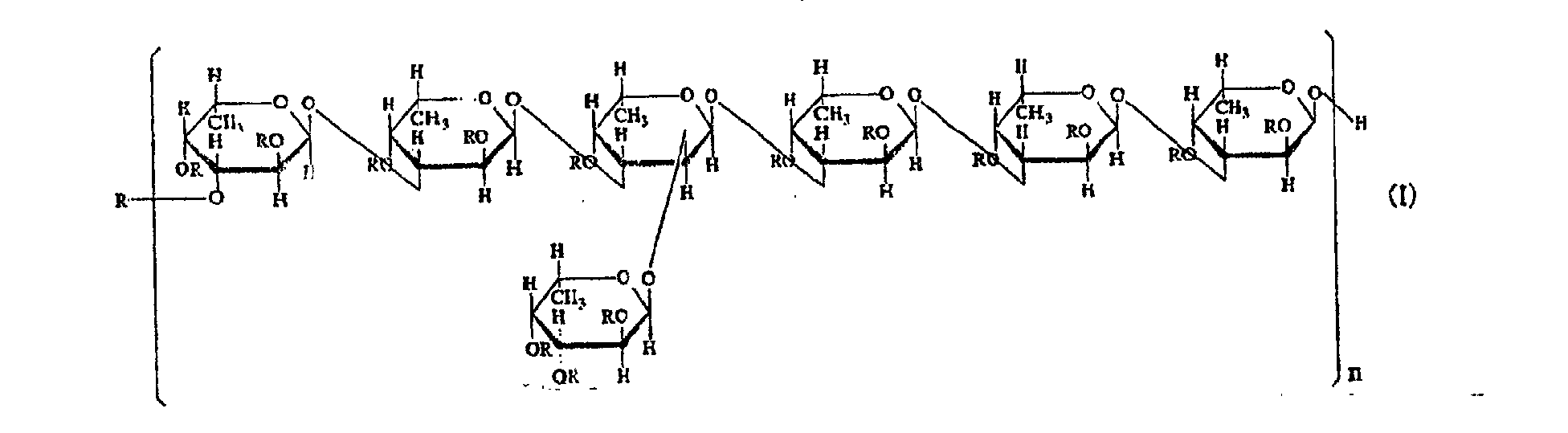
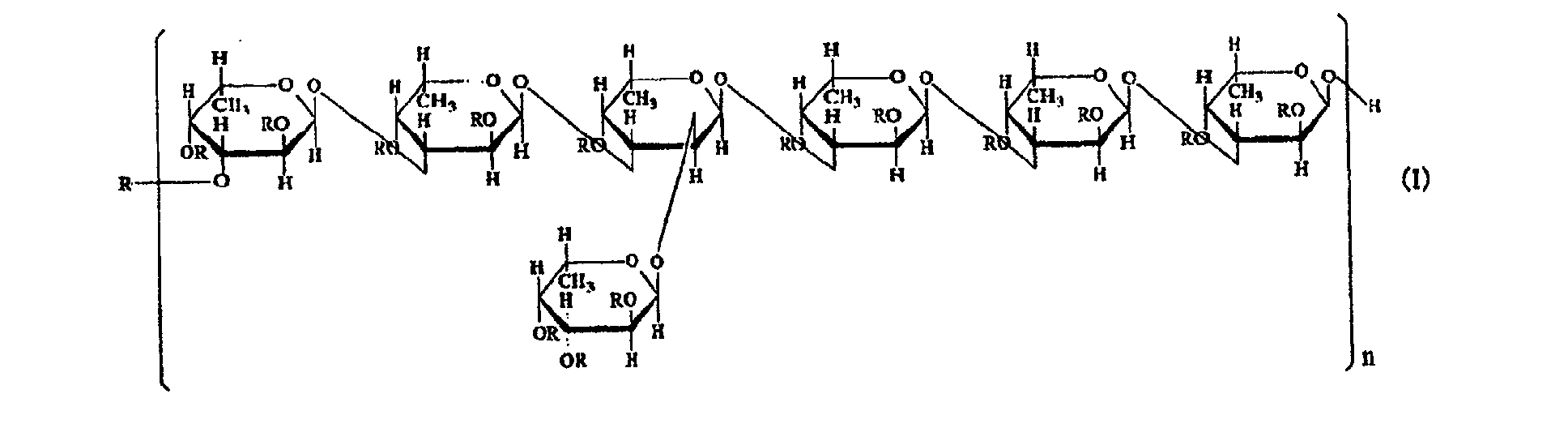
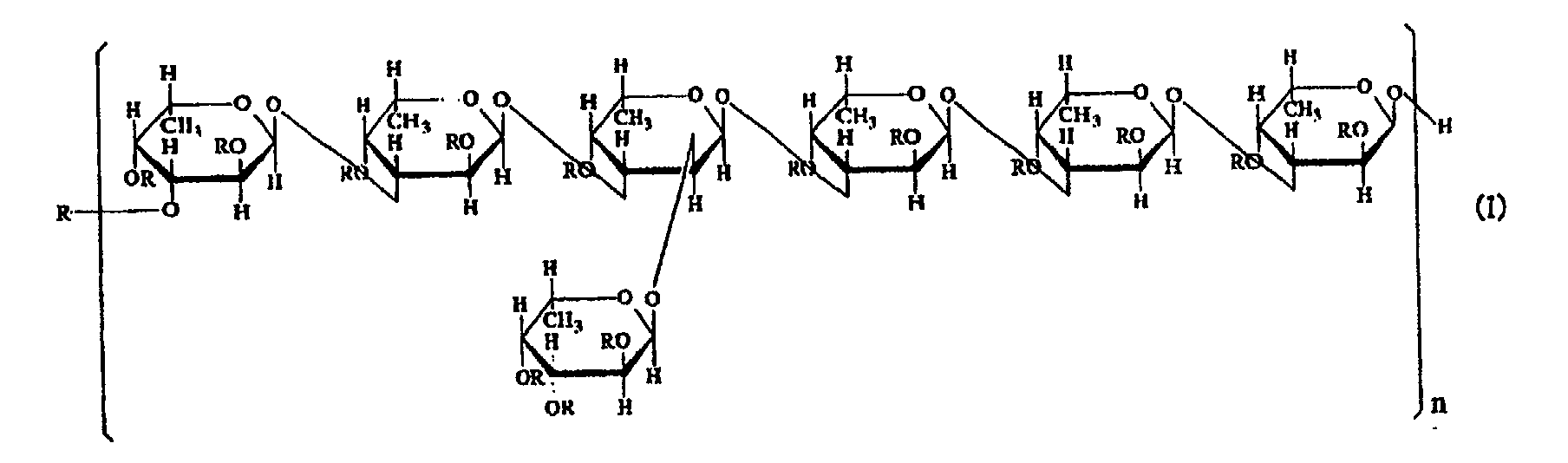
- the second aspect of the present invention relates to a sulfated fucan oligosaccharide of general formula (I): wherein R is H or SO 3 H, at least one of Rs is SO 3 H and n is 1 to 5.
- the third aspect of the present invention relates to a method for preparing a sulfated fucan oligosaccharide, the method comprising:
- the sulfated fucan is derived from Kjellmaniella crassifolia , Laminaria japonica or Lessonia nigrescens.
- the fourth aspect of the present invention relates to a sulfated fucan oligosaccharide obtainable by the preparation method of the third aspect.
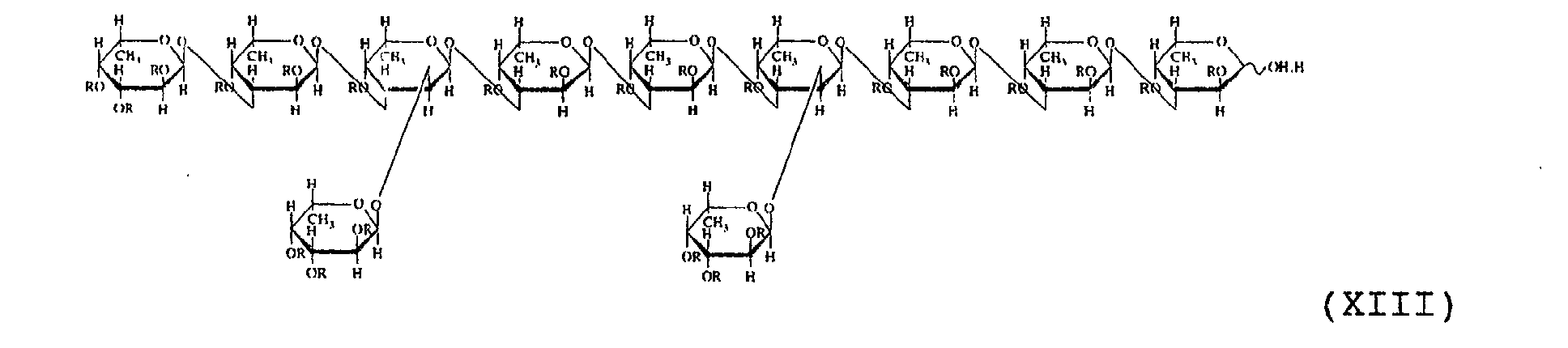
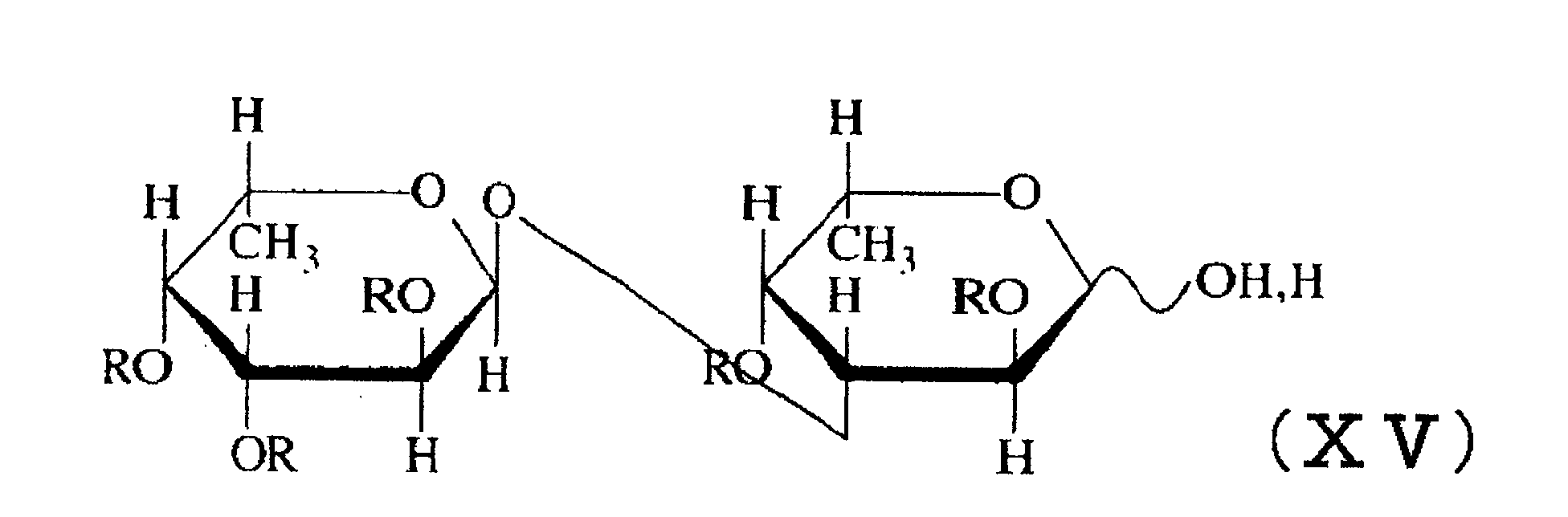
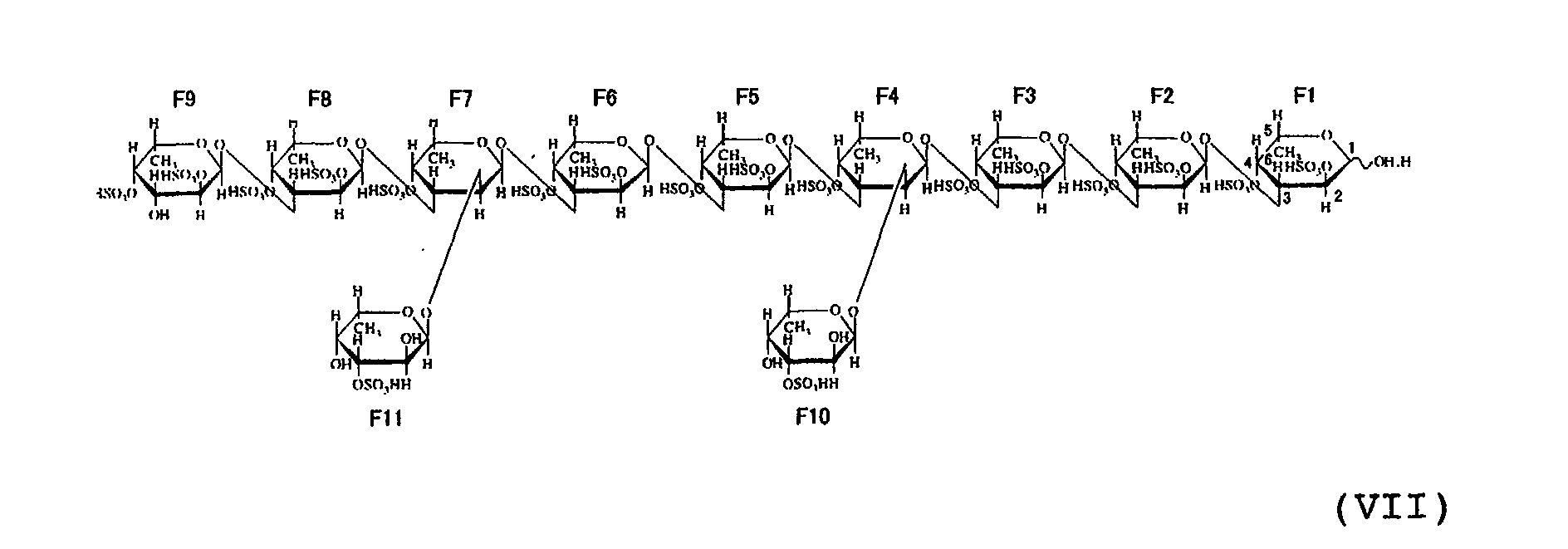
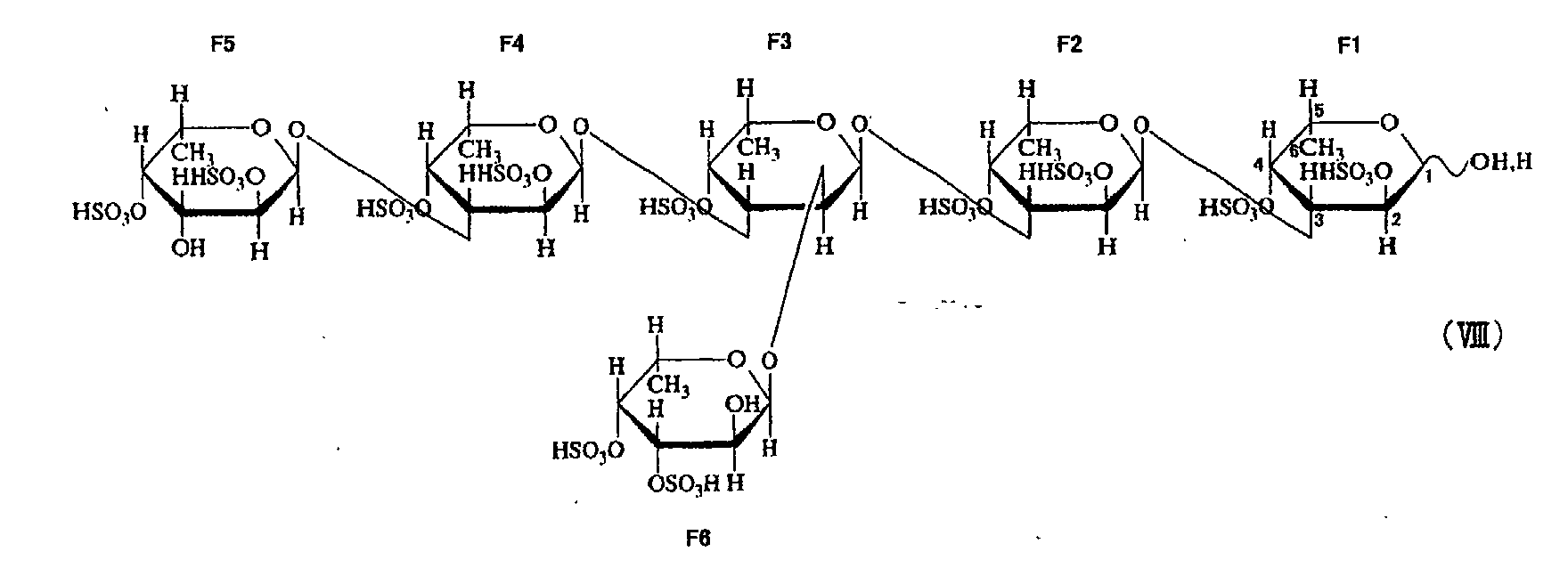
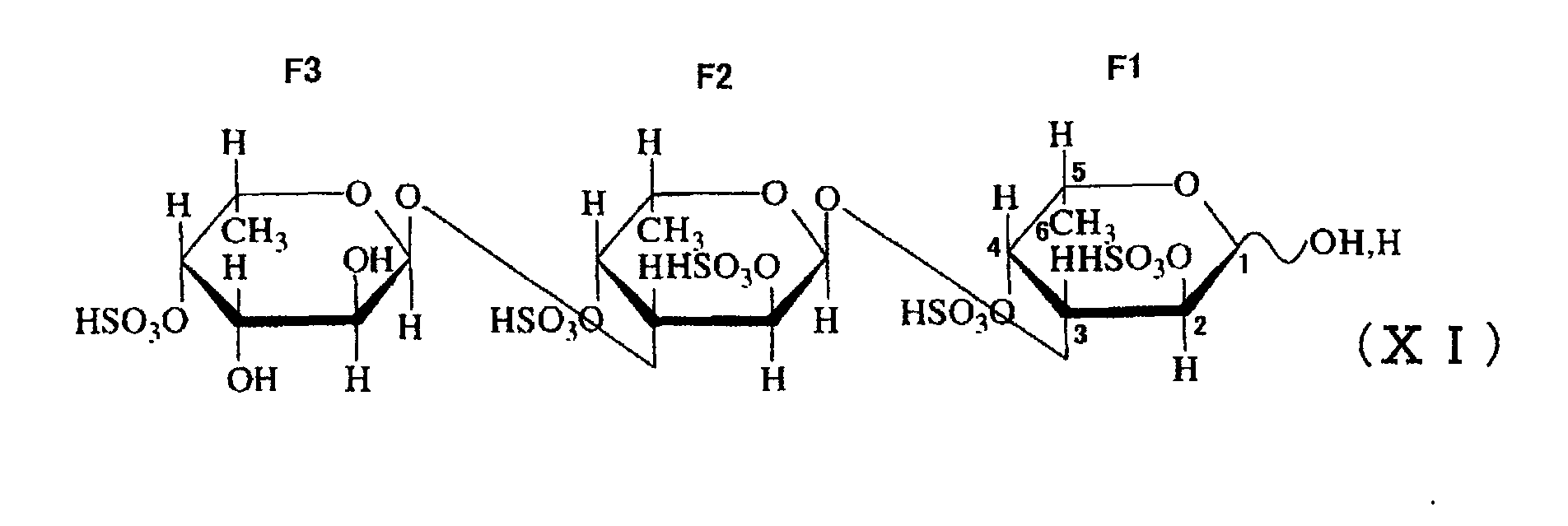
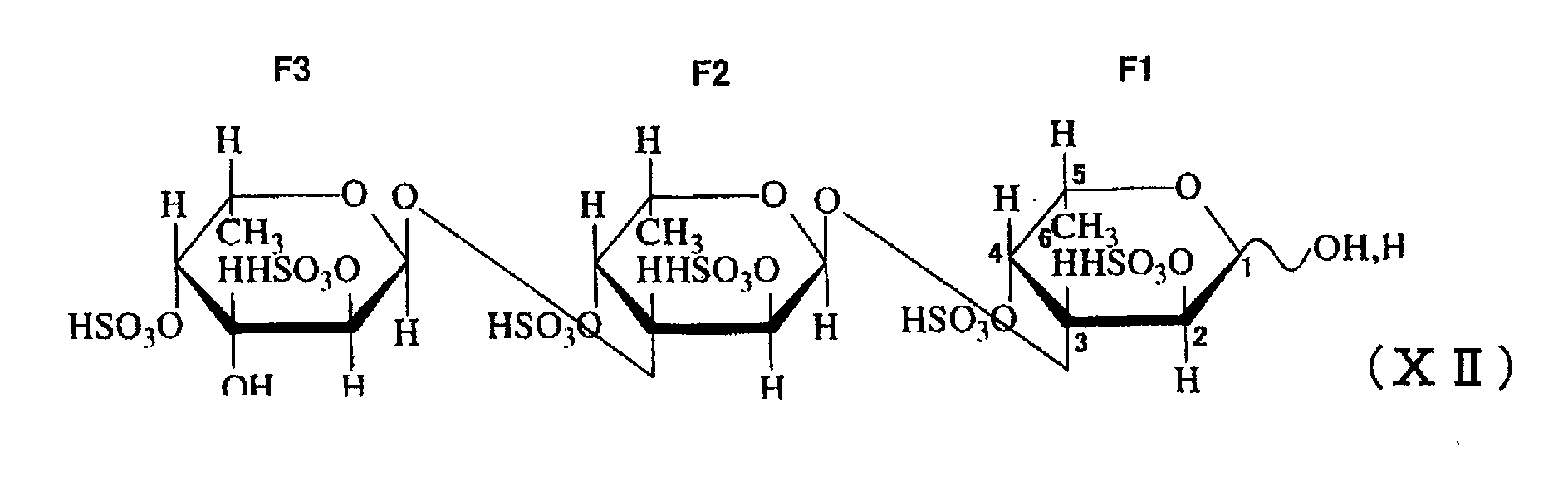
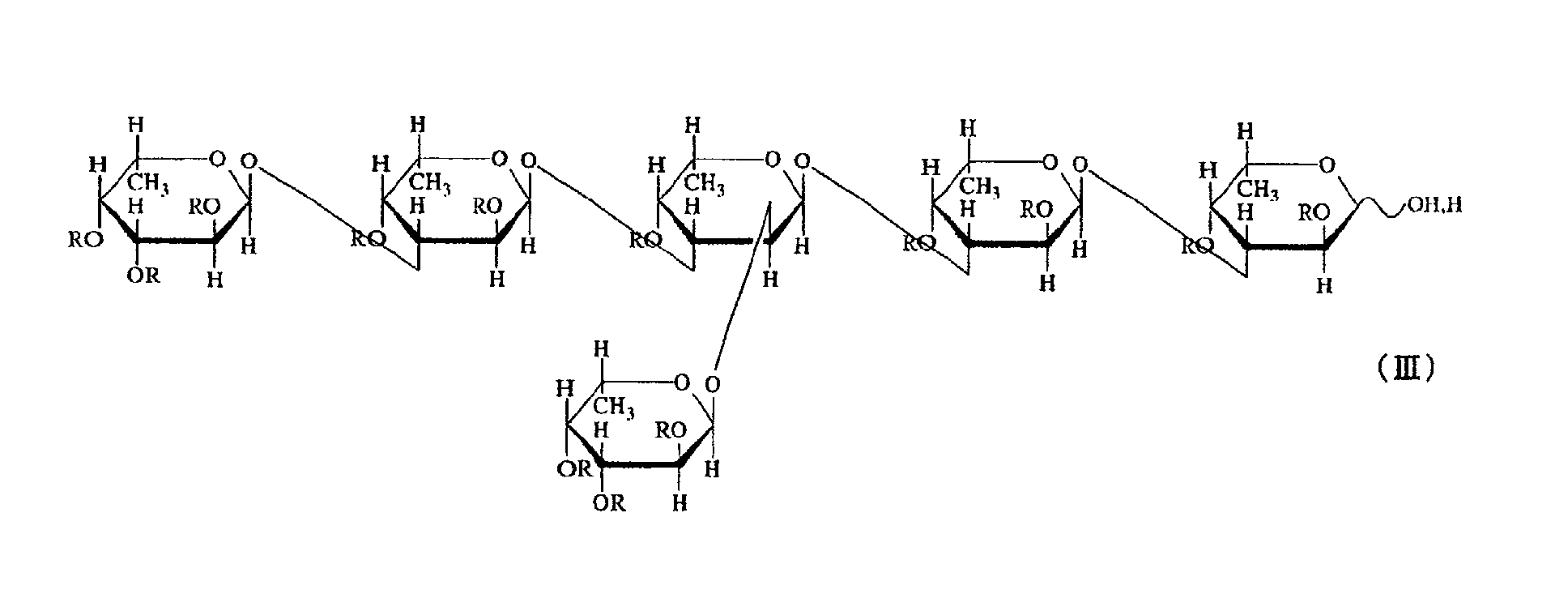
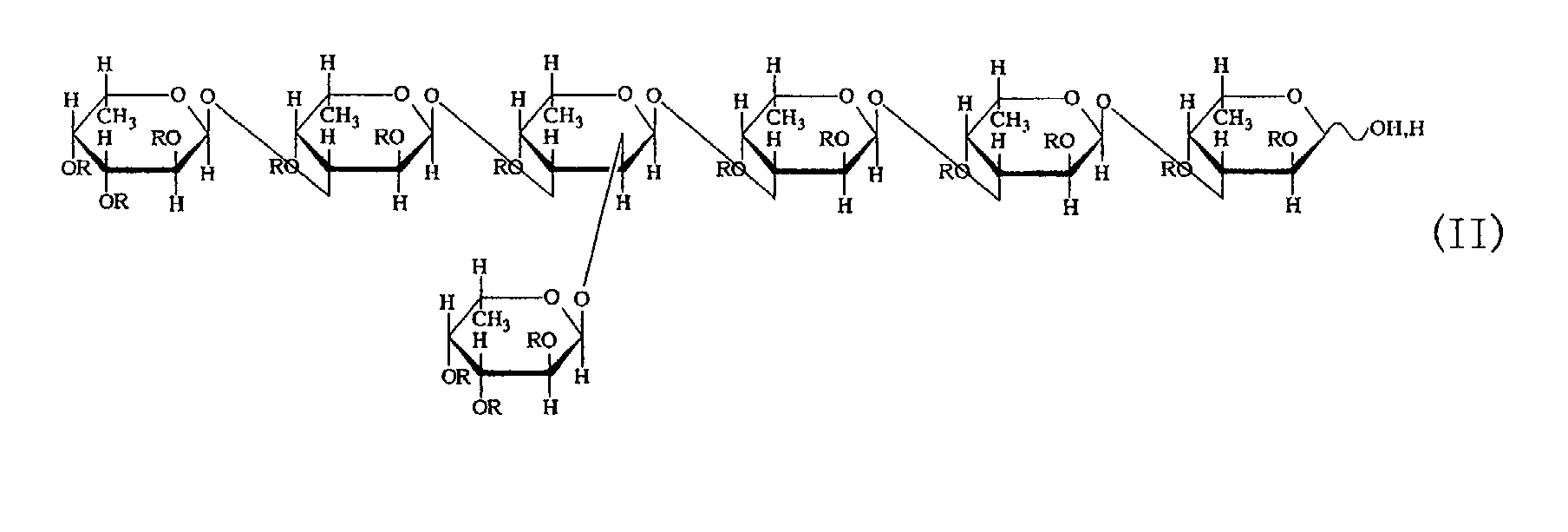
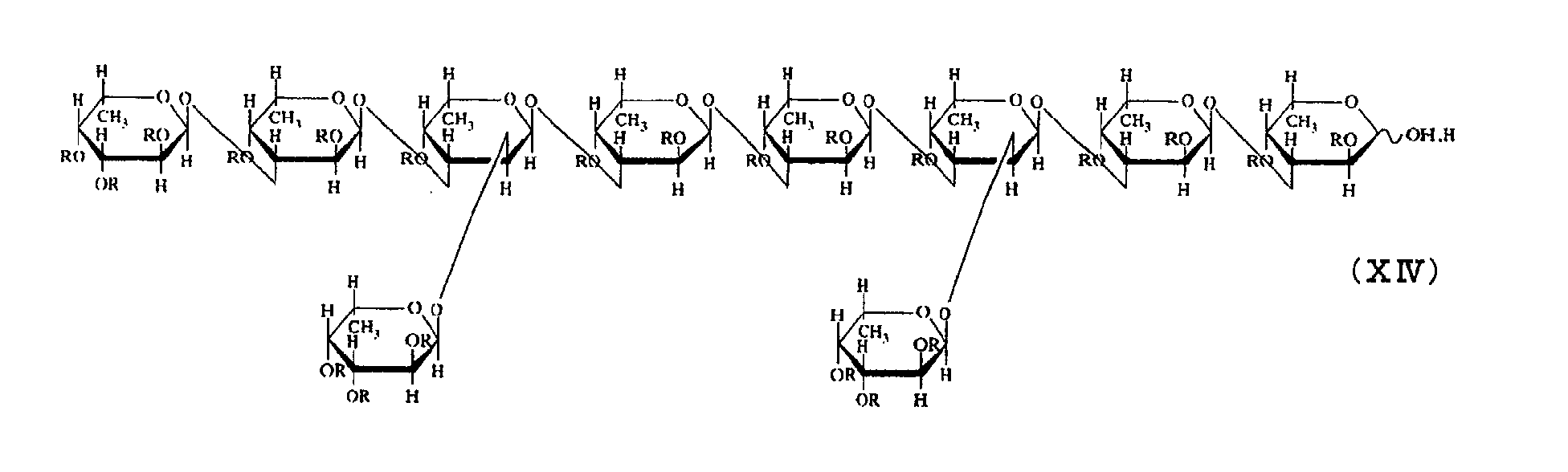
- the fifth aspect of the present invention relates to a sulfated fucan oligosaccharide having a chemical structure selected from the group consisting of general formulas (II), (III), (XIII), (XIV), (XV) and (XVI): and wherein R is H or SO 3 H and at least one of Rs is SO 3 H in all formulas above, or a salt thereof.
- the present inventors have found a method for producing a sulfated fucan oligosaccharide by digesting a novel sulfated polysaccharide derived from a alga belonging to Laminariales using a sulfated fucan-digesting enzyme.
- the sulfated fucan oligosaccharide can be utilized as a reagent for glycotechnology and is structurally homogeneous.
- the present inventors have determined the structure of the oligosaccharide. Thus, the present invention has been completed.
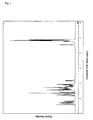
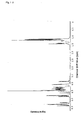
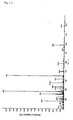
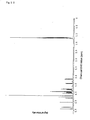
- Figure 1 a figure which illustrates the 1 H-NMR spectrum of the sulfated fucan oligosaccharide 1-(1) according to the present invention.
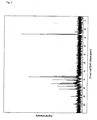
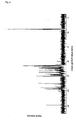
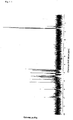
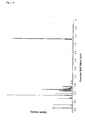
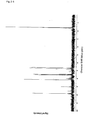
- Figure 2 a figure which illustrates the 13 C-NMR spectrum of the sulfated fucan oligosaccharide 1-(1) according to the present invention.
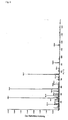
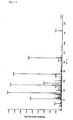
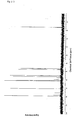
- Figure 3 a figure which illustrates the mass spectrum of the sulfated fucan oligosaccharide 1-(1) according to the present invention.
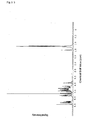
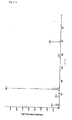
- Figure 4 a figure which illustrates the 1 H-NMR spectrum of the sulfated fucan oligosaccharide 1-(2) according to the present invention.
- Figure 5 a figure which illustrates the 13 C-NMR spectrum of the sulfated fucan oligosaccharide 1-(2) according to the present invention.
- Figure 6 a figure which illustrates the mass spectrum of the sulfated fucan oligosaccharide 1-(2) according to the present invention.
- Figure 7 a figure which illustrates the 1 H-NMR spectrum of the sulfated fucan oligosaccharide 1-(3) according to the present invention.
- Figure 8 a figure which illustrates the 13 C-NMR spectrum of the sulfated fucan oligosaccharide 1-(3) according to the present invention.
- Figure 9 a figure which illustrates the mass spectrum of the sulfated fucan oligosaccharide 1-(3) according to the present invention.
- Figure 10 a figure which illustrates the 1 H-NMR spectrum of the sulfated fucan oligosaccharide 1-(4) according to the present invention.
- Figure 11 a figure which illustrates the 13 C-NMR spectrum of the sulfated fucan oligosaccharide 1-(4) according to the present invention.
- Figure 12 a figure which illustrates the mass spectrum of the sulfated fucan oligosaccharide 1-(4) according to the present invention.
- Figure 13 a figure which illustrates the 1 H-NMR spectrum of the sulfated fucan oligosaccharide 2-(1)-2 according to the present invention.
- Figure 14 a figure which illustrates the 13 C-NMR spectrum of the sulfated fucan oligosaccharide 2-(1)-2 according to the present invention.
- Figure 15 a figure which illustrates the mass spectrum of the sulfated fucan oligosaccharide 2-(1)-2 according to the present invention.
- Figure 16 a figure which illustrates the 1 H-NMR spectrum of the sulfated fucan oligosaccharide 2-(2) according to the present invention.
- Figure 17 a figure which illustrates the 13 C-NMR spectrum of the sulfated fucan oligosaccharide 2-(2) according to the present invention.
- Figure 18 a figure which illustrates the mass spectrum of the sulfated fucan oligosaccharide 2-(2) according to the present invention.
- Figure 19 a figure which illustrates the 1 H-NMR spectrum of the Lessonia nigrescens sulfated fucan oligosaccharide 1-(1) according to the present invention.
- Figure 20 a figure which illustrates the 13 C-NMR spectrum of the Lessonia nigrescens sulfated fucan oligosaccharide 1-(1) according to the present invention.
- Figure 21 a figure which illustrates the mass spectrum of the Lessonia nigrescens sulfated fucan oligosaccharide 1-(1) according to the present invention.
- Figure 22 a figure which illustrates the 1 H-NMR spectrum of the Lessonia nigrescens sulfated fucan oligosaccharide 1-(2) according to the present invention.
- Figure 23 a figure which illustrates the 13 C-NMR spectrum of the Lessonia nigrescens sulfated fucan oligosaccharide 1-(2) according to the present invention.
- Figure 24 a figure which illustrates the mass spectrum of the Lessonia nigrescens sulfated fucan oligosaccharide 1-(2) according to the present invention.
- Figure 25 a figure which illustrates the 1 H-NMR spectrum of the Lessonia nigrescens sulfated fucan oligosaccharide 1-(3) according to the present invention.
- Figure 26 a figure which illustrates the 13 C-NMR spectrum of the Lessonia nigrescens sulfated fucan oligosaccharide 1-(3) according to the present invention.
- Figure 27 a figure which illustrates the mass spectrum of the Lessonia nigrescens sulfated fucan oligosaccharide 1-(3) according to the present invention.
- a sulfated fucan derived from an alga belonging to Laminariales can be used according to the present invention.
- This polysaccharide has a sulfate group and fucose as main constituents.
- the main chain of a sulfated fucan derived from an alga belonging to Laminariales is composed of L-fucose which is more acid-labile than general saccharides. Therefore, it can be readily converted into smaller molecules by heating or acid treatment.
- a sulfated fucan having the above-mentioned characteristics can be used according to the present invention.
- algae belonging to Laminariales such as Kjellmaniella crassifolia , Laminaria japonica and Lessonia nigrescens are preferably used as raw materials because their sulfated fucan contents are high.
- the sulfated fucan-digesting enzyme acts on a sulfated fucan, a sulfated fucan oligosaccharide and the like and hydrolyzes an ⁇ -L-fucosyl bond between fucoses in an endo-type manner to generate an oligosaccharide having L-fucose at its reducing end.
- the sulfated fucan oligosaccharide of the present invention is an oligosaccharide that is obtainable by allowing the sulfated fucan-digesting enzyme according to the present invention to act on a sulfated fucan and has L-fucose as a saccharide at the reducing end.
- a water-soluble fraction extract is first obtained from a brown alga in order to produce the sulfated fucan used according to the present invention.
- amino acids, small molecule pigments or the like in the extract can be efficiently removed by ultrafiltration.
- Activated carbon treatment or the like is effective for the removal of hydrophobic substances.
- a sulfated polysaccharide fraction from a brown alga can be obtained as described above.
- This fraction can be used as a sulfated fucan fraction, for example, as a substrate for the sulfated fucan-digesting enzyme according to the present invention.
- a more highly pure sulfated fucan can be obtained by separating the fraction using an anion exchange column. Both the sulfated polysaccharide fraction and the sulfated fucan purified using an anion exchange column can be used as raw materials for production of the sulfated fucan oligosaccharide of the present invention.
- the main backbone of the sulfated fucan of the present invention is represented by general formula (I) below.
- the sulfated fucans of the present invention include those of the general formula wherein n is an integer of 1 or more, for example 1 to 20,000, preferably 1 to 10,000.
- the sulfated fucans of the present invention include those having a structure in which general formula (I) is continuously repeated and those having a structure in which general formula (I) is discontinuously included being intervened by other structures as long as they are within the definition as described above. wherein R is H or SO 3 H, and at least one of Rs is SO 3 H.;
- the bacterial strain producing the sulfated fucan-digesting enzyme to be used according to the present invention is classified as a bacterium belonging to genus Alteromonas according to the basic classification as described in Bergey's Manual of Determinative Bacteriology, Vol. 9 (1994). Classification of bacteria belonging to genus Alteromonas is recently re-organized. Therefore, it is not appropriate to classify the bacterium based only on the bacteriological properties. The nucleotide sequence of 16S rDNA of this bacterial strain was determined. Comparison of homologies with sequences of known bacteria revealed that a bacterium belonging to genus Thalassomonas has the most homologous sequence.
- the genetic distance is 0.05 (change/average nucleotide position) or more, the bacterium was not determined to belong to this genus. Then, the present inventors concluded that this bacterium does not belong to known genera but belongs to a novel genus based on the 16S rDNA sequence homology, and designated it as Fucanobacter lyticus SN-1009. As used herein, Alteromonas sp. SN-1009 is the same as Fucanobacter lyticus SN-1009.
- This bacterial strain is designated as Alteromonas sp. SN-1009 and deposited on February 13, 1996 (date of original deposit) at International Patent Organism Depositary, National Institute of Advanced Industrial Science and Technology, AIST Tsukuba Central 6, 1-1, Higashi 1-Chome, Tsukuba-shi, Ibaraki-ken 305-8566, Japan. under accession number FERM BP-5747 (transmitted to international depositary authority under Budapest Treaty on November 15, 1996).
- the 16S rDNA sequence of this bacterial strain is shown in SEQ ID NO:1.
- the sulfated fucan-digesting enzyme used according to the present invention can be produced by culturing a bacterium that is determined to belong to the same genus as Fucanobacter lyticus SN-1009 based on the 16S rDNA sequence.
- a bacterium that is determined to belong to the same genus as Fucanobacter lyticus SN-1009 based on the 16S rDNA sequence.
- Alteromonas sp. SN-1009, a spontaneous or artificial mutant of Alteromonas sp. SN-1009 and microorganisms belonging to genus Alteromonas and genus Fucanobacter capable of producing the sulfated fucan-digesting enzyme used according to the present invention can be utilized.
- the sulfated fucan-digesting enzyme to be used according to the present invention can be obtained from the above-mentioned microorganism according to the method as described in Example 1.
- the sulfated fucan oligosaccharide of the present invention can be prepared by allowing a sulfated fucan-digesting enzyme to act on a sulfated fucan-containing material.
- a partially purified preparation of sulfated fucan, a sulfated fucose-containing polysaccharide fraction derived from a brown alga, a product obtained by extracting a brown alga with an aqueous solvent, or a brown alga itself can be preferably used as a sulfated fucan-containing material.
- a sulfated fucan or a sulfated fucan-containing material may be dissolved according to a conventional method.
- the sulfated fucan of the present invention or the sulfated fucan-containing material may be dissolved in the solution at the maximal concentration.
- the concentration is usually selected taking its operationality and the amount of the sulfated fucan-digesting enzyme according to the present invention used in a reaction into consideration.
- the solvent for the sulfated fucan may be selected from water, buffers and the like depending on the objects. Usually, the pH of the solution is nearly neutral.
- the enzymatic reaction is usually carried out at about 30°C.
- the molecular weight of the sulfated fucan oligosaccharide can be controlled by adjusting the ratio or amount of the sulfated fucan-digesting enzyme according to the present invention used in the reaction, the composition of the reaction mixture, the reaction time and the like.
- the sulfated fucan oligosaccharide of the present invention having more homogeneous molecular weight distribution or more homogeneous charge density distribution can be prepared by subjecting the sulfated fucan oligosaccharide of the present invention obtained as described above to molecular weight fractionation or fractionation using an anion exchange column.
- a conventional means for molecular weight fractionation can be applied. For example, gel filtration or molecular weight fractionation membrane may be used.
- the smaller molecules may be further purified using ion-exchange resin treatment, active carbon treatment or the like, or they may be desalted, sterilized or lyophilized.
- the sulfated fucan oligosaccharide of the present invention having a structure so homogeneous that one can determine the structure by NMR analysis as described below can be obtained.
- the sulfated fucan oligosaccharides of the present invention have sulfate groups within the molecules, which groups react with various bases to form salts.
- the sulfated fucan oligosaccharide of the present invention is stable when it is in a form of salt. It is usually provided in a form of sodium and/or potassium and/or calcium salt.
- the sulfated fucan oligosaccharide of the present invention in a free form can be derived from a salt thereof by utilizing cation-exchange resin such as Dowex 50W. Optionally, it can be subjected to conventional salt-exchange to convert it into any one of various desirable salts.
- salts of the sulfated fucan oligosaccharide of the present invention can be used as the salts of the sulfated fucan oligosaccharide of the present invention.
- the salts include salts with alkaline metals such as sodium and potassium and alkaline earth metals such as calcium, magnesium and zinc as well as ammonium salts.
- the sulfated fucan oligosaccharide of the present invention can be used as a reagent for glycotechnology.
- a substance which is very useful as a reagent for glycotechnology e.g., which can be used as a fluorescence-labeled standard for the sulfated fucan oligosaccharide
- PA 2-aminopyridine
- the molecular weights of the oligosaccharides of sulfated fucan are their average molecular weights that were calculated from the results of mass analyses of them.
- the mixture was stirred at 25°C for 20 hours, and then centrifuged.
- the supernatant was concentrated to 4 L using an ultrafiltration device equipped with hollow fibers with exclusion molecular weight of 100,000, centrifuged to remove insoluble substances and allowed to stand at 5°C for 24 hours.
- the formed precipitate was removed by centrifugation.
- the supernatant was subjected to solvent exchange for 100 mM sodium chloride using an ultrafiltration device.
- the solution was cooled to 4°C or below, and the pH was adjusted to 2.0 with hydrochloric acid.
- the formed precipitate was removed by centrifugation.
- the pH of the supernatant was adjusted to 8.0 with sodium hydroxide.
- the supernatant was concentrated to 4 L.
- the concentrate was subjected to solvent exchange for 20 mM sodium chloride using an ultrafiltration device. Insoluble substances in the solution were removed by centrifugation. The supernatant was then lyophilized to obtain 76 g of a dried fucoidan preparation from Kjellmaniella crassifolia.
- the total sugar content and the uronic acid content of each fraction were measured according to the phenol-sulfuric acid method and the carbazole-sulfuric acid method, respectively.
- the fractions 43-49, 50-55 and 56-67 were combined, desalted by electrodialysis and lyophilized. 340 mg, 870 mg and 2.64 g of dried products were obtained from the fractions 43-49, 50-55 and 56-67, respectively.
- the fraction obtained from the fractions 56-67 was used as a sulfated fucan fraction.
- a reaction mixture obtained by a reaction in which the buffer used for dissolving the sulfated fucan-digesting enzyme solution was used in place of the digesting enzyme solution and a reaction mixture obtained by a reaction in which water was used in place of the sulfated fucan fraction were similarly analyzed using HPLC.
- One unit of an activity of sulfated fucan-digesting enzyme is defined as an amount of an enzyme that cleaves fucosyl bonds in 1 ⁇ mol of a sulfated fucan in 1 minute in the above-mentioned reaction system.
- the HPLC was carried out as follows:
- Example 1 Preparation of sulfated fucan-digesting enzyme
- Fucanobacter lyticus SN-1009 was inoculated into 4 ml of a medium consisting of artificial seawater (Jamarine Laboratory) (pH 8.2) containing 0.2% fucoidan prepared as described in Referential Example 1 and 0.3% peptone which had been autoclaved at 120°C for 20 minutes, and cultured at 25°C for 24 hours to prepare a seed culture.
- a medium consisting of artificial seawater (Jamarine Laboratory) (pH 8.2) containing 0.2% fucoidan prepared as described in Referential Example 1 and 0.3% peptone which had been autoclaved at 120°C for 20 minutes, and cultured at 25°C for 24 hours to prepare a seed culture.
- the seed culture was inoculated into 600 ml of a medium consisting of artificial seawater (pH 8.2) containing 0.25% glucose, 1% peptone, 0.05% yeast extract and antifoaming agent (KM70, Shin-Etsu Chemical) in a 2-L Erlenmeyer flask which had been autoclaved at 120°C for 20 minutes, and cultured at 25°C for 20 hours.
- a medium consisting of artificial seawater (pH 8.2) containing 0.25% glucose, 1% peptone, 0.05% yeast extract and antifoaming agent (KM70, Shin-Etsu Chemical) in a 2-L Erlenmeyer flask which had been autoclaved at 120°C for 20 minutes, and cultured at 25°C for 20 hours.
- the culture supernatant was concentrated using an ultrafiltration device equipped with hollow fibers with exclusion molecular weight of 10,000.
- the concentrate was subjected to solvent exchange for 20 mM Tris-hydrochloride buffer (pH 8.2) containing 10 mM calcium chloride and 150 mM sodium chloride and centrifuged to obtain a supernatant.
- the supernatant was loaded onto a 2-L DEAE-Cellulofine A-800 column equilibrated with the same buffer. After washing with the same buffer, elution was then carried out with a gradient of 150 mM to 400 mM sodium chloride such that each fraction contained 63 ml of the eluate to collect an active fraction.
- the active fraction was concentrated using an ultrafiltration device equipped with hollow fibers with exclusion molecular weight of 10,000.
- the concentrate was subjected to solvent exchange for 20 mM Tris-hydrochloride buffer (pH 8.2) containing 10 mM calcium chloride and 100 mM sodium chloride.
- the enzyme solution was loaded onto a 200-ml DEAE-Cellulofine A-800 column equilibrated with the same buffer. After washing with the same buffer, elution was then carried out with a gradient of 100 mM to 300 mM sodium chloride such that each fraction contained 19 ml of the eluate to collect an active fraction.
- the active fraction was concentrated using an ultrafiltration device equipped with an ultrafiltration membrane with exclusion molecular weight of 10,000.
- Sodium chloride at a final concentration of 4 M was added thereto.
- the solution was loaded onto a Phenyl-Sepharose CL-4B column equilibrated with 20 mM Tris-hydrochloride buffer (pH 8.0) containing 100 mM calcium chloride and 4 M sodium chloride. After washing with the same buffer, elution was then carried out with a gradient of 4 M to 1 M sodium chloride such that each fraction contained 9.4 ml of the eluate. Thus, a purified preparation of sulfated fucan-digesting enzyme was obtained.
- Example 2 Preparation of sulfated fucan oligosaccharide using sulfated fucan-digesting enzyme, and purification and structural analysis thereof
- sulfated fucan oligosaccharide fraction 1 200 g of dried cultured Kjellmaniella crassifolia was soaked in 10 L of 18 mM imidazole-hydrochloride buffer (pH 7.0) containing 45 mM calcium chloride, 500 mM sodium chloride and 9% ethanol. 30 U of the sulfated fucan-digesting enzyme was added thereto. The mixture was stirred at room temperature for 2 days and filtered through a filter paper. A small molecule fraction recovered from the filtrate using an ultrafiltration device equipped with hollow fibers with exclusion molecular weight of 100,000 was designated as a sulfated fucan oligosaccharide fraction 1.
- the sulfated fucan oligosaccharide fraction 1 obtained in Example 2-(1) was desalted using a desalting apparatus (Micro Acilyzer G3, Asahi Kasei) and concentrated using a rotary evaporator. Imidazole and sodium chloride were added to the sulfated fucan oligosaccharide solution 1 at final concentrations of 10 mM and 300 mM, respectively. The resulting mixture was loaded onto a 1-L DEAE-Cellulofine A-800 column equilibrated with 10 mM imidazole-hydrochloride buffer (pH 6.0) containing 300 mM sodium chloride.
- the sulfated fucan oligosaccharides 1-(1) to 1-(4) of the present invention obtained in Example 2-(2) were subjected to analyses of saccharides at the reducing ends and saccharide compositions according to a fluorescence labeling method using 2-aminopyridine. As a result, the saccharide at the reducing end of and the sole saccharide constituting each of the oligosaccharides 1-(1) to 1-(4) were determined to be fucose.
- Example 3 Preparation of sulfated fucan oligosaccharide using sulfated fucan-digesting enzyme, and purification and structural analysis thereof
- Chips were prepared from dried cultured Kjellmaniella crassifolia using a cutter mill (Masuko Sangyo) equipped with a screen having a pore diameter of 1 mm. 250 g of the Kjellmaniella crassifolia chips were suspended in 5 L of 80% ethanol. The suspension was stirred at room temperature for 2 hours and filtered. The washing in 80% ethanol was repeated four times to obtain washed Kjellmaniella crassifolia chips. 250 g of the washed chips were suspended in 5 L of 17 mM imidazole-hydrochloride buffer (pH 7.5) containing 125 mM calcium chloride, 250 mM sodium chloride and 10% ethanol.
- the suspension was stirred at room temperature for 24 hours, filtered and centrifuged to obtain a Kjellmaniella crassifolia fucoidan solution.
- 10 U of the sulfated fucan-digesting enzyme was added to 1 L of the extract.
- the resulting mixture was stirred at room temperature for three days, and then filtered through a filter paper.
- a supernatant was obtained by centrifuging the filtrate.
- a small molecule fraction recovered from the supernatant using an ultrafiltration device equipped with hollow fibers with exclusion molecular weight of 10,000 was designated as a sulfated fucan oligosaccharide fraction 2.
- the sulfated fucan oligosaccharide fraction 2 obtained in Example 3-(1) was loaded onto a 1-L DEAE-Cellulofine A-800 column equilibrated with 10 mM imidazole-hydrochloride buffer (pH 6.5) containing 100 mM sodium chloride. After adequately washing with the same buffer, elution was then carried out with a gradient of 100 mM to 1 M sodium chloride. The total sugar content and the total uronic acid content of each of the eluted fractions were measured according to the phenol-sulfuric acid method and the carbazole-sulfuric acid method, respectively. As a result, the eluted fractions formed two peaks.
- Fractions obtained by YMC Pack Polyamine II column chromatography were subjected to mass spectrometric analyses, and substances having masses of 1914 and 2016 from peak number 2-(1), and a substance having a mass of 3110 from peak number 2-(2) were obtained as their main peaks.
- the sulfated fucan oligosaccharides 2-(1)-1, 2-(1)-2, and 2-(2) of the present invention obtained in Example 3-(2) were subjected to analyses of the reducing terminal sugar and component sugar according to a fluorescence labeling method using 2-aminopyridine. As a result, the reducing terminal and the component sugar of them were only fucose. Next, their sulfate content (by the turbidimetric method using barium chloride) and their uronic acid content (by the carbazole-sulfuric acid method) were determined. NMR analyses of them using a nuclear magnetic resonance apparatus JNM ⁇ -500 (Nippon Denshi) were also carried out.
- the linkages among the constituting saccharides were analyzed using the HMBC method, a method for 1 H-detection of heteronuclei.
- the DQF-COSY method and the HOHAHA method were used for the assignment of 1 H-NMR data, and the HSQC method was used for the assignment of 13 C-NMR data.
- Example 4 The preparation of Laminaria japonica sulfated fucan oligosaccharides using sulfated fucan-digesting enzyme, their purification, and their structural analyses
- Laminaria japonica Dried cultured Laminaria japonica was disrupted into chips using a cutter mill (Masuko Sangyo) equipped with a screen having a pore diameter of 1 mm. Five hundred grams of Laminaria japonica chips were suspended in 4.5 L of 80% ethanol, stirred at room temperature for 24 hours, and filtered. The residue was washed with 80% ethanol for three times by the same method as described above, and the washed Laminaria japonica chips were obtained.
- a cutter mill Mosuko Sangyo
- the conductivity of the solution of the Laminaria japonica sulfated fucan oligosaccharide fraction 1 obtained in Example 4-(1) was adjusted by adding 10% ethanol to the same conductivity of the equilibration buffer described below, and it was applied to 500 ml of DEAE-Cellulofine A-800 column equilibrated with 20 mM imidazole-HCl buffer (pH 6.5) containing 200 mM sodium chloride and 10% ethanol, then the column was washed with the same buffer, and eluted with a linear gradient of sodium chloride from 200 mM to 1.2 M. For the elution, 4.5 L of the buffer was used, and fractions of 50 ml were collected.
- the total sugar content and the total uronic acid content of each of the eluted fractions were measured by the phenol-sulfuric acid method and carbazole-sulfuric acid method, respectively. As a result, the eluted fractions formed 3 peaks. Fractions around the second peak (44-48) were pooled, concentrated to 40 ml by evaporator, applied to Cellulofine GCL-25 column (4.1 x 90 cm) equilibrated with 10% ethanol, and eluted with 10% ethanol. The total sugar of each of the eluted fractions was determined by phenol-sulfuric acid method.
- Fractions obtained by the column chromatography shown above (3 times, fraction number around 50-59) were pooled, dialyzed against 10% ethanol using a dialysis tube of which the exclusion molecular weight is 3,500, concentrated to about 40 ml by evaporator, applied to Cellulofine GCL-25 column equilibrated with 10% ethanol, and eluted with 10% ethanol.
- the total sugar of each of the eluted fractions was determined by the phenol-sulfuric acid method.
- the fractions around the main peak were pooled and purified again by Cellulofine GCL-25 as described above.
- the fractions around the main peak of these eluted fractions were pooled, concentrated by Speed Vac, and lyophilized. Thus Laminaria japonica sulfated fucan oligosaccharide 1 was obtained.
- Example 2 By the structural analyses of the oligosaccharide as shown in Example 2, the structure of Laminaria japonica sulfated fucan oligosaccharide 1 was determined to be the same structure as the sulfated fucan oligosaccharide 1-(3) shown in Example 2.
- Example 5 Preparation, purification, and structural analyses of Lessonia nigrescence sulfated fucan oligosaccharide
- the total sugar content and the total uronic acid content of each of the eluted fractions were measured by the phenol-sulfuric acid method and carbazole-sulfuric acid method, respectively. As a result, the eluted fractions formed 7 peaks. Fractions around the each peak were pooled separately, concentrated to 40 ml by evaporator (they are designated as Lessonia nigrescens sulfated fucan oligosaccharides 1-(1) to 1-(7)), applied to Cellulofine GCL-25 column (4.1 x 90 cm) equilibrated with 10% ethanol, and eluted with 10% ethanol. The total sugar of each of the eluted fractions was determined by phenol-sulfuric acid method.
- the total sugar of each of the eluted fractions was determined by the phenol-sulfuric acid method.
- the fractions around the main peak were pooled and purified again by Cellulofine GCL-25 as described above.
- Lessonia nigrescens sulfated fucan oligosaccharide 1-(7) two main peaks were observed, therefore, the two peaks were designated as Lessonia nigrescens sulfated fucan oligosaccharides 1-(7)-1 and 1-(7)-2.
- Example 2 By the structural analyses of the oligosaccharide as shown in Example 2, the structure of Lessonia nigrescens sulfated fucan oligosaccharide 1-(4) was determined to be the same structure as the sulfated fucan oligosaccharide 1-(2) shown in Example 2.
- Example 2 By the structural analyses of the oligosaccharide as shown in Example 2, the structure of Lessonia nigrescens sulfated fucan oligosaccharide 1-(5) was determined to be the same structure as the sulfated fucan oligosaccharide 1-(3) shown in Example 2.
- Example 6 Preparation of sulfated fucan oligosaccharide using sulfated fucan-digesting enzyme, and purification and structural analysis thereof
- the sulfated fucan oligosaccharide fraction 3 obtained in (1) above was loaded onto a 1-L DEAE-Cellulofine A-800 column equilibrated with 10 mM imidazole-hydrochloride buffer (pH 6.5) containing 100 mM sodium chloride. After adequately washing with the same buffer, elution was then carried out with a gradient of 100 mM to 1 M sodium chloride. The total sugar content and the total uronic acid content of each of the eluted fractions were measured according to the phenol-sulfuric acid method and the carbazole-sulfuric acid method, respectively. As a result, the eluted fractions formed two peaks.
- the sulfated fucan oligosaccharide fraction 3 contained various sulfated fucan oligosaccharides as shown in the table above.
- Example 7 Preparation of sulfated fucan oligosaccharide using sulfated fucan-digesting enzyme, and purification, structural analysis and physiological activity thereof
- Example 2-(2) In addition to the four distinct peaks observed in DEAE-Cellulofine column chromatography as described in Example 2-(2), a broad peak eluted with a higher salt concentration was observed. It was collected, designated as an oligosaccharide 4 and subjected to NMR analysis as described in Example 2. As a result, a spectrum almost identical to that for the sulfated fucan oligosaccharide 1-(2) was observed. These results strongly suggested that the oligosaccharide 4 had a structure in which several molecules of the oligosaccharide 1-(2) were connected each other. Then, the oligosaccharide 4 was digested using the sulfated fucan-digesting enzyme as described in Example 1, and the digestion product was analyzed using HPLC. The majority of the reaction products was eluted at the same position as that for the sulfated fucan oligosaccharide 1-(2).
- the molecular weight of the oligosaccharide 4 as determined by gel filtration using pullulan as a standard substance was shown to be about triple of the oligosaccharide 1-(2).
- a sulfated fucan-containing polysaccharide obtained from a brown alga such as Kjellmaniella crassifolia was converted into smaller molecules by treating it using a sulfated fucan-digesting enzyme, and that a sulfated polysaccharide containing a sulfated saccharide of the general formula above as an essential component of the constituting saccharide was then obtained.
- the average molecular weight of the sulfated polysaccharide extracted at pH 6-8 at 95°C for about 2 hour as determined by gel filtration was about 200,000.
- the present invention provides a method for producing a sulfated fucan oligosaccharide having a varying molecular weight, which is useful as a reagent for glycotechnology, using a sulfated fucan-digesting enzyme.
- the present invention also provides various sulfated fucan oligosaccharides of which the structures have been determined.
Landscapes
- Chemical & Material Sciences (AREA)
- Life Sciences & Earth Sciences (AREA)
- Health & Medical Sciences (AREA)
- Biochemistry (AREA)
- Molecular Biology (AREA)
- Engineering & Computer Science (AREA)
- General Health & Medical Sciences (AREA)
- Materials Engineering (AREA)
- Chemical Kinetics & Catalysis (AREA)
- Medicinal Chemistry (AREA)
- Polymers & Plastics (AREA)
- Organic Chemistry (AREA)
- Polysaccharides And Polysaccharide Derivatives (AREA)
- Saccharide Compounds (AREA)
Abstract
Description




or a salt thereof.

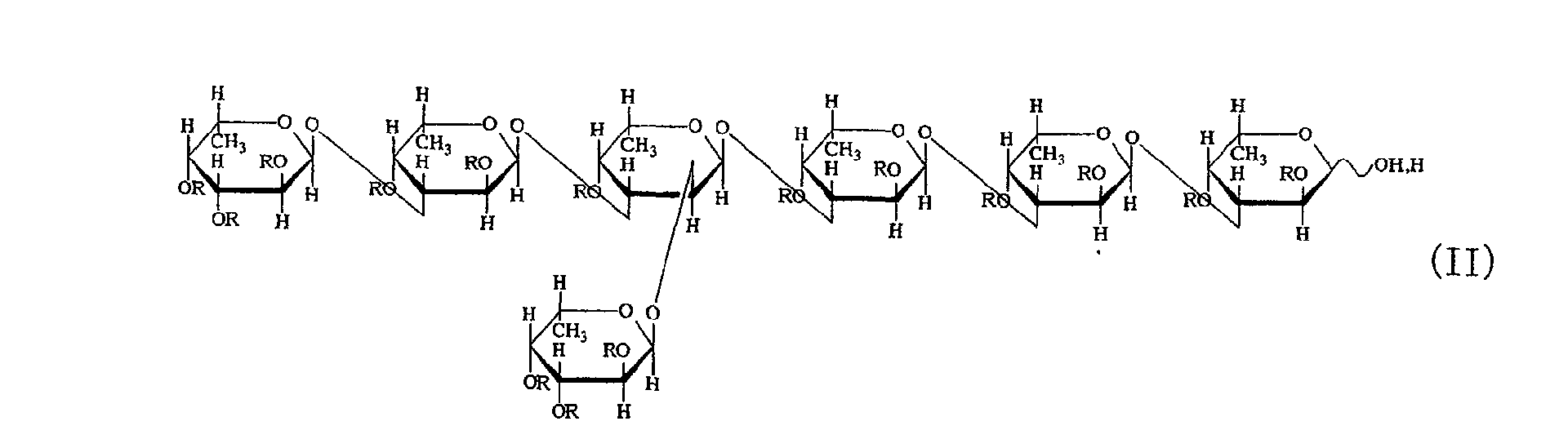
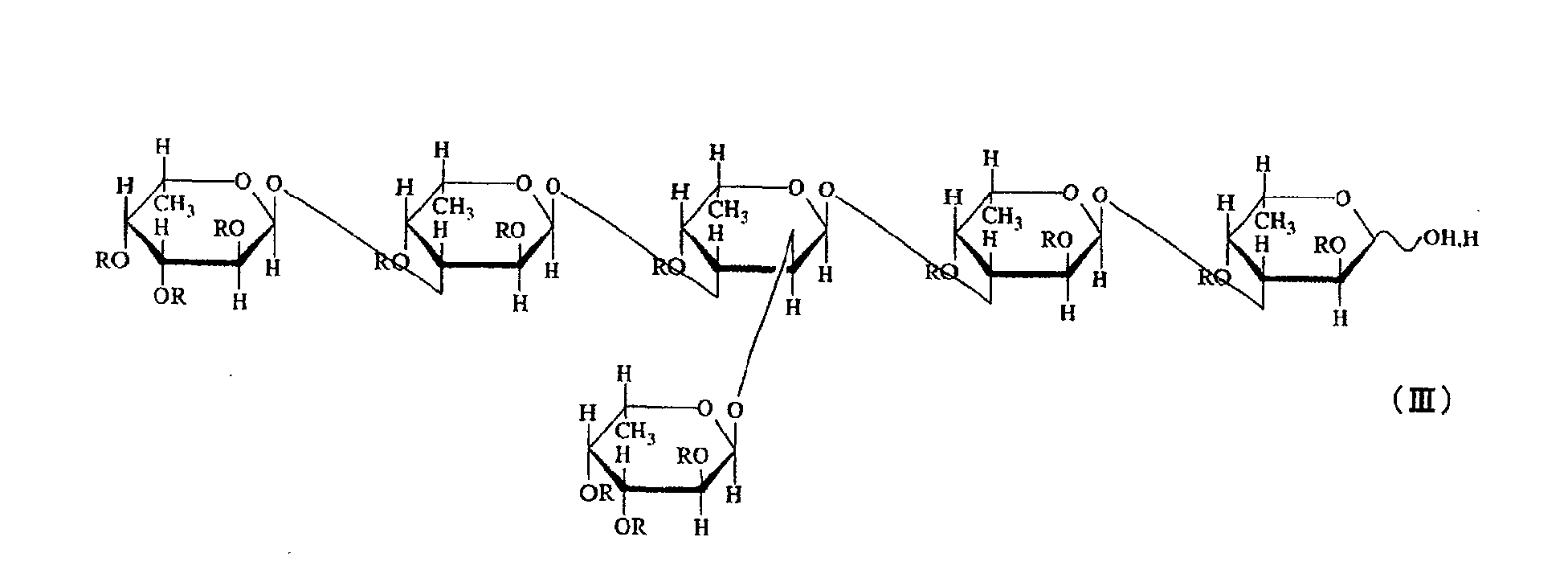


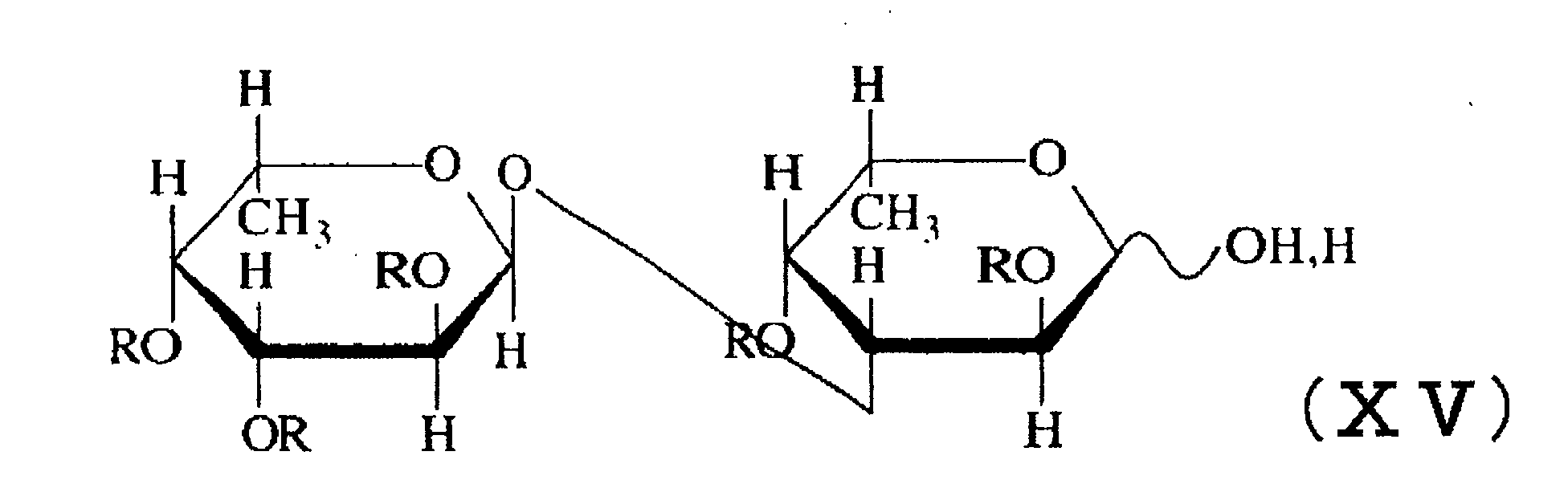
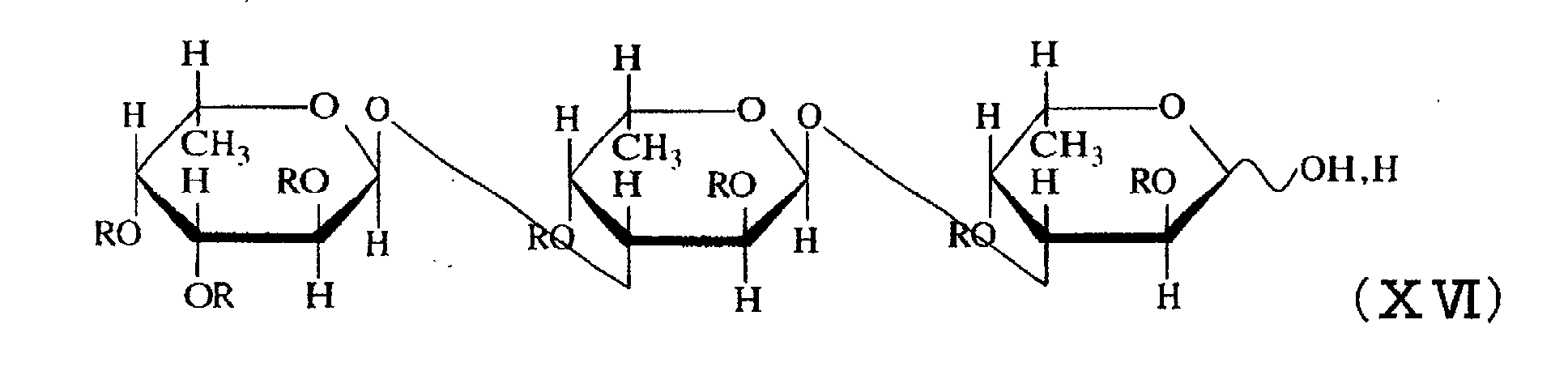


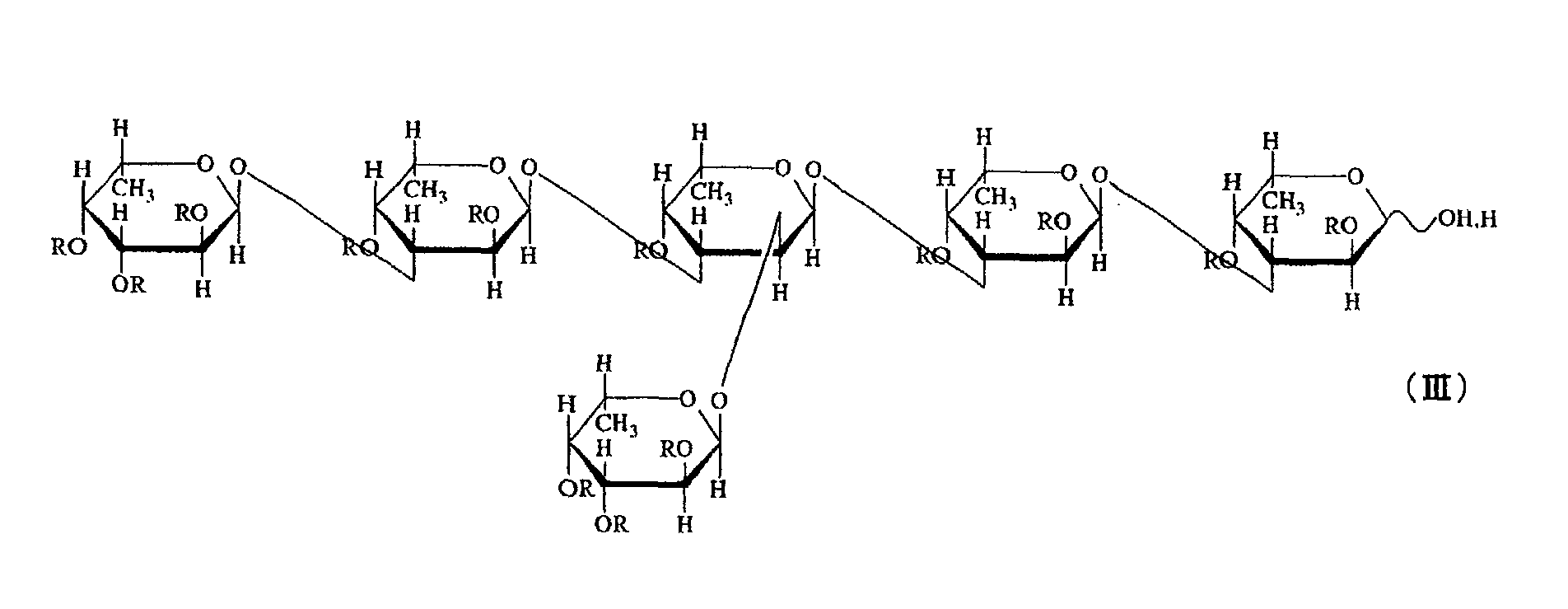
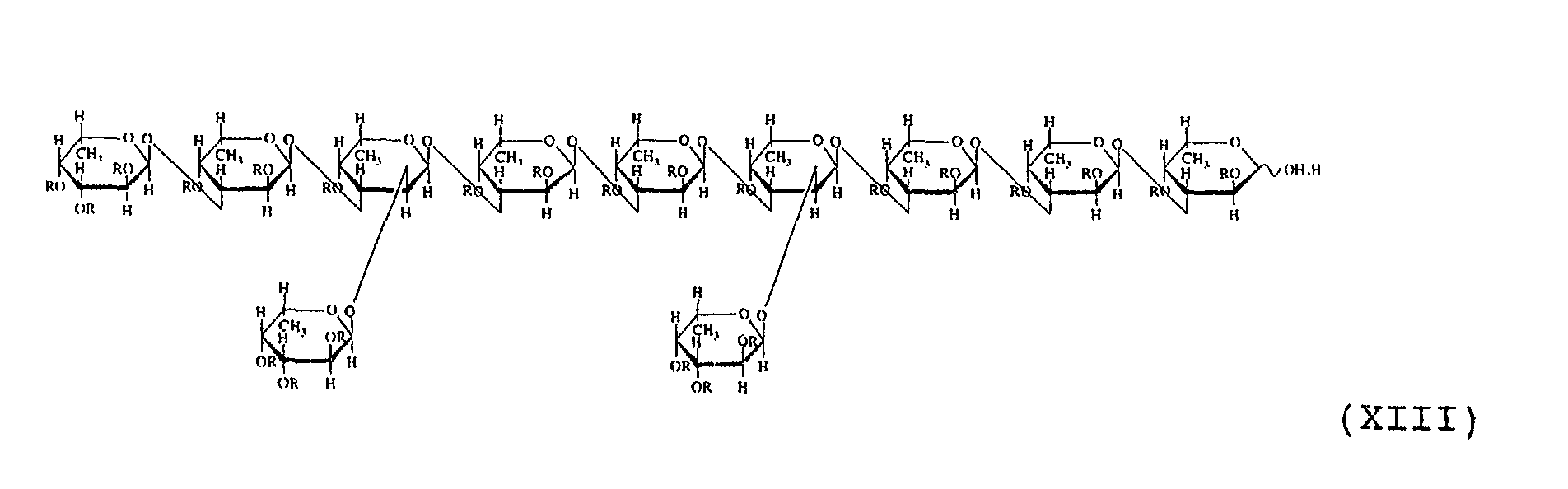


or a salt thereof exemplifies the sulfated fucan oligosaccharide of the present invention.
| Peak no. | Molecular weight | Composition of oligosaccharide | ||
| Fucose | Sulfate group | Sodium | ||
| 1-(1) | 1914 | 6 | 10 | 10 |
| 1812 | 6 | 9 | 9 | |
| 1564 | 5 | 8 | 8 | |
| 1-(2) | 2264 | 7 | 12 | 12 |
| 2162 | 7 | 11 | 11 | |
| 1914 | 6 | 10 | 10 | |
| 2016 | 6 | 11 | 11 | |
| 1-(3) | 2366 | 7 | 13 | 13 |
| 2264 | 7 | 12 | 12 | |
| 2016 | 6 | 11 | 11 | |
| 1914 | 6 | 10 | 10 | |
| 2162 | 7 | 11 | 11 | |
| 1-(4) | 3460 | 11 | 18 | 18 |
| 3358 | 11 | 17 | 17 | |
| 3110 | 10 | 16 | 16 |
Molecular weight: 1914
MS m/z 455.0 [M-4Na+]4-, 614.8 [M-3Na+]3-, 933.8 [M-2Na+]2-
| Chemical shift value (ppm) | ||
| 13C-NMR | 1H-NMR Chemical shift value, multiplicity, coupling constant | |
| F1-1 | 91.3 | 5.41, d, 3.4 |
| F1-2 | 75.9 | 4.39, dd, 3.4, 10.1 |
| F1-3 | 75.9 | 4.14, dd, 2.4, 10.1 |
| F1-4 | 81.1 | 4.81, d, 2.4 |
| F1-5 | 67.6 | 4.20, q, 6.4 |
| F1-6 | 16.8 | 1.16, d, 6.4 |
| F2-1 | 99.7 | 5.25, d, 1.8 |
| F2-2 | 75.2 | 4.43, m |
| F2-3 | 72.5 | 4.43, m |
| F2-4 | 78.8 | 4.75, br-s |
| F2-5 | 68.3 | 4.27, q, 6.7 |
| F2-6 | 17.0 | 1.18, d, 6.7 |
| F3-1 | 91.0 | 5.22, br-s |
| F3-2 | 75.8 | 4.10, d, 5.2 |
| F3-3 | 74.7 | 4.27, dd, 5.2, 2.5 |
| F3-4 | 74.0 | 4.73, dd, 2.5, 5.5 |
| F3-5 | 71.9 | 4.32, m, 5.5, 6.1 |
| F3-6 | 14.2 | 1.45, d, 6.1 |
| Chemical shift value (ppm) | ||
| 13C-NMR | 1H-NMR Chemical shift value, multiplicity, coupling constant | |
| F4-1 | 98.5 | 5.32, d, 3.1 |
| F4-2 | 74.0 | 4.45, m |
| F4-3 | 71.0 | 4.27, m |
| F4-4 | 78.9 | 4.76, br-s |
| F4-5 | 68.3 | 4.29, q, 6.7 |
| F4-6 | 17.0 | 1.18, d, 6.7 |
| F5-1 | 96.1 | 5.29, d, 3.4 |
| F5-2 | 75.9 | 4.35, dd, 3.4, 10.7 |
| F5-3 | 67.4 | 4.27, dd, 2.4, 10.7 |
| F5-4 | 82.3 | 4.60, d, 2.4 |
| F5-5 | 67.4 | 4.38, q, 6.4 |
| F5-6 | 17.0 | 1.16, d, 6.4 |
| F6-1 | 100.5 | 5.18, d, 4.0 |
| F6-2 | 66.7 | 3.84, dd, 4.0, 10.4 |
| F6-3 | 78.8 | 4.45, dd, 3.1, 10.4 |
| F6-4 | 71.1 | 4.07, d, 3.1 |
| F6-5 | 67.9 | 4.06, q, 6.4 |
| F6-6 | 16.5 | 1.13, d, 6.4 |
Sulfate group: 10 molecules
Sodium: 10 molecules

Molecular weight: 2264
MS m/z 354.2 [M-6Na+]6-, 429.8 [M-5Na+]5-, 543.0 [M-4Na+]4-, 731.6 [M-3Na+]3-
| Chemical shift value (ppm) | ||
| 13C-NMR | 1H-NMR | |
| F1-1 | 90.3 | 5.41, d, 3.4 |
| F1-2 | 75.7 | 4.38, dd, 3.4, 9.8 |
| F1-3 | 74.9 | 4.22, m |
| F1-4 | 80.2 | 4.80, br-s |
| F1-5 | 67.5 | 4.23, q, 6.7 |
| F1-6 | 16.0 | 1.19, d, 6.7 |
| F2-1 | 99.3 | 5.31, d, 3.4 |
| F2-2 | 75.2 | 4.40, m |
| F2-3 | 76.9 | 4.29, m |
| F2-4 | 81.5 | 4.83, d, 2.8 |
| F2-5 | 68.5 | 4.22, q, 6.4 |
| F2-6 | 16.4 | 1.16, d, 6.4 |
| F3-1 | 99.7 | 5.29, br-s |
| F3-2 | 74.0 | 4.41, m |
| F3-3 | 71.1 | 4.41, m |
| F3-4 | 78.2 | 4.75, m |
| F3-5 | 67.4 | 4.34, q, 6.7 |
| F3-6 | 16.5 | 1.22, d, 6.7 |
| F4-1 | 89.6 | 5.26, br-s |
| F4-2 | 74.4 | 4.07, m |
| F4-3 | 74.4 | 4.27, m |
| F4-4 | 73.3 | 4.73, dd, 2.8, 5.8 |
| F4-5 | 71.2 | 4.36, m, 5.8, 6.4 |
| F4-6 | 13.5 | 1.44, d, 6.4 |
| Chemical shift value (ppm) | ||
| 13C-NMR | 1H-NMR | |
| F5-1 | 98.3 | 5.31, d, 3.4 |
| F5-2 | 73.4 | 4.45, dd, 3.4, 10.1 |
| F5-3 | 70.4 | 4.26, m |
| F5-4 | 78.2 | 4.76, br-s |
| F5-5 | 67.6 | 4.33, q, 6.4 |
| F5-6 | 16.4 | 1.23, d, 6.4 |
| F6-1 | 95.2 | 5.29, d, 3.7 |
| F6-2 | 75.2 | 4.36, m |
| F6-3 | 66.8 | 4.27, m |
| F6-4 | 81.7 | 4.60, d, 2.8 |
| F6-5 | 66.8 | 4.38, q, 6.7 |
| F6-6 | 16.4 | 1.16, d, 6.7 |
| F7-1 | 100.1 | 5.17, d, 4.3 |
| F7-2 | 66.1 | 3.86, dd, 4.3, 10.4 |
| F7-3 | 78.3 | 4.45, dd, 3.7, 10.4 |
| F7-4 | 70.5 | 4.07, d, 3.7 |
| F7-5 | 67.4 | 4.05, q, 6.4 |
| F7-6 | 16.0 | 1.13, d, 6.4 |
Sulfate group: 12 molecules
Sodium: 12 molecules

Molecular weight: 2366
MS m/z 371.4 [M-6Na+]6-, 450.3 [M-5Na+]5-, 568.6 [M-4Na+]4-, 765.7 [M-3Na+]3-
| Chemical shift value (ppm) | ||
| 13C-NMR | 1H-NMR Chemical shift value, multiplicity, coupling constant | |
| F1-1 | 89.6 | 5.42, d, 2.5 |
| F1-2 | 75.3 | 4.40, m |
| F1-3 | 73.9 | 4.28, m |
| F1-4 | 78.6 | 4.78, m |
| F1-5 | 67.5 | 4.24, m |
| F1-6 | 15.9 | 1.24, d, 6.5 |
| F2-1 | 98.3 | 5.34, d, 3.5 |
| F2-2 | 74.8 | 4.43, m |
| F2-3 | 76.0 | 4.29, m |
| F2-4 | 80.8 | 4.83, m |
| F2-5 | 68.1 | 4.20, m |
| F2-6 | 15.9 | 1.18, d,7 .0 |
| F3-1 | 99.1 | 5.29, m |
| F3-2 | 73.8 | 4.45, m |
| F3-3 | 70.8 | 4.45, m |
| F3-4 | 77.5 | 4.73, m |
| F3-5 | 66.8 | 4.31, m |
| F3-6 | 15.9 | 1.25, d, 6.5 |
| Chemical shift value (ppm) | ||
| 13C-NMR | 1H-NMR Chemical shift value, multiplicity, coupling constant | |
| F4-1 | 89.2 | 5.27, br-s |
| F4-2 | 74.1 | 4.09, d, 9.5 |
| F4-3 | 74.3 | 4.26, m |
| F4-4 | 72.8 | 4.74, m |
| F4-5 | 70.8 | 4.36, m |
| F4-6 | 13.3 | 1.46, d, 7.0 |
| F5-1 | 97.3 | 5.31, d, 3.5 |
| F5-2 | 73.1 | 4.47, dd, 10.0, 3.5 |
| F5-3 | 69.8 | 4.27, m |
| F5-4 | 77.5 | 4.75, m |
| F5-5 | 67.0 | 4.34, m |
| F5-6 | 15.9 | 1.20, d, 6.0 |
| F6-1 | 94.6 | 5.29, m |
| F6-2 | 74.9 | 4.38, m |
| F6-3 | 66.6 | 4.29, m |
| F6-4 | 81.3 | 4.60, m |
| F6-5 | 66.4 | 4.38, m |
| F6-6 | 15.4 | 1.17, d, 6.5 |
| F7-1 | 99.3 | 5.22, d, 4.0 |
| F7-2 | 65.9 | 3.91, dd, 11.0, 4.0 |
| F7-3 | 75.3 | 4.52, dd, 11.0, 3.0 |
| F7-4 | 79.0 | 4.80, d, 3.0 |
| F7-5 | 66.6 | 4.16, m |
| F7-6 | 15.9 | 1.20, d, 6.0 |
Sulfate group: 13 molecules
Sodium: 13 molecules
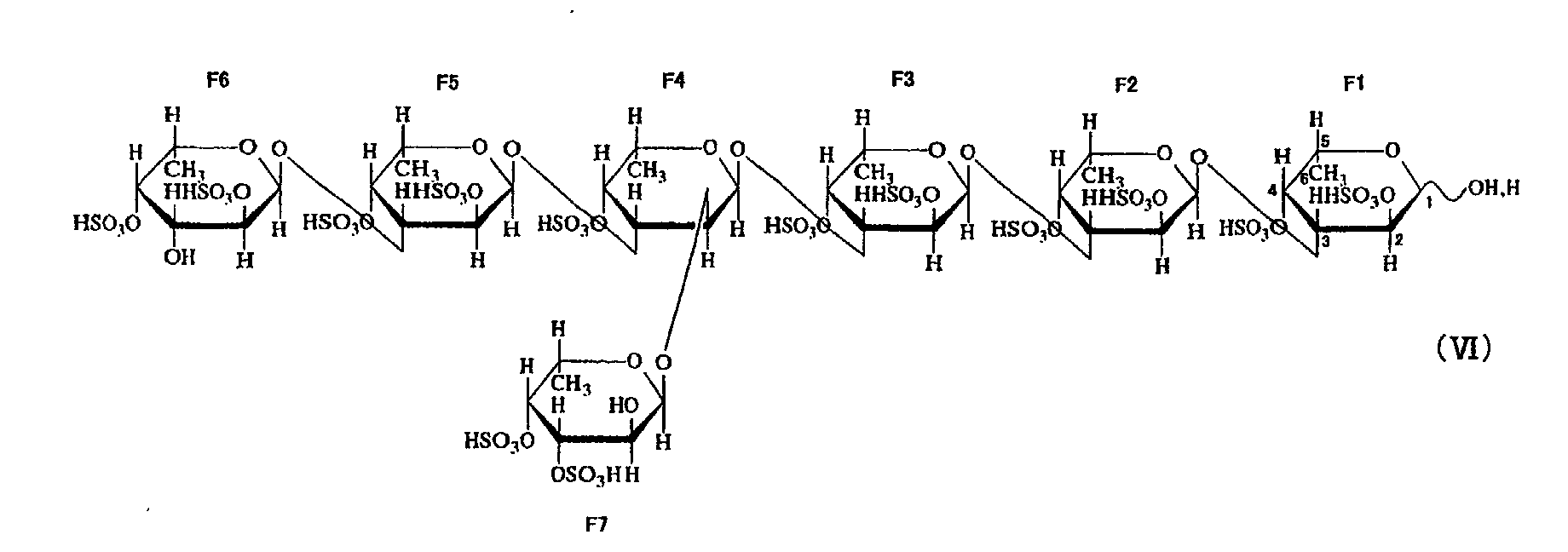
Molecular weight: 3460
MS m/z 409.6 [M-8Na+]8-, 471.4 [M-7Na+]7-, 553.8 [M-6Na+]6-, 669.3 [M-5Na+]5-, 842.3 [M-4Na+]4-, 1130.8 [M-3Na+]3-
| Chemical shift value (ppm) | ||
| 13C-NMR | 1H-NMR Chemical shift value, multiplicity, coupling constant | |
| F1-1 | 90.3 | 5.39, d, 3.3 |
| F1-2 | 75.5 | 4.37, m |
| F1-3 | 76.0 | 4.21, m |
| F1-4 | 79.8 | 4.77, m |
| F1-5 | 67.5 | 4.19, m |
| F1-6 | 16.5 | 1.15, m |
| F2-1 | 99.8 | 5.28, m |
| F2-2 | 73.6 | 4.41, m |
| F2-3 | 73.6 | 4.41, m |
| F2-4 | 78.1 | 4.74, m |
| F2-5 | 68.7 | 4.25, m |
| F2-6 | 16.8 | 1.20, m |
| F3-1 | 98.7 | 5.31, m |
| F3-2 | 74.8 | 4.46, m |
| F3-3 | 73.6 | 4.35, m |
| F3-4 | 78.1 | 4.74, m |
| F3-5 | 67.7 | 4.25, m |
| F3-6 | 16.8 | 1.20, m |
| F4-1 | 90.2 | 5.29, m |
| F4-2 | 74.8 | 4.04, m |
| F4-3 | 74.9 | 4.27, m |
| F4-4 | 74.3 | 4.74, m |
| F4-5 | 68.1 | 4.27, q, 6.5 |
| F4-6 | 14.0 | 1.39, d, 6.5 |
| Chemical shift value (ppm) | ||
| 13C-NMR | 1H-NMR Chemical shift value, multiplicity, coupling constant | |
| F5-1 | 99.2 | 5.34, d, 3.5 |
| F5-2 | 74.3 | 4.42, m |
| F5-3 | 74.3 | 4.21, m |
| F5-4 | 81.5 | 4.81, m |
| F5-5 | 68.7 | 4.20, m |
| F5-6 | 16.6 | 1.18, m |
| F6-1 | 98.7 | 5.31, m |
| F6-2 | 75.3 | 4.46, m |
| F6-3 | 71.1 | 4.35, m |
| F6-4 | 78.1 | 4.74, m |
| F6-5 | 67.7 | 4.25, m |
| F6-6 | 16.7 | 1.19, m |
| F7-1 | 90.2 | 5.29, m |
| F7-2 | 74.8 | 4.04, m |
| F7-3 | 74.9 | 4.27, m |
| F7-4 | 74.3 | 4.74, m |
| F7-5 | 67.9 | 4.27, q, 7.0 |
| F7-6 | 14.0 | 1.43, d, 7.0 |
| Chemical shift value (ppm) | ||
| 13C-NMR | 1H-NMR Chemical shift value, multiplicity, coupling constant | |
| F8-1 | 96.0 | 5.30, m |
| F8-2 | 75.3 | 4.46, m |
| F8-3 | 71.1 | 4.35, m |
| F8-4 | 78.1 | 4.81, m |
| F8-5 | 67.1 | 4.43, m |
| F8-6 | 16.7 | 1.19, m |
| F9-1 | 96.0 | 5.29, m |
| F9-2 | 75.5 | 4.33, m |
| F9-3 | 67.1 | 4.27, m |
| F9-4 | 82.0 | 4.58, d, 2.8 |
| F9-5 | 67.1 | 4.34, q, 6.5 |
| F9-6 | 16.5 | 1.15, d, 6.5 |
| F10-1 | 99.8 | 5.19, d, 4.2 |
| F10-2 | 66.3 | 3.85, dd, 4.2, 10.4 |
| F10-3 | 78.5 | 4.43, m |
| F10-4 | 70.8 | 4.05, br-s |
| F10-5 | 67.5 | 4.03, q, 6.6 |
| F10-6 | 16.1 | 1.12, d, 6.6 |
| F11-1 | 99.8 | 5.21, d, 4.2 |
| F11-2 | 66.3 | 3.85, dd, 4.2, 10.4 |
| F11-3 | 78.5 | 4.44, m |
| F11-4 | 70.8 | 4.06, br-s |
| F11-5 | 67.5 | 4.08, q, 6.6 |
| F11-6 | 16.1 | 1.12, d, 6.6 |
Sulfate group: 18 molecules
Sodium: 18 molecules
| Peak no. | Molecular weight | Composition of oligosaccharide | ||
| Fucose | Sulfate group | Sodium | ||
| 2-(1) | 1914 | 6 | 10 | 10 |
| 2264 | 7 | 12 | 12 | |
| 2016 | 6 | 11 | 11 | |
| 2-(2) | 3110 | 10 | 16 | 16 |
| 2760 | 9 | 14 | 14 | |
| 3360 | 11 | 17 | 17 | |
| 4308 | 14 | 22 | 22 | |
| 3958 | 13 | 20 | 20 |
Molecular weight: 2016
MS m/z 313.1 [M-6Na+]6-, 380.3 [M-5Na+]5-, 481.1 [M-4Na+]4-, 649.1 [M-3Na+]3-, 985.0 [M-2Na+]2-
| Chemical shift value (ppm) | ||
| 13C-NMR | 1H-NMR Chemical shift value, multiplicity, coupling constant | |
| F1-1 | 90.7 | 5.43, d, 3.6 |
| F1-2 | 75.3 | 4.41, dd, 3.6, 10.1 |
| F1-3 | 75.7 | 4.15, dd, 10.1, 2.4 |
| F1-4 | 80.6 | 4.83, d, 2.4 |
| F1-5 | 67.0 | 4.22, q, 6.6 |
| F1-6 | 16.5 | 1.18, d, 6.6 |
| F2-1 | 99.2 | 5.27, d, 3.2 |
| F2-2 | 74.5 | 4.45, m |
| F2-3 | 71.9 | 4.46, m |
| F2-4 | 78.1 | 4.77, br-s |
| F2-5 | 67.7 | 4.30, q, 6.6 |
| F2-6 | 16.5 | 1.20, d, 6.6 |
| F3-1 | 89.8 | 5.24, br-s |
| F3-2 | 75.2 | 4.12, m |
| F3-3 | 74.2 | 4.28, m |
| F3-4 | 73.3 | 4.76, br-s |
| F3-5 | 71.4 | 4.36, q, 6.0 |
| F3-6 | 13.6 | 1.48, d, 6.0 |
| Chemical shift value (ppm) | ||
| 13C-NMR | 1H-NMR Chemical shift value, multiplicity, coupling constant | |
| F4-1 | 98.2 | 5.33, d, 3.3 |
| F4-2 | 73.3 | 4.47, m |
| F4-3 | 71.0 | 4.28, m |
| F4-4 | 78.1 | 4.78, br-s |
| F4-5 | 67.7 | 4.32, q, 6.6 |
| F4-6 | 16.5 | 1.20, d, 6.6 |
| F5-1 | 94.8 | 5.31, d, 3.4 |
| F5-2 | 75.3 | 4.38, m |
| F5-3 | 66.9 | 4.28, m |
| F5-4 | 81.7 | 4.62, d, 2.4 |
| F5-5 | 66.8 | 4.40, q, 6.6 |
| F5-6 | 16.5 | 1.18, d, 6.6 |
| F6-1 | 100.1 | 5.22, d, 3.6 |
| F6-2 | 66.3 | 3.89, dd, 3.6, 10.4 |
| F6-3 | 75.7 | 4.52, dd, 10.4, 3.0 |
| F6-4 | 79.2 | 4.82, d, 3.0 |
| F6-5 | 67.2 | 4.18, q, 6.6 |
| F6-6 | 16.3 | 1.20, d, 6.6 |
Sulfate residues: 11 molecules
Sodium: 11 molecules
Molecular weight: 3111
MS m/z 365.8[M-8Na+]8-, 421.4[M-7Na+]7-, 495.2[M-6Na+]6-, 599.1[M-5Na+]5-, 755.0[M-4Na+]4-, 1013.7[M-3Na+]3-
| Chemical shift value (ppm) | ||
| 13C-NMR | 1H-NMR Chemical shift value, multiplicity, coupling constant | |
| F1-1 | 90.8 | 5.44, d, 3.4 |
| F1-2 | 75.7 | 4.44, dd, 3.4, 9.8 |
| F1-3 | 75.9 | 4.19, dd, 9.8, 2.9 |
| F1-4 | 80.3 | 4.84, d, 2.9 |
| F1-5 | 67.7 | 4.24, m |
| F1-6 | 16.6 | 1.22, m |
| F2-1 | 99.4 | 5.30, d, 3.0 |
| F2-2 | 74.9 | 4.46, m |
| F2-3 | 72.5 | 4.44, m |
| F2-4 | 78.4 | 4.78, br-s |
| F2-5 | 68.2 | 4.29, q, 6.6 |
| F2-6 | 17.1 | 1.25, d, 6.6 |
| F3-1 | 91.2 | 5.29, br-s |
| F3-2 | 74.9 | 4.11, m |
| F3-3 | 75.0 | 4.28, m |
| F3-4 | 74.5 | 4.78, br-s |
| F3-5 | 68.4 | 4.31, q, 6.8 |
| F3-6 | 14.5 | 1.43, d, 6.8 |
| F4-1 | 98.7 | 5.40, d, 3.5 |
| F4-2 | 74.9 | 4.48, m |
| F4-3 | 74.9 | 4.29, m |
| F4-4 | 80.3 | 4.48, br-s |
| F4-5 | 68.4 | 4.24, m |
| F4-6 | 16.6 | 1.22, m |
| Chemical shift value (ppm) | ||
| 13C-NMR | 1H-NMR Chemical shift value, multiplicity, coupling constant | |
| F5-1 | 98.0 | 5.35, d, 3.6 |
| F5-2 | 73.8 | 4.51, m |
| F5-3 | 71.2 | 4.39, m |
| F5-4 | 78.4 | 4.78, m |
| F5-5 | 68.2 | 4.29, m |
| F5-6 | 16.9 | 1.23, m |
| F6-1 | 90.5 | 5.34, br-s |
| F6-2 | 74.9 | 4.11, m |
| F6-3 | 75.0 | 4.29, m |
| F6-4 | 74.5 | 4.78, br-s |
| F6-5 | 68.4 | 4.31, q, 7.0 |
| F6-6 | 14.2 | 1.48, d, 7.0 |
| F7-1 | 95.9 | 5.33, m |
| F7-2 | 73.9 | 4.48, m |
| F7-3 | 71.2 | 4.37, m |
| F7-4 | 78.2 | 4.78, m |
| F7-5 | 67.3 | 4.46, m |
| F7-6 | 16.8 | 1.23, m |
| Chemical shift value (ppm) | ||
| 13C-NMR | 1H-NMR Chemical shift value, multiplicity, coupling constant | |
| F8-1 | 96.2 | 5.33, d, 3.3 |
| F8-2 | 75.7 | 4.38, m |
| F8-3 | 67.3 | 4.31, m |
| F8-4 | 82.2 | 4.62, d, 3.1 |
| F8-5 | 67.3 | 4.38, m |
| F8-6 | 16.4 | 1.20, m |
| F9-1 | 99.7 | 5.25, d, 4.4 |
| F9-2 | 66.5 | 3.88, dd, 4.4, 10.2 |
| F9-3 | 78.7 | 4.48, m |
| F9-4 | 70.9 | 4.10, m |
| F9-5 | 67.5 | 4.08, q, 6.6 |
| F9-6 | 16.2 | 1.17, d, 6.6 |
| F10-1 | 99.7 | 5.26, d, 4.4 |
| F10-2 | 66.5 | 3.90, dd, 4.4, 10.2 |
| F10-3 | 78.7 | 4.49, m |
| F10-4 | 70.9 | 4.11, m |
| F10-5 | 67.5 | 4.12, q, 6.6 |
| F10-6 | 16.3 | 1.17, d, 6.6 |
Sulfate group: 16 molecules
Sodium: 16 molecules

Column: YMC Pack Polyamine II (20 x 250 mm, YMC)
Flow rate: 8 ml/minute
Column temperature: 30°C
Equilibration solution: 875 mM sodium dihydrogenphosphate containing 10% acetonitrile
Elution: Gradient from 875 mM sodium dihydrogenphosphate containing 10% acetonitrile to 1.4 M sodium dihydrogenphosphate containing 10% acetonitrile
Fractionation: 4 ml/fraction
Detection: by the phenol-sulfuric acid method
Column: YMC Pack Polyamine II (20 x 250 mm, YMC)
Flow rate: 8 ml/minute
Column temperature: 30°C
Equilibration solution: For Lessonia nigrescens sulfated fucan oligosaccharides 1-(1), (2), and (3), 90 mM sodium dihydrogenphosphate containing 10% acetonitrile. For Lessonia nigrescens sulfated fucan oligosaccharide 1-(4) and (5), 630 mM sodium dihydrogenphosphate containing 10% acetonitrile. For Lessonia nigrescens sulfated fucan oligosaccharide 1-(6), 720 mM sodium dihydrogenphosphate containing 10% acetonitrile. For Lessonia nigrescens sulfated fucan oligosaccharide 1-(7), 900 mM sodium dihydrogenphosphate containing 10% acetonitrile.
Elution: For Lessonia nigrescens sulfated fucan oligosaccharides 1-(1), (2), and (3), with the gradient from 90 mM sodium dihydrogenphosphate containing 10% acetonitrile to 900 mM sodium dihydrogenphosphate containing 10% acetonitrile. For Lessonia nigrescens sulfated fucan oligosaccharides 1-(4) and (5), with the gradient from 630 mM sodium dihydrogenphosphate containing 10% acetonitrile to 1260 mM sodium dihydrogenphosphate containing 10% acetonitrile. For Lessonia nigrescens sulfated fucan oligosaccharide 1-(6), with the gradient from 720 mM sodium dihydrogenphosphate containing 10% acetonitrile to 1440 mM sodium dihydrogenphosphate containing 10% acetonitrile. For Lessonia nigrescens sulfated fucan oligosaccharide 1-(7), with the gradient from 900 mM sodium dihydrogenphosphate containing 10% acetonitrile to 1620 mM sodium dihydrogenphosphate containing 10% acetonitrile.
Fractionation: 4 ml/fraction
Detection: by the phenol-sulfuric acid method
Molecular weight; 718
MS m/z 216.5 [M-3Na+]3-, 336.0 [M-2Na+]2-, 695.0 [M-Na+]-
| Chemical shift value (ppm) | ||
| 13C-NMR | 1H-NMR Chemical shift value, multiplicity, coupling constant | |
| F1-1 | 90.8 | 5.41, d, 3.6 |
| F1-2 | 75.1 | 4.38, dd, 3.6, 10.8 |
| F1-3 | 75.1 | 4.11, dd, 10.8, 3.0 |
| F1-4 | 81.0 | 4.84, d, 3.0 |
| F1-5 | 66.7 | 4.22, q, 6.0 |
| F1-6 | 16.2 | 1.16, d, 6.0 |
| F2-1 | 99.2 | 5.21, d, 3.0 |
| F2-2 | 76.4 | 4.29, m |
| F2-3 | 67.8 | 4.29, m |
| F2-4 | 81.5 | 4.55, d, 3.0 |
| F2-5 | 67.8 | 4.31, q, 6.6 |
| F2-6 | 16.3 | 1.16, d, 6.6 |
Sulfate residues: 4 molecules
Sodium: 4 molecules

Molecular weight; 966
MS m/z 459.9[M-2Na+]2-, 942.9[M-Na+]-
| Chemical shift value (ppm) | ||
| 13C-NMR | 1H-NMR Chemical shift value, multiplicity, coupling constant | |
| F1-1 | 90.6 | 5.42, d, 3.6 |
| F1-2 | 75.7 | 4.22, dd, 3.6, 10.4 |
| F1-3 | 73.8 | 4.24, dd, 10.4, 2.4 |
| F1-4 | 80.5 | 4.79, d, 2.4 |
| F1-5 | 66.9 | 4.24, q, 6.4 |
| F1-6 | 16.3 | 1.18, d, 6.4 |
| F2-1 | 98.3 | 5.32, d, 2.0 |
| F2-2 | 74.9 | 4.41, m |
| F2-3 | 72.5 | 4.41, m |
| F2-4 | 79.8 | 4.72, br-s |
| F2-5 | 67.8 | 4.30, q, 6.5 |
| F2-6 | 16.3 | 1.17, d, 6.5 |
| F3-1 | 97.7 | 5.03, d, 3.9 |
| F3-2 | 69.0 | 3.66, dd, 3.9, 10.5 |
| F3-3 | 69.3 | 3.93, dd, 10.5, 2.8 |
| F3-4 | 81.4 | 4.51, d, 2.8 |
| F3-5 | 66.9 | 4.46, q, 6.4 |
| F3-6 | 16.3 | 1.19, d, 6.4 |
Sulfate residues: 5 molecules
Sodium: 5 molecules
Molecular weight; 1068
MS m/z 332.9 [M-3Na+]3-, 511.0 [M-2Na+]2-, 1045.0 [M-Na+]-
| Chemical shift value (ppm) | ||
| 13C-NMR | 1H-NMR Chemical shift value, multiplicity, coupling constant | |
| F1-1 | 90.3 | 5.42, d, 3.4 |
| F1-2 | 75.5 | 4.39, dd, 3.4, 10.2 |
| F1-3 | 74.6 | 4.22, dd, 10.2, 2.9 |
| F1-4 | 78.0 | 4.80, d, 2.9 |
| F1-5 | 67.3 | 4.24, q, 6.6 |
| F1-6 | 16.3 | 1.20, d, 6.6 |
| F2-1 | 98.8 | 5.30, d, 3.3 |
| F2-2 | 75.0 | 4.41, m |
| F2-3 | 75.0 | 4.30, m |
| F2-4 | 80.7 | 4.81, d, 2.6 |
| F2-5 | 68.4 | 4.25, q, 6.7 |
| F2-6 | 16.2 | 1.18, d, 6.7 |
| F3-1 | 98.5 | 5.24, d, 3.2 |
| F3-2 | 75.7 | 4.31, dd, 3.2, 10.4 |
| F3-3 | 66.5 | 4.26, dd, 10.4, 3.0 |
| F3-4 | 81.7 | 4.57, d, 3.0 |
| F3-5 | 67.4 | 4.36, q, 6.6 |
| F3-6 | 16.0 | 1.20, d, 6.6 |
Sulfate residues: 6 molecules
Sodium: 6 molecules
Molecular weight; 3461
MS m/z 361.5 [M-9Na+]9-, 409.62 [M-8Na+]8-, 471.42 [M-7Na+]7-, 553.81 [M-6Na+]6-, 669.31 [M-5Na+]5-, 842.32 [M-4Na+]4-, 1130.83 [M-3Na+]3-
Component sugar: only L-fucose (11 molecules)
Sulfate residues: 18 molecules
Sodium: 18 molecules
Molecular weight; 4659
MS m/z 442.82 [M-10Na+]10-, 494.72 [M-9Na+]9-, 559.32 [M-8Na+]8-, 642.62 [M-7Na+]7-, 753.52 [M-6Na+]6-, 908.82 [M-5Na+]5-, 1141.43 [M-4Na+]4-
Component sugar: only L-fucose (15 molecules)
Sulfate residues: 24 molecules
Sodium: 24 molecules
Molecular weight; 3564
MS m/z 373.12[M-9Na+]9-, 422.52 [M-8Na+]8-, 486.32 [M-7Na+]7-, 571.01 [M-6Na+]6-, 689.61 [M-5Na+]5-, 868.02 [M-4Na+]4-, 1164.93 [M-3Na+]3-
Component sugar: only L-fucose (11 molecules)
Sulfate residues: 19 molecules
Sodium: 19 molecules
| Peak no. | Molecular weight | Composition of oligosaccharide | ||
| Fucose | Sulfate group | Sodium | ||
| 3-(1) | 1564 | 5 | 8 | 8 |
| 1914 | 6 | 10 | 10 | |
| 2016 | 6 | 11 | 11 | |
| 2162 | 7 | 11 | 11 | |
| 2264 | 7 | 12 | 12 | |
| 2410 | 8 | 12 | 12 | |
| 3-(2) | 3110 | 10 | 16 | 16 |
| 3360 | 11 | 17 | 17 | |
| 3462 | 11 | 18 | 18 | |
| 3710 | 12 | 19 | 19 | |
| 4308 | 14 | 22 | 22 |

Claims (6)
- A sulfated fucan having the following chemical and physical properties:wherein R is H or SO3H and at least one of Rs is SO3H in all formulas above,(1) containing fucose as a constituting saccharide;(2) containing a sulfated saccharide of general formula (I) as an essential component of the constituting saccharide:wherein R is H or SO3H, at least one of Rs is SO3H and n is an integer of 1 or more; and
 (3) being converted into smaller molecules by a sulfated fucan-digesting enzyme derived from Alteromonas sp. SN-1009 to generate at least one compound selected from the group consisting of the compounds of general formulas (II), (III), (XIII), (XIV), (XV) and (XVI):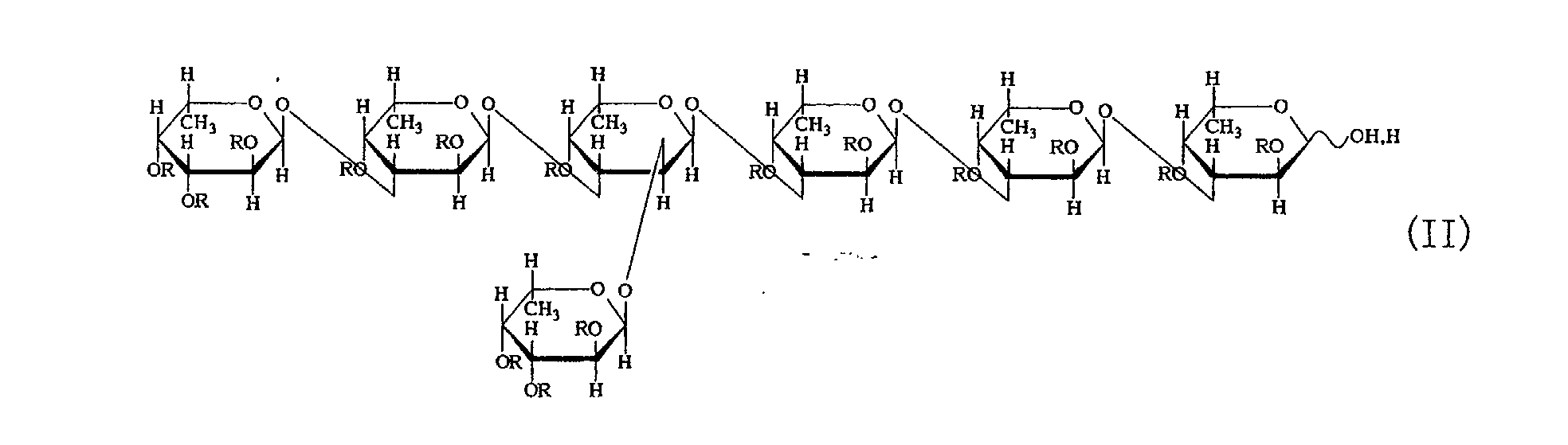

 and
and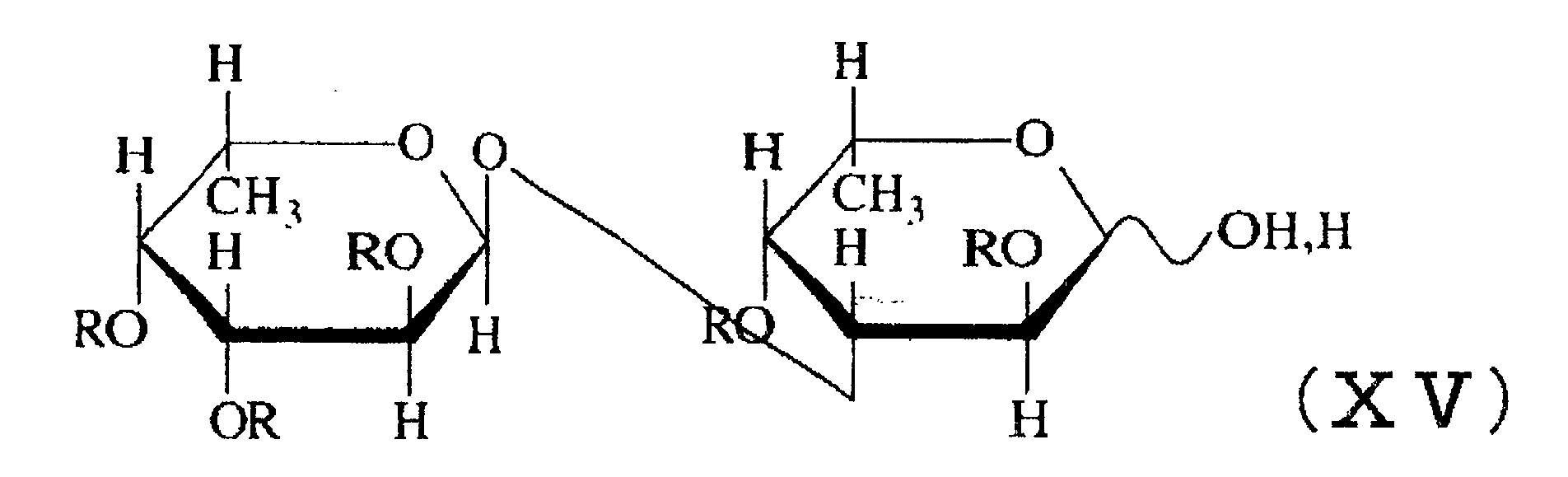

or a salt thereof. - A sulfated fucan oligosaccharide of general formula (I):wherein R is H or SO3H, at least one of Rs is SO3H and n is 1 to 5.
- A method for preparing a sulfated fucan oligosaccharide, the method comprising:allowing a sulfated fucan-digesting enzyme derived from Alteromonas sp. SN-1009 to act on a sulfated fucan defined by claim 1 or 2; andcollecting a digestion product.
- The method according to claim 3, wherein the sulfated fucan is derived from Kjellmaniella crassifolia, Laminaria japonica or Lessonia nigrescens.
- A sulfated fucan oligosaccharide obtainable by the preparation method defined by claim 3.
- A sulfated fucan oligosaccharide having a chemical structure selected from the group consisting of general formulas (II), (III), (XIII), (XIV), (XV) and (XVI):


 and
and wherein R is H or SO3H and at least one of Rs is SO3H in all formulas above,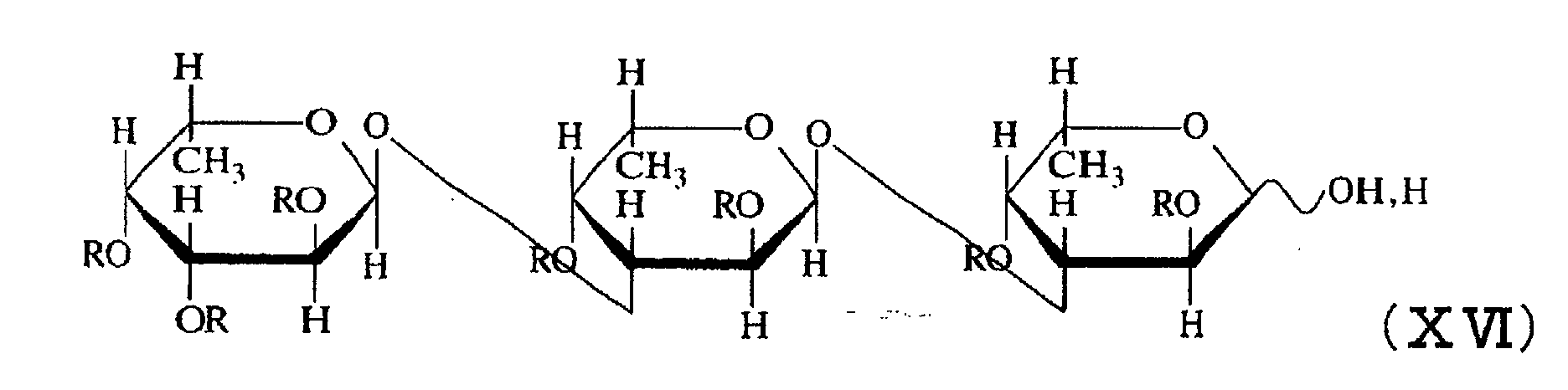
or a salt thereof.
Applications Claiming Priority (2)
| Application Number | Priority Date | Filing Date | Title |
|---|---|---|---|
| JP2001325960 | 2001-10-24 | ||
| JP2001325960 | 2001-10-24 |
Publications (3)
| Publication Number | Publication Date |
|---|---|
| EP1306389A2 true EP1306389A2 (en) | 2003-05-02 |
| EP1306389A3 EP1306389A3 (en) | 2003-10-08 |
| EP1306389B1 EP1306389B1 (en) | 2004-12-29 |
Family
ID=19142424
Family Applications (1)
| Application Number | Title | Priority Date | Filing Date |
|---|---|---|---|
| EP02023064A Expired - Lifetime EP1306389B1 (en) | 2001-10-24 | 2002-10-16 | Sulfated fucan oligosaccharide |
Country Status (7)
| Country | Link |
|---|---|
| US (2) | US6720419B2 (en) |
| EP (1) | EP1306389B1 (en) |
| KR (1) | KR100903771B1 (en) |
| CN (1) | CN100379748C (en) |
| AT (1) | ATE286075T1 (en) |
| DE (1) | DE60202427T2 (en) |
| ES (1) | ES2236420T3 (en) |
Cited By (1)
| Publication number | Priority date | Publication date | Assignee | Title |
|---|---|---|---|---|
| EP1466969A4 (en) * | 2002-01-18 | 2006-02-01 | Takara Bio Inc | Sulfated fucan |
Families Citing this family (4)
| Publication number | Priority date | Publication date | Assignee | Title |
|---|---|---|---|---|
| AU2003242486A1 (en) * | 2002-06-20 | 2004-01-06 | Takara Bio Inc. | Enzyme for decomposition of sulfated fucan derived from sea cucumber |
| PL1748781T3 (en) * | 2004-05-27 | 2013-05-31 | Baxter Int | Methods for treating bleeding disorders using sulfated polysaccharides |
| EP3241895A1 (en) | 2016-05-04 | 2017-11-08 | ETH Zürich, ETH Transfer | Transglutaminase mediated high molecular weight hyaluronan hydrogels |
| CN110437288B (en) * | 2019-09-02 | 2021-06-08 | 中国海洋大学 | Sea cucumber fucoidin and preparation method and application thereof |
Family Cites Families (12)
| Publication number | Priority date | Publication date | Assignee | Title |
|---|---|---|---|---|
| JPS6410177A (en) | 1987-07-02 | 1989-01-13 | Takara Shuzo Co | Fluorescent labeling method for saccharides |
| FR2648463B1 (en) * | 1989-06-14 | 1993-01-22 | Inst Fs Rech Expl Mer | SULPHATE POLYSACCHARIDES, ANTICOAGULATING AGENT AND ANTI-COMPLEMENTARY AGENT OBTAINED FROM BROWN ALGAE FUCANES AND PROCESS FOR OBTAINING SAME |
| EP0870771B1 (en) | 1995-04-28 | 2008-11-12 | Takara Bio Inc. | Sugar compounds |
| FR2738009B1 (en) * | 1995-08-24 | 1997-10-31 | Centre Nat Rech Scient | PROCESS FOR OBTAINING SULPHATE POLYSACCHARIDES |
| JP3506672B2 (en) * | 1996-01-26 | 2004-03-15 | タカラバイオ株式会社 | Sulfated-fucose-containing polysaccharide |
| KR100555845B1 (en) | 1996-01-26 | 2006-11-23 | 다카라 홀딩스 인크. | Anticancer agent |
| JPH1160590A (en) * | 1997-08-22 | 1999-03-02 | Yakult Honsha Co Ltd | Oligofucose derivative or oligorhamnose derivative and method for producing the same |
| WO1999011797A1 (en) * | 1997-09-03 | 1999-03-11 | Takara Shuzo Co., Ltd. | Gene |
| WO1999041288A1 (en) | 1998-02-17 | 1999-08-19 | Takara Shuzo Co., Ltd. | Sulfated saccharides |
| KR100601330B1 (en) | 1999-02-23 | 2006-07-14 | 다카라 바이오 가부시키가이샤 | Sulfated Fucogalactan |
| WO2000062785A1 (en) | 1999-04-15 | 2000-10-26 | Takara Shuzo Co., Ltd. | Remedies |
| AU2001248788A1 (en) | 2000-04-21 | 2001-11-07 | Takara Bio Inc. | Glucuronofucan sulfate |
-
2002
- 2002-10-16 ES ES02023064T patent/ES2236420T3/en not_active Expired - Lifetime
- 2002-10-16 EP EP02023064A patent/EP1306389B1/en not_active Expired - Lifetime
- 2002-10-16 AT AT02023064T patent/ATE286075T1/en not_active IP Right Cessation
- 2002-10-16 DE DE60202427T patent/DE60202427T2/en not_active Expired - Lifetime
- 2002-10-17 KR KR1020020063455A patent/KR100903771B1/en not_active Expired - Fee Related
- 2002-10-24 US US10/278,942 patent/US6720419B2/en not_active Expired - Fee Related
- 2002-10-24 CN CNB021471398A patent/CN100379748C/en not_active Expired - Fee Related
-
2003
- 2003-10-28 US US10/694,352 patent/US6927289B2/en not_active Expired - Fee Related
Cited By (1)
| Publication number | Priority date | Publication date | Assignee | Title |
|---|---|---|---|---|
| EP1466969A4 (en) * | 2002-01-18 | 2006-02-01 | Takara Bio Inc | Sulfated fucan |
Also Published As
| Publication number | Publication date |
|---|---|
| EP1306389B1 (en) | 2004-12-29 |
| EP1306389A3 (en) | 2003-10-08 |
| DE60202427D1 (en) | 2005-02-03 |
| US20040146995A1 (en) | 2004-07-29 |
| US6720419B2 (en) | 2004-04-13 |
| US20030171571A1 (en) | 2003-09-11 |
| KR20030035913A (en) | 2003-05-09 |
| ATE286075T1 (en) | 2005-01-15 |
| ES2236420T3 (en) | 2005-07-16 |
| KR100903771B1 (en) | 2009-06-19 |
| DE60202427T2 (en) | 2005-12-29 |
| CN1421533A (en) | 2003-06-04 |
| US6927289B2 (en) | 2005-08-09 |
| CN100379748C (en) | 2008-04-09 |
Similar Documents
| Publication | Publication Date | Title |
|---|---|---|
| CA2217746C (en) | Sugar compounds | |
| JPWO1996034004A1 (en) | sugar compound | |
| JP2009050271A (en) | Glucuronofucan sulfate | |
| EP1176153B1 (en) | Sulfated fucogalactan | |
| EP1466969A1 (en) | Sulfated fucan | |
| JPWO2001081560A1 (en) | Sulfated glucuronofucan | |
| US6927289B2 (en) | Sulfated fucan oligosaccharide | |
| US7041656B2 (en) | Sulfated fucoglucuronomannan | |
| EP1514923A1 (en) | Enzyme for decomposition of sulfated fucan derived from sea cucumber | |
| JP3564469B2 (en) | Sulfated fucan oligosaccharide | |
| JP3854063B2 (en) | Sugar compounds | |
| TWI243853B (en) | Glucuronofucan sulfate | |
| JP2001224369A (en) | Sulfated fucogalactan-degrading enzyme |
Legal Events
| Date | Code | Title | Description |
|---|---|---|---|
| PUAI | Public reference made under article 153(3) epc to a published international application that has entered the european phase |
Free format text: ORIGINAL CODE: 0009012 |
|
| AK | Designated contracting states |
Designated state(s): AT BE BG CH CY CZ DE DK EE ES FI FR GB GR IE IT LI LU MC NL PT SE SK TR |
|
| AX | Request for extension of the european patent |
Extension state: AL LT LV MK RO SI |
|
| PUAL | Search report despatched |
Free format text: ORIGINAL CODE: 0009013 |
|
| AK | Designated contracting states |
Kind code of ref document: A3 Designated state(s): AT BE BG CH CY CZ DE DK EE ES FI FR GB GR IE IT LI LU MC NL PT SE SK TR |
|
| AX | Request for extension of the european patent |
Extension state: AL LT LV MK RO SI |
|
| 17P | Request for examination filed |
Effective date: 20031111 |
|
| 17Q | First examination report despatched |
Effective date: 20040220 |
|
| GRAP | Despatch of communication of intention to grant a patent |
Free format text: ORIGINAL CODE: EPIDOSNIGR1 |
|
| AKX | Designation fees paid |
Designated state(s): AT BE BG CH CY CZ DE DK EE ES FI FR GB GR IE IT LI LU MC NL PT SE SK TR |
|
| GRAS | Grant fee paid |
Free format text: ORIGINAL CODE: EPIDOSNIGR3 |
|
| GRAA | (expected) grant |
Free format text: ORIGINAL CODE: 0009210 |
|
| AK | Designated contracting states |
Kind code of ref document: B1 Designated state(s): AT BE BG CH CY CZ DE DK EE ES FI FR GB GR IE IT LI LU MC NL PT SE SK TR |
|
| PG25 | Lapsed in a contracting state [announced via postgrant information from national office to epo] |
Ref country code: LI Free format text: LAPSE BECAUSE OF FAILURE TO SUBMIT A TRANSLATION OF THE DESCRIPTION OR TO PAY THE FEE WITHIN THE PRESCRIBED TIME-LIMIT Effective date: 20041229 Ref country code: NL Free format text: LAPSE BECAUSE OF FAILURE TO SUBMIT A TRANSLATION OF THE DESCRIPTION OR TO PAY THE FEE WITHIN THE PRESCRIBED TIME-LIMIT Effective date: 20041229 Ref country code: TR Free format text: LAPSE BECAUSE OF FAILURE TO SUBMIT A TRANSLATION OF THE DESCRIPTION OR TO PAY THE FEE WITHIN THE PRESCRIBED TIME-LIMIT Effective date: 20041229 Ref country code: SK Free format text: LAPSE BECAUSE OF FAILURE TO SUBMIT A TRANSLATION OF THE DESCRIPTION OR TO PAY THE FEE WITHIN THE PRESCRIBED TIME-LIMIT Effective date: 20041229 Ref country code: BG Free format text: LAPSE BECAUSE OF FAILURE TO SUBMIT A TRANSLATION OF THE DESCRIPTION OR TO PAY THE FEE WITHIN THE PRESCRIBED TIME-LIMIT Effective date: 20041229 Ref country code: AT Free format text: LAPSE BECAUSE OF FAILURE TO SUBMIT A TRANSLATION OF THE DESCRIPTION OR TO PAY THE FEE WITHIN THE PRESCRIBED TIME-LIMIT Effective date: 20041229 Ref country code: CZ Free format text: LAPSE BECAUSE OF FAILURE TO SUBMIT A TRANSLATION OF THE DESCRIPTION OR TO PAY THE FEE WITHIN THE PRESCRIBED TIME-LIMIT Effective date: 20041229 Ref country code: FI Free format text: LAPSE BECAUSE OF FAILURE TO SUBMIT A TRANSLATION OF THE DESCRIPTION OR TO PAY THE FEE WITHIN THE PRESCRIBED TIME-LIMIT Effective date: 20041229 Ref country code: EE Free format text: LAPSE BECAUSE OF FAILURE TO SUBMIT A TRANSLATION OF THE DESCRIPTION OR TO PAY THE FEE WITHIN THE PRESCRIBED TIME-LIMIT Effective date: 20041229 Ref country code: BE Free format text: LAPSE BECAUSE OF FAILURE TO SUBMIT A TRANSLATION OF THE DESCRIPTION OR TO PAY THE FEE WITHIN THE PRESCRIBED TIME-LIMIT Effective date: 20041229 Ref country code: CH Free format text: LAPSE BECAUSE OF FAILURE TO SUBMIT A TRANSLATION OF THE DESCRIPTION OR TO PAY THE FEE WITHIN THE PRESCRIBED TIME-LIMIT Effective date: 20041229 |
|
| REG | Reference to a national code |
Ref country code: GB Ref legal event code: FG4D |
|
| REG | Reference to a national code |
Ref country code: CH Ref legal event code: EP |
|
| REG | Reference to a national code |
Ref country code: IE Ref legal event code: FG4D |
|
| REF | Corresponds to: |
Ref document number: 60202427 Country of ref document: DE Date of ref document: 20050203 Kind code of ref document: P |
|
| PG25 | Lapsed in a contracting state [announced via postgrant information from national office to epo] |
Ref country code: DK Free format text: LAPSE BECAUSE OF FAILURE TO SUBMIT A TRANSLATION OF THE DESCRIPTION OR TO PAY THE FEE WITHIN THE PRESCRIBED TIME-LIMIT Effective date: 20050329 Ref country code: SE Free format text: LAPSE BECAUSE OF FAILURE TO SUBMIT A TRANSLATION OF THE DESCRIPTION OR TO PAY THE FEE WITHIN THE PRESCRIBED TIME-LIMIT Effective date: 20050329 Ref country code: GR Free format text: LAPSE BECAUSE OF FAILURE TO SUBMIT A TRANSLATION OF THE DESCRIPTION OR TO PAY THE FEE WITHIN THE PRESCRIBED TIME-LIMIT Effective date: 20050329 |
|
| NLV1 | Nl: lapsed or annulled due to failure to fulfill the requirements of art. 29p and 29m of the patents act | ||
| REG | Reference to a national code |
Ref country code: CH Ref legal event code: PL |
|
| REG | Reference to a national code |
Ref country code: ES Ref legal event code: FG2A Ref document number: 2236420 Country of ref document: ES Kind code of ref document: T3 |
|
| PG25 | Lapsed in a contracting state [announced via postgrant information from national office to epo] |
Ref country code: CY Free format text: LAPSE BECAUSE OF FAILURE TO SUBMIT A TRANSLATION OF THE DESCRIPTION OR TO PAY THE FEE WITHIN THE PRESCRIBED TIME-LIMIT Effective date: 20051016 |
|
| PG25 | Lapsed in a contracting state [announced via postgrant information from national office to epo] |
Ref country code: IE Free format text: LAPSE BECAUSE OF NON-PAYMENT OF DUE FEES Effective date: 20051017 |
|
| PG25 | Lapsed in a contracting state [announced via postgrant information from national office to epo] |
Ref country code: MC Free format text: LAPSE BECAUSE OF NON-PAYMENT OF DUE FEES Effective date: 20051031 Ref country code: LU Free format text: LAPSE BECAUSE OF NON-PAYMENT OF DUE FEES Effective date: 20051031 |
|
| PLBE | No opposition filed within time limit |
Free format text: ORIGINAL CODE: 0009261 |
|
| STAA | Information on the status of an ep patent application or granted ep patent |
Free format text: STATUS: NO OPPOSITION FILED WITHIN TIME LIMIT |
|
| PGFP | Annual fee paid to national office [announced via postgrant information from national office to epo] |
Ref country code: ES Payment date: 20051129 Year of fee payment: 4 |
|
| 26N | No opposition filed |
Effective date: 20050930 |
|
| ET | Fr: translation filed | ||
| REG | Reference to a national code |
Ref country code: IE Ref legal event code: MM4A |
|
| PGFP | Annual fee paid to national office [announced via postgrant information from national office to epo] |
Ref country code: IT Payment date: 20061031 Year of fee payment: 5 |
|
| PG25 | Lapsed in a contracting state [announced via postgrant information from national office to epo] |
Ref country code: PT Free format text: LAPSE BECAUSE OF NON-PAYMENT OF DUE FEES Effective date: 20050529 |
|
| REG | Reference to a national code |
Ref country code: ES Ref legal event code: FD2A Effective date: 20061017 |
|
| PG25 | Lapsed in a contracting state [announced via postgrant information from national office to epo] |
Ref country code: ES Free format text: LAPSE BECAUSE OF NON-PAYMENT OF DUE FEES Effective date: 20061017 |
|
| PG25 | Lapsed in a contracting state [announced via postgrant information from national office to epo] |
Ref country code: IT Free format text: LAPSE BECAUSE OF NON-PAYMENT OF DUE FEES Effective date: 20071016 |
|
| PGFP | Annual fee paid to national office [announced via postgrant information from national office to epo] |
Ref country code: DE Payment date: 20091008 Year of fee payment: 8 |
|
| PGFP | Annual fee paid to national office [announced via postgrant information from national office to epo] |
Ref country code: FR Payment date: 20091029 Year of fee payment: 8 Ref country code: GB Payment date: 20091014 Year of fee payment: 8 |
|
| GBPC | Gb: european patent ceased through non-payment of renewal fee |
Effective date: 20101016 |
|
| PG25 | Lapsed in a contracting state [announced via postgrant information from national office to epo] |
Ref country code: FR Free format text: LAPSE BECAUSE OF NON-PAYMENT OF DUE FEES Effective date: 20101102 |
|
| REG | Reference to a national code |
Ref country code: FR Ref legal event code: ST Effective date: 20110630 |
|
| PG25 | Lapsed in a contracting state [announced via postgrant information from national office to epo] |
Ref country code: GB Free format text: LAPSE BECAUSE OF NON-PAYMENT OF DUE FEES Effective date: 20101016 |
|
| REG | Reference to a national code |
Ref country code: DE Ref legal event code: R119 Ref document number: 60202427 Country of ref document: DE Effective date: 20110502 |
|
| PG25 | Lapsed in a contracting state [announced via postgrant information from national office to epo] |
Ref country code: DE Free format text: LAPSE BECAUSE OF NON-PAYMENT OF DUE FEES Effective date: 20110502 |