EP1304894A2 - Data transfer to a mobile station through a mobile communication system - Google Patents
Data transfer to a mobile station through a mobile communication system Download PDFInfo
- Publication number
- EP1304894A2 EP1304894A2 EP02023490A EP02023490A EP1304894A2 EP 1304894 A2 EP1304894 A2 EP 1304894A2 EP 02023490 A EP02023490 A EP 02023490A EP 02023490 A EP02023490 A EP 02023490A EP 1304894 A2 EP1304894 A2 EP 1304894A2
- Authority
- EP
- European Patent Office
- Prior art keywords
- information
- mobile communications
- cellular telephone
- transmitting
- communications terminal
- Prior art date
- Legal status (The legal status is an assumption and is not a legal conclusion. Google has not performed a legal analysis and makes no representation as to the accuracy of the status listed.)
- Granted
Links
Images





Classifications
-
- H—ELECTRICITY
- H04—ELECTRIC COMMUNICATION TECHNIQUE
- H04W—WIRELESS COMMUNICATION NETWORKS
- H04W28/00—Network traffic management; Network resource management
- H04W28/02—Traffic management, e.g. flow control or congestion control
- H04W28/10—Flow control between communication endpoints
- H04W28/14—Flow control between communication endpoints using intermediate storage
-
- H—ELECTRICITY
- H04—ELECTRIC COMMUNICATION TECHNIQUE
- H04W—WIRELESS COMMUNICATION NETWORKS
- H04W84/00—Network topologies
- H04W84/02—Hierarchically pre-organised networks, e.g. paging networks, cellular networks, WLAN [Wireless Local Area Network] or WLL [Wireless Local Loop]
- H04W84/04—Large scale networks; Deep hierarchical networks
- H04W84/042—Public Land Mobile systems, e.g. cellular systems
-
- H—ELECTRICITY
- H04—ELECTRIC COMMUNICATION TECHNIQUE
- H04W—WIRELESS COMMUNICATION NETWORKS
- H04W88/00—Devices specially adapted for wireless communication networks, e.g. terminals, base stations or access point devices
- H04W88/02—Terminal devices
Definitions
- the present invention relates to a mobile communications terminal, network device, mobile communications system, information transmitting and receiving method and information transmitting and receiving program.
- senders of information and receivers of information have disappeared, so that anyone may be a receiver of information, and may also be a sender of information.
- this user can send his own information to a wide circle of other users by uploading this information into a server device managed by an internet connection business operator or the like.
- other users can receive the information sent by the abovementioned user by accessing the server device managed by the abovementioned internet connection business operator and downloading this information.
- the information that can be received is limited to information that has been uploaded into a server device provided by a mobile communications business operator. Accordingly, even if other users of mobile communications terminals have extremely useful information, this information cannot be received by requests from receivers unless the information is uploaded into a server device provided by a mobile communications business operator (self-initiated transmission from senders is possible).
- the abovementioned conventional technology does not offer a high level of convenience in cases where users of mobile communications terminals send or receive information.
- the mobile communications terminal of the present invention comprises first storage means for storing information, first receiving means for receiving transmission requests transmitted from communications terminals for the abovementioned information stored in the abovementioned storage means, and first transmitting means for transmitting the abovementioned information stored in the abovementioned storage means to the abovementioned communications terminals in accordance with the transmission requests for the abovementioned information received by the abovementioned first receiving means.
- the information transmitting and receiving method of the present invention comprises a first receiving step in which information is stored in the storage means of a mobile communications terminal, and the receiving means of the abovementioned mobile communications terminal receive a transmission request that is transmitted from a communications terminal for the abovementioned information that is stored in the abovementioned storage means, and a first transmitting step in which the transmitting means of the abovementioned mobile communications terminal transmit the abovementioned information stored in the abovementioned storage means to the abovementioned communications terminal in accordance with the transmission request for the abovementioned information received by the abovementioned receiving means.
- the information transmitting and receiving program of the present invention causes a mobile communications terminal to function as first receiving means for receiving transmission requests transmitted from communications terminals for information stored in the storage means of the abovementioned mobile communications terminal, and as first transmitting means for transmitting the abovementioned information stored in the abovementioned storage means to the abovementioned communications terminals in accordance with the transmission requests for the abovementioned information received by the abovementioned first receiving means.
- the mobile communications terminal receives transmission requests for information and transmits information stored in the storage means to communications terminals in accordance with the transmission requests for this information, this information can be sent from the mobile communications terminal to other communications terminals without uploading the information into a server device provided by a mobile communications business operator. As a result, increased convenience is afforded when the user of the mobile communications terminal sends information.
- the mobile communications terminal of the present invention comprises second transmitting means for transmitting transmission requests for information stored in the storage means of other mobile communications terminals to these other mobile communications terminals, second receiving means for receiving the abovementioned information transmitted from the abovementioned other mobile communications terminals in accordance with the transmission requests for the abovementioned information that are transmitted from the abovementioned second transmitting means, and presenting means for presenting the abovementioned information that is received by the abovementioned second receiving means.
- the information transmitting and receiving method of the present invention comprises a second transmitting step in which the transmitting means of a mobile communications terminal transmits a transmission request for information stored in the storage means of another mobile communications terminal to this other mobile communications terminal, a second receiving step in which the receiving means of the abovementioned mobile communications terminal receive the abovementioned information that is transmitted from the abovementioned other mobile communications terminal in accordance with the transmission request for the abovementioned information that is transmitted from the abovementioned transmitting means, and a presenting step in which the presenting means of the abovementioned mobile communications terminal present the abovementioned information received by the abovementioned receiving means.
- the information transmitting and receiving program of the present invention causes a mobile communications terminal to function as second transmitting means for transmitting transmission requests for information stored in the storage means of other mobile communications terminals to these other mobile communications terminals, as second receiving means for receiving the abovementioned information transmitted from the abovementioned other mobile communications terminals in accordance with the transmission requests for the abovementioned information that are transmitted from the abovementioned second transmitting means, and as presenting means for presenting the abovementioned information received by the abovementioned second receiving means.
- transmission requests for information stored in the storage means of other mobile communications terminals are transmitted to these other mobile communications terminals, and information transmitted from the other mobile communications terminals is received and presented in accordance with the transmission requests for this information, this information can be received from other mobile communications terminals without uploading the information into a server device provided by a mobile communications business operator. As a result, increased convenience can be afforded when the user of the mobile communications terminal receives information.
- the network device of the present invention comprises third receiving means for receiving transmission requests that are transmitted from communications terminals for information stored in the storage means of a mobile communications terminal, specifying means for specifying the abovementioned mobile communications terminal on the basis of the transmission requests for the abovementioned information received by the abovementioned third receiving means, third transmitting means for transmitting a transmission request for the abovementioned information to the abovementioned mobile communications terminal specified by the abovementioned specifying means, fourth receiving means for receiving the abovementioned information that is transmitted from the abovementioned mobile communications terminal in accordance with the transmission request for the abovementioned information that is transmitted by the abovementioned third transmitting means, and fourth transmitting means for transmitting the abovementioned information that is received by the abovementioned fourth receiving means to the abovementioned communications terminals.
- transmission requests for information stored in the storage means of a mobile communications terminal are received from communications terminals and transmitted to the mobile communications terminal, and information transmitted from the mobile communications terminal in accordance with the transmission requests for information is received and transmitted to the communications terminals, this information can be sent to the communications terminals from the mobile communications terminal without passing through a sever device provided by a mobile communications business operator. As a result, increased convenience can be afforded when the user of the mobile communications terminal sends or receives information.
- the mobile communications system of the present invention comprises the abovementioned network device, the abovementioned mobile communications terminal (on the information transmitting side) and communications terminals, and in this mobile communications system, the abovementioned network device receives transmission requests for the abovementioned information that are transmitted from the abovementioned communications terminals, transmits the transmission requests for the abovementioned information to the abovementioned mobile communications terminal, receives the abovementioned information that is transmitted from the abovementioned mobile communications terminal, and transmits the abovementioned information to the abovementioned communications terminals.
- the mobile communications system of the present embodiment includes a network device and mobile communications terminal constituting embodiments of the present invention.
- Fig. 1 is a structural diagram of the mobile communications system of the present embodiment.
- the mobile communications system 10 of the present embodiment is constructed so that this system is equipped with cellular telephones 12 and 14 (mobile communications terminals) and a network device 16.
- the cellular telephone 12 will be described as the cellular telephone on the information transmitting side
- the cellular telephone 14 will be described as the cellular telephone on the information receiving side.
- the cellular telephone 12 is the cellular telephone on the information receiving side
- conversely there may be cases in which the cellular telephone 14 is the cellular telephone on the information transmitting side.
- the respective constituent elements will be described in detail below.
- the cellular telephone 12 is constructed so that this cellular telephone is equipped with a storage part 17 (first storage means), an attribute adding part 18 (adding means), a request receiving part 20 (first receiving means) and an information transmitting part 22 (first transmitting means).
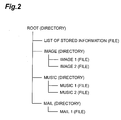
- Fig. 2 is a diagram which shows the directory construction of the storage part 17. For example, as is shown in Fig. 2, subordinate directories titled “images", "music” and “mail” have been created by the user of the cellular telephone 12 under a root directory provided beforehand in the storage part 17. Furthermore, the image information of "image 1" and “image 2" is stored as image files (e. g., JPEG, GIF, BMP or MPEG files) in the "image” directory, and the music information of "music 1" and "music 2" is stored as music files (e.
- image files e. g., JPEG, GIF, BMP or MPEG files
- the text information of "mail 1" is stored as a text file in the "mail" directory.
- the directory construction of the storage part 17 can be freely altered by the user of the cellular telephone 12. For example, a "still image” directory and a “moving image” directory can be further created under the "image" directory shown in Fig. 2, so that a hierarchical directory structure can be constructed.
- Figure 3 is a diagram which shows the construction of the file titled "list of stored information”.
- a list of the information (files) stored in the storage part 17, and attribute information such as transmission permission information, forwarding permission information, editing permission information, copyright information, data size and the like, for the respective information (files) stored in the storage part 17, are contained in the file titled "list of stored information”.
- transmission permission information refers to information that indicates whether or not it is permitted to transmit the information in question to other cellular telephones (e. g., the cellular telephone 14), i. e., whether or not it is permitted to disclose the information in question to other parties.
- forwarding permission information refers to information that indicates whether or not information that has been transmitted to other cellular telephones (e. g., the cellular telephone 14) may be further forwarded from these other cellular telephones to still other cellular telephones (e. g., cellular telephones other than the cellular telephone 14), i. e., whether or not this information may be secondarily distributed.
- editing permission information refers to information that indicates whether or not information that has been transmitted to other cellular telephones (e. g., the cellular telephone 14) may be edited in these other cellular telephones.
- copyright information refers to information that indicates whether or not the information in question is copyrighted.
- the attribute adding part 18 adds attribute information regarding attributes of information such as images, music, text and the like stored in the storage part 17 to this stored information. To describe this in greater detail, the attribute adding part 18 adds transmission permission information, forwarding permission information, editing permission information and copyright information to the respective information (files) such as images, music, text and the like stored in the storage part 17, and records such attribution in the file titled "list of stored information”. Furthermore, the attribute adding part 18 detects the data size of respective information (files) such as images, music, text and the like stored in the storage part 17, and records this data size in the file titled "list of stored information”.
- the request receiving part 20 receives transmission requests that are transmitted from the cellular telephone 14 via the network device 16 for the list of information that is stored in the storage part 17 of the cellular telephone containing this request receiving part 20 (i. e., the cellular telephone 12).
- the request receiving part 20 also receives transmission requests that are transmitted from the cellular telephone 14 via the network device 16 for information stored in the storage part 17 of the cellular telephone containing this request receiving part 20 (i. e., the cellular telephone 12).
- the information transmitting part 22 transmits the list of information stored in the storage part 17 of the cellular telephone containing this information transmitting part 22 (i. e., the cellular telephone 12) to the cellular telephone 14 via the network device 16 in accordance with transmission requests for the list of information that are received by the request receiving part 20. Furthermore, the information transmitting part 22 transmits information stored in the storage part 17 of the cellular telephone containing this information transmitting part 22 (i. e., the cellular telephone 12) to the cellular telephone 14 via the network device 16 in accordance with transmission requests for information that are received by the request receiving part 20.
- the information transmitting part 22 refers to transmission permission information that is contained in the file titled "list of stored information" that is stored in the storage part 17, and in cases where the transmission of the information requested by the cellular telephone 14 is permitted, the information transmitting part 22 transmits this information to the cellular telephone 14. On the other hand, in cases where the transmission of this information is not permitted, the information transmitting part 22 does not transmit this information to the cellular telephone 14.
- the information transmitting part 22 refers to forwarding permission information contained in the file titled "list of stored information" that is stored in the storage part 17, and in cases where forwarding of the information requested by the cellular telephone 14 is permitted, the information transmitting part 22 transmits this information to the cellular telephone 14 in a state of allowing the forwarding of the information. On the other hand, in cases where forwarding of this information is not permitted, the information transmitting part 22 transmits this information to the cellular telephone 14 after working the information into a state that does not allow forwarding.
- the information transmitting part 22 refers to editing permission information contained in the file titled "list of stored information' that is stored in the storage part 17, and in cases where editing of the information requested by the cellular telephone 14 is permitted in the cellular telephone 14, the information transmitting part 22 transmits this information to the cellular telephone 14 in a state of allowing the editing of the information. On the other hand, in cases where editing of the information is not permitted in the cellular telephone 14, the information transmitting part 22 transmits this information to the cellular telephone 14 after working the information into a state that does not allow editing of the information.
- the information transmitting part 22 refers to copyright information contained in the file titled "list of stored information" that is stored in the storage part 17, and if the information requested by the cellular telephone 14 is copyrighted, the information transmitting part 22 transmits information indicating this to the cellular telephone 14.
- the cellular telephone 12 can perform communications while moving. Specifically, the cellular telephone 12 can transmit the abovementioned information to the cellular telephone 14 while moving. However, in cases where the cellular telephone 12 transmits the abovementioned information while moving, there may be instances in which the cellular telephone 12 enters a region in which the reception electromagnetic wave strength is small, so that the call is cut off before the transmission of the abovementioned information is completed. The cellular telephone 12 is prepared for such cases.
- the information transmitting part 22 again makes a call connection when the cellular telephone 12 returns to a region in which the reception electromagnetic wave strength is large, and re-initiates the transmission of the abovementioned information to the cellular telephone 14.
- the attribute adding part 18, request receiving part 20 and information transmitting part 22 of the cellular telephone 12 are realized by installing a program (information transmitting and receiving program) in the cellular telephone 12 in order to realize the respective functions of the abovementioned attribute adding part 18, request receiving part 20 and information transmitting part 22 in the cellular telephone 12.
- This program may be installed in the cellular telephone 12 beforehand, or may be downloaded from a server via a carrier wave, and then installed.
- the cellular telephone 14 is constructed so that this cellular telephone is equipped with a request transmitting part 24 (second transmitting means), an information receiving part 26 (second receiving means), a storage part 28 (second storage means) and an information presenting part 30 (presenting means).
- a request transmitting part 24 second transmitting means
- an information receiving part 26 second receiving means
- a storage part 28 second storage means
- an information presenting part 30 presenting means
- the request transmitting part 24 transmits transmission requests for the list of information stored in the storage part 17 of the cellular telephone 12 to the cellular telephone 12 via the network device 16.
- the request transmitting part 24 also transmits transmission requests for information stored in the storage part 17 of the cellular telephone 12 to the cellular telephone 12 via the network device 16.
- the information receiving part 26 receives the abovementioned list of information that is transmitted from the cellular telephone 12 via the network device 16 in accordance with the transmission requests for the abovementioned list of information.
- the information receiving part 26 also receives the abovementioned information that is transmitted from the cellular telephone 12 via the network device 16 in accordance with the transmission requests for the abovementioned information.
- the abovementioned list of information and the abovementioned information received by the information receiving part 26 are stored in the storage part 28.
- the storage part 28 can also create directories based on instructions from the user.
- the information presenting part 30 presents the abovementioned list of information and the abovementioned information received by the information receiving part 26.
- the information presenting part 30 displays the abovementioned list of information on the display of the cellular telephone 14. Furthermore, if the abovementioned information consists of images or text, the information presenting part 30 displays this information on the display, and if the abovementioned information consists of music, the information presenting part 30 plays back this information and outputs the information from the speaker.
- the request transmitting part 24, information receiving part 26 and information presenting part 30 of the cellular telephone 14 are realized by installing a program (information transmitting and receiving program) in the cellular telephone 14 in order to realize the respective functions of the abovementioned request transmitting part 24, information receiving part 26 and image presenting part 30 in the cellular telephone 14.
- This program may be installed beforehand in the cellular telephone 14, or may be downloaded from a server via a carrier wave, and then installed.
- the network device 16 is constructed so that this device is equipped with a communications device 32 and an address determining device 34 (specifying means). Furthermore, the communications device 32 is constructed so that this device is equipped with a request receiving part 36 (third receiving means), request transmitting part 38 (third transmitting means), information receiving part 40 (fourth receiving means), information transmitting part 42 (fourth transmitting means) and storage part 44 (third storage means).
- the request receiving part 36 of the communications device 32 receives transmission requests that are transmitted from the cellular telephone 14 to the cellular telephone 12 for the list of information that is stored in the storage part 17 of the cellular telephone 12.
- the request receiving part 36 also receives transmission requests that are transmitted from the cellular telephone 14 to the cellular telephone 12 for information that is stored in the storage part 17 of the cellular telephone 12.
- the address determining device 34 specifies the cellular telephone 12 to which transmission requests for the abovementioned list of information and transmission requests for information received by the request receiving part 36 of the communications device 32 are to be transmitted on the basis of these transmission requests for the abovementioned list of information and transmission requests for information, and notifies the request transmitting part 38 of the communications device 32 of the results.
- the address determining device 34 extracts information (e. g., telephone number or machine number of the cellular telephone) that specifies the destination cellular telephone from the transmission requests for the list of information and transmission requests for information, and specifies the destination cellular telephone on the basis of this information.
- the request transmitting part 38 of the communications device 32 transmits transmission requests for the abovementioned list of information and transmission requests for the abovementioned information to the cellular telephone 12 specified by the address determining device 34.
- the request transmitting part 38 stores the transmission requests for the abovementioned list of information and transmission requests for the abovementioned information in the storage part 44.
- the transmission requests for the abovementioned list of information or transmission requests for the abovementioned information can be transmitted to the cellular telephone 12
- the transmission requests for the abovementioned list of information or transmission requests for the abovementioned information are read out from the storage part 44 and transmitted to the cellular telephone 12.
- the fact that the cellular telephone 12 has returned to the mobile communications area, or the fact that the power supply has been switched on can be detected by means of a position registration request that is transmitted from the cellular telephone 12.
- the information receiving part 40 of the communications device 32 receives the list of the abovementioned information and the abovementioned information transmitted from the cellular telephone 12 in accordance with the transmission requests for the abovementioned list of information and the transmission requests for the abovementioned information that are transmitted by the request transmitting part 38.
- the information transmitting part 42 of the communications device 32 transmits the list of the abovementioned information and the abovementioned information received by the information receiving part 40 to the cellular telephone 14 which is the originator of the requests.
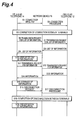
- Fig. 4 is a timing chart which illustrates the operation of the mobile communications system 10 of the present embodiment
- Fig. 5 is a diagram which shows the flow of information that takes place when a connection is made from the cellular telephone 14 to the cellular telephone 12.
- Fig. 6 is a diagram which shows the flow of information that takes place when the list of information is transmitted from the cellular telephone 12 to the cellular telephone 14, and
- Fig. 7 is a diagram which shows the flow of information that takes place when information is transmitted from the cellular telephone 12 to the cellular telephone 14.
- the cellular telephone 14 is connected to the cellular telephone 12 in order to allow the cellular telephone 14 to receive information stored in the storage part 17 of the cellular telephone 12.
- a request for connection to the cellular telephone 12 is first transmitted from the cellular telephone 14 to the network device 16 (S1).
- this connection request contains the telephone number "090000000" of the cellular telephone 12 as information that specifies the destination cellular telephone 12.
- the cellular telephone 12 that is the connection destination is specified by the address determining device 34 on the basis of the telephone number of the cellular telephone 12 that is contained in the abovementioned transmission request, and the communications device 32 is notified of the result (S3).
- a connection procedure that includes the transmission of the connection request from the cellular telephone 14, setting of a wireless link and the like is performed by the communications device 32 of the network device 16 for the cellular telephone 12 (S4), and when this connection procedure is completed, a connection is completed between the cellular telephone 12 and cellular telephone 14 (S5).
- a transmission request for the list of information is first transmitted from the cellular telephone 14 to the communications device 32 of the network device 16 as shown in Figs. 4 and 6 (S6).
- the transmission request for the list of information that is received by the communications device 32 of the network device 16 is transmitted from the communications device 32 of the network device 16 to the cellular telephone 12, and is received by the cellular telephone 12 (S7).
- the transmission request for the abovementioned list of information is temporarily stored in the storage part 44.
- the transmission request for the abovementioned list of information is read out from the storage part 44 and transmitted to the cellular telephone 12.
- the system it would also be possible to arrange the system so that in cases where the cellular telephone 12 has moved outside of the mobile communications area or the power supply has been switched off, the option of interrupting the transmission of the transmission request for the list of information, or transmitting the transmission request for the abovementioned list of information to the cellular telephone 12 when the cellular telephone 12 has returned to the mobile communications area or the power supply has been switched on, is selected on the side of the cellular telephone 14.
- the system may also be arranged so that the abovementioned control option is selected by instructions from the cellular telephone 12 on the information transmitting side.
- the system may also be arranged so that in cases where the cellular telephone 12 has moved outside of the mobile communications area, or the power supply has been switched off, the option of interrupting the transmission of the abovementioned list of information, or transmitting the information to the cellular telephone 14 when the cellular telephone 12 has returned to the mobile communications area or the power supply has been switched on, is selected on the side of the cellular telephone 12.
- the list of information stored in the storage part 17 of the cellular telephone 12 is read out from the file titled "list of stored information" that is stored in the storage part 17, and is transmitted to the communications device 32 of the network device 16 (S8).
- the attribute information such as transmission permission information, forwarding permission information, editing permission information, copyright information, data size and the like that is contained in the file titled "list of stored information” is also included in the list of information and transmitted.
- the list of information that is received by the communications device 32 of the network device 16 is further transmitted from the communications device 32 of the network device 16 to the cellular telephone 14, and is received by the cellular telephone 14 (S9).
- the abovementioned list of information received by the cellular telephone 14 is shown on the display of the cellular telephone 14 (S10). Specifically, the titles of the information "image 1", “image 2", “music 1” and “music 2" are displayed on the display of the cellular telephone 14 as the list of information stored in the storage part 17 of the cellular telephone 12, whose telephone number is "090-000-0000". In this case, attribute information such as forwarding permission information, editing permission information, copyright information, data size and the like is also displayed together with the respective information. Furthermore, information whose transmission from the cellular telephone 12 is not permitted ("mail 1" in the example shown in Fig. 3) is excluded from the list of information.
- email 1 in the example shown in Fig. 3
- the display configuration of the list of information is not limited to the display configuration shown in Fig. 8; for example, the information titles "image 1", “image 2", “music 1” and “music 2" may be displayed in different colors according to the attributes of the information. Moreover, it would also be possible to arrange the system so that information whose transmission is not permitted is also included in the list of information, and so that a display of "cannot be transmitted" is output when this information is designated.
- a transmission request for information is first transmitted from the cellular telephone 14 to the communications device 32 of the network device 16 as shown in Figs. 4 and 7 (S11).
- Information that specifies the desired information e. g., the information title "image 1" is included in the transmission request for the information.
- the transmission request for this information that is received by the communications device 32 of the network device 16 is further transmitted from the communications device 32 of the network device 16 to the cellular telephone 12, and is received by the cellular telephone 12 (S12).
- the transmission request for the abovementioned information is temporarily stored in the storage part 44. Subsequently, when the cellular telephone 12 returns to the mobile communications area or the power supply is switched on so that the transmission request for the abovementioned information can be transmitted to the cellular telephone 12, the transmission request for the abovementioned information is read out from the storage part 44 and transmitted to the cellular telephone 12. In this case, furthermore, it would also be possible to arrange the system so that the abovementioned control option can be selected by instructions from the cellular telephone 14 on the information request side.
- the system it would also be possible to arrange the system so that in cases where the cellular telephone 12 has moved outside of the mobile communications area or the power supply has been switched off, the option of interrupting the transmission of the transmission request for the information, or transmitting the transmission request for the abovementioned information to the cellular telephone 12 when the cellular telephone 12 has returned to the mobile communications area or the power supply has been switched on, is selected on the side of the cellular telephone 14.
- the system may also be arranged so that the abovementioned control option is selected by instructions from the cellular telephone 12 on the information transmitting side.
- the system may also be arranged so that in cases where the cellular telephone 12 has moved outside of the mobile communications area, or the power supply has been switched off, the option of interrupting the transmission of the list of information, or transmitting the abovementioned information to the cellular telephone 14 when the cellular telephone 12 has returned to the mobile communications area or the power supply has been switched on, is selected on the side of the cellular telephone 12.
- the corresponding information (e. g., "image 1") that is stored in the storage part 17 of the cellular telephone 12 is read out, and is transmitted to the communications device 32 of the network device 16 (S13).
- the forwarding permission information that is contained in the file titled "list of stored information” stored in the storage part 17, and if forwarding of the information in question is permitted, this information is transmitted in a state of allowing the forwarding.
- the information is worked into a state that does not allow forwarding, and is then transmitted.
- the information (e. g., "image 1") that is received by the communications device 32 of the network device 16 is further transmitted from the communications device 32 of the network device 16 to the cellular telephone 14, and is received by the cellular telephone 14 (S14).
- the information that is received by the cellular telephone 14 is temporarily stored in the storage part 28 of the cellular telephone 14 (S15).
- the cellular telephone 12 can perform communications while moving. Specifically, the cellular telephone 12 can transmit the abovementioned information to the cellular telephone 14 while moving. However, in cases where the cellular telephone 12 transmits the abovementioned information while moving, there may be instances in which the cellular telephone 12 enters a region in which the reception electromagnetic wave strength is small, so that the call is cut off before the transmission of the abovementioned information is completed. The cellular telephone 12 is prepared for such cases.
- a disconnection request is transmitted from the cellular telephone 14 to the communications device 32 of the network device 16 (S16), and a disconnection procedure is performed by the communications device 32 of the network device 16 with respect to the cellular telephone 12 (S17), so that the connection between the cellular telephone 12 and cellular telephone 14 is severed (S18).
- information stored in the storage part 28 is presented by instructions from the user (S19). Specifically, if the abovementioned information consists of images or text, this information is displayed on the display, and if the abovementioned information consists of music, this information is played back and output from the speaker.
- the cellular telephone 12 receives transmission requests for information from the cellular telephone 14, and transmits information stored in the storage part 17 to the cellular telephone 14 in accordance with these transmission requests for information. Accordingly, the abovementioned information can be sent from one cellular telephone 12 to the other cellular telephone 14 without uploading this information into a server device provided by a mobile communications business operator. As a result, increased convenience can be afforded when the user of the cellular telephone sends information.
- the cellular telephone 14 transmits transmission requests for information stored in the storage part 17 of another cellular telephone 12 to this other cellular telephone 12, and receives and presents information that is transmitted from this other cellular telephone 12 in accordance with these transmission requests. Accordingly, the abovementioned information can be received from the other cellular telephone 12 without uploading this information into a server device provided by a mobile communications business operator. As a result, increased convenience can be afforded when the user of the cellular telephone receives information.
- cellular telephone 12 can transmit the abovementioned information while moving.
- the cellular telephone 12 of the present embodiment again makes a call connection and re-initiates the transmission of the abovementioned information to the abovementioned cellular telephone 14 at the point in time at which the cellular telephone 12 returns to a region in which the reception electromagnetic wave strength is large.
- the abovementioned information can be securely transmitted from the cellular telephone 12 to the cellular telephone 14.
- attribute information for the abovementioned information stored in the storage part 17 is added to this stored information. Accordingly, for each information file stored in the storage part 17, various types of control such as allowing or not allowing transmission, allowing or not allowing editing and the like can be executed.
- transmission permission information is added to the abovementioned information stored in the storage part 17.
- the information is transmitted to the other cellular telephone 14 in cases where the transmission of this information is permitted, and the information is not transmitted to the other cellular telephone 14 in cases where the transmission of this information is not permitted. Accordingly, the user of the cellular telephone 12 can transmit only information that he desires to send to the other cellular telephone 14.
- forwarding permission information is added to the abovementioned information stored in the storage part 17.
- information is sent to the cellular telephone 14 in a state of allowing the forwarding in cases where forwarding of this information is permitted.
- the information is worked into a state that does not allow forwarding, and is then transmitted to the cellular telephone 14. Accordingly, in the case of information that the user of the cellular telephone 12 does not desire to be forwarded to other cellular telephones from the cellular telephone 14, the forwarding of this information to other cellular telephones can be prevented.
- editing permission information is added to the abovementioned information stored in the storage part 17.
- information is sent to the cellular telephone 14 in a state of allowing the editing in cases where editing of this information is permitted.
- the information is worked into a state that does not allow editing, and is then transmitted to the cellular telephone 14. Accordingly, in the case of information that the user of the cellular telephone 12 does not desire to be edited by other parties, editing of this information by other parties can be prevented.
- copyright information is added to the abovementioned information stored in the storage part 17, and this copyright information is transmitted to the cellular telephone 14. Accordingly, the user of the cellular telephone 14 can ascertain any copyrighting of the information that is received.
- a list of the abovementioned information stored in the storage part 17 of the cellular telephone 12 is transmitted to the cellular telephone 14. Accordingly, the user of the cellular telephone 14 can easily ascertain what kinds of information are stored in the storage part 17 of the cellular telephone 12, and can easily search for desired information.
- directories of the storage part 17 can be created on the basis of instructions from the user. Accordingly, the user of the cellular telephone 12 can create directories in accordance with the types of information (e. g., images, music, text and the like) possessed by this user, and can store the information in an orderly manner.
- information e. g., images, music, text and the like
- received information is stored in the storage part 28 in this cellular telephone 14. Accordingly, such received information can be presented not only at the time of reception, but also at a later time.
- a list of information stored in the storage part 17 of the other cellular telephone 12 is received and presented. Accordingly, the user of the cellular telephone 14 can easily ascertain what kinds of information are stored in the storage part 17 of the other cellular telephone 12, and can easily search for desired information.
- directories of the storage part 28 can be created on the basis of instructions from the user. Accordingly, the user of the cellular telephone 14 can create directories in accordance with the types of information (e. g., images, music, text and the like) possessed by this user, and can store the information in an orderly manner.
- information e. g., images, music, text and the like
- the mobile communications system 10 of the abovementioned embodiment was a system in which information was transmitted from a cellular telephone 12 to a cellular telephone 14, however, the cellular telephones 12 and 14 may also be other mobile communications terminals such as PHS or the like.
- the communications terminal on the side receiving information was a cellular telephone 14, however, this terminal may also be a communications terminal such as a personal computer or the like.
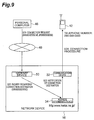
- Fig. 9 is a diagram which shows the flow of information that takes place when a connection is made from a personal computer 46 to the cellular telephone 12
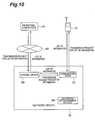
- Fig. 10 is a diagram which shows the flow of information that takes place when the list of information is transmitted from the cellular telephone 12 to the personal computer 46.
- Fig. 11 is a diagram which shows the flow of information that takes place when information is transmitted from the cellular telephone 12 to the personal computer 46.
- a connection is first made from the personal computer 46 to the cellular telephone 12.
- a request for connection to the cellular telephone 12 is first transmitted from the personal computer 46 to the network device 16 via the internet 48 (S21).
- This connection request includes information that specifies the IP address of the address determining device inside the network device 16 ("www.keitai.ne.jp/", which is the domain name of the address determining device), and information that specifies the destination cellular telephone 12 ("0900000000", which is the telephone number of the cellular telephone 12).
- the cellular telephone 12 that constitutes the connection destination is specified by the address determining device 34 on the basis of the telephone number of the cellular telephone 12 that is included in the abovementioned transmission request, and the communications device 32 is notified of the result (S23).
- connection procedure that includes transmission of the connection request from the personal computer 46, setting of a wireless link and the like is performed by the communications device 32 of the network device 16 with respect to the cellular telephone 12 (S24), and when this connecting procedure is completed, the connection of the personal computer 46 to the cellular telephone 12 is completed.
- a transmission request of the list of information is transmitted from the personal computer 46 to the cellular telephone 12 via the gateway device 50 and communications device 32 of the network device 16 as shown in Fig. 10. Furthermore, the list of information is transmitted from the cellular telephone 12 to the personal computer 46 via the communications device 32 and gateway device 50 of the network device 16 in accordance with this transmission request for the list of information.
- a transmission request for this information is transmitted from the personal computer 46 to the cellular telephone 12 via the gateway device 50 and communications device 32 of the network device 16 as shown in Fig. 11.
- information such as images, music, text or the like is transmitted from the cellular telephone 12 to the personal computer 46 via the communications device 32 and gateway device 50 of the network device 16 in accordance with this transmission request for information.
Landscapes
- Engineering & Computer Science (AREA)
- Computer Networks & Wireless Communication (AREA)
- Signal Processing (AREA)
- Mobile Radio Communication Systems (AREA)
- Telephonic Communication Services (AREA)
- Information Transfer Between Computers (AREA)
Abstract
Description
Claims (23)
- A mobile communications terminal comprising:first storage means for storing information;first receiving means for receiving transmission requests that are transmitted from communications terminals for said information stored in said first storage means; andfirst transmitting means for transmitting said information stored in said first storage means to said communications terminals in accordance with transmission requests for said information received by said first receiving means.
- The mobile communications terminal according to claim 1, wherein said first transmitting means again establish a call connection and re-initiate the transmission of said information to said communications terminals in cases where the call between said mobile communications terminal and said communications terminals is cut off in a state in which the transmission of said information to said communications terminals is incomplete.
- The mobile communications terminal according to claim 1, wherein said mobile communications terminal further comprises adding means for adding attribute information regarding attributes of said information stored in said first storage means to said information.
- The mobile communications terminal according to claim 3, wherein said attribute information that is added by said adding means is transmission permission information regarding permission to transmit said information, and on the basis of said transmission permission information, said first transmitting means transmit said information to said communications terminals in cases where the transmission of said information is permitted, and do not transmit said information to said communications terminals in cases where the transmission of said information is not permitted.
- The mobile communications terminal according to claim 3, wherein said attribute information that is added by said adding means is forwarding permission information regarding permission to forward said information from said communications terminals to other communications terminals, and on the basis of said forwarding permission information, said first transmitting means transmit said information to said communications terminals in a state of allowing the forwarding in cases where the forwarding of said information is permitted, and transmit said information to said communications terminals in a state of inhibiting the forwarding in cases where the forwarding of said information is not permitted.
- The mobile communications terminal according to claim 3, wherein said attribute information that is added by said adding means is editing permission information regarding permission to edit said information in said communications terminals, and on the basis of said editing permission information, said first transmitting means transmit said information to said communications terminals in a state of allowing the editing in cases where the editing of said information is permitted, and transmit said information to said communications terminals in a state of inhibiting the editing in cases where the editing of said information is not permitted.
- The mobile communications terminal according to claim 3, wherein said attribute information that is added by said adding means is copyright information regarding the copyright of said information, and said first transmitting means transmit said copyright information to said communications terminals.
- The mobile communications terminal according to claim 1, wherein said first transmitting means transmit a list of said information stored in said first storage means to said communications terminals.
- The mobile communications terminal according to claim 1, wherein said first storage means can create directories on the basis of instructions from the user.
- A mobile communications terminal comprising:second transmission means for transmitting transmission requests for information stored in the storage means of other mobile communications terminals to said other mobile communications terminals;second receiving means for receiving said information transmitted from said other mobile communications terminals in accordance with the transmission requests for said information that are transmitted from said second transmitting means; andpresenting means for presenting said information received by said second receiving means.
- The mobile communications terminal according to claim 10, wherein said mobile communications terminal further comprises second storage means for storing said information received by said second receiving means.
- The mobile communications terminal according to claim 10, wherein said second receiving means receive a list of the information stored in the storage means of said other mobile communications terminals, which is transmitted from said other mobile communications terminals, and said presenting means present said list of information received by said second receiving means.
- The mobile communications terminal according to claim 11, wherein said second storage means can create directories on the basis of instructions from the user.
- A network device comprising:third receiving means for receiving transmission requests transmitted from communications terminals for information stored in the storage means of a mobile communications terminal;specifying means for specifying said mobile communications terminal on the basis of transmission requests for said information received by said third receiving means;third transmitting means for transmitting transmission requests for said information to said mobile communications terminal specified by said specifying means;fourth receiving means for receiving said information transmitted from said mobile communications terminal in accordance with the transmission requests for said information transmitted by said third transmitting means; andfourth transmitting means for transmitting said information received by said fourth receiving means to said communications terminals.
- The network device according to claim 14, further comprising third storage means for storing transmission requests for said information that are received by said third receiving means, wherein said third transmitting means store said transmission requests for said information in said third storage means in cases where said transmission requests for said information cannot be transmitted to said mobile communications terminal, and read out said transmission requests for said information from said third storage means and transmit to said mobile communications terminal when it becomes possible to transmit said transmission requests for said information to said mobile communications terminal.
- A mobile communications system comprising:wherein said network device receives transmission requests for said information that are transmitted from said communications terminals, said network device transmits said transmission requests for said information to said mobile communications terminal, said network device receives said information that is transmitted from said mobile communications terminal, and said network device transmits said information to said communications terminals.the network device according to claim 14 or 15; the mobile communications terminal according to any one of claims 1 through 9; andcommunications terminals;
- The mobile communications system according to claim 16, wherein said communications terminals are mobile communications terminals according to any one of claims 10 through 13.
- An information transmitting and receiving method comprising:a first receiving step in which information is stored in the storage means of a mobile communications terminal, and the receiving means of said mobile communications terminal receive transmission requests that are transmitted from communications terminals for said information that is stored in said storage means; anda first transmitting step in which the transmitting means of said mobile communications terminal transmit said information stored in said storage means to said communications terminals in accordance with the transmission requests for said information that are received by said receiving means.
- The information transmitting and receiving method according to claim 18, wherein said first transmitting step is devised so that a call connection is again made and the transmission of said information from said mobile communications terminal to said communications terminals is re-initiated in cases where the call between said mobile communications terminal and said communications terminals is cut off in a state in which the transmission of said information from said mobile communications terminal to said communications terminals is incomplete.
- An information transmitting and receiving method comprising:a second transmitting step in which the transmitting means of a mobile communications terminal transmit transmission requests for information stored in the storage means of another mobile communications terminal to said other mobile communications terminal;a second receiving step in which the receiving means of said mobile communications terminal receive said information transmitted from said other mobile communications terminal in accordance with the transmission requests for said information transmitted by said transmitting means; anda presenting step in which the presenting means of said mobile communications terminal present said information received by said receiving means.
- An information transmitting and receiving program which causes a mobile communications terminal to function as first receiving means for receiving transmission requests that are transmitted from communications terminals for information stored in the storage means of said mobile communications terminal, and as first transmitting means for transmitting said information stored in said storage means to said communications terminals in accordance with the transmission requests for said information that are received by said first receiving means.
- The information transmitting and receiving program according to claim 21, wherein said first transmitting means again establish a call connection and re-initiate the transmission of said information to said communications terminals in cases where the call between said mobile communications terminal and said communications terminals is cut off in a state in which the transmission of said information to said communications terminals is incomplete.
- An information transmitting and receiving program which causes a mobile communications terminal to function as second transmitting means for transmitting requests for information stored in the storage means of another mobile communications terminal to said other mobile communications terminal, as second receiving means for receiving said information transmitted from said other mobile communications terminal in accordance with the transmission requests for said information that are transmitted from said second transmitting means, and as presenting means for presenting said information that is received by said second receiving means.
Applications Claiming Priority (4)
| Application Number | Priority Date | Filing Date | Title |
|---|---|---|---|
| JP2001324084 | 2001-10-22 | ||
| JP2001324084 | 2001-10-22 | ||
| JP2002296534 | 2002-10-09 | ||
| JP2002296534A JP2003204581A (en) | 2001-10-22 | 2002-10-09 | Mobile communication terminal, network device, mobile communication system, information transmitting / receiving method, information transmitting / receiving program |
Publications (3)
| Publication Number | Publication Date |
|---|---|
| EP1304894A2 true EP1304894A2 (en) | 2003-04-23 |
| EP1304894A3 EP1304894A3 (en) | 2003-10-08 |
| EP1304894B1 EP1304894B1 (en) | 2006-08-16 |
Family
ID=26624026
Family Applications (1)
| Application Number | Title | Priority Date | Filing Date |
|---|---|---|---|
| EP02023490A Expired - Lifetime EP1304894B1 (en) | 2001-10-22 | 2002-10-21 | Data transfer to a mobile station through a mobile communication system |
Country Status (7)
| Country | Link |
|---|---|
| US (1) | US20030078034A1 (en) |
| EP (1) | EP1304894B1 (en) |
| JP (1) | JP2003204581A (en) |
| KR (1) | KR20030033956A (en) |
| CN (1) | CN1234256C (en) |
| DE (1) | DE60213936T2 (en) |
| SG (1) | SG102063A1 (en) |
Cited By (3)
| Publication number | Priority date | Publication date | Assignee | Title |
|---|---|---|---|---|
| EP1578157A1 (en) * | 2004-03-18 | 2005-09-21 | Nec Corporation | Cellular Phone, Information Providing Site Access Method and Access Control Program |
| WO2009134604A1 (en) * | 2008-04-28 | 2009-11-05 | Qualcomm Incorporated | Method and apparatus for retrieving data from one or more wireless communication devices |
| CN101567827B (en) * | 2008-04-22 | 2012-04-04 | 华为技术有限公司 | Method, system, device, and terminal for transmitting session records in terminal session switching |
Families Citing this family (18)
| Publication number | Priority date | Publication date | Assignee | Title |
|---|---|---|---|---|
| US7472091B2 (en) * | 2001-10-03 | 2008-12-30 | Accenture Global Services Gmbh | Virtual customer database |
| US7441016B2 (en) * | 2001-10-03 | 2008-10-21 | Accenture Global Services Gmbh | Service authorizer |
| US7640006B2 (en) * | 2001-10-03 | 2009-12-29 | Accenture Global Services Gmbh | Directory assistance with multi-modal messaging |
| US7363053B2 (en) * | 2003-03-28 | 2008-04-22 | Lockheed Martin Corproation | System for integrated mobile devices |
| US7305230B2 (en) * | 2003-07-01 | 2007-12-04 | Nokia Corporation | System, apparatus, and method for providing a mobile server |
| KR100540241B1 (en) | 2003-07-21 | 2006-01-11 | 엘지전자 주식회사 | Message Management |
| JP4434788B2 (en) | 2004-03-11 | 2010-03-17 | 日本電気株式会社 | Call control system, call management system, and call control method |
| KR101044888B1 (en) * | 2004-07-09 | 2011-06-28 | 엘지전자 주식회사 | Handheld terminal with keypad flow prevention device |
| KR100600750B1 (en) * | 2004-07-27 | 2006-07-14 | 엘지전자 주식회사 | Mobile terminal equipped with dual camera |
| US9143380B2 (en) * | 2004-08-06 | 2015-09-22 | Nokia Technologies Oy | System and method for third party specified generation of web server content |
| JP2006165650A (en) * | 2004-12-02 | 2006-06-22 | Matsushita Electric Ind Co Ltd | Metadata management device |
| US20060143297A1 (en) * | 2004-12-27 | 2006-06-29 | Panu Korhonen | Mobile communication terminal, system and method therefore |
| KR20060093358A (en) * | 2005-02-21 | 2006-08-25 | 주식회사 팬택 | Method of exchanging information between a plurality of portable terminals and the portable terminal |
| US20080171562A1 (en) * | 2007-01-16 | 2008-07-17 | Agere Systems Inc. | System and method to access and download data from a mobile device using a cellular network |
| JP5167726B2 (en) * | 2007-08-23 | 2013-03-21 | ソニー株式会社 | Content billing system, content acquisition device, content acquisition method and program thereof, and content providing device, content provision method and program thereof |
| JP5429780B2 (en) * | 2009-01-28 | 2014-02-26 | シャープ株式会社 | Communication terminal, communication method, and communication program |
| JP2010272973A (en) * | 2009-05-19 | 2010-12-02 | Sharp Corp | Network system, communication terminal, communication method, and communication program |
| US8953478B2 (en) * | 2012-01-27 | 2015-02-10 | Intel Corporation | Evolved node B and method for coherent coordinated multipoint transmission with per CSI-RS feedback |
Family Cites Families (23)
| Publication number | Priority date | Publication date | Assignee | Title |
|---|---|---|---|---|
| JPH09205680A (en) * | 1996-01-26 | 1997-08-05 | Nippon Denki Ido Tsushin Kk | Data transmission / reception method between mobile phones |
| US5915225A (en) * | 1996-03-28 | 1999-06-22 | Ericsson Inc. | Remotely retrieving SIM stored data over a connection-less communications link |
| US5889860A (en) * | 1996-11-08 | 1999-03-30 | Sunhawk Corporation, Inc. | Encryption system with transaction coded decryption key |
| JP3098442B2 (en) * | 1997-01-28 | 2000-10-16 | 日本電気移動通信株式会社 | Telephone system |
| JPH1125076A (en) * | 1997-06-30 | 1999-01-29 | Fujitsu Ltd | Document management device and document management program storage medium |
| KR100281083B1 (en) * | 1998-01-23 | 2001-02-01 | 서평원 | Method of Performing Wireless Data Communication Between the Mobile Data Cellular-Phone |
| KR100270661B1 (en) * | 1998-09-10 | 2000-11-01 | 윤종용 | How to Back Up User Information in Mobile Communication Terminal Using Wireless Data Communication |
| US6477373B1 (en) * | 1999-08-10 | 2002-11-05 | Research Foundation Of State University Of New York | Method and apparatus to maintain connectivity for mobile terminals in wireless and cellular communications systems |
| JP2001128242A (en) * | 1999-10-28 | 2001-05-11 | Mitsubishi Electric Corp | File transfer system between mobile terminals |
| JP3281920B2 (en) * | 2000-03-14 | 2002-05-13 | 東北大学長 | Method for producing allylfuran compound |
| EP1139631A1 (en) * | 2000-03-31 | 2001-10-04 | BRITISH TELECOMMUNICATIONS public limited company | Method of initiating a data transfer from a server to a client |
| CA2351291A1 (en) * | 2000-06-26 | 2001-12-26 | Nadine Smolarski-Koff | Data exchange method and communication protocol used during same |
| JP2002016956A (en) * | 2000-06-30 | 2002-01-18 | Toshiba Corp | Position information acquisition system and position information acquisition method |
| JP2002099287A (en) * | 2000-09-22 | 2002-04-05 | Toshiba Corp | Music data distribution device, music data reception device, music data reproduction device, and music data distribution method |
| US7143939B2 (en) * | 2000-12-19 | 2006-12-05 | Intel Corporation | Wireless music device and method therefor |
| US6931454B2 (en) * | 2000-12-29 | 2005-08-16 | Intel Corporation | Method and apparatus for adaptive synchronization of network devices |
| KR100576580B1 (en) * | 2000-12-30 | 2006-05-04 | 주식회사 비즈모델라인 | Method and system for processing direct data communication between wireless communication devices |
| JP3705747B2 (en) * | 2001-03-30 | 2005-10-12 | 富士通株式会社 | Image data distribution method, image data distribution apparatus and program |
| JP3902730B2 (en) * | 2001-03-30 | 2007-04-11 | 株式会社日立製作所 | COMMUNICATION MANAGEMENT METHOD, ITS EXECUTION SYSTEM, AND PROCESSING PROGRAM THEREOF |
| KR100464973B1 (en) * | 2001-06-15 | 2005-01-05 | 엘지전자 주식회사 | Method of sharing mutually a data for mobile phone users |
| US7421411B2 (en) * | 2001-07-06 | 2008-09-02 | Nokia Corporation | Digital rights management in a mobile communications environment |
| US7320033B2 (en) * | 2001-07-27 | 2008-01-15 | Intel Corporation | Dynamic local drive and printer sharing |
| US20030225744A1 (en) * | 2002-05-28 | 2003-12-04 | Luke Waaler | Method, personal digital assistant, and computer-readable medium for exchange of information |
-
2002
- 2002-10-09 JP JP2002296534A patent/JP2003204581A/en active Pending
- 2002-10-21 DE DE60213936T patent/DE60213936T2/en not_active Expired - Lifetime
- 2002-10-21 EP EP02023490A patent/EP1304894B1/en not_active Expired - Lifetime
- 2002-10-21 SG SG200206372A patent/SG102063A1/en unknown
- 2002-10-21 US US10/274,127 patent/US20030078034A1/en not_active Abandoned
- 2002-10-22 KR KR1020020064430A patent/KR20030033956A/en not_active Ceased
- 2002-10-22 CN CNB021471118A patent/CN1234256C/en not_active Expired - Fee Related
Cited By (5)
| Publication number | Priority date | Publication date | Assignee | Title |
|---|---|---|---|---|
| EP1578157A1 (en) * | 2004-03-18 | 2005-09-21 | Nec Corporation | Cellular Phone, Information Providing Site Access Method and Access Control Program |
| CN101567827B (en) * | 2008-04-22 | 2012-04-04 | 华为技术有限公司 | Method, system, device, and terminal for transmitting session records in terminal session switching |
| WO2009134604A1 (en) * | 2008-04-28 | 2009-11-05 | Qualcomm Incorporated | Method and apparatus for retrieving data from one or more wireless communication devices |
| CN102017667A (en) * | 2008-04-28 | 2011-04-13 | 高通股份有限公司 | Method and apparatus for retrieving data from one or more wireless communication devices |
| US7991418B2 (en) | 2008-04-28 | 2011-08-02 | Qualcomm Incorporated | Method and apparatus for retrieving data from one or more wireless communication devices |
Also Published As
| Publication number | Publication date |
|---|---|
| SG102063A1 (en) | 2004-02-27 |
| CN1414808A (en) | 2003-04-30 |
| US20030078034A1 (en) | 2003-04-24 |
| EP1304894A3 (en) | 2003-10-08 |
| JP2003204581A (en) | 2003-07-18 |
| KR20030033956A (en) | 2003-05-01 |
| DE60213936D1 (en) | 2006-09-28 |
| DE60213936T2 (en) | 2007-03-01 |
| CN1234256C (en) | 2005-12-28 |
| EP1304894B1 (en) | 2006-08-16 |
Similar Documents
| Publication | Publication Date | Title |
|---|---|---|
| EP1304894B1 (en) | Data transfer to a mobile station through a mobile communication system | |
| US10397788B2 (en) | Multimedia message service method and system | |
| USRE45982E1 (en) | Method and device for speeding up and simplifying information transfer between electronic devices | |
| JP4220155B2 (en) | Multimedia message communication service | |
| RU2288545C2 (en) | Method and system for multimedia message delivery | |
| US20020019225A1 (en) | Communication control system using telephone directory management system of mobile phone | |
| US20080207233A1 (en) | Method and System For Centralized Storage of Media and for Communication of Such Media Activated By Real-Time Messaging | |
| US20020006793A1 (en) | Wireless communication devices | |
| US20020002047A1 (en) | Communication system capable of reducing communication load | |
| US7779078B2 (en) | Method and system for managing multimedia messages in a mobile communication systems | |
| KR20010074057A (en) | Wireless Internet Service System and Method thereof | |
| CN103888917B (en) | Transmission of the useful data object from exchange component to movement station | |
| WO2004017654A1 (en) | Apparatus and method of providing a contacts list for a mobile telecommunications device | |
| CN108540519A (en) | A kind of equilibrium download control method and device | |
| KR20010025659A (en) | Voice contents service method for mobile phone | |
| KR100644204B1 (en) | A system and method of managing a SMS message | |
| KR20030047639A (en) | Management system and method of data for mobile communications terminal | |
| KR100361729B1 (en) | A mobile telecommunication service system for providing image information and a method thereof | |
| KR20030028588A (en) | Music-mail service system and method for mobile information terminal | |
| JP2002247104A (en) | Information arrival notification system and information arrival notification method used therefor | |
| JP2001265719A (en) | Information provision system | |
| KR20030055894A (en) | An electronic mail transporting method in mobile phone | |
| KR20050053113A (en) | Method for downloading alarm data | |
| KR20020069906A (en) | Method for offering supplement of service in mobile communication system |
Legal Events
| Date | Code | Title | Description |
|---|---|---|---|
| PUAI | Public reference made under article 153(3) epc to a published international application that has entered the european phase |
Free format text: ORIGINAL CODE: 0009012 |
|
| 17P | Request for examination filed |
Effective date: 20021021 |
|
| AK | Designated contracting states |
Designated state(s): AT BE BG CH CY CZ DE DK EE ES FI FR GB GR IE IT LI LU MC NL PT SE SK TR |
|
| AX | Request for extension of the european patent |
Extension state: AL LT LV MK RO SI |
|
| PUAL | Search report despatched |
Free format text: ORIGINAL CODE: 0009013 |
|
| AK | Designated contracting states |
Kind code of ref document: A3 Designated state(s): AT BE BG CH CY CZ DE DK EE ES FI FR GB GR IE IT LI LU MC NL PT SE SK TR |
|
| AX | Request for extension of the european patent |
Extension state: AL LT LV MK RO SI |
|
| 17Q | First examination report despatched |
Effective date: 20031117 |
|
| AKX | Designation fees paid |
Designated state(s): DE GB IT |
|
| GRAP | Despatch of communication of intention to grant a patent |
Free format text: ORIGINAL CODE: EPIDOSNIGR1 |
|
| GRAS | Grant fee paid |
Free format text: ORIGINAL CODE: EPIDOSNIGR3 |
|
| GRAA | (expected) grant |
Free format text: ORIGINAL CODE: 0009210 |
|
| AK | Designated contracting states |
Kind code of ref document: B1 Designated state(s): DE GB IT |
|
| PG25 | Lapsed in a contracting state [announced via postgrant information from national office to epo] |
Ref country code: IT Free format text: LAPSE BECAUSE OF FAILURE TO SUBMIT A TRANSLATION OF THE DESCRIPTION OR TO PAY THE FEE WITHIN THE PRESCRIBED TIME-LIMIT;WARNING: LAPSES OF ITALIAN PATENTS WITH EFFECTIVE DATE BEFORE 2007 MAY HAVE OCCURRED AT ANY TIME BEFORE 2007. THE CORRECT EFFECTIVE DATE MAY BE DIFFERENT FROM THE ONE RECORDED. Effective date: 20060816 |
|
| REG | Reference to a national code |
Ref country code: GB Ref legal event code: FG4D |
|
| REF | Corresponds to: |
Ref document number: 60213936 Country of ref document: DE Date of ref document: 20060928 Kind code of ref document: P |
|
| PLBE | No opposition filed within time limit |
Free format text: ORIGINAL CODE: 0009261 |
|
| STAA | Information on the status of an ep patent application or granted ep patent |
Free format text: STATUS: NO OPPOSITION FILED WITHIN TIME LIMIT |
|
| 26N | No opposition filed |
Effective date: 20070518 |
|
| PGFP | Annual fee paid to national office [announced via postgrant information from national office to epo] |
Ref country code: DE Payment date: 20121017 Year of fee payment: 11 |
|
| PGFP | Annual fee paid to national office [announced via postgrant information from national office to epo] |
Ref country code: IT Payment date: 20121013 Year of fee payment: 11 Ref country code: GB Payment date: 20121017 Year of fee payment: 11 |
|
| REG | Reference to a national code |
Ref country code: DE Ref legal event code: R119 Ref document number: 60213936 Country of ref document: DE |
|
| GBPC | Gb: european patent ceased through non-payment of renewal fee |
Effective date: 20131021 |
|
| REG | Reference to a national code |
Ref country code: DE Ref legal event code: R079 Ref document number: 60213936 Country of ref document: DE Free format text: PREVIOUS MAIN CLASS: H04Q0007320000 Ipc: H04W0088000000 |
|
| PG25 | Lapsed in a contracting state [announced via postgrant information from national office to epo] |
Ref country code: GB Free format text: LAPSE BECAUSE OF NON-PAYMENT OF DUE FEES Effective date: 20131021 |
|
| REG | Reference to a national code |
Ref country code: DE Ref legal event code: R119 Ref document number: 60213936 Country of ref document: DE Effective date: 20140501 Ref country code: DE Ref legal event code: R079 Ref document number: 60213936 Country of ref document: DE Free format text: PREVIOUS MAIN CLASS: H04Q0007320000 Ipc: H04W0088000000 Effective date: 20140625 |
|
| PG25 | Lapsed in a contracting state [announced via postgrant information from national office to epo] |
Ref country code: DE Free format text: LAPSE BECAUSE OF NON-PAYMENT OF DUE FEES Effective date: 20140501 Ref country code: IT Free format text: LAPSE BECAUSE OF NON-PAYMENT OF DUE FEES Effective date: 20131021 |