EP1304879A1 - Monitoring apparatus, computer program and network for secure data storage - Google Patents
Monitoring apparatus, computer program and network for secure data storage Download PDFInfo
- Publication number
- EP1304879A1 EP1304879A1 EP01203969A EP01203969A EP1304879A1 EP 1304879 A1 EP1304879 A1 EP 1304879A1 EP 01203969 A EP01203969 A EP 01203969A EP 01203969 A EP01203969 A EP 01203969A EP 1304879 A1 EP1304879 A1 EP 1304879A1
- Authority
- EP
- European Patent Office
- Prior art keywords
- strings
- monitoring apparatus
- output
- string
- output strings
- Prior art date
- Legal status (The legal status is an assumption and is not a legal conclusion. Google has not performed a legal analysis and makes no representation as to the accuracy of the status listed.)
- Withdrawn
Links
Images

Classifications
-
- H—ELECTRICITY
- H04—ELECTRIC COMMUNICATION TECHNIQUE
- H04N—PICTORIAL COMMUNICATION, e.g. TELEVISION
- H04N7/00—Television systems
- H04N7/16—Analogue secrecy systems; Analogue subscription systems
- H04N7/167—Systems rendering the television signal unintelligible and subsequently intelligible
Definitions
- the invention relates to a monitoring apparatus, a computer program and a network for secure storage of data.
- This result can be achieved by providing a monitoring apparatus that monitors representations of objects such as for e.g. images of people present in a specific area, and decomposing the recorded image.
- a representation of an object might be identical to the object in its entirety, but can refer to a characteristic part, such as the face of a person, of the object as well.
- the decomposed recorded image can only be viewed by reconstruction of the decomposed parts of the image if a number of different parties consent to do so.
- Those parties could include the police, a privacy advocacy group, and a party that is primarily responsible for that specific area. Criteria for selection of the parties can e.g. include the requirement that at least one of the parties has a high degree of independency, i.e. is not involved in the situation whatsoever.
- such a monitoring apparatus generates from a first data string representing the image two or more output strings.
- a first data string representing the image two or more output strings.
- the first two of the three output strings is generated using random means such as e.g. measurements from an internal clock or thermal measurements.
- the third output string is then chosen so that the binary addition modulo 2 of the three output strings yields the first data string.
- the output strings can be transmitted to separate storage locations.
- the first data string and the two or more output strings can be combined at or near the monitoring apparatus in order to obtain an additional output string.
- the monitoring apparatus can be a digital camera or other data source having digital data strings as an output.
- the monitoring apparatus is an analog camera equipped with an analog-digital conversion module.
- the output strings and/or additional output strings can be stored in separate locations.
- stored here refers to having the data available in any possible manner such as registration of the location of the data, saving the data on a data carrier, knowing the whereabouts of the data somewhere in a network etc.
- separate locations not necessarily refers to physical separation but also comprises e.g. different memory areas in a single data memory, e.g. a hard disc.
- the separate locations are not located in the neighbourhood of the camera.
- the monitoring apparatus can be equipped with network communication means to enable transmission of the output strings and/or additional output strings to these separate storage locations over a network.
- the strings are encrypted by encryption means at the monitoring apparatus before they are sent over the network, using e.g. encryption keys.
- state of the art compression techniques can be applied to the various output strings before they are sent to the specific storage locations.
- At least one of the storage locations can be situated in or near the monitoring apparatus. It can e.g. be that all but one storage locations are situated outside the neighbourhood of the monitoring apparatus. This provides the advantage that in the case that all (minus one) output strings which are stored at a certain distance and therefore have to be transported over that distance, could be intercepted during that data transport, the output string that is stored at or near the camera can not be intercepted. As a result the image taken by the monitoring apparatus cannot be reconstructed even if all strings transmitted over the network have been intercepted.
- all storage locations might be situated in or near the monitoring apparatus. Storage within the monitoring apparatus can be obtained in various kinds of known data memories, like tapes, harddisc, CD, DVD etc. Compression of the data strings can be advantageously applied in this variant as well.
- the storage locations containing the various output strings are preferably not directly available to all the parties concerned.
- assessment means are provided to assess the access rights of the parties to a particular storage location storing at least one of the various output strings, such as e.g. a personal identification number (PIN) or password.
- PIN personal identification number
- all the various output strings are needed to reconstruct the image whereas the parties concerned only have access rights to just a single storage location containing one output string. If a situation arises where one of the parties concerned or a third party not having access rights themselves wants to reconstruct the image as taken by the monitoring apparatus all parties having access rights need to consent to reconstruct the image(s). Such a situation might e.g. be theft in a shop, riots in a stadium or fire at the airport.
- output strings are needed to reconstruct the image but redundant output strings are generated at the monitoring apparatus by selection means to select selected output strings from the two or more output strings.
- Registration means such as the generation of strings using techniques in such a way that certain predefined subsets allow for the reconstruction of the image can register which strings are needed to reconstruct the image, by e.g. assigning a code to an output string. This can have advantages if for example one wants to give certain parties greater authority in reconstucting the original data string than other parties.
- the monitoring apparatus is equipped with an event trigger for event detection.
- This event trigger can cause the generation of output strings and transmission of these output strings to the separate storage locations to substantially take place only if e.g. a change of a substantially steady image is detected. Such a change might be the result of the movement of a person or an object in an otherwise "movement-free" area.
- An event trigger can e.g. be based on well-known image-recognition techniques.
- An example is a camera installed near an emergency exit to a bank which begins recording when it detects that someone is passing through the exit. This detection would take place through an event detector, which can take the form of image recognition software or of a physical detector such as an infrared detector. Such event detectors alert the camera when the reference event has occurred.
- the presence of an event trigger at or near the monitoring apparatus has the advantage that less irrelevant data, i.e. the various output strings generated from the first data string, are stored at the separate locations.
- the monitoring apparatus is equipped with watermarking means in order to assign watermarks to the first datastrings and/or output strings and/or additional output strings, e.g. by insertion of a watermark string in the respective strings.
- watermarks can comprise an identifier referring to its origin, i.e. the monitoring apparatus.
- the watermark can comprise a timestamp referring to the timeframe in which the first data string was recorded or in which the two or more output strings and/or additional output strings were recorded.
- the storage location for the specific output string can be part of said watermark, e.g. a download watermark.
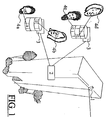
- FIG 1 an embodiment of the invention is shown illustrating the employed security system.
- the system comprises a monitoring apparatus 1, e.g. a data source such as a digital camera connected to a processor 2.
- the processor 2 can be, but is not necessarily, an integral part of the monitoring apparatus 1.
- the processor 2 in an embodiment generates at least two output strings from a first data string provided by the monitoring apparatus 1 and transmits these output strings to separate storage locations 3.
- Those storage locations 3 are accessible by different parties 4a...d, each of them having accession rights for e.g. only one storage location, by means of an individual identifier/password combination, stored in the storage system 3.
- the storage locations may be physically located within one storage system or within physically separated storage systems.
- one party has the rights to access to one de-compiled file and upload it to processor 2 when desired. In that way re-compilation of (a replica of) the original (image) file can be achieved after several parties have accessed their own de-compiled files and uploaded them to the processor 2. In processor 2 uploaded files are combined, resulting in a reconstruction of the original.
- FIG 2 an embodiment of the monitoring apparatus 1 according to the invention is shown, identifying several modules 2-10 that in this preferred embodiment are part of a digital camera. It is noted that any kind of data source can be employed, e.g. also an analog camera the output of which can be digitalised by an analog-digital conversion module.In the embodiment as shows in figure 2 the processor 2 is an integral part of the camera.
- the camera 1 monitors an area to be watched. Such areas might e.g. be main city squares, shopping malls, airports or stadiums hosting sports events or rock concerts.
- the camera 1 is equipped with event triggering means that only activate the processor 2 of the camera 1 if "something happens".
- event triggering means that only activate the processor 2 of the camera 1 if "something happens".
- One might e.g. think of a camera 1 monitoring a normally speaking "movement free” area, the event triggering any kind of movement in this area.
- Such event triggers can be implemented either using well-known image recognition techniques or using physical means such as infrared detection.
- the camera 1 provides a first data string which is generated as a consequence of the monitoring of representation such as images of person entering the area to be watched.
- the first data string is fed to the processor 2 which generates at least two output strings from the first data string and is suited to generate additional output strings and watermark the strings as will be explained in more detailed now.
- the camera 1 When a particular location is to have a camera 1 C installed, the camera 1 is provided, in a tamper-resistant module, the keys K_1, K_2,...,K_t of the parties P_1,...,P_t respectively. This can be done using PKI for example, or otherwise can be done at the manufacturing stage itself.
- DK_i Derived Key(P_i, T_C, C, (optionally-names of the parties P_1,....,P_t)) (*)
- This derived key can be obtained in numerous ways.
- a one-way hash function like SHA-1 will be used.
- each of the parties P_1,...,P_t shall calculate (*) for its own value of i.
- the camera 1 shall then transmit the current digital image, denoted D_ ⁇ T_C ⁇ as follows.
- the image D_ ⁇ T_C ⁇ will first be assigned a digital watermark by the processor 2, to obtain a new D_ ⁇ T_C ⁇ containing a general watermark.
- the image D_ ⁇ T_C ⁇ shall be divided into a number of t equal "portions", in the following manner.
- D_ ⁇ T_C ⁇ ,t ⁇ D_ ⁇ T_C ⁇
- the processor 2 shall calculate a new image M_ ⁇ T_C ⁇ _i ⁇ based on D_ ⁇ T_C ⁇ _i ⁇ , where M_ ⁇ T_C ⁇ _i ⁇ is equal to D_ ⁇ T_C ⁇ _i ⁇ , with a download digital watermark that contains the identifier of C, T_C, i, and the current date.
- the values of the other parties may optionally be placed on the digital watermark.
- the image (i.e. matrix) M_( ⁇ T_C ⁇ _i ⁇ is then sent to the party i by e.g. networking communication means 9, encrypted with K_i.
- a hashed value of M_ ⁇ T_C ⁇ _i ⁇ is sent to all the parties 1 through t.
- those three output strings and the original data string are combined by calculating for each bit position the sum modulo 2 (indicated as "[+]") of the bit values of string a, string b and string c.
- bit position 1 from the left
- All (four) output strings a-d (generated from the first data string) are stored separately in storage locations 3 and/or 3'.
- the camera string is: 0111100001111011111111000110011111000000.
- Watermarking with a results into: 0000000111100001111011111111000110011111000000.
- the processor 2 generates three random output strings:
- the output and additional output strings a to d are transmitted to the central processor 2, where the individual watermarks will be checked on validity. If correct, the individual watermarks are deleted, resulting into the strings a-d:
- the processor 2 may assign download watermarks to the output strings, while the storage means 3 may assign, on uploading from the storage location to the processor 2, upload watermarks.
- the same may apply for the first data string and its reconstructed string.
- the monitoring apparatus 1 can be equipped with several hardware or software modules.
- Figure 2 shows:
- the separate storage of the various data strings i.e. output strings, additional output strings and/or selected output strings, can be done at or near the camera 1 as well as outside the camera as shown by 3' resp. 3.
- separate storage not necessarily refers to separate physical locations.
- the separate storage locations are provided with assessing means 10 in order to determine the access right of a party requesting access to data string stored at a specific storage location. Only if a party is authorized this party can actually retrieve the data string stored at that specific storage location.
- compression means 7 Advantageously compression of the data strings, applying state of the art compression techniques, is performed by compression means 7. Compressing of the data strings can be done in order to reduce storage capacity at the storage locations and to reduce bandwidth usage if the data strings are to be transmitted over a network.
- the monitoring means 1 is preferably supplied with networks communication means 9 in order to enable the transmittal of the various output strings to separate storage locations away from the monitor apparatus.
- modules can coincide, such as the encryption means that might be part of the processor 2 as well as being a separate module 8.
- sequence of the modules can be modified, e.g. compression of the data at 7 can also be applied to the data strings before encryption of the data strings has been performed.
Landscapes
- Engineering & Computer Science (AREA)
- Multimedia (AREA)
- Signal Processing (AREA)
- Closed-Circuit Television Systems (AREA)
Abstract
A monitoring apparatus, a computer program and a network are disclosed for monitoring a representation. The representation comprises a first data string and afterwards two or more output strings are generated by the monitoring apparatus which output strings are stored at separate storage locations. <IMAGE>
Description
The invention relates to a monitoring apparatus, a computer
program and a network for secure storage of data.
The growing societal demand for privacy is on a collision
course with the increased need for surveillance such as
e.g. camera surveillance, arising from growing crime and
civil disputes. As an example it happens more and more
frequently that specific areas, such as e.g. main city
squares, airports or stadiums hosting sports events or rock
concerts, need to be watched because of rising crime,
expected troubles with unknown groups of people or more
general security considerations. On the other hand the
privacy of individuals has become a fundamental right of
people. Camera surveillance will obviously be in conflict
with the right of privacy and will therefore encounter
strong opposition of privacy advocates since it can be seen
as encroaching on the rule of law abiding citizens to
conduct their affairs without being watched.
From the above it can be concluded that there is a need to
avoid or soften this collision between security and privacy
considerations by providing a monitoring apparatus which
can monitor events while still preserving the privacy of
those being filmed. State of the art closed circuit
television (CCTV)cameras and other digital surveillance
systems do not provide a solution to this problem.
It is an aim of the invention to improve the existing
surveillance apparatus in such a way that the modern day
requirements put on both security and privacy are met. This
result can be achieved by providing a monitoring apparatus
that monitors representations of objects such as for e.g.
images of people present in a specific area, and
decomposing the recorded image. A representation of an
object might be identical to the object in its entirety,
but can refer to a characteristic part, such as the face of
a person, of the object as well. In a preferred embodiment
the decomposed recorded image can only be viewed by
reconstruction of the decomposed parts of the image if a
number of different parties consent to do so. Those parties
could include the police, a privacy advocacy group, and a
party that is primarily responsible for that specific area.
Criteria for selection of the parties can e.g. include the
requirement that at least one of the parties has a high
degree of independency, i.e. is not involved in the
situation whatsoever.
In a preferred embodiment of the invention such a
monitoring apparatus generates from a first data string
representing the image two or more output strings. There
are several methods by which one can generate two or more
output strings that in combination provide the first data
string once again. In an exemplary embodiment dealing with
e.g. three output strings, the first two of the three
output strings is generated using random means such as e.g.
measurements from an internal clock or thermal
measurements. The third output string is then chosen so
that the binary addition modulo 2 of the three output
strings yields the first data string. The output strings
can be transmitted to separate storage locations. The first
data string and the two or more output strings can be
combined at or near the monitoring apparatus in order to
obtain an additional output string.
The monitoring apparatus can be a digital camera or other
data source having digital data strings as an output. In a
variant the monitoring apparatus is an analog camera
equipped with an analog-digital conversion module.
The output strings and/or additional output strings can be
stored in separate locations. The term "stored" here refers
to having the data available in any possible manner such as
registration of the location of the data, saving the data
on a data carrier, knowing the whereabouts of the data
somewhere in a network etc.
Moreover it is noted that separate locations not
necessarily refers to physical separation but also
comprises e.g. different memory areas in a single data
memory, e.g. a hard disc. Preferably the separate locations
are not located in the neighbourhood of the camera. For
this purpose the monitoring apparatus can be equipped with
network communication means to enable transmission of the
output strings and/or additional output strings to these
separate storage locations over a network. In an embodiment
the strings are encrypted by encryption means at the
monitoring apparatus before they are sent over the network,
using e.g. encryption keys. Moreover state of the art
compression techniques can be applied to the various output
strings before they are sent to the specific storage
locations.
In a variant at least one of the storage locations can be
situated in or near the monitoring apparatus. It can e.g.
be that all but one storage locations are situated outside
the neighbourhood of the monitoring apparatus. This
provides the advantage that in the case that all (minus
one) output strings which are stored at a certain distance
and therefore have to be transported over that distance,
could be intercepted during that data transport, the output
string that is stored at or near the camera can not be
intercepted. As a result the image taken by the monitoring
apparatus cannot be reconstructed even if all strings
transmitted over the network have been intercepted. In
another variant all storage locations might be situated in
or near the monitoring apparatus. Storage within the
monitoring apparatus can be obtained in various kinds of
known data memories, like tapes, harddisc, CD, DVD etc.
Compression of the data strings can be advantageously
applied in this variant as well.
In order to achieve the balance needed between security and
privacy considerations as described above the storage
locations containing the various output strings are
preferably not directly available to all the parties
concerned. For this purpose assessment means are provided
to assess the access rights of the parties to a particular
storage location storing at least one of the various output
strings, such as e.g. a personal identification number
(PIN) or password. In an embodiment of the invention all
the various output strings are needed to reconstruct the
image whereas the parties concerned only have access rights
to just a single storage location containing one output
string. If a situation arises where one of the parties
concerned or a third party not having access rights
themselves wants to reconstruct the image as taken by the
monitoring apparatus all parties having access rights need
to consent to reconstruct the image(s). Such a situation
might e.g. be theft in a shop, riots in a stadium or fire
at the airport.
In a variant not all output strings are needed to
reconstruct the image but redundant output strings are
generated at the monitoring apparatus by selection means to
select selected output strings from the two or more output
strings. Registration means such as the generation of
strings using techniques in such a way that certain
predefined subsets allow for the reconstruction of the
image can register which strings are needed to reconstruct
the image, by e.g. assigning a code to an output string.
This can have advantages if for example one wants to give
certain parties greater authority in reconstucting the
original data string than other parties.
In a variant of the invention the monitoring apparatus is
equipped with an event trigger for event detection. This
event trigger can cause the generation of output strings
and transmission of these output strings to the separate
storage locations to substantially take place only if e.g.
a change of a substantially steady image is detected. Such
a change might be the result of the movement of a person or
an object in an otherwise "movement-free" area. An event
trigger can e.g. be based on well-known image-recognition
techniques. An example is a camera installed near an
emergency exit to a bank which begins recording when it
detects that someone is passing through the exit. This
detection would take place through an event detector, which
can take the form of image recognition software or of a
physical detector such as an infrared detector. Such event
detectors alert the camera when the reference event has
occurred. The presence of an event trigger at or near the
monitoring apparatus has the advantage that less irrelevant
data, i.e. the various output strings generated from the
first data string, are stored at the separate locations.
In an embodiment of the invention the monitoring apparatus
is equipped with watermarking means in order to assign
watermarks to the first datastrings and/or output strings
and/or additional output strings, e.g. by insertion of a
watermark string in the respective strings. These
watermarks can comprise an identifier referring to its
origin, i.e. the monitoring apparatus. Moreover the
watermark can comprise a timestamp referring to the
timeframe in which the first data string was recorded or in
which the two or more output strings and/or additional
output strings were recorded. Also the storage location for
the specific output string can be part of said watermark,
e.g. a download watermark.
It is noted that the previous embodiments or variants of
the previous embodiments of the invention can be combined.
For the purpose of teaching the invention, preferred
embodiments of the method and devices of the invention are
described in the sequel. It will be apparent to the person
skilled in the art that other alternative and equivalent
embodiments of the invention can be conceived and reduced
to practice without departing from the true spirit of the
invention, the scope of the invention being only limited by
the claims as finally granted.
In figure 1 an embodiment of the invention is shown
illustrating the employed security system. The system
comprises a monitoring apparatus 1, e.g. a data source such
as a digital camera connected to a processor 2. The
processor 2 can be, but is not necessarily, an integral
part of the monitoring apparatus 1. The processor 2 in an
embodiment generates at least two output strings from a
first data string provided by the monitoring apparatus 1
and transmits these output strings to separate storage
locations 3. Those storage locations 3 are accessible by
different parties 4a...d, each of them having accession
rights for e.g. only one storage location, by means of an
individual identifier/password combination, stored in the
storage system 3. The storage locations may be physically
located within one storage system or within physically
separated storage systems. In an embodiment of the
invention one party has the rights to access to one
de-compiled file and upload it to processor 2 when desired.
In that way re-compilation of (a replica of) the original
(image) file can be achieved after several parties have
accessed their own de-compiled files and uploaded them to
the processor 2. In processor 2 uploaded files are
combined, resulting in a reconstruction of the original.
In figure 2 an embodiment of the monitoring apparatus 1
according to the invention is shown, identifying several
modules 2-10 that in this preferred embodiment are part of
a digital camera. It is noted that any kind of data source
can be employed, e.g. also an analog camera the output of
which can be digitalised by an analog-digital conversion
module.In the embodiment as shows in figure 2 the processor
2 is an integral part of the camera.
The camera 1 monitors an area to be watched. Such areas
might e.g. be main city squares, shopping malls, airports
or stadiums hosting sports events or rock concerts. The
camera 1 is equipped with event triggering means that only
activate the processor 2 of the camera 1 if "something
happens". One might e.g. think of a camera 1 monitoring a
normally speaking "movement free" area, the event
triggering any kind of movement in this area. Such event
triggers can be implemented either using well-known image
recognition techniques or using physical means such as
infrared detection.
The camera 1 provides a first data string which is
generated as a consequence of the monitoring of
representation such as images of person entering the area
to be watched. The first data string is fed to the
processor 2 which generates at least two output strings
from the first data string and is suited to generate
additional output strings and watermark the strings as will
be explained in more detailed now.
Let the following parameters be defined as:
- t
- Number of parties
- P_1,...,P_t
- Parties receiving the shared images
- C
- Camera C
- K_1,...,K_t
- Secret keys of the
parties 1 to t - T_C
- Time interval at camera C
- DK_i
- Derived key for party i
- D_{T_C}
- Complete image for camera C at time T
- D_{{T_C}_i}}
- Un-watermarked shares, i from 1 to t
- M_{{T_C}_i}
- Watermarked shares, i from 1 to t
The various parties whose consent will be needed to
reconstruct the representation are denoted as P_1, P_2,
...,P_t. A particular camera 1 is denoted by C. The values
that follow (such as keys and so forth) will all be taken
to be indexed with respect to the camera C. This will be
denoted by the subscript C.
When a particular location is to have a camera 1 C
installed, the camera 1 is provided, in a tamper-resistant
module, the keys K_1, K_2,...,K_t of the parties
P_1,...,P_t respectively. This can be done using PKI for
example, or otherwise can be done at the manufacturing
stage itself.
The camera 1 will have a defined time interval that
contains a predetermined number of data frames (or
alternately a predetermined elapsed time). Let the time on
the camera be defined as T_C. Thus in this embodiment T_C=0
for the first frame, T_C=1 for the second, and so forth.
For each value of i, 1<=i<=t, the camera C (in fact
processor 2) shall calculate the following key for the
present value of T_C:
DK_i=Derived Key(P_i, T_C, C, (optionally-names of the
parties P_1,....,P_t)) (*)
This derived key can be obtained in numerous ways. In this
particular embodiment a one-way hash function like SHA-1
will be used.
As well, each of the parties P_1,...,P_t shall calculate
(*) for its own value of i.
The camera 1 shall then transmit the current digital image,
denoted D_{T_C} as follows. The image D_{T_C} will first be
assigned a digital watermark by the processor 2, to obtain
a new D_{T_C} containing a general watermark. The image
D_{T_C} shall be divided into a number of t equal
"portions", in the following manner. Regarding each D_{T_C}
as a matrix over some ring (which depends on the resolution
of the picture), the processor 2 shall assign arbitrary
matrices D_{{T_C},i}, for i=1 to t-1, in an independent,
arbitrary (random) manner. Then the last matrix D_{{T_C},t}
shall be assigned in such a way such that:
D_{{T_C}_1}+D_{{T_C}_2}+...+D_{{T_C}_t}} = D_{T_C}
Now the processor 2 shall calculate a new image M_{{T_C}_i}
based on D_{{T_C}_i}, where M_{{T_C}_i} is equal to
D_{{T_C}_i}, with a download digital watermark that
contains the identifier of C, T_C, i, and the current date.
As well, the values of the other parties (those values in
1,...,t not equal to i) may optionally be placed on the
digital watermark.
The image (i.e. matrix) M_({T_C}_i} is then sent to the
party i by e.g. networking communication means 9, encrypted
with K_i. In one embodiment, a hashed value of M_{{T_C}_i}
is sent to all the parties 1 through t.
Now suppose one of the parties wants to reconstruct the
image. Since all the parties have a completely random
image, none will be able to reconstruct the image without
the co-operation of the other parties.
However, if the parties operate together, together they
will be able to reconstruct the image by combining the
constituent parts. In this embodiment an uploading
watermark is added to each share M_{T_C}_i} before the re-composition
begins. Each party can then verify if the share
it is receiving from the other party is valid.
Below the method according to the invention will be
illustrated by a simplified example. In this example
watermarking and encryption of the strings are not shown.
Starting from an original data string produced by the
camera:
01111000011110111111110001100111110000001101101110..
three independent random output strings are generated.
01111000011110111111110001100111110000001101101110..
three independent random output strings are generated.
According to an embodiment of the invention those three
output strings and the original data string are combined by
calculating for each bit position the sum modulo 2
(indicated as "[+]") of the bit values of string a, string
b and string c. E.g. for bit position 1 (from the left)
this is 0[+]1[+]1[+]0 = 0; for bit position 2 this is
1[+]1[+]1[+]1 = 0; for bit position 3 this is 1[+]0[+]0[+]1
= 0; ; for bit position 4 this is 1[+]1[+]0[+]1 = 1; etc.
This results in a fourth additional output string d as
shown below:
All (four) output strings a-d (generated from the first
data string) are stored separately in storage locations 3
and/or 3'.
For retrieval of a (re-composed) replica of the first data
string from the separately stored output strings a-d, those
strings are combined by calculating for each bit position
the sum modulo 2 ("[+]") of the four bit values of the
individual output strings,
011110000111101111111100011001111100000011011..
which is identical to the first data string.
Expanding this example with watermarking the first data
string by the processor 2 as well as the output strings
strings, results into the following.
Again, the camera string is:
0111100001111011111111000110011111000000..
Watermarking with a (in this case very simple 6-bits watermark header string "000000") results into:
0000000111100001111011111111000110011111000000..
Firstly, theprocessor 2 generates three random output
strings:
0111100001111011111111000110011111000000..
Watermarking with a (in this case very simple 6-bits watermark header string "000000") results into:
0000000111100001111011111111000110011111000000..
Firstly, the
- string d: 1001000111101011101110100001000111011101010101..
- a: 000001 1101001000101011110001101110111000010001010110..
- b: 000010 0101110001101111011010100001010011010001100101..
- c: 000011 0001111001001110111110010001101010000010100110..
- d: 000100 1001000111101011101110100001000111011101010101..
In the retrieving and re-composition stage of the process,
the output and additional output strings a to d are
transmitted to the central processor 2, where the
individual watermarks will be checked on validity. If
correct, the individual watermarks are deleted, resulting
into the strings a-d:
0000000111100001111011111111000110011111000000..
The camera watermark can be checked then and, if correct, the watermark can be deleted, resulting into a replica of the first data string:
0111100001111011111111000110011111000000..
It is noted that it may be advantageous in view of security to generate more output strings then actually will be used for re-composition. A method hereto is to generate a number of redundant output strings in the processor, indicated by 2' in figure 2, and to label those strings, within those strings themselves or within the processor 2', by an redundancy/relevance code. Only strings having such code indicating that that string is essential for recovering the original string, will be processed in
- a: 00000111010010001010111100011011101110000100010101100..
- b: 00001001011100011011110110101000010100110100011001011..
- c: 00001100011110010011101111100100011010100000101001101..
- d: 00010001011001101110100001111101010101110010111010101..
- e: 10010111000001001011011000001001111110010100011011110..
- f: 10011011010001011100011010001011111111010110110001100..
- g: 10011111011000000011011000010111000101000111000101100..
Finally, it may be advantageous to make use of different
watermarks for downloading and uploading of the output
strings respectively. In that case, on downloading the
strings to the storage location 3, the processor 2 may
assign download watermarks to the output strings, while the
storage means 3 may assign, on uploading from the storage
location to the processor 2, upload watermarks. The same
may apply for the first data string and its reconstructed
string.
In order to enable the monitoring apparatus 1 to perform
the functions as mentioned above as well as additional
functions, the monitoring apparatus 1 can be equipped with
several hardware or software modules. Figure 2 shows:
The function of the processor 2 and 2' and register 6 and
encryption means 8 has been explained above in detail.
The separate storage of the various data strings, i.e.
output strings, additional output strings and/or selected
output strings, can be done at or near the camera 1 as well
as outside the camera as shown by 3' resp. 3. As stated
before separate storage not necessarily refers to separate
physical locations. The separate storage locations are
provided with assessing means 10 in order to determine the
access right of a party requesting access to data string
stored at a specific storage location. Only if a party is
authorized this party can actually retrieve the data string
stored at that specific storage location.
Advantageously compression of the data strings, applying
state of the art compression techniques, is performed by
compression means 7. Compressing of the data strings can be
done in order to reduce storage capacity at the storage
locations and to reduce bandwidth usage if the data strings
are to be transmitted over a network.
The monitoring means 1 is preferably supplied with networks
communication means 9 in order to enable the transmittal of
the various output strings to separate storage locations
away from the monitor apparatus.
As will be clear to the man skilled in the art several of
the modules can coincide, such as the encryption means that
might be part of the processor 2 as well as being a
separate module 8. Moreover the sequence of the modules can
be modified, e.g. compression of the data at 7 can also be
applied to the data strings before encryption of the data
strings has been performed.
Claims (32)
- Monitoring apparatus for monitoring a representation of an object, said monitoring apparatus comprising
means for converting said representation into at least one first data string;
means for generating two or more output strings from which said first data string can be reconstructed and
means for transmitting said two or more output strings to separate storage locations - Monitoring apparatus according to claim 0 wherein said apparatus is a digital camera.
- Monitoring apparatus according to claim 0 wherein said apparatus is an analog camera the output of which is digitalised by an analog-digital conversion module for obtaining said first data string.
- Monitoring apparatus according to any of the claims 0 - 0 wherein combination means are provided to combine said two or more output strings with each other and/or with said first data string resulting in at least one additional output string.
- Monitoring apparatus according to any of the preceding claims wherein network communication means are provided for transmission of said two or more output strings and/or additional output string over a network.
- Monitoring apparatus according to claim 0 wherein said separate storage locations are not part of said monitoring apparatus and said network is used for transmission of said two or more output strings and/or additional output strings to said separate storage locations
- Monitoring apparatus according to any of the claims 0-0 wherein at least one separate storage location for storing said output string and/or additional output string is located at or near said monitoring apparatus.
- Monitoring apparatus according to claim 0 wherein the separate storage locations being part of said monitoring apparatus are provided with means to assess the access rights of parties requesting retrieval or access to of one or more output strings and/or additional output strings.
- Monitoring apparatus according to any of the preceding claims wherein event triggering means are provided in order to generate said two or more output strings and transmit these output strings only if said representation has changed with respect to an earlier representation.
- Monitoring apparatus according to any of the preceding claims wherein selection means are provided to obtain a selection of selected output strings from said two or more output strings.
- Monitoring apparatus according to claim 0 wherein said selected output strings are combined with each other and said first data string by using said combination means as recited in claim 4 to obtain at least one additional output string
- Monitoring apparatus according to claims 0 or 0 wherein registration means are provided to register said selected output strings and/or said additional output string.
- Monitoring apparatus according to claim 0 wherein said registration means assigns a code to said selected output strings and/or additional output string.
- Monitoring apparatus according to any of the preceding claims wherein compression means are provided to compress said first data string, said output strings, said selected output strings and/or said additional output strings.
- Monitoring apparatus according to any of the preceding claims wherein watermarking means are provided to assign a watermark string to said first datastring.
- Monitoring apparatus according to any of the preceding claims wherein watermarking means are provided to assign a watermark string to substantially each of said two or more output strings and/or said at least one additional output string and/or said replacement string.
- Monitoring apparatus according to claims 0 or 0 wherein said watermarking means assign a watermark string to said first datastring and/or said two or more output strings comprising an identifier referring to said monitoring apparatus.
- Monitoring apparatus according to claim 0 wherein said monitoring apparatus identifier comprises a time stamp referring to the generation of said two or more output strings or the transmission of said two or more output strings to said separate storage locations.
- Monitoring apparatus according to claims 0 or 0 wherein said watermark string comprises an identifier referring to said separate storage locations.
- Monitoring apparatus according to any of the preceding claims wherein encryption means are provided to encrypt said two or more output strings and/or additional output string and/or selected output strings before these strings are transmitted by said transmission means to said separate storage locations.
- Monitoring apparatus according to claim 0 wherein said encryption means use an encryption key which is a function of said identifiers referring to said separate storage locations.
- A computer program for running on a computer system at least including software code portions performing generation of two or more output strings from which a first data string can be reconstructed, said first data string being obtained from converting a representation of an object monitored by a monitoring apparatus and transmission of said output data strings to separate storage locations.
- A computer program according to claim 0 wherein said software code portions further include combination portions to combine said two or more output strings with each other and/or with said first data string resulting in at least one additional output string.
- A computer program according to claims 0 or 0 wherein said software code portions further include portions to select selected output strings from said two or more output strings.
- A computer program according to claim 0 wherein said software code portions further include portions to combine said selected output strings with each other and first data string to obtain at least one additional output.
- A computer program according to any of the claims 0 - 0 wherein said software code portion further include portions to compress said first data string, said output strings, said additional output strings and/or said selected output strings.
- A computer program according to any of the claims 0 - 0 wherein said software code portions further include portions to assign a watermark to said first data string, said output strings, said additional output strings and/or said selected output strings.
- A computer program according to claim 0 wherein said watermark comprises an identifier referring to said monitoring apparatus and/or a time stamp referring to the generation of said two or more output strings or the transmission of said two or more output strings to said separate storage locations and/or an identifier referring to said storage locations.
- A computer program according to any of the claims 0 - 0 wherein said software code portions further include portions to encrypt said two or more output strings and/or additional output string and/or selected output strings.
- A data carrier, stored with data loadable in a computer memory said data representing a computer program for running on a computer system at least including software code portions for performing generation of two or more output strings from which a first data string can be reconstructed said first data string being obtained from converting a representation of an object monitored by a monitoring apparatus and transmission of said output data strings to separate storage locations.
- A data carrier according to claim 0 wherein said software code portions further include portions as described in at least one of the claims 0 - 0.
- A data communication network comprising at least one monitoring apparatus generating a first data string by converting a representation of an object monitored by said monitoring apparatus said first data string being processed by a processor generating two or more output strings from which said first data string can be reconstructed said monitoring apparatus being communicatively connected to said data communication network by network communication means to transmit said two or more output strings over said data communication network to storage locations to store at least one of said one or more substrings.
Priority Applications (5)
| Application Number | Priority Date | Filing Date | Title |
|---|---|---|---|
| EP01203969A EP1304879A1 (en) | 2001-10-22 | 2001-10-22 | Monitoring apparatus, computer program and network for secure data storage |
| PCT/EP2002/003235 WO2002078340A2 (en) | 2001-03-23 | 2002-03-19 | Monitoring apparatus, computer program and network for secure data storage |
| AU2002257696A AU2002257696A1 (en) | 2001-03-23 | 2002-03-19 | Monitoring apparatus, computer program and network for secure data storage |
| EP02727457.0A EP1386489B1 (en) | 2001-03-23 | 2002-03-19 | Monitoring apparatus, computer program and network for secure data storage |
| US10/472,867 US7614086B2 (en) | 2001-03-23 | 2002-03-19 | Monitoring apparatus, computer program and network for secure data storage |
Applications Claiming Priority (1)
| Application Number | Priority Date | Filing Date | Title |
|---|---|---|---|
| EP01203969A EP1304879A1 (en) | 2001-10-22 | 2001-10-22 | Monitoring apparatus, computer program and network for secure data storage |
Publications (1)
| Publication Number | Publication Date |
|---|---|
| EP1304879A1 true EP1304879A1 (en) | 2003-04-23 |
Family
ID=8181098
Family Applications (1)
| Application Number | Title | Priority Date | Filing Date |
|---|---|---|---|
| EP01203969A Withdrawn EP1304879A1 (en) | 2001-03-23 | 2001-10-22 | Monitoring apparatus, computer program and network for secure data storage |
Country Status (1)
| Country | Link |
|---|---|
| EP (1) | EP1304879A1 (en) |
Citations (5)
| Publication number | Priority date | Publication date | Assignee | Title |
|---|---|---|---|---|
| GB2343049A (en) * | 1998-10-21 | 2000-04-26 | Martin John Baker | Digital audio or video playback arrangement and method of operation thereof |
| JP2000195168A (en) * | 1998-11-08 | 2000-07-14 | Lg Electronics Inc | Digital data stream management information generation and recording method and apparatus |
| WO2000045296A1 (en) * | 1999-01-29 | 2000-08-03 | Axis Ab | A data storage and reduction method for digital images, and a surveillance system using said method |
| WO2001022735A1 (en) * | 1999-09-21 | 2001-03-29 | Hewlett-Packard Company | Video communication using multiple streams |
| US20010029584A1 (en) * | 2000-04-06 | 2001-10-11 | Van De Haar Peter George | Object-conditional access system |
-
2001
- 2001-10-22 EP EP01203969A patent/EP1304879A1/en not_active Withdrawn
Patent Citations (5)
| Publication number | Priority date | Publication date | Assignee | Title |
|---|---|---|---|---|
| GB2343049A (en) * | 1998-10-21 | 2000-04-26 | Martin John Baker | Digital audio or video playback arrangement and method of operation thereof |
| JP2000195168A (en) * | 1998-11-08 | 2000-07-14 | Lg Electronics Inc | Digital data stream management information generation and recording method and apparatus |
| WO2000045296A1 (en) * | 1999-01-29 | 2000-08-03 | Axis Ab | A data storage and reduction method for digital images, and a surveillance system using said method |
| WO2001022735A1 (en) * | 1999-09-21 | 2001-03-29 | Hewlett-Packard Company | Video communication using multiple streams |
| US20010029584A1 (en) * | 2000-04-06 | 2001-10-11 | Van De Haar Peter George | Object-conditional access system |
Non-Patent Citations (1)
| Title |
|---|
| PATENT ABSTRACTS OF JAPAN vol. 2000, no. 10 17 November 2000 (2000-11-17) * |
Similar Documents
| Publication | Publication Date | Title |
|---|---|---|
| KR102700353B1 (en) | Image distribution using synthetic re-encrypted images | |
| US7508941B1 (en) | Methods and apparatus for use in surveillance systems | |
| US10721058B2 (en) | Ultra-secure blockchain enabled analytics | |
| JP4169797B2 (en) | Digital authentication center for medical image authentication | |
| US5564106A (en) | Method for providing blind access to an encryption key | |
| CN108512653A (en) | A kind of electronic evidence acquisition and method of servicing based on block chain | |
| US12511439B2 (en) | Digital forensic image verification system | |
| EP0822551B1 (en) | Recording apparatus with system for authentification of the recorded material | |
| CN101689230A (en) | Improved Tape Backup Method | |
| CN1808972A (en) | Recording device and recording method of generating information flow | |
| Kerr et al. | A blockchain implementation for the cataloguing of cctv video evidence | |
| CN111079162A (en) | Data encryption method, data decryption method and data encryption system based on block chain | |
| CN112699406B (en) | Medical imaging data security management method and system based on blockchain | |
| US10891702B2 (en) | Duplicate image evidence management system for verifying authenticity and integrity | |
| CN110598043B (en) | Video processing method, device, computer equipment and storage medium | |
| CN112966042A (en) | Law enforcement recorder information processing method and system based on block chain | |
| Xu et al. | Separable reversible data hiding in encrypted images based on difference histogram modification | |
| US20160142670A1 (en) | Information processing apparatus, surveillance camera apparatus, and image reproduction apparatus | |
| US12470667B2 (en) | Authentication module for sensor data | |
| US7614086B2 (en) | Monitoring apparatus, computer program and network for secure data storage | |
| KR101847618B1 (en) | Method for privacy object masking and key management for user authentication in video surveillance system and video surveillance system using the same | |
| Scott et al. | Location based encryption and its role in digital cinema distribution | |
| CN113595741B (en) | Credible data chain generation system and method based on 5G law enforcement recorder | |
| US7263588B1 (en) | Data storage system using geographically-distributed storage devices/facilities | |
| CN114422534A (en) | Distributed data storage method and decryption method applied to supervision scene |
Legal Events
| Date | Code | Title | Description |
|---|---|---|---|
| PUAI | Public reference made under article 153(3) epc to a published international application that has entered the european phase |
Free format text: ORIGINAL CODE: 0009012 |
|
| AK | Designated contracting states |
Designated state(s): AT BE CH CY DE DK ES FI FR GB GR IE IT LI LU MC NL PT SE TR |
|
| AX | Request for extension of the european patent |
Extension state: AL LT LV MK RO SI |
|
| AKX | Designation fees paid | ||
| REG | Reference to a national code |
Ref country code: DE Ref legal event code: 8566 |
|
| STAA | Information on the status of an ep patent application or granted ep patent |
Free format text: STATUS: THE APPLICATION IS DEEMED TO BE WITHDRAWN |
|
| 18D | Application deemed to be withdrawn |
Effective date: 20031024 |