EP1304864A2 - Automatic detection method and system - Google Patents
Automatic detection method and system Download PDFInfo
- Publication number
- EP1304864A2 EP1304864A2 EP02257179A EP02257179A EP1304864A2 EP 1304864 A2 EP1304864 A2 EP 1304864A2 EP 02257179 A EP02257179 A EP 02257179A EP 02257179 A EP02257179 A EP 02257179A EP 1304864 A2 EP1304864 A2 EP 1304864A2
- Authority
- EP
- European Patent Office
- Prior art keywords
- document
- predetermined
- setting
- scene
- aperture
- Prior art date
- Legal status (The legal status is an assumption and is not a legal conclusion. Google has not performed a legal analysis and makes no representation as to the accuracy of the status listed.)
- Withdrawn
Links
Images




Classifications
-
- H—ELECTRICITY
- H04—ELECTRIC COMMUNICATION TECHNIQUE
- H04N—PICTORIAL COMMUNICATION, e.g. TELEVISION
- H04N1/00—Scanning, transmission or reproduction of documents or the like, e.g. facsimile transmission; Details thereof
- H04N1/00795—Reading arrangements
- H04N1/00798—Circuits or arrangements for the control thereof, e.g. using a programmed control device or according to a measured quantity
- H04N1/00801—Circuits or arrangements for the control thereof, e.g. using a programmed control device or according to a measured quantity according to characteristics of the original
- H04N1/00806—According to type of the original, e.g. colour paper or transparency, or reading a plurality of different types of original
-
- H—ELECTRICITY
- H04—ELECTRIC COMMUNICATION TECHNIQUE
- H04N—PICTORIAL COMMUNICATION, e.g. TELEVISION
- H04N1/00—Scanning, transmission or reproduction of documents or the like, e.g. facsimile transmission; Details thereof
- H04N1/00795—Reading arrangements
-
- H—ELECTRICITY
- H04—ELECTRIC COMMUNICATION TECHNIQUE
- H04N—PICTORIAL COMMUNICATION, e.g. TELEVISION
- H04N1/00—Scanning, transmission or reproduction of documents or the like, e.g. facsimile transmission; Details thereof
- H04N1/00795—Reading arrangements
- H04N1/00798—Circuits or arrangements for the control thereof, e.g. using a programmed control device or according to a measured quantity
- H04N1/00819—Self-calibrating reading means
-
- H—ELECTRICITY
- H04—ELECTRIC COMMUNICATION TECHNIQUE
- H04N—PICTORIAL COMMUNICATION, e.g. TELEVISION
- H04N23/00—Cameras or camera modules comprising electronic image sensors; Control thereof
- H04N23/60—Control of cameras or camera modules
-
- H—ELECTRICITY
- H04—ELECTRIC COMMUNICATION TECHNIQUE
- H04N—PICTORIAL COMMUNICATION, e.g. TELEVISION
- H04N1/00—Scanning, transmission or reproduction of documents or the like, e.g. facsimile transmission; Details thereof
- H04N1/00127—Connection or combination of a still picture apparatus with another apparatus, e.g. for storage, processing or transmission of still picture signals or of information associated with a still picture
- H04N1/00281—Connection or combination of a still picture apparatus with another apparatus, e.g. for storage, processing or transmission of still picture signals or of information associated with a still picture with a telecommunication apparatus, e.g. a switched network of teleprinters for the distribution of text-based information, a selective call terminal
- H04N1/00283—Connection or combination of a still picture apparatus with another apparatus, e.g. for storage, processing or transmission of still picture signals or of information associated with a still picture with a telecommunication apparatus, e.g. a switched network of teleprinters for the distribution of text-based information, a selective call terminal with a television apparatus
- H04N1/00286—Connection or combination of a still picture apparatus with another apparatus, e.g. for storage, processing or transmission of still picture signals or of information associated with a still picture with a telecommunication apparatus, e.g. a switched network of teleprinters for the distribution of text-based information, a selective call terminal with a television apparatus with studio circuitry, devices or equipment, e.g. television cameras
-
- H—ELECTRICITY
- H04—ELECTRIC COMMUNICATION TECHNIQUE
- H04N—PICTORIAL COMMUNICATION, e.g. TELEVISION
- H04N2201/00—Indexing scheme relating to scanning, transmission or reproduction of documents or the like, and to details thereof
- H04N2201/0008—Connection or combination of a still picture apparatus with another apparatus
- H04N2201/007—Selecting or switching between a still picture apparatus or function and another apparatus or function
Definitions
- the present invention relates generally to a method for capturing images for use in a digital camera, and more particularly, to a method and system for automatically determining that a scene is a document and tailoring the image capture and image processing accordingly.
- those cameras with a document mode offer only tolerable and primitive image processing that leads to very noisy images. For example, the documents often appear very dark, and the text often appears blurry. Consequently, it is desirable for there to be a digital camera that has improved image processing capabilities so that appearance of captured documents can be more clear.
- an automatic document detection method is described. First, a preview image of a scene is captured. Next, an automatic determination is made whether the scene is a document. When it is determined that the scene is a document, at least one camera control is programmed with a value that is tailored for document capture. The scene is then captured using the programmed camera controls. Image processing that is tailored for documents is then performed on the captured scene. When it is determined that the scene is not a document, standard camera settings are used for image capture, and standard image processing is performed on the captured image.
- FIG. 1 illustrates a digital image capture device in which the automatic document detection mechanism and document image processing mechanism according to one embodiment of the present invention can be utilized.
- FIG. 2 is a block diagram that illustrates in greater detail the automatic document detection mechanism in accordance with a preferred embodiment of the present invention.
- FIG. 3 is a block diagram illustrating in greater detail the document image processing mechanism in accordance with one embodiment of the present invention.
- FIG. 4 is a flow chart illustrating the processing steps performed by the automatic document detection mechanism of FIG. 2 in accordance with one embodiment of the present invention.
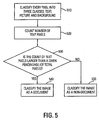
- FIG. 5 is a flow chart illustrating the processing steps for automatic document detection in accordance with an alternative embodiment of the present invention.
- FIG. 6 is a flow chart illustrating the processing steps performed by the document image processing mechanism of FIG. 3 in accordance with one embodiment of the present invention.
- FIG. 7 is a block diagram illustrating in greater detail the document mode camera control mechanism in accordance with one embodiment of the present invention.
- FIG. 8 and FIG. 9 illustrate vertical differences and horizontal differences, respectively, that may be utilized in step 410 of FIG. 4.
- Taking a picture involves letting light fall on film or an image sensor under controlled conditions. This process is often referred to as an exposure.
- This process is often referred to as an exposure.
- blades (known as a diaphragm) inside the lens shift to form an opening that is referred to as the aperture.
- the amount of light that exposes a frame depends on the shutter speed and the size of the aperture.
- the lens has diaphragm blades that open and close to form certain-sized holes (i.e., apertures) that control the amount of light allowed to expose the film or image sensor.
- the aperture scale which is found on the lens' aperture ring, is referred to as f-number or f/stops.
- the aperture affects the depth of field, which in turn affects the way that a picture looks.
- depth of field When a subject is in focus, there is a certain area in front of the subject and behind the subject that is also in focus. This range of sharpness is called depth of field.
- One or more of these different parameters may be controlled by a document mode camera control mechanism 134 of the present invention as described in greater detail hereinafter with reference to FIG. 7.
- FIG. 1 illustrates a digital image capture device 100 in which the automatic document detection mechanism (ADDM) 110 and document image processing mechanism 120 according to one embodiment of the present invention can be utilized.
- the term 'document can be, but is not limited to, a magazine page, a page in a book, a computer printout, information written on a whiteboard, a slide projected from a projector (e.g., a LCD projector), a presentation displayed by a projector (e.g., an overhead projector).
- a document can include a mixture of text, graphics, and images.
- the digital image capture device 100 includes an automatic document detection mechanism (ADDM) 110 for automatically evaluating whether a scene is a document or a natural scene (i.e., a non-document image).
- ADDM automatic document detection mechanism
- the automatic document detection mechanism 110 is described in greater detail hereinafter with reference to FIGS. 2, 4, and 5.
- the digital image capture device 100 includes a document processing block 130 for processing scenes that are determined to be a document by the automatic document detection mechanism 110 and a natural scene processing block 150 for processing scenes that are determined not to be a document by the automatic document detection mechanism 110.
- the document processing block 130 includes a document specific camera control unit 134 for providing camera settings to optimize the capture of a document.
- the document processing block 130 also includes a capture unit 138 for capturing the document.
- the document processing block 130 also includes a document image processing unit 144 for applying image processing algorithms that are tailored for enhancing document images.
- the natural scene processing block 150 includes a natural scene specific camera control unit 154 for providing camera settings to optimize the capture of natural scenes (i.e., non-document images).
- the natural scene processing block 150 also includes a capture unit 158 for capturing the natural scene.
- the natural scene processing block 150 also includes a image processing unit 164 for applying image processing algorithms that are tailored for enhancing natural scenes.
- the capture unit 138 and the capture unit 158 may be implemented with a single image capture unit that has different settings as described in greater detail hereinafter with reference to FIG. 7.
- the document processing block 130 and the natural scene processing block 150 may be implemented by a single image processing unit that executes different image processing programs as described in greater detail hereinafter with reference to FIG. 6.
- the document specific camera control unit 134 and the natural scene specific camera control unit 154 may be implemented as a single control unit that controls the image capture unit and the image processing unit
- FIG. 2 is a block diagram that illustrates in greater detail the automatic document detection mechanism 110 in accordance with a preferred embodiment of the present invention.
- the automatic document detection mechanism 110 includes an image divider 210 for dividing an image (e.g., the preview image) into a plurality of regions and an edge detector 220 (e.g., a luminance edge detector) for detecting the luminance edges in each region.
- An edge pixel counter 230 is provided for counting the number of luminance edges in each region.
- a region determination unit 240 determines the number of regions in which the number luminance edges is greater than a predetermined number of edges. When the number of regions exceeds a predetermined number of regions, the classifier 250 classifies the image as a document. Otherwise, when the number 244 of regions does not exceed the predetermined number 248 of regions, the classifier 250 classifies the scene as a non-document.
- a Boolean variable or flag e.g., a document flag 254 may be employed to denote whether an image is classified as a document or non-document
- Any document image identification algorithm that is tailored for operation on images captured by a digital camera can be utilized to detect whether the current scene is a document.
- a preferred document image identification algorithm is now described with reference to FIG. 4.
- An alternative document image identification algorithm is described with reference to FIG. 5.
- FIG. 4 is a flow chart illustrating the processing steps performed by the automatic document detection mechanism of FIG. 2 in accordance with one embodiment of the present invention.
- step 410 luminance edges within the image are detected. It is noted that edge detection algorithms that are well known by those of ordinary skill in the art can be utilized in step 410.
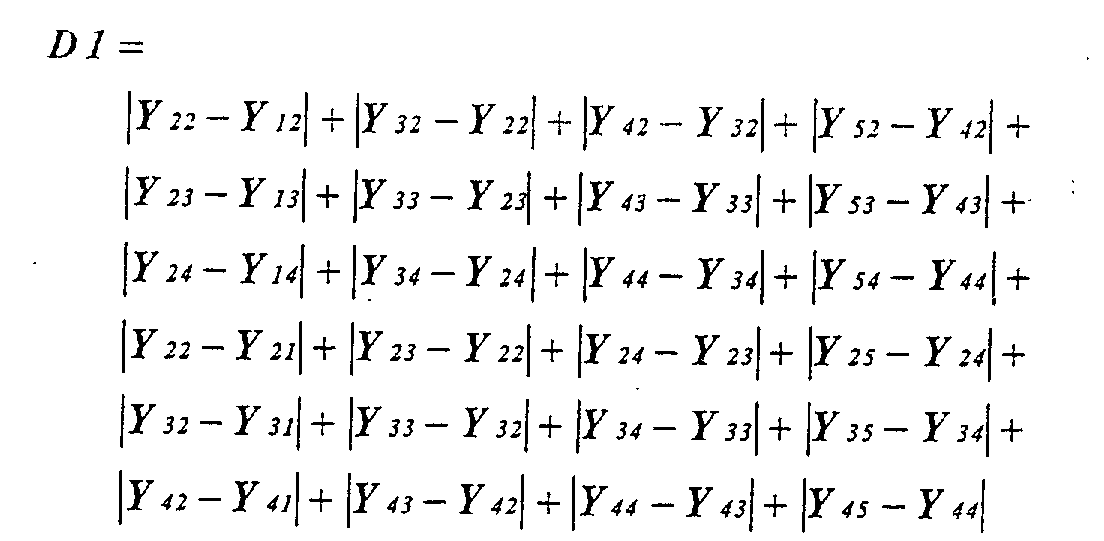
- An exemplary edge detection scheme is now described. For each pixel location, calculate metric of adjacent differences (D1) based on image luminance Y and then compare D1 with a predetermined threshold value (Th) (e.g., 400). When the metric value (D1) is greater than the predetermined threshold (Th), the pixel is classified as an edge pixel. Otherwise, the pixel is classified as a non-edge pixel.
- Th a predetermined threshold value
- the metric of adjacent differences (D1) can be expressed as follows:
- FIG. 8 illustrates vertical differences that may be utilized in step 410 of FIG. 4.
- FIG. 9 illustrates horizontal differences that may be utilized in step 410 of FIG. 4.
- step 420 the distribution (e.g., the spatial distribution) of the edge locations is evaluated
- the evaluation step of 420 can include the following sub-steps.
- step 430 the image is divided into regions (e.g., rectangular regions of equal size).
- step 440 the number of edge pixels within each region is counted.
- step 450 the number (Tw) of regions with edge count that is more than a predetermined edge count is determined.
- the predetermined edge count may be expressed as a percentage (e.g., 50%) of the total region size.
- the predetermined number of regions may be expressed as a predetermined percentage (e.g., 60%) of the total number of regions in the image.
- Tw is larger than a predetermined percentage of the total number of regions, the image is classified as a document type. Otherwise, in step 470 the image is classified as non-document type (e.g., a natural scene).
- FIG. 5 is a flow chart illustrating the processing steps for automatic document detection in accordance with an alternative embodiment of the present invention. An alternative manner in which to determine whether a scene is natural or a document is now described.
- step 510 every pixel is classified into three classes of pixels, such as a text pixel class, a picture pixel class, and a background pixel class.
- step 520 the number of text pixels is counted
- step 540 When the number of text pixels is in a predetermined relationship with a predetermined percentage of the total pixels, in step 540, the image is classified as a document Otherwise, when the number of text pixels is not in a predetermined relationship with a predetermined percentage of the total pixels, in step 550, the image is classified as a non-document.
- FIG. 3 is a block diagram illustrating in greater detail the document image processing mechanism 144 in accordance with one embodiment of the present invention.
- the document image processing mechanism 144 includes an edge pixel detector 310 for detecting edge pixels, a sharpening module 320 for sharpening the edge pixels, and a darkening module 330 for darkening the edge pixels.
- a luminance correction unit 340 corrects luminance of the image. For example, this may involve estimating an illumination map using the edges detected within regions and then correcting for the varying illumination across the input image.
- FIG. 6 is a flow chart illustrating the processing steps performed by the document image processing mechanism of FIG. 3 in accordance with one embodiment of the present invention.
- the edge pixels of the image are first identified.
- the edge pixels may be identified by the processing of FIG. 4 or the processing of FIG. 5.
- the edge pixels determined by the processing of FIG. 4 or text pixels determined by the processing of FIG. 5 are sharpened and darkened. This image processing is tailored for documents and makes the text, graphics, and images of a document more readable by sharpening the edges of text and also by darkening the text.
- step 620 luminance correction is performed on the image. Since the lighting for the image capture may be non-uniform, the document specific image processing unit 144 corrects for non-uniformities in the background For example, the background pixels that can represent the paper on which the text is printed may be non-white, where in fact the background of the document is supposed to be white. In this case, the document specific image processing corrects these pixels to reflect the background of the document.
- the automatic flash control unit 710 disables the flash to tailor the image capture for documents. It is noted that when a flash is utilized and directly pointed at the document, there is severe glare in the image such that a portion of the image tends to become washed out (e.g., a white area) regardless of the content of the document
- the shutter speed control unit 720 sets the shutter speed at a predetermined shutter speed (e.g., 1/30 second or faster) in order to avoid possible motion blur caused by movement of a user's hand during image capture.
- a predetermined shutter speed e.g. 1/30 second or faster
- the aperture control unit 730 determines an appropriate aperture setting based on the predetermined shutter speed For example, the aperture control unit 730 can set an aperture with a maximum opening, corresponding to a minimum f-number. When a maximum aperture is not available for the image capture device, the ISO control unit 740 accommodates the current lighting situation by modifying the ISO film speed (e.g., by increasing the ISO film speed).
- FIG. 7 is a block diagram illustrating in greater detail the document mode camera control mechanism in accordance with one embodiment of the present invention.
- the document mode camera control mechanism includes an automatic flash control unit 710, a shutter speed control unit 720, an aperture control unit 730, an ISO control unit 740, and a user interface unit 750 for generating messages and instructions for the user.
- the digital camera includes an automatic flash, a shutter speed control, an aperture control, and a capture plane.
- the document to be captured is disposed in a document plane.
- a first example of the type of settings programmed by the document mode camera control mechanism of FIG. 6 is now described.
- a user is instructed to position the digital camera in a first predetermined manner, where the capture plane is approximately paralle 1 to the document plane.
- the document mode camera control mechanism 134 employs the automatic flash control unit 710 to disable the automatic flash.
- the document mode camera control mechanism 134 can utilizes the user interface unit 750 for generating a message to instruct the user to manually disable the flash.
- the shutter speed control unit 720 sets the shutter speed to a predetermined shutter speed (e.g., 1/30 second or faster). Then, the aperture control unit 730 determines an appropriate aperture setting based on the selected shutter speed When the required aperture is beyond the range of available aperture settings, the ISO control unit 740 can modify the ISO film speed in order to accommodate a wide variety of possible lighting situations.
- a predetermined shutter speed e.g. 1/30 second or faster.
- the user is instructed to position the digital camera in a second predetermined manner that reduces reflections from the document.
- the capture plane is at an angle with respect to the document plane, and the angle may have a value is in a predetermined range of angle values.
- the predetermined range of angle values includes the range from about 22 degrees to about 45 degrees.
- the document mode camera control mechanism enables the automatic flash and sets a small aperture with a f-number greater than or equal to a predetermined value, for example, f/5.6, in order to secure enough depth of field to avoid out of focus blur.
- the document mode camera control mechanism determines a shutter speed based on the aperture setting and sets the shutter speed accordingly.
Landscapes
- Engineering & Computer Science (AREA)
- Multimedia (AREA)
- Signal Processing (AREA)
- Studio Devices (AREA)
- Facsimile Scanning Arrangements (AREA)
- Image Analysis (AREA)
- Image Input (AREA)
Abstract
Description
Claims (10)
- A method for capturing images for use in a digital camera (100) comprising the steps of:a) receiving a preview of a scene to be captured;b) automatically determining (110) whether the scene to be captured is a document based on the preview;c) when it is determined that the scene is a document, programming at least one camera control for document capture; andd) capturing the scene with the programmed camera control.
- A method as claimed in claim 1 further comprising:e) performing image processing tailored for documents on the captured scene.
- A method as claimed in claim 1 or 2 wherein the preview is a lower resolution version of the scene to be captured.
- A method as claimed in any preceding claim wherein automatically determining whether the scene is a document includes:dividing (430) the preview into a plurality of regions;detecting the luminance edges in each region;counting (440) the number of luminance edges in each region;determining (450) the number of regions in which the number luminance edges is greater than a predetermined number of edges;when the number of regions exceeds a predetermined number of regions, classifying (460) the preview as a document;otherwise, when the number of regions does not exceed the predetermined number of regions classifying (470) the scene as a non-document.
- A method as claimed in any of claims 1 to 3 wherein automatically determining whether the scene is a document includes:classifying (510) every pixel into three classes of pixel; wherein the classes include a text pixel class, a picture pixel class, and a background pixel class'counting (520) the number of text pixels;determining (530) whether the number of text pixels is in a predetermined relationship with a predetermined percentage of the total pixels;when the number of text pixels is in a predetermined relationship with a predetermined percentage of the total pixels, classifying (540) the image as a document;otherwise, when the number of text pixels is not in a predetermined relationship with a predetermined percentage of the total pixels, classifying (550) the image as a non-document.
- A method as claimed in any preceding claim wherein the digital camera includes an automatic flash, a shutter speed control, an aperture control, and a capture plane and a document to be captured is disposed in a document plane;
wherein programming the camera controls for document capture includes
instructing the user to position the digital camera in a first predetermined manner; wherein the capture plane is approximately parallel to the document plane;
disabling the automatic flash; and
setting the shutter-speed to a predetermined shutter speed. - A method as claimed in claim 6 wherein setting the shutter speed to a predetermined shutter speed includes
setting the shutter speed to be equal to or faster than 1/30 second. - A method as claimed in claim 6 or 7 wherein the digital camera further includes an ISO setting, the method further wherein the comprising:determining an aperture (f-number) based on the shutter speed setting;determining if the determined aperture setting is available;when the determined aperture setting is available, setting the aperture to the determined aperture setting;otherwise, when the determined aperture setting is not available, setting the aperture to the maximum available aperture and modifying an ISO setting.
- A method as claimed in any of claims 1 to 5 wherein the digital camera includes a capture plane and a document to be captured is disposed in a document plane; wherein tailoring the camera controls for document capture includes
wherein the capture plane is at an angle with respect to the document plane;
wherein the angle is in a predetermined range of angle values;
enabling the automatic flash; and
setting a small aperture with an f-number that is greater than or equal to a predetermined value. - A method as claimed in claim 9 wherein the predetermined range of angle values includes the range from about 22 degrees to about 45 degrees; and
wherein setting the f-number to a value that is greater than or equal to a predetermined minimum f-number includes
setting the f-number to a value that is equal to or greater than f/5.6.
Applications Claiming Priority (2)
| Application Number | Priority Date | Filing Date | Title |
|---|---|---|---|
| US09/982,620 US7053939B2 (en) | 2001-10-17 | 2001-10-17 | Automatic document detection method and system |
| US982620 | 2001-10-17 |
Publications (2)
| Publication Number | Publication Date |
|---|---|
| EP1304864A2 true EP1304864A2 (en) | 2003-04-23 |
| EP1304864A3 EP1304864A3 (en) | 2004-12-08 |
Family
ID=25529352
Family Applications (1)
| Application Number | Title | Priority Date | Filing Date |
|---|---|---|---|
| EP02257179A Withdrawn EP1304864A3 (en) | 2001-10-17 | 2002-10-16 | Automatic detection method and system |
Country Status (3)
| Country | Link |
|---|---|
| US (1) | US7053939B2 (en) |
| EP (1) | EP1304864A3 (en) |
| JP (1) | JP2003189170A (en) |
Cited By (1)
| Publication number | Priority date | Publication date | Assignee | Title |
|---|---|---|---|---|
| EP3833001A1 (en) * | 2019-12-05 | 2021-06-09 | Beijing Xiaomi Mobile Software Co., Ltd. | Image shooting method and device, terminal, and non-transitory storage medium for automatic shooting |
Families Citing this family (53)
| Publication number | Priority date | Publication date | Assignee | Title |
|---|---|---|---|---|
| US20050097046A1 (en) | 2003-10-30 | 2005-05-05 | Singfield Joy S. | Wireless electronic check deposit scanning and cashing machine with web-based online account cash management computer application system |
| JP4639734B2 (en) * | 2004-09-30 | 2011-02-23 | 富士ゼロックス株式会社 | Slide content processing apparatus and program |
| US8708227B1 (en) | 2006-10-31 | 2014-04-29 | United Services Automobile Association (Usaa) | Systems and methods for remote deposit of checks |
| US7873200B1 (en) | 2006-10-31 | 2011-01-18 | United Services Automobile Association (Usaa) | Systems and methods for remote deposit of checks |
| US10380559B1 (en) | 2007-03-15 | 2019-08-13 | United Services Automobile Association (Usaa) | Systems and methods for check representment prevention |
| JP5033724B2 (en) * | 2007-07-12 | 2012-09-26 | 株式会社沖データ | Document search apparatus, image forming apparatus, and document search system |
| US9058512B1 (en) | 2007-09-28 | 2015-06-16 | United Services Automobile Association (Usaa) | Systems and methods for digital signature detection |
| US9159101B1 (en) | 2007-10-23 | 2015-10-13 | United Services Automobile Association (Usaa) | Image processing |
| US9892454B1 (en) | 2007-10-23 | 2018-02-13 | United Services Automobile Association (Usaa) | Systems and methods for obtaining an image of a check to be deposited |
| US20090180771A1 (en) * | 2008-01-14 | 2009-07-16 | Ming-Chang Liu | Camera for shooting like a professional |
| US10102583B2 (en) | 2008-01-18 | 2018-10-16 | Mitek Systems, Inc. | System and methods for obtaining insurance offers using mobile image capture |
| US10528925B2 (en) | 2008-01-18 | 2020-01-07 | Mitek Systems, Inc. | Systems and methods for mobile automated clearing house enrollment |
| US9842331B2 (en) | 2008-01-18 | 2017-12-12 | Mitek Systems, Inc. | Systems and methods for mobile image capture and processing of checks |
| US9672510B2 (en) * | 2008-01-18 | 2017-06-06 | Mitek Systems, Inc. | Systems and methods for automatic image capture and processing of documents on a mobile device |
| US20130085935A1 (en) | 2008-01-18 | 2013-04-04 | Mitek Systems | Systems and methods for mobile image capture and remittance processing |
| US9292737B2 (en) | 2008-01-18 | 2016-03-22 | Mitek Systems, Inc. | Systems and methods for classifying payment documents during mobile image processing |
| US10685223B2 (en) | 2008-01-18 | 2020-06-16 | Mitek Systems, Inc. | Systems and methods for mobile image capture and content processing of driver's licenses |
| US10380562B1 (en) | 2008-02-07 | 2019-08-13 | United Services Automobile Association (Usaa) | Systems and methods for mobile deposit of negotiable instruments |
| US8286068B2 (en) * | 2008-04-25 | 2012-10-09 | Microsoft Corporation | Linking digital and paper documents |
| US10504185B1 (en) | 2008-09-08 | 2019-12-10 | United Services Automobile Association (Usaa) | Systems and methods for live video financial deposit |
| KR101441307B1 (en) * | 2008-10-10 | 2014-09-17 | 삼성전자주식회사 | Image processing method and apparatus for reducing power consumption |
| US8249343B2 (en) * | 2008-10-15 | 2012-08-21 | Xerox Corporation | Representing documents with runlength histograms |
| US8452689B1 (en) | 2009-02-18 | 2013-05-28 | United Services Automobile Association (Usaa) | Systems and methods of check detection |
| US10956728B1 (en) | 2009-03-04 | 2021-03-23 | United Services Automobile Association (Usaa) | Systems and methods of check processing with background removal |
| US9779392B1 (en) | 2009-08-19 | 2017-10-03 | United Services Automobile Association (Usaa) | Apparatuses, methods and systems for a publishing and subscribing platform of depositing negotiable instruments |
| US20110044554A1 (en) * | 2009-08-21 | 2011-02-24 | Konica Minolta Systems Laboratory, Inc. | Adaptive deblurring for camera-based document image processing |
| US8977571B1 (en) | 2009-08-21 | 2015-03-10 | United Services Automobile Association (Usaa) | Systems and methods for image monitoring of check during mobile deposit |
| US8699779B1 (en) | 2009-08-28 | 2014-04-15 | United Services Automobile Association (Usaa) | Systems and methods for alignment of check during mobile deposit |
| US10891475B2 (en) | 2010-05-12 | 2021-01-12 | Mitek Systems, Inc. | Systems and methods for enrollment and identity management using mobile imaging |
| US9208393B2 (en) | 2010-05-12 | 2015-12-08 | Mitek Systems, Inc. | Mobile image quality assurance in mobile document image processing applications |
| US9129340B1 (en) | 2010-06-08 | 2015-09-08 | United Services Automobile Association (Usaa) | Apparatuses, methods and systems for remote deposit capture with enhanced image detection |
| US20120019841A1 (en) * | 2010-07-20 | 2012-01-26 | Schaertel David M | Document scanner |
| US20120040717A1 (en) * | 2010-08-16 | 2012-02-16 | Veechi Corp | Mobile Data Gathering System and Method |
| JP2013009304A (en) * | 2011-05-20 | 2013-01-10 | Ricoh Co Ltd | Image input device, conference device, image processing control program, recording medium |
| US10380565B1 (en) | 2012-01-05 | 2019-08-13 | United Services Automobile Association (Usaa) | System and method for storefront bank deposits |
| CN104583983B (en) * | 2012-08-31 | 2018-04-24 | 惠普发展公司,有限责任合伙企业 | The zone of action of image with addressable link |
| KR101992153B1 (en) * | 2012-11-13 | 2019-06-25 | 삼성전자주식회사 | Method and apparatus for recognizing text image and photography method using the same |
| US10552810B1 (en) | 2012-12-19 | 2020-02-04 | United Services Automobile Association (Usaa) | System and method for remote deposit of financial instruments |
| US10963535B2 (en) | 2013-02-19 | 2021-03-30 | Mitek Systems, Inc. | Browser-based mobile image capture |
| JP5975932B2 (en) * | 2013-04-24 | 2016-08-23 | キヤノン株式会社 | Image processing apparatus and image processing method |
| US11138578B1 (en) | 2013-09-09 | 2021-10-05 | United Services Automobile Association (Usaa) | Systems and methods for remote deposit of currency |
| US9286514B1 (en) | 2013-10-17 | 2016-03-15 | United Services Automobile Association (Usaa) | Character count determination for a digital image |
| ES2873966T3 (en) | 2013-10-21 | 2021-11-04 | Sicpa Holding Sa | A security checkpoint |
| EP3175609B1 (en) | 2014-07-31 | 2022-02-23 | Hewlett-Packard Development Company, L.P. | Processing data representing an image |
| US10402790B1 (en) | 2015-05-28 | 2019-09-03 | United Services Automobile Association (Usaa) | Composing a focused document image from multiple image captures or portions of multiple image captures |
| TWI549067B (en) * | 2015-08-13 | 2016-09-11 | 宏碁股份有限公司 | Portable electronic device and image capturing method |
| US10114447B2 (en) * | 2015-12-10 | 2018-10-30 | Samsung Electronics Co., Ltd. | Image processing method and apparatus for operating in low-power mode |
| US10701261B2 (en) | 2016-08-01 | 2020-06-30 | International Business Machines Corporation | Method, system and computer program product for selective image capture |
| CN110463177A (en) * | 2017-04-06 | 2019-11-15 | 华为技术有限公司 | The bearing calibration of file and picture and device |
| US11030752B1 (en) | 2018-04-27 | 2021-06-08 | United Services Automobile Association (Usaa) | System, computing device, and method for document detection |
| US11393272B2 (en) | 2019-09-25 | 2022-07-19 | Mitek Systems, Inc. | Systems and methods for updating an image registry for use in fraud detection related to financial documents |
| US11900755B1 (en) | 2020-11-30 | 2024-02-13 | United Services Automobile Association (Usaa) | System, computing device, and method for document detection and deposit processing |
| US12211095B1 (en) | 2024-03-01 | 2025-01-28 | United Services Automobile Association (Usaa) | System and method for mobile check deposit enabling auto-capture functionality via video frame processing |
Family Cites Families (28)
| Publication number | Priority date | Publication date | Assignee | Title |
|---|---|---|---|---|
| JP2827259B2 (en) | 1989-03-08 | 1998-11-25 | キヤノン株式会社 | Solid camera |
| US5596655A (en) | 1992-08-18 | 1997-01-21 | Hewlett-Packard Company | Method for finding and classifying scanned information |
| JP3437226B2 (en) * | 1993-10-20 | 2003-08-18 | キヤノン株式会社 | Image processing method and apparatus |
| JPH07284011A (en) * | 1994-04-05 | 1995-10-27 | Ricoh Co Ltd | Digital electronic still camera |
| JPH07288722A (en) * | 1994-04-15 | 1995-10-31 | Canon Inc | Imaging device |
| JPH0823473A (en) * | 1994-07-05 | 1996-01-23 | Canon Inc | Imaging device |
| JPH0946591A (en) * | 1995-07-31 | 1997-02-14 | Canon Inc | Image processing apparatus and image processing system |
| JPH09200455A (en) * | 1996-01-19 | 1997-07-31 | Minolta Co Ltd | Method for correcting density of read image and image reader |
| JP3380831B2 (en) * | 1996-03-08 | 2003-02-24 | シャープ株式会社 | Image forming device |
| JP3631333B2 (en) * | 1996-08-23 | 2005-03-23 | シャープ株式会社 | Image processing device |
| JPH10262173A (en) * | 1997-03-18 | 1998-09-29 | Minolta Co Ltd | Line sensor camera |
| JPH10262017A (en) | 1997-03-19 | 1998-09-29 | Fujitsu Ltd | SDH multiplex transmission system and device |
| NL1006472C2 (en) * | 1997-07-04 | 1999-01-05 | Oce Tech Bv | Copier with adjustable gradation. |
| US6366699B1 (en) * | 1997-12-04 | 2002-04-02 | Nippon Telegraph And Telephone Corporation | Scheme for extractions and recognitions of telop characters from video data |
| GB9809679D0 (en) * | 1998-05-06 | 1998-07-01 | Xerox Corp | Portable text capturing method and device therefor |
| US6741279B1 (en) | 1998-07-21 | 2004-05-25 | Hewlett-Packard Development Company, L.P. | System and method for capturing document orientation information with a digital camera |
| US6567559B1 (en) * | 1998-09-16 | 2003-05-20 | Texas Instruments Incorporated | Hybrid image compression with compression ratio control |
| US6289122B1 (en) * | 1999-04-15 | 2001-09-11 | Electronics For Imaging, Inc. | Intelligent detection of text on a page |
| US6563948B2 (en) * | 1999-04-29 | 2003-05-13 | Intel Corporation | Using an electronic camera to build a file containing text |
| DE69929748T2 (en) * | 1999-06-15 | 2006-08-10 | Hewlett-Packard Development Company, L.P., Houston | Photographic flash lighting |
| JP2001016447A (en) * | 1999-06-30 | 2001-01-19 | Minolta Co Ltd | Picture processor, picture processing method and recording medium with picture processing program stored therein |
| GB2353870B (en) * | 1999-09-02 | 2004-01-21 | Hewlett Packard Co | Document capture stand |
| US7324139B2 (en) | 2000-01-20 | 2008-01-29 | Ricoh Company, Ltd. | Digital camera, a method of shooting and transferring text |
| US6771838B1 (en) * | 2000-10-06 | 2004-08-03 | Hewlett-Packard Development Company, L.P. | System and method for enhancing document images |
| US6937272B1 (en) * | 2000-11-08 | 2005-08-30 | Xerox Corporation | Display device for a camera |
| US6975352B2 (en) * | 2000-12-18 | 2005-12-13 | Xerox Corporation | Apparatus and method for capturing a composite digital image with regions of varied focus and magnification |
| US7068852B2 (en) * | 2001-01-23 | 2006-06-27 | Zoran Corporation | Edge detection and sharpening process for an image |
| US6903767B2 (en) * | 2001-04-05 | 2005-06-07 | Hewlett-Packard Development Company, L.P. | Method and apparatus for initiating data capture in a digital camera by text recognition |
-
2001
- 2001-10-17 US US09/982,620 patent/US7053939B2/en not_active Expired - Lifetime
-
2002
- 2002-10-11 JP JP2002298677A patent/JP2003189170A/en not_active Withdrawn
- 2002-10-16 EP EP02257179A patent/EP1304864A3/en not_active Withdrawn
Cited By (1)
| Publication number | Priority date | Publication date | Assignee | Title |
|---|---|---|---|---|
| EP3833001A1 (en) * | 2019-12-05 | 2021-06-09 | Beijing Xiaomi Mobile Software Co., Ltd. | Image shooting method and device, terminal, and non-transitory storage medium for automatic shooting |
Also Published As
| Publication number | Publication date |
|---|---|
| US7053939B2 (en) | 2006-05-30 |
| JP2003189170A (en) | 2003-07-04 |
| US20030072568A1 (en) | 2003-04-17 |
| EP1304864A3 (en) | 2004-12-08 |
Similar Documents
| Publication | Publication Date | Title |
|---|---|---|
| US7053939B2 (en) | Automatic document detection method and system | |
| EP3599760B1 (en) | Image processing method and apparatus | |
| US7315630B2 (en) | Perfecting of digital image rendering parameters within rendering devices using face detection | |
| US7440593B1 (en) | Method of improving orientation and color balance of digital images using face detection information | |
| US7471846B2 (en) | Perfecting the effect of flash within an image acquisition devices using face detection | |
| JP5089405B2 (en) | Image processing apparatus, image processing method, and imaging apparatus | |
| US7430369B2 (en) | Image capture apparatus and control method therefor | |
| JP5475021B2 (en) | Support for blur detection in images | |
| US8326066B2 (en) | Digital image adjustable compression and resolution using face detection information | |
| US7809162B2 (en) | Digital image processing using face detection information | |
| US7317815B2 (en) | Digital image processing composition using face detection information | |
| US20060203108A1 (en) | Perfecting the optics within a digital image acquisition device using face detection | |
| US20060203107A1 (en) | Perfecting of digital image capture parameters within acquisition devices using face detection | |
| US20060204034A1 (en) | Modification of viewing parameters for digital images using face detection information | |
| CN108337447A (en) | High dynamic range image exposure compensation value acquisition method, device, equipment and medium | |
| US8059187B2 (en) | Image capturing apparatus | |
| KR20100075447A (en) | Face tracking in a camera processor | |
| US20120121129A1 (en) | Image processing apparatus | |
| US20060182430A1 (en) | Camera exposure program coupled to image stabilization capability | |
| JP4834725B2 (en) | Method and apparatus for incorporating iris color in red-eye correction | |
| KR20100006488A (en) | Photographing control method and apparatus for prohibiting flash | |
| US9674427B2 (en) | Image processing method and apparatus | |
| CN106791451B (en) | Photographing method of intelligent terminal | |
| CN110291779B (en) | Photographic device, control method thereof, and non-volatile computer-readable medium | |
| US7397968B2 (en) | System and method for tone composition |
Legal Events
| Date | Code | Title | Description |
|---|---|---|---|
| PUAI | Public reference made under article 153(3) epc to a published international application that has entered the european phase |
Free format text: ORIGINAL CODE: 0009012 |
|
| AK | Designated contracting states |
Designated state(s): AT BE BG CH CY CZ DE DK EE ES FI FR GB GR IE IT LI LU MC NL PT SE SK TR |
|
| AX | Request for extension of the european patent |
Extension state: AL LT LV MK RO SI |
|
| PUAL | Search report despatched |
Free format text: ORIGINAL CODE: 0009013 |
|
| AK | Designated contracting states |
Kind code of ref document: A3 Designated state(s): AT BE BG CH CY CZ DE DK EE ES FI FR GB GR IE IT LI LU MC NL PT SE SK TR |
|
| AX | Request for extension of the european patent |
Extension state: AL LT LV MK RO SI |
|
| 17P | Request for examination filed |
Effective date: 20050530 |
|
| AKX | Designation fees paid |
Designated state(s): DE FR GB |
|
| STAA | Information on the status of an ep patent application or granted ep patent |
Free format text: STATUS: THE APPLICATION IS DEEMED TO BE WITHDRAWN |
|
| 18D | Application deemed to be withdrawn |
Effective date: 20100310 |