EP1304609A2 - Notebook type information processing apparatus - Google Patents
Notebook type information processing apparatus Download PDFInfo
- Publication number
- EP1304609A2 EP1304609A2 EP02251477A EP02251477A EP1304609A2 EP 1304609 A2 EP1304609 A2 EP 1304609A2 EP 02251477 A EP02251477 A EP 02251477A EP 02251477 A EP02251477 A EP 02251477A EP 1304609 A2 EP1304609 A2 EP 1304609A2
- Authority
- EP
- European Patent Office
- Prior art keywords
- side portion
- apparatus body
- notebook type
- display device
- personal computer
- Prior art date
- Legal status (The legal status is an assumption and is not a legal conclusion. Google has not performed a legal analysis and makes no representation as to the accuracy of the status listed.)
- Ceased
Links
Images






Classifications
-
- G—PHYSICS
- G06—COMPUTING OR CALCULATING; COUNTING
- G06F—ELECTRIC DIGITAL DATA PROCESSING
- G06F1/00—Details not covered by groups G06F3/00 - G06F13/00 and G06F21/00
- G06F1/16—Constructional details or arrangements
- G06F1/1613—Constructional details or arrangements for portable computers
- G06F1/1615—Constructional details or arrangements for portable computers with several enclosures having relative motions, each enclosure supporting at least one I/O or computing function
- G06F1/1616—Constructional details or arrangements for portable computers with several enclosures having relative motions, each enclosure supporting at least one I/O or computing function with folding flat displays, e.g. laptop computers or notebooks having a clamshell configuration, with body parts pivoting to an open position around an axis parallel to the plane they define in closed position
-
- G—PHYSICS
- G06—COMPUTING OR CALCULATING; COUNTING
- G06F—ELECTRIC DIGITAL DATA PROCESSING
- G06F1/00—Details not covered by groups G06F3/00 - G06F13/00 and G06F21/00
- G06F1/16—Constructional details or arrangements
- G06F1/1613—Constructional details or arrangements for portable computers
- G06F1/1633—Constructional details or arrangements of portable computers not specific to the type of enclosures covered by groups G06F1/1615 - G06F1/1626
- G06F1/1656—Details related to functional adaptations of the enclosure, e.g. to provide protection against EMI, shock, water, or to host detachable peripherals like a mouse or removable expansions units like PCMCIA cards, or to provide access to internal components for maintenance or to removable storage supports like CDs or DVDs, or to mechanically mount accessories
-
- G—PHYSICS
- G06—COMPUTING OR CALCULATING; COUNTING
- G06F—ELECTRIC DIGITAL DATA PROCESSING
- G06F1/00—Details not covered by groups G06F3/00 - G06F13/00 and G06F21/00
- G06F1/16—Constructional details or arrangements
- G06F1/1613—Constructional details or arrangements for portable computers
- G06F1/1633—Constructional details or arrangements of portable computers not specific to the type of enclosures covered by groups G06F1/1615 - G06F1/1626
- G06F1/1675—Miscellaneous details related to the relative movement between the different enclosures or enclosure parts
- G06F1/1679—Miscellaneous details related to the relative movement between the different enclosures or enclosure parts for locking or maintaining the movable parts of the enclosure in a fixed position, e.g. latching mechanism at the edge of the display in a laptop or for the screen protective cover of a PDA
Definitions
- the present invention relates to a notebook type information processing apparatus such as a notebook type personal computer.
- a previously-proposed notebook type personal computer comprises an apparatus body, including a circuit board, and a display device connected to the apparatus body by hinges, whereby the display device can be folded onto the apparatus body. Also, the apparatus body is provided with a keyboard and other input means.
- Fig.7 of the accompanying drawings shows an example of a previously-proposed notebook type personal computer.
- notebook type personal computer 1 comprises an apparatus body 2, and a display device 3 connected to the apparatus body 2 with hinges 4.
- the width "a" of the apparatus body 2 of the notebook type personal computer 1 between opposite sides thereof is equal to the width "b" of the display device 3 between opposite sides thereof, so that the sides of the apparatus body 2 and the sides of the display device 3 are continuous, in a plane, when the display device 3 is folded onto the apparatus body 2.
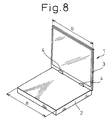
- Fig.8 of the accompanying drawings shows a variation of the notebook type personal computer shown in Fig.7.
- the width "a" of the apparatus body 2 of the notebook type personal computer 1 between opposite sides thereof is less than the width "b" of the display device 3 between opposite sides thereof, so that the sides of the display device 3 laterally extend beyond the sides of the apparatus body 2 when the display device 3 is folded onto the apparatus body 2.
- the contour of the notebook type personal computer 1 shown in Fig.7 is typical. But, there is a case that a contour different from the typical one, like the contour shown in Fig.8, is required.
- a contour different from the typical one like the contour shown in Fig.8, is required.
- the size of the lower portion (apparatus body 2) is less than the size of the upper portion (display device 3), because it bears much of the appearance of the computer and increases the flexibility in the design of the computer.
- one of the notebook type personal computers 1 in one series may have the width "a" between opposite sides of the computer body 2 less than width "b" between opposite sides of the display device 3.
- Fig.6 of the accompanying drawings is a rear view of the notebook type personal computer 1, shown in Fig.8, in the case where it is placed on its side.
- Numeral 4 denotes hinges
- numeral 5 denotes a latch for locking the display device 3 to the apparatus body 2 when the display 3 is folded in the closed position.
- the two hinges 4 are disposed at the rear of the notebook type personal computer 1, and the latch 5 is disposed at the front of the notebook type personal computer 1.
- the notebook type personal computer 1 In the shock test of the notebook type personal computer 1, the notebook type personal computer 1 is dropped onto a wall surface 6, or is contacted to a wall surface 6 with a shock. In this case, the weight of the notebook type personal computer 1 is received only by the display device 3, and the weight of the apparatus body 2 is supported by the display device 3 through the hinges 4. When the apparatus body 2 twists around the hinges 4, and the front portion of the apparatus body 2 is displaced from the display device 3, an undesirable force may be applied to the latch 5 disposed at the front of the apparatus body 2, thus damaging the latch 5.
- the notebook type information processing apparatus comprises an apparatus body having a circuit board, a display device connected to said apparatus body with a hinge device, and said apparatus body having, in its side, a first side portion having a height and a second side portion having a height different from the height of the first side portion.
- the first side portion may be matched to the display device in size, and the load of the notebook type information processing apparatus may be supported by the apparatus body and the display device, while the shape of the second side portion may be designed irrespective of the size of the display device, and thereby the flexibility in the design of the apparatus may be increased.
- Fig.1 is a perspective view of a notebook type personal computer according to a preferred embodiment of the present invention, with a display device in the open position with respect to an apparatus body
- Fig.2 is a perspective view of the notebook type personal computer shown in Fig.1, with the display device in the closed position with respect to the apparatus body.
- the notebook type personal computer 10 shown in the Figs.1 and 2 is an example of a notebook type information processing apparatus.
- letter F denotes the front of the notebook type personal computer 10
- letter S denotes the side
- R denotes the rear.
- the notebook type personal computer 10 comprises an apparatus body 12 and a display device 14 connected to the apparatus body 12 by hinges 16.
- a latch 18 is provided on the upper portion of the display device 14 (the front portion of the display device 14 when folded), and a latch hole 20 is provided in the front portion of the apparatus body 12. When the display device 14 is folded in the closed position, the latch 18 engages with the latch hole 20.
- the apparatus body 12 has a keyboard 22 and other input means. Inside the apparatus body 12, a circuit board (see Fig.15) on which electric and electronic components are mounted is provided inside the apparatus body 12.
- the display device 14 comprises a liquid crystal display device, and has a displaying portion 24.
- the apparatus body 12 has, at its side, a first side portion 26 and a second side portion 28 having a height different from the height of the first side portions 26.
- the height is measured in the direction from the center toward one side S.
- the apparatus body 12 has an additional side portion 30.
- the first side portion 26 is disposed at the front end or at a position near the front end of the apparatus body 12, and the second side portion 28 is disposed on the rear side of the first side portion 26.
- the first side portion 26 protrudes outward, like a lobe, with respect to the second side portion 28. In other words, the height of the first side portion 26 is greater than the height of the second side portion 28.
- the additional side portion 30 is disposed at the rear end or at a position near the rear end of the apparatus body 12, and has the same height as that of the first side portion 26.
- the first side portion 26 and the additional side portion 30 are disposed in relatively narrow regions, as viewed in the direction from the front F to the rear R of the apparatus body 12, and the second side portion 28 is disposed in the relatively longer region between the first side portion 26 and the additional side portion 30.
- the width of the apparatus body 12 between the opposite sides thereof at the first side portion 26 or the additional side portion 30 is denoted by A.
- the width of the apparatus body 12 between opposite sides thereof at the second side portion 28 is denoted by B.
- the width of the display device 14 between the opposite side thereof is denoted by C.
- the relationship between widths A, B, and C is described by the equation A ⁇ C>B. In other words, the width A is nearly equal to the width C, or the width A is slightly less than the width C within an error. Width B is less than the width C.
- Figs.3 and 4 are perspective views of a variation of the notebook type personal computer shown in Figs.1 and 2.
- the notebook type personal computer 10 shown in Figs.3 and 4 is different from the notebook type personal computer 10 shown in Figs.1 and 2 only in that the additional side portion 30 is deleted as shown in Figs.3 and 4, and is the same as the notebook type personal computer 10 shown in Figs.1 and 2 in other points.
- Fig.5 is a rear view of the notebook type personal computer 10 shown in Fig.2, with its one side pointing downward.
- the weight of the notebook type personal computer 10 is supported by the first side portion 26 and the additional side portion 30 of the apparatus body 12 and the display device 14.
- the weight of the apparatus body 12 is supported by the body itself, and the apparatus body 12 does not twist around the hinges 16.
- the latch 18 positioned at the front of the apparatus body 12 is not damaged. This effect is similar to that of the arrangement having no additional side portion 30 as shown in Figs.3 and 4.
- the first side portion 26 (and the additional side portion 30) can receive the load along with the display device 14 when the load is applied.
- the second side portion 28 does not receive the load applied to the apparatus body 12.
- the shape of the second side portion 28 may be designed freely irrespective of the size of the display device 14, and thereby the flexibility in the design of the computer may be increased.
- Fig.9 is a left perspective view of another embodiment of the present invention
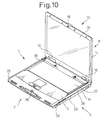
- Fig.10 is a right perspective view of the notebook type personal computer shown in Fig.9.
- the notebook type personal computer 10 comprises an apparatus body 12 and a display device 14 connected to the apparatus body 12 by hinges 16.
- a latch 18 is provided on the upper portion of the display device 14 and a latch hole 20 is provided in the front portion of the apparatus body 12.
- letter F denotes the front of the notebook type personal computer 10
- letter S denotes the side
- R denotes the rear.
- the apparatus body 12 has a keyboard 22 and other input means. Inside the apparatus body 12, a circuit board (see Fig.15) on which electric and electronic components are mounted is provided.
- the display device 14 comprises a liquid crystal display device, and has a displaying portion 24. Interface portions 32 are disposed on one side of the apparatus body 12, and a CD slot 34 is disposed on the other side of the apparatus body 12.
- Fig.11 is a partially cut away, perspective view of a part of the notebook type personal computer 10 shown in Figs.9 and 10.
- parts of the outer casings of the apparatus body 12 and the display device 14 are cut away to show the part of the hinge device 16.
- the hinge device 16 includes a torque shaft 16a attached to the display device 14 and a plate 16b attached to the apparatus body 12.
- a vertical member 16c of the plate 16b is pinched and supported by the components of the torque shaft 16a.
- the hinge device 16 has been used in previously-proposed systems.
- Fig.12 is a bottom perspective view of a part of the notebook type personal computer 10 shown in Figs.9 and 10.
- Fig.13 is a bottom view of the apparatus body 12 of the notebook type personal computer 10 shown in Figs.9 and 10.
- Fig.14 is a schematic bottom view of the notebook type personal computer 10 (apparatus body 12) shown in Fig.13.
- the apparatus body 12 comprises a first side portion 26, a second side portion 28 having a height different from that of the first side portion 26, and a third side portion 38.
- the first side portion 26 is formed as a protrusion like a lobe.
- the width of the apparatus body 12 between opposite sides thereof at the first side portion 26 is denoted by A
- the width of the apparatus body 12 between the opposite sides thereof at the second side portion 28 is denoted by B
- the width of the display device 14 is denoted by C.
- the relationship between widths A, B, and C is described by the equation A ⁇ C>B.
- the width A is nearly equal to the width C
- the width A is slightly less than the width C within an error.
- Width B is less than the width C.
- the width of the apparatus body 12 between the opposite sides thereof at the third side portion 38 is denoted by D.
- the relationship between widths A, B, and D is described by the equation A>D>B.
- the first side portion 26 protrudes outward with respect to the second side portion 28, and the third side portion 38 protrudes outward with respect to the second side portion 28 and recedes inward with respect to the first side portion 26.
- the shape of the apparatus body 12 at the third side portion 38 and the shape of the apparatus body 12 at the second side portion 26 can be changed irrespective of the display device 14, and thereby the flexibility in the design of the computer may be further increased.
- the first side portion 26 is disposed in the relatively narrow region at the front end or at a position near the front end of the apparatus body 12, and the second side portion 28 and the third side portion 38 are disposed in the relatively wide region on the rear side of the first side portion.
- the second side portion 28 extends near the bottom of the apparatus body 12, and the third side portion 38 extends near the upper surface of the apparatus body 12.
- the second side portion 28 and the third side portion 38 extend substantially parallel to the upper surface and the bottom surface of the apparatus body 12, which are substantially parallel to each other.
- the front end portion of the apparatus body 12 slopes forward with a round contour.
- the first side portion 26 is smoothly continuous to the second side portion 28 and the third side portion 38.
- the interface portions 32 are provided at the second side portion 28 in one side of the apparatus body 12, and the slot 34 for a CD is provided at the second side portion 28 in the other side of the apparatus body 12.
- Fig.15 is perspective view of the circuit board unit 42 disposed in the apparatus body 12 of the notebook type personal computer 10 shown in Figs.9 and 10.
- the circuit board unit 42 includes a mother board or main board 44 and electric and electronic components mounted thereon.
- the main board 44 has a connector 46, and a CD drive unit 48 is mounted on the main board 44 and connected to the connector 46.
- the CD drive unit 48 is located adjacent to the CD slot 34.
- the main board 44 has interface connectors 50.
- the interface connectors 50 are located adjacent to the interface portions.32.
- the CD slot 34 and the interface portions 32 are arranged in the second side portions 28 of the apparatus body 12, and the second side portions 28 of the apparatus body 12 are adapted to the circuit board unit 42 including the main board 44.
- the notebook type personal computer 10 shown in Figs.9 to 14 is adopted as one of a series of differently sized notebook type personal computers.
- the notebook type personal computer 10 is formed as a 15-inch personal computer.
- Fig.16 is a bottom view of an apparatus body 54 of a comparative notebook type personal computer 52.
- the notebook type personal computer 52 shown in Fig.16 is formed as a 14-inch personal computer.
- the notebook type personal computer 10 is one of a plurality of notebook type personal computers in one series which includes the notebook type personal computer 52. Display devices having different sizes are used for a plurality of notebook type personal computers in this series, but the circuit board unit 42 shown in Fig.15 is commonly used for all of the apparatus bodies.
- the apparatus body 54 of the notebook type personal computer 52 shown in Fig.16 has flat sides 56, and the 'width of the apparatus body 54 (distance between the opposite sides 56) is B. Width B of the apparatus body 54 shown in Fig.16 is the same as width B of the apparatus body 12 between opposite sides thereof at the second side portion 28 shown in Fig.13.
- the circuit board unit 42 shown in Fig.15 may be commonly used for the apparatus body 12 shown in Fig.13 and the apparatus body 54 shown in Fig.16.
- the notebook type personal computer 10 shown in Fig.13 if a portion of the apparatus body 12 including the second side portion 28 shown in Fig.13 is designed under the same design condition as the apparatus body 54 shown in Fig.16, and then a portion including the first side portions 26 and the third side portions 38 is additionally designed, the notebook type personal computer 10 shown in Figs.9 to 14 can be easily designed.
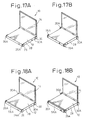
- Figs.17A to 20B are perspective views of modifications of the notebook type personal computer embodying the present invention.
- the first side portion 26, and the additional side portion 30 or the third side portion 38 are detachable/attachable components.
- Each of Figs.17A, 18A, 19A and 20A shows the state that a detachably attachable component is attached to the apparatus body 12, and each of Figs.17B 18B, 19B and 20B shows the state that the detachably attachable component is detached from the apparatus body 12.
- the sides of the apparatus body 12 is formed so that the surfaces of the sides are generally equal to the surfaces of the second side portions 28, and protruding portions including the first side portions 26 and the additional side portions 30 are made as detachably attachable components 26A and 30A.
- the apparatus body 12 from which the components 26A and 30A are removed can be used as a 14-inch notebook type personal computer, and the apparatus body 12 to which the components 26A and 30A are attached can be used as a 15-inch notebook type personal computer.
- protruding portions including the first side portions 26 and the additional side portions 30 are made as detachably attachable components 26A and 30A respectively, and a front portion of the apparatus body 12 is made as a detachably attachable component 58A.
- protruding portions including the first side portions 26 are made as a detachably attachable components 26A.
- the front and side portions of the apparatus body 12 are made by one detachably attachable component 60A.
- the detachably attachable component 60A include the first side portions 26, the second side portions 28, and the third side portions 38.
- an embodiment of the present invention can provide a notebook type information processing apparatus, wherein the load of the apparatus body is supported by the body itself and the display device, and the shape of the apparatus body may be changed irrespective of the display device to increase the flexibility in the design of the apparatus.
Landscapes
- Engineering & Computer Science (AREA)
- Computer Hardware Design (AREA)
- Theoretical Computer Science (AREA)
- Physics & Mathematics (AREA)
- General Engineering & Computer Science (AREA)
- Human Computer Interaction (AREA)
- General Physics & Mathematics (AREA)
- Mathematical Physics (AREA)
- Casings For Electric Apparatus (AREA)
- Devices For Indicating Variable Information By Combining Individual Elements (AREA)
Abstract
Description
- The present invention relates to a notebook type information processing apparatus such as a notebook type personal computer.
- A previously-proposed notebook type personal computer comprises an apparatus body, including a circuit board, and a display device connected to the apparatus body by hinges, whereby the display device can be folded onto the apparatus body. Also, the apparatus body is provided with a keyboard and other input means.
- Fig.7 of the accompanying drawings shows an example of a previously-proposed notebook type personal computer. In Fig.7, notebook type
personal computer 1 comprises anapparatus body 2, and adisplay device 3 connected to theapparatus body 2 withhinges 4. The width "a" of theapparatus body 2 of the notebook typepersonal computer 1 between opposite sides thereof is equal to the width "b" of thedisplay device 3 between opposite sides thereof, so that the sides of theapparatus body 2 and the sides of thedisplay device 3 are continuous, in a plane, when thedisplay device 3 is folded onto theapparatus body 2. - Fig.8 of the accompanying drawings shows a variation of the notebook type personal computer shown in Fig.7. In Fig.8, the width "a" of the
apparatus body 2 of the notebook typepersonal computer 1 between opposite sides thereof is less than the width "b" of thedisplay device 3 between opposite sides thereof, so that the sides of thedisplay device 3 laterally extend beyond the sides of theapparatus body 2 when thedisplay device 3 is folded onto theapparatus body 2. - The contour of the notebook type
personal computer 1 shown in Fig.7 is typical. But, there is a case that a contour different from the typical one, like the contour shown in Fig.8, is required. For example, in a case of a large notebook typepersonal computer 1, if the shape of the lower portion (apparatus body 2) is the same as the shape of the upper portion (display device 3) when thedisplay device 3 is folded onto theapparatus body 2, the computer only looks large but the appearance thereof is not attractive. It is therefore preferable that the size of the lower portion (apparatus body 2) is less than the size of the upper portion (display device 3), because it bears much of the appearance of the computer and increases the flexibility in the design of the computer. Furthermore, in a series of differently sized notebook typepersonal computers 1, it possible to design the sizes of the display devices to be different from each other, and the sizes of the apparatus bodies to be common to each other. In this case, one of the notebook typepersonal computers 1 in one series may have the width "a" between opposite sides of thecomputer body 2 less than width "b" between opposite sides of thedisplay device 3. - Fig.6 of the accompanying drawings is a rear view of the notebook type
personal computer 1, shown in Fig.8, in the case where it is placed on its side. Numeral 4 denotes hinges, andnumeral 5 denotes a latch for locking thedisplay device 3 to theapparatus body 2 when thedisplay 3 is folded in the closed position. The twohinges 4 are disposed at the rear of the notebook typepersonal computer 1, and thelatch 5 is disposed at the front of the notebook typepersonal computer 1. - In the shock test of the notebook type
personal computer 1, the notebook typepersonal computer 1 is dropped onto a wall surface 6, or is contacted to a wall surface 6 with a shock. In this case, the weight of the notebook typepersonal computer 1 is received only by thedisplay device 3, and the weight of theapparatus body 2 is supported by thedisplay device 3 through thehinges 4. When theapparatus body 2 twists around thehinges 4, and the front portion of theapparatus body 2 is displaced from thedisplay device 3, an undesirable force may be applied to thelatch 5 disposed at the front of theapparatus body 2, thus damaging thelatch 5. - Accordingly, it is desirable to provide a notebook type information processing apparatus in which the load on the apparatus body is received by the body itself along with the display device, and the shape of the apparatus body may be changed irrespective of the display device to increase the flexibility in the design of the apparatus.
- The notebook type information processing apparatus, according to an embodiment of the present invention, comprises an apparatus body having a circuit board, a display device connected to said apparatus body with a hinge device, and said apparatus body having, in its side, a first side portion having a height and a second side portion having a height different from the height of the first side portion.
- In this configuration, for example, the first side portion may be matched to the display device in size, and the load of the notebook type information processing apparatus may be supported by the apparatus body and the display device, while the shape of the second side portion may be designed irrespective of the size of the display device, and thereby the flexibility in the design of the apparatus may be increased.
- Reference will now be made, by way of example, to the accompanying drawings, in which:
- Fig.1 is a perspective view of a notebook type personal computer according to a preferred embodiment of the present invention, showing the display device in the open position with respect to the apparatus body;
- Fig.2 is a perspective view of the notebook type personal computer shown in Fig.1, showing the display device in the closed position with respect to the apparatus body;
- Fig.3 is a perspective view of a variation of the notebook type personal computer shown in Fig.1 showing the display device in the open position with respect to the apparatus body;
- Fig.4 is a perspective view of the notebook type personal computer shown in Fig.3, showing the display device in the closed position with respect to the apparatus body;
- Fig.5 is a rear view of the notebook type personal computer shown in Fig.2, when it is placed on its side;
- Fig.6 (described above) is a rear view of a notebook type personal computer shown in Fig.8, when it is placed on its side;
- Fig.7 (described above) is a perspective view of an example of a previously-proposed notebook type personal computer;
- Fig.8 (described above) is a perspective view of a variation of the notebook type personal computer shown in Fig.7;
- Fig.9 is a left perspective view of a notebook type personal computer according to another embodiment of the present invention;
- Fig.10 is a right perspective view of the notebook type personal computer shown in Fig.9;
- Fig.11 is a partially cut away, perspective view of a part of the notebook type personal computer shown in Figs.9 and 10;
- Fig.12 is a bottom perspective view of a part of the notebook type personal computer shown in Figs.9 and 10;
- Fig.13 is a bottom view of the notebook type personal computer shown in Figs.9 and 10;
- Fig.14 is a schematic bottom view of the notebook type personal computer shown in Fig.13;
- Fig.15 is a perspective view of the circuit board unit disposed in the apparatus body of the notebook type personal computer shown in Figs.9 and 10;
- Fig.16 is a bottom view of an apparatus body of a comparative notebook type personal computer;
- Figs.17A and 17B are perspective views of another example of the notebook type personal computer according to an embodiment of the present invention;
- Figs.18A and 18B are perspective views of a further example of the notebook type personal computer according to an embodiment of the present invention;
- Figs.19A and 19B are perspective views of a further example of the notebook type personal computer according to an embodiment of the present invention; and
- Figs.20A and 20B are perspective views of a still further example of the notebook type personal computer according to an embodiment of the present invention.
-
- Fig.1 is a perspective view of a notebook type personal computer according to a preferred embodiment of the present invention, with a display device in the open position with respect to an apparatus body, and Fig.2 is a perspective view of the notebook type personal computer shown in Fig.1, with the display device in the closed position with respect to the apparatus body. The notebook type
personal computer 10 shown in the Figs.1 and 2 is an example of a notebook type information processing apparatus. In these figures, letter F denotes the front of the notebook typepersonal computer 10, letter S denotes the side, and R denotes the rear. - The notebook type
personal computer 10 comprises anapparatus body 12 and adisplay device 14 connected to theapparatus body 12 byhinges 16. Alatch 18 is provided on the upper portion of the display device 14 (the front portion of thedisplay device 14 when folded), and alatch hole 20 is provided in the front portion of theapparatus body 12. When thedisplay device 14 is folded in the closed position, thelatch 18 engages with thelatch hole 20. Theapparatus body 12 has akeyboard 22 and other input means. Inside theapparatus body 12, a circuit board (see Fig.15) on which electric and electronic components are mounted is provided. Thedisplay device 14 comprises a liquid crystal display device, and has a displayingportion 24. - The
apparatus body 12 has, at its side, afirst side portion 26 and asecond side portion 28 having a height different from the height of thefirst side portions 26. The height is measured in the direction from the center toward one side S. Furthermore, in this embodiment, theapparatus body 12 has anadditional side portion 30. - The
first side portion 26 is disposed at the front end or at a position near the front end of theapparatus body 12, and thesecond side portion 28 is disposed on the rear side of thefirst side portion 26. Thefirst side portion 26 protrudes outward, like a lobe, with respect to thesecond side portion 28. In other words, the height of thefirst side portion 26 is greater than the height of thesecond side portion 28. - The
additional side portion 30 is disposed at the rear end or at a position near the rear end of theapparatus body 12, and has the same height as that of thefirst side portion 26. Thefirst side portion 26 and theadditional side portion 30 are disposed in relatively narrow regions, as viewed in the direction from the front F to the rear R of theapparatus body 12, and thesecond side portion 28 is disposed in the relatively longer region between thefirst side portion 26 and theadditional side portion 30. - The width of the
apparatus body 12 between the opposite sides thereof at thefirst side portion 26 or theadditional side portion 30 is denoted by A. The width of theapparatus body 12 between opposite sides thereof at thesecond side portion 28 is denoted by B. The width of thedisplay device 14 between the opposite side thereof is denoted by C. The relationship between widths A, B, and C is described by the equation A≒C>B. In other words, the width A is nearly equal to the width C, or the width A is slightly less than the width C within an error. Width B is less than the width C. - Figs.3 and 4 are perspective views of a variation of the notebook type personal computer shown in Figs.1 and 2. The notebook type
personal computer 10 shown in Figs.3 and 4 is different from the notebook typepersonal computer 10 shown in Figs.1 and 2 only in that theadditional side portion 30 is deleted as shown in Figs.3 and 4, and is the same as the notebook typepersonal computer 10 shown in Figs.1 and 2 in other points. - Fig.5 is a rear view of the notebook type
personal computer 10 shown in Fig.2, with its one side pointing downward. - When the notebook type
personal computer 10 is dropped onto a wall surface 6, or is contacted to the wall surface 6 with a shock, the weight of the notebook typepersonal computer 10 is supported by thefirst side portion 26 and theadditional side portion 30 of theapparatus body 12 and thedisplay device 14. The weight of theapparatus body 12 is supported by the body itself, and theapparatus body 12 does not twist around thehinges 16. Thus, thelatch 18 positioned at the front of theapparatus body 12 is not damaged. This effect is similar to that of the arrangement having noadditional side portion 30 as shown in Figs.3 and 4. - In this way, the first side portion 26 (and the additional side portion 30) can receive the load along with the
display device 14 when the load is applied. Thesecond side portion 28 does not receive the load applied to theapparatus body 12. As a result, the shape of thesecond side portion 28 may be designed freely irrespective of the size of thedisplay device 14, and thereby the flexibility in the design of the computer may be increased. - Fig.9 is a left perspective view of another embodiment of the present invention, and Fig.10 is a right perspective view of the notebook type personal computer shown in Fig.9. The notebook type
personal computer 10 comprises anapparatus body 12 and adisplay device 14 connected to theapparatus body 12 by hinges 16. Alatch 18 is provided on the upper portion of thedisplay device 14 and alatch hole 20 is provided in the front portion of theapparatus body 12. In these figures, letter F denotes the front of the notebook typepersonal computer 10, letter S denotes the side, and R denotes the rear. - The
apparatus body 12 has akeyboard 22 and other input means. Inside theapparatus body 12, a circuit board (see Fig.15) on which electric and electronic components are mounted is provided. Thedisplay device 14 comprises a liquid crystal display device, and has a displayingportion 24.Interface portions 32 are disposed on one side of theapparatus body 12, and aCD slot 34 is disposed on the other side of theapparatus body 12. - Fig.11 is a partially cut away, perspective view of a part of the notebook type
personal computer 10 shown in Figs.9 and 10. In Fig.11, parts of the outer casings of theapparatus body 12 and thedisplay device 14 are cut away to show the part of thehinge device 16. Thehinge device 16 includes atorque shaft 16a attached to thedisplay device 14 and aplate 16b attached to theapparatus body 12. Avertical member 16c of theplate 16b is pinched and supported by the components of thetorque shaft 16a. Thehinge device 16 has been used in previously-proposed systems. - Fig.12 is a bottom perspective view of a part of the notebook type
personal computer 10 shown in Figs.9 and 10. Fig.13 is a bottom view of theapparatus body 12 of the notebook typepersonal computer 10 shown in Figs.9 and 10. Fig.14 is a schematic bottom view of the notebook type personal computer 10 (apparatus body 12) shown in Fig.13. - In Figs.9 to 14, the
apparatus body 12 comprises afirst side portion 26, asecond side portion 28 having a height different from that of thefirst side portion 26, and athird side portion 38. Thefirst side portion 26 is formed as a protrusion like a lobe. - The relationship between these
side portions apparatus body 12 between opposite sides thereof at thefirst side portion 26 is denoted by A, and the width of theapparatus body 12 between the opposite sides thereof at thesecond side portion 28 is denoted by B. The width of thedisplay device 14 is denoted by C. Like the embodiment shown in Fig.1 to Fig.5, the relationship between widths A, B, and C is described by the equation A≒C>B. In other words, the width A is nearly equal to the width C, or the width A is slightly less than the width C within an error. Width B is less than the width C. Thus, as described above, the first andsecond side portions apparatus body 12 along with thedisplay device 14, and the shape of theapparatus body 12 may be changed irrespective of thedisplay device 14, and thereby the flexibility in the design of the computer may be increased. - In addition, the width of the
apparatus body 12 between the opposite sides thereof at thethird side portion 38 is denoted by D. The relationship between widths A, B, and D is described by the equation A>D>B. In other words, thefirst side portion 26 protrudes outward with respect to thesecond side portion 28, and thethird side portion 38 protrudes outward with respect to thesecond side portion 28 and recedes inward with respect to thefirst side portion 26. The shape of theapparatus body 12 at thethird side portion 38 and the shape of theapparatus body 12 at thesecond side portion 26 can be changed irrespective of thedisplay device 14, and thereby the flexibility in the design of the computer may be further increased. - The
first side portion 26 is disposed in the relatively narrow region at the front end or at a position near the front end of theapparatus body 12, and thesecond side portion 28 and thethird side portion 38 are disposed in the relatively wide region on the rear side of the first side portion. - As shown in Figs.11 and 12, the
second side portion 28 extends near the bottom of theapparatus body 12, and thethird side portion 38 extends near the upper surface of theapparatus body 12. A shoulder exists between thesecond side portion 28 and thethird side portion 38. Thesecond side portion 28 and thethird side portion 38 extend substantially parallel to the upper surface and the bottom surface of theapparatus body 12, which are substantially parallel to each other. - As shown in Figs.9 and 10, the front end portion of the
apparatus body 12 slopes forward with a round contour. Thefirst side portion 26 is smoothly continuous to thesecond side portion 28 and thethird side portion 38. - The
interface portions 32 are provided at thesecond side portion 28 in one side of theapparatus body 12, and theslot 34 for a CD is provided at thesecond side portion 28 in the other side of theapparatus body 12. - Fig.15 is perspective view of the
circuit board unit 42 disposed in theapparatus body 12 of the notebook typepersonal computer 10 shown in Figs.9 and 10. Thecircuit board unit 42 includes a mother board ormain board 44 and electric and electronic components mounted thereon. Themain board 44 has aconnector 46, and aCD drive unit 48 is mounted on themain board 44 and connected to theconnector 46. When thecircuit board unit 44 is arranged in theapparatus body 12, theCD drive unit 48 is located adjacent to theCD slot 34. - In addition, the
main board 44 hasinterface connectors 50. When thecircuit board unit 42 is arranged in theapparatus body 12, theinterface connectors 50 are located adjacent to the interface portions.32. In this way, theCD slot 34 and theinterface portions 32 are arranged in thesecond side portions 28 of theapparatus body 12, and thesecond side portions 28 of theapparatus body 12 are adapted to thecircuit board unit 42 including themain board 44. - It is preferable and convenient that the notebook type
personal computer 10 shown in Figs.9 to 14 is adopted as one of a series of differently sized notebook type personal computers. In this embodiment, the notebook typepersonal computer 10 is formed as a 15-inch personal computer. - Fig.16 is a bottom view of an
apparatus body 54 of a comparative notebook typepersonal computer 52. The notebook typepersonal computer 52 shown in Fig.16 is formed as a 14-inch personal computer. The notebook typepersonal computer 10 is one of a plurality of notebook type personal computers in one series which includes the notebook typepersonal computer 52. Display devices having different sizes are used for a plurality of notebook type personal computers in this series, but thecircuit board unit 42 shown in Fig.15 is commonly used for all of the apparatus bodies. - The
apparatus body 54 of the notebook typepersonal computer 52 shown in Fig.16 hasflat sides 56, and the 'width of the apparatus body 54 (distance between the opposite sides 56) is B. Width B of theapparatus body 54 shown in Fig.16 is the same as width B of theapparatus body 12 between opposite sides thereof at thesecond side portion 28 shown in Fig.13. Thus, thecircuit board unit 42 shown in Fig.15 may be commonly used for theapparatus body 12 shown in Fig.13 and theapparatus body 54 shown in Fig.16. - In the design of the notebook type
personal computer 10 shown in Fig.13, if a portion of theapparatus body 12 including thesecond side portion 28 shown in Fig.13 is designed under the same design condition as theapparatus body 54 shown in Fig.16, and then a portion including thefirst side portions 26 and thethird side portions 38 is additionally designed, the notebook typepersonal computer 10 shown in Figs.9 to 14 can be easily designed. - Figs.17A to 20B are perspective views of modifications of the notebook type personal computer embodying the present invention. In these examples, the
first side portion 26, and theadditional side portion 30 or thethird side portion 38 are detachable/attachable components. Each of Figs.17A, 18A, 19A and 20A shows the state that a detachably attachable component is attached to theapparatus body 12, and each of Figs.17B 18B, 19B and 20B shows the state that the detachably attachable component is detached from theapparatus body 12. - In Figs.17A and 17B, the sides of the
apparatus body 12 is formed so that the surfaces of the sides are generally equal to the surfaces of thesecond side portions 28, and protruding portions including thefirst side portions 26 and theadditional side portions 30 are made as detachablyattachable components apparatus body 12 from which thecomponents apparatus body 12 to which thecomponents - In Figs.18A and 18B, protruding portions including the
first side portions 26 and theadditional side portions 30 are made as detachablyattachable components apparatus body 12 is made as a detachablyattachable component 58A. - In Figs.19A and 19B, protruding portions including the
first side portions 26 are made as a detachablyattachable components 26A. - In Figs.20A and 20B, the front and side portions of the
apparatus body 12 are made by one detachablyattachable component 60A. The detachablyattachable component 60A include thefirst side portions 26, thesecond side portions 28, and thethird side portions 38. - As described above in greater detail, an embodiment of the present invention can provide a notebook type information processing apparatus, wherein the load of the apparatus body is supported by the body itself and the display device, and the shape of the apparatus body may be changed irrespective of the display device to increase the flexibility in the design of the apparatus.
Claims (11)
- A notebook type information processing apparatus comprising:an apparatus body having a circuit board;a display device connected to said apparatus body by a hinge;said apparatus body having, in its side, a first side portion having a height and a second side portion having a height different from said height of said first side portion;said first side portion being disposed at a front end or at a position near the front end of said apparatus body;said second side portion being disposed on the rear side of said first side portion; andsaid first side portion protruding outward with respect to said second side portion.
- The notebook type information processing apparatus according to claim 1, wherein a width of said apparatus body between opposite sides thereof at said first side portion is nearly equal to a width of said display device between opposite sides thereof, and a width of said apparatus body between opposite sides thereof at said second side portion is less than the width of said display device.
- The notebook type information processing apparatus according to claim 1 or 2, wherein said second side portion is adapted to a circuit board unit having said circuit board.
- The notebook type information processing apparatus according to any preceding claim, wherein said apparatus body has a third side portion which extends substantially in parallel to the surface of said apparatus body and to said second side portion, and which protrudes outward with respect to said second side portion and recedes inward with respect to said first side portion.
- The notebook type information processing apparatus according to any preceding claim, wherein a portion of said apparatus body including at least one of said first side portion and said second side portion is made as a detachably attachable component.
- A notebook type information processing apparatus comprising:an apparatus body having a circuit board; anda display device connected to said apparatus body by a hinge;said apparatus body having, in its side, a first side portion having a height and a second side portion having a height different from said height of said first side portion.
- The notebook type information processing apparatus according to claim 6, wherein said first side portion is disposed at a front end or at a position near the front end of said apparatus body, said second side portion is disposed on the rear side of said first side portion, and said first side portion protrudes outward with respect to said second side portion.
- The notebook type information processing apparatus according to claim 6 or 7, wherein a width of said apparatus body between opposite sides thereof at said first side portion is nearly equal to a width of said display device between opposite sides thereof, and a width of said apparatus body between opposite sides thereof at said second sides portion is less than the width of said display device.
- The notebook type information processing apparatus according to claim 6, 7 or 8, wherein said second side portion is adapted to a circuit board unit having said circuit board.
- The notebook type information processing apparatus according to any one of claims 6 to 9, wherein said apparatus body has a third side portion which extends substantially in parallel to the surface of said apparatus body and to said second side portion, and which protrudes outward with respect to said second side portion and recedes inward with respect to said first side portion.
- The notebook type information processing apparatus according to any one of claims 6 to 10, wherein a portion of said apparatus body including at least one of said first side portion and said second side portion is made as a detachably attachable component.
Priority Applications (1)
| Application Number | Priority Date | Filing Date | Title |
|---|---|---|---|
| EP08171094A EP2037346A1 (en) | 2001-10-18 | 2002-03-04 | Notebook type information processing apparatus |
Applications Claiming Priority (2)
| Application Number | Priority Date | Filing Date | Title |
|---|---|---|---|
| JP2001321066A JP3868256B2 (en) | 2001-10-18 | 2001-10-18 | Notebook information processor |
| JP2001321066 | 2001-10-18 |
Related Child Applications (1)
| Application Number | Title | Priority Date | Filing Date |
|---|---|---|---|
| EP08171094A Division EP2037346A1 (en) | 2001-10-18 | 2002-03-04 | Notebook type information processing apparatus |
Publications (2)
| Publication Number | Publication Date |
|---|---|
| EP1304609A2 true EP1304609A2 (en) | 2003-04-23 |
| EP1304609A3 EP1304609A3 (en) | 2005-07-13 |
Family
ID=19138353
Family Applications (2)
| Application Number | Title | Priority Date | Filing Date |
|---|---|---|---|
| EP08171094A Withdrawn EP2037346A1 (en) | 2001-10-18 | 2002-03-04 | Notebook type information processing apparatus |
| EP02251477A Ceased EP1304609A3 (en) | 2001-10-18 | 2002-03-04 | Notebook type information processing apparatus |
Family Applications Before (1)
| Application Number | Title | Priority Date | Filing Date |
|---|---|---|---|
| EP08171094A Withdrawn EP2037346A1 (en) | 2001-10-18 | 2002-03-04 | Notebook type information processing apparatus |
Country Status (4)
| Country | Link |
|---|---|
| US (2) | US6693795B2 (en) |
| EP (2) | EP2037346A1 (en) |
| JP (1) | JP3868256B2 (en) |
| CN (2) | CN1967435A (en) |
Cited By (1)
| Publication number | Priority date | Publication date | Assignee | Title |
|---|---|---|---|---|
| US8797734B2 (en) | 2007-12-17 | 2014-08-05 | Fujitsu Limited | Electronic apparatus |
Families Citing this family (7)
| Publication number | Priority date | Publication date | Assignee | Title |
|---|---|---|---|---|
| JP3868256B2 (en) * | 2001-10-18 | 2007-01-17 | 富士通株式会社 | Notebook information processor |
| US7232960B2 (en) * | 2004-12-21 | 2007-06-19 | Kabushiki Kaisha Toshiba | Apparatus for improving durability of electronic devices |
| JP4537843B2 (en) * | 2004-12-22 | 2010-09-08 | 株式会社東芝 | Electronics |
| JP4542944B2 (en) * | 2005-04-28 | 2010-09-15 | 株式会社東芝 | Electronics |
| JP2009146270A (en) * | 2007-12-17 | 2009-07-02 | Fujitsu Ltd | Electronics |
| JP5647819B2 (en) * | 2010-06-11 | 2015-01-07 | 任天堂株式会社 | Portable electronic devices |
| USD709510S1 (en) * | 2012-02-29 | 2014-07-22 | Hatch, Inc. | Tablet cover |
Citations (1)
| Publication number | Priority date | Publication date | Assignee | Title |
|---|---|---|---|---|
| JPH1063195A (en) * | 1996-08-13 | 1998-03-06 | Sony Corp | Display device and electronic equipment |
Family Cites Families (20)
| Publication number | Priority date | Publication date | Assignee | Title |
|---|---|---|---|---|
| US4986763A (en) | 1989-03-06 | 1991-01-22 | Dynabook Technologies Cororation | Contact strip-to-flex bushing connector |
| JP3048696B2 (en) | 1991-09-06 | 2000-06-05 | 株式会社日立製作所 | Ink film |
| IT1253902B (en) * | 1991-12-05 | 1995-08-31 | Meliconi Spa | SHOCKPROOF PROTECTIVE CASE FOR INSTRUMENTS FOR PERSONAL OR PROFESSIONAL USE, PARTICULARLY SUITABLE FOR PORTABLE REMOTE CONTROLS OF REMOTE CONTROL DEVICES |
| JPH07110726A (en) * | 1993-10-13 | 1995-04-25 | Hitachi Ltd | Information processing equipment |
| US5583742A (en) | 1993-12-15 | 1996-12-10 | Alps Electric Co., Ltd. | Computer with protective cover having outwardly projecting cushioning portions |
| JP2892265B2 (en) | 1993-12-15 | 1999-05-17 | アルプス電気株式会社 | Computer |
| JP2885693B2 (en) | 1996-04-23 | 1999-04-26 | 静岡日本電気株式会社 | LCD holding structure for small electronic devices |
| KR19980072823A (en) * | 1997-03-08 | 1998-11-05 | 김광호 | Portable computer with speaker mount and speaker mount |
| TW331943U (en) * | 1997-03-28 | 1998-05-11 | zhen-fu Li | Improved structure of a monitor cover of a notebook computer |
| US6028765A (en) * | 1997-06-19 | 2000-02-22 | Xplore Technologies, Inc. | Removable hand-grips for a portable pen-based computer |
| KR100303080B1 (en) * | 1997-10-13 | 2001-11-22 | 윤종용 | Impact resistant portable computer |
| US6128192A (en) * | 1998-04-28 | 2000-10-03 | Dell Usa, L.P. | Integrated rear cover for a notebook computer base |
| US6122167A (en) * | 1998-06-02 | 2000-09-19 | Dell Usa, L.P. | Integrated hybrid cooling with EMI shielding for a portable computer |
| JPH11353054A (en) * | 1998-06-10 | 1999-12-24 | Toshiba Corp | Liquid crystal display |
| WO1999064949A1 (en) | 1998-06-10 | 1999-12-16 | Sanyo Electric Co., Ltd. | Folding electronic apparatus |
| JP2000112564A (en) | 1998-09-30 | 2000-04-21 | Matsushita Electric Ind Co Ltd | Portable electronic devices |
| JP2000148295A (en) * | 1998-11-12 | 2000-05-26 | Hitachi Ltd | Computer equipment |
| US6206195B1 (en) * | 1999-09-23 | 2001-03-27 | Getac Corporation | Impact protecting modular block for shielding an industrial computer from impact |
| US6292357B1 (en) * | 1999-10-07 | 2001-09-18 | International Business Machines Corporation | Laptop computer with ergonomically enhanced interface features |
| JP3868256B2 (en) * | 2001-10-18 | 2007-01-17 | 富士通株式会社 | Notebook information processor |
-
2001
- 2001-10-18 JP JP2001321066A patent/JP3868256B2/en not_active Expired - Fee Related
-
2002
- 2002-02-28 US US10/085,946 patent/US6693795B2/en not_active Expired - Fee Related
- 2002-03-04 EP EP08171094A patent/EP2037346A1/en not_active Withdrawn
- 2002-03-04 EP EP02251477A patent/EP1304609A3/en not_active Ceased
- 2002-03-22 CN CNA2006101463985A patent/CN1967435A/en active Pending
- 2002-03-22 CN CNB021078386A patent/CN100339786C/en not_active Expired - Fee Related
-
2003
- 2003-12-11 US US10/733,093 patent/US7031146B2/en not_active Expired - Fee Related
Patent Citations (1)
| Publication number | Priority date | Publication date | Assignee | Title |
|---|---|---|---|---|
| JPH1063195A (en) * | 1996-08-13 | 1998-03-06 | Sony Corp | Display device and electronic equipment |
Cited By (1)
| Publication number | Priority date | Publication date | Assignee | Title |
|---|---|---|---|---|
| US8797734B2 (en) | 2007-12-17 | 2014-08-05 | Fujitsu Limited | Electronic apparatus |
Also Published As
| Publication number | Publication date |
|---|---|
| CN1412643A (en) | 2003-04-23 |
| US20040120110A1 (en) | 2004-06-24 |
| JP2003122453A (en) | 2003-04-25 |
| CN100339786C (en) | 2007-09-26 |
| US20030076651A1 (en) | 2003-04-24 |
| EP2037346A1 (en) | 2009-03-18 |
| EP1304609A3 (en) | 2005-07-13 |
| US7031146B2 (en) | 2006-04-18 |
| CN1967435A (en) | 2007-05-23 |
| JP3868256B2 (en) | 2007-01-17 |
| US6693795B2 (en) | 2004-02-17 |
Similar Documents
| Publication | Publication Date | Title |
|---|---|---|
| US6625013B2 (en) | Electronic apparatus having antenna elements for use in wireless communication | |
| US10802551B1 (en) | Display device and a hinge mechanism therewith | |
| US11516323B2 (en) | Electronic device including supplementary structure | |
| US7579993B2 (en) | Electronic device detachable antenna assembly | |
| US20100315774A1 (en) | Wireless Card Adapters | |
| US6424540B1 (en) | Computer enclosure incorporating means for positioning a circuit board | |
| US20030198009A1 (en) | Portable computer having multiport bay | |
| US6159031A (en) | Retention mechanism that can be used with different electronic assemblies | |
| US20180295710A1 (en) | Heat dissipater resilient structure and connector module | |
| EP1304609A2 (en) | Notebook type information processing apparatus | |
| US8456818B2 (en) | Wireless card module | |
| JP2020202247A (en) | Housing for electronic device and electronic device | |
| US7220142B2 (en) | Electronic apparatus with retaining member | |
| US8587951B2 (en) | Portable computer structures | |
| US8029314B2 (en) | Connector for mounting a flexible printed circuit board | |
| US4862327A (en) | Adapter card mounting in a low profile microcomputer | |
| US7179125B2 (en) | Mounting device for connector | |
| US20070194444A1 (en) | Protecting apparatus of chip | |
| US6259607B1 (en) | Ejector device for a mobile module | |
| US20080146063A1 (en) | Flat displays and flexible conductors thereof | |
| CN100403222C (en) | Fixing device for expansion card | |
| EP2259382B1 (en) | Low profile surface-mounted connector integrated into a PCB slot. | |
| JP4083756B2 (en) | Mounting the connector on the board | |
| KR20070077676A (en) | Storage member for flat panel display | |
| JP2001135958A (en) | Panel structure of optional substrate |
Legal Events
| Date | Code | Title | Description |
|---|---|---|---|
| PUAI | Public reference made under article 153(3) epc to a published international application that has entered the european phase |
Free format text: ORIGINAL CODE: 0009012 |
|
| AK | Designated contracting states |
Designated state(s): AT BE CH CY DE DK ES FI FR GB GR IE IT LI LU MC NL PT SE TR |
|
| AX | Request for extension of the european patent |
Extension state: AL LT LV MK RO SI |
|
| PUAL | Search report despatched |
Free format text: ORIGINAL CODE: 0009013 |
|
| AK | Designated contracting states |
Kind code of ref document: A3 Designated state(s): AT BE CH CY DE DK ES FI FR GB GR IE IT LI LU MC NL PT SE TR |
|
| AX | Request for extension of the european patent |
Extension state: AL LT LV MK RO SI |
|
| 17P | Request for examination filed |
Effective date: 20060109 |
|
| AKX | Designation fees paid |
Designated state(s): DE FR GB |
|
| 17Q | First examination report despatched |
Effective date: 20060330 |
|
| STAA | Information on the status of an ep patent application or granted ep patent |
Free format text: STATUS: THE APPLICATION HAS BEEN REFUSED |
|
| 18R | Application refused |
Effective date: 20081211 |