EP1302680A2 - Method and apparatus for coupling a link connector to a clevis - Google Patents
Method and apparatus for coupling a link connector to a clevis Download PDFInfo
- Publication number
- EP1302680A2 EP1302680A2 EP02257043A EP02257043A EP1302680A2 EP 1302680 A2 EP1302680 A2 EP 1302680A2 EP 02257043 A EP02257043 A EP 02257043A EP 02257043 A EP02257043 A EP 02257043A EP 1302680 A2 EP1302680 A2 EP 1302680A2
- Authority
- EP
- European Patent Office
- Prior art keywords
- link connector
- opening
- clevis
- connector
- support washer
- Prior art date
- Legal status (The legal status is an assumption and is not a legal conclusion. Google has not performed a legal analysis and makes no representation as to the accuracy of the status listed.)
- Granted
Links
Images


Classifications
-
- F—MECHANICAL ENGINEERING; LIGHTING; HEATING; WEAPONS; BLASTING
- F02—COMBUSTION ENGINES; HOT-GAS OR COMBUSTION-PRODUCT ENGINE PLANTS
- F02C—GAS-TURBINE PLANTS; AIR INTAKES FOR JET-PROPULSION PLANTS; CONTROLLING FUEL SUPPLY IN AIR-BREATHING JET-PROPULSION PLANTS
- F02C7/00—Features, components parts, details or accessories, not provided for in, or of interest apart form groups F02C1/00 - F02C6/00; Air intakes for jet-propulsion plants
- F02C7/32—Arrangement, mounting, or driving, of auxiliaries
-
- F—MECHANICAL ENGINEERING; LIGHTING; HEATING; WEAPONS; BLASTING
- F02—COMBUSTION ENGINES; HOT-GAS OR COMBUSTION-PRODUCT ENGINE PLANTS
- F02C—GAS-TURBINE PLANTS; AIR INTAKES FOR JET-PROPULSION PLANTS; CONTROLLING FUEL SUPPLY IN AIR-BREATHING JET-PROPULSION PLANTS
- F02C7/00—Features, components parts, details or accessories, not provided for in, or of interest apart form groups F02C1/00 - F02C6/00; Air intakes for jet-propulsion plants
- F02C7/20—Mounting or supporting of plant; Accommodating heat expansion or creep
-
- F—MECHANICAL ENGINEERING; LIGHTING; HEATING; WEAPONS; BLASTING
- F16—ENGINEERING ELEMENTS AND UNITS; GENERAL MEASURES FOR PRODUCING AND MAINTAINING EFFECTIVE FUNCTIONING OF MACHINES OR INSTALLATIONS; THERMAL INSULATION IN GENERAL
- F16C—SHAFTS; FLEXIBLE SHAFTS; ELEMENTS OR CRANKSHAFT MECHANISMS; ROTARY BODIES OTHER THAN GEARING ELEMENTS; BEARINGS
- F16C11/00—Pivots; Pivotal connections
- F16C11/04—Pivotal connections
- F16C11/045—Pivotal connections with at least a pair of arms pivoting relatively to at least one other arm, all arms being mounted on one pin
-
- B—PERFORMING OPERATIONS; TRANSPORTING
- B60—VEHICLES IN GENERAL
- B60G—VEHICLE SUSPENSION ARRANGEMENTS
- B60G2204/00—Indexing codes related to suspensions per se or to auxiliary parts
- B60G2204/10—Mounting of suspension elements
- B60G2204/14—Mounting of suspension arms
- B60G2204/143—Mounting of suspension arms on the vehicle body or chassis
-
- B—PERFORMING OPERATIONS; TRANSPORTING
- B60—VEHICLES IN GENERAL
- B60G—VEHICLE SUSPENSION ARRANGEMENTS
- B60G2204/00—Indexing codes related to suspensions per se or to auxiliary parts
- B60G2204/40—Auxiliary suspension parts; Adjustment of suspensions
- B60G2204/41—Elastic mounts, e.g. bushings
-
- B—PERFORMING OPERATIONS; TRANSPORTING
- B60—VEHICLES IN GENERAL
- B60G—VEHICLE SUSPENSION ARRANGEMENTS
- B60G2204/00—Indexing codes related to suspensions per se or to auxiliary parts
- B60G2204/40—Auxiliary suspension parts; Adjustment of suspensions
- B60G2204/44—Centering or positioning means
- B60G2204/4402—Spacers or shims
-
- F—MECHANICAL ENGINEERING; LIGHTING; HEATING; WEAPONS; BLASTING
- F05—INDEXING SCHEMES RELATING TO ENGINES OR PUMPS IN VARIOUS SUBCLASSES OF CLASSES F01-F04
- F05B—INDEXING SCHEME RELATING TO WIND, SPRING, WEIGHT, INERTIA OR LIKE MOTORS, TO MACHINES OR ENGINES FOR LIQUIDS COVERED BY SUBCLASSES F03B, F03D AND F03G
- F05B2260/00—Function
- F05B2260/30—Retaining components in desired mutual position
- F05B2260/301—Retaining bolts or nuts
- F05B2260/3011—Retaining bolts or nuts of the frangible or shear type
-
- F—MECHANICAL ENGINEERING; LIGHTING; HEATING; WEAPONS; BLASTING
- F05—INDEXING SCHEMES RELATING TO ENGINES OR PUMPS IN VARIOUS SUBCLASSES OF CLASSES F01-F04
- F05D—INDEXING SCHEME FOR ASPECTS RELATING TO NON-POSITIVE-DISPLACEMENT MACHINES OR ENGINES, GAS-TURBINES OR JET-PROPULSION PLANTS
- F05D2300/00—Materials; Properties thereof
- F05D2300/40—Organic materials
- F05D2300/43—Synthetic polymers, e.g. plastics; Rubber
- F05D2300/431—Rubber
-
- F—MECHANICAL ENGINEERING; LIGHTING; HEATING; WEAPONS; BLASTING
- F16—ENGINEERING ELEMENTS AND UNITS; GENERAL MEASURES FOR PRODUCING AND MAINTAINING EFFECTIVE FUNCTIONING OF MACHINES OR INSTALLATIONS; THERMAL INSULATION IN GENERAL
- F16B—DEVICES FOR FASTENING OR SECURING CONSTRUCTIONAL ELEMENTS OR MACHINE PARTS TOGETHER, e.g. NAILS, BOLTS, CIRCLIPS, CLAMPS, CLIPS OR WEDGES; JOINTS OR JOINTING
- F16B2200/00—Constructional details of connections not covered for in other groups of this subclass
- F16B2200/63—Frangible connections
Definitions
- This application relates generally to coupling assemblies and, more particularly, to methods and apparatus for coupling a link connector to a clevis.
- Coupling assemblies that includes a link connector coupled to a clevis are used to support secondary structures.
- such coupling assemblies are used to support secondary structures, such as gear drive trains, to turbomachinery.
- the link connectors provide the prime support for the secondary structure and also isolate the structures from vibrations generated by the turbomachinery. More specifically, the link connectors include a elastomer support end that includes an opening that extends therethrough.
- the link connectors also provide alignment of the secondary structure with respect to the turbomachinery. Maintaining proper alignment between the secondary structure and the turbomachinery facilitates preventing gear and/or bearing damage within the gear drive trains. Furthermore, the elastomers provide support for ultimate loading conditions, such as blade out conditions.
- a connector assembly in one aspect of the invention, includes a link connector, a clevis, a fastener, and a support washer.
- the link connector includes a first end that includes an elastomer portion that defines an opening extending therethrough.
- the clevis includes a first arm, a second arm, and an opening extending therethrough.
- the fastener is configured to extend through the clevis opening and the link connector elastomer opening to couple the link connector to the clevis such that the link connector is between the clevis arms.
- the support washer includes an opening that extends therethrough and the washer extends circumferentially around the fastener between the link connector and at least one of the clevis arms.
- a method for coupling a link connector to a clevis includes a pair of arms and an opening that extends therethrough.
- the link connector includes a first end that includes an elastomer portion that defines an opening.
- the method includes positioning a support washer including an opening extending therethrough adjacent the link connector elastomer portion, and inserting a fastener through the clevis opening, the support washer opening, and the link connector elastomer opening to couple the link connector and the support washer to the clevis such that the link connector is coupled between the clevis arms by the fastener, and such that the support washer thermally insulates at least a portion of the link connector elastomer portion.
- a connector assembly for a gas turbine engine includes a link connector, a U-shaped clevis, a support washer, and a fastener.
- the link connector includes a first end that includes an elastomer portion that defines an opening extending therethrough.
- the elastomer portion is configured to damp vibrations induced within the link connector.
- the clevis includes a first arm, a second arm, and an opening that extends therethrough.
- the support washer also includes an opening extending therethrough.
- the fastener is configured to extend through the clevis opening, the support washer opening, and the link connector elastomer opening to couple the link connector and the support washer to the clevis, such that the link connector is coupled between the clevis arms by the fastener.
- the support washer is configured to thermally insulate the link connector elastomer portion.
- Figure 1 is a cross-sectional view of a coupling assembly 10 including a link connector 12 and a clevis 14.
- Figure 2 is a cross-section of coupling assembly 10 taken along line 2-2 (shown in Figure 1).
- Clevis 14 is known and is substantially U-shaped and includes a first arm 20 and a second arm 22 that extend from a body 24. Arms 20 and 22 define a cavity 26 therebetween that is sized to receive link connector 12 therein. More specifically, cavity 26 has a width 27 measured between arms 20 and 22.
- Each clevis arm 20 and 22 includes a respective opening 28 and 30 extending therethrough. Openings 28 and 30 are identical and are concentrically aligned. Openings 28 and 30 are sized to receive a fastener (not shown in Figures 1 and 2) therethrough for coupling link connector 12 to clevis 14.
- Link connector 12 includes a first end 40 and a second end (not shown) and is used to support and align a secondary structure.
- link connector 12 is used to support a gear train (not shown) within a turbofan engine (not shown), and to provide alignment of a gearbox with respect to the turbomachinery.
- Link connector first end 40 includes an elastomer portion 44 that defines an opening 46 that extends therethrough.
- Elastomer portion 44 facilitates damping vibrations induced through clevis 14.
- elastomer portion 44 facilitates isolating the gear drive trains from vibrations generated by the turbomachinery.
- Opening 46 is sized to receive the fastener and a mounting sleeve 50 therethrough.
- mounting sleeve 50 is bonded to elastomer portion 44 through opening 46.
- Mounting sleeve 50 extends through elastomer portion opening 46 and has an outer diameter 52 that is slightly smaller than a diameter 54 of opening 46. Mounting sleeve 50 also has an inner diameter 55 and a height 56. Inner diameter 55 is approximately equal a diameter 58 of clevis openings 28 and 30, and mounting sleeve height 56 is slightly less than clevis cavity width 27. Accordingly, when mounting sleeve 50 is extended through elastomer portion opening 46 and link connector 12 is inserted within clevis cavity 26, mounting sleeve 50 contacts an inner surface 60 of clevis cavity 26 circumferentially around each opening 28 and 30.
- a support washer 70 is positioned adjacent an outer surface 72 of link connector first end 40. More specifically, washer 70 is coupled to link connector 12 such that when link connector 12 is coupled to clevis 14, support washer 70 is between clevis 14 and link connector 12.
- Support washer 70 includes a fastener opening 74 that extends between an upper surface 76 of support washer 70 and a lower surface 78 of support washer 70. Opening 74 has a diameter 80 that is approximately equal to elastomer portion opening diameter. Accordingly, support washer 70 is sized to receive mounting sleeve 50 therethrough.
- washer opening 74 is substantially circular. In an alternative embodiment, opening 74 is non-circular to facilitate accommodating elastomer degradation.
- support washer 70 has a substantially tear-shaped cross-sectional profile.
- the tear-shaped cross-sectional profile enables washer 70 to extend substantially across elastomer portion 44 when coupled to link connector 12, and thus, as described in more detail below, enables washer 70 to thermal insulate elastomer portion 44.
- support washer 70 may have a non-tear-shaped cross-sectional profile.
- Support washer 70 also includes a shear pin opening 84 that is sized to receive a shear pin 86 therethrough. Shear pin 86 couples support washer 70 to link connector 12 and extends at least partially into a shear pin opening 88 defined within link connector 12.
- support washer 70 is coupled to link connector 12 by shear pin 86, such that support washer lower surface 78 contacts link connector outer surface 72. Furthermore, when coupled to link connector 12, support washer openings 74 and 84 are substantially concentrically aligned with respect to respective link connector openings 46 and 88.
- Link connector 12 is then inserted between clevis arms 20 and 22 into cavity 26.
- openings 74 and 46 are substantially concentrically aligned by sleeve 50 and with respect to clevis openings 28 and 30, the fastener is inserted through clevis 14, sleeve 50, and link connector 12 to couple link connector 12 to clevis 14.
- link connector 12 facilitates aligning a secondary structure.
- support washer 70 thermally insulates elastomer portion 44, elastomer portion 44 may still degrade as a result of exposure to heat, caustic fluids, or environmental exposure. When degradation occurs, support washer 70 provides structural support to link connector 12 and facilitates preventing portion 44 from failing due to sagging.
- support washer 70 is not used a primary load path, and rather opening 74 is elongated to accommodate elastomer degradation.
- pin 86 shears and the loading is transmitted through elastomer portion 44, thus facilitating preventing damage to the secondary structure.
- pin 86 shears when a pre-determined loading is applied to link connector 12.
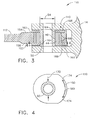
- FIG 3 is a cross-sectional view of an alternative embodiment of a coupling assembly 110.
- Figure 4 is a cross-sectional view of coupling assembly 110 taken along line 4-4 (shown in Figure 3).
- Coupling assembly 110 is substantially similar to coupling assembly 10 shown in Figures 1 and 2, and components in coupling assembly 110 that are identical to components of coupling assembly 10 are identified in Figures 3 and 4 using the same reference numerals used in Figures 2 and 3. Accordingly, coupling assembly 110 includes clevis 14, mounting sleeve 50, and a link connector 112 that is substantially similar link connector 10 (shown in Figures 1 and 2).
- Link connector 112 includes a first end 140 and a second end (not shown) and is used to support and align a secondary structure.
- link connector 112 is used to support a gear train (not shown) within a turbofan engine (not shown), and to provide alignment of a gearbox with respect to the turbomachinery.
- Link connector first end 140 includes elastomer portion 44, opening 46, and a shear lip 150 that extends radially outward from an outer surface 152 of each side 154 and 156 of link connector 112.
- a pair of identical support washers 160 are positioned adjacent each side 154 and 156 of link connector 112. More specifically, washers 160 are coupled to link connector 112, such that when link connector 112 is coupled to clevis 14, each support washer 160 is between clevis 14 and link connector 112.
- Each support washer 160 includes an opening 164 that extends between an outer surface 166 of each support washer 160 and an inner surface 168 of each support washer 160.
- Each opening 164 has a diameter 170 that is approximately equal to elastomer portion opening diameter 54. Accordingly, support washers 160 are sized to receive mounting sleeve 50 and a fastener (not shown in Figures 3 and 4) therethrough.
- each washer opening 164 is substantially circular. In an alternative embodiment, each opening 164 is non-circular to facilitate accommodating elastomer degradation.
- Each washer 160 also includes a pair of anti-rotation projections 174 that extend outwardly from washer 160. Projections 174 engage link connector shear lip 150 to facilitate preventing washers 160 from rotating independently of link connector 112.
- support washers 160 are positioned adjacent link connector sides 154 and 156, such that support washer inner surface 168 contacts link connector outer surface 152, and such that washer openings 164 are substantially concentrically aligned with respect to respective link connector openings 46.
- Link connector 112 is then inserted between clevis arms 20 and 22 into cavity 26.
- openings 164 and 46 are substantially concentrically aligned by mounting sleeve 50 and with respect to. clevis openings 28 and 30, the fastener is inserted through clevis 14, washer 160, and link connector 112 to couple link connector 112 to clevis 14.
- link connector 112 facilitates aligning a secondary structure.
- support washers 160 thermally insulate elastomer portion 44, elastomer portion 44 may still degrade as a result of exposure to heat, caustic fluids, or environmental exposure.
- support washers 160 provide structural support to link connector 12 and facilitate preventing portion 44 from failing due to sagging.
- each support washer 160 is not used a primary load path, and rather each washer opening 164 is elongated to accommodate elastomer degradation.
- a gap 180 is defined between shear lip 150 and each support washer 160. Gap 180 also accommodates elastomer degradation.
- shear lip 150 supports link connector 12 after elastomer degradation of elastomer portion 44.
- FIG 5 is a cross-sectional view of a further alternative embodiment of a coupling assembly 210.
- Figure 6 is a cross-sectional view of coupling assembly 210 taken along line 6-6.
- Coupling assembly 210 is substantially similar to coupling assembly 110 shown in Figures 3 and 4, and components in coupling assembly 210 that are identical to components of coupling assembly 110 are identified in Figures 4 and 5 using the same reference numerals used in Figures 4 and 5.
- coupling assembly 210 includes clevis 14, mounting sleeve 50, and a link connector 212 that is substantially similar link connector 110 (shown in Figures 3 and 4).
- Link connector 212 includes a first end 240 and a second end (not shown) and is used to support and align a secondary structure.
- link connector 212 is used to support a gear train (not shown) within a turbofan engine (not shown), and to provide alignment of a gearbox with respect to the turbomachinery.
- Link connector first end 240 includes elastomer portion 44 and opening 46.
- Link connector first end 240 also includes a pair of anti-rotation projections 250 that extend outwardly from link connector first end 240.
- a pair of identical support washers 260 are positioned adjacent each side 254 and 256 of link connector 212. More specifically, washers 260 are coupled to link connector 212 such that when link connector 212 is coupled to clevis 14, each support washer 260 is between clevis 14 and link connector 212.
- Each support washer 260 includes an opening 264 that extends between an outer surface 266 of each support washer 260 and an inner surface 268 of each support washer 260.
- Each opening 264 has a diameter 270 that is approximately equal to elastomer portion opening diameter 56.
- support washers 260 are sized to receive a fastener (not shown in Figures 5 and 6) therethrough.
- each washer opening 264 is substantially circular.
- each opening 264 is non-circular to facilitate accommodating elastomer degradation.
- Each washer 260 also includes a shear lip 280 that extends radially outward from each washer 260.
- Link connector anti-rotation projections 250 engage washer shear lips 280 to facilitate preventing washers 260 from rotating independently of link connector 212.
- support washers 260 are positioned adjacent link connector sides 254 and 256, such that support washer inner surface 268 contacts link connector outer surface 252, and such that washer openings 264 are substantially concentrically aligned by mounting sleeve 50 and with respect to respective link connector openings 46.
- Link connector 212 is then inserted between clevis arms 20 and 22 into cavity 26.
- openings 264 and 46 are substantially concentrically aligned with respect to clevis openings 28 and 30, the fastener is inserted through clevis 14, mounting sleeve 50, and link connector 212 to couple link connector 212 to clevis 14.
- link connector 212 facilitates aligning a secondary structure.
- support washers 260 thermally insulate elastomer portion 44, elastomer portion 44 may still degrade as a result of exposure to heat, caustic fluids, or environmental exposure.
- support washers 260 provide structural support to link connector 12 and facilitate preventing portion 44 from failing due to sagging.
- support washers 260 are not used a primary load path, and rather openings 264 are elongated to accommodate elastomer degradation.
- loading is transmitted through link connector 212 to clevis 14 via support washers 260.
- shear lip 280 shears when subjected to a pre-determined amount of loading, and the loading is transmitted through elastomer portion 44.
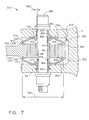
- FIG 7 is a cross-sectional view of another alternative embodiment of a coupling assembly 310.
- Coupling assembly 310 is substantially similar to coupling assembly 10 shown in Figures 1 and 2, and components in coupling assembly 310 that are identical to components of coupling assembly 10 are identified in Figure 7 using the same reference numerals used in Figures 1 and 2. Accordingly, coupling assembly 10 includes clevis 14, mounting sleeve 50, and a link connector 312 that is substantially similar link connector 112 (shown in Figures 3 and 4).
- Link connector 312 includes a first end 340 and a second end (not shown) and is used to support and align a secondary structure.
- link connector 312 is used to support a gear train (not shown) within a turbofan engine (not shown), and to provide alignment of a gearbox with respect to the turbomachinery.
- Link connector first end 340 includes elastomer portion 44 and opening 46.
- Link connector first end 340 also includes a first pair of projections 350 that extend outwardly from link connector first end 340 and a second pair of projections 352 that extend outwardly from link connector 312 a distance 354 from first end 340.
- a pair of identical annular support washers 360 are positioned adjacent each side 362 and 364 of link connector 312. More specifically, washers 360 are coupled to link connector 312 such that when link connector 312 is coupled to clevis 14, each support washer 360 is between clevis 14 and link connector 312.
- Each support washer 360 includes an opening 368 that extends between an outer surface 370 of each support washer 360 and an inner surface 372 of each support washer 360.
- Each opening 368 has a diameter 374 that is larger than clevis opening diameter 58. Accordingly, support washers 360 are sized to receive a fastener 380 therethrough.
- each washer opening 368 is substantially circular
- fastener 380 is a combination threaded bolt and nut.
- Each washer 360 has a frusto-conical cross-sectional profile extending between an inner edge 382 and an outer edge 384 of each washer 360. More specifically, each washer 360 is biased to remain in a frusto-conical configuration and is formed with a spring-like induced bias. Furthermore, washer edge 384 is formed with a shear lip 390 that enables each washer 360 to be biased against link connector projections 350 and 352, such that each washer is positioned a distance 392 from contacting mounting sleeve 50. More specifically, distance 392 is pre-selected to ensure a pre-determined amount of nominal loading is induced through washers 360.
- each projection 350 and 352 includes a radially inner surface 394 and a radially outer surface 396, and each washer 360 is biased against each respective projection radially inner surface 394.
- washer edges 384 are biased against each respective projection radially outer surface 396.
- Washer edge 382 includes an elbow 400 that enables each washer 360 to be in slidable contact against each respective clevis arm 20 and 22. More specifically, each elbow 400 is in slidable contact with a respective annular wear insert 402 inserted within each clevis opening 28 and 30. Wear inserts 402 facilitate preventing wear to clevis 14 during movement of washers 360.
- support washers 360 are positioned adjacent link connector sides 362 and 364, such that washer openings 368 are substantially concentrically aligned with respect to respective link connector openings 46.
- Link connector 312 is then inserted between clevis arms 20 and 22 into cavity 26.
- Fastener 380 is then inserted through clevis 14, washer 360, and link connector 312 to couple link connector 312 to clevis 14.
- link connector 312 provides alignment of the secondary structure.
- support washers 360 thermally insulate elastomer portion 44, elastomer portion 44 may still degrade as a result of exposure to heat, caustic fluids, or environmental exposure. When degradation occurs, support washers 360 provide structural support to elastomer portion 44 and facilitate preventing portion 44 from failing due to sagging.
- washers 360 may translate towards and from mounting sleeve 50 to transmit loading through link connector 312 to clevis 14 via support washers 360.
- Wear inserts 402 facilitate preventing frictional contact and wear between washers 360 and clevis 14.
- washer edge lip 390 is configured to shear such that the loading is transmitted through a softer support elastomer portion 44.
- the above-described coupling assemblies include a clevis, a link connector, a support washer, and a fastener that couples the link connector and the support washer to the clevis.
- the support washer thermally insulates the elastomer portion of the link connector and provides structural support between the link connector and the clevis if the elastomer portion degrades.
- the coupling assembly includes a shear section that facilitates the coupling assembly accommodating abnormal or ultimate loading. As a result, the support washer facilitates extending a useful life of the secondary support structure coupled to the clevis through the link connector.
Landscapes
- Engineering & Computer Science (AREA)
- Chemical & Material Sciences (AREA)
- Combustion & Propulsion (AREA)
- General Engineering & Computer Science (AREA)
- Mechanical Engineering (AREA)
- Pivots And Pivotal Connections (AREA)
- Connector Housings Or Holding Contact Members (AREA)
- Structures Of Non-Positive Displacement Pumps (AREA)
- Insertion Pins And Rivets (AREA)
- Connection Of Plates (AREA)
Abstract
Description
- This application relates generally to coupling assemblies and, more particularly, to methods and apparatus for coupling a link connector to a clevis.
- Coupling assemblies that includes a link connector coupled to a clevis are used to support secondary structures. For example, in at least some known turbine engines, such coupling assemblies are used to support secondary structures, such as gear drive trains, to turbomachinery. The link connectors provide the prime support for the secondary structure and also isolate the structures from vibrations generated by the turbomachinery. More specifically, the link connectors include a elastomer support end that includes an opening that extends therethrough.
- The link connectors also provide alignment of the secondary structure with respect to the turbomachinery. Maintaining proper alignment between the secondary structure and the turbomachinery facilitates preventing gear and/or bearing damage within the gear drive trains. Furthermore, the elastomers provide support for ultimate loading conditions, such as blade out conditions.
- However, exposure to environmental elements, such as high temperatures which may be generated by the turbomachinery or caustic fluids which may be present, may cause the elastomers to degrade. Over time, continued degradation may cause the elastomer portion of the link connectors to sag or loosen, and as such, may cause the alignment of the secondary structure with respect to the turbomachinery to shift. Such misalignment may cause bearing and/or gear damage.
- In one aspect of the invention, a connector assembly is provided. The connector assembly includes a link connector, a clevis, a fastener, and a support washer. The link connector includes a first end that includes an elastomer portion that defines an opening extending therethrough. The clevis includes a first arm, a second arm, and an opening extending therethrough. The fastener is configured to extend through the clevis opening and the link connector elastomer opening to couple the link connector to the clevis such that the link connector is between the clevis arms. The support washer includes an opening that extends therethrough and the washer extends circumferentially around the fastener between the link connector and at least one of the clevis arms.
- In another aspect, a method for coupling a link connector to a clevis is provided. The clevis includes a pair of arms and an opening that extends therethrough. The link connector includes a first end that includes an elastomer portion that defines an opening. The method includes positioning a support washer including an opening extending therethrough adjacent the link connector elastomer portion, and inserting a fastener through the clevis opening, the support washer opening, and the link connector elastomer opening to couple the link connector and the support washer to the clevis such that the link connector is coupled between the clevis arms by the fastener, and such that the support washer thermally insulates at least a portion of the link connector elastomer portion.
- In a further aspect, a connector assembly for a gas turbine engine is provided. The connector assembly includes a link connector, a U-shaped clevis, a support washer, and a fastener. The link connector includes a first end that includes an elastomer portion that defines an opening extending therethrough. The elastomer portion is configured to damp vibrations induced within the link connector. The clevis includes a first arm, a second arm, and an opening that extends therethrough. The support washer also includes an opening extending therethrough. The fastener is configured to extend through the clevis opening, the support washer opening, and the link connector elastomer opening to couple the link connector and the support washer to the clevis, such that the link connector is coupled between the clevis arms by the fastener. The support washer is configured to thermally insulate the link connector elastomer portion.
- The invention will now be described in greater detail, by way of example, with reference to the drawings, in which:-
- Figure 1 is a cross-sectional view of a coupling assembly including a link connector and a clevis;
- Figure 2 is a cross-section of the coupling assembly shown in Figure 1 taken along line 2-2;
- Figure 3 is a cross-sectional view of an alternative embodiment of a coupling assembly including a link connector and a clevis;
- Figure 4 is a cross-sectional view of the coupling assembly shown in Figure 3 taken along line 4-4;
- Figure 5 is a cross-sectional view of a further alternative embodiment of a coupling assembly including a link connector and a clevis;
- Figure 6 is a cross-sectional view of the coupling assembly shown in Figure 6 taken along line 6-6; and
- Figure 7 is a cross-sectional view of another alternative embodiment of a coupling assembly including a link connector and a clevis.
-
- Figure 1 is a cross-sectional view of a
coupling assembly 10 including alink connector 12 and aclevis 14. Figure 2 is a cross-section ofcoupling assembly 10 taken along line 2-2 (shown in Figure 1). Clevis 14 is known and is substantially U-shaped and includes afirst arm 20 and asecond arm 22 that extend from abody 24.Arms cavity 26 therebetween that is sized to receivelink connector 12 therein. More specifically,cavity 26 has awidth 27 measured betweenarms - Each
clevis arm respective opening Openings Openings coupling link connector 12 toclevis 14. -
Link connector 12 includes a first end 40 and a second end (not shown) and is used to support and align a secondary structure. In the exemplary embodiment,link connector 12 is used to support a gear train (not shown) within a turbofan engine (not shown), and to provide alignment of a gearbox with respect to the turbomachinery. Link connector first end 40 includes anelastomer portion 44 that defines anopening 46 that extends therethrough.Elastomer portion 44 facilitates damping vibrations induced throughclevis 14. In the exemplary embodiment,elastomer portion 44 facilitates isolating the gear drive trains from vibrations generated by the turbomachinery.Opening 46 is sized to receive the fastener and amounting sleeve 50 therethrough. In the exemplary embodiment,mounting sleeve 50 is bonded toelastomer portion 44 through opening 46. -
Mounting sleeve 50 extends through elastomer portion opening 46 and has anouter diameter 52 that is slightly smaller than adiameter 54 of opening 46.Mounting sleeve 50 also has aninner diameter 55 and aheight 56.Inner diameter 55 is approximately equal adiameter 58 ofclevis openings sleeve height 56 is slightly less thanclevis cavity width 27. Accordingly, whenmounting sleeve 50 is extended through elastomer portion opening 46 andlink connector 12 is inserted withinclevis cavity 26,mounting sleeve 50 contacts aninner surface 60 ofclevis cavity 26 circumferentially around each opening 28 and 30. - A
support washer 70 is positioned adjacent anouter surface 72 of link connector first end 40. More specifically,washer 70 is coupled tolink connector 12 such that whenlink connector 12 is coupled toclevis 14,support washer 70 is betweenclevis 14 andlink connector 12.Support washer 70 includes afastener opening 74 that extends between anupper surface 76 ofsupport washer 70 and alower surface 78 ofsupport washer 70.Opening 74 has adiameter 80 that is approximately equal to elastomer portion opening diameter. Accordingly,support washer 70 is sized to receivemounting sleeve 50 therethrough. In the exemplary embodiment, washer opening 74 is substantially circular. In an alternative embodiment, opening 74 is non-circular to facilitate accommodating elastomer degradation. - In the exemplary embodiment,
support washer 70 has a substantially tear-shaped cross-sectional profile. The tear-shaped cross-sectional profile enableswasher 70 to extend substantially acrosselastomer portion 44 when coupled tolink connector 12, and thus, as described in more detail below, enableswasher 70 to thermalinsulate elastomer portion 44. Alternatively,support washer 70 may have a non-tear-shaped cross-sectional profile. -
Support washer 70 also includes a shear pin opening 84 that is sized to receive ashear pin 86 therethrough.Shear pin 86 couples supportwasher 70 to linkconnector 12 and extends at least partially into a shear pin opening 88 defined withinlink connector 12. - During assembly,
support washer 70 is coupled to linkconnector 12 byshear pin 86, such that support washerlower surface 78 contacts link connectorouter surface 72. Furthermore, when coupled to linkconnector 12,support washer openings link connector openings 46 and 88. -
Link connector 12 is then inserted between clevisarms cavity 26. Whenopenings sleeve 50 and with respect to clevisopenings clevis 14,sleeve 50, andlink connector 12 tocouple link connector 12 toclevis 14. - During use,
link connector 12 facilitates aligning a secondary structure. Over time, althoughsupport washer 70 thermally insulateselastomer portion 44,elastomer portion 44 may still degrade as a result of exposure to heat, caustic fluids, or environmental exposure. When degradation occurs,support washer 70 provides structural support to linkconnector 12 and facilitates preventingportion 44 from failing due to sagging. In an alternative embodiment,support washer 70 is not used a primary load path, and rather opening 74 is elongated to accommodate elastomer degradation. - During normal operations, loading is transmitted through
link connector 12 to clevis 14 viasupport washer 70. However, during abnormal or extreme loading, such as may occur in a turbine engine following a blade out condition, pin 86 shears and the loading is transmitted throughelastomer portion 44, thus facilitating preventing damage to the secondary structure. In one embodiment, pin 86 shears when a pre-determined loading is applied to linkconnector 12. - Figure 3 is a cross-sectional view of an alternative embodiment of a
coupling assembly 110. Figure 4 is a cross-sectional view ofcoupling assembly 110 taken along line 4-4 (shown in Figure 3).Coupling assembly 110 is substantially similar tocoupling assembly 10 shown in Figures 1 and 2, and components incoupling assembly 110 that are identical to components ofcoupling assembly 10 are identified in Figures 3 and 4 using the same reference numerals used in Figures 2 and 3. Accordingly,coupling assembly 110 includesclevis 14, mountingsleeve 50, and alink connector 112 that is substantially similar link connector 10 (shown in Figures 1 and 2). -
Link connector 112 includes afirst end 140 and a second end (not shown) and is used to support and align a secondary structure. In the exemplary embodiment,link connector 112 is used to support a gear train (not shown) within a turbofan engine (not shown), and to provide alignment of a gearbox with respect to the turbomachinery. Link connectorfirst end 140 includeselastomer portion 44, opening 46, and ashear lip 150 that extends radially outward from anouter surface 152 of eachside link connector 112. - A pair of
identical support washers 160 are positioned adjacent eachside link connector 112. More specifically,washers 160 are coupled to linkconnector 112, such that whenlink connector 112 is coupled toclevis 14, eachsupport washer 160 is betweenclevis 14 andlink connector 112. Eachsupport washer 160 includes anopening 164 that extends between anouter surface 166 of eachsupport washer 160 and aninner surface 168 of eachsupport washer 160. Eachopening 164 has adiameter 170 that is approximately equal to elastomerportion opening diameter 54. Accordingly,support washers 160 are sized to receive mountingsleeve 50 and a fastener (not shown in Figures 3 and 4) therethrough. In the exemplary embodiment, eachwasher opening 164 is substantially circular. In an alternative embodiment, eachopening 164 is non-circular to facilitate accommodating elastomer degradation. - Each
washer 160 also includes a pair ofanti-rotation projections 174 that extend outwardly fromwasher 160.Projections 174 engage linkconnector shear lip 150 to facilitate preventingwashers 160 from rotating independently oflink connector 112. - During assembly,
support washers 160 are positioned adjacent link connector sides 154 and 156, such that support washerinner surface 168 contacts link connectorouter surface 152, and such thatwasher openings 164 are substantially concentrically aligned with respect to respectivelink connector openings 46. -
Link connector 112 is then inserted between clevisarms cavity 26. Whenopenings sleeve 50 and with respect to. clevisopenings clevis 14,washer 160, andlink connector 112 tocouple link connector 112 toclevis 14. - During use,
link connector 112 facilitates aligning a secondary structure. Over time, althoughsupport washers 160 thermally insulateelastomer portion 44,elastomer portion 44 may still degrade as a result of exposure to heat, caustic fluids, or environmental exposure. When degradation occurs,support washers 160 provide structural support to linkconnector 12 and facilitate preventingportion 44 from failing due to sagging. In an alternative embodiment, eachsupport washer 160 is not used a primary load path, and rather eachwasher opening 164 is elongated to accommodate elastomer degradation. Furthermore, in the exemplary embodiment, agap 180 is defined betweenshear lip 150 and eachsupport washer 160.Gap 180 also accommodates elastomer degradation. - During normal operations, loading is transmitted through
link connector 112 to clevis 14 viasupport washers 160. However, during abnormal or extreme loading, such as may occur in a turbine engine following a blade out condition,shear lip 150 shears and the loading is transmitted throughelastomer portion 44. In oneembodiment shear lip 150 supports linkconnector 12 after elastomer degradation ofelastomer portion 44. - Figure 5 is a cross-sectional view of a further alternative embodiment of a
coupling assembly 210. Figure 6 is a cross-sectional view ofcoupling assembly 210 taken along line 6-6.Coupling assembly 210 is substantially similar tocoupling assembly 110 shown in Figures 3 and 4, and components incoupling assembly 210 that are identical to components ofcoupling assembly 110 are identified in Figures 4 and 5 using the same reference numerals used in Figures 4 and 5. Accordingly,coupling assembly 210 includesclevis 14, mountingsleeve 50, and alink connector 212 that is substantially similar link connector 110 (shown in Figures 3 and 4). -
Link connector 212 includes afirst end 240 and a second end (not shown) and is used to support and align a secondary structure. In the exemplary embodiment,link connector 212 is used to support a gear train (not shown) within a turbofan engine (not shown), and to provide alignment of a gearbox with respect to the turbomachinery. Link connectorfirst end 240 includeselastomer portion 44 andopening 46. Link connectorfirst end 240 also includes a pair ofanti-rotation projections 250 that extend outwardly from link connectorfirst end 240. - A pair of
identical support washers 260 are positioned adjacent eachside link connector 212. More specifically,washers 260 are coupled to linkconnector 212 such that whenlink connector 212 is coupled toclevis 14, eachsupport washer 260 is betweenclevis 14 andlink connector 212. Eachsupport washer 260 includes anopening 264 that extends between anouter surface 266 of eachsupport washer 260 and aninner surface 268 of eachsupport washer 260. Eachopening 264 has adiameter 270 that is approximately equal to elastomerportion opening diameter 56. Accordingly,support washers 260 are sized to receive a fastener (not shown in Figures 5 and 6) therethrough. In the exemplary embodiment, eachwasher opening 264 is substantially circular. In an alternative embodiment, eachopening 264 is non-circular to facilitate accommodating elastomer degradation. - Each
washer 260 also includes ashear lip 280 that extends radially outward from eachwasher 260. Linkconnector anti-rotation projections 250 engagewasher shear lips 280 to facilitate preventingwashers 260 from rotating independently oflink connector 212. - During assembly,
support washers 260 are positioned adjacent link connector sides 254 and 256, such that support washerinner surface 268 contacts link connector outer surface 252, and such thatwasher openings 264 are substantially concentrically aligned by mountingsleeve 50 and with respect to respectivelink connector openings 46. -
Link connector 212 is then inserted between clevisarms cavity 26. Whenopenings openings clevis 14, mountingsleeve 50, andlink connector 212 tocouple link connector 212 toclevis 14. - During use,
link connector 212 facilitates aligning a secondary structure. Over time, althoughsupport washers 260 thermally insulateelastomer portion 44,elastomer portion 44 may still degrade as a result of exposure to heat, caustic fluids, or environmental exposure. When degradation occurs,support washers 260 provide structural support to linkconnector 12 and facilitate preventingportion 44 from failing due to sagging. In an alternative embodiment,support washers 260 are not used a primary load path, and ratheropenings 264 are elongated to accommodate elastomer degradation. - During normal operations, loading is transmitted through
link connector 212 to clevis 14 viasupport washers 260. However, during abnormal or extreme loading, such as may occur in a turbine engine following a blade out condition,shear lip 280 shears when subjected to a pre-determined amount of loading, and the loading is transmitted throughelastomer portion 44. - Figure 7 is a cross-sectional view of another alternative embodiment of a
coupling assembly 310.Coupling assembly 310 is substantially similar tocoupling assembly 10 shown in Figures 1 and 2, and components incoupling assembly 310 that are identical to components ofcoupling assembly 10 are identified in Figure 7 using the same reference numerals used in Figures 1 and 2. Accordingly,coupling assembly 10 includesclevis 14, mountingsleeve 50, and alink connector 312 that is substantially similar link connector 112 (shown in Figures 3 and 4). -
Link connector 312 includes afirst end 340 and a second end (not shown) and is used to support and align a secondary structure. In the exemplary embodiment,link connector 312 is used to support a gear train (not shown) within a turbofan engine (not shown), and to provide alignment of a gearbox with respect to the turbomachinery. Link connectorfirst end 340 includeselastomer portion 44 andopening 46. Link connectorfirst end 340 also includes a first pair ofprojections 350 that extend outwardly from link connectorfirst end 340 and a second pair ofprojections 352 that extend outwardly from link connector 312 adistance 354 fromfirst end 340. - A pair of identical
annular support washers 360 are positioned adjacent eachside 362 and 364 oflink connector 312. More specifically,washers 360 are coupled to linkconnector 312 such that whenlink connector 312 is coupled toclevis 14, eachsupport washer 360 is betweenclevis 14 andlink connector 312. Eachsupport washer 360 includes anopening 368 that extends between anouter surface 370 of eachsupport washer 360 and aninner surface 372 of eachsupport washer 360. Eachopening 368 has adiameter 374 that is larger thanclevis opening diameter 58. Accordingly,support washers 360 are sized to receive afastener 380 therethrough. In the exemplary embodiment, eachwasher opening 368 is substantially circular, andfastener 380 is a combination threaded bolt and nut. - Each
washer 360 has a frusto-conical cross-sectional profile extending between aninner edge 382 and anouter edge 384 of eachwasher 360. More specifically, eachwasher 360 is biased to remain in a frusto-conical configuration and is formed with a spring-like induced bias. Furthermore,washer edge 384 is formed with ashear lip 390 that enables eachwasher 360 to be biased againstlink connector projections distance 392 from contacting mountingsleeve 50. More specifically,distance 392 is pre-selected to ensure a pre-determined amount of nominal loading is induced throughwashers 360. Furthermore, eachprojection inner surface 394 and a radiallyouter surface 396, and eachwasher 360 is biased against each respective projection radiallyinner surface 394. In an alternative embodiment, washer edges 384 are biased against each respective projection radiallyouter surface 396. -
Washer edge 382 includes anelbow 400 that enables eachwasher 360 to be in slidable contact against eachrespective clevis arm elbow 400 is in slidable contact with a respectiveannular wear insert 402 inserted within each clevis opening 28 and 30. Wear inserts 402 facilitate preventing wear to clevis 14 during movement ofwashers 360. - During assembly,
support washers 360 are positioned adjacent link connector sides 362 and 364, such thatwasher openings 368 are substantially concentrically aligned with respect to respectivelink connector openings 46.Link connector 312 is then inserted between clevisarms cavity 26.Fastener 380 is then inserted throughclevis 14,washer 360, andlink connector 312 tocouple link connector 312 toclevis 14. - During use,
link connector 312 provides alignment of the secondary structure. Over time, althoughsupport washers 360 thermally insulateelastomer portion 44,elastomer portion 44 may still degrade as a result of exposure to heat, caustic fluids, or environmental exposure. When degradation occurs,support washers 360 provide structural support toelastomer portion 44 and facilitate preventingportion 44 from failing due to sagging. - Furthermore, during normal operations, loading is transmitted through
link connector 312 to clevis 14 viasupport washers 360. Becausedistance 392 enables a pre-determined loading to be induced towashers 360, during normal operation, load is transferred throughlink connector 312 and throughelastomer portion 44 tosleeve 50,fastener 380, and toclevis 14. During transient operations, or degraded conditions,washers 360 may translate towards and from mountingsleeve 50 to transmit loading throughlink connector 312 to clevis 14 viasupport washers 360. Wear inserts 402 facilitate preventing frictional contact and wear betweenwashers 360 andclevis 14. However, during abnormal or extreme loading, such as may occur in a turbine engine following a blade out condition,washer edge lip 390 is configured to shear such that the loading is transmitted through a softersupport elastomer portion 44. - The above-described coupling assemblies include a clevis, a link connector, a support washer, and a fastener that couples the link connector and the support washer to the clevis. The support washer thermally insulates the elastomer portion of the link connector and provides structural support between the link connector and the clevis if the elastomer portion degrades. Furthermore, the coupling assembly includes a shear section that facilitates the coupling assembly accommodating abnormal or ultimate loading. As a result, the support washer facilitates extending a useful life of the secondary support structure coupled to the clevis through the link connector.
- For the sake of good order, various aspects of the invention are set out in the following clauses:-
- 1. A method for coupling a link connector (12) to a clevis (14) including a
pair of arms (20, 22) and an opening (27, 28) extending therethrough, the link
connector including a first end (40) including an elastomer portion (44) that
defines an opening (46), said method comprising:
- positioning a support washer (70) including an opening (74) extending therethrough against the link connector elastomer portion; and
- inserting a fastener through the clevis opening, the support washer opening, and the link connector elastomer opening to couple the link connector and the support washer to the clevis such that the link connector is coupled between the clevis arms by the fastener, and such that the support washer is positioned to thermally insulate at least a portion of the link connector elastomer portion.
- 2. A method in accordance with Clause 1 further comprising inserting a mounting sleeve (50) through the support washer (70) and the elastomer portion (44) prior to inserting the fastener through the clevis opening (27, 28).
- 3. A method in accordance with Clause 1 further comprising coupling a pin (86) through an opening (74) in the support washer (70) to the link connector (12), wherein the pin is configured to shear when subjected to a pre-determined amount of loading, such that loading is transmitted through the link connector elastomer portion (44).
- 4. A method in accordance with Clause 1 wherein positioning a support washer (70) further comprises positioning the support washer against the link connector (12) such that at least one of the link connector and the support washer includes a lip (150) extension that is configured to shear when subjected to a pre-determined amount of loading, such that loading is transmitted through the link connector elastomer portion (44).
- 5. A method in accordance with Clause 1 wherein positioning a support washer (70) further comprises positioning the support washer against the link connector (12) such that the support washer is prevented from rotating relative to the link connector.
- 6. A connector assembly (10), said connector assembly comprising:
- a link connector (12) comprising a first end (40) comprising an elastomer portion (44) and an opening (46) extending therethrough, said opening defined by said elastomer portion;
- a clevis (14) comprising an a first arm (20), a second arm (22), and an opening (27, 28) extending therethrough;
- a fastener configured to extend through said clevis opening and said link connector elastomer opening to couple said link connector to said clevis such that said link connector is between said clevis arms; and
- a support washer (70) comprising an opening (74) extending therethrough, said washer extending circumferentially around said fastener between said link connector and at least one of said clevis arms.
- 7. A connector assembly (10) in accordance with Clause 6 further comprising a pin (86) configured to couple said support washer (70) to said link connector (12), said pin configured to shear such that loading is transmitted through said link connector elastomer portion (44).
- 8. A connector assembly (10) in accordance with Clause 6 wherein said support washer opening (74) is substantially circular.
- 9. A connector assembly (10) in accordance with Clause 6 wherein said support washer opening (74) is non-circular.
- 10. A connector assembly (10) in accordance with Clause 6 wherein at least one of said support washer (70) and said link connector first end (40) further comprises a lip (150) extension configured to shear such that loading is transmitted through said link connector elastomer portion (44).
- 11. A connector assembly (10) in accordance with Clause 6 wherein at least one of said support washer (70) and said link connector first end (40) further comprises an anti-rotation projection (174) configured to prevent rotation of said support washer relative to said link connector (12).
- 12. A connector assembly (10) in accordance with Clause 6 wherein said support washer (70) further comprises a shear (86) portion configured to provide support to said link connector first end (40).
- 13. A connector assembly (10) in accordance with Clause 6 wherein said support washer (70) configured to thermally insulate said link connector elastomer portion (44).
- 14. A connector assembly (10) for a gas turbine engine, said connector
assembly comprising:
- a link connector (12) comprising a first end (40) comprising an elastomer portion (44) defining an opening (46) extending therethrough, said elastomer portion configured to damp vibrations induced within said link connector;
- a u-shaped clevis (14) comprising an a first arm (20), a second arm
(22), and an opening (27, 28) extending therethrough;
a support washer (70) comprising an opening (74) extending therethrough; and - a fastener configured to extend through said clevis opening, said support washer opening, and said link connector elastomer opening to couple said link connector and said support washer to said clevis such that said link connector is coupled between said clevis arms by said fastener, said support washer configured to thermally insulate said link connector elastomer portion.
- 15. A connector assembly (10) in accordance with
Clause 14 further comprising a mounting sleeve (50) extending between said clevis arms (20, 22) through said link connector elastomer opening (46) and said support washer opening (74). - 16. A connector assembly (10) in accordance with Clause 15 wherein said support wash opening (74) is non-circular.
- 17. A connector assembly (10) in accordance with Clause 15 wherein at least one of said support washer (70) and said link connector (12) comprises a lip (150) configured to shear when a pre-determined amount of loading is induced to said link connector first end (44).
- 18. A connector assembly (10) in accordance with Clause 15 wherein at least one of said support washer (70) and said link connector first end (40) further comprises an anti-rotation projection (174) configured to prevent rotation of said support washer relative to said link connector (12).
- 19. A link connector (12) in accordance with Clause 15 further comprising a pin (86) extending through said support washer (70) into said link connector, said pin configured to shear when a pre-determined amount of loading is induced to said link connector first end (40).
- 20. A link connector (12) in accordance with Clause 15 wherein said support washer (70) further comprises shear (86) portion configured to provide support to said link connector first end (40).
-
Claims (10)
- A method for coupling a link connector (12) to a clevis (14) including a pair of arms (20, 22) and an opening (27, 28) extending therethrough, the link connector including a first end (40) including an elastomer portion (44) that defines an opening (46), said method comprising:positioning a support washer (70) including an opening (74) extending therethrough against the link connector elastomer portion; andinserting a fastener through the clevis opening, the support washer opening, and the link connector elastomer opening to couple the link connector and the support washer to the clevis such that the link connector is coupled between the clevis arms by the fastener, and such that the support washer is positioned to thermally insulate at least a portion of the link connector elastomer portion.
- A method in accordance with Claim 1 further comprising inserting a mounting sleeve (50) through the support washer (70) and the elastomer portion (44) prior to inserting the fastener through the clevis opening (27, 28).
- A method in accordance with Claim 1 or 2 further comprising coupling a pin (86) through an opening (74) in the support washer (70) to the link connector (12), wherein the pin is configured to shear when subjected to a pre-determined amount of loading, such that loading is transmitted through the link connector elastomer portion (44).
- A method in accordance with Claim 1, 2 or 3 wherein positioning a support washer (70) further comprises positioning the support washer against the link connector (12) such that at least one of the link connector and the support washer includes a lip (150) extension that is configured to shear when subjected to a pre-determined amount of loading, such that loading is transmitted through the link connector elastomer portion (44).
- A connector assembly (10), said connector assembly comprising:a link connector (12) comprising a first end (40) comprising an elastomer portion (44) and an opening (46) extending therethrough, said opening defined by said elastomer portion;a clevis (14) comprising an a first arm (20), a second arm (22), and an opening (27, 28) extending therethrough;a fastener configured to extend through said clevis opening and said link connector elastomer opening to couple said link connector to said clevis such that said link connector is between said clevis arms; anda support washer (70) comprising an opening (74) extending therethrough, said washer extending circumferentially around said fastener between said link connector and at least one of said clevis arms.
- A connector assembly (10) in accordance with Claim 5 further comprising a pin (86) configured to couple said support washer (70) to said link connector (12), said pin configured to shear such that loading is transmitted through said link connector elastomer portion (44).
- A connector assembly (10) in accordance with Claim 5 or 6 wherein said support washer opening (74) is substantially circular.
- A connector assembly (10) for a gas turbine engine, said connector assembly comprising:a link connector (12) comprising a first end (40) comprising an elastomer portion (44) defining an opening (46) extending therethrough, said elastomer portion configured to damp vibrations induced within said link connector;a u-shaped clevis (14) comprising an a first arm (20), a second arm (22), and an opening (27, 28) extending therethrough;
a support washer (70) comprising an opening (74) extending therethrough; anda fastener configured to extend through said clevis opening, said support washer opening, and said link connector elastomer opening to couple said link connector and said support washer to said clevis such that said link connector is coupled between said clevis arms by said fastener, said support washer configured to thermally insulate said link connector elastomer portion. - A connector assembly (10) in accordance with Claim 8 further comprising a mounting sleeve (50) extending between said clevis arms (20, 22) through said link connector elastomer opening (46) and said support washer opening (74).
- A connector assembly (10) in accordance with Claim 8 or 9 wherein said support wash opening (74) is non-circular.
Applications Claiming Priority (2)
| Application Number | Priority Date | Filing Date | Title |
|---|---|---|---|
| US974194 | 1992-11-10 | ||
| US09/974,194 US6669393B2 (en) | 2001-10-10 | 2001-10-10 | Connector assembly for gas turbine engines |
Publications (3)
| Publication Number | Publication Date |
|---|---|
| EP1302680A2 true EP1302680A2 (en) | 2003-04-16 |
| EP1302680A3 EP1302680A3 (en) | 2005-06-08 |
| EP1302680B1 EP1302680B1 (en) | 2008-01-23 |
Family
ID=25521723
Family Applications (1)
| Application Number | Title | Priority Date | Filing Date |
|---|---|---|---|
| EP02257043A Expired - Lifetime EP1302680B1 (en) | 2001-10-10 | 2002-10-10 | Method and apparatus for coupling a link connector to a clevis |
Country Status (5)
| Country | Link |
|---|---|
| US (1) | US6669393B2 (en) |
| EP (1) | EP1302680B1 (en) |
| JP (1) | JP4184030B2 (en) |
| CN (1) | CN100487233C (en) |
| DE (1) | DE60224760T2 (en) |
Cited By (8)
| Publication number | Priority date | Publication date | Assignee | Title |
|---|---|---|---|---|
| EP1473441A2 (en) | 2003-04-30 | 2004-11-03 | General Electric Company | Apparatus for mounting a gas turbine engine |
| FR2866683A1 (en) * | 2004-02-25 | 2005-08-26 | Snecma Moteurs | Vibration damper for connecting rod, has parallel units with thickness equal to portion of ball joint projecting with respect to one side of head of connecting rod, where one unit is compressed when connecting rod is inclined |
| FR2994244A1 (en) * | 2012-07-31 | 2014-02-07 | Peugeot Citroen Automobiles Sa | Thermal protection device for protecting elastic stopper used for fixing electrical motor with rear axle cross-piece of hybrid car via clevis mounting, has base wall interdependent from lateral walls of mounting that surround stopper parts |
| EP2921727A1 (en) * | 2014-03-17 | 2015-09-23 | Lockheed Martin Corporation | U-shaped clip for fixing a link rod within an aircraft clevis |
| EP3015368A1 (en) * | 2014-10-30 | 2016-05-04 | Airbus Operations (S.A.S) | Device for attaching an aircraft engine, and corresponding aircraft |
| FR3063459A1 (en) * | 2017-03-06 | 2018-09-07 | Peugeot Citroen Automobiles Sa | ANTI-COUPLE THERMAL THERMAL PROTECTION SLEEVE AND EQUIPPED ANTI-TORQUE BARRIER |
| FR3097205A1 (en) * | 2019-06-17 | 2020-12-18 | Airbus Operations | ENGINE ATTACHMENT FOR AN AIRCRAFT ENGINE COMPRISING A SCREED, A CONNECTING ROD AND AN INTERFACE PART BETWEEN THE SCREED AND THE CONNECTING ROD |
| EP3859172A1 (en) * | 2020-01-31 | 2021-08-04 | The Boeing Company | Assembly to connect a panel to a support member |
Families Citing this family (61)
| Publication number | Priority date | Publication date | Assignee | Title |
|---|---|---|---|---|
| DE10249517B4 (en) * | 2002-10-23 | 2008-11-20 | Eurocopter Deutschland Gmbh | Shock-absorbing, load-limiting connection device and rotary wing aircraft with such a connection device |
| GB0413276D0 (en) * | 2004-06-14 | 2004-07-14 | Rolls Royce Plc | Load reduced engine mount |
| US7469689B1 (en) * | 2004-09-09 | 2008-12-30 | Jones Daniel W | Fluid cooled supercharger |
| FR2887853B1 (en) * | 2005-06-29 | 2007-08-17 | Airbus France Sas | ENGINE ATTACHMENT FOR AN AIRCRAFT INTENDED TO BE INTERPOSED BETWEEN A MOTOR AND A COUPLING MAT |
| US7900873B2 (en) * | 2005-11-15 | 2011-03-08 | The Boeing Company | Vibration isolation system |
| US8104736B2 (en) * | 2005-12-01 | 2012-01-31 | Hamilton Sundstrand Corporation | Gas turbine engine auxiliary component mount |
| DE07750434T1 (en) * | 2007-02-09 | 2010-01-28 | Bell Helicopter Textron, Inc., Fort Worth | SELF-STABLE THRUST-SAFETY CLAMP |
| US8806972B2 (en) * | 2007-05-03 | 2014-08-19 | T-Motion Technology Co., Ltd. | Telescoping rod structure for linear actuator |
| WO2008150202A1 (en) * | 2007-06-08 | 2008-12-11 | Volvo Aero Corporation | A structure for transferring loads at a gas turbine engine, and an engine and an aircraft with such a structure |
| FR2923459B1 (en) * | 2007-11-09 | 2010-05-21 | Snecma | ROTATING BLOCKING MEANS FOR A AXIS SUPPORTING A TURBOMOTEUR SUSPENSION MEMBER |
| US20140174056A1 (en) | 2008-06-02 | 2014-06-26 | United Technologies Corporation | Gas turbine engine with low stage count low pressure turbine |
| US8128021B2 (en) | 2008-06-02 | 2012-03-06 | United Technologies Corporation | Engine mount system for a turbofan gas turbine engine |
| FR2942205B1 (en) * | 2009-02-18 | 2012-08-03 | Airbus France | MOTOR ATTACHMENT WITH CHARGED / DEFORMATION CURVE ADAPTED |
| FR2956164B1 (en) * | 2010-02-10 | 2012-02-24 | Snecma | CONNECTION BETWEEN THE EXHAUST CASE AND A STRUCTURAL RING OF A BLOWER DELIVERY OF A TURBOREACTOR |
| US9631558B2 (en) | 2012-01-03 | 2017-04-25 | United Technologies Corporation | Geared architecture for high speed and small volume fan drive turbine |
| US9523422B2 (en) | 2011-06-08 | 2016-12-20 | United Technologies Corporation | Flexible support structure for a geared architecture gas turbine engine |
| US9239012B2 (en) | 2011-06-08 | 2016-01-19 | United Technologies Corporation | Flexible support structure for a geared architecture gas turbine engine |
| DE102011084722A1 (en) * | 2011-10-18 | 2013-04-18 | Airbus Operations Gmbh | Tie rod for connecting a fitting of equipment of an equipment module, in particular a luggage rack, to a structural fitting of a fuselage structure of an aircraft |
| EP2587003A1 (en) | 2011-10-25 | 2013-05-01 | Siemens Aktiengesellschaft | Gas turbine engine support strut assembly |
| US9272781B2 (en) * | 2011-11-01 | 2016-03-01 | Textron Innovations Inc. | Rotor system anti-rotation wear protector |
| US9410596B2 (en) | 2011-11-04 | 2016-08-09 | Honeywell International Inc. | Mounting systems for structural members, fastening assemblies thereof, and vibration isolation systems including the same |
| FR2982331B1 (en) * | 2011-11-07 | 2013-11-29 | Eurocopter France | JOINT JOINT MECHANISM BETWEEN A HAT AND A ROD, IN PARTICULAR FOR A CONTROL EQUIPMENT COMPRISING A GIRAVION |
| US9222417B2 (en) | 2012-01-31 | 2015-12-29 | United Technologies Corporation | Geared turbofan gas turbine engine architecture |
| US10287914B2 (en) | 2012-01-31 | 2019-05-14 | United Technologies Corporation | Gas turbine engine with high speed low pressure turbine section and bearing support features |
| US20130192191A1 (en) | 2012-01-31 | 2013-08-01 | Frederick M. Schwarz | Gas turbine engine with high speed low pressure turbine section and bearing support features |
| US8887487B2 (en) | 2012-01-31 | 2014-11-18 | United Technologies Corporation | Geared turbofan gas turbine engine architecture |
| US8935913B2 (en) | 2012-01-31 | 2015-01-20 | United Technologies Corporation | Geared turbofan gas turbine engine architecture |
| US20150345426A1 (en) | 2012-01-31 | 2015-12-03 | United Technologies Corporation | Geared turbofan gas turbine engine architecture |
| US8932022B2 (en) | 2012-02-03 | 2015-01-13 | Pratt & Whitney Canada Corp. | Fastening system for fan and shaft interconnection |
| US8678323B2 (en) | 2012-02-28 | 2014-03-25 | Honeywell International Inc. | Launch lock assemblies including axial gap amplification devices and spacecraft isolation systems including the same |
| US10125693B2 (en) | 2012-04-02 | 2018-11-13 | United Technologies Corporation | Geared turbofan engine with power density range |
| US8572943B1 (en) | 2012-05-31 | 2013-11-05 | United Technologies Corporation | Fundamental gear system architecture |
| US20150308351A1 (en) | 2012-05-31 | 2015-10-29 | United Technologies Corporation | Fundamental gear system architecture |
| US8756908B2 (en) | 2012-05-31 | 2014-06-24 | United Technologies Corporation | Fundamental gear system architecture |
| US9475594B2 (en) | 2012-09-25 | 2016-10-25 | Honeywell International Inc. | Launch lock assemblies with reduced preload and spacecraft isolation systems including the same |
| US10724479B2 (en) | 2013-03-15 | 2020-07-28 | United Technologies Corporation | Thrust efficient turbofan engine |
| US9624827B2 (en) | 2013-03-15 | 2017-04-18 | United Technologies Corporation | Thrust efficient turbofan engine |
| ITTO20130636A1 (en) * | 2013-07-29 | 2015-01-30 | Avio Spa | TRANSMISSION BOX, AND DISASSEMBLY METHOD TO DISCONNECT A DRIVE SHAFT IN SUCH A TRANSMISSION BOX |
| FR3014970B1 (en) * | 2013-12-12 | 2016-01-22 | Airbus Operations Sas | ASSEMBLY COMPRISING A JOINT AXLE SUPPORTED BY A CAP AND IMMOBILIZED IN TRANSLATION BY A LOCKING DEVICE INCORPORATING A DOUBLE ANTI-ROTATION SYSTEM |
| FR3014972B1 (en) | 2013-12-12 | 2016-04-22 | Airbus Operations Sas | ASSEMBLY COMPRISING A JOINT AXLE SUPPORTED BY A CAP AND IMMOBILIZED IN TRANSLATION BY A LOCKING DEVICE INCORPORATING A DOUBLE ANTI-ROTATION SYSTEM |
| US20160032561A1 (en) * | 2014-07-29 | 2016-02-04 | Caterpillar Inc. | Pin joint for a machine |
| FR3025268B1 (en) * | 2014-09-01 | 2017-12-29 | Sagem Defense Securite | COUPLING WITH SAFETY PIN |
| US9822667B2 (en) | 2015-04-06 | 2017-11-21 | United Technologies Corporation | Tri-tab lock washer |
| US10520012B1 (en) * | 2015-04-14 | 2019-12-31 | Roller Bearing Company Of America, Inc. | Rod end having wear mitigation features for an augmenter nozzle on a jet engine turbine |
| US10495004B2 (en) | 2015-09-17 | 2019-12-03 | General Electric Company | Multi-directional gearbox deflection limiter for a gas turbine engine |
| US10024270B2 (en) * | 2015-10-13 | 2018-07-17 | Rohr, Inc. | Vibration damping drag link fitting for a thrust reverser |
| US10107378B2 (en) | 2015-11-03 | 2018-10-23 | General Electric Company | Systems and methods for a gas turbine engine with combined multi-directional gearbox deflection limiters and dampers |
| US10220951B2 (en) * | 2016-02-01 | 2019-03-05 | Bell Helicopter Textron Inc. | Sleeved bolt assemblies for aircraft engine mount assemblies |
| US9828117B2 (en) * | 2016-02-04 | 2017-11-28 | United Launch Alliance, L.L.C. | Tensioning apparatus and system for clamping joints |
| US10215100B2 (en) * | 2016-03-14 | 2019-02-26 | Hamilton Sundstrand Corporation | One degree-of-constraint semi-fusible gearbox mounting link |
| US10132245B2 (en) * | 2016-04-25 | 2018-11-20 | Hamilton Sundstrand Corporation | Fusible link with coulomb damping |
| CN107097912A (en) * | 2017-04-13 | 2017-08-29 | 中国船舶科学研究中心(中国船舶重工集团公司第七0二研究所) | Radial type flexible connector and installation method with hollow cylinder variable cross-section bearing pin |
| US10753224B2 (en) | 2017-04-27 | 2020-08-25 | General Electric Company | Variable stator vane actuator overload indicating bushing |
| US10927711B2 (en) * | 2017-10-26 | 2021-02-23 | Unison Industries, Llc | Tunable compliant attachment structure |
| DE102017130001A1 (en) * | 2017-12-14 | 2019-06-19 | Elringklinger Ag | Fastening device for a shielding and shielding part comprising the fastening device |
| TWI731778B (en) | 2020-08-27 | 2021-06-21 | 緯穎科技服務股份有限公司 | Liftable hinge mechanism and related airtight device for preventing gaseous matter from leakage |
| US12409330B2 (en) | 2020-08-27 | 2025-09-09 | Wiwynn Corporation | Airtight device and feedthrough module |
| US12129887B2 (en) * | 2021-10-24 | 2024-10-29 | Textron Innovations Inc. | Self-retaining wear-pad leveler |
| GB202301053D0 (en) * | 2023-01-25 | 2023-03-08 | Rolls Royce Plc | Mounting assembly for gas turbine engine |
| FR3160675B1 (en) * | 2024-03-28 | 2026-04-03 | Airbus Operations Sas | Aircraft engine attachment system comprising a two-point shackle equipped with at least one stop, aircraft comprising at least one such engine attachment system |
| US20260077873A1 (en) * | 2024-09-19 | 2026-03-19 | Pratt & Whitney Canada Corp. | Assembly and method for connecting aircraft components together |
Family Cites Families (17)
| Publication number | Priority date | Publication date | Assignee | Title |
|---|---|---|---|---|
| US3950941A (en) | 1973-01-12 | 1976-04-20 | Bulten-Kanthal Ab | Lift chain with end connector |
| US4875655A (en) | 1987-03-13 | 1989-10-24 | General Electric Company | Vibration isolating engine mount |
| US5122007A (en) * | 1990-09-19 | 1992-06-16 | Smith Jackson A | Pulling eye with breakaway |
| US5193787A (en) * | 1991-05-03 | 1993-03-16 | Maremont Corporation | Sleeve and bushing assembly and method of manufacturing the same |
| US5174502A (en) | 1991-05-10 | 1992-12-29 | General Electric Company | Support for a translating nozzle vectoring ring |
| US5307623A (en) | 1991-05-28 | 1994-05-03 | General Electric Company | Apparatus and method for the diassembly of an ultra high bypass engine |
| US5275357A (en) | 1992-01-16 | 1994-01-04 | General Electric Company | Aircraft engine mount |
| US5320307A (en) * | 1992-03-25 | 1994-06-14 | General Electric Company | Aircraft engine thrust mount |
| US5415439A (en) | 1992-08-24 | 1995-05-16 | General Electric Company | Misalignment fitting |
| US5277382A (en) | 1992-10-13 | 1994-01-11 | General Electric Company | Aircraft engine forward mount |
| US5303880A (en) | 1992-10-28 | 1994-04-19 | General Electric Company | Aircraft engine pin mount |
| US5438756A (en) | 1993-12-17 | 1995-08-08 | General Electric Company | Method for assembling a turbine frame assembly |
| FR2730788B1 (en) * | 1995-02-22 | 1997-06-06 | Hutchinson | THERMAL SHIELD FOR TORQUE RECOVERY OF INTERNAL COMBUSTION ENGINE |
| US5797483A (en) | 1997-02-06 | 1998-08-25 | General Electric Company | Operating mechanism linkage assembly for high ampere-rated circuit breakers |
| US5921500A (en) * | 1997-10-08 | 1999-07-13 | General Electric Company | Integrated failsafe engine mount |
| US5927644A (en) * | 1997-10-08 | 1999-07-27 | General Electric Company | Double failsafe engine mount |
| US6212974B1 (en) * | 1998-12-17 | 2001-04-10 | United Technologies Corporation | Variable stiffness positioning link for a gearbox |
-
2001
- 2001-10-10 US US09/974,194 patent/US6669393B2/en not_active Expired - Lifetime
-
2002
- 2002-10-09 JP JP2002295519A patent/JP4184030B2/en not_active Expired - Fee Related
- 2002-10-10 EP EP02257043A patent/EP1302680B1/en not_active Expired - Lifetime
- 2002-10-10 CN CNB02152906XA patent/CN100487233C/en not_active Expired - Fee Related
- 2002-10-10 DE DE60224760T patent/DE60224760T2/en not_active Expired - Lifetime
Non-Patent Citations (1)
| Title |
|---|
| None |
Cited By (18)
| Publication number | Priority date | Publication date | Assignee | Title |
|---|---|---|---|---|
| EP1473441A2 (en) | 2003-04-30 | 2004-11-03 | General Electric Company | Apparatus for mounting a gas turbine engine |
| EP1473441A3 (en) * | 2003-04-30 | 2007-10-03 | General Electric Company | Apparatus for mounting a gas turbine engine |
| FR2866683A1 (en) * | 2004-02-25 | 2005-08-26 | Snecma Moteurs | Vibration damper for connecting rod, has parallel units with thickness equal to portion of ball joint projecting with respect to one side of head of connecting rod, where one unit is compressed when connecting rod is inclined |
| EP1568903A1 (en) * | 2004-02-25 | 2005-08-31 | Snecma Moteurs | Damper of elastomeric material for connecting rod or other connecting part |
| RU2389921C2 (en) * | 2004-02-25 | 2010-05-20 | Снекма | Unit of elastomer shock absorber with connecting element and procedure for assembly of this unit |
| US8002489B2 (en) | 2004-02-25 | 2011-08-23 | Snecma | Shock absorber in elastomer material for a suspension connecting rod or other connecting component |
| FR2994244A1 (en) * | 2012-07-31 | 2014-02-07 | Peugeot Citroen Automobiles Sa | Thermal protection device for protecting elastic stopper used for fixing electrical motor with rear axle cross-piece of hybrid car via clevis mounting, has base wall interdependent from lateral walls of mounting that surround stopper parts |
| JP2015174655A (en) * | 2014-03-17 | 2015-10-05 | ロッキード マーティン コーポレイションLockheed Martin Corporation | Apparatus and system for preventing wear to component |
| EP2921727A1 (en) * | 2014-03-17 | 2015-09-23 | Lockheed Martin Corporation | U-shaped clip for fixing a link rod within an aircraft clevis |
| US9278752B2 (en) | 2014-03-17 | 2016-03-08 | Lockheed Martin Corporation | Apparatus and system for preventing wear to a component |
| EP3015368A1 (en) * | 2014-10-30 | 2016-05-04 | Airbus Operations (S.A.S) | Device for attaching an aircraft engine, and corresponding aircraft |
| FR3027875A1 (en) * | 2014-10-30 | 2016-05-06 | Airbus Operations Sas | DEVICE FOR FIXING AN AIRCRAFT ENGINE, AND A CORRESPONDING AIRCRAFT |
| US9676489B2 (en) | 2014-10-30 | 2017-06-13 | Airbus Operations Sas | Aircraft engine attachment device, and corresponding aircraft |
| FR3063459A1 (en) * | 2017-03-06 | 2018-09-07 | Peugeot Citroen Automobiles Sa | ANTI-COUPLE THERMAL THERMAL PROTECTION SLEEVE AND EQUIPPED ANTI-TORQUE BARRIER |
| WO2018162811A1 (en) * | 2017-03-06 | 2018-09-13 | Psa Automobiles Sa | Thermal protective sleeve for an anti-torque rod and anti-torque rod fitted therewith |
| FR3097205A1 (en) * | 2019-06-17 | 2020-12-18 | Airbus Operations | ENGINE ATTACHMENT FOR AN AIRCRAFT ENGINE COMPRISING A SCREED, A CONNECTING ROD AND AN INTERFACE PART BETWEEN THE SCREED AND THE CONNECTING ROD |
| EP3859172A1 (en) * | 2020-01-31 | 2021-08-04 | The Boeing Company | Assembly to connect a panel to a support member |
| US11480207B2 (en) | 2020-01-31 | 2022-10-25 | The Boeing Company | Assembly to connect a panel to a support member |
Also Published As
| Publication number | Publication date |
|---|---|
| CN100487233C (en) | 2009-05-13 |
| EP1302680B1 (en) | 2008-01-23 |
| EP1302680A3 (en) | 2005-06-08 |
| CN1412449A (en) | 2003-04-23 |
| JP4184030B2 (en) | 2008-11-19 |
| JP2003262103A (en) | 2003-09-19 |
| US20030068192A1 (en) | 2003-04-10 |
| DE60224760T2 (en) | 2009-01-15 |
| DE60224760D1 (en) | 2008-03-13 |
| US6669393B2 (en) | 2003-12-30 |
Similar Documents
| Publication | Publication Date | Title |
|---|---|---|
| US6669393B2 (en) | Connector assembly for gas turbine engines | |
| US6468033B1 (en) | Methods and apparatus for maintaining alignment of borescope plungers | |
| CA1200987A (en) | Sealed chain joint | |
| US5630673A (en) | Pivot joint assembly | |
| US9121432B2 (en) | Nut plate fastener with elongated fastener aperture | |
| JPH0235274A (en) | mechanical seal assembly | |
| CN105765173B (en) | To the equipment that the rotation of propeller for turboprop arbor is felt relieved and is oriented to, including the improved device for fixing external bearings ring | |
| CN104395655B (en) | Mechanical seal | |
| EP1010928A2 (en) | Robust tube strap clamp | |
| JP2002221589A (en) | Jet pump slip joint seal | |
| EP1733165B1 (en) | Mounting system allowing for thermal expansion of an engine of a generator set | |
| EP4290103A1 (en) | Seal for an aircraft engine | |
| WO2021163801A1 (en) | Field serviceable landing gear bushing | |
| US20040062464A1 (en) | Adapter mounted bearing assembly | |
| JPH03153975A (en) | Valve body assembly, valve body and valve body manufacturing method | |
| WO2025256169A1 (en) | Split-type sliding base for thermal stress release and use method therefor | |
| EP1788198A2 (en) | Turbine blades retention system and method | |
| US9982819B2 (en) | Tube seal assembly | |
| KR20110102240A (en) | Shaft Coupling and Torque Limiter | |
| EP1719877A2 (en) | Service pipe coupling within a gas turbine nozzle guide vane | |
| KR100195412B1 (en) | Pipe connection structure | |
| CN220440319U (en) | MPP pipe connecting device | |
| LU504918B1 (en) | Bidirectional pipeline compensator | |
| GB2184806A (en) | Reducing stresses in connector latches | |
| KR200158383Y1 (en) | Checking apparatus of gasket for gas pipe |
Legal Events
| Date | Code | Title | Description |
|---|---|---|---|
| PUAI | Public reference made under article 153(3) epc to a published international application that has entered the european phase |
Free format text: ORIGINAL CODE: 0009012 |
|
| AK | Designated contracting states |
Designated state(s): AT BE BG CH CY CZ DE DK EE ES FI FR GB GR IE IT LI LU MC NL PT SE SK TR |
|
| AX | Request for extension of the european patent |
Extension state: AL LT LV MK RO SI |
|
| PUAL | Search report despatched |
Free format text: ORIGINAL CODE: 0009013 |
|
| AK | Designated contracting states |
Kind code of ref document: A3 Designated state(s): AT BE BG CH CY CZ DE DK EE ES FI FR GB GR IE IT LI LU MC NL PT SE SK TR |
|
| AX | Request for extension of the european patent |
Extension state: AL LT LV MK RO SI |
|
| 17P | Request for examination filed |
Effective date: 20051208 |
|
| AKX | Designation fees paid |
Designated state(s): DE FR GB |
|
| GRAP | Despatch of communication of intention to grant a patent |
Free format text: ORIGINAL CODE: EPIDOSNIGR1 |
|
| GRAS | Grant fee paid |
Free format text: ORIGINAL CODE: EPIDOSNIGR3 |
|
| GRAA | (expected) grant |
Free format text: ORIGINAL CODE: 0009210 |
|
| AK | Designated contracting states |
Kind code of ref document: B1 Designated state(s): DE FR GB |
|
| REG | Reference to a national code |
Ref country code: GB Ref legal event code: FG4D |
|
| REF | Corresponds to: |
Ref document number: 60224760 Country of ref document: DE Date of ref document: 20080313 Kind code of ref document: P |
|
| ET | Fr: translation filed | ||
| PLBE | No opposition filed within time limit |
Free format text: ORIGINAL CODE: 0009261 |
|
| STAA | Information on the status of an ep patent application or granted ep patent |
Free format text: STATUS: NO OPPOSITION FILED WITHIN TIME LIMIT |
|
| 26N | No opposition filed |
Effective date: 20081024 |
|
| REG | Reference to a national code |
Ref country code: FR Ref legal event code: PLFP Year of fee payment: 14 |
|
| PGFP | Annual fee paid to national office [announced via postgrant information from national office to epo] |
Ref country code: DE Payment date: 20151028 Year of fee payment: 14 Ref country code: GB Payment date: 20151027 Year of fee payment: 14 |
|
| PGFP | Annual fee paid to national office [announced via postgrant information from national office to epo] |
Ref country code: FR Payment date: 20151019 Year of fee payment: 14 |
|
| REG | Reference to a national code |
Ref country code: DE Ref legal event code: R119 Ref document number: 60224760 Country of ref document: DE |
|
| GBPC | Gb: european patent ceased through non-payment of renewal fee |
Effective date: 20161010 |
|
| REG | Reference to a national code |
Ref country code: FR Ref legal event code: ST Effective date: 20170630 |
|
| PG25 | Lapsed in a contracting state [announced via postgrant information from national office to epo] |
Ref country code: GB Free format text: LAPSE BECAUSE OF NON-PAYMENT OF DUE FEES Effective date: 20161010 Ref country code: DE Free format text: LAPSE BECAUSE OF NON-PAYMENT OF DUE FEES Effective date: 20170503 Ref country code: FR Free format text: LAPSE BECAUSE OF NON-PAYMENT OF DUE FEES Effective date: 20161102 |