EP1302527A1 - Process for the preparation of polyalkylphenoxyaminoalkanes - Google Patents
Process for the preparation of polyalkylphenoxyaminoalkanes Download PDFInfo
- Publication number
- EP1302527A1 EP1302527A1 EP02256892A EP02256892A EP1302527A1 EP 1302527 A1 EP1302527 A1 EP 1302527A1 EP 02256892 A EP02256892 A EP 02256892A EP 02256892 A EP02256892 A EP 02256892A EP 1302527 A1 EP1302527 A1 EP 1302527A1
- Authority
- EP
- European Patent Office
- Prior art keywords
- process according
- hydrogen
- sodium
- potassium
- polyalkylphenol
- Prior art date
- Legal status (The legal status is an assumption and is not a legal conclusion. Google has not performed a legal analysis and makes no representation as to the accuracy of the status listed.)
- Granted
Links
- 238000000034 method Methods 0.000 title claims abstract description 37
- 238000002360 preparation method Methods 0.000 title claims abstract description 10
- IZXIZTKNFFYFOF-UHFFFAOYSA-N 2-Oxazolidone Chemical compound O=C1NCCO1 IZXIZTKNFFYFOF-UHFFFAOYSA-N 0.000 claims abstract description 25
- 229910052739 hydrogen Inorganic materials 0.000 claims abstract description 19
- 239000001257 hydrogen Substances 0.000 claims abstract description 19
- 150000001875 compounds Chemical class 0.000 claims abstract description 16
- 239000003054 catalyst Substances 0.000 claims abstract description 15
- 125000000217 alkyl group Chemical group 0.000 claims abstract description 14
- 125000004432 carbon atom Chemical group C* 0.000 claims abstract description 13
- UFHFLCQGNIYNRP-UHFFFAOYSA-N Hydrogen Chemical compound [H][H] UFHFLCQGNIYNRP-UHFFFAOYSA-N 0.000 claims abstract description 7
- KWYUFKZDYYNOTN-UHFFFAOYSA-M Potassium hydroxide Chemical compound [OH-].[K+] KWYUFKZDYYNOTN-UHFFFAOYSA-M 0.000 claims description 18
- -1 polypropylene Polymers 0.000 claims description 18
- 229920002367 Polyisobutene Polymers 0.000 claims description 13
- HEMHJVSKTPXQMS-UHFFFAOYSA-M Sodium hydroxide Chemical compound [OH-].[Na+] HEMHJVSKTPXQMS-UHFFFAOYSA-M 0.000 claims description 12
- AFFLGGQVNFXPEV-UHFFFAOYSA-N 1-decene Chemical compound CCCCCCCCC=C AFFLGGQVNFXPEV-UHFFFAOYSA-N 0.000 claims description 10
- KWKAKUADMBZCLK-UHFFFAOYSA-N 1-octene Chemical compound CCCCCCC=C KWKAKUADMBZCLK-UHFFFAOYSA-N 0.000 claims description 10
- 229910052783 alkali metal Inorganic materials 0.000 claims description 10
- 150000001340 alkali metals Chemical class 0.000 claims description 9
- 150000004703 alkoxides Chemical class 0.000 claims description 9
- WQDUMFSSJAZKTM-UHFFFAOYSA-N Sodium methoxide Chemical compound [Na+].[O-]C WQDUMFSSJAZKTM-UHFFFAOYSA-N 0.000 claims description 8
- 125000004435 hydrogen atom Chemical group [H]* 0.000 claims description 8
- 150000008044 alkali metal hydroxides Chemical class 0.000 claims description 7
- WMFOQBRAJBCJND-UHFFFAOYSA-M Lithium hydroxide Chemical compound [Li+].[OH-] WMFOQBRAJBCJND-UHFFFAOYSA-M 0.000 claims description 6
- 239000003513 alkali Substances 0.000 claims description 6
- 150000004678 hydrides Chemical class 0.000 claims description 6
- 125000001495 ethyl group Chemical group [H]C([H])([H])C([H])([H])* 0.000 claims description 5
- 125000002496 methyl group Chemical group [H]C([H])([H])* 0.000 claims description 5
- TVMXDCGIABBOFY-UHFFFAOYSA-N n-Octanol Natural products CCCCCCCC TVMXDCGIABBOFY-UHFFFAOYSA-N 0.000 claims description 5
- 150000002431 hydrogen Chemical group 0.000 claims description 4
- 239000004743 Polypropylene Substances 0.000 claims description 3
- 229920013639 polyalphaolefin Polymers 0.000 claims description 3
- 229920001083 polybutene Polymers 0.000 claims description 3
- 229920001155 polypropylene Polymers 0.000 claims description 3
- KEAYESYHFKHZAL-UHFFFAOYSA-N Sodium Chemical group [Na] KEAYESYHFKHZAL-UHFFFAOYSA-N 0.000 claims description 2
- RPDAUEIUDPHABB-UHFFFAOYSA-N potassium ethoxide Chemical compound [K+].CC[O-] RPDAUEIUDPHABB-UHFFFAOYSA-N 0.000 claims description 2
- NTTOTNSKUYCDAV-UHFFFAOYSA-N potassium hydride Chemical compound [KH] NTTOTNSKUYCDAV-UHFFFAOYSA-N 0.000 claims description 2
- 229910000105 potassium hydride Inorganic materials 0.000 claims description 2
- BDAWXSQJJCIFIK-UHFFFAOYSA-N potassium methoxide Chemical compound [K+].[O-]C BDAWXSQJJCIFIK-UHFFFAOYSA-N 0.000 claims description 2
- CUQOHAYJWVTKDE-UHFFFAOYSA-N potassium;butan-1-olate Chemical compound [K+].CCCC[O-] CUQOHAYJWVTKDE-UHFFFAOYSA-N 0.000 claims description 2
- AWDMDDKZURRKFG-UHFFFAOYSA-N potassium;propan-1-olate Chemical compound [K+].CCC[O-] AWDMDDKZURRKFG-UHFFFAOYSA-N 0.000 claims description 2
- WQKGAJDYBZOFSR-UHFFFAOYSA-N potassium;propan-2-olate Chemical compound [K+].CC(C)[O-] WQKGAJDYBZOFSR-UHFFFAOYSA-N 0.000 claims description 2
- QDRKDTQENPPHOJ-UHFFFAOYSA-N sodium ethoxide Chemical compound [Na+].CC[O-] QDRKDTQENPPHOJ-UHFFFAOYSA-N 0.000 claims description 2
- 229910000104 sodium hydride Inorganic materials 0.000 claims description 2
- 239000012312 sodium hydride Substances 0.000 claims description 2
- SYXYWTXQFUUWLP-UHFFFAOYSA-N sodium;butan-1-olate Chemical compound [Na+].CCCC[O-] SYXYWTXQFUUWLP-UHFFFAOYSA-N 0.000 claims description 2
- RCOSUMRTSQULBK-UHFFFAOYSA-N sodium;propan-1-olate Chemical compound [Na+].CCC[O-] RCOSUMRTSQULBK-UHFFFAOYSA-N 0.000 claims description 2
- WBQTXTBONIWRGK-UHFFFAOYSA-N sodium;propan-2-olate Chemical compound [Na+].CC(C)[O-] WBQTXTBONIWRGK-UHFFFAOYSA-N 0.000 claims description 2
- VLKZOEOYAKHREP-UHFFFAOYSA-N n-Hexane Chemical compound CCCCCC VLKZOEOYAKHREP-UHFFFAOYSA-N 0.000 description 18
- 238000006243 chemical reaction Methods 0.000 description 16
- ISWSIDIOOBJBQZ-UHFFFAOYSA-N Phenol Chemical compound OC1=CC=CC=C1 ISWSIDIOOBJBQZ-UHFFFAOYSA-N 0.000 description 8
- 150000005673 monoalkenes Chemical class 0.000 description 8
- 239000002904 solvent Substances 0.000 description 7
- RTZKZFJDLAIYFH-UHFFFAOYSA-N Diethyl ether Chemical compound CCOCC RTZKZFJDLAIYFH-UHFFFAOYSA-N 0.000 description 6
- XEKOWRVHYACXOJ-UHFFFAOYSA-N Ethyl acetate Chemical compound CCOC(C)=O XEKOWRVHYACXOJ-UHFFFAOYSA-N 0.000 description 6
- OKKJLVBELUTLKV-UHFFFAOYSA-N Methanol Chemical compound OC OKKJLVBELUTLKV-UHFFFAOYSA-N 0.000 description 6
- 239000000203 mixture Substances 0.000 description 6
- 229920000098 polyolefin Polymers 0.000 description 6
- IJGRMHOSHXDMSA-UHFFFAOYSA-N Atomic nitrogen Chemical compound N#N IJGRMHOSHXDMSA-UHFFFAOYSA-N 0.000 description 4
- CURLTUGMZLYLDI-UHFFFAOYSA-N Carbon dioxide Chemical compound O=C=O CURLTUGMZLYLDI-UHFFFAOYSA-N 0.000 description 4
- QUSNBJAOOMFDIB-UHFFFAOYSA-N Ethylamine Chemical compound CCN QUSNBJAOOMFDIB-UHFFFAOYSA-N 0.000 description 4
- 150000001336 alkenes Chemical class 0.000 description 4
- 150000002989 phenols Chemical class 0.000 description 4
- XLYOFNOQVPJJNP-UHFFFAOYSA-N water Substances O XLYOFNOQVPJJNP-UHFFFAOYSA-N 0.000 description 4
- UHOVQNZJYSORNB-UHFFFAOYSA-N Benzene Chemical compound C1=CC=CC=C1 UHOVQNZJYSORNB-UHFFFAOYSA-N 0.000 description 3
- VYPSYNLAJGMNEJ-UHFFFAOYSA-N Silicium dioxide Chemical compound O=[Si]=O VYPSYNLAJGMNEJ-UHFFFAOYSA-N 0.000 description 3
- YXFVVABEGXRONW-UHFFFAOYSA-N Toluene Chemical compound CC1=CC=CC=C1 YXFVVABEGXRONW-UHFFFAOYSA-N 0.000 description 3
- WTEOIRVLGSZEPR-UHFFFAOYSA-N boron trifluoride Chemical group FB(F)F WTEOIRVLGSZEPR-UHFFFAOYSA-N 0.000 description 3
- JRZJOMJEPLMPRA-UHFFFAOYSA-N olefin Natural products CCCCCCCC=C JRZJOMJEPLMPRA-UHFFFAOYSA-N 0.000 description 3
- 238000010992 reflux Methods 0.000 description 3
- IMLAIXAZMVDRGA-UHFFFAOYSA-N 2-phenoxyethanamine Chemical class NCCOC1=CC=CC=C1 IMLAIXAZMVDRGA-UHFFFAOYSA-N 0.000 description 2
- VWIIJDNADIEEDB-UHFFFAOYSA-N 3-methyl-1,3-oxazolidin-2-one Chemical compound CN1CCOC1=O VWIIJDNADIEEDB-UHFFFAOYSA-N 0.000 description 2
- ZSBDGXGICLIJGD-UHFFFAOYSA-N 4-phenoxyphenol Chemical compound C1=CC(O)=CC=C1OC1=CC=CC=C1 ZSBDGXGICLIJGD-UHFFFAOYSA-N 0.000 description 2
- 229910015900 BF3 Inorganic materials 0.000 description 2
- PIICEJLVQHRZGT-UHFFFAOYSA-N Ethylenediamine Chemical class NCCN PIICEJLVQHRZGT-UHFFFAOYSA-N 0.000 description 2
- VQTUBCCKSQIDNK-UHFFFAOYSA-N Isobutene Chemical group CC(C)=C VQTUBCCKSQIDNK-UHFFFAOYSA-N 0.000 description 2
- CSNNHWWHGAXBCP-UHFFFAOYSA-L Magnesium sulfate Chemical compound [Mg+2].[O-][S+2]([O-])([O-])[O-] CSNNHWWHGAXBCP-UHFFFAOYSA-L 0.000 description 2
- IMNFDUFMRHMDMM-UHFFFAOYSA-N N-Heptane Chemical compound CCCCCCC IMNFDUFMRHMDMM-UHFFFAOYSA-N 0.000 description 2
- HEDRZPFGACZZDS-MICDWDOJSA-N Trichloro(2H)methane Chemical compound [2H]C(Cl)(Cl)Cl HEDRZPFGACZZDS-MICDWDOJSA-N 0.000 description 2
- 150000001298 alcohols Chemical class 0.000 description 2
- 230000002152 alkylating effect Effects 0.000 description 2
- 239000003849 aromatic solvent Substances 0.000 description 2
- 125000003118 aryl group Chemical group 0.000 description 2
- 238000003556 assay Methods 0.000 description 2
- 239000012267 brine Substances 0.000 description 2
- 239000001569 carbon dioxide Substances 0.000 description 2
- 229910002092 carbon dioxide Inorganic materials 0.000 description 2
- 230000003197 catalytic effect Effects 0.000 description 2
- MVPPADPHJFYWMZ-UHFFFAOYSA-N chlorobenzene Chemical compound ClC1=CC=CC=C1 MVPPADPHJFYWMZ-UHFFFAOYSA-N 0.000 description 2
- 238000007796 conventional method Methods 0.000 description 2
- 229920001577 copolymer Polymers 0.000 description 2
- 239000003814 drug Substances 0.000 description 2
- 239000012442 inert solvent Substances 0.000 description 2
- JJWLVOIRVHMVIS-UHFFFAOYSA-N isopropylamine Chemical compound CC(C)N JJWLVOIRVHMVIS-UHFFFAOYSA-N 0.000 description 2
- 239000000395 magnesium oxide Substances 0.000 description 2
- CPLXHLVBOLITMK-UHFFFAOYSA-N magnesium oxide Inorganic materials [Mg]=O CPLXHLVBOLITMK-UHFFFAOYSA-N 0.000 description 2
- AXZKOIWUVFPNLO-UHFFFAOYSA-N magnesium;oxygen(2-) Chemical compound [O-2].[Mg+2] AXZKOIWUVFPNLO-UHFFFAOYSA-N 0.000 description 2
- 238000004519 manufacturing process Methods 0.000 description 2
- 239000000463 material Substances 0.000 description 2
- 229910052757 nitrogen Inorganic materials 0.000 description 2
- 239000012044 organic layer Substances 0.000 description 2
- 229920000642 polymer Polymers 0.000 description 2
- 239000000741 silica gel Substances 0.000 description 2
- 229910002027 silica gel Inorganic materials 0.000 description 2
- HPALAKNZSZLMCH-UHFFFAOYSA-M sodium;chloride;hydrate Chemical compound O.[Na+].[Cl-] HPALAKNZSZLMCH-UHFFFAOYSA-M 0.000 description 2
- 239000000126 substance Substances 0.000 description 2
- 238000006467 substitution reaction Methods 0.000 description 2
- 230000009466 transformation Effects 0.000 description 2
- 238000000844 transformation Methods 0.000 description 2
- 0 *C(CO1)N(*)C1=O Chemical compound *C(CO1)N(*)C1=O 0.000 description 1
- 238000005160 1H NMR spectroscopy Methods 0.000 description 1
- BELGHMWMXFCZTP-UHFFFAOYSA-N 3-ethyl-1,3-oxazolidin-2-one Chemical compound CCN1CCOC1=O BELGHMWMXFCZTP-UHFFFAOYSA-N 0.000 description 1
- VAJFEOKPKHIPEN-UHFFFAOYSA-N 4-methyl-1,3-oxazolidin-2-one Chemical compound CC1COC(=O)N1 VAJFEOKPKHIPEN-UHFFFAOYSA-N 0.000 description 1
- 229910001854 alkali hydroxide Inorganic materials 0.000 description 1
- 229910000102 alkali metal hydride Inorganic materials 0.000 description 1
- 150000008046 alkali metal hydrides Chemical class 0.000 description 1
- 230000029936 alkylation Effects 0.000 description 1
- 238000005804 alkylation reaction Methods 0.000 description 1
- 230000009435 amidation Effects 0.000 description 1
- 238000007112 amidation reaction Methods 0.000 description 1
- 150000001412 amines Chemical class 0.000 description 1
- 239000002585 base Substances 0.000 description 1
- BRPQOXSCLDDYGP-UHFFFAOYSA-N calcium oxide Chemical compound [O-2].[Ca+2] BRPQOXSCLDDYGP-UHFFFAOYSA-N 0.000 description 1
- 239000000292 calcium oxide Substances 0.000 description 1
- ODINCKMPIJJUCX-UHFFFAOYSA-N calcium oxide Inorganic materials [Ca]=O ODINCKMPIJJUCX-UHFFFAOYSA-N 0.000 description 1
- 150000004649 carbonic acid derivatives Chemical class 0.000 description 1
- 150000002170 ethers Chemical class 0.000 description 1
- DKDLGJHVWAZPMW-UHFFFAOYSA-N ethyl n-[2-(2-phenoxyphenoxy)ethyl]carbamate Chemical compound CCOC(=O)NCCOC1=CC=CC=C1OC1=CC=CC=C1 DKDLGJHVWAZPMW-UHFFFAOYSA-N 0.000 description 1
- 239000002816 fuel additive Substances 0.000 description 1
- 150000002430 hydrocarbons Chemical group 0.000 description 1
- XLYOFNOQVPJJNP-UHFFFAOYSA-M hydroxide Chemical compound [OH-] XLYOFNOQVPJJNP-UHFFFAOYSA-M 0.000 description 1
- 125000002887 hydroxy group Chemical group [H]O* 0.000 description 1
- 230000000640 hydroxylating effect Effects 0.000 description 1
- 239000000543 intermediate Substances 0.000 description 1
- 125000001449 isopropyl group Chemical group [H]C([H])([H])C([H])(*)C([H])([H])[H] 0.000 description 1
- 125000004108 n-butyl group Chemical group [H]C([H])([H])C([H])([H])C([H])([H])C([H])([H])* 0.000 description 1
- 125000001280 n-hexyl group Chemical group C(CCCCC)* 0.000 description 1
- 125000000740 n-pentyl group Chemical group [H]C([H])([H])C([H])([H])C([H])([H])C([H])([H])C([H])([H])* 0.000 description 1
- 125000004123 n-propyl group Chemical group [H]C([H])([H])C([H])([H])C([H])([H])* 0.000 description 1
- 239000000575 pesticide Substances 0.000 description 1
- 239000003208 petroleum Substances 0.000 description 1
- 239000002798 polar solvent Substances 0.000 description 1
- 230000002265 prevention Effects 0.000 description 1
- 239000002994 raw material Substances 0.000 description 1
- 239000000376 reactant Substances 0.000 description 1
- 238000012552 review Methods 0.000 description 1
- 125000002914 sec-butyl group Chemical group [H]C([H])([H])C([H])([H])C([H])(*)C([H])([H])[H] 0.000 description 1
- 125000000999 tert-butyl group Chemical group [H]C([H])([H])C(*)(C([H])([H])[H])C([H])([H])[H] 0.000 description 1
Classifications
-
- C—CHEMISTRY; METALLURGY
- C07—ORGANIC CHEMISTRY
- C07C—ACYCLIC OR CARBOCYCLIC COMPOUNDS
- C07C213/00—Preparation of compounds containing amino and hydroxy, amino and etherified hydroxy or amino and esterified hydroxy groups bound to the same carbon skeleton
-
- C—CHEMISTRY; METALLURGY
- C08—ORGANIC MACROMOLECULAR COMPOUNDS; THEIR PREPARATION OR CHEMICAL WORKING-UP; COMPOSITIONS BASED THEREON
- C08F—MACROMOLECULAR COMPOUNDS OBTAINED BY REACTIONS ONLY INVOLVING CARBON-TO-CARBON UNSATURATED BONDS
- C08F8/00—Chemical modification by after-treatment
- C08F8/30—Introducing nitrogen atoms or nitrogen-containing groups
- C08F8/32—Introducing nitrogen atoms or nitrogen-containing groups by reaction with amines
Definitions
- the present invention relates to a process for the preparation of polyalkylphenoxyaminoalkanes. More particularly, this invention relates to a process for the preparation of polyalkylphenoxyaminoalkanes which comprises the aminoethylation of a polyalkylphenol compound with 2-oxazolidinone or a derivative thereof.
- Polyalkylphenoxyaminoalkanes are known fuel additives useful in the prevention and control of engine deposits.
- U.S. Patent Nos. 5,669,939 and 5,851,242 describes a process for preparing these compounds. The process involves initially hydroxylating a polyalkylphenol with an alkylene carbonate in the presence of a catalytic amount of an alkali metal hydride or hydroxide, or alkali metal salt, to provide a polyalkylphenoxyalkanol which is subsequently reacted with an appropriate amine to provide the desired polyalkylphenoxyaminoalkane.
- 2-oxazolidinones or derivatives thereof are well described.
- Martin E. Dyen and Daniel Swern, Chemistry Reviews (1967), pages 197-246 describes 2-oxazolidinones in detail.
- the use of 2-oxazolidinones or derivatives thereof in the aminoethylation of phenols is well known in the art.
- U.S. Patent No. 4,381,401 discloses the reaction of 2-oxazolidinone or N-substituted derivatives thereof with aromatic amine hydrochlorides at elevated temperatures to produce 1,2-ethanediamines.
- the 1,2-ethandiamines produced are an important class of materials which are useful as intermediates for the production of pharmaceuticals, photographic chemicals and other compositions.
- JP 2592732 B2 discloses a method of producing phenoxyethylamines by reacting, under base conditions, low molecular weight phenols and 2-oxazolidinone. Phenoxyethylamines are important raw materials for pharmaceuticals and pesticides.
- German Patent Publication DE 19711004 A1 discloses the use of 2-oxazolidinone to prepare phenoxyaminoalkanes from low molecular weight phenols.
- 2-4-(Phenoxyphenoxy)ethylamine and ethyl 2-(phenoxyphenoxy)ethylcarbamate are sequentially prepared in high yield and selectivity by the aminoethylation of 4-phenoxyphenol with 2-oxazolidinone under inert atomsphere, followed by amidation of 2-4-(phenoxyphenoxy)ethylamine with carbonate derivatives.
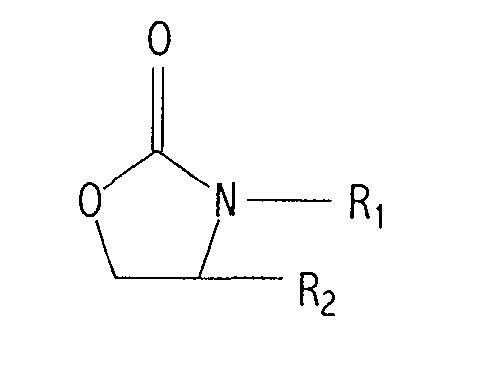
- the present invention provides a novel process for the preparation of polyalkylphenoxyaminoalkanes which comprises the aminoethylation of a polyalkylphenol compound in the presence of a basic catalyst with 2-oxazolidinone or a derivative thereof having the following formula: wherein R 1 and R 2 are independently hydrogen or lower alkyl having 1 to about 6 carbon atoms and wherein the polyalkyl group of said polyalkylphenol has an average molecular weight in the range of about 600 to 5,000.
- the aminoethylation reaction of the present invention readily occurs using a basic catalyst selected from the group consisting of alkali metal lower alkoxides, alkali hydrides or alkali metal hydroxides in the temperature range of about 100°C to 250°C, wherein the molar ratio of 2-oxazolidinone or a derivative thereof to polyalkylphenol compound is about 5:1 to 1:1 and wherein the number of equivalents of basic catalyst per equivalent of polyalkylphenol is about 0.05:1 to 1:1.
- a basic catalyst selected from the group consisting of alkali metal lower alkoxides, alkali hydrides or alkali metal hydroxides in the temperature range of about 100°C to 250°C, wherein the molar ratio of 2-oxazolidinone or a derivative thereof to polyalkylphenol compound is about 5:1 to 1:1 and wherein the number of equivalents of basic catalyst per equivalent of polyalkylphenol is about 0.05:1 to 1:1.
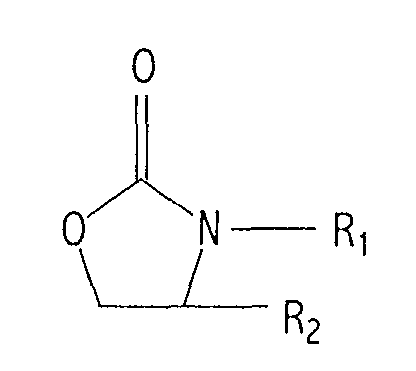
- the present invention provides a novel process for the preparation of polyalkylphenoxyaminoalkanes which comprises an aminoethylation of a polyalkylphenol compound in the presence of a basic catalyst with 2-oxazolidinone or a derivative thereof having the following formula: wherein R 1 and R 2 are independently hydrogen or lower alkyl having 1 to 6 carbon atoms and wherein the polyalkyl group of said polyalkylphenol has an average molecular weight in the range of about 600 to 5,000.
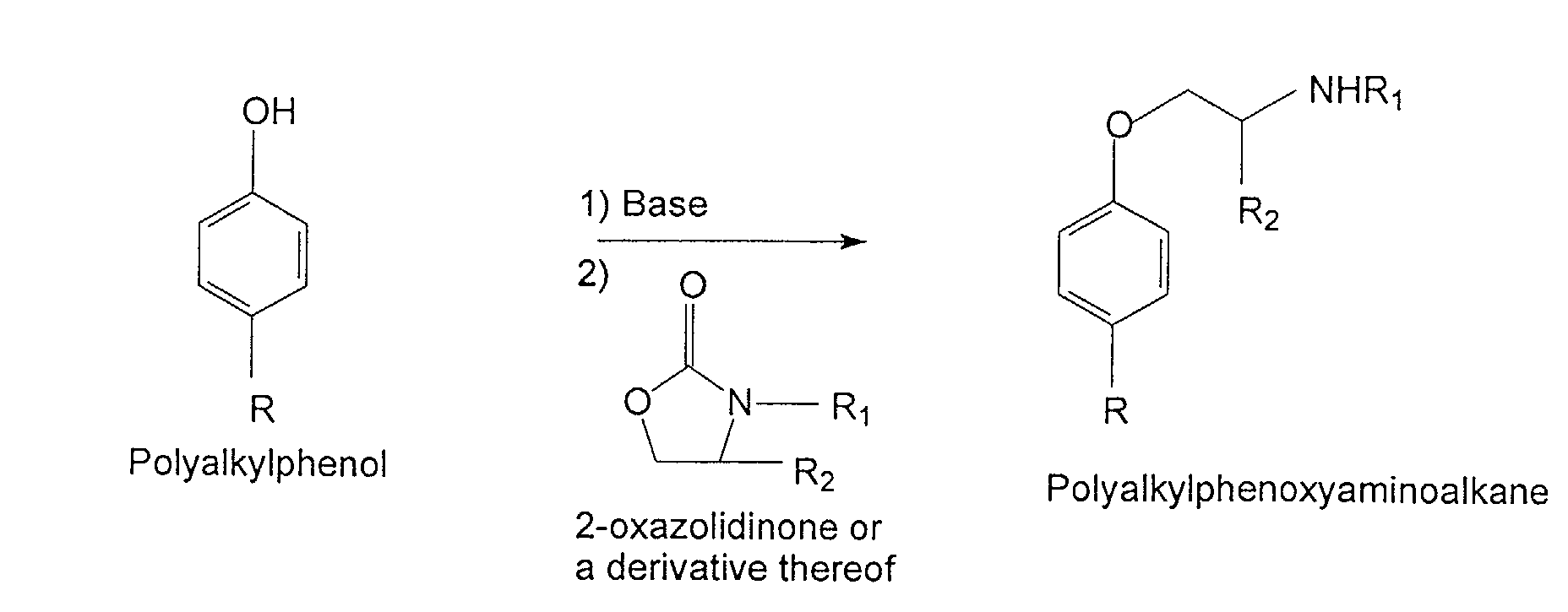
- reaction may be illustrated by the following: wherein R is a polyalkyl group having a molecular weight in the range of about 600 to 5,000, and R 1 and R 2 are as herein described.
- alkyl refers to both straight- and branched-chain alkyl groups.
- lower alkyl refers to alkyl groups having 1 to about 6 carbon atoms and includes primary, secondary and tertiary alkyl groups.
- Typical lower alkyl groups include, for example, methyl, ethyl, n-propyl, isopropyl, n-butyl, sec-butyl, t-butyl, n-pentyl, n-hexyl and the like.
- polyalkyl refers to an alkyl group which is generally derived from polyolefins which are polymers or copolymers of mono-olefins, particularly 1-mono-olefins, such as ethylene, propylene, butylene, and the like.
- the mono-olefin employed will have about 2 to 24 carbon atoms, and more preferably, about 3 to 12 carbon atoms. More preferred mono-olefins include propylene, butylene, particularly isobutylene, 1-octene and 1-decene.
- Polyolefins prepared from such mono-olefins include polypropylene, polybutene, especially polyisobutene, and the polyalphaolefins produced from 1-octene and 1-decene.
- Polyalkylphenoxyaminoalkanes may be prepared by the process of the present invention which comprises an aminoethylation of a polyalkylphenol compound with 2-oxazolidinone or a derivative thereof having the following formula: wherein R 1 and R 2 are defined herein, in the presence of a catalytic amount of an alkali metal lower alkoxide, alkali hydride or alkali metal hydroxide.
- Polyalkylphenols are well known materials and are typically prepared by the alkylation of phenol with the desired polyolefin or chlorinated polyolefin. A further discussion of polyalkylphenols can be found, for example, in U.S. Patent Nos. 4,744,921 and 5,300,701.
- polyalkylphenols may be prepared from the corresponding olefins by conventional procedures.
- polyalkylphenols may be prepared by reacting the appropriate olefin or olefin mixture with phenol in the presence of an alkylating catalyst at a temperature of from about 25°C to 150°C, and preferably about 30°C to 100°C either neat or in an essentially inert solvent at atmospheric pressure.
- a preferred alkylating catalyst is boron trifluoride. Molar ratios of reactants may be used.
- molar excesses of phenol can be employed, i.e., about 2 to 3 equivalents of phenol for each equivalent of olefin with unreacted phenol recycled. The latter process maximizes monoalkylphenol.
- inert solvents include heptane, benzene, toluene, chlorobenzene and 250 thinner which is a mixture of aromatics, paraffins and naphthenes.
- the polyalkyl group on the polyalkylphenols employed in the invention is generally derived from polyolefins which are polymers or copolymers of mono-olefins, particularly 1-mono-olefins, such as ethylene, propylene, butylene, and the like.
- the mono-olefin employed will have about 2 to 24 carbon atoms, and more preferably, about 3 to 12 carbon atoms. More preferred mono-olefins include propylene, butylene, particularly isobutylene, 1-octene and 1-decene.
- Polyolefins prepared from such mono-olefins include polypropylene, polybutene, especially polyisobutene, and the polyalphaolefins produced from 1-octene and 1-decene.
- the preferred polyisobutenes used to prepare the presently employed polyalkylphenols are polyisobutenes which comprise at least about 20% of the more reactive methylvinylidene isomer, preferably at least about 50% and more preferably at least about 70%.
- Suitable polyisobutenes include those prepared using BF 3 catalysts.
- the preparation of such polyisobutenes in which the methylvinylidene isomer comprises a high percentage of the total composition is described in U.S. Patent Nos. 4,152,499 and 4,605,808.
- Such polyisobutenes, known as "reactive" polyisobutenes yield high molecular weight alcohols in which the hydroxyl group is at or near the end of the hydrocarbon chain.
- suitable polyisobutenes having a high alkylvinylidene content include Ultravis 30, a polyisobutene having a number average molecular weight of about 1,300 and a methylvinylidene content of about 74%, and Ultravis 10, a polyisobutene having a number average molecular weight of about 950 and a methylvinylidene content of about 76%, both available from British Petroleum.
- the polyalkyl group on the polyalkylphenol has a molecular weight in the range of about 600 to 5,000, preferably about 600 to 3,000, more preferably about 700 to 3,000, and most preferably about 900 to 2,500.
- the polyalkyl group on the polyalkylphenol may be in any position in the phenol ring. However, substitution at the para position is preferred.
- R 1 and R 2 are independently hydrogen or lower alkyl having 1 to about 6 carbon atoms.
- one of R 1 and R 2 is hydrogen or lower alkyl of 1 to about 4 carbon atoms, and the other is hydrogen.
- one of R 1 and R 2 is hydrogen, methyl, or ethyl, and the other is hydrogen.
- R 1 is hydrogen, methyl, or ethyl, and R 2 is hydrogen.
- both R 1 and R 2 are hydrogen.
- Examples of such compounds include, but are not limited to, 2-oxazolidinone, 3-methyl-2-oxazolidinone, 4-methyl-2-oxazolidinone, and 3-ethyl-2-oxazolidinone.
- the 2-oxazolidinone compound is preferred. These compounds are readily commercially available. For instance, 2-oxazolidinone and 3-methyl-2-oxazolidinone may be purchased from Aldrich Chemical Company. Alternatively, these compounds may be synthesized by conventional methods apparent to the skilled artisan.
- the basic catalyst employed in the process of the present invention will generally be any of the well known basic catalyst selected from the group of alkali metal lower alkoxides, alkali hydrides or alkali metal hydroxides.
- Typical alkali metal lower alkoxides include, but are not limited to, sodium methoxide, potassium methoxide, sodium ethoxide, potassium ethoxide, sodium propoxide, potassium propoxide, sodium isopropoxide, potassium isopropoxide, sodium butoxide, potassium butoxide.
- the alkali metal lower alkoxides will contain 1 to about 6, preferably 1 to about 4, carbon atoms.
- the alkali metal lower alkoxide is sodium methoxide.
- Sodium hydride and potassium hydride are typical alkali hydrides.
- alkali metal hydroxides include, but are not limited to, sodium hydroxide, lithium hydroxide, or potassium hydroxide.
- Sodium hydroxide and potassium hydroxide are preferred.
- the reaction temperature for the aminoethylation reaction will be in the range of about 100°C to 250°C, and preferably in the range of about 130°C to 210°C.
- the reaction pressure will generally be atmospheric or lower. Lower pressures may be used to facilitate the removal of carbon dioxide.
- Other carbon dioxide scavengers may be employed to facilitate the reaction, such as, for example, magnesium oxide or calcium oxide.
- the molar ratio of 2-oxazolidinone or a derivative thereof to the polyalkylphenol compound is normally in the range of about 5:1 to 1:1, and preferably will be in the range of about 2:1 to 1:1.
- the number of equivalents of the basic catalyst per equivalents of polyalkylphenol will be in the range of about 0.05:1 to 1:1, and preferably in the range of about 0.1:1 to 1:1.
- the aminoethylation reaction may be carried out neat or in the presence of a solvent which is inert to the reaction of the polyalkylphenol compound and the 2-oxazolidinone or a derivative thereof.
- a typical solvent is an aromatic solvent such as Exxon 150 aromatic solvent, although other solvents apparent to those skilled in the art may also be used.
- aromatic solvent such as Exxon 150 aromatic solvent, although other solvents apparent to those skilled in the art may also be used.
- any number of ethers, aprotic polar solvents or alcohols may also be useful in the process of the present invention.
- the aminoethylation reaction will generally be carried out over a period of about 2 to 24 hours, and preferably over a period of about 3 to 20 hours.
- the desired polyalkyphenoxyaminoalkane is isolated using conventional techniques.
- the reaction was cooled to room temperature, diluted with hexane, washed three times with water and once with brine.
- the organic layer was dried over anhydrous magnesium sulfate, filtered and the solvents removed in vacuo to yield a brown oil.
- the oil was chromatographed on silica gel, eluting with hexane:ethyl acetate (70:30) followed by hexane:diethyl ether:methanol:isopropylamine (40:40:15:5) to yield 22.77 grams of the desired product as a yellow oil.
- the reaction was cooled to room temperature, diluted with hexane, filtered through Celite, washed three times with water and once with brine.
- the organic layer was dried over anhydrous magnesium sulfate, filtered and the solvents removed in vacuo to yield a brown oil.
- the oil was chromatographed on silica gel, eluting with hexane:ethyl acetate (70:30) followed by hexane:diethyl ether:methanol:isopropylamine (40:40:15:5) to yield 7.26 grams of the desired product as a yellow oil.
Landscapes
- Chemical & Material Sciences (AREA)
- Organic Chemistry (AREA)
- General Chemical & Material Sciences (AREA)
- Health & Medical Sciences (AREA)
- Chemical Kinetics & Catalysis (AREA)
- Medicinal Chemistry (AREA)
- Polymers & Plastics (AREA)
- Organic Low-Molecular-Weight Compounds And Preparation Thereof (AREA)
- Heterocyclic Carbon Compounds Containing A Hetero Ring Having Nitrogen And Oxygen As The Only Ring Hetero Atoms (AREA)
- Addition Polymer Or Copolymer, Post-Treatments, Or Chemical Modifications (AREA)
Abstract

Description
- The present invention relates to a process for the preparation of polyalkylphenoxyaminoalkanes. More particularly, this invention relates to a process for the preparation of polyalkylphenoxyaminoalkanes which comprises the aminoethylation of a polyalkylphenol compound with 2-oxazolidinone or a derivative thereof.
- Polyalkylphenoxyaminoalkanes are known fuel additives useful in the prevention and control of engine deposits. U.S. Patent Nos. 5,669,939 and 5,851,242 describes a process for preparing these compounds. The process involves initially hydroxylating a polyalkylphenol with an alkylene carbonate in the presence of a catalytic amount of an alkali metal hydride or hydroxide, or alkali metal salt, to provide a polyalkylphenoxyalkanol which is subsequently reacted with an appropriate amine to provide the desired polyalkylphenoxyaminoalkane.
- 2-oxazolidinones or derivatives thereof are well described. For example, Martin E. Dyen and Daniel Swern, Chemistry Reviews (1967), pages 197-246 describes 2-oxazolidinones in detail. The use of 2-oxazolidinones or derivatives thereof in the aminoethylation of phenols is well known in the art.
- U.S. Patent No. 4,381,401 discloses the reaction of 2-oxazolidinone or N-substituted derivatives thereof with aromatic amine hydrochlorides at elevated temperatures to produce 1,2-ethanediamines. The 1,2-ethandiamines produced are an important class of materials which are useful as intermediates for the production of pharmaceuticals, photographic chemicals and other compositions.
- Japanese Patent Publication No. JP 2592732 B2 discloses a method of producing phenoxyethylamines by reacting, under base conditions, low molecular weight phenols and 2-oxazolidinone. Phenoxyethylamines are important raw materials for pharmaceuticals and pesticides.
- German Patent Publication DE 19711004 A1 discloses the use of 2-oxazolidinone to prepare phenoxyaminoalkanes from low molecular weight phenols. 2-4-(Phenoxyphenoxy)ethylamine and ethyl 2-(phenoxyphenoxy)ethylcarbamate are sequentially prepared in high yield and selectivity by the aminoethylation of 4-phenoxyphenol with 2-oxazolidinone under inert atomsphere, followed by amidation of 2-4-(phenoxyphenoxy)ethylamine with carbonate derivatives.
- Until now, the use of 2-oxazolidinone or a derivative thereof in aminoethylation transformations have been limited to low molecular weight phenols to produce phenoxyaminoalkanes. There has not been any teaching wherein 2-oxazolidinone or a derivative thereof has been used in aminoethylation transformations involving high molecular polyalkylphenols as in the case of the polyalkylphenoxyaminoalkanes disclosed in U.S Patent Nos. 5,669,939 and 5,851,242.
- The present invention provides a novel process for the preparation of polyalkylphenoxyaminoalkanes which comprises the aminoethylation of a polyalkylphenol compound in the presence of a basic catalyst with 2-oxazolidinone or a derivative thereof having the following formula:wherein R1 and R2 are independently hydrogen or lower alkyl having 1 to about 6 carbon atoms and wherein the polyalkyl group of said polyalkylphenol has an average molecular weight in the range of about 600 to 5,000.
- The aminoethylation reaction of the present invention readily occurs using a basic catalyst selected from the group consisting of alkali metal lower alkoxides, alkali hydrides or alkali metal hydroxides in the temperature range of about 100°C to 250°C, wherein the molar ratio of 2-oxazolidinone or a derivative thereof to polyalkylphenol compound is about 5:1 to 1:1 and wherein the number of equivalents of basic catalyst per equivalent of polyalkylphenol is about 0.05:1 to 1:1.
- As noted above, the present invention provides a novel process for the preparation of polyalkylphenoxyaminoalkanes which comprises an aminoethylation of a polyalkylphenol compound in the presence of a basic catalyst with 2-oxazolidinone or a derivative thereof having the following formula:wherein R1 and R2 are independently hydrogen or lower alkyl having 1 to 6 carbon atoms and wherein the polyalkyl group of said polyalkylphenol has an average molecular weight in the range of about 600 to 5,000.
- The reaction may be illustrated by the following:wherein R is a polyalkyl group having a molecular weight in the range of about 600 to 5,000, and R1 and R2 are as herein described.
- Prior to discussing the present invention in detail, the following terms will have the following meanings unless expressly stated to the contrary.
- The term "alkyl" refers to both straight- and branched-chain alkyl groups.
- The term "lower alkyl" refers to alkyl groups having 1 to about 6 carbon atoms and includes primary, secondary and tertiary alkyl groups. Typical lower alkyl groups include, for example, methyl, ethyl, n-propyl, isopropyl, n-butyl, sec-butyl, t-butyl, n-pentyl, n-hexyl and the like.
- The term "polyalkyl" refers to an alkyl group which is generally derived from polyolefins which are polymers or copolymers of mono-olefins, particularly 1-mono-olefins, such as ethylene, propylene, butylene, and the like. Preferably, the mono-olefin employed will have about 2 to 24 carbon atoms, and more preferably, about 3 to 12 carbon atoms. More preferred mono-olefins include propylene, butylene, particularly isobutylene, 1-octene and 1-decene. Polyolefins prepared from such mono-olefins include polypropylene, polybutene, especially polyisobutene, and the polyalphaolefins produced from 1-octene and 1-decene.
- Polyalkylphenoxyaminoalkanes may be prepared by the process of the present invention which comprises an aminoethylation of a polyalkylphenol compound with 2-oxazolidinone or a derivative thereof having the following formula:wherein R1 and R2 are defined herein, in the presence of a catalytic amount of an alkali metal lower alkoxide, alkali hydride or alkali metal hydroxide.

- Polyalkylphenols are well known materials and are typically prepared by the alkylation of phenol with the desired polyolefin or chlorinated polyolefin. A further discussion of polyalkylphenols can be found, for example, in U.S. Patent Nos. 4,744,921 and 5,300,701.
- Accordingly, polyalkylphenols may be prepared from the corresponding olefins by conventional procedures. For example, polyalkylphenols may be prepared by reacting the appropriate olefin or olefin mixture with phenol in the presence of an alkylating catalyst at a temperature of from about 25°C to 150°C, and preferably about 30°C to 100°C either neat or in an essentially inert solvent at atmospheric pressure. A preferred alkylating catalyst is boron trifluoride. Molar ratios of reactants may be used. Alternatively, molar excesses of phenol can be employed, i.e., about 2 to 3 equivalents of phenol for each equivalent of olefin with unreacted phenol recycled. The latter process maximizes monoalkylphenol. Examples of inert solvents include heptane, benzene, toluene, chlorobenzene and 250 thinner which is a mixture of aromatics, paraffins and naphthenes.
- The polyalkyl group on the polyalkylphenols employed in the invention is generally derived from polyolefins which are polymers or copolymers of mono-olefins, particularly 1-mono-olefins, such as ethylene, propylene, butylene, and the like. Preferably, the mono-olefin employed will have about 2 to 24 carbon atoms, and more preferably, about 3 to 12 carbon atoms. More preferred mono-olefins include propylene, butylene, particularly isobutylene, 1-octene and 1-decene. Polyolefins prepared from such mono-olefins include polypropylene, polybutene, especially polyisobutene, and the polyalphaolefins produced from 1-octene and 1-decene.
- The preferred polyisobutenes used to prepare the presently employed polyalkylphenols are polyisobutenes which comprise at least about 20% of the more reactive methylvinylidene isomer, preferably at least about 50% and more preferably at least about 70%. Suitable polyisobutenes include those prepared using BF3 catalysts. The preparation of such polyisobutenes in which the methylvinylidene isomer comprises a high percentage of the total composition is described in U.S. Patent Nos. 4,152,499 and 4,605,808. Such polyisobutenes, known as "reactive" polyisobutenes, yield high molecular weight alcohols in which the hydroxyl group is at or near the end of the hydrocarbon chain. Examples of suitable polyisobutenes having a high alkylvinylidene content include Ultravis 30, a polyisobutene having a number average molecular weight of about 1,300 and a methylvinylidene content of about 74%, and Ultravis 10, a polyisobutene having a number average molecular weight of about 950 and a methylvinylidene content of about 76%, both available from British Petroleum.
- Typically, the polyalkyl group on the polyalkylphenol has a molecular weight in the range of about 600 to 5,000, preferably about 600 to 3,000, more preferably about 700 to 3,000, and most preferably about 900 to 2,500. The polyalkyl group on the polyalkylphenol may be in any position in the phenol ring. However, substitution at the para position is preferred.
- As noted above, the polyalkylphenol compound is reacted with 2-oxazolidinone or a derivative thereof having the formula illustrated herein above, wherein R1 and R2 are independently hydrogen or lower alkyl having 1 to about 6 carbon atoms. Preferably, one of R1 and R2 is hydrogen or lower alkyl of 1 to about 4 carbon atoms, and the other is hydrogen. More preferably, one of R1 and R2 is hydrogen, methyl, or ethyl, and the other is hydrogen. Still more preferably, R1 is hydrogen, methyl, or ethyl, and R2 is hydrogen. Most preferably, both R1 and R2 are hydrogen. Examples of such compounds include, but are not limited to, 2-oxazolidinone, 3-methyl-2-oxazolidinone, 4-methyl-2-oxazolidinone, and 3-ethyl-2-oxazolidinone. The 2-oxazolidinone compound is preferred. These compounds are readily commercially available. For instance, 2-oxazolidinone and 3-methyl-2-oxazolidinone may be purchased from Aldrich Chemical Company. Alternatively, these compounds may be synthesized by conventional methods apparent to the skilled artisan.
- The basic catalyst employed in the process of the present invention will generally be any of the well known basic catalyst selected from the group of alkali metal lower alkoxides, alkali hydrides or alkali metal hydroxides. Typical alkali metal lower alkoxides include, but are not limited to, sodium methoxide, potassium methoxide, sodium ethoxide, potassium ethoxide, sodium propoxide, potassium propoxide, sodium isopropoxide, potassium isopropoxide, sodium butoxide, potassium butoxide. Typically, the alkali metal lower alkoxides will contain 1 to about 6, preferably 1 to about 4, carbon atoms. Preferably, the alkali metal lower alkoxide is sodium methoxide. Sodium hydride and potassium hydride are typical alkali hydrides. Examples of alkali metal hydroxides include, but are not limited to, sodium hydroxide, lithium hydroxide, or potassium hydroxide. Sodium hydroxide and potassium hydroxide are preferred.
- Typically, the reaction temperature for the aminoethylation reaction will be in the range of about 100°C to 250°C, and preferably in the range of about 130°C to 210°C. The reaction pressure will generally be atmospheric or lower. Lower pressures may be used to facilitate the removal of carbon dioxide. Other carbon dioxide scavengers may be employed to facilitate the reaction, such as, for example, magnesium oxide or calcium oxide.
- The molar ratio of 2-oxazolidinone or a derivative thereof to the polyalkylphenol compound is normally in the range of about 5:1 to 1:1, and preferably will be in the range of about 2:1 to 1:1. In general, the number of equivalents of the basic catalyst per equivalents of polyalkylphenol will be in the range of about 0.05:1 to 1:1, and preferably in the range of about 0.1:1 to 1:1.
- The aminoethylation reaction may be carried out neat or in the presence of a solvent which is inert to the reaction of the polyalkylphenol compound and the 2-oxazolidinone or a derivative thereof. When employed, a typical solvent is an aromatic solvent such as Exxon 150 aromatic solvent, although other solvents apparent to those skilled in the art may also be used. For example, any number of ethers, aprotic polar solvents or alcohols may also be useful in the process of the present invention.
- The aminoethylation reaction will generally be carried out over a period of about 2 to 24 hours, and preferably over a period of about 3 to 20 hours. Upon completion of the reaction, the desired polyalkyphenoxyaminoalkane is isolated using conventional techniques.
- The invention will be further illustrated by the following examples, which set forth particularly advantageous process embodiments. While the Examples are provided to illustrate the present invention, they are not intended to limit it. This application is intended to cover those various changes and substitutions that may be made by those skilled in the art without departing from the spirit and scope of the appended claims.
-

- Potassium hydroxide (assay 85%, 0.40 grams), Exxon Aromatic 150 solvent (35 mL) and 4-polyisobutyl phenol wherein the polyisobutyl group has an average molecular weight of about 950 (31.26 grams, prepared as in Example 1 of U.S. 5,300,701) were added to a flask equipped with a magnetic stirrer, Dean-Stark trap, reflux condensor, nitrogen inlet and thermometer. The reaction was heated at 170°C until no more water came over. The Dean-Stark trap was removed and 2-oxazolidinone (2.61 grams) was added. The mixture was heated at 180°C for 6 hours under enough vacuum to maintain a reflux. The reaction was cooled to room temperature, diluted with hexane, washed three times with water and once with brine. The organic layer was dried over anhydrous magnesium sulfate, filtered and the solvents removed in vacuo to yield a brown oil. The oil was chromatographed on silica gel, eluting with hexane:ethyl acetate (70:30) followed by hexane:diethyl ether:methanol:isopropylamine (40:40:15:5) to yield 22.77 grams of the desired product as a yellow oil. 1H NMR (CDCl3) 7.25 (ABq, 2H), 6.8 (ABq, 2H), 4.0 (t, 2H), 3.1 (t, 2H), 2.35 (bs, 2H), 0.7-1.6 (m, 137H).
-

- Potassium hydroxide (assay 85% 1.46 grams), Exxon Aromatic 150 solvent (50 mL) and 4-polyisobutyl phenol wherein the polyisobutyl group has an average molecular weight of about 950 (20.8 grams, prepared as in Example 1 of U.S. 5,300,701) were added to a flask equipped with a magnetic stirrer, Dean-Stark trap, reflux condensor, nitrogen inlet and thermometer. The reaction was heated at 170°C until no more water came over. The reaction was cooled to 150°C. The Dean-Stark trap was removed. Magnesium oxide (1.34 grams) and 2-oxazolidinone (1.92 grams) were added. The mixture was heated at 180°C for 16 hours. The reaction was cooled to room temperature, diluted with hexane, filtered through Celite, washed three times with water and once with brine. The organic layer was dried over anhydrous magnesium sulfate, filtered and the solvents removed in vacuo to yield a brown oil. The oil was chromatographed on silica gel, eluting with hexane:ethyl acetate (70:30) followed by hexane:diethyl ether:methanol:isopropylamine (40:40:15:5) to yield 7.26 grams of the desired product as a yellow oil.
Claims (23)
- A process for the preparation of a polyalkylphenoxyaminoalkane which comprises the aminoethylation of a polyalkylphenol compound in the presence of a basic catalyst with 2-oxazolidinone or a derivative thereof having the following formula:wherein R1 and R2 are independently hydrogen or lower alkyl having 1 to about 6 carbon atoms and wherein the polyalkyl group of said polyalkylphenol has an average molecular weight in the range of about 600 to 5,000.

- The process according to Claim 1, wherein the polyalkyl group has a molecular weight in the range of about 600 to 3,000.
- The process according to Claim 2, wherein the polyalkyl group has a molecular weight in the range of about 700 to 3,000.
- The process according to Claim 3, wherein the polyalkyl group has a molecular weight in the range of about 900 to 2,500.
- The process according to Claim 4, wherein the polyalkyl group is derived from polypropylene, polybutene, or a polyalphaolefin oligomer of 1-octene or 1-decene.
- The process according to Claim 5, wherein the polyalkyl group is derived from polyisobutene.
- The process according to Claim 6, wherein the polyisobutene contains at least about 20 wt % of a methylvinylidene isomer.
- The process according to Claim 1, wherein one of R1 and R2 is hydrogen or lower alkyl of 1 to about 4 carbon atoms, and the other is hydrogen.
- The process according to Claim 8, wherein one of R1 and R2 is hydrogen, methyl, or ethyl, and the other is hydrogen.
- The process according to Claim 9, wherein R1 is hydrogen, methyl, or ethyl and R2 is hydrogen.
- The process according to Claim 10, wherein both R1 and R2 are hydrogen.
- The process according to Claim 1, wherein the basic catalyst is selected from the group consisting of alkali metal lower alkoxide, alkali hydride or alkali metal hydroxide.
- The process according to Claim 12, wherein the alkali metal lower alkoxide is selected from the group consisting of sodium methoxide, potassium methoxide, sodium ethoxide, potassium ethoxide, sodium propoxide, potassium propoxide, sodium isopropoxide, potassium isopropoxide, sodium butoxide, potassium butoxide.
- The process according to Claim 13, wherein the alkali metal lower alkoxide is sodium methoxide.
- The process according to Claim 12, wherein the alkali hydride is sodium hydride or potassium hydride.
- The process according to Claim 12, wherein the alkali metal hydroxide is selected from the group consisting of sodium hydroxide, lithium hydroxide, or potassium hydroxide.
- The process according to Claim 16, wherein the alkali metal hydroxide is sodium hydroxide or potassium hydroxide.
- The process according to Claim 1, wherein the aminoethylation temperature is in the range of about 100°C to 250°C.
- The process according to Claim 17, wherein the aminoethylation temperature is in the range of about 130°C to 210°C.
- The process according to Claim 1, wherein the molar ratio of 2-oxazolidinone or a derivative thereof to polyalkylphenol compound is about 5:1 to 1:1.
- The process according to Claim 19, wherein the molar ratio of 2-oxazolidinone or a derivative thereof to polyalkylphenol compound is about 2:1 to 1:1.
- The process according to Claim 1, wherein the number of equivalents of basic catalyst per equivalent of polyalkylphenol is about 0.05:1 to 1:1.
- The process according to Claim 21, wherein the number of equivalents of basic catalyst per equivalent of polyalkylphenol is about 0.1:1 to 1:1.
Applications Claiming Priority (2)
| Application Number | Priority Date | Filing Date | Title |
|---|---|---|---|
| US976747 | 2001-10-12 | ||
| US09/976,747 US6384280B1 (en) | 2001-10-12 | 2001-10-12 | Process for the preparation of polyalkylphenoxyaminoalkanes |
Publications (2)
| Publication Number | Publication Date |
|---|---|
| EP1302527A1 true EP1302527A1 (en) | 2003-04-16 |
| EP1302527B1 EP1302527B1 (en) | 2008-07-30 |
Family
ID=25524414
Family Applications (1)
| Application Number | Title | Priority Date | Filing Date |
|---|---|---|---|
| EP02256892A Expired - Lifetime EP1302527B1 (en) | 2001-10-12 | 2002-10-03 | Process for the preparation of polyalkylphenoxyaminoalkanes |
Country Status (5)
| Country | Link |
|---|---|
| US (1) | US6384280B1 (en) |
| EP (1) | EP1302527B1 (en) |
| JP (1) | JP4313019B2 (en) |
| CA (1) | CA2405208C (en) |
| DE (1) | DE60227896D1 (en) |
Families Citing this family (7)
| Publication number | Priority date | Publication date | Assignee | Title |
|---|---|---|---|---|
| US6486352B1 (en) | 2002-06-28 | 2002-11-26 | Chevron Oronite Company Llc | Process for the preparation of polyalkylphenoxyaminoalkanes |
| US6649800B1 (en) | 2002-10-31 | 2003-11-18 | Chevron Oronite Company Llc | Process for the preparation of polyalkylphenoxyaminoalkanes |
| US20060059771A1 (en) * | 2004-09-17 | 2006-03-23 | Malfer Dennis J | Preparation of amine derivates from nitriles and phenols |
| US9115237B2 (en) | 2012-07-18 | 2015-08-25 | Chevron Oronite Company Llc | Viscosity improver grafted with unsaturated acylating agent and an aryloxyalylkene monoamine |
| US9035097B2 (en) * | 2012-09-12 | 2015-05-19 | Chevron Oronite Company Llc | Aminoethylation process having improved yield of aryloxyalkylene amine compounds and reduced urea by-products |
| US9872824B2 (en) * | 2013-02-06 | 2018-01-23 | Lubrizol Advanced Materials, Inc. | Semi-permanent hair straightening composition and method |
| EP3405554B1 (en) | 2016-01-22 | 2019-12-25 | Chevron Oronite Company LLC | Lubricating oil composition containing a mixture of olefin copolymer dispersant-type viscosity improver and amine compound |
Citations (3)
| Publication number | Priority date | Publication date | Assignee | Title |
|---|---|---|---|---|
| JPH0616600A (en) * | 1991-07-12 | 1994-01-25 | Ube Ind Ltd | Method for producing phenoxyethylamines |
| US5669939A (en) * | 1996-05-14 | 1997-09-23 | Chevron Chemical Company | Polyalkylphenoxyaminoalkanes and fuel compositions containing the same |
| DE19711004A1 (en) * | 1996-03-20 | 1997-10-30 | Ciba Geigy Ag | Production of ethyl ((phenoxy)phenoxy)-ethyl carbamate pesticide |
Family Cites Families (1)
| Publication number | Priority date | Publication date | Assignee | Title |
|---|---|---|---|---|
| US4381401A (en) | 1981-10-09 | 1983-04-26 | The Dow Chemical Company | Aminoethylation process |
-
2001
- 2001-10-12 US US09/976,747 patent/US6384280B1/en not_active Expired - Lifetime
-
2002
- 2002-09-25 CA CA2405208A patent/CA2405208C/en not_active Expired - Lifetime
- 2002-10-03 DE DE60227896T patent/DE60227896D1/en not_active Expired - Lifetime
- 2002-10-03 EP EP02256892A patent/EP1302527B1/en not_active Expired - Lifetime
- 2002-10-11 JP JP2002299531A patent/JP4313019B2/en not_active Expired - Lifetime
Patent Citations (4)
| Publication number | Priority date | Publication date | Assignee | Title |
|---|---|---|---|---|
| JPH0616600A (en) * | 1991-07-12 | 1994-01-25 | Ube Ind Ltd | Method for producing phenoxyethylamines |
| DE19711004A1 (en) * | 1996-03-20 | 1997-10-30 | Ciba Geigy Ag | Production of ethyl ((phenoxy)phenoxy)-ethyl carbamate pesticide |
| US5669939A (en) * | 1996-05-14 | 1997-09-23 | Chevron Chemical Company | Polyalkylphenoxyaminoalkanes and fuel compositions containing the same |
| US5851242A (en) * | 1996-05-14 | 1998-12-22 | Chevron Chemical Company | Fuel additive compositions containing polyalkylphenoxy-aminoalkanes and poly (oxyalkylene) amines |
Non-Patent Citations (1)
| Title |
|---|
| PATENT ABSTRACTS OF JAPAN vol. 018, no. 222 (C - 1193) 21 April 1994 (1994-04-21) * |
Also Published As
| Publication number | Publication date |
|---|---|
| CA2405208A1 (en) | 2003-04-12 |
| JP4313019B2 (en) | 2009-08-12 |
| CA2405208C (en) | 2010-09-21 |
| JP2003183321A (en) | 2003-07-03 |
| EP1302527B1 (en) | 2008-07-30 |
| DE60227896D1 (en) | 2008-09-11 |
| US6384280B1 (en) | 2002-05-07 |
Similar Documents
| Publication | Publication Date | Title |
|---|---|---|
| US6867171B2 (en) | Low molecular weight branched alkenyl succinic acid derivatives prepared from low molecular weight polyisobutene and unsaturated acidic reagents | |
| EP0628022B1 (en) | Process for the preparation of polyisobutyl hydroxyaromatics | |
| CA2789843C (en) | Process for preparing high-reactivity isobutene homo- or copolymers | |
| US8637619B2 (en) | Process for preparing high-reactivity isobutene homo- or copolymers | |
| CN108602914B (en) | Process for preparing highly reactive isobutene homopolymer or copolymer | |
| JP2000095819A (en) | Production of polyalkenyl derivative of unsaturated acidic reagent | |
| US6384280B1 (en) | Process for the preparation of polyalkylphenoxyaminoalkanes | |
| JP2000087053A (en) | Ether compound of polyalkyl- or polyalkenyl-n- hydroxyalkylsuccinimide and fuel composition containing this compound | |
| US6303703B1 (en) | Method for making monoamines | |
| US6486352B1 (en) | Process for the preparation of polyalkylphenoxyaminoalkanes | |
| US6649800B1 (en) | Process for the preparation of polyalkylphenoxyaminoalkanes | |
| CN108602913B (en) | Method for producing highly reactive isobutene homo-or copolymers | |
| JPH08507091A (en) | Alkylation of alkyl salicylates with long-chain carbon feeds | |
| CN110128273B (en) | A kind of synthetic method of two (ethylene acetal methyl carbonate) carbonate | |
| KR102778735B1 (en) | Polymerization Catalyst System and Process to Produce Highly Reactive Polyisobutylene | |
| CN111848842B (en) | Process for producing highly reactive polybutenes | |
| DE69702824T2 (en) | Aromatic ethers of polyalkylphenoxyalkanols and fuel compositions containing them | |
| KR100827273B1 (en) | Method for preparing boron trifluoride complex catalyst and method for producing highly reactive polybutene using the same | |
| CN110997737B (en) | Method for producing highly reactive isobutene homo-or copolymers | |
| JPH0840982A (en) | Production of fumaric acid diester or maleic acid diester from tertiary alcohol | |
| KR20150144978A (en) | Method for preparing polyisobutylene using the normal propanol |
Legal Events
| Date | Code | Title | Description |
|---|---|---|---|
| PUAI | Public reference made under article 153(3) epc to a published international application that has entered the european phase |
Free format text: ORIGINAL CODE: 0009012 |
|
| AK | Designated contracting states |
Designated state(s): AT BE BG CH CY CZ DE DK EE ES FI FR GB GR IE IT LI LU MC NL PT SE SK TR |
|
| AX | Request for extension of the european patent |
Extension state: AL LT LV MK RO SI |
|
| 17P | Request for examination filed |
Effective date: 20031008 |
|
| AKX | Designation fees paid |
Designated state(s): DE FR GB NL |
|
| 17Q | First examination report despatched |
Effective date: 20040628 |
|
| 17Q | First examination report despatched |
Effective date: 20040628 |
|
| GRAP | Despatch of communication of intention to grant a patent |
Free format text: ORIGINAL CODE: EPIDOSNIGR1 |
|
| GRAS | Grant fee paid |
Free format text: ORIGINAL CODE: EPIDOSNIGR3 |
|
| GRAA | (expected) grant |
Free format text: ORIGINAL CODE: 0009210 |
|
| AK | Designated contracting states |
Kind code of ref document: B1 Designated state(s): DE FR GB NL |
|
| REG | Reference to a national code |
Ref country code: GB Ref legal event code: FG4D |
|
| REF | Corresponds to: |
Ref document number: 60227896 Country of ref document: DE Date of ref document: 20080911 Kind code of ref document: P |
|
| PLBE | No opposition filed within time limit |
Free format text: ORIGINAL CODE: 0009261 |
|
| STAA | Information on the status of an ep patent application or granted ep patent |
Free format text: STATUS: NO OPPOSITION FILED WITHIN TIME LIMIT |
|
| 26N | No opposition filed |
Effective date: 20090506 |
|
| REG | Reference to a national code |
Ref country code: FR Ref legal event code: PLFP Year of fee payment: 15 |
|
| REG | Reference to a national code |
Ref country code: FR Ref legal event code: PLFP Year of fee payment: 16 |
|
| REG | Reference to a national code |
Ref country code: FR Ref legal event code: PLFP Year of fee payment: 17 |
|
| REG | Reference to a national code |
Ref country code: DE Ref legal event code: R082 Ref document number: 60227896 Country of ref document: DE Representative=s name: HL KEMPNER PATENTANWALT, RECHTSANWALT, SOLICIT, DE |
|
| PGFP | Annual fee paid to national office [announced via postgrant information from national office to epo] |
Ref country code: NL Payment date: 20210915 Year of fee payment: 20 Ref country code: FR Payment date: 20210913 Year of fee payment: 20 |
|
| PGFP | Annual fee paid to national office [announced via postgrant information from national office to epo] |
Ref country code: GB Payment date: 20210901 Year of fee payment: 20 |
|
| PGFP | Annual fee paid to national office [announced via postgrant information from national office to epo] |
Ref country code: DE Payment date: 20210831 Year of fee payment: 20 |
|
| REG | Reference to a national code |
Ref country code: DE Ref legal event code: R071 Ref document number: 60227896 Country of ref document: DE |
|
| REG | Reference to a national code |
Ref country code: NL Ref legal event code: MK Effective date: 20221002 |
|
| REG | Reference to a national code |
Ref country code: GB Ref legal event code: PE20 Expiry date: 20221002 |
|
| PG25 | Lapsed in a contracting state [announced via postgrant information from national office to epo] |
Ref country code: GB Free format text: LAPSE BECAUSE OF EXPIRATION OF PROTECTION Effective date: 20221002 |
|
| P01 | Opt-out of the competence of the unified patent court (upc) registered |
Effective date: 20230522 |