EP1302510A1 - Flame retardant resin composition - Google Patents
Flame retardant resin composition Download PDFInfo
- Publication number
- EP1302510A1 EP1302510A1 EP02256943A EP02256943A EP1302510A1 EP 1302510 A1 EP1302510 A1 EP 1302510A1 EP 02256943 A EP02256943 A EP 02256943A EP 02256943 A EP02256943 A EP 02256943A EP 1302510 A1 EP1302510 A1 EP 1302510A1
- Authority
- EP
- European Patent Office
- Prior art keywords
- group
- unit
- organopolysiloxane
- metal salt
- weight
- Prior art date
- Legal status (The legal status is an assumption and is not a legal conclusion. Google has not performed a legal analysis and makes no representation as to the accuracy of the status listed.)
- Granted
Links
Classifications
-
- C—CHEMISTRY; METALLURGY
- C08—ORGANIC MACROMOLECULAR COMPOUNDS; THEIR PREPARATION OR CHEMICAL WORKING-UP; COMPOSITIONS BASED THEREON
- C08L—COMPOSITIONS OF MACROMOLECULAR COMPOUNDS
- C08L69/00—Compositions of polycarbonates; Compositions of derivatives of polycarbonates
-
- C—CHEMISTRY; METALLURGY
- C08—ORGANIC MACROMOLECULAR COMPOUNDS; THEIR PREPARATION OR CHEMICAL WORKING-UP; COMPOSITIONS BASED THEREON
- C08L—COMPOSITIONS OF MACROMOLECULAR COMPOUNDS
- C08L25/00—Compositions of, homopolymers or copolymers of compounds having one or more unsaturated aliphatic radicals, each having only one carbon-to-carbon double bond, and at least one being terminated by an aromatic carbocyclic ring; Compositions of derivatives of such polymers
- C08L25/02—Homopolymers or copolymers of hydrocarbons
- C08L25/04—Homopolymers or copolymers of styrene
- C08L25/08—Copolymers of styrene
-
- C—CHEMISTRY; METALLURGY
- C08—ORGANIC MACROMOLECULAR COMPOUNDS; THEIR PREPARATION OR CHEMICAL WORKING-UP; COMPOSITIONS BASED THEREON
- C08L—COMPOSITIONS OF MACROMOLECULAR COMPOUNDS
- C08L83/00—Compositions of macromolecular compounds obtained by reactions forming in the main chain of the macromolecule a linkage containing silicon with or without sulfur, nitrogen, oxygen or carbon only; Compositions of derivatives of such polymers
- C08L83/04—Polysiloxanes
Definitions
- the present invention relates to a flame retardant resin composition. More particularly, the present invention is concerned with a flame retardant resin composition comprising a resin component (A) which is a resin mixture of an aromatic polycarbonate and a styrene polymer, an organopolysiloxane (B) and at least one inorganic metal salt (C) selected from the group consisting of inorganic alkali metal salts and inorganic alkaline earth metal salts.
- a resin composition which contains an inherently flammable styrene polymer can be imparted with flame retardancy.
- Aromatic polycarbonates are known as engineering plastics which have excellent impact resistance, heat resistance and transparency, and have been widely used in various fields, especially in the fields of office automation machines, household electric appliances and data communication equipments. In these fields, there has been a demand for mechanical parts having a small thickness as well as complicated structures. In accordance with such a demand, in order to improve the melt fluidity so as to achieve high injection moldability with respect to an aromatic polycarbonate, it has frequently been practiced to add a styrene resin to an aromatic polycarbonate. As the styrene resin used for this purpose, a rubber-modified styrene resin is generally used from the viewpoint of the desired properties, such as impact resistance, of the resultant aromatic polycarbonate resin composition.
- An aromatic polycarbonate has a limiting oxygen index (which is a criterion for the flame retardancy) of from 26 to 27, and is known as a resin having a self-extinguishing property.
- the reason for this can be explained as follows.
- the main chain of the molecule of an aromatic polycarbonate is comprised mainly of aromatic rings. Therefore, when the aromatic polycarbonate is on fire, not only a thermal decomposition reaction but also a rearrangement reaction, a cyclization reaction and a crosslinking reaction occur, thereby easily forming a char layer which has extremely high flame retardancy.
- a styrene polymer is a flammable resin having a limiting oxygen index as low as 18 and it is extremely difficult to inhibit the combustion thereof.
- the reason for this can be explained as follows. A styrene polymer is depolymerized by the combustion, and the resultant monomer acts as a fuel, causing the combustion to continue and also proceed acceleratedly. Consequently, in a resin mixture of an aromatic polycarbonate and a styrene polymer, as the amount of the styrene polymer is increased for improving the moldability, it becomes difficult to achieve high flame retardancy.
- a phosphate compound For imparting flame retardancy to an aromatic polycarbonate and a resin mixture of an aromatic polycarbonate and a styrene polymer, a phosphate compound is generally employed as a flame retardant.
- a phosphate compound has a problem in that it is susceptible to hydrolysis and thermal decomposition and the resultant phosphoric acid causes a lowering of the molecular weight of the polycarbonate, leading to a lowering of the mechanical properties of the resin composition. Therefore, there arises a demand for a safer and more reliable flame retardant.
- An organopolysiloxane is one of the non-halogen flame retardants, which has long been studied for its high safety.
- an organopolysiloxane is a polymer comprising recurring units of at least one type of unit selected from the group consisting of the following units:
- Unexamined Japanese Patent Application Laid-Open Specification Nos. Hei 10-139964 (corresponding to EP No. 0 829 521) and Hei 11-140294 (corresponding to German Patent No. 19850453) each disclose a technique of improving the flame retardancy of an aromatic polycarbonate by using as a flame retardant a branched organopolysiloxane comprised mainly of a D unit and a T unit and optionally further comprised of a Q unit.
- flame retardants which are generally used in combination with an organopolysiloxane include organic metal salts, such as a metal salt of an aromatic sulfonic acid and a metal salt of a perfluoroalkane sulfonic acid. Further, for preventing the dripping of flaming particles from a resin when the resin is on fire, a fluorine-containing olefin resin, such as polytetrafluoroethylene is frequently used.
- Metal salts of organic sulfonic acids (such as an aromatic sulfonic acid and a perfluoroalkane sulfonic acid), especially alkali metal salts of organic sulfonic acids and alkaline earth metal salts of organic sulfonic acids, exhibit the effect of imparting flame retardancy to an aromatic polycarbonate even when such a metal salt of an organic sulfonic acid is used only in a small amount (specifically not greater than 0.5 part by weight, relative to 100 parts by weight of an aromatic polycarbonate). Therefore, such metal salts of organic sulfonic acids have long been used as a flame retardant (see, for example, Examined Japanese Patent Application Publication Specification Nos.
- Unexamined Japanese Patent Application Laid-Open Specification Nos. Hei 6-306265 and Hei 6-336547 disclose a method in which an organopolysiloxane comprised mainly of a D unit and an alkali metal salt or alkaline earth metal salt of a perfluoroalkane sulfonic acid are added to an aromatic polycarbonate.
- Unexamined Japanese Patent Application Laid-Open Specification Nos. Hei 11-217494 (corresponding to EP No. 1 035 169), 2000-302961 (corresponding to International Application Publication No. WO2000/64976), 2000-226527, and 2001-200150 disclose techniques of incorporating into polycarbonate resins organopolysiloxanes having varied types of branched structures which are comprised mainly of a D unit, a T unit and a Q unit, together with a metal salt of an organic sulfonic acid and a fluorine-containing polymer.
- Unexamined Japanese Patent Application Laid-Open Specification Nos. Hei 8-176425, Hei 11-222559 (corresponding to U.S. Patent No. 6,184,312), Hei 11-263903 and 2001-26704 disclose a technique of using, as a flame retardant for an aromatic polycarbonate, combinations of organopolysiloxanes having varied types of structures and a metal salt of an organic sulfonic acid.
- the resins used in all the above-mentioned prior art patent documents are only aromatic polycarbonates. None of the above-mentioned prior art patent documents has any specific description about a flame retardancy -improving effect on a resin mixture of an aromatic polycarbonate and a styrene polymer. As mentioned above, a styrene polymer is a flammable resin, and hence it has conventionally been impossible to impart high flame retardancy to a resin mixture of an aromatic polycarbonate and a styrene polymer.
- a metal salt of an organic sulfonic acid is used in an amount as large as 1 part by weight, relative to 100 parts by weight of the resin mixture.
- a metal salt of an organic sulfonic acid is added to an aromatic polycarbonate, it is possible that the thermal stability of the aromatic polycarbonate becomes low, causing a problem in that, during the melt-kneading and molding of the resultant resin composition, a lowering of the molecular weight of the polycarbonate occurs, leading to a lowering of the mechanical properties of the resin composition.
- examples of such techniques include a method which uses an alkali metal halide (see, for example, Unexamined Japanese Patent Application Laid-Open Specification Nos. Sho 49-88944, Sho 49-107049, Sho 49-125464 and Sho 50-83448); a method which uses an alkali metal salt or alkaline earth metal salt of sulfurous acid, thiosulfuric acid, dithionous acid or pyrosulfurous acid (see, for example, Unexamined Japanese Patent Application Laid-Open Specification Nos.
- a flame retardant comprising, in combination, an organopolysiloxane (having high safety) and at least one inorganic metal salt selected from the group consisting of inorganic alkali metal salts and inorganic alkaline earth metal salts, and that, in addition, high flame retardancy can be obtained even when such flame retardant is used only in a very small amount, as compared to the case where a conventional flame retardant is used which comprises a combination of an organopolysiloxane and a metal salt of an organic sulfonic acid.
- the present invention has been completed, based this novel finding.
- a primary object of the present invention is to provide an aromatic polycarbonate resin composition which contains a styrene polymer (which inherently has high flammability) as a part of its resin component, wherein the resin composition exhibits high flame retardancy in spite of the presence of the styrene polymer.
- a flame retardant resin composition comprising:
- a resin component (A) which is a resin mixture of an aromatic polycarbonate and a styrene polymer, wherein the resin mixture has an aromatic polycarbonate content of from 50 to 95 % by weight and a styrene polymer content of from 5 to 50 % by weight, 0.1 to 30 parts by weight of an organopolysiloxane (B), and 0.0005 to 5 parts by weight of at least one inorganic metal salt (C) selected from the group consisting of inorganic alkali metal salts and inorganic alkaline earth metal salts, the organopolysiloxane (B) comprising: 0 to 70 mol% of a monofunctional siloxane unit (M unit) represented by the following formula (1): wherein each R independently represents a monovalent organic group selected from the group consisting of a monovalent C 1 -C 20 hydrocarbon group, a monovalent C 1 -C 20 halogenated hydrocarbon group, a C 1 -C 20 mercap
- Resin component (A) used in the present invention is a resin mixture of an aromatic polycarbonate and a styrene polymer.
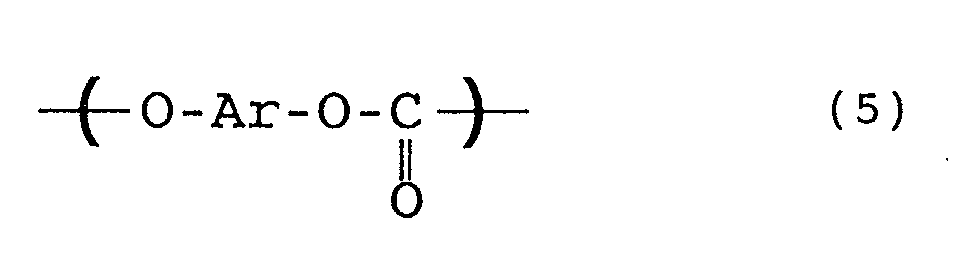
- the aromatic polycarbonate contained in the resin component (A) is an aromatic polycarbonate having a main chain comprising recurring units represented by the following formula (5): (wherein Ar is a residue of a bifunctional phenolic compound).
- Such an aromatic polycarbonate can be produced, for example, by a reaction between a bifunctional phenolic compound and a carbonate precursor or a polymerization reaction of a carbonate prepolymer.
- examples of methods for producing aromatic polycarbonates include an interfacial polymerization method (i.e., a phosgene method) in which a bifunctional phenolic compound is reacted with phosgene in the presence of an aqueous sodium hydroxide solution and methylene chloride as a solvent; a transesterification method (i.e., melt transesterification) in which a bifunctional phenolic compound and diphenyl carbonate are subjected to transesterification; and a solid-phase polymerization method in which a crystallized carbonate prepolymer is used.
- an interfacial polymerization method i.e., a phosgene method
- a bifunctional phenolic compound is reacted with phosgene in the presence of an aqueous sodium hydroxide solution and methylene chloride as a solvent
- a transesterification method i.e., melt transesterification
- a solid-phase polymerization method in which
- bifunctional phenolic compounds include 2,2-bis(4-hydroxyphenyl)propane (i.e., bisphenol A), 2,2-bis(4-hydroxy-3,5-dimethylphenyl)propane, 1,1-bis(4-hydroxyphenyl)ethane, bis(4-hydroxyphenyl)methane, 4,4'-dihydroxydiphenyl, 4,4'-dihydroxy-3,3',5,5'-tetramethyldiphenyl, 1,1-bis(4-hydroxyphenyl)cyclohexane, 1-phenyl-1,1-bis(4-hydroxyphenyl)ethane, bis(4-hydroxyphenyl)ether, bis(4-hydroxyphenyl)ketone, bis(4-hydroxyphenyl)sulfide, bis(4-hydroxyphenyl)sulfone, bis(4-hydroxyphenyl)sulfoxide, hydroquinone, resorcinol and catechol. 2,2-bis(4-hydroxyphenyl)propane
- the polymerization reaction for producing the aromatic polycarbonate can be conducted in the presence of a monofunctional phenolic compound, such as phenol, p-methylphenol, m-methylphenol, p-propylphenol, m-propylphenol, p-t-butylphenol, p-t-octylphenol or p-cumylphenol.
- a monofunctional phenolic compound such as phenol, p-methylphenol, m-methylphenol, p-propylphenol, m-propylphenol, p-t-butylphenol, p-t-octylphenol or p-cumylphenol.
- aromatic polycarbonate used in the present invention may have a branched structure.
- a branched aromatic polycarbonate can be produced by substantially the same method as described above in connection with the non-branched aromatic polycarbonate except that the polymerization reaction is conducted in the presence of a branching agent.
- branching agents include 1,1,1-tris(4-hydroxyphenyl)ethane, 1,3,5-tris(4-hydroxyphenyl)benzene, ⁇ , ⁇ ', ⁇ "-tris(4-hydroxyphenyl)-1,3,5-triiso-propylbenzene, phloroglucin, 4,6-dimethyl-2,4,6-tris(4-hydroxyphenyl)-2-heptene, 4,6-dimethyl-2,4,6-tris(4-hydroxyphenyl)heptane and isatin bisphenol (i.e., 3,3-bis(4-hydroxyphenyl)oxyindol).
- the aromatic polycarbonate used in the present invention is an aromatic polycarbonate containing substantially no halogens in the structure thereof.
- the viscosity average molecular weight of the aromatic polycarbonate is preferably in the range of from 10,000 to 100,000, more preferably in the range of from 14,000 to 40,000.
- the viscosity average molecular weight of an aromatic polycarbonate can be determined from the solution viscosity (using methylene chloride as a solvent) of the aromatic polycarbonate.
- the styrene polymer contained in resin component (A) is a rubber-modified styrene polymer and/or a non-rubber-modified styrene polymer, and it is preferred to use a rubber-modified styrene polymer alone or a mixture of a rubber-modified styrene polymer and a non-rubber-modified styrene polymer.
- a rubber-modified styrene polymer is a polymer having a structure in which a dispersed phase comprised of a particulate rubber polymer for modification is dispersed in a continuous phase comprised of a styrene polymer.
- a rubber-modified styrene polymer can be obtained by graft-polymerizing an aromatic vinyl monomer (such as styrene, ⁇ -methylstyrene or p-methylstyrene) and optionally a comonomer copolymerizable with the aromatic vinyl monomer, on a rubber polymer for modification, using a customary method, such as a bulk polymerization method, an emulsion polymerization method or a suspension polymerization method.
- aromatic vinyl monomer such as styrene, ⁇ -methylstyrene or p-methylstyrene
- a customary method such as a bulk polymerization method, an emulsion polymerization method or a suspension polymerization method.
- suitable rubber polymers for modification include diene rubbers, such as polybutadiene, poly(styrene-butadiene) and poly(acrylonitrile-butadiene); an isoprene rubber; a chloroprene rubber; acrylic rubbers, such as polybutyl acrylate; an ethylene/propylene/diene terpolymer (EPDM); an ethylene/octene copolymer rubber; and a composite rubber comprising a organopolysiloxane component and an alkyl (meth)acrylate component (a silicone-acrylic composite rubber).
- diene rubbers such as polybutadiene, poly(styrene-butadiene) and poly(acrylonitrile-butadiene)
- an isoprene rubber such as polybutyl acrylate
- EPDM ethylene/propylene/diene terpolymer
- EPDM ethylene/octene copolymer rubber
- a composite rubber comprising
- comonomers copolymerizable with the aromatic vinyl monomer examples include unsaturated nitrile monomers, such as acrylonitrile and methacrylonitrile; vinyl monomers, such as acrylic acid, methacrylic acid, an alkyl acrylate and an alkyl methacrylate; maleic anhydride; and an N-substituted maleimide.
- the content of the modifyer rubber polymer in the rubber-modified styrene polymer is preferably in the range of from 5 to 80 % by weight, more preferably from 10 to 60 % by weight.
- the content of the rubber polymer in the rubber-modified styrene polymer is less than 5 % by weight, the impact resistance of the resin composition becomes unsatisfactory.
- the content of the rubber polymer in the rubber-modified styrene polymer is more than 80 % by weight, the resin composition suffers not only a lowering of heat stability as well as stiffness, but also a lowering of melt fluidity and an occurrence of discoloration as well as gelation.
- the average diameter of the rubber polymer particles in the rubber-modified styrene polymer is preferably from 0.1 to 2.0 ⁇ m, more preferably from 0.1 to 1.0 ⁇ m, still more preferably from 0.2 to 0.6 ⁇ m.
- the average diameter of the rubber polymer particles is less than 0.1 ⁇ m, the improvement in impact resistance of the resin composition is unsatisfactory.
- the average diameter of the rubber polymer particles exceeds 2.0 ⁇ m, the melt fluidity of the resin composition and the appearance of an ultimate shaped article produced from the resin composition become poor.
- Preferred examples of rubber-modified styrene polymers include the so-called high impact polystyrene (hereinafter, frequently referred to as "HIPS"), acrylonitrile/butadiene/styrene copolymer (ABS resin), acrylonitrile/acrylic rubber/styrene copolymer (AAS resin), acrylonitrile/ethylene-propylene rubber/styrene copolymer (AES resin) and methyl methacrylate/butadiene/styrene copolymer (MBS resin).
- HIPS high impact polystyrene
- ABS resin acrylonitrile/butadiene/styrene copolymer
- AS resin acrylonitrile/acrylic rubber/styrene copolymer
- AES resin acrylonitrile/ethylene-propylene rubber/styrene copolymer
- MFS resin methyl methacrylate/butadiene/styren
- a non-rubber-modified styrene polymer is a polymer obtained by substantially the same method as described above in connection with the rubber-modified styrene polymer except that a rubber polymer is not used. That is, a non-rubber-modified styrene polymer can be obtained by polymerizing or copolymerizing an aromatic vinyl monomer (such as styrene, ⁇ -methylstyrene or p-methylstyrene) and optionally an unsaturated nitrile monomer (such as acrylonitrile or methacrylonitrile) or other monomers (such as, vinyl monomers, e.g., acrylic acid, methacrylic acid, an alkyl acrylate and an alkyl methacrylate; and maleic anhydride and an N-substituted maleimide).
- aromatic vinyl monomer such as styrene, ⁇ -methylstyrene or p-methylstyrene
- non-rubber-modified styrene polymers include general purpose polystyrene (GPPS), acrylonitrile/styrene copolymer (AS resin) and butyl acrylate/acrylonitrile/styrene copolymer resin (BAAS).
- GPPS general purpose polystyrene
- AS resin acrylonitrile/styrene copolymer
- BAAS butyl acrylate/acrylonitrile/styrene copolymer resin
- the reduced viscosity ⁇ sp /C (as measured in a 0.005 g/cm 3 polymer solution at 30 °C), which is an index of the molecular weight, is preferably in the range of from 30 to 80 cm 3 /g, more preferably from 40 to 60 cm 3 /g, wherein, when the styrene polymer is a polystyrene resin, toluene is used as the solvent and when the styrene polymer is an unsaturated nitrile/aromatic vinyl copolymer, methyl ethyl ketone is used as the solvent.
- the reduced viscosity ⁇ sp /C can be controlled by selecting the type and amount of the initiator, the polymerization temperature and the amount of the chain transfer agent.
- the resin mixture used as resin component (A) has an aromatic polycarbonate content of from 50 to 95 % by weight, preferably from 65 to 95 % by weight, more preferably from 75 to 90 % by weight, that is, the styrene polymer content of the resin mixture is from 50 to 5 % by weight, preferably from 35 to 5 % by weight, more preferably from 25 to 10 % by weight.
- the aromatic polycarbonate content is less than 50 % by weight, the heat resistance, mechanical strength and flame retardancy of the ultimate shaped article become unsatisfactory.
- the styrene polymer content is less than 5 % by weight, the improvement in moldability of the resin composition becomes unsatisfactory.
- the organopolysiloxane used as component (B) in the present invention is one of the components which play an important role for imparting flame retardancy to resin component (A).
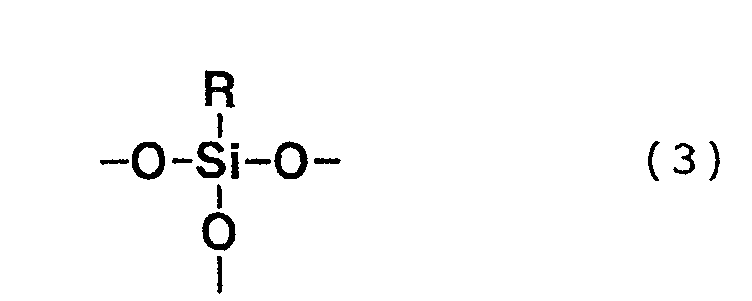
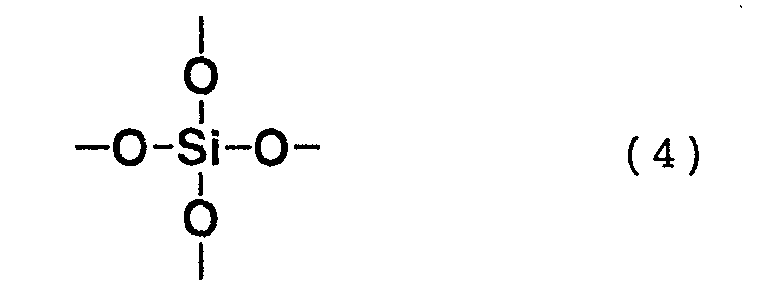
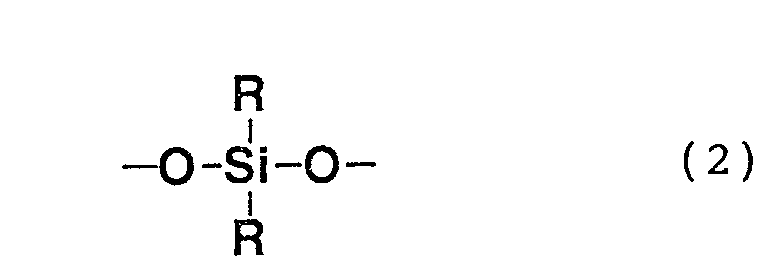
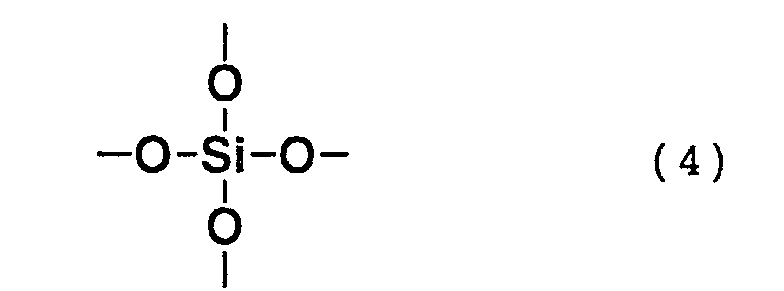
- the organopolysiloxane (B) used in the present invention comprises: 0 to 70 mol% of the above-mentioned monofunctional siloxane unit (hereinafter referred to as "M unit”), 0 to 100 mol% of the above-mentioned bifunctional recurring siloxane unit (hereinafter referred to as "D unit”), 0 to 100 mol% of the above-mentioned trifunctional recurring siloxane unit (hereinafter referred to as "T unit”) and 0 to 63 mol% of the above-mentioned tetrafunctional recurring siloxane unit (hereinafter referred to as "Q unit”), wherein each mol% is based on the total molar amount of the M unit, the D unit, the T unit and the Q unit.
- M unit monofunctional siloxane unit
- D unit bifunctional recurring siloxane unit
- T unit 0 to 100 mol% of the above-mentioned trifunctional recurring siloxane
- the organopolysiloxane (B) comprises 0 to 50 mol% of an M unit, 0 to 100 mol% of a D unit, 0 to 90 mol% of a T unit and 0 to 60 mol% of a Q unit, wherein each mol% is based on the total molar amount of the M unit, the D unit, the T unit and the Q unit.
- the molar ratio (mol%) of each of the M unit, D unit, T unit and Q unit and the structure of the siloxane units contained can be confirmed by proton and silicon 29 nuclear magnetic resonance ( 1 H- and 29 Si-NMR) spectroscopy.
- the M unit is a terminal group-forming unit.
- the amount of the M unit exceeds 70 mol%, the molecular weight of the organopolysiloxane becomes too low, and this results in that the volatility of the organopolysiloxane becomes too high and the compatibility of the organopolysiloxane with resin component (A) becomes too high and, therefore, resin component (A) becomes plasticized. As a result, the flame retardancy of the resin composition becomes disadvantageously lowered.
- the Q unit is a crosslinkage-forming unit.
- the amount of the Q unit exceeds 63 mol%, a problem arises in that a gelation occurs during the production of the organopolysiloxane or that the molecular weight of the organopolysiloxane becomes too high, so that the dispersibility of the organopolysiloxane in resin component (A) is lowered, leading to a lowering of the flame retardancy imparting effect of the organopolysiloxane.
- D unit content and T unit content of organopolysiloxane (B) there is no particular limitation, and these units can be contained in any desired proportions in organopolysiloxane (B).
- Each R in the M unit, D unit and T unit of organopolysiloxane (B) independently represents a monovalent organic group selected from the group consisting of a monovalent C 1 -C 20 hydrocarbon group, a monovalent C 1 -C 20 halogenated hydrocarbon group, a C 1 -C 20 mercaptoalkyl group, a C 2 -C 20 cyanoalkyl group, a C 2 -C 20 acyloxyalkyl group, a C 1 -C 20 aminoalkyl group, a C 6 -C 20 aminoaryl group, a C 1 -C 20 hydroxyalkyl group, and a C 4 -C 20 glycidoxyalkyl group.
- hydrocarbon groups include an alkyl group, such as a methyl group, an ethyl group, an n-propyl group, an isopropyl group, an n-butyl group, an isobutyl group, an s-butyl group, a t-butyl group, an n-pentyl group, an isopentyl group, a neopentyl group, a t-pentyl group, an n-hexyl group, an n-heptyl group, an n-octyl group, an isooctyl group, an n-nonyl group, an n-decyl group, an n-dodecyl group or an n-octadecyl group; an alkenyl group, such as a vinyl group, an allyl group, a 5-hexenyl group or a 4-vinylcyclohexyl group; a methyl
- halogenated hydrocarbon groups include a chloromethyl group, a 3-chloropropyl group, a 3,3,3-trifluoropropyl group, a 5,5,5,4,4,3,3-heptafluoropentyl group, a chlorophenyl group, a dichlorophenyl group and a trifluorotolyl group.
- Examples of mercaptoalkyl groups include a 2-mercaptoethyl group and a 3-mercaptopropyl group.
- cyanoalkyl groups examples include a 2-cyanoethyl group and a 3-cyanopropyl group.
- acyloxyalkyl groups include a 3-acryloxypropyl group and a 3-methacryloxypropyl group.
- aminoalkyl groups include a 3-amino-propyl group, an N-(2-aminoethyl)-3-aminopropyl group, and an N-(2-aminoethyl)-3-amino-(2-methyl)-propyl group.
- aminoaryl groups examples include an aminophenyl group.
- hydroxyalkyl groups include a hydroxypropyl group.
- Examples of glycidoxyalkyl groups include a 3-glycidoxypropyl group.
- each R in the M unit, D unit and T unit of organopolysiloxane (B) independently represents an organic group selected from the group consisting of a methyl group, an ethyl group, an n-propyl group, an isopropyl group, an isooctyl group, a vinyl group and a phenyl group.
- organopolysiloxane (B) With respect to the structure of organopolysiloxane (B), there is no particular limitation as long as the contents of M unit, D unit, T unit and Q unit are, respectively, in the above mentioned ranges. Therefore, various types of organopolysiloxanes can be used in the present invention.
- Examples of the structures of organopolysiloxane (B) include a linear or cyclic structure comprising D units, a branched structure comprising T units, and a branched structure comprising a combination DT, DQ, TQ or DTQ (wherein, for example, DT means a combination of D unit and T unit; and similar abbreviations are frequently used hereinafter).
- examples of structures having terminal M units include a linear structure comprising a combination MD, and a branched structure comprising a combination MT, MQ, MDT, MDQ, MTQ or MDTQ.
- an organopolysiloxane having a linear structure comprising a combination MD and an organopolysiloxane having a branched structure comprising a combination DT, MDT, MQ, MDQ, MTQ or MDTQ.
- organopolysiloxane (B) is the so-called MQ resin which is an organopolysiloxane composed mainly of M units and Q units and optionally containing D units and/or T units.
- Such an organopolysiloxane can be advantageously produced by, for example, the methods disclosed in Examined Japanese Patent Application Publication No. Hei 8-22921 (corresponding to U.S. Patent No. 5,548,053) and Japanese Patent No. 2941701 (corresponding to U.S. Patent No. 5,786,413).
- organopolysiloxane (B) can be expressed in terms of its composition.
- organopolysiloxane (B) is composed mainly of D units and T units, it is preferred that the total content of D unit and T unit is in the range of from 70 to 100 mol% and the M unit content is in the range of from 0 to 30 mol%, wherein it is more advantageous that the molar ratio of the D unit to the T unit is in the range of from 10/90 to 90/10.
- organopolysiloxane (B) is composed mainly of M units and Q units
- the M unit content is in the range of from 10 to 50 mol%
- the Q unit content is in the range of from 15 to 60 mol%
- the total content of D unit and T unit is in the range of from 0 to 70 mol%, more advantageously from 5 to 70 mol%.
- Organopolysiloxane (B) comprising D unit, T unit and Q unit contains, as a terminal group, a hydroxyl group and/or an alkoxy group which are/is directly bonded to the silicon atom, depending on the production method.
- the alkyl group in the alkoxy group varies depending on the starting material or solvent used in the production process and it is generally a lower alkyl group, such as a methyl group, an ethyl group, a propyl group, a butyl group, a pentyl group or a hexyl group.
- terminal groups are highly reactive and therefore it is not preferred that they are present in a large amount in organopolysiloxane (B). This is because these terminal groups cause a side reaction in which, when the organopolysiloxane is hydrolyzed, these terminal groups form crosslinking, thereby causing a lowering of the moldability of the resin composition, or in which, when the organopolysiloxane is mixed with the resin component at a high temperature, these terminal groups react with an aromatic polycarbonate, thereby causing a lowering of the molecular weight of the aromatic polycarbonate.
- the terminal hydroxyl group content of organopolysiloxane (B) is 5 % by weight or less, more advantageously 1 % by weight or less. It is preferred that the terminal alkoxy group content of organopolysiloxane (B) is 10 % by weight or less, more advantageously 5 % by weight or less.
- the hydroxyl group content can be determined by a method in which the amount of gas which is generated when organopolysiloxane (B) is reacted with an organometallic compound, such as an alkyllithium, an alkyl-magnesium halide (Grignard reagent) or the like, in an anhydrous solvent is measured.
- organometallic compound such as an alkyllithium, an alkyl-magnesium halide (Grignard reagent) or the like
- the alkoxy group content can be calculated, for example from the signal integral ratio of the proton nuclear magnetic resonance ( 1 H-NMR) spectrum using an appropriate internal standard substance.
- Organopolysiloxane (B) can be stabilized by a method in which the terminal hydroxyl groups are treated with a silylating agent to thereby convert the terminal hydroxyl groups into M units.
- organopolysiloxane (B) The introduction of an M unit into the skeleton of organopolysiloxane (B) can be conducted not only by the silylation treatment conducted after the below-mentioned hydrolysis-condensation polymerization reaction (for producing organopolysiloxane (B)), but also during the hydrolysis-condensation polymerization reaction (for producing organopolysiloxane (B)).
- organochlorosilanes Organo-alkoxysilanes and other raw materials used for producing organopolysiloxane (B) are described below.
- raw materials for the D unit include dimethyldichlorosilane, diethyldichlorosilane, methylvinyldichlorosilane, methylphenyldichlorosilane, di-phenyldichlorosilane, dimethyldimethoxysilane, dimethyldiethoxysilane, diethyldimethoxysilane, diethyldiethoxysilane, methylvinyldimethoxysilane, methylvinyldiethoxysilane, methylphenyldimethoxysilane, methylphenyldiethoxysilane, diphenyldimethoxysilane, and diphenyldiethoxysilane.
- Examples of other raw materials for the D unit include hexamethylcyclotrisiloxane, octamethylcyclotetrasiloxane, decamethylcyclopentasiloxane, 1,3,5-trimethyl-1,3,5-triphenylcyclotrisiloxane, 1,3,5,7-tetramethyl-1,3,5,7-tetraphenylcyclotetrasiloxane, hexaphenylcyclotrisiloxane and octaphenylcyclotetrasiloxane.
- raw materials for the T unit include methyltrichlorosilane, ethyltrichlorosilane, vinyltrichlorosilane, n-propyltrichlorosilane, isopropyltrichlorosilane, phenyltrichlorosilane, isooctyltrichlorosilane, methyltrimethoxysilane, methyltriethoxysilane, ethyltrimethoxysilane, ethyltriethoxysilane, vinyltrimethoxysilane, vinyltriethoxysilane, n-propyltri-methoxysilane, n-propyltriethoxysilane, isopropyltrimethoxysilane, isopropyltriethoxysilane, phenyltrimethoxysilane, phenyltriethoxysilane, isooctyltrimethoxysilane and iso
- raw materials for the Q unit include tetrachlorosilane, tetramethoxysilane, tetraethoxysilane and tetra-n-propoxysilane.
- silylating agents used for introducing the M unit include chlorosilanes, such as trimethylchlorosilane, triethylchlorosilane, dimethylphenylchlorosilane, diphenylmethylchlorosilane, triphenylchlorosilane and dimethylvinylchlorosilane; and disilazanes, such as hexamethyldisilazane and 1,3-divinyltetramethyldisilazane.
- chlorosilanes such as trimethylchlorosilane, triethylchlorosilane, dimethylphenylchlorosilane, diphenylmethylchlorosilane, triphenylchlorosilane and dimethylvinylchlorosilane
- disilazanes such as hexamethyldisilazane and 1,3-divinyltetramethyldisilazane.
- raw materials for the M unit include hexamethyldisiloxane, 1,3-diphenyltetramethyldisiloxane and 1,3-divinyltetramethyldisiloxane.
- Organopolysiloxane (B) used in the present invention preferably has a weight average molecular weight of from 500 to 100,000, more preferably from 1,000 to 40,000, still more preferably from 1,000 to 10,000.
- the weight average molecular weight is less than 500, the volatility of organopolysiloxane (B) becomes too high and the compatibility with resin component (A) becomes too high and, therefore, resin component (A) becomes plasticized. As a result, the flame retardancy of the resin composition becomes disadvantageously lowered.
- the weight average molecular weight exceeds 100,000, the dispersibility of organopolysiloxane (B) in resin component (A) is lowered.
- the weight average molecular weight of organopolysiloxane (B) is obtained by gel permeation chromatography (GPC), using a calibration curve obtained with respect to standard monodisperse polystyrene samples.
- organopolysiloxane (B) With respect to the method for producing organopolysiloxane (B), there is no particular limitation, and any conventional methods can be employed.
- an organopolysiloxane can be produced by subjecting an organochlorosilane, an organoalkoxysilane or the like to a hydrolysis-condensation polymerization reaction in the presence of an excess amount of water and an acidic or basic catalyst, followed by neutralization of the acidic or basic catalyst with a base or acid.
- Organopolysiloxane (B) having a desired structure can be obtained by controlling the contents of M units, D units, T units and Q units by appropriately selecting the type and amount of the organochlorosilane, organoalkoxysilane or the like.
- the molecular weight of the organopolysiloxane (B) can be controlled by adjusting the type and amount of the catalyst, the amount of water, the temperature and time of the hydrolysis-condensation polymerization reaction and the content of M units.
- an organopolysiloxane produced is subjected to purification treatment for removing by-produced salts, i.e., salts formed between an acidic or basic catalyst and a base or acid used for neutralization of the acidic or basic catalyst.
- an organopolysiloxane produced may be subjected to such purification treatment.
- the by-produced salts include inorganic metal salts usable as component (C). Therefore, as described below in connection with the method for incorporating inorganic metal salt (C), it is preferred that the purification treatment is omitted and the inorganic metal salts by-produced in the organopolysiloxane produced are used as component (C).
- the amount of organopolysiloxane (B) used in the resin composition is from 0.1 to 30 parts by weight, preferably from 0.5 to 20 parts by weight, more preferably from 1 to 15 parts by weight, relative to 100 parts by weight of resin component (A).
- the amount of organopolysiloxane (B) is less than 0.1 part by weight, the improvement in flame retardancy of the resin composition becomes unsatisfactory.
- the amount of organopolysiloxane (B) is more than 30 parts by weight, the mechanical properties, such as impact resistance, of the resin composition disadvantageously become low.
- Organopolysiloxanes (B) can be used individually or in combination.
- inorganic metal salt (C) An inorganic alkali metal salt and/or an inorganic alkaline earth metal salt are/is used as inorganic metal salt (C).
- the inorganic metal salt (C) is the component which is the characteristic feature of the present invention and which plays an important role for imparting flame retardancy to resin component (A) by a synergistic effect achieved by the cooperation between inorganic metal salt (C) and organopolysiloxane (B).
- the inorganic alkali metal salt and inorganic alkaline earth metal salt, which are used as inorganic metal salt (C), are, respectively, a salt formed between an inorganic acid and an alkali metal element and a salt formed between an inorganic acid and an alkaline earth metal element.
- the alkali metal elements used for producing inorganic metal salt (C) are lithium, sodium, potassium, rubidium and cesium. Of them, sodium and potassium are preferred.
- the alkaline earth metal elements used for producing inorganic metal salt (C) are beryllium, magnesium, calcium, strontium and barium. Of them, magnesium and calcium are preferred.
- inorganic acids used for producing inorganic metal salt (C) include hydrogen fluoride, hydrogen chloride, hydrogen bromide, hydrogen iodide, sulfuric acid, sulfurous acid, thiosulfuric acid, pyrosulfurous acid, dithinous acid, nitric acid, nitrous acid, phosphoric acid, pyrophosphoric acid, boric acid, hexafluoroaluminic acid, hexafluorosilicic acid, hexa-fluorotitanic acid, hexafluorophosphoric acid and tetrafluoroboric acid.
- Preferred examples of inorganic metal salt (C) include an alkali metal salt of nitric acid, an alkaline earth metal salt of nitric acid, an alkali metal halide and an alkaline earth metal halide.
- the alkali metal halide is formed between an alkali metal element and hydrogen fluoride, hydrogen chloride, hydrogen bromide or hydrogen iodide.
- the alkaline earth metal halide is formed between an alkaline earth metal element and hydrogen fluoride, hydrogen chloride, hydrogen bromide or hydrogen iodide.
- alkali metal halides include LiF, LiCl, LiBr, LiI, NaF, NaCl, NaBr, NaI, KF, KCl, KBr and KI. Of them, NaCl, NaBr, KCl and KBr are preferred.
- alkaline earth metal halides include MgF 2 , MgCl 2 , MgBr 2 , MgI 2 , CaF 2 , CaCl 2 , CaBr 2 and CaI 2 .
- inorganic metal salts (C) include Na 2 SO 4 , K 2 SO 4 , MgSO 4 , CaSO 4 , Na 2 SO 3 , K 2 SO 3 , MgSO 3 , CaSO 3 , Na 2 S 2 O 3 , K 2 S 2 O 3 , MgS 2 O 3 , CaS 2 O 3 , Na 2 S 2 O 5 , K 2 S 2 O 5 , MgS 2 O 5 , CaS 2 O 5 , Na 2 S 2 O 4 , K 2 S 2 O 4 , MgS 2 O 4 , CaS 2 O 4 , NaNO 3 , KNO 3 , Mg(NO 3 ) 2 , Ca(NO 3 ) 2 , NaNO 2 , KNO 2 , Mg(NO 2 ) 2 , Ca(NO 2 ) 2 , Na 3 PO 4 , K 3 PO 4 , Mg 3 (PO 4 ) 2 , Ca 3 (PO 4 ) 2 , Na 4 P 2 O 7 , K 4 P
- the amount of inorganic metal salt (C) used in the resin composition is from 0.0005 to 5 parts by weight, preferably from 0.001 to 2 parts by weight, more preferably from 0.005 to 1 part by weight, relative to 100 parts by weight of resin component (A).
- the amount of inorganic metal salt (C) is less than 0.0005 part by weight, the improvement in flame retardancy of the resin composition becomes unsatisfactory.
- the amount of inorganic metal salt (C) is more than 5 parts by weight, the heat stability and hydrolysis resistance of the aromatic polycarbonate become lowered and hence the mechanical properties, such as impact resistance, of the resin composition disadvantageously become low.
- inorganic metal salt (C) various inorganic alkali metal salts and various inorganic alkaline earth metal salts can be used individually or in combination.
- organopolysiloxane (B) and inorganic metal salt (C) are necessary.
- organopolysiloxane (B) alone is added to resin component (A)
- the improvement in flame retardancy of the resin composition is unsatisfactory, but when both organopolysiloxane (B) and inorganic metal salt (C) are added to resin component (A), the flame retardancy of the resin composition is greatly improved.
- inorganic metal salt (C) alone is added to resin component (A), almost no improvement in flame retardancy can be obtained.
- the characteristic feature of the present invention resides in that a small amount of inorganic metal salt (C) is used in combination with organopolysiloxane (B) to thereby obtain synergy therebetween for imparting high flame retardancy to an aromatic polycarbonate resin composition containing an inherently flammable styrene polymer.
- C inorganic metal salt
- B organopolysiloxane
- the studies of the present inventors have revealed that when a metal salt of an organic sulfonic acid is used in combination with organopolysiloxane (B), no synergistic effect can be exhibited by them.
- the present inventors have also found that, when it is attempted to use a metal salt of an organic sulfonic acid so as to impart a satisfactory level of flame retardancy to a resin composition, the metal salt of an organic sulfonic acid must be used in a large amount.
- a dry blending method As examples of methods for conducting the preliminary mixing of the components, there can be mentioned a dry blending method; a method which employs a mixer, such as a Henschel mixer, a super mixer, a tumble mixer, a ribbon blender and the like; and a wet blending method in which a part or whole of each of the components (A) to (C) is individually dissolved in water or a solvent to thereby obtain solutions, and the obtained solutions are mixed together and then dried.
- a mixer such as a Henschel mixer, a super mixer, a tumble mixer, a ribbon blender and the like
- a wet blending method in which a part or whole of each of the components (A) to (C) is individually dissolved in water or a solvent to thereby obtain solutions, and the obtained solutions are mixed together and then dried.
- Melt-kneading of the mixture of components can be conducted by means of an extruder, such as a single-screw extruder, a twin-screw extruder, a Banbury mixer and a Brabender.
- an extruder such as a single-screw extruder, a twin-screw extruder, a Banbury mixer and a Brabender.
- the flame retardant resin composition of the present invention As a particularly preferred method for producing the flame retardant resin composition of the present invention, there can be mentioned a method in which an inorganic metal salt (C) and an organopolysiloxane (B) are preliminary mixed to obtain a uniform mixture which is comprised of the organopolysiloxane (B) containing the inorganic metal salt (C), and the obtained uniform mixture is mixed with a resin component (A).
- the synergistic effect of organopolysiloxane (B) and inorganic metal salt (C) can be easily exhibited and highly improved flame retardancy can be imparted to the resin composition.
- organopolysiloxane (B) are used as inorganic metal salt (C), because inorganic metal salt (C) can be uniformly dispersed in organopolysiloxane (B) at a low cost.
- alkoxysilanes used as raw materials are reacted in two steps, namely a polycondensation operation using an acidic catalyst (step 1) and a polycondensation operation using a basic catalyst (step 2), and then subjected to a neutralization operation (step 3) for neutralizing the basic catalyst with an acid, thereby obtaining MQ resin.
- MQ resin containing NaCl can be obtained by using HCl as an acid in steps 1 and 3 and using NaOH as a base in step 2.
- MQ resin obtained in the above mentioned manner can be advantageously used in the present invention as organopolysiloxane (B) containing inorganic metal salt (C).
- the amount of inorganic metal salt (C) therein can be determined by conventional methods.
- an element to be measured for determining the amount of inorganic metal salt (C) can be recovered from the resin composition or organopolysiloxane by, for example, a method in which the resin composition or organopolysiloxane is dissolved in a solvent, and then the desired element is extracted by using water or the like; or a method in which the resin composition or organopolysiloxane is decomposed at a high temperature in the presence or absence of an acid or peroxide, and then the desired element is extracted by using a solvent.
- the amount of the recovered element can be measured by, for example, coulometric titration, atomic absorption spectroscopy, emission spectrochemical analysis, ion chromatography or fluorescence X-ray analysis.
- the amount of inorganic metal salt (C) contained in any of the resin composition of the present invention and organopolysiloxane (B) can also be determined by a method in which the resin composition or organopolysiloxane is subjected directly to fluorescence X-ray analysis, and the amounts of the elements are determined by the FP method (Fundamental Parameter method), the calibration curve method or the like.
- the resin composition of the present invention may further comprise a flame retardant other than organopolysiloxane (B) and inorganic metal salt (C) to impart a higher level of flame retardancy to the resin composition.
- a flame retardant selected from the group consisting of (a) phosphate compounds; (b) red phosphorus and inorganic phosphorus compounds, such as ammonium polyphosphate; (c) halogen-containing organic compounds; (d) nitrogen-containing organic compounds, such as melamine, melamine cyanurate, melam, melem and mellon; (e) inorganic metal salts other than alkali metal salts and alkaline earth metal salts, such as zinc borate and zinc stannate; (f) metal oxides, such as antimony oxide, molybdenum oxide, titanium oxide, zirconium oxide and zinc oxide; (g) cyclic or linear phosphazene polymers or oligomers, such as polyphenoxyphosphazene, poly
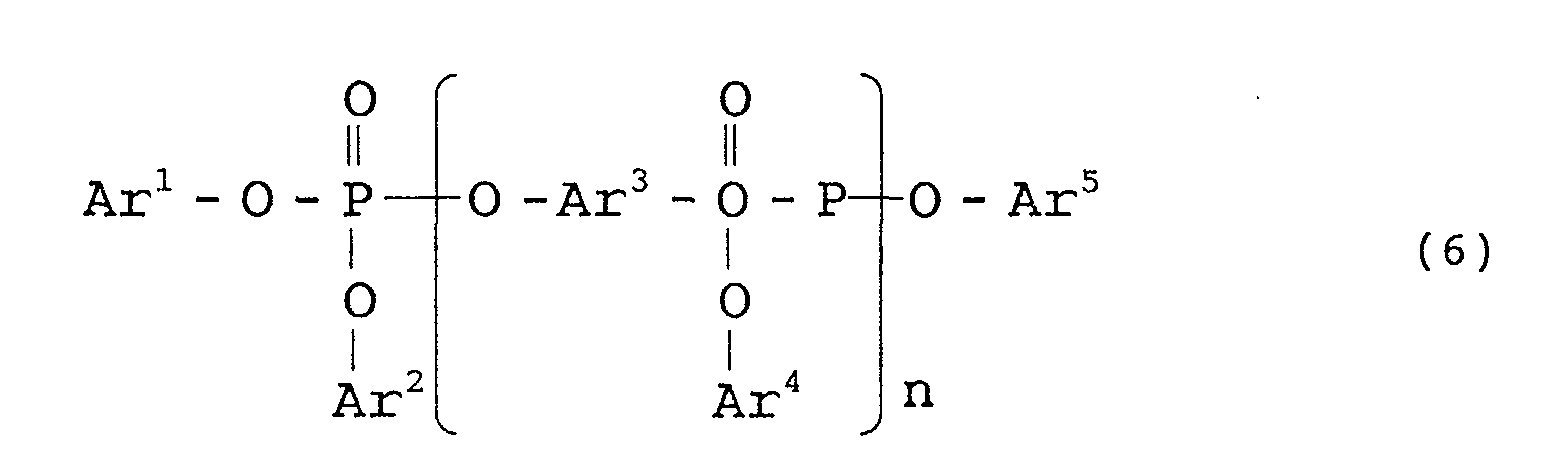
- phosphate compounds include phosphates, such as trimethyl phosphate, triethyl phosphate, tripropyl phosphate, tributyl phosphate, tripentyl phosphate, trihexyl phosphate, triphenyl phosphate, tritolyl phosphate, trixylyl phosphate, dimethyl ethyl phosphate, methyl dibutyl phosphate, ethyl dipropyl phosphate, hydroxyphenyl diphenyl phosphate; compounds obtained by introducing various substituents into the above-mentioned phosphates; and condensed phosphate compounds represented by the following formula (6): wherein:
- condensed phosphate compounds include bisphenol A tetraphenyldiphosphate, bisphenol A tetratolyldiphosphate, bisphenol A tetraxylyldiphosphate, bisphenol A di(phenylxylylphosphate), resorcinol tetraphenyldiphosphate and resorcinol tetraxylyldiphosphate.
- a fluoroolefin resin can be used to reduce the amount of flaming particles dripping from an ultimate shaped article when the shaped article is on fire.
- the fluoroolefin resins usable in the present invention there can be mentioned a homopolymer and a copolymer each comprising a fluoroethylene structure.
- fluoroolefin resins include a difluoroethylene polymer, a trifluoroethylene polymer, a tetrafluoroethylene polymer, a tetrafluoro-ethylene-hexafluoropropylene copolymer, and a copolymer of tetrafluoroethylene and an ethylene monomer containing no fluorine.
- polytetrafluoroethylene is preferred.
- PTFE polytetrafluoroethylene
- the fluoroolefin resin is dispersed in the resin composition in the form of fibrils having a diameter of 0.5 ⁇ m or less.
- the amount of fluoroolefin resin incorporated into the resin composition is in the range of from 0.01 to 3 parts by weight, relative to 100 parts by weight of resin component (A).
- the flame retardant resin composition of the present invention may optionally contain various additives generally used with thermoplastic resins to improve moldability, impact resistance, stiffness, weathering resistance, appearance and the like.
- additives include heat stabilizers; antioxidants; ultraviolet light absorbers; weathering resistance agents; antimicrobial agents; compatibility agents; colorants (dyes and pigments); mold release agents; lubricants; antistatic agents; plasticizers; polymers, such as other resins and rubbers; and fillers.
- heat stabilizers include heat stabilizers; antioxidants; ultraviolet light absorbers; weathering resistance agents; antimicrobial agents; compatibility agents; colorants (dyes and pigments); mold release agents; lubricants; antistatic agents; plasticizers; polymers, such as other resins and rubbers; and fillers.
- the flame retardant resin composition of the present invention can be advantageously used for producing housings and parts for office automation machines, data communication equipments, electric and electronic appliances and household electric appliances, such as a copier, a facsimile, a television set, a radio, a tape recorder, a video deck, a personal computer, a printer, a telephone, a data terminal equipment, a portable telephone, a refrigerator, a microwave oven and the like.
- the flame retardant resin composition of the present invention can also be advantageously used for producing parts for an automobile.
- PC A commercially available bisphenol A polycarbonate having a viscosity average molecular weight of 20,000 (trade name: Iupilon S3000, manufactured and sold by Mitsubishi Engineering-Plastics Corporation, Japan) was used.
- AS A commercially available acrylonitrile/styrene copolymer (trade name: Stylac AS T8801, manufactured and sold by Asahi Chemical Co., Ltd., Japan) was used.
- ABS A commercially available powdery acrylonitrile/butadiene/styrene copolymer (trade name: RV, manufactured and sold by Mitsubishi Rayon Co., Ltd., Japan) was used.
- organopolysiloxane (B) With respect to organopolysiloxane (B), the molar ratios between the M unit, D unit, T unit and Q unit and the structure of the siloxane units contained were confirmed by proton and silicon 29 nuclear magnetic resonance ( 1 H- and 29 Si-NMR) spectroscopy.
- 1 H- and 29 Si-NMR spectra were obtained by using deuterated benzene as a solvent and a nuclear magnetic resonance apparatus (trade name: Avance DPX 400 or DPX 300, manufactured and sold by Brucker Instruments Inc., Germany), or by using deuterated chloroform as a solvent and a nuclear magnetic resonance apparatus (trade name: JNM- ⁇ 400, manufactured and sold by JEOL LTD., Japan).
- the weight average molecular weight of organopolysiloxane (B) was obtained by gel permeation chromatography (GPC), using a calibration curve obtained with respect to standard monodisperse polystyrene samples. GPC was carried out under the following "conditions 1" or "conditions 2".
- Organopolysiloxane (B) contains, as a reactive terminal group, a hydroxyl group (a silanol group) and/or an ethoxy group (a terminal ethoxy group) which are/is directly bonded to a silicon atom.
- a hydroxyl group a silanol group
- an ethoxy group a terminal ethoxy group
- silanol group content (% by weight):
- the content of inorganic metal salt (C) in organopolysiloxane (B) was determined by fluorescence X-ray analysis or flameless atomic absorption spectrometry. Fluorescence X-ray analysis was conducted using a fluorescence X-ray analyzer (trade name: RIX3000 fluorescence X-ray analyzer, manufactured and sold by Rigaku Corporation, Japan) which employs the FP (Fundamental Parameter) method.
- Flameless atomic absorption spectrometry was conducted by a method in which the organopolysiloxane is pre-treated with sulfuric acid and hydrofluoric acid, and the resultant product is analyzed using a flameless atomic absorption spectrometer (trade name: Z-8270, manufactured and sold by Hitachi, Ltd., Japan).
- Inorganic metal salts were not detected in organopolysiloxanes S-1 to S-5, S-7 and S-16. However, NaCl derived from each of the catalysts used for synthesizing organopolysiloxanes was detected in the other organosiloxanes (S-6 and S-8 to S-15).
- organopolysiloxanes (B) which were determined by the above-mentioned methods are shown in Table 1.
- F114P A commercially available potassium perfluorobutanesulfonate (trade name: MEGAFAC F114P, manufactured and sold by DAINIPPON INK & CHEMICALS INC., Japan) was used.
- KSS A commercially available potassium diphenylsulfon-3-sulfonate (manufactured and sold by UCB Japan, Japan) was used.
- Polycarbonate resin compositions were produced in accordance with the formulations shown in Table 2. Specifically, first, an aqueous solution or methanol solution of inorganic metal salt (C) was mixed with an aromatic polycarbonate, followed by drying at 120 °C for 4 hours to thereby obtain a mixture of an aromatic polycarbonate and an inorganic metal salt. The obtained mixture, a styrene polymer and organopolysiloxane (B) were placed in a polyethylene bag and preliminarily mixed together by hand and, then, melt-kneaded at 250 °C using an extruder (trade name: KZW15-45MG, manufactured and sold by Technovel Corporation, Japan), thereby obtaining a resin composition (in the form of pellets).
- an extruder trade name: KZW15-45MG, manufactured and sold by Technovel Corporation, Japan
- the obtained resin composition was subjected to injection molding at a temperature of 250 °C by means of a small size injection molding machine (trade name: MJEC10, manufactured and sold by Modern Machinery Company, Japan) to thereby obtain a test sample having a thickness of 3.18 mm.
- a small size injection molding machine (trade name: MJEC10, manufactured and sold by Modern Machinery Company, Japan) to thereby obtain a test sample having a thickness of 3.18 mm.
- each of the resin compositions of the present invention exhibits excellent flame retardancy (self-extinguishing properties) and exhibits no dripping of flaming particles, in spite of the fact that the resin component thereof is a resin mixture of an aromatic polycarbonate and an inherently flammable styrene polymer.
- test sample was prepared using a resin composition composed only of an aromatic polycarbonate and a styrene polymer (i.e., without using an organopolysiloxane and an inorganic metal salt). The results are shown in Table 2.
- test sample was prepared using a resin composition composed only of an aromatic polycarbonate, a styrene polymer and an organopolysiloxane (i.e., without using an inorganic metal salt). The results are shown in Table 2.
- test sample was prepared using a resin composition composed only of an aromatic polycarbonate, a styrene polymer and either a metal salt of an organic sulfonic acid (F114P) or an inorganic metal salt (NaCl) (i.e., without using an organopolysiloxane).
- F114P organic sulfonic acid
- NaCl inorganic metal salt
- Polycarbonate resin compositions were produced using respectively organopolysiloxanes S-2 to S-5, which have different structures.
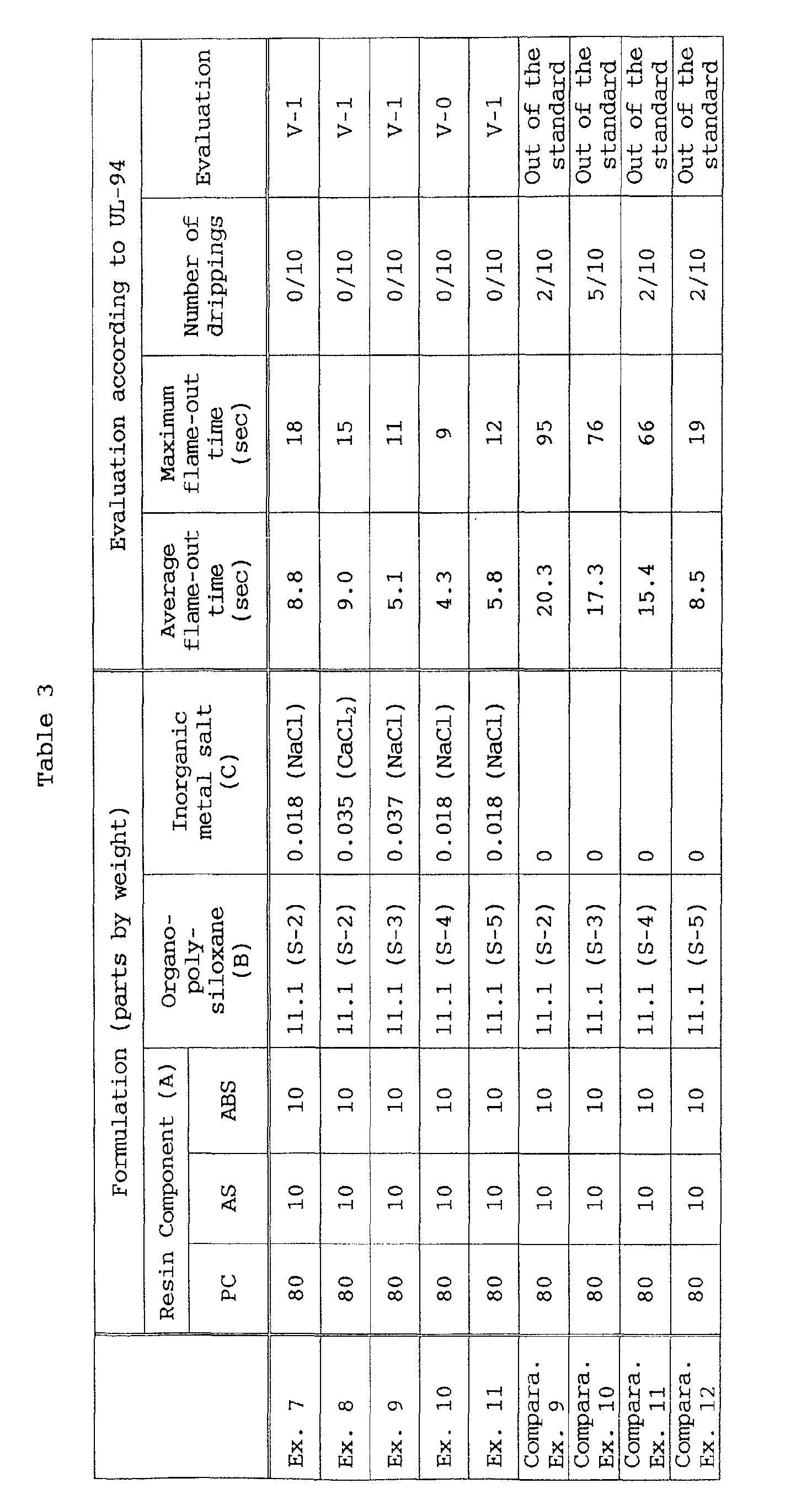
- test samples were produced in substantially the same manner as in Examples 1 to 6 except that the formulations shown in Table 3 were used.
- test samples were produced in substantially the same manner as in Examples 1 to 6 except that the formulations shown in Table 3 were used and that the resin compositions (in the form of pellets) were subjected to compression molding at a temperature of 250 °C using a compression molding machine to thereby obtain test samples having a thickness of 3.18 mm.
- the evaluation of the self-extinguishing properties of the test samples was conducted in the same manner as in Examples 1 to 6. The results are shown in Table 3.
- the resin compositions of the present invention exhibit excellent flame retardancy irrespective of the structure of the organopolysiloxanes used.
- organopolysiloxanes S-2 to S-5 were, respectively, used as organopolysiloxanes (B) and an inorganic metal salt was not used.
- organopolysiloxanes S-2 to S-5 were, respectively, used as organopolysiloxanes (B) and an inorganic metal salt was not used.
- Polycarbonate resin compositions were produced using respectively organopolysiloxanes S-6, S-8, S-10, S-12 and S-14, which contain NaCl derived from the catalysts used for synthesizing the organopolysiloxanes.
- organopolysiloxanes S-6, S-8, S-10, S-12 and S-14 which contain NaCl derived from the catalysts used for synthesizing the organopolysiloxanes.
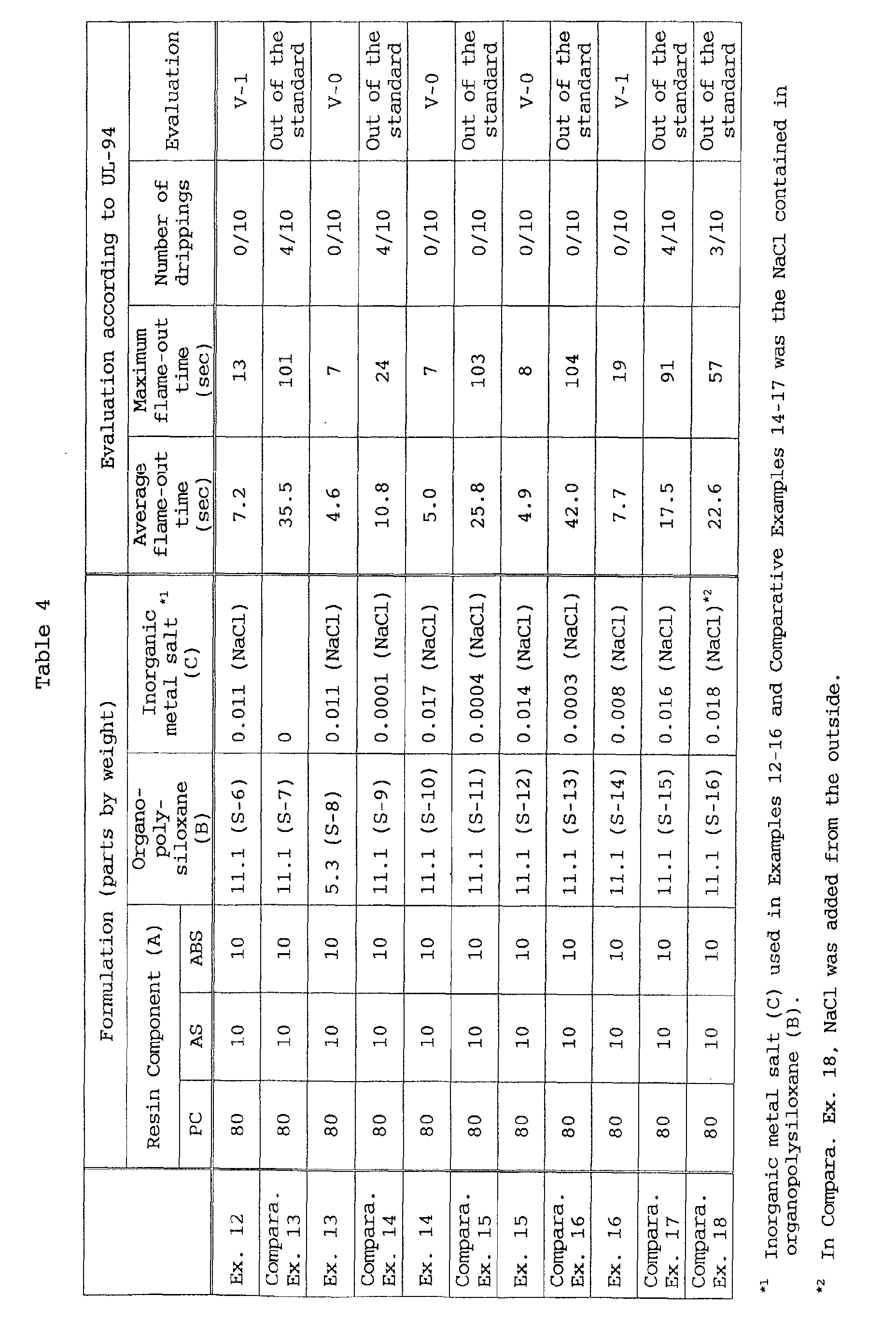
- Table 4 an aromatic polycarbonate, a styrene polymer and an organopolysiloxane were preliminarily mixed together, and preparation of test samples and evaluation of the self-extinguishing properties were conducted in the same manner as in Examples 1 to 6.
- No inorganic metal salt was added from the outside to the resin composition, and only the NaCl contained in the organopolysiloxane was used as inorganic metal salt (C).
- C inorganic metal salt
- the resin compositions of the present invention exhibit excellent flame retardancy in spite of the fact that no inorganic metal salt was added from the outside to the resin composition.
- organopolysiloxanes S-7, S-9, S-11 and S-13 which respectively have the same or substantially the same structures as those of organopolysiloxanes S-6, S-8, S-10 and S-12 (which are used in Examples 12 to 15), but which have low inorganic metal salt contents.
- an aromatic polycarbonate, a styrene polymer and an organopolysiloxane were preliminarily mixed together, and preparation of test samples and evaluation of the self-extinguishing properties were conducted in the same manner as in Examples 1 to 6.
- No inorganic metal salt was added from the outside to the resin composition, and only the NaCl contained in the organopolysiloxaneone was used as inorganic metal salt (C).
- C inorganic metal salt
- a high molecular weight MQ resin (S-15) containing 65 mol% of Q unit was used as organopolysiloxane (B).
- organopolysiloxane (B) a high molecular weight MQ resin (S-15) containing 65 mol% of Q unit was used as organopolysiloxane (B).
- S-15 contained NaCl derived from the catalyst used for synthesizing S-15, no inorganic metal salt was added from the outside to the resin composition.
- Comparative Example 18 a low molecular weight silicone compound (S-16) containing 75 mol% of M unit was used as organopolysiloxane (B). Since S-16 contained no inorganic metal salt, NaCl was added from the outside to the resin composition in the same manner as in Examples 1 to 6, and preparation of a test sample and evaluation of the self-extinguishing properties were conducted in the same manner as in Examples 1 to 6. The results are shown in Table 4.
- the flame retardant aromatic polycarbonate resin composition of the present invention which contains a flame retardant comprising a combination of an organopolysiloxane and an inorganic metal salt, exhibits high flame retardancy in spite of the fact that the resin composition contains an inherently flammable styrene polymer. Accordingly, the resin composition of the present invention can be satisfactorily used as a material for various parts which have been becoming large and thin, such as parts for office automation machines, data communication equipments, electric and electronic appliances, household electric appliances and automobiles. Therefore, the application field for the resin composition of the present invention is expected to be expanded.
Landscapes
- Chemical & Material Sciences (AREA)
- Health & Medical Sciences (AREA)
- Chemical Kinetics & Catalysis (AREA)
- Medicinal Chemistry (AREA)
- Polymers & Plastics (AREA)
- Organic Chemistry (AREA)
- Compositions Of Macromolecular Compounds (AREA)
Abstract
Description


0.1 to 30 parts by weight of an organopolysiloxane (B), and
0.0005 to 5 parts by weight of at least one inorganic metal salt (C) selected from the group consisting of inorganic alkali metal salts and inorganic alkaline earth metal salts,
the organopolysiloxane (B) comprising:
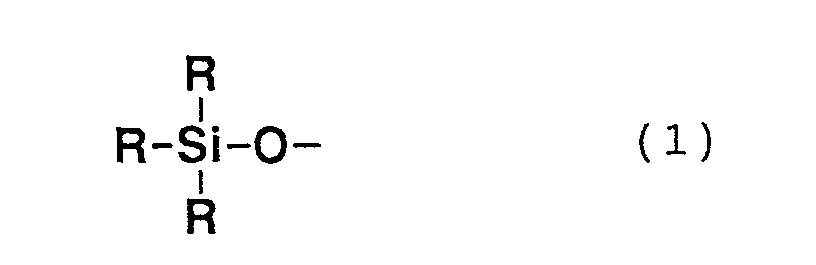
0 to 70 mol% of a monofunctional siloxane unit (M unit) represented by the following formula (1):

0 to 100 mol% of a bifunctional recurring siloxane unit (D unit) represented by the following formula (2) :
0 to 100 mol% of a trifunctional recurring siloxane unit (T unit) represented by the following formula (3):

0 to 63 mol% of a tetrafunctional recurring siloxane unit (Q unit) represented by the following formula (4):
100 parts by weight of a resin component (A) which is a resin mixture of an aromatic polycarbonate and a styrene polymer, wherein the resin mixture has an aromatic polycarbonate content of from 50 to 95 % by weight and a styrene polymer content of from 5 to 50 % by weight,
0.1 to 30 parts by weight of an organopolysiloxane (B), and
0.0005 to 5 parts by weight of at least one inorganic metal salt (C) selected from the group consisting of inorganic alkali metal salts and inorganic alkaline earth metal salts,
the organopolysiloxane (B) comprising:
0 to 70 mol% of a monofunctional siloxane unit (M unit) represented by the following formula (1):
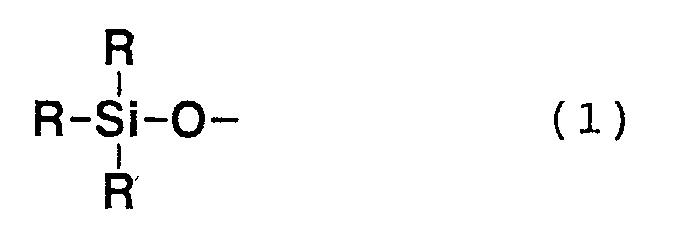
0 to 100 mol% of a bifunctional recurring siloxane unit (D unit) represented by the following formula (2) :

0 to 100 mol% of a trifunctional recurring siloxane unit (T unit) represented by the following formula (3):
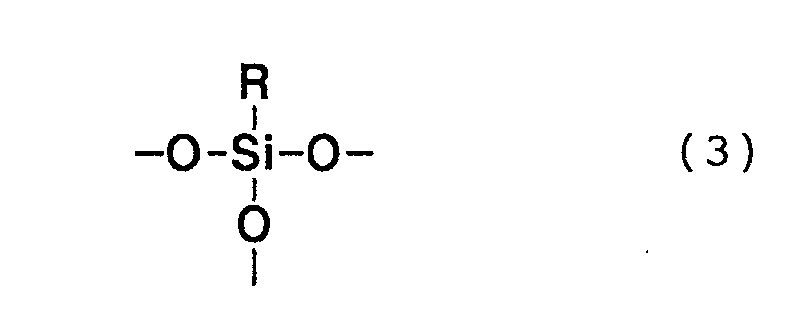
0 to 63 mol% of a tetrafunctional recurring siloxane unit (Q unit) represented by the following formula (4):

When the content of the rubber polymer in the rubber-modified styrene polymer is less than 5 % by weight, the impact resistance of the resin composition becomes unsatisfactory. When the content of the rubber polymer in the rubber-modified styrene polymer is more than 80 % by weight, the resin composition suffers not only a lowering of heat stability as well as stiffness, but also a lowering of melt fluidity and an occurrence of discoloration as well as gelation. The average diameter of the rubber polymer particles in the rubber-modified styrene polymer is preferably from 0.1 to 2.0 µm, more preferably from 0.1 to 1.0 µm, still more preferably from 0.2 to 0.6 µm. When the average diameter of the rubber polymer particles is less than 0.1 µm, the improvement in impact resistance of the resin composition is unsatisfactory. When the average diameter of the rubber polymer particles exceeds 2.0 µm, the melt fluidity of the resin composition and the appearance of an ultimate shaped article produced from the resin composition become poor.


Therefore, the application field for the resin composition of the present invention is expected to be expanded.
Claims (4)
- A flame retardant resin composition comprising:100 parts by weight of a resin component (A) which is a resin mixture of an aromatic polycarbonate and a styrene polymer, wherein said resin mixture has an aromatic polycarbonate content of from 50 to 95 % by weight and a styrene polymer content of from 5 to 50 % by weight,0.1 to 30 parts by weight of an organopolysiloxane (B), and0.0005 to 5 parts by weight of at least one inorganic metal salt (C) selected from the group consisting of inorganic alkali metal salts and inorganic alkaline earth metal salts,said organopolysiloxane (B) comprising:0 to 70 mol% of a monofunctional siloxane unit (M unit) represented by the following formula (1):wherein each R independently represents a monovalent organic group selected from the group consisting of a monovalent C1-C20 hydrocarbon group, a monovalent C1-C20 halogenated hydrocarbon group, a C1-C20 mercaptoalkyl group, a C2-C20 cyanoalkyl group, a C2-C20 acyloxyalkyl group, a C1-C20 aminoalkyl group, a C6-C20 aminoaryl group, a C1-C20 hydroxyalkyl group, and a C4-C20 glycidoxyalkyl group;
 0 to 100 mol% of a bifunctional recurring siloxane unit (D unit) represented by the following formula (2):wherein each R is as defined above for formula (1);
 0 to 100 mol% of a trifunctional recurring siloxane unit (T unit) represented by the following formula (3):wherein R is as defined above for formula (1); and
 0 to 63 mol% of a tetrafunctional recurring siloxane unit (Q unit) represented by the following formula (4):wherein each mol% is based on the total molar amount of said M unit, said D unit, said T unit and said Q unit.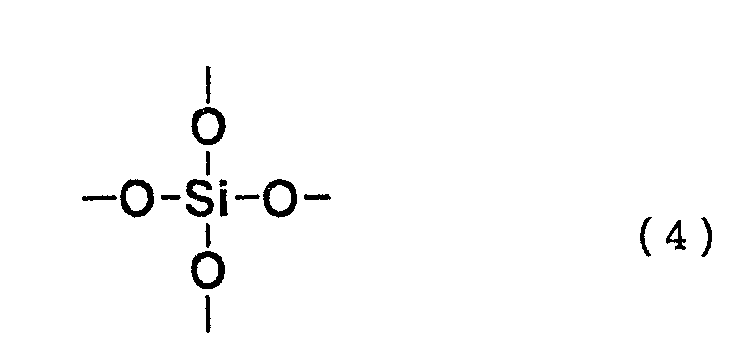
- The composition according to claim 1, wherein each R in said formulae (1), (2) and (3) is independently selected from the group consisting of a methyl group, an ethyl group, an n-propyl group, an isopropyl group, an isooctyl group, a vinyl group and a phenyl group.
- The composition according to claim 1 or 2, wherein said inorganic metal salt (C) is at least one compound selected from the group consisting of an alkali metal salt of nitric acid, an alkaline earth metal salt of nitric acid, an alkali metal halide and an alkaline earth metal halide.
- The composition according to claim 3, wherein said alkali metal halide is at least one compound selected from the group consisting of NaCl, KCl, NaBr and KBr.
Applications Claiming Priority (2)
| Application Number | Priority Date | Filing Date | Title |
|---|---|---|---|
| JP2001313442 | 2001-10-11 | ||
| JP2001313442A JP3865295B2 (en) | 2001-10-11 | 2001-10-11 | Flame retardant resin composition |
Publications (2)
| Publication Number | Publication Date |
|---|---|
| EP1302510A1 true EP1302510A1 (en) | 2003-04-16 |
| EP1302510B1 EP1302510B1 (en) | 2006-08-09 |
Family
ID=19131909
Family Applications (1)
| Application Number | Title | Priority Date | Filing Date |
|---|---|---|---|
| EP02256943A Expired - Lifetime EP1302510B1 (en) | 2001-10-11 | 2002-10-08 | Flame retardant resin composition |
Country Status (8)
| Country | Link |
|---|---|
| US (1) | US6825264B2 (en) |
| EP (1) | EP1302510B1 (en) |
| JP (1) | JP3865295B2 (en) |
| CN (1) | CN1197913C (en) |
| DE (1) | DE60213735T2 (en) |
| PL (1) | PL206130B1 (en) |
| SG (1) | SG143016A1 (en) |
| TW (1) | TWI297347B (en) |
Families Citing this family (20)
| Publication number | Priority date | Publication date | Assignee | Title |
|---|---|---|---|---|
| JP4649103B2 (en) * | 2003-10-07 | 2011-03-09 | 帝人化成株式会社 | Aromatic polycarbonate resin composition |
| JP5144872B2 (en) * | 2003-10-07 | 2013-02-13 | 帝人化成株式会社 | Aromatic polycarbonate resin composition |
| US7731881B2 (en) * | 2003-12-30 | 2010-06-08 | Sabic Innovative Plastics Ip B.V. | Method for making fog resistant thermoplastic articles and articles made therefrom |
| US7220792B2 (en) * | 2003-12-30 | 2007-05-22 | General Electric Company | Water resistant permanent antistatic thermoplastic composition |
| CN1914251B (en) * | 2004-02-02 | 2012-03-28 | 陶氏康宁公司 | MQ-T propyl siloxane resins |
| US8604151B2 (en) | 2004-02-02 | 2013-12-10 | Dow Corning Corporation | Bodied siloxane resin including M, Q, and T-propyl units and capped with additional M units |
| JP4678338B2 (en) * | 2006-06-06 | 2011-04-27 | 信越化学工業株式会社 | Organic resin flame retardant additive, flame retardant resin composition and molded product thereof |
| CN101104730B (en) * | 2006-07-14 | 2012-09-05 | 上海普利特复合材料有限公司 | Low-fluorine anti-flaming polycarbonate/styryl resin composition |
| JP2008266362A (en) * | 2007-04-16 | 2008-11-06 | Mitsubishi Engineering Plastics Corp | Flame retardant aromatic polycarbonate resin composition and resin molding |
| KR20100100814A (en) * | 2007-11-20 | 2010-09-15 | 다우 코닝 코포레이션 | Article comprising fibers and a method of forming the same |
| CN102083409B (en) * | 2008-07-30 | 2014-04-16 | 陶氏康宁公司 | Personal care compositions having improved compatibility and providing improved sun protection |
| CN101747609B (en) * | 2008-12-22 | 2013-06-19 | 广州熵能聚合物技术有限公司 | Fire resistance polycarbonate composition |
| CN102604246A (en) * | 2012-03-19 | 2012-07-25 | 上海锦湖日丽塑料有限公司 | Efficient-inflame-retardance styrene resin composition |
| EP2915828B1 (en) * | 2012-10-31 | 2024-10-09 | Mitsubishi Chemical Corporation | Polyorganosiloxane-containing graft copolymer, resin composition, and molded article |
| WO2015105931A1 (en) | 2014-01-08 | 2015-07-16 | Dow Corning Corporation | Method for capping mq-type silicone resins |
| CN104804390B (en) * | 2015-04-09 | 2017-05-10 | 深圳市丹华塑胶科技有限公司 | Blending composite super-tough PC (polycarbonate) material with weather resistance and corrosion resistance and application of PC material in mobile internet |
| GB201516038D0 (en) * | 2015-09-09 | 2015-10-28 | Dow Corning | Flame retardant resin composition |
| CN108752901B (en) * | 2018-06-26 | 2021-02-05 | 浙江威思康塑胶有限公司 | Edge banding made of aromatic polycarbonate material and production method thereof |
| CN109439290B (en) * | 2018-12-05 | 2021-03-16 | 山东恒利热载体工程技术有限公司 | Environment-friendly organic heat carrier and preparation method thereof |
| JP7643536B2 (en) * | 2021-03-30 | 2025-03-11 | 三菱ケミカル株式会社 | Polyorganosiloxane-containing polymer, composition, and molded body |
Citations (3)
| Publication number | Priority date | Publication date | Assignee | Title |
|---|---|---|---|---|
| JP2001040202A (en) * | 1999-07-28 | 2001-02-13 | Idemitsu Petrochem Co Ltd | Polycarbonate resin composition |
| WO2001038438A2 (en) * | 1999-11-26 | 2001-05-31 | General Electric Company | Flame-retardant resin composition and molded article consisting of the same |
| WO2001072900A1 (en) * | 2000-03-28 | 2001-10-04 | Teijin Chemicals, Ltd. | Reclaimed resin composition |
Family Cites Families (20)
| Publication number | Priority date | Publication date | Assignee | Title |
|---|---|---|---|---|
| JPS49107049A (en) | 1973-02-12 | 1974-10-11 | ||
| JPH06207092A (en) * | 1993-01-12 | 1994-07-26 | Teijin Chem Ltd | Flame-retardant polycarbonate resin composition |
| JP2719486B2 (en) | 1993-04-26 | 1998-02-25 | 出光石油化学株式会社 | Flame retardant polycarbonate resin composition |
| JPH06306267A (en) * | 1993-04-26 | 1994-11-01 | Idemitsu Petrochem Co Ltd | Flame-retardant polycarbonate resin composition |
| JP2746519B2 (en) * | 1993-05-28 | 1998-05-06 | 出光石油化学株式会社 | Flame retardant polycarbonate resin composition |
| US5449710A (en) * | 1993-05-18 | 1995-09-12 | Idemitsu Petrochemical Co., Ltd. | Flame retardative polycarbonate resin composition |
| JPH08127723A (en) * | 1994-10-31 | 1996-05-21 | Dainippon Ink & Chem Inc | Flame retardant thermoplastic resin composition |
| DE4440684A1 (en) * | 1994-11-15 | 1996-05-23 | Bayer Ag | Flame retardant polycarbonate molding compounds |
| JP3151789B2 (en) * | 1994-12-22 | 2001-04-03 | 出光石油化学株式会社 | Flame retardant polycarbonate resin composition |
| JP3163596B2 (en) * | 1994-12-22 | 2001-05-08 | 出光石油化学株式会社 | Flame retardant polycarbonate resin composition |
| US6001921A (en) * | 1997-09-11 | 1999-12-14 | Nec Corporation | Flame retardant resin composition |
| JP3835497B2 (en) * | 1997-11-05 | 2006-10-18 | 日本電気株式会社 | Flame retardant polycarbonate resin composition |
| US6184312B1 (en) * | 1997-11-19 | 2001-02-06 | Shin-Etsu Chemical Co., Ltd. | Flame retardant resin compositions |
| JP4507287B2 (en) | 1997-11-28 | 2010-07-21 | 住友ダウ株式会社 | Flame retardant polycarbonate resin composition |
| US6454969B1 (en) | 1998-02-05 | 2002-09-24 | Asahi Kasei Kabushiki Kaisha | Silicon-containing flame retardant |
| JP3767669B2 (en) * | 1998-11-17 | 2006-04-19 | 信越化学工業株式会社 | Flame retardant resin composition |
| DE10080144T1 (en) | 1999-02-08 | 2001-03-22 | Asahi Chemical Ind | Aromatic polycarbonate resin composition |
| JP4322376B2 (en) * | 1999-11-26 | 2009-08-26 | Sabicイノベーティブプラスチックスジャパン合同会社 | Flame retardant resin composition and molded product thereof |
| JP3439710B2 (en) * | 2000-01-20 | 2003-08-25 | 東レ・ダウコーニング・シリコーン株式会社 | Flame retardant organic resin composition |
| JP3833056B2 (en) * | 2000-08-07 | 2006-10-11 | 旭化成ケミカルズ株式会社 | Flame retardant aromatic polycarbonate resin composition |
-
2001
- 2001-10-11 JP JP2001313442A patent/JP3865295B2/en not_active Expired - Fee Related
-
2002
- 2002-10-07 TW TW091123128A patent/TWI297347B/en not_active IP Right Cessation
- 2002-10-08 EP EP02256943A patent/EP1302510B1/en not_active Expired - Lifetime
- 2002-10-08 DE DE60213735T patent/DE60213735T2/en not_active Expired - Lifetime
- 2002-10-09 SG SG200206164-6A patent/SG143016A1/en unknown
- 2002-10-10 PL PL356575A patent/PL206130B1/en unknown
- 2002-10-11 US US10/268,983 patent/US6825264B2/en not_active Expired - Fee Related
- 2002-10-11 CN CN02130858.6A patent/CN1197913C/en not_active Expired - Fee Related
Patent Citations (5)
| Publication number | Priority date | Publication date | Assignee | Title |
|---|---|---|---|---|
| JP2001040202A (en) * | 1999-07-28 | 2001-02-13 | Idemitsu Petrochem Co Ltd | Polycarbonate resin composition |
| EP1201715A1 (en) * | 1999-07-28 | 2002-05-02 | Idemitsu Petrochemical Co., Ltd. | Polycarbonate resin composition |
| WO2001038438A2 (en) * | 1999-11-26 | 2001-05-31 | General Electric Company | Flame-retardant resin composition and molded article consisting of the same |
| WO2001072900A1 (en) * | 2000-03-28 | 2001-10-04 | Teijin Chemicals, Ltd. | Reclaimed resin composition |
| EP1191065A1 (en) * | 2000-03-28 | 2002-03-27 | Teijin Chemicals, Ltd. | Reclaimed resin composition |
Also Published As
| Publication number | Publication date |
|---|---|
| CN1197913C (en) | 2005-04-20 |
| JP3865295B2 (en) | 2007-01-10 |
| CN1412246A (en) | 2003-04-23 |
| DE60213735T2 (en) | 2007-08-23 |
| US20030109660A1 (en) | 2003-06-12 |
| PL206130B1 (en) | 2010-07-30 |
| TWI297347B (en) | 2008-06-01 |
| DE60213735D1 (en) | 2006-09-21 |
| JP2003119368A (en) | 2003-04-23 |
| EP1302510B1 (en) | 2006-08-09 |
| SG143016A1 (en) | 2008-06-27 |
| US6825264B2 (en) | 2004-11-30 |
| PL356575A1 (en) | 2003-04-22 |
Similar Documents
| Publication | Publication Date | Title |
|---|---|---|
| US6825264B2 (en) | Flame retardant resin composition | |
| US6417319B1 (en) | Flame-retardant polycarbonate resin composition with excellent melt flowability | |
| US6541548B2 (en) | Flame retardant aromatic polycarbonate resin composition | |
| US7511091B2 (en) | Additive for imparting flame retardance with an organic resin, flame retardant resin composition, and article molded therefrom | |
| JP3891272B2 (en) | Flame retardant resin composition and molded product thereof | |
| JP3767669B2 (en) | Flame retardant resin composition | |
| US6716952B1 (en) | Flame retardant and flame-retardant resin composition containing the same | |
| JP4322376B2 (en) | Flame retardant resin composition and molded product thereof | |
| JP2003277596A (en) | Resin composition | |
| EP1272565B1 (en) | Flame-retardant resin molding | |
| Kong et al. | Hybrid POSS Nanocomposites: An Overview of Material Toughening and Fire Retardancy | |
| JP4290250B2 (en) | Flame retardant polycarbonate composition | |
| KR100833354B1 (en) | Flame retardant resin moldings | |
| JP3891271B2 (en) | Flame retardant resin composition and molded product thereof | |
| JPH09310013A (en) | Flame retardant polycarbonate resin composition | |
| EP1634924B1 (en) | Polyphenylene ether oligomer sulfonic acid salts, their preparation and use in flame retardant resin compositions and molded articles | |
| JP3379847B2 (en) | Flame retardant resin composition | |
| JP2002167498A (en) | Flame resistant resin composition and its molded product | |
| WO2001038438A2 (en) | Flame-retardant resin composition and molded article consisting of the same | |
| WO2026012684A1 (en) | Flame retardant thermoplastic composition | |
| JP3915926B2 (en) | Flame retardant resin composition | |
| JP2004131581A (en) | Flame retardant resin composition |
Legal Events
| Date | Code | Title | Description |
|---|---|---|---|
| PUAI | Public reference made under article 153(3) epc to a published international application that has entered the european phase |
Free format text: ORIGINAL CODE: 0009012 |
|
| 17P | Request for examination filed |
Effective date: 20021019 |
|
| AK | Designated contracting states |
Designated state(s): AT BE BG CH CY CZ DE DK EE ES FI FR GB GR IE IT LI LU MC NL PT SE SK TR |
|
| AX | Request for extension of the european patent |
Extension state: AL LT LV MK RO SI |
|
| AKX | Designation fees paid |
Designated state(s): BE DE FR GB NL |
|
| RAP1 | Party data changed (applicant data changed or rights of an application transferred) |
Owner name: WACKER-CHEMIE GMBH Owner name: ASAHI KASEI CHEMICALS CORPORATION |
|
| 17Q | First examination report despatched |
Effective date: 20050119 |
|
| GRAP | Despatch of communication of intention to grant a patent |
Free format text: ORIGINAL CODE: EPIDOSNIGR1 |
|
| RAP1 | Party data changed (applicant data changed or rights of an application transferred) |
Owner name: WACKER CHEMIE AG Owner name: ASAHI KASEI CHEMICALS CORPORATION |
|
| GRAS | Grant fee paid |
Free format text: ORIGINAL CODE: EPIDOSNIGR3 |
|
| GRAA | (expected) grant |
Free format text: ORIGINAL CODE: 0009210 |
|
| AK | Designated contracting states |
Kind code of ref document: B1 Designated state(s): BE DE FR GB NL |
|
| PG25 | Lapsed in a contracting state [announced via postgrant information from national office to epo] |
Ref country code: BE Free format text: LAPSE BECAUSE OF FAILURE TO SUBMIT A TRANSLATION OF THE DESCRIPTION OR TO PAY THE FEE WITHIN THE PRESCRIBED TIME-LIMIT Effective date: 20060809 Ref country code: NL Free format text: LAPSE BECAUSE OF FAILURE TO SUBMIT A TRANSLATION OF THE DESCRIPTION OR TO PAY THE FEE WITHIN THE PRESCRIBED TIME-LIMIT Effective date: 20060809 |
|
| REG | Reference to a national code |
Ref country code: GB Ref legal event code: FG4D |
|
| REF | Corresponds to: |
Ref document number: 60213735 Country of ref document: DE Date of ref document: 20060921 Kind code of ref document: P |
|
| NLV1 | Nl: lapsed or annulled due to failure to fulfill the requirements of art. 29p and 29m of the patents act | ||
| ET | Fr: translation filed | ||
| PLBE | No opposition filed within time limit |
Free format text: ORIGINAL CODE: 0009261 |
|
| STAA | Information on the status of an ep patent application or granted ep patent |
Free format text: STATUS: NO OPPOSITION FILED WITHIN TIME LIMIT |
|
| 26N | No opposition filed |
Effective date: 20070510 |
|
| PGFP | Annual fee paid to national office [announced via postgrant information from national office to epo] |
Ref country code: DE Payment date: 20121120 Year of fee payment: 11 |
|
| PGFP | Annual fee paid to national office [announced via postgrant information from national office to epo] |
Ref country code: GB Payment date: 20121025 Year of fee payment: 11 |
|
| PGFP | Annual fee paid to national office [announced via postgrant information from national office to epo] |
Ref country code: FR Payment date: 20130826 Year of fee payment: 12 |
|
| GBPC | Gb: european patent ceased through non-payment of renewal fee |
Effective date: 20131008 |
|
| REG | Reference to a national code |
Ref country code: DE Ref legal event code: R119 Ref document number: 60213735 Country of ref document: DE Effective date: 20140501 |
|
| PG25 | Lapsed in a contracting state [announced via postgrant information from national office to epo] |
Ref country code: GB Free format text: LAPSE BECAUSE OF NON-PAYMENT OF DUE FEES Effective date: 20131008 |
|
| PG25 | Lapsed in a contracting state [announced via postgrant information from national office to epo] |
Ref country code: DE Free format text: LAPSE BECAUSE OF NON-PAYMENT OF DUE FEES Effective date: 20140501 |
|
| REG | Reference to a national code |
Ref country code: FR Ref legal event code: ST Effective date: 20150630 |
|
| PG25 | Lapsed in a contracting state [announced via postgrant information from national office to epo] |
Ref country code: FR Free format text: LAPSE BECAUSE OF NON-PAYMENT OF DUE FEES Effective date: 20141031 |