EP1300993A2 - Method and apparatus for enabling access on a network switch - Google Patents
Method and apparatus for enabling access on a network switch Download PDFInfo
- Publication number
- EP1300993A2 EP1300993A2 EP02022232A EP02022232A EP1300993A2 EP 1300993 A2 EP1300993 A2 EP 1300993A2 EP 02022232 A EP02022232 A EP 02022232A EP 02022232 A EP02022232 A EP 02022232A EP 1300993 A2 EP1300993 A2 EP 1300993A2
- Authority
- EP
- European Patent Office
- Prior art keywords
- filter rules
- cpu
- filter
- network switch
- recited
- Prior art date
- Legal status (The legal status is an assumption and is not a legal conclusion. Google has not performed a legal analysis and makes no representation as to the accuracy of the status listed.)
- Granted
Links
Images




Classifications
-
- H—ELECTRICITY
- H04—ELECTRIC COMMUNICATION TECHNIQUE
- H04L—TRANSMISSION OF DIGITAL INFORMATION, e.g. TELEGRAPHIC COMMUNICATION
- H04L63/00—Network architectures or network communication protocols for network security
- H04L63/02—Network architectures or network communication protocols for network security for separating internal from external traffic, e.g. firewalls
- H04L63/0227—Filtering policies
- H04L63/0263—Rule management
-
- H—ELECTRICITY
- H04—ELECTRIC COMMUNICATION TECHNIQUE
- H04L—TRANSMISSION OF DIGITAL INFORMATION, e.g. TELEGRAPHIC COMMUNICATION
- H04L49/00—Packet switching elements
- H04L49/35—Switches specially adapted for specific applications
- H04L49/351—Switches specially adapted for specific applications for local area network [LAN], e.g. Ethernet switches
-
- H—ELECTRICITY
- H04—ELECTRIC COMMUNICATION TECHNIQUE
- H04L—TRANSMISSION OF DIGITAL INFORMATION, e.g. TELEGRAPHIC COMMUNICATION
- H04L63/00—Network architectures or network communication protocols for network security
- H04L63/10—Network architectures or network communication protocols for network security for controlling access to devices or network resources
- H04L63/101—Access control lists [ACL]
-
- H—ELECTRICITY
- H04—ELECTRIC COMMUNICATION TECHNIQUE
- H04L—TRANSMISSION OF DIGITAL INFORMATION, e.g. TELEGRAPHIC COMMUNICATION
- H04L49/00—Packet switching elements
- H04L49/30—Peripheral units, e.g. input or output ports
- H04L49/3018—Input queuing
-
- H—ELECTRICITY
- H04—ELECTRIC COMMUNICATION TECHNIQUE
- H04L—TRANSMISSION OF DIGITAL INFORMATION, e.g. TELEGRAPHIC COMMUNICATION
- H04L49/00—Packet switching elements
- H04L49/35—Switches specially adapted for specific applications
- H04L49/351—Switches specially adapted for specific applications for local area network [LAN], e.g. Ethernet switches
- H04L49/352—Gigabit ethernet switching [GBPS]
-
- H—ELECTRICITY
- H04—ELECTRIC COMMUNICATION TECHNIQUE
- H04L—TRANSMISSION OF DIGITAL INFORMATION, e.g. TELEGRAPHIC COMMUNICATION
- H04L49/00—Packet switching elements
- H04L49/35—Switches specially adapted for specific applications
- H04L49/354—Switches specially adapted for specific applications for supporting virtual local area networks [VLAN]
Definitions
- the invention relates to an apparatus for high performance switching in local area communications networks such as token ring, ATM, Ethernet, Fast Ethernet, 1 gigabit and 10,000 Mbits/s Ethernet environments, generally known as LANs.
- the invention relates to a method and apparatus for enabling and controlling access on a network switch.
- Ethernet technology which is based upon numerous IEEE Ethernet standards, is one example of computer networking technology which has been able to be modified and improved to remain a viable computing technology.
- SWITCHED AND FAST ETHERNET is one example of computer networking technology which has been able to be modified and improved to remain a viable computing technology.
- Switches Based upon the Open Systems Interconnect (OSI) 7-layer reference model, network capabilities have grown through the development of repeaters, bridges, routers, and, more recently, "switches", which operate with various types of communication media. Thickwire, thinwire, twisted pair, and optical fiber are examples of media which has been used for computer networks. Switches, as they relate to computer networking and to Ethernet, are hardware-based devices which control the flow of data packets or cells based upon destination address information which is available in each packet. A properly designed and implemented switch should be capable of receiving a packet and switching the packet to an appropriate output port at what is referred to wirespeed or linespeed, which is the maximum speed capability of the particular network.
- wirespeed or linespeed which is the maximum speed capability of the particular network.
- Basic Ethernet wirespeed is up to 10 megabits per second
- Fast Ethernet is up to 100 megabits per second.
- the newest Ethernet is referred to as 10,000 Mbits/s Ethernet, and is capable of transmitting data over a network at a rate of up to 10,000 megabits per second.
- design constraints and design requirements have become more and more complex with respect to following appropriate design and protocol rules and providing a low cost, commercially viable solution. For example, when filtering packets in a switch based on assigned criteria, if the filtering process delays the processing of a packet by the switch, then it becomes almost impossible to operate the switch or the network at linespeed.
- Traffic policing is crucial in running a network for security and performance reasons.
- a policy implemented for a network environment, determines which type of data traffic is allowed to the network.
- Implementing an Access Control List is a basic mechanism for a network administrator to control the traffic.
- prior art switches and systems have limitations that can impede the overall effectiveness of such policing and can adversely affect the operational speed of a switch.
- the present invention is directed to a switch-on-chip solution for a switch, capable of using Ethernet, Fast Ethernet, 1 gigabit and 10,000 Mbits/s Ethernet systems, wherein all of the hardware is disposed on a single microchip.
- the present invention is also directed to methods employed to enable and control access on a network switch.
- the invention is therefore directed to a network switch for network communications, with the data switch including a data port interface, supporting a plurality of data ports transmitting and receiving data.
- the switch also includes a CPU interface configured to communicate with a CPU and a memory management unit, including a memory interface for communicating data from the data port interface to switch memory.
- a communication channel is also provided, communicating data and messaging information between the data port interface, the CPU interface, the switch memory, and the memory management unit.
- the data port interface also includes an access control unit that filters the data coming into the data port interface and takes selective action on the data by applying a set of filter rules such that access to the switch is controlled by the set of filter rules.
- the access control unit can be programmed by inputs from the CPU through the CPU interface.
- the data port interface may also include a filter mask table interface and a filter rules table thereupon, the set of filter rules being contained in the filter rules table.
- the access control unit applies a filter mask to a packet incoming thereto, providing a filter result, wherein the filter result is applied to the filter rules in the filter rules table, and wherein action is taken on the data based upon the filtering result.
- the data port interface, the CPU interface, the memory management unit, the communications channel and the access control unit can all be implemented on a common semiconductor substrate.
- the functions of the access control filter can accomplished by a fast filtering processor. Additionally, the switch can control access to incoming data independent of the CPU interface, i.e. without communicating with the CPU, or in conjunction with communication with the CPU through the CPU interface. In either case, the filter rules of the network switch can be changed by the CPU based on access control list set in the CPU. Each filter rule of the set of filter rules can have an associated index and conflicting filtering results based on the application of the filter rules can be resolved through the associated indices of the filter rules.
- the invention is also directed to a method for handling data packets that includes placing incoming packets into an input queue.
- the incoming packet is then filtered through application of a set of filter rules by an access control unit in order to determine if the incoming packet should have access through the network switch. Then, the packet is discarded, forwarded, or modified based upon the application of the set of filter rules.
- the set of filter rules may be received through communication with a CPU through a CPU interface.
- the CPU can further update the filter rules of the set of filter rules based on an access control list set in the CPU, where the updating can include adding additional filter rules.
- each filter rule of the set of filter rules can have an associated index, which can be used to resolve conflicting filtering results based on the application of the filter rules.
- Fig. 1 is a general block diagram of elements of the present invention
- Fig. 2 is block diagram of elements of the switch on chip of the present invention.
- Fig. 3 illustrates data flow in ingress in the switch of the present invention.
- Fig. 4 is a block diagram of a fast filtering processor (FFP);
- Fig. 5 illustrates a series of steps which are used to program an FFP
- Fig. 6 illustrates a network architecture that can be used with the present invention
- Fig. 7 is schematic showing routers and network switch.
- Fig. 8 illustrates voice over IP, where such access can be mediated through the methods of the present invention.
- the methods and apparatuses of the present invention enable traffic policing based on access control lists.
- the present invention supports traffic policing because of features built into structure of the network switch, described below, as well as intelligence built into software used with the network switch.
- the general structure of a network switch of embodying the present invention is discussed and then the general process of filtering data is described in more detail below. Next a brief overview of Access Control is described, the specific features of the present invention that are pertinent to traffic policing are discussed, and how these features are applied to some traffic policing applications are detailed.
- Fig. 1 illustrates a configuration wherein a switch-on-chip (SOC) 10, in accordance with the present invention, is functionally connected to external devices 11, a central processing unit (CPU) 52, gigabit Ethernet ports 15, and Ethernet ports 17.
- the Gigabit Ethernet ports 15, which are high speed Ethernet ports are capable of operating at 1000 Mbps, but are also capable of operating at speeds ranging from 10 Mbps to 100 Mbps.
- the switch on chip is shown as being connected to Ethernet ports as well, embodiments of this invention are applicable to switches that connect only to Gigabit Ethernet ports.
- External devices 11 could include other switching devices for expanding switching capabilities, or other devices as may be required by a particular application.
- CPU 52 can be used as necessary to program SOC 10 with rules which are appropriate to control packet processing. However, once SOC 10 is appropriately programmed or configured, SOC 10 operates, as much as possible, in a free running manner without communicating with CPU 52. Because CPU 52 does not control every aspect of the operation of SOC 10, CPU 52 performance requirements, at least with respect to SOC 10, are fairly low. A less powerful and therefore less expensive CPU 52 can therefore be used when compared to known network switches.
- gigabit Ethernet ports 15 or Ethernet ports 17 can be provided. In one embodiment, 8 gigabit ports 15 can be provided. Similarly, additional interconnect links to additional external devices 11 and CPUs 52 may be provided as necessary.
- SOC 10 includes a plurality of Ethernet Port Interface Controllers (EPIC) 20a, 20b, 20c, etc., a plurality of Gigabit Port Interface Controllers (GPIC) 30a, 30b, etc., a CPU Management Interface Controller (CMIC) 40, a Common Buffer Memory Pool (CBP) 50, a Pipelined Memory Management Unit (PMMU) 70, including a Common Buffer Manager (CBM) 71, and a system-wide bus structure referred to as CPS channel 80.
- the PMMU 70 communicates with external memory 12, which includes a Global Buffer Memory Pool (GBP) 60.
- the CPS channel 80 comprises C channel 81, P channel 82, and S channel 83.
- the CPS channel is also referred to as the Cell Protocol Sideband Channel, and is a 17 Gbps channel which glues or interconnects the various modules together.
- other high speed interconnects can be provided, as shown as an extendible high speed interconnect.
- this interconnect can be in the form of an interconnect port interface controller (IPIC) 90, which is capable of interfacing CPS channel 80 to external devices 11 through an extendible high speed interconnect link.
- IPIC interconnect port interface controller
- each EPIC 20a, 20b, and 20c generally referred to as EPIC 20, and GPIC 30a and 30b, generally referred to as GPIC 30, are closely interrelated with appropriate address resolution logic and layer three switching tables 21a, 21b, 21c, 31a, 31b, rules tables 22a, 22b, 22c, 31a, 31b, and VLAN tables 23a, 23b, 23c, 31a, 31b.
- These tables will be generally referred to as 21, 31, 22, 32, 23, 33, respectively.
- These tables like other tables on SOC 10, are implemented in silicon as two-dimensional arrays.
- each EPIC 20 supports 8 fast Ethernet ports 13, and switches packets to and/or from these ports as may be appropriate.
- the ports therefore, are connected to the network medium (coaxial, twisted pair, fiber, etc.) using known media connection technology, and communicates with the CPS channel 80 on the other side thereof.
- the interface of each EPIC 20 to the network medium can be provided through a Reduced Media Internal Interface (RMII), which enables the direct medium connection to SOC 10.
- RMII Reduced Media Internal Interface
- auto-negotiation is an aspect of Fast Ethernet, wherein the network is capable of negotiating a highest communication speed between a source and a destination based on the capabilities of the respective devices.
- the communication speed can vary, as noted previously, between 10 Mbps and 100 Mbps; auto negotiation capability, therefore, is built directly into each EPIC module.
- the address resolution logic (ARL) and layer three tables (ARL/L3) 21 a, 21 b, 21 c, rules table 22a, 22b, 22c, and VLAN tables 23a, 23b, and 23c are configured to be part of or interface with the associated EPIC in an efficient and expedient manner, also to support wirespeed packet flow.
- Each EPIC 20 has separate ingress and egress functions. On the ingress side, self-initiated and CPU-initiated learning of level 2 address information can occur. Address resolution logic is utilized to assist in this task. Address aging is built in as a feature, in order to eliminate the storage of address information which is no longer valid or useful.
- the EPIC also carries out layer 2 mirroring.
- a fast filtering processor (FFP) 141 (see Fig. 3) is incorporated into the EPIC, in order to accelerate packet forwarding and enhance packet flow.
- FFP fast filtering processor
- the ingress side of each EPIC and GPIC has a significant amount of complexity to be able to properly process a significant number of different types of packets which may come in to the port, for linespeed buffering and then appropriate transfer to the egress.
- each port on each module of SOC 10 has a separate ingress submodule 14 associated therewith. From an implementation perspective, however, in order to minimize the amount of hardware implemented on the single-chip SOC 10, common hardware elements in the silicon will be used to implement a plurality of ingress submodules on each particular module.
- the configuration of SOC 10 discussed herein enables concurrent lookups and filtering, and therefore, processing of up to 6.6 million packets per second. Layer two lookups, Layer three lookups and filtering occur simultaneously to achieve this level of performance.
- the EPIC On the egress side, the EPIC is capable of supporting packet polling based either as an egress management or class of service (COS) function. Rerouting/scheduling of packets to be transmitted can occur, as well as head-of-line (HOL) blocking notification, packet aging, cell reassembly, and other functions associated with Ethernet port interface.
- COS class of service
- Each GPIC 30 is similar to each EPIC 20, but supports only one gigabit Ethernet port, and utilizes a port-specific ARL table, rather than utilizing an ARL table which is shared with any other ports. Additionally, instead of an RMII, each GPIC port interfaces to the network medium utilizing a gigabit media independent interface (GMII).
- GMII gigabit media independent interface
- CMIC 40 acts as a gateway between the SOC 10 and the host CPU.
- the communication can be, for example, along a PCI bus, or other acceptable communications bus.
- CMIC 40 can provide sequential direct mapped accesses between the host CPU 52 and the SOC 10.
- CPU 52, through the CMIC 40, will be able to access numerous resources on SOC 10, including MIB counters, programmable registers, status and control registers, configuration registers, ARL tables, port-based VLAN tables, IEEE 802.1q VLAN tables, layer three tables, rules tables, CBP address and data memory, as well as GBP address and data memory.
- the CMIC 40 can include DMA support, DMA chaining and scatter-gather, as well as master and target PCI64.
- Common buffer memory pool or CBP 50 can be considered to be the on-chip data memory.
- the CBP 50 is first level high speed SRAM memory, to maximize performance and minimize hardware overhead requirements.
- the CBP can have a size of, for example, 720 kilobytes running at 132 MHz. Packets stored in the CBP 50 are typically stored as cells, rather than packets.
- PMMU 70 also contains the Common Buffer Manager (CBM) 71 thereupon.
- CBM 71 handles queue management, and is responsible for assigning cell pointers to incoming cells, as well as assigning common packet IDs (CPID) once the packet is fully written into the CBP.
- CBM 71 can also handle management of the on-chip free address pointer pool, control actual data transfers to and from the data pool, and provide memory budget management.
- Global memory buffer pool or GBP 60 acts as a second level memory, and can be located on-chip or off chip.
- GBP 60 is located off chip with respect to SOC 10.
- GBP 60 is considered to be a part of or all of external memory 12.
- the GBP does not need to be expensive high speed SRAMs, and can be a slower less expensive memory such as DRAM.
- the GBP is tightly coupled to the PMMU 70, and operates like the CBP in that packets are stored as cells. For broadcast and multicast messages, only one copy of the packet is stored in GBP 60.
- PMMU 70 is located between GBP 60 and CPS channel 80, and acts as an external memory interface.
- PMMU 70 includes multiple read and write buffers, and supports numerous functions including global queue management, which broadly includes assignment of cell pointers for rerouted incoming packets, maintenance of the global FAP, time-optimized cell management, global memory budget management, GPID assignment and egress manager notification, write buffer management, read prefetches based upon egress manager/class of service requests, and smart memory control.
- global queue management which broadly includes assignment of cell pointers for rerouted incoming packets, maintenance of the global FAP, time-optimized cell management, global memory budget management, GPID assignment and egress manager notification, write buffer management, read prefetches based upon egress manager/class of service requests, and smart memory control.
- Fig. 3 illustrates some of the concurrent filtering and look-up details of a packet coming into the ingress side of a port of the switch.
- Fig. 3 addresses the application of filtering, address resolution, and rules application segments of SOC 10. These functions are performed simultaneously with respect to the CBP admission discussed above.
- packet is received at an input port of one of the EPIC 20 or GPIC 30. It is then directed to input FIFO 33. As soon as the first sixteen bytes of the packet arrive in the input FIFO 33, an address resolution request is sent to ARL engine 24 (step 2a); this initiates lookup in ARL/L3 tables 21.
- the ARL Engine does the lookup based on 802.1q Tag in the TAG BASED VLAN TABLE. If the packet does not contain 802.1q Tag then ARL Engine gets the VLAN based on the ingress port from the PORT BASED VLAN TABLE. Once the VLAN is identified for the incoming packet, ARL Engine does the ARL Table search based on Source Mac Address and Destination Mac Address. The key used in this search is Mac Address + VLAN Id. If the result of the ARL search is one of the L3 Interface Mac Address, then it does the L3 search to get the Route Entry. If an L3 search is successful then it modifies the packet as per Packet Routing Rules.
- a Filtering Request is sent to an Access Control Unit (ACU) or a Fast Filtering Processor (FP) 27 as soon as first 64 bytes arrive in the Input FIFO.
- ACU Access Control Unit
- FFP Fast Filtering Processor
- the outcome of the ARL search, step 3a, is the egress port/ ports, the Class Of Service (COS), Untagged Port Bitmap and also in step 3b the modified packet in terms of Tag Header, or L3 header and L2 Header as per Routing Rules.
- COS Class Of Service
- Untagged Port Bitmap Untagged Port Bitmap
- the modified packet in terms of Tag Header, or L3 header and L2 Header as per Routing Rules.
- the outcome of the Filtering Logic decides if the packet has to be discarded, sent to the CPU or, in 3d, the packet has to be modified in terms of 802.1q header or the TOS Precedence field in the IP Header. If the TOS Precedence field is modified in the IP Header then the IP Checksum needs to be recalculated and modified in the IP Header.
- the outcome of FFP and ARL Engine, 31, in 4a, are applied to modify the packet in the Buffer Slicer 32.
- the Message Header 28 is formed ready to go on the Protocol Channel 30.
- the Dispatch Unit 29 sends the modified packet over the cell Channel 80, in 5a, and at the same time, in 5b, sends the control Message on the Protocol Channel 80.
- the Control Message contains the information such as source port number, COS, Flags, Time Stamp and the bitmap of all the ports on which the packet should go out and Untagged Bitmap.
- FFP 27 is essentially a state machine driven programmable rules engine.
- the filters used by the FFP are 64 (sixty-four) bytes wide, and are applied on an incoming packet; any offset can be used, however, a preferred embodiment uses an offset of zero, and therefore operates on the first 64 bytes, or 512 bits, of a packet.
- the actions taken by the filter are tag insertion, priority mapping, TOS tag insertion, sending of the packet to the CPU, dropping of the packet, forwarding of the packet to an egress port, and sending the packet to a mirrored port.
- the filters utilized by FFP 141 are defined by rules table 22.
- Rules table 22 is completely programmable by CPU 52, through CMIC 40.
- the rules table can be, for example, 256 entries deep, and may be partitioned for inclusive and exclusive filters, with, again as an example, 128 entries for inclusive filters and 128 entries for exclusive filters.
- a filter database, within FFP 141, includes a number of inclusive mask registers and exclusive mask registers, such that the filters are formed based upon the rules in rules table 22, and the filters therefore essentially form a 64 byte wide mask or bit map which is applied on the incoming packet.
- the filter will exclude all packets unless there is a match.
- the exclusive filter allows a packet to go through the forwarding process only if there is a filter match. If there is no filter match, the packet is dropped. In an inclusive filter, if there is no match, no action is taken but the packet is not dropped. Action on an exclusive filter requires an exact match of all filter fields. If there is an exact match with an exclusive filter, therefore, action is taken as specified in the action field; the actions which may be taken, are discussed above. If there is no full match or exact of all of the filter fields, but there is a partial match, then the packet is dropped.
- a partial match is defined as either a match on the ingress field, egress field, or filter select fields.
- the FFP includes a filter database with eight sets of inclusive filters and eight sets of exclusive filters, as separate filter masks.
- the filter masks are applied to the packet; in other words, a logical AND operation is performed with the mask and the packet. If there is a match, the matching entries are applied to rules tables 22, in order to determine which specific actions will be taken.
- the actions include 802.1p tag insertion, 802.1p priority mapping, IP TOS (type-of-service) tag insertion, sending of the packet to the CPU, discarding or dropping of the packet, forwarding the packet to an egress port, and sending the packet to the mirrored port.
- the rules table requirements are minimized in the present invention by the present invention setting all incoming packets to be "tagged" packets; all untagged packets, therefore, are subject to 802.1p tag insertion, in order to reduce the number of entries which are necessary in the rules table. This action eliminates the need for entries regarding handling of untagged packets. It should be noted that specific packet types are defined by various IEEE and other networking standards, and will not be defined herein.
- FFP 27 is shown to include filter database 272 containing filter masks therein, communicating with logic circuitry 271 for determining packet types and applying appropriate filter masks.
- a flow monitor 273 is used to track the flows through the switch.
- the filter mask is applied as noted above, the result of the application is applied to rules table 22, for appropriate lookup and action.
- the filter masks, rules tables, and logic while programmable by CPU 52, do not rely upon CPU 52 for the processing and calculation thereof. After programming, a hardware configuration is provided which enables linespeed filter application and lookup.
- FFP 27 determines and takes the appropriate action.
- the filtering logic can discard the packet, send the packet to the CPU 52, modify the packet header or IP header, and recalculate any IP checksum fields or takes other appropriate action with respect to the headers.
- the modification occurs at buffer slicer 32, and the packet is placed on C channel 80.
- the control message and message header information is applied by the FFP 27 and ARL engine 24, and the message header is placed on P channel 80.
- Dispatch unit 29 coordinates all dispatches to C channel, P channel and S channel.
- each EPIC module 20, GPIC module 30, PMMU 70, etc. are individually configured to communicate via the CPS channel.
- Each module can be independently modified, and as long as the CPS channel interfaces are maintained, internal modifications to any modules such as EPIC 20a should not affect any other modules such as EPIC 20b, or any GPICs 30.
- FFP 27 is programmed by the user, through CPU 52, based upon the specific functions which are sought to be handled by each FFP 27.
- an FFP programming step is initiated by the user. Once programming has been initiated, the user identifies the protocol fields of the packet which are to be of interest for the filter, in step 17-2.
- the packet type and filter conditions are determined, and in step 17-4, a filter mask is constructed based upon the identified packet type, and the desired filter conditions.
- the filter mask is essentially a bit map which is applied orANDed with selected fields of the packet.
- step 17-6 it is determined whether or not the filter is on the ingress port, and in step 17-7, it is determined whether or not the filter is on the egress port. If the filter is on the ingress port, an ingress port mask is used in step 17-8. If it is determined that the filter will be on the egress port, then an egress mask is used in step 17-9. Based upon these steps, a rules table entry for rules tables 22 is then constructed, and the entry or entries are placed into the appropriate rules table (steps 17-10 and 17-11).
- FIG. 6 An illustrative system configuration is generally illustrated in Figure 6.
- two personal computers (PCs) 121 each with network access capability, allow users 120 to exchange data with each other through an IP network 122.
- the communications are transmitted over an IP data network 122.
- FIG. 7 A general illustration of a configuration of the invention is shown in Fig. 7.
- Each of network switches 124 which are generally equivalent to the exemplary network switch (SOC 10) described above, which are positioned on the outer edge or boundary of IP network 122, and are configured to utilize the fast filtering processor (FFP) 141 to identify related packets and take appropriate actions upon the identified packets in order to facilitate transmission of the packets through the network.
- the fast filtering processor 141 of network switch 124 operates to apply the filter mask discussed above to the packet header of every packet coming through network switch 124.
- the fast filtering processor 141 Upon applying the mask to the packet header, the remaining information is then compared to entries residing in rules table 22 located in the network switch 124. If a match is found between the masked information from the packet header and an entry in the rules table 22 of the network switch, then the fast filtering processor 141 takes an action upon the packet in accordance with a predetermined action field stored in the network switch. Alternatively, an exclusive filter scheme could be employed, wherein a no-match state triggered taking action in accordance with the action fields.
- the actions corresponding to the predetermined action field may include changing or modifying the Layer 2 priority associated with the packet, changing the type of service (TOS) associated with the packet, modifying the differentiated services code point (DSCP) associated with the packet, sending the packet to a queue for a predetermined Class of Service (COS), sending the packet to the CPU via the CPU interface, or discarding the packet, in addition to other switching actions.
- TOS type of service
- DSCP differentiated services code point
- COS Class of Service
- voice over IP Voice over IP
- a voice conversation When a voice conversation is transmitted through a data network, it must first be broken down in to small “pieces" of audio. This process is illustrated generally in Fig. 8.
- Each of these pieces termed a voice packet or voice frame, consists of a very short duration, generally from 10 to 30 ms, of audio.
- a string of voice packets which when assembled form a continuous audio stream, are generally compressed, linked together with a common packet header, and transmitted through the data network to the destination IP address.
- Access permission is, in most cases, an exception to a general access denial policy.
- access denial is an exception to a general permission.
- access control is enabled on a per flow basis.
- a traffic flow can be defined as traffic based on network addresses, application type and other criteria.
- commands can be implemented using the FFP to control access.
- the commands, and examples of using the commands are based on the document Cisco IOS IP and IP Routing Command Interface.
- the commands pertinent to the StrataSwitch are mostly about traffic policing.
- An access control list specifies the traffic that are allowed or denied access to the networking equipment. It consists of one or more access control commands.
- a command has the following format: access-list ⁇ access-list identifier> permit
- the parameters specify what type of traffic is being access controlled, i.e. permitted or denied in the network.
- the traffic may be based on network address/subnet, application type, protocol type, etc.
- the parameters that are most pertinent to permit or deny commands are described below:
- the icmp-message is specified in a mnemonic, which is translated to a value from 0 to 255.
- ⁇ igmp-type> for an igmp message the IGMP type field in the IP payload eq ⁇ port> destination port number in TCP/UDP header established for a TCP packet, the ACK bit or RST bit in CODE BITS in TCP header eq ⁇ protocol>
- ACL is applicable to an application protocol ⁇ protocol> no- ⁇ protocol> no application protocol ⁇ protocol> allowed ⁇ time-range-id>
- ACL is only effective in a specified time range ⁇ time-range- id>, which is predefined in a time-range command.
- the FFP will use each filter mask to mask out certain fields of the packet, and determine whether the masked out packet matches the relevant filter rules.
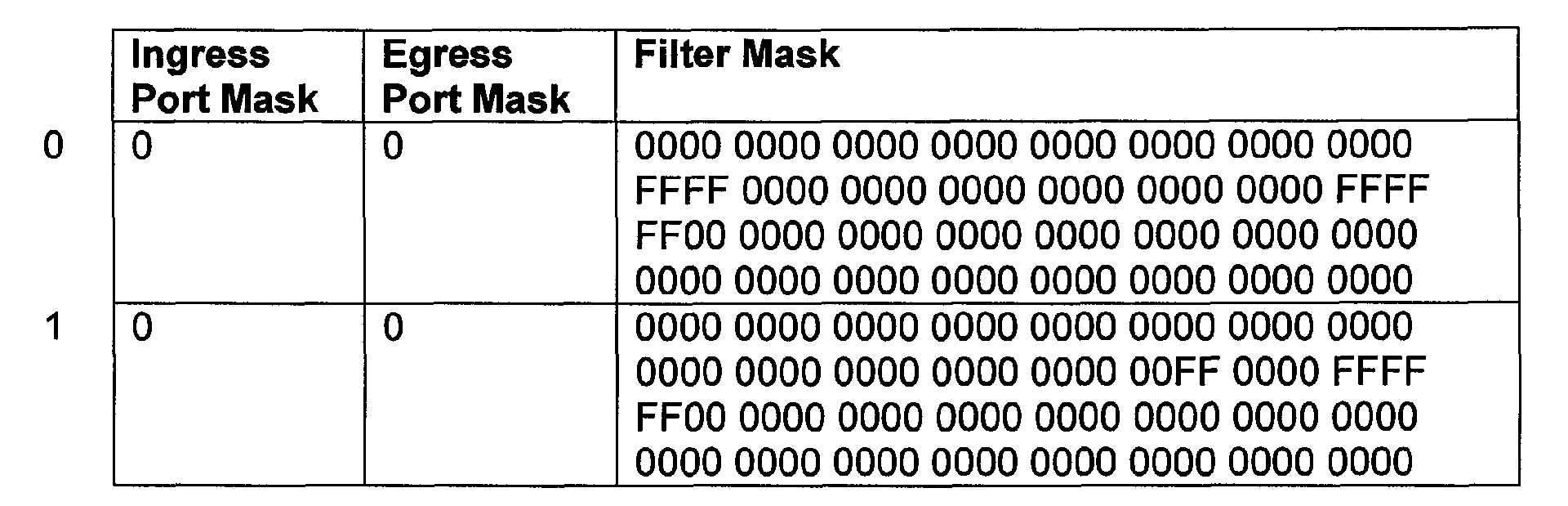
- the mask covers four of the first five 16-byte segments of the packet. If there is a match, some specific action will be taken.
- Every packet executed with this mask will only have bytes (0-based) 40 and 41 untouched. After the masking, the packet will be matched with all the rules associated with this mask, one of which has the value 0x022A (554 decimal) in bytes 40 and 41, shown below:
- the packet is an RTSP packet, it will have value 554 in its TCP destination port field and result in a match. Packet classifications result in the matched packets receiving special processing. The two actions related to traffic policing are discarding a packet and explicitly switching a packet.
- the switch on chip of the present invention has a built-in mechanism to resolve filter rule conflicts.
- Filtering conflict arises when there are two rules matching the same packet, while the two rules calling for two conflicting actions to be taken, such as discarding a packet and changing the packet's priority.
- the action associated with the filter of a higher mask index (the FSEL field of the rule) is executed.
- That command would have the form of:
- This filter rule will match all packets that have 0x0800 at its Layer 2 Frame Protocol Field, which indicates an IP packet; and 0x0050 at its TCP/UDP destination port field, which is the Well-Known-Port (WKP) for HTTP message.
- the action for a rule match is to discard the packet, which is indicated by having bit 4 (the least significant bit being bit 0) set. This is specified by the value 0x10 in the ACTION field.
- the LAN owner or administrator may want to disable web access as in the previous example, but only during certain hours.
- the access control list thus requires a qualification, which is a time range of that the access control list is in effect: time-range no-http periodic weekdays 8:00 to 18:00 ! access-list 101 deny tcp any any eq http time-range
- This command is implemented in conjunction with the CPU, which places the filter into the filter table at 08:00 and removes it at 18:00 every weekday.
- the filter is the same as the one used in the previous example, but shows the expandability of the filtering process.
- the LAN administrator may want to deny all IP traffic, except ICMP traffic, originated from the subnet 192.168.3.xx.
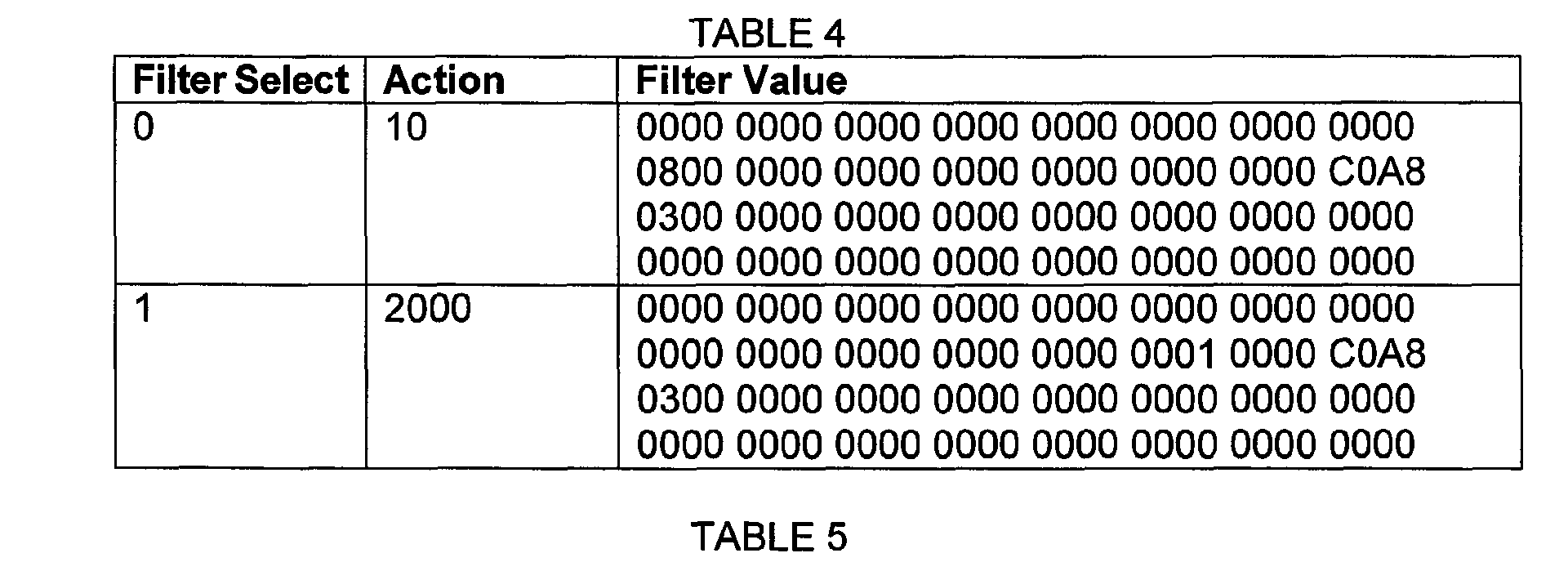
- the access control list consists of two commands and the following filter masks (Table 4) and filter rules (Table 5):
- the action of the second rule is 0x2000. With bit 13 set, the FFP will not discard the packet.
- the rule with the higher associated filter masks wins out. In this case, since the first rule's Filter Select value is 0, while the second rule's is 1, the second rule wins the tiebreaker.
- WKP Well-Known Port
- a LAN may only permit a certain type of IP telephony traffic in a particular subnet, while denying all other traffic in that subnet.
- the permitted traffic is represented by the standard protocol Session Initiation Protocol (SIP).
- SIP Session Initiation Protocol
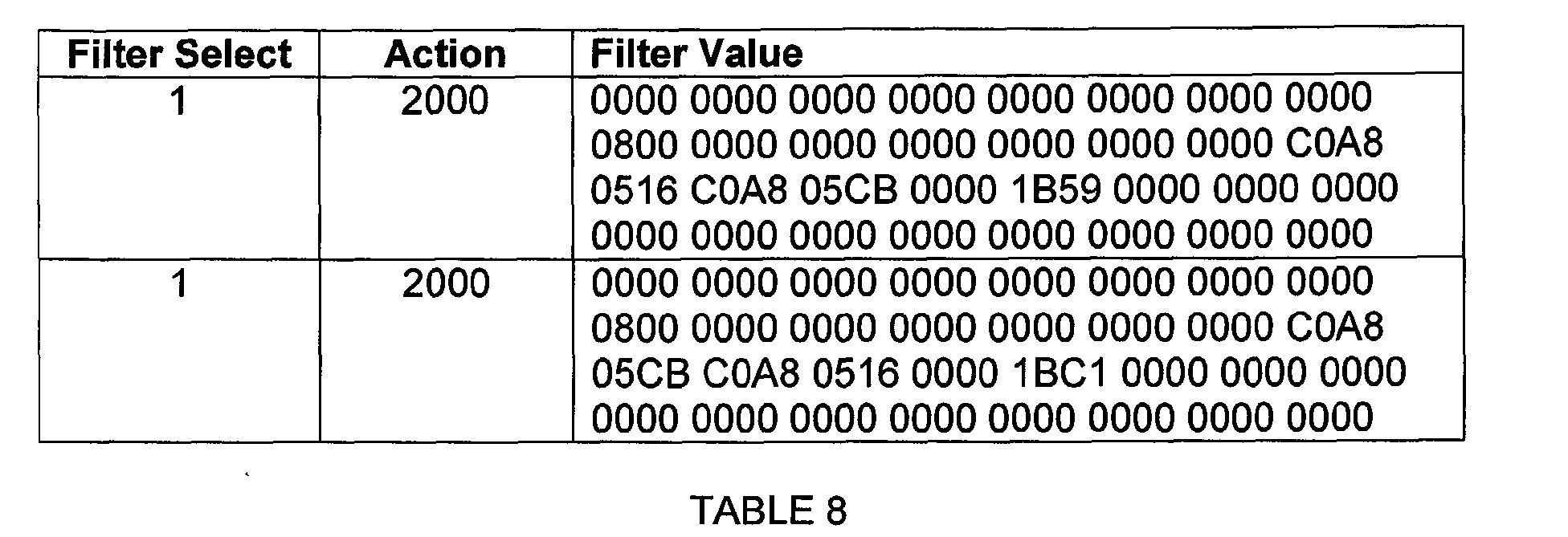
- the second rule will match all packets in the subnet 192.168.5.xx with the destination port number equal to 5060 (0x13C4), which is the WKP for SIP, but all such SIP packets will also match the first rule. Since the second rule has a higher Filter Select value, it will win the tiebreaker. Thus the SIP packets will not be discarded.
- the WKP is used only for session setup. Once a session is set up, the IP phone conversation is transmitted between two ports other than the WKP. These ports, known as dynamic ports, are negotiated between the two IP phones during the setup. They vary from call to call.
- the present invention has the capability to capture the SIP session setup messages, and find out about the dynamic ports to be used for the voice transmission.
- two addition rules will be inserted into the rule table to permit all the traffic between these two ports. For example, in a session between two IP phones 192.168.5.22 and 192.168.5.203, if the voice traffic from 192.168.5.22 to 192.168.5.203 uses the port 7001 (0x1 B59), while the traffic in the other direction uses the port 7105 (0x1 BC1), the following two rules are also required:
- the complement of the previous example is to deny all traffic of a particular application.
- denial of such traffic requires more than a single rule.
- it may require a substantial number of rules if the access denial starts when there are a lot of on-going traffic of that application.
- the ACL for that purpose is given as follows:
- the present invention is capable of keeping track of every SIP call, including the dynamic ports used. As soon as the ACL is enforced, such information will be used to create the new rules to discard the voice packets between the dynamic ports. For example, in an on-going call between 192.168.3.42 and 192.168.3.55, the voice traffic from 192.168.3.42 to 192.168.3.55 uses dynamic port 7510 (0x1D56), while the voice traffic in the other direction uses dynamic port 7530 (0x1D6A), the following two rules are required to explicitly discard the voice packets between the two:
- the FFP of the present invention provides a powerful tool for controlling network traffic.
- the FFP is able to regulate network traffic according to a specified Access Control List.
- Most of the access control commands can be implemented by FFP in a straightforward manner.
- the FFP can enable access control based on a flow, which is defined as traffic in a specific application, addresses, subnets and other criteria.
- a flow which is defined as traffic in a specific application, addresses, subnets and other criteria.
- access control can also be enabled and disabled dynamically, based on time-of-the-day, dates, and other conditions.
- the network switch of the present invention is also capable of offering Access Control to more complex network traffic.
- the software has the intelligence to snoop into traffic going through the switch, and retrieve information regarding the traffic of various applications, like Voice over IP and streaming media.
- the present invention offers policing of traffic flows that are not known a priori.
- Filters are setup in the filter table based on the Application Layer protocol type, i.e. packets are filtered based on information in the Transport Layer (Layer 4 in the ISO seven-layer model). After the initial filters are set, the Access Control Unit (ACU) is capable of adding new filters into the filter tables when the switch encounters certain types of packets. This dynamic creation of filter rules is discussed below with respect to a specific application.
- ACU Access Control Unit
- the dynamic creation of filter rules can occur, for example, in the setup and processing of Voice over IP (VOIP) applications.
- VOIP Voice over IP
- the process starts with types of packets that are called setup packets. These packets carry information regarding the media channels used in the subsequent a VOIP session. Such information belong to the Transport Layer.
- the ACU is capable of decoding the packet and extracting such Transport Layer information.
- the ACU creates new filters based on the extracted Transport Layer information. Such new filters filter all the media packets (voice or video) that pass through the switch. Access control (permit or deny) are then applied to these media packets.
- the ACU In case of permission of media packets, the ACU will remove the filter upon disconnection of the call. In case of denial of media packets, the filter will stay in the table indefinitely. Some timeout mechanism is required for the ACU to remove the filter.
- the present invention allows for dynamic access based on the application and allows for control of traffic even when the precise identifiers of packet data are not known initially.
- the above-discussed configuration of the invention is, in a preferred embodiment, embodied on a semiconductor substrate, such as silicon, with appropriate semiconductor manufacturing techniques and based upon a circuit layout which would, based upon the embodiments discussed above, be apparent to those skilled in the art.
- a person of skill in the art with respect to semiconductor design and manufacturing would be able to implement the various modules, interfaces, and tables, buffers, etc. of the present invention onto a single semiconductor substrate, based upon the architectural description discussed above. It would also be within the scope of the invention to implement the disclosed elements of the invention in discrete electronic components, thereby taking advantage of the functional aspects of the invention without maximizing the advantages through the use of a single semiconductor substrate.
Landscapes
- Engineering & Computer Science (AREA)
- Computer Networks & Wireless Communication (AREA)
- Signal Processing (AREA)
- Computer Hardware Design (AREA)
- Computer Security & Cryptography (AREA)
- Computing Systems (AREA)
- General Engineering & Computer Science (AREA)
- Business, Economics & Management (AREA)
- General Business, Economics & Management (AREA)
- Data Exchanges In Wide-Area Networks (AREA)
- Diaphragms For Electromechanical Transducers (AREA)
- Small-Scale Networks (AREA)
Abstract
Description
| Command Parameters | Descriptions |
| <protocol> | Layer III protocol in frame header or layer IV protocol in IP header |
| < IP> <wild-card> | specifies the network addresses in the ACL; <IP> specifies the IP address/subnet to be used; <wild-card>, in the same format as a regular IP address, specifies the wildcard value of the IP address (0 = must match, FF = ignored); any ACL must have two such pairs, the first one for the access control for the packet origin, while the second one for the packet destination |
| any | may replace any <IP> <wild-card> pair; same semantics as FF.FF.FF.FF in the <wild-card> |
| precedence <precedence> | precedence field in IP header |
| tos <tos> | type-of-service field in IP header |
| <icmp-type> | for an icmp message, the icmp-type field in IP payload, this parameter is specified in numeric (0-255) |
| <icmp-code> | for an icmp message, the icmp-code field in IP payload, this parameter is specified in numeric (0-255) |
| <icmp-message> | for an icmp message, the combined icmp type and code fields. The icmp-message is specified in a mnemonic, which is translated to a value from 0 to 255. |
| <igmp-type> | for an igmp message, the IGMP type field in the IP payload |
| eq <port> | destination port number in TCP/UDP header |
| established | for a TCP packet, the ACK bit or RST bit in CODE BITS in TCP header |
| eq <protocol> | ACL is applicable to an application protocol <protocol> |
| no- <protocol> | no application protocol <protocol> allowed |
| <time-range-id> | ACL is only effective in a specified time range <time-range- id>, which is predefined in a time-range command. |


time-range no-http
periodic weekdays 8:00 to 18:00
!
access-list 101 deny tcp any any eq http time-range
- Layer III protocol type = 0x0800 (IP), and
- IP source address = 0xC0A803 (192.168.3.xx).
- Layer IV protocol type = 0x01 (ICMP), and
- IP source address = 0xC0A803 (192.168.3.xx)




Claims (22)
- A network switch for network communications, said network switch comprising:wherein said data port interface further comprises an access control unit that filters the data coming into the data port interface and takes selective action on the data by applying a set of filter rules such that access to the switch is controlled by the set of filter rules.a data port interface, said data port interface supporting a plurality of data ports transmitting and receiving data;a CPU interface, said CPU interface configured to communicate with a CPU;a memory management unit, said memory management unit including a memory interface for communicating data from said data port interface to switch memory; anda communication channel, communicating data and messaging information between said data port interface, the CPU interface, said switch memory, and said memory management unit;
- A network switch as recited in claim 1, wherein said access control unit is programmable by inputs from the CPU through the CPU interface.
- A network switch as recited in claim 1, wherein said data port interface includes a filter mask table interface and a filter rules table thereupon, said set of filter rules being contained in the filter rules table, and wherein said access control unit applies a filter mask to a packet incoming thereto, providing a filter result, wherein said filter result is applied to the filter rules in said filter rules table, and wherein action is taken on the data based upon the filtering result.
- A network switch as recited in claim 3, wherein said data port interface, CPU interface, memory management unit, communications channel and said access control unit are implemented on a common semiconductor substrate.
- A network switch as recited in one of claims 1 and 4, wherein said access control filter comprises a fast filtering processor.
- A network switch as recited in claim 1, wherein the access control unit controls access to the switch by incoming data independent of the CPU interface, and therefore without communicating with the CPU.
- A network switch as recited in claim 1, wherein the access control unit controls access to the switch by incoming data in conjunction with communication with the CPU through the CPU interface.
- A network switch as recited in claim 7, wherein the CPU changes filter rules of the set of filter rules based on access control list set in the CPU.
- A network switch as recited in claim 1, wherein each filter rule of the set of filter rules has an associated index and conflicting filtering results based on the application of the filter rules are resolved through the associated indices of the filter rules.
- A method of handling data packets in a network switch, said method comprising:placing incoming packets into an input queue;filtering the incoming packet through application of a set of filter rules by an access control unit in order to determine if the incoming packet should have access through the network switch; anddiscarding, forwarding, or modifying the packet based upon the application of the set of filter rules.
- A method as recited in claim 10, wherein the method further comprises receiving the set of filter rules through communication with a CPU through a CPU interface.
- A method as recited in claim 11, wherein the method further comprises updating filter rules of the set of filter rules by the CPU based on an access control list set in the CPU.
- A method as recited in claim 12, wherein the method further comprises setting initial filter rules and said step of updating filter rules comprises adding new filter rules to the initial filter rules.
- A method as recited in claim 13, wherein the step of adding new filter rules to the initial filter rules occurs when certain types of packets are received and processed in the network switch.
- A method as recited in claim 10, wherein each filter rule of the set of filter rules has an associated index and the method further comprises resolving conflicting filtering results based on the application of the filter rules through the associated indices of the filter rules.
- A network switch for handling data packets comprising:means for placing incoming packets into an input queue;means for filtering the incoming packet through application of a set of filter rules by an access control unit in order to determine if the incoming packet should have access through the network switch; andmeans for discarding, forwarding, or modifying the packet based upon the application of the set of filter rules.
- A network switch as recited in claim 16, further comprising means for receiving the set of filter rules through communication with a CPU through a CPU interface.
- A network switch as recited in claim 16, further comprising means for updating filter rules of the set of filter rules by the CPU based on an access control list set in the CPU.
- A network switch as recited in claim 16, further comprising means for updating filter rules of the set of filter rules by the CPU based on an access control list set in the CPU.
- A network switch as recited in claim 19, further comprising means for setting initial filter rules and said means for updating filter rules comprises means for adding new filter rules to the initial filter rules.
- A method as recited in claim 20, wherein the means for adding new filter rules to the initial filter rules is configured to add new filter rules when certain types of packets are received and processed in the network switch.
- A network switch as recited in claim 14, wherein each filter rule of the set of filter rules has an associated index and the network switch further comprises means for resolving conflicting filtering results based on the application of the filter rules through the associated indices of the filter rules.
Applications Claiming Priority (2)
| Application Number | Priority Date | Filing Date | Title |
|---|---|---|---|
| US09/970,650 US7355970B2 (en) | 2001-10-05 | 2001-10-05 | Method and apparatus for enabling access on a network switch |
| US970650 | 2001-10-05 |
Publications (3)
| Publication Number | Publication Date |
|---|---|
| EP1300993A2 true EP1300993A2 (en) | 2003-04-09 |
| EP1300993A3 EP1300993A3 (en) | 2004-06-30 |
| EP1300993B1 EP1300993B1 (en) | 2006-07-05 |
Family
ID=25517257
Family Applications (1)
| Application Number | Title | Priority Date | Filing Date |
|---|---|---|---|
| EP02022232A Expired - Lifetime EP1300993B1 (en) | 2001-10-05 | 2002-10-02 | Method and apparatus for enabling access on a network switch |
Country Status (4)
| Country | Link |
|---|---|
| US (1) | US7355970B2 (en) |
| EP (1) | EP1300993B1 (en) |
| AT (1) | ATE332603T1 (en) |
| DE (1) | DE60212916T2 (en) |
Cited By (1)
| Publication number | Priority date | Publication date | Assignee | Title |
|---|---|---|---|---|
| FR2834412A1 (en) * | 2001-12-27 | 2003-07-04 | Zarlink Semiconductor Vn Inc | NETWORK NODE, PHYSICAL INTERFACE CONTAINED BY THIS NODE AND PROCESS FOR PROCESSING PACKAGES CARRYING A VOICE PAYLOAD |
Families Citing this family (77)
| Publication number | Priority date | Publication date | Assignee | Title |
|---|---|---|---|---|
| ATE343886T1 (en) * | 1999-03-17 | 2006-11-15 | Broadcom Corp | NETWORK BROKERAGE |
| US7643481B2 (en) * | 1999-03-17 | 2010-01-05 | Broadcom Corporation | Network switch having a programmable counter |
| US7596139B2 (en) | 2000-11-17 | 2009-09-29 | Foundry Networks, Inc. | Backplane interface adapter with error control and redundant fabric |
| US7236490B2 (en) | 2000-11-17 | 2007-06-26 | Foundry Networks, Inc. | Backplane interface adapter |
| US7068652B2 (en) * | 2001-03-07 | 2006-06-27 | Broadcom Corporation | Pointer based binary search engine and method for use in network devices |
| US7382787B1 (en) | 2001-07-30 | 2008-06-03 | Cisco Technology, Inc. | Packet routing and switching device |
| US7245620B2 (en) * | 2002-03-15 | 2007-07-17 | Broadcom Corporation | Method and apparatus for filtering packet data in a network device |
| CN1152531C (en) * | 2002-04-23 | 2004-06-02 | 华为技术有限公司 | Network Access Control Method for Fragmented Messages |
| US7187687B1 (en) | 2002-05-06 | 2007-03-06 | Foundry Networks, Inc. | Pipeline method and system for switching packets |
| US7468975B1 (en) | 2002-05-06 | 2008-12-23 | Foundry Networks, Inc. | Flexible method for processing data packets in a network routing system for enhanced efficiency and monitoring capability |
| US20120155466A1 (en) * | 2002-05-06 | 2012-06-21 | Ian Edward Davis | Method and apparatus for efficiently processing data packets in a computer network |
| US20090279558A1 (en) * | 2002-05-06 | 2009-11-12 | Ian Edward Davis | Network routing apparatus for enhanced efficiency and monitoring capability |
| US7649885B1 (en) | 2002-05-06 | 2010-01-19 | Foundry Networks, Inc. | Network routing system for enhanced efficiency and monitoring capability |
| US7266117B1 (en) | 2002-05-06 | 2007-09-04 | Foundry Networks, Inc. | System architecture for very fast ethernet blade |
| US7450438B1 (en) | 2002-06-20 | 2008-11-11 | Cisco Technology, Inc. | Crossbar apparatus for a forwarding table memory in a router |
| US7525904B1 (en) | 2002-06-20 | 2009-04-28 | Cisco Technology, Inc. | Redundant packet routing and switching device and method |
| US7536476B1 (en) * | 2002-12-20 | 2009-05-19 | Cisco Technology, Inc. | Method for performing tree based ACL lookups |
| US7970006B1 (en) * | 2003-03-10 | 2011-06-28 | Ciena Corporation | Dynamic configuration for a modular interconnect |
| US6901072B1 (en) | 2003-05-15 | 2005-05-31 | Foundry Networks, Inc. | System and method for high speed packet transmission implementing dual transmit and receive pipelines |
| US7706363B1 (en) | 2003-06-11 | 2010-04-27 | Radlan Computer Communications, Ltd | Method and apparatus for managing packets in a packet switched network |
| US20050080932A1 (en) * | 2003-10-09 | 2005-04-14 | Pao-Kang Liu | New generation fax machine |
| US7817659B2 (en) | 2004-03-26 | 2010-10-19 | Foundry Networks, Llc | Method and apparatus for aggregating input data streams |
| US8730961B1 (en) | 2004-04-26 | 2014-05-20 | Foundry Networks, Llc | System and method for optimizing router lookup |
| DE602004012721T2 (en) * | 2004-06-23 | 2009-04-16 | Alcatel Lucent | Network element with a coupling field |
| US20050286512A1 (en) * | 2004-06-28 | 2005-12-29 | Atul Mahamuni | Flow processing |
| US7688806B2 (en) * | 2004-07-15 | 2010-03-30 | Broadcom Corporation | Method and system for a gigabit ethernet IP telephone chip |
| US7746846B2 (en) * | 2004-07-15 | 2010-06-29 | Broadcom Corporation | Method and system for a gigabit Ethernet IP telephone chip with integrated security module |
| US7680053B1 (en) | 2004-10-29 | 2010-03-16 | Marvell International Ltd. | Inter-device flow control |
| US7657703B1 (en) | 2004-10-29 | 2010-02-02 | Foundry Networks, Inc. | Double density content addressable memory (CAM) lookup scheme |
| US8023408B2 (en) * | 2004-11-19 | 2011-09-20 | International Business Machines Corporation | Dynamically changing message priority or message sequence number |
| US20060136338A1 (en) * | 2004-12-16 | 2006-06-22 | Intel Corporation | Techniques for filtering attempts to access component core logic |
| US7889712B2 (en) | 2004-12-23 | 2011-02-15 | Cisco Technology, Inc. | Methods and apparatus for providing loop free routing tables |
| US7979702B2 (en) * | 2004-12-29 | 2011-07-12 | Intel Corporation | Protecting privacy of networked devices containing management subsystems |
| US8799428B2 (en) * | 2004-12-30 | 2014-08-05 | Intel Corporation | Automated provisioning of new networked devices |
| US20060262779A1 (en) * | 2005-05-18 | 2006-11-23 | International Business Machines Corporation | A method and apparatus for transferring data between cores in an integrated circuit |
| US8031706B2 (en) * | 2005-10-31 | 2011-10-04 | Agere Systems Inc. | Circuitry for determining network operations in a network device by addressing lookup tables with contents of protocol header fields |
| US7716729B2 (en) * | 2005-11-23 | 2010-05-11 | Genband Inc. | Method for responding to denial of service attacks at the session layer or above |
| US8448162B2 (en) | 2005-12-28 | 2013-05-21 | Foundry Networks, Llc | Hitless software upgrades |
| US7738403B2 (en) * | 2006-01-23 | 2010-06-15 | Cisco Technology, Inc. | Method for determining the operations performed on packets by a network device |
| US8041804B2 (en) * | 2006-05-25 | 2011-10-18 | Cisco Technology, Inc. | Utilizing captured IP packets to determine operations performed on packets by a network device |
| US8769091B2 (en) | 2006-05-25 | 2014-07-01 | Cisco Technology, Inc. | Method, device and medium for determining operations performed on a packet |
| US8665892B2 (en) * | 2006-05-30 | 2014-03-04 | Broadcom Corporation | Method and system for adaptive queue and buffer control based on monitoring in a packet network switch |
| US20080170502A1 (en) * | 2006-05-31 | 2008-07-17 | Thomas Benton | Method and system for monitoring data flow in an IP network device |
| US20070288690A1 (en) * | 2006-06-13 | 2007-12-13 | Foundry Networks, Inc. | High bandwidth, high capacity look-up table implementation in dynamic random access memory |
| US7903654B2 (en) | 2006-08-22 | 2011-03-08 | Foundry Networks, Llc | System and method for ECMP load sharing |
| US8238255B2 (en) | 2006-11-22 | 2012-08-07 | Foundry Networks, Llc | Recovering from failures without impact on data traffic in a shared bus architecture |
| US7940657B2 (en) | 2006-12-01 | 2011-05-10 | Sonus Networks, Inc. | Identifying attackers on a network |
| US7672336B2 (en) * | 2006-12-01 | 2010-03-02 | Sonus Networks, Inc. | Filtering and policing for defending against denial of service attacks on a network |
| US20090279441A1 (en) | 2007-01-11 | 2009-11-12 | Foundry Networks, Inc. | Techniques for transmitting failure detection protocol packets |
| US20100046516A1 (en) * | 2007-06-26 | 2010-02-25 | Media Patents, S.L. | Methods and Devices for Managing Multicast Traffic |
| US8205092B2 (en) * | 2007-06-26 | 2012-06-19 | Novell, Inc. | Time-based method for authorizing access to resources |
| ATE542327T1 (en) * | 2007-06-26 | 2012-02-15 | Media Patents Sl | DEVICE FOR MANAGING MULTIPLE SHIPMENT GROUPS |
| US8271859B2 (en) | 2007-07-18 | 2012-09-18 | Foundry Networks Llc | Segmented CRC design in high speed networks |
| US8037399B2 (en) | 2007-07-18 | 2011-10-11 | Foundry Networks, Llc | Techniques for segmented CRC design in high speed networks |
| US8149839B1 (en) | 2007-09-26 | 2012-04-03 | Foundry Networks, Llc | Selection of trunk ports and paths using rotation |
| US8064449B2 (en) * | 2007-10-15 | 2011-11-22 | Media Patents, S.L. | Methods and apparatus for managing multicast traffic |
| US8184630B2 (en) * | 2007-10-15 | 2012-05-22 | Media Patents, S.L. | Method for managing multicast traffic in a data network and network equipment using said method |
| EP2215772A1 (en) * | 2007-10-30 | 2010-08-11 | Media Patents, S. L. | Method for managing multicast traffic between routers communicating by means of a protocol integrating the pim protocol; and router and switch involved in said method |
| US9031068B2 (en) * | 2008-02-01 | 2015-05-12 | Media Patents, S.L. | Methods and apparatus for managing multicast traffic through a switch |
| WO2009095041A1 (en) * | 2008-02-01 | 2009-08-06 | Soporte Multivendor S.L. | Method for managing multicast traffic through a switch operating in the layer 2 of the osi model, and router and switch involved in said method |
| WO2009109684A1 (en) * | 2008-03-05 | 2009-09-11 | Media Patents, S. L. | Method for monitoring or managing devices connected to a data network |
| US8819201B2 (en) * | 2008-08-07 | 2014-08-26 | At&T Intellectual Property I, L.P. | Method and apparatus for providing routing and access control filters |
| US9262357B2 (en) | 2008-09-29 | 2016-02-16 | International Business Machines Corporation | Associating process priority with I/O queuing |
| US9357384B2 (en) | 2009-02-09 | 2016-05-31 | International Business Machines Corporation | System and method to support identity theft protection as part of a distributed service oriented ecosystem |
| US8090901B2 (en) | 2009-05-14 | 2012-01-03 | Brocade Communications Systems, Inc. | TCAM management approach that minimize movements |
| US8189584B2 (en) | 2009-07-27 | 2012-05-29 | Media Patents, S. L. | Multicast traffic management in a network interface |
| US8599850B2 (en) | 2009-09-21 | 2013-12-03 | Brocade Communications Systems, Inc. | Provisioning single or multistage networks using ethernet service instances (ESIs) |
| US20110149960A1 (en) * | 2009-12-17 | 2011-06-23 | Media Patents, S.L. | Method and apparatus for filtering multicast packets |
| US8819161B1 (en) | 2010-01-18 | 2014-08-26 | Marvell International Ltd. | Auto-syntonization and time-of-day synchronization for master-slave physical layer devices |
| US8307418B2 (en) * | 2010-03-16 | 2012-11-06 | Genband Inc. | Methods, systems, and computer readable media for providing application layer firewall and integrated deep packet inspection functions for providing early intrusion detection and intrusion prevention at an edge networking device |
| US20130067488A1 (en) * | 2010-05-19 | 2013-03-14 | Hughes Systique India Private Limited | Method and system for efficient inter- process communication in a high availability system |
| US9507736B2 (en) * | 2012-06-01 | 2016-11-29 | Broadcom Corporation | Network controller with integrated management controller |
| US10171422B2 (en) * | 2016-04-14 | 2019-01-01 | Owl Cyber Defense Solutions, Llc | Dynamically configurable packet filter |
| CN106130997A (en) * | 2016-06-30 | 2016-11-16 | 网宿科技股份有限公司 | The method and apparatus that flow guides |
| US10785118B2 (en) * | 2017-02-23 | 2020-09-22 | Dell Products L.P. | Systems and methods for network topology validation |
| US10425287B2 (en) | 2017-02-23 | 2019-09-24 | Dell Products L.P. | Systems and methods for network topology discovery |
| US11436024B2 (en) * | 2018-12-27 | 2022-09-06 | Texas Instruments Incorporated | Independent operation of an ethernet switch integrated on a system on a chip |
Family Cites Families (72)
| Publication number | Priority date | Publication date | Assignee | Title |
|---|---|---|---|---|
| US4899334A (en) | 1987-10-19 | 1990-02-06 | Oki Electric Industry Co., Ltd. | Self-routing multistage switching network for fast packet switching system |
| US5423015A (en) | 1988-10-20 | 1995-06-06 | Chung; David S. F. | Memory structure and method for shuffling a stack of data utilizing buffer memory locations |
| US5276789A (en) * | 1990-05-14 | 1994-01-04 | Hewlett-Packard Co. | Graphic display of network topology |
| US5253248A (en) | 1990-07-03 | 1993-10-12 | At&T Bell Laboratories | Congestion control for connectionless traffic in data networks via alternate routing |
| GB9023867D0 (en) | 1990-11-02 | 1990-12-12 | Mv Ltd | Improvements relating to a fault tolerant storage system |
| JPH04189023A (en) | 1990-11-22 | 1992-07-07 | Victor Co Of Japan Ltd | Pulse synchronizing circuit |
| JPH04214290A (en) | 1990-12-12 | 1992-08-05 | Mitsubishi Electric Corp | Semiconductor memory device |
| US5274631A (en) * | 1991-03-11 | 1993-12-28 | Kalpana, Inc. | Computer network switching system |
| JPH05183828A (en) | 1991-12-27 | 1993-07-23 | Sony Corp | Electronics |
| US5245606A (en) * | 1992-01-02 | 1993-09-14 | National Semiconductor Corporation | Computer network bridge circuit |
| DE69319757T2 (en) | 1992-01-10 | 1999-04-15 | Digital Equipment Corp | Method for connecting a line card to an address recognition unit |
| US5490252A (en) * | 1992-09-30 | 1996-02-06 | Bay Networks Group, Inc. | System having central processor for transmitting generic packets to another processor to be altered and transmitting altered packets back to central processor for routing |
| DE69324204T2 (en) | 1992-10-22 | 1999-12-23 | Cabletron Systems, Inc. | Searching for addresses during packet transmission using hashing and a content-addressed memory |
| US5390173A (en) | 1992-10-22 | 1995-02-14 | Digital Equipment Corporation | Packet format in hub for packet data communications system |
| US5696899A (en) | 1992-11-18 | 1997-12-09 | Canon Kabushiki Kaisha | Method and apparatus for adaptively determining the format of data packets carried on a local area network |
| US5473607A (en) | 1993-08-09 | 1995-12-05 | Grand Junction Networks, Inc. | Packet filtering for data networks |
| US5499295A (en) | 1993-08-31 | 1996-03-12 | Ericsson Inc. | Method and apparatus for feature authorization and software copy protection in RF communications devices |
| US5802287A (en) | 1993-10-20 | 1998-09-01 | Lsi Logic Corporation | Single chip universal protocol multi-function ATM network interface |
| US5887187A (en) | 1993-10-20 | 1999-03-23 | Lsi Logic Corporation | Single chip network adapter apparatus |
| US5835726A (en) * | 1993-12-15 | 1998-11-10 | Check Point Software Technologies Ltd. | System for securing the flow of and selectively modifying packets in a computer network |
| US5579301A (en) | 1994-02-28 | 1996-11-26 | Micom Communications Corp. | System for, and method of, managing voice congestion in a network environment |
| US5459717A (en) | 1994-03-25 | 1995-10-17 | Sprint International Communications Corporation | Method and apparatus for routing messagers in an electronic messaging system |
| US5555398A (en) | 1994-04-15 | 1996-09-10 | Intel Corporation | Write back cache coherency module for systems with a write through cache supporting bus |
| FR2725573B1 (en) | 1994-10-11 | 1996-11-15 | Thomson Csf | METHOD AND DEVICE FOR CONTROLLING CONGESTION OF SPORADIC EXCHANGES OF DATA PACKETS IN A DIGITAL TRANSMISSION NETWORK |
| EP0719065A1 (en) | 1994-12-20 | 1996-06-26 | International Business Machines Corporation | Multipurpose packet switching node for a data communication network |
| US5790539A (en) | 1995-01-26 | 1998-08-04 | Chao; Hung-Hsiang Jonathan | ASIC chip for implementing a scaleable multicast ATM switch |
| US5644784A (en) | 1995-03-03 | 1997-07-01 | Intel Corporation | Linear list based DMA control structure |
| US5664116A (en) | 1995-07-07 | 1997-09-02 | Sun Microsystems, Inc. | Buffering of data for transmission in a computer communication system interface |
| US5684800A (en) | 1995-11-15 | 1997-11-04 | Cabletron Systems, Inc. | Method for establishing restricted broadcast groups in a switched network |
| US5781549A (en) | 1996-02-23 | 1998-07-14 | Allied Telesyn International Corp. | Method and apparatus for switching data packets in a data network |
| US5940596A (en) | 1996-03-25 | 1999-08-17 | I-Cube, Inc. | Clustered address caching system for a network switch |
| US5828653A (en) | 1996-04-26 | 1998-10-27 | Cascade Communications Corp. | Quality of service priority subclasses |
| US5748631A (en) | 1996-05-09 | 1998-05-05 | Maker Communications, Inc. | Asynchronous transfer mode cell processing system with multiple cell source multiplexing |
| US5787084A (en) | 1996-06-05 | 1998-07-28 | Compaq Computer Corporation | Multicast data communications switching system and associated method |
| US5802052A (en) | 1996-06-26 | 1998-09-01 | Level One Communication, Inc. | Scalable high performance switch element for a shared memory packet or ATM cell switch fabric |
| US5898687A (en) | 1996-07-24 | 1999-04-27 | Cisco Systems, Inc. | Arbitration mechanism for a multicast logic engine of a switching fabric circuit |
| GB9618132D0 (en) | 1996-08-30 | 1996-10-09 | Sgs Thomson Microelectronics | Improvements in or relating to an ATM switch |
| US5845081A (en) | 1996-09-03 | 1998-12-01 | Sun Microsystems, Inc. | Using objects to discover network information about a remote network having a different network protocol |
| US5831980A (en) | 1996-09-13 | 1998-11-03 | Lsi Logic Corporation | Shared memory fabric architecture for very high speed ATM switches |
| US5842038A (en) | 1996-10-10 | 1998-11-24 | Unisys Corporation | Optimized input/output memory access request system and method |
| JP3123447B2 (en) | 1996-11-13 | 2001-01-09 | 日本電気株式会社 | Switch control circuit of ATM exchange |
| EP0849917B1 (en) | 1996-12-20 | 2005-07-20 | International Business Machines Corporation | Switching system |
| US6233246B1 (en) | 1996-12-30 | 2001-05-15 | Compaq Computer Corporation | Network switch with statistics read accesses |
| DE19703833A1 (en) | 1997-02-01 | 1998-08-06 | Philips Patentverwaltung | Coupling device |
| US6452933B1 (en) | 1997-02-07 | 2002-09-17 | Lucent Technologies Inc. | Fair queuing system with adaptive bandwidth redistribution |
| US6061351A (en) | 1997-02-14 | 2000-05-09 | Advanced Micro Devices, Inc. | Multicopy queue structure with searchable cache area |
| US6175902B1 (en) | 1997-12-18 | 2001-01-16 | Advanced Micro Devices, Inc. | Method and apparatus for maintaining a time order by physical ordering in a memory |
| US5852607A (en) * | 1997-02-26 | 1998-12-22 | Cisco Technology, Inc. | Addressing mechanism for multiple look-up tables |
| US5892922A (en) | 1997-02-28 | 1999-04-06 | 3Com Corporation | Virtual local area network memory access system |
| US5983270A (en) * | 1997-03-11 | 1999-11-09 | Sequel Technology Corporation | Method and apparatus for managing internetwork and intranetwork activity |
| US6011795A (en) | 1997-03-20 | 2000-01-04 | Washington University | Method and apparatus for fast hierarchical address lookup using controlled expansion of prefixes |
| US6014380A (en) | 1997-06-30 | 2000-01-11 | Sun Microsystems, Inc. | Mechanism for packet field replacement in a multi-layer distributed network element |
| US5920566A (en) | 1997-06-30 | 1999-07-06 | Sun Microsystems, Inc. | Routing in a multi-layer distributed network element |
| US5938736A (en) * | 1997-06-30 | 1999-08-17 | Sun Microsystems, Inc. | Search engine architecture for a high performance multi-layer switch element |
| US6115378A (en) | 1997-06-30 | 2000-09-05 | Sun Microsystems, Inc. | Multi-layer distributed network element |
| US6246680B1 (en) | 1997-06-30 | 2001-06-12 | Sun Microsystems, Inc. | Highly integrated multi-layer switch element architecture |
| US6119196A (en) | 1997-06-30 | 2000-09-12 | Sun Microsystems, Inc. | System having multiple arbitrating levels for arbitrating access to a shared memory by network ports operating at different data rates |
| US6021132A (en) | 1997-06-30 | 2000-02-01 | Sun Microsystems, Inc. | Shared memory management in a switched network element |
| US5909686A (en) | 1997-06-30 | 1999-06-01 | Sun Microsystems, Inc. | Hardware-assisted central processing unit access to a forwarding database |
| US6094435A (en) | 1997-06-30 | 2000-07-25 | Sun Microsystems, Inc. | System and method for a quality of service in a multi-layer network element |
| US6088356A (en) | 1997-06-30 | 2000-07-11 | Sun Microsystems, Inc. | System and method for a multi-layer network element |
| US6016310A (en) | 1997-06-30 | 2000-01-18 | Sun Microsystems, Inc. | Trunking support in a high performance network device |
| US5918074A (en) | 1997-07-25 | 1999-06-29 | Neonet Llc | System architecture for and method of dual path data processing and management of packets and/or cells and the like |
| US6041053A (en) | 1997-09-18 | 2000-03-21 | Microsfot Corporation | Technique for efficiently classifying packets using a trie-indexed hierarchy forest that accommodates wildcards |
| JP2959539B2 (en) | 1997-10-01 | 1999-10-06 | 日本電気株式会社 | Buffer control method and device |
| US6185185B1 (en) | 1997-11-21 | 2001-02-06 | International Business Machines Corporation | Methods, systems and computer program products for suppressing multiple destination traffic in a computer network |
| US6341130B1 (en) * | 1998-02-09 | 2002-01-22 | Lucent Technologies, Inc. | Packet classification method and apparatus employing two fields |
| GB2337905B (en) | 1998-05-28 | 2003-02-12 | 3Com Technologies Ltd | Buffer management in network devices |
| WO2000003516A1 (en) | 1998-07-08 | 2000-01-20 | Broadcom Corporation | Network switching architecture with multiple table synchronization, and forwarding of both ip and ipx packets |
| EP1208677B1 (en) | 1999-09-03 | 2012-05-02 | Broadcom Corporation | Apparatus and method for enabling voice over ip support for a network switch |
| US7039641B2 (en) * | 2000-02-24 | 2006-05-02 | Lucent Technologies Inc. | Modular packet classification |
| US20020083331A1 (en) * | 2000-12-21 | 2002-06-27 | 802 Systems, Inc. | Methods and systems using PLD-based network communication protocols |
-
2001
- 2001-10-05 US US09/970,650 patent/US7355970B2/en not_active Expired - Lifetime
-
2002
- 2002-10-02 DE DE60212916T patent/DE60212916T2/en not_active Expired - Lifetime
- 2002-10-02 AT AT02022232T patent/ATE332603T1/en not_active IP Right Cessation
- 2002-10-02 EP EP02022232A patent/EP1300993B1/en not_active Expired - Lifetime
Cited By (1)
| Publication number | Priority date | Publication date | Assignee | Title |
|---|---|---|---|---|
| FR2834412A1 (en) * | 2001-12-27 | 2003-07-04 | Zarlink Semiconductor Vn Inc | NETWORK NODE, PHYSICAL INTERFACE CONTAINED BY THIS NODE AND PROCESS FOR PROCESSING PACKAGES CARRYING A VOICE PAYLOAD |
Also Published As
| Publication number | Publication date |
|---|---|
| US7355970B2 (en) | 2008-04-08 |
| DE60212916T2 (en) | 2007-03-15 |
| EP1300993A3 (en) | 2004-06-30 |
| US20030091042A1 (en) | 2003-05-15 |
| ATE332603T1 (en) | 2006-07-15 |
| DE60212916D1 (en) | 2006-08-17 |
| EP1300993B1 (en) | 2006-07-05 |
Similar Documents
| Publication | Publication Date | Title |
|---|---|---|
| US7355970B2 (en) | Method and apparatus for enabling access on a network switch | |
| US7577148B2 (en) | Apparatus and method for enabling Voice Over IP support for a network switch | |
| EP1180877B1 (en) | Method and apparatus for filtering packets based on data flows using address tables | |
| US6876653B2 (en) | Fast flexible filter processor based architecture for a network device | |
| US7415022B2 (en) | Network switching architecture with multiple table synchronization, and forwarding of both IP and IPX packets | |
| US6430188B1 (en) | Unified table for L2, L3, L4, switching and filtering | |
| US6993027B1 (en) | Method for sending a switch indicator to avoid out-of-ordering of frames in a network switch | |
| US7643481B2 (en) | Network switch having a programmable counter | |
| US7099276B1 (en) | Apparatus and method for distributing a load across a trunk group | |
| EP1345363A2 (en) | Scalable packet filter for a network device | |
| EP1197045B1 (en) | Unified table for L2, L3, L4 switching and filtering |
Legal Events
| Date | Code | Title | Description |
|---|---|---|---|
| PUAI | Public reference made under article 153(3) epc to a published international application that has entered the european phase |
Free format text: ORIGINAL CODE: 0009012 |
|
| 17P | Request for examination filed |
Effective date: 20021002 |
|
| AK | Designated contracting states |
Kind code of ref document: A2 Designated state(s): AT BE BG CH CY CZ DE DK EE ES FI FR GB GR IE IT LI LU MC NL PT SE SK TR |
|
| AX | Request for extension of the european patent |
Extension state: AL LT LV MK RO SI |
|
| PUAL | Search report despatched |
Free format text: ORIGINAL CODE: 0009013 |
|
| AK | Designated contracting states |
Kind code of ref document: A3 Designated state(s): AT BE BG CH CY CZ DE DK EE ES FI FR GB GR IE IT LI LU MC NL PT SE SK TR |
|
| AX | Request for extension of the european patent |
Extension state: AL LT LV MK RO SI |
|
| 17Q | First examination report despatched |
Effective date: 20040802 |
|
| AKX | Designation fees paid |
Designated state(s): AT BE BG CH CY CZ DE DK EE ES FI FR GB GR IE IT LI LU MC NL PT SE SK TR |
|
| GRAP | Despatch of communication of intention to grant a patent |
Free format text: ORIGINAL CODE: EPIDOSNIGR1 |
|
| GRAS | Grant fee paid |
Free format text: ORIGINAL CODE: EPIDOSNIGR3 |
|
| GRAA | (expected) grant |
Free format text: ORIGINAL CODE: 0009210 |
|
| AK | Designated contracting states |
Kind code of ref document: B1 Designated state(s): AT BE BG CH CY CZ DE DK EE ES FI FR GB GR IE IT LI LU MC NL PT SE SK TR |
|
| PG25 | Lapsed in a contracting state [announced via postgrant information from national office to epo] |
Ref country code: NL Free format text: LAPSE BECAUSE OF FAILURE TO SUBMIT A TRANSLATION OF THE DESCRIPTION OR TO PAY THE FEE WITHIN THE PRESCRIBED TIME-LIMIT Effective date: 20060705 Ref country code: FI Free format text: LAPSE BECAUSE OF FAILURE TO SUBMIT A TRANSLATION OF THE DESCRIPTION OR TO PAY THE FEE WITHIN THE PRESCRIBED TIME-LIMIT Effective date: 20060705 Ref country code: IT Free format text: LAPSE BECAUSE OF FAILURE TO SUBMIT A TRANSLATION OF THE DESCRIPTION OR TO PAY THE FEE WITHIN THE PRESCRIBED TIME-LIMIT;WARNING: LAPSES OF ITALIAN PATENTS WITH EFFECTIVE DATE BEFORE 2007 MAY HAVE OCCURRED AT ANY TIME BEFORE 2007. THE CORRECT EFFECTIVE DATE MAY BE DIFFERENT FROM THE ONE RECORDED. Effective date: 20060705 Ref country code: AT Free format text: LAPSE BECAUSE OF FAILURE TO SUBMIT A TRANSLATION OF THE DESCRIPTION OR TO PAY THE FEE WITHIN THE PRESCRIBED TIME-LIMIT Effective date: 20060705 Ref country code: CH Free format text: LAPSE BECAUSE OF FAILURE TO SUBMIT A TRANSLATION OF THE DESCRIPTION OR TO PAY THE FEE WITHIN THE PRESCRIBED TIME-LIMIT Effective date: 20060705 Ref country code: CZ Free format text: LAPSE BECAUSE OF FAILURE TO SUBMIT A TRANSLATION OF THE DESCRIPTION OR TO PAY THE FEE WITHIN THE PRESCRIBED TIME-LIMIT Effective date: 20060705 Ref country code: BE Free format text: LAPSE BECAUSE OF FAILURE TO SUBMIT A TRANSLATION OF THE DESCRIPTION OR TO PAY THE FEE WITHIN THE PRESCRIBED TIME-LIMIT Effective date: 20060705 Ref country code: SK Free format text: LAPSE BECAUSE OF FAILURE TO SUBMIT A TRANSLATION OF THE DESCRIPTION OR TO PAY THE FEE WITHIN THE PRESCRIBED TIME-LIMIT Effective date: 20060705 Ref country code: LI Free format text: LAPSE BECAUSE OF FAILURE TO SUBMIT A TRANSLATION OF THE DESCRIPTION OR TO PAY THE FEE WITHIN THE PRESCRIBED TIME-LIMIT Effective date: 20060705 |
|
| REG | Reference to a national code |
Ref country code: GB Ref legal event code: FG4D |
|
| REG | Reference to a national code |
Ref country code: CH Ref legal event code: EP |
|
| REG | Reference to a national code |
Ref country code: IE Ref legal event code: FG4D |
|
| REF | Corresponds to: |
Ref document number: 60212916 Country of ref document: DE Date of ref document: 20060817 Kind code of ref document: P |
|
| PG25 | Lapsed in a contracting state [announced via postgrant information from national office to epo] |
Ref country code: IE Free format text: LAPSE BECAUSE OF NON-PAYMENT OF DUE FEES Effective date: 20061002 |
|
| PG25 | Lapsed in a contracting state [announced via postgrant information from national office to epo] |
Ref country code: SE Free format text: LAPSE BECAUSE OF FAILURE TO SUBMIT A TRANSLATION OF THE DESCRIPTION OR TO PAY THE FEE WITHIN THE PRESCRIBED TIME-LIMIT Effective date: 20061005 Ref country code: BG Free format text: LAPSE BECAUSE OF FAILURE TO SUBMIT A TRANSLATION OF THE DESCRIPTION OR TO PAY THE FEE WITHIN THE PRESCRIBED TIME-LIMIT Effective date: 20061005 Ref country code: DK Free format text: LAPSE BECAUSE OF FAILURE TO SUBMIT A TRANSLATION OF THE DESCRIPTION OR TO PAY THE FEE WITHIN THE PRESCRIBED TIME-LIMIT Effective date: 20061005 |
|
| PG25 | Lapsed in a contracting state [announced via postgrant information from national office to epo] |
Ref country code: ES Free format text: LAPSE BECAUSE OF FAILURE TO SUBMIT A TRANSLATION OF THE DESCRIPTION OR TO PAY THE FEE WITHIN THE PRESCRIBED TIME-LIMIT Effective date: 20061016 |
|
| PG25 | Lapsed in a contracting state [announced via postgrant information from national office to epo] |
Ref country code: MC Free format text: LAPSE BECAUSE OF NON-PAYMENT OF DUE FEES Effective date: 20061031 |
|
| NLV1 | Nl: lapsed or annulled due to failure to fulfill the requirements of art. 29p and 29m of the patents act | ||
| PG25 | Lapsed in a contracting state [announced via postgrant information from national office to epo] |
Ref country code: PT Free format text: LAPSE BECAUSE OF FAILURE TO SUBMIT A TRANSLATION OF THE DESCRIPTION OR TO PAY THE FEE WITHIN THE PRESCRIBED TIME-LIMIT Effective date: 20061205 |
|
| ET | Fr: translation filed | ||
| PLBE | No opposition filed within time limit |
Free format text: ORIGINAL CODE: 0009261 |
|
| STAA | Information on the status of an ep patent application or granted ep patent |
Free format text: STATUS: NO OPPOSITION FILED WITHIN TIME LIMIT |
|
| RAP2 | Party data changed (patent owner data changed or rights of a patent transferred) |
Owner name: BROADCOM CORPORATION |
|
| 26N | No opposition filed |
Effective date: 20070410 |
|
| REG | Reference to a national code |
Ref country code: FR Ref legal event code: CA |
|
| PG25 | Lapsed in a contracting state [announced via postgrant information from national office to epo] |
Ref country code: GR Free format text: LAPSE BECAUSE OF FAILURE TO SUBMIT A TRANSLATION OF THE DESCRIPTION OR TO PAY THE FEE WITHIN THE PRESCRIBED TIME-LIMIT Effective date: 20061006 |
|
| PG25 | Lapsed in a contracting state [announced via postgrant information from national office to epo] |
Ref country code: EE Free format text: LAPSE BECAUSE OF FAILURE TO SUBMIT A TRANSLATION OF THE DESCRIPTION OR TO PAY THE FEE WITHIN THE PRESCRIBED TIME-LIMIT Effective date: 20060705 |
|
| PG25 | Lapsed in a contracting state [announced via postgrant information from national office to epo] |
Ref country code: LU Free format text: LAPSE BECAUSE OF NON-PAYMENT OF DUE FEES Effective date: 20061002 Ref country code: TR Free format text: LAPSE BECAUSE OF FAILURE TO SUBMIT A TRANSLATION OF THE DESCRIPTION OR TO PAY THE FEE WITHIN THE PRESCRIBED TIME-LIMIT Effective date: 20060705 |
|
| PG25 | Lapsed in a contracting state [announced via postgrant information from national office to epo] |
Ref country code: CY Free format text: LAPSE BECAUSE OF FAILURE TO SUBMIT A TRANSLATION OF THE DESCRIPTION OR TO PAY THE FEE WITHIN THE PRESCRIBED TIME-LIMIT Effective date: 20060705 |
|
| PGFP | Annual fee paid to national office [announced via postgrant information from national office to epo] |
Ref country code: FR Payment date: 20131018 Year of fee payment: 12 |
|
| REG | Reference to a national code |
Ref country code: FR Ref legal event code: ST Effective date: 20150630 |
|
| PG25 | Lapsed in a contracting state [announced via postgrant information from national office to epo] |
Ref country code: FR Free format text: LAPSE BECAUSE OF NON-PAYMENT OF DUE FEES Effective date: 20141031 |
|
| REG | Reference to a national code |
Ref country code: DE Ref legal event code: R082 Ref document number: 60212916 Country of ref document: DE Representative=s name: BOSCH JEHLE PATENTANWALTSGESELLSCHAFT MBH, DE Ref country code: DE Ref legal event code: R081 Ref document number: 60212916 Country of ref document: DE Owner name: AVAGO TECHNOLOGIES INTERNATIONAL SALES PTE. LT, SG Free format text: FORMER OWNER: BROADCOM CORP., IRVINE, CALIF., US Ref country code: DE Ref legal event code: R081 Ref document number: 60212916 Country of ref document: DE Owner name: AVAGO TECHNOLOGIES GENERAL IP (SINGAPORE) PTE., SG Free format text: FORMER OWNER: BROADCOM CORP., IRVINE, CALIF., US |
|
| REG | Reference to a national code |
Ref country code: GB Ref legal event code: 732E Free format text: REGISTERED BETWEEN 20171005 AND 20171011 |
|
| REG | Reference to a national code |
Ref country code: DE Ref legal event code: R081 Ref document number: 60212916 Country of ref document: DE Owner name: AVAGO TECHNOLOGIES INTERNATIONAL SALES PTE. LT, SG Free format text: FORMER OWNER: AVAGO TECHNOLOGIES GENERAL IP (SINGAPORE) PTE. LTD., SINGAPORE, SG Ref country code: DE Ref legal event code: R082 Ref document number: 60212916 Country of ref document: DE Representative=s name: BOSCH JEHLE PATENTANWALTSGESELLSCHAFT MBH, DE |
|
| REG | Reference to a national code |
Ref country code: GB Ref legal event code: 732E Free format text: REGISTERED BETWEEN 20190222 AND 20190227 |
|
| PGFP | Annual fee paid to national office [announced via postgrant information from national office to epo] |
Ref country code: GB Payment date: 20191028 Year of fee payment: 18 |
|
| GBPC | Gb: european patent ceased through non-payment of renewal fee |
Effective date: 20201002 |
|
| PG25 | Lapsed in a contracting state [announced via postgrant information from national office to epo] |
Ref country code: GB Free format text: LAPSE BECAUSE OF NON-PAYMENT OF DUE FEES Effective date: 20201002 |
|
| PGFP | Annual fee paid to national office [announced via postgrant information from national office to epo] |
Ref country code: DE Payment date: 20211011 Year of fee payment: 20 |
|
| REG | Reference to a national code |
Ref country code: DE Ref legal event code: R071 Ref document number: 60212916 Country of ref document: DE |