EP1300748A2 - Method and system for managing, accessing and paying for the use of copyrighted electronic media - Google Patents
Method and system for managing, accessing and paying for the use of copyrighted electronic media Download PDFInfo
- Publication number
- EP1300748A2 EP1300748A2 EP02078887A EP02078887A EP1300748A2 EP 1300748 A2 EP1300748 A2 EP 1300748A2 EP 02078887 A EP02078887 A EP 02078887A EP 02078887 A EP02078887 A EP 02078887A EP 1300748 A2 EP1300748 A2 EP 1300748A2
- Authority
- EP
- European Patent Office
- Prior art keywords
- media
- copyrighted
- licensing
- steganographically
- information
- Prior art date
- Legal status (The legal status is an assumption and is not a legal conclusion. Google has not performed a legal analysis and makes no representation as to the accuracy of the status listed.)
- Withdrawn
Links
Images


Classifications
-
- G—PHYSICS
- G06—COMPUTING OR CALCULATING; COUNTING
- G06F—ELECTRIC DIGITAL DATA PROCESSING
- G06F21/00—Security arrangements for protecting computers, components thereof, programs or data against unauthorised activity
- G06F21/10—Protecting distributed programs or content, e.g. vending or licensing of copyrighted material ; Digital rights management [DRM]
- G06F21/109—Protecting distributed programs or content, e.g. vending or licensing of copyrighted material ; Digital rights management [DRM] by using specially-adapted hardware at the client
-
- H—ELECTRICITY
- H04—ELECTRIC COMMUNICATION TECHNIQUE
- H04N—PICTORIAL COMMUNICATION, e.g. TELEVISION
- H04N2201/00—Indexing scheme relating to scanning, transmission or reproduction of documents or the like, and to details thereof
- H04N2201/32—Circuits or arrangements for control or supervision between transmitter and receiver or between image input and image output device, e.g. between a still-image camera and its memory or between a still-image camera and a printer device
- H04N2201/3201—Display, printing, storage or transmission of additional information, e.g. ID code, date and time or title
- H04N2201/3225—Display, printing, storage or transmission of additional information, e.g. ID code, date and time or title of data relating to an image, a page or a document
- H04N2201/3233—Display, printing, storage or transmission of additional information, e.g. ID code, date and time or title of data relating to an image, a page or a document of authentication information, e.g. digital signature, watermark
-
- H—ELECTRICITY
- H04—ELECTRIC COMMUNICATION TECHNIQUE
- H04N—PICTORIAL COMMUNICATION, e.g. TELEVISION
- H04N2201/00—Indexing scheme relating to scanning, transmission or reproduction of documents or the like, and to details thereof
- H04N2201/32—Circuits or arrangements for control or supervision between transmitter and receiver or between image input and image output device, e.g. between a still-image camera and its memory or between a still-image camera and a printer device
- H04N2201/3201—Display, printing, storage or transmission of additional information, e.g. ID code, date and time or title
- H04N2201/3269—Display, printing, storage or transmission of additional information, e.g. ID code, date and time or title of machine readable codes or marks, e.g. bar codes or glyphs
- H04N2201/327—Display, printing, storage or transmission of additional information, e.g. ID code, date and time or title of machine readable codes or marks, e.g. bar codes or glyphs which are undetectable to the naked eye, e.g. embedded codes
Definitions
- the present invention relates electronic copyrighted media and, more particularly, to a method and system for licensing copyrighted electronic media in which a substantially unusable version of the copyrighted media is electronically distributed, and upon acceptance of licensing conditions, the original copyrighted is distributed.
- the multilevel data image is convolved with an encoding carrier image to produce a frequency dispersed data image, and the frequency dispersed data image is added to the source image to produce a source image containing embedded data.
- the data is recovered from the image by cross correlating the source image containing embedded data with a decoding carrier image to recover the data image, and extracting the digital data from the recovered data image.
- U.S. Patent 6,026,193 to Geoffrey B. Rhoads entitled Video Steganography discloses a method of decoding encoded video to extract multi-bit auxiliary data.
- the prior art goes beyond methods to embedding steganographic data into electronic media or methods and apparatus for controlling systems based on steganographic data.
- methods have been developed to manage the access to copyrighted works, providing a systematic way of controlling the rights to copyrighted electronic media.
- U.S. Patent No. 5,765,152 to Erickson entitled System and Method for Managing Copyrighted Electronic Media discloses such a system.
- copyrighted electronic media are packaged in a secure electronic format, and registered on associated registration server, which serves to provide on-line licensing and copyright management for that media.
- Users are connecting to the server through a computer network or the Internet, to enable data transfers and to transact licenses to utilize the media.
- the packaged media is registered on the server, the media is made available for limited use and possible license through an authorization server. This limited use is specified within the minimum permission data set assigned to each packaged media. Without a license, users are permitted to view the packaged media through a system which unpacks the media - - but cannot save or otherwise transfer the media without obtaining auxiliary permissions to do so from the authorization server.
- This patent discloses balancing between the free access for fair use and ownership protection. However, it solves the problem of balance in a fairly typical way of imposing a closed system solution on both the owners and the users of the electronic media. The owners must 'package' their content prior to registering and storing it within the system. A user must use a 'viewer' and/or rely upon their software developer to incorporate the appropriate functionality of the system through the use of a 'software development kit'. Both owners and users must engage the electronic media in a very controlled and restrictive manner.
- the owner retains protection of the high-resolution, truly valued images. This is a common practice not only in imaging but also in text, graphics, audio/music and video. Quite often, either lower resolution or segments of electronic content are published publicly on the Internet for public consumption. Although this 'derivative' content is copyright protected, unauthorized uses are often found. It is copied, used and re-used, in many cases without any compensation to the content owner. This may be in part a result of how difficult it is to identify the owner of this content to provided appropriate compensation.
- U.S. Patent No. 5,765,152 (discussed hereinabove) is one solution to the management of copyrighted electronic media but it has several shortcomings. Fundamentally, it is a closed-system solution. Creators of media must packaged their media and register it with a minimum set of permissions. More importantly, and more restrictive, users must log on to an authorization server while using a particular viewing module to view and request a license for the media. This is in essence forcing users of electronic media to a designated server for content. If a person serendipitously sees media and wants to either identify the owner or obtain the original content for use, this system is of little value. Namely, there is no direct connection between the media sought and what is in this system.
- the packaged media can not be readily displayed on a web page given that a browser such as Netscape or Internet Explorer may not be enabled to display it.
- the browser's basic functionality e.g. 'save as'
- the viewing module In order to use the widely distributed version of the packaged media, one has to have and use the viewing module. This is contradictory to being generally usable for free and fair use.
- This invention is a method and system for the management, access and payment for use of copyrighted electronic media.
- Original electronic media is steganographically tagged with a copyright identifier prior to being registered in an electronic media registry. Upon registration, a unique media identifier is provided by the system. The media is then stored on a networked database. Basic licensing terms are then created and also stored in a networked database. Derivative content is created from the original media and steganographically tagged with the appropriate media identifier. The derivative content is subsequently published electronically and can be used in conjunction with the networked system to identify the copyright owner, obtain the original electronic media or obtain some form of output via enabled service providers.
- a copyright owner or media creator 5 who captures copyrighted media 30, images in this embodiment, and registers his relevant information about themselves such as name, business name, and address, with the creator registry 120. The creator 5 then receives a unique identification 11 from the registry 120.
- the creator's media is then provided to the digital rights management service (RMS) 14 to be registered.
- RMS digital rights management service
- a unique media identifier is created by the media registry 140, which is located on an Internet accessible server 150. If the media is not in a digital format, the RMS 14 will convert it into the appropriate digital format via any well-known technique.
- an electronic version of the copyrighted source media 30 will then be stored within a secured centralized media repository 142. If the copyright owner chooses, they can store this copyrighted media 30 on storage device 160 located on a different networked computer 170.
- This computer 170 can be, for example, the copyright owner's computer and the like.
- the associated network address (or URL) and any necessary user identifications and passwords must be input in the media registry 140 to permit the RMS 14 to obtain the copyrighted media 30, and to distribute the media 30 after licensing. It is instructive to note that both the media registry 140 and media repository 142 reside on a network-accessible server 150.
- a predetermined set of licensing terms is entered into the licensing terms database 110. These terms contain the legally binding clauses and conditions for protecting the copyrighted media 30; for example, in an image, the length of use, circulation requirements, the type of application (book, magazine and the like), and cost. A person seeking to use the copyrighted media 30 from the RMS 14 can select licensing terms in various combinations depending on their needs. Each combination of terms represents a unique identification. This unique identification will be assigned a unique identifier for permitting monitoring and tracking of the license. Server 100 derives the associated usage cost from the chosen combination of terms.
- a unique creator watermark could have already been embedded in the electronic media 30 prior to submission to the rights management service 14 for use as the creator identifier.
- This embedding is well known in the art and will not be discussed in detail herein. In regards to image media, it could be embedded by a digital camera capture or at film or print scanning.
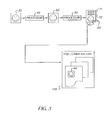
- the electronic source media 30 is then processed by a processor 45 to generate a derivative media 50.
- This derivative media 50 is processed by a processor 55 of the RMS 14 to steganographically embed information that includes the copyright owner's identification 11 and a media identification 12 which uniquely identifies the particular copyrighted media.
- a visually perceptible watermark 65 is added to the media 50 by the processor 55 for indicating that the media is copyrighted and includes embedded information.
- This media 60 will be published so that prospective licensees can view the derivative media 60 and decide whether they wish to license the copyrighted media 30.
- the media 60 may be published on a website 119 in which a user views the media 60 and decides, based on the content and any associated terms and the like, whether they wish to license media 30 as described in detail hereinbelow.
- the media 60 may also be published on any other suitable website 75.
- low-resolution web images will be steganographically tagged and published for prospective licensees to review.
- clips or segments of lower quality may be created, steganographically tagged and published to aid in communication of media to be licensed.
- a user can purchase a license for use of media registered and managed by the rights management system 14.
- the user would enter the RMS 14 via the web interface 119.
- the user would review the media by reviewing its associated steganographically embedded derivative 60.
- the user would then click an hypertext link for indicating a desire to license the media.
- the associated information like proprietor and licensing terms would be presented.
- the user would select a set of terms for a particular media. These terms will be transmitted from the licensing terms database 110 to the user's computer via the network 180.
- the user will chose a set of terms based on their needs.
- This set of terms will be transmitted from the user's computer to the RMS licensing terms database 110.
- the server 100 will translate this particular set of terms into an associated licensing cost. This cost will be transmitted to the user's computer via the network 180.
- the license can be an electronic document and/or a physical document that is subsequently delivered to the licensee.
- a networked payment provider 200 would have an account database 190 that will be used to verify that appropriate funds exist (to cover cost incurred by the licensee).
- the payment provider 200 will pay the RMS service 14 by transferring funds from the licensee's s specific account to the RMS provider 14 via the communication channel 180.
- the RMS 14 will then aggregate and distribute appropriate funds to the media creator 5. This and all such transaction will be monitored and recorded in the transactional database 112 such that usage reports of various kinds can be created and provided to media creator 5.
- the media 30 will then be provided to the licensee. This can be done electronically over the network 180 or physically (for example, a CD, a hardcopy print, a zip drive and the like). Electronically, it can be done using encryption and keys, if high levels of security are required. In either case, the media 30 will be steganographically encoded with a minimum set of information, such as at a minimum, a watermark which includes the proprietors' identification 11, the media identification 12 and a license identification marker for subsequent monitoring and tracking usage of that media 30. These three identifications can be incorporated into one watermark. If media is provided to user over a network, it may be encrypted based on a specific key. A user would receive the encrypted media and be required to a have a particular key to unlock and use it.
- the RMS 14 enables access to additional services such as tracking, and other on-line media fulfillment.
- additional services such as tracking, and other on-line media fulfillment.
- the steganographically encoded derivative media 60 is published or displayed it will retain its embedded information. All on-line visitors to web sites where the media 60 is published can use this media 60 to obtain information about the media creator 5 or for some other subsequent use. A person can simply upload this media 60 to a service provider 230 who has access to the overall RMS 14 for obtaining such information.
- a user can obtain the derivative media 60 by simply using a standard web browser and mouse. By placing their mouse pointer on the media and right clicking, the customer can 'save as' or 'copy location' for obtaining a copy of the derivative media 60. This functionality is provided in both Netscape ⁇ and Internet ⁇ explorer web browser.
- a user may use a plurality of well-known devices 250 for accessing the service provider 230.
- These devices may be, for example, a retail networked media device similar to a media kiosk or some other type of networked media device like a PDA all of which are well known in the art.
- the derivative media 60 may be retrieved from a web site and stored on a variety of devices. For example, in using an imaging kiosk, the user insert storage medium having the derivative file which can then uploaded from the device's local storage.
- the derivative media 60 can be provided to a on-line service provider for requesting a particular output like prints, posters or t-shirts.
- the media 60 is processed to extract the steganographically embedded signal .
- This signal is provided to the RMS 14 to obtain information about the source media 30.
- This extracted signal along with basic terms of use (output type, quantity, etc.) are provided to the licensing terms database 110 to calculate the appropriate usage costs. If the user agrees the cost, the original electronic media from the centralized media database 142 or defined network computer 170 is provided to the service provider 230 so that the request can be fulfilled. Every use of the copyrighted media 30 is recorded in the transactional database 112.
- a user can take hardcopy output provided either directly by RMS 14 or derived from the source media 30 to acquire additional services.
- a professional hardcopy print with an embedded signal of the copyright owner and the particular media can be presented to an imaging kiosk where the image can be scanned. The scanned image can be processed to obtain the embedded signal.
- This signal can be submitted to the RMS system via a network connection.
- Information of ownership, usage rights and costs can be provided to the customer via the kiosk user interface. Reprints can be provided with payment ensured back to the media creator 5 via the RMS 14.
- the RMS service 14 can search the network 180 and identify locations having this media based on the steganographically embedded information.
- the search results can be compared against the media registry 140, so that a general report can be provided to the media creator 5.
- automated notifications can be sent indicating awareness of illicit use and requiring licensing to be obtained. This notification can have an automated link back into the RMS 14.
- other media registered by the same media creator 5 can be identified within the RMS 14, and a notification can be transmitted from the RMS service 14 to the identified licensee for identifying additional licensing opportunities.
- RMS system 14 An additional feature of RMS system 14 is that any electronic media with a RMS embedded watermark can be submitted to registry to obtain information or to license the media. Hence, a media derivative 60 or an electronic version can be used to perform a search. The submitted media 60 will be processed to extract the watermark. The watermark is then used to obtain the proprietor of identifier, the media identifier or license identifier. Any one of these identifiers or some combination thereof can be used to search the database for given criteria.
Landscapes
- Engineering & Computer Science (AREA)
- Software Systems (AREA)
- Theoretical Computer Science (AREA)
- Multimedia (AREA)
- Technology Law (AREA)
- Computer Hardware Design (AREA)
- Computer Security & Cryptography (AREA)
- Physics & Mathematics (AREA)
- General Engineering & Computer Science (AREA)
- General Physics & Mathematics (AREA)
- Management, Administration, Business Operations System, And Electronic Commerce (AREA)
- Storage Device Security (AREA)
Abstract
Description
Claims (10)
- A method for licensing copyrighted electronic media, the method comprising the steps of:(a) storing a first digital representation of the copyrighted media which digital representation includes digital information;(b) creating a second digital representation of the copyrighted electronic media having a portion of the digital information of the first digital representation;(c) steganographically embedding information in the second digital representation;(d) electronically publishing the steganographically embedded second digital representation; and(e) steganographically encoding information in the first digital representation prior to transmitting to a licensee.
- The method as in claim 1 further comprising the step of providing licensing conditions having conditions for licensing the copyrighted media.
- The method as in claim 1, wherein step (e) includes encoding either individually or in any combination: (i) proprietor registration identifier, (ii) an electronic media identifier, and/or (iii) identifier of license conditions for a particular licensee.
- The method as in claim 2 further comprising the step of recording licensing data upon acceptance of a portion of the licensing conditions.
- The method as in claim 4 further comprising the step of providing transactional information indicating at least one of: (i) number of registrations, and/or (ii) licensing revenues generated for a copyrighted media.
- The method as in claim 1, wherein step (a) includes storing the copyrighted media in a centralized media repository.
- The method as in claim 1, wherein step (a) includes storing the copyrighted media on a network accessible computer.
- The method as in claim 1 further comprising the step of encrypting the steganographically encoded information in either step (c) or (e) prior to transmission.
- The method as in claim 1, where step (e) includes encrypting the steganographically encoded information prior to embedding.
- The method as in claim 1 further comprising the step of registering on a server a registration identification for a proprietor.
Applications Claiming Priority (2)
| Application Number | Priority Date | Filing Date | Title |
|---|---|---|---|
| US09/971,153 US20030069853A1 (en) | 2001-10-04 | 2001-10-04 | Method and system for managing, accessing and paying for the use of copyrighted electronic media |
| US971153 | 2001-10-04 |
Publications (2)
| Publication Number | Publication Date |
|---|---|
| EP1300748A2 true EP1300748A2 (en) | 2003-04-09 |
| EP1300748A3 EP1300748A3 (en) | 2003-09-17 |
Family
ID=25517987
Family Applications (1)
| Application Number | Title | Priority Date | Filing Date |
|---|---|---|---|
| EP02078887A Withdrawn EP1300748A3 (en) | 2001-10-04 | 2002-09-23 | Method and system for managing, accessing and paying for the use of copyrighted electronic media |
Country Status (2)
| Country | Link |
|---|---|
| US (1) | US20030069853A1 (en) |
| EP (1) | EP1300748A3 (en) |
Families Citing this family (27)
| Publication number | Priority date | Publication date | Assignee | Title |
|---|---|---|---|---|
| US6965682B1 (en) | 1999-05-19 | 2005-11-15 | Digimarc Corp | Data transmission by watermark proxy |
| US8055899B2 (en) | 2000-12-18 | 2011-11-08 | Digimarc Corporation | Systems and methods using digital watermarking and identifier extraction to provide promotional opportunities |
| JP2003046697A (en) * | 2001-07-30 | 2003-02-14 | Fuji Photo Film Co Ltd | Digital content for print, print ordering system and program |
| JP2004087062A (en) * | 2002-06-25 | 2004-03-18 | Sony Corp | Data recording medium, identification information recording method, identification information recording device, identification information reproduction method, identification information reproduction device, information service method, information service system |
| US20050278258A1 (en) * | 2004-06-14 | 2005-12-15 | O'donnell Michael | User software for facilitating copyright licensing and compliance |
| US20060212395A1 (en) * | 2005-03-15 | 2006-09-21 | Winklevoss Howard E Jr | Method and system for computerized administration of affinity programs for purchasing copyrighted computer files |
| US20070061265A1 (en) * | 2005-03-17 | 2007-03-15 | Speedus Corp. | A system and method for the provision of audio and/or visual services |
| US20080114693A1 (en) * | 2006-11-14 | 2008-05-15 | Fabrice Jogand-Coulomb | Method for allowing content protected by a first DRM system to be accessed by a second DRM system |
| US20080112562A1 (en) * | 2006-11-14 | 2008-05-15 | Fabrice Jogand-Coulomb | Methods for linking content with license |
| US20080114772A1 (en) * | 2006-11-14 | 2008-05-15 | Fabrice Jogand-Coulomb | Method for connecting to a network location associated with content |
| US8327454B2 (en) * | 2006-11-14 | 2012-12-04 | Sandisk Technologies Inc. | Method for allowing multiple users to access preview content |
| US8079071B2 (en) | 2006-11-14 | 2011-12-13 | SanDisk Technologies, Inc. | Methods for accessing content based on a session ticket |
| US8763110B2 (en) * | 2006-11-14 | 2014-06-24 | Sandisk Technologies Inc. | Apparatuses for binding content to a separate memory device |
| WO2008076294A2 (en) * | 2006-12-13 | 2008-06-26 | Ricall, Inc. | Online music and other copyrighted work search and licensing system |
| JP4933932B2 (en) * | 2007-03-23 | 2012-05-16 | ソニー株式会社 | Information processing system, information processing apparatus, information processing method, and program |
| US20090172517A1 (en) * | 2007-12-27 | 2009-07-02 | Kalicharan Bhagavathi P | Document parsing method and system using web-based GUI software |
| US20110022589A1 (en) * | 2008-03-31 | 2011-01-27 | Dolby Laboratories Licensing Corporation | Associating information with media content using objects recognized therein |
| US20100131417A1 (en) * | 2008-11-25 | 2010-05-27 | Hank Risan | Enhancing copyright revenue generation |
| US20110035686A1 (en) * | 2009-08-06 | 2011-02-10 | Hank Risan | Simulation of a media recording with entirely independent artistic authorship |
| US20120197785A1 (en) * | 2011-01-31 | 2012-08-02 | Keith Cooper | Apparatus and method for management of intellectual property rights |
| US10853505B2 (en) * | 2011-12-30 | 2020-12-01 | Microsoft Technology Licensing, Llc | Data policies for online services |
| US20140279582A1 (en) * | 2013-03-13 | 2014-09-18 | Ywein Van Den Brande | Dynamic licensing method |
| US9722978B2 (en) * | 2013-03-22 | 2017-08-01 | Lidcore, Inc. | System and method for automated licensing identification and verification |
| US20140310264A1 (en) * | 2013-04-15 | 2014-10-16 | Mark D'AMBROSIO | Image registration system and method |
| WO2015027226A1 (en) * | 2013-08-23 | 2015-02-26 | Nantmobile, Llc | Recognition-based content management, systems and methods |
| US10481763B2 (en) * | 2014-09-17 | 2019-11-19 | Lett.rs LLC. | Mobile stamp creation and management for digital communications |
| CN114428868B (en) * | 2020-10-29 | 2025-06-27 | 李庆成 | Method for processing audio and video images |
Family Cites Families (10)
| Publication number | Priority date | Publication date | Assignee | Title |
|---|---|---|---|---|
| US6516079B1 (en) * | 2000-02-14 | 2003-02-04 | Digimarc Corporation | Digital watermark screening and detecting strategies |
| US6122403A (en) * | 1995-07-27 | 2000-09-19 | Digimarc Corporation | Computer system linked by using information in data objects |
| US5768426A (en) * | 1993-11-18 | 1998-06-16 | Digimarc Corporation | Graphics processing system employing embedded code signals |
| CN1312549C (en) * | 1995-02-13 | 2007-04-25 | 英特特拉斯特技术公司 | Systems and methods for secure transaction management and electronic rights protection |
| US6760463B2 (en) * | 1995-05-08 | 2004-07-06 | Digimarc Corporation | Watermarking methods and media |
| US6728390B2 (en) * | 1995-05-08 | 2004-04-27 | Digimarc Corporation | Methods and systems using multiple watermarks |
| US6788800B1 (en) * | 2000-07-25 | 2004-09-07 | Digimarc Corporation | Authenticating objects using embedded data |
| US5765152A (en) * | 1995-10-13 | 1998-06-09 | Trustees Of Dartmouth College | System and method for managing copyrighted electronic media |
| US5949885A (en) * | 1996-03-12 | 1999-09-07 | Leighton; F. Thomson | Method for protecting content using watermarking |
| JP2002539487A (en) * | 1999-03-10 | 2002-11-19 | ディジマーク コーポレイション | Signal processing method and apparatus |
-
2001
- 2001-10-04 US US09/971,153 patent/US20030069853A1/en not_active Abandoned
-
2002
- 2002-09-23 EP EP02078887A patent/EP1300748A3/en not_active Withdrawn
Also Published As
| Publication number | Publication date |
|---|---|
| US20030069853A1 (en) | 2003-04-10 |
| EP1300748A3 (en) | 2003-09-17 |
Similar Documents
| Publication | Publication Date | Title |
|---|---|---|
| EP1300748A2 (en) | Method and system for managing, accessing and paying for the use of copyrighted electronic media | |
| US9589111B2 (en) | System for controlling the distribution and use of rendered digital works through watermarking | |
| US6735699B1 (en) | Method and system for monitoring use of digital works | |
| Zhao | A WWW service to embed and prove digital copyright watermarks | |
| CN100365614C (en) | Watermark and transmit data | |
| Piva et al. | Managing copyright in open networks | |
| US20040021549A1 (en) | System and method of providing and autheticating works and authorship based on watermark technique | |
| US20060041591A1 (en) | Associating data with images in imaging systems | |
| EP1199878A2 (en) | A method of authorizing the reproduction of copyrighted images | |
| JP5285188B2 (en) | System for controlling the distribution and use of digital work | |
| US8594364B2 (en) | Batch identifier registration and embedding in media signals | |
| JP2000163488A (en) | Method and system for monitoring use of digital copyrighted work, digital copyrighted work recording device, and digital copyrighted work reproducing device | |
| US7469231B2 (en) | Digital contents and system for receiving order for prints | |
| JP3801785B2 (en) | Data distribution method and apparatus, and data distribution system | |
| KR100656219B1 (en) | How to trade digital photos | |
| Cappellini et al. | Copyright protection of cultural heritage multimedia data through digital watermarking techniques | |
| Garofalakis et al. | Digital robbery; authors are not unprotected | |
| Serrão et al. | Protecting Intellectual Proprietary Rights through secure interactive contract negotiation | |
| JP2002169913A (en) | Management method for digital information |
Legal Events
| Date | Code | Title | Description |
|---|---|---|---|
| PUAI | Public reference made under article 153(3) epc to a published international application that has entered the european phase |
Free format text: ORIGINAL CODE: 0009012 |
|
| AK | Designated contracting states |
Kind code of ref document: A2 Designated state(s): AT BE BG CH CY CZ DE DK EE ES FI FR GB GR IE IT LI LU MC NL PT SE SK TR Designated state(s): AT BE BG CH CY CZ DE DK EE ES FI FR GB GR IE IT LI LU MC NL PT SE SK TR |
|
| AX | Request for extension of the european patent |
Extension state: AL LT LV MK RO SI |
|
| PUAL | Search report despatched |
Free format text: ORIGINAL CODE: 0009013 |
|
| AK | Designated contracting states |
Kind code of ref document: A3 Designated state(s): AT BE BG CH CY CZ DE DK EE ES FI FR GB GR IE IT LI LU MC NL PT SE SK TR |
|
| AX | Request for extension of the european patent |
Extension state: AL LT LV MK RO SI |
|
| 17P | Request for examination filed |
Effective date: 20040115 |
|
| 17Q | First examination report despatched |
Effective date: 20040213 |
|
| AKX | Designation fees paid |
Designated state(s): DE FR GB |
|
| STAA | Information on the status of an ep patent application or granted ep patent |
Free format text: STATUS: THE APPLICATION IS DEEMED TO BE WITHDRAWN |
|
| 18D | Application deemed to be withdrawn |
Effective date: 20040624 |