TECHNICAL FIELD
The present invention relates to a process for preparing
3-amino-2-hydroxypropionic acid derivatives represented by the
following general formula (1);
wherein R
1, R
2 and R
3, independently from each other, represent
a hydrogen atom, a substituted or unsubstituted alkyl group having
1 to 30 carbon atoms, a substituted or unsubstituted aryl group
having 6 to 30 carbon atoms, or a substituted or unsubstituted
aralkyl group having 7 to 30 carbon atoms.
3-Amino-2-hydroxypropionic acid derivatives of the
general formula (1) [hereinafter, also referred to as 3-amino-2-hydroxypropionic
acid derivatives (1)] are useful
compounds as an intermediate of a medicine. Among others, 3-amino-2-hydroxy-4-phenylbutyric
acid [a compound of the general
formula (1) wherein R1 is a benzyl group, R2 and R3 are hydrogen
atoms] is particularly important: (2S,3R)-isomer (i.e. threo-isomer)
of the compound can be led, for example, to an
immunostimulating anticancer agent, Bestatin [J. Antibiotics,
vol.29, p.600 (1976)]; on the other hand, (2S,3S)-isomer (i.e.
erythro-isomer) of the compound can be led, for example, to a HIV
protease inhibitor, KNI-227 (JP-A-05/170722).
BACKGROUND ART
Several processes for preparing 3-amino-2-hydroxypropionic
acid derivatives (1) are known in the art. One
representative is a process comprising a stereoselective addition
reaction of a cyanide compound onto an aminoaldehyde derived from
an amino acid [J. Chem. Soc., Chem. Commun., p.938 (1989);
Synthesis, p.703 (1989); EP-B-341462; JP-A-02/17165; JP-A-02/28144;
JP-A-02/56547; JP-A-08/165274; JP-A-10/231280].
However, the above process must use a cyanogen compound having
a very high toxicity, and therefore, is problematic as an
industrial production process.
Other processes, for example, a process comprising
decomposing an optically active 2-azetidinone derivative
obtained through a [2+2] cycloaddition of a chiral imine and a
ketene compound [Tetrahedron Lett., vol.31, p.3031 (1990)], and
a process comprising a stereoselective alkylation and a
stereoselective amination of a chiral glyoxylate [J. Org. Chem.,
vol.54, p.4235 (1989)] are also known in the art. However, all
these processes are also problematic as an industrial production
process because they need many steps and complicated procedures,
for example.
Furthermore, a process comprising stereoselectively
alkylating a malic acid ester, selectively converting one of
carboxyl groups into an azide, and then passing through a
rearrangement reaction of Curtius type [EP-B-379288; Tetrahedron
Lett., vol.33, p.6803 (1992)], as well as, a process comprising
selectively converting one of carboxyl groups into an amide in
a similar manner and then passing through a rearrangement reaction
of Hofmann type [Tetrahedron Lett., vol.33, p.6763 (1992)] are
known in the art. However, these processes are also unsuitable
for an industrial production because they use an expensive base
(e.g. lithium hexamethyldisilazane and lithium amide), an
explosive azide compound, a toxic lead compound, or the like.
On the other hand, as a process for preparing 3-amino-2-hydroxypropionic
acid derivatives (1) which does not use
specially dangerous reagents and is suitable for an industrial
production, a process comprising a stereoselective hydrolysis of
a dihaloketone derivative derived from an amino acid (JP-A-10/59909)
is known in the art. In this process, for example, an
erythro form [i.e. (2S,3S)-isomer or (2R,3R)-isomer,
respectively] of 3-amino-2-hydroxypropionic acid derivative (1)
is predominantly obtained from a (S)-amino acid or (R) -amino acid,
but there is a limitation as a process for obtaining a threo form
[i.e. (2R,3S)-isomer or (2S,3R)-isomer] of 3-amino-2-hydroxypropionic
acid derivative (1) which is a diastereomer of
the former compound.
In addition, a process is known in the art which
comprises reacting the above erythro form [i.e. (2S,3S)-isomer
or (2R,3R)-isomer, respectively] of 3-amino-2-hydroxypropionic
acid derivative (1) with a carbonylation agent to obtain an erythro
form of an oxazolidinone derivative, and then isomerizing it with
a strong base to a threo form [i.e. (2R,3S)-isomer or
(2S,3R)-isomer] of the oxazolidinone derivative which is a
diastereomer of the former compound (JP-A-09/169744). However,
this process must use phosgene having a very high toxicity as a
carbonylation agent, and an expensive base such as an alkali metal
or alkaline earth metal alkoxide, an alkali metal amide or an alkyl
lithium compound or an alkylmagnesium halide as a strong base.
Accordingly, the process is unsuitable for an industrial
production.
Accordingly, there is a strong need for establishment
of a novel production process suitable for an industrial
production of 3-amino-2-hydroxypropionic acid derivatives (1) by
a methodology different from that of the prior art, in particular,
for establishment of an industrial production process for desired
stereoisomeric (e.g. threo) 3-amino-2-hydroxypropionic acid
derivatives (1).
In view of the above circumstances, the object of the
present invention was to provide a process for preparing 3-amino-2-hydroxypropionic
acid derivatives (1) which does not use
dangerous reagents, is economically advantageous, and is suitable
for an industrial production.
DISCLOSURE OF THE INVENTION
The present inventors have intensively investigated in
order to solve the above problems. As a result, they found that
3-amino-2-hydroxypropionic acid derivatives (1) can be prepared
without using dangerous reagents, by converting a hydroxyl group
of N-alkoxycarbonyl-3-amino-2-hydroxypropionic acid derivatives
having a steric configuration at 2-position carbon reverse to that
of desired stereoisomeric 3-amino-2-hydroxypropionic acid
derivatives into a leaving group, and then inverting the steric
configuration at 2-position carbon.
In addition, they found that impurities are apt to be
produced secondarily and the yield and quality of 3-amino-2-hydroxypropionic
acid derivatives (1) tend to reduce, if
intermediate substituted-3-amino-2-hydroxypropionic acid
derivatives having an inverted steric configuration at 2-position
carbon are supplied to a next step without isolation and/or
purification to a pure form. However, they also found that
3-amino-2-hydroxypropionic acid derivatives (1) can be stably
produced in a high yield and a high quality, by contacting the
intermediate substituted-3-amino-2-hydroxypropionic acid
derivatives having an inverted steric configuration at 2-position
carbon, without isolation and/or purification to a pure form, with
water under acidic to neutral conditions and subjecting the
mixture to heat treatment.
On the basis of the above findings, the present
invention was accomplished as a process capable of preparing
3-amino-2-hydroxypropionic acid derivatives (1) in a safe and
economically advantageous manner and in a form suitable for an
industrial production.
Thus, the present invention relates to a process for
preparing 3-amino-2-hydroxypropionic acid derivatives
represented by the general formula (1):
wherein R
1, R
2 and R
3, independently from each other,
represent a hydrogen atom, a substituted or unsubstituted
alkyl group having 1 to 30 carbon atoms, a substituted or
unsubstituted aryl group having 6 to 30 carbon atoms, or a
substituted or unsubstituted aralkyl group having 7 to 30
carbon atoms, which comprises the steps of:
into N-protected-3-aminopropionic acid derivatives [hereinafter,
also referred to as N-protected-3-aminopropionic acid
derivatives (3)] represented by the general formula (3):
- wherein R1, R2, R3 and S1 are as defined above;
- L represents a leaving group; and
- S3 represents a hydrogen atom or an ester residue;
then converting the derivatives (3) into
substituted-3-amino-2-hydroxypropionic acid derivatives
[hereinafter, also referred to as substituted-3-amino-2-hydroxypropionic
acid derivatives (4)] having an inverted steric
configuration at 2-position carbon and represented by the general
formula (4):
- wherein R1, R2 and R3 are as defined above;
- S4 represents a hydrogen atom or an ester residue;
- S5 represents a hydrogen atom or a substituent derived from
S1;
- S6 represents S1 when S5 is a hydrogen atom, or a substituent
derived from S1, taken together with S5, when S5 is a
substituent derived from S1; and
- S1 is as defined above;
and then converting the derivatives (4) into 3-amino-2-hydroxypropionic
acid derivatives (1).
The present invention also relates to a process for
preparing the 3-amino-2-hydroxypropionic acid derivatives in a
high quality and a high yield, which comprises:
BEST MODE FOR PRACTICING THE INVENTION
Hereinafter, the present invention is described in more
detail.
Basically, the process according to the present
invention consists of three steps as shown in the following scheme:
Firstly described is the first step wherein leaving
group L is introduced into N-protected-3-amino-2-hydroxypropionic
acid derivatives (2) to convert the derivatives
into N-protected-3-aminopropionic acid derivatives (3).
In the N-protected-3-amino-2-hydroxypropionic acid
derivatives (2) and the N-protected-3-aminopropionic acid
derivatives (3), R1, R2 and R3, independently from each other,
represent a hydrogen atom, a substituted or unsubstituted alkyl
group having 1 to 30 carbon atoms, a substituted or unsubstituted
aryl group having 6 to 30 carbon atoms, or a substituted or
unsubstituted aralkyl group having 7 to 30 carbon atoms.
The above alkyl group is not limited to a particular
one and includes, for example, a methyl group, an ethyl group,
a propyl group, an isopropyl group, an isobutyl group, a
cyclohexylmethyl group or the like. The above aryl group is not
limited to a particular one and includes, for example, a phenyl
group, a p-chlorophenyl group, a p-fluorophenyl group, a p-methoxyphenyl
group, a 1-naphthyl group, a 2-naphthyl group or
the like. The above aralkyl group is not limited to a particular
one and includes, for example, a benzyl group, a p-methoxybenzyl
group, a 3-phenylpropyl group, a 2-phenylpropyl group or the like.
As to the combination of R1 and R2, a combination wherein
one of these is a hydrogen atom and the other is a substituted
or unsubstituted alkyl group having 1 to 30 carbon atoms, a
substituted or unsubstituted aryl group having 6 to 30 carbon atoms,
or a substituted or unsubstituted aralkyl group having 7 to 30
carbon atoms is preferable. Among others, a combination wherein
one of these is a hydrogen atom and the other is a substituted
or unsubstituted aralkyl group having 7 to 30 carbon atoms is
preferable. In particular, a combination wherein one of these
is a hydrogen atom and the other is a substituted or unsubstituted
benzyl group is preferable, and especially, a combination wherein
one of these is a hydrogen atom and the other is an unsubstituted
benzyl group is preferable.
Also, R3 is preferably a hydrogen atom, a substituted
or unsubstituted alkyl group having 1 to 30 carbon atoms, or a
substituted or unsubstituted aralkyl group having 7 to 30 carbon
atoms. In particular, R3 is preferably a hydrogen atom, a lower
alkyl group having 1 to 4 carbon atoms, or a substituted or
unsubstituted benzyl group, and especially preferable R3 is a
hydrogen atom, a methyl group, an ethyl group, or a benzyl group.
Most preferable R3 is a hydrogen atom.
In the N-protected-3-amino-2-hydroxypropionic acid
derivatives (2) and the N-protected-3-aminopropionic acid
derivatives (3), S1 is an urethane-type protecting group for an
amino group. The above urethane-type protecting group for an
amino group is not limited to a particular one and may be selected
from the protecting groups as described, for example, in
PROTECTIVE GROUPS IN ORGANIC SYNTHESIS, 2nd ed., JOHN WILLY & SONS
publ. (1991). In general, from the viewpoint of an easy handling,
an inexpensiveness, a convenient synthesis of substrate compounds
and the like, a lower alkoxycarbonyl group having 1 to 4 carbn
atoms or a substituted or unsubstituted aralkyloxycarbonyl group
having 7 to 10 carbon atoms is preferably used, for example. Among
others, a methoxycarbonyl group, an ethoxycarbonyl group, a
t-butoxycarbonyl group, a benzyloxycarbonyl group or the like is
preferably used, and especially, a methoxycarbonyl group or an
ethoxycarbonyl group is preferably used. An ethoxycarbonyl group
is most preferably used.
Also, S2 in the N-protected-3-amino-2-hydroxypropionic
acid derivatives (2) and S3 in the N-protected-3-aminopropionic
acid derivatives (3) represent a hydrogen atom or an ester residue.
The above ester residue represents a monovalent organic group
which can serve as an ester-type protecting group for a carboxyl
group, for example, by being included in a structure represented
by -COOS2 (-COOS3). The above monovalent organic group is not
limited to a particular one if it has an effect of protecting the
carboxyl group, and may be selected from the ester-type protecting
groups as described, for example, in PROTECTIVE GROUPS IN ORGANIC
SYNTHESIS, 2nd ed., JOHN WILLY & SONS publ. (1991). Among others,
a lower alkyl group having 1 to 4 carbon atoms or a substituted
or unsubstituted benzyl group is preferably used. A lower alkyl
group having 1 to 4 carbon atoms is more preferably used and a
methyl group or an ethyl group is further preferably used. A
methyl group is most preferably used.
In the N-protected-3-aminopropionic acid derivatives
(3), L represents a leaving group. The above L is not limited
to a particular one and preferably includes, for example, a
sulfonyloxy group, a halosulfinyloxy group or a halogen atom. The
above sulfonyloxy group is not limited to a particular one and
preferably includes, for example, a substituted or unsubstituted
lower alkylsulfonyloxy group, in particular a lower
alkylsulfonyloxy group having 1 to 4 carbon atoms, or a substituted
or unsubstituted arylsulfonyloxy group, in particular
arylsulfonyloxy group having 6 to 10 carbon atoms. The above
lower alkylsulfonyloxy group includes, for example, a
methanesulfonyloxy group, an ethanesulfonyloxy group or the like,
and the above arylsulfonyloxy group includes a p-toluenesulfonyloxy
group, an o-, p- or m-nitrobenzenesulfonyloxy
group or the like. Among others, a methanesulfonyloxy group is
preferably used. The above halosulfinyloxy group includes, for
example, a chlorosulfinyloxy group, a bromosulfinyloxy group or
the like, and a chlorosulfinyloxy group is particularly preferable.
The above halogen atom includes, for example, a chlorine atom,
a bromine atom, an iodine atom or the like, and a chlorine atom
is particularly preferable.
In the introduction of the above leaving group L into
the 3-amino-2-hydroxypropionic acid derivatives (2), any of known
leaving group-introducing agents may be used without any
limitation.
If the leaving group L is a sulfonyloxy group, a
corresponding sulfonyl halide compound is preferably reacted as
a leaving group-introducing agent. In general, cheap and easily
available sulfonyl chloride compounds are preferably used as the
above sulfonyl halide compound. Among others, methanesulfonyl
chloride, ethanesulfonyl chloride, benzenesulfonyl chloride,
p-toluenesulfonyl chloride, nitrobenzenesulfonyl chloride or the
like is preferably used, and especially, methanesulfonyl chloride
is preferably used. The amount of the above sulfonyl halide
compounds used is not limited to a particular range, and they are
usually used in a molar amount of 1 to 10-fold, preferably in a
molar amount of 1 to 5-fold, and more preferably in a molar amount
of 1 to 2-fold, relative to the 3-amino-2-hydroxypropionic acid
derivatives (2).
Also, in order to progress the above reaction with
sulfonyl halide compounds smoothly, the reaction may be carried
out in the coexistence of a base. The base is not limited to a
particular one and amines, particularly tertiary amines may be
preferably used. The above amines are not limited to a particular
one and include triethylamine, diisopropylethylamine, pyridine
or the like. From the viewpoint of practical use, cheap bases
are preferable and generally triethylamine is preferably used.
The amount of the above amines used is not limited to a prticular
range, and they are usually used in a molar amount of 1 to 20-fold,
preferably in a molar amount of 1 to 5-fold, and more preferably
in a molar amount of 1 to 3-fold, relative to the 3-amino-2-hydroxypropionic
acid derivatives (2). The reaction temperature
can not be defined uniformly and is usually from -20° to 80°C,
preferably from -10° to 50°C.
In the introduction of the above L into the 3-amino-2-hydroxypropionic
acid derivatives (2), if L is a
halosulfinyloxy group or a halogen atom, thionyl halides are
preferably used for the reaction as a leaving group-introducing
agent. Usually, cheap and easily available thionyl chloride is
preferably used as the above thionyl halides. The amount of the
above thionyl halides used is not limited to a particular range,
and they are usually used in a molar amount of 1 to 10-fold,
preferably in a molar amount of 1 to 5-fold, and more preferably
in a molar amount of 2 to 3-fold, relative to the 3-amino-2-hydroxypropionic
acid derivatives (2). The reaction temperature
can not be defined uniformly and is usually from -20° to 120°C,
preferably from 0° to 80°C.
Reaction solvents used for the introduction of the above
leaving group L are not limited to a particular one, if they are
essentially inert to the above sulfonyl halide compounds or the
above thionyl halides. Examples of the reaction solvents include,
for example, aliphatic hydrocarbons such as hexane, heptane or
methylcyclohexane; aromatic hydrocarbons such as toluene or
xylene; halogenated hydrocarbons such as methylene chloride or
chloroform; ethers such as tetrahydrofuran, 1,4-dioxane or t-butyl
methyl ether; aliphatic acid esters such as methyl acetate,
ethyl acetate or isopropyl acetate; aprotic polar solvents such
as acetonitrile, N,N-dimethyl formamide or dimethyl sulfoxide.
Among others, the above aromatic hydrocarbons, the above ethers,
or the above aliphatic acid esters are preferably used. Toluene
is a particularly preferable aromatic hydrocarbon,
tetrahydrofuran is a particularly preferable ether, and ethyl
acetate is a particularly preferable aliphatic acid ester. These
solvents may be used alone or in a mixture of two or more solvents.
Besides, if the reaction mixture of the 3-amino-2-hydroxypropionic
acid derivatives (2) and the above sulfonyl
halide compounds or the above thionyl halides is fluid, for example,
in a solution state, the above reaction solvents are not
necessarily needed.
The above S2 and S3 may be the same. Also, it is simple
and convenient if they are the same, and generally, they are often
the same. However, they may be converted by esterification,
hydrolysis, transesterification or the like under the conditions
of this reaction. Furthermore, if necessary, known
esterification, hydrolysis, transesterification or the like may
be introduced into this step, and they may be freely selected in
a range of not affecting the step. For example, if S2 is a hydrogen
atom in the N-protected-3-amino-2-hydroxypropionic acid
derivatives (2), and if thionyl halides are reacted with the
derivatives to introduce a halogen atom as leaving group L, then
alcohol treatment may be preferably carried out to derive an ester
form of N-protected-3-aminopropionic acid derivatives (3) (S3 is
an ester residue) by the action of hydrogen halides and/or thionyl
halides present in excess.
In this step, the selection of a leaving group-introducing
agent used for the introduction of the above leaving
group L or the combination of S2 and the leaving group L is not
limited to a particular one. In general, if S2 in the N-protected-3-amino-2-hydroxypropionic
acid derivatives (2) is a
hydrogen atom, thionyl halides (i.e. leaving group L is a
chlorosulfinyloxy group or a halogen atom) are preferably used.
Also, if S2 is an ester residue, sulfonyl halide compounds (i.e.
leaving group L is a sulfonyloxy group) or thionyl halides (i.e.
leaving group L is a chlorosulfinyloxy group or a halogen atom)
are preferably used, and especially, sulfonyl halide compounds
(i.e. leaving group L is a sulfonyloxy group) are preferably used..
Most preferable combination of S2 and leaving group L is that
wherein S2 is an ester residue and leaving group L is a sulfonyloxy
group.
The N-protected-3-aminopropionic acid derivatives (3)
synthesized as described above may be isolated and/or purified
by a conventional method such as extraction, crystallization,
distillation, chromatography or the like. However, from the
operational and/or economical viewpoint in the industrial
production, the products may be used in the next reaction as they
are without isolation and/or purification by the above
conventional method.
Next described is the second step wherein a steric
configuration at 2-position carbon of N-protected-3-aminopropionic
acid derivatives (3) is inverted to convert the
derivatives into substituted-3-amino-2-hydroxypropionic acid
derivatives (4).
In this step, the N-protected-3-aminopropionic acid
derivatives (3) obtained in the first step can be converted into
substituted-3-amino-2-hydroxypropionic acid derivatives (4)
having an inverted steric configuration at 2-position carbon, in
a high steric inversion ratio. In this case, the N-protected-3-aminopropionic
acid derivatives (3) synthesized in
the above first step may be occasionally converted into
substituted-3-amino-2-hydroxypropionic acid derivatives (4)
having an inverted steric configuration at 2-position carbon under
reaction conditions of the above first step. However, the process
is included within the production process according to the present
invention so far as the above N-protected-3-aminopropionic acid
derivatives (3) are once formed as an intermediate.
In this step, the inversion of a steric configuration
at 2-position carbon can proceed with an essentially perfect
inversion. The steric inversion ratio at 2-position carbon in
the products can be expected to be at least 95% or more, usually
98% or more, preferably 100%. In this connection, the steric
inversion ratio means, as a general concept, a ratio of enantiomer
excess (%e.e.) or diastereomer excess (% d.e.) of a product having
an inverted steric configuration at 2-position carbon [in this
case, substituted-3-amino-2-hydroxypropionic acid derivatives
(4)] to enantiomer excess (% e.e.) or diastereomer excess (% d.e.)
of a starting material [in this case, N-protected-3-aminopropionic
acid derivatives (3)].
In this step, oxazolidinone derivatives are usually
obtained as the substituted-3-amino-2-hydroxypropionic acid
derivatives (4) having an inverted steric configuration at 2-position
carbon. However, as described below in more detail, for
example, if water coexists at the beginning of this step for the
purpose of producing 3-amino-2-hydroxypropionic acid derivatives
in a high quality and a high yield, plural compounds can be formed
as the substituted-3-amino-2-hydroxypropionic acid derivatives
(4) having an inverted steric configuration at 2-position carbon.
The typical examples are shown in the following scheme:
wherein R
1, R
2, R
3, R
4 and S
3 are as defined above;
The formation mechanism of these inversion products is
presumed as follows.
Firstly, oxazolinium derivative (4a) is formed by
substitution of leaving group L of N-protected-3-aminopropionic
acid derivative (3) through a nucleophilic substitution reaction
by carbonyl oxygen of an alkoxycarbonyl group (-COOR4) in the same
molecule. The leaving group L eliminated in this substitution
reaction can form a salt with oxazolinium derivative (4a) as a
counter anion. If R3 is a hydrogen atom, of course, the structure
of the oxazolinium derivative (4a) may be represented as oxazoline
derivative (4d) formed by deprotonation.
N-alkoxycarbonyl-3-amino-2-hydroxypropionic acid
derivative (4b) can be formed by hydrolysis of the above
oxazolinium derivative (4a), or by direct substitution of leaving
group L of N-protected-3-aminopropionic acid derivative (3) with
water.
The oxazolidinone derivative (4c) can be formed by
hydrolysis or the like of the above oxazolinium derivative (4a),
or by substitution of an alkoxy group (-OR4) of an alkoxycarbonyl
group (-COOR4) of the above N-alkoxycarbonyl-3-amino-2-hydroxypropionic
acid derivative (4b) with a 2-position hydroxyl
group in the same molecule. In this connection, the oxazolidinone
derivative (4c) can be formed whether water coexists in this step
or not.
In the substituted-3-amino-2-hydroxypropionic acid
derivatives (4) obtained in this step, S4 (or S7, S8 or S9) represents
a hydrogen atom or an ester residue. The above ester residue
represents a monovalent organic group which can serve as an
ester-type protecting group for a carboxyl group, for example,
by being included in a structure represented by -COOS4 or the like.
The above monovalent organic group is not limited to a particular
one if it has an effect of protecting the carboxyl group, and may
be selecter from the ester-type protecting groups as described,
for example, in PROTECTIVE GROUPS IN ORGANIC SYNTHESIS, 2nd ed.,
JOHN WILLY & SONS publ. (1991) . Among others, a lower alkyl group
having 1 to 4 carbon atoms or a substituted or unsubstituted benzyl
group is preferably used. A lower alkyl group having 1 to 4 carbon
atoms is more preferably used and a methyl group or an ethyl group
is further preferably used. A methyl group is most preferably
used.
S3 in the N-protected-3-aminopropionic acid
derivatives (3) and S4 (or S7, S8 or S9) in the substituted-3-amino-2-hydroxypropionic
acid derivatives (4) may be the same.
It is simple and convenient if they are the same, and generally,
they are often the same. However, they may be converted by
esterification, hydrolysis, transesterification or the like
under the conditions of this reaction. Furthermore, if necessary,
known esterification, hydrolysis, transesterification or the
like may be introduced into this step, and they may be freely
selected in a range of not affecting the step. For example, if
S3 is an ester residue in the 3-aminopropionic acid derivatives
(3), for example, this reaction may be preferably carried out in
the presence of water (or using water as a reaction solvent), and
if necessary, the ester site may be hydrolyzed, to derive
substituted-3-amino-2-hydroxypropionic acid derivatives (4)
wherein S4 is a hydrogen atom.
Next, reaction conditions of the second step are
described.
Preferably, this reaction is carried out under heating.
The reaction temperature is not limited to a particular range
if it is below the boiling point of the reaction mixture. It may
be preferably above 40°C, more preferably above 60°C, and most
preferably above 80°C. In general, as the temperature becomes
higher, the reaction proceeds more rapidly.
Also, in this step, an acid treatment or a base treatment
may be carried out for the purpose of promoting the reaction, if
necessary, by coexistence or addition of a suitable amount of an
acidic substance or a basic substance as a reaction accelerator.
This treatment allows the reaction to proceed repidly at a lower
temperature, and therefore, it is possible to carry out the
inversion step at a milder treating temperature or a far milder
treating temperature. The treating temperature in this case is
usually below about 40°C, and it is also possible to carry out
the step at a temperature below about 20°C. It is particularly
preferable to carry out the step in the coexistence of an acidic
substance, because it has a high effect of promoting the reaction
and it allows a later water treatment step to be carried out easily
under an acidic to neutral condition.
The acidic substance is not limited to a particular one.
Organic acids include, for example, sulfonic acids such as
methanesulfonic acid, ethanesulfonic acid, p-toluenesulfonic
acid, o-, p- or m-nitrobenzenesulfonic acid; carboxylic acids such
as formic acid, acetic acid, trifluoroacetic acid or benzoic acid.
Inorganic acids include, for example, hydrochloric acid,
sulfuric acid, sulfurous acid, phosphoric acid or the like. Also,
in this reaction, leaving group L is eliminated to produce
secondarily a conjugate acid of the leaving group L represented
by the following general formula (7) :
L-H
wherein L is as defined above,
and the conjugate acid (7) of the leaving group L is also used
as an acidic substance preferably.
The amount of acidic substances used is not limited to
a particular range, and they are usually used in a molar amount
of 0.01 to 100-fold, preferably in a molar amount of 0.05 to 50-fold,
and more preferably in a molar amount of 0.1 to 20-fold, for example,
relative to the N-protected-3-aminopropionic acid derivatives
(3).
Also, the basic substance is not limited to a particular
one, and weakly basic substances are preferably used. The weakly
basic substances are not limited to particular ones. In general,
basic substances showing a pKa value below 10, for example, of
the conjugate acid in an aqueous solution are preferably used,
and especially, those showing a pKa value below 5 are more
preferably used. Specific examples include, for example, amines
such as triethylamine, diisopropylamine or pyridine; carbonates
such as sodium carbonate or potassium carbonate; hydrogen
carbonates such as sodium hydrogencarbonate or potassium
hydrogencarbonate. Organic solvents showing a weak basicity such
as N,N-dimethyl formamide, dimethyl sulfoxide or the like are also
within a range of selection.
The amount of the basic substances used is not limited
to a particular range, and they are usually used in a molar amount
of 0.01 to 100-fold, preferably in a molar amount of 0.05 to 50-fold,
and more preferably in amolar amount of 0.1 to 20-fold, for example,
relative to the N-protected-3-aminopropionic acid derivatives
(3).
In general, acidic substances are preferably used as
the above reaction accelerator, bacause they are easily removed
from the reaction mixture after completion of the reaction and
they have small influence in the yield and quality of the products
even if they are brought in the next step as they are.
Reaction solvents used in this reaction are not limited
to particular ones, and various solvents usually used may be used.
Examples of the reaction solvents include, for example, aliphatic
hydrocarbons such as hexane, heptane or methylcyclohexane;
aromatic hydrocarbons such as toluene or xylene; halogenated
hydrocarbons such as methylene chloride or chloroform; ethers such
as tetrahydrofuran, 1,4-dioxane or t-butyl methyl ether;
aliphatic acid esters such as methyl acetate, ethyl acetate or
isopropyl acetate; nitriles such as acetonitrile; alcohols such
as methanol, ethanol, isopropanol or benzyl alcohol; water.
Among others, aromatic hydrocarbons, ethers, aliphatic acid
esters or water are preferably used. Toluene is a particularly
preferable aromatic hydrocarbon, 1,4-dioxane is a particularly
preferable ether, and ethyl acetate is a particularly preferable
aliphatic acid ester. These solvents may be used alone or in a
mixture of two or more solvents. Besides, if the above reaction
accelerator is liquid at the above reaction temperature, the above
reaction accelerator may be used so as to also serve as a reaction
solvent.
The substituted-3-amino-2-hydroxypropionic acid
derivatives (4) synthesized as described above may be isolated
and/or purified by a conventional mathod such as extraction,
crystallization, distillation, chromatography or the like.
Alternatively, the reaction mixture may be used next in the third
step as it is.
In the meantime, if the above reaction mixture, in
particular, the reaction mixture obtained by carrying out the
above second step under non-aqueous conditions is next supplied
to the third step as it is without isolation and/or purification,
an impurity is apt to be produced secondarily and the yield tends
to decrease. The present inventors have intensively investigated
the causes of the secondary production of the impurity as well
as the decrease of the yield. As a result, they found that a
by-product [hereinafter, also referred to as by-product (8)]
represented by the following general formula (8):
L-R4
wherein L and R
4 are as defined above,
is produced secondarily in the second step, and it serves as a
certain alkylating agent, whereby a N-substituted-3-amino-2-hydroxypropionic
acid derivative [hereinafter, also referred to
as impurity (9)], in which R
4 is introduced onto the nitrogen atom
in the above 3-amino-2-hydroxypropionic acid derivatives (1), and
which is represented by the following general formula (9):
wherein R
1, R
2, R
3 and R
4 are as defined above,
is produced secondarily as an impurity and the derivative causes
the decrease of the yield and quality of the 3-amino-2-hydroxypropionic
acid derivatives (1).
Accordingly, in order to minimize the secondary
production of the impurity (9) and to maximize the yield in the
third step, it is preferable to remove the above by-product (8)
responsible for the above impurity (9), for example, by carrying
out isolation and/or purification of the above substituted-3-amino-2-hydroxypropionic
acid derivatives (4) to a pure form, for
example, by obtaining the derivatives as crystals by
crystallization.
If the above substituted-3-amino-2-hydroxypropionic
acid derivatives (4) obtained according to the present invention,
in particular, 2-oxazolidinone-5-carboxylic acid ester
derivatives (4') [compounds of the general formula (4) wherein
S4 is an ester residue and S5 and S6, taken together, are a carbonyl
group] are isolated and/or purified by crystallization into an
almost pure form (as crystals), the derivatives may be purified
and crystallized well using aromatic hydrocarbons as a solvent
for crystallization. The aromatic hydrocarbons are not limited
to particular ones, and include benzene, toluene, o-, m- or
p-xylene, mesitylene, chlorobenzene or the like. Among others,
toluene is used preferably.
In the crystallization of the above substituted-3-amino-2-hydroxypropionic
acid derivatives (4), usual
crystallization procedures such as cooling and/or concentration
may be used without any limitation.
In the above crystallization, a solvent in a solution
of the above substituted-3-amino-2-hydroxypropionic acid
derivatives (4) other than the above aromatic hydrocarbons may
be replaced to a solvent selected from the above aromatic
hydrocarbons. Of course, with the progress of the solvent-replacement
procedures, the above substituted-3-amino-2-hydroxypropionic
acid derivatives (4) may be crystallized
(so-called solvent-replacement crystallization). The above
solvents other than aromatic hydrocarbons are not limited to
particular ones, and include, for example, acetic acid esters such
as ethyl acetate or isopropyl acetate; ethers such as tert-butyl
methyl ether, tetrahydrofuran or 1,4-dioxane; alcohols such as
methanol, ethanol or isopropanol; water.
The concentration of crystallization solution may be
in a range capable of maintaining the fluidity of a crystallization
solution. In general, the concentration is preferably below
about 60% (w/v), more preferably below about 40% (w/v), and most
preferably below about 20% (w/v).
The temperature at which the above crystallization is
carried out is not limited to a particular range. In order to
obtain a crystallization solution (slurry) having a good property,
a slow progress of crystallization, for example, by a slow cooling
is suitable. Also, addition of seed crystals is suitable for
smooth crystallization
The above substituted-3-amino-2-hydroxypropionic acid
derivatives (4) crystallized may be separated using usual
solid-liquid separation procedures such as filtration,
centrifugation or the like. If necessary, separated wet solids
of the substituted-3-amino-2-hydroxypropionic acid derivatives
(4) may be further washed using, for example, the above aromatic
hydrocarbons, and then dried at atmospheric pressure or under
reduced pressure.
On the other hand, if a reaction mixture containing the
above substituted-3-amino-2-hydroxypropionic acid derivatives
(4) is used as it is without isolation and/or purification, the
above reaction mixture is contacted with water and subjected to
heat treatment to hydrolyze the above by-products (8) responsible
for the above impurity (9), whereby the above by-products (8) may
be made harmless to obtain effects similar to those obtained when
carrying out isolation and/or purification. The above heat
treatment in contact with water may be carried out in the second
step, after carrying out the conversion into the above
substituted-3-amino-2-hydroxypropionic acid derivatives (4) in
a non-aqueous system, or simultaneously with the inversion of a
steric configuration at 2-position carbon of N-protected-3-aminopropionic
acid derivatives (3) to convert into the above
substituted-3-amino-2-hydroxypropionic acid derivatives (4) in
the coexistence of water from the beginning.
Water is required to make the above by-products(8)
responsible for the above impurity (9) harmless. The amount of
water used is not limited to a particular range, and it is usually
used in a molar amount above 1-fold, preferably in a molar amount
above 10-fold, more preferably in a molar amount above 20-fold,
and most preferably in a molar amount above 50-fold, relative to
the N-protected-3-aminopropionic acid derivatives (3). In
general, as the amount of water used becomes larger, the effects
become larger and duration required for treatment may be shortened.
In this connection, from the viewpoint of productivity, water
is usually used in a molar amount below 1000-fold, preferably in
a molar amount below 500-fold, and more preferably in a molar
amount below 100-fold, although there is no problem even if a large
amount of water is used.
The temperature of the above heat treatment carried out
in contact with water is not limited to a particular range if the
temperature is below the boiling point of the reaction mixture.
In general, as the temperature becomes higher, the effects by
the contact with water become larger and duration required for
treatment may be shortened. The treating temperature varies
depending on various conditions such as the kind of
substituted-3-amino-2-hydroxypropionic acid derivatives (4),
the amount of water used, the contact duration with water, the
acidity of a reaction mixture or the like, and can not be defined
uniformly. The temperature may be preferably above 40°C, more
preferably above 60°C, and most preferably above 80°C.
The above contact with water is carried out under acidic
to neutral conditions. In general, as the acidity becomes higher,
the effects by the contact with water become larger and duration
required for treatment may be shortened. The above contact is
usually carried out under acidic to neutral conditions, preferably
under acidic conditions, and more preferably under strongly acidic
conditions. Also, a gradual shift from neutral to acidic
conditions may be preferably carried out with the progress of the
reaction.
In the above contact with water, in order to maintain
the reaction under acidic to neutral conditions, preferably under
acidic conditions, and more preferably strongly acidic conditions
and/or in order to shift the reaction to these conditions, if
necessary, the reaction may be preferably carried out in the
coexistence of an acidic substance. The acidic substance is not
limited to a particular one. For example, organic acids include
sulfonic acids such as methanesulfonic acid, ethanesulfonic acid,
p-toluenesulfonic acid, o-, p- or m-nitrobenzenesulfonic acid;
carboxylic acids such as formic acid, acetic acid, trifluoroacetic
acid or benzoic acid, and inorganic acids include hydrochloric
acid, sulfuric acid, sulfurous acid, phosphoric acid or the like.
The amount of acidic substances used is not limited to
a particular range, and they are usually used in a molar amount
of 0.01 to 100-fold, preferably in a molar amount of 0.05 to 50-fold,
and more preferably in a molar amount of 0.1 to 20-fold, for example,
relative to N-protected-3-aminopropionic acid derivatives (3).
In this connection, if the acidity in the above contact
with water is expressed using a pH value as an indicator (standard),
the acidic to neutral conditions refer to usually a range below
pH 9, preferably a range below pH 8, and more preferably a range
below pH 7. Also, the acidic conditions refer to a range below
pH 4 and the strongly acidic conditions refer to a range below
pH 2.
Next described is the third step wherein
substituted-3-amino-2-hydroxypropionic acid derivatives (4) are
converted into 3-amino-2-hydroxypropionic acid derivatives (1).
In this step, the substituents to be eliminated
(substituent S4 on the oxygen atom of the carboxyl group,
substituent S5 on the oxygen atom at 2-position carbon, and
substituent S6 on the nitrogen atom at 3-position carbon) on the
substituted-3-amino-2-hydroxypropionic acid derivatives (4)
having an inverted steric configuration at 2-position carbon,
which are obtained in the second step, are eliminated to convert
into 3-amino-2-hydroxypropionic acid derivatives (1). If each
of S4, S5 and S6 is a hydrogen atom, substituents to be eliminated
are not present on each of oxygen and nitrogen atoms, of course.
Methods for eliminating substituents to be eliminated
are not limited to particular ones and include, for example,
methods described in PROTECTIVE GROUPS IN ORGANIC SYNTHESIS, 2nd
ed., JOHN WILLY & SONS publ. (1991). Although preferable methods
vary depending on the kind of protecting groups, they include,
for example, acid treatment, base treatment, hydrolysis,
catalytic reduction, electrolytic reduction, Zn/AcOH treatment
or the like. Among others, acid treatment or hydrolysis is
convenient and generally used. In particular, hydrolysis is
convenient and generally used. Hereinafter, a method by
hydrolysis for eliminating the above substituents to be eliminated
is specifically described.
In this step, the amount of water used for hydrolysis
is not limited to a particular range, and it is usually used in
a molar amount above 1-fold, preferably in a molar amount above
10-fold, more preferably in a molar amount above 20-fold, and most
preferably in a molar amount above 50-fold, relative to
substituted-3-amino-2-hydroxypropionic acid derivatives (4).
Water may be used in an excess amount, also as a reaction solvent,
and usually used so. In this connection, from the viewpoint of
productivity, water is usually used in a molar amount below
1000-fold, preferably in a molar amount below 500-fold, and more
preferably in a molar amount below 100-fold, although there is
no problem even if a large amount of water is used. If the
treatment of contact with water is carried out in the above second
step, water used in the treatment of contact with water may be
used for hydrolysis in this step as it is, of course.
In the above hydrolysis, various organic solvents
usually used may coexist in a range not affecting the reaction,
in addition to water used as reaction reagents. In general, the
above substituted-3-amino-2-hydroxypropionic acid derivatives
(4) have a tendency to dissolve hardly in water, and therefore,
organic solvents having a high dissolubility may be used together
for the purpose of promotion of the reaction, improvement of the
property of the reaction solution or the like. Examples of the
various organic solvents include aliphatic hydrocarbons such as
hexane, heptane or methylcyclohexane; aromatic hydrocarbons such
as toluene or xylene; halogenated hydrocarbons such as methylene
chloride or chloroform; ethers such as tetrahydrofuran, 1,4-dioxane
or t-butyl methyl ether; aliphatic acid esters such as
methyl acetate, ethyl acetate or isopropyl acetate; ketones such
as acetone, methyl ethyl ketone or cyclohexanone; aprotic polar
solvents such as acetonitrile, N,N-dimethyl formamide or dimethyl
sulfoxide; alcohols such as methanol, ethanol, isopropanol or
benzyl alcohol. Among others, aromatic hydrocarbons or ethers
are preferably used. Toluene is a particularly preferable
aromatic hydrocarbon and 1, 4-dioxane is a particularly preferable
ether. These solvents may be used alone or in a mixture of two
or more solvents. Of course, the use of these organic solvents
includes the case wherein an organic solvent used in the previous
step is used as it is without any solvent-replacement.
The above hydrolysis may be carried out under basic or
acidic conditions using a base or an acid. In particular, if
oxazolinium derivatives (4a) and oxazolidinone derivatives (4c)
are hydrolysed, the hydrolysis is preferably carried out under
basic conditions.
The base is not limited to a particular one. Although
the basic substance (weak base) used in the second step may be
used as it is, it is preferable to add a base (preferably strong
base) separately. The base separately added is not limited to
a particular one and includes, for example, alkali metal
hydroxides such as lithium hydroxide, sodium hydroxide or
potassium hydroxide; alkaline earth metal hydroxides such as
magnesium hydroxide or calcium hydroxide. Among others, alkali
metal hydroxides are preferably used, and especially, sodium
hydroxide is preferably used. The amount of the bases used is
not limited to a particular range, and they are usually used in
a molar amount of 1 to 100-fold, preferably in a molar amount of
2 to 50-fold, and more preferably in a molar amount of 5 to 20-fold,
relative to substituted-3-amino-2-hydroxypropionic acid
derivatives (4). If a pH value of a reaction solution is used
as an indicator (standard), the value is usually above pH 10,
preferably above pH 12, and more preferably above pH 14.
On the other hand, in the case of N-alkoxycarbonyl-3-amino-2-hydroxypropionic
acid derivatives (4b), hydrolysis may
be suitably carried out under acidic conditions as well. The acid
is not limited to a particular one. Although the conjugate acid
(7) of leaving group L produced secondarily in the second step
and also the acidic substance used in the second step may be used
as they are, an acid (preferably strong acid) may be added further.
The acid separately added is not limited to a particular one.
Organic acids include, for example, sulfonic acids such as
methanesulfonic acid, ethanesulfonic acid, p-toluenesulfonic
acid, o-, p- or m-nitrobenzenesulfonic acid; carboxylic acids such
as formic acid, acetic acid, trifluoroacetic acid or benzoic acid,
and inorganic acids include hydrochloric acid, sulfuric acid,
sulfurous acid, phosphoric acid or the like. The amount of the
acids used is not limited to a particular range, and they are
usually used in a molar amount of 1 to 100-fold, preferably in
a molar amount of 2 to 50-fold, more preferably in a molar amount
of 5 to 20-fold, relative to substituted-3-amino-2-hydroxypropionic
acid derivatives (4).
The reaction temperature of the above hydrolysis is not
limited to a particular range if it is below the boiling point
of the reaction mixture. The reaction temperature may be
preferably above 40°C, more preferably above 60°C, and most
preferably above 80°C. In general, as the temperature becomes
higher, the reaction proceeds more rapidly.
The 3-amino-2-hydroxypropionic acid derivatives (1)
synthesized as described above may be isolated by a conventional
method such as extraction, crystallization, distillation,
chromatography or the like. However, the derivatives are
preferably isolated by a convenient and efficient crystallization
process as described below.
The crystallization process comprises converting an
acid or a base coexisting in an acidic or basic aqueous solution
of 3-amino-2-hydroxypropionic acid derivatives (1), in
particular, an aqueous solution obtained in the above third step
[step of converting substituted-3-amino-2-hydroxypropionic acid
derivatives (4) into 3-amino-2-hydroxypropionic acid derivatives
(1)], into a salt soluble in an organic solvent and/or water by
neutralization, whereby precipitating 3-amino-2-hydroxypropionic
acid derivatives (1) from a medium consisting
of water or a mixture of an organic solvent and water, and at the
same time, dissolving the salt formed in said medium.
The salt soluble in an organic solvent and/or water is
not limited to a particular one and includes, for example, alkali
metal salts such as lithium salts, sodium salts or potassium salts;
alkaline earth metal salts such as magnesium salts or calcium
salts; ammonium salts. Among others, alkali metal salts are
preferable and lithium salts and sodium salts are more preferable.
The alkali metal salts are not limited to particular
ones. Alkali metal halides such as lithium halides or sodium
halides are preferable, alkali metal chlorides and alkali metal
bromides are more preferable, and alkali metal chlorides are most
preferable.
The conversion into a salt soluble in an organic solvent
and/or water may be carried out as follows. Thus, in the case
of using an acidic aqueous solution containing 3-amino-2-hydroxypropionic
acid derivative (1) and an acid (i.e. in the case
of using an acid for hydrolysis in the third step), neutralization
may be carried out using a basic compound, for example, hydroxides
such as lithium hydroxide or sodium hydroxide; or carbonates such
as lithium carbonate, sodium carbonate or sodium bicarbonate. On
the other hand, in the case of using a basic aqueous solution
containing 3-amino-2-hydroxypropionic acid derivative (1) and a
base (i.e. in the case of using a base for hydrolysis in the third
step), a basic compound, for example, hydroxides such as lithium
hydroxide or sodium hydroxide; or carbonates such as lithium
carbonate, sodium carbonate or sodium bicarbonate may be used as
a base, and neutralization may be carried out using an acid after
completion of the above hydrolysis. The acid used for the above
hydrolysis or neutralization is not limited to a particular one
if its salt with the above basic compound is soluble in the above
organic solvent and/or water. For example, inorganic acids such
as hydrohalogenic acids (e.g. hydrochloric acid), sulfuric acid,
sulfurous acid or phosphoric acid; organic acids such as
methanesulfonic acid or trifluoroacetic acid may be used.
Hydrohalogenic acids are preferable and hydrochloric acid is
particularly preferable.
In this connection, 3-amino-2-hydroxypropionic acid
derivatives (1) may be water-soluble compounds. Accordingly, it
may be difficult to efficiently precipitate 3-amino-2-hydroxypropionic
acid derivatives (1), with retaining a salt
formed by neutralization of a coexisting acid or base in mother
liquor. In such a case, it is effective to adopt a process for
minimizing the precipitating amount of a salt formed by the above
neutralization, by coexistence of a water-soluble organic solvent,
in particular, an organic solvent miscible with water in the above
medium, and by selection of the above salt soluble in an organic
solvent and water as a salt formed by the above neutralization.
Thus, it is effective to adopt a process for converting an acid
or a base coexisting in an aqueous solution obtained in the above
third step [step of converting substituted-3-amino-2-hydroxypropionic
acid derivatives (4) into 3-amino-2-hydroxypropionic
acid derivatives (1)] into a salt soluble in an
organic solvent and water by neutralization.
The above salt soluble in an organic solvent and water
is not limited to a particular one, and preferably includes
lithium salts, and more preferably lithium halide salts such
as lithium chloride or lithium bromide.
The above conversion into a salt soluble in an organic
solvent and water may be carried out as follows. Thus, in the
case of using an acidic aqueous solution containing 3-amino-2-hydroxypropionic
acid derivative (1) and an acid (i.e. in the
case of using an acid for hydrolysis in the third step),
neutralization may be carried out using a basic lithium compound
such as lithium hydroxide and lithium carbonate. On the other
hand, in the case of using a basic aqueous solution containing
3-amino-2-hydroxypropionic acid derivative (1) and a base (i.e.
in the case of using a base for hydrolysis in the third step),
a basic lithium compound such as lithium hydroxide and lithium
carbonate may be used as a base, and neutralization may be carried
out using an acid after completion of the above hydrolysis. The
acid used for the above hydrolysis or neutralization is not limited
to a particular one if its salt with the above lithium compound
is soluble in the above organic solvent and water. For example,
inorganic acids such as hydrohalogenic acids (e.g. hydrochloric
acid), sulfuric acid, sulfurous acid or phosphoric acid; organic
acids such as methanesulfonic acid or trifluoroacetic acid may
be used. Hydrohalogenic acids are preferable and hydrochloric
acid is particularly preferable.
The above medium used in the conversion into a salt
soluble in an organic solvent and/or water is not limited to a
particular one. Since, however, it is generally suitable to carry
out the above conversion into a salt in the presence of water,
water is usually used. Also, an excess amount of water is
generally used for hydrolysis in the third step, and therefore,
water is preferably used. The amount of water used is not limited
to a particular range. Since, however, the above 3-amino-2-hydroxypropionic
acid derivatives (1) may be water-soluble
compounds, it is preferable to minimize the amount of water from
the viewpoint of increasing the precipitating amount of the
derivatives. In general, the amount of water is adjusted by the
amount of water used in the above hydrolysis. If necessary, water
may be distilled off after completion of the hydrolysis.
Also, it is effective to decrease the amount of
water-soluble 3-amino-2-hydroxypropionic acid derivatives (1)
dissolved and increase the amount precipitated, by coexistence
of an organic solvent water-soluble, in particular, miscible with
water, which has a low solubility of 3-amino-2-hydroxypropionic
acid derivatives (1), in the above medium. The amount of the above
organic solvent used can not be defined uniformly and is usually
0 to 20-fold by weight, preferably 0.1 to 10-fold by weight, and
more preferably 0.2 to 5-fold by weight, relative to the water.
In this connection, the above medium may form a homogeneous phase
or a multiphase system separating into two or more phases, and
may be freely selected in a range of not affecting the step.
Preferable examples of the above organic solvent
include, for example, ethers such as tetrahydrofuran, 1, 4-dioxane
or t-butyl methyl ether; ketones such as acetone, methyl ethyl
ketone or cyclohexanone; alcohols such as methanol, ethanol,
isopropanol or benzyl alcohol. Among others, organic solvents
miscible with water are particularly preferable. Among the
organic solvents miscible with water, tetrahydrofuran or 1,4-dioxane
is a particularly preferable ether, acetone is a
particularly preferable ketone, and methanol or ethanol is a
particularly preferable alcohol. These solvents may be used
alone or in a mixture of two or more solvents. Of course, the
use of these organic solvents includes the case wherein an organic
solvent used in the previous step is used as it is without any
solvent-replacement. Also, these organic solvents may be newly
added in order to increase the precipitating amount of 3-amino-2-hydroxypropionic
acid derivatives (1), after carrying
out the above conversion into a salt soluble in an organic solvent
and/or water.
When precipitating 3-amino-2-hydroxypropionic acid
derivatives (1), a neutralizing treatment is carried out for an
aqueous solution after completion of the above hydrolysis, in
order to convert a coexisting acid or base into the above soluble
salt. If, however, the aqueous solution has a poor fluidity due
to a small amount of water, for example, it is preferable to add
water up to a water amount necessary for fluidizing and preferably
dissolving the above aqueous solution, before carrying out the
above neutralizing treatment. Also, if necessary, filtration of
insoluble matters, treatment by an adsorbent such as activated
charcoal, washing of the aqueous solution by an organic solvent
immiscible with water or the like may be carried out for the purpose
of removing impurities or decolorizing.
Preferably, the above neutralizing treatment may be
carried out by adjusting the aqueous solution to a weakly acidic
to neutral range, in particular, to around isoelectric point of
the above 3-amino-2-hydroxypropionic acid derivatives (1). The
range can not be defined uniformly, depending on the kind of the
3-amino-2-hydroxypropionic acid derivatives (1), and usually, it
is preferably adjusted to around pH 4 to 7.
In the above neutralizing treatment, addition of an acid
or a base over a longer period generally tends to increase fluid
and separation properties of a slurry for crystallization as well
as effects of purification. Accordingly, the acid or base is
preferably added over a maximumly long period, in a range not
affecting from the viewpoint of productivity. Furthermore, if
necessary, a water-soluble organic solvent may be added to the
slurry for crystallization thus obtained, as described above.
Besides, any procedures to increase a precipitating amount which
are used in coventional crystallization procedures, for example,
cooling may be used without any limitation.
The 3-amino-2-hydroxypropionic acid derivatives (1)
precipitated may be separated using conventional solid-liquid
separation procedures such as filtration, centrifugation or the
like. Also, wet solids of the 3-amino-2-hydroxypropionic acid
derivatives (1) separated may be washed using, for example, the
above water-soluble organic solvent or a mixed solvent of the above
water-soluble organic solvent and water, and then, the solvent
may be removed at atmospheric pressure or under reduced pressure.
Next described is a process for preparing the N-protected-3-amino-2-hydroxypropionic
acid derivatives (2) used
in the process according to the present invention. The process
for preparing the N-protected-3-amino-2-hydroxypropionic acid
derivatives (2) is not limited to a particular one and various
processes may be used (including processes exemplified as those
in the prior art). Of these processes, it is preferable to use
processes suitable for industrial production for the purpose of
the present invention.
For example (e.g. JP-A-10/59909), dihaloketone
derivatives [hereinafter, also referred to as dihaloketone
derivatives (5)] represented by the following general formula (5):
wherein R
1, R
2 and R
3 are as defined above;
may be hydrolyzed to convert into 3-amino-2-hydroxypropionic acid
derivatives [hereinafter, also referred to as 3-amino-2-hydroxypropionic
acid derivatives (6)] represented by the
following general formula (6):
wherein R
1, R
2 and R
3 are as defined above; and
- P2 represents a hydrogen atom or the above P1.
The above protecting group of an amino group represented
by P1 and P2 is not limited to a particular one and may be selected
from the protecting groups as described, for example, in
PROTECTIVE GROUPS IN ORGANIC SYNTHESIS, 2nd ed., JOHN WILLY & SONS
publ. (1991). Specific examples include, for example,
urethane-type protecting groups, acyl-type protecting groups and
alkyl-type protecting groups. In general, from the viewpoint of
an easy handling, an inexpensiveness, a convenient synthesis of
substrate compounds and the like, urethane-type protecting groups
are preferably used.
In this case, it is most preferable to carry out the
above hydrolysis in dihaloketone derivatives (5) wherein P1 is
a urethane-type protecting group (i.e. P1 = S1), with retaining
the protecting group P1, to produce 3-amino-2-hydroxypropionic
acid derivatives (6) wherein P2 is P1 [corresponding to N-protected-3-amino-2-hydroxypropionic
acid derivatives (2)
wherein S2 is a hydrogen atom]. It is also preferable to carry
out deprotection in addition to hydrolysis in dihaloketone
derivatives (5) wherein P1 is a urethane-type protecting group
(i.e. P1 = S1) under the above hydrolysis conditions to produce
3-amino-2-hydroxypropionic acid derivatives (6) wherein P2 is a
hydrogen atom, after which a urethane-type protecting group is
introduced into an amino group in the later derivatives to convert
into N-protected-3-amino-2-hydroxypropionic acid derivatives
(2) wherein S2 is a hydrogen atom.
If the above process for preparing 3-amino-2-hydroxypropionic
acid derivatives (6) by hydrolysis of
dihaloketone derivatives (5) is used and if esterification is not
carried out separately, N-protected-3-amino-2-hydroxypropionic
acid derivatives (2) wherein S2 is a hydrogen atom are obtained
in general. Accordingly, if N-protected-3-amino-2-hydroxypropionic
acid derivatives (2) wherein S2 is an ester
residue are desired, esterification may be carried out using a
known esterification method.
In this connection, it is necessary to convert P1 and/or
P2 ultimately into a urethane-type protecting group for an amino
group in the above process, except for the case where S1 = p1 =
P2 = urethane-type protecting group. In this case, it is usually
necessary to convert P1 and/or P2 into a urethane-type protecting
group by the action of an amino-protecting agent for introducing
a urethane-type protecting group for an amino group, after
conversion of P1 or P2 into a hydrogen atom by deprotection if P1
or P2 is a protecting group for an amino group, and using P1 and
P2 as they are if P1 and P2 are a hydrogen atom, respectively.
The above methods for deprotecting and for introducing
a urethane-type protecting group are not limited to particular
ones and include, for example, those described in PROTECTIVE
GROUPS IN ORGANIC SYNTHESIS, 2nd ed., JOHN WILLY & SONS publ.
(1991). For example, the above method for deprotecting includes
acid treatment, base treatment (alkali treatment), catalytic
reduction, electrolytic reduction, Zn/AcOH treatment, treatment
with a thiol compound or the like, although a suitable method
varies depending on the kind of the protecting group. Also, the
above method for introducing a urethane-type protecting group is
not limited to a particular one and generally includes, for example,
a method of introducing a methoxycarbonyl group, an ethoxycarbonyl
group or a benzyloxycarbonyl group by treatment using chloroformic
esters such as methyl chloroformate, ethyl chloroformate or benzyl
chloroformate as an amino-protecting agent, or a method of
introducing a tert-butoxycarbonyl group by treatment using
dicarbonates such as di-tert-butyl dicarbonate as an amino-protecting
agent
As described above, N-protected-3-amino-2-hydroxypropionic
acid derivatives (2) may be obtained by
hydrolyzing dihaloketone derivatives (5) to convert into 3-amino-2-hydroxypropionic
acid derivatives (6), and if necessary,
by further converting P1 or P2 into S1 and/or by further esterifying
3-amino-2-hydroxypropionic acid derivatives (6).
The above dihaloketone derivatives (5) may be prepared
by various processes. For example, they may be prepared from
amino acid derivatives [hereinafter, also referred to as amino
acid derivatives (10)] represented by the following general
formula (10):
wherein R
1, R
2, R
3 and P
1 are as defined above; and
In the meantime, N-protected-3-amino-2-hydroxypropionic
acid derivatives (2) prepared by a prior art
process, in particular derivatives (2) having R1 and R2 different
from each other usually contain an isomer having a reverse steric
configuration at 2-position carbon in a not small amount. In many
cases, they are obtained as a mixture of diastereomers having the
same steric configuration at 3-position carbon and having a
different steric configuration only at 2-position carbon [i.e.
a mixture of (2S,3S)-isomer and (2R,3S)-isomer, or a mixture of
(2S,3R)-isomer and (2R,3R)-isomer]. For example, the
derivatives (2) wherein R1 is a substituted or unsubstituted alkyl
group having 1 to 30 carbon atoms, a substituted or unsubstituted
aryl group having 6 to 30 carbon atoms, or a substituted or
unsubstituted aralkyl group having 7 to 30 carbon atoms, and R2
is a hydrogen atom are obtained as a mixture of diastereomers
having an erythro configuration and a threo configuration [i.e.
a mixture of (2S,3S)-isomer and (2R,3S)-isomer, or a mixture of
(2R,3R)-isomer and (2S,3R)-isomer].
In this connection, the steric expressions ┌erythro┘
and ┌threo┘ mean a relative steric configuration represented by
the following formulae (11) and (12), respectively, using Fischer
projection formula:
In an industrial production process of desired
stereoisomeric 3-amino-2-hydroxypropionic acid derivatives (1),
the above mixture of diastereomers is not preferable, and usually,
undesired diastereomers have to be removed by various purification
procedures such as crystallization, distillation, chromatography
or the like. It is often difficult to remove the above undesired
diastereomers efficiently (in a good yield) by purification. In
addition, there is usually no other way but to dispose of the
undesired diastereomers removed unless they have any application
fields, and therefore, they are responsible for a very low yield.
However, the present inventors found, for example, as
shown in the following scheme that, in the above second step
wherein N-protected-3-aminopropionic acid derivative (3) having
an erythro configuration [hereinafter, also referred to as
erythro-isomer (3)] is converted into substituted-3-amino-2-hydroxypropionic
acid derivative (4) having a threo configuration
[hereinafter, also referred to as threo-isomer (4)], it is
possible to retain N-protected-3-aminopropionic acid derivative
(3) having a threo configuration [hereinafter, also referred to
as threo-isomer (3)] which is contained in erythro-isomer (3) and
has no need to invert, as it is unreacted, by selecting reaction
conditions suitably. In addition, they also found that retained
threo-isomer (3) can be supplied to conversion of leaving group
L into a hydroxyl group as well as to deprotection of an
amino-protecting group, with retaining its steric configuration,
under reaction conditions of the above third step followed:
Thus, if a mixture of erythro-isomer (3) and threo-isomer
(3) is used, it is possible to convert erythro-isomer (3)
selectively into threo-isomer (4) having an inverted steric
configuration at 2-position carbon, and at the same time, to retain
threo-isomer (3) as it is, in the second step, as shown in the
above scheme. Subsequently, in the third step, leaving group L
of retained threo-isomer (3) may be converted into a hydroxyl group
to obtain threo-isomer (4), and then, substituents may be removed
to obtain 3-amino-2-hydroxypropionic acid derivative (1) having
a threo configuration [hereinafter, also referred to as
threo-isomer (1)]. This process can greatly increase the
diastereomer excess of the products.
In the above process, R1 is a substituted or
unsubstituted alkyl group having 1 to 30 carbon atoms, a
substituted or unsubstituted aryl group having 6 to 30 carbon atoms,
or a substituted or unsubstituted aralkyl group having 7 to 30
carbon atoms, and R2 is a hydrogen atom. However, R1 is preferably
a substituted or unsubstituted aralkyl group having 7 to 30 carbon
atoms, more preferably a substituted or unsubstituted benzyl group,
and most preferably an unsubstituted benzyl group. Also, leaving
group L is preferably the above sulfonyloxy group.
In the above process, in order to convert erythro-isomer
(3) into threo-isomer (4) having an inverted steric configuration
at 2-position carbon, and at the same time, to retain threo-isomer
(3) as it is, it is preferable to carry out the reaction in the
above second step under mild conditions, for example, by using
an acidic substance or a basic substance in a small amount, by
retaining a low reaction temperature or by combining these
conditions. As the conditions become mild, it is possible to
retain threo-isomer (3) efficiently.
The above acidic substance is not limited to a
particular one and may be selected from acidic substances used
in the above second step. The amount of the acidic substances
used varies depending on the kind of acids, and they are usually
used in a molar amount below 5-fold, preferably in a molar amount
below 2-fold, and more preferably in a molar amount below 1-fold,
relative to the total amount of erythro-isomer (3) and threo-isomer
(3).
The above basic substance is not limited to a particular
one and weakly basic substances used in the above second step are
preferably used. Among others, N,N-dimethyl formamide, pyridine
or the like may be used preferably. The amount of the above basic
substances used varies depending on the kind of bases, and they
are usually used in a molar amount below 50-fold, preferably in
a molar amount below 20-fold, and more preferably in a molar amount
below 10-fold, relative to the total amount of erythro-isomer (3)
and threo-isomer (3).
Also, the reaction temperature varies, for example,
depending on the kind of the above acidic substances or basic
substances, the amount of them used and the like, and it may be
usually below 120°C, preferably below 100°C, and more preferably
below 80°C.
Reaction solvents used in this reaction are not limited
to particular ones and , various organic solvents used in the above
second step may be used. Examples of the reaction solvents
include, for example, aliphatic hydrocarbons such as hexane,
heptane or methylcyclohexane; aromatic hydrocarbons such as
toluene or xylene; halogenated hydrocarbons such as methylene
chloride or chloroform; ethers such as tetrahydrofuran, 1,4-dioxane
or t-butyl methyl ether; aliphatic acid esters such as
methyl acetate, ethyl acetate or isopropyl acetate; nitriles such
as acetonitrile; alcohols such as methanol, ethanol, isopropanol
or benzyl alcohol. Toluene is a particularly preferable aromatic
hydrocarbon, 1, 4-dioxane is a particularly preferable ether, and
ethyl acetate is a particularly preferable aliphatic acid ester.
Among others, aromatic hydrocarbons are preferably used. These
organic solvents may be used alone or in a mixture of two or more
solvents. Besides, if the basic substances used in the above
second step are liquid at the above reaction temperature, the above
basic substances may be used so as to also serve as a reaction
solvent.
By the above process, it is possible to obtain 3-amino-2-hydroxy-4-phenylbutyric
acid wherein the diastereomer
excess of the threo-isomer is 87% d.e. from N-ethoxycarbonyl-3-amino-2-methanesulfonyloxy-4-phenylbutyric
acid methyl ester
[in the above general formula (2), R1 = benzyl group, R2 = hydrogen
atom, P1 = ethoxycarbonyl group, and R4 = methyl group] wherein
the diastereomer excess of the erythro-isomer is 66% d.e., for
example, as shown in Example 9 below. Thus, the process can
greatly increase the diastereomer excess.
As described above, according to the present invention,
it is possible to prepare conveniently and efficiently, and with
industrial advantages, 3-amino-2-hydroxypropionic acid
derivatives (1) having a particular steric configuration from
N-protected-3-amino-2-hydroxypropionic acid derivatives (2)
having a reverse steric configuration at 2-position carbon.
EXAMPLES
The present invention is illustrated in more detail
based on the following examples, but it is not limited thereto.
Example 1: Synthesis of (2S,3S)-3-(ethoxycarbonyl)amino-2-hydroxy-4-phenylbutyric
acid (erythro-isomer)
A toluene solution (677.2 g) containing (S)-1,1-dibromo-3-(ethoxycarbonyl)amino-2-oxo-4-phenylbutane
(67.65 g)
was added dropwise to a 10% aqueous solution of sodium hydroxide
(691.3 g) ice-cooled over 10 hours, and stirred at the same
temperature for 1 hour. The resultant reaction solution was
further reacted at 60°C for 6 hours. The organic phase was
separated from the resultant reaction mixture, ethyl acetate (400
ml) was added to the resultant aqueous phase, and the pH was
adjusted to pH 2 with conc. hydrochloric acid (150 g) . The organic
phase was separated to obtain an aqueous solution (944.7 g)
containing erythro-3-amino-2-hydroxy-4-phenylbutyric acid
(26.52 g) and threo-3-amino-2-hydroxy-4-phenylbutyric acid (5.44
g) . The ratio of erythro-isomer/threo-isomer was 83/17, and the
diastereomer excess was 66% d.e.
The aqueous solution (940.4 g) [containing erythro-3-amino-2-hydroxy-4-phenylbutyric
acid (26.40 g) and threo-3-amino-2-hydroxy-4-phenylbutyric
acid (5.42 g)] thus obtained was
adjusted to pH 10 with a 30% aqueous solution of sodium hydroxide
(91 g) under ice-cooling. While the aqueous solution was
maintaind at an internal temperature below 5°C and at around pH
10 with a 30% aqueous solution of sodium hydroxide, ethyl
chloroformate (19.52 g) was added dropwise to the solution over
3 hours. The mixture was further stirred at the same temperature
for 1 hour to continue the reaction. The reaction solution was
warmed to room temperature and washed with toluene (64 ml) . Then,
ethyl acetate (849.3 ml) was added to the solution, the pH was
adjusted to pH 2 with conc. hydrochloric acid (60 g), and the
aqueous phase was separated. Then, the resultant organic phase
was washed with water (96 ml) to obtain an ethyl acetate extract
(971.9 g) . Determination by HPLC revealed that the amount of the
diastereomer mixture of 3-(ethoxycarbonyl)amino-2-hydroxy-4-phenylbutyric
acid in the resultant extract was 43.07 g calculated
as an erythro-isomer. Also, the HPLC area ratio of erythro-isomer/threo-isomer
was 83/17, and the diastereomer excess was
66% d.e.
The ethyl acetate extract (870.3 g) thus obtained
[containing a diastereomer mixture (38.57 g) of 3-(ethoxycarbonyl)amino-2-hydroxy-4-phenylbutyric
acid] was
concentrated under reduced pressure, and solvent-replacement was
then carried out with toluene to precipitate crystals. The total
amount of the concentrate was adjusted to 770.5 g, acetonitrile
(118.3 g) was then added to the mixture, and the mixture was heated
to 70°C to completely dissolve the crystals. After maintaining
the mixture at the same temperature for 1 or more hours, cooling
crystallization was carried out at a cooling rate of 10°C/hour,
and precipitated crystals were separated by suction filtration.
The crystals were washed with cold toluene (200 ml) and then dried
in vacuo to obtain white crystals (30.23 g). The purity of
(2S,3S)-3-(ethoxycarbonyl)amino-2-hydroxy-4-phenylbutyric
acid (erythro-isomer) was 99% by weight. The HPLC area ratio of
erythro-isomer/threo-isomer was 99/1, and the diastereomer
excess was 99% d.e. (2R,3R)-Isomer (enantiomer) was not
detected.
Example 2: Synthesis of a diastereomer mixture of 3-(ethoxycarbonyl)amino-2-hydroxy-4-phenylbutyric
acid
The ethyl acetate extract (96.5 g) obtained in Example
1 [containing a diastereomer mixture (4.28 g) of 3-(ethoxycarbonyl)amino-2-hydroxy-4-phenylbutyric
acid] was
concentrated to dry up under reduced pressure. The solid was
ground in a porcelain mortar and then further dried in vacuo to
obtain a powdery solid (4.43 g). The purity of erythro-3-(ethoxycarbonyl)
amino-2-hydroxy-4-phenylbutyric acid was 80% by
weight. Also, the HPLC area ratio of erythro-isomer/threo-isomer
was 83/17, and the diastereomer excess was 66% d.e.
Example 3: Synthesis of (2S,3S)-3-(t-butoxycarbonyl)amino-2-hydroxy-4-phenylbutyric
acid (erythro-isomer)
(S)-1,1-Dibromo-3-(t-butoxycarbonyl)amino-2-oxo-4-phenylbutane
(42.12 g) was suspended in toluene (420 ml) and water
(280 ml) and the suspension was ice-cooled. To this suspension,
a 30% aqueous solution of sodium hydroxide (133 g) was added
dropwise over 1 hour, and the mixture was stirred at the same
temperature for 20 hours. The organic phase was separated from
the resultant reaction mixture, ethyl acetate (600 ml) was added
to the resultant aqueous phase, the pH was adjusted to pH 2 with
conc. hydrochloric acid (115 g), and the aqueous phase was
separated. Then, the resultant organic phase was washed with
water (70 ml) to obtain an ethyl acetate extract (591.9 g).
Determination by HPLC revealed that the amount of the diastereomer
mixture of 3-(t-butoxycarbonyl)amino-2-hydroxy-4-phenylbutyric
acid in the resultant extract was 27.14 g calculated as an
erythro-isomer. Also, the HPLC area ratio of erythro-isomer/threo-isomer
was 83/17, and the diastereomer excess was
66% d.e.
The extract (589.2 g) [containing a diastereomer
mixture (27.02 g) of 3-(t-butoxycarbonyl)amino-2-hydroxy-4-phenylbutyric
acid] was concentrated under reduced pressure, and
solvent-replacement was then carried out with toluene to
precipitate crystals. The total amount of the concentrate was
adjusted to 544.5 g, acetonitrile (120.3 g) was then added to the
mixture, and the mixture was heated to 70°C to completely dissolve
the crystals. After maintaining the mixture at the same
temperature for 1 hour, crystallization was carried out by cooling
the mixture to -10°C at a cooling rate of 2.5°C/hour, and
precipitated crystals were separated by suction filtration. The
crystals were washed with cold toluene (150 ml) and then dried
in vacuo to obtain white crystals (20.23 g). The purity of
(2S,3S)-3-(t-butoxycarbonyl)amino-2-hydroxy-4-phenylbutyric
acid was 99% by weight. The HPLC area ratio of erythro-isomer/threo-isomer
was 99/1, and the diastereomer excess was 99%
d.e. (2R,3R)-Isomer (enantiomer) was not detected.
Example 4: Conversion of (2S,3S)-3- (ethoxycarbonyl)amino-2-hydroxy-4-phenylbutyric
acid into (2S,3S)-3-(ethoxycarbonyl)-amino-2-methanesulfonyloxy-4-phenylbutyric
acid methyl ester
Thionyl chloride (596 mg) was added to methanol (1.39
g) over 10 minutes under ice-cooling, and the mixture was reacted
at the same temperature for 1 hour. The resultant solution was
added to a solution of (2S,3S)-3-(ethoxycarbonyl)amino-2-hydroxy-4-phenylbutyric
acid (HPLC area ratio of erythro-isomer/threo-isomer
= 99/1) (1.04 g) and toluene (10 ml) over 10
minutes under ice-cooling. The mixture was reacted at the same
temperature for 2 hours and then warmed to room temperature. From
the resultant reaction solution, methanol and thionyl chloride
as well as components secondarily produced from these reagents
and having a low boiling point such as sulfurous acid, hydrogen
chloride or the like were distilled off under reduced pressure.
Tetrahydrofuran was added to the resultant residue to obtain a
tetrahydrofuran solution (10.12 g) of (2S,3S)-3-(ethoxycarbonyl)
amino-2-hydroxy-4-phenylbutyric acid methyl
ester. The HPLC area ratio of erythro-isomer/threo-isomer was
99/1, and the diastereomer excess was 99% d.e.
To the tetrahydrofuran solution (5.04 g) of
(2S,3S)-3-(ethoxycarbonyl)amino-2-hydroxy-4-phenylbutyric
acid methyl ester thus obtained, triethylamine (421 mg) was added
under ice-cooling. Then, methanesulfony chloride (1376 mg) was
added to the mixture over 10 minutes, and the mixture was reacted
at the same temperature for 2 hours. Toluene (5 ml) and water
(5 ml) were added to the resultant reaction solution, and the
aqueous phase was separated. The resultant organic phase was
concentrated under reduced pressure to obtain (2S,3S)-3-(ethoxycarbonyl)amino-2-methanesulfonyloxy-4-phenylbutyric
acid methyl ester (erythro-isomer) (685 mg) as a white solid. The
HPLC area ratio of erythro-isomer/threo-isomer was 99/1, and the
diastereomer excess was 99% d.e.
1H-NMR Spectra (CDCl3, TMS internal standard) of the
resultant (2S,3S)-3-(ethoxycarbonyl) amino-2-methanesulfonyloxy-4-phenylbutyric
acid methyl ester were: δ
1.19 (3H, t, J = 7.2 Hz), 2.79-2.86 (2H, m), 3.20 (3H, s), 3.64
(3H, s), 4.08 (2H, q, J = 7.2 Hz), 4.55-4.63 (1H, m), 4.92 (1H,
d, J = 8.8 Hz), 5.31 (1H, brs), 7.17-7.33 (5H, m).
Also, 13C NMR spectra (CDCl3) were: δ 14.4, 35.6, 39.2,
52.8, 53.0, 61.3, 78.6, 127.1, 128.6, 129.3, 135.9, 155.8, 167.4.
Example 5: Conversion of (2S,3S)-3-(ethoxycarbonyl)amino-2-methanesulfonyloxy-4-phenylbutyric
acid methyl ester into
(2R,3S)-3-amino-2-hydroxy-4-phenylbutyric acid
(2S,3S)-3- (Ethoxycarbonyl) amino-2-methanesulfonyloxy-4-phenylbutyric
acid methyl ester (HPLC area
ratio of erythro-isomer/threo-isomer = 99/1) (148 mg) obtained
in Example 4 was dissolved in N,N-dimethyl formamide (3 ml), the
temperature of the mixture was gradually raised from 60°C, and
the mixture was reacted finally at 100°C for 8 hours. The
resultant reaction solution was concentrared under reduced
pressure, water (2 ml) and a 30% aqueous solution of sodium
hydroxide (551 mg) were added to the resultant residue, and the
mixture was reacted at 60°C for 15 hours. Determination by HPLC
revealed that the amount of (2R,3S)-3-amino-2-hydroxy-4-phenylbutyric
acid (threo-isomer) in the resultant reaction
solution was 71 mg. Also, (2S,3S)-3-amino-2-hydroxy-4-phenylbutyric
acid (erythro-isomer) was not detected.
Example 6: Conversion of (2S,3S)-3-(ethoxycarbonyl)amino-2-hydroxy-4-phenylbutyric
acid through 3-(ethoxycarbonyl)amino-2-chloro-4-phenylbutyric
acid into (2R,3S)-3-amino-2-hydroxy-4-phenylbutyric
acid
Thionyl chloride (694 mg) was added to a solution of
(2S,3S)-3-(ethoxycarbonyl)amino-2-hydroxy-4-phenylbutyric
acid (HPLC area ratio of erythro-isomer/threo-isomer = 99/1) (277
mg) and tetrahydrofuran (2 ml) over 2 hours under ice-cooling,
and the temperature of the mixture was then raised to 60°C stepwise.
The mixture was reacted at 60 °C for 24 hours. From the resultant
reaction solution, tetrahydrofuran and thionyl chloride as well
as components secondarily produced from thionyl chloride and
having a low boiling point such as sulfurous acid, hydrogen
chloride or the like were distlled off under reduced pressure.
The resultant residue was treated with a silica gel column (silica
gel: WAKOGEL C-200, developing solvent: ethyl acetate/hexane =
30/70) to obtain a concentrate (100 mg) of 3-(ethoxycarbonyl)
amino-2-chloro-4-phenylbutyric acid as a solid.
LC/MS Spectra (ESI) of the resultant 3-(ethoxycarbonyl)
amino-2-chloro-4-phenylbutyric acid were: m/e
286.1 [100%, M(Cl35)+1], 288.2 [36%, M(Cl37)+1].
The concentrate (73 mg) thus obtained was dissolved in
N,N-dimethyl formamide (1 ml), and the mixture was reacted at 100°C
for 2 days. The resultant reaction solution was concentrated
under reduced pressure, water (0.4 ml) and a 30% aqueous solution
of sodium hydroxide (0.4 ml) were added to the resultant residue,
and the mixture was reacted at 60°C for 18 hours. Determination
by HPLC revealed that the amount of the (2R,3S)-3-amino-2-hydroxy-4-phenylbutyric
acid in the resultant reaction solution
was 46 mg. Also, the HPLC area ratio of threo-isomer/erythro-isomer
was 97/3, and the diastereomer excess was
94% d.e.
Example 7: Conversion of 3-(ethoxycarbonyl)amino-2-hydroxy-4-phenylbutyric
acid (diastereomer mixture) into 3-(ethoxycarbonyl)-amino-2-methanesulfonyloxy-4-phenylbutyric
acid methyl ester
Thionyl chloride (3.46 g) was added to methanol (2.64
g) over 30 minutes under ice-cooling, and the mixture was reacted
at the same temperature for 1 hour. The resultant solution was
added to a toluene solution (54.51 g) containing the diastereomer
mixture (4.05 g) of 3-(ethoxycarbonyl)amino-2-hydroxy-4-phenylbutyric
acid obtained in Example 2 (HPLC area ratio of
erythro-isomer/threo-isomer = 83/17, diastereomer excess = 66%
d.e.) over 30 minutes under ice-cooling. The mixture was reacted
at the same temperature for 2 hours, and the temperature of the
mixture was then raised to room temperature. From the resultant
reaction solution, methanol and thionyl chloride as well as
components secondarily produced from these reagents and having
a low boiling point such as sulfurous acid, hydrogen chloride or
the like were distilled off under reduced pressure. Toluene (90
ml) was added to the resultant residue and water (30 ml) was then
added to the mixture with ice-cooling. At this point, the pH of
the aqueous phase was about pH 0. The pH was adjusted to pH 5
with a 30% aqueous solution of sodium hydroxide, and the aqueous
phase was separated to obtain an extract (82.64 g) of 3-(ethoxycarbonyl)amino-2-hydroxy-4-phenylbutyric
acid methyl
ester.
The extract (75.38 g) of 3-(ethoxycarbonyl)amino-2-hydroxy-4-phenylbutyric
acid methyl ester thus obtained was
concentrated under reduced pressure to obtain a concentrate (30.27
g). Triethylamine (2.31 g) was added to the concentrate under
ice-cooling, and methanesulfonyl chloride (1.91 g) was then added
to the mixture over 30 minutes. The mixture was reacted at the
same temperature for 1 hour. To the resultant reaction solution,
water (30 ml) and ethyl acetate (30 ml) were added. At this point,
the pH of the aqueous phase was pH 9.1. The pH was adjusted to
pH 4.7 with conc. hydrochloric acid, and the aqueous phase was
separated to obtain an organic phase. Furthermore, the aqueous
phase was extracted with ethyl acetate (30 ml), and the resultant
organic phase was collected together with the previous organic
phase. The organic phase was concentrated under reduced pressure,
and solvent-replacement was then carried out to obtain an ethyl
acetate solution (25.76 g) of 3-(ethoxycarbonyl)amino-2-methanesulfonyloxy-4-phenylbutyric
acid methyl ester.
Determination by HPLC revealed that the amount of the diastereomer
mixture of 3-(ethoxycarbonyl)amino-2-methanesulfonyloxy-4-phenylbutyric
acid methyl ester in the resultant solution was 4.67
g calculated as an erythro-isomer. Also, the HPLC area ratio of
erythro-isomer/threo-isomer was 83/17, and the diastereomer
excess was 66% d.e.
Example 8: Conversion of 3-(ethoxycarbonyl)amino-2-methanesulfonyloxy-4-phenylbutyric
acid methyl ester into 4-benzyl-2-oxazolidinone-5-carboxylic
acid methyl ester
The ethyl acetate solution (833 mg) of the diastereomer
mixture of 3-(ethoxycarbonyl)amino-2-methanesulfonyloxy-4-phenylbutyric
acid methyl ester obtained in Example 7
[corresponding to diastereomer mixture (151 mg) of 3-(ethoxycarbonyl)
amino-2-methanesulfonyloxy-4-phenylbutyric
acid methyl ester, calculated as an erythro-isomer; HPLC area
ratio of erythro-isomer/threo-isomer = 83/17] was solvent-replaced
with toluene to obtain a toluene solution (901 mg).
N,N-Dimethyl formamide (1 ml) was added to the solution, and the
mixture was reacted at 80°C for 20 hours, at 100°C for 6 hours,
and further at 110°C for 25 hours. The resultant reaction
solution was concentrated under reduced pressure, ethyl acetate
(3 ml) was added to the resultant residue, and the mixture was
washed with water (0.5 ml) for three times. The resultant organic
phase was concentrated under reduced pressure to obtain 4-benzyl-2-oxazolidinone-5-carboxylic
acid methyl ester (99 mg) as
an oily substance. The HPLC area ratio of threo-isomer/erythro-isomer
was 83/17, and the diastereomer excess was
66% d.e.
1H-NMR Spectra (CDCl3, TMS internal standard) of the
resultant threo-4-benzyl-2-oxazolidinone-5-carboxylic acid
methyl ester were: δ 2.79 (1H, dd, CH2Ph, J = 13.2 Hz (CH2Ph), 10
Hz (H-4)), 3.07 (1H, dd, CH2Ph, J = 13.2 Hz (CH2Ph), 4.4 Hz (H-4)),
3.86 (3H, s, CO2CH3), 4.01-4.09 (1H, m, H-4), 4.72 (1H, d, H-5,
J = 4.4 Hz (H-4)), 7.15-7.38 (5H, m, Ph).
Also, 1H-NMR spectra (CDCl3, TMS internal standard) of
erythro-4-benzyl-2-oxazolidinone-5-carboxylic acid methyl ester
were: δ 2.54 (1H, dd, CH2Ph, J = 13.2 Hz (CH2Ph), 12 Hz (H-4)),
2.94 (1H, dd, CH2Ph, J = 13.2 Hz (CH2Ph), 3.2 Hz (H-4)), 3.86 (3H,
s, CO2CH3), 4.26-4.34 (1H, m, H-4), 5.17 (1H, d, H-5, J = 8.4 Hz
(H-4)), 7.15-7.38 (5H, m, Ph).
Example 9: Conversion of 3-(ethoxycarbonyl)amino-2-methanesulfonyloxy-4-phenylbutyric
acid methyl ester
(diastereomer mixture) into threo-3-amino-2-hydroxy-4-phenylbutyric
acid
The ethyl acetate solution (826 mg) of the diastereomer
mixture of 3-(ethoxycarbonyl)amino-2-methanesulfonyloxy-4-phenylbutyric
acid methyl ester obtained in Example 7
[corresponding to 3-(ethoxycarbonyl)amino-2-methanesulfonyloxy-4-phenylbutyric
acid methyl ester (150 mg),
calculated as an erythro-isomer; HPLC area ratio of erythro-isomer/threo-isomer
= 83/17] was solvent-replaced with toluene
to obtain a toluene solution (890 mg). N,N-Dimethyl formamide
(1 ml) was added to the solution, and the mixture was reacted at
80°C for 20 hours. HPLC analysis (area percent method) confirmed
that the conversion ratio of erythro-3-(ethoxycarbonyl)amino-2-methanesulfonyloxy-4-phenylbutyric
acid methyl ester was 98%
and the remaining ratio of threo-3-(ethoxycarbonyl)amino-2-methanesulfonyloxy-4-phenylbutyric
acid methyl ester was 99%.
The reaction solution thus obtained was concentrated
under reduced pressure, and water (1 ml) and 1,4-dioxane (2 ml)
were added to the resultant residue to obtain a homogeneous
solution. To the solution, a 30% aqueous solution of sodium
hydroxide (596 mg) was added, and the mixture was reacted at 80°C
for 12 hours. Determination by HPLC revealed that the amount of
threo-3-amino-2-hydroxy-4-phenylbutyric acid in the resultant
reaction solution was 75 mg. Also, the HPLC area ratio of
threo-isomer/erythro-isomer was 93/7, and the diastereomer
excess was 87% d.e.
Example 10: Conversion of 3-(ethoxycarbonyl)amino-2-methanesulfonyloxy-4-phenylbutyric
acid methyl ester
(diastereomer mixture) into threo-3-amino-2-hydroxy-4-phenylbutyric
acid
The ethyl acetate solution (825 mg) of the diastereomer
mixture of 3-(ethoxycarbonyl)amino-2-methanesulfonyloxy-4-phenylbutyric
acid methyl ester obtained in Example 7
[corresponding to 3-(ethoxycarbonyl)amino-2-methanesulfonyloxy-4-phenylbutyric
acid methyl ester (150 mg),
calculated as an erythro-isomer; HPLC area ratio of erythro-isomer/threo-isomer
= 83/17] was solvent-replaced with toluene
to obtain a toluene solution (1.51 g). N,N-Dimethyl formamide
(76 mg) was added to the solution, and the mixture was reacted
at 100°C for 20 hours. HPLC analysis (area percent method)
confirmed that the conversion ratio of erythro-3-(ethoxycarbonyl)amino-2-methanesulfonyloxy-4-phenylbutyric
acid methyl ester was 98% and the remaining ratio of threo-3-(ethoxycarbonyl)amino-2-methanesulfonyloxy-4-phenylbutyric
acid methyl ester was 99%.
The reaction solution thus obtained was concentrated
under reduced pressure, and water was added to the resultant
residue (329 mg) to obtain an aqueous solution (1.51 g). To the
solution, a 30% aqueous solution of sodium hydroxide (672 mg) was
added, and the mixture was reacted at 60°C for 12 hours.
Determination by HPLC revealed that the amount of threo-3-amino-2-hydroxy-4-phenylbutyric
acid in the resultant reaction
solution was 74 mg. Also, the HPLC area ratio of threo-isomer/erythro-isomer
was 93/7, and the diastereomer excess was
87% d.e.
Example 11: Conversion of 3-(ethoxycarbonyl)amino-2-methanesulfonyloxy-4-phenylbutyric
acid methyl ester
(diastereomer mixture) into threo-3-amino-2-hydroxy-4-phenylbutyric
acid
The ethyl acetate solution (831 mg) of the diastereomer
mixture of 3-(ethoxycarbonyl)amino-2-methanesulfonyloxy-4-phenylbutyric
acid methyl ester obtained in Example 7
[corresponding to 3-(ethoxycarbonyl)amino-2-methanesulfonyloxy-4-phenylbutyric
acid methyl ester (151 mg),
calculated as an erythro-isomer; HPLC area ratio of erythro-isomer/threo-isomer
= 83/17] was solvent-replaced with toluene
to obtain a toluene solution (901mg). Pyridine (1.69 g) was added
to the solution, and the mixture was reacted at 100°C for 18 hours.
HPLC analysis (area percent method) confirmed that the conversion
ratio of erythro-3-(ethoxycarbonyl)amino-2-methanesulfonyloxy-4-phenylbutyric
acid methyl ester was 98% and
the remaining ratio of threo-3-(ethoxycarbonyl)amino-2-methanesulfonyloxy-4-phenylbutyric
acid methyl ester was 99%.
The reaction solution thus obtained was concentrated
under reduced pressure, and water was added to the resultant
residue (327 mg) to obtain an aqueous solution (1.52 g). To the
solution, a 30% aqueous solution of sodium hydroxide (665 mg) was
added, and the mixture was reacted at 60°C for 12 hours.
Determination by HPLC revealed that the amount of threo-3-amino-2-hydroxy-4-phenylbutyric
acid in the resultant reaction
solution was 74 mg. Also, the HPLC area ratio of threo-isomer/erythro-isomer
was 93/7, and the diastereomer excess was
87% d.e.
Example 12: Crystallization example of threo-3-amino-2-hydroxy-4-phenylbutyric
acid
The ethyl acetate solution (8.29 g) of the diastereomer
mixture of 3-(ethoxycarbonyl)amino-2-methanesulfonyloxy-4-phenylbutyric
acid methyl ester obtained in Example 7
[corresponding to 3-(ethoxycarbonyl)amino-2-methanesulfonyloxy-4-phenylbutyric
acid methyl ester (1.50 g),
calculated as an erythro-isomer; HPLC area ratio of erythro-isomer/threo-isomer
= 83/17] was treated in the same manner as
that in Example 5. The resultant 4-benzyl-2-oxazolidinone-5-carboxylic
acid methyl ester (1.00 g) was mixed with water (10
ml), lithium hydroxide monohydrate (757 mg) was added to the
mixture, and the mixture was reacted at 60°C for 20 hours. The
resultant reaction solution was filtrated with a filter to remove
insoluble matters, and the filter was then washed with water (1
ml) to obtain a filtrate (12.49g) free from the insoluble matters.
The amount of 3-amino-2-hydroxy-4-phenylbutyric acid in the
resultant filtrate was 695 mg calculated as a threo-isomer. Also,
the HPLC area ratio of threo-isomer/erythro-isomer was 83/17, and
the diastereomer excess was 66% d.e.
To the filtrate thus obtained, conc. hydrochloric acid
was added slowly, and the pH was adjusted to pH 4.6 to precipitate
crystals. Acetone (12 ml) was added to the solution over 1 hour,
the mixture was stirred for further 3 hours under ice-cooling to
mature the precipitation of the crystals well, and the
precipitated crystals were then filtrated. The resultant wet
crystals were washed with acetone (3 ml) and then dried in vacuo
to obtain white crystals (564 mg). The purity of threo-3-amino-2-hydroxy-4-phenylbutyric
acid was 96% by weight, and the
water content was 2% by weight (crystallization yield 94%). Also,
the HPLC area ratio of threo-isomer/erythro-isomer was 99/1, and
the diastereomer excess was 98% d.e.
Example 13: Crystallization example of threo-3-amino-2-hydroxy-4-phenylbutyric
acid
The ethyl acetate solution (8.35 g) of the diastereomer
mixture of 3-(ethoxycarbonyl)amino-2-methanesulfonyloxy-4-phenylbutyric
acid methyl ester obtained in Example 7
[corresponding to 3-(ethoxycarbonyl)amino-2-methanesulfonyloxy-4-phenylbutyric
acid methyl ester (1.51 g),
calculated as an erythro-isomer; HPLC area ratio of erythro-isomer/threo-isomer
= 83/17] was solvent-replaced with toluene
to obtain a toluene solution (8.95 g). N,N-Dimethyl formamide
(10 ml) was added to the solution, and the mixture was reacted
at 80°C for 20 hours. HPLC analysis (area percent method)
confirmed that the conversion ratio of erythro-3-(ethoxycarbonyl)amino-2-methanesulfonyloxy-4-phenylbutyric
acid methyl ester was 99% and the remaining ratio of threo-3-(ethoxycarbonyl)amino-2-methanesulfonyloxy-4-phenylbutyric
acid methyl ester was 99%.
The reaction solution thus obtained was mixed with water
(10 ml), and the mixture was concentrated under reduced pressure.
Lithium hydroxide monohydrate (761 mg) was added to the resultant
residue (1.03 g), and the mixture was reacted at 60°C for 20 hours.
The amount of 3-amino-2-hydroxy-4-phenylbutyric acid in the
resultant reaction solution was 772 mg calculated as a threo-isomer.
Also, the HPLC area ratio of threo-isomer/erythro-isomer
was 94/6, and the diastereomer excess was 88% d.e.
To the reaction solution thus obtained, conc.
hydrochloric acid was added slowly, and the pH was adjusted to
pH 4.5 to precipitate crystals. Conc. hydrochloric acid was
further added slowly to the mixture, and the pH was adjusted to
pH 2 to dissolve most of the precipitated crystals. The solution
was filtrated with a filter to remove insoluble matters, and the
filter was further washed with water (1 ml) to obtain a light brown
filtrate (12.49 g) free from the insoluble matters . The resultant
filtrate was then washed with toluene (10 ml), whereby it was
possible to transfer most of colored components to the toluene
phase. To the solution thus obtained, 4 mol/l of an aqueous
lithium hydroxide solution (0.5 ml) was added slowly, and the pH
was adjusted to pH 4.8 to precipitate crystals. Acetone (20 ml)
was added to the solution over 1 hour, and the mixture was stirred
for further 3 hours under ice-cooling to mature the precipitation
of the crystals well, and the precipitated crystals were then
filtrated. The resultant wet crystals were washed with acetone
(3 ml) and then dried in vacuo to obtain white crystals (663 mg).
The purity of threo-3-amino-2-hydroxy-4-phenylbutyric acid was
98% by weight, and the water content was 1% by weight
(crystallization yield 90%). Also, erythro-3-amino-2-hydroxy-4-phenylbutyric
acid was not detected.
1H-NMR Spectra (D2O, sodium 2,2-dimethyl-2-silapentane-5-sulfonate
(DSS) internal standard) of the
resultant crystals of threo-3-amino-2-hydroxy-4-phenylbutyric
acid were: δ 2.95 (1H, dd, H-4, J = 14 Hz (H-4), J = 8.8 Hz (H-3)),
3.16 (1H dd, H-4, J = 14 Hz (H-4), J = 6.8 Hz (H-3)), 3.76-3.83
(1H, m, H-3), 4.06 (1H, d, H-2, J = 2.8 Hz (H-3)), 7.35-7.48 (5H,
m, Ph).
Also, 13C NMR spectra (D2O, DSS internal standard) were:
δ 38.2, 58.2, 73.4, 130.5, 132.0, 132.3, 138.4, 179.9.
Example 14: Conversion of (2S,3S)-3-(ethoxycarbonyl)amino-2-methanesulfonyloxy-4-phenylbutyric
acid methyl ester into
(4S,5R)-4-benzyl-2-oxazolidinone-5-carboxylic acid methyl ester
(coexistence of acid)
(2S,3S)-3-(Ethoxycarbonyl)amino-2-methanesulfonyloxy-4-phenylbutyric
acid methyl ester obtained in
Example 4 (HPLC area ratio of erythro-isomer/threo-isomer = 99/1)
(150 mg) was suspended in toluene (1.5 ml), methanesulfonic acid
(45 mg) was added to the suspension, and the mixture was reacted
at 100°C with stirring. The crystals dissolved with the progress
of the reaction, and the reaction solution became a homogeneous
solution. After reacting for 8 hours, a portion of the reaction
solution was sampled and applied to HPLC analysis which revealed
that the conversion ratio of (2S,3S)-3-(ethoxycarbonyl)amino-2-methanesulfonyloxy-4-phenylbutyric
acid methyl ester was 99%
(area percent method).
Example 15: Conversion of (2S,3S)-3-(ethoxycarbonyl)amino-2-methanesulfonyloxy-4-phenylbutyric
acid methyl ester into
(4S,5R)-4-benzyl-2-oxazolidinone-5-carboxylic acid methyl ester
(without reaction accelerator)
(2S,3S)-3-(Ethoxycarbonyl)amino-2-methanesulfonyloxy-4-phenylbutyric
acid methyl ester obtained in
Example 4 (HPLC area ratio of erythro-isomer/threo-isomer = 99/1)
(150 mg) was suspended in toluene (1.5 ml), and the suspension
was reacted at 100°C with stirring. The crystals dissolved with
the progress of the reaction, and the reaction solution became
a homogeneous solution. After reacting for 8 hours, a portion
of the reaction solution was sampled and applied to HPLC analysis
which revealed that the conversion ratio of (2S,3S)-3-(ethoxycarbonyl)amino-2-methanesulfonyloxy-4-phenylbutyric
acid methyl ester was 62% (area percent method). After further
reacting at 110°C for 20 hours, a portion of the reaction solution
was sampled and applied to HPLC analysis which revealed that the
conversion ratio of (2S,3S)-3-(ethoxycarbonyl)amino-2-methanesulfonyloxy-4-phenylbutyric
acid methyl ester was 99%
(area percent method).
From the results of Example 14 and Example 15, it is
apparent that methanesulfonic acid is effective as a reaction
accelerator.
Example 16: Conversion of (2S,3S)-3-(ethoxycarbonyl)amino-2-hydroxy-4-phenylbutyric
acid into (4S,5R)-4-benzyl-2-oxazolidinone-5-carboxylic
acid methyl ester
(2S,3S)-3-(Ethoxycarbonyl)amino-2-hydroxy-4-phenylbutyric
acid obtained in Example 1 (HPLC area ratio of
erythro-isomer/threo-isomer = 99/1) (66.87 g) was dissolved in
methanol (340 ml) and toluene (300ml), methanesulfonic acid (2.41
g) was added to the mixture, and the mixture was reacted under
reflux for 5 hours. After cooling the resultant reaction solution
to room temperature, the pH of the solution was adjusted to pH
6 with a 5% aqueous solution of sodium hydrogencarbonate (42.04
g), and methanol was distilled off under reduced pressure. Ethyl
acetate (360 ml) and water (130 ml) were added to the resultant
concentrate (330.6 g), the pH was adjusted to pH 8 with a 5% aqueous
solution of sodium hydrogencarbonate (12.51 g), and the aqueous
phase was separated. The resultant organic phase was then washed
with water (130 ml) and concentrated under reduced pressure to
obtain an ethyl acetate extract (462.7 g) . Determination by HPLC
revealed that the amount of (2S,3S)-3-(ethoxycarbonyl)amino-2-hydroxy-4-phenylbutyric
acid methyl ester in the resultant
extract was 68.27 g. Also, the HPLC area ratio of erythro-isomer/threo-isomer
was 99/1, and the diastereomer excess was 98%
d.e.
To the ethyl acetate extract (450.3 g) thus obtained
[containing (2S,3S) -3-(ethoxycarbonyl)amino-2-hydroxy-4-phenylbutyric
acid (66.44 g)], triethylamine (33.46 g) was added
under ice-cooling, methanesulfonyl chloride (32.46 g) was then
added over 2 hours, and the mixture was reacted at the same
temperature for 1 hour. Water (660 ml) was added to the resultant
reaction solution, and the aqueous phase was separated. The
resultant organic phase was then washed with water (330 ml), ethyl
acetate was distilled off under reduced pressure, and
solvent-replacement was carried out with toluene. The resultant
solvent-replaced solution was reacted at 110°C for 12 hours to
obtain a toluene solution (668.5 g). Determination by HPLC
revealed that the amount of (4S,5R)-4-benzyl-2-oxazolidinone-5-carboxylic
acid methyl ester in the resultant toluene solution
was 54.39 g. Also, the HPLC area ratio of erythro-isomer/threo-isomer
was 99/1, and the diastereomer excess was 98%
d.e.
Example 17: Conversion of (2S,3S)-3-(ethoxycarbonyl)amino-2-methanesulfonyloxy-4-phenylbutyric
acid methyl ester into
(2R,3S)-3-amino-2-hydroxy-4-phenylbutyric acid via inversion
reaction in the coexistence of water
To the ethyl acetate extract (10.17 g) of (2S,3S)-3-(ethoxycarbonyl)amino-2-hydroxy-4-phenylbutyric
acid methyl
ester obtained in Example 16 [containing (25,35)-3-(ethoxycarbonyl)amino-2-hydroxy-4-phenylbutyric
acid methyl
ester (1.50 g); HPLC area ratio of erythro-isomer/threo-isomer
= 99/1], triethylamine (756 mg) was added under ice-cooling,
methanesulfonyl chloride (733 mg) was then added over 10 minutes,
and the mixture was reacted at the same temperature for 2 hours.
Water (15 ml) was added to the resultant reaction solution, and
the aqueous phase was separated. The resultant organic phase was
then washed with water (8 ml), ethyl acetate was distilled off
under reduced pressure, and solvent-replacement was carried out
with toluene to obtain a solvent-replaced solution (7.59 g).
Water (1.5 ml) and N,N-dimethyl formamide (5.98 g) were added
to the solution (pH 9) . The mixture was reacted at 85°C for 12
hours. The pH of the resultant reaction solution (14.88 g) was
pH 4. Determination by HPLC of the reaction solution thus
obtained revealed that the amount of (4S,5R)-4-benzyl-2-oxazolidinone-5-carboxylic
acid methyl ester in reaction
solution was 0.35 g and that of (2R,3S)-3-(ethoxycarbonyl)
amino-2-hydroxy-4-phenylbutyric acid methyl
ester was 1.04 g. When combining these two inversion products,
the HPLC area ratio of threo-isomer/erythro-isomer was 99/1, and
the diastereomer excess was 98% d.e.
The reaction solution (14.05 g) thus obtained
[containing (4S,5R)-4-benzyl-2-oxazolidinone-5-carboxylic acid
methyl ester (0.33 g) and (2R,3S)-3-(ethoxycarbonyl)amino-2-hydroxy-4-phenylbutyric
acid methyl ester (0.98 g)] was
solvent-replaced with toluene under reduced pressure, and
insoluble matters were filtered off. Water (5 ml) and a 30%
aqueous solution of sodium hydroxide (6.61 g) were added to the
resultant toluene solution, and the mixture was reacted at 60°C
for 12 hours with stirring. The organic phase was separated from
the resultant reaction solution (pH 14), water (2 ml) was added
to the organic phase, and the mixture was throughly mixed at 60°C
with stirring. The resultant aqueous phase was separated and
collected together with the previous aqueous phase.
Determination by HPLC of the aqueous phase thus obtained revealed
that the content of (2R,3S)-3-amino-2-hydroxy-4-phenylbutyric
acid in the aqueous phase was 0.95 g, the yield was 97%, and the
purity was 99% (area percent method). Also, the HPLC area ratio
of threo-isomer/erythro-isomer was 99/1, and the diastereomer
excess was 98% d.e.
Example 18: Conversion of purified (4S,5R)-4-benzyl-2-oxazolidinone-5-carboxylic
acid methyl ester into (2R,3S)-3-amino-2-hydroxy-4-phenylbutyric
acid
The toluene solution (66.9 g) obtained in Example 16
[containing (4S,5R)-4-benzyl-2-oxazolidinone-5-carboxylic acid
methyl ester (5.44 g); HPLC area ratio of threo-isomer/erythro-isomer
= 99/1] was concentrated under reduced
pressure to obtain an oily substance (7.79 g) . Toluene was added
to the oily substance up to the amount of 54.7 g, and the substance
was again dissolved by stirring at 70°C for 3 hours. When the
toluene solution was cooled and then stirred for 3 days, it was
found that crystals precipitated from the solution. The solution
was further cooled to -10°C, and precipitated crystals were
separated by suction filtration. The crystals were washed with
cold toluene (150 ml) and then dried in vacuo to obtain purified
(4S,5R) -4-benzyl-2-oxazolidinone-5-carboxylic acid methyl ester
(5.06 g) as white crystals. The purity of (4S,5R)-4-benzyl-2-oxazolidinone-5-carboxylic
acid methyl ester was 99% (area
percent method). Also, the HPLC area ratio of threo-isomer/erythro-isomer
was 99/1, and the diastereomer excess was
99% d.e.
1H-NMR Spectra (CDCl3, TMS internal standard) of the
resultant (4S,5R)-4-benzyl-2-oxazolidinone-5-carboxylic acid
methyl ester were: δ 2.79 (1H, dd, CH2Ph, J = 13.2 Hz (CH2Ph), 10
Hz (H-4)), 3.07 (1H, dd, CH2Ph, J = 13.2 Hz (CH2Ph), 4.4 Hz (H-4)),
3.86 (3H, s, CO2CH3), 4.01-4.09 (1H, m, H-4), 4.72 (1H, d, H-5,
J = 4.4 Hz (H-4)), 7.15-7.38 (5H, m, Ph).
On the other hand, the crystallization mother liquor
and the toluene washing were combined, the solution was then
concentrated under reduced pressure to remove toluene, and the
residue was further dried in vacuo to obtain methanesulfonic acid
ethyl ester (2.69 g) as an oily substance.
1H-NMR Spectra (CDCl3, TMS internal standard) of the
resultant methanesulfonic acid ethyl ester were: δ 0.92 (3H, t,
CH3, J = 6.8 Hz), 2.23 (3H, s, CH3SO2), 3.77 (2H, q, CH2, J = 6.8
Hz).
Purified (4S,5R)-4-benzyl-2-oxazolidinone-5-carboxylic
acid methyl ester (2.35 g) obtained as described above
was suspended in toluene (25 ml) and water (10 ml), a 30% aqueous
solution of sodium hydroxide (13.33 g) was added to the suspension,
and the mixture was reacted at 60°C for 12 hours with stirring.
Determination by HPLC of the resultant reaction solution revealed
that the content of (2R,3S)-3-amino-2-hydroxy-4-phenylbutyric
acid in the reaction solution was 1.91 g, the yield was 98%, and
the purity was 98% (area percent method). Also, the HPLC area
ratio of threo-isomer/erythro-isomer was 99/1, and the
diastereomer excess was 99% d.e.
Comparative example 1: Conversion of (4S,5R)-4-benzyl-2-oxazolidinone-5-carboxylic
acid methyl ester into (2R,3S)-3-amino-2-hydroxy-4-phenylbutyric
acid (without water treatment)
Firstly, a 30% aqueous solution of sodium hydroxide
(13.33 g) was cooled to 5°C with stirring, and the toluene solution
(28.88 g) obtained in Example 16 [containing (4S,5R)-4-benzyl-2-oxazolidinone-5-carboxylic
acid methyl ester (2.35 g);
HPLC area ratio of threo-isomer/erythro-isomer = 99/1] was added
dropwise to the cooled solution over 30 minutes (pH 14). The
temperature of the mixture was raised to 60°C, and the mixture
was reacted for further 12 hours with stirring. Water (10 ml)
was then added to the reaction solution, and the organic phase
was separated from the resultant reaction solution. Water (4 ml)
was added to the organic phase, and the mixture was throughly mixed
at 60°C with stirring. The aqueous phase was separated and
collected together with the previous aqueous phase.
Determination by HPLC of the aqueous phase (27.98 g) thus obtained
revealed that the content of (2R,3S)-3-amino-2-hydroxy-4-phenylbutyric
acid in the aqueous phase was 1.24 g, the yield was
64%, and the purity was 64% (area percent method) . Also, the HPLC
area ratio of erythro-isomer/threo-isomer was 99/1, the
diastereomer excess was 98% d.e., and the content of (2R,3S)-3-ethylamino-2-hydroxy-4-phenylbutyric
acid secondarily
produced was 35% (area percent method).
Example 19: Conversion of (4S,5R)-4-benzyl-2-oxazolidinone-5-carboxylic
acid methyl ester into (2R,3S)-3-amino-2-hydroxy-4-phenylbutyric
acid (with water treatment)
The toluene solution (28.88 g) obtained in Example 16
[containing (4S,5R)-4-benzyl-2-oxazolidinone-5-carboxylic acid
methyl ester (2.35 g); HPLC area ratio of threo-isomer/erythro-isomer
= 99/1] was mixed with water (10 ml), and
the mixture was reacted at 80°C for 12 hours with stirring (pH
1). To the mixture, a 30% aqueous solution of sodium hydroxide
(13.33 g) was added, and the mixture was reacted at 60°C for 12
hours with stirring. The organic phase was separated from the
resultant reaction solution, and water (5 ml) was added to the
organic phase. The mixture was throughly mixed at 60°C with
stirring. The resultant aqueous phase was separated and
collected together with the previous aqueous phase.
Determination by HPLC of the aqueous phase thus obtained revealed
that the content of (2R,3S)-3-amino-2-hydroxy-4-phenylbutyric
acid in the aqueous phase was 1.92 g, the yield was 98%, and the
purity was 99% (area percent method). Also, the HPLC area ratio
of threo-isomer/erythro-isomer was 99/1, and the diastereomer
excess was 99% d.e.
Example 20: Conversion of (4S,5R)-4-benzyl-2-oxazolidinone-5-carboxylic
acid methyl ester into (2R,3S)-3-amino-2-hydroxy-4-phenylbutyric
acid (with water treatment)
The toluene solution (92.42 g) obtained in Example 16
[containing (4S,5R)-4-benzyl-2-oxazolidinone-5-carboxylic acid
methyl ester (7.52 g); HPLC area ratio of threo-isomer/erythro-isomer
= 99/1] was concentrated and solvent-replaced
with 1, 4-dioxane to obtain a 1,4-dioxane solution (92.50
g).
The 1,4-dioxane solution (28.89 g) thus obtained
[containing (4S,5R)-4-benzyl-2-oxazolidinone-5-carboxylic acid
methyl ester (2.35 g); HPLC area ratio of threo-isomer/erythro-isomer
= 99/1] was mixed with water (10 ml), and
the mixture was reacted at 60°C for 60 hours with stirring (pH
1). To the mixture, a 30% aqueous solution of sodium hydroxide
(13.33 g) was added, and the mixture was reacted at 60°C for 12
hours with stirring. Water (15 ml) was added to the reaction
solution separated into two layers to homogenize the solution.
Determination by HPLC of the solution revealed that the content
of (2R,3S)-3-amino-2-hydroxy-4-phenylbutyric acid was 1.92 g,
the yield was 98%, and the purity was 99% (area percent method) .
Also, the HPLC area ratio of threo-isomer/erythro-isomer was 99/1,
and the diastereomer excess was 99% d.e.
Comparative example 2: Conversion of (4S,5R)-4-benzyl-2-oxazolidinone-5-carboxylic
acid methyl ester into (2R,3S)-3-amino-2-hydroxy-4-phenylbutyric
acid (without treatment)
The toluene solution (28.88 g) obtained in Example 16
[containing (4S,5R)-4-benzyl-2-oxazolidinone-5-carboxylic acid
methyl ester (2.35 g); HPLC area ratio of threo-isomer/erythro-isomer
= 99/1] was mixed with water (10 ml), a 30%
aqueous solution of sodium hydroxide (13.33 g) was added to the
mixture (pH 14), and the mixture was reacted at 60°C for 12 hours
with stirring. The organic phase was separated from the reaction
solution, water (4 ml) was added to the organic phase, and the
mixture was throughly mixed at 60°C with stirring. The aqueous
phase was separated and collected together with the previous
aqueous phase. Determination by HPLC of the aqueous phase thus
obtained revealed that the content of (2R,3S)-3-amino-2-hydroxy-4-phenylbutyric
acid in the aqueous phase was 1.56 g, the
yield was 80%, and the purity was 79% (area percent method) . Also,
the HPLC area ratio of threo-isomer/erythro-isomer was 99/1, the
diastereomer excess was 98% d.e., and the content of (2R,3S)-3-ethylamino-2-hydroxy-4-phenylbutyric
acid secondarily
prodeced was 18% (area percent method).
From the results of Example 19, Example 20 and
Comparative example 2, it is apparent that water treatment
increases the yield and the purity.
Example 21: Crystallization example of (2R,3S)-3-amino-2-hydroxy-4-phenylbutyric
acid
Conc. hydrochloric acid was added in portions at 60°C
to the aqueous phase (29.97 g) obtained in Example 19 [containing
(2R,3S)-3-amino-2-hydroxy-4-phenylbutyric acid (1.85 g); HPLC
area ratio of threo-isomer/erythro-isomer = 99/1], whereby
crystals gradually precipitated. The pH was finally adjusted to
pH 5. Then, cooling crystallization was carried out at a cooling
rate of 5°C/hour, and precipitated crystals were separated by
suction filtration. The crystals were washed with cold water (8
ml) and then dried in vacuo to obtain white crystals (1.77 g).
The purity of (2R,3S)-3-amino-2-hydroxy-4-phenylbutyric acid
was 98% by weight, and the water content was 2% by weight. Neither
erythro-isomer (diastereomer) nor (2S,3R)-isomer (enantiomer)
was detected.
1H-NMR Spectra (D2O, sodium 2,2-dimethyl-2-silapentane-5-sulfonate
(DSS) internal standard) of the
resultant crystals of (2R,3S)-3-amino-2-hydroxy-4-phenylbutyric
acid were: δ 2.95 (1H, dd, H-4, J = 14 Hz (H-4), J = 8.8 Hz (H-3)),
3.16 (1H, dd, H-4, J = 14 Hz (H-4), J = 6.8 Hz (H-3)), 3.76-3.83
(1H, m, H-3), 4.06 (1H, d, H-2, J = 2.8 Hz (H-3)), 7.35-7.48 (5H,
m, Ph).
Also, 13C NMR spectra (D2O, DSS internal standard) were:
δ 38.2, 58.2, 73.4, 130.5, 132.0, 132.3, 138.4, 179.9.
Reference example 1: Conversion of (4S,5R)-4-benzyl-2-oxazolidinone-5-carboxylic
acid methyl ester into (2R,3S)-3-ethylamino-2-hydroxy-4-phenylbutyric
acid
From the toluene solution (88.73 g) obtained in Example
16 [containing (4S,5R)-4-benzyl-2-oxazolidinone-5-carboxylic
acid methyl ester (7.22 g) and methanesulfonic acid ethyl ester;
HPLC area ratio of threo-isomer/erythro-isomer = 99/1], toluene
was distilled off under reduced pressure, and tetrahydrofuran was
then added to the residue to obtain a solvent-replaced solution
(90.11 g). The solvent-replaced solution was added dropwise to
a suspension of sodium hydride (oily, 60% by weight) (1.48 g) and
tetrahydrofuran (15 ml) cooled to 5°C over 15 minutes. THF (30
ml) was further added to the mixture, and the mixture was reacted
at the same temperature for 1 hour. Then, the reaction solution
was decanted to remove most of a large quantity of white
precipitates. The resultant supernatant solution was further
filtrated to remove insoluble matters, the solvent of the filtrate
was distilled off under reduced pressure, and the residue was dried
in vacuo to obtain an oily substance (3.94 g).
Water (30 ml) and a 30% aqueous solution of sodium
hydroxide (30.42 g) were added to the oily substance (3.35 g) thus
obtained, and the mixture was reacted at 60°C for 20 hours. To
the resultant reaction solution [containing (2R,3S)-3-amino-2-hydroxy-4-phenylbutyric
acid (17%), (2S,3S)-3-amino-2-hydroxy-4-phenylbutyric
acid (1%), and secondarily produced
(2R,3S)-3-ethylamino-2-hydroxy-4-phenylbutyric acid (76%) (all
values by area percent method)], conc. hydrochloric acid was added
in portions at 60°C, whereby crystals gradually precipitated.
The pH was finally adjusted to pH 5. Then, cooling
crystallization was carried out at a cooling rate of 5°C/hour,
and precipitated crystals were separated by suction filtration.
The crystals were washed with cold water (4 ml) and then dried
in vacuo to obtain white crystals (1.18 g). The content of
(2R,3S)-3-ethylamino-2-hydroxy-4-phenylbutyric acid was 97%
(area percent method).
1H NMR Spectra (D2O-K2CO3, sodium 2,2-dimethyl-2-silapentane-5-sulfonate
(DSS) internal standard) of the
resultanat (2R,3S)-3-ethylamino-2-hydroxy-4-phenylbutyric acid
were: δ 1.03 (3H, t, CH3, J = 7.1Hz), 2.63-2.74 (2H, m, CH2), 2.83
(1H, dd, H-4, J = 14 Hz (H-4), J = 8.8 Hz (H-3)), 2.92 (1H, dd,
H-4, J = 14 Hz (H-4), J = 6.4 Hz (H-3)), 3.35 (1H, m, H-3), 3.85
(1H, d, H-2, J = 2.0 Hz (H-3)), 7.30-7.44 (5H, m, Ph).
Also, 13C NMR spectra (D2O-K2CO3, DSS internal standard)
were: δ 16.1, 40.3, 44.0, 63.6, 74.1, 129.5, 131.6, 132.3, 141.6,
167.4.
Reference example 2: Crystallization example of a mixture of
(2R,3S)-3-amino-2-hydroxy-4-phenylbutyric acid and (2R,3S)-3-ethylamino-2-hydroxy-4-phenylbutyric
acid
To the aqueous phase (25.50 g) obtained in Comparative
example 1 [containing (2R,3S)-3-amino-2-hydroxy-4-phenylbutyric
acid (1.13 g); HPLC area ratio of threo-isomer/erythro-isomer =
99/1; containing secondarily produced (2R,3S)-3-ethylamino-2-hydroxy-4-phenylbutyric
acid (35%) (area percent method)], water
(75 ml) was added and conc. hydrochloric acid was added in portions
at 60°C, whereby crystals gradually precipitated. The pH was
finally adjusted to pH 5. Then, cooling crystallization was
carried out at a cooling rate of 5°C/hour, and precipitated
crystals were separated by suction filtration. The crystals
were washed with cold water (4 ml) and then dried in vacuo to obtain
white crystals (1.07 g). The content of (2R,3S)-3-ethylamino-2-hydroxy-4-phenylbutyric
acid was 72% (area percent
method).
Signals characteristic of (2R,3S)-3-ethylamino-2-hydroxy-4-phenylbutyric
acid as shown in Reference example 1 were
confirmed in 1H-NMR spectra (D2O-K2CO3, sodium 2,2-dimethyl-2-silapentane-5-sulfonate
(DSS) internal standard) of the
resultant crystals.
INDUSTRIAL UTILIZATION
According to the present invention, it is possible to
prepare conveniently and efficiently, and with industrial
advantages, 3-amino-2-hydroxypropionic acid derivatives (1)
having a particular steric configuration from N-protected-3-amino-2-hydroxypropionic
acid derivatives (2) having a reverse
steric configuration at 2-position carbon.


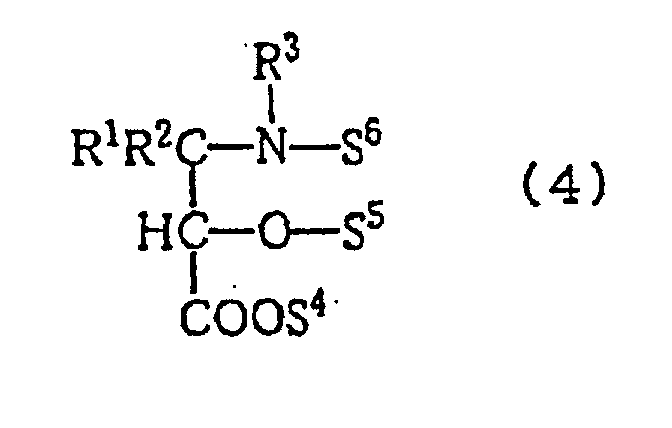


 converting a N-protected-3-amino-2-hydroxypropionic acid derivative having a steric configuration at 2-position carbon reverse to that of the above compound (1) and represented by the general formula (2):
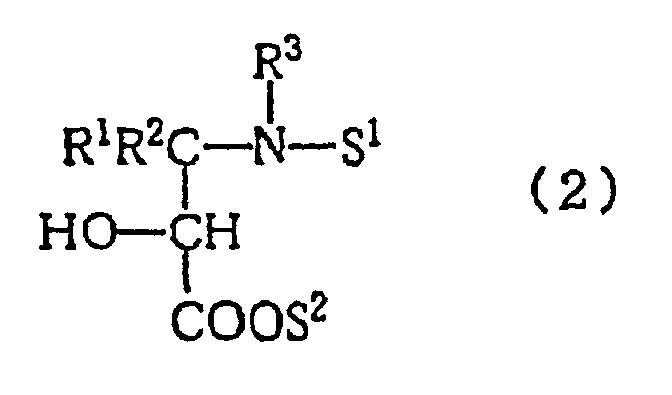 wherein R1, R2 and R3 are as defined above;S1 represents an urethane-type protecting group for an amino group represented by -COOR4, wherein R4 represents a substituted or unsubstituted alkyl group having 1 to 30 carbon atoms, a substituted or unsubstituted aryl group having 6 to 30 carbon atoms, or a substituted or unsubstituted aralkyl group having 7 to 30 carbon atoms; andS2 represents a hydrogen atom or an ester residue; into a N-protected-3-aminopropionic acid derivative represented by the general formula (3):
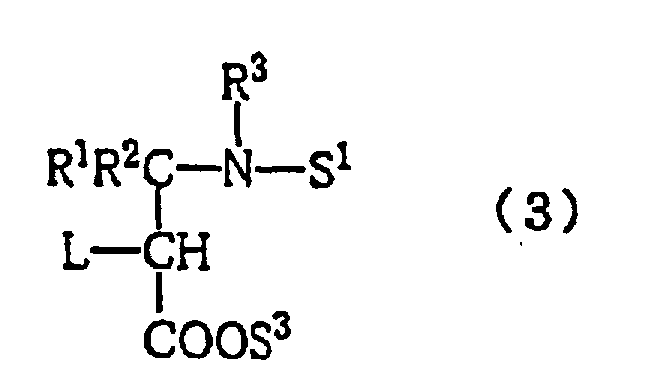 wherein R1, R2, R3 and S1 are as defined above;L represents a leaving group; andS3 represents a hydrogen atom or an ester residue;
 wherein R1, R2 and R3 are as defined above;S4 represents a hydrogen atom or an ester residue;S5 represents a hydrogen atom or a substituent derived from S1;S6 represents S1 when S5 is a hydrogen atom, or a substituent derived from S1, taken together with S5, when S5 is a substituent derived from S1; andS1 is as defined above;
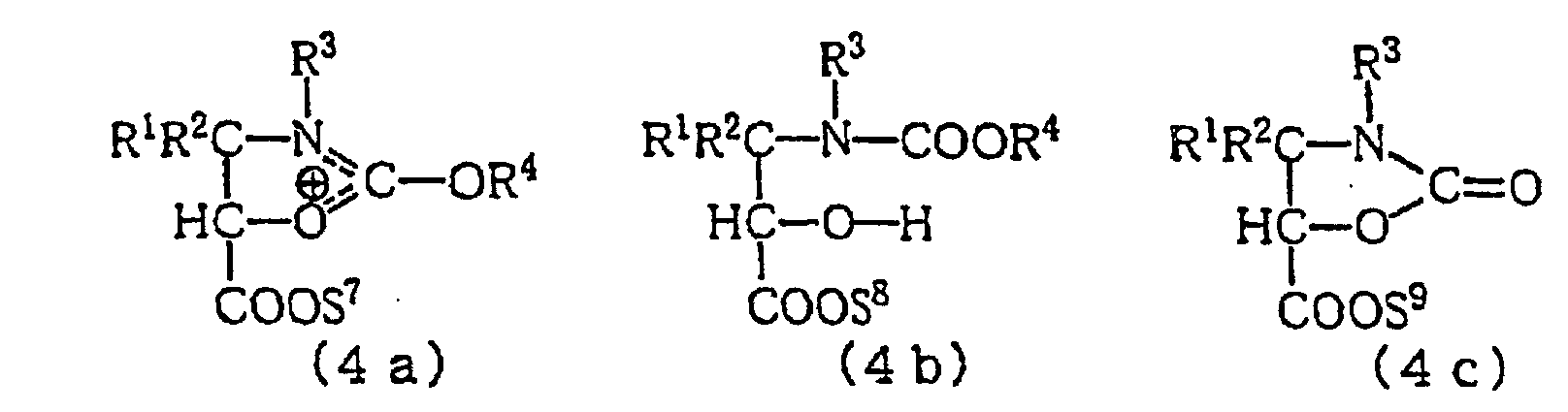 wherein R1, R2, R3 and R4 are as defined above; andS', S8 and S9 are a hydrogen atom or an ester residue.
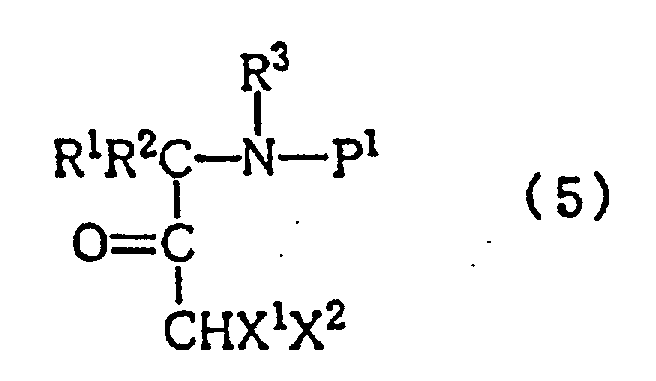 to convert into 3-amino-2-hydroxypropionic acid derivative represented by the general formula (6):wherein R1, R2 and R3 are as defined above;P1 represents a hydrogen atom or a protecting group for an amino group; andX1 and X2, independently from each other, represent a halogen atom;
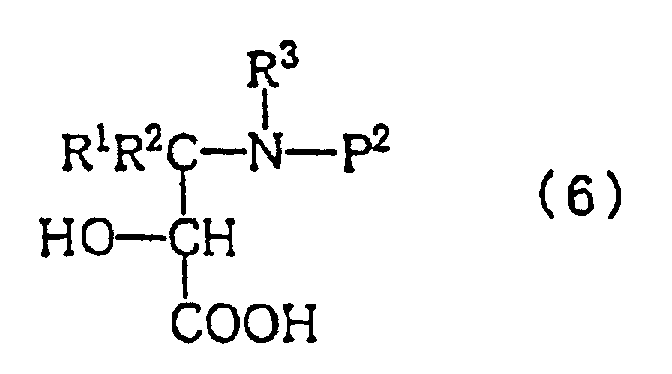 wherein R1, R2 and R3 are as defined above; andP2 represents a hydrogen atom or the above P1; and, if necessary, carrying out conversion of P1 or P2 into S1 and/or esterification.
 whereby precipitating 3-amino-2-hydroxypropionic acid derivative (1) from a medium consisting of water or a mixture of an organic solvent and water, and at the same time, dissolving the above salt formed in said medium.converting an acid or a base coexisting in an acidic or basic aqueous solution of 3-amino-2-hydroxypropionic acid derivative (1) into a salt soluble in an organic solvent and water by neutralization using a base or an acid,
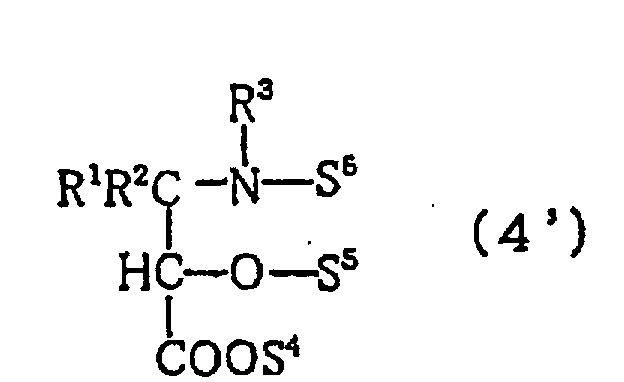 wherein R1, R2 and R3, independently from each other, represent a hydrogen atom, a substituted or unsubstituted alkyl group having 1 to 30 carbon atoms, a substituted or unsubstituted aryl group having 6 to 30 carbon atoms, or a substituted or unsubstituted aralkyl group having 7 to 30 carbon atoms;S4 represents an ester residue; andS5 and S6, taken together, represents a carbonyl group; which comprises crystallizing the derivative using an aromatic hydrocarbon as a solvent.