EP1300239A1 - Non-oriented polyproylene film - Google Patents
Non-oriented polyproylene film Download PDFInfo
- Publication number
- EP1300239A1 EP1300239A1 EP01123752A EP01123752A EP1300239A1 EP 1300239 A1 EP1300239 A1 EP 1300239A1 EP 01123752 A EP01123752 A EP 01123752A EP 01123752 A EP01123752 A EP 01123752A EP 1300239 A1 EP1300239 A1 EP 1300239A1
- Authority
- EP
- European Patent Office
- Prior art keywords
- film
- polypropylene
- polypropylene composition
- oriented
- water vapour
- Prior art date
- Legal status (The legal status is an assumption and is not a legal conclusion. Google has not performed a legal analysis and makes no representation as to the accuracy of the status listed.)
- Withdrawn
Links
- 239000004743 Polypropylene Substances 0.000 claims abstract description 48
- -1 polypropylene Polymers 0.000 claims abstract description 45
- 229920001155 polypropylene Polymers 0.000 claims abstract description 45
- 239000000203 mixture Substances 0.000 claims abstract description 31
- XLYOFNOQVPJJNP-UHFFFAOYSA-N water Substances O XLYOFNOQVPJJNP-UHFFFAOYSA-N 0.000 claims abstract description 25
- 239000005026 oriented polypropylene Substances 0.000 claims abstract description 20
- 230000005540 biological transmission Effects 0.000 claims abstract description 17
- 235000013305 food Nutrition 0.000 claims abstract description 11
- 238000002425 crystallisation Methods 0.000 claims abstract description 10
- 238000004806 packaging method and process Methods 0.000 claims abstract description 8
- 238000005516 engineering process Methods 0.000 claims description 19
- QQONPFPTGQHPMA-UHFFFAOYSA-N propylene Natural products CC=C QQONPFPTGQHPMA-UHFFFAOYSA-N 0.000 claims description 10
- 125000004805 propylene group Chemical group [H]C([H])([H])C([H])([*:1])C([H])([H])[*:2] 0.000 claims description 10
- VGGSQFUCUMXWEO-UHFFFAOYSA-N Ethene Chemical compound C=C VGGSQFUCUMXWEO-UHFFFAOYSA-N 0.000 claims description 7
- 239000005977 Ethylene Substances 0.000 claims description 7
- 238000004519 manufacturing process Methods 0.000 claims description 7
- 229920005604 random copolymer Polymers 0.000 claims description 7
- 229920001384 propylene homopolymer Polymers 0.000 claims description 6
- 238000001595 flow curve Methods 0.000 claims description 5
- 239000002667 nucleating agent Substances 0.000 claims description 5
- 239000004711 α-olefin Substances 0.000 claims description 4
- 229910000831 Steel Inorganic materials 0.000 claims description 3
- 239000010959 steel Substances 0.000 claims description 3
- 238000010791 quenching Methods 0.000 claims description 2
- 230000000171 quenching effect Effects 0.000 claims description 2
- 238000009826 distribution Methods 0.000 abstract description 7
- 238000000034 method Methods 0.000 description 14
- 230000004888 barrier function Effects 0.000 description 13
- 229920000642 polymer Polymers 0.000 description 10
- 239000011127 biaxially oriented polypropylene Substances 0.000 description 5
- 238000010899 nucleation Methods 0.000 description 5
- 229920006378 biaxially oriented polypropylene Polymers 0.000 description 3
- 238000001816 cooling Methods 0.000 description 3
- 230000006911 nucleation Effects 0.000 description 3
- 238000004804 winding Methods 0.000 description 3
- CURLTUGMZLYLDI-UHFFFAOYSA-N Carbon dioxide Chemical compound O=C=O CURLTUGMZLYLDI-UHFFFAOYSA-N 0.000 description 2
- 239000013032 Hydrocarbon resin Substances 0.000 description 2
- QVGXLLKOCUKJST-UHFFFAOYSA-N atomic oxygen Chemical compound [O] QVGXLLKOCUKJST-UHFFFAOYSA-N 0.000 description 2
- LDLDYFCCDKENPD-UHFFFAOYSA-N ethenylcyclohexane Chemical compound C=CC1CCCCC1 LDLDYFCCDKENPD-UHFFFAOYSA-N 0.000 description 2
- 229920006270 hydrocarbon resin Polymers 0.000 description 2
- 239000010410 layer Substances 0.000 description 2
- 239000000463 material Substances 0.000 description 2
- 238000005259 measurement Methods 0.000 description 2
- 239000000155 melt Substances 0.000 description 2
- 239000000178 monomer Substances 0.000 description 2
- 230000003287 optical effect Effects 0.000 description 2
- 229910052760 oxygen Inorganic materials 0.000 description 2
- 239000001301 oxygen Substances 0.000 description 2
- 229920005989 resin Polymers 0.000 description 2
- 239000011347 resin Substances 0.000 description 2
- 238000003856 thermoforming Methods 0.000 description 2
- 238000005079 FT-Raman Methods 0.000 description 1
- 238000005033 Fourier transform infrared spectroscopy Methods 0.000 description 1
- 239000000654 additive Substances 0.000 description 1
- 239000002390 adhesive tape Substances 0.000 description 1
- 230000002902 bimodal effect Effects 0.000 description 1
- 238000003490 calendering Methods 0.000 description 1
- 229910002092 carbon dioxide Inorganic materials 0.000 description 1
- 239000001569 carbon dioxide Substances 0.000 description 1
- 239000003054 catalyst Substances 0.000 description 1
- 238000006243 chemical reaction Methods 0.000 description 1
- 230000000052 comparative effect Effects 0.000 description 1
- 150000001875 compounds Chemical class 0.000 description 1
- 229920001577 copolymer Polymers 0.000 description 1
- 239000012792 core layer Substances 0.000 description 1
- 230000002596 correlated effect Effects 0.000 description 1
- 239000013078 crystal Substances 0.000 description 1
- 239000003599 detergent Substances 0.000 description 1
- 230000000694 effects Effects 0.000 description 1
- 238000001125 extrusion Methods 0.000 description 1
- 239000000796 flavoring agent Substances 0.000 description 1
- 235000019634 flavors Nutrition 0.000 description 1
- 239000007789 gas Substances 0.000 description 1
- 238000010438 heat treatment Methods 0.000 description 1
- 238000000691 measurement method Methods 0.000 description 1
- 238000002844 melting Methods 0.000 description 1
- 230000008018 melting Effects 0.000 description 1
- 239000003607 modifier Substances 0.000 description 1
- 239000000825 pharmaceutical preparation Substances 0.000 description 1
- 229940127557 pharmaceutical product Drugs 0.000 description 1
- 229920006254 polymer film Polymers 0.000 description 1
- 150000003097 polyterpenes Chemical class 0.000 description 1
- 239000002994 raw material Substances 0.000 description 1
- 238000004611 spectroscopical analysis Methods 0.000 description 1
- 238000003860 storage Methods 0.000 description 1
- 239000000126 substance Substances 0.000 description 1
- 238000009966 trimming Methods 0.000 description 1
Classifications
-
- C—CHEMISTRY; METALLURGY
- C08—ORGANIC MACROMOLECULAR COMPOUNDS; THEIR PREPARATION OR CHEMICAL WORKING-UP; COMPOSITIONS BASED THEREON
- C08J—WORKING-UP; GENERAL PROCESSES OF COMPOUNDING; AFTER-TREATMENT NOT COVERED BY SUBCLASSES C08B, C08C, C08F, C08G or C08H
- C08J5/00—Manufacture of articles or shaped materials containing macromolecular substances
- C08J5/18—Manufacture of films or sheets
-
- C—CHEMISTRY; METALLURGY
- C08—ORGANIC MACROMOLECULAR COMPOUNDS; THEIR PREPARATION OR CHEMICAL WORKING-UP; COMPOSITIONS BASED THEREON
- C08J—WORKING-UP; GENERAL PROCESSES OF COMPOUNDING; AFTER-TREATMENT NOT COVERED BY SUBCLASSES C08B, C08C, C08F, C08G or C08H
- C08J2323/00—Characterised by the use of homopolymers or copolymers of unsaturated aliphatic hydrocarbons having only one carbon-to-carbon double bond; Derivatives of such polymers
- C08J2323/02—Characterised by the use of homopolymers or copolymers of unsaturated aliphatic hydrocarbons having only one carbon-to-carbon double bond; Derivatives of such polymers not modified by chemical after treatment
- C08J2323/10—Homopolymers or copolymers of propene
Definitions
- the invention relates to a non-oriented polypropylene film with reduced water vapour transmission rate comprised of a polypropylene composition.
- Polypropylene films are used in many commercial applications.
- One particularly important application is the packaging of food products.
- Films employed in the food packaging industry are chosen and/or designed to provide characteristics necessary for proper food containment. Such characteristics include water vapour barrier properties, oxygen and gas barrier properties and flavour and aroma barrier properties. These improved barrier properties are advantageous also in non-food packaging applications, for example for the production of blister packages containing pharmaceutical products, detergents or other moisture-sensitive articles.
- Polypropylene is a polymer commonly employed in the manufacture of films used in the food packaging industry. In the case of multilayer films, polypropylene is typically used in the base or core layer. Often the polypropylene layer is modified to obtain desired characteristics which are not inherent in unmodified polypropylene. For example, resin modifiers and/or additives may be blended with the polypropylene.
- WO 96/02388 discloses biaxially oriented polypropylene (BOPP) films from highly crystalline polypropylene and a moisture barrier improving amount of a polyterpene resin.
- the addition of moisture barrier improving compounds however has the disadvantage of being rather costly and sharply increases the raw material price. It also leads to a reduced toughness of the produced film.
- MOPP Monoaxially oriented PP film
- a solid-state orientation step below the melting temperature is applied before winding.
- the resulting films (used e.g. for adhesive tapes or packaging tapes) have a higher crystallinity and stiffness, which goes along with reduced WVTR as compared to cast or roll stack films.
- a disadvantage of such films is the severe anisotropy of mechanical properties, the limited transparency caused by oriented crystals and a strong tendency to split in processing direction.
- the cost for a setup for MOPP production is already significantly higher than for a standard cast film unit.
- BOPP Biaxially oriented PP film
- BOPP Biaxially oriented polypropylene
- Orientation and properties are determined by the draw ratio and details of the process; the films have generally the highest crystallinity and stiffness achievable.
- the main disadvantages of the BOPP process are the high requirements to the polymers used for this process (a rather high molecular weight and broad molecular weight distribution combined with limited isotacticity are required) and the dimension and cost of the necessary machines, which exceed those for every other technology for the production of PP film.
- OPP oriented polypropylene films
- non-oriented polypropylene films have only a limited barrier function against water vapour and even less so against oxygen or carbon dioxide. In case of oriented films, these properties are greatly improved - however, at the price of significantly higher production costs and a certain brittleness as well as strongly anisotropic mechanical properties and shrinkage.. Due to these disadvantages non-oriented polypropylene films are gradually gaining in importance over OPP because of their lower machinery and conversion costs.
- a polypropylene composition being comprised of a propylene homopolymer and/or a propylene random copolymer which comprises up to 1.5 wt% of one or more C 4 -C 8 ⁇ -olefins and/or ethylene, which polypropylene composition has an isotacticity 2 0.96, a crystallisation temperature of T c ⁇ 120 °C (determined by DSC according to ISO 3146) and a shear thinning index SHI (0/50) ⁇ 10 (calculated from the flow curve at 200 °C).
- Isotacticity is determined by FTIR measurement and calculated as peak ratio A 998 /A 973 (described in T.Sundell, H. Fagerholm & H. Crozier, Isotacticity determination of polypropylene using FT-Raman spectroscopy, Polymer 37 , 1996, 3227-31).
- Crystallisation temperatures are determined by DSC measurement according to ISO 3146 at a cooling rate of 10 K/min after a first heating to 200 °C.
- the shear thinning index SHI is calculated from the flow curve ⁇ ( ⁇ ) at 200 °C - which can be determined with a capillary rheometer according to ISO 11443 or calculated from the complex shear viscosity determined with a plate-plate rheometer according to ISO 6271-10 using the well-known "Cox-Merz rule" relating the shear viscosity to the dynamic viscosity as described in W.P. Cox & E.H. Merz, J.Polym.Sci. 28(1958) 619-623.
- the SHI (0/50) is defined as the ratio between the zero shear viscosity ( ⁇ 0 ) and the viscosity at a stress ( ⁇ ) value of 50000 Pa.
- the shear thinning index is proportional to the broadness of the molecular weight distribution (MWD) of the polymer. At very high values it can reflect the bimodality of the molecular weight distribution (i.e. the MWD curve shows two maxima or one maximum and a pronounced shoulder). For reasons of processability and homogeneity the higher molecular weight tail will be limited in practice.
- MWD molecular weight distribution
- melt flow rate is that quantity of polymer in grams which the test apparatus standardised to DIN 53 735 extrudes within 10 minutes at a temperature of 230 °C under a weight of 2.16 kg.
- Comonomer contents were calculated from polymerisation parameters, i.e. the monomer consumption.
- Water vapour transmission rates are determined under tropical conditions (38 °C, 90 % rel. humidity) according to DIN 53122/1. Water vapour transmission rates are determined on 50 ⁇ m cast films.
- the polypropylene composition has an isotacticity ⁇ 0.96,. preferably ⁇ 0.97, more preferably ⁇ 0.98.
- the polypropylene composition has a crystallisation temperature Tc ⁇ 120 °C, preferably ⁇ 123 °C, more preferably ⁇ 125 °C.
- the crystallisation temperature can be correlated both to the molecular weight distribution of the polymer and to the final crystallinity achieved.
- An increased content of high molecular weight molecules will normally increase the crystallisation temperature, which will also result in an increased crystallinity.
- the extent of these effects is, however, depending on details of the molecular weight distribution and the molecular structure as well as - for the final crystallinity - on the type and conditions of processing.
- an increased crystallinity will generally lead to reduced WVTR and increased stiffness in case of films. If, however, this crystallinity increase goes along with coarsening or anisotropy of the formed crystalline morphology it will lead to brittleness of the film, thus limiting the applicability.
- the polypropylene composition has a shear thinning index SHI (0/50) ⁇ 10, preferably ⁇ 12, more preferably ⁇ 15.
- SHI is a measure for the processing behaviour of a polymer with higher values indicating a broad to bimodal molecular weight distribution. It has surprisingly been found, that a higher shear thinning index corresponds with a decrease in water vapour transmission rates.
- the polypropylene composition is comprised of a propylene random copolymer which comprises 99.7 wt% of propylene and 0.3 wt% of ethylene.
- Random copolymers of propylene and ethylene have the additional advantage of good optical properties, e.g. reduced haze and increased surface gloss.
- the polypropylene composition has a shear thinning index SHI (0/50) ⁇ 14 and the film has a water vapour transmission rate ⁇ 2.00 g.m -2 .day -1 (determined according to DIN 53122/1 on a 50 ⁇ m cast film).
- Non-oriented polypropylene films with the above properties are particularly preferred, because they are the best suited substitutes for BOPP films where water barrier properties are concerned.
- Films according to the invention may be produced by any method which is suitable for obtaining non-oriented films.
- the molten polymer is extruded through a slot die fed by a (normally single-screw) extruder onto a first cooled roll, the so-called chill-roll. From this roll, the already solidified film is taken up by a second roll (nip roll or takeup roll) and transported to a winding device after trimming the edges. Only a very limited amount of orientation is created in the film, which is determined by the ratio between die thickness and film thickness or the extrusion speed and the take-up speed, respectively.
- the films resulting from this technology usually have a thickness of from 30 to 500 ⁇ m and are characterised by good transparency and rather isotropic mechanical properties (limited stiffness, high toughness).
- this is an expansion of the cast film technology to allow higher film thickness, mostly for thermoforming applications.
- the still partially molten film is transferred to a roll stack similar to a calendering setup, in which the final film thickness and orientation of the film are determined.
- the final film thickness can range from 300 to 2000 ⁇ m, orientation and anisotropy of the mechanical properties are low.
- the polypropylene composition comprises a nucleating agent.
- nucleation it is known that mechanical properties of polymers may be further improved by nucleation.
- ⁇ -nucleation is preferred.
- a wide range of nucleating agents is suitable for accomplishing the desired degree of ⁇ -nucleation. Of the possible ⁇ -nucleating agents the following are especially preferred:
- CCPP further nucleation method, "CCPP" in the examples, is a special reactor technique, where the catalyst is prepolymerised with monomers like vinylcyclohexane (VCH). This method is described in greater detail in e.g. EP 0 316 187 A2.
- a polypropylene composition being comprised of a propylene homopolymer and/or a propylene random copolymer which comprises up to 1.5 wt% of one or more C 4 -C 8 ⁇ -olefins and/or ethylene, which polypropylene composition has an isotacticity ⁇ 0.96, a crystallisation temperature of T c ⁇ 120 °C (determined by DSC according to ISO 3146) and a shear thinning index SHI (0/50) ⁇ 10 (calculated from the flow curve at 200 °C) for the production of a non-oriented polypropylene film which has a reduced water vapour transmission rate.
- the polypropylene film has a water vapour transmission rate of ⁇ 3.00 g.m -2 .day -1 (determined according to DIN 53122/1 on a 50 ⁇ m cast film).
- a polypropylene composition which has a shear thinning index SHI (0/50) ⁇ 14 and the film has a water vapour transmission rate ⁇ 2.00 g.m -2 .day -1 (determined according to DIN 53122/1 on a 50 ⁇ m cast film).
- a polypropylene composition which is comprised of a propylene homopolymer which polypropylene composition has an isotacticity ⁇ 0.96.
- the polypropylene composition is coextruded into one of the layers of a two- or multi-layered film.
- the films according to the invention can be utilised in a wide range of applications, especially in food or non-food packaging applications.
- All films were produced from propylene homo- or copolymers, which are characterised by their analytical data in table1.
- the films were produced in cast film technology on a single screw extruder with a barrel diameter of 52 mm and a slot die of 800 x 0.5 mm in combination with a chill- and a takeup-roll. Melt temperature was 240 °C in the die; the chill-roll was kept at 15 °C and the takeup roll at 20 °C. A film thickness of 50 ⁇ m was adjusted through the ratio between extruder output and takeoff speed.
- Examples 1, 2 and 3 are according to the invention, examples C1 and C2 are comparative examples.
- All of the inventive films show remarkably improved water barrier properties. Optical properties are maintained in an acceptable range.
Landscapes
- Chemical & Material Sciences (AREA)
- Engineering & Computer Science (AREA)
- Manufacturing & Machinery (AREA)
- Medicinal Chemistry (AREA)
- Health & Medical Sciences (AREA)
- Chemical Kinetics & Catalysis (AREA)
- Materials Engineering (AREA)
- Polymers & Plastics (AREA)
- Organic Chemistry (AREA)
- Manufacture Of Macromolecular Shaped Articles (AREA)
- Compositions Of Macromolecular Compounds (AREA)
- Wrappers (AREA)
- Laminated Bodies (AREA)
- Moulding By Coating Moulds (AREA)
Abstract
The invention relates to a non-oriented polypropylene film comprised of a polypropylene
composition which has an increased stereoregularity, crystallisation temperature and a broad
molecular weight distribution.
The inventive films have reduced water vapour transmission rates and are applicable for food and non-food packaging applications.
The inventive films have reduced water vapour transmission rates and are applicable for food and non-food packaging applications.
Description
The invention relates to a non-oriented polypropylene film with reduced water vapour
transmission rate comprised of a polypropylene composition.
Polypropylene films are used in many commercial applications. One particularly important
application is the packaging of food products. Films employed in the food packaging industry
are chosen and/or designed to provide characteristics necessary for proper food
containment. Such characteristics include water vapour barrier properties, oxygen and gas
barrier properties and flavour and aroma barrier properties. These improved barrier
properties are advantageous also in non-food packaging applications, for example for the
production of blister packages containing pharmaceutical products, detergents or other
moisture-sensitive articles.
Polypropylene is a polymer commonly employed in the manufacture of films used in the food
packaging industry. In the case of multilayer films, polypropylene is typically used in the base
or core layer. Often the polypropylene layer is modified to obtain desired characteristics
which are not inherent in unmodified polypropylene. For example, resin modifiers and/or
additives may be blended with the polypropylene.
US 5,667,902 teaches that a substantial increase in water vapour barrier properties is
achieved by adding up to 8 to 9 wt% of hydrocarbon resin to the polymer base material.
Additional improvements in water vapour barrier properties are only small when adding more
than 9 wt% of hydrocarbon resin.
WO 96/02388 discloses biaxially oriented polypropylene (BOPP) films from highly crystalline
polypropylene and a moisture barrier improving amount of a polyterpene resin.
The addition of moisture barrier improving compounds however has the disadvantage of being rather costly and sharply increases the raw material price. It also leads to a reduced toughness of the produced film.
The addition of moisture barrier improving compounds however has the disadvantage of being rather costly and sharply increases the raw material price. It also leads to a reduced toughness of the produced film.
Based on a cast film, a solid-state orientation step below the melting temperature is applied
before winding. The resulting films (used e.g. for adhesive tapes or packaging tapes) have a
higher crystallinity and stiffness, which goes along with reduced WVTR as compared to cast
or roll stack films. A disadvantage of such films is the severe anisotropy of mechanical
properties, the limited transparency caused by oriented crystals and a strong tendency to
split in processing direction. Moreover, the cost for a setup for MOPP production is already
significantly higher than for a standard cast film unit.
Two main technologies are used for this process, which are described in detail in A. Ajji &
M.M. Dumoulin, Biaxially oriented polypropylene (BOPP) process, in: J. Karger-Kocsis (Ed.)
Polypropylene: An A-Z Reference, Kluwer, Dordrecht 1999, 60-67. Orientation and properties
are determined by the draw ratio and details of the process; the films have generally the
highest crystallinity and stiffness achievable. The main disadvantages of the BOPP process
are the high requirements to the polymers used for this process (a rather high molecular
weight and broad molecular weight distribution combined with limited isotacticity are
required) and the dimension and cost of the necessary machines, which exceed those for
every other technology for the production of PP film.
While oriented polypropylene films (OPP) are known for their inherent moisture barrier
properties, non-oriented polypropylene films have only a limited barrier function against water
vapour and even less so against oxygen or carbon dioxide. In case of oriented films, these
properties are greatly improved - however, at the price of significantly higher production
costs and a certain brittleness as well as strongly anisotropic mechanical properties and
shrinkage..
Due to these disadvantages non-oriented polypropylene films are gradually gaining in
importance over OPP because of their lower machinery and conversion costs.
It is therefore the object of the invention to provide a non-oriented polypropylene film
comprised of a polypropylene composition which film has good mechanical properties,
processability and improved water vapour barrier properties.
This object is achieved by a polypropylene composition being comprised of a propylene
homopolymer and/or a propylene random copolymer which comprises up to 1.5 wt% of one
or more C4-C8 α-olefins and/or ethylene,
which polypropylene composition has an isotacticity 2 0.96,
a crystallisation temperature of Tc ≥ 120 °C (determined by DSC according to ISO 3146) and a shear thinning index SHI (0/50) ≥ 10 (calculated from the flow curve at 200 °C).
which polypropylene composition has an isotacticity 2 0.96,
a crystallisation temperature of Tc ≥ 120 °C (determined by DSC according to ISO 3146) and a shear thinning index SHI (0/50) ≥ 10 (calculated from the flow curve at 200 °C).
Isotacticity is determined by FTIR measurement and calculated as peak ratio A998/A973
(described in T.Sundell, H. Fagerholm & H. Crozier, Isotacticity determination of
polypropylene using FT-Raman spectroscopy, Polymer 37, 1996, 3227-31).
Crystallisation temperatures are determined by DSC measurement according to ISO 3146 at
a cooling rate of 10 K/min after a first heating to 200 °C.
The shear thinning index SHI is calculated from the flow curve η(σ) at 200 °C - which can be
determined with a capillary rheometer according to ISO 11443 or calculated from the
complex shear viscosity determined with a plate-plate rheometer according to ISO 6271-10
using the well-known "Cox-Merz rule" relating the shear viscosity to the dynamic viscosity as
described in W.P. Cox & E.H. Merz, J.Polym.Sci. 28(1958) 619-623. The SHI (0/50) is
defined as the ratio between the zero shear viscosity (η0) and the viscosity at a stress (σ)
value of 50000 Pa.
Generally, the shear thinning index is proportional to the broadness of the molecular weight
distribution (MWD) of the polymer.
At very high values it can reflect the bimodality of the molecular weight distribution (i.e. the MWD curve shows two maxima or one maximum and a pronounced shoulder). For reasons of processability and homogeneity the higher molecular weight tail will be limited in practice.
At very high values it can reflect the bimodality of the molecular weight distribution (i.e. the MWD curve shows two maxima or one maximum and a pronounced shoulder). For reasons of processability and homogeneity the higher molecular weight tail will be limited in practice.
The melt flow rates were measured with a load of 2.16 kg at 230 °C. The melt flow rate
(MFR) is that quantity of polymer in grams which the test apparatus standardised to DIN 53
735 extrudes within 10 minutes at a temperature of 230 °C under a weight of 2.16 kg.
Comonomer contents were calculated from polymerisation parameters, i.e. the monomer
consumption.
All film properties were determined on film samples with a thickness of 50 µm after 4 days
storage at 23 °C.
Water vapour transmission rates are determined under tropical conditions (38 °C, 90 % rel.
humidity) according to DIN 53122/1.
Water vapour transmission rates are determined on 50 µm cast films.
Water vapour transmission rates are determined on 50 µm cast films.
Haze was determined according to ASTM D 1003-92.
Tensile Modulus was determined according to DIN 53 457.
According to the present invention the polypropylene composition has an isotacticity ≥ 0.96,.
preferably ≥ 0.97, more preferably ≥ 0.98.
The higher the isotacticity the higher is the crystallinity of the polypropylene composition.
With increasing crystallinity of the polypropylene composition the stiffness of the film also
increases.
Generally, a higher crystallinity will mean higher density and, subsequently, lower water
vapour transmission rate. In cast films, the crystallinity potential of a specific material is,
however, only partially utilised due to the high cooling rates in the process. Moreover, a too
high crystallinity can lead to brittleness of the film and to problems in transparency and gloss
of the film.
According to the present invention the polypropylene composition has a crystallisation
temperature Tc ≥ 120 °C, preferably ≥ 123 °C, more preferably ≥ 125 °C.
For non-nucleated polypropylenes, the crystallisation temperature can be correlated both to
the molecular weight distribution of the polymer and to the final crystallinity achieved. An
increased content of high molecular weight molecules will normally increase the
crystallisation temperature, which will also result in an increased crystallinity. The extent of
these effects is, however, depending on details of the molecular weight distribution and the
molecular structure as well as - for the final crystallinity - on the type and conditions of
processing. Furthermore, an increased crystallinity will generally lead to reduced WVTR and
increased stiffness in case of films. If, however, this crystallinity increase goes along with
coarsening or anisotropy of the formed crystalline morphology it will lead to brittleness of the
film, thus limiting the applicability.
According to the present invention the polypropylene composition has a shear thinning index
SHI (0/50) ≥ 10, preferably ≥ 12, more preferably ≥ 15.
SHI is a measure for the processing behaviour of a polymer with higher values indicating a
broad to bimodal molecular weight distribution.
It has surprisingly been found, that a higher shear thinning index corresponds with a
decrease in water vapour transmission rates.
According to an advantageous embodiment of the present invention the polypropylene
composition is comprised of a propylene random copolymer which comprises 99.7 wt% of
propylene and 0.3 wt% of ethylene.
Random copolymers of propylene and ethylene have the additional advantage of good
optical properties, e.g. reduced haze and increased surface gloss.
According to a preferred embodiment of the present invention the polypropylene composition
has a shear thinning index SHI (0/50) ≥ 14 and the film has a water vapour transmission rate
< 2.00 g.m-2.day-1 (determined according to DIN 53122/1 on a 50 µm cast film).
Non-oriented polypropylene films with the above properties are particularly preferred,
because they are the best suited substitutes for BOPP films where water barrier properties
are concerned.
Films according to the invention may be produced by any method which is suitable for
obtaining non-oriented films. Cast film technology, roll stack technology and rapid quenching
technologies, e.g. waterbath or steel belt technology, are particularly preferred.
In this most simple technology for producing polymer films, the molten polymer is extruded
through a slot die fed by a (normally single-screw) extruder onto a first cooled roll, the so-called
chill-roll. From this roll, the already solidified film is taken up by a second roll (nip roll
or takeup roll) and transported to a winding device after trimming the edges. Only a very
limited amount of orientation is created in the film, which is determined by the ratio between
die thickness and film thickness or the extrusion speed and the take-up speed, respectively.
Due to its technical simplicity, cast film technology is a very economical and easy-to-handle
process. The films resulting from this technology usually have a thickness of from 30 to 500
µm and are characterised by good transparency and rather isotropic mechanical properties
(limited stiffness, high toughness).
Basically, this is an expansion of the cast film technology to allow higher film thickness,
mostly for thermoforming applications. From the chill roll, the still partially molten film is
transferred to a roll stack similar to a calendering setup, in which the final film thickness and
orientation of the film are determined. The final film thickness can range from 300 to
2000 µm, orientation and anisotropy of the mechanical properties are low.
Waterbath or steel-belt technology: These processes are targeted at reaching very high
cooling rates in the film forming process, thus reducing the film crystallinity and stiffness
while optimising thermoforming properties and transparency. The molten film from a flat die
is quenched immediately between polished steel belts cooled from the backside or in a cold
water bath, from which it is taken to the winding device. Films produced this way have the
lowest possible crystallinity and stiffness.
According to a still further advantageous embodiment of the present invention the
polypropylene composition comprises a nucleating agent.
It is known that mechanical properties of polymers may be further improved by nucleation.
For the present invention α-nucleation is preferred. A wide range of nucleating agents is
suitable for accomplishing the desired degree of α-nucleation.
Of the possible α-nucleating agents the following are especially preferred:
Of the possible α-nucleating agents the following are especially preferred:
A further nucleation method, "CCPP" in the examples, is a special reactor technique, where
the catalyst is prepolymerised with monomers like vinylcyclohexane (VCH). This method is
described in greater detail in e.g. EP 0 316 187 A2.
In addition to the nucleating agents mentioned above, the use of long-chain branched
polypropylene with high melt strength for nucleation purposes as outlined e.g. in
US 6,077,907 is included. Like CCPP technology, this method avoids the addition of
additional chemical substances, which could give rise to taste or odour problems.
It is a further object of the invention to provide a novel way of producing non-oriented
polypropylene films with reduced water vapour transmission rates.
This object is achieved by using a polypropylene composition being comprised of a
propylene homopolymer and/or a propylene random copolymer which comprises up to
1.5 wt% of one or more C4-C8 α-olefins and/or ethylene,
which polypropylene composition has an isotacticity ≥ 0.96,
a crystallisation temperature of Tc ≥ 120 °C (determined by DSC according to ISO 3146)
and a shear thinning index SHI (0/50) ≥ 10 (calculated from the flow curve at 200 °C) for the production of a non-oriented polypropylene film which has a reduced water vapour transmission rate.
which polypropylene composition has an isotacticity ≥ 0.96,
a crystallisation temperature of Tc ≥ 120 °C (determined by DSC according to ISO 3146)
and a shear thinning index SHI (0/50) ≥ 10 (calculated from the flow curve at 200 °C) for the production of a non-oriented polypropylene film which has a reduced water vapour transmission rate.
According to an advantageous embodiment of the present invention the polypropylene film
has a water vapour transmission rate of < 3.00 g.m-2.day-1 (determined according to DIN
53122/1 on a 50 µm cast film).
According to a further aspect of the invention a polypropylene composition is used which has
a shear thinning index SHI (0/50) ≥ 14 and the film has a water vapour transmission rate
< 2.00 g.m-2.day-1 (determined according to DIN 53122/1 on a 50 µm cast film)..
According to a still further aspect of the invention a polypropylene composition is used which
is comprised of a propylene homopolymer which polypropylene composition has an
isotacticity ≥ 0.96.
According to a still further aspect of the invention the polypropylene composition is
coextruded into one of the layers of a two- or multi-layered film.
The films according to the invention can be utilised in a wide range of applications, especially
in food or non-food packaging applications.
All films were produced from propylene homo- or copolymers, which are characterised by
their analytical data in table1. The films were produced in cast film technology on a single
screw extruder with a barrel diameter of 52 mm and a slot die of 800 x 0.5 mm in
combination with a chill- and a takeup-roll. Melt temperature was 240 °C in the die; the chill-roll
was kept at 15 °C and the takeup roll at 20 °C. A film thickness of 50 µm was adjusted
through the ratio between extruder output and takeoff speed.
The films were tested an analysed as is outlined and described above. The results are
shown in table 1.
Examples 1, 2 and 3 are according to the invention, examples C1 and C2 are comparative
examples.
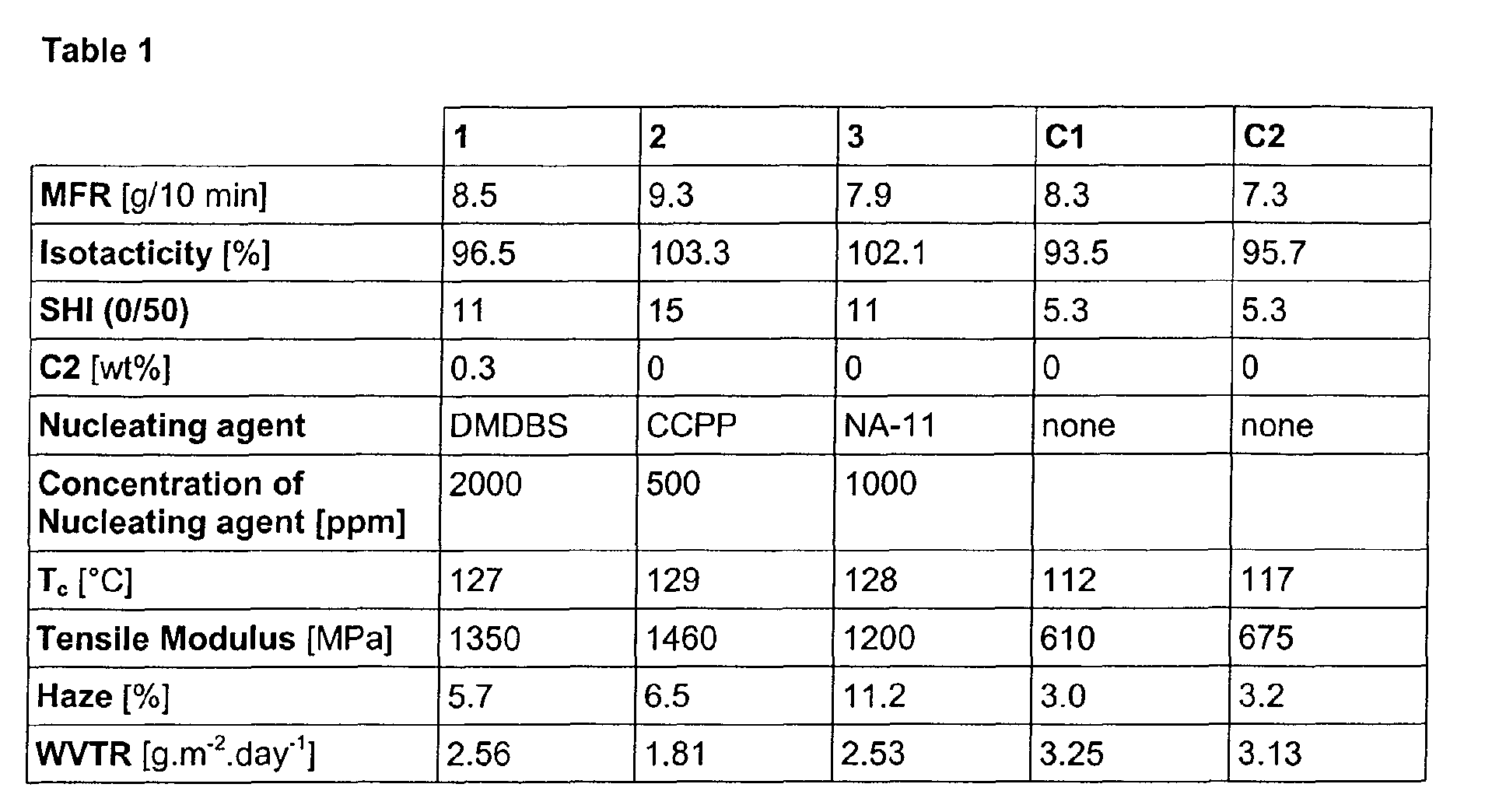
All of the inventive films show remarkably improved water barrier properties. Optical
properties are maintained in an acceptable range.
Claims (14)
- A non-oriented polypropylene film with reduced water vapour transmission rate comprised of a polypropylene composition characterised in the polypropylene composition being comprised of a propylene homopolymer and/or a propylene random copolymer which comprises up to 1.5 wt% of one or more C4-C8 α-olefins and/or ethylene,
which polypropylene composition has an isotacticity ≥ 0.96,
a crystallisation temperature of Tc ≥ 120°C (determined by DSC according to ISO 3146)
and a shear thinning index SHI (0/50) ≥ 10 (calculated from the flow curve at 200 °C). - A non-oriented polypropylene film according to claim 1, characterised in that the polypropylene composition is comprised of a propylene random copolymer which comprises 99.7 wt% of propylene and 0.3 wt% of ethylene.
- A non-oriented polypropylene film according to any one of claims 1 or 2 characterised in that the polypropylene composition has a shear thinning index SHI (0/50) ≥ 14 and the film has a water vapour transmission rate < 2.00 g.m-2.day-1 (determined according to DIN 53122/1 on a 50 µm cast film).
- A non-oriented polypropylene film according to any one of claims 1-3, characterised in that it is obtained by cast film technology.
- A non-oriented polypropylene film according to any one of claims 1-3, characterised in that it is obtained by roll stack technology.
- A non-oriented polypropylene film according to any one of claims 1-3, characterised in that it is obtained by rapid quenching technologies, preferably waterbath or steel belt technology.
- A non-oriented polypropylene film according to any one of claims 1-6, characterised in that the polypropylene composition comprises a nucleating agent.
- A non-oriented polypropylene film according to any one of claims 1-7, characterised in that it forms at least one of the layers of a two- or multi-layered film.
- Use of a polypropylene composition being comprised of a propylene homopolymer and/or a propylene random copolymer which comprises up to 1.5 wt% of one or more C4-C8 α-olefins and/or ethylene,
which polypropylene composition has an isotacticity ≥ 0.96,
a crystallisation temperature of Tc ≥ 120 °C (determined by DSC according to ISO 3146)
and a shear thinning index SHI (0/50) ≥ 10 (calculated from the flow curve at 200 °C) for the production of a non-oriented polypropylene film which has a reduced water vapour transmission rate. - Use according to claim 9, characterised in that the polypropylene film has a water vapour transmission rate of < 3.00 g.m-2.day-1 (determined according to DIN 53122/1 on a 50 µm cast film).
- Use according to claim 9-10, characterised in that the polypropylene composition has a shear thinning index SHI (0/50) ≥ 14 and the film has a water vapour transmission rate < 2.00 g.m-2.day-1 (determined according to DIN 53122/1 on a 50 µm cast film).
- Use according to any one of claims 9-11, characterised in that the polypropylene composition is comprised of a propylene homopolymer which polypropylene composition has an isotacticity ≥ 0.96.
- Use according to any one of claims 9-12, characterised in that the polypropylene composition is coextruded into at least one of the layers of a two- or multi-layered film.
- Use of a polypropylene film according to any one of claims 1-8 in food or non-food packaging applications.
Priority Applications (9)
| Application Number | Priority Date | Filing Date | Title |
|---|---|---|---|
| EP01123752A EP1300239A1 (en) | 2001-10-04 | 2001-10-04 | Non-oriented polyproylene film |
| JP2003534184A JP2005504864A (en) | 2001-10-04 | 2002-10-02 | Unstretched polypropylene film |
| DE60204974T DE60204974T2 (en) | 2001-10-04 | 2002-10-02 | NON-ALIGNED POLYPROPYLENE FOIL |
| RU2004113444/04A RU2294343C2 (en) | 2001-10-04 | 2002-10-02 | Nonoriented polypropylene film |
| CNB028221850A CN100572048C (en) | 2001-10-04 | 2002-10-02 | Non-oriented polypropylene film |
| AT02800592T ATE299097T1 (en) | 2001-10-04 | 2002-10-02 | NON-ALIGINATED POLYPROPYLENE FILM |
| ES02800592T ES2243796T3 (en) | 2001-10-04 | 2002-10-02 | NON-ORIENTED POLYPROPYLENE FILM. |
| EP02800592A EP1439957B1 (en) | 2001-10-04 | 2002-10-02 | Non-oriented polypropylene film |
| PCT/EP2002/011050 WO2003031174A2 (en) | 2001-10-04 | 2002-10-02 | Non-oriented polypropylene film |
Applications Claiming Priority (1)
| Application Number | Priority Date | Filing Date | Title |
|---|---|---|---|
| EP01123752A EP1300239A1 (en) | 2001-10-04 | 2001-10-04 | Non-oriented polyproylene film |
Publications (1)
| Publication Number | Publication Date |
|---|---|
| EP1300239A1 true EP1300239A1 (en) | 2003-04-09 |
Family
ID=8178846
Family Applications (2)
| Application Number | Title | Priority Date | Filing Date |
|---|---|---|---|
| EP01123752A Withdrawn EP1300239A1 (en) | 2001-10-04 | 2001-10-04 | Non-oriented polyproylene film |
| EP02800592A Expired - Lifetime EP1439957B1 (en) | 2001-10-04 | 2002-10-02 | Non-oriented polypropylene film |
Family Applications After (1)
| Application Number | Title | Priority Date | Filing Date |
|---|---|---|---|
| EP02800592A Expired - Lifetime EP1439957B1 (en) | 2001-10-04 | 2002-10-02 | Non-oriented polypropylene film |
Country Status (8)
| Country | Link |
|---|---|
| EP (2) | EP1300239A1 (en) |
| JP (1) | JP2005504864A (en) |
| CN (1) | CN100572048C (en) |
| AT (1) | ATE299097T1 (en) |
| DE (1) | DE60204974T2 (en) |
| ES (1) | ES2243796T3 (en) |
| RU (1) | RU2294343C2 (en) |
| WO (1) | WO2003031174A2 (en) |
Cited By (3)
| Publication number | Priority date | Publication date | Assignee | Title |
|---|---|---|---|---|
| EP2338930A1 (en) * | 2009-12-23 | 2011-06-29 | Borealis AG | Blownfilm grade showing superior stiffness, transparency and processing behaviour |
| EP2338931A1 (en) * | 2009-12-23 | 2011-06-29 | Borealis AG | Blown grade showing superior stiffness, transparency and processing behaviour |
| CN107685518A (en) * | 2017-10-17 | 2018-02-13 | 安徽松泰包装材料有限公司 | One kind is packed for CPP films and preparation method thereof |
Families Citing this family (16)
| Publication number | Priority date | Publication date | Assignee | Title |
|---|---|---|---|---|
| CN100363417C (en) * | 2005-01-28 | 2008-01-23 | 中国石油化工股份有限公司 | Propylene polymer composition and biaxially oriented film prepared therefrom |
| PL1712574T3 (en) * | 2005-04-12 | 2008-08-29 | Borealis Tech Oy | Polyethylene film with improved processability and mechanical properties |
| EP1726602A1 (en) * | 2005-05-27 | 2006-11-29 | Borealis Technology Oy | Propylene polymer with high crystallinity |
| JP2008062524A (en) * | 2006-09-07 | 2008-03-21 | Tokuyama Corp | Film for thermoforming sheet lamination |
| WO2008074636A1 (en) * | 2006-12-21 | 2008-06-26 | Basell Poliolefine Italia S.R.L. | High shrink polypropylene films |
| KR101061632B1 (en) * | 2007-01-11 | 2011-09-01 | 주식회사 엘지화학 | Polymerization Method of Propylene Using Prepolymerized Ziegler-Natta Catalysts and Polypropylene Prepared by the Propylene |
| ES2710606T3 (en) * | 2010-04-20 | 2019-04-26 | Borealis Ag | Polypropylene bottles |
| EP2418237A1 (en) | 2010-08-12 | 2012-02-15 | Borealis AG | Easy tear polypropylene film without notch |
| WO2012020106A1 (en) | 2010-08-12 | 2012-02-16 | Borealis Ag | Easy tear polypropylene film without notch |
| AU2017377588B2 (en) * | 2016-12-15 | 2020-07-30 | Abu Dhabi Polymers Co. Ltd (Borouge) L.L.C. | A process for producing a non-oriented film with improved oxygen barrier property |
| EP4069510A1 (en) | 2019-12-05 | 2022-10-12 | Borealis AG | Multilayer film with improved properties |
| WO2022084236A1 (en) | 2020-10-19 | 2022-04-28 | Borealis Ag | Polyolefin composition comprising polypropylene homopolymer and recycled plastic material |
| ES2968750T3 (en) | 2021-04-21 | 2024-05-13 | Borealis Ag | Polyolefin composition comprising polypropylene homopolymer and recycled plastic material |
| EP4194502B1 (en) | 2021-12-13 | 2025-02-12 | Borealis AG | Polyolefin composition comprising polypropylene homopolymer and recycled plastic material |
| EP4345135B1 (en) | 2022-09-30 | 2025-03-05 | Borealis AG | Polyolefin composition comprising polypropylene homopolymer, polypropylene block copolymer and recycled plastic material |
| EP4556523A1 (en) | 2023-11-20 | 2025-05-21 | Borealis AG | Polyolefin composition comprising recycled plastic material, an elastomer and glass fibers |
Citations (5)
| Publication number | Priority date | Publication date | Assignee | Title |
|---|---|---|---|---|
| EP0015472A2 (en) * | 1979-03-03 | 1980-09-17 | Hoechst Aktiengesellschaft | Package that can be easily opened and process for its production and its use |
| JPH02301435A (en) * | 1989-05-17 | 1990-12-13 | Toray Ind Inc | Moistureproof and deodorant polypropylene laminate |
| EP0465912A2 (en) * | 1990-06-25 | 1992-01-15 | Moplefan S.p.A. | Gas and vapor barrier polyolefinic films |
| DE4128820A1 (en) * | 1991-08-30 | 1993-03-04 | Hoechst Ag | Laminated film with good oxygen-barrier properties - comprises 2 multilayer poly:olefin films laminated together, with interlayer of specified silica, as barrier layer |
| JPH07330922A (en) * | 1994-06-06 | 1995-12-19 | Toray Ind Inc | Unstretched polypropylene film for metal deposition |
Family Cites Families (4)
| Publication number | Priority date | Publication date | Assignee | Title |
|---|---|---|---|---|
| IT1260497B (en) * | 1992-05-29 | 1996-04-09 | Himont Inc | PROPYLENE CRYSTALLINE POLYMERS HAVING IMPROVED STATE PROCESSABILITY AND PROCESS FOR THEIR PREPARATION |
| US5318842A (en) * | 1992-12-03 | 1994-06-07 | Himont Incorporated | Biaxially oriented propylene polymer film or sheet articles |
| IT1271418B (en) * | 1993-08-11 | 1997-05-28 | Himont Inc | CAST FILM MANUFACTURES CONSTITUTED BY PROPYLENE POLYMERS |
| US5667902A (en) * | 1996-04-30 | 1997-09-16 | Mobil Oil Corporation | High moisture barrier polypropylene-based film |
-
2001
- 2001-10-04 EP EP01123752A patent/EP1300239A1/en not_active Withdrawn
-
2002
- 2002-10-02 AT AT02800592T patent/ATE299097T1/en not_active IP Right Cessation
- 2002-10-02 DE DE60204974T patent/DE60204974T2/en not_active Expired - Lifetime
- 2002-10-02 CN CNB028221850A patent/CN100572048C/en not_active Expired - Lifetime
- 2002-10-02 WO PCT/EP2002/011050 patent/WO2003031174A2/en not_active Ceased
- 2002-10-02 ES ES02800592T patent/ES2243796T3/en not_active Expired - Lifetime
- 2002-10-02 EP EP02800592A patent/EP1439957B1/en not_active Expired - Lifetime
- 2002-10-02 RU RU2004113444/04A patent/RU2294343C2/en active
- 2002-10-02 JP JP2003534184A patent/JP2005504864A/en active Pending
Patent Citations (5)
| Publication number | Priority date | Publication date | Assignee | Title |
|---|---|---|---|---|
| EP0015472A2 (en) * | 1979-03-03 | 1980-09-17 | Hoechst Aktiengesellschaft | Package that can be easily opened and process for its production and its use |
| JPH02301435A (en) * | 1989-05-17 | 1990-12-13 | Toray Ind Inc | Moistureproof and deodorant polypropylene laminate |
| EP0465912A2 (en) * | 1990-06-25 | 1992-01-15 | Moplefan S.p.A. | Gas and vapor barrier polyolefinic films |
| DE4128820A1 (en) * | 1991-08-30 | 1993-03-04 | Hoechst Ag | Laminated film with good oxygen-barrier properties - comprises 2 multilayer poly:olefin films laminated together, with interlayer of specified silica, as barrier layer |
| JPH07330922A (en) * | 1994-06-06 | 1995-12-19 | Toray Ind Inc | Unstretched polypropylene film for metal deposition |
Non-Patent Citations (2)
| Title |
|---|
| DATABASE WPI Section Ch Week 199105, Derwent World Patents Index; Class A17, AN 1991-032458, XP002194820 * |
| DATABASE WPI Section Ch Week 199608, Derwent World Patents Index; Class A17, AN 1996-074998, XP002194821 * |
Cited By (7)
| Publication number | Priority date | Publication date | Assignee | Title |
|---|---|---|---|---|
| EP2338930A1 (en) * | 2009-12-23 | 2011-06-29 | Borealis AG | Blownfilm grade showing superior stiffness, transparency and processing behaviour |
| EP2338931A1 (en) * | 2009-12-23 | 2011-06-29 | Borealis AG | Blown grade showing superior stiffness, transparency and processing behaviour |
| WO2011076636A1 (en) * | 2009-12-23 | 2011-06-30 | Borealis Ag | Blownfilm grade showing superior stiffness, transparency and processing behaviour |
| WO2011076637A3 (en) * | 2009-12-23 | 2011-09-22 | Borealis Ag | Blown grade showing superior stiffness, transparency and processing behaviour |
| CN102652150A (en) * | 2009-12-23 | 2012-08-29 | 北欧化工公司 | Blownfilm grade showing superior stiffness, transparency and processing behaviour |
| CN102652150B (en) * | 2009-12-23 | 2015-01-14 | 北欧化工公司 | Blownfilm grade showing superior stiffness, transparency and processing behaviour |
| CN107685518A (en) * | 2017-10-17 | 2018-02-13 | 安徽松泰包装材料有限公司 | One kind is packed for CPP films and preparation method thereof |
Also Published As
| Publication number | Publication date |
|---|---|
| ES2243796T3 (en) | 2005-12-01 |
| WO2003031174A2 (en) | 2003-04-17 |
| CN100572048C (en) | 2009-12-23 |
| RU2004113444A (en) | 2005-10-10 |
| JP2005504864A (en) | 2005-02-17 |
| DE60204974D1 (en) | 2005-08-11 |
| ATE299097T1 (en) | 2005-07-15 |
| WO2003031174A3 (en) | 2003-12-11 |
| EP1439957B1 (en) | 2005-07-06 |
| RU2294343C2 (en) | 2007-02-27 |
| CN1582230A (en) | 2005-02-16 |
| EP1439957A2 (en) | 2004-07-28 |
| DE60204974T2 (en) | 2006-05-18 |
Similar Documents
| Publication | Publication Date | Title |
|---|---|---|
| EP1439957B1 (en) | Non-oriented polypropylene film | |
| US6037417A (en) | Polypropylene composition useful for making solid state oriented film | |
| AU2004213164B2 (en) | Polypropylene compositions | |
| US4514534A (en) | Modified polypropylene for film | |
| EP2718365B1 (en) | Improved resin compositions for extrusion coating | |
| US6733719B2 (en) | Polypropylene biaxially oriented film | |
| CA1239723A (en) | Film of polymer mixture containing 4-methyl-1-pentene polymer | |
| EP4129626B1 (en) | Biaxially-oriented polypropylene film | |
| EP3812152A1 (en) | Polypropylene-based multilayer film | |
| EP3581611B1 (en) | Polyethylene resin film | |
| EP4316831A1 (en) | Polypropylene film, laminate, packaging material, and packing body | |
| WO2006119901A1 (en) | Transparent easy tearable film | |
| WO1998027144A1 (en) | Biaxially oriented polypropylene-base film | |
| WO2008112116A1 (en) | Resin compositions for producing biaxially oriented polypropylene films | |
| US5902848A (en) | Polypropylene films suitable for packaging | |
| WO2002044251A1 (en) | Use of propylene terpolymers for the production of films | |
| WO2006115768A1 (en) | In-reactor produced polypropylene blends | |
| WO2002044252A1 (en) | Use of propylene terpolymers for the production of films | |
| EP1957547B2 (en) | Polymer | |
| EP1608506B1 (en) | Multilayer films | |
| JPH10212361A (en) | Self-adhesive packaging film | |
| WO1999057195A1 (en) | Molded polypropylene | |
| JP2007224280A (en) | Propylene resin unstretched film | |
| JPH02127041A (en) | twist packaging film | |
| JPH0784649B2 (en) | Metallized polypropylene film |
Legal Events
| Date | Code | Title | Description |
|---|---|---|---|
| PUAI | Public reference made under article 153(3) epc to a published international application that has entered the european phase |
Free format text: ORIGINAL CODE: 0009012 |
|
| AK | Designated contracting states |
Kind code of ref document: A1 Designated state(s): AT BE CH CY DE DK ES FI FR GB GR IE IT LI LU MC NL PT SE TR Designated state(s): AT BE CH CY DE DK ES FI FR GB GR IE IT LI LU MC NL PT SE TR |
|
| AX | Request for extension of the european patent |
Extension state: AL LT LV MK RO SI |
|
| STAA | Information on the status of an ep patent application or granted ep patent |
Free format text: STATUS: THE APPLICATION IS DEEMED TO BE WITHDRAWN |
|
| 18D | Application deemed to be withdrawn |
Effective date: 20030205 |