EP1298543A2 - Providing a join plan using group-by operator - Google Patents
Providing a join plan using group-by operator Download PDFInfo
- Publication number
- EP1298543A2 EP1298543A2 EP02256224A EP02256224A EP1298543A2 EP 1298543 A2 EP1298543 A2 EP 1298543A2 EP 02256224 A EP02256224 A EP 02256224A EP 02256224 A EP02256224 A EP 02256224A EP 1298543 A2 EP1298543 A2 EP 1298543A2
- Authority
- EP
- European Patent Office
- Prior art keywords
- group
- attribute
- join
- clause
- result
- Prior art date
- Legal status (The legal status is an assumption and is not a legal conclusion. Google has not performed a legal analysis and makes no representation as to the accuracy of the status listed.)
- Withdrawn
Links
Images





Classifications
-
- G—PHYSICS
- G06—COMPUTING OR CALCULATING; COUNTING
- G06F—ELECTRIC DIGITAL DATA PROCESSING
- G06F16/00—Information retrieval; Database structures therefor; File system structures therefor
- G06F16/20—Information retrieval; Database structures therefor; File system structures therefor of structured data, e.g. relational data
- G06F16/24—Querying
- G06F16/245—Query processing
- G06F16/2455—Query execution
- G06F16/24553—Query execution of query operations
- G06F16/24554—Unary operations; Data partitioning operations
- G06F16/24556—Aggregation; Duplicate elimination
-
- G—PHYSICS
- G06—COMPUTING OR CALCULATING; COUNTING
- G06F—ELECTRIC DIGITAL DATA PROCESSING
- G06F16/00—Information retrieval; Database structures therefor; File system structures therefor
- G06F16/20—Information retrieval; Database structures therefor; File system structures therefor of structured data, e.g. relational data
- G06F16/24—Querying
- G06F16/245—Query processing
- G06F16/2453—Query optimisation
- G06F16/24534—Query rewriting; Transformation
- G06F16/24542—Plan optimisation
- G06F16/24544—Join order optimisation
-
- Y—GENERAL TAGGING OF NEW TECHNOLOGICAL DEVELOPMENTS; GENERAL TAGGING OF CROSS-SECTIONAL TECHNOLOGIES SPANNING OVER SEVERAL SECTIONS OF THE IPC; TECHNICAL SUBJECTS COVERED BY FORMER USPC CROSS-REFERENCE ART COLLECTIONS [XRACs] AND DIGESTS
- Y10—TECHNICAL SUBJECTS COVERED BY FORMER USPC
- Y10S—TECHNICAL SUBJECTS COVERED BY FORMER USPC CROSS-REFERENCE ART COLLECTIONS [XRACs] AND DIGESTS
- Y10S707/00—Data processing: database and file management or data structures
- Y10S707/99931—Database or file accessing
- Y10S707/99933—Query processing, i.e. searching
- Y10S707/99934—Query formulation, input preparation, or translation
-
- Y—GENERAL TAGGING OF NEW TECHNOLOGICAL DEVELOPMENTS; GENERAL TAGGING OF CROSS-SECTIONAL TECHNOLOGIES SPANNING OVER SEVERAL SECTIONS OF THE IPC; TECHNICAL SUBJECTS COVERED BY FORMER USPC CROSS-REFERENCE ART COLLECTIONS [XRACs] AND DIGESTS
- Y10—TECHNICAL SUBJECTS COVERED BY FORMER USPC
- Y10S—TECHNICAL SUBJECTS COVERED BY FORMER USPC CROSS-REFERENCE ART COLLECTIONS [XRACs] AND DIGESTS
- Y10S707/00—Data processing: database and file management or data structures
- Y10S707/99931—Database or file accessing
- Y10S707/99933—Query processing, i.e. searching
- Y10S707/99935—Query augmenting and refining, e.g. inexact access
Definitions
- a database is a collection of stored data that is logically related and that is accessible by one or more users.
- a popular type of database is the relational database management system (RDBMS), which includes relational tables made up of rows and columns. Each row represents an occurrence of an entity defined by a table, with an entity being a person, place, or thing about which the table contains information.
- RDBMS relational database management system
- SQL Structured Query Language
- Examples of SQL statements include INSERT, SELECT, UPDATE, and DELETE.
- the SELECT statement is used to retrieve information from the database and to organize information for presentation to a user or to an application program.
- the SELECT statement can specify a join operation to join rows of multiple tables.
- a SELECT statement can also specify that a particular column (or attribute) of a table be aggregated by some specified function, e.g., SUM (to compute the total of a column), AVG (to compute the average value in a column), MIN (to find the smallest value in a column), MAX (to find the largest value in a column), COUNT (to count the number of values in a column), and so forth.
- SUM to compute the total of a column
- AVG to compute the average value in a column
- MIN to find the smallest value in a column
- MAX to find the largest value in a column
- COUNT to count the number of values in a column
- an optimizer in response to a SELECT statement that specifies a join of multiple tables in addition to aggregation of one or more attributes of the tables, an optimizer generates a plan that performs the join of multiple tables first followed by the aggregation following the join.
- An optimizer selects a lowest cost execution or access plan (for a given query) from a plurality of possible plans. The cost is defined as the amount of time and resources needed to perform an execution of the plan.
- the intermediate results are typically stored in a spool table.
- the join of multiple tables (such as a product join) can generate a large amount of data.
- a spool space problem may be encountered if the spool table becomes too big. Consequently, database system performance may suffer.
- the invention resides in a method of performing a join of multiple base tables stored in a database system, the system comprising a storage system to contain the multiple base tables; and at least one node to manage access to the storage system, the method comprising the steps of receiving at the at least one node a query containing an aggregate function and at least one of a Where clause and a Group-by clause for performing a join of the multiple base tables, the at least one of the Where clause and Group-by clause containing a first attribute of a first one of the multiple base tables; performing a Group-by of the first base table on the first attribute to reduce a number of working rows of the first base table and performing a join of a result of the Group-by of the first base table with one other base table.
- the one of the Where clause and Group-by clause preferably contains a second attribute of a second base table, the method further comprising performing a Group-by of the second base table on the second attribute to reduce a number of working rows of the second base table.
- Performing the join preferably comprises performing the join of the result of the Group-by of the first table with a result of the Group-by of the second table.
- performing the join may comprisesperforming the join of the result of the Group-by of first table with the second table.
- the Group-by clause may contain a third attribute of one of the first and second tables, the method then further comprising storing, in an intermediate table, a result of the join of the result of the Group-by of the first table with the result of the Group-by of the second table and performing a Group-by of the intermediate table on the third attribute.
- the third attribute is one of the first and second attributes.
- the Group-by clause contains a second attribute of one of the first and second tables, the method further comprising performing a Group-by, on the second attribute, of a result of the join of the result of the Group-by of the first table with the one other table.
- the query may contain an aggregate function performed on a second attribute of the first table, the method then further comprising calculating an aggregate on the second attribute of the first table and storing a third attribute representing the aggregate in the result of the Group-by of the first table.
- the number of rows of the result of the Group-by of the first table are preferably counted and a fourth attribute representing the count is stored in the result of the Group-by of the first table.
- Labels are preferably assigned to each of the first, second, third, and fourth attributes.
- the one of the Where clause and Group-by clause contains an attribute of a second table
- the method then further comprising performing a Group-by of the second table on the attribute of the second table to reduce a number of working rows of the second table, counting a number of rows of a result of the Group-by of the second table and storing a fifth attribute representing the count of the number of rows of the result of the Group-by of the second table.
- performing the join comprises performing a cross-augmented join of the result of the Group-by of the first table with the result of the Group-by of the second table, the cross-augmented join comprising multiplying the third attribute by the fifth attribute.
- a value representing the multiplication is preferably stored in a sixth attribute.
- the query may contain an aggregate function performed on a sixth attribute of the second table, the method further comprising calculating an aggregate on the sixth attribute of the second table; storing a seventh attribute representing the aggregate on the sixth attribute in the result of the Group-by of the second table, wherein performing the cross-augmented join further comprises multiplying the seventh attribute by the fourth attribute.
- the invention resides in a method of performing a join of multiple base tables stored in a database system, the system comprising a storage system to contain the multiple base tables; and at least one node to manage access to the storage system, the method comprising the steps of receiving a query containing an aggregate function and at least one of a Where clause and a Group-by clause for performing a join of plural base tables, the at least one of the Where clause and Group-by clause containing at least a first attribute of at least a first one of the plural base tables; performing a Group-by of the first base table on the first attribute; storing a result of the Group-by of the first base table in a first Group-by table and performing a join of the first Group-by table with another table.
- the one of the Where clause and the Group-by clause preferably contains a second attribute of a second one of the plural base tables, the method further comprising performing another Group-by of the second base table on the second attribute and storing a result of the Group-by of the second base table in a second Group-by table.
- the join is preferably performed by performing a join of the first Group-by table with the second Group-by table. This join may be a cross-augmented join.
- the aggregate function may be an aggregate function of an attribute of the first base table, wherein the method then further comprises calculating an aggregate of the attribute of the first base table; store the aggregate in a second attribute; calculating a count of a number of rows of the second Group-by table and storing the count in a third attribute, wherein performing the cross-augmented join comprises multiplying the second attribute by the third attribute.
- the one of the Where clause and the Group-by clause further contains a third attribute of a third one of the plural base tables, the method then further comprising performing another Group-by of the third base table on the third attribute and storing a result of the Group-by of the third base table in a third Group-by table.
- the invention may also be expressed as a computer program comprising code which when executed on a data processing system comprising storage means containing multiple base tables and at least one node to manage access to the storage means, causes the database system to receive a query containing an aggregate function and at least one of a Where clause and a Group-by clause for performing a join of plural tables, the at least one of the Where clause and Group-by clause containing a first attribute of at least a first one of the plural tables; compare costs of plural join plans wherein one of the plural join plans comprises performing a Group-by of the first table on the first attribute and select one of the plural join plans having a lower cost.
- the invention also resides in a database system comprising means operable to carry out the method described above and on which the computer program described above is executed on.
- the invention can also be expressed as a database system comprising a storage system to contain plural base tables and an optimizer module operable to receive a query containing an aggregate function and at least one of a Where clause and a group-by clause for performing a join of plural tables, the at least one of the Where clause and group-by clause containing a first attribute of at least a first one of the plural tables, the optimizer module also being operable to compare costs of plural join plans for the query, wherein one of the join plans comprises performing a Group-by of the first table on the first attribute and to select one of the plural join plans having a lower cost.
- the invention also resides in a computer program comprising computer code means adapted to perform all the steps of the methods described above when executed on a database system and in such a computer program embodied on a computer-readable storage medium or as a transmission medium.
- Fig. 1 shows a database system 10 that is accessible by one or more client terminals 12 over a network 14.
- the network 14 include a local area network (LAN), a wide area network (WAN), or some other type of communications channel.
- LAN local area network
- WAN wide area network
- a user or software application is able to issue database queries to extract or manipulate data stored in the database system 10.
- queries are according to a standard database-query language, such as the Structured Query Language (SQL) from the American National Standards Institute (ANSI).
- SQL Structured Query Language
- ANSI American National Standards Institute
- One version of SQL is the SQL-92 Standard
- another version is the SQL-99 Standard (also referred to as the SQL-3 Standard).
- the database system 10 includes a plurality of nodes 16A, 16B, and 16C that are coupled together by an interconnect layer 15.
- the node 16A is coupled to the network 14, and in the illustrated embodiment, includes a parsing engine (PE) or query coordinator 18.
- the node 16A includes an optimizer module 20.
- the parsing engine 18 interprets a query (such as a query received from the client terminal 12), checks the query for proper SQL syntax, and sends out executable steps to be performed by the nodes 16B, 16C.
- the optimizer module 20 selects a lowest cost (or lower cost) execution or access plan from among a plurality of possible plans. In one example, cost is defined as the amount of time and system resources needed to perform an execution plan.
- Each of the nodes 16B, 16C includes an access module 22.
- One example of the access module 22 is the access module processor (AMP) used in some TERADATA® database systems from NCR Corporation.
- the access module 22 is responsible for managing access to respective portions of the database. As shown in Fig. 1, each access module 22 manages access to data stored in a respective storage module 24. Although shown as discrete components, the storage modules 24 may be part of the same storage subsystem, with the storage modules 24 representing different partitions of the storage subsystem.
- nodes In other embodiments, other arrangements of nodes are provided.
- the various software modules, such as the parsing engine 18, optimizer module 20, and access modules 22 are executable on different nodes.
- Each storage module 24 stores one or more tables (also referred to as relations) 26, 28. Because the database system 10 shown in Fig. 1 is a parallel database system that enables concurrent access of different portions of a table, the tables are distributed among plural storage modules 24 corresponding to plural nodes, as shown in Fig. 1.
- the parallel database system 10 is implemented as a single-node multiprocessing system that has plural processors.
- a uni-processor database system is used.
- an alternative method and apparatus of performing joins of plural tables is selectable by the optimizer module 20 in response to queries that contain aggregation function(s) and at least one of a Where clause and a Group-by clause.
- aggregation functions include SUM (to compute the sum of a column of values), AVG to compute the average value of a column of values), MIN (to find the smallest value in a column), MAX (to find the largest value in a column), COUNT (to count the number of values in a column), and so forth.
- a Group-by clause enables query results to be summarized to a "subtotal" level.
- a Group-by clause in a query typically causes several summary rows of data to be produced, with one row for each group (or "class") selected by the Group-by clause.
- the Where clause specifies a condition (or conditions) of the join rows (or tuples) of multiple tables.
- QUERY 1 specifies a join of tables t1, t2, and t3.
- Table t1 includes columns (or attributes) x1, y1 and z1
- table t2 includes attributes x2, y2, and z2
- table t3 includes attributes x3, y3, and z3.
- QUERY 1 also specifies an aggregation function SUM(y1) to sum all the values of the attribute yl and an aggregation function SUM(y3) to sum all the values of attribute y3.
- QUERY 1 includes a Group-by clause to group the join and aggregation results by attributes x1 and z1.
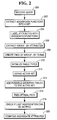
- Fig. 2 shows a process according to one embodiment of performing a join operation in response to a query containing one or more aggregation functions and at least one of a Where clause and a Group-by clause.
- the process illustrated in Fig. 2 is one example of a "partial group-by join path.”
- a query expression such as QUERY 1 above
- the one or more aggregation functions in the query are extracted (at 202) from the SELECT clause in the query.
- the aggregation functions are the two SUM functions SUM(y1) and SUM(y3).
- the extracted aggregation functions are placed in a set SetOfAggregations; that is, SetOfAggregations ⁇ SUM(y1), SUM(y2) ⁇ .
- the attributes that are subject to the extracted aggregation functions are labeled (at 204).
- QUERY 1 for example, the attributes y1 and y3 are associated with the label SUM.
- the following pairs (label, attributes) are produced: (SUM,y1 ) and (SUM, y3).
- the Group-by attributes are extracted (at 206) from the Group-by clause of the received query. Each of these attributes are associated with the label Gb.
- the Group-by attributes include ⁇ x1, z1 ⁇ , each labeled Gb to produce the following pairs (label, attributes): (Gb, x1) and (Gb, z1).
- the "finer" Group-by attributes are extracted from the Where clause of the query. These attributes are labeled Gbw.
- the attributes z1, y2, z2, and z3 are labeled Gbw to provide the pairs: (Gbw, z1), (Gbw, y2), (Gbw, z2), (Gbw, z3).
- the collection of the Gb attributes and Gbw attributes are used to create (at 208) a tree of group-by terms. The tree specifies an order in which the group-by terms are applied.
- table types are initialized (at 210). Initially, all tables are of the type "Regular”: TableType (all tables) ⁇ Regular. However, another type of table, discussed further below, is the Groupby type, which is used by the optimizer module 20 (Fig. 1) to find an optimal join plan.
- An active set is a set of active tables with respect to a given table.
- the join path (order of joins on tables) is searched, in which a partial path may be discovered.
- the optimizer module 20 finds all possible tables that can be joined to the result of the partial path. This collection of possible tables is called the active set.
- the active set varies during the search; however, once the search is over, the active set is empty. For example, ActiveSet is set equal to ⁇ t1, t1', t2, t2', t3, t4xt5, (t4xt5)', ... ⁇ .
- Gb Attributes(ti) represent the attributes of table ti extracted from the Group-by clause of the query
- Gbw Attributes(ti) represent the attributes of table ti extracted from the Where clause of the query
- aggrFunction(attribute) represents the aggregate function performed on an attribute of table ti.
- the function SUM performed on attribute y1, referred to as SUM(y1) is designated as attribute sumyl.
- the COUNT(*) function counts the number of rows of a query result, in this case result table ti'.
- An attribute cti is used to represent COUNT(*) for table ti.
- the set table-conditions(ti) contains all conditions in the Where clause of the original queries that affects table ti.
- the Group-by clause contains Gb Attributes(ti) and Gbw Attributes(ti).
- an optimal path is identified (at 216) based on an active set of tables.
- a result table storing the join of two other tables has attributes (possibly modified) from the joined tables in addition to additional attributes.
- input tables to the join are removed from the active set.
- the Groupby tables associated with those input tables are also removed from the active set.
- a new join table is added to the active set, its prime counterpart (the Groupby version of the new join table) is also added if there are aggregations on the join results.
- the optimizer module 20 next checks (at 218) to determine if a Group-by of the result (referred to as the "last relation") is needed. If rows of the last relation are unique, then nothing further needs to be done. In other words, the last aggregation can be skipped.
- the last relation is unique if it has all rows different on the group-by condition specified in the base query. However, if the rows of the last relation are not unique, then a Group-by of the last relation on the attributes in the Group-by clause of the base query is performed.
- the optimizer module 20 composes (at 220) the aggregate attributes on the result using expression trees and types of attributes.
- the attribute function SUM(x1+3x2) divided by (4*x5) is an aggregate function that works on an expression involving x1, x2, and x5.
- the expression is represented as a tree.
- a SUM step is then performed to aggregate from Spool 3.
- the optimizer module 20 is able to select the conventional join path or the partial group-by join path discussed in connection with Fig. 2, depending on which plan is the optimal plan in terms of cost.
- the partial group-by join operation for QUERY 1 can be expressed as follows.
- the first task is to perform a partial Group-by of tables t1, t2, and t3 (212 in Fig. 2) CREATE VIEW v1 (x1, sumy1, z1, ct1) AS SELECT x1, SUM(y1), z1, COUNT(*) FROM t1 GROUP BY x1, z1; CREATE VIEW v2 (y2, z2, ct2) AS SELECT y2, z2, COUNT(*) FROM t2 GROUP BY y2, z2; CREATE VIEW v3 (sumy3, z3, ct3) AS SELECT SUM(y3), z3, COUNT(*) FROM t3 GROUP BY z3;
- the Group-by of each table ti is placed into a view vi.
- the Group-by of table t1 is placed into view v1
- the Group-by of table t2 is placed into view v2
- the Group-by of table t3 is placed into view v3.
- views v1, v2, and v3 are joined, with the result placed into view v123, as represented by the CREATE statement below:
- a Group-by on the view V123 is then performed, which is a Group-by based on attributes x1, z1.
- Table t1 has Gb attributes x1 and z1 and attribute y1 is associated with the label SUM.
- a partial Group-by of table t1 is performed on the attributes x1 and z1.
- the function COUNT(*) which counts the number of rows in t1', is placed into attribute ct1 and the aggregate function SUM(y1) is placed into sumyl.
- the Groupby table t1' has Gb attributes x1 and z1, the attribute sumy1 associated with the label SUM, and the attribute ct1 associated with the label COUNT.
- the base table t2 has Gbw attributes y2 and z2, which appear in the Where clause of QUERY 1 above.
- a partial Group-by of table t2 is performed on the attributes y2 and z2.
- the ct2 attribute is defined to store the output of COUNT(*).
- the Groupby table t2' (generated from a partial Group-by of base table t2) has attributes y2 and z2 (originally in the Where clause of QUERY 1) that are not associated with any labels since a Group-by of those attributes will not be performed in later joins.
- the attribute ct2 is associated with the label COUNT.
- the base table t3 has a Gbw attribute z3 and an attribute y3 associated with the label SUM.
- a partial Group-by of table t3 is performed on the attributes y3 and z3.
- an attribute ct3 is defined to store the output of COUNT(*).
- an attribute sumy3 is defined to store the output of SUM(y3).
- the Groupby table t3' has an attribute sumy3 associated with the label SUM, and an attribute ct3 associated with the label COUNT.
- the attribute z3 is not associated with any label since further operations are not needed with respect to z3 (which appeared in the Where clause of QUERY 1).
- Figs. 4 and 5 illustrate two different join orders that are selectable by the optimizer module 20.
- Fig. 4 illustrates the join order ((t1'x t2') x t3')'
- Fig. 5 illustrates the join order ((t1'x t2)' x t3')'.
- the join order of Fig. 4 first joins t1' with t2', followed by the join of (t1'xt2') with t3'.
- the join order of Fig. 5 first joins the Groupby table t1' with Regular base table t2, with a partial Group-by performed on the result (t1'xt2) to produce (t1'xt2)'.
- a join is then performed of (t1'x t2)' with Groupby table t3'.
- a cross-augmented join is a regular binary join except that the SUM-type attribute (or other type of aggregate attribute) on one table is augmented (or multiplied) by the COUNT-type attribute of the other table, and the COUNT-type attribute of one table is augmented (or multiplied) by the COUNT-type attribute of the other table. If a table has no COUNT-type attribute, the default value is one.
- the join of table t1' and table t2' is an augmented join, in which the attribute sumy1 is multiplied by ct2 (to produce sumy1ct2), and ct1 is multiplied by ct2 (to produce ct1ct2).
- sumy1ct2 is multiplied by ct3 into sumy1ct2ct3, and ct1ct2 is multiplied by ct3 to produce ct1ct2ct3.
- a Group-by on attributes x1 and z1 is then performed on this table, if necessary, with the result represented as [(t1'x t2') x t3']'.
- the SUM() function is applied on the attribute sumy1ct2ct3, as indicated by SUM(sumy1ct2ct3), and is also applied on the attribute sumy3ct1ct2, as indicated by SUM(sumy3ct1ct2).
- the results of the SUM() functions referenced above are associated with the label SUM.
- the SUM() function is also applied on ctlct2ct2, with the results associated with the label COUNT.
- COUNT attribute SUM(ct2ct2ct3) is not really necessary in the final result of the table, but is left to show a consistent pattern in joining to create a data structure of the table result. Also, if the COUNT attribute is requested in a submitted query, the field can be produced.
- results produced are x1, z1, SUM (sumylct2ct3), and SUM(sumy3ct1ct2) grouped by x1 and z1, which correspond to the result of the original query (QUERY 1).
- Fig. 5 which uses a different join order
- the table t1' (Groupby table) is joined with table t2 (Regular table).
- the attribute z1 is of type Gb
- the resultant table t1' x t2 is a Groupby table, which includes Gb attributes x1 and z1, the attribute sumy1 having the label SUM, the attribute ct1 having the label COUNT, and the Gbw attribute z2.
- a Group-by is then performed on t1' x t2 on (x1, z1, z2) to produce a table (t1' x t2)', which has Gb attributes x1 and z1. Also, in the table (t1' x t2)', the attribute z2 is no longer associated with any label.
- the value of SUM(sumy1) is placed into sumsumy1, and the value of SUM(ctl) is placed into sumct1.
- the product of sumsumy1 and ct3 is placed in sumsumylct3, the product of sumy3 and sumct1 is placed in sumy3sumct1, and the product of sumct1 and ct3 is placed in sumct1ct3.
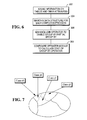
- the partial group-by join operation is considered by the optimizer module 20 as one of the execution plans that can be selected based on a comparison of costs of several possible plans.
- an optimizer finds an optimal path for a join based on costs of binary joins on the base tables and intermediate join results.
- group-by operators on each individual table (or relation) are considered.
- the group-by operator is a unary operator on a table, while a join is a binary operator.
- the decision to be made by the optimizer module 20 is to determine when to join first or group-by first, which depends on the cost of each choice.
- each relation is of type Regular or Groupby.
- Each attribute has an associated label: blank (no type), Gb, Gbw, or aggregation (e.g., SUM, AVG, etc.). These labels are stored along with the table.
- a data structure is maintained (at 304) for each complex expression operated upon by an aggregation function.
- the data structure is a tree structure representing the expression. The basic aggregations are collected on the attributes with the data structure used to compose the aggregations at the final step when the join result is found.
- Another enhancement is to modify (at 306) the join operator by augmenting an aggregate attribute (e.g., SUM attribute, AVG attribute, etc.) of one relation with the count attribute of the other relation. Also, the count attribute of one relation is augmented by the count attribute of the other relation.
- an aggregate attribute e.g., SUM attribute, AVG attribute, etc.
- the optimizer module 20 is also configured (at 308) to calculate the cost of a group-by operation, such as on a base relation or an intermediate relation, to determine costs during a search for an optimal plan by the optimizer module 20.
- Each attribute of a base table is associated with a type determined by the query.
- the types include: Gb (for an attribute specified in the Group-by clause of a query); Gbw (for an attribute specified in the Where clause); SUM (for an attribute on which the aggregation function SUM is applied in the Select clause); MIN (for an attribute on which the aggregation function MIN is applied in the Select clause); MAX (for an attribute on which the aggregation function MAX is applied in the Select clause); COUNT (for an attribute on which the aggregation function COUNT is applied in the Select clause); and blank otherwise.
- attribute x1 has two different aggregation functions associated with it, such as MAX and SUM, then the attribute is duplicated and assigned to both types.
- attribute x1 has aggregation functions MAX and SUM applied on it, then pairs (MAX, x1) and (SUM, x1) are defined.
- table types are also defined. Tables specified in the From clause of a query are of the Regular type. Join results of a query are also of the Regular type. The partial group-by operator can apply on a table or a join result, with the resultant table being of the Groupby type. Given two tables u and v, the following formula determines the type of the result table from a join of the table's u and v: Type(u x v) equals Type(u) AND Type(v). A Boolean TRUE indicates a Regular-type table and a Boolean FALSE indicates a Groupby-type table. Thus, a join table is Regular only if both table's u and v are Regular; otherwise, the join table is of the Groupby table.
- the attribute x of Type Gb is denoted by (Gb, x). Similarly, other designations (Gbw, x), (SUM, x), (MAX, x), (MIN, x), and (COUNT, x) are provided for the other types.
- the partial group-by operator is referred to as GbOp.
- GbOp The partial group-by operator.
- a partial Group-by may be performed on each table that is to be joined by a query, depending on the plan selected by the optimizer module 20.
- Chr(Q, t) be the characteristic of the table t.
- the resulting table GbOp(t) has the following characteristics.
- the table type is Groupby.
- the aggregation sequence is formed by the aggregations SUM, MAX or the like on each attribute. Moreover, a COUNT aggregation function is added.
- the group-by sequence is the same as the table before the operation, or the group-by sequence can be dropped depending on the original query as discussed further below. An "extra" group-by sequence is dropped (that is, the Gbw type becomes blank).
- a Group-by of a table on a finer attribute (Gbw attribute) is referred to as an extra group-by sequence.
- the GbOp operator does not apply on every table.
- a group-by operator does not apply on a table if there is a blank attribute; that is, the attribute that is not of the type Gb, Gbw, or aggregation.
- the GbOp operator can be applied on regular tables.
- the GbOp operator can be used on a Groupby table with a finer set of attributes than the one of the query.
- a finer set is defined as a super set, the set that contains all attributes specified in the Group-by clause and Where clause of the base query. In other words, the finer set includes both Gb and Gbw attributes.
- the result table has an updated data structure.
- the group-by sequence is dropped (no Group-by) if the group-by sequence is one of two cases: (1) the extra group-by sequence is applied on the same attribute; and (2) the attributes in the group-by sequence and the extra group-by sequence are equal to the attributes in the Group-by clause of the base query.
- a cross-augmented join is performed on tables where at least one of the tables is a Groupby table.
- a cross-augmented join is a regular join except that the SUM-type attribute in one table is multiplied (augmented) by the COUNT-type attribute of the other tables; and the COUNT-type attribute of one table is multiplied (augmented) by the COUNT-type attribute of the other table. If a table has no COUNT-type attribute, the default value for COUNT is one.
- the augmented join result has the following characteristics.
- the join table type is Regular if both tables are Regular; otherwise, the join table is of the Groupby type.
- the attribute type is inherited from the two given tables. Assume two views: vi(x1, y1, z1, aggr1, ct1) and v2(x2, y2, z2, aggr2, ct2), where aggr1 and ct1 are generated by SUM and COUNT on a table t1; and aggr2 and ct2 are generated by SUM and COUNT on a table t2.
- the augmented join between v1 and v2 is defined as a regular binary join between them except the attribute aggr1 is replaced by aggr1 *ct2, the attribute aggr2 is replaced by aggr2*ct1, and the attributes ct1 and ct2 are replaced by ct1*ct2.
- Augmented join(vl, v2) join(v1, v2) (x1, y1, z1, aggr1*ct2, x2, y2, z2, aggr2*ct1, ct1*ct2).
- the attributes aggr1*ct2 and aggr2*ct1 are of type SUM, and the attribute ct1*ct2 is of type COUNT.
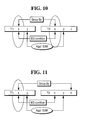
- the Group-by on B groups or sorts all rows using attributes in B before an aggregation is performed. Since B is larger than A, the set of rows with a constant value in B is the subset of rows with the same constant in A. Hence, group-by B is a finer partition of group-by A.
- the optimizer module 20 can thus choose among plural join paths that involve Groupby tables.
- the result is (1, a, SUM a (z2)*count(1, a)).
- the result is (1, b, SUM b (z2)*count(1, b))
- the result is (1, c, SUM c (z2)*count(1, c)).
- the base query is grouped by on x1 only, and thus y2 should not be collected (to avoid a violation of group-by operator).
- the result is Group-by in (x1, y1).
- a Group-by is also performed of the rows on y2, with the values a, b, c, and so forth, then on z2, with the values r and s. This is graphically shown in Fig. 9.
- COUNT maintains the repetition of identical rows from each table. In a join, it is the product of the two joined tables.
- Some properties of COUNT(*) are as follows. COUNT is unique in each table. Hence, there is at most one attribute of type COUNT within the characteristics of each table. If the initial base table does not have a COUNT-type attribute, it is initialized to 1. COUNT(*) is accumulated during the progressive joins along the join path. The COUNT from a table is used to augment the SUM type of other tables. Attribute names of COUNT are named by the prefix ct followed by the table number. For example, ct1 and ct2 are COUNT(tl) and COUNT(t2), respectively. After the join of t1 and t2, ct1 and ct2 are updated to ct1*ct2 with a new attribute name by concatenating the two previous names: ct1ct2. This is of COUNT type also.
- the optimizer module 20 in general searches for a join path on the active set of base tables. Since Proposition 1 (referred to above) provides alternative ways to Group-by first and join later, the optimizer module 20 now can find a join path from a larger active set that includes the base tables and their respective group-by's.
- the augmented join enhances the regular join to enforce the same result of the query. Indeed, the augmented join updates certain attributes (such as attributes of type SUM or other aggregate type) by COUNT(*). This is done to carry the table types and attribute types so that the optimizer module 20 can produce a better join path.
- GbOp the partial group-by operator
- GbOp(t) the join result may require a further Group-by.
- a join is not restricted on group-by tables GbOp(t), but instead, the join can apply on base tables or between a base table and a group-by table. This provides the optimizer module 20 with much more freedom in searching for a lower cost path in performing a binary join.
- a select statement with a Group-by clause involving a single table is considered.
- the statement is considered invalid if the selected non-aggregate values are not part of the associated group.
- the query SELECT x2, z2, r2, SUM(y2), COUNT(*) FROM t2 GROUP BY z2, r2; is invalid because the associated group is ⁇ z2, r2 ⁇ while the non-aggregate values are x2, z2, and r2.
- the optimizer module 20 stops and a message is provided to the user to submit a correct query.
- Corollary 1 Given a select statement on multiple tables with a Group-by clause, the group-by operator can be applied on each table using its characteristics.
- the following discusses the necessary and sufficient conditions to apply the Group-by operator GbOp to the base or non-base tables. If the optimizer module 20 is able to detect in advance that a Group-by is no longer needed under some conditions, the optimizer module 20 is able to determine when to not consider GbOp any longer and focus only on the joins. If the characteristics of the intermediate table no longer have attributes with types Gb or Gbw, performance of partial group-by operations is disabled.
- GbSetOfQuery be the set of attributes within the Group-by clause of the base query. If the GbSetOfQuery set contains a primary key, then the Group-by clause can be omitted without changing the result of the query. This concept is also true for a candidate key--a generalization of primary key on multiple attributes to distinguish all rows.
- plural data server nodes are present to manage concurrent access to plural storage modules.
- a table is distributed across the storage modules.
- a primary key is used to determine how rows of the table are distributed across the nodes.
- a candidate key is a collection of columns (or attributes) of a table that in combination distinguish all rows of the table and the collection is a minimal set.
- GbSetOfQuery contains a primary key or a candidate key
- the attributes Gb and Gbw can be changed to the blank type.
- table t1' has the attribute x1 as a primary key.
- GbSet(t2) ⁇ z2 ⁇
- GbwSet(t2) ⁇ x2 ⁇ .
- Groupby table t' (the table containing the Group-by of t under GbSet(t) ⁇ GbwSet(t)) has a candidate key of GbSetOfQuery. Hence, Group-by on GbSetOfQuery is not necessary on any table having this set of attributes. Therefore, the final Group-by on the result is not necessary.
- the attributes specified in the Group-by clause of the query can be replaced by the attributes specified in the Where clause without changing the result of the query. This is referred to as "Lemma 2.” It is assumed that within the Where clause, the conditions are connected by the Boolean AND. Since the equality is set between two attributes in the Where clause, the Group-by clause can be changed to either of the attributes.
- Group-by equivalent sets may not be available in the case of OR, instead of AND, in the Where clause.
- the conditions in Theorem 1a and Theorem 1b are equivalent if there are only 2 tables. This is referred to as "Theorem 2.”
- S GroupByOfQuery be the set of attributes specified by the Group-by clause in the query.
- GbSet(t1) GbwSet(t1)
- the Where clause links all S1 attributes to some attributes of t2 (referred to as S'1, which is a subset of ⁇ bj
- j 1,..m ⁇ ).
- S'1 ⁇ S2 GbwSet(t2) ⁇ Gbset(t2).
- GbwSet(t2) GbwSet(t2)
- all attributes in Gb(tl) can be replaced by GbwSet(t2). That means the set GroupByOfQuery after the replacement is GbwSet(t2) ⁇ GbSet(t2).
- t2 also satisfies Theorem 1b.
- GbSetOfQuery GbSet(t) ⁇ GbwSet(t) for some table t.
- t1 is such t.
- GbSetOfQuery GbSet(t1) ⁇ GbwSet(t1).
- GbwSet(t1) is a subset of GbSetOfQuery
- GbwSet(t1) must link also to attributes of other tables other than t1.
- t1 satisfies the Theorem 1a condition (Lemma 2) and none of t1, t2, and t3 satisfy the Theorem 1b condition (Lemma 2). Therefore, dropping the group-by sequences of t1, t2, or t3 is not acceptable.
- t1, t2, ..., tn be base tables. Their local group-by's are denoted t1', t2', ..., tn', respectively.
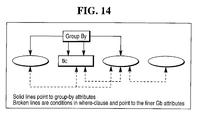
- tk be the table that satisfies the Theorem 1b condition (as illustrated in Fig. 14).
- S1 ⁇ S2 is the set of group-by attributes specified by the query. Since S2 is formed by the conditions in the Where clause, there is some linking between tk and other tables.
- Groupby table tk' is the local group-by of tk on S 1 ⁇ S2. Hence, tk' has all rows different on S 1 ⁇ S2 (candidate key).
- ti For each ti, i ⁇ k, there are two cases (with or without group-by attributes).
- the ti group-by attributes must have conditions (Where clause) to transfer to tk.
- Table ti in this case satisfies condition Theorem 1a.
- ti' (the group-by on ti) has a candidate key on its set of group-by attributes.
- this candidate key is a subset of S 1 ⁇ S2. Therefore, the join between ti' and tk' makes all rows different in S1 ⁇ S2 and there is no further group-by necessary.
- the table ti has no group-by attribute, but it is possible there is a condition to link it to another table g.
- finer Group-by on the condition attribute makes it possible to join with another table g that is already grouped by the same attribute.
- Lemma 1 indicates drop on this finer group-by.
- a join of ti' with tk' retains S 1 ⁇ S2 as the candidate key.
- condition in Theorem 1a is useful to conclude that the final GbOp on a result table is not necessary.
- the condition in Theorem 1b is useful for indicating that no further GbOp is needed during the searching for an optimal path.
- the group-by sequence of r is carried from the group-by sequence of t1 and the group-by sequence of t2 (that means the sequence is a concatenation of the group-by sequences of t1 and t2) unless the condition of Theorem 1 is met. In this exception case, the further group-by sequence is dropped, which means no further group-by is necessary.
- the aggregation sequence of r is of the concatenation of the aggregation sequence of t1 and the aggregation sequence t2.
- the SUM (or other aggregate) attributes of one table must be augmented by the COUNT attribute from other table, and the COUNT attribute is augmented by the COUNT attribute of the other table.
- control units include microprocessors, microcontrollers, processor cards (including one or more microprocessors or microcontrollers), or other control or computing devices.
- a “controller” refers to hardware, software, or a combination thereof.
- a “controller” can refer to a single component or to plural components (whether software or hardware).
- the storage units referred to in this discussion include one or more machine-readable storage media for storing data and instructions.
- the storage media include different forms of memory including semiconductor memory devices such as dynamic or static random access memories (DRAMs or SRAMs), erasable and programmable read-only memories (EPROMs), electrically erasable and programmable read-only memories (EEPROMs) and flash memories; magnetic disks such as fixed, floppy and removable disks; other magnetic media including tape; and optical media such as compact disks (CDs) or digital video disks (DVDs).
- DRAMs or SRAMs dynamic or static random access memories
- EPROMs erasable and programmable read-only memories
- EEPROMs electrically erasable and programmable read-only memories
- flash memories such as fixed, floppy and removable disks
- CDs compact disks
- DVDs digital video disks
- the instructions of the software routines or modules are loaded or transported to the corresponding system in one of many different ways. For example, code segments including instructions stored on floppy disks, CD or DVD media, a hard disk, or transported through a network interface card, modem, or other interface device are loaded into the system and executed as corresponding software routines or modules.
- data signals that are embodied in carrier waves (transmitted over telephone lines, network lines, wireless links, cables, and the like) may communicate the code segments, including instructions, to the system.
- carrier waves may be in the form of electrical, optical, acoustical, electromagnetic, or other types of signals.
Landscapes
- Engineering & Computer Science (AREA)
- Theoretical Computer Science (AREA)
- Computational Linguistics (AREA)
- Data Mining & Analysis (AREA)
- Databases & Information Systems (AREA)
- Physics & Mathematics (AREA)
- General Engineering & Computer Science (AREA)
- General Physics & Mathematics (AREA)
- Operations Research (AREA)
- Information Retrieval, Db Structures And Fs Structures Therefor (AREA)
Abstract
Description
Embodiments of the invention will now be described with reference to the accompanying drawings in which:
- SELECT
- x1, z1,
SUM(y1),
SUM(y3) - FROM
- t1, t2, t3
- WHERE
- z1 = y2 AND z2 = z3
- GROUP-BY
- x1, z1;

- SELECT
- x1, z1,
SUM(y1),
SUM(y3) - FROM
- t1, t2, t3
- WHERE
- z1 = y2 AND z2 = z3
- GROUP BY
- x1, z1;
CREATE VIEW v1 (x1, sumy1, z1, ct1) AS
SELECT x1, SUM(y1), z1, COUNT(*)
FROM t1
GROUP BY x1, z1;
CREATE VIEW v2 (y2, z2, ct2) AS
SELECT y2, z2, COUNT(*)
FROM t2
GROUP BY y2, z2;
CREATE VIEW v3 (sumy3, z3, ct3) AS
SELECT SUM(y3), z3, COUNT(*)
FROM t3
GROUP BY z3;
CREATE VIEW v123 (x1, sumy1ct2ct3, z1, sumy3ctlct2) AS
SELECT x1, sumy1*ct2*ct3, z1, sumy3*ct1*ct2
FROM v1, v2, v3
WHERE z1=y2 and z2=z3;
SELECT x1, z1, SUM(sumy1ct2ct3), SUM(sumy3ct1ct2)
FROM v123
GROUP-BY x1, z1;
Also, an attribute sumy3 is defined to store the output of SUM(y3). Thus, the Groupby table t3' has an attribute sumy3 associated with the label SUM, and an attribute ct3 associated with the label COUNT. The attribute z3 is not associated with any label since further operations are not needed with respect to z3 (which appeared in the Where clause of QUERY 1).

SELECT x2, z2, r2, SUM(y2), COUNT(*)
FROM t2
GROUP BY z2, r2;
is invalid because the associated group is {z2, r2} while the non-aggregate values are x2, z2, and r2. When the query is determined invalid, the
(Gb set) ∪ (Gbw set) ∪ {Aggregate attributes} = set of all attributes in the characteristics.
In other words, the attributes of the tables must be of type Gb, Gbw, or Aggregate function.
- {x1, z1} is the candidate key of t1'. All rows of t1' have pairs (x1, z1) as
{(3,1), (3, 2)}. Table t1' is as follows:
x1 sumy1 Z1 Ct1(=count(*)) 3 2 1 1 3 2 2 1 - {z2, r2} is the candidate key of t2'. All rows of t2' have pairs (z2, r2) as
{(2,1), (2,2)}. Table t2' is as follows:
Sumy2 z2 r2 Ct2(=count(*)) 1 2 1 1 2 2 2 1 - The augmented merge join on tl' and t2' under z1 = r2 as follows:
x1 sumy1 sumy2 z2 Ct1*Ct2 3 2 1 2 1 3 2 2 2 1
GbSet(t) = GbwSet(t) (referred to as "Theorem 1a"), and
GbSetOfQuery = GbSet(t) ∪ GbwSet(t) (referred to as "Theorem 1b").
Hence, Group-by, if it exists, on any table on GbSetOfQuery is not necessary. Therefore, all Gb attributes of t' can be set to blank.
| tm1: | x1 | y1 | |
| 1 | 100 | 1 | |
| 1 | 101 | 3 |
| tm2: | x2 | y2 | z2 |
| 2 | 10 | ||
| 2 | 10 |
| tm3: | x3 | y3 | z3 |
| 20 | 10 | ||
| 21 | 10 |
Claims (27)
- A method of performing a join of multiple base tables stored in a database system, the system (10) comprising a storage system to contain the multiple base tables; and at least one node (16) to manage access to the storage system, the method comprising the steps of:receiving at the at least one node (16), a query containing an aggregate function and at least one of a Where clause and a Group-by clause for performing a join of the multiple base tables, the at least one of the Where clause and Group-by clause containing a first attribute of a first one of the multiple base tables;performing a Group-by of the first base table on the first attribute to reduce a number of working rows of the first base table; andperforming a join of a result of the Group-by of the first base table with one other base table.
- The method of claim 1, wherein the one of the Where clause and Group-by clause contains a second attribute of a second base table, the method further comprising:performing a Group-by of the second base table on the second attribute to reduce a number of working rows of the second base table,and wherein performing the join comprisesperforming the join of the result of the Group-by of the first table with a result of the Group-by of the second table.
- The method of claim 2, wherein the Group-by clause contains a third attribute of one of the first and second tables, the method further comprising:storing, in an intermediate table, a result of the join of the result of the Group-by of the first table with the result of the Group-by of the second table; andperforming a Group-by of the intermediate table on the third attribute.
- The method of claim 3, wherein the third attribute is one of the first and second attributes.
- The method of claim 1, wherein the one of the Where clause and Group-by clause contains a second attribute of a second table, wherein performing the join comprises performing the join of the result of the Group-by of first table with the second table.
- The method of claim 1, wherein the Group-by clause contains a second attribute of one of the first and second tables, the method further comprising performing a Group-by, on the second attribute, of a result of the join of the result of the Group-by of the first table with the one other table.
- The method of claim 1, wherein the query contains an aggregate function performed on a second attribute of the first table, the method further comprising:calculating an aggregate on the second attribute of the first table; andstoring a third attribute representing the aggregate in the result of the Group-by of the first table.
- The method of claim 7, further comprising:counting a number of rows of the result of the Group-by of the first table; andstoring a fourth attribute representing the count in the result of the Group-by of the first table.
- The method of claim 8, further comprising assigning labels to each of the first, second, third, and fourth attributes.
- The method of claim 9, wherein the one of the Where clause and Group-by clause contains an attribute of a second table, the method further comprising:wherein performing the join comprises performing a cross-augmented join of the result of the Group-by of the first table with the result of the Group-by of the second table,performing a Group-by of the second table on the attribute of the second table to reduce a number of working rows of the second table; andcounting a number of rows of a result of the Group-by of the second table; andstoring a fifth attribute representing the count of the number of rows of the result of the Group-by of the second table,
the cross-augmented join comprising multiplying the third attribute by the fifth attribute. - The method of claim 10, further comprising storing a value representing the multiplication in a sixth attribute.
- The method of claim 11, wherein the query contains an aggregate function performed on a sixth attribute of the second table, the method further comprising:wherein performing the cross-augmented join further comprises multiplying the seventh attribute by the fourth attribute.calculating an aggregate on the sixth attribute of the second table;storing a seventh attribute representing the aggregate on the sixth attribute in the result of the Group-by of the second table,
- A method of performing a join of multiple base tables stored in a database system, the system (10) comprising a storage system to contain the multiple base tables; and at least one node (16) to manage access to the storage system, the method comprising the steps of
receiving a query containing an aggregate function and at least one of a Where clause and a Group-by clause for performing a join of plural base tables, the at least one of the Where clause and group-by clause containing at least a first attribute of at least a first one of the plural base tables;
performing a Group-by of the first base table on the first attribute;
storing a result of the Group-by of the first base table in a first Group-by table; and
performing a join of the first group-by table with another table. - The method of claim 13, wherein one of the Where clause and the group-by clause contains a second attribute of a second one of the plural base tables, further comprising the steps of:performing another Group-by of the second base table on the second attribute; andstoring a result of the Group-by of the second base table in a second Group-by table.
- The method of claim 14, wherein performing the join comprises performing a join of the first Group-by table with the second Group-by table.
- The method of claim 15, wherein the performing the join comprises performing a cross-augmented join of the first Group-by table with the secondGroup-by table.
- The method of claim 16, wherein the aggregate function is an aggregate function of an attribute of the first base table, wherein the method further comprises:wherein performing the cross-augmented join comprises multiplying the second attribute by the third attribute.calculating an aggregate of the attribute of the first base table;storing the aggregate in a second attribute;calculating a count of a number of rows of the second Group-by table;storing the count in a third attribute,
- The method of claim 15, wherein one of the Where clause and the Group-by clause further contains a third attribute of a third one of the plural base tables, the method further comprising:performing another Group-by of the third base table on the third attribute; andstoring a result of the Group-by of the third base table in a third Group-by table.
- A computer program comprising code which when executed on a data processing system comprising storage means containing multiple base tables and at least one node (16) to manage access to the storage means, causes the database system to
receive a query containing an aggregate function and at least one of a Where clause and a Group-by clause for performing a join of plural tables, the at least one of the Where clause and Group-by clause containing a first attribute of at least a first one of the plural tables;
compare costs of plural join plans,
wherein one of the plural join plans comprises performing a Group-by of the first table on the first attribute; and
select one of the plural join plans having a lower cost. - The computer program of claim 19, wherein the code when executed cause the database system to further perform a join of the Group-by of the first table with another table.
- The computer program of claim 20, wherein the code when executed cause the database system to further:wherein performing the join comprises performing the join of a result of the Group-by of the first table with a result of the Group-by of the second table.perform a Group-by of a second table,
- The computer program of claim 21, wherein the code when executed cause the database system to perform the join by performing a cross-augmented join.
- A database system comprising means operable to carry out the methods of claims 1 to 18.
- A database system comprising:a storage system to contain plural base tables; andan optimizer module operable to receive a query containing an aggregate function and at least one of a Where clause and a group-by clause for performing a join of plural tables, the at least one of the Where clause and group-by clause containing a first attribute of at least a first one of the plural tables,the optimizer module operable to compare costs of plural join plans for the query, wherein one of the join plans comprises performing a Group-by of the first table on the first attribute,the optimizer module operable to select one of the plural join plans having a lower cost.
- A computer program comprising computer code means adapted to perform all the steps of claims 1 to 18 when executed on a database system.
- A computer program as claimed in claim 25 embodied on a computer-readable storage medium.
- A computer program as claimed in claim 25 as embodied in a transmission medium.
Applications Claiming Priority (2)
| Application Number | Priority Date | Filing Date | Title |
|---|---|---|---|
| US967561 | 2001-09-28 | ||
| US09/967,561 US6757677B2 (en) | 2001-09-28 | 2001-09-28 | Providing a join plan using group-by operator |
Publications (2)
| Publication Number | Publication Date |
|---|---|
| EP1298543A2 true EP1298543A2 (en) | 2003-04-02 |
| EP1298543A3 EP1298543A3 (en) | 2008-03-26 |
Family
ID=25512975
Family Applications (1)
| Application Number | Title | Priority Date | Filing Date |
|---|---|---|---|
| EP02256224A Withdrawn EP1298543A3 (en) | 2001-09-28 | 2002-09-09 | Providing a join plan using group-by operator |
Country Status (2)
| Country | Link |
|---|---|
| US (1) | US6757677B2 (en) |
| EP (1) | EP1298543A3 (en) |
Cited By (7)
| Publication number | Priority date | Publication date | Assignee | Title |
|---|---|---|---|---|
| EP1403788A3 (en) * | 2002-09-27 | 2007-05-02 | Ncr International Inc. | Eliminating group-by operation in a join plan |
| US8832073B2 (en) * | 2007-06-29 | 2014-09-09 | Alcatel Lucent | Method and apparatus for efficient aggregate computation over data streams |
| US20210334264A1 (en) * | 2018-12-09 | 2021-10-28 | Kohei KAIGAI | System, method, and program for increasing efficiency of database queries |
| US11933967B2 (en) | 2019-08-22 | 2024-03-19 | Red Creamery, LLC | Distally actuated scanning mirror |
| US12123950B2 (en) | 2016-02-15 | 2024-10-22 | Red Creamery, LLC | Hybrid LADAR with co-planar scanning and imaging field-of-view |
| US12399279B1 (en) | 2016-02-15 | 2025-08-26 | Red Creamery Llc | Enhanced hybrid LIDAR with high-speed scanning |
| US12399278B1 (en) | 2016-02-15 | 2025-08-26 | Red Creamery Llc | Hybrid LIDAR with optically enhanced scanned laser |
Families Citing this family (29)
| Publication number | Priority date | Publication date | Assignee | Title |
|---|---|---|---|---|
| US7321898B1 (en) * | 2002-04-04 | 2008-01-22 | Ncr Corp. | Locking mechanism for materialized views in a database system |
| US7107277B1 (en) * | 2002-12-17 | 2006-09-12 | Microsoft Corporation | Programmable calculation engine |
| US7725455B1 (en) | 2003-12-31 | 2010-05-25 | Teradata Us, Inc. | Computing aggregates on distinct attribute values |
| US7720840B2 (en) * | 2004-01-08 | 2010-05-18 | International Business Machines Corporation | Method applying transitive closure to group by and order by clauses |
| US20050160102A1 (en) * | 2004-01-15 | 2005-07-21 | International Business Machines Corporation | Look-ahead predicate generation for join costing and optimization |
| US7359922B2 (en) * | 2004-12-22 | 2008-04-15 | Ianywhere Solutions, Inc. | Database system and methodology for generalized order optimization |
| US8694524B1 (en) | 2006-08-28 | 2014-04-08 | Teradata Us, Inc. | Parsing a query |
| US8209322B2 (en) * | 2007-08-21 | 2012-06-26 | Oracle International Corporation | Table elimination technique for group-by query optimization |
| US8352461B2 (en) * | 2007-09-12 | 2013-01-08 | Oracle International Corporation | Table elimination optimizations |
| US8150850B2 (en) * | 2008-01-07 | 2012-04-03 | Akiban Technologies, Inc. | Multiple dimensioned database architecture |
| US7865502B2 (en) * | 2008-04-10 | 2011-01-04 | International Business Machines Corporation | Optimization of extensible markup language path language (XPATH) expressions in a database management system configured to accept extensible markup language (XML) queries |
| US8943058B1 (en) | 2009-12-14 | 2015-01-27 | Teradata Us, Inc. | Calculating aggregates of multiple combinations of a given set of columns |
| US9031930B2 (en) * | 2011-12-22 | 2015-05-12 | Sap Se | Data browser for group-by data access |
| US8849871B2 (en) | 2012-10-04 | 2014-09-30 | Oracle International Corporation | Efficient pushdown of joins in a heterogeneous database system involving a large-scale low-power cluster |
| US9311359B2 (en) | 2013-01-30 | 2016-04-12 | International Business Machines Corporation | Join operation partitioning |
| US9317548B2 (en) | 2013-01-30 | 2016-04-19 | International Business Machines Corporation | Reducing collisions within a hash table |
| US9275103B2 (en) | 2013-02-28 | 2016-03-01 | International Business Machines Corporation | Optimization of JOIN queries for related data |
| US10204140B2 (en) | 2013-03-14 | 2019-02-12 | Oracle International Corporation | Massively parallel and in-memory execution of grouping and aggregation in a heterogeneous system |
| US9471710B2 (en) | 2013-06-14 | 2016-10-18 | International Business Machines Corporation | On-the-fly encoding method for efficient grouping and aggregation |
| US9367556B2 (en) | 2013-06-14 | 2016-06-14 | International Business Machines Corporation | Hashing scheme using compact array tables |
| US9378264B2 (en) | 2013-06-18 | 2016-06-28 | Sap Se | Removing group-by characteristics in formula exception aggregation |
| US9317558B2 (en) * | 2014-05-13 | 2016-04-19 | Sap Se | Intelligent unmasking in an in-memory database |
| US9672248B2 (en) | 2014-10-08 | 2017-06-06 | International Business Machines Corporation | Embracing and exploiting data skew during a join or groupby |
| US10303791B2 (en) | 2015-03-20 | 2019-05-28 | International Business Machines Corporation | Efficient join on dynamically compressed inner for improved fit into cache hierarchy |
| US9922064B2 (en) | 2015-03-20 | 2018-03-20 | International Business Machines Corporation | Parallel build of non-partitioned join hash tables and non-enforced N:1 join hash tables |
| US10650011B2 (en) | 2015-03-20 | 2020-05-12 | International Business Machines Corporation | Efficient performance of insert and point query operations in a column store |
| US10831736B2 (en) | 2015-03-27 | 2020-11-10 | International Business Machines Corporation | Fast multi-tier indexing supporting dynamic update |
| US10108653B2 (en) | 2015-03-27 | 2018-10-23 | International Business Machines Corporation | Concurrent reads and inserts into a data structure without latching or waiting by readers |
| US20180357278A1 (en) * | 2017-06-09 | 2018-12-13 | Linkedin Corporation | Processing aggregate queries in a graph database |
Family Cites Families (12)
| Publication number | Priority date | Publication date | Assignee | Title |
|---|---|---|---|---|
| US5287493A (en) * | 1990-08-31 | 1994-02-15 | International Business Machines Corporation | Database interactive prompted query system having named database tables linked together by a user through join statements |
| US5321813A (en) | 1991-05-01 | 1994-06-14 | Teradata Corporation | Reconfigurable, fault tolerant, multistage interconnect network and protocol |
| US5659725A (en) * | 1994-06-06 | 1997-08-19 | Lucent Technologies Inc. | Query optimization by predicate move-around |
| US5640584A (en) | 1994-12-12 | 1997-06-17 | Ncr Corporation | Virtual processor method and apparatus for enhancing parallelism and availability in computer systems |
| US5864842A (en) | 1995-10-23 | 1999-01-26 | Ncr Corporation | Optimization of SQL queries using hash star join operations |
| US5761657A (en) * | 1995-12-21 | 1998-06-02 | Ncr Corporation | Global optimization of correlated subqueries and exists predicates |
| US6032144A (en) * | 1996-05-29 | 2000-02-29 | Lucent Technologies Inc. | Optimization of queries using relational algebraic theta-semijoin operator |
| US5713015A (en) * | 1996-05-30 | 1998-01-27 | International Business Machines Corporation | Reordering of complex SQL queries involving GROUPBYs, joins, outer joins and full outer joins |
| US5884299A (en) | 1997-02-06 | 1999-03-16 | Ncr Corporation | Optimization of SQL queries involving aggregate expressions using a plurality of local and global aggregation operations |
| US6112198A (en) * | 1997-06-30 | 2000-08-29 | International Business Machines Corporation | Optimization of data repartitioning during parallel query optimization |
| CA2266990A1 (en) * | 1998-05-20 | 1999-11-20 | Lucent Technologies, Inc. | System and techniques for fast approximate query answering |
| US6505189B1 (en) * | 2000-06-15 | 2003-01-07 | Ncr Corporation | Aggregate join index for relational databases |
-
2001
- 2001-09-28 US US09/967,561 patent/US6757677B2/en not_active Expired - Lifetime
-
2002
- 2002-09-09 EP EP02256224A patent/EP1298543A3/en not_active Withdrawn
Cited By (8)
| Publication number | Priority date | Publication date | Assignee | Title |
|---|---|---|---|---|
| EP1403788A3 (en) * | 2002-09-27 | 2007-05-02 | Ncr International Inc. | Eliminating group-by operation in a join plan |
| US8832073B2 (en) * | 2007-06-29 | 2014-09-09 | Alcatel Lucent | Method and apparatus for efficient aggregate computation over data streams |
| US9116956B2 (en) | 2007-06-29 | 2015-08-25 | Alcatel Lucent | Method and apparatus for efficient aggregate computation over data streams |
| US12123950B2 (en) | 2016-02-15 | 2024-10-22 | Red Creamery, LLC | Hybrid LADAR with co-planar scanning and imaging field-of-view |
| US12399279B1 (en) | 2016-02-15 | 2025-08-26 | Red Creamery Llc | Enhanced hybrid LIDAR with high-speed scanning |
| US12399278B1 (en) | 2016-02-15 | 2025-08-26 | Red Creamery Llc | Hybrid LIDAR with optically enhanced scanned laser |
| US20210334264A1 (en) * | 2018-12-09 | 2021-10-28 | Kohei KAIGAI | System, method, and program for increasing efficiency of database queries |
| US11933967B2 (en) | 2019-08-22 | 2024-03-19 | Red Creamery, LLC | Distally actuated scanning mirror |
Also Published As
| Publication number | Publication date |
|---|---|
| EP1298543A3 (en) | 2008-03-26 |
| US20030078922A1 (en) | 2003-04-24 |
| US6757677B2 (en) | 2004-06-29 |
Similar Documents
| Publication | Publication Date | Title |
|---|---|---|
| US6757677B2 (en) | Providing a join plan using group-by operator | |
| US7062481B2 (en) | Eliminating group-by operations in a join plan | |
| US7644062B2 (en) | Join factorization of union/union all queries | |
| US5367675A (en) | Computer automated system and method for optimizing the processing of a query in a relational database system by merging subqueries with the query | |
| Simitsis et al. | State-space optimization of ETL workflows | |
| US10572484B2 (en) | Duplicate reduction or elimination with hash join operations | |
| US7809713B2 (en) | Efficient search space analysis for join factorization | |
| US7054852B1 (en) | Performance of join operations in parallel database systems | |
| US6351742B1 (en) | Method and mechanism for database statement optimization | |
| US7233944B2 (en) | Determining query cost based on subquery filtering factor | |
| US10394813B2 (en) | Method and apparatus for performing query aware partitioning | |
| US4930072A (en) | Method for computing transitive closure | |
| EP0747838A1 (en) | Method and apparatus for complete SQL subquery elimination process | |
| Kalinsky et al. | Flexible caching in trie joins | |
| US7035843B1 (en) | Evaluation of database hierarchical cubes by nesting rollup operators associated with multiple groupings | |
| US20050283471A1 (en) | Multi-tier query processing | |
| US20170357708A1 (en) | Apparatus and method for processing multi-dimensional queries in a shared nothing system through tree reduction | |
| US7949655B2 (en) | Joins of relations in an object relational database system | |
| US10558660B2 (en) | Redundant group by and distinct removal | |
| JPH0855138A (en) | Method for optimization of question of relational database | |
| US7213011B1 (en) | Efficient processing of multi-column and function-based in-list predicates | |
| US9177079B1 (en) | Apparatus and method for processing multi-dimensional queries in a shared nothing system through tree reduction | |
| Sacco et al. | Query optimization in distributed data base systems | |
| US8046394B1 (en) | Dynamic partitioning for an ordered analytic function | |
| US6694324B1 (en) | Determination of records with a specified number of largest or smallest values in a parallel database system |
Legal Events
| Date | Code | Title | Description |
|---|---|---|---|
| PUAI | Public reference made under article 153(3) epc to a published international application that has entered the european phase |
Free format text: ORIGINAL CODE: 0009012 |
|
| AK | Designated contracting states |
Kind code of ref document: A2 Designated state(s): AT BE BG CH CY CZ DE DK EE ES FI FR GB GR IE IT LI LU MC NL PT SE SK TR Designated state(s): AT BE BG CH CY CZ DE DK EE ES FI FR GB GR IE IT LI LU MC NL PT SE SK TR |
|
| AX | Request for extension of the european patent |
Extension state: AL LT LV MK RO SI |
|
| PUAL | Search report despatched |
Free format text: ORIGINAL CODE: 0009013 |
|
| AK | Designated contracting states |
Kind code of ref document: A3 Designated state(s): AT BE BG CH CY CZ DE DK EE ES FI FR GB GR IE IT LI LU MC NL PT SE SK TR |
|
| AX | Request for extension of the european patent |
Extension state: AL LT LV MK RO SI |
|
| RAP1 | Party data changed (applicant data changed or rights of an application transferred) |
Owner name: TERADATA US, INC. |
|
| 17P | Request for examination filed |
Effective date: 20080926 |
|
| 17Q | First examination report despatched |
Effective date: 20081103 |
|
| AKX | Designation fees paid |
Designated state(s): DE FR GB |
|
| STAA | Information on the status of an ep patent application or granted ep patent |
Free format text: STATUS: THE APPLICATION IS DEEMED TO BE WITHDRAWN |
|
| 18D | Application deemed to be withdrawn |
Effective date: 20110303 |