EP1298534A2 - Method and apparatus for Similarity evaluation - Google Patents
Method and apparatus for Similarity evaluation Download PDFInfo
- Publication number
- EP1298534A2 EP1298534A2 EP02252615A EP02252615A EP1298534A2 EP 1298534 A2 EP1298534 A2 EP 1298534A2 EP 02252615 A EP02252615 A EP 02252615A EP 02252615 A EP02252615 A EP 02252615A EP 1298534 A2 EP1298534 A2 EP 1298534A2
- Authority
- EP
- European Patent Office
- Prior art keywords
- probability
- similarity
- pair
- profiles
- information included
- Prior art date
- Legal status (The legal status is an assumption and is not a legal conclusion. Google has not performed a legal analysis and makes no representation as to the accuracy of the status listed.)
- Withdrawn
Links
Images






Classifications
-
- G—PHYSICS
- G06—COMPUTING OR CALCULATING; COUNTING
- G06F—ELECTRIC DIGITAL DATA PROCESSING
- G06F17/00—Digital computing or data processing equipment or methods, specially adapted for specific functions
- G06F17/10—Complex mathematical operations
- G06F17/18—Complex mathematical operations for evaluating statistical data, e.g. average values, frequency distributions, probability functions, regression analysis
Definitions
- the present invention relates to a similarity evaluation method, program and apparatus for determining similarity between probability models and more specifically between sets of information about different probability models, these sets of information being referred to as "profiles" or “definitions” of probability models.
- probability models mainly, Hidden Markov Models
- the probability models are used to determine which words are produced based on voice patterns or to determine which sequences belong to which homology groups, but there are also cases where it is desired to evaluate similarity between probability models.
- Research has therefore been carried out into methods of evaluating similarity. For example, researches to evaluate similarity between probability models using the equations below are performed. Note that, the values calculated in eq.1 to eq.3 are respectively referred to as "Kullback-Lieber Distance", “mutual information”, and "co-emission probability”.
- a similarity evaluation method is adopted where, in order to evaluate similarity between a pair of probability model definitions (profiles), each including multiple items of probability information constituted by a plurality of types of probability data, arithmetic processing is carried out based on dynamic programming techniques, employing a similarity value calculated in a similarity value calculating step as an indicator value for path selection.
- probability model information subjected to evaluation can be taken to be probability model information relating to a Hidden Markov Model.
- the similarity value can be calculated based on a plurality of emission probability data in the probability information included in one of the pair of model definitions, and a plurality of emission probability data in the probability information included in the other of the pair of model definitions.
- the similarity evaluation method can be implemented in such a manner that the similarity value can be calculated based on a plurality of emission probability data and a plurality of transition probability data in the probability information included in the one of the pair of model definitions, and a plurality of emission probability data and a plurality of transition probability data in the probability information included in the other of the pair of model definitions.
- the similarity evaluation method also can be implemented such that the similarity value is calculated by multiplying the cosine squared of an angle made by an emission probability vector constituted by a plurality of emission probability data in the probability information included in the one of the pair of model definitions and an emission probability vector constituted by a plurality of emission probability data in the probability information included in the other of the pair of model definitions, with the cosine squared of an angle made by a transition probability vector constituted by the plurality of transition probability data in the probability information included in the one of the pair of model definitions and a transition probability vector constituted by the plurality of transition probability data in the probability information included in the other of the pair of model definitions.
- the similarity evaluation program according to the present invention is structured so that a computer can perform the similarity evaluation method according to the present invention, and the similarity evaluation apparatus according to the present invention is structured so to perform the similarity evaluation method according to the present invention. Consequently, when using the program and apparatus of the present invention, it is possible to evaluate similarity between pairs of probability models rapidly.
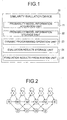
- FIG. 1 is a block diagram showing the functions of a similarity evaluation device 10 of an embodiment of the present invention.
- the similarity evaluation device 10 comprises a probability model information acquisition unit 21, a probability model information storage unit 22, a dynamic programming operation unit 23, an evaluation results storage unit 24 and an evaluation results presentation unit 25.
- the probability model information storage unit 22 is a unit for temporarily storing definition information (hereinafter referred to as "probability model information") for two probability models (in this embodiment, HMM (Hidden Markov Model) profiles) to be evaluated for similarity.
- the probability model information acquisition unit 21 is a unit for storing probability model information within a file designated by an operator or probability model information inputted by an operator into the probability model information storage unit 22.
- the probability model information acquisition unit 21 also acquires a designation provided by the operator as to which one of first to third evaluation modes (described in detail later) is used to evaluate similarity between probability models.
- the dynamic programming operation unit 23 is a unit for performing arithmetic processing in order to evaluate similarity of probability models using an evaluation mode designated by an operator based on two items of probability model information stored in the probability model information storage unit 22. Although described in detail later, arithmetic processing executed by the dynamic programming operation unit 23 is a variation of arithmetic processing employing dynamic programming techniques carried out in the related art for pair-wise alignment.
- the evaluation results storage unit 24 is a unit for storing the final results of calculations carried out by the dynamic programming operation unit 23.
- the evaluation results presentation unit 25 is a unit for carrying out processing for exhibiting evaluation results to an operator (processing for displaying evaluation results, and processing for outputting data for printing out evaluation results) based on information (calculation results) stored in the evaluation results storage unit 24.
- the similarity evaluation device 10 of this embodiment is realized as a device where a similarity evaluation program is installed on a relatively high-performance computer, with the probability model information storage unit 22 and the evaluation results storage unit 24 corresponding to the RAM and hard disc provided in the computer.
- the probability model information acquisition unit 21, dynamic programming operation unit 23 and the evaluation results presentation unit 25 correspond to the computer (portions centered about the CPU) in states of implementing specific portions of the similarity evaluation program.
- the HMM profiles are HMMs expressing base sequences and amino acid sequences.
- the HMM profile comprises M nodes, I nodes, D nodes, S nodes and E nodes made to correlate with each other via transition probabilities (shown by arrows in the drawing) as shown in the example in FIG. 2.
- the M nodes and I nodes constituting this HMM profile are nodes each expressing the state of a certain element of a sequence (sequence alignment). Emission probability of the symbols (with HMMs expressing a base sequence there are four types of emission probability for four types of symbols referred to as A, G, C and T, and with HMMs expressing amino acid sequences, there are twenty types of emission probability) and the probability of a transition to several other nodes (M nodes, I nodes and D nodes) is made to correspond at the M node. Further, at the I node, as with the M node, emission probabilities for a plurality of symbols and several transition probabilities are made to correspond to each other. However, the probability of a transition to an own I node is made to correspond at the I node rather than the probability of a transition to another I node.
- a D node is a dummy node to which no emission probability is made to correspond. Only the probability of a transition to several nodes is made to correspond at a D node.
- An S node is a node expressing the start state (initial state) of this HMM profile and only the probability of a transition to several other nodes is made to correspond at this S node.
- An E node is a node expressing the end state (final state) of this HMM profile and only emission probability is made to correspond at this E node.
- pairwise alignment is an operation (process) for obtaining two sequences for which the manner in which elements are lined up is most similar by inserting gaps into appropriate locations of two sequences that are provided.
- each migration path along the direction of the arrows from the node at the upper left end of the matrix to the node at the lower right end can be understood as one alignment (one alignment result for two series).
- movement along the arrows towards the right can be understood to be an operation of outputting elements (characters) made to correspond to nodes after movement as elements of alignment results
- movement to the right along the direction of the arrows can be understood to be an operation of outputting gaps as elements of alignment results.
- movement at an incline along the direction of the arrows can be understood as an operation for outputting elements (characters) made to correspond to nodes after movement as elements of alignment results.
- movement downwards along the direction of the arrows can be understood as an operation of outputting gaps as elements of alignment results
- this movement can be understood as an operation of outputting elements (characters) made to correspond to nodes after movement as elements of alignment results.
- the path shown by the dotted line can be understood as showing “-AIMS” and “AMOS-”, while the path shown by the thick lined arrows can be understood as showing “AIM-S” and "A-MOS”.
- V i , j is an evaluation point (evaluation value) for a path to a node making a first sequence element #i and a second sequence element #j correspond.
- ⁇ is a function which outputs maximum element
- d is an evaluation point for a deficiency of corresponding elements referred to as "gap penalty" or "gap cost”.
- w i,j is an evaluation point relating to similarity between the first sequence element #i and the second sequence element #j.
- a value (one of two preset values) corresponding to whether or not both elements coincide is used as w i,j when a base sequence is taken as a subject and a value read out from a table storing w values for each combination of two amino acids is used when an amino acid sequence is taken as the subject.
- Equation (1) The calculation of equation (1) is then carried out for each node while increasing i, j while obtaining pairwise alignment using dynamic programming techniques.
- the optimum alignment is then obtained by storing which of the paths traced was the most appropriate (a plurality is also possible), and then, after completion of all the calculations, tracing the optimum path back (trace back) in reverse from the lower right end.
- the pairwise alignment employing dynamic programming techniques can therefore be completed at high speed, because a process is carried out in which every calculation of V value increases paths for which final evaluation points are not calculated (a process in which, with the max function ⁇ , paths for two of three types of path capable of reaching this node are taken to be paths for which calculation of the final evaluation point is not carried out).
- the dynamic programming operation unit 23 is for subjecting the HMM profile to processing of the same theory as for the processing carried out in order to obtain pairwise alignment.
- the dynamic programming operation unit 23 has three evaluation modes, as described above.
- the first evaluation mode is a mode where comparison of two HMM profiles is carried out using only emission probability provided to the M node of each HMM profile.
- a matrix comprising (imax + 1) x (jmax + 1) nodes where emission probability vectors for an ith M nodes relating to HMM#0 (one of the two HMM profiles to be subjected to similarity evaluation) are made to correspond to emission probability vectors for jth M nodes relating to HMM #1 (the other of the two HMM profiles to be subjected to similarity evaluation) is assumed (refer to FIG. 3; in the following, this matrix is referred to as an "evaluation value matrix").
- imax is the number of M nodes for one of the HMM#0
- jmax is the number of M nodes of the HMM#1.
- the dynamic programming operation unit 23 calculates evaluation values V i,j , which are evaluation values for nodes (i, j) of the evaluation matrix, using equation (2) as follows:
- d is so-called gap cost (gap penalty)
- L, L' and L' ' are the numbers of the nodes that are passed through to reach node (i, j).
- the introduction of L, L' and L'' is so that an evaluation value for a path inserted with a large number of gaps are inserted is a relatively small value.
- M i is an emission probability vector for ith M node of HMM#0
- M j is an emission probability vector for jth M node of HMM#1.
- S(M i , M j ) is a function for obtaining a degree of similarity constituted by numerical information exhibiting this similarity from the emission probability vector M i and the emission probability vector M j . Any function may be employed as S(M i , M j ) providing that a maximum value (for example, "1") is taken when M i and M j are the same, and a minimum value (for example, "0") is taken when M i and M j are completely different (when M i and M j are orthogonal). Namely, as shown in FIG.
- the cosine cos( ⁇ ) of the angle ⁇ between the vectors M i and M j or the cosine squared cos 2 ( ⁇ ) of the angle ⁇ can be used as S(M i , M j ), but the dynamic programming operation unit 23 of this embodiment employs the cosine squared cos 2 ( ⁇ ) of the angle ⁇ as S(M i , M j ).
- the dynamic programming operation unit 23 that starts operation in the form instructed as evaluation in the first evaluation mode calculates degree of similarity every node based on the two items of probability model information stored in the model information storage unit 22 (step S101).
- the dynamic programming operation unit 23 calculates 16 degrees of similarity in the manner shown in FIG. 6C in step S101 when the probability models H0 and H1 of the content shown in FIG. 6A and FIG. 6B are taken as probability models (HMM profiles) to be evaluated for similarity.
- the probability model HO is an item made for homology groups comprising "AAAA” and "AAAA”
- the probability model H1 is an item made for homology groups comprising "AAGA” and "ACAA”.
- the dynamic programming operation unit 23 carries out processing to calculate and internally store evaluation values for each node using sequential calculations employing equation (2) and internally store path information indicating paths employed in calculating evaluation values for each node.
- the evaluation value group shown in FIG. 6D is calculated and stored, and a path information group exhibiting the state shown in FIG. 6E is stored.
- FIG. 6E is a diagram showing nodes for which evaluation values have been calculated using paths of diagonal, right, and down being made to correspond to " ⁇ ", " ⁇ " and " ⁇ ", respectively.
- step S103 the dynamic programming operation unit 23 performs at step S103 a back trace, the results of which are stored in the evaluation results storage unit 24 together with information required by the evaluation results presentation unit 25 (path information relating to portions not yet subject to back-tracing). And the dynamic programming operation unit 23 terminates the process shown in the figure.
- the process for presenting the evaluation results to the operator is then carried out by the evaluation results presentation unit 25 based on information stored in the evaluation results storage unit 24.
- processing is carried out to display, for example, a graph (symbols lined up in a matrix) of the kind of contents shown in FIG. 7 and a value V for optimum alignment obtained by the back trace.
- FIG. 7 is a diagram showing results of performing evaluation using the first evaluation mode on entries Big1 (Bacterial lg-like domain(group 1)): length 108 and Big2(Bacterial lg-like domain(group 2)): length 88 of Pfam(http://pfam.wustl.edu) of this application.
- the degree of similarity (evaluation value) of portions in the figure that are back traced (i.e. aligned) is calculated to be 0.392255.
- comparison of two HMM profiles is carried out using emission probability and the transition probability provided to the M node of each HMM profile.
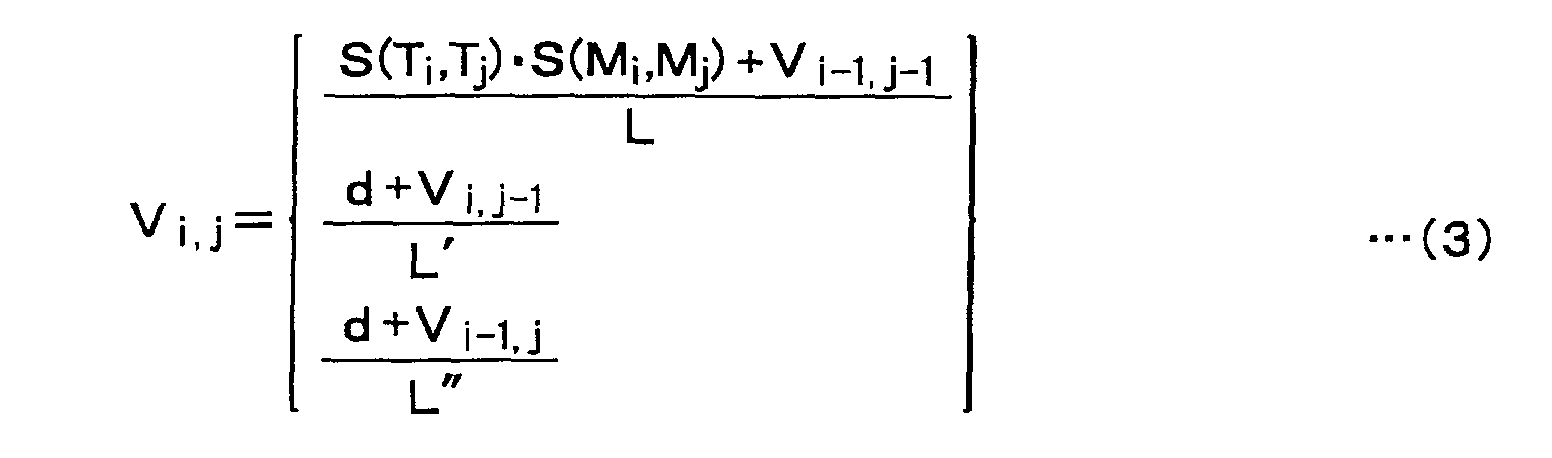
- the dynamic programming operation unit 23 calculates evaluation values V i,j using equation (3) described in the following.
- T i is a transition probability vector for ith M node of HMM#0
- T j is an emission probability vector for jth M node of HMM#1.
- S(T i , T j ) is the degree of similarity between the two transition probability vectors (S(T i , T j ) is cosine squared of the angle made by the two vectors).
- HMM profiles that can be made from a sequence group is not necessarily limited to one.
- two HMM profiles put simply, two HMM profiles where the same portions are handles as M nodes and I modes, respectively
- ACT ACT
- A-T A-T
- A-T A-T
- the evaluation value for movement in a diagonal direction is S(T i , T j )•(M i , M j ).
- S(T i , T j ) is not a value directly exhibiting the presence of an I node or a D node but S(T i , T j ) relating to portions where there is the kind of relationship shown in FIG. 8 is a particularly small value (S(T i , T j ) for the two M nodes shown at the left end of FIG. 8 is 0.25).
- the selection of movement in a diagonal direction is not prominent at portions likely to be selected for movement in a lateral or vertical direction and a more accurate determination of reliability can be carried out than for the first evaluation mode as a result.
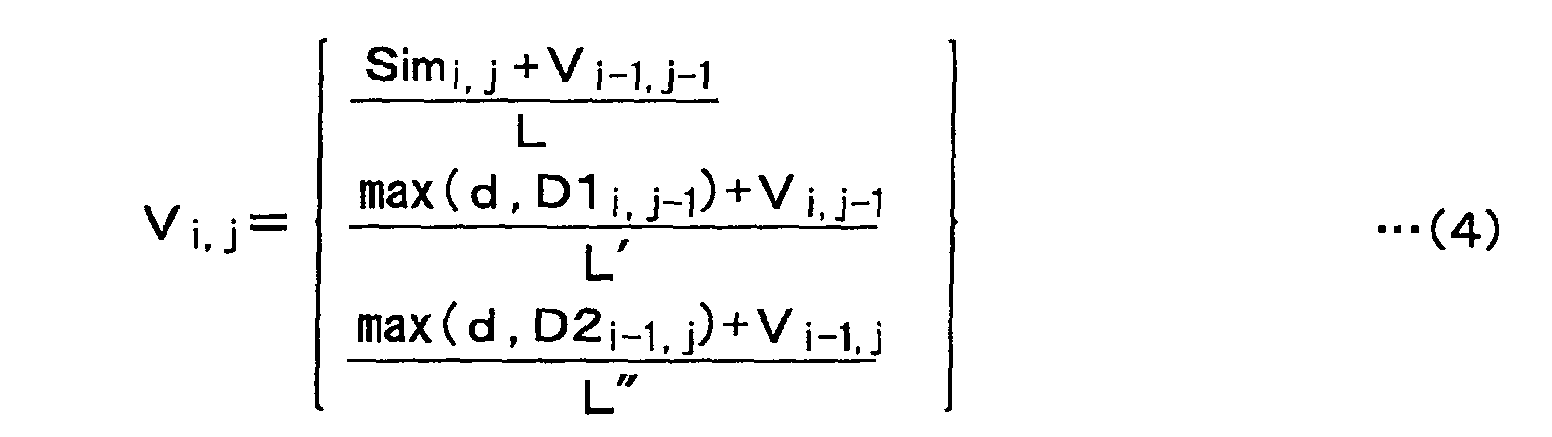
- the third mode is an evaluation mode that gives more pertinent consideration to the presence of the I nodes and the D nodes.
- Tm i , Ti i and Td i are the probability of a transition to an M node, the probability of a transition to an I node, and the probability of a transition to a D node, respectively, with regards to ith M node of the HMM#0.
- Tm j , Ti j and Td j are the probability of a transition to an M node, the probability of a transition to an I node, and the probability of a transition to a D node, respectively, with regards to jth M node of the HMM#1.
- I i is an emission probability vector for ith node of HMM#0
- I j is an emission probability vector for jth I node of HMM#1.
- a function for a degree of similarity ("S(M i , M j )) of emission probability vectors for two M nodes, a degree of similarity (“S(I i , I j )”) of emission probability vectors for two I nodes, and transition probability vectors ("Tm i , Ti i , Td i " and "Tm j , Ti j , Td j ") is used as the evaluation value for movement in a diagonal direction.
- Ti i xTm j xS(ii, Mj) (or conversely, Ti j •Tm i xS(I j , M i ) can be considered as a function (operator) that will give a large value.
- Tm i •Td j (or conversely, Tm j •Td i ) can be considered as a function (operator) that is large with respect to this M node.
- D1 i,j defined in equation (6) and the larger of the values for d are used as evaluation values for movement in a lateral direction
- D1 i defined in equation (7) and the larger of the values j and d are used as evaluation values for movement in a vertical direction.
- evaluation results for the first evaluation mode and evaluation results for the second evaluation mode for HMM#0 and HMM#1 of the content shown in FIG. 9A and FIG. 9B made from multiple alignments referred to as "AACAA”, “AACAA”, “AA-AA” and “AA-AA” are described.
- back trace results for the second evaluation mode are shown in FIG. 10, and a degree of similarity of 0.962821 was calculated as the degree of similarity (evaluation value) for both HMM's.
- the back trace results for the first evaluation mode were the same as shown in FIG. 10 but a degree of similarity of 0.85 was calculated.
- the second evaluation mode is an evaluation mode that can calculate a more reliable degree of similarity than the first evaluation mode.
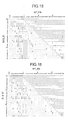
- HMM profiles given the respective names of 5H1A_M7, 5H1B_D7, 5HT_BO6, 5HT_HE6 are made from the amino acid sequences for four homology groups and evaluation is carried out on all combinations thereof in the first evaluation mode. The determination results shown in FIG. 11 to FIG. 17 can then be obtained.
- FIG. 11 is a diagram showing degrees of similarity (evaluation values) obtained for each of the combinations
- FIG. 12 is a diagram showing back trace results for between 5H1A_M7 and 5H1B_D7.
- FIG. 13 is a diagram showing back trace results for between 5H1A_M7 and 5HT_B06
- FIG. 14 is a diagram showing back trace results for between 5H1A_M7 and 5HT_HE6.
- FIG. 15 shows back trace results for between 5H1B_D7 and 5HT_B06.
- FIG. 16 is a diagram showing back trace results for between 5H1B_D7 and 5HT_HE6.
- FIG. 17 is a diagram showing back trace results for between 5HT_B06 and 5HT_HE6.
- the similarity evaluation device 10 of the embodiment is configured so as to obtain a degree of similarity between probability models using dynamic programming techniques. Therefore, if this similarity evaluation device 10 is used, similarity between probability models can be determined at a higher speed than in the related art.
- the values D1 and D2 employed in the processing when operating in the third evaluation mode are values taking into consideration the presence of both D nodes and I nodes.
- An evaluation value (evaluation function) for when passing through a D node and an evaluation value (evaluation function) for when passing through an I node may therefore be calculated and these values and the maximum value of d values may then be used as an evaluation value for movement in a lateral direction or vertical direction.
- the similarity evaluation device 10 is a device where a similarity evaluation program is installed on a computer, and the dynamic processing unit 23 may therefore be an IC, and the technology employed in the similarity evaluation device 10 may also be applied to probability models other than HMMs.
Landscapes
- Engineering & Computer Science (AREA)
- Physics & Mathematics (AREA)
- Data Mining & Analysis (AREA)
- General Physics & Mathematics (AREA)
- Mathematical Optimization (AREA)
- Pure & Applied Mathematics (AREA)
- Theoretical Computer Science (AREA)
- Mathematical Physics (AREA)
- Computational Mathematics (AREA)
- Mathematical Analysis (AREA)
- Life Sciences & Earth Sciences (AREA)
- Operations Research (AREA)
- Probability & Statistics with Applications (AREA)
- Bioinformatics & Cheminformatics (AREA)
- Algebra (AREA)
- Evolutionary Biology (AREA)
- Databases & Information Systems (AREA)
- Software Systems (AREA)
- General Engineering & Computer Science (AREA)
- Bioinformatics & Computational Biology (AREA)
- Information Retrieval, Db Structures And Fs Structures Therefor (AREA)
- Complex Calculations (AREA)
Abstract
Description





Claims (15)
- A similarity evaluation method for evaluating similarity between a pair of probability model profiles each including a plurality of items of probability information constituted by a plurality of probability data, including:a similarity value calculating step of calculating a similarity value indicating similarity between a pair of items of probability information based on probability information included in one of the pair of probability model profiles and probability information included in the other of the pair of probability model profiles; andan evaluating step of carrying out arithmetic processing based on dynamic programming techniques employing a similarity value calculated in the similarity value calculating step as an indicator value for path selection, thereby evaluating similarity of the pair of probability model profiles.
- The similarity evaluation method according to claim 1, wherein
the probability model information is probability model information relating to a Hidden Markov Model, and
the similarity value calculating step involves calculating the similarity value based on a plurality of emission probability data in the probability information included in one of the pair of profiles, and a plurality of emission probability data in the probability information included in the other of the pair of profiles. - The similarity evaluation method according to claim 1, wherein
the probability model information is probability model information relating to a Hidden Markov Model, and
the similarity value calculating step involves calculating the similarity value based on a plurality of emission probability data and a plurality of transition probability data in the probability information included in one of the pair of profiles, and a plurality of emission probability data and a plurality of transition probability data in the probability information included in the other of the pair of profiles. - The similarity evaluation method according to claim 3, wherein
the similarity value calculating step involves calculating the similarity value by multiplying the cosine squared of an angle made by an emission probability vector constituted by a plurality of emission probability data in the probability information included in one of the pair of profiles, and an emission probability vector constituted by a plurality of emission probability data in the probability information included in the other of the pair of profiles with the cosine squared of an angle made by a transition probability vector constituted by the plurality of transition probability data in the probability information included in said one of the pair of profiles
and a transition probability vector constituted by the plurality of transition probability data in the probability information included in said other of the pair of profiles. - The similarity evaluation method of any one of claim 1 to claim 4, further including a step of outputting information indicating the relationship of similarity between items of probability information included in the pair of profiles based on the results of arithmetic processing carried out in the evaluating step.
- A similarity evaluation program for making a computer perform a process of evaluating similarity between a pair of probability model profiles each including a plurality of items of probability information constituted by a plurality of probability data, said process comprising:a similarity value calculating step of calculating a similarity value indicating similarity between a pair of items of probability information based on probability information included in one of the pair of profiles and probability information included in the other of the pair of profiles; andan evaluating step of carrying out arithmetic processing based on dynamic programming techniques employing a similarity value calculated in the similarity value calculating step as an indicator value for path selection, thereby evaluating similarity of the pair of profiles.
- The similarity evaluation program according to claim 6, wherein
the probability model information is probability model information relating to a Hidden Markov Model, and
the similarity value calculating step involves calculating the similarity value based on a plurality of emission probability data in the probability information included in one of the pair of profiles, and a plurality of emission probability data in the probability information included in the other of the pair of profiles. - The similarity evaluation program according to claim 6, wherein
the probability model information is probability model information relating to a Hidden Markov Model, and
the similarity value calculating step involves calculating the similarity value based on a plurality of emission probability data and a plurality of transition probability data in the probability information included in one of the pair of profiles, and a plurality of emission probability data and a plurality of transition probability data in the probability information included in the other of the pair of profiles. - The similarity evaluation program according to claim 8, wherein
the similarity value calculating step involves calculating the similarity value by multiplying the cosine squared of an angle made by an emission probability vector constituted by a plurality of emission probability data in the probability information included in one of the pair of profiles and an emission probability vector constituted by a plurality of emission probability data in the probability information included in the other of the pair of profiles with the cosine squared of an angle made by a transition probability vector constituted by the plurality of transition probability data in the probability information included in said one of the pair of profiles
and a transition probability vector constituted by the plurality of transition probability data in the probability information included in said other of the pair of profiles. - The similarity evaluation program according to any one of claim 6 to claim 9, wherein said process further includes a step of outputting information indicating the relationship of similarity between pairs of items of probability information included in the pair of profiles based on the results of arithmetic processing carried out in the evaluating step.
- A similarity evaluation apparatus for evaluating similarity between a pair of probability model profiles each including a plurality of items of probability information constituted by a plurality of probability data, comprising:a similarity value calculating part for calculating a similarity value indicating similarity between a pair of items of probability information based on probability information included in one of the pair of profiles and probability information included in the other of the pair of profiles; andan evaluating part for carrying out arithmetic processing based on dynamic programming techniques employing a similarity value calculated by the similarity value calculating part as an indicator value for path selection, thereby evaluating similarity of the pair of profiles.
- The similarity evaluation apparatus according to claim 11, wherein
the probability model information is probability model information relating to a Hidden Markov Model, and
the similarity value calculating part calculates the similarity value based on a plurality of emission probability data in the probability information included in one of the pair of profiles, and a plurality of emission probability data in the probability information included in the other of the pair of profiles. - The similarity evaluation apparatus according to claim 11, wherein
the probability model information is probability model information relating to a Hidden Markov Model, and
the similarity value calculating part calculates the similarity value based on a plurality of emission probability data and a plurality of transition probability data in the probability information included in one of the pair of profiles, and a plurality of emission probability data and a plurality of transition probability data in the probability information included in the other of the pair of profiles. - The similarity evaluation apparatus according to claim 13, wherein
the similarity value calculating part calculates the similarity value by multiplying the cosine squared of an angle made by an emission probability vector constituted by a plurality of emission probability data in the probability information included in one of the pair of profiles and an emission probability vector constituted by a plurality of emission probability data in the probability information included in the other of the pair of profiles with the cosine squared of an angle made by a transition probability vector constituted by the plurality of transition probability data in the probability information included in the one of the pair of profiles and a transition probability vector constituted by the plurality of transition probability data in the probability information included in the other of the pair of profiles. - The similarity evaluation apparatus according to any one of claim 11 to claim 14, further comprising a part for outputting information indicating the relationship of similarity between pairs of items of probability information included in the pair of probability model information based on the results of arithmetic processing carried out by the evaluating part.
Applications Claiming Priority (2)
| Application Number | Priority Date | Filing Date | Title |
|---|---|---|---|
| JP2001299218 | 2001-09-28 | ||
| JP2001299218A JP2003108187A (en) | 2001-09-28 | 2001-09-28 | Method and program for similarity evaluation |
Publications (2)
| Publication Number | Publication Date |
|---|---|
| EP1298534A2 true EP1298534A2 (en) | 2003-04-02 |
| EP1298534A3 EP1298534A3 (en) | 2005-01-19 |
Family
ID=19120005
Family Applications (1)
| Application Number | Title | Priority Date | Filing Date |
|---|---|---|---|
| EP02252615A Withdrawn EP1298534A3 (en) | 2001-09-28 | 2002-04-12 | Method and apparatus for Similarity evaluation |
Country Status (4)
| Country | Link |
|---|---|
| US (1) | US20030065510A1 (en) |
| EP (1) | EP1298534A3 (en) |
| JP (1) | JP2003108187A (en) |
| AU (1) | AU765400B2 (en) |
Families Citing this family (7)
| Publication number | Priority date | Publication date | Assignee | Title |
|---|---|---|---|---|
| US7822614B2 (en) * | 2003-12-05 | 2010-10-26 | Kabushikikaisha Kenwood | Device control, speech recognition device, agent device, control method |
| KR100612882B1 (en) | 2004-12-29 | 2006-08-14 | 삼성전자주식회사 | Method and apparatus for determining pattern recognition possibility of time series signal |
| JP2007047575A (en) * | 2005-08-11 | 2007-02-22 | Canon Inc | Pattern matching method and apparatus, and voice information retrieval system |
| US20080059190A1 (en) * | 2006-08-22 | 2008-03-06 | Microsoft Corporation | Speech unit selection using HMM acoustic models |
| US8234116B2 (en) * | 2006-08-22 | 2012-07-31 | Microsoft Corporation | Calculating cost measures between HMM acoustic models |
| US8244534B2 (en) * | 2007-08-20 | 2012-08-14 | Microsoft Corporation | HMM-based bilingual (Mandarin-English) TTS techniques |
| JP7662953B2 (en) * | 2021-02-15 | 2025-04-16 | 日本電信電話株式会社 | Information processing device, information processing method, and information processing program |
Family Cites Families (5)
| Publication number | Priority date | Publication date | Assignee | Title |
|---|---|---|---|---|
| MX9706407A (en) * | 1995-03-07 | 1997-11-29 | British Telecomm | Speech recognition. |
| CA2180392C (en) * | 1995-07-31 | 2001-02-13 | Paul Wesley Cohrs | User selectable multiple threshold criteria for voice recognition |
| US5842161A (en) * | 1996-06-25 | 1998-11-24 | Lucent Technologies Inc. | Telecommunications instrument employing variable criteria speech recognition |
| US6128587A (en) * | 1997-01-14 | 2000-10-03 | The Regents Of The University Of California | Method and apparatus using Bayesian subfamily identification for sequence analysis |
| US5983180A (en) * | 1997-10-23 | 1999-11-09 | Softsound Limited | Recognition of sequential data using finite state sequence models organized in a tree structure |
-
2001
- 2001-09-28 JP JP2001299218A patent/JP2003108187A/en active Pending
-
2002
- 2002-03-27 AU AU27731/02A patent/AU765400B2/en not_active Ceased
- 2002-03-28 US US10/107,204 patent/US20030065510A1/en not_active Abandoned
- 2002-04-12 EP EP02252615A patent/EP1298534A3/en not_active Withdrawn
Also Published As
| Publication number | Publication date |
|---|---|
| AU2773102A (en) | 2003-04-03 |
| JP2003108187A (en) | 2003-04-11 |
| AU765400B2 (en) | 2003-09-18 |
| EP1298534A3 (en) | 2005-01-19 |
| US20030065510A1 (en) | 2003-04-03 |
Similar Documents
| Publication | Publication Date | Title |
|---|---|---|
| Asai et al. | Prediction of protein secondary structure by the hidden Markov model | |
| Lucasius et al. | Genetic algorithms in wavelength selection: a comparative study | |
| US10083334B2 (en) | Barcode reconstruction utilizing a sequence alignment matrix | |
| US20170228613A1 (en) | Random Sample Consensus for Groups of Data | |
| EP1298534A2 (en) | Method and apparatus for Similarity evaluation | |
| CN109189892A (en) | A kind of recommended method and device based on article review | |
| CN117291175B (en) | Method for detecting generated text based on statistical feature fusion of multiple large language models | |
| CN116363402B (en) | Method and system for detecting data waveform alignment based on data feature matching | |
| EP1351183A2 (en) | Sequence data combining method, apparatus and program | |
| Charters et al. | Disentangling chromosome overlaps by combining trainable shape models with classification evidence | |
| CN109977400B (en) | Verification processing method and device, computer storage medium and terminal | |
| JP2019133462A (en) | Detection program, detection method, and detection apparatus | |
| CN119048843A (en) | AI generated image detection method based on graph topology learning | |
| CN119479815A (en) | DNA sequence vectorization parallel alignment method and device based on wavefront algorithm | |
| JP2003022446A (en) | Device and method for signature collation, and program making computer implement the same method | |
| Šrámek et al. | On-line Viterbi algorithm for analysis of long biological sequences | |
| Hu et al. | Automated Chinese handwriting error detection using attributed relational graph matching | |
| CN117688391B (en) | Precision analysis method of network model and electronic equipment | |
| Kang et al. | Locating patterns in Nanopore currents using time-warped signal representation of consensus nucleotides for demultiplexing and motif detection | |
| JP2004220082A (en) | Document search program, document search method, and document search device | |
| JP3237606B2 (en) | Multiple character string alignment method and system | |
| Jonoska et al. | Algebraic and topological models for DNA recombinant processes | |
| KR20050065884A (en) | Apparatus for predicting transcription factor binding sites based on similar sequences and method thereof | |
| CN117763589A (en) | Method and system for encrypting and processing driving trajectory according to distance weight | |
| Nabende | Mining transliterations from wikipedia using pair hmms |
Legal Events
| Date | Code | Title | Description |
|---|---|---|---|
| PUAI | Public reference made under article 153(3) epc to a published international application that has entered the european phase |
Free format text: ORIGINAL CODE: 0009012 |
|
| AK | Designated contracting states |
Kind code of ref document: A2 Designated state(s): AT BE CH CY DE DK ES FI FR GB GR IE IT LI LU MC NL PT SE TR Designated state(s): AT BE CH CY DE DK ES FI FR GB GR IE IT LI LU MC NL PT SE TR |
|
| AX | Request for extension of the european patent |
Extension state: AL LT LV MK RO SI |
|
| PUAL | Search report despatched |
Free format text: ORIGINAL CODE: 0009013 |
|
| RIC1 | Information provided on ipc code assigned before grant |
Ipc: 7G 06F 19/00 B Ipc: 7G 06F 17/18 B Ipc: 7G 06F 17/15 A |
|
| AK | Designated contracting states |
Kind code of ref document: A3 Designated state(s): AT BE CH CY DE DK ES FI FR GB GR IE IT LI LU MC NL PT SE TR |
|
| AX | Request for extension of the european patent |
Extension state: AL LT LV MK RO SI |
|
| AKX | Designation fees paid | ||
| STAA | Information on the status of an ep patent application or granted ep patent |
Free format text: STATUS: THE APPLICATION IS DEEMED TO BE WITHDRAWN |
|
| 18D | Application deemed to be withdrawn |
Effective date: 20050720 |
|
| REG | Reference to a national code |
Ref country code: DE Ref legal event code: 8566 |