EP1298496A2 - Electrophotographic organophotoreceptors - Google Patents
Electrophotographic organophotoreceptors Download PDFInfo
- Publication number
- EP1298496A2 EP1298496A2 EP02256725A EP02256725A EP1298496A2 EP 1298496 A2 EP1298496 A2 EP 1298496A2 EP 02256725 A EP02256725 A EP 02256725A EP 02256725 A EP02256725 A EP 02256725A EP 1298496 A2 EP1298496 A2 EP 1298496A2
- Authority
- EP
- European Patent Office
- Prior art keywords
- group
- integer
- aryl
- atom
- compound
- Prior art date
- Legal status (The legal status is an assumption and is not a legal conclusion. Google has not performed a legal analysis and makes no representation as to the accuracy of the status listed.)
- Withdrawn
Links
- 0 **1C(*(*=Cc2ccc(*(*)c3ccccc3-3)c-3c2)c2ccccc2)=**=*1 Chemical compound **1C(*(*=Cc2ccc(*(*)c3ccccc3-3)c-3c2)c2ccccc2)=**=*1 0.000 description 5
Classifications
-
- G—PHYSICS
- G03—PHOTOGRAPHY; CINEMATOGRAPHY; ANALOGOUS TECHNIQUES USING WAVES OTHER THAN OPTICAL WAVES; ELECTROGRAPHY; HOLOGRAPHY
- G03G—ELECTROGRAPHY; ELECTROPHOTOGRAPHY; MAGNETOGRAPHY
- G03G5/00—Recording-members for original recording by exposure, e.g. to light, to heat or to electrons; Manufacture thereof; Selection of materials therefor
- G03G5/02—Charge-receiving layers
- G03G5/04—Photoconductive layers; Charge-generation layers or charge-transporting layers; Additives therefor; Binders therefor
-
- C—CHEMISTRY; METALLURGY
- C07—ORGANIC CHEMISTRY
- C07D—HETEROCYCLIC COMPOUNDS
- C07D403/00—Heterocyclic compounds containing two or more hetero rings, having nitrogen atoms as the only ring hetero atoms, not provided for by group C07D401/00
- C07D403/14—Heterocyclic compounds containing two or more hetero rings, having nitrogen atoms as the only ring hetero atoms, not provided for by group C07D401/00 containing three or more hetero rings
-
- C—CHEMISTRY; METALLURGY
- C07—ORGANIC CHEMISTRY
- C07D—HETEROCYCLIC COMPOUNDS
- C07D209/00—Heterocyclic compounds containing five-membered rings, condensed with other rings, with one nitrogen atom as the only ring hetero atom
- C07D209/56—Ring systems containing three or more rings
- C07D209/80—[b, c]- or [b, d]-condensed
- C07D209/82—Carbazoles; Hydrogenated carbazoles
- C07D209/86—Carbazoles; Hydrogenated carbazoles with only hydrogen atoms, hydrocarbon or substituted hydrocarbon radicals, directly attached to carbon atoms of the ring system
-
- C—CHEMISTRY; METALLURGY
- C07—ORGANIC CHEMISTRY
- C07D—HETEROCYCLIC COMPOUNDS
- C07D403/00—Heterocyclic compounds containing two or more hetero rings, having nitrogen atoms as the only ring hetero atoms, not provided for by group C07D401/00
- C07D403/02—Heterocyclic compounds containing two or more hetero rings, having nitrogen atoms as the only ring hetero atoms, not provided for by group C07D401/00 containing two hetero rings
- C07D403/12—Heterocyclic compounds containing two or more hetero rings, having nitrogen atoms as the only ring hetero atoms, not provided for by group C07D401/00 containing two hetero rings linked by a chain containing hetero atoms as chain links
-
- C—CHEMISTRY; METALLURGY
- C07—ORGANIC CHEMISTRY
- C07D—HETEROCYCLIC COMPOUNDS
- C07D409/00—Heterocyclic compounds containing two or more hetero rings, at least one ring having sulfur atoms as the only ring hetero atoms
- C07D409/14—Heterocyclic compounds containing two or more hetero rings, at least one ring having sulfur atoms as the only ring hetero atoms containing three or more hetero rings
-
- G—PHYSICS
- G03—PHOTOGRAPHY; CINEMATOGRAPHY; ANALOGOUS TECHNIQUES USING WAVES OTHER THAN OPTICAL WAVES; ELECTROGRAPHY; HOLOGRAPHY
- G03G—ELECTROGRAPHY; ELECTROPHOTOGRAPHY; MAGNETOGRAPHY
- G03G5/00—Recording-members for original recording by exposure, e.g. to light, to heat or to electrons; Manufacture thereof; Selection of materials therefor
- G03G5/02—Charge-receiving layers
- G03G5/04—Photoconductive layers; Charge-generation layers or charge-transporting layers; Additives therefor; Binders therefor
- G03G5/043—Photoconductive layers characterised by having two or more layers or characterised by their composite structure
- G03G5/047—Photoconductive layers characterised by having two or more layers or characterised by their composite structure characterised by the charge-generation layers or charge transport layers
-
- G—PHYSICS
- G03—PHOTOGRAPHY; CINEMATOGRAPHY; ANALOGOUS TECHNIQUES USING WAVES OTHER THAN OPTICAL WAVES; ELECTROGRAPHY; HOLOGRAPHY
- G03G—ELECTROGRAPHY; ELECTROPHOTOGRAPHY; MAGNETOGRAPHY
- G03G5/00—Recording-members for original recording by exposure, e.g. to light, to heat or to electrons; Manufacture thereof; Selection of materials therefor
- G03G5/02—Charge-receiving layers
- G03G5/04—Photoconductive layers; Charge-generation layers or charge-transporting layers; Additives therefor; Binders therefor
- G03G5/06—Photoconductive layers; Charge-generation layers or charge-transporting layers; Additives therefor; Binders therefor characterised by the photoconductive material being organic
- G03G5/0601—Acyclic or carbocyclic compounds
- G03G5/0612—Acyclic or carbocyclic compounds containing nitrogen
- G03G5/0616—Hydrazines; Hydrazones
-
- G—PHYSICS
- G03—PHOTOGRAPHY; CINEMATOGRAPHY; ANALOGOUS TECHNIQUES USING WAVES OTHER THAN OPTICAL WAVES; ELECTROGRAPHY; HOLOGRAPHY
- G03G—ELECTROGRAPHY; ELECTROPHOTOGRAPHY; MAGNETOGRAPHY
- G03G5/00—Recording-members for original recording by exposure, e.g. to light, to heat or to electrons; Manufacture thereof; Selection of materials therefor
- G03G5/02—Charge-receiving layers
- G03G5/04—Photoconductive layers; Charge-generation layers or charge-transporting layers; Additives therefor; Binders therefor
- G03G5/06—Photoconductive layers; Charge-generation layers or charge-transporting layers; Additives therefor; Binders therefor characterised by the photoconductive material being organic
- G03G5/0622—Heterocyclic compounds
- G03G5/0624—Heterocyclic compounds containing one hetero ring
- G03G5/0627—Heterocyclic compounds containing one hetero ring being five-membered
- G03G5/0629—Heterocyclic compounds containing one hetero ring being five-membered containing one hetero atom
-
- G—PHYSICS
- G03—PHOTOGRAPHY; CINEMATOGRAPHY; ANALOGOUS TECHNIQUES USING WAVES OTHER THAN OPTICAL WAVES; ELECTROGRAPHY; HOLOGRAPHY
- G03G—ELECTROGRAPHY; ELECTROPHOTOGRAPHY; MAGNETOGRAPHY
- G03G5/00—Recording-members for original recording by exposure, e.g. to light, to heat or to electrons; Manufacture thereof; Selection of materials therefor
- G03G5/02—Charge-receiving layers
- G03G5/04—Photoconductive layers; Charge-generation layers or charge-transporting layers; Additives therefor; Binders therefor
- G03G5/06—Photoconductive layers; Charge-generation layers or charge-transporting layers; Additives therefor; Binders therefor characterised by the photoconductive material being organic
- G03G5/0622—Heterocyclic compounds
- G03G5/0624—Heterocyclic compounds containing one hetero ring
- G03G5/0642—Heterocyclic compounds containing one hetero ring being more than six-membered
-
- G—PHYSICS
- G03—PHOTOGRAPHY; CINEMATOGRAPHY; ANALOGOUS TECHNIQUES USING WAVES OTHER THAN OPTICAL WAVES; ELECTROGRAPHY; HOLOGRAPHY
- G03G—ELECTROGRAPHY; ELECTROPHOTOGRAPHY; MAGNETOGRAPHY
- G03G5/00—Recording-members for original recording by exposure, e.g. to light, to heat or to electrons; Manufacture thereof; Selection of materials therefor
- G03G5/02—Charge-receiving layers
- G03G5/04—Photoconductive layers; Charge-generation layers or charge-transporting layers; Additives therefor; Binders therefor
- G03G5/06—Photoconductive layers; Charge-generation layers or charge-transporting layers; Additives therefor; Binders therefor characterised by the photoconductive material being organic
- G03G5/0622—Heterocyclic compounds
- G03G5/0644—Heterocyclic compounds containing two or more hetero rings
- G03G5/0646—Heterocyclic compounds containing two or more hetero rings in the same ring system
- G03G5/0648—Heterocyclic compounds containing two or more hetero rings in the same ring system containing two relevant rings
-
- G—PHYSICS
- G03—PHOTOGRAPHY; CINEMATOGRAPHY; ANALOGOUS TECHNIQUES USING WAVES OTHER THAN OPTICAL WAVES; ELECTROGRAPHY; HOLOGRAPHY
- G03G—ELECTROGRAPHY; ELECTROPHOTOGRAPHY; MAGNETOGRAPHY
- G03G5/00—Recording-members for original recording by exposure, e.g. to light, to heat or to electrons; Manufacture thereof; Selection of materials therefor
- G03G5/02—Charge-receiving layers
- G03G5/04—Photoconductive layers; Charge-generation layers or charge-transporting layers; Additives therefor; Binders therefor
- G03G5/06—Photoconductive layers; Charge-generation layers or charge-transporting layers; Additives therefor; Binders therefor characterised by the photoconductive material being organic
- G03G5/0622—Heterocyclic compounds
- G03G5/0644—Heterocyclic compounds containing two or more hetero rings
- G03G5/0646—Heterocyclic compounds containing two or more hetero rings in the same ring system
- G03G5/0651—Heterocyclic compounds containing two or more hetero rings in the same ring system containing four relevant rings
-
- G—PHYSICS
- G03—PHOTOGRAPHY; CINEMATOGRAPHY; ANALOGOUS TECHNIQUES USING WAVES OTHER THAN OPTICAL WAVES; ELECTROGRAPHY; HOLOGRAPHY
- G03G—ELECTROGRAPHY; ELECTROPHOTOGRAPHY; MAGNETOGRAPHY
- G03G5/00—Recording-members for original recording by exposure, e.g. to light, to heat or to electrons; Manufacture thereof; Selection of materials therefor
- G03G5/02—Charge-receiving layers
- G03G5/04—Photoconductive layers; Charge-generation layers or charge-transporting layers; Additives therefor; Binders therefor
- G03G5/06—Photoconductive layers; Charge-generation layers or charge-transporting layers; Additives therefor; Binders therefor characterised by the photoconductive material being organic
- G03G5/0622—Heterocyclic compounds
- G03G5/0644—Heterocyclic compounds containing two or more hetero rings
- G03G5/0661—Heterocyclic compounds containing two or more hetero rings in different ring systems, each system containing at least one hetero ring
Definitions
- This invention relates to organophotoreceptors suitable for use in electrophotography and, more specifically, to flexible organophotoreceptors having novel charge transport compounds comprising at least two carbazolecarboxaldehyde substituted-hydrazone groups.
- an organophotoreceptor in the form of a plate, a flexible belt, a disk, a rigid drum, or a sheet around a rigid or compliant drum having an electrically insulating photoconductive element on an electrically conductive substrate is imaged by first uniformly electrostatically charging the surface of the photoconductive layer, and then exposing the charged surface to a pattern of light. The light exposure selectively dissipates the charge in the illuminated areas, thereby forming a pattern of charged and uncharged areas (referred to as latent image). A liquid or solid toner is then provided in the vicinity of the latent image, and the toner particles deposit in either the charged or uncharged areas to create a toned image on the surface of the photoconductive layer.
- the resulting visible toner image can be transferred to a suitable receiving surface such as paper, or the photoconductive layer can operate as a permanent receptor for the image.
- the imaging process can be repeated many times.
- both single layer and multilayer photoconductive elements have been used.
- a charge transport material and charge generating material are combined with a polymeric binder and then deposited on an electrically conductive substrate.
- the charge transport material and charge generating material are in the form of separate layers, each of which can optionally be combined with a polymeric binder and deposited on the electrically conductive substrate.
- Two arrangements are possible. In one arrangement (the “dual layer” arrangement), the charge generating layer is deposited on the electrically conductive substrate and the charge transport layer is deposited on top of the charge generating layer. In an alternate arrangement (the "inverted dual layer” arrangement), the order of the charge transport layer and charge generating layer is reversed.
- the purpose of the charge generating material is to generate charge carriers (i.e., holes or electrons) upon exposure to light.
- the purpose of the charge transport material is to accept these charge carriers and transport them through the charge transport layer in order to discharge a surface charge on the photoconductive element.
- the charge transport compound accepts the hole carriers and transports them through the layer in which the charge transport compound is located.
- the electron transport compound accepts the electron carriers and transports them through the layer in which the electron transport compound is located.
- the charge transport material To produce high quality images, particularly after multiple cycles, it is desirable for the charge transport material to form a homogeneous solution with the polymeric binder and remain in solution. In addition, it is desirable to maximize the amount of charge which the charge transport material can accept (indicated by a parameter known as the acceptance voltage or "V acc "), and to minimize retention of that charge upon discharge (indicated by a parameter known as the residual voltage or " V res ").
- charge transport materials There are many charge transport materials available for electrophotography.
- the most common charge transport materials are pyrazoline derivatives, fluorene derivatives, oxadiazole derivatives, stilbene derivatives, hydrazone derivatives, carbazole hydrazone derivatives, triphenylamine derivatives, julolidine hydrazone derivatives, polyvinyl carbazole, polyvinyl pyrene, or polyacenaphthylene.
- pyrazoline derivatives fluorene derivatives, oxadiazole derivatives, stilbene derivatives, hydrazone derivatives, carbazole hydrazone derivatives, triphenylamine derivatives, julolidine hydrazone derivatives, polyvinyl carbazole, polyvinyl pyrene, or polyacenaphthylene.
- fluorene derivatives fluorene derivatives
- oxadiazole derivatives stilbene derivatives
- hydrazone derivatives carbazole hydr
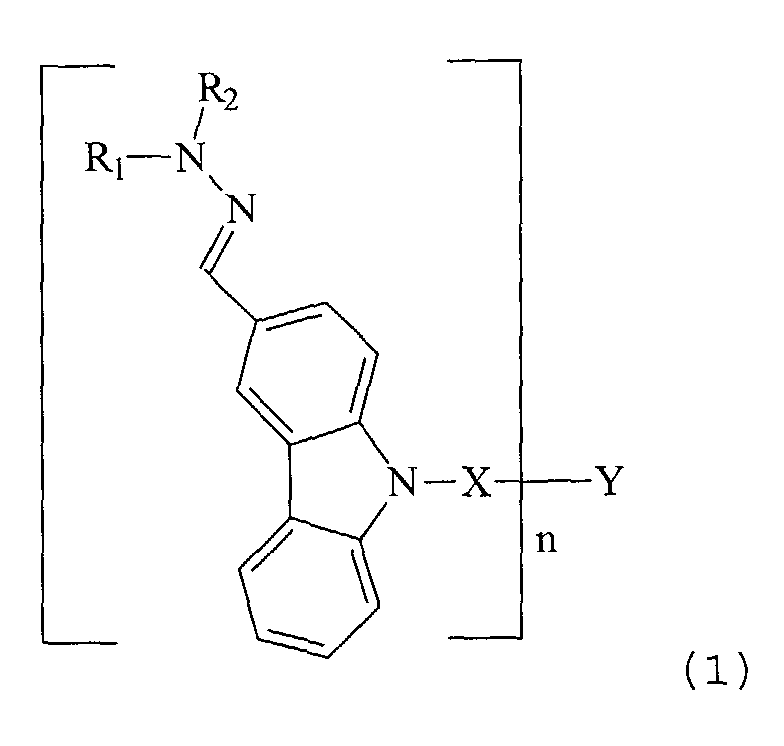
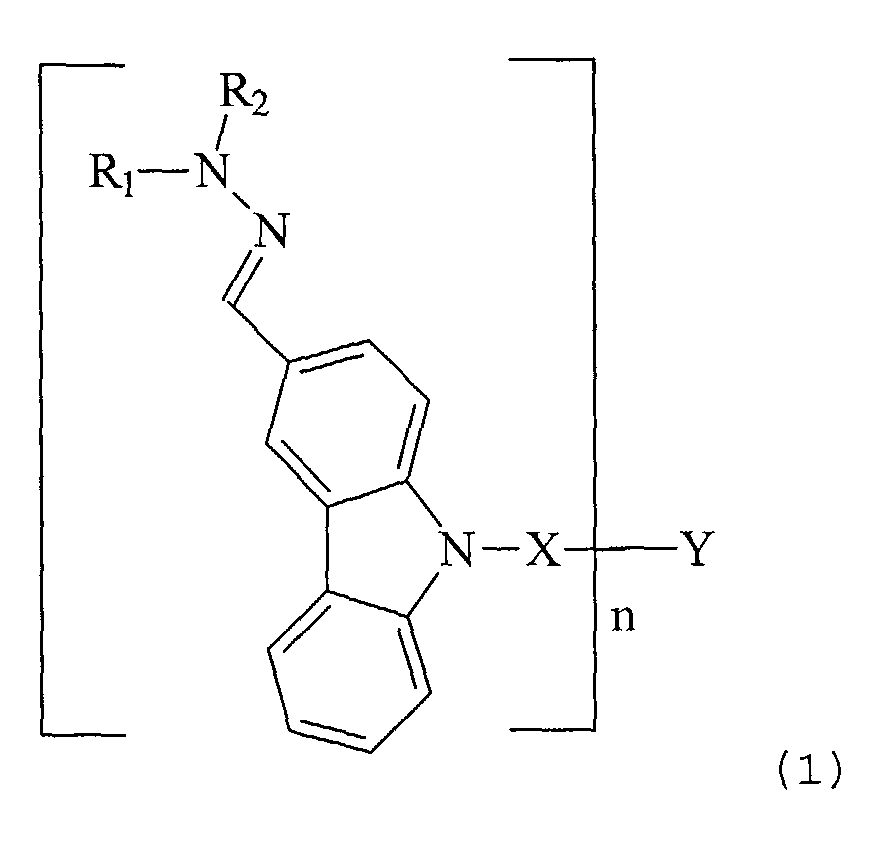
- the invention provides an organophotoreceptor that includes:
- n may be limited accordingly (e.g., a bond may allow n to be only 2, an oxygen atom will allow n to be only 2, a carbon atom will allow n to be a maximum of 4 in a tetra-substituted modality, N will allow n to be a maximum of 3 (although a quaternary ammonium salt is a possibility, without altering the generic structure (1) of the compound), and the like).
- a bond may allow n to be only 2
- an oxygen atom will allow n to be only 2
- a carbon atom will allow n to be a maximum of 4 in a tetra-substituted modality
- N will allow n to be a maximum of 3 (although a quaternary ammonium salt is a possibility, without altering the generic structure (1) of the compound), and the like).
- the charge transport compound may or may not be symmetrical.
- a linking group X for any given "arm” of the compound may be the same or different from the linking groups in other "arms" of the compound.
- R 1 and R 2 groups for any given “arm” of the compound may be the same or different from R 1 and R 2 groups in any other arm.
- the above-described formula for the charge transport compound is intended to cover isomers.
- the organophotoreceptor may be provided in the form of a plate, a flexible belt, a disk, a rigid drum, or a sheet around a rigid or compliant drum.
- the organophotoreceptor suitably includes: (a) a charge transport layer comprising the charge transport compound and a polymeric binder; (b) a charge generating layer comprising the charge generating compound and a polymeric binder; and (c) the electrically conductive substrate.
- the charge transport layer may be intermediate between the charge generating layer and the electrically conductive substrate.
- the charge generating layer may be intermediate between the charge transport layer and the electrically conductive substrate.
- the invention provides an electrophotographic imaging apparatus that includes (a) a plurality of support rollers; and (b) an organophotoreceptor according to the first aspect in the form of a flexible belt threaded around the support rollers.
- the apparatus preferably further includes a liquid toner dispenser.
- the invention provides an electrophotographic imaging process that includes
- the invention provides a novel charge transport material having the formula where n is an integer between 2 and 6, inclusive;
- the charge transport material is a charge transport compound.
- a charge transport compound is suitably selected in which R 1 is phenyl, R 2 is a sulfolanyl group, n is 2, X is -(CH 2 ) m - group where m is an integer between 0 and 20, and Y is a chemical bond or methylene group.
- alkyl group includes not only such alkyl moieties as methyl, ethyl, octyl, stearyl, etc., but also such moieties bearing substituents groups such as halogen, cyano, hydroxyl, nitro, amine, carboxylate, etc.
- alkyl moiety or “alkyl” includes only methyl, ethyl, octyl, stearyl, cyclohexyl, etc.
- photoreceptors can be used successfully with liquid toners to produce high quality images.
- the high quality of the images is maintained after repeated cycling.
- the preferred embodiments of the present invention relate to organophotoreceptors that include charge transport compounds having the formulae: where n is an integer between 2 and 6, inclusive;
- a charge transport compound is selected in which R 1 is phenyl, R 2 is a sulfolanyl group, n is 2, X is an alkylene (-(CH 2 ) m -) group where m is an integer between 0 and 20, and Y is a chemical bond or methylene group.
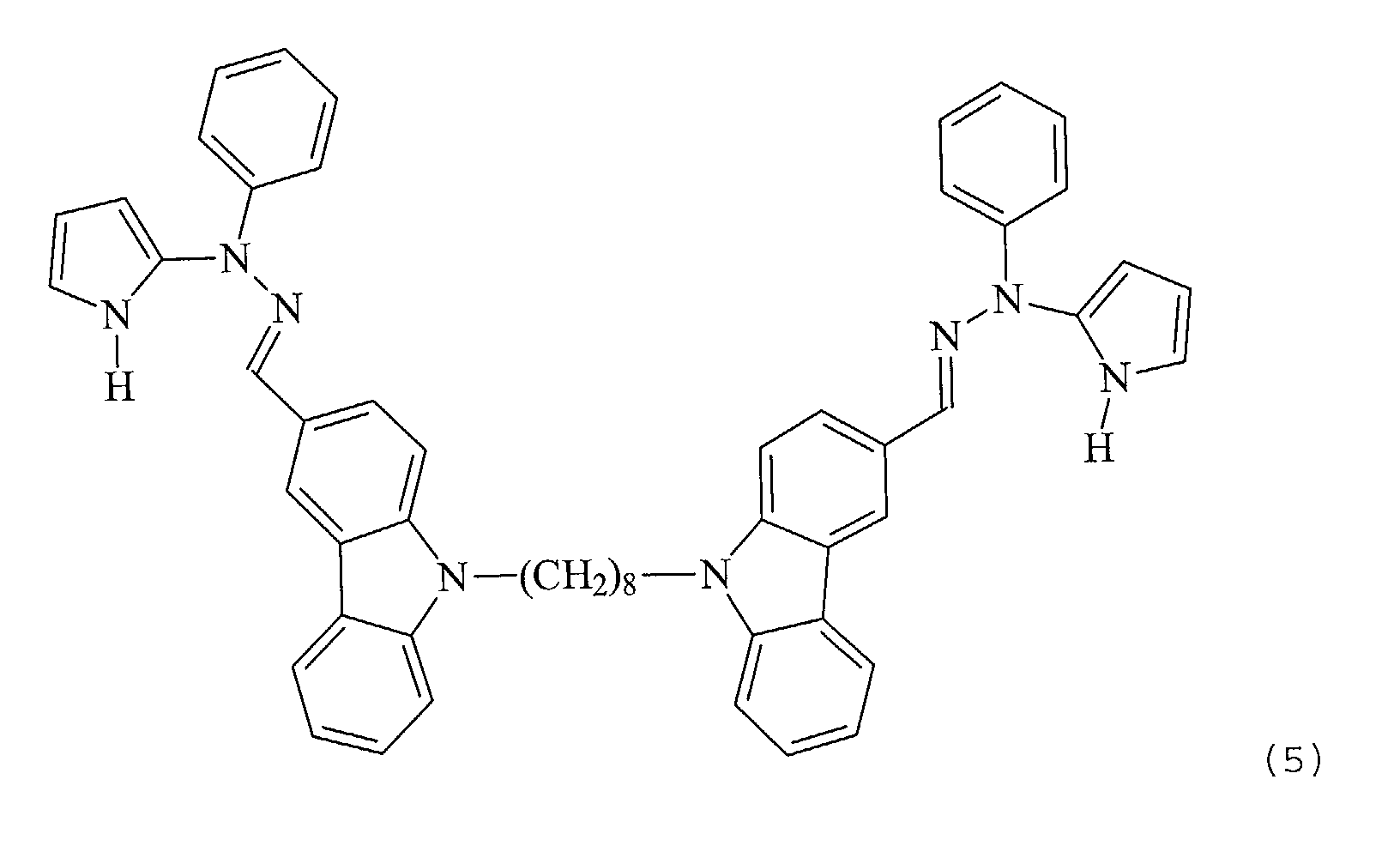
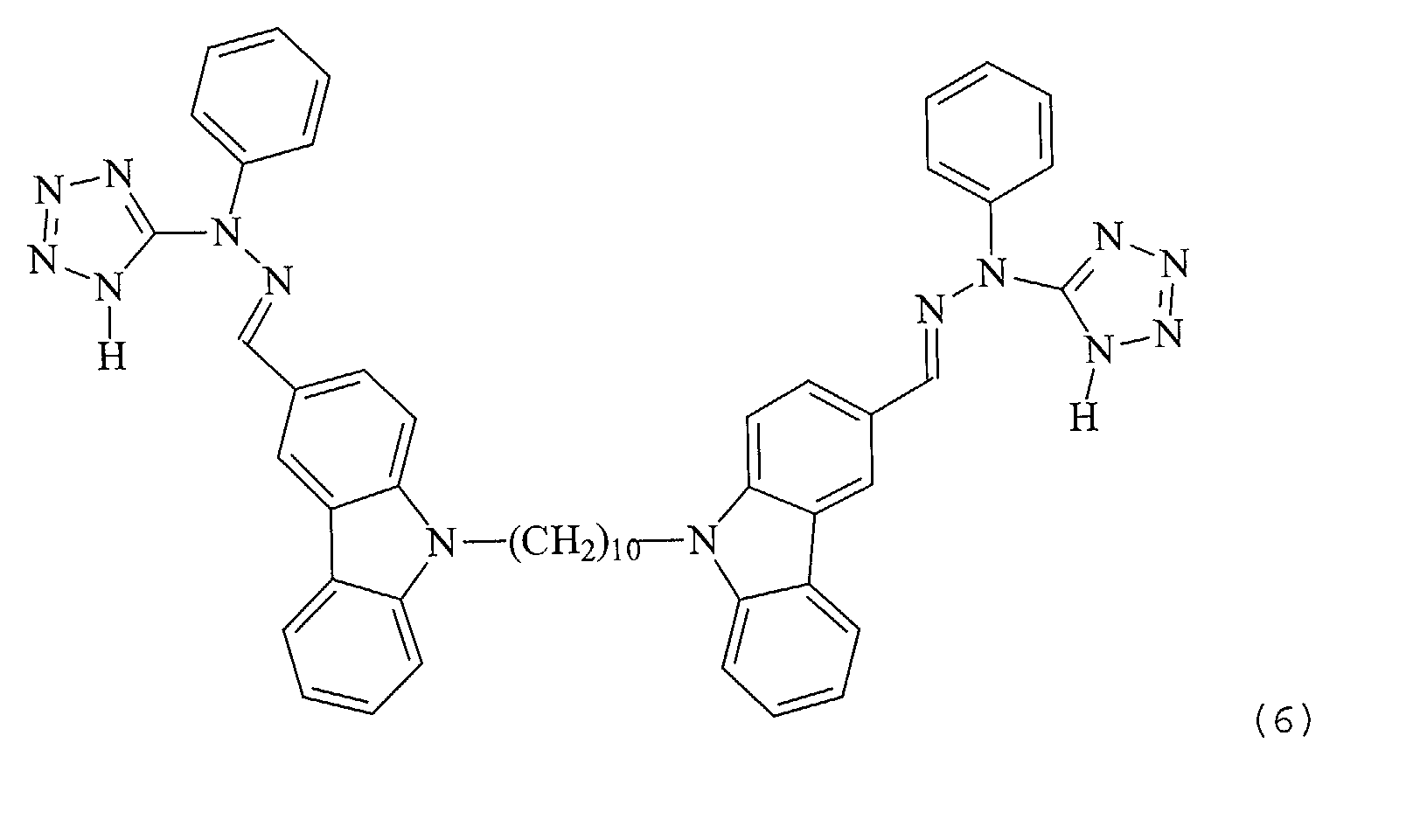
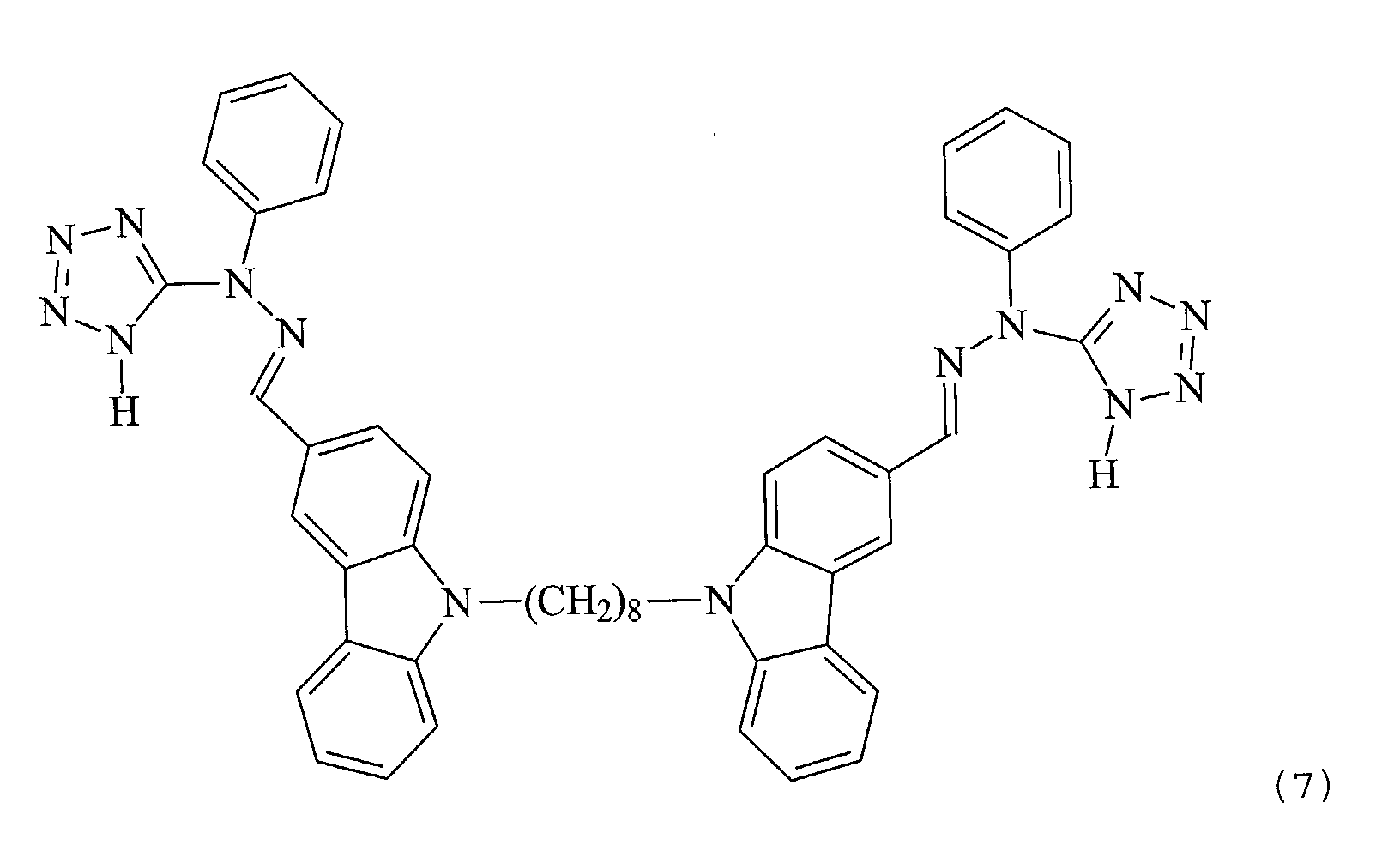
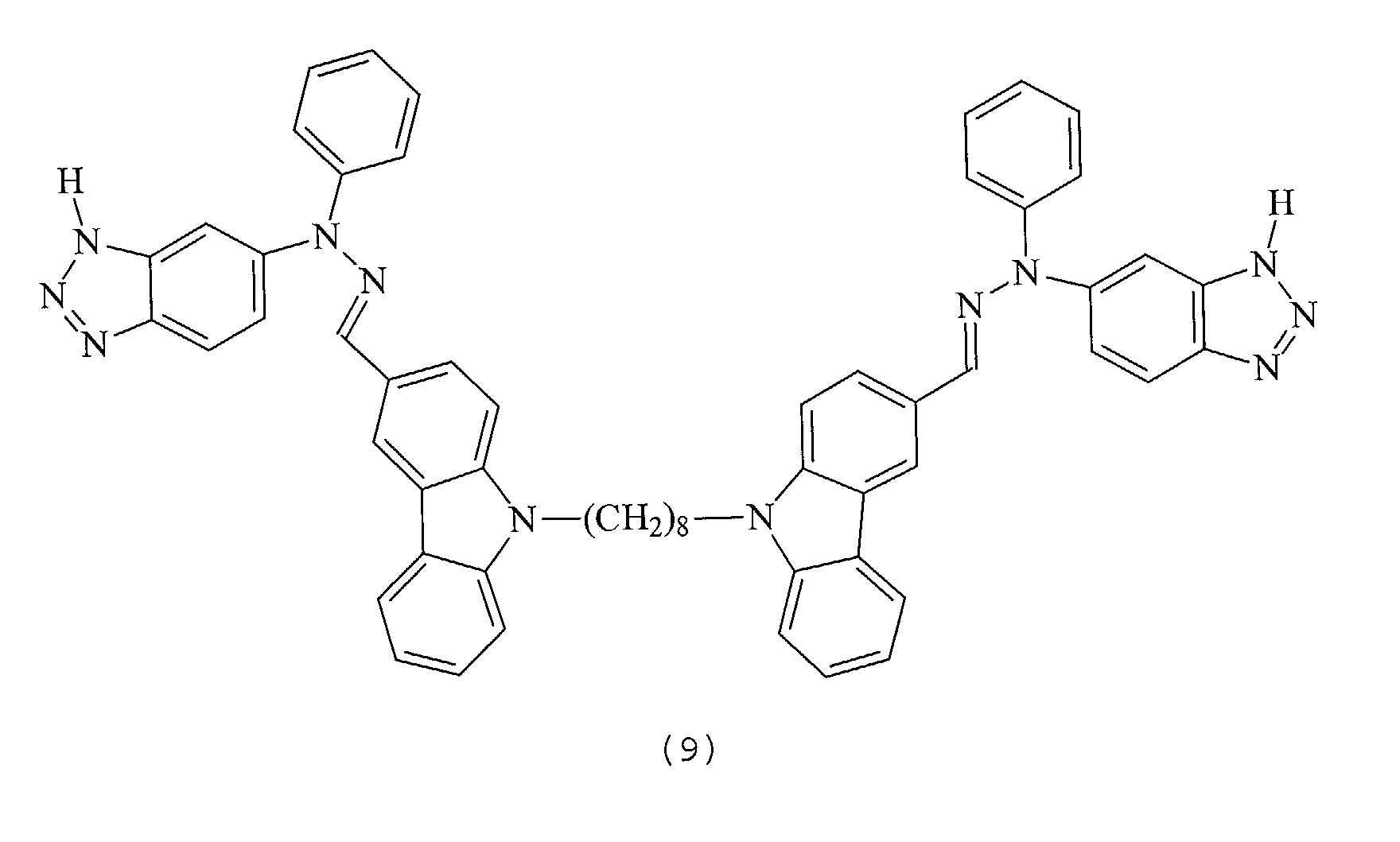
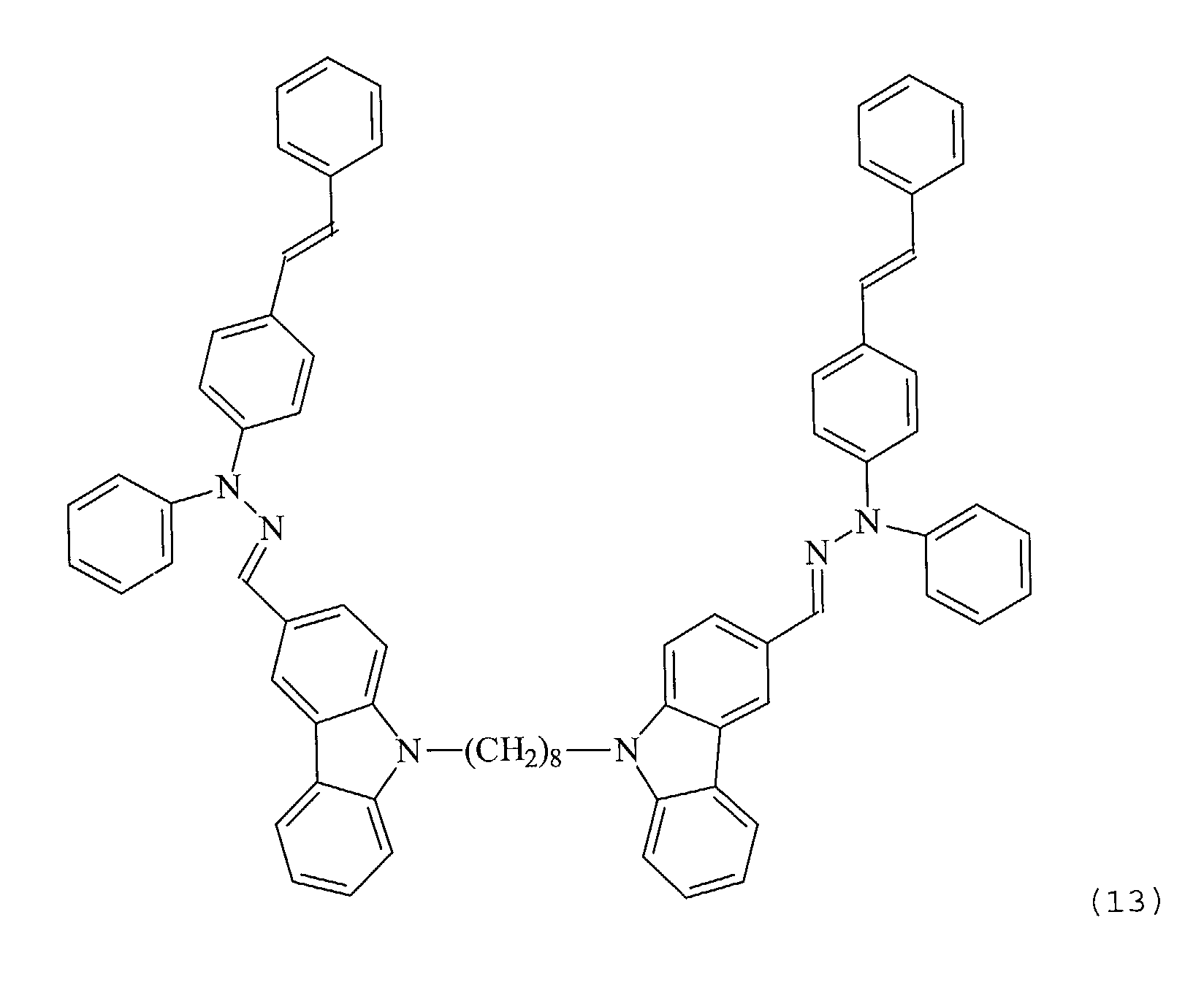
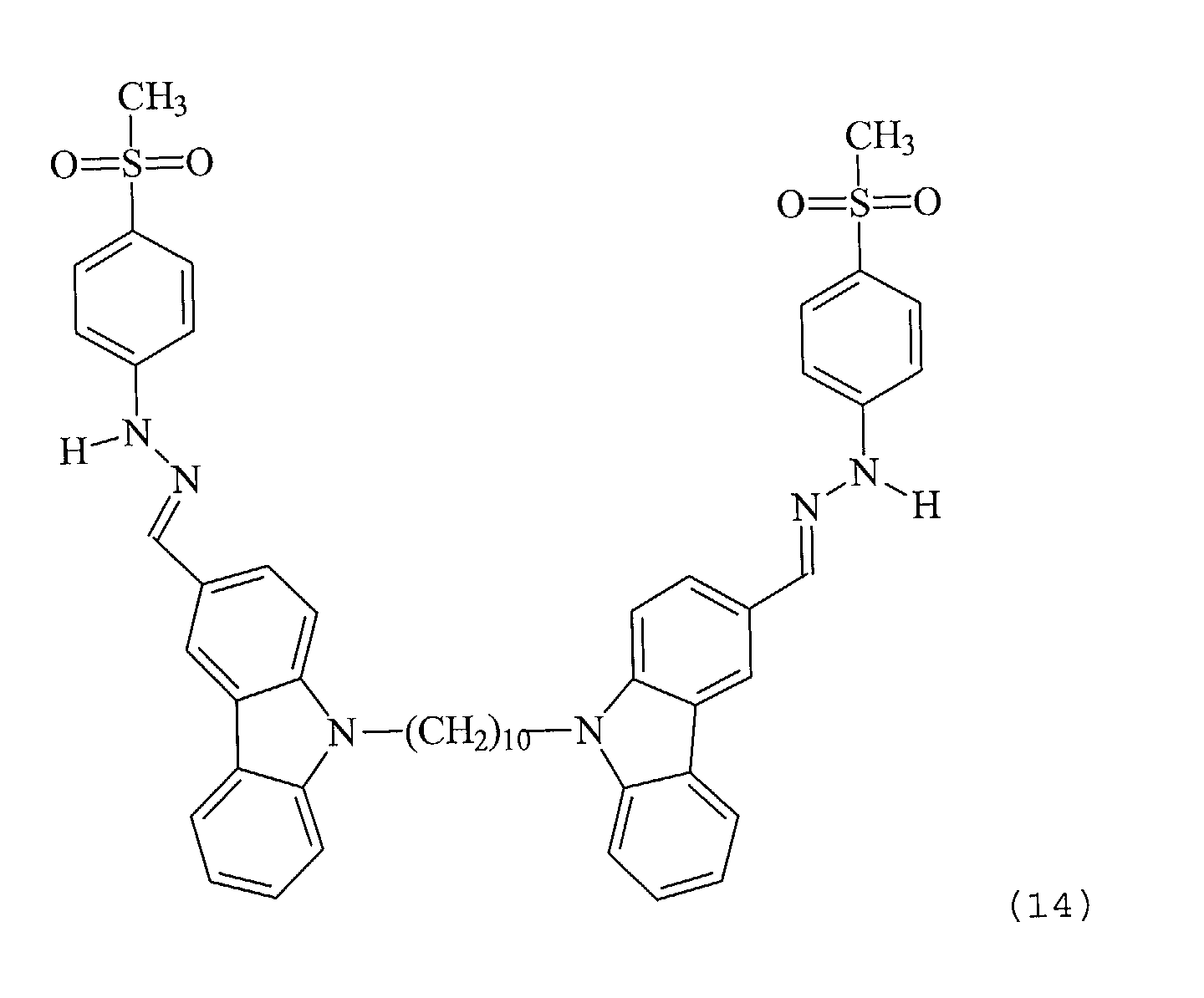
- Examples of such charge transport compound may have the following structures.
- the organophotoreceptor may be in the form of a plate, a flexible belt, a disk, a rigid drum, or a sheet around a rigid or compliant drum, with flexible belts and rigid drums being preferred.
- the organophotoreceptor may include an electrically conductive substrate and a photoconductive element in the form of a single layer that includes both the charge transport compound and charge generating compound in a polymeric binder.
- the organophotoreceptor includes an electrically conductive substrate and a photoconductive element that is a bilayer construction featuring a charge generating layer and a separate charge transport layer.
- the charge generating layer may be located intermediate between the electrically conductive substrate and the charge transport layer.
- the photoconductive element may be an inverted construction in which the charge transport layer is intermediate between the electrically conductive substrate and the charge generating layer.
- the electrically conductive substrate may be flexible, for example in the form of a flexible web or a belt, or inflexible, for example in the form of a drum.
- a flexible electrically conductive substrate comprises of an insulated substrate and a thin layer of electrically conductive materials.
- the insulated substrate may be paper or a film forming polymer such as polyethylene terepthalate, polyimide, polysulfone, polyethylene naphthalate, polypropylene, nylon, polyester, polycarbonate, polyvinyl fluoride, polystyrene and the like.
- the electrically conductive materials may be graphite, dispersed carbon black, iodide, conductive polymers such as polypyroles and Calgon Conductive polymer 261 (commercially available from Calgon Corporation, Inc., Pittsburgh, Pa.), metals such as aluminum, titanium, chromium, brass, gold, copper, palladium, nickel, or stainless steel, or metal oxide such as tin oxide or indium oxide.
- the electrically conductive material is aluminum.
- the photoconductor substrate will have a thickness adequate to provide the required mechanical stability.
- flexible web substrates generally have a thickness from about 0.01 to about 1 mm
- drum substrates generally have a thickness of from about 0.5 mm to about 2 mm.
- the charge generating compound is a material which is capable of absorbing light to generate charge carriers, such as a dyestuff or pigment.
- suitable charge generating compounds include metal-free phthalocyanines (e.g., CGM-X01 x-form metal-free phthalocyanine from Sanyo Color Works, Ltd.), metal phthalocyanines such as titanium phthalocyanine, copper phthalocyanine, oxytitanium phthalocyanine, hydroxygallium phthalocyanine, squarylium dyes and pigments, hydroxy-substituted squarylium pigments, perylimides, polynuclear quinones available from Allied Chemical Corporation under the tradename Indofast Double Scarlet, Indofast Violet Lake B, Indofast Brilliant Scarlet and Indofast Orange, quinacridones available from DuPont under the tradename Monastral Red, Monastral Violet and Monastral Red Y, naphthalene 1,4,5,8-tetracarboxylic acid derived pigments including the
- the binder is capable of dispersing or dissolving the charge transport material of this invention and the charge generating compound.
- suitable binders include polystyrene-co-butadiene, modified acrylic polymers, polyvinyl acetate, styrene-alkyd resins, soya-alkyl resins, polyvinylchloride, polyvinylidene chloride, polyacrylonitrile, polycarbonates, polyacrylic acid, polyacrylates, polymethacrylates, styrene polymers, polyvinyl butyral, alkyd resins, polyamides, polyurethanes, polyesters, polysulfones, polyethers, polyketones, phenoxy resins, epoxy resins, silicone resins, polysiloxanes, poly(hydroxyether) resins, polyhydroxystyrene resins, novolak, resol, poly(phenylglycidyl ether)-co-dicyclopentadiene, copolymers
- Polycarbonate binders are particularly preferred.
- suitable polycarbonate binders include polycarbonate A which is derived from bisphenol-A, polycarbonate Z, which is derived from cyclohexylidene bisphenol, polycarbonate C, which is derived from methylbisphenol A, and polyestercarbonates.
- the organophotoreceptor of this invention may contain an electron transport compound.
- suitable electron transport compound include bromoanil, tetracyanoethylene, tetracyanoquinodimethane, 2,4,7-trinitro-9-fluorenone, 2,4,5,7-tetranitro-9-fluorenone, 2,4,5,7-tetranitroxanthone, 2,4,8-trinitrothioxanthone, 2,6,8-trinitro-indeno4H-indeno[1,2-b]thiophene-4-one, and 1,3,7-trinitrodibenzothiophene-5,5-dioxide, (2,3-diphenyl-1-indenylidene)malononitrile, 4H-thiopyran-1,1-dioxide and its derivatives such as 4-dicyanomethylene-2,6-diphenyl-4H-thiopyran-1,1-dioxide and its derivatives such as 4-dicyanomethylene-2,6-diphenyl-4H
- the organophotoreceptor of this invention may contain a charge transport compound.
- Suitable charge transport compounds include, but are not limited to, pyrazoline derivatives, fluorene derivatives, oxadiazole derivatives, stilbene derivatives, hydrazone derivatives, carbazole hydrazone derivatives, triaryl amines, polyvinyl carbazole, polyvinyl pyrene, polyacenaphthylene, or multi-hydrazone compounds comprising at least two hydrazone groups and at least two groups selected from the group consisting of triphenylamine and heterocycles such as carbazole, julolidine, phenothiazine, phenazine, phenoxazine, phenoxathiin, thiazole, oxazole, isoxazole, dibenzo(1,4)dioxine, thianthrene, imidazole, benzothiazo
- the charge generation layer suitably comprises a binder in an amount of from about 10 to about 90 weight percent of the charge generation layer and preferably in an amount of from about 20 to about 75 weight percent of the charge generation layer, based on the weight of the charge generation layer.
- the charge transport layer typically comprises a charge transport compound in an amount of from about 25 to about 60 weight percent of the charge transport layer, based on the weight of the charge transport layer, and more preferably in an amount of from about 35 to about 50 weight percent, based on the weight of the charge transport layer, with the remainder of the charge transport layer comprising the binder, and optionally any conventional additives.
- the charge transport layer will typically have a thickness of from about 10 to about 40 microns and may be formed in accordance with any conventional technique known in the art.
- the charge generation compound is suitably in an amount of from about 0.5 to about 20 weight percent and more preferably in an amount of from about 1 to about 10 weight percent, based on the weight of the photoconductive layer.
- the charge transport compound is suitably in an amount of from about 10 to about 80 weight percent, based on the weight of the photoconductive layer, and more preferably in an amount of from about 40 to about 60 weight percent, based on the weight of the photoconductive layer.
- the electron transport compound is suitably in an amount of from about 2.5 to about 25 weight percent, based on the weight of the photoconductive layer, and more preferably in an amount of from about 4 to about 20 weight percent, based on the weight of the photoconductive layer.
- the binder is suitably in an amount of from about 15 to about 80 weight percent, based on the weight of the photoconductive layer, and more preferably in an amount of from about 20 to about 50 weight percent, based on the weight of the photoconductive layer.
- the organophotoreceptor of this invention may contain a light stabilizer.
- suitable light stabilizer may include hindered trialkylamines such as Tinuvin® 292 (from Ciba Specialty Chemicals, Terrytown, NY), hindered alkoxydialkylamines such as Tinuvin® 123 (from Ciba Specialty Chemicals), benzotriazoles such as Tinuvin® 928 (from Ciba Specialty Chemicals), benzophenones, nickel compounds such as ArbestabTM (from Robinson Brothers Ltd, West Midlands, Great Britain), salicylates, cyanocinnamates, benzylidene malonates, benzoates, oxanilides, polymeric sterically hindered amines such as LuchemTM (from Atochem North America, Buffalo, NY).
- the light stabilizer is selected from the group consisting of hindered trialkylamines having the following formula: where R 1 , R 2 , R 3 , R 4 , R 6 , R 7 , R 8 , R 10 , R 11 , R 12 , R 13 , R 15 , R 16 are, independently, hydrogen, alkyl group, or ester group, or ether group; and R 5 , R 9 , and R 14 are, independently, alkyl group; and X is a linking group selected from the group consisting of -O-CO-(CH 2 ) m -CO-O-where m is between 2 to 20.
- the light stabilizer in the photoconductive layer is suitably in an amount of from about 0.5 to about 25 weight percent and more preferably in an amount of from about 1 to about 10 weight percent, based on the weight of the photoconductive layer.
- the photoconductive layer may be formed by dispersing or dissolving the components such as a charge generating compound, a charge transport compound, a light stabilizer, an electron transport compound, and a polymeric binder in organic solvent, coating the dispersion and/or solution on the respective underlying layer and drying the coating.
- the components are dispersed by high shear homogenization, ball-milling, attritor milling, high energy bead (sand) milling or other size reduction processes or mixing means known in the art for effecting particle size reduction in forming a dispersion.
- the photoreceptor may include additional layers as well.
- Such layers are well-known and include, for example, barrier layers, release layers, adhesive layer, and sub-layer.
- the release layer suitably forms the uppermost layer of the photoconductor element with the barrier layer sandwiched between the release layer and the photoconductive element.
- the adhesive layer locates and improves the adhesion between the barrier layer and the release layer.
- the sub-layer is a charge blocking layer and locates between the electrically conductive substrate and the photoconductive element. The sub-layer may also improve the adhesion between the electrically conductive substrate and the photoconductive element.
- Suitable barrier layers include coatings such as crosslinkable siloxanol-colloidal silica coating and hydroxylated silsesquioxane-colloidal silica coating, and organic binders such as polyvinyl alcohol, methyl vinyl ether/maleic anhydride copolymer, casein, polyvinyl pyrrolidone, polyacrylic acid, gelatin, starch, polyurethanes, polyimides, polyesters, polyamides, polyvinyl acetate, polyvinyl chloride, polyvinylidene chloride, polycarbonates, polyninyl butyral, polyvinyl acetoacetal, polyvinyl formal, polyacrylonitrile, polymethyl methacrylate, polyacrylates, polyvinyl carbazoles, copolymers of monomers used in the above-mentioned polymers, vinyl chloride/vinyl acetate/vinyl alcohol terpolymers, vinyl chloride/vinyl acetate/maleic acid terpoly
- the above organic binders optionally may contain small inorganic particles such as fumed silica, silica, titania, alumina, zirconia, or a combination thereof.
- the typical particle size is in the range of 0.001 to 0.5 micrometers, preferably 0.005 micrometers.
- a preferred barrier layer is a 1:1 mixture of methyl cellulose and methyl vinyl ether/maleic anhydride copolymer with glyoxal as a crosslinker.
- the release layer topcoat may comprise any release layer composition known in the art.
- the release layer is a fluorinated polymer, siloxane polymer, fluorosilicone polymer, silane, polyethylene, polypropylene, polyacrylate, or a combination thereof. More preferably, the release layers are crosslinked silicone polymers.
- Typical adhesive layers include film forming polymers such as polyester, polyvinylbutyral, polyvinylpyrolidone, polyurethane, polymethyl methacrylate, poly(hydroxy amino ether) and the like.
- the adhesive layer is poly(hydroxy amino ether). If such layers are utilized, they preferably have a dry thickness between about 0.01 micrometer and about 5 micrometers.
- Typical sub-layers include polyvinylbutyral, organosilanes, hydrolyzable silanes, epoxy resins, polyesters, polyamides, polyurethanes, silicones and the like.
- the sub-layer has a dry thickness between about 20 Angstroms and about 2,000 Angstroms.
- the charge transport compounds, and photoreceptors including these compounds are suitable for use in an imaging process with either dry or liquid toner development.
- Liquid toner development is generally preferred because it offers the advantages of providing higher resolution images and requiring lower energy for image fixing compared to dry toners.
- useful liquid toners are well-known. They typically include a colorant, a resin binder, a charge director, and a carrier liquid.
- a preferred resin to pigment ratio is 2:1 to 10:1, more preferably 4:1 to 8:1.
- the colorant, resin, and the charge director form the toner particles.
- the preferred electrophotographic imaging apparatus includes a plurality of support rollers, and an organophotoreceptor having a charge transport compound, a charge generating compound and a conductive substrate as herein described.
- the apparatus may further include a liquid toner dispenser.
- a liquid toner dispenser In a preferred electrophotographic imaging process using the electrophotographic imaging apparatus an electrical charge is applied to a surface of the organophotoreceptor, and then the surface of the organophotoreceptor is imagewise exposed to radiation to dissipate charge in selected areas and thereby form a pattern of charged and uncharged areas on the surface.
- the surface is contacted with a liquid toner comprising a dispersion of colorant particles in an organic liquid to create a toned image. Then, the toned image is transferred to a substrate, thereby obtaining a desired image.
- N-Phenyl-N-sulfolan-3-ylhydrazine can be prepared according to the procedure described in Great Britain Patent No. 1,047,525 by Mason, which is incorporated herein by reference.
- Carbazole 120 g, 0.72 mol, commercially obtained from Aldrich, Milwaukee, WI
- dibromodecane 100 g, 0.33 mol, commercially obtained from Aldrich, Milwaukee, WI
- benzyltriethyl ammonium chloride (12 g) were dissolved in tetrahydrofuran (400 mL) and a concentrated solution of sodium hydroxide (120 g) in water (120 mL) was added. The mixture was heated at reflux with strong mechanical stirring for 4 hours, then cooled to room temperature and poured into an excess of water. The solid that precipitated was filtered off and the tetrahydrofuran layer was dried by magnesium sulfate and concentrated to dryness.
- Dimethylformamide 200 mL was stirred and cooled in an ice bath while phosphorus oxychloride (70 mL, 115 g, 0.75 mol, commercially obtained from Aldrich, Milwaukee, WI) was gradually added.
- 1,10-bis(9-carbazolyl)decane 100 g, 0.22 mol was introduced and the resulting mixture was heated on a steam bath with stirring for 1.5 hours. A viscous, dark brown liquid was generated from which a yellow solid precipitated upon cooling. This entire mixture was added to water (400 mL) and the crude product was filtered off at the pump, washed with water (200 mL), and then with a little ethanol.
- N-Pyrrol-2-yl-N-phenylhydrazine can be prepared according to the procedure described in Japanese Patent No. 05148210 by Myamoto, which is incorporated herein by reference.
- 1-Phenyl-1-(1-benzyl-1H-tetrazol-5-yl)hydrazine can be prepared according to the procedure described in Tetrahedron (1983), 39(15), 2599-608 by Atherton et el., which is incorporated herein by reference.
- N-(5-benzotriazolyl)-N-phenylhydrazine can be prepared according to the procedure described below.
- phenylhydrazine 9 g, 0.9 mole, commercially available from Aldrich, Milwaukee, WI
- 5-chlorobenzotriazole (15.4 g, 0.1 mole, commercially available from Aldrich, Milwaukee, WI) heated to boiling temperature
- sodium is slowly added until there is no more discharge of red coloration. After boiling for some time, the mixture is cooled to room temperature. The product is isolated and purified.
- N-4-[(9H-fluoren-9-ylidene)benzyl]-N-phenylhydrazine can be prepared according to the procedure similar to that described in Zh. Org. Khim. (1967), 3(9), 1605-3 by Matevosyan et el., which is incorporated herein by reference.
- phenylhydrazine 9 g, 0.9 mole, commercially available from Aldrich, Milwaukee, WI
- p-9-(4-chlorobenzylidene)fluorene 28.9 g, 0.1 mole, commercially available from Aldrich, Milwaukee, WI
- N-(4-Stilbenyl)-N-phenylhydrazine can be prepared according to the procedure described in Zh. Org. Khim. (1967), 3(9), 1605-3 by Matevosyan et el., which is incorporated herein by reference.
- phenylhydrazine 9 g, 0.9 mole, commercially available from Aldrich, Milwaukee, WI
- p-chlorostilbene (21.4 g, 0.1 mole, commercially available from Spectrum Quality Products, Inc., Gardena, CA; Web: www.spectrumchemical.com
- 5-Methyl-1-phenyl-3-(1-phenylhydrazino)-pyrazole can be prepared according to the procedure described in J. Chem. Soc. C (1971), (12), 2314-17 by Boyd et el., which is incorporated herein by reference.
- Compound (3) can be prepared by the following procedure. 1,8-Bis(3-formyl-9-carbazolyl)decane (32 g, 64 mmol) and N-phenyl-N-sulfolan-3-ylhydrazine (29.38 g, 130 mmol, 2 equiv.) are combined in tetrahydrofuran (600 mL) and refluxed with stirring for 2 hours. Compound (3) is isolated and purified.
- Compound (4) can be prepared by the following procedure. 1,10-Bis(3-formyl-9-carbazolyl)decane (34 g, 64 mmol) and N-pyrrol-2-yl-N-phenylhydrazine (22.49 g, 130 mmol, 2 equiv.) are combined in tetrahydrofuran (600 mL) and heated at reflux with stirring for 2 hours. Compound (4) is isolated and purified.
- Compound (5) can be prepared by the following procedure. 1,8-Bis(3-formyl-9-carbazolyl)decane (32 g, 64 mmol) and N-pyrrol-2-yl-N-phenylhydrazine (22.49 g, 130 mmol, 2 equiv.) are combined in tetrahydrofuran (600 mL) and refluxed with stirring for 2 hours. Compound (5) is isolated and purified.
- Compound (6) can be prepared by the following procedure. 1,10-Bis(3-formyl-9-carbazolyl)decane (34 g, 64 mmol) and 1-Phenyl-1-(1-benzyl-1H-tetrazol-5-yl)hydrazine (34.58 g, 130 mmol, 2 equiv.) are combined in tetrahydrofuran (600 mL) and heated at reflux with stirring for 2 hours. Compound (6) is isolated and purified.
- Compound (7) can be prepared by the following procedure. 1,8-Bis(3-formyl-9-carbazolyl)decane (32 g, 64 mmol) and 1-Phenyl-1-(1-benzyl-1H-tetrazol-5-yl)hydrazine (34.58 g, 130 mmol, 2 equiv.) are combined in tetrahydrofuran (600 mL) and heated at reflux with stirring for 2 hours. Compound (7) is isolated and purified.
- Compound (8) can be prepared by the following procedure. 1,10-Bis(3-formyl-9-carbazolyl)decane (34 g, 64 mmol) and N-(5-benzotriazolyl)-N-phenylhydrazine (29.25 g, 130 mmol, 2 equiv.) are combined in tetrahydrofuran (600 mL) and heated at reflux with stirring for 2 hours. Compound (8) is isolated and purified.
- Compound (9) can be prepared by the following procedure. 1,8-Bis(3-formyl-9-carbazolyl)decane (32 g, 64 mmol) and N-(5-benzotriazolyl)-N-phenylhydrazine (29.25 g, 130 mmol, 2 equiv.) are combined in tetrahydrofuran (600 mL) and heated at reflux with stirring for 2 hours. Compound (9) is isolated and purified.
- Compound (10) can be prepared by the following procedure. 1,10-Bis(3-formyl-9-carbazolyl)decane (34 g, 64 mmol) and N-4-[(9H-fluoren-9-ylidene)benzyl]-N-phenylhydrazine (46.8 g, 130 mmol, 2 equiv.) are combined in tetrahydrofuran (600 mL) and heated at reflux with stirring for 2 hours. Compound (10) is isolated and purified.
- Compound (11) can be prepared by the following procedure. 1,8-Bis(3-formyl-9-carbazolyl)decane (32 g, 64 mmol) and N-4-[(9H-fluoren-9-ylidene)benzyl]-N-phenylhydrazine (46.8 g, 130 mmol, 2 equiv.) are combined in tetrahydrofuran (600 mL) and heated at reflux with stirring for 2 hours. Compound (11) is isolated and purified.
- Compound (12) can be prepared by the following procedure. 1,10-Bis(3-formyl-9-carbazolyl)decane (34 g, 64 mmol) and N-(4-stilbenyl)-N-phenylhydrazine (37.18 g, 130 mmol, 2 equiv.) are combined in tetrahydrofuran (600 mL) and heated at reflux with stirring for 2 hours. Compound (12) is isolated and purified.
- Compound (13) can be prepared by the following procedure. 1,8-Bis(3-formyl-9-carbazolyl)octane (32 g, 64 mmol) and N-(4-stilbenyl)-N-phenylhydrazine (37.18 g, 130 mmol, 2 equiv.) are combined in tetrahydrofuran (600 mL) and heated at reflux with stirring for 2 hours. Compound (13) is isolated and purified.
- Compound (15) can be prepared by the following procedure. 1,8-Bis(3-formyl-9-carbazolyl)decane (32 g, 64 mmol) and 4-methylsulfonylphenylhydrazine (24.18 g, 130 mmol, 2 equiv., commercially available from Fisher Scientific USA, Pittsburgh, PA) are combined in tetrahydrofuran (600 mL) and heated at reflux with stirring for 16 hours. Compound (15) is isolated and purified.
- Compound (16) can be prepared by the following procedure. 1,10-Bis(3-formyl-9-carbazolyl)decane (34 g, 64 mmol) and 4-(methylsulfonyl)-2-nitrophenylhydrazine (30.03 g, 130 mmol, 2 equiv., commercially available from Aldrich, Milwaukee, WI) are combined in tetrahydrofuran (600 mL) and heated at reflux with stirring for 16 hours. Compound (16) is isolated and purified.
- Compound (17) can be prepared by the following procedure. 1,10-Bis(3-formyl-9-carbazolyl)decane (34 g, 64 mmol) and 5-methyl-1-phenyl-3-(1-phenylhydrazino)pyrazole (34.32 g, 130 mmol, 2 equiv.) are combined in tetrahydrofuran (600 mL) and heated at reflux with stirring for 2 hours. Compound (17) is isolated and purified.
- Compound (18) can be prepared by the following procedure. 1,8-Bis(3-formyl-9-carbazolyl)octane (32 g, 64 mmol) and 5-methyl-1-phenyl-3-(1-phenylhydrazino)pyrazole (34.32 g, 130 mmol, 2 equiv.) are combined in tetrahydrofuran (600 mL) and heated at reflux with stirring for 2 hours. Compound (18) is isolated and purified.
- An inverted dual layer organophotoreceptor can be prepared by incorporating Compounds (2) - (18).
- a charge transport solution containing 50 wt. % of one of the compounds in Polycarbonate Z binder can be prepared by combining a solution of 1.25 g of the compound in 8.0 g of tetrahydrofuran with 1.25 g of Polycarbonate Z in 2.50 g of toluene.
- the charge transport solution is then hand knife-coated onto a 3 mil (76 micrometer) thick aluminized polyethylene terephthalate film (Melinex 442 polyester film from Dupont having a 1 ohm/square aluminum vapor coat) having a 0.3 micron polyester resin sub-layer (Vitel PE-2200 from Bostik, Middletown, MA) and dried to form a charge transport layer having a thickness of 9 micrometers.
- aluminized polyethylene terephthalate film (Melinex 442 polyester film from Dupont having a 1 ohm/square aluminum vapor coat) having a 0.3 micron polyester resin sub-layer (Vitel PE-2200 from Bostik, Middletown, MA)
- a dispersion can be prepared by micronising 700 g of suspension consisting of 112.7 g of oxytitanium phthalocyanine pigment (H.W. Sands Corp., Jupiter, Fl), 49 g of S-Lec B Bx-5 polyvinylbutryal resin (Sekisui Chemical Co. Ltd.), and 651 g of methyl ethyl ketone using a horizontal sand mill operating in recirculation mode for 8 hours.
- a 10 g portion of the resulting dispersion is diluted by 3-fold with methyl ethyl ketone then hand knife-coated onto the charge transport layer from the preceding paragraph and dried at 80 °C for 10 minutes to form a charge generating layer having a thickness of 0.27 micrometer.
- a single layer organophotoreceptor can be prepared by incorporating Compounds (2) - (18).
- a single layer organophotoreceptor is fabricated by hand knife-coating a solution onto a 76.2 micron (3 mil) thick polyester substrate with a layer of vapor-coated aluminum (commercially obtained from CP Films, Martinsville, VA).
- the coating solution for the single layer organophotoreceptor was prepared by combining 2.4 g of a premix solution containing 20wt% electron transport compound in tetrahydrofuran , 6.66 g of a premix solution containing 25wt% charge transfer material in tetrahydrofuran, 7.67 g of of a premix solution containing 12% polyvinyl butyral resin (BX-1, commercially obtained from Sekisui Chemical Co. Ltd., Japan) in tetrahydrofuran, 0.74 g of the CGM mill-base containing 19% of titanyl oxyphthalocyanine and a polyvinyl butyral resin (BX-5, commercially obtained from Sekisui Chemical Co.
- the CGM mill-base was obtained by milling 112.7 g of titanyl oxyphthalocyanine (commercially obtained from H.W. Sands Corp., Jupiter, FL) with 49 g of the polyvinyl butyral resin (BX-5) in 651 g of MEK on a horizontal sand mill (model LMC12 DCMS, commercially obtained from Netzsch Incorporated, Exton, PA) with 1-micron zirconium beads using recycle mode for 4-8 hours. After mixing the final solution on a mechanical shaker for ⁇ 1 hour, the single layer coating solution was coated onto the substrate described above using a knife coater with a gap space of 94 micron followed by drying in an oven at 110°C for 5 minutes.
- Comparative Example A was a single layer organophotoreceptor having a 76.2 micron (3 mil) thick polyester substrate having a layer of vapor-coated aluminum (commercially obtained from CP Films, Martinsville, VA).
- the coating solution for the single layer organophotoreceptor was prepared by pre-mixing 2.4 g of 20% (4-n-butoxycarbonyl-9-fluorenylidene) malononitrile in tetrahydrofuran, 6.66 g of 25% MPCT-10 (a charge transfer material, commercially obtained from Mitsubishi Paper Mills, Tokyo, Japan) in tetrahydrofuran, 7.65 g of 12% polyvinyl butyral resin (BX-1, commercially obtained from Sekisui Chemical Co.
- This Example was a single layer organophotoreceptor having a 76.2 micron (3 mil) thick polyester substrate having a layer of vapor-coated aluminum (commercially obtained from CP Films, Martinsville, VA).
- the coating solution for the single layer organophotoreceptor was prepared by pre-mixing 2.4 g of 20% Compound 14 in tetrahydrofuran, 6.66 g of 25% MPCT-10 (a charge transfer material, commercially obtained from Mitsubishi Paper Mills, Tokyo, Japan) in tetrahydrofuran, 7.65 g of 12% polyvinyl butyral resin (BX-1, commercially obtained from Sekisui Chemical Co. Ltd., Japan) in tetrahydrofuran.
- a CGM mill-base containing 19% of titanyl oxyphthalocyanine and a polyvinyl butyral resin (BX-5, commercially obtained from Sekisui Chemical Co. Ltd., Japan) at a ratio of 2.3:1.
- the CGM mill-base was obtained by milling 112.7 g of titanyl oxyphthalocyanine (commercially obtained from H.W. Sands Corp., Jupiter, FL) with 49 g of the polyvinyl butyral resin (BX-5) in 651 g of MEK on a horizontal sand mill (model LMC12 DCMS, commercially obtained from Netzsch Incorporated, Exton, PA) with 1-micron zirconium beads using recycle mode for 4 hours.
- the single layer coating solution was coated onto the substrate described above using a knife coater with a gap space of 94 micron followed by drying in an oven at 110°C for 5 minutes.
- Extended electrostatic cycling performance of the charge transfer compounds of this invention is determined using an in-house designed and developed test bed that tests up to 3 samples strips that are wrapped around a drum.
- At least one of the strips was a control sample (e.g., Compound 2 in U.S. Patent No. 6,140,004) that was precision web coated and used as an internal reference point.
- the drum rotated at a rate of 8.13 cm / s (3.2ips) and the location of each station in the tester (distance and elapsed time per cycle) is given as: Electrostatic test stations around the sample sheet wrapped drum.
- the first electrostatic probe (TrekTM 344 electrostatic meter) is located 0.34 s after the laser strike station and 0.78 s after the scorotron. Also, the second probe (Trek 344 electrostatic meter) is located 1.21 s from the first probe and 1.99 s from the scorotron. All measurements were performed at ambient temperature and relative humidity.
- Electrostatic measurements were obtained as a compilation of several tests.
- the first three diagnostic tests (prodstart, VlogE initial, dark decay initial) are designed to evaluate the electrostatic cycling of a new, fresh sample and the last three, identical diagnostic tests (prodend, VlogE final, dark decay final) are run after cycling of the sample (longrun).
- Samples for ionization potential (Ip) measurements were prepared by dissolving Compounds 2 and 14 independently in tetrahydrofuran. Each solution was hand-coated on an aluminized polyester substrate that was precision coated with a methylcellulose-based adhesion sub-layer to form a charge transport material (CTM) layer. The role of this sub-layer was to improve adhesion of the CTM layer, to retard crystallization of CTM, and to eliminate the electron photoemission from the Al layer through possible CTM layer defects. No photoemission was detected from the Al through the sub-layer at illumination with up to 6.4 eV quanta energy light. In addition, the adhesion sub-layer was conductive enough to avoid charge accumulation on it during measurement. The thickness of both the sub-layer and CTM layer was ⁇ 0.4 ⁇ m. No binder material was used with CTM in the preparation of the samples for Ip measurements.
- CTM charge transport material
- the ionization potential was measured by the electron photoemission in air method similar to that described in "Ionization Potential of Organic Pigment Film by Atmospheric Photoelectron Emission Analysis", Electrophotography , 28, Nr. 4, p. 364. (1989) by E. Miyamoto, Y. Yamaguchi, and M. Yokoyama, which is hereby incorporated by reference.
- the samples were illuminated with monochromatic light from the quartz monochromator with a deuterium lamp source.
- the power of the incident light beam was 2-5 ⁇ 10 -8 W.
- the negative voltage of -300 V was supplied to the sample substrate.
- the counter-electrode with the 4.5 ⁇ 15 mm 2 slit for illumination was placed at 8 mm distance from the sample surface.
- the counter-electrode was connected to the input of the BK2-16 type electrometer, working in the open impute regime, for the photocurrent measurement.
- a 10 -15 - 10 -12 amp photocurrent was flowing in the circuit under illumination.
- the photocurrent, I was strongly dependent on the incident light photon energy h ⁇ .
- Usually the dependence of the square root of photocurrent on incident light quanta energy is well described by linear relationship near the threshold [see references "Ionization Potential of Organic Pigment Film by Atmospheric Photoelectron Emission Analysis", Electrophotography, 28, Nr. 4, p. 364. (1989) by E. Miyamoto, Y. Yamaguchi, and M.
- Samples for charge carrier mobility measurements were prepared by dissolving Compounds 2 and 14 independently in tetrahydrofuran with a binder to form 10% solid solutions.
- the binder was polycarbonate Z 200 (commercially obtained from Mitsubishi Engineering Plastics, White Plains, NY).
- the sample/binder ratio was 4:6 or 5:5.
- Each solution was coated on an aluminized polyester substrate to form a charge transport material (CTM) layer.
- the thickness of the CTM layer varied in the range of 5-10 ⁇ m.
- the hole drift mobility was measured by a time of flight technique as described in "The discharge kinetics of negatively charged Se electrophotographic layers," Lithuanian Journal of Physics, 6, p. 569-576 (1966) by E. Montrimas, V. Gaidelis, and A. Pa ra, which is hereby incorporated by reference.
- Positive corona charging created electric field inside the CTM layer.
- the charge carriers were generated at the layer surface by illumination with pulses of nitrogen laser (pulse duration was 2 ns, wavelength 337 nm).
- the layer surface potential decreased as a result of pulse illumination was up to 1-5 % of initial potential before illumination.
- the capacitance probe that was connected to the wide frequency band electrometer measured the speed of the surface potential dU/dt.
- the transit time t t was determined by the change (kink) in the curve of the dU/dt transient in linear or double logarithmic scale.
- Mobility values at electric field strength, E, of 6.4-10 5 V/cm are given in the Table 3.
- the mobility field dependencies may be approximated by the function ⁇ ⁇ e ⁇ E where ⁇ is parameter characterizing mobility field dependence.
- the value of the parameter ⁇ is also given in Table 3.
- Compound Hole Mobility (cm 2 /Vs) A I P (eV) 2 ⁇ 2.10 -8 0.008 5.7 14 2.10 -8 0.006 ⁇ 5.65
- novel charge transport compounds containing at least two carbazolecarboxaldehyde substituted-hydrazone groups can produce organophotoreceptors having good mechanical and electrostatic properties.
- an electrophotographic imaging apparatus which can produce high quality images after repeated cycling can be manufactured by using the organophotoreceptors.
Landscapes
- Chemical & Material Sciences (AREA)
- Organic Chemistry (AREA)
- Physics & Mathematics (AREA)
- General Physics & Mathematics (AREA)
- Photoreceptors In Electrophotography (AREA)
- Indole Compounds (AREA)
Abstract

Description








| Electrostatic test stations around the sample sheet wrapped drum. | |||
| Station | Degrees | Total Distance, cm | Total Time, sec |
| Front erase bar edge | 0° | Initial, 0 cm | Initial, 0 s |
| Erase Bar | 0 - 7.2° | 0 - 1.0 | 0 - 0.12 |
| Scorotron | 113.1 - 135.3° | 15.8 - 18.9 | 1.94 - 2.33 |
| Laser Strike | 161.0° | 22.5 | 2.77 |
| Probe #1 | 181.1° | 25.3 | 3.11 |
| Probe #2 | 251.2° | 35.1 | 4.32 |
| Erase bar | 360° | 50.3 | 6.19 |
| Electrostatic Testing Results after 100 cycles. | |||||||||||
| Prodstart | Prodstop | ||||||||||
| Sample | Vacc | Vdis | Vcon | Sensitivity | Dark Decay | Vres | Vacc | Vdis | Vcon | Dark Decay | Vres |
| Comparative Example A | 620 | 36 | 584 | 377 | 42 | 12 | 621 | 34 | 587 | 41 | 10 |
| Example 1 | 597 | 69 | 528 | 314 | 33 | 34 | 421 | 59 | 351 | 32 | 33 |

| Compound | Hole Mobility (cm2/Vs) | A | IP (eV) |
| 2 | ∼2.10-8 | 0.008 | 5.7 |
| 14 | 2.10-8 | 0.006 | ∼5.65 |
Claims (8)
- An organophotoreceptor comprising:(a) a charge transport compound having the formulawhere n is an integer between 2 and 6, inclusive;
 R1 is an aryl group;R2 is a sulfolanyl group, a pyrrolyl group; a tetrazolyl group; a benzotriazolyl group; a 4-(9H-fluoren-9-ylidene)benzyl group; a stilbenyl group; an alkylsulfonylphenyl group, an arylsulfonylphenyl; or a pyrazolyl group, with the proviso that when R2 is an alkylsulfonylphenyl group or an arylsulfonylphenyl, R1 may be hydrogen, an alkyl group, or an aryl group;X is a linking alkylene group having the formula-(CH2)m-, branched or linear, where m is an integer between 0 and 20, inclusive, and one or more of methylene groups in the alkylene group is optionally replaced by an oxygen atom, a carbonyl group, urethane, urea, an ester group, a -NR3 group, a CHR4 group, or a CR5R6 group where R3 , R4, R5, and R6 are, independently, H, an alkyl group, or aryl group; andY is a chemical bond, carbon atom, nitrogen atom, oxygen atom, sulfur atom, a branched or linear -(CH2)p-group where p is an integer between 0 and 10, an aryl group, a cycloalkyl group, a cyclosiloxyl group, a heterocyclic group, or a CR7 group where R7 is hydrogen atom, an alkyl group, or aryl group;(b) a charge generating compound; and(c) an electrically conductive substrate.
 - An organophotoreceptor according to claim 1 wherein said organophotoreceptor is in the form of a flexible belt.
- An organophotoreceptor according to claim 1 comprising:(a) a charge transport layer comprising said charge transport compound and a polymeric binder;(b) a charge generating layer comprising said charge generating compound and a polymeric binder; and(c) said electrically conductive substrate.
- An organophotoreceptor according to claim 1 wherein said charge transport compound has the general formulawhere m is an integer between 2 and 20.
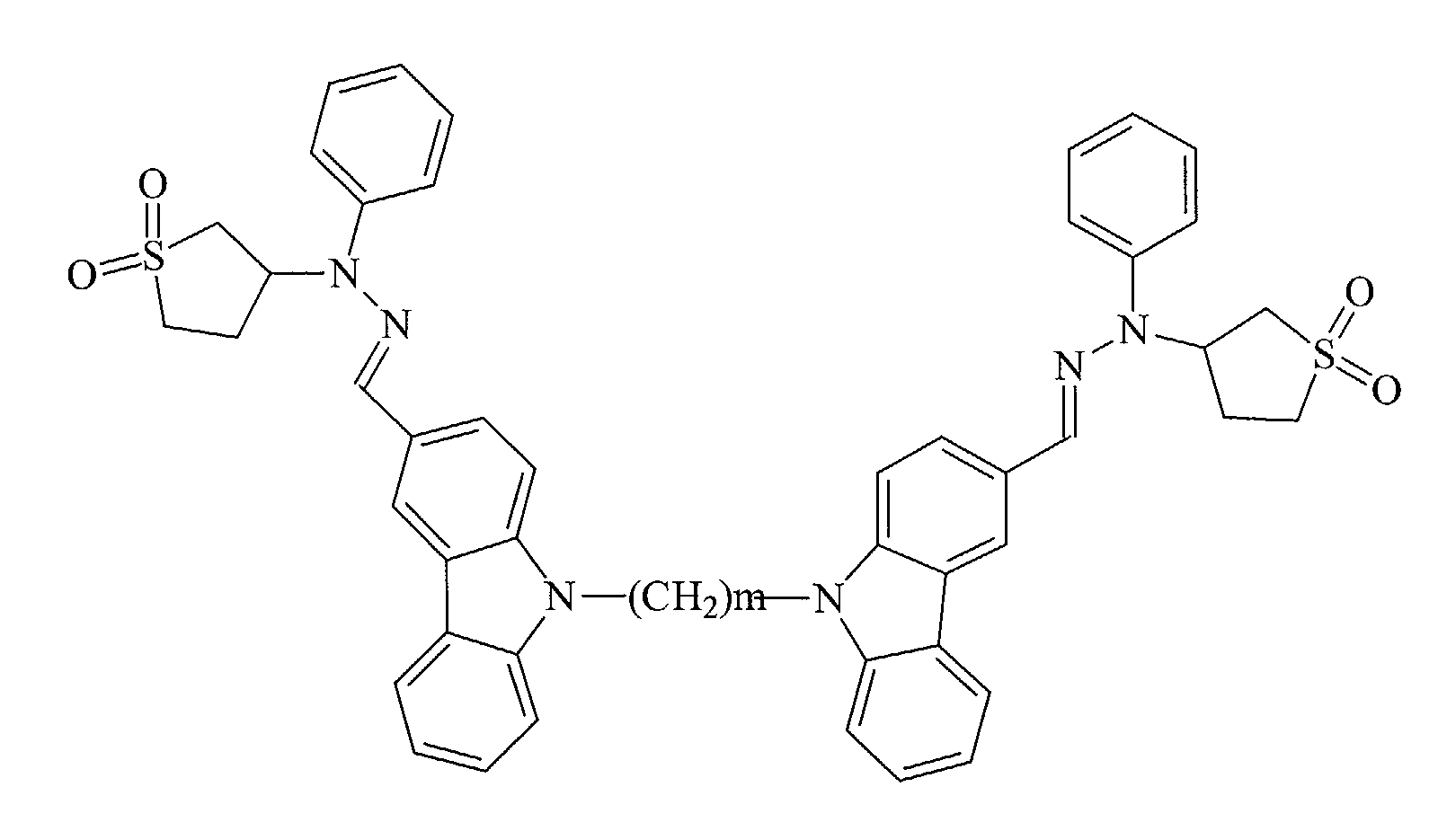
- The organic photoreceptor of claim 1 wherein R2 is a sulfolanyl group, a pyrrolyl group, a tetrazolyl group, a benzotriazolyl group, a 4-(9H-fluoren-9-ylidene)benzyl group, a stilbenyl group, an alkylsulfonylphenyl group, an arylsulfonylphenyl, or a pyrazolyl group and X is a linking group having the formula -(CH2)m-, branched or linear, where m is an integer between 0 and 20, inclusive.
- An electrophotographic imaging apparatus comprising:(a) a plurality of support rollers; and(b) an organophotoreceptor in the form of a flexible belt threaded around said support rollers, said organophotoreceptor comprising:(i) a charge transport compound having the formulawhere n is an integer between 2 and 6, inclusive;
 R1 is an aryl group;R2 is a sulfolanyl group a pyrrolyl group; a tetrazolyl group; a benzotriazolyl group; a 4-(9H-fluoren-9-ylidene)benzyl group; a stilbenyl group; an alkylsulfonylphenyl group, an arylsulfonylphenyl; or a pyrazolyl group, with the provision that when R2 is an alkylsulfonylphenyl group or an arylsulfonylphenyl, R1 may be hydrogen, an alkyl group, or an aryl group;X is a linking alkylene group having the formula-(CH2)m-, branched or linear, where m is an integer between 0 and 20, inclusive, and one or more methylene groups in the alkylene group is optionally replaced by an oxygen atom, a carbonyl group, urethane, urea, an ester group, a -NR3 group, a CHR4 group, or a CR5R6 group where R3, R4, R5, and R6 are, independently, H, an alkyl group, or aryl group; andY is a chemical bond, carbon atom, nitrogen atom, oxygen atom, sulfur atom, a branched or linear -(CH2)p-group where p is an integer between 0 and 10, an aryl group, a cycloalkyl group, a cyclosiloxyl group, a heterocyclic group, or a CR7 group where R7 is hydrogen atom, an alkyl group, or aryl group;(ii) a charge generating compound; and(iii) an electrically conductive substrate.
 - An electrophotographic imaging process comprising:(a) applying an electrical charge to a surface of an organophotoreceptor comprising:(i) a charge transport compound having the formulawhere n is an integer between 2 and 6, inclusive;
 R1 is an aryl group;R2 is a sulfolanyl group a pyrrolyl group; a tetrazolyl group; a benzotriazolyl group; a 4-(9H-fluoren-9-ylidene)benzyl group; a stilbenyl group; an alkylsulfonylphenyl group, an arylsulfonylphenyl; or a pyrazolyl group, with the proviso that when R2 is an alkylsulfonylphenyl group or an arylsulfonylphenyl, R1 may be hydrogen, an alkyl group, or an aryl group;X is a linking alkylene group having the formula-(CH2)m-, branched or linear, where m is an integer between 0 and 20, inclusive, and one or more methylene groups in the alkylene group is optionally replaced by an oxygen atom, a carbonyl group, urethane, urea, an ester group, a -NR3 group, a CHR4 group, or a CR5R6 group where R3, R4, R5, and R6 are, independently, H, an alkyl group, or aryl group; andY is a chemical bond, carbon atom, nitrogen atom, oxygen atom, sulfur atom, a branched or linear -(CH2)p-group where p is an integer between 0 and 10, an aryl group, a cycloalkyl group, a cyclosiloxyl group, a heterocyclic group, or a CR7 group where R7 is hydrogen atom, an alkyl group, or aryl group;(ii) a charge generating compound; and(iii) an electrically conductive substrate;(b) imagewise exposing said surface of said organophotoreceptor to radiation to dissipate charge in selected areas and thereby form a pattern of charged and uncharged areas on said surface;(c) contacting said surface with a liquid toner comprising a dispersion of colorant particles in an organic liquid to create a toned image; and(d) transferring said toned image to a substrate.
 - A charge transport compound having the formulawhere n is an integer between 2 and 6, inclusive;
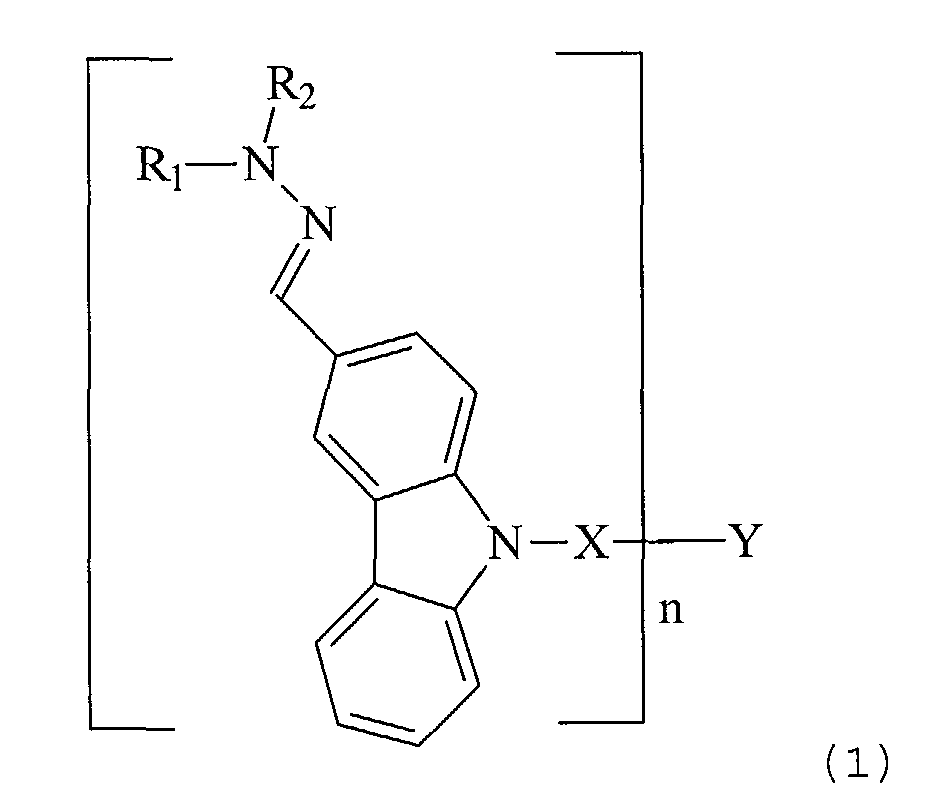 R1 is an aryl group;R2 is a sulfolanyl group a pyrrolyl group; a tetrazolyl group; a benzotriazolyl group; a 4-(9H-fluoren-9-ylidene)benzyl group; a stilbenyl group; an alkylsulfonylphenyl group, an arylsulfonylphenyl; or a pyrazolyl group, with the proviso that when R2 is an alkylsulfonylphenyl group or an arylsulfonylphenyl, R1 may be hydrogen, an alkyl group, or an aryl group;X is a linking alkylene group having the formula-(CH2)m-, branched or linear, where m is an integer between 0 and 20, inclusive, and one or more methylene groups in the alkyelene group is optionally replaced by an oxygen atom, a carbonyl group, urethane, urea, an ester group, a -NR3 group, a CHR4 group, or a CR5R6 group where R3 , R4, R5, and R6 are, independently, H, an alkyl group, or aryl group; andY is a chemical bond, carbon atom, nitrogen atom, oxygen atom, sulfur atom, a branched or linear -(CH2)p-group where p is an integer between 0 and 10, an aryl group, a cycloalkyl group, a cyclosiloxyl group, a heterocyclic group, or a CR7 group where R7 is hydrogen atom, an alkyl group, or aryl group.
Applications Claiming Priority (18)
| Application Number | Priority Date | Filing Date | Title |
|---|---|---|---|
| US32571401P | 2001-09-28 | 2001-09-28 | |
| US32573401P | 2001-09-28 | 2001-09-28 | |
| US32571701P | 2001-09-28 | 2001-09-28 | |
| US32573501P | 2001-09-28 | 2001-09-28 | |
| US325734P | 2001-09-28 | ||
| US325735P | 2001-09-28 | ||
| US325714P | 2001-09-28 | ||
| US32912101P | 2001-10-12 | 2001-10-12 | |
| US32927501P | 2001-10-12 | 2001-10-12 | |
| US329275P | 2001-10-12 | ||
| US33037701P | 2001-10-18 | 2001-10-18 | |
| US330377P | 2001-10-18 | ||
| US35461701P | 2001-10-26 | 2001-10-26 | |
| US354617P | 2001-10-26 | ||
| US34705102P | 2002-01-08 | 2002-01-08 | |
| US347051P | 2002-01-08 | ||
| US325717P | 2010-04-19 | ||
| US329121P | 2010-04-29 |
Publications (2)
| Publication Number | Publication Date |
|---|---|
| EP1298496A2 true EP1298496A2 (en) | 2003-04-02 |
| EP1298496A3 EP1298496A3 (en) | 2004-10-27 |
Family
ID=27578808
Family Applications (1)
| Application Number | Title | Priority Date | Filing Date |
|---|---|---|---|
| EP02256725A Withdrawn EP1298496A3 (en) | 2001-09-28 | 2002-09-26 | Electrophotographic organophotoreceptors |
Country Status (4)
| Country | Link |
|---|---|
| EP (1) | EP1298496A3 (en) |
| JP (1) | JP3648507B2 (en) |
| KR (1) | KR100503067B1 (en) |
| CN (1) | CN100401194C (en) |
Cited By (3)
| Publication number | Priority date | Publication date | Assignee | Title |
|---|---|---|---|---|
| EP1519239A3 (en) * | 2003-09-25 | 2005-12-14 | Samsung Electronics Co., Ltd. | Organophotoreceptor with a charge transport material having at least two azine groups |
| WO2014006544A3 (en) * | 2012-07-04 | 2014-02-27 | Basf Se | Organic dyes comprising hydrazone moiety and use in dye- sensitized solar cells thereof |
| US9831042B2 (en) | 2012-07-04 | 2017-11-28 | Basf Se | Organic dyes comprising a hydrazone moiety and their use in dye-sensitized solar cells |
Families Citing this family (2)
| Publication number | Priority date | Publication date | Assignee | Title |
|---|---|---|---|---|
| US7348112B2 (en) * | 2004-07-01 | 2008-03-25 | Samsung Electronics Co., Ltd. | Polymeric charge transport materials having repeating units comprising an aromatic group and a —S— linkage |
| CN111085417A (en) * | 2019-12-19 | 2020-05-01 | 苏州恒久光电科技股份有限公司 | Processing method of electronegative multilayer OPC drum |
Family Cites Families (6)
| Publication number | Priority date | Publication date | Assignee | Title |
|---|---|---|---|---|
| US4440845A (en) * | 1981-06-08 | 1984-04-03 | Ricoh Co., Ltd. | Disazo compound, method of making same and electrophotographic element using same |
| EP0504794B1 (en) * | 1991-03-18 | 1998-06-03 | Canon Kabushiki Kaisha | Electrophotographic photosensitive member and electrophotographic apparatus, device unit and facsimile machine using the same |
| JPH0511468A (en) * | 1991-07-01 | 1993-01-22 | Nec Corp | Electrophotographic sensitive body |
| US6066426A (en) * | 1998-10-14 | 2000-05-23 | Imation Corp. | Organophotoreceptors for electrophotography featuring novel charge transport compounds |
| US6214503B1 (en) * | 1999-12-21 | 2001-04-10 | Imation Corp. | Organophotoreceptors for electrophotography featuring novel charge transport compounds based upon hydroxy-functional compounds |
| US6340548B1 (en) * | 2000-03-16 | 2002-01-22 | Imation Corp. | Organophotoreceptors for electrophotography featuring novel charge transport compounds |
-
2002
- 2002-09-26 EP EP02256725A patent/EP1298496A3/en not_active Withdrawn
- 2002-09-28 KR KR10-2002-0059137A patent/KR100503067B1/en not_active Expired - Fee Related
- 2002-09-28 CN CNB021547475A patent/CN100401194C/en not_active Expired - Fee Related
- 2002-09-30 JP JP2002286418A patent/JP3648507B2/en not_active Expired - Fee Related
Cited By (3)
| Publication number | Priority date | Publication date | Assignee | Title |
|---|---|---|---|---|
| EP1519239A3 (en) * | 2003-09-25 | 2005-12-14 | Samsung Electronics Co., Ltd. | Organophotoreceptor with a charge transport material having at least two azine groups |
| WO2014006544A3 (en) * | 2012-07-04 | 2014-02-27 | Basf Se | Organic dyes comprising hydrazone moiety and use in dye- sensitized solar cells thereof |
| US9831042B2 (en) | 2012-07-04 | 2017-11-28 | Basf Se | Organic dyes comprising a hydrazone moiety and their use in dye-sensitized solar cells |
Also Published As
| Publication number | Publication date |
|---|---|
| JP2003162076A (en) | 2003-06-06 |
| EP1298496A3 (en) | 2004-10-27 |
| KR100503067B1 (en) | 2005-07-21 |
| CN1410835A (en) | 2003-04-16 |
| JP3648507B2 (en) | 2005-05-18 |
| KR20030027867A (en) | 2003-04-07 |
| CN100401194C (en) | 2008-07-09 |
Similar Documents
| Publication | Publication Date | Title |
|---|---|---|
| US7202004B2 (en) | Electrophotographic organophotoreceptors with novel charge transport materials | |
| EP1293837B1 (en) | Electrophotographic organophotoreceptors | |
| US7063928B2 (en) | Electrophotographic organophotoreceptors with novel charge transport materials | |
| US7029812B2 (en) | Organophotoreceptor with charge transport compound having an epoxy group | |
| US7090953B2 (en) | Organophotoreceptor with a charge transport compound having an epoxy group | |
| US6890693B2 (en) | Organophotoreceptor with an electron transport layer | |
| US20050089789A1 (en) | Organophotoreceptor with a light stabilizer | |
| US7183026B2 (en) | Organophotoreceptor with a plurality of photoconductive layers | |
| JP2004151725A (en) | Charge transport compound having a hydrazone group, organic photoreceptor containing the charge transport compound, electrophotographic image forming apparatus including the organic photoreceptor, and method of forming an electrophotographic image using the organic photoreceptor | |
| KR100503067B1 (en) | Electrophotographic organophotoreceptor | |
| US7300732B2 (en) | Organophotoreceptors with azine-based compounds | |
| US6955869B2 (en) | Organophotoreceptor with a charge transport material having two azine groups | |
| US7501216B2 (en) | Azine-based charge transport materials | |
| US20040043314A1 (en) | Organophotoreceptors with a fluoran-based compound | |
| EP1406127A2 (en) | Organophotoreceptor with a compound having a toluidine group |
Legal Events
| Date | Code | Title | Description |
|---|---|---|---|
| PUAI | Public reference made under article 153(3) epc to a published international application that has entered the european phase |
Free format text: ORIGINAL CODE: 0009012 |
|
| 17P | Request for examination filed |
Effective date: 20021011 |
|
| AK | Designated contracting states |
Kind code of ref document: A2 Designated state(s): AT BE BG CH CY CZ DE DK EE ES FI FR GB GR IE IT LI LU MC NL PT SE SK TR Designated state(s): AT BE BG CH CY CZ DE DK EE ES FI FR GB GR IE IT LI LU MC NL PT SE SK TR |
|
| AX | Request for extension of the european patent |
Extension state: AL LT LV MK RO SI |
|
| PUAL | Search report despatched |
Free format text: ORIGINAL CODE: 0009013 |
|
| AK | Designated contracting states |
Kind code of ref document: A3 Designated state(s): AT BE BG CH CY CZ DE DK EE ES FI FR GB GR IE IT LI LU MC NL PT SE SK TR |
|
| AX | Request for extension of the european patent |
Extension state: AL LT LV MK RO SI |
|
| AKX | Designation fees paid |
Designated state(s): DE FR GB |
|
| GRAP | Despatch of communication of intention to grant a patent |
Free format text: ORIGINAL CODE: EPIDOSNIGR1 |
|
| STAA | Information on the status of an ep patent application or granted ep patent |
Free format text: STATUS: THE APPLICATION IS DEEMED TO BE WITHDRAWN |
|
| 18D | Application deemed to be withdrawn |
Effective date: 20100302 |