EP1298225A1 - Method for producing unidirectional silicon steel sheet free of inorganic mineral coating film - Google Patents
Method for producing unidirectional silicon steel sheet free of inorganic mineral coating film Download PDFInfo
- Publication number
- EP1298225A1 EP1298225A1 EP02720581A EP02720581A EP1298225A1 EP 1298225 A1 EP1298225 A1 EP 1298225A1 EP 02720581 A EP02720581 A EP 02720581A EP 02720581 A EP02720581 A EP 02720581A EP 1298225 A1 EP1298225 A1 EP 1298225A1
- Authority
- EP
- European Patent Office
- Prior art keywords
- alumina
- annealing
- steel sheet
- remaining
- specific surface
- Prior art date
- Legal status (The legal status is an assumption and is not a legal conclusion. Google has not performed a legal analysis and makes no representation as to the accuracy of the status listed.)
- Granted
Links
Images
Classifications
-
- C—CHEMISTRY; METALLURGY
- C21—METALLURGY OF IRON
- C21D—MODIFYING THE PHYSICAL STRUCTURE OF FERROUS METALS; GENERAL DEVICES FOR HEAT TREATMENT OF FERROUS OR NON-FERROUS METALS OR ALLOYS; MAKING METAL MALLEABLE, e.g. BY DECARBURISATION OR TEMPERING
- C21D9/00—Heat treatment, e.g. annealing, hardening, quenching or tempering, adapted for particular articles; Furnaces therefor
- C21D9/46—Heat treatment, e.g. annealing, hardening, quenching or tempering, adapted for particular articles; Furnaces therefor for sheet metals
-
- C—CHEMISTRY; METALLURGY
- C21—METALLURGY OF IRON
- C21D—MODIFYING THE PHYSICAL STRUCTURE OF FERROUS METALS; GENERAL DEVICES FOR HEAT TREATMENT OF FERROUS OR NON-FERROUS METALS OR ALLOYS; MAKING METAL MALLEABLE, e.g. BY DECARBURISATION OR TEMPERING
- C21D8/00—Modifying the physical properties of ferrous metals or ferrous alloys by deformation combined with, or followed by, heat treatment
- C21D8/12—Modifying the physical properties of ferrous metals or ferrous alloys by deformation combined with, or followed by, heat treatment during manufacturing of articles with special electromagnetic properties
- C21D8/1277—Modifying the physical properties of ferrous metals or ferrous alloys by deformation combined with, or followed by, heat treatment during manufacturing of articles with special electromagnetic properties involving a particular surface treatment
- C21D8/1283—Application of a separating or insulating coating
-
- C—CHEMISTRY; METALLURGY
- C21—METALLURGY OF IRON
- C21D—MODIFYING THE PHYSICAL STRUCTURE OF FERROUS METALS; GENERAL DEVICES FOR HEAT TREATMENT OF FERROUS OR NON-FERROUS METALS OR ALLOYS; MAKING METAL MALLEABLE, e.g. BY DECARBURISATION OR TEMPERING
- C21D1/00—General methods or devices for heat treatment, e.g. annealing, hardening, quenching or tempering
- C21D1/68—Temporary coatings or embedding materials applied before or during heat treatment
- C21D1/70—Temporary coatings or embedding materials applied before or during heat treatment while heating or quenching
-
- C—CHEMISTRY; METALLURGY
- C21—METALLURGY OF IRON
- C21D—MODIFYING THE PHYSICAL STRUCTURE OF FERROUS METALS; GENERAL DEVICES FOR HEAT TREATMENT OF FERROUS OR NON-FERROUS METALS OR ALLOYS; MAKING METAL MALLEABLE, e.g. BY DECARBURISATION OR TEMPERING
- C21D3/00—Diffusion processes for extraction of non-metals; Furnaces therefor
- C21D3/02—Extraction of non-metals
- C21D3/04—Decarburising
-
- C—CHEMISTRY; METALLURGY
- C21—METALLURGY OF IRON
- C21D—MODIFYING THE PHYSICAL STRUCTURE OF FERROUS METALS; GENERAL DEVICES FOR HEAT TREATMENT OF FERROUS OR NON-FERROUS METALS OR ALLOYS; MAKING METAL MALLEABLE, e.g. BY DECARBURISATION OR TEMPERING
- C21D8/00—Modifying the physical properties of ferrous metals or ferrous alloys by deformation combined with, or followed by, heat treatment
- C21D8/12—Modifying the physical properties of ferrous metals or ferrous alloys by deformation combined with, or followed by, heat treatment during manufacturing of articles with special electromagnetic properties
- C21D8/1244—Modifying the physical properties of ferrous metals or ferrous alloys by deformation combined with, or followed by, heat treatment during manufacturing of articles with special electromagnetic properties characterised by the heat treatment
- C21D8/1255—Modifying the physical properties of ferrous metals or ferrous alloys by deformation combined with, or followed by, heat treatment during manufacturing of articles with special electromagnetic properties characterised by the heat treatment with diffusion of elements, e.g. decarburising, nitriding
-
- C—CHEMISTRY; METALLURGY
- C21—METALLURGY OF IRON
- C21D—MODIFYING THE PHYSICAL STRUCTURE OF FERROUS METALS; GENERAL DEVICES FOR HEAT TREATMENT OF FERROUS OR NON-FERROUS METALS OR ALLOYS; MAKING METAL MALLEABLE, e.g. BY DECARBURISATION OR TEMPERING
- C21D8/00—Modifying the physical properties of ferrous metals or ferrous alloys by deformation combined with, or followed by, heat treatment
- C21D8/12—Modifying the physical properties of ferrous metals or ferrous alloys by deformation combined with, or followed by, heat treatment during manufacturing of articles with special electromagnetic properties
- C21D8/1244—Modifying the physical properties of ferrous metals or ferrous alloys by deformation combined with, or followed by, heat treatment during manufacturing of articles with special electromagnetic properties characterised by the heat treatment
- C21D8/1272—Final recrystallisation annealing
Definitions
- the present invention relates to a method for producing a grain-oriented silicon steel sheet, not having inorganic mineral films, by using an annealing separator capable of preventing inorganic mineral film composed of forsterite (Mg 2 SiO 4 ), and so on, from forming during final annealing.
- an annealing separator capable of preventing inorganic mineral film composed of forsterite (Mg 2 SiO 4 ), and so on, from forming during final annealing.
- a grain-oriented silicon steel sheet is widely used as a material for magnetic cores and, for minimizing energy loss in particular, a silicon steel sheet having a small core loss has been sought. It is effective to impose a tension on a steel sheet for reducing a core loss. For this reason, it has been a common practice to create a tension and to reduce a core loss by forming coating films consisting of a material having a smaller thermal expansion coefficient than that of a steel sheet at a high temperature.
- a film of a forsterite type formed through the reaction of oxides on a steel sheet surface with an annealing separator in a final annealing process creates a tension in the steel sheet, and the adhesiveness of the film is excellent.
- the method for forming insulating coating films by coating the surfaces of a steel sheet with a coating liquid mainly consisting of colloidal silica and phosphate and by baking it, as disclosed in JP-A-48-39338, has a significant effect on creating a tension in the steel sheet and is effective in reducing the core loss.
- the method of keeping the films of a forsterite type formed in a final annealing process and then forming insulating coating films mainly consisting of phosphate is generally employed as a method for producing a grain-oriented silicon steel sheet.
- U. S. Patent No. 3785882 discloses a method wherein alumina at 99% or more in purity and 100 to 400 mesh in grain size is used as an annealing separator
- JP-A-56-65983 discloses another method wherein an annealing separator mainly composed of aluminum hydroxide is used in annealing. Besides these,
- JP-B-48-19050 discloses a method wherein an annealing separator produced by adding an alkali metallic compound containing a boric acid component to alumina is used in annealing.
- JP-B-56-3414 discloses a method wherein an annealing separator containing hydrous silicate powder by 5 to 40% with the balance consisting of alumina is used in annealing
- JP-B-58-44152 discloses a technology wherein an annealing separator containing, in addition to hydrous silicate powder, a compound of strontium and/or barium by 0.2 to 20% and calcia and/or calcium hydroxide by 2 to 30% with the balance consisting of alumina is used in annealing.
- JP-A-7-18457 discloses a method wherein a mixture of coarse alumina with an average grain size of 1 to 50 ⁇ m and fine alumina with an average grain size of 1 ⁇ m or less is used as an annealing separator.
- the grain size of the alumina is prescribed.
- JP-A- 59-96278 discloses a method wherein inert magnesia having a specific surface area of 0.5 to 10 m 2 /g, which is produced by calcining it at 1,300°C or higher and then crushing it, is added by 15 to 70 to alumina of 100 in terms of weight.
- the effect of preventing the formation of a forsterite film can be obtained to some extent by employing any of the above methods and applying finish annealing to a steel sheet after it is subjected to decarburization annealing.
- finish annealing to a steel sheet after it is subjected to decarburization annealing.
- the present invention is a method of stably producing a final-annealed steel sheet on which neither forsterite films are formed nor oxides remain by solving the above problems, and the gist of the present invention is as follows:
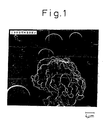
- Fig. 1 is a photograph showing the appearance of a steel sheet surface when alumina powder having a smaller BET specific surface area is used as an annealing separator in annealing compared to the present invention.
- the present inventors assiduously studied the reasons why the effects of stably preventing the formation of a forsterite film and inhibiting oxides from remaining were not obtained even when an annealing separator consisting mainly of alumina was used in annealing.
- studies carried out detailed analyses especially of the structural change of surface oxide layers occurring during the heating stage of final annealing and the subsequent process of thermal smoothing of a sheet surface.
- the effect of preventing oxides from remaining was widely varied depending on the temperature at which alumina was calcined even when the grain size of the alumina was the same.
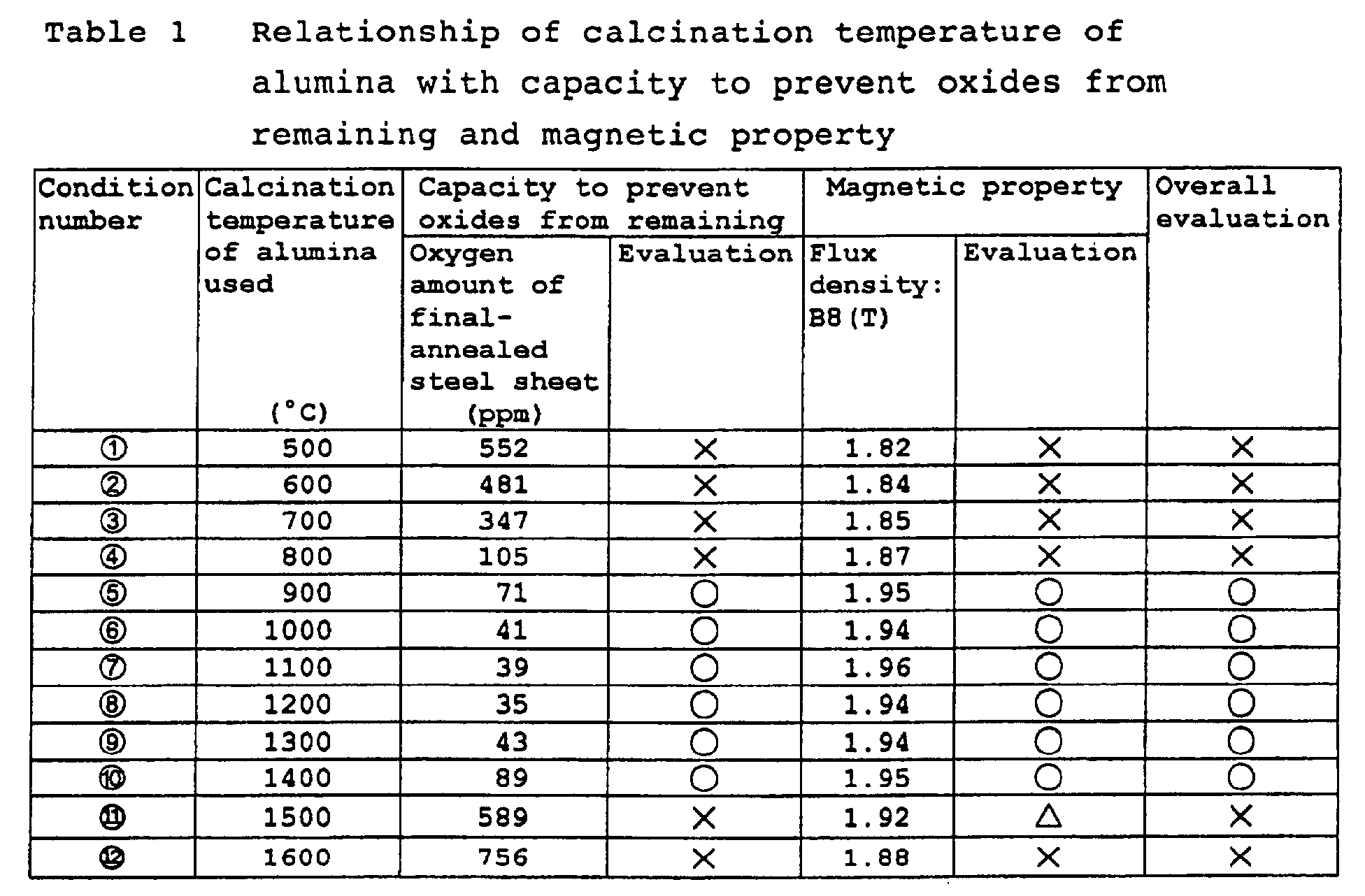
- the present inventors carried out the following test and examined the relationship between a calcination temperature of alumina and a capacity thereof to prevent oxides from remaining.
- steel sheets of 0.225 mm in thickness after being subjected to decarburization annealing were coated with annealing separator consisting mainly of alumina and they were subjected to final annealing for secondary recrystallization.
- annealing separator consisting mainly of alumina
- 12 different kinds of alumina powder calcined at 500 to 1,600°C were prepared in the form of water slurry and the steel sheets were coated with the slurry and dried.
- the steel sheets were subjected to final annealing at 1,200°C for 20 h. in a dry hydrogen atmosphere.
- the annealed steel sheets were cleaned of superfluous alumina remaining on the surfaces by wiping the surfaces with waste cloth in running water.
- the steel sheets thus prepared were analyzed and evaluated. Table 1 shows the results.
- the evaluation criterion was defined as follows: a steel sheet showing an oxygen amount over 100 ppm was marked with ⁇ , and that showing an oxygen amount of 100 ppm or less was marked with ⁇ .
- a magnetic property was evaluated in terms of flux density (B8), and a steel sheet showing a value of B8 of 1.94 T or more was marked with ⁇ , that showing a value of B8 in the range from 1.93 to 1.90 T was marked with ⁇ , and that showing a value of B8 below 1.90 T was marked with ⁇ .
- the steel sheets showing the high capacities to prevent oxides from remaining were the ones having the condition numbers 5 ⁇ to wherein the calcination temperatures of alumina were from 900 to 1,400°C.
- the amounts of remaining oxides were as high as 105 to 552 ppm in terms of the analysis value of the oxygen amount.
- the flux densities were as good as 1.94 T or more in case of the condition numbers 5 ⁇ to wherein the calcination temperatures were from 900 to 1,400°C
- the flux densities were as low as 1.87 T or less in case of the condition numbers 1 ⁇ to 4 ⁇ wherein the calcination temperatures were as low as 500 to 800°C and, in contrast, the flux density was 1.92 T which was somewhat low in case of the condition number wherein the calcination temperature was as high as 1,500°C, and the flux density was 1.88 T which was lower still and poor in case of the condition number wherein the calcination temperature was 1,600°C which was yet higher.
- the present inventors discovered that there was a close relationship between a capacity to prevent oxides from remaining and a calcination temperature of alumina. However, if a capacity to prevent oxides from remaining can be controlled by the physical properties of alumina when alumina is purchased and used for the coating of a steel sheet, it is possible to stably prevent oxides from remaining and to produce a final-annealed steel sheet not having inorganic mineral films after final annealing.
- the present inventors anticipated that there might be a relationship between a BET specific surface area of alumina and a capacity to prevent oxides from remaining, and they investigated the relationship between the two.
- steel sheets of 0.225 mm in thickness after being subjected to decarburization annealing were coated with annealing separator consisting mainly of alumina and they were subjected to final annealing for secondary recrystallization.
- annealing separator consisting mainly of alumina
- 12 different kinds of alumina powder having the BET specific surface areas ranging from 0.6 to 305.6 m 2 /g were prepared in the form of water slurry and the steel sheets were coated with the slurry and dried.
- the steel sheets were subjected to final annealing at 1,200°C for 20 h. in a dry hydrogen atmosphere.
- the annealed steel sheets were cleaned of superfluous alumina remaining on the surfaces by wiping the surfaces with waste cloth in running water.
- the steel sheets thus prepared were analyzed and evaluated. Table 2 shows the results.
- a BET specific surface area is a value obtained by having the surfaces of particles adsorb an inert gas such as argon and measuring the pressures before and after the adsorption. This is a method commonly employed for evaluating the surface area of powder of an inorganic mineral substance.
- the steel sheets showing the high capacities to prevent oxides from remaining, namely having small amounts of remaining oxides on the steel sheet surfaces after final annealing, were the ones having the condition numbers 2 ⁇ to wherein the BET specific surface areas were from 1.0 to 100.0 m 2 /g.
- the amount of remaining oxides was as high as 320 ppm in terms of the analysis value of the oxygen amount
- the amounts of remaining oxides were as high as 450 and 621 ppm, respectively, in terms of the analysis value of the oxygen amount, showing the low capacities to prevent oxides from remaining.
- the flux densities were as good as 1.94 T or more in case of the condition numbers 2 ⁇ to wherein the BET specific surface areas were from 1.0 to 100.0 m 2 /g
- the flux density was 1.93 T which was somewhat low in case of the condition number 1 ⁇ wherein the surface area was as small as 0.6 m 2 /g in terms of the BET specific surface area
- the flux density was as low as 1.91 T in case of the condition number wherein the surface area was as large as 152.6 m 2 /g in terms of the BET specific surface area
- the flux density was 1.88 T which was lower still and poor in case of the condition number wherein the surface area was 305.6 m 2 /g which was yet larger in terms of the BET specific surface area.
- the present'inventors further studied in search of a simpler analysis means for identifying the kind of alumina having an excellent capacity to prevent oxide from remaining. During the course of the studies, they discovered the fact that the effect of alumina on preventing oxides from remaining significantly varied depending on the amount of oil that the alumina could absorb.
- the present inventors carried out the following test and examined the relationship between an oil absorption of alumina and a capacity thereof to prevent oxides from remaining.
- steel sheets 0.225 mm in thickness after being subjected to decarburization annealing were coated with annealing separator consisting mainly of alumina and they were subjected to final annealing for secondary recrystallization.
- annealing separator consisting mainly of alumina
- 10 different kinds of alumina powder having oil absorptions ranging from 0.5 to 80.4 ml/100 g were prepared in the form of water slurry and the steel sheets were coated with the slurry and dried.
- An oil absorption mentioned here is an index defined by the amount, which is expressed by ml, of linseed oil that alumina powder 100 g in weight can absorb.
- the steel sheets were subjected to final annealing at 1,200°C for 20 h. in a dry hydrogen atmosphere.
- the annealed steel sheets were cleaned of superfluous alumina remaining on the surfaces by wiping the surfaces with waste cloth in running water.
- the steel sheets thus prepared were analyzed and evaluated. Table 3 shows the results.
- the steel sheets showing the high capacities to prevent oxides from remaining were the ones having the condition numbers 2 ⁇ to 9 ⁇ wherein the oil absorptions were from 1.0 to 70.0 ml/100 g.
- the amount of remaining oxides was as high as 420 ppm in terms of the analysis value of the oxygen amount.
- the amount of remaining oxides was as high as 458 ppm in terms of the analysis value of the oxygen amount, showing the low capacity to prevent oxides from remaining.
- the flux densities were as good as 1.94 T or more in case of the condition numbers 2 ⁇ to 9 ⁇ wherein the oil absorptions were from 1.0 to 70.0 ml/100 g
- the flux density was 1.92 T which was somewhat low in case of the condition number 1 ⁇ wherein the oil absorption was as small as 0.5 ml/100 g and, in contrast, the flux density was as low as 1.89 T and poor in case of the condition number wherein the oil absorption was as large as 80.4 ml/100 g.
- the present inventors investigated the dependence of a capacity to prevent oxides from remaining on a ⁇ (gamma) ratio of alumina for the purpose of clarifying the mechanisms of the dependence of a capacity to prevent oxides from remaining on a calcination temperature, a BET specific surface area and an oil absorption of alumina.
- the present inventors carried out the following test and examined the relationship among a ⁇ ratio of alumina, a capacity thereof to prevent oxides from remaining and a magnetic property of a steel sheet.
- steel sheets 0.225 mm in thickness after being subjected to decarburization annealing, were coated with annealing separator consisting mainly of alumina and they were subjected to final annealing for secondary recrystallization.
- annealing separator consisting mainly of alumina
- 8 different kinds of alumina powder having ⁇ ratios ranging from 0 to 3.2 were prepared in the form of water slurry and the steel sheets were coated with the slurry and dried.
- a ⁇ ratio mentioned here is the ratio of the diffraction intensity from the (440) plane of ⁇ -alumina to the diffraction intensity from the (113) plane of ⁇ -alumina in the measurement of alumina powder by X-ray diffraction method.
- K ⁇ of Cu the observed values of the peaks ascribed to ⁇ -alumina and ⁇ -alumina agreed well with standard values of the references as explained below. Therefore, a ⁇ ratio was obtained by measuring the intensities of these diffraction patterns and calculating the ⁇ ratio.
- a high ⁇ ratio is considered to mean a loose alumina structure.
- the diffraction peaks derived from ⁇ -alumina agreed well with that specified in Card No. 10-173 of the Joint Committee on Powder Diffraction Standards (JCPDS). Therefore, the diffraction peaks of 2.086 ⁇ in distance and of 43.3 degrees in 2 ⁇ was identified as the diffraction peak from the (113) plane of ⁇ -alumina, and the intensity thereof was read from the chart. Also, the diffraction peak of ⁇ -alumina agreed well with that specified in Card No. 29-63 of the JCPDS. Therefore, the diffraction peak of 1.40 ⁇ in distance and of 66.8 degrees in 2 ⁇ was identified as the diffraction intensity from the (440) plane of ⁇ -alumina, and the intensity thereof was read from the chart.
- JCPDS Joint Committee on Powder Diffraction Standards
- the steel sheets were subjected to final annealing at 1,200°C for 20 h. in a dry hydrogen atmosphere.
- the annealed steel sheets were cleaned of superfluous alumina remaining on the surfaces by wiping the surfaces with waste cloth in running water.
- the steel sheets thus prepared were analyzed and evaluated. Table 4 shows the results.
- the steel sheets showing the high capacities to prevent oxides from remaining were the ones having the condition numbers 2 ⁇ to 7 ⁇ wherein the ⁇ ratios were from 0.001 to 2.0.
- the amount of remaining oxides was as high as 324 ppm in terms of the oxygen amount.
- the amount of remaining oxides was as high as 520 ppm in terms of the oxygen amount, showing the low capacity to prevent oxides from remaining.
- the flux densities were as good as 1.94 T or more in case of the condition numbers 2 ⁇ to 7 ⁇ wherein the ⁇ ratios were from 0.001 to 2.0
- the flux density was 1.92 T which was somewhat low in case of the condition number 1 ⁇ wherein the ⁇ ratio was 0, and, in contrast, the flux density was 1.88 T, which was very low and poor, in case of the condition number 8 ⁇ wherein the ⁇ ratio was as high as 3.2.
- the present inventors prepared the water slurry of alumina having various BET specific surface areas, coated the steel sheets after being subjected to decarburization annealing with the slurry, dried them, subjected them to final annealing, and then examined the appearances of the surfaces thereof.
- the hemispherical deposits consist mainly of silica and, for this reason, it is considered that an oxide layer formed during the decarburization annealing generates a kind of aggregation reaction at a high temperature, and, as a result, the hemispherical deposits are formed.
- an aggregation reaction does not proceed unless the substance is softened to some extent. Therefore, considering that the spherical objects are observed, it is appropriate to judge that a sort of softening has occurred.
- the present inventors assumed the following mechanism occurs: in the case of alumina having a small BET specific surface area, the alumina cannot absorb silica in a molten-like state into its own structure owing to the small surface area, leaving the silica on the steel sheet surfaces and leading to the sticking of alumina; and, in the case of alumina having a large BET specific surface area, on the contrary, it can absorb silica into its own structure owing to the large surface area, and thus the sticking of alumina is inhibited.
- the capacity of alumina to absorb softened and aggregated silica can be evaluated from an oil absorption, which is an index of the capacity to absorb linseed oil, or a ⁇ ratio, which is an index of the looseness to absorb other substances into the crystal.
- the present inventors presume that similar mechanisms work regarding the dependence of a magnetic property on an oil absorption or a ⁇ ratio.
- the present inventors proceeded with studies further and tackled also the reduction of inclusions, which influence a core loss, in a steel.
- studies further and tackled also the reduction of inclusions, which influence a core loss, in a steel found out the fact that, when magnesia was mixed with alumina while the BET specific surface areas of them were changed variously, the amounts of residual inclusions varied significantly with the change of their BET specific surface areas.
- the present inventors carried out the following test and examined the relationship between the BET specific surface areas of alumina and magnesia and the amounts of oxides remaining on a surface and inclusions in a steel.
- steel sheets 0.225 mm in thickness after being subjected to decarburization annealing, were used and they were coated with annealing separator, consisting mainly of alumina and magnesia and then were subjected to final annealing.
- annealing separator consisting mainly of alumina and magnesia and then were subjected to final annealing.
- the mixtures of alumina and magnesia having various BET specific surface areas shown in Table 5 were prepared in the form of water slurry and the steel sheets were coated with the slurry and then dried.
- the weight percentage of the magnesia relative to the total weight of the alumina and magnesia was 20%.
- the steel sheets were subjected to final annealing at 1,200°C for 20 h. in a dry hydrogen atmosphere.
- the annealed steel sheets were cleaned of the annealing separator remaining on the surfaces by wiping the surfaces with waste cloth in running water.
- the steel sheets thus prepared were analyzed and evaluated. Table 5 shows the results.
- the degree of the effect of preventing oxides from remaining was evaluated with the amount of oxygen of a final-annealed sheet determined by chemical analysis.
- the evaluation criterion was defined as follows: a steel sheet showing an oxygen amount of 100 ppm or more was marked with ⁇ , and that showing an oxygen amount below 100 ppm was marked with ⁇ .
- a final-annealed sheet having the small amounts of oxides remaining on a surface and no inclusions in the steel can be obtained by using an annealing separator consisting mainly of alumina having a BET specific surface area of 1 to 100 m 2 /g and being mixed with magnesia having a BET specific surface area of 0.5 to 5.0 m 2 /g.
- the present inventors examined the influence of the ratio of the weight of mixed magnesia to the total weight of alumina and magnesia.
- steel sheets 0.225 mm in thickness after being subjected to decarburization annealing, were used, and they were coated with annealing separator consisting mainly of alumina and magnesia and dried.
- annealing separator consisting mainly of alumina and magnesia and dried.
- alumina having a BET specific surface area of 10.5 m 2 /g and magnesia having a BET specific surface area of 1.2 m 2 /g were used.
- the steel sheets coated with annealing separator were subjected to final annealing at 1,200°C for 20 h. in a dry hydrogen atmosphere.
- the annealed steel sheets were cleaned of the annealing separator on the surfaces by wiping the surfaces with waste cloth in running water.
- the steel sheets thus prepared were analyzed and evaluated. Table 6 shows the results. Note that the analysis and evaluation were carried out in the same manner as that shown in Table 1.
- a mixing ratio of magnesia has to be in the range from 5 to 30 mass %.
- a final-annealed sheet having the small amounts of oxides on a surface and inclusions in the steel can be produced by mixing magnesia having a BET specific surface area of 0.5 to 5.0 m 2 /g with annealing separator consisting mainly of alumina having a BET specific surface area of 1 to 100 m 2 /g in a mixing ratio of 5 to 30 mass % as stated above, the present inventors think as follows.
- magnesia With regard to the role of magnesia, the present inventors assumed as follows. The aggregates of hemispherical silica were discussed earlier. When the aggregates are formed on a surface of a steel sheet, there arises a situation in which even the alumina having a large BET specific surface area cannot absorb the aggregates completely. Regarding the above, the present inventors conjecture that, if magnesia coexists with alumina, magnesia may react in some way or other with the aggregates of molten-like silica not completely absorbed by alumina itself, changing them into a compound easily removable from a surface of a steel sheet.
- the present inventors suppose that, when a BET specific surface area of magnesia is large, the activity of magnesia in the form of powder increases excessively, as a consequence, the same effect as in the case where magnesia is mixed at a high mixing ratio is brought about, a film similar to that of forsterite is formed, and that causes the amounts of oxides on the surface and inclusions in the steel to increase.
- the median grain sizes of alumina and magnesia used for an annealing separator in view of the fact that the thickness of a common grain-oriented silicon steel sheet is from 0.225 to 0.50 mm, it is desirable that the median grain sizes are 200 ⁇ m or less in consideration of the stacking factor obtained when the steel sheet is coated with an annealing separator, dried, and wound into a coil.
- a thickener or the like may be added as required. Further, even if calcium oxide or the like is added for accelerating the purification of the sulfur component in a steel, it does not hinder the effects of the present invention.
- JP-A-59-96278 discloses a method in which inert magnesia calcined at a temperature of 1,300°C or above and crushed and thus having a specific surface area in the range from 0.5 to 10 m 2 /g is added by 15 to 70 to alumina of 100 in terms of weight, this is a technology different from that of the present invention for the following reasons.
- the present invention specifies the BET specific surface area of alumina as an important factor, no specification of it is provided in said patent.
- the object of mixing magnesia in the present invention is to change the molten-like silica aggregates into a compound easily removable from a surface of a steel sheet
- the object of mixing magnesia in said patent is to remove S and Se used as inhibitors and, thus, the objects of mixing magnesia are totally different.
- Cold-rolled steel sheets 0.30 mm in thickness having a Si concentration of 3.30% and being used for producing grain-oriented silicon steel sheets were subjected to decarburization annealing, coated with alumina powder prepared in the form of water slurry, dried, and then final-annealed at 1,200°C for 20 h. in a dry hydrogen atmosphere.
- Two kinds of alumina powder were used here: one calcined at 1,500°C (comparative example) and the other at 1,200°C (invented example).
- the steel sheets after the final annealing were rinsed with water and the oxygen amounts and magnetic properties were evaluated. The results are shown in Table 7.
- Cold-rolled steel sheets 0.225 mm in thickness having a Si concentration of 3.20% and being used for producing grain-oriented silicon steel sheets were subjected to decarburization annealing, coated with alumina powder prepared in the form of water slurry, dried, and then final-annealed at 1,200°C for 20 h. in a dry hydrogen atmosphere.
- Two kinds of alumina powder were used here: one calcined at 800°C (comparative example) and the other at 1,100°C (invented example).
- the steel sheets after the final annealing were rinsed with water and the oxygen amounts and magnetic properties were evaluated. The results are shown in Table 8.
- Cold-rolled steel sheets 0.15 mm in thickness having a Si concentration of 3.25% and being used for producing grain-oriented silicon steel sheets were subjected to decarburization annealing, coated with alumina powder prepared in the form of water slurry, dried, and then final-annealed at 1,200°C for 20 h. in a dry hydrogen atmosphere.
- Two kinds of alumina powder were used here: one calcined at 500°C (comparative example) and the other at 1,300°C (invented example).
- the steel sheets after the final annealing were rinsed with water and the oxygen amounts and magnetic properties were evaluated. The results are shown in Table 9.
- Cold-rolled steel sheets 0.15 mm in thickness having a Si concentration of 3.20% and being used for producing grain-oriented silicon steel sheets were subjected to decarburization annealing, coated with alumina powder prepared in the form of water slurry, dried, and then final-annealed at 1,200°C for 20 h. in a dry hydrogen atmosphere.
- Two kinds of alumina powder were used here: one having a BET specific surface area of 0.7 m 2 /g (comparative example) and the other having a BET specific surface area of 15.7 m 2 /g (invented example).
- the steel sheets after the final annealing were rinsed with water and the oxygen amounts and magnetic properties were evaluated. The results are shown in Table 12.
- Cold-rolled steel sheets 0.30 mm in thickness having a Si concentration of 3.30% and being used for producing grain-oriented silicon steel sheets were subjected to decarburization annealing, coated with alumina powder prepared in the form of water slurry, dried, and then final-annealed at 1,200°C for 20 h. in a dry hydrogen atmosphere.
- Two kinds of alumina powder were used here: one having an oil absorption of 0.8 ml/100 g (comparative example) and the other having an oil absorption of 13.6 ml/100 g (invented example).
- the steel sheets after the final annealing were rinsed with water and the oxygen amounts and magnetic properties were evaluated. The results are shown in Table 14.
- Cold-rolled steel sheets 0.30 mm in thickness having a Si concentration of 3.30% and being used for producing grain-oriented silicon steel sheets were subjected to decarburization annealing, coated with alumina powder prepared in the form of water slurry, dried, and then final-annealed at 1,200°C for 20 h. in a dry hydrogen atmosphere.
- Two kinds of alumina powder were used here: one having a ⁇ ratio of 2.8 (comparative example) and the other having a ⁇ ratio of 0.001 (invented example).
- the steel sheets after the finish annealing were rinsed with water and the oxygen amounts and magnetic properties were evaluated. The results are shown in Table 16.
- Cold-rolled steel sheets 0.15 mm in thickness having a Si concentration of 3.25% and being used for producing grain-oriented silicon steel sheets were subjected to decarburization annealing, coated with alumina powder prepared in the form of water slurry, dried, and then final-annealed at 1,200°C for 20 h. in a dry hydrogen atmosphere.
- Two kinds of alumina powder were used here: one having a ⁇ ratio of 3.4 (comparative example) and the other having a ⁇ ratio of 0.01 (invented example).
- the steel sheets after the final annealing were rinsed with water and the oxygen amounts and magnetic properties were evaluated. The results are shown in Table 17.
- Cold-rolled steel sheets 0.30 mm in thickness having a Si concentration of 3.30% and being used for producing grain-oriented silicon steel sheets were subjected to decarburization annealing, coated with a mixture of alumina powder and magnesia powder prepared in the form of water slurry, dried, and then final-annealed at 1,200°C for 20 h. in a dry hydrogen atmosphere.
- the alumina powder having a BET specific surface area of 23.1 m 2 /g and the magnesia powder having a BET specific surface area of 2.4 m 2 /g were mixed in the mixing ratios shown in Table 19.
- the steel sheets after the final annealing were rinsed with water and the oxygen amounts and magnetic properties were evaluated.
- Cold-rolled steel sheets 0.15 mm in thickness having a Si concentration of 3.25% and being used for producing grain-oriented silicon steel sheets were subjected to decarburization annealing, coated with a mixture of alumina powder and magnesia powder prepared in the form of water slurry, dried, and then final-annealed at 1,200°C for 20 h. in a dry hydrogen atmosphere.
- the alumina powder having a BET specific surface area of 7.6 m 2 /g and the magnesia powder having a BET specific surface area of 0.8 m 2 /g were mixed in the mixing ratios shown in Table 20.
- the steel sheets after the final annealing were rinsed with water and the oxygen amounts and magnetic properties were evaluated.
- Cold-rolled steel sheets 0.225 mm in thickness having a Si concentration of 3.35% and being used for producing grain-oriented silicon steel sheets were subjected to decarburization annealing, coated with a mixture of alumina powder and magnesia powder prepared in the form of water slurry, dried, and then final-annealed at 1,200°C for 20 h. in a dry hydrogen atmosphere.
- the alumina powder having a BET specific surface area of 14.5 m 2 /g and the magnesia powder having a BET specific surface area of 1.1 m 2 /g were mixed in the mixing ratios shown in Table 21.
- the steel sheets after the final annealing were rinsed with water and the oxygen amounts and magnetic properties were evaluated.
- the present invention makes it possible to provide a grain-oriented silicon steel sheet not having inorganic mineral coating films on the surfaces by using an annealing separator capable of preventing the inorganic mineral films composed of forsterite (Mg 2 SiO 4 ) and so on from forming during final annealing.
- an annealing separator capable of preventing the inorganic mineral films composed of forsterite (Mg 2 SiO 4 ) and so on from forming during final annealing.
Landscapes
- Chemical & Material Sciences (AREA)
- Engineering & Computer Science (AREA)
- Physics & Mathematics (AREA)
- Materials Engineering (AREA)
- Crystallography & Structural Chemistry (AREA)
- Mechanical Engineering (AREA)
- Thermal Sciences (AREA)
- Metallurgy (AREA)
- Organic Chemistry (AREA)
- Electromagnetism (AREA)
- Manufacturing & Machinery (AREA)
- Chemical Treatment Of Metals (AREA)
- Manufacturing Of Steel Electrode Plates (AREA)
- Soft Magnetic Materials (AREA)
Abstract
Description


| Relationship of γ ratio of alumina with capacity to prevent oxides from remaining and magnetic property | ||||||
| Condition number | γ ratio of alumina used (-) | Capacity to prevent oxides from remaining | Magnetic property | Overall evaluation | ||
| Oxygen amount of final-annealed steel sheet (ppm) | Evaluation | Flux density: B8(T) | Evaluation | |||
| 1 ○ | 0 | 324 | X | 1.92 | Δ | × |
| 2 ○ | 0.001 | 45 | ○ | 1.96 | ○ | ○ |
| 3 ○ | 0.01 | 68 | ○ | 1.95 | ○ | ○ |
| 4 ○ | 0.1 | 47 | ○ | 1.95 | ○ | ○ |
| 5 ○ | 0.5 | 53 | ○ | 1.96 | ○ | ○ |
| 6 ○ | 1.3 | 41 | 0 | 1.95 | ○ | ○ |
| 7 ○ | 2.0 | 64 | ○ | 1.94 | ○ | ○ |
| 8 ○ | 3.2 | 520 | × | 1.88 | × | ○ |
| Amount of surface oxides and existence or not of inclusions in steel when alumina-magnesia type annealing separator is used in annealing | |||||||
| Condition number | BET specific surface area | Amount of surface oxides | Existence or not of inclusions in steel | Overall evaluation | |||
| Alumina (m2/g) | Magnesia (m2/g) | Oxygen amount of steel sheet (ppm) | Evaluation | Existence or not of inclusions (SEM observation) | Evaluation | ||
| 1 | 0.3 | 0.5 | 298 | × | Existed | × | × |
| 2 | 1.2 | 285 | × | " | × | × | |
| 3 | 5.0 | 283 | × | " | × | × | |
| 4 | 10.1 | 446 | × | " | × | × | |
| 5 | 1.0 | 0.5 | 84 | ○ | Not existed | ○ | ○ |
| 6 | 1.2 | 82 | ○ | " | ○ | ○ | |
| 7 | 5.0 | 76 | ○ | " | ○ | ○ | |
| 8 | 10.1 | 358 | × | Existed | × | × | |
| 9 | 5.2 | 0.5 | 65 | ○ | Not existed | ○ | ○ |
| 10 | 1.2 | 50 | ○ | " | ○ | ○ | |
| 11 | 5.0 | 58 | ○ | " | ○ | ○ | |
| 12 | 10.1 | 236 | × | Existed | × | × | |
| 13 | 10.5 | 0.5 | 56 | ○ | Not existed | ○ | ○ |
| 14 | 1.2 | 40 | ○ | " | ○ | ○ | |
| 15 | 5.0 | 49 | ○ | " | ○ | ○ | |
| 16 | 10.1 | 295 | X | Existed | × | × | |
| 17 | 100.0 | 0.5 | 73 | ○ | Not existed | ○ | ○ |
| 18 | 1.2 | 65 | ○ | " | ○ | ○ | |
| 19 | 5.0 | 72 | ○ | " | ○ | ○ | |
| 20 | 10.1 | 327 | × | Existed | × | × | |
| 21 | 212.8 | 0.5 | 126 | × | Existed slightly | Δ | × |
| 22 | 1.2 | 174 | × | " | Δ | × | |
| 23 | 5.0 | 198 | × | " | Δ | × | |
| 24 | 10.1 | 350 | × | Existed | × | × |
| Influence of magnesia mixing ratio in alumina-magnesia type annealing separator | |||||||
| Condition number | Mixing ratio | Amount of remaining oxides | Formation of inclusion | Overall evaluation | |||
| Alumina (weight %) | Magnesia (weight %) | Oxygen amount of steel sheet (ppm) | Evaluation | Existence or not of inclusions (SEM observation) | Evaluation | ||
| 1 | 99 | 1 | 90 | ○ | Existed | × | Δ |
| 2 | 95 | 5 | 83 | ○ | Not existed | ○ | ○ |
| 3 | 90 | 10 | 73 | ○ | " | ○ | ○ |
| 4 | 80 | 20 | 51 | ○ | " | ○ | ○ |
| 5 | 70 | 30 | 71 | ○ | " | ○ | ○ |
| 6 | 50 | 50 | 340 | × | Glass films formed | × | × |
| Relationship of calcination temperature of alumina with capacity to prevent oxides from remaining and magnetic property | ||||||
| Calcination temperature of alumina powder (°C) | Capacity to prevent oxides from remaining | Magnetic property | Overall evaluation | Remarks | ||
| Oxygen amount of final-annealed steel sheet (ppm) | Evaluation | Flux density: B8(T) | Evaluation | |||
| 1500 | 450 | × | 1.91 | Δ | × | Comparative example |
| 1200 | 25 | ○ | 1.95 | ○ | ○ | Invented example |
| Relationship of calcination temperature of alumina with capacity to prevent oxides from remaining and magnetic property | ||||||
| Calcination temperature of alumina powder (°C) | Capacity to prevent oxides from remaining | Magnetic property | Overall evaluation | Remarks | ||
| Oxygen amount of final-annealed steel sheet (ppm) | Evaluation | Flux density: B8(T) | Evaluation | |||
| 800 | 220 | X | 1.88 | X | X | Comparative example |
| 1100 | 32 | ○ | 1.94 | ○ | ○ | Invented example |
| Relationship of calcination temperature of alumina with capacity to prevent oxides from remaining and magnetic property | ||||||
| Calcination temperature of alumina powder (°C) | Capacity to prevent oxides from remaining | Magnetic property | Overall evaluation | Remarks | ||
| Oxygen amount of final-annealed steel sheet (ppm) | Evaluation | Flux density: B8(T) | Evaluation | |||
| 500 | 765 | × | 1.80 | × | × | Comparative example |
| 1300 | 43 | ○ | 1.94 | ○ | ○ | Invented example |
| Relationship of BET specific surface area of alumina with capacity to prevent oxides from remaining and magnetic property | ||||||
| BET specific surface area of alumina powder (m2/g) | Capacity to prevent oxides from remaining | Magnetic property | Overall evaluation | Remarks | ||
| Oxygen amount of final-annealed steel sheet (ppm) | Evaluation | Flux density: B8(T) | Evaluation | |||
| 0.4 | 420 | X | 1.92 | Δ | X | Comparative example |
| 7.8 | 40 | ○ | 1.95 | ○ | ○ | Invented example |
| Relationship of BET specific surface area of alumina with capacity to prevent oxides from remaining and magnetic property | ||||||
| BET specific surface area of alumina powder (m2/g) | Capacity to prevent oxides from remaining | Magnetic property | Overall evaluation | Remarks | ||
| Oxygen amount of final-annealed steel sheet (ppm) | Evaluation | Flux density: B8 (T) | Evaluation | |||
| 0.8 | 210 | × | 1.92 | Δ | × | Comparative example |
| 23.2 | 28 | ○ | 1.96 | ○ | ○ | Invented example |
wherein the BET specific surface area was as small as 0.8 m2/g, the oxygen amount of the final-annealed steel sheet was as high as 210 ppm showing a poor capacity to prevent oxides from remaining, the magnetic flux density was 1.92 T which was somewhat low, and the example was rated as poor. In contrast, in case of the invented example
wherein the BET specific surface area was as large as 23.2 m2/g, the oxygen amount of the final-annealed steel sheet was as low as 28 ppm showing a good capacity to prevent oxides from remaining, the magnetic flux density was as high as 1.96 T, and the example was rated as good.
| Relationship of BET specific surface area of alumina with capacity to prevent oxides from remaining and magnetic property | ||||||
| BET specific surface area of alumina powder (m2/g) | Capacity to prevent oxides from remaining | Magnetic property | Overall evaluation | Remarks | ||
| Oxygen amount of final-annealed steel sheet (ppm) | Evaluation | Flux density: B8(T) | Evaluation | |||
| 0.7 | 630 | × | 1.91 | Δ | × | Comparative example |
| 15.7 | 52 | ○ | 1.95 | ○ | ○ | Invented example |
| Relationship of oil absorption of alumina with capacity to prevent oxides from remaining and magnetic property | ||||||
| Oil absorption of alumina powder (ml/100 g) | Capacity to prevent oxides from remaining | Magnetic property | Overall evaluation | Remarks | ||
| Oxygen amount of final-annealed steel sheet (ppm) | Evaluation | Flux density: B8(T) | Evaluation | |||
| 0.4 | 650 | X | 1.92 | Δ | X | Comparative example |
| 25.6 | 45 | ○ | 1.94 | ○ | ○ | Invented example |
| Relationship of oil absorption of alumina with capacity to prevent oxides from remaining and magnetic property | ||||||
| Oil absorption of alumina powder (ml/100 g) | Capacity to prevent oxides from remaining | Magnetic property | Overall evaluation | Remarks | ||
| Oxygen amount of final-annealed steel sheet (ppm) | Evaluation | Flux density: B8(T) | Evaluation | |||
| 0.8 | 390 | × | 1.91 | Δ | × | Comparative example |
| 13.6 | 31 | ○ | 1.95 | ○ | ○ | Invented example |
| Relationship of oil absorption of alumina with capacity to prevent oxides from remaining and magnetic property | ||||||
| Oil absorption of alumina powder (ml/100 g) | Capacity to prevent oxides from remaining | Magnetic property | Overall evaluation | Remarks | ||
| Oxygen amount of final-annealed steel sheet (ppm) | Evaluation | Flux density: B8(T) | Evaluation | |||
| 0.3 | 450 | × | 1.92 | Δ | × | Comparative example |
| 57.6 | 50 | ○ | 1.96 | ○ | ○ | Invented example |
| Relationship of γ ratio of alumina with capacity to prevent oxides from remaining and magnetic property | ||||||
| γ ratio of alumina powder (-) | Capacity to prevent oxides from remaining | Magnetic property | Overall evaluation | Remarks | ||
| Oxygen amount of final-annealed steel sheet (ppm) | Evaluation | Flux density: B8(T) | Evaluation | |||
| 2.8 | 382 | × | 1.89 | × | × | Comparative example Invented |
| 0.001 | 33 | ○ | 1.94 | ○ | ○ | example |
| Relationship of γ ratio of alumina with capacity to prevent oxides from remaining and magnetic property | ||||||
| γ ratio of alumina powder (-) | Capacity to prevent oxides from remaining | Magnetic property | Overall evaluation | Remarks | ||
| Oxygen amount of final-annealed steel sheet (ppm) | Evaluation | Flux density: B8(T) | Evaluation | |||
| 3.4 | 631 | × | 1.88 | × | × | Comparative example |
| 0.01 | 43 | ○ | 1.95 | ○ | ○ | Invented example |
| Relationship of γ ratio of alumina with capacity to prevent oxides from remaining and magnetic property | ||||||
| γ ratio of alumina powder (-) | Capacity to prevent oxides from remaining | Magnetic property | Overall evaluation | Remarks | ||
| Oxygen amount of final-annealed steel sheet (ppm) | Evaluation | Flux density: B8(T) | Evaluation | |||
| 4.1 | 439 | X | 1.89 | X | X | Comparative example |
| 0.2 | 52 | ○ | 1.96 | ○ | ○ | Invented example |
| Mixing ratio, amount of remaining oxides and formation of inclusions when alumina-magnesia type annealing separator is used in annealing | ||||||||||
| Condition number | Composition of annealing separator | Amount of remaining oxides | Formation of inclusion | Overall evaluation | Remarks | |||||
| Alumina | Magnesia | Oxygen amount of steel sheet (ppm) | Evaluation | Existence or not of inclusions (SEM observation) | Evaluation | |||||
| BET specific surface area | Mass % | BET specific surface area | Mass % | |||||||
| 1 | 23.1 | 99 | 2.4 | 1 | 85 | ○ | Existed | X | Δ | Comparative example |
| 2 | 95 | 5 | 63 | ○ | Not existed | ○ | ○ | Invented example | ||
| 3 | 90 | 10 | 53 | ○ | " | ○ | ○ | Invented | ||
| 4 | 60 | 40 | 430 | X | Existed | × | × | Comparative example |
| Mixing ratio, amount of remaining oxides and formation of inclusions when alumina-magnesia type annealing separator is used in annealing | ||||||||||
| Condition number | Composition of annealing separator | Amount of remaining oxides | Formation of inclusion | Overall evaluation | Remarks | |||||
| Alumina | Magnesia | Oxygen amount of steel sheet (ppm) | Evaluation | Existence or not of inclusions (SEM observation) | Evaluation | |||||
| BET specific surface area | Mass % | BET specific surface area | Mass % | |||||||
| 1 | 7.6 | 98 | 0.8 | 2 | 95 | ○ | Existed | × | Δ | Comparative example |
| 2 | 95 | 5 | 94 | ○ | Not existed | ○ | ○ | Invented example | ||
| 3 | 85 | 15 | 81 | ○ | " | ○ | ○ | Invented example | ||
| 4 | 50 | 50 | 394 | × | Existed | × | × | Comparative example |
| Mixing ratio, amount of remaining oxides and formation of inclusions when alumina-magnesia type annealing separator is used in annealing | ||||||||||
| Condition number | Composition of annealing separator | Amount of remaining oxides | Formation of inclusion | Overall evaluation | Remarks | |||||
| Alumina | Magnesia | Oxygen amount of steel sheet (ppm) | Evaluation | Existence or not of inclusions (SEM observation) | Evaluation | |||||
| BET specific surface area | Mass % | BET specific surface area | Mass % | |||||||
| 1 | 14.5 | 98 | 1.1 | 2 | 90 | ○ | Existed | × | Δ | Comparative example |
| 2 | 90 | 10 | 75 | ○ | Not existed | ○ | ○ | Invented example | ||
| 3 | 80 | 20 | 69 | ○ | " | ○ | ○ | Invented example | ||
| 4 | 60 | 40 | 271 | X | Existed | X | X | Comparative example |
Claims (6)
- A method for producing a grain-oriented silicon steel sheet not having inorganic mineral films, comprising the steps of decarburization annealing followed by coating with an annealing separator and final annealing, wherein alumina powder calcined at a calcination temperature of 900 to 1,400°C is used as the annealing separator.
- A method for producing a grain-oriented silicon steel sheet not having inorganic mineral films, comprising the steps of decarburization annealing followed by coating with an annealing separator and final annealing, according to claim 1, wherein the alumina powder having a BET specific surface area of 1 to 100 m2/g is used as the annealing separator.
- A method for producing a grain-oriented silicon steel sheet not having inorganic mineral films, comprising the steps of decarburization annealing followed by coating with an annealing separator and final annealing, according to claim 1 or 2, wherein the alumina powder having an oil absorption of 1 to 70 ml/100 g is used as the annealing separator.
- A method for producing a grain-oriented silicon steel sheet not having inorganic mineral films, comprising the steps of decarburization annealing followed by coating with an annealing separator and final annealing, according to any one of claims 1 to 3, wherein the alumina powder having a γ ratio of 0.001 to 2.0 is used as the annealing separator, where the γ ratio is the ratio of the diffraction intensity from the (440) plane of a γ-alumina phase to the diffraction intensity from the (113) plane of an α-alumina phase in the measurement of the alumina powder by X-ray diffraction.
- A method for producing a grain-oriented silicon steel sheet not having inorganic mineral films according to any one of claims 1 to 4, further comprising the step of mixing magnesia having a BET specific surface area of 0.5 to 5 m2/g is added to the alumina powder by 5 to 30 weight % relative to the total weight of the alumina powder and the magnesia powder.
- A method for producing a grain-oriented silicon steel sheet not having inorganic mineral films according to any one of claims 1 to 5, wherein the average grain size(s) of the alumina powder, and/or the magnesia powder, if added, is/are 200 µm or less.
Applications Claiming Priority (9)
| Application Number | Priority Date | Filing Date | Title |
|---|---|---|---|
| JP2001124882 | 2001-04-23 | ||
| JP2001124882 | 2001-04-23 | ||
| JP2001172885 | 2001-06-07 | ||
| JP2001172913 | 2001-06-07 | ||
| JP2001172885 | 2001-06-07 | ||
| JP2001172913 | 2001-06-07 | ||
| JP2001220228 | 2001-07-19 | ||
| JP2001220228 | 2001-07-19 | ||
| PCT/JP2002/004051 WO2002088403A1 (en) | 2001-04-23 | 2002-04-23 | Method for producing unidirectional silicon steel sheet free of inorganic mineral coating film |
Publications (3)
| Publication Number | Publication Date |
|---|---|
| EP1298225A1 true EP1298225A1 (en) | 2003-04-02 |
| EP1298225A4 EP1298225A4 (en) | 2006-01-11 |
| EP1298225B1 EP1298225B1 (en) | 2010-04-07 |
Family
ID=27482231
Family Applications (1)
| Application Number | Title | Priority Date | Filing Date |
|---|---|---|---|
| EP02720581A Expired - Lifetime EP1298225B1 (en) | 2001-04-23 | 2002-04-23 | Method for producing unidirectional silicon steel sheet free of inorganic mineral coating film |
Country Status (7)
| Country | Link |
|---|---|
| US (1) | US6733599B2 (en) |
| EP (1) | EP1298225B1 (en) |
| JP (1) | JP4184809B2 (en) |
| KR (1) | KR100542618B1 (en) |
| CN (1) | CN100413980C (en) |
| DE (1) | DE60235862D1 (en) |
| WO (1) | WO2002088403A1 (en) |
Cited By (1)
| Publication number | Priority date | Publication date | Assignee | Title |
|---|---|---|---|---|
| EP3913084A4 (en) * | 2019-01-16 | 2022-10-05 | Nippon Steel Corporation | GRAIN ORIENTATED MAGNETIC STEEL SHEET MANUFACTURING METHOD |
Families Citing this family (27)
| Publication number | Priority date | Publication date | Assignee | Title |
|---|---|---|---|---|
| CN100369986C (en) * | 2005-12-05 | 2008-02-20 | 高申明 | Composite corindon waterbase powder coating |
| JP5262436B2 (en) * | 2008-08-27 | 2013-08-14 | Jfeスチール株式会社 | Magnetic measurement method and apparatus |
| RU2422929C1 (en) * | 2009-12-07 | 2011-06-27 | Лариса Соломоновна Каренина | Heat-resistant coating for anisotropic electro-technical steel |
| CN102453793B (en) * | 2010-10-25 | 2013-09-25 | 宝山钢铁股份有限公司 | Annealing isolation agent used for preparing mirror surface-oriented silicon steel with excellent magnetic property |
| CN103014285B (en) * | 2011-09-28 | 2015-04-01 | 宝山钢铁股份有限公司 | Manufacturing method of mirror surface oriented silicon steel with good magnetic performance and annealing parting agent |
| CN103114181A (en) * | 2013-01-24 | 2013-05-22 | 广东盈泉钢制品有限公司 | Coating formula of oriented silicon steel barrier coat |
| KR101651431B1 (en) * | 2014-11-14 | 2016-08-26 | 주식회사 포스코 | Method of manufacturing oriented electrical steels |
| PL3653758T3 (en) | 2017-07-13 | 2022-07-04 | Nippon Steel Corporation | Grain-oriented electrical steel sheet |
| EP3653759B1 (en) | 2017-07-13 | 2024-09-25 | Nippon Steel Corporation | Grain-oriented electrical steel sheet and method for producing same |
| CN108977638B (en) * | 2018-08-24 | 2020-05-19 | 首钢智新迁安电磁材料有限公司 | Oriented silicon steel annealing release agent and use method thereof |
| KR102179215B1 (en) * | 2018-12-19 | 2020-11-16 | 주식회사 포스코 | Annealing separating agent composition for grain oriented electrical steel sheet, grain oriented electrical steel sheet, and method for manufacturing grain oriented electrical steel sheet |
| WO2020149346A1 (en) | 2019-01-16 | 2020-07-23 | 日本製鉄株式会社 | Method for manufacturing grain-oriented electrical steel sheet |
| KR102583079B1 (en) | 2019-01-16 | 2023-10-04 | 닛폰세이테츠 가부시키가이샤 | Manufacturing method of grain-oriented electrical steel sheet |
| PL3913100T3 (en) * | 2019-01-16 | 2024-01-29 | Nippon Steel Corporation | Grain-oriented electrical steel sheet |
| US12195832B2 (en) | 2019-01-16 | 2025-01-14 | Nippon Steel Corporation | Method for producing grain oriented electrical steel sheet |
| EP3913096B1 (en) | 2019-01-16 | 2024-06-12 | Nippon Steel Corporation | Method for producing grain oriented electrical steel sheet |
| JP7603448B2 (en) | 2019-01-16 | 2024-12-20 | 日本製鉄株式会社 | Grain-oriented electrical steel sheets and intermediate steel sheets for grain-oriented electrical steel sheets |
| US12110567B2 (en) | 2019-01-16 | 2024-10-08 | Nippon Steel Corporation | Method for producing grain oriented electrical steel sheet |
| US12195818B2 (en) | 2019-01-16 | 2025-01-14 | Nippon Steel Corporation | Method for producing grain oriented electrical steel sheet |
| US12378676B2 (en) | 2019-01-16 | 2025-08-05 | Nippon Steel Corporation | Grain-oriented electrical steel sheet and manufacturing method of the same |
| EP3913091A4 (en) | 2019-01-16 | 2022-10-12 | Nippon Steel Corporation | METHOD FOR MANUFACTURING A GRAIN ORIENTED ELECTRICAL STEEL SHEET |
| RU2767365C1 (en) * | 2019-01-16 | 2022-03-17 | Ниппон Стил Корпорейшн | Method for producing a sheet of electrotechnical steel with oriented grain structure |
| KR102576546B1 (en) | 2019-01-16 | 2023-09-12 | 닛폰세이테츠 가부시키가이샤 | Manufacturing method of grain-oriented electrical steel sheet |
| BR112023021042A2 (en) | 2021-05-28 | 2023-12-12 | Nippon Steel Corp | GRAIN ORIENTED ELECTRIC STEEL SHEET |
| EP4350033A4 (en) | 2021-05-28 | 2024-09-18 | Nippon Steel Corporation | GRAIN-ORIENTED ELECTROMAGNETIC STEEL SHEET |
| CN115326799B (en) * | 2022-07-29 | 2025-03-11 | 中策橡胶集团股份有限公司 | A laboratory test method for the isolation effect of capsule isolation agent or internal spray agent |
| JP7656247B2 (en) | 2022-11-01 | 2025-04-03 | 日本製鉄株式会社 | Grain-oriented electrical steel sheet |
Family Cites Families (11)
| Publication number | Priority date | Publication date | Assignee | Title |
|---|---|---|---|---|
| JPS4813814B1 (en) * | 1969-12-18 | 1973-05-01 | ||
| US4582547A (en) * | 1984-05-07 | 1986-04-15 | Allegheny Ludlum Steel Corporation | Method for improving the annealing separator coating on silicon steel and coating therefor |
| US4871402A (en) * | 1986-12-29 | 1989-10-03 | Allegheny Ludlum Corporation | Separating-agent composition and method using same |
| JP2680529B2 (en) | 1993-08-26 | 1997-11-19 | 新日本製鐵株式会社 | Annealing Separator for Unidirectional Silicon Steel Sheet |
| JP2679944B2 (en) * | 1993-10-26 | 1997-11-19 | 新日本製鐵株式会社 | Method for manufacturing mirror-oriented electrical steel sheet with low iron loss |
| JPH09256068A (en) | 1996-03-25 | 1997-09-30 | Nippon Steel Corp | Manufacturing method of grain-oriented electrical steel sheet for obtaining excellent glass coating |
| US5855694A (en) * | 1996-08-08 | 1999-01-05 | Kawasaki Steel Corporation | Method for producing grain-oriented silicon steel sheet |
| JP3921807B2 (en) | 1998-04-24 | 2007-05-30 | Jfeスチール株式会社 | Method for producing grain-oriented silicon steel sheet |
| JP3921806B2 (en) * | 1998-04-24 | 2007-05-30 | Jfeスチール株式会社 | Method for producing grain-oriented silicon steel sheet |
| JP4116702B2 (en) * | 1998-07-21 | 2008-07-09 | 新日本製鐵株式会社 | Method for producing grain-oriented electrical steel sheet |
| CN1109762C (en) * | 2000-01-06 | 2003-05-28 | 武汉钢铁(集团)公司 | Production process of oriented silicon steel sheet through flame heating |
-
2002
- 2002-04-23 CN CNB028013514A patent/CN100413980C/en not_active Expired - Lifetime
- 2002-04-23 KR KR1020027017585A patent/KR100542618B1/en not_active Expired - Lifetime
- 2002-04-23 US US10/312,115 patent/US6733599B2/en not_active Expired - Lifetime
- 2002-04-23 DE DE60235862T patent/DE60235862D1/en not_active Expired - Lifetime
- 2002-04-23 WO PCT/JP2002/004051 patent/WO2002088403A1/en not_active Ceased
- 2002-04-23 JP JP2002585681A patent/JP4184809B2/en not_active Expired - Lifetime
- 2002-04-23 EP EP02720581A patent/EP1298225B1/en not_active Expired - Lifetime
Cited By (1)
| Publication number | Priority date | Publication date | Assignee | Title |
|---|---|---|---|---|
| EP3913084A4 (en) * | 2019-01-16 | 2022-10-05 | Nippon Steel Corporation | GRAIN ORIENTATED MAGNETIC STEEL SHEET MANUFACTURING METHOD |
Also Published As
| Publication number | Publication date |
|---|---|
| WO2002088403A1 (en) | 2002-11-07 |
| EP1298225B1 (en) | 2010-04-07 |
| US20030188806A1 (en) | 2003-10-09 |
| EP1298225A4 (en) | 2006-01-11 |
| CN1462315A (en) | 2003-12-17 |
| JP4184809B2 (en) | 2008-11-19 |
| KR20040000302A (en) | 2004-01-03 |
| KR100542618B1 (en) | 2006-01-11 |
| JPWO2002088403A1 (en) | 2004-08-19 |
| DE60235862D1 (en) | 2010-05-20 |
| US6733599B2 (en) | 2004-05-11 |
| CN100413980C (en) | 2008-08-27 |
Similar Documents
| Publication | Publication Date | Title |
|---|---|---|
| US6733599B2 (en) | Method for producing grain-oriented silicon steel sheet not having inorganic mineral film | |
| KR930007151B1 (en) | Insulation film formation method and oriented electromagnetic steel sheet of oriented electrical steel sheet with excellent iron core workability, heat resistance and tension | |
| RU2726523C1 (en) | Anisotropic electrical steel sheet | |
| RU2431697C1 (en) | Processing solution for application of insulation coating on sheet of textured electro-technical steel and procedure for manufacture of sheet of textured electro-technical steel with insulation coating | |
| KR100973071B1 (en) | A grain-oriented electrical steel sheet having an insulating film containing no chromium and its insulating film | |
| EP2319944B1 (en) | Method for manufacturing grain-oriented silicon steel sheets with mirror-like surface | |
| KR0157539B1 (en) | Annealing separator for grain-oriented electrical steel with excellent reactivity and its use | |
| JP7727214B2 (en) | Grain-oriented electrical steel sheet and method for forming insulating coating | |
| US6835250B2 (en) | Magnesium oxide particle aggregate | |
| CA1227728A (en) | Method for improving the annealing separator coating on silicon steel and coating therefor | |
| KR20230151108A (en) | Method of forming grain-oriented electrical steel sheet and insulating film | |
| JP3009578B2 (en) | Method for producing grain-oriented electrical steel sheet having excellent film properties and insulating film treating agent therefor | |
| JP7787460B2 (en) | Grain-oriented electrical steel sheet and method for forming insulating coating | |
| JP7817624B2 (en) | Grain-oriented electrical steel sheet and method for forming insulating coating | |
| CN100513597C (en) | Annealing method for grain-oriented electromagnetic steel sheet and method for producing grain-oriented electromagnetic steel sheet | |
| US20230160034A1 (en) | Grain-oriented electrical steel sheet and method for manufacturing same and annealing separator | |
| KR100480001B1 (en) | METHOD FOR MANUFACTURING GRAIN ORIENTED Si STEEL WITH SUPERIOR PUNCHABILITY | |
| JP7207436B2 (en) | Oriented electrical steel sheet | |
| JP7755224B1 (en) | grain-oriented electrical steel sheet | |
| KR100544535B1 (en) | Chrome-free insulating film for glass-oriented oriented electrical steel sheet and method for manufacturing oriented electrical steel sheet using the same | |
| KR920010227B1 (en) | Coating agents for annealing of the electric steel sheet | |
| JP7755225B1 (en) | grain-oriented electrical steel sheet | |
| RU2823254C2 (en) | Sheet of anisotropic electrical steel and method of forming insulating coating | |
| KR100479994B1 (en) | A method for manufacturing low temperature reheated grain-oriented electrical steel sheet having superior punching property | |
| KR20250167079A (en) | Insulating coating solution for grain-oriented electrical steel sheets and method for manufacturing grain-oriented electrical steel sheets |
Legal Events
| Date | Code | Title | Description |
|---|---|---|---|
| PUAI | Public reference made under article 153(3) epc to a published international application that has entered the european phase |
Free format text: ORIGINAL CODE: 0009012 |
|
| 17P | Request for examination filed |
Effective date: 20030115 |
|
| AK | Designated contracting states |
Kind code of ref document: A1 Designated state(s): AT BE CH CY DE DK ES FI FR GB GR IE IT LI LU MC NL PT SE TR Designated state(s): AT BE CH CY DE DK ES FI FR GB GR IE IT LI LU MC NL PT SE TR |
|
| A4 | Supplementary search report drawn up and despatched |
Effective date: 20051128 |
|
| RIC1 | Information provided on ipc code assigned before grant |
Ipc: C21D 1/70 20000101ALI20051123BHEP Ipc: C21D 9/46 19680901AFI20021113BHEP |
|
| 17Q | First examination report despatched |
Effective date: 20061031 |
|
| GRAP | Despatch of communication of intention to grant a patent |
Free format text: ORIGINAL CODE: EPIDOSNIGR1 |
|
| RBV | Designated contracting states (corrected) |
Designated state(s): DE FR IT |
|
| GRAS | Grant fee paid |
Free format text: ORIGINAL CODE: EPIDOSNIGR3 |
|
| RIN1 | Information on inventor provided before grant (corrected) |
Inventor name: FUJII, HIROYASUC/O NIPPON STEEL CO. YAWATA WORKS Inventor name: USHIGAMI, YOSHIYUKIC/O NIPPON STEEL CORPORATION Inventor name: YAMAZAKI, SHUICHIC/O NIPPON STEEL CORPORATION Inventor name: YAMAMOTO, NORIHIROC/O NIPPON STEEL CO. YAWATA WORK Inventor name: MURAKAMI, KENICHIC/O NIPPON STEEL CO. YAWATA WORKS Inventor name: NAKAMURA, SHUICHIC/O NIPPON STEEL CORPORATION Inventor name: SAWANO, KIYOSHIC/O NIPPON STEEL CORPORATION |
|
| GRAA | (expected) grant |
Free format text: ORIGINAL CODE: 0009210 |
|
| RAP1 | Party data changed (applicant data changed or rights of an application transferred) |
Owner name: NIPPON STEEL CORPORATION |
|
| AK | Designated contracting states |
Kind code of ref document: B1 Designated state(s): DE FR IT |
|
| REF | Corresponds to: |
Ref document number: 60235862 Country of ref document: DE Date of ref document: 20100520 Kind code of ref document: P |
|
| PLBE | No opposition filed within time limit |
Free format text: ORIGINAL CODE: 0009261 |
|
| STAA | Information on the status of an ep patent application or granted ep patent |
Free format text: STATUS: NO OPPOSITION FILED WITHIN TIME LIMIT |
|
| 26N | No opposition filed |
Effective date: 20110110 |
|
| PG25 | Lapsed in a contracting state [announced via postgrant information from national office to epo] |
Ref country code: IT Free format text: LAPSE BECAUSE OF FAILURE TO SUBMIT A TRANSLATION OF THE DESCRIPTION OR TO PAY THE FEE WITHIN THE PRESCRIBED TIME-LIMIT Effective date: 20100407 |
|
| REG | Reference to a national code |
Ref country code: DE Ref legal event code: R082 Ref document number: 60235862 Country of ref document: DE Representative=s name: VOSSIUS & PARTNER, DE Effective date: 20130227 Ref country code: DE Ref legal event code: R081 Ref document number: 60235862 Country of ref document: DE Owner name: NIPPON STEEL & SUMITOMO METAL CORPORATION, JP Free format text: FORMER OWNER: NIPPON STEEL CORP., TOKIO/TOKYO, JP Effective date: 20130227 Ref country code: DE Ref legal event code: R082 Ref document number: 60235862 Country of ref document: DE Representative=s name: VOSSIUS & PARTNER PATENTANWAELTE RECHTSANWAELT, DE Effective date: 20130227 |
|
| REG | Reference to a national code |
Ref country code: FR Ref legal event code: CA Effective date: 20130913 Ref country code: FR Ref legal event code: CD Owner name: NIPPON STEEL & SUMITOMO METAL CORPORATION, JP Effective date: 20130913 |
|
| REG | Reference to a national code |
Ref country code: FR Ref legal event code: PLFP Year of fee payment: 15 |
|
| REG | Reference to a national code |
Ref country code: FR Ref legal event code: PLFP Year of fee payment: 16 |
|
| REG | Reference to a national code |
Ref country code: FR Ref legal event code: PLFP Year of fee payment: 17 |
|
| REG | Reference to a national code |
Ref country code: DE Ref legal event code: R082 Ref document number: 60235862 Country of ref document: DE Representative=s name: VOSSIUS & PARTNER PATENTANWAELTE RECHTSANWAELT, DE Ref country code: DE Ref legal event code: R081 Ref document number: 60235862 Country of ref document: DE Owner name: NIPPON STEEL CORPORATION, JP Free format text: FORMER OWNER: NIPPON STEEL & SUMITOMO METAL CORPORATION, TOKYO, JP |
|
| PGFP | Annual fee paid to national office [announced via postgrant information from national office to epo] |
Ref country code: FR Payment date: 20210309 Year of fee payment: 20 |
|
| PGFP | Annual fee paid to national office [announced via postgrant information from national office to epo] |
Ref country code: DE Payment date: 20210330 Year of fee payment: 20 |
|
| REG | Reference to a national code |
Ref country code: DE Ref legal event code: R071 Ref document number: 60235862 Country of ref document: DE |