EP1298118A2 - Process for production of 5-arylpentanols - Google Patents
Process for production of 5-arylpentanols Download PDFInfo
- Publication number
- EP1298118A2 EP1298118A2 EP02021724A EP02021724A EP1298118A2 EP 1298118 A2 EP1298118 A2 EP 1298118A2 EP 02021724 A EP02021724 A EP 02021724A EP 02021724 A EP02021724 A EP 02021724A EP 1298118 A2 EP1298118 A2 EP 1298118A2
- Authority
- EP
- European Patent Office
- Prior art keywords
- reaction
- group
- carbon atoms
- catalyst
- alkyl
- Prior art date
- Legal status (The legal status is an assumption and is not a legal conclusion. Google has not performed a legal analysis and makes no representation as to the accuracy of the status listed.)
- Granted
Links
- 238000000034 method Methods 0.000 title claims abstract description 24
- 238000004519 manufacturing process Methods 0.000 title abstract description 14
- 239000003054 catalyst Substances 0.000 claims abstract description 59
- 125000004432 carbon atom Chemical group C* 0.000 claims abstract description 21
- 125000000217 alkyl group Chemical group 0.000 claims abstract description 17
- 125000004435 hydrogen atom Chemical group [H]* 0.000 claims abstract description 15
- 229910000510 noble metal Inorganic materials 0.000 claims abstract description 15
- 239000002253 acid Substances 0.000 claims abstract description 12
- 238000007327 hydrogenolysis reaction Methods 0.000 claims abstract description 11
- 230000000737 periodic effect Effects 0.000 claims abstract description 9
- 125000003342 alkenyl group Chemical group 0.000 claims abstract description 8
- 125000003118 aryl group Chemical group 0.000 claims abstract description 7
- -1 pyran compound Chemical class 0.000 claims abstract description 7
- 125000003545 alkoxy group Chemical group 0.000 claims abstract description 6
- 125000001118 alkylidene group Chemical group 0.000 claims abstract description 4
- 125000002070 alkenylidene group Chemical group 0.000 claims abstract description 3
- 238000006243 chemical reaction Methods 0.000 claims description 80
- XLYOFNOQVPJJNP-UHFFFAOYSA-N water Substances O XLYOFNOQVPJJNP-UHFFFAOYSA-N 0.000 claims description 16
- KDLHZDBZIXYQEI-UHFFFAOYSA-N Palladium Chemical compound [Pd] KDLHZDBZIXYQEI-UHFFFAOYSA-N 0.000 claims description 14
- 150000004880 oxines Chemical class 0.000 claims description 10
- 229910052763 palladium Inorganic materials 0.000 claims description 7
- BASFCYQUMIYNBI-UHFFFAOYSA-N platinum Chemical compound [Pt] BASFCYQUMIYNBI-UHFFFAOYSA-N 0.000 claims description 4
- 239000002994 raw material Substances 0.000 claims description 4
- 229910052697 platinum Inorganic materials 0.000 claims description 2
- 229930195733 hydrocarbon Natural products 0.000 abstract description 14
- 150000002430 hydrocarbons Chemical class 0.000 abstract description 14
- 238000005260 corrosion Methods 0.000 abstract description 6
- 230000007797 corrosion Effects 0.000 abstract description 6
- KFZMGEQAYNKOFK-UHFFFAOYSA-N Isopropanol Chemical compound CC(C)O KFZMGEQAYNKOFK-UHFFFAOYSA-N 0.000 description 30
- 239000007795 chemical reaction product Substances 0.000 description 23
- 238000004817 gas chromatography Methods 0.000 description 18
- SWOPLXXJAVYFPY-UHFFFAOYSA-N 4-methyl-2-phenyl-3,6-dihydro-2h-pyran Chemical compound C1C(C)=CCOC1C1=CC=CC=C1 SWOPLXXJAVYFPY-UHFFFAOYSA-N 0.000 description 17
- 229910052739 hydrogen Inorganic materials 0.000 description 15
- 239000001257 hydrogen Substances 0.000 description 15
- 239000000047 product Substances 0.000 description 15
- 239000000203 mixture Substances 0.000 description 14
- OXYRENDGHPGWKV-UHFFFAOYSA-N 3-methyl-5-phenylpentan-1-ol Chemical compound OCCC(C)CCC1=CC=CC=C1 OXYRENDGHPGWKV-UHFFFAOYSA-N 0.000 description 11
- 150000002431 hydrogen Chemical class 0.000 description 11
- 239000000843 powder Substances 0.000 description 11
- 239000011541 reaction mixture Substances 0.000 description 11
- UKVIEHSSVKSQBA-UHFFFAOYSA-N methane;palladium Chemical compound C.[Pd] UKVIEHSSVKSQBA-UHFFFAOYSA-N 0.000 description 9
- QTBSBXVTEAMEQO-UHFFFAOYSA-N Acetic acid Chemical compound CC(O)=O QTBSBXVTEAMEQO-UHFFFAOYSA-N 0.000 description 6
- 239000006227 byproduct Substances 0.000 description 6
- 239000002904 solvent Substances 0.000 description 6
- 230000002378 acidificating effect Effects 0.000 description 5
- 125000001997 phenyl group Chemical group [H]C1=C([H])C([H])=C(*)C([H])=C1[H] 0.000 description 5
- 239000000126 substance Substances 0.000 description 5
- VTYYLEPIZMXCLO-UHFFFAOYSA-L Calcium carbonate Chemical compound [Ca+2].[O-]C([O-])=O VTYYLEPIZMXCLO-UHFFFAOYSA-L 0.000 description 4
- UFHFLCQGNIYNRP-UHFFFAOYSA-N Hydrogen Chemical compound [H][H] UFHFLCQGNIYNRP-UHFFFAOYSA-N 0.000 description 4
- TZCXTZWJZNENPQ-UHFFFAOYSA-L barium sulfate Chemical compound [Ba+2].[O-]S([O-])(=O)=O TZCXTZWJZNENPQ-UHFFFAOYSA-L 0.000 description 4
- 229910052751 metal Inorganic materials 0.000 description 4
- 239000002184 metal Substances 0.000 description 4
- 125000002496 methyl group Chemical group [H]C([H])([H])* 0.000 description 4
- LFQSCWFLJHTTHZ-UHFFFAOYSA-N Ethanol Chemical compound CCO LFQSCWFLJHTTHZ-UHFFFAOYSA-N 0.000 description 3
- OKKJLVBELUTLKV-UHFFFAOYSA-N Methanol Chemical compound OC OKKJLVBELUTLKV-UHFFFAOYSA-N 0.000 description 3
- VYPSYNLAJGMNEJ-UHFFFAOYSA-N Silicium dioxide Chemical compound O=[Si]=O VYPSYNLAJGMNEJ-UHFFFAOYSA-N 0.000 description 3
- 230000000052 comparative effect Effects 0.000 description 3
- BDERNNFJNOPAEC-UHFFFAOYSA-N propan-1-ol Chemical compound CCCO BDERNNFJNOPAEC-UHFFFAOYSA-N 0.000 description 3
- YXKYECZAOSJDGP-UHFFFAOYSA-N 4-methyl-6-phenyl-3,6-dihydro-2h-pyran Chemical compound O1CCC(C)=CC1C1=CC=CC=C1 YXKYECZAOSJDGP-UHFFFAOYSA-N 0.000 description 2
- XCZQYLKHFRXCPX-UHFFFAOYSA-N 4-methylidene-2-phenyloxane Chemical compound C1C(=C)CCOC1C1=CC=CC=C1 XCZQYLKHFRXCPX-UHFFFAOYSA-N 0.000 description 2
- 229910021536 Zeolite Inorganic materials 0.000 description 2
- PNEYBMLMFCGWSK-UHFFFAOYSA-N aluminium oxide Inorganic materials [O-2].[O-2].[O-2].[Al+3].[Al+3] PNEYBMLMFCGWSK-UHFFFAOYSA-N 0.000 description 2
- 229910000019 calcium carbonate Inorganic materials 0.000 description 2
- 239000000969 carrier Substances 0.000 description 2
- 230000007423 decrease Effects 0.000 description 2
- HNPSIPDUKPIQMN-UHFFFAOYSA-N dioxosilane;oxo(oxoalumanyloxy)alumane Chemical compound O=[Si]=O.O=[Al]O[Al]=O HNPSIPDUKPIQMN-UHFFFAOYSA-N 0.000 description 2
- 238000005470 impregnation Methods 0.000 description 2
- VLTRZXGMWDSKGL-UHFFFAOYSA-N perchloric acid Chemical compound OCl(=O)(=O)=O VLTRZXGMWDSKGL-UHFFFAOYSA-N 0.000 description 2
- 238000002360 preparation method Methods 0.000 description 2
- 239000000741 silica gel Substances 0.000 description 2
- 229910002027 silica gel Inorganic materials 0.000 description 2
- 239000010457 zeolite Substances 0.000 description 2
- TZOIYNLRZQUAQF-UHFFFAOYSA-N 2-phenyloxane Chemical compound O1CCCCC1C1=CC=CC=C1 TZOIYNLRZQUAQF-UHFFFAOYSA-N 0.000 description 1
- SQVJYNSGAXORSQ-UHFFFAOYSA-N 4,6-dimethyl-2-phenyl-3,6-dihydro-2h-pyran Chemical compound C1C(C)=CC(C)OC1C1=CC=CC=C1 SQVJYNSGAXORSQ-UHFFFAOYSA-N 0.000 description 1
- LMDIUAJJZPCCOR-UHFFFAOYSA-N 4-methyl-2-(4-methylphenyl)-3,6-dihydro-2h-pyran Chemical compound C1C(C)=CCOC1C1=CC=C(C)C=C1 LMDIUAJJZPCCOR-UHFFFAOYSA-N 0.000 description 1
- JMKCIRUCIXLBDU-UHFFFAOYSA-N 4-methylidene-2-phenylpyran Chemical compound C=C1C=COC(C=2C=CC=CC=2)=C1 JMKCIRUCIXLBDU-UHFFFAOYSA-N 0.000 description 1
- DPZMVZIQRMVBBW-UHFFFAOYSA-N 5-Phenyl-1-pentanol Chemical compound OCCCCCC1=CC=CC=C1 DPZMVZIQRMVBBW-UHFFFAOYSA-N 0.000 description 1
- OKTJSMMVPCPJKN-UHFFFAOYSA-N Carbon Chemical compound [C] OKTJSMMVPCPJKN-UHFFFAOYSA-N 0.000 description 1
- 239000005909 Kieselgur Substances 0.000 description 1
- KJTLSVCANCCWHF-UHFFFAOYSA-N Ruthenium Chemical compound [Ru] KJTLSVCANCCWHF-UHFFFAOYSA-N 0.000 description 1
- DSVGQVZAZSZEEX-UHFFFAOYSA-N [C].[Pt] Chemical compound [C].[Pt] DSVGQVZAZSZEEX-UHFFFAOYSA-N 0.000 description 1
- 239000003905 agrochemical Substances 0.000 description 1
- 239000005456 alcohol based solvent Substances 0.000 description 1
- 229910052799 carbon Inorganic materials 0.000 description 1
- 230000003247 decreasing effect Effects 0.000 description 1
- 239000003814 drug Substances 0.000 description 1
- 230000007613 environmental effect Effects 0.000 description 1
- 230000002349 favourable effect Effects 0.000 description 1
- 239000000543 intermediate Substances 0.000 description 1
- 125000000040 m-tolyl group Chemical group [H]C1=C([H])C(*)=C([H])C(=C1[H])C([H])([H])[H] 0.000 description 1
- 150000002739 metals Chemical class 0.000 description 1
- NCPHGZWGGANCAY-UHFFFAOYSA-N methane;ruthenium Chemical compound C.[Ru] NCPHGZWGGANCAY-UHFFFAOYSA-N 0.000 description 1
- 125000001570 methylene group Chemical group [H]C([H])([*:1])[*:2] 0.000 description 1
- AMQJEAYHLZJPGS-UHFFFAOYSA-N n-butyl carbinol Natural products CCCCCO AMQJEAYHLZJPGS-UHFFFAOYSA-N 0.000 description 1
- 125000001624 naphthyl group Chemical group 0.000 description 1
- 125000003261 o-tolyl group Chemical group [H]C1=C([H])C(*)=C(C([H])=C1[H])C([H])([H])[H] 0.000 description 1
- 125000001037 p-tolyl group Chemical group [H]C1=C([H])C(=C([H])C([H])=C1*)C([H])([H])[H] 0.000 description 1
- 239000002304 perfume Substances 0.000 description 1
- 238000011160 research Methods 0.000 description 1
- 229910052703 rhodium Inorganic materials 0.000 description 1
- 239000010948 rhodium Substances 0.000 description 1
- MHOVAHRLVXNVSD-UHFFFAOYSA-N rhodium atom Chemical compound [Rh] MHOVAHRLVXNVSD-UHFFFAOYSA-N 0.000 description 1
- 229910052707 ruthenium Inorganic materials 0.000 description 1
- 239000007787 solid Substances 0.000 description 1
- 239000002699 waste material Substances 0.000 description 1
Classifications
-
- C—CHEMISTRY; METALLURGY
- C07—ORGANIC CHEMISTRY
- C07C—ACYCLIC OR CARBOCYCLIC COMPOUNDS
- C07C29/00—Preparation of compounds having hydroxy or O-metal groups bound to a carbon atom not belonging to a six-membered aromatic ring
- C07C29/17—Preparation of compounds having hydroxy or O-metal groups bound to a carbon atom not belonging to a six-membered aromatic ring by hydrogenation of carbon-to-carbon double or triple bonds
Definitions
- the present invention relates to a process for producing 5-arylpentanols that are useful as synthetic intermediates of perfume, medicaments, agricultural chemicals and the like from pyran compounds.
- An object of the present invention is to provide a process for producing a 5-arylpentanol in a high yield with little amount of by-products.
- Another object of the invention is to provide a process for producing a 5-arylpentanol which does not bring about a problem with regard to corrosion of process equipment and is industrially satisfactory.
- the present inventors have found, after intensive researches, that the aimed product can be obtained in a high yield and industrially satisfactorily while suppressing production of by-products without using a special corrosion-resistant equipment by effecting hydrogenolysis in the presence of a supported catalyst of two or more elements selected from the noble metals in Group VIII in the periodic table and/or an acidic-type palladium-supporting catalyst, and have completed the invention.
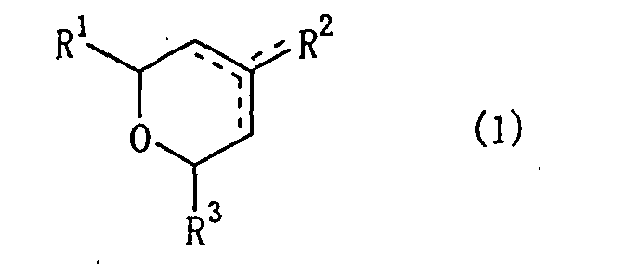
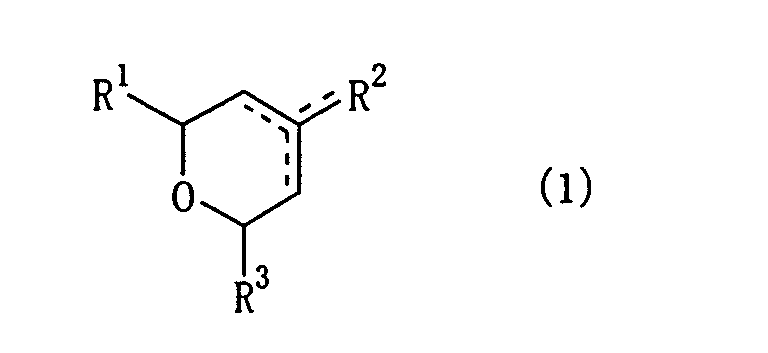
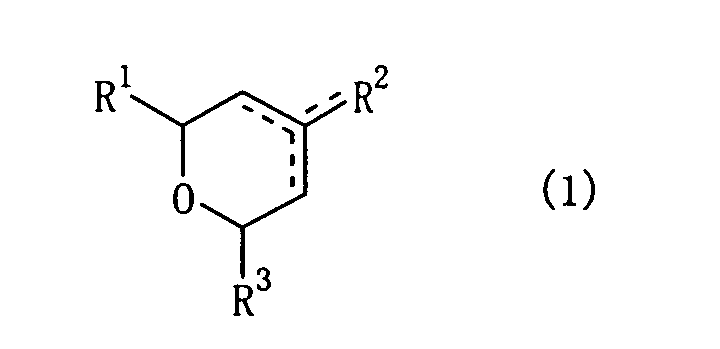
- R 1 is preferably an aryl group having in total 6 to 12 carbon atoms which may be substituted with one or two or more of alkyl or alkoxy groups each having 1 to 6 carbon atoms.
- the aryl group includes phenyl group and naphthyl group, and is preferably phenyl group.
- R 1 is particularly preferably phenyl, or o-, m- or p-tolyl, and most preferably phenyl.
- R 2 is preferably a hydrogen atom or an alkyl or alkylidene group having 1 to 6 carbon atoms, more preferably a hydrogen atom, methyl group or methylene group, and most preferably a hydrogen atom or methyl group.
- R 3 is preferably a hydrogen atom or an alkyl group having 1 to 6 carbon atoms, and particularly preferably a hydrogen atom or methyl group.
- Examples of the pyran compounds include 6-phenyl-4-methyl-5,6-dihydro-2H-pyran, 6-phenyl-2,4-dimethyl-5,6-dihydro-2H-pyran, 6-p-tolyl-4-methyl-5,6-dihydro-2H-pyran, 2-phenyl-4-methylenetetrahydro-2H-pyran, and 2-phenyl-4-methyl-5,6-dihydro-2H-pyran.
- One of the preferred embodiments of the present invention is a process for producing a 5-arylpentanol of formula (2a): wherein,
- R 1 and R 3 are the same as those described for R 1 and R 3 in formula (1).
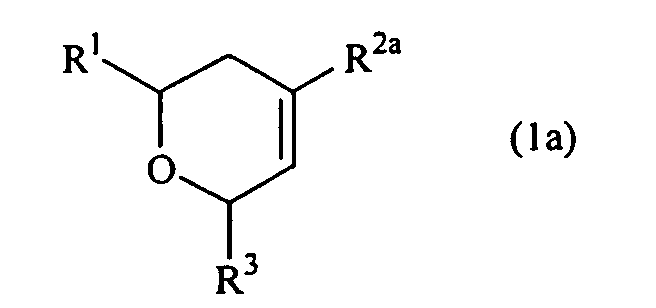
- R 2a is preferably a hydrogen atom or an alkyl group having 1 to 6 carbon atoms, and more preferably a hydrogen atom or methyl group.
- the noble metals include palladium, platinum, rhodium and ruthenium.
- Carriers for the noble metals include carbon, alumina, silica gel, barium sulfate, zeolite and calcium carbonate.
- the catalyst may be two or more noble metals supported on one kind of carrier, or a mixture of two or more kinds of carriers each carrying one kind of noble metal.
- the amount of each noble metal supported on a carrier is preferably 0.1 to 10% by weight, and more preferably 0.2 to 8% by weight of the catalyst.
- Total amount of two or more noble metals supported on carrier(s) is preferably 1 to 20% by weight, more preferably 2 to 10% by weight of the catalyst.
- catalysts can be obtained by a well known method, for example by an impregnation supporting method ( "Catalyst Preparation Chemistry” edited by Atsumu Ozaki, published by Kodansha) in which a carrier is impregnated with a metal and the resulting carrier is reduced with hydrogen at a higher temperature.
- an impregnation supporting method "Catalyst Preparation Chemistry” edited by Atsumu Ozaki, published by Kodansha) in which a carrier is impregnated with a metal and the resulting carrier is reduced with hydrogen at a higher temperature.
- commercial products may be used as they are. Examples of such commercial products include Palladium-Platinum-Carbon powder, Palladium-Carbon Powder, Platinum-Carbon Powder, and Ruthenium-Carbon Powder each manufactured by N. E. Chemcat Corporation.
- the acid type palladium-supporting catalyst used in the present invention means such a solid palladium catalyst in which palladium is supported on at least one carrier selected from alumina, silica gel, barium sulfate, zeolite and calcium carbonate and which shows a pH of less than 7, preferably 2 to 6, particularly preferably 3 to 5.5 when it is dispersed in water.
- a carrier selected from alumina, silica gel, barium sulfate, zeolite and calcium carbonate
- the resulting water has a pH of less than 7, preferably 2 to 6, particularly preferably 3 to 5.5. If the pH of the catalyst is not less than 7, production rate of a 5-arylpentanol significantly decreases.
- the amount of palladium in the catalyst is preferably 0.5 to 10% by weight, particularly 2 to 10% by weight of the catalyst.
- Such catalysts can be obtained by a well known method, for example by impregnating a carrier with a metal according to an impregnation supporting method ( "Catalyst Preparation Chemistry” edited by Atsumu Ozaki, published by Kodansha), and reducing the resulting carrier with hydrogen at a higher temperature.
- commercially available catalysts may be used.
- those having a pH in the above-mentioned range may be used.
- the amount of the catalyst to be used in the invention is usually in a range of 0.01 to 5% by weight, preferably in a range of 0.05 to 5% by weight based on the pyran compounds although it varies depending on the amount of the metals contained in the catalyst; use of too little amount of the catalyst results in a low reaction rate while use of too much amount of the catalyst results in much production of by-products such as hydrocarbons and excessive reaction products wherein the benzene ring of a 5-aryl pentanol is hydrogenated and thus is not economical.
- the catalyst carrying two or more elements selected from the noble metals in Group VIII in the periodic table is used, it is used in an amount of 0.01 to 2% by weight, preferably 0.05 to 1% by weight based on the pyran compounds. Either of the two kinds of the catalysts can be re-used.
- the reaction in the present invention may be carried out using a solvent.
- Alcohol solvents are preferred as the solvent and examples thereof include methanol, ethanol, 1-propanol and 2-propanl. These solvents may be used alone or as a mixture of two or more thereof.
- the amount of the solvent used in the reaction is preferably not more than 60% by weight based on the pyran compound. Alternatively, solvents may not be used.
- the reaction may be conducted at a constant temperature. However, it is preferable to conduct the reaction at a relatively lower temperature in the early stage of reaction and then increase the temperature at the later stage of reaction in order to suppress production of by-products and to increase the production rate of 5-arylpentanols.
- the later stage of reaction begins preferably from the time when conversion of the raw material, pyran compounds, reaches about 60 to 95%, particularly about 80 to 90%, which time usually corresponds to about 1 to 4 hours after commencement of the reaction although such time varies depending on the reaction temperature and the like.
- the reaction temperature in the later stage of reaction is preferably higher than that in the early stage of reaction.
- the temperature is increased with time at a rate preferably in a range of from 3 to 20°C per minute.
- Hydrogenolysis of the pyran compounds is effected at about 30 to 300°C, preferably at about 40 to 200°C.
- the reaction is desirably conducted at about 40 to 100°C, preferably 50 to 80 °C at the early stage of reaction. Thereafter, in the later stage of reaction, the reaction temperature is increased to a temperature higher than that in the early stage of reaction by about 30 to 260°C to enhance the production rate of 5-arylpentanols.
- the temperature in the later stage of reaction is preferably in a range of from about 120 to 180°C.
- Hydrogen pressure during reaction is in a range of 0.2 to 10MPaG, preferably 0.5 to 5MPaG; too lower hydrogen pressure results in insufficient production rate of 5-arylpentanols.
- reaction mixture was filtered to remove the catalyst and was analyzed by gas chromatography. As the result, the yield of 5-phenyl-3-methylpentanol was 93.4%.
- the reaction product contained 1.3% of hydrocarbons and 2.1% of excessive reaction products.
- reaction temperature was raised to 150°C in 19 minutes and reaction was conducted for additional 5 hours.
- reaction mixture was filtered to remove the catalyst and was analyzed by gas chromatography. As the result, the yield of 5-phenyl-3-methylpentanol was 93.0%.
- the reaction product contained 1.8% of hydrocarbons and 2.1% of excessive reaction products.
- reaction mixture was filtered to remove the catalyst and was analyzed by gas chromatography. As the result, the yield of 5-phenyl-3-methylpentanol was 92.0%.
- the reaction product contained 1.9% of hydrocarbons and 4.1% of excessive reaction products.
- reaction mixture was filtered to remove the catalyst and was analyzed by gas chromatography. As the result, the yield of 5-phenyl-3-methylpentanol was 93.1%.
- the reaction product contained 0.8% of hydrocarbons and 3.8% of excessive reaction products.
- 5-arylpentanol can be prepared in a high yield while suppressing production of hydrocarbons and without causing a problem with regard to corrosion of process equipment.
Landscapes
- Chemical & Material Sciences (AREA)
- Organic Chemistry (AREA)
- Organic Low-Molecular-Weight Compounds And Preparation Thereof (AREA)
- Low-Molecular Organic Synthesis Reactions Using Catalysts (AREA)
- Catalysts (AREA)
Abstract

Description

- R1 and R3 are as defined above,
- R2 represents a hydrogen atom, an alkyl or alkenyl group of 1 to 6 carbon atoms, or an alkylidene or alkenylidene group of 1 to 6 carbon atoms, and
- a dotted line (----) represents a possible bond and any one of the three bonds represented by dotted lines and solid lines is a double bond,

Claims (7)
- A process for producing a 5-arylpentanol of formula (2):wherein,
 which comprises effecting hydrogenolysis of a pyran compound of formula (1):R1 represents an aryl group which may be substituted with one or two or more of an alkyl or alkoxy group and has 6 to 12 carbon atoms in total,R3 represents a hydrogen atom, or an alkyl or alkenyl group of 1 to 6 carbon atoms, andR4 represents R2 defined below when R2 is a monovalent group or represents R2H when R2 is a divalent group,wherein,
 in the presence of one or more catalysts selected from (a) a catalyst carrying two or more elements selected from noble metals in Group VIII in the periodic table and (b) an acid type palladium-supporting catalyst.R1 and R3 are as defined above,R2 represents a hydrogen atom, an alkyl or alkenyl group of 1 to 6 carbon atoms, or an alkylidene or alkenylidene group of 1 to 6 carbon atoms, anda dotted line represents a possible bond and any one of the three bonds represented by dotted lines and solid lines is a double bond,
 - The process according to claim 1, wherein the reaction in the later stage of reaction is conducted at a temperature higher than that in the early stage of reaction.
- The process according to claim 2, wherein the reaction temperature in the early stage of reaction is in a range of from 40 to 100°C, and the reaction in the later stage of reaction is conducted at a temperature higher than that in the early stage of reaction by 30 to 160°C.
- The process according to claim 2 or 3, wherein the later stage of reaction begins from the time when the conversion of the raw material, pyran compounds, reaches 80 to 90%.
- The process according to any of claims 1 to 4, wherein the catalyst carrying two or more elements selected from noble metals in Group VIII in the periodic table is a catalyst carrying palladium and platinum.
- The process according to any of claims 1 to 4, wherein the acid type palladium-supporting catalyst is such a catalyst that shows a pH in a range of from 2 to 6 when it is dispersed in water.
- A process for producing a 5-arylpentanol of formula (2a):wherein,
 which comprises effecting hydrogenolysis of a 5,6-dihydro-2H-pyran compound of formula (1a):R1 represents an aryl group which may be substituted with one or two or more of an alkyl or alkoxy group and has 6 to 12 carbon atoms in total, andR2a and R3 may be the same or different and represent a hydrogen atom, or an alkyl or alkenyl group of 1 to 6 carbon atoms,wherein, R1 , R2a and R3 are as defined above, in the presence of one or more catalysts selected from (a) a catalyst carrying two or more elements selected from noble metals in Group VIII in the periodic table and (b) an acid type palladium-supporting catalyst.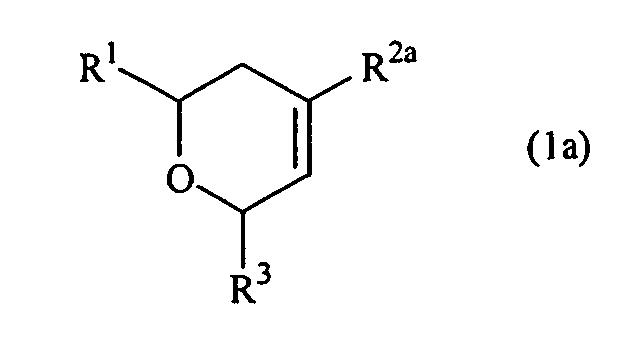
Applications Claiming Priority (4)
| Application Number | Priority Date | Filing Date | Title |
|---|---|---|---|
| JP2001296249 | 2001-09-27 | ||
| JP2001296249 | 2001-09-27 | ||
| JP2002169630 | 2002-06-11 | ||
| JP2002169630A JP3881288B2 (en) | 2001-09-27 | 2002-06-11 | Process for producing 5-arylpentanol |
Publications (3)
| Publication Number | Publication Date |
|---|---|
| EP1298118A2 true EP1298118A2 (en) | 2003-04-02 |
| EP1298118A3 EP1298118A3 (en) | 2003-07-16 |
| EP1298118B1 EP1298118B1 (en) | 2008-02-13 |
Family
ID=26623052
Family Applications (1)
| Application Number | Title | Priority Date | Filing Date |
|---|---|---|---|
| EP20020021724 Expired - Lifetime EP1298118B1 (en) | 2001-09-27 | 2002-09-25 | Process for production of 5-arylpentanols |
Country Status (5)
| Country | Link |
|---|---|
| US (1) | US6600079B2 (en) |
| EP (1) | EP1298118B1 (en) |
| JP (1) | JP3881288B2 (en) |
| DE (1) | DE60224968T2 (en) |
| ES (1) | ES2296860T3 (en) |
Cited By (1)
| Publication number | Priority date | Publication date | Assignee | Title |
|---|---|---|---|---|
| WO2020144307A1 (en) * | 2019-01-11 | 2020-07-16 | Basf Se | Preparation of 5-aryl-pentanols |
Families Citing this family (2)
| Publication number | Priority date | Publication date | Assignee | Title |
|---|---|---|---|---|
| CN104876800A (en) * | 2015-04-03 | 2015-09-02 | 江苏绿源精细化工有限公司 | Process for preparing benorilate amyl alcohol |
| CN105924332B (en) * | 2016-05-06 | 2020-06-09 | 山东新和成药业有限公司 | Preparation method of 3-methyl-5-phenyl-pentanol |
Family Cites Families (4)
| Publication number | Priority date | Publication date | Assignee | Title |
|---|---|---|---|---|
| CH655932A5 (en) * | 1983-02-24 | 1986-05-30 | Firmenich & Cie | Pyran derivatives, process for their preparation and their use for the preparation of aliphatic alcohols |
| NL8800009A (en) * | 1988-01-05 | 1989-08-01 | Naarden International Nv | PROCESS FOR THE PREPARATION OF DIHYDRO-PYRANES. |
| US5219836A (en) * | 1992-07-27 | 1993-06-15 | Firmenich Sa | Use of tetrahydro-4-methyl-2-phenyl-2H-pyran as perfuming ingredient |
| ES2241019T3 (en) * | 1996-10-03 | 2005-10-16 | Kao Corporation | PROCEDURE FOR THE PREPARATION OF DIHYDROPIRANE COMPOUND. |
-
2002
- 2002-06-11 JP JP2002169630A patent/JP3881288B2/en not_active Expired - Fee Related
- 2002-09-25 EP EP20020021724 patent/EP1298118B1/en not_active Expired - Lifetime
- 2002-09-25 DE DE2002624968 patent/DE60224968T2/en not_active Expired - Lifetime
- 2002-09-25 ES ES02021724T patent/ES2296860T3/en not_active Expired - Lifetime
- 2002-09-26 US US10/254,661 patent/US6600079B2/en not_active Expired - Lifetime
Cited By (4)
| Publication number | Priority date | Publication date | Assignee | Title |
|---|---|---|---|---|
| WO2020144307A1 (en) * | 2019-01-11 | 2020-07-16 | Basf Se | Preparation of 5-aryl-pentanols |
| CN113260603A (en) * | 2019-01-11 | 2021-08-13 | 巴斯夫欧洲公司 | Preparation of 5-arylpentanols |
| US11365168B2 (en) | 2019-01-11 | 2022-06-21 | Basf Se | Preparation of 5-aryl-pentanols |
| CN113260603B (en) * | 2019-01-11 | 2023-12-01 | 巴斯夫欧洲公司 | Preparation of 5-arylpentanol |
Also Published As
| Publication number | Publication date |
|---|---|
| DE60224968D1 (en) | 2008-03-27 |
| ES2296860T3 (en) | 2008-05-01 |
| DE60224968T2 (en) | 2009-02-12 |
| EP1298118A3 (en) | 2003-07-16 |
| EP1298118B1 (en) | 2008-02-13 |
| JP3881288B2 (en) | 2007-02-14 |
| US20030060667A1 (en) | 2003-03-27 |
| JP2003171323A (en) | 2003-06-20 |
| US6600079B2 (en) | 2003-07-29 |
Similar Documents
| Publication | Publication Date | Title |
|---|---|---|
| EP1858903B1 (en) | Diarylphenoxy aluminum compounds | |
| EP1298118B1 (en) | Process for production of 5-arylpentanols | |
| EP1900720B1 (en) | Process for production of substituted cyclopentanone | |
| US7321067B2 (en) | Process for the preparation of 1,4-dialkyl-2,3-diol-1,4-butanedione | |
| EP1095035B1 (en) | Method for preparing 4-(3-pyridinyl)-1h-imidazole and the intermediates used | |
| EP0822173A1 (en) | A new process for the manufacture of 1,3-cyclohexanedione | |
| US6268501B1 (en) | Process for the preparation of hydroxyethylcyclohexanes and hydroxyethylpiperidines | |
| EP1968925B1 (en) | Process for producing difluoroethanol | |
| WO1997046546A1 (en) | Process for preparing tetrahydrofuran from dialkoxybutenes | |
| EP0038471B1 (en) | Beta-gamma-unsaturated ketones and isoprenoic dienones, process for their preparation and their use as perfume compounds and flavourings | |
| EP0295531B1 (en) | Hydrogenation process | |
| US4910343A (en) | Nitroamines | |
| US6403843B1 (en) | Process for the preparation of 1-(3,4-dimethoxyphenyl)ethanol | |
| JPH0534346B2 (en) | ||
| RU2228327C1 (en) | Method for preparing 4,4-dimethyl-1-(para-chlorophenyl)-pentane-3-one | |
| JP4200704B2 (en) | Method for producing fluorinated benzonitrile | |
| EP0570817B1 (en) | Process for the preparation of 5-chloroxindole | |
| CA2288304A1 (en) | Production of naphthyl-substituted ketones from naphthaldehydes | |
| JP2004506034A5 (en) | ||
| KR100530345B1 (en) | Method for preparing amine compound from nitro compound using indium metal wire | |
| JP4099630B2 (en) | Method for producing perfluoroalkyl compound | |
| US5047586A (en) | Process for the preparation of 4-acylamino-2-aminoalkoxybenzenes | |
| JP2786300B2 (en) | Stereoselective process for producing optically active S, S- or R, R-β-amino alcohols | |
| KR100214102B1 (en) | Process for preparation of n-alkyl-beta-hydroxyethylsulfon aniline derivative | |
| JPH0524140B2 (en) |
Legal Events
| Date | Code | Title | Description |
|---|---|---|---|
| PUAI | Public reference made under article 153(3) epc to a published international application that has entered the european phase |
Free format text: ORIGINAL CODE: 0009012 |
|
| AK | Designated contracting states |
Kind code of ref document: A2 Designated state(s): AT BE BG CH CY CZ DE DK EE ES FI FR GB GR IE IT LI LU MC NL PT SE SK TR |
|
| AX | Request for extension of the european patent |
Extension state: AL LT LV MK RO SI |
|
| PUAL | Search report despatched |
Free format text: ORIGINAL CODE: 0009013 |
|
| AK | Designated contracting states |
Designated state(s): AT BE BG CH CY CZ DE DK EE ES FI FR GB GR IE IT LI LU MC NL PT SE SK TR |
|
| AX | Request for extension of the european patent |
Extension state: AL LT LV MK RO SI |
|
| 17P | Request for examination filed |
Effective date: 20031216 |
|
| AKX | Designation fees paid |
Designated state(s): CH DE ES GB LI |
|
| GRAP | Despatch of communication of intention to grant a patent |
Free format text: ORIGINAL CODE: EPIDOSNIGR1 |
|
| GRAS | Grant fee paid |
Free format text: ORIGINAL CODE: EPIDOSNIGR3 |
|
| GRAA | (expected) grant |
Free format text: ORIGINAL CODE: 0009210 |
|
| AK | Designated contracting states |
Kind code of ref document: B1 Designated state(s): CH DE ES GB LI |
|
| REG | Reference to a national code |
Ref country code: GB Ref legal event code: FG4D |
|
| REG | Reference to a national code |
Ref country code: CH Ref legal event code: EP |
|
| REF | Corresponds to: |
Ref document number: 60224968 Country of ref document: DE Date of ref document: 20080327 Kind code of ref document: P |
|
| REG | Reference to a national code |
Ref country code: ES Ref legal event code: FG2A Ref document number: 2296860 Country of ref document: ES Kind code of ref document: T3 |
|
| REG | Reference to a national code |
Ref country code: CH Ref legal event code: NV Representative=s name: E. BLUM UND CO. AG PATENT- UND MARKENANWAELTE VSP |
|
| PLBE | No opposition filed within time limit |
Free format text: ORIGINAL CODE: 0009261 |
|
| STAA | Information on the status of an ep patent application or granted ep patent |
Free format text: STATUS: NO OPPOSITION FILED WITHIN TIME LIMIT |
|
| 26N | No opposition filed |
Effective date: 20081114 |
|
| PGFP | Annual fee paid to national office [announced via postgrant information from national office to epo] |
Ref country code: DE Payment date: 20180911 Year of fee payment: 17 |
|
| PGFP | Annual fee paid to national office [announced via postgrant information from national office to epo] |
Ref country code: CH Payment date: 20180913 Year of fee payment: 17 Ref country code: GB Payment date: 20180919 Year of fee payment: 17 |
|
| PGFP | Annual fee paid to national office [announced via postgrant information from national office to epo] |
Ref country code: ES Payment date: 20181002 Year of fee payment: 17 |
|
| REG | Reference to a national code |
Ref country code: DE Ref legal event code: R119 Ref document number: 60224968 Country of ref document: DE |
|
| REG | Reference to a national code |
Ref country code: CH Ref legal event code: PL |
|
| PG25 | Lapsed in a contracting state [announced via postgrant information from national office to epo] |
Ref country code: CH Free format text: LAPSE BECAUSE OF NON-PAYMENT OF DUE FEES Effective date: 20190930 Ref country code: DE Free format text: LAPSE BECAUSE OF NON-PAYMENT OF DUE FEES Effective date: 20200401 Ref country code: LI Free format text: LAPSE BECAUSE OF NON-PAYMENT OF DUE FEES Effective date: 20190930 |
|
| GBPC | Gb: european patent ceased through non-payment of renewal fee |
Effective date: 20190925 |
|
| PG25 | Lapsed in a contracting state [announced via postgrant information from national office to epo] |
Ref country code: GB Free format text: LAPSE BECAUSE OF NON-PAYMENT OF DUE FEES Effective date: 20190925 |
|
| REG | Reference to a national code |
Ref country code: ES Ref legal event code: FD2A Effective date: 20210128 |
|
| PG25 | Lapsed in a contracting state [announced via postgrant information from national office to epo] |
Ref country code: ES Free format text: LAPSE BECAUSE OF NON-PAYMENT OF DUE FEES Effective date: 20190926 |