EP1298115A1 - Process for the preparation of polyhydric alcohols - Google Patents
Process for the preparation of polyhydric alcohols Download PDFInfo
- Publication number
- EP1298115A1 EP1298115A1 EP01947836A EP01947836A EP1298115A1 EP 1298115 A1 EP1298115 A1 EP 1298115A1 EP 01947836 A EP01947836 A EP 01947836A EP 01947836 A EP01947836 A EP 01947836A EP 1298115 A1 EP1298115 A1 EP 1298115A1
- Authority
- EP
- European Patent Office
- Prior art keywords
- acid
- groups
- group
- process according
- polyhydric alcohol
- Prior art date
- Legal status (The legal status is an assumption and is not a legal conclusion. Google has not performed a legal analysis and makes no representation as to the accuracy of the status listed.)
- Granted
Links
- 150000005846 sugar alcohols Polymers 0.000 title claims abstract description 49
- 238000000034 method Methods 0.000 title claims description 32
- 238000002360 preparation method Methods 0.000 title description 3
- 125000002887 hydroxy group Chemical group [H]O* 0.000 claims abstract description 72
- 150000001875 compounds Chemical class 0.000 claims abstract description 67
- 239000002253 acid Substances 0.000 claims abstract description 32
- 125000006239 protecting group Chemical group 0.000 claims abstract description 19
- 150000007514 bases Chemical class 0.000 claims abstract description 18
- 238000010494 dissociation reaction Methods 0.000 claims abstract description 11
- 230000005593 dissociations Effects 0.000 claims abstract description 11
- 238000004519 manufacturing process Methods 0.000 claims abstract description 7
- VEXZGXHMUGYJMC-UHFFFAOYSA-N Hydrochloric acid Chemical compound Cl VEXZGXHMUGYJMC-UHFFFAOYSA-N 0.000 claims description 44
- -1 alicyclic hydrocarbon compounds Chemical class 0.000 claims description 30
- AFVFQIVMOAPDHO-UHFFFAOYSA-N Methanesulfonic acid Chemical compound CS(O)(=O)=O AFVFQIVMOAPDHO-UHFFFAOYSA-N 0.000 claims description 10
- 125000001931 aliphatic group Chemical group 0.000 claims description 10
- 150000002391 heterocyclic compounds Chemical class 0.000 claims description 10
- DTQVDTLACAAQTR-UHFFFAOYSA-N Trifluoroacetic acid Chemical compound OC(=O)C(F)(F)F DTQVDTLACAAQTR-UHFFFAOYSA-N 0.000 claims description 8
- 125000005575 polycyclic aromatic hydrocarbon group Polymers 0.000 claims description 7
- NBIIXXVUZAFLBC-UHFFFAOYSA-N Phosphoric acid Chemical compound OP(O)(O)=O NBIIXXVUZAFLBC-UHFFFAOYSA-N 0.000 claims description 6
- QAOWNCQODCNURD-UHFFFAOYSA-N Sulfuric acid Chemical compound OS(O)(=O)=O QAOWNCQODCNURD-UHFFFAOYSA-N 0.000 claims description 6
- 125000000217 alkyl group Chemical group 0.000 claims description 6
- 229940098779 methanesulfonic acid Drugs 0.000 claims description 5
- 125000002723 alicyclic group Chemical group 0.000 claims description 4
- 125000003342 alkenyl group Chemical group 0.000 claims description 4
- 125000002029 aromatic hydrocarbon group Chemical group 0.000 claims description 4
- GRYLNZFGIOXLOG-UHFFFAOYSA-N Nitric acid Chemical compound O[N+]([O-])=O GRYLNZFGIOXLOG-UHFFFAOYSA-N 0.000 claims description 3
- 150000008044 alkali metal hydroxides Chemical class 0.000 claims description 3
- 229910000147 aluminium phosphate Inorganic materials 0.000 claims description 3
- 125000003710 aryl alkyl group Chemical group 0.000 claims description 3
- 229910017604 nitric acid Inorganic materials 0.000 claims description 3
- 229910052783 alkali metal Inorganic materials 0.000 claims description 2
- 150000001340 alkali metals Chemical class 0.000 claims description 2
- 229910001860 alkaline earth metal hydroxide Inorganic materials 0.000 claims description 2
- 150000001412 amines Chemical class 0.000 claims description 2
- FOCAUTSVDIKZOP-UHFFFAOYSA-N chloroacetic acid Chemical compound OC(=O)CCl FOCAUTSVDIKZOP-UHFFFAOYSA-N 0.000 claims description 2
- ITMCEJHCFYSIIV-UHFFFAOYSA-N triflic acid Chemical compound OS(=O)(=O)C(F)(F)F ITMCEJHCFYSIIV-UHFFFAOYSA-N 0.000 claims description 2
- QTBSBXVTEAMEQO-UHFFFAOYSA-N Acetic acid Chemical compound CC(O)=O QTBSBXVTEAMEQO-UHFFFAOYSA-N 0.000 description 69
- 238000006243 chemical reaction Methods 0.000 description 37
- 239000007858 starting material Substances 0.000 description 22
- 239000011541 reaction mixture Substances 0.000 description 17
- 238000004811 liquid chromatography Methods 0.000 description 14
- PPKHAIRFQKFMLE-UHFFFAOYSA-N 2,7-dimethoxynaphthalene Chemical compound C1=CC(OC)=CC2=CC(OC)=CC=C21 PPKHAIRFQKFMLE-UHFFFAOYSA-N 0.000 description 12
- HEMHJVSKTPXQMS-UHFFFAOYSA-M Sodium hydroxide Chemical compound [OH-].[Na+] HEMHJVSKTPXQMS-UHFFFAOYSA-M 0.000 description 12
- 239000000203 mixture Substances 0.000 description 12
- XLYOFNOQVPJJNP-UHFFFAOYSA-N water Substances O XLYOFNOQVPJJNP-UHFFFAOYSA-N 0.000 description 12
- IBTGEEMBZJBBSH-UHFFFAOYSA-N 2,6-dimethoxypyridine Chemical compound COC1=CC=CC(OC)=N1 IBTGEEMBZJBBSH-UHFFFAOYSA-N 0.000 description 11
- 150000007513 acids Chemical class 0.000 description 10
- TXROZCSFVVIBFI-UHFFFAOYSA-N 2,3,6,7,10,11-hexamethoxytriphenylene Chemical group C12=CC(OC)=C(OC)C=C2C2=CC(OC)=C(OC)C=C2C2=C1C=C(OC)C(OC)=C2 TXROZCSFVVIBFI-UHFFFAOYSA-N 0.000 description 9
- 230000000052 comparative effect Effects 0.000 description 9
- WLFXSECCHULRRO-UHFFFAOYSA-N pyridine-2,6-diol Chemical compound OC1=CC=CC(O)=N1 WLFXSECCHULRRO-UHFFFAOYSA-N 0.000 description 9
- 239000011521 glass Substances 0.000 description 8
- DFQICHCWIIJABH-UHFFFAOYSA-N naphthalene-2,7-diol Chemical compound C1=CC(O)=CC2=CC(O)=CC=C21 DFQICHCWIIJABH-UHFFFAOYSA-N 0.000 description 8
- QMLILIIMKSKLES-UHFFFAOYSA-N triphenylene-2,3,6,7,10,11-hexol Chemical group C12=CC(O)=C(O)C=C2C2=CC(O)=C(O)C=C2C2=C1C=C(O)C(O)=C2 QMLILIIMKSKLES-UHFFFAOYSA-N 0.000 description 8
- 239000013078 crystal Substances 0.000 description 7
- 230000001678 irradiating effect Effects 0.000 description 7
- 239000002904 solvent Substances 0.000 description 7
- ZWEHNKRNPOVVGH-UHFFFAOYSA-N 2-Butanone Chemical compound CCC(C)=O ZWEHNKRNPOVVGH-UHFFFAOYSA-N 0.000 description 6
- YMWUJEATGCHHMB-UHFFFAOYSA-N Dichloromethane Chemical compound ClCCl YMWUJEATGCHHMB-UHFFFAOYSA-N 0.000 description 6
- CPELXLSAUQHCOX-UHFFFAOYSA-N Hydrogen bromide Chemical compound Br CPELXLSAUQHCOX-UHFFFAOYSA-N 0.000 description 6
- YXFVVABEGXRONW-UHFFFAOYSA-N Toluene Chemical compound CC1=CC=CC=C1 YXFVVABEGXRONW-UHFFFAOYSA-N 0.000 description 6
- 239000003153 chemical reaction reagent Substances 0.000 description 6
- 125000002496 methyl group Chemical group [H]C([H])([H])* 0.000 description 6
- 239000003960 organic solvent Substances 0.000 description 6
- 150000003918 triazines Chemical class 0.000 description 6
- 125000003118 aryl group Chemical group 0.000 description 5
- 238000010511 deprotection reaction Methods 0.000 description 5
- 230000035484 reaction time Effects 0.000 description 5
- CRUILBNAQILVHZ-UHFFFAOYSA-N 1,2,3-trimethoxybenzene Chemical compound COC1=CC=CC(OC)=C1OC CRUILBNAQILVHZ-UHFFFAOYSA-N 0.000 description 4
- 238000005160 1H NMR spectroscopy Methods 0.000 description 4
- IAZDPXIOMUYVGZ-WFGJKAKNSA-N Dimethyl sulfoxide Chemical compound [2H]C([2H])([2H])S(=O)C([2H])([2H])[2H] IAZDPXIOMUYVGZ-WFGJKAKNSA-N 0.000 description 4
- YCIMNLLNPGFGHC-UHFFFAOYSA-N catechol Chemical compound OC1=CC=CC=C1O YCIMNLLNPGFGHC-UHFFFAOYSA-N 0.000 description 4
- 230000017858 demethylation Effects 0.000 description 4
- 238000010520 demethylation reaction Methods 0.000 description 4
- 239000003791 organic solvent mixture Substances 0.000 description 4
- 239000002699 waste material Substances 0.000 description 4
- UHOVQNZJYSORNB-UHFFFAOYSA-N Benzene Chemical compound C1=CC=CC=C1 UHOVQNZJYSORNB-UHFFFAOYSA-N 0.000 description 3
- IAZDPXIOMUYVGZ-UHFFFAOYSA-N Dimethylsulphoxide Chemical compound CS(C)=O IAZDPXIOMUYVGZ-UHFFFAOYSA-N 0.000 description 3
- LFQSCWFLJHTTHZ-UHFFFAOYSA-N Ethanol Chemical compound CCO LFQSCWFLJHTTHZ-UHFFFAOYSA-N 0.000 description 3
- XEKOWRVHYACXOJ-UHFFFAOYSA-N Ethyl acetate Chemical compound CCOC(C)=O XEKOWRVHYACXOJ-UHFFFAOYSA-N 0.000 description 3
- LYCAIKOWRPUZTN-UHFFFAOYSA-N Ethylene glycol Chemical compound OCCO LYCAIKOWRPUZTN-UHFFFAOYSA-N 0.000 description 3
- KFZMGEQAYNKOFK-UHFFFAOYSA-N Isopropanol Chemical compound CC(C)O KFZMGEQAYNKOFK-UHFFFAOYSA-N 0.000 description 3
- KWYUFKZDYYNOTN-UHFFFAOYSA-M Potassium hydroxide Chemical compound [OH-].[K+] KWYUFKZDYYNOTN-UHFFFAOYSA-M 0.000 description 3
- ZMANZCXQSJIPKH-UHFFFAOYSA-N Triethylamine Chemical compound CCN(CC)CC ZMANZCXQSJIPKH-UHFFFAOYSA-N 0.000 description 3
- 238000000354 decomposition reaction Methods 0.000 description 3
- UAOMVDZJSHZZME-UHFFFAOYSA-N diisopropylamine Chemical compound CC(C)NC(C)C UAOMVDZJSHZZME-UHFFFAOYSA-N 0.000 description 3
- 229910000042 hydrogen bromide Inorganic materials 0.000 description 3
- 239000005457 ice water Substances 0.000 description 3
- 239000007788 liquid Substances 0.000 description 3
- 239000000463 material Substances 0.000 description 3
- VLKZOEOYAKHREP-UHFFFAOYSA-N n-Hexane Chemical compound CCCCCC VLKZOEOYAKHREP-UHFFFAOYSA-N 0.000 description 3
- 150000007524 organic acids Chemical class 0.000 description 3
- 235000005985 organic acids Nutrition 0.000 description 3
- 239000012450 pharmaceutical intermediate Substances 0.000 description 3
- 238000010992 reflux Methods 0.000 description 3
- 239000011347 resin Substances 0.000 description 3
- 229920005989 resin Polymers 0.000 description 3
- 239000011369 resultant mixture Substances 0.000 description 3
- 238000003756 stirring Methods 0.000 description 3
- MXYLLYBWXIUMIT-PFBJBMPXSA-N (2r,3s,4r)-3,4-bis(phenylmethoxy)-2-(phenylmethoxymethyl)-3,4-dihydro-2h-pyran Chemical compound C([C@@H]1[C@H]([C@H](OCC=2C=CC=CC=2)C=CO1)OCC=1C=CC=CC=1)OCC1=CC=CC=C1 MXYLLYBWXIUMIT-PFBJBMPXSA-N 0.000 description 2
- ULWFBDBHIPNAPH-AIPODZBISA-N (5S,8S,9S,10S,13R,14S)-3,16-dimethoxy-10,13-dimethyl-2,3,4,5,6,7,8,9,11,12,14,15,16,17-tetradecahydro-1H-cyclopenta[a]phenanthrene Chemical compound COC1C[C@@H]2CC[C@@H]3[C@H](CC[C@@]4(CC(C[C@H]43)OC)C)[C@]2(CC1)C ULWFBDBHIPNAPH-AIPODZBISA-N 0.000 description 2
- SCYULBFZEHDVBN-UHFFFAOYSA-N 1,1-Dichloroethane Chemical compound CC(Cl)Cl SCYULBFZEHDVBN-UHFFFAOYSA-N 0.000 description 2
- AGIQIOSHSMJYJP-UHFFFAOYSA-N 1,2,4-Trimethoxybenzene Chemical compound COC1=CC=C(OC)C(OC)=C1 AGIQIOSHSMJYJP-UHFFFAOYSA-N 0.000 description 2
- LKUDPHPHKOZXCD-UHFFFAOYSA-N 1,3,5-trimethoxybenzene Chemical compound COC1=CC(OC)=CC(OC)=C1 LKUDPHPHKOZXCD-UHFFFAOYSA-N 0.000 description 2
- DPZNOMCNRMUKPS-UHFFFAOYSA-N 1,3-Dimethoxybenzene Chemical compound COC1=CC=CC(OC)=C1 DPZNOMCNRMUKPS-UHFFFAOYSA-N 0.000 description 2
- OHBQPCCCRFSCAX-UHFFFAOYSA-N 1,4-Dimethoxybenzene Chemical compound COC1=CC=C(OC)C=C1 OHBQPCCCRFSCAX-UHFFFAOYSA-N 0.000 description 2
- RYHBNJHYFVUHQT-UHFFFAOYSA-N 1,4-Dioxane Chemical compound C1COCCO1 RYHBNJHYFVUHQT-UHFFFAOYSA-N 0.000 description 2
- QRPDMEIIZPOYED-UHFFFAOYSA-N 1,8-dimethoxynaphthalene Chemical compound C1=CC(OC)=C2C(OC)=CC=CC2=C1 QRPDMEIIZPOYED-UHFFFAOYSA-N 0.000 description 2
- 238000001644 13C nuclear magnetic resonance spectroscopy Methods 0.000 description 2
- VOXZDWNPVJITMN-ZBRFXRBCSA-N 17β-estradiol Chemical compound OC1=CC=C2[C@H]3CC[C@](C)([C@H](CC4)O)[C@@H]4[C@@H]3CCC2=C1 VOXZDWNPVJITMN-ZBRFXRBCSA-N 0.000 description 2
- ISUYTITXRVKOQA-UHFFFAOYSA-N 2,4,6-trimethoxypyridine Chemical compound COC1=CC(OC)=NC(OC)=C1 ISUYTITXRVKOQA-UHFFFAOYSA-N 0.000 description 2
- VNFZATXXGYDZKN-UHFFFAOYSA-N 2,6-bis[(2-methylpropan-2-yl)oxy]pyridine Chemical compound CC(C)(C)OC1=CC=CC(OC(C)(C)C)=N1 VNFZATXXGYDZKN-UHFFFAOYSA-N 0.000 description 2
- YZWIIEJLESXODL-UHFFFAOYSA-N 3,5,7-trimethoxy-2-(4-methoxyphenyl)chromen-4-one Chemical compound C1=CC(OC)=CC=C1C1=C(OC)C(=O)C2=C(OC)C=C(OC)C=C2O1 YZWIIEJLESXODL-UHFFFAOYSA-N 0.000 description 2
- ZXJJBDHPUHUUHD-UHFFFAOYSA-N 4',5,7-Trimethoxyflavone Chemical compound C1=CC(OC)=CC=C1C1=CC(=O)C2=C(OC)C=C(OC)C=C2O1 ZXJJBDHPUHUUHD-UHFFFAOYSA-N 0.000 description 2
- OAFFXIGVFHSWTA-UHFFFAOYSA-N 5-Hydroxy-2-(3,4,5-trimethoxy-phenyl)-chromen-4-on Natural products COC1=C(OC)C(OC)=CC(C=2OC3=CC=CC(O)=C3C(=O)C=2)=C1 OAFFXIGVFHSWTA-UHFFFAOYSA-N 0.000 description 2
- CSCPPACGZOOCGX-UHFFFAOYSA-N Acetone Chemical compound CC(C)=O CSCPPACGZOOCGX-UHFFFAOYSA-N 0.000 description 2
- QIGBRXMKCJKVMJ-UHFFFAOYSA-N Hydroquinone Chemical compound OC1=CC=C(O)C=C1 QIGBRXMKCJKVMJ-UHFFFAOYSA-N 0.000 description 2
- CSNNHWWHGAXBCP-UHFFFAOYSA-L Magnesium sulfate Chemical compound [Mg+2].[O-][S+2]([O-])([O-])[O-] CSNNHWWHGAXBCP-UHFFFAOYSA-L 0.000 description 2
- JLTDJTHDQAWBAV-UHFFFAOYSA-N N,N-dimethylaniline Chemical compound CN(C)C1=CC=CC=C1 JLTDJTHDQAWBAV-UHFFFAOYSA-N 0.000 description 2
- OFBQJSOFQDEBGM-UHFFFAOYSA-N Pentane Chemical compound CCCCC OFBQJSOFQDEBGM-UHFFFAOYSA-N 0.000 description 2
- JUJWROOIHBZHMG-UHFFFAOYSA-N Pyridine Chemical compound C1=CC=NC=C1 JUJWROOIHBZHMG-UHFFFAOYSA-N 0.000 description 2
- WYURNTSHIVDZCO-UHFFFAOYSA-N Tetrahydrofuran Chemical compound C1CCOC1 WYURNTSHIVDZCO-UHFFFAOYSA-N 0.000 description 2
- 239000003513 alkali Substances 0.000 description 2
- KZNIFHPLKGYRTM-UHFFFAOYSA-N apigenin Chemical compound C1=CC(O)=CC=C1C1=CC(=O)C2=C(O)C=C(O)C=C2O1 KZNIFHPLKGYRTM-UHFFFAOYSA-N 0.000 description 2
- 239000007864 aqueous solution Substances 0.000 description 2
- GGNQRNBDZQJCCN-UHFFFAOYSA-N benzene-1,2,4-triol Chemical compound OC1=CC=C(O)C(O)=C1 GGNQRNBDZQJCCN-UHFFFAOYSA-N 0.000 description 2
- 150000001555 benzenes Chemical class 0.000 description 2
- 239000006227 byproduct Substances 0.000 description 2
- MVPPADPHJFYWMZ-UHFFFAOYSA-N chlorobenzene Chemical compound ClC1=CC=CC=C1 MVPPADPHJFYWMZ-UHFFFAOYSA-N 0.000 description 2
- RTIXKCRFFJGDFG-UHFFFAOYSA-N chrysin Chemical compound C=1C(O)=CC(O)=C(C(C=2)=O)C=1OC=2C1=CC=CC=C1 RTIXKCRFFJGDFG-UHFFFAOYSA-N 0.000 description 2
- JRFZSUMZAUHNSL-UHFFFAOYSA-N chrysin 5,7-dimethyl ether Chemical compound C=1C(OC)=CC(OC)=C(C(C=2)=O)C=1OC=2C1=CC=CC=C1 JRFZSUMZAUHNSL-UHFFFAOYSA-N 0.000 description 2
- OROGSEYTTFOCAN-DNJOTXNNSA-N codeine Chemical compound C([C@H]1[C@H](N(CC[C@@]112)C)C3)=C[C@H](O)[C@@H]1OC1=C2C3=CC=C1OC OROGSEYTTFOCAN-DNJOTXNNSA-N 0.000 description 2
- USIUVYZYUHIAEV-UHFFFAOYSA-N diphenyl ether Chemical compound C=1C=CC=CC=1OC1=CC=CC=C1 USIUVYZYUHIAEV-UHFFFAOYSA-N 0.000 description 2
- 229940079593 drug Drugs 0.000 description 2
- 239000003814 drug Substances 0.000 description 2
- 238000002451 electron ionisation mass spectrometry Methods 0.000 description 2
- 229960005309 estradiol Drugs 0.000 description 2
- 229930182833 estradiol Natural products 0.000 description 2
- 229930003944 flavone Natural products 0.000 description 2
- 150000002213 flavones Chemical class 0.000 description 2
- 235000011949 flavones Nutrition 0.000 description 2
- 125000000623 heterocyclic group Chemical group 0.000 description 2
- 229930195733 hydrocarbon Natural products 0.000 description 2
- 238000002955 isolation Methods 0.000 description 2
- LRDGATPGVJTWLJ-UHFFFAOYSA-N luteolin Natural products OC1=CC(O)=CC(C=2OC3=CC(O)=CC(O)=C3C(=O)C=2)=C1 LRDGATPGVJTWLJ-UHFFFAOYSA-N 0.000 description 2
- BDAGIHXWWSANSR-UHFFFAOYSA-N methanoic acid Natural products OC=O BDAGIHXWWSANSR-UHFFFAOYSA-N 0.000 description 2
- BQJCRHHNABKAKU-KBQPJGBKSA-N morphine Chemical compound O([C@H]1[C@H](C=C[C@H]23)O)C4=C5[C@@]12CCN(C)[C@@H]3CC5=CC=C4O BQJCRHHNABKAKU-KBQPJGBKSA-N 0.000 description 2
- OENHRRVNRZBNNS-UHFFFAOYSA-N naphthalene-1,8-diol Chemical compound C1=CC(O)=C2C(O)=CC=CC2=C1 OENHRRVNRZBNNS-UHFFFAOYSA-N 0.000 description 2
- 150000002790 naphthalenes Chemical class 0.000 description 2
- 125000001997 phenyl group Chemical group [H]C1=C([H])C([H])=C(*)C([H])=C1[H] 0.000 description 2
- 238000000746 purification Methods 0.000 description 2
- 150000003222 pyridines Chemical class 0.000 description 2
- 150000003230 pyrimidines Chemical class 0.000 description 2
- WQGWDDDVZFFDIG-UHFFFAOYSA-N pyrogallol Chemical compound OC1=CC=CC(O)=C1O WQGWDDDVZFFDIG-UHFFFAOYSA-N 0.000 description 2
- GHMLBKRAJCXXBS-UHFFFAOYSA-N resorcinol Chemical compound OC1=CC=CC(O)=C1 GHMLBKRAJCXXBS-UHFFFAOYSA-N 0.000 description 2
- 150000003431 steroids Chemical class 0.000 description 2
- 239000000126 substance Substances 0.000 description 2
- 150000003643 triphenylenes Chemical class 0.000 description 2
- LZTRCELOJRDYMQ-UHFFFAOYSA-N triphenylmethanol Chemical compound C=1C=CC=CC=1C(C=1C=CC=CC=1)(O)C1=CC=CC=C1 LZTRCELOJRDYMQ-UHFFFAOYSA-N 0.000 description 2
- ABDKAPXRBAPSQN-UHFFFAOYSA-N veratrole Chemical compound COC1=CC=CC=C1OC ABDKAPXRBAPSQN-UHFFFAOYSA-N 0.000 description 2
- IAFBOKYTDSDNHV-UHFFFAOYSA-N (2S)-(-)-5,7-dimethoxyflavanone Natural products O1C2=CC(OC)=CC(OC)=C2C(=O)CC1C1=CC=CC=C1 IAFBOKYTDSDNHV-UHFFFAOYSA-N 0.000 description 1
- VCTBQEPMLLIXBG-AYERNYAYSA-N (5S,8R,9S,10S,13S,14S)-3,16,17-trimethoxy-10,13-dimethyl-2,3,4,5,6,7,8,9,11,12,14,15,16,17-tetradecahydro-1H-cyclopenta[a]phenanthrene Chemical compound COC1C[C@@H]2CC[C@@H]3[C@H](CC[C@@]4(C(C(C[C@H]43)OC)OC)C)[C@]2(CC1)C VCTBQEPMLLIXBG-AYERNYAYSA-N 0.000 description 1
- AQOCBVOXXCEOLR-GUTNPPIESA-N (5S,8R,9S,10S,13S,14S)-3,17-dimethoxy-10,13-dimethyl-2,3,4,5,6,7,8,9,11,12,14,15,16,17-tetradecahydro-1H-cyclopenta[a]phenanthrene Chemical compound COC1C[C@@H]2CC[C@@H]3[C@H](CC[C@@]4(C(CC[C@H]43)OC)C)[C@]2(CC1)C AQOCBVOXXCEOLR-GUTNPPIESA-N 0.000 description 1
- KVUXYQHEESDGIJ-RHMIJCJMSA-N (5S,8S,9S,10S,13R,14S)-10,13-dimethyl-2,3,4,5,6,7,8,9,11,12,14,15,16,17-tetradecahydro-1H-cyclopenta[a]phenanthrene-3,16-diol Chemical compound C[C@@]12CC(C[C@H]1[C@@H]1CC[C@H]3CC(CC[C@]3(C)[C@H]1CC2)O)O KVUXYQHEESDGIJ-RHMIJCJMSA-N 0.000 description 1
- CBMYJHIOYJEBSB-WZDBAGNOSA-N (5s,8r,9s,10s,13s,14s)-10,13-dimethyl-2,3,4,5,6,7,8,9,11,12,14,15,16,17-tetradecahydro-1h-cyclopenta[a]phenanthrene-3,17-diol Chemical compound C1C(O)CC[C@]2(C)[C@H]3CC[C@](C)(C(CC4)O)[C@@H]4[C@@H]3CC[C@H]21 CBMYJHIOYJEBSB-WZDBAGNOSA-N 0.000 description 1
- CXGDRQWRJUSSAR-HONWYQEFSA-N (8r,9s,10s,13s,14s)-10,13-dimethyl-2,3,4,5,6,7,8,9,11,12,14,15,16,17-tetradecahydro-1h-cyclopenta[a]phenanthrene-3,16,17-triol Chemical compound C1C(O)CC[C@]2(C)[C@H]3CC[C@](C)(C(C(O)C4)O)[C@@H]4[C@@H]3CCC21 CXGDRQWRJUSSAR-HONWYQEFSA-N 0.000 description 1
- 125000004178 (C1-C4) alkyl group Chemical group 0.000 description 1
- YIXWTOHVYXPCMF-UHFFFAOYSA-N 1,2,3-triethoxybenzene Chemical compound CCOC1=CC=CC(OCC)=C1OCC YIXWTOHVYXPCMF-UHFFFAOYSA-N 0.000 description 1
- VJYDJBFFMRUOGW-UHFFFAOYSA-N 1,2,3-tris[(2-methylpropan-2-yl)oxy]benzene Chemical compound CC(C)(C)OC1=CC=CC(OC(C)(C)C)=C1OC(C)(C)C VJYDJBFFMRUOGW-UHFFFAOYSA-N 0.000 description 1
- MTXHYYFYFLXUEN-UHFFFAOYSA-N 1,2,4-triethoxybenzene Chemical compound CCOC1=CC=C(OCC)C(OCC)=C1 MTXHYYFYFLXUEN-UHFFFAOYSA-N 0.000 description 1
- DPDSSXFFLJUXKY-UHFFFAOYSA-N 1,2,4-tris[(2-methylpropan-2-yl)oxy]benzene Chemical compound CC(C)(C)OC1=CC=C(OC(C)(C)C)C(OC(C)(C)C)=C1 DPDSSXFFLJUXKY-UHFFFAOYSA-N 0.000 description 1
- GZWLFCGQNCRLIN-UHFFFAOYSA-N 1,2-bis(prop-2-enoxy)benzene Chemical compound C=CCOC1=CC=CC=C1OCC=C GZWLFCGQNCRLIN-UHFFFAOYSA-N 0.000 description 1
- SDUILFAEUHNOAS-UHFFFAOYSA-N 1,2-bis[(2-methylpropan-2-yl)oxy]benzene Chemical compound CC(C)(C)OC1=CC=CC=C1OC(C)(C)C SDUILFAEUHNOAS-UHFFFAOYSA-N 0.000 description 1
- SMPKBZNOCHMWHT-UHFFFAOYSA-N 1,2-bis[(2-methylpropan-2-yl)oxy]naphthalene Chemical compound C1=CC=CC2=C(OC(C)(C)C)C(OC(C)(C)C)=CC=C21 SMPKBZNOCHMWHT-UHFFFAOYSA-N 0.000 description 1
- QZYDOKBVZJLQCK-UHFFFAOYSA-N 1,2-diethoxybenzene Chemical compound CCOC1=CC=CC=C1OCC QZYDOKBVZJLQCK-UHFFFAOYSA-N 0.000 description 1
- PLQJMPNNBLKOEF-UHFFFAOYSA-N 1,2-diethoxynaphthalene Chemical compound C1=CC=CC2=C(OCC)C(OCC)=CC=C21 PLQJMPNNBLKOEF-UHFFFAOYSA-N 0.000 description 1
- RHHDMTSHWRREPK-UHFFFAOYSA-N 1,2-dimethoxynaphthalene Chemical compound C1=CC=CC2=C(OC)C(OC)=CC=C21 RHHDMTSHWRREPK-UHFFFAOYSA-N 0.000 description 1
- CPEDYIVPGWUOGI-UHFFFAOYSA-N 1,3,5-triethoxybenzene Chemical compound CCOC1=CC(OCC)=CC(OCC)=C1 CPEDYIVPGWUOGI-UHFFFAOYSA-N 0.000 description 1
- MMOYVYSPNDJNOT-UHFFFAOYSA-N 1,3,5-tris[(2-methylpropan-2-yl)oxy]benzene Chemical compound CC(C)(C)OC1=CC(OC(C)(C)C)=CC(OC(C)(C)C)=C1 MMOYVYSPNDJNOT-UHFFFAOYSA-N 0.000 description 1
- HIQUVLYPUNAUEL-UHFFFAOYSA-N 1,3-bis[(2-methylpropan-2-yl)oxy]benzene Chemical compound CC(C)(C)OC1=CC=CC(OC(C)(C)C)=C1 HIQUVLYPUNAUEL-UHFFFAOYSA-N 0.000 description 1
- BVDCHQOHHAHQDL-UHFFFAOYSA-N 1,3-bis[(2-methylpropan-2-yl)oxy]naphthalene Chemical compound C1=CC=CC2=CC(OC(C)(C)C)=CC(OC(C)(C)C)=C21 BVDCHQOHHAHQDL-UHFFFAOYSA-N 0.000 description 1
- FQXOOGHQVPKHPG-UHFFFAOYSA-N 1,3-diazinane-2,4,5-trione Chemical compound O=C1NCC(=O)C(=O)N1 FQXOOGHQVPKHPG-UHFFFAOYSA-N 0.000 description 1
- MKGFYMKFBCWNCP-UHFFFAOYSA-N 1,3-diethoxybenzene Chemical compound CCOC1=CC=CC(OCC)=C1 MKGFYMKFBCWNCP-UHFFFAOYSA-N 0.000 description 1
- IYZWERCGPPDCQI-UHFFFAOYSA-N 1,3-diethoxynaphthalene Chemical compound C1=CC=CC2=CC(OCC)=CC(OCC)=C21 IYZWERCGPPDCQI-UHFFFAOYSA-N 0.000 description 1
- XAVOEDQPSYWNHI-UHFFFAOYSA-N 1,3-dimethoxynaphthalene Chemical compound C1=CC=CC2=CC(OC)=CC(OC)=C21 XAVOEDQPSYWNHI-UHFFFAOYSA-N 0.000 description 1
- SLBILIQCELPANR-UHFFFAOYSA-N 1,4,5-triethoxy-2h-triazine Chemical compound CCON1NN=C(OCC)C(OCC)=C1 SLBILIQCELPANR-UHFFFAOYSA-N 0.000 description 1
- XSXJCWDARXFDCH-UHFFFAOYSA-N 1,4,5-trimethoxy-2h-triazine Chemical compound CON1NN=C(OC)C(OC)=C1 XSXJCWDARXFDCH-UHFFFAOYSA-N 0.000 description 1
- FDQKZXHLEVLNPL-UHFFFAOYSA-N 1,4,5-tris[(2-methylpropan-2-yl)oxy]-2h-triazine Chemical compound CC(C)(C)ON1NN=C(OC(C)(C)C)C(OC(C)(C)C)=C1 FDQKZXHLEVLNPL-UHFFFAOYSA-N 0.000 description 1
- AANPQJBOJRZUNO-UHFFFAOYSA-N 1,4-bis(prop-2-enoxy)benzene Chemical compound C=CCOC1=CC=C(OCC=C)C=C1 AANPQJBOJRZUNO-UHFFFAOYSA-N 0.000 description 1
- FMDDSXFJMWQYTJ-UHFFFAOYSA-N 1,4-bis[(2-methylpropan-2-yl)oxy]benzene Chemical compound CC(C)(C)OC1=CC=C(OC(C)(C)C)C=C1 FMDDSXFJMWQYTJ-UHFFFAOYSA-N 0.000 description 1
- BIPDJWUCDRVFJP-UHFFFAOYSA-N 1,4-bis[(2-methylpropan-2-yl)oxy]naphthalene Chemical compound C1=CC=C2C(OC(C)(C)C)=CC=C(OC(C)(C)C)C2=C1 BIPDJWUCDRVFJP-UHFFFAOYSA-N 0.000 description 1
- VWGNFIQXBYRDCH-UHFFFAOYSA-N 1,4-diethoxybenzene Chemical compound CCOC1=CC=C(OCC)C=C1 VWGNFIQXBYRDCH-UHFFFAOYSA-N 0.000 description 1
- LJSLYKNKVQMIJY-UHFFFAOYSA-N 1,4-diethoxynaphthalene Chemical compound C1=CC=C2C(OCC)=CC=C(OCC)C2=C1 LJSLYKNKVQMIJY-UHFFFAOYSA-N 0.000 description 1
- FWWRTYBQQDXLDD-UHFFFAOYSA-N 1,4-dimethoxynaphthalene Chemical compound C1=CC=C2C(OC)=CC=C(OC)C2=C1 FWWRTYBQQDXLDD-UHFFFAOYSA-N 0.000 description 1
- APQSQLNWAIULLK-UHFFFAOYSA-N 1,4-dimethoxynaphthalene Natural products C1=CC=C2C(C)=CC=C(C)C2=C1 APQSQLNWAIULLK-UHFFFAOYSA-N 0.000 description 1
- FRASJONUBLZVQX-UHFFFAOYSA-N 1,4-dioxonaphthalene Natural products C1=CC=C2C(=O)C=CC(=O)C2=C1 FRASJONUBLZVQX-UHFFFAOYSA-N 0.000 description 1
- DZTCXOBBBGQCHQ-UHFFFAOYSA-N 1,5-bis[(2-methylpropan-2-yl)oxy]-2h-pyrimidine Chemical compound CC(C)(C)ON1CN=CC(OC(C)(C)C)=C1 DZTCXOBBBGQCHQ-UHFFFAOYSA-N 0.000 description 1
- KMEZAZADJHFHKD-UHFFFAOYSA-N 1,5-bis[(2-methylpropan-2-yl)oxy]naphthalene Chemical compound C1=CC=C2C(OC(C)(C)C)=CC=CC2=C1OC(C)(C)C KMEZAZADJHFHKD-UHFFFAOYSA-N 0.000 description 1
- IXKWQPWSMOIZRC-UHFFFAOYSA-N 1,5-diethoxy-2h-pyrimidine Chemical compound CCON1CN=CC(OCC)=C1 IXKWQPWSMOIZRC-UHFFFAOYSA-N 0.000 description 1
- CIHMPXJICUOBOA-UHFFFAOYSA-N 1,5-diethoxynaphthalene Chemical compound C1=CC=C2C(OCC)=CC=CC2=C1OCC CIHMPXJICUOBOA-UHFFFAOYSA-N 0.000 description 1
- BOKGTLAJQHTOKE-UHFFFAOYSA-N 1,5-dihydroxynaphthalene Chemical compound C1=CC=C2C(O)=CC=CC2=C1O BOKGTLAJQHTOKE-UHFFFAOYSA-N 0.000 description 1
- XJZGKCKDMQTHIX-UHFFFAOYSA-N 1,5-dimethoxy-2h-pyrimidine Chemical compound CON1CN=CC(OC)=C1 XJZGKCKDMQTHIX-UHFFFAOYSA-N 0.000 description 1
- ANCSPRJFGGDREM-UHFFFAOYSA-N 1,5-dimethoxynaphthalene Chemical compound C1=CC=C2C(OC)=CC=CC2=C1OC ANCSPRJFGGDREM-UHFFFAOYSA-N 0.000 description 1
- UCRPQEXJDFCNTF-UHFFFAOYSA-N 1,6-bis[(2-methylpropan-2-yl)oxy]-2h-pyrimidine Chemical compound CC(C)(C)ON1CN=CC=C1OC(C)(C)C UCRPQEXJDFCNTF-UHFFFAOYSA-N 0.000 description 1
- IEPDZBRZVWBMTN-UHFFFAOYSA-N 1,6-bis[(2-methylpropan-2-yl)oxy]naphthalene Chemical compound CC(C)(C)OC1=CC=CC2=CC(OC(C)(C)C)=CC=C21 IEPDZBRZVWBMTN-UHFFFAOYSA-N 0.000 description 1
- LXVSQPXKFBMLSE-UHFFFAOYSA-N 1,6-diethoxy-2h-pyrimidine Chemical compound CCON1CN=CC=C1OCC LXVSQPXKFBMLSE-UHFFFAOYSA-N 0.000 description 1
- ZGXCBXRNNYACJW-UHFFFAOYSA-N 1,6-diethoxynaphthalene Chemical compound CCOC1=CC=CC2=CC(OCC)=CC=C21 ZGXCBXRNNYACJW-UHFFFAOYSA-N 0.000 description 1
- NNJJJHPWJUODKE-UHFFFAOYSA-N 1,6-dimethoxy-2h-pyrimidine Chemical compound CON1CN=CC=C1OC NNJJJHPWJUODKE-UHFFFAOYSA-N 0.000 description 1
- RBUFUWIWCCOVOS-UHFFFAOYSA-N 1,6-dimethoxynaphthalene Chemical compound COC1=CC=CC2=CC(OC)=CC=C21 RBUFUWIWCCOVOS-UHFFFAOYSA-N 0.000 description 1
- CVJGBRLOMXEQQJ-UHFFFAOYSA-N 1,7-bis[(2-methylpropan-2-yl)oxy]naphthalene Chemical compound C1=CC=C(OC(C)(C)C)C2=CC(OC(C)(C)C)=CC=C21 CVJGBRLOMXEQQJ-UHFFFAOYSA-N 0.000 description 1
- XPTCIPWPSSKEIO-UHFFFAOYSA-N 1,7-diethoxynaphthalene Chemical compound C1=CC=C(OCC)C2=CC(OCC)=CC=C21 XPTCIPWPSSKEIO-UHFFFAOYSA-N 0.000 description 1
- SNJIXGITYNNHDO-UHFFFAOYSA-N 1,7-dimethoxynaphthalene Chemical compound C1=CC=C(OC)C2=CC(OC)=CC=C21 SNJIXGITYNNHDO-UHFFFAOYSA-N 0.000 description 1
- VMXJIVJRBUAPFN-UHFFFAOYSA-N 1,8-bis[(2-methylpropan-2-yl)oxy]naphthalene Chemical compound C1=CC(OC(C)(C)C)=C2C(OC(C)(C)C)=CC=CC2=C1 VMXJIVJRBUAPFN-UHFFFAOYSA-N 0.000 description 1
- SKYTZUNCKOTOOR-UHFFFAOYSA-N 1,8-diethoxynaphthalene Chemical compound C1=CC(OCC)=C2C(OCC)=CC=CC2=C1 SKYTZUNCKOTOOR-UHFFFAOYSA-N 0.000 description 1
- UWSZRDRWWVOROP-UHFFFAOYSA-N 1-hydroxy-2h-pyrimidin-5-ol Chemical compound ON1CN=CC(O)=C1 UWSZRDRWWVOROP-UHFFFAOYSA-N 0.000 description 1
- 125000004343 1-phenylethyl group Chemical group [H]C1=C([H])C([H])=C(C([H])=C1[H])C([H])(*)C([H])([H])[H] 0.000 description 1
- OENSZBCVSJELOP-UHFFFAOYSA-N 2,3-bis[(2-methylpropan-2-yl)oxy]naphthalene Chemical compound C1=CC=C2C=C(OC(C)(C)C)C(OC(C)(C)C)=CC2=C1 OENSZBCVSJELOP-UHFFFAOYSA-N 0.000 description 1
- OFTLYDSFNUJTDF-UHFFFAOYSA-N 2,3-bis[(2-methylpropan-2-yl)oxy]pyridine Chemical compound CC(C)(C)OC1=CC=CN=C1OC(C)(C)C OFTLYDSFNUJTDF-UHFFFAOYSA-N 0.000 description 1
- ZTWXEGJBUBRWFB-UHFFFAOYSA-N 2,3-diethoxynaphthalene Chemical compound C1=CC=C2C=C(OCC)C(OCC)=CC2=C1 ZTWXEGJBUBRWFB-UHFFFAOYSA-N 0.000 description 1
- MEZNWVTWWGWZFT-UHFFFAOYSA-N 2,3-diethoxypyridine Chemical compound CCOC1=CC=CN=C1OCC MEZNWVTWWGWZFT-UHFFFAOYSA-N 0.000 description 1
- XYRPWXOJBNGTMX-UHFFFAOYSA-N 2,3-dimethoxynaphthalene Chemical compound C1=CC=C2C=C(OC)C(OC)=CC2=C1 XYRPWXOJBNGTMX-UHFFFAOYSA-N 0.000 description 1
- QHUHPERZCBUMRK-UHFFFAOYSA-N 2,3-dimethoxypyridine Chemical compound COC1=CC=CN=C1OC QHUHPERZCBUMRK-UHFFFAOYSA-N 0.000 description 1
- IVCRFRYRQJRGKE-UHFFFAOYSA-N 2,4,5-triethoxypyrimidine Chemical compound CCOC1=CN=C(OCC)N=C1OCC IVCRFRYRQJRGKE-UHFFFAOYSA-N 0.000 description 1
- ICQWQSZIAYKVDV-UHFFFAOYSA-N 2,4,5-trimethoxypyrimidine Chemical compound COC1=CN=C(OC)N=C1OC ICQWQSZIAYKVDV-UHFFFAOYSA-N 0.000 description 1
- OLVRZIAXGMNXGB-UHFFFAOYSA-N 2,4,5-tris[(2-methylpropan-2-yl)oxy]pyrimidine Chemical compound CC(C)(C)OC1=CN=C(OC(C)(C)C)N=C1OC(C)(C)C OLVRZIAXGMNXGB-UHFFFAOYSA-N 0.000 description 1
- ZRFHGRHBNSGKLY-UHFFFAOYSA-N 2,4,6-triethoxy-1h-triazine Chemical compound CCON1NC(OCC)=CC(OCC)=N1 ZRFHGRHBNSGKLY-UHFFFAOYSA-N 0.000 description 1
- RBBLIBVGQHKKJV-UHFFFAOYSA-N 2,4,6-triethoxypyridine Chemical compound CCOC1=CC(OCC)=NC(OCC)=C1 RBBLIBVGQHKKJV-UHFFFAOYSA-N 0.000 description 1
- FMBCOINDOLIFTQ-UHFFFAOYSA-N 2,4,6-triethoxypyrimidine Chemical compound CCOC1=CC(OCC)=NC(OCC)=N1 FMBCOINDOLIFTQ-UHFFFAOYSA-N 0.000 description 1
- DFUGJTBMQKRCPI-UHFFFAOYSA-N 2,4,6-trimethoxy-1,3,5-triazine Chemical compound COC1=NC(OC)=NC(OC)=N1 DFUGJTBMQKRCPI-UHFFFAOYSA-N 0.000 description 1
- RJVAFLZWVUIBOU-UHFFFAOYSA-N 2,4,6-trimethoxypyrimidine Chemical compound COC1=CC(OC)=NC(OC)=N1 RJVAFLZWVUIBOU-UHFFFAOYSA-N 0.000 description 1
- ZXHHCVQLJGYWDN-UHFFFAOYSA-N 2,4,6-tris[(2-methylpropan-2-yl)oxy]-1h-triazine Chemical compound CC(C)(C)ON1NC(OC(C)(C)C)=CC(OC(C)(C)C)=N1 ZXHHCVQLJGYWDN-UHFFFAOYSA-N 0.000 description 1
- NQVJEEJWTBATEZ-UHFFFAOYSA-N 2,4,6-tris[(2-methylpropan-2-yl)oxy]pyridine Chemical compound CC(C)(C)OC1=CC(OC(C)(C)C)=NC(OC(C)(C)C)=C1 NQVJEEJWTBATEZ-UHFFFAOYSA-N 0.000 description 1
- PXLCOHJFZFYNMD-UHFFFAOYSA-N 2,4,6-tris[(2-methylpropan-2-yl)oxy]pyrimidine Chemical compound CC(C)(C)OC1=CC(OC(C)(C)C)=NC(OC(C)(C)C)=N1 PXLCOHJFZFYNMD-UHFFFAOYSA-N 0.000 description 1
- ZEZJPIDPVXJEME-UHFFFAOYSA-N 2,4-Dihydroxypyridine Chemical compound OC=1C=CNC(=O)C=1 ZEZJPIDPVXJEME-UHFFFAOYSA-N 0.000 description 1
- YHHWWPBVCGEOTI-UHFFFAOYSA-N 2,4-bis[(2-methylpropan-2-yl)oxy]pyridine Chemical compound CC(C)(C)OC1=CC=NC(OC(C)(C)C)=C1 YHHWWPBVCGEOTI-UHFFFAOYSA-N 0.000 description 1
- HNFSYCIQTIXGSU-UHFFFAOYSA-N 2,4-bis[(2-methylpropan-2-yl)oxy]pyrimidine Chemical compound CC(C)(C)OC1=CC=NC(OC(C)(C)C)=N1 HNFSYCIQTIXGSU-UHFFFAOYSA-N 0.000 description 1
- NULQHNTZEYOBBS-UHFFFAOYSA-N 2,4-diethoxypyridine Chemical compound CCOC1=CC=NC(OCC)=C1 NULQHNTZEYOBBS-UHFFFAOYSA-N 0.000 description 1
- REZCUNDZKVUACL-UHFFFAOYSA-N 2,4-diethoxypyrimidine Chemical compound CCOC1=CC=NC(OCC)=N1 REZCUNDZKVUACL-UHFFFAOYSA-N 0.000 description 1
- CSJLJSGWKXPGRN-UHFFFAOYSA-N 2,4-dimethoxypyridine Chemical compound COC1=CC=NC(OC)=C1 CSJLJSGWKXPGRN-UHFFFAOYSA-N 0.000 description 1
- KEVRHVMWBKFGLO-UHFFFAOYSA-N 2,4-dimethoxypyrimidine Chemical compound COC1=CC=NC(OC)=N1 KEVRHVMWBKFGLO-UHFFFAOYSA-N 0.000 description 1
- XJFCMDPNSFQUIR-UHFFFAOYSA-N 2,5-bis[(2-methylpropan-2-yl)oxy]pyridine Chemical compound CC(C)(C)OC1=CC=C(OC(C)(C)C)N=C1 XJFCMDPNSFQUIR-UHFFFAOYSA-N 0.000 description 1
- PMIJFQIRRFKQMN-UHFFFAOYSA-N 2,5-bis[(2-methylpropan-2-yl)oxy]pyrimidine Chemical compound CC(C)(C)OC1=CN=C(OC(C)(C)C)N=C1 PMIJFQIRRFKQMN-UHFFFAOYSA-N 0.000 description 1
- CEAFWVOLIUXDQV-UHFFFAOYSA-N 2,5-diethoxypyridine Chemical compound CCOC1=CC=C(OCC)N=C1 CEAFWVOLIUXDQV-UHFFFAOYSA-N 0.000 description 1
- VNVQWDLQYPWIQM-UHFFFAOYSA-N 2,5-diethoxypyrimidine Chemical compound CCOC1=CN=C(OCC)N=C1 VNVQWDLQYPWIQM-UHFFFAOYSA-N 0.000 description 1
- HFFNRRVTKJCKGM-UHFFFAOYSA-N 2,5-dimethoxypyridine Chemical compound COC1=CC=C(OC)N=C1 HFFNRRVTKJCKGM-UHFFFAOYSA-N 0.000 description 1
- JCDHBXYIWAUNSH-UHFFFAOYSA-N 2,5-dimethoxypyrimidine Chemical compound COC1=CN=C(OC)N=C1 JCDHBXYIWAUNSH-UHFFFAOYSA-N 0.000 description 1
- SJHPWQBGAXVJDU-UHFFFAOYSA-N 2,6-bis[(2-methylpropan-2-yl)oxy]naphthalene Chemical compound C1=C(OC(C)(C)C)C=CC2=CC(OC(C)(C)C)=CC=C21 SJHPWQBGAXVJDU-UHFFFAOYSA-N 0.000 description 1
- SFMWCTLRFTWBQO-UHFFFAOYSA-N 2,6-diethoxynaphthalene Chemical compound C1=C(OCC)C=CC2=CC(OCC)=CC=C21 SFMWCTLRFTWBQO-UHFFFAOYSA-N 0.000 description 1
- RLVWFCXXXDOSJO-UHFFFAOYSA-N 2,6-diethoxypyridine Chemical compound CCOC1=CC=CC(OCC)=N1 RLVWFCXXXDOSJO-UHFFFAOYSA-N 0.000 description 1
- AHKDVDYNDXGFPP-UHFFFAOYSA-N 2,6-dimethoxynaphthalene Chemical compound C1=C(OC)C=CC2=CC(OC)=CC=C21 AHKDVDYNDXGFPP-UHFFFAOYSA-N 0.000 description 1
- XBKHATGGVASCPE-UHFFFAOYSA-N 2,7-bis[(2-methylpropan-2-yl)oxy]naphthalene Chemical compound C1=CC(OC(C)(C)C)=CC2=CC(OC(C)(C)C)=CC=C21 XBKHATGGVASCPE-UHFFFAOYSA-N 0.000 description 1
- BDDBFEZAOGSEMD-UHFFFAOYSA-N 2,7-diethoxynaphthalene Chemical compound C1=CC(OCC)=CC2=CC(OCC)=CC=C21 BDDBFEZAOGSEMD-UHFFFAOYSA-N 0.000 description 1
- KXPQYWKYYDYOCQ-UHFFFAOYSA-N 2-(3,4-dihydroxyphenyl)-5-hydroxychromen-4-one Chemical compound C1=C(O)C(O)=CC=C1C1=CC(=O)C2=C(O)C=CC=C2O1 KXPQYWKYYDYOCQ-UHFFFAOYSA-N 0.000 description 1
- HIXDQWDOVZUNNA-UHFFFAOYSA-N 2-(3,4-dimethoxyphenyl)-5-hydroxy-7-methoxychromen-4-one Chemical compound C=1C(OC)=CC(O)=C(C(C=2)=O)C=1OC=2C1=CC=C(OC)C(OC)=C1 HIXDQWDOVZUNNA-UHFFFAOYSA-N 0.000 description 1
- UNXOIMSTKYPTRE-UHFFFAOYSA-N 2-(3,4-dimethoxyphenyl)-5-hydroxychromen-4-one Chemical compound C1=C(OC)C(OC)=CC=C1C1=CC(=O)C2=C(O)C=CC=C2O1 UNXOIMSTKYPTRE-UHFFFAOYSA-N 0.000 description 1
- IIOQEHSFZUYICM-UHFFFAOYSA-N 2-(3,4-dimethoxyphenyl)-5-methoxychromen-4-one Chemical compound C1=C(OC)C(OC)=CC=C1C1=CC(=O)C2=C(OC)C=CC=C2O1 IIOQEHSFZUYICM-UHFFFAOYSA-N 0.000 description 1
- 125000000094 2-phenylethyl group Chemical group [H]C1=C([H])C([H])=C(C([H])=C1[H])C([H])([H])C([H])([H])* 0.000 description 1
- 125000003903 2-propenyl group Chemical group [H]C([*])([H])C([H])=C([H])[H] 0.000 description 1
- GBCZFCZICCHZNK-UHFFFAOYSA-N 3,4-bis[(2-methylpropan-2-yl)oxy]pyridine Chemical compound CC(C)(C)OC1=CC=NC=C1OC(C)(C)C GBCZFCZICCHZNK-UHFFFAOYSA-N 0.000 description 1
- YOHWNYCPIWRIIU-UHFFFAOYSA-N 3,4-diethoxypyridine Chemical compound CCOC1=CC=NC=C1OCC YOHWNYCPIWRIIU-UHFFFAOYSA-N 0.000 description 1
- OSSPPRKJEQZZQH-UHFFFAOYSA-N 3,4-dimethoxypyridine Chemical compound COC1=CC=NC=C1OC OSSPPRKJEQZZQH-UHFFFAOYSA-N 0.000 description 1
- SRDFMIIZMWVZDR-UHFFFAOYSA-N 3,5-bis[(2-methylpropan-2-yl)oxy]pyridine Chemical compound CC(C)(C)OC1=CN=CC(OC(C)(C)C)=C1 SRDFMIIZMWVZDR-UHFFFAOYSA-N 0.000 description 1
- KLTYMCNDQCBKKY-UHFFFAOYSA-N 3,5-diethoxypyridine Chemical compound CCOC1=CN=CC(OCC)=C1 KLTYMCNDQCBKKY-UHFFFAOYSA-N 0.000 description 1
- QKFWDBYEOFWTDF-UHFFFAOYSA-N 3,5-dihydroxy-1,2-dihydrotriazin-6-one Chemical compound ON1NNC(=O)C(O)=C1 QKFWDBYEOFWTDF-UHFFFAOYSA-N 0.000 description 1
- LPFKVVZTNDJALE-UHFFFAOYSA-N 3,5-dimethoxypyridine Chemical compound COC1=CN=CC(OC)=C1 LPFKVVZTNDJALE-UHFFFAOYSA-N 0.000 description 1
- ZCUUVWCJGRQCMZ-UHFFFAOYSA-N 3-hydroxypyridin-4(1H)-one Chemical compound OC1=CC=NC=C1O ZCUUVWCJGRQCMZ-UHFFFAOYSA-N 0.000 description 1
- RBHLJEJYIGDEGT-UHFFFAOYSA-N 4,5,6-triethoxypyrimidine Chemical compound CCOC1=NC=NC(OCC)=C1OCC RBHLJEJYIGDEGT-UHFFFAOYSA-N 0.000 description 1
- WZCTZTQVHQCMPD-UHFFFAOYSA-N 4,5,6-triethoxytriazine Chemical compound CCOC1=NN=NC(OCC)=C1OCC WZCTZTQVHQCMPD-UHFFFAOYSA-N 0.000 description 1
- AFFDWOOHJMRBFD-UHFFFAOYSA-N 4,5,6-trimethoxypyrimidine Chemical compound COC1=NC=NC(OC)=C1OC AFFDWOOHJMRBFD-UHFFFAOYSA-N 0.000 description 1
- LUDKCHYRSYIRGU-UHFFFAOYSA-N 4,5,6-trimethoxytriazine Chemical compound COC1=NN=NC(OC)=C1OC LUDKCHYRSYIRGU-UHFFFAOYSA-N 0.000 description 1
- QTHVUNXPZPOPJE-UHFFFAOYSA-N 4,5,6-tris[(2-methylpropan-2-yl)oxy]pyrimidine Chemical compound CC(C)(C)OC1=NC=NC(OC(C)(C)C)=C1OC(C)(C)C QTHVUNXPZPOPJE-UHFFFAOYSA-N 0.000 description 1
- QAYFTQWWVJWDOA-UHFFFAOYSA-N 4,5,6-tris[(2-methylpropan-2-yl)oxy]triazine Chemical compound CC(C)(C)OC1=NN=NC(OC(C)(C)C)=C1OC(C)(C)C QAYFTQWWVJWDOA-UHFFFAOYSA-N 0.000 description 1
- NFVBIQLNBUFUPN-UHFFFAOYSA-N 4,5-dihydroxy-1h-pyrimidin-6-one Chemical compound OC1=NC=NC(O)=C1O NFVBIQLNBUFUPN-UHFFFAOYSA-N 0.000 description 1
- UQXMYBSUHYOBEK-UHFFFAOYSA-N 4,6-dihydroxy-1h-pyridin-2-one Chemical compound OC1=CC(O)=NC(O)=C1 UQXMYBSUHYOBEK-UHFFFAOYSA-N 0.000 description 1
- OSWFIVFLDKOXQC-UHFFFAOYSA-N 4-(3-methoxyphenyl)aniline Chemical compound COC1=CC=CC(C=2C=CC(N)=CC=2)=C1 OSWFIVFLDKOXQC-UHFFFAOYSA-N 0.000 description 1
- GIKVSFNAEBQLGB-UHFFFAOYSA-N 5,7-dimethoxy-2-(3,4,5-trimethoxyphenyl)chromen-4-one Chemical compound C=1C(OC)=CC(OC)=C(C(C=2)=O)C=1OC=2C1=CC(OC)=C(OC)C(OC)=C1 GIKVSFNAEBQLGB-UHFFFAOYSA-N 0.000 description 1
- QIPKQEKUQASMNI-UHFFFAOYSA-N 5-hydroxy-1h-pyrimidin-2-one Chemical compound OC1=CN=C(O)N=C1 QIPKQEKUQASMNI-UHFFFAOYSA-N 0.000 description 1
- ZFZLITWAAVYXFN-UHFFFAOYSA-N 5-hydroxy-2-(3,4,5-trihydroxyphenyl)chromen-4-one Chemical compound OC1=C(O)C(O)=CC(C=2OC3=CC=CC(O)=C3C(=O)C=2)=C1 ZFZLITWAAVYXFN-UHFFFAOYSA-N 0.000 description 1
- OKRNDQLCMXUCGG-UHFFFAOYSA-N 5-hydroxy-2-(4-hydroxyphenyl)chromen-4-one Chemical compound C1=CC(O)=CC=C1C1=CC(=O)C2=C(O)C=CC=C2O1 OKRNDQLCMXUCGG-UHFFFAOYSA-N 0.000 description 1
- WAGFUKCEIMCKQR-UHFFFAOYSA-N 5-hydroxy-2-(4-methoxyphenyl)chromen-4-one Chemical compound C1=CC(OC)=CC=C1C1=CC(=O)C2=C(O)C=CC=C2O1 WAGFUKCEIMCKQR-UHFFFAOYSA-N 0.000 description 1
- YFKMSUGAUYOYBI-UHFFFAOYSA-N 5-methoxy-2-(3,4,5-trimethoxyphenyl)chromen-4-one Chemical compound COC1=C(OC)C(OC)=CC(C=2OC3=CC=CC(OC)=C3C(=O)C=2)=C1 YFKMSUGAUYOYBI-UHFFFAOYSA-N 0.000 description 1
- LUCPCQIWHDVLMX-UHFFFAOYSA-N 5-methoxy-2-(4-methoxyphenyl)chromen-4-one Chemical compound C1=CC(OC)=CC=C1C1=CC(=O)C2=C(OC)C=CC=C2O1 LUCPCQIWHDVLMX-UHFFFAOYSA-N 0.000 description 1
- XDTMQSROBMDMFD-UHFFFAOYSA-N Cyclohexane Chemical compound C1CCCCC1 XDTMQSROBMDMFD-UHFFFAOYSA-N 0.000 description 1
- 206010061307 Neck deformity Diseases 0.000 description 1
- JABRICWECQCINV-UHFFFAOYSA-N ON1CN=CC=C1O Chemical compound ON1CN=CC=C1O JABRICWECQCINV-UHFFFAOYSA-N 0.000 description 1
- JPYHHZQJCSQRJY-UHFFFAOYSA-N Phloroglucinol Natural products CCC=CCC=CCC=CCC=CCCCCC(=O)C1=C(O)C=C(O)C=C1O JPYHHZQJCSQRJY-UHFFFAOYSA-N 0.000 description 1
- VYPSYNLAJGMNEJ-UHFFFAOYSA-N Silicium dioxide Chemical compound O=[Si]=O VYPSYNLAJGMNEJ-UHFFFAOYSA-N 0.000 description 1
- ISAKRJDGNUQOIC-UHFFFAOYSA-N Uracil Chemical compound O=C1C=CNC(=O)N1 ISAKRJDGNUQOIC-UHFFFAOYSA-N 0.000 description 1
- 230000002411 adverse Effects 0.000 description 1
- 150000001298 alcohols Chemical class 0.000 description 1
- 229910052782 aluminium Inorganic materials 0.000 description 1
- 150000001491 aromatic compounds Chemical class 0.000 description 1
- 150000004945 aromatic hydrocarbons Chemical class 0.000 description 1
- HNYOPLTXPVRDBG-UHFFFAOYSA-N barbituric acid Chemical compound O=C1CC(=O)NC(=O)N1 HNYOPLTXPVRDBG-UHFFFAOYSA-N 0.000 description 1
- 125000001797 benzyl group Chemical group [H]C1=C([H])C([H])=C(C([H])=C1[H])C([H])([H])* 0.000 description 1
- 230000015572 biosynthetic process Effects 0.000 description 1
- 229910052796 boron Inorganic materials 0.000 description 1
- AXCZMVOFGPJBDE-UHFFFAOYSA-L calcium dihydroxide Chemical compound [OH-].[OH-].[Ca+2] AXCZMVOFGPJBDE-UHFFFAOYSA-L 0.000 description 1
- 239000000920 calcium hydroxide Substances 0.000 description 1
- 229910001861 calcium hydroxide Inorganic materials 0.000 description 1
- 229960004126 codeine Drugs 0.000 description 1
- 238000004440 column chromatography Methods 0.000 description 1
- 238000001816 cooling Methods 0.000 description 1
- 150000004292 cyclic ethers Chemical class 0.000 description 1
- 125000000753 cycloalkyl group Chemical group 0.000 description 1
- 125000000113 cyclohexyl group Chemical group [H]C1([H])C([H])([H])C([H])([H])C([H])(*)C([H])([H])C1([H])[H] 0.000 description 1
- 125000001511 cyclopentyl group Chemical group [H]C1([H])C([H])([H])C([H])([H])C([H])(*)C1([H])[H] 0.000 description 1
- 230000020335 dealkylation Effects 0.000 description 1
- 238000006900 dealkylation reaction Methods 0.000 description 1
- 229940043279 diisopropylamine Drugs 0.000 description 1
- 230000000694 effects Effects 0.000 description 1
- 238000003912 environmental pollution Methods 0.000 description 1
- 229960001348 estriol Drugs 0.000 description 1
- RTZKZFJDLAIYFH-UHFFFAOYSA-N ether Substances CCOCC RTZKZFJDLAIYFH-UHFFFAOYSA-N 0.000 description 1
- 238000006266 etherification reaction Methods 0.000 description 1
- 125000001495 ethyl group Chemical group [H]C([H])([H])C([H])([H])* 0.000 description 1
- 239000000284 extract Substances 0.000 description 1
- 238000000605 extraction Methods 0.000 description 1
- 238000001125 extrusion Methods 0.000 description 1
- 238000001914 filtration Methods 0.000 description 1
- 235000019253 formic acid Nutrition 0.000 description 1
- YVECGMZCTULTIS-PBXRRBTRSA-N glucal Chemical compound OC[C@H]1OC=C[C@@H](O)[C@@H]1O YVECGMZCTULTIS-PBXRRBTRSA-N 0.000 description 1
- 150000008282 halocarbons Chemical class 0.000 description 1
- 238000010438 heat treatment Methods 0.000 description 1
- 150000002430 hydrocarbons Chemical class 0.000 description 1
- OROGSEYTTFOCAN-UHFFFAOYSA-N hydrocodone Natural products C1C(N(CCC234)C)C2C=CC(O)C3OC2=C4C1=CC=C2OC OROGSEYTTFOCAN-UHFFFAOYSA-N 0.000 description 1
- 125000004435 hydrogen atom Chemical group [H]* 0.000 description 1
- 230000007062 hydrolysis Effects 0.000 description 1
- 238000006460 hydrolysis reaction Methods 0.000 description 1
- 229910052500 inorganic mineral Inorganic materials 0.000 description 1
- 125000000959 isobutyl group Chemical group [H]C([H])([H])C([H])(C([H])([H])[H])C([H])([H])* 0.000 description 1
- ZFSLODLOARCGLH-UHFFFAOYSA-N isocyanuric acid Chemical compound OC1=NC(O)=NC(O)=N1 ZFSLODLOARCGLH-UHFFFAOYSA-N 0.000 description 1
- 125000001449 isopropyl group Chemical group [H]C([H])([H])C([H])(*)C([H])([H])[H] 0.000 description 1
- 150000002576 ketones Chemical class 0.000 description 1
- IQPNAANSBPBGFQ-UHFFFAOYSA-N luteolin Chemical compound C=1C(O)=CC(O)=C(C(C=2)=O)C=1OC=2C1=CC=C(O)C(O)=C1 IQPNAANSBPBGFQ-UHFFFAOYSA-N 0.000 description 1
- 229910052943 magnesium sulfate Inorganic materials 0.000 description 1
- 235000019341 magnesium sulphate Nutrition 0.000 description 1
- 125000000956 methoxy group Chemical group [H]C([H])([H])O* 0.000 description 1
- 239000011707 mineral Substances 0.000 description 1
- 235000010755 mineral Nutrition 0.000 description 1
- 229960005181 morphine Drugs 0.000 description 1
- 125000004108 n-butyl group Chemical group [H]C([H])([H])C([H])([H])C([H])([H])C([H])([H])* 0.000 description 1
- 125000004123 n-propyl group Chemical group [H]C([H])([H])C([H])([H])C([H])([H])* 0.000 description 1
- NXPPAOGUKPJVDI-UHFFFAOYSA-N naphthalene-1,2-diol Chemical compound C1=CC=CC2=C(O)C(O)=CC=C21 NXPPAOGUKPJVDI-UHFFFAOYSA-N 0.000 description 1
- XOOMNEFVDUTJPP-UHFFFAOYSA-N naphthalene-1,3-diol Chemical compound C1=CC=CC2=CC(O)=CC(O)=C21 XOOMNEFVDUTJPP-UHFFFAOYSA-N 0.000 description 1
- PCILLCXFKWDRMK-UHFFFAOYSA-N naphthalene-1,4-diol Chemical compound C1=CC=C2C(O)=CC=C(O)C2=C1 PCILLCXFKWDRMK-UHFFFAOYSA-N 0.000 description 1
- FZZQNEVOYIYFPF-UHFFFAOYSA-N naphthalene-1,6-diol Chemical compound OC1=CC=CC2=CC(O)=CC=C21 FZZQNEVOYIYFPF-UHFFFAOYSA-N 0.000 description 1
- ZUVBIBLYOCVYJU-UHFFFAOYSA-N naphthalene-1,7-diol Chemical compound C1=CC=C(O)C2=CC(O)=CC=C21 ZUVBIBLYOCVYJU-UHFFFAOYSA-N 0.000 description 1
- JRNGUTKWMSBIBF-UHFFFAOYSA-N naphthalene-2,3-diol Chemical compound C1=CC=C2C=C(O)C(O)=CC2=C1 JRNGUTKWMSBIBF-UHFFFAOYSA-N 0.000 description 1
- MNZMMCVIXORAQL-UHFFFAOYSA-N naphthalene-2,6-diol Chemical compound C1=C(O)C=CC2=CC(O)=CC=C21 MNZMMCVIXORAQL-UHFFFAOYSA-N 0.000 description 1
- 238000006386 neutralization reaction Methods 0.000 description 1
- 239000000825 pharmaceutical preparation Substances 0.000 description 1
- QCDYQQDYXPDABM-UHFFFAOYSA-N phloroglucinol Chemical compound OC1=CC(O)=CC(O)=C1 QCDYQQDYXPDABM-UHFFFAOYSA-N 0.000 description 1
- LPNYRYFBWFDTMA-UHFFFAOYSA-N potassium tert-butoxide Chemical compound [K+].CC(C)(C)[O-] LPNYRYFBWFDTMA-UHFFFAOYSA-N 0.000 description 1
- 230000002035 prolonged effect Effects 0.000 description 1
- UMJSCPRVCHMLSP-UHFFFAOYSA-N pyridine Natural products COC1=CC=CN=C1 UMJSCPRVCHMLSP-UHFFFAOYSA-N 0.000 description 1
- GGOZGYRTNQBSSA-UHFFFAOYSA-N pyridine-2,3-diol Chemical compound OC1=CC=CN=C1O GGOZGYRTNQBSSA-UHFFFAOYSA-N 0.000 description 1
- CHGPEDOMXOLANF-UHFFFAOYSA-N pyridine-2,5-diol Chemical compound OC1=CC=C(O)N=C1 CHGPEDOMXOLANF-UHFFFAOYSA-N 0.000 description 1
- DSNXVCDIWGFMOI-UHFFFAOYSA-N pyridine-3,5-diol Chemical compound OC1=CN=CC(O)=C1 DSNXVCDIWGFMOI-UHFFFAOYSA-N 0.000 description 1
- 239000002994 raw material Substances 0.000 description 1
- 238000007086 side reaction Methods 0.000 description 1
- 239000000741 silica gel Substances 0.000 description 1
- 229910002027 silica gel Inorganic materials 0.000 description 1
- 238000003786 synthesis reaction Methods 0.000 description 1
- 125000000999 tert-butyl group Chemical group [H]C([H])([H])C(*)(C([H])([H])[H])C([H])([H])[H] 0.000 description 1
- YLQBMQCUIZJEEH-UHFFFAOYSA-N tetrahydrofuran Natural products C=1C=COC=1 YLQBMQCUIZJEEH-UHFFFAOYSA-N 0.000 description 1
- 125000003944 tolyl group Chemical group 0.000 description 1
- NKCIVLISTXOILK-UHFFFAOYSA-N triazinane-4,5,6-trione Chemical compound OC1=NN=NC(O)=C1O NKCIVLISTXOILK-UHFFFAOYSA-N 0.000 description 1
- ARSRJFRKVXALTF-UHFFFAOYSA-N tricetin Chemical compound C=1C(O)=CC(O)=C(C(C=2)=O)C=1OC=2C1=CC(O)=C(O)C(O)=C1 ARSRJFRKVXALTF-UHFFFAOYSA-N 0.000 description 1
- 125000000391 vinyl group Chemical group [H]C([*])=C([H])[H] 0.000 description 1
- 229920002554 vinyl polymer Polymers 0.000 description 1
- 238000005406 washing Methods 0.000 description 1
Classifications
-
- C—CHEMISTRY; METALLURGY
- C07—ORGANIC CHEMISTRY
- C07C—ACYCLIC OR CARBOCYCLIC COMPOUNDS
- C07C29/00—Preparation of compounds having hydroxy or O-metal groups bound to a carbon atom not belonging to a six-membered aromatic ring
-
- C—CHEMISTRY; METALLURGY
- C07—ORGANIC CHEMISTRY
- C07J—STEROIDS
- C07J1/00—Normal steroids containing carbon, hydrogen, halogen or oxygen, not substituted in position 17 beta by a carbon atom, e.g. estrane, androstane
- C07J1/0051—Estrane derivatives
- C07J1/0066—Estrane derivatives substituted in position 17 beta not substituted in position 17 alfa
- C07J1/007—Estrane derivatives substituted in position 17 beta not substituted in position 17 alfa the substituent being an OH group free esterified or etherified
- C07J1/0077—Ethers
-
- C—CHEMISTRY; METALLURGY
- C07—ORGANIC CHEMISTRY
- C07B—GENERAL METHODS OF ORGANIC CHEMISTRY; APPARATUS THEREFOR
- C07B41/00—Formation or introduction of functional groups containing oxygen
- C07B41/02—Formation or introduction of functional groups containing oxygen of hydroxy or O-metal groups
-
- C—CHEMISTRY; METALLURGY
- C07—ORGANIC CHEMISTRY
- C07C—ACYCLIC OR CARBOCYCLIC COMPOUNDS
- C07C37/00—Preparation of compounds having hydroxy or O-metal groups bound to a carbon atom of a six-membered aromatic ring
- C07C37/01—Preparation of compounds having hydroxy or O-metal groups bound to a carbon atom of a six-membered aromatic ring by replacing functional groups bound to a six-membered aromatic ring by hydroxy groups, e.g. by hydrolysis
- C07C37/055—Preparation of compounds having hydroxy or O-metal groups bound to a carbon atom of a six-membered aromatic ring by replacing functional groups bound to a six-membered aromatic ring by hydroxy groups, e.g. by hydrolysis the substituted group being bound to oxygen, e.g. ether group
-
- C—CHEMISTRY; METALLURGY
- C07—ORGANIC CHEMISTRY
- C07D—HETEROCYCLIC COMPOUNDS
- C07D213/00—Heterocyclic compounds containing six-membered rings, not condensed with other rings, with one nitrogen atom as the only ring hetero atom and three or more double bonds between ring members or between ring members and non-ring members
- C07D213/02—Heterocyclic compounds containing six-membered rings, not condensed with other rings, with one nitrogen atom as the only ring hetero atom and three or more double bonds between ring members or between ring members and non-ring members having three double bonds between ring members or between ring members and non-ring members
- C07D213/04—Heterocyclic compounds containing six-membered rings, not condensed with other rings, with one nitrogen atom as the only ring hetero atom and three or more double bonds between ring members or between ring members and non-ring members having three double bonds between ring members or between ring members and non-ring members having no bond between the ring nitrogen atom and a non-ring member or having only hydrogen or carbon atoms directly attached to the ring nitrogen atom
- C07D213/60—Heterocyclic compounds containing six-membered rings, not condensed with other rings, with one nitrogen atom as the only ring hetero atom and three or more double bonds between ring members or between ring members and non-ring members having three double bonds between ring members or between ring members and non-ring members having no bond between the ring nitrogen atom and a non-ring member or having only hydrogen or carbon atoms directly attached to the ring nitrogen atom with hetero atoms or with carbon atoms having three bonds to hetero atoms with at the most one bond to halogen, e.g. ester or nitrile radicals, directly attached to ring carbon atoms
- C07D213/62—Oxygen or sulfur atoms
- C07D213/69—Two or more oxygen atoms
-
- C—CHEMISTRY; METALLURGY
- C07—ORGANIC CHEMISTRY
- C07D—HETEROCYCLIC COMPOUNDS
- C07D309/00—Heterocyclic compounds containing six-membered rings having one oxygen atom as the only ring hetero atom, not condensed with other rings
- C07D309/16—Heterocyclic compounds containing six-membered rings having one oxygen atom as the only ring hetero atom, not condensed with other rings having one double bond between ring members or between a ring member and a non-ring member
- C07D309/28—Heterocyclic compounds containing six-membered rings having one oxygen atom as the only ring hetero atom, not condensed with other rings having one double bond between ring members or between a ring member and a non-ring member with hetero atoms or with carbon atoms having three bonds to hetero atoms with at the most one bond to halogen, e.g. ester or nitrile radicals, directly attached to ring carbon atoms
- C07D309/30—Oxygen atoms, e.g. delta-lactones
-
- C—CHEMISTRY; METALLURGY
- C07—ORGANIC CHEMISTRY
- C07J—STEROIDS
- C07J1/00—Normal steroids containing carbon, hydrogen, halogen or oxygen, not substituted in position 17 beta by a carbon atom, e.g. estrane, androstane
-
- C—CHEMISTRY; METALLURGY
- C07—ORGANIC CHEMISTRY
- C07J—STEROIDS
- C07J1/00—Normal steroids containing carbon, hydrogen, halogen or oxygen, not substituted in position 17 beta by a carbon atom, e.g. estrane, androstane
- C07J1/0051—Estrane derivatives
- C07J1/0055—Estrane derivatives not substituted in position 17
-
- C—CHEMISTRY; METALLURGY
- C07—ORGANIC CHEMISTRY
- C07J—STEROIDS
- C07J1/00—Normal steroids containing carbon, hydrogen, halogen or oxygen, not substituted in position 17 beta by a carbon atom, e.g. estrane, androstane
- C07J1/0051—Estrane derivatives
- C07J1/0066—Estrane derivatives substituted in position 17 beta not substituted in position 17 alfa
- C07J1/007—Estrane derivatives substituted in position 17 beta not substituted in position 17 alfa the substituent being an OH group free esterified or etherified
-
- C—CHEMISTRY; METALLURGY
- C07—ORGANIC CHEMISTRY
- C07C—ACYCLIC OR CARBOCYCLIC COMPOUNDS
- C07C2603/00—Systems containing at least three condensed rings
- C07C2603/02—Ortho- or ortho- and peri-condensed systems
- C07C2603/40—Ortho- or ortho- and peri-condensed systems containing four condensed rings
- C07C2603/42—Ortho- or ortho- and peri-condensed systems containing four condensed rings containing only six-membered rings
-
- Y—GENERAL TAGGING OF NEW TECHNOLOGICAL DEVELOPMENTS; GENERAL TAGGING OF CROSS-SECTIONAL TECHNOLOGIES SPANNING OVER SEVERAL SECTIONS OF THE IPC; TECHNICAL SUBJECTS COVERED BY FORMER USPC CROSS-REFERENCE ART COLLECTIONS [XRACs] AND DIGESTS
- Y02—TECHNOLOGIES OR APPLICATIONS FOR MITIGATION OR ADAPTATION AGAINST CLIMATE CHANGE
- Y02P—CLIMATE CHANGE MITIGATION TECHNOLOGIES IN THE PRODUCTION OR PROCESSING OF GOODS
- Y02P20/00—Technologies relating to chemical industry
- Y02P20/50—Improvements relating to the production of bulk chemicals
- Y02P20/55—Design of synthesis routes, e.g. reducing the use of auxiliary or protecting groups
Definitions
- the present invention relates to a process for the preparation of polyhydric alcohol. Specifically, the invention relates to a process for the preparation of polyhydric alcohol by removing from a polyhydric alcohol compound having protected hydroxy groups the protecting groups of the hydroxy groups.
- Etherification is a typical method of protecting hydroxy groups.
- alkyl groups substitute for the hydrogen atoms of the hydroxy groups.
- methyl group has long been known to be a very stable protecting group for hydroxy group as described in "Protective Group in Organic Synthesis, Chapter 3, pp.87-113, Theodora W. Greene (1981)". Because of the very high stability of methyl group, demethylation must be conducted under severe conditions such as prolonged heating and the like while using expensive reagent, etc.
- the target compounds are steroid compounds having two or more hydroxy groups, heterocyclic compounds having two or more hydroxy groups or the like, the steroid or heterocyclic skeleton, etc. is unstable, and therefore specific reagents including aluminum halide, boron halide and the like are needed.
- these reagents are expensive and substantially impossible to recover.
- disposal of the waste liquid thereof is difficult, making these reagents unsuitable for industrial use.
- the method of protecting hydroxy group with methyl group is advantageous in that the methyl group is stable as protecting group for hydroxy group, the application is narrowly limited.
- demethylized compounds can be produced at a yield of about 80 to 96% by subjecting aromatic alcohols having hydroxy groups protected by methyl groups to demethylation by conducting microwave irradiation in acetic acid in the presence of 48% hydrogen bromide.
- An object of the invention is to provide an industrially advantageous process for preparing polyhydric alcohols by readily removing protecting group(s) from hydroxy group(s) of polyhydric alcohol compounds wherein the hydroxy group(s) is protected.
- Another object of the invention is to provide a process whereby the objected polyhydric alcohols are produced in a high yield and high purity.
- a further object of the invention is to provide a process for preparing polyhydric alcohols wherein expensive and special reagents are not required and which is free from bothersome waste liquid treatment.
- the inventors carried out intensive research to develop a novel process for preparing polyhydric alcohols and found that the above objects can be achieved by irradiating polyhydric alcohol compounds having protected hydroxy groups with microwaves in the presence of a basic compound or an acid having a pKa (acid dissociation exponent) of -8 to 3 at 25°C.
- the invention is accomplished by the above findings.
- the invention provides a process for preparing polyhydric alcohol comprising the hydroxy protecting group(s) in the polyhydric alcohol compound is removed by irradiating polyhydric alcohol compound having protected hydroxy group(s) with microwaves in the presence of basic compound(s) or acid(s) having a pKa (acid dissociation exponent) of -8 to 3 at 25°C.
- polyhydric alcohol compound having protected hydroxy group(s) by irradiating polyhydric alcohol compound having protected hydroxy group(s) with microwaves in the presence of basic compound(s) or acid(s) having a specific acid dissociation exponent, the hydroxy protecting group(s) is removed, and thereby polyhydric alcohol compounds useful as pharmaceutical intermediates, pharmaceutical preparations and resin materials can be obtained in a short time, a high purity and a high yield without producing byproducts.
- the objective polyhydric alcohol compounds are catechol, estradiol, morphine and the like, the process of the invention is advantageously employed because these compounds are used as medicines or raw materials for medicines and the purity thereof is important.
- the polyhydric alcohols to be prepared by the process of the invention include heterocyclic compounds having 2 or more (preferably 2 to 6) hydroxy groups, alicyclic hydrocarbon compounds having 2 or more (preferably 2 to 6) hydroxy groups, monocyclic aromatic hydrocarbons having 2 or more (preferably 2 to 9) hydroxy groups and condensed polycyclic hydrocarbons having 2 or more (preferably 2 to 9) hydroxy groups.
- heterocyclic compounds having 2 or more hydroxy groups are heterocyclic compounds having 2 to 6 hydroxy groups such as follows:
- heterocyclic compounds are 2,3-dihydroxypyridine, 2,4-dihydroxypyridine, 2,5-dihydroxypyridine, 2,6-dihydroxypyridine, 3,4-dihydroxypyridine, 3,5-dihydroxypyridine, 2,4,6-trihydroxypyridine, 2,4-dihydroxypyrimidine, 2,5-dihydroxypyrimidine, 3,4-dihydroxypyrimidine, 3,5-dihydroxypyrimidine, 2,4,5-trihydroxypyrimidine, 2,4,6-trihydroxypyrimidine, 4,5,6-trihydroxypyrimidine, 4,5,6-trihydroxytriazine, 3,5,6-trihydroxytriazine, 2,4,6-trihydroxytriazine, D-glucal, 5,7-dihydroxyflavone, 4',5-dihydroxyflavone, 3',4',5-trihydroxyflavone, 4',5,7-trihydroxyflavone, 3',4',5,5'-tetrahydroxyflavone, 3',4'
- alicyclic hydrocarbon compounds having 2 or more hydroxy groups are alicyclic hydrocarbon compounds having 2 to 6 hydroxy groups such as follows:
- alicyclic hydrocarbon compounds are 3,16-dihydroxyandrostane, 3,17-dihydroxyandrostane, androstane-3,16,17-triol, 3,17-dihydroxyestradiol, 3,16,17-estriol and the like.
- monocyclic aromatic hydrocarbons having 2 or more hydroxy groups are monocyclic aromatic hydrocarbons having 2 to 9 hydroxy groups such as follows:
- Examples of such monocyclic aromatic hydrocarbons are 1,2-dihydroxybenzene, 1,3-dihydroxybenzene, 1,4-dihydroxybenzene, 1,2,3-trihydroxybenzene, 1,2,4-trihydroxybenzene, 1,3,5-trihydroxybenzene, 2,2',4,4',4"-pentahydroxy triphenylcarbinol and the like.
- condensed polycyclic aromatic hydrocarbons having 2 or more hydroxy groups are condensed polycyclic aromatic hydrocarbons having 2 to 9 hydroxy groups such as follows:
- condensed polycyclic aromatic hydrocarbons are 1,2-dihydroxynaphthalene, 1,3-dihydroxynaphthalene, 1,4-dihydroxynaphthalene, 1,5-dihydroxynaphthalene, 1,6-dihydroxynaphthalene, 1,7-dihydroxynaphthalene, 1,8-dihydroxynaphthalene, 2,3-dihydroxynaphthalene, 2,6-dihydroxynaphthalene, 2,7-dihydroxynaphthalene, 2,3,6,7,10,11,-hexahydroxy triphenylene and the like.
- the present invention uses a polyhydric alcohol compound having protected hydroxy group(s) as a starting material. As long as the hydroxy groups are protected, any known polyhydric alcohol compound can be used.
- Polyhydric alcohol compounds of the invention include polyhydric alcohol compounds having two hydroxy groups but only one of them being protected such as codeine, etc.
- the protecting groups used for protecting hydroxy group(s) are not limited.
- Preferable protecting groups include at least one member selected from the group consisting of aliphatic hydrocarbon groups, alicyclic hydrocarbon groups and aromatic hydrocarbon groups.
- An aliphatic hydrocarbon groups include saturated aliphatic hydrocarbon groups and unsaturated aliphatic hydrocarbon groups. Aliphatic hydrocarbon groups may be substituted with aryl groups including a phenyl group. Examples of such aliphatic hydrocarbon groups are lower alkyl groups, lower alkenyl groups and the like. Specific examples of lower alkyl groups are methyl, ethyl, n-propyl, isopropyl, n-butyl, isobutyl, tert-butyl and like C 1 to C 4 straight or branched alkyl groups, etc. Specific examples of lower alkenyl groups are vinyl, allyl and like C 2 to C 4 alkenyl groups, etc.
- aliphatic hydrocarbon groups substituted with an aryl group are arylalkyl groups and the like.
- arylalkyl groups are benzyl, 1-phenylethyl, 2-phenylethyl and like phenyl-C 1-4 alkyl groups.
- alicyclic hydrocarbon groups are cyclopentyl, cyclohexyl and like C 3 to C 8 cycloalkyl groups, etc.
- aromatic hydrocarbon groups examples include aryl groups, etc.
- aryl groups are a phenyl group, a tolyl group and the like.
- polyhydric alcohols having hydroxy groups being protected by such protecting groups are the compounds as below.
- heterocyclic compounds having protected hydroxy groups are heterocyclic compounds having 2 to 6 protected hydroxy groups such as follows:
- heterocyclic compounds having protected hydroxy groups are 2,3-dimethoxypyridine, 2,4-dimethoxypyridine, 2,5-dimethoxypyridine, 2,6-dimethoxypyridine, 3,4-dimethoxypyridine, 3,5-dimethoxypyridine, 2,4,6-trimethoxypyridine, 2,3-diethoxypyridine, 2,4-diethoxypyridine, 2,5-diethoxypyridine, 2,6-diethoxypyridine, 3,4-diethoxypyridine, 3,5-diethoxypyridine, 2,4,6-triethoxypyridine, 2,3-di-(t-butoxy)pyridine, 2,4-di-(t-butoxy)pyridine, 2,5-di-(t-butoxy)pyridine, 2,6-di-(t-butoxy)pyridine, 3,4-di-(t-butoxy)pyridine, 3,5-di-(t-butoxy)pyridine, 2,4,6-tri-(t-butoxy)pyridine, 2,3-dial
- alicyclic hydrocarbon compounds having protected hydroxy groups are alicyclic hydrocarbon compounds having 2 to 6 protected hydroxy groups such as follows:
- alicyclic hydrocarbon compounds having protected hydroxy groups are 3,16-dimethoxyandrostane, 3,17-dimethoxyandrostane, 3,16-dimethoxyandrostane, 3,16,17-trimethoxyandrostane, 3,17-dimethoxyestradiol, 3,17-diethoxyestradiol, 3,16,17-tri-O-methylerythritol and the like.
- monocyclic aromatic hydrocarbons having protected hydroxy groups examples include monocyclic aromatic hydrocarbons having 2 to 9 protected hydroxy groups such as follows:
- monocyclic aromatic hydrocarbons having protected hydroxy groups are 1,2-dimethoxybenzene, 1,3-dimethoxybenzene, 1,4-dimethoxybenzene, 1,2-diethoxybenzene, 1,3-diethoxybenzene, 1,4-diethoxybenzene, 1,2-di-(t-butoxy)benzene, 1,3-di-(t-butoxy)benzene, 1,4-di-(t-butoxy)benzene, 1,2-diallyloxybenzene, 1,3-diallyloxybenzene, 1,4-diallyloxybenzene, 1,2,3-trimethoxybenzene, 1,2,4-trimethoxybenzene, 1,3,5-trimethoxybenzene, 1,2,3-triethoxybenzene, 1,2,4-triethoxybenzene, 1,3,5-triethoxybenzene, 1,2,3-tri-(t-butoxy)benzene, 1,2,4-tri-(t-butoxy)
- condensed polycyclic aromatic hydrocarbons having 2 or more protected hydroxy groups are the condensed polycyclic aromatic hydrocarbons having 2 to 9 hydroxy groups such as follows:
- condensed polycyclic aromatic hydrocarbons having protected hydroxy groups are 1,2-dimethoxynaphthalene, 1,3-dimethoxynaphthalene, 1,4-dimethoxynaphthalene, 1,5-dimethoxynaphthalene, 1,6-dimethoxynaphthalene, 1,7-dimethoxynaphthalene, 1,8-dimethoxynaphthalene, 2,3-dimethoxynaphthalene, 2,6-dimethoxynaphthalene, 2,7-dimethoxynaphthalene, 1,2-diethoxynaphthalene, 1,3-diethoxynaphthalene, 1,4-diethoxynaphthalene, 1,5-diethoxynaphthalene, 1,6-diethoxynaphthalene, 1,7-diethoxynaphthalene, 1,8-diethoxynaphthalene, 2,3-diethoxynaphthalene, 2,6-diethoxynaphthalene, 2,7-d
- the reaction system of the invention requires the presence of a basic compound or an acid having a pKa (acid dissociation exponent) of -8 to 3 at 25°C. Presence of the aforementioned basic compound or acid in the reaction system enables the deprotection step to progress more smoothly, and results in an improved yield of the objective compounds.
- acids can be used as long as they have acid dissociation exponents in the range defined above.
- Such acids include hydrochloric acid, nitric acid, sulfuric acid, phosphoric acid and like mineral acids, trifluoroacetic acid, monochloroacetic acid, methanesulfonic acid, trifluoromethanesulfonic acid and like organic acids, etc.
- hydrochloric acid is preferable.
- the aforementioned trifluororacetic acid, methanesulfonic acid and like organic acids can also be used as organic solvents as described below.
- known basic compounds can be used. Specific examples are sodium hydroxide, potassium hydroxide and like alkali metal hydroxides, calcium hydroxide and like alkaline earth metal hydroxides, triethylamine, diisopropylamine, pyridine, N,N-dimethylaniline and like organic amines, potassium tert-butoxide and like alkali metal alcoxides, etc.
- a preferable basic compound is sodium hydroxide.
- the above acids can be used alone or in combinations.
- the basic compounds can also be used alone or in combinations.
- the amount of acid or basic compound used is not limited and is selected from a wide range depending on various conditions including the types of starting materials, the amounts and kinds of solvents, the type of acid or basic compound, the reaction conditions (frequency and power of the microwaves, reaction temperature, reaction time, etc.) and the like. However, the amount used is generally about 0.5 to about 10 equivalent, and preferably about 1 to about 3 equivalent based on the protecting group(s) of the polyhydric alcohol compounds.
- the deprotection reaction whereby the protecting groups are removed from polyhydric alcohol compounds having protected hydroxy groups is generally conducted in water or a water-organic solvent mixture.
- the water-organic solvent mixture comprises an organic solvent and water which can be a homogeneous system or a two-phase system.
- the ratio of water to organic solvent is not limited and is selected from a wide range depending on various conditions including the types and amounts of starting materials, the kinds of solvents, the type and amounts of acid or basic compound, the reaction conditions (frequency and power of the microwaves, reaction temperature, reaction time, etc.) and the like.
- water and the organic solvent are mixed in such a manner that all the protected hydroxy groups in the polyhydric alcohol compounds subjected to deprotection will be hydrolyzed, i.e., the content of water will exceed the total moles of the protected hydroxy groups.
- the ratio of water:organic solvent is preferably in the range of 1:100 to 100:1, and more preferably in the range of 1:10 to 10:1.
- Organic solvents usable with water are not limited insofar as they do not adversely affect the reaction. Specific examples are formic acid, acetic acid, trifluoroacetic acid, methanesulfonic acid and like organic acids, ethanol, isopropyl alcohol, ethylene glycol and like alcohols, acetone, methyl ethyl ketone and like ketones, dioxane, tetrahydrofuran and like cyclic ethers, pentane, hexane, cyclohexane and like hydrocarbons, benzene, toluene and like aromatic hydrocarbons, dichloromethane, dichloroethane, chlorobenzene and like halogenated hydrocarbons, etc. They can be used singly or in combinations.
- the amount of solvent (water or water-organic solvent mixture) used is not limited and is selected from a wide range depending on various conditions including the types of starting materials, the types of solvents, the type and amounts of acid or basic compound, the reaction condition (frequency and power of the microwaves, reaction temperature, reaction time, etc.) and the like. However, the amount is generally about 1 to about 10 liters, and preferably about 5 to about 50 liters per 1 kg of the starting materials.
- the frequency of the microwaves irradiating the reaction system is generally in the range of from 915 MHz to 28 GHz, preferably from 915 MHz to 5.8 GHz, and most preferably 2.45 GHz.
- the power of microwave is not limited and is selected from a wide range depending on various conditions including the types and amounts of starting materials, the types and amounts of solvents, the type and amounts of acid or basic compound, the reaction conditions (frequency of the microwaves, reaction temperature, reaction time, etc.) and the like, and, generally, is in the range of from 200 to 1600 W, preferably in the range of from 400 to 1200 W.
- the microwave irradiation can be conducted continuously or intermittently.
- the microwave irradiation time depends on the frequency and the power of the microwaves, etc. and cannot be generalized, however, usually it is in the range of about 30 seconds to about 3 hours.
- the reaction of the invention is conducted with or without stirring, generally at about 0°C to about 200°C, and preferably at about 60°C to about 160°C.
- the reaction time varies depending on the types and amounts of starting materials, the power of the microwaves, the reaction temperature and the like.
- the reaction is generally completed in about 1 minute to about 3 hours.
- the reaction of the invention can also be conducted under ordinary pressure. When the reaction is conducted under ordinary pressure, the temperature should not exceed the reflux temperature of the solvent, and therefore in order to complete the reaction in a short time, the reaction of the invention is preferably conducted under pressure. When the reaction pressure is too high, decomposition of starting material and objective compounds may occur, and therefore the reaction pressure is generally 0.1 to 3 MPa, and preferably 0.2 to 1 MPa.
- the polyhydric alcohols obtained by the process of the invention can be readily isolated from the reaction system and purified by a general purification process.
- all the hydroxy protecting groups can be completely removed from the polyhydric alcohol compounds in a short time without being accompanied by side effects such as decomposition of the objective polyhydric alcohol compounds, etc.
- hydroxy heterocyclic compounds, hydroxy aromatic compounds and steroid compounds useful as pharmaceutical intermediates or resin materials can be obtained in a short time, a high purity and a high yield.
- the process of the invention requires neither expensive and special reagents nor troublesome waste liquid disposal.
- the objective polyhydric alcohols can be industrially and effectively produced from polyhydric alcohol compounds having protected hydroxy groups.
- the process of the invention can be applied even when the objective polyhydric alcohol is water-soluble polyhydric alcohol.
- the treatment was conducted in the same manner as in Example 1 except that the reaction in a microwave irradiator was carried out at 120°C and 0.31 MPa for 3 minutes while intermittently irradiating the mixture with microwaves having a frequency of 2.45 GHz and a power of 1000 W for 0.3 seconds and then pausing for 0.7 seconds.
- the reaction mixture was analyzed using liquid chromatography, showing a residual ratio of the starting material (2,6-dimethoxypyridine) of 1.3%, and a yield of the objective compound (2,6-dihydroxypyridine) of 99.0%.
- the treatment was conducted in the same manner as in Example 1 except that 0.8304 g of 2,7-dimethoxynaphthalene was used instead of 0.751 g of 2,6-dimethoxypyridine, and the reaction was conducted for 2 minutes.
- the reaction mixture was analyzed using liquid chromatography, showing a yield of the objective compound (2,7-dihydroxynaphthalene) of 99.8% and a residual ratio of the starting material (2,7-dimethoxynaphthalene) of 0.0%.
- the reaction mixture was analyzed using liquid chromatography, showing a yield of the objective compound (2,7-dihydroxynaphthalene) of 88.9% and a residual ratio of the starting material (2,7-dimethoxynaphthalene) of 5.9%.
- the resultant mixture was subjected to the same process as in Example 1, obtaining a desired compound (2,7-dihydroxynaphthalene) having a purity of 99% at a yield of 87%.
- the reaction mixture was analyzed using liquid chromatography, showing a yield of the objective compound (2,7-dihydroxynaphthalene) of 94.4% and a residual ratio of the starting material (2,7-dimethoxynaphthalene) of 0.0%.
- the resultant mixture was subjected to the same process as in Example 1, obtaining an objective compound (2,7-dihydroxynaphthalene) having a purity of 99% at a yield of 93%.
- the trreatment was conducted in the same manner as in Comparative Example 1 except that 0.8304 g of 2,7-dimethoxynaphthalene was used instead of 0.751 g of 2,6-dimethoxypyridine.
- the reaction mixture was analyzed using liquid chromatography, showing a yield of the objective compound (2,7-dihydroxynaphthalene) of 74.7% and a residual ratio of the starting material (2,7-dimethoxynaphthalene) of 0.0%.
- the test was conducted in the same manner as in Comparative Example 2 except that 0.8304 g of 2,7-dimethoxynaphthalene was used instead of 0.751 g of 2,6-dimethoxypyridine.
- the reaction mixture was analyzed using liquid chromatography, showing a yield of the objective compound (2,7-dihydroxynaphthalene) of 81.2% and a residual ratio of the starting material (2,7-dimethoxynaphthalene) of 0.0%.
- the reaction mixture was analyzed using liquid chromatography, showing a yield of the objective compound (2,3,6,7,10,11-hexahydroxytriphenylene) of 90.8% and a residual ratio of the starting material (2,3,6,7,10,11-hexamethoxytriphenylene) of 0.0%.
- the reaction mixture was analyzed using liquid chromatography, showing a yield of the objective compound (2,3,6,7,10,11-hexahydroxytriphenylene) of 92.3% and a residual ratio of the starting material (2,3,6,7,10,11-hexamethoxytriphenylene) of 0.0%.
- the 1 H-NMR and 13 C-NMR of the obtained 2,3,6,7,10,11-hexahydroxytriphenylene are the same those of 2,3,6,7,10,11-hexahydroxytriphenylene obtained in Example 6.
- reaction mixture was poured into water, subjected to extrusion with methylene chloride, dried on magnesium sulfate anhydride, concentrated and purified by column chromatography using silica gel, producing 2.7 g of estradiol (purity:99%, yield:79.7%).
- the objective yield is the area ratio of the resultant compound to the standard object measured using liquid chromatography.
Landscapes
- Chemical & Material Sciences (AREA)
- Organic Chemistry (AREA)
- Health & Medical Sciences (AREA)
- General Health & Medical Sciences (AREA)
- Organic Low-Molecular-Weight Compounds And Preparation Thereof (AREA)
Abstract
Description
- The present invention relates to a process for the preparation of polyhydric alcohol. Specifically, the invention relates to a process for the preparation of polyhydric alcohol by removing from a polyhydric alcohol compound having protected hydroxy groups the protecting groups of the hydroxy groups.
- Compounds having hydroxy groups are highly reactive. Among such compounds, heterocyclic, aromatic, steroid and like compounds having hydroxy groups are useful as pharmaceutical intermediates, resin materials and the like.
- When producing compounds such as heterocyclic compounds having hydroxy groups, aromatic compounds having hydroxy groups, steroid compounds having hydroxy groups and the like, the hydroxy groups thereof should be protected by protecting groups because they are extremely reactive.
- Etherification is a typical method of protecting hydroxy groups. In this method, alkyl groups substitute for the hydrogen atoms of the hydroxy groups.
- However, a method for removing the protecting groups (dealkylation method) without affecting the core chemical structure, easy to conduct and economical enough for industrial application has not yet been found.
- Among the alkyl groups, methyl group has long been known to be a very stable protecting group for hydroxy group as described in "Protective Group in Organic Synthesis, Chapter 3, pp.87-113, Theodora W. Greene (1981)". Because of the very high stability of methyl group, demethylation must be conducted under severe conditions such as prolonged heating and the like while using expensive reagent, etc.
- When demethylation is conducted under severe conditions, side reactions such as decomposition of the core chemical structure and the like occur. When the objective compound is a polyhydric alcohol compound having two or more hydroxy groups, demethylation does not completely progress and part of methylated hydroxy groups remains in the reaction system. This causes a reduced purity and a low yield of the objective compound.
- Particularly, when the target compounds are steroid compounds having two or more hydroxy groups, heterocyclic compounds having two or more hydroxy groups or the like, the steroid or heterocyclic skeleton, etc. is unstable, and therefore specific reagents including aluminum halide, boron halide and the like are needed. However, these reagents are expensive and substantially impossible to recover. Furthermore, disposal of the waste liquid thereof is difficult, making these reagents unsuitable for industrial use.
- Therefore, although the method of protecting hydroxy group with methyl group is advantageous in that the methyl group is stable as protecting group for hydroxy group, the application is narrowly limited.
- Radiat. Phys. Chem., Vol.45, No.4, pp.567-579 (1995) and AMERICAN LABORATORY, pp.37-40, JULY 1998, etc., disclose that demethylized compounds can be produced at a yield of about 80 to 96% by subjecting aromatic alcohols having hydroxy groups protected by methyl groups to demethylation by conducting microwave irradiation in acetic acid in the presence of 48% hydrogen bromide.
- However, use of hydrogen bromide leads to the formation of byproducts which are difficult to remove, and this makes isolation and purification of the objective compounds very difficult. Therefore, the improvement in the purity of the desired compounds results in an extremely lowered yield. In addition, use of hydrogen bromide causes problems of environmental pollution, disposal of the waste after completion of the reaction and the like. Furthermore, this method requires aftertreatment to be conducted by using an alkali; however, alkali treatment involves danger because it forms an unduly large amount of neutralization heat. Therefore, in practice, if crystals of the objective compounds are separated out by simply cooling the reaction mixture containing the objective compounds, the resultant crystals can be collected by filtering out and repeatedly washing the obtained crystals with water, or adding the crystals into a large volume of ice water. Employing these methods, when the objective compounds are water-soluble, makes the isolation of the objective compounds difficult. Therefore, the methods described above can be employed only when the objective compounds are compounds insoluble in water and separated out as crystals.
- An object of the invention is to provide an industrially advantageous process for preparing polyhydric alcohols by readily removing protecting group(s) from hydroxy group(s) of polyhydric alcohol compounds wherein the hydroxy group(s) is protected.
- Another object of the invention is to provide a process whereby the objected polyhydric alcohols are produced in a high yield and high purity.
- A further object of the invention is to provide a process for preparing polyhydric alcohols wherein expensive and special reagents are not required and which is free from bothersome waste liquid treatment.
- The inventors carried out intensive research to develop a novel process for preparing polyhydric alcohols and found that the above objects can be achieved by irradiating polyhydric alcohol compounds having protected hydroxy groups with microwaves in the presence of a basic compound or an acid having a pKa (acid dissociation exponent) of -8 to 3 at 25°C. The invention is accomplished by the above findings.
- The invention provides a process for preparing polyhydric alcohol comprising the hydroxy protecting group(s) in the polyhydric alcohol compound is removed by irradiating polyhydric alcohol compound having protected hydroxy group(s) with microwaves in the presence of basic compound(s) or acid(s) having a pKa (acid dissociation exponent) of -8 to 3 at 25°C.
- According to the invention, by irradiating polyhydric alcohol compound having protected hydroxy group(s) with microwaves in the presence of basic compound(s) or acid(s) having a specific acid dissociation exponent, the hydroxy protecting group(s) is removed, and thereby polyhydric alcohol compounds useful as pharmaceutical intermediates, pharmaceutical preparations and resin materials can be obtained in a short time, a high purity and a high yield without producing byproducts. Especially, when the objective polyhydric alcohol compounds are catechol, estradiol, morphine and the like, the process of the invention is advantageously employed because these compounds are used as medicines or raw materials for medicines and the purity thereof is important.
- The polyhydric alcohols to be prepared by the process of the invention include heterocyclic compounds having 2 or more (preferably 2 to 6) hydroxy groups, alicyclic hydrocarbon compounds having 2 or more (preferably 2 to 6) hydroxy groups, monocyclic aromatic hydrocarbons having 2 or more (preferably 2 to 9) hydroxy groups and condensed polycyclic hydrocarbons having 2 or more (preferably 2 to 9) hydroxy groups.
- Examples of heterocyclic compounds having 2 or more hydroxy groups are heterocyclic compounds having 2 to 6 hydroxy groups such as follows:
- pyridines represented by the formula:
wherein n is 2 or 3,

- pyrimidines represented by the formula:
wherein n is as defined above,
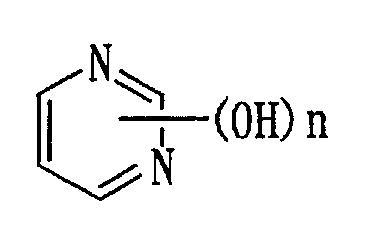
- triazines represented by the formula:
wherein n is as defined above,
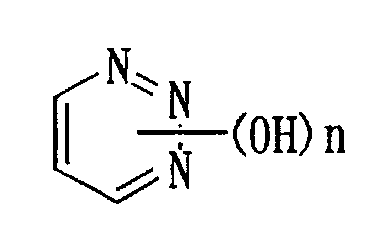
- triazines represented by the formula:
wherein n is as defined above,

- triazines represented by the formula:
wherein n is as defined above,

- compounds represented by the formula:
wherein n is as defined above,
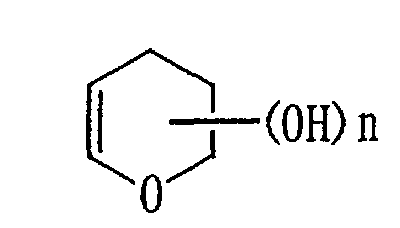
- flavones represented by the formula:
wherein m1 and m2 are integers from 0 to 3, with the proviso m1 + m2 ≥ 2, etc.

-
- Specific examples of such heterocyclic compounds are 2,3-dihydroxypyridine, 2,4-dihydroxypyridine, 2,5-dihydroxypyridine, 2,6-dihydroxypyridine, 3,4-dihydroxypyridine, 3,5-dihydroxypyridine, 2,4,6-trihydroxypyridine, 2,4-dihydroxypyrimidine, 2,5-dihydroxypyrimidine, 3,4-dihydroxypyrimidine, 3,5-dihydroxypyrimidine, 2,4,5-trihydroxypyrimidine, 2,4,6-trihydroxypyrimidine, 4,5,6-trihydroxypyrimidine, 4,5,6-trihydroxytriazine, 3,5,6-trihydroxytriazine, 2,4,6-trihydroxytriazine, D-glucal, 5,7-dihydroxyflavone, 4',5-dihydroxyflavone, 3',4',5-trihydroxyflavone, 4',5,7-trihydroxyflavone, 3',4',5,5'-tetrahydroxyflavone, 3',4',5,7-tetrahydroxyflavone, 3',4',5,5',7-pentahydroxyflavone and the like.
- Examples of alicyclic hydrocarbon compounds having 2 or more hydroxy groups are alicyclic hydrocarbon compounds having 2 to 6 hydroxy groups such as follows:
- steroid compounds represented by the formula:
wherein m1 and m2 are as defined above,
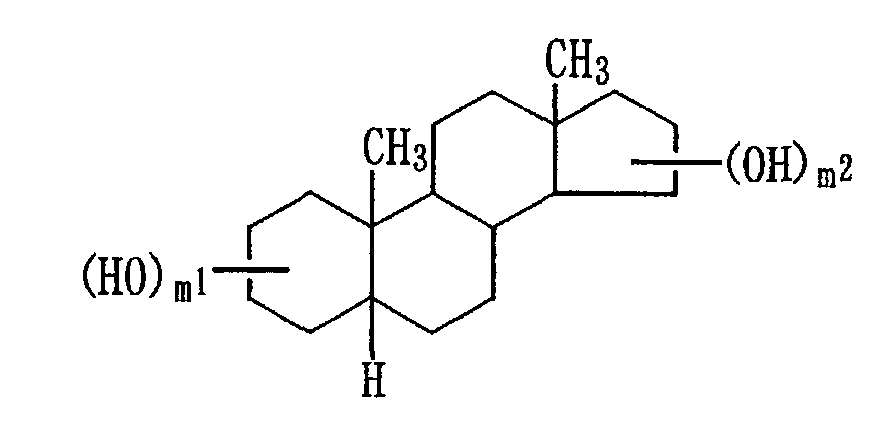
- steroid compounds represented by the formula:
wherein m1 and m2 are as defined above, etc.

-
- Specific examples of such alicyclic hydrocarbon compounds are 3,16-dihydroxyandrostane, 3,17-dihydroxyandrostane, androstane-3,16,17-triol, 3,17-dihydroxyestradiol, 3,16,17-estriol and the like.
- Examples of monocyclic aromatic hydrocarbons having 2 or more hydroxy groups are monocyclic aromatic hydrocarbons having 2 to 9 hydroxy groups such as follows:
- benzenes represented by the formula:
wherein n is as defined above,
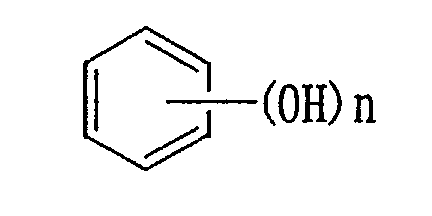
- carbinols represented by the formula:
wherein m1 and m2 are as defined above, and m3 is an integer from 0 to 3, with the proviso m1 + m2 + m3 ≥ 2, etc.

-
- Examples of such monocyclic aromatic hydrocarbons are 1,2-dihydroxybenzene, 1,3-dihydroxybenzene, 1,4-dihydroxybenzene, 1,2,3-trihydroxybenzene, 1,2,4-trihydroxybenzene, 1,3,5-trihydroxybenzene, 2,2',4,4',4"-pentahydroxy triphenylcarbinol and the like.
- Examples of condensed polycyclic aromatic hydrocarbons having 2 or more hydroxy groups are condensed polycyclic aromatic hydrocarbons having 2 to 9 hydroxy groups such as follows:
- naphthalenes represented by the formula:
wherein n is as defined above,
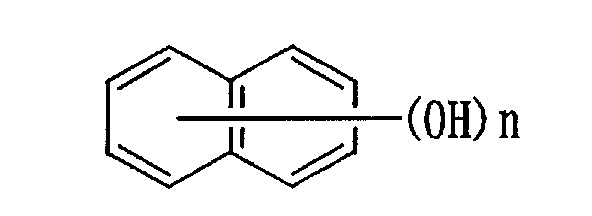
- triphenylenes represented by the formula:
wherein m1, m2 and m3 are as defined above, etc.

-
- Specific examples of such condensed polycyclic aromatic hydrocarbons are 1,2-dihydroxynaphthalene, 1,3-dihydroxynaphthalene, 1,4-dihydroxynaphthalene, 1,5-dihydroxynaphthalene, 1,6-dihydroxynaphthalene, 1,7-dihydroxynaphthalene, 1,8-dihydroxynaphthalene, 2,3-dihydroxynaphthalene, 2,6-dihydroxynaphthalene, 2,7-dihydroxynaphthalene, 2,3,6,7,10,11,-hexahydroxy triphenylene and the like.
- The present invention uses a polyhydric alcohol compound having protected hydroxy group(s) as a starting material. As long as the hydroxy groups are protected, any known polyhydric alcohol compound can be used.
- According to the invention, it is not necessary that all of the hydroxy groups be protected in the polyhydric alcohol used as a starting material. Polyhydric alcohol compounds of the invention include polyhydric alcohol compounds having two hydroxy groups but only one of them being protected such as codeine, etc.
- The protecting groups used for protecting hydroxy group(s) are not limited. Preferable protecting groups include at least one member selected from the group consisting of aliphatic hydrocarbon groups, alicyclic hydrocarbon groups and aromatic hydrocarbon groups.
- An aliphatic hydrocarbon groups include saturated aliphatic hydrocarbon groups and unsaturated aliphatic hydrocarbon groups. Aliphatic hydrocarbon groups may be substituted with aryl groups including a phenyl group. Examples of such aliphatic hydrocarbon groups are lower alkyl groups, lower alkenyl groups and the like. Specific examples of lower alkyl groups are methyl, ethyl, n-propyl, isopropyl, n-butyl, isobutyl, tert-butyl and like C1 to C4 straight or branched alkyl groups, etc. Specific examples of lower alkenyl groups are vinyl, allyl and like C2 to C4 alkenyl groups, etc. Examples of aliphatic hydrocarbon groups substituted with an aryl group are arylalkyl groups and the like. Specific examples of arylalkyl groups are benzyl, 1-phenylethyl, 2-phenylethyl and like phenyl-C1-4 alkyl groups.
- Examples of alicyclic hydrocarbon groups are cyclopentyl, cyclohexyl and like C3 to C8 cycloalkyl groups, etc.
- Examples of aromatic hydrocarbon groups are aryl groups, etc. Specific examples of aryl groups are a phenyl group, a tolyl group and the like.
- Examples of polyhydric alcohols having hydroxy groups being protected by such protecting groups are the compounds as below.
- Examples of heterocyclic compounds having protected hydroxy groups are heterocyclic compounds having 2 to 6 protected hydroxy groups such as follows:
- pyridines represented by the formula:
wherein R is an aliphatic hydrocarbon group, an alicyclic hydrocarbon group or an aromatic hydrocarbon group and n is as defined above,

- pyrimidines represented by the formula:
wherein R and n are as defined above,
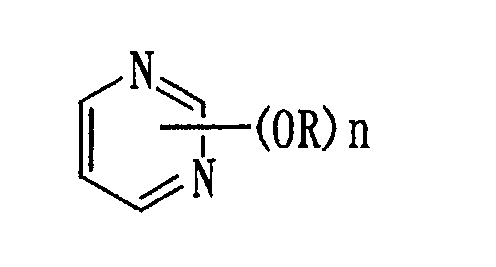
- triazines represented by the formula:
wherein R and n are as defined above,
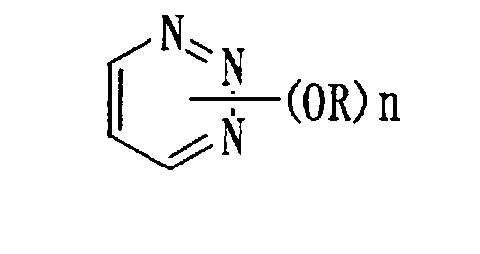
- triazines represented by the formula:
wherein R and n are as defined above,

- triazines represented by the formula:
wherein R and n are as defined above,
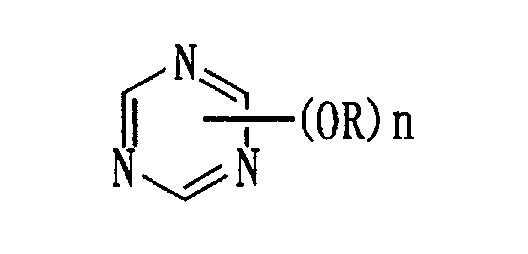
- compounds represented by the formula:
wherein R and n are as defined above,

- flavones represented by the formula:
wherein R, m1 and m2 are as defined above, etc.
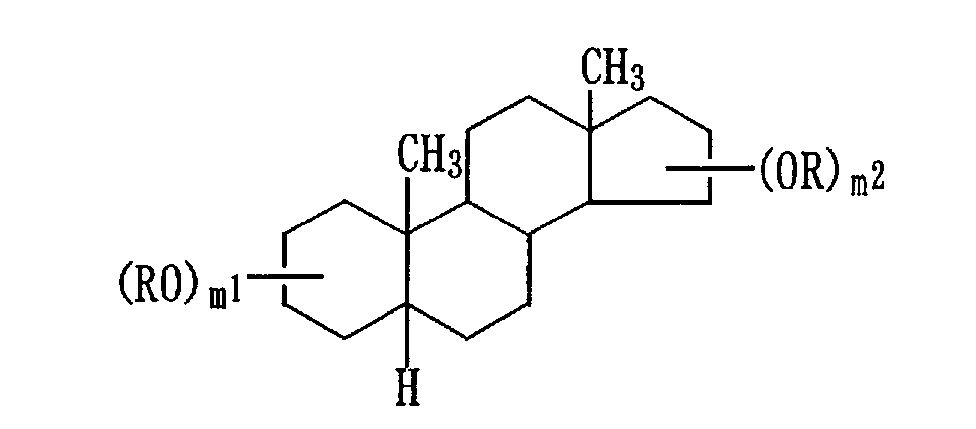
-
- Specific examples of heterocyclic compounds having protected hydroxy groups are 2,3-dimethoxypyridine, 2,4-dimethoxypyridine, 2,5-dimethoxypyridine, 2,6-dimethoxypyridine, 3,4-dimethoxypyridine, 3,5-dimethoxypyridine, 2,4,6-trimethoxypyridine, 2,3-diethoxypyridine, 2,4-diethoxypyridine, 2,5-diethoxypyridine, 2,6-diethoxypyridine, 3,4-diethoxypyridine, 3,5-diethoxypyridine, 2,4,6-triethoxypyridine, 2,3-di-(t-butoxy)pyridine, 2,4-di-(t-butoxy)pyridine, 2,5-di-(t-butoxy)pyridine, 2,6-di-(t-butoxy)pyridine, 3,4-di-(t-butoxy)pyridine, 3,5-di-(t-butoxy)pyridine, 2,4,6-tri-(t-butoxy)pyridine, 2,3-diallyloxypyridine, 2,4-diallyloxypyridine, 2,5-diallyloxypyridine, 2,6-diallyloxypyridine, 3,4-diallyloxypyridine, 3,5-diallyloxypyridine, 2,4,6-triallyloxypyridine, 2,4-dimethoxypyrimidine, 2,5-dimethoxypyrimidine, 3,4-dimethoxypyrimidine, 3,5-dimethoxypyrimidine, 2,4,5-trimethoxypyrimidine, 2,4,6-trimethoxypyrimidine, 4,5,6-trimethoxypyrimidine, 2,4-diethoxypyrimidine, 2,5-diethoxypyrimidine, 3,4-diethoxypyrimidine, 3,5-diethoxypyrimidine, 2,4,5-triethoxypyrimidine, 2,4,6-triethoxypyrimidine, 4,5,6-triethoxypyrimidine, 2,4-di-(t-butoxy)pyrimidine, 2,5-di-(t-butoxy)pyrimidine, 3,4-di-(t-butoxy)pyrimidine, 3,5-di-(t-butoxy)pyrimidine, 2,4,5-tri-(t-butoxy)pyrimidine, 2,4,6-tri-(t-butoxy)pyrimidine, 4,5,6-tri-(t-butoxy)pyrimidine, 2,4-diallyloxypyrimidine, 2,5-diallyloxypyrimidine, 3,4-diallyloxypyrimidine, 3,5-diallyloxypyrimidine, 2,4,5-triallyloxypyrimidine, 2,4,6-triallyloxypyrimidine, 4,5,6-triallyloxypyrimidine, 4,5,6-trimethoxytriazine, 4,5,6-triethoxytriazine, 4,5,6-tri-(t-butoxy)triazine, 4,5,6-triallyloxytriazine, 3,5,6-trimethoxytriazine, 3,5,6-triethoxytriazine, 3,5,6-tri-(t-butoxy)triazine, 3,5,6-triallyloxytriazine, 2,4,6-trimethoxytriazine, 2,4,6-triethoxytriazine, 2,4,6-tri-(t-butoxy)triazine, 2,4,6-triallyloxytriazine, tri-O-benzyl-D-glucal, 5,7-dimethoxyflavone, 4',5-dimethoxyflavone, 3',4',5-trimethoxyflavone, 4',5,7-trimethoxyflavone, 3',4',5,5'-tetramethoxyflavone, 3,4',5,7-tetramethoxyflavone, 3',4',5,5',7-pentamethoxyflavone, 5-hydroxy-4'-methoxyflavone, 5-hydroxy-3',4'-dimethoxyflavone, 5-hydroxy-3',4',5'-trimethoxyflavone and the like.
- Examples of alicyclic hydrocarbon compounds having protected hydroxy groups are alicyclic hydrocarbon compounds having 2 to 6 protected hydroxy groups such as follows:
- steroid compounds represented by the formula:
wherein R, m1 and m2 are as defined above,

- steroid compounds represented by the formula:
wherein R, m1 and m2 are as defined above, etc.
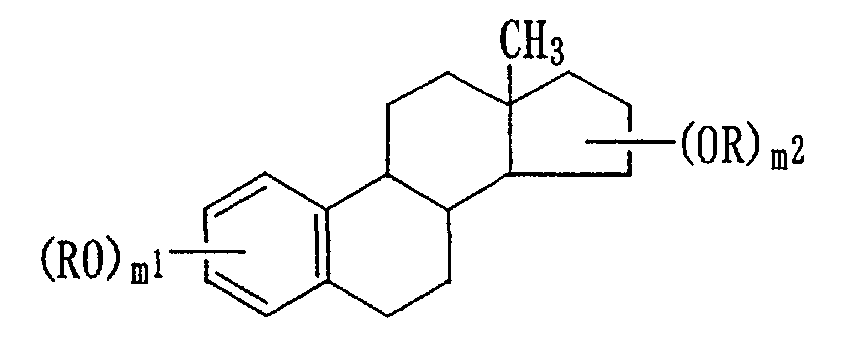
-
- Specific examples of alicyclic hydrocarbon compounds having protected hydroxy groups are 3,16-dimethoxyandrostane, 3,17-dimethoxyandrostane, 3,16-dimethoxyandrostane, 3,16,17-trimethoxyandrostane, 3,17-dimethoxyestradiol, 3,17-diethoxyestradiol, 3,16,17-tri-O-methylerythritol and the like.
- Examples of monocyclic aromatic hydrocarbons having protected hydroxy groups are monocyclic aromatic hydrocarbons having 2 to 9 protected hydroxy groups such as follows:
- benzenes represented by the formula:
wherein R and n are as defined above,

- carbinols represented by the formula:
wherein R, m1, m2 and m3 are as defined above, etc.
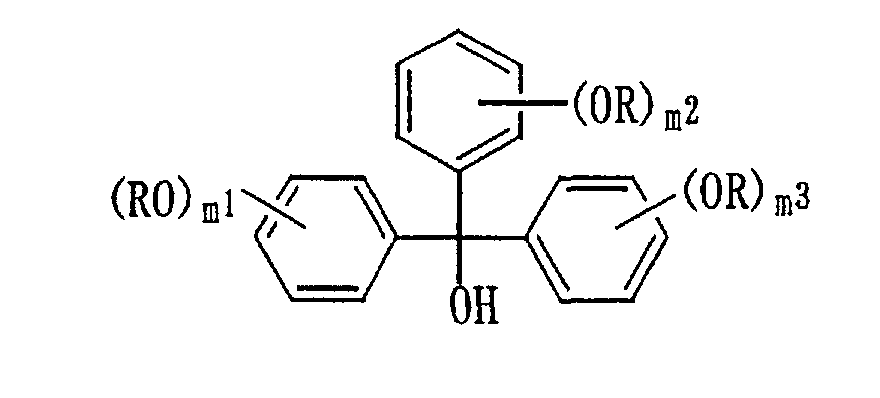
-
- Specific examples of monocyclic aromatic hydrocarbons having protected hydroxy groups are 1,2-dimethoxybenzene, 1,3-dimethoxybenzene, 1,4-dimethoxybenzene, 1,2-diethoxybenzene, 1,3-diethoxybenzene, 1,4-diethoxybenzene, 1,2-di-(t-butoxy)benzene, 1,3-di-(t-butoxy)benzene, 1,4-di-(t-butoxy)benzene, 1,2-diallyloxybenzene, 1,3-diallyloxybenzene, 1,4-diallyloxybenzene, 1,2,3-trimethoxybenzene, 1,2,4-trimethoxybenzene, 1,3,5-trimethoxybenzene, 1,2,3-triethoxybenzene, 1,2,4-triethoxybenzene, 1,3,5-triethoxybenzene, 1,2,3-tri-(t-butoxy)benzene, 1,2,4-tri-(t-butoxy)benzene, 1,3,5-tri-(t-butoxy)benzene, 1,2,3-triallyloxybenzene, 1,2,4-triallyloxybenzene, 1,3,5-triallyloxybenzene, diphenyl ether, 2,2',4,4',4''-pentamethoxy triphenyl carbinol and the like.
- Examples of condensed polycyclic aromatic hydrocarbons having 2 or more protected hydroxy groups are the condensed polycyclic aromatic hydrocarbons having 2 to 9 hydroxy groups such as follows:
- naphthalenes represented by the formula:
wherein R and n are as defined above,
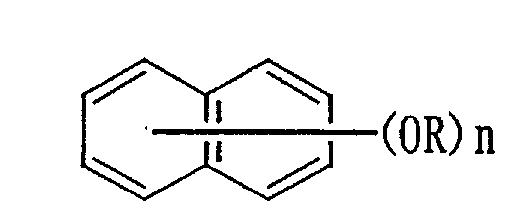
- triphenylenes represented by the formula:
wherein R, m1, m2 and m3 are as defined above, etc.

-
- Specific examples of condensed polycyclic aromatic hydrocarbons having protected hydroxy groups are 1,2-dimethoxynaphthalene, 1,3-dimethoxynaphthalene, 1,4-dimethoxynaphthalene, 1,5-dimethoxynaphthalene, 1,6-dimethoxynaphthalene, 1,7-dimethoxynaphthalene, 1,8-dimethoxynaphthalene, 2,3-dimethoxynaphthalene, 2,6-dimethoxynaphthalene, 2,7-dimethoxynaphthalene, 1,2-diethoxynaphthalene, 1,3-diethoxynaphthalene, 1,4-diethoxynaphthalene, 1,5-diethoxynaphthalene, 1,6-diethoxynaphthalene, 1,7-diethoxynaphthalene, 1,8-diethoxynaphthalene, 2,3-diethoxynaphthalene, 2,6-diethoxynaphthalene, 2,7-diethoxynaphthalene, 1,2-di-(t-butoxy)naphthalene, 1,3-di-(t-butoxy)naphthalene, 1,4-di-(t-butoxy)naphthalene, 1,5-di-(t-butoxy)naphthalene, 1,6-di-(t-butoxy)naphthalene, 1,7-di-(t-butoxy)naphthalene, 1,8-di-(t-butoxy)naphthalene, 2,3-di-(t-butoxy)naphthalene, 2,6-di-(t-butoxy)naphthalene, 2,7-di-(t-butoxy)naphthalene, 1,2-diallyloxynaphthalene, 1,3-diallyloxynaphthalene, 1,4-diallyloxynaphthalene, 1,5-diallyloxynaphthalene, 1,6-diallyloxynaphthalene, 1,7-diallyloxynaphthalene, 1,8-diallyloxynaphthalene, 2,3-diallyloxynaphthalene, 2,6-diallyloxynaphthalene, 2,7-diallyloxynaphthalene, 2,3,6,7,10,11-hexamethoxyphenylene and the like.
- The reaction system of the invention requires the presence of a basic compound or an acid having a pKa (acid dissociation exponent) of -8 to 3 at 25°C. Presence of the aforementioned basic compound or acid in the reaction system enables the deprotection step to progress more smoothly, and results in an improved yield of the objective compounds.
- Heretofore known acids can be used as long as they have acid dissociation exponents in the range defined above. Such acids include hydrochloric acid, nitric acid, sulfuric acid, phosphoric acid and like mineral acids, trifluoroacetic acid, monochloroacetic acid, methanesulfonic acid, trifluoromethanesulfonic acid and like organic acids, etc. When an acid with an acid dissociation exponent that does not fall in the above range, for example, acetic acid having a dissociation exponent of 4.75 is used, the object of the invention cannot be achieved. Hydrochloric acid is preferable. The aforementioned trifluororacetic acid, methanesulfonic acid and like organic acids can also be used as organic solvents as described below.
- In the invention, known basic compounds can be used. Specific examples are sodium hydroxide, potassium hydroxide and like alkali metal hydroxides, calcium hydroxide and like alkaline earth metal hydroxides, triethylamine, diisopropylamine, pyridine, N,N-dimethylaniline and like organic amines, potassium tert-butoxide and like alkali metal alcoxides, etc. A preferable basic compound is sodium hydroxide.
- The above acids can be used alone or in combinations. The basic compounds can also be used alone or in combinations.
- The amount of acid or basic compound used is not limited and is selected from a wide range depending on various conditions including the types of starting materials, the amounts and kinds of solvents, the type of acid or basic compound, the reaction conditions (frequency and power of the microwaves, reaction temperature, reaction time, etc.) and the like. However, the amount used is generally about 0.5 to about 10 equivalent, and preferably about 1 to about 3 equivalent based on the protecting group(s) of the polyhydric alcohol compounds.
- In the invention, the deprotection reaction (hydrolysis) whereby the protecting groups are removed from polyhydric alcohol compounds having protected hydroxy groups is generally conducted in water or a water-organic solvent mixture. The water-organic solvent mixture comprises an organic solvent and water which can be a homogeneous system or a two-phase system. When a water-organic solvent mixture is used, the ratio of water to organic solvent is not limited and is selected from a wide range depending on various conditions including the types and amounts of starting materials, the kinds of solvents, the type and amounts of acid or basic compound, the reaction conditions (frequency and power of the microwaves, reaction temperature, reaction time, etc.) and the like. However, it is preferable that water and the organic solvent are mixed in such a manner that all the protected hydroxy groups in the polyhydric alcohol compounds subjected to deprotection will be hydrolyzed, i.e., the content of water will exceed the total moles of the protected hydroxy groups. The ratio of water:organic solvent is preferably in the range of 1:100 to 100:1, and more preferably in the range of 1:10 to 10:1.
- Organic solvents usable with water are not limited insofar as they do not adversely affect the reaction. Specific examples are formic acid, acetic acid, trifluoroacetic acid, methanesulfonic acid and like organic acids, ethanol, isopropyl alcohol, ethylene glycol and like alcohols, acetone, methyl ethyl ketone and like ketones, dioxane, tetrahydrofuran and like cyclic ethers, pentane, hexane, cyclohexane and like hydrocarbons, benzene, toluene and like aromatic hydrocarbons, dichloromethane, dichloroethane, chlorobenzene and like halogenated hydrocarbons, etc. They can be used singly or in combinations.
- The amount of solvent (water or water-organic solvent mixture) used is not limited and is selected from a wide range depending on various conditions including the types of starting materials, the types of solvents, the type and amounts of acid or basic compound, the reaction condition (frequency and power of the microwaves, reaction temperature, reaction time, etc.) and the like. However, the amount is generally about 1 to about 10 liters, and preferably about 5 to about 50 liters per 1 kg of the starting materials.
- In the invention, the frequency of the microwaves irradiating the reaction system is generally in the range of from 915 MHz to 28 GHz, preferably from 915 MHz to 5.8 GHz, and most preferably 2.45 GHz.
- The power of microwave is not limited and is selected from a wide range depending on various conditions including the types and amounts of starting materials, the types and amounts of solvents, the type and amounts of acid or basic compound, the reaction conditions (frequency of the microwaves, reaction temperature, reaction time, etc.) and the like, and, generally, is in the range of from 200 to 1600 W, preferably in the range of from 400 to 1200 W. The microwave irradiation can be conducted continuously or intermittently. The microwave irradiation time depends on the frequency and the power of the microwaves, etc. and cannot be generalized, however, usually it is in the range of about 30 seconds to about 3 hours.
- The reaction of the invention is conducted with or without stirring, generally at about 0°C to about 200°C, and preferably at about 60°C to about 160°C. The reaction time varies depending on the types and amounts of starting materials, the power of the microwaves, the reaction temperature and the like. The reaction is generally completed in about 1 minute to about 3 hours. The reaction of the invention can also be conducted under ordinary pressure. When the reaction is conducted under ordinary pressure, the temperature should not exceed the reflux temperature of the solvent, and therefore in order to complete the reaction in a short time, the reaction of the invention is preferably conducted under pressure. When the reaction pressure is too high, decomposition of starting material and objective compounds may occur, and therefore the reaction pressure is generally 0.1 to 3 MPa, and preferably 0.2 to 1 MPa.
- The polyhydric alcohols obtained by the process of the invention can be readily isolated from the reaction system and purified by a general purification process.
- According to the process of the invention, all the hydroxy protecting groups can be completely removed from the polyhydric alcohol compounds in a short time without being accompanied by side effects such as decomposition of the objective polyhydric alcohol compounds, etc.
- By employing the process of the invention, hydroxy heterocyclic compounds, hydroxy aromatic compounds and steroid compounds useful as pharmaceutical intermediates or resin materials can be obtained in a short time, a high purity and a high yield.
- The process of the invention requires neither expensive and special reagents nor troublesome waste liquid disposal.
- According to the process of the invention, the objective polyhydric alcohols can be industrially and effectively produced from polyhydric alcohol compounds having protected hydroxy groups.
- The process of the invention can be applied even when the objective polyhydric alcohol is water-soluble polyhydric alcohol.
- The following Examples and Comparative Examples illustrate the present invention in further detail.
- In a 50 cc glass sealed tube, 0.751 g of 2,6-dimethoxypyridine, 18 ml of 35% hydrochloric acid and 18 ml of acetic acid were placed. In an oven-type microwave irradiator where power and temperature are controllable, the mixture was continuously irradiated with microwaves having a frequency of 2.45 GHz and a power of 400 W, and then subjected to the reaction at 140°C and 0.51 MPa for 10 minutes. The reaction mixture was analyzed using liquid chromatography, showing a residual ratio of the starting material (2,6-dimethoxypyridine) of 0.2%, and a yield of the objective compound (2,6-dihydroxypyridine) of 98.7%.
- Water (20 ml) was added to the reaction mixture, and its pH was adjusted to be 8 to 9 using a 10 % sodium hydroxide aqueous solution. Thereafter, the reaction mixture was subjected to extraction twice with 50 ml of ethyl acetate. The extract was dried on anhydrous magnesium sulfate and concentrated under reduced pressure, and the resultant residue was crystallized by adding a small amount of ether, obtaining 0.558 g of the objective compound (2,6-dihydroxypyridine, yield : 96%, purity : 99%).
1H-NMR(DMSO)δppm: 3.4(brs, 2H), 5.7(d,1H), 7.3(dd, 2H)
EI-MS: M+=111 - The treatment was conducted in the same manner as in Example 1 except that the reaction in a microwave irradiator was carried out at 120°C and 0.31 MPa for 3 minutes while intermittently irradiating the mixture with microwaves having a frequency of 2.45 GHz and a power of 1000 W for 0.3 seconds and then pausing for 0.7 seconds. The reaction mixture was analyzed using liquid chromatography, showing a residual ratio of the starting material (2,6-dimethoxypyridine) of 1.3%, and a yield of the objective compound (2,6-dihydroxypyridine) of 99.0%.
- The resultant mixture was treated in the same manner as in Example 1, obtaining 0.564 g of the objective compound (2,6-dihydroxypyridine, yield:97%, purity:99%). The obtained 2,6-dihydroxypyridine gave the same 1H-NMR and EI-MS as those of the 2,6-dihydroxypyridine obtained in Example 1.
- In a 50 cc short-neck flask, 0.751 g of 2,6-dimethoxypyridine, 18 ml of 35% hydrochloric acid and 18 ml of acetic acid were placed, and then the flask was dipped in an oil bath of 140°C while conducting stirring reflux for 1 hour. The reaction mixture was analyzed using liquid chromatography, showing a yield of 2,6-dihydroxypyridine of 28.8% and a residual ratio of the starting material (2,6-dimethoxypyridine) of 51.2%.
- In a 50 cc glass sealed tube, 0.751 g of 2,6-dimethoxypyridine, 18 ml of 35% hydrochloric acid and 18 ml of acetic acid were placed. The tube was dipped in an oil bath of 140°C and the mixture was subjected to the reaction at 140°C and 0.51 MPa for 1 hour. The reaction mixture was analyzed using liquid chromatography, showing a yield of 2,6-dihydroxypyridine of 11.3% and a residual ratio of the starting material (2,6-dimethoxypyridine) of 13.4%.
- The treatment was conducted in the same manner as in Example 1 except that 0.8304 g of 2,7-dimethoxynaphthalene was used instead of 0.751 g of 2,6-dimethoxypyridine, and the reaction was conducted for 2 minutes. The reaction mixture was analyzed using liquid chromatography, showing a yield of the objective compound (2,7-dihydroxynaphthalene) of 99.8% and a residual ratio of the starting material (2,7-dimethoxynaphthalene) of 0.0%.
- In a 50 cc glass sealed tube, 0.8304 g of 2,7-dimethoxynaphthalene, 18 ml of 1 M sodium hydroxide aqueous solution and 18 ml of methyl ethyl ketone were placed. In an oven-type microwave irradiator where power and temperature are controllable, the mixture was continuously irradiated with microwaves having a frequency of 2.45 GHz and a power of 400 W, and then subjected to the reaction at 120°C and 0.62 MPa for 20 minutes. The reaction mixture was analyzed using liquid chromatography, showing a yield of the objective compound (2,7-dihydroxynaphthalene) of 88.9% and a residual ratio of the starting material (2,7-dimethoxynaphthalene) of 5.9%.
- The resultant mixture was subjected to the same process as in Example 1, obtaining a desired compound (2,7-dihydroxynaphthalene) having a purity of 99% at a yield of 87%.
- In a 50 cc glass sealed tube, 0.8304 g of 2,7-dimethoxynaphthalene, 1.2 ml of 35% hydrochloric acid (equivalent of the methoxy groups) and 18 ml of acetic acid were placed. In an oven-type microwave irradiator where power and temperature are controllable, the mixture was continuously irradiated with microwaves having a frequency of 2.45 GHz and a power of 400 W, and then subjected to the reaction at 140°C and 0.51 MPa for 2 minutes. The reaction mixture was analyzed using liquid chromatography, showing a yield of the objective compound (2,7-dihydroxynaphthalene) of 94.4% and a residual ratio of the starting material (2,7-dimethoxynaphthalene) of 0.0%.
- The resultant mixture was subjected to the same process as in Example 1, obtaining an objective compound (2,7-dihydroxynaphthalene) having a purity of 99% at a yield of 93%.
- The trreatment was conducted in the same manner as in Comparative Example 1 except that 0.8304 g of 2,7-dimethoxynaphthalene was used instead of 0.751 g of 2,6-dimethoxypyridine. The reaction mixture was analyzed using liquid chromatography, showing a yield of the objective compound (2,7-dihydroxynaphthalene) of 74.7% and a residual ratio of the starting material (2,7-dimethoxynaphthalene) of 0.0%.
- The test was conducted in the same manner as in Comparative Example 2 except that 0.8304 g of 2,7-dimethoxynaphthalene was used instead of 0.751 g of 2,6-dimethoxypyridine. The reaction mixture was analyzed using liquid chromatography, showing a yield of the objective compound (2,7-dihydroxynaphthalene) of 81.2% and a residual ratio of the starting material (2,7-dimethoxynaphthalene) of 0.0%.
- In a 50 cc glass sealed tube, 3.6 g of 2,3,6,7,10,11-hexamethoxytriphenylene, 20 ml of 35% hydrochloric acid and 20 ml of acetic acid were placed. In an oven-type microwave irradiator where power and temperature are controllable, the mixture was continuously irradiated with microwaves having a frequency of 2.45 GHz and a power of 800 W, and then subjected to the reaction at 140°C and 0.51 MPa for 2 hours. The reaction mixture was analyzed using liquid chromatography, showing a yield of the objective compound (2,3,6,7,10,11-hexahydroxytriphenylene) of 90.8% and a residual ratio of the starting material (2,3,6,7,10,11-hexamethoxytriphenylene) of 0.0%.
- Pouring this mixture into 100 ml of ice water produces the objective 2,3,6,7,10,11-hexahydroxytriphenylene in the form of crystal (purity:99%, yield:90%).
1H-NMR (DMSO-d6)δppm: 7.605(brs, 6H), 9.292(brs, 6H)
13C-NMR(DMSO-d6)δppm: 139.86, 153.96, 177.46 - In a 50 cc glass sealed tube, 3.6 g of 2,3,6,7,10,11-hexamethoxytriphenylene, 20 ml of 35% hydrochloric acid and 20 ml of acetic acid were placed. In an oven-type microwave irradiator where power and temperature are controllable, the mixture was subjected to the reaction for 2 hours at 140°C and 0.51 MPa by intermittently irradiating the mixture with microwaves having a frequency of 2.45 GHz and a power of 1200 W for 0.5 seconds and then pausing for 0.5 seconds. The reaction mixture was analyzed using liquid chromatography, showing a yield of the objective compound (2,3,6,7,10,11-hexahydroxytriphenylene) of 92.3% and a residual ratio of the starting material (2,3,6,7,10,11-hexamethoxytriphenylene) of 0.0%.
- Pouring this mixture into 100 ml of ice water produces the objective compound (2,3,6,7,10,11-hexahydroxytriphenylene) in the form of crystal (purity:99%, yield:92%).
- The 1H-NMR and 13C-NMR of the obtained 2,3,6,7,10,11-hexahydroxytriphenylene are the same those of 2,3,6,7,10,11-hexahydroxytriphenylene obtained in Example 6.
- In a 50 cc eggplant-type flask, 3.6 g of 2,3,6,7,10,11-hexamethoxytriphenylene, 20 ml of 35% hydrochloric acid and 20 ml of acetic acid were placed, and the flask was dipped in an oil bath of 140°C and the mixture was subjected to 36-hour of reflux while stirring. The reaction mixture was analyzed using liquid chromatography, showing a residual ratio of the starting material (2,3,6,7,10,11-hexamethoxytriphenylene) of 100.0% and no trace of the objective compound (2,3,6,7,10,11-hexahydroxytriphenylene).
- In a 50 cc glass sealed tube, 3.6 g of 2,3,6,7,10,11-hexamethoxytriphenylene, 20 ml of 35% hydrochloric acid and 20 ml of acetic acid were placed and subjected to the reaction at 140°C and 0.51 MPa for 2 hours. Thereafter, the reaction mixture was analyzed using liquid chromatography, showing a residual ratio of the starting material (2,3,6,7,10,11-hexamethoxytriphenylene) of 100% and no trace of the objective compound (2,3,6,7,10,11-hexahydroxytriphenylene).
- In a 50 cc glass sealed tube, 3.0 g of 3, 17-dimethoxyestradiol, 20 ml of 35% hydrochloric acid and 20 ml of acetic acid were placed. In an oven-type microwave irradiator where power and temperature are controllable, the mixture was subjected to the reaction at 120°C and 0.62 MPa for 5 minutes by continuously irradiating microwaves having a frequency of 2.45 GHz and a power of 400 W. Then, the reaction mixture was poured into water, subjected to extrusion with methylene chloride, dried on magnesium sulfate anhydride, concentrated and purified by column chromatography using silica gel, producing 2.7 g of estradiol (purity:99%, yield:79.7%).
- Five millimoles of the polyhydric alcohol compounds having protected hydroxy groups which are listed on Table 1 were subjected to deprotection under the reaction conditions in Table 1 (the reaction temperature was unified to be 140°C), producing polyhydric alcohol compounds. In Table 1, the yield of the polyhydric alcohol compounds is expressed as the objective yield.
- Note that, the objective yield is the area ratio of the resultant compound to the standard object measured using liquid chromatography.
No. Polyhydric alcohol comp. with protection groups Reaction conditions Object. yield (%) Acid and solvent (ml/ml) Pres. (MPa) Microwave irr. cond. Time (Min.) 1 1,2,3-trimethoxybenzene 35% hydrochloric acid/acetic acid (15/15) 0.62 800 W continuous 10 95.5 2 2,7-dimethoxynaphthalene 10% nitric acid/ acetic acid (15/15) 0.59 As above 10 93.9 3 As above 10% sulfuric acid/ acetic acid (15/15) 0.57 As above 10 88.3 4 As above Methanesulfonic acid/acetic acid (15/15) 0.67 As above 40 86.2 5 As above Trifluoroacetic acid/acetic acid (15/15) 0.73 As above 40 80.0 6 As above 50% phosphoric acid/acetic acid (15/15) 0.58 As above 40 80.1 7 As above 35% hydrochloric acid/acetic acid (15/15) 0.62 As above 2 100 8 2,6-di-tert-butoxypyridine 35% hydrochloric acid/acetic acid (15/15) 0.62 400 W continuous 5 99.7 9 2,4,6-trimethoxypyridine 35% hydrochloric acid/acetic acid (15/15) 0.62 As above 10 93.5 10 2,4,6-triallyloxypyridine 35% hydrochloric acid/acetic acid (15/15) 0.62 As above 10 99.0 11 Tri-O-benzyl-D-glucal 35% hydrochloric acid/acetic acid (15/15) 0.62 As above 10 85.0 12 2,3,6,7,10,11-hexamethoxytriphenylene 35% hydrochloric acid/dichloroethane (15/15) 0.95 800W continuous 120 80.0 13 As above 35% hydrochloric acid/toluene (15/15) 0.65 As above 120 89.8 14 As above 35% hydrochloric acid/dioxane (15/15) 0.55 As above 120 90.0
Claims (11)
- A process for preparing a polyhydric alcohol comprising subjecting a polyhydric alcohol compound having protected hydroxy group(s) to microwave irradiation in the presence of basic compound(s) or acid(s) having an acid dissociation exponent (pKa) of -8 to 3 at 25°C and removing the protecting group(s) of the hydroxy group(s) of the polyhydric alcohol compound.
- The process according to claim 1, wherein the desired polyhydric alcohol is one of heterocyclic compounds having 2 or more hydroxy groups, alicyclic hydrocarbon compounds having 2 or more hydroxy groups, monocyclic aromatic hydrocarbons having 2 or more hydroxy groups and condensed polycyclic aromatic hydrocarbons having 2 or more hydroxy groups.
- The process according to claim 1, wherein the protecting group of hydroxy group is at least one member selected from the group consisting of aliphatic hydrocarbon groups, alicyclic hydrocarbon groups and aromatic hydrocarbon groups.
- The process according to claim 3, wherein the aliphatic hydrocarbon group is at least one member selected from the group consisting of lower alkyl groups, lower alkenyl groups and arylalkyl groups.
- The process according to claim 1, wherein the basic compound is at least one member selected from the group consisting of alkali metal hydroxides, alkaline earth metal hydroxides, amines and alkali metal alcoxides.
- The process according to claim 5, wherein the basic compound is an alkali metal hydroxide.
- The process according to claim 1, wherein the acid having an acid dissociation exponent (pKa) of -8 to 3 at 25°C is at least one member selected from the group consisting of hydrochloric acid, nitric acid, sulfuric acid, phosphoric acid, trifluoroacetic acid, monochloroacetic acid, methanesulfonic acid and trifluoromethanesulfonic acid.
- The process according to claim 7, wherein the acid having an acid dissociation exponent (pKa) of -8 to 3 at 25°C to 3 is hydrochloric acid.
- The process according to claim 1, wherein the frequency of the microwaves is in the range from 915 MHz to 28 GHz.
- The process according to claim 1, wherein the frequency of the microwaves is in the range from 915 MHz to 5.8 GHz.
- The process according to claim 1, wherein the power of the microwaves is in the range from 200 W to 1600 W.
Applications Claiming Priority (3)
| Application Number | Priority Date | Filing Date | Title |
|---|---|---|---|
| JP2000203433 | 2000-07-05 | ||
| JP2000203433 | 2000-07-05 | ||
| PCT/JP2001/005829 WO2002002486A1 (en) | 2000-07-05 | 2001-07-05 | Process for the preparation of polyhydric alcohols |
Publications (3)
| Publication Number | Publication Date |
|---|---|
| EP1298115A1 true EP1298115A1 (en) | 2003-04-02 |
| EP1298115A4 EP1298115A4 (en) | 2005-11-16 |
| EP1298115B1 EP1298115B1 (en) | 2009-08-26 |
Family
ID=18700839
Family Applications (1)
| Application Number | Title | Priority Date | Filing Date |
|---|---|---|---|
| EP01947836A Expired - Lifetime EP1298115B1 (en) | 2000-07-05 | 2001-07-05 | Process for the preparation of polyhydric alcohols |
Country Status (6)
| Country | Link |
|---|---|
| US (1) | US6656328B2 (en) |
| EP (1) | EP1298115B1 (en) |
| KR (1) | KR100514900B1 (en) |
| AT (1) | ATE440808T1 (en) |
| DE (1) | DE60139693D1 (en) |
| WO (1) | WO2002002486A1 (en) |
Families Citing this family (4)
| Publication number | Priority date | Publication date | Assignee | Title |
|---|---|---|---|---|
| US20040074760A1 (en) * | 2002-10-17 | 2004-04-22 | Carnegie Mellon University | Production of biofuels |
| US20050274065A1 (en) * | 2004-06-15 | 2005-12-15 | Carnegie Mellon University | Methods for producing biodiesel |
| JP4541230B2 (en) * | 2005-05-25 | 2010-09-08 | ニチコン株式会社 | Electrolytic solution for driving electrolytic capacitors |
| CN107987115B (en) * | 2017-11-28 | 2019-09-03 | 北京金城泰尔制药有限公司 | Utilize the method for Promestriene organic waste residues recycling estradiol |
Family Cites Families (1)
| Publication number | Priority date | Publication date | Assignee | Title |
|---|---|---|---|---|
| JPH07330667A (en) * | 1994-06-10 | 1995-12-19 | Koichi Shinozaki | Production of esters by heating with microwave |
-
2001
- 2001-07-05 DE DE60139693T patent/DE60139693D1/en not_active Expired - Lifetime
- 2001-07-05 EP EP01947836A patent/EP1298115B1/en not_active Expired - Lifetime
- 2001-07-05 AT AT01947836T patent/ATE440808T1/en not_active IP Right Cessation
- 2001-07-05 US US10/070,877 patent/US6656328B2/en not_active Expired - Fee Related
- 2001-07-05 KR KR10-2002-7002712A patent/KR100514900B1/en not_active Expired - Fee Related
- 2001-07-05 WO PCT/JP2001/005829 patent/WO2002002486A1/en not_active Ceased
Non-Patent Citations (2)
| Title |
|---|
| No further relevant documents disclosed * |
| See also references of WO0202486A1 * |
Also Published As
| Publication number | Publication date |
|---|---|
| EP1298115A4 (en) | 2005-11-16 |
| WO2002002486A1 (en) | 2002-01-10 |
| ATE440808T1 (en) | 2009-09-15 |
| KR100514900B1 (en) | 2005-09-16 |
| HK1051678A1 (en) | 2003-08-15 |
| US6656328B2 (en) | 2003-12-02 |
| US20020157939A1 (en) | 2002-10-31 |
| KR20020025246A (en) | 2002-04-03 |
| DE60139693D1 (en) | 2009-10-08 |
| EP1298115B1 (en) | 2009-08-26 |
Similar Documents
| Publication | Publication Date | Title |
|---|---|---|
| KR20020040860A (en) | Method for Production of Aryl Alkyl Ethers | |
| EP0288582B1 (en) | Process for producing alkyl group-substituted aromatic hydrocarbons | |
| Santucci et al. | Some Bromine-containing and Sulfur-containing Aromatic Bornic Acids | |
| EP1298115B1 (en) | Process for the preparation of polyhydric alcohols | |
| Liu et al. | Efficient dealkylation of aryl alkyl ethers catalyzed by Cu2O | |
| KR100598243B1 (en) | Process for the preparation of cyclohexanones | |
| HK1051678B (en) | Process for the preparation of polyhydric alcohols | |
| Gambarotti et al. | Selective monoetherification of 1, 4-hydroquinone promoted by NaNO2 | |
| JPWO2002002486A1 (en) | Method for producing polyhydric alcohol | |
| EP0051681B1 (en) | Process for preparing a dibenzylidenesorbitol or a dibenzylidenexylitol | |
| US4632987A (en) | Process for the preparation of triarylmethane compounds | |
| Sarkar et al. | O-Methylation of polymer-supported phenoxides with dimethyl sulfate | |
| WO2022117071A1 (en) | Method for synthesizing benzyl ether from polyhydric phenol | |
| JP2913706B2 (en) | Chalcone derivative and method for producing the same | |
| US11591305B2 (en) | Method for producing fisetin or fisetin derivatives | |
| Ayres et al. | Lignans and related phenols. Part 18. The synthesis of quinones from podophyllotoxin and its analogues | |
| JPS6259248A (en) | Production of n-vinylformamide | |
| JP3636570B2 (en) | Method for etherifying phenols | |
| US9061989B1 (en) | Method for producing terephthalic acid | |
| Peng et al. | Arginine catalyzed direct aldol reactions in pure water: An environmentally friendly reaction system | |
| EP0318591B1 (en) | Process for preparing dihydroxynaphthalene | |
| Mathers et al. | 257. Walden inversion in the glucose series. Derivatives of altrose | |
| JP5843106B2 (en) | Process for producing 4-substituted piperidine-2-carbonitriles and process for producing 4-substituted piperidine-2-carboxylic acid mineral salts | |
| EP0161499B1 (en) | Process for preparation of aminophthalideisoquinolines | |
| US2546499A (en) | Synthesis of coumarans |
Legal Events
| Date | Code | Title | Description |
|---|---|---|---|
| PUAI | Public reference made under article 153(3) epc to a published international application that has entered the european phase |
Free format text: ORIGINAL CODE: 0009012 |
|
| 17P | Request for examination filed |
Effective date: 20020301 |
|
| AK | Designated contracting states |
Kind code of ref document: A1 Designated state(s): AT BE CH CY DE DK ES FI FR GB GR IE IT LI LU MC NL PT SE TR |
|
| RAP1 | Party data changed (applicant data changed or rights of an application transferred) |
Owner name: NATIONAL INSTITUTE OF ADVANCED INDUSTRIAL SCIENCE Owner name: OTSUKA CHEMICAL CO., LTD. |
|
| A4 | Supplementary search report drawn up and despatched |
Effective date: 20050930 |
|
| 17Q | First examination report despatched |
Effective date: 20070926 |
|
| GRAP | Despatch of communication of intention to grant a patent |
Free format text: ORIGINAL CODE: EPIDOSNIGR1 |
|
| GRAS | Grant fee paid |
Free format text: ORIGINAL CODE: EPIDOSNIGR3 |
|
| GRAA | (expected) grant |
Free format text: ORIGINAL CODE: 0009210 |
|
| AK | Designated contracting states |
Kind code of ref document: B1 Designated state(s): AT BE CH CY DE DK ES FI FR GB GR IE IT LI LU MC NL PT SE TR |
|
| REG | Reference to a national code |
Ref country code: GB Ref legal event code: FG4D |
|
| REG | Reference to a national code |
Ref country code: CH Ref legal event code: EP |
|
| REG | Reference to a national code |
Ref country code: IE Ref legal event code: FG4D |
|
| REF | Corresponds to: |
Ref document number: 60139693 Country of ref document: DE Date of ref document: 20091008 Kind code of ref document: P |
|
| REG | Reference to a national code |
Ref country code: HK Ref legal event code: GR Ref document number: 1051678 Country of ref document: HK |
|
| PG25 | Lapsed in a contracting state [announced via postgrant information from national office to epo] |
Ref country code: AT Free format text: LAPSE BECAUSE OF FAILURE TO SUBMIT A TRANSLATION OF THE DESCRIPTION OR TO PAY THE FEE WITHIN THE PRESCRIBED TIME-LIMIT Effective date: 20090826 Ref country code: FI Free format text: LAPSE BECAUSE OF FAILURE TO SUBMIT A TRANSLATION OF THE DESCRIPTION OR TO PAY THE FEE WITHIN THE PRESCRIBED TIME-LIMIT Effective date: 20090826 Ref country code: SE Free format text: LAPSE BECAUSE OF FAILURE TO SUBMIT A TRANSLATION OF THE DESCRIPTION OR TO PAY THE FEE WITHIN THE PRESCRIBED TIME-LIMIT Effective date: 20090826 |
|
| NLV1 | Nl: lapsed or annulled due to failure to fulfill the requirements of art. 29p and 29m of the patents act | ||
| PG25 | Lapsed in a contracting state [announced via postgrant information from national office to epo] |
Ref country code: NL Free format text: LAPSE BECAUSE OF FAILURE TO SUBMIT A TRANSLATION OF THE DESCRIPTION OR TO PAY THE FEE WITHIN THE PRESCRIBED TIME-LIMIT Effective date: 20090826 |
|
| PG25 | Lapsed in a contracting state [announced via postgrant information from national office to epo] |
Ref country code: PT Free format text: LAPSE BECAUSE OF FAILURE TO SUBMIT A TRANSLATION OF THE DESCRIPTION OR TO PAY THE FEE WITHIN THE PRESCRIBED TIME-LIMIT Effective date: 20091228 Ref country code: CY Free format text: LAPSE BECAUSE OF FAILURE TO SUBMIT A TRANSLATION OF THE DESCRIPTION OR TO PAY THE FEE WITHIN THE PRESCRIBED TIME-LIMIT Effective date: 20090826 |
|
| PG25 | Lapsed in a contracting state [announced via postgrant information from national office to epo] |
Ref country code: ES Free format text: LAPSE BECAUSE OF FAILURE TO SUBMIT A TRANSLATION OF THE DESCRIPTION OR TO PAY THE FEE WITHIN THE PRESCRIBED TIME-LIMIT Effective date: 20091207 Ref country code: DK Free format text: LAPSE BECAUSE OF FAILURE TO SUBMIT A TRANSLATION OF THE DESCRIPTION OR TO PAY THE FEE WITHIN THE PRESCRIBED TIME-LIMIT Effective date: 20090826 |
|
| PG25 | Lapsed in a contracting state [announced via postgrant information from national office to epo] |
Ref country code: BE Free format text: LAPSE BECAUSE OF FAILURE TO SUBMIT A TRANSLATION OF THE DESCRIPTION OR TO PAY THE FEE WITHIN THE PRESCRIBED TIME-LIMIT Effective date: 20090826 |
|
| PLBE | No opposition filed within time limit |
Free format text: ORIGINAL CODE: 0009261 |
|
| STAA | Information on the status of an ep patent application or granted ep patent |
Free format text: STATUS: NO OPPOSITION FILED WITHIN TIME LIMIT |
|
| 26N | No opposition filed |
Effective date: 20100527 |
|
| PG25 | Lapsed in a contracting state [announced via postgrant information from national office to epo] |
Ref country code: GR Free format text: LAPSE BECAUSE OF FAILURE TO SUBMIT A TRANSLATION OF THE DESCRIPTION OR TO PAY THE FEE WITHIN THE PRESCRIBED TIME-LIMIT Effective date: 20091127 |
|
| PG25 | Lapsed in a contracting state [announced via postgrant information from national office to epo] |
Ref country code: MC Free format text: LAPSE BECAUSE OF NON-PAYMENT OF DUE FEES Effective date: 20100731 |
|
| REG | Reference to a national code |
Ref country code: CH Ref legal event code: PL |
|
| GBPC | Gb: european patent ceased through non-payment of renewal fee |
Effective date: 20100705 |
|
| PG25 | Lapsed in a contracting state [announced via postgrant information from national office to epo] |
Ref country code: IT Free format text: LAPSE BECAUSE OF FAILURE TO SUBMIT A TRANSLATION OF THE DESCRIPTION OR TO PAY THE FEE WITHIN THE PRESCRIBED TIME-LIMIT Effective date: 20090826 |
|
| PG25 | Lapsed in a contracting state [announced via postgrant information from national office to epo] |
Ref country code: LI Free format text: LAPSE BECAUSE OF NON-PAYMENT OF DUE FEES Effective date: 20100731 Ref country code: CH Free format text: LAPSE BECAUSE OF NON-PAYMENT OF DUE FEES Effective date: 20100731 |
|
| PG25 | Lapsed in a contracting state [announced via postgrant information from national office to epo] |
Ref country code: GB Free format text: LAPSE BECAUSE OF NON-PAYMENT OF DUE FEES Effective date: 20100705 Ref country code: IE Free format text: LAPSE BECAUSE OF NON-PAYMENT OF DUE FEES Effective date: 20100705 |
|
| PG25 | Lapsed in a contracting state [announced via postgrant information from national office to epo] |
Ref country code: LU Free format text: LAPSE BECAUSE OF NON-PAYMENT OF DUE FEES Effective date: 20100705 |
|
| PG25 | Lapsed in a contracting state [announced via postgrant information from national office to epo] |
Ref country code: TR Free format text: LAPSE BECAUSE OF FAILURE TO SUBMIT A TRANSLATION OF THE DESCRIPTION OR TO PAY THE FEE WITHIN THE PRESCRIBED TIME-LIMIT Effective date: 20090826 |
|
| REG | Reference to a national code |
Ref country code: DE Ref legal event code: R082 Ref document number: 60139693 Country of ref document: DE Representative=s name: MEISSNER, BOLTE & PARTNER GBR, DE |
|
| REG | Reference to a national code |
Ref country code: DE Ref legal event code: R082 Ref document number: 60139693 Country of ref document: DE Representative=s name: MEISSNER, BOLTE & PARTNER GBR, DE |
|
| PGFP | Annual fee paid to national office [announced via postgrant information from national office to epo] |
Ref country code: FR Payment date: 20140821 Year of fee payment: 14 |
|
| PGFP | Annual fee paid to national office [announced via postgrant information from national office to epo] |
Ref country code: DE Payment date: 20140929 Year of fee payment: 14 |
|
| REG | Reference to a national code |
Ref country code: DE Ref legal event code: R119 Ref document number: 60139693 Country of ref document: DE |
|
| PG25 | Lapsed in a contracting state [announced via postgrant information from national office to epo] |
Ref country code: DE Free format text: LAPSE BECAUSE OF NON-PAYMENT OF DUE FEES Effective date: 20160202 |
|
| REG | Reference to a national code |
Ref country code: FR Ref legal event code: ST Effective date: 20160331 |
|
| PG25 | Lapsed in a contracting state [announced via postgrant information from national office to epo] |
Ref country code: FR Free format text: LAPSE BECAUSE OF NON-PAYMENT OF DUE FEES Effective date: 20150731 |