EP1298053A2 - Engine control system - Google Patents
Engine control system Download PDFInfo
- Publication number
- EP1298053A2 EP1298053A2 EP02020906A EP02020906A EP1298053A2 EP 1298053 A2 EP1298053 A2 EP 1298053A2 EP 02020906 A EP02020906 A EP 02020906A EP 02020906 A EP02020906 A EP 02020906A EP 1298053 A2 EP1298053 A2 EP 1298053A2
- Authority
- EP
- European Patent Office
- Prior art keywords
- power turbine
- turbine speed
- control system
- speed control
- recited
- Prior art date
- Legal status (The legal status is an assumption and is not a legal conclusion. Google has not performed a legal analysis and makes no representation as to the accuracy of the status listed.)
- Granted
Links
Images


Classifications
-
- B—PERFORMING OPERATIONS; TRANSPORTING
- B64—AIRCRAFT; AVIATION; COSMONAUTICS
- B64C—AEROPLANES; HELICOPTERS
- B64C27/00—Rotorcraft; Rotors peculiar thereto
- B64C27/001—Vibration damping devices
-
- B—PERFORMING OPERATIONS; TRANSPORTING
- B64—AIRCRAFT; AVIATION; COSMONAUTICS
- B64C—AEROPLANES; HELICOPTERS
- B64C27/00—Rotorcraft; Rotors peculiar thereto
- B64C27/04—Helicopters
- B64C27/12—Rotor drives
- B64C27/14—Direct drive between power plant and rotor hub
-
- B—PERFORMING OPERATIONS; TRANSPORTING
- B64—AIRCRAFT; AVIATION; COSMONAUTICS
- B64D—EQUIPMENT FOR FITTING IN OR TO AIRCRAFT; FLIGHT SUITS; PARACHUTES; ARRANGEMENT OR MOUNTING OF POWER PLANTS OR PROPULSION TRANSMISSIONS IN AIRCRAFT
- B64D31/00—Power plant control systems; Arrangement of power plant control systems in aircraft
- B64D31/02—Initiating means
- B64D31/06—Initiating means actuated automatically
-
- F—MECHANICAL ENGINEERING; LIGHTING; HEATING; WEAPONS; BLASTING
- F02—COMBUSTION ENGINES; HOT-GAS OR COMBUSTION-PRODUCT ENGINE PLANTS
- F02C—GAS-TURBINE PLANTS; AIR INTAKES FOR JET-PROPULSION PLANTS; CONTROLLING FUEL SUPPLY IN AIR-BREATHING JET-PROPULSION PLANTS
- F02C9/00—Controlling gas-turbine plants; Controlling fuel supply in air- breathing jet-propulsion plants
- F02C9/26—Control of fuel supply
- F02C9/28—Regulating systems responsive to plant or ambient parameters, e.g. temperature, pressure, rotor speed
-
- F—MECHANICAL ENGINEERING; LIGHTING; HEATING; WEAPONS; BLASTING
- F02—COMBUSTION ENGINES; HOT-GAS OR COMBUSTION-PRODUCT ENGINE PLANTS
- F02C—GAS-TURBINE PLANTS; AIR INTAKES FOR JET-PROPULSION PLANTS; CONTROLLING FUEL SUPPLY IN AIR-BREATHING JET-PROPULSION PLANTS
- F02C9/00—Controlling gas-turbine plants; Controlling fuel supply in air- breathing jet-propulsion plants
- F02C9/48—Control of fuel supply conjointly with another control of the plant
- F02C9/56—Control of fuel supply conjointly with another control of the plant with power transmission control
-
- G—PHYSICS
- G05—CONTROLLING; REGULATING
- G05B—CONTROL OR REGULATING SYSTEMS IN GENERAL; FUNCTIONAL ELEMENTS OF SUCH SYSTEMS; MONITORING OR TESTING ARRANGEMENTS FOR SUCH SYSTEMS OR ELEMENTS
- G05B5/00—Anti-hunting arrangements
- G05B5/01—Anti-hunting arrangements electric
-
- F—MECHANICAL ENGINEERING; LIGHTING; HEATING; WEAPONS; BLASTING
- F05—INDEXING SCHEMES RELATING TO ENGINES OR PUMPS IN VARIOUS SUBCLASSES OF CLASSES F01-F04
- F05D—INDEXING SCHEME FOR ASPECTS RELATING TO NON-POSITIVE-DISPLACEMENT MACHINES OR ENGINES, GAS-TURBINES OR JET-PROPULSION PLANTS
- F05D2220/00—Application
- F05D2220/30—Application in turbines
- F05D2220/32—Application in turbines in gas turbines
- F05D2220/329—Application in turbines in gas turbines in helicopters
-
- F—MECHANICAL ENGINEERING; LIGHTING; HEATING; WEAPONS; BLASTING
- F05—INDEXING SCHEMES RELATING TO ENGINES OR PUMPS IN VARIOUS SUBCLASSES OF CLASSES F01-F04
- F05D—INDEXING SCHEME FOR ASPECTS RELATING TO NON-POSITIVE-DISPLACEMENT MACHINES OR ENGINES, GAS-TURBINES OR JET-PROPULSION PLANTS
- F05D2270/00—Control
- F05D2270/01—Purpose of the control system
- F05D2270/02—Purpose of the control system to control rotational speed (n)
-
- F—MECHANICAL ENGINEERING; LIGHTING; HEATING; WEAPONS; BLASTING
- F05—INDEXING SCHEMES RELATING TO ENGINES OR PUMPS IN VARIOUS SUBCLASSES OF CLASSES F01-F04
- F05D—INDEXING SCHEME FOR ASPECTS RELATING TO NON-POSITIVE-DISPLACEMENT MACHINES OR ENGINES, GAS-TURBINES OR JET-PROPULSION PLANTS
- F05D2270/00—Control
- F05D2270/01—Purpose of the control system
- F05D2270/05—Purpose of the control system to affect the output of the engine
- F05D2270/052—Torque
Definitions
- the subject invention relates to the operation of gas turbine engines, and more particularly, to a control system for a turboshaft engine of a helicopter which includes a wide-band speed governor.
- the main and tail rotors define the primary flight control surfaces for the aircraft.
- the rotor drive train for the main and tail rotor is coupled to the power plant which can have a single or twin engine configuration.
- Engine response is therefore critical to the control of the aircraft.
- Even more critical to the control of the aircraft is fast fuel flow response to the engine.
- the subject invention is directed to a new and useful control system for a turboshaft engine of a helicopter.
- the control system includes a speed control loop with means for generating a power turbine speed signal based upon a demanded rotor speed, means for filtering the power turbine speed signal by effectuating a rapid attenuation of main and tail rotor torsional frequencies in the power turbine speed signal without compromising phase at low frequencies, and a governor for providing isochronous power turbine speed and rotor speed control based upon the filtered power turbine speed signal.
- the means for filtering the power turbine speed signal is a high-order filter.
- the high-order filter is an eighth order filter.
- the high-order filter is configured as three second order filters cascaded in series with two first order filters.
- the high-order filter is configured as a sixth order filter in series with a second order filter.
- the speed control system of the subject invention further includes an optional active torsional damping loop for damping main and tail rotor torsional frequencies.
- the torsional damping loop includes a Kalman state estimator for estimating a plurality of engine states based upon one or more measured engine states, such as, for example power turbine shaft torque (QS).
- QS power turbine shaft torque
- the torsional damping loop also includes a Linear Quadratic Regulator (LQR) that provides combustive damping.
- LQR Linear Quadratic Regulator
- Fig. 1 a schematic representation of the engine control system of the subject invention which is designated generally by reference numeral 10. More particularly, the engine control system 10 includes an outer engine speed control loop 12 and an inner torsional damping loop 14 that may be selectively activated by the pilot of the aircraft.
- the inner torsional damping loop 14 provides active damping of torsional resonance frequencies without significantly affecting the rotor speed governing loop 12 of the engine control system 10.
- the outer engine speed control loop 12 includes a Power Turbine Governor (PTG) 16 providing proportional and derivative control paths.
- the PTG receives an input signal from a primary summing junction 18. This signal is based upon the pilot's demanded rotor speed (NF*) and the filtered free turbine speed signal (NF).
- the PTG delivers an output signal to a secondary summing junction 20 which also receives input signals from rotor load anticipators and the optional torsional damping loop 14 when activated by the pilot.
- the resultant signal from summing junction 20 is indicative of the Demanded Rate of Change of the Gas Generator Speed (NDOT*).
- NDOT* Demanded Rate of Change of the Gas Generator Speed
- This signal is input into an auctioneering circuit 22 which incorporates software programming that determines a highest or lowest NDOT* value based upon engine limits related to acceleration/deceleration, torque and temperature.
- a signal indicative of the winning NDOT* value is used as the input to the fuel control unit 24, together with a signal indicative of the gas generator speed (NG) sensed from the core engine 30.
- the fuel control unit 24 Based upon these signals, the fuel control unit 24 generates a proportional signal indicative of the fuel flow (WF) divided by the compressor discharge pressure (P3).
- This proportional signal is input into a multiplier junction 26 that receives a sensed signal indicative of the compressor discharge pressure (P3) of the core engine 30.
- the (P3) denominator is dropped from the proportional signal by the multiplier, and the resulting output signal from multiplier junction 26 is indicative of the demanded fuel flow (WF*).
- a signal indicative of the demanded fuel flow (WF*) is input into the hydromechanical unit (HMU) 28 that includes, among other things, a fuel metering valve (not shown) for regulating the amount of fuel delivered to the core engine 30.
- HMU hydromechanical unit
- a signal indicative of the engine output torque (QGAS) is transmitted from the core engine 30 to the power turbines and rotor drive train control unit 32, which, in turn produces two distinct signals.
- One signal is indicative of the free power turbine speed (NF), and the other signal is indicative of the power turbine shaft torque (QS).
- the signal indicative of NF is input into a high-order torsional filter 40, the function and configuration of which is described in detail hereinbelow.
- the signal indicative of QS is used as the input signal to the optional torsional damping loop 14, as will also be discussed hereinbelow with reference to Fig. 5.
- the signal indicative of NF is a compound signal containing a plurality of contributing frequencies. Included among these frequencies, are the main and tail rotor torsional frequencies.
- the high-order filter 40 is adapted and configured to attenuate torsional oscillations in the power turbine speed signal (NF) that are directly associated with the main and tail rotors.
- NF power turbine speed signal
- the high-order filter 40 provides greater attenuation of the main and tail rotor resonant frequencies, as compared to a baseline control system, in both single engine and twin engine configurations.
- the high-order filter also allows for the magnitude peak at about 30 rad/sec.
- the high-order filter 40 functions to minimize the low frequency phase lag, as compared to a baseline control system.
- the increased attenuation provided by the high-order filter allows the proportional and derivative gains of the PTG to be increased by about a factor of three, as compared to a baseline control system. Consequently, the bandwidth of the outer turbine speed control loop 12 is increased by about a factor three as compared to the baseline control system.
- Table 1.0 summarizes the differences in characteristics of the baseline and high-order torsional filter for single and twin engines coupled to the UH-60L Black Hawk rotor drive train.
- Figs. 3 and 4 there are illustrated open loop bode diagrams for twin engine operation at sea level, standard day ambient conditions for the baseline and wide-band governor system.
- the cross-over frequency at unity gain or the bandwidth of the baseline control system is about 3-4 rad/sec.
- the cross-over frequency or bandwidth of the wide-band governor is about 8-10 rad/sec. This represents an increase in bandwidth on the order of two to three times that of the baseline system.
- Table 2.1 presents a summary of the baseline system's power turbine governor control loop stability margins and open loop system bandwidth for twin engine operation when coupled to the rotor drive train.
- the tail rotor torsional attenuation exceeds that of the main rotor, therefore the torsional attenuation listed in the table represents that of the main rotor.
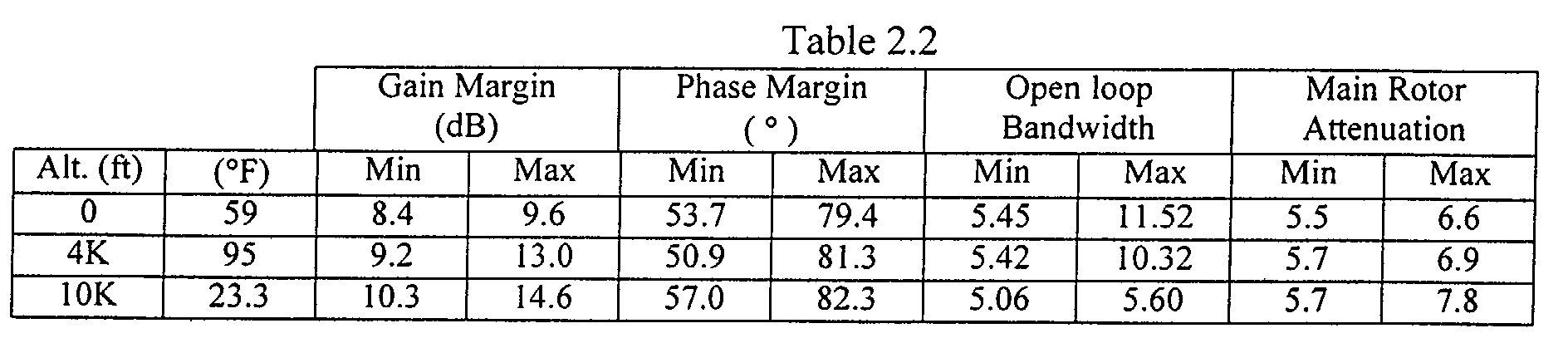
- Table 2.2 presents a summary of the wide-band governor control loop stability margins and open loop system bandwidth for twin engine operation when coupled to the rotor drive train.
- the increased open loop bandwidth is due to tripling the PD gains, It should be noted hat there is no significant decrease in the main torsional frequency attenuation despite the increase in bandwidth.
- VDVP variable displacement vane pump
- the wide-band governor of the subject invention runs on an ECU with a sampling time often milliseconds.
- the high-order filter allows for a tripling of proportional and derivative (PD) gains when compared to the baseline control.
- the wide-band governor of the subject invention is configured to maintain open loop gain and phase margins of at least 6dB and 45° respectively, throughout the powered region of the engine operating envelope when coupled to the rotor drive train. This configuration provides stable, responsive and well damped power turbine speed control
- the baseline speed control loop incorporates, in the feedback path, a second order attenuating lead-lag (notch) filter, sized for the Black Hawk helicopter, cascaded in series with a first order lag filter to provide gain attenuation of the main and tail rotor resonant modes.
- notch lead-lag
- the wide-band governor speed control loop of the subject invention incorporates, in the feedback path, an eighth order attenuating filter to provide increased gain attenuation of the main and tail rotor resonant modes.
- the high-order filter is sized to minimize the phase lag in the low frequency region (below 10 rad/sec) while providing more attenuation of the main and tail rotor resonant peak amplitudes than the baseline filters.
- the anti-resonant notch frequencies of the high-order filter are sized to account for the effective torsional frequency shifts between the single and twin coupled engine operation.
- the high-order filter of the subject invention can be configured as three second order (notch ) filters cascaded in series with two first order lead/lag filters.
- the high-order torsional filter can be configured as a sixth order lead/lag filter in series with a second order lead/lag filter.
- Yaw anticipation in an engine control system is designed to accommodate the change in rotor load resulting immediately from changes in tail rotor pitch.
- lateral cyclic anticipation in an engine control system is designed to accommodate the change in rotor load resulting from right/left lateral rolls.
- the increased bandwidth of the outer speed loop 12 of control system 10 eliminates the need for yaw and lateral cyclic open loop load anticipation. It has been determined however, that open loop anticipators are necessary for rotor decay anticipation and collective pitch anticipation. Accordingly, the control system of the subject invention does incorporate appropriate rotor load anticipators.
- the engine control system 10 of the subject invention includes an optional active inner torsional damping loop 14.
- Damping loop 14 receives a signal indicative of the measured power turbine shaft torque (QS) from a sensor operatively associated with the power turbines and the rotor drive train.
- the measured signal input into a summing junction 50 which also receives an estimated QS which is a function of gas generator speed (NG).
- NG gas generator speed
- the difference between the actual QS and the estimated QS, otherwise referred to as the ⁇ QS from the summing junction, is input into a high pass filter 52. This high pass filter effectively nulls out any steady state errors in the signal, and allows only the torsional frequencies to pass therethrough.
- the filtered signal is then sent to a Kalman state estimator 54 which is programmed to estimate twelve different dynamic variables associated with the power turbines and rotor drive train using the measured QS to estimate all of the other states or dynamic variables for feedback control.
- the twelve states estimated by the Kalman estimator are defined as follows:
- the twelve estimated states are input into a Linear Quadratic Regulator (LQR) 56 where they undergo gain reduction/amplification and summation, as described in more detail hereinbelow with respect to Fig. 5.
- the resulting control signal is indicative of ⁇ NDOT * and is passed to summing junction 20 where it is added to the power turbine governor output signal and the signal from the rotor load anticipators.
- the active damping loop 14 is optional. Accordingly, the inner loop 14 includes a switching gate 58 that follows the LQR summing junction, that may be selectively actuated to activate the damping loop.
- the functional operation of the LQR and Kalman estimator is illustrated in Fig. 5. As shown, the measured raw shaft torque and the estimated shaft torque are summed to produce a ⁇ QS .
- the ⁇ QS is input into a high pass K T QS filter which effectively nulls out steady state error in the shaft torque signal and generates a filtered ⁇ QS which is summed with the unfiltered ⁇ QS to produce a shaft torque signal indicative of the torsional frequencies of the rotor drive system.
- the resultant signal is applied to a (12 x1) Kalman gain vector containing the twelve estimated dynamic state variables discussed above.
- the resulting values are input into a Kalman summing junction which receives three additional feedback signals indicative of various dynamic properties of the control system architecture (A, B and C).
- the summing junction produces an X andDOT vector that is input into a (12 x 1) integrator to generate a signal indicative of X and .
- the three additional feedback signals sent to the Kalman summing junction follow from the integrated X and .
- the first feedback loop includes a (12 x 1) output vector C and a (1 x 12) Kalman gain vector.
- the second feedback loop includes a (1 x 12 ) K or LQR gain vector, a gain reducer and a (12 x 1) input vector B.
- the third feedback loop includes a (12 x 12) dynamic property vector A. The signals from the three feedback loops and summed at the Kalman summing junction with the primary Kalman gain vector. The output signal from the X and integrator is summed and reduced as a function of gas generator speed (NG), resulting in the aforementioned ⁇ NDOT*.
- NG gas generator speed
- LQR Linear Quadratic Regulator
- the Kalman estimator is designed as an adjunct problem to the LQR problem whereby state weight Q is selected to be the identity matrix so that the estimated states are driven to be equal to actual values, and control weight R is chosen to give acceptable bandwidth (e.g., 70 rad/sec) and to attenuate higher frequencies.
- a power turbine speed control system for a helicopter which includes components for generating a power turbine speed signal based upon a demanded rotor speed, a high-order filter for filtering the power turbine speed signal by effectuating a rapid attenuation of main and tail rotor torsional frequencies in the power turbine speed signal without compromising phase at low frequencies, and a governor for providing isochronous power turbine speed and rotor speed control based upon the filtered power turbine speed signal.
Landscapes
- Engineering & Computer Science (AREA)
- Mechanical Engineering (AREA)
- Chemical & Material Sciences (AREA)
- Combustion & Propulsion (AREA)
- Aviation & Aerospace Engineering (AREA)
- General Engineering & Computer Science (AREA)
- Physics & Mathematics (AREA)
- General Physics & Mathematics (AREA)
- Automation & Control Theory (AREA)
- Control Of Turbines (AREA)
- Control Of Eletrric Generators (AREA)
- Control Of Velocity Or Acceleration (AREA)
- Feedback Control In General (AREA)
Abstract
Description
- NF*
- Demanded Free Power Turbine Speed
- NF
- Free Power Turbine Speed
- NG
- Gas Generator Speed
- NDOT*
- Demanded Rate of Change of Power Turbine Speed
- WF*
- Demanded Fuel Flow
- WF
- Actual Fuel Flow
- P3
- Compressor Discharge Pressure
- HMU
- Hydro-mechanical Unit
- QGAS
- Gas Generator Output Torque
- QS
- Power Turbine Shaft Torque


- Xand1 =
- Main Rotor Gearbox Speed ( ΔNGB )
- Xand2 =
- Main Rotor Speed ( ΔNR )
- Xand3 =
- Effective Lag Hinge Damper Velocity ( ΔNLHD )
- Xand4 =
- Main Rotor Shaft Torque ( ΔQRS )
- Xand5 =
- Tail Rotor Speed ( ΔNT )
- Xand6 =
- Gas Generator High Pressure Turbine Speed ( ΔNH )
- Xand7 =
- Engine Burn Flow ( ΔWfburn )
- Xand8 =
- Power Turbine Speed ( ΔNF )
- Xand9 =
- NDOT Control Output ( ΔWF/P3 )
- Xand10 =
- HMU Output Fuel Flow ( ΔWF )
- Xand11 =
- Tail Rotor Shaft Torque ( ΔQTS )
- Xand12 =
- Power Turbine Shaft Torque ( ΔQS )

Claims (19)
- A power turbine speed control system for a helicopter comprising:a) means for generating a power turbine speed signal based upon a demanded rotor speed;b) means for filtering the power turbine speed signal by effectuating a rapid attenuation of main and tail rotor torsional frequencies in the power turbine speed signal without compromising phase at low frequencies; andc) a governor for providing isochronous power turbine speed and rotor speed control based upon the filtered power turbine speed signal.
- A power turbine speed control system as recited in Claim 1, wherein the means for filtering the power turbine speed signal is a high-order filter.
- A power turbine speed control system as recited in Claim 2, wherein the high-order filter is an eighth order filter.
- A power turbine speed control system as recited in Claim 2, wherein the high-order filter is configured as three second order filters cascaded in series with two first order filters.
- A power turbine speed control system as recited in Claim 2, wherein the high-order filter is configured as a sixth order filter in series with a second order filter.
- A power turbine speed control system as recited in Claim 1, wherein the governor has a sampling time of about ten milliseconds.
- A power turbine speed control system as recited in Claim 1, further comprising damping means for actively damping main and tail rotor torsional frequencies.
- A power turbine speed control system as recited in Claim 7, wherein the damping means includes means for estimating a plurality of engine states based upon a single measured engine state.
- A power turbine speed control system as recited in Claim 8, wherein the single measured engine state is power turbine shaft torque.
- A power turbine speed control system as recited in Claim 7, wherein the damping means includes a linear quadratic regulator that provides combustive damping.
- A power turbine speed control system as recited in Claim 7, further comprising means for selectively activating the damping means.
- A power turbine speed control system as recited in Claim 7, wherein the damping means is tuned to provide attenuation of resonant frequencies so as not to influence low frequency response of the system.
- A power turbine speed control system as recited in Claim 12, wherein the damping means includes a high pass filter.
- A power turbine speed control system for a helicopter comprising:a) means for generating a power turbine speed signal and a power turbine shaft torque signal from a power turbine and rotor drive train;b) filtering means for filtering the power turbine speed signal by effectuating a rapid attenuation of main and tail rotor torsional frequencies in the power turbine speed signal without compromising phase at low frequencies; andc) damping means for actively damping main and tail rotor torsional frequencies in the power turbine shaft torque signal.
- A power turbine speed control system as recited in Claim 14, further comprising means for selectively activating the damping means.
- A power turbine speed control system as recited in Claim 14, further comprising a governor for providing isochronous power turbine speed and rotor speed control based upon the filtered power turbine speed signal.
- A power turbine speed control system as recited in Claim 14, wherein the filtering means is a high-order filter.
- A power turbine speed control system as recited in Claim 14, wherein the damping means includes a Kalman state estimator and a linear quadratic regulator.
- A power turbine speed control system as recited in Claim 18, wherein the a Kalman state estimator estimates a plurality of engine states using the power turbine shaft torque signal and the linear quadratic regulator uses total energy of the rotor drive train.
Priority Applications (1)
| Application Number | Priority Date | Filing Date | Title |
|---|---|---|---|
| EP05012146A EP1568606B1 (en) | 2001-09-26 | 2002-09-18 | Engine control system |
Applications Claiming Priority (2)
| Application Number | Priority Date | Filing Date | Title |
|---|---|---|---|
| US09/963,180 US6729139B2 (en) | 2001-09-26 | 2001-09-26 | Engine control system |
| US963180 | 2001-09-26 |
Related Child Applications (1)
| Application Number | Title | Priority Date | Filing Date |
|---|---|---|---|
| EP05012146A Division EP1568606B1 (en) | 2001-09-26 | 2002-09-18 | Engine control system |
Publications (3)
| Publication Number | Publication Date |
|---|---|
| EP1298053A2 true EP1298053A2 (en) | 2003-04-02 |
| EP1298053A3 EP1298053A3 (en) | 2003-11-12 |
| EP1298053B1 EP1298053B1 (en) | 2005-08-17 |
Family
ID=25506857
Family Applications (2)
| Application Number | Title | Priority Date | Filing Date |
|---|---|---|---|
| EP05012146A Expired - Lifetime EP1568606B1 (en) | 2001-09-26 | 2002-09-18 | Engine control system |
| EP02020906A Expired - Lifetime EP1298053B1 (en) | 2001-09-26 | 2002-09-18 | Engine control system |
Family Applications Before (1)
| Application Number | Title | Priority Date | Filing Date |
|---|---|---|---|
| EP05012146A Expired - Lifetime EP1568606B1 (en) | 2001-09-26 | 2002-09-18 | Engine control system |
Country Status (4)
| Country | Link |
|---|---|
| US (2) | US6729139B2 (en) |
| EP (2) | EP1568606B1 (en) |
| JP (1) | JP2003148171A (en) |
| DE (2) | DE60214253T2 (en) |
Cited By (5)
| Publication number | Priority date | Publication date | Assignee | Title |
|---|---|---|---|---|
| EP1571509A1 (en) * | 2004-03-02 | 2005-09-07 | General Electric Company | Model-based control systems and methods for gas turbine engines |
| FR2956481A1 (en) * | 2010-02-18 | 2011-08-19 | Snecma | METHOD FOR DETECTING RESONANCE OF A ROTOR SHAFT OF A TURBOMOTEUR |
| WO2012003134A3 (en) * | 2010-07-02 | 2012-02-16 | Woodward Hrt, Inc. | Controller for actuation system employing kalman estimator incorporating effect of system structural stiffness |
| US9435683B2 (en) | 2014-10-22 | 2016-09-06 | Rolls-Royce Plc | Method to determine inertia in a shaft system |
| CN112761795A (en) * | 2020-12-29 | 2021-05-07 | 中国航发控制系统研究所 | Control system and method for single-rotor turboprop power device |
Families Citing this family (43)
| Publication number | Priority date | Publication date | Assignee | Title |
|---|---|---|---|---|
| US6879885B2 (en) * | 2001-11-16 | 2005-04-12 | Goodrich Pump & Engine Control Systems, Inc. | Rotor torque predictor |
| US7643928B2 (en) * | 2004-01-05 | 2010-01-05 | Bombardier Transportation Gmbh | System and method for controlling the speed of a gas turbine engine |
| US8942866B2 (en) * | 2004-11-08 | 2015-01-27 | Textron Innovations Inc. | Extension of three loop control laws for system uncertainties, calculation time delay and command quickness |
| US8948936B2 (en) | 2004-11-08 | 2015-02-03 | Textron Innovations Inc. | Vehicle management system using finite state machines |
| CN100591900C (en) * | 2004-11-08 | 2010-02-24 | 贝尔直升机泰克斯特龙公司 | Flight control system with three control loop design |
| US7235892B2 (en) * | 2005-09-09 | 2007-06-26 | Cummins, Inc. | Load-based quadratic compensator gain adjustment |
| US7931231B2 (en) * | 2007-05-18 | 2011-04-26 | Sikorsky Aircraft Corporation | Engine anticipation for rotary-wing aircraft |
| US8275500B2 (en) * | 2008-03-11 | 2012-09-25 | Honeywell International Inc. | Gas turbine engine fixed collective takeoff compensation control system and method |
| US7839304B2 (en) * | 2008-05-01 | 2010-11-23 | The United States Of America As Represented By The Secretary Of The Navy | Method and system for alerting aircrew to unsafe vibration levels |
| GB2463647B (en) * | 2008-09-17 | 2012-03-14 | Chapdrive As | Turbine speed stabillisation control system |
| US20130133751A1 (en) * | 2009-12-08 | 2013-05-30 | Christoph Backi | Method and device for regulating the production of steam in a steam plant |
| US8723349B2 (en) | 2011-10-07 | 2014-05-13 | General Electric Company | Apparatus for generating power from a turbine engine |
| US8723385B2 (en) | 2011-10-07 | 2014-05-13 | General Electric Company | Generator |
| US9002615B2 (en) * | 2012-01-18 | 2015-04-07 | General Electric Company | Methods and systems for managing power of an engine |
| WO2013123385A1 (en) | 2012-02-15 | 2013-08-22 | Rolls-Royce Corporation | Gas turbine engine performance seeking control |
| US8829701B2 (en) | 2012-10-11 | 2014-09-09 | Pratt & Whitney Canada Corp. | Resonant mode damping system and method |
| US9382847B2 (en) * | 2012-11-02 | 2016-07-05 | Pratt & Whitney Canada Corp. | Rotor resonance disturbance rejection controller |
| FR3000465B1 (en) * | 2012-12-27 | 2015-02-13 | Eurocopter France | METHOD FOR ROTATING A MAIN ROTOR OF ROTOR OF ROTOR, ACCORDING TO A VARIABLE VALUE ROTATION SPEED SET |
| US10113487B2 (en) * | 2013-10-24 | 2018-10-30 | United Technologies Corporation | Cascaded multi-variable control system for a turboshaft engine |
| US10316760B2 (en) | 2014-02-24 | 2019-06-11 | United Technologies Corporation | Turboshaft engine control |
| DE102014204115A1 (en) * | 2014-03-06 | 2015-09-10 | Robert Bosch Gmbh | Emergency mode for a piston engine in an aircraft |
| EP3201086B1 (en) * | 2014-10-01 | 2019-07-31 | Sikorsky Aircraft Corporation | Power management between a propulsor and a coaxial rotor of a helicopter |
| US9494085B2 (en) * | 2015-01-19 | 2016-11-15 | United Technologies Corporation | System and method for load power management in a turboshaft gas turbine engine |
| CN105240131B (en) * | 2015-09-02 | 2017-10-24 | 中国南方航空工业(集团)有限公司 | Gas turbine control method and device |
| US10240544B2 (en) | 2016-10-27 | 2019-03-26 | Rolls-Royce Corporation | Adaptive controller using unmeasured operating parameter |
| US10309330B2 (en) | 2016-10-27 | 2019-06-04 | Rolls-Royce Corporation | Model reference adaptive controller |
| US10641184B2 (en) | 2016-11-15 | 2020-05-05 | Sikorsky Aircraft Corporation | Dynamic flight command cross-feed for rotor speed droop reduction |
| CN108280245B (en) * | 2017-01-06 | 2021-09-03 | 南方电网科学研究院有限责任公司 | Damping characteristic analysis method of water turbine speed regulating system |
| US10287026B2 (en) * | 2017-02-04 | 2019-05-14 | Bell Helicopter Textron Inc. | Power demand anticipation systems for rotorcraft |
| FR3067325B1 (en) * | 2017-06-13 | 2022-02-18 | Airbus Helicopters | REGULATION SYSTEM FOR CONTROLLING THE VIBRATIONAL BEHAVIOR AND/OR THE TORSIONAL STABILITY OF A KINEMATIC CHAIN, GIRAVION EQUIPPED WITH SUCH A REGULATION SYSTEM AND ASSOCIATED REGULATION METHOD |
| CN108443022B (en) * | 2018-03-01 | 2019-08-09 | 南京航空航天大学 | Method and device for suppressing torsional vibration of aircraft engine with variable rotor speed |
| US10961922B2 (en) * | 2018-04-04 | 2021-03-30 | Raytheon Technologies Corporation | Systems and methods for power turbine governing |
| US11092136B2 (en) * | 2018-05-04 | 2021-08-17 | Raytheon Technologies Corporation | Systems and methods for optimal speed protection for power turbine governing |
| FR3082225B1 (en) | 2018-06-07 | 2020-06-05 | Safran Helicopter Engines | ASYMMETRIC PROPULSIVE HEAT RECOVERY SYSTEM |
| US10961921B2 (en) | 2018-09-19 | 2021-03-30 | Pratt & Whitney Canada Corp. | Model-based control system and method for a turboprop engine |
| US11781476B2 (en) * | 2019-06-25 | 2023-10-10 | Pratt & Whitney Canada Corp. | System and method for operating a multi-engine rotorcraft |
| CN110556840B (en) * | 2019-08-23 | 2023-04-28 | 广西电网有限责任公司电力科学研究院 | A damping control method and control system for a speed regulation system of a gas turbine generator set |
| US11873081B2 (en) | 2021-06-09 | 2024-01-16 | Textron Innovations Inc. | Supplemental engine power control |
| US12606313B2 (en) * | 2022-03-29 | 2026-04-21 | Pratt & Whitney Canada Corp. | Aircraft powerplant(s) for an aircraft with electric machine controlled propulsor speed |
| US12077308B2 (en) | 2022-04-14 | 2024-09-03 | Textron Innovations Inc. | Supplemental engine transition control |
| US12054245B2 (en) * | 2022-07-18 | 2024-08-06 | Textron Innovations Inc. | Optimizing usage of supplemental engine power |
| US12055103B2 (en) * | 2022-09-06 | 2024-08-06 | Woodward, Inc. | Fuel system with reduced bypass flow |
| CN116577993B (en) * | 2023-06-19 | 2024-01-26 | 南京航空航天大学 | Neural network self-adaptive control method and device for turboshaft engine |
Family Cites Families (9)
| Publication number | Priority date | Publication date | Assignee | Title |
|---|---|---|---|---|
| US4411595A (en) * | 1979-09-19 | 1983-10-25 | General Electric Company | Control system for gas turbine engine |
| US4466526A (en) | 1982-04-16 | 1984-08-21 | Chandler Evans Inc. | Helicopter engine control with rotor speed decay anticipator |
| US4423593A (en) * | 1982-04-16 | 1984-01-03 | Chandler Evans Inc. | Fuel control for controlling helicopter rotor/turbine acceleration |
| US4493465A (en) | 1982-04-16 | 1985-01-15 | Chandler Evans Inc. | Helicopter engine torque compensator |
| US4531361A (en) | 1982-04-19 | 1985-07-30 | Chandler Evans, Inc. | Torsional mode suppressor |
| US4453378A (en) | 1982-04-19 | 1984-06-12 | Chandler Evans, Inc. | Torsional mode suppressor |
| US4648797A (en) | 1983-12-19 | 1987-03-10 | United Technologies Corporation | Torque control system |
| US5051918A (en) * | 1989-09-15 | 1991-09-24 | United Technologies Corporation | Gas turbine stall/surge identification and recovery |
| US5189620A (en) | 1989-10-06 | 1993-02-23 | United Technologies Corporation | Control system for gas turbine helicopter engines and the like |
-
2001
- 2001-09-26 US US09/963,180 patent/US6729139B2/en not_active Expired - Fee Related
-
2002
- 2002-09-18 DE DE60214253T patent/DE60214253T2/en not_active Expired - Lifetime
- 2002-09-18 DE DE60205554T patent/DE60205554T2/en not_active Expired - Lifetime
- 2002-09-18 EP EP05012146A patent/EP1568606B1/en not_active Expired - Lifetime
- 2002-09-18 EP EP02020906A patent/EP1298053B1/en not_active Expired - Lifetime
- 2002-09-25 JP JP2002279272A patent/JP2003148171A/en active Pending
-
2003
- 2003-07-07 US US10/614,364 patent/US6986641B1/en not_active Expired - Lifetime
Cited By (7)
| Publication number | Priority date | Publication date | Assignee | Title |
|---|---|---|---|---|
| EP1571509A1 (en) * | 2004-03-02 | 2005-09-07 | General Electric Company | Model-based control systems and methods for gas turbine engines |
| FR2956481A1 (en) * | 2010-02-18 | 2011-08-19 | Snecma | METHOD FOR DETECTING RESONANCE OF A ROTOR SHAFT OF A TURBOMOTEUR |
| US8474307B2 (en) | 2010-02-18 | 2013-07-02 | Snecma | Method for detecting resonance in a rotor shaft of a turbine engine |
| WO2012003134A3 (en) * | 2010-07-02 | 2012-02-16 | Woodward Hrt, Inc. | Controller for actuation system employing kalman estimator incorporating effect of system structural stiffness |
| US8427093B2 (en) | 2010-07-02 | 2013-04-23 | Woodward Hrt, Inc. | Controller for actuation system employing Kalman estimator incorporating effect of system structural stiffness |
| US9435683B2 (en) | 2014-10-22 | 2016-09-06 | Rolls-Royce Plc | Method to determine inertia in a shaft system |
| CN112761795A (en) * | 2020-12-29 | 2021-05-07 | 中国航发控制系统研究所 | Control system and method for single-rotor turboprop power device |
Also Published As
| Publication number | Publication date |
|---|---|
| US6986641B1 (en) | 2006-01-17 |
| DE60205554D1 (en) | 2005-09-22 |
| EP1568606A2 (en) | 2005-08-31 |
| US20030094001A1 (en) | 2003-05-22 |
| US6729139B2 (en) | 2004-05-04 |
| EP1568606B1 (en) | 2006-08-23 |
| EP1568606A3 (en) | 2005-09-07 |
| EP1298053B1 (en) | 2005-08-17 |
| DE60214253D1 (en) | 2006-10-05 |
| EP1298053A3 (en) | 2003-11-12 |
| DE60214253T2 (en) | 2006-12-14 |
| JP2003148171A (en) | 2003-05-21 |
| DE60205554T2 (en) | 2006-06-08 |
Similar Documents
| Publication | Publication Date | Title |
|---|---|---|
| EP1298053B1 (en) | Engine control system | |
| US5189620A (en) | Control system for gas turbine helicopter engines and the like | |
| EP0092424B1 (en) | Method and apparatus for damping aircraft rotor drive | |
| CA1202099A (en) | Super contingency aircraft engine control | |
| EP2719881B1 (en) | Resonant mode damping system of a rotor drive train of an engine and method | |
| US5023793A (en) | Apparatus and method for dynamic compensation of a propeller pitch speed control governor | |
| EP2356327B1 (en) | Adaptive fail-fixed system for fadec controlled gas turbine engines | |
| EP3626628B1 (en) | System and method for synchrophasing aircraft engines | |
| EP0274341B1 (en) | Control for bleed modulation during engine deceleration | |
| US4470118A (en) | Gas turbine engine fuel control | |
| GB2059117A (en) | Control system for gas turbine engine | |
| US5274558A (en) | Apparatus for decoupling a torque loop from a speed loop in a power management system for turboprop engines | |
| JPS6368724A (en) | Integrated controller | |
| US5908485A (en) | Flight indicator with testing means for a helicopter | |
| US20030051461A1 (en) | System for regulating the output of an engine of a helicopter | |
| US5058376A (en) | Turbofan synchrophaser | |
| US5224340A (en) | Turbofan synchrophaser | |
| Howlett et al. | Adaptive fuel control for helicopter applications | |
| Wong | Designing and simulating the engine speed governor for helicopter applications | |
| US20040035978A1 (en) | System for controlling the torsional stability of the drivetrain of a machine, in particular of a helicopter | |
| Hamers et al. | First control system evaluation of the research helicopter FHS | |
| Delosreyes et al. | The design of a turboshaft speed governor using modern control techniques | |
| Swick et al. | Investigation of Coordinated Free Turbine Engine Control Systems for Multiengine Helicopters | |
| Morrison et al. | Adaptive Fuel Control Feasibility Investigation for Helicopter Applications | |
| FLANDERS | The inlet/engine control vector |
Legal Events
| Date | Code | Title | Description |
|---|---|---|---|
| PUAI | Public reference made under article 153(3) epc to a published international application that has entered the european phase |
Free format text: ORIGINAL CODE: 0009012 |
|
| AK | Designated contracting states |
Kind code of ref document: A2 Designated state(s): AT BE BG CH CY CZ DE DK EE ES FI FR GB GR IE IT LI LU MC NL PT SE SK TR Designated state(s): AT BE BG CH CY CZ DE DK EE ES FI FR GB GR IE IT LI LU MC NL PT SE SK TR |
|
| AX | Request for extension of the european patent |
Extension state: AL LT LV MK RO SI |
|
| PUAL | Search report despatched |
Free format text: ORIGINAL CODE: 0009013 |
|
| AK | Designated contracting states |
Kind code of ref document: A3 Designated state(s): AT BE BG CH CY CZ DE DK EE ES FI FR GB GR IE IT LI LU MC NL PT SE SK TR |
|
| AX | Request for extension of the european patent |
Extension state: AL LT LV MK RO SI |
|
| RIC1 | Information provided on ipc code assigned before grant |
Ipc: 7F 02C 9/28 B Ipc: 7B 64D 31/06 B Ipc: 7G 05D 13/62 B Ipc: 7B 64C 27/14 A Ipc: 7F 02C 9/56 B |
|
| 17P | Request for examination filed |
Effective date: 20040216 |
|
| 17Q | First examination report despatched |
Effective date: 20040429 |
|
| AKX | Designation fees paid |
Designated state(s): DE FR GB |
|
| GRAP | Despatch of communication of intention to grant a patent |
Free format text: ORIGINAL CODE: EPIDOSNIGR1 |
|
| GRAS | Grant fee paid |
Free format text: ORIGINAL CODE: EPIDOSNIGR3 |
|
| GRAA | (expected) grant |
Free format text: ORIGINAL CODE: 0009210 |
|
| RAP1 | Party data changed (applicant data changed or rights of an application transferred) |
Owner name: GOODRICH PUMP & ENGINE CONTROL SYSTEMS, INC. |
|
| AK | Designated contracting states |
Kind code of ref document: B1 Designated state(s): DE FR GB |
|
| REG | Reference to a national code |
Ref country code: GB Ref legal event code: FG4D |
|
| REF | Corresponds to: |
Ref document number: 60205554 Country of ref document: DE Date of ref document: 20050922 Kind code of ref document: P |
|
| ET | Fr: translation filed | ||
| PLBE | No opposition filed within time limit |
Free format text: ORIGINAL CODE: 0009261 |
|
| STAA | Information on the status of an ep patent application or granted ep patent |
Free format text: STATUS: NO OPPOSITION FILED WITHIN TIME LIMIT |
|
| 26N | No opposition filed |
Effective date: 20060518 |
|
| REG | Reference to a national code |
Ref country code: FR Ref legal event code: PLFP Year of fee payment: 15 |
|
| PGFP | Annual fee paid to national office [announced via postgrant information from national office to epo] |
Ref country code: DE Payment date: 20161130 Year of fee payment: 15 |
|
| REG | Reference to a national code |
Ref country code: FR Ref legal event code: PLFP Year of fee payment: 16 |
|
| REG | Reference to a national code |
Ref country code: DE Ref legal event code: R119 Ref document number: 60205554 Country of ref document: DE |
|
| PG25 | Lapsed in a contracting state [announced via postgrant information from national office to epo] |
Ref country code: DE Free format text: LAPSE BECAUSE OF NON-PAYMENT OF DUE FEES Effective date: 20180404 |
|
| REG | Reference to a national code |
Ref country code: FR Ref legal event code: PLFP Year of fee payment: 17 |
|
| PGFP | Annual fee paid to national office [announced via postgrant information from national office to epo] |
Ref country code: FR Payment date: 20210927 Year of fee payment: 20 |
|
| PGFP | Annual fee paid to national office [announced via postgrant information from national office to epo] |
Ref country code: GB Payment date: 20210929 Year of fee payment: 20 |
|
| REG | Reference to a national code |
Ref country code: GB Ref legal event code: PE20 Expiry date: 20220917 |
|
| PG25 | Lapsed in a contracting state [announced via postgrant information from national office to epo] |
Ref country code: GB Free format text: LAPSE BECAUSE OF EXPIRATION OF PROTECTION Effective date: 20220917 |