EP1296527A1 - Process and apparatus for controlling the generation of statistical information in a CSS signaling node - Google Patents
Process and apparatus for controlling the generation of statistical information in a CSS signaling node Download PDFInfo
- Publication number
- EP1296527A1 EP1296527A1 EP01410122A EP01410122A EP1296527A1 EP 1296527 A1 EP1296527 A1 EP 1296527A1 EP 01410122 A EP01410122 A EP 01410122A EP 01410122 A EP01410122 A EP 01410122A EP 1296527 A1 EP1296527 A1 EP 1296527A1
- Authority
- EP
- European Patent Office
- Prior art keywords
- protocol stack
- administration application
- scf
- reported
- file
- Prior art date
- Legal status (The legal status is an assumption and is not a legal conclusion. Google has not performed a legal analysis and makes no representation as to the accuracy of the status listed.)
- Granted
Links
- 238000000034 method Methods 0.000 title claims abstract description 41
- 230000008569 process Effects 0.000 title claims abstract description 35
- 230000011664 signaling Effects 0.000 title claims abstract description 35
- 230000008859 change Effects 0.000 claims description 12
- 230000004044 response Effects 0.000 claims description 2
- 238000004590 computer program Methods 0.000 claims 1
- 108091006146 Channels Proteins 0.000 description 12
- 238000004891 communication Methods 0.000 description 11
- 238000011161 development Methods 0.000 description 5
- 230000018109 developmental process Effects 0.000 description 5
- 101000597193 Homo sapiens Telethonin Proteins 0.000 description 4
- 102100035155 Telethonin Human genes 0.000 description 4
- 230000005540 biological transmission Effects 0.000 description 4
- 230000006870 function Effects 0.000 description 4
- 238000012545 processing Methods 0.000 description 4
- 238000001514 detection method Methods 0.000 description 3
- 230000007246 mechanism Effects 0.000 description 3
- 230000007704 transition Effects 0.000 description 3
- 230000008901 benefit Effects 0.000 description 2
- 238000012423 maintenance Methods 0.000 description 2
- 238000000926 separation method Methods 0.000 description 2
- 230000009131 signaling function Effects 0.000 description 2
- 238000012546 transfer Methods 0.000 description 2
- 102100029368 Cytochrome P450 2C18 Human genes 0.000 description 1
- 101000919360 Homo sapiens Cytochrome P450 2C18 Proteins 0.000 description 1
- 230000006978 adaptation Effects 0.000 description 1
- 239000000872 buffer Substances 0.000 description 1
- 238000012544 monitoring process Methods 0.000 description 1
- 238000005457 optimization Methods 0.000 description 1
- 230000000737 periodic effect Effects 0.000 description 1
- 238000009877 rendering Methods 0.000 description 1
- 238000012360 testing method Methods 0.000 description 1
Images


Classifications
-
- H—ELECTRICITY
- H04—ELECTRIC COMMUNICATION TECHNIQUE
- H04Q—SELECTING
- H04Q3/00—Selecting arrangements
- H04Q3/0016—Arrangements providing connection between exchanges
- H04Q3/0025—Provisions for signalling
-
- H—ELECTRICITY
- H04—ELECTRIC COMMUNICATION TECHNIQUE
- H04Q—SELECTING
- H04Q3/00—Selecting arrangements
- H04Q3/0016—Arrangements providing connection between exchanges
- H04Q3/0062—Provisions for network management
- H04Q3/0087—Network testing or monitoring arrangements
Definitions
- the invention relates to communication systems and more particular to a process and apparatus for controlling the generation of statistical information in a Common Channel System signaling node.
- the process is in charge of the protocol implementation and collects statistics for the network operation.
- CCITT N°7 superseding the former CCITT N°6, has become now the reference in the definition of common channel signaling systems which renders possible new services provided to customers by operators.
- An example of implementation of a CCITT N°7 signaling network is found in the article 'The HP OpenCall SS7 Platform' by Denis Pierrot et al, Hewlett Packard Journal, August 1997, p. 58-64.
- FIG. 1 shows the known architecture of a telecommunication network based on a number of switches and application processors which are interconnected by transmission circuits.
- the SS7 network exists within the communication network and is used for controlling it by means of creating and transferring call processing, network management and maintenance messages to the network various components.
- the figure recalls the three basic components of the SS7 network: the Service Switching Points (SSP) 10, the Signal Transfer Points (STP) 20 and the Service Control Points (SCP) 30. These components are generally referred to as “nodes” or “signaling" points.
- SSP Service Switching Points
- STP Signal Transfer Points
- SCP Service Control Points
- the latter comprises a protocol stack for embodying the requirements of the SS7 and, further, an administration application which is used by the customer for handling and managing statistical information concerning the different entities of the telecommunication network, including the links and the destinations, which is reported back by the protocol stack.
- This statistics information shows to be very useful to the customer who can be aware of the existence of a congestion or whether a link, for instance, is in service or is out of service.
- the needs for statisticals information can substantially vary from one customer to another.
- the telecommunication products manufacturers provide SS7 platform which are arranged to report a huge amount of statistical information elements, whatever the particular need of their customers.
- SCF Statistics Control File
- the user is given the possibility to precisely define the particular statistical information for which he or she wants a report from the protocol stack.
- the protocol stack becomes generic and can be used for a wide range of different administration applications which can precisely control the particular information which is to be reported back to the user or administration application.
- the telecommunication product manufacturers are thus given the possibility to provide a generic CCS platform which can be easiiy customized and precisely adapted to the particular needs of different customers.
- SCF file in the protocol stack permits to avoid the generation of unnecessary statistical information, which unnecessary statistical information is no longer to be created by the protocol stack and further, is no longer to be received and processed by the administration application.
- the CSS platform is a SS7 platform which complies with the SS7 specification laid down by the CCITT and the local Statistics Control File (SCF) contains a description of the entities, expressed in terms of state machines, for which statistical information is to be reported which complies with the Specification and Description Language (SDL) standard .
- SCF Specification and Description Language
- the user is therefore given an easy way to define via the administration application the precise information for which he/she wants a report and further the SS7 protocol stack can communication with a wide number of different user applications via the SDL description language.
- the protocol stack executes the following steps:
- the CSS or SS7 protocol stacks communicate with the user application by means of a Interconnect Process Communication channel (I.P.C.) which may, for instance, be based on a shared memory.
- I.P.C. Interconnect Process Communication channel
- the administration application is fitted with a Graphical User Interface (G.U.I.) which permits to easily create and update the contents of the Statistics Control File (SCF), thereby providing adaptability to a wide range of user requirements.
- G.U.I. Graphical User Interface
- SCF Statistics Control File
- the invention also provides a CSS protocol stack, such as a SS7 protocol stack for instance, which communicates with an administration application and includes a local Statistical Control File (CSF) file containing a description of the different entities for which statistical information is to be reported to said administration application.
- CSF Statistical Control File
- both CSS protocol stack and the administration application communicate with each other via a Interconnect Process Communication channel and the description which is contained within the SCF file complies with the Specification and Description Language (SDL) and the SCF contains SDL status of entities for which notifications are to be reported to the administration application.
- SDL Specification and Description Language
- the invention provides an administration application for handling statistical information relating to the different entities of a signaling node of a telecommunication network, said administration application including means for updating a Statistics Control File (SCF) located within a signaling protocol stack of the telecommunication network.
- SCF Statistics Control File
- the administration application specifies the contents of the SCF file in a description complying with the Specification Description Language protocol.
- the invention will now be more particularly described with reference to the SS7 signaling system which is clearly the current standard of the Common Channel Systems (C.C.S.) networks.
- C.C.S. Common Channel Systems
- the invention is applicable to any CCS system based on the use of a common-signaling channel to carry signaling information for numerous traffic circuits.
- the signaling information is carried in messages and each message is delineated by a flag and the transaction to which a message refers is defined by an identifier.
- the identifier used is the circuit number of the appropriate traffic circuit.
- the identifier used is a reference number that is independent of traffic circuits.
- Each message contains an information field defining the meaning of the message and check bits that are used to detect message corruption during transmission. Messages are stored in buffers to await the opportunity to be transmitted. In parallel to the different notifications which are to be communicated to the signaling network, for the purpose of embodying the SS7 protocol stack, the protocol stack prepares a specific statistical information which is to be reported to a user application or administration application.
- the administration application can be a application which monitors the availability of the telecommunication network for the purpose of tracking the general quality and availability of the telecommunication network.
- the user will be particularly interested in receiving specific notification and messages prepared by the SS7 protocol stack and which concerns the failure of a link and the particular identification of the destination being subject of such a failure. It should be clear however that such an administration application is only an example and that the skilled man will straightforwardly adapt the process for controlling the generation and the reporting of statistical information to any kind of administration purpose.
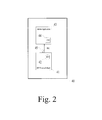
- Figure 2 particularly shows the general architecture of a signaling node 40.
- the signal node comprises a protocol stack 41 which provides compliance with the SS7 protocol standard.
- the architecture adopted for modern CCS is based on dividing signaling functions into a number of tiers comprising self-contained groups of functions.
- a user can be a customer or a node in the network. Specifications are derived by defining a) the primitives used between adjacent tiers within a user, b) the procedures adopted for transferring information between corresponding tiers in different users and c) the format of the information transferred between corresponding tiers in different users.
- CCITT n°7 has been specified using two different types of tier-structure.
- Circuit-related functions are specified using a 4-level structure, whilst non-circuit-related functions are specified using the OSI 7-layer structure.
- Levels 1 to 3 of CCITT N°7 form the message-transfer-part (MTP), which is responsible for transferring messages from one signaling point to another, even in the event of link and network failures.
- Level 4 comprises the user parts, which define the meaning of the messages transferred by the MTP and the logical sequence of events for a particular application (eg telephony).
- Layers 1 to 3 of CCITT n°7 comprise a combination of the MTP and the Signaling-connection-control part (SCCP) The combination of the MTP and the SCCP provides a network-layer service to higher layers.
- Layers 4 to 7 of CCITT N°7 comprise transaction capability (TC) .
- TC is a protocol designed to carry non-circuit related data between nodes in the network.
- Protocol stack 41 communicates with a user or administration application 41 via a channel 45, such as of the type Interconnect process Communication (IPC).
- IPC Interconnect process Communication
- the particular embodiment of the IPC channel 45 closely depends upon the particular operating system being used. Alternately, the channel can be based on a shared memory but any other mechanism such as a TCP/IP based socket can be used.
- the process for controlling the generation and the report of the statistical information is based on the existence of a Statistical Control File (SCF) 42 existing in the protocol stack 41 and which contains a description of the different entities for which statistical information is to be reported to the administration application 43.
- SCF Statistical Control File
- the description of the different entities - including the destinations and/or the links - is based on a Spectification and Description Language known by the skilled man. It should be noticed that the SDL language is a development tool which is traditionnaly reserved to the telecommunication development team for the purpose of creating telecommunication applications.
- the statistics controlling process which is described below substantially deviates from this traditional use by considering it as a communication tool between the SS7 protocol stack 41 and the user application 43 for the purpose of expressing entities in the SCF file 12 for which specific notifications are to be prepared by the protocol stack 41.
- entity is well known to the skilled man and an example of an entity is a link which can be in a idle state or congested or uncongested.
- the SCF file 12 contains the information which precisely defines the state machine corresponding to the entity of interest, for instance a link, a destination or a circuit, and the particular state of this entity for which he/she wants a report, either when leaving the status (for instance CIC no more free: Call Control Processing Out Status Idle ⁇ CPCO SO out) or when entering the status (CIC seized: Call Control Processing Incoming ⁇ CPCI S4 In).
- one application may be interested in the link status, to trigger an alarm to start a restore operation as soon as a link goes to the unavailable state and thus minimizing the unavailability duration.
- the monitored SDL status is then the link unavailable state as described Figure 28 q704 Signalling traffic management, link availability control (TLAC).
- Another application may monitor the TCAP transaction status to know the instantaneous usage of the TCAP layer.
- the SDL TCAP transaction status is described in Figure 8 and A5 of recommendation Q.774. The usage monitoring allows a better network performance prediction.
- the statistics description uses the following syntax:
- the IPC may be any features supported by the operating system :signals, shared memory, file system, sockets,....The implementation must comply to performance, fault tolerance, supportability , portability constraints.
- the administration application is fitted with a Graphical User Interface 44 (G.U.I.) which permits to easily create and update the contents of the Statistics Control File (SCF) 42 contained within the protocol stack 41, thereby providing adaptability to a wide range of user requirements. Comfort in use can thus be substantially enhanced by the GUI which provides the user a wide and comprehensive list of the different entities for he may have a reporting.
- a drag-and-drop mechanism is used for selecting one particular set of entities for which a reporting is requested.
- the GUI interface is used for allowing a dynamic update and control of Statistics Control File 42 for the purpose of allowing the user to dynamically change the reporting of the statistics information from the SS7 protocol stack.
- FIG 3 there is shown the process for controlling the generation and the reporting of the statistics information to the administration application 43.
- the process starts with a step 51 which consists in the detection of a change of the status of one entity.
- the process performs a test for determining whether the change concerns a SDL state machine which is recited within the SDL description file.
- the process completes in a step 53 and the SDL state machine change is no further processed. In particular, there is no generation of a specific notification by the protocol stack 41 and therefore, no need to process it by administration application 43.
- step 54 a specific notification concerning this state machine is prepared by the SS7 protocol stack 41.
- a step 55 the notification is transmitted to the administration application 43 and the process completes until the detection of a new change in the status of one SDL machine.
- the contents of the SCF file 12 precisely defines which statistics information will be reported to the application 43.
- Many benefits result from this new arrangement. Firstly, the arrangement is applicable for any state machines and any kind of information is made available to the user administration application 43 excepted the information regarding the volume of data transfer.
- the statistics can be defined at run-time and every customer can define the statistics for which he/she needs a report without waiting for additional release or development of the SS7 platform or product. With the provision of the invention, the statistics report can be changed dynamically, simply by stopping and restarting the platform. Thirdly, it clearly results in the centralization of the software code implementing the statistics control process, thus minimizing and facilitating maintenance.
Landscapes
- Engineering & Computer Science (AREA)
- Computer Networks & Wireless Communication (AREA)
- Telephonic Communication Services (AREA)
- Exchange Systems With Centralized Control (AREA)
- Data Exchanges In Wide-Area Networks (AREA)
- Mobile Radio Communication Systems (AREA)
- Communication Control (AREA)
Abstract
Description
- The invention relates to communication systems and more particular to a process and apparatus for controlling the generation of statistical information in a Common Channel System signaling node. The process is in charge of the protocol implementation and collects statistics for the network operation.
- The need for more and more services lead to the restructuration of telecommunication networks around a strong separation between the voice transmission functions and the signaling functions. In modern networks, based around the concept of Common-Channel Signaling (CCS) systems, the information that is exchanged between customers and networks, but also between the different exchanges forming parts of the networks, is conveyed on a dedicated separated signaling channel that is different from that used for the speech path. This separation occurs both within the Exchanges within the telecommunication networks and external to the Exchanges, thus allowing optimization of the control processes, the switch blocks and the signaling systems. CCS systems are a major part in the drive towards all-digital networks. Networks offering end-to-end digital communications between customers are termed 'Integrated Services Digital Networks' (ISDN).
- CCITT N°7, superseding the former CCITT N°6, has become now the reference in the definition of common channel signaling systems which renders possible new services provided to customers by operators. General background information relevant to the systems and protocols which are involved in CCITT N°7, and more generally with CCS systems, can be found in document 'Common-channel signaling' by R. Manterfield, Institution of Electrical Engineers, Telecommunications series 26, 1991 and also in the C.C.I.T.T. Specifications of Signaling System N°7, Recommendations Q. 700-Q716, Blue Book, Vol. VI - Fascicle VI.7, Geneva 1988 . An example of implementation of a CCITT N°7 signaling network is found in the article 'The HP OpenCall SS7 Platform' by Denis Pierrot et al, Hewlett Packard Journal, August 1997, p. 58-64.
- Figure 1 shows the known architecture of a telecommunication network based on a number of switches and application processors which are interconnected by transmission circuits. The SS7 network exists within the communication network and is used for controlling it by means of creating and transferring call processing, network management and maintenance messages to the network various components. The figure recalls the three basic components of the SS7 network: the Service Switching Points (SSP) 10, the Signal Transfer Points (STP) 20 and the Service Control Points (SCP) 30. These components are generally referred to as "nodes" or "signaling" points.
- Considering now the particular architecture of a node or signaling point, the latter comprises a protocol stack for embodying the requirements of the SS7 and, further, an administration application which is used by the customer for handling and managing statistical information concerning the different entities of the telecommunication network, including the links and the destinations, which is reported back by the protocol stack. This statistics information shows to be very useful to the customer who can be aware of the existence of a congestion or whether a link, for instance, is in service or is out of service. However, the needs for statisticals information can substantially vary from one customer to another. Generally speaking, the telecommunication products manufacturers provide SS7 platform which are arranged to report a huge amount of statistical information elements, whatever the particular need of their customers.
- Such a solution is clearly not satisfactory since the different customers may have different needs regarding statistical information and, further, may have needs varying with time. The generation and the collection of unnecessary information, as this is done today in the known SS7 platforms and signaling nodes, strongly increases the processing tasks, both in the protocol stack and in the administration application communicating with it. Telecommunication manufacturers wish to find a flexible solution which permits an easy adaptation to the customer's requirements while reducing the development costs.
- It is an object of the present invention to provide a process and apparatus for rendering more flexible the generation and the reporting of the statistical information of a protocol stack of a signaling node regarding the different entities of said signaling node.
- It is another object of the present invention to provide a generic protocol stack for a telecommunication node, such as a SS7 signaling node for instance, and which offers improves communication and control means with an administration application handling statistical information.
- It is a further object of the present invention to provide an improved Administration application which has enhanced means for controlling the generation of statistical information reported by a protocol stack of a signaling node of a telecommunication network.
- These and other objects is achieved by means of a process for controlling the generation of statistical information being reported to a user or administration application by a Common Channel Signaling (CCS) protocol stack of a telecommunication node. The process involves the use of a Statistics Control File (SCF) file which is located within the protocol stack and which contains a description of the entities, including links and destinations, for which a statistical notification is to be reported to the user application. The SCF file is under control of the user or administration application. For performance reasons, the SCF may be implemented as an in memory database instead of a file.
- By modifying the contents of said SCF file contained within the protocol stack via the administration application, the user is given the possibility to precisely define the particular statistical information for which he or she wants a report from the protocol stack.. Further, the protocol stack becomes generic and can be used for a wide range of different administration applications which can precisely control the particular information which is to be reported back to the user or administration application. The telecommunication product manufacturers are thus given the possibility to provide a generic CCS platform which can be easiiy customized and precisely adapted to the particular needs of different customers.
- Further the use of the SCF file in the protocol stack permits to avoid the generation of unnecessary statistical information, which unnecessary statistical information is no longer to be created by the protocol stack and further, is no longer to be received and processed by the administration application.
- In the preferred embodiment, the CSS platform is a SS7 platform which complies with the SS7 specification laid down by the CCITT and the local Statistics Control File (SCF) contains a description of the entities, expressed in terms of state machines, for which statistical information is to be reported which complies with the Specification and Description Language (SDL) standard . The user is therefore given an easy way to define via the administration application the precise information for which he/she wants a report and further the SS7 protocol stack can communication with a wide number of different user applications via the SDL description language.
- Preferrably, the protocol stack executes the following steps:
- detecting (51) a change of the status of one SDL state machine
- determining (52) whether said state machine subject to a change is recited into said Statistics Control File (42);
- in response to said determination, preparing (54) and transmitting (55) to said user or administration application a specific notification concerning said change.
- In one embodiment, the CSS or SS7 protocol stacks communicate with the user application by means of a Interconnect Process Communication channel (I.P.C.) which may, for instance, be based on a shared memory.
- More preferably, the administration application is fitted with a Graphical User Interface (G.U.I.) which permits to easily create and update the contents of the Statistics Control File (SCF), thereby providing adaptability to a wide range of user requirements.
- The invention also provides a CSS protocol stack, such as a SS7 protocol stack for instance, which communicates with an administration application and includes a local Statistical Control File (CSF) file containing a description of the different entities for which statistical information is to be reported to said administration application. Preferably, both CSS protocol stack and the administration application communicate with each other via a Interconnect Process Communication channel and the description which is contained within the SCF file complies with the Specification and Description Language (SDL) and the SCF contains SDL status of entities for which notifications are to be reported to the administration application.
- At last the invention provides an administration application for handling statistical information relating to the different entities of a signaling node of a telecommunication network, said administration application including means for updating a Statistics Control File (SCF) located within a signaling protocol stack of the telecommunication network. Preferably, the administration application specifies the contents of the SCF file in a description complying with the Specification Description Language protocol.
- An embodiment of the invention will now be described, by way of example only, with reference to the accompanying drawings, wherein:
- Figure 1 illustrates the basic architecture of the SS7 network.
- Figure 2 illustrates an architecture of a telecommunication node which incorporates the Statistical Control File for controlling the generation and the transmission of the statistics to the customer application.
- Figure 3 shows the process for controlling the generation and the reporting of statistical information to the administration application.
-
- The invention will now be more particularly described with reference to the SS7 signaling system which is clearly the current standard of the Common Channel Systems (C.C.S.) networks. However it should be clear that the invention is applicable to any CCS system based on the use of a common-signaling channel to carry signaling information for numerous traffic circuits. Generally speaking the signaling information is carried in messages and each message is delineated by a flag and the transaction to which a message refers is defined by an identifier. In circuit-related applications, the identifier used is the circuit number of the appropriate traffic circuit. In non-circuit-related applications, the identifier used is a reference number that is independent of traffic circuits. Each message contains an information field defining the meaning of the message and check bits that are used to detect message corruption during transmission. Messages are stored in buffers to await the opportunity to be transmitted. In parallel to the different notifications which are to be communicated to the signaling network, for the purpose of embodying the SS7 protocol stack, the protocol stack prepares a specific statistical information which is to be reported to a user application or administration application.
- Further there is described a process for controlling the generation and the reporting of the statistical information is applicable to a wide range of different administration applications. In one particular example, the administration application can be a application which monitors the availability of the telecommunication network for the purpose of tracking the general quality and availability of the telecommunication network. Clearly, in such a application, the user will be particularly interested in receiving specific notification and messages prepared by the SS7 protocol stack and which concerns the failure of a link and the particular identification of the destination being subject of such a failure. It should be clear however that such an administration application is only an example and that the skilled man will straightforwardly adapt the process for controlling the generation and the reporting of statistical information to any kind of administration purpose.
- Figure 2 particularly shows the general architecture of a signaling
node 40. The signal node comprises aprotocol stack 41 which provides compliance with the SS7 protocol standard. As known by the skilled man the architecture adopted for modern CCS is based on dividing signaling functions into a number of tiers comprising self-contained groups of functions. A user can be a customer or a node in the network. Specifications are derived by defining a) the primitives used between adjacent tiers within a user, b) the procedures adopted for transferring information between corresponding tiers in different users and c) the format of the information transferred between corresponding tiers in different users. CCITT n°7 has been specified using two different types of tier-structure. Circuit-related functions are specified using a 4-level structure, whilst non-circuit-related functions are specified using the OSI 7-layer structure. Levels 1 to 3 of CCITT N°7 form the message-transfer-part (MTP), which is responsible for transferring messages from one signaling point to another, even in the event of link and network failures. Level 4 comprises the user parts, which define the meaning of the messages transferred by the MTP and the logical sequence of events for a particular application (eg telephony). Layers 1 to 3 of CCITT n°7 comprise a combination of the MTP and the Signaling-connection-control part (SCCP) The combination of the MTP and the SCCP provides a network-layer service to higher layers. Layers 4 to 7 of CCITT N°7 comprise transaction capability (TC) . TC is a protocol designed to carry non-circuit related data between nodes in the network. - Those different components of the signaling node will be referred as the
SS7 protocol stack 41.Protocol stack 41 communicates with a user oradministration application 41 via achannel 45, such as of the type Interconnect process Communication (IPC). Clearly, the particular embodiment of theIPC channel 45 closely depends upon the particular operating system being used. Alternately, the channel can be based on a shared memory but any other mechanism such as a TCP/IP based socket can be used. - The process for controlling the generation and the report of the statistical information is based on the existence of a Statistical Control File (SCF) 42 existing in the
protocol stack 41 and which contains a description of the different entities for which statistical information is to be reported to theadministration application 43. In the preferred embodiment, the description of the different entities - including the destinations and/or the links - is based on a Spectification and Description Language known by the skilled man. It should be noticed that the SDL language is a development tool which is traditionnaly reserved to the telecommunication development team for the purpose of creating telecommunication applications. The statistics controlling process which is described below substantially deviates from this traditional use by considering it as a communication tool between theSS7 protocol stack 41 and theuser application 43 for the purpose of expressing entities in the SCF file 12 for which specific notifications are to be prepared by theprotocol stack 41. The concept of entity is well known to the skilled man and an example of an entity is a link which can be in a idle state or congested or uncongested. There is provided to the customer a tool for precisely defining the SDL state machines and status for which he/she wants to gather information for. Generally speaking the SCF file 12 contains the information which precisely defines the state machine corresponding to the entity of interest, for instance a link, a destination or a circuit, and the particular state of this entity for which he/she wants a report, either when leaving the status (for instance CIC no more free: Call Control Processing Out Status Idle → CPCO SO out) or when entering the status (CIC seized: Call Control Processing Incoming → CPCI S4 In). - Multiple applications may benefit from this new method. For example, for the MTP level 3 layer, one application may be interested in the link status, to trigger an alarm to start a restore operation as soon as a link goes to the unavailable state and thus minimizing the unavailability duration. The monitored SDL status is then the link unavailable state as described Figure 28 q704 Signalling traffic management, link availability control (TLAC).
- Another application may monitor the TCAP transaction status to know the instantaneous usage of the TCAP layer. The SDL TCAP transaction status is described in Figure 8 and A5 of recommendation Q.774. The usage monitoring allows a better network performance prediction.
- The two previous examples, for MTP and TCAP, use the ITU Recommendation but the same kind of examples may apply to the ANSI T1.111 standard. The method is applicable to all standards using the SDL: ANSI, ITU, TTC and others.
- In one particular embodiment, the statistics description uses the following syntax:
- SDL state machine; SDL status; Transition; Statistics reporting; IPC Where
-
- The IPC may be any features supported by the operating system :signals, shared memory, file system, sockets,....The implementation must comply to performance, fault tolerance, supportability , portability constraints.
- The above developments, given only by way of examples, show that any event or entity can be described by use of the SDL language and the corresponding description is then filed within the Statistical Control File (SCF) 42 existing in the
protocol stack 41. The skilled man will adapt the particular SDL states machine to the requirements of his particular user application. Additional details concerning the use of the SDL description language can be found in the following reference document: "Functional Specification and Description language (SDL) , criteria four using formal description techniques (FDTS), Recommendations Z.100 and annexes A, B, C and E, Recommendations Z.110" ; in CCITT, Blue Book, Vol. X, Fascicle X.1, Geneva 1989. - In the preferred embodiment, the administration application is fitted with a Graphical User Interface 44 (G.U.I.) which permits to easily create and update the contents of the Statistics Control File (SCF) 42 contained within the
protocol stack 41, thereby providing adaptability to a wide range of user requirements. Comfort in use can thus be substantially enhanced by the GUI which provides the user a wide and comprehensive list of the different entities for he may have a reporting. In particular a drag-and-drop mechanism is used for selecting one particular set of entities for which a reporting is requested. Preferrably, the GUI interface is used for allowing a dynamic update and control ofStatistics Control File 42 for the purpose of allowing the user to dynamically change the reporting of the statistics information from the SS7 protocol stack. - With respect to figure 3 there is shown the process for controlling the generation and the reporting of the statistics information to the
administration application 43. - The process starts with a
step 51 which consists in the detection of a change of the status of one entity. - In a
steps 52, the process performs a test for determining whether the change concerns a SDL state machine which is recited within the SDL description file. - If the SDL state machine is not recited within the
SCF file 42, then the process completes in astep 53 and the SDL state machine change is no further processed. In particular, there is no generation of a specific notification by theprotocol stack 41 and therefore, no need to process it byadministration application 43. - If the SDL state machine appears to be recited in the SCF file 12, the process proceeds to a
step 54 where a specific notification concerning this state machine is prepared by theSS7 protocol stack 41. - In a
step 55, the notification is transmitted to theadministration application 43 and the process completes until the detection of a new change in the status of one SDL machine. - Therefore, it can be seen that the contents of the SCF file 12 precisely defines which statistics information will be reported to the
application 43. Many benefits result from this new arrangement. Firstly, the arrangement is applicable for any state machines and any kind of information is made available to theuser administration application 43 excepted the information regarding the volume of data transfer. Secondly, the statistics can be defined at run-time and every customer can define the statistics for which he/she needs a report without waiting for additional release or development of the SS7 platform or product. With the provision of the invention, the statistics report can be changed dynamically, simply by stopping and restarting the platform. Thirdly, it clearly results in the centralization of the software code implementing the statistics control process, thus minimizing and facilitating maintenance.
The SDL state machine and the SDL status defines the particular entity for which a reporting notification is to be generated and reported to the
The transition is the transition IN or OUT concerning the state machine;
The Statistics Reporting is periodic for the purpose of gathering periodical statistics or, alternatively, is executed upon detection of the occurrence of a particular event when a status change arises;
IPC defines the particular way of communication between the
Claims (13)
- Process for controlling the generation of statistical information being reported to a user or administration application (43) by a Common Channel Signaling (CCS) protocol stack (41) of a telecommunication node (40), said process being based on the use of a Statistics Control File (SCF) file (42) which is located within the protocol stack (41) and which contains a description of the entities, including links and destinations, for which a statistical notification is to be reported to said user application.
- Process according to claim 1 wherein the CSS platform is a SS7 platform which complies with the SS7 specification laid down by the CCITT and the local Statistics Control File (SCF) which complies with the Specification and Description Language (SDL) and contains a description of the entities and corresponding state machines for which statistical information is to be reported to said administration application (43).
- Process according to claim 2 characterized in that said protocol stack (41) executes the following steps:detecting (51) a change of the status of one SDL state machinedetermining (52) whether said state machine subject to a change is recited into said Statistics Control File (42);in response to said determination, preparing (54) and transmitting (55) to said user or administration application a specific notification concerning said change.
- Process according to claim 3 wherein said SS7 protocol stacks (41) communicate with said administration application (43) by means of a Interconnect Process Channel (I.P.C.) (45) such as based on a shared memory or a TCP/IP based socket.
- Process according to claim 4 wherein said administration application (43) includes a Graphical User Interface (G.U.I.) (44) for updating the contents of the Statistics Control File (SCF), thereby providing adaptability to a wide range of user requirements.
- Protocol stack computer program product having program code elements for carrying out a method as claimed in any of claims 1 to 5.
- Apparatus for controlling the generation of statistical information being reported to a user or administration application (43) by a Common Channel Signalling (CCS) protocol stack (41) of a telecommunication node (40), said protocol stack being characterized in that if includes Statistics Control File (SCF) file (42) which is located within the protocol stack and which contains a description of the entities, including links and destinations, for which a statistical notification is to be reported to said user application.
- Apparatus according to claim 7 wherein the CSS platform is a SS7 platform which complies with the SS7 specification laid down by the CCITT and the local Statistics Control File (SCF) which complies with the Specification and Description Language (SDL) and contains a description of the entities and corresponding state machines for which statistical information is to be reported to said administration application (43).
- Apparatus according to claim 8 wherein said SS7 protocol stacks (41) communicate with said administration application (43) by means of a Interconnect Process Channel (I.P.C.) (45) such as based on a shared memory or a TCP/IP based socket.
- Apparatus according to claim 9 wherein said administration application (43) includes a Graphical User Interface (G.U.I.) (44) for updating the contents of the Statistics Control File (SCF), thereby providing adaptability to a wide range of user requirements.
- Common Channel System (CCS) protocol stack for handling the signaling notification and procedure of a CCS signaling system, said CCS protocol stack communicating with an administration application (43) via a Interconnect Process Channel (IPC) and characterized in that it further includes a local Statistical Control File (CSF) file (42) which can be updated by the user of said administration application and which contains a description of the different entities for which statistical information is to be reported to said administration application.
- CCS Protocol stack according to claim 11 characterized in that the contents of said SCF file (43) complies with the Specification and Description Language (SDL) and the SCF contains SDL status of entities for which notifications are to be reported to the administration application.
- Administration application for a signaling node (40) of a telecommunication network which communicates with a CCS protocol stack (41), said administration application being characterized in that it includes means for updating a statistics Control File (SCF) located within a signaling protocol stack of the telecommunication network thereby controlling the generation and the reporting of statistics information from said CCS protocol stack.
Priority Applications (4)
| Application Number | Priority Date | Filing Date | Title |
|---|---|---|---|
| EP01410122A EP1296527B1 (en) | 2001-09-25 | 2001-09-25 | Process and apparatus for controlling the generation of statistical information in a CSS signaling node |
| DE60111380T DE60111380T2 (en) | 2001-09-25 | 2001-09-25 | Method and device for generating statistical information in a CSS signaling node |
| AT01410122T ATE297637T1 (en) | 2001-09-25 | 2001-09-25 | METHOD AND DEVICE FOR CONTROLLING THE GENERATION OF STATISTICAL INFORMATION IN A CSS SIGNALING NODE |
| US10/251,678 US20030076938A1 (en) | 2001-09-25 | 2002-09-19 | Process and apparatus for controlling the generation of statistical information in a CSS signaling node, CSS protocol stack and administration application for doing the same |
Applications Claiming Priority (1)
| Application Number | Priority Date | Filing Date | Title |
|---|---|---|---|
| EP01410122A EP1296527B1 (en) | 2001-09-25 | 2001-09-25 | Process and apparatus for controlling the generation of statistical information in a CSS signaling node |
Publications (2)
| Publication Number | Publication Date |
|---|---|
| EP1296527A1 true EP1296527A1 (en) | 2003-03-26 |
| EP1296527B1 EP1296527B1 (en) | 2005-06-08 |
Family
ID=8183121
Family Applications (1)
| Application Number | Title | Priority Date | Filing Date |
|---|---|---|---|
| EP01410122A Expired - Lifetime EP1296527B1 (en) | 2001-09-25 | 2001-09-25 | Process and apparatus for controlling the generation of statistical information in a CSS signaling node |
Country Status (4)
| Country | Link |
|---|---|
| US (1) | US20030076938A1 (en) |
| EP (1) | EP1296527B1 (en) |
| AT (1) | ATE297637T1 (en) |
| DE (1) | DE60111380T2 (en) |
Citations (1)
| Publication number | Priority date | Publication date | Assignee | Title |
|---|---|---|---|---|
| WO2001020920A1 (en) * | 1999-09-14 | 2001-03-22 | Inet Technologies, Inc. | Service quality monitoring in a communications network |
Family Cites Families (4)
| Publication number | Priority date | Publication date | Assignee | Title |
|---|---|---|---|---|
| US5438570A (en) * | 1993-12-29 | 1995-08-01 | Tekno Industries, Inc. | Service observing equipment for signalling System Seven telephone network |
| US6028914A (en) * | 1998-04-09 | 2000-02-22 | Inet Technologies, Inc. | System and method for monitoring performance statistics in a communications network |
| US6529594B1 (en) * | 1998-06-05 | 2003-03-04 | Inet Technologies, Inc. | System and method for generating quality of service statistics for an international communications network |
| US6249572B1 (en) * | 1998-06-08 | 2001-06-19 | Inet Technologies, Inc. | Transaction control application part (TCAP) call detail record generation in a communications network |
-
2001
- 2001-09-25 AT AT01410122T patent/ATE297637T1/en not_active IP Right Cessation
- 2001-09-25 DE DE60111380T patent/DE60111380T2/en not_active Expired - Fee Related
- 2001-09-25 EP EP01410122A patent/EP1296527B1/en not_active Expired - Lifetime
-
2002
- 2002-09-19 US US10/251,678 patent/US20030076938A1/en not_active Abandoned
Patent Citations (1)
| Publication number | Priority date | Publication date | Assignee | Title |
|---|---|---|---|---|
| WO2001020920A1 (en) * | 1999-09-14 | 2001-03-22 | Inet Technologies, Inc. | Service quality monitoring in a communications network |
Non-Patent Citations (1)
| Title |
|---|
| BELINA F ET AL: "THE CCITT-SPECIFICATION AND DESCRIPTION LANGUAGE SDL", COMPUTER NETWORKS AND ISDN SYSTEMS, NORTH HOLLAND PUBLISHING. AMSTERDAM, NL, vol. 16, no. 4, 1 March 1988 (1988-03-01), pages 311 - 341, XP000027089, ISSN: 0169-7552 * |
Also Published As
| Publication number | Publication date |
|---|---|
| EP1296527B1 (en) | 2005-06-08 |
| DE60111380T2 (en) | 2006-04-20 |
| US20030076938A1 (en) | 2003-04-24 |
| ATE297637T1 (en) | 2005-06-15 |
| DE60111380D1 (en) | 2005-07-14 |
Similar Documents
| Publication | Publication Date | Title |
|---|---|---|
| US7313129B1 (en) | Arrangement for sharing a single signaling point code between multiple hosts in an IP-based network | |
| AU727007B2 (en) | Programmable service node for call control processing | |
| US6507649B1 (en) | Mechanism and method for distributing ISUP stacks over multiple loosely coupled processors | |
| EP1974282B1 (en) | Methods, systems, and computer program products for decentralized processing of signaling messages in a multi-application processing environment | |
| AU724255B2 (en) | Service control unit for call control processing | |
| EP1277355B1 (en) | Methods and systems for providing dynamic routing key registration | |
| AU719309B2 (en) | Programmable service architecture for call control processing | |
| US20100329152A1 (en) | Methods, systems, and computer program products for organizing, managing, and selectively distributing routing information in a signaling message routing node | |
| JP2002500489A (en) | High-speed SS7 signaling adaptation device | |
| CA2275500A1 (en) | Method and system for monitoring the operational status of a network element in an advanced intelligent network | |
| EP1422914A1 (en) | The method for initiative setting up the call by the server control point in the mobile intelligent network | |
| US7711003B2 (en) | Method for reducing service loss in interworking between SS7 signaling network and M3UA, and a signaling gateway | |
| WO2006096597A2 (en) | Methods, systems, and computer program products for congestion-based routing of telecommunications signaling messages | |
| CN1136739C (en) | Method of controlling service execution in intelligent network and switching point in intelligent network | |
| EP1519591A1 (en) | Methods and apparatus for controlling signalling gateways | |
| JP2001223793A (en) | Message transfer part level-3 alias point code | |
| EP1296527B1 (en) | Process and apparatus for controlling the generation of statistical information in a CSS signaling node | |
| US7519051B2 (en) | Methods and related apparatus for operating a gateway to act as a conduit for a structured transaction | |
| US20050223391A1 (en) | Telecommunication switch using generic API to support multiple protocol-specific signal control functions | |
| CN1210909C (en) | Equipment and method for united management of transmission of different network carried signaling | |
| US6760425B2 (en) | Interworking between services in telecommunications network | |
| CA2349766C (en) | Ain triggers to invoke non-ain features | |
| US20030061391A1 (en) | Apparatus for interworking between heterogeneous No.7 signaling networks and method thereof | |
| US20040136520A1 (en) | Next generation gateway | |
| JPH11501495A (en) | Communication links interconnecting service control points of load balancing groups for traffic management control |
Legal Events
| Date | Code | Title | Description |
|---|---|---|---|
| PUAI | Public reference made under article 153(3) epc to a published international application that has entered the european phase |
Free format text: ORIGINAL CODE: 0009012 |
|
| AK | Designated contracting states |
Kind code of ref document: A1 Designated state(s): AT BE CH CY DE DK ES FI FR GB GR IE IT LI LU MC NL PT SE TR |
|
| AX | Request for extension of the european patent |
Extension state: AL LT LV MK RO SI |
|
| AKX | Designation fees paid | ||
| 17P | Request for examination filed |
Effective date: 20030904 |
|
| RBV | Designated contracting states (corrected) |
Designated state(s): AT BE CH CY DE DK ES FI FR GB GR IE IT LI LU MC NL PT SE TR |
|
| REG | Reference to a national code |
Ref country code: DE Ref legal event code: 8566 |
|
| 17Q | First examination report despatched |
Effective date: 20031219 |
|
| GRAP | Despatch of communication of intention to grant a patent |
Free format text: ORIGINAL CODE: EPIDOSNIGR1 |
|
| GRAS | Grant fee paid |
Free format text: ORIGINAL CODE: EPIDOSNIGR3 |
|
| GRAA | (expected) grant |
Free format text: ORIGINAL CODE: 0009210 |
|
| AK | Designated contracting states |
Kind code of ref document: B1 Designated state(s): AT BE CH CY DE DK ES FI FR GB GR IE IT LI LU MC NL PT SE TR |
|
| PG25 | Lapsed in a contracting state [announced via postgrant information from national office to epo] |
Ref country code: IT Free format text: LAPSE BECAUSE OF FAILURE TO SUBMIT A TRANSLATION OF THE DESCRIPTION OR TO PAY THE FEE WITHIN THE PRESCRIBED TIME-LIMIT;WARNING: LAPSES OF ITALIAN PATENTS WITH EFFECTIVE DATE BEFORE 2007 MAY HAVE OCCURRED AT ANY TIME BEFORE 2007. THE CORRECT EFFECTIVE DATE MAY BE DIFFERENT FROM THE ONE RECORDED. Effective date: 20050608 Ref country code: CH Free format text: LAPSE BECAUSE OF FAILURE TO SUBMIT A TRANSLATION OF THE DESCRIPTION OR TO PAY THE FEE WITHIN THE PRESCRIBED TIME-LIMIT Effective date: 20050608 Ref country code: BE Free format text: LAPSE BECAUSE OF FAILURE TO SUBMIT A TRANSLATION OF THE DESCRIPTION OR TO PAY THE FEE WITHIN THE PRESCRIBED TIME-LIMIT Effective date: 20050608 Ref country code: FI Free format text: LAPSE BECAUSE OF FAILURE TO SUBMIT A TRANSLATION OF THE DESCRIPTION OR TO PAY THE FEE WITHIN THE PRESCRIBED TIME-LIMIT Effective date: 20050608 Ref country code: TR Free format text: LAPSE BECAUSE OF FAILURE TO SUBMIT A TRANSLATION OF THE DESCRIPTION OR TO PAY THE FEE WITHIN THE PRESCRIBED TIME-LIMIT Effective date: 20050608 Ref country code: LI Free format text: LAPSE BECAUSE OF FAILURE TO SUBMIT A TRANSLATION OF THE DESCRIPTION OR TO PAY THE FEE WITHIN THE PRESCRIBED TIME-LIMIT Effective date: 20050608 Ref country code: NL Free format text: LAPSE BECAUSE OF FAILURE TO SUBMIT A TRANSLATION OF THE DESCRIPTION OR TO PAY THE FEE WITHIN THE PRESCRIBED TIME-LIMIT Effective date: 20050608 Ref country code: AT Free format text: LAPSE BECAUSE OF FAILURE TO SUBMIT A TRANSLATION OF THE DESCRIPTION OR TO PAY THE FEE WITHIN THE PRESCRIBED TIME-LIMIT Effective date: 20050608 |
|
| REG | Reference to a national code |
Ref country code: GB Ref legal event code: FG4D |
|
| REG | Reference to a national code |
Ref country code: CH Ref legal event code: EP |
|
| REF | Corresponds to: |
Ref document number: 60111380 Country of ref document: DE Date of ref document: 20050714 Kind code of ref document: P |
|
| REG | Reference to a national code |
Ref country code: IE Ref legal event code: FG4D |
|
| PG25 | Lapsed in a contracting state [announced via postgrant information from national office to epo] |
Ref country code: GR Free format text: LAPSE BECAUSE OF FAILURE TO SUBMIT A TRANSLATION OF THE DESCRIPTION OR TO PAY THE FEE WITHIN THE PRESCRIBED TIME-LIMIT Effective date: 20050908 Ref country code: SE Free format text: LAPSE BECAUSE OF FAILURE TO SUBMIT A TRANSLATION OF THE DESCRIPTION OR TO PAY THE FEE WITHIN THE PRESCRIBED TIME-LIMIT Effective date: 20050908 Ref country code: DK Free format text: LAPSE BECAUSE OF FAILURE TO SUBMIT A TRANSLATION OF THE DESCRIPTION OR TO PAY THE FEE WITHIN THE PRESCRIBED TIME-LIMIT Effective date: 20050908 |
|
| PG25 | Lapsed in a contracting state [announced via postgrant information from national office to epo] |
Ref country code: ES Free format text: LAPSE BECAUSE OF FAILURE TO SUBMIT A TRANSLATION OF THE DESCRIPTION OR TO PAY THE FEE WITHIN THE PRESCRIBED TIME-LIMIT Effective date: 20050919 |
|
| PG25 | Lapsed in a contracting state [announced via postgrant information from national office to epo] |
Ref country code: CY Free format text: LAPSE BECAUSE OF FAILURE TO SUBMIT A TRANSLATION OF THE DESCRIPTION OR TO PAY THE FEE WITHIN THE PRESCRIBED TIME-LIMIT Effective date: 20050925 |
|
| PG25 | Lapsed in a contracting state [announced via postgrant information from national office to epo] |
Ref country code: IE Free format text: LAPSE BECAUSE OF NON-PAYMENT OF DUE FEES Effective date: 20050926 |
|
| PG25 | Lapsed in a contracting state [announced via postgrant information from national office to epo] |
Ref country code: MC Free format text: LAPSE BECAUSE OF NON-PAYMENT OF DUE FEES Effective date: 20050930 Ref country code: LU Free format text: LAPSE BECAUSE OF NON-PAYMENT OF DUE FEES Effective date: 20050930 |
|
| PG25 | Lapsed in a contracting state [announced via postgrant information from national office to epo] |
Ref country code: PT Free format text: LAPSE BECAUSE OF FAILURE TO SUBMIT A TRANSLATION OF THE DESCRIPTION OR TO PAY THE FEE WITHIN THE PRESCRIBED TIME-LIMIT Effective date: 20051114 |
|
| NLV1 | Nl: lapsed or annulled due to failure to fulfill the requirements of art. 29p and 29m of the patents act | ||
| REG | Reference to a national code |
Ref country code: CH Ref legal event code: PL |
|
| ET | Fr: translation filed | ||
| PLBE | No opposition filed within time limit |
Free format text: ORIGINAL CODE: 0009261 |
|
| STAA | Information on the status of an ep patent application or granted ep patent |
Free format text: STATUS: NO OPPOSITION FILED WITHIN TIME LIMIT |
|
| 26N | No opposition filed |
Effective date: 20060309 |
|
| REG | Reference to a national code |
Ref country code: IE Ref legal event code: MM4A |
|
| PGFP | Annual fee paid to national office [announced via postgrant information from national office to epo] |
Ref country code: FR Payment date: 20060918 Year of fee payment: 6 |
|
| PGFP | Annual fee paid to national office [announced via postgrant information from national office to epo] |
Ref country code: GB Payment date: 20060925 Year of fee payment: 6 |
|
| PGFP | Annual fee paid to national office [announced via postgrant information from national office to epo] |
Ref country code: DE Payment date: 20061031 Year of fee payment: 6 |
|
| GBPC | Gb: european patent ceased through non-payment of renewal fee |
Effective date: 20070925 |
|
| PG25 | Lapsed in a contracting state [announced via postgrant information from national office to epo] |
Ref country code: DE Free format text: LAPSE BECAUSE OF NON-PAYMENT OF DUE FEES Effective date: 20080401 |
|
| REG | Reference to a national code |
Ref country code: FR Ref legal event code: ST Effective date: 20080531 |
|
| PG25 | Lapsed in a contracting state [announced via postgrant information from national office to epo] |
Ref country code: FR Free format text: LAPSE BECAUSE OF NON-PAYMENT OF DUE FEES Effective date: 20071001 |
|
| PG25 | Lapsed in a contracting state [announced via postgrant information from national office to epo] |
Ref country code: GB Free format text: LAPSE BECAUSE OF NON-PAYMENT OF DUE FEES Effective date: 20070925 |