EP1296514A2 - System and method for color correcting electronically captured images - Google Patents
System and method for color correcting electronically captured images Download PDFInfo
- Publication number
- EP1296514A2 EP1296514A2 EP02256530A EP02256530A EP1296514A2 EP 1296514 A2 EP1296514 A2 EP 1296514A2 EP 02256530 A EP02256530 A EP 02256530A EP 02256530 A EP02256530 A EP 02256530A EP 1296514 A2 EP1296514 A2 EP 1296514A2
- Authority
- EP
- European Patent Office
- Prior art keywords
- media
- color
- input
- image data
- image
- Prior art date
- Legal status (The legal status is an assumption and is not a legal conclusion. Google has not performed a legal analysis and makes no representation as to the accuracy of the status listed.)
- Withdrawn
Links
Images


Classifications
-
- H—ELECTRICITY
- H04—ELECTRIC COMMUNICATION TECHNIQUE
- H04N—PICTORIAL COMMUNICATION, e.g. TELEVISION
- H04N1/00—Scanning, transmission or reproduction of documents or the like, e.g. facsimile transmission; Details thereof
- H04N1/46—Colour picture communication systems
- H04N1/56—Processing of colour picture signals
- H04N1/60—Colour correction or control
- H04N1/6094—Colour correction or control depending on characteristics of the input medium, e.g. film type, newspaper
Definitions
- the invention relates generally to a method and system for processing different input media types and more particularly to a system and method for color correcting electronically captured images of input media based on media types.
- Input media may include documents, photographs, films and other items that can be electronically captured by digital imaging devices.
- the color accuracy of a digital imaging device depends on the color correction computations performed by that digital imaging system to correct the color information in the captured images to accurately reproduce the original images on the input media.
- Color correction computations may involve the use of look-up tables, or linear or non-linear matrix techniques to modify the raw color signals, e.g., RGB signals, of the captured images such that the colors of the captured images are an accurate reproduction of the input with respect to colorimetric or perceptual match.
- the color gamut of raw color signals captured from a particular input medium depends the media type, as well as the digital imaging device that captured those color signals.
- the color gamuts of captured image signals from one media type are different from the color gamuts of captured image signals from another media type even if the same digital imaging device is used for both media types.
- the color gamuts of offset printed media differ from the color gamuts of inkjet printed media. Consequently, even if the filter responses of a digital imaging device are compensated by the color correction computations, the color accuracy of the digital imaging device can be significantly reduced when the media type is not taken into consideration. Thus, the color accuracy of a digital imaging device can be increased by tuning the color correction computations based on the media type of the input media.
- Some conventional scanners utilize software that allows the user to select the input media type from a list of predefined media types.
- the predefined media types may include high-gloss photos, offset media and coated media.
- customized color correction computations are performed on the captured color signals in accordance with the selected media type, which increases the color accuracy of the scanners.
- the user input method utilized by the conventional scanners may be appropriate for high end users, the user input method is not appropriate for ordinary users, who may not bother to select the media type, if such selection is made available in an accompanying software.
- the increased color accuracy derived from the media-dependent color correction computations is negated by user neglect or user interface design.
- a system and method for color correcting electronically captured input images utilizes a correlation between the input images and a set of reference images of different media types to determine the media type of the input images.
- the correlation is performed using a media correlation matrix, which includes media characteristic data from the different media types.
- the media type information of the input images is used to customize the color correction procedure being performed on the input images. The customization of the color correction procedure ensures that the final images are accurate reproduction of the input images with respect colorimetric or perceptual match.
- a method in accordance with the invention includes the steps of receiving color image data associated with an original image on an input medium and comparing the color image data to a plurality of reference image data that correspond to different reference media types to determine a candidate media type of the input medium from the different reference media types.
- the method further includes the step of correcting color information contained in the color image data according to the candidate media type to provide a color-corrected electronic image of the original image on the input medium.
- the step of comparing the color image data to the plurality of reference data may include correlating an image vector associated with the color image data to a media correlation matrix having columns of entries that are associated with different reference media types.
- the image vector includes input media data corresponding to input media characteristics of the input medium.
- each column of the media correlation matrix includes reference media data corresponding to reference media characteristics of a particular media type of the different reference media types.
- the input and reference media characteristics may include color gamut, size, gloss, fluorescence, and presence of text and/or graphics.
- the reference media data of the media correlation matrix may include binary, weighted or probability information.
- a system in accordance with the invention includes an image sensor that electronically captures an image on an input medium as color image data and a correlation unit that compares the color image data to a plurality of reference image data that correspond to different reference media types to determine a candidate media type of the input medium from the different reference media types.
- the system further includes a color correction unit coupled to the correlation unit.
- the color correction unit is configured to correct color information contained in the color image data according to the candidate media type to provide a color-corrected electronic image of the original image on the input medium.
- the correlation unit of the system may be configured to correlate an image vector associated with the color image data to a media correlation matrix having columns of entries that are associated with different reference media types.
- the image vector includes input media data corresponding to input media characteristics of the input medium.
- each column of the media correlation matrix includes reference media data corresponding to reference media characteristics of a particular media type of the different reference media types.
- the input and reference media characteristics may include color gamut, size, gloss, fluorescence, and presence of text and/or graphics.
- the reference media data of the media correlation matrix may include binary, weighted or probability information.
- Fig. 1 is a block diagram of a digital imaging system in accordance with the present invention.
- Fig. 2 is a diagram illustrating the generation of a correlation matrix used by the digital imaging system of Fig. 1.
- Fig. 3 is a diagram illustrating the conversion of captured image signals to an image vector, which is then multiplied by the correlation matrix.
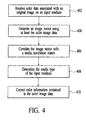
- Fig. 4 is a flow diagram of a method of color correcting captured images in accordance with the invention.
- a digital imaging system 100 in accordance with the present invention is shown.
- the digital imaging system operates to automatically determine the media type of the input medium being captured to color correct a captured image based on the determined media type.
- the digital imaging system reproduces original images on different input media with accurate rendering of the colors of the original images.
- the digital imaging device 100 includes an image capturing device 102, a processing module 104, an input device 106 and an output device 108.
- the image capturing device operates to electronically capture original images on different media.
- the image capturing device includes a light source 110 and an electronic image sensor 112.
- the light source provides a constant illumination on an input medium being imaged by the image capturing device.
- the light source may be a linear fluorescent lamp or a series of light emitting diodes.
- the electronic image sensor of the image capturing device operates to detect the illumination reflected from the input medium to electronically capture the original image on the input medium as raw image data, e.g. RGB signals.
- the electronic image sensor may detect the illumination transmitted through the input medium, such as a film.
- the electronic image sensor may be a charge coupled device (CCD) sensor or a complementary metal oxide semiconductor (CMOS) sensor.
- CMOS complementary metal oxide semiconductor
- the image capturing device may be any imaging device, such as a flatbed scanner or a film scanner. In order to provide a more lucid description of the image capturing device, other components that are commonly found in a conventional image capturing device are not shown or described herein.
- the input device 106 of the digital imaging system 100 allows a user to input commands into the system.
- the input device allows the user to input information relating to the input medium being captured by the system.
- the media type determination may take into consideration information manually provided by the user.
- the input device includes a computer keyboard 114 and a cursor pointing mechanism 116, as illustrated in Fig. 1.
- the input device may be any type of electronic input device (such as a button on a scanner).
- the output device 108 of the digital imaging system 100 produces a final color image of the original image on the input medium that was imaged by the system.
- the output device may be a color printer that produces a hard copy of the final color image.
- the output device may be a computer monitor that electronically produces the final color image for viewing.
- the processing module 104 of the digital imaging system 100 operates to determine the media type of the input medium from the image data acquired by the image capturing device 102, and to color correct the raw image data according to the media type determination to improve the color accuracy of the electronically captured image.
- the media type determination is achieved by comparing predefined indicators from the input medium with corresponding reference indicators from different reference media.
- the main indicator is the color range (color gamut) of captured image signals. Other indicators may include size, gloss, and fluorescence of the input medium.
- the reference indicators are stored as a correlation matrix 202, as shown in Fig. 2.
- Each column of the correlation matrix includes reference indicators from a particular reference media type.
- the portion 204 of each column represents the indicator for color range, or the gamut, of the captured signals for a particular reference media type.
- the entries in the portion 204 of the correlation matrix 202 include binary data.
- the binary data entries indicate the presence or absence of specific colors for a particular reference media type.
- the entries in the portion 204 of the correlation matrix 202 include probability data.
- the probability data entries for a particular reference media type indicate the likelihood that an input medium of the same media type will contain the specific colors that correspond to the probability data entries.
- each column represents the indicator for the size of a particular reference media type.
- the size indicator may indicate whether the reference media type is a 4" ⁇ 6" medium, which would strongly suggest that the reference media type is a photograph.
- the correlation matrix may include additional indicators, such as gloss, fluorescence, and presence of text and/or business graphics.
- Fig. 2 illustrates the manner in which the correlation matrix 202 is built.
- a reference media type 1 is electronically captured by a test image capturing device (not shown).
- the reference media type 1 may be a photograph, a document (e.g., inkjet printed or laser tone printed), an offset printed medium or any other media type.
- the test image capturing device has the same imaging characteristics as the image capturing device 102 of the digital imaging system 100.
- the signals obtained from the reference media type 1, e.g., RGB signals are plotted as chromaticity coordinates 208 in a two-dimensional chromaticity space shown in Fig. 2, which is similar to the Commission Internationale de l'Eclairage (CIE) 1931 diagram.
- CIE Commission Internationale de l'Eclairage
- the gamut 210 for the reference media type 1 is then defined by taking the convex hull 212 of these chromaticity coordinates.
- the gamut includes all the chromaticity coordinates in the convex hull.
- the gamut for the media type 1 is then transformed into a linear form, or a vector, which forms the color range portion 204 of the column marked "media type 1" for the reference media type 1.
- the vector is built by scanning the gamut in the chromaticity space in a raster fashion and determining whether the coordinates of the chromaticity space are included in the gamut or not.
- a chromaticity coordinate that is included in the gamut is represented as a "1" in the correlation matrix, while a coordinate that is not included in the gamut is represented as a "0" in the matrix.
- Additional binary information for other indicators is then attached to the vector.
- the binary information for the input size indicator may then be attached to the vector. If the input size of the reference media type 1 is the predetermined size, e.g., 4" ⁇ 6", then the input size portion 206 of the media type 1 column is set to "1". Otherwise, the input size portion of the media type 1 column is set to "0". As illustrated in Fig. 2, the input size portion 206 of the media type 1 column is set to "0", which indicates that the reference media type 1 is not of the predetermined size.
- Other indicators may also be included in the media type 1 column as additional binary information.
- the number corresponding to the additional indicators i.e., size, gloss, fluorescence, and presence of text and/or business graphics
- weighting factors that would correspond to the importance of this information.
- the processing module 104 of the digital imaging system 100 includes a vectorizing unit 118, a media characteristic detector 120, a color correcting unit 122, a processor 124 and a storage unit 126.
- the vectorizing unit 118 operates to build a vector 302 from captured image signals 304 of an input medium received from the image capturing device 102.
- the vector 302 is shown transposed in Fig. 3. This vector corresponds to the color range or color gamut portion 204 of the correlation matrix 202 and is built in the same manner as the correlation matrix columns for the portion 204.
- the vectorizing unit converts the captured image signals 304, e.g., RGB signals, to the chromaticity coordinates, and then defines the gamut (not shown) of the image signals by taking the convex hull of the chromaticity coordinates, as illustrated in Fig. 3.
- the vectorizing unit builds the vector by examining the chromaticity space with the plotted coordinates in a raster fashion, which is the same procedure for building the correlation matrix 202.
- the media characteristic detector 120 of the processing module 104 measures additional media characteristics of the input medium to include additional indicators into the vector 302.
- the operation of the media characteristic detector depends on the additional indicators used by the digital imaging system 100 to determine the media type of the input medium. If one of the additional indicators is the input size, the media characteristic detector determines whether the size of the input medium is equal to a predefined size, e.g., 4" ⁇ 6".
- the media characteristic detector outputs this information to the vectorizing unit 118, which attaches a "1" or a "0" to the vector 302 at the location 306 shown in Fig. 3, which corresponds to the portion 206 of the correlation matrix 202.
- the vectorizing unit attaches a "1" to the vector at the location 306 if the size of the input medium equals the predefined size. Otherwise, the vectorizing unit attaches a "0" to the vector at the location 306.
- the media characteristic detector measures the fluorescence of the input medium and determines whether the measured fluorescence exceeds a predefined threshold. For this indicator, the vectorizing unit attaches a "1" to the vector at the appropriated location if the size of the input medium equals the predefined size. Otherwise, the vectorizing unit attaches a "0" to the vector at that location. Similar process may be performed by the media characteristic detector and the vectorizing unit for other indicators, such as the gloss of the input medium. In other embodiments, the number corresponding to the additional indicators (i.e., size, gloss, fluorescence, and presence of text and/or business graphics) could be multiplied by weighting factors that would correspond to the importance of this information.
- the storage unit 126 of the processing module 104 functions as a storage medium to store the correlation matrix 202, as well as other information.
- the storage unit may be a hard disk drive, read-only memory (ROM) or other forms of memory.
- the storage unit may store a color correction look-up table or a color correction matrix that are commonly used for color correction.
- the color correction look-up table or the color correction matrix includes color correction computation information that are customized for the different reference media types.
- the processor 124 of the processing module 104 performs the determination of the input media type by using the correlation matrix 202.
- the processor multiplies the transpose of the vector to the correlation matrix to derive correlation values 308 for the different reference media types, as illustrated in Fig. 3.
- the operation of the processor to derive the correlation values can be mathematically express as: v t M, where v is the vector associated with the captured image signals and M is the correlation matrix.
- Each correlation value corresponds to the likelihood that the input medium matches the associated reference media type. Higher correlation value indicates higher likelihood of a match.
- the correlation value for the reference media type 2 is the highest value among the correlation values. Thus, the input medium most likely matches the reference media type 2.
- the color correction unit 122 of the processing module 104 adaptively performs color correction computations on the captured image signals from the electronic image sensor 112 of the image capturing device 102 based on the "matched" reference media type determined by the processor 124. Thus, the color correction unit performs different color correction computations on the captured image signals depending on the matched reference media type.
- the color correction unit may use a color correction lookup table stored in the storage unit 126 to perform the color correction computations.
- the color correction unit may use a color correction matrix to perform the color correction computations.
- the color correction lookup table or the color correction matrix includes customized color correction computation information for the different reference media types. Color correction process using a color correction lookup table or a color correction matrix is well known and thus, is not described herein.
- the color corrected image signals are then transmitted to the output device 108 to produce a final color image of the original image on the input medium.
- the vectorizing unit 118, the media characteristic detector 120, the processor 124 and the color correction unit 122 of the processing module 104 represent function blocks that can be embodied in any combination of software, hardware and firmware. In one embodiment, the operations performed by these components are executed by a digital signal processor (not shown) of a computer. In another embodiment, the components of the processing module may be integrated into the image capturing device 112.
- the color correction computations performed by the color correction unit 122 are tailored to a particular media type that best represents the input medium being imaged by the digital imaging system 100, the colors of the original image on the input medium are more accurately replicated in the captured mage.
- the media type determination is made automatically by the processing module 104, the color accuracy of the digital imaging system is not dependent on the user input.
- some or all of the additional media characteristics of the input medium may be provided by user inputs.
- the user essentially operates as the media characteristic detector 120 of the processing module 102.
- the user may input whether the input medium is of a predefined size.
- the vectorizing unit 118 of the processing module 102 then attaches the appropriate binary information into the vector for that input medium.
- a user may indicate that the input media is a photograph, which would then refine the search by the processor to include only photographic material media types (e.g., KODAK, AGFA or FUJII paper).
- Other media characteristics may be attached to the vector in the same manner. If all of the additional media characteristics of the input medium are provided by the user, the media characteristic detector 120 is no longer needed in the digital imaging system 100 and thus, can be removed from the processing module 104.
- a method of color correcting captured images in accordance with the invention is described with reference to Fig. 4.
- a color image data associated with an original image on an input medium is received.
- an image vector is generated using at least the color image data.
- the image vector is correlated with a media correlation matrix, which includes columns of entries that are associated with different reference media types.
- the entries correspond to media characteristics, such as color gamut, size, gloss, fluorescence, presence of text, and presence of business graphics.
- the entries of the media correlation matrix may be one of binary information, weighted information and probability information.
- the media type of the input medium is determined using the information derived from the correlation of the image vector with the media correlation matrix.
- color information contained in the color image data is corrected according the determined media type to provide a color-corrected electronic image of the original image on the input medium.
Landscapes
- Engineering & Computer Science (AREA)
- Multimedia (AREA)
- Signal Processing (AREA)
- Facsimile Image Signal Circuits (AREA)
- Image Processing (AREA)
- Color Image Communication Systems (AREA)
- Image Analysis (AREA)
- Processing Of Color Television Signals (AREA)
Abstract
Description
Claims (10)
- A method of processing different input media types comprising:receiving (402) color image data associated with an original image on an input medium; andcomparing (406) said color image data to a plurality of reference image data that correspond to different reference media types to determine a candidate media type of said input medium from said different reference media types.
- A method as claimed in claim 1 wherein said step of comparing (406) said color image data to said plurality of reference image data includes correlating (406) an image vector (302) associated with said color image data to a media correlation matrix (202), said media correlation matrix having columns of entries that are associated with said different reference media types.
- A method as claimed in claim 2 wherein said image vector (302) includes input media data corresponding to input media characteristics of said input medium, and wherein each of said columns of said media correlation matrix (202) includes reference media data (204, 206) corresponding to reference media characteristics of a particular media type of said different reference media types.
- A method as claimed in claim 3 wherein said reference media data of said correlation matrix (202) includes one of binary information, weighted information and probability information corresponding to a particular reference media characteristic of said reference media characteristics.
- A method as claimed in any preceding claim further comprising a step of correcting color information contained in said color image data according to said candidate media type to provide a color-corrected electronic image of said original image on said input medium.
- A system for processing different input media types comprising:an image sensor (12) that electronically captures an image on an input medium as color image data; anda correlation unit (124) that compares said color image data to a plurality of reference image data that correspond to different reference media types to determine a candidate media type of said input medium from said different reference media types.
- A system as claimed in claim 6 further comprising a color correction unit (122) coupled to said correlation unit (124), said color correction unit being configured to correct color information contained in said color image data according to said candidate media type to provide a color-corrected electronic image of said original image on said input medium.
- A system as claimed in claim 6 or 7 wherein said correlation unit (124) is configured to correlate an image vector (302) associated with said color image data to a media correlation matrix (202), said media correlation matrix having columns of entries that are associated with said different reference media types.
- A system as claimed in claim 8 wherein said image vector (302) includes input media data corresponding to input media characteristics of said input medium, and wherein each of said columns of said media correlation matrix (202) includes reference media data corresponding to reference media characteristics of a particular media type of said different reference media types.
- A system as claimed in claim 9 wherein said reference media data of said correlation matrix includes one of binary information, weighted information and probability information corresponding to a particular reference media characteristic of said reference media characteristics.
Applications Claiming Priority (2)
| Application Number | Priority Date | Filing Date | Title |
|---|---|---|---|
| US09/960,777 US6985622B2 (en) | 2001-09-21 | 2001-09-21 | System and method for color correcting electronically captured images by determining input media types using color correlation matrix |
| US960777 | 2001-09-21 |
Publications (2)
| Publication Number | Publication Date |
|---|---|
| EP1296514A2 true EP1296514A2 (en) | 2003-03-26 |
| EP1296514A3 EP1296514A3 (en) | 2004-09-01 |
Family
ID=25503608
Family Applications (1)
| Application Number | Title | Priority Date | Filing Date |
|---|---|---|---|
| EP02256530A Withdrawn EP1296514A3 (en) | 2001-09-21 | 2002-09-20 | System and method for color correcting electronically captured images |
Country Status (3)
| Country | Link |
|---|---|
| US (1) | US6985622B2 (en) |
| EP (1) | EP1296514A3 (en) |
| JP (1) | JP2003153016A (en) |
Families Citing this family (54)
| Publication number | Priority date | Publication date | Assignee | Title |
|---|---|---|---|---|
| WO2003088133A1 (en) * | 2002-04-06 | 2003-10-23 | Barbour Randall L | Modification of the normalized difference method for real-time optical tomography |
| US7298892B2 (en) * | 2003-04-09 | 2007-11-20 | Eastman Kodak Company | Producing a balanced digital color image having minimal color errors |
| US20060085274A1 (en) * | 2004-10-14 | 2006-04-20 | The Procter & Gamble Company | Methods and apparatus for selecting a color for use by a personal care product recommendation system |
| US7330193B2 (en) * | 2005-07-08 | 2008-02-12 | Seiko Epson Corporation | Low noise dithering and color palette designs |
| US7856118B2 (en) * | 2007-07-20 | 2010-12-21 | The Procter & Gamble Company | Methods for recommending a personal care product and tools therefor |
| US7830429B1 (en) | 2007-07-27 | 2010-11-09 | Hewlett-Packard Development Company, L.P. | Optimizing characterization values of image capture apparatus components |
| US8229215B2 (en) | 2007-12-03 | 2012-07-24 | Omnivision Technologies, Inc. | Image sensor apparatus and method for scene illuminant estimation |
| US20090147098A1 (en) * | 2007-12-10 | 2009-06-11 | Omnivision Technologies, Inc. | Image sensor apparatus and method for color correction with an illuminant-dependent color correction matrix |
| US9118880B2 (en) * | 2008-09-24 | 2015-08-25 | Nikon Corporation | Image apparatus for principal components analysis based illuminant estimation |
| US20130058543A1 (en) | 2011-09-06 | 2013-03-07 | The Proctor & Gamble Company | Systems, devices, and methods for image analysis |
| US9977999B2 (en) | 2014-01-06 | 2018-05-22 | Hewlett-Packard Development Company, L.P. | Paper classification based on three-dimensional characteristics |
| KR20200104371A (en) | 2017-12-27 | 2020-09-03 | 에티컨, 엘엘씨 | Fluorescence imaging in a light-deficient environment |
| US11758256B2 (en) | 2019-06-20 | 2023-09-12 | Cilag Gmbh International | Fluorescence imaging in a light deficient environment |
| US11624830B2 (en) | 2019-06-20 | 2023-04-11 | Cilag Gmbh International | Wide dynamic range using a monochrome image sensor for laser mapping imaging |
| US11141052B2 (en) | 2019-06-20 | 2021-10-12 | Cilag Gmbh International | Image rotation in an endoscopic fluorescence imaging system |
| US11311183B2 (en) | 2019-06-20 | 2022-04-26 | Cilag Gmbh International | Controlling integral energy of a laser pulse in a fluorescence imaging system |
| US11944273B2 (en) | 2019-06-20 | 2024-04-02 | Cilag Gmbh International | Fluorescence videostroboscopy of vocal cords |
| US11533417B2 (en) | 2019-06-20 | 2022-12-20 | Cilag Gmbh International | Laser scanning and tool tracking imaging in a light deficient environment |
| US11012599B2 (en) | 2019-06-20 | 2021-05-18 | Ethicon Llc | Hyperspectral imaging in a light deficient environment |
| US11674848B2 (en) | 2019-06-20 | 2023-06-13 | Cilag Gmbh International | Wide dynamic range using a monochrome image sensor for hyperspectral imaging |
| US11412152B2 (en) | 2019-06-20 | 2022-08-09 | Cilag Gmbh International | Speckle removal in a pulsed hyperspectral imaging system |
| US11671691B2 (en) | 2019-06-20 | 2023-06-06 | Cilag Gmbh International | Image rotation in an endoscopic laser mapping imaging system |
| US11096565B2 (en) | 2019-06-20 | 2021-08-24 | Cilag Gmbh International | Driving light emissions according to a jitter specification in a hyperspectral, fluorescence, and laser mapping imaging system |
| US11898909B2 (en) | 2019-06-20 | 2024-02-13 | Cilag Gmbh International | Noise aware edge enhancement in a pulsed fluorescence imaging system |
| US12126887B2 (en) | 2019-06-20 | 2024-10-22 | Cilag Gmbh International | Hyperspectral and fluorescence imaging with topology laser scanning in a light deficient environment |
| US11716543B2 (en) | 2019-06-20 | 2023-08-01 | Cilag Gmbh International | Wide dynamic range using a monochrome image sensor for fluorescence imaging |
| US11266304B2 (en) | 2019-06-20 | 2022-03-08 | Cilag Gmbh International | Minimizing image sensor input/output in a pulsed hyperspectral imaging system |
| US11550057B2 (en) | 2019-06-20 | 2023-01-10 | Cilag Gmbh International | Offset illumination of a scene using multiple emitters in a fluorescence imaging system |
| US11633089B2 (en) | 2019-06-20 | 2023-04-25 | Cilag Gmbh International | Fluorescence imaging with minimal area monolithic image sensor |
| US11471055B2 (en) | 2019-06-20 | 2022-10-18 | Cilag Gmbh International | Noise aware edge enhancement in a pulsed fluorescence imaging system |
| US11432706B2 (en) | 2019-06-20 | 2022-09-06 | Cilag Gmbh International | Hyperspectral imaging with minimal area monolithic image sensor |
| US11700995B2 (en) | 2019-06-20 | 2023-07-18 | Cilag Gmbh International | Speckle removal in a pulsed fluorescence imaging system |
| US11589819B2 (en) | 2019-06-20 | 2023-02-28 | Cilag Gmbh International | Offset illumination of a scene using multiple emitters in a laser mapping imaging system |
| US11540696B2 (en) | 2019-06-20 | 2023-01-03 | Cilag Gmbh International | Noise aware edge enhancement in a pulsed fluorescence imaging system |
| US11931009B2 (en) | 2019-06-20 | 2024-03-19 | Cilag Gmbh International | Offset illumination of a scene using multiple emitters in a hyperspectral imaging system |
| US11903563B2 (en) | 2019-06-20 | 2024-02-20 | Cilag Gmbh International | Offset illumination of a scene using multiple emitters in a fluorescence imaging system |
| US11389066B2 (en) | 2019-06-20 | 2022-07-19 | Cilag Gmbh International | Noise aware edge enhancement in a pulsed hyperspectral, fluorescence, and laser mapping imaging system |
| US11187658B2 (en) | 2019-06-20 | 2021-11-30 | Cilag Gmbh International | Fluorescence imaging with fixed pattern noise cancellation |
| US12440085B2 (en) | 2019-06-20 | 2025-10-14 | Cilag Gmbh International | Image synchronization without input clock and data transmission clock in a pulsed laser mapping imaging system |
| US10952619B2 (en) | 2019-06-20 | 2021-03-23 | Ethicon Llc | Hyperspectral and fluorescence imaging and topology laser mapping with minimal area monolithic image sensor |
| US11457154B2 (en) | 2019-06-20 | 2022-09-27 | Cilag Gmbh International | Speckle removal in a pulsed hyperspectral, fluorescence, and laser mapping imaging system |
| US11622094B2 (en) | 2019-06-20 | 2023-04-04 | Cilag Gmbh International | Wide dynamic range using a monochrome image sensor for fluorescence imaging |
| US11937784B2 (en) | 2019-06-20 | 2024-03-26 | Cilag Gmbh International | Fluorescence imaging in a light deficient environment |
| US11134832B2 (en) | 2019-06-20 | 2021-10-05 | Cilag Gmbh International | Image rotation in an endoscopic hyperspectral, fluorescence, and laser mapping imaging system |
| US11412920B2 (en) | 2019-06-20 | 2022-08-16 | Cilag Gmbh International | Speckle removal in a pulsed fluorescence imaging system |
| US11237270B2 (en) | 2019-06-20 | 2022-02-01 | Cilag Gmbh International | Hyperspectral, fluorescence, and laser mapping imaging with fixed pattern noise cancellation |
| US11617541B2 (en) | 2019-06-20 | 2023-04-04 | Cilag Gmbh International | Optical fiber waveguide in an endoscopic system for fluorescence imaging |
| US10841504B1 (en) | 2019-06-20 | 2020-11-17 | Ethicon Llc | Fluorescence imaging with minimal area monolithic image sensor |
| US11516387B2 (en) | 2019-06-20 | 2022-11-29 | Cilag Gmbh International | Image synchronization without input clock and data transmission clock in a pulsed hyperspectral, fluorescence, and laser mapping imaging system |
| US11925328B2 (en) | 2019-06-20 | 2024-03-12 | Cilag Gmbh International | Noise aware edge enhancement in a pulsed hyperspectral imaging system |
| US12013496B2 (en) | 2019-06-20 | 2024-06-18 | Cilag Gmbh International | Noise aware edge enhancement in a pulsed laser mapping imaging system |
| US11240426B2 (en) | 2019-06-20 | 2022-02-01 | Cilag Gmbh International | Pulsed illumination in a hyperspectral, fluorescence, and laser mapping imaging system |
| US11275520B2 (en) | 2020-03-02 | 2022-03-15 | Micron Technology, Inc. | Media type selection using a processor in memory |
| CN113742288B (en) * | 2020-05-29 | 2024-09-24 | 伊姆西Ip控股有限责任公司 | Method, electronic device and computer program product for data indexing |
Family Cites Families (11)
| Publication number | Priority date | Publication date | Assignee | Title |
|---|---|---|---|---|
| US5757983A (en) * | 1990-08-09 | 1998-05-26 | Hitachi, Ltd. | Document retrieval method and system |
| IL101029A (en) * | 1992-02-20 | 1996-01-19 | Scitex Corp Ltd | Method for identifying film type |
| US5767983A (en) | 1995-03-24 | 1998-06-16 | Fuji Photo Film Co., Ltd. | Color copying apparatus for determining exposure amount from image data of an original image and a reference image |
| JPH10191079A (en) | 1996-12-26 | 1998-07-21 | Canon Inc | Image reading apparatus and image reading method |
| US5925889A (en) * | 1997-10-21 | 1999-07-20 | Hewlett-Packard Company | Printer and method with media gloss and color determination |
| US6038339A (en) | 1997-11-14 | 2000-03-14 | Hewlett-Packard Company | White point determination using correlation matrix memory |
| JPH11261821A (en) | 1998-03-12 | 1999-09-24 | Fuji Photo Film Co Ltd | Image processing method |
| US6459825B1 (en) * | 1999-02-18 | 2002-10-01 | Phillips M. Lippincott | Method and apparatus for a self learning automatic control of photo capture and scanning |
| US6291829B1 (en) * | 1999-03-05 | 2001-09-18 | Hewlett-Packard Company | Identification of recording medium in a printer |
| US6650446B1 (en) | 1999-06-29 | 2003-11-18 | Kodak Polychrome Graphics | Colorimetric characterization of scanned media using spectral scanner and media models |
| US6819792B1 (en) * | 2000-09-07 | 2004-11-16 | Xerox Corporation | Automatic detection of colorimetry of unknown CMYK images |
-
2001
- 2001-09-21 US US09/960,777 patent/US6985622B2/en not_active Expired - Lifetime
-
2002
- 2002-09-18 JP JP2002271071A patent/JP2003153016A/en active Pending
- 2002-09-20 EP EP02256530A patent/EP1296514A3/en not_active Withdrawn
Also Published As
| Publication number | Publication date |
|---|---|
| EP1296514A3 (en) | 2004-09-01 |
| US6985622B2 (en) | 2006-01-10 |
| US20030059108A1 (en) | 2003-03-27 |
| JP2003153016A (en) | 2003-05-23 |
Similar Documents
| Publication | Publication Date | Title |
|---|---|---|
| US6985622B2 (en) | System and method for color correcting electronically captured images by determining input media types using color correlation matrix | |
| JP4775410B2 (en) | Output image adjustment of image data | |
| US7933041B2 (en) | Adjustment for output image of image data | |
| CN110557515B (en) | Image processing apparatus, image processing method, and storage medium | |
| US20110001843A1 (en) | Image processing apparatus, image processing method, and electronic camera | |
| WO2006120839A1 (en) | Image processing method, image processing device, and image processing program | |
| JP4653194B2 (en) | Image processing apparatus, image processing apparatus control method, program, and computer-readable storage medium | |
| JP6338554B2 (en) | Image processing apparatus, image processing method, and program | |
| WO2006123492A1 (en) | Image processing method, image processing device, imaging device and image processing program | |
| JP2009037625A (en) | Image processing using subject information | |
| JP4672587B2 (en) | Image output method, apparatus and program | |
| US20030161608A1 (en) | Image reproducing apparatus and image reproducing method | |
| WO2005112428A1 (en) | Image processing method, image processing device, image recorder, and image processing program | |
| JP4024737B2 (en) | Image processing apparatus, image reading apparatus, image forming apparatus, image processing method, and program | |
| JP2018129861A (en) | Information processing apparatus, information processing apparatus control method, and program | |
| JP3834516B2 (en) | Output image adjustment of image data | |
| US20130278980A1 (en) | Method for scanning hard copy originals | |
| JP4600503B2 (en) | Output image adjustment of image data | |
| WO2006033235A1 (en) | Image processing method, image processing device, imaging device, and image processing program | |
| JP2002344764A (en) | Image processing device | |
| WO2006033234A1 (en) | Image processing method, image processing device, imaging device, and image processing program | |
| WO2006033236A1 (en) | Image processing method, image processing device, imaging device, and image processing program | |
| JP7135575B2 (en) | Image processing device, image reading device and program | |
| JP2009194516A (en) | Image processing apparatus and image processing method | |
| JP2002094814A (en) | Image input device |
Legal Events
| Date | Code | Title | Description |
|---|---|---|---|
| PUAI | Public reference made under article 153(3) epc to a published international application that has entered the european phase |
Free format text: ORIGINAL CODE: 0009012 |
|
| AK | Designated contracting states |
Kind code of ref document: A2 Designated state(s): AT BE BG CH CY CZ DE DK EE ES FI FR GB GR IE IT LI LU MC NL PT SE SK TR Designated state(s): AT BE BG CH CY CZ DE DK EE ES FI FR GB GR IE IT LI LU MC NL PT SE SK TR |
|
| AX | Request for extension of the european patent |
Extension state: AL LT LV MK RO SI |
|
| PUAL | Search report despatched |
Free format text: ORIGINAL CODE: 0009013 |
|
| AK | Designated contracting states |
Kind code of ref document: A3 Designated state(s): AT BE BG CH CY CZ DE DK EE ES FI FR GB GR IE IT LI LU MC NL PT SE SK TR |
|
| AX | Request for extension of the european patent |
Extension state: AL LT LV MK RO SI |
|
| 17P | Request for examination filed |
Effective date: 20050228 |
|
| AKX | Designation fees paid |
Designated state(s): DE FR GB |
|
| RBV | Designated contracting states (corrected) |
Designated state(s): DE FR GB |
|
| STAA | Information on the status of an ep patent application or granted ep patent |
Free format text: STATUS: THE APPLICATION HAS BEEN WITHDRAWN |
|
| 18W | Application withdrawn |
Effective date: 20080704 |