EP1296488A2 - Multiplexing IP data packets within a MPLS frame - Google Patents
Multiplexing IP data packets within a MPLS frame Download PDFInfo
- Publication number
- EP1296488A2 EP1296488A2 EP02252570A EP02252570A EP1296488A2 EP 1296488 A2 EP1296488 A2 EP 1296488A2 EP 02252570 A EP02252570 A EP 02252570A EP 02252570 A EP02252570 A EP 02252570A EP 1296488 A2 EP1296488 A2 EP 1296488A2
- Authority
- EP
- European Patent Office
- Prior art keywords
- data packet
- overhead information
- data
- multiplexed
- mpls
- Prior art date
- Legal status (The legal status is an assumption and is not a legal conclusion. Google has not performed a legal analysis and makes no representation as to the accuracy of the status listed.)
- Withdrawn
Links
Images



Classifications
-
- H—ELECTRICITY
- H04—ELECTRIC COMMUNICATION TECHNIQUE
- H04L—TRANSMISSION OF DIGITAL INFORMATION, e.g. TELEGRAPHIC COMMUNICATION
- H04L45/00—Routing or path finding of packets in data switching networks
-
- H—ELECTRICITY
- H04—ELECTRIC COMMUNICATION TECHNIQUE
- H04L—TRANSMISSION OF DIGITAL INFORMATION, e.g. TELEGRAPHIC COMMUNICATION
- H04L45/00—Routing or path finding of packets in data switching networks
- H04L45/50—Routing or path finding of packets in data switching networks using label swapping, e.g. multi-protocol label switch [MPLS]
-
- H—ELECTRICITY
- H04—ELECTRIC COMMUNICATION TECHNIQUE
- H04L—TRANSMISSION OF DIGITAL INFORMATION, e.g. TELEGRAPHIC COMMUNICATION
- H04L69/00—Network arrangements, protocols or services independent of the application payload and not provided for in the other groups of this subclass
- H04L69/16—Implementation or adaptation of Internet protocol [IP], of transmission control protocol [TCP] or of user datagram protocol [UDP]
- H04L69/161—Implementation details of TCP/IP or UDP/IP stack architecture; Specification of modified or new header fields
-
- H—ELECTRICITY
- H04—ELECTRIC COMMUNICATION TECHNIQUE
- H04L—TRANSMISSION OF DIGITAL INFORMATION, e.g. TELEGRAPHIC COMMUNICATION
- H04L69/00—Network arrangements, protocols or services independent of the application payload and not provided for in the other groups of this subclass
- H04L69/16—Implementation or adaptation of Internet protocol [IP], of transmission control protocol [TCP] or of user datagram protocol [UDP]
- H04L69/168—Implementation or adaptation of Internet protocol [IP], of transmission control protocol [TCP] or of user datagram protocol [UDP] specially adapted for link layer protocols, e.g. asynchronous transfer mode [ATM], synchronous optical network [SONET] or point-to-point protocol [PPP]
-
- H—ELECTRICITY
- H04—ELECTRIC COMMUNICATION TECHNIQUE
- H04L—TRANSMISSION OF DIGITAL INFORMATION, e.g. TELEGRAPHIC COMMUNICATION
- H04L69/00—Network arrangements, protocols or services independent of the application payload and not provided for in the other groups of this subclass
- H04L69/30—Definitions, standards or architectural aspects of layered protocol stacks
- H04L69/32—Architecture of open systems interconnection [OSI] 7-layer type protocol stacks, e.g. the interfaces between the data link level and the physical level
- H04L69/322—Intralayer communication protocols among peer entities or protocol data unit [PDU] definitions
- H04L69/324—Intralayer communication protocols among peer entities or protocol data unit [PDU] definitions in the data link layer [OSI layer 2], e.g. HDLC
-
- H—ELECTRICITY
- H04—ELECTRIC COMMUNICATION TECHNIQUE
- H04L—TRANSMISSION OF DIGITAL INFORMATION, e.g. TELEGRAPHIC COMMUNICATION
- H04L69/00—Network arrangements, protocols or services independent of the application payload and not provided for in the other groups of this subclass
- H04L69/30—Definitions, standards or architectural aspects of layered protocol stacks
- H04L69/32—Architecture of open systems interconnection [OSI] 7-layer type protocol stacks, e.g. the interfaces between the data link level and the physical level
- H04L69/322—Intralayer communication protocols among peer entities or protocol data unit [PDU] definitions
- H04L69/325—Intralayer communication protocols among peer entities or protocol data unit [PDU] definitions in the network layer [OSI layer 3], e.g. X.25
-
- H—ELECTRICITY
- H04—ELECTRIC COMMUNICATION TECHNIQUE
- H04L—TRANSMISSION OF DIGITAL INFORMATION, e.g. TELEGRAPHIC COMMUNICATION
- H04L2212/00—Encapsulation of packets
-
- H—ELECTRICITY
- H04—ELECTRIC COMMUNICATION TECHNIQUE
- H04L—TRANSMISSION OF DIGITAL INFORMATION, e.g. TELEGRAPHIC COMMUNICATION
- H04L69/00—Network arrangements, protocols or services independent of the application payload and not provided for in the other groups of this subclass
- H04L69/16—Implementation or adaptation of Internet protocol [IP], of transmission control protocol [TCP] or of user datagram protocol [UDP]
Definitions
- This invention relates generally to communications and, more particularly, to packet communications systems.
- IP Internet Protocol
- MPLS Multi Protocol Label Switching
- FIG. 1 depicts a protocol stack 10 comprising of at least the following protocol layers: User Datagram Protocol (UDP), IP, MPLS, Point-to-Point Protocol (PPP) and High level Data Link Control (HDLC).
- UDP User Datagram Protocol
- IP IP
- MPLS Point-to-Point Protocol
- HDLC High level Data Link Control
- UDP overhead information is added by the UDP layer to the data packet and encapsulated in an UDP frame to produce an UDP data packet.
- IP overhead information is added by the IP layer to the UDP data packet and encapsulated in an IP frame to produce an IP data packet.
- MPLS overhead information is added by the MPLS layer to the IP data packet and encapsulated in a MPLS frame to produce a MPLS data packet.
- PPP/HDLC overhead information is added by the PPP/HDLC layer to the MPLS data packet and encapsulated in a PPP/HDLC frame to produce a PPP/HDLC data packet.
- UDP, IP, MPLS and PPP/HDLC overhead information are well-known in the art.
- T1 lines connect the BSC to its base stations.
- PPP/HDLC data packets are transmitted between the BSC and base stations over the T1 lines.
- T1 lines have limited bandwidth which, in turn, limit the size of PPP/HDLC data packets that may be transmitted over the T1 lines.
- One way to utilize bandwidth more efficiently is to reduce the amount of overhead information being added to the data packet by the protocol stack. Accordingly, there exists a need to reduce the amount of overhead information.
- the present invention is a method for reducing the amount of overhead information being added to a data packet by multiplexing IP (Internet Protocol) data packets within a MPLS (Multi Protocol Label Switching) frame, thereby reducing the amount of overhead information associated with subsequent protocol layers being added to the data packet.
- IP Internet Protocol
- MPLS Multi Protocol Label Switching
- the present invention utilizes a target size to limit the number of IP data packets which may be multiplexed within a MPLS frame and a timer to limit the delay in transmission of IP data packets.
- the present invention is a method for reducing the amount of overhead information being added to a data packet by multiplexing Internet Protocol (IP) data packets within a Multi Protocol Label Switching (MPLS) frame, thereby reducing the amount of overhead information associated with subsequent protocol layers being added to the data packet.
- IP Internet Protocol
- MPLS Multi Protocol Label Switching
- FIG. 2 depicts an architecture 20 incorporating an IP based transport mechanism comprising of a plurality of mobile-stations 22-1, 22-2, 22-3, 22-4, a base station 24, a MPLS network 26, a base station controller (BSC) 28, a 5E switch 30, a Packet Control Function (PCF) 32 and a Packet Data Serving Node (PDSN) 34.
- Mobile-stations 22-1, 22-2, 22-3, 22-4 and base station 24 are operable to communicate with each other over an air interface.
- Base station 24 is connected to MPLS network 26 via a T1 line 36.
- MPLS network comprises of a plurality of Label Edge Routers (LER) and Label Switching Routers (LSR), and is connected to BSC 28 via a T1 line (or some broadband connection, such as T3 or OC3) 38.
- BSC 28 is connected to 5E switch 30 and PCF 32 via broadband connections (or T1 lines) 40 and 42, respectively.
- PCF 32 is connected to PDSN 34 via a broadband connection (or T1 line) 44.
- architecture 20 is provided herein for illustration purposes. Other architectures are possible. Accordingly, the present invention should not be limited to architecture 20.
- FIG. 3 depicts a protocol stack 50 for multiplexing IP data packets within a MPLS frame in accordance with one embodiment of the present invention.
- Protocol stack 50 comprises of the following protocol layers: User Datagram Protocol (UDP), IP, multiplexing MPLS (MUX_MPLS), MPLS, Point-to-Point Protocol (PPP) and High level Data Link Control (HDLC).
- UDP User Datagram Protocol
- IP IP
- MUX_MPLS multiplexing MPLS
- MPLS Point-to-Point Protocol
- HDLC High level Data Link Control
- Base station 24 and BSC 28 are operable to process data packets utilizing protocol stack 50.
- the present invention will be described herein with respect to data communication from base station 24 to BSC 28. This should not be construed to limit the present invention to only data communication from base station 24 to BSC 28. It will be readily apparent to those of ordinary skill in the art that the present invention can also be used for data communication from BSC 28 to base station 24, or between any network elements.
- FIG. 4 is a flow diagram 50 illustrating a manner of processing streams of data 52- n transmitted from mobile-stations 22- n to base station 24 in accordance with several layers of protocol stack 50.
- Each data stream 52- n includes zero or more data packets 54- n-p .
- Each data packet 54- n - p is processed by the UDP protocol layer to produce UDP data streams 56- n, wherein each UDP data stream 56- n includes zero or more UDP data packets 58- n - p.
- UDP overhead information 60-n-p is added to each data packet 54 -n-p and encapsulated in an UDP frame to produce UDP data packet 58 -n-p.
- Each UDP data packet 58 -n-p is processed by the IP protocol layer to produce IP data streams 60- n , wherein each IP data-stream 60- n includes zero or more IP data packets 62 -n-p. Specifically, IP overhead information 6 -n-p is added to each data packet 58 -n-p and encapsulated in an IP frame to produce IP data packet 62 -n-p.
- IP data packets 62 -n-p are processed by the MUX_MPLS and MPLS protocol layers to produce MPLS data stream 64, wherein MPLS data stream 64 includes zero or more MPLS data packets 66- x .
- MPLS data stream 64 includes zero or more MPLS data packets 66- x .
- MUX_MPLS overhead information 68 -n-p is added to IP data packets 62 -n-p and multiplexed within a MPLS frame to produce a MUX_MPLS data packet 70- x , wherein MUX_MPLS overhead information 68 -n-p indicates a length of its associated IP data packet 62 -n-p to allow for the separation of IP data packets 62 -n-p in MUX_MPLS data packet 70- x .
- no more than one IP data packet 62 -n-p from a same IP data stream 60 -n may be multiplexed within a same MPLS frame.
- the MUX_MPLS protocol will be described in greater detail later herein.
- MPLS overhead information 72- x is added to MUX_MPLS data packet 70- x and encapsulated within the same MPLS frame to produce MPLS data packet 66 -x.
- PPP/HDLC overhead information 74- x is added to each MPLS data packet 66 -x and encapsulated within a PPP/HDLC frame by the PPP/HDLC protocol to produce PPP/HDLC data streams 76, wherein PPP/HDLC data stream 76 includes zero or more PPP/HDLC data packets 78- x .
- PPP/HDLC data packets 78- x are further processed according to a set of T1 physical layer requirements for transmission from base station 24 over T1 line 36 to MPLS network 26 using PPP/HDLC overhead information 74- x .
- PPP/HDLC overhead information 74- x is terminated and replaced with new PPP/HDLC overhead information at each node for point-to-point routing of the associated MPLS data packet 66- x over MPLS network 26 and to BSC 28.
- the PPP/HDLC data packet received over connection 38 is processed up protocol stack 50, including demultiplexing MUX_MPLS data packet 70- x to obtain IP data packets 62 -n-p using MUX_MPLS overhead information 68 -n-p to separate IP data packets 62 -n-p.
- UDP and IP overhead information 60 -n-p and 64 -n-p are used to generate new IP overhead information for further routing of the associated data packets to either 5E switch 30 or PCF 32.
- the MUX_MPLS protocol utilizes a target size to limit the number of IP data packets which may be multiplexed within a MPLS frame and a timer to set a limit on IP data packet transmission delay.
- a target size to limit the number of IP data packets which may be multiplexed within a MPLS frame
- a timer to set a limit on IP data packet transmission delay.
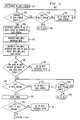
- FIG. 5 depicts a flowchart 500 illustrating this embodiment of the MUX_MPLS protocol.
- a IP data stream in a plurality of IP data streams is set to be a current IP data stream.
- the current IP data stream is checked to determined whether it is empty, i.e., IP data stream has zero IP data packets. If the current IP data stream is an empty IP data stream then, in step 503, it is checked to determine whether the current IP data stream is the last IP data stream in the plurality of IP data streams.
- a current IP data stream is considered to be the last IP data stream in the plurality of data streams if it was the last IP data stream to be set as a current IP data stream.
- step 550 If the current IP data stream is the last IP data stream, then flowchart 500 goes to step 550. Otherwise, in step 504, a next IP data stream (which was never a current IP data stream) in the plurality of IP data streams is set as the current IP data stream and flowchart 500 returns to step 502.
- step 506 the length or size of an IP data packet from the current IP data stream is determined.
- step 510 MUX_MPLS overhead information is generated based on the determined IP data packet length.
- the MUX_MPLS overhead information is one byte in size, and the length of the associated IP data packet may be indicated using one of the two following formats: octet or word. In other embodiments, the MUX_MPLS overhead information may be greater than one byte in size. In the octet format, the length of the associated IP data packet is indicated in eight bit binary format if the length is less than or equal to 255 octets or bytes. Otherwise, the length of the associated IP data packet is indicated using all zeroes, i.e., 00000000, to indicate that the length is greater than 255 octets.
- the associated IP data packet may be padded such that the resultant padded IP data packet is some integer multiple of a word, i.e., thirty-two bits.
- Six bits of the MUX-MPLS overhead information are used to represent the number of words in the associated IP data packet.
- the length of the associated IP data packet is indicated in six bit binary format if the number of words is less than or equal to 63 words. Otherwise, all zeroes, i.e., 000000, are used to indicate that the length is greater than 63 words.
- the other two bits of the MUX-MPLS overhead information are used to represent how many octets were used to pad the last word of the IP data packet.
- the two least or most significant bits of the MUX_MPLS overhead information are the two bits indicating the number of padded octets.
- IP data packet when an IP data packet is greater than 255 octets or 63 words and all zeroes are used to indicate its length, no other IP data packets may be multiplexed into the same MPLS frame after that IP data packet.
- IP data packet if a MPLS frame has an IP data packet with a length greater than 255 octets or 63 words, then such IP data packet shall be the last IP data packet in the MPLS frame.
- IP data packets with a length greater than 255 octets or 63 words are also referred to herein as "oversized IP data packets.” It should be understood that an oversized IP data packet may be any IP data packet where its own size or length is determinative of whether the IP data packet shall be the last IP data packet in the MPLS frame, i.e., an IP data packet with a length of at least L is an oversized IP data packet.
- the MUX_MPLS overhead information and associated IP data packet are multiplexed into a MUX_MPLS data packet. If there is an existing MUX_MPLS data packet, then the MUX_MPLS overhead information and associated IP data packet are added to or multiplexed with an existing MUX_MPLS data packet. If there is no existing MUX_MPLS data packet, then the MUX_MPLS overhead information and associated IP data packet are used to form a MUX_MPLS data packet. In step 520, the MUX_MPLS data packet is checked to determine whether any more IP data packets may be added to or multiplexed with the existing or newly formed MUX_MPLS data packet.
- the current size of the MUX_MPLS data packet is greater than a target size or if the MUX_MPLS overhead information associated with the last IP data packet of the MUX_MPLS data packet is all zeroes, then no more IP data packets may be added to or multiplexed with the MUX_MPLS data packet and flowchart 500 continues to the next protocol layer, i.e., MPLS protocol layer, in step 525.
- MPLS protocol layer i.e., MPLS protocol layer
- the target size is related to jitter performance. Making the target size smaller can also increase the jitter performance at the cost of lower efficiency. For better efficiency the target size should be larger but this increases the amount of delay. In one embodiment, the target size is set to 300 bytes.
- step 520 it is determined that more IP data packets may be added to or multiplexed with the existing or newly formed MUX_MPLS data packet and flowchart 500 continues to step 530.
- step 530 a check is made to determine whether the current IP data stream is the last IP data stream in the plurality of data streams. If the current IP data stream is not the last IP data stream, then flowchart 500 continues to step 535 where a next IP data stream (which was never a current IP data stream) in the plurality of IP data streams is set as the current IP data stream.
- step 540 the current IP data stream is checked to determined whether it is empty. If the current IP data stream is an empty IP data stream, then flowchart 500 returns to step 530. If the current IP data stream is not empty, then flowchart 500 returns to step 510, via step 545.
- step 530 If, in step 530, the current IP data stream is the last IP data stream, then flowchart 500 continues to step 550 where a timer is started. In step 552, it is determined whether there were any empty IP data streams in the plurality of IP data streams, i.e., was step 502 or 540 answered yes. If there were none then, in step 554, flowchart 500 goes to the next protocol layer. Otherwise, flowchart 500 goes to step 555.
- step 555 a previously empty IP data stream is set as the current IP data stream.
- step 560 the current IP data stream is checked to determined whether it is empty. If the current IP data stream is an empty IP data stream, then flowchart 500 continues to step 565 where the timer is checked to determined whether it has expired. If the timer expired then, in step 590, flowchart 500 continues to the next protocol layer. Otherwise, flowchart 500 continues to step 570.
- timer When a timer is set to expire depends on delay sensitivity and jitter performance. When the data is sensitive to delay and/or increase jitter performance is desired, the timer should have a timer value or be set to expire within a short time interval. In one embodiment, the timer is set to expire after 2 ms.
- a next previously empty IP data stream is set as the current IP data stream before returning flowchart 500 back to step 560.
- empty IP data streams may be set as the current IP data stream more than once. In other embodiments, empty IP data streams may not be set as the current IP data stream more than once.
- step 560 If, in step 560, it is determined that the current IP data stream is not empty, then the length or size of an IP data packet from the current IP data stream is determined in step 575.
- step 580 MUX_MPLS overhead information is generated based on the determined IP data packet length.
- step 585 the MUX_MPLS overhead information and the associated IP data packet are added to or multiplexed with the existing MUX_MPLS data packet.
- flowchart 500 continues to the next protocol layer.
- an intervening step between steps 585 and 590 allows for the resetting of the timer.
- the timer is allowed to be reset a limited number of times. If the limit of resets have been met, then flowchart 500 would continue to step 590. If the limit of resets have not been met, then flowchart 500 would return to step 570.
- flowchart 500 continues to step 565, instead of step 590, from step 585.
- an intervening step of checking the MUX_MPLS data packet size against the target size may also be performed (similar to step 520).
- flowchart 500 does not permit two IP data packets from a particular IP data stream to be multiplexed within a same MUX_MPLS data packet.
- two IP data packets from a particular IP data stream may be multiplexed within a same MUX_MPLS data packet.
Landscapes
- Engineering & Computer Science (AREA)
- Computer Networks & Wireless Communication (AREA)
- Signal Processing (AREA)
- Computer Security & Cryptography (AREA)
- Data Exchanges In Wide-Area Networks (AREA)
- Small-Scale Networks (AREA)
- Mobile Radio Communication Systems (AREA)
Abstract
Description
Claims (10)
- A protocol stack comprising:an internet protocol layer for adding internet protocol overhead information to data packets to produce internet protocol data packets;a multiplexing layer for adding multiplexer overhead information to the internet protocol data packets and multiplexing the internet protocol data packets and multiplexer overhead information to produce a multiplexed data packet, wherein the multiplexer overhead information are interposed between the internet protocol data packets and are indicative of lengths associated with the internet protocol data packets; anda multi protocol label switching layer for adding multi protocol label switching overhead information to the multiplexed the multiplexed data packet to produce a multi protocol label switching data packet.
- The protocol stack of claim 1 further comprising:a point to point protocol layer and a high level data link control protocol layer for adding point to point overhead information and high level data link control overhead information to the multi protocol label switching data packet.
- A method for multiplexing streams of internet protocol (IP) data packets comprising the steps of:multiplexing within a frame a first IP overhead information and a first IP data packet, the first IP overhead information indicative of a length associated with the first IP data packet;determining whether a second IP data packet can be multiplexed into the same frame with the multiplexed first IP overhead information and the first IP data packet; andmultiplexing within the frame the second IP overhead information and the second IP data packet if the second IP data packet can be multiplexed into the frame.
- The method of claim 3, wherein the second IP overhead information and the second IP data packet can be multiplexed within the frame if the multiplexed first IP overhead information and the first IP data packet are not greater than a target size.
- The method of claim 4, wherein the target size is based on desired jitter performance.
- The method of claim 3, wherein the second IP overhead information and the second IP data packet can be multiplexed within the frame if the first IP data packet was not an oversized IP data packet.
- The method of claim 3, wherein the second IP overhead information and the second IP data packet can be multiplexed within the frame if a timer has not expired.
- The method of claim 3, wherein the second IP overhead information and the second IP data packet can be multiplexed within the frame if a timer has not expired and if the first IP data packet was not an oversized IP data packet or the multiplexed first IP overhead information and the first IP data packet are not greater than a target size.
- The method of claim 3, wherein the first IP data packet and the second IP data packet belong to different IP data streams.
- The method of claim 3 comprising the additional step of:adding multi protocol label switching overhead information to IP overhead information and IP data packets multiplexed within the frame when no more IP data packets can be multiplexed within the frame.
Applications Claiming Priority (2)
| Application Number | Priority Date | Filing Date | Title |
|---|---|---|---|
| US09/957,409 US20030053485A1 (en) | 2001-09-20 | 2001-09-20 | Multiplexing IP data packets within a MPLS frame |
| US957409 | 2001-09-20 |
Publications (2)
| Publication Number | Publication Date |
|---|---|
| EP1296488A2 true EP1296488A2 (en) | 2003-03-26 |
| EP1296488A3 EP1296488A3 (en) | 2003-05-14 |
Family
ID=25499528
Family Applications (1)
| Application Number | Title | Priority Date | Filing Date |
|---|---|---|---|
| EP02252570A Withdrawn EP1296488A3 (en) | 2001-09-20 | 2002-04-10 | Multiplexing IP data packets within a MPLS frame |
Country Status (3)
| Country | Link |
|---|---|
| US (1) | US20030053485A1 (en) |
| EP (1) | EP1296488A3 (en) |
| JP (1) | JP2003115876A (en) |
Families Citing this family (23)
| Publication number | Priority date | Publication date | Assignee | Title |
|---|---|---|---|---|
| EP1351453B1 (en) * | 2002-04-03 | 2006-04-12 | Alcatel | Method and apparatuses for packet reordering in a network processor |
| KR101486352B1 (en) | 2007-06-18 | 2015-01-26 | 엘지전자 주식회사 | Uplink synchronization state control method in a terminal of a wireless communication system |
| KR101341515B1 (en) | 2007-06-18 | 2013-12-16 | 엘지전자 주식회사 | Method of updating repeatedly-transmitted information in wireless communicaiton system |
| KR101490253B1 (en) | 2007-08-10 | 2015-02-05 | 엘지전자 주식회사 | Method and apparatus for transmitting and receiving control information in a wireless communication system |
| KR101514841B1 (en) | 2007-08-10 | 2015-04-23 | 엘지전자 주식회사 | Method for re-attempting a random access effectively |
| WO2009022826A1 (en) | 2007-08-10 | 2009-02-19 | Lg Electronics Inc. | Method for controlling harq operation in dynamic radio resource allocation |
| KR101479341B1 (en) | 2007-08-10 | 2015-01-05 | 엘지전자 주식회사 | An efficient receiving method in a wireless communication system providing an MBMS service |
| US8488523B2 (en) | 2007-08-14 | 2013-07-16 | Lg Electronics Inc. | Method of transmitting and processing data block of specific protocol layer in wireless communication system |
| KR101461970B1 (en) | 2007-09-13 | 2014-11-14 | 엘지전자 주식회사 | A method of performing a polling process in a wireless communication system |
| KR100937432B1 (en) | 2007-09-13 | 2010-01-18 | 엘지전자 주식회사 | Radio Resource Allocation Method in Wireless Communication System |
| KR101396062B1 (en) * | 2007-09-18 | 2014-05-26 | 엘지전자 주식회사 | Effective data block transmission method using a header indicator |
| KR101435844B1 (en) | 2007-09-18 | 2014-08-29 | 엘지전자 주식회사 | Method for transmitting data blocks in a wireless communication system |
| KR101591824B1 (en) | 2007-09-18 | 2016-02-04 | 엘지전자 주식회사 | Method of performing polling procedure in a wireless communication system |
| KR101513033B1 (en) | 2007-09-18 | 2015-04-17 | 엘지전자 주식회사 | A method for qos guarantees in a multilayer structure |
| WO2009038377A2 (en) | 2007-09-20 | 2009-03-26 | Lg Electronics Inc. | Method of effectively transmitting radio resource allocation request in mobile communication system |
| KR20090041323A (en) | 2007-10-23 | 2009-04-28 | 엘지전자 주식회사 | Method for effectively transmitting identification information of terminal in data block configuration |
| KR101487557B1 (en) | 2007-10-23 | 2015-01-29 | 엘지전자 주식회사 | Method of transmitting data of common control channel |
| KR20090043465A (en) | 2007-10-29 | 2009-05-06 | 엘지전자 주식회사 | Error solving method according to radio bearer type |
| KR101163275B1 (en) * | 2008-03-17 | 2012-07-05 | 엘지전자 주식회사 | Method for transmitting pdcp status report |
| WO2009116788A1 (en) | 2008-03-17 | 2009-09-24 | Lg Electronics Inc. | Method of transmitting rlc data |
| US11711592B2 (en) * | 2010-04-06 | 2023-07-25 | Comcast Cable Communications, Llc | Distribution of multiple signals of video content independently over a network |
| US10448083B2 (en) | 2010-04-06 | 2019-10-15 | Comcast Cable Communications, Llc | Streaming and rendering of 3-dimensional video |
| US9204123B2 (en) | 2011-01-14 | 2015-12-01 | Comcast Cable Communications, Llc | Video content generation |
Family Cites Families (14)
| Publication number | Priority date | Publication date | Assignee | Title |
|---|---|---|---|---|
| US5291482A (en) * | 1992-07-24 | 1994-03-01 | At&T Bell Laboratories | High bandwidth packet switch |
| GB2301752B (en) * | 1995-06-02 | 2000-03-29 | Dsc Communications | Control message transmission in telecommunications systems |
| US6393008B1 (en) * | 1997-12-23 | 2002-05-21 | Nokia Movile Phones Ltd. | Control structures for contention-based packet data services in wideband CDMA |
| KR100454930B1 (en) * | 1998-08-17 | 2005-01-13 | 삼성전자주식회사 | Apparatus and method for multiplexing physical channel in cdma communication system |
| WO2000011849A1 (en) * | 1998-08-20 | 2000-03-02 | Nokia Networks Oy | Method and apparatus for providing user multiplexing in a real-time protocol |
| US6590882B1 (en) * | 1998-09-15 | 2003-07-08 | Nortel Networks Limited | Multiplexing/demultiplexing schemes between wireless physical layer and link layer |
| AU2499600A (en) * | 1999-01-12 | 2000-08-01 | Nokia Internet Communications Inc. | Method and apparatus for providing efficient multiplexing between gateways usingdynamic timers |
| US6366961B1 (en) * | 1999-03-03 | 2002-04-02 | Nokia Telecommunications, Oy | Method and apparatus for providing mini packet switching in IP based cellular access networks |
| WO2000057284A1 (en) * | 1999-03-25 | 2000-09-28 | Motorola Inc. | Point to point protocol multiplexing/demultiplexing method and apparatus |
| WO2000072532A1 (en) * | 1999-05-24 | 2000-11-30 | Rutgers, The State University Of New Jersey | System and method for network packet reduction |
| US6574224B1 (en) * | 1999-07-02 | 2003-06-03 | Nortel Networks Limited | Processing communication traffic |
| US6829254B1 (en) * | 1999-12-28 | 2004-12-07 | Nokia Internet Communications, Inc. | Method and apparatus for providing efficient application-level switching for multiplexed internet protocol media streams |
| US7600039B2 (en) * | 2000-02-16 | 2009-10-06 | Motorola, Inc. | Label-based multiplexing |
| AU2001288399A1 (en) * | 2000-08-24 | 2002-03-04 | Tiara Networks, Inc. | System and method for connecting geographically distributed virtual local area networks |
-
2001
- 2001-09-20 US US09/957,409 patent/US20030053485A1/en not_active Abandoned
-
2002
- 2002-04-10 EP EP02252570A patent/EP1296488A3/en not_active Withdrawn
- 2002-09-20 JP JP2002274263A patent/JP2003115876A/en active Pending
Also Published As
| Publication number | Publication date |
|---|---|
| JP2003115876A (en) | 2003-04-18 |
| US20030053485A1 (en) | 2003-03-20 |
| EP1296488A3 (en) | 2003-05-14 |
Similar Documents
| Publication | Publication Date | Title |
|---|---|---|
| US20030053485A1 (en) | Multiplexing IP data packets within a MPLS frame | |
| EP0836781B1 (en) | Method and apparatus for synchronizing data transmission with on-demand links of a network | |
| AU777645B2 (en) | Circuit emulation service over an internet protocol network | |
| FI106591B (en) | Method of transmitting data transfer flows | |
| EP1005780B1 (en) | Method and system for encapsulating/decapsulating data on a per channel basis in hardware | |
| US6876669B2 (en) | Packet fragmentation with nested interruptions | |
| JP3751823B2 (en) | Header compression in real-time services | |
| US6993021B1 (en) | Lightweight internet protocol encapsulation (LIPE) scheme for multimedia traffic transport | |
| JP2007529182A (en) | Providing information on upper layer packet or frame boundary in GRE frame | |
| TW201208324A (en) | Packet coalescing | |
| US11902172B2 (en) | Device and method for transferring identification and/or data flow control information between devices | |
| JP2002290383A (en) | Packet transmission control method and transmission device | |
| CN117041143A (en) | A satellite data forwarding method and system based on label switching technology | |
| EP2071808A1 (en) | Methods and a system and devices for ipv6 datagram transmission in the ethernet | |
| US8583822B2 (en) | Method and system for minimum frame size support for a communication protocol encapsulated over Ethernet | |
| JP2025528604A (en) | Method for transmitting an Ethernet MAC frame | |
| WO1997048211A2 (en) | Implementing atm virtual channels in a packet network | |
| EP1344416B1 (en) | Method for transmitting packets over circuit-switched network | |
| EP2048828B1 (en) | Method and systems for data transmission over packet networks, corresponding computer program product | |
| KR20040074525A (en) | Method for framing packet data in wireless telecommunication system | |
| KR100800226B1 (en) | Port control device of mobile communication system and its control method | |
| EP1494402A1 (en) | Transmission control device and process for an interface between communication networks and associated products | |
| Hardware | 7986@ A6BCD@ EF GIHQ PSR6CT6RU& PSR6CT6R VWB86ECBX HGICY V% GIXa6R6EBC9 bc@ B86cBIU dBXX@ 86T6e@ DB86T fER ghU& i&pqsrt6u vIt6uw PSR6CT6RU& i&@ 86xf8 y | |
| JP2004289239A (en) | Packet receiver |
Legal Events
| Date | Code | Title | Description |
|---|---|---|---|
| PUAI | Public reference made under article 153(3) epc to a published international application that has entered the european phase |
Free format text: ORIGINAL CODE: 0009012 |
|
| 17P | Request for examination filed |
Effective date: 20020429 |
|
| AK | Designated contracting states |
Kind code of ref document: A2 Designated state(s): AT BE CH CY DE DK ES FI FR GB GR IE IT LI LU MC NL PT SE TR Designated state(s): AT BE CH CY DE DK ES FI FR GB GR IE IT LI LU MC NL PT SE TR |
|
| AX | Request for extension of the european patent |
Extension state: AL LT LV MK RO SI |
|
| PUAL | Search report despatched |
Free format text: ORIGINAL CODE: 0009013 |
|
| AK | Designated contracting states |
Designated state(s): AT BE CH CY DE DK ES FI FR GB GR IE IT LI LU MC NL PT SE TR |
|
| AX | Request for extension of the european patent |
Extension state: AL LT LV MK RO SI |
|
| RIC1 | Information provided on ipc code assigned before grant |
Ipc: 7H 04L 29/06 B Ipc: 7H 04L 12/56 A |
|
| 17Q | First examination report despatched |
Effective date: 20030729 |
|
| AKX | Designation fees paid |
Designated state(s): DE ES FR GB IT |
|
| STAA | Information on the status of an ep patent application or granted ep patent |
Free format text: STATUS: THE APPLICATION IS DEEMED TO BE WITHDRAWN |
|
| 18D | Application deemed to be withdrawn |
Effective date: 20040210 |