EP1295920A2 - Fluorescent marking stain and pen - Google Patents
Fluorescent marking stain and pen Download PDFInfo
- Publication number
- EP1295920A2 EP1295920A2 EP02020989A EP02020989A EP1295920A2 EP 1295920 A2 EP1295920 A2 EP 1295920A2 EP 02020989 A EP02020989 A EP 02020989A EP 02020989 A EP02020989 A EP 02020989A EP 1295920 A2 EP1295920 A2 EP 1295920A2
- Authority
- EP
- European Patent Office
- Prior art keywords
- percent
- stain
- present
- concentration
- marking
- Prior art date
- Legal status (The legal status is an assumption and is not a legal conclusion. Google has not performed a legal analysis and makes no representation as to the accuracy of the status listed.)
- Withdrawn
Links
Images
Classifications
-
- C—CHEMISTRY; METALLURGY
- C09—DYES; PAINTS; POLISHES; NATURAL RESINS; ADHESIVES; COMPOSITIONS NOT OTHERWISE PROVIDED FOR; APPLICATIONS OF MATERIALS NOT OTHERWISE PROVIDED FOR
- C09D—COATING COMPOSITIONS, e.g. PAINTS, VARNISHES OR LACQUERS; FILLING PASTES; CHEMICAL PAINT OR INK REMOVERS; INKS; CORRECTING FLUIDS; WOODSTAINS; PASTES OR SOLIDS FOR COLOURING OR PRINTING; USE OF MATERIALS THEREFOR
- C09D11/00—Inks
- C09D11/16—Writing inks
-
- C—CHEMISTRY; METALLURGY
- C09—DYES; PAINTS; POLISHES; NATURAL RESINS; ADHESIVES; COMPOSITIONS NOT OTHERWISE PROVIDED FOR; APPLICATIONS OF MATERIALS NOT OTHERWISE PROVIDED FOR
- C09D—COATING COMPOSITIONS, e.g. PAINTS, VARNISHES OR LACQUERS; FILLING PASTES; CHEMICAL PAINT OR INK REMOVERS; INKS; CORRECTING FLUIDS; WOODSTAINS; PASTES OR SOLIDS FOR COLOURING OR PRINTING; USE OF MATERIALS THEREFOR
- C09D11/00—Inks
- C09D11/16—Writing inks
- C09D11/17—Writing inks characterised by colouring agents
-
- B—PERFORMING OPERATIONS; TRANSPORTING
- B43—WRITING OR DRAWING IMPLEMENTS; BUREAU ACCESSORIES
- B43K—IMPLEMENTS FOR WRITING OR DRAWING
- B43K8/00—Pens with writing-points other than nibs or balls
- B43K8/02—Pens with writing-points other than nibs or balls with writing-points comprising fibres, felt, or similar porous or capillary material
-
- C—CHEMISTRY; METALLURGY
- C09—DYES; PAINTS; POLISHES; NATURAL RESINS; ADHESIVES; COMPOSITIONS NOT OTHERWISE PROVIDED FOR; APPLICATIONS OF MATERIALS NOT OTHERWISE PROVIDED FOR
- C09D—COATING COMPOSITIONS, e.g. PAINTS, VARNISHES OR LACQUERS; FILLING PASTES; CHEMICAL PAINT OR INK REMOVERS; INKS; CORRECTING FLUIDS; WOODSTAINS; PASTES OR SOLIDS FOR COLOURING OR PRINTING; USE OF MATERIALS THEREFOR
- C09D11/00—Inks
- C09D11/50—Sympathetic, colour changing or similar inks
Definitions
- the present invention is directed to a fluorescent marking stain. More particularly, the present invention is directed to a readily applyable fluorescent marking stain and pen for use in coating or marking parts.
- parts are more easily identified and/or located when marked. To this end, parts are often marked with paints or dyes for use in assemblies. However, known paints or dyes for this use are simply colored. Thus, while this marking facilitates identification, it does not enhance the ability to identify or locate the parts, generally.
- a fluorescent marking stain that enhances the ability to visually identify and locate parts.
- a stain is provided in a readily usable device to permit marking of parts.
- a fluorescent marking stain is used for marking items.
- the stain enhances the ability to visually identify and locate parts.
- a stain is provided in a readily usable device to permit marking of parts.
- a present marking stain is yellow.
- the marking stain is formulated from a resin present in a concentration of about 1 percent to about 5 percent of the stain, an active solvent for and compatible with the resin present in a concentration of about 40 percent to about 50 percent of the stain, a dye solvent present in a concentration of about 20 percent to about 30 percent of the stain, a diluent present in a concentration of about 10 percent to about 20 percent of the stain, an adhesion promoter present in a concentration of about 1 percent to about 5 percent of the stain, an optical brightener present in a concentration of about 1 percent to about 5 percent of the stain and a fluorescent dye present in a concentration of about 0.2 percent to about 5 percent of the stain.
- the resin is nitrocellulose present in a concentration of about 3.3 percent of the stain and the active solvent is butyl acetate present in a concentration of about 43 percent of the stain.
- a preferred dye solvent includes ethanol, propyl acetate and isopropanol, and is present in a concentration of about 27 percent of the stain.
- the dye solvent can be formulated such that the ethanol is present in a concentration of about 90 percent to about 98 percent of the dye solvent, the propyl acetate is present in a concentration of about 1 percent to about 5 percent of the dye solvent and the isopropanol is present in a concentration of about 1 percent to about 5 percent of the dye solvent.
- a preferred diluent is butanol present in a concentration of about 18 percent of the stain.
- the adhesion promoter is preferably a polyamide resin, and is present in a concentration of about 4.5 percent of the stain.
- a preferred fluorescent dye is a quinoline dye present in a concentration of about 0.3 percent of the stain and a preferred optical brightener is an amino coumarin in a concentration of optical brightener is about 1.2 percent of the stain.
- the fluorescent marking stain can further include one or more plasticizers.
- the plasticizers can be present in a concentration of about 1 percent to about 5 percent of the stain.
- the plasticizers can include tri-phenyl phosphate and castor oil, present in a concentration of about 1.4 percent and 0.6 percent, respectively.
- a marking pen for marking with the marking stain includes a porous nib and a chamber for storing the stain, in which the nip is in fluid communication with the stain in the chamber.
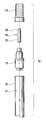
- FIG. 1 is an exploded view of an exemplary pen for use with the fluorescent marking stain embodying the principles of the present invention.
- a fluorescent marking stain in accordance with the present invention has been found to be useful for marking items.
- a preferred stain is of the type that will adhere to parts, including metal parts an the like. Although many types of stains or dyes are known, a stain for use in marking parts must be able to adhere to such parts without being readily removed or “rubbed off” of the parts. Additionally, such a stain or dye must be formulated so as to not flake off of the parts so marked.
- a present fluorescent marking stain is formulated from resin carried in a compatible active solvent.
- the resin is nitrocellulose and the compatible solvent is butyl acetate.
- Other resins as well as solvents compatible with nitrocellulose and such other resins will be recognized by those skilled in the art.
- the nitrocellulose is present in a concentration of about 1 percent to about 5 percent, and preferably about 3.3 percent of the stain and the active solvent is present in a concentration of about 40 percent to about 50 percent, and preferably about 43 percent of the stain.
- the nitrocellulose is provided in a solution of butyl acetate and isopropanol, such as that commercially available from Akzo Nobel Coatings of Somerset, New Jersey, as product No. 50-C3-801. Additional butyl acetate, if needed, can be, for example, that commercially available from Union Carbide Corporation, under the product name Butyl Acetate Urethane Grade.
- the stain further includes a dye solvent, also compatible with the resin,
- a preferred dye solvent includes ethanol, propyl acetate and isopropanol.
- the ethanol is present in a concentration of about 90% to about 98% of the dye solvent
- the propyl acetate is present in a concentration of about 1% to about 5% of the dye solvent
- the isopropanol is present in a concentration of about 1% to about 5% of the dye solvent.
- the dye solvent is present in a concentration of about 27 percent of the stain.
- the dye solvent used in the present marking stain is commercially available under the product name Duplicating Fluid 5, from HCI Chemtech Distribution, Incorporated of Chesterfield, Missouri.
- solvents can be used in formulation of the stain.
- light alcohols such as isopropanol, ethanol and the like can be used for the solvent.
- solvents that will be compatible with the resin, which other solvents are within the scope and spirit of the present invention.
- the marking stain further includes a diluent.
- a preferred diluent is butanol present in a concentration of about 10 percent of the stain to about 20 percent of the stain. In a present stain, the butanol is present in a concentration of about 18 percent of the stain.
- One commercially available butanol is that available from BASF Corporation of Mount Olive, New Jersey, under the product identification code NCO 526220.
- the stain includes an adhesion promoter.
- the adhesion promoter is polyamide resin, present in a concentration of about 1 percent to about 5 percent of the stain, and preferably about 4.5 percent of the stain.
- One polyamide resin is a dimer acid based polyamide resin, commercially available under the trade name Versamid 757 from Cognis Corporation of Cincinnati, Ohio.
- the marking stain further includes a fluorescent dye present in a concentration of about 0.2 percent to about 5 percent of the stain, and preferably about 1.4 percent of the stain.
- a present dye is a quinoline dye, such as that available from Sunbelt Corporation of Rock Hill, South Carolina under the trade name Morplas Fluorescent Yellow G Powder (Solvent Yellow 43).
- the stain includes an optical brightener present in a concentration of about 1 percent to about 5 percent of the stain, and preferably about 0.6 percent of the stain.
- a preferred optical brightener is an amino coumarin, and preferably 4-methyl, 7-diethyl amino coumarin, commercially available under the trade name Keywhite RWP, from Keystone Aniline Corporation of Chicago, Illinois. Other optical brighteners will be recognized by those skilled in the art.
- the stain can include one or more plasticizers.
- Plasticizers such as tri-phenyl phosphate, castor oil and the like can be present in a concentration of about 1 percent to about 10 percent of the stain. These can be obtained commercially from Solutia Inc. of St. Louis Missouri and Caschem, Inc. of Bayonne, New Jersey, the former under its chemical name and the latter under the trade name #15 Oil.
- the present marking stain having an organic base (e.g., in an organic solvent solution), will adhere to parts and the like the have been coated or otherwise protected with, for example, a light oil.
- a light oil many such parts are fabricated from carbon steel materials or materials that maybe susceptible to oxidation. As such, upon machining these parts are often coated with a light oil to protect these parts by prevent oxygen from contacting the part surfaces.
- the present marking stain is formulated to penetrate the oil coating to permit the stain to contact the part surface. As such, the stain will adhere to the part, and will not “rub-off" when the part is contacted. Thus, it is anticipated that the parts can be marked with the stain, as after fabrication, and the stain will remain adhered to the part in shipping and handling.
- the nitrocellulose in the stain is the principle coating agent for the stain.
- the solvent is present to dissolve the nitrocellulose and to permits the nitrocellulose to be carried in solution.
- the solvent such as the exemplary butyl acetate is relatively volatile, and will thus evaporate after application of the stain. Although evaporation is desired, other solvents, having less volatile organic compound (VOC) characteristics are anticipated. One such alternate, anticipated solvent is acetone.
- the solvent further assists in enhancing the flow characteristics of the stain. That is, the solvent is a viscosity modifier or viscosity controlling constituent for the stain. It will be understood by those skilled in the art that the concentration of the solvent must be sufficiently high to dissolve the resin (i.e., to bring the resin to solution), while not being so high that it will adversely affect the drying time of the stain.
- the marking of the parts is a secondary operation, that is, it does not in and of itself effectuate part fabrication, it must be process that minimally, if at all, impacts the fabrication process and the time and cost to carry out the fabrication process.
- a desired marking stain dries quickly, dries well and adheres to the part.
- the concentration of the solvent, vis-a-vis the entirety of the stain must be such that it permits ready application of the stain while providing for rapid drying and a "not-easily removed" mark.
- the marking stain is applied using a "pen,” exemplary of which is the pen 10 illustrated in FIG. 1.
- a pen 10 includes a body 12 defining a sealed chamber 14 in which the marking stain S is stored.
- a nib 16 is formed from a porous material, such as felt, and is mounted to the body 12 by a biased valve assembly 18.
- the nib 16 has a marking end 20 and a supply end 22, from which the stain S is supplied to the marking end 20.
- a typical pen 10 includes a cap 24 to prevent the pen 10 from drying out.
- Such a marking pen is commercially available from ITW Mark-Tex of Roseland, New Jersey.
- the nib 16 is biased to an outward position in which it extends outwardly of the body 12 and valve assembly 18.
- the supply end 22 of the nib is positioned in the valve assembly 18.
- the nib 16 urges the valve assembly 18 open which permits the stain S to flow from the chamber 14, into the valve 18 and into contact with the nib supply end 22.
- This saturates the nib 16 with the stain S which flows through the nib 16 to the marking end 20.
- Contact of the marking end 20 with an item thus results in marking the item. Marking pens such as these are well known in the art.
Landscapes
- Chemical & Material Sciences (AREA)
- Life Sciences & Earth Sciences (AREA)
- Engineering & Computer Science (AREA)
- Materials Engineering (AREA)
- Wood Science & Technology (AREA)
- Organic Chemistry (AREA)
- Pens And Brushes (AREA)
- Inks, Pencil-Leads, Or Crayons (AREA)
Abstract
Description
Claims (19)
- A fluorescent marking stain for marking items comprising:a resin present in a concentration of about 1 percent to about 5 percent of the marking stain;an active solvent for and compatible with the resin present in a concentration of about 40 percent to about 50 percent of the marking stain;a dye solvent present in a concentration of about 20 percent to about 30 percent of the marking stain;a diluent present in a concentration of about 10 percent to about 20 percent of the marking stain;an adhesion promoter present in a concentration of about 1 percent to about 5 percent of the marking stain;an optical brightener present in a concentration of about 1 percent to about 5 percent of the marking stain; anda fluorescent dye present in a concentration of about 0.2 percent to about 5 percent of the marking stain.
- The fluorescent marking stain in accordance with claim 1 wherein the resin is nitrocellulose.
- The fluorescent marking stain in accordance with claim 1 or 2 wherein the active solvent is butyl acetate.
- The fluorescent marking stain in accordance with at least one of the preceding claims wherein the dye solvent includes ethanol, propyl acetate and isopropanol.
- The fluorescent marking stain in accordance with claim 4 wherein the dye solvent includes ethanol, propyl acetate and isopropanol, and wherein the ethanol is present in a concentration of about 90 percent to about 98 percent of the dye solvent, the propyl acetate is present in a concentration of about 1 percent to about 5 percent of the dye solvent and the isopropanol is present in a concentration of about 1 percent to about 5 percent of the dye solvent.
- The fluorescent marking stain in accordance with at least one of the preceding claims wherein the diluent is butanol.
- The fluorescent marking stain in accordance with at least one of the preceding claims wherein the adhesion promoter is a polyamide resin.
- The fluorescent marking stain in accordance with at least one of the preceding claims wherein the fluorescent dye is a quinoline dye.
- The fluorescent marking stain in accordance with at least one of the preceding claims including a plasticizer.
- The fluorescent marking stain in accordance with claim 9 wherein the plasticizer is at least one of tri-phenyl phosphate and castor oil.
- The fluorescent marking stain in accordance with claim 9 or 10 wherein the plasticizer is present in a concentration of about 1 percent to about 5 percent of the marking stain.
- The fluorescent marking stain in accordance with at least one of the preceding claims wherein the optical brightener is an amino coumarin.
- The fluorescent marking stain in accordance with at least one of the preceding claims wherein the marking stain is yellow.
- A fluorescent marking stain for marking items comprising:nitrocellulose present in a concentration of about 1 percent to about 5 percent of the marking stain;butyl acetate as an active solvent for and compatible with the nitrocellulose present in a concentration of about 40 percent to about 50 percent of the marking stain;a dye solvent present in a concentration of about 20 percent to about 30 percent of the marking stain comprising ethanol, propyl acetate and isopropanol;,a diluent present comprising butanol present in a concentration of about 10 percent to about 20 percent of the marking stain;an adhesion promoter comprising a polyamide resin present in a concentration of about 1 percent to about 5 percent of the marking stain;an optical brightener present in a concentration of about 1 percent to about 5 percent of the marking stain; anda fluorescent dye present in a concentration of about 0.2 percent to about 5 percent of the marking stain.
- The fluorescent marking stain in accordance with claim 14 including a plasticizer.
- The fluorescent marking stain in accordance with claim 14 or 15 wherein the marking stain is yellow.
- A marking pen comprising:a porous nib;a chamber for storing a marking stain, the nip being in fluid communication with the marking stain; anda fluorescent marking stain comprising a resin present in a concentration of about 1 percent to about 5 percent of the marking stain, an active solvent for and compatible with the resin present in a concentration of about 40 percent to about 50 percent of the marking stain, a dye solvent present in a concentration of about 20 percent to about 30 percent of the marking stain, a diluent present in a concentration of about 10 percent to about 20 percent of the marking stain, an adhesion promoter present in a concentration of about 1 percent to about 5 percent of the marking stain, an optical brightener present in a concentration of about 1 percent to about 5 percent of the marking stain and a fluorescent dye present in a concentration of about 0.2 percent to about 5 percent of the marking stain.
- The marking pen in accordance with claim 17 wherein the nib is biasedly mounted for reciprocating movement into and out of the chamber.
- The marking pen in accordance with claim 17 or 18 wherein the fluorescent marking stain is yellow.
Applications Claiming Priority (2)
| Application Number | Priority Date | Filing Date | Title |
|---|---|---|---|
| US957771 | 2001-09-21 | ||
| US09/957,771 US6692558B2 (en) | 2001-09-21 | 2001-09-21 | Fluorescent marking stain and pen |
Publications (2)
| Publication Number | Publication Date |
|---|---|
| EP1295920A2 true EP1295920A2 (en) | 2003-03-26 |
| EP1295920A3 EP1295920A3 (en) | 2004-03-31 |
Family
ID=25500106
Family Applications (1)
| Application Number | Title | Priority Date | Filing Date |
|---|---|---|---|
| EP02020989A Withdrawn EP1295920A3 (en) | 2001-09-21 | 2002-09-20 | Fluorescent marking stain and pen |
Country Status (5)
| Country | Link |
|---|---|
| US (1) | US6692558B2 (en) |
| EP (1) | EP1295920A3 (en) |
| JP (1) | JP2003118291A (en) |
| KR (1) | KR20030025866A (en) |
| CN (1) | CN1228403C (en) |
Cited By (1)
| Publication number | Priority date | Publication date | Assignee | Title |
|---|---|---|---|---|
| CN100351355C (en) * | 2002-04-24 | 2007-11-28 | 伊利诺斯器械工程公司 | Fluorescent lubricant |
Families Citing this family (3)
| Publication number | Priority date | Publication date | Assignee | Title |
|---|---|---|---|---|
| US6828359B2 (en) * | 2002-03-25 | 2004-12-07 | Illinois Tool Works, Inc. | Resin based fluorescent marking stain |
| CN102093754A (en) * | 2010-12-08 | 2011-06-15 | 中国人民解放军63975部队 | Dyeing agent for labeling skin |
| EP4574921A1 (en) * | 2023-12-21 | 2025-06-25 | The Swatch Group Research and Development Ltd | Light-coloured photoluminescent material |
Family Cites Families (14)
| Publication number | Priority date | Publication date | Assignee | Title |
|---|---|---|---|---|
| US4186020A (en) * | 1974-11-04 | 1980-01-29 | A. B. Dick Company | Fluorescent ink for automatic identification |
| JPS5482234A (en) * | 1977-12-14 | 1979-06-30 | Fuji Photo Film Co Ltd | Photostabilizing method for organic base material |
| US4243694A (en) * | 1978-06-26 | 1981-01-06 | Whittaker Corporation | Jet ink process and ink composition fluorescent in ultraviolet light |
| JPS55152750A (en) * | 1979-05-17 | 1980-11-28 | Fuji Photo Film Co Ltd | Stabilization of organic substrate substance against light |
| JPS58208359A (en) * | 1982-05-28 | 1983-12-05 | Pentel Kk | Fluorescent ink for writing utensils |
| US4601863A (en) * | 1984-02-09 | 1986-07-22 | Kanzaki Paper Manufacturing Co., Ltd. | Process for producing powder of microcapsules |
| JPS63268777A (en) * | 1987-04-25 | 1988-11-07 | Kanzaki Paper Mfg Co Ltd | Microencapsulated ink composition |
| DE4006396A1 (en) * | 1990-03-01 | 1991-09-05 | Bayer Ag | FLUORESCENTLY COLORED POLYMER EMULSIONS |
| US5203638A (en) * | 1991-11-29 | 1993-04-20 | Redmond Jr Robert F | Writing instrument for alternately writing in fluorescent transparent and nontransparent ink |
| EP0645735A2 (en) * | 1993-08-30 | 1995-03-29 | Konica Corporation | Id card |
| JP3304612B2 (en) * | 1994-06-09 | 2002-07-22 | 株式会社サクラクレパス | Fluorescent color ink composition for writing instruments |
| EP0711814B1 (en) * | 1994-10-21 | 2001-04-11 | Hitachi Maxell Ltd. | Fluorescent marking composition and fluorescent mark formed by said composition |
| TW363016B (en) * | 1996-01-08 | 1999-07-01 | Nippon Kayaku Kk | Laser marking article having two or more layers of thin films on the surface thereof, method for laser marking of the article and ground composition for use in laser marking |
| US6517619B1 (en) * | 2000-08-24 | 2003-02-11 | Bic Corporation | Fluorescent inks for writing instruments using fluorescent dyes and white pigments |
-
2001
- 2001-09-21 US US09/957,771 patent/US6692558B2/en not_active Expired - Fee Related
-
2002
- 2002-09-19 KR KR1020020057150A patent/KR20030025866A/en not_active Withdrawn
- 2002-09-19 JP JP2002273018A patent/JP2003118291A/en active Pending
- 2002-09-20 EP EP02020989A patent/EP1295920A3/en not_active Withdrawn
- 2002-09-20 CN CNB021424802A patent/CN1228403C/en not_active Expired - Fee Related
Cited By (1)
| Publication number | Priority date | Publication date | Assignee | Title |
|---|---|---|---|---|
| CN100351355C (en) * | 2002-04-24 | 2007-11-28 | 伊利诺斯器械工程公司 | Fluorescent lubricant |
Also Published As
| Publication number | Publication date |
|---|---|
| JP2003118291A (en) | 2003-04-23 |
| US6692558B2 (en) | 2004-02-17 |
| KR20030025866A (en) | 2003-03-29 |
| US20030056689A1 (en) | 2003-03-27 |
| CN1228403C (en) | 2005-11-23 |
| EP1295920A3 (en) | 2004-03-31 |
| CN1408798A (en) | 2003-04-09 |
Similar Documents
| Publication | Publication Date | Title |
|---|---|---|
| KR102009538B1 (en) | Colorant, microcapsule pigment prepared by using the same and ink composition for writing instrument | |
| US6315152B1 (en) | Tube storage device | |
| US6692558B2 (en) | Fluorescent marking stain and pen | |
| CA2132398A1 (en) | Cosmetic Composition Containing an Epoxidized Oil as Plastifier | |
| MY117627A (en) | Solvent-based non-fluorescent ink for writing instruments based upon pigment dispersions in non-aqueous solvents | |
| DE602004022321D1 (en) | ULTRAVIOLET-HARDENING RESIN COMPOSITION, PAINTING, INK, ADHESIVE, LUBRICANT AND PRIMER | |
| CA2421426C (en) | Fluorescent lubricant | |
| KR930007890B1 (en) | Metal forming lubricant | |
| US20030213936A1 (en) | Corrosion inhibiting formula and corrosion inhibiting articles using same | |
| CA2292613A1 (en) | Coloring composition | |
| EP1348745A2 (en) | Resin based fluorescent marking stain | |
| US20040028462A1 (en) | Writing utensil excellent in cap-off characteristics | |
| US7785413B2 (en) | Lacquer thinner | |
| EP0873887A3 (en) | Process for marking tyres using a water-based composition | |
| EP1268684B1 (en) | Agent for cleaning | |
| US11987068B2 (en) | Marking pen | |
| JP4376008B2 (en) | Oil ballpoint pen or ballpoint pen refill | |
| JP2005048025A (en) | Water-based paint composition | |
| US20030040449A1 (en) | Agent for cleaning | |
| GB2443247A (en) | Coating composition | |
| JPS62174282A (en) | Oil-based ink | |
| KR20160078540A (en) | Paint composition for inkjet printing | |
| JPH07268269A (en) | Aqueous dye ink for ballpoint pens |
Legal Events
| Date | Code | Title | Description |
|---|---|---|---|
| PUAI | Public reference made under article 153(3) epc to a published international application that has entered the european phase |
Free format text: ORIGINAL CODE: 0009012 |
|
| AK | Designated contracting states |
Kind code of ref document: A2 Designated state(s): AT BE BG CH CY CZ DE DK EE ES FI FR GB GR IE IT LI LU MC NL PT SE SK TR Designated state(s): AT BE BG CH CY CZ DE DK EE ES FI FR GB GR IE IT LI LU MC NL PT SE SK TR |
|
| AX | Request for extension of the european patent |
Extension state: AL LT LV MK RO SI |
|
| PUAL | Search report despatched |
Free format text: ORIGINAL CODE: 0009013 |
|
| AK | Designated contracting states |
Kind code of ref document: A3 Designated state(s): AT BE BG CH CY CZ DE DK EE ES FI FR GB GR IE IT LI LU MC NL PT SE SK TR |
|
| AX | Request for extension of the european patent |
Extension state: AL LT LV MK RO SI |
|
| RIC1 | Information provided on ipc code assigned before grant |
Ipc: 7C 09D 11/00 B Ipc: 7C 09D 11/16 A |
|
| AKX | Designation fees paid | ||
| REG | Reference to a national code |
Ref country code: DE Ref legal event code: 8566 |
|
| STAA | Information on the status of an ep patent application or granted ep patent |
Free format text: STATUS: THE APPLICATION IS DEEMED TO BE WITHDRAWN |
|
| 18D | Application deemed to be withdrawn |
Effective date: 20041004 |