EP1295911A1 - Redispersible powder composition comprising protective colloid, vinyl ester based polymer and olefin - maleic anhydride copolymer - Google Patents
Redispersible powder composition comprising protective colloid, vinyl ester based polymer and olefin - maleic anhydride copolymer Download PDFInfo
- Publication number
- EP1295911A1 EP1295911A1 EP02256329A EP02256329A EP1295911A1 EP 1295911 A1 EP1295911 A1 EP 1295911A1 EP 02256329 A EP02256329 A EP 02256329A EP 02256329 A EP02256329 A EP 02256329A EP 1295911 A1 EP1295911 A1 EP 1295911A1
- Authority
- EP
- European Patent Office
- Prior art keywords
- composition
- olefin
- maleic anhydride
- dry
- weight
- Prior art date
- Legal status (The legal status is an assumption and is not a legal conclusion. Google has not performed a legal analysis and makes no representation as to the accuracy of the status listed.)
- Withdrawn
Links
- 239000000203 mixture Substances 0.000 title claims abstract description 79
- 229920000642 polymer Polymers 0.000 title claims abstract description 56
- 150000001336 alkenes Chemical class 0.000 title claims abstract description 37
- JRZJOMJEPLMPRA-UHFFFAOYSA-N olefin Natural products CCCCCCCC=C JRZJOMJEPLMPRA-UHFFFAOYSA-N 0.000 title claims abstract description 35
- 239000000084 colloidal system Substances 0.000 title claims abstract description 30
- 229920001577 copolymer Polymers 0.000 title claims abstract description 29
- 230000001681 protective effect Effects 0.000 title claims abstract description 28
- 229920001567 vinyl ester resin Polymers 0.000 title claims abstract description 17
- 239000000843 powder Substances 0.000 title description 3
- 239000000178 monomer Substances 0.000 claims abstract description 31
- 238000000034 method Methods 0.000 claims abstract description 20
- XLYOFNOQVPJJNP-UHFFFAOYSA-N water Substances O XLYOFNOQVPJJNP-UHFFFAOYSA-N 0.000 claims abstract description 19
- FPYJFEHAWHCUMM-UHFFFAOYSA-N maleic anhydride Chemical compound O=C1OC(=O)C=C1 FPYJFEHAWHCUMM-UHFFFAOYSA-N 0.000 claims abstract description 15
- 239000000126 substance Substances 0.000 claims abstract description 8
- 239000004372 Polyvinyl alcohol Substances 0.000 claims description 9
- 229920002451 polyvinyl alcohol Polymers 0.000 claims description 9
- XTXRWKRVRITETP-UHFFFAOYSA-N Vinyl acetate Chemical group CC(=O)OC=C XTXRWKRVRITETP-UHFFFAOYSA-N 0.000 claims description 5
- 238000001035 drying Methods 0.000 claims description 4
- 239000004568 cement Substances 0.000 abstract description 6
- 238000007792 addition Methods 0.000 description 31
- NIXOWILDQLNWCW-UHFFFAOYSA-M Acrylate Chemical compound [O-]C(=O)C=C NIXOWILDQLNWCW-UHFFFAOYSA-M 0.000 description 20
- -1 for example Substances 0.000 description 17
- 239000002245 particle Substances 0.000 description 11
- 239000004908 Emulsion polymer Substances 0.000 description 8
- 230000000052 comparative effect Effects 0.000 description 7
- PPBRXRYQALVLMV-UHFFFAOYSA-N Styrene Chemical compound C=CC1=CC=CC=C1 PPBRXRYQALVLMV-UHFFFAOYSA-N 0.000 description 6
- 239000000853 adhesive Substances 0.000 description 6
- 230000001070 adhesive effect Effects 0.000 description 6
- 239000002585 base Substances 0.000 description 6
- 238000007720 emulsion polymerization reaction Methods 0.000 description 6
- 239000004570 mortar (masonry) Substances 0.000 description 6
- 239000007921 spray Substances 0.000 description 6
- 239000004094 surface-active agent Substances 0.000 description 6
- 229920002554 vinyl polymer Polymers 0.000 description 6
- 238000000576 coating method Methods 0.000 description 5
- 230000009477 glass transition Effects 0.000 description 5
- 238000007654 immersion Methods 0.000 description 5
- 125000000391 vinyl group Chemical group [H]C([*])=C([H])[H] 0.000 description 5
- VYPSYNLAJGMNEJ-UHFFFAOYSA-N Silicium dioxide Chemical compound O=[Si]=O VYPSYNLAJGMNEJ-UHFFFAOYSA-N 0.000 description 4
- 238000010521 absorption reaction Methods 0.000 description 4
- 125000000217 alkyl group Chemical class 0.000 description 4
- 238000006243 chemical reaction Methods 0.000 description 4
- 239000012071 phase Substances 0.000 description 4
- RPACBEVZENYWOL-XFULWGLBSA-M sodium;(2r)-2-[6-(4-chlorophenoxy)hexyl]oxirane-2-carboxylate Chemical compound [Na+].C=1C=C(Cl)C=CC=1OCCCCCC[C@]1(C(=O)[O-])CO1 RPACBEVZENYWOL-XFULWGLBSA-M 0.000 description 4
- VZCYOOQTPOCHFL-UHFFFAOYSA-N trans-butenedioic acid Natural products OC(=O)C=CC(O)=O VZCYOOQTPOCHFL-UHFFFAOYSA-N 0.000 description 4
- HRPVXLWXLXDGHG-UHFFFAOYSA-N Acrylamide Chemical compound NC(=O)C=C HRPVXLWXLXDGHG-UHFFFAOYSA-N 0.000 description 3
- NLHHRLWOUZZQLW-UHFFFAOYSA-N Acrylonitrile Chemical compound C=CC#N NLHHRLWOUZZQLW-UHFFFAOYSA-N 0.000 description 3
- LYCAIKOWRPUZTN-UHFFFAOYSA-N Ethylene glycol Chemical compound OCCO LYCAIKOWRPUZTN-UHFFFAOYSA-N 0.000 description 3
- 239000011398 Portland cement Substances 0.000 description 3
- KWYUFKZDYYNOTN-UHFFFAOYSA-M Potassium hydroxide Chemical compound [OH-].[K+] KWYUFKZDYYNOTN-UHFFFAOYSA-M 0.000 description 3
- OFOBLEOULBTSOW-UHFFFAOYSA-N Propanedioic acid Natural products OC(=O)CC(O)=O OFOBLEOULBTSOW-UHFFFAOYSA-N 0.000 description 3
- HEMHJVSKTPXQMS-UHFFFAOYSA-M Sodium hydroxide Chemical compound [OH-].[Na+] HEMHJVSKTPXQMS-UHFFFAOYSA-M 0.000 description 3
- 239000007771 core particle Substances 0.000 description 3
- 238000011156 evaluation Methods 0.000 description 3
- 229920001519 homopolymer Polymers 0.000 description 3
- 239000004615 ingredient Substances 0.000 description 3
- 239000011976 maleic acid Substances 0.000 description 3
- 238000006386 neutralization reaction Methods 0.000 description 3
- 239000000049 pigment Substances 0.000 description 3
- 239000000758 substrate Substances 0.000 description 3
- 238000012360 testing method Methods 0.000 description 3
- PUPZLCDOIYMWBV-UHFFFAOYSA-N (+/-)-1,3-Butanediol Chemical compound CC(O)CCO PUPZLCDOIYMWBV-UHFFFAOYSA-N 0.000 description 2
- MYRTYDVEIRVNKP-UHFFFAOYSA-N 1,2-Divinylbenzene Chemical compound C=CC1=CC=CC=C1C=C MYRTYDVEIRVNKP-UHFFFAOYSA-N 0.000 description 2
- QGZKDVFQNNGYKY-UHFFFAOYSA-N Ammonia Chemical compound N QGZKDVFQNNGYKY-UHFFFAOYSA-N 0.000 description 2
- KAKZBPTYRLMSJV-UHFFFAOYSA-N Butadiene Chemical class C=CC=C KAKZBPTYRLMSJV-UHFFFAOYSA-N 0.000 description 2
- 229920002134 Carboxymethyl cellulose Polymers 0.000 description 2
- VGGSQFUCUMXWEO-UHFFFAOYSA-N Ethene Chemical class C=C VGGSQFUCUMXWEO-UHFFFAOYSA-N 0.000 description 2
- 239000005977 Ethylene Chemical class 0.000 description 2
- VZCYOOQTPOCHFL-OWOJBTEDSA-N Fumaric acid Chemical compound OC(=O)\C=C\C(O)=O VZCYOOQTPOCHFL-OWOJBTEDSA-N 0.000 description 2
- 229920000084 Gum arabic Polymers 0.000 description 2
- 239000004354 Hydroxyethyl cellulose Substances 0.000 description 2
- 229920000663 Hydroxyethyl cellulose Polymers 0.000 description 2
- KFZMGEQAYNKOFK-UHFFFAOYSA-N Isopropanol Chemical compound CC(C)O KFZMGEQAYNKOFK-UHFFFAOYSA-N 0.000 description 2
- 241000978776 Senegalia senegal Species 0.000 description 2
- 239000000205 acacia gum Substances 0.000 description 2
- 235000010489 acacia gum Nutrition 0.000 description 2
- 239000002253 acid Substances 0.000 description 2
- 239000002671 adjuvant Substances 0.000 description 2
- 150000003863 ammonium salts Chemical class 0.000 description 2
- 239000012736 aqueous medium Substances 0.000 description 2
- 230000015572 biosynthetic process Effects 0.000 description 2
- WQAQPCDUOCURKW-UHFFFAOYSA-N butanethiol Chemical class CCCCS WQAQPCDUOCURKW-UHFFFAOYSA-N 0.000 description 2
- 239000001768 carboxy methyl cellulose Substances 0.000 description 2
- 235000010948 carboxy methyl cellulose Nutrition 0.000 description 2
- 239000008112 carboxymethyl-cellulose Substances 0.000 description 2
- 239000003795 chemical substances by application Substances 0.000 description 2
- 239000008199 coating composition Substances 0.000 description 2
- 239000006185 dispersion Substances 0.000 description 2
- 239000003995 emulsifying agent Substances 0.000 description 2
- 235000019447 hydroxyethyl cellulose Nutrition 0.000 description 2
- 239000000463 material Substances 0.000 description 2
- 238000002156 mixing Methods 0.000 description 2
- 238000006116 polymerization reaction Methods 0.000 description 2
- 238000002360 preparation method Methods 0.000 description 2
- 239000012966 redox initiator Substances 0.000 description 2
- 239000004576 sand Substances 0.000 description 2
- 239000010420 shell particle Substances 0.000 description 2
- 150000003440 styrenes Chemical class 0.000 description 2
- 238000010998 test method Methods 0.000 description 2
- UTOVMEACOLCUCK-SNAWJCMRSA-N (e)-4-butoxy-4-oxobut-2-enoic acid Chemical compound CCCCOC(=O)\C=C\C(O)=O UTOVMEACOLCUCK-SNAWJCMRSA-N 0.000 description 1
- 229940058015 1,3-butylene glycol Drugs 0.000 description 1
- ZRKMQKLGEQPLNS-UHFFFAOYSA-N 1-Pentanethiol Chemical class CCCCCS ZRKMQKLGEQPLNS-UHFFFAOYSA-N 0.000 description 1
- YAJYJWXEWKRTPO-UHFFFAOYSA-N 2,3,3,4,4,5-hexamethylhexane-2-thiol Chemical class CC(C)C(C)(C)C(C)(C)C(C)(C)S YAJYJWXEWKRTPO-UHFFFAOYSA-N 0.000 description 1
- FXNDIJDIPNCZQJ-UHFFFAOYSA-N 2,4,4-trimethylpent-1-ene Chemical group CC(=C)CC(C)(C)C FXNDIJDIPNCZQJ-UHFFFAOYSA-N 0.000 description 1
- SMZOUWXMTYCWNB-UHFFFAOYSA-N 2-(2-methoxy-5-methylphenyl)ethanamine Chemical compound COC1=CC=C(C)C=C1CCN SMZOUWXMTYCWNB-UHFFFAOYSA-N 0.000 description 1
- PRAMZQXXPOLCIY-UHFFFAOYSA-N 2-(2-methylprop-2-enoyloxy)ethanesulfonic acid Chemical compound CC(=C)C(=O)OCCS(O)(=O)=O PRAMZQXXPOLCIY-UHFFFAOYSA-N 0.000 description 1
- JAHNSTQSQJOJLO-UHFFFAOYSA-N 2-(3-fluorophenyl)-1h-imidazole Chemical compound FC1=CC=CC(C=2NC=CN=2)=C1 JAHNSTQSQJOJLO-UHFFFAOYSA-N 0.000 description 1
- OEPOKWHJYJXUGD-UHFFFAOYSA-N 2-(3-phenylmethoxyphenyl)-1,3-thiazole-4-carbaldehyde Chemical compound O=CC1=CSC(C=2C=C(OCC=3C=CC=CC=3)C=CC=2)=N1 OEPOKWHJYJXUGD-UHFFFAOYSA-N 0.000 description 1
- MVYVKSBVZFBBPL-UHFFFAOYSA-N 2-(prop-2-enoylamino)propane-1-sulfonic acid Chemical compound OS(=O)(=O)CC(C)NC(=O)C=C MVYVKSBVZFBBPL-UHFFFAOYSA-N 0.000 description 1
- NIXOWILDQLNWCW-UHFFFAOYSA-N 2-Propenoic acid Natural products OC(=O)C=C NIXOWILDQLNWCW-UHFFFAOYSA-N 0.000 description 1
- 125000003903 2-propenyl group Chemical group [H]C([*])([H])C([H])=C([H])[H] 0.000 description 1
- DKIDEFUBRARXTE-UHFFFAOYSA-N 3-mercaptopropanoic acid Chemical class OC(=O)CCS DKIDEFUBRARXTE-UHFFFAOYSA-N 0.000 description 1
- OIYTYGOUZOARSH-UHFFFAOYSA-N 4-methoxy-2-methylidene-4-oxobutanoic acid Chemical compound COC(=O)CC(=C)C(O)=O OIYTYGOUZOARSH-UHFFFAOYSA-N 0.000 description 1
- WIVTXBIFTLNVCZ-UHFFFAOYSA-N CC(=C)C(=O)OCCP(=O)=O Chemical compound CC(=C)C(=O)OCCP(=O)=O WIVTXBIFTLNVCZ-UHFFFAOYSA-N 0.000 description 1
- GAWIXWVDTYZWAW-UHFFFAOYSA-N C[CH]O Chemical group C[CH]O GAWIXWVDTYZWAW-UHFFFAOYSA-N 0.000 description 1
- 239000004641 Diallyl-phthalate Substances 0.000 description 1
- QXNVGIXVLWOKEQ-UHFFFAOYSA-N Disodium Chemical class [Na][Na] QXNVGIXVLWOKEQ-UHFFFAOYSA-N 0.000 description 1
- 239000004606 Fillers/Extenders Substances 0.000 description 1
- 229920002153 Hydroxypropyl cellulose Polymers 0.000 description 1
- HETCEOQFVDFGSY-UHFFFAOYSA-N Isopropenyl acetate Chemical compound CC(=C)OC(C)=O HETCEOQFVDFGSY-UHFFFAOYSA-N 0.000 description 1
- CERQOIWHTDAKMF-UHFFFAOYSA-M Methacrylate Chemical compound CC(=C)C([O-])=O CERQOIWHTDAKMF-UHFFFAOYSA-M 0.000 description 1
- CERQOIWHTDAKMF-UHFFFAOYSA-N Methacrylic acid Chemical compound CC(=C)C(O)=O CERQOIWHTDAKMF-UHFFFAOYSA-N 0.000 description 1
- GYCMBHHDWRMZGG-UHFFFAOYSA-N Methylacrylonitrile Chemical compound CC(=C)C#N GYCMBHHDWRMZGG-UHFFFAOYSA-N 0.000 description 1
- 229910019142 PO4 Chemical class 0.000 description 1
- 239000004698 Polyethylene Substances 0.000 description 1
- ULUAUXLGCMPNKK-UHFFFAOYSA-N Sulfobutanedioic acid Chemical class OC(=O)CC(C(O)=O)S(O)(=O)=O ULUAUXLGCMPNKK-UHFFFAOYSA-N 0.000 description 1
- BZHJMEDXRYGGRV-UHFFFAOYSA-N Vinyl chloride Chemical compound ClC=C BZHJMEDXRYGGRV-UHFFFAOYSA-N 0.000 description 1
- 239000000654 additive Substances 0.000 description 1
- 239000012615 aggregate Substances 0.000 description 1
- 150000001298 alcohols Chemical class 0.000 description 1
- 229910052783 alkali metal Inorganic materials 0.000 description 1
- 150000001340 alkali metals Chemical class 0.000 description 1
- 125000004103 aminoalkyl group Chemical group 0.000 description 1
- 229910021529 ammonia Inorganic materials 0.000 description 1
- 238000004458 analytical method Methods 0.000 description 1
- 150000008064 anhydrides Chemical class 0.000 description 1
- 125000000129 anionic group Chemical group 0.000 description 1
- 239000002518 antifoaming agent Substances 0.000 description 1
- 239000003963 antioxidant agent Substances 0.000 description 1
- 235000006708 antioxidants Nutrition 0.000 description 1
- 125000003118 aryl group Chemical class 0.000 description 1
- 229920005601 base polymer Polymers 0.000 description 1
- 239000003139 biocide Substances 0.000 description 1
- QUDWYFHPNIMBFC-UHFFFAOYSA-N bis(prop-2-enyl) benzene-1,2-dicarboxylate Chemical compound C=CCOC(=O)C1=CC=CC=C1C(=O)OCC=C QUDWYFHPNIMBFC-UHFFFAOYSA-N 0.000 description 1
- 230000001680 brushing effect Effects 0.000 description 1
- 239000000872 buffer Substances 0.000 description 1
- 244000309464 bull Species 0.000 description 1
- 235000019437 butane-1,3-diol Nutrition 0.000 description 1
- 125000000484 butyl group Chemical group [H]C([*])([H])C([H])([H])C([H])([H])C([H])([H])[H] 0.000 description 1
- CJZGTCYPCWQAJB-UHFFFAOYSA-L calcium stearate Chemical compound [Ca+2].CCCCCCCCCCCCCCCCCC([O-])=O.CCCCCCCCCCCCCCCCCC([O-])=O CJZGTCYPCWQAJB-UHFFFAOYSA-L 0.000 description 1
- 235000013539 calcium stearate Nutrition 0.000 description 1
- 239000008116 calcium stearate Substances 0.000 description 1
- OYACROKNLOSFPA-UHFFFAOYSA-N calcium;dioxido(oxo)silane Chemical compound [Ca+2].[O-][Si]([O-])=O OYACROKNLOSFPA-UHFFFAOYSA-N 0.000 description 1
- 125000004432 carbon atom Chemical group C* 0.000 description 1
- 150000001735 carboxylic acids Chemical class 0.000 description 1
- 239000011083 cement mortar Substances 0.000 description 1
- 239000012986 chain transfer agent Substances 0.000 description 1
- 239000003638 chemical reducing agent Substances 0.000 description 1
- 239000003086 colorant Substances 0.000 description 1
- 150000001875 compounds Chemical class 0.000 description 1
- 230000001143 conditioned effect Effects 0.000 description 1
- 238000004132 cross linking Methods 0.000 description 1
- LDHQCZJRKDOVOX-NSCUHMNNSA-N crotonic acid Chemical compound C\C=C\C(O)=O LDHQCZJRKDOVOX-NSCUHMNNSA-N 0.000 description 1
- 125000002704 decyl group Chemical group [H]C([H])([H])C([H])([H])C([H])([H])C([H])([H])C([H])([H])C([H])([H])C([H])([H])C([H])([H])C([H])([H])C([H])([H])* 0.000 description 1
- 150000001991 dicarboxylic acids Chemical class 0.000 description 1
- 235000014113 dietary fatty acids Nutrition 0.000 description 1
- KCIDZIIHRGYJAE-YGFYJFDDSA-L dipotassium;[(2r,3r,4s,5r,6r)-3,4,5-trihydroxy-6-(hydroxymethyl)oxan-2-yl] phosphate Chemical class [K+].[K+].OC[C@H]1O[C@H](OP([O-])([O-])=O)[C@H](O)[C@@H](O)[C@H]1O KCIDZIIHRGYJAE-YGFYJFDDSA-L 0.000 description 1
- 238000009826 distribution Methods 0.000 description 1
- WNAHIZMDSQCWRP-UHFFFAOYSA-N dodecane-1-thiol Chemical class CCCCCCCCCCCCS WNAHIZMDSQCWRP-UHFFFAOYSA-N 0.000 description 1
- 125000003438 dodecyl group Chemical group [H]C([H])([H])C([H])([H])C([H])([H])C([H])([H])C([H])([H])C([H])([H])C([H])([H])C([H])([H])C([H])([H])C([H])([H])C([H])([H])C([H])([H])* 0.000 description 1
- 230000000694 effects Effects 0.000 description 1
- 239000000839 emulsion Substances 0.000 description 1
- IGBZOHMCHDADGY-UHFFFAOYSA-N ethenyl 2-ethylhexanoate Chemical compound CCCCC(CC)C(=O)OC=C IGBZOHMCHDADGY-UHFFFAOYSA-N 0.000 description 1
- MEGHWIAOTJPCHQ-UHFFFAOYSA-N ethenyl butanoate Chemical compound CCCC(=O)OC=C MEGHWIAOTJPCHQ-UHFFFAOYSA-N 0.000 description 1
- GLVVKKSPKXTQRB-UHFFFAOYSA-N ethenyl dodecanoate Chemical compound CCCCCCCCCCCC(=O)OC=C GLVVKKSPKXTQRB-UHFFFAOYSA-N 0.000 description 1
- UIWXSTHGICQLQT-UHFFFAOYSA-N ethenyl propanoate Chemical compound CCC(=O)OC=C UIWXSTHGICQLQT-UHFFFAOYSA-N 0.000 description 1
- 125000001495 ethyl group Chemical group [H]C([H])([H])C([H])([H])* 0.000 description 1
- 239000004794 expanded polystyrene Substances 0.000 description 1
- 239000000194 fatty acid Chemical class 0.000 description 1
- 229930195729 fatty acid Chemical class 0.000 description 1
- 150000004665 fatty acids Chemical class 0.000 description 1
- 235000013312 flour Nutrition 0.000 description 1
- 238000009472 formulation Methods 0.000 description 1
- 238000010528 free radical solution polymerization reaction Methods 0.000 description 1
- 239000001530 fumaric acid Substances 0.000 description 1
- NKHAVTQWNUWKEO-UHFFFAOYSA-N fumaric acid monomethyl ester Natural products COC(=O)C=CC(O)=O NKHAVTQWNUWKEO-UHFFFAOYSA-N 0.000 description 1
- 238000005227 gel permeation chromatography Methods 0.000 description 1
- 239000010440 gypsum Substances 0.000 description 1
- 229910052602 gypsum Inorganic materials 0.000 description 1
- 125000004836 hexamethylene group Chemical class [H]C([H])([*:2])C([H])([H])C([H])([H])C([H])([H])C([H])([H])C([H])([H])[*:1] 0.000 description 1
- XXMIOPMDWAUFGU-UHFFFAOYSA-N hexane-1,6-diol Chemical compound OCCCCCCO XXMIOPMDWAUFGU-UHFFFAOYSA-N 0.000 description 1
- 239000003906 humectant Substances 0.000 description 1
- 230000036571 hydration Effects 0.000 description 1
- 238000006703 hydration reaction Methods 0.000 description 1
- 229920003063 hydroxymethyl cellulose Polymers 0.000 description 1
- 229940031574 hydroxymethyl cellulose Drugs 0.000 description 1
- 239000001863 hydroxypropyl cellulose Substances 0.000 description 1
- 235000010977 hydroxypropyl cellulose Nutrition 0.000 description 1
- 239000003999 initiator Substances 0.000 description 1
- 239000008384 inner phase Substances 0.000 description 1
- 239000001023 inorganic pigment Substances 0.000 description 1
- VZCYOOQTPOCHFL-UPHRSURJSA-N maleic acid Chemical compound OC(=O)\C=C/C(O)=O VZCYOOQTPOCHFL-UPHRSURJSA-N 0.000 description 1
- 239000002609 medium Substances 0.000 description 1
- 229910052751 metal Inorganic materials 0.000 description 1
- 239000002184 metal Substances 0.000 description 1
- FQPSGWSUVKBHSU-UHFFFAOYSA-N methacrylamide Chemical compound CC(=C)C(N)=O FQPSGWSUVKBHSU-UHFFFAOYSA-N 0.000 description 1
- 125000002496 methyl group Chemical group [H]C([H])([H])* 0.000 description 1
- LVHBHZANLOWSRM-UHFFFAOYSA-N methylenebutanedioic acid Natural products OC(=O)CC(=C)C(O)=O LVHBHZANLOWSRM-UHFFFAOYSA-N 0.000 description 1
- 150000002763 monocarboxylic acids Chemical class 0.000 description 1
- NKHAVTQWNUWKEO-NSCUHMNNSA-N monomethyl fumarate Chemical compound COC(=O)\C=C\C(O)=O NKHAVTQWNUWKEO-NSCUHMNNSA-N 0.000 description 1
- 229940005650 monomethyl fumarate Drugs 0.000 description 1
- 239000011412 natural cement Substances 0.000 description 1
- 239000012860 organic pigment Substances 0.000 description 1
- 239000008385 outer phase Substances 0.000 description 1
- 239000012188 paraffin wax Substances 0.000 description 1
- 150000002978 peroxides Chemical class 0.000 description 1
- 150000002989 phenols Chemical class 0.000 description 1
- 235000021317 phosphate Nutrition 0.000 description 1
- 150000003013 phosphoric acid derivatives Chemical class 0.000 description 1
- 229950010765 pivalate Drugs 0.000 description 1
- IUGYQRQAERSCNH-UHFFFAOYSA-N pivalic acid Chemical compound CC(C)(C)C(O)=O IUGYQRQAERSCNH-UHFFFAOYSA-N 0.000 description 1
- 239000004033 plastic Substances 0.000 description 1
- 229920000573 polyethylene Polymers 0.000 description 1
- 150000003254 radicals Chemical class 0.000 description 1
- 230000003014 reinforcing effect Effects 0.000 description 1
- 239000006254 rheological additive Substances 0.000 description 1
- 238000005096 rolling process Methods 0.000 description 1
- 238000010008 shearing Methods 0.000 description 1
- 239000000377 silicon dioxide Substances 0.000 description 1
- 239000007787 solid Substances 0.000 description 1
- 238000001694 spray drying Methods 0.000 description 1
- 238000005507 spraying Methods 0.000 description 1
- 125000004079 stearyl group Chemical group [H]C([*])([H])C([H])([H])C([H])([H])C([H])([H])C([H])([H])C([H])([H])C([H])([H])C([H])([H])C([H])([H])C([H])([H])C([H])([H])C([H])([H])C([H])([H])C([H])([H])C([H])([H])C([H])([H])C([H])([H])C([H])([H])[H] 0.000 description 1
- 238000003756 stirring Methods 0.000 description 1
- 150000003871 sulfonates Chemical class 0.000 description 1
- 125000000383 tetramethylene group Chemical group [H]C([H])([*:1])C([H])([H])C([H])([H])C([H])([H])[*:2] 0.000 description 1
- 239000002562 thickening agent Substances 0.000 description 1
- 229940071127 thioglycolate Drugs 0.000 description 1
- LDHQCZJRKDOVOX-UHFFFAOYSA-N trans-crotonic acid Natural products CC=CC(O)=O LDHQCZJRKDOVOX-UHFFFAOYSA-N 0.000 description 1
- NLVXSWCKKBEXTG-UHFFFAOYSA-N vinylsulfonic acid Chemical compound OS(=O)(=O)C=C NLVXSWCKKBEXTG-UHFFFAOYSA-N 0.000 description 1
- 239000001993 wax Substances 0.000 description 1
- 230000004584 weight gain Effects 0.000 description 1
- 235000019786 weight gain Nutrition 0.000 description 1
- 239000000080 wetting agent Substances 0.000 description 1
Classifications
-
- C—CHEMISTRY; METALLURGY
- C04—CEMENTS; CONCRETE; ARTIFICIAL STONE; CERAMICS; REFRACTORIES
- C04B—LIME, MAGNESIA; SLAG; CEMENTS; COMPOSITIONS THEREOF, e.g. MORTARS, CONCRETE OR LIKE BUILDING MATERIALS; ARTIFICIAL STONE; CERAMICS; REFRACTORIES; TREATMENT OF NATURAL STONE
- C04B40/00—Processes, in general, for influencing or modifying the properties of mortars, concrete or artificial stone compositions, e.g. their setting or hardening ability
- C04B40/0028—Aspects relating to the mixing step of the mortar preparation
- C04B40/0039—Premixtures of ingredients
- C04B40/0042—Powdery mixtures
-
- C—CHEMISTRY; METALLURGY
- C04—CEMENTS; CONCRETE; ARTIFICIAL STONE; CERAMICS; REFRACTORIES
- C04B—LIME, MAGNESIA; SLAG; CEMENTS; COMPOSITIONS THEREOF, e.g. MORTARS, CONCRETE OR LIKE BUILDING MATERIALS; ARTIFICIAL STONE; CERAMICS; REFRACTORIES; TREATMENT OF NATURAL STONE
- C04B28/00—Compositions of mortars, concrete or artificial stone, containing inorganic binders or the reaction product of an inorganic and an organic binder, e.g. polycarboxylate cements
- C04B28/02—Compositions of mortars, concrete or artificial stone, containing inorganic binders or the reaction product of an inorganic and an organic binder, e.g. polycarboxylate cements containing hydraulic cements other than calcium sulfates
-
- C—CHEMISTRY; METALLURGY
- C08—ORGANIC MACROMOLECULAR COMPOUNDS; THEIR PREPARATION OR CHEMICAL WORKING-UP; COMPOSITIONS BASED THEREON
- C08L—COMPOSITIONS OF MACROMOLECULAR COMPOUNDS
- C08L31/00—Compositions of homopolymers or copolymers of compounds having one or more unsaturated aliphatic radicals, each having only one carbon-to-carbon double bond, and at least one being terminated by an acyloxy radical of a saturated carboxylic acid, of carbonic acid or of a haloformic acid; Compositions of derivatives of such polymers
- C08L31/02—Homopolymers or copolymers of esters of monocarboxylic acids
- C08L31/04—Homopolymers or copolymers of vinyl acetate
-
- C—CHEMISTRY; METALLURGY
- C08—ORGANIC MACROMOLECULAR COMPOUNDS; THEIR PREPARATION OR CHEMICAL WORKING-UP; COMPOSITIONS BASED THEREON
- C08L—COMPOSITIONS OF MACROMOLECULAR COMPOUNDS
- C08L23/00—Compositions of homopolymers or copolymers of unsaturated aliphatic hydrocarbons having only one carbon-to-carbon double bond; Compositions of derivatives of such polymers
-
- C—CHEMISTRY; METALLURGY
- C08—ORGANIC MACROMOLECULAR COMPOUNDS; THEIR PREPARATION OR CHEMICAL WORKING-UP; COMPOSITIONS BASED THEREON
- C08L—COMPOSITIONS OF MACROMOLECULAR COMPOUNDS
- C08L29/00—Compositions of homopolymers or copolymers of compounds having one or more unsaturated aliphatic radicals, each having only one carbon-to-carbon double bond, and at least one being terminated by an alcohol, ether, aldehydo, ketonic, acetal or ketal radical; Compositions of hydrolysed polymers of esters of unsaturated alcohols with saturated carboxylic acids; Compositions of derivatives of such polymers
- C08L29/02—Homopolymers or copolymers of unsaturated alcohols
-
- C—CHEMISTRY; METALLURGY
- C08—ORGANIC MACROMOLECULAR COMPOUNDS; THEIR PREPARATION OR CHEMICAL WORKING-UP; COMPOSITIONS BASED THEREON
- C08L—COMPOSITIONS OF MACROMOLECULAR COMPOUNDS
- C08L35/00—Compositions of homopolymers or copolymers of compounds having one or more unsaturated aliphatic radicals, each having only one carbon-to-carbon double bond, and at least one being terminated by a carboxyl radical, and containing at least one other carboxyl radical in the molecule, or of salts, anhydrides, esters, amides, imides or nitriles thereof; Compositions of derivatives of such polymers
Definitions
- This invention relates to a modified polymeric composition. More particularly, this invention relates to a polymeric composition including: (1) an addition polymer including at least 20 wt%, based on dry addition polymer weight, copolymerized vinyl ester monomer, (2) a protective colloid, and (3) 0.1 to 3.0 wt%, based on dry composition weight, olefin/maleic anhydride copolymer having an olefin/maleic anhydride molar ratio of 30/70 to 70/30, the composition in pulverulent or aqueous form, the composition optionally including a hydraulic substance such as cement.
- the invention also relates to a method for improving the water resistance of a dry or cured composition by using the composition.
- Dry compositions such as, for example, adhesives and coatings and cured compositions such as, for example, polymer-modified mortars and patching cements often contain addition polymers including at least 20 wt%, based on dry addition polymer weight, copolymerized vinyl ester monomer such as, for example, vinyl acetate and a protective colloid such as, for example, polyvinyl alcohol.
- copolymerized vinyl ester monomer such as, for example, vinyl acetate
- a protective colloid such as, for example, polyvinyl alcohol.
- an addition polymer including at least 20 wt%, based on dry addition polymer weight, copolymerized vinyl ester monomer may be formed via emulsion polymerization stabilized by a protective colloid.
- an addition polymer including at least 20 wt%, based on dry addition polymer weight, copolymerized vinyl ester monomer may be formed via emulsion polymerization stabilized with a surfactant, mixed with a protective colloid and subsequently spray dried.
- a surfactant such as sodium bicarbonate
- Such compositions are more water sensitive than corresponding polymeric compositions not incorporating protective colloids.
- US Patent No. 6,242,512 discloses a redispersible dispersion powder composition including a water-insoluble base polymer and a water-soluble atomizing protective colloid.
- the protective colloids include partly neutralized copolymers of olefinically unsaturated mono- or dicarboxylic acids or anhydrides thereof having an acid contant of >80 mole% in the case of copolymers with C3- to C12- alkenes or styrene.
- the present invention serves to provide a dry or cured composition including an addition polymer including at least 20 wt%, based on dry addition polymer weight, copolymerized vinyl ester monomer and a protective colloid modified with 0.1 to 3.0 wt%, based on dry composition weight, olefin/maleic anhydride copolymer having an olefin/maleic anhydride molar ratio of 30/70 to 70/30, the composition optionally including a hydraulic substance, which composition surprisingly exhibits water resistance and/or adhesion to a substrate superior to that of the unmodified composition.
- a pulverulent polymeric composition comprising: (1) an addition polymer comprising at least 20 wt%, based on dry addition polymer weight, copolymerized vinyl ester monomer, (2) a protective colloid, and (3) 0.1 to 3.0 wt%, based on dry composition weight, olefin/maleic anhydride copolymer having an olefin/maleic anhydride molar ratio of 30/70 to 70/30.
- an aqueous polymeric composition comprising (1) an addition polymer comprising at least 20 wt%, copolymerized vinyl ester monomer, (2) a protective colloid, and (3) 0.1 to 3.0 wt%, based on dry composition weight, olefin/maleic anhydride copolymer having an olefin/maleic anhydride molar ratio of 30/70 to 70/30.
- a method for improving the water resistance of a dry composition formed from an addition polymer comprising at least 20 wt%, based on dry addition polymer weight, copolymerized vinyl ester monomer and a protective colloid comprising admixing 0.1 to 3.0 wt%, based on dry composition weight, olefin/maleic anhydride copolymer having an olefin/maleic anhydride molar ratio of 30/70 to 70/30; and drying or curing said composition.
- the addition polymer contains at least 20 wt%, based on dry addition polymer weight, copolymerized vinyl ester monomer such as, for example, vinyl acetate, vinyl propionate, vinyl butyrate, vinyl 2-ethyl hexanoate, vinyl laurate, vinyls pivalate, 1-methylvinyl acetate, and vinyl esters of branched carboxylic acids having 5-12 carbon atoms (as vinyl versatate).
- copolymerized vinyl ester monomer such as, for example, vinyl acetate, vinyl propionate, vinyl butyrate, vinyl 2-ethyl hexanoate, vinyl laurate, vinyls pivalate, 1-methylvinyl acetate, and vinyl esters of branched carboxylic acids having 5-12 carbon atoms (as vinyl versatate).
- the addition polymer additionally contains copolymerized monoethylenically-unsaturated monomer(s) such as, for example, (meth)acrylic ester monomer including methyl (meth)acrylate, ethyl (meth)acrylate, butyl (meth)acrylate, 2-ethylhexyl (meth)acrylate, decyl (meth)acrylate, lauryl (meth)acrylate, stearyl (meth)acrylate, hydroxyethyl (meth)acrylate, hydroxypropyl (meth)acrylate, aminoalkyl (meth)acrylate, N-alkyl aminoalkyl (meth)acrylate, N,N-dialkyl aminoalkyl (meth)acrylate; N-alkoxyethyl (meth)acrylate; urieido (meth)acrylate; (meth)acrylonitrile; (meth)acrylamide; styrene or alkyl-substitute
- (meth) followed by another term such as acrylate, acrylonitrile, or acrylamide, as used throughout the disclosure, refers to both acrylate, acrylonitrile, or acrylamide and methacrylate,methacrylonitrile, and methacrylamide, respectively.
- the addition polymer may contain, as copolymerized units, from 0 to 10% by weight, based on dry polymer weight, monoethylenically-unsaturated acid monomer such as, for example, acrylic acid, methacrylic acid, crotonic acid, itaconic acid, vinyl sulfonic acid, 2-acrylamidopropane sulfonate, sulfoethyl methacrylate, phosphoethyl methacrylate, fumaric acid, maleic acid, monomethyl itaconate, monomethyl fumarate, monobutyl fumarate, and maleic anhydride.
- monoethylenically-unsaturated acid monomer such as, for example, acrylic acid, methacrylic acid, crotonic acid, itaconic acid, vinyl sulfonic acid, 2-acrylamidopropane sulfonate, sulfoethyl methacrylate, phosphoethyl methacrylate, fumaric acid
- emulsion polymerization Preferred is emulsion polymerization.
- Conventional surfactants may be used such as, for example, anionic and/or nonionic emulsifiers such as, for example, alkali metal or ammonium salts of alkyl, aryl, or alkylaryl sulfates, sulfonates or phosphates; alkyl sulfonic acids; sulfosuccinate salts; fatty acids; ethylenically unsaturated surfactant monomers; and ethoxylated alcohols or phenols.
- the amount of surfactant used is usually 0.1% to 6% by weight, based on the weight of monomer.
- a protective colloid such as, for example, polyvinyl alcohol, partially acetylated polyvinyl alcohol, hydroxyethyl cellulose, hydroxymethyl cellulose, hydroxypropyl cellulose, poly N-vinyl pyrollidone, carboxymethyl cellulose, and gum arabic, may be used in the emulsion polymerization, either exclusively or in conjuction with a surfactant.
- the reaction temperature is typically maintained at a temperature lower than 100 °C throughout the course of the reaction. Preferred is a reaction temperature between 30 °C and 95 °C, more preferably between 50 °C and 90 °C.
- a thermal or redox initiation process may be used.
- the monomer mixture may be added neat or as an emulsion in water.
- the monomer mixture may be added in one or more additions or continuously, linearly or not, over the reaction period, or combinations thereof.
- a chain transfer agent such as, for example, isopropanol, halogenated compounds, n-butyl mercaptan, n-amyl mercaptan, n-dodecyl mercaptan, t-dodecyl mercaptan, alkyl thioglycolate, mercaptopropionic acid, and alkyl mercaptoalkanoate in an amount of 0 to 5% by weight based on monomer weight may be used to regulate the molecular weight of the addition polymer.
- a chain transfer agent such as, for example, isopropanol, halogenated compounds, n-butyl mercaptan, n-amyl mercaptan, n-dodecyl mercaptan, t-dodecyl mercaptan, alkyl thioglycolate, mercaptopropionic acid, and alkyl mercaptoalkano
- the emulsion polymer may be prepared by a multistage emulsion polymerization process, in which at least two stages differing in composition are polymerized in sequential fashion. Such a process usually results in the formation of at least two mutually incompatible polymer compositions, thereby resulting in the formation of at least two phases within the polymer particles.
- Such particles are composed of two or more phases of various geometries such as, for example, core/shell or core/sheath particles, core/shell particles with shell phases incompletely encapsulating the core, core/shell particles with a multiplicity of cores, and interpenetrating network particles.
- each of the stages of the multi-staged emulsion polymer may include the monomers, surfactants, protective colloid, redox initiation system, chain transfer agents, etc. as disclosed herein-above for the emulsion polymer.
- the composition for the purpose of this invention is to be calculated herein using the overall composition of the emulsion polymer without regard for the number of stages or phases therein.
- the polymerization techniques used to prepare such multistage emulsion polymers are well known in the art such as, for example, US Patents No. 4,325,856; 4,654,397; and 4,814,373.
- the emulsion polymer has an average particle diameter from 20 to 1000 nanometers, preferably from 70 to 300 nanometers as determined using a Brookhaven Model BI-90 particle sizer manufactured by Brookhaven Instruments Corporation, Holtsville NY, reported as "effective diameter”. Also contemplated are multimodal particle size emulsion polymers wherein two or more distinct particle sizes or very broad distributions are provided as is taught in US Patents No. 5,340,858; 5,350,787; 5,352,720; 4,539,361; and 4,456,726.
- the glass transition temperature ("Tg") of the emulsion polymer is typically from -20 °C to 100 °C, the monomers and amounts of the monomers selected to achieve the desired polymer Tg range being well known in the art.
- Tgs used herein are those calculated by using the Fox equation (T.G. Fox, Bull. Am. Physics Soc., Volume 1, Issue No. 3, page 123(1956)).
- Tg(calc.) w(M1)/Tg(M1) + w(M2)/Tg(M2) , wherein Tg(calc.) is the glass transition temperature calculated for the copolymer w(M1) is the weight fraction of monomer M1 in the copolymer w(M2) is the weight fraction of monomer M2 in the copolymer Tg(M1) is the glass transition temperature of the homopolymer of M1 Tg(M2) is the glass transition temperature of the homopolymer of M2, all temperatures being in °K.
- the glass transition temperatures of homopolymers may be found, for example, in "Polymer Handbook", edited by J. Brandrup and E.H. Immergut, Interscience Publishers.
- the polymeric composition of the present invention includes a protective colloid such as, for example, polyvinyl alcohol, partially acetylated polyvinyl alcohol, hydroxyethyl cellulose, poly N-vinyl pyrollidone, carboxymethyl cellulose, and gum arabic.
- a protective colloid herein is is meant a composition, namely, a nonionic polymer which is suitable for functioning as a protective colloid in emulsion polymerization; it is not to be taken that the protective colloid necessarily has been, is being, or will be used in that function in the composition or method of this invention.
- Preferred as the protective colloid is polyvinyl alcohol.
- the protective colloid may be admixed with the addition polymer or the addition polymer may be formed in the presence of the protective colloid.
- the protective colloid is typically present at a level of 0.05% to40%, preferably 0.05% to 10%, by weight based on the weight of the addition polymer.
- the polymeric composition of the present invention includes 0.1 to 3.0 wt%, preferably 0.1 to 2.0 wt%, more preferably 0.1 to0.5 wt%, based on dry composition weight, olefin/maleic anhydride copolymer having an olefin/maleic anhydride molar ratio of 30/70 to 70/30, preferably an olefin/maleic anhydride molar ratio of 40/60 to 60/40.
- Suitable olefins include butenes, hexenes, decenes, diisobutylene, and the like.
- Preferred are 1-alkenes. Commercially available alkene mixtures containing 1-alkene compositions are also suitable.
- Olefin/maleic anhydride copolymer additionally including minor amounts of other copolymerized monomers such as from 0-5 mole % copolymerized styrene or alkyl substituted styrenes wherein the alkyl groups are selected from C1 to C6 n-, i-, s-, or t-alkyl groups, as are chemically attainable, are included in the olefin/maleic anhydride copolymers herein.
- Such minor amounts of other copolymerized monomers are not included in the calculation of molar ratios of the olefin/maleic anhydride copolymer herein.
- the olefin/maleic anhydride copolymer is prepared by solution polymerization using a free radical initiator such as, for example, a peroxide or azo compound as is well-known in the art as taught by US Patent No. 2,901,453 and US Patent No. 3,560,456.
- the olefin/maleic anhydride copolymer typically has a number average molecular weight, as measured by gel permeation chromatography, between 500 and 25,000, preferably betwen 500 and 10,000.
- the olefin/maleic anhydride copolymer may be neutralized with a base such as, for example, sodium hydroxide, potassium hydroxide, and ammonia to provide a disodium salt of an olefin/maleic acid copolymer, a dipotassium salt of an olefin/maleic acid copolymer, and an ammonium salt of an olefin/maleamic acid copolymer, respectively.
- Neutralization of 0 to 100% of the copolymerized maleic anhydride units is contemplated; neutralization by mixtures of bases is also contemplated.
- the effect of neutralization, if any, on the olefin/maleic anhydride molar ratio is not included in the calculation of the olefin/maleic anhydride molar ratio herein.
- the polymeric composition may include, for example, organic or inorganic pigments, extenders, sand, aggregates; in one embodiment the polymeric composition may include a hydraulic substance, referred to herein as a "cementitious substance", such as natural cement, Portland cement of any of ASTM types I-V, pozzolan cement, gypsum, and the like.
- cementitious substance such as natural cement, Portland cement of any of ASTM types I-V, pozzolan cement, gypsum, and the like.
- the polymeric compositions of this invention include compositions known in the art as coatings, adhesives, mortars, cementitious grouts, cementious coatings, and the like.
- the polymeric composition may also contain conventional coatings adjuvants such as, for example, emulsifiers, buffers, neutralizers, tackifiers, coalescents, thickeners or rheology modifiers, freeze-thaw additives, wet-edge aids, humectants, wetting agents, biocides, antifoaming agents, colorants, waxes, water-reducing agents, antiblocking agents for compositions in powder form, and anti-oxidants.
- conventional coatings adjuvants such as, for example, emulsifiers, buffers, neutralizers, tackifiers, coalescents, thickeners or rheology modifiers, freeze-thaw additives, wet-edge aids, humectants, wetting agents, biocides, antifoaming agents, colorants, waxes, water-reducing agents, antiblocking agents for compositions in powder form, and anti-oxidants.
- the aqueous polymeric composition of this invention is prepared by techniques which are well known in the art. First, if the coating composition is to be pigmented, at least one pigment may be well dispersed in an aqueous medium under high shear such as is afforded by a COWLES® mixer or, in the alternative, at least one predispersed pigment may be used. Then the addition polymer may be added under low shear stirring along with other coatings adjuvants as desired. Alternatively, the addition polymer may be present during the pigment dispersion step.
- the aqueous coating composition may contain up to 50%, by weight based on the total dry weight of the polymer, of an addition polymer not meeting the limitations of the addition polymer of the present invention, including a film-forming and/or a non-film-forming addition polymer.
- the aqueous polymeric composition with or without additional optional ingredients may be dried by known techniques such as spray drying.
- the components of the pulverulent polymeric composition may be dry ingredients and may then be dry-blended.
- the solids content of the aqueous polymeric composition of the invention may be from 25% to 60% by volume.
- the viscosity of the aqueous polymeric composition may be from 50 KU (Krebs Units) to 200 KU as measured using a Brookfield Digital viscometer KU-1; the viscosities appropriate for different application methods vary considerably.
- aqueous composition application methods such as, for example, brushing, trowelling, rolling, and spraying methods such as, for example, air-atomized spray, air-assisted spray, airless spray, high volume low pressure spray, and air-assisted airless spray may be used in the method of this invention.
- the aqueous polymeric composition may be advantageously applied to substrates such as, for example, plastic, wood, metal, primed surfaces, previously painted surfaces, weathered painted surfaces and cementitious substrates.
- the pulverulent polymeric composition of this invention is typically dispersed in a medium, preferably an aqueous medium, and then sprayed, cast, rolled, etc. into a desired form.
- Drying may be effected at temperatures from 0 °C to 120 °C.; drying is typically allowed to proceed under ambient conditions such as, for example, at 0 °C to 35 °C. Curing if crosslinking processes are involved or when the hydration of hydraulic substances is occuring typically occurs at the same temperatures.
- compositions to be evaluated were trowel applied over a 4" X 4 " sectionof Expanded Polystyrene board with reinforcing mesh embedded.
- the samples were then allowed to cure 7days at 75° F. and 50 % relative humidity.
- the edges of the samples were then sealed with paraffin wax ;
- the initial weight of the samples was then recorded ;
- Samples were then immersed face down in water ;
- the samples were removed after 1, 2, 4, 8, and 24 hours,excess water blotted off and reweighed; the weight gain was expressed in g /m 2 .
- Tensile strength was tested according to ASTM C-190 specifications using briquet specimens, which were prepared and conditioned according to specified procedures. To measure tensile strength, a specimen was clipped onto the testing machine and subjected to a continuous load which pulled the sample apart at the rate of 600 ⁇ 25 lbs. force/min. The point at which the specimen broke(maximum load) was recorded from the machine. The tensile strength (in lbs/sq inch) was calculated from the maximum load and the cross sectional area of the specimen.
- the Shear Bond Adhesion test determined the force required to shear off a mortar patch that had been cured on a concrete base.
- a 2" x 2" x 0.5" cement mortar patch was centrally cast and cured on a 4" x 6" x 1" cured unmodified concrete base piece.
- the shear bond adhesion strength was calculated by dividing the load (lbs) at failure by the interfacial area of the patch (sq. inches).
- adhesive failure was when the patch was sheared off cleanly from the concrete base
- cohesive failure (“C”) was when failure occured within the concrete base piece or in the patch, but not at the interface.
- a formulation was prepared by mixing the following: Materials Parts By Weight 60 Mesh Sand 357.0 Silica Flour 120 54.8 Portland cement Type I 292.5 Dry Polymer A 30.0 Nyad G 11.3 Calcium Stearate 2.3 Bermocoll E-481FQ 1.5 Colloids 775DD 0.8 Dry Polymer B 1.5 Evaluation of cured cementitious EIFS basecoat / adhesive for water absorption (in g/m 2 ; average of 2 samples)
- Example Dry Polymer B 1 Hour Immersion 2 Hours Immersion 4 Hours Immersion 8 Hours Immersion 24 Hours Immersion Comp.A none 168 196 221 246 310 Comp.B 0.1 % SSNF 151 179 200 223 289 Comp.C 0.2 % SSNF 163 187 203 225 306 Comp.D 0.1 % SSNF, Na salt 190 212 229 250 332 Comp.E 0.1 0.2 % SSNF, Na salt 153 183 204 223 288 1 0.1%64/36 SDIB/MA, Na salt 138
- Examples 1-2 of this invention exhibit water resistance (lower water absorption levels) superior to that for Comparative Examples A-F.
- Examples 3-6 of this invention exhibit water resistance (lower water absorption levels) superior to that for Comparative Example G
- EXAMPLES 7 and COMPARATIVE EXAMPLES H Preparation and evaluation of a polymer modified mortar Mortar was prepared by charging all of the dry components below to a container and shaking it in a polyethylene bag to dry blend those components. The blended dry mix was then charged to the bowl of a Hobart mixer. A paddle mixer blade was attached to the mixer and the speed was set at the lowest setting (number 1). The mixer was started and the water is added while mixing. This wet material was mixed for one minute.
- Dry Polymer C Commercial Ethylene/vinyl acetate polymer including at least 20 wt%, based on dry addition polymer weight, vinyl acetate and containing 14.1% polyvinyl alcohol (by analysis) Properties of cured polymer modified mortars Ingredients Comparative H 7 Mechanical strength, samples cured at 72 F and 50% relative humidity Tensile strength, psi 1 day 81 235 3 days 296 -- 7 days 434 612 7 days dry + 7 days wet 279 323 Shearbond adhesion strength, psi 7 days 136 304 Mode of failure A A 7 days dry + 7 days wet 185 400 Mode of failure A A/C 28 days dry 103 343 Mode of failure A A
- Example 7 of this invention exhibits water resistance (wet tensile strength and wet shearbond adhesion) and dry property levels superior to that for Comparative Example H.
Landscapes
- Chemical & Material Sciences (AREA)
- Ceramic Engineering (AREA)
- Engineering & Computer Science (AREA)
- Organic Chemistry (AREA)
- Structural Engineering (AREA)
- Materials Engineering (AREA)
- Chemical Kinetics & Catalysis (AREA)
- Health & Medical Sciences (AREA)
- Medicinal Chemistry (AREA)
- Polymers & Plastics (AREA)
- Inorganic Chemistry (AREA)
- Curing Cements, Concrete, And Artificial Stone (AREA)
- Compositions Of Macromolecular Compounds (AREA)
Abstract
A polymeric composition including: (1) an addition polymer including at least 20
wt%, based on dry addition polymer weight, copolymerized vinyl ester monomer, (2) a
protective colloid, and (3) 0.1 to 3.0 wt%, based on dry composition weight, olefin/maleic
anhydride copolymer having an olefin/maleic anhydride molar ratio of 30/70 to 70/30, the
composition in pulverulent or aqueous form, the composition optionally including a hydraulic
substance such as cement. The invention also relates to a method for improving the water
resistance of a dry or cured composition by using the composition.
Description
- This invention relates to a modified polymeric composition. More particularly, this invention relates to a polymeric composition including: (1) an addition polymer including at least 20 wt%, based on dry addition polymer weight, copolymerized vinyl ester monomer, (2) a protective colloid, and (3) 0.1 to 3.0 wt%, based on dry composition weight, olefin/maleic anhydride copolymer having an olefin/maleic anhydride molar ratio of 30/70 to 70/30, the composition in pulverulent or aqueous form, the composition optionally including a hydraulic substance such as cement. The invention also relates to a method for improving the water resistance of a dry or cured composition by using the composition.
- Dry compositions such as, for example, adhesives and coatings and cured compositions such as, for example, polymer-modified mortars and patching cements often contain addition polymers including at least 20 wt%, based on dry addition polymer weight, copolymerized vinyl ester monomer such as, for example, vinyl acetate and a protective colloid such as, for example, polyvinyl alcohol. In one embodiment an addition polymer including at least 20 wt%, based on dry addition polymer weight, copolymerized vinyl ester monomer may be formed via emulsion polymerization stabilized by a protective colloid. In another embodiment an addition polymer including at least 20 wt%, based on dry addition polymer weight, copolymerized vinyl ester monomer may be formed via emulsion polymerization stabilized with a surfactant, mixed with a protective colloid and subsequently spray dried. Such compositions are more water sensitive than corresponding polymeric compositions not incorporating protective colloids.
- US Patent No. 6,242,512 discloses a redispersible dispersion powder composition including a water-insoluble base polymer and a water-soluble atomizing protective colloid. The protective colloids include partly neutralized copolymers of olefinically unsaturated mono- or dicarboxylic acids or anhydrides thereof having an acid contant of >80 mole% in the case of copolymers with C3- to C12- alkenes or styrene.
- The present invention serves to provide a dry or cured composition including an addition polymer including at least 20 wt%, based on dry addition polymer weight, copolymerized vinyl ester monomer and a protective colloid modified with 0.1 to 3.0 wt%, based on dry composition weight, olefin/maleic anhydride copolymer having an olefin/maleic anhydride molar ratio of 30/70 to 70/30, the composition optionally including a hydraulic substance, which composition surprisingly exhibits water resistance and/or adhesion to a substrate superior to that of the unmodified composition.
- In a first aspect of the present invention there is provided a pulverulent polymeric composition comprising: (1) an addition polymer comprising at least 20 wt%, based on dry addition polymer weight, copolymerized vinyl ester monomer, (2) a protective colloid, and (3) 0.1 to 3.0 wt%, based on dry composition weight, olefin/maleic anhydride copolymer having an olefin/maleic anhydride molar ratio of 30/70 to 70/30.
- In a second aspect of the present invention there is provided an aqueous polymeric composition comprising (1) an addition polymer comprising at least 20 wt%, copolymerized vinyl ester monomer, (2) a protective colloid, and (3) 0.1 to 3.0 wt%, based on dry composition weight, olefin/maleic anhydride copolymer having an olefin/maleic anhydride molar ratio of 30/70 to 70/30.
- In a third aspect of the present invention there is provided a method for improving the water resistance of a dry composition formed from an addition polymer comprising at least 20 wt%, based on dry addition polymer weight, copolymerized vinyl ester monomer and a protective colloid comprising admixing 0.1 to 3.0 wt%, based on dry composition weight, olefin/maleic anhydride copolymer having an olefin/maleic anhydride molar ratio of 30/70 to 70/30; and drying or curing said composition.
- The addition polymer contains at least 20 wt%, based on dry addition polymer weight, copolymerized vinyl ester monomer such as, for example, vinyl acetate, vinyl propionate, vinyl butyrate, vinyl 2-ethyl hexanoate, vinyl laurate, vinyls pivalate, 1-methylvinyl acetate, and vinyl esters of branched carboxylic acids having 5-12 carbon atoms (as vinyl versatate). The addition polymer additionally contains copolymerized monoethylenically-unsaturated monomer(s) such as, for example, (meth)acrylic ester monomer including methyl (meth)acrylate, ethyl (meth)acrylate, butyl (meth)acrylate, 2-ethylhexyl (meth)acrylate, decyl (meth)acrylate, lauryl (meth)acrylate, stearyl (meth)acrylate, hydroxyethyl (meth)acrylate, hydroxypropyl (meth)acrylate, aminoalkyl (meth)acrylate, N-alkyl aminoalkyl (meth)acrylate, N,N-dialkyl aminoalkyl (meth)acrylate; N-alkoxyethyl (meth)acrylate; urieido (meth)acrylate; (meth)acrylonitrile; (meth)acrylamide; styrene or alkyl-substituted styrenes; butadiene; ethylene, vinyl monomers which are not vinyl esters such as vinyl chloride, vinylidene chloride, and N-vinyl pyrollidone; allyl (meth)acrylate, diallyl phthalate, ethylene glycol di(meth)acrylate, 1,3-butylene glycol di(meth)acrylate, 1,6-hexanediol di(meth)acrylate, and divinyl benzene.. The use of the term "(meth)" followed by another term such as acrylate, acrylonitrile, or acrylamide, as used throughout the disclosure, refers to both acrylate, acrylonitrile, or acrylamide and methacrylate,methacrylonitrile, and methacrylamide, respectively.
- The addition polymer may contain, as copolymerized units, from 0 to 10% by weight, based on dry polymer weight, monoethylenically-unsaturated acid monomer such as, for example, acrylic acid, methacrylic acid, crotonic acid, itaconic acid, vinyl sulfonic acid, 2-acrylamidopropane sulfonate, sulfoethyl methacrylate, phosphoethyl methacrylate, fumaric acid, maleic acid, monomethyl itaconate, monomethyl fumarate, monobutyl fumarate, and maleic anhydride.
- The polymerization techniques used to prepare the addition polymer are well known. Preferred is emulsion polymerization. Conventional surfactants may be used such as, for example, anionic and/or nonionic emulsifiers such as, for example, alkali metal or ammonium salts of alkyl, aryl, or alkylaryl sulfates, sulfonates or phosphates; alkyl sulfonic acids; sulfosuccinate salts; fatty acids; ethylenically unsaturated surfactant monomers; and ethoxylated alcohols or phenols. The amount of surfactant used is usually 0.1% to 6% by weight, based on the weight of monomer. Alternatively, a protective colloid such as, for example, polyvinyl alcohol, partially acetylated polyvinyl alcohol, hydroxyethyl cellulose, hydroxymethyl cellulose, hydroxypropyl cellulose, poly N-vinyl pyrollidone, carboxymethyl cellulose, and gum arabic, may be used in the emulsion polymerization, either exclusively or in conjuction with a surfactant. The reaction temperature is typically maintained at a temperature lower than 100 °C throughout the course of the reaction. Preferred is a reaction temperature between 30 °C and 95 °C, more preferably between 50 °C and 90 °C. A thermal or redox initiation process may be used. The monomer mixture may be added neat or as an emulsion in water. The monomer mixture may be added in one or more additions or continuously, linearly or not, over the reaction period, or combinations thereof.
- Further, a chain transfer agent such as, for example, isopropanol, halogenated compounds, n-butyl mercaptan, n-amyl mercaptan, n-dodecyl mercaptan, t-dodecyl mercaptan, alkyl thioglycolate, mercaptopropionic acid, and alkyl mercaptoalkanoate in an amount of 0 to 5% by weight based on monomer weight may be used to regulate the molecular weight of the addition polymer.
- In another aspect of the present invention the emulsion polymer may be prepared by a multistage emulsion polymerization process, in which at least two stages differing in composition are polymerized in sequential fashion. Such a process usually results in the formation of at least two mutually incompatible polymer compositions, thereby resulting in the formation of at least two phases within the polymer particles. Such particles are composed of two or more phases of various geometries such as, for example, core/shell or core/sheath particles, core/shell particles with shell phases incompletely encapsulating the core, core/shell particles with a multiplicity of cores, and interpenetrating network particles. In all of these cases the majority of the surface area of the particle will be occupied by at least one outer phase and the interior of the particle will be occupied by at least one inner phase. Each of the stages of the multi-staged emulsion polymer may include the monomers, surfactants, protective colloid, redox initiation system, chain transfer agents, etc. as disclosed herein-above for the emulsion polymer. In the case of a multi-staged polymer particle the composition for the purpose of this invention is to be calculated herein using the overall composition of the emulsion polymer without regard for the number of stages or phases therein. The polymerization techniques used to prepare such multistage emulsion polymers are well known in the art such as, for example, US Patents No. 4,325,856; 4,654,397; and 4,814,373.
- The emulsion polymer has an average particle diameter from 20 to 1000 nanometers, preferably from 70 to 300 nanometers as determined using a Brookhaven Model BI-90 particle sizer manufactured by Brookhaven Instruments Corporation, Holtsville NY, reported as "effective diameter". Also contemplated are multimodal particle size emulsion polymers wherein two or more distinct particle sizes or very broad distributions are provided as is taught in US Patents No. 5,340,858; 5,350,787; 5,352,720; 4,539,361; and 4,456,726.
- The glass transition temperature ("Tg") of the emulsion polymer is typically from -20 °C to 100 °C, the monomers and amounts of the monomers selected to achieve the desired polymer Tg range being well known in the art. Tgs used herein are those calculated by using the Fox equation (T.G. Fox, Bull. Am. Physics Soc., Volume 1, Issue No. 3, page 123(1956)). that is, for calculating the Tg of a copolymer of monomers M1 and M2,
Tg(calc.) is the glass transition temperature calculated for the copolymer
w(M1) is the weight fraction of monomer M1 in the copolymer
w(M2) is the weight fraction of monomer M2 in the copolymer
Tg(M1) is the glass transition temperature of the homopolymer of M1
Tg(M2) is the glass transition temperature of the homopolymer of M2, all temperatures being in °K. - The glass transition temperatures of homopolymers may be found, for example, in "Polymer Handbook", edited by J. Brandrup and E.H. Immergut, Interscience Publishers.
- The polymeric composition of the present invention includes a protective colloid such as, for example, polyvinyl alcohol, partially acetylated polyvinyl alcohol, hydroxyethyl cellulose, poly N-vinyl pyrollidone, carboxymethyl cellulose, and gum arabic. By "protective colloid" herein is is meant a composition, namely, a nonionic polymer which is suitable for functioning as a protective colloid in emulsion polymerization; it is not to be taken that the protective colloid necessarily has been, is being, or will be used in that function in the composition or method of this invention. Preferred as the protective colloid is polyvinyl alcohol. The protective colloid may be admixed with the addition polymer or the addition polymer may be formed in the presence of the protective colloid. The protective colloid is typically present at a level of 0.05% to40%, preferably 0.05% to 10%, by weight based on the weight of the addition polymer.
- The polymeric composition of the present invention includes 0.1 to 3.0 wt%, preferably 0.1 to 2.0 wt%, more preferably 0.1 to0.5 wt%, based on dry composition weight, olefin/maleic anhydride copolymer having an olefin/maleic anhydride molar ratio of 30/70 to 70/30, preferably an olefin/maleic anhydride molar ratio of 40/60 to 60/40. Suitable olefins include butenes, hexenes, decenes, diisobutylene, and the like. Preferred are 1-alkenes. Commercially available alkene mixtures containing 1-alkene compositions are also suitable. Olefin/maleic anhydride copolymer additionally including minor amounts of other copolymerized monomers such as from 0-5 mole % copolymerized styrene or alkyl substituted styrenes wherein the alkyl groups are selected from C1 to C6 n-, i-, s-, or t-alkyl groups, as are chemically attainable, are included in the olefin/maleic anhydride copolymers herein. Such minor amounts of other copolymerized monomers are not included in the calculation of molar ratios of the olefin/maleic anhydride copolymer herein. The olefin/maleic anhydride copolymer is prepared by solution polymerization using a free radical initiator such as, for example, a peroxide or azo compound as is well-known in the art as taught by US Patent No. 2,901,453 and US Patent No. 3,560,456. The olefin/maleic anhydride copolymer typically has a number average molecular weight, as measured by gel permeation chromatography, between 500 and 25,000, preferably betwen 500 and 10,000. The olefin/maleic anhydride copolymer may be neutralized with a base such as, for example, sodium hydroxide, potassium hydroxide, and ammonia to provide a disodium salt of an olefin/maleic acid copolymer, a dipotassium salt of an olefin/maleic acid copolymer, and an ammonium salt of an olefin/maleamic acid copolymer, respectively. Neutralization of 0 to 100% of the copolymerized maleic anhydride units is contemplated; neutralization by mixtures of bases is also contemplated. The effect of neutralization, if any, on the olefin/maleic anhydride molar ratio is not included in the calculation of the olefin/maleic anhydride molar ratio herein.
- The polymeric composition may include, for example, organic or inorganic pigments, extenders, sand, aggregates; in one embodiment the polymeric composition may include a hydraulic substance, referred to herein as a "cementitious substance", such as natural cement, Portland cement of any of ASTM types I-V, pozzolan cement, gypsum, and the like. The polymeric compositions of this invention include compositions known in the art as coatings, adhesives, mortars, cementitious grouts, cementious coatings, and the like. The polymeric composition may also contain conventional coatings adjuvants such as, for example, emulsifiers, buffers, neutralizers, tackifiers, coalescents, thickeners or rheology modifiers, freeze-thaw additives, wet-edge aids, humectants, wetting agents, biocides, antifoaming agents, colorants, waxes, water-reducing agents, antiblocking agents for compositions in powder form, and anti-oxidants.
- The aqueous polymeric composition of this invention is prepared by techniques which are well known in the art. First, if the coating composition is to be pigmented, at least one pigment may be well dispersed in an aqueous medium under high shear such as is afforded by a COWLES® mixer or, in the alternative, at least one predispersed pigment may be used. Then the addition polymer may be added under low shear stirring along with other coatings adjuvants as desired. Alternatively, the addition polymer may be present during the pigment dispersion step. The aqueous coating composition may contain up to 50%, by weight based on the total dry weight of the polymer, of an addition polymer not meeting the limitations of the addition polymer of the present invention, including a film-forming and/or a non-film-forming addition polymer.
- If a pulverulent polymeric composition is desired the aqueous polymeric composition with or without additional optional ingredients may be dried by known techniques such as spray drying. Alternatively, the components of the pulverulent polymeric composition may be dry ingredients and may then be dry-blended.
- The solids content of the aqueous polymeric composition of the invention may be from 25% to 60% by volume. The viscosity of the aqueous polymeric composition may be from 50 KU (Krebs Units) to 200 KU as measured using a Brookfield Digital viscometer KU-1; the viscosities appropriate for different application methods vary considerably.
- Conventional aqueous composition application methods such as, for example, brushing, trowelling, rolling, and spraying methods such as, for example, air-atomized spray, air-assisted spray, airless spray, high volume low pressure spray, and air-assisted airless spray may be used in the method of this invention. The aqueous polymeric composition may be advantageously applied to substrates such as, for example, plastic, wood, metal, primed surfaces, previously painted surfaces, weathered painted surfaces and cementitious substrates.
- In the embodiment wherein the pulverulent polymeric composition of this invention is used, it is typically dispersed in a medium, preferably an aqueous medium, and then sprayed, cast, rolled, etc. into a desired form.
- Drying may be effected at temperatures from 0 °C to 120 °C.; drying is typically allowed to proceed under ambient conditions such as, for example, at 0 °C to 35 °C. Curing if crosslinking processes are involved or when the hydration of hydraulic substances is occuring typically occurs at the same temperatures.
- The following examples are presented to illustrate the invention and the results obtained by the test procedures.
- The compositions to be evaluated were trowel applied over a 4" X 4 " sectionof Expanded Polystyrene board with reinforcing mesh embedded. The samples were then allowed to cure 7days at 75° F. and 50 % relative humidity. The edges of the samples were then sealed with paraffin wax ; The initial weight of the samples was then recorded ; Samples were then immersed face down in water ; The samples were removed after 1, 2, 4, 8, and 24 hours,excess water blotted off and reweighed; the weight gain was expressed in g /m2.
- Tensile strength was tested according to ASTM C-190 specifications using briquet specimens, which were prepared and conditioned according to specified procedures. To measure tensile strength, a specimen was clipped onto the testing machine and subjected to a continuous load which pulled the sample apart at the rate of 600 ± 25 lbs. force/min. The point at which the specimen broke(maximum load) was recorded from the machine. The tensile strength (in lbs/sq inch) was calculated from the maximum load and the cross sectional area of the specimen.
- The Shear Bond Adhesion test determined the force required to shear off a mortar patch that had been cured on a concrete base. A 2" x 2" x 0.5" cement mortar patch was centrally cast and cured on a 4" x 6" x 1" cured unmodified concrete base piece. After mounting on the test machine, a shearing load was applied to the patch at a steadily increasing rate until failure occured. The shear bond adhesion strength was calculated by dividing the load (lbs) at failure by the interfacial area of the patch (sq. inches). The type of failure obtained was also reported: adhesive failure ("A") was when the patch was sheared off cleanly from the concrete base; cohesive failure ("C") was when failure occured within the concrete base piece or in the patch, but not at the interface.
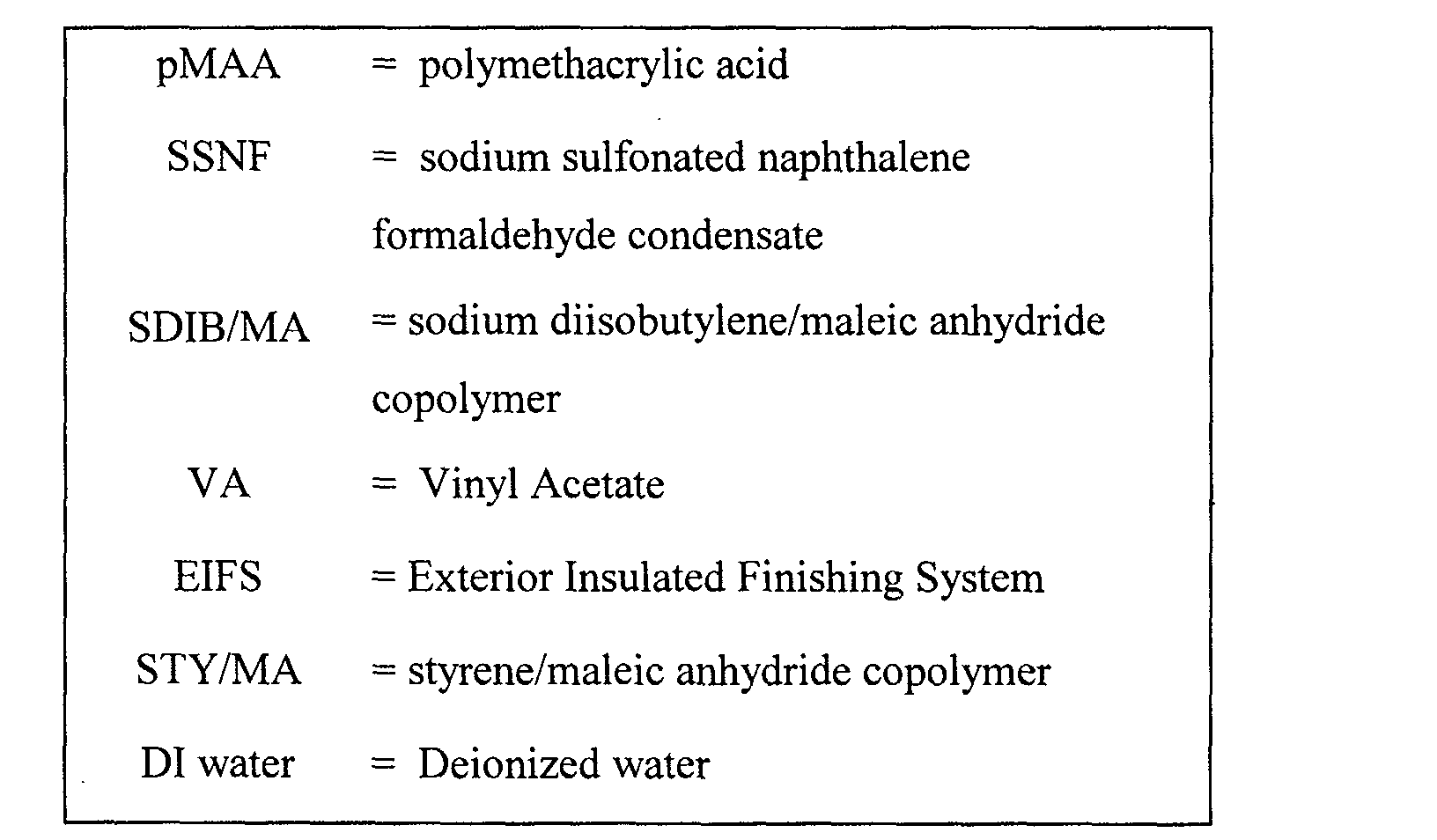
- The abbreviations listed below are used throughout the examples.
- A formulation was prepared by mixing the following:
Materials Parts By Weight 60 Mesh Sand 357.0 Silica Flour 120 54.8 Portland cement Type I 292.5 Dry Polymer A 30.0 Nyad G 11.3 Calcium Stearate 2.3 Bermocoll E-481FQ 1.5 Colloids 775DD 0.8 Dry Polymer B 1.5 Evaluation of cured cementitious EIFS basecoat / adhesive for water absorption (in g/m2; average of 2 samples) Example Dry Polymer B 1 Hour Immersion 2 Hours Immersion 4 Hours Immersion 8 Hours Immersion 24 Hours Immersion Comp.A none 168 196 221 246 310 Comp.B 0.1 % SSNF 151 179 200 223 289 Comp.C 0.2 % SSNF 163 187 203 225 306 Comp.D 0.1 % SSNF, Na salt 190 212 229 250 332 Comp.E 0.1 0.2 % SSNF, Na salt 153 183 204 223 288 1 0.1%64/36 SDIB/MA, Na salt 138 190 215 231 277 2 0.2% 64/36 SDIB/MA, Na salt 95 117 132 148 189 Comp.E 0.2 % pMAA Copolymer 195 223 253 279 342 Comp.F 0.2 % pMAA 242 247 261 278 319 - Examples 1-2 of this invention exhibit water resistance (lower water absorption levels) superior to that for Comparative Examples A-F.

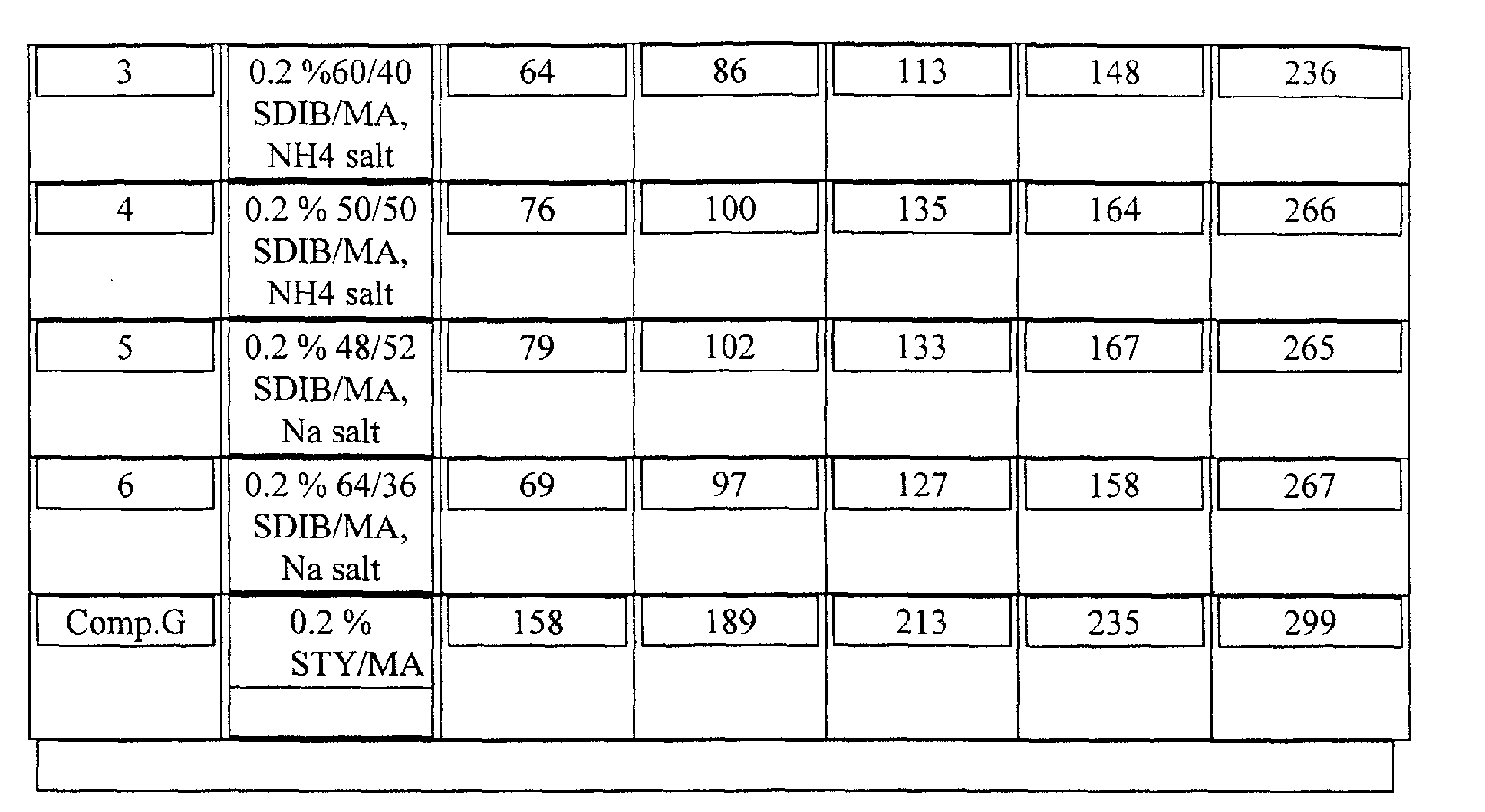
- Examples 3-6 of this invention exhibit water resistance (lower water absorption levels) superior to that for Comparative Example G
- EXAMPLES 7 and COMPARATIVE EXAMPLES H. Preparation and evaluation of a polymer modified mortar
Mortar was prepared by charging all of the dry components below to a container and shaking it in a polyethylene bag to dry blend those components. The blended dry mix was then charged to the bowl of a Hobart mixer. A paddle mixer blade was attached to the mixer and the speed was set at the lowest setting (number 1). The mixer was started and the water is added while mixing. This wet material was mixed for one minute.Example Comparative H 7 Sand, 60 mesh 2000 2000 Portland cement, Type I 800 800 Dry Polymer C 80 80 Colloids 775DD 8 8 DIB/Man 64/36, dry -- 3.3 Water 508 376 Water/cement weight ratio 0.635 0.47 Polymer/cement weight ratio 0.10 0.10 (1) Dry Polymer C = Commercial Ethylene/vinyl acetate polymer including at least 20 wt%, based on dry addition polymer weight, vinyl acetate and containing 14.1% polyvinyl alcohol (by analysis) Properties of cured polymer modified mortars Ingredients Comparative H 7 Mechanical strength, samples cured at 72 F and 50% relative humidity Tensile strength, psi 1 day 81 235 3 days 296 -- 7 days 434 612 7 days dry + 7 days wet 279 323 Shearbond adhesion strength, psi 7 days 136 304 Mode of failure A A 7 days dry + 7 days wet 185 400 Mode of failure A A/C 28 days dry 103 343 Mode of failure A A - Example 7 of this invention exhibits water resistance (wet tensile strength and wet shearbond adhesion) and dry property levels superior to that for Comparative Example H.
Claims (10)
- A pulverulent polymeric composition comprising: (1) an addition polymer comprising at least 20 wt%, based on dry addition polymer weight, copolymerized vinyl ester monomer, (2) a protective colloid, and (3) 0.1 to 3.0 wt%, based on dry composition weight, olefin/maleic anhydride copolymer having an olefin/maleic anhydride molar ratio of 30/70 to 70/30.
- An aqueous polymeric composition comprising (1) an addition polymer comprising at least 20 wt%, based on dry addition polymer weight, copolymerized vinyl ester monomer, (2) a protective colloid, and (3) 0.1 to 3.0 wt%, based on dry composition weight, olefin/maleic anhydride copolymer having an olefin/maleic anhydride molar ratio of 30/70 to 70/30.
- The composition of claim 1 or claim 2 additionally comprising a hydraulic substance.
- The composition of claim 1 or claim 2 comprising 0.1 to 0.5 wt%, based on dry composition weight, of said olefin/maleic anhydride copolymer.
- The composition of claim 1 or claim 2 wherein said vinyl ester monomer is vinyl acetate.
- The composition of claim 1 or claim 2 wherein said protective colloid comprises polyvinyl alcohol.
- A method for improving the water resistance of a dry composition formed from an addition polymer comprising at least 20 wt%, based on dry addition polymer weight, copolymerized vinyl ester monomer and a protective colloid comprising admixing 0.1 to 3.0 wt%, based on dry composition weight, olefin/maleic anhydride copolymer having an olefin/maleic anhydride molar ratio of 30/70 to 70/30; and drying or curing said composition.
- The method of claim 6 wherein said composition additionally comprises a hydraulic substance.
- The method of claim 6 wherein said composition comprises 0.1 to 0.5 wt%, based on dry composition weight, of said olefin/maleic anhydride copolymer.
- The method of claim 6 wherein said protective colloid comprises polyvinyl alcohol.
Applications Claiming Priority (2)
| Application Number | Priority Date | Filing Date | Title |
|---|---|---|---|
| US32481601P | 2001-09-25 | 2001-09-25 | |
| US324816P | 2001-09-25 |
Publications (1)
| Publication Number | Publication Date |
|---|---|
| EP1295911A1 true EP1295911A1 (en) | 2003-03-26 |
Family
ID=23265221
Family Applications (1)
| Application Number | Title | Priority Date | Filing Date |
|---|---|---|---|
| EP02256329A Withdrawn EP1295911A1 (en) | 2001-09-25 | 2002-09-12 | Redispersible powder composition comprising protective colloid, vinyl ester based polymer and olefin - maleic anhydride copolymer |
Country Status (5)
| Country | Link |
|---|---|
| US (1) | US20030119947A1 (en) |
| EP (1) | EP1295911A1 (en) |
| CN (1) | CN1408763A (en) |
| BR (1) | BR0203875A (en) |
| TW (1) | TW593518B (en) |
Cited By (1)
| Publication number | Priority date | Publication date | Assignee | Title |
|---|---|---|---|---|
| WO2020119932A1 (en) | 2018-12-14 | 2020-06-18 | Wacker Chemie Ag | Polymers in the form of water-redispersible powders or aqueous dispersions |
Families Citing this family (1)
| Publication number | Priority date | Publication date | Assignee | Title |
|---|---|---|---|---|
| DE102006037318A1 (en) * | 2006-08-08 | 2008-02-14 | Celanese Emulsions Gmbh | Method of applying a dispersion adhesive by means of nozzle application and use of dispersion adhesives |
Citations (4)
| Publication number | Priority date | Publication date | Assignee | Title |
|---|---|---|---|---|
| EP0315278A1 (en) * | 1987-11-04 | 1989-05-10 | Shell Internationale Researchmaatschappij B.V. | Vinyl ester latices |
| EP0467103A2 (en) * | 1990-07-03 | 1992-01-22 | BASF Aktiengesellschaft | Aqueous polymer dispersions and polymer powder obtained by their spray drying |
| WO1997024400A1 (en) * | 1995-12-29 | 1997-07-10 | Wacker-Chemie Gmbh | Redispersible, dispersion-powder composition |
| US6242512B1 (en) * | 1996-01-18 | 2001-06-05 | Wacker Chemie Gmbh | Re-dispersible polymer powder and aqueous polymer dispersions obtainable therefrom |
Family Cites Families (5)
| Publication number | Priority date | Publication date | Assignee | Title |
|---|---|---|---|---|
| DE3716974A1 (en) * | 1986-05-20 | 1987-12-10 | Nippon Zeon Co | HYDRAULIC MASS |
| US5185039A (en) * | 1986-05-20 | 1993-02-09 | Nippon Zeon Co., Ltd. | Hydraulic composition |
| US5162060A (en) * | 1989-12-14 | 1992-11-10 | Rohm And Haas Company | Polymer-modified cements with improved chemical resistance |
| JP3285526B2 (en) * | 1997-12-02 | 2002-05-27 | 花王株式会社 | Concrete admixture |
| JP3278391B2 (en) * | 1997-12-16 | 2002-04-30 | 竹本油脂株式会社 | Dispersant for cement |
-
2002
- 2002-09-12 EP EP02256329A patent/EP1295911A1/en not_active Withdrawn
- 2002-09-16 US US10/244,312 patent/US20030119947A1/en not_active Abandoned
- 2002-09-18 CN CN02142838A patent/CN1408763A/en active Pending
- 2002-09-18 TW TW091121339A patent/TW593518B/en active
- 2002-09-24 BR BR0203875-7A patent/BR0203875A/en not_active IP Right Cessation
Patent Citations (4)
| Publication number | Priority date | Publication date | Assignee | Title |
|---|---|---|---|---|
| EP0315278A1 (en) * | 1987-11-04 | 1989-05-10 | Shell Internationale Researchmaatschappij B.V. | Vinyl ester latices |
| EP0467103A2 (en) * | 1990-07-03 | 1992-01-22 | BASF Aktiengesellschaft | Aqueous polymer dispersions and polymer powder obtained by their spray drying |
| WO1997024400A1 (en) * | 1995-12-29 | 1997-07-10 | Wacker-Chemie Gmbh | Redispersible, dispersion-powder composition |
| US6242512B1 (en) * | 1996-01-18 | 2001-06-05 | Wacker Chemie Gmbh | Re-dispersible polymer powder and aqueous polymer dispersions obtainable therefrom |
Cited By (1)
| Publication number | Priority date | Publication date | Assignee | Title |
|---|---|---|---|---|
| WO2020119932A1 (en) | 2018-12-14 | 2020-06-18 | Wacker Chemie Ag | Polymers in the form of water-redispersible powders or aqueous dispersions |
Also Published As
| Publication number | Publication date |
|---|---|
| CN1408763A (en) | 2003-04-09 |
| US20030119947A1 (en) | 2003-06-26 |
| TW593518B (en) | 2004-06-21 |
| BR0203875A (en) | 2003-06-03 |
Similar Documents
| Publication | Publication Date | Title |
|---|---|---|
| US6166113A (en) | Flexible building material compounds | |
| CA2052173C (en) | Redispersible powder composition | |
| RU2287537C2 (en) | Polyvinyl alcohol-stabilized re-dispersible powders with tinning ability | |
| JP5144928B2 (en) | Dispersant, method for producing the same, method for using the same, method for producing redispersed powder using the dispersant, redispersed powder obtained by the method, and redispersed powder containing the dispersant | |
| CA2097657C (en) | Use of polypropyleve glycol as a shrinkage-reducing additive in dispersion powder compositions for constructing materials | |
| CN101679707B (en) | Copolymer mixture | |
| JP2005036235A (en) | Polymer powder composition redispersible in water, manufacturing method thereof, and use of this composition | |
| CN102234402B (en) | Redispersible polymer powders prepared from low carboxylation styrene butadiene-based latex | |
| JP2006523594A (en) | Use of redispersed powder compositions having a setting-promoting action | |
| JPS6372781A (en) | Mastic and coking composition and composite article | |
| US10927224B2 (en) | Process for modifying polymer particles of an aqueous polymer dispersion, an aqueous polymer dispersion obtainable by said process, a redispersible polymer powder, and a composition comprising the redispersible polymer powder | |
| JPH11503790A (en) | Redispersible polymer powder and aqueous polymer dispersion obtained from the powder | |
| KR19990067055A (en) | Water-redispersible finely divided membrane-producing polymer composition | |
| JP2010522798A (en) | Acrylic ester copolymer composition and redispersible powder | |
| JP2002521545A (en) | Water redispersible powders of film-forming polymers made from monomers having ethylenic unsaturation, including naphthalene sulfonates | |
| US6291573B1 (en) | Preparation of polymer powders | |
| CN104870397B (en) | The additive of hydraulic pressure congealed mixt | |
| WO2020094228A1 (en) | Hydrophobic polymer powder composition that can be redispersed in water | |
| US7863370B2 (en) | Dispersion powders stabilized by polyvinyl alcohol protective colloids | |
| JP6506012B2 (en) | Non-cement organic primer formulations having improved processability | |
| CN104837788B (en) | The additive of hydraulic pressure congealed mixt | |
| JP4421703B2 (en) | Aqueous preparation, its use for coating of mineral moldings, production method of coated mineral moldings, coated mineral moldings, aqueous polymer dispersion and its production method | |
| JPH11322471A (en) | Coating of mineral molding and coating composition | |
| US20030119947A1 (en) | Modified polymeric composition | |
| DE10351334A1 (en) | Redispersible dispersion powders for thermal insulation composite systems |
Legal Events
| Date | Code | Title | Description |
|---|---|---|---|
| PUAI | Public reference made under article 153(3) epc to a published international application that has entered the european phase |
Free format text: ORIGINAL CODE: 0009012 |
|
| 17P | Request for examination filed |
Effective date: 20020924 |
|
| AK | Designated contracting states |
Kind code of ref document: A1 Designated state(s): AT BE BG CH CY CZ DE DK EE ES FI FR GB GR IE IT LI LU MC NL PT SE SK TR Designated state(s): AT BE BG CH CY CZ DE DK EE ES FI FR GB GR IE IT LI LU MC NL PT SE SK TR |
|
| AX | Request for extension of the european patent |
Extension state: AL LT LV MK RO SI |
|
| STAA | Information on the status of an ep patent application or granted ep patent |
Free format text: STATUS: THE APPLICATION HAS BEEN WITHDRAWN |
|
| 18W | Application withdrawn |
Effective date: 20030516 |