EP1295886A1 - Laulimalide-derivates, their use and process for the production of laulimalide and laulimalide-derivates - Google Patents
Laulimalide-derivates, their use and process for the production of laulimalide and laulimalide-derivates Download PDFInfo
- Publication number
- EP1295886A1 EP1295886A1 EP01250331A EP01250331A EP1295886A1 EP 1295886 A1 EP1295886 A1 EP 1295886A1 EP 01250331 A EP01250331 A EP 01250331A EP 01250331 A EP01250331 A EP 01250331A EP 1295886 A1 EP1295886 A1 EP 1295886A1
- Authority
- EP
- European Patent Office
- Prior art keywords
- meaning
- alkyl
- general formula
- compound
- group
- Prior art date
- Legal status (The legal status is an assumption and is not a legal conclusion. Google has not performed a legal analysis and makes no representation as to the accuracy of the status listed.)
- Withdrawn
Links
- 238000000034 method Methods 0.000 title claims abstract description 47
- 238000004519 manufacturing process Methods 0.000 title claims abstract description 45
- MSBQEQDLFWWWMV-XZZGLLCESA-N laulimalide Chemical compound C(/[C@H](O)[C@H]1OC(=O)\C=C/C[C@@H]2C=CC[C@H](O2)C[C@H](CC(=C)C[C@H](O)[C@@H]2O[C@H]2C1)C)=C\[C@@H]1CC(C)=CCO1 MSBQEQDLFWWWMV-XZZGLLCESA-N 0.000 title claims abstract description 17
- IKIBJHWXDSKRKV-UHFFFAOYSA-N fijianolide B Natural products CC1CC(=C)CC(O)C2OC2CC(OC(=O)C=C/CC3OC(C)(CC=C3)C1)C(O)C=CC4CC(=CCO4)C IKIBJHWXDSKRKV-UHFFFAOYSA-N 0.000 title claims abstract description 13
- 239000000543 intermediate Substances 0.000 claims abstract description 26
- 229910052740 iodine Inorganic materials 0.000 claims abstract description 19
- MYMOFIZGZYHOMD-UHFFFAOYSA-N Dioxygen Chemical compound O=O MYMOFIZGZYHOMD-UHFFFAOYSA-N 0.000 claims abstract description 9
- 150000001875 compounds Chemical class 0.000 claims description 89
- -1 hydroxy, paramethyloxybenzyl Chemical group 0.000 claims description 88
- XEKOWRVHYACXOJ-UHFFFAOYSA-N Ethyl acetate Natural products CCOC(C)=O XEKOWRVHYACXOJ-UHFFFAOYSA-N 0.000 claims description 82
- 229910052760 oxygen Inorganic materials 0.000 claims description 72
- QVGXLLKOCUKJST-UHFFFAOYSA-N atomic oxygen Chemical compound [O] QVGXLLKOCUKJST-UHFFFAOYSA-N 0.000 claims description 60
- 239000001301 oxygen Substances 0.000 claims description 60
- 229910052739 hydrogen Inorganic materials 0.000 claims description 46
- 239000001257 hydrogen Substances 0.000 claims description 46
- 239000002904 solvent Substances 0.000 claims description 45
- 125000004169 (C1-C6) alkyl group Chemical group 0.000 claims description 44
- 239000000203 mixture Substances 0.000 claims description 44
- ZUOUZKKEUPVFJK-UHFFFAOYSA-N diphenyl Chemical compound C1=CC=CC=C1C1=CC=CC=C1 ZUOUZKKEUPVFJK-UHFFFAOYSA-N 0.000 claims description 38
- 125000003118 aryl group Chemical group 0.000 claims description 37
- 125000000217 alkyl group Chemical group 0.000 claims description 34
- 150000002431 hydrogen Chemical class 0.000 claims description 32
- 125000000753 cycloalkyl group Chemical group 0.000 claims description 31
- 125000001797 benzyl group Chemical group [H]C1=C([H])C([H])=C(C([H])=C1[H])C([H])([H])* 0.000 claims description 29
- 235000019439 ethyl acetate Nutrition 0.000 claims description 28
- NINIDFKCEFEMDL-UHFFFAOYSA-N Sulfur Chemical compound [S] NINIDFKCEFEMDL-UHFFFAOYSA-N 0.000 claims description 26
- 239000005864 Sulphur Substances 0.000 claims description 26
- DHKHKXVYLBGOIT-UHFFFAOYSA-N acetaldehyde Diethyl Acetal Natural products CCOC(C)OCC DHKHKXVYLBGOIT-UHFFFAOYSA-N 0.000 claims description 25
- 125000001997 phenyl group Chemical group [H]C1=C([H])C([H])=C(*)C([H])=C1[H] 0.000 claims description 25
- 229910052717 sulfur Inorganic materials 0.000 claims description 24
- UFHFLCQGNIYNRP-UHFFFAOYSA-N Hydrogen Chemical compound [H][H] UFHFLCQGNIYNRP-UHFFFAOYSA-N 0.000 claims description 22
- LCGLNKUTAGEVQW-UHFFFAOYSA-N Dimethyl ether Chemical group COC LCGLNKUTAGEVQW-UHFFFAOYSA-N 0.000 claims description 20
- 235000010290 biphenyl Nutrition 0.000 claims description 19
- 239000004305 biphenyl Substances 0.000 claims description 19
- 125000001624 naphthyl group Chemical group 0.000 claims description 19
- 125000002023 trifluoromethyl group Chemical group FC(F)(F)* 0.000 claims description 19
- JUJWROOIHBZHMG-UHFFFAOYSA-N Pyridine Chemical compound C1=CC=NC=C1 JUJWROOIHBZHMG-UHFFFAOYSA-N 0.000 claims description 17
- RAXXELZNTBOGNW-UHFFFAOYSA-N imidazole Natural products C1=CNC=N1 RAXXELZNTBOGNW-UHFFFAOYSA-N 0.000 claims description 15
- 150000003839 salts Chemical class 0.000 claims description 14
- 125000002777 acetyl group Chemical group [H]C([H])([H])C(*)=O 0.000 claims description 13
- 230000003287 optical effect Effects 0.000 claims description 13
- 125000000026 trimethylsilyl group Chemical group [H]C([H])([H])[Si]([*])(C([H])([H])[H])C([H])([H])[H] 0.000 claims description 13
- KXDHJXZQYSOELW-UHFFFAOYSA-M Carbamate Chemical group NC([O-])=O KXDHJXZQYSOELW-UHFFFAOYSA-M 0.000 claims description 11
- YLQBMQCUIZJEEH-UHFFFAOYSA-N Furan Chemical compound C=1C=COC=1 YLQBMQCUIZJEEH-UHFFFAOYSA-N 0.000 claims description 11
- FZWLAAWBMGSTSO-UHFFFAOYSA-N Thiazole Chemical compound C1=CSC=N1 FZWLAAWBMGSTSO-UHFFFAOYSA-N 0.000 claims description 11
- 125000001181 organosilyl group Chemical group [SiH3]* 0.000 claims description 11
- 229910052719 titanium Inorganic materials 0.000 claims description 11
- YTPLMLYBLZKORZ-UHFFFAOYSA-N Thiophene Chemical compound C=1C=CSC=1 YTPLMLYBLZKORZ-UHFFFAOYSA-N 0.000 claims description 10
- 125000005587 carbonate group Chemical group 0.000 claims description 10
- 229910052732 germanium Inorganic materials 0.000 claims description 10
- 229910052736 halogen Inorganic materials 0.000 claims description 10
- 150000002367 halogens Chemical class 0.000 claims description 10
- 229910052738 indium Inorganic materials 0.000 claims description 10
- 229910052744 lithium Inorganic materials 0.000 claims description 10
- 229910052749 magnesium Inorganic materials 0.000 claims description 10
- 125000006239 protecting group Chemical group 0.000 claims description 10
- 239000003054 catalyst Substances 0.000 claims description 9
- 125000003342 alkenyl group Chemical group 0.000 claims description 8
- 239000007800 oxidant agent Substances 0.000 claims description 7
- 230000001590 oxidative effect Effects 0.000 claims description 7
- 229920006395 saturated elastomer Polymers 0.000 claims description 7
- 150000001408 amides Chemical class 0.000 claims description 6
- 125000005605 benzo group Chemical group 0.000 claims description 6
- 125000003178 carboxy group Chemical group [H]OC(*)=O 0.000 claims description 6
- 239000003814 drug Substances 0.000 claims description 6
- 238000009472 formulation Methods 0.000 claims description 6
- 229910052727 yttrium Inorganic materials 0.000 claims description 6
- JYEUMXHLPRZUAT-UHFFFAOYSA-N 1,2,3-triazine Chemical compound C1=CN=NN=C1 JYEUMXHLPRZUAT-UHFFFAOYSA-N 0.000 claims description 5
- 125000003349 3-pyridyl group Chemical group N1=C([H])C([*])=C([H])C([H])=C1[H] 0.000 claims description 5
- KRHYYFGTRYWZRS-UHFFFAOYSA-M Fluoride anion Chemical compound [F-] KRHYYFGTRYWZRS-UHFFFAOYSA-M 0.000 claims description 5
- 206010028980 Neoplasm Diseases 0.000 claims description 5
- ZCQWOFVYLHDMMC-UHFFFAOYSA-N Oxazole Chemical compound C1=COC=N1 ZCQWOFVYLHDMMC-UHFFFAOYSA-N 0.000 claims description 5
- WTKZEGDFNFYCGP-UHFFFAOYSA-N Pyrazole Chemical compound C=1C=NNC=1 WTKZEGDFNFYCGP-UHFFFAOYSA-N 0.000 claims description 5
- CZPWVGJYEJSRLH-UHFFFAOYSA-N Pyrimidine Chemical compound C1=CN=CN=C1 CZPWVGJYEJSRLH-UHFFFAOYSA-N 0.000 claims description 5
- SMWDFEZZVXVKRB-UHFFFAOYSA-N Quinoline Chemical compound N1=CC=CC2=CC=CC=C21 SMWDFEZZVXVKRB-UHFFFAOYSA-N 0.000 claims description 5
- 239000002585 base Substances 0.000 claims description 5
- 125000001072 heteroaryl group Chemical group 0.000 claims description 5
- AWJUIBRHMBBTKR-UHFFFAOYSA-N isoquinoline Chemical compound C1=NC=CC2=CC=CC=C21 AWJUIBRHMBBTKR-UHFFFAOYSA-N 0.000 claims description 5
- 125000002496 methyl group Chemical group [H]C([H])([H])* 0.000 claims description 5
- 150000007530 organic bases Chemical class 0.000 claims description 5
- 229930192474 thiophene Natural products 0.000 claims description 5
- XEZNGIUYQVAUSS-UHFFFAOYSA-N 18-crown-6 Chemical compound C1COCCOCCOCCOCCOCCO1 XEZNGIUYQVAUSS-UHFFFAOYSA-N 0.000 claims description 4
- 125000004105 2-pyridyl group Chemical group N1=C([*])C([H])=C([H])C([H])=C1[H] 0.000 claims description 4
- 208000015181 infectious disease Diseases 0.000 claims description 4
- 230000004770 neurodegeneration Effects 0.000 claims description 4
- 208000015122 neurodegenerative disease Diseases 0.000 claims description 4
- 125000003107 substituted aryl group Chemical group 0.000 claims description 4
- 150000003512 tertiary amines Chemical class 0.000 claims description 4
- VEXZGXHMUGYJMC-UHFFFAOYSA-M Chloride anion Chemical compound [Cl-] VEXZGXHMUGYJMC-UHFFFAOYSA-M 0.000 claims description 3
- QYKIQEUNHZKYBP-UHFFFAOYSA-N Vinyl ether Chemical compound C=COC=C QYKIQEUNHZKYBP-UHFFFAOYSA-N 0.000 claims description 3
- 239000003513 alkali Substances 0.000 claims description 3
- 239000002168 alkylating agent Substances 0.000 claims description 3
- 229940100198 alkylating agent Drugs 0.000 claims description 3
- 239000003638 chemical reducing agent Substances 0.000 claims description 3
- 239000003795 chemical substances by application Substances 0.000 claims description 3
- 125000000113 cyclohexyl group Chemical group [H]C1([H])C([H])([H])C([H])([H])C([H])(*)C([H])([H])C1([H])[H] 0.000 claims description 3
- 201000010099 disease Diseases 0.000 claims description 3
- 208000037265 diseases, disorders, signs and symptoms Diseases 0.000 claims description 3
- 150000002440 hydroxy compounds Chemical class 0.000 claims description 3
- BXBLTKZWYAHPKM-UHFFFAOYSA-M magnesium;methanidyl(trimethyl)silane;chloride Chemical compound [Mg+2].[Cl-].C[Si](C)(C)[CH2-] BXBLTKZWYAHPKM-UHFFFAOYSA-M 0.000 claims description 3
- 150000002902 organometallic compounds Chemical class 0.000 claims description 3
- VLTRZXGMWDSKGL-UHFFFAOYSA-M perchlorate Inorganic materials [O-]Cl(=O)(=O)=O VLTRZXGMWDSKGL-UHFFFAOYSA-M 0.000 claims description 3
- 208000030507 AIDS Diseases 0.000 claims description 2
- 208000024827 Alzheimer disease Diseases 0.000 claims description 2
- 206010003210 Arteriosclerosis Diseases 0.000 claims description 2
- 208000023275 Autoimmune disease Diseases 0.000 claims description 2
- 208000024172 Cardiovascular disease Diseases 0.000 claims description 2
- 208000035473 Communicable disease Diseases 0.000 claims description 2
- 206010012289 Dementia Diseases 0.000 claims description 2
- 241000233866 Fungi Species 0.000 claims description 2
- 206010018364 Glomerulonephritis Diseases 0.000 claims description 2
- 208000031886 HIV Infections Diseases 0.000 claims description 2
- 208000005176 Hepatitis C Diseases 0.000 claims description 2
- 208000023105 Huntington disease Diseases 0.000 claims description 2
- XQFRJNBWHJMXHO-RRKCRQDMSA-N IDUR Chemical compound C1[C@H](O)[C@@H](CO)O[C@H]1N1C(=O)NC(=O)C(I)=C1 XQFRJNBWHJMXHO-RRKCRQDMSA-N 0.000 claims description 2
- 206010028116 Mucosal inflammation Diseases 0.000 claims description 2
- 208000018737 Parkinson disease Diseases 0.000 claims description 2
- 208000031481 Pathologic Constriction Diseases 0.000 claims description 2
- 241000224016 Plasmodium Species 0.000 claims description 2
- 201000004681 Psoriasis Diseases 0.000 claims description 2
- 241000223996 Toxoplasma Species 0.000 claims description 2
- 241000223104 Trypanosoma Species 0.000 claims description 2
- WETWJCDKMRHUPV-UHFFFAOYSA-N acetyl chloride Chemical compound CC(Cl)=O WETWJCDKMRHUPV-UHFFFAOYSA-N 0.000 claims description 2
- 239000012346 acetyl chloride Substances 0.000 claims description 2
- 230000001154 acute effect Effects 0.000 claims description 2
- 150000001412 amines Chemical class 0.000 claims description 2
- 208000011775 arteriosclerosis disease Diseases 0.000 claims description 2
- 210000004556 brain Anatomy 0.000 claims description 2
- 201000011510 cancer Diseases 0.000 claims description 2
- KOPOQZFJUQMUML-UHFFFAOYSA-N chlorosilane Chemical compound Cl[SiH3] KOPOQZFJUQMUML-UHFFFAOYSA-N 0.000 claims description 2
- 230000003635 deoxygenating effect Effects 0.000 claims description 2
- 208000002672 hepatitis B Diseases 0.000 claims description 2
- 208000032839 leukemia Diseases 0.000 claims description 2
- 208000005264 motor neuron disease Diseases 0.000 claims description 2
- 201000006417 multiple sclerosis Diseases 0.000 claims description 2
- 244000045947 parasite Species 0.000 claims description 2
- VLTRZXGMWDSKGL-UHFFFAOYSA-N perchloric acid Chemical compound OCl(=O)(=O)=O VLTRZXGMWDSKGL-UHFFFAOYSA-N 0.000 claims description 2
- 208000037803 restenosis Diseases 0.000 claims description 2
- 208000037804 stenosis Diseases 0.000 claims description 2
- 230000036262 stenosis Effects 0.000 claims description 2
- HEDRZPFGACZZDS-MICDWDOJSA-N Trichloro(2H)methane Chemical compound [2H]C(Cl)(Cl)Cl HEDRZPFGACZZDS-MICDWDOJSA-N 0.000 description 94
- YMWUJEATGCHHMB-UHFFFAOYSA-N Dichloromethane Chemical compound ClCCl YMWUJEATGCHHMB-UHFFFAOYSA-N 0.000 description 59
- HEDRZPFGACZZDS-UHFFFAOYSA-N Chloroform Chemical compound ClC(Cl)Cl HEDRZPFGACZZDS-UHFFFAOYSA-N 0.000 description 48
- VLKZOEOYAKHREP-UHFFFAOYSA-N n-Hexane Chemical compound CCCCCC VLKZOEOYAKHREP-UHFFFAOYSA-N 0.000 description 48
- 239000000243 solution Substances 0.000 description 40
- YXFVVABEGXRONW-UHFFFAOYSA-N Toluene Chemical compound CC1=CC=CC=C1 YXFVVABEGXRONW-UHFFFAOYSA-N 0.000 description 36
- 238000006243 chemical reaction Methods 0.000 description 33
- WYURNTSHIVDZCO-UHFFFAOYSA-N Tetrahydrofuran Chemical compound C1CCOC1 WYURNTSHIVDZCO-UHFFFAOYSA-N 0.000 description 28
- 229910001868 water Inorganic materials 0.000 description 28
- 238000005160 1H NMR spectroscopy Methods 0.000 description 25
- 238000002329 infrared spectrum Methods 0.000 description 25
- 238000001644 13C nuclear magnetic resonance spectroscopy Methods 0.000 description 24
- LFQSCWFLJHTTHZ-UHFFFAOYSA-N Ethanol Chemical compound CCO LFQSCWFLJHTTHZ-UHFFFAOYSA-N 0.000 description 23
- XLYOFNOQVPJJNP-UHFFFAOYSA-N water Substances O XLYOFNOQVPJJNP-UHFFFAOYSA-N 0.000 description 23
- OKKJLVBELUTLKV-UHFFFAOYSA-N Methanol Chemical compound OC OKKJLVBELUTLKV-UHFFFAOYSA-N 0.000 description 21
- 238000003818 flash chromatography Methods 0.000 description 21
- RTZKZFJDLAIYFH-UHFFFAOYSA-N Diethyl ether Chemical compound CCOCC RTZKZFJDLAIYFH-UHFFFAOYSA-N 0.000 description 20
- 239000012267 brine Substances 0.000 description 19
- HPALAKNZSZLMCH-UHFFFAOYSA-M sodium;chloride;hydrate Chemical compound O.[Na+].[Cl-] HPALAKNZSZLMCH-UHFFFAOYSA-M 0.000 description 19
- 239000007832 Na2SO4 Substances 0.000 description 18
- PMZURENOXWZQFD-UHFFFAOYSA-L Sodium Sulfate Chemical compound [Na+].[Na+].[O-]S([O-])(=O)=O PMZURENOXWZQFD-UHFFFAOYSA-L 0.000 description 18
- 229910052938 sodium sulfate Inorganic materials 0.000 description 18
- 239000003921 oil Substances 0.000 description 16
- 235000019198 oils Nutrition 0.000 description 16
- UIIMBOGNXHQVGW-UHFFFAOYSA-M Sodium bicarbonate Chemical compound [Na+].OC([O-])=O UIIMBOGNXHQVGW-UHFFFAOYSA-M 0.000 description 14
- 239000012043 crude product Substances 0.000 description 14
- VYPSYNLAJGMNEJ-UHFFFAOYSA-N Silicium dioxide Chemical compound O=[Si]=O VYPSYNLAJGMNEJ-UHFFFAOYSA-N 0.000 description 12
- 239000012047 saturated solution Substances 0.000 description 12
- ZMANZCXQSJIPKH-UHFFFAOYSA-N Triethylamine Chemical compound CCN(CC)CC ZMANZCXQSJIPKH-UHFFFAOYSA-N 0.000 description 11
- NKLCNNUWBJBICK-UHFFFAOYSA-N dess–martin periodinane Chemical compound C1=CC=C2I(OC(=O)C)(OC(C)=O)(OC(C)=O)OC(=O)C2=C1 NKLCNNUWBJBICK-UHFFFAOYSA-N 0.000 description 11
- 239000012074 organic phase Substances 0.000 description 10
- 0 CC(C(*)CC1*C(CC=*)C=CC1)C(C*)=C Chemical compound CC(C(*)CC1*C(CC=*)C=CC1)C(C*)=C 0.000 description 9
- VHYFNPMBLIVWCW-UHFFFAOYSA-N 4-Dimethylaminopyridine Chemical compound CN(C)C1=CC=NC=C1 VHYFNPMBLIVWCW-UHFFFAOYSA-N 0.000 description 8
- IAZDPXIOMUYVGZ-UHFFFAOYSA-N Dimethylsulphoxide Chemical compound CS(C)=O IAZDPXIOMUYVGZ-UHFFFAOYSA-N 0.000 description 8
- FPGGTKZVZWFYPV-UHFFFAOYSA-M tetrabutylammonium fluoride Chemical compound [F-].CCCC[N+](CCCC)(CCCC)CCCC FPGGTKZVZWFYPV-UHFFFAOYSA-M 0.000 description 8
- NLXLAEXVIDQMFP-UHFFFAOYSA-N Ammonia chloride Chemical compound [NH4+].[Cl-] NLXLAEXVIDQMFP-UHFFFAOYSA-N 0.000 description 7
- 239000000284 extract Substances 0.000 description 7
- 229910000030 sodium bicarbonate Inorganic materials 0.000 description 7
- 239000010936 titanium Substances 0.000 description 7
- CDBYLPFSWZWCQE-UHFFFAOYSA-L Sodium Carbonate Chemical compound [Na+].[Na+].[O-]C([O-])=O CDBYLPFSWZWCQE-UHFFFAOYSA-L 0.000 description 6
- 239000011777 magnesium Substances 0.000 description 6
- IUBQJLUDMLPAGT-UHFFFAOYSA-N potassium bis(trimethylsilyl)amide Chemical compound C[Si](C)(C)N([K])[Si](C)(C)C IUBQJLUDMLPAGT-UHFFFAOYSA-N 0.000 description 6
- 239000000377 silicon dioxide Substances 0.000 description 6
- 239000003153 chemical reaction reagent Substances 0.000 description 5
- 229910052681 coesite Inorganic materials 0.000 description 5
- 229910052906 cristobalite Inorganic materials 0.000 description 5
- 238000000746 purification Methods 0.000 description 5
- UMJSCPRVCHMLSP-UHFFFAOYSA-N pyridine Natural products COC1=CC=CN=C1 UMJSCPRVCHMLSP-UHFFFAOYSA-N 0.000 description 5
- 239000002002 slurry Substances 0.000 description 5
- 229910052682 stishovite Inorganic materials 0.000 description 5
- 238000004809 thin layer chromatography Methods 0.000 description 5
- 229910052905 tridymite Inorganic materials 0.000 description 5
- GLGNXYJARSMNGJ-VKTIVEEGSA-N (1s,2s,3r,4r)-3-[[5-chloro-2-[(1-ethyl-6-methoxy-2-oxo-4,5-dihydro-3h-1-benzazepin-7-yl)amino]pyrimidin-4-yl]amino]bicyclo[2.2.1]hept-5-ene-2-carboxamide Chemical compound CCN1C(=O)CCCC2=C(OC)C(NC=3N=C(C(=CN=3)Cl)N[C@H]3[C@H]([C@@]4([H])C[C@@]3(C=C4)[H])C(N)=O)=CC=C21 GLGNXYJARSMNGJ-VKTIVEEGSA-N 0.000 description 4
- XKRFYHLGVUSROY-UHFFFAOYSA-N Argon Chemical compound [Ar] XKRFYHLGVUSROY-UHFFFAOYSA-N 0.000 description 4
- 150000001241 acetals Chemical group 0.000 description 4
- 239000012230 colorless oil Substances 0.000 description 4
- 229940125758 compound 15 Drugs 0.000 description 4
- 239000012071 phase Substances 0.000 description 4
- BWHMMNNQKKPAPP-UHFFFAOYSA-L potassium carbonate Chemical compound [K+].[K+].[O-]C([O-])=O BWHMMNNQKKPAPP-UHFFFAOYSA-L 0.000 description 4
- CIHOLLKRGTVIJN-UHFFFAOYSA-N tert‐butyl hydroperoxide Chemical compound CC(C)(C)OO CIHOLLKRGTVIJN-UHFFFAOYSA-N 0.000 description 4
- JOXIMZWYDAKGHI-UHFFFAOYSA-N toluene-4-sulfonic acid Chemical compound CC1=CC=C(S(O)(=O)=O)C=C1 JOXIMZWYDAKGHI-UHFFFAOYSA-N 0.000 description 4
- FANCTJAFZSYTIS-IQUVVAJASA-N (1r,3s,5z)-5-[(2e)-2-[(1r,3as,7ar)-7a-methyl-1-[(2r)-4-(phenylsulfonimidoyl)butan-2-yl]-2,3,3a,5,6,7-hexahydro-1h-inden-4-ylidene]ethylidene]-4-methylidenecyclohexane-1,3-diol Chemical compound C([C@@H](C)[C@@H]1[C@]2(CCCC(/[C@@H]2CC1)=C\C=C\1C([C@@H](O)C[C@H](O)C/1)=C)C)CS(=N)(=O)C1=CC=CC=C1 FANCTJAFZSYTIS-IQUVVAJASA-N 0.000 description 3
- ASQOQJYHIYYTEJ-GBESFXJTSA-N (1r,7s,9as)-7-decyl-2,3,4,6,7,8,9,9a-octahydro-1h-quinolizin-1-ol Chemical compound O[C@@H]1CCCN2C[C@@H](CCCCCCCCCC)CC[C@H]21 ASQOQJYHIYYTEJ-GBESFXJTSA-N 0.000 description 3
- SHAHPWSYJFYMRX-GDLCADMTSA-N (2S)-2-(4-{[(1R,2S)-2-hydroxycyclopentyl]methyl}phenyl)propanoic acid Chemical compound C1=CC([C@@H](C(O)=O)C)=CC=C1C[C@@H]1[C@@H](O)CCC1 SHAHPWSYJFYMRX-GDLCADMTSA-N 0.000 description 3
- QFLWZFQWSBQYPS-AWRAUJHKSA-N (3S)-3-[[(2S)-2-[[(2S)-2-[5-[(3aS,6aR)-2-oxo-1,3,3a,4,6,6a-hexahydrothieno[3,4-d]imidazol-4-yl]pentanoylamino]-3-methylbutanoyl]amino]-3-(4-hydroxyphenyl)propanoyl]amino]-4-[1-bis(4-chlorophenoxy)phosphorylbutylamino]-4-oxobutanoic acid Chemical compound CCCC(NC(=O)[C@H](CC(O)=O)NC(=O)[C@H](Cc1ccc(O)cc1)NC(=O)[C@@H](NC(=O)CCCCC1SC[C@@H]2NC(=O)N[C@H]12)C(C)C)P(=O)(Oc1ccc(Cl)cc1)Oc1ccc(Cl)cc1 QFLWZFQWSBQYPS-AWRAUJHKSA-N 0.000 description 3
- IGVKWAAPMVVTFX-BUHFOSPRSA-N (e)-octadec-5-en-7,9-diynoic acid Chemical compound CCCCCCCCC#CC#C\C=C\CCCC(O)=O IGVKWAAPMVVTFX-BUHFOSPRSA-N 0.000 description 3
- UNILWMWFPHPYOR-KXEYIPSPSA-M 1-[6-[2-[3-[3-[3-[2-[2-[3-[[2-[2-[[(2r)-1-[[2-[[(2r)-1-[3-[2-[2-[3-[[2-(2-amino-2-oxoethoxy)acetyl]amino]propoxy]ethoxy]ethoxy]propylamino]-3-hydroxy-1-oxopropan-2-yl]amino]-2-oxoethyl]amino]-3-[(2r)-2,3-di(hexadecanoyloxy)propyl]sulfanyl-1-oxopropan-2-yl Chemical compound O=C1C(SCCC(=O)NCCCOCCOCCOCCCNC(=O)COCC(=O)N[C@@H](CSC[C@@H](COC(=O)CCCCCCCCCCCCCCC)OC(=O)CCCCCCCCCCCCCCC)C(=O)NCC(=O)N[C@H](CO)C(=O)NCCCOCCOCCOCCCNC(=O)COCC(N)=O)CC(=O)N1CCNC(=O)CCCCCN\1C2=CC=C(S([O-])(=O)=O)C=C2CC/1=C/C=C/C=C/C1=[N+](CC)C2=CC=C(S([O-])(=O)=O)C=C2C1 UNILWMWFPHPYOR-KXEYIPSPSA-M 0.000 description 3
- MCIPQLOKVXSHTD-UHFFFAOYSA-N 3,3-diethoxyprop-1-ene Chemical compound CCOC(C=C)OCC MCIPQLOKVXSHTD-UHFFFAOYSA-N 0.000 description 3
- WEVYAHXRMPXWCK-UHFFFAOYSA-N Acetonitrile Chemical compound CC#N WEVYAHXRMPXWCK-UHFFFAOYSA-N 0.000 description 3
- UHOVQNZJYSORNB-UHFFFAOYSA-N Benzene Chemical compound C1=CC=CC=C1 UHOVQNZJYSORNB-UHFFFAOYSA-N 0.000 description 3
- DRSHXJFUUPIBHX-UHFFFAOYSA-N COc1ccc(cc1)N1N=CC2C=NC(Nc3cc(OC)c(OC)c(OCCCN4CCN(C)CC4)c3)=NC12 Chemical compound COc1ccc(cc1)N1N=CC2C=NC(Nc3cc(OC)c(OC)c(OCCCN4CCN(C)CC4)c3)=NC12 DRSHXJFUUPIBHX-UHFFFAOYSA-N 0.000 description 3
- HEMHJVSKTPXQMS-UHFFFAOYSA-M Sodium hydroxide Chemical compound [OH-].[Na+] HEMHJVSKTPXQMS-UHFFFAOYSA-M 0.000 description 3
- YLEIFZAVNWDOBM-ZTNXSLBXSA-N ac1l9hc7 Chemical compound C([C@H]12)C[C@@H](C([C@@H](O)CC3)(C)C)[C@@]43C[C@@]14CC[C@@]1(C)[C@@]2(C)C[C@@H]2O[C@]3(O)[C@H](O)C(C)(C)O[C@@H]3[C@@H](C)[C@H]12 YLEIFZAVNWDOBM-ZTNXSLBXSA-N 0.000 description 3
- 150000001299 aldehydes Chemical class 0.000 description 3
- 230000000259 anti-tumor effect Effects 0.000 description 3
- 125000004432 carbon atom Chemical group C* 0.000 description 3
- 229940125773 compound 10 Drugs 0.000 description 3
- 229940126214 compound 3 Drugs 0.000 description 3
- 125000001495 ethyl group Chemical group [H]C([H])([H])C([H])([H])* 0.000 description 3
- ZLVXBBHTMQJRSX-VMGNSXQWSA-N jdtic Chemical compound C1([C@]2(C)CCN(C[C@@H]2C)C[C@H](C(C)C)NC(=O)[C@@H]2NCC3=CC(O)=CC=C3C2)=CC=CC(O)=C1 ZLVXBBHTMQJRSX-VMGNSXQWSA-N 0.000 description 3
- 239000007788 liquid Substances 0.000 description 3
- MHCFAGZWMAWTNR-UHFFFAOYSA-M lithium perchlorate Chemical compound [Li+].[O-]Cl(=O)(=O)=O MHCFAGZWMAWTNR-UHFFFAOYSA-M 0.000 description 3
- 229910001486 lithium perchlorate Inorganic materials 0.000 description 3
- 239000012044 organic layer Substances 0.000 description 3
- NFHFRUOZVGFOOS-UHFFFAOYSA-N palladium;triphenylphosphane Chemical compound [Pd].C1=CC=CC=C1P(C=1C=CC=CC=1)C1=CC=CC=C1.C1=CC=CC=C1P(C=1C=CC=CC=1)C1=CC=CC=C1.C1=CC=CC=C1P(C=1C=CC=CC=1)C1=CC=CC=C1.C1=CC=CC=C1P(C=1C=CC=CC=1)C1=CC=CC=C1 NFHFRUOZVGFOOS-UHFFFAOYSA-N 0.000 description 3
- 239000011541 reaction mixture Substances 0.000 description 3
- 239000011734 sodium Substances 0.000 description 3
- 229910000029 sodium carbonate Inorganic materials 0.000 description 3
- 239000000725 suspension Substances 0.000 description 3
- 238000006257 total synthesis reaction Methods 0.000 description 3
- GHYOCDFICYLMRF-UTIIJYGPSA-N (2S,3R)-N-[(2S)-3-(cyclopenten-1-yl)-1-[(2R)-2-methyloxiran-2-yl]-1-oxopropan-2-yl]-3-hydroxy-3-(4-methoxyphenyl)-2-[[(2S)-2-[(2-morpholin-4-ylacetyl)amino]propanoyl]amino]propanamide Chemical compound C1(=CCCC1)C[C@@H](C(=O)[C@@]1(OC1)C)NC([C@H]([C@@H](C1=CC=C(C=C1)OC)O)NC([C@H](C)NC(CN1CCOCC1)=O)=O)=O GHYOCDFICYLMRF-UTIIJYGPSA-N 0.000 description 2
- VUDZSIYXZUYWSC-DBRKOABJSA-N (4r)-1-[(2r,4r,5r)-3,3-difluoro-4-hydroxy-5-(hydroxymethyl)oxolan-2-yl]-4-hydroxy-1,3-diazinan-2-one Chemical compound FC1(F)[C@H](O)[C@@H](CO)O[C@H]1N1C(=O)N[C@H](O)CC1 VUDZSIYXZUYWSC-DBRKOABJSA-N 0.000 description 2
- YYROPELSRYBVMQ-UHFFFAOYSA-N 4-toluenesulfonyl chloride Chemical compound CC1=CC=C(S(Cl)(=O)=O)C=C1 YYROPELSRYBVMQ-UHFFFAOYSA-N 0.000 description 2
- 241000349731 Afzelia bipindensis Species 0.000 description 2
- FGUUSXIOTUKUDN-IBGZPJMESA-N C1(=CC=CC=C1)N1C2=C(NC([C@H](C1)NC=1OC(=NN=1)C1=CC=CC=C1)=O)C=CC=C2 Chemical compound C1(=CC=CC=C1)N1C2=C(NC([C@H](C1)NC=1OC(=NN=1)C1=CC=CC=C1)=O)C=CC=C2 FGUUSXIOTUKUDN-IBGZPJMESA-N 0.000 description 2
- ROSDSFDQCJNGOL-UHFFFAOYSA-N Dimethylamine Chemical compound CNC ROSDSFDQCJNGOL-UHFFFAOYSA-N 0.000 description 2
- GUBGYTABKSRVRQ-QKKXKWKRSA-N Lactose Natural products OC[C@H]1O[C@@H](O[C@H]2[C@H](O)[C@@H](O)C(O)O[C@@H]2CO)[C@H](O)[C@@H](O)[C@H]1O GUBGYTABKSRVRQ-QKKXKWKRSA-N 0.000 description 2
- CPLXHLVBOLITMK-UHFFFAOYSA-N Magnesium oxide Chemical compound [Mg]=O CPLXHLVBOLITMK-UHFFFAOYSA-N 0.000 description 2
- 229930012538 Paclitaxel Natural products 0.000 description 2
- OFBQJSOFQDEBGM-UHFFFAOYSA-N Pentane Chemical compound CCCCC OFBQJSOFQDEBGM-UHFFFAOYSA-N 0.000 description 2
- 229920002472 Starch Polymers 0.000 description 2
- YTAHJIFKAKIKAV-XNMGPUDCSA-N [(1R)-3-morpholin-4-yl-1-phenylpropyl] N-[(3S)-2-oxo-5-phenyl-1,3-dihydro-1,4-benzodiazepin-3-yl]carbamate Chemical compound O=C1[C@H](N=C(C2=C(N1)C=CC=C2)C1=CC=CC=C1)NC(O[C@H](CCN1CCOCC1)C1=CC=CC=C1)=O YTAHJIFKAKIKAV-XNMGPUDCSA-N 0.000 description 2
- 229910052786 argon Inorganic materials 0.000 description 2
- 230000015572 biosynthetic process Effects 0.000 description 2
- 229910000085 borane Inorganic materials 0.000 description 2
- ABQPEYRVNHDPIO-UHFFFAOYSA-N bromo(dimethyl)borane Chemical compound CB(C)Br ABQPEYRVNHDPIO-UHFFFAOYSA-N 0.000 description 2
- 239000000872 buffer Substances 0.000 description 2
- 125000000484 butyl group Chemical group [H]C([*])([H])C([H])([H])C([H])([H])C([H])([H])[H] 0.000 description 2
- 239000002775 capsule Substances 0.000 description 2
- 229940125797 compound 12 Drugs 0.000 description 2
- 229940125898 compound 5 Drugs 0.000 description 2
- 238000001816 cooling Methods 0.000 description 2
- IJKVHSBPTUYDLN-UHFFFAOYSA-N dihydroxy(oxo)silane Chemical compound O[Si](O)=O IJKVHSBPTUYDLN-UHFFFAOYSA-N 0.000 description 2
- NLFBCYMMUAKCPC-KQQUZDAGSA-N ethyl (e)-3-[3-amino-2-cyano-1-[(e)-3-ethoxy-3-oxoprop-1-enyl]sulfanyl-3-oxoprop-1-enyl]sulfanylprop-2-enoate Chemical compound CCOC(=O)\C=C\SC(=C(C#N)C(N)=O)S\C=C\C(=O)OCC NLFBCYMMUAKCPC-KQQUZDAGSA-N 0.000 description 2
- OAYLNYINCPYISS-UHFFFAOYSA-N ethyl acetate;hexane Chemical compound CCCCCC.CCOC(C)=O OAYLNYINCPYISS-UHFFFAOYSA-N 0.000 description 2
- 239000012530 fluid Substances 0.000 description 2
- 239000012634 fragment Substances 0.000 description 2
- 239000008101 lactose Substances 0.000 description 2
- KWGKDLIKAYFUFQ-UHFFFAOYSA-M lithium chloride Chemical compound [Li+].[Cl-] KWGKDLIKAYFUFQ-UHFFFAOYSA-M 0.000 description 2
- ZCSHNCUQKCANBX-UHFFFAOYSA-N lithium diisopropylamide Chemical compound [Li+].CC(C)[N-]C(C)C ZCSHNCUQKCANBX-UHFFFAOYSA-N 0.000 description 2
- IHLVCKWPAMTVTG-UHFFFAOYSA-N lithium;carbanide Chemical compound [Li+].[CH3-] IHLVCKWPAMTVTG-UHFFFAOYSA-N 0.000 description 2
- 229930014626 natural product Natural products 0.000 description 2
- CTSLXHKWHWQRSH-UHFFFAOYSA-N oxalyl chloride Chemical compound ClC(=O)C(Cl)=O CTSLXHKWHWQRSH-UHFFFAOYSA-N 0.000 description 2
- ZRSNZINYAWTAHE-UHFFFAOYSA-N p-methoxybenzaldehyde Chemical compound COC1=CC=C(C=O)C=C1 ZRSNZINYAWTAHE-UHFFFAOYSA-N 0.000 description 2
- 229960001592 paclitaxel Drugs 0.000 description 2
- 239000008194 pharmaceutical composition Substances 0.000 description 2
- 239000006187 pill Substances 0.000 description 2
- 229910000027 potassium carbonate Inorganic materials 0.000 description 2
- 239000012279 sodium borohydride Substances 0.000 description 2
- 229910000033 sodium borohydride Inorganic materials 0.000 description 2
- 239000008107 starch Substances 0.000 description 2
- 235000019698 starch Nutrition 0.000 description 2
- 238000003786 synthesis reaction Methods 0.000 description 2
- 239000003826 tablet Substances 0.000 description 2
- 239000000454 talc Substances 0.000 description 2
- 229910052623 talc Inorganic materials 0.000 description 2
- 235000012222 talc Nutrition 0.000 description 2
- RCINICONZNJXQF-MZXODVADSA-N taxol Chemical compound O([C@@H]1[C@@]2(C[C@@H](C(C)=C(C2(C)C)[C@H](C([C@]2(C)[C@@H](O)C[C@H]3OC[C@]3([C@H]21)OC(C)=O)=O)OC(=O)C)OC(=O)[C@H](O)[C@@H](NC(=O)C=1C=CC=CC=1)C=1C=CC=CC=1)O)C(=O)C1=CC=CC=C1 RCINICONZNJXQF-MZXODVADSA-N 0.000 description 2
- UORVGPXVDQYIDP-UHFFFAOYSA-N trihydridoboron Substances B UORVGPXVDQYIDP-UHFFFAOYSA-N 0.000 description 2
- 125000000391 vinyl group Chemical group [H]C([*])=C([H])[H] 0.000 description 2
- AADVCYNFEREWOS-UHFFFAOYSA-N (+)-DDM Natural products C=CC=CC(C)C(OC(N)=O)C(C)C(O)C(C)CC(C)=CC(C)C(O)C(C)C=CC(O)CC1OC(=O)C(C)C(O)C1C AADVCYNFEREWOS-UHFFFAOYSA-N 0.000 description 1
- SZUVGFMDDVSKSI-WIFOCOSTSA-N (1s,2s,3s,5r)-1-(carboxymethyl)-3,5-bis[(4-phenoxyphenyl)methyl-propylcarbamoyl]cyclopentane-1,2-dicarboxylic acid Chemical compound O=C([C@@H]1[C@@H]([C@](CC(O)=O)([C@H](C(=O)N(CCC)CC=2C=CC(OC=3C=CC=CC=3)=CC=2)C1)C(O)=O)C(O)=O)N(CCC)CC(C=C1)=CC=C1OC1=CC=CC=C1 SZUVGFMDDVSKSI-WIFOCOSTSA-N 0.000 description 1
- GTCCGKPBSJZVRZ-RFZPGFLSSA-N (2r,4r)-pentane-2,4-diol Chemical compound C[C@@H](O)C[C@@H](C)O GTCCGKPBSJZVRZ-RFZPGFLSSA-N 0.000 description 1
- 125000000008 (C1-C10) alkyl group Chemical group 0.000 description 1
- CRPTXKKKIGGDBX-UHFFFAOYSA-N (z)-but-2-ene Chemical group [CH2]C=CC CRPTXKKKIGGDBX-UHFFFAOYSA-N 0.000 description 1
- ONBQEOIKXPHGMB-VBSBHUPXSA-N 1-[2-[(2s,3r,4s,5r)-3,4-dihydroxy-5-(hydroxymethyl)oxolan-2-yl]oxy-4,6-dihydroxyphenyl]-3-(4-hydroxyphenyl)propan-1-one Chemical compound O[C@@H]1[C@H](O)[C@@H](CO)O[C@H]1OC1=CC(O)=CC(O)=C1C(=O)CCC1=CC=C(O)C=C1 ONBQEOIKXPHGMB-VBSBHUPXSA-N 0.000 description 1
- 125000004973 1-butenyl group Chemical group C(=CCC)* 0.000 description 1
- UWKQJZCTQGMHKD-UHFFFAOYSA-N 2,6-di-tert-butylpyridine Chemical compound CC(C)(C)C1=CC=CC(C(C)(C)C)=N1 UWKQJZCTQGMHKD-UHFFFAOYSA-N 0.000 description 1
- 125000004974 2-butenyl group Chemical group C(C=CC)* 0.000 description 1
- 125000003903 2-propenyl group Chemical group [H]C([*])([H])C([H])=C([H])[H] 0.000 description 1
- GNFTZDOKVXKIBK-UHFFFAOYSA-N 3-(2-methoxyethoxy)benzohydrazide Chemical compound COCCOC1=CC=CC(C(=O)NN)=C1 GNFTZDOKVXKIBK-UHFFFAOYSA-N 0.000 description 1
- WDYVUKGVKRZQNM-UHFFFAOYSA-N 6-phosphonohexylphosphonic acid Chemical compound OP(O)(=O)CCCCCCP(O)(O)=O WDYVUKGVKRZQNM-UHFFFAOYSA-N 0.000 description 1
- ZCYVEMRRCGMTRW-UHFFFAOYSA-N 7553-56-2 Chemical compound [I] ZCYVEMRRCGMTRW-UHFFFAOYSA-N 0.000 description 1
- 244000215068 Acacia senegal Species 0.000 description 1
- CSCPPACGZOOCGX-UHFFFAOYSA-N Acetone Chemical compound CC(C)=O CSCPPACGZOOCGX-UHFFFAOYSA-N 0.000 description 1
- RMHZYEJBFOCPKT-UHFFFAOYSA-N C1(CCCCC1)CC(C)([Li])C1CCCCC1 Chemical compound C1(CCCCC1)CC(C)([Li])C1CCCCC1 RMHZYEJBFOCPKT-UHFFFAOYSA-N 0.000 description 1
- DCERHCFNWRGHLK-UHFFFAOYSA-N C[Si](C)C Chemical compound C[Si](C)C DCERHCFNWRGHLK-UHFFFAOYSA-N 0.000 description 1
- 239000004215 Carbon black (E152) Substances 0.000 description 1
- BVKZGUZCCUSVTD-UHFFFAOYSA-L Carbonate Chemical compound [O-]C([O-])=O BVKZGUZCCUSVTD-UHFFFAOYSA-L 0.000 description 1
- FKLJPTJMIBLJAV-UHFFFAOYSA-N Compound IV Chemical compound O1N=C(C)C=C1CCCCCCCOC1=CC=C(C=2OCCN=2)C=C1 FKLJPTJMIBLJAV-UHFFFAOYSA-N 0.000 description 1
- 238000006646 Dess-Martin oxidation reaction Methods 0.000 description 1
- QMMFVYPAHWMCMS-UHFFFAOYSA-N Dimethyl sulfide Chemical compound CSC QMMFVYPAHWMCMS-UHFFFAOYSA-N 0.000 description 1
- AADVCYNFEREWOS-OBRABYBLSA-N Discodermolide Chemical compound C=C\C=C/[C@H](C)[C@H](OC(N)=O)[C@@H](C)[C@H](O)[C@@H](C)C\C(C)=C/[C@H](C)[C@@H](O)[C@@H](C)\C=C/[C@@H](O)C[C@@H]1OC(=O)[C@H](C)[C@@H](O)[C@H]1C AADVCYNFEREWOS-OBRABYBLSA-N 0.000 description 1
- SNRUBQQJIBEYMU-UHFFFAOYSA-N Dodecane Natural products CCCCCCCCCCCC SNRUBQQJIBEYMU-UHFFFAOYSA-N 0.000 description 1
- 241000196324 Embryophyta Species 0.000 description 1
- QXRSDHAAWVKZLJ-OXZHEXMSSA-N Epothilone B Natural products O=C1[C@H](C)[C@H](O)[C@@H](C)CCC[C@@]2(C)O[C@H]2C[C@@H](/C(=C\c2nc(C)sc2)/C)OC(=O)C[C@H](O)C1(C)C QXRSDHAAWVKZLJ-OXZHEXMSSA-N 0.000 description 1
- KRHYYFGTRYWZRS-UHFFFAOYSA-N Fluorane Chemical compound F KRHYYFGTRYWZRS-UHFFFAOYSA-N 0.000 description 1
- 108010010803 Gelatin Proteins 0.000 description 1
- 229920000084 Gum arabic Polymers 0.000 description 1
- DGAQECJNVWCQMB-PUAWFVPOSA-M Ilexoside XXIX Chemical compound C[C@@H]1CC[C@@]2(CC[C@@]3(C(=CC[C@H]4[C@]3(CC[C@@H]5[C@@]4(CC[C@@H](C5(C)C)OS(=O)(=O)[O-])C)C)[C@@H]2[C@]1(C)O)C)C(=O)O[C@H]6[C@@H]([C@H]([C@@H]([C@H](O6)CO)O)O)O.[Na+] DGAQECJNVWCQMB-PUAWFVPOSA-M 0.000 description 1
- 239000002841 Lewis acid Substances 0.000 description 1
- 239000012448 Lithium borohydride Substances 0.000 description 1
- 239000012359 Methanesulfonyl chloride Substances 0.000 description 1
- 102000029749 Microtubule Human genes 0.000 description 1
- 108091022875 Microtubule Proteins 0.000 description 1
- JGFZNNIVVJXRND-UHFFFAOYSA-N N,N-Diisopropylethylamine (DIPEA) Chemical compound CCN(C(C)C)C(C)C JGFZNNIVVJXRND-UHFFFAOYSA-N 0.000 description 1
- 238000005481 NMR spectroscopy Methods 0.000 description 1
- ZLMJMSJWJFRBEC-UHFFFAOYSA-N Potassium Chemical compound [K] ZLMJMSJWJFRBEC-UHFFFAOYSA-N 0.000 description 1
- 244000061456 Solanum tuberosum Species 0.000 description 1
- 235000002595 Solanum tuberosum Nutrition 0.000 description 1
- 238000006859 Swern oxidation reaction Methods 0.000 description 1
- 240000008042 Zea mays Species 0.000 description 1
- 235000016383 Zea mays subsp huehuetenangensis Nutrition 0.000 description 1
- 235000002017 Zea mays subsp mays Nutrition 0.000 description 1
- OWVIRVJQDVCGQX-VSGBNLITSA-N [(4r,5r)-5-[hydroxy(diphenyl)methyl]-2,2-dimethyl-1,3-dioxolan-4-yl]-diphenylmethanol Chemical compound C=1C=CC=CC=1C(O)([C@H]1[C@@H](OC(O1)(C)C)C(O)(C=1C=CC=CC=1)C=1C=CC=CC=1)C1=CC=CC=C1 OWVIRVJQDVCGQX-VSGBNLITSA-N 0.000 description 1
- 239000000205 acacia gum Substances 0.000 description 1
- 235000010489 acacia gum Nutrition 0.000 description 1
- 239000002253 acid Substances 0.000 description 1
- 230000002378 acidificating effect Effects 0.000 description 1
- 239000004480 active ingredient Substances 0.000 description 1
- 239000000654 additive Substances 0.000 description 1
- 230000010457 affective process Effects 0.000 description 1
- HOPRXXXSABQWAV-UHFFFAOYSA-N anhydrous collidine Natural products CC1=CC=NC(C)=C1C HOPRXXXSABQWAV-UHFFFAOYSA-N 0.000 description 1
- 238000013459 approach Methods 0.000 description 1
- 239000008346 aqueous phase Substances 0.000 description 1
- 125000002619 bicyclic group Chemical group 0.000 description 1
- 239000011230 binding agent Substances 0.000 description 1
- AZWXAPCAJCYGIA-UHFFFAOYSA-N bis(2-methylpropyl)alumane Chemical compound CC(C)C[AlH]CC(C)C AZWXAPCAJCYGIA-UHFFFAOYSA-N 0.000 description 1
- 125000001246 bromo group Chemical group Br* 0.000 description 1
- 125000005510 but-1-en-2-yl group Chemical group 0.000 description 1
- 239000000969 carrier Substances 0.000 description 1
- 239000012876 carrier material Substances 0.000 description 1
- 239000004359 castor oil Substances 0.000 description 1
- 229960001777 castor oil Drugs 0.000 description 1
- 235000019438 castor oil Nutrition 0.000 description 1
- 210000004027 cell Anatomy 0.000 description 1
- 125000001309 chloro group Chemical group Cl* 0.000 description 1
- 238000004587 chromatography analysis Methods 0.000 description 1
- UTBIMNXEDGNJFE-UHFFFAOYSA-N collidine Natural products CC1=CC=C(C)C(C)=N1 UTBIMNXEDGNJFE-UHFFFAOYSA-N 0.000 description 1
- 229940126543 compound 14 Drugs 0.000 description 1
- 229940126142 compound 16 Drugs 0.000 description 1
- 229940125782 compound 2 Drugs 0.000 description 1
- 239000013078 crystal Substances 0.000 description 1
- 125000001995 cyclobutyl group Chemical group [H]C1([H])C([H])([H])C([H])(*)C1([H])[H] 0.000 description 1
- 125000000582 cycloheptyl group Chemical group [H]C1([H])C([H])([H])C([H])([H])C([H])([H])C([H])(*)C([H])([H])C1([H])[H] 0.000 description 1
- 125000006547 cyclononyl group Chemical group [H]C1([H])C([H])([H])C([H])([H])C([H])([H])C([H])([H])C([H])(*)C([H])([H])C([H])([H])C1([H])[H] 0.000 description 1
- 125000000640 cyclooctyl group Chemical group [H]C1([H])C([H])([H])C([H])([H])C([H])([H])C([H])(*)C([H])([H])C([H])([H])C1([H])[H] 0.000 description 1
- 125000001511 cyclopentyl group Chemical group [H]C1([H])C([H])([H])C([H])([H])C([H])(*)C1([H])[H] 0.000 description 1
- 125000001559 cyclopropyl group Chemical group [H]C1([H])C([H])([H])C1([H])* 0.000 description 1
- 125000002704 decyl group Chemical group [H]C([H])([H])C([H])([H])C([H])([H])C([H])([H])C([H])([H])C([H])([H])C([H])([H])C([H])([H])C([H])([H])C([H])([H])* 0.000 description 1
- 238000001212 derivatisation Methods 0.000 description 1
- HPNMFZURTQLUMO-UHFFFAOYSA-N diethylamine Chemical compound CCNCC HPNMFZURTQLUMO-UHFFFAOYSA-N 0.000 description 1
- SIPUZPBQZHNSDW-UHFFFAOYSA-N diisobutylaluminium hydride Substances CC(C)C[Al]CC(C)C SIPUZPBQZHNSDW-UHFFFAOYSA-N 0.000 description 1
- 238000004821 distillation Methods 0.000 description 1
- 125000003438 dodecyl group Chemical group [H]C([H])([H])C([H])([H])C([H])([H])C([H])([H])C([H])([H])C([H])([H])C([H])([H])C([H])([H])C([H])([H])C([H])([H])C([H])([H])C([H])([H])* 0.000 description 1
- 229940079593 drug Drugs 0.000 description 1
- 230000000694 effects Effects 0.000 description 1
- XOPYFXBZMVTEJF-PDACKIITSA-N eleutherobin Chemical compound C(/[C@H]1[C@H](C(=CC[C@@H]1C(C)C)C)C[C@@H]([C@@]1(C)O[C@@]2(C=C1)OC)OC(=O)\C=C\C=1N=CN(C)C=1)=C2\CO[C@@H]1OC[C@@H](O)[C@@H](O)[C@@H]1OC(C)=O XOPYFXBZMVTEJF-PDACKIITSA-N 0.000 description 1
- XOPYFXBZMVTEJF-UHFFFAOYSA-N eleutherobin Natural products C1=CC2(OC)OC1(C)C(OC(=O)C=CC=1N=CN(C)C=1)CC(C(=CCC1C(C)C)C)C1C=C2COC1OCC(O)C(O)C1OC(C)=O XOPYFXBZMVTEJF-UHFFFAOYSA-N 0.000 description 1
- 239000003995 emulsifying agent Substances 0.000 description 1
- 239000000839 emulsion Substances 0.000 description 1
- HESCAJZNRMSMJG-HGYUPSKWSA-N epothilone A Natural products O=C1[C@H](C)[C@H](O)[C@H](C)CCC[C@H]2O[C@H]2C[C@@H](/C(=C\c2nc(C)sc2)/C)OC(=O)C[C@H](O)C1(C)C HESCAJZNRMSMJG-HGYUPSKWSA-N 0.000 description 1
- QXRSDHAAWVKZLJ-PVYNADRNSA-N epothilone B Chemical compound C/C([C@@H]1C[C@@H]2O[C@]2(C)CCC[C@@H]([C@@H]([C@@H](C)C(=O)C(C)(C)[C@@H](O)CC(=O)O1)O)C)=C\C1=CSC(C)=N1 QXRSDHAAWVKZLJ-PVYNADRNSA-N 0.000 description 1
- 150000003883 epothilone derivatives Chemical class 0.000 description 1
- 238000006735 epoxidation reaction Methods 0.000 description 1
- 210000003527 eukaryotic cell Anatomy 0.000 description 1
- 238000010265 fast atom bombardment Methods 0.000 description 1
- 235000003599 food sweetener Nutrition 0.000 description 1
- 235000011389 fruit/vegetable juice Nutrition 0.000 description 1
- 239000008273 gelatin Substances 0.000 description 1
- 229920000159 gelatin Polymers 0.000 description 1
- 235000019322 gelatine Nutrition 0.000 description 1
- 235000011852 gelatine desserts Nutrition 0.000 description 1
- ZEMPKEQAKRGZGQ-XOQCFJPHSA-N glycerol triricinoleate Natural products CCCCCC[C@@H](O)CC=CCCCCCCCC(=O)OC[C@@H](COC(=O)CCCCCCCC=CC[C@@H](O)CCCCCC)OC(=O)CCCCCCCC=CC[C@H](O)CCCCCC ZEMPKEQAKRGZGQ-XOQCFJPHSA-N 0.000 description 1
- 125000003187 heptyl group Chemical group [H]C([*])([H])C([H])([H])C([H])([H])C([H])([H])C([H])([H])C([H])([H])C([H])([H])[H] 0.000 description 1
- 125000004051 hexyl group Chemical group [H]C([H])([H])C([H])([H])C([H])([H])C([H])([H])C([H])([H])C([H])([H])* 0.000 description 1
- 238000004128 high performance liquid chromatography Methods 0.000 description 1
- 229930195733 hydrocarbon Natural products 0.000 description 1
- 150000002430 hydrocarbons Chemical class 0.000 description 1
- 229910000040 hydrogen fluoride Inorganic materials 0.000 description 1
- 239000011630 iodine Substances 0.000 description 1
- 125000000959 isobutyl group Chemical group [H]C([H])([H])C([H])(C([H])([H])[H])C([H])([H])* 0.000 description 1
- 125000001972 isopentyl group Chemical group [H]C([H])([H])C([H])(C([H])([H])[H])C([H])([H])C([H])([H])* 0.000 description 1
- 125000001449 isopropyl group Chemical group [H]C([H])([H])C([H])(*)C([H])([H])[H] 0.000 description 1
- 150000002576 ketones Chemical class 0.000 description 1
- 239000010410 layer Substances 0.000 description 1
- 150000007517 lewis acids Chemical class 0.000 description 1
- 239000002502 liposome Substances 0.000 description 1
- 239000006193 liquid solution Substances 0.000 description 1
- 239000012280 lithium aluminium hydride Substances 0.000 description 1
- VXJIMUZIBHBWBV-UHFFFAOYSA-M lithium;chloride;hydrate Chemical compound [Li+].O.[Cl-] VXJIMUZIBHBWBV-UHFFFAOYSA-M 0.000 description 1
- 239000000395 magnesium oxide Substances 0.000 description 1
- NXPHGHWWQRMDIA-UHFFFAOYSA-M magnesium;carbanide;bromide Chemical compound [CH3-].[Mg+2].[Br-] NXPHGHWWQRMDIA-UHFFFAOYSA-M 0.000 description 1
- 235000009973 maize Nutrition 0.000 description 1
- 238000001819 mass spectrum Methods 0.000 description 1
- 230000001404 mediated effect Effects 0.000 description 1
- 238000002844 melting Methods 0.000 description 1
- 230000008018 melting Effects 0.000 description 1
- 239000002207 metabolite Substances 0.000 description 1
- QARBMVPHQWIHKH-UHFFFAOYSA-N methanesulfonyl chloride Chemical compound CS(Cl)(=O)=O QARBMVPHQWIHKH-UHFFFAOYSA-N 0.000 description 1
- 125000001160 methoxycarbonyl group Chemical group [H]C([H])([H])OC(*)=O 0.000 description 1
- DVSDBMFJEQPWNO-UHFFFAOYSA-N methyllithium Chemical compound C[Li] DVSDBMFJEQPWNO-UHFFFAOYSA-N 0.000 description 1
- 210000004688 microtubule Anatomy 0.000 description 1
- 239000002808 molecular sieve Substances 0.000 description 1
- 238000012544 monitoring process Methods 0.000 description 1
- GVOISEJVFFIGQE-YCZSINBZSA-N n-[(1r,2s,5r)-5-[methyl(propan-2-yl)amino]-2-[(3s)-2-oxo-3-[[6-(trifluoromethyl)quinazolin-4-yl]amino]pyrrolidin-1-yl]cyclohexyl]acetamide Chemical compound CC(=O)N[C@@H]1C[C@H](N(C)C(C)C)CC[C@@H]1N1C(=O)[C@@H](NC=2C3=CC(=CC=C3N=CN=2)C(F)(F)F)CC1 GVOISEJVFFIGQE-YCZSINBZSA-N 0.000 description 1
- HBEDNENASUYMPO-LJQANCHMSA-N n-hydroxy-4-[[(2r)-3-oxo-2-(thiophen-2-ylmethyl)-2,4-dihydroquinoxalin-1-yl]methyl]benzamide Chemical compound C1=CC(C(=O)NO)=CC=C1CN1C2=CC=CC=C2NC(=O)[C@H]1CC1=CC=CS1 HBEDNENASUYMPO-LJQANCHMSA-N 0.000 description 1
- 230000012106 negative regulation of microtubule depolymerization Effects 0.000 description 1
- 125000001400 nonyl group Chemical group [H]C([*])([H])C([H])([H])C([H])([H])C([H])([H])C([H])([H])C([H])([H])C([H])([H])C([H])([H])C([H])([H])[H] 0.000 description 1
- QIQXTHQIDYTFRH-UHFFFAOYSA-N octadecanoic acid Chemical compound CCCCCCCCCCCCCCCCCC(O)=O QIQXTHQIDYTFRH-UHFFFAOYSA-N 0.000 description 1
- 125000002347 octyl group Chemical group [H]C([*])([H])C([H])([H])C([H])([H])C([H])([H])C([H])([H])C([H])([H])C([H])([H])C([H])([H])[H] 0.000 description 1
- 230000003204 osmotic effect Effects 0.000 description 1
- 125000001147 pentyl group Chemical group C(CCCC)* 0.000 description 1
- 150000003904 phospholipids Chemical class 0.000 description 1
- DHRLEVQXOMLTIM-UHFFFAOYSA-N phosphoric acid;trioxomolybdenum Chemical compound O=[Mo](=O)=O.O=[Mo](=O)=O.O=[Mo](=O)=O.O=[Mo](=O)=O.O=[Mo](=O)=O.O=[Mo](=O)=O.O=[Mo](=O)=O.O=[Mo](=O)=O.O=[Mo](=O)=O.O=[Mo](=O)=O.O=[Mo](=O)=O.O=[Mo](=O)=O.OP(O)(O)=O DHRLEVQXOMLTIM-UHFFFAOYSA-N 0.000 description 1
- 229920001223 polyethylene glycol Polymers 0.000 description 1
- 229910052700 potassium Inorganic materials 0.000 description 1
- 239000011591 potassium Substances 0.000 description 1
- 239000012286 potassium permanganate Substances 0.000 description 1
- 235000012015 potatoes Nutrition 0.000 description 1
- 239000003755 preservative agent Substances 0.000 description 1
- 125000001436 propyl group Chemical group [H]C([*])([H])C([H])([H])C([H])([H])[H] 0.000 description 1
- 229910052707 ruthenium Inorganic materials 0.000 description 1
- 229910052708 sodium Inorganic materials 0.000 description 1
- URGAHOPLAPQHLN-UHFFFAOYSA-N sodium aluminosilicate Chemical compound [Na+].[Al+3].[O-][Si]([O-])=O.[O-][Si]([O-])=O URGAHOPLAPQHLN-UHFFFAOYSA-N 0.000 description 1
- WRIKHQLVHPKCJU-UHFFFAOYSA-N sodium bis(trimethylsilyl)amide Chemical compound C[Si](C)(C)N([Na])[Si](C)(C)C WRIKHQLVHPKCJU-UHFFFAOYSA-N 0.000 description 1
- 229960001922 sodium perborate Drugs 0.000 description 1
- YKLJGMBLPUQQOI-UHFFFAOYSA-M sodium;oxidooxy(oxo)borane Chemical compound [Na+].[O-]OB=O YKLJGMBLPUQQOI-UHFFFAOYSA-M 0.000 description 1
- 239000007787 solid Substances 0.000 description 1
- 239000003381 stabilizer Substances 0.000 description 1
- 230000000087 stabilizing effect Effects 0.000 description 1
- 239000000126 substance Substances 0.000 description 1
- UDYFLDICVHJSOY-UHFFFAOYSA-N sulfur trioxide pyridine complex Chemical compound O=S(=O)=O.C1=CC=NC=C1 UDYFLDICVHJSOY-UHFFFAOYSA-N 0.000 description 1
- 239000000829 suppository Substances 0.000 description 1
- 239000003765 sweetening agent Substances 0.000 description 1
- GFYHSKONPJXCDE-UHFFFAOYSA-N sym-collidine Natural products CC1=CN=C(C)C(C)=C1 GFYHSKONPJXCDE-UHFFFAOYSA-N 0.000 description 1
- ILMRJRBKQSSXGY-UHFFFAOYSA-N tert-butyl(dimethyl)silicon Chemical group C[Si](C)C(C)(C)C ILMRJRBKQSSXGY-UHFFFAOYSA-N 0.000 description 1
- JUSLDGCXWNOBLW-UHFFFAOYSA-N tert-butyl-(tert-butyl-methyl-prop-2-enylsilyl)oxy-methyl-prop-2-enylsilane Chemical compound C=CC[Si](C)(C(C)(C)C)O[Si](C)(CC=C)C(C)(C)C JUSLDGCXWNOBLW-UHFFFAOYSA-N 0.000 description 1
- 125000000037 tert-butyldiphenylsilyl group Chemical group [H]C1=C([H])C([H])=C([H])C([H])=C1[Si]([H])([*]C(C([H])([H])[H])(C([H])([H])[H])C([H])([H])[H])C1=C([H])C([H])=C([H])C([H])=C1[H] 0.000 description 1
- VXUYXOFXAQZZMF-UHFFFAOYSA-N titanium(IV) isopropoxide Chemical compound CC(C)O[Ti](OC(C)C)(OC(C)C)OC(C)C VXUYXOFXAQZZMF-UHFFFAOYSA-N 0.000 description 1
- 125000002306 tributylsilyl group Chemical group C(CCC)[Si](CCCC)(CCCC)* 0.000 description 1
- 125000000025 triisopropylsilyl group Chemical group C(C)(C)[Si](C(C)C)(C(C)C)* 0.000 description 1
- 210000004881 tumor cell Anatomy 0.000 description 1
- 125000002948 undecyl group Chemical group [H]C([*])([H])C([H])([H])C([H])([H])C([H])([H])C([H])([H])C([H])([H])C([H])([H])C([H])([H])C([H])([H])C([H])([H])C([H])([H])[H] 0.000 description 1
- 235000015112 vegetable and seed oil Nutrition 0.000 description 1
- 239000008158 vegetable oil Substances 0.000 description 1
- 239000003981 vehicle Substances 0.000 description 1
- 229920002554 vinyl polymer Polymers 0.000 description 1
Classifications
-
- C—CHEMISTRY; METALLURGY
- C07—ORGANIC CHEMISTRY
- C07D—HETEROCYCLIC COMPOUNDS
- C07D407/00—Heterocyclic compounds containing two or more hetero rings, at least one ring having oxygen atoms as the only ring hetero atoms, not provided for by group C07D405/00
- C07D407/02—Heterocyclic compounds containing two or more hetero rings, at least one ring having oxygen atoms as the only ring hetero atoms, not provided for by group C07D405/00 containing two hetero rings
- C07D407/06—Heterocyclic compounds containing two or more hetero rings, at least one ring having oxygen atoms as the only ring hetero atoms, not provided for by group C07D405/00 containing two hetero rings linked by a carbon chain containing only aliphatic carbon atoms
-
- C—CHEMISTRY; METALLURGY
- C07—ORGANIC CHEMISTRY
- C07D—HETEROCYCLIC COMPOUNDS
- C07D309/00—Heterocyclic compounds containing six-membered rings having one oxygen atom as the only ring hetero atom, not condensed with other rings
- C07D309/16—Heterocyclic compounds containing six-membered rings having one oxygen atom as the only ring hetero atom, not condensed with other rings having one double bond between ring members or between a ring member and a non-ring member
- C07D309/20—Heterocyclic compounds containing six-membered rings having one oxygen atom as the only ring hetero atom, not condensed with other rings having one double bond between ring members or between a ring member and a non-ring member with hydrogen atoms and substituted hydrocarbon radicals directly attached to ring carbon atoms
- C07D309/22—Radicals substituted by oxygen atoms
- C07D309/26—Carboxaldehyde radicals
-
- C—CHEMISTRY; METALLURGY
- C07—ORGANIC CHEMISTRY
- C07D—HETEROCYCLIC COMPOUNDS
- C07D407/00—Heterocyclic compounds containing two or more hetero rings, at least one ring having oxygen atoms as the only ring hetero atoms, not provided for by group C07D405/00
- C07D407/14—Heterocyclic compounds containing two or more hetero rings, at least one ring having oxygen atoms as the only ring hetero atoms, not provided for by group C07D405/00 containing three or more hetero rings
-
- C—CHEMISTRY; METALLURGY
- C07—ORGANIC CHEMISTRY
- C07D—HETEROCYCLIC COMPOUNDS
- C07D493/00—Heterocyclic compounds containing oxygen atoms as the only ring hetero atoms in the condensed system
- C07D493/02—Heterocyclic compounds containing oxygen atoms as the only ring hetero atoms in the condensed system in which the condensed system contains two hetero rings
- C07D493/08—Bridged systems
-
- C—CHEMISTRY; METALLURGY
- C07—ORGANIC CHEMISTRY
- C07F—ACYCLIC, CARBOCYCLIC OR HETEROCYCLIC COMPOUNDS CONTAINING ELEMENTS OTHER THAN CARBON, HYDROGEN, HALOGEN, OXYGEN, NITROGEN, SULFUR, SELENIUM OR TELLURIUM
- C07F7/00—Compounds containing elements of Groups 4 or 14 of the Periodic Table
- C07F7/02—Silicon compounds
- C07F7/08—Compounds having one or more C—Si linkages
- C07F7/18—Compounds having one or more C—Si linkages as well as one or more C—O—Si linkages
- C07F7/1804—Compounds having Si-O-C linkages
-
- C—CHEMISTRY; METALLURGY
- C07—ORGANIC CHEMISTRY
- C07F—ACYCLIC, CARBOCYCLIC OR HETEROCYCLIC COMPOUNDS CONTAINING ELEMENTS OTHER THAN CARBON, HYDROGEN, HALOGEN, OXYGEN, NITROGEN, SULFUR, SELENIUM OR TELLURIUM
- C07F9/00—Compounds containing elements of Groups 5 or 15 of the Periodic Table
- C07F9/02—Phosphorus compounds
- C07F9/547—Heterocyclic compounds, e.g. containing phosphorus as a ring hetero atom
- C07F9/655—Heterocyclic compounds, e.g. containing phosphorus as a ring hetero atom having oxygen atoms, with or without sulfur, selenium, or tellurium atoms, as the only ring hetero atoms
- C07F9/6552—Heterocyclic compounds, e.g. containing phosphorus as a ring hetero atom having oxygen atoms, with or without sulfur, selenium, or tellurium atoms, as the only ring hetero atoms the oxygen atom being part of a six-membered ring
-
- C—CHEMISTRY; METALLURGY
- C07—ORGANIC CHEMISTRY
- C07F—ACYCLIC, CARBOCYCLIC OR HETEROCYCLIC COMPOUNDS CONTAINING ELEMENTS OTHER THAN CARBON, HYDROGEN, HALOGEN, OXYGEN, NITROGEN, SULFUR, SELENIUM OR TELLURIUM
- C07F9/00—Compounds containing elements of Groups 5 or 15 of the Periodic Table
- C07F9/02—Phosphorus compounds
- C07F9/547—Heterocyclic compounds, e.g. containing phosphorus as a ring hetero atom
- C07F9/6558—Heterocyclic compounds, e.g. containing phosphorus as a ring hetero atom containing at least two different or differently substituted hetero rings neither condensed among themselves nor condensed with a common carbocyclic ring or ring system
- C07F9/65586—Heterocyclic compounds, e.g. containing phosphorus as a ring hetero atom containing at least two different or differently substituted hetero rings neither condensed among themselves nor condensed with a common carbocyclic ring or ring system at least one of the hetero rings does not contain nitrogen as ring hetero atom
Definitions
- the invention relates to laulimalide-derivatives, their use, and process for the production of laulimalide (Fijanolide B; structure see formula I, in which X and X 1 has the meaning of oxygene, R 1 has the meaning of ⁇ -methyl, Z 1 has the meaning of a (E)-double bond, Z 2 has the meaning of an ⁇ -epoxide and Z 3 has the meaning of a (Z)-double bond) and its derivatives.
- the invention further relates to the intermediates used for the production of laulimalide and laulimalide-derivatives.
- the inventive compounds can be used as medicament for the treatment of cancer, such as solide tumors and Leukemia, autoimmune diseases, such as psoriasis, alopezia and multiple sklerose, chemotherapeutically induced alopezia and mukositis, cardiovascular diseases, such as stenosis, arteriosclerosis and restenosis, infectious diseases caused by unicellulare parasites, such as trypanosoma, toxoplasma or plasmodium, or nephrological diseases caused by fungi, such as glomerulonephritis, chronical neurodegenerative diseases, such as Huntington's disease, amyotropical lateral sclerose, Parkinson disease, AIDS dementia and Alzheimer's diseases, acute neurodegenerative disease, such as mia of the brain and neurotraumata, virale in Stammions, such as wie z.
- cancer such as solide tumors and Leukemia, autoimmune diseases, such as psoriasis, alopezia and multiple sklerose
- compounds are brought into a pharmaceutical formulation, which beside the active inventive compound further comprises organic or inorganic inert carrier materials, such as water, gelatin, gum Arabic, lactose, starch, magnesia stearate, talc, vegetable oils, polyethylene glycols, etc.
- organic or inorganic inert carrier materials such as water, gelatin, gum Arabic, lactose, starch, magnesia stearate, talc, vegetable oils, polyethylene glycols, etc.
- Said formulations can be used for enteral or parenteral applications.
- These pharmaceutical formulations can be applied in solid form, such as tablets, pills,suppositories, capsules; or in fluid form, such as solutions, suspensions, or emulsions.
- these formulations further comprise additives, such as preservatives, stabilizers, or emulgators; and salts for the change of the osmotic pressure or as buffer
- additives such as preservatives, stabilizers, or emulgators
- salts for the change of the osmotic pressure or as buffer for parenteral application special injectable solutions or suspensions, especially liquid solutions of the active compound in polyhydroxy ethoxylated castor-oil are suitable.
- salts such as gall acid, or plant or animal phospholipids, or a mixture thereof, as well as liposomes or compatiments thereof.
- tablets, pills or capsules can be used, which comprise talcum, and/ or hydrocarbon carriers or binders, such as lactose, maize or potatoe starch.
- hydrocarbon carriers or binders such as lactose, maize or potatoe starch.
- fluid formulation such as juice, added with sweeteners, or if necessary with one or two artificials.
- the dosis of the active ingredients can vary, depending on the way of application, age and weight of the patient, as well as difficilties with respect to hat disease, and other problems.
- the daily dosis is 0,5-1000 mg, especially 50-200 mg.
- the dosis can be applied as single dosis, or separated as two or more daily dosages.
- the formulations and appliable forms of the inventive compounds described above, are also claimed matter of the instant invention.
- medicaments comprising one or more compounds of general formula I, optionally together with suitable formulations and vehicles, as described above.
- the instant invention therefore concerns a process for the production of laulimalide and laulimalide derivatives of general formula I in which R 1 , R 2 , R 3 , R 4 , X 1 , Z 1 , Z 2 , Z 3 have the meaning as defined above, characterised in by reacting a compound of general formula II in which
- Laulimalid derivatives of general formula I are those, in which
- Preferred protecting groups are silyl protecting groups, such as trimethylsilyl, triethylsilylyl, tributylsilyl, tributyl-dipropyl-silyl, triisopropylsilyl, t-butyldiphenylsilyl or t-butyldimethylsilyl, or other protecting groups, such as for example acetyl, benzyl, carbamate or carbonate.
- silyl protecting groups such as trimethylsilyl, triethylsilylyl, tributylsilyl, tributyl-dipropyl-silyl, triisopropylsilyl, t-butyldiphenylsilyl or t-butyldimethylsilyl, or other protecting groups, such as for example acetyl, benzyl, carbamate or carbonate.
- Halogene has the meaning of chloro, bromo or iodine.
- Alkyl stands for a substituted or unsubstituted, linear or branched alkyl chain, such as methyl, ethyl, propyl, iso-propyl, butyl, iso-butyl, sec. butyl, pentyl, iso-pentyl, hexyl, heptyl, octyl, nonyl, decyl, undecyl, dodecyl.
- Cycloalkyl stands for a monocyclic alkyl ring, such as cyclopropyl, cyclobutyl, cyclopentyl, cyclohexyl, cycloheptyl, cyclooctyl, cyclononyl or cyclodecyl; and for a bicyclic ring or tricyclic ring, such as adamantanyl, which each can partially be saturated.
- Alkenyl stands for a substituted or unsubstituted, linear or branched alkenyl chain, having 2 - 6, preferred 2 - 4 carbon atoms, such as vinyl, propen-1-yl, propen-2-yl, but-1-en-1-yl, but-1-en-2-yl, but-2-en-1-yl, but-2-en-2-yl, 2-methyl-prop-2-en-1-yl, 2-methyl-prop-1-en-1-yl, but-1-en-3-yl, but-3-en-1-yl, allyl.
- Aryl has the meaning of a ring, consisting of 5 - 12 carbon atoms, such as naphthyl, biphenyl, and preferred a phenyl ring.
- Heteroaryl has the meaning of a ring, consisting of 4 - 12 carbon atoms, which can be condensed with benzene.
- a five membered ring has the meaning of thiophene, furan, oxazole, thiazole, imidazole, pyrazole or benzo derivatives thereof; and a six membered ring has the meaning of pyridin, pyrimidine, triazine, quinolin, isoquinolin or benzo derivatives thereof, and preferred thiazole and pyridin, especially 1,3-thiazole and 2- and 3-pyridyl.
- Cyclic acetal stands for a ring, such as which can optionally be substituted with C 1 -C 10 -alkyl.
- inventive matter are also the intermediates of general formula II in which
- R 4 and X 1 have the meaning as defined under formula I
- R 8 has the meaning of hydrogen, trimethylsilyl, or the group MHal
- M has the meaning of Mg, Li, Ti, Ge or In
- R 9 has the meaning of hydrogen, alkyl, cycloalkyl or aryl, which are useful for the production of laulimalide and laulimalide derivatives of general formula I, can be produced via a process, which is characterized in by reacting
- a suitable solvent in reaction step a), b), d), e), f), g), i), j), k), l), m), n), o), p), q) and r) is for example ether, tetrahydrofuran, methylene chloride, etc.
- a suitable oxidant in reaction step a), m) and o) is for example 1,1,1-triacetoxy-1,1-dihydro-1,2-benz-iodoxol-3(1H)-one (Dess-Martin periodinane), a combination of dimethylsulfoxide, oxalyl chloride or a tertiary amine (Swern-oxidation), etc.
- a suitable alkylating agent in reaction step b) is for example allyl-diisopinocamphenyl-borane (Ipc 2 Ball), or alkyl-cyclopentadienyl-
- solvents were dried by distillation under argon, from Na (toluene), Na / K (Et 2 O), potassium (THF), CaH 2 (Et 3 N, DMF), P 2 O 5 (CH 2 Cl 2 ), KOH (pyridine) and Mg (MeOH, EtOH). All other commercially available reagents were used without further purification unless specified otherwise. All reactions were performed in oven-dried glassware under argon. Chromatography refers to flash column chromatography on silica gel 60 (230-400 mesh).
- TLC Thin layer chromatography
- Reagents and conditions a) EtAlCl 2 , methylene choride, -50-0°C, 85%.
- Aldehyde compound 3 of step i) (0.6 g, 3.8 mmol) was dissolved in dry Et 2 O (20 ml) and cooled to -100°C. To this solution was added (-) Ipc 2 BAII (9 ml, 0.5 M in pentane, 1.2 eqv) by cannulation during 30 min. After the completion of the addition, the mixture was stirred at the same temperature for 30 min. Methanol (1 ml) was added at -100°C and the reaction mixture was allowed to reach room temperature. The solvent was evaporated and the residue was dissolved in THF (20 ml). To this solution was added a solution of sodium perborate (1g in 10 ml water,) and the mixture was stirred for 30 min.
- a solution of compound 6 of step iv) (0.42 g, 1.5 mmol) and Grubs catalyst (0.06 g, 0.007 mmol) in CH 2 Cl 2 was deoxygenated by a freeze-thaw cycle in which the solvent was first frozen in liquid N 2 , and then warmed up in vacuo. The deoxygenated mixture was refluxed for a 6 h (TLC monitoring). At the end of the reaction the catalyst was destroyed by passing an air through the solution for 15 min.
- step vii) To a solution of compound 9 of step vii) (0.13 g, 0.5 mmol) in pyridine (5 ml) was added TESCI (0.12 ml, 0.7 mmol) and the mixture was stirred at room temperature for 30 min. The mixture was diluted with toluene (10 ml), washed with water, brine, dried (Na 2 SO 4 ) and concentrated.
- reaction was quenched with saturated solution of Na 2 CO 3 (1 ml) and the solution was diluted with toluene (20 ml). The organic phase was washed with saturated solution of Na 2 CO 3 (2 X 2 ml), water, brine, dried (Na 2 SO 4 ) and concentrated.
- step xvii) To a solution of alcohol compound 4a of step xvii) (0,76 g, 2 mmol) and DMAP (0.6 g, 3 mmol) in dry CH 2 Cl 2 (10 ml) was added slowly a solution of (CF 3 CH 2 O) 2 P(O)CH 2 COCl (1.07 g, 1.6 eqv) in CH 2 Cl 2 at -78°C. After 15 min pyridine (0.3 ml) was added at the same temperature and the mixture was allowed to warm up slowly to room temperature (approximately 2 h). The reaction was quenched with saturated solution of NaHCO 3 . The organic phase was extracted with CH 2 Cl 2 , (3 X 5 ml).
- step xviii) To a mixture of compound 5a of step xviii) (0.1 g, 0.15 mmol) and 18-crown-6 (0.21 g, 0,8 mmol) in THF (2 ml) was added KHMDS (0.29 ml, 0.5 M in toluene, 0.15 mmol) at -78°C. After 45 min a solution of aldehyde compound 15 (0.052 g, 0.18 mmol) in THF (1 ml) was added dropwise and the mixture was stirred an additional 45 min. The reaction was quenched with saturated solution of NH 4 Cl and extracted with ethyl acetate, (3 X 5 ml).
Landscapes
- Chemical & Material Sciences (AREA)
- Organic Chemistry (AREA)
- Health & Medical Sciences (AREA)
- Life Sciences & Earth Sciences (AREA)
- Biochemistry (AREA)
- General Health & Medical Sciences (AREA)
- Molecular Biology (AREA)
- Pharmaceuticals Containing Other Organic And Inorganic Compounds (AREA)
Abstract
Description
- The invention relates to laulimalide-derivatives, their use, and process for the production of laulimalide (Fijanolide B; structure see formula I, in which X and X1 has the meaning of oxygene, R1 has the meaning of α-methyl, Z1 has the meaning of a (E)-double bond, Z2 has the meaning of an β-epoxide and Z3 has the meaning of a (Z)-double bond) and its derivatives. The invention further relates to the intermediates used for the production of laulimalide and laulimalide-derivatives.
- The interest in a total synthesis of natural products, such as laulimalide has been kindled by the striking success of paclitaxel as a novel drug against previously incurable tumors. However, in view of the manifold problems met during the clinical application of paclitaxel, a great deal of effort has been focused on potential successors with the same mode of microtubule stabilizing antitumor action, however, with better bioavailability and higher activity against multidrug resistant tumor cells. Among recent advances have been epothilone B and derivatives, discodermolide and eleutherobin. Quite recently, it has been discovered that laulimalide, a metabolite from various marine sponges, also shows microtubule stabilization in eukaryotic cells, however, with better bioavailability and high antitumor activity against multidrug resistant cells lines. To date, only one total synthesis of laulimalide has been published along with several approaches to major fragments (Synthesis of Fragments:
- (a) Shimizu, A.; Nishiyama, S. Tetrahedron Lett. 1997, 38, 6011-6014.
- (b) Shimizu, A.; Nishiyama, S. Synlett 1998, 1209-1210) (c) Ghosh, A. K.; Mathivanan, P.; Cappiello, J. Tetrahedron Lett. 1997, 38, 2427-2430. (d) Ghost, A. K.; Wong, Y. Tetrahedron Lett. 2000, 41, 2319-2322.
- (e) Mulzer, J.; Hanbauer, M. Tetrahedron Lett. 2000, 41, 33-36.
- (f) Dorling, E. K.; Öhler, E.; Mulzer, J. Tetrahedron Lett. 2000, 41, 6323-6326.
- (g) Dorling, E. K.; Öhler, E.; Mantoulidis, A.; Mulzer, J. Synlett 2001, 1105-1108.
- (h) Nadolski, G. T.; Davidson, B. S. Tetrahedron Lett. 2001 42, 797-800.
- (i) Messenger, B. T.; Davidson, B. S. Tetrahedron Lett. 2001 42, 801-804.
- (j) Paterson, I.; Savi, C. D.; Tudge, M. Org. Lett. 2001, 3, 213-216.
-
- Total synthesis: Ghost, A. K.; Wong, Y. J. Am. Chem. Soc. 2000, 122, 11027-11028. Tetrahedron Lett. 2001, 42, 3399-3402).
- There is a high demand for further active compounds which can be used for different deseases, and which show a reasonable bioavailability together with antitumor activity. Further, there is a high demand for an affective process for the production of said natural product compounds.
- The disadvantages of the known process is the lower yield combined with the huge amount of process steps.
- It has now been found that laulimalid derivatives of general formula Iin which

- R1 and R2
- independently from each other have the meaning of hydrogen, α-alkyl, β-alkyl, methylmethylether, alkyl optionally substituted with hydroxy, paramethyloxybenzyl, benzyl, or a protecting group,
- R3
- has the meaning of a five or six membered, optionally substituted aryl or heteroaryl ring, or a five or six membered optionally substituted and optionally partially saturated cycloalkyl ring, which can be interrupted by oxygen, sulphur or the group =NR5,
- R4
- has the meaning of α-alkyl, β-alkyl, aryl or trifluoromethyl,
- X1
- has the meaning of oxygen, sulphur or the group =NR5, in which
- R5
- has the meaning of hydrogen, alkyl, cycloalkyl or aryl,
- Z1
- has the meaning of a (Z)- or (E)-double bond, triple bond, or has the meaning of oxygen, sulphur or the group -CH2-, -CH2-CH2 -, =C(OH)2, =C(halogen)(OH), =C(OH)NR6 or =NR7,
- Z2
- has the meaning of a (Z)- or (E)-double bond, triple bond, or has the meaning of oxygen (α- or β-epoxide), sulphur or the group -CH2-, -CH2-CH2 -, =C(OH)2, =C(halogene)(OH), =C(OH)NR6 or =NR7,
- Z3
- has the meaning of a (Z) or (E)-double bond,
- R6
- has the meaning of alkyl, cycloalkyl or aryl, and
- R7
- has the meaning of hydrogen, alkyl, cycloalkyl or aryl,
and the optical isomers and salts thereof, except of those
compounds in which R3 stands for the cycloalkyl ring
and X1 has the meaning of oxygen, R1 has the meaning of α-methyl, Z1 has the meaning of a (E)-double bond, Z2 has the meaning of β-epoxide if Z3 has the meaning of a (Z)-double bond, overcome the known disadvantages.

- The inventive compounds can be used as medicament for the treatment of cancer, such as solide tumors and Leukemia, autoimmune diseases, such as psoriasis, alopezia and multiple sklerose, chemotherapeutically induced alopezia and mukositis, cardiovascular diseases, such as stenosis, arteriosclerosis and restenosis, infectious diseases caused by unicellulare parasites, such as trypanosoma, toxoplasma or plasmodium, or nephrological diseases caused by fungi, such as glomerulonephritis, chronical neurodegenerative diseases, such as Huntington's disease, amyotropical lateral sclerose, Parkinson disease, AIDS dementia and Alzheimer's diseases, acute neurodegenerative disease, such as mia of the brain and neurotraumata, virale infektions, such as wie z. B. Cytomegalus-infectiones, herpes, hepatitis B and C, and HIV diseases.
- Thus, the use of the inventive compounds is also claimed matter.
- For the use of the compounds of general formula I as medicament, compounds are brought into a pharmaceutical formulation, which beside the active inventive compound further comprises organic or inorganic inert carrier materials, such as water, gelatin, gum Arabic, lactose, starch, magnesia stearate, talc, vegetable oils, polyethylene glycols, etc.
Said formulations can be used for enteral or parenteral applications.
These pharmaceutical formulations can be applied in solid form, such as tablets, pills,suppositories, capsules; or in fluid form, such as solutions, suspensions, or emulsions.
If necessary, these formulations further comprise additives, such as preservatives, stabilizers, or emulgators; and salts for the change of the osmotic pressure or as buffer
For parenteral application special injectable solutions or suspensions, especially liquid solutions of the active compound in polyhydroxy ethoxylated castor-oil are suitable. - As carrier systems it is also possible to use salts, such as gall acid, or plant or animal phospholipids, or a mixture thereof, as well as liposomes or compatiments thereof.
- For an oral application, especially tablets, pills or capsules can be used, which comprise talcum, and/ or hydrocarbon carriers or binders, such as lactose, maize or potatoe starch.
The application is also possible as fluid formulation, such as juice, added with sweeteners, or if necessary with one or two artificials. - The dosis of the active ingredients can vary, depending on the way of application, age and weight of the patient, as well as difficilties with respect to hat disease, and other problems.
- The daily dosis is 0,5-1000 mg, especially 50-200 mg. The dosis can be applied as single dosis, or separated as two or more daily dosages.
The formulations and appliable forms of the inventive compounds described above, are also claimed matter of the instant invention. - Further claimed matter are medicaments comprising one or more compounds of general formula I, optionally together with suitable formulations and vehicles, as described above.
- It has further been found that the inventive process for the production of laulimalide and laulimalide derivatives overcomes the known disadvantages of the state of the art process.
The retrosynthetic strategy of the process is illustrated in Scheme 1. The key step of the process is the Lewis acid mediated addition of compound II to the acetal moiety of compound III to form the C14 -15-bond.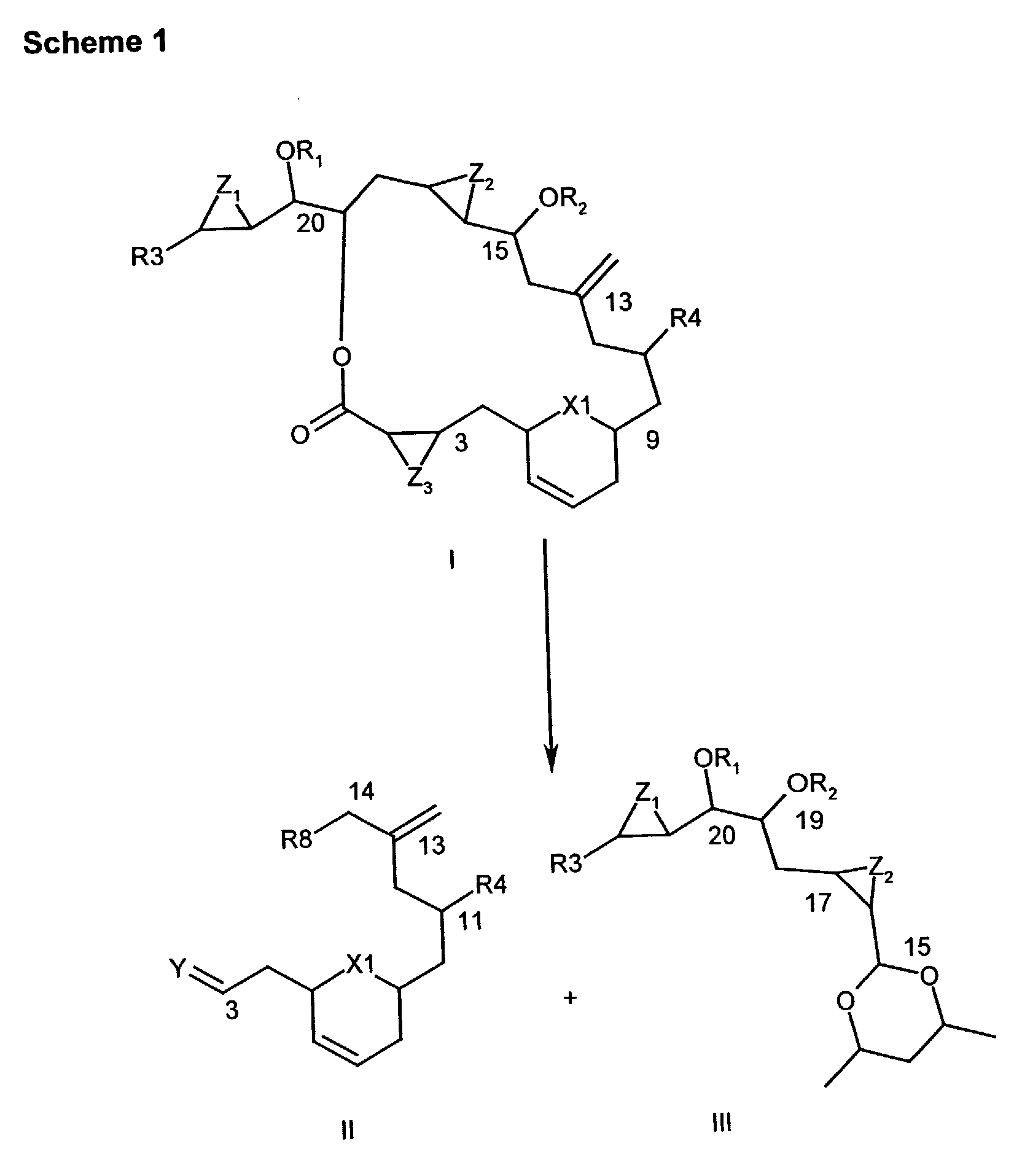
- The instant invention therefore concerns a process for the production of laulimalide and laulimalide derivatives of general formula Iin which R1, R2, R3, R4, X1, Z1, Z2, Z3 have the meaning as defined above, characterised in by reacting a compound of general formula II
 in which
- R4 and X1
- have the meaning defined above under formula I, and
- R8
- has the meaning of hydrogen, trimethylsilyl, or the group MHal, wherein
- M
- has the meaning of Mg, Li, Ti, Ge or In, and
- Y
- has the meaning of oxygen or the group =CH(OH), (Z) or (E)- CH-COOH, (Z) or (E)- =CH-COOR9 or (Z) or (E)-CHHal, in which
- R9
- has the meaning of hydrogen, alkyl, cycloalkyl or aryl,
- R1, R3, Z1 und Z2
- have the meaning defined above under formula I, and
- R2
- has the meaning of hydrogen, methylmethylether, paramethyloxybenzyl, benzyl, or a protecting group, or a group -COCH2B, wherein
- B
- has the meaning of the group -SiR10, -SeR11, -Se(O)R11, -TeR11, -PO(OR11)3 or -P(O)(OCH2CR10)2, in which
- R10
- has the meaning of alkyl, aryl, alkenyl, or the group -CF3, or -CH2OR11, in which
- R11
- has the meaning of hydrogen, alkyl, cycloalkyl or aryl, and
- Y1
- has the meaning of oxygen, or an alkyl acetal of the group -CH(OR12)2, or a five membered O,O; N,O; O,S; or S,S; cyclic acetal, or six membered O,O; N,O; O,S; or S,S; cyclic acetal, and
- R12
- has the meaning of alkyl,
- R1, R3, R4, X1 and Z1-Z3
- have the meaning defined above under formula I, and
- Y1
- has the meaning defined above under formula III, and
- R14
- has the meaning of hydrogen, halogen, trimethylsilyl, or the group MHal, wherein
- M
- has the meaning of Mg, Li, Ti, Ge or In,
- Preferred Laulimalid derivatives of general formula I are those, in which
- R1 and R2
- independently from each other have the meaning of hydrogen, α-C1-C6-alkyl, β- C1-C6-alkyl, methylmethylether, C1-C6-alkyl optionally substituted with hydroxy, paramethyloxybenzyl, benzyl, or a silyl protecting group, or an acetyl, benzyl, carbamate or carbonate protecting group,
- R3
- has the meaning of a five or six membered, optionally substituted aryl or heteroaryl ring, or a five or six membered optionally substituted and optionally partially saturated C3-C7-cycloalkyl ring, which can be interrupted by oxygen, sulphur or the group =NR5,
- R4
- has the meaning of α- C1-C6-alkyl, β- C1-C6-alkyl, aryl or trifluoromethyl,
- X1
- has the meaning of oxygen, sulphur or the group =NR5, in which
- R5
- has the meaning of hydrogen, C1-C6-alkyl, C3-C7-cycloalkyl or aryl,
- Z1
- has the meaning of a (Z)- or (E)-double bond, triple bond, or has the meaning of oxygen, sulphur or the group -CH2-, -CH2-CH2 -, =C(OH)2, =C(halogen)(OH), =C(OH)NR6 or =NR7,
- Z2
- has the meaning of a (Z)- or (E)-double bond, triple bond, or has the meaning of oxygen (α- or β-epoxide), sulphur or the group -CH2-, -CH2-CH2 -, =C(OH)2, =C(halogene)(OH), =C(OH)NR6 or =NR7,
- Z3
- has the meaning of a (Z) or (E)-double bond,
- R6
- has the meaning of C1-C6-alkyl, C3-C7-cycloalkyl or aryl, and
- R7
- has the meaning of hydrogen, C1-C6-alkyl, C3-C7-cycloalkyl or aryl,
- Especially preferred are those laulimalid derivatives of general formula I, according to claims 1 and 2, in which
- R1 and R2
- independently from each other have the meaning of hydrogen, α-C1-C6-alkyl, β- C1-C6-alkyl, methylmethylether, C1-C6-alkyl optionally substituted with hydroxy, paramethyloxybenzyl, benzyl, or a silyl protecting group, or an acetyl, benzyl, carbamate or carbonate protecting group,
- R3
- has the meaning of optionally substituted phenyl, biphenyl, naphthyl, thiophene, furan, oxazole, thiazole, imidazole, pyrazole, pyridin, pyrimidine, triazine, quinolin, isoquinolin or benzo derivatives thereof, or a five or six membered optionally substituted and optionally partially saturated C3-C7-cycloalkyl ring, which can be interrupted by oxygen, sulphur or the group =NR5,
- R4
- has the meaning of α- C1-C6-alkyl, β- C1-C6-alkyl, phenyl, biphenyl, naphthyl, or trifluoromethyl,
- X1
- has the meaning of oxygen, sulphur or the group =NR5, in which
- R5
- has the meaning of hydrogen, C1-C6-alkyl, C3-C7-cycloalkyl, phenyl, biphenyl or naphthyl,
- Z1
- has the meaning of a (Z)- or (E)-double bond, triple bond, or has the meaning of oxygen, sulphur or the group -CH2-, -CH2-CH2 -, =C(OH)2, =C(halogen)(OH), =C(OH)NR6 or =NR7,
- Z2
- has the meaning of a (Z)- or (E)-double bond, triple bond, or has the meaning of oxygen (α- or β-epoxide), sulphur or the group -CH2-, -CH2-CH2 -, =C(OH)2, =C(halogene)(OH), =C(OH)NR6 or =NR7
- Z3
- has the meaning of a (Z) or (E)-double bond
- R6
- has the meaning of C1-C6-alkyl, C3-C7-cycloalkyl, phenyl, biphenyl or naphthyl, and
- R7
- has the meaning of hydrogen, C1-C6-alkyl, C3-C7-cycloalkyl, phenyl, biphenyl or naphthyl,
- Of special interest ara those laulimalid derivatives of general formula I, in which
- R1 and R2
- independently from each other have the meaning of hydrogen, α-C1-C6-alkyl, β- C1-C6-alkyl, methylmethylether, C1-C6-alkyl optionally substituted with hydroxy, paramethyloxybenzyl, benzyl, or a silyl protecting group, or an acetyl, benzyl, carbamate or carbonate protecting group,
- R3
- has the meaning of optionally substituted phenyl, biphenyl, naphthyl, thiophene, furan, oxazole, thiazole, imidazole, pyrazole, pyridin, pyrimidine, triazine, quinolin, isoquinolin or benzo derivatives thereof, or a five or six membered optionally substituted and optionally partially saturated C3-C7-cycloalkyl ring, which can be interrupted by oxygen, sulphur or the group =NR5,
- R4
- has the meaning of α- C1-C6-alkyl, β- C1-C6-alkyl, phenyl, biphenyl, naphthyl, or trifluoromethyl,
- X1
- has the meaning of oxygen,
- Z1
- has the meaning of a (Z)- or (E)-double bond, or has the meaning of oxygen,
- Z2
- has the meaning of a (Z)- or (E)-double bond, or has the meaning of oxygen (α- or β-epoxide) and
- Z3
- has the meaning of a (Z) or (E)-double bond,
- Of further special interest are those laulimalid derivatives of general formula I, in which
- R1 and R2
- independently from each other have the meaning of hydrogen, α-C1-C6-alkyl, β- C1-C6-alkyl, methylmethylether, C1-C6-alkyl optionally substituted with hydroxy, paramethyloxybenzyl, benzyl, or a silyl protecting group, or an acetyl, benzyl, carbamate or carbonate protecting group,
- R3
- has the meaning of optionally substituted phenyl, 1,3-thiazoles or 2- and 3-pyridyl, or a six membered optionally substituted and optionally partially saturated cyclohexyl ring, which can be interrupted by oxygen,
- R4
- has the meaning of α- C1-C6-alkyl, β- C1-C6-alkyl, phenyl, biphenyl, naphthyl, or trifluoromethyl,
- X1
- has the meaning of oxygen,
- Z1
- has the meaning of a (Z)- or (E)-double bond, or has the meaning of oxygen,
- Z2
- has the meaning of a (Z)- or (E)-double bond, or has the meaning of oxygen (α- or β-epoxide) and
- Z3
- has the meaning of a (Z) or (E)-double bond,
- Of most interest are those laulimalid derivatives of general formula I, in which
- R1 and R2
- independently from each other have the meaning of hydrogen, α-C1-C6-alkyl, β- C1-C6-alkyl, methylmethylether, C1-C6-alkyl optionally substituted with hydroxy, paramethyloxybenzyl, benzyl, or a silyl protecting group, or an acetyl, benzyl, carbamate or carbonate protecting group,
- R3
- has the meaning of optionally substituted phenyl, 1,3-thiazoles, 2- ai
3-pyridyl or the group
which is substituted with methyl,

- R4
- has the meaning of α- C1-C6-alkyl, β- C1-C6-alkyl, phenyl, biphenyl, naphthyl, or trifluoromethyl,
- X1
- has the meaning of oxygen,
- Z1
- has the meaning of a (Z)- or (E)-double bond,
- Z2
- has the meaning of a (Z)- or (E)-double bond, and
- Z3
- has the meaning of a (Z) or (E)-double bond,
- Preferred protecting groups are silyl protecting groups, such as trimethylsilyl, triethylsilylyl, tributylsilyl, tributyl-dipropyl-silyl, triisopropylsilyl, t-butyldiphenylsilyl or t-butyldimethylsilyl, or other protecting groups, such as for example acetyl, benzyl, carbamate or carbonate.
- Halogene (Hal) has the meaning of chloro, bromo or iodine.
- Alkyl stands for a substituted or unsubstituted, linear or branched alkyl chain, such as methyl, ethyl, propyl, iso-propyl, butyl, iso-butyl, sec. butyl, pentyl, iso-pentyl, hexyl, heptyl, octyl, nonyl, decyl, undecyl, dodecyl.
- Cycloalkyl stands for a monocyclic alkyl ring, auch as cyclopropyl, cyclobutyl, cyclopentyl, cyclohexyl, cycloheptyl, cyclooctyl, cyclononyl or cyclodecyl; and for a bicyclic ring or tricyclic ring, such as adamantanyl, which each can partially be saturated.
- Alkenyl stands for a substituted or unsubstituted, linear or branched alkenyl chain, having 2 - 6, preferred 2 - 4 carbon atoms, such as vinyl, propen-1-yl, propen-2-yl, but-1-en-1-yl, but-1-en-2-yl, but-2-en-1-yl, but-2-en-2-yl, 2-methyl-prop-2-en-1-yl, 2-methyl-prop-1-en-1-yl, but-1-en-3-yl, but-3-en-1-yl, allyl.
- Aryl has the meaning of a ring, consisting of 5 - 12 carbon atoms, such as naphthyl, biphenyl, and preferred a phenyl ring.
- Heteroaryl has the meaning of a ring, consisting of 4 - 12 carbon atoms, which can be condensed with benzene. For example, a five membered ring has the meaning of thiophene, furan, oxazole, thiazole, imidazole, pyrazole or benzo derivatives thereof; and a six membered ring has the meaning of pyridin, pyrimidine, triazine, quinolin, isoquinolin or benzo derivatives thereof, and preferred thiazole and pyridin, especially 1,3-thiazole and 2- and 3-pyridyl.
- Cyclic acetal stands for a ring, such as
 which can optionally be substituted with C1-C10-alkyl.
- A further matter of the invention are the valuable intermediates which can preferrably be used for the production of laulimalide and ist derivatives.
Therefore, inventive matter are also the intermediates of general formula IIin which
- R4 and X1
- have the meaning defined above under formula I, and
- R8
- has the meaning of hydrogen, trimethylsilyl, or the group MHal, wherein
- M
- has the meaning of Mg, Li, Ti, Ge or In, and
- Y
- has the meaning of oxygen or the group =CH(OH), (Z) or (E)- CH-COOH, (Z) or (E)- =CH-COOR9 or (Z) or (E)-CHHal, in which
- R9
- has the meaning of hydrogen, alkyl, cycloalkyl or aryl,
- R1, R3, Z1 und Z2
- have the meaning defined above under formula I, and
- R2
- has the meaning of hydrogene, methylmethylether, paramethyloxybenzyl, benzyl, or a protecting group, or a group -COCH2B, wherein
- B
- has the meaning of the group -SiR10, -SeR11, -Se(O)R11, -TeR11, -PO(OR11)3 or -P(O)(OCH2CR10)2, in which
- R10
- has the meaning of alkyl, aryl, alkenyl, or the group -CF3, or -CH2OR11, in which
- R11
- has the meaning of hydrogene, alkyl, cycloalkyl or aryl, and
- Y1
- has the meaning of oxygene, or an alkyl acetal of the group -CH(OR12)2, or a five membered O,O; N,O; O,S; or S,S; cyclic acetal, or six membered O,O; N,O; O,S; or S,S; cyclic acetal, and
- R12
- has the meaning of alkyl,
- R1, R3, R4, X1 and Z1-Z3
- have the meaning defined above under formula I, and
- Y1
- has the meaning defined above under formula III, and
- R14
- has the meaning of hydrogen, halogen, trimethylsilyl, or the group MHal, wherein
- M
- has the meaning of Mg, Li, Ti, Ge or In,
- The intermediates of general formula II,in which R4 and X1 have the meaning as defined under formula I, and R8 has the meaning of hydrogen, trimethylsilyl, or the group MHal, wherein M has the meaning of Mg, Li, Ti, Ge or In, and Y has the meaning of oxygen or the group =CH(OH), (Z) or (E)-CH-COOH, (Z) or (E)- =CH-COOR9 or (Z) or (E)-CHHal, in which R9 has the meaning of hydrogen, alkyl, cycloalkyl or aryl, which are useful for the production of laulimalide and laulimalide derivatives of general formula I, can be produced via a process, which is characterized in by reacting

- a) an alcohol compound of general formula II-2)
in which R4 has the meaning as defined under formula I, in a suitable solvent together with a suitable oxidant to give an aldehyde compound of general formula II-3)
 in which R4 has the meaning as defined under formula I,
- b) reacting aldehyde compound of general formula II-3) in a suitable
solvent with a suitable alkylating agent to give a compound of general
formula II-4)
in which R4 and X1 have the meaning as defined under formula I,
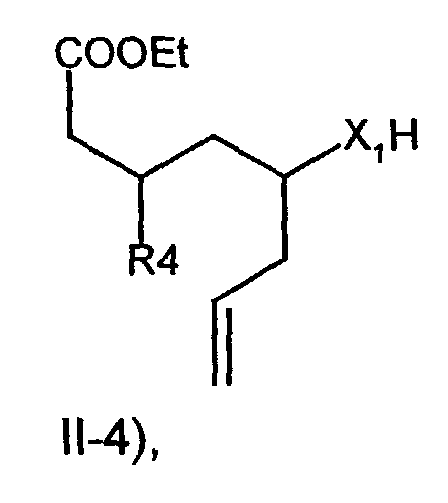
- c) reacting compound II-4) with an amine of general formula II-4a
in which R4 and X1 have the meaning as defined under formula I and Ri and Rii have the meaning as defined under formula II-4a,

- d) reacting compound II-5) in a suitable solvent with a suitable acetal and
a suitable hydroxy compound to give a compound of general formula II-6)
in which R4 and X1 have the meaning as defined under formula I,

- e) deoxygenating compound II-6) in a suitable solvent with a suitable
catalyst, to give a compound of general formula II-7)
in which R4 and X1 have the meaning as defined under formula I,
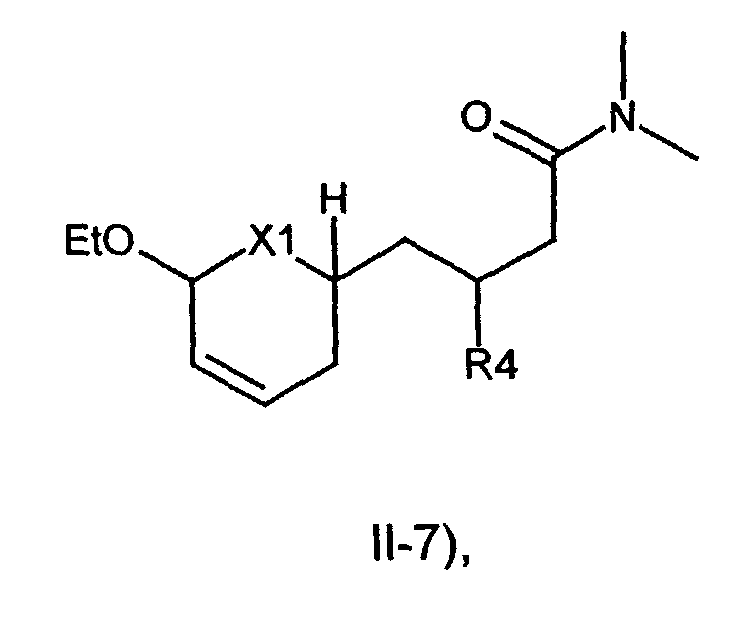
- f) reacting compound II-7) with a suitable vinyl ether and a suitable
perchlorate in a suitable solvent, to give a compound of general formula
II-8)
in which R4 and X1 have the meaning as defined under formula I,
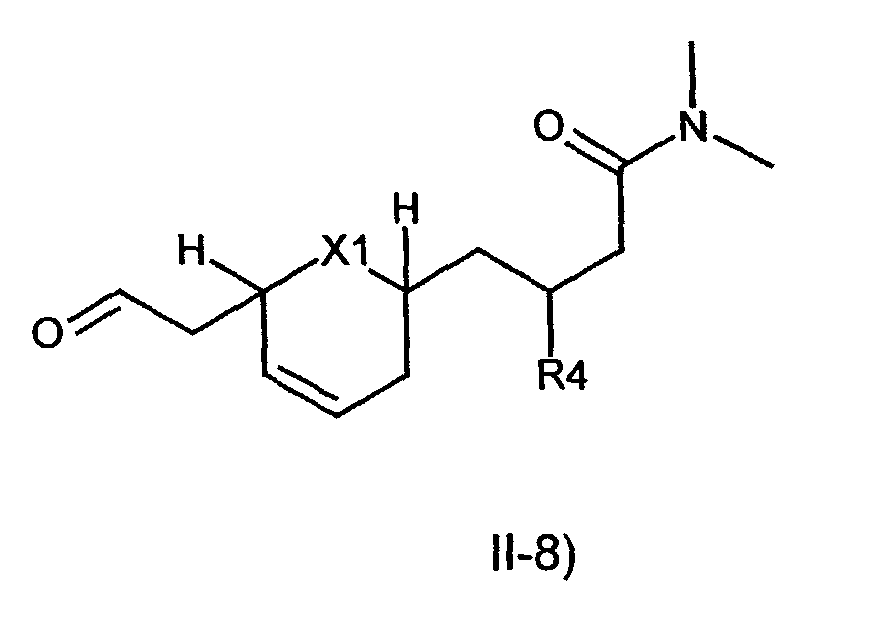
- g) reacting aldehyde compound II-8) with a suitable reductant in a suitable
solvent to give an alcohol compound of general formula II-9)
in which R4 and X1 have the meaning as defined under formula I,

- h) reacting a solution of alcohol compound II-9) in a suitable organic base
and with a silyl chloride or a triflak (Si) of general formula II-9a)
in which R4 and X1 have the meaning as defined under formula I and Si has the meaning as defined under formula II-9a,

- i) reacting amide compound of general formula II-10) with a metal organic
compound and in a suitable solvent to give a ketone compound of
general formula II-11)
in which R4 and X1 have the meaning as defined under formula I and Si has the meaning as defined under formula II-9a,

- j) reacting the ketone compound II-11) with a suitable strong amide base
in a suitable solvent, and accordingly with a suitable acylating agent in a
suitable solvent to give an enoltriflate of general formula II-12)
in which R4 and X1 have the meaning as defined under formula I and Si has the meaning as defined under formula II-9a,

- k) reacting enoltriflate compound II-12) with a suitable Pd catalyst
and with alkali chloride in a suitable solvent, and accordingly with
TMSCH2MgCl to give compound II-13)
in which R4 and X1 have the meaning as defined under formula I, R8 has the meaning as defined under formula II, and Sil has the meaning as defined under formula II-9a,
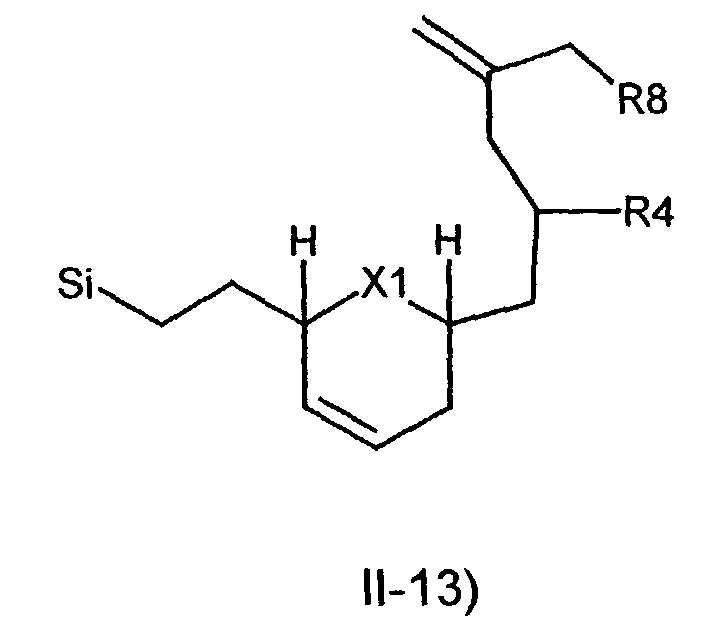
- I) reacting compounds of general formula II-13) with a suitable ionic
fluoride in a suitable solvent to give compound II-14)
in which R4 and X1 have the meaning as defined under formula I, and R8 has the meaning as defined under formula II,

- m) reacting compound II-14) with a suitable oxidant in a suitable
solvent to give an aldehyde compound of general formula II-15)
in which R4 and X1 have the meaning as defined under formula I, and R8 has the meaning as defined under formula II, and

- n) reacting aldehyde compound II-15) with a phosphonyl acetic
ester of general formula II-15a)
- R1, R3, Z1 and Z2
- have the meaning defined above under formula I, and
- R2
- has the meaning of hydrogene, methylmethylether, paramethyloxybenzyl, benzyl, or a protecting group, or a group -COCH2B, wherein
- B
- has the meaning of the group -SiR10, -SeR11, -Se(O)R11, -TeR11, -PO(OR11)3 or -P(O)(OCH2CR10)2, in which
- R10
- has the meaning of alkyl, aryl, alkenyl, or the group -CF3, or -CH2OR11, in which
- R11
- has the meaning of hydrogene, alkyl, cycloalkyl or aryl, and
- Y1
- has the meaning of oxygene, or an alkyl acetal of the group -CH(OR12)2, or a five membered O,O; N,O; O,S; or S,S; cyclic acetal, or six membered O,O; N,O; O,S; or S,S; cyclic acetal, and
- R12
- has the meaning of alkyl, can be produced via a process,
- o) an alcohol compound of general Formula III-16)
in which R1, R3, Z1 and Z2 have the meaning as defined under general formula I, with a suitable oxidant in a suitable solvent to give an aldehyde compound of general formula III-17)
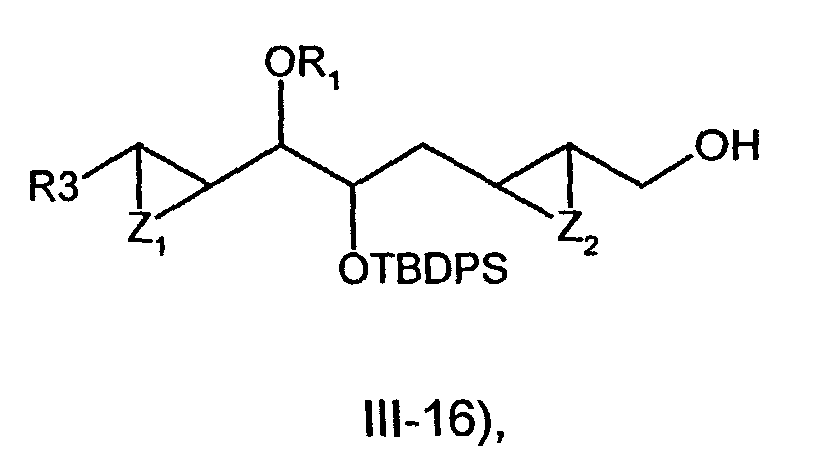 in which R1, R3, Z1 and Z2 have the meaning as defined under general formula I,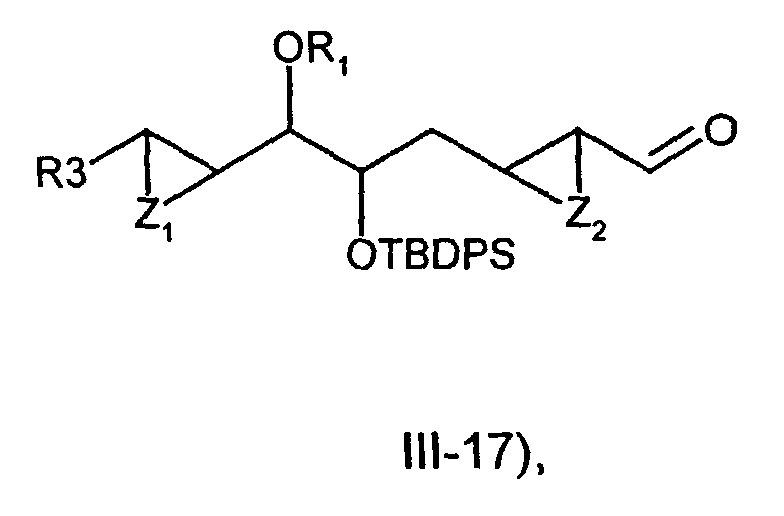
- p) reacting a compound of general formula III-17) with an acetal in a
suitable solvent to give a compound of general Formula III-18)
in which R1, R3, Z1 and Z2 have the meaning as defined under general formula I, and Y1, has the meaning as defined under formula III,

- q) reacting a compound of general formula III-18) with a suitable ionic
fluoride in a suitable solvent to an alcohol compound of general formula
III-19)
in which R1, R3, Z1 and Z2 have the meaning as defined under general formula I, and Y1 has the meaning as defined under formula III, and
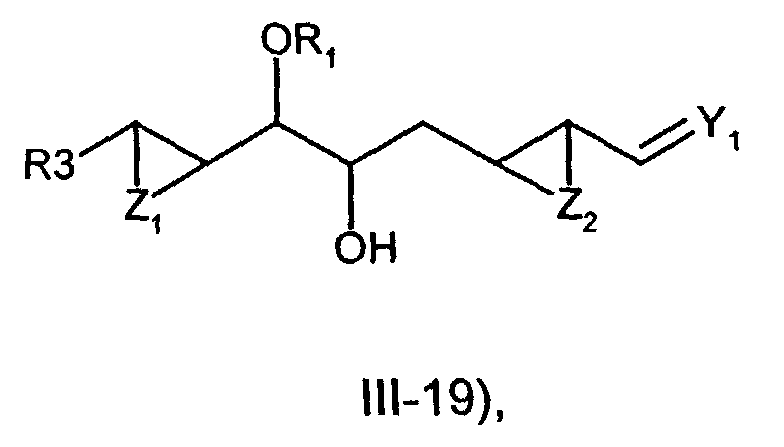
- r) reacting a compound of general formula III-19) with a suitable tertiary
amine in a suitable solvent, and accordingly with a solution of a
phosphoro acetyl chloride of general formula III-19a
-
- According to the process for the production of the intermediates supra,
a suitable solvent in reaction step a), b), d), e), f), g), i), j), k), l), m), n), o), p), q) and r) is for example ether, tetrahydrofuran, methylene chloride, etc.;
a suitable oxidant in reaction step a), m) and o) is for example 1,1,1-triacetoxy-1,1-dihydro-1,2-benz-iodoxol-3(1H)-one (Dess-Martin periodinane), a combination of dimethylsulfoxide, oxalyl chloride or a tertiary amine (Swern-oxidation), etc.;
a suitable alkylating agent in reaction step b) is for example allyl-diisopinocamphenyl-borane (Ipc2Ball), or alkyl-cyclopentadienyl-[2,2-dimethyl-α,α,α,'α'-tetra-phenyl-1,3-dioxolanyl]-titanium, etc.;
a suitable acetal in reaction step d) and p) is for example acrolein-diethylacetal, etc.;
a suitable hydroxy compound in reaction step d) is for example an alcohol, such as ethanol, etc.;
a suitable vinyl ether in reaction step f) is for example vinyl-tert-butyl-dimethyl-silyl-ether, etc.;
a suitable catalyst in reaction step e) and f) is for example di-chloro-ditriphenyl-phosphino-benzylidene-ruthenium, etc.;
a suitable reductant in reaction step g) is for example sodium borhydride, lithium aluminium hydride, diisobutylaluminium-hydride, lithium borohydride, etc.;
a suitable metal organic compound in reaction step i) is for example methyl lithium, methyl magnesium bromide, etc.;
a suitable alkali chloride in reaction step k) is for example LiCI, NaCI, KCI, RbCI, CsCI, etc.,
a suitable a strong amide base in reaction step j) and n) is for example KHMDS, NaHMDS, LDA, dicyclohexyl-isopropyl-lithium amide, etc.;
a suitable acylating agent in reaction step j) is for example PhN(OTf)2 or Tf2O, tosyl chloride, mesyl chloride, etc.;
a suitable Pd catalyst in reaction step k) is for example Pd(Ph3P)4, tris-di-benzylideneacetone-dipalladium, etc.;
a suitable ionic fluoride in reaction step l) and q) is for example tetra-n-butylammoniumfluoride (TBAF), hydrogen fluoride in acetonitrile, pyridine, etc.;
a suitable tertiary amine in reaction step r) is for example 4-dimethylamino-pyridine (DMAP), pyridine, collidine, etc.;
a suitable organic base in reaction step h) and r) is for example triethylamine, pyridine, 2,6-ditert-butylpyridine, ethyl-diisopropyl amine, etc.;
a suitable perchlorat in reaction step f) is for example lithium perchlorate, etc. - The following process examples describe the production of the inventive intermediate compounds, and further describe the feasability of the inventive process, however, not restricting the process to compounds decribed in these process examples.
- Unless otherwise stated, solvents were dried by distillation under argon, from Na (toluene), Na / K (Et2O), potassium (THF), CaH2 (Et3N, DMF), P2O5 (CH2Cl2), KOH (pyridine) and Mg (MeOH, EtOH). All other commercially available reagents were used without further purification unless specified otherwise. All reactions were performed in oven-dried glassware under argon. Chromatography refers to flash column chromatography on silica gel 60 (230-400 mesh). Thin layer chromatography (TLC) was performed on Al-backed plates (Merck silica gel 60 F254) and visualised by using either a UV lamp, phosphomolybdic acid, sulphuric acidic/anisaldehyde or potassium permanganate solutions. Melting points (mp) are uncorrected. Optical rotations are reported in g/100 ml. Infrared spectra (IR) were measured as evaporated films on single crystal silica plates and reported in wave numbers (cm-1) with broad signals denoted by (br). High resolution mass spectra were obtained using electron ionisation (El), field ionisation (Fl) or fast atom bombardment (FAB). 1H and 13C NMR were recorded on a Bruker AC 250 (250 MHz), AM 400 (400 MHz) or AM 600 (600 MHz) spectrometer. Chemical shifts are reported using the solvent resonance internal standard (chloroform, 7.26 and 77.0 ppm).
- The production of compound II, in which R4 has the meaning of β-methyl, R8 has the meaning of trimethylsilyl, X1 has the meaning of oxygene, and Y has the meaning of group (Z)- =COOMe, was performed according to Scheme 2.

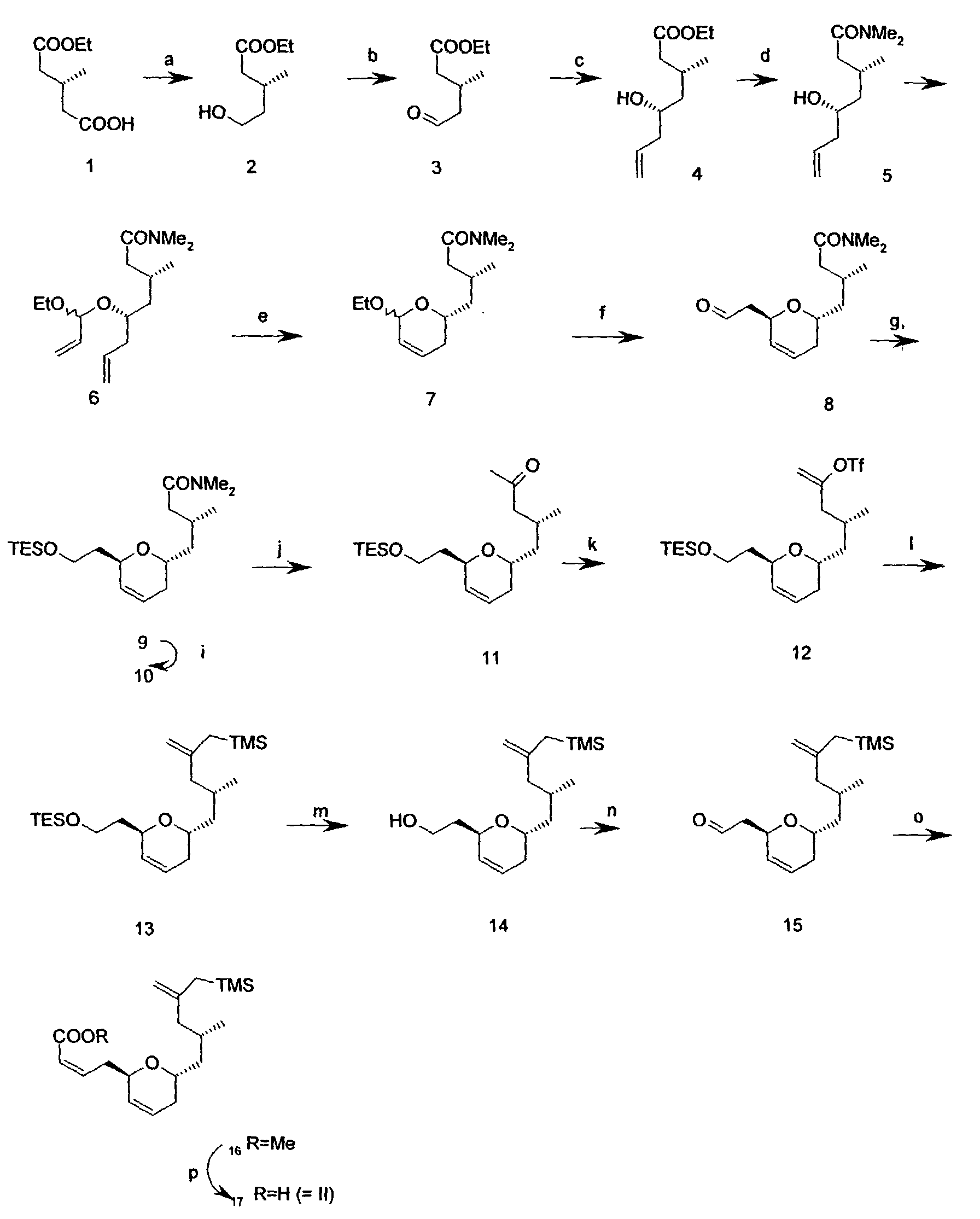
-
- a) BH3.Me2S, 98%; b) Et2NH, EtOH, 94%; c) Swern ox. 96%; d)AllylTi TADDOL; 92%, e) acrolein -diethylacetal, TsOH, Tol, 94%; f) 4 mol % Grubs catalyst, CH2Cl2, 87%; f) TBSO-CH=CH2, LiClO4, 92%; g) NaBH4, MeOH, 0°C, 99%; i) TESCI, Py, Tol, 92%; j) MeLi, Et2O, -75°C->r.t., 90%; k) KHMDS, C6H5N(OTf)2, THF, 60%; I) 5 mol% Pd(PPh3)4, LiCl 5 eqv, TMSCH2MgBr 5 eqv, Et2O, 96%; m) K2CO3, MeOH, 0°C, 98%, n) Py.SO3, TEA, DMSO, CH2Cl2, 90%; o) MeOOCCH2P(O)-(OCH2CF3)2, KHMDS, THF, 84%; p) LiCl.H2O, aceton, 0°C, 2 days, 80%.
-
- The synthesis of intermediate compound III (R1= methylmethylether (MOM), R2= group -COCH2B, B= -P(O)(OCH2CR10)2, R10= -CF3 (TBDPS), R3 =methyl, X = oxygene, Y= chiral six membered cyclic acetal, Z and Z1 = double bond) and intermediate compound IV (R1 = methylmethylether (MOM), R3 = methyl, X, X1 = oxygene, Z and Z1 = (E)-double bonds, R2 = trimethylsilyl (TMS), Z3 = (Z)-double bond, R4 = α-methyl) was performed according to Schemes 3 and 4.
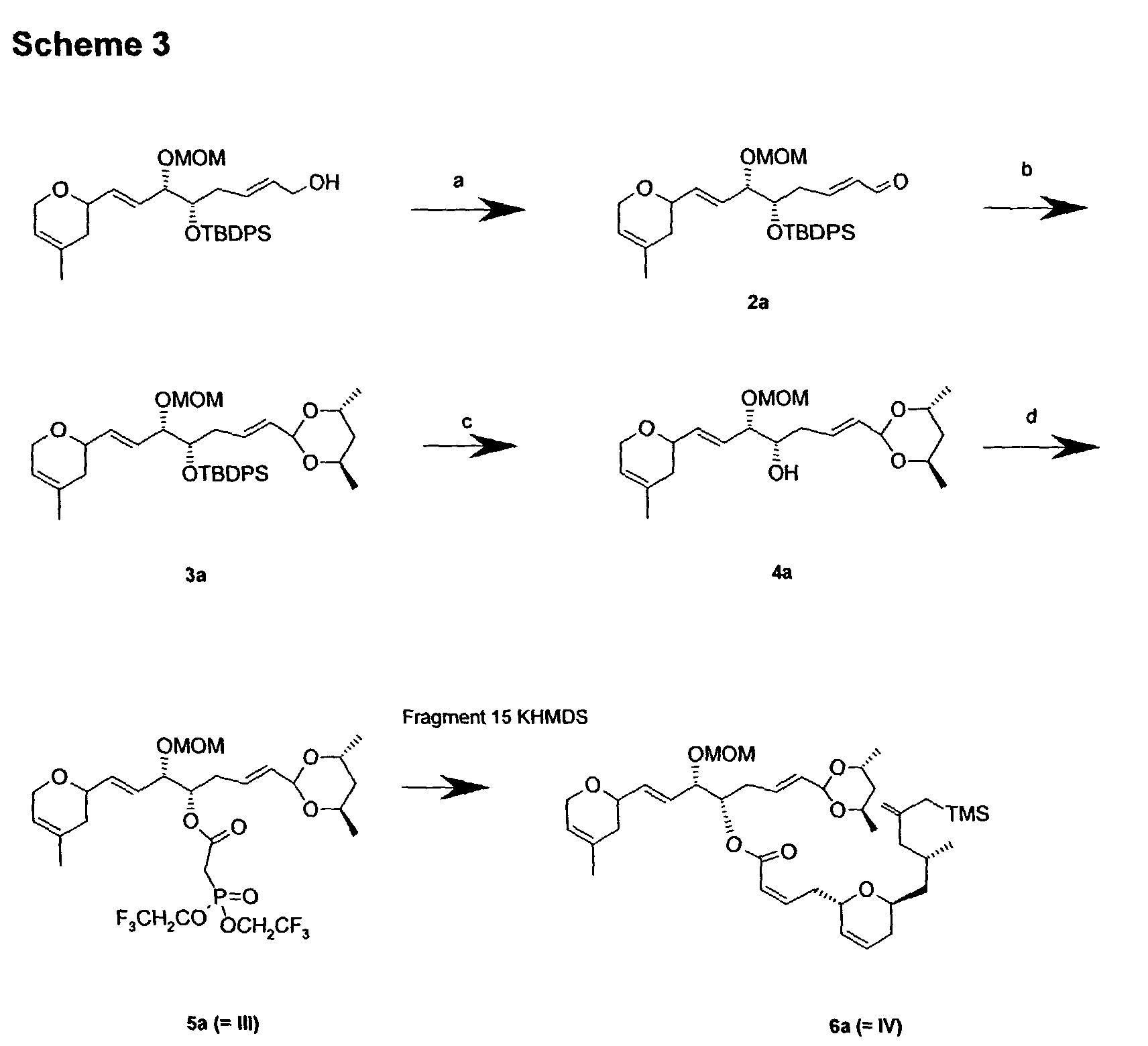
- Reagents and conditions: a) Dess-Martin oxidation 96%, b) (R;R)-(-)-2,4 pentan diol/H+, 89%, c) TBAF, THF 96%, d) (CF3CH2O)2P(O)CH2COCl/DMAP/Py, -78°C-r.t, 96%,
-

- Reagents and conditions: a) EtAlCl2, methylene choride, -50-0°C, 85%.
-


-
- a) Dess Martin periodinane, ether, 90%; b) pTsOH, CH2Cl2, 80%;
- c) Me2BBr, ether, -78°C, 96%; d) tBuOOH, Ti(OiPr)4, CH2Cl2, -20°C, 2h
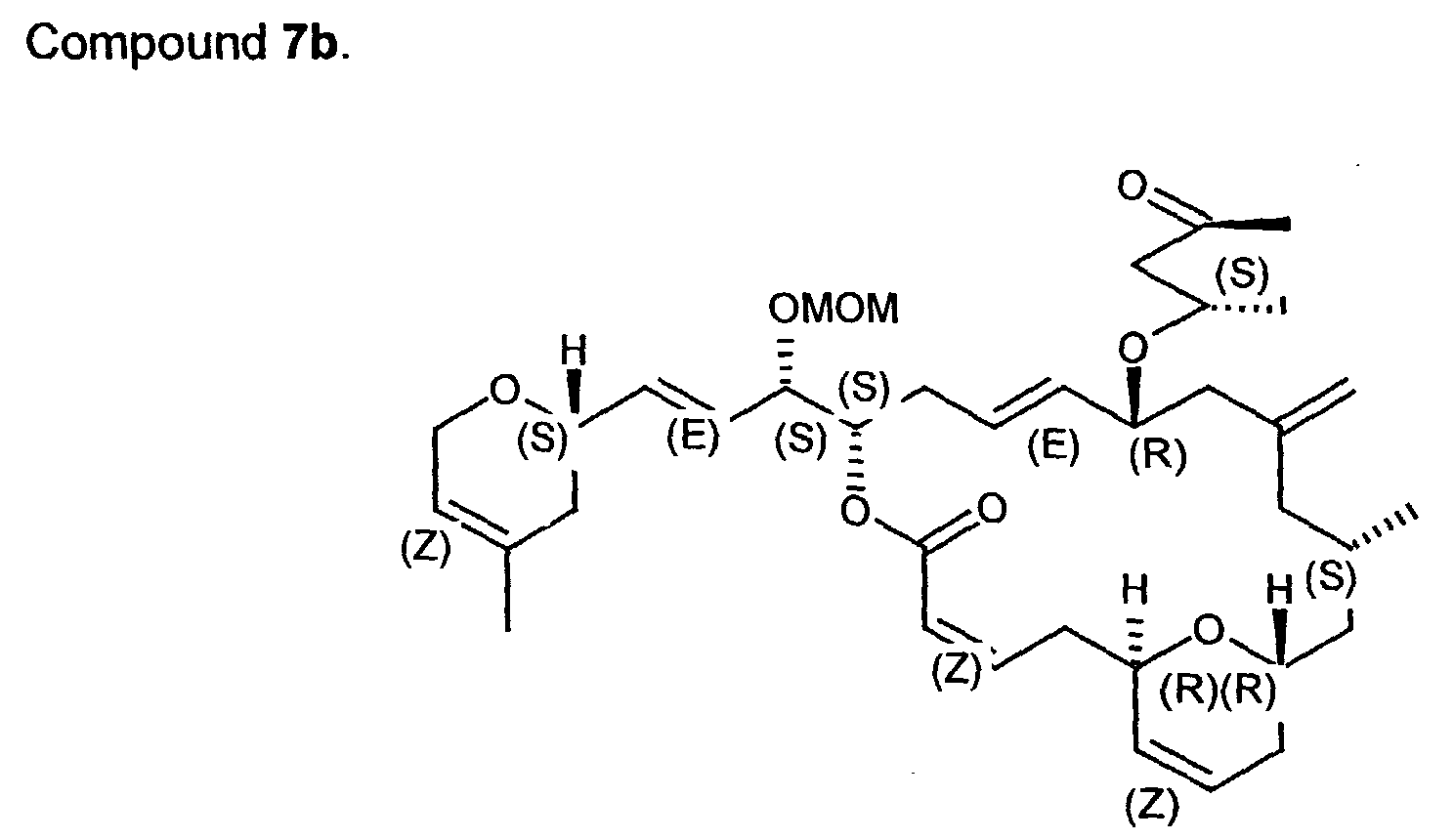 C37H54O8
 -
- A solution of alcohol 7a (0.02g, 0.032mmol) in dry CH2Cl2 (0.5ml) was added to a slurry of Dess-Martin periodinane (0.02g, 0.06mmol) and NaHCO3 (0.05g) in CH2Cl2 (2 ml). The mixture was stirred at room temperature for 30 minutes, then subjected directly to SiO2 Flash chromatography (hexane : ethyl acetate - 1:1) to yield 7b as a colorless oil (0.018g, 90%), [α] D 20= -35° (c=0.05 in CHCl3); IR (neat): 2978, 1719, 1682, 1640, 1360, 1166, 1035cm-1; 1H-NMR (600 MHZ, CDCl3); δin ppm= 6.34 (ddd, J=11.5, 10.0, 5.5 Hz), 5.93 (1H, d, J=11.6, Hz), 5.85 (2H, m), 5.71 (1H, ddd, J=10.2, 4.2, 2.4Hz), 5.62.(1H, m), 5.58 (2H, m), 5.44 (2H, m), 5.09, (1H, dd, J=12.9, 6.4 Hz), 4.80 (1H, brs), 4.77 (1H, brs), 4.69 (1H, d, J=6.8 Hz), 4.57 (1H, d, J=6.8Hz), 4.27 (1H, m), 4.16 (2H, m), 4.16 (2H, m) 4.07 (1H, m), 3.94 (2H, m), 3.83 (1H, ddd J=8.3, 8.0, 4.7 Hz), 3.69 (1H, m), 3.40 (3H, s), 2.69. (1H,dd, J=15.3, 6.9 Hz), 2.42. (1H, dd, J= 15.3, 6.0 Hz), 2.37 (2H, m), 2.26. (1H, dd, J= 14.6, 7.9 Hz), 2.16 (3H, s), 2.12 (1H, m), 2.06 (3H, m), 1.90 (2H, m), 1.74 (2H, m), 1.65 (3H, brs), 1.62 (3H, m), 1.16 (1H, m), 1.14 (3H, d, J=6.3 Hz), 0.91 (1H, m), 0.87 ( 3H, d, J=6.2 Hz); 13C-NMR (150 MHz, CDCl3), δ in ppm=208.2 (s), 165.7 (s), 147.7 (d), 144.9 (s), 136.2 (d), 134.7 (d), 131.7 (s), 128.9 (d), 127.9 (d), 126.3 (d), 125.4 (d), 121.8 (d), 120.1 (d), 113.6 (t), 94.4 (t), 77.4 (d), 76.1 (d), 74.3 (d), 73.6 (d), 72.4 (d), 69.0 (d), 67.4 (d), 65.9 (t), 56.0 (d), 51.7 (q), 45.3 (t), 43.2 (t), 42.9 (t), 36.0 (t), 34.5 (t), 33.3 (t), 31.8 (t), 31.7 (d), 28.9 (q), 23.3 (q), 20.6 (q), 19.8 (q); HRMS: found: 626. 8100, C37H54 O8 requires 626.8199.C32H46O7

Exact Mass: 542,3244
Mol Wt: 542,7034
C, 70,82; H, 8,54; O, 20, 64 - A solution of 7b (0.015g, 0.023 mmol) and TsOH (0.002g, 4 eqv) in CHCl3 (5ml) was stirred at 0°C for 24 hours. The mixture was washed with a solution NaHCO3, water followed by brine, dried (Na2SO4) and concentrated. Flash chromatography of the crude product (hexane: ethyl acetate: 1:1) gave 7c as a colorless oil (0.010g, 80%); [α]D 20= -22° (c=0.05 in CHCl3); IR (neat): 3520, 2990, 1720, 1675, 1640, 1370, 1160, 1022 cm-1; 1H-NMR ( 600 MHz, CDCl3);
δ in ppm=6.34 (ddd, J=11.5, 10.0, 5.3Hz), 5.93 (1H, dt, J=11.6, 1.2 Hz), 5.85 (2H, m), 5.72 (1H, ddd, J=10.2, 4.1, 1.9 Hz), 5.61.(3H, m), 5.41 (1H, brs), 5.11 (1H, ddd J=9.7, 6.0, 3.5 Hz), 4.83 (2H, brs), 4.68 (1H, d, J=6.9 Hz), 4.55 (1H, d, J=6.9 Hz), 4.16 (5H, m), 4.06 (1H, m), 3.92 (1H, m), 3.58 (1H,m), 3.35 (3H, s), 2.4-2.0 (10H), 1.9-1.7 (5H, m), 1.69 (3H, brs), 1.64 (2H, m), 1.14 (1H, m), 0.89 (1H, m), 0.86 (3H, d, J=6.5 Hz); 13C-NMR (150 MHz, CDCl3), in ppm=165.3 (s), 146.8 (d), 144.8 (s), 136.0 (d), 135.3 (d), 131.2 (s), 128.3 (d), 126.6 (d), 125.8 (d), 124.7 (d), 121.8 (d), 119.7 (d), 114.3 (t), 93.8 (t), 73.8 (d), 73.1 (d), 71.2 (d), 69.7 (d), 67.4 (d), 65.5 (t), 55.6 (q), 44.7 (t), 43.3 (t), 42.2 (t), 35.7 (t), 34.3 (t), 33.4 (t), 30.9 (t), 29.7 (t), 28.2 (q), 22.2 (q), 19.8(q); HRMS: found: 542.3200, C32H46O7 requires 542.3244.C30H42O6
Exact Mass: 498,2981
Mol Wt: 498,6509
C, 72,26;H 8,49; O, 19,25 - To a solution of 7c (0.01g, 0.18 mmol) in CH2Cl2 (5ml) was added at -78°C a solution of Me2BBr (0.3ml, 0.3M in CH2Cl2) and the mixture was kept at same temperature for 30 min. The reaction was quenched with a mixture of THF and saturated solution of NaHCO3 (1ml). The organic phase was washed with water followed by brine, dried (Na2SO4) and concentrated. Flash chromatography of the crude product ( hexane: ethyl acetate- 1:1) gave 7d as a colorless oil (0.09g, 96%); [α]D 20=-26°C (c=0.01 in CHCl3); IR (neat): 3422, 2924, 1718, 1654, 1320, 1130, cm-1; 1H-NMR (600 MHz, CDCl3); δ in ppm=6.32 (1H; ddd, J=11.5, 10.0, 5.3 Hz), 5.94 (1H, d, J= 11.5Hz), 5.91 (1H, ddd, J= 15.6, 5.6, 1.2, Hz), 5.86 (1H, m), 5.76 (2H, m) 5.65 (1H,m), 5.41 (1H, brs), 5.02 (1H, dd, J=13.3, 5.8), 4.88 (2H, brs), 4.2-4.1 (5H, m), 4.07 (1H, m), 3.89 (1H, m), 3.55 (1H,m), 2.4-2.1 (6H, m), 2.07 (1H, m), 1.93 (1H, d, J=16.9 Hz), 1.85-1.70 (4H, m), 0.87 (3H, d, J= 6.3Hz); 13C-NMR (150 MHz, CDCl3): δ=165.5 (s), 147.8 (d),
144.8 (s), 135.9 (d), 134.0 (d), 131.2 (s), 128.6 (d), 128.3 (d), 126.6 (d), 125.4 (d), 121.6 (d), 119.7 (d), 114.5 (t), 74.0 (d), 73.2 (d), 73.1 (d), 71.2 (d), 69.8 (d), 67.6 (d), 65.6 (t), 44.7 (t), 43.5 (t), 42.2 (t), 35.7 (t), 34.3 (t), 33.5 (t), 30.9 (t), 28.7 (t), 19.6 (q). - MS-EI (m/z, %): 498 (M+, 1.5), 480 (8), 462 (3.5), 395 (7), 217 (13), 179 (40), 81 (75). HRMS: found: 498.2969, C30H42O6 requires 498.2981.C30H42O7
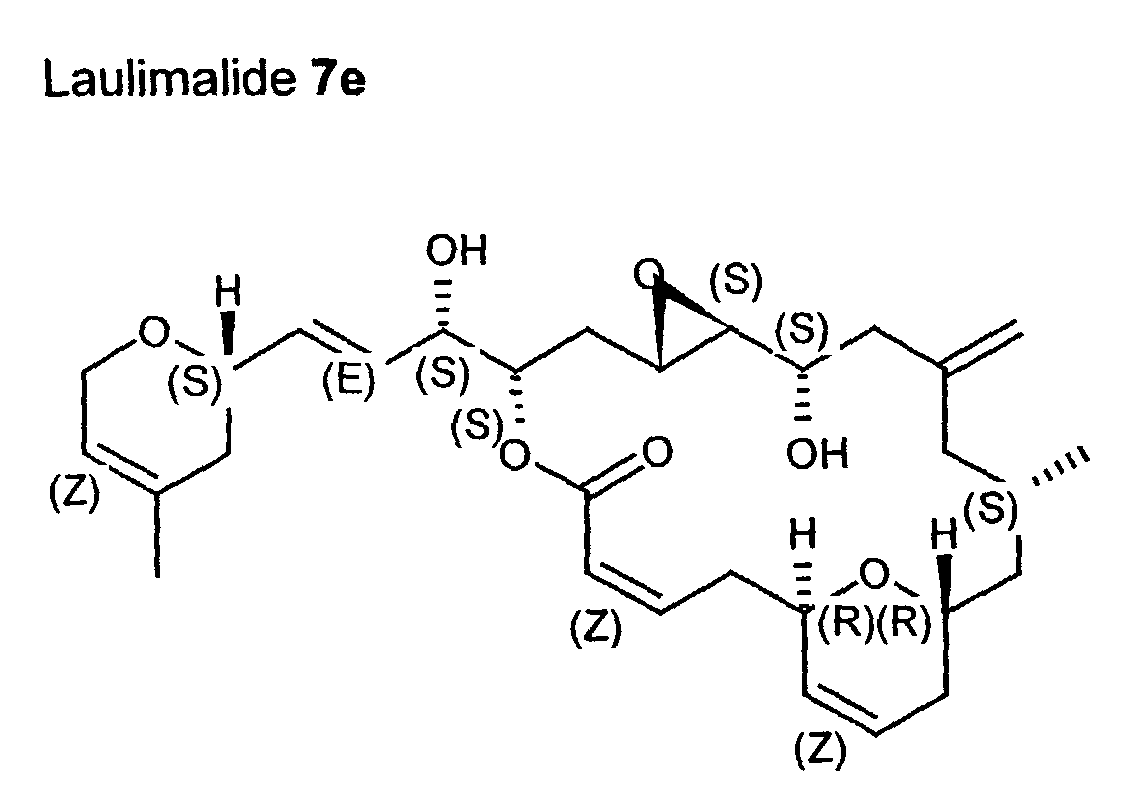
Exact Mass: 514,2931
Mol. Wt: 514,6503
C, 70,01; H, 8,23; O, 21,76 - To a suspension of 4 A molecular sieves (50mg) in CH2Cl2 (2ml) at -20°C was added Ti (iPrO)4, (3µl, 0.01 mmol). The mixture was stirred for 30min at -20°C and then tBuOOH (2µl, 5.5M, 0.01 mmol) was added. The mixture was stirred for additional 20 min and then a solution of compound 7d (0.03mg, 0.01 mmol) in CH2Cl2 (1ml) was added. The resulting mixture was stirred for 2h at -20°C.
After this period a mixture of 4 N NaOH (0.2ml) and brine (1ml) was added and the resulting mixture was stirred at 0°C for 1h. The layers was separated and the aqueous phase was extracted with CH2Cl2. The combined organic layers were washed with brine, dried (Na2SO4) and concentrated. HPLC purification of the crude product (hexane: ethyl acetate- 1:1) gave 7e as a colorless oil (0.02g), [α]D 20=-195° (c=0.01 in CHCl3); 1H-NMR (600 MHz, CDCl3); δ in ppm=6.46 (1H, td, J=10.3, 4.1 HZ), 5.88 (3H, m), 5.76 (1H, dd, J=15.6, 5.7, Hz), 5.70 (1H, brd, J=10.3), 5.41 (1H, brs), 5.15 (1H, dd, J=10.4, 4.4Hz), 4.86 (1H, brs), 4.84 (1H, brs), 4.30 (1H, m), 4.22 (1H, dd, J=6.0, 5.2Hz), 4.17 (2H, m), 4.07 (1H, m), 4.00 (1H, m). 3.75 (2H, m), 3.07 (1H, ddd, J=8.9, 3.4, 2.4Hz), 2.89 (1H, t, 2.4 Hz), 2.37 (2H, m), 2.23 (1H, ddd, J=16.6, 6.1, 3.5 Hz), 2.10 (1H, d, J=14.5), 2.0-1.81 (5H, m), 1.79 (1H, dd, J=12.5, 9.5 Hz), 1.7 (3H, brs), 15-1.4 (2H, m), 1.30 (1H, m), 0.80 (3H, d, J=6.6Hz); 13C-NMR (150 MHz, CDCl3): δ=166.0 (s), 150.3 (d), 144.8 (s), 131.2 (s), 128.7 (d), 128.5 (d), 125.2 (d), 120.5 (d), 119.7 (d), 112.5 (t), 73.5 (d), 73.1 (d), 72.3 (d), 67.8 (d), 66.6 (d), 65.6 (t), 60.7 (d), 52.1 (d), 45.6 (t), 43.4 (t), 37.1 (t), 35.6 (t), 33.8 (t), 33.4 (t), 31.7 (t), 29.2 (d), 22.9 (d), 20.2 (q). MS HRMS: found: 514,2900, C30H42O7 requires 514,2931. - C8H14O3

Exact Mass: 158,0943
Mol. Wt.: 158,1950
C, 60,74; H, 8,92; O, 30,34 - A solution of alcohol compound 2 (0.8 g, 5 mmol) in dry CH2Cl2 (10 ml) was added dropwise to a slurry of Dess -Martin periodinane (6.5 g, 15 mmol) and NaHCO3 (10 g) in dichloromethane (CH2Cl2) (40 ml). The mixture was stirred at room temperature for 1h, then subjected directly to SiO2 Flash chromatography (hexane-ethyl acetate :5:1) to yield compound 3 (0.77g, 98%) as a colourless liquid; [α]D 20= -5.5° (c= 0.04, CHCl3); IR (neat) 2954, 2915, 1730, 1717, 1415, 1360, 1238, 1182, 940 cm-1; 1H-NMR (250 MHz, CDCl3); δ in ppm = 9.80 (1H, s), 4.25 (2H, q, J=7.5 Hz), 3.75 (3H, m), 2.8-2.2 (5H, m), 1.22 (3H, t, J=7.5 Hz), 1.05(3H, d, J=7.2 Hz); 13C-NMR (62.5 MHz, CDCl3), δ in ppm = 204.0 (d), 168.2 (s), 60.8 (t), 50.4 (t), 41.4 (t), 25.7 (d), 20.4 (q), 14.6 (q); HRMS: found 158,0450 +. 5 ppm, C8H14O3 requires 158,0943.
- C11H20O3
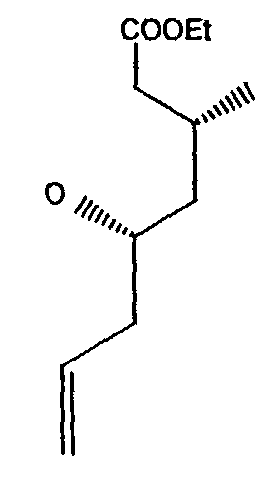
Exact Mass: 200,1412
Mol. WT.: 200,2747
C, 65,97; H, 10,07; O, 23,97 - Aldehyde compound 3 of step i) (0.6 g, 3.8 mmol) was dissolved in dry Et2O (20 ml) and cooled to -100°C. To this solution was added (-) Ipc2BAII (9 ml, 0.5 M in pentane, 1.2 eqv) by cannulation during 30 min. After the completion of the addition, the mixture was stirred at the same temperature for 30 min. Methanol (1 ml) was added at -100°C and the reaction mixture was allowed to reach room temperature. The solvent was evaporated and the residue was dissolved in THF (20 ml). To this solution was added a solution of sodium perborate (1g in 10 ml water,) and the mixture was stirred for 30 min. The organic phase was separated and the water phase was extracted with ethyl acetate (3 X 5 ml). The combined organic layers were washed with water, brine, dried (Na2SO4) and concentrated. Flash chromatography of the crude mixture (ethyl acetate :hexane -5:1) provided 4.(0.66 g, 87%), oil, [α]D 20= -9.4° (c= 0.65, CHCl3); IR (neat) 3460, 2925, 1730, 1633, 1499, 1460, 1397, 1262, 809 cm-1; 1H-NMR (250 MHz, CDCl3); δ in ppm = 1H-NMR (250 MHz, CDCl3); δ in ppm = 5.86 (1H, m), 5.11 (2H, brd, J=14.0 Hz), 4,16 (2H, q, J=7.0 Hz), 3.75 (1H, brd, w1/2 = 17Hz), 2.4-1.9 (5H, m), 1.45 (1H, m), 1.32 (1H, m), 1.24 (3H, t, J=7.0, Hz), 0.99 (3H, d, J=6.5, Hz); 13C-NMR (62.5 MHz, CDCl3), δ in ppm =173.5 (s), 132.9 (d), 118.9 (t), 71.6 (d), 60.6 (t), 44.0 (t), 43.2 (t), 42.6 (t), 27.6 (d), 19.9.4 (q), 14.6 (q); 27.6 (d), 19.9.4 (q), 14.6 (q); MS-EI (m/z, %): 200 (M+, 0.3), 182 (M+ - H2O, 20), 172 (25), 158 (20), 128 (12), 85 (83), 72 (100); HRMS: found 1821, 1310 + - 5 ppm, C11H18O2 (M+-H2O) requires 182,1307.
- C11H21NO2
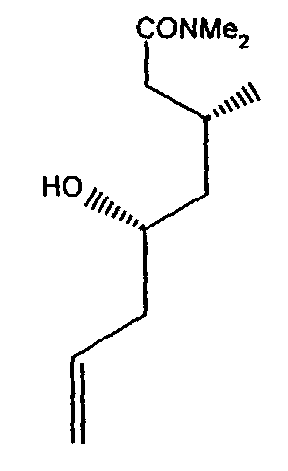
Exact Mass: 199,1572
Mol. Wt.: 199,2900
C, 66,29; H, 10,62; N, 7,03; O, 1606 - A solution of alcohol compound 4 of step ii) (0.6 g, 3mmol) in dimethylamine (5.6 M in ethanol, 10 ml) was heated for 2h in sailed flask at 40°C and then, was allowed to stay 12 h at room temperature. The ethanol was removed and the residue was filtered trough SiO2, (CH2Cl2 : MeOH - 97:3) to give pure amide 5 (0.58 g, 98%) as a yellow oil; [α]D 20= -9.4° (c= 0.65 in CHCl3).); IR (neat) 3665, 3645, 3400, 2925, 1633, 1504, 1403, 1056, cm-1; 1H-NMR (250 MHz, CDCl3); δ in ppm = 5.86 (1H, m), 5.11 (2H, brd, J=14.0 Hz), 3.01 (3H, s), 2.96 (3H, s), 3.75 (1H, brs, w1/2 = 19Hz), 2.4-2.2 (5H, m), 1.45 (2H, m), 0.99 (3H, d, J=6.5, Hz); 13C-NMR NMR (62.5 MHz, CDCl3), δ in ppm =175.5 (s), 135.6 (d), 117.8 (t), 69.7 (d), 44.6 (t), 43.3 (t), 41.3 (t), 37.7 (q), 35.8 (q), 27.6 (d), 21.2 (q); MS-EI (m/z, %): 199 (M+, 0.5), 188 (M+ - H2O, 15), 172 (20), 158 (32), 128 (12), 95 (23), 85 (83), 72 (100); HRMS: found 181,1470 + - 5 ppm, C11H19O2N (M+-H2O) requires 181,1466.
- C16H29NO3
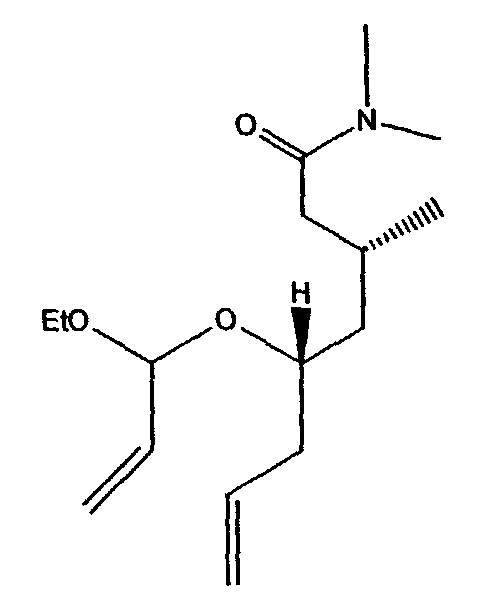
Exact Mass: 283,2147
Mol. Wt.: 283,4064
C, 67,81; H, 10,31; N, 4,94; O, 16,94 - To a solution of compound 5 of step iii) (0.350 g, 1.7 mmol) and acrolein-diethylacetal (0.38 ml, 2.4 mmol) in dry toluene (30 ml) was added TsOH (10 mg) and the mixture was slowly rotated on a rotavapour at 80°C mbars and 40°C. The reaction was monitored by TLC and the volume of the solvent was kept constant by addition of toluene. At the end of the reaction, the mixture was washed with NaHCO3, water, brine, dried (Na2SO4) and concentrated. Purification by Flash chromatography (ethyl acetate : toluene - 3:1) provided compound 6 (0.46 g, 92%), as a mixture of diastereomers (1:1); IR (neat) 3041, 3077, 2925, 1651, 1451, 1497, 1324, 1262, 1181, 1103 cm-1; 1H-NMR (250 MHz, CDCl3); δ in ppm = 5.81 (4H, m), 5,40 (2H, d, J=16.2, Hz), 5,28 (2H, d, J=12.6, Hz), 5.10 (4H, m), 4.97 (1H, d, J=5.3, Hz), 4.91 (1H, d, J=5.5, Hz), 3.50 (4H, m), 3.01 (6H, s), 2.94 (6H, s), 2.50-1.56 (12H, m), 1.37 (2H, m), 1.17 (6H, t, J=7.0 Hz) 1.0 (3H, d, J=6.2 Hz ), 0.95 (3H, d, J=6.2 Hz); 13C-NMR (62.5 MHz, CDCl3), δ in ppm = 172.7 (s), 172.6 (s) 136.4 (d), 136.3 (d), 135.3 (d), 134.9 (d), 118.3 (t), 118.2 (t), 117.6 (t), 117.5 (t), 102.4 (d), 100.0 (d), 75.00 (d), 75.55 (d) 60.8 (t) 60.7 (t), 42.5 (t), 42.2 (t), 41.6 (t), 41.5 (t), 40.4 (t),39.5 (t), 37.9 (q), 37.7 (q), 35.7 (q), 27.2 (d), 20.6 (q), 20.3 (q), 15.6 (q), 15.5 (q); HRMS: found 283,2155. + - 5 ppm, C16H29NO3 requires 283,2147
- C14H25NO3
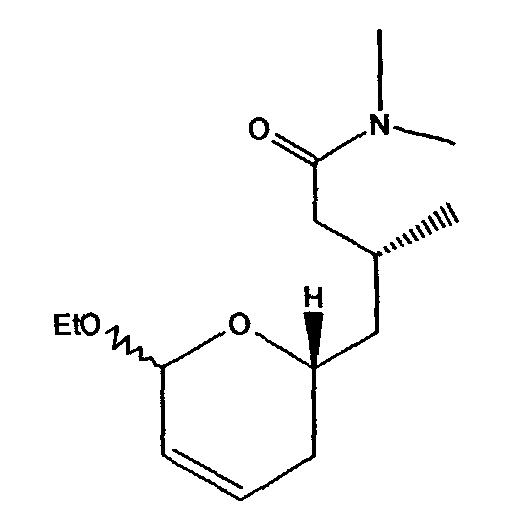
Exact Mass: 255,1834
Mol. Wt.: 255,3532
C, 67,85; H, 9,87; N, 5,49; O, 18,80 - A solution of compound 6 of step iv) (0.42 g, 1.5 mmol) and Grubs catalyst (0.06 g, 0.007 mmol) in CH2Cl2 was deoxygenated by a freeze-thaw cycle in which the solvent was first frozen in liquid N2, and then warmed up in vacuo. The deoxygenated mixture was refluxed for a 6 h (TLC monitoring). At the end of the reaction the catalyst was destroyed by passing an air through the solution for 15 min. The solvent was evaporated and the crude product was purified by Flash chromatography (ethyl acetate : toluene : TEA-3:1.0.1) to give 7 as a mixture of diastereomers (1:1) (0.35 g, 92%), oil; IR (neat) 3041, 2925, 1644, 1455, 1395, 1324, 1262, 1181, 1103 cm-1; 1H-NMR (250 MHz, CDCl3); δ in ppm = 5.95 (2H, m), 5,75 (1H, d, J=10.6, Hz), 5,66 (1H, d, J=10.6, Hz), 5.04 (1H, brs), 4.96 (1H, brs), 3.90 (4H, m), 3.54 (2H, m), 3.01 (6H, s), 2.94 (6H, s), 2.50-1.80 (12H, m), 1.65 (2H, m) 1.32 (2H, m), 1.2 (6H, t, J=6.9 Hz) 1.0 (3H, d, J=6.2 Hz), 0.95 (3H, d, J=6.2 Hz); 13C-NMR (62.5 MHz, CDCl3), δ in ppm = 172.7 (s), 172.6 (s) 129.4 (d). 128.1 (d), 126.0 (d), 98.1 (d), 94.8 (d), 70.69 (d), 64.4 (d), 64.0 (t), 63.5 (t), 43.1 (t), 43.0 (t),41.4 (t) 37.9 (q), 35.7 (q), 31.7 (t), 31.5 (t), 27.5 (d), 26.9 (d), 20.5 (q), 19.8 (q), 15.7 (q); HRMS: found 255,1840 + - 5 ppm, C14H25NO3 requires 255,1834.
- C14H23NO3

Exact Mass: 253,1678
Mol. Wt.: 253,3374
C, 66,37; H, 9,15; N, 5,53; O, 18,95 - A mixture of compound 7 of step v) (0.12 g, 0.47 mmol), vinyl-TBS ether (0.1 g, 0.62mmol) and a solution of LiClO4 in ethyl acetate (5 ml, 3M) was kept at room temperature for 24 h. The mixture was diluted with water (10 ml) and the organic phase was separated. The water phase was extracted with CHCl3 (3 X 5 ml). The combined organic layers were washed with water, brine, dried (Na2SO4) and concentrated. Purification by Flash chromatography (ethyl acetate : toluene -3:1) provided 8 (0.105 g, 89%), oil, [α]D 20= -8.8° (c= 0.5 in CHCl3); IR (neat) 2925, 1724, 1633, 1499, 1460, 1461, 1397, 1262, 809 cm-1; 1H-NMR (250 MHz, CDCl3); δ in ppm = 9.79 (1H, dd, J=3, 1.7 Hz), 5.75 (1H, ddd, J=10.3, 5, 2.5 Hz), 5,68 (1H, ddd, J=10.3, 4, 2.5 Hz), 4.90 (1H, m), 3.78 (1H, m), 2.98 (3H, s), 2.82 (3H, s), 2.70 (1H, ddd, J=16.0, 8.8, 3 Hz), 2.52 (1H, ddd, J=16, 4.7, 1.7 Hz), 2.2-2.1 (4H, m), 1.9 (1H, m), 1.80 (1H, m), 1.10 (1H, m), 0.90 (3H, d, J=6.2 Hz); 13C-NMR (62.5 MHz, CDCl3), δ in ppm = 201.4 (d), 172.6 (s), 128.2 (d), 125.7 (d), 67.8 (d), 66.4 (d), 48.4 (t), 41.4 (t), 37.9 (q), 35.8 (q), 31.0 (t), 26.9 (d), 20.2 (q); MS-EI (m/z, %): 253 (M+, 8), 238 (3), 180 (15), 156 (9), 126 (12), 95 (15), 87 (100); HRMS: found 253,1662 + - 5 ppm, C14H23NO3 requires 253,1678.
- C14H25NO3

Exact Mass: 255,1834
Mol. Wt.: 255,3532
C, 66,85; H, 9,87; N, 5,49; O, 18,80 - Reduction of aldehyde compound 8 of step vi) (0.140 g, 0.55mmol) was performed in MeOH (3ml) with NaBH4 (0.015g) at 0°C. The reaction was quenched with 0.5 ml saturated solution of NH4Cl, the solvent was evaporated and the mixture was extracted with ethyl acetate (3 X 5 ml). The combined extracts were washed with water followed by brine, dried (Na2SO4) and concentrated to give pure alcohol of compound 9 (0.14 g) which was used in the next step without further purification. IR (neat) 3650, 3500, 3030, 2953, 2876, 1653, 1495, 1460, 1415, 1394, 1263, 1089 cm-1; 1H-NMR (250 MHz, CDCl3); δ in ppm = 5.75 (1H, brd, J=10.3 Hz), 5,65 (1H, brd, J=10.3 Hz), 4.36 (1H, brd, J=9.8 Hz), 3.70 (3H, m), 2.98 (3H, s), 2.82 (3H, s), 2.3-2.1 (4H, m), 1.9-1.5 (4H, m), 1.20 (1H, m), 0.94 (3H, d, J=6.4 Hz); 13C-NMR (62.5 MHz, CDCl3), δ in ppm = 172.6 (s), 129.9 (d), 124.3 (d), 70.1 (d), 66.4 (d), 60.4 (t), 42.1 (t), 41.4 (t), 37.8 (q), 36.7 (t), 35.8 (q), 31.0 (t), 27.0 (d), 20.3 (q), MS-EI (m/z, %): 255 (M+, 8), 237 (3), 210 (28), 182 (15), 158 (16), 140 (12), 128 (14), 114 (17), 95 (15), 87 (100), 72( 84); HRMS: found 255,1816 + - 5 ppm, C14H25NO3 requires 255,1834.
- C20H39NO3Si

Exact Mass: 255,1834
Mol. Wt.: 369,6141
C, 64,99; H, 10,64; N, 3,79; O, 12,99; Si, 7,60 - To a solution of compound 9 of step vii) (0.13 g, 0.5 mmol) in pyridine (5 ml) was added TESCI (0.12 ml, 0.7 mmol) and the mixture was stirred at room temperature for 30 min. The mixture was diluted with toluene (10 ml), washed with water, brine, dried (Na2SO4) and concentrated. The crude product was purified by Flash chromatography (hexane : ethyl acetate - 1:1) to give compound 10 (0.18 g, 98 %), oil, [α]D 20= -20.0° (c= 0.60, CHCl3); IR (neat) 3030, 2953, 2915, 2876, 1653, 1495, 1460, 1415, 1394, 1263, 1089 cm-1; 1H-NMR (250 MHz, CDCl3); δ in ppm = 5.76 (1H, brd, J=10.3 Hz), 5,65 (1H, brd, J=10.3 Hz), 4.28 (1H, m), 3.70 (3H, m), 2.98 (3H, s), 2.90 (3H, s), 2.3-2.1 (3H, m), 1.9-1.5 (5H, m), 1.20 (1H, m), 0.94 (3H, d, J=6.4 Hz), 0.90 (9H, t, J=7.5 Hz), 0.60 (6H, q, J=7.5 Hz); 13C-NMR (62.5 MHz, CDCl3), δ in ppm = 172.6 (s), 130.2 (d), 124.3 (d), 68.7 (d), 65.6 (d), 59.9 (t), 43.1 (t), 41.6 (t), 37.8 (q), 37.4 (t), 35.6 (q), 31.7 (t), 27.2 (d), 20.1 (q), 7.1 (q), 4.7 (t); MS-EI (m/z, %): 369 (M+, 2), 340 (8), 255 (5), 210 (10), 182 (7), 132 (7), 103 (100), 75 (85); HRMS: found 369,2670 + - 5 ppm, C20H39NO3Si requires 369,2699.
- C19H36O3Si
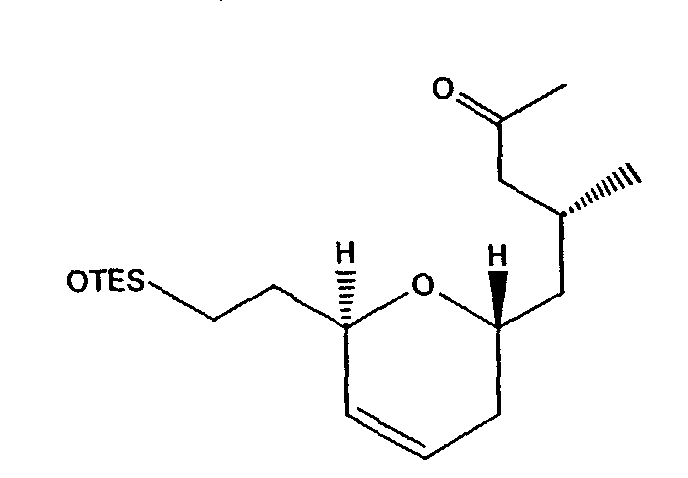
Exact Mass: 340,2434
Mol. Wt.: 340,5728
C, 67,01; H, 10,65; O, 14,09; Si, 8,25 - To a solution of amide compound 10 of step ix) (0.2 g, 0.54 mmol) in Et2O (8 ml) was added a solution of MeLi (0.44 ml, 1.6M in Et2O, 0.7 mmol) at -78°. The mixture was stirred for 0.5 h and then the cooling bath was removed and the mixture was allowed to warm up to room temperature. The reaction was quenched with saturated solution of NH4Cl, the organic phase was washed with water, brine, dried (Na2SO4) and concentrated. The crude product was purified by Flash chromatography (hexane : ethyl acetate -5:1) to give compound 11 (0.17 g, 94 %) oil, [α]D 20= -30.0° (c= 0.40, CHCl3); IR (neat) 2954, 2915, 2876, 1717, 1654 1459, 1415, 1360, 1238, 1182, 1090, 940 cm-1; 1H-NMR (250 MHz, CDCl3); δ in ppm = 5.80 (1H, brd, J=11.6 Hz), 5,71 (1H, brd, J=11.6 Hz), 4.35 (1H, m), 3.75 (3H, m), 2.47 (1H, dd, J=18.0, 9.0 Hz), 2.28 (1H, dd, J=18.0, 7.5 Hz), 2.1 (3H, s), 1.8-1.5 (6H, m), 1.20 (1H, m), 0.95 (12H, t, J=7.5 Hz), 0.60 (6H, q, J=7.5 Hz); 13C-NMR (62.5 MHz, CDCl3); δ in ppm = 208.0 (s), 130.3 (d), 124.3 (d), 68.8 (d), 65.4 (d), 59.9 (t), 52.3 (t), 43.0 (d), 37.3 (t), 31.7 (t), 30.3 (q), 26.4 (d), 19.2 (q), 7.1 (q), 4.7 (t); MS-EI (m/z, %): 340 (M+, 3), 311 (100), 281 (12), 269 (7), 213 (80), 183 (43), 150 (38), 109 (70), 81 (65); HRMS: found 340,2439 + - 5 ppm, C14H25NO3 requires 340,2434.
- C20H35F3O5SSi
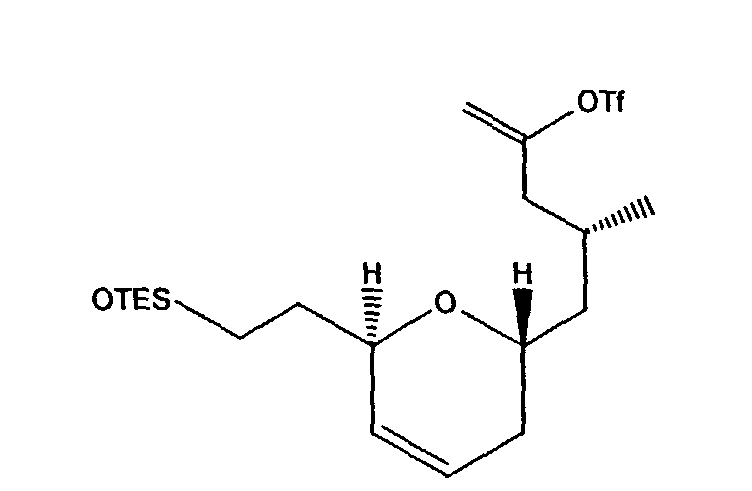
Exact Mass: 340,2434
Mol. Wt.: 472,1827
C, 50,82; H, 7,46; F, 12,06; O, 16,93; S, 6,78; Si, 5,94 - To a solution of KHMDS (3 ml, 0.5 M in toluene, 1.5 mmol) was added slowly a solution of ketone compound 11 of step ix) (0.4 g, 1.2 mmol) in THF (5 ml) at -78°C. The mixture was stirred for 1 h and then a solution of PhN(OTf)2, (0.59 g, 1.6 mmol) in THF (1ml) was added at same temperature. After being stirred for additional 1 h at -78°C, the cooling bath was removed and the mixture was allowed to warm up to room temperature. The reaction was quenched with saturated solution of Na2CO3 (1 ml) and the solution was diluted with toluene (20 ml).The organic phase was washed with saturated solution of Na2CO3 (2 X 2 ml), water, brine, dried (Na2SO4) and concentrated. The crude product was purified by Flash chromatography (hexane: ethyl acetate: TEA-20:1:0.1) to give compound 12 (0.38 g, 68%) oil, [α]D 20= -34.8° (c= 0.42, CHCl3); IR (neat) 2956, 2937, 2877, 1731, 1668, 1574, 1537, 1504, 1460, 1248, 1212, 1182, 1097, 906 cm-1; 1H-NMR (250 MHz, CDCl3); δ in ppm = 5.82 (1H, brd, J=11.6 Hz), 5,73 (1H, brd, J=11.6 Hz), 5.17 (1H, d, J=3.4 Hz) 5.05 (1H, d, J=3.4 Hz),
- C23H46O2SSi2
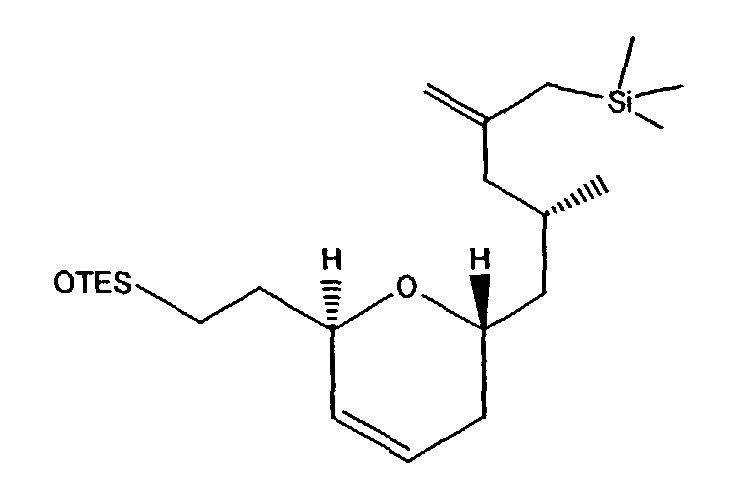
Exact Mass: 410,3036
Mol. Wt.: 410,7811
C, 67,25; H, 11,29; O, 7,79; Si, 13,67 - A slurry of Pd(Ph3P)4 (0.018 g, 0.015 mmol) and LiCI (0.03 g, 0.04 mmol) in ether (15 ml) was stirred for 10 min and then a solution of enoltriflate 12 of step x) (0.1 g, 0.2 mmol) in ether (1 ml) was added dropwise. After being stirred for additional 10 min a solution of TMSCH2MgCl (0.4 ml, 1M in ether, 0.4 mmol) was added at once. After 15 min, the reaction was quenched with saturated solution of Na2CO3 (1 ml) and the solution was diluted with toluene (10 ml). The organic phase was washed with water followed by brine, dried (Na2SO4) and concentrated. The crude product was purified by Flash chromatography (hexane: ethyl acetate : TEA-25:1:0.1) to give compound 13 (0.084 g, 96%) oil, [α]D 20= -38.7° (c= 0.40, CHCl3); IR (neat) 3071, 3032, 2954, 1631, 1418, 1392, 1247, 1180, 1158, 1097, 850 cm-1; 1H-NMR (250 MHz, CDCl3); δ in ppm = 5.85 (1H, brd, J=11.4 Hz), 5,71 (1H, brd, J=11.4 Hz), 4.60 (2H, ABq, J=8.3 Hz), 4.33 (1H, brd, J=9.3 Hz), 3.82 (3H, m), 2.0-1.8 (6H, m), 1.7-1.5 (3H, m), 1.10-1.0 (2H, m), 0.92 (9H, t, J=7.9 Hz), 0.86 (3H, d, J=6.6,), 0.65 (6H, q, J=7.9 Hz), 0.17 (9H, s); 13C-NMR (62.5 MHz, CDCl3), δ in ppm = 201.37 (d), 146.4 (s), 128.2.4 (d), 126.1 (d), 109.2 (t), 68.2 (d), 66.0 (d), 48.3 (t), 47.2 (t), 42.5 (t), 31.4 (t), 27.1 (d), 26.7.0 (t), 19.7 (q), 0.8 (q); MS-EI (m/z, %): 410 (M+, 8), 395 (6), 278 (27), 239 (84), 181 (25), 155 (22), 117 (38), 73 (100); HRMS: found 410,3021 + - 5 ppm, C23H46O2Si2 requires 410,3036.
- C17H32O2Si

Exact Mass: 296,2172
Mol. Wt.: 296,5203
C, 68,86; H, 10,88; O, 10,79; Si, 9,47 - The slurry K2CO3 (0.2 g) and compound 13 of step xi) (0.1g) in methanol (2 ml) was stirred for 12 h at room temperature. The solvent was evaporated and saturated solution of NH4Cl (1 ml) was added. The mixture was extracted with ethyl acetate (3 X 5 ml). The organic phase was washed with water followed by brine, dried (Na2SO4) and concentrated. The crude mixture was purified by Flash chromatography (hexane :ethyl acetate :TEA-10:1:0.1) to give the alcohol 14 (0.07 g, 96%), oil; [α]D 20= -42.5° (c= 0.50, CHCl3); IR (neat) 3540, 3071, 3030, 2960, 1631, 1418, 1392, 1180, 1158, 850 cm-1; 1H-NMR (250 MHz, CDCl3); δ in ppm = 5.82 (1H, brd, J=11.4 Hz), 5,72 (1H, brd, J=11.4 Hz), 4.57 (2H, s), 4.30 (1H, brd, J=9.3 Hz), 3.82 (3H, m), 2.0-1.8 (6H, m), 1.7-1.5 (3H, m), 1.10-1.0 (2H, m), 0.91 (3H, d, J=6.6,), 0.17 (9H, s); 13C-NMR (62.5 MHz, CDCl3), δ in ppm = 146.0 (s), 130.4 (d), 124.8 (d), 110.0 (t), 69.9 (d), 65.2 (d), 47.3 (t), 43.3 (t), 37.2 (t), 32.0 (t), 27.2 (d), 26.6 (t), 19.6 (q), 4.72 (t), -0.9 (q); HRMS: found 296,2175 + - 5 ppm, C17H32O2Si requires 296,2172.
- C17H30O2Si

Exact Mass: 294,2015
Mol. Wt.: 294,5044
C, 69,33; H, 10,27; O, 10,87; Si, 9,54 - To a mixture of alkohol (0.05 g, 0.17 mmol) and TEA (0.07 ml) in CH2Cl2 (1.5 ml) was added a solution of SO3.Py complex (0.08 g, 0.5 mmol) in DMSO (1.5 ml) at 0°C. and stirred for 15 min. The reaction was quenched with saturated solution of NH4Cl, and extracted with ethyl acetate (3 X 5 ml). The combined extracts were washed with water followed by brine, dried (Na2SO4) and concentrated. Flash chromatography (hexane : ethyl acetate:TEA-15:1:0.1) of the crude products gave compound 15 (0.044 g, 86%), oil, [α]D 20= -65.3° (c= 0.68, CHCl3); IR (neat) 2952, 2924, 1725, 1647, 1438, 1248, 1216,1168, 1093 cm-1; 1H-NMR (250 MHz, CDCl3); δ in ppm = 9.81 (1H, dd, J=3.1, 1.7), 5.90 (1H, m), 5.74 (1H, d, J=11.9), 4.80 (1H, m), 4.60 (2H, brs), 3.79 (1H, m), 2.84 (1H, ddd, J=16.0, 9.0, 3.0), 2.60 (1H, ddd, J=16.0, 4.6, 1.8), 2.0-1.8 (5H, m), 1.7-1.5 (2H, m), 1.10 (1H, m), 09 (3H, d, J=6.4,), 0.04 (9H, s); 13C-NMR (62.5 MHz, CDCl3), δ in ppm = 168.8 (s), 147.7 (d), 146.5 (s), 129.4 (d), 125.4 (d), 120.8 (d), 109.1 (t), 72.3 (d), 65.7 (d), 51.4 (q), 47.3 (t), 42.9 (t), 33.9 (t), 31.7 (t), 27.2 (d), 26.7 (t), 19.7 (q), -0.8 (q); HRMS: found: 294,2010 + - 5 ppm, C17H30O2Si requires 294,2015.
- C20H34O3Si

Exact Mass: 350,2277
Mol. Wt.: 350,5677
C, 68,52; H, 9,78; O, 13,69; Si, 8,01 - To a mixture of (CF3CH2O)2P(O)CH2COOMe (0.1 g, 0.3 mmol) and 18-crown-6 (0.43 g, 1,6 mmol) in THF (2 ml) was added KHMDS (0.68 ml, 0.5 M in Tol, 0.3 mmol) at -78°C. After 45 min a solution of aldehyde compound 15 (0.08 g, 0.28 mmol) in THF (1 ml) was added dropwise and the mixture was stirred additional 45 min. The reaction was quenched with saturated solution of NH4Cl and extracted with ethyl acetate, (3 X 5 ml). The combined extracts were washed with water followed by brine, dried (Na2SO4) and concentrated. Flash chromatography of the crude products (ethyl acetate : hexane 1:1) gave pure (Z)- isomer (0.085 g, 90%) as a colourless oil, [α]D 20= -68.6° (c= 0.23, CHCl3); IR (neat) 2952, 2924, 1725, 1647, 1438, 1248, 1216, 1168, 1093 cm-11H-NMR (250 MHz, CDCl3); δ in ppm = 6.41 (1H, ddd, J=11.6, 7.3, 4.3), 5.85 (2H, m), 5,75 (1H, brd, J=11.4), 4.58 (2H, brs), 4.30 (1H, brs), 3.90 (1H, m), 3.81 (3H, s), 2.98 (2H, m), 2.0-1.8 (5H, m), 1.7-1.5 (2H, m), 1.10 (1H, m), 0.86 (3H, d, J=6.6,), 0.17 (3H, s); 13C-NMR (62.5 MHz, CDCl3); δ in ppm = 168.8 (s), 147.7 (d), 146.5 (s), 129.4 (d), 125.4 (d), 120.8 (d), 109.1 (t), 72.3 (d), 65.7 (d), 51.4 (q), 47.3 (t), 42.9 (t), 33.9 (t), 31.7 (t), 27.2 (d), 26.7 (t), 19.7 (q), -0.8 (q); MS-EI (m/z, %): 350 (M+, 4), 335 (3), 251 (55), 182 (38), 109 (13), 73 (100); HRMS: found: 350,2273 + - 5 ppm, C20H34O3Si requires 350,2260.
- C32H42O5Si

Exact Mass: 534,2802
Mol. Wt.: 534,7584
C, 71,87; H, 7,92; O, 14,96; Si, 5,25 - A solution. of alcohol compound 1a (0.53 g, 1 mmol) in dry CH2Cl2 (2 ml) was added dropwise to a slurry of Dess -Martin periodinane (1.3 g, 5 mmol) and NaHCO3 (2 g) in CH2Cl2 (20 ml). The mixture was stirred at room temperature for 15 min, then subjected directly to SiO2 Flash chromatography (hexane-ethyl acetate : 5:1) to yield compound 2a (0.500g, 95%) as a colourless liquid, [α]D 20= -9.7° (c= 0.75, CHCl3); IR (neat) 29312, 2924, 1692, 1427, 1106, 1033, 977, 741 cm-11H-NMR (250 MHz, CDCl3); δ in ppm =9.28 (1H, d, , J=7.9 Hz), 7.71 (4H, m), 7.43 (6H, m), 6.64 (1H, ddd, J=15.4, 7.4, 7.4 Hz), 5.94 (1H, dd, J=15.4, 7.9 Hz), 5.81 (2H, m), 5.45 (1H, brs), 4.54 (1H, d, J=6.6 Hz), 4.44 (1H, d, J=6.6 Hz), 4.13 (5H, m), 3.20 (3H, s), 2.47 (2H, m), 1.75 (3H, brs), 1.10 (9H, s); 13C-NMR (62.5 MHz, CDCl3), δ in ppm =194.3 (d), 156.2 (d), 136.4 (d), 136.3 (d), 135.1 (d), 134.7 (s), 131.7 (s), 128.1 (d), 126.6 (d), 120.2 (d), 95.1 (t), 78.8 (d), 65.9 (t), 55.9 (d), 36.3 (t), 36.0 (t), 27.4 (q), 23.3 (q), 21.4 (s); MS-EI (m/z, %): 534. (M+, 0.1), 477 (M+- t-Bu, 0.43), 415 (6), 337 (38), 109 (15), 267 (12), 233 (30), 199 (100), 135 (88), 91(30); HRMS: found: 477,2079 + - 5 ppm, C28H33O5Si requires 477,2097 (M+- t-Bu).
- C37H52O6Si

Exact Mass: 620,3533
Mol. Wt.: 620,8907
C, 71,57; H, 8,44; O, 15,46; Si, 4,52 - To a solution of compound 2a from step xv) ( 0.530 g, 1 mmol) and (R, R)-(-)-2,4-pentanediol (0.16 g, 1.6 mmol) in dry toluene (20 ml) was added Montmorillonit K-10 (20 mg) and the mixture was slowly rotated on a rotavapour at 80 mbars and 40°C. The reaction was monitored by TLC and the volume of the solvent was kept constant by addition of additional portions of solvent. At the end the reaction mixture was filtered trough a short pad of SiO2 (hexane : ethyl acetate : TEA - 5:1:0.1) to give compound 3a (0.55 g, 89%), oil, [α]D 20= +14.3° (c= 0.18, CHCl3); IR (neat) 2940, 2925, 1427, 1130, 1125, 1106, 1033, 977, 741 cm-1; 1H-NMR (250 MHz, CDCl3); δ in ppm =7.71 (4H, m), 7.43 (6H, m), 5.78 (3H, m), 5.40 (2H, m), 5.19 (1H, d, J=5.0 Hz), 4.54 (1H, d, J=6.6 Hz), 4.40 (1H, d, J=6.6 Hz), 4.32 (1H, ddd J=13.2, 6.8, 6.6 Hz), 4.20 (2H, brs), 4.1-3.8 (4H, m), 3.20 (3H, s), 2.4-1.8 (5H, m), 1.83 (3H, brs), 1.4 (3H, d, J=7.2 Hz), 1.3 (2H, m), 1.24 (3H, d, J=6.4 Hz), 1.10 (9H, s); 13C-NMR (62.5 MHz, CDCl3), δ in ppm =136.6 (d), 136.5 (d), 136.4 (d), 135.1 (d), 134.7 (s), 133.8 (s), 132.2 (d), 132.0 (s), 129.6 (d), 128.1 (d), 128.0 (d), 127.9 (d), 120.1 (d), 93.8 (t), 92.5 (d), 78.6 (d), 76.2 (d), 75.2 (d), 68.4 (d), 68.3 (d), 65.9 (t), 55.9 (d), 35.9 (t), 35.7 (t), 27.5 (q), 23.4 (q), 22.3 (q), 19.8 (t), 19.6 (s), 17.6 (q); MS-EI (m/z, %): 620 (M+, 3), 563 (15), 423 (60), 337 (18), 275 (45), 199 (100), 135 (94); HRMS: found: 620,3541 + - 5 ppm, C37H52O6Si requires 620,3533.
- C21H34O6

Exact Mass: 382,2355
Mol. Wt.: 382,4911
C, 65,94; H, 8,96; O, 25,10 - A solution of compound 3a of step xvi) (0.76, 1.2 mmol) and TBAF (1M, 3 ml) in THF (5 ml) was kept for 24 h at room temperature. The reaction was quenched with saturated solution of NH4Cl. The organic phase was extracted with ethyl acetate, (3 X 5 ml). The combined extracts were washed with water followed by brine, dried (Na2SO4) and concentrated. Flash chromatography of the crude product (hexane : ethyl acetate : 1:2) gave alcohol compound 4a as a colourless oil (0.45 g, 96%); [α]D 20= +14.3° (c=0.08 in CHCl3); IR (neat), 3650, 3467, 2971, 1679, 1448, 1377, 1288, 1240, 1153, 1137, 971 cm-1; 1H-NMR (250 MHz, CDCl3); δ in ppm =5.94 (1H, ddd , J=15.0, 7.3, 6.4 Hz), 5.82 (1H, dd, J= 15.7, 5.3 Hz), 5.59 (2H, m), 5.39 (1H, brs), 5.25 (1H, d, J=5.0 Hz), 4.69 (1H, d, J=6.6 Hz), 4.54 (1H, d, J=6.6 Hz), 4.30 (1H, ddd, J=13.2, 6.8, 6.6 Hz), 4.19 (2H, m), 4.02 (2H, m), 3.89 (1H, dd, J=7.4, 6.7 Hz), 3.61 (1H, m), 3.35 (3H, s), 2.4-1.8 (5H, m), 1.61 (3H, brs), 1.36 (3H, d, J=7.1 Hz), 1.31 (1H, m), 1.19 (3H, d, J=6.2 Hz); 13C-NMR (62.5 MHz, CDCl3), δ in ppm =136.6 (d), 131.6 (d), 131.3 (s), 130.6 (d), 127.1 (d), 120.0 (d), 94.4 (t), 93.6 (d), 80.0 (d), 73.3 (d), 68.4 (d), 67.8 (d), 65.9 (t), 56.0 (d), 37.0 (t), 36.1 (t), 36.0 (t), 23.2 (q), 22.2 (q), 17.5 (q); MS-EI (m/z, %): 620 (M+, 3), 563 (15), 423 (60), 337 (18), 275 (45), 199 (100), 135 (94), HRMS: found: 620,3541 + - 5 ppm, C37H52O6Si requires 620,3533
- C27H39F6O10P
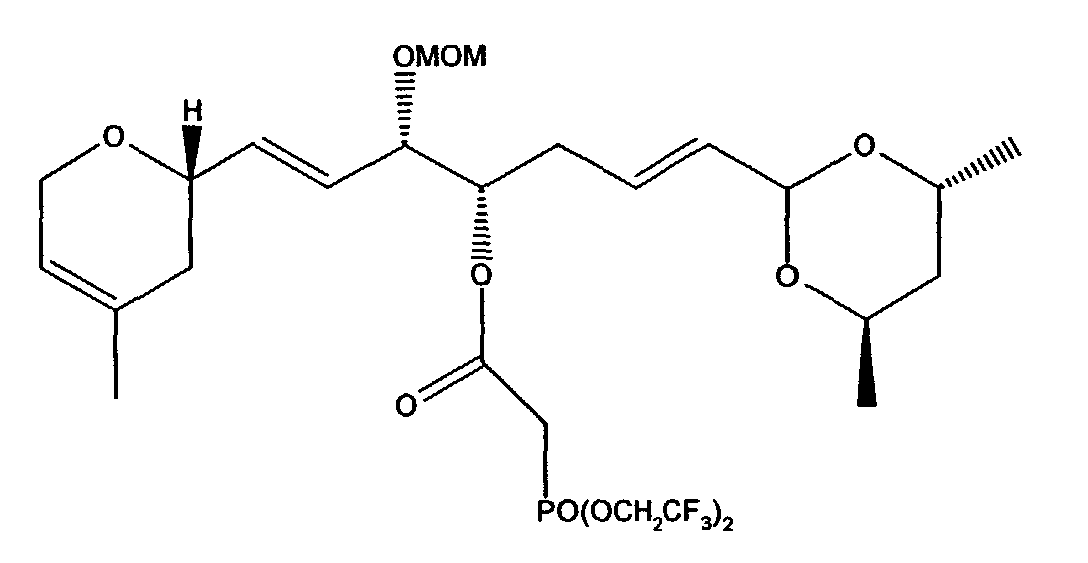
Exact Mass: 668,2185
Mol. Wt.: 668,5567
C, 48,51; H, 5,88; F, 17,05; O, 23,93; P, 4,63 - To a solution of alcohol compound 4a of step xvii) (0,76 g, 2 mmol) and DMAP (0.6 g, 3 mmol) in dry CH2Cl2 (10 ml) was added slowly a solution of (CF3CH2O)2P(O)CH2COCl (1.07 g, 1.6 eqv) in CH2Cl2 at -78°C. After 15 min pyridine (0.3 ml) was added at the same temperature and the mixture was allowed to warm up slowly to room temperature (approximately 2 h). The reaction was quenched with saturated solution of NaHCO3. The organic phase was extracted with CH2Cl2, (3 X 5 ml). The combined extracts were washed with water followed by brine, dried (Na2SO4) and concentrated. Flash chromatography of the crude product (hexane: ethyl acetate: 1:1) gave compound 5a as a colourless oil (0.45 g, 96%); [α]D 20= -48° (c=0.25 in CHCl3); IR (neat), 2974, 1740, 1269, 1173, 1104, 964 cm-1; 1H-NMR (250 MHz, CDCl3); δ in ppm =5.87 (1H, dd J=15.7, 5.3 Hz), 5.76 (1H,, t, J=6.6 Hz), 5.60 (2H, m), 5.43 (1H, brs), 5.24 (1H, d, J=5.0 Hz), 5.07, (1H, ddd J=10.0, 8.3, 5.1 Hz), 4.69 (1H, d, J=6.9 Hz), 4.54 (1H, d, J=6.9 Hz), 4.47 (5H, m), 4.32 (1H, ddd J=13.2, 6.8, 1,5 Hz), 4.10 (3H, m), 4.02 (2H, m), 3.37 (3H, s), 3.24 (1H, dd, J=16.2, 21.0 Hz), 3.18 (1H, dd, J=16.2, 20.4 Hz), 2.5-2.2 (2H, m), 2.1-1.7 (4H, m), 1.71 (3H, brs), 1.38 (3H, d, J=7.1 Hz), 1.30 (1H, m), 1.22 (3H, d, J=6.8 Hz); 13C-NMR (62.5 MHz, CDCl3), δ in ppm =160.4 (s), 137. (d), 131.6 (d), 132.1 (d), 131.6 (s), 129.0 (d), 125.8 (d), 120.1 (d), 94.3 (t), 93.3 (d), 76.6 (d), 76.5 (d), 73.3 (d), 68.5 (d), 67.9 (d), 65.9 (t), 63.3 (t), 62.5 (t), 56.1 (d), 37.0 (t), 36.0 (t), 35.4 (t), 33.7 (t), 33.1 (t), 23.2 (q), 22.2 (q), 22.2 (q), 17.5 (q); MS-EI (m/z, %): 668 (M+, 6), 623 (8), 521 (5), 469 (6), 369 (15), 287 (85), 217 (30), 115 (80); HRMS: found: 628,2201+- 5 ppm, C27H39F6O10P requires 668,2185
- C40H64O8Si

Exact Mass: 700,4370
Mol. Wt.: 701,0169
C, 68,53; H, 9,20; O, 18,26; P, 4,01 - To a mixture of compound 5a of step xviii) (0.1 g, 0.15 mmol) and 18-crown-6 (0.21 g, 0,8 mmol) in THF (2 ml) was added KHMDS (0.29 ml, 0.5 M in toluene, 0.15 mmol) at -78°C. After 45 min a solution of aldehyde compound 15 (0.052 g, 0.18 mmol) in THF (1 ml) was added dropwise and the mixture was stirred an additional 45 min. The reaction was quenched with saturated solution of NH4Cl and extracted with ethyl acetate, (3 X 5 ml). The combined extracts were washed with water followed by brine, dried (Na2SO4) and concentrated. Flash chromatography of the crude product (hexane : ethyl acetate - 1:1) gave pure (Z)- isomer compound 6a (0.089g, 85%) as a colourless oil; %); [α]D 20= -28° (c=0.2 in CHCl3); IR (neat), 2928, 1719, 1680, 1640, 1560, 1376, 1274, 1164, 1099, 997 cm-1; 1H-NMR (600 MHz, CDCl3); δ in ppm =6.45 (ddd, J=11.5, 7.6, 6.5 Hz),5.91 (1H, dt, J=11.5, 1.9 Hz), 5.82 (2H, , m), 5.72 (1H, dq , J=9.0, 2.3 Hz), 5.59 (2H, m), 5.40 (1H, brs), 5.24 (1H, d, J=5.2 Hz), 5.06 , (1H, ddd, J=10.6, 8.5, 5.1 Hz), 4.69 (1H, d, J=6.8 Hz), 4.59 (1H, bs), 4.58 (1H, d, J=6.8 Hz), 4.56 (1H, brs), 4.32 (1H, ddd J=13.4, 6.7, 6.7 Hz), 4.28 (1H, m), 4.19 (3H, m), 4.03 (2H, m), 3.81 (1H, m), 3.37 (3H, s), 3.0. (1H, m),2.93 (1H, m), 2.51 (1H, m), 2.36 (1H, m), 2.1-1.8 (9H, m), 1.71 (3H, brs), 1.67 (2H, m), 1.52 (2H, m), 1.38 (3H, d, J=6.9 Hz), 1.35 (1H, brd, J=13.3, Hz), 1.23 (3H, d, J=6.1 Hz), 1.1 (1H, m), 0.87 (3H, d, J=6.4 Hz), 0.3 (9H, s); 13C-NMR (62.5 MHz, CDCl3), δ in ppm =165.5 (s), 147.9 (d), 146.2 (s), 131.6 (s), 131.3 (d), 129.9 (d), 129.4 (d), 126.4 (d), 125.3 (d), 120.9 (d), 120.1 (d), 109.1 (t), 94.4 (t), 93.5 (d), 76.6 (d), 73.8 (d), 73.5 (d), 72.3 (d), 68.5 (d), 67.8 (d), 65.9 (t), 65.5 (d), 56.1 (d), 47.3 (t), 42.8 (t), 37.1 (t), 36.0 (t), 34.0 (t), 33.6 (t), 31.7 (t), 27.1 (d), 26.7 (t), 23.3 (q), 22.2 (q), 19.7 (q), 17.6 (q); 0.8 (q); MS-EI (m/z, %): 700 (M+, 4), 613 (8), 503 (4), 365 (95), 303 (12), 251 (85),161 (35), 115 (55); HRMS: found 700.4395, requires for C40H64O8Si 700.4370.
- C37H56O8
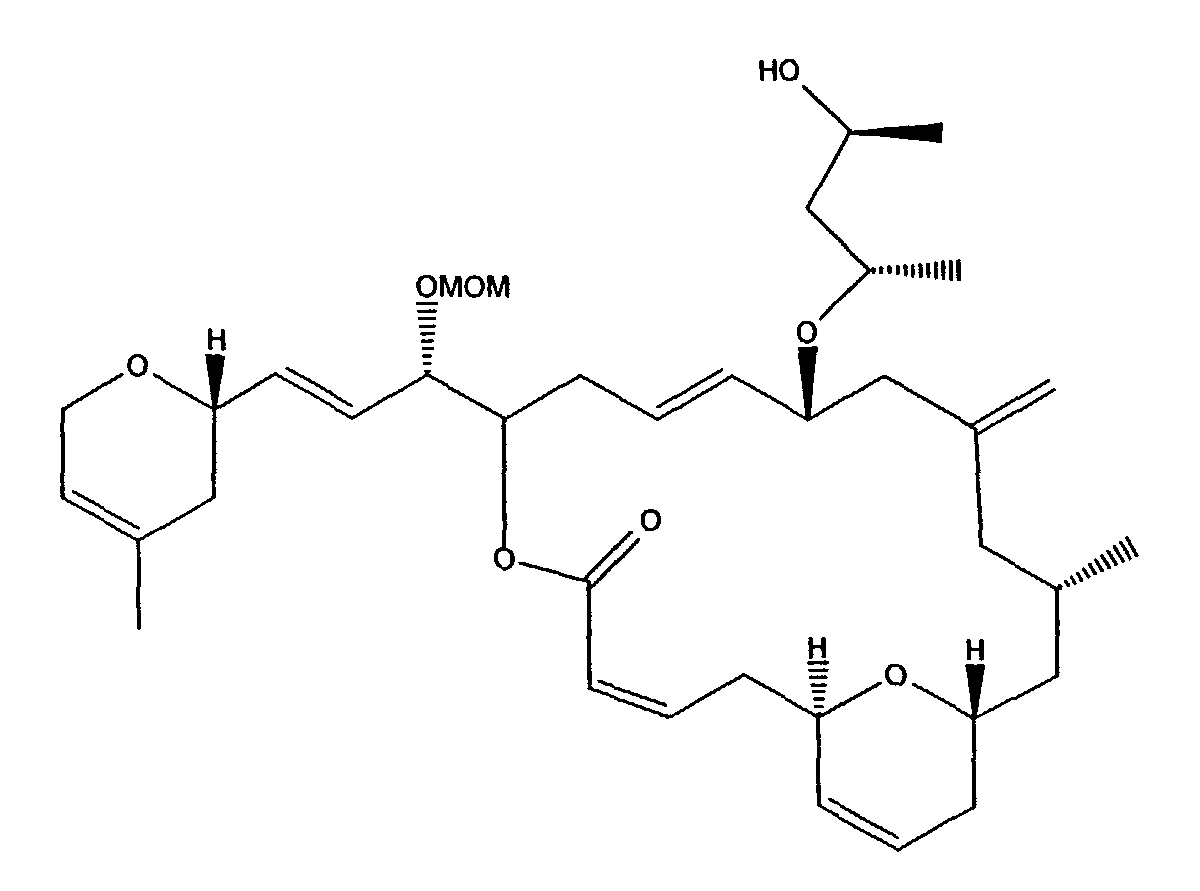
Exact Mass: 628,3975
Mol. Wt.: 628,8357
C, 70,67; H, 8,98; O, 20,35 - To a solution of EtAlCl2 (0.1 ml, 1M in CH2Cl2, 0.1 mmol) in 15 ml CH2Cl2 was added slowly (syringe pump), a solution of compound 6a of step xix) (0.04 g,. 0.05 mmol) in CH2Cl2 (1ml) at -50°C. After the addition was finished, the reaction mixture was allowed to warm up to °C. The reaction was quenched with buffer (pH = 7, 2 ml) and stirred for 2 h. The organic phase phase was separated and the water phase was extracted with CH2Cl2, (3 X 5 ml). The combined extracts were washed with water followed by brine, dried (Na2SO4) and concentrated. Flash chromatography of the crude product (hexane: ethyl acetate: 1:1) gave compound 7a as a colourless oil (0.031 g, 85%); [α]D 20= -31° (c=0.1 in CHCl3); IR (neat), 3500, 2928, 17290, 1682, 1638, 1510, 1376, 1164, 990 cm-1;6.31 (ddd, J=11.5, 10.0, 5.3 Hz), 5.91 (1H, d, J=6.9, Hz), 5.84 (2H, , m), 5.71 (1H, dd , J=9.9, 1.9 Hz), 5.62.(1H, m), 5.58 (1H, ddd, J=7.2, 2.0, 1.3 Hz), 5.47 (dd, J=15.5, 8.0 Hz), 5.41 (1H, brs), 5.09, (1H, dd J=12.8, 6.4, Hz), 4.79 (1H, brs), 4.76 (1H, brs), 4.67 (1H, d, J=6.8 Hz), 4.55 (1H, bs), 4.24 (1H, brs), 4.11(6H, m), 3.96 (1H, ddd J=8.3, 8.0, 4.7 Hz), 3.83 (2H, m), 3.62 (1H, m), 3.34 (3H, s), 3.0. (1H, m),2.36 (2H, t, J=6.9 Hz),), 2.3-2.0 (5H, m), 1.87 (2H, m), 1.74 (2H, m), 1.60 (2H, m), 1.56 (3H, s), 1.52 (1H, ddd J=14.5, 6.3, 2.2 Hz), 1.26 (3H, d, J=6.2 Hz), 1.12 (3H, d, J=6.1 Hz), 0.85 (3H, d, J=6.2 Hz); 13C-NMR (62.5 MHz, CDCl3), δ in ppm =165.2 (s), 146.9 (d), 144.3 (s), 136.1 (d), 134.2 (d), 131.4 (s), 128.5 (d), 128.4 (d), 126.0 (d), 125.1 (d), 121.7 (d), 119.8 (d), 115.6 (d), 112.9 (t), 94.0 (t), 75.3 (d), 74.0 (d), 73.5 (d), 73.3 (d), 71.9 (d), 69.8 (d), 67.2 (d), 65.9 (t), 64.3 (d), 55.7 (d), 44.8 (d), 44.7 (t), 43.0 (t), 42.8 (t), 38.8 (t), 36.2 (t), 35.9 (t), 34.4 (t), 33.0 (t), 31.) (t), 31.4 (t), 29.8 (t), 28.3 (d), 24.4 (t), 23.5 (q), 23.0 (q), 22.7 (t), 20.0 (q), 18.3 (q), 14.2 (q); HRMS: found: 628.3930+ - 5 ppm, C37H56O8 requires 628.3975.


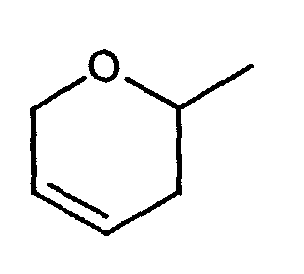
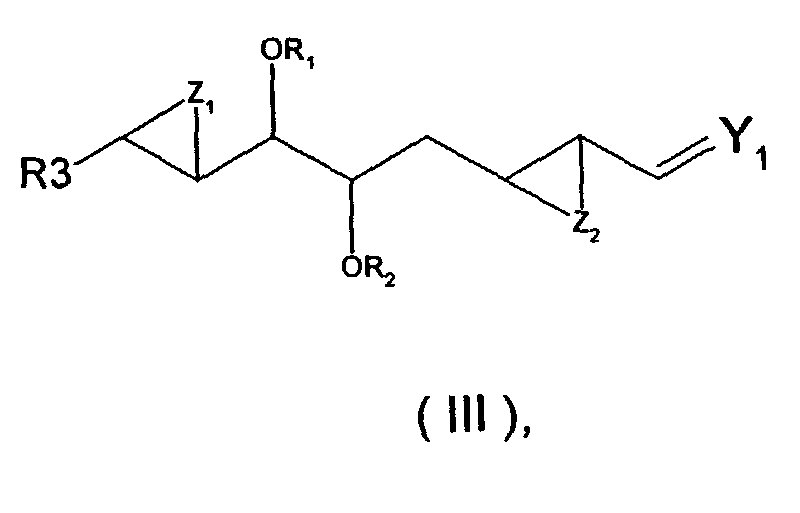


Exact Mass: 626,3819
Mol.Wt: 626,8199
C, 70,90; H, 8,68; O, 20,42
Claims (15)
- Laulimalid derivatives of general formula Iin which

- R1 and R2
- independently from each other have the meaning of hydrogen, α-alkyl, β-alkyl, methylmethylether, alkyl optionally substituted with hydroxy, paramethyloxybenzyl, benzyl, or a protecting group,
- R3
- has the meaning of a five or six membered, optionally substituted aryl or heteroaryl ring, or a five or six membered optionally substituted and optionally partially saturated cycloalkyl ring, which can be interrupted by oxygen, sulphur or the group =NR5,
- R4
- has the meaning of α-alkyl, β-alkyl, aryl or trifluoromethyl,
- X1
- has the meaning of oxygen, sulphur or the group =NR5, in which
- R5
- has the meaning of hydrogen, alkyl, cycloalkyl or aryl,
- Z1
- has the meaning of a (Z)- or (E)-double bond, triple bond, or has the meaning of oxygen, sulphur or the group -CH2-, -CH2-CH2-, =C(OH)2, =C(halogen)(OH), =C(OH)NR6 or =NR7,
- Z2
- has the meaning of a (Z)- or (E)-double bond, triple bond, or has the meaning of oxygen (α- or β-epoxide), sulphur or the group -CH2-, -CH2-CH2 -, =C(OH)2, =C(halogene)(OH), =C(OH)NR6 or =NR7,
- Z3
- has the meaning of a (Z) or (E)-double bond,
- R6
- has the meaning of alkyl, cycloalkyl or aryl, and
- R7
- has the meaning of hydrogen, alkyl, cycloalkyl or aryl,
and X1 has the meaning of oxygen, R1 has the meaning of α-methyl, Z1 has the meaning of a (E)-double bond, Z2 has the meaning of β-epoxide if Z3 has the meaning of a (Z)-double bond.
- Laulimalid derivatives of general formula I, according to claim 1, in which
- R1 and R2
- independently from each other have the meaning of hydrogen, α-C1-C6-alkyl, β- C1-C6-alkyl, methylmethylether, C1-C6-alkyl optionally substituted with hydroxy, paramethyloxybenzyl, benzyl, or a silyl protecting group, or an acetyl, benzyl, carbamate or carbonate protecting group,
- R3
- has the meaning of a five or six membered, optionally substituted aryl or heteroaryl ring, or a five or six membered optionally substituted and optionally partially saturated C3-C7-cycloalkyl ring, which can be interrupted by oxygen, sulphur or the group =NR5,
- R4
- has the meaning of α- C1-C6-alkyl, β- C1-C6-alkyl, aryl or trifluoromethyl,
- X1
- has the meaning of oxygen, sulphur or the group =NR5, in which
- R5
- has the meaning of hydrogen, C1-C6-alkyl, C3-C7-cycloalkyl or aryl,
- Z1
- has the meaning of a (Z)- or (E)-double bond, triple bond, or has the meaning of oxygen, sulphur or the group -CH2-, -CH2-CH2 -, =C(OH)2, =C(halogen)(OH), =C(OH)NR6 or =NR7,
- Z2
- has the meaning of a (Z)- or (E)-double bond, triple bond, or has the meaning of oxygen (α- or β-epoxide), sulphur or the group -CH2-, -CH2-CH2 -, =C(OH)2, =C(halogene)(OH), =C(OH)NR6 or =NR7,
- Z3
- has the meaning of a (Z) or (E)-double bond,
- R6
- has the meaning of C1-C6-alkyl, C3-C7-cycloalkyl or aryl, and
- R7
- has the meaning of hydrogen, C1-C6-alkyl, C3-C7-cycloalkyl or aryl,
and X1 has the meaning of oxygen, R1 has the meaning of α-methyl, Z1 has the meaning of a (E)-double bond, Z2 has the meaning of β-epoxide if Z3 has the meaning of a (Z)-double bond.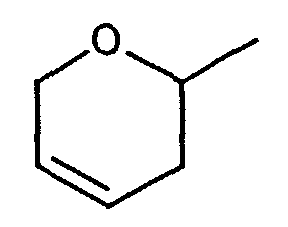
- Laulimalid derivatives of general formula I, according to claims 1 and 2, in which
- R1 and R2
- independently from each other have the meaning of hydrogen, α-C1-C6-alkyl, β- C1-C6-alkyl, methylmethylether, C1-C6-alkyl optionally substituted with hydroxy, paramethyloxybenzyl, benzyl, or a silyl protecting group, or an acetyl, benzyl, carbamate or carbonate protecting group,
- R3
- has the meaning of optionally substituted phenyl, biphenyl, naphthyl, thiophene, furan, oxazole, thiazole, imidazole, pyrazole, pyridin, pyrimidine, triazine, quinolin, isoquinolin or benzo derivatives thereof, or a five or six membered optionally substituted and optionally partially saturated C3-C7-cycloalkyl ring, which can be interrupted by oxygen, sulphur or the group =NR5,
- R4
- has the meaning of α- C1-C6-alkyl, β- C1-C6-alkyl, phenyl, biphenyl, naphthyl, or trifluoromethyl,
- X1
- has the meaning of oxygen, sulphur or the group =NR5, in which
- R5
- has the meaning of hydrogen, C1-C6-alkyl, C3-C7-cycloalkyl, phenyl, biphenyl or naphthyl,
- Z1
- has the meaning of a (Z)- or (E)-double bond, triple bond, or has the meaning of oxygen, sulphur or the group -CH2-, -CH2-CH2 -, =C(OH)2, =C(halogen)(OH), =C(OH)NR6 or =NR7,
- Z2
- has the meaning of a (Z)- or (E)-double bond, triple bond, or has the meaning of oxygen (α- or β-epoxide), sulphur or the group -CH2-, -CH2-CH2 -, =C(OH)2, =C(halogene)(OH), =C(OH)NR6 or =NR7,
- Z3
- has the meaning of a (Z) or (E)-double bond,
- R6
- has the meaning of C1-C6-alkyl, C3-C7-cycloalkyl, phenyl, biphenyl or naphthyl, and
- R7
- has the meaning of hydrogen, C1-C6-alkyl, C3-C7-cycloalkyl, phenyl, biphenyl or naphthyl,
X1 has the meaning of oxygen, R1 has the meaning of α-methyl, Z1 has the meaning of a (E)-double bond, Z2 has the meaning of β-epoxide if Z3 has the meaning of a (Z)-double bond.
- Laulimalid derivatives of general formula I, according to claims 1 to 3, in which
- R1 and R2
- independently from each other have the meaning of hydrogen, α-C1-C6-alkyl, β- C1-C6-alkyl, methylmethylether, C1-C6-alkyl optionally substituted with hydroxy, paramethyloxybenzyl, benzyl, or a silyl protecting group, or an acetyl, benzyl, carbamate or carbonate protecting group,
- R3
- has the meaning of optionally substituted phenyl, biphenyl, naphthyl, thiophene, furan, oxazole, thiazole, imidazole, pyrazole, pyridin, pyrimidine, triazine, quinolin, isoquinolin or benzo derivatives thereof, or a five or six membered optionally substituted and optionally partially saturated C3-C7-cycloalkyl ring, which can be interrupted by oxygen, sulphur or the group =NR5,
- R4
- has the meaning of α- C1-C6-alkyl, β- C1-C6-alkyl, phenyl, biphenyl, naphthyl, or trifluoromethyl,
- X1
- has the meaning of oxygen,
- Z1
- has the meaning of a (Z)- or (E)-double bond, or has the meaning of oxygen,
- Z2
- has the meaning of a (Z)- or (E)-double bond, or has the meaning of oxygen (α- or β-epoxide) and
- Z3
- has the meaning of a (Z) or (E)-double bond,
X1 has the meaning of oxygen, R1 has the meaning of α-methyl, Z1 has the meaning of a (E)-double bond, Z2 has the meaning of β-epoxide if Z3 has the meaning of a (Z)-double bond.
- Laulimalid derivatives of general formula I, according to claims 1 to 4, in which
- R1 and R2
- independently from each other have the meaning of hydrogen, α-C1-C6-alkyl, β- C1-C6-alkyl, methylmethylether, C1-C6-alkyl optionally substituted with hydroxy, paramethyloxybenzyl, benzyl, or a silyl protecting group, or an acetyl, benzyl, carbamate or carbonate protecting group,
- R3
- has the meaning of optionally substituted phenyl, 1,3-thiazoles or 2- and 3-pyridyl, or a six membered optionally substituted and optionally partially saturated cyclohexyl ring, which can be interrupted by oxygen,
- R4
- has the meaning of α- C1-C6-alkyl, β- C1-C6-alkyl, phenyl, biphenyl, naphthyl, or trifluoromethyl,
- X1
- has the meaning of oxygen,
- Z1
- has the meaning of a (Z)- or (E)-double bond, or has the meaning of oxygen,
- Z2
- has the meaning of a (Z)- or (E)-double bond, or has the meaning of oxygen (α- or β-epoxide) and
- Z3
- has the meaning of a (Z) or (E)-double bond,
X1 has the meaning of oxygen, R1 has the meaning of α-methyl, Z1 has the meaning of a (E)-double bond, Z2 has the meaning of β-epoxide if Z3 has the meaning of a (Z)-double bond.
- Laulimalid derivatives of general formula I, according to claims 1 to 5, in which
- R1 and R2
- independently from each other have the meaning of hydrogen, α-C1-C6-alkyl, β- C1-C6-alkyl, methylmethylether, C1-C6-alkyl optionally substituted with hydroxy, paramethyloxybenzyl, benzyl, or a silyl protecting group, or an acetyl, benzyl, carbamate or carbonate protecting group,
- R3
- has the meaning of optionally substituted phenyl, 1,3-thiazoles,
2- and 3-pyridyl or the group
which is substituted with methyl,
- R4
- has the meaning of α- C1-C6-alkyl, β- C1-C6-alkyl, phenyl, biphenyl, naphthyl, or trifluoromethyl,
- X1
- has the meaning of oxygen,
- Z1
- has the meaning of a (Z)- or (E)-double bond,
- Z2
- has the meaning of a (Z)- or (E)-double bond, and
- Z3
- has the meaning of a (Z) or (E)-double bond,
- Process for the production of laulimalide and laulimalide derivatives of general formula Iin which

R1, R2, R3, R4, X1, Z1, Z2 and Z3 have the meaning as defined in claims 1 to 6, characterised in by reacting a compound of general formula IIin which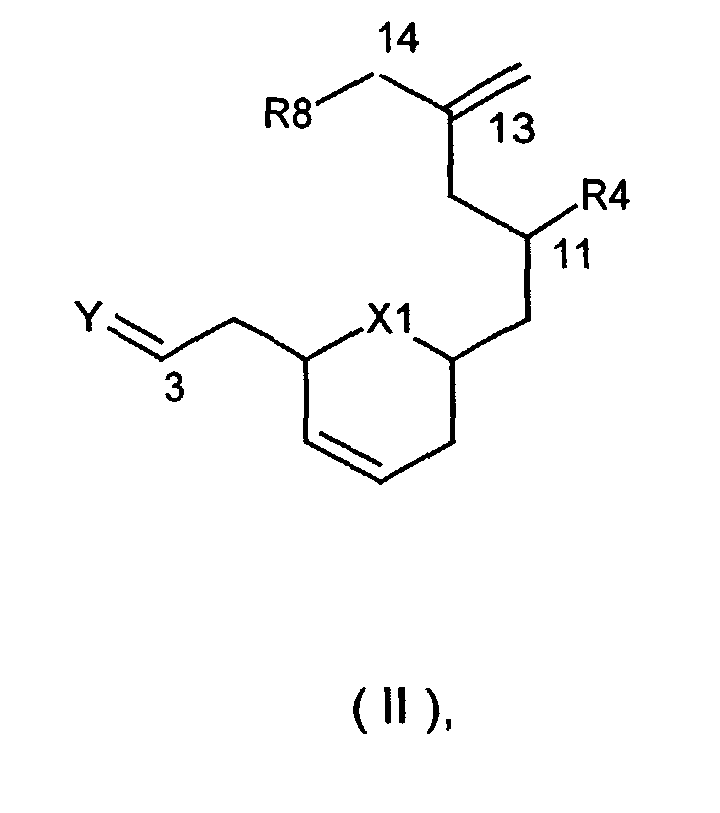
- R4 and X1
- have the meaning defined under formula I, and
- R8
- has the meaning of hydrogen, trimethylsilyl, or the group MHal, wherein
- M
- has the meaning of Mg, Li, Ti, Ge or In, and
- Y
- has the meaning of oxygen or the group =CH(OH), (Z) or (E)- CH-COOH, (Z) or (E)- =CH-COOR9 or (Z) or (E)- CHHal, in which
- R9
- has the meaning of hydrogen, alkyl, cycloalkyl or aryl,
in which
- R1, R3, Z1 und Z2
- have the meaning defined under formula I, and
- R2
- has the meaning of hydrogen, methylmethylether, paramethyloxybenzyl, benzyl, or a protecting group, or a group -COCH2B, wherein
- B
- has the meaning of the group -SiR10, -SeR11, -Se(O)R11, -TeR11, -PO(OR11)3 or -P(O)(OCH2CR10)2, in which
- R10
- has the meaning of alkyl, aryl, alkenyl, or the group -CF3, or -CH2OR11, in which
- R11
- has the meaning of hydrogen, alkyl, cycloalkyl or aryl, and
- Y1
- has the meaning of oxygen, or an alkyl acetal of the group -CH(OR12)2, or a five membered O,O; N,O; O,S; or S,S; cyclic acetal, or six membered O,O; N,O; O,S; or S,S; cyclic acetal, and
- R12
- has the meaning of alkyl,
in which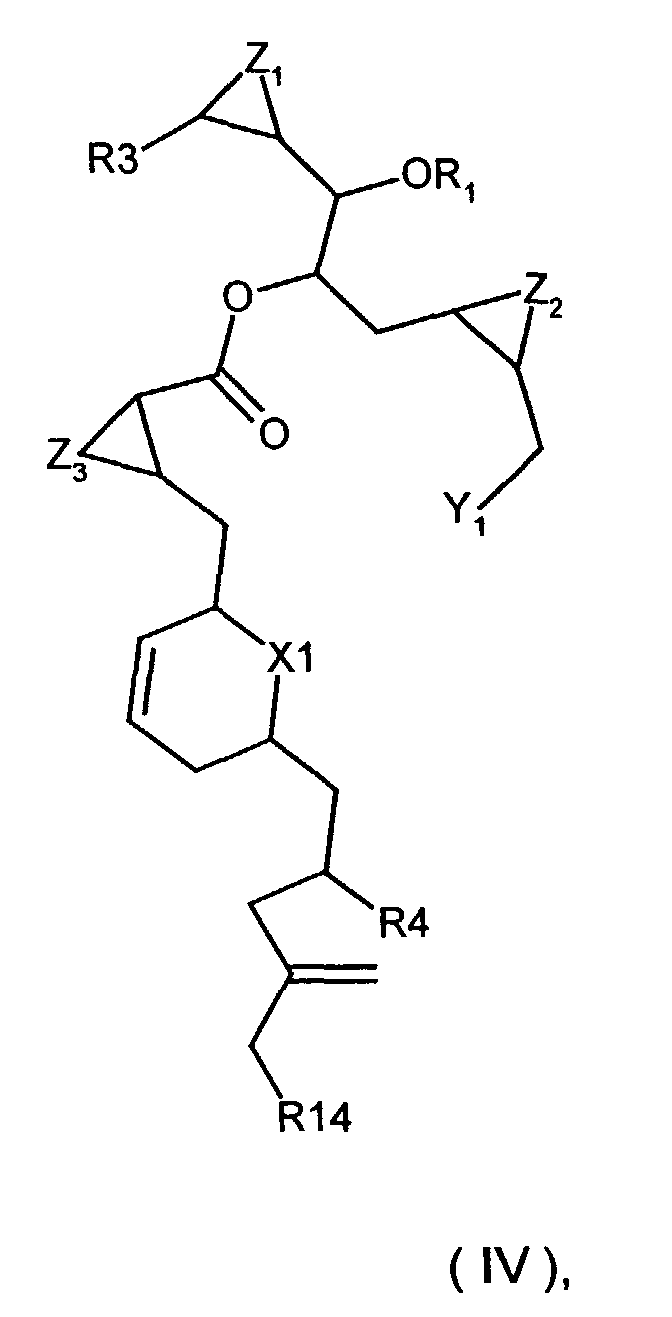
- R1, R3, R4, X1 and Z1-Z3
- have the meaning defined under formula I, and
- Y1
- has the meaning defined under formula III, and
- R14
- has the meaning of hydrogen, halogen, trimethylsilyl, or the group MHal, wherein
- M
- has the meaning of Mg, Li, Ti, Ge or In,
- Process for the production of intermediates of general formula II,in which R4 and X1 have the meaning as defined under formula I, and R8 has the meaning of hydrogen, trimethylsilyl, or the group MHal, wherein M has the meaning of Mg, Li, Ti, Ge or In, and Y has the meaning of oxygen or the group =CH(OH), (Z) or (E)-CH-COOH, (Z) or (E)- =CH-COOR9 or (Z) or (E)-CHHal, in which R9 has the meaning of hydrogen, alkyl, cycloalkyl or aryl, characterized in by reacting
 a) an alcohol compound of general formula II-2)in which R4 has the meaning as defined under formula I, in a suitable solvent together with a suitable oxidant to give an aldehyde compound of general formula II-3)
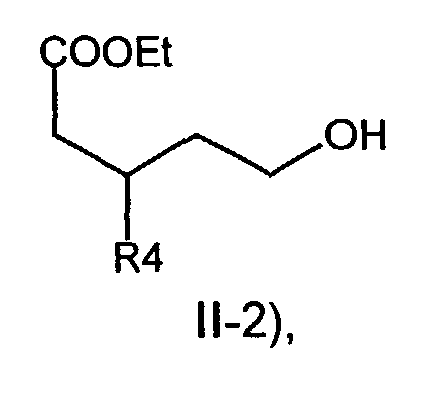 in which R4 has the meaning as defined under formula I,
 b) reacting aldehyde compound of general formula II-3) in a suitable solvent with a suitable alkylating agent to give a compound of general formula II-4)in which R4 and X1 have the meaning as defined under formula I,
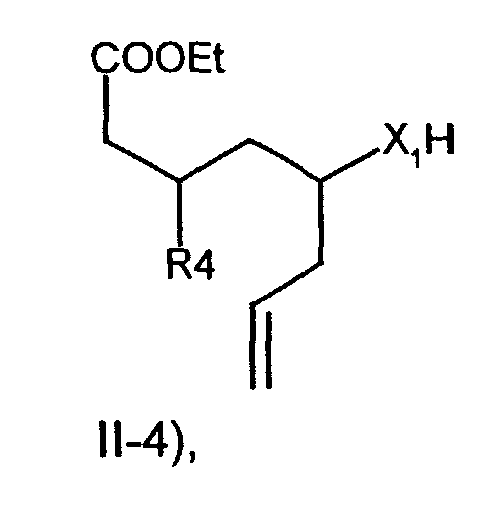 c) reacting compound II-4) with an amine of general formula II-4ain which R4 and X1 have the meaning as defined under formula I and Ri and Rii have the meaning as defined under formula II-4a,
 d) reacting compound II-5) in a suitable solvent with a suitable acetal and a suitable hydroxy compound to give a compound of general formula II-6)in which R4 and X1 have the meaning as defined under formula I,
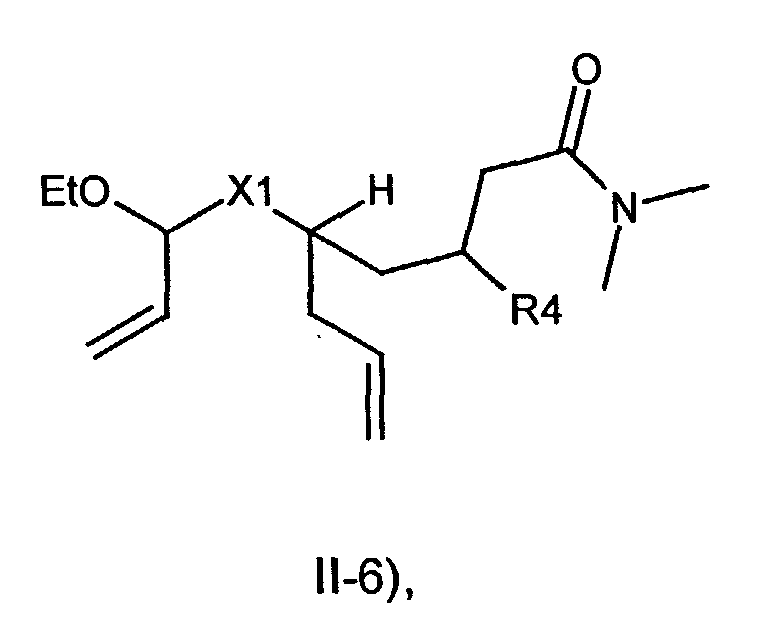 e) deoxygenating compound II-6) in a suitable solvent with a suitable catalyst, to give a compound of general formula II-7)in which R4 and X1 have the meaning as defined under formula I,
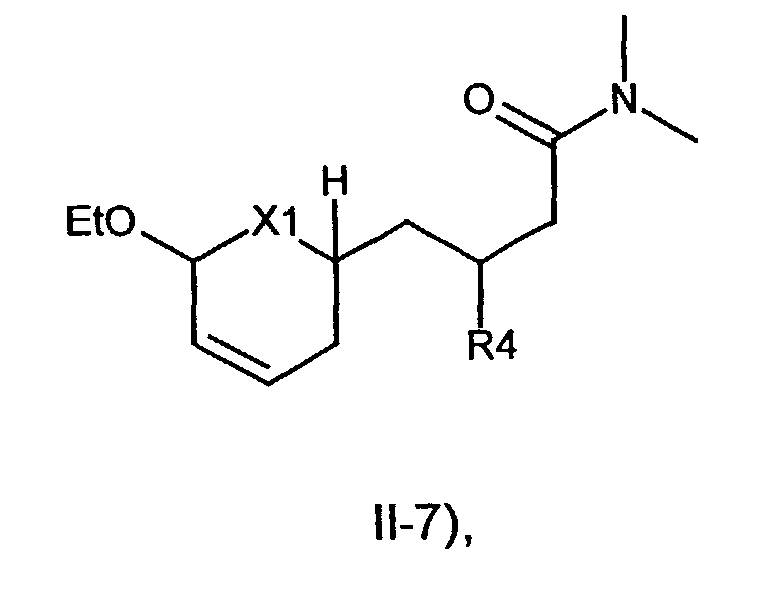 f) reacting compound II-7) with a suitable vinyl ether and a suitable perchlorate in a suitable solvent, to give a compound of general formula II-8)in which R4 and X1 have the meaning as defined under formula I,
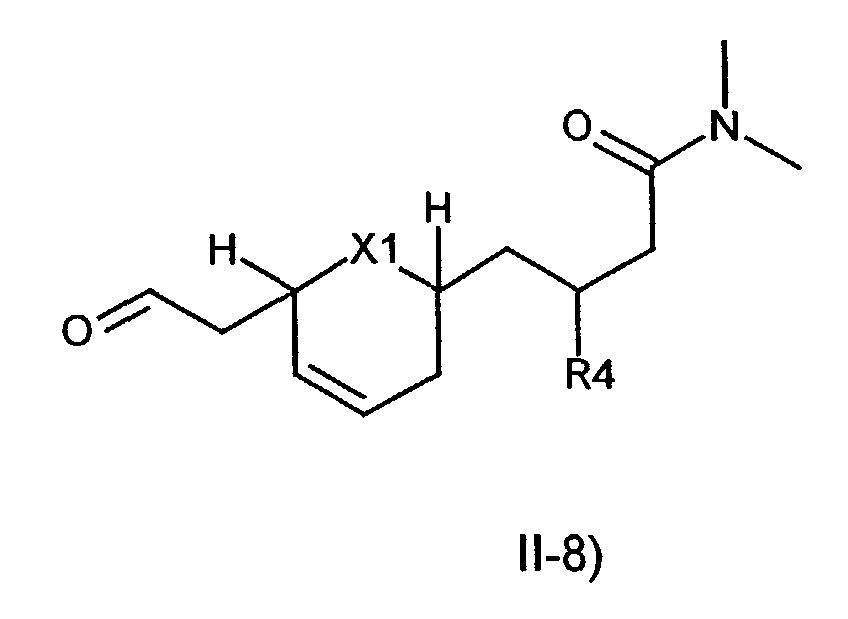 g) reacting aldehyde compound II-8) with a suitable reductant in a suitable solvent to give an alcohol compound of general formula II-9)in which R4 and X1 have the meaning as defined under formula I,
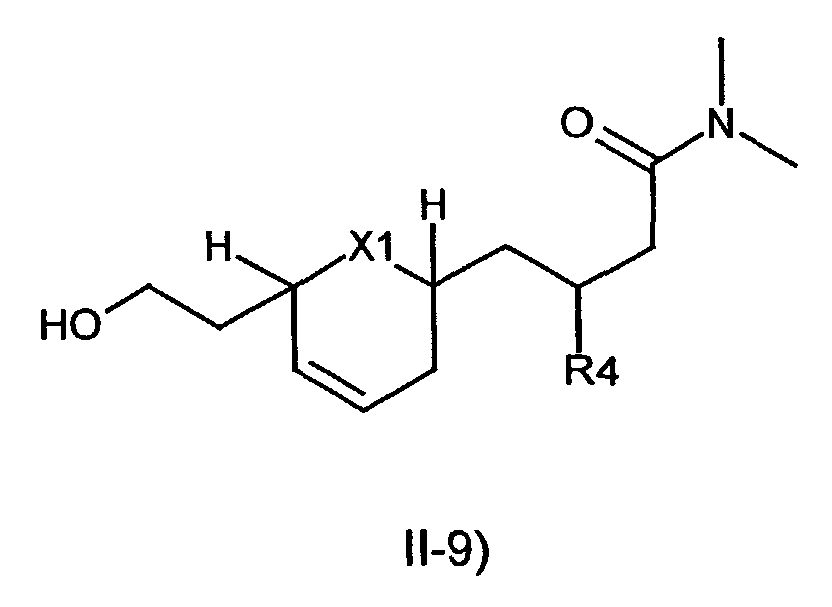 h) reacting a solution of alcohol compound II-9) in a suitable organic base and with a silyl chloride or a triflak (Si) of general formula II-9a)in which R4 and X1 have the meaning as defined under formula I and Si has the meaning as defined under formula II-9a,
 i) reacting amide compound of general formula II-10) with a metal organic compound and in a suitable solvent to give a ketone compound of general formula II-11)in which R4 and X1 have the meaning as defined under formula I and Si has the meaning as defined under formula II-9a,
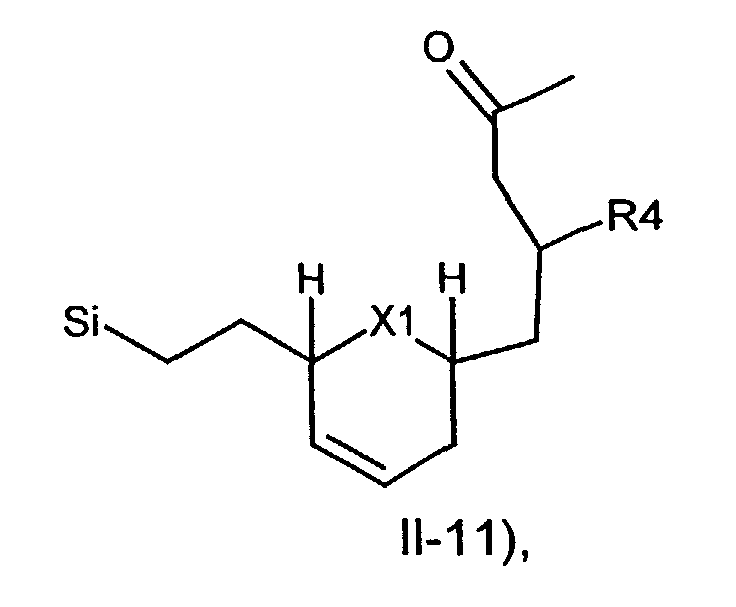 j) reacting the ketone compound II-11) with a suitable strong amide base in a suitable solvent, and accordingly with a suitable acylating agent in a suitable solvent to give an enoltriflate of general formula II-12)in which R4 and X1 have the meaning as defined under formula I and Si has the meaning as defined under formula II-9a,
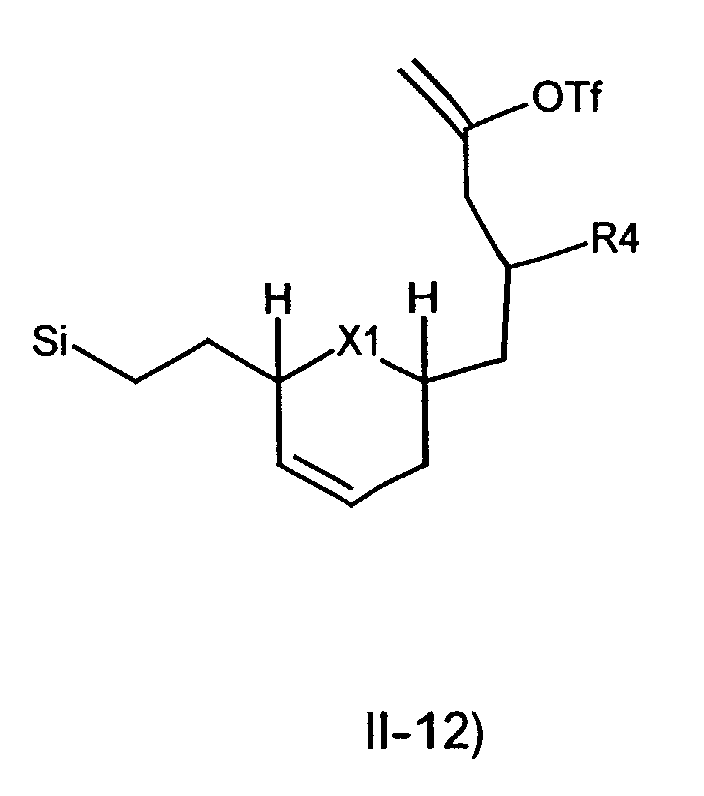 k) reacting enoltriflate compound II-12) with a suitable Pd catalyst and with alkali chloride in a suitable solvent, and accordingly with TMSCH2MgCl to give compound II-13)in which R4 and X1 have the meaning as defined under formula I, R8 has the meaning as defined under formula II, and Si has the meaning as defined under formula II-9a,
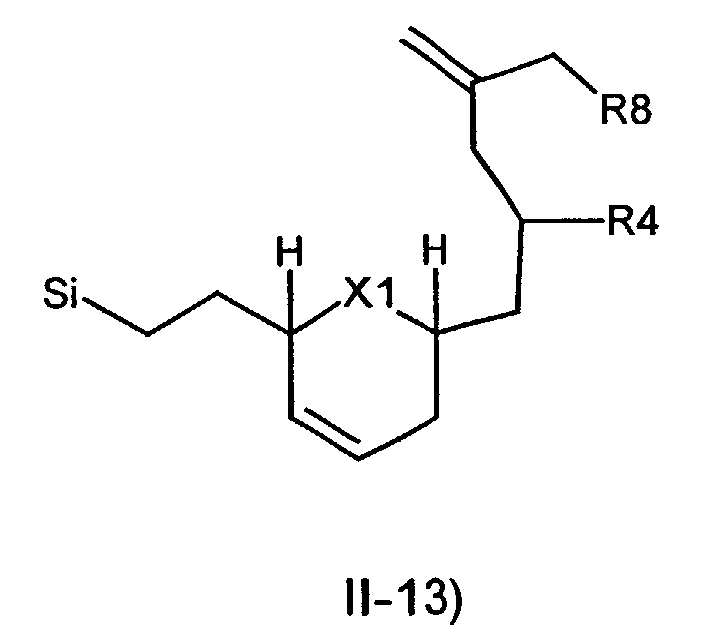 l) reacting compounds of general formula II-13) with a suitable ionic fluoride in a suitable solvent to give compound II-14)in which R4 and X1 have the meaning as defined under formula I and R8 has the meaning as defined under formula II,
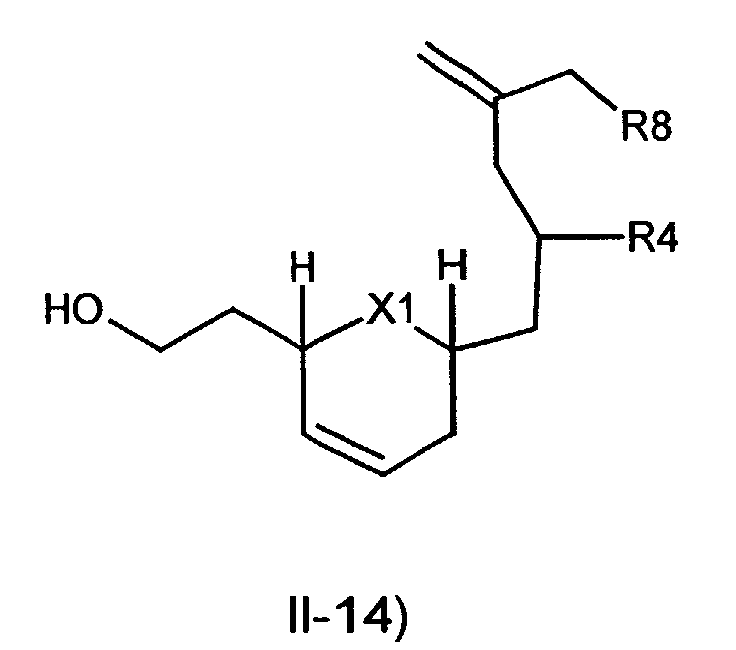 m) reacting compound II-14) with a suitable oxidant in a suitable solvent to give an aldehyde compound of general formula II-15)in which R4 and X1 have the meaning as defined under formula I and R8 has the meaning as defined under formula II, and
 n) reacting aldehyde compound II-15) with a phosphonyl acetic ester of general formula II-15a)
 - Process for the production of general formula III,in which

- R1, R3, Z1 and Z2
- have the meaning defined under formula I, and
- R2
- has the meaning of hydrogene, methylmethylether, paramethyloxybenzyl, benzyl, or a protecting group, or a group -COCH2B, wherein
- B
- has the meaning of the group -SiR10, -SeR11, -Se(O)R11, -TeR11, -PO(OR11)3 or -P(O)(OCH2CR10)2, in which
- R10
- has the meaning of alkyl, aryl, alkenyl, or the group -CF3, or -CH2OR11, in which
- R11
- has the meaning of hydrogene, alkyl, cycloalkyl or aryl, and
- Y1
- has the meaning of oxygene, or an alkyl acetal of the group -CH(OR12)2, or a five membered O,O; N,O; O,S; or S,S; cyclic acetal, or six membered O,O; N,O; O,S; or S,S; cyclic acetal, and
- R12
- has the meaning of alkyl, which is characterized in by reacting
o) an alcohol compound of general Formula III-16)in which R1, R3, Z1 and Z2 have the meaning as defined under general formula I, with a suitable oxidant in a suitable solvent to give an aldehyde compound of general formula III-17) in which R1, R3, Z1 and Z2 have the meaning as defined under general formula I,
 p) reacting a compound of general formula III-17) with an acetal in a suitable solvent to give a compound of general Formula III-18)in which R1, R3, Z1 and Z2 have the meaning as defined under general formula I, and Y1, has the meaning as defined under formula III,
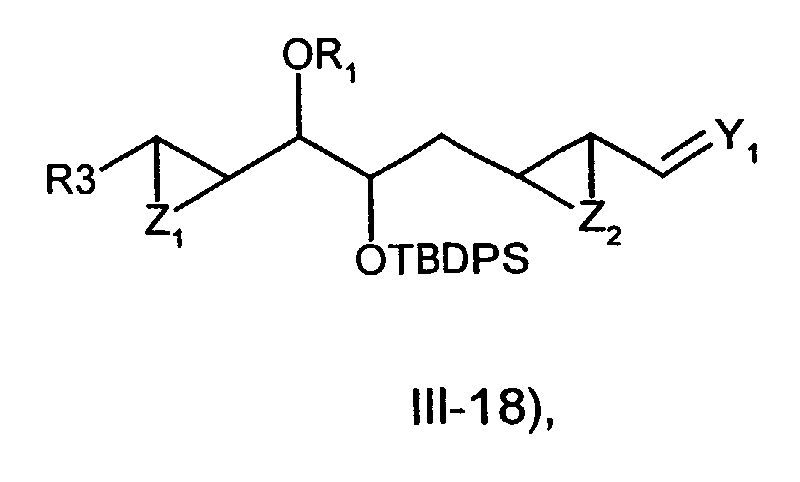 q) reacting a compound of general formula III-18) with a suitable ionic fluoride in a suitable solvent to an alcohol compound of general formula III-19)in which R1, R3, Z1 and Z2 have the meaning as defined under general formula I, and Y1 has the meaning as defined under formula III, and
 r) reacting a compound of general formula III-19) with a suitable tertiary amine in a suitable solvent, and accordingly with a solution of a phosphoro acetyl chloride of general formula III-19a
 - Compounds of general formula IIin which
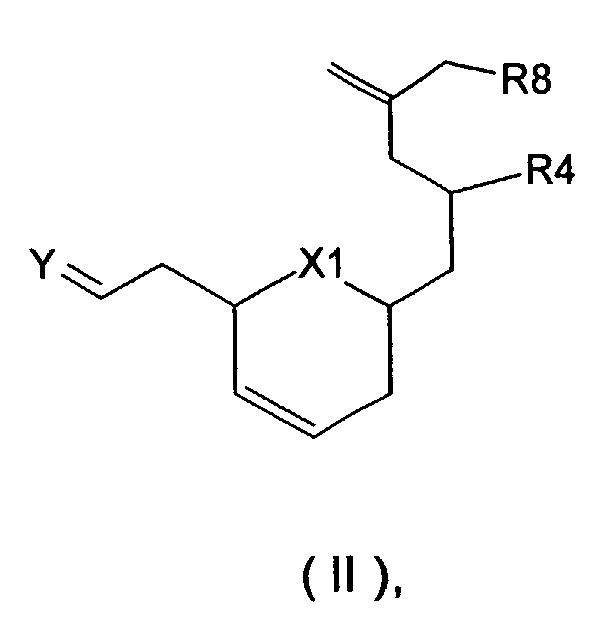
- R4 and X1
- have the meaning defined above under formula I, and
- R8
- has the meaning of hydrogen, trimethylsilyl, or the group MHal, wherein
- M
- has the meaning of Mg, Li, Ti, Ge or In, and
- Y
- has the meaning of oxygen or the group =CH(OH), (Z) or (E)- CH-COOH, (Z) or (E)- =CH-COOR9 or (Z) or (E)-CHHal, in which
- R9
- has the meaning of hydrogen, alkyl, cycloalkyl or aryl, as intermediates for the production of compounds of general formula I.
- Compounds of general formula IIIin which

- R1, R3, Z1 und Z2
- have the meaning defined above under formula I, and
- R2
- has the meaning of hydrogene, methylmethylether, paramethyloxybenzyl, benzyl, or a protecting group, or a group -COCH2B, wherein
- B
- has the meaning of the group -SiR10, -SeR11, -Se(O)R11, -TeR11, -PO(OR11)3 or -P(O)(OCH2CR10)2, in which
- R10
- has the meaning of alkyl, aryl, alkenyl, or the group -CF3, or -CH2OR11, in which
- R11
- has the meaning of hydrogene, alkyl, cycloalkyl or aryl, and
- Y1
- has the meaning of oxygene, or an alkyl acetal of the group -CH(OR12)2, or a five membered O,O; N,O; O,S; or S,S; cyclic acetal, or six membered O,O; N,O; O,S; or S,S; cyclic acetal, and
- R12
- has the meaning of alkyl, as intermediates for the production of compounds of general formula I.
- Compounds of general formula IVin which

- R1, R3, R4, X1 and Z1-Z3
- have the meaning defined above under formula I, and
- Y1
- has the meaning defined above under formula III, and
- R14
- has the meaning of hydrogen, halogen, trimethylsilyl, or the group MHal, wherein
- M
- has the meaning of Mg, Li, Ti, Ge or In, as intermediates for the production of compounds of general formula I.
- Use of compounds of general formula I, according to claims 1 to 6, for the treatment of cancer, such as solide tumors and Leukemia, autoimmune diseases, such as psoriasis, alopezia and multiple sklerose, chemotherapeutically induced alopezia and mukositis, cardiovascular diseases, such as stenosis, arteriosclerosis and restenosis, infectious diseases caused by unicellulare parasites, such as trypanosoma, toxoplasma or plasmodium, or nephrological diseases caused by fungi, such as glomerulonephritis, chronical neurodegenerative diseases, such as Huntington's disease, amyotropical lateral sclerose, Parkinson disease, AIDS dementia and Alzheimer's diseases, acute neurodegenerative disease, such as ichemia of the brain and neurotraumata, virale infektions, such as wie z. B. Cytomegalus-infectiones, herpes, hepatitis B and C, and HIV diseases.
- A medicament comprising one or more compounds of general Formula I, according to claim1 to 6.
- A medicament according to claim 14, together with suitable formulations and vehicles.
Priority Applications (2)
| Application Number | Priority Date | Filing Date | Title |
|---|---|---|---|
| EP01250331A EP1295886A1 (en) | 2001-09-20 | 2001-09-20 | Laulimalide-derivates, their use and process for the production of laulimalide and laulimalide-derivates |
| PCT/EP2002/010546 WO2003024975A1 (en) | 2001-09-20 | 2002-09-19 | Laulimalide-derivatives, their use and process for the production of laulimalide and laulimalide-derivatives |
Applications Claiming Priority (1)
| Application Number | Priority Date | Filing Date | Title |
|---|---|---|---|
| EP01250331A EP1295886A1 (en) | 2001-09-20 | 2001-09-20 | Laulimalide-derivates, their use and process for the production of laulimalide and laulimalide-derivates |
Publications (1)
| Publication Number | Publication Date |
|---|---|
| EP1295886A1 true EP1295886A1 (en) | 2003-03-26 |
Family
ID=8181609
Family Applications (1)
| Application Number | Title | Priority Date | Filing Date |
|---|---|---|---|
| EP01250331A Withdrawn EP1295886A1 (en) | 2001-09-20 | 2001-09-20 | Laulimalide-derivates, their use and process for the production of laulimalide and laulimalide-derivates |
Country Status (2)
| Country | Link |
|---|---|
| EP (1) | EP1295886A1 (en) |
| WO (1) | WO2003024975A1 (en) |
Cited By (2)
| Publication number | Priority date | Publication date | Assignee | Title |
|---|---|---|---|---|
| WO2003076445A3 (en) * | 2002-03-07 | 2004-01-08 | Univ Illinois | Microtubule stabilizing compounds |
| WO2005030779A3 (en) * | 2003-09-23 | 2008-01-24 | Eisai Co Ltd | Laulimalide analogs with anti-cancer activitity |
Families Citing this family (1)
| Publication number | Priority date | Publication date | Assignee | Title |
|---|---|---|---|---|
| CN116710282A (en) * | 2020-12-28 | 2023-09-05 | 富士胶片株式会社 | Resin composition, cured product, laminate, method for producing cured product, semiconductor device, and compound |
Citations (1)
| Publication number | Priority date | Publication date | Assignee | Title |
|---|---|---|---|---|
| WO2001054689A1 (en) * | 2000-01-28 | 2001-08-02 | University Of Hawaii | Laulimalide compounds as microtubule stabilizing agents |
-
2001
- 2001-09-20 EP EP01250331A patent/EP1295886A1/en not_active Withdrawn
-
2002
- 2002-09-19 WO PCT/EP2002/010546 patent/WO2003024975A1/en not_active Ceased
Patent Citations (1)
| Publication number | Priority date | Publication date | Assignee | Title |
|---|---|---|---|---|
| WO2001054689A1 (en) * | 2000-01-28 | 2001-08-02 | University Of Hawaii | Laulimalide compounds as microtubule stabilizing agents |
Non-Patent Citations (2)
| Title |
|---|
| GHOSH, A. K. ET AL: "A macrolactonization-based strategy to obtain microtubule- stabilizing agent (-)-laulimalide", TETRAHEDRON LETT. (2001), 42(20), 3399-3401, XP002189881 * |
| GHOSH, ARUN K. ET AL: "Total Synthesis of (-)-Laulimalide", JOURNAL OF THE AMERICAN CHEMICAL SOCIETY (2000), 122(44), 11027-11028, XP002189882 * |
Cited By (3)
| Publication number | Priority date | Publication date | Assignee | Title |
|---|---|---|---|---|
| WO2003076445A3 (en) * | 2002-03-07 | 2004-01-08 | Univ Illinois | Microtubule stabilizing compounds |
| US7109235B2 (en) | 2002-03-07 | 2006-09-19 | The Board Of Trustees Of The University Illinois | Microtubule stabilizing compounds |
| WO2005030779A3 (en) * | 2003-09-23 | 2008-01-24 | Eisai Co Ltd | Laulimalide analogs with anti-cancer activitity |
Also Published As
| Publication number | Publication date |
|---|---|
| WO2003024975A1 (en) | 2003-03-27 |
Similar Documents
| Publication | Publication Date | Title |
|---|---|---|
| ES2290993T3 (en) | NEW DERIVATIVES OF EPOTILONE, PROCESS FOR ITS PRODUCTION AND ITS PHARMACEUTICAL USE. | |
| KR100721488B1 (en) | 6-alkenyl-, 6-alkynyl- and 6-epoxy-epothilone derivatives, methods of preparation thereof and their use as pharmaceutical preparations | |
| FI113267B (en) | Process for the preparation of therapeutically useful taxane derivatives | |
| US5412092A (en) | N-substituted 2-azetidinones | |
| CA3028453C (en) | Intermediates for the preparation of analogs of halichondrin b | |
| EP0503630B1 (en) | Cyclohexanetriol derivatives | |
| CA2857395A1 (en) | Process for preparation of 3-((2s,5s)-4-methylene-5-(3-oxopropyl)tetrahydrofuran-2-yl)propanol derivatives and intermediates useful thereof | |
| CA2696039A1 (en) | Process for producing pyripyropene derivatives and intermediates for the production thereof | |
| JP2003531207A (en) | Novel epothilone derivatives, their production and their use as medicaments | |
| US20040127727A1 (en) | Method of preparing (3R, 3aS, 6aR) -3-hydroxyhexahydrofuro [2,3,-b] furan and related compounds | |
| AU4101800A (en) | Epothilon derivatives, method for the production and the use thereof as pharmaceuticals | |
| JPH04506669A (en) | Antimalarial homologs of artemisinin | |
| CN102307859A (en) | Process for the synthesis of cleistanthin | |
| JPH08239373A (en) | 7-O-ether taxane derivative | |
| JPS63310882A (en) | Polyoxygenated labdane derivative and manufacture | |
| WO2003024975A1 (en) | Laulimalide-derivatives, their use and process for the production of laulimalide and laulimalide-derivatives | |
| RU2478630C2 (en) | Intermediate compounds and methods for preparing zearalene macrolide analogues | |
| US6008347A (en) | N-substituted 2-azetidinones | |
| JP2739866B2 (en) | Cycin N derivative | |
| Yonezawa et al. | Total syntheses of naturally occurring bis (methylthio) silvatin and its three stereoisomers | |
| EP0478803B1 (en) | Process for producing (S)-gamma-acyloxy-methyl-alpha-beta-butenolide | |
| CA2059906A1 (en) | Heterocyclic amido prostaglandin analogs | |
| US20060030720A1 (en) | Method for synthesizing macrosphelides | |
| JPH03123780A (en) | 2h-benzo(b)quinolidine derivative | |
| JPS625980A (en) | Thiazolidine derivative |
Legal Events
| Date | Code | Title | Description |
|---|---|---|---|
| PUAI | Public reference made under article 153(3) epc to a published international application that has entered the european phase |
Free format text: ORIGINAL CODE: 0009012 |
|
| 17P | Request for examination filed |
Effective date: 20010920 |
|
| AK | Designated contracting states |
Kind code of ref document: A1 Designated state(s): AT BE CH CY DE DK ES FI FR GB GR IE IT LI LU MC NL PT SE TR Designated state(s): AT BE CH CY DE DK ES FI FR GB GR IE IT LI LU MC NL PT SE TR |
|
| AX | Request for extension of the european patent |
Extension state: AL LT LV MK RO SI |
|
| 17Q | First examination report despatched |
Effective date: 20031006 |
|
| AKX | Designation fees paid |
Designated state(s): AT BE CH CY DE DK ES FI FR GB GR IE IT LI LU MC NL PT SE TR |
|
| AXX | Extension fees paid |
Extension state: SI Payment date: 20010920 Extension state: RO Payment date: 20010920 Extension state: MK Payment date: 20010920 Extension state: LV Payment date: 20010920 Extension state: LT Payment date: 20010920 Extension state: AL Payment date: 20010920 |
|
| STAA | Information on the status of an ep patent application or granted ep patent |
Free format text: STATUS: THE APPLICATION HAS BEEN WITHDRAWN |
|
| 18W | Application withdrawn |
Effective date: 20040217 |