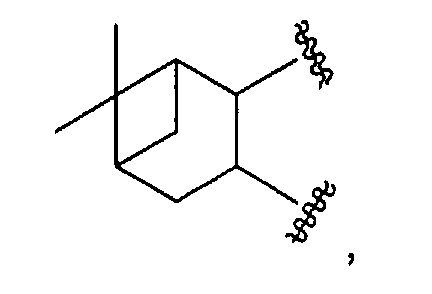
Technical Field
This invention relates to a pharmaceutical composition comprising a
dual antagonist against thromboxane A2 and prostagrandin D2 receptors and
in detail, a compound having a [2. 2. 1] or [3. 1. 1.] bicyclo skeleton.
Background Art
As a pharmaceutical composition comprising a dual antagonist
against PGD
2/TXA
2 receptors, a compound of the formula:
wherein R
X is optionally substituted single ring or fused heterocyclyl; X is
hydrogen or alkyl, was described in WO 99/15502. The above mentioned
compound has a substituent of the formula:
-CH
2-CH=CH-CH
2-CH
2-CH
2-COOX wherein X is hydrogen or alkyl, as an α
chain and R on an ω chain is a single or fused heterocyclyl optionally
substituted with amino, halogen, hydroxy and the like.
Further, the other compounds having a [2.2.1] bicyclo skeleton similar
to the compounds of the present invention have been described in
WO97/00853 and the like. In this publication, it is described that the
compounds are useful as prostagrandin D2 (PGD2) antagonists.
However, in these publications, almost none of compound having other
substituents than those represented by the formula:
wherein X
1 and X
3 are each independently optionally substituted aryl,
optionally substituted heteroaryl or optionally substituted non-aromatic
heterocyclyl; X
2 is a bond, -CH
2-, -S-, -SO
2- and the like; X
4 is -CH
2- and the
like; m is 0 or 1; p is 0 or 1 as the ω chain, and furthermore, the formula:
-CH
2-CH=CH-CH
2-CH
2-CH
2-COOR
2 wherein R
2 is hydrogen or alkyl, as the
α chain of bicyclic ring, has been described.
PGD2 receptor antagonists have a quite different character from that
of TXA2 receptor antagonists in the site and mechanism of action and
indications thereof.
On the other hand, a compound having a dual antagonistic activity
against both a TXA2 receptor and a PGD2 receptor can be useful as
therapeutic agents for various diseases caused by TXA2 or PGD2.
For example, in the case of bronchial asthma, it is known that TXA2
causes potent tracheal contraction and respiratory anaphylaxis and PGD2
effects infiltration of eosionophils. From these comprehension, TXA2 and
PGD2 are thought to be one of causative substances of the pathopoiesis and
advance of asthma, thus the dual antagonistic compounds are expected to be
more potent agents for treating asthma than ever known antagonists.
Further, in the case of allergic rhinitis, it is recognized that TXA2 and
PGD2 cause the swelling of nasal mucosa through the aggravation of vascular
permeability, and PGD2 induces the nasal blockage through the enlargement
of vascular volume. Therefore, the dual antagonistic compounds are expected
to be more potent agents for treating nasal blockage than known antagonists.
These diseases and conditions thereof might be treated by
administering both a TXA2 receptor antagonist and a PGD2 receptor
antagonist at the same time, for example, in combination therapy or as a
mixture thereof. But the administration of two or more agents often causes
some problems due to the difference of their metabolic rate. For example,
when the antagonists are different from each other in the time to reach a
maximum blood concentration or the duration of action, they do not always
efficiently exhibit each receptor antagonistic effect at the same time, failing
to give a desired additive or synergic effect.
It has therefore been desired to develop medicines having a dual
antagonistic activity against TXA2/PGD2 receptors, which exhibit new
excellent therapeutic effects and can be used for many indications.
On the other hand, it was disclosed that 3-oxa-derivatives were
prepared as metabolically stable TXA
2/PGH
2 receptor antagonists in
Bioorganic & Medicinal Chemistry Letters, Vol.2, No.9, pp.1069-1072, 1992.
The active value of the compound was only described but the metabolic
stability has not been described in the literature.
wherein, Z is p-fluorophenyl; Rω is benzenesulfonamino and the like.
Furthermore, it was reported in PROSTAGLANDINS, 1986, 31, 95
that ILOPROST, PGI2 mimetics was stabilized metabolically by converting to
the 3-oxa-derivative. But, remaining activity of each compound was only
compared under a presence of the metabolic enzyme of a rat and the
metabolic stability did not mentioned, since there was a possibility of a
production of active metabolites
Disclosure of Invention
The present inventors have studied intensively to develop a
pharmaceutical composition having a dual antagonistic activity against
TXA2/PGD2 receptors and found out new compounds and pharmaceutical
compositions comprising them.
The present invention provides:
R is -C(=O)-R1, -CH2-R1, or tetrazolyl;
R1 is hydroxy, alkyloxy, or optionally substituted amino;
m is 0 or 1;
provided that combinations wherein m is 1, A is -CH=CH-CH2-CH2-CH2- and
R is -C(=O)-R1 (R1 is hydroxy or alkyloxy) and wherein A is
-CH2-CH=CH-CH2-CH2-CH2- and R is -C(=O)-R1 wherein R1 is hydroxy or
alkyloxy are excluded,
p is 0 or 1, provided when p = 0, X1 is not bonded to X3 via X4;
X1 and X3 are each independently optionally substituted aryl, optionally
substituted heteroaryl or optionally substituted non-aromatic heterocyclyl;
X2 is a bond, -CH2-, -CH2-CH2-, -C(=O)-, -O-, -S-, -SO-, -SO2-, -NH-, -N(CH3)-,
-C(=N-O-CH3)-, -N=N-, -CH=CH-, -(C=O)-NH-, -NH-(C=O)-, -CH2-NH-,
-NH-CH2-, -CH2-O-, -O-CH2-, -CH2-S-, -S-CH2-, -CH2-SO2-, -SO2-CH2-,
-SO2-NH-, -NH-SO2-, -C(=CH2)-, -SO2N(Me)-, -CH2NHSO2-, -CH2NH-(C=O)-,
-NH-C(=O)-NH or -·NH-C(=O)·N(Me)-;
X4 is -CH2-, -CH2-CH2-, -C(=O)-, -SO-, -SO2-, -(C=O)-NH-, -NH-(C=O)-,
-CH2-NH-, -NH-CH2-, -CH2-O-, -O-CH2-, -CH2-S-, -S-CH2-, -CH2-SO2-,
-SO2-CH2-, -SO2-NH- or -NH-SO2-,
provided that a combination wherein
is
A is -CH=CH-CH2-CH2-CH2-, R is -COOH, m is 1, p is 0, X1 and X3 are phenyl,
and X2 is -N=N-, is excluded
and provided that when
is
X1 and X3 are phenyl, X2 is -CH=CH-, -O-, or -S-, m is 0, and p is 0, a
compound wherein A is -CH=CH-CH2-CH2-CH2-C(CH3)2- and R is COOH,
A is -CH2-C(=O)-CH2-CH2-CH2-CH2- and R is COOH,
A is -CH2-CH2-CH2-CH2-CH2- and R is -COOH, or
A is -CH=CH-CH2-CH2-CH2- and R is -CH2OH,
is excluded,
a prodrug, a pharmaceutically acceptable salt or a solvate thereof, (2) A compound as described in (1) wherein A is alkylene optionally
intervened with a heteroatom, optionally having an oxo group, optionally
substituted with halogen and/or optionally having a unsaturated bond;
R is -C(=O)-R1, -CH2-R1, or tetrazolyl;
R1 is hydroxy, alkyloxy, or optionally substituted amino;
provided compounds wherein A is -CH=CH-CH2-CH2-CH2- and R is -C(=O)-R1
(R1 is hydroxy or alkyloxy), or A is -CH2-CH=CH-CH2-CH2-CH2- and R is
-C(=O)-R1 wherein R1 is hydroxy or alkyloxy are excluded,
a prodrug, a pharmaceutically acceptable salt or a solvate thereof, (3) A compound as described in (1) or (2), wherein A is alkylene intervened
with a heteroatom, optionally having an oxo group, optionally substituted
with halogen and/or optionally having an unsaturated bond,
a prodrug, a pharmaceutically acceptable salt, or a solvate thereof, (4) A compound as described in (1) or (2), wherein A is C1 to C4 or C7 to C9
alkylene optionally intervened with a heteroatom, optionally having an oxo
group, optionally substituted with halogen and/or optionally having an
unsaturated bond, a prodrug, a pharmaceutically acceptable salt, or a solvate
thereof, (5) A compound as described in (1) or (2), wherein A is -CH2-CH2-CH2-,
-CH2-CH2-CH(F)-, -CH2CH=CH-, -CH2-O-CH2-, -CH2CH=C(F)-,
-CH2-CH2-CH2-CH2-, -CH2CH=CH-CH2-, -CH2-CH2-CH=CH-,
-CH=CH-CH2-CH2-, -CH2-CH2-O-CH2-, -CH2-CH2-S-CH2-, -CH2-CO-NH-CH2-,
-CH2-CH2-CH2-CH2-CH2-, -CH2CH=CH-CH2-CH2-, -CH2-CH2-CH2-CH=CH-,
-CH2-CH2-CH2-O-CH2-, -CH2-CH2-CH2-S-CH2-, -CH2-CH2-CO-NH-CH2-,
-CH2-CH2-CH2-CH2-CH2-CH2-, -CH2-CH2-CH2-CH2-CH2-CH(Me)-,
-CH2-CH2-CH2-CH2-CH2-C(Me)2-, -CH2-CH2-CH2-CH2-CH2-CH(F)-,
-CH2-CH=CH-CH2-CH2-CH(Me)-, -CH2-CH=CH-CH2-CH2-C(Me)2-,
-CH2-CH=CH-CH2-CH2-CH(F)-, -CH2-CH2-CH2-CH2-CH=CH-,
-CH2-CH2-CH2-CH2-CH=C(Me)-, -CH2-CH2-CH2-CH2-C(Me)=CH-,
-CH2-CH2-CH2-CH2-CH=C(F)-, -CH2-CH2-CH2-CH2-O-CH2-,
-CH2-CH=CH-CH2-O-CH2-, -CH2-CH=CH-CH2-S-CH2-,
-CH2-CH=C(F)-CH2-O-CH2-, -CH2-CH2-O-CH2-CH=CH-,
-CH2-CH2-CH2-CH2-S-CH2-, -CH2-CH2-CH2-CO-NH-CH2-,
-CH2-CH2CH=N-O-CH2-, -CH2-CH2-S-CH2-CH2-CH2-,
-CH2-CH2-CH2-CH2-CH2-CH2-CH2-, -CH2-CH=CH-CH2-CH2-CH2-CH2-,
-CH2-CH2-CH2-CH2-CH2-O-CH2-, -CH2-CH2-CH2-CH2-CH2-CH2-CH2-CH2-, or
-CH2-CH=CH-CH2-CH2-CH2-CH2-CH2-,
a prodrug, a pharmaceutically acceptable salt, or a solvate thereof, (6) A compound as described in (5), wherein A is -CH2-CH2-CH2-CH2-,
-CH2-CH2-CH2-CH2-CH=CH-, -CH2-CH2-CH2-CH2-O-CH2-,
-CH2-CH=CH-CH2-O-CH2-, -CH2-CH=CH-CH2-S-CH2-, or
-CH2-CH2-CH2-CH2-S-CH2-,
a prodrug, a pharmaceutically acceptable salt, or a solvate thereof, (7) A compound as described in (6), wherein A is -CH2-CH2-CH2-CH2-O-CH2-,
a prodrug, a pharmaceutically acceptable salt, or a solvate thereof, (8) A compound as described in any one of (1) to (7), wherein X1 and X3 are
each independently optionally substituted aryl or optionally substituted
heteroaryl,
a prodrug, a pharmaceutically acceptable salt, or a solvate thereof, (9) A compound as described in (8), wherein at least one of X1 and X3 is
optionally substituted heteroaryl,
a prodrug, a pharmaceutically acceptable salt, or a solvate thereof, (10) A compound as described in (9), wherein X1 and X3 are each
independently optionally substituted heteroaryl,
a prodrug, a pharmaceutically acceptable salt, or a solvate thereof, (11) A compound as described in (9), wherein at least one of X1 and X3 is
optionally substituted thienyl or optionally substituted benzothienyl,
a prodrug, a pharmaceutically acceptable salt, or a solvate thereof, (12) A compound as described in any one of (1) to (11), wherein X2 is a bond,
-CH2-, -S-, -SO2-, -CH2-O-, -O-CH2-, -CH2-S-, -S-CH2-, or -NH-C(=O)-NH-,
a prodrug, a pharmaceutically acceptable salt, or a solvate thereof, (13) A compound as described in any one of (1) to (12), wherein m is 0 and p
is 0,
a prodrug, a pharmaceutically acceptable salt, or a solvate thereof, (14) A compound as described in any one of (1) to (13), wherein R is
-C(=O)-R1 and R1 is hydroxy, alkyloxy, or optionally substituted amino,
a prodrug, a pharmaceutically acceptable salt, or a solvate thereof, (15) A pharmaceutical composition comprising a compound, a prodrug, a
pharmaceutically acceptable salt, or a solvate thereof as described in any one
of above (1) to (14), (16) A pharmaceutical composition having a dual antagonistic activity
against PGD2/TXA2 receptors as described in the above (15), (17) A pharmaceutical composition as described in the above (15), which is
used for treatment of asthma, (18) A pharmaceutical composition as described in the above (15), which is
used for the treatment of nasal blockage, (19) A pharmaceutical composition as described in the above (15), which is
used for the treatment of allergic conjunctivitis, (20) A pharmaceutical composition as described in the above (15), which is
used for the treatment of allergic rhinitis, (21) Use of the compound as described in any one of (1) to (14) for the
preparation of a pharmaceutical composition for treating asthma, nasal
blockage, allergic conjunctivitis or allergic rhinitis, (22) A method for treating nasal blockage, allergic conjunctivitis or allergic
rhinitis, which comprises administrating a compound as described in any one
of (1) to (14), (23) A compound of formula: X3-X2-X1-COOH wherein X3 is pyrrolyl optionally
substituted with alkyl, alkyloxy or halogen, indolyl optionally substituted
with alkyl, alkyloxy or halogen, indolinyl optionally substituted with alkyl,
alkyloxy or halogen, or 1,2,3,4-tetrahydroquinolyl optionally substituted with
alkyl, alkyloxy or halogen; X2 is -SO2-, -S- or -CH2-; X1 is thienyl, or a salt
thereof, (24) A compound as described in (23), wherein a substituent of the formula:
·X1-X2-X3 is 5-(1-pyrrolylsulfonyl)thiophen-2-yl,
5-[(2-methyl-1-pyrrolyl)sulfonyl]thiophen-2-yl, or
5-[(2,5-dimethyl-1-pyrrolyl)sulfonyl]thiophen-2-yl, or a salt thereof.
Best Mode for Carrying Out the Invention
Special feature of a compound in the present invention is
Provided that a compound wherein A is -CH2-CH=CH-CH2-CH2-CH2-
and R is -C(=O)-R1 (R1 is hydroxy or alkyloxy), is not included in the present
invention, since the compound is metabolically unstable caused by oxidizaton
of an α-chain at a β-position.
Therefore, a compound of the present invention has a special feature
at A and R and has an improved metabolic property. Further, a compound of
the present invention is a dual antagonistic activity against PGD2/TXA2
receptors having the above mentioned features (A) to (D).
A preferred embodiment is a compound of the formula (I) wherein
Each term used herein is defined to have meanings below in either
case of a single or a joint use with other terms, unless otherwise noted.
"Alkylene" used herein means a straight chain and branched chain C1
to C9 and refers to methylene, methylmethylene, dimethylmethylene,
ethylmethylmethylene, ethylene, trimethylene, tetramethylene,
pentamethylene, hexamethylene, heptamethylene, octamethylene,
nonamethylene, and the like. The above mentioned alkylene optionally
contains a hetero atom (oxygen atom, sulfur, nitrogen atom or the like),
optionally has an oxo group (=O), is optionally substituted with halogen (e.g.
F, Cl, Br, I, preferable is F) and/or optionally contains one or more
unsaturated bond (double bond or triple bond) on the chain at any position.
Examples are -CH2-CH2-CH2-, -CH2-CH2-CH(F)-, -CH2-CH=CH-, -CH2-O-CH2-,
-CH2-CH=C(F)-, -CH2-CH2-CH2-CH2-, -CH2-CH=CH-CH2-, -CH2-CH2-CH=CH-,
-CH=CH-CH2-CH2-, -CH2-CH2-O2-CH2-, -CH2-CH2-S-CH2-, -CH2-CO-NH-CH2-,
-CH2-CH2-CH2-CH2-CH2-, -CH2-CH=CH-CH2-CH2-, -CH2-CH2-CH2-CH=CH-,
-CH=CH-CH2-CH2-CH2-, -CH2-CH2-CH2-O-CH2-, -CH2-CH2-CH2-S-CH2-,
-CH2-CH2-CO-NH-CH2-, -CH2-CH2-CH2-CH2-CH2-CH2-,
-CH2-CH2-CH2-CH2-CH2-CH(Me)-, -CH2-CH2-CH2-CH2-CH2-C(Me)2-,
-CH2-CH2-CH2-CH2-CH2-CH(F)-, -CH2-CH=CH-CH2-CH2-CH2-,
-CH2-CH=CH-CH2-CH2-CH(Me)-, -CH2-CH=CH-CH2-CH2-C(Me)2-,
-CH2-CH=CH-CH2-CH2-CH(F)-, -CH2-CH2-CH2-CH2-CH=CH-,
-CH2-CH2-CH2-CH2-CH=C(Me)-, -CH2-CH2-CH2-CH2-C(Me)=CH-,
-CH2-CH2-CH2-CH2-CH=C(F)-, -CH2-CH2-CH2-CH2-O-CH2-,
-CH2-CH=CH-CH2-O-CH2-, -CH2-CH=CH-CH2-S-CH2-,
-CH2-CH=C(F)-CH2-O-CH2-, -CH2-CH2-O-CH2-CH=CH-,
-CH2-CH2-CH2-CH2-S-CH2-, -CH2-CH2-CH2-CO-NH-CH2-,
-CH2-CH2-CH=N-O-CH2-, -CH2-CH2-S-CH2-CH2-CH2-,
-CH2-CH2-CH2-CH2-CH2-CH2-CH2-, -CH2-CH=CH-CH2-CH2-CH2-CH2-,
-CH2-CH2-CH2-CH2-CH2-O-CH2-, -CH2-CH2-CH2-CH2-CH2-CH2-CH2-CH2-,
-CH2-CH=CH-CH2-CH2-CH2-CH2-, -CH2-CH2-O-CH2-CH2-CH2-,
-CH2-CH=CH-CH2-CH=CH2-, and the like.
Especially, the following embodiment is preferred for the above
mentioned "alkylene":
The term "heteroaryl" includes a group which has a bond at any
substitutable position and which can be converted from a 5- to 7-membered
aromatic heterocycle containing one or more oxygen atom, sulfur atom and/or
nitrogen atom in the ring, or such an aromatic heterocycle as fused with one
or more carbocycle or other aromatic heterocycle. Any one of aromatic
heterocycle and aromatic carbocycle may have a bond. "Heteroaryl" may have
a bond at a nitrogen atom as well as a carbon atom of aromatic heterocycle or
aromatic carbocycle. Examples of "heteroaryl" include pyrrolyl (e.g.,
1-pyrrolyl, 2-pyrrolyl, 3-pyrrolyl), pyridyl (e.g., 2-pyridyl, 3-pyridyl,
4-pyridyl), pyrazolyl (e.g., 1-pyrazolyl, 3-pyrazolyl, 4-pyrazolyl), imidazolyl
(e.g., 1-imidazolyl, 2-imidazolyl, 4-imidazolyl), pyrimidinyl (e.g.,
2-pyrimidinyl, 4-pyrimidinyl, 5-pyrimidinyl), pyrazinyl (e.g., 2-pyrazinyl),
indolyl (e.g., 1-indolyl, 2-indolyl, 3-indolyl, 4-indolyl, 5-indolyl, 6-indolyl,
7-indolyl), carbazolyl (e.g., 1-carbazolyl, 2-carbazolyl, 3-carbazolyl,
4-carbazolyl, 9-carbazolyl), benzimidazolyl (e.g., 1-benzimidazolyl,
2-benzimidazolyl, 4-benzimidazolyl, 5-benzimidazolyl), indazolyl (e.g.,
1-indazolyl, 2-indazolyl, 3-indazolyl, 4-indazolyl, 5-indazolyl, 6-indazolyl,
7-indazolyl), quinolyl (e.g., 2-quinolyl, 3-quinolyl, 4-quinolyl, 5-quinolyl,
6-quinolyl, 7-quinolyl, 8-quinolyl), isoquinolyl (e.g., 1-isoquinolyl,
3-isoquinolyl, 4-isoquinolyl, 5-isoquinolyl, 6-isoquinolyl, 7-isoquinolyl,
8-isoquinolyl), furyl (e.g., 2-furyl, 3-furyl), benzofuryl (e.g., 2-benzofuryl,
3-benzofuryl, 4-benzofuryl, 5-benzofuryl, 6-benzofuryl, 7-benzofuryl), thienyl
(e.g., 2-thienyl, 3-thienyl), benzothienyl (e.g., benzo[b]thiophen-2-yl,
benzolb]thiophen-3-yl, benzo[b]thiophen-4-yl, benzo[b]thiophen-5-yl,
benzo[b]thiophen-6-yl, benzo[b]thiophen-7-yl), dibenzothienyl (e.g.,
2-dibenzothienyl, 3-dibenzothienyl), dibenzofuryl (e.g., 2-dibenzofuryl,
3-dibenzofuryl), naphthothienyl (e.g., naphtho[2,3-b]thiophen-2-yl,
naphtho[2,3-b]thiophen-3-yl, naphtho[1.2-b]thiophen-2-yl,
naphtho[1.2-b]thiophen-3-yl), oxazolyl (e.g., 2-oxazolyl, 4-oxazolyl, 5-oxazolyl),
isoxazolyl (e.g., 3-isoxazolyl, 4-isoxazolyl, 5-isoxazolyl), thiazolyl (e.g.,
2-thiazolyl, 4-thiazolyl, 5-thiazolyl), isothiazolyl (e.g., 3-isothiazolyl,
4-isothiazolyl, 5-isothiazolyl), imidazothiazolyl (e.g.,
imidazo[2.1-b]thiazol-2-yl, imidazo[2.1-b]thiazol-3-yl), benzoisoxazolyl (e.g.,
benzo[d]isoxazol-3-yl), benzothiazolyl (e.g., benzo[d]thiazol-2-yl), and the
like.
The term of "aromatic carbocycle or other aromatic heterocycle" which
may fuse the above "heteroaryl" includes 5- to 7-membered aromatic cycle
which may contains one or more oxygen atom, sulfur atom and/or nitrogen
atom in the ring, or such an aromatic ring as fused with one or more other
aromatic rings.
The term of "aryl" includes mono aromatic carbocyclyl (e.g., phenyl) or
fused aromatic carbocyclyl (e.g., 1-naphthyl, 2-naphthyl, 1-anthryl, 9-anthryl,
1-phenanthryl, 10-phenanthryl).
The term of "non-aromatic heterocyclyl" includes a group which has a
bond at any substitutable position and which can be converted from 3- to
7-membered non-aromatic heterocyclyl which contains one or more oxygen
atom, sulfur atom and/or nitrogen atom in the ring, or non-aromatic
heterocyclyl which is fused with a carbon ring (e.g. aromatic carbocycle) or
other heterocyclyl (e.g. aromatic heterocycle). The substitutable bond may
exist not only on the carbon atom but also on the nitrogen atom in the
non-aromatic heterocyclyl. Examples are aziridinyl, piperidino, piperidinyl,
morphorino, morphorinyl, pyrrolinyl, pyrrolidinyl, imidazolinyl, piperadino,
piperadinyl, isooxazolinyl, thiolanyl, tetrahydrofuranyl, dioxanyl, oxathianyl,
tetrahydropyranyl, and the like. Preferable is 5- or 6-membered non-aromatic
heterocyclyl containing a nitrogen atom. The following groups are exexplified
as a group which has a bond at any substitutable position and which can be
converted from non-aromatic heterocyclyl fused with one or more carbon ring
(e.g. aromatic carbocycle) or other heterocyclyl (e.g. aromatic heterocycle):


Furthermore, the substitutable bond may exist at any position of the carbon
atom or the nitrogen atom.
"Aryl" or "heteroaryl" may be fused 4- to 7-membered cycloalkane or
4- to 7-membered non-aromatic heterocycle. Examples of cycloalkane include
cyclobutane, cyclopentane, cyclohexane, and cycloheptane. Examples of
non-aromatic heterocycle include pyrrolidine, piperazine, oxorane,
1,3-dioxorane, 1,4-dioxane, thiorane, or the like. The above "cycloalkane" and
"non-aromatic heterocycle" may be fused with other aromatic carbocycle or
aromatic heterocycle. Examples of aryl or heteroaryl fused with 4- to
7-membered cycloalkane or 4- to 7-membered non-aromatic heterocycle are
illustrated below.
Examples of the substituent on "optionally substituted aryl",
"optionally substituted heteroaryl" or "optionally substituted non-aromatic
heterocyclyl" include a group of the formula: -Z1-Z2 wherein Z1 is a bond, -O-,
-S-, -NH-, -NH-C(=O)-, -NH-C(=O)-O-, -NH-SO2-, -C(=O)-, -O-C(=O)-,
-C(=O)-O-, or -SO2-; and Z2 is alkyl, haloalkyl, alkenyl, alkynyl, aryl
optionally substituted with alkyl or halogen, heteroaryl optionally
substituted with alkyl or halogen, arylalkyl optionally substituted with alkyl
or halogen, heteroarylalkyl optionally substituted with alkyl or halogen,
carboxy, halogen (F, Cl, Br, I), hydroxyalkyl, hydroxy, nitro, cyano, mercapto,
thioformyl, thioacetyl, thiocarboxy, dithiocarboxy, thiocarbamoyl, sulfino,
sulfo, sulfamoyl, sulfoamino, optionally substituted amino, optionally
substituted aminoalkyl, hydroxyamino, carbamoyl, or hydorazino. One to
three substituents may be at any suitable position on the above aryl,
heteroaryl, or non-aromatic heterocyclyl.
"Alkyl" includes a straight or branched C1 to C8 alkyl group or a C3 to
C8 cycloalkyl group. Examples are methyl, ethyl, n-propyl, isopropyl, n-butyl,
isobutyl, tert-butyl, n-pentyl, isopentyl, n-hexyl, n-heptyl, n-octyl,
cyclopropyl, cyclobutyl, cyclopentyl, cyclohexyl, cycloheptyl and the like.
"Haloalkyl" includes a straight or branched C1 to C8 alkyl or C3 to C8
cycloalkyl group substituted with one or more halogen, for example,
chloromethyl, fluoromethyl, trifluoromethyl, 2,2,2-trifluoroethyl,
1,1-difluoroethyl, trichloromethyl, 2,2,2-trichloroethyl, 1,1-dichloroethyl or
the like.
"Alkenyl" includes a straight or branched C2 to C8 alkenyl or C3 to C8
cycloalkenyl group having one or more double bond(s), for example, vinyl,
1-propenyl, 2-propenyl, isopropenyl, 2-cyclobuten-1-yl, 2-cyclopenten-1-yl,
3-cyclopenten-1-yl, 2-cyclohexen-1-yl or the like.
"Alkynyl" includes a straight or branched C2 to C8 alkynyl having one
or more triple bond(s), for example, ethynyl, 1-propynyl, 2-propynyl,
1-butynyl, 2-butynyl, 3-butynyl or the like.
"Halogen" includes fluoro, chloro, bromo, and iodo.
"Alkyl" used in the term "arylalkyl" or "heteroarylalkyl" have the
same meaning of the above "alkyl", "aryl" used in the term "arylalkyl" have
the same meaning of the above "aryl" and "heteroaryl" used in the term
"heteroarylalkyl" have the same meaning of the above "heteroaryl".
"Hydroxy alkyl" includes the above "alkyl" substituted with one or two
hydroxy, for example, hydroxymethyl, 1-hydroxyethyl, 2-hydroxyethyl,
1,2-dihydroxyethyl, 1,2-dihydroxy-n-propyl or the like.
Examples of the substituent of "optionally substituted amino" or
"optionally substituted amino alkyl" include the above "alkyl", the above
"arylalkyl", the above "aryl", the above "heteroaryl", the above
"heteroarylalkyl" hydroxy. Alkylsulfonyl, or the like. They may be mono- or
di-substituted with these substituents. When the substituent is alkyl, alkyl
may form a ring together with a nitrogen atom of an amino group.
Example of "optionally substituted amino" includes amino,
N,N-dimethylamino, N-ethyl-N-methylamino, N,N-diethylamino, pyrrolidino,
piperidino, N-methyl-N-phenylamino, isopropylamino, diisopropylamino,
hydroxyamino, alkylsulfonylamino (e.g., methanesulfonylamino,
ethanesulfonylamino, etc.), arylsulfonyl (e.g., benzenesulfonylamino,
toluenesulfonylamino, etc.), N-alkyl-N-alkylsulfonylamino (e.g.,
N-methyl-N-methanesulfonylamino, etc.), halogenated alkylsulfonylamino
(e.g., trifluoromethanesulfonylamino, etc.), or the like.
Examples of "optionally substituted aminoalkyl" include
N,N-dimethylaminomethyl, N-ethyl-N-methylaminomethyl,
N,N-diethylaminomethyl, pyrrolidinomethyl, piperidinomethyl,
N-methyl-N-phenylaminomethyl, isopropylaminomethyl,
diisopropylaminomethyl or the like.
"A pharmaceutical composition having a dual antagonistic activity
against PGD2/TXA2 receptors" means a pharmaceutical composition
comprising at least one compound of the formula (I) having an antagonistic
activity against both a PGD2 receptor and a TXA2 receptor. In addition to a
compound of the formula (I), the other active agents (e.g. antiinflammatory
agents, antiallergy agents and the like) and pharmaceutically acceptable
admixtures (e.g., binding agent, filler and the like) may be included.
The compound of the present invention has an antagonistic activity
against PGD2 receptor and TXA2 receptor and can exhibit antagonistic
activities against PGD2 receptor and TXA2 receptor in vivo. For example, even
if a compound has both antagonistic activities against receptors in vitro, the
compound administered can not always exhibit both of the antagonistic
activity in vivo, owing to the preferential binding to the receptor of stronger
affinity. Therefore, as a compound of the present invention, preferable is that
the compound has antagonistic activities against PGD2 and TXA2 receptors
and is 100 times, preferably 50 times and more preferably ca. 10 times in a
ratio between affinities against PGD2 and TXA2 receptors. The ratio between
affinities against PGD2 and TXA2 receptors can be calculated by the use of
IC50 values and the like.
Furthermore, as a compound of the present invention, preferable is
less than 0.1 µM in the binding activity against TXA2 receptor using human
platelet membrane (IC50 value) and 0.1 µM in the antagonistic activity
against PGD2 receptor using human platelet (IC50 value). In particular, the
compound is preferable, in which both of the binding activity against TXA2
receptor using human platelet membrane (IC50 value) and the antagonistic
activity against PGD2 receptor using human platelet (IC50 value) are less
than 0.1 µM. Furthermore, the compound is preferable, in which their ratio is
100 times, preferably 50 times and more preferably ca. 10 times.
The present invention includes a method for treating asthma, nasal
blockage, allergic conjunctivitis or allergic rhinitis which comprises
administering a compound of the formula (I) and use of a compound of the
formula (I) for manufacturing a medicine for asthma, nasal blockage allergic
conjunctivitis or allergic rhinitis.
Furthermore, in a compound displayed in formula (I), "α chain" means
a group represented by the formula: "A-R
1, and "ω chain" means a group
represented by the formula:
Preferable is following substituents as the α chain. Furthermore, E
and Z mean E-form and Z-form in double bond of each formula, respectively.
Each sign in 4A to 9B means an A part of the formula and means the same
group in Table 1 to Table 15 in this description.
R is exemplified by -C(=O)-R1, -CH2-R1, or tetrazolyl and preferable is
-C(=O)-R1, wherein, R1 is hydroxy, alkyloxy, or optionally substituted amino.
Examples of R are COOH, COOMe, CONH2, CONHSO2Me, CH2OH, CH2OMe,
CONHMe, CON(Me)SO2Me, 5-tetrazolyl, CONHSO2Ph, CONHSO2CF3 and the
like.
Furthermore, the combination of A and R includes all of the
combination and preferable is a combination described in Table 1 to Table 15.
As an ω chain, the following embodiments are preferred in the
formula:
In particular, preferable is a combination described below for the
formula: -X
1-X
2-X
3. Furthermore, each sign of 1 to 513 below means a group
shown by the formula: -X
1-X
2-X
3 and the compound number both in Table 1 to
Table 15 and in Examples of reference in the present invention means the
same group.
A compound of the present invention can be any of the following stereo
isomers of [2.2.1] and [3.1.1] bicyclic skeleton.
In these stereo isomers, preferable is a compound having the skeleton
of the formula:
The present invention includes all stereo isomers of them and the
optional mixtures thereof. Namely, the bond binding to the bicyclic ring is in
R configuration or S configuration, and all of the stereo isomers
(diastereomer, epimer, enantiomer and the like), racemates, and optional
mixture thereof are included in the present invention.
Moreover, the α chain of the compound of the present invention can be
in Z configuration or E configuration, thus a compound having any of the
configurations and the mixture thereof are included in the present invention.
A prodrug of a compound of the formula (I) is a derivative of the
compound of the present invention having a group which can be decomposed
chemically or metabolically, and such prodrug is converted to a
pharmaceutically active compound of the present invention by means of
solvolysis or by placing the compound in vivo under a physiological condition.
Method for the selection and process of an appropriate prodrug derivative are
described in the literature such as Design of Prodrugs, Elsevier, Amsterdam
1985.
When the compound of the formula (I) has a carboxyl group, an ester
derivative prepared by reacting a basal acid compound with a suitable alcohol
or an amide derivative prepared by reacting a basal acid compound with a
suitable amine is exemplified as a prodrug. A particularly preferred ester
derivative as an prodrug is an optionally substituted alkyl ester derivative
(e.g., methyl ester, ethyl ester, n-propyl ester, isopropyl ester, n-butyl ester,
isobutyl ester, tert-butyl ester, morpholinoethyl ester), an arylalkyl ester
derivative (e.g., benzyl ester, phenethyl ester, benzhydryl ester), or the like.
A particularly preferred amide derivative as a prodrug is alkyl amide
derivative (e.g., N-methyl amide, N-ethyl amide, N-(n-propyl)amide,
N-isopropyl amide, N-(n-butyl)amide, N-isobutyl amide, N-(tert-butyl)amide),
aryl alkyl amide (e.g., N-benzyl amide, N-phenethyl amide, benzhydryl
amide), or the like.
When the compound of the formula (I) has a hydroxy group, an acyloxy
derivative prepared by reacting with a suitable acyl halide (e.g., acid chloride,
halogenated acid) or a suitable acid anhydride (e.g., mixed acid anhydride) is
exemplified as a prodrug. A particularly preferred acyloxy derivative as a
prodrug is a derivative substituted with optionally substituted
alkylcarbonyloxy (e.g., -OCOC2H5, -OCO(tert-Bu), -OCOC15H31,
-OCOCH2CH2COONa, -OCOCH(NH2)CH3, -OCOCH2N(CH3)2-), optionally
substituted arylcarbonyloxy (e.g., -OCO(m-COONa-Ph) or the like.
When the compound of the formula (I) has an amino group, an amide
derivative prepared by reacting with a suitable acid halide or a suitable acid
anhydride is exemplified as a prodrug. A particularly preferred amide
derivative as a prodrug is a derivative substituted with optionally
substituted alkylcarbonyl (e.g., -NHCO(CH2)20CH3, -NHCOCH(NH2)CH3) or
the like.
Examples of a salt of the compound of the formula (I) or its prodrug
include alkali metal salts such as lithium salts, sodium salts or potassium
salts, alkaline-earth metal salts such as calcium salts, salts with organic
bases such as tromethamine, trimethylamine, triethylamine, 2-aminobutane,
tert-butylamine, diisopropylethylamine, n-butylmethylamine,
cyclohexylamine, dicyclohexylamine, N-isopropylcyclohexylamine,
furfurylamine, benzylamine, methylbenzylamine, dibenzylamine,
N,N-dimethylbenzylamine, 2-chlorobenzylamine, 4-methoxybenzylamine,
1-naphthylene methylamine, diphenylbenzylamine, triphenylamine,
1-naphthylamine, 1-aminoanthorathene, 2-aminoanthorathene,
dehydroabiethylamine, N-methylmorpholine, pyridine), basic amino acid salts
such as arginine salts or lysine salts.
A solvate means a solvate with an organic solvent, a hydrate and the
like of the compound of the formula (I), its prodrug or its pharmaceutically
acceptable salt, for example, monohydrate, dihydrate or the like.
General processes for the preparation of the compounds of the formula
(I) are illustrated as follows.
wherein
is
A is alkylene optionally intervened with a heteroatom, optionally having an
oxo group, optionally substituted with halogen and/or optionally having an
unsaturated bond;
R is -C(=O)-R
1, -CH
2-R
1, or tetrazolyl;
R
1 is hydroxy, alkyloxy, or optionally substituted amino;
m is 0 or 1;
provided that when m is 1, A is -CH=CH-CH
2-CH
2-CH
2- and furthermore R is
-C(=O)-R
1 wherein R
1 is hydroxy or alkyloxy, and provided that when A is
-CH
2-CH=CH-CH
2-CH
2-CH
2- and R is -C(=O)-R
1 wherein R
1 is hydroxy or
alkyloxy, a compound is excluded;
p is 0 or 1, provided that when p = 0, X
1 is not bonded to X
3 via X
4;
X
1 and X
3 are each independently optionally substituted aryl, optionally
substituted heteroaryl, or optionally substituted non-aromatic heterocyclyl;
X
2 is a bond, -CH
2-, -CH
2-CH
2-, -C(=O)-, -O-, -S-, -SO-, -SO
2-, -NH-, -N(CH
3)-,
-C(=N-O-CH
3)-, -N=N-, -CH=CH-, -(C=O)-NH-, -NH-(C=O)-, -CH
2-NH-,
-NH-CH
2-, -CH
2-O-, -O-CH
2-, -CH
2-S-, -S-CH
2-, -CH
2-SO
2-, -SO
2-CH
2-,
-SO
2-NH-, -NH-SO
2-, -C(=CH
2)-, -SO
2N(Me)-, -CH
2NHSO
2-, -CH
2NH-(C=O)-,
-NH-C(=O)-NH, or -NH-C(=O)-N(Me)-;
X
4 is -CH
2-, -CH
2-CH
2-, -C(=O)-, -SO-, -SO
2-, -(C=O)-NH-, -NH-(C=O)-,
-CH
2-NH-, -NH-CH
2-, -CH
2-O-, -O-CH
2-, -CH
2-S-, -S-CH
2-, -CH
2-SO
2-,
-SO
2-CH
2-, -SO
2-NH- or -NH-SO
2-.
As shown in the above process, the compound of the formula (I) can be
prepared by reacting a carboxylic acid of the formula (M-2) or its reactive
derivative with an amino compound of the formula (M-1).
The reactive derivatives of carboxylic acid of the formula (M-2) mean
the corresponding acid halides (e.g., chloride, bromide, iodide), anhydrides
(e.g., mixed anhydride with formic acid or acetic acid), active esters (e.g.,
N-hydroxysuccinimide ester), and the like, and include acylating agents used
for the usual acylation of amino group.
For example, an acid halide is obtained by reacting the compound
(M-2) with a thionyl halide (e.g., thionyl chloride), phosphorous halide (e.g.,
phosphorous trichloride, phosphorous pentachloride), oxalyl halide (e.g.,
oxalyl chloride), and the like, in accordance with known methods as described
in the literatures.
The reaction can be conducted under a condition generally used for
the acylation of amino group. For example, in the case of condensation with
the acid halide, the reaction is carried out in a solvent such as an ether
solvent (e.g., diethyl ether, tetrahydrofuran, dioxane), benzene solvent (e.g.,
benzene, toluene, xylene), halogenated hydrocarbon solvent (e.g.,
dichloromethane, dichloroethane, chloroform) as well as ethyl acetate,
dimethylformamide, dimethyl sulfoxide, acetonitrile, or the like, if necessary,
in the presence of a base (e.g., organic base such as triethylamine, pyridine,
N,N-dimethylaminopyridine, N-methylmorpholine; inorganic base such as
sodium hydroxide, potassium hydroxide, potassium carbonate, or the like)
under cooling, at room temperature, or under heating, preferably at a
temperature ranging from -20 °C to ice-cooling temperature, or from room
temperature to a refluxing temperature of the reaction system, during
several min to several hr, preferably for 0.5 hr to 24 hr, more preferably for 1
hr to 12 hr.
Unless R of a compound represented by the formula (M-1) is a
carboxyl group, a free form may be used without converting the carboxy group
(M-2) into the reactive derivatives and the reaction may be conducted in the
presence of a condensing agent (e.g., dicyclohexylcarbodiimide (DCC),
1-ethyl-3-(3-methylaminopropyl)carbodiimide, N,N'-carbonyldiimidazole, or
the like) usually used in the condensation reaction of amine and carboxylic
acid.
When "optionally substituted aryl", "optionally substituted heteroaryl"
or "optionally substituted non-aromatic heterocyclyl" in X1 or X3 of the
compound of the formula (M-2) is substituted with a hydroxy group or an
amino group, such a compound can be used after protection by acetyl group or
the like in accordance with the well known method.
In the reaction of the other reactive derivatives or free acid (M-2) with
the amine (M-1), the reaction conditions are determined according to the
property of each reactive derivative or free acid, in accordance with a known
method. The reaction product can be purified in accordance with a
conventional purification, such as the extraction with a solvent,
chromatography, recrystallization, and the like.
In an object compound of the present invention, various derivatives in
which R is -C(=O)-R1, -CH2-R1 or tetrazolyl (R1 is hydroxy, alkyloxy or
optionally substituted amino) can be converted from a compound in which R
is carboxylic acid. For instance, a derivative of the ester or the amide can be
prepared by esterification or amidation, in accordance with the well known
method. Furthermore, the ester derivative can be converted by reduction to
an alcoholic derivative, which can be derived to an ether derivative by
O-alkylation. A compound in which R is 5-tetrazolyl, can be prepared by
converting an amide derivative having R; CONH2 to R: CN by dehydration in
accordance with the well known method, followed by a reaction with sodium
azide (J. Am. Chem. Soc. 1958, 80, 3908) or trimethylsilylazide (J. Org. Chem.
1993, 58, 4139).
In this process, the starting compound (M-1) wherein R
1 is
-CH
2-CH=CH-CH
2-CH
2-CH
2-COOMe, m is 0, Y is [2.2.1]bicyclic skeleton,
7-(3-amino-bicyclo[2.2.1]hept-2-yl)-5-heptenoic acid methyl ester is described
in the Japanese Patent Publication (Kokoku) No. 79060/1993. The other
starting compounds can be prepared from the aldehyde derivative (Q is a
protecting group such as benzyloxycarbonyl, t-butoxycarbonyl and the like)
represented by a general formula (M-1a) or (M-1b) by one or more reaction(s)
of an ylide compound under a Wittig reaction condition (Org. Reaction, 1965,
14, 270) in combination with other reactions. In a starting compound, various
derivatives wherein R is -C(=O)-R
1, -CH
2-R
1 or tetrazolyl (R
1 is hydroxy,
alkyloxy or optionally substituted amino) can be converted from a compound
wherein R is COOH.
For example, the aldehyde (M-1a) is reacted with
(3-carboxypropyl)triphenylphosphonium salt under a well known Wittig
reaction condition to give a starting material (M-5D), wherein A is
-CH2=CH-CH2-CH2-. The compound M-5D is hydrogenated in the presence of
palladium, platinum and the like to give a starting material (M-5A), wherein
A is -CH2-CH2-CH2-CH2-. Furthermore, after a Wittig reaction using
methoxymethyltriphenyl-phosphonium salt, followed by a hydrolysis with
hydrochloric acid, formic acid, acetic acid and the like can furnish an
aldehyde (M-1b) with one additional carbon atom and moreover a Wittig
reaction with 2-(1,3-dioxoran-2-yl)ethyltriphenylphosphonium salt can give a
compound represented by a general formula (M-1c). A Jones oxidation (J.
Chem. Soc., 1946, 39) of the compound gives a starting material (M-5B)
wherein A is -CH2-CH=CHCH2- in the formula (M-1). And by the above
similar method, after an aldehyde (M-ld) was obtained by hydrogenation,
followed by hydrolysis of the acetal with acid, either a Wittig reaction with a
stable yield such as methyl (triphenylphophoranidene)acetate and the like or
a Horner-Emmons reaction with methyl dimethylphosphonoacetate can
convert to a starting material (M-7I), wherein A is
-CH2-CH2-CH2-CH2-CH=CH-. When the above mentioned reaction is applied
to an aldehyde (M-1b), a corresponding starting material (M-4B), wherein A
is -CH2CH=CH- is obtained and furthermore a corresponding starting
material (M-4A) wherein A is -CH2-CH2-CH2- is obtained by a hydrogenation
of the double bond. When a starting material wherein A is
-CH2-CH2-CH2-CH2-O-CH2- is required, a compound of the formula (M-4A)
wherein R is CH2OH can be reacted with halogenated acetic acid or its ester,
ether, or amide and the like in the presence of a base in accordance with
known methods as described in the literatures.
Amidation with a starting carboxylic acid (M-2) can be accomplished
after a deprotection of an amino protecting group Q in a way of conversion to
α-chain, if necessary.
When p is 0, the carboxylic acid of the formula (M-2) can be prepared
by reacting a carboxylic acid having X1 or its reactive derivative with a
compound having X3. A person ordinary skilled in the art can carry out such
a reaction by selecting the kinds of reactions and their conditions depending
on the kind of X2.
A compound represented by the formula: X3-X2-X1-COOH wherein X3 is
pyrrolyl optionally substituted with alkyl, alkyloxy or halogen, indolyl
optionally substituted with alkyl, alkyloxy or halogen, indolinyl optionally
substituted with alkyl, alkyloxy or halogen or 1,2,3,4-tetrahydroquinolyl
optionally substituted with alkyl, alkyloxy or halogen; X2 is -SO2-, -S-or
-CH2-; X1 is thienyl, or the pharmaceutically acceptable salt, or especially a
substituent represented by the formula: X1-X2-X3 is
5-[(1-pyrrolyl)sulfonyl]thiophen-2-yl,
5-[(2-methyl-1-pyrrolyl)sulfonyl]thiophen-2-yl or
5-[(2,5-dimethyl-1-pyrrolyl)sulfonyl]thiophen-2-yl, or the pharmaceutically
acceptable salt is important as an intermediate. Salt refers to lithium salt,
sodium salt, potassium salt, calcium salt, triethylammonium salt, pyridinium
salt or the like.
When p is 0, a group of the formula: -NHCO-X1-X2-X3 of the compound
(I) can be introduced by reacting a carboxylic acid of the formula:
X3-X2-X1-COOH (M-2) or its reactive derivative with amine (M-1), or by
reacting a carboxylic acid having X1 or its reactive derivatives with amine
(M-1) and reacting the obtained compound with a compound having X3.
In case of the introduction of a substituent(s) into the "optionally
substituted aryl", "optionally substituted heteroaryl" or "optionally
substituted non-aromatic heterocyclyl", the change of the functional group
can be performed before or after reacting a carboxylic acid or its reactive
derivative thereof (M-2) with the amine (M-1).
In an aromatic part such as aryl, heteroaryl and the like, usual
methods of introduction or conversion of the functional group known for an
aromatic ring can be applied. For example, the compound having an aromatic
heterocycle substituted with a nitro group can be prepared through the
nitration of the compound with a nitrating acid. Moreover, the compound
having an aromatic heterocycle substituted with an amino group can be
prepared through the reduction of the above-obtained compound with tin in
the presence of hydrochloride. Moreover, the compound having an aromatic
heterocycle substituted with hydroxy group can be prepared through the
diazonization of the above-obtained compound and the hydrolysis with alkali.
On the other hand, the compound having an aromatic heterocycle substituted
with an alkoxy group can be prepared through the reaction of the diazonium
derivative with alcohol. The compound having an aromatic heterocycle
substituted with halogen can be prepared through Sandmeyer reaction, the
reaction of the diazonium derivative with a copper salt (e.g., CuCl2, CuBr2).
The compound having an aromatic heterocycle substituted with halogen can
be also prepared through the direct reaction of the compound having an
aromatic heterocycle with chlorine and the like. Using the above-mentioned
methods appropriately, halogen can be introduced into a desired position(s).
The group of alkyl, alkenyl or acyl group can be directly introduced into an
aromatic heterocycle through Friedel Crafts reaction with alkylating agent,
an alkenylating agent, or an acylating agent, respectively, in the presence of
anhydrous aluminum chloride and the like.
The objective compound (I) of the present invention can be converted
into a corresponding ester derivative, if desired. For example, the ester
derivative can be prepared by esterification of a carboxylic acid in accordance
with a known method.
When using the compound (I) of the present invention in treatment, it
can be formulated into ordinary formulations for oral and parenteral
administration. A pharmaceutical composition containing the compound (I) of
the present invention can be in the form for oral and parenteral
administration. Specifically, it can be formulated into formulations for oral
administration such as tablets, capsules, granules, powders, syrup, and the
like; or those for parenteral administration such as injectable solution or
suspension for intravenous, intramuscular, or subcutaneous injection,
inhalant, eye drops, nasal drops, suppositories, or percutaneous formulations
such as ointment.
In preparing the formulations, carriers, excipients, solvents, and
bases known to one having ordinary skill in the art may be used. In case of
tablets, they are prepared by compressing or formulating an active ingredient
together with auxiliary components. Examples of usable auxiliary
components include pharmaceutically acceptable excipients such as binders
(e.g., cornstarch), fillers (e.g., lactose, microcrystalline cellulose),
disintegrants (e.g., starch sodium glycolate) or lubricants (e.g., magnesium
stearate). Tablets may be coated appropriately. In case of liquid formulations
such as syrups, solutions, or suspensions, they may contain suspending
agents (e.g., methyl cellulose), emulsifiers (e.g., lecithin), preservatives, and
the like. In case of injectable formulations, it may be in the form of solution,
suspension, or oily or aqueous emulsion, which may contain
suspension-stabilizing agents or dispersing agent, and the like. In case of an
inhalant, it is formulated into a liquid formulation applicable to an inhaler.
In case of eye drops, it is formulated into a solution or a suspension.
Especially, in case of a nasal drug for treating nasal blockage, it can
be used as a solution or suspension prepared by a conventional formulating
method, or administered as a powder formulated using a powdering agent
(e.g., hydroxypropyl cellulose, carbopole) into the nasal cavity. Alternatively,
it can be used as an aerosol filled into a special container together with a
solvent of low boiling point.
In a case using as an eyewash drug for treating allergic conjunctivitis,
it can be used as a solution or suspension of the compound or can be used by
solving or suspending the compound before use. A stabilizing agent,
solubilizing agent, suspending agent, emulsifier, buffer, preservatives and
the like can be included. In a case using as an eyewash drug, aseptic
treatment is preferable.
Pharmaceutical preparation of injection, oral agent, inhalation and
the like is preferable for treating asthma.
Although an appropriate dosage of the compound (I) varies depending
on the administration route, age, body weight, sex, or conditions of the
patient, and the kind of drug(s) used together, if any, and should be
determined by the physician in the end, in the case of oral administration,
the daily dosage can generally be between 0.01 - 100 mg, preferably 0.01 - 10
mg, more preferably 0.01 - 1 mg, per kg body weight. In case of parenteral
administration, the daily dosage can generally be between 0.001 - 100 mg,
preferably 0.001 - 1 mg, more preferably 0.001 - 0. 1 mg, per kg body weight.
The daily dosage can be administered in 1 - 4 divisions.
Example
The following examples are provided to further illustrate the present
invention and are not to be construed as limiting the scope.
Example 1 Preparation of (I-5A-59a), (I-5A-59b)
Process 1
Potassium t-butoxide (4.32g, 38.5 mmol) was added to a suspension of
(3-carboxypropyl)triphenylphosphonium bromide (9.42 g, 22.0 mmol) in THF
(45 ml) with cooling in ice. The mixture was stirred for 1h and cooled to -10°C.
A solution of compound (I) (3.0 g, 11.0 mmol) in THF (15 ml) was added
dropwise over 15 min. The mixture was stirred at the temperature for 1h,
diluted with water, washed twice with toluene, acidified (pH=1) with
hydrochloric acid and extracted with ethyl acetate. The extracts were washed
with water and brine, dried and concentrated. An excess diazomethane
solution in ether was added to a solution of the residue in ethyl acetate (20
ml) with cooling in ice. The mixture was concentrated and purified by silica
gel chromatography (hexane-ethyl acetate, 85:15) to give a compound (2)
(3.32 g; yield 85%).
Process 2
10% Palladium-carbon (0.32 g) was added to a solution of compound
(2) (3.22 g, 9.0 mmol) in methanol (30 ml). The mixture was stirred under a
hydrogen atmosphere for 17h, filtered and concentrated to give a compound
(3) (2.05 g; yield 100%)
Process 3
5-(2-Thienylthio)thiophene-2-carboxylic acid (233 mg, 0.96 mmol) and
1-hydroxybenzotriazole (10.8 mg, 0.08 mmol) were added to a solution of
compound (3) (180 mg, 0.80 mmol) in THF (8 ml) and
1-ethyl-3-(3-dimethylaminopropyl)-carbodiimide (149 mg, 0.96 mmol) under
cooling in ice. The mixture was stirred at room temperature for 14h, diluted
with ethyl acetate, washed with dilute hydrochloric acid, aq. sodium
hydrogencarbonate successively, dried and concentrated. The residue was
purified by silica gel chromatography (hexane-ethyl acetate, 5:1) to give a
compound (I-5A-59b) (325mg; yield 90%).
Process 4
1N aq. lithium hydroxide (1.8 ml, 1.8 mmol) was added to a solution of
compound (I-5A-59b) (325 mg, 0.72 mmol) in THF (8 ml). The mixture was
stirred at room temperature for 14h, acidified and extracted with ethyl
acetate. The extracts were washed with water and brine, successively, dried
and concentrated to give a compound (I-5A-59a) (300 mg; yield 96%).
Example 2 Preparation of compound (I-7M-1a), (I-7N-la), (I-7N-1b)
Process 1
Methyl bis(2,2,2-trifluoroethyl)phosphonoacetate (2.94 ml, 13.92
mmol) and 18-crown-6 (5.52 g, 20.88 mmol) in THF (100 ml) were cooled at
-60°C. A solution of potassium bis(trimethylsilyl)amide (0.5 M toluene
solution, 27.8 ml, 13.9 mmol) was added. The mixture was stirred for 15h. A
solution of compound (4) (2.0 g, 6.96 mmol) in THF (20 ml) was added
dropwise during 15 min. The mixture was stirred at the same temperature for
2h. The temperature was raised to 0 °C and the mixture was diluted with
water and extracted with ethyl acetate. The extracts were washed with water
and brine, successively, dried, concentrated and purified by silica gel
chromatography (hexane-ethyl acetaqte, 5:1) to give a compound (5) (2.10 g;
yield 88%).
Process 2
Diisopropylaluminum hydride (1M toluene solution, 13.1 ml, 13.1
mmol) was added dropwise to a solution of compound (5) (1.80 g, 5.24 mmol)
in dichloromethane (20 ml)-hexane (20 ml) at -78°C. The mixture was stirred
at the temperature for 1h. Methanol (1 ml) was added. The mixture was
warmed to the room temperature. 2N Hydrochloric acid was added. The
mixture was extracted with ethyl acetate. The extracts were washed with
sodium hydrogencarbonate and brine successively, dried, concentrated and
purified by silica gel chromatography (hexane-ethyl acetate, 7:3) to give a
compound (6) (5.92 g; yield 96%).
Process 3
A mixture of compound (6) (1.58 g, 5.01 mmol), t-butyl bromoacetate
(1.05 ml, 6.50 mmol), tetrabutylammonium hydrogensulfate (170 mg, 0.5
mmol) and 50% sodium hydroxide (4 ml) were vigorously stirred at room
temperature for 18h. The phase of toluene was separated, washed with water
and brine successively, dried and concentrated. The residue obtained,
trifluoroacetic acid (6.38 ml, 83 mmol) and anisole (3.37 ml. 31 mmol) were
stirred at 60°C for 15h and concentrated under a reduced pressure. The
residue was washed with hexane. Methanol (20 ml) and conc. sulfuric acid
(0.44 ml) were added. The mixture was heated under reflux for 2h. 2N sodium
hydroxide was added to be alkaline. The mixture was extracted with ethyl
acetate. The extracts were washed with water and brine successively, dried
and concentrated to give a compound (7) (461 mg; yield 44%).
Process 4
5-(2-Methyl-1-pyrrolylsulfonyl)thiophene-2-carboxylic acid (21.8 mg,
0.85 mmol) and 1-hydroxybenzotriazole (13 mg, 0.09 mmol) were added to a
solution of compound (7) (215 mg, 0.85 mmol) in THF (6 ml).
1-Ethyl-3-(3-dimethylaminopropyl)-carbodiimide (137 mg, 1.02 mmol) was
further added under cooling in ice. The mixture was stirred at room
temperature for 16h, diluted with ethyl acetate, washed with dilute
hydrochloric acid and sodium hydrogencarbonate successively, dried and
concentrated. The residue was purified by silica gel chromatography
(hexane-ethyl acetate 2:1) to give a compound (I-7N-1b) (328 mg; yield 78%).
Process 5
1 N Sodium hydroxide solution (1.57 ml, 1.57 mmol) was added to a
solution of compound (I-7N-1b) (310 mg, 0.63 mmol) in THF (3.2
ml)-methanol (6.3 ml) and the mixture was stirred at room temperature 16h.
2N Hydrochloric acid was added to acidify and the mixture was extracted
with ethyl acetate. The extracts were washed with water and brine
successively, dried and concentrated to give a compound (I-7N-1a) (399 mg;
yield 73%).
Process 6
10% Palladium-carbon (170 mg, 0.36 mmol) was added to a solution of
compound (I-7N-1a) (170 mg, 0.36 mmol) in methanol (5 ml). The mixture was
stirred under a hydrogen atmosphere for 17h and filtered. The filtrate was
concentrated to give a compound (I-7M-1a) (162 mg; yield 95%).
Example 3 Preparation of compounds (I-7I-55a), (II-7I-55b)
Process 1
Potassium t-butoxide (6.73 g, 60.0 mmol) was added to a suspension of
2-(1,3-dioxolan-2-yl)ethyltriphenylphosphonium bromide (13.28 g, 30.0 mmol)
in THF (60 ml) at -30°C. The mixture was stirred at -30°C to 0°C for 1h. A
solution of compound (8) (5.62 g, 20.0 mmol) in THF (40 ml) was added
dropwise at -25°C during 15min. The mixture was warmed to 0°C, stirred for
1.5h, diluted with water and extracted with ethyl acetate. The extracts were
washed with water and brine, dried and concentrated. The residue was
purified by silica gel chromatography (hexane-ethyl acetate 85:15) to give a
compound (9) (6.27 g, yield 86%)
Process 2
10% Palladium-carbon (0.21g) was added to a solution of compound (9)
(4.10g, 11.2 mmol) in methanol (41 ml). The mixture was stirred under a
hydrogen atmosphere for 2h and filtered. The filtrate was concentrated to
give a residue. Pydidinium p-toluenesulfonate (503 mg, 2.0 mmol) was added
to a solution of the residue in acetone-water (4:1, 50 ml). The mixture was
heated under reflux for 16h, diluted with water and extracted with ethyl
acetate. The extracts were washed with water and brine, dried and
concentrated. A mixture of the residue and methyl
(triphenylphosphoraniliden)acetate (2.93 g, 8.76 mmol) in toluene (35 ml) was
stirred at room temperature for 18h, diluted with ethyl acetate, washed with
water and brine and concentrated. The residue was purified by silica gel
chromatography in (hexane-ethyl acetate 35:15) to give a compound (10) (2.71
g; yield 71%).
Process 3
Trifluoroacetic acid (3.82 ml, 49.5 mmol) was added to a solution of
compound (10) (2.35 g, 6.19 mmol) in dicholoromethane (38 ml) and the
mixture was stirred at room temperature for 3h and concentrated under a
reduced pressure. The residue was dissolved in toluene (50 ml) and water (10
ml). 2N Sodium hydroxide was added to be alkaline in the aq. layer. The
toluene phase was separated, washed with water and brine, dried and
concentrated to give a compound (11) (1.70 g; yield 98%).
Process 4
1-Ethyl-3-(3-dimethylaminopropyl)-carbodiimide (252 mg, 1.62 mmol)
was added to a mixture of a compound (11) (433 mg, 1.55 mmol),
5-(2-methyl-1-pyrrolylsulfonyl)thiophen-2-carboxylic acid (400m g, 1.47
mmol) and 1-hydroxybenzotriazole (20 mg, 0.15 mmol) in THF (6 ml) with
cooling in ice. The mixture was stirred at room temperature for 16h, diluted
with ethyl acetate, washed with dilute hydrochloric acid and aq. sodium
hydrogencarbonate successively, dried and concentrated. The residue was
purified by silica gel chromatography (hexane-ethyl acetate, 4:1) to give a
product (II-7I-55b) (585mg; yield 74%).
Process 5
2N Lithium hydroxide (1.58 ml, 3.15 mmol) was added to a solution of
compound (II-7I-55b) (560 mg, 1.05 mmol) in THF (8 ml). A mixture was
stirred at room temperature for 48h, acidified with 2N Hydrochloric acid and
extracted with ethyl acetate. The extracts were washed with water and brine
successively, dried and concentrated. The residue was purified by silica gel
chromatography (hexane-ethyl acetate, 1:3) to give a compound (II-7I-55a)
(399 mg; yield 73%).
Example 4 Preparation of compounds (I-7A-1e), (I-7E-1e)
Process 1
Oxalyl chloride (0.236 ml, 2.71 mmol) and N,N-dimethylformamide (a
drop) were added to a solution compound (12) (840 mg, 2.26 mmol) in
dichloromethane (20 ml) with cooling in ice. The mixture was stirred for
30min and concentrated under a reduced pressure. The residue was dissolved
in dichloromethane (20 ml). Methanesulfonamide (258 mg, 2.71 mmol) and
1,8-diazabicyclo[5.4.0]-7-undecene (0.744 ml, 4.97 mmol) were added. The
mixture was stirred for 2.5h, diluted with ethyl acetate, washed with dilute
hydrochloric acid, aq. sodium hydrogencarbonate and brine successively,
dried and concentrated. Trifluoroacetic acid (25 ml) and anisole (2 ml, 18.40
mmol) were added to the residue. The mixture was stirred at 50°C for 13h
and concentrated under a reduced pressure. The oily residue was washed
with hexane to give a compound (13) (0.776g; yield 65%).
Process 2
Oxalyl chloride (0.081 ml, 0.929 mmol) and N,N-dimethylformamide (a
drop) were added to a solution 5-(1-pyrrolylsulfonyl)thiophene-2-carboxylic
acid (209 m g, 0.812 mmol) in dichloromethane (4 ml) with cooling in ice.
The mixture was stirred for 20min and at room temperature for 40min and
concentrated under a reduced pressure. The residue was dissolved in
dichloromethane (4 ml). A solution of compound (13) (0.42, 0.774 mmol) in
dichloromethane (4 ml)-THF (3 ml) and triethylamine (0.486 ml, 3.49 mmol)
were added to the solution with cooling in ice. The mixture was stirred for
1.5h and at room temperature for 19h, diluted with ethyl acetate, washed
with dilute hydrochloric acid, aq. sodium hydrogencarbonate and brine
successively, dried and concentrated. The residue was purified by silica gel
chromatography (hexane-ethyl acetate-acetic acid, 1:1:0.003) to give a
compound (I-7E-1e) (157 mg; yield 37%).
Process 3
20% Palladium hydroxide-carbon (64 mg) was added to a solution of
compound (I-7E-1e) (116 mg, 0.21 mmol) in methanol (3 ml). The mixture was
stirred under a hydrogen atmosphere for 20h and filtered. The filtrate was
concentrated to give a compound (I-7A-1e) (109 mg; yield 94%).
Example 5 Preparation of compound (formula: X3-X2-X1-COOH)
5-Bromothiophene-2-sulfonyl chloride was reacted directly with a
pyrrole derivative or the acid chloride was converted to the sulfonamide
followed by condensation with 2,5-dimethoxytetrahydro-derivative to give a
sulfonylpyrrole derivative. Then, the product was converted to the
organolithium or the organomagnesium compound by a halogen-metal
exchange reaction, followed by reacting with carbon dioxide to give a desired
compound.
5-(1-Pyrrolylsulfonyl)-2-thiophenecarboxylic acid
mp 191-194 °C; 1H-NMR (CDCl3) δ 6.36 (2H, t, J = 2.4 Hz), 7.18 (2H, t, J = 2.4
Hz), 7.61 (1H, d, J = 4.2 Hz), 7.74 (1H, d, J = 4.2 Hz).
5-(2-Methyl-1-pyrrolylsulfonyl)-2-thiophenecarboxylic acid
mp 159-160 °C; 1H-NMR (CDCl3) δ 2.40 (3H, d, J = 0.9 Hz), 6.01 (1H, m), 6.23
(1H, t, J = 3.0 Hz), 7.20 (1H, dd, J = 1.8, 3.6 Hz), 7.58 (1H, d, J = 4.2 Hz),
7.76 (1H, d, J = 4.2 Hz).
5-(2,5-Dimethyl-1-pyrrolylsulfonyl)-2-thiophenecarboxylic acid
mp 167-171 °C; 1H-NMR (CDCl3) δ 2.43 (6H, s), 5.90 (2H, s), 7.52 (1H, d, J =
3.9 Hz), 7.75 (1H, d, J = 3.9 Hz).
The structure and physical property of the compound prepared in
accordance with the above examples are shown below. Each sign used for
-X
1-X
2-X
3 and A in Tables means the sign represented before.
The structure and physical property of the compound prepared as the
example of reference are shown below. A compound with a beginning number
"I-" means a compound of the formula:
A compound with a beginning number "II-" means a compound of the formula:
A compound with a beginning number "III-" means a compound of the
formula:
A compound with a beginning number "IV-" means a compound of the
formula:
A compound with a beginning number "V-" means a compound of the formula:
A compound with a beginning number "VI-" means a compound of the
formula:
Furthermore, a number following the number (I, II, III, IV, V, and VI)
represents a structure of the group of the formula: -X
1-X
2-X
3 and each
number is the same meaning as that used in the list of the structure of the
formula: -X
1-X
2-X
3.
mp.113-114 °C; 1H-NMR(CDCl3) δ: 1.09(1H, m), 1.17-1.32(2H, m),
1.34-1.52(2H, m), 1.56-1.75(4H, m), 2.00-2.18(5H, m), 2.35 (2H, t, J=7.2Hz),
2.52(1H, m), 3.80(1H, m), 5.31-5.43(2H, m), 6.22(1H, d, J=6.0Hz), 6.35 and
7.17(each 2H, each t, each J=2.1Hz), 7.37 and 7.56(each 1H, each d, each
J=3.9Hz). IR(Nujol): 3369, 3143, 3124, 3068, 2678, 1710, 1626, 1593, 1374,
1200, 1171 cm-1. [α]D 26.5+75.5±1.2°(c=1.004, MeOH) Anal. (C23H28N2O5S2)
Calcd.(%): C, 57.96; H, 5.92; N, 5.88; S, 13.45 Found(%): C, 57.99; H, 5.88; N,
5.66; S, 13.50
Compound number I-3
1H-NMR (CDCl3-CD3OD) δ: 1.23(1H, m), 1.28-1.32(2H, m), 1.44-1.53(2H, m),
1.57-1.74(4H, m), 2.03-2.14(5H, m), 2.32(2H, t, J=7.2Hz), 2.56(1H, m),
3.82(1H, m), 5.33-5.47(2H, m), 6.80(1H, m), 7.09-7.12(2H, m), 7.22(1H, t,
J=8.1Hz), 7.63 and 7.86(each 1H, each d, each J=8.1Hz). IR(CHCl3): 3593
3442, 3111, 1710, 1644, 1519, 1449 cm-1. [α]D 25+77.6±1.2°(c=1.010, MeOH)
Anal. (C25H29NO4S·0.2H2O) Calcd.(%): C, 67.76; H, 6.69; N, 3.16; S, 7.23
Found(%): C, 67.64; H, 6.77; N, 3.17; S, 7.18
Compound number I-4
1H-NMR(CDCl3) δ: 1.06(1H, m), 1.17-1.32(2H, m), 1.40-1.50(2H, m), 1.56-1.80
(4H, m), 2.00-2.22(5H, m), 2.33(2H, t, J=7.2Hz), 2.53(1H, m), 3.84 (3H, s),
3.85(1H, m), 5.29-5.42(2H, m), 6.18(1H, d, J=6.9Hz), 6.93, 7.10, 7.44 and 7.59
(each 2H, each d-like). IR(CHCl3): 3516, 3448, 1708, 1650, 1594, 1514, 1494,
1483, 1288, 1248, 1032 cm-1. [α]D 26+82.8±1.2°(c=1.000, MeOH) Anal.
(C28H33NO4S·0.2H2O) Calcd.(%): C, 69.59; H, 6.97; N, 2.90; S, 6.64 Found(%):
C, 69.69; H, 6.93; N, 3.20; S, 6.57
Compound number I-5
1H-NMR(CDCl3) δ: 1.06(1H, m), 1.16-1.32(2H, m), 1.36-1.50(2H, m), 1.54-1.80
(4H, m), 2.00-2.22(5H, m), 2.34(2H, t, J=7.2Hz), 2.53(1H, m), 3.82 (1H, m),
3.83(3H, s), 5.29-5.42(2H, m), 6.14(1H, d, J=7.2Hz), 6.92 (2H, d-like),
7.20-7.30(2H, m), 7.41-7.51(4H, m). IR(CHCl3): 3509, 3444, 2666, 1708, 1654,
1592, 1570, 1510, 1494, 1468, 1288, 1247, 1082 cm-1. [α]D 26+58.4±1.4°(c=0.704,
MeOH) Anal. (C28H33NO4S·0.2H2O) Calcd.(%): C, 69.59; H, 6.97; N, 2.90; S,
6.64 Found(%): C, 69.55; H, 6.93; N, 3.03; S, 6.57
Compound number I-6
1H-NMR(CDCl3) δ: 1.11(1H, m), 1.20-1.34(2H, m), 1.42-1.52(2H, m),
1.56-1.78(4H, m), 2.00-2.23(5H, m), 2.35(2H, t, J=7.2Hz), 2.57(1H, m), 3.89
(1H, m), 5.31-5.45(2H, m), 6.30(1H, d, J=7.2Hz), 6.37 and 7.12(each 2H, each
2H, each J=2.1Hz), 7.42 and 7.83(each 2H, each d-like). IR (CHCl3): 3518,
3448, 2662, 1708, 1653, 1609, 1499, 1334 cm-1. [α]D 23+94.9±1.3°(c=1.005,
MeOH) Anal. (C25H30N2O3·0.1H2O) Calcd.(%): C, 73.54; H, 7.45; N, 6.86
Found(%): C, 73.43; H, 7.46; N, 7.01
Compound number I-7
1H-NMR(CDCl3) δ: 1.12-1.76(9H, m), 1.96-2.24(5H, m), 2.33(2H, t, J = 7.2 Hz),
2.53(1H, m), 3.86(1H, m), 5.30-5.47(2H, m), 6.60(1H, d, J=6.9Hz),
7.05-7.23(5H, m), 7.55(1H, brs), 7.67 and 7.74(each 2H, each d, each J=8.7
Hz). IR(CHCl3): 3516, 3439, 3368, 1708, 1653, 1600, 1519, 1496, 1487, 1401,
1347, 1165 cm-1. [α]D 25+69.9±1.1°(c=1.019, MeOH) Anal.
(C27H34N2O5S·0.1H2O) Calcd.(%): C, 64.80; H, 6.89; N, 5.60; S, 6.41 Found(%):
C, 64.73; H, 6.56; N, 5.74; S, 6.41
Compound number I-8
1H-NMR(CDCl3) δ: 1.19-1.27(3H, m), 1.35-1.43(2H, m), 1.55-1.80(4H, m),
1.90-2.08(3H, m), 2.11-2.21(2H, m), 2.34(2H, t, J=7.2Hz), 2.53(1H, m), 3.74
(1H, m), 5.29-5.48(2H, m), 6.44(1H, d, J=6.9Hz), 7.15(1H, d, J=1.5 Hz),
7.46(2H, t, J=7.8Hz), 7.57(1H, m), 7.60(1H, d, J=1.5Hz), 7.76-7.78 (2H, m),
7.89(1H, s). IR(CHCl3): 3440, 3360, 3107, 1708, 1637, 1518, 1448, 1329, 1163
cm-1. [α]D 20+55.5±1.0°(c=1.003, MeOH) Anal. (C25H30N2O5S2·0.2H2O)
Calcd.(%): C, 59.31; H, 6.05; N, 5.53; S, 12.67 Found(%): C, 59.19; H, 6.12; N,
5.66; S, 12.50
Compound number I-9
mp.193-194 °C; 1H-NMR (d6-DMSO) δ: 1.18-1.59 (9H, m), 1.93 (1H, d, J = 2.4
Hz), 1.99-2.07(4H, m), 2.21(2H, t, J=7.2Hz), 2.36(1H, m), 5.30-5.40(2H, m),
7.25(1H, d, J=1.5Hz), 7.54-7.63(3H, m), 7.69(1H, d, J=1.5Hz), 7.99-8.02 (3H,
m), 11.6(1H, s), 12.00(1H, brs). IR(Nujol): 3367, 3221, 3186, 3091, 3055, 2654,
1711, 1631, 1566, 1541, 1321 cm-1. [α]D 21+74.6±1.1°(c=1.006, MeOH) Anal.
(C26H30N2O4S) Calcd.(%): C, 66.93; H, 6.48; N, 6.00; S, 6.87 Found(%): C,
66.76; H, 6.44; N, 5.88; S, 6.76
Compound number I-10
1H-NMR(CDCl3) δ: 1.08(1H, m), 1.18-1.34(2H, m), 1.40-1.50(2H, m),
1.56-1.77(4H, m), 2.00-2.20(5H, m), 2.35(2H, t, J=7.2Hz), 2.55(1H, m), 3.86
(1H, m), 5.31-5.54(2H, m), 6.26(1H, d, J=7.8Hz), 6.31 and 7.14(each 2H, each
t, each J=2.1Hz), 7.84 and 7.88(each 2H, each d, each J=8.4Hz). IR(CHCl3):
3515, 3441, 3144, 2669, 1708, 1662, 1515, 1486, 1455, 1376 cm-1.
[α]D 22+77.4±1.2°(c=1.004, MeOH) Anal. (C25H30N2O5S·0.2H2O) Calcd.(%): C,
63.32; H, 6.46; N, 6.91; S, 6.76 Found(%): C, 63.23; H, 6.49; N, 5.88; S, 6.67
Compound number I-11
1H-NMR(CDCl3) δ: 1.06(1H, m), 1.18-1.29(2H, m), 1.42-1.46(2H, m), 1.56-1.79
(4H, m), 2.03-2.20(5H, m), 2.34(2H, t, J=7.2Hz), 2.52(1H, m), 3.82(1H, m),
4.12(2H, s), 5.29-5.43(2H, m), 6.04(1H, d, J=7.5Hz), 7.09(1H, d, J=1.5Hz),
7.22-7.34(5H, m), 7.67(1H, d, J=1.5Hz). IR (CHCl3): 3517, 3446, 2669, 1708,
1647, 1549, 1508, 1454 cm-1. [α]D 21.5+68.8±1.1°(c=1.016, MeOH) Anal.
(C26H31NO3S·0.1H2O) Calcd.(%): C, 71.07; H, 7.16; N, 3.19; S, 7.30 Found(%):
C, 71.05; H, 7.11; N, 3.38; S, 7.33
Compound number I-12
1H-NMR(CDCl3) δ: 1.09(1H, m), 1.10-1.30(2H, m), 1.40-1.46(2H, m), 1.56-1.77
(4H, m), 2.00-2.22(5H, m), 2.33(2H, t, J=7.2Hz), 2.52(1H, m), 3.83(1H, m),
5.28-5.42 (2H, m), 6.26(1H, d, J=6.9Hz), 7.15 and 7.63(each 2H, each d, each
J=8.7Hz), 7.53(1H, m), 7.78-7.82(2H, m). IR(CHCl3): 3515, 3446, 3371, 3138,
1708, 1648, 1610, 1496, 1163 cm-1. [α]D 22.5+66.5±1.1°(c=1.004, MeOH) Anal.
(C27H34N2O5S·0.4H2O) Calcd.(%): C, 64.11; H, 6.93; N, 5.54; S, 6.34 Found(%):
C, 64.05; H, 6.63; N, 5.56; S, 6.12
Compound number I-13
1H-NMR(CDCl3) δ: 1.19-1.31(3H, m), 1.36-1.44(2H, m), 1.55-1.78(4H, m),
1.85-2.02(2H, m), 2.05(1H, m), 2.13-2.47(4H, m), 2.57(1H, m), 3.71(1H, m),
5.31-5.54(2H, m), 6.53(1H, d, J=6.9Hz), 7.14-7.32(5H, m), 7.47(1H, br), 8.05
and 8.13 (each 1H, each d, each J=1.5Hz). IR(CHCl3): 3509, 3360, 3262, 1709,
1649, 1542, 1496, 1349, 1160 cm-1. [α]D 23+59.1±1.1°(c=1.001, MeOH) Anal.
(C25H30N2O5S2·0.2H2O) Calcd.(%): C, 59.31; H, 6.05; N, 5.53; S, 12.67
Found(%): C, 59.17; H, 6.01; N, 5.49; S, 12.37
Compound number I-14
1H-NMR(CDCl3) δ: 1.18-1.32(3H, m), 1.38-1.47(2H, m), 1.55-1.78(4H, m),
1.90-2.08(3H, m), 2.15-2.31(2H, m), 2.32-2.49(2H, m), 2.59(1H, m), 3.74 (1H,
m), 5.33-5.53(2H, m), 6.35 and 7.17(each 2H, each t, each J=2.4Hz), 6.47(1H,
d, J=6.3Hz), 8.21 and 8.22(each 1H, each d, each J=1.5Hz). IR(CHCl3): 3506,
3412, 3144, 3107, 1727, 1709, 1656, 1540, 1504, 1456, 1382, 1166 cm-1.
[α]D 23+63.8±1.0°(c=1.005, MeOH) Anal. (C23H28N2O5S2·0.2H2O) Calcd.(%): C,
57.53; H, 5.96; N, 5.83; S, 13.35 Found(%): C, 57.44; H, 5.96; N, 6.00; S, 13.35
Compound number I-15
mp.128-130 °C; 1H-NMR(CDCl3) δ: 1.16-1.34(3H, m), 1.40-1.81(6H, m), 2.37
(2H, t, J=7.2Hz), 2.57(1H, m), 3.89(1H, m), 5.35-5.51(2H, m), 6.37 and 7.20
(each 2H, each d, each J=2.4Hz), 7.23(1H, d, J=8.7Hz). IR (Nujol): 3371, 3097,
2662, 1716, 1703, 1671, 1652, 1530, 1367, 1361, 1187, 1162 cm-1.
[α]D 25+47.5±0.9°(c=1.003, MeOH) Anal. (C23H28N2O5S2) Calcd.(%): C, 57.96;
H, 5.92; N, 5.88; S, 13.45 Found(%): C, 58.05; H, 5.91; N, 5.83; S, 13.38
Compound number I-16
1H-NMR(CDCl3) δ: 1.09(1H, m), 1.20-1.32(2H, m), 1.42-1.47(2H, m),
1.58-1.75(4H, m), 2.01(3H, d, J=1.2Hz), 2.00-2.16(5H, m), 2.35(2H, t, J=7.2
Hz), 2.55(1H, m), 3.86(1H, m), 5.31-5.44(2H, m), 6.14(1H, dd, J=1.5 and
3.0Hz), 6.29(1H, d, J=7.5Hz), 6.86(1H, m), 7.04(1H, t, J=3.0Hz), 7.84 (4H, s).
IR(CHCl3): 3517, 3441, 2667, 1708, 1661, 1515, 1485, 1375, 1260, 1178 cm-1.
[α]D 25+73.8±1.1°(c=1.001, MeOH) Anal. (C26H32N2O5S·0.1H2O) Calcd.(%): C,
64.20; H, 6.67; N, 5.76; S, 6.59 Found(%): C, 64.14; H, 6.65; N, 5.85; S, 6.86
Compound number I-17
1H-NMR(CDCl3) δ: 1.20-1.31(3H, m), 1.40-1.47(2H, m), 1.57-1.80(4H, m),
2.00-2.30(5H, m), 2.37(2H, t, J=6.9Hz), 2.60(1H, m), 3.84(1H, m),
5.32-5.50(2H, m), 6.32(2H, t, J=2.4Hz), 6.63(1H, d, J=6.6Hz), 7.16(2H, t,
J=2.4 Hz), 7.55(1H, t, J=8.0Hz), 7.89(1H, m), 8.06(1H, d, J=7.8Hz), 8.30(1H, t,
J=1.7Hz). IR(CHCl3): 3394, 3145, 1726, 1709, 1659, 1374 cm-1.
[α]D 25+60.3±1.0°(c=1.000, MeOH) Anal. (C26H30N2O5S·0.2H2O) Calcd.(%): C,
63.32; H, 6.46; N, 5.91; S, 6.76 Found(%): C, 63.39; H, 6.50; N, 6.16; S, 6.80
Compound number I-18
1H-NMR(CDCl3) δ: 1.10(1H, m), 1.20-1.32(2H, m), 1.45(2H, t, J=6.9Hz),
1.58-1.74(4H, m), 2.04-2.16(5H, m), 2.28(3H, s), 2.35(2H, t, J=6.9Hz), 2.55
(1H, m), 3.87(1H, m), 5.31-5.44(2H, m), 5.96(1H, m), 6.18(1H, t, J=3.3Hz),
6.32 (1H, d, J=7.5Hz), 7.25(1H, dd, J=1.8 and 3.3Hz), 7.78 and 7.85(each 2H,
each d, each J=8.7Hz). IR(CHCl3): 3514, 3441, 1708, 1661, 1515, 1487, 1368,
1164 cm-1. [α]D 25+74.0±1.1°(c=1.004, MeOH) Anal. (C26H32N2O5S·0.2H2O)
Calcd.(%): C, 63.96; H, 6.69; N, 5.74; S, 6.57 Found(%): C, 63.97; H, 6.69; N,
5.98; S, 6.54
Compound number I-19
1H-NMR(CDCl3) δ: 1.07(1H, m), 1.18-1.31(2H, m), 1.41-1.49(2H, m),
1.56-1.76(4H, m), 2.00-2.21(5H, m), 2.34(2H, t, J=7.2Hz), 2.55(1H, m), 3.86
(1H, m), 5.09(2H, s), 5.29-5.43(2H, m), 6.19(2H, t, J=2.1Hz), 6.25(1H, d,
J=7.5Hz), 6.67(2H, t, J=2.1Hz), 7.13 and 7.70(each 2H, each d, each J =
8.4Hz). IR(CHCl3): 3517, 3446, 3103, 2667, 1708, 1653, 1523, 1497 cm-1.
[α]D 25+57.7±1.0°(c=1.010, MeOH) Anal. (C26H32N2O3) Calcd.(%): C, 73.63; H,
7.70; N, 6.60 Found(%): C, 73.72; H, 7.77; N, 6.76
Compound number I-20
1H-NMR(CDCl3) δ: 1.05(1H, m), 1.15-1.30(2H, m), 1.36-1.45(2H, m), 1.55-1.72
(4H, m), 2.00-2.14(5H, m), 2.32(2H, t, J=7.2Hz), 2.51(1H, m), 3.82 (1H, m),
5.28-5.42(2H, m), 6.22(2H, d, J=7.5Hz), 6.68(1H, d, J=3.6 Hz), 7.22-7.34(2H,
m), 7.52-7.55(2H, m), 7.76 and 7.88(each 2H, each d, each J=8.7Hz), 7.97(1H,
d, J=8.1Hz). IR(CHCl3): 3510, 3480, 3440, 3145, 3117, 1708, 1661, 1516, 1485,
1445, 1377, 1130 cm-1. [α]D 25+65.9±1.1°(c=1.010, MeOH) Anal.
(C29H32N2O5S·0.3H2O) Calcd.(%): C, 66.21; H, 6.25; N, 5.33; S, 6.10 Found(%):
C, 66.34; H, 6.30; N, 5.63; S,5.84
Compound number I-21
1H-NMR(CDCl3) δ: 1.13(1H, m), 1.20-1.31(2H, m), 1.44(2H, t, J=6.8Hz),
1.59-1.72(4H, m), 2.03-2.20(5H, m), 2.32(2H, t, J=7.2Hz), 2.54(1H, m), 3.83
(1H, m), 4.62(2H, s), 5.31-5.45(2H, m), 6.25-6.26(2H, m), 6.57(1H, d, J=7.2Hz),
7.25(1H, m), 7.81(4H, s). IR(CHCl3): 3581, 3518, 3440, 3149, 1708, 1660, 1517,
1486, 1371, 1150 cm-1. [α]D 27+72.2±1.1°(c=1.007, MeOH) Anal.
(C26H32N2O6S) Calcd.(%): C, 62.38; H, 6.44; N, 5.60; S,6.40 Found(%): C,
62.17; H, 6.52; N, 5.71; S,6.40
Compound number I-22
1H-NMR(d6-DMSO) δ: 1.18-1.33(3H, m), 1.43-1.60(6H, m), 1.92-2.30(5H, m),
2.20(2H, t, J=7.5Hz), 2.38(1H, m), 3.67(1H, m), 5.30-5.36(2H, m), 6.85 (1H, d,
J=4.8Hz), 7.27(1H, d, J=4.8Hz), 7.86 and 7.94(each 2H, each d, each J=8.7Hz),
8.37(1H, d, J=6.9Hz). IR(KBr): 3360, 3151, 3103, 1707, 1635, 1569, 1530,
1328, 1284, 1140 cm-1. [α]D 27+67.4±1.1°(c=1.007, DMSO) Anal.
(C24H29N3O5S2·0.3H2O) Calcd.(%): C, 56.62; H, 5.86; N, 8.24; S,12.60
Found(%): C, 56.74; H, 5.96; N, 8.30; S,12.31
Compound number I-23
mp.231-232 °C; 1H-NMR(d6-DMSO) δ: 1.19-1.61(9H, m), 1.95-2.08(5H, m),
2.21(2H, t, J=7.2Hz), 2.40(1H, m), 3.71(1H, m), 5.34·5.37(2H, m), 7.31 and
7.59(each 1H, each d, each J=3.6Hz), 7.98 and 8.16(each 2H, each d, each
J=8.7Hz), 8.41(1H, d, J=7.2Hz). IR(KBr): 3336, 3185, 2541, 1675, 1631, 1548,
1324, 1295, 1163 cm-1. [α]D 27+84.5±1.3°(c=1.000, DMSO) Anal.
(C24H29N3O4S) Calcd.(%): C, 64.22; H, 6.25; N, 8.99; S,6.86 Found(%): C,
64.13; H, 6.10; N, 8.92; S,7.08
Compound number I-24
1H-NMR(CDCl3) δ: 1.14(1H, m), 1.22-1.35(2H, m), 1.44-1.53(2H, m), 1.58-1.78
(4H, m), 2.02-2.28(5H, m), 2.36(2H, t, J=7.2Hz), 2.58(1H, m), 3.87(1H, m),
5.15-5.48(2H, m), 6.29 and 7.18(each 2H, each t, J=2.4Hz), 6.38(1H, d,
J=7.2Hz), 7.77(1H, dd, J=1.8 and 8.7Hz), 7.82(1H, s), 7.91(1H, d, J=8.7Hz),
8.34(1H, d, J=1.8Hz). IR(CHCl3): 3512, 3441, 3423, 3144, 2670, 1708, 1530,
1501, 1374, 1164 cm-1. [α]D 26+96.1±1.4°(c=1.006, MeOH) Anal.
(C27H30N2O5S2·0.2H2O) Calcd.(%): C, 61.16; H, 5.78; N, 5.28; S, 12.09
Found(%): C, 61.17; H, 5.74; N, 5.35; S, 12.12
Compound number I-25
1H-NMR(CDCl3) δ: 1.06(1H, m), 1.17-1.31(2H, m), 1.39-1.48(2H, m),
1.56-1.77(4H, m), 1.99-2.20(5H, m), 2.34(2H, t, J=7.2Hz), 2.53(1H, m), 3.84
(1H, m), 5.29-5.42(2H, m), 6.20(1H, d, J=7.2Hz), 7.10-7.17(3H, m), 7.32 (1H,
dd, J=1.2 and 3.6Hz), 7.54(1H, dd, J=1.2 and 5.4Hz), 7.60-7.64 (2H, m).
IR(CHCl3): 3518, 3447, 2669, 1708, 1651, 1596, 1515, 1483 cm-1.
[α]D 26+84.7±1.2°(c=1.003, MeOH) Anal. (C25H29NO3S2·0.1H2O) Calcd.(%): C,
65.64; H, 6.43; N, 3.06; S, 14.02 Found(%): C, 65.58; H, 6.41; N, 3.10; S, 13.82
Compound number I-26
1H-NMR(CDCl3) δ: 1.13(1H, m), 1.20-1.33(2H, m), 1.41-1.50(2H, m),
1.56-1.77(4H, m), 2.00-2.21(5H, m), 2.37(2H, t, J=7.2Hz), 2.55(1H, m),
3.87(1H, m), 5.31-5.45(2H, m), 6.48(1H, d, J=7.2Hz), 7.10(1H, dd, J=3.9 and
5.1Hz), 7.68(1H, dd, J=1.2 and 5.1Hz), 7.69(1H, dd, J=1.2 and 3.9Hz),
7.84-7.88 and 7.95-7.99(each 2H, each m). IR(CHCl3): 3518, 3441, 3382, 1708,
1659, 1515, 1329, 1158 cm-1. [α]D 26+75.7±1.2°(c=1.000, MeOH) Anal.
(C25H29NO5S2) Calcd.(%): C, 61.58; H, 5.99; N, 2.87; S, 13.15 Found(%): C,
61.36; H, 6.05; N, 2.91; S, 13.13
Compound number I-27
mp.213-215 °C; 1H-NMR(d6-DMSO) δ: 1.18-1.61(9H, m), 1.95-2.10 (5H, m),
2.21(2H, t, J=7.5Hz), 2.40(1H, m), 3.71(1H, m), 5.33-5.38(2H, m), 7.19(1H, m),
7.87(1H, m), 7.96 and 8.10(each 2H, each d, each J=8.2Hz), 8.21(1H, d,
J=8.6Hz), 8.40(1H, m), 10.92(1H, s), 12.05(1H, brs). IR (Nujol): 3337, 3249,
3205, 3132, 2524, 1678, 1632, 1545, 1433, 1305 cm-1. [α]D 23+85.2±2.5°(c=0.505,
MeOH) Anal. (C27H31N3O4·0.3H2O) Calcd.(%): C, 69.72; H, 6.80; N, 9.03
Found(%): C, 69.76; H, 6.75; N, 8.76
Compound number I-28
1H-NMR(CDCl3) δ: 1.07(1H, m), 1.18-1.32(2H, m), 1.40-1.50(2H, m),
1.56-1.78(4H, m), 2.00-2.21(5H, m), 2.34(2H, t, J=7.2Hz), 2.54(1H, m), 3.85
(1H, m), 5.29-5.42(2H, m), 6.17(1H, d, J=6.9Hz), 7.07(1H, dd, J=1.2 and
5.1Hz), 7.15(2H, d J=8.7Hz), 7.43(1H, dd, J=3.0 and 5.1Hz), 7.51(1H, dd,
J=1.2 and 3.0Hz), 7.62(2H, d, J=8.7Hz). IR(CHCl3): 3510, 3447, 3110, 2666,
1708, 1651, 1596, 1515, 1482 cm-1. [α]D 27+85.9±1.3°(c=1.007, MeOH) Anal.
(C25H29NO3S2) Calcd.(%): C, 65.90; H, 6.42; N, 3.07; S, 14.07 Found(%): C,
65.60; H, 6.36; N, 3.36; S, 13.86
Compound number I-29
mp.123-125°C; 1H-NMR (CDCl3) δ: 1.12(1H, m), 1.18-1.34(2H, m),
1.42-1.50(2H, m), 1.56-1.78(4H, m), 2.02-2.21(5H, m), 2.35(2H, t, J=7.2Hz),
2.55(1H, m), 3.88(1H, m), 5.31-5.45(2H, m), 6.42(1H, d, J=6.0Hz), 7.31 (1H, d,
J=5.1Hz), 7.40(1H, dd, J=3.0 and 5.1Hz), 7.87 and 7.96(each 2H, each d, each
J=8.7Hz), 8.11(1H, d, J=3.0Hz). IR(Nujol): 3286, 3108, 2671, 1701, 1641, 1546,
1327, 1156 cm-1. [α]D 27+75.3±1.2°(c=1.004, MeOH) Anal. (C25H29NO5S2)
Calcd.(%): C, 61.58; H, 5.99; N, 2.87; S, 13.15 Found(%): C, 61.39; H, 5.94; N,
3.02; S, 12.99
Compound number I-30
1H-NMR(CDCl3) δ: 1.12(1H, m), 1.23-1.34(2H, m), 1.43-1.52(2H, m),
1.58-1.79(4H, m), 2.02-2.24(5H, m), 2.36(2H, t, J=7.2Hz), 2.53(1H, m), 3.87
(1H, m), 5.32-5.45(2H, m), 6.11(1H, d, J=3.6Hz), 6.28(1H, d, J=7.5 Hz), 6.35
and 7.09(each 2H, each t, each J=2.1Hz), 7.16(1H, d, J=3.6Hz). IR (CHCl3):
3512, 3438, 3142, 1741, 1709, 1653, 1623, 1564, 1508 cm-1.
[α]D 25+102.4±1.4°(c=1.006, MeOH) Anal. (C23H28N2O4·0.2H2O) Calcd.(%): C,
69.05; H, 7.15; N, 7.00 Found(%): C, 69.12; H, 7.10; N, 6.95
Compound number I-31
1H-NMR(CDCl3) δ: 1.04(1H, m), 1.08-1.28(2H, m), 1.41-1.46(2H, m),
1.55-1.78(4H, m), 1.99-2.16(5H, m), 2.34(2H, t, J=7.2Hz), 2.51(1H, m),
3.81(1H, m), 4.13(2H, s), 5.29-5.42(2H, m), 5.96(1H, d, J=8.1Hz), 6.77(1H, ddd,
J=0.9, 0.9 and 3.9Hz), 7.20-7.35(5H, m), 7.37(1H, d, J=3.9Hz). IR (CHCl3):
3511, 3445, 2670, 1708, 1642, 1544, 1507, 1455 cm-1. [α]D 26
+67.1±1.1°(c=1.015, MeOH) Anal. (C26H31NO3S) Calcd.(%): C, 71.36; H, 7.14;
N, 3.20; S, 7.33 Found(%): C, 71.19; H, 7.16; N, 3.34; S, 7.26
Compound number I-32
1H-NMR(CDCl3) δ: 1.22-1.85(9H, m), 1.95-2.53(7H, m), 2.66(1H, m), 3.84(1H,
m), 5.37-5.60(2H, m), 6.79(1H, d, J=6.0Hz), 7.01-7.17(5H, m), 7.83 (1H, dd,
J=1.5 and 8.7Hz), 7.53(1H, d, J=8.7Hz), 7.89(1H, s), 8.35 (1H, s), 8.83(1H, d,
J=1.5Hz). IR(CHCl3): 3509, 3437, 3364, 3209, 1710, 1634, 1495, 1344, 1158
cm-1. [α]D 26+36.6±0.8°(c=1.005, MeOH) Anal. (C29H32N2O5S2·0.2H2O)
Calcd.(%): C, 62.61; H, 5.87; N, 5.04; S, 11.53 Found(%): C, 62.53; H, 5.87; N,
5.21; S, 11.42
Compound number I-33
1H-NMR(CDCl3) δ: 1.13(1H, m), 1.20-1.37(2H, m), 1.46-1.56(2H, m), 1.60-1.80
(4H, m), 2.02-2.28(5H, m), 2.38(2H, t, J=7.2Hz), 2.64(1H, m), 3.94 (1H, m),
5.35-5.50(2H, m), 6.21(1H, d, J=7.2Hz), 6.28 and 7.21(each 2H, each t, each
J=2.4Hz), 7.81(1H, dd, J=1.8 and 8.7Hz), 7.91(1H, d, J = 8.7 Hz), 7.99(1H, s),
8.97(1H, d, J=1.8Hz). IR(CHCl3): 3513, 3438, 3144, 3096, 1708, 1656, 1518,
1374 cm-1. [α]D 26+40.1±0.8°(c=1.010, MeOH) Anal. (C27H30N2O5S2·0.2H2O)
Calcd.(%): C, 61.16; H, 5.78; N, 5.28; S,12.09 Found(%): C, 61.16; H, 5.76; N,
5.43; S,12.05
Compound number I-34
1H-NMR(CDCl3) δ: 1.18-1.35(3H, m), 1.40-1.48(2H, m), 1.57-1.79(4H, m),
1.99-2.21(5H, m), 2.37(2H, t, J=7.2Hz), 2.50(1H, m), 3.80(1H, m),
5.32-5.47(2H, m), 6.38(2H, t, J=2.4Hz), 6.54(1H, d, J=7.5Hz), 7.12 and
7.13(each 1H, each d, each J=3.6Hz), 7.20(2H, t, J=2.4Hz). IR(CHCl3): 3512,
3433, 3144, 2686, 1708, 1669, 1591, 1528, 1475, 1457, 1394 cm-1.
[α]D 26+74.3±1.1°(c=1.007, MeOH) Anal. (C23H28N2O5S) Calcd.(%): C, 59.98; H,
6.13; N, 6.08; S, 6.96 Found(%): C, 59.71; H, 6.22; N, 6.10; S, 7.02
Compound number I-35
mp.102-103°C; 1H-NMR(CDCl3) δ: 1.05(1H, m), 1.18-1.30(2H, m), 1.38-1.48(2H,
m), 1.55-1.78(4H, m), 1.99-2.19(5H, m), 2.35(2H, t, J=7.2Hz), 2.52(1H, m),
3.81(1H, m), 5.20(2H, d, J=0.9Hz), 5.30-5.42(2H, m), 5.99 (1H, d, J=7.2Hz),
6.20 and 6.71 (each 2H, each t, each J=2.1Hz), 6.86(1H, td, J=0.9 and 3.9Hz),
7.37(1H, d, J=3.9Hz). IR(Nujol): 3393, 3093, 6064, 2669, 1704, 1616, 1523,
1522 cm-1. [α]D 26+71.1±1.1°(c=1.005, MeOH) Anal. (C24H30N2O3S) Calcd.(%): C,
67.58; H, 7.09; N, 6.57; S, 7.52 Found(%): C, 67.45; H, 7.09; N, 6.58; S, 7.67
Compound number I-36
1H-NMR(CDCl3) δ: 1.07(1H, m), 1.18-1.31(2H, m), 1.40-1.48(2H, m),
1.56-1.78(4H, m), 2.00-2.20(5H, m), 2.35(2H, t, J=7.2Hz), 2.53(1H, m), 3.82
(1H, m), 5.31-5.43(2H, m), 6.02(1H, d, J=7.2Hz), 7.15 and 7.44 (each 1H, each
d, each J=3.9Hz), 7.20-7.33(5H, m). IR(CHCl3): 3511, 3444, 3426, 3031, 2665,
1708, 1646, 1530, 1499, 1477, 1421, 1318 cm-1. [α]D 26+74.8±1.1°(c=1.004,
MeOH) Anal. (C25H29NO3S2) Calcd.(%): C, 65.90; H, 6.42; N, 3.07; S, 14.07
Found(%): C, 65.61; H, 6.40; N, 3.19; S, 14.18
Compound number I-37
1H-NMR(CDCl3) δ: 1.09(1H, m), 1.17-1.31(2H, m), 1.38-1.47(2H, m),
1.54-1.74(4H, m), 2.00-2.17(5H, m), 2.34(2H, t, J=7.2Hz), 2.52(1H, m), 3.80
(1H, m), 5.30-5.43(2H, m), 6.27(1H, d, J=7.2Hz), 7.41(1H, d, J = 4.2 Hz),
7.51-7.64(4H, m), 7.98(2H, m). IR(CHCl3): 3515, 3442, 3366, 1708, 1656, 1530,
1504, 1327, 1156 cm-1. [α]D 26+73.1±1.1°(c=1.004, MeOH) Anal.
(C26H29NO5S2·0.2H2O) Calcd.(%): C, 61.13; H, 6.03; N, 2.85; S, 13.05
Found(%): C, 60.94; H, 6.02; N, 2.86; S, 13.12
Compound number I-38
mp.163-165°C 1H-NMR(CDCl3) δ: 1.24-1.43(3H, m), 1.52-1.87 (8H, m), 2.10(1H,
d, J=3.0Hz), 2.30-2.55(4H, m), 2.71(1H, m), 3.66(1H, m), 5.38 and 5.63(each
1H, each m), 7.13(1H, d, J=1.5Hz), 7.34(1H, d, J=5.4 Hz), 7.49-7.60(3H, m),
7.86-7.89(2H, m), 8.49(1H, s), 8.69(1H, d, J=1.5Hz). IR(KBr): 3367, 3261,
3090, 1726, 1645, 1618, 1589, 1577, 1535, 1513, 1426, 1396, 1289, 1197 cm-1.
[α]D 23+84.5±1.2°(c=1.006, MeOH) Anal. (C26H30N2O4S) Calcd.(%): C, 66.93; H,
6.48; N, 6.00; S, 6.87 Found(%): C, 66.97; H, 6.36; N, 6.01; S, 6.89
Compound number I-39
1H-NMR(CDCl3) δ: 1.25-1.80(9H, m), 1.87-2.05(3H, m), 2.14-2.29(2H, m),
2.37(2H, t, J=6.9Hz), 2.57(1H, m), 3.73(1H, m), 5.35 and 5.49(each 1H, each
m), 6.71(1H, d, J=6.6Hz), 6.87(1H, d, J=1.5Hz), 7.43-7.48(2H, m), 7.56 (1H,
m), 7.63(1H s), 7.64((1H, d, J=1.5Hz), 7.73-7.76(2H, m). IR (CHCl3): 3510,
3379, 3247, 3108, 1709, 1637, 1556, 1516, 1448, 1365, 1319, 1161 cm-1.
[α]D 23+61.1±1.0°(c=1.004, MeOH) Anal. (C25H30N2O5S2·0.2H2O) Calcd.(%): C,
59.31; H, 6.05; N, 5.53; S, 12.67 Found(%): C, 59.38; H, 6.11; N, 5.75; S, 12.41
Compound number I-40
1H-NMR(CDCl3) δ: 1.11(1H, m), 1.24-1.31(2H, m), 1.44-1.52(2H, m), 1.60-1.79
(4H, m), 2.00-2.21(5H, m), 2.37(2H, t, J=7.2Hz), 2.56(1H, m), 3.86 (1H, m),
5.32-5.46(2H, m), 6.11(1H, d, J=7.8Hz), 7.25 and 7.49(each 1H, each d, each
J=4.2Hz), 7.30-7.43(3H, m), 7.60-7.63(2H, m). IR(CHCl3): 3510, 3445, 3428,
1739, 1708, 1643, 1540, 1510, 1491, 1454 cm-1. [α]D 35 +88.0±1.3°(c=1.012,
MeOH) Anal. (C25H29NO3S·0.2H2O) Calcd.(%): C, 70.29; H, 6.94; N, 3.28; S,
7.51 Found(%): C, 70.35; H, 7.01; N, 3.59; S, 7.46
Compound number I-41
1H-NMR(CDCl3) δ: 1.13(1H, m), 1.22-1.32(2H, m), 1.46-1.51(2H, m),
1.60-1.76(4H, m), 2.04-2.17(5H, m), 2.36(2H, t, J=7.2Hz), 2.57(1H, m),
3.86(1H, m), 5.32-5.46(2H, m), 6.30(1H, d, J=8.4Hz), 7.48-7.65(5H, m),
7.84-7.88(2H, m). IR(CHCl3): 3511, 3443, 3425, 1708, 1643, 1529, 1506, 1448
cm-1. [α]D 25+92.4±1.3°(c=1.000, MeOH) Anal. (C26H29NO4S2·0.2H2O) Calcd.(%):
C, 68.61; H, 6.51; N, 3.08; S, 7.04 Found(%): C, 68.55; H, 6.52; N, 3.13; S,
7.03
Compound number I-42
1H-NMR(CDCl3) δ: 1.10(1H, m), 1.27-1.31(2H, m), 1.49(2H, brs), 1.59-1.80 (4H,
m), 2.00-2.20(5H, m), 2.36(2H, t, J=7.2Hz), 2.55(1H, m), 3.85 (1H, m),
5.31-5.45(2H, m), 6.14(1H, d, J=7.2Hz), 7.13(1H, d, J=3.9Hz), 7.30 (1H, dd,
J=1.2 and 5.1Hz), 7.36(1H, dd, J=3.0 and 5.1Hz), 7.45-7.46 (2H, m).
IR(CHCl3): 3511, 3445, 3428, 3109, 1708, 1642, 1523, 1499, 1456 cm-1.
[α]D 25+82.9±1.2°(c=1.006, MeOH) Anal. (C23H27NO3S2·0.1H2O) Calcd.(%): C,
64.04; H, 6.36; N, 3.25; S, 14.86 Found(%): C, 63.99; H, 6.52; N, 3.23; S, 14.85
Compound number I-43
1H-NMR(CDCl3) δ: 1.10(1H, m), 1.22-1.31(2H, m), 1.46-1.51(2H, m),
1.60-1.80(4H, m), 2.03-2.22(5H, m), 2.37(2H, t, J=7.2Hz), 2.55(1H, m), 3.85
(1H, m), 5.32-5.45(2H, m), 6.07(1H, d, J=7.5Hz), 7.04(1H, dd, J=3.6 and
5.4Hz), 7.11(1H, d, J=3.9Hz), 7.24(1H, dd, J=1.2 and 3.6Hz), 7.28(1H, dd,
J=1.2 and 5.4Hz), 7.42(1H, d J=3.9Hz). IR(CHCl3): 3511, 3445, 3428, 3113,
3073, 2667, 1708, 1643, 1521, 1498, 1455 cm-1. [α]D 25+89.5±1.3°(c=1.005,
MeOH) Anal. (C23H27NO3S2·0.1H2O) Calcd.(%): C, 64.04; H, 6.36; N, 3.25; S,
14.86 Found(%): C, 63.93; H, 6.39; N, 3.46; S, 14.61
Compound number I-44
mp.146-147°C; 1H-NMR(CDCl3) δ: 1.10(1H, m), 1.24-1.31(2H, m), 1.46-1.51(2H,
m), 1.61-1.82(4H, m), 2.00-2.24(5H, m), 2.37(2H, t, J=7.2Hz), 2.37(3H, s),
2.56(1H, m), 3.85(1H, m), 5.31-5.45(2H, m), 6.06(1H, d, J=6.9 Hz), 7.20 and
7.51(each 2H, each d, each J=9.0Hz), 7.21 and 7.48(each 1H, each d, each
J=3.9Hz). IR(CHCl3): 3517, 3445, 3428, 1740, 1708, 1642, 1542, 1518, 1498,
1451 cm-1. [α]D 26+89.3±1.3°(c=1.009, MeOH) Anal. (C26H31NO3S) Calcd.(%): C,
71.36; H, 7.14; N, 3.20; S, 7.33 Found(%): C, 71.51; H, 7.10; N, 3.20; S, 7.33
Compound number I-45
mp. 110-116°C 1H-NMR(CDCl3) δ: 1.10(1H, m), 1.24-1.31(2H, m), 1.46-1.51(2H,
m), 1.61-1.83(4H, m), 2.00-2.25(5H, m), 2.37(2H, t, J=7.2 Hz), 2.56(1H, m),
3.84(3H, s), 3.85(1H, m), 5.31-5.45(2H, m), 6.04(1H, d, J=7.5Hz), 6.93 and
7.55(each 2H, each d, each J=8.7Hz), 7.15 and 7.46 (each 2H, each d, each
J=4.2Hz). IR(CHCl3): 3515, 3445, 3428, 1740, 1708, 1640, 1608, 1541, 1499,
1453, 1178 cm-1. [α]D 26+88.0±1.3°(c=1.010, MeOH) Anal. (C26H31NO4S)
Calcd.(%): C, 68.85; H, 6.89; N, 3.09; S, 7.07 Found(%): C, 68.87; H, 6.82; N,
3.11; S, 7.19
Compound number I-46
mp.124-125°C; 1H-NMR(CDCl3) δ: 1.10(1H, m), 1.24-1.32(2H, m), 1.46-1.51(2H,
m), 1.61-1.82(4H, m), 2.00-2.24(5H, m), 2.37(2H, t, J=7.2Hz), 2.56 (1H, m),
3.85(1H, m), 5.32-5.45(2H, m), 6.06(1H, d, J=7.2Hz), 7.10 (2H, t, J=8.7Hz),
6.19 and 7.47(each 1H, each d, each J=3.6Hz), 7.56-5.60 (2H, m). IR(CHCl3):
3516, 3445, 3428, 2672, 1740, 1708, 1643, 1542, 1519, 1498, 1452 cm-1.
[α]D 26+83.3±1.2°(c=1.005, MeOH) Anal. (C25H28FNO3S) Calcd.(%): C, 68.00; H,
6.39; N, 3.17; F, 4.30; S, 7.26 Found(%): C, 67.90; H, 6.34; N, 3.25; F, 4.31; S,
7.20
Compound number I-47
1H-NMR(CDCl3) δ: 1.10(1H, m), 1.18-1.32(2H, m), 1.38-1.48(2H, m),
1.56-1.76(4H, m), 2.00-2.18(5H, m), 2.35(2H, t, J=7.2Hz), 2.53(1H, m), 3.81
(1H, m), 5.31-5.43(2H, m), 6.32(1H, d, J=7.5Hz), 7.11(1H, dd, J=3.9 and
5.1Hz), 7.42 and 7.62(each 1H, each d, each J=3.9Hz), 7.70(1H, dd, J=1.5 and
5.1Hz), 7.74(1H, dd, J=1.5 and 3.9Hz). IR(CHCl3): 3516, 3442, 3378, 1708,
1655, 1530, 1504, 1336, 1153 cm-1. [α]D 25+74.3±1.1°(c=1.000, MeOH) Anal.
(C23H27NO5S3·0.1H2O) Calcd.(%): C, 55.76; H, 5.53; N, 2.83; S, 19.41
Found(%): C, 55.49; H, 5.64; N, 3.09; S, 19.32
Compound number I-48
mp.112-115°C 1H-NMR(CDCl3) δ: 1.13-1.30(3H, m), 1.34-1.45 (2H, m),
1.50-1.82(4H, m), 1.94-2.27(5H, m), 2.34(2H, t, J=7.2Hz), 2.56 (1H, m),
3.74(1H, m), 5.22(2H, s), 5.31-5.50(2H, m), 6.64(1H, d, J=6.6Hz), 6.84 (1H, d,
J=3.9Hz), 6.93 and 7.05(each 1H, each s), 7.47(1H, d, J=3.9 Hz), 7.66(1H, s).
IR(Nujol): 3339, 3102, 2464, 1691, 1635, 1622, 1551, 1288 cm-1.
[α]D 25+71.2±1.1°(c=1.005, MeOH) Anal. (C23H29N3O3S) Calcd.(%): C, 64.61; H,
6.84; N, 9.83; S, 7.50 Found(%): C, 64.54; H, 6.85; N, 9.78; S, 7.42
Compound number I-49
1H-NMR(CDCl3) δ: 1.08(1H, m), 1.16-1.30(2H, m), 1.38-1.47(2H, m),
1.54-1.77(4H, m), 1.98-2.20(5H, m), 2.34(2H, t, J=7.2Hz), 2.52(1H, m), 3.79
(1H, m), 5.30-5.42(2H, m), 5.47(2H, s), 6.16(1H, d, J=6.9Hz), 6.30(1H, t,
J=2.1Hz), 6.94 and 7.41(each 1H, each d, each J=3.6Hz), 7.47 and 7.57 (each
1H, each d, each J=2.1Hz). IR(CHCl3): 3510, 3444, 3426, 1709, 1646, 1546,
1512 cm-1. [α]D 25+68.6±1.1°(c=1.011, MeOH) Anal. (C23H29N3O3S·0.1H2O)
Calcd.(%): C, 64.34; H, 6.85; N, 9.79; S, 7.47 Found(%): C, 64.10; H, 6.93; N,
9.90; S, 7.52
Compound number I-50
mp.126-128°C; 1H-NMR(CDCl3) δ: 1.12(1H, m), 1.18-1.33(2H, m), 1.40-1.50(2H,
m), 1.55-1.78(4H, m), 2.00-2.21(5H, m), 2.54(1H, m), 3.87(1H, m),
5.30-5.44(2H, m), 6.43(1H, d, J=6.6Hz), 7.48-7.62(3H, m), 7.83-7.95(5H, m).
IR(Nujol): 3284, 3058, 2669, 1701, 1641, 1546, 1326, 1294, 1160 cm-1.
[α]D 25+77.2±1.2°(c=1.007, MeOH) Anal. (C27H31NO5S) Calcd.(%): C, 67.34; H,
6.49; N, 2.91; S, 6.66 Found(%): C, 67.20; H, 6.38; N, 2.88; S, 6.58
Compound number I-51
mp.103-107°C 1H-NMR(CDCl3) δ: 1.14(1H, m), 1.18-1.33(2H, m), 1.40-1.50(2H,
m), 1.54-1.77(4H, m), 2.00-2.20(5H, m), 2.34(2H, t, J=7.2 Hz), 2.54(1H, m),
3.85(3H, s), 3.86(1H, m), 5.30-5.45(2H, m), 6.48(1H, d, J=6.9Hz), 6.96(2H, m),
7.81-7.91(6H, m). IR(Nujol): 3273, 3067, 2669, 1702, 1639, 1560, 1548, 1323,
1301, 1274, 1156 cm-1. [α]D 25+75.4±1.2°(c=1.002, MeOH) Anal. (C28H33NO6S)
Calcd.(%): C, 65.73; H, 6.50; N, 2.74; S, 6.27 Found(%): C, 65.50; H, 6.46; N,
2.82; S, 6.25
Compound number I-52
1H-NMR(CDCl3) δ: 1.17(1H, m), 1.26-1.34(2H, m), 1.47-1.53(2H, m),
1.60-1.76(4H, m), 2.04-2.21(5H, m), 2.36(2H, t, J=7.2Hz), 2.60(1H, m),
3.91(1H, m), 5.32-5.47(2H, m), 6.46(1H, d, J=8.4Hz), 7.17(1H, dd, J=3.9 and
5.1Hz), 7.61(1H, dd, J=1.2 and 3.9Hz), 7.76(1H, dd, J=1.2 and 5.1Hz), 7.87(4H,
s-like). IR(CHCl3): 3518, 3444, 2663, 1708, 1638, 1517, 1494, 1414 cm-1.
[α]D 25+86.6±1.3°(c=1.008, MeOH) Anal. (C26H29NO4S) Calcd.(%): C, 69.15; H,
6.47; N, 3.10; S, 7.10 Found(%): C, 68.86; H, 6.70; N, 3.15; S, 6.95
Compound number I-53
mp.144-145°C; 1H-NMR(CDCl3) δ: 1.20-2.54(16H, m), 2.62(1H, m), 3.69 (3H, s),
5.35-5.56(2H, m), 6.36 and 7.17(each 2H, each t, each J=2.4Hz), 6.66(1H, d,
J=6.3Hz), 8.05 and 8.07(each 1H, each d, each J=1.5Hz). IR(Nujol): 3509,
3406, 3146, 3110, 1728, 1708, 1653, 1535, 1375, 1189, 1166 cm-1.
[α]D 25+67.9±1.1°(c=1.007, MeOH) Anal. (C23H28N2O5S2) Calcd.(%): C, 57.96; H,
5.92; N, 5.88; S, 13.45 Found(%): C, 58.19; H, 5.95; N, 5.75; S, 13.09
Compound number I-54
1H-NMR(CDCl3) δ: 1.22-2.57(16H, m), 2.68(1H, m), 3.66(3H, s), 5.37-5.63 (2H,
m), 6.20, 6.35, 6.74 and 6.87(each 2H, each t, each J=2.4Hz), 6.92 (1H, d,
J=5.4Hz), 8.27(1H, s). IR(CHCl3): 3402, 3143, 3108, 1725, 1710, 1650, 1516,
1375 cm-1. [α]D 26+70.0±1.1°(c=1.006, MeOH) Anal. (C27H31N3O5S2·0.3H2O)
Calcd.(%): C, 59.28; H, 5.82; N, 7.68; S, 11.72 Found(%): C, 59.28; H, 5.77; N,
5.58; S, 11.68
Compound number I-55
1H-NMR(CDCl3) δ: 1.10(1H, m), 1.18-1.31(2H, m), 1.40-1.45(2H, m),
1.57-1.74(4H, m), 2.00-2.10(5H, m), 2.35(2H, t, J=7.2Hz), 2.38(3H, s), 2.52
(1H, m), 3.80(1H, m), 5.31-5.43(2H, m), 5.99(1H, m), 6.20(1H, t, J=3.3Hz),
6.30(1H, d, J=6.9Hz), 7.18(1H, dd, J=1.8 and 3.3Hz), 7.40 and 7.53(each 1H,
each d, each J=3.9Hz). IR(CHCl3): 3513, 3442, 3149, 3100, 1708, 1657, 1530,
1504, 1375, 1183, 1161 cm-1. [α]D 27+70.3±1.5°(c=0.730, MeOH) Anal.
(C24H30N2O5S2·0.4H2O) Calcd.(%): C, 57.90; H, 6.24; N, 5.63; S, 12.88
Found(%): C, 58.08; H, 6.28; N, 5.77; S, 12.54
Compound number I-56
1H-NMR(d6-DMSO) δ: 1.06-1.59(9H, m), 1.93-2.07(5H, m), 2.21(2H, t, J = 7.2
Hz), 2.35(1H, m), 3.65(1H, m), 5.30-5.41(2H, m), 6.90 and 7.69 (each 1H, each
d, each J=4.2Hz), 7.55-7.64(3H, m), 7.99-8.04(3H, m), 11.73 (1H, s), 12.01(1H,
brs). IR (KBr): 3562, 1708, 1616, 1564, 1523, 1454, 1295 cm-1.
[α]D 27+71.2±1.1°(c=1.000, MeOH) Anal. (C26H30N2O4S·0.2H2O) Calcd.(%): C,
66.42; H, 6.52; N, 5.96; S, 6.82 Found(%): C, 66.43; H, 6.32; N, 6.17; S, 6.75
Compound number I-57
1H-NMR(d6-DMSO) δ: 1.05-1.56(9H, m), 1.91-2.05(5H, m), 2.19(2H, t,
J=7.2Hz), 2.29(1H, m), 3.56(1H, m), 5.28-5.38(2H, m), 6.54 and 7.56(each 1H,
each d, each J=4.2Hz), 7.59-7.62(3H, m), 7.76-7.79(2H, m), 8.06(1H, d,
J=6.9Hz), 11.10(1H, s), 11.99(1H, brs). IR(KBr): 3384, 3084, 1707, 1616, 1553,
1523, 1459, 1350, 1322, 1161 cm-1. [α]D 27+62.4±1.0°(c=1.005, MeOH) Anal.
(C25H30N2O5S2·0.2H2O) Calcd.(%): C, 59.31; H, 6.05; N, 5.53; S, 12.66
Found(%): C, 59.36; H, 5.75; N, 5.55; S, 12.38
Compound number I-58
1H-NMR(CDCl3) δ: 1.07(1H, m), 1.17-1.33(2H, m), 1.36-1.50(2H, m),
1.54-1.75(4H, m), 2.00-2.20(5H, m), 2.35(2H, t, J=7.2Hz), 2.45(3H, s), 2.52
(1H, m), 3.80(1H, m), 5.31-5.43(2H, m), 6.12(1H, d, J=7.5Hz), 6.32 and
7.18(each 2H, each t, each J=2.4Hz), 7.22(1H, s). IR(CHCl3): 3316, 3442, 3145,
2668, 1708, 1657, 1545, 1509, 1455, 1375, 1190, 1165, 1057 cm-1.
[α]D 26+75.8±1.2°(c=1.002, MeOH) Anal. (C24H30N2O5S2·0.1H2O) Calcd.(%): C,
58.54; H, 6.18; N, 5.69; S, 13.02 Found(%): C, 58.35; H, 6.29; N, 5.74; S, 12.92
Compound number I-59
1H-NMR(CDCl3) δ: 1.05(1H, m), 1.16-1.30(2H, m), 1.38-1.48(2H, m),
1.53-1.79(4H, m), 1.98-2.17(5H, m), 2.34(2H, t, J=7.2Hz), 2.50(1H, m),
3.79(1H, m), 5.30-5.42(2H, m), 6.00(1H, d, J=7.5Hz), 7.01(1H, dd, J=3.6 and
5.4Hz), 7.03(1H, d, J=3.9Hz), 7.29(1H, dd, J=1.2 and 3.6Hz), 7.33(1H, d,
J=3.9) 7.43(1H, dd, J=1.2 and 5.4Hz). IR(CHCl3): 3517, 3444, 3426, 2670,
1708, 1645, 1530, 1499, 1421, 1318 cm-1. [α]D 26+70.8±1.1°(c=1.018, MeOH)
Anal. (C23H27NO3S3) Calcd.(%): C, 59.84; H, 5.89; N, 3.03; S, 20.84 Found(%):
C, 59.73; H, 5.99; N, 3.15; S, 20.70
Compound number I-60
1H-NMR(CDCl3) δ: 1.07(1H, m), 1.17-1.32(2H, m), 1.40-1.50(2H, m),
1.56-1.80(4H, m), 1.99-2.21(5H, m), 2.34(2H, t, J=7.2Hz), 2.54(1H, m), 3.85
(1H, m), 5.29-5.42(2H, m), 6.20(1H, d, J=6.9Hz), 7.23-7.45(7H, m), 7.55 (2H, d,
J=8.1Hz). IR(CHCl3): 3516, 3447, 2667, 1708, 1651, 1596, 1514, 1481 cm-1.
[α]D 26+89.1±1.3°(c=1.006, MeOH) Anal. (C27H31NO3S·0.2H2O) Calcd.(%): C,
71.56; H, 6.98; N, 3.09; S, 7.07 Found(%): C, 71.39; H, 6.97; N, 3.16; S, 6.94
Compound number I-61
1H-NMR(CDCl3) δ: 1.06(1H, m), 1.18-1.31(2H, m), 1.41-1.50(2H, m),
1.55-1.80(4H, m), 1.99-2.20(5H, m), 2.35(2H, t, J=7.2Hz), 2.52(1H, m),
3.82(1H, m), 5.31-5.43(2H, m), 5.97(1H, d, J=6.6Hz), 6.45(1H, d, J=4.2Hz),
7.11-7.20(3H, m), 7.28(1H, d, J=4.2Hz), 7.33-7.40(2H, m). IR(CHCl3): 3515,
3445, 3427, 2667, 1740, 1708, 1640, 1506, 1475 cm-1. [α]D 27+71.3±1.1°(c=1.002,
MeOH) Anal. (C25H29NO4S) Calcd.(%): C, 68.31; H, 6.65; N, 3.19; S, 7.29
Found(%): C, 68.41; H, 6.87; N, 3.22; S, 7.35
Compound number I-62
1H-NMR(CDCl3) δ: 1.14(1H, m), 1.20-1.35(2H, m), 1.42-1.54(2H, m),
1.57-1.77(4H, m), 2.00-2.23(5H, m), 2.35(2H, t, J=7.2Hz), 2.58(1H, m),
3.88(1H, m), 5.32-5.46(2H, m), 6.31 and 7.19(each 2H, each t, each J=2.4 Hz),
6.33(1H, d, J=7.5Hz), 7.77(1H, dd, J=1.8 and 8.4Hz), 7.77(1H, s), 7.87(1H, d,
J=8.4Hz), 8.38(1H, d, J=1.8Hz). IR(CHCl3): 3514, 3442, 3422, 3144, 2670,
1708, 1654, 1525, 1375, 1193, 1171 cm-1. [α]D 26+89.8±1.3°(c=1.000, MeOH)
Anal. (C27H30N2O5S2) Calcd.(%): C, 61.58; H, 5.74; N, 5.32; S, 12.17 Found(%):
C, 61.42; H, 5.86; N, 5.57; S, 11.98
Compound number I-63
mp.180-181°C; 1H-NMR(CDCl3) δ: 1.04(1H, m), 1.22-1.30(2H, m), 1.41-1.46
(2H, m), 1.59-1.82(4H, m), 1.94-2.16(3H, m), 2.25-2.37(2H, m), 2.42 (2H, t,
J=6.9Hz), 2.52(1H, m), 2.52(3H, s), 3.79(1H, m), 5.41-5.59(2H, m), 5.73(1H, d,
J=6.6Hz), 7.48-7.53(2H, m), 7.60(1H, m), 8.07-8.10(2H, m). IR(Nujol): 3372,
3173, 3053, 2544, 1690, 1672, 1632, 1559, 1496, 1362, 1317 cm-1.
[α]D 28+77.7±1.2°(c=1.007, MeOH) Anal. (C26H31N3O4S) Calcd.(%): C, 64.84; H,
6.49; N, 8.72; S, 6.66 Found(%): C, 64.66; H, 6.31; N, 8.73; S, 6.65
Compound number I-64
1H-NMR(d6-DMSO) δ: 1.07(1H, m), 1.28-1.58(8H, m), 1.91-2.08(5H, m),
2.20(2H, t, J=7.2Hz), 2.31(3H, s), 2.32(1H, s), 3.96(1H, m), 5.28-5.40(2H, m),
7.52-7.62(3H, m), 7.80-7.83(2H, m), 7.94(1H, d, J=6.9Hz). IR(Nujol): 3316,
3161, 3106, 2677, 1709, 1629, 1531, 1284, 1142 cm-1. [α]D 27+76.2±1.2°(c=1.002,
MeOH) Anal. (C25H31N3O5S2·0.1H2O) Calcd.(%): C, 57.80; H, 6.05; N, 8.09; S,
12.34 Found(%): C, 57.59; H, 6.15; N, 8.10; S, 12.57
Compound number I-65
1H-NMR(CDCl3) δ: 1.28-1.31(2H, m), 1.47(2H, brs), 1.56-1.84(4H, m),
1.94-2.30(5H, m), 2.39(2H, t, J=6.9Hz), 2.62(1H, s), 2.63(3H, s), 3.77(1H, m),
5.35-5.67(2H, m), 6.42(1H, d, J=6.3Hz), 7.29-7.43(3H, m), 7.46(1H, s), 7.72(2H,
d, J=7.2Hz). IR(CHCl3): 3517, 3421, 3350, 3150, 2538, 1708, 1651, 1590, 1512,
1474, 1442, 1164 cm-1. [α]D 28+100.8±1.4°(c=1.002, MeOH) Anal.
(C27H31N3O3S·0.5H2O) Calcd.(%): C, 66.64; H, 6.63; N, 8.63; S, 6.59 Found(%):
C, 66.55; H, 6.59; N, 8.68; S, 6.76
Compound number I-66
1H-NMR(CDCl3) δ: 1.08(1H, m), 1.19-1.33(2H, m), 1.42-1.50(2H, m),
1.58-1.79(4H, m), 2.01-2.22(5H, m), 2.35(2H, t, J=7.2Hz), 2.55(1H, m),
3.86(1H, m), 4.37(2H, s), 5.30-5.43(2H, m), 6.19(1H, d, J=7.5Hz), 6.90(1H, dd,
J=3.6 and 5.1Hz), 6.93(1H, m), 7.17(1H, dd, J=1.2 and 5.1Hz), 7.33 and
7.65(each 2H, each d, J=8.4Hz). IR(CHCl3): 3518, 3447, 2665, 1708, 1651,
1596, 1515, 1484 cm-1. [α]D 26+82.4±1.4°(c=0.900, MeOH) Anal.
(C26H31NO3S2·0.1H2O) Calcd.(%): C, 66.24; H, 6.67; N, 2.97; S, 13.60
Found(%): C, 66.14; H, 6.72; N, 2.96; S, 13.53
Compound number I-67
1H-NMR(CDCl3) δ: 1.16(1H, m), 1.21-1.34(2H, m), 1.43-1.52(2H, m),
1.57-1.76(4H, m), 2.04-2.22(5H, m), 2.35(2H, t, J=7.2Hz), 2.56(1H, m), 3.89
(1H, m), 4.53(2H, s), 5.33-5.48(2H, m), 6.58(1H, d, J=6.9Hz), 6.83(1H, dd,
J=1.2 and 3.9Hz), 6.93(1H, dd, J=3.9 and 5.1Hz), 7.28(1H, dd, J=1.2 and
5.1Hz), 7.65 and 7.81(each 2H, each d, J=8.4Hz). IR(CHCl3): 3518, 3442, 3373,
2666, 1708, 1658, 1516, 1483, 1323, 1153 m-1. [α]D 26+69.6±1.1°(c=1.003,
MeOH) Anal. (C26H31NO5S2·0.5H2O) Calcd.(%): C, 61.15; H, 6.32; N, 2.74; S,
12.56 Found(%): C, 66.16; H, 6.25; N, 2.90; S, 12.57
Compound number I-68
1H-NMR(CDCl3) δ: 1.13(1H, m), 1.20-1.32(2H, m), 1.38-1.50(2H, m),
1.54-1.77(4H, m), 1.98-2.20(5H, m), 2.35(2H, t, J=7.2Hz), 2.53(1H, m), 3.80
(1H, m), 5.31-5.46(2H, m), 6.47(1H, d, J=7.5Hz), 6.87(1H, dd, J=1.5 and
3.6Hz), 6.84(1H, dd, J=3.6 and 5.4Hz), 7.03(1H, dd, J=1.5 and 5.4Hz), 7.33
and 7.38(each 1H, each d, each J=3.9Hz), 7.90(1H, br). IR(CHCl3): 3510, 3440,
3358, 3109, 1708, 1647, 1533, 1505, 1364, 1331, 1161 cm-1.
[α]436 29+151.3±1.9°(c=1.010, MeOH) Anal. (C23H28N2O5S3·0.1H2O) Calcd.(%): C,
54.12; H, 5.57; N, 5.49; S, 18.84 Found(%): C, 53.84; H, 5.46; N, 5.38; S, 18.62
Compound number I-69
1H-NMR(CDCl3) δ: 1.20(1H, m), 1.26-1.38(2H, m), 1.42-1.52(2H, m),
1.57-1.76(4H, m), 2.00-2.24(5H, m), 2.34(2H, t, J=7.2Hz), 2.53(1H, m), 3.88
(1H, m), 5.31-5.49(2H, m), 6.63(1H, dd, J=1.2 and 3.9Hz), 6.69(1H, d,
J=7.5Hz), 6.77(1H, dd, J=3.9 and 5.4Hz), 6.98(1H, dd, J=1.2 and 5.4Hz), 7.66
and 7.76(each 2H, each d, each J=8.4Hz). IR(CHCl3): 3509, 3439, 3363, 3111,
1707, 1651, 1520, 1328, 1167 cm-1. [α]436 29+155.7±2.0°(c=1.003, MeOH) Anal.
(C25H30N2O5S3·0.3H2O) Calcd.(%): C, 59.10; H, 6.07; N, 5.51; S, 12.62
Found(%): C, 59.00; H, 5.95; N, 5.51; S, 12.46
Compound number I-70
mp.187-188°C; 1H-NMR(d6-DMSO) δ: 1.16-1.62(9H, m), 1.90-2.14(5H, m),
2.21(2H, t, J=7.2Hz), 2.38(1H, m), 3.66(1H, m), 5.27-5.41(2H, m), 7.10-7.15
(1H, m), 7.34-7.39(2H, m), 7.42-7.75(2H, m), 7.91 and 7.99(each 1H, each d,
each J=3.9Hz), 8.04(1H, d, J=6.6Hz), 10.32(1H, s), 12.02(1H, s). IR(Nujol):
3316, 3075, 2678, 1704, 1635, 1614, 1544, 1323 cm-1. [α]D 28+83.3±1.2°(c=1.003,
MeOH) Anal. (C26H30N2O4S) Calcd.(%): C, 66.93; H, 6.48; N, 6.00; S, 6.87
Found(%): C, 67.04; H, 6.45; N, 5.98; S, 6.96
Compound number I-71
mp.192-194°C; 1H-NMR(d6-DMSO) δ: 1.16-1.62(9H, m), 1.90-2.14(5H, m),
2.21(2H, t, J=7.2Hz), 2.37(1H, m), 3.65(1H, m), 5.29-5.41(2H, m), 7.18-7.24
(2H, m), 7.33-7.78(2H, m), 7.91 and 7.97(each 1H, each d, each J=3.9 Hz),
8.04(1H, d, J=6.9Hz), 10.38(1H, s), 12.01(1H, s). IR(Nujol): 3322, 3278, 3150,
3098, 3077, 2678, 1704, 1635, 1615, 1546, 1521, 1508, 1322 cm-1.
[α]D 28+83.3±1.2°(c=1.000, MeOH) Anal. (C26H29FN2O4S) Calcd.(%): C, 64.44; H,
6.03; N, 5.78; F, 3.92; S, 6.62 Found(%): C, 64.36; H, 6.00; N, 5.81; F, 3.94; S,
6.46
Compound number I-72
mp. 192-193°C; 1H-NMR(d6-DMSO) δ: 1.16-1.62(9H, m), 1.92-2.14 (5H, m),
2.21(2H, t, J=7.2Hz), 2.37(1H, m), 3.66(1H, m), 3.75(3H, s), 5.30-5.41(2H, m),
6.94 and 7.63(each 2H, each d-like), 7.89 and 7.94(each 1H, each d, each
J=3.9Hz), 8.38(1H, d, J=6.9Hz), 10.21(1H, s), 12.01(1H, s). IR(Nujol): 3316,
3075, 2678, 1704, 1635, 1614, 1544, 1323 cm-1. [α]D 27+81.6±1.2°(c=1.000,
MeOH) Anal. (C27H32N2O5S) Calcd.(%): C, 65.30; H, 6.49; N, 5.64; S, 6.46
Found(%): C, 65.19; H, 6.49; N, 5.45; S, 6.31
Compound number I-73
1H-NMR(CDCl3) δ: 1.14(1H, m), 1.18-1.32(2H, m), 1.40-1.78(6H, m), 1.94-2.20
(5H, m), 2.35(2H, t, J=7.2Hz), 2.51(1H, m), 3.80(1H, m), 3.81(6H, s), 3.82(3H,
s), 5.30-5.44(2H, m), 6.56(1H, d, J=7.2Hz), 6.97(2H, s), 7.47 and 7.58(each 1H,
each d, each J=3.9Hz), 8.43(1H, s). IR(CHCl3): 3515, 3438, 3317, 1708, 1650,
1607, 1537, 1508, 1454, 1412, 1131 cm-1. [α]D 27+75.8±1.2°(c=1.009, MeOH)
Anal. (C29H36N2O7S·0.4H2O) Calcd.(%): C, 61.77; H, 6.58; N, 4.97; S, 5.69
Found(%): C, 61.74; H, 6.64; N, 4.89; S, 5.89
Compound number I-74
1H-NMR(CDCl3) δ: 1.10(1H, m), 1.20-1.33(2H, m), 1.43-1.52(2H, m),
1.57-1.78(4H, m), 2.00-2.21(5H, m), 2.36(2H, t, J=7.2Hz), 2.55(1H, m),
3.85(1H, m), 5.32-5.45(2H, m), 6.09(1H, d, J=6.9Hz), 6.32 and 7.00(each 2H,
each t, each J=2.1Hz), 6.81 and 7.34(each 1H, each d, each J=3.9Hz).
IR(CHCl3): 3515, 3445, 3109, 2678, 1740, 1708, 1642, 1507, 1489 cm-1.
[α]D 26+83.5±1.2°(c=1.007, MeOH) Anal. (C23H28N2O3S) Calcd.(%): C, 66.96; H,
6.84; N, 6.79; S, 7.77 Found(%): C, 66.66; H, 6.74; N, 6.74; S, 7.61
Compound number I-75
1H-NMR(CDCl3) δ: 1.09(1H, m), 1.20-1.32(2H, m), 1.39-1.49(2H, m),
1.57-1.66(4H, m), 2.01-2.22(5H, m), 2.35(2H, t, J=7.2Hz), 2.56(1H, m),
3.88(1H, m), 3.95(2H, s), 5.30-5.44(2H, m), 6.27(1H, d, J=7.5Hz), 6.89-6.91(2H,
m), 7.32(1H, dd, J=2.4 and 3.9Hz), 7.19 and 7.66(each 2H, each d, J=8.4Hz).
IR(CHCl3): 3516, 3447, 2670, 1708, 1651, 1523, 1496 m-1.
[α]D 26+71.8±1.1°(c=1.016, MeOH) Anal. (C26H31NO3S2·0.1H2O) Calcd.(%): C,
66.24; H, 6.67; N, 2.97; S, 13.60 Found(%): C, 66.36; H, 6.67; N, 3.27; S, 13.62
Compound number I-76
mp.135-136°C; 1H-NMR(CDCl3) δ: 1.12(1H, m), 1.22-1.33(2H, m), 1.43-1.51(2H,
m), 1.59-1.78(4H, m), 2.03-2.22(5H, m), 2.35(2H, t, J=7.2Hz), 2.56 (1H, m),
3.87(1H, m), 4.44(2H, s), 5.31-5.45(2H, m), 6.30(1H, d, J=7.2 Hz), 7.08(1H, dd,
J=3.9 and 5.1Hz), 7.23(2H, d, J=8.4Hz), 7.40(1H, dd, J=1.5 and 3.9Hz),
7.69-7.71(3H, m). IR(CHCl3): 3516, 3445, 3096, 2665, 1708, 1655, 1523,
1496, 1403, 1327, 1152, 1127 m-1. [α]D 26+65.0±1.1°(c=1.000, MeOH) Anal.
(C26H31NO5S2·0.2H2O) Calcd.(%): C, 61.81; H, 6.26; N, 2.77; S, 12.69
Found(%): C, 61.76; H, 6.20; N, 2.90; S, 12.57
Compound number I-77
mp.215-217°C 1H-NMR(d6-DMSO) δ: 1.16-1.62(9H, m), 1.90-2.14 (5H, m),
2.21(2H, t, J=7.2Hz), 2.38(1H, m), 3.66(1H, m), 5.29-5.41 (2H, m),
6.91-6.94(2H, m), 7.05(1H, dd, J=2.4 and 4.2Hz), 7.93 and 7.96 (each 1H, each
d, each J=4.2Hz), 8.43(1H, d, J=6.6Hz), 10.67(1H, br), 12.01 (1H, br).
IR(Nujol): 3315, 3222, 3097, 3049, 2672, 1705, 1621, 1548, 1504, 1311 cm-1.
[α]D 27+88.2±1.3°(c=1.009, MeOH) Anal. (C24H28N2O4S2) Calcd.(%): C, 60.99; H,
5.97; N, 5.93; S, 13.57 Found(%): C, 60.94; H, 5.74; N, 5.91; S, 13.61
Compound number I-78
1H-NMR(CDCl3) δ: 1.09(1H, m), 1.18-1.31(2H, m), 1.40-1.47(2H, m),
1.57-1.73(4H, m), 2.00-2.12(5H, m), 2.31(2H, t, J=7.2Hz), 2.56(1H, m), 3.79
(1H, m), 4.70(2H, s), 5.30-5.45(2H, m), 6.26-6.30(2H, m), 6.34(1H, d, J=6.9Hz),
7.22(1H, dd, J=1.8 and 3.3Hz), 7.41 and 7.62(each 1H, each d, each J=4.2Hz).
IR(CHCl3): 3589, 3516, 3441, 3355, 3100, 1708, 1656, 1530, 1504, 1377, 1180,
1147 cm-1. [α]D 26.5+70.8±1.1°(c=1.009, MeOH) Anal. (C24H30N2O6S2·0.2H2O)
Calcd.(%): C, 56.50; H, 6.01; N, 5.49; S, 12.57 Found(%): C, 56.43; H, 6.02; N,
5.61; S, 12.47
Compound number I-79
1H-NMR(CDCl3) δ: 1.06(1H, m), 1.16-1.30(2H, m), 1.38-1.50(2H, m),
1.54-1.77(4H, m), 1.98-2.18(5H, m), 2.35(2H, t, J=7.2Hz), 2.51(1H, m),
3.80(1H, m), 5.30-5.42(2H, m), 6.03(1H, d, J=7.2Hz), 7.04-7.06(2H, m),
7.32-7.35(2H, m), 7.37(1H, d, J=3.6Hz). IR(CHCl3): 3509, 3444, 3426, 3110,
2667, 1708, 1645, 1530, 1499, 1421 cm-1. [α]D 26.5+69.5±1.1°(c=1.001, MeOH)
Anal. (C23H27NO3S3·0.1H2O) Calcd.(%): C, 59.61; H, 5.92; N, 3.02; S, 20.76
Found(%): C, 59.66; H, 5.90; N, 3.15; S, 20.52
Compound number I-80
1H-NMR(CDCl3) δ: 1.10(1H, m), 1.17-1.32(2H, m), 1.38-1.48(2H, m),
1.54-1.77(4H, m), 2.00-2.20(5H, m), 2.35(2H, t, J=7.2Hz), 2.53(1H, m),
3.81(1H, m), 5.31-5.43(2H, m), 6.31(1H, d, J=7.2Hz), 7.37-7.44(3H, m),
7.61(1H, d, J=3.9Hz), 8.15(1H, dd, J=1.2 and 3.0Hz). IR(CHCl3): 3517, 3441,
3371, 3114, 1708, 1655, 1530, 1504, 1331, 1152 cm-1.
[α]D 26.5+73.9±1.1°(c=1.001, MeOH) Anal. (C23H27NO5S3·0.3H2O) Calcd.(%): C,
55.35; H, 5.57; N, 2.81; S, 19.28 Found(%): C, 55.47; H, 5.50; N, 2.80; S, 19.09
Compound number I-81
1H-NMR(CDCl3) δ: 1.05(1H, m), 1.16-1.30(2H, m), 1.38-1.48(2H, m), 1.54-1.77
(4H, m), 1.98-2.17(5H, m), 2.34(2H, t, J=7.2Hz), 2.46(3H, d, J=0.9Hz),
2.50(1H, m), 3.79(1H, m), 5.29-5.41(2H, m), 5.99(1H, d, J=7.2 Hz), 6.67(1H,
m), 6.99, 7.10 and 7.32(each 1H, each d, each J=3.9Hz). IR(CHCl3): 3517,
3445, 3426, 2668, 1708, 1644, 1530, 1499, 1420, cm-1.
[α]D 26.5+66.1±1.1°(c=1.002, MeOH) Anal. (C24H29NO3S3·0.1H2O) Calcd.(%): C,
60.37; H, 6.16; N, 2.93; S, 20.15 Found(%): C, 60.21; H, 6.10; N, 2.90; S, 20.45
Compound number I-82
1H-NMR(CDCl3) δ: 1.11(1H, m), 1.18-1.32(2H, m), 1.38-1.50(2H, m), 1.54-1.74
(4H, m), 2.00-2.20(5H, m), 2.35(2H, t, J=7.2Hz), 2.53(4H, d and m, J=0.6Hz),
3.80(1H, m), 5.31-5.43(2H, m), 6.34(1H, d, J=6.6Hz), 6.77 (1H, m), 7.41, 7.55
and 7.58(each 1H, each d, each J=3.9Hz). IR(CHCl3): 3511, 3442, 3373, 3096,
1708, 1655, 1530, 1504, 1436, 1335, 1152 cm-1. [α]D 26.5+73.0±1.1°(c=1.002,
MeOH) Anal. (C24H29NO5S3·0.3H2O) Calcd.(%): C, 56.18; H, 5.81; N, 2.73; S,
18.75 Found(%): C, 56.26; H, 5.74; N, 2.65; S, 18.50
Compound number I-83
1H-NMR(CDCl3) δ: 1.17(1H, m), 1.24-1.36(2H, m), 1.37-1.82(6H, m), 2.01-2.23
(5H, m), 2.36(2H, t, J=7.2Hz), 2.51(1H, m), 3.83(1H, m), 5.31-5.45 (2H, m),
7.17(1H, dd, J=3.9 and 5.4Hz), 7.36(1H, d, J=7.8Hz), 7.47 (1H, dd, J=1.5 and
3.9Hz), 7.66(1H, dd, J=1.5 and 5.4Hz). IR(CHCl3): 3514, 3404, 3121, 1709,
1657, 1544, 1488, 1425 cm-1. [α]D 25+73.2±2.2°(c=0.518, MeOH) Anal.
(C22H26N2O3S3·0.2H2O) Calcd.(%): C, 56.67; H, 5.71; N, 6.01; S, 20.63
Found(%): C, 56.55; H, 5.71; N, 6.03; S, 20.93
Compound number I-84
1H-NMR(CDCl3) δ: 1.07(1H, m), 1.20-1.32(2H, m), 1.43-1.48(2H, m),
1.57-1.82(4H, m), 2.02(1H, d, J=3.3Hz), 2.00-2.20(5H, m), 2.35(2H, t, J = 7.2
Hz), 2.55(1H, m), 3.86(1H, m), 4.01(2H, s), 5.29-5.43(2H, m), 6.17(1H, d,
J=7.2Hz), 7.15-7.31(7H, m), 7.67(2H, d, J=8.1Hz). IR(CHCl3): 3517, 3447,
2669, 1708, 1651, 1523, 1495 cm-1. [α]D 25+77.9±1.2°(c=1.016, MeOH) Anal.
(C28H33NO3) Calcd.(%): C, 77.93; H, 7.71; N, 3.25 Found(%): C, 77.65; H, 7.93;
N, 3.32
Compound number I-85
1H-NMR(CDCl3) δ: 1.08(1H, m), 1.21-1.31(2H, m), 1.44-1.49(2H, m),
1.58-1.82(4H, m), 2.00-2.20(5H, m), 2.35(2H, t, J=7.2Hz), 2.56(1H, m),
3.87(1H, m), 4.19(2H, s), 5.30-5.43(2H, m), 6.19(1H, d, J=7.2Hz), 6.80(1H, m),
6.93(1H, dd, J=2.6 and 5.1Hz), 7.16(1H, dd, J=1.5 and 5.1Hz), 7.30 and
8.69(each 2H, each d, each J=8.1Hz). IR(CHCl3): 3510, 3446, 2664, 1708, 1651,
1523, 1496 cm-1. [α]D 25+73.2±1.1°(c=1.009, MeOH) Anal. (C26H31NO3S)
Calcd.(%): C, 71.36; H, 7.14; N, 3.20; S, 7.33 Found(%): C, 71.48; H, 7.05; N,
3.29; S, 7.13
Compound number I-86
1H-NMR(CDCl3) δ: 1.07(1H, m), 1.19-1.31(2H, m), 1.43-1.48(2H, m),
1.58-1.81(4H, m), 2.00-2.17(5H, m), 2.34(2H, t, J=7.2Hz), 2.55(1H, m),
3.87(1H, m), 3.98(2H, s), 5.30-5.43(2H, m), 6.19(1H, d, J=7.2Hz), 6.93-7.00(2H,
m), 7.09-7.13(2H, m), 7.22 and 7.70(each 2H, each d, each J=8.4Hz).
IR(CHCl3): 3516, 3447, 2664, 1709, 1651, 1612, 1522, 1509, 1496, cm-1.
[α]D 25+71.6±1.1°(c=1.019, MeOH) Anal. (C28H32FNO3) Calcd.(%): C, 74.81; H,
7.17; N, 3.12; F, 4.23 Found(%): C, 74.66; H, 7.19; N, 3.13; F, 4.10
Compound number I-87
1H-NMR(CDCl3) δ: 1.08(1H, m), 1.20-1.31(2H, m), 1.44-1.49(2H, m),
1.58-1.82(4H, m), 2.00-2.22(5H, m), 2.35(2H, t, J=7.2Hz), 2.56(1H, m), 3.87
(1H, m), 4.02(2H, s), 5.30-5.43(2H, m), 6.18(1H, d, J=7.2Hz), 6.88(1H, dd,
J=1.5 and 4.8Hz), 6.92(1H, m), 7.25-7.28(3H, m), 7.68(2H, d, J=8.1Hz).
IR(CHCl3): 3516, 3446, 2668, 1709, 1651, 1612, 1523, 1496 cm-1.
[α]D 25+72.7±1.1°(c=1.014, MeOH) Anal. (C26H31NO3S·0.1H2O) Calcd.(%): C,
71.07; H, 7.16; N, 3.18; S, 7.30 Found(%): C, 70.90; H, 7.08; N, 3.21; S, 7.46
Compound number I-88
mp.103-105°C; 1H-NMR(CDCl3) δ: 1.05(1H, m), 1.19-1.29(2H, m), 1.42-1.47(2H,
m), 1.58-1.81(4H, m), 2.00-2.15(5H, m), 2.35(2H, t, J=7.2Hz), 2.52(1H, m),
3.82(1H, m), 4.16(2H, s), 5.30-5.43(2H, m), 5.97(1H, d, J=7.5 Hz), 6.79(1H, dt,
J=0.9 and 3.9Hz), 6.96(1H, dd, J=1.5 and 4.8Hz), 7.05 (1H, m), 7.28(1H, dd,
J=3.0 and 4.8Hz), 7.37(1H, d, J=3.9Hz). IR(CHCl3): 3516, 3445, 3427, 2670,
1708, 1642, 1544, 1507 cm-1. [α]D 25+67.3±1.1°(c=1.002, MeOH) Anal.
(C24H29NO3S2·0.3H2O) Calcd.(%): C, 64.20; H, 6.64; N, 3.12; S, 14.28
Found(%): C, 64.29; H, 6.49; N, 3.10; S, 14.11
Compound number I-89
1H-NMR(CDCl3) δ: 1.07(1H, m), 1.20-1.29(2H, m), 1.40-1.49(2H, m),
1.56-1.89(4H, m), 2.00-2.25(5H, m), 2.32-2.38(2H, m), 2.51(1H, m), 3.80 (1H,
m), 5.04(2H, s), 5.27-5.41(2H, m), 5.90(1H, d, J=6.6Hz), 6.38(1H, m), 6.63(1H,
t, J=2.4Hz), 7.14-7.17(2H, m), 7.29-7.35(4H, m). IR(CHCl3): 3510, 3448, 2663,
1736, 1709, 1636, 1555, 1497 cm-1. [α]D 25+60.8±1.0°(c=1.003, MeOH) Anal.
(C26H32N2O3·0.3H2O) Calcd.(%): C, 73.62; H, 7.70; N, 6.60 Found(%): C, 73.68;
H, 7.62; N, 6.73
Compound number I-90
1H-NMR(CDCl3) δ: 1.06(1H, m), 1.20-1.29(2H, m), 1.40-1.48(2H, m),
1.56-1.87(4H, m), 2.00-2.24(5H, m), 2.32-2.38(2H, m), 2.50(1H, m), 3.80 (1H,
m), 5.19(2H, s), 5.27-5.41(2H, m), 5.90(1H, d, J=7.5Hz), 6.37(1H, dd, J=2.1
and 3.0Hz), 6.67(1H, t, J=2.4Hz), 6.95-6.98(2H, m), 7.27(1H, dd, J=1.8 and
4.5Hz), 7.31(1H, dd, J=1.8 and 2.1Hz). IR(CHCl3): 3513, 3448, 2661, 1709,
1637, 1555, 1497 cm-1. [α]D 25+59.4±1.0°(c=1.011, MeOH) Anal.
(C24H30N2O3S·0.2H2O) Calcd.(%): C, 67.01; H, 7.12; N, 6.51; S, 7.45 Found(%):
C, 67.07; H, 7.03; N, 6.62; S, 7.55
Compound number I-91
1H-NMR(CDCl3) δ: 1.06(1H, m), 1.23-1.26(2H, m), 1.39-1.48(2H, m),
1.57-1.82(4H, m), 2.00-2.16(5H, m), 2.34(2H, t, J=7.2Hz), 2.50(1H, m),
3.82(1H, m), 5.03(2H, s), 5.27-5.42(2H, m), 5.98(1H, brs), 6.40(1H, m),
6.91(1H, dd, J=1.2 and 4.8Hz), 7.08(1H, brs), 7.28-7.31(2H, m). IR(CHCl3):
3516, 3448, 3108, 2663, 1736, 1709, 1636, 1555, 1497 cm-1.
[α]D 25+59.8±1.0°(c=1.008, MeOH) Anal. (C24H30N2O3S·0.2H2O) Calcd.(%): C,
67.01; H, 7.12; N, 6.51; S, 7.45 Found(%): C, 67.26; H, 7.06; N, 6.61; S, 7.55
Compound number I-92
1H-NMR(CDCl3) δ: 1.08(1H, m), 1.18-1.28(2H, m), 1.38-1.43(2H, m),
1.54-1.78(4H, m), 1.96-2.23(5H, m), 2.36(2H, dt, J=1.8 and 6.9Hz), 2.52 (1H,
m), 3.77(1H, m), 5.30-5.45(2H, m), 6.07(1H, d, J=6.9Hz), 6.58(1H, dd, J=1.5
and 3.3Hz), 7.14(1H, dd, J=2.1 and 3.3Hz), 7.51-7.57(2H, m), 7.65 (1H, m),
7.77(1H, t, J=2.1Hz), 7.88-7.92(2H, m). IR(CHCl3): 3510, 3444, 3144, 1732,
1708, 1651, 1570, 1509, 1382, 1176 cm-1. [α]D 24+55.9±0.9°(c=1.013, MeOH)
Anal. (C25H30N2O5S·0.3H2O) Calcd.(%): C, 63.08; H, 6.48; N, 5.88; S, 6.74
Found(%): C, 63.24; H, 6.27; N, 6.03; S, 6.74
Compound number I-93
1H-NMR(CDCl3) δ: 1.06(1H, m), 1.18-1.29(2H, m), 1.39-1.47(2H, m), 1.56-1.78
(4H, m), 1.98-2.18(5H, m), 2.35(2H, t, J=7.2Hz), 2.52(1H, m), 3.81(1H, m),
4.33(2H, s), 5.29-5.42(2H, m), 6.03(1H, d, J=7.5Hz), 6.84(1H, d, J=3.9Hz),
6.90(1H, m), 6.95(1H, dd, J=3.6 and 5.1Hz), 7.19(1H, dd, J=1.2 and 5.1Hz),
7.38(1H, d, J=3.9Hz). IR(CHCl3): 3510, 3554, 3427, 1708, 1643, 1544, 1507
m-1. [α]D 27+70.1±1.1°(c=1.010, MeOH) Anal. (C24H29NO3S2·0.1H2O) Calcd.(%):
C, 64.72; H, 6.61; N, 3.14; S, 14.40 Found(%): C, 64.83; H, 6.60; N, 3.31; S,
14.46
Compound number I-94
1H-NMR(CDCl3) δ: 1.09(1H, m), 1.20-1.27(2H, m), 1.40-1.44(2H, m),
1.56-1.78(4H, m), 2.00-2.19(5H, m), 2.36(2H, d, J=7.2Hz), 2.51(1H, m), 3.78
(1H, m), 5.30-5.44(2H, m), 6.13(1H, d, J=6.9Hz), 6.59(1H, dd, J=1.5 and
3.3Hz), 7.10(1H, dd, J=3.6 and 5.1Hz), 7.16(1H, dd, J=2.1 and 3.3Hz),
7.69-7.76(3H, m). IR(CHCl3): 3510, 3444, 3143, 1708, 1651, 1571, 1508, 1387,
1179 cm-1. [α]D 24+56.0±1.0°(c=1.005, MeOH) Anal. (C23H28N2O5S2·0.2H2O)
Calcd.(%): C, 57.53; H, 5.96; N, 5.83; S, 13.35 Found(%): C, 57.54; H, 6.07; N,
5.93; S, 12.91
Compound number I-95
1H-NMR(CDCl3) δ: 1.16(1H, m), 1.26-1.37(2H, m), 1.40-1.81(6H, m),
2.04-2.25(5H, m), 2.36(2H, t, J=7.2Hz), 2.53(1H, m), 3.87(1H, m), 5.32-5.46
(2H, m), 6.37(2H, t, J=2.1Hz), 7.31(1H, d, J=7.5Hz), 7.33(2H, t, J=2.1 Hz),
7.82(1H, m). IR(CHCl3): 3512, 3408, 3127, 1708, 1658, 1540, 1525, 1493, 1341
m-1. [α]D 25+88.2±1.3°(c=1.003, MeOH) Anal. (C22H27N3O3S·0.1H2O) Calcd.(%):
C, 63.62; H, 6.60; N, 10.12; S, 7.72 Found(%): C, 63.72; H, 6.45; N, 9.99; S,
7.75
Compound number I-96
1H-NMR(CDCl3) δ: 1.07(1H, m), 1.18-1.30(2H, m), 1.39-1.48(2H, m),
1.57-1.78(4H, m), 2.01-2.22(5H, m), 2.35(2H, t, J=7.2Hz), 2.52(1H, m),
3.80(1H, m), 5.30-5.43(2H, m), 6.11(1H, m), 6.98(1H, dd, J=3.6 and 5.4 Hz),
7.24(1H, dd, J=1.2 and 3.6Hz), 7.38(1H, dd, J=1.2 and 5.4Hz), 7.43 (1H, d,
J=1.5Hz), 7.85(1H, d, J=1.5Hz). IR(CHCl3): 3510, 3445, 3108, 1708, 1650,
1535, 1498 m-1. [α]D 25+70.7±1.1°(c=1.004, MeOH) Anal. (C23H27NO3S3·0.3H2O)
Calcd.(%): C, 59.15; H, 5.96; N, 3.00; S, 20.60 Found(%): C, 59.06; H, 5.66; N,
3.07; S, 20.87
Compound number I-97
1H-NMR(CDCl3) δ: 1.20-2.52(16H, m), 2.61(1H, m), 3.72(1H, m), 5.34-5.55 (2H,
m), 6.66(1H, d, J=6.3Hz), 71.2(1H, m), 7.71(1H, m), 7.75(1H, m), 8.29(1H, m),
8.37(1H, brs). IR(CHCl3): 3512, 3405, 3096, 1726, 1710, 1653, 1542, 1505,
1402, 1329, 1152 m-1. [α]D 25+65.4±1.1°(c=1.005, MeOH) Anal.
(C23H27NO5S3·0.2H2O) Calcd.(%): C, 55.55; H, 5.55; N, 2.82; S, 19.35
Found(%): C, 55.47; H, 5.54; N, 3.09; S, 19.21
Compound number I-98
mp.103-104°C; 1H-NMR(CDCl3) δ: 1.09(1H, m), 1.23-1.31(2H, m), 1.45-1.50(2H,
m), 1.60-1.80(4H, m), 2.00-2.23(5H, m), 2.37(2H, t, J=7.2Hz), 2.55 (1H, m),
3.85(1H, m), 5.31-5.45(2H, m), 6.05(1H, d, J=7.5Hz), 6.98 and 7.04(each 1H,
each d, each J=16.2Hz), 6.97(1H, d, J=3.9Hz), 7.25-7.33 (3H, m), 7.41(1H, d,
J=3.9Hz). IR(CHCl3): 3511, 3445, 3428, 2665, 1708, 1641, 1538, 1519, 1499
cm-1. [α]D 24+77.8±1.2°(c=1.007, MeOH) Anal. (C25H29NO3S2·0.25AcOEt)
Calcd.(%): C, 65.38; H, 6.54; N, 2.93; S, 13.43 Found(%): C, 65.64; H, 6.62; N,
2.95; S, 13.26
Compound number I-99
1H-NMR(CDCl3) δ: 1.05(1H, m), 1.20-1.30(2H, m), 1.41-1.46(2H, m),
1.59-1.80(4H, m), 2.00-2.20(5H, m), 2.35(2H, t, J=7.2Hz), 2.52(1H, m),
3.80(1H, m), 5.30-5.43(2H, m), 5.94(1H, d, J=6.9Hz), 6.57(2H, s), 6.94(1H, d,
J=3.9Hz), 7.03(1H, dd, J=1.5 and 4.5Hz), 7.29(1H, s), 7.30(1H, m), 7.34 (1H, d,
J=3.9Hz). IR(CHCl3): 3511, 3445, 3427, 2670, 1708, 1642, 1536, 1518, 1500
cm-1. [α]D 24+62.8±1.0°(c=1.003, MeOH) Anal. (C26H29NO3S2·0.2AcOEt)
Calcd.(%): C, 65.48; H, 6.52; N, 2.96; S, 13.55 Found(%): C, 65.36; H, 6.47; N,
2.13; S, 13.58
Compound number I-100
1H-NMR(CDCl3) δ: 1.06(1H, m), 1.17-1.32(2H, m), 1.38-1.50(2H, m), 1.56-1.80
(4H, m), 1.98-2.20(5H, m), 2.35(2H, t, J=7.2Hz), 2.44(3H, d, J=0.9 Hz),
2.52(1H, m), 3.80(1H, m), 5.30-5.43(2H, m), 5.99(1H, d, J=7.5 Hz), 5.99(1H, d,
J=7.5Hz), 6.70(1H, m), 7.03(1H, d, J=3.9Hz), 7.10(1H, d, J=1.5Hz), 7.36(1H, d,
J=3.9Hz). IR(CHCl3): 3510, 3445, 3426, 2671, 1708, 1644, 1530, 1499, 1420,
1318 cm-1. [α]D 25+69.1±1.1°(c=1.018, MeOH) Anal. (C24H29NO3S3) Calcd.(%): C,
60.60; H, 6.14; N, 2.94; S, 20.22 Found(%): C, 60.49; H, 6.26; N, 2.98; S, 20.25
Compound number I-101
1H-NMR(CDCl3) δ: 1.10(1H, m), 1.18-1.32(2H, m), 1.38-1.50(2H, m), 1.54-1.77
(4H, m), 2.00-2.20(5H, m), 2.36(2H, t, J=7.2Hz), 2.47(3H, d, J=0.9 Hz),
2.53(1H, m), 3.81(1H, m), 5.31-5.44(2H, m), 6.30(1H, d, J=7.2 Hz), 7.03(1H,
m), 7.42 and 7.59(each 1H, each d, each J=3.9Hz), 7.90(1H, d, J=1.5Hz).
IR(CHCl3): 3517, 3441, 3370, 3115, 2671, 1708. 1655, 1530, 1504, 1442, 1328,
1156, 1142 cm-1. [α]D 24+71.6±1.1°(c=1.018, MeOH) Anal.
(C24H29NO5S3·0.2H2O) Calcd.(%): C, 56.38; H, 5.80; N, 2.74; S, 18.81
Found(%): C, 56.28; H, 5.74; N, 2.79; S, 18.92
Compound number I-102
1H-NMR(CDCl3) δ: 1.09(1H, m), 1.21-1.28(2H, m), 1.42-1.47(2H, m),
1.57-1.74(4H, m), 2.00-2.18(5H, m), 2.35(2H, t, J=7.2Hz), 2.53(1H, m), 3.82
(1H, m), 5.30-5.43(2H, m), 6.15(1H, d, J=7.5Hz), 6.51 and 6.68(each 1H, each
d, J=11.7Hz), 6.98(1H, dd, J=3.6 and 5.1Hz), 7.06(1H, dd, J=0.9 and 3.9Hz),
7.13(1H, dt, J=0.9 and 3.6Hz), 7.25(1H, dd, J=0.9 and 5.1Hz), 7.41(1H, d,
J=3.9Hz). IR(CHCl3): 3510, 3445, 3427, 2665, 1708, 1643, 1535, 1501 cm-1.
[α]D 24+68.6±1.1°(c=1.006, MeOH) Anal. (C25H29NO3S2·0.2H2O) Calcd.(%): C,
65.45; H, 6.45; N, 3.05; S, 13.98 Found(%): C, 65.44; H, 6.37; N, 3.28; S, 13.82
Compound number I-103
mp.107-108°C; 1H-NMR(CDCl3) δ: 1.09(1H, m), 1.26-1.32(2H, m), 1.45-1.50
(2H, m), 1.60-1.81(4H, m), 2.01-2.23(5H, m), 2.37(2H, t, J=7.2Hz), 2.55 (1H,
m), 3.84(1H, m), 5.31-5.45(2H, m), 6.03(1H, d, J=7.5Hz), 6.97 and 7.14(each
1H, each d, J=15.9Hz), 6.97(1H, d, J=3.9Hz), 7.01(1H, dd, J=3.6 and 5.4Hz),
7.08(1H, d, J=3.6Hz), 7.23(1H, d, J=5.4Hz), 7.40(1H, d, J=3.9Hz). IR(CHCl3):
3517, 3445, 3428, 2670, 1708, 1641, 1536, 1518, 1500 cm-1.
[α]D 24+85.0±1.2°(c=1.009, MeOH) Anal. (C25H29NO3S2·0.15AcOEt) Calcd.(%): C,
65.58; H, 6.49; N, 2.99; S, 13.68 Found(%): C, 65.88; H, 6.74; N, 2.98; S, 13.35
Compound number I-104
1H-NMR(CDCl3) δ: 1.07(1H, m), 1.19-1.30(2H, m), 1.42-1.50(2H, m),
1.57-1.79(4H, m), 2.01-2.24(5H, m), 2.36(2H, t, J=7.2Hz), 2.53(1H, m), 3.82
(1H, m), 4.10(sH, s), 5.31-5.44(2H, m), 6.03(1H, d, J=7.2Hz), 6.70(1H, d,
J=3.6Hz), 6.95(1H, dd, J=3.6 and 5.4Hz), 7.03(1H, dd, J=1.5 and 3.6 Hz),
7.30(1H, d, J=3.6Hz), 7.36(1H, dd, J=1.5 and 5.4Hz). IR(CHCl3): 3518, 3445,
3427, 1708, 1644, 1542, 1507 cm-1. [α]D 24.5+65.0±1.0°(c=1.008, MeOH) Anal.
(C24H29NO3S3·0.4H2O) Calcd.(%): C, 59.69; H, 6.22; N, 2.90; S, 19.92
Found(%): C, 59.40; H, 5.98; N, 2.95; S, 20.06
Compound number I-105
1H-NMR(CDCl3) δ: 1.11(1H, m), 1.21-1.31(2H, m), 1.42-1.49(2H, m),
1.58-1.76(4H, m), 2.01-2.21(5H, m), 2.36(2H, t, J=7.2Hz), 2.53(1H, m), 3.81
(1H, m), 4.60(sH, s), 5.32-5.45(2H, m), 6.18(1H, d, J=7.2Hz), 6.91(1H, d,
J=3.9Hz), 7.12(1H, dd, J=3.9 and 5.1Hz), 7.40(1H, d, J=3.9Hz), 7.52 (1H, dd,
J=1.2 and 3.9Hz), 7.72(1H, dd, J=1.2 and 5.1Hz). IR(CHCl3): 3517, 3444, 3425,
3097, 1708, 1648, 1524, 1508, 1402, 1328, 1147 cm-1.
[α]D 24.5+61.5±1.0°(c=1.008, MeOH) Anal. (C24H29NO5S2·0.4H2O) Calcd.(%): C,
55.98; H, 5.83; N, 2.72; S, 18.68 Found(%): C, 55.77; H, 5.71; N, 2.84; S, 18.73
Compound number I-106
1H-NMR(CDCl3) δ: 1.07(1H, m), 1.19-1.31(2H, m), 1.41-1.49(2H, m),
1.57-1.78(4H, m), 2.00-2.21(5H, m), 2.36(2H, t, J=7.2Hz), 2.53(1H, m), 3.81
(1H, m), 4.23(sH, s), 5.31-5.44(2H, m), 6.00(1H, d, J=7.2Hz), 6.82(1H, m),
6.88(1H, dd, J=3.6 and 5.1Hz), 6.92(1H, d, J=3.6Hz), 7.21(1H, dd, J= 1.2 and
5.1Hz), 7.33(1H, d, J=3.6Hz). IR(CHCl3): 3514, 3444, 3427, 2665, 1709, 1645,
1529, 1498, 1421, 1317 cm-1. [α]D 24+67.1±1.1°(c=1.006, MeOH) Anal.
(C24H29NO3S3·0.1H2O) Calcd.(%): C, 60.37; H, 6.16; N, 2.90; S, 20.15
Found(%): C, 60.46; H, 6.14; N, 2.96; S, 20.02
Compound number I-107
1H-NMR(CDCl3) δ: 1.09-1.32(3H, m), 1.38-1.48(2H, m), 1.53-1.79(4H, m),
1.96-2.20(5H, m), 2.34(2H, t, J=7.2Hz), 2.54(4H, d and m, J=0.6Hz), 3.79 (1H,
m), 5.30-5.45(2H, m), 6.48 and 6.51(total 1H, each d, J=7.8 and 7.5 Hz), 7.12
(1H, dd, J=3.9 and 5.1Hz), 7.42 and 7.43(total 1H, each d, each J=3.9Hz), 7.52
and 7.53(total 1H, each d, each J=3.9Hz), 7.58(1H, m), 7.69 (1H, dd, J=1.2
and 5.1Hz). IR(CHCl3): 3509, 3443, 3425, 3092, 2666, 1708, 1650, 1532, 1503,
1403, 1322 cm-1. [α]D 23+70.4±1.1°(c=1.007, MeOH) Anal.
(C23H27NO4S3·0.4H2O) Calcd.(%): C, 56.97; H, 5.78; N, 2.89; S, 19.84
Found(%): C, 57.03; H, 5.67; N, 3.19; S, 19.73
Compound number I-108
1H-NMR(CDCl3) δ: 1.09-1.32(3H, m), 1.39-1.50(2H, m), 1.54-1.77(4H, m),
1.97-2.20(5H ,m), 2.35(2H, t, J=7.2Hz), 2.52 and 2.53(total 3H, each s),
2.54(1H, m), 3.79(1H, m), 5.31-5.45(2H, m), 6.43 and 6.47(total 1H, each d,
J=7.5 and 6.6Hz), 6.76(1H, m), 7.39(1H, t-like), 7.40(1H, dd, J=2.1 and 3.6Hz),
7.52(1H, dd, J=2.1 and 4.2Hz). IR(CHCl3): 3510, 3443, 3425, 3092, 1708, 1650,
1531, 1503, 1437, 1237 cm-1. [α]D 23+68.6±1.1°(c=1.011, MeOH) Anal.
(C24H29NO4S3·0.2H2O) Calcd.(%): C, 58.20; H, 5.98; N, 2.83; S, 19.42
Found(%): C, 58.18; H, 5.67; N, 2.90; S, 19.11
Compound number I-109
1H-NMR(CDCl3) δ: 1.13(1H, m), 1.21-1.34(2H, m), 1.45-1.52(2H, m),
1.59-1.78(4H, m), 2.03-2.23(5H, m), 2.37(2H, t, J=7.2Hz), 2.58(1H, m),
3.86(1H, m), 5.32-5.46(2H, m), 6.28(1H, d, J=6.6Hz), 7.20(1H, dd, J=3.9 and
5.1Hz), 7.59(1H, d, J=3.9Hz), 7.75(1H, dd, J=1.2 and 5.1Hz), 7.81(1H, d,
J=3.9Hz), 7.92(1H, dd, J=1.2 and 3.9Hz). IR(CHCl3): 3518, 3442, 3425, 3109,
1709, 1651, 1622, 1529, 1508, 1442, 1414, 1356, 1286, 1267 cm-1.
[α]D 23+89.2±1.3°(c=1.002, MeOH) Anal. (C24H27NO4S2·0.2H2O) Calcd.(%): C,
62.50; H, 5.99; N, 3.04; S, 13.90 Found(%): C, 62.63; H, 6.07; N, 2.97; S, 13.60
Compound number I-110
1H-NMR(CDCl3) δ: 1.12(1H, m), 1.22-1.33(2H, m), 1.44-1.52(2H, m), 1.59-1.79
(4H, m), 2.03-2.24(5H, m), 2.37(2H, t, J=7.2Hz), 2.57(1H, m), 3.87(1H, m),
4.14(3H, s), 5.32-5.47(2H, m), 6.14(1H, d, J=7.5Hz), 7.08(1H, dd, J=3.9 and
5.4Hz), 7.27(1H, dd, J=1.2 and 3.9Hz), 7.39(1H, dd, J=1.2 and 5.4Hz), 7.41(1H,
d, J=3.9Hz), 7.49(1H, d, J=3.9Hz). IR(CHCl3): 3516, 3444, 3425, 2665, 1709,
1649, 1529, 1498, 1049 cm-1. [α]D 24+73.3±1.1°(c=1.003, MeOH) Anal.
(C25H30N2O4S2·0.6H2O) Calcd.(%): C, 60.36; H, 6.32; N, 5.63; S, 12.89
Found(%): C, 60.30; H, 6.14; N, 5.84; S, 12.95
Compound number I-111
1H-NMR(CDCl3) δ: 1.08(1H, m), 1.19-1.30(2H, m), 1.40-1.50(2H, m),
1.55-1.82(4H, m), 1.98-2.21(5H ,m), 2.36(2H, t, J=7.2Hz), 2.53(1H, m),
3.83(1H, m), 5.30-5.44(2H, m), 5.96(1H, d, J=7.5Hz), 6.43(1H, br), 6.52 (1H, d,
J=3.9Hz), 6.90(1H, m), 7.08-7.11(2H, m), 7.26-7.32(3H, m). IR(CHCl3): 3514,
3444, 3419, 1739, 1709, 1633, 1601, 1500, 1456 cm-1. [α]D 22+86.6±1.3°(c=1.005,
MeOH) Anal. (C25H30N2O3S·0.1H2O) Calcd.(%): C, 68.18; H, 6.91; N, 6.36; S,
7.28 Found(%): C, 68.11; H, 6.95; N, 6.43; S, 7.31
Compound number I-112
1H-NMR(CDCl3) δ: 1.05(1H, m), 1.18-1.30(2H, m), 1.39-1.48(2H, m),
1.54-1.83(4H, m), 1.98-2.21(5H ,m), 2.35(2H, t, J=7.2Hz), 2.51(1H, m), 3.38
(3H, s), 3.80(1H, m), 5.29-5.42(2H, m), 5.82(1H, d, J=6.0Hz), 6.15(1H, d,
J=4.2Hz), 7.11-7.39(6H, m). IR(CHCl3): 3514, 3446, 3425, 1741, 1709, 1628,
1597, 1477, 1415 cm-1. [α]D 22+83.2±1.2°(c=1.001, MeOH) Anal. (C26H32N2O3S)
Calcd.(%): C, 69.00; H, 7.13; N, 6.19; S, 7.08 Found(%): C, 68.74; H, 7.08; N,
6.15; S, 7.01
Compound number I-113
1H-NMR(CDCl3) δ: 1.07(1H, m), 1.18-1.31(2H, m), 1.40-1.49(2H, m),
1.55-1.75(4H, m), 1.99-2.16(5H, m), 2.31(3H, s), 2.35(2H, t, J=7.2Hz), 2.52
(1H, m), 3.82(1H, m), 5.31-5.43(2H, m), 6.06(1H, d, J=7.5Hz), 7.03-7.20 (5H,
m), 7.44(1H, d, J=3.9Hz). IR(CHCl3): 3516, 3444, 3425, 2671, 1709, 1647,
1529, 1498, 1421, 1317 cm-1. [α]D 23+70.2±1.1°(c=1.001, MeOH) Anal.
(C26H31NO3S2) Calcd.(%): C, 66.49; H, 6.65; N, 2.98; S, 13.65 Found(%): C,
66.34; H, 6.74; N, 2.94; S, 13.78
Compound number I-114
mp.114-116°C; 1H-NMR(CDCl3) δ: 1.09(1H, m), 1.18-1.32(2H, m), 1.37-1.47
(2H, m), 1.55-1.75(4H, m), 2.00-2.18(5H, m), 2.35(2H, t, J=7.2Hz), 2.42 (3H, s),
2.52(1H, m), 3.80(1H, m), 5.30-5.43(2H, m), 6.23(1H, d, J=7.5 Hz), 7.41(3H,
m), 7.59(1H, d, J=3.9Hz), 7.78(2H, m). IR(CHCl3): 3514, 3442, 3371, 2669,
1707, 1655, 1529, 1504, 1329, 1151 cm-1. [α]D 23+72.4±1.1°(c=1.004, MeOH)
Anal. (C26H31NO5S2) Calcd.(%): C, 62.25; H, 6.23; N, 2.79; S, 12.78 Found(%):
C, 61.83; H, 6.39; N, 2.73; S, 12.78
Compound number I-115
1H-NMR(CDCl3) δ: 1.07(1H, m), 1.18-1.31(2H, m), 1.40-1.50(2H, m),
1.56-1.78(4H, m), 1.99-2.20(5H, m), 2.35(2H, t, J=7.2Hz), 2.53(1H, m),
3.77(3H, s), 3.82(1H, m), 5.31-5.43(2H, m), 6.06(1H, d, J=7.2Hz), 6.74-6.89(3H,
m), 7.16-7.23(2H, m), 7.45(1H, d, J=3.9Hz). IR(CHCl3): 3516, 3444, 3425,
2665, 1709, 1647, 1591, 1529, 1498, 1477, 1423 cm-1. [α]D 23+68.7±1.1°(c=1.014,
MeOH) Anal. (C26H31NO4S2) Calcd.(%): C, 64.30; H, 6.43; N, 2.88; S, 13.20
Found(%): C, 64.04; H, 6.56; N, 2.87; S, 13.43
Compound number I-116
mp.67-70°C; 1H-NMR(CDCl3) δ: 1.09(1H, m), 1.17-1.32(2H, m), 1.39-1.47 (2H,
m), 1.55-1.75(4H, m), 2.00-2.20(5H, m), 2.35(2H, t, J=7.2Hz), 2.52 (1H, m),
3.80(1H, m), 3.86(3H, s), 5.30-5.43(2H, m), 6.26(1H, d, J=7.2Hz), 7.12 (1H, m),
7.40-7.47(2H, m), 7.55(1H, m), 7.59(1H, d, J=3.9Hz). IR (CHCl3): 3514, 3442,
3373, 1707, 1655, 1599, 1529, 1504, 1481, 1327, 1151 cm-1.
[α]D 23+70.0±1.1°(c=1.008, MeOH) Anal. (C26H31NO6S2·0.7H2O) Calcd.(%): C,
58.89; H, 6.16; N, 2.64; S, 12.09 Found(%): C, 58.87; H, 6.15; N, 2.74; S, 12.10
Compound number I-117
1H-NMR(CDCl3) δ: 1.10-1.32(3H, m), 1.37-1.46(2H, m), 1.55-1.73(4H, m),
1.94-2.18(5H, m), 2.34(2H, t, J=7.2Hz), 2.55(1H, m), 3.78(1H, m),
5.29-5.45(2H, m), 6.56(1H, d, J=6.6Hz), 7.09(1H, m), 7.37(1H, t, J=8.1Hz),
7.45 (1H, d, J=3.9Hz), 7.47-7.53(2H, m), 7.55(1H, d, J=3.9Hz). IR(KBr): 3365,
3095, 1707, 1628, 1543, 1448, 1306, 1147 cm-1. [α]D 23+70.8±1.1°(c=1.003,
MeOH) Anal. (C25H29NO6S2·0.3H2O) Calcd.(%): C, 58.99; H, 5.86; N, 2.75; S,
12.60 Found(%): C, 58.85; H, 5.85; N, 2.67; S, 12.77
Compound number I-118
mp.133-134°C; 1H-NMR(CDCl3) δ: 1.08(1H, m), 1.18-1.32(2H, m), 1.40-1.49
(2H, m), 1.55-1.78(4H, m), 1.96-2.24(5H, m), 2.34(2H, t, J=7.2Hz), 2.52(1H,
m), 3.81(1H, m), 5.31-5.46(2H, m), 6.14(1H, d, J=6.6Hz), 6.71 (2H, m),
6.86(1H, m), 7.14(2H, m), 7.42(1H, d, J=3.9Hz). IR(Nujol): 3336, 3091, 2656,
1703, 1603, 1581, 1545 cm-1. [α]D 23+73.2±1.1°(c=1.007, MeOH) Anal.
(C25H29NO4S2) Calcd.(%): C, 63.67; H, 6.20; N, 2.97; S, 13.60 Found(%): C,
63.78; H, 6.17; N, 3.10; S, 13.73
Compound number I-119
1H-NMR(CDCl3) δ: 1.05(1H, m), 1.17-1.30(2H, m), 1.38-1.48(2H, m), 1.54-1.80
(4H, m), 1.98-2.20(5H, m), 2.34(2H, t, J=7.2Hz), 2.51(1H, m), 3.79 (3H, s),
3.81(1H, m), 4.10(2H, s), 5.29-5.42(2H, m), 5.97(1H, d, J=7.5 Hz),
6.77-6.84(4H, m), 7.23(2H, m), 7.37(1H, d, J=3.9Hz). IR (CHCl3): 3514, 3446,
3427, 1741, 1709, 1641, 1543, 1506, 1456 cm-1. [α]D 22+64.3±1.0°(c=1.005,
MeOH) Anal. (C27H33NO4S·0.1H2O) Calcd.(%): C, 69.08; H, 7.13; N, 2.98; S,
6.83 Found(%): C, 69.03; H, 7.25; N, 3.06; S, 7.00
Compound number I-120
1H-NMR(CDCl3) δ: 1.07(1H, m), 1.16-1.28(2H, m), 1.36-1.46(2H, m), 1.52-1.78
(4H, m), 1.96-2.17(5H, m), 2.32(2H, t, J=7.2Hz), 2.50(1H, m), 3.80(1H, m),
4.02(2H, s), 5.28-5.42(2H, m), 6.16(1H, d, J=7.5Hz), 6.72-6.77(4H, m), 7.14(1H,
m), 7.36(1H, d, J=3.9Hz). IR(CHCl3): 3595, 3423, 3207, 1707, 1635, 1599,
1545, 1508, 1456 cm-1. [α]D 23+66.8±1.1°(c=1.009, MeOH) Anal.
(C26H31NO4S·0.4H2O) Calcd.(%): C, 67.77; H, 6.96; N, 3.04; S, 6.96 Found(%):
C, 67.83; H, 6.92; N, 3.18; S, 7.14
Compound number I-121
1H-NMR(CDCl3) δ: 1.06(1H, m), 1.18-1.31(2H, m), 1.40-1.48(2H, m),
1.55-1.82(4H, m), 1.98-2.22(5H, m), 2.29(3H, s), 2.35(2H, t, J=7.2Hz), 2.52
(1H, m), 3.80(1H, m), 4.14(2H, s), 5.29-5.43(2H, m), 5.97(1H, d, J=7.5Hz),
6.78 (1H,m), 6.94-7.00(2H, m), 7.10(1H, m), 7.33(1H, m), 7.36(1H, d, J=3.9
Hz). IR(CHCl3): 3514, 3446, 3427, 2669, 1763, 1745, 1709, 1643, 1545, 1506,
1371 cm-1. [α]D 23+61.3±1.0°(c=1.019, MeOH) Anal. (C28H33NO5S·0.1H2O)
Calcd.(%): C, 67.61; H, 6.73; N, 2.82; S, 6.45 Found(%): C, 67.52; H, 6.77; N,
2.99; S, 6.48
Compound number I-122
1H-NMR(CDCl3) δ: 1.06(1H, m), 1.18-1.30(2H, m), 1.40-1.48(2H, m),
1.56-1.76(4H, m), 1.99-2.17(5H, m), 2.35(2H, t, J=7.2Hz), 2.62(1H, m),
3.81(1H, m), 4.25(2H, s), 5.30-5.43(2H, m), 6.00(1H, d, J=7.5Hz), 6.81(1H, d,
J=3.9Hz), 7.20-7.36(6H, m). IR(CHCl3): 3516, 3446, 3427, 2667, 1709, 1643,
1543, 1506 cm-1. [α]D 23+65.0±1.0°(c=1.008, MeOH) Anal.
(C26H31NO3S2·0.1H2O) Calcd.(%): C, 66.24; H, 6.67; N, 2.97; S, 13.60
Found(%): C, 66.14; H, 6.63; N, 3.05; S, 13.49
Compound number I- 123
1H-NMR(CDCl3) δ: 1.08(1H, m), 1.20-1.32(2H, m), 1.40-1.50 (2H, m), 1.56-1.80
(4H, m), 2.00-2.20(5H, m), 2.36(2H, t, J=7.2Hz), 2.54 (1H, m), 3.84 (1H, m),
5.20(2H, s), 5.31-5.44(2H, m), 6.06(1H, d, J=7.5Hz), 6.94-7.05 (4H, m),
7.27-7.33(2H, m), 7.42(1H, d, J=3.9Hz). IR(CHCl3): 3516, 3444, 3427, 2669,
1709, 1645, 1599, 1545, 1508, 1497 cm-1. [α]D 24+65.4±1.1°(c=1.003, MeOH)
Anal. (C26H31NO4S·0.2H2O) Calcd.(%): C, 68.30; H, 6.92; N, 3.06; S, 7.01
Found(%): C, 68.32; H, 6.83; N, 3.08; S, 6.99
Compound number I-124
1H-NMR(CDCl3) δ: 1.06(1H, m), 1.18-1.32(2H, m), 1.40-1.50(2H, m),
1.55-1.80(4H, m), 2.00-2.20(5H, m), 2.35(2H, t, J=7.2Hz), 2.52(1H, m),
3.81(1H, m), 4.51(2H, d, J=0.9Hz), 5.30-5.43(2H, m), 6.01(1H, d, J=7.5 Hz),
6.65-6.97(3H, m), 6.96(1H, d, J=3.9Hz), 7.16-7.21(1H, m), 7.41(1H, d,
J=3.9Hz). IR(CHCl3): 3516, 3444, 3427, 1709, 1643, 1603, 1545, 1504, 1309,
1260 cm-1. [α]D 22+65.7±1.0°(c=1.014, MeOH) Anal. (C26H32N2O3S·0.2H2O)
Calcd.(%): C, 68.45; H, 7.16; N, 6.14; S, 7.03 Found(%): C, 68.43; H, 7.18; N,
6.27; S, 6.94
Compound number I-125
1H-NMR(CDCl3) δ: 1.05(1H, m), 1.18-1.27(2H, m), 1.40-1.45(2H, m),
1.56-1.77(4H, m), 2.00-2.13(5H, m), 2.28(3H, s), 2.34(2H, t, J=7.5Hz), 2.51(1H,
m), 3.80(1H, m), 4.12(2H, s), 5.29-5.41(2H, m), 5.98(1H, d, J=7.2Hz), 6.69(1H,
d, J=3.6Hz), 7.18(4H, s), 7.36(1H, d, J=3.6Hz). IR (CHCl3): 3518, 3446, 3426,
1741, 1709, 1641, 1543, 1506, 1458 cm-1. [α]D 22.5+66.8±1.1°(c=1.003, MeOH)
Anal. (C27H33NO3S·H2O) Calcd.(%): C, 69.05; H, 7.51; N, 2.98; S, 6.83
Found(%): C, 69.07; H, 7.11; N, 3.23; S, 7.04
Compound number I-126
1H-NMR(CDCl3) δ: 1.04(1H, m), 1.17-1.28(2H, m), 1.41-1.46(2H, m),
1.55-1.77(4H, m), 2.00-2.20(5H, m), 2.34(2H, t, J=7.2Hz), 2.51(1H, m),
3.80(1H, m), 4.12(2H, s), 5.29-5.41(2H, m), 5.91(1H, d, J=7.2Hz), 6.77(1H, d,
J=3.3Hz), 6.86-6.90(2H, m), 7.15(1H, dd, J=1.8 and 7.5Hz), 7.20-7.26 (1H, m),
7.34(1H, d, J=3.6Hz). IR(CHCl3): 3519, 3446, 3427, 2669, 1741, 1709, 1641,
1543, 1504, 1458, 1248 cm-1. [α]D 22.5+64.2±1.0°(c=1.005, MeOH) Anal.
(C27H33NO4S·0.1H2O) Calcd.(%): C, 69.08; H, 7.13; N, 2.98; S, 6.83 Found(%):
C, 68.97; H, 6.90; N, 3.09; S, 6.77
Compound number I-127
1H-NMR(CDCl3) δ: 1.04(1H, m), 1.18 (3H, t, J=7.7Hz), 1.15-1.29 (2H, m),
1.41-1.46 (2H, m), 1.56-1.80 (4H, m), 2.00-2.15 (5H, m), 2.35 (2H, t, J=7.2 Hz),
2.51 (1H, s), 2.64 (2H, q, J=7.7Hz), 3.80 (1H, m), 4.16 (2H, s), 5.29-5.41 (2H,
m), 5.91 (1H, d, J=7.5Hz), 6.69 (1H, d, J=3.6Hz), 7.16-7.25 (4H, m), 7.35 (1H,
d, J=3.6Hz). IR (CHCl3): 3516, 3447, 3427, 2669, 1709, 1641, 1543, 1506, 1456
cm-1. [α]D 21+65.8±1.1°(c=1.011, MeOH). Anal. (C28H35NO3S·0.2H2O) Calcd.(%):
C, 71.67; H, 7.60; N, 2.98; S, 6.83 Found(%): C, 71.83; H, 7.49; N, 3.12; S,
6.89
Compound number I-128
1H-NMR(CDCl3) δ: 1.04 (1H, m), 1.18-1.29 (2H, m), 1.41-1.46 (2H, m),
1.56-1.80 (4H, m), 2.00-2.20 (5H, m), 2.24 and 2.31 (each 3H, each s), 2.35
(2H, t, J=7.4Hz), 2.51 (1H, s), 3.80 (1H, m), 4.19 (2H, s), 5.29-5.41 (2H, m),
5.91 (1H, d, J=7.2Hz), 6.70 (1H, d, J=3.6Hz), 6.99 (1H, d, J = 7.5Hz), 7.00 (1H,
s), 7.07 (1H, d, J=7.5Hz), 7.35 (1H, d, J=3.6Hz). IR (CHCl3): 3514, 3446, 3426,
1741, 1709, 1641, 1543, 1506, 1456 cm-1. [α]D 21+65.2±1.0°(c=1.014, MeOH)
Anal. (C28H35NO3S·0.2H2O) Calcd.(%): C, 71.67; H, 7.60; N, 2.98; S, 6.83
Found(%): C, 71.53; H, 7.49; N, 3.31; S, 6.90
Compound number I-129
1H-NMR(CDCl3) δ: 1.05(1H, m), 1.18-1.29(2H, m), 1.42-1.47(2H, m),
1.56-1.78(4H, m), 2.00-2.20(5H, m), 2.35(2H, t, J=7.5Hz), 2.43(3H, s), 2.52
(1H, s),3.81(1H, m), 4.24(2H, s), 5.30-5.42(2H, m), 5.97(1H, d, J=7.5 Hz),
6.57(1H, m), 6.67(1H, d, J=3.3Hz), 6.83(1H, d, J=3.9Hz), 7.37 (1H, d, J=3.9
Hz). IR(CHCl3): 3514, 3446, 3427, 1709, 1643, 1545, 1506, 1456 cm-1.
[α]D 22+67.1±1.1°(c=1.002, MeOH) Anal. (C25H31NO3S2) Calcd.(%): C, 65.61; H,
6.83; N, 3.06; S, 14.01 Found(%): C, 65.42; H, 6.76; N, 3.20; S, 13.73
Compound number I-130
1H-NMR(CDCl3) δ: 1.04(1H, m), 1.18-1.28(2H, m), 1.41-1.45(2H, m), 1.55-1.78
(4H, m), 1.99-2.16(5H, m), 2.34(2H, t, J=7.2Hz), 2.38(3H, s), 2.51 (1H, m),
3.80(1H, m), 4.09(2H, s), 5.29-5.41(2H, m), 5.96(1H, d, J=6.9 Hz), 6.76(1H, d,
J=3.6Hz), 7.12(4H, s), 7.37(1H, d, J=3.6Hz). IR (CHCl3): 3510, 3446, 3427,
1741, 1709, 1641, 1543, 1508, 1458 cm-1. [α]D 22+67.0±1.1°(c=1.014, MeOH)
Anal. (C27H33NO3S) Calcd.(%): C, 71.81; H, 7.36; N, 3.10; S, 7.10 Found(%): C,
71.53; H, 7.24; N, 3.21; S, 7.36
Compound number I-131
1H-NMR(CDCl3) δ: 1.04(1H, m), 1.18-1.28(2H, m), 1.41-1.46(2H, m),
1.56-1.78(4H, m), 1.99-2.19(5H, m), 2.33(3H, s), 2.34(2H, t, J=7.5Hz), 2.51
(1H, m), 3.81(1H, m), 4.09(2H, s), 5.29-5.42(2H, m), 5.96(1H, d, J=7.2Hz),
6.77 (1H, d, J=3.6Hz), 7.02-7.07(3H, m), 7.21(1H, m), 7.37(1H, d, J=3.6 Hz).
IR (CHCl3): 3516, 3446, 3427, 1741, 1709, 1641, 1543, 1506, 1458 cm-1.
[α]D 23+66.1±1.1°(c=1.006, MeOH) Anal. (C27H33NO3S·0.2H2O) Calcd.(%): C,
71.24; H, 7.40; N, 3.08; S, 7.04 Found(%): C, 71.26; H, 7.20; N, 3.19; S, 7.12
Compound number I-132
1H-NMR(CDCl3) δ: 1.06(1H, m), 1.19-1.30(2H, m), 1.41-1.49(2H, m),
1.57-1.78(4H, m), 2.00-2.21(5H, m), 2.30(3H, s), 2.35(2H, t, J=7.2 Hz),
2.52(1H, m), 3.81(1H, m), 4.25(2H, s), 5.30-5.43(2H, m), 6.01(1H, d, J=6.9 Hz),
6.82(1H, d, J=3.9Hz), 7.02(1H, m), 7.10-7.19(3H, m), 7.31(1H, d, J=3.9 Hz).
IR(CHCl3): 3516, 3446, 3427, 2671, 1739, 1709, 1643, 1543, 1506, 1475, 1456
cm-1. [α]D 23+63.2±1.0°(c=1.007, MeOH) Anal. (C27H33NO3S2·0.2H2O) Calcd.(%):
C, 66,55; H, 6.91; N, 2.87; S, 13.16 Found(%): C, 66.44; H, 6.87; N, 2.99; S,
13.11
Compound number I-133
1H-NMR(CDCl3) δ: 1.07(1H, m), 1.20-1.30(2H, m), 1.45-1.51(2H, m),
1.56-1.82(4H, m), 2.00-2.20(5H, m), 2.35(2H, t, J=7.2Hz), 2.52(1H, m), 3.82
(1H, m), 4.16(2H, s), 5.30-5.43(2H, m), 5.98(1H, d, J=7.2Hz), 6.13 (1H, dd,
J=3.3 and 0.9Hz), 6.32(1H, dd, J=3.3 and 1.8Hz), 6.84(1H, d, J=3.6Hz),
7.35(1H, dd, J=1.8 and 0.9Hz), 7.37(1H, d, J=3.6Hz). IR (CHCl3): 3512, 3446,
3427, 2669, 1709, 1643, 1545, 1506 cm-1. [α]D 22 +69.6±1.1°(c=1.015, MeOH)
Anal. (C24H29NO4S·0.2H2O) Calcd.(%): C, 66.86; H, 6.87; N, 3.25; S, 7.44
Found(%): C, 66.75; H, 6.63; N, 3.32; S, 7.50
Compound number I-134
1H-NMR(CDCl3) δ: 1.07(1H, m), 1.19-1.29(2H, m), 1.45-1.60(2H, m),
1.61-1.80(4H, m), 2.00-2.21(5H, m), 2.36(2H, t, J=7.2Hz), 2.52(1H, m),
3.81(1H, m), 3.96(2H, s), 5.29-5.42(2H, m), 5.96(1H, d, J=6.9Hz), 6.30 (1H, m),
6.80(1H, m), 7.32(1H, m), 7.35-7.39(2H, m). IR(CHCl3): 3516, 3446, 3427,
2663, 1709, 1643, 1545, 1506 cm-1. [α]D 21+70.2±1.1°(c=1.007, MeOH) Anal.
(C24H29NO4S) Calcd.(%): C, 67.42; H, 6.84; N, 3.28; S, 7.50 Found(%): C,
67.13; H, 6.57; N, 3.40; S, 7.40
Compound number I-135
1H-NMR(CDCl3) δ: 1.06(1H, m), 1.20-1.29(2H, m), 1.42-1.47(2H, m),
1.58-1.82(4H, m), 2.00-2.15(5H, m), 2.35(2H, t, J=7.2Hz), 2.52(1H, m), 3.81
(1H, m), 4.41(2H, s), 5.29-5.41(2H, m), 5.96(1H, d, J=7.2Hz), 6.91 (1H, d,
J=3.6Hz), 7.11(1H, s), 7.25-7.35(3H, m), 7.39(1H, d, J=3.6Hz), 7.76 (1H, d,
J=7.8Hz). IR(CHCl3): 3510, 3444, 3427, 2667, 1709, 1643, 1543, 1508 cm-1.
[α]D 24+66.5±1.1°(c=1.012, MeOH) Anal. (C28H31NO3S2·0.5H2O) Calcd.(%): C,
66.90; H, 6.42; N, 2.79; S, 12.76 Found(%): C, 66.99; H, 6.12; N, 2.81; S, 12.48
Compound number I-136
1H-NMR(CDCl3) δ: 1.07(1H, m), 1.20-1.42(2H, m), 1.44-1.49(2H, m),
1.55-1.80(4H, m), 2.00-2.20(5H, m), 2.35(2H, t, J=7.2Hz), 2.52(1H, m), 3.81
(1H, m), 4.30(2H, s), 5.29-5.41(2H, m), 5.98(1H, d, J=7.8Hz), 6.51 (1H, d,
J=0.6Hz), 6.92(1H, d, J=3.9Hz), 7.17-7.25(2H, m), 7.38-7.51 (3H, m). IR
(CHCl3): 3514, 3444, 3427, 2669, 1709, 1643, 1545, 1508, 1454 cm-1.
[α]D 23+63.8±1.0°(c=1.004, MeOH) Anal. (C28H31NO4S·0.3H2O) Calcd.(%): C,
69.62; H, 6.59; N, 2.90; S, 6.64 Found(%): C, 69.51; H, 6.52; N, 2.92; S, 6.63
Compound number I-137
1H-NMR(CDCl3) δ: 1.05(1H, m), 1.18-1.29(2H, m), 1.40-1.48(2H, m),
1.55-1.78(4H, m), 1.98-2.18(5H, m), 2.34(2H, t, J=7.2Hz), 2.51(1H, m),
3.81(1H, m), 4.17(2H, s), 5.29-5.42(2H, m), 5.98(1H, d, J=7.5Hz), 6.81 (1H, d,
J=3.6Hz), 7.29-7.46(6H, m), 7.52-7.60(4H, m). IR(CHCl3): 3510, 3446, 3427,
1741, 1709, 1643, 1543, 1506, 1489 cm-1. [α]D 23+59.4±1.0°(c=1.007, MeOH)
Anal. (C32H35NO3S·0.2H2O) Calcd.(%): C, 74.30; H, 6.90; N, 2.71; S, 6.20
Found(%): C, 74.24; H, 6.78; N, 2.97; S, 6.16
Compound number I-138
1H-NMR(CDCl3) δ: 1.04(1H, m), 1.17-1.29(2H, m), 1.39-1.47(2H, m),
1.54-1.76(4H, m), 1.97-2.38(5H, m), 2.33(2H, t, J=7.5Hz), 2.51(1H, m), 3.80
(1H, m), 4.19(2H, s), 5.28-5.41(2H, m), 5.98(1H, d, J=7.5Hz), 6.79 (1H, d,
J=3.6Hz), 7.21(1H, d, J=7.8Hz), 7.31-7.49(7H, m), 7.56(2H, m). IR (CHCl3):
3512, 3446, 3427, 2669, 1741, 1709, 1643, 1543, 1506, 1479, 1456 cm-1.
[α]D 24+59.2±1.0°(c=1.006, MeOH) Anal. (C32H35NO3S·0.2H2O) Calcd.(%): C,
74.30; H, 6.90; N, 2.71; S, 6.20 Found(%): C, 74.26; H, 6.92; N, 3.00; S, 6.20
Compound number I-139
1H-NMR(CDCl3) δ: 1.05(1H, m), 1.17-1.32(2H, m), 1.43-1.48(2H, m),
1.58-1.80(4H, m), 2.02-2.24(5H, m), 2.34(2H, t, J=7.2Hz), 2.58(1H, s), 3.91(1H,
m),4.11(2H, s), 5.30-5.44(2H, m), 6.11(1H, d, J=7.2Hz), 7.18-7.30(6H, m),
7.75(1H, d, J=8.4Hz), 7.86(1H, s), 8.16(1H, s). IR(CHCl3): 3516, 3430, 2665,
1741, 1709, 1651, 1513, 1494, 1454, 1435 cm-1. [α]D 24+45.6+0.9°(c=1.004,
MeOH) Anal. (C30H33NO3S·0.1H2O) Calcd.(%): C, 73.62; H, 6.84; N, 2.86; S,
6.55 Found(%): C, 73.57; H, 6.71; N, 3.07; S, 6.30
Compound number I-140
1H-NMR(CDCl3) δ: 1.09(1H, m), 1.20-1.32(2H, m), 1.46-1.51(2H, m),
1.58-1.78(4H, m), 2.02-2.24(5H, m), 2.35(2H, t, J=7.4Hz), 2.60(1H, s), 3.92(1H,
m),4.10(2H, s), 5.32-5.46(2H, m), 6.14(1H, d, J=7.2Hz), 7.19-7.32(6H, m),
7.64(1H, s), 7.81(1H, s), 8.20(1H, d, J=8.4Hz). IR(CHCl3): 3516, 3438, 2669,
1709, 1651, 1516, 1494, 1406 cm-1. [α]D 24+53.0±0.9°(c=1.002, MeOH) Anal.
(C30H33NO3S) Calcd.(%): C, 73.89; H, 6.82; N, 2.87; S, 6.58 Found(%): C,
73.57; H, 7.05; N, 3.08; S, 6.63
Compound number I-141
mp.54-56°C; 1H-NMR(CDCl3) δ: 0.97(1H, m), 1.10-1.43(4H, m), 1.53-1.72 (4H,
m), 1.97-2.15(5H, m), 2.31(2H, t, J=7.4Hz), 2.45(1H, s), 3.83(1H, m), 4.39 and
4.52(each 1H, each d, J=16.5Hz), 5.25-5.40(2H, m), 5.98 (1H, d, J=7.5Hz),
7.00-7.31(7H, m), 7.57(1H, s), 7.73(1H, d, J=7.5Hz). IR (CHCl3): 3514, 3433,
2671, 1709, 1655, 1512, 1454 cm-1. [α]D 25+76.7±1.2°(c=1.005, MeOH) Anal.
(C30H33NO3S·0.1H2O) Calcd.(%): C, 73.62; H, 6.84; N, 2.86; S, 6.55 Found(%):
C, 73.45; H, 6.91; N, 3.21; S, 6.34
Compound number I-142
mp.118-119°C; 1H-NMR(CDCl3) δ: 1.07(1H, m), 1.20-1.27(2H, m), 1.42-1.46(2H,
m), 1.55-1.73(4H, m), 1.99-2.12(5H, m), 2.33(2H, t, J=7.5Hz), 2.52(1H, s),
3.82(1H, m),3.93(2H, s), 5.29-5.42(2H, m), 6.10 (1H, d, J=7.2Hz), 7.05(1H, d,
J=0.9Hz), 7.16-7.32(6H, m). IR(CHCl3): 3516, 3444, 3429, 2669, 1739, 1709,
1665, 1549, 1508, 1454 cm-1. [α]D 24+72.7±0.1.1°(c=1.001, MeOH) Anal.
(C26H31NO3S) Calcd.(%): C, 71.36; H, 7.14; N, 3.20; S, 7.33 Found(%): C,
71.31; H, 7.27; N, 3.36; S, 7.31
Compound number I-143
1H-NMR(CDCl3) δ: 1.09(1H, m), 1.19-1.32(2H, m), 1.46-1.51(2H, m),
1.58-1.78(4H, m), 2.02-2.24(5H, m), 2.35(2H, t, J=7.2Hz), 2.60(1H, s), 3.92(1H,
m),4.24(2H, s), 5.32-5.47(2H, m), 6.14(1H, d, J=7.5Hz), 7.18-7.30(6H, m),
7.43(1H, t, J=7.8Hz), 7.83(1H, s), 8.17(1H, d, J=7.8Hz). IR(CHCl3): 3516, 3438,
2671, 1709, 1651, 1518, 1495, 1454 cm-1. [α]D 25+62.8±1.0°(c=1.011, MeOH)
Anal. (C30H33NO3S·0.1H2O) Calcd.(%): C, 73.62; H, 6.84; N, 2.86; S, 6.55
Found(%): C, 73.52; H, 6.87; N, 3.13; S, 6.47
Compound number I-144
1H-NMR(CDCl3) δ: 1.05(1H, m), 1.23-1.29(2H, m), 1.41-1.49(2H, m),
1.58-1.77(4H, m), 2.00-2.21(5H, m), 2.35(2H, t, J=7.2Hz), 2.52(1H, m), 3.81
(1H, m), 4.05(2H, s), 5.12(2H, s), 5.29-5.42(2H, m), 5.94(1H, d, J=7.8 Hz),
6.76(1H, d, J=3.9Hz), 6.90-6.98(3H, m), 7.32-7.45 (6H, m). IR (CHCl3): 3516,
3446, 3427, 1741, 1709, 1643, 1543, 1510, 1456, 1273 cm-1.
[α]D 23+53.7±0.9°(c=1.006, MeOH) Anal. (C33H36FNO4S·0.2H2O) Calcd.(%): C,
70.11; H, 6.49; N, 2.48; S, 5.67; F,3.36 Found(%): C, 70.00; H, 6.44; N, 2.50; S,
5.75; F,3.32
Compound number I-145
mp.136-137°C; 1H-NMR(CDCl3) δ: 1.06(1H, m), 1.23-1.29(2H, m), 1.41-1.49(2H,
m), 1.58-1.77(4H, m), 2.00-2.21(5H, m), 2.35(2H, t, J=7.2Hz), 2.52(1H, m),
3.78(1H, m), 4.05(2H, s), 5.29-5.42(2H, m), 5.93 (1H, d, J=10.8 Hz), 6.77(1H,
d, J=3.6Hz), 6.88-6.98(3H, m), 7.36 (1H, d, J=3.6Hz). IR (Nujol): 3377, 3101,
2752, 1703, 1618, 1601, 1550, 1518 cm-1. [α]D 23 +64.2±1.0°(c=1.009, MeOH)
Anal. (C26H30FNO4S) Calcd.(%): C, 66.23; H, 6.41; N, 2.97; S, 6.80; F, 4.03
Found(%): C, 66.15; H, 6.38; N, 2.94; S, 6.76; F, 3.94
Compound number I-146
1H-NMR(CDCl3) δ: 1.06(1H, m), 1.20-1.29(2H, m), 1.41-1.46(2H, m),
1.61-1.81(4H, m), 2.00-2.16(5H, m), 2.35(2H, t, J=7.2Hz), 2.51(1H, m), 3.79
(1H, m), 4.03(2H, s), 5.08(2H, s), 5.29-5.40(2H, m), 5.63(1H, brs), 5.93 (1H, d,
J=7.5Hz), 6.70(1H, dd, J=2.1 and 8.4Hz), 6.77 (1H, d, J = 3.9Hz), 6.83 (1H, d,
J=5.7Hz). 6.86(1H, d, J=8.4Hz), 7.36-7.41(6H, m). IR(CHCl3): 3539, 3446,
3425, 1741, 1709, 1641, 1543, 1508, 1475, 1273 cm-1. [α]D 23+53.8±0.9°(c=1.003,
MeOH) Anal. (C33H37NO5S·0.5H2O) Calcd.(%): C, 69.69; H, 6.73; N, 2.46; S,
5.64 Found(%): C, 69.68; H, 6.85; N, 2.68; S, 5.76
Compound number I-147
mp.150-151°C; 1H-NMR(CDCl3) δ: 1.06(1H, m), 1.20-1.29(2H, m), 1.41-1.46(2H,
m), 1.58-1.79(4H, m), 2.00-2.16(5H, m), 2.35(2H, t, J=7.2Hz), 2.51(1H, m),
3.79(1H, m), 3.86(3H, s), 4.06(2H, s), 5.29-5.41 (2H, m), 5.56 (1H, brs),
5.93(1H, d, J=8.4Hz), 6.72-6.77(3H, m), 6.87 (1H, d, J=8.1 Hz), 7.37(1H, d,
J=3.6Hz). IR(Nujol): 3452, 3361, 3130, 1743, 1707, 1620, 1599, 1550, 1522,
1286 cm-1. [α]D 23+62.6±1.0°(c=1.002, MeOH) Anal. (C27H33NO5S) Calcd.(%): C,
67.05; H, 6.88; N, 2.90; S, 6.63 Found(%): C, 67.20; H, 7.04; N, 2.98; S, 6.58
Compound number I-148
1H-NMR(CDCl3) δ: 1.07(1H, m), 1.19-1.31(2H, m), 1.41-1.50(2H, m), 1.56-1.81
(4H, m), 1.99-2.21(5H, m), 2.35(2H, t, J=7.2Hz), 2.53(1H, m), 2.95-3.00
(2H,m), 3.10-3.15(2H, m),3.83(1H, m), 5.31-5.44(2H, m), 6.02 (1H, d, J=7.2Hz),
6.70(1H, d, J=3.9Hz), 7.15-7.32(5H, m), 7.33(1H, d, J=3.9 Hz). IR(CHCl3):
3510, 3446, 3429, 2671, 1741, 1709, 1641, 1543, 1506, 1456 cm-1.
[α]D 23+68.4±1.1°(c=1.004, MeOH) Anal. (C27H33NO3S·0.1H2O) Calcd.(%): C,
71.52; H, 7.38; N, 3.09; S, 7.07 Found(%): C, 71.35; H, 7.37; N, 3.19; S, 7.19
Compound number I-149
1H-NMR(CDCl3) δ: 1.07(1H, m), 1.19-1.32(2H, m), 1.41-1.50(2H, m), 1.56-1.81
(4H, m), 1.99-2.23(5H, m), 2.36(2H, t, J=7.2Hz), 2.43(3H, s), 2.53 (1H, m),
3.05-3.19(4H, m), 3.83(1H, m), 5.31-5.44(2H, m), 6.00(1H, d, J=6.9Hz),
6.23-6.56(2H, m), 6.75 and 7.34(each 1H, each d, each J=3.6 Hz). IR (CHCl3):
3510, 3446, 3429, 2669, 1709, 1641, 1543, 1506, 1458 cm-1.
[α]D 23+64.6±1.0°(c=1.014, MeOH) Anal. (C26H33NO3S2·0.1H2O) Calcd.(%): C,
65.96; H, 7.07; N, 2.96; S, 13.54 Found(%): C, 65.87; H, 7.03; N, 3.02; S, 13.50
Compound number I-150
1H-NMR(CDCl3) δ: 1.07(1H, m), 1.19-1.31(2H, m), 1.41-1.50(2H, m),
1.56-1.80(4H, m), 1.99-2.20(5H, m), 2.35(2H, t, J=7.5Hz), 2.53(1H, m),
3.18(3H, s), 3.83(1H, m), 5.31-5.44(2H, m), 6.05(1H, d, J=7.2Hz), 6.74 (1H, d,
J=3.6Hz), 6.79(1H, m), 6.91(1H, dd, J=3.6 and 5.4Hz), 7.13(1H, dd, J=1.2 and
5.4Hz), 7.34(1H, d, J=3.6Hz). IR(CHCl3): 3516, 34446, 3429, 2669, 1709, 1641,
1543, 1506 cm-1. [α]D 24+66.1±1.0°(c=1.019, MeOH) Anal. (C25H31NO3S2)
Calcd.(%): C, 65.61; H, 6.83; N, 3.06; S, 14.01 Found(%): C, 65.47; H, 6.89; N,
3.12; S, 13.82
Compound number I-151
1H-NMR(CDCl3) δ: 1.09(1H, m), 1.20-1.32(2H, m), 1.42-1.51(2H, m),
1.57-1.81(4H, m), 2.00-2.22(5H, m), 2.33(2H, t, J=7.5Hz), 2.56(1H, m),
2.99-3.05(2H, m), 3.11-3.17(2H, m), 3.88(1H, m), 5.30-5.44(2H, m), 6.22 (1H, d,
J=7.2Hz), 6.74(1H, m), 6.89(1H, dd, J=3.3 and 5.1Hz), 7.11(1H, dd, J=1.2 and
5.1Hz), 7.23 and 7.67(each 2H, each d, each J=8.1Hz). IR (CHCl3): 3516, 3448,
2665, 1709, 1651, 1523, 1496 cm-1. [α]D 24+71.8±1.1°(c=1.009, MeOH) Anal.
(C27H33NO3S) Calcd.(%): C, 71.81; H, 7.37; N, 3.10; S, 7.10 Found(%): C,
71.68; H, 7.40; N, 3.18; S, 6.96
Compound number I-152
1H-NMR(CDCl3) δ: 1.07(1H, m), 1.19-1.31(2H, m), 1.42-1.50(2H, m),
1.56-1.81(4H, m), 2.00-2.21(5H, m), 2.36(2H, t, J=7.2Hz), 2.53(1H, m),
2.92-2.97(2H, m), 3.07-3.12(2H, m), 3.83(1H, m), 5.31-5.44(2H, m), 5.99 (1H, d,
J=7.2Hz), 6.68(1H, d, J=3.6Hz), 6.92-7.00(2H, m), 7.08-7.15(2H, m), 7.32(1H,
d, J=3.6Hz). IR(CHCl3): 3516, 3446, 3429, 1741, 1709, 1641, 1543, 1510, 1458
cm-1. [α]D 23+64.1±1.0° (c=1.012, MeOH) Anal. (C27H32FNO3S) Calcd.(%): C,
69.06; H, 6.87; N, 2.98; S, 6.83; F, 4.05 Found(%): C, 68.92; H, 6.90; N, 3.03; S,
6.81; F, 4.02
Compound number I-153
1H-NMR(CDCl3) δ: 1.05(1H, m), 1.19-1.29(2H, m), 1.41-1.46(2H, m),
1.56-1.78(4H, m), 2.00-2.19(5H, m), 2.29(6H, s), 2.34(2H, t, J=7.5Hz), 2.51(1H,
m), 3.81(1H, m), 4.05(2H, s), 5.29-5.42(2H, m), 5.96(1H, d, J=7.5 Hz), 6.77(1H,
td, J=0.9 and 3.6Hz), 6.85(2H, s), 6.88(1H, s), 7.37 (1H, d, J=3.6Hz).
IR(CHCl3): 3516, 3446, 3427, 1739, 1709, 1641, 1606, 1543, 1506, 1458 cm-1.
[α]D 23+64.6±1.0°(c=1.004, MeOH) Anal. (C28H35NO3S·0.1H2O) Calcd.(%): C,
71.94; H, 7.59; N, 3.00; S, 6.86 Found(%): C, 71.87; H, 7.52; N, 3.31; S, 6.94
Compound number I-154
1H-NMR(CDCl3) δ: 1.05(1H, m), 1.18-1.29(2H, m), 1.41-1.46(2H, m), 1.56-1.78
(4H, m), 2.00-2.19(5H, m), 2.34(2H, t, J=7.5Hz), 2.51(1H, m), 3.81(1H, m),
4.10(2H, s), 5.29-5.42(2H, m), 5.98(1H, d, J=7.2Hz), 6.75 (1H, td, J=0.9 and
3.9Hz), 6.97-7.03(2H, m), 7.17-7.22(2H, m), 7.36(1H, d, J = 3.9 Hz).
IR(CHCl3): 3512, 3446, 3427, 1741, 1709, 1643, 1543, 1508 cm-1.
[α]D 24+66.1±1.1°(c=1.008, MeOH) Anal. (C26H30FNO3S) Calcd.(%): C, 68.54; H,
6.64; N, 3.07; S, 7.04; F,4.17 Found(%): C, 68.41; H, 6.70; N, 3.19; S, 6.90;
F,3.98
Compound number I-155
1H-NMR(CDCl3) δ: 1.05(1H, m), 1.19-1.29(2H, m), 1.42-1.46(2H, m),
1.58-1.78(4H, m), 2.00-2.17(5H, m), 2.35(2H, t, J=7.5Hz), 2.52(1H, m), 3.81
(1H, m), 4.19(2H, s), 5.29-5.42(2H, m), 5.97(1H, d, J=7.8Hz), 6.75 (1H, td,
J=0.9 and 3.6Hz), 7.34-7.37(3H, m), 7.56-7.59(2H, m). IR (CHCl3): 3512, 3444,
3427, 1741, 1709, 1643, 1543, 1506, 1325, 1167, 1130, 1066 cm-1.
[α]D 24+60.3±1.0°(c=1.001, MeOH) Anal. (C27H30F3NO3S) Calcd.(%): C, 64.14; H,
5.98; N, 2.77; S, 6.34; F,11.27 Found(%): C, 64.16; H, 6.04; N, 3.02; S, 6.19;
F,11.17
Compound number I-156
mp.66-70°C; 1H-NMR(CDCl3) δ: 1.11(1H, m), 1.22-1.30(2H, m), 1.43-1.50(2H,
m), 1.60-1.78(4H, m), 2.03-2.22(5H, m), 2.36(2H, t, J=7.5Hz), 2.54(1H, m),
3.87(1H, m), 4.08(2H, s), 5.31-5.45(2H, m), 6.21 (1H, d, J=7.2 Hz),
7.18-7.32(6H, m), 7.60(1H, d, J=0.9Hz), 7.70(1H, d, J=0.6Hz), 7,74 (1H, d,
J=8.1Hz). IR(KBr): 3338, 1707, 1616, 1556, 1537 cm-1. [α]D 23
+97.2±1.4°(c=1.016, MeOH) Anal. (C30H33NO3S·0.3H2O) Calcd.(%): C, 73.08; H,
6.87; N, 2.84; S, 6.50 Found(%): C, 73.19; H, 7.11; N, 2.98; S, 6.32
Compound number I-157
1H-NMR(CDCl3) δ: 1.03(1H, m), 1.17-1.29(2H, m), 1.38-1.47(2H, m),
1.55-1.76(4H, m), 1.97-2.18(5H, m), 2.33(2H, t, J=7.5Hz), 2.50(1H, m), 3.80
(1H, m), 4.29(2H, s), 5.28-5.40(2H, m), 5.94(1H, d, J=7.5Hz), 6.81 (1H, d,
J=3.9Hz), 7.32-7.39(2H, m), 7.42-7.50(2H, m), 7.69(1H, s), 7.77-7.83 (3H, m).
IR(CHCl3): 3516, 3446, 3427, 2665, 1739, 1709, 1643, 1543, 1506, 1458 cm-1.
[α]D 23+62.8±1.0°(c=1.005, MeOH) Anal. (C30H32NO3S·0.2H2O) Calcd.(%): C,
73.35; H, 6.85; N, 2.85; S, 6.53 Found(%): C, 73.36; H, 6.84; N, 3.19; S, 6.55
Compound number I-158
1H-NMR(CDCl3) δ: 1.07(1H, m), 1.20-1.32(2H, m), 1.42-1.50(2H, m), 1.57-1.84
(4H, m), 2.00-2.23(5H, m), 2.36(2H, t, J=7.5Hz), 2.53(1H, m), 2.95-3.00(2H,
m), 3.06-3.12(2H, m), 3.82(1H, m),3.83(3H, s), 5.30-5.43 (2H, m), 5.95(1H, d,
J=6.9Hz), 6.73(1H, d, J=3.6Hz), 6.84-6.89(2H, m), 7.09 (1H, dd, J=1.5 and
7.5Hz), 7.20(1H, dt, J=1.5 and 7.5Hz), 7.34(1H, d, J=3.6Hz). IR(Nujol): 3367,
3221, 3186, 3091, 3055, 2654, 1711, 1631, 1566, 1541, 1321 cm-1.
[α]D 25+61.3±1.0°(c=1.003, MeOH) Anal. (C28H35NO4S) Calcd.(%): C, 69.82; H,
7.32; N, 2.91; S, 6.66 Found(%): C, 69.93; H, 7.48; N, 3.09; S, 6.54
Compound number I-159
1H-NMR(CDCl3) δ: 1.07(1H, m), 1.18-1.30(2H, m), 1.40-1.50(2H, m),
1.54-1.78(4H, m), 1.98-2.21(5H, m), 2.33(2H, t, J=7.2Hz), 2.53(1H, m),
2.94-3.03 (2H, m), 3.06-3.15(2H, m), 3.83(1H, m), 5.29-5.43(2H, m), 6.12 (1H,
d, J=7.5Hz), 6.72(1H, d, J=3.6Hz), 6.77-6.83(2H, m), 7.04-7.08(2H, m),
7.36(1H, d, J=3.6Hz). IR(CHCl3): 3599, 3444, 3425, 3195, 1709, 1635, 1543,
1508, 1456 cm-1. [α]D 25+64.8±1.0°(c=1.006, MeOH) Anal. (C27H33NO4S·0.2H2O)
Calcd.(%): C, 68.82; H, 7.14; N, 2.97; S, 6.80 Found(%): C, 68.81; H, 7.10; N,
3.03; S, 6.88
Compound number I-160
mp.139-141°C; 1H-NMR(CDCl3) δ: 1.12(1H, m), 1.25-1.31(2H, m), 1.45-1.51(2H,
m), 1.60-1.78(4H, m), 2.02-2.22(5H, m), 2.35(2H, t, J=7.5Hz), 2.57 (1H, m),
3.87(1H, m), 4.09(2H, s), 5.31-5.45(2H, m), 6.22 (1H, d, J=7.2 Hz),
7.19-7.33(6H, m), 7.63(1H, m), 7.71(1H, d, J=8.7Hz), 7,73(1H, s). IR (KBr):
3338, 1705, 1616, 1560, 1537 cm-1. [α]D 25+92.1±1.3°(c=1.006, MeOH) Anal.
(C30H33NO3S) Calcd.(%): C, 73.89; H, 6.82; N, 2.87; S, 6.58 Found(%): C,
73.69; H, 6.75; N, 2.91; S, 6.58
Compound number I-161
1H-NMR(CDCl3) δ: 1.12(1H, m), 1.25-1.31(2H, m), 1.47-1.51(2H, m),
1.60-1.76(4H, m), 2.03-2.20(5H, m), 2.36(2H, t, J=7.2Hz), 2.57(1H, m), 3.87
(1H, m), 4.08(2H, s), 5.31-5.45(2H, m), 6.22(1H, d, J=7.5Hz), 6.90 (1H, dd,
J=1.2 and 4.8Hz), 6.93(1H, m), 7.25-7.29(2H, m), 7.61 and 7.71 (each 1H, each
s), 7.75(1H, d, J=8.4Hz). IR(CHCl3): 3512, 3444, 3423, 2671, 1709, 1649, 1531,
1502 cm-1. [α]D 25+96.1±1.4°(c=1.005, MeOH) Anal. (C28H31NO3S2) Calcd.(%): C,
68.12; H, 6.33; N, 2.84; S, 12.99 Found(%): C, 67.89; H, 6.32; N, 2.88; S, 12.88
Compound number I-162
1H-NMR(CDCl3) δ: 1.12(1H, m), 1.24-1.31(2H, m), 1.45-1.51(2H, m),
1.60-1.78(4H, m), 2.03-2.22(5H, m), 2.36(2H, t, J=7.2Hz), 2.57(1H, m),
3.87(1H, m), 4.25(2H, s), 5.31-5.45(2H, m), 6.25(1H, d, J=7.2Hz), 6.81 (1H, m),
6.93(1H, dd, J=3.3 and 5.4Hz), 7.15(1H, dd, J=1.5 and 5.4Hz), 7.31 (1H, dd,
J=1.5 and 8.1Hz), 7.65 and 7.71(each 1H, each s), 7.76(1H, d, J = 8.1 Hz).
IR(CHCl3): 3516, 3444, 3423, 1741, 1709, 1649, 1531, 1502 cm-1.
[α]D 25+98.5±1.4°(c=1.007, MeOH) Anal. (C28H31NO3S2·0.1H2O) Calcd.(%): C,
67.87; H, 6.35; N, 2.83; S, 12.94 Found(%): C, 67.83; H, 6.29; N, 3.00; S, 12.99
Compound number I-163
mp.114-115°C; 1H-NMR(CDCl3) δ: 1.09(1H, m), 1.20-1.30(2H, m), 1.40-1.49
(2H, m), 1.55-1.77(4H, m), 1.99-2.19(5H, m), 2.34(2H, t, J = 7.2Hz), 2.53(1H,
m), 3.83(1H, m), 4.12(2H, s), 5.30-5.43(2H, m), 6.14 (1H, d, J=7.5 Hz), 6.81
and 6.93(each 1H, each m), 7.14-7.17(2H, m), 7.37(1H, d, J=1.8 Hz). IR
(CHCl3): 3516, 3444, 3428, 2671, 1709, 1645, 1550, 1508, 1435 cm-1.
[α]D 25+71.6±1.1° (c=1.002, MeOH) Anal. (C24H29NO3S2·0.1H2O) Calcd.(%): C,
64.72; H, 6.61; N, 3.14; S, 14.40 Found(%): C, 64.50; H, 6.54; N, 3.24; S, 14.45
Compound number I-164
1H-NMR(CDCl3) δ: 1.08(1H, m), 1.20-1.31(2H, m), 1.41-1.49(2H, m),
1.56-1.77(4H, m), 1.99-2.19(5H, m), 2.34(2H, t, J=7.2Hz), 2.53(1H, m),
3.83(1H, m), 3.94(2H, s), 5.30-5.43(2H, m), 6.08(1H, d, J=6.9Hz), 6.91 and
6.95 (each 1H, each m), 7.08(1H, d, J=1.5Hz), 7.27(1H, m), 7.34(1H, d, J=1.5
Hz). IR(CHCl3): 3512. 3444, 3429, 1739, 1709, 1644, 1550, 1508 cm-1.
[α]D 25+69.7±1.1°(c=1.000, MeOH) Anal. (C24H29NO3S2·0.2H2O) Calcd.(%): C,
64.45; H, 6.63; N, 3.13; S, 14.34 Found(%): C, 64.37; H, 6.49; N, 3.16; S, 14.41
Compound number I-165
1H-NMR(CDCl3) δ: 1.08(1H, m), 1.19-1.31(2H, m), 1.41-1.51(2H, m),
1.55-1.74(4H, m), 1.99-2.16(5H, m), 2.34(2H, t, J=7.2Hz), 2.53(1H, m),
3.73(2H, s), 3.83(1H, m), 5.30-5.42(2H, m), 6.15(1H, d, J=6.6Hz), 6.25, 7.10
and 7.24(each 1H, each s), 7.35-7.38(2H, m). IR(CHCl3): 3510, 3444, 3429,
2669, 1709, 1645, 1550, 1508 cm-1. [α]D 25+71.6±1.1°(c=1.008, MeOH) Anal.
(C24H29NO4S·0.2H2O) Calcd.(%): C, 66.85; H, 6.78; N, 3.25; S, 7.44 Found(%):
C, 66.94; H, 6.81; N, 3.26; S, 7.38
Compound number I-166
1H-NMR(CDCl3) δ: 1.02(1H, m), 1.15-1.27(2H, m), 1.36-1.45(2H, m),
1.53-1.76(4H, m), 1.96-2.14(5H, m), 2.32(2H, t, J=7.2Hz), 2.49(1H, m), 3.78
(1H, m), 4.58(2H, s), 5.27-5.39(2H, m), 5.92(1H, d, J=7.2Hz), 6.73 and
7.32(each 1H, each d, each J=3.9Hz), 7.37-7.51(4H, m), 7.80(1H, d, J=7.5 Hz),
7.87 and 7.97(each 1H, each m). IR(CHCl3): 3516, 3446, 3427, 2669, 1739,
1709, 1641, 1543, 1508, 1458 cm-1. [α]D 25.5+62.8±1.0°(c=1.012, MeOH) Anal.
(C30H33NO3S·0.1H2O) Calcd.(%): C, 73.62; H, 6.84; N, 2.86; S, 6.55 Found(%):
C, 73.35; H, 6.54; N, 3.06; S, 6.51
Compound number I-167
mp.129-130°C; 1H-NMR(CDCl3) δ: 1.04(1H, m), 1.16-1,28(2H, m), 1.38-1.46(2H,
m), 1.54-1.73(4H, m), 1.97-2.15(5H, m), 2.31(2H, t, J=7.2Hz), 2.51(1H, m),
3.81(1H, m), 4.37(2H, s), 5.28-5.41(2H, m), 6.04 (1H, d, J=7.5Hz), 6.97(1H, s),
7.30-7.50(5H, m), 7.77(1H, d, J=8.1Hz), 7.86 and 7.94(each 1H, each m).
IR(CHCl3): 3514, 3444, 3427, 1739, 1709, 1645, 1549, 1508 cm-1.
[α]D 24+59.4±1.0°(c=1.011, MeOH) Anal. (C30H33NO3S) Calcd.(%): C, 73.89; H,
6.82; N, 2.87; S, 6.58 Found(%): C, 73.85; H, 6.90; N, 2.85; S, 6.81
Compound number I-168
1H-NMR(CDCl3) δ: 1.10(1H, m), 1.21-1.33(2H, m), 1.47-1.52(2H, m), 1.59-1.80
(4H, m), 2.04-2.27(5H, m), 2.36(2H, t, J=7.5Hz), 2.61(1H, m), 3.93(1H, m),
4.42(2H, s), 5.33-5.47(2H, m), 6.13(1H, d, J=7.5Hz), 6.88 (1H, m), 6.92(1H, m),
7.15(1H, dd, J=1.2 and 5.1Hz), 7.28(1H, d, J=7.5Hz), 7.43 (1H, d, J=8.1Hz),
7.84(1H, s), 8.20(1H, d, J=8.1Hz). IR(CHCl3): 3512, 3438, 1709, 1651, 1518,
1495 cm-1. [α]D 25+61.6±1.0°(c=1.003, MeOH) Anal. (C28H31NO3S2) Calcd.(%): C,
68.12; H, 6.33; N, 2.84; S, 12.99 Found(%): C, 67.83; H, 6.28; N, 2.96; S, 12.76
Compound number I-169
1H-NMR(CDCl3) δ: 1.10(1H, m), 1.22-1.32(2H, m), 1.46-1.51(2H, m),
1.58-1.76(4H, m), 2.02-2.24(5H, m), 2.35(2H, t, J=7.2Hz), 2.60(1H, m), 3.92
(1H, m), 4.23(2H, s), 5.32-5.47(2H, m), 6.18(1H, d, J=8.1Hz), 6.92 (1H, dd,
J=1.2 and 4.8Hz), 7.01(1H, m), 7.20-7.25(2H, m), 7.41(1H, t, J=8.1 Hz),
7.84(1H, s), 8.18(1H, d, J=7.5Hz). IR (CHCl3): 3510, 3438, 2667, 1709, 1651,
1518, 1495 cm-1. [α]D 25+61.3±1.0°(c=1.006, MeOH) Anal. (C28H31NO3S2)
Calcd.(%): C, 68.12; H, 6.33; N, 2.84; S, 12.99 Found(%): C, 67.94; H, 6.30; N,
2.97; S, 12.87
Compound number I-170
1H-NMR(CDCl3) δ: 1.10(1H, m), 1.21-1.33(2H, m), 1.47-1.52(2H, m),
1.59-1.79(4H, m), 2.03-2.27(5H, m), 2.36(2H, t, J=7.5Hz), 2.61(1H, m), 3.93
(1H, m), 4.03(2H, s), 5.33-5.48(2H, m), 6.15(1H, d, J=7.2Hz), 7.23 (1H, d,
J=7.2Hz), 7.29(1H, m), 7.35(1H, t, J=1.5Hz), 7.42(1H, t, J=7.8 Hz), 7.85 (1H,
s), 8.18(1H, d, J=7.8Hz). IR (CHCl3): 3518, 3438, 2663, 1739, 1709, 1651,
1518, 1496 cm-1. [α]D 25+60.3±1.0°(c=1.002, MeOH) Anal. (C28H31NO4S·0.1H2O)
Calcd.(%): C, 70.15; H, 6.56; N, 2.92; S, 6.69 Found(%): C, 70.03; H, 6.49; N,
2.92; S, 6.69
Compound number I-171
1H-NMR(CDCl3) δ: 1.05(1H, m), 1.18-1.28(2H, m), 1.41-1.46(2H, m),
1.56-1.79(4H, m), 2.00-2.15(5H, m), 2.34(2H, t, J=7.2Hz), 2.45(3H, s), 2.50(1H,
m), 3.80(1H, m), 4.25(2H, s), 5.29-5.42(2H, m), 5,95(1H, d, J=7.5 Hz), 6.78(1H,
d, J=3.6Hz), 7.11-7.27(4H, m), 7.36(1H, d, J = 3.6 Hz). IR(CHCl3): 3512, 3446,
3427, 2669, 1739, 1709, 1643, 1543, 1506 cm-1. [α]D 23.5+62.8±1.0°(c=1.005,
MeOH) Anal. (C27H33NO3S2) Calcd.(%): C, 67.05; H, 6.88; N, 2.90; S, 13.26
Found(%): C, 66.94; H, 7.05; N, 3.00; S, 13.14
Compound number I-172
1H-NMR(CDCl3) δ: 1.07(1H, m), 1.19-1.29(2H, m), 1.41-1.46(2H, m),
1.57-1.78(4H, m), 2.01-2.19(5H, m), 2.34(2H, t, J=7.5Hz), 2.51(1H, m),
2.90(3H, s), 3.80(1H, m), 4.68(2H, s), 5.29-5.43(2H, m), 6.02(1H, d, J=7.5Hz),
6.84(1H, td, J=0.9 and 3.9Hz), 7.37(1H,d, J=3.9Hz), 7.42-7.51 (2H, m),
7.62(1H, dt, J=1.5 and 7.5Hz), 8.08(1H, dd, J=1,5 and 7.5 Hz). IR(CHCl3):
3518, 3444, 3427, 1709, 1643, 1543, 1508, 1311, 1153 cm-1.
[α]D 23.5+59.3±1.0°(c=1.007, MeOH) Anal. (C27H33NO5S2·0.2H2O) Calcd.(%): C,
62.45; H, 6.48; N, 2.70; S, 12.35 Found(%): C, 62.47; H, 6.60; N, 2.73; S, 12.36
Compound number I-173
1H-NMR(CDCl3) δ: 1.13(1H, m), 1.23-1.36(2H, m), 1.43-1.80(6H, m),
2.03-2.24(5H, m), 2.36(2H, t, J=7.2Hz), 2.60(1H, m), 3.91(1H, m), 3.93 (2H, s),
5.31-5.46(2H, m), 6.31(1H, d, J=7.2Hz), 7.32-7.42(2H, m), 7.57 (1H, d,
J=6.9Hz), 7.73-7.82(3H, m), 7.94(1H, s). IR(CHCl3): 3516, 3446, 2665, 1709,
1649, 1616, 1514, 1481, 1468 cm-1. [α]D 24+100.7±1.4°(c=1.008, MeOH) Anal.
(C28H31NO3·0.2H2O) Calcd.(%): C, 77.64; H, 7.31; N, 3.23 Found(%): C, 77.64;
H, 7.57; N, 3.29
Compound number I-174
1H-NMR(CDCl3) δ: 1.06(1H, m), 1.19-1.28(2H, m), 1.40-1.47(2H, m),
1.57-1.78(4H, m), 1.99-2.18(5H, m), 2.35(2H, t, J=7.4Hz), 2.51(1H, s), 3.21(2H,
t, J=8.7Hz), 3.81(1H, m), 4.01(2H, s), 4.58(2H, t, J=8.7Hz), 5.29-5.42 (2H, m),
6.02(1H, d, J=7.5Hz), 6.80(1H, d, J=3.9Hz), 7.06(1H, d, J=1.8 Hz), 7.18(1H, d,
J=1.8Hz), 7.36(1H, d, J=3.9Hz). IR (CHCl3): 3512, 3446, 3427, 2669, 1709,
1641, 1543, 1506, 1477, 1460, 1173 cm-1. [α]D 25+53.8±0.9°(c=1.007, MeOH)
Anal. (C28H32BrNO4S·0.1H2O) Calcd.(%): C, 60.02; H, 5.79; Br, 14.26; N, 2.50;
S, 5.72 Found(%): C, 59.87; H, 5.68; Br, 14.13; N, 2.59; S, 5.71
Compound number I-175
1H-NMR(CDCl3) δ: 1.12(1H, m), 1.23-1.31(2H, m), 1.44-1.51(2H, m),
1.60-1.78(4H, m), 2.03-2.28(5H, m), 2.36(2H, t, J=7.4Hz), 2.56(1H, s), 3.87(1H,
m),4.21(2H, s), 5.31-5.45(2H, m), 6.21(1H, d, J=7.2Hz), 7.18-7.37(7H, m),
7.70(1H, d, J=7.2Hz), 7.80(1H, s). IR(CHCl3): 3514, 3444, 3423, 2667, 1709,
1649, 1537, 1502, 1454 cm-1. [α]D 25+78.2±1.2°(c=1.002, MeOH) Anal.
(C30H33BrNO3S·0.1H2O) Calcd.(%): C, 73.62; H, 6.84; N, 2.86; S, 6.55
Found(%): C, 73.49; H, 6.88; N, 2.89; S, 6.57
Compound number I-176
1H-NMR(CDCl3) δ: 1.12(1H, m), 1.23-1.32(2H, m), 1.44-1.51(2H, m),
1.61-1.78(4H, m), 2.03-2.28(5H, m), 2.36(2H, t, J=7.4Hz), 2.57(1H, s), 3.88
(1H, m),4.21(2H, s), 5.31-5.45(2H, m), 6.22(1H, d, J=7.2Hz), 6.94 (1H, dd,
J=1.5 and 4.8Hz), 7.04(1H, m), 7.21-7.25(2H, m), 7.35(1H, dd, J=7.2 and
7.8Hz), 7.71(1H, d, J=7.2Hz), 7.80(1H, s). IR(CHCl3): 3512, 3444, 3423, 2669,
1709, 1647, 1539, 1504 cm-1. [α]D 25+77.1±1.2°(c=1.002, MeOH) Anal.
(C28H31NO3S2·0.2H2O) Calcd.(%): C, 67.63; H, 6.36; N, 2.82; S, 12.90
Found(%): C, 67.57; H, 6.34; N, 2.97; S, 12.98
Compound number I-177
1H-NMR(CDCl3) δ: 1.12(1H, m), 1.25-1.32(2H, m), 1.44-1.51(2H, m),
1.60-1.78(4H, m), 2.03-2.28(5H, m), 2.31(3H, s), 2.36(2H, t, J=7.2Hz), 2.56
(1H, s),3.87(1H, m),4.17(2H, s), 5.31-5.45(2H, m), 6.22(1H, d, J = 7.2Hz), 7.09
and 7.15(each 2H, each d, J=8.1Hz), 7.19(1H, d, J=7.2Hz), 7.34(1H, dd, J=7.2
and 7.8Hz), 7.69(1H, d, J=7.8Hz), 7.79(1H, s). IR (CHCl3): 3510, 3444, 3423,
2669, 1709, 1647, 1537, 1504 cm-1. [α]D 25+75.9±1.2°(c=1.004, MeOH) Anal.
(C31H35NO3S) Calcd.(%): C, 74.22; H, 7.03; N, 2.79; S, 6.39 Found(%): C,
73.93; H, 7.13; N, 2.91; S, 6.38
Compound number I-178
1H-NMR(CDCl3) δ: 1.13(1H, m), 1.24-1.31(2H, m), 1.44-1.51(2H, m),
1.60-1.77(4H, m), 2.03-2.22(5H, m), 2.36(2H, t, J=7.2Hz), 2.56(1H, s), 3.88(1H,
m),4.39(2H, s), 5.31-5.45(2H, m), 6.26(1H, d, J=7.2Hz), 6.90-6.94(2H, m),
7.15(1H, dd, J=1.5 and 5.1Hz), 7.27(1H, d, J=7.5Hz), 7.36 (1H, t, J=7.5Hz),
7.71(1H, d, J=7.5Hz), 7.80(1H, s). IR(CHCl3): 3510, 3444, 3423, 2667, 1709,
1649, 1537, 1504 cm-1. [α]D 25+76.6±1.2°(c=1.003, MeOH) Anal. (C28H31NO3S2)
Calcd.(%): C, 68.12; H, 6.33; N, 2.84; S, 12.99 Found(%): C, 67.83; H, 6.45; N,
3.04; S, 13.03
Compound number I-179
1H-NMR(CDCl3) δ: 1.04(1H, m), 1.18-1.28(2H, m), 1.39-1.47(2H, m),
1.56-1.78(4H, m), 1.98-2.18(5H, m), 2.34(2H, t, J=7.2Hz), 2.50(1H, m),
3.80(1H, m), 4.08(2H, s), 5.29-5.41(2H, m), 5.95(1H, d, J=7.2Hz), 6.53 (1H, d,
J=3.6Hz), 7.23-7.41(10H, m). IR(CHCl3): 3516, 3446, 3427, 1741, 1709, 1641,
1543, 1506, 1479, 1456 cm-1. [α]D 24.5+57.6±1.0°(c=1.007, MeOH) Anal.
(C32H35NO3S·0.2H2O) Calcd.(%): C, 74.30; H, 6.90; N, 2.71; S, 6.20 Found(%):
C, 74.24; H, 6.89; N, 2.88; S, 6.47
Compound number I-180
1H-NMR(CDCl3) δ: 1.17(1H, m), 1.24-1.35(2H, m), 1.48-1.55(2H, m),
1.61-1.79(4H, m), 2.06-2.26(5H, m), 2.37(2H, t, J=7.2Hz), 2.61(1H, m), 3.90
(1H, m), 5.33-5.48(2H, m), 6.44(1H, d, J=7.2Hz), 7.31(1H, m), 7.47-7.65 (5H,
m), 7.90(1H, s). IR(CHCl3): 3516, 3440, 1714, 1655, 1604, 1514, 1473, 1446
cm-1. [α]D 25+92.1±1.3°(c=1.001, MeOH) Anal. (C28H29NO4·0.3H2O) Calcd.(%): C,
74.91; H, 6.65; N, 3.12 Found(%): C, 74.81; H, 6.51; N, 3.29
Compound number I-181
1H-NMR(CDCl3) δ: 1.04(1H, m), 1.18-1.28(2H, m), 1.41-1.46(2H, m),
1.55-1.77(4H, m), 1.99-2.16(5H, m), 2.34(2H, t, J=7.4Hz), 2.51(1H, s), 3.79(3H,
s),3.80(1H, m), 4.08(2H, s), 5.29-5.42(2H, m), 5.97(1H, d, J=7.2 Hz), 6.75(1H,
d, J=3.9Hz), 6.85 and 7.15(each 2H, each d, J=8.4Hz), 7.37(1H, d, J=3.9Hz).
IR(CHCl3): 3518, 3446, 3427, 1741, 1709, 1641, 1612, 1543, 1510, 1458 cm-1.
[α]D 25+63.6±1.0°(c=1.000, MeOH) Anal. (C27H33NO4S·0.2H2O) Calcd.(%): C,
68.88; H, 7.14; N, 2.97; S, 6.80 Found(%): C, 68.92; H, 7.02; N, 3.12; S, 6.96
Compound number I-182
1H-NMR(CDCl3) δ: 1.04(1H, m), 1.18-1.27(2H, m), 1.40-1.45(2H, m),
1.59-1.78(4H, m), 1.99-2.14(5H, m), 2.34(2H, t, J=7.4Hz), 2.51(1H, s), 3.80
(1H, m),4.37(2H, s), 5.29-5.41(2H, m), 5.97(1H, d, J=7.2Hz), 6.82 (1H, d,
J=3.6Hz), 7.20(1H, s), 7.34-7.37(3H, m), 7.69(1H, m), 7.86(1H, m). IR (CHCl3):
3512, 3444, 3427, 2669, 1709, 1643, 1543, 1508, 1458, 1431 cm-1.
[α]D 25+60.7±1.0°(c=1.008, MeOH) Anal. (C28H31NO3S2·0.3H2O) Calcd.(%): C,
67.39; H, 6.38; N, 2.81; S, 12.85 Found(%): C, 67.44; H, 6.30; N, 3.15; S, 12.81
Compound number I-183
1H-NMR(CDCl3) δ: 1.04(1H, m), 1.18-1.26(2H, m), 1.39-1.44(2H, m),
1.54-1.75(4H, m), 1.99-2.15(5H, m), 2.32(2H, t, J=7.4Hz), 2.50(1H, s), 3.80
(1H, m),4.12(2H, s), 5.28-5.42(2H, m), 6.05(1H, d, J=7.5Hz), 6.78 (1H, d,
J=3.9 Hz), 6.82-6.87(2H, m), 7.07-7.14(2H, m), 7.35(1H, d, J=3.9 Hz). IR
(CHCl3): 3508, 3444, 3197, 1707, 1635, 1543, 1508, 1456 cm-1. [α]D 25
+64.7±1.0°(c=1.004, MeOH) Anal. (C26H31NO4S·0.2H2O) Calcd.(%): C, 68.30; H,
6.92; N, 3.06; S, 7.01 Found(%): C, 68.21; H, 6.96; N, 3.09; S, 6.93
Compound number I-184
1H-NMR(CDCl3) δ: 1.15(1H, m), 1.26-1.35(2H, m), 1.47-1.56(2H, m),
1.62-1.82(4H, m), 2.05-2.26(5H, m), 2.37(2H, t, J=7.2Hz), 2.61(1H, m),
3.92(1H, m), 3.93(2H, s), 5.32-5.47(2H, m), 6.34(1H, d, J=6.9Hz), 7.31-7.43
(2H, m), 7.53-7.59(2H, m), 7.67(1H, m), 7.5(1H, d, J=6.9Hz), 8.17 (1H, s).
IR(CHCl3): 3514, 3444, 2667, 1709, 1651, 1572, 1516, 1481, 1452 cm-1.
[α]D 24+81.2±1.2°(c=1.002, MeOH) Anal. (C28H31NO3·0.2H2O) Calcd.(%): C,
77.64; H, 7.31; N, 3.23 Found(%): C, 77.59; H, 7.15; N, 3.44
Compound number I-185
1H-NMR(CDCl3) δ: 1.06(1H, m), 1.21-1.28(2H, m), 1.41-1.46(2H, m),
1.58-1.78(4H, m), 2.00-2.16(5H, m), 2.35(2H, t, J=7.2Hz), 2.51(1H, m), 3.79
(1H, m), 4.16(2H, s), 5.31-5.40(2H, m), 5.93(1H, d, J=7.8Hz), 6.80 (1H, d,
J=3.6Hz), 7.03-7.12(2H, m), 7.20-7.28(2H, m), 7.35(1H, d, J=3.6 Hz). IR
(CHCl3): 3518, 3444, 3427, 1741, 1709, 1643, 1543, 1506, 1456 cm-1.
[α]D 24+56.2±0.9°(c=1.03, CHCl3) Anal. (C26H30FNO3S·0.4H2O) Calcd.(%): C,
67.48; H, 6.71; N, 3.03; S, 6.93; F, 4.11 Found(%): C, 67.49; H, 6.72; N, 3.09; S,
6.93; F, 4.11
Compound number I-186
1H-NMR(CDCl3) δ: 1.04(1H, m), 1.19-1.29(2H, m), 1.41-1.46(2H, m),
1.58-1.82(4H, m), 2.00-2.16(5H, m), 2.34(2H, t, J=7.4Hz), 2.51(1H, s), 3.80(1H,
m),4.17(2H, s), 5.08(2H, s), 5.28-5.41(2H, m), 5.90(1H, d, J=7.5 Hz), 6.76(1H,
d, J=3.9Hz), 6.90-6.95(2H, m), 7.18-7.25(2H, m), 7.31-7.38 (6H, m).
IR(CHCl3): 3516, 3446, 3427, 1741, 1709, 1641, 1601, 1543, 1502, 1454 cm-1.
[α]D 24+53.9±0.9°(c=1.005, MeOH) Anal. (C33H37NO4S) Calcd.(%): C, 72.90; H,
6.86; N, 2.58; S, 5.90 Found(%): C, 72.64; H, 6.92; N, 2.52; S, 5.74
Compound number I-187
1H-NMR(CDCl3) δ: 1.04(1H, m), 1.18-1.28(2H, m), 1.41-1.46(2H, m),
1.57-1.78(4H, m), 1.99-2.15(5H, m), 2.34(2H, t, J=7.4Hz), 2.51(1H, s), 3.80
(1H, m),4.16(2H, s), 4.54-4.57(2H, m), 5.24-5.41(4H, m), 5.94(1H, d, J=7.5 Hz),
6.04(1H, m), 6.79(1H, d, J=3.9Hz), 6.85-6.93(2H, m), 7.15-7.24 (2H, m),
7.34(1H, d, J=3.9Hz). IR(CHCl3): 3516, 3446, 3427, 1739, 1709, 1641, 1543,
1506, 1477 cm-1. [α]D 24+59.0±1.0°(c=1.007, MeOH) Anal. (C29H35NO4S·0.2H2O)
Calcd.(%): C, 70.05; H, 7.18; N, 2.82; S, 6.45 Found(%): C, 69.97; H, 7.16; N,
2.80; S, 6.52
Compound number I-188
mp.84-85°C; 1H-NMR(CDCl3) δ: 1.04(1H, m), 1.18-1.29(2H, m), 1.41-1.46 (2H,
m), 1.56-1.81(4H, m), 2.00-2.17(5H, m), 2.35(2H, t, J=7.2Hz), 2.51 (1H, s),
3.80(1H, m),4.07(2H, s), 5.05(2H, s), 5.29-5.42(2H, m), 5.93 (1H, d, J=7.5Hz),
6.75(1H, d, J=3.9Hz), 6.92 and 7.15(each 2H, each d, J=8.7Hz), 7.31-7.44(6H,
m). IR(CHCl3): 3521, 3446, 3427, 1741, 1709, 1643, 1612, 1543, 1510, 1456
cm-1. [α]D 24+56.1±1.0°(c=1.002, MeOH) Anal. (C33H37NO4S) Calcd.(%): C,
72.90; H, 6.86; N, 2.58; S, 5.90 Found(%): C, 72.78; H, 6.88; N, 2.74; S, 5.84
Compound number I-189
1H-NMR(CDCl3) δ: 1.04(1H, m), 1.19-1.29(2H, m), 1.41-1.46(2H, m),
1.56-1.79(4H, m), 2.00-2.15(5H, m), 2.35(2H, t, J=7.2Hz), 2.51(1H, s), 3.80
(1H, m),4.07(2H, s), 4.51-4.53(2H, m), 5.26-5.44(4H, m), 5.94(1H, d, J=7.5 Hz),
6.05(1H, m), 6.76(1H, d, J=3.9Hz), 6.87 and 7.14(each 2H, each d, J=8.7 Hz),
7.36(1H, d, J=3.9Hz). IR(CHCl3): 3512, 3446, 3427, 1741, 1709, 1643, 1612,
1543, 1508, 1458 cm-1. [α]D 24+61.6±1.0°(c=1.004, MeOH) Anal.
(C29H35NO4S·0.4H2O) Calcd.(%): C, 69.54; H, 7.20; N, 2.78; S, 6.40 Found(%):
C, 69.47; H, 7.22; N, 2.84; S, 6.51
Compound number I-190
1H-NMR(CDCl3) δ: 1.05(1H, m), 1.18-1.32(2H, m), 1.39-1.48(2H, m),
1.54-1.80(4H, m), 1.98-2.20(5H, m), 2.34(2H, t, J=7.2Hz), 2.51(1H, m),
3.81(1H, m), 4.04(2H, s), 5.29-5.42(2H, m), 5.93(1H, d, J=7.5Hz), 6.68-6.78(2H,
m), 7.36(1H, d, J=3.6Hz). IR(CHCl3): 3517, 3446, 3427, 1741, 1709, 1643,
1543, 1504, 1489, 1444, 1250, 1041 cm-1. [α]D 24+59.4±1.0°(c=1.011, MeOH)
Anal. (C27H31NO5S) Calcd.(%): C, 67.34; H, 6.49; N, 2.91; S, 6.66 Found(%): C,
67.27; H, 6.45; N, 3.04; S, 6.63
Compound number I-191
1H-NMR(CDCl3) δ: 1.06(1H, m), 1.18-1.32(2H, m), 1.39-1.48(2H, m),
1.54-1.80(4H, m), 1.98-2.20(5H, m), 2.34(2H, t, J=7.5Hz), 2.51(1H, m), 3.81
(1H, m), 4.12(2H, s), 5.30-5.42(2H, m), 6.04(1H, d, J=7.2Hz), 6.77 (1H, d,
J=3.6Hz), 6.89-7.04(3H, m), 7.28(1H, m), 7.38(1H, d, J = 3.6 Hz). IR(CHCl3):
3518, 3446, 3427, 1739, 1709, 1643, 1545, 1506 cm-1. [α]D 25
+62.6±1.0°(c=1.009, MeOH) Anal. (C26H30FNO3S) Calcd.(%): C, 68.54; H, 6.64;
N, 3.07; S, 7.04; F,4.17 Found(%): C, 68.25; H, 6.37; N, 3.19; S, 7.12; F,4.12
Compound number I-192
1H-NMR(CDCl3) δ: 1.06(1H, m), 1.18-1.32(2H, m), 1.40-1.48(2H, m),
1.54-1.80(4H, m), 1.98-2.20(5H, m), 2.35(2H, t, J=7.5Hz), 2.52(1H, m),
3.81(1H, m), 4.19(2H, s), 5.30-5.42(2H, m), 5.99(1H, d, J=7.2Hz), 6.78 and
7.37(each 1H, each d, each J=3.6Hz), 7.40-7.54(4H, m). IR(CHCl3): 3516, 3446,
3427, 1740, 1709, 1643, 1545, 1506, 1450, 1330, 1167, 1130, 1074 cm-1.
[α]D 25+55.4±0.9°(c=1.029, MeOH) Anal. (C27H30F3NO3S) Calcd.(%): C, 64.14; H,
5.98; N, 2.77; S, 6.34; F,11.27 Found(%): C, 63.95; H, 5.99; N, 2.90; S, 6.36;
F,10.98
Compound number I-193
1H-NMR(CDCl3) δ: 1.05(1H, m), 1.24-1.28(2H, m), 1.42-1.46(2H, m),
1.58-1.79(4H, m), 2.01-2.21(5H, m), 2.35(2H, t, J=7.2Hz), 2.51(1H, m), 3.80
(1H, m), 4.26(2H, s), 5.33-5.38(2H, m), 5.94(1H, d, J=7.2Hz), 6.79 (1H, d,
J=3.9Hz), 7.21-7.28(3H, m), 7.35-7.40(2H, m). IR(CHCl3): 3518, 3446, 3427,
1743, 1709, 1643, 1543, 1506 cm-1. [α]D 25+55.5±0.9°(c=1.06, CHCl3) Anal.
(C26H30ClNO3S·0.3H2O) Calcd.(%): C, 65.41; H, 6.46; N, 2.93; S, 6.72; Cl, 7.43
Found(%): C, 65.41; H, 6.40; N, 3.08; S, 6.75; Cl, 7.31
Compound number I-194
1H-NMR(CDCl3) δ: 1.04(1H, m), 1.18-1.28(2H, m), 1.39-1.46(2H, m), 1.56-1.78
(4H, m), 1.98-2.16(5H, m), 2.30(6H, s), 2.34(2H, t, J=7.2Hz), 2.50 (1H, m),
3.80(1H, m), 4.16(2H, s), 5.28-5.41(2H, m), 5.93(1H, d, J = 6.9 Hz), 6.78(1H, d,
J=3.9Hz), 7.03-7.14(3H, m), 7.77(1H, d, J = 3.9 Hz). IR (CHCl3): 3516, 3446,
3427, 2669, 1709, 1641, 1543, 1506, 1456 cm-1. [α]D 24+66.6±1.0°(c=1.009,
MeOH) Anal. (C28H35NO3S·0.2H2O) Calcd.(%): C, 71.67; H, 7.60; N, 2.98; S,
6.83 Found(%): C, 71.71; H, 7.54; N, 3.15; S, 6.81
Compound number I-195
1H-NMR(CDCl3) δ: 1.05(1H, m), 1.22-1.28(2H, m), 1.42-1.47(2H, m),
1.59-1.78(4H, m), 2.01-2.17(5H, m), 2.35(2H, t, J=7.2Hz), 2.50(1H, m),
3.82(1H, m), 4.32(2H, s), 5.35-5.37(2H, m), 5.94(1H, d, J=6.9Hz), 6.76 (1H, d,
J=3.9Hz), 7.33-7.39(3H, m), 7.50 (1H, m), 7.69(1H, d, J=3.9Hz). IR (CHCl3):
3316, 3446, 3427, 1743, 1709, 1643, 1543, 1506, 1456, 1163, 1126 cm-1.
[α]D 25+54.5±1.0°(c=1.00, CHCl3) Anal. (C27H30F3NO3S·0.2H2O) Calcd.(%): C,
63.93; H, 6.02; N, 2.75; S, 6.30 Found(%): C, 63.92; H, 5.85; N, 2.94; S, 6.38
Compound number I-196
1H-NMR(CDCl3) δ: 1.05(1H, m), 1.22-1.28(2H, m), 1.42-1.46(2H, m), 1.58-1.80
(4H, m), 2.01-2.21(5H, m), 2.35(2H, t, J=7.2Hz), 2.52(1H, m), 3.81 (1H, m),
3.88(3H, s), 4.06(2H, s), 5.33-5.38(2H, m), 5.94(1H, d, J=10.2 Hz), 6.70(1H, d,
J=3.6Hz), 6.87-6.97(3H, m), 7.36(1H, d, J=3.6Hz). IR (CHCl3): 3517, 3446,
3427, 2673, 1741, 1709, 1643, 1543, 1516, 1274 1030 cm-1.
[α]D 25+54.2±0.9°(c=1.00, CHCl3) Anal. (C27H32FNO4S·0.3H2O) Calcd.(%): C,
66.04; H, 6.69; N, 2.85; S, 6.53; F, 3.87 Found(%): C, 66.16; H, 6.61; N, 2.82; S,
6.34; F, 3.66
Compound number I-197
1H-NMR(CDCl3) δ: 1.05(1H, m), 1.18-1.27(2H, m), 1.41-1.45(2H, m),
1.56-1.77(4H, m), 1.98-2.13(5H, m), 2.34(2H, t, J=7.5Hz), 2.50(1H, s), 3.21
(2H, t, J=8.7Hz), 3.80(1H, m), 4.07(2H, s), 4.57(2H, t, J=8.7Hz), 5.29-5.41 (2H,
m), 6.00(1H, d, J=7.5Hz), 6.79(1H, d, J=3.6Hz), 6.79(1H, dd, J=7.2 and 7.5Hz),
6.95(1H, d, J=7.5Hz), 7.09(1H, d, J=7.2Hz), 7.36(1H, d, J=3.6 Hz). IR(CHCl3):
3514, 3446, 3427, 2669, 1739, 1709, 1641, 1543, 1506, 1477, 1456, 1441 cm-1.
[α]D 25+61.1±1.0°(c=1.004, MeOH) Anal. (C28H33NO4S·0.2H2O) Calcd.(%): C,
69.60; H, 6.97; N, 2.90; S, 6.63 Found(%): C, 69.68; H, 6.89; N, 3.19; S, 6.65
Compound number I-198
1H-NMR(CDCl3) δ: 1.04(1H, m), 1.18-1.27(2H, m), 1.40-1.46(2H, m),
1.56-1.76(4H, m), 1.98-2.13(5H, m), 2.33(2H, t, J=7.5Hz), 2.50(1H, s), 3.21(2H,
t, J=8.7Hz), 3.80(1H, m), 4.24(2H, s), 5.28-5.40(2H, m), 5.97(1H, d, J=7.2Hz),
6.79(1H, d, J=3.6Hz), 7.22(1H, dd, J=1.2 and 8.1Hz), 7.29 (1H, d, J=5.4Hz),
7.38(1H, d,J=3.6Hz), 7.44(1H, d, J=5.4Hz), 7.68(1H, d, J=1.2Hz), 7.81(1H, d,
J=8.1Hz). IR(CHCl3): 3516, 3446, 3427, 1741, 1709, 1643, 1543, 1506, 1547
cm-1. [α]D 25+62.0±1.0°(c=1.000, MeOH) Anal. (C28H31NO3S2·0.2H2O)
Calcd.(%): C, 67.63; H, 6.36; N, 2.82; S, 12.90 Found(%): C, 67.55; H, 6.28; N,
2.97; S, 12.90
Compound number I-199
1H-NMR(CDCl3) δ: 1.04(1H, m), 1.17-1.27(2H, m), 1.40-1.45(2H, m),
1.54-1.77(4H, m), 1.98-2.15(5H, m), 2.34(2H, t, J=7.2Hz), 2.51(1H, s), 3.80
(1H, m),4.25(2H, s), 5.28-5.41(2H, m), 5.97(1H, d, J=7.2Hz), 6.79(1H, d,
J=3.9Hz), 7.24(1H, dd, J=1.5 and 8.1Hz), 7.30(1H, d, J=5.4Hz), 7.38(1H, d,
J=3.6Hz), 7.41(1H, d, J=5.4Hz), 7.73(1H, m), 7.76(1H, d, J=8.1Hz). IR(CHCl3):
3516, 3447, 3427, 1741, 1709, 1643, 1543, 1506, 1458 cm-1.
[α]D 25+62.1±1.0°(c=1.008, MeOH) Anal. (C28H31NO3S2·0.3H2O) Calcd.(%): C,
67.39; H, 6.38; N, 2.81; S, 12.85 Found(%): C, 67.42; H, 6.29; N, 2.99; S, 12.94
Compound number I-200
1H-NMR(CDCl3) δ: 1.03(1H, m), 1.16-1.22(2H, m), 1.39-1.44(2H, m), 1.53-1.76
(4H, m), 1.97-2.14(5H, m), 2.33(2H, t, J=7.5Hz), 2.49(1H, s), 3.79 (1H,
m),4.39(2H, s), 5.28-5.40(2H, m), 5.98(1H, d, J=7.5Hz), 6.86(1H, d, J=3.9Hz),
7.21(1H, d, J=6.9Hz), 7.35(1H, dd, J=6.9 and 8.1Hz), 7.36(1H, d, J=5.4Hz),
7.36(1H, d, J=3.9Hz), 7.42(1H, d, J=5.4Hz), 7.74(1H, d, J=8.1Hz). IR(CHCl3):
3516, 3446, 3427, 1739, 1709, 1643, 1543, 1506, 1458 cm-1.
[α]D 25+58.4±1.0°(c=1.003, MeOH) Anal. (C28H31NO3S2·0.2H2O) Calcd.(%): C,
67.63; H, 6.36; N, 2.82; S, 12.90 Found(%): C, 67.62; H, 6.27; N, 3.09; S, 12.92
Compound number I-201
1H-NMR(CDCl3+CD3OD) δ: 1.08(1H, m), 1.22-1.28(2H, m), 1.41-1.46(2H, m),
1.55-1.71(4H, m), 2.01-2.10(5H, m), 2.29(2H, t, J=7.4Hz), 2.51(1H, s), 3.77(1H,
m), 4.29(2H, s), 5.34-5.40(2H, m), 6.80(1H, d, J=3.9Hz), 6.93(1H, dd, J=1.8
and 8.7Hz), 7.10(1H, d, J=1.8Hz), 7.22(1H, s), 7.36(1H, d, J = 3.9Hz), 7.65(1H,
d, J=8.7Hz). IR(CHCl3): 3508, 3423, 3236, 1709, 1633, 1601, 1545, 1510, 1441
cm-1. [α]D 25+57.5±1.0°(c=1.006, MeOH) Anal. (C28H31NO4S2·0.5H2O) Calcd.(%):
C, 64.84; H, 6.21; N, 2.70; S, 12.36 Found(%): C, 67.57; H, 6.20; N, 2.93; S,
12.38
Compound number I-202
1H-NMR(CDCl3) δ: 1.05(1H, m), 1.24-1.28(2H, m), 1.41-1.48(2H, m),
1.58-1.79(4H, m), 2.02-2.22(5H, m), 2.33(2H, t, J=7.5Hz), 2.51(1H, m), 3.78
(1H, m), 4.25(2H, s), 4.70(2H, s), 5.31-5.42(2H, m), 6.00(1H, d, J=7.2 Hz),
6.74(1H, d, J=3.6Hz), 7.24-7.42(5H, m). IR(CHCl3): 3518, 3444, 3427, 1709,
1643, 1543, 1506, 1456 cm-1. [α]D 26+51.9±0.9°(c=1.04, CHCl3) Anal.
(C27H33FNO4S·0.7H2O) Calcd.(%): C, 67.53; H, 7.22; N, 2.92; S, 6.02
Found(%): C, 67.92; H, 7.13; N, 2.88; S, 6.11
Compound number I-203
1H-NMR(CDCl3) δ: 1.02(1H, m), 1.22-1.28(2H, m), 1.40-1.42(2H, m),
1.57-1.72(4H, m), 1.82-1.85(4H, m), 2.01-2.13(5H, m), 2.27(2H, t, J=7.5 Hz),
2.49(1H, m), 2.71-2.73(4H, m), 3.67(1H, d, J=13.2Hz), 3.76 (1H,m), 3.83(1H, d,
J=13.2Hz), 4.26(1H, d, J=16.5Hz), 4.34(1H, d, J=16.5Hz), 5.33-5.45(2H, m),
6.04(1H, d, J=7.2Hz), 6.70(1H, d, J=3.6Hz), 7.16-7.33 (4H, m), 7.43((1H, d,
J=3.6Hz). IR(CHCl3): 3518, 3446, 3424, 2472, 1707, 1643, 1545, 1506, 1456
cm-1. [α]D 26+41.9±0.8°(c=1.03, CHCl3) Anal. (C31H40N2O3S·0.6H2O) Calcd.(%):
C, 70.05; H, 7.81; N, 5.27; S, 6.03 Found(%): C, 70.01; H, 7.81; N, 5.18; S,
5.86
Compound number I-204
1H-NMR(CDCl3) δ: 1.06(1H, m), 1.22-1.29(2H, m), 1.41-1.46(2H, m),
1.58-1.72(4H, m), 2.03-2.17(5H, m), 2.31(2H, t, J=7.2Hz), 2.51(1H, m), 2.60
(6H, s), 3.79(1H, m), 3.94(1H, d, J=13.2Hz), 3.99(1H, d, J=13.2Hz), 4.39
(2H,s), 5.30-5.44(2H, m), 6.01(1H, d, J=7.2Hz), 6.72(1H, d, J=3.9Hz),
7.26-7.40(4H, m), 7.56(1H, d, J=7.2Hz). IR(CHCl3): 3519, 3444, 3425, 2455,
1753, 1712, 1643, 1545, 1508, 1458 cm-1. [α]D 26+41.2±0.8°(c=1.02, CHCl3) Anal.
(C29H38N2O3S-1.7H2O·0.2CHCl3) Calcd.(%): C, 63.86; H, 7.63; N, 5.10; S, 5.84;
Cl, 3.87 Found(%): C, 63.88; H, 7.51; N, 4.94; S, 5.63; Cl, 4.22
Compound number I-205
1H-NMR(CDCl3) δ: 1.14(1H, m), 1.24-1.36(2H, m), 1.45-1.54(2H, m),
1.60-1.79(4H, m), 2.03-2.26(5H, m), 2.36(2H, t, J=7.5Hz), 2.58(1H, m),
3.19-3.26(4H, m), 3.89(1H, m), 5.32-5.45(2H, m), 6.33(1H, d, J=6.3Hz),
7.24(1H, d, J=7.2Hz), 7.34 and 7.46(each 1H, each m), 7.61(1H, dd, J=1.5 and
8.4Hz), 7.68(1H, d, J=1.5Hz), 7.98-8.04(2H, m). IR(CHCl3): 3518, 3444, 2667,
1709, 1649, 1597, 1514, 1483, 1450, 1294 cm-1. [α]D 25+78.7±1.2°(c=1.003,
MeOH) Anal. (C30H33NO4) Calcd.(%): C, 75.54; H, 7.10; N, 2.94 Found(%): C,
75.62; H, 7.05; N, 2.94
Compound number I-206
1H-NMR(CDCl3) δ: 1.10(1H, m), 1.22-1.36(2H, m), 1.40-1.52(2H, m),
1.56-1.81(4H, m), 2.00-2.24(5H, m), 2.35(2H, t, J=7.2Hz), 2.50(1H, m), 3.84
(1H, m), 3.99(2H, s), 5.30-5.43(2H, m), 6.05(1H, d, J=3.3Hz), 6.29(1H, d,
J=7.8Hz), 6.99-7.05(3H, m), 7.17-7.22(2H, m). IR(CHCl3): 3512, 3435, 1739,
1709, 1653, 1606, 1549, 1510 cm-1. [α]D 26+71.0±1.1°(c=1.005, MeOH) Anal.
(C26H30FNO4) Calcd.(%): C, 71.05; H, 6.88; N, 3.19; F,4.32 Found(%): C, 70.78;
H, 6.97; N, 3.30; F,4.27
Compound number I-207
1H-NMR(CDCl3) δ: 1.10(1H, m), 1.22-1.34(2H, m), 1.40-1.50(2H, m),
1.56-1.81(4H, m), 2.00-2.24(5H, m), 2.35(2H, t, J=7.2Hz), 2.50(1H, m), 3.84
(1H, m), 4.02(2H, s), 5.30-5.43(2H, m), 6.07(1H, d, J=3.3Hz), 6.30(1H, d,
J=7.5Hz), 7.02(1H, d, J=3.3Hz), 7.22-7.36(5H, m). IR(CHCl3): 3516, 3435,
2669, 1709, 1651, 1606, 1547, 1498 cm-1. [α]D 24+76.5±1.2°(c=1.005, MeOH)
Anal. (C26H31FNO4·0.1H2O) Calcd.(%): C, 73.77; H, 7.43; N, 3.31 Found(%): C,
73.63; H, 7.27; N, 3.42
Compound number I-208
1H-NMR(CDCl3) δ: 1.04(1H, m), 1.16-1.26(2H, m), 1.39-1.44(2H, m),
1.55-1.76(4H, m), 1.98-2.18(5H, m), 2.33(2H, t, J=7.2Hz), 2.50(1H, s), 3.79
(1H, m),4.42(2H, s), 5.28-5.40(2H, m), 5.98(1H, d, J=6.9Hz), 6.78(1H, d,
J=2.1Hz), 6.84(1H, d, J=3.6Hz), 7.12-7.21(2H, m), 7.36(1H, d, J=3.6Hz),
7.50(1H, dd, J=1.5 and 7.5Hz), 7.63(1H, d, J=2.1Hz). IR(CHCl3): 3516, 3446,
3427, 2665, 1741, 1709, 1643, 1523, 1506, 1458, 1427 cm-1.
[α]D 25+63.4±1.0°(c=1.006, MeOH) Anal. (C28H31NO4S·0.2H2O) Calcd.(%): C,
69.89; H, 6.58; N, 2.91; S, 6.66 Found(%): C, 69.68; H, 6.48; N, 3.10; S, 6.62
Compound number I-209
1H-NMR(CDCl3) δ: 1.07(1H, m), 1.22-1.29(2H, m), 1.42-1.47(2H, m),
1.59-1.82(4H, m), 2.01-2.20(5H, m), 2.35(2H, t, J=7.2Hz), 2.52(1H, m), 2.94
(3H,s), 3.81(1H, m), 4.19(2H, s), 4.44(2H, s), 5.31-5.38(2H, m), 5.35 (1H,d,
J=7.2Hz), 6.63-6.72(4H, m), 7.16-7.25(6H, m), 7.36(1H, d, J=3.6 Hz). IR
(CHCl3): 3514, 3444, 3427, 1741, 1709, 1643, 1599, 1543, 1506, 1456 cm-1.
[α]D 26+50.8±0.9°(c=1.04, CHCl3) Anal. (C34H40N2O3S·0.7H2O) Calcd.(%): C,
71.72; H, 7.33; N, 4.92; S, 5.63 Found(%): C, 71.81; H, 7.29; N, 4.81; S, 5.54
Compound number I-210
1H-NMR(CDCl3) δ: 1.14-1.68(11H, m), 1.91-2.16(9H, m), 2.21(2H, t, J=7.2 Hz),
2.57(1H, m), 2.98(1H, m), 3.71(1H, m), 3.89(2H, s), 4.28(1H, d, J=16.5 Hz),
4.30(1H, d, J=16.5Hz), 5.28-5.50(3H, m), 6.56(1H, m), 6.75(1H, m), 7.20-7.33
(2H, m), 7.49-7.55(2H, m). IR(CHCl3): 3518, 3425, 1753, 1711, 1641, 1545,
1508, 1456 cm-1. [α]D 26+35.6±0.7°(c=1.03, CHCl3)
Compound number I-211
1H-NMR(CDCl3) δ: 1.04(1H, m), 1.17-1.28(2H, m), 1.39-1.46(2H, m),
1.54-1.78(4H, m), 1.98-2.19(5H, m), 2.33(2H, t, J=7.2Hz), 2.51(1H, m),
3.80(1H, m), 4.29(2H, s), 5.28-5.40(2H, m), 5.95(1H, d, J=7.2Hz), 6.82(1H, d,
J=3.6Hz), 7.23(1H, dd, J=1.5 and 8.1Hz), 7.30-7.47(4H, m), 7.55(1H, d,
J=8.1Hz), 7.89(1H, d, J=7.8Hz), 7.93(1H, dd, J=1.5 and 7.8Hz). IR (CHCl3):
3510, 3446, 3427, 2671, 1739, 1709, 1641, 1545, 1506, 1458, 1427 cm-1.
[α]D 24+60.2±1.0°(c=1.006, MeOH) Anal. (C32H33NO4S·0.2H2O) Calcd.(%): C,
72.34; H, 6.34; N, 2.64; S, 6.04 Found(%): C, 72.28; H, 6.25; N, 2.72; S, 5.93
Compound number I-212
1H-NMR(CDCl3) δ: 1.05(1H, m), 1.18-1.30(2H, m), 1.38-1.47(2H, m),
1.54-1.80(4H, m), 1.98-2.20(5H, m), 2.34(2H, t, J=7.5Hz), 2.51(1H, m), 3.78
(3H, s), 3.80(1H, m), 3.86(3H, s), 4.15(2H, s), 5.29-5.42(2H, m), 5.93(1H, d,
J=7.5Hz), 6.78-6.85(3H, m), 7.01(1H, t, J=8.1Hz), 7.36(1H, d, J=3.9Hz).
IR(CHCl3): 3516, 3446, 3425, 2667, 1739, 1709, 1641, 1543, 1506, 1481, 1273,
1076 cm-1. [α]D 25+60.8±1.0°(c=1.002, MeOH) Anal. (C28H35NO5S·0.1H2O)
Calcd.(%): C, 67.33; H, 7.10; N, 2.80; S, 6.42 Found(%): C, 67.21; H, 7.08; N,
2.92; S, 6.45
Compound number I-213
1H-NMR(CDCl3) δ: 1.08(1H, m), 1.19-1.30(2H, m), 1.42-1.47(2H, m),
1.58-1.78(4H, m), 2.01-2.16(5H, m), 2.38(2H, t, J=7.2Hz), 2.39(3H, s), 2.53
(1H, s), 3.82(1H, m), 4.15(2H, s), 5.31-5.44(2H, m), 5.87(1H, s), 6.05(1H, d,
J=7.2Hz), 6.86(1H, d, J=3.9Hz), 7.38(1H, d, J=3.9Hz). IR(CHCl3): 3516, 3444,
3427, 2669, 1709, 1643, 1608, 1545, 1508, 1456 cm-1. [α]D 25+64.3±1.0°(c=1.012,
MeOH) Anal. (C24H30N2O4S·0.2H2O) Calcd.(%): C, 64.61; H, 6.87; N, 6.28; S,
7.19 Found(%): C, 64.70; H, 6.84; N, 6.34; S, 7.27
Compound number I-214
1H-NMR(CDCl3) δ: 1.06(1H, m), 1.19-1.28(2H, m), 1.41-1.46(2H, m),
1.58-1.79(4H, m), 2.00-2.15(5H, m), 2.33-2.37(5H, m), 2.51(1H, s), 3.81-3.82
(4H,m), 4.08(2H, s), 5.29-5.42(2H, m), 5.93(1H, d, J=6.9Hz), 6.70(1H, s),
6.72(1H, d, J=7.8Hz), 6.77(1H, d, J=3.6Hz), 7.04(1H, d, J=7.8Hz), 7.34 (1H, d,
J=3.6Hz). IR(CHCl3): 3516, 3446, 3427, 2669, 1741, 1709, 1641, 1614, 1583,
1506, 1458 cm-1. [α]D 25+58.9±1.0°(c=1.012, MeOH) Anal.
(C28H35NO4S·0.2H2O) Calcd.(%): C, 69.31; H, 7.35; N, 2.89; S, 6.61 Found(%):
C, 69.21; H, 7.35; N, 3.03; S, 6.65
Compound number I-215
mp.128-129°C; 1H-NMR(CDCl3) δ: 1.05 (1H, m), 1.19-1.28 (2H, m), 1.41-1.46
(2H, m), 1.56-1.79(4H, m), 2.00-2.15(5H, m), 2.34(2H, t, J=7.2Hz), 2.51(1H, s),
3.80(1H, m), 3.84(3H, s), 4.33(2H, s), 5.29-5.42 (2H, m), 5.94(1H, d, J=6.9Hz),
6.83(1H, d, J=3.6Hz), 7.01(1H, dd, J=2.7 and 9.0Hz), 7.11(1H, d, J=2.7Hz),
7.21(1H, s), 7.36(1H, d, J=3.6Hz), 7.72 (1H, d, J=9.0Hz). IR(CHCl3): 3516,
3446, 3427, 1739, 1709, 1643, 1601, 1543, 1506, 1458, 1427 cm-1.
[α]D 25+55.7±1.0°(c=1.008, MeOH) Anal. (C29H33NO4S2) Calcd.(%): C, 66.51; H,
6.35; N, 2.67; S, 12.25 Found(%): C, 66.41; H, 6.30; N, 2.96; S, 12.15
Compound number I-216
1H-NMR(CDCl3) δ: 1.04(1H, m), 1.16-1.29(2H, m), 1.39-1.46(2H, m), 1.55-1.79
(4H, m), 1.98-2.19(5H, m), 2.34(2H, t, J=7.2Hz), 2.51(1H, m), 3.80 (1H, m),
3.87 and 4.20(each 2H, each s), 5.28-5.40(2H, m), 5.93(1H, d, J=8.1 Hz),
6.81(1H, d, J=3.9Hz), 7.24-7.39(5H, m), 7.53(1H, d, J=7.2Hz), 7.71-7.77(2H,
m). IR(CHCl3): 3516, 3446, 3427, 1739, 1709, 1643, 1543, 1506, 1456 cm-1.
[α]D 25+56.7±1.0°(c=1.000, MeOH) Anal. (C33H35NO3S·0.1H2O) Calcd.(%): C,
75.14; H, 6.73; N, 2.66; S, 6.08 Found(%): C, 75.14; H, 6.80; N, 2.74; S, 5.83
Compound number I-217
1H-NMR(CDCl3) δ: 1.07(1H, m), 1.19-1.32(2H, m), 1.40-1.48(2H, m), 1.56-1.78
(4H, m), 2.00-2.21(5H, m), 2.34(2H, t, J=7.5Hz), 2.54(1H, m), 3.13-3.24 (4H,
m), 3.85(1H, m), 4.13(2H, s), 5.28-5.42(2H, m), 6.17(1H, d, J=7.2Hz),
7.06-7.17(4H, m), 7.22(1H, d, J=7.8Hz), 7.44(1H, dd, J=1.8 and 7.8Hz),
7.53(1H, d, J=1.8Hz). IR(CHCl3): 3518, 3446, 1739, 1709, 1651, 1570, 1518,
1491, 1456 cm-1. [α]D 25+73.3±1.1°(c=1.000, MeOH) Anal. (C30H35NO3·0.2H2O)
Calcd.(%): C, 78.13; H, 7.44; N, 3.04 Found(%): C, 78.25; H, 7.76; N, 3.29
Compound number I-218
1H-NMR(CDCl3) δ: 1.05(1H, m), 1.18-1.30(2H, m), 1.39-1.48(2H, m),
1.54-1.81(4H, m), 1.98-2.20(5H, m), 2.34(2H, t, J=7.2Hz), 2.51(1H, m),
3.80(1H, m), 3.82, 3.85 and 3.87(each 3H, each s), 4.07(2H, s), 5.29-5.42 (2H,
m), 5.94(1H, d, J=7.5Hz), 6.62(1H, d, J=8.7Hz), 6.76(1H, d, J=3.6Hz), 6.85(1H,
d, J=8.7Hz), 7.35(1H, d, J=3.6Hz). IR(CHCl3): 3514, 3446, 3427, 1739, 1709,
1641, 1603, 1543, 1495, 1468, 1277, 1259, 1097 cm-1. [α]D 26
+54.8±1.0°(c=1.013, MeOH) Anal. (C29H37NO6S·0.2H2O) Calcd.(%): C, 65.56; H,
7.10; N, 2.64; S, 6.04 Found(%): C, 65.54; H, 6.96; N, 2.74; S, 5.98
Compound number I-219
1H-NMR(CDCl3) δ: 1.05(1H, m), 1.18-1.30(2H, m), 1.39-1.48(2H, m),
1.54-1.81(4H, m), 1.98-2.20(5H, m), 2.34(2H, t, J=7.2Hz), 2.51(1H, m), 3.80
(1H, m), 3.82, 3.85 and 3.87(each 3H, each s), 4.07(2H, s), 5.29-5.42 (2H, m),
5.94(1H, d, J=7.5Hz), 6.62(1H, d, J=8.7Hz), 6.76(1H, d, J=3.6Hz), 6.85(1H, d,
J=8.7Hz), 7.35(1H, d, J=3.6Hz). IR(CHCl3): 3514, 3446, 3427, 1739, 1709,
1641, 1603, 1543, 1495, 1468, 1277, 1259, 1097 cm-1. [α]D 26
+54.8±1.0°(c=1.013, MeOH) Anal. (C29H37NO6S·0.2H2O) Calcd.(%): C, 65.56; H,
7.10; N, 2.64; S, 6.04 Found(%): C, 65.54; H, 6.96; N, 2.74; S, 5.98
Compound number I-220
mp.131-133°C; 1H-NMR(CDCl3) δ: 1.06(1H, m), 1.18-1.31(2H, m), 1.40-1.48
(2H, m), 1.56-1.82(4H, m), 2.00-2.21(5H, m), 2.35(2H, t, J=7.5Hz), 2.52 (1H,
m), 3.82(1H, m), 3.83(3H, s), 3.84(6H, s), 4.07(2H, s), 5.30-5.42 (2H, m),
5.95(1H, d, J=7.5Hz), 6.45(2H, s), 6.79(1H, d, J=3.6Hz), 7.36(1H, d, J=3.6Hz).
IR(CHCl3): 3516, 3446, 3427, 1739, 1709, 1643, 1593, 1543, 1506, 1462, 1421,
1331, 1240, 1130 cm-1. [α]D 24+57.5±1.0°(c=1.007, MeOH) Anal. (C29H37NO6S)
Calcd.(%): C, 66.01; H, 7.07; N, 2.65; S, 6.08 Found(%): C, 65.84; H, 6.93; N,
2.71; S, 6.06
Compound number I-221
1H-NMR(CDCl3) δ: 1.05(1H, m), 1.17-1.30(2H, m), 1.39-1.48(2H, m),
1.54-1.80(4H, m), 1.98-2.20(5H, m), 2.34(2H, t, J=7.5Hz), 2.51(1H, m), 3.81
(1H, m), 4.08(2H, s), 5.29-5.42(2H, m), 5.95(2H, s), 5.98(1H, d, J=7.5 Hz),
6.68-6.80(4H, m), 7.35(1H, d, J=3.9Hz). IR(CHCl3): 3516, 3446, 3427, 1741,
1709, 1641, 1543, 1504, 1460, 1252, 1063 cm-1. [α]D 24+62.7±1.0°(c=1.006,
MeOH) Anal. (C27H31NO5S) Calcd.(%): C, 67.34; H, 6.49; N, 2.91; S, 6.66
Found(%): C, 67.12; H, 6.37; N, 2.98; S, 6.55
Compound number I-222
1H-NMR(CDCl3) δ: 1.08(1H, m), 1.24-1.28(2H, m), 1.41-1.45(2H, m),
1.56-1.78(4H, m), 1.97-2.20(5H, m), 2.14(3H, s), 2.33(2H, t, J=7.2Hz), 2.51
(1H, m), 3.77(1H, m), 4.06(2H, s), 5.28-5.42(2H, m), 6.16(1H, d, J=7.2Hz),
6.74 (1H, d, J=3.6Hz), 6.96(1H, d, J=7.5Hz), 7.24(1H, t, J=8.7Hz), 7.35-7.38
(3H, m), 7.74(1H, br s). IR(KBr): 3309, 1707, 1672, 1614, 1547, 1523, 1489,
1441, 1371, 1319 cm-1. [α]D 26+57.7±1.0°(c=1.012, MeOH) Anal.
(C28H34N2O4S·0.4H2O) Calcd.(%): C, 67.01; H, 6.99; N, 5.58; S, 6.39 Found(%):
C, 66.98; H, 6.72; N, 5.47; S, 6.27
Compound number I-223
1H-NMR(CDCl3) δ: 1.05(1H, m), 1.22-1.28(2H, m), 1.42-1.46(2H, m),
1.55-1.75(4H, m), 2.02-2.22(5H, m), 2.34(2H, t, J=7.5Hz), 2.51(1H, m), 2.99
(3H, s), 3.81(1H, m), 4.11(2H, s), 5.29-5.45(2H, m), 6.04(1H, d, J = 7.2Hz),
6.78 (1H, d, J=3.6Hz), 7.04-7.06(2H, m), 7.16(1H, m), 7.25(1H, br s), 7.29(1H,
t, J=7.8Hz), 7.36 (1H, d, J=3.6Hz). IR (CHCl3): 3512, 3444, 3427, 3371, 1709,
1639, 1608, 1545, 1508, 1475, 1458, 1389, 1335, 1151 cm-1.
[α]D 24+55.0±1.0°(c=1.003, MeOH) Anal. (C27H34N2O5S2·0.2H2O) Calcd.(%): C,
60.69; H, 6.49; N, 5.24; S, 12.00 Found(%): C, 60.70; H, 6.44; N, 5.15; S, 11.56
Compound number I-224
1H-NMR(CDCl3) δ: 1.07(1H, m), 1.22-1.28(2H, m), 1.42-1.53(2H, m),
1.57-1.74(4H, m), 2.00-2.24(5H, m), 2.35(2H, t, J=7.2Hz), 2.52(1H, m), 3.81
(1H, m), 4.33(2H, s), 5.29-5.42(2H, m), 5.98(1H, d, J=7.8Hz), 6.86, 6.88 and
7.14 (each 1H, each d, each J=3.6Hz), 7.22-7.37(4H, m), 7.53-7.56(2H, m).
Compound number I-225
1H-NMR (CDCl3) δ: 1.05(1H, m), 1.17-1.30(2H, m), 1.39-1.48(2H, m),
1.54-1.81(4H, m), 1.98-2.20(5H, m), 2.35(2H, t, J=7.5Hz), 2.51(1H, m), 3.81
(1H, m), 4.08(2H, s), 4.23-4.30(4H, m), 5.29-5.42(2H, m), 5.95(1H, d, J=7.2Hz),
6.71-6.80(4H, m), 7.34(1H, d, J=3.6Hz). IR(CHCl3): 3514, 3446, 3427, 1739,
1709, 1641, 1603, 1543, 1506, 1475, 1456, 1284, 1090 cm-1.
[α]D 24.5+58.9±1.0°(c=1.013, MeOH) Anal. (C28H33NO5S) Calcd.(%): C, 67.85; H,
6.71; N, 2.83; S, 6.47 Found(%): C, 68.01; H, 6.72; N, 2.97; S, 6.50
Compound number I-226
1H-NMR(CDCl3) δ: 1.05(1H, m), 1.18-1.30(2H, m), 1.38-1.47(2H, m), 1.54-1.81
(4H, m), 1.98-2.20(5H, m), 2.31(3H, s), 2.34(2H, t, J=7.5Hz), 2.51(1H, m),
3.70(3H, s), 3.80(1H, m), 4.16(2H, s), 5.29-5.42(2H, m), 5.95 (1H, d, J=7.2Hz),
6.78(1H, d, J=3.6Hz), 6.96-7.11(3H, m), 7.37(1H, d, J=3.6Hz). IR(CHCl3):
3514, 3446, 3427, 2669, 1709, 1641, 1543, 1506, 1473, 1458, 1259, 1011 cm-1.
[α]D 24+62.7±1.0°(c=1.009, MeOH) Anal. (C28H35NO4S) Calcd.(%): C, 69.82; H,
7.32; N, 2.91; S, 6.66 Found(%): C, 69.55; H, 7.27; N, 3.09; S, 6.55
Compound number I-227
1H-NMR(CDCl3) δ: 1.07(1H, m), 1.24-1.28(2H, m), 1.41-1.46(2H, m),
1.56-1.79(4H, m), 2.00-2.17(5H, m), 2.16(3H, s), 2.33(2H, t, J=7.5Hz), 2.51
(1H, m), 3.79(1H, m), 4.08(2H, s), 5.28-5.42(2H, m), 6.05(1H, d, J=7.5Hz),
6.75 (1H, d, J=3.6Hz), 7.16(2H, d, J=8.1Hz), 7.37(1H, d, J=3.6Hz), 7.43 (2H, d,
J=8.1Hz), 7.53(1H, br s). IR(CHCl3): 3512, 3437, 1707, 1639, 1543, 1516, 1410
cm-1. [α]D 24.5+60.7±1.0°(c=1.012, MeOH) Anal. (C28H34N2O4S·0.5H2O)
Calcd.(%): C, 67.77; H, 7.00; N, 5.56; S, 6.37 Found(%): C, 66.84; H, 6.91; N,
5.56; S, 6.26
Compound number I-228
1H-NMR(CDCl3) δ: 1.06(1H, m), 1.22-1.29(2H, m), 1.41-1.46(2H, m), 1.58-1.76
(4H, m), 2.01-2.17(5H, m), 2.34(2H, t, J=7.5Hz), 2.51(1H, m), 2.99 (3H, s),
3.80(1H, m), 4.11(2H, s), 5.29-5.43(2H, m), 6.01(1H, d, J=7.5 Hz), 6.78(1H, d,
J=3.6Hz), 6.86(1H, br s), 7.17-7.23(4H, m), 7.36(1H, d, J=3.6Hz). IR(CHCl3):
3510, 3444, 3427, 3371, 1709, 1639, 1543, 1510, 1456, 1389, 1338, 1155 cm-1.
[α]D 24.5+56.5±1.0°(c=0.953, MeOH) Anal. (C27H34N2O5S2·0.1H2O) Calcd.(%): C,
60.90; H, 6.47; N, 5.26; S, 12.04 Found(%): C, 61.06; H, 6.45; N, 5.29; S, 11.52
Compound number I-229
mp.103-105°C; 1H-NMR(CDCl3) δ: 1.02 (1H, m), 1.15-1.27 (2H, m),
1.37-1.45(2H, m), 1.53-1.77(4H, m), 1.96-2.18(5H, m), 2.33 (2H, t, J=7.5Hz),
2.49(1H, m), 3.79(1H, m), 4.40(2H, s), 5.27-5.39 (2H, m), 5.94(1H, d, J=7.8
Hz), 6.89(1H, d, J=3.9Hz), 7.32-7.37(2H, m), 7.43-7.48 (3H, m), 7.84(1H, m),
8.08(1H, d, J=6.9Hz), 8.15(1H, m). IR(CHCl3): 3514, 3444, 3427, 2667, 1739,
1709, 1643, 1543, 1506, 1458, 1444 cm-1. [α]D 24.5+58.9±1.0°(c=1.006, MeOH)
Anal. (C32H33NO3S2) Calcd.(%): C, 70.68; H, 6.12; N, 2.58; S, 11.79 Found(%):
C, 70.52; H, 6.11; N, 2.67; S, 11.72
Compound number I-230
mp.86-87°C; 1H-NMR(CDCl3) δ: 1.02(1H, m), 1.16-1.28(2H, m), 1.37-1.45 (2H,
m), 1.54-1.77(4H, m), 1.97-2.17(5H, m), 2.32(2H, t, J=7.5Hz), 2.49 (1H, m),
3.78(1H, m), 3.79 and 4.26(each 2H, each s), 5.27-5.39(2H, m), 5.93 (1H, d,
J=7.2Hz), 6.78(1H, d, J=3.9Hz), 7.18(1H, d, J=7.2Hz), 7.29 (1H, m),
7.34-7.40(3H, m), 7.52(1H, d, J=7.2Hz), 7.72(1H, d, J=7.5Hz), 7.78(1H, d,
J=7.2Hz). IR(CHCl3): 3514, 3446, 3427, 2669, 1709, 1641, 1543, 1506, 1456
cm-1. [α]D 24.5+59.2±1.0°(c=1.006, MeOH) Anal. (C33H35NO3S) Calcd.(%): C,
75.40; H, 6.71; N, 2.66; S, 6.10 Found(%): C, 75.33; H, 6.73; N, 2.75; S, 6.06
Compound number I-231
1H-NMR(CDCl3) δ: 1.04(1H, m), 1.16-1.30(2H, m), 1.38-1.46(2H, m),
1.54-1.81(4H, m), 1.98-2.16(5H, m), 2.21 and 2.50(each 3H, each s), 2.34 (2H,
t, J=7.2Hz), 2.51(1H, m), 3.66(3H, s), 3.80(1H, m), 4.13(2H, s), 5.29-5.42 (2H,
m), 5.93(1H, d, J=6.9Hz), 6.78(1H, d, J=3.6Hz), 6.89 and 6.96 (each 1H, each
d, each J=7.5Hz), 7.36(1H, d, J=3.6Hz). IR(CHCl3): 3516, 3446, 3425, 2669,
1709, 1641, 1545, 1506, 1458, 1263, 1084, 1009 cm-1. [α]D 24+61.8±1.0°(c=1.006,
MeOH) Anal. (C29H37NO4S·0.2H2O) Calcd.(%): C, 69.76; H, 7.55; N, 2.81; S,
6.42 Found(%): C, 69.80; H, 7.59; N, 2.97; S, 6.34
Compound number I-232
1H-NMR(CDCl3) δ: 1.02(1H, m), 1.16-1.27(2H, m), 1.37-1.45(2H, m),
1.53-1.77(4H, m), 1.96-2.15(5H, m), 2.33(2H, t, J=7.5Hz), 2.50(1H, m), 3.79
(1H, m), 4.50(2H, s), 5.27-5.40(2H, m), 5.94(1H, d, J=7.5Hz), 6.88(1H, d,
J=3.9Hz), 7.29-7.38(4H, m), 7.47(1H, m), 7.58(1H, d, J=8.4Hz), 7.86(1H, m),
7.95(1H, d, J=7.8Hz). IR(CHCl3): 3512, 3444, 3427, 2669, 1739, 1708, 1641,
1543, 1506, 1475, 1452, 1423 cm-1. [α]D 24+58.5±1.0°(c=1.006, MeOH) Anal.
(C32H33NO4S·0.2H2O) Calcd.(%): C, 72.34; H, 6.34; N, 2.64; S, 6.04 Found(%):
C, 72.36; H, 6.16; N, 2.72; S, 5.94
Compound number I-233
mp.125-126°C; 1H-NMR(CDCl3) δ: 1.05(1H, m), 1.18-1.28(2H, m), 1.41-1.45
(2H, m), 1.57-1.78(4H, m), 2.00-2.20 (5H, m), 2.33(2H, t, J=7.4 Hz), 2.51 (1H,
s), 3.80(1H, m),4.05 (2H, s), 5.28-5.42 (2H, m), 5.98(1H, d, J=6.6 Hz), 6.76
(1H, d, J=3.6Hz), 6.80 and 7.09(each 2H, each d, J=8.4Hz), 7.37(1H, d,
J=3.6Hz). IR(KBr): 3354, 3132, 2688, 1703, 1616, 1599, 1549, 1514, 1458,
1250 cm-1. [α]D 25+67.7±1.1°(c=1.001, MeOH) Anal. (C26H31NO4S) Calcd.(%): C,
68.85; H, 6.89; N, 3.09; S, 7.07 Found(%): C, 69.12; H, 6.95; N, 3.10; S, 7.12
Compound number II-1
1H-NMR(CDCl3) δ: 0.93(1H, d, J=10.2Hz), 1.08 and 1.21(each 3H, each s),
1.50-2.41(14H, m), 4.20(1H, m), 5.35-5.47(2H, m), 6.16(1H, d, J=8.7Hz), 6.33
and 7.16(each 2H, each t, each J=2.4Hz), 7.30 and 7.56 (each 1H, each d, each
J=3.9Hz). IR(CHCl3): 3515, 3446, 3144, 3100, 1708, 1658, 1529, 1504, 1456,
1385, 1167 cm-1. [α]D 26.5+54.1±0.9°(c=1.004, MeOH) Anal.
(C26H32N2O5S2·0.2H2O) Calcd.(%): C, 59.08; H, 6.43; N, 5.51; S, 12.62
Found(%): C, 59.12; H, 6.36; N, 5.57; S, 12.59
Compound number II-6
1H-NMR(CDCl3) δ: 0.98(1H, d, J=10.2Hz), 1.14 and 1.24(each 3H, each s),
1.54-2.48(14H, m), 4.30(1H, m), 5.35-5.52(2H, m), 6.26 (1H, d, J=8.7Hz), 6.38
and 7.13 (each 2H, each t, J=2.1Hz), 7.44 and 7.79 (each 2H, each d, each
J=8.4Hz). IR(CHCl3): 3453, 2662, 1739, 1708, 1652, 1609, 1500, 1333 cm-1.
[α]D 22+65.2±1.1°(c=1.006, MeOH) Anal. (C27H34N2O3·0.3H2O) Calcd.(%): C,
73.71; H, 7.93; N, 6.37 Found(%): C, 73.85; H, 7.88; N, 6.37
Compound number II-7
1H-NMR(CDCl3) δ: 0.95(1H, d, J=10.2Hz), 1.10 and 1.22 (each 3H, each s),
1.52-2.42(14H, m), 4.25(1H, m), 5.34-5.51(2H, m), 6.35(1H, d, J=8.7Hz),
7.07-7.15(3H, m), 7.21-7.26(2H, m), 7.73 and 7.77(each 2H, each d, each
J=8.7Hz). IR(CHCl3): 3518, 3446, 3365, 3249, 2673, 1709, 1655, 1516, 1348,
1167 cm-1. [α]D 21.5+56.1±0.9°(c=1.000, MeOH) Anal. (C29H36N2O5S·0.6H2O)
Calcd.(%): C, 65.05; H, 7.00; N, 5.23; S, 5.99 Found(%): C, 65.07; H, 6.94; N,
5.37; S, 6.03
Compound number II-8
1H-NMR(CDCl3) δ: 0.89(1H, d, J=10.2Hz), 1.05 and 1.19(each 3H, each s),
1.50-2.44(14H, m), 4.15(1H, m), 5.31-5.50(2H, m), 6.31 (1H, d, J=8.1Hz),
7.00(1H, d, J=1.8Hz), 7.42-7.47(2H, m), 7.54 (1H, d, J=1.8Hz), 7.56(1H, m),
7.76-7.79(2H, m), 8.29(1H, s). IR (CHCl3): 3509, 3446, 3360, 3108, 1708, 1639,
1515, 1448, 1330, 1164 cm-1. [α]D 20+39.0±0.8°(c=1.006, MeOH) Anal.
(C27H34N2O5S2·0.2H2O) Calcd.(%): C, 60.09; H, 6.54; N, 5.19; S,11.88
Found(%): C, 60.07; H, 6.48; N, 5.31; S,11.92
Compound number II-9
1H-NMR(CDCl3) δ: 0.73(1H, d, J=10.2Hz), 1.06 and 1.16(each 3H, each s),
1.43-2.36(14H, m), 4.07(1H, m), 5.28-5.49(2H, m), 6.37 (1H, d, J=8.7Hz), 7.28
and 7.33(each 1H, each d, each J=1.8Hz), 7.38-7.43 (2H, m), 7.50(1H, m),
7.96-7.99(2H, m). IR(CHCl3): 3440, 3254, 3096, 3062, 1708, 1643, 1560, 1530,
1298 cm-1. [α]D 20+49.0±0.9°(c=1.008, MeOH) Anal. (C28H34N2O4S·0.4H2O)
Calcd.(%): C, 67.01; H, 6.99; N, 5.58; S,6.39 Found(%): C, 66.96; H, 7.04; N,
5.67; S,6.32
Compound number II-10
1H-NMR(CDCl3) δ: 0.96(1H, d, J=10.5Hz), 1.09 and 1.22(each 3H, each s),
1.52-2.44(14H, m), 4.26(1H, m), 5.33-5.49(2H, m), 6.26(1H, d, J=8.4Hz), 6.31
and 7.15(each 2H, each t, each J=2.1Hz), 7.81 and 7.89 (each 2H, each d, each
J=8.4Hz). IR(CHCl3): 3514, 3446, 3144, 1708, 1663, 1514, 1377, 1173 cm-1.
[α]D 22+64.1±0.9°(c=1.000, MeOH) Anal. (C27H34N2O5S·0.2H2O) Calcd.(%): C,
64.57; H, 6.90; N, 5.58; S, 6.38 Found(%): C, 64.50; H, 6.97; N, 5.71; S, 6.28
Compound number II-11
1H-NMR(CDCl3) δ: 0.94(1H, d, J=10.2Hz), 1.08 and 1.21(each 3H, each s),
1.50-2.43(14H, m), 4.12(2H, s), 4.22(1H, m), 5.33-5.49(2H, m), 6.06(1H, d,
J=8.7Hz), 7.04(1H, d, J=1.2Hz), 7.22-7.34(2H, m), 7.63 (1H, d, J=1.2Hz).
IR(CHCl3): 3517, 3451, 3087, 3065, 2670, 1708, 1708, 1647, 1549, 1508 cm-1.
[α]D 21.5+41.9±0.8°(c=1.015, MeOH) Anal. (C28H35NO3S) Calcd.(%): C, 72.22; H,
7.58; N, 3.01; S,6.89 Found(%): C, 72.07; H, 7.57; N, 3.21; S,6.77
Compound number II-12
1H-NMR(CDCl3) δ: 0.94(1H, d, J=10.5Hz), 1.09 and 1.21(each 3H, each s),
1.50-2.44 (14H, m), 4.24(1H, m), 5.32-5.48(2H, m), 6.24(1H, d, J=8.7Hz), 7.17
and 7.60(each 2H, each d, each J=8.7Hz), 7.41-7.46 (2H, m), 7.54(1H, m),
7.80-7.84(2H, m). IR(CHCl3): 3510, 3451, 3371, 3139, 1709, 1647, 1609, 1496,
1163 cm-1. [α]D 22.5+47.1±0.9°(c=1.006, MeOH) Anal. (C29H36N2O5S·0.4H2O)
Calcd.(%): C, 65.49; H, 6.97; N, 5.27; S, 6.03 Found(%): C, 65.51; H, 6.87; N,
5.39; S, 5.89
Compound number II-14
1H-NMR(CDCl3) δ: 0.92(1H, d, J=10.2Hz), 1.09 and 1.21(each 3H, each s),
1.53-2.47(14H, m), 4.17(1H, m), 5.35-5.55(2H, m), 6.35 and 7.17 (each 2H,
each t, each J=2.1Hz), 6.38(1H, d, J=8.7Hz), 8.09 and 8.17 (each 1H, each d,
each J=1.5Hz). IR(CHCl3): 3510, 3409, 3144, 3107, 1727, 1709, 1657, 1538,
1503, 1456, 1387, 1166 cm-1. [α]D 26.5+46.1±0.9°(c=1.005, MeOH) Anal.
(C25H32N2O5S2·0.2H2O) Calcd.(%): C, 59.08; H, 6.43; N, 5.51; S, 12.62
Found(%): C, 59.10; H, 6.45; N, 5.69; S, 12.58
Compound number II-15
mp.119-121°C 1H-NMR(CDCl3) δ: 0.97(1H, d, J=10.2Hz), 1.11 and 1.24(each
3H, each s), 1.53-2.49(14H, m), 4.29(1H, m), 5.39-5.57 (2H, m), 6.37 and
7.22(each 2H, each t, each J=2.1Hz), 7.13 (1H, d, J=8.4Hz), 7.50 and
7.93(each 1H, each d, each J=3.9Hz). IR(Nujol): 3365, 3145, 3100, 1739, 1621,
1548, 1405, 1367, 1187 cm-1. [α]D 26.5+45.5±0.8°(c=1.012, MeOH) Anal.
(C25H32N2O5S2) Calcd.(%): C, 59.74; H, 6.02; N, 5.57; S, 12.76 Found(%): C,
59.56; H, 6.33; N, 5.64; S, 12.76
Compound number II-17
1H-NMR(CDCl3) δ: 0.96 (1H, d, J=10.5Hz), 1.11 and 1.23(each 3H, each s),
1.54-2.49(14H, m), 4.25(1H, m), 5.35-5.56(2H, m), 6.33 (2H, t, J=2.4Hz),
6.56(1H, d, J=7.8Hz), 7.17(2H, t, J=2.4Hz), 7.58(1H, t, J=7.8Hz), 7.93(1H, m),
8.04(1H, d, J=7.8Hz), 8.24(1H, m). IR (CHCl3): 3513, 3389, 3144, 2669, 1726,
1709, 1659, 1515, 1470, 1455, 1375 cm-1. [α]D 25+54.0±0.9°(c=1.008, MeOH)
Anal. (C27H34N2O5S·0.2H2O) Calcd.(%): C, 64.46; H, 6.90; N, 5.53; S,6.38
Found(%): C, 64.45; H, 6.89; N, 5.75; S,6.42
Compound number II-18
1H-NMR(CDCl3) δ: 0.96(1H, d, J=10.2Hz), 1.10 and 1.23(each 3H, each s),
1.52-2.42(14H, m), 2.29(3H, t), 4.26(1H, m), 5.35-5.49(2H, m), 5.96(1H, brs),
6.19(1H, t, J=3.2Hz), 6.26(1H, d, J=8.1Hz), 7.25 (1H, m), 7.81(4H, s).
IR(CHCl3): 3511, 3446, 3152, 1708, 1662, 1514, 1485, 1368, 1164 cm-1.
[α]D 27+59.4±1.0°(c=1.006, MeOH) Anal. (C28H36N2O5S) Calcd.(%): C, 65.60; H,
7.08; N, 5.46; S,6.25 Found(%): C, 65.41; H, 7.00; N, 5.67; S,6.24
Compound number II-19
1H-NMR(CDCl3) δ: 0.97(1H, d, J=10.5Hz), 1.03 and 1.22(each 3H, each s),
1.452-2.46 (14H, m), 4.26(1H, m), 5.33-5.50(2H, m), 6.20 (2H, t, J=2.1Hz),
6.22(1H, d, J=8.1Hz), 6.68(2H, t, J=2.1Hz), 7.15 and 7.67 (each 2H, each d,
each J=8.1Hz). IR(CHCl3): 3511, 3452, 3103, 2666, 1709, 1652, 1523, 1496
cm-1. [α]D 23+57.7±1.0°(c=1.010, MeOH) Anal. (C28H36N2O3·0.1H2O) Calcd.(%):
C, 74.67; H, 8.10; N, 6.22 Found(%): C, 74.69; H, 8.21; N, 6.38
Compound number II-20
1H-NMR(CDCl3) δ: 0.94(1H, d, J=10.2Hz), 1.06 and 1.20(each 3H, each s),
1.49-2.40(14H, m), 4.21(1H, m), 5.31-5.45(2H, m), 6.19(1H, d, J=8.4Hz),
6.88(1H, d, J=3.6Hz), 7.22-7.35(2H, m), 7.52-7.55(2H, m), 7.74 and 7.91(each
2H, each d, each J=8.4Hz), 7.98(1H, d, J=8.4Hz). IR(CHCl3): 3481, 3440, 3145,
3116, 2661, 1709, 1660, 1516, 1485, 1446, 1377, 1261, 1178, 1130 cm-1.
[α]D 26+56.6±1.0°(c=1.000, MeOH) Anal. (C31H36N2O5S·0.1H2O) Calcd.(%): C,
67.64; H, 6.63; N, 5.09; S, 5.82 Found(%): C, 67.68; H, 6.72; N, 5.35; S, 5.73
Compound number II-21
1H-NMR(CDCl3) δ: 0.95(1H, d, J=10.2Hz), 1.09 and 1.22 (each 3H, each s),
1.52-2.45(14H, m), 4.24(1H, m), 4.63(2H, s), 5.34-5.50(2H, m), 6.25-6.27(2H,
m), 6.40(1H, d, J=8.4Hz), 7.25(1H, dd, J=1.8 and 3.0Hz), 7.80 and 7.85(each
2H, each d, each J=8.7Hz). IR(CHCl3): 3581, 3518, 3445, 3149, 2666, 1709,
1661, 1515, 1472, 1371, 1182, 1150 cm-1. [α]D 27+58.1±1.0°(c=1.007, MeOH)
Anal. (C28H36N2O6S) Calcd.(%): C, 63.61; H, 6.86; N, 5.30; S, 6.07 Found(%): C,
63.50; H, 6.84; N, 5.44; S, 5.89
Compound number II-31
mp.98-100°C 1H-NMR(CDCl3) δ: 0.94(1H, d, J=10.2Hz), 1.08 and 1.21(each 3H,
each s), 1.50-2.43(14H, m), 4.13(2H, s), 4.20 (1H, m), 5.33-5.49(2H, m),
5.97(1H, d, J=8.4Hz), 6.77(1H, m), 7.21-7.35(6H, m). IR(KBr): 3407, 2674,
1703, 1630, 1511 cm-1. [α]D 24+46.8±0.9°(c=1.006, MeOH) Anal. (C28H35NO3S)
Calcd.(%): C, 72.22; H, 7.58; N, 3.01; S, 6.89 Found(%): C, 72.04; H, 7.36; N,
3.27; S, 6.91
Compound number II-37
1H-NMR(CDCl3) δ: 0.93(1H, d, J=10.5Hz), 1.08 and 1.21(each 3H, each s),
1.50-2.41(14H, m), 4.20(1H, m), 5.39-5.47(2H, m), 6.19(1H, d, J=8.4Hz),
7.35(1H, d, J=3.9Hz), 7.51-7.64(4H, m), 7.98(2H, m). IR(CHCl3): 3516, 3446,
2667, 1709, 1657, 1529, 1504, 1327, 1157 cm-1. [α]D 20+55.6°±1.0°(c=1.004,
MeOH) Anal. (C27H33NO5S·0.2H2O) Calcd.(%): C, 62.45; H, 6.48; N, 2.70; S,
12.35 Found(%): C, 62.46; H, 6.40; N, 2.75; S, 12.19
Compound number II-47
1H-NMR(CDCl3) δ: 0.93(1H, d, J=10.2Hz), 1.08 and 1.21(each 3H, each s),
1.50-2.41(14H, m), 4.21(1H, m), 5.34-5.48(2H, m), 6.21(1H, d, J=8.4Hz), 7.36
and 7.63(each 1H, each d, each J=3.9Hz), 7.70(1H, dd, J=1.5 and 5.1Hz),
7.75(1H, dd, J=1.5 and 3.9Hz). IR(CHCl3): 3516, 3446, 3097, 1708, 1656, 1529,
1504, 1337, 1153 cm-1. [α]D 25+54.1±0.9°(c=1.000, MeOH) Anal. (C25H31NO5S3)
Calcd.(%): C, 57.56; H, 5.99; N, 2.68; S, 18.44 Found(%): C, 57.33; H, 5.95; N,
2.68; S, 18.38
Compound number II-55
1H-NMR(CDCl3) δ: 0.93(1H, d, J=10.5Hz), 1.08 and 1.22(each 3H, each s),
1.50-2.41(14H, m), 2.39(3H, d, J=0.6Hz), 4.21(1H, m), 5.35-5.48(2H, m),
5.99(1H, m), 6.15(1H, d, J=8.7Hz), 6.20(1H, t, J=3.3 Hz), 7.18(1H, dd, J=1.8
and 3.3Hz), 7.31 and 7.54(each 1H, each d, each J=3.9Hz). IR(CHCl3): 3511,
3446, 3150, 3101, 1708, 1658, 1529, 1504, 1375, 1183, 1160 cm-1.
[α]D 23+50.3±0.9°(c=1.007, MeOH) Anal. (C26H34N2O5S2·0.2H2O) Calcd.(%): C,
59.79; H, 6.64; N, 5.36; S, 12.28 Found(%): C, 59.72; H, 6.61; N, 5.51; S, 12.37
Compound number II-59
1H-NMR(CDCl3) δ: 0.93(1H, d, J=10.2Hz), 1.07 and 1.21(each 3H, each s),
1.49-2.41(14H, m), 4.19(1H, m), 5.33-5.47(2H, m), 5.99(1H, d, J=8.7Hz),
7.01(1H, dd, J=3.6 and 5.4Hz), 7.04 and 7.28(each 1H, each d, each J=3.6Hz),
7.29(1H, dd, J=1.2 and 3.6Hz), 7.43(1H, dd, J=1.2 and 5.4Hz). IR(CHCl3):
3518, 3449, 3430, 2672, 1708, 1646, 1530, 1500, 1421 cm-1.
[α]D 25.5+45.9±0.9°(c=1.010, MeOH) Anal. (C25H31NO3S3) Calcd.(%): C, 61.32; H,
6.38; N, 2.86; S, 19.64 Found(%): C, 61.17; H, 6.42; N, 3.00; S, 19.80
Compound number II-60
1H-NMR (CDCl3) δ:0.96 (1H,d,J=10.2 Hz),1.10 and 1.22 (each 3H, each s),
1.51-1.79 (3H, m), 1.83-2.44 (11H, m), 4.26 (1H, m), 5.33-5.49 (2H, m), 6.21
(1H, d, J=8.7 Hz), 7.25 (2H, d, J=9.0 Hz), 7.34-7.47 (5H,m), 7.60 (2H, d, J=9.0
Hz) IR (CHCl3): 3453, 3062, 3029, 3014, 2925, 2870, 1739, 1708, 1651, 1595,
1583, 1557, 1515, 1481cm-1. [α]D 22+61.0°(c=1.01,CH3OH) Anal.
(C29H35NO3S·0.1H2O) Calcd.(%): C, 72.65; H, 7.48; N, 2.92; S, 6.69 Found (%):
C, 72.50; H, 7.45; N, 3.19; S,6.69
Compound number II-81
1H-NMR(CDCl3) δ: 0.93(1H, d, J=10.2Hz), 1.07 and 1.21(each 3H, each s),
1.49-2.41(14H, m), 2.46(3H, d, J=1.2Hz), 4.18(1H, m), 5.33-5.47(2H, m),
5.99(1H, d, J=8.4Hz), 6.66(1H, m), 6.99(1H, d, J=3.9 Hz), 7.10(1H, d,
J=3.3Hz), 7.26(1H, d, J=3.9Hz). IR(CHCl3): 3509, 3449, 2671, 1708, 1645,
1530, 1500, 1420 cm-1. [α]D 25.5+43.5±0.8°(c=1.002, MeOH) Anal.
(C26H33NO3S3) Calcd.(%): C, 61.99; H, 6.60; N, 2.78; S, 19.10 Found(%): C,
61.77; H, 6.68; N, 2.83; S, 18.91
Compound number II-82
mp.118-120°C 1H-NMR(CDCl3) δ: 0.94(1H, d, J=10.2Hz), 1.09 and 1.22(each
3H, each s), 1.51-2.42(14H, m), 2.53(3H, d, J=0.9Hz), 4.20 (1H, m),
5.35-5.48(2H, m), 6.17(1H, d, J=8.7Hz), 6.77(1H, m), 7.34 (1H, d, J=3.9Hz),
7.57(1H, d, J=3.6Hz), 7.60(1H, d, J=3.9Hz). IR (Nujol): 3399, 3082, 1733,
1613, 1543, 1328, 1318, 1151 cm-1. [α]D 25.5+54.0±0.9°(c=1.012, MeOH) Anal.
(C26H33NO5S3) Calcd.(%): C, 58.29; H, 6.21; N, 2.61; S, 17.95 Found(%): C,
58.08; H, 6.18; N, 2.73; S, 17.66
Compound number II-88
mp.91-92°C 1H-NMR(CDCl3) δ: 0.95(1H, d, J=10.5Hz), 1.09 and 1.22(each 3H,
each s), 1.51-2.44(14H, m), 4.16(2H, s), 4.20 (1H, m), 5.34-5.49(2H, m),
5.99(1H, d, J=8.7Hz), 6.79(1H, d, J = 3.9 Hz), 6.96 (1H, dd, J=1.2 and 4.8Hz),
7.05(1H, m), 7.28(1H, dd, J=3.0 and 4.8Hz), 7.32(1H, d, J=3.9Hz). IR(Nujol):
3408, 2677, 1703, 1626, 1541, 1514, 1246 cm-1. [α]D 26+43.8±0.8°(c=1.005,
MeOH) Anal. (C26H33NO3S2) Calcd.(%): C, 66.21; H, 7.05; N, 2.97; S, 13.60
Found(%): C, 66.00; H, 7.81; N, 3.11; S, 13.69
Compound number II-92
mp.165-166°C 1H-NMR(CDCl3) δ: 0.93(1H, d, J=10.2Hz), 1.08 and 1.20(each
3H, each s), 1.50-2.45(14H, m), 4.17(1H, m), 5.33-5.51(2H, m), 6.04(1H, d,
J=8.4Hz), 6.51(1H, dd, J=1.5 and 3.3Hz), 7.15(1H, dd, J=2.4 and 3.3Hz),
7.52-7.57(2H, m), 7.65(1H, m), 7.74(1H, dd, J=1.8 and 2.1Hz), 7.89-7.93(1H,
m). IR(CHCl3): 3510, 3449, 3144, 1733, 1708, 1650, 1570, 1507, 1384, 1185,
1176 cm-1. [α]D 24+33.8±0.7°(c=1.011, MeOH) Anal. (C27H34N2O5S) Calcd.(%): C,
65.04; H, 6.87; N, 5.62; S, 6.43 Found(%): C, 64.95; H, 6.68; N, 5.69; S, 6.40
Compound number II-93
1H-NMR(CDCl3) δ: 0.93(1H, d, J=10.2Hz), 1.08 and 1.21(each 3H, each s),
1.50-2.46(14H, m), 4.19(1H, m), 5.33-5.50(2H, m), 6.03(1H, d, J=8.7Hz),
6.52(1H, dd, J=1.5 and 3.3Hz), 7.11(1H, dd, J=3.9 and 4.8Hz), 7.17(1H, dd,
J=2.1 and 3.3Hz), 7.70-7.72(2H, m), 7.74(1H, dd, J=1.2 and 3.9Hz).
IR(CHCl3): 3510, 3448, 3143, 2666, 1733, 1708, 1650, 1572, 1507, 1387, 1179
cm-1. [α]D 24+39.1°±0.8° (c=1.003, MeOH) Anal. (C25H32N2O5S2) Calcd.(%): C,
59.50; H, 6.39; N, 5.55; S, 12.71 Found(%): C, 59.49; H, 6.46; N, 5.47; S, 12.70
Compound number II-94
mp.132-133°C 300MHz 1H-NMR(CDCl3) δ: 0.93(1H, d, J=10.2Hz), 1.08 and
1.21(each 3H, each s), 1.54-2.44(14H, m), 4.19(1H, m), 5.33-5.50 (2H, m),
6.03(1H, d, J=8.7Hz), 6.52(1H, dd, J=1.5 and 3.3Hz), 7.11(1H, dd, J=3.9 and
4.8Hz), 7.17(1H, dd, J=2.1 and 3.3Hz), 7.70-7.72(2H, m), 7.74(1H, dd, J=1.5
and 3.9Hz). IR(CHCl3): 3510, 3448, 3143, 3099, 1733, 1708, 1650, 1572, 1507,
1473, 1387, 1179 cm-1. [α]D 24+39.1±0.8°(c=1.003, MeOH) Anal. (C25H32N2O5S2)
Calcd.(%): C, 59.50; H, 6.39; N, 5.55; S, 12.71 Found(%): C, 59.49; H, 6.46; N,
5.47; S, 12.70
Compound number II-98
mp.138-139°C 1H-NMR(CDCl3) δ: 0.97(1H, d, J=10.2Hz), 1.13 and 1.24(each
3H, each s), 1.50-2.47(14H, m), 4.24(1H, m), 5.36-5.52 (2H, m), 6.06(1H, d,
J=8.4Hz), 6.98(1H, d, J=3.9Hz), 6.99 and 7.05 (each 1H, each d, each
J=16.2Hz), 7.28-7.34(3H, m), 7.37 (1H, d, J=3.9Hz). IR(CHCl3): 3518, 3449,
3431, 2665, 1708, 1642, 1538, 1519, 1500 cm-1. [α]D 24+49.1±0.9°(c=1.014,
MeOH) Anal. (C27H38NO3S2) Calcd.(%): C, 67.05; H, 6.88; N, 2.90; S, 13.26
Found(%): C, 67.94; H, 6.86; N, 2.99; S, 13.23
Compound number II-99
1H-NMR(CDCl3) δ: 0.94(1H, d, J=9.9Hz), 1.07 and 1.22 (each 3H, each s),
1.50-2.44(14H, m), 4.20(1H, m), 5.30-5.51(2H, m), 5.97(1H, d, J=9.0Hz),
6.58(2H, s), 6.95(1H, d, J=3.9Hz), 7.02(1H, dd, J=1.5 and 4.8Hz),
7.25-7.31(2H, m), 7.31(1H, d, J=3.9Hz). IR(CHCl3): 3517, 3449, 3430, 2664,
1708, 1642, 1536, 1519, 1501 cm-1. [α]D 24+38.6±0.8°(c=1.006, MeOH) Anal.
(C27H33NO3S2·0.2H2O) Calcd.(%): C, 66.55; H, 6.91; N, 2.87; S, 13.16
Found(%): C, 66.52; H, 6.81; N, 3.11; S, 12.93
Compound number II-100
1H-NMR(CDCl3) δ: 0.94(1H, d, J=10.2Hz), 1.09 and 1.22(each 3H, each s),
1.50-2.39(14H, m), 2.44(3H, d, J=0.9Hz), 4.20(1H, m), 5.34-5.49(2H, m),
5.98(1H, d, J=8.7Hz), 6.70(1H, m), 7.06(1H, d, J=3.9 Hz), 7.10(1H, d,
J=1.8Hz), 7.30(1H, d, J=3.9Hz). IR(CHCl3): 3518, 3450, 3430, 3110, 2669,
1740, 1708, 1645, 1530, 1499, 1420 cm-1. [α]D 24+46.0±0.9°(c=0.968, MeOH)
Anal. (C26H33NO3S3) Calcd.(%): C, 61.99; H, 6.60; N, 2.78; S, 19.10 Found(%):
C, 61.99; H, 6.61; N, 2.87; S, 19.18
Compound number II-101
1H-NMR(CDCl3) δ: 0.94(1H, d, J=10.5Hz), 1.09 and 1.22(each 3H, each s),
1.51-2.42(14H, m), 2.47(3H, d, J=0.9Hz), 4.21(1H, m), 5.35-5.49(2H, m),
6.18(1H, d, J=8.7Hz), 7.04(1H, m), 7.36 and 7.60(each 1H, each d, each
J=3.9Hz), 7.91(1H, d, J=1.5Hz). IR(CHCl3): 3510, 3447, 3115, 2670, 1708,
1656, 1529, 1504, 1443, 1329, 1156, 1143 cm-1. [α]D 24+53.8±0.9°(c=1.008,
MeOH) Anal. (C26H33NO5S3) Calcd.(%): C, 58.29; H, 6.21; N, 2.61; S, 17.96
Found(%): C, 58.07; H, 6.05; N, 2.69; S, 17.94
Compound number II-102
1H-NMR(CDCl3) δ: 0.94(1H, d, J=10.2Hz), 1.09 and 1.22(each 3H, each s),
1.50-2.45(14H, m), 4.22(1H, m), 5.35-5.49(2H, m), 6.04(1H, d, J=8.7Hz), 6.52
and 6.69(each 1H, each d, each J=12.0Hz), 6.99 (1H, dd, J=3.6 and 5.1Hz),
7.07(1H, d, J=3.9Hz), 7.13(1H, d, J=3.9 Hz), 7.27(1H, dd, J=0.9 and 5.1Hz),
7.36(1H, d, J=3.9Hz). IR (CHCl3): 3510, 3449, 3430, 2664, 1708, 1643, 1536,
1501 cm-1. [α]D 24+40.3±0.8°(c=1.011, MeOH) Anal. (C27H33NO3S2·0.3H2O)
Calcd.(%): C, 66.31; H, 6.92; N, 2.86; S, 13.11 Found(%): C, 66.29; H, 6.81; N,
3.07; S, 13.13
Compound number II-103
mp.117-118°C 1H-NMR(CDCl3) δ: 0.97(1H, d, J=10.2Hz), 1.13 and 1.24(each
3H, each s), 1.50-2.47(14H, m), 4.24(1H, m), 5.36-5.52(2H, m), 6.06(1H, d,
J=8.7Hz), 6.97 and 7.15(each 1H, each d, each J=15.9 Hz), 6.98(1H, d,
J=3.9Hz), 7.01(1H, dd, J=3.3 and 4.8Hz), 7.09 (1H, d, J=3.3Hz), 7.23(1H, d,
J=4.8Hz), 7.36(1H, d, J=3.9 Hz). IR(CHCl3): 3517, 3450, 2670, 1738, 1708,
1641, 1537, 1518, 1500 cm-1. [α]D 24+55.7±1.0°(c=1.001, MeOH) Anal.
(C27H33NO3S2) Calcd.(%): C, 67.05; H, 6.88; N, 2.90; S, 13.26 Found(%): C,
66.91; H, 6.83; N, 2.97; S, 13.13
Compound number II-107
1H-NMR(CDCl3) δ: 0.93(1H, d, J=10.2Hz), 1.09 and 1.22(each 3H, each s),
1.51-2.44(14H, m), 4.20(1H, m), 5.34-5.50(2H, m), 6.22 and 6.23(total 1H,
each d, J=8.1 and 8.7Hz), 7.12(1H, dd, J=3.9 and 5.1 Hz), 7.44(2H, m),
7.60(1H, m), 7.69(1H, m). IR(CHCl3): 3509, 3447, 3092, 1708, 1653, 1530,
1503 cm-1. [α]D 23+49.3±0.9°(c=1.002, MeOH) Anal. (C25H31NO4S3·0.4H2O)
Calcd.(%): C, 58.54; H, 6.25; N, 2.73; S, 18.75 Found(%): C, 58.62; H, 6.16; N,
2.88; S, 18.72
Compound number II-108
1H-NMR(CDCl3) δ: 0.94(1H, d, J=10.2Hz), 1.09 and 1.10(total 3H, each s),
1.22 and 1.23(total 3H, each s), 1.51-2.44(14H, m), 2.52 and 2.53(total 3H,
each d, J=0.6Hz), 4.20(1H, m), 5.35-5.50(2H, m), 6.23 and 6.24(total 1H, each
d, J=8.7 and 8.4Hz), 6.77(1H, m), 7.39-7.46 (3H, m). IR(CHCl3): 3510, 3447,
3429, 3093, 2665, 1708, 1652, 1530, 1502, 1437 cm-1. [α]D 23+47.4±0.9°(c=1.008,
MeOH) Anal. (C26H33NO4S3·0.3H2O) Calcd.(%): C, 59.47; H, 6.45; N, 2.67; S,
18.32 Found(%): C, 59.59; H, 6.16; N, 2.76; S, 18.11
Compound number II-112
1H-NMR(CDCl3) δ: 0.94(1H, d, J=10.2Hz), 1.09 and 1.21(each 3H, each s),
1.51-2.43(14H, m), 3.38(3H, s), 4.18(1H, m), 5.33-5.50(2H, m), 5.83(1H, d,
J=8.7Hz), 6.16(1H, d, J=3.9Hz), 7.14(1H, m), 7.21-7.27 (4H, m), 7.33-7.39(2H,
m). IR(CHCl3): 3514, 3450, 2661, 1739, 1709, 1628, 1597, 1495, 1479, 1415,
1132 cm-1. [α]D 23.5+50.8°±0.9° (c=1.005, MeOH) Anal. (C28H36N2O3S·0.2H2O)
Calcd.(%): C, 69.45; H, 7.58; N, 5.78; S, 6.62 Found(%): C, 69.45; H, 7.39; N,
5.99; S, 6.65
Compound number II-113
1H-NMR(CDCl3) δ: 0.95(1H, d, J=10.5Hz), 1.09 and 1.22(each 3H, each s),
1.50-2.44(14H, m), 2.31(3H, s), 4.22(1H, m), 5.35-5.49(2H, m), 6.01(1H, d,
J=8.7Hz), 7.03-7.21(4H, m), 7.38(1H, d, J=3.9 Hz). IR(CHCl3): 3516, 3448,
3429, 1739, 1709, 1647, 1529, 1500, 1473, 1421 cm-1.
[α]D 20+46.2°±1.0°(c=1.003, MeOH) Anal. (C28H35NO3S2·0.2H2O) Calcd.(%): C,
67.08; H, 7.12; N, 2.79; S, 12.79 Found(%): C, 67.12; H, 7.04; N, 2.94; S, 12.88
Compound number II-114
mp.112-115°C 1H-NMR(CDCl3) δ: 0.93(1H, d, J=10.2Hz), 1.08 and 1.21(each
3H, each s), 1.50-2.39(14H, m), 2.42(3H, s), 4.20(1H, m), 5.34-5.47(2H, m),
6.17(1H, d, J=8.7Hz), 7.34(1H, d, J=3.9Hz), 7.41 (2H, m), 7.59(1H, d,
J=3.9Hz), 7.78(2H, m). IR(CHCl3): 3516, 3446, 1739, 1707, 1655, 1529, 1504,
1331, 1151 cm-1. [α]D 20+53.0°±0.9°(c=1.002, MeOH) Anal.
(C28H35NO5S2·0.2H2O) Calcd.(%): C, 63.06; H, 6.69; N, 2.63; S, 12.02
Found(%): C, 63.07; H, 6.62; N, 2.73; S, 12.04
Compound number II-115
1H-NMR(CDCl3) δ: 0.95(1H, d, J=10.2Hz), 1.09 and 1.22(each 3H, each s),
1.50-2.44(14H, m), 3.77(3H, s), 4.22(1H, m), 5.35-5.49(2H, m), 6.04(1H, d,
J=8.7Hz), 6.74-6.89(3H, m), 7.17-7.23(2H, m), 7.40 (1H, d, J=3.9Hz).
IR(CHCl3): 3514, 3448, 3431, 1739, 1707, 1649, 1529, 1500, 1477 cm-1.
[α]D 20+45.8°±0.9°(c=1.011, MeOH) Anal. (C28H35NO4S2·0.3H2O) Calcd.(%): C,
64.78; H, 6.91; N, 2.70; S, 12.35 Found(%): C, 64.62; H, 6.83; N, 2.85; S, 12.65
Compound number II-116
1H-NMR(CDCl3) δ: 0.93(1H, d, J=10.5Hz), 1.08 and 1.21(each 3H, each s),
1.50-2.41(14H, m), 3.86(3H, s), 4.20(1H, m), 5.34-5.47 (2H, m), 6.17(1H, d,
J=8.7Hz), 7.12(1H, m), 7.35(1H, d, J=3.9Hz), 7.40-7.48(2H, m), 7.56(1H, m),
7.60(1H, d, J=3.9Hz). IR(CHCl3): 3514, 3446, 2667, 1707, 1657, 1599, 1529,
1504, 1481, 1329, 1252, 1151 cm-1. [α]D 20+52.6°±0.9°(c=1.011, MeOH) Anal.
(C28H35NO6S2·0.2H2O) Calcd.(%): C, 61.22; H, 6.50; N, 2.55; S, 11.67
Found(%): C, 61.10; H, 6.36; N, 2.65; S, 11.73
Compound number II-117
1H-NMR(CDCl3) δ: 0.92(1H, d, J=10.5Hz), 1.07 and 1.20(each 3H, each s),
1.52-2.43(14H, m), 4.18(1H, m), 5.33-5.50(2H, m), 6.42(1H, d, J=8.4Hz),
7.07(1H, m), 7.33-7.39(2H, m), 7.46-7.51(2H, m), 7.56 (1H, d, J=3.9Hz).
IR(CHCl3): 3587, 3442, 3280, 1707, 1643, 1531, 1329, 1308, 1149 cm-1.
[α]D 20+53.2°±0.9°(c=1.010, MeOH) Anal. (C27H33NO6S2·0.4H2O) Calcd.(%): C,
60.18; H, 6.32; N, 2.60; S, 11.90 Found(%): C, 60.19; H, 6.06; N, 2.63; S, 11.99
Compound number II-118
1H-NMR(CDCl3) δ: 0.91(1H, d, J=10.2Hz), 1.08 and 1.21(each 3H, each s),
1.50-2.45(14H, m), 4.20(1H, m), 5.33-5.50(2H, m), 6.17(1H, d, J=8.7Hz),
6.72(2H, m), 6.79(1H, m), 7.11(2H, m), 7.38(1H, d, J= 3.9 Hz). IR(CHCl3):
3342, 2669, 1707, 1622, 1583, 1535 cm-1. [α]D 23+45.6°±0.9°(c=1.007, MeOH)
Anal. (C27H33NO4S2·0.2H2O) Calcd.(%): C, 64.44; H, 6.69; N, 2.78; S, 12.74
Found(%): C, 64.33; H, 6.59; N, 2.83; S, 13.07
Compound number II-119
1H-NMR(CDCl3) δ: 0.94(1H, d, J=10.5Hz), 1.08 and 1.21(each 3H, each s),
1.50-2.43(14H, m), 3.79(3H, s), 4.10(2H, s), 4.20(1H, m), 5.33-5.49(2H, m),
5.98(1H, d, J=8.7Hz), 6.76-6.85(4H, m), 7.24(1H, m), 7.32(1H, d, J=3.9Hz).
IR(CHCl3): 3516, 3450, 3431, 2669, 1738, 1709, 1641, 1600, 1437, 1261 cm-1.
[α]D 23.5+42.8°±0.8°(c=1.005, MeOH) Anal. (C29H37NO4S) Calcd.(%): C, 70.27; H,
7.52; N, 2.83; S, 6.47 Found(%): C, 70.05; H, 7.55; N, 2.84; S, 6.45
Compound number II-125
1H-NMR(CDCl3) δ: 0.93(1H, d, J=9.9Hz), 1.08 and 1.21(each 3H, each s),
1.50-2.42(14H, m), 2.28(3H, s), 4.12(2H, s), 4.20(1H, m), 5.33-5.48 (2H, m),
5.98(1H, d, J=9.0Hz), 6.71(1H, d, J=3.6Hz), 7.17 (4H, s), 7.30(1H, d, J=3.6Hz).
IR(CHCl3): 3518, 3450, 3430, 1739, 1709, 1641, 1543, 1506, 1471, 1458 cm-1.
[α]D 22.5+42.9°±0.8°(c=1.000, MeOH) Anal. (C29H37NO3S) Calcd.(%): C, 72.61; H,
7.77; N, 2.92; S, 6.68 Found(%): C, 72.43; H, 7.78; N, 3.09; S, 6.62
Compound number II-126
1H-NMR(CDCl3) δ: 0.93(1H, d, J=10.5Hz), 1.08 and 1.21(each 3H, each s),
1.50-2.42(14H, m), 3.84(3H, s), 4.12(2H, s), 4.19(1H, m), 5.33-5.48 (2H, m),
5.98(1H, d, J=9.0Hz), 6.77(1H, dt, J=0.9 and 3.9 Hz), 6.88(1H, d, J=8.1Hz),
9.90(1H, m), 7.15(1H, m), 7.23(1H, m), 7.28(1H, d, J=3.9Hz). IR(CHCl3): 3509,
3450, 3431, 2664, 1739, 1708, 1639, 1544, 1506, 1464 cm-1.
[α]D 24+40.4°±0.8°(c=1.003, MeOH) Anal. (C29H37NO4S·0.1H2O) Calcd.(%): C,
70.02; H, 7.53; N, 2.81; S, 6.45 Found(%): C, 69.92; H, 7.53; N, 2.96; S, 6.46
Compound number II-127
1H-NMR(CDCl3) δ: 0.94(1H, d, J=10.5Hz), 1.08 and 1.21(each 3H, each
s),1.18(3H, t, J=7.8Hz), 1.50-2.42(14H, m), 2.64(2H, q, J = 7.8 Hz), 4.15(2H, s),
4.19(1H, m), 5.33-5.48(2H, m), 5.96(1H, d, J = 9.3 Hz), 6.68 (1H, d, J=3.6Hz),
7.16-7.25(4H, m), 7.29(1H, d, J = 3.6 Hz). IR (CHCl3): 3516, 3450, 3431, 2667,
1739, 1709, 1641, 1543, 1506, 1471, 1456 cm-1. [α]D 21+41.9±0.8°(c=1.013,
MeOH) Anal. (C30H39NO3S·0.1H2O) Calcd.(%): C, 72.72; H, 7.97; N, 2.83; S,
6.47 Found(%): C, 72.55; H, 7.88; N, 3.19; S, 6.62
Compound number II-129
1H-NMR(CDCl3) δ: 0.94(1H, d, J=9.9Hz), 1.09 and 1.22(each 3H, each
s), 1.50-2.42(14H, m), 2.43(3H, s), 4.20(1H, m), 4.24(2H, s), 5.34-5.49 (2H, m),
5.99(1H, d, J=8.7Hz), 6.58(1H, m), 6.67(1H, d, J=3.3 Hz), 6.83(1H, d,
J=3.9Hz), 7.32(1H, d, J=3.9Hz). IR (CHCl3): 3516, 3450, 3431, 2667, 1709,
1643, 1545, 1508, 1471, 1458 cm-1. [α]D 22+42.8±0.8°(c=1.006, MeOH) Anal.
(C27H35NO3S2) Calcd.(%): C, 66.77; H, 7.26; N, 2.88; S, 13.20 Found(%): C,
66.60; H, 7.23; N, 2.93; S, 13.19
Compound number II-132
1H-NMR(CDCl3) δ: 0.94(1H, d, J=10.5Hz), 1.09 and 1.22(each 3H, each s),
1.50-2.44(14H, m), 2.31(3H, s), 4.21(1H, m), 4.25(2H, s), 5.34-5.49 (2H, m),
6.01(1H, d, J=8.7Hz), 6.83(1H, d, J=3.9Hz), 7.03 (1H, m), 7.11-7.20(3H, m),
7.27(1H, d, J=3.9Hz). IR(CHCl3): 3516, 3450, 3431, 2665, 1739, 1709, 1643,
1543, 1508, 1473 cm-1. [α]D 22+42.6±1.0°(c=0.861, MeOH) Anal.
(C29H37NO3S2H2O) Calcd.(%): C, 67.59; H, 7.31; N, 2.72; S, 12.44 Found(%): C,
67.49; H, 7.27; N, 2.82; S, 12.35
Compound number II-133
1H-NMR(CDCl3) δ: 0.95(1H, d, J=10.5Hz), 1.09 and 1.21(each 3H, each s),
1.50-2.44(14H, m), 4.15(2H, s), 4.20(1H, m), 5.33-5.49(2H, m), 6.01(1H, d,
J=9.3Hz), 6.13(1H, dd, J=0.6 and 3.0Hz), 6.32(1H, dd, J=1.8 and 3.0Hz), 6.84
and 7.22(each 1H, each d, each J=3.6Hz), 7.47(1H, dd, J=0.6 and 1.8Hz).
IR(CHCl3): 3518, 3450, 3431, 2669, 1739, 1709, 1643, 1545, 1506 cm-1.
[α]D 23+45.8±0.9°(c=1.003, MeOH) Anal. (C26H33NO4S·0.6H2O) Calcd.(%): C,
66.95; H, 7.39; N, 3.00; S, 6.87 Found(%): C, 67.04; H, 7.17; N, 3.11; S, 7.03
Compound number II-134
1H-NMR(CDCl3) δ: 0.95(1H, d, J=10.5Hz), 1.10 and 1.22(each 3H, each s),
1.52-2.45(14H, m), 3.96(2H, s), 4.20(1H, m), 5.33-5.49(2H, m), 6.00(1H, d,
J=8.7Hz), 6.30(1H, dd, J=0.9 and 1.8Hz), 6.81(1H, d, J=3.6Hz), 7.31-7.33(2H,
m), 7.38(1H, t, J=1.8Hz). IR(CHCl3): 3516, 3450, 3431, 2663, 1739, 1709, 1643,
1545, 1506 cm-1. [α]D 21+46.5±0.9°(c=1.002, MeOH) Anal. (C26H33NO4S·0.1H2O)
Calcd.(%): C, 68.27; H, 7.32; N, 3.06; S, 7.01 Found(%): C, 68.08; H, 7.14; N,
3.21; S, 7.19
Compound number II-135
1H-NMR(CDCl3) δ: 0.94(1H, d, J=10.2Hz), 1.09 and 1.21(each 3H, each s),
1.50-2.42(14H, m), 4.20(1H, m), 4.41(2H, s), 5.33-5.49(2H, m), 6.01(1H, d,
J=8.7Hz), 6.91(1H, d, J=3.6Hz), 7.11(1H, s), 7.27-7.35(3H, m), 7.68-7.77(2H,
m). IR(CHCl3): 3512, 3446, 3431, 1709, 1645, 1543, 1508 cm-1.
[α]D 24+44.9±0.9°(c=1.002, MeOH) Anal. (C30H35NO3S2·0.3H2O) Calcd.(%): C,
68.35; H, 6.81; N, 2.66; S, 12.17 Found(%): C, 68.17; H, 6.52; N, 2.68; S, 12.04
Compound number II-136
1H-NMR(CDCl3) δ: 0.94(1H, d, J=10.5Hz), 1.09 and 1.21(each 3H, each s),
1.50-2.41(14H, m), 4.19(1H, m), 4.29(2H, s), 5.33-5.48(2H, m), 6.02(1H, d,
J=8.4Hz), 6.51(1H, s), 6.91(1H, d, J=3.6Hz), 7.16-7.25 (2H, m), 7.34(1H, d,
J=3.6Hz), 7.42(1H, d, J=8.4Hz), 7.50(1H, m). IR(CHCl3): 3516, 3450, 3431,
1739, 1709, 1643, 1545, 1508, 1454 cm-1. [α]D 23+42.3±0.8°(c=1.001, MeOH)
Anal. (C30H35NO4S·0.3H2O) Calcd.(%): C, 70.50; H, 7.02; N, 2.74; S, 6.27
Found(%): C, 70.36; H, 6.94; N, 2.70; S, 6.17
Compound number II-138
1H-NMR(CDCl3) δ: 0.94(1H, d, J=10.2Hz), 1.08 and 1.20(each 3H, each s),
1.49-2.42(14H, m), 4.20(1H, m), 4.19(2H, s), 5.33-5.48(2H, m), 5.99(1H, d,
J=9.0Hz), 6.80(1H, d, J=3.6Hz), 7.22 (1H, d, J = 7.5 Hz), 7.31-7.50(7H, m),
7.57(2H, m). IR(CHCl3): 3518, 3450, 3431, 2671, 1739, 1709, 1643, 1543, 1506,
1471, 1456 cm-1. [α]D 24+38.7±0.8°(c=1.014, MeOH) Anal. (C34H39NO3S·0.2H2O)
Calcd.(%): C, 74.88; H, 7.28; N, 2.57; S, 5.88 Found(%): C, 74.92; H, 7.30; N,
2.75; S, 5.99
Compound number II-139
1H-NMR(CDCl3) δ: 0.97(1H, d, J=10.2Hz), 1.06 and 1.22(each 3H, each
s),1.52-2.48(14H, m), 4.11(2H, s), 4.31(1H, m), 5.34-5.51(2H, m), 6.15(1H, d,
J=9.0Hz), 7.19-7.30(6H, m), 7.76(1H, d, J=8.1Hz), 7.83(1H, s), 8.15(1H, s)
IR(CHCl3): 3516, 3442, 2667, 1739, 1709, 1651, 1514, 1495, 1471, 1454, 1435
cm-1. [α]D 24+42.8±0.8°(c=1011, MeOH) Anal. (C32H37NO3S) Calcd.(%): C,
74.53; H, 7.23; N, 2.72; S, 6.22 Found(%): C, 74.25; H, 7.20; N, 2.97; S, 6.05
Compound number II-140
1H-NMR(CDCl3) δ: 0.98(1H, d, J=10.2Hz), 1.10 and 1.23(each 3H, each
s),1.52-2.49(14H, m), 4.10(2H, s), 4.32(1H, m), 5.35-5.53(2H, m), 6.17(1H, d,
J=8.7Hz), 7.19-7.32(6H, m), 7.64(1H, d, J=0.9Hz), 7.76(1H, s), 8.21(1H, d,
J=8.4Hz). IR(CHCl3): 3518, 3442, 2671, 1739, 1707, 1651, 1514, 1493, 1469,
1454, 1404 cm-1. [α]D 24+47.1±0.9°(c=1.001, MeOH) Anal. (C32H37NO3S·0.2H2O)
Calcd.(%): C, 74.01; H, 7.26; N, 2.70; S, 6.17 Found(%): C, 73.89; H, 7.44; N,
2.93; S, 6.04
Compound number II-141
mp.134-135°C 300MHz 1H-NMR(CDCl3) δ: 0.93(1H, d, J=10.5Hz), 0.98 and
1.15(each 3H, each s),1.48-2.43(14H, m), 4.20(1H, m), 4.40 and 4.54(each 1H,
each d, J=16.5Hz), 5.33-5.50(2H, m), 6.04(1H, d, J=8.4Hz), 6.99-7.30(6H, m),
7.55(1H, s), 7.73(1H, d, J=8.4Hz). IR(CHCl3): 3518, 3437, 2669, 1741, 1709,
1653, 1510, 1471, 1454 cm-1. [α]D 25+54.2±0.9°(c=1.003, MeOH) Anal.
(C32H37NO3S·0.1H2O) Calcd.(%): C, 74.27; H, 7.25; N, 2.71; S, 6.20 Found(%):
C, 74.11; H, 7.16; N, 3.15; S, 6.25
Compound number II-142
1H-NMR(CDCl3) δ: 0.94(1H, d, J=10.5Hz), 1.08 and 1.21(each 3H, each
s), 1.49-2.43(14H, m), 3.94(2H, s), 4.22(1H, m), 5.33-5.49(2H, m), 6.03(1H, d,
J=8.7Hz), 7.04(1H, s), 7.17-7.33(6H, m). IR(CHCl3): 3516, 3448, 3433, 2669,
1739, 1709, 1645, 1549, 1508, 1471, 1454 cm-1. [α]D 25+40.5±0.8°(c=1.003,
MeOH) Anal. (C28H35NO3S·0.1H2O) Calcd.(%): C, 71.95; H, 7.59; N, 3.00; S,
6.86 Found(%): C, 71.82; H, 7.49; N, 3.37; S, 6.83
Compound number II-143
1H-NMR(CDCl3) δ: 0.98(1H, d, J=10.5Hz), 1.10 and 1.23(each 3H, each
s), 1.53-2.50(14H, m), 4.24(2H, s), 4.33(1H, m), 5.35-5.54(2H, m), 6.18(1H, d,
J=8.4Hz), 7.19-7.30(6H, m), 7.42(1H, t, J=7.8Hz), 7.78(1H, s), 8.18(1H, d,
J=7.8Hz). IR(CHCl3): 3514, 3442, 2671, 1709, 1651, 1516, 1495, 1471, 1454,
cm-1. [α]D 25+53.6±0.9°(c=1.003, MeOH), Anal. (C32H37NO3S·0.1H2O) Calcd.(%):
C, 74.27; H, 7.25; N, 2.71; S, 6.20 Found(%): C, 74.18; H, 7.24; N, 2.90; S,
6.14
Compound number II-147
mp.117-118°C 300MHz 1H-NMR(CDCl3) δ: 0.94(1H, d, J=9.9Hz), 1.09 and
1.21(each 3H, each s), 1.55-2.42(14H, m), 3.87(3H, s), 4.06 (2H, s), 4.18(1H,
m), 5.35-5.49(2H, m), 5,56(1H, brs), 5.89(1H, d, J=8.7Hz), 6.72-6.77(3H, m),
6.87(1H, d, J=8.1Hz), 7.31(1H, d, J=3.6Hz). IR(Nujol): 3373, 3184, 2667, 1705,
1622, 1599, 1547, 1520, 1286 cm-1. [α]D 23+42.0±0.8°(c=1.008, MeOH) Anal.
(C29H37NO5S) Calcd.(%): C, 68.07; H, 7.29; N, 2.74; S, 6.27 Found(%): C,
67.84; H, 7.43; N, 2.71; S, 6.18
Compound number II-148
1H-NMR(CDCl3) δ: 0.95(1H, d, J=9.9Hz), 1.10 and 1.23(each 3H, each s),
1.53-2.45(14H, m), 3.87(3H, s), 2.96-3.01(2H, m), 3.10-3.16(2H, m), 4.22(1H,
m), 5.34-5.50(2H, m), 6.01(1H, d, J=8.4Hz), 6.71(1H, d, J=3.9Hz),
7.16-7.32(6H, m). IR(CHCl3): 3518, 3450, 3431, 2671, 1739, 1709, 1641, 1545,
1508 cm-1. [α]D 22+44.3±0.8°(c=1.006, MeOH) Anal. (C29H37NO3S·0.1H2O)
Calcd.(%): C, 72.34; H, 7.79; N, 2.91; S, 6.66 Found(%): C, 72.24; H, 7.68; N,
3.11; S, 6.73
Compound number II-149
1H-NMR(CDCl3) δ: 0.95(1H, d, J=10.2Hz), 1.10 and 1.23(each 3H, each s),
1.52-2.45(14H, m), 2.43(3H, d, J=0.9Hz), 3.07-3.18(4H, m), 4.21(1H, m),
5.35-5.50(2H, m), 6.02(1H, d, J=8.4Hz), 6.53-6.57(2H, m), 6.76 and 7.30(each
1H, each d, each J=3.9Hz). IR(CHCl3): 3516, 3450, 3431, 2667, 1709, 1641,
1543, 1508 cm-1. [α]D 22+43.1±0.8°(c=1.005, MeOH) Anal.
(C28H37NO3S2·0.3H2O) Calcd.(%): C, 66.58; H, 7.50; N, 2.77; S, 12.70
Found(%): C, 66.47; H, 7.46; N, 2.99; S, 12.62
Compound number II-150
1H-NMR(CDCl3) δ: 0.95(1H, d, J=10.2Hz), 1.10 and 1.23(each 3H, each s),
1.52-2.45(14H, m), 3.19(4H, s), 4.21(1H, m), 5.34-5.50(2H, m), 6.01(1H, d,
J=8.4Hz), 6.75(1H, d, J=3.9Hz), 6.79(1H, m), 6.91 (1H, dd, J=3.6 and 5.1Hz),
7.13(1H, dd, J=0.9 and 5.1Hz), 7.29(1H, d, J=3.9Hz). IR(CHCl3): 3514, 3450,
3433, 2667,n 1739, 1709, 1641, 1545, 1508 cm-1. [α]D 24+33.5±0.8°(c=1.009,
MeOH) Anal. (C27H35NO3S2) Calcd.(%): C, 66.77; H, 7.26; N, 2.88; S, 13.20
Found(%): C, 66.48; H, 7.31; N, 2.97; S, 13.22
Compound number II-151
1H-NMR(CDCl3) δ: 0.97(1H, d, J=9.9Hz), 1.12 and 1.23(each 3H, each s),
1.53-2.47(14H, m), 3.00-3.06(2H, m), 3.12-3.17(2H, m), 4.27 (1H, m),
5.34-5.51(2H, m), 6.24(1H, d, J=9.0Hz), 6.75(1H, m), 6.90(1H, dd, J=3.6 and
5.4Hz), 7.12(1H, dd, J=1.2 and 5.4Hz), 7.25 and 7.64(each 2H, each d-like).
IR(CHCl3): 3516, 3452, 2665, 1738, 1709, 1649, 1523, 1495 cm-1.
[α]D 24+54.5±0.9°(c=1.016, MeOH) Anal. (C29H37NO3S) Calcd.(%): C, 72.61; H,
7.77; N, 2.92; S, 6.68 Found(%): C, 72.51; H, 7.69; N, 2.98; S, 6.62
Compound number II-152
1H-NMR(CDCl3) δ: 0.95(1H, d, J=10.2Hz), 1.10 and 1.23(each 3H, each s),
1.51-2.45(14H, m), 2.92-2.97(2H, m), 3.08-3.13(2H, m), 4.22 (1H, m),
5.34-5.50(2H, m), 6.00(1H, d, J=8.7Hz), 6.69(1H, d, J = 3.6 Hz), 6.92-7.00 (2H,
m), 7.09-7.15(2H, m), 7.28(1H, d, J = 3.6 Hz). IR(CHCl3): 3516, 3450, 3431,
1741, 1709, 1641, 1543, 1510, 1471 cm-1. [α]D 23+42.6±0.8°(c=1.014, MeOH)
Anal. (C29H36FNO3S) Calcd.(%): C, 69.99; H, 7.29; N, 2.81; S, 6.44; F, 3.82
Found(%): C, 69.87; H, 7.29; N, 2.88; S, 6.50; F, 3.85
Compound number II-156
mp.93-95°C 1H-NMR(CDCl3) δ: 0.96(1H, d, J=10.2Hz), 1.13 and 1.23(each 3H,
each s), 1.52-2.47(14H, m), 4.08(2H, s), 4.27(1H, m), 5.34-5.51(2H, m),
6.21(1H, d, J=8.7Hz), 7.18-7.32(6H, m), 7.61 and 7.66(each 1H, each s),
7.74(1H, d, J=8.4Hz). IR(KBr): 3367, 1705, 1618, 1556, 1533, 1508 cm-1.
[α]D 23+60.4±0.8°(c=1.012, MeOH) Anal. (C32H37NO3S) Calcd.(%): C, 74.53; H,
7.23; N, 2.72; S, 6.22 Found(%): C, 74.31; H, 7.37; N, 2.99; S, 6.10
Compound number II-157
1H-NMR(CDCl3) δ: 0.92(1H, d, J=10.2Hz), 1.06 and 1.19(each 3H, each s),
1.47-2.42(14H, m), 4.20(1H, m), 4.28(2H, s), 5.32-5.47(2H, m), 5.98(1H, d,
J=8.7Hz), 6.80(1H, d, J=3.3Hz), 7.32-7.36(2H, m), 7.41-7.50(2H, m), 7.68(1H,
s), 7.77-7.83(3H, m). IR(CHCl3): 3518, 3450, 3431, 1739, 1709, 1641, 1545,
1508, 1471 cm-1. [α]D 23+42.7±0.8°(c=1.003, MeOH) Anal. (C32H37NO3S·0.2H2O)
Calcd.(%): C, 74.01; H, 7.26; N, 2.70; S, 6.17 Found(%): C, 73.94; H, 7.30; N,
2.89; S, 6.15
Compound number II-158
1H-NMR(CDCl3) δ: 0.95(1H, d, J=10.5Hz), 1.11 and 1.22(each 3H, each s),
1.51-2.45(14H, m), 2.94-3.00(2H, m), 3.06-3.12(2H, m), 3.83 (3H, s), 4.22(1H,
m), 5.34-5.50(2H, m), 6.00(1H, d, J=8.7Hz), 6.73(1H, d, J=3.6Hz),
6.84-6.89(2H, m), 7.09(1H, dd, J=1.5 and 7.8Hz), 7.20 (1H, dt, J=1.5 and
7.8Hz), 7.30(1H, d, J=3.6Hz). IR(CHCl3): 3518, 3450, 3431, 1741, 1709, 1639,
1545, 1506, 1496, 1466 cm-1. [α]D 25+41.3±0.8°(c=1.007, MeOH) Anal.
(C30H39FNO4S) Calcd.(%): C, 70.69; H, 7.71; N, 2.75; S, 6.29 Found(%): C,
70.42; H, 7.64; N, 2.78; S, 6.37
Compound number II-159
1H-NMR(CDCl3) δ: 0.94(1H, d, J=10.2Hz), 1.10 and 1.22(each 3H, each s),
1.53-2.48(14H, m), 2.96-3.04(2H, m), 3.07-3.16(2H, m), 4.22 (1H, m),
5.34-5.52(2H, m), 6.04(1H, d, J=8.7Hz), 6.74(1H, d, J = 3.6 Hz), 6.77-6.85 (2H,
m), 7.05-7.11 (2H, m), 7.31(1H, d, J=3.6Hz). IR(CHCl3): 359, 3510, 3429, 3190,
1709, 1636, 1545, 1508, 1456 cm-1. [α]D 25+42.7±0.8°(c=1.009, MeOH) Anal.
(C29H37NO4S·0.3H2O) Calcd.(%): C, 69.51; H, 7.56; N, 2.80; S, 6.40 Found(%):
C, 69.25; H, 7.43; N, 2.89; S, 6.43
Compound number II-160
mp.125-126°C 300MHz 1H-NMR(CDCl3) δ: 0.96(1H, d, J=10.2Hz), 1.13 and
1.23(each 3H, each s), 1.52-2.47(14H, m), 4.10(2H, s), 4.27 (1H, m),
5.34-5.51(2H, m), 6.20(1H, d, J=9.0Hz), 7.19-7.33(6H, m), 7.62 and 7.69(each
1H, each s), 7.73(1H, d, J=8.4Hz). IR(KBr): 3415, 3199, 1736, 1703, 1633,
1523 cm-1. [α]D 25+53.3±0.8°(c=1.002, MeOH) Anal. (C32H37NO3S·0.1H2O)
Calcd.(%): C, 74.27; H, 7.25; N, 2.71; S, 6.23 Found(%): C, 74.19; H, 7.16; N,
2.81; S, 6.23
Compound number II-161
mp.98-101°C 1H-NMR(CDCl3) δ: 0.97(1H, d, J=10.5Hz), 1.14 and 1.24(each 3H,
each s), 1.53-2.47(14H, m), 4.08(2H, s), 4.27 (1H, m), 5.35-5.51(2H, m),
6.21(1H, d, J=8.7Hz), 6.90(1H, dd, J=1.2 and 5.1Hz), 6.93(1H, m),
7.24-7.29(2H, m), 7.63(1H, s), 7.75(1H, d, J = 8.1 Hz). IR(KBr): 3394, 3097,
1707, 1643, 1533, 1500 cm-1. [α]D 25+58.7±1.0°(c=1.006, MeOH) Anal.
(C30H35NO3S2·0.3H2O) Calcd.(%): C, 68.35; H, 6.81; N, 2.66; S, 12.17
Found(%): C, 68.27; H, 6.76; N, 2.94; S, 12.17
Compound number II-162
mp.106-109°C 1H-NMR(CDCl3) δ: 0.97(1H, d, J=10.2Hz), 1.14 and 1.24(each
3H, each s), 1.53-2.47(14H, m), 4.26(2H, s), 4.27(1H, m), 5.35-5.51(2H, m),
6.22(1H, d, J=8.7Hz), 6.82(1H, m), 6.93(1H, dd, J=3.6 and 5.1Hz), 7.16(1H, dd,
J=1.2 and 5.1Hz), 7.32(1H, dd, J=8.1 and 1.8Hz), 7.68(2H, m), 7.76(1H, d,
J=8.1Hz). IR(KBr): 3396, 3070, 1707, 1645, 1535, 1500 cm-1.
[α]D 25+59.9±1.0°(c=1.005, MeOH) Anal. (C30H35NO3S2·0.2H2O) Calcd.(%): C,
68.59; H, 6.79; N, 2.67; S, 12.21 Found(%): C, 68.57; H, 6.62; N, 2.76; S, 12.17
Compound number II-163
1H-NMR(CDCl3) δ: 0.94(1H, d, J=10.2Hz), 1.09 and 1.22(each 3H, each s),
1.49-2.44(14H, m), 4.12(2H, s), 4.23(1H, m), 5.34-5.49(2H, m), 6.09(1H, d,
J=8.7Hz), 6.82 and 6.93(each 1H, each m), 7.13-7.17 (2H, m), 7.34(1H, d,
J=1.5Hz). IR(CHCl3): 3512, 3448, 3431, 1739, 1709, 1645, 1550, 1508, 1471,
1456 cm-1. [α]D 25+43.3±0.8°(c=1.007, MeOH) Anal. (C26H33NO3S2·0.1H2O)
Calcd.(%): C, 65.95; H, 7.07; N, 2.96; S, 13.54 Found(%): C, 66.12; H, 7.06; N,
3.04; S, 13.66
Compound number II-164
1H-NMR(CDCl3) δ: 0.94(1H, d, J=10.5Hz), 1.09 and 1.22 (each 3H, each s),
1.49-2.44(14H, m), 3.95(2H, s), 4.22(1H, m), 5.34-5.49 (2H, m), 6.06(1H, d,
J=8.7Hz), 6.92 and 6.96(each 1H, each m), 7.07(1H, d, J=1.5Hz), 7.28(1H, m),
7.30(1H, d, J=1.5Hz). IR(CHCl3): 3510, 3431, 1739, 1709, 1645, 1550, 1508,
1471 cm-1. [α]D 25+41.1±0.8°(c=1.009, MeOH) Anal. (C26H33NO3S2·0.2H2O)
Calcd.(%): C, 65.70; H, 7.08; N, 2.95; S, 13.49 Found(%): C, 65.57; H, 6.97; N,
3.08; S, 13.63
Compound number II-165
1H-NMR(CDCl3) δ: 0.95(1H, d, J=10.2Hz), 1.10 and 1.22(each 3H, each s),
1.50-2.44(14H, m), 3.74(2H, s), 4.23(1H, m), 5.34-5.50(2H, m), 6.07(1H, d,
J=8.0Hz), 6.23(1H, s), 7.08(1H, d, J=1.5Hz), 7.24(1H, s), 7.31(1H, d, J=1.5Hz),
7.36(1H, m). IR(CHCl3): 3510, 3448, 3431, 2663, 1709, 1645, 1550, 1508, 1471
cm-1. [α]D 25+44.2±0.8°(c=1.001, MeOH) Anal. (C26H33NO4S·0.2H2O) Calcd.(%):
C, 68.00; H, 7.33; N, 3.05; S, 6.98 Found(%): C, 68.00; H, 7.30; N, 3.15; S,
7.12
Compound number II-166
1H-NMR(CDCl3) δ: 0.92(1H, d, J=10.2Hz), 1.05 and 1.19(each 3H, each s),
1.48-2.40(14H, m), 4.17(1H, m), 4.58(2H, s), 5.31-5.46(2H, m), 5.96(1H, d,
J=8.7Hz), 6.72 and 7.26(each 1H, each d, each J=3.9Hz), 7.37-7.51(4H, m),
7.79(1H, d, J=8.1Hz), 7.87 and 7.97 (each 1H, each m). IR(CHCl3): 3516, 3450,
3431, 2667, 1739, 1709, 1641, 1543, 1508, 1471 cm-1.
[α]D 25.5+41.9±0.8°(c=1.011, MeOH) Anal. (C32H37NO3S·0.2H2O) Calcd.(%): C,
74.01; H, 7.26; N, 2.70; S, 6.17 Found(%): C, 74.10; H, 7.13; N, 2.99; S, 6.15
Compound number II-167
1H-NMR(CDCl3) δ: 0.93(1H, d, J=10.2Hz), 1.05 and 1.20(each 3H, each s),
1.48-2.42(14H, m), 4.20(1H, m), 4.39(2H, m), 5.31-5.46(2H, m), 6.00(1H, d,
J=9.0Hz), 6.96(1H, s), 7.30-7.33(2H, m), 7.40-7.50 (3H, m), 7.78(1H, d,
J=8.1Hz), 7.87 and 7.95(each 1H, each m). IR(CHCl3): 3518, 3448, 3431, 2665,
1738, 1709, 1645, 1549, 1508, 1471 cm-1. [α]D 24+37.9±0.8°(c=1.004, MeOH)
Anal. (C32H37NO3S·0.1H2O) Calcd.(%): C, 74.27; H, 7.25; N, 2.71; S, 6.20
Found(%): C, 74.13; H, 7.18; N, 2.87; S, 6.26
Compound number II-169
1H-NMR(CDCl3) δ: 0.98(1H, d, J=10.5Hz), 1.10 and 1.23(each 3H, each
s), 1.53-2.50(14H, m), 4.23(2H, s), 4.33(1H, m), 5.35-5.54(2H, m), 6.18(1H, d,
J=8.7Hz), 6.92(1H, dd, J=1.2 and 4.8Hz), 7.01(1H, m), 7.22(1H, d, J=7.8Hz),
7.24(1H, dd, J=3.0 and 4.8Hz), 7.42(1H, d, J=7.8 and 8.1Hz), 7.79(1H, s),
8.18(1H, d, J=8.1Hz). IR(CHCl3): 3516, 3442, 2667, 1709, 1651, 1516, 1495,
1471 cm-1. [α]D 26+50.9±0.9°(c=1.009, MeOH), Anal. (C30H35NO3S2·0.2H2O)
Calcd.(%): C, 68.59; H, 6.79; N, 2.67; S, 12.21 Found(%): C, 68.51; H, 6.69; N,
2.73; S, 12.39
Compound number II-170
1H-NMR(CDCl3) δ: 0.99(1H, d, J=10.2Hz), 1.11 and 1.24(each 3H, each s),
1.53-2.50(14H, m), 4.03(2H, s), 4.34(1H, m), 5.36-5.54 (2H, m), 6.20(1H, d,
J=8.4Hz), 7.24(1H, d, J=8.4Hz), 7.24(1H, d, J = 7.2 Hz), 7.30(1H, m), 7.35(1H,
t, J=1.8Hz), 7.42(1H, dd, J=7.2 and 8.1 Hz), 7.81(1H, s), 8.19(1H, d, J=7.2Hz).
IR(CHCl3): 3518, 3442, 1739, 1709, 1651, 1516, 1496, 1471 cm-1.
[α]D 25+54.3±1.0°(c=1.002, MeOH) Anal. (C30H35NO4S·0.1H2O) Calcd.(%): C,
71.00; H, 6.99; N, 2.76; S, 6.32 Found(%): C, 70.95; H, 6.82; N, 2.74; S, 6.35
Compound number II-173
1H-NMR(CDCl3) δ: 0.99(1H, d, J=10.5Hz), 1.16 and 1.24(each 3H, each s),
1.53-2.48(14H, m), 3.93(2H, s), 4.32(1H, m), 5.34-5.52(2H, m), 6.35(1H, d,
J=8.7Hz), 7.31-7.42(2H, m), 7.56(1H, d, J=6.9Hz), 7.71(1H, dd, J=1.5 and
8.1Hz), 7.78-7.83(2H, m), 7.92(1H, s). IR (CHCl3): 3516, 3452, 3026, 2667,
1738, 1709, 1649, 1641, 1514, 1481, 1469, 1454 cm-1. [α]D 24+67.5±1.1°(c=1.005,
MeOH) Anal. (C30H35NO3·0.1H2O) Calcd.(%): C, 78.43; H, 7.72; N, 3.05
Found(%): C, 78.36; H, 7.99; N, 3.24
Compound number II-174
1H-NMR(CDCl3) δ: 0.93(1H, d, J=10.2Hz), 1.09 and 1.21(each 3H, each
s),1.50-2.42(14H, m), 3.21(2H, t, J=8.7Hz), 4.02(2H, s), 4.20 (1H, m), 4.59(2H,
t, J=8.7Hz), 5.34-5.49(2H, m), 6.01(1H, d, J = 8.7 Hz), 6.80 (1H, d, J=3.6Hz),
7.06(1H, d, J=1.8Hz), 7.19(1H, m), 7.30(1H, d, J=3.6Hz). IR(CHCl3): 3512,
3450, 3431, 2667, 1739, 1709, 1641, 1543, 1508, 1460 cm-1.
[α]D 25+35.7±0.8°(c=1.002, MeOH), Anal. (C30H36BrNO4S) Calcd.(%): C, 61.43;
H, 6.19; Br, 13.62; N, 2.39; S, 5.47 Found(%): C, 61.26; H, 6.11; Br, 13.54; N,
2.46; S, 5.47
Compound number II-175
1H-NMR(CDCl3) δ: 0.96(1H, d, J=10.2Hz), 1.14 and 1.23(each 3H, each
s),1.52-2.46(14H, m), 4.21((2H, s), 4.28(1H, m), 5.34-5.51(2H, m), 6.23(1H, d,
J=9.0Hz), 6.94(1H, dd, J=1.2 and 4.8Hz), 7.05(1H, m), 7.21-7.26(2H, m),
7.35(1H, dd, J=7.5 and 8.1Hz), 7.71(1H, d, J=7.5Hz), 7.75(1H, s). IR(CHCl3):
3510, 3448, 3427, 2665, 1709, 1649, 1539, 1504, 1469, 1454 cm-1.
[α]D 25+47.4±0.9°(c=1.005, MeOH), Anal. (C32H37NO3S·0.1H2O) Calcd.(%): C,
74.27; H, 7.25; N, 2.71; S, 6.20 Found(%): C, 74.15; H, 7.14; N, 2.89; S, 6.26
Compound number II-176
1H-NMR(CDCl3) δ: 0.97(1H, d, J=10.2Hz), 1.14 and 1.24(each 3H, each s),
1.53-2.47(14H, m), 4.22((2H, s), 4.27(1H, m), 5.35-5.51(2H, m), 6.22(1H, d,
J=8.7Hz), 6.94(1H, dd, J=1.2 and 4.8Hz), 7.05(1H, m), 7.21-7.26(2H, m),
7.35(1H, dd, J=7.5 and 8.1Hz), 7.71(1H, d, J=7.5Hz), 7.75(1H, s). IR(CHCl3):
3512, 3448, 3427, 2665, 1709, 1649, 1539, 1504, 1469 cm-1.
[α]D 25+46.1±0.9°(c=1.011, MeOH), Anal. (C30H35NO3S2) Calcd.(%): C, 69.06; H,
6.76; N, 2.68; S, 12.29 Found(%): C, 68.77; H, 6.84; N, 2.78; S, 12.30
Compound number II-177
1H-NMR(CDCl3) δ: 0.96(1H, d, J=10.2Hz), 1.14 and 1.24(each 3H, each
s),1.53-2.46(14H, m), 2.31(3H, s), 4.17((2H, s), 4.28(1H, m), 5.34-5.51 (2H, m),
6.22(1H, d, J=9.0Hz), 7.09 and 7.15(each 2H, each d, J=7.8Hz), 7.19(1H, d,
J=7.2Hz), 7.34(1H, dd, J=7.2 and 7.8Hz), 7.70 (1H, d, J=7.8Hz), 7.75(1H, s).
IR(CHCl3): 3510, 3448, 3427, 2669, 1709, 1649, 1537, 1504, 1469 cm-1.
[α]D 25+45.6±0.9°(c=1.005, MeOH), Anal. (C33H39NO3S·0.1H2O) Calcd.(%): C,
74.57; H, 7.43; N, 2.64; S, 6.03 Found(%): C, 74.46; H, 7.48; N, 2.78; S, 6.15
Compound number II-178
1H-NMR(CDCl3) δ: 0.97(1H, d, J=10.2Hz), 1.14 and 1.24(each 3H, each
s),1.53-2.47(14H, m), 2.31(3H, s), 4.28(1H, m), 4.40((2H, s), 5.35-5.51 (2H, m),
6.23(1H, d, J=8.7Hz), 6.92-6.94(2H, m), 7.16(1H, dd, J=1.5 and 5.1Hz),
7.28(1H, d, J=7.5Hz), 7.36(1H, t, J=7.5Hz), 7.72 (1H, d, J=7.5Hz), 7.75(1H, s).
IR(CHCl3): 3508, 3448, 3427, 2663, 1709, 1649, 1539, 1504, 1469 cm-1.
[α]D 25+46.2±0.9°(c=1.005, MeOH), Anal. (C30H35NO3S2) Calcd.(%): C, 69.06; H,
6.76; N, 2.68; S, 12.29 Found(%): C, 68.84; H, 6.86; N, 2.79; S, 12.28
Compound number II-179
1H-NMR(CDCl3) δ: 0.94(1H, d, J=10.5Hz), 1.08 and 1.21(each 3H, each s),
1.51-2.42(14H, m), 4.09(2H, s), 4.18(1H, m), 5.33-5.48(2H, m), 5.96(1H, d,
J=9.3Hz), 6.54(1H. d, J=3.6Hz), 7.24-7.42(10H, m). IR(CHCl3): 3510, 3450,
3431, 1739, 1709, 1641, 1543, 1506, 1479, 1458 cm-1.
[α]D 24.5+39.4±0.8°(c=1.007, MeOH) Anal. (C34H39NO3S·0.1H2O) Calcd.(%): C,
75.13; H, 7.27; N, 2.58; S, 5.90 Found(%): C, 75.05; H, 7.32; N, 2.69; S, 6.17
Compound number II-180
1H-NMR(CDCl3) δ: 1.00(1H, d, J=10.2Hz), 1.15 and 1.26(each 3H, each s),
1.55-2.49(14H, m), 4.30(1H, m), 5.37-5.53(2H, m), 6.38(1H, d, J=8.1Hz),
7.32(1H, m), 7.49-7.58(3H, m), 7.64-7.67(2H, m), 7.92 (1H, s). IR(CHCl3):
3514, 3446, 1714, 1655, 1618, 1514, 1469, 1446 cm-1. [α]D 25+66.7±1.1°(c=1.005,
MeOH) Anal. (C30H33NO4·0.2H2O) Calcd.(%): C, 75.83; H, 7.08; N, 2.95
Found(%): C, 75.69; H, 7.05; N, 3.08
Compound number II-181
mp.103-104°C 300MHz 1H-NMR(CDCl3) δ: 0.93(1H, d, J=10.2Hz), 1.08 and
1.21(each 3H, each s),1.49-2.42(14H, m), 3.79(3H, s), 4.07 ((2H, s), 4.20(1H,
m), 5.33-5.48(2H, m), 5.98(1H, d, J=8.7Hz), 6.75 (1H, d, J=3.6Hz), 6.85 and
7.15(each 2H, each d, J=8.4Hz), 7.31 (1H, d, J=3.6Hz). IR(CHCl3): 3519, 3450,
3431, 1741, 1709, 1641, 1612, 1543, 1510, 1464 cm-1. [α]D 25+43.8±0.8°(c=1.009,
MeOH) Anal. (C29H37NO4S) Calcd.(%): C, 70.27; H, 7.52; N, 2.83; S, 6.47
Found(%): C, 70.33; H, 7.55; N, 3.05; S, 6.46
Compound number II-182
1H-NMR(CDCl3) δ: 0.93(1H, d, J=10.5Hz), 1.07 and 1.21(each 3H, each
s),1.49-2.42(14H, m), 4.20(1H, m), 4.37(2H, s), 5.33-5.48(2H, m), 5.99(1H, d,
J=8.4Hz), 6.82(1H, d, J=3.6Hz), 7.21(1H, s), 7.30 (1H, d, J=3.6Hz),
7.34-7.37(2H, m), 7.69(1H, m), 7.86(1H, m). IR (CHCl3): 3512, 3450, 3431,
2671, 1739, 1709, 1643, 1543, 1508, 1471, 1460 cm-1. [α]D 25+40.2±0.8°(c=1.005,
MeOH), Anal. (C30H35NO3S2·0.4H2O) Calcd.(%): C, 68.12; H, 6.82; N, 2.64; S,
12.12 Found(%): C, 68.05; H, 6.70; N, 2.87; S, 12.00
Compound number II-183
1H-NMR(CDCl3) δ: 0.93(1H, d, J=10.2Hz), 1.08 and 1.21(each 3H, each s),
1.50-2.47(14H, m), 4.13(2H, s), 4.20(1H, m), 5.33-5.50(2H, m), 6.01(1H, d,
J=9.0Hz), 6.80(1H, m), 6.82(1H, m), 6.86(1H, m), 7.12 (1H, m), 7.15(1H, m),
7.31(1H, d, J=3.9Hz). IR(CHCl3): 3597, 3510, 3448, 3427, 3190, 1709, 1633,
1545, 1508, 1456 cm-1. [α]D 24+41.8°±0.8°(c=1.004, MeOH) Anal.
(C28H35NO4S·0.3H2O) Calcd.(%): C, 69.11; H, 7.37; N, 2.88; S, 6.59 Found(%):
C, 68.94; H, 7.42; N, 2.96; S, 6.73
Compound number II-184
1H-NMR(CDCl3) δ: 1.00(1H, d, J=10.5Hz), 1.17 and 1.25(each 3H, each s),
1.55-2.50(14H, m), 3.93 (2H, s), 4.32(1H, m), 5.35-5.49(2H, m), 6.37(1H, d,
J=8.7Hz), 7.31-7.43(2H, m), 7.54-7.63(3H, m), 7.84 (1H, d, J=7.2Hz), 8.16(1H,
s). IR (CHCl3): 3514, 3450, 2667, 1709, 1651, 1572, 1514, 1481, 1452 cm-1.
[α]D 24+58.3±1.0°(c=1.003, MeOH) Anal. (C30H35NO3·0.1H2O) Calcd.(%): C,
78.43; H, 7.72; N, 3.05 Found(%): C, 78.26; H, 7.73; N, 3.28
Compound number II-185
1H-NMR(CDCl3) δ: 0.94(1H, d, J=10.2Hz), 1.09 and 1.21(each 3H, each s),
1.52-2.42(14H, m), 4.16(2H, s), 4.19(1H, m), 5.33-5.47(2H, m), 5.99(1H, d,
J=9.3Hz), 6.78(1H, d, J=3.6Hz), 7.00-7.12(2H, m), 7.20-7.27 (2H, m), 7.30(1H,
d, J=3.6Hz). IR(CHCl3): 3510, 3450, 3431, 1741, 1709, 1643, 1543, 1508, 1456
cm-1. [α]D 24+38.0±0.8°(c=1.03, CHCl3) Anal. (C28H34FNO3S·0.5H2O) Calcd.(%):
C, 68.26; H, 7.16; N, 2.86; S, 6.51; F, 3.86 Found(%): C, 68.24; H, 7.08; N,
2.93; S, 6.50; F, 3.80
Compound number II-188
mp.53-55°C 300MHz 1H-NMR(CDCl3) δ: 0.94(1H, d, J=10.2Hz), 1.08 and
1.21(each 3H, each s),1.51-2.42(14H, m), 4.07(2H, s), 4.19 (1H, m), 5.05(2H, s),
5.33-5.48(2H, m), 5.98(1H, d, J=9.0Hz), 6.76 (1H, d, J=3.6Hz), 6.92 and
7.15(each 2H, each d, J=8.7Hz), 7.31(1H, d, J=3.6Hz), 7.32.-7.43 (5H, m)
IR(CHCl3): 3518, 3450, 3431, 1741, 1709, 1641, 1612, 1545, 1510, 1469, 1456
cm-1. [α]D 24+36.0±0.8°(c=1.005, MeOH), Anal. (C35H41NO4S·0.4H2O) Calcd.(%):
C, 72.61; H, 7.28; N, 2.42; S, 5.54 Found(%): C, 72.58; H, 7.33; N, 2.65; S,
5.53
Compound number II-189
300MHz 1H-NMR(CDCl3) δ: 0.94(1H, d, J=10.5Hz), 1.08 and 1.21 (each 3H,
each s),1.51-2.42(14H, m), 4.07(2H, s), 4.19(1H, m), 4.51-4.53 (2H, m),
5.26-5.46(4H, m), 5.98(1H, d, J=8.7Hz), 6.05(1H, m), 6.76 (1H, d, J=3.6Hz),
6.87 and 7.14(each 2H, each d, J=8.7Hz), 7.31 (1H, d, J=3.6Hz). IR(CHCl3):
3511, 3450, 3431, 1741, 1709, 1641, 1612, 1543, 1508, 1471, 1458 cm-1.
[α]D 24+39.7±0.8°(c=1.008, MeOH), Anal. (C31H39NO4S·0.2H2O) Calcd.(%): C,
70.88; H, 7.56; N, 2.67; S, 6.10 Found(%): C, 70.86; H, 7.60; N, 2.68; S, 6.17
Compound number II-190
1H-NMR(CDCl3) δ: 0.94(1H, d, J=10.2Hz), 1.09 and 1.21(each 3H, each
s),1.50-2.43(14H, m), 4.04(2H, s), 4.20(1H, m), 5.33-5.49(2H, m), 5.94(2H, s),
5.98(1H, d, J=8.7Hz), 6.68-6.78(4H, m), 7.31(1H, d, J=3.9Hz), IR(CHCl3):
3518, 3450, 3431, 1739, 1709, 1641, 1543, 1504, 1489, 1444, 1250, 1041 cm-1.
[α]D 24+42.2±0.8°(c=1.010, MeOH), Anal. (C29H35NO5S) Calcd.(%): C, 68.34; H,
6.92; N, 2.75; S, 6.29 Found(%): C, 68.19; H, 6.88; N, 2.86; S, 6.20
Compound number II-191
mp.76-80°C 1H-NMR(CDCl3) δ: 0.94(1H, d, J=9.9Hz), 1.09 and 1.21 (each 3H,
each s),1.51-2.43(14H, m), 4.13(2H, s), 4.20(1H, m), 5.34-5.49(2H, m), 6.00(1H,
d, J=8.4Hz), 6.78(1H, d, J=3.9Hz), 6.90-7.04 (3H, m), 7.27(1H, m), 7.32(1H, d,
J=3.9Hz). IR(Nujol): 3408, 1703, 1631, 1514, 1250 cm-1.
[α]D 25+51.0±0.9°(c=1.001, MeOH), Anal. (C28H34FNO3S) Calcd.(%): C, 69.54; H,
7.09; N, 2.90; S, 6.63; F,3.93 Found(%): C, 69.77; H, 7.23; N, 2.95; S, 6.55;
F,3.93
Compound number II-192
1H-NMR(CDCl3) δ: 0.94(1H, d, J=10.2Hz), 1.09 and 1.22(each 3H, each
s),1.51-2.44(14H, m), 4.19(2H, s), 4.20(1H, m), 5.34-5.49(2H, m), 6.00(1H, d,
J=8.4Hz), 6.78 and 7.32(each 1H, each d, each J=3.6Hz), 7.40-7.54(4H, m).
IR(CHCl3): 3516, 3450, 3431, 1739, 1709, 1643, 1543, 1508, 1331, 1167, 1130
cm-1. [α]D 25+39.5±0.8°(c=1.012, MeOH), Anal. (C29H34F3NO3S) Calcd.(%): C,
65.27; H, 6.42; N, 2.62; S, 6.01; F,10.68 Found(%): C, 65.05; H, 6.46; N, 2.74;
S, 6.02; F,10.63
Compound number II-193
1H-NMR(CDCl3) δ: 0.94(1H, d, J=10.2Hz), 1.09 and 1.21(each 3H, each s),
1.51-2.26(14H, m), 4.19(1H, m), 4.26(2H, s), 5.33-5.49(2H, m), 6.00(1H, d,
J=8.4Hz), 6.79(1H, d, J=3.9Hz), 7.20-7.25(3H, m), 7.30(1H, d, J=3.9Hz),
7.37-7.40(1H, m). IR(CHCl3): 3516, 3450, 3431, 1741, 1709, 1643, 1543, 1508,
1471 cm-1. [α]D 25+38.5±0.8°(c=1.00, CHCl3) Anal. (C28H34FNO3S·0.5H2O)
Calcd.(%): C, 66.06; H, 6.93; N, 2.75; S, 6.30; Cl, 6.96 Found(%): C, 66.21; H,
6.87; N, 2.97; S, 6.24; Cl, 6.75
Compound number II-194
1H-NMR(CDCl3) δ: 0.93(1H, d, J=10.5Hz), 1.07 and 1.20(each 3H, each s),
1.49-2.42(14H, m), 2.30(6H, s), 4.15(2H, s), 4.19(1H, m), 5.33-5.48 (2H, m),
5.97(1H, d, J=8.7Hz), 6.56(1H, d, J=3.9Hz), 7.03-7.13 (3H, m), 7.26(1H, d,
J=3.9Hz). IR(CHCl3): 3518, 3450, 3431, 2671, 1739, 1709, 1641, 1543, 1506,
1471 cm-1. [α]D 24+43.7±0.8°(c=1.004, MeOH) Anal. (C30H39FNO3S·0.1H2O)
Calcd.(%): C, 72.72; H, 7.97; N, 2.83; S, 6.47 Found(%): C, 72.68; H, 7.95; N,
2.96; S, 6.48
Compound number II-195
1H-NMR(CDCl3) δ: 0.94(1H, d, J=9.9Hz), 1.09 and 1.21(each 3H, each s),
1.53-2.50(14H, m), 4.19(1H, m), 4.32(2H, s), 5.34-5.47(2H, m), 6.00(1H, d,
J=8.7Hz), 6.76(1H, d, J=3.6Hz), 7.28-7.39(3H, m), 7.50 (1H, m), 7.66(1H, d,
J=3.6Hz). IR(CHCl3): 3516, 3450, 3431, 2669, 1741, 1709, 1643, 1543, 1508,
1456, 1315, 1163, 1126, 1059, 1038 cm-1. [α]D 25+36.4±0.7°(c=1.03, CHCl3) Anal.
(C29H34F3NO3S) Calcd.(%): C, 65.27; H, 6.42; N, 2.62; S, 6.01 Found(%): C,
65.34; H, 6.30; N, 2.82; S, 6.00
Compound number II-197
1H-NMR(CDCl3) δ: 0.93(1H, d, J=10.5Hz), 1.08 and 1.20(each 3H, each
s), 1.49-2.42(14H, m), 3.22(2H, t, J=8.7Hz), 4.07(2H, s), 4.20 (1H, m), 4.57(2H,
t, J=8.7Hz), 5.33-5.48(2H, m), 5.99(1H, d, J=9.0 Hz), 6.79 (1H, t, 7.5Hz),
6.80(1H, d, J=3.6Hz), 6.95(1H, d, J=7.5 Hz), 7.09(1H, d, J=7.5Hz), 7.30(1H, d,
J=3.6Hz). IR(CHCl3): 3514, 3450, 3431, 2667, 1739, 1709, 1641, 1545, 1506,
1458 cm-1. [α]D 25+42.0±0.8°(c=1.004, MeOH), Anal. (C30H37NO4S·0.1H2O)
Calcd.(%): C, 70.72; H, 7.36; N, 2.75; S, 6.29 Found(%): C, 70.59; H, 7.39; N,
2.95; S, 6.31
Compound number II-198
1H-NMR(CDCl3) δ: 0.92 (1H, d, J=10.5Hz), 1.07 and 1.19 (each 3H, each
s),1.47-2.41(14H, m), 4.20(1H, m), 4.24(2H, s), 5.32-5.47(2H, m), 6.00(1H, d,
J=8.7Hz), 6.78(1H, d, J=3.9Hz), 7.21(1H, dd, J=1.8 and 8.4Hz), 7.26(1H, d,
J=5.7Hz), 7.33(1H, d, J=3.9Hz), 7.43(1H, d, J=5.7Hz), 7.67(1H, d, J=1.8Hz),
7.81(1H, d, J=8.4Hz) . IR(HCl3): 3516, 3450, 3431, 1739, 1709, 1641, 1545,
1458 cm-1. [α]D 25+40.9±0.8°(c=1.002, MeOH), Anal. (C30H35NO3S2·0.3H2O)
Calcd.(%): C, 68.36; H, 6.81; N, 2.66; S, 12.17 Found(%): C, 68.30; H, 6.68; N,
2.94; S, 12.25
Compound number II-199
1H-NMR(CDCl3) δ: 0.93(1H, d, J=10.5Hz), 1.07 and 1.20(each 3H, each
s),1.49-2.42(14H, m), 4.20(1H, m), 4.27(2H, s), 5.32-5.48(2H, m), 5.99(1H, d,
J=8.7Hz), 6.80(1H, d, J=3.6Hz), 7.24(1H, dd, J=1.5 and 8.1Hz), 7.31(1H, dd,
J=0.6 and 5.4Hz), 7.33(1H, d, J=3.6Hz), 7.40 (1H, d, J=5.4Hz), 7.73(1H, m),
7.77(1H, d, J=8.1Hz). IR (CHCl3): 3516, 3450, 3431, 1741, 1709, 1641, 1543,
1508, 1469 cm-1. [α]D 25+41.5±0.8°(c=1.002, MeOH), Anal.
(C30H35NO3S2·0.3H2O) Calcd.(%): C, 68.36; H, 6.81; N, 2.66; S, 12.17
Found(%): C, 68.37; H, 6.73; N, 2.86; S, 12.21
Compound number II-200
1H-NMR(CDCl3) δ: 0.93(1H, d, J=10.2Hz), 1.06 and 1.19(each 3H, each
s),1.48-2.41(14H, m), 4.19(1H, m), 4.39(2H, s), 5.32-5.47(2H, m), 5.99(1H, d,
J=8.7Hz), 6.86(1H, d, J=3.6Hz), 7.21(1H, d, J=7.2 Hz), 7.30(1H, d, J=3.6Hz),
7.35(1H, t, J=7.2Hz), 7.36(1H, d, J=5.4 Hz), 7.42(1H, d, J=5.4Hz), 7.74(1H, d,
J=7.2Hz). IR(CHCl3): 3516, 3450, 3431, 1739, 1709, 1641, 1543, 1508, 1471,
1460 cm-1. [α]D 25+42.0±0.8°(c=1.001, MeOH), Anal. (C30H35NO3S2·0.3H2O)
Calcd.(%): C, 68.36; H, 6.81; N, 2.66; S, 12.17 Found(%): C, 68.63; H, 6.78; N,
2.84; S, 12.26
Compound number II-201
1H-NMR(CDCl3) δ: 0.92(1H, d, J=10.2Hz), 1.07 and 1.20(each 3H, each
s),1.52-2.47(14H, m), 4.20(1H, m), 4.23(2H, s), 5.32-5.51(2H, m), 6.08(1H, d,
J=8.7Hz), 6.75(1H, d, J=3.6Hz), 6.95(1H, dd, J=2.4 and 9.0Hz), 7.10(1H, d,
J=2.4Hz), 7.19(1H, s), 7.27(1H, d, J=3.6Hz), 7.66(1H, d, J=9.0Hz). IR(CHCl3):
3427, 3249, 1707, 1633, 1601, 1545, 1510, 1442 cm-1. [α]D 25+40.1±0.8°(c=1.007,
MeOH), Anal. (C30H35NO4S2·0.3H2O) Calcd.(%): C, 66.34; H, 6.61; N, 2.58; S,
11.81 Found(%): C, 66.21; H, 6.70; N, 2.70; S, 11.75
Compound number II-202
1H-NMR(CDCl3) δ: 0.93(1H, d, J=10.2Hz), 1.08 and 1.21(each 3H, each s),
1.53-2.45(14H, m), 4.17(1H, m), 4.24(2H, m), 4.69(2H, m), 5.35-5.47(2H, m),
6.02(1H, d, J=9.3Hz), 6.72(1H, d, J=3.9Hz), 7.23-7.31(4H, m), 7.40(1H, m).
IR(CHCl3): 3516, 3450, 3431, 1709, 1641, 1527, 1508, 1456 cm-1.
[α]D 26+32.7±0.7°(c=1.00, CHCl3)
Compound number II-203
1H-NMR(CDCl3) δ: 0.92(1H, d, J=10.2Hz), 1.08 and 1.21(each 3H, each s),
1.54-2.48(18H, m), 3.20 (4H, m), 4.11-4.22(3H, m), 4.43(2H, s), 5.33-5.55(2H,
m), 5.99(1H, d, J=8.4Hz), 6.67(1H, d, J=4.2Hz), 7.30-7.43 (4H, m), 7.64(1H, d,
J=4.2Hz). IR(CHCl3): 3514, 3448, 3420, 2555, 2459, 1711, 1643, 1543, 1508,
1456 cm-1. [α]D 26+20.4±0.6°(c=1.05, CHCl3) Anal. (C33H44N2O3S-1.1H2O)
Calcd.(%): C, 69.71; H, 8.19; N, 4.93; S, 5.64 Found(%): C, 69.69; H, 8.08; N,
4.92; S, 5.54
Compound number II-204
1H-NMR(CDCl3) δ: 0.93(1H, d, J=10.5Hz), 1.07 and 1.21(each 3H, each s),
1.53-2.46(14H, m), 2.49(6H,s), 3.79(1H, d, J=10.8Hz), 3.84 (1H, d, J=10.8Hz),
4.19(1H, m), 4.35(1H, d, J=20.1Hz), 4.37(1H, d, J=20.1Hz), 5.36-5.54 (2H, m),
5.94(1H, d, J=9.0Hz), 6.71(1H, d, J= 3.6 Hz), 7.25-7.43(5H, m). IR(CHCl3):
3516, 3448, 3429, 2553, 2459, 1711, 1643, 1545, 1506, 1471 cm-1.
[α]D 26+20.9±0.6°(c=1.03, CHCl3) Anal. (C31H42N2O3S·3.1H2O) Calcd.(%): C,
64.35; H, 8.40; N, 4.84; S, 5.54 Found(%): C, 64.36; H, 7.87; N, 4.63; S, 5.17
Compound number II-205
1H-NMR(CDCl3) δ: 0.98(1H, d, J=10.5Hz), 1.13 and 1.24(each 3H, each s),
1.53-2.47(14H, m), 3.20-3.27(4H, m), 4.28(1H, m), 5.35-5.51 (2H, m), 6.32(1H,
d, J=8.4Hz), 7.24(1H, d, J=7.5Hz), 7.34 and 7.46 (each 1H, each m), 7.55(1H,
dd, J=1.8 and 8.4Hz), 7.67(1H, d, J=1.8 Hz), 8.00-8.04(2H, m). IR(CHCl3):
3518, 3448, 1709, 1649, 1597, 1514, 1294 cm-1. [α]D 25+58.8±1.0°(c=1.001,
MeOH) Anal. (C32H37NO4·0.2H2O) Calcd.(%): C, 76.37; H, 7.49; N, 2.78
Found(%): C, 76.33; H, 7.50; N, 2.88
Compound number II-206
1H-NMR(CDCl3) δ: 0.95(1H, d, J=10.2Hz), 1.07 and 1.22(each 3H, each s),
1.51-2.43(14H, m), 3.97(2H, s), 4.21(1H, m), 5.34-5.49(2H, m), 6.07(1H, d,
J=3.3Hz), 6.38(1H, d, J=9.3Hz), 6.98-7.04(3H, m), 7.13-7.22(2H, m).
IR(CHCl3): 3518, 3438, 1739, 1709, 1651, 1606, 1549, 1508 cm-1.
[α]D 26+57.2±1.0°(c=1.016, MeOH) Anal. (C28H34FNO4·0.1H2O) Calcd.(%): C,
71.65; H, 7.34; N, 2.98; F, 4.05 Found(%): C, 71.57; H, 7.44; N, 3.14; F, 4.01
Compound number II-207
1H-NMR(CDCl3) δ: 0.96(1H, d, J=10.5Hz), 1.07 and 1.21(each 3H, each s),
1.52-2.43(14H, m), 4.00(2H, s), 4.21(1H, m), 5.34-5.49(2H, m), 6.09(1H, d,
J=3.3Hz), 6.40(1H, d, J=9.6Hz), 7.01(1H, d, J=3.3 Hz), 7.22-7.36(5H, m).
IR(CHCl3): 3516, 3439, 2667, 1738, 1709, 1651, 1606, 1547, 1498 cm-1.
[α]D 24+62.2±1.0°(c=1.007, MeOH) Anal. (C28H35NO4·0.2H2O) Calcd.(%): C,
74.21; H, 7.87; N, 3.09 Found(%): C, 74.14; H, 7.81; N, 3.25
Compound number II-208
1H-NMR(CDCl3) δ: 0.92(1H, d, J=10.2Hz), 1.07 and 1.20(each 3H, each
s),1.48-2.42(14H, m), 4.19(1H, m), 4.42(2H, s), 5.32-5.47(2H, m), 5.98(1H, d,
J=8.7Hz), 6.78(1H, d, J=2.1Hz), 6.84(1H, d, J=3.9 Hz), 7.13(1H, dd, J=1.5 and
7.5Hz), 7.19(1H, t, J=7.5Hz), 7.30(1H, d, J=3.9Hz), 7.50(1H, dd, J=1.5 and
7.5Hz), 7.63(1H, d, 2.1Hz). IR(CHCl3): 3516, 3450, 3431, 1741, 1709, 1641,
1543, 1508, 1471, 1458, 1427 cm-1. [α]D 25+43.5±0.8°(c=1.010, MeOH), Anal.
(C30H35NO4S·0.2H2O) Calcd.(%): C, 70.75; H, 7.01; N, 2.75; S, 6.30 Found(%):
C, 70.80; H, 7.02; N, 2.96; S, 6.26
Compound number II-209
1H-NMR(CDCl3) δ: 0.94(1H, d, J=10.2Hz), 1.09 and 1.22(each 3H, each s),
1.55-2.41(14H, m), 2.95(3H, s), 4.18-4.21(3H, m), 4.45(2H, s), 5.39-5.43(2H,
m), 6.00(1H, d, J=8.7Hz), 6.63-6.71(4H, m), 7.16-7.26(6H, m), 7.32(1H, m).
IR(CHCl3): 3516, 3450, 3431, 1739, 1709, 1643, 1599, 1543, 1505, 1454 cm-1.
[α]D 26+32.2±0.7°(c=1.00, CHCl3) Anal. (C36H44N2O3S·0.6H2O) Calcd.(%): C,
72.59; H, 7.65; N, 4.70; S, 5.38 Found(%): C, 72.68; H, 7.47; N, 4.74; S, 5.29
Compound number II-211
1H-NMR(CDCl3) δ: 0.93(1H, d, J=9.9Hz), 1.07 and 1.20(each 3H, each s),
1.49-2.41(14H, m), 4.19(1H, m), 4.30(2H, s), 5.32-5.48(2H, m), 5.99(1H, d,
J=9.0Hz), 6.82(1H, d, J=3.6Hz), 7.24(1H, dd, J=1.5 and 8.1Hz), 7.30-7.36(2H,
m), 7.41-7.47(2H, m), 7.55(1H, d, J=8.1 Hz), 7.87-7.94(2H, m). IR(CHCl3):
3510, 3450, 3431, 2669, 1739, 1709, 1641, 1545, 1506, 1458, 1429 cm-1.
[α]D 24+39.4±0.8°(c=1.002, MeOH) Anal. (C34H37NO4S·0.1H2O) Calcd.(%): C,
73.25; H, 6.73; N, 2.51; S, 5.75 Found(%): C, 73.13; H, 6.53; N, 2.69; S, 5.79
Compound number II-212
1H-NMR(CDCl3) δ: 0.93(1H, d, J=10.2Hz), 1.08 and 1.21(each 3H, each s),
1.50-2.43(14H, m), 3.79 and 3.86(each 3H, each s), 4.14(2H, s), 4.19(1H, m),
5.33-5.48(2H, m), 5.96(1H, d, J=8.4Hz), 6.78-6.85 (3H, m), 7.00(1H, t,
J=8.1Hz), 7.30(1H, d, J=3.6Hz). IR(CHCl3): 3516, 3450, 3431, 2667, 1739,
1709, 1641, 1543, 1506, 1481, 1273, 1076 cm-1. [α]D 26+39.6±0.8°(c=1.007,
MeOH) Anal. (C30H39NO5S·0.1H2O) Calcd.(%): C, 68.31; H, 7.49; N, 2.66; S,
6.08 Found(%): C, 68.17; H, 7.50; N, 2.76; S, 6.13
Compound number II-213
1H-NMR(CDCl3) δ: 0.94(1H, d, J=10.2Hz), 1.09 and 1.22 (each 3H, each
s),1.51-2.45(14H, m), 2.39(3H, s), 4.15(2H, s), 4.21(1H, m), 5.34-5.50 (2H, m),
5.87(1H, s), 6.04(1H, d, J=8.7Hz), 6.86(1H, d, J= 3.6 Hz), 7.32(1H, d,
J=3.6Hz). IR(CHCl3): 3514, 3450, 3431, 1709, 1645, 1608, 1545, 1508, 1471,
1456 cm-1. [α]D 25+47.0±0.9°(c=1.017, MeOH), Anal. (C26H34N2O4S·0.3H2O)
Calcd.(%): C, 65.60; H, 7.33; N, 5.88; S, 6.74 Found(%): C, 65.49; H, 7.31; N,
6.00; S, 6.86
Compound number II-214
1H-NMR(CDCl3) δ: 0.93(1H, d, J=10.2Hz), 1.08 and 1.21(each 3H, each
s),1.50-2.42(14H, m), 2.33(3H, s), 3.82(3H, s), 4.07(2H, s), 4.18 (1H, m),
5.33-5.48(2H, m), 5.96(1H, d, J=8.7Hz), 6.69(1H, s), 6.74 (1H, d, J=7.8Hz),
6.76(1H, d, J=3.6Hz), 7.03(1H, d, J=7.8Hz), 7.28 (1H, d, J=3.6Hz). IR(CHCl3):
3516, 3450, 3431, 1741, 1709, 1639, 1614, 1543, 1506, 1464 cm-1.
[α]D 24+43.3±0.8°(c=1.012, MeOH), Anal. (C30H39NO4S·0.1H2O) Calcd.(%): C,
70.45; H, 7.73; N, 2.74; S, 6.27 Found(%): C, 70.35; H, 7.78; N, 2.96; S, 6.20
Compound number II-215
1H-NMR(CDCl3) δ: 0.93(1H, d, J=10.2Hz), 1.07 and 1.21(each 3H, each
s),1.49-2.43(14H, m), 3.84(3H, s), 4.20(1H, m), 4.32(2H, s), 5.33-5.48(2H, m),
5.99(1H, d, J=8.4Hz), 6.83(1H, d, J=3.6Hz), 7.01 (1H, dd, J=2.4 and 8.7Hz),
7.12(1H, d,J=2.4Hz), 7.21(1H, s), 7.31 (1H, d, J=3.6Hz), 7.71(1H, d, J=8.7Hz).
IR(CHCl3): 3516, 3450, 3431, 1739, 1709, 1643, 1601, 1543, 1508, 1458, 1427
cm-1. [α]D 25+38.5±0.8°(c=1.004, MeOH), Anal. (C31H37NO4S2·0.1H2O)
Calcd.(%): C, 67.26; H, 6.72; N, 2.53; S, 11.58 Found(%): C, 67.24; H, 6.73; N,
2.77; S, 11.51
Compound number II-216
1H-NMR(CDCl3) δ: 0.94(1H, d, J=10.5Hz), 1.07 and 1.20(each 3H, each s),
1.50-2.42(14H, m), 3.87(2H, s), 4.18(1H, m), 4.20(2H, s), 5.32-5.48 (2H, m),
5.98(1H, d, J=7.2Hz), 6.81(1H, d, J=3.6Hz), 7.23-7.41 (5H, m), 7.53(1H, d,
J=7.5Hz), 7.71-7.77(2H, m). IR(CHCl3): 3514, 3450, 3431, 1739, 1709, 1641,
1545, 1506, 1469, 1456 cm-1. [α]D 25+38.5±0.8°(c=1.007, MeOH) Anal.
(C35H39NO3S·0.2H2O) Calcd.(%): C, 75.42; H, 7.13; N, 2.51; S, 5.75 Found(%):
C, 75.36; H, 7.18; N, 2.79; S, 5.50
Compound number II-217
1H-NMR(CDCl3) δ: 0.96(1H, d, J=10.2Hz), 1.10 and 1.21(each 3H, each s),
1.52-2.44(14H, m), 3.14-3.24(4H, m), 4.13(2H, s), 4.24(1H, m), 5.32-5.49(2H,
m), 6.19(1H, d, J=9.0Hz), 7.06-7.18(4H, m), 7.22 (1H, d, J=8.1Hz), 7.39(1H, dd,
J=1.8 and 8.1Hz), 7.51(1H, d, J=1.8 Hz). IR(CHCl3): 3516, 3452, 1738, 1709,
1649, 1570, 1518, 1491, 1471 cm-1. [α]D 25+54.4±0.9°(c=1.002, MeOH) Anal.
(C32H39NO4·0.1H2O) Calcd.(%): C, 78.85; H, 8.11; N, 2.87 Found(%): C, 78.74;
H, 8.14; N, 3.17
Compound number II-218
1H-NMR(CDCl3) δ: 0.94(1H, d, J=10.2Hz), 1.08 and 1.21(each 3H, each s),
1.50-2.43(14H, m), 3.83, 3.85 and 3.86(each 3H, each s), 4.07 (2H, s), 4.19(1H,
m), 5.33-5.49(2H, m), 5.97(1H, d, J=9.0Hz), 6.62 (1H, d, J=8.7Hz), 6.76(1H, td,
J=0.9 and 3.6Hz), 6.87(1H, d, J= 8.7 Hz), 7.30 (1H, d, J=3.6Hz). IR(CHCl3):
3516, 3450, 3431, 1739, 1709, 1641, 1603, 1543, 1495, 1469, 1277, 1259, 1097
cm-1. [α]D 26+38.4±0.8°(c=1.013, MeOH) Anal. (C31H41NO6S·0.2H2O) Calcd.(%):
C, 66.57; H, 7.46; N, 2.50; S, 5.73 Found(%): C, 66.54; H, 7.42; N, 2.61; S,
5.71
Compound number II-219
1H-NMR(CDCl3) δ: 0.94(1H, d, J=10.2Hz), 1.08 and 1.21(each 3H, each s),
1.50-2.42(14H, m), 2.18 and 2.29(each 3H, each s), 4.14(2H, s), 4.19(1H, m),
5.33-5.49(2H, m), 5.96(1H, d, J=8.4Hz), 6.67(1H, td, J=0.9 and 3.6Hz),
7.02-7.12(3H, m), 7.29(1H, t, J=3.6Hz). IR (CHCl3): 3516, 3450, 3431, 1741,
1709, 1641, 1543, 1506, 1471 cm-1. [α]D 26+42.8±0.8°(c=1.007, MeOH) Anal.
(C30H39NO3S) Calcd.(%): C, 72.98; H, 7.96; N, 2.84; S, 6.50 Found(%): C,
72.67; H, 7.98; N, 2.94; S, 6.38
Compound number II-220
1H-NMR(CDCl3) δ: 0.95(1H, d, J=10.2Hz), 1.09 and 1.22(each 3H, each s),
1.51-2.44(14H, m), 3.83(3H, s), 3.84(6H, s), 4.07(2H, s), 4.20 (1H, m),
5.34-5.49(2H, m), 6.00(1H, d, J=8.7Hz), 6.45(2H, s), 6.79 and 7.31 (each 1H,
each d, each J=3.6Hz). IR(CHCl3): 3516, 3450, 3431, 1741, 1709, 1641, 1593,
1543, 1506, 1464, 1421, 1331, 1240, 1130 cm-1. [α]D 24+38.3±0.8°(c=1.004,
MeOH) Anal. (C31H41NO6S·0.2H2O) Calcd.(%): C, 66.57; H, 7.46; N, 2.50; S,
5.73 Found(%): C, 66.48; H, 7.37; N, 2.59; S, 5.63
Compound number II-221
1H-NMR(CDCl3) δ: 0.94(1H, d, J=10.2Hz), 1.08 and 1.21(each 3H, each s),
1.50-2.43(14H, m), 4.08(2H, s), 4.20(1H, m), 5.33-5.49(2H, m), 5.95(2H, s),
5.99(1H, d, J=8.7Hz), 6.68-6.82(4H, m), 7.30(1H, d, J=3.6Hz). IR(CHCl3):
3512, 3450, 3431, 1739, 1709, 1641, 1545, 1506, 1460, 1252, 1063 cm-1.
[α]D 24+41.8±0.8°(c=1.007, MeOH) Anal. (C29H35NO5S) Calcd.(%): C, 68.34; H,
6.92; N, 2.75; S, 6.29 Found(%): C, 68.04; H, 6.90; N, 2.79; S, 6.29
Compound number II-222
1H-NMR(CDCl3) δ: 0.92(1H, d, J=10.5Hz), 1.09 and 1.21(each 3H, each s),
1.51-2.45(14H, m), 2.14(3H, s), 4.08(2H, s), 4.18(1H, m), 5.32-5.50 (2H, m),
6.08(1H, d, J=8.4Hz), 6.76(1H, d, J=3.6Hz), 6.97 (1H, d, J=7.8Hz), 7.24(1H, t,
J=8.4Hz), 7.30(1H, d, J=3.6Hz), 7.38-7.40 (2H, m), 7.74(1H, br s). IR(CHCl3):
3514, 3435, 3311, 1705, 1639, 1612, 1534, 1508, 1439 cm-1.
[α]D 25+40.1±0.8°(c=1.008, MeOH) Anal. (C30H38N2O4S·0.4H2O) Calcd.(%): C,
68.00; H, 7.38; N, 5.29; S, 6.05 Found(%): C, 68.11; H, 7.17; N, 5.22; S, 5.93
Compound number II-223
1H-NMR(CDCl3) δ: 0.94(1H, d, J=10.5Hz), 1.09 and 1.22(each 3H, each s),
1.53-2.50(14H, m), 2.99(3H, s), 4.13(2H, s), 4.21(1H, m), 5.34-5.52 (2H, m),
6.02(1H, d, J=9.3Hz), 6.80(1H, d, J=3.9Hz), 7.04-7.07(2H, m), 7.16(1H, m),
7.25-7.32(3H, m). IR(CHCl3): 3510, 3440, 3431, 3371, 1709, 1639, 1608, 1543,
1508, 1471, 1386, 1335, 1151 cm-1. [α]D 24+38.3±0.8°(c=1.006, MeOH) Anal.
(C29H38N2O5S2·0.2H2O) Calcd.(%): C, 61.94; H, 6.88; N, 4.98; S, 11.40
Found(%): C, 61.99; H, 6.92; N, 4.95; S, 10.97
Compound number II-224
1H-NMR(CDCl3) δ: 0.94(1H, d, J=10.2Hz), 1.09 and 1.21(each 3H, each s),
1.50-2.44(14H, m), 4.21(1H, m), 4.32(2H, s), 5.34-5.50(2H, m), 6.01(1H, d,
J=9.0Hz), 6.86, 6.88 and 7.14(each 1H, each d, each J=3.6Hz), 7.23-7.37(4H,
m), 7.53-7.56(2H, m).
Compound number II-225
1H-NMR(CDCl3) δ: 0.94 (1H, d, J=10.2Hz), 1.08 and 1.21(each 3H, each s),
1.50-2.43(14H, m), 4.08(2H, s), 4.17-4.30(5H, m), 5.33-5.49 (2H, m), 5.98(1H,
d, J=8.4Hz), 6.71-6.80(4H, m), 7.28(1H, d, J=3.6 Hz). IR(CHCl3): 3516, 3450,
3431, 1739, 1709, 1639, 1602, 1543, 1506, 1475, 1456, 1284, 1090 cm-1.
[α]D 24.5+40.2±0.8°(c=1.011, MeOH) Anal. (C30H37NO5S·0.2H2O) Calcd.(%): C,
68.34; H, 7.15; N, 2.66; S, 6.08 Found(%): C, 68.35; H, 7.03; N, 2.71; S, 6.17
Compound number II-226
1H-NMR(CDCl3) δ: 0.94(1H, d, J=10.2Hz), 1.08 and 1.21(each 3H, each s),
1.50-2.43(14H, m), 2.31 and 3.70(each 3H, each s), 4.15(2H, s), 4.19(1H, m),
5.33-5.49(2H, m), 5.98(1H, d, J=8.7Hz), 6.77(1H, d, J=3.9Hz), 6.96-7.11(3H,
m), 7.31(1H, d, J=3.9Hz). IR(CHCl3): 3516, 3450, 3431, 2669, 1738, 1709,
1641, 1545, 1506, 1471, 1259, 1011 cm-1. [α]D 24+41.2±0.8°(c=1.003, MeOH)
Anal. (C30H39NO4S) Calcd.(%): C, 70.69; H, 7.71; N, 2.75; S, 6.29 Found(%): C,
70.41; H, 7.76; N, 2.97; S, 6.04
Compound number II-227
1H-NMR(CDCl3) δ: 0.93(1H, d, J=10.2Hz), 1.08 and 1.21(each 3H, each s),
1.51-2.42(14H, m), 2.16(3H, s), 4.09(2H, s), 4.18(1H, m), 5.32-5.50 (2H, m),
6.01(1H, d, J=8.7Hz), 6.77(1H, d, J=3.6Hz), 7.17 (2H, d, J=8.1Hz), 7.32(1H, d,
J=3.6Hz), 7.43(1H, br s), 7.44(2H, d, J=8.1Hz). IR(CHCl3): 3514, 3435, 3311,
1705, 1639, 1541, 1513, 1410 cm-1. [α]D 24.5+40.8±0.8°(c=1.000, MeOH) Anal.
(C30H38N2O4S·0.4H2O) Calcd.(%): C, 68.00; H, 7.38; N, 5.29; S, 6.05 Found(%):
C, 68.06; H, 7.38; N, 5.28; S, 5.92
Compound number II-228
1H-NMR(CDCl3) δ: 0.94(1H, d, J=9.9Hz), 1.09 and 1.21(each 3H, each s),
1.51-2.42(14H, m), 2.99(3H, s), 4.11(2H, s), 4.20(1H, m), 5.33-5.49(2H, m),
6.01(1H, d, J=9.3Hz), 6.78(1H, d, J=3.6Hz), 6.86 (1H, br s), 7.17-7.25(4H, m),
7.31(1H, d, J=3.6Hz). IR(CHCl3): 3510, 3448, 3431, 3371, 1707, 1639, 1543,
1510, 1471, 1456, 1387, 1330, 1155 cm-1. [α]D 24.5+37.6±0.8°(c=1.006, MeOH)
Anal. (C29H38N2O5S2·0.3H2O) Calcd.(%): C, 61.74; H, 6.90; N, 4.97; S, 11.37
Found(%): C, 61.84; H, 6.93; N, 5.03; S, 11.14
Compound number II-229
mp.149-150°C 1H-NMR(CDCl3) δ: 0.92(1H, d, J=10.5Hz), 1.05 and 1.19(each
3H, each s), 1.47-2.40(14H, m), 4.18(1H, m), 4.40 (2H, s), 5.31-5.46(2H, m),
5.98(1H, d, J=8.4Hz), 6.88(1H, d, J=3.9 Hz), 7.30-7.35(2H, m), 7.42-7.48(3H,
m), 7.58(1H, m), 8.08(1H, d, J = 6.6 Hz), 8.14(1H, m). IR(CHCl3): 3514, 3450,
3431, 2667, 1738, 1707, 1643, 1543, 1508, 1471, 1458, 1444 cm-1.
[α]D 24.5+39.7±0.8°(c=1.008, MeOH) Anal. (C34H37NO3S2) Calcd.(%): C, 71.42; H,
6.52; N, 2.45; S, 11.22 Found(%): C, 71.21; H, 6.53; N, 2.51; S, 10.97
Compound number II-230
1H-NMR(CDCl3) δ: 0.92(1H, d, J=10.5Hz), 1.06 and 1.19(each 3H, each s),
1.48-2.40(14H, m), 3.79(2H, s), 4.18(1H, m), 4.26(2H, s), 5.21-5.47(2H, m),
5.96(1H, d, J=8.4Hz), 6.78(1H, d, J=3.6Hz), 7.18 (1H, d, J=7.2Hz),
7.27-7.40(4H, m), 7.53(1H, d, J=7.2Hz), 7.72(1H, d, J=7.8Hz), 7.78(1H, d,
J=6.9Hz). IR(CHCl3): 3510, 3450, 3431, 2669, 1739, 1709, 1641, 1543, 1506,
1471, 1456 cm-1. [α]D 24+36.6±0.8°(c=1.006, MeOH) Anal. (C35H39NO3S·0.2H2O)
Calcd.(%): C, 75.42; H, 7.13; N, 2.51; S, 5.75 Found(%): C, 75.46; H, 7.15; N,
2.73; S, 5.55
Compound number II-231
1H-NMR(CDCl3) δ: 0.93(1H, d, J=9.9Hz), 1.08 and 1.21(each 3H, each s),
1.50-2.43(14H, m), 2.20, 2.45 and 3.67(each 3H, each s), 4.13 (2H, s), 4.19(1H,
m), 5.33-5.49(2H, m), 5.97(1H, d, J=8.4Hz), 6.77 (1H, td, J=0.9 and 3.9Hz),
6.89 and 6.95(each 1H, each d, each J=7.8Hz), 7.31(1H, d, J=3.6Hz).
IR(CHCl3): 3516, 3450, 3431, 1738, 1709, 1641, 1545, 1506, 1458, 1263, 1084,
1009 cm-1. [α]D 24+39.8±0.80(c=1.006, MeOH) Anal. (C31H41NO4S) Calcd.(%): C,
71.09; H, 7.89; N, 2.67; S, 6.12 Found(%): C, 70.80; H, 8.02; N, 2.92; S, 6.06
Compound number II-232
1H-NMR(CDCl3) δ: 0.93(1H, d, J=10.2Hz), 1.06 and 1.19(each 3H, each s),
1.49-2.41(14H, m), 4.18(1H, m), 4.50(2H, s), 5.32-5.47(2H, m), 5.98(1H, d,
J=9.0Hz), 6.89(1H, d, J=3.9Hz), 7.29-7.38(4H, m), 7.47 (1H, m), 7.59(1H, d,
J=8.4Hz), 7.86(1H, m), 7.95(1H, d, J= 7.8 Hz). IR(CHCl3): 3510, 3450, 3431,
2669, 1739, 1709, 1641, 1645, 1508, 1471, 1450, 1423 cm-1.
[α]D 24+40.3±0.8°(c=1.007, MeOH) Anal. (C34H37NO4S·0.2H2O) Calcd.(%): C,
73.01; H, 6.74; N, 2.50; S, 5.73 Found(%): C, 72.91; H, 6.58; N, 2.59; S, 5.75
Compound number II-233
1H-NMR(CDCl3) δ: 0.92(1H, d, J=10.2Hz), 1.08 and 1.20(each 3H, each
s),1.50-2.43(14H, m), 4.04(2H, s), 4.20(1H, m), 5.32-5.49(2H, m), 6.03(1H, d,
J=9.0Hz), 6.75(1H, d, J=3.6Hz), 6.80 and 7.06(each 2H, each d, J=8.7Hz),
7.32(1H, d, J=3.6Hz). IR(CHCl3): 3446, 3510, 3182, 2673, 1709, 1635, 1614,
1545, 1512, 1471, 1458 cm-1. [α]D 25+43.8±0.8°(c=1.000, MeOH), Anal.
(C28H35NO4S) Calcd.(%): C, 69.82; H, 7.32; N, 2.91; S, 6.66 Found(%): C,
69.57; H, 7.43; N, 3.00; S, 6.61
Compound number II-295
mp.156-157°C 1H-NMR(CDCl3) δ: 1.00(1H, d, J=10.2Hz), 1.17 and 1.25 (each
3H, each s), 1.57-2.51(14H, m), 4.31(1H, m), 5.34-5.54(2H, m), 6.37(1H, d,
J=9.3Hz), 7.33-7.47(3H, m), 7.61(1H, s), 7.64(1H, m), 7.70-7.73 (2H, m),
7.87(1H, d, J=8.4Hz), 8.15(1H, d, J=1.2Hz). IR (CHCl3): 3518, 3452, 1741,
1709, 1649, 1510 cm-1. [α]D 23+67.2±2.1°(c=0.503, MeOH) Anal.
(C31H35NO3S·0.1H2O) Calcd.(%): C, 73.95; H, 7.05; N, 2.78; S, 6.37 Found(%):
C, 73.94; H, 7.08; N, 3.04; S, 6.53
Compound number II-296
mp.126-127°C 1H-NMR(CDCl3) δ: 0.93(1H, d, J=10.2Hz), 1.08 and 1.20(each
3H, each s), 1.50-2.46(14H, m), 4.17(1H, m), 5.33-5.51(2H, m), 6.04(1H, d,
J=8.4Hz), 6.51(1H, dd, J=1.5 and 3.3Hz), 7.13(1H, dd, J=2.7 and 3.3Hz),
7.22(1H, dd, J=7.8 and 9.0Hz), 7.73(1H, dd, J=1.5 and 2.1Hz), 7.91-7.96(2H,
m). IR(CHCl3): 3513, 3449, 3144, 1733, 1709, 1651, 1592, 1507, 1496, 1385,
1181 cm-1. [α]D 24+36.2±0.8°(c=1.005, MeOH) Anal. (C27H33FN2O5S) Calcd.(%):
C, 62.77; H, 6.44; N, 5.42; F, 3.68; S, 6.21 Found(%): C, 62.71; H, 6.49; N,
5.39; F, 3.69; S, 6.21
Compound number II-297
mp.145-146°C 1H-NMR(CDCl3) δ: 0.93(1H, d, J=10.2Hz), 1.08 and 1.20(each
3H, each s), 1.50-2.45(14H, m), 3.86(3H, s), 4.17(1H, m), 5.33-5.51 (2H, m),
6.04(1H, d, J=8.4Hz), 6.48(1H, dd, J=1.5 and 3.3Hz), 6.98 and 7.85(each 2H,
each d, each J=9.0Hz), 7.12(1H, dd, J=2.7 and 3.3Hz), 7.71(1H, dd, J=1.8 and
2.1Hz). IR(CHCl3): 3513, 3449, 3413, 3143, 1733, 1709, 1649, 1596, 1576,
1499, 1379, 1266, 1189, 1167 cm-1. [α]D 24+34.5±0.7°(c=1.005, MeOH) Anal.
(C28H36N2O6S) Calcd.(%): C, 63.61; H, 6.86; N, 5.30; S, 6.07 Found(%): C,
63.54; H, 6.93; N, 5.18; S, 6.08
Compound number II-298
1H-NMR(CDCl3) δ: 0.97(1H, d, J=10.5Hz), 1.12 and 1.23(each 3H, each s),
1.50-2.50(14H, m), 4.23(1H, m), 5.39-5.51(2H, m), 6.09(1H, d, J=9.6Hz),
6.35(1H, dd, J=2.4 and 3.9Hz), 6.48(1H, dd, J=2.4 and 3.9Hz), 7.02(1H, dd,
J=3.6 and 4.8Hz), 7.18(1H, dd, J=0.6 and 4.8 Hz), 7.41(1H, dd, J=0.6 and
3.6Hz), 10.92(1H, brs). IR(CHCl3): 3506, 3447, 3220, 3164, 1704, 1617, 1537,
1508 cm-1. [α]D 24+50.7±0.9°(c=1.009, MeOH) Anal. (C25H32N2O3S·0.2H2O)
Calcd.(%): C, 67.59; H, 7.35; N, 6.31; S, 7.22 Found(%): C, 67.60; H, 7.23; N,
6.39; S, 7.34
Compound number II-299
1H-NMR(CDCl3) δ: 0.93(1H, d, J=10.2Hz), 1.08 and 1.21(each 3H, each s),
1.50-2.44(14H, m), 2.27(3H, s), 4.05(2H, s), 4.20(1H, m), 5.33-5.49(2H, m),
6.01(1H, d, J=8.7Hz), 6.71(1H, d, J=3.9Hz), 7.09 (1H, dd, J=1.2 and 7.8Hz),
7.17-7.32(3H, m), 7.28(1H, d, J=3.9 Hz). IR(CHCl3): 3516, 3450, 3431, 2669,
1747, 1709, 1641, 1543, 1506, 1456, 1369 cm-1. [α]D 24+40.2°±0.8°(c=1.006,
MeOH) Anal. (C30H37NO5S·0.2H2O) Calcd.(%): C, 68.34; H, 7.15; N, 2.66; S,
6.08 Found(%): C, 68.33; H, 6.94; N, 2.83; S, 6.31
Compound number II-300
1H-NMR(CDCl3) δ: 0.93(1H, d, J=9.9Hz), 1.08 and 1.21(each 3H, each s),
1.50-2.41(14H, m), 2.60(3H, s), 4.20(1H, m), 5.34-5.48(2H, m), 6.18(1H, d,
J=8.7Hz), 7.28(1H, d-like), 7.36(1H, d, J=3.9Hz), 7.40 (1H, t-like), 7.51(1H, dt,
J=1.2 and 7.2Hz), 7.61(1H, d, J = 3.9 Hz), 8.15(1H, dd, J=1.2 and 8.1Hz).
IR(CHCl3): 3512, 3446, 1739, 1709, 1655, 1529, 1504, 1325, 1157 cm-1.
[α]D 24+51.1±0.9°(c=1.010, MeOH) Anal. (C28H35NO5S2) Calcd.(%): C, 63.49; H,
6.66; N, 2.64; S, 12.11 Found(%): C, 63.23; H, 6.53; N, 2.70; S, 12.17
Compound number II-301
1H-NMR(CDCl3) δ: 0.93(1H, d, J=10.2Hz), 1.07 and 1.21(each 3H, each s),
1.50-2.40(14H, m), 2.42(3H, s), 4.20(1H, m), 5.34-5.47(2H, m), 6.17(1H, d,
J=8.7Hz), 7.32(1H, d-like), 7.34 and 7.57(each 1H, each d, each J=4.2Hz),
7.86(2H, d-like). IR(CHCl3): 3512, 3446, 1741, 1707, 1655, 1529, 1504, 1331,
1153 cm-1. [α]D 24+54.9±0.9°(c=1.008, MeOH) Anal. (C28H35NO5S2) Calcd.(%): C,
63.49; H, 6.66; N, 2.64; S, 12.11 Found(%): C, 63.16; H, 6.54; N, 2.70; S, 12.16
Compound number II-302
1H-NMR(CDCl3) δ: 0.96(1H, d, J=10.2Hz), 1.14 and 1.25(each 3H, each
s),1.53-2.47(14H, m), 4.25(1H, m), 5.37-5.52(2H, m), 6.23(1H, d, J=8.7Hz),
7.16-7.22(2H, m), 7.36(1H, m), 7.46(1H, s), 7.45-7.49(1H, m). IR(CHCl3): 3516,
3446, 3429, 1734, 1703, 1652, 1606, 1521, 1496, 1457, 1419 cm-1.
[α]D 25+72.80±1.1° (c=1.005, MeOH), Anal. (C28H31NO4S·0.3H2O) Calcd.(%): C,
69.63; H, 6.59; N, 2.90; S, 6.63 Found(%): C, 69.51; H, 6.72; N, 3.30; S, 6.56
Compound number III-1
1H-NMR(CDCl3) δ: 0.88(1H, d, J=10.2Hz), 1.07 and 1.23(each 3H, each s),
1.56-2.51(13H, m), 2.67(1H, m), 4.41(1H, m), 5.29-5.41(2H, m), 6.07(1H, d,
J=8.1Hz), 6.34 and 7.16(each 2H, each t, each J=2.1 Hz), 7.35 and 7.52(each
1H, each d, each J=3.9Hz). IR (CHCl3): 3511, 3431, 3144, 3101, 2668, 1708,
1656, 1530, 1505, 1455, 1384, 1167 cm-1. [α]D 24 +34.2±0.7°(c=1.007, MeOH)
Anal. (C25H32N2O5S2·0.5H2O) Calcd.(%): C, 58.46; H, 6.48; N, 5.45; S, 12.48
Found(%): C, 58.77; H, 6.40; N, 5.65; S, 12.72
Compound number III-47
1H-NMR(CDCl3) δ: 0.94(1H, d, J=9.9Hz), 1.07 and 1.23(each 3H, each s),
1.56-2.48(13H, m), 2.68(1H, m), 4.42(1H, m), 5.29-5.42(2H, m), 6.16(1H, d,
J=8.4Hz), 7.16(1H, dd, J=3.9 and 5.1Hz), 7.42 and 7.63(each 1H, each d, each
J=3.9Hz), 7.70(1H, dd, J=1.5 and 5.1 Hz), 7.76(1H, dd, J=1.5 and 3.9Hz).
IR(CHCl3): 3516, 3431, 3365, 3097, 1708, 1654, 1530, 1505, 1402, 1336, 1153
cm-1. [α]D 24 +34.5±0.7°(c=1.010, MeOH) Anal. (C25H31NO5S3·0.1H2O)
Calcd.(%): C, 57.36; H, 6.01; N, 2.68; S, 18.38 Found(%): C, 57.16; H, 5.88; N,
2.76; S, 18.36
Compound number III-55
1H-NMR (CDCl3) δ: 0.88(1H, d, J=9.9Hz), 1.07 and 1.23(each 3H, each s),
1.58-2.34(12H, m), 2.39(3H, s), 2.44(1H, m), 2.68(1H, m), 4.41(1H, m),
5.29-5.42(2H, m), 5.99(1H, m), 6.08(1H, d, J=8.4Hz), 6.20(1H, t, J=3.3Hz),
7.19(1H, m), 7.38 and 7.55(each 1H, each d, each J=3.9Hz). IR(CHCl3): 3510,
3431, 3150, 3100, 1708, 1656, 1530, 1505, 1375, 1161 cm-1. [α]D 24
+30.9±0.7°(c=1.000, MeOH) Anal. (C26H34N2O5S2·0.3H2O) Calcd.(%): C, 59.58;
H, 6.65; N, 5.35; S, 12.24 Found(%): C, 59.57; H, 6.48; N, 5.51; S, 12.22
Compound number III-80
1H-NMR(CDCl3) δ: 0.90(1H, d, J=9.9Hz), 1.06 and 1.23(each 3H, each s),
1.58-2.48(13H, m), 2.67(1H, m), 4.41(1H, m), 5.29-5.42(2H, m), 6.27(1H, d,
J=8.1Hz), 7.38-7.44(3H, m), 6.34(1H, d, J=3.9Hz), 8.14(1H, dd, J=1.5 and
3.0Hz). IR(CHCl3): 3517, 3431, 3361, 3114, 1708, 1654, 1530, 1504, 1332,
1151 cm-1. [α]D 24 +33.7±0.7°(c=1.003, MeOH) Anal. (C25H31NO5S3·0.2H2O)
Calcd.(%): C, 57.16; H, 6.02; N, 2.67; S, 18.31 Found(%): C, 57.09; H, 5.88; N,
2.76; S, 18.15
Compound number IV-1
1H-NMR(CDCl3) δ: 0.84 and 1.22(each 3H, each s), 1.43(1H, d, J=10.5 Hz),
1.53-2.50(14H, m), 4.09(1H, m), 5.30-5.41(2H, m), 6.17 (1H, d, J=8.7Hz), 6.33
and 7.16(each 2H, each t-like), 7.40 and 7.57 (each 1H, each d, each J=3.9Hz).
IR(CHCl3): 3514, 3432, 3144, 3102, 1708, 1657, 1531, 1506, 1456, 1384, 1167
cm-1. [α]D 23-45.4±0.9°(c=1.010, MeOH) Anal. (C25H30N2O5S2·0.3H2O)
Calcd.(%): C, 59.10; H, 6.07; N, 5.51; S, 12.62 Found(%): C, 59.12; H, 5.83; N,
5.53; S, 12.41
Compound number IV-47
1H-NMR(CDCl3) δ: 0.85 and 1.22(each 3H, each s), 1.44(1H, d, J=10.2 Hz),
1.54-2.51(14H, m), 4.10(1H, m), 5.31-5.41(2H, m), 6.21 (1H, d, J=8.4Hz),
7.11(1H, dd, J=3.9 and 4.8Hz), 7.44 and 7.63 (each 1H, each d, each J=3.9Hz),
7.70(1H, dd, J=1.2 and 4.8Hz), 7.75 (1H, dd, J=1.2 and 3.9Hz). IR(CHCl3):
3517, 3423, 3366, 3097, 2665, 1708, 1655, 1530, 1505, 1335, 1153 cm-1.
[α]D 23·46.4±0.9°(c=1.010, MeOH) Anal. (C25H31NO5S3·0.3H2O) Calcd.(%): C,
56.97; H, 6.04; N, 2.66; S, 18.25 Found(%): C, 57.10; H, 5.96; N, 2.70; S, 18.02
Compound number V-88
mp.105-106°C; 1H-NMR(CDCl3) δ: 1.06(1H, m), 1.19-1.29(2H, m), 1.42-1.47(2H,
m), 1.58-1.78(4H, m), 2.00-2.19(5H, m), 2.35(2H, t, J=7.2Hz), 2.52(1H, m),
3.82(1H, m), 4.16(2H, s), 5.30-5.42(2H, m), 5.99(1H, d, J=7.5Hz), 6.79(1H, dt,
J=0.9 and 3.9Hz), 6.96(1H, dd, J=1.5 and 4.8Hz), 7.05(1H, m), 7.28(1H, dd,
J=3.0 and 4.8Hz), 7.37(1H. d, J=3.9Hz). IR(KBr): 3367, 2667, 1700, 1612,
1543, 1520, 1317, 1244 cm-1. [α]D 24 +70.2±1.1°(c=1.006, MeOH) Anal.
(C24H29NO3S2) Calcd.(%): C, 64.98; H, 6.59; N, 3.16; S, 14.46 Found(%): C,
64.92; H, 6.52; N, 3.32; S, 14.48
Compound number VI-1
1H-NMR(CDCl3) δ: 1.24-2.13(13H, m), 2.22(1H, m), 2.32(2H, t, J=7.2 Hz),
3.41(1H, m), 3.44(1H, m), 5.18-5.36(2H, m), 6.19(1H, m), 6.33 and 7.15(each
2H, each t, each J=2.4Hz), 7.28 and 7.55(each 2H, each t, each J=3.9Hz).
IR(CHCl3): 3512, 3439, 3144, 3100, 1708, 1658, 1535, 1508, 1446, 1167 cm-1.
[α]D 26 +69.5±1.1°(c=1.012, MeOH) Anal. (C23H28N2O5S·0.5H2O) Calcd.(%): C,
56.89; H, 6.02; N, 5.77; S, 13.21 Found(%): C, 56.91; H, 5.96; N, 5.91; S, 13.37
Compound number VI-31
1H-NMR(CDCl3) δ: 1.18-2.10(13H, m), 2.11(1H, m), 2.21-2.35(2H, m), 3.35(1H,
m), 3.46(1H, m), 4.12(2H, s), 5.17-5.34(2H, m), 5.88(1H, m), 6.74(1H, d,
J=3.9Hz), 7.21-7.38(6H, m). IR(CHCl3): 3511, 3432, 3065, 1708, 1642, 1547,
1515, 1455 cm-1. [α]D 23 +69.1±1.1°(c=1.009, MeOH) Anal.
(C26H31NO3S·0.1H2O) Calcd.(%): C, 71.07; H, 7.16; N, 3.19; S, 7.30 Found(%):
C, 70.91; H, 7.18; N, 3.19; S, 7.34
Compound number VI-40
1H-NMR(CDCl3) δ: 1.18-2.15(14H, m), 2.24-2.34(2H, m), 3.36(1H, m), 3.58(1H,
m), 5.19-5.40(2H, m), 6.07(1H, m), 7.28-7.42(3H, m), 7.51(1H, d, J=0.6Hz),
7.56-7.59(2H, m), 7.72(1H, d, J=0.6Hz). IR (CHCl3): 3514, 3446, 1709, 1649,
1550, 1520, 1491 cm-1. [α]D 22 +79.4±1.2°(c=1.004, MeOH) Anal.
(C25H29NO3S·0.2H2O) Calcd.(%): C, 70.29; H, 6.94; N, 3.28; S, 7.51 Found(%):
C, 70.26; H, 6.68; N, 3.48; S, 7.44
Compound number VI-47
1H-NMR(CDCl3) δ: 1.14-2.16(13H, m), 2.23(1H, m), 2.30-2.37(2H, m), 3.41(1H,
m), 3.45(1H, m), 5.18-5.36(2H, m), 6.19(1H, m), 7.11 (1H, dd, J=3.9 and
5.1Hz), 7.32 and 7.62(each 1H, each d, each J=3.9Hz), 7.39(1H, dd, J=1.5 and
5.1Hz), 7.75(1H, dd, J=1.5 and 3.9Hz). IR(CHCl3): 3512, 3440, 3096, 1708,
1657, 1534, 1507, 1402, 1336, 1153 cm-1. [α]D 25 +69.2±1.1°(c=1.006, MeOH)
Anal. (C23H27NO6S3·0.1H2O) Calcd.(%): C, 55.57; H, 5.51; N, 2.83; S, 19.42
Found(%): C, 55.55; H, 5.32; N, 2.85; S, 19.21
Compound number VI-55
1H-NMR(CDCl3) δ: 1.18-2.18(13H, m), 2.23(1H, m), 2.31-2.35 (2H, m), 2.38(3H,
s), 3.43(2H, m), 5.18-5.36(2H, m), 5.98(1H, m), 6.14(1H, m), 6.19(1H, t,
J=3.3Hz), 7.17(1H, m), 7.29 and 7.53(each 1H, each d, each J=3.9Hz).
IR(CHCl3): 3512 3440, 3150, 3101, 1708, 1658, 1535, 1508, 1375, 1161 cm-1.
[α]D 24 +30.9±0.7°(c=1.000, MeOH)
Anal. (C26H34N2O5S2·0.3H2O) Calcd.(%): C, 59.58; H, 6.65; N, 5.35; S, 12.24
Found(%): C, 59.57; H, 6.48; N, 5.51; S, 12.22
Compound number VI-80
1H-NMR(CDCl3) δ: 1.16-2.14(13H, m), 2.23(1H, m), 2.28-2.36(2H, m),
3.54-3.46(2H, m), 5.17-5.37(2H, m), 6.14(1H, m), 7.32(1H, d, J=3.9Hz),
7.38-7.44(2H, m), 7.61(1H, d, J=3.9Hz), 8.15(1H, dd, J=1.2 and 3.0Hz).
IR(CHCl3): 3508, 3431, 3114, 1708, 1656, 1534, 1508, 1331, 1152, 1102 cm-1.
[α]D 24 +66.5±1.1°(c=1.003, MeOH) Anal. (C23H27NO5S3·0.3H2O) Calcd.(%): C,
55.35; H, 5.57; N, 2.81; S, 19.28 Found(%): C, 55.29; H, 5.54; N, 2.85; S, 19.01
Compound number VI-104
1H-NMR(CDCl3) δ: 1.18-2.14(13H, m), 2.25(1H, m), 2.31-2.39(2H, m), 3.32(1H,
m), 3.56(1H, m), 4.09(2H, d, J=0.3Hz), 5.18-5.38(2H, m), 5.89(1H, m), 6.68(1H,
d, J=3.6Hz), 6.94(1H, dd, J=3.6 and 5.1 Hz), 7.02(1H, dd, J=1.5 and 3.6Hz),
7.23(1H, d, J=3.6Hz), 7.35(1H, dd, J=1.5 and 5.1Hz). IR(CHCl3): 3514, 3433,
1709, 1645, 1545, 1516, 1458 cm-1. [α]D 23 +61.8±1.0°(c=1.008, MeOH) Anal.
(C24H29NO3S3·0.2H2O) Calcd.(%): C, 60.14; H, 6.18; N, 2.92; S, 20.07
Found(%): C, 60.08; H, 6.11; N, 2.90; S, 20.05
Compound number VI-122
1H-NMR(CDCl3) δ: 1.06-2.15(13H, m), 2.27(1H, m), 2.28-2.38(2H, m), 3.31(1H,
m), 3.54(1H, m), 4.24(2H, d, J=0.6Hz), 5.17-5.36(2H, m), 5.87(1H, m), 6.78(1H,
d, J=3.6Hz), 7.21-7.42(6H, m). IR(CHCl3): 3514, 3433, 3062, 2669, 1709, 1643,
1545, 1514 cm-1. [α]D 22 +64.3±1.0°(c=1.000, MeOH) Anal.
(C26H31NO3S2·0.5H2O) Calcd.(%): C, 65.24; H, 6.74; N, 2.93; S, 13.40
Found(%): C, 65.23; H, 6.55; N, 3.00; S, 13.46
Compound number VI-123
1H-NMR(CDCl3) δ: 1.06-2.15(13H, m), 2.23(1H, m), 2.28-2.38(2H, m), 3.35(1H,
m), 3.54(1H, m), 5.20(2H, s), 5.19-5.37(2H, m), 5.95(1H, m), 6.94-7.04(4H, m),
7.27-7.35(3H, m). IR(CHCl3): 3514, 3433, 1709, 1647, 1599, 1547, 1518, 1495
cm-1. [α]D 24 +67.8±1.1°(c=1.008, MeOH) Anal. (C26H31NO4S·0.2H2O) Calcd.(%):
C, 68.30; H, 6.92; N, 3.06; S, 7.01 Found(%): C, 68.31; H, 6.84; N, 3.16; S,
7.11
Compound number VI-124
1H-NMR(CDCl3) δ: 1.06-2.14(13H, m), 2.24(1H, m), 2.30-2.37(2H, m), 3.31(1H,
m), 3.53(1H, m), 4.50(2H, d, J=0.9Hz), 5.15-5.36(2H, m), 5.89(1H, m),
6.65-6.79(3H, m), 6.95(1H, d, J=3.9Hz), 7.15-7.21 (2H, m), 7.33(1H, d,
J=3.9Hz). IR(CHCl3): 3512, 3440, 1707, 1643, 1603, 1547, 1506 cm-1, [α]D 22
+67.3±1.1°(c=1,009, MeOH) Anal. (C26H32N2O3S·0.3H2O) Calcd.(%): C, 68.18;
H, 7.17; N, 6.20; S, 7.00 Found(%): C, 68.04; H, 7.09; N, 6.25; S, 7.02
Compound number VI-133
1H-NMR(CDCl3) δ: 1.18-1.81(7H, m), 1.85-1.94(2H, m), 2.01-2.13 (2H, m),
2.22-2.33(3H, m), 3.41(1H, m), 3.33(1H, m), 3.49(2H, s), 3.54 (1H, m), 4.15(2H,
s), 5.17-5.37(2H, m), 5.90(1H, m), 6.12(1H, dd, J=0.9 and 3.0Hz), 6.31(1H, dd,
J=1.8 and 3.0Hz), 6.81 and 7.30 (each 1H, each d, each J=3.6Hz), 7.34(1H, dd,
J=0.9 and 1.8Hz). IR(CHCl3): 3516, 3433, 1709, 1643, 1547, 1516 cm-1. [α]D 23
+71.3±1.1°(c=1.004, MeOH) Anal. (C24H29NO4S·0.3H2O) Calcd.(%): C, 66.58; H,
6.89; N, 3.24; S, 7.41 Found(%): C, 66.55; H, 6.63; N, 3.37; S, 7.51
Compound number VI-303
1H-NMR(CDCl3) δ: 1.18-2.14(13H, m), 2.26(1H, m), 2.31-2.36(2H, m), 3.30(1H,
m), 3.64(1H, m), 3.82(3H, s), 5.19-5.39(2H, m), 6.06(1H, m), 6.89-7.01(6H, m),
7.66(2H, d, J=8.1Hz). IR(CHCl3): 3514, 3446, 1709, 1649, 1550, 1520, 1491
cm-1. [α]D 22+76.3±1.2°(c=1.009, MeOH) Anal. (C28H33NO5·0.2H2O) Calcd.(%):
C, 71.99; H, 7.21; N, 3.00 Found(%): C, 72.05; H, 7.35; N, 2.93
The compounds prepared in Examples above were tested for
determining the in vivo and in vitro activities according to the method as
shown in Experimental examples below.
Experiment 1 Binding activity to PGD2 Receptor
(1) Preparation of Human Platelet Membrane Fraction
Blood was collected using a plastic syringe containing 3.8 % sodium
citrate from the vein of healthy volunteers (adult male and female), then put
into a plastic test tube and mixed by slow-reversion. The sample was then
centrifuged at 1800 rpm, for 10 min at room temperature, and the
supernatant containing PRP (platelet-rich plasma) was collected. The PRP
was re-centrifuged at 2300 rpm, for 22 min at room temperature to obtain
platelets. The platelets were homogenized using a homogenizer
(Ultra-Turrax) followed by centrifugation 3 times at 20,000 rpm, 10 min at 4
°C to obtain a platelet membrane fraction. After protein determination, the
membrane fraction was adjusted to 2 mg/ml and preserved in a refrigerator
at -80 °C until using for the binding test.
(2) Binding to PGD2 Receptor
To a binding-reaction solution (50 mM Tris/HCl, pH 7.4, 5 mM MgCl2)
(0.2 ml) were added the human platelet membrane fraction (0.1 mg) and 5 nM
[3H]PGD2 (115 Ci/mmol), and the mixture was reacted at 4 °C for 90 min.
After the reaction, the mixture was filtered through a glass fiber filter paper
and washed several times with cooled physiological saline, then the
radioactivity retained on the filter paper was measured. The specific-binding
ratio was calculated by subtracting the non-specific binding ratio which is the
radioactivity similarly measured in the presence of 10 µM PGD2 from the
total binding. The inhibitory activity of each compound was expressed as the
concentration required for 50 % inhibition (IC50), which was determined by
depicting a substitution curve by plotting the binding ratio (%) in the
presence of each compound, where the binding ratio in the absence of a test
compound is 100 %.
Experiment 2 Binding activity to TXA2 Receptor
(1) Preparation of Human Platelet Membrane Fraction
The human platelet membrane fraction was prepared in accordance
with Experiment 1 (1).
(2) Binding to TXA2 Receptor
To a binding-reaction solution (50 mM Tris/HCl, pH 7.4, 10 mM
MgCl2) (0.2 ml) were added the human platelet membrane fraction (0.05 mg)
and 2 nM Sodium
[3H](+)-(5Z)-7-[3-endo-[(phenylsulfonyl)amino]bicyclo[2.2.1]hept-2-exo-yl]hept
enoate (Japanese Patent Publication (Kokoku) No.79060/1993, hereinafter
referred to as (+)-S-145 sodium salt) (26.4 Ci/mmol), and the mixture was
reacted at room temperature for 90 min. After the reaction, the resultant
mixture was filtered through a glass fiber filter paper and washed several
times with cooled physiological saline, then the radioactivity retained on the
filter paper was measured. The specific-binding ratio was calculated by
subtracting the non-specific binding ratio (the radio activity similarly
determined in the presence of 10 µM (+)-S-145 sodium salt) from the total
binding. The inhibitory activity of each compound was expressed as the
concentration required for 50 % inhibition (IC50), which was determined by
depicting a substitution curve by plotting the binding ratio (%) in the
presence of each compound, where the binding ratio in the absence of a test
compound is 100 %.
Experiment 3 Evaluation of Antagonistic Activity Against PGD2 Receptor
Using Human Platelet
Peripheral blood was collected from a healthy volunteer using a
syringe in which 1/9 volume of a citric acid/dextrose solution was previously
added. The sample was subjected to centrifugation at 1200 rpm for 10 min
to obtain the supernatant (PRP: platelet rich plasma). The resultant PRP was
washed 3 times with a washing buffer and the number of platelets was
counted with a micro cell counter. A suspension adjusted to contain the
platelets at a final concentration of 5 x 10⁸/ml was warmed at 37 °C, then
subjected to the pre-treatment with 3-isobutyl-1-methylxanthine (0.5 mM) for
5 min. To the suspension was added a test compound diluted at various
concentration, and 10 minutes later, 0.1 µM PGD2 was added to induce the
reaction 2 minutes later, hydrochloric acid was added to terminate the
reaction. The platelet was destroyed with an ultrasonic homogenizer. After
centrifugation, the cAMP in the supernatant was determined by
radioimmunoassay. PGD2 receptor antagonism of a drug was evaluated as
follows: the inhibition rate regarding cAMP increased by the addition of
PGD2 was determined at each concentration, and the concentration of the
drug required for 50 % inhibition (IC50) was calculated.
The results of Experiment 1-3 are shown below. The results of
Experiment of compounds of Example are shown in Table 68 and Table 69
and the results of Experiment of compounds of Example of reference are
shown in Table 70 and Table 71.
| Compd. No.. | Binding activity to PGD2 receptor in human platelet membrane fraction
IC50(µM) | Binding activity to TXA2 receptor in human platelet membrane fraction
IC50(µM) | Inhibitory activity for the increase of cAMP caused by PGD2 in human platelet
IC50(µM) |
| I-5A-59a | | 0.011 | 0.079 |
| I-7A-1a | 0.0076 | 0.0046 | 0.035 |
| I-7A-31a | | 0.063 | 0.057 |
| I-7A-47a | 0.073 | 0.003 | 0.018 |
| I-7A-59a | | 0.0098 | 0.012 |
| I-7A-88a | | 0.034 | 0.036 |
| I-7A-104a | | 0.024 | 0.082 |
| I-7A-143a | | 0.084 | 0.036 |
| I-7I-1a | | 0.0026 | 0.064 |
| I-7I-31a | | 0.065 | 0.092 |
| I-7I-47a | | 0.0012 | 0.085 |
| I-7I-88a | | 0.033 | 0.025 |
| I-7I-126a | | 0.061 | 0.021 |
| I-7I-270a | | 0.0009 | 0.026 |
| I-7I-307a | | 0.051 | 0.097 |
| I-7M-1e | | 0.044 | 0.039 |
| I-7M-59a | | 0.040 | 0.024 |
| I-7M-143a | | 0.021 | 0.026 |
| I-7M-270a | | 0.0014 | 0.012 |
| I-7M-307a | | 0.100 | 0.024 |
| I-7M-315a | | 0.039 | 0.028 |
| I-7M-316a | | 0.062 | 0.11 |
| I-7M-317a | | 0.074 | 0.018 |
| I-7M-318a | | 0.068 | 0.028 |
| I-7M-333a | | 0.013 | 0.094 |
| I-7M-337a | | 0.037 | 0.019 |
| I-7M-343a | | 0.029 | 0.033 |
| I-7M-393a | | 0.019 | 0.11 |
| I-7M-424a | | 0.0076 | 0.02 |
| I-7M-446a | | 0.0063 | 0.027 |
| I-7P-1a | | 0.034 | 0.036 |
| I-7R-1a | | 0.01 | 0.018 |
| I-7R-270a | | 0.012 | 0.027 |
| Compd. No.. | Binding activity to PGD2 receptor in human platelet membrane fraction
IC50(µM) | Binding activity to TXA2 receptor in human platelet membrane fraction
IC50(µM) | Inhibitory activity for the increase of cAMP caused by PGD2 in human platelet
IC50(µM) |
| II-5A-1a | 0.027 | 0.0012 | 0.066 |
| II-5A-31a | | 0.013 | 0.045 |
| II-5A-55a | 0.0053 | 0.0006 | 0.017 |
| II-5A-88a | | 0.022 | 0.019 |
| II-5A-104a | | 0.013 | 0.047 |
| II-5A-143a | | 0.047 | 0.024 |
| II-5B-55a | 0.0042 | 0.0012 | 0.011 |
| II-5F-55a | | 0.0019 | 0.061 |
| II-6A-55a | 0.047 | 0.026 | 0.1 |
| II-7A-31a | | 0.082 | 0.027 |
| II-7A-47a | | 0.0038 | 0.059 |
| II-7A-55a | 0.0062 | 0.0042 | 0.057 |
| II-7A-55e | | 0.019 | 0.19 |
| II-7A-59a | | 0.040 | 0.042 |
| II-7A-143a | | 0.037 | 0.019 |
| II-7I-55a | 0.0018 | 0.0023 | 0.063 |
| II-7I-59a | | 0.015 | 0.015 |
| II-7I-126a | | 0.102 | 0.013 |
| II-7I-239a | | 0.046 | 0.042 |
| II-7I-270a | | 0.0006 | 0.032 |
| II-7I-343a | | 0.0041 | 0.079 |
| II-7M-1a | | 0.0012 | 0.054 |
| II-7M-1e | | 0.011 | 0.12 |
| II-7M-1k | | 0.020 | 0.02 |
| II-7M-31a | | 0.047 | 0.033 |
| II-7M-47a | 0.024 | 0.0018 | 0.073 |
| II-7M-55a | 0.0013 | 0.0022 | 0.013 |
| II-7M-59a | | 0.027 | 0.021 |
| II-7M-88a | | 0.122 | 0.014 |
| II-7M-126a | | 0.119 | 0.026 |
| II-7M-197a | | 0.012 | 0.019 |
| II-7M-239a | | 0.055 | 0.028 |
| II-7M-270a | | 0.0006 | 0.034 |
| II-7M-307a | | 0.077 | 0.021 |
| II-7M-332a | | 0.0017 | 0.067 |
| II-7M-343a | | 0.0045 | 0.075 |
| II-7N-55a | 0.0065 | 0.0025 | 0.02 |
| II-7P-55a | | 0.0084 | 0.047 |
| II-7R-55a | | 0.0036 | 0.013 |
| II-7R-270a | | 0.015 | 0.023 |
| II-7U-55a | | 0.021 | 0.077 |
| Compd. No.. | Binding activity to PGD2 receptor in human platelet membrane fraction
IC50(µM) | Binding activity to TXA2 receptor in human platelet membrane fraction
IC50(µM) | Inhibitory activity for the increase of cAMP caused by PGD2 in human platelet
IC50(µM) |
| I-1 | 0.0043 | 0.003 | 0.0013 |
| I-10 | 0.0016 | 0.092 | 0.0018 |
| I-31 | 0.0082 | 0.130 | 0.0057 |
| I-47 | 0.0041 | 0.0062 | 0.007 |
| I-59 | 0.00041 | 0.016 | 0.0046 |
| I-66 | 0.0046 | 0.034 | 0.044 |
| I-79 | 0.00042 | 0.015 | 0.024 |
| I-80 | 0.0066 | 0.0052 | 0.039 |
| I-82 | 0.032 | 0.0018 | 0.053 |
| I-88 | 0.0076 | 0.078 | 0.0047 |
| I-93 | 0.0070 | 0.072 | 0.0084 |
| I-94 | 0.001 | 0.083 | 0.01 |
| I-104 | 0.0001 | 0.039 | 0.0016 |
| I-106 | 0.013 | 0.013 | 0.0093 |
| I-117 | 0.0091 | 0.0038 | 0.047 |
| I-128 | 0.020 | 0.048 | 0.01 |
| I-129 | 0.011 | 0.052 | 0.022 |
| I-131 | 0.044 | 0.019 | 0.041 |
| I-132 | 0.032 | 0.012 | 0.043 |
| I-136 | 0.023 | 0.016 | 0.015 |
| I-143 | 0.0027 | 0.028 | 0.0019 |
| I-146 | 0.044 | 0.019 | 0.073 |
| I-160 | 0.028 | 0.02 | 0.085 |
| I-168 | 0.00046 | 0.034 | 0.029 |
| I-169 | 0.00061 | 0.032 | 0.026 |
| I-170 | 0.00092 | 0.027 | 0.017 |
| I-182 | 0.061 | 0.028 | 0.011 |
| Compd. No.. | Binding activity to PGD2 receptor in human platelet membrane fraction
IC50(µM) | Binding activity to TXA2 receptor in human platelet membrane fraction
IC50(µM) | Inhibitory activity for the increase of cAMP caused by PGD2 in human platelet
IC50(µM) |
| II-1 | 0.002 | 0.012 | 0.011 |
| II-18 | 0.0079 | 0.030 | 0.0003 |
| II-37 | 0.026 | 0.0043 | 0.035 |
| II-47 | 0.00096 | 0.0036 | 0.004 |
| II-55 | 0.0015 | 0.0044 | 0.0039 |
| II-59 | 0.0001 | 0.014 | 0.024 |
| II-101 | 0.072 | 0.0040 | 0.045 |
| II-117 | 0.022 | 0.0026 | 0.024 |
| II-126 | 0.0046 | 0.045 | 0.004 |
| II-138 | 0.032 | 0.072 | 0.025 |
Compound (0.5 to 2 mg/kg) was administered intravenously to Jcl-SD
male rats. The concentration of the unchanged compound was measured at 2,
5, 15, 30, 60, 120, and 240min after the administration by the use of HPLC
(determination limit; 0.05 µg/ml) and LC/MS/MS (determination limit; 0.001
µg/ml) and the half life of the disappearance was calculated.
| Compd. No.. | half life of the disappearance (min) |
| Reference Compd.I-1 | 9.4 |
| I-7M-1a | 26.3 |
| Reference Compd. I-143 | 4.7 |
| I-7M-143a | 33.4 |
| Reference Compd.II-59 | 11.0 |
| II-7I-59a | 67.0 |
| II-7M-59a | 92.6 |
A half-life of the disappearance of a compound of the present
invention was observed to be about 3 to 8 times as long as that of the
compound of reference and the metabolic stability was confirmed.
Experiments for comparing the present compound having a dual
antagonistic activity against PGD
2/TXA
2 receptors (e.g., II-7I-55a, II-7M-55a)
with a PGD
2 receptor antagonist (e.g., B-1, B-2) and a TXA
2 antagonist (e.g.,
A) are shown below.
The experiments were carried out in accordance with the above
Experiment 1-3 for the purpose of comparing the compound having a dual
antagonistic activity against PGD
2/TXA
2 receptor with a PGD
2 receptor
antagonist and a TXA
2 receptor antagonist.
| | Experiment 1 | Experiment 2 | Experiment 3 |
| Compd. | Antagonistic activity against PGD2 receptor
IC50 (µM) | Antagonistic activity against TXA2 receptor
IC50 (µM) | Antagonistic activity against PGD2 receptor
IC50 (µM) |
| Compound (II-7I-55a) | 0.0018 | 0.0023 | 0.063 |
| Compound (II-7M-55a) TXA2 receptor antagonist (A) PGD2 receptor antagonist (B-1) | 0.0013 | 0.0022 | 0.013 |
| >10 | 0.0038 | >10 |
| 0.022 | 0.37 | 0.030 |
Male Hartley guinea pigs were actively sensitized to ovalbumin (OVA)
by inhalation of aerosolized solution of 1% ovalbumin twice at a week
interval. One week after the second sensitization, the animals were treated
with antihistamine, diphenhydramine (10 mg/kg, i.p.), and then challenged
with 1% OVA aerosol for 5 min. Twenty four hours later, acetylcholine at
doses at 3.13, 6.25, 12.5, 25, 50 and 100 micro g/kg was sequentially injected
into the animals which were anesthetized with pentobarbital (30 mg/kg, i.p.).
The bronchoconstriction induced by each dose of acetylcholine was monitored
by the modified method of Konzett-Rössler technique, and made a
dose-response curve of acetylcholine. Using the dose-response curve, the dose
required for 200% increase in bronchoconstriction from baseline (PD
200) was
calculated in each animal and used as an indication of bronchial
responsiveness. Compounds were orally administered 1 hour before antigen
challenge. ** : P<0.01 vs Vehicle(Dunnett's test),
##: P<0. 01 vs
Vehicle(Student's t test).
| | Log PD200 |
| Vehicle | 1.033 ± 0.053 |
| Compound (II-7I-55a)10mg/kg | 1.442 ± 0.055 ** |
| Compound (II-7M-55a)10mg/kg | 1.485 ± 0.119 ** |
| Negative control | 1.517 ± 0.067 ## |
| | Log PD200 |
| Vehicle | 1.125 ± 0.023 |
| Compound (B-2)10mg/kg | 1.237 ± 0.052 |
| Negative control | 1.465 ± 0.074 ## |
| | Log PD200 |
| Vehicle | 1.11 ± 0.06 |
| Compound (A)1mg/kg | 1.29 ± 0.04 |
| Compound (A)10mg/kg | 1.61 ± 0.09 ** |
| Negative control | 1.69 ± 0.06 ## |
As shown in Table 74 to Table 76, a PGD2 receptor antagonist (B-2)
did not inhibit the induction of bronchial hyperresponsiveness, but TXA2
receptor antagonist (A) and PGD2/TXA2 dual receptor antagonist, (e.g.,
II-7I-55a, II-7M-55a) suppressed it, indicating that TXA2 receptor
antagonism is necessary for improvement of bronchial hyperresponsiveness.
Comparative Experiment 3
Antigen-induced increase in the eosinophil number in bronchoalveolar lavage
fluid.
Bronchoalveolar lavage was performed with 10 mL of saline, after the
animals were sensitized and challenged with antigen. The number of total
cells in the recovered fluid was stained with Türk and counted using
hemocytometer. *: P<0.05, **:P<0.01 vs Vehicle(Dunnett's test), ##: P<0.01 vs
Vehicle(Student's t test). ( ) : inhibition %.
| | Total cells (× 106cells/animal) |
| Vehicle | 23.36 ± 2.33 |
| Compound (II-7I-55a) 10mg/kg | 12.26 ± 1.54 **(80%) |
| Compound (II-7M-55a) 10mg/kg | 18.29 ± 1.46 (36%) |
| Negative control | 9.43 ± 0.78 ## |
| | Total cells (× 106cells/animal) |
| Vehicle | 17.12 ± 2.20 |
| Compound (B-2) 10mg/kg | 9.72 ± 2.32 *(53%) |
| Negative control | 3.20 ± 0.52 ## |
| | Total cells (× 106cells/animal) |
| Vehicle | 13.89 ± 2.42 |
| Compound (A) 10mg/kg | 15.20 ± 2.20 (-12%) |
| Negative control | 2.98 ± 0.28 ## |
As shown in Table 77 to Table 79, PGD2 receptor antagonist (B-2) and
PGD2/TXA2 dual receptor antagonist (II-7I-55a, II-7M55a) significantly
suppressed the eosinophil infiltration. But a TXA2 receptor antagonist (A) did
not show any inhibitory actions. These results indicate that PGD2 receptor
antagonism is necessary for suppression of inflammatory cell infiltration.
Comparative Experiment 4
Acceleration of vascular permeability of conjunctiva induced by PGD2 and
U-46619
Using male Hartley guinea pigs, PGD
2- and TxA
2 receptor-mediated
increase in conjunctival vascular permeability was produced by instillation of
each 10 µl solution of either 0.1% PGD
2 or U-46619 (TXA
2 receptor agonist) to
the both eyes without anesthetization. Immediately after that, Evans blue
dye (20 mg/kg) was intravenously injected. 30 min after the challenge, guinea
pigs were sacrificed by bleeding under anesthesia with Pentobarbital (30
mg/kg, i.p.) and the tissue of conjunctiva was removed. The dye leaked into
the tissue was extracted in formamide 3 ml at 60°C for more than 24h, and
then centrifuged. The absorbance of the supernatant was measured at 620 nm.
The amount of dye was calculated from the calibration curve of Evans blue
dye. Each compound was suspended in 0.5% methyl-cellulose and
administrated orally at 1h before the challenge. The antagonistic activity was
evaluated by the inhibition ratio against the dye leaked into conjunctiva
caused by PGD2 or U-46619 at each dose and then a 50% effective dose of
inhibition (ED
50 value) of each compound was calculated.
| Compound | ED50 (mg/kg)
PGD2 | TXA2 (U-46619) |
| II-7I-55a | 0.33 | 0.030 |
| II-7M-55a | 0.043 | 0.083 |
| PGD2 receptor antagonist (B-2) | 0.099 | >10 |
| TXA2 receptor antagonist (A) | >30 | 0.017 |
As shown in Table 80, a PGD2 receptor antagonist (B-2) inhibited the
increase in vascular permeability in conjunctiva by the stimulation with
PGD2 but did not inhibit that caused by U-46619, viceversa, a TXA2 receptor
antagonist (A) suppressed only U-46619-induced response. PGD2/TXA2 dual
receptor antagonist (e.g., II-7I-55a, II-7M-55a) showed both responses. Thus,
the inhibition of both receptor-mediated responses was ascertained in vivo.
Formulation Example
It is to be noted that the following Formulation Examples 1 to 8 are
mere illustration, but not intended to limit the scope of the invention. The
term "Active ingredient" means a compound of the present invention, the
prodrug thereof, their pharmaceutically acceptable salt, or their hydrate.
Formulation Example 1
Hard gelatin capsules are prepared using the following ingredients:
| | Dose
(mg/capsule) |
| Active ingredient | 250 |
| Starch, dried | 200 |
| Magnesium stearate | 10 |
| Total | 460 mg |
Tablet are prepared using the following ingredients:
| | Dose
(mg/tablet) |
| Active ingredient | 250 |
| Cellulose, microcrystals | 400 |
| Silicon dioxide, fumed | 10 |
| Stearic acid | 5 |
| Total | 665 mg |
The ingredients are blended and compressed to form tablets each weighing
665 mg.
Formulation Example 3
An aerosol solution is prepared containing the following components:
| | Weight |
| Active ingredient | 0.25 |
| Ethanol | 25.75 |
| Propellant 22 (chlorodifluoromethane) | 74.00 |
| Total | 100.00 |
The active ingredient is mixed with ethanol and the admixture added to a
portion of the propellant 22, cooled to -30 °C and transferred to a filling
device. The required amount is then fed to a stainless steel container and
diluted with the reminder of the propellant. The valve units are then fitted to
the container.
Formulation Example 4
Tablets, each containing 60 mg of active ingredient, are made as follows.
| Active ingredient | 60 mg |
| Starch | 45 mg |
| Microcrystals cellulose | 35 mg |
| Polyvinylpyrrolidone (as 10% solution in water) | 4 mg |
| Sodium carboxymethyl starch | 4.5 mg |
| Magnesium stearate | 0.5 mg |
| Talc | 1 mg |
| Total | 150 mg |
The active ingredient, starch, and cellulose are passed through a No. 45 mesh
U.S. sieve, and the mixed thoroughly. The aqueous solution containing
polyvinylpyrrolidone is mixed with the resultant powder, and the admixture
then is passed through a No. 14 mesh U.S. sieve. The granules so produced
are dried at 50°C and passed through a No. 18 mesh U.S. sieve. The sodium
carboxymethyl starch, magnesium stearate, and talc, previously passed
through No. 60 mesh U.S. sieve, are then added to the granules which, after
mixing, are compressed on a tablet machine to yield tablets each weighing
150 mg.
Formulation Example 5
Capsules, each containing 80 mg of active ingredient, are made as follows:
| Active ingredient | 80 mg |
| Starch | 59 mg |
| Microcrystals cellulose | 59 mg |
| Magnesium stearate | 2 mg |
| Total | 200 mg |
The active ingredient, cellulose, starch, and magnesium stearate are blended,
passed through a No. 45 mesh U.S. sieve, and filled into hard gelatin
capsules in 200 mg quantities.
Formulation Example 6
Suppositories, each containing 225 mg of active ingredient, are made as
follows:
| Active ingredient | 225 mg |
| Saturated fatty acid glycerides | 2000 mg |
| Total | 2225 mg |
The active ingredient is passed through a No.60 mesh U.S. sieve and
suspended in the saturated fatty acid glycerides previously melted using the
minimum heat necessary. The mixture is then poured into a suppository mold
of nominal 2g capacity and allowed to cool.
Formulation Example 7
Suspensions, each containing 50 mg of active ingredient per 5 ml dose, are
made as follows:
| Active ingredient | 50 mg |
| Sodium carboxymethyl cellulose | 50 mg |
| Syrup | 1.25 ml |
| Benzoic acid solution | 0.10 ml |
| Flavor | q.v. |
| Color | q.v. |
| Purified water to total | 5 ml |
The active ingredient is passed through a No. 45 U.S. sieve, and mixed with
the sodium carboxymethyl cellulose and syrup to form a smooth paste. The
benzoic acid solution, flavor and color are diluted with a portion of the water
and added, with stirring. Sufficient water is then added to produce the
required volume.
An intravenous formulation may be prepared as follows:
| Active ingredient | 100 mg |
| Isotonic saline | 1000 ml |
The solution of the above ingredients is generally administered intravenously
to a subject at a rate of 1 ml per minute.
Industrial Applicability
The pharmacological effect of the compound of the present invention is
compared with that of TXA
2 receptor antagonist and PGD
2 receptor
antagonist in the following table.
| | TXA2 receptor antagonist | PGD2 receptor antagonist | Compound(I) |
| Bronchial asthma Eosinophilic infiltration | × | o ○ | o ○ |
| Advance of respiratory anaphylaxis | o ○ | × | o ○ |
| Respiratory contraction | o ○ | × | o ○ |
In bronchial asthma, a TXA2 receptor antagonist itself can inhibit
advance of respiratory anaphylaxis and respiratory contraction, but has no
effect for eosinophilic infiltration. A PGD2 receptor antagonist itself can
inhibit eosinophilic infiltration, but has no effect for advance of respiratory
anaphylaxis and respiratory contraction. On the other hand, a compound
having a dual antagonistic activity against PGD2/TXA2 receptors like the
compound (I) is efficient for all of eosinophilic infiltration, advance of
respiratory anaphylaxis and respiratory contraction.
A TXA2 receptor antagonist has no effect for eosinophilic infiltration
but was ascertained to increase the inhibitory effect for eosinophilic
infiltration caused by a PGD2 receptor antagonist. That is, a TXA2 receptor
antagonist and a PGD2 receptor antagonist were ascertained to show a
synergistic effect. Then, a compound having a dual antagonistic activity
against PGD2/TXA2 receptors like the compound (I) is very efficient.
The compound having a dual antagonistic activity against PGD2/TXA2
receptors is useful for treating systemic mastocytosis and disorder of
systemic mast cell activation as well as tracheal contraction, asthma, allergic
rhinitis, allergic conjunctivitis, urticaria, itching, atopic dermatitis,
alimentary allergy, ischemic reperfusion injury, cerebrovascular disorder,
and inflammation, and effective for treating or improving condition of
diseases such as arteriosclerosis, myocardial infarction, acute myocardial
ischemia angina, cardiovascular shock or preventing unexpected death and
the like, especially asthma or nasal blockage.
With a dual antagonistic activity against both a TXA2 receptor and a
PGD2 receptor, the present compound can overcome some problems such as
that due to the metabolic rate difference of each compound, which occur upon
simultaneous administration of both a TXA2 receptor antagonist and a PGD2
receptor antagonist.
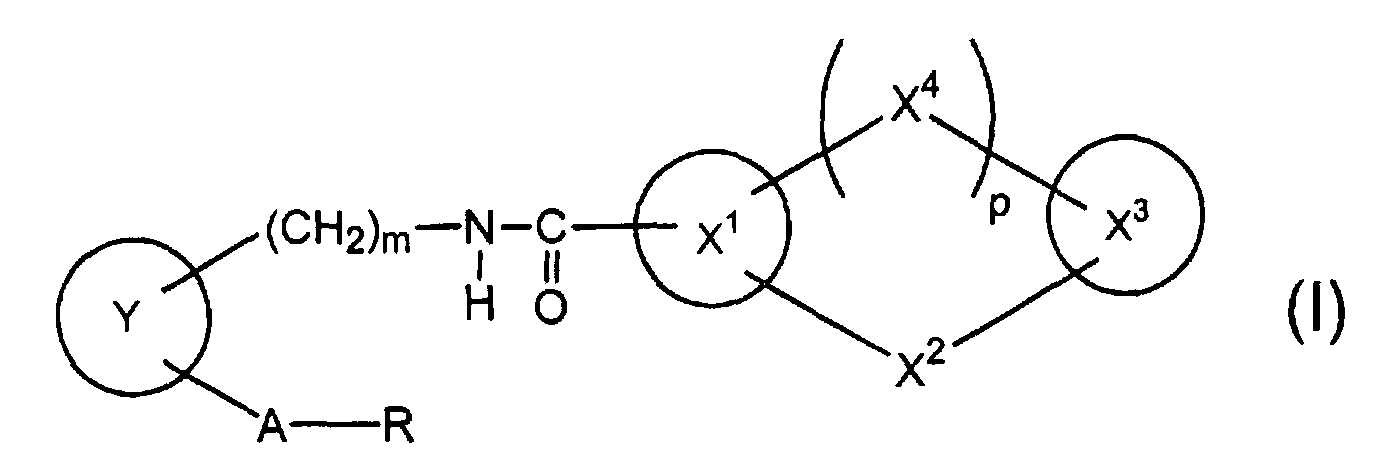

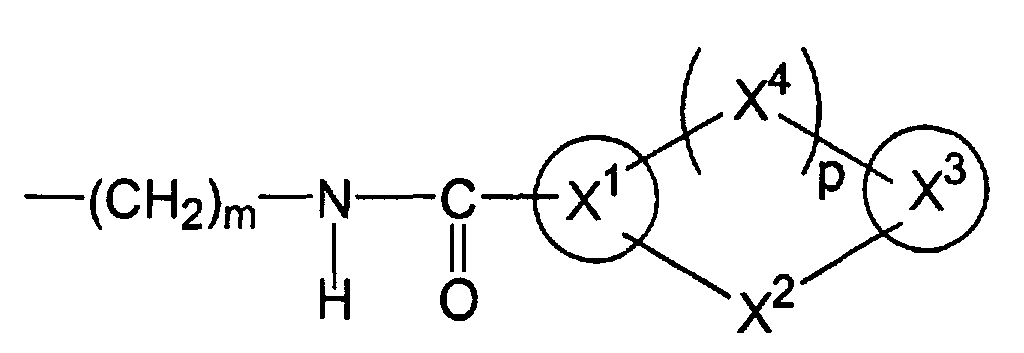
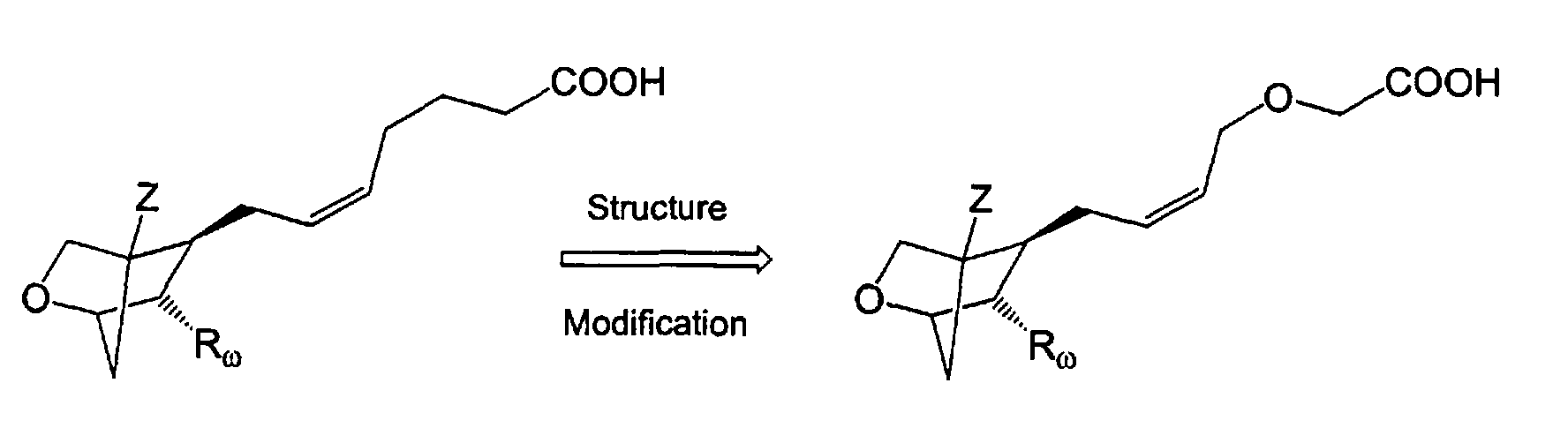
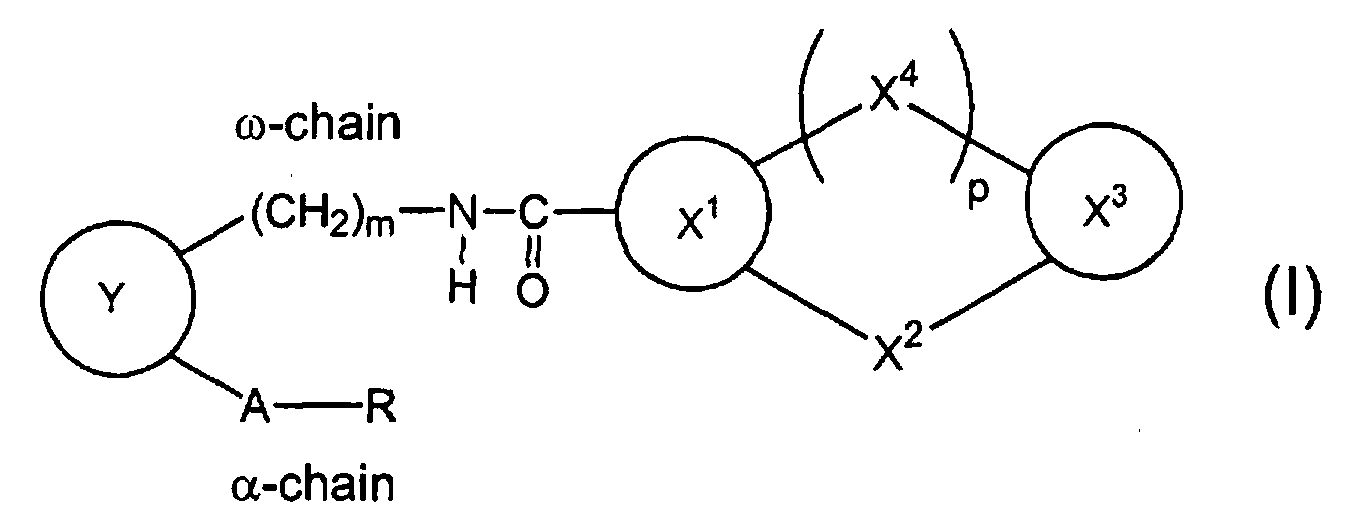


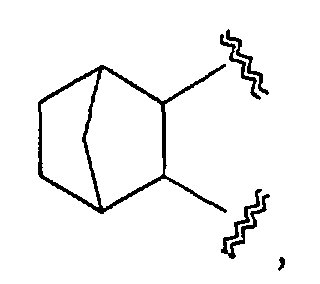
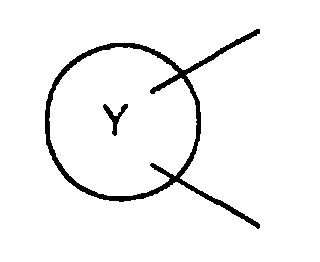
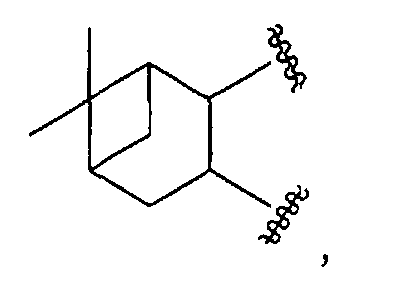


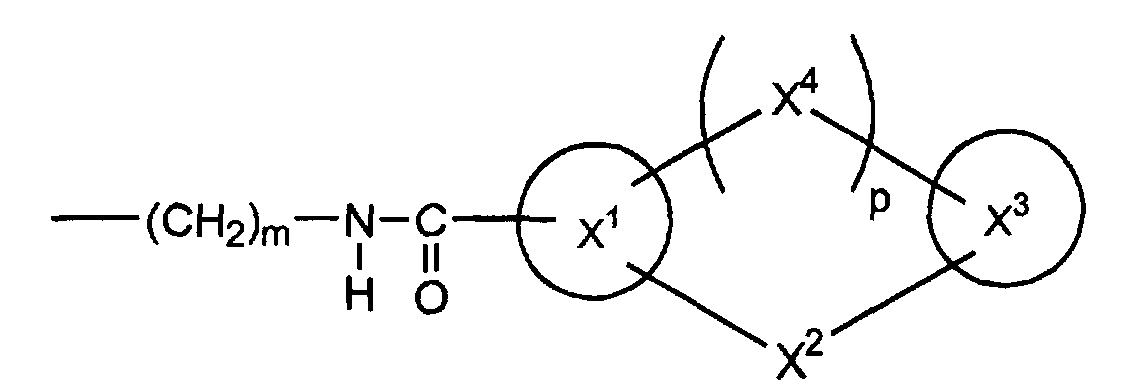


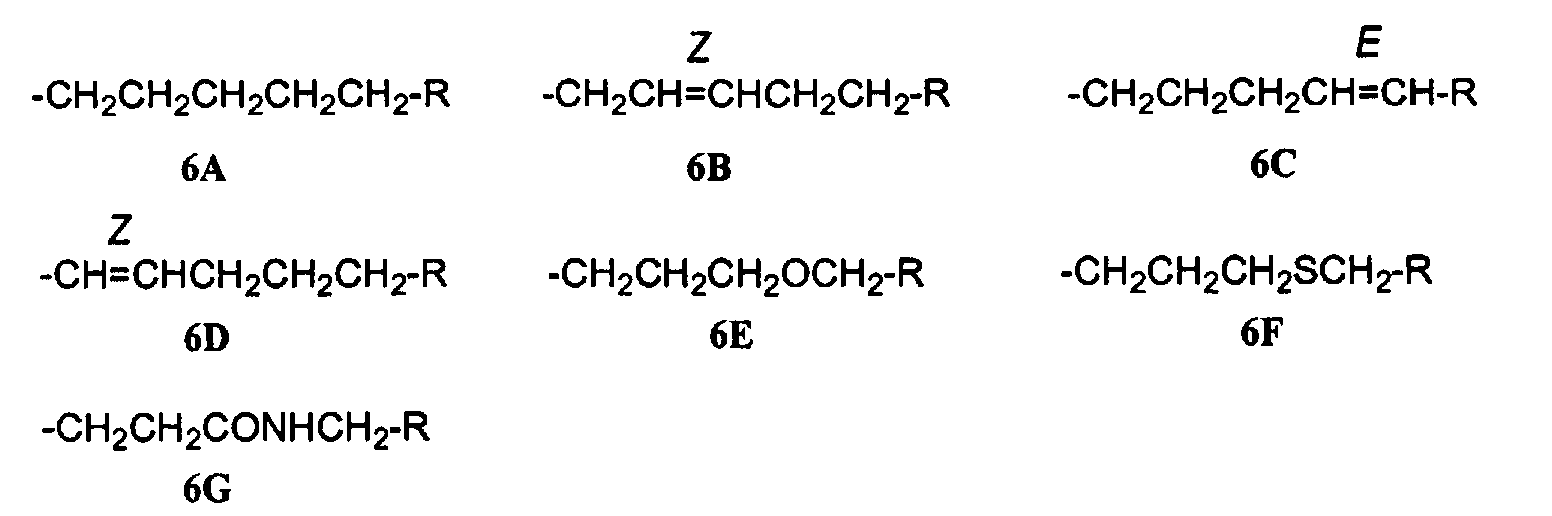
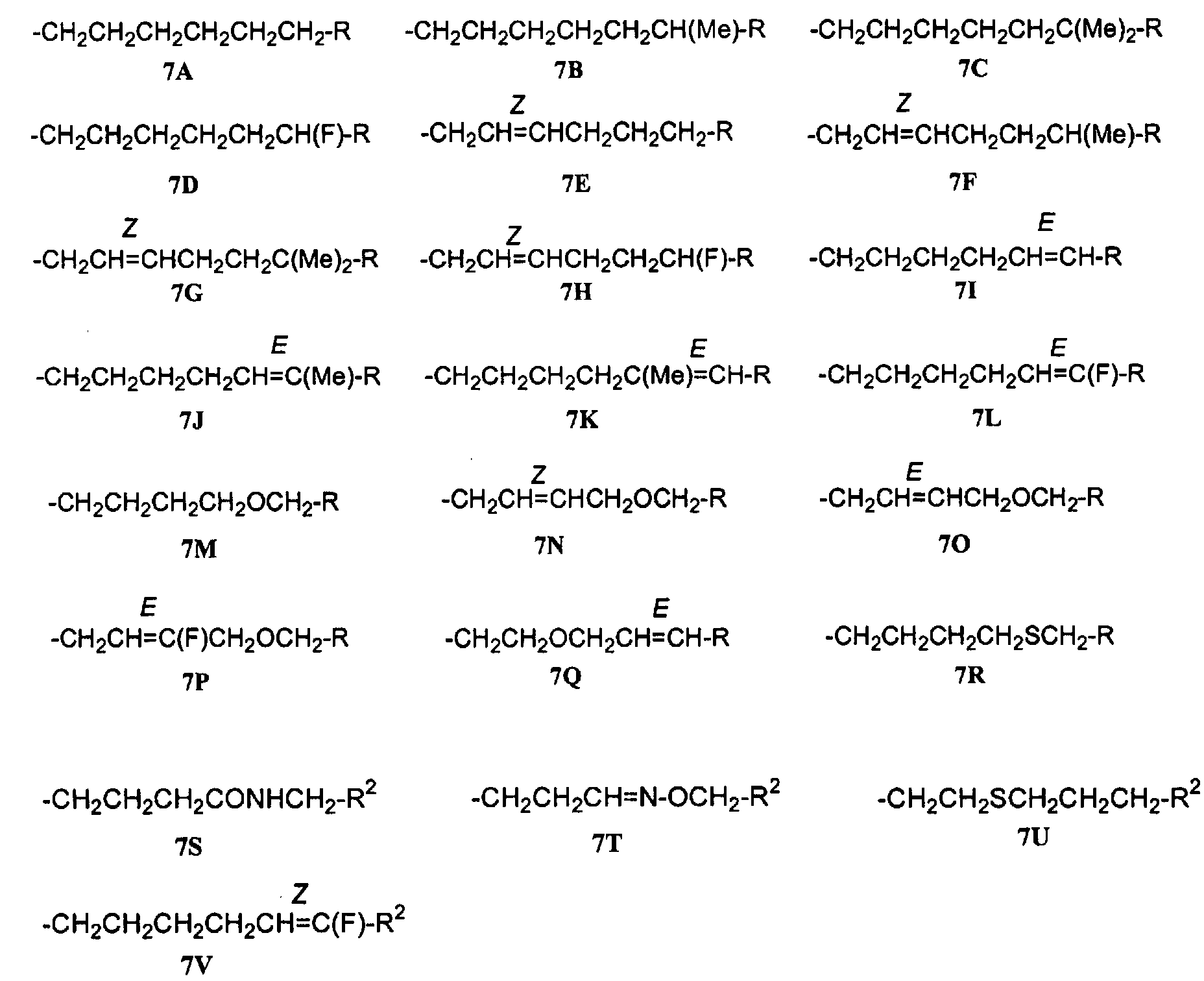
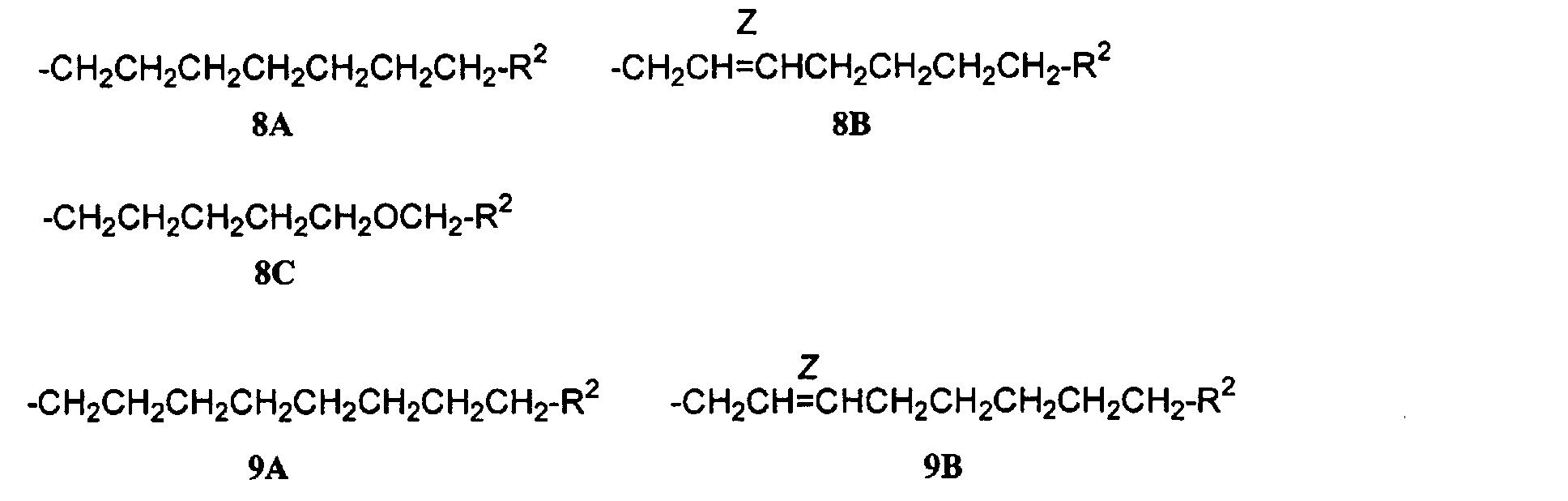


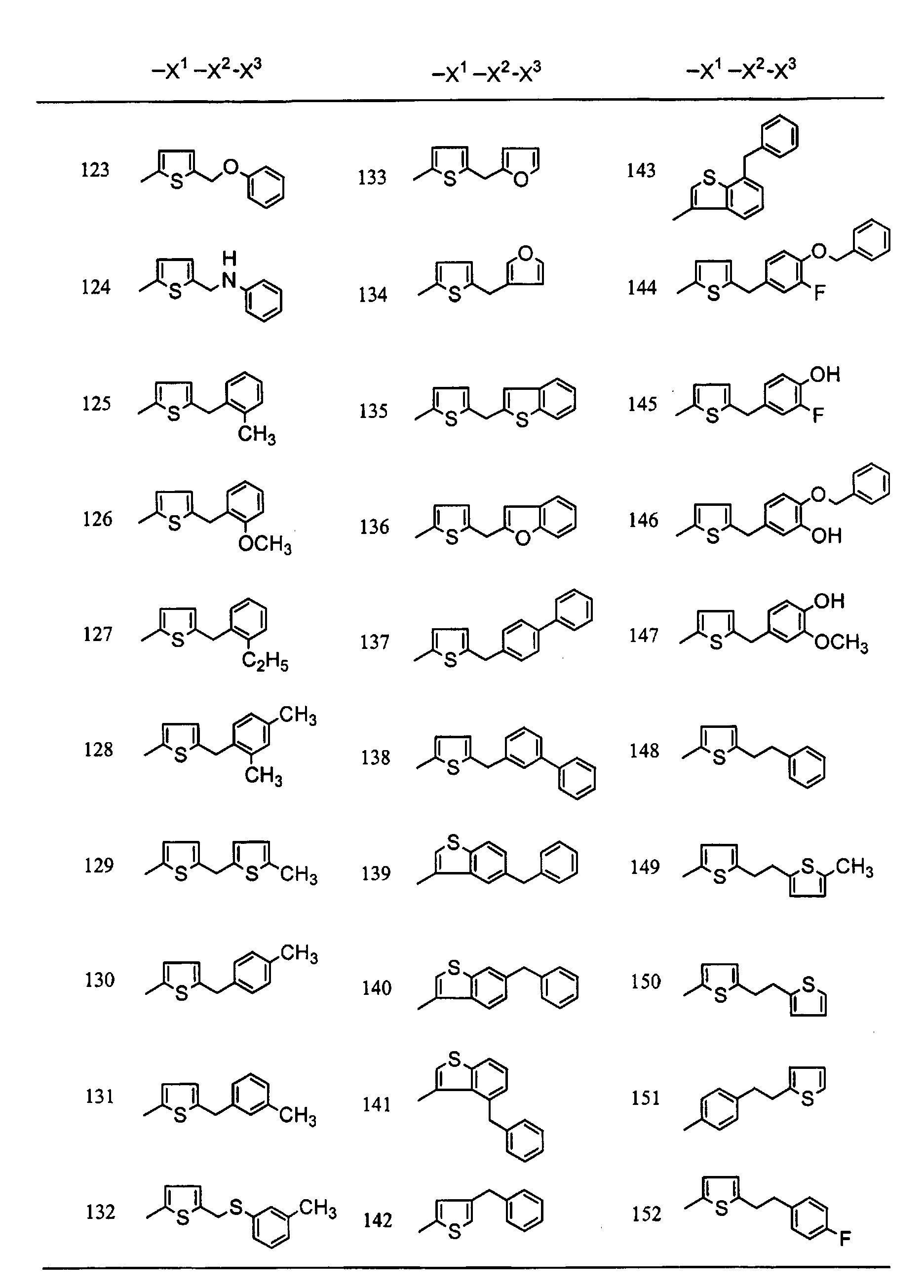


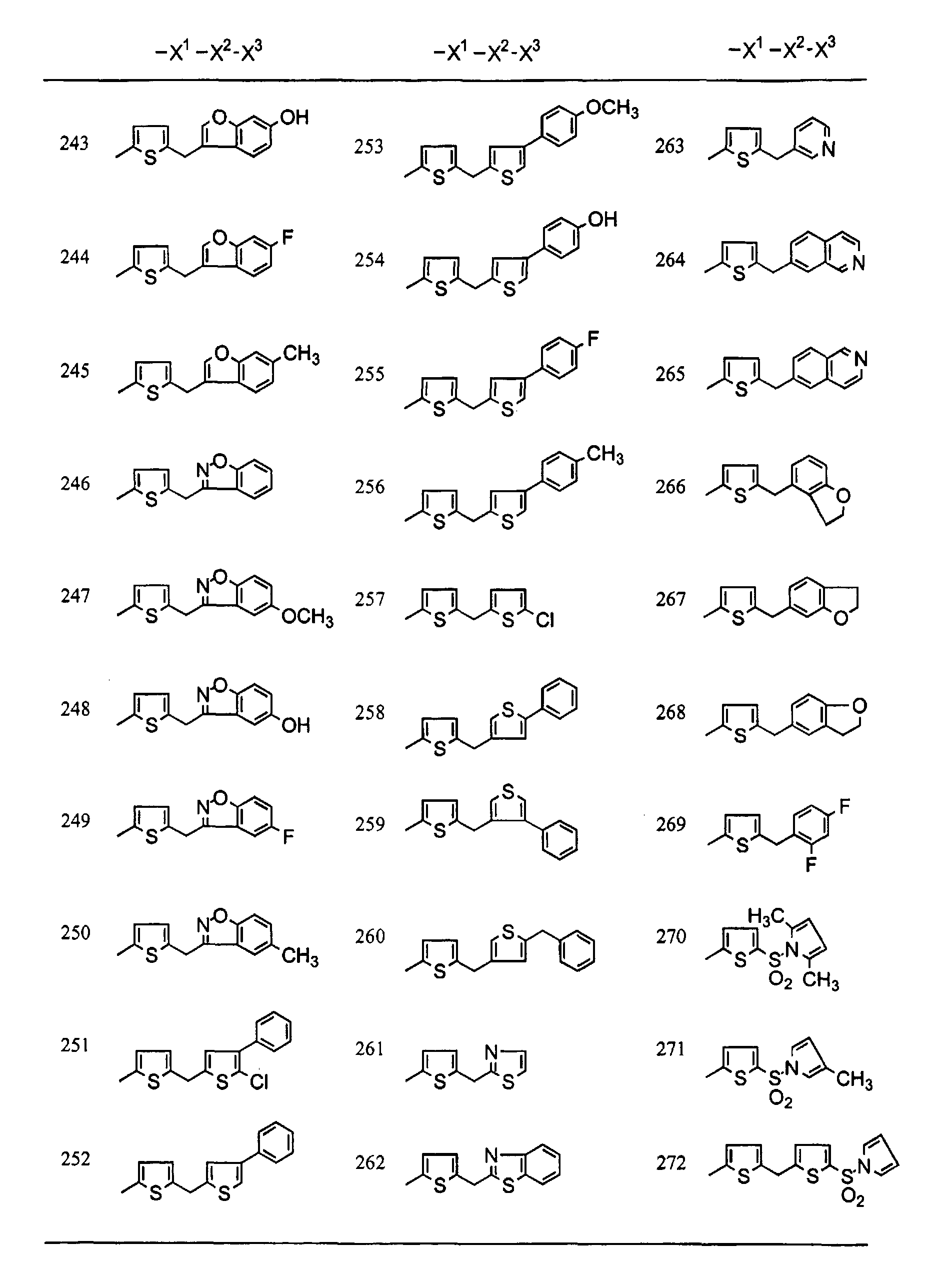


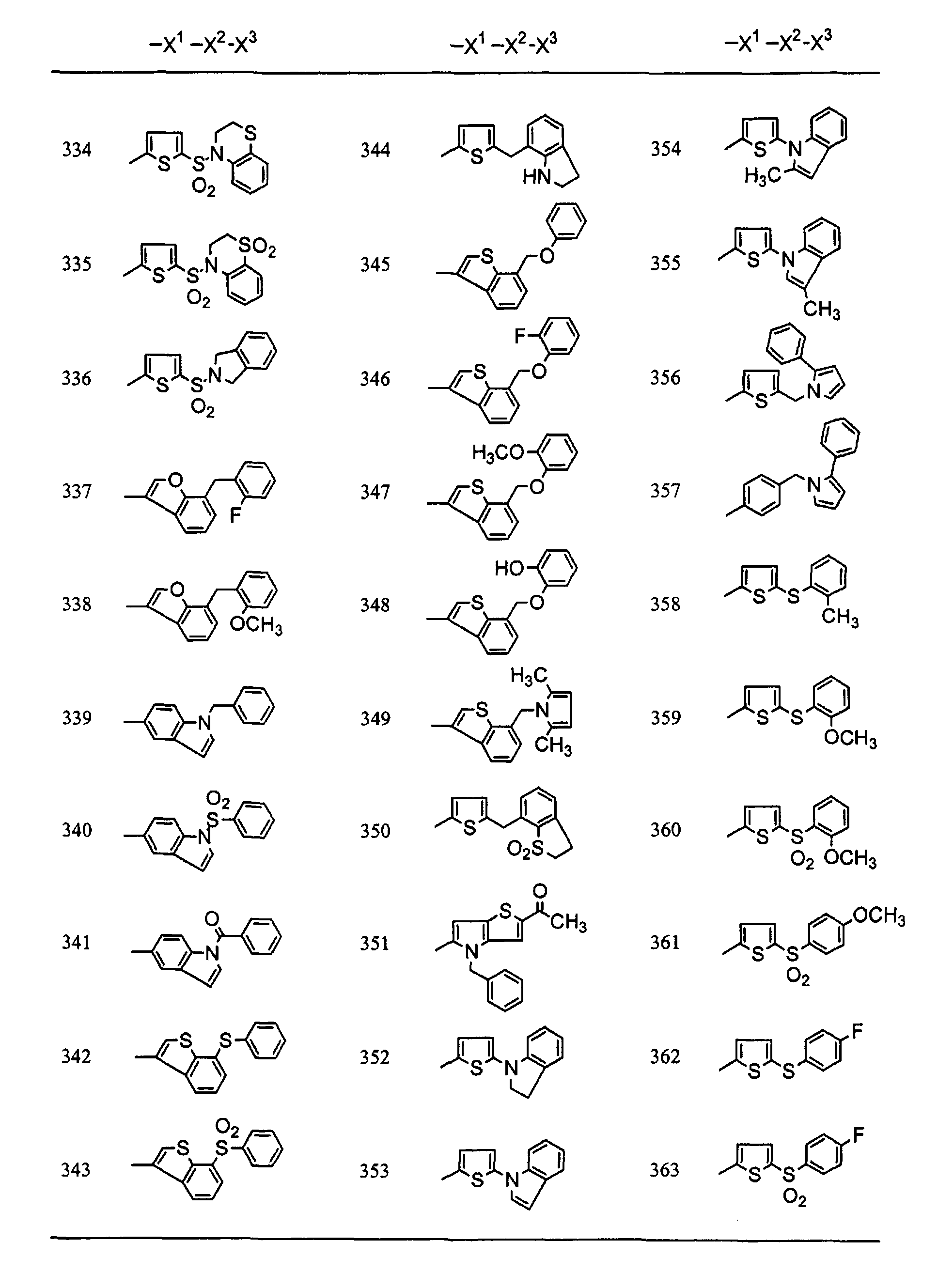

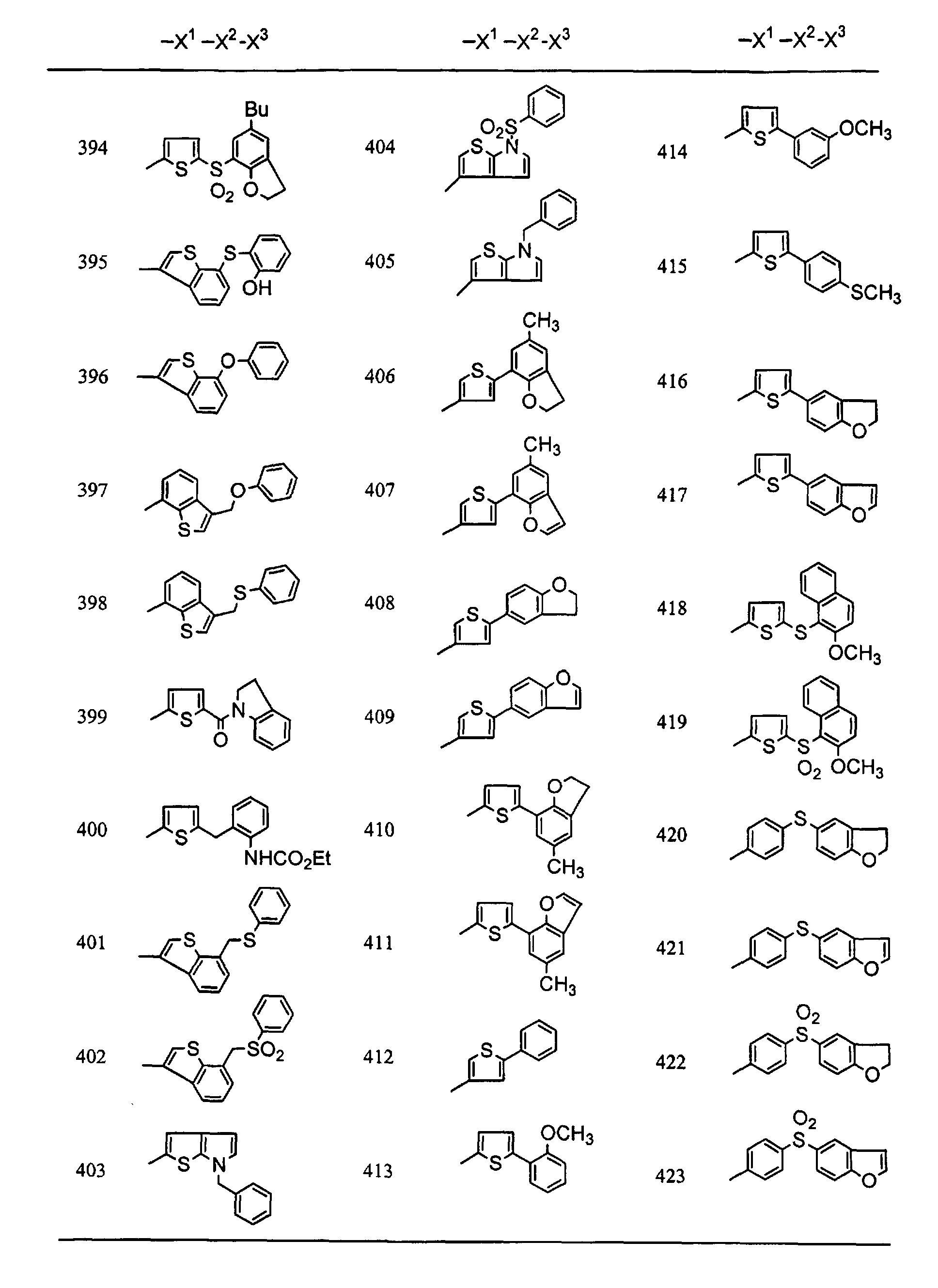
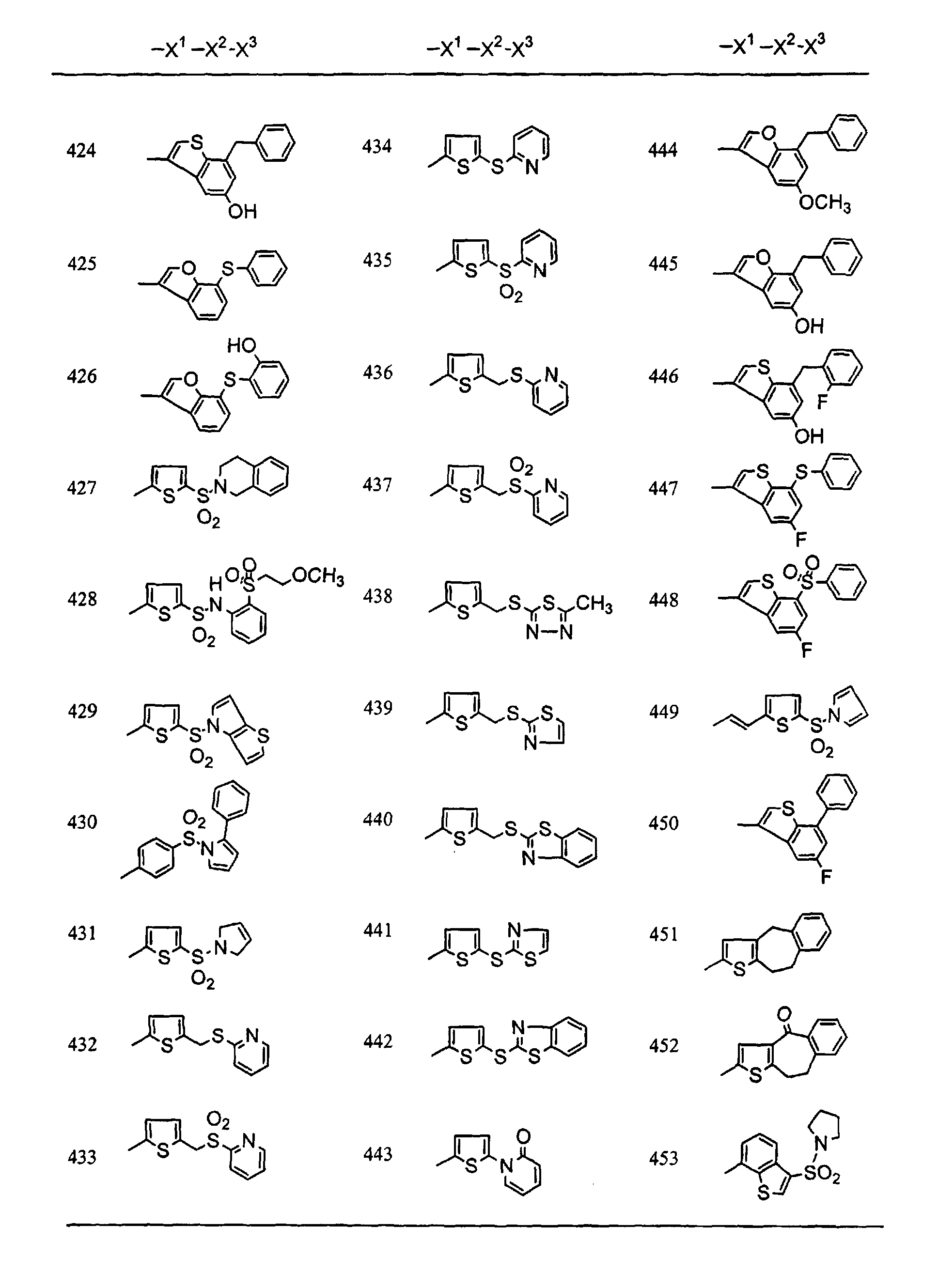


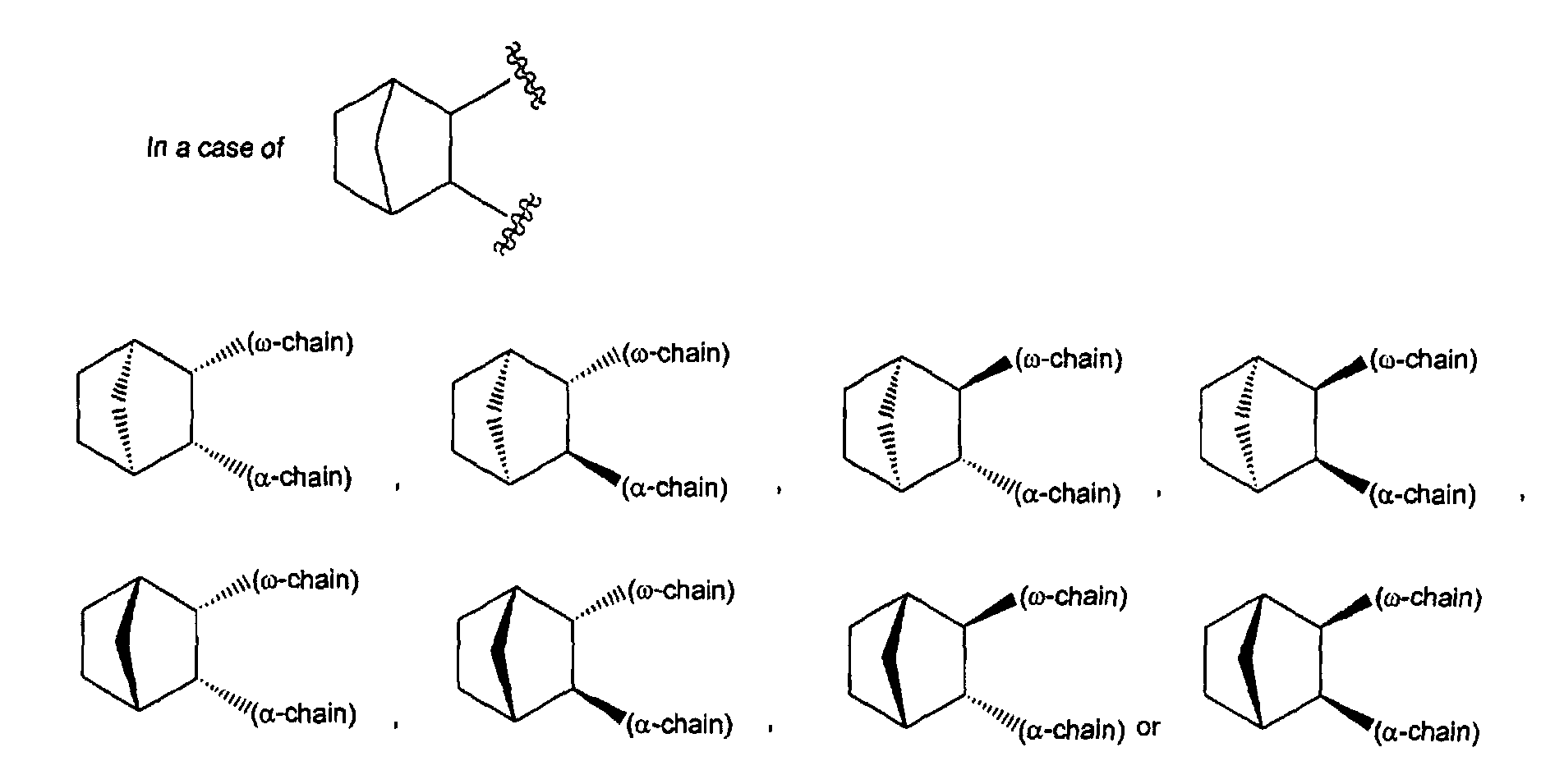
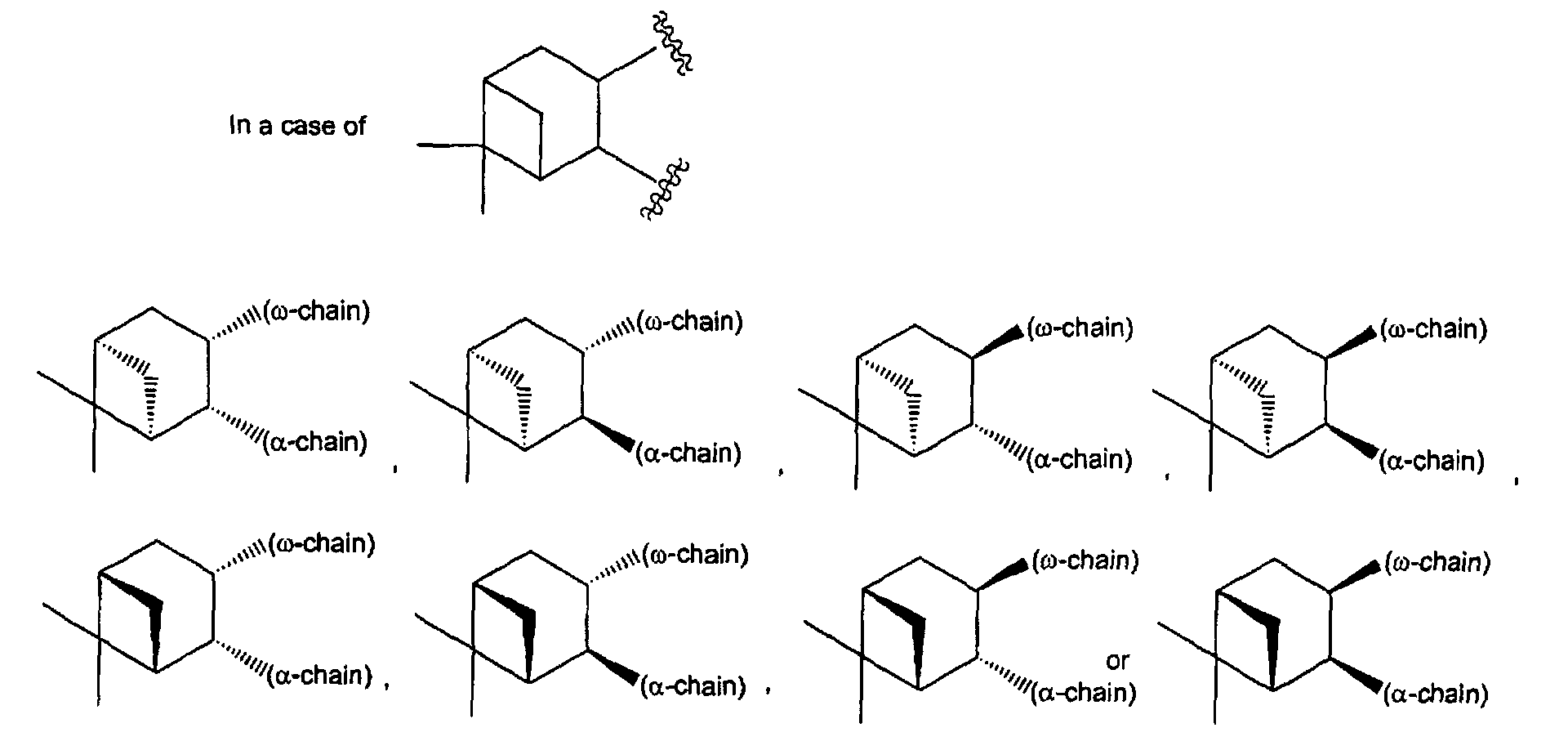

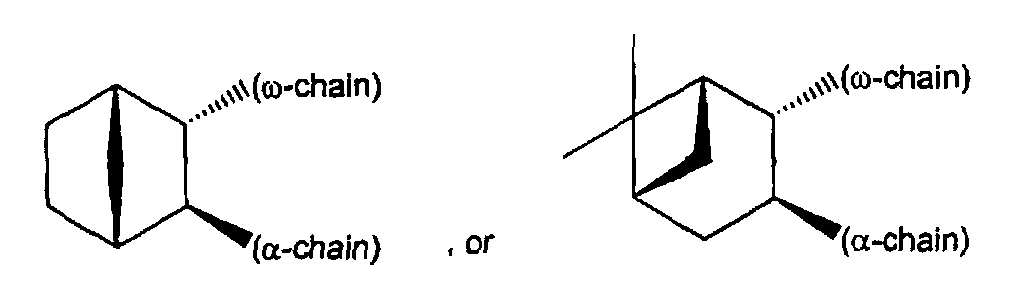


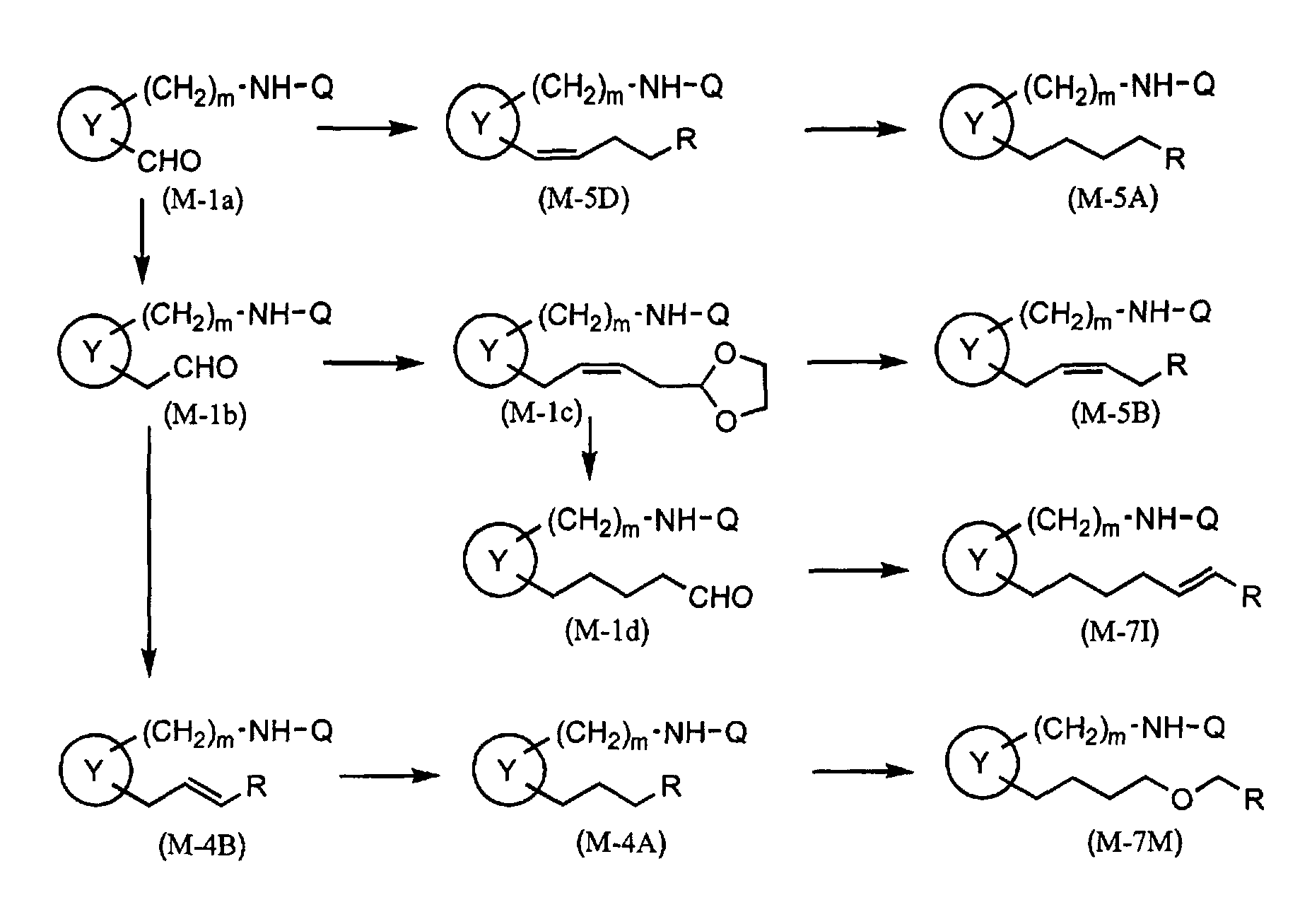


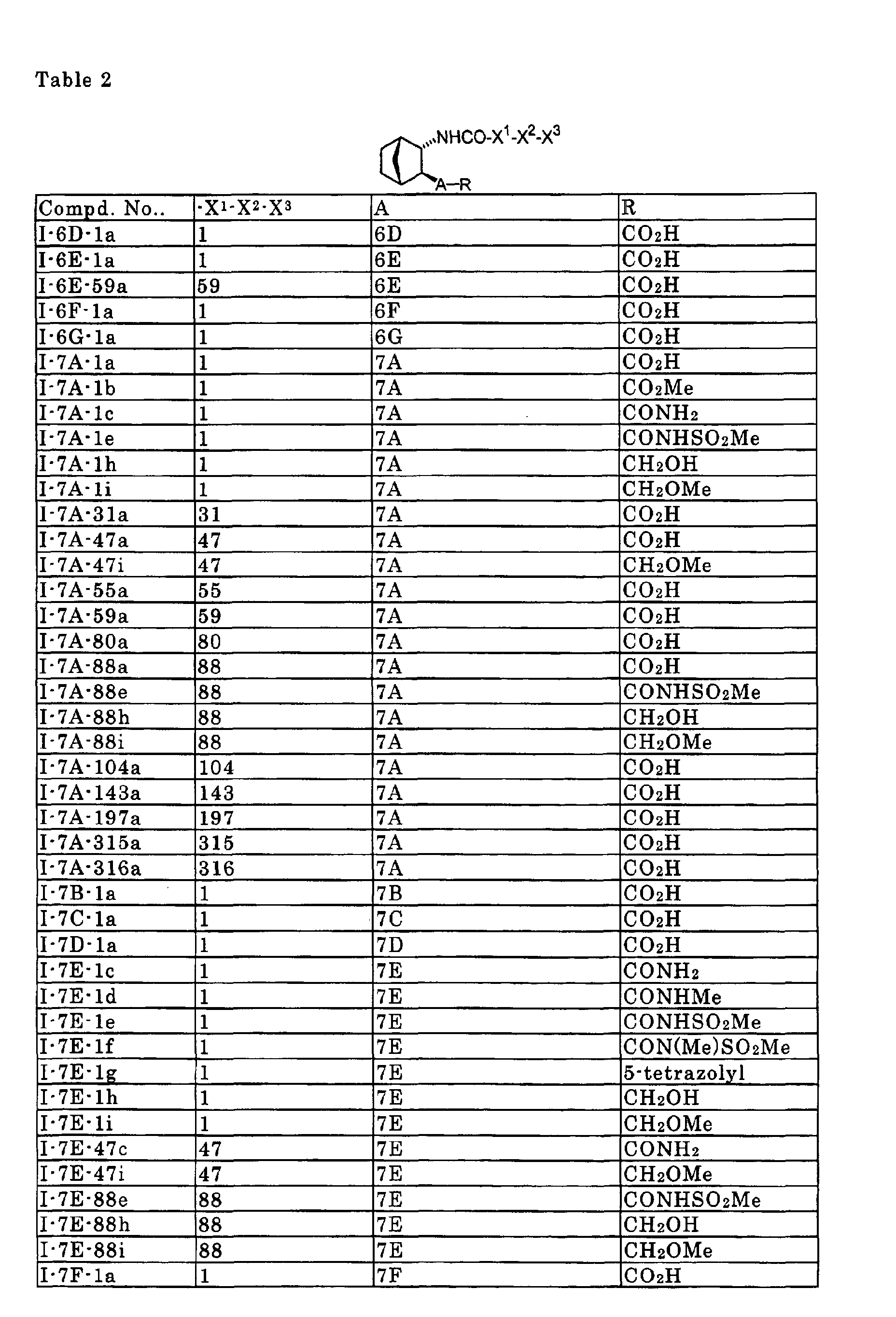


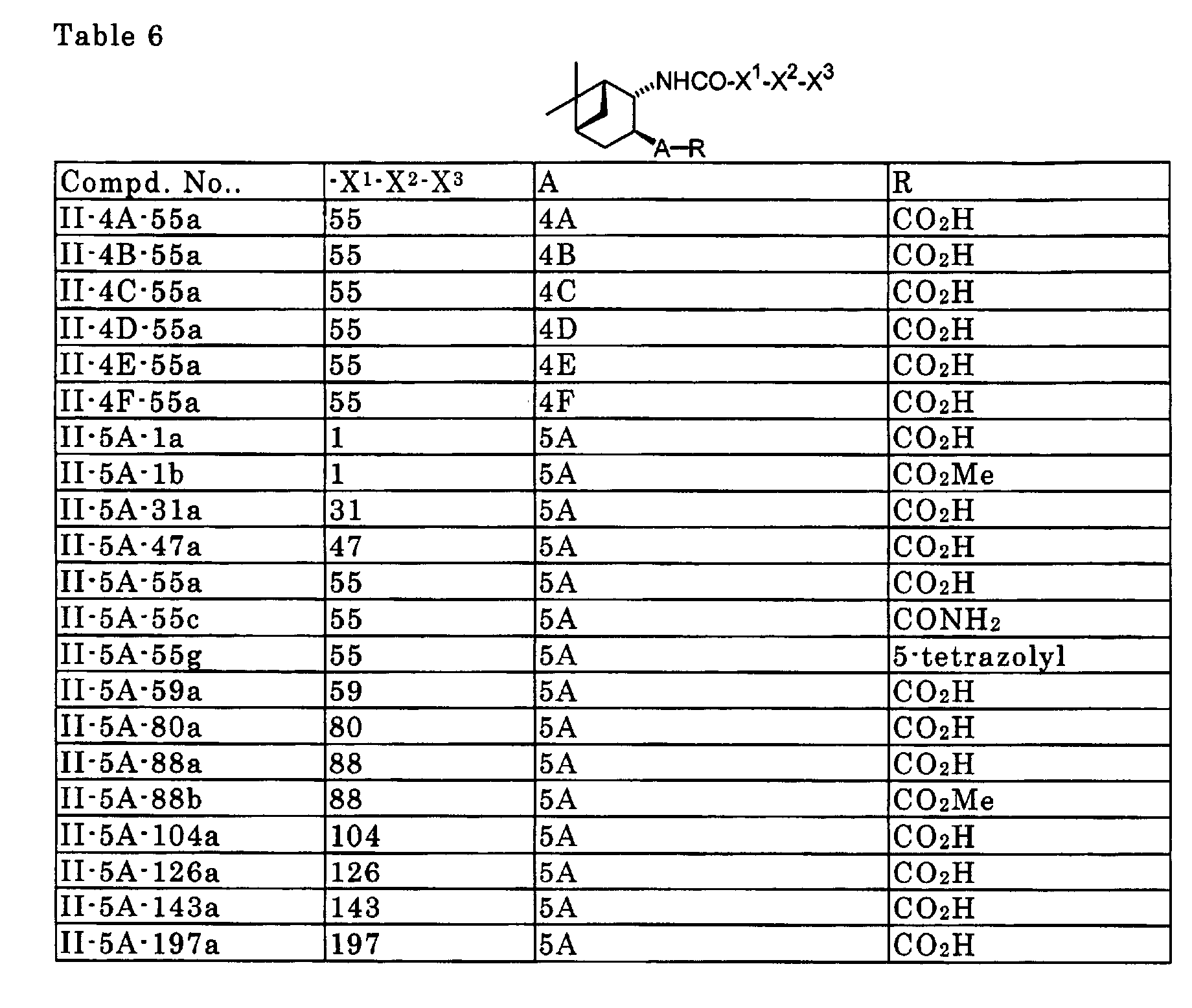


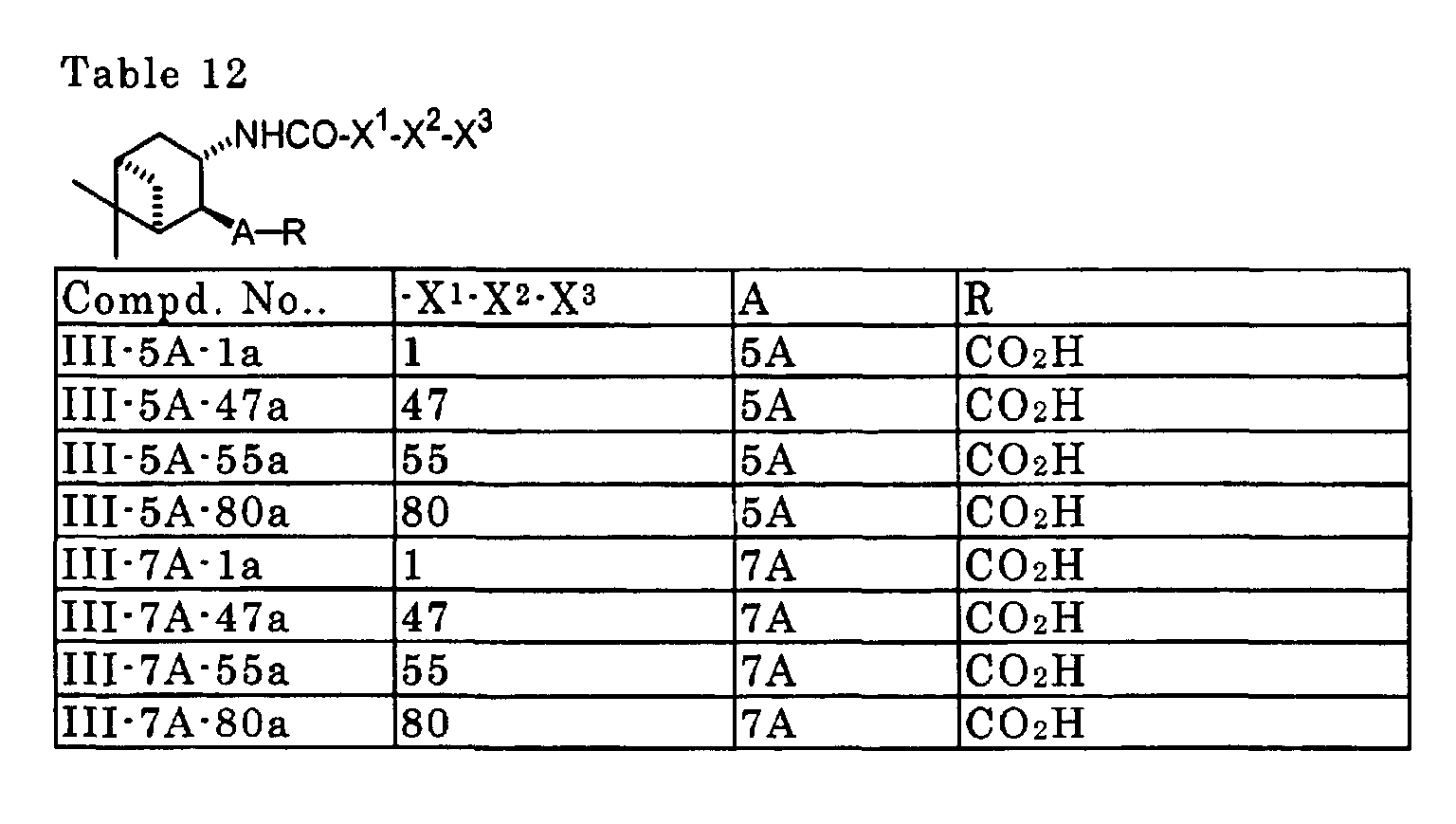
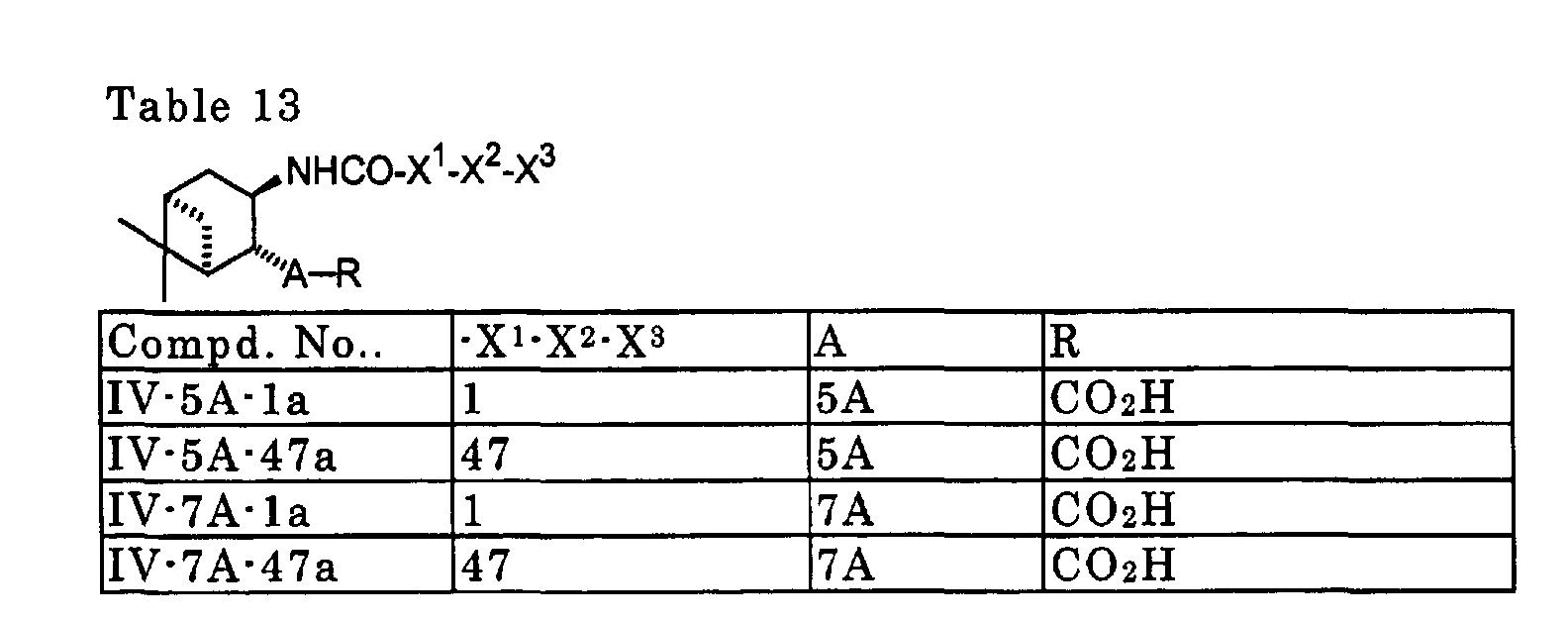
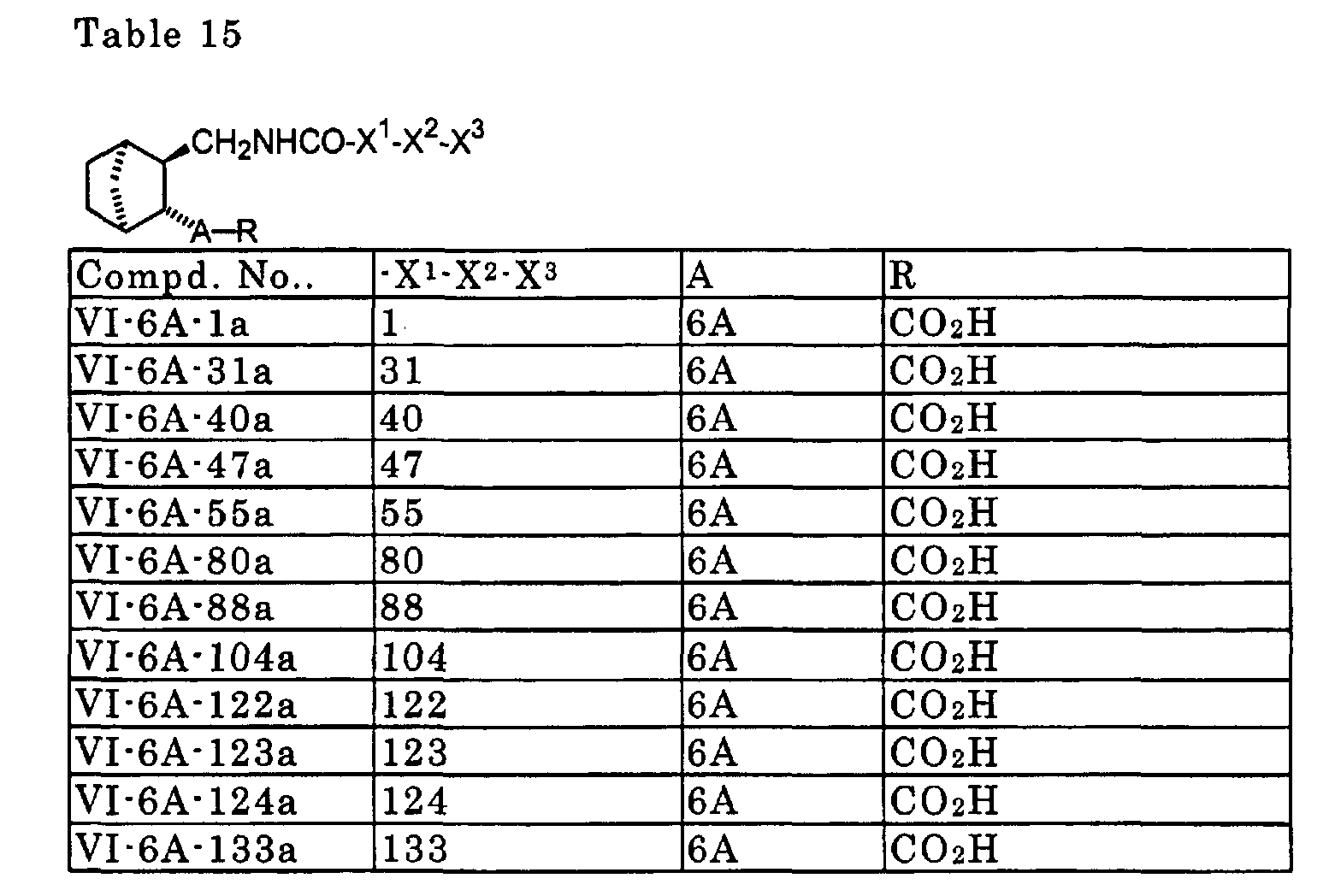


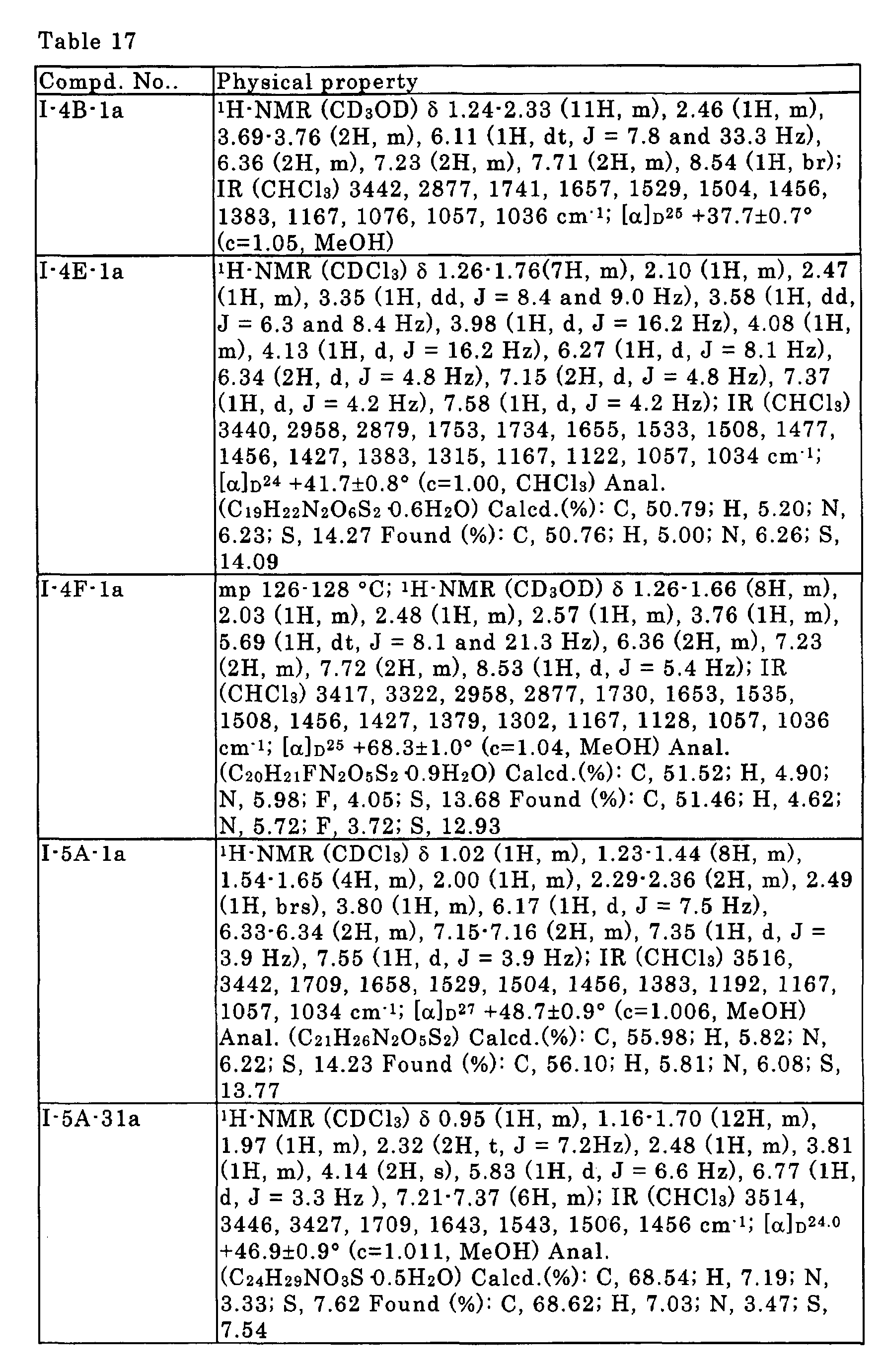


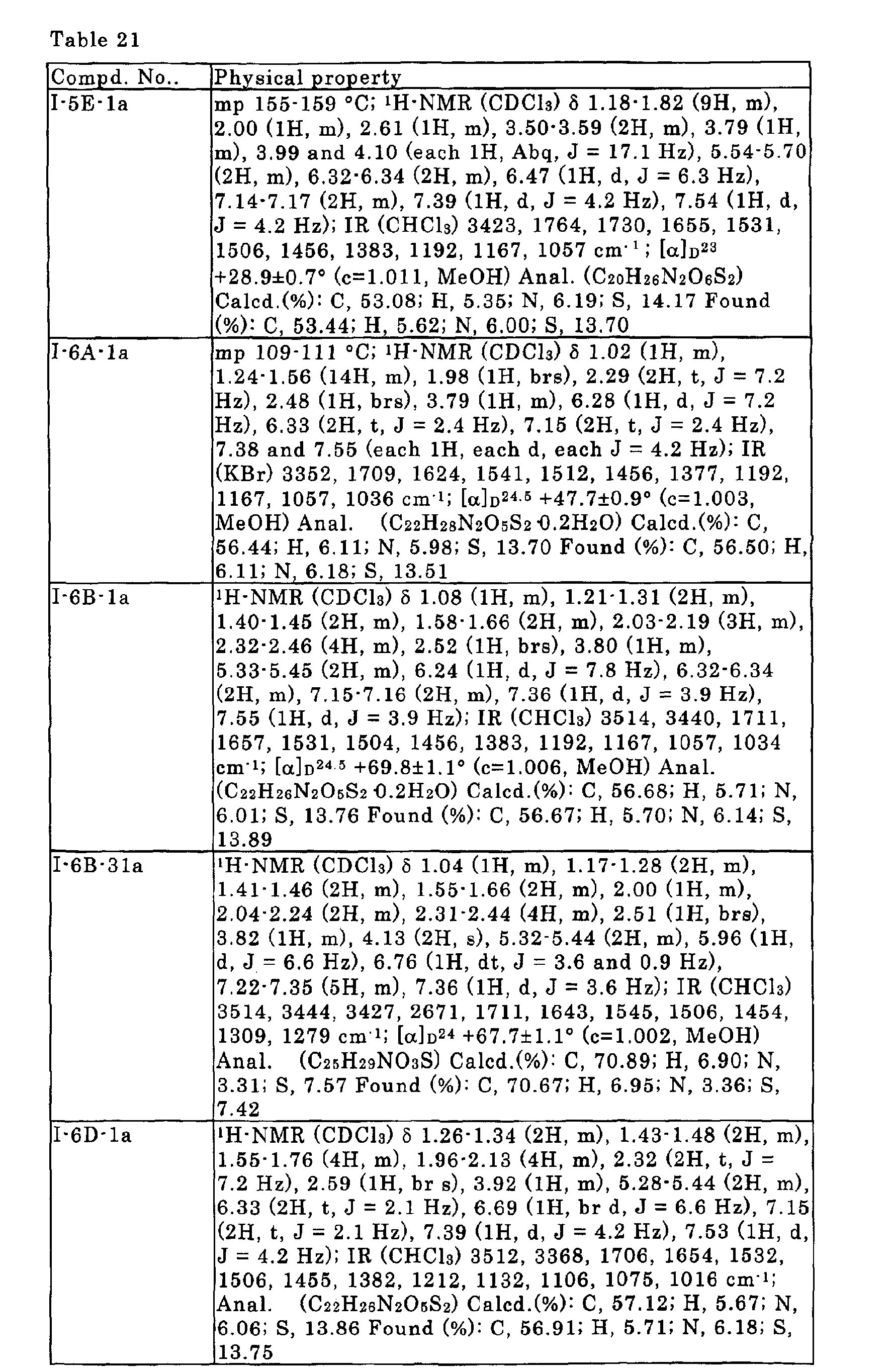


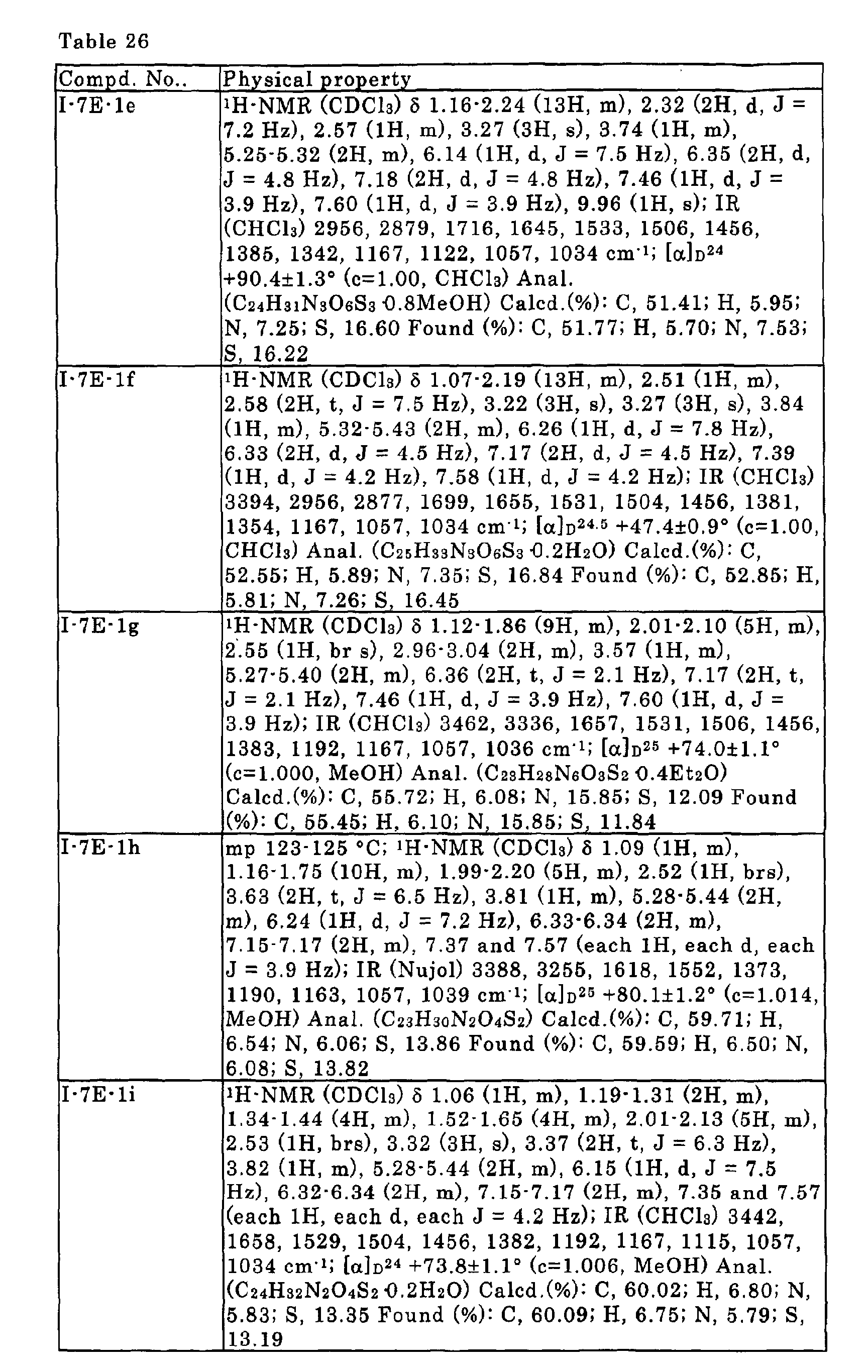


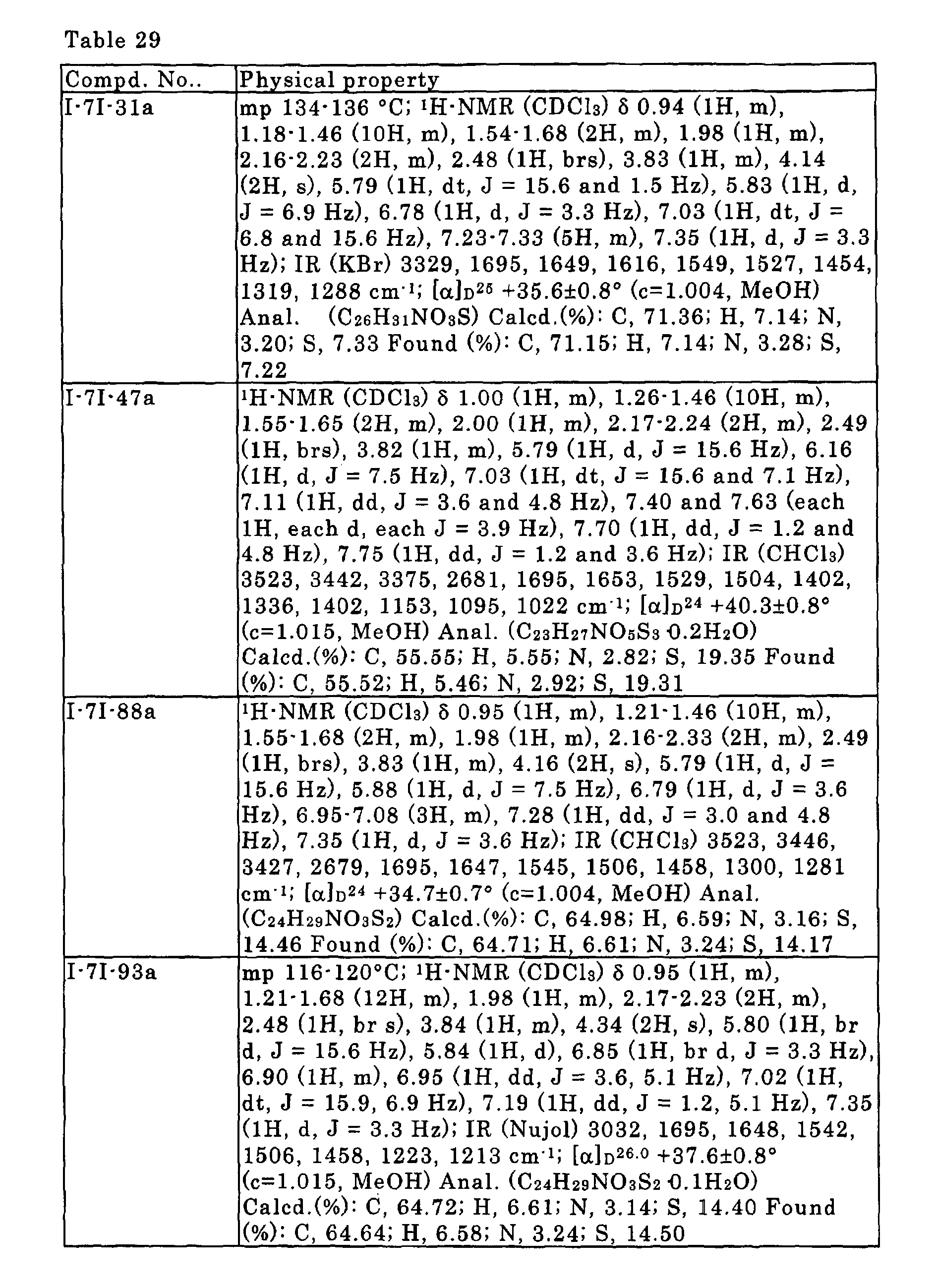


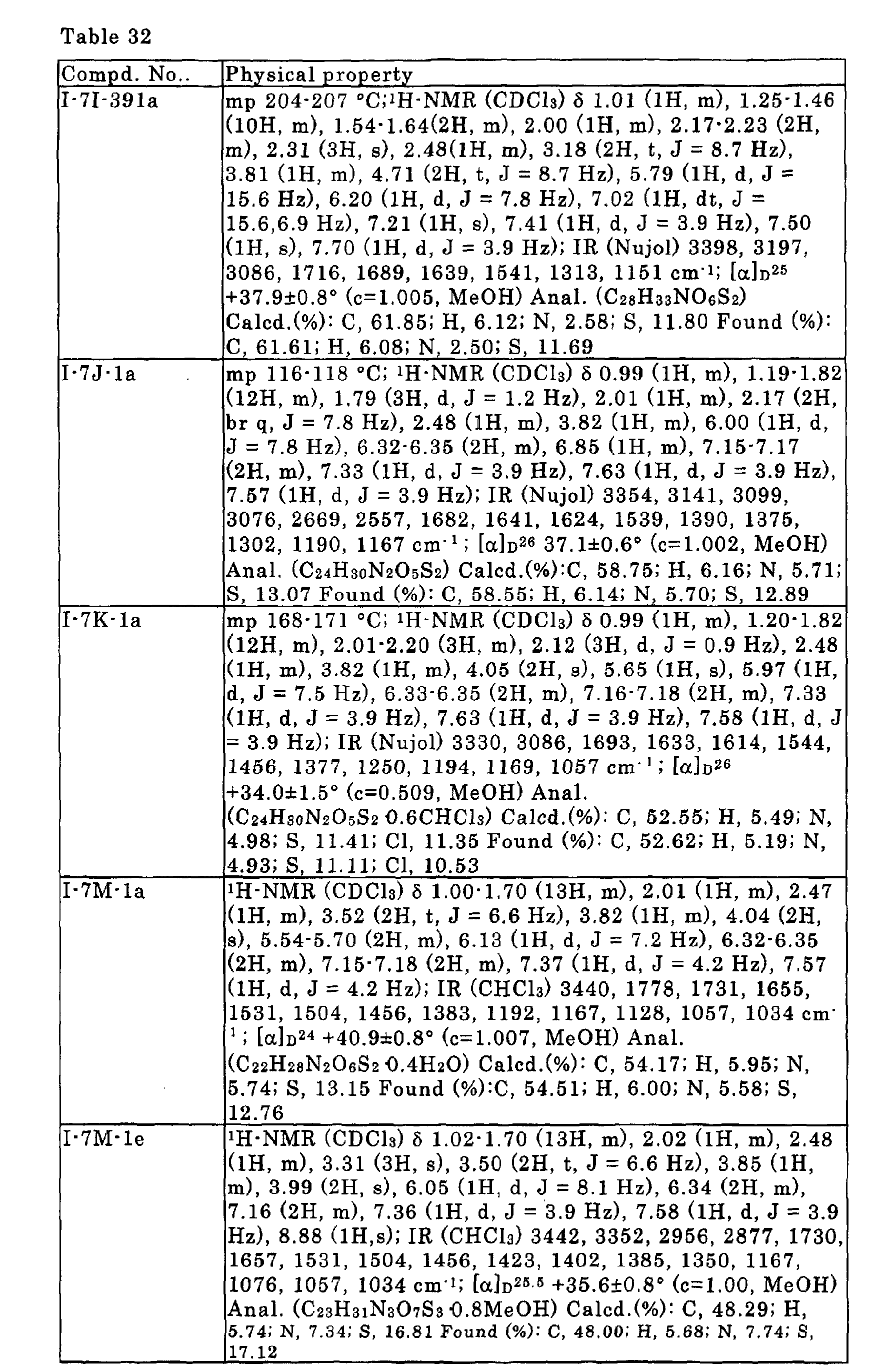
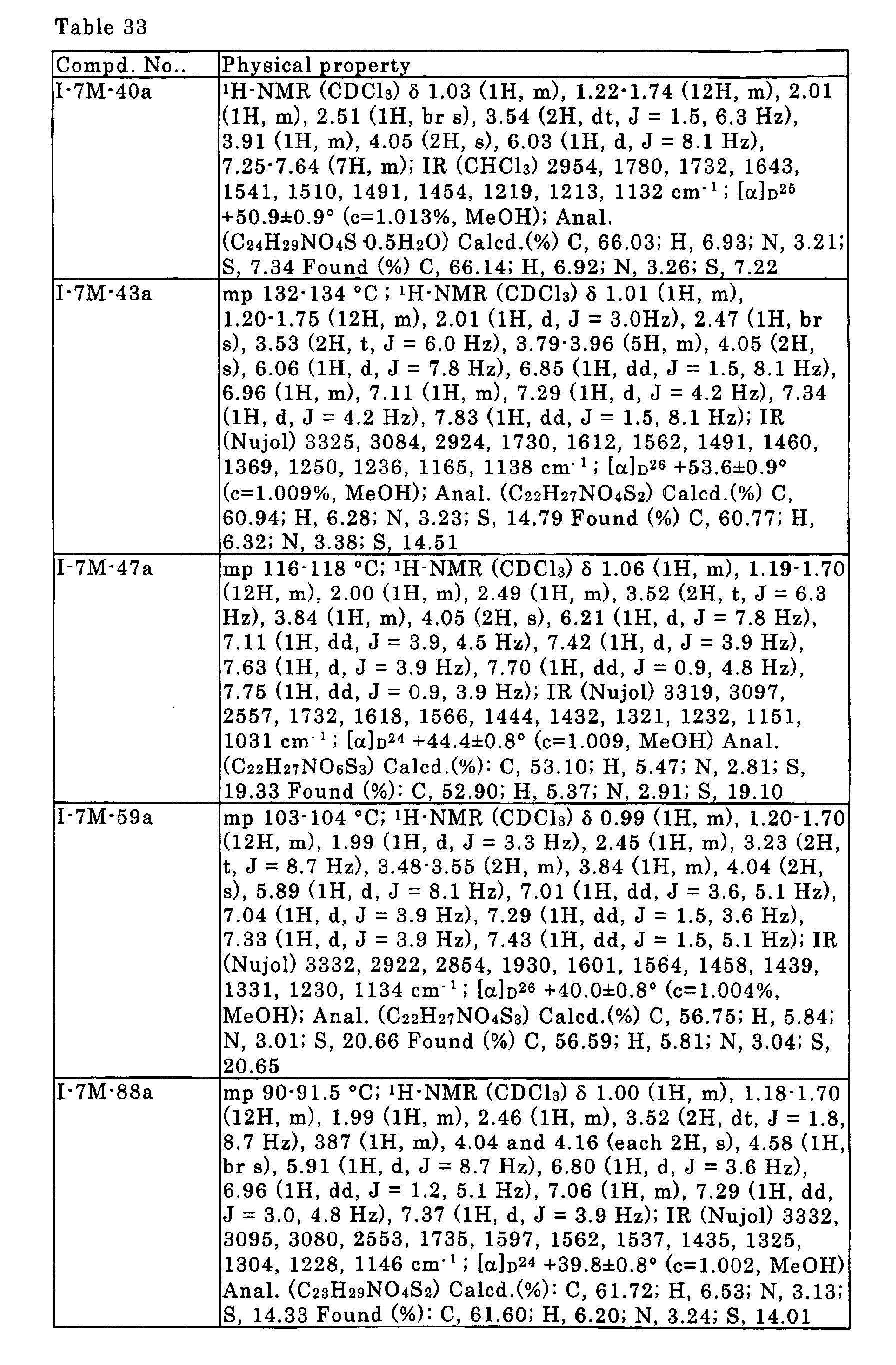


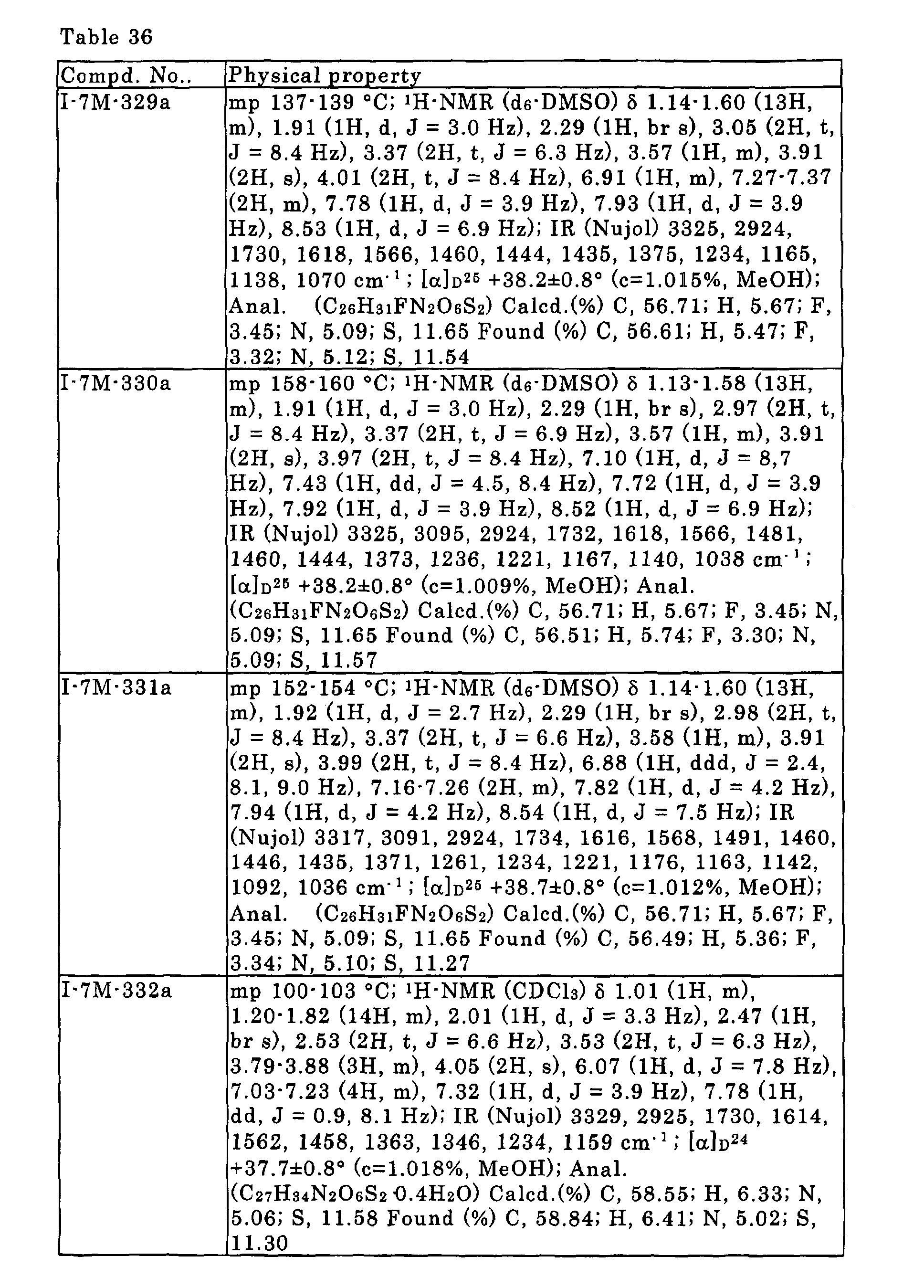

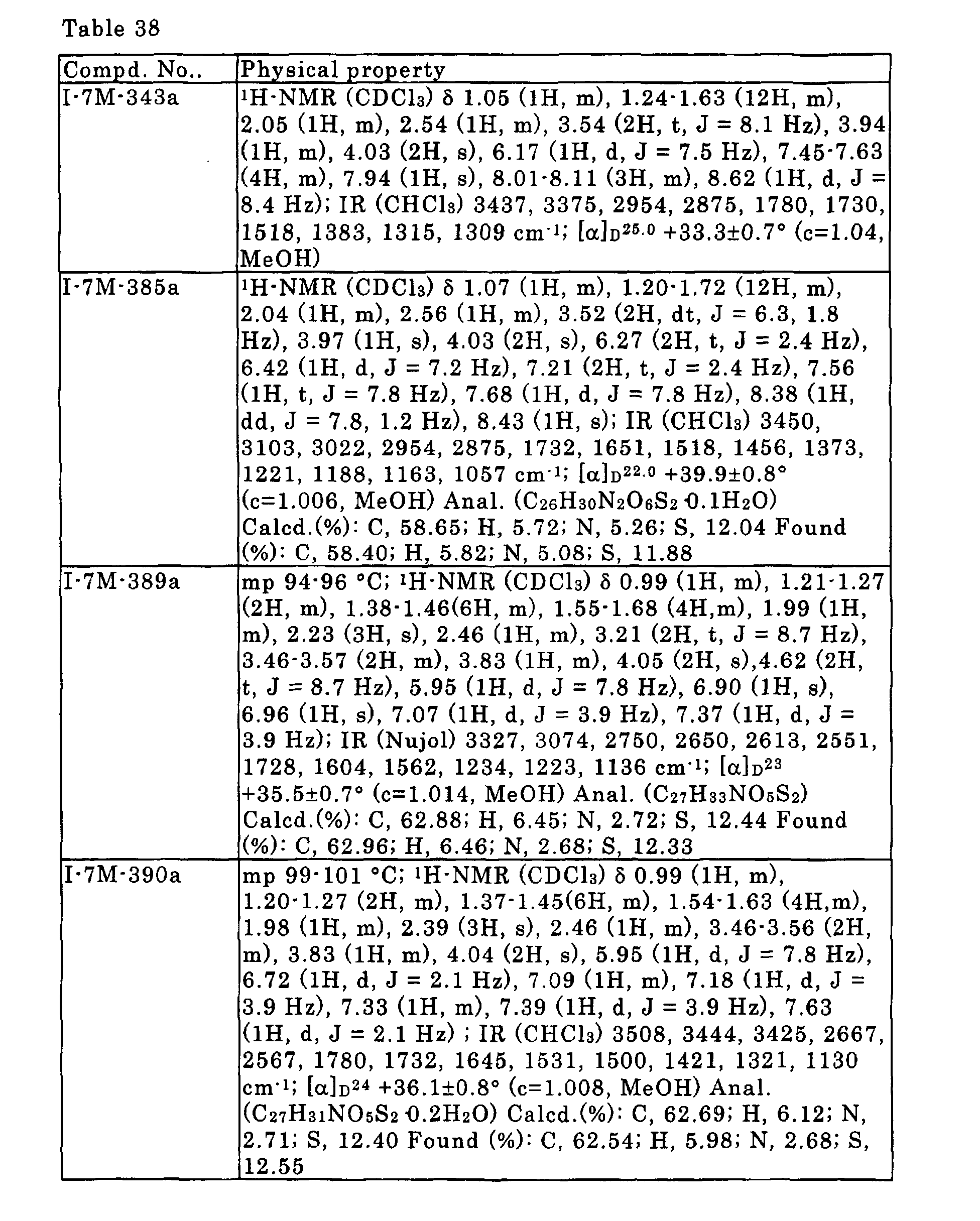
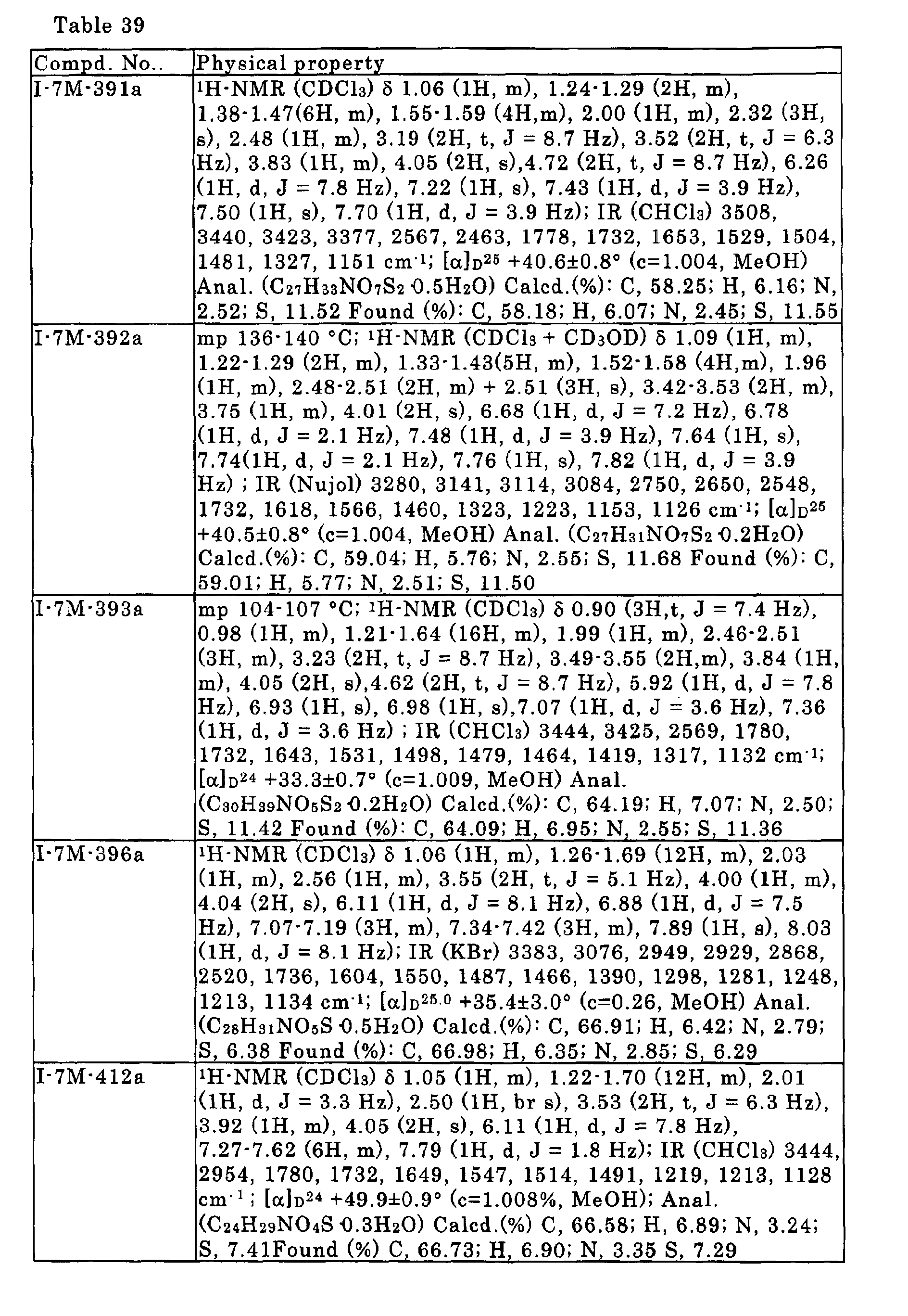


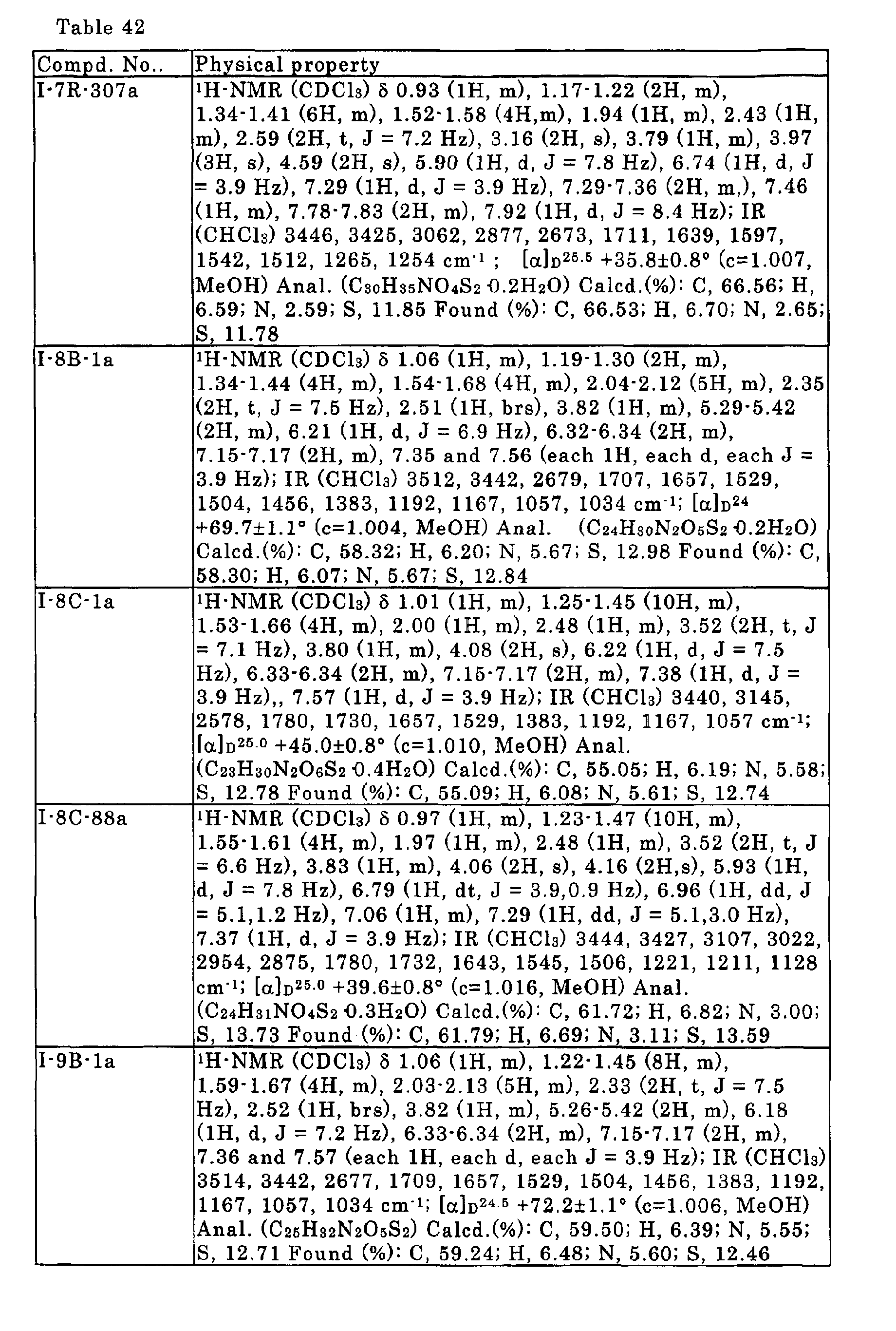
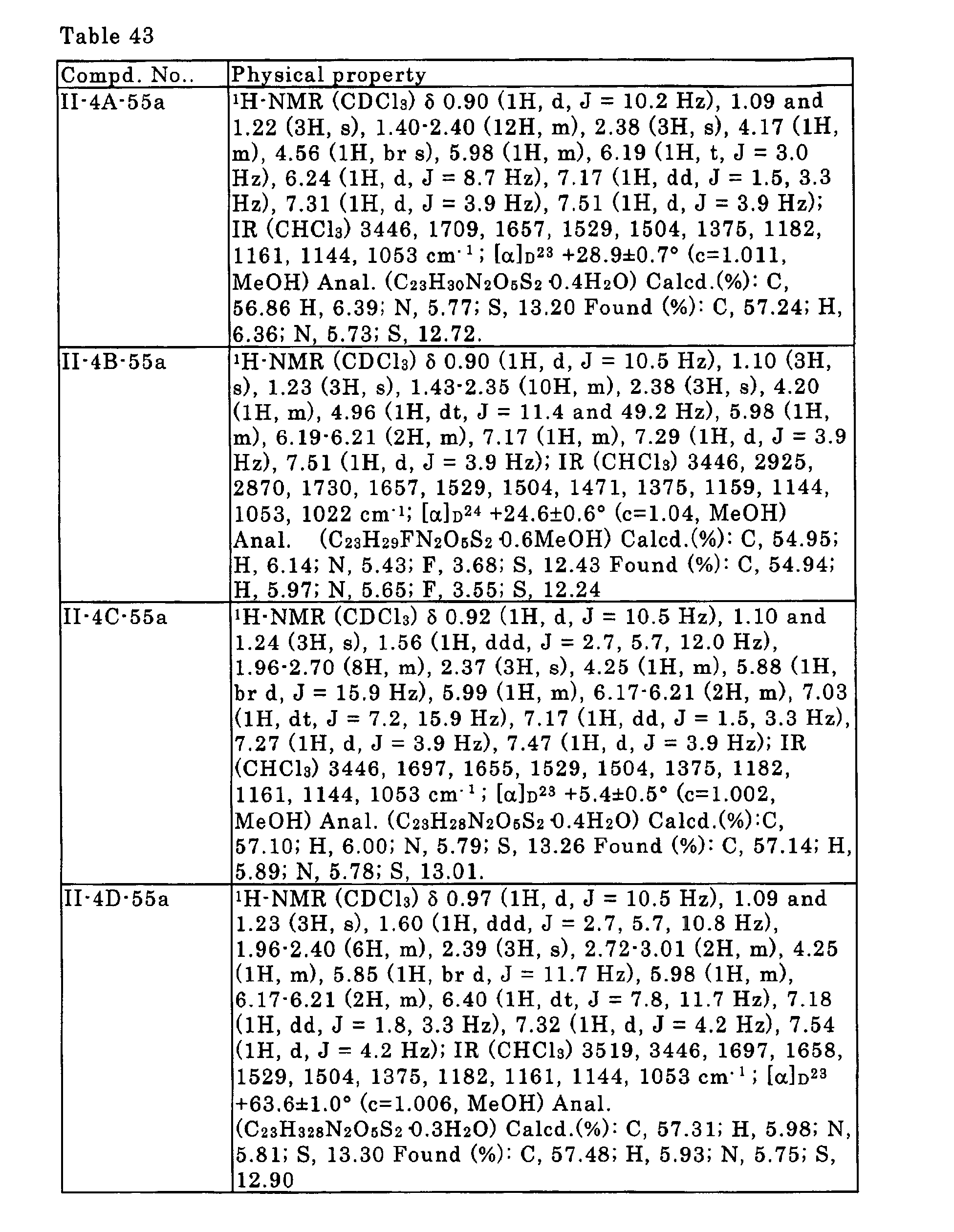
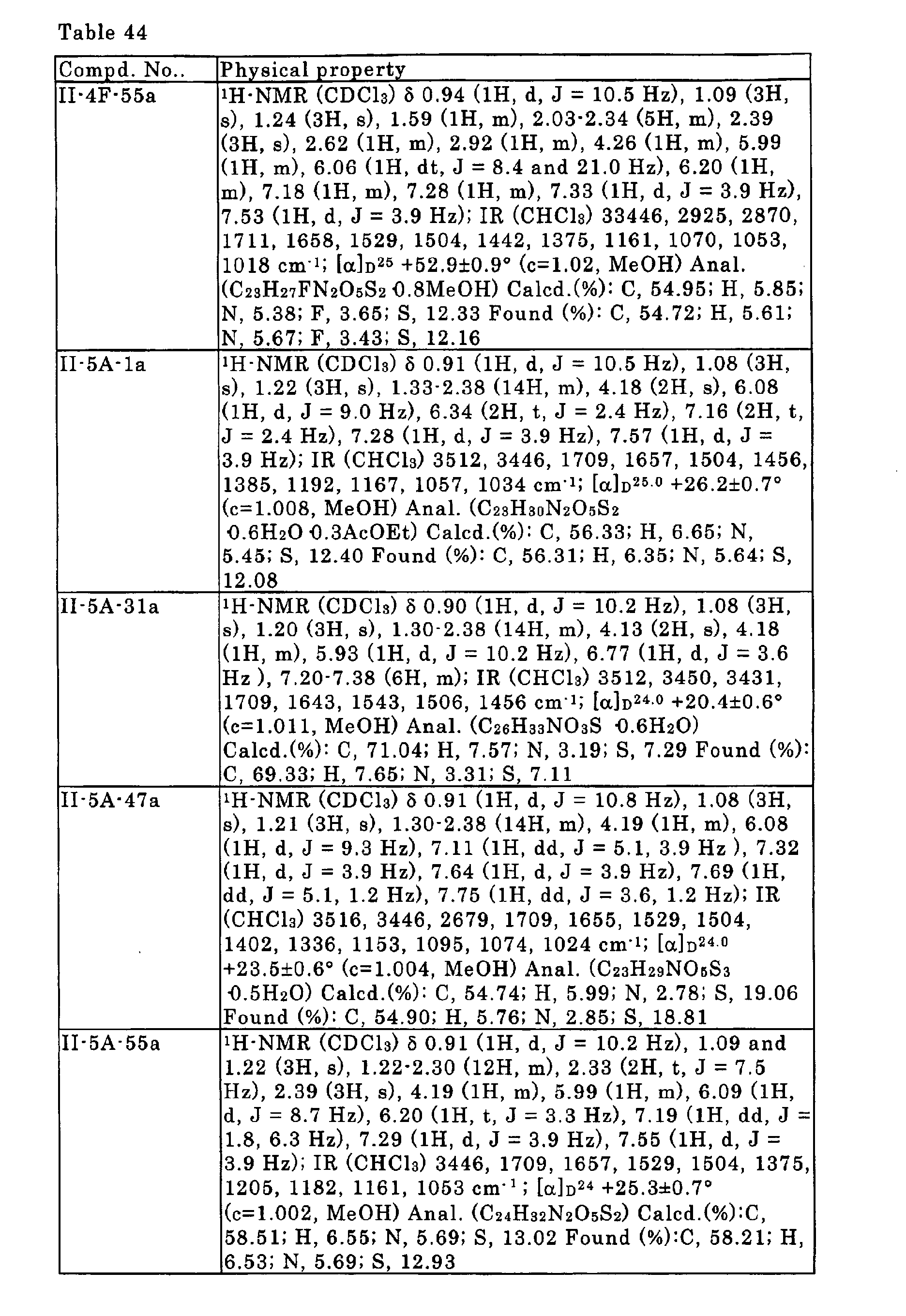
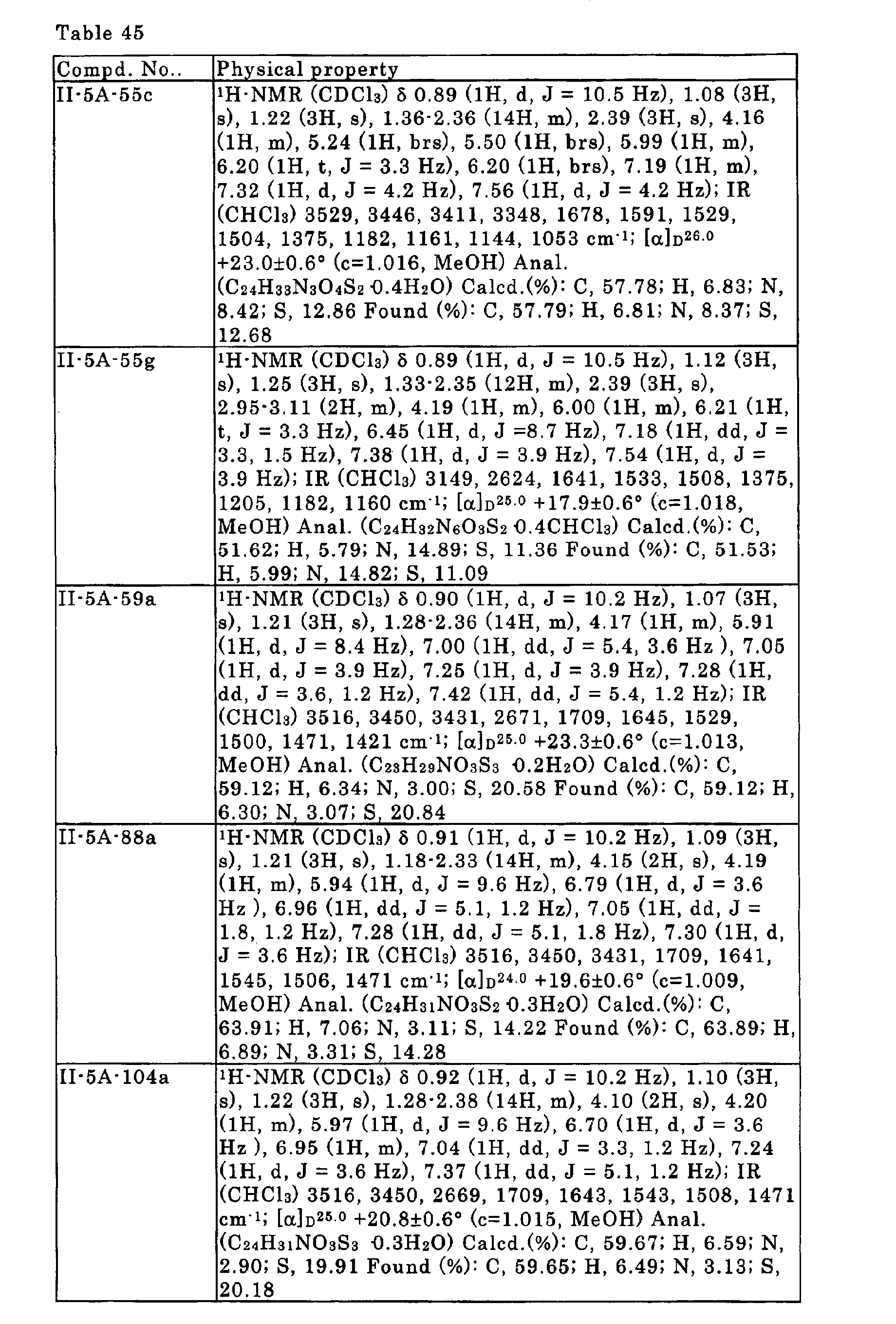


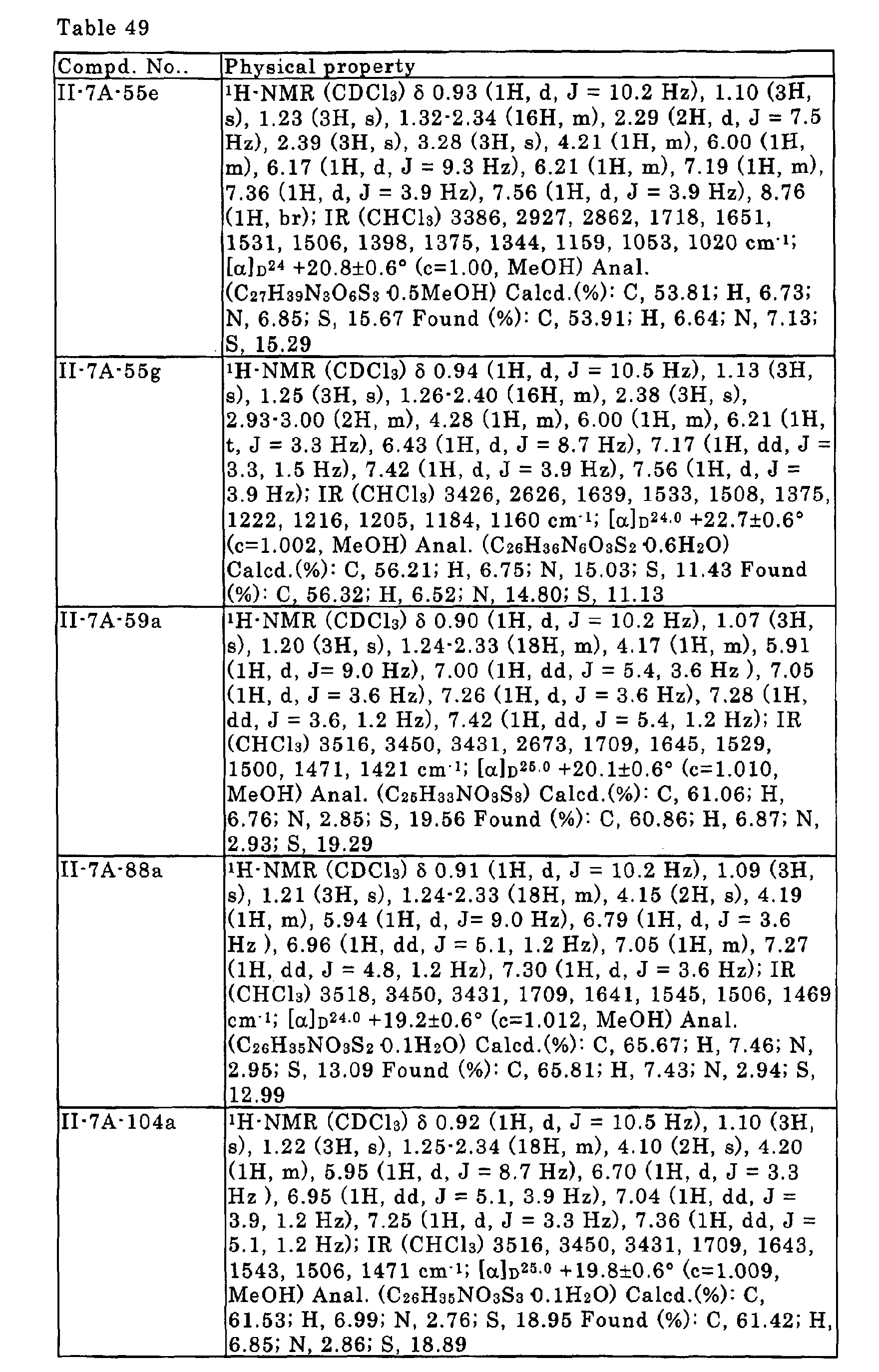


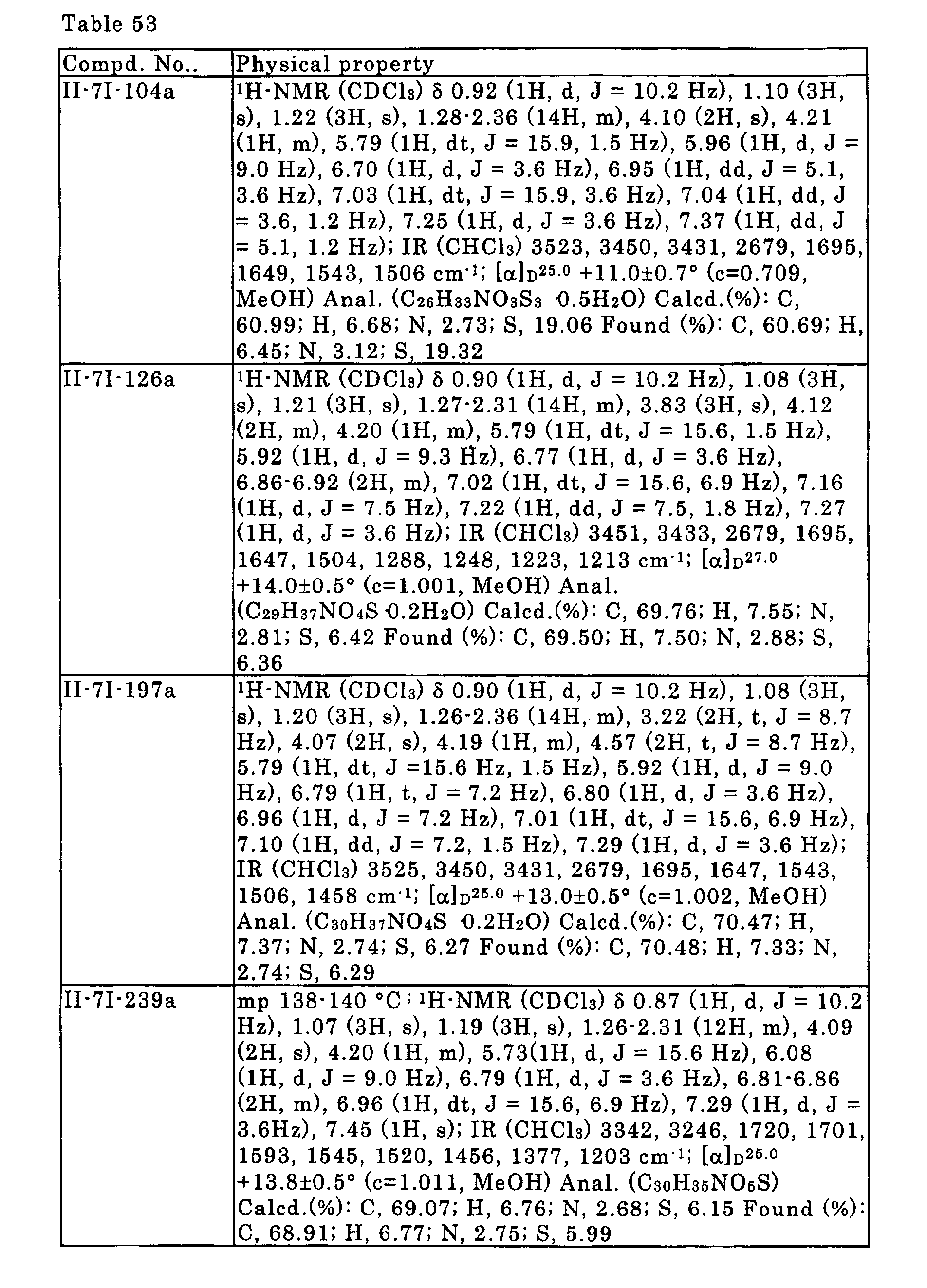

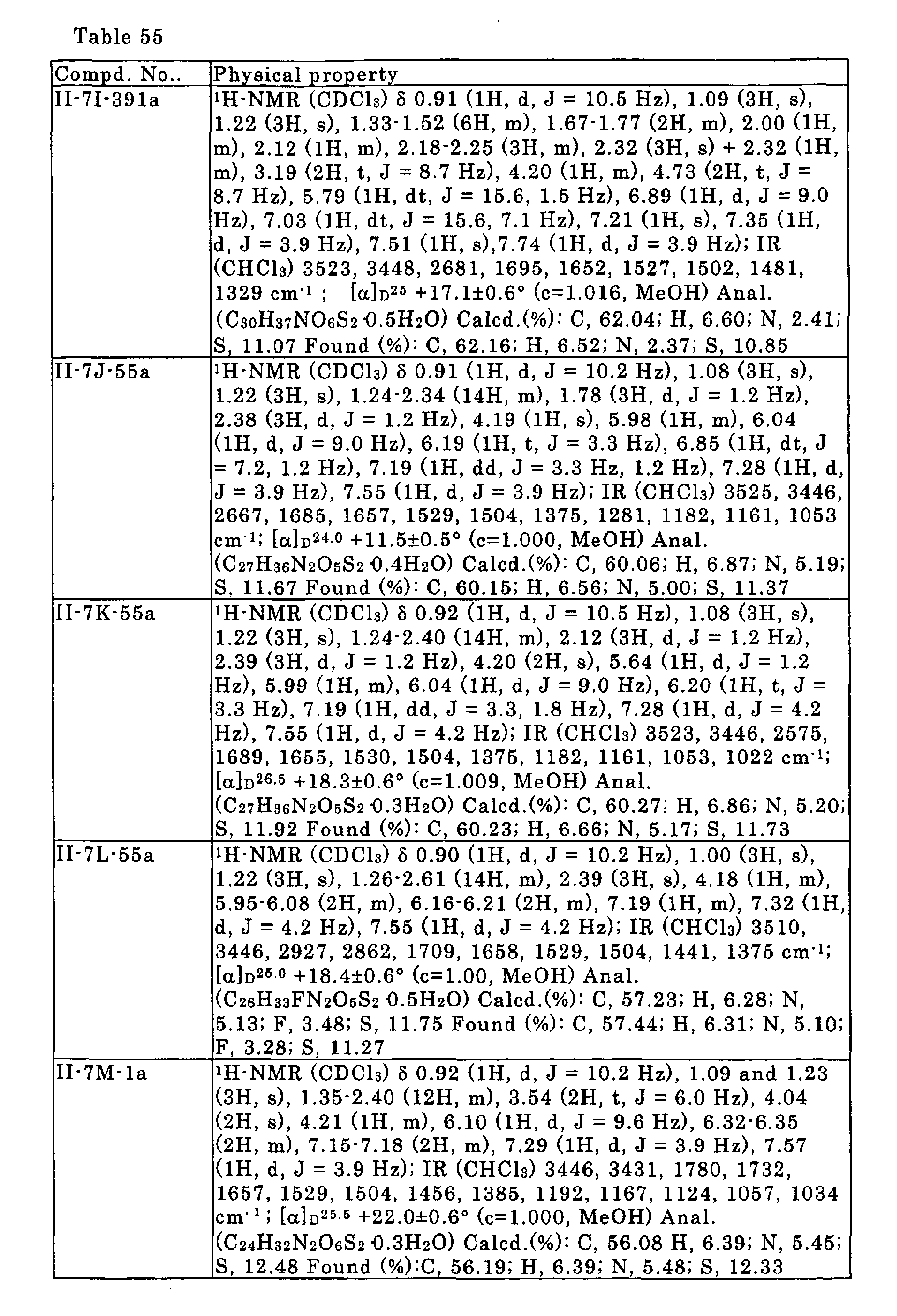
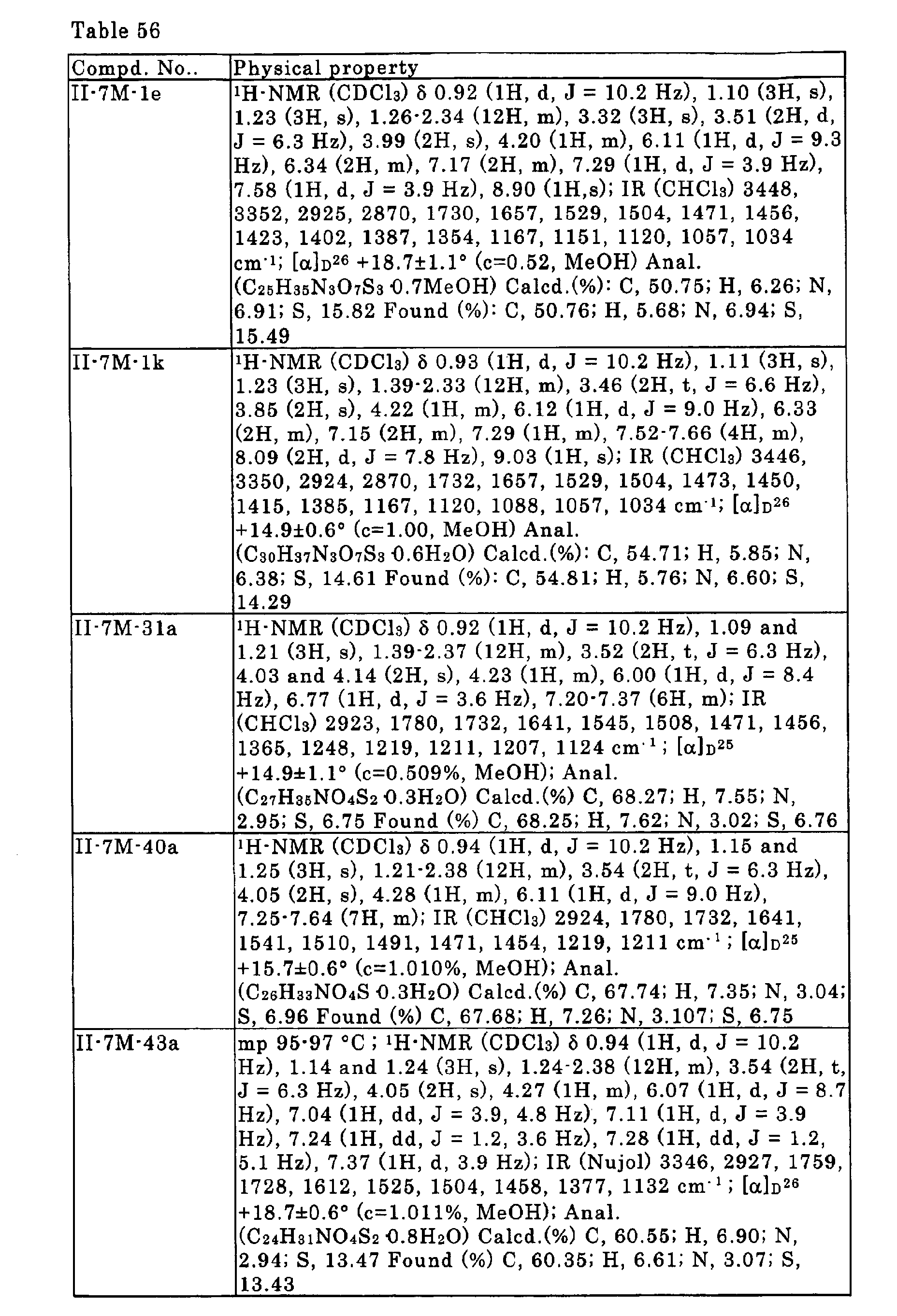

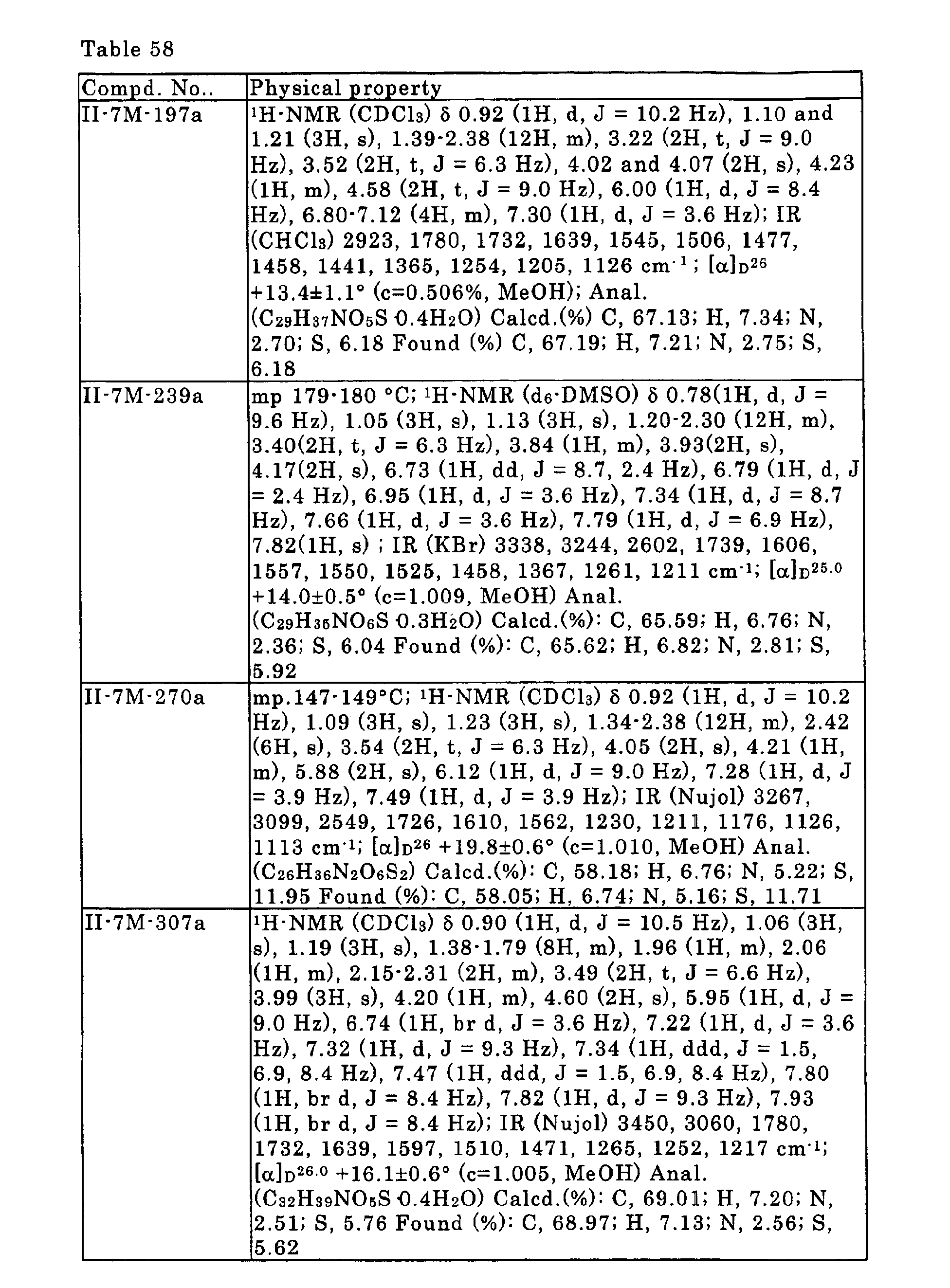


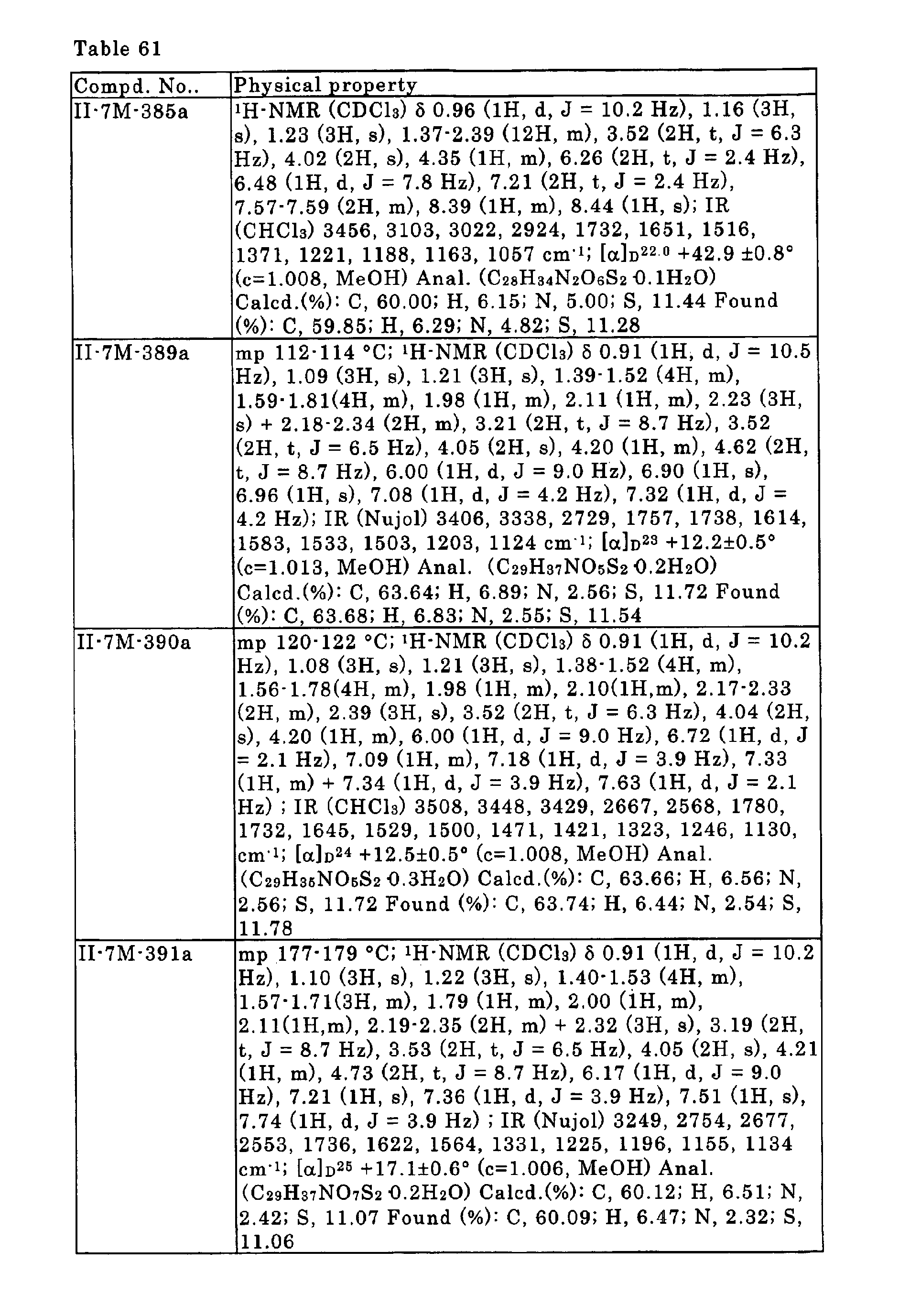
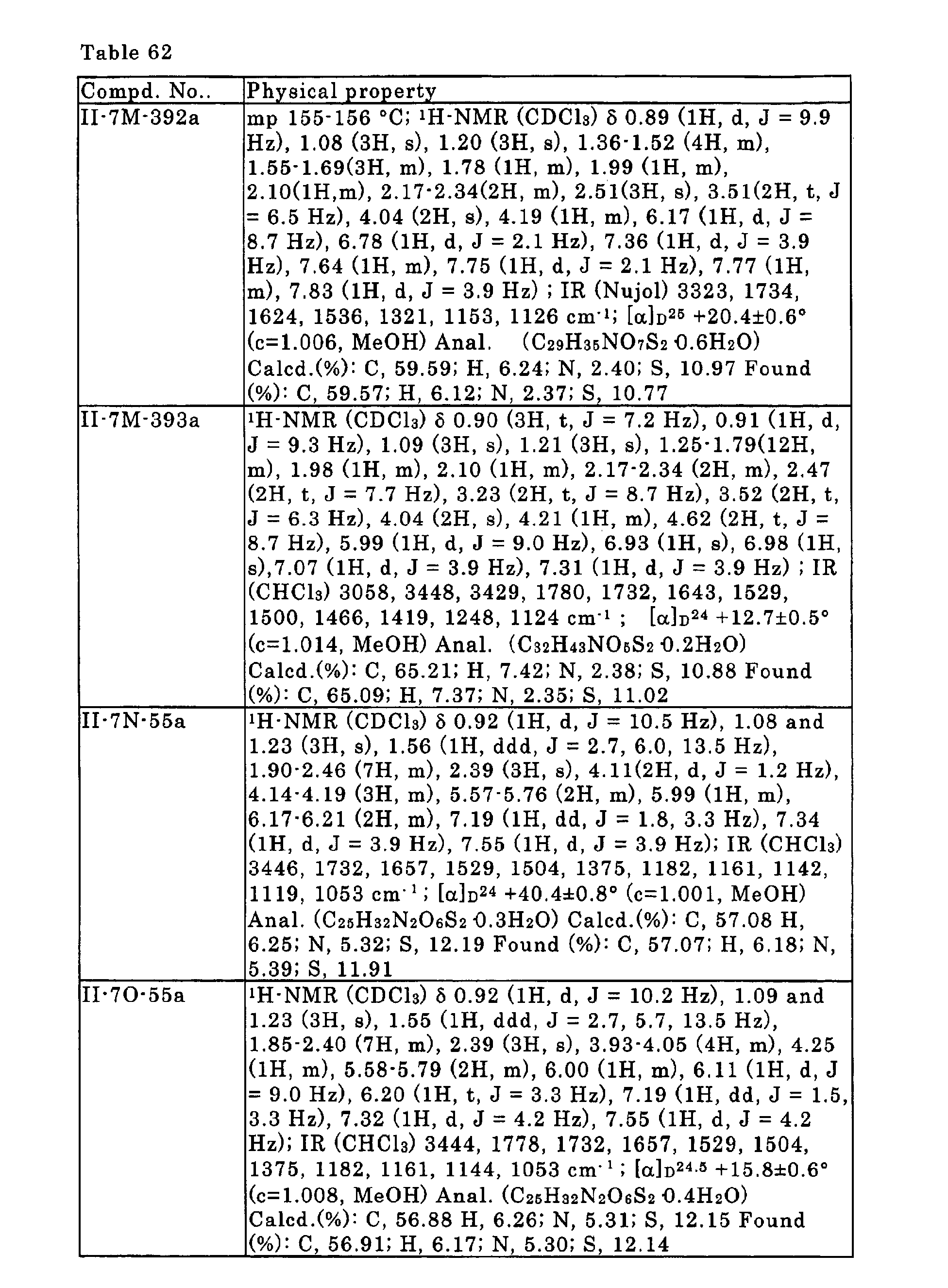


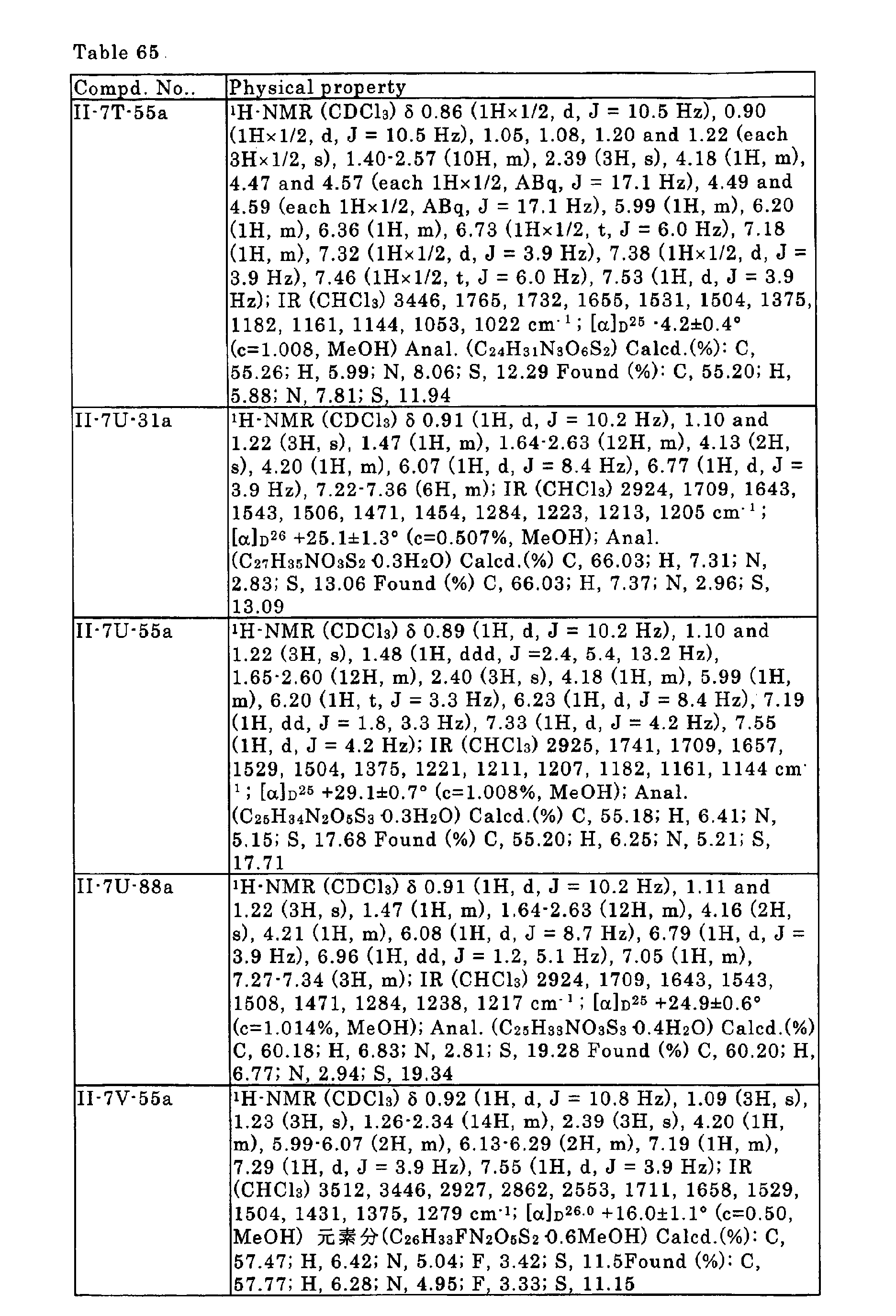
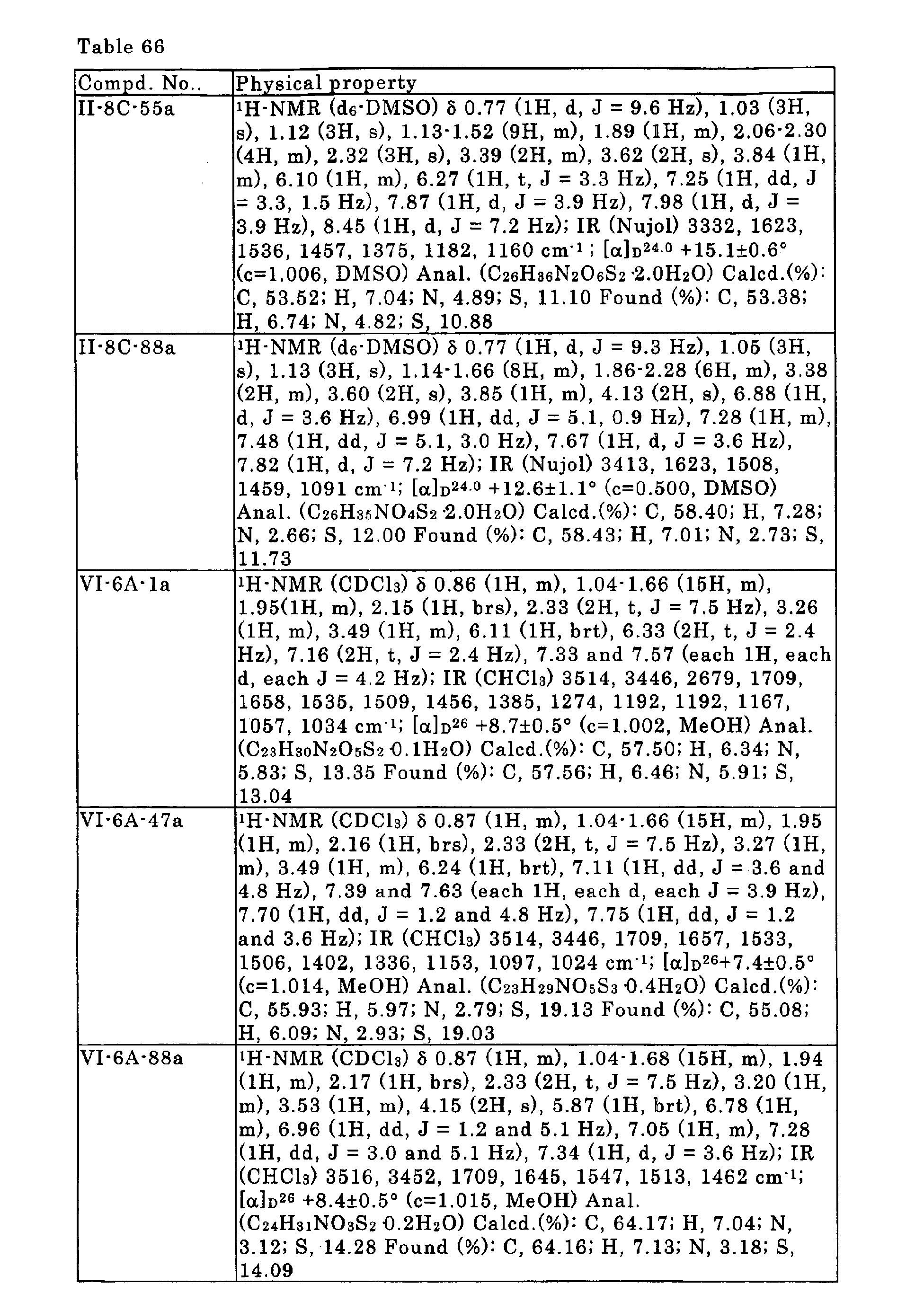
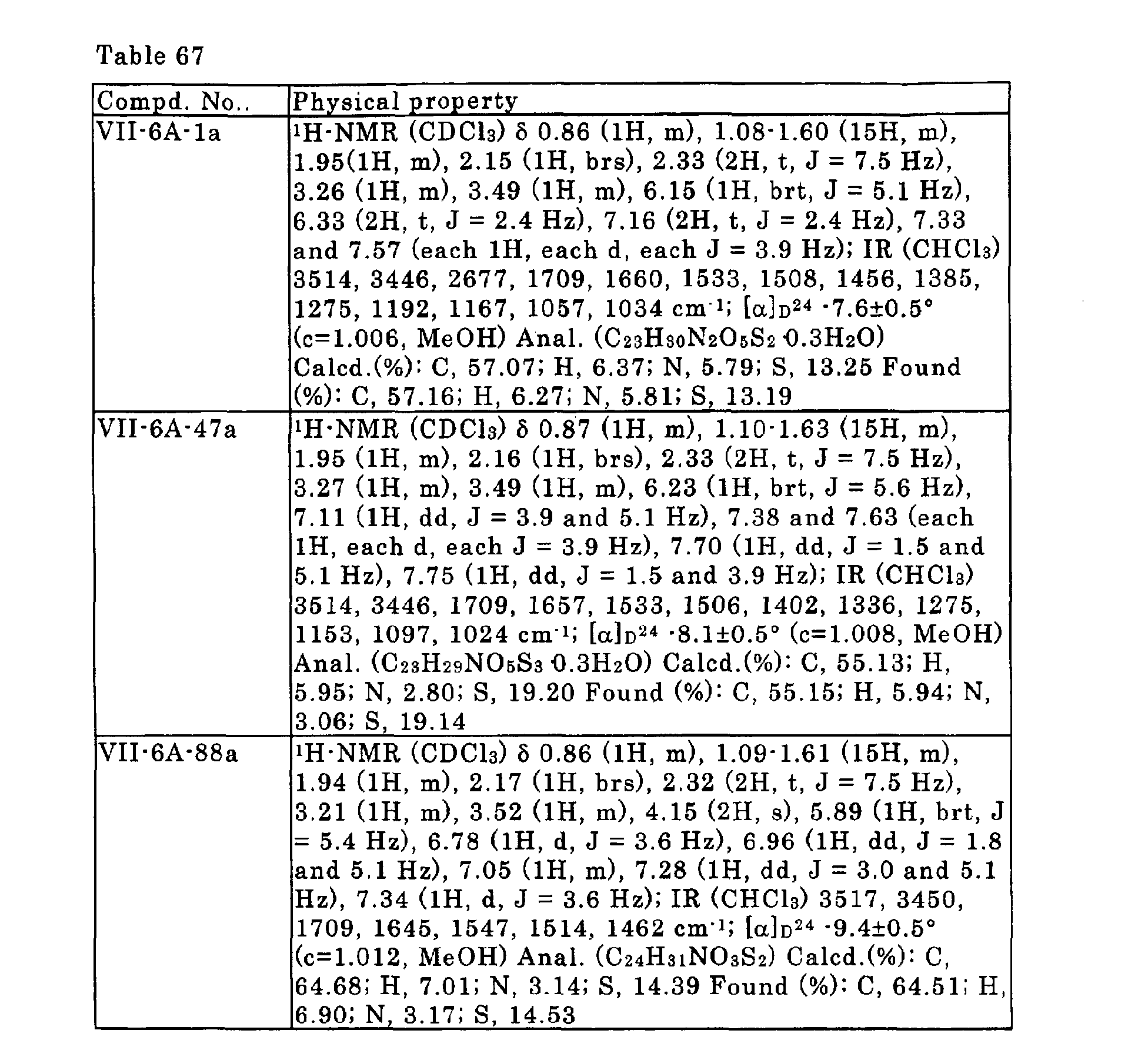
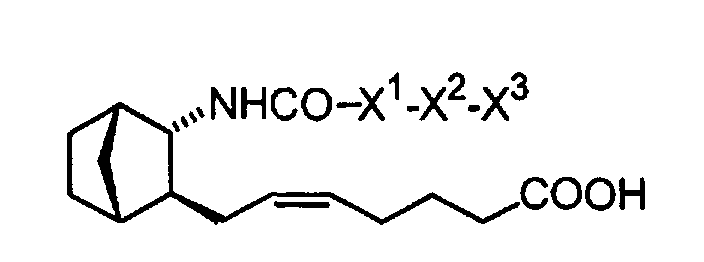


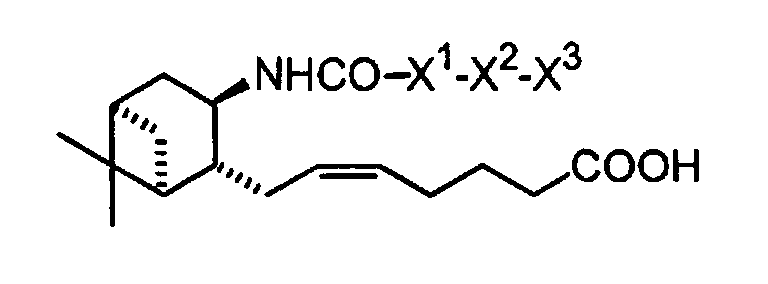
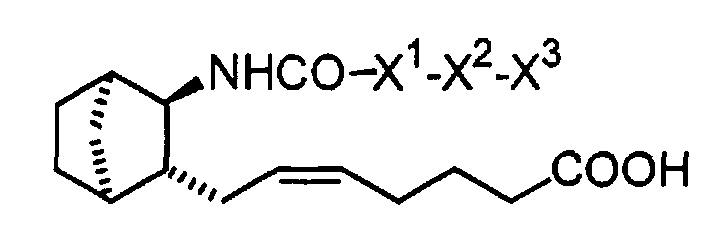

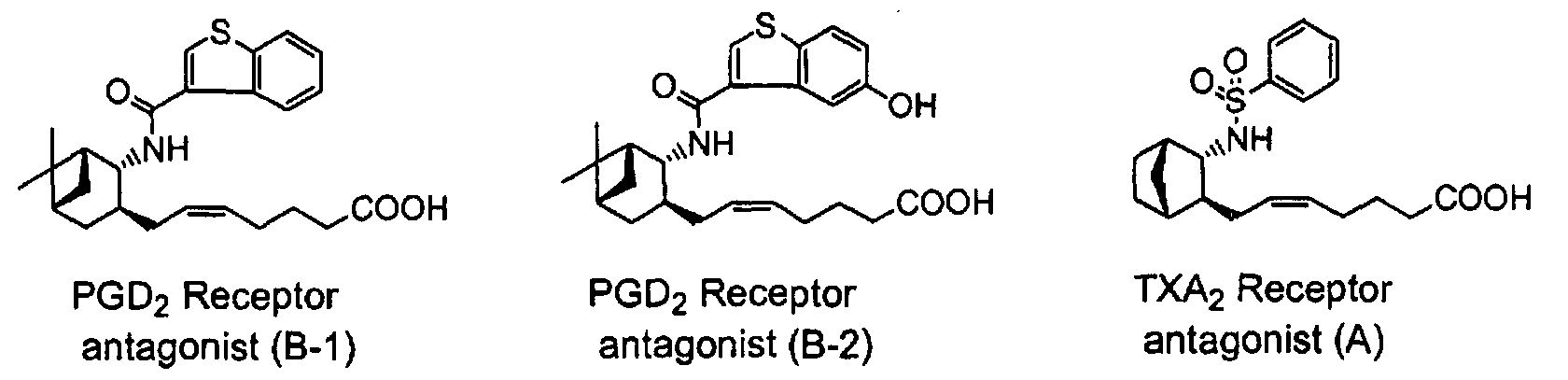
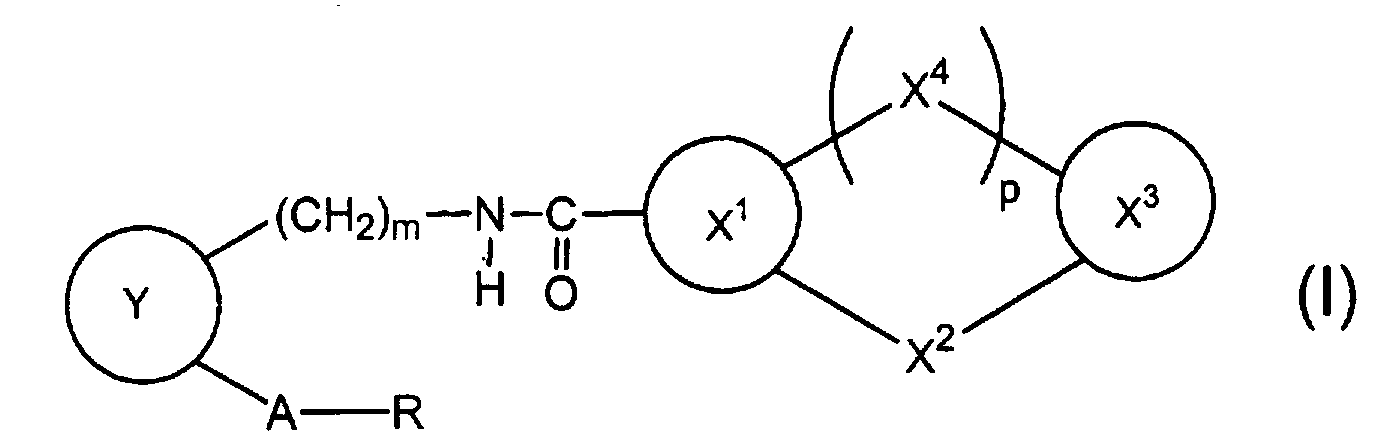 is
is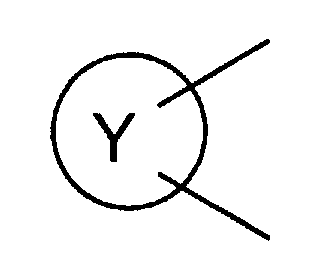 A is alkylene optionally intervened with a heteroatom, optionally having an oxo group, optionally substituted with halogen and/or optionally having an unsaturated bond;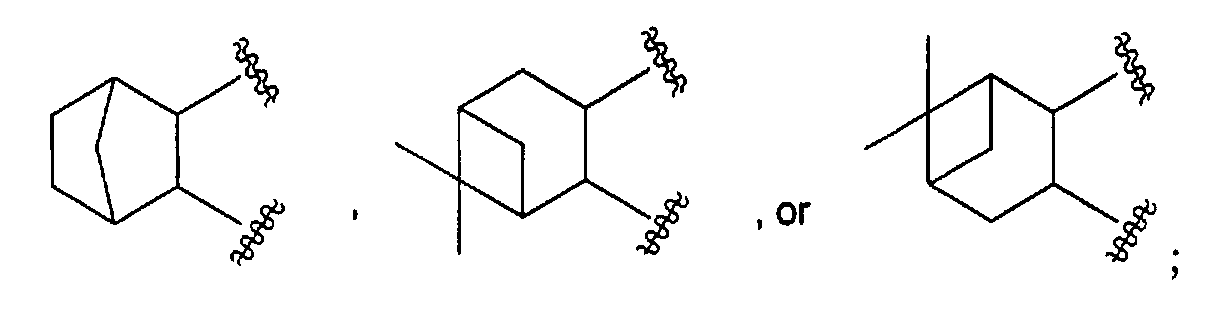
 A is -CH=CH-CH2-CH2-CH2-, R is -COOH, m is 1, p is 0, X1 and X3 are phenyl, and X2 is -N=N-, is excluded
 X1 and X3 are phenyl, X2 is -CH=CH-, -O-, or -S-, m is 0, and p is 0, a compound wherein A is -CH=CH-CH2-CH2-CH2-C(CH3)2- and R is COOH,