EP1295527A1 - Mouse showing neurofibril change due to senile dementia - Google Patents
Mouse showing neurofibril change due to senile dementia Download PDFInfo
- Publication number
- EP1295527A1 EP1295527A1 EP01941045A EP01941045A EP1295527A1 EP 1295527 A1 EP1295527 A1 EP 1295527A1 EP 01941045 A EP01941045 A EP 01941045A EP 01941045 A EP01941045 A EP 01941045A EP 1295527 A1 EP1295527 A1 EP 1295527A1
- Authority
- EP
- European Patent Office
- Prior art keywords
- transgenic mouse
- tau
- neurofibrillary tangles
- mouse
- tau protein
- Prior art date
- Legal status (The legal status is an assumption and is not a legal conclusion. Google has not performed a legal analysis and makes no representation as to the accuracy of the status listed.)
- Withdrawn
Links
Images


Classifications
-
- C—CHEMISTRY; METALLURGY
- C12—BIOCHEMISTRY; BEER; SPIRITS; WINE; VINEGAR; MICROBIOLOGY; ENZYMOLOGY; MUTATION OR GENETIC ENGINEERING
- C12N—MICROORGANISMS OR ENZYMES; COMPOSITIONS THEREOF; PROPAGATING, PRESERVING, OR MAINTAINING MICROORGANISMS; MUTATION OR GENETIC ENGINEERING; CULTURE MEDIA
- C12N15/00—Mutation or genetic engineering; DNA or RNA concerning genetic engineering, vectors, e.g. plasmids, or their isolation, preparation or purification; Use of hosts therefor
- C12N15/09—Recombinant DNA-technology
- C12N15/63—Introduction of foreign genetic material using vectors; Vectors; Use of hosts therefor; Regulation of expression
- C12N15/79—Vectors or expression systems specially adapted for eukaryotic hosts
- C12N15/85—Vectors or expression systems specially adapted for eukaryotic hosts for animal cells
- C12N15/8509—Vectors or expression systems specially adapted for eukaryotic hosts for animal cells for producing genetically modified animals, e.g. transgenic
-
- A—HUMAN NECESSITIES
- A01—AGRICULTURE; FORESTRY; ANIMAL HUSBANDRY; HUNTING; TRAPPING; FISHING
- A01K—ANIMAL HUSBANDRY; AVICULTURE; APICULTURE; PISCICULTURE; FISHING; REARING OR BREEDING ANIMALS, NOT OTHERWISE PROVIDED FOR; NEW BREEDS OF ANIMALS
- A01K67/00—Rearing or breeding animals, not otherwise provided for; New or modified breeds of animals
- A01K67/027—New or modified breeds of vertebrates
- A01K67/0275—Genetically modified vertebrates, e.g. transgenic
-
- A—HUMAN NECESSITIES
- A01—AGRICULTURE; FORESTRY; ANIMAL HUSBANDRY; HUNTING; TRAPPING; FISHING
- A01K—ANIMAL HUSBANDRY; AVICULTURE; APICULTURE; PISCICULTURE; FISHING; REARING OR BREEDING ANIMALS, NOT OTHERWISE PROVIDED FOR; NEW BREEDS OF ANIMALS
- A01K67/00—Rearing or breeding animals, not otherwise provided for; New or modified breeds of animals
- A01K67/027—New or modified breeds of vertebrates
- A01K67/0275—Genetically modified vertebrates, e.g. transgenic
- A01K67/0278—Knock-in vertebrates, e.g. humanised vertebrates
-
- A—HUMAN NECESSITIES
- A61—MEDICAL OR VETERINARY SCIENCE; HYGIENE
- A61P—SPECIFIC THERAPEUTIC ACTIVITY OF CHEMICAL COMPOUNDS OR MEDICINAL PREPARATIONS
- A61P25/00—Drugs for disorders of the nervous system
-
- A—HUMAN NECESSITIES
- A61—MEDICAL OR VETERINARY SCIENCE; HYGIENE
- A61P—SPECIFIC THERAPEUTIC ACTIVITY OF CHEMICAL COMPOUNDS OR MEDICINAL PREPARATIONS
- A61P25/00—Drugs for disorders of the nervous system
- A61P25/14—Drugs for disorders of the nervous system for treating abnormal movements, e.g. chorea, dyskinesia
- A61P25/16—Anti-Parkinson drugs
-
- A—HUMAN NECESSITIES
- A61—MEDICAL OR VETERINARY SCIENCE; HYGIENE
- A61P—SPECIFIC THERAPEUTIC ACTIVITY OF CHEMICAL COMPOUNDS OR MEDICINAL PREPARATIONS
- A61P25/00—Drugs for disorders of the nervous system
- A61P25/28—Drugs for disorders of the nervous system for treating neurodegenerative disorders of the central nervous system, e.g. nootropic agents, cognition enhancers, drugs for treating Alzheimer's disease or other forms of dementia
-
- C—CHEMISTRY; METALLURGY
- C07—ORGANIC CHEMISTRY
- C07K—PEPTIDES
- C07K14/00—Peptides having more than 20 amino acids; Gastrins; Somatostatins; Melanotropins; Derivatives thereof
- C07K14/435—Peptides having more than 20 amino acids; Gastrins; Somatostatins; Melanotropins; Derivatives thereof from animals; from humans
- C07K14/46—Peptides having more than 20 amino acids; Gastrins; Somatostatins; Melanotropins; Derivatives thereof from animals; from humans from vertebrates
- C07K14/47—Peptides having more than 20 amino acids; Gastrins; Somatostatins; Melanotropins; Derivatives thereof from animals; from humans from vertebrates from mammals
- C07K14/4701—Peptides having more than 20 amino acids; Gastrins; Somatostatins; Melanotropins; Derivatives thereof from animals; from humans from vertebrates from mammals not used
- C07K14/4711—Alzheimer's disease; Amyloid plaque core protein
-
- A—HUMAN NECESSITIES
- A01—AGRICULTURE; FORESTRY; ANIMAL HUSBANDRY; HUNTING; TRAPPING; FISHING
- A01K—ANIMAL HUSBANDRY; AVICULTURE; APICULTURE; PISCICULTURE; FISHING; REARING OR BREEDING ANIMALS, NOT OTHERWISE PROVIDED FOR; NEW BREEDS OF ANIMALS
- A01K2207/00—Modified animals
- A01K2207/15—Humanized animals
-
- A—HUMAN NECESSITIES
- A01—AGRICULTURE; FORESTRY; ANIMAL HUSBANDRY; HUNTING; TRAPPING; FISHING
- A01K—ANIMAL HUSBANDRY; AVICULTURE; APICULTURE; PISCICULTURE; FISHING; REARING OR BREEDING ANIMALS, NOT OTHERWISE PROVIDED FOR; NEW BREEDS OF ANIMALS
- A01K2217/00—Genetically modified animals
-
- A—HUMAN NECESSITIES
- A01—AGRICULTURE; FORESTRY; ANIMAL HUSBANDRY; HUNTING; TRAPPING; FISHING
- A01K—ANIMAL HUSBANDRY; AVICULTURE; APICULTURE; PISCICULTURE; FISHING; REARING OR BREEDING ANIMALS, NOT OTHERWISE PROVIDED FOR; NEW BREEDS OF ANIMALS
- A01K2217/00—Genetically modified animals
- A01K2217/05—Animals comprising random inserted nucleic acids (transgenic)
-
- A—HUMAN NECESSITIES
- A01—AGRICULTURE; FORESTRY; ANIMAL HUSBANDRY; HUNTING; TRAPPING; FISHING
- A01K—ANIMAL HUSBANDRY; AVICULTURE; APICULTURE; PISCICULTURE; FISHING; REARING OR BREEDING ANIMALS, NOT OTHERWISE PROVIDED FOR; NEW BREEDS OF ANIMALS
- A01K2227/00—Animals characterised by species
- A01K2227/10—Mammal
- A01K2227/105—Murine
-
- A—HUMAN NECESSITIES
- A01—AGRICULTURE; FORESTRY; ANIMAL HUSBANDRY; HUNTING; TRAPPING; FISHING
- A01K—ANIMAL HUSBANDRY; AVICULTURE; APICULTURE; PISCICULTURE; FISHING; REARING OR BREEDING ANIMALS, NOT OTHERWISE PROVIDED FOR; NEW BREEDS OF ANIMALS
- A01K2267/00—Animals characterised by purpose
- A01K2267/03—Animal model, e.g. for test or diseases
- A01K2267/0306—Animal model for genetic diseases
- A01K2267/0312—Animal model for Alzheimer's disease
-
- A—HUMAN NECESSITIES
- A01—AGRICULTURE; FORESTRY; ANIMAL HUSBANDRY; HUNTING; TRAPPING; FISHING
- A01K—ANIMAL HUSBANDRY; AVICULTURE; APICULTURE; PISCICULTURE; FISHING; REARING OR BREEDING ANIMALS, NOT OTHERWISE PROVIDED FOR; NEW BREEDS OF ANIMALS
- A01K2267/00—Animals characterised by purpose
- A01K2267/03—Animal model, e.g. for test or diseases
- A01K2267/0306—Animal model for genetic diseases
- A01K2267/0318—Animal model for neurodegenerative disease, e.g. non- Alzheimer's
Definitions
- the present invention relates to a transgenic mouse that exhibits neurofibrillary tangles in its brain.
- Alzheimer's disease is specific to human beings. It takes 10 years or more before its onset so that development of human disease model animals is desired in order to elucidate the cause of its occurrence or treat it.
- Alzheimer's disease also called "Alzheimer type senile dementia”
- Neurofibrillary tangles are neuronal inclusions composed mainly of phosphorylated tau protein.
- Neurofibrillary tangles are observed in sites where neurons are abolished, besides in Alzheimer's disease, in neurodegenerative disorders with dementia (frontotemporal type dementia Parkinsonism-17 (FTDP-17) (Poorkaj, P. et al. Tau is a candidate gene for chromosome 17 frontotemporal dementia. Ann. Neurol. 43, 815-825 (1998)), Down's syndrome and several other neurodegenerative disorders). From this it is said that formation of neurofibrillary tangles is a common cascade in all the disorders that involve neurodegeneration.
- FTDP-17 frontotemporal type dementia Parkinsonism-17
- neurofibrillary tangles represents a final common pathway that leads to abolition of neurons in Alzheimer's disease and other neurodegenerative disorders with dementia (Spillantini, M.G. & Goedert, M. Tau protein pathology in neurodegenerative diseases. Trends Neurosci 21, 428-433 (1998)). Therefore, inhibition of neurofibrillary tangles is considered to be one of treatments for all the neurodegenerative disorders inclusive of Alzheimer's disease. However, generation of mice that cause neurofibrillary tangles has hitherto been tried using overexpression of mutant human amyloid precursor protein (Games, D.
- tau human wild-type tau protein
- transgenic mice that expresses wild human type tau protein (tau) and three lines of transgenic mice have been reported.
- Tau wild human type tau protein
- 4 repeat tau cDNA driven by Thy-1 promoter Gotz, J. et al. Somatodendritic localization and hyperphosphorylation of tau protein in transgenic mice expressing the longest human brain tau isoform.
- EMBO J. 14, 1304-1313 (1995) (2) 3 repeat tau cDNA driven by 3-hydroxy-3-methylglutaryl coenzyme A reductase promoter (Brion, J.P., Tremp, G. & Octave, J.N.
- Transgenic expression of the shortest human tau affects its compartmentalization and its phosphorylation as in the pretangle stage of Alzheimer's disease.
- Am. J. Pathol. 154, 255-270 (1999)) (3) 3 repeat tau cDNA driven by prion protein promoter (Ishihara, T. et al., Age-dependent emergence and progression of a taupathy in transgenic mice overexpressing the shortest human tau isoform. Neurone 24, 751-762 (1999)) have been respectively used as a transgene.
- an object of the present invention is to provide a transgenic mouse useful for the development of such a therapeutic drug.
- the present inventors have made intensive investigation and, as a result, they have been found that a mouse exhibiting the same neurofibrillary tangles as observed in a human brain with Alzheimer's disease can be generated by expression of a mutant tau protein which is a cause of familial frontotemporal type dementia, and, based on the findings, they have completed the present invention.
- the present invention provides a transgenic mouse transformed with a DNA encoding a mutant human tau protein, wherein the mouse exhibits neurofibrillary tangles in its brain.
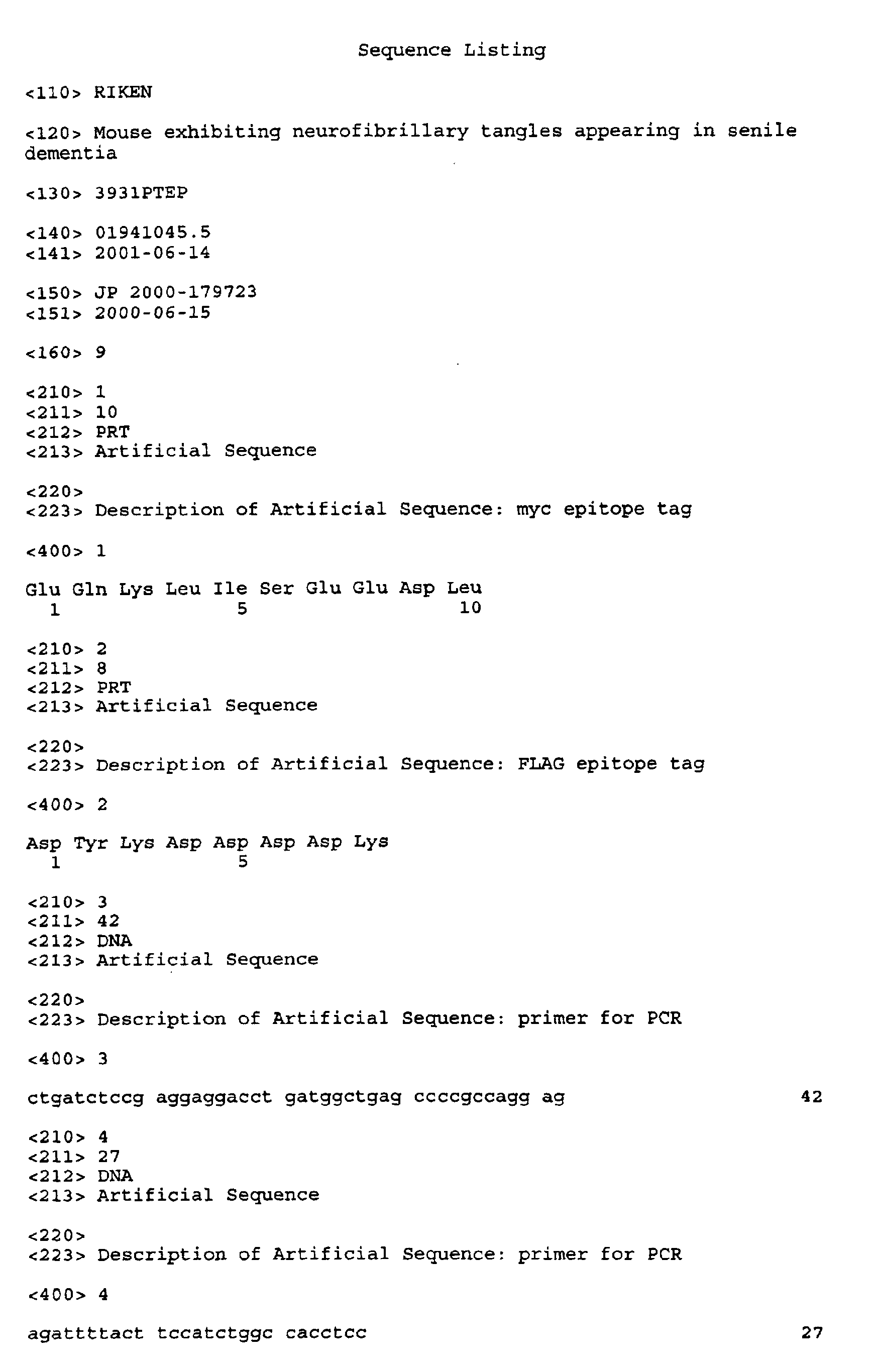
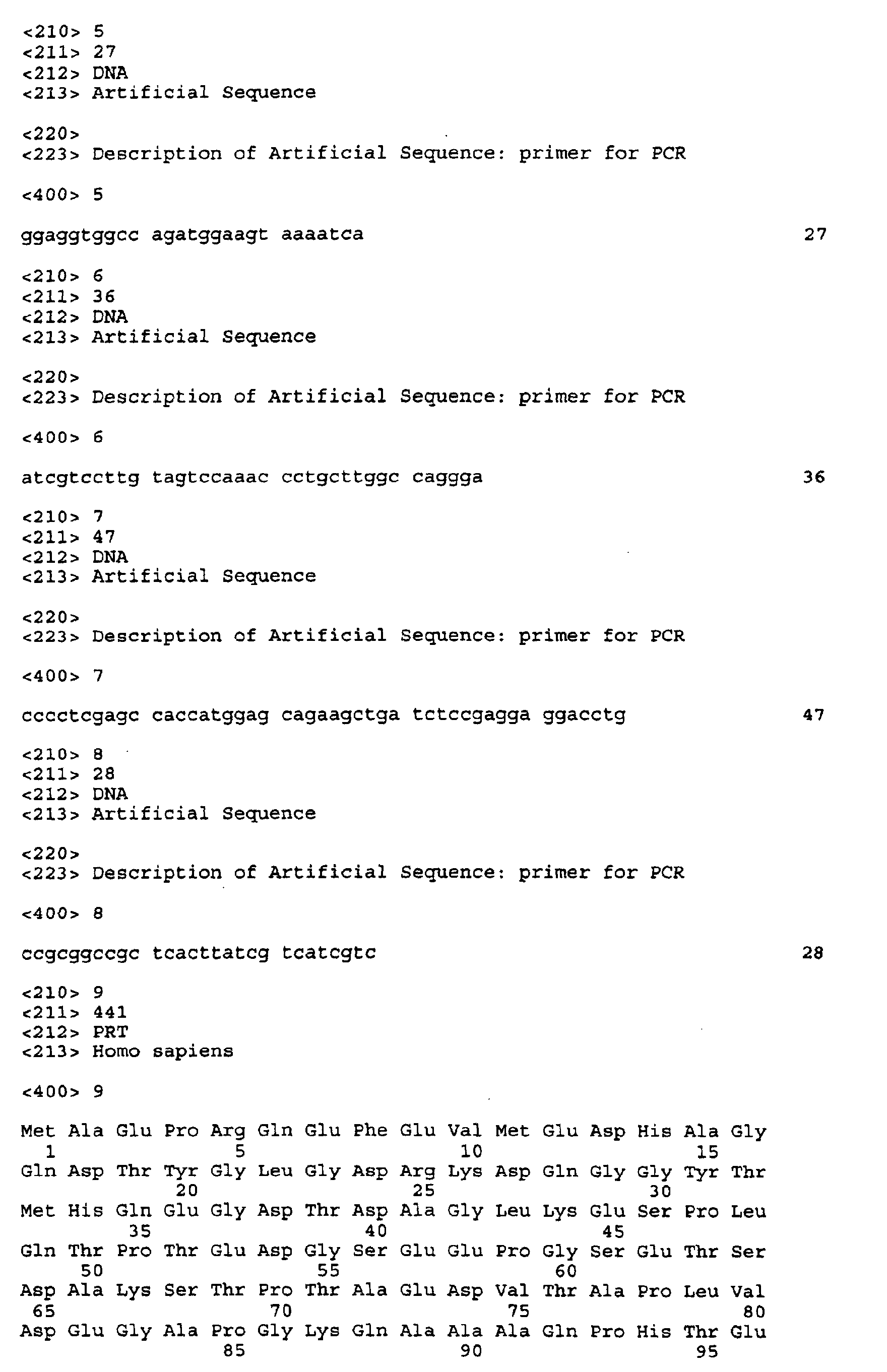
- the mutant human tau protein is preferably a mutant tau protein in which valine at a position corresponding to residue 337 in SEQ ID NO: 9 is substituted with an amino acid other than valine.
- the amino acid other than valine is preferably methionine.
- the transgenic mouse of the present invention is used as a model of neurodegenerative disorder.
- the transgenic mouse of the present invention is preferably one characterized in that the neurofibrillary tangles are positive in immunoreactions using an antibody against a phosphorylated tau protein, an antibody against ubiquitin and an antibody against paired-helical filaments, and birefringency is shown after staining with Congo red.
- transgenic mouse of the present invention preferably shows abnormal behavior.
- the transgenic mouse of the present invention is preferably one in which mutant human tau protein is expressed under control of platelet growth factor ⁇ chain promoter.
- the present invention also provides a method for screening for an agent for treating a neurodegenerative disorder, comprising administering a candidate substance to the above-mentioned transgenic mouse exhibiting neurofibrillary tangles, or contacting a candidate substance with a tissue or a cell from brain of the transgenic mouse, and determining an effect of the candidate substance on a property associated with the neurodegenerative disorder in the transgenic mouse or the tissue or the cell thereof, as well as, a method for producing an agent for treating aneurodegenerative disorder, comprising selecting a candidate substance by the screening method, and preparing a pharmaceutical composition comprising the selected substance.
- the transgenic mouse exhibiting neurofibrillary tangles of the present invention may play an important role in elucidating the cause of neurofibrillary tangles and be useful for the development of the agent for treating all the neurodegenerative disorders exhibiting neurofibrillary tangles including Alzheimer's disease.
- the transgenic mouse of the present invention which exhibits neurofibrillary tangles, can be used as an ideal preclinic model of a neurodegenerative disorder such as Alzheimer's disease and contributes to elucidation of human neurodegenerative disorders and development of therapeutic agents therefore.
- Human tau protein is known to include several isoforms.
- the nucleotide sequence of mRNA encoding one of isoforms of the human tau protein is registered under GenBank/EMBL/DDBJ accession No. J03778. Because the human tau protein includes isoforms, the position of amino acid is herein indicated by the number of the corresponding position in the amino acid sequence shown in SEQ ID NO: 9.
- the DNA encoding mutant human tau protein used in the present invention encodes mutant human tau protein having mutation by which a mouse transformed with the DNA exhibits neurofibrillary tangles in its brain.
- the mutant human tau protein is preferably one observed in the disease exhibiting neurofibrillary tangles.
- the mutant human tau protein having such a mutation includes one having an amino acid sequence in which the amino acid residue at 337, which is valine in the tau protein of normal person, is substituted with an amino acid other than valine (preferably methonine) and one having an amino acid sequence in which the amino acid residue at 406, which is arginine in the tau protein of normal person, is substituted with an amino acid other than arginine (preferably tryptophan).
- mutant tau protein may have mutation that has no influence on the activity that results in the neurofibrillary tangles in addition to the mutation exhibiting neurofibrillary tangles in the brain of a mouse transformed with a DNA encoding the mutant tau protein.
- the DNA encoding an amino acid sequence may include different nucleotide sequences due to degeneration of genetic codons.
- the nucleotide sequence of DNA encoding, for example, the mutant tau protein in which valine at 337 is substituted with methionine may have polymorphism such as substitution, deletion, or insertion of one or more nucleotides as long as V337M human tau is expressed and the transgenic mouse exhibits neurofibrillary tangles.
- the transgenic mouse of the present invention is characterized by exhibiting neurofibrillary tangles similar to those observed in the human brain with Alzheimer's disease.
- the neurofibrillary tangles (tau aggregation) in the brain of transgenic mouse are those satisfying pathological changes and histological characteristics characteristically observed in the brain of patients with Alzheimer's disease.
- Human neurofibrillary tangles refer to argento-philic nerve structures accumulated in neurons and are composed of a large number of fibrils running parallel to each other. A single fibril is called paired helical filaments (PHF).
- the PHF is a unique fibril that has constrictions at an interval of about 80 nm. Its basic backbone is composed of hyperphosphorylated tau. It revealed that this tau is ubiquitinated when subjected to processing.
- neurofibrillary tangles as used herein means that in microscopic observations, neurofibrillary tangles are observed in the brain of the transgenic mouse. More specifically, one or more immunoreactions using specific antibodies against phosphorylated tau, ubiquitin and PHF, respectively, are positive or birefringency is shown after Congo red staining as in human neurofibrillary tangles. Preferably, the phrase means that all the immunoreactions using respective specific antibodies against the phosphorylated tau, ubiquitin and PHF are positive and birefringency is shown after Congo red staining.
- the transgenic mouse of the present invention preferably is characterized in that it shows an abnormal behavior such as antianxiety.
- the abnormal behavior means abnormality compared with a control animal.
- the transgenic mouse stays on an open arm in an elevated maze for a significantly longer time than a control animal (usually, mice are apt to dislike approaching an open arm).
- mice are apt to dislike approaching an open arm.
- the control animal in the maze acclimates within 2 minutes to cause a reduction in the amount of behavior.
- the transgenic mouse does not cause this.
- human neurofibrillary tangles are present as bound with RNA and form a ⁇ -sheet structure and hence it is preferable that the ⁇ -sheet structure be observed in the neurons in the brain of the transgenic mouse by thioflavin staining, and it is also preferable that the neurofibrillary tangles be in a state where they are bound with RNA.
- antibodies for use in immunoreactions using specific antibodies against phosphorylated tau, ubiquitin and PHF, respectively include PS199 as a phosphorylation dependent anti-tau antibody (Michel, G. et al., Characterisation of tau phosphorylation in glycogen synthase kinase-3 ⁇ and cyclin dependent kinase-5 activator (p23) transfected cells. Biochimica et Biophysica Acta 1380, 177-182 (1998)), AT8 (Biernat, J. et al. The switch of tau protein to an Alzheimer-like state includes the phosphorylation of two serine-proline motifs upstream of the microtubule binding region. EMBO J.
- the antibody that recognizes the structure of PHF includes an antibody specific for conformational epitope found in PHF, Alz50.
- anti-ubiquitin antibody may be used.
- Monoclonal antibodies to the above proteins can be prepared, for example, by the Cambell method using the above-mentioned proteins fixed with formalin (MONOCLONAL ANTIBODY TECHNOLOGY, Elstevier Science Publishers, Amsterdam, 1984) as antigen.
- the transgenic mouse of the present invention can be generated as follows.
- Human tau DNA can be obtained by a method for synthesizing its entire sequence based on a known amino acid sequence or nucleotide sequence (GenBank/EMBL/DDBJ accession No. J03778, etc.), a method using PCR with primers synthesized based on a known amino acid sequence or nucleotide sequence, or the like method.
- the human tau DNA may have intron.
- the mutant human tau DNA can be prepared, for example, by introducing mutation by site-specific mutagenesis (for example, PCR-based site-specific mutagenesis) to a known human tau DNA.
- site-specific mutagenesis for example, PCR-based site-specific mutagenesis
- primers for the PCR include those having nucleotide sequences shown in SEQ ID NOS: 3 to 8.
- the total sequence of the prepared DNA (about 1.4 kb) can be confirmed by a DNA sequencer and the like (for example, ABI PRISM 377 DNA sequencer and the like).
- the transgenic mouse having DNA encoding the mutant tau protein and exhibiting neurofibrillary tangles can be obtained by introducing the DNA into a suitable host to transform it.
- the host is not particularly limited and usually used mice can be used.
- the transformation that is, introduction of DNA into a mouse
- a microinjection method DNA encoding the mutant tau protein (transgene) is introduced into an ovum by a microinjection method and the injected ovum is transplanted to a foster mother, and introduction of the gene to the chromosome of mouse is confirmed using the tail DNA of the borne littermate.
- transgenic mouse can be obtained. Since the amount of mutant tau may vary among mouse lines, and among mice even within the same transgenic line, it is preferable that two or more mouse lines be used in generating transgenic mice.
- the transgene can be constructed by introducing a region that is necessary for expressing neurofibrillary tangles into the mutant human tau DNA.
- the region necessary for expressing neurofibrillary tangles includes a promoter to be added to the 5'-terminal, a poly-A signal to be added to the 3'-terminal and the like.
- the region necessary for expressing neurofibillary tangles may be added via intron.
- the promoter for expressing the mutant human tau DNA sequence is not particularly limited but promoters usually used when expressing genes in a mouse may be used. As such a promoter, platelet derived growth factor (PDGF)- ⁇ chain promoter is preferably used.
- the PDGF- ⁇ chain promoter can be obtained from a human genome library.
- an epitope tag to the sequence of human tau protein near its N-terminal and/or C-terminal in order to distinguish the human tau protein from endogenous proteins since the human tau protein exists also as an endogenous protein, or to immunologically confirm expression of the mutant human tau.
- tag epitope near the N-terminal and/or C-terminal include, for example, myc amino acid sequence (SEQ ID NO: 1) and FLAG amino acid sequence (SEQ ID NO: 2) (Fig. 1).
- transgenic mouse is generated or not by microinjection can be confirmed by a genetic technique, e.g., hybridization method such as a Southern blot method using 32 P-labeled human tau probe (Southern, E.M., J. Mol. Microbiol. 98, 503, 1975). Also, the expression of mutant tau protein in the transgenic mice can be immunologically confirmed by the Western blot analysis by Towbin, H. et al. (Proc. Natl. Acad. Sci. USA, 76, 4350, 1979). Further, a transgene-derived mutant tau protein can be recognized by a specific anti-tau antibody.
- a genetic technique e.g., hybridization method such as a Southern blot method using 32 P-labeled human tau probe (Southern, E.M., J. Mol. Microbiol. 98, 503, 1975).
- the expression of mutant tau protein in the transgenic mice can be immunologically confirmed by the Western blot analysis by Towbin, H. et
- the expression of tau can be confirmed by using an anti-protein antibody to the terminal tag.
- the mutant tau protein is greater than the endogenous tau, which has a size of about 50 kD, though depending on the size of the attached epitope and the like (in Examples, the mutant tau protein is of a size of about 70 kD), so that it can be distinguished from the endogenous tau.
- the transformed mutant tau protein is expressed or not can be confirmed, for example, as follows. First, a transformed transgenic mouse is sacrificed, the mouse brain is homogenised in a reassembly buffer (RAB), and tau protein is recovered as heat-stable fractions, which then are separated on SDS-PAGE gel, and the separated protein is transferred on a PVDF membrane. Then using an antibody such as the above-mentioned anti-tau antibody, specific immunoreaction is performed. If the result of immunoreaction is positive, the expression of mutant tau protein is confirmed.
- RAB reassembly buffer
- the localization of mutant tau in the brain of a transgenic mouse can be determined by immunostaining with an anti-tau antibody, an antibody against a terminal tag epitope (for example, anti-myc antibody) or the like.
- an anti-tau antibody for example, JM described hereinbelow
- an antibody against a terminal epitope tag for example, anti-myc antibody
- transgenic mouse of the present invention exhibits neurofibrillary tangles can be . confirmed as follows.
- Neurons that exhibit neurofibrillary tangles (NFT) behavior generally observed in human neurodegenerative disorders such as Alzheimer's disease and frontotemporal dementia Parkinson syndrome-17 are irregularly shaped under microscopic observation and clearly distinct from other neurons.
- NFT neurofibrillary tangles
- NFT are composed of a number of fibrils running parallel to each other and a single fibril is called PHF.
- the basic backbone of PHF is composed of hyperphosphorylated tau that is ubiquitinated and forms a ⁇ -sheet structure.
- NFT or its resembling morphology can be confirmed by performing histochemical test used for identifying NFT in human neurodegenerative disorders.
- the histochemical tests for detecting NFT include immunostaining a brain section from the transgenic mouse with a phosphorylation dependent anti-tau antibody (for example, PS199, AT8, etc.), an anti-ubiquitin antibody, an antibody specific for a conformational epitope of paired helical filaments (PHF) (for example, Alz50, etc.) or the like.
- PHF paired helical filament
- tau protein is phosphorylated (Morishima-Kawashima, M. et al., Proline-directed and non-proline-directed phosphorylation of PHF-tau, J. Biol. Chem., 270, 823-829 (1995), Lee, V.M., Balin, B.J., Otvos, L. Jr. & Trojanowski, J.Q.
- A68 A major subunit of paired helical filaments and derivatized forms of normal Tau., Science, 251, 675-678 (1991) and Woloszin, B.L., Pruchnicki, A., Dickson, D.W. & Davies, P., A neuronal antigen in the brains of Alzheimer patients, Science 232, 648-650 (1986)), and ubiquitinated (Mori, H., Kondo, J. & Ihara, Y., Ubiquitin is a component of paired helical filaments in Alzheimer's disease. Science 235, 1641-1644 (1987)) and forms a fibrillary structure of a ⁇ -sheet configuration.
- RNA Oxidation is a prominent feature of vulnerable neurons in Alzheimer's disease. J. Neurosci. 19, 1959-1964 (1999)). Therefore, a transgenic mouse is preferred in which neurofibrillary tangles exist in a state where they are bound to RNA since it resembles the neurofibrillary tangles in humans.
- the nucleic acids in neurons can be subjected to specific counterstaining with propidium iodide (PI).
- PI propidium iodide
- the levels of nucleic acids are proportional to the density of stain. Therefore, if a pretreatment with RNase decreases the staining of cytoplasm with PI, the existence and localization of nucleic acids can be confirmed by comparing the density before and after the pretreatment with RNase. Further, comparing the localization of mutant tau aggregations with the localization of RNA by electron microscope, the binding of RNA and tau aggregations in NFT can be confirmed.
- the transgenic mouse of the present invention can be used as a preclinic model of a neurodegenerative disorder for development of therapeutic agents for human neurodegenerative disorder.
- the present invention provides a method for screening for an agent for treating a neurodegenerative disorder by using the transgenic mouse of the present invention.
- the screening method of the present invention comprises administering a candidate substance to the transgenic mouse of the present invention, or contacting a candidate substance with a tissue or a cell from brain of the transgenic mouse of the present invention, and determining an effect of the candidate substance on a property associated with the neurodegenerative disorder in the transgenic mouse or the tissue or the cell thereof.
- the method of administering the candidate substance to the transgenic mouse is not particularly limited, and may be a usual method used for mouse. As to the administration period, the administration is preferably performed from prior to apperance of neurofibrillary tangles to a time when neurofibrillary tangles usually appear in the transgenic mouse to which the candidate substance is not administered.
- the method of determining the effect of the candidate substance on the property associated with the neurodegenerative disorder in the transgenic mouse is not particularly limited either. An example thereof is a method of performing a pathological test of brain.
- the tissue or the cell from brain of the transgenic mouse includes isolated tissues and cells and cultured materials therefrom.
- the method of contacting the candidate substance with the tissue or the cell is not particularly limited either.
- An example thereof is a method of determining whether tau protein insoluble even in the presence of SDS appears or not, by Western blotting.
- the first screening is performed by contacting a candidate substance with a cell isolated from the transgenic mouse of the present invention, and then the second screening is performed by administering the candidate substance selected by the first screening to the transgenic mouse of the present invention.
- the first screening is performed by simultaneously administering ⁇ -amyloid and a candidate substance to primary cultured cells of hippocampus from the transgenic mouse and determining tau protein insoluble even in the presence of SDS appears or not, by Western blotting
- the second screening is performed by administering the substance having an effect in the first screening to the transgenic mouse (for example, 10 months) and performing a pathological test to confirm an effect in the individual level.
- the screening method of the present invention can be used for production of an agent for treating a neurodegenerative disorder.
- an agent for treating a neurodegenerative disorder can be produced by preparing a pharmaceutical composition comprising the substance selected by the screening method of the present invention.
- the preparation of pharmaceutical composition may be performed according to usual methods depending on kinds of the selected substance, forms of the preparation and the like.
- Fig. 1 shows a map of a structure of a DNA encoding a mutant human tau used to generate a transgenic mouse of the present invention.
- This structure contained a cytomegalovirus (CMV) enhancer, a PDGF- ⁇ promoter, and a human tau cDNA encoding mutation of from Val to Met at the position of codon 337.
- Epitope tags (myc and FLAG) were attached to the N-terminal and C-terminal thereof.
- the DNA encoding V337M human tau with myc and FLAG epitope tags was prepared by PCR-based site-specific mutation using a DNA having the nucleotide sequence of GenBank/EMBL/DDBJ accession No. 03778 as a template. Specifically, the following three sets of PCR primers were used.
- the entire sequence of the cloned cDNA (1.4 kb) was confirmed by an ABI PRISM 377 DNA Sequencer.
- This cDNA was inserted into the Xho I and Not I sites of a PDGF- ⁇ chain expression vector prepared by inserting a cloned PDGF- ⁇ chain promoter portion into the CMV promoter portion of pCIneo vector.
- a 4.3 kb Bgl II- Nae I fragment containing PDGF- ⁇ promoter, V337M human tau cDNA and a 3'-untranslated sequence was used as a transgene to generate a mutant tau transgenic mouse (Tg) on a B6SJL background.
- Tg mice were identified by Southern blot analysis of tail DNA using 32 P-labeled human tau probe. Tg mouse lines established from the three mice were named Tg216, Tg214 and Tg212, respectively.
- Tissue was homogenized in 400 ⁇ l of RAB (0.1 M MES, 1 mM EGTA, 0.5 mM MgSO 4 , 0.75 M NaCl, 0.02 M NaF, and 1 mM phenylmethylsulfonyl fluoride) and centrifuged at 50,000 ⁇ g for 40 minutes at 4°C in an Optima TL ultracentrifuge (Beckman).
- RAB 0.1 M MES, 1 mM EGTA, 0.5 mM MgSO 4 , 0.75 M NaCl, 0.02 M NaF, and 1 mM phenylmethylsulfonyl fluoride
- the pellet was re-homogenized with 1 M sucrose/RAB, and centrifuged at 50,000 ⁇ g for 20 minutes at 4°C.
- the resulting pellet was homogenized in 400 ⁇ l of RIPA buffer (50 mM Tris, 150 mM NaCl, 1% NP40, 5 mM EDTA, 0.5% sodium deoxycholate, and 0.1% SDS, pH 8.0) and centrifuged at 100,000 ⁇ g for 20 minutes at 4°C.
- the RIPA-insoluble pellet was solubilized in 70% formic acid (FA) and reconstituted in 50 ⁇ l Laemli SDS/PAGE sample buffer after lyophilization.
- Protein concentration of each fraction was determined by Coomassie Brilliant Blue (CBB) dye (Nacalai).
- CBB Coomassie Brilliant Blue
- the samples were separated by SDS/PAGE (8% acrylamide gel).
- the separated protein was blotted onto Immobilon-P membrane (Millipore). After blocking the membrane with PBS containing 10% skimmed milk solution and 0.1% Tween-20, the membrane was incubated with anti-tau antibody JM diluted in PBS containing 5% skimmed milk and 0.05% Tween-20 ( ⁇ 10000).
- the membranes were developed using HRP-labeled anti-rabbit IgG polyclonal antibody. Chemiluminescent detection (ECL, Amersham) was used for visualization.
- Sections (2 ⁇ m) intended for light microscopic observations were incubated with mouse monoclonal anti-myc antibody as the primary antibody and goat anti-mouse IgG antibody conjugated by alkaline phosphatase as the secondary antibody. Visualization was accomplished with the HistoMark RED kit (KPL MD, USA). Sections intended for confocal laser microscopic observations were incubated with either anti-mouse Ig, labeled by Alexa488/568 (Molecular Probe), or anti-rabbit Ig, labeled by Alexa 488/568, as the secondary antibody. For nuclear counterstaining, PI or TO-PRO-3 dye (Molecular Probe) was used after treatment with RNase. PI recognizes nucleic acid.
- paraffin-embedded sections (10 ⁇ m) were prepared for electron microscopic examination.
- Deparaffinized sections were hydrated and postfixed in 1% osmium tetroxide, dehydrated in various grades of ethanol, infiltrated with propylene oxide, and embedded in Araldite (trademark of TAAB).
- Ultrathin sections were cut with an ultramicrotome, stained with uranyl acetate and lead citrate, and examined with a JEM-1200EX transmission electron microscope at 80 kV.
- mutant human tau DNA into mice was confirmed by Southern blot analysis. Namely, DNA fragments from Tg216 (Lane 5), Tg214 (Lane 6), and Tg212 (lane 7) line transgenic mice were analyzed by Southern blotting using XhoI - and NotI-digested tau DNA as the probe (Fig. 2). As controls, mutant human tau DNAs (Transgene) before introduction to the transgenic mice (Lanes 2 to 4 and 8) were also electrophoresed. The results revealed mutant human tau DNA was introduced in all the transgenic mice.
- mutant human tau (V337M) in the brains of transgenic mice was confirmed by Western blot analysis (Fig. 3(a)). Namely, RAB fraction proteins (20 ⁇ g) from the brains of mice were each supplied on 8% acrylamide gel, separated by SDS electrophoresis, and transferred to a membrane. Then, analysis was made using an anti-myc antibody, that specifically recognizes mutant human tau, as the probe and mutant human tau (V337M) was detected at the position of 70 kD. As a result, for all the transgenic mice (Lane 3, Tg212; Lane 4, Tg214; and Lane 5, Tg216), expression of mutant human tau protein was confirmed. On the other hand, in the non-transgenic mice, mutant human tau was not detected (Lane 1, nontransgenic littermate of Tg214; and Lane 2, nontransgenic littermate of Tg21).
- Fig. 3 (b) shows the results obtained by probing anti-tau antibody, JM, which recognizes both endogenous and mutant human tau by western blotting. Lanes 1 to 5 are given same assignments as in Fig. 3 (a). Both the transgenic and non-transgenic mice showed similar electrophoretic patterns.
- Fig. 4 (a) shows the cerebral cortex of Tg216. Expression of mutant human tau in the cerebral cortex was confirmed.
- Fig. 4 (b) shows the hippocampus of Tg214. Similarly, expression of mutant human tau in the hippocampus was confirmed (scale bar in (a) and (b); 50 ⁇ m).
- mutant human tau DNA (V337M) was introduced into the transgenic mice (Tg212, Tg214, and Tg216) and expression of the mutant human tau DNA (V337M) in the brain tissues of the mice was confirmed.
- Adjacent series of sections of hippocampal region of Tg214 (10 months old) were specifically stained with the various antibodies set forth below and histochemical characteristics of the neurons of the transgenic mice were observed.
- the transgenic mice tissue sections were specifically immunostained with mouse monoclonal anti-myc antibody and phosphorylation dependent rabbit polyclonal anti-tau antibody PS199.
- the tissue sections were also specifically immunostained with phosphorylation dependent mouse monoclonal antibody AT8 and rabbit polyclonal anti-ubiquitin antibody.
- the sections were also specifically immunostained with rabbit polyclonal anti-myc antibody and mouse monoclonal antibody Alz50, an antibody specific to the conformational epitope found in PHF.
- Fig. 5 (a) to (c) are light microscopic photographs after staining mouse brain tissue sections (Tg214 (10 months old)) with Congo red. In the tissue of hippocampus of Tg214 (10 months old) (Fig. 5 (a)), NFT was observed while in the littermate of Tg214, which is nontransgenic, no NFT was observed (Fig. 5(b)).
- transgenic mouse of the present application showed abnormality in behavior such as antianxiety, which is presumed to be similar to the behavior of progressed Alzheimer patients.
Landscapes
- Health & Medical Sciences (AREA)
- Life Sciences & Earth Sciences (AREA)
- Engineering & Computer Science (AREA)
- Chemical & Material Sciences (AREA)
- General Health & Medical Sciences (AREA)
- Organic Chemistry (AREA)
- Biomedical Technology (AREA)
- Zoology (AREA)
- Genetics & Genomics (AREA)
- Bioinformatics & Cheminformatics (AREA)
- Veterinary Medicine (AREA)
- Biotechnology (AREA)
- Environmental Sciences (AREA)
- Animal Behavior & Ethology (AREA)
- Neurology (AREA)
- Medicinal Chemistry (AREA)
- Neurosurgery (AREA)
- Biophysics (AREA)
- Molecular Biology (AREA)
- Biodiversity & Conservation Biology (AREA)
- Wood Science & Technology (AREA)
- Animal Husbandry (AREA)
- Biochemistry (AREA)
- General Engineering & Computer Science (AREA)
- Chemical Kinetics & Catalysis (AREA)
- General Chemical & Material Sciences (AREA)
- Nuclear Medicine, Radiotherapy & Molecular Imaging (AREA)
- Pharmacology & Pharmacy (AREA)
- Public Health (AREA)
- Microbiology (AREA)
- Gastroenterology & Hepatology (AREA)
- Plant Pathology (AREA)
- Toxicology (AREA)
- Physics & Mathematics (AREA)
- Proteomics, Peptides & Aminoacids (AREA)
- Psychiatry (AREA)
- Psychology (AREA)
- Hospice & Palliative Care (AREA)
- Medicines That Contain Protein Lipid Enzymes And Other Medicines (AREA)
- Investigating Or Analysing Biological Materials (AREA)
Abstract
Description
- Sense:
- SEQ ID NO: 3
- Antisense:
- SEQ ID NO: 4
- Sense:
- SEQ ID NO: 5
- Antisense:
- SEQ ID NO: 6
- Sense:
- SEQ ID NO: 7
- Antisense:
- SEQ ID NO: 8

Claims (9)
- A transgenic mouse transformed with a DNA fragment encoding a mutant human tau protein, wherein the mouse exhibits neurofibrillary tangles in its brain.
- A transgenic mouse according to claim 1, wherein the mutant human tau protein is a mutant tau protein in which valine at a position corresponding to residue 337 in SEQ ID NO: 9 is substituted with an amino acid other than valine.
- A transgenic mouse according to claim 2, wherein the amino acid other than valine is methionine.
- A transgenic mouse according to any one of claims 1 to 3, wherein the mouse is used as a model of neurodegenerative disorder.
- A transgenic mouse according to any one of claims 1 to 4, wherein the neurofibrillary tangles are positive in immunoreactions using an antibody against a phosphorylated tau protein, an antibody against ubiquitin and an antibody against paired-helical filaments, and birefringency is shown after staining with Congo red.
- A transgenic mouse according to any one of claims 1 to 5, wherein the mouse shows abnormal behavior.
- A transgenic mouse according to any of claims 1 to 6, wherein the mutant human tau protein is expressed under control of platelet-derived growth factor β chain promoter.
- A method for screening for an agent for treating a neurodegenerative disorder, comprising administering a candidate substance to the transgenic mouse as defined in any one of claims 1 to 7, or contacting a candidate substance with a tissue or a cell from brain of the transgenic mouse, and determining an effect of the candidate substance on a property associated with the neurodegenerative disorder in the transgenic mouse or the tissue or the cell thereof.
- A method for producing an agent for treating a neurodegenerative disorder, comprising selecting a candidate substance by the screening method as defined in claim 8, and preparing a pharmaceutical composition comprising the selected substance.
Applications Claiming Priority (3)
| Application Number | Priority Date | Filing Date | Title |
|---|---|---|---|
| JP2000179723A JP2001352860A (en) | 2000-06-15 | 2000-06-15 | Mice showing neurofibrillary tangles caused by senile dementia |
| JP2000179723 | 2000-06-15 | ||
| PCT/JP2001/005070 WO2001095709A1 (en) | 2000-06-15 | 2001-06-14 | Mouse showing neurofibril change due to senile dementia |
Publications (2)
| Publication Number | Publication Date |
|---|---|
| EP1295527A1 true EP1295527A1 (en) | 2003-03-26 |
| EP1295527A4 EP1295527A4 (en) | 2004-11-24 |
Family
ID=18680940
Family Applications (1)
| Application Number | Title | Priority Date | Filing Date |
|---|---|---|---|
| EP01941045A Withdrawn EP1295527A4 (en) | 2000-06-15 | 2001-06-14 | MOUSE REVEALING NEUROFIBRILLAL CHANGES CAUSED BY SENILE DEMENTIA |
Country Status (4)
| Country | Link |
|---|---|
| US (1) | US7135610B2 (en) |
| EP (1) | EP1295527A4 (en) |
| JP (1) | JP2001352860A (en) |
| WO (1) | WO2001095709A1 (en) |
Families Citing this family (2)
| Publication number | Priority date | Publication date | Assignee | Title |
|---|---|---|---|---|
| GB0100119D0 (en) * | 2001-01-03 | 2001-02-14 | Univ Aberdeen | Materials and methods relating to protein aggregation in neurodegenerative disease |
| JP5558049B2 (en) * | 2009-08-21 | 2014-07-23 | 泰造 谷口 | Testing method for Parkinsonism using non-human model animals |
Family Cites Families (4)
| Publication number | Priority date | Publication date | Assignee | Title |
|---|---|---|---|---|
| WO1999057129A1 (en) * | 1998-05-01 | 1999-11-11 | Mayo Foundation For Medical Education And Research | Pathogeniv tau mutations |
| WO1999062548A1 (en) | 1998-06-01 | 1999-12-09 | Advanced Research And Technology Institute | Methods and compositions for diagnosing tauopathies |
| US6593512B1 (en) * | 1999-03-03 | 2003-07-15 | Cognosci, Inc. | Transgenic mouse expressing human tau gene |
| WO2001053340A2 (en) * | 2000-01-21 | 2001-07-26 | Pharmacia & Upjohn Company | Transgenic mouse model of human neurodegenerative disease |
-
2000
- 2000-06-15 JP JP2000179723A patent/JP2001352860A/en not_active Withdrawn
-
2001
- 2001-06-14 US US10/311,144 patent/US7135610B2/en not_active Expired - Fee Related
- 2001-06-14 WO PCT/JP2001/005070 patent/WO2001095709A1/en not_active Ceased
- 2001-06-14 EP EP01941045A patent/EP1295527A4/en not_active Withdrawn
Also Published As
| Publication number | Publication date |
|---|---|
| WO2001095709A1 (en) | 2001-12-20 |
| JP2001352860A (en) | 2001-12-25 |
| US7135610B2 (en) | 2006-11-14 |
| US20050034182A1 (en) | 2005-02-10 |
| EP1295527A4 (en) | 2004-11-24 |
Similar Documents
| Publication | Publication Date | Title |
|---|---|---|
| Tanemura et al. | Formation of filamentous tau aggregations in transgenic mice expressing V337M human tau | |
| Von Koch et al. | Generation of APLP2 KO mice and early postnatal lethality in APLP2/APP double KO mice | |
| Lim et al. | FTDP-17 mutations in tau transgenic mice provoke lysosomal abnormalities and Tau filaments in forebrain | |
| US9485972B2 (en) | Truncated tau proteins | |
| JPH07132033A (en) | Alzheimer's disease model transgenic animal | |
| JP2000513929A (en) | Transgenic non-human mammal with progressive neurological disease | |
| JPH09511388A (en) | Nonhuman transgenic mammals with progressive neurological disease | |
| WO1994006282A1 (en) | Transgenic animal models for neurodegenerative disease | |
| WO1994006282A9 (en) | Transgenic animal models for neurodegenerative disease | |
| JP2001517065A (en) | Methods for identifying therapeutic agents for Alzheimer's disease using transgenic animal models | |
| US7161060B1 (en) | Transgenic mice comprising a genomic human tau transgene | |
| US20020010947A1 (en) | Transgenic mouse model of human neurodegenerative disease | |
| US7309812B2 (en) | Perlecan transgenic animals and methods of identifying compounds for the treatment of amyloidoses | |
| US7479579B2 (en) | Triple transgenic mouse model of Alzheimer's disease | |
| JP5070236B2 (en) | Transgenic animal model of neurodegenerative disorder | |
| US20020016978A1 (en) | Transgenic animal expressing non-native wild-type and familial alzheimer's disease mutant presenilin 1 protein on native presenilin 1 null background | |
| JPH11507821A (en) | Methods for identifying therapeutic agents for Alzheimer's disease using transgenic animal models | |
| US7550648B2 (en) | Inducing neurofibrillary tangles in transgenic mice expressing a mutant tau protein | |
| US7135610B2 (en) | Mouse showing neurofibril change due to senile dementia | |
| Czech et al. | Alzheimer’s disease and transgenic mice | |
| KR100699453B1 (en) | Transgenic Animals as Models for Neurodegenerative Diseases | |
| JP5046413B2 (en) | Targeted recombinant non-human mammal with human FAD presenilin mutation and reproductive progeny | |
| US20030115621A1 (en) | Transgenic mice comprising a genomic human tau transgene | |
| DE60223205T2 (en) | Transgenic animal model for Alzheimer's disease | |
| KR100734815B1 (en) | Transgenic dementia mice expressing the gene HT24 and the method of manufacturing the same |
Legal Events
| Date | Code | Title | Description |
|---|---|---|---|
| PUAI | Public reference made under article 153(3) epc to a published international application that has entered the european phase |
Free format text: ORIGINAL CODE: 0009012 |
|
| 17P | Request for examination filed |
Effective date: 20030115 |
|
| AK | Designated contracting states |
Designated state(s): AT BE CH CY DE DK ES FI FR GB GR IE IT LI LU MC NL PT SE TR Kind code of ref document: A1 Designated state(s): AT BE CH CY DE DK ES FI FR GB GR IE IT LI LU MC NL PT SE TR |
|
| R17P | Request for examination filed (corrected) |
Effective date: 20030114 |
|
| RBV | Designated contracting states (corrected) |
Designated state(s): FR GB SE |
|
| REG | Reference to a national code |
Ref country code: DE Ref legal event code: 8566 |
|
| A4 | Supplementary search report drawn up and despatched |
Effective date: 20041008 |
|
| 17Q | First examination report despatched |
Effective date: 20050330 |
|
| STAA | Information on the status of an ep patent application or granted ep patent |
Free format text: STATUS: THE APPLICATION IS DEEMED TO BE WITHDRAWN |
|
| 18D | Application deemed to be withdrawn |
Effective date: 20061013 |