EP1294124A2 - Method for data stream encryption - Google Patents
Method for data stream encryption Download PDFInfo
- Publication number
- EP1294124A2 EP1294124A2 EP02292203A EP02292203A EP1294124A2 EP 1294124 A2 EP1294124 A2 EP 1294124A2 EP 02292203 A EP02292203 A EP 02292203A EP 02292203 A EP02292203 A EP 02292203A EP 1294124 A2 EP1294124 A2 EP 1294124A2
- Authority
- EP
- European Patent Office
- Prior art keywords
- data stream
- encoding
- apply
- key
- packets
- Prior art date
- Legal status (The legal status is an assumption and is not a legal conclusion. Google has not performed a legal analysis and makes no representation as to the accuracy of the status listed.)
- Withdrawn
Links
Images


Classifications
-
- H—ELECTRICITY
- H04—ELECTRIC COMMUNICATION TECHNIQUE
- H04L—TRANSMISSION OF DIGITAL INFORMATION, e.g. TELEGRAPHIC COMMUNICATION
- H04L9/00—Cryptographic mechanisms or cryptographic arrangements for secret or secure communications; Network security protocols
- H04L9/06—Cryptographic mechanisms or cryptographic arrangements for secret or secure communications; Network security protocols the encryption apparatus using shift registers or memories for block-wise or stream coding, e.g. DES systems or RC4; Hash functions; Pseudorandom sequence generators
- H04L9/065—Encryption by serially and continuously modifying data stream elements, e.g. stream cipher systems, RC4, SEAL or A5/3
-
- H—ELECTRICITY
- H04—ELECTRIC COMMUNICATION TECHNIQUE
- H04L—TRANSMISSION OF DIGITAL INFORMATION, e.g. TELEGRAPHIC COMMUNICATION
- H04L2209/00—Additional information or applications relating to cryptographic mechanisms or cryptographic arrangements for secret or secure communication H04L9/00
- H04L2209/12—Details relating to cryptographic hardware or logic circuitry
- H04L2209/125—Parallelization or pipelining, e.g. for accelerating processing of cryptographic operations
-
- H—ELECTRICITY
- H04—ELECTRIC COMMUNICATION TECHNIQUE
- H04L—TRANSMISSION OF DIGITAL INFORMATION, e.g. TELEGRAPHIC COMMUNICATION
- H04L2209/00—Additional information or applications relating to cryptographic mechanisms or cryptographic arrangements for secret or secure communication H04L9/00
- H04L2209/34—Encoding or coding, e.g. Huffman coding or error correction
Definitions
- the present invention relates to a method for performing encryption of a data stream, the method employing encoding means to perform a mapping operation to the incoming data, to apply a reversal operation, to perform a combination key operation, to perform a demapping operation, and further comprising the steps of tacking and re-combining the outgoing data with the incoming data.
- a method for encrypting data streams is known in the literature, the method comprising the step of coding data blocks according to the so-called 'RIJNDAEL' Standard.
- the block coding comprises the application of a cryptographic key and a data block algorithm, for instance 64 contiguous bits, only once rather than a bit each time.
- a data block algorithm for instance 64 contiguous bits, only once rather than a bit each time.
- Said RIJNDAEL Standard is based upon the adoption of three layers, wherein a linear mixing function of blocks, a non-linear function and a key addition function are performed.
- an incoming data stream Fl containing a word of cleartext Tl is input into an encoding circuit 11, which comprises a linear transformation block T, followed by an encoder block 12, in turn followed by a reversal linear transformation block T -1 .
- an encoding circuit 11 At the output of the reversal linear transformation block T -1 , through an adder S2, a k key is inserted, therefore, an outgoing data stream FO is produced, which contains an encoded text TC.
- Said encoded text TC is fed-back through a D delay block to be combined with the following incoming data stream block Fl through an adder S1. Therefore, the coding circuit 11 comprises an encoding ring and is of non-linear type.
- the encoder incoming bytes 11 are indicated by b and the outgoing bytes are indicated by b'.
- the RIJNDAEL coding diagram comprises the step of loading the incoming data stream Fl on a variable string of 128 (or 192, or 256) bytes and to fundamentally repeat, on a regular basis, the following operations on the variable string:
- Said Bytesub operation is a complex operation, namely its implementation employs a great number of logical ports and a remarkable number of layers, therefore resulting in a large latency time, from which a low operating speed is resulting.
- ( MT -1 ) is a pre-calculated 8x8 constant matrix.
- the object of the present invention is overcoming the above said disadvantages and providing a method for performing data stream encryption having an improved implementation, and which is more efficient vis-à-vis the known solutions.
- the main object of the present invention is indicating an encryption method of data stream for accelerating the encryption operation.
- a further object of the present invention is to indicate an encryption method of data stream allowing the use of computational components which require a reduced complexity and performances.
- T ⁇ M ⁇ T -1 is a pre-calculated 8x8 constant matrix.
- the Bytesub operation now consists in a linear transformation and a simple reversal on bytes b.
- Figure 2 exemplifies a block diagram concerning an encoding circuit 21 according to the present invention, wherein the incoming data stream Fl first enters a linear transformation block T4, so that the b bytes, which have became transformed bytes w, pass through the S1 adder and into a simplified encoder block 22 which applies the simplified Is reversal and a MixColumn L operation, in order to generate outgoing transformed bytes w'.
- the coding circuit 21 described as an example in Fig. 2 operates on the blocks of 32 bits.
- w and w' are to be understood therefore as the chaining of 4 bytes
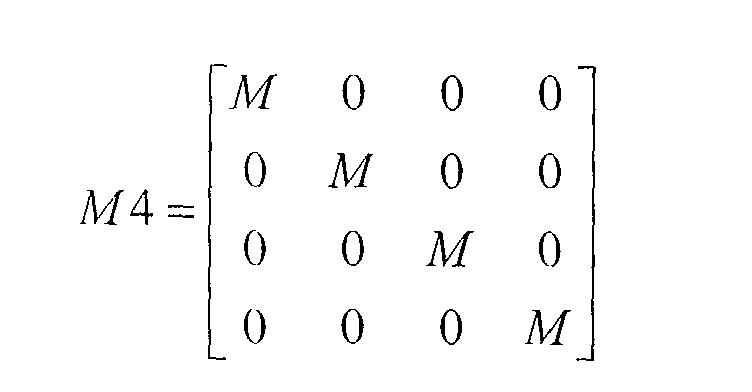
- T4 and M4 are block diagonal matrices 32x32, wherein while and
- Is4 is the simplified reversal operation in the transformed domain operating on 4 bytes independently.
- T 4 w' T 4 ⁇ M 4 ⁇ T 4 -1 Is 4( T 4 w ) +T 4 c 4
- T 4 ⁇ L ⁇ M 4 ⁇ T 4 -1 is a constant matrix (therefore pre-calculated)
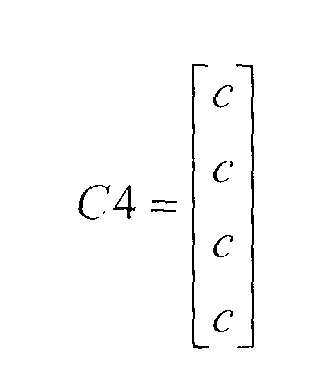
- T 4 ⁇ L ⁇ c 4 is a constant vector
- T 4 ⁇ k 4 are 32 bits of transformed key, through a block T4 properly placed before the S2 adder.
- KeyExpander process employs the ByteSub operation, and therefore the reversal, advantageously the KeyExpander is implemented in the transformed domain, so the KeyExpander is simpler and generates directly k 4 ⁇ T 4.
- the encoder block operation 22 consists now in four simplified reversals and a a multiplication of the matrix and vector, followed by the sum of the key k4, while in the known state of art four reversals (not simplified), a multiplication of the matrix and vector and the sum of the key were performed.
- mapping (and demapping) operation 4 has been carried outside of the encoder block 22.
- mapping operation being of linear type, is moved outside of the encoding ring, therefore outside of the area with a latency constraint.
- the encoding circuits 21 operate jointly to the schedulers blocks 24, which distribute the computational load on the encoding blocks 22.
- Figure 3 describes, therefore, a parallel structure encoding system.
- the CBC modality limits the max. elaboration capacity of a coded circuit, as the encoder circuit 11 or 21.
- the parallel structure according to Figure 3 forecasts therefore a plurality of encoders blocks 22, for instance 8, which are slow, namely they operate at a rate which is an eighth of the incoming data stream rate Fl, but they contribute, by a parallel operation, to reach the desired rate.
- An encoder under CBC modalities is not parallelizable per se ; but in the case of the packets traffic encoding, the elaboration of a single data packet is awarded to each encoder 22.
- the proper schedulers blocks 24 are inserted, which are placed upwards of the plurality of encoders blocks 22 and distribute their PK packets, of which the incoming data stream Fl is composed.
- the same schedulers blocks 24 recombine the PK packets at the output of the coded circuits 22 and generate the outgoing data stream FO.
- the scheduler 24 is exemplified in Fig. 4 and comprises substantially a MM memory having a length LM, wherein it is possible to have an access four times each clock cycle, twice for writing operations and twice for reading operations.
- the further two reading and writing accesses are used for the elaboration; specifically, a reading operation is implemented at a location identified by an Er address, which contains a word to be elaborated (or a clear word), and a writing operation is implemented at another location identified by an Ew address, by writing the elaborated (or encrypted data). Therefore, if each word which has been written in the memory MM is then read, codified and rewritten, the second reading operation returns the coded data stream in the same order of writing.
- the received word is written into the memory, a clear word is read from the memory, an encrypted word is written (in the same location wherein the corresponding clear word was resident) and the coded word to be transmitted is read.
- the physical implementation of a four-access memory can be carried out by employing a single-access memory with a data bus which is quadruple of the input word and the four-cycle accesses are set.
- the Ew and Er addresses select the data in turn for one of the encoders 22, and are evolved in the time t according to the following relationships:
- the dynamics of the starting address S is regulated by the mechanism which distributes the work among the N slow encoders blocks 22: when the first word arrives at the input of a new packet PK, the S address - where the first word of the packet PK has been written - and the length of the same packet PK are queued, namely they are inserted into a FIFO MF or queue memory. Then, the S address is picked off from the queue, when the encoder block 22 has terminated, that is when the reading address Er[t-N] reaches the last word of the PK packet.
- Imax and Imin are respectively the max. and min. lengths of a packet PK expressed in a number of words.
- the encryption method of a data stream according to the present invention allows advantageously to reduce the complexity of encoders, by reducing the operations on the blocks and by carrying the mapping operations outside of the encoding rings. Besides, advantageously, the encryption method of a data stream according to the present invention allows to simplify also the keys generation.
- the encryption method of a data stream according to the present invention allows to encode at high rate, also under the CBC manner, even with slower encoders and therefore of simpler but less expensive type, thanks to the development of a parallel architecture.
Landscapes
- Engineering & Computer Science (AREA)
- Computer Security & Cryptography (AREA)
- Computer Networks & Wireless Communication (AREA)
- Signal Processing (AREA)
- Storage Device Security (AREA)
- Data Exchanges In Wide-Area Networks (AREA)
- Compression, Expansion, Code Conversion, And Decoders (AREA)
- Time-Division Multiplex Systems (AREA)
- Recording Measured Values (AREA)
Abstract
Description
- the ShiftRows operation is simply a permutation among the 128 bits;
- the MixColumn operation is a linear operation, represented - therefore - as a matrix application;
- the AddRoundKey operation is a module 2 adding operation, (in other words, Xor bit ) between the 128 bits of k key and the 128 bits of the variable at the S2 adder input;
- the ByteSub operation, on the contrary, is a non-linear operation applied to each byte of the variable in order to implement the so-called mapping, namely a transformation on the bytes b and involving the T, 12 e T-1 blocks.
- Fig. 1 illustrates a block diagram showing the principle of an encoder implementing the data stream encryption method according to the prior art;
- Fig. 2 illustrates an encoder implementing the data stream encryption method according to the present invention;
- Figure 3 illustrates a block diagram showing a system of encoders implementing the encryption method of a data stream according to the present invention;
- Figure 4 illustrates a basic diagram of a detail of the encoders system according to Figure 3.

- writing operation at the P location of the (clear) word of the incoming data stream Fl;
- reading operation from the location P of the word addressed to the output.
Claims (11)
- Method for performing encryption of a data stream, the method comprising using encoding means (11, 21) to apply a mapping operation (T, T4) to the input data (Fl), to apply a reversal operation (l, ls), to apply a combination operation by a key (k; k4), to apply a demapping operation (T-1; T4-1), and further comprising tacking and re-combining outgoing data (FO) with the incoming data (Fl), characterized in that the mapping operation (T4) is applied upwards the re-combination operation between the incoming data stream (Fl) and the outgoing data stream (FO), to apply the demapping operation (T4-1) downwards of the tacking operation of the outgoing data stream (FO) and to implement the simplified reversal operation (Is).
- Encryption method of a data stream according to Claim 1, characterized by inserting a mapping operation (T4) into the combination key operation (k4) in order to produce a mapped key (T4 k4)
- Encryption method of a data stream according to Claim 2 characterized by distributing the incoming data stream (Fl) in a plurality (N) of parallel data streams (PK) addressed to a plurality of encoding circuits (22) and parallel encrypting each one of said data streams (PK).
- Encryption method of a data stream according to Claim 3 characterized by distributing packets (PK) of the incoming data stream (Fl) to the plurality of encoding circuits (21) according to a time sequence ascertained by proper scheduling means (24) and re-combining the encrypted packets coming from each coding circuit (21) into an outgoing data stream (FO).
- Encryption method of a data stream according to the Claim 4 characterized in that said scheduling means (24) carry out the distribution and the combination of packets (PK) through writing and reading operations into a multiple access memory (MM).
- Encryption method of a data stream according to Claim 5 characterized in that said reading and writing operations are generated through a control machine (25) which generates proper writing (Ew) and reading (Er) addresses into the multiple access memory (MM) for distributing the packets (PK) to a plurality of encoders (21).
- Encoder of the type comprising mapping and demapping means (T, T-1; T4, T4-1), encoding means (22) fit for implementing reversal operations and means (S1) for inserting a key (k, k4), and means for implementing a coding ring (D, S2), characterised in that said mapping and demapping means (T, T-1; T4, T4-1) are placed upwards and downwards of said encoding ring (D, S2).
- Encoder according to Claim 7, characterized in that said means (S1) inserting a key are connected to further mapping means (T4) to transform the key (k4).
- System for encrypting data, comprising a plurality of encoding devices according to Claim 7, characterized in that it comprises scheduling means (24) for distributing data packets (PK) from an incoming data stream (Fl) to said plurality of encoding devices (21) and for re-combining the elaborated packets into an outgoing data stream (FO).
- System for encrypting data according to Claim 9, characterized in that said scheduling means (24) comprise a multiple access memory (MM).
- System for encrypting data according to Claim 10, characterized in that said scheduling means (24) comprise a control machine (25) generating proper writing (Ew) and reading ( Er) addresses in the multiple access memory (MM) for distributing packets (PK) to a plurality of encoding devices (21).
Applications Claiming Priority (2)
| Application Number | Priority Date | Filing Date | Title |
|---|---|---|---|
| IT2001MI001938A ITMI20011938A1 (en) | 2001-09-17 | 2001-09-17 | METHOD TO ENCRYPT A FLOW OF DATA |
| ITMI20011938 | 2001-09-17 |
Publications (2)
| Publication Number | Publication Date |
|---|---|
| EP1294124A2 true EP1294124A2 (en) | 2003-03-19 |
| EP1294124A3 EP1294124A3 (en) | 2003-11-19 |
Family
ID=11448385
Family Applications (1)
| Application Number | Title | Priority Date | Filing Date |
|---|---|---|---|
| EP02292203A Withdrawn EP1294124A3 (en) | 2001-09-17 | 2002-09-09 | Method for data stream encryption |
Country Status (4)
| Country | Link |
|---|---|
| US (1) | US20030053624A1 (en) |
| EP (1) | EP1294124A3 (en) |
| CN (1) | CN1409512A (en) |
| IT (1) | ITMI20011938A1 (en) |
Cited By (1)
| Publication number | Priority date | Publication date | Assignee | Title |
|---|---|---|---|---|
| EP3567796A1 (en) * | 2018-05-10 | 2019-11-13 | Rolls-Royce plc | Structured file encryption process |
Families Citing this family (3)
| Publication number | Priority date | Publication date | Assignee | Title |
|---|---|---|---|---|
| US7885405B1 (en) * | 2004-06-04 | 2011-02-08 | GlobalFoundries, Inc. | Multi-gigabit per second concurrent encryption in block cipher modes |
| CN101632084B (en) * | 2007-03-13 | 2012-05-02 | Nxp股份有限公司 | Encryption and decryption of data sets of at least two dimensions |
| FR3039733B1 (en) * | 2015-07-29 | 2017-09-01 | Sagemcom Broadband Sas | DEVICE AND METHOD FOR MODIFYING A STREAMED MEDIA DATA STREAM |
Family Cites Families (27)
| Publication number | Priority date | Publication date | Assignee | Title |
|---|---|---|---|---|
| US4352952A (en) * | 1978-06-12 | 1982-10-05 | Motorola Inc. | Data security module |
| US4430734A (en) * | 1981-12-14 | 1984-02-07 | Bell Telephone Laboratories, Incorporated | Demultiplexer circuit |
| CA1296430C (en) * | 1986-11-10 | 1992-02-25 | Masahide Kaneko | Encoding system capable of accomplishing a high efficiency by anterior and/or posterior processing to quantization |
| US5365589A (en) * | 1992-02-07 | 1994-11-15 | Gutowitz Howard A | Method and apparatus for encryption, decryption and authentication using dynamical systems |
| US5226082A (en) * | 1992-07-02 | 1993-07-06 | At&T Bell Laboratories | Variable length decoder |
| US5365588A (en) * | 1993-03-12 | 1994-11-15 | Hughes Aircraft Company | High speed encryption system and method |
| US5455864A (en) * | 1993-09-20 | 1995-10-03 | Seiko Communications Holdings N.V. | Encrypted paging message transmission |
| US5440640A (en) * | 1993-10-05 | 1995-08-08 | Arithmetica, Inc. | Multistream encryption system for secure communication |
| US5903648A (en) * | 1996-02-06 | 1999-05-11 | The University Of Connecticut | Method and apparatus for encryption |
| US6088452A (en) * | 1996-03-07 | 2000-07-11 | Northern Telecom Limited | Encoding technique for software and hardware |
| US5835599A (en) * | 1996-04-15 | 1998-11-10 | Vlsi Technology, Inc. | Muti-cycle non-parallel data encryption engine |
| US6049608A (en) * | 1996-12-31 | 2000-04-11 | University Technology Corporation | Variable length nonlinear feedback shift registers with dynamically allocated taps |
| JP3351305B2 (en) * | 1997-08-07 | 2002-11-25 | 日本電気株式会社 | Computer-readable recording medium storing an encryption device and a program for implementing the encryption device |
| US6510228B2 (en) * | 1997-09-22 | 2003-01-21 | Qualcomm, Incorporated | Method and apparatus for generating encryption stream ciphers |
| US6252958B1 (en) * | 1997-09-22 | 2001-06-26 | Qualcomm Incorporated | Method and apparatus for generating encryption stream ciphers |
| US6263087B1 (en) * | 1998-06-26 | 2001-07-17 | Signafy, Inc. | Method of encoding bits in a signal |
| US6490357B1 (en) * | 1998-08-28 | 2002-12-03 | Qualcomm Incorporated | Method and apparatus for generating encryption stream ciphers |
| US6560338B1 (en) * | 1998-08-28 | 2003-05-06 | Qualcomm Incorporated | Limiting delays associated with the generation of encryption stream ciphers |
| US6415032B1 (en) * | 1998-12-01 | 2002-07-02 | Xilinx, Inc. | Encryption technique using stream cipher and block cipher |
| US6347143B1 (en) * | 1998-12-15 | 2002-02-12 | Philips Electronics No. America Corp. | Cryptographic device with encryption blocks connected parallel |
| WO2001024438A1 (en) * | 1999-09-27 | 2001-04-05 | Telefonaktiebolaget Lm Ericsson (Publ) | Output cipher feedback type pseudo noise-sequence generation |
| US6870929B1 (en) * | 1999-12-22 | 2005-03-22 | Juniper Networks, Inc. | High throughput system for encryption and other data operations |
| US6973187B2 (en) * | 2000-01-31 | 2005-12-06 | Vdg, Inc. | Block encryption method and schemes for data confidentiality and integrity protection |
| JP3864675B2 (en) * | 2000-03-09 | 2007-01-10 | 株式会社日立製作所 | Common key encryption device |
| US20020048364A1 (en) * | 2000-08-24 | 2002-04-25 | Vdg, Inc. | Parallel block encryption method and modes for data confidentiality and integrity protection |
| US7068788B2 (en) * | 2001-01-04 | 2006-06-27 | Maxim Integrated Products, Inc. | Data encryption for suppression of data-related in-band harmonics in digital to analog converters |
| KR100456599B1 (en) * | 2002-11-12 | 2004-11-09 | 삼성전자주식회사 | Cryptographic apparatus with parallel des structure |
-
2001
- 2001-09-17 IT IT2001MI001938A patent/ITMI20011938A1/en unknown
-
2002
- 2002-09-09 EP EP02292203A patent/EP1294124A3/en not_active Withdrawn
- 2002-09-13 US US10/242,731 patent/US20030053624A1/en not_active Abandoned
- 2002-09-17 CN CN02142665A patent/CN1409512A/en active Pending
Cited By (2)
| Publication number | Priority date | Publication date | Assignee | Title |
|---|---|---|---|---|
| EP3567796A1 (en) * | 2018-05-10 | 2019-11-13 | Rolls-Royce plc | Structured file encryption process |
| US11146382B2 (en) | 2018-05-10 | 2021-10-12 | Rolls-Royce Plc | Structured file encryption process |
Also Published As
| Publication number | Publication date |
|---|---|
| ITMI20011938A1 (en) | 2003-03-17 |
| CN1409512A (en) | 2003-04-09 |
| ITMI20011938A0 (en) | 2001-09-17 |
| US20030053624A1 (en) | 2003-03-20 |
| EP1294124A3 (en) | 2003-11-19 |
Similar Documents
| Publication | Publication Date | Title |
|---|---|---|
| US6879689B2 (en) | Stream-cipher method and apparatus | |
| US7760871B2 (en) | Block cipher using auxiliary transformation | |
| US20190207745A1 (en) | Sequential Encryption Method Based On Multi-Key Stream Ciphers | |
| CN101061661B (en) | encryption method | |
| US9363074B2 (en) | Encryption processing apparatus, encryption processing method, and computer program | |
| US20040146158A1 (en) | Cryptographic systems and methods supporting multiple modes | |
| CN109981249B (en) | Encryption and decryption method and device based on zipper type dynamic hash and NLFSR | |
| US20120155638A1 (en) | Securing keys of a cipher using properties of the cipher process | |
| US8122075B2 (en) | Pseudorandom number generator and encryption device using the same | |
| CN100382485C (en) | Method for Designing Optimal Encryption Function and Optimized Encryption Device | |
| US8687803B2 (en) | Operational mode for block ciphers | |
| CN100393026C (en) | Binary data block encryption conversion method | |
| US5909494A (en) | System and method for constructing a cryptographic pseudo random bit generator | |
| EP1294124A2 (en) | Method for data stream encryption | |
| WO2016026287A1 (en) | Encryption device, encryption method and computer storage medium | |
| Rais et al. | Efficient hardware realization of advanced encryption standard algorithm using Virtex-5 FPGA | |
| RU2738321C1 (en) | Cryptographic transformation method and device for its implementation | |
| Buell | Modern symmetric ciphers—Des and Aes | |
| US6005944A (en) | System and method for constructing block ciphers | |
| Kocheta et al. | A review of some recent stream ciphers | |
| TWI728933B (en) | Hybrid multistage algorithm encryption and decryption system, transmitting device thereof, and receiving device thereof | |
| RU2140716C1 (en) | Method for cryptographic conversion of digital data blocks | |
| Kan et al. | The fastest matrices multiplication using involutory matrix in AES MixColumns-InvMixcolumns transformation | |
| Srivaishnavi et al. | Design and Implementation of Efficient Block Cipher | |
| JP2001509608A (en) | Method for cryptographically converting an L-bit input block of digital data into an L-bit output block |
Legal Events
| Date | Code | Title | Description |
|---|---|---|---|
| PUAI | Public reference made under article 153(3) epc to a published international application that has entered the european phase |
Free format text: ORIGINAL CODE: 0009012 |
|
| AK | Designated contracting states |
Kind code of ref document: A2 Designated state(s): AT BE BG CH CY CZ DE DK EE ES FI FR GB GR IE IT LI LU MC NL PT SE SK TR Designated state(s): AT BE BG CH CY CZ DE DK EE ES FI FR GB GR IE IT LI LU MC NL PT SE SK TR |
|
| AX | Request for extension of the european patent |
Extension state: AL LT LV MK RO SI |
|
| PUAL | Search report despatched |
Free format text: ORIGINAL CODE: 0009013 |
|
| AK | Designated contracting states |
Kind code of ref document: A3 Designated state(s): AT BE BG CH CY CZ DE DK EE ES FI FR GB GR IE IT LI LU MC NL PT SE SK TR |
|
| AX | Request for extension of the european patent |
Extension state: AL LT LV MK RO SI |
|
| 17P | Request for examination filed |
Effective date: 20031010 |
|
| 17Q | First examination report despatched |
Effective date: 20040220 |
|
| AKX | Designation fees paid |
Designated state(s): AT BE BG CH CY CZ DE DK EE ES FI FR GB GR IE IT LI LU MC NL PT SE SK TR |
|
| STAA | Information on the status of an ep patent application or granted ep patent |
Free format text: STATUS: THE APPLICATION IS DEEMED TO BE WITHDRAWN |
|
| 18D | Application deemed to be withdrawn |
Effective date: 20040902 |