EP1294107A2 - Transmission diversity in a WCDMA system - Google Patents
Transmission diversity in a WCDMA system Download PDFInfo
- Publication number
- EP1294107A2 EP1294107A2 EP02018655A EP02018655A EP1294107A2 EP 1294107 A2 EP1294107 A2 EP 1294107A2 EP 02018655 A EP02018655 A EP 02018655A EP 02018655 A EP02018655 A EP 02018655A EP 1294107 A2 EP1294107 A2 EP 1294107A2
- Authority
- EP
- European Patent Office
- Prior art keywords
- complex
- sequences
- mobile device
- accordance
- demodulated
- Prior art date
- Legal status (The legal status is an assumption and is not a legal conclusion. Google has not performed a legal analysis and makes no representation as to the accuracy of the status listed.)
- Granted
Links
- 230000005540 biological transmission Effects 0.000 title claims abstract description 36
- 238000012935 Averaging Methods 0.000 claims abstract description 36
- 238000000034 method Methods 0.000 claims abstract description 31
- 238000012545 processing Methods 0.000 claims abstract description 10
- 230000008569 process Effects 0.000 claims abstract description 8
- 230000004044 response Effects 0.000 claims description 12
- 230000001413 cellular effect Effects 0.000 claims description 5
- 230000007480 spreading Effects 0.000 claims description 3
- 238000001228 spectrum Methods 0.000 claims description 2
- 238000001514 detection method Methods 0.000 description 8
- 238000010586 diagram Methods 0.000 description 5
- 238000013461 design Methods 0.000 description 2
- 238000012986 modification Methods 0.000 description 2
- 230000004048 modification Effects 0.000 description 2
- 230000008859 change Effects 0.000 description 1
- 230000007423 decrease Effects 0.000 description 1
- 230000010354 integration Effects 0.000 description 1
Images


Classifications
-
- H—ELECTRICITY
- H04—ELECTRIC COMMUNICATION TECHNIQUE
- H04B—TRANSMISSION
- H04B1/00—Details of transmission systems, not covered by a single one of groups H04B3/00 - H04B13/00; Details of transmission systems not characterised by the medium used for transmission
- H04B1/69—Spread spectrum techniques
- H04B1/707—Spread spectrum techniques using direct sequence modulation
- H04B1/709—Correlator structure
- H04B1/7093—Matched filter type
-
- H—ELECTRICITY
- H04—ELECTRIC COMMUNICATION TECHNIQUE
- H04B—TRANSMISSION
- H04B1/00—Details of transmission systems, not covered by a single one of groups H04B3/00 - H04B13/00; Details of transmission systems not characterised by the medium used for transmission
- H04B1/69—Spread spectrum techniques
- H04B1/707—Spread spectrum techniques using direct sequence modulation
- H04B1/7097—Interference-related aspects
- H04B1/711—Interference-related aspects the interference being multi-path interference
- H04B1/7115—Constructive combining of multi-path signals, i.e. RAKE receivers
- H04B1/7117—Selection, re-selection, allocation or re-allocation of paths to fingers, e.g. timing offset control of allocated fingers
-
- H—ELECTRICITY
- H04—ELECTRIC COMMUNICATION TECHNIQUE
- H04B—TRANSMISSION
- H04B7/00—Radio transmission systems, i.e. using radiation field
- H04B7/02—Diversity systems; Multi-antenna system, i.e. transmission or reception using multiple antennas
- H04B7/04—Diversity systems; Multi-antenna system, i.e. transmission or reception using multiple antennas using two or more spaced independent antennas
- H04B7/06—Diversity systems; Multi-antenna system, i.e. transmission or reception using multiple antennas using two or more spaced independent antennas at the transmitting station
Definitions
- the present invention relates to mobile radio terminals such as, but not limited to, mobile radio terminals described by the 3GPP TS 25.211 3.7.0 (2001-06) Technical Specification which is incorporated herein by reference in its entirety.
- radio transmissions to mobile data receivers employing radio frames each having 15 slots.
- the length of each frame is 38,400 chips and each slot is 2,560 chips.
- the common downlink physical channels in the Technical Specification include a common pilot channel (CPICH) which carries predefined bit/symbol sequences as described in Chapter 5.3.3.1.
- CPICH common pilot channel
- the CPICH channel may utilize two spatially diverse antennas which respectively transmit first and second complex sequences.
- the CPICH channel is transmitted from both antennas using the same channelization and scrambling code but, the predefined symbol sequence of each antenna is different.
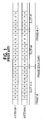
- Fig. 1 illustrates a diagram of the predefined symbol sequences of the CPICH channel for the antennas.
- Antenna 1 transmits a repeating sequence of symbols "A” and antenna 2 transmits a repeating sequence of alternating negative pairs of symbols "-A" and "A".
- the symbols themselves are transmitted as first and second complex sequences.
- the spreading code utilized is 256 chips per bit.
- RAKE demodulators are well known. For example, see pages 842-851 of Digital Communications, 4 th Edition, John P. Proakis, McGraw-Hill 2001, and the Assignee's United States Patent Application Serial No. 09/915,382 (Attorney's Docket No. 367.40363X00), filed July 27, 2001, "Method and Apparatus for Synchronization" which are incorporated herein by reference in their entirety.
- a RAKE receiver detects at least one peak with multiple peaks representing reception of multipath components of the transmission.
- the fingers of the RAKE receiver are aligned in time with as many multipath components as possible so as to increase the signal level which is detected.
- the number of fingers in a RAKE receiver used for signal detection may be set up to a maximum number designed into the receiver.
- the number of fingers which are used corresponds to the number of peaks detected in the received transmissions up to the maximum number of fingers designed into the receiver.
- the present invention provides an efficient matched filter which is used to estimate channel impulse response of transmitted constant symbol patterns such as, but not limited to, the aforementioned symbols of the CPICH channel.
- Channel impulse response of the matched filter of the present invention may be used with real time samples or stored samples.
- the first and second complex sequences transmitted by the two spatially diverse antennas in accordance with the Technical Specification may be estimated by multiplication with the complex conjugates thereof.
- a function of the complex detected first and second sequences is averaged to produce an averaged function.
- the averaged function is processed to detect a time, relative to a system time reference (which may, without limitation be obtained by detecting the predefined symbol sequences of the CPICH channel) of at least one peak therein resultant from the transmission of the first and second complex sequences.
- the time of the at least one peak relative to a system time reference may be used to set at least one finger in a RAKE receiver so as to detect the greatest possible signal strength.
- a power level of the peaks of the received transmissions being detected by the mobile device is transmitted to the system to control handoff.
- the handoff of transmissions may be from at least one group of transmitters to at least another group of transmitters.
- complex conjugates of the maximum impulse response components may be multiplied with corresponding data results and added together to form a soft value used to estimate if symbol patterns have been received while the RF electronics are shut down.
- the CPU of the mobile device in accordance with the invention may be used to dynamically change the length of the matched filter so as to meet different requirements pertaining to the use thereof such as minimizing power consumption in the mobile device.
- Stored data samples can be estimated without the RF receiver electronics of the mobile device being turned on.
- the detected time of the peaks transmitted from the spatially diverse antennas, such as from the CPICH channel, defines the time reference for detection of the data.
- the stored data is applied to the matched filter and the response of the matched filter is used to detect the data.
- the present invention utilizes the matched filter to detect the CPICH channel which reduces wakeup time compared to prior art RAKE receivers which increases standby time and reducing power consumption.
- the detection of the at least one peak is made more efficient by the present invention by threshold detecting the averaged function so as to cut down the signal peaks inputted into the central processing unit.
- a method at the mobile device in accordance with the invention includes demodulating the first and second complex sequences to produce demodulated complex first and second sequences; detecting the demodulated first and second complex sequences to produce detected complex first and second sequences by multiplying respectively the demodulated first and second complex sequences with complex conjugates thereof; averaging a function of the complex detected first and second sequences to produce an averaged function; and processing the averaged function to detect a time, relative to a system time reference, of at least one peak therein resultant from the transmission of the first and second complex sequences.
- the mobile device may comprise a RAKE receiver; and the time of the at least one peak may be used to set fingers in the RAKE receiver within the mobile device.
- the system may be a cellular system having a plurality of base stations at which the transmitters are located which transmit the first and second complex sequences, a power level of the peaks may be detected by the mobile device and the power level of the peaks may be transmitted to the system; and the system, in response to the power level, may control handoff of transmissions to the mobile device from one transmitter to another transmitter in the system.
- the method further may include performing a first averaging which averages the detected complex first and second sequences to produce complex averages thereof; detecting a magnitude of the complex averages; performing a second averaging of the magnitude of the complex averages to produce a real average; and wherein the processing of the averaged function is performed on the real average.
- the RAKE receiver may have n fingers and the number of fingers may be set equal to the number of peaks m when m # n and equal to n when m > n.
- the averaged function may be threshold detected to pass only peaks therein which exceed a set threshold to the processing of the averaged function.
- the first and second sequences may be transmitted as a spread spectrum transmission using a pseudonoise spreading code to spread the first and second complex sequences across a base band with each bit in the first and second sequences being spread into n chips; and the mobile device may include a matched filter, responsive to the demodulated first and second complex sequences, comprising n stages which combine signals from at least some of the n stages to produce a matched filter output signal which is the demodulated complex first and second sequences.
- the number of stages n may be varied under control of a processor which processes the averaged function.
- the first and second complex sequences may be phase references representative of a phase of the transmitter transmitting the first and second complex sequences; and the mobile device may detect the first and second phase references and may detect data transmissions to the mobile device from the one transmitter using the first and second phase references. Data may be transmitted simultaneously with the phase references to the mobile device and stored; and thereafter the stored data is demodulated using the stored phase references while demodulation is turned off.
- the mobile device may include a matched filter, responsive to the demodulated first and second complex sequences, comprising n stages which combine signals from at least some of the n stages to produce a matched filter output signal which is the demodulated complex first and second sequences;
- the first and second complex sequences may be phase references representative of a phase of the transmitter transmitting the first and second complex sequences;
- a data transmission may be transmitted simultaneously with the phase references to the mobile device;
- the mobile device may include a storage which stores the data; and the data may be retrieved from storage and may be detected using the matched filter and the stored phase references while the mobile device demodulation is turned off.
- a mobile device in accordance with the invention includes a demodulator which demodulates the first and second complex sequences to produce demodulated first and second complex sequences; a detector which detects the demodulated first and second complex sequences by multiplying respectively the demodulated first and second complex sequences with complex conjugates thereof to produce detected first and second complex sequences; at least one averaging unit, responsive to the detected first and second complex sequences, which produces an averaged function of the detected first and second complex sequences; and a processor, responsive to the averaged function, which detects a time, relative to a system time reference, of at least one peak therein resultant from the transmission of the first and second complex sequences.
- the mobile device may include a RAKE receiver; and the time of the at least one peak may be used to set fingers in the RAKE receiver within the mobile device.
- the RAKE receiver may have n fingers with the number of fingers being set equal to the number of peaks m when m # n and equal to n when m > n.
- the system may be a cellular system having a plurality of base stations at which the transmitters are located which transmit the first and second complex sequences, a power level of the peaks may be detected by the mobile device and the power level may be transmitted to the system; and the system in response to the power level the system may control handoff of transmissions to the mobile device from one transmitter to another transmitter in the system.
- the at least one averaging unit may comprise a first averaging unit, responsive to the detected first complex sequence, which produces a first complex average and a second averaging unit, responsive to the detected second complex sequence, which produces a second complex average; and a third averaging unit, responsive to a function of the first and second complex averages, which produces the averaged function.
- a first magnitude detector responsive to the first complex average and coupled to the third averaging unit, may detect a magnitude of the first complex average which is an input to the third averaging unit; and a second magnitude detector, responsive to the first complex average and coupled to the third averaging unit, which detects a magnitude of the second complex average which is an input of the third averaging unit.
- a matched filter responsive to the demodulated first and second complex sequences comprising n stages may combine signals from at least some of the n stages to produce a matched filter output signal which is the demodulated complex first and second sequences.
- the first and second complex sequences may be phase references representative of a phase of the transmitter transmitting the first and second complex sequences; and the mobile device may detect the first and second phase references and may detect data transmissions to the mobile device from the one transmitter using the first and second phase references.
- a threshold detector coupled between the at least one averaging unit and the processor, may pass only peaks in the averaged function to the processor which exceed a set threshold.
- a power level detector coupled to the complex first and second sequences, may detect a power level of the complex first and second sequences and may apply a control signal to the threshold detector to set the threshold in accordance with the detected power level.
- the mobile device may include a matched filter, responsive to the demodulated first and second complex sequences, comprising n stages which combine signals from at least some of the n stages to produce a matched filter output signal which is the demodulated complex first and second sequences; the first and second complex sequences are phase references representative of a phase of the transmitter transmitting the first and second complex sequences; data may be transmitted simultaneously with the phase references to the mobile device; the mobile device includes a storage which stores the data; and the data may be retrieved from storage and is detected using the matched filter and the stored phase references while the mobile device demodulation is turned off.
- Fig. 1 illustrates a diagram of the CPICH channel of the 3GPP Technical Specification referred to above.
- Fig. 2 illustrates a block diagram of a system including the mobile device of the present invention.
- Fig. 3 illustrates the process of detection of peaks using a set threshold by a mobile device in accordance with the present invention.
- Fig. 4 illustrates a diagram of detection of data transmissions in accordance with the invention while the RF electronics of the mobile device are turned off.
- Fig. 2 illustrates a system 10 comprising a wireless data network 12 which may be in accordance with the Technical Specification but is not limited thereto and a mobile device 14 in accordance with the present invention.
- the wireless data network 12 has a plurality of base stations 16 of conventional design each containing at least two spatially diverse antennas 18 which transmit first and second complex sequences such as in accordance with the prior art of Fig. 1 but not limited thereto.
- the wireless data network 12 operates in a conventional fashion to control handoff.
- a signal strength estimation is transmitted from the mobile device 14 which is obtained from the transmissions 20 from one or more of the base stations 16 to one or more of the other base stations 16.
- the antenna 22 of the mobile device 14 transmits an uplink transmission of the detected power level of the transmission(s) 20 received by antenna 22 which provides the signal strength information to the wireless data network necessary for handoff to another one or more base stations 16 when the signal level of the data transmissions received from one or more of the base stations falls below a set level.
- the handoff process is conventional with the present invention using the detection of the signal strength of the first and second complex sequences in transmissions 20 such as the aforementioned CPICH channels from the multiple base stations to provide the wireless data network 12 with an estimate of signal strength from the various base stations.
- the "mobile transmissions" input 25 to RF electronics 24 is the power level information used to control handoff which is discussed in more detail below.
- the resultant digitized data samples represent samples of the orthogonal I and Q components of each symbol.
- the demodulated first and second complex sequences outputted by the A to D converter 28 are applied to matched filter 30 and to a RAKE receiver 32 of standard design.
- the output of the RAKE receiver 32 is coupled to a decoder 34.
- the decoder 34 outputs decoded data received on channels selected by Walsh code generator 40 other than the CPICH channel in accordance with the prior art.
- a sample storage 38 stores data samples produced by A to D converter 28 which may be read out and detected by the CPU 36 using a conventional soft decision process which is not part of the present invention once the timing of signal peaks obtained from the matched filter by the detecting of the first and second complex sequences of Fig. 1 which may contain phase information if the first and second sequences are from the CPICH channel.
- a Walsh code generator 40 inputs channel selection codes for tuning of particular channels such as the aforementioned CPICH channel and the data channels.
- the PN_I and PN_Q generators 42 and 44 generate pseudorandom noise codes for dispreading the chips used for encoding each bit.
- the matched filter 30 contains a number of stages equal to the number of chips per bit, e.g. 256 in the aforementioned Technical Standard, with the number used for estimation of signal response being reducible under control of CPU 36.
- the number of stages used for channel estimation may be varied under control of the control signal 75 generated by CPU 36 to conserve power if sufficient signal level can be detected with signal components obtained from a smaller number of stages.
- a first sequence generator 46 generates a complex conjugate of the first complex sequence transmitted by one of the antennas 18 and a second sequence generator 48 generates a complex conjugate of the second complex sequence transmitted by the other of the antennas 18.
- the invention should be understood as not being limited to antennas
- the detected outputs of the sequence generators 46 and 48 are complex, are respectively applied to a first multiplier 50 and a second multiplier 51, which respectively multiply the demodulated first and second sequences outputted by the matched filter 30, to produce detected complex first and second sequences.
- the first detected complex sequence produced by multiplier 50 is applied to a first averaging unit 52 and the second detected second complex sequence produced by multiplier 51 is applied to second averaging unit 54.
- the averaging units 52 and 54 may perform averaging by different methods. These averaging methods include taking numerous samples and computing an average thereof or integration with both methodologies being equivalent for purposes of the present invention.
- the averaging units 52 and 54 respectively average the detected first and second complex sequences outputted by the multipliers 50 and 51 and output complex averages which are respectively applied to magnitude detectors 56 and 58 which respectively are responsive to the first complex average and the second complex average.
- the resultant real outputs from the magnitude detectors 56 and 58 are applied to a third averaging unit 60 which produces a real averaged function of the detected first and second complex sequences and, as illustrated in Fig. 3, typically contain a series of peaks 62 of relative small signal magnitude which represent the reception of low energy multipath components resultant from the transmission of the signal 20 from the diversity antennas 18 and a smaller number of higher energy peaks 64 representative of significant energy multipath components.
- the third averaging unit 30 outputs real information which varies in magnitude and contains one or more of the higher energy signal peaks 64 containing significant signal level representative of different multipath components to produce maximum signal energy.
- Threshold detector 66 is utilized to set the threshold level 68 in Fig. 3 to reduce the data rate applied to the CPU 36 which reduces processing overhead.
- the demodulated first and second complex sequences outputted from the A to D converter 28 are also applied to a power level detector 70 which, for example, may compute the real quantity of I 2 plus Q 2 .
- the I 2 and Q 2 components are respectively representative of the orthogonal components of each symbol.
- the sum of I 2 + Q 2 is used to set a threshold level input to the threshold detector 66.
- the CPU 36 functions to detect a time of each of the peaks 64, relative to a system time reference, which may be obtained by using any known method, including detecting and using the phase information contained in the frames of the prior art of Fig. 1, so that the number of fingers used within the RAKE receiver 32 is set.
- the CPU 36 outputs a signal 74 to the RAKE receiver 32.
- the signal 74 causes the RAKE receiver 32 to activate, within the number of fingers n designed in the RAKE receiver, a number of fingers used for detection.
- the number of fingers which are activated is equal to the number of peaks m when m ⁇ n and equal to n when m > n.
- the CPU 36 also generates a signal 75 for controlling selection of a number of stages in the matched filter 30.
- the number of stages nominally from the maximum number, e.g. 256 or reduced to a lesser number, for conserving power or otherwise if the matched filter 30 produces sufficient signal response.
- the CPU 36 also outputs a power control signal 76 which may be used to turn off the RF electronics 24, A to D converter 28, RAKE receiver 32 and decoder 34 to conserve power when soft data detection by the CPU is used for data transmissions of a relative short duration is performed using the matched filter 30 in accordance with Figs. 4 D and E.
- a power control signal 76 which may be used to turn off the RF electronics 24, A to D converter 28, RAKE receiver 32 and decoder 34 to conserve power when soft data detection by the CPU is used for data transmissions of a relative short duration is performed using the matched filter 30 in accordance with Figs. 4 D and E.
- Figs. 4A-C illustrate a time diagram of the operation of the prior art.
- the "RF ON" illustrated in Fig. 4C represents the estimation of the time spacing between peaks 64 in Fig. 3 and the subsequent demodulation of data symbols.
- the RF components are turned on only for the detecting of the time of the signal peaks 64 and turned of for the subsequent demodulation of symbols which decreases power consumption.
- the A to D samples outputted by the A to D converter 28, which are stored in sample storage 38 during estimation of the time of the peaks 64, are estimated using the impulse response of matched filter 30 while the RF electronics are turned off.
- the stored data samples from the sample storage 38 are demodulated, while the RF electronics and other components are turned off by power control signal 76.
- the RF electronics are turned off while demodulation of the stored data occurs using a conventional soft decision in CPU 36 which processes the signals inputted from the threshold detector 66.
- the channel containing the data stored within the sample storage 38 is selected by Walsh code generator 40 and the I and Q components are despread in the same manner by dispreading codes from PN_I and PN_Q generators 42 and 44 as used in the earlier signal processing.
Landscapes
- Engineering & Computer Science (AREA)
- Computer Networks & Wireless Communication (AREA)
- Signal Processing (AREA)
- Mobile Radio Communication Systems (AREA)
- Radio Transmission System (AREA)
Abstract
Description
Claims (26)
- In a system, including a plurality of transmitters which transmit from at least one of the transmitters first and second complex sequences respectively from two spatially diverse antennas of the at least one transmitter to a mobile device, the method at the mobile device comprising:demodulating the first and second complex sequences to produce demodulated complex first and second sequences;detecting the demodulated first and second complex sequences to produce detected complex first and second sequences by multiplying respectively the demodulated first and second complex sequences with complex conjugates thereof;averaging a function of the complex detected first and second sequences to produce an averaged function; andprocessing the averaged function to detect a time, relative to a system time reference, of at least one peak therein resultant from the transmission of the first and second complex sequences.
- A method in accordance with claim 1 wherein:the mobile device comprises a RAKE receiver; andthe time of the at least one peak is used to set fingers in the RAKE receiver within the mobile device.
- A method in accordance with claim 1 wherein:the system is a cellular system having a plurality of base stations at which the transmitters are located which transmit the first and second complex sequences, a power level of the peaks is detected by the mobile device and the power level of the peaks is transmitted to the system; andthe system, in response to the power level, controls handoff of transmissions to the mobile device from one transmitter to another transmitter in the system.
- A method in accordance with claims 1-3 wherein the averaging a function of the detected complex first and second sequences to produce the averaged function comprises:performing a first averaging which averages the detected complex first and second sequences to produce complex averages thereof;detecting a magnitude of the complex averages;performing a second averaging of the magnitude of the complex averages to produce a real average; and whereinthe processing of the averaged function is performed on the real average.
- A method in accordance with claim 2 wherein:the RAKE receiver has n fingers with the number of fingers being set equal to the number of peaks m for m # n and equal to n where m > n.
- A method in accordance with claim 2 wherein:the system is a cellular system having a plurality of base stations at which transmitters are located which transmit the first and second complex sequences, a power level of the peaks is detected by the mobile device and the power level of the peaks is transmitted to the system; andthe system, in response to the power level, controls handoff of transmissions to the mobile device from one transmitter to another transmitter in the system.
- A method in accordance with claim 4 wherein:the RAKE receiver has n fingers with the number of fingers being set equal to the number of peaks m for m # n and equal to n where m > n.
- A method in accordance with claims 1-7 wherein:the averaged function is threshold detected to pass only peaks therein which exceed a set threshold to the processing of the averaged function.
- A method in accordance with claim 8 wherein:the set threshold level is a function of a power level in the demodulated first and second sequences.
- A method in accordance with claim 1 wherein:the first and second sequences are transmitted as a spread spectrum transmission using a pseudonoise spreading code to spread the first and second complex sequences across a base band with each bit in the first and second sequences being spread into n chips; andthe mobile device includes a matched filter, responsive to the demodulated first and second complex sequences, comprising n stages which combine signals from at least some of the n stages to produce a matched filter output signal which is the demodulated complex first and second sequences.
- A method in accordance with claim 10 wherein:the number of stages n is varied under control of a processor which processes the average function.
- A method in accordance with claim 1 wherein:the first and second complex sequences are phase references representative of a phase of the transmitter transmitting the first and second complex sequences; andthe mobile device detects the first and second phase references and detects data transmissions to the mobile device from the one transmitter using the first and second phase references.
- A method in accordance with claim 12 wherein:data is transmitted simultaneously with the phase references to the mobile device and stored; andthereafter the stored data is demodulated using the stored phase references while demodulation is turned off.
- A method in accordance with claim 1 wherein:the mobile device includes a matched filter, responsive to the demodulated first and second complex sequences, comprising n stages which combine signals from at least some of the n stages to produce a matched filter output signal which is the demodulated complex first and second sequences;the first and second complex sequences are phase references representative of a phase of the transmitter transmitting the first and second complex sequences;a data transmission is transmitted simultaneously with the phase references to the mobile device;the mobile device includes a storage which stores the data; andthe data is retrieved from storage and is detected using the matched filter and the stored phase references while the mobile device demodulation is turned off.
- A method in accordance with claim 1 wherein:the transmitters comprise base stations in a mobile data system.
- In a system including a plurality of transmitters which transmit from at least one of the transmitters first and second complex sequences respectively from two spatially diverse antennas of the at least one transmitter, a mobile device comprising:a demodulator which demodulates the first and second complex sequences to produce demodulated first and second complex sequences;a detector which detects the demodulated first and second complex sequences by multiplying respectively the demodulated first and second complex sequences with complex conjugates thereof to produce detected first and second complex sequences;at least one averaging unit, responsive to the detected first and second complex sequences, which produces an averaged function of the detected first and second complex sequences; anda processor, responsive to the averaged function, which detects a time, relative to a system time reference, of at least one peak therein resultant from the transmission of the first and second complex sequences.
- A mobile device in accordance with claim 16 comprising:a RAKE receiver; andthe time of the at least one peak is used to set fingers in the RAKE receiver within the mobile device.
- A mobile device in accordance with claim 17 wherein:the RAKE receiver has n fingers with the number of fingers being set equal to the number of peaks m for m * n and equal to n where m > n.
- A mobile device in accordance with claims 16-18 wherein:the system is a cellular system having a plurality of base stations at which the transmitters are located which transmit the first and second complex sequences, a power level of the peaks is detected by the mobile device and the power level is transmitted to the system; andthe system in response to the power level the system controls handoff of transmissions to the mobile device from one transmitter to another transmitter in the system.
- A mobile device in accordance with claims 16-19 wherein:the at least one averaging unit comprises a first averaging unit, responsive to the detected first complex sequence, which produces a first complex average and a second averaging unit, responsive to the detected second complex sequence, which produces a second complex average; anda third averaging unit, responsive to a function of the first and second complex averages, which produces the averaged function.
- A mobile device in accordance with claim 20 comprising:a first magnitude detector, responsive to the first complex average and coupled to the third averaging unit, which detects a magnitude of the first complex average which is an input to the third averaging unit; anda second magnitude detector, responsive to the first complex average and coupled to the third averaging unit, which detects a magnitude of the second complex average which is an input of the third averaging unit.
- A mobile device in accordance with claim 16 comprising:a matched filter, responsive to the demodulated first and second complex sequences comprising n stages which combine signals from at least some of the n stages to produce a matched filter output signal which is the demodulated complex first and second sequences.
- A mobile device in accordance with claim 16 wherein:the first and second complex sequences are phase references representative of a phase of the transmitter transmitting the first and second complex sequences; andthe mobile device detects the first and second phase references and detects data transmissions to the mobile device from the one transmitter using the first and second phase references.
- A mobile device in accordance with claims 16-23 comprising:a threshold detector, coupled between the at least one averaging unit and the processor, which passes only peaks in the averaged function to the processor which exceed a set threshold.
- A mobile device in accordance with claim 24 comprising:a power level detector, coupled to the complex first and second sequences, which detects a power level of the complex first and second sequences and applies a control signal to the threshold detector to set the threshold in accordance with the detected power level.
- A mobile device in accordance with claims 16-25 wherein:the mobile device includes a matched filter, responsive to the demodulated first and second complex sequences, comprising n stages which combine signals from at least some of the n stages to produce a matched filter output signal which is the demodulated complex first and second sequences;the first and second complex sequences are phase references representative of a phase of the transmitter transmitting the first and second complex sequences;data is transmitted simultaneously with the phase references to the mobile device;the mobile device includes a storage which stores the data; andthe data is retrieved from storage and is detected using the matched filter and the stored phase references while the mobile device demodulation is turned off.
Applications Claiming Priority (2)
| Application Number | Priority Date | Filing Date | Title |
|---|---|---|---|
| US09/950,023 US7042968B1 (en) | 2001-09-12 | 2001-09-12 | Efficient multipurpose code matched filter for wideband CDMA |
| US950023 | 2001-09-12 |
Publications (3)
| Publication Number | Publication Date |
|---|---|
| EP1294107A2 true EP1294107A2 (en) | 2003-03-19 |
| EP1294107A3 EP1294107A3 (en) | 2003-07-02 |
| EP1294107B1 EP1294107B1 (en) | 2006-10-04 |
Family
ID=25489843
Family Applications (1)
| Application Number | Title | Priority Date | Filing Date |
|---|---|---|---|
| EP02018655A Expired - Lifetime EP1294107B1 (en) | 2001-09-12 | 2002-08-20 | Support for handoff in a mobile receiver in WCDMA system with transmission diversity |
Country Status (4)
| Country | Link |
|---|---|
| US (1) | US7042968B1 (en) |
| EP (1) | EP1294107B1 (en) |
| CN (1) | CN1236574C (en) |
| DE (1) | DE60215094T2 (en) |
Families Citing this family (10)
| Publication number | Priority date | Publication date | Assignee | Title |
|---|---|---|---|---|
| US8611311B2 (en) * | 2001-06-06 | 2013-12-17 | Qualcomm Incorporated | Method and apparatus for canceling pilot interference in a wireless communication system |
| US7190749B2 (en) * | 2001-06-06 | 2007-03-13 | Qualcomm Incorporated | Method and apparatus for canceling pilot interference in a wireless communication system |
| EP1526648A1 (en) * | 2003-10-21 | 2005-04-27 | Mitsubishi Electric Information Technology Centre Europe B.V. | System and device for modulating UWB pulse sequences |
| US8442441B2 (en) * | 2004-12-23 | 2013-05-14 | Qualcomm Incorporated | Traffic interference cancellation |
| US8099123B2 (en) * | 2004-12-23 | 2012-01-17 | Qualcomm Incorporated | Adaptation of transmit subchannel gains in a system with interference cancellation |
| US8406695B2 (en) * | 2004-12-23 | 2013-03-26 | Qualcomm Incorporated | Joint interference cancellation of pilot, overhead and traffic channels |
| US8422955B2 (en) | 2004-12-23 | 2013-04-16 | Qualcomm Incorporated | Channel estimation for interference cancellation |
| US8472877B2 (en) * | 2005-10-24 | 2013-06-25 | Qualcomm Incorporated | Iterative interference cancellation system and method |
| US8385388B2 (en) * | 2005-12-06 | 2013-02-26 | Qualcomm Incorporated | Method and system for signal reconstruction from spatially and temporally correlated received samples |
| US9106341B2 (en) * | 2011-12-12 | 2015-08-11 | Intel Deutschland Gmbh | Communication terminal and method for receiving data |
Family Cites Families (10)
| Publication number | Priority date | Publication date | Assignee | Title |
|---|---|---|---|---|
| US5563604A (en) * | 1995-02-08 | 1996-10-08 | Alliedsignal Inc. | Weather radar using spectral gaussian envelope discrimination for clutter rejection |
| KR100326330B1 (en) * | 1998-05-08 | 2002-06-26 | 윤종용 | Hand-off apparatus for mobile communication system and method therefor |
| JP3397237B2 (en) * | 1998-09-29 | 2003-04-14 | 日本電気株式会社 | CDMA communication system, mobile station, and transmission power control method therefor |
| US6243561B1 (en) | 1998-10-13 | 2001-06-05 | Qualcomm Incorporated | Offline page monitoring |
| US6363108B1 (en) * | 1999-03-31 | 2002-03-26 | Qualcomm Inc. | Programmable matched filter searcher |
| US6389003B1 (en) * | 1999-11-23 | 2002-05-14 | Lucent Technologies Inc. | Method for decreasing false positives in frame synchronization of code division multiple access |
| JP3407711B2 (en) * | 2000-04-27 | 2003-05-19 | 日本電気株式会社 | Path search circuit in DS-CDMA receiver |
| JP3846546B2 (en) * | 2000-08-29 | 2006-11-15 | 日本電気株式会社 | Frequency offset estimator |
| JP3360069B2 (en) * | 2000-08-30 | 2002-12-24 | 株式会社東芝 | Automatic frequency control circuit |
| US6680727B2 (en) * | 2000-10-17 | 2004-01-20 | Qualcomm Incorporated | Method and apparatus for canceling pilot interference in a CDMA communication system |
-
2001
- 2001-09-12 US US09/950,023 patent/US7042968B1/en not_active Expired - Lifetime
-
2002
- 2002-08-20 EP EP02018655A patent/EP1294107B1/en not_active Expired - Lifetime
- 2002-08-20 DE DE60215094T patent/DE60215094T2/en not_active Expired - Lifetime
- 2002-09-11 CN CN02131541.8A patent/CN1236574C/en not_active Expired - Fee Related
Also Published As
| Publication number | Publication date |
|---|---|
| US7042968B1 (en) | 2006-05-09 |
| EP1294107A3 (en) | 2003-07-02 |
| EP1294107B1 (en) | 2006-10-04 |
| DE60215094T2 (en) | 2007-04-05 |
| CN1406009A (en) | 2003-03-26 |
| CN1236574C (en) | 2006-01-11 |
| DE60215094D1 (en) | 2006-11-16 |
Similar Documents
| Publication | Publication Date | Title |
|---|---|---|
| US7180881B2 (en) | Burst detector | |
| KR0173414B1 (en) | Method and apparatus for identifying a coded communication signal | |
| US5764690A (en) | Apparatus for despreading and demodulating a burst CDMA signal | |
| US6717976B1 (en) | Method and apparatus for signal to noise power ratio estimation in a multi sub-channel CDMA receiver | |
| US6192040B1 (en) | Method and apparatus for producing channel estimate of a communication channel in a CDMA communication system | |
| EP0577044A1 (en) | Phase difference correcting demodulator for a receiver for spread spectrum communication | |
| US20090201905A1 (en) | Method and apparatus for estimating channelization codes in a wireless transmit/receive unit | |
| EP0975100A1 (en) | Receiver and method of recovering data from radio signals | |
| US7336640B2 (en) | Method and apparatus for CDMA demodulation | |
| CN100517998C (en) | wireless communication system | |
| US7042968B1 (en) | Efficient multipurpose code matched filter for wideband CDMA | |
| US6996162B1 (en) | Correlation using only selected chip position samples in a wireless communication system | |
| WO2000036760A1 (en) | Channel estimation for a cdma system using pre-defined symbols in addition to pilot symbols | |
| US6831956B1 (en) | Wireless communications system with combining of multiple paths selected from sub-windows in response to the primary synchronization channel | |
| US7023901B2 (en) | Spreading factor estimation system and method | |
| WO2002037713A2 (en) | Method and apparatus for forward link power control bit generation in a spread-spectrum communication system | |
| US7558314B2 (en) | Method and device for detection of a UMTS signal | |
| US20050243901A1 (en) | Reception device and reception method | |
| KR100366288B1 (en) | Optimal searching method of DS-CDMA signal composed of time multiplexed known symbols and unknown symbols | |
| EP1093237A2 (en) | Improvements in or relating to wireless communication systems | |
| US20040125865A1 (en) | Maximum signal-to-interference-and-noise spread spectrum rake receiver and method | |
| EP1091507A2 (en) | Wireless communication system with asymmetrically spaced synchronization channel components |
Legal Events
| Date | Code | Title | Description |
|---|---|---|---|
| PUAI | Public reference made under article 153(3) epc to a published international application that has entered the european phase |
Free format text: ORIGINAL CODE: 0009012 |
|
| AK | Designated contracting states |
Kind code of ref document: A2 Designated state(s): AT BE BG CH CY CZ DE DK EE ES FI FR GB GR IE IT LI LU MC NL PT SE SK TR |
|
| AX | Request for extension of the european patent |
Extension state: AL LT LV MK RO SI |
|
| PUAL | Search report despatched |
Free format text: ORIGINAL CODE: 0009013 |
|
| AK | Designated contracting states |
Designated state(s): AT BE BG CH CY CZ DE DK EE ES FI FR GB GR IE IT LI LU MC NL PT SE SK TR |
|
| AX | Request for extension of the european patent |
Extension state: AL LT LV MK RO SI |
|
| 17P | Request for examination filed |
Effective date: 20031218 |
|
| AKX | Designation fees paid |
Designated state(s): DE FI FR GB NL |
|
| 17Q | First examination report despatched |
Effective date: 20040329 |
|
| GRAP | Despatch of communication of intention to grant a patent |
Free format text: ORIGINAL CODE: EPIDOSNIGR1 |
|
| RTI1 | Title (correction) |
Free format text: SUPPORT FOR HANDOFF IN A MOBILE RECEIVER IN WCDMA SYSTEM WITH TRANSMISSION DIVERSITY |
|
| GRAS | Grant fee paid |
Free format text: ORIGINAL CODE: EPIDOSNIGR3 |
|
| GRAA | (expected) grant |
Free format text: ORIGINAL CODE: 0009210 |
|
| AK | Designated contracting states |
Kind code of ref document: B1 Designated state(s): DE FI FR GB NL |
|
| PG25 | Lapsed in a contracting state [announced via postgrant information from national office to epo] |
Ref country code: FI Free format text: LAPSE BECAUSE OF FAILURE TO SUBMIT A TRANSLATION OF THE DESCRIPTION OR TO PAY THE FEE WITHIN THE PRESCRIBED TIME-LIMIT Effective date: 20061004 |
|
| REG | Reference to a national code |
Ref country code: GB Ref legal event code: FG4D |
|
| REF | Corresponds to: |
Ref document number: 60215094 Country of ref document: DE Date of ref document: 20061116 Kind code of ref document: P |
|
| ET | Fr: translation filed | ||
| PLBE | No opposition filed within time limit |
Free format text: ORIGINAL CODE: 0009261 |
|
| STAA | Information on the status of an ep patent application or granted ep patent |
Free format text: STATUS: NO OPPOSITION FILED WITHIN TIME LIMIT |
|
| 26N | No opposition filed |
Effective date: 20070705 |
|
| PGFP | Annual fee paid to national office [announced via postgrant information from national office to epo] |
Ref country code: GB Payment date: 20140820 Year of fee payment: 13 |
|
| REG | Reference to a national code |
Ref country code: GB Ref legal event code: 732E Free format text: REGISTERED BETWEEN 20150910 AND 20150916 |
|
| REG | Reference to a national code |
Ref country code: DE Ref legal event code: R082 Ref document number: 60215094 Country of ref document: DE Representative=s name: BECKER, KURIG, STRAUS, DE Ref country code: DE Ref legal event code: R081 Ref document number: 60215094 Country of ref document: DE Owner name: NOKIA TECHNOLOGIES OY, FI Free format text: FORMER OWNER: NOKIA CORP., 02610 ESPOO, FI |
|
| GBPC | Gb: european patent ceased through non-payment of renewal fee |
Effective date: 20150820 |
|
| REG | Reference to a national code |
Ref country code: NL Ref legal event code: PD Owner name: NOKIA TECHNOLOGIES OY; FI Free format text: DETAILS ASSIGNMENT: VERANDERING VAN EIGENAAR(S), OVERDRACHT; FORMER OWNER NAME: NOKIA CORPORATION Effective date: 20151111 |
|
| REG | Reference to a national code |
Ref country code: FR Ref legal event code: PLFP Year of fee payment: 15 |
|
| PG25 | Lapsed in a contracting state [announced via postgrant information from national office to epo] |
Ref country code: GB Free format text: LAPSE BECAUSE OF NON-PAYMENT OF DUE FEES Effective date: 20150820 |
|
| REG | Reference to a national code |
Ref country code: FR Ref legal event code: TP Owner name: NOKIA TECHNOLOGIES OY, FI Effective date: 20170109 |
|
| REG | Reference to a national code |
Ref country code: FR Ref legal event code: PLFP Year of fee payment: 16 |
|
| REG | Reference to a national code |
Ref country code: FR Ref legal event code: PLFP Year of fee payment: 17 |
|
| PGFP | Annual fee paid to national office [announced via postgrant information from national office to epo] |
Ref country code: NL Payment date: 20190814 Year of fee payment: 18 |
|
| PGFP | Annual fee paid to national office [announced via postgrant information from national office to epo] |
Ref country code: DE Payment date: 20190806 Year of fee payment: 18 |
|
| PGFP | Annual fee paid to national office [announced via postgrant information from national office to epo] |
Ref country code: FR Payment date: 20200715 Year of fee payment: 19 |
|
| REG | Reference to a national code |
Ref country code: DE Ref legal event code: R119 Ref document number: 60215094 Country of ref document: DE |
|
| REG | Reference to a national code |
Ref country code: NL Ref legal event code: MM Effective date: 20200901 |
|
| PG25 | Lapsed in a contracting state [announced via postgrant information from national office to epo] |
Ref country code: DE Free format text: LAPSE BECAUSE OF NON-PAYMENT OF DUE FEES Effective date: 20210302 |
|
| PG25 | Lapsed in a contracting state [announced via postgrant information from national office to epo] |
Ref country code: NL Free format text: LAPSE BECAUSE OF NON-PAYMENT OF DUE FEES Effective date: 20200901 |
|
| PG25 | Lapsed in a contracting state [announced via postgrant information from national office to epo] |
Ref country code: FR Free format text: LAPSE BECAUSE OF NON-PAYMENT OF DUE FEES Effective date: 20210831 |