EP1293510A1 - Novel polypeptide and its dna - Google Patents
Novel polypeptide and its dna Download PDFInfo
- Publication number
- EP1293510A1 EP1293510A1 EP01941118A EP01941118A EP1293510A1 EP 1293510 A1 EP1293510 A1 EP 1293510A1 EP 01941118 A EP01941118 A EP 01941118A EP 01941118 A EP01941118 A EP 01941118A EP 1293510 A1 EP1293510 A1 EP 1293510A1
- Authority
- EP
- European Patent Office
- Prior art keywords
- polypeptide
- salt
- ester
- amide
- seq
- Prior art date
- Legal status (The legal status is an assumption and is not a legal conclusion. Google has not performed a legal analysis and makes no representation as to the accuracy of the status listed.)
- Withdrawn
Links
- 108090000765 processed proteins & peptides Proteins 0.000 title claims description 335
- 102000004196 processed proteins & peptides Human genes 0.000 title claims description 286
- 229920001184 polypeptide Polymers 0.000 title claims description 281
- 238000000034 method Methods 0.000 claims abstract description 180
- 150000001875 compounds Chemical class 0.000 claims abstract description 99
- 102000005666 Apolipoprotein A-I Human genes 0.000 claims abstract description 88
- 108010059886 Apolipoprotein A-I Proteins 0.000 claims abstract description 88
- 239000012634 fragment Substances 0.000 claims abstract description 84
- 238000012216 screening Methods 0.000 claims abstract description 66
- 208000037265 diseases, disorders, signs and symptoms Diseases 0.000 claims abstract description 48
- 108010003082 intrinsic factor-cobalamin receptor Proteins 0.000 claims abstract description 48
- 150000003839 salts Chemical class 0.000 claims description 126
- 150000002148 esters Chemical class 0.000 claims description 60
- 150000001408 amides Chemical class 0.000 claims description 53
- 239000003814 drug Substances 0.000 claims description 48
- 230000036961 partial effect Effects 0.000 claims description 47
- 102100031096 Cubilin Human genes 0.000 claims description 45
- 201000005577 familial hyperlipidemia Diseases 0.000 claims description 40
- 206010003210 Arteriosclerosis Diseases 0.000 claims description 29
- 208000011775 arteriosclerosis disease Diseases 0.000 claims description 29
- 208000006575 hypertriglyceridemia Diseases 0.000 claims description 28
- 239000013598 vector Substances 0.000 claims description 28
- 230000000694 effects Effects 0.000 claims description 25
- 230000000069 prophylactic effect Effects 0.000 claims description 25
- 208000008589 Obesity Diseases 0.000 claims description 19
- 206010012601 diabetes mellitus Diseases 0.000 claims description 19
- 235000020824 obesity Nutrition 0.000 claims description 19
- 208000017169 kidney disease Diseases 0.000 claims description 18
- 208000035475 disorder Diseases 0.000 claims description 16
- 206010002383 Angina Pectoris Diseases 0.000 claims description 15
- 206010029216 Nervousness Diseases 0.000 claims description 15
- 235000012054 meals Nutrition 0.000 claims description 15
- 208000010125 myocardial infarction Diseases 0.000 claims description 15
- 201000008383 nephritis Diseases 0.000 claims description 10
- 201000001474 proteinuria Diseases 0.000 claims description 10
- 229940124597 therapeutic agent Drugs 0.000 claims description 10
- AGVAZMGAQJOSFJ-WZHZPDAFSA-M cobalt(2+);[(2r,3s,4r,5s)-5-(5,6-dimethylbenzimidazol-1-yl)-4-hydroxy-2-(hydroxymethyl)oxolan-3-yl] [(2r)-1-[3-[(1r,2r,3r,4z,7s,9z,12s,13s,14z,17s,18s,19r)-2,13,18-tris(2-amino-2-oxoethyl)-7,12,17-tris(3-amino-3-oxopropyl)-3,5,8,8,13,15,18,19-octamethyl-2 Chemical compound [Co+2].N#[C-].[N-]([C@@H]1[C@H](CC(N)=O)[C@@]2(C)CCC(=O)NC[C@@H](C)OP(O)(=O)O[C@H]3[C@H]([C@H](O[C@@H]3CO)N3C4=CC(C)=C(C)C=C4N=C3)O)\C2=C(C)/C([C@H](C\2(C)C)CCC(N)=O)=N/C/2=C\C([C@H]([C@@]/2(CC(N)=O)C)CCC(N)=O)=N\C\2=C(C)/C2=N[C@]1(C)[C@@](C)(CC(N)=O)[C@@H]2CCC(N)=O AGVAZMGAQJOSFJ-WZHZPDAFSA-M 0.000 claims description 8
- 230000007812 deficiency Effects 0.000 claims description 8
- 239000011715 vitamin B12 Substances 0.000 claims description 8
- 229940039227 diagnostic agent Drugs 0.000 claims description 7
- 239000000032 diagnostic agent Substances 0.000 claims description 7
- 238000004519 manufacturing process Methods 0.000 claims description 7
- 241000124008 Mammalia Species 0.000 claims description 6
- 238000012258 culturing Methods 0.000 claims description 5
- 125000003275 alpha amino acid group Chemical group 0.000 claims 6
- 238000009739 binding Methods 0.000 abstract description 84
- 230000027455 binding Effects 0.000 abstract description 75
- 201000010099 disease Diseases 0.000 abstract description 32
- 230000003449 preventive effect Effects 0.000 abstract 2
- 150000001413 amino acids Chemical group 0.000 description 115
- 108020004414 DNA Proteins 0.000 description 87
- 210000004027 cell Anatomy 0.000 description 86
- 239000002585 base Substances 0.000 description 50
- 235000001014 amino acid Nutrition 0.000 description 37
- 229940024606 amino acid Drugs 0.000 description 37
- -1 α-naphthyl Chemical group 0.000 description 36
- 108090000623 proteins and genes Proteins 0.000 description 33
- 238000006243 chemical reaction Methods 0.000 description 30
- 239000002299 complementary DNA Substances 0.000 description 30
- 239000013615 primer Substances 0.000 description 30
- 239000002609 medium Substances 0.000 description 28
- 101000922080 Homo sapiens Cubilin Proteins 0.000 description 26
- FAPWRFPIFSIZLT-UHFFFAOYSA-M Sodium chloride Chemical compound [Na+].[Cl-] FAPWRFPIFSIZLT-UHFFFAOYSA-M 0.000 description 26
- 239000000872 buffer Substances 0.000 description 26
- 241001465754 Metazoa Species 0.000 description 25
- 229920005989 resin Polymers 0.000 description 25
- 239000011347 resin Substances 0.000 description 25
- 238000002821 scintillation proximity assay Methods 0.000 description 25
- 239000000243 solution Substances 0.000 description 24
- 239000000427 antigen Substances 0.000 description 23
- 108091007433 antigens Proteins 0.000 description 22
- 102000036639 antigens Human genes 0.000 description 22
- 239000011324 bead Substances 0.000 description 22
- 235000018102 proteins Nutrition 0.000 description 22
- 102000004169 proteins and genes Human genes 0.000 description 22
- 238000012360 testing method Methods 0.000 description 22
- 229940079593 drug Drugs 0.000 description 21
- 238000002347 injection Methods 0.000 description 19
- 239000007924 injection Substances 0.000 description 19
- YBJHBAHKTGYVGT-ZKWXMUAHSA-N (+)-Biotin Chemical compound N1C(=O)N[C@@H]2[C@H](CCCCC(=O)O)SC[C@@H]21 YBJHBAHKTGYVGT-ZKWXMUAHSA-N 0.000 description 18
- PXIPVTKHYLBLMZ-UHFFFAOYSA-N Sodium azide Chemical compound [Na+].[N-]=[N+]=[N-] PXIPVTKHYLBLMZ-UHFFFAOYSA-N 0.000 description 18
- 238000000746 purification Methods 0.000 description 18
- 239000000126 substance Substances 0.000 description 18
- 125000006239 protecting group Chemical group 0.000 description 17
- 241000238631 Hexapoda Species 0.000 description 16
- 239000012488 sample solution Substances 0.000 description 16
- 239000003795 chemical substances by application Substances 0.000 description 15
- 239000012228 culture supernatant Substances 0.000 description 15
- RAXXELZNTBOGNW-UHFFFAOYSA-N imidazole Natural products C1=CNC=N1 RAXXELZNTBOGNW-UHFFFAOYSA-N 0.000 description 15
- 108010076504 Protein Sorting Signals Proteins 0.000 description 14
- 108091081021 Sense strand Proteins 0.000 description 14
- 239000000203 mixture Substances 0.000 description 14
- 239000011780 sodium chloride Substances 0.000 description 13
- 101000733802 Homo sapiens Apolipoprotein A-I Proteins 0.000 description 12
- 230000037396 body weight Effects 0.000 description 12
- 230000000875 corresponding effect Effects 0.000 description 12
- 239000013604 expression vector Substances 0.000 description 12
- 239000000499 gel Substances 0.000 description 12
- 102000051062 human APOA1 Human genes 0.000 description 12
- 238000002360 preparation method Methods 0.000 description 12
- 210000001519 tissue Anatomy 0.000 description 12
- 229960002685 biotin Drugs 0.000 description 11
- 239000011616 biotin Substances 0.000 description 11
- 238000000926 separation method Methods 0.000 description 11
- 238000005406 washing Methods 0.000 description 11
- LFQSCWFLJHTTHZ-UHFFFAOYSA-N Ethanol Chemical compound CCO LFQSCWFLJHTTHZ-UHFFFAOYSA-N 0.000 description 10
- 241000699666 Mus <mouse, genus> Species 0.000 description 10
- 239000000284 extract Substances 0.000 description 10
- 125000002485 formyl group Chemical group [H]C(*)=O 0.000 description 10
- 239000007788 liquid Substances 0.000 description 10
- 102000004190 Enzymes Human genes 0.000 description 9
- 108090000790 Enzymes Proteins 0.000 description 9
- 235000020958 biotin Nutrition 0.000 description 9
- 230000000295 complement effect Effects 0.000 description 9
- 229940088598 enzyme Drugs 0.000 description 9
- 238000009396 hybridization Methods 0.000 description 9
- 239000003112 inhibitor Substances 0.000 description 9
- 238000002372 labelling Methods 0.000 description 9
- 239000007790 solid phase Substances 0.000 description 9
- 239000002904 solvent Substances 0.000 description 9
- QKNYBSVHEMOAJP-UHFFFAOYSA-N 2-amino-2-(hydroxymethyl)propane-1,3-diol;hydron;chloride Chemical compound Cl.OCC(N)(CO)CO QKNYBSVHEMOAJP-UHFFFAOYSA-N 0.000 description 8
- UXVMQQNJUSDDNG-UHFFFAOYSA-L Calcium chloride Chemical compound [Cl-].[Cl-].[Ca+2] UXVMQQNJUSDDNG-UHFFFAOYSA-L 0.000 description 8
- 241000588722 Escherichia Species 0.000 description 8
- 239000002202 Polyethylene glycol Substances 0.000 description 8
- 240000004808 Saccharomyces cerevisiae Species 0.000 description 8
- 235000014680 Saccharomyces cerevisiae Nutrition 0.000 description 8
- 239000001110 calcium chloride Substances 0.000 description 8
- 229910001628 calcium chloride Inorganic materials 0.000 description 8
- HVYWMOMLDIMFJA-DPAQBDIFSA-N cholesterol Chemical compound C1C=C2C[C@@H](O)CC[C@]2(C)[C@@H]2[C@@H]1[C@@H]1CC[C@H]([C@H](C)CCCC(C)C)[C@@]1(C)CC2 HVYWMOMLDIMFJA-DPAQBDIFSA-N 0.000 description 8
- 238000009833 condensation Methods 0.000 description 8
- 230000005494 condensation Effects 0.000 description 8
- 210000004408 hybridoma Anatomy 0.000 description 8
- 238000003018 immunoassay Methods 0.000 description 8
- 239000013612 plasmid Substances 0.000 description 8
- 229920001223 polyethylene glycol Polymers 0.000 description 8
- KCXVZYZYPLLWCC-UHFFFAOYSA-N EDTA Chemical compound OC(=O)CN(CC(O)=O)CCN(CC(O)=O)CC(O)=O KCXVZYZYPLLWCC-UHFFFAOYSA-N 0.000 description 7
- 239000002033 PVDF binder Substances 0.000 description 7
- 241000700159 Rattus Species 0.000 description 7
- 210000004102 animal cell Anatomy 0.000 description 7
- 230000000692 anti-sense effect Effects 0.000 description 7
- 125000003178 carboxy group Chemical group [H]OC(*)=O 0.000 description 7
- 239000012528 membrane Substances 0.000 description 7
- 238000007911 parenteral administration Methods 0.000 description 7
- 229920002981 polyvinylidene fluoride Polymers 0.000 description 7
- 230000001225 therapeutic effect Effects 0.000 description 7
- 102000007592 Apolipoproteins Human genes 0.000 description 6
- 108010071619 Apolipoproteins Proteins 0.000 description 6
- 241000193830 Bacillus <bacterium> Species 0.000 description 6
- 241000282693 Cercopithecidae Species 0.000 description 6
- 108020004635 Complementary DNA Proteins 0.000 description 6
- QOSSAOTZNIDXMA-UHFFFAOYSA-N Dicylcohexylcarbodiimide Chemical compound C1CCCCC1N=C=NC1CCCCC1 QOSSAOTZNIDXMA-UHFFFAOYSA-N 0.000 description 6
- 241000620209 Escherichia coli DH5[alpha] Species 0.000 description 6
- 102000015779 HDL Lipoproteins Human genes 0.000 description 6
- 108010010234 HDL Lipoproteins Proteins 0.000 description 6
- 241000283973 Oryctolagus cuniculus Species 0.000 description 6
- 241001494479 Pecora Species 0.000 description 6
- DNIAPMSPPWPWGF-UHFFFAOYSA-N Propylene glycol Chemical compound CC(O)CO DNIAPMSPPWPWGF-UHFFFAOYSA-N 0.000 description 6
- UIIMBOGNXHQVGW-UHFFFAOYSA-M Sodium bicarbonate Chemical compound [Na+].OC([O-])=O UIIMBOGNXHQVGW-UHFFFAOYSA-M 0.000 description 6
- 210000004899 c-terminal region Anatomy 0.000 description 6
- 239000002775 capsule Substances 0.000 description 6
- 239000000969 carrier Substances 0.000 description 6
- 239000003153 chemical reaction reagent Substances 0.000 description 6
- 239000002552 dosage form Substances 0.000 description 6
- 230000000984 immunochemical effect Effects 0.000 description 6
- 108020004999 messenger RNA Proteins 0.000 description 6
- 239000003826 tablet Substances 0.000 description 6
- 238000001262 western blot Methods 0.000 description 6
- 108020004491 Antisense DNA Proteins 0.000 description 5
- 241000894006 Bacteria Species 0.000 description 5
- 241000283690 Bos taurus Species 0.000 description 5
- 108091003079 Bovine Serum Albumin Proteins 0.000 description 5
- 241000009328 Perro Species 0.000 description 5
- 206010035226 Plasma cell myeloma Diseases 0.000 description 5
- 108010090804 Streptavidin Proteins 0.000 description 5
- 241000282898 Sus scrofa Species 0.000 description 5
- 239000002253 acid Substances 0.000 description 5
- 125000002252 acyl group Chemical group 0.000 description 5
- 239000002671 adjuvant Substances 0.000 description 5
- 238000005273 aeration Methods 0.000 description 5
- 102000005936 beta-Galactosidase Human genes 0.000 description 5
- 108010005774 beta-Galactosidase Proteins 0.000 description 5
- 230000000903 blocking effect Effects 0.000 description 5
- 238000005516 engineering process Methods 0.000 description 5
- 238000000855 fermentation Methods 0.000 description 5
- 230000004151 fermentation Effects 0.000 description 5
- HNDVDQJCIGZPNO-UHFFFAOYSA-N histidine Natural products OC(=O)C(N)CC1=CN=CN1 HNDVDQJCIGZPNO-UHFFFAOYSA-N 0.000 description 5
- 238000001727 in vivo Methods 0.000 description 5
- 238000005259 measurement Methods 0.000 description 5
- 201000000050 myeloid neoplasm Diseases 0.000 description 5
- 239000008194 pharmaceutical composition Substances 0.000 description 5
- 239000000546 pharmaceutical excipient Substances 0.000 description 5
- ISWSIDIOOBJBQZ-UHFFFAOYSA-N phenol group Chemical group C1(=CC=CC=C1)O ISWSIDIOOBJBQZ-UHFFFAOYSA-N 0.000 description 5
- 239000002244 precipitate Substances 0.000 description 5
- 239000000047 product Substances 0.000 description 5
- 238000003756 stirring Methods 0.000 description 5
- 230000009466 transformation Effects 0.000 description 5
- IJGRMHOSHXDMSA-UHFFFAOYSA-N Atomic nitrogen Chemical compound N#N IJGRMHOSHXDMSA-UHFFFAOYSA-N 0.000 description 4
- 241000701022 Cytomegalovirus Species 0.000 description 4
- 101150074155 DHFR gene Proteins 0.000 description 4
- 241000282326 Felis catus Species 0.000 description 4
- WQZGKKKJIJFFOK-GASJEMHNSA-N Glucose Natural products OC[C@H]1OC(O)[C@H](O)[C@@H](O)[C@@H]1O WQZGKKKJIJFFOK-GASJEMHNSA-N 0.000 description 4
- 108010023302 HDL Cholesterol Proteins 0.000 description 4
- TWRXJAOTZQYOKJ-UHFFFAOYSA-L Magnesium chloride Chemical compound [Mg+2].[Cl-].[Cl-] TWRXJAOTZQYOKJ-UHFFFAOYSA-L 0.000 description 4
- AFVFQIVMOAPDHO-UHFFFAOYSA-N Methanesulfonic acid Chemical compound CS(O)(=O)=O AFVFQIVMOAPDHO-UHFFFAOYSA-N 0.000 description 4
- 238000010306 acid treatment Methods 0.000 description 4
- 239000004480 active ingredient Substances 0.000 description 4
- 125000003277 amino group Chemical group 0.000 description 4
- 210000000628 antibody-producing cell Anatomy 0.000 description 4
- 239000003816 antisense DNA Substances 0.000 description 4
- SESFRYSPDFLNCH-UHFFFAOYSA-N benzyl benzoate Chemical compound C=1C=CC=CC=1C(=O)OCC1=CC=CC=C1 SESFRYSPDFLNCH-UHFFFAOYSA-N 0.000 description 4
- 125000001797 benzyl group Chemical group [H]C1=C([H])C([H])=C(C([H])=C1[H])C([H])([H])* 0.000 description 4
- 230000015572 biosynthetic process Effects 0.000 description 4
- 210000004369 blood Anatomy 0.000 description 4
- 239000008280 blood Substances 0.000 description 4
- 238000005119 centrifugation Methods 0.000 description 4
- 235000012000 cholesterol Nutrition 0.000 description 4
- 238000001514 detection method Methods 0.000 description 4
- 239000003085 diluting agent Substances 0.000 description 4
- 230000006870 function Effects 0.000 description 4
- 230000004927 fusion Effects 0.000 description 4
- 239000008103 glucose Substances 0.000 description 4
- NPZTUJOABDZTLV-UHFFFAOYSA-N hydroxybenzotriazole Substances O=C1C=CC=C2NNN=C12 NPZTUJOABDZTLV-UHFFFAOYSA-N 0.000 description 4
- 239000007791 liquid phase Substances 0.000 description 4
- HQKMJHAJHXVSDF-UHFFFAOYSA-L magnesium stearate Chemical compound [Mg+2].CCCCCCCCCCCCCCCCCC([O-])=O.CCCCCCCCCCCCCCCCCC([O-])=O HQKMJHAJHXVSDF-UHFFFAOYSA-L 0.000 description 4
- 239000002245 particle Substances 0.000 description 4
- 230000002285 radioactive effect Effects 0.000 description 4
- 239000002994 raw material Substances 0.000 description 4
- 239000000523 sample Substances 0.000 description 4
- 238000010517 secondary reaction Methods 0.000 description 4
- 230000035945 sensitivity Effects 0.000 description 4
- 239000012679 serum free medium Substances 0.000 description 4
- 210000000813 small intestine Anatomy 0.000 description 4
- 238000002415 sodium dodecyl sulfate polyacrylamide gel electrophoresis Methods 0.000 description 4
- 238000003786 synthesis reaction Methods 0.000 description 4
- QTBSBXVTEAMEQO-UHFFFAOYSA-N Acetic acid Chemical compound CC(O)=O QTBSBXVTEAMEQO-UHFFFAOYSA-N 0.000 description 3
- WFDIJRYMOXRFFG-UHFFFAOYSA-N Acetic anhydride Chemical compound CC(=O)OC(C)=O WFDIJRYMOXRFFG-UHFFFAOYSA-N 0.000 description 3
- CSCPPACGZOOCGX-UHFFFAOYSA-N Acetone Chemical compound CC(C)=O CSCPPACGZOOCGX-UHFFFAOYSA-N 0.000 description 3
- WEVYAHXRMPXWCK-UHFFFAOYSA-N Acetonitrile Chemical compound CC#N WEVYAHXRMPXWCK-UHFFFAOYSA-N 0.000 description 3
- QGZKDVFQNNGYKY-UHFFFAOYSA-N Ammonia Chemical compound N QGZKDVFQNNGYKY-UHFFFAOYSA-N 0.000 description 3
- 241000271566 Aves Species 0.000 description 3
- 241000255789 Bombyx mori Species 0.000 description 3
- 241000700199 Cavia porcellus Species 0.000 description 3
- 241000699802 Cricetulus griseus Species 0.000 description 3
- YMWUJEATGCHHMB-UHFFFAOYSA-N Dichloromethane Chemical compound ClCCl YMWUJEATGCHHMB-UHFFFAOYSA-N 0.000 description 3
- RTZKZFJDLAIYFH-UHFFFAOYSA-N Diethyl ether Chemical compound CCOCC RTZKZFJDLAIYFH-UHFFFAOYSA-N 0.000 description 3
- QMMFVYPAHWMCMS-UHFFFAOYSA-N Dimethyl sulfide Chemical compound CSC QMMFVYPAHWMCMS-UHFFFAOYSA-N 0.000 description 3
- 241000283073 Equus caballus Species 0.000 description 3
- XEKOWRVHYACXOJ-UHFFFAOYSA-N Ethyl acetate Chemical compound CCOC(C)=O XEKOWRVHYACXOJ-UHFFFAOYSA-N 0.000 description 3
- WHUUTDBJXJRKMK-UHFFFAOYSA-N Glutamic acid Natural products OC(=O)C(N)CCC(O)=O WHUUTDBJXJRKMK-UHFFFAOYSA-N 0.000 description 3
- 108060003951 Immunoglobulin Proteins 0.000 description 3
- ZMXDDKWLCZADIW-UHFFFAOYSA-N N,N-Dimethylformamide Chemical compound CN(C)C=O ZMXDDKWLCZADIW-UHFFFAOYSA-N 0.000 description 3
- MUBZPKHOEPUJKR-UHFFFAOYSA-N Oxalic acid Chemical compound OC(=O)C(O)=O MUBZPKHOEPUJKR-UHFFFAOYSA-N 0.000 description 3
- HEMHJVSKTPXQMS-UHFFFAOYSA-M Sodium hydroxide Chemical compound [OH-].[Na+] HEMHJVSKTPXQMS-UHFFFAOYSA-M 0.000 description 3
- 229930006000 Sucrose Natural products 0.000 description 3
- CZMRCDWAGMRECN-UGDNZRGBSA-N Sucrose Chemical compound O[C@H]1[C@H](O)[C@@H](CO)O[C@@]1(CO)O[C@@H]1[C@H](O)[C@@H](O)[C@H](O)[C@@H](CO)O1 CZMRCDWAGMRECN-UGDNZRGBSA-N 0.000 description 3
- ZMANZCXQSJIPKH-UHFFFAOYSA-N Triethylamine Chemical compound CCN(CC)CC ZMANZCXQSJIPKH-UHFFFAOYSA-N 0.000 description 3
- 241000700605 Viruses Species 0.000 description 3
- 125000002777 acetyl group Chemical group [H]C([H])([H])C(*)=O 0.000 description 3
- 230000004913 activation Effects 0.000 description 3
- 239000007864 aqueous solution Substances 0.000 description 3
- 150000001718 carbodiimides Chemical class 0.000 description 3
- 230000015556 catabolic process Effects 0.000 description 3
- 230000007910 cell fusion Effects 0.000 description 3
- KRKNYBCHXYNGOX-UHFFFAOYSA-N citric acid Chemical compound OC(=O)CC(O)(C(O)=O)CC(O)=O KRKNYBCHXYNGOX-UHFFFAOYSA-N 0.000 description 3
- 230000002860 competitive effect Effects 0.000 description 3
- 238000007796 conventional method Methods 0.000 description 3
- 230000002950 deficient Effects 0.000 description 3
- 125000001495 ethyl group Chemical group [H]C([H])([H])C([H])([H])* 0.000 description 3
- 239000012894 fetal calf serum Substances 0.000 description 3
- 125000000524 functional group Chemical group 0.000 description 3
- 230000002163 immunogen Effects 0.000 description 3
- 102000018358 immunoglobulin Human genes 0.000 description 3
- 238000011534 incubation Methods 0.000 description 3
- 230000003993 interaction Effects 0.000 description 3
- 210000003734 kidney Anatomy 0.000 description 3
- 239000000463 material Substances 0.000 description 3
- 125000002496 methyl group Chemical group [H]C([H])([H])* 0.000 description 3
- 244000005700 microbiome Species 0.000 description 3
- 238000002156 mixing Methods 0.000 description 3
- 230000009871 nonspecific binding Effects 0.000 description 3
- 238000010647 peptide synthesis reaction Methods 0.000 description 3
- WVDDGKGOMKODPV-ZQBYOMGUSA-N phenyl(114C)methanol Chemical compound O[14CH2]C1=CC=CC=C1 WVDDGKGOMKODPV-ZQBYOMGUSA-N 0.000 description 3
- 239000000419 plant extract Substances 0.000 description 3
- 229920002401 polyacrylamide Polymers 0.000 description 3
- 238000011160 research Methods 0.000 description 3
- 108091008146 restriction endonucleases Proteins 0.000 description 3
- 239000008159 sesame oil Substances 0.000 description 3
- 235000011803 sesame oil Nutrition 0.000 description 3
- 229910000030 sodium bicarbonate Inorganic materials 0.000 description 3
- 238000006467 substitution reaction Methods 0.000 description 3
- 239000005720 sucrose Substances 0.000 description 3
- 239000000725 suspension Substances 0.000 description 3
- 125000000999 tert-butyl group Chemical group [H]C([H])([H])C(*)(C([H])([H])[H])C([H])([H])[H] 0.000 description 3
- RMVRSNDYEFQCLF-UHFFFAOYSA-N thiophenol Chemical compound SC1=CC=CC=C1 RMVRSNDYEFQCLF-UHFFFAOYSA-N 0.000 description 3
- 241000701447 unidentified baculovirus Species 0.000 description 3
- XLYOFNOQVPJJNP-UHFFFAOYSA-N water Substances O XLYOFNOQVPJJNP-UHFFFAOYSA-N 0.000 description 3
- 125000006526 (C1-C2) alkyl group Chemical group 0.000 description 2
- 125000003088 (fluoren-9-ylmethoxy)carbonyl group Chemical group 0.000 description 2
- 108091032973 (ribonucleotides)n+m Proteins 0.000 description 2
- VYMPLPIFKRHAAC-UHFFFAOYSA-N 1,2-ethanedithiol Chemical compound SCCS VYMPLPIFKRHAAC-UHFFFAOYSA-N 0.000 description 2
- UFBJCMHMOXMLKC-UHFFFAOYSA-N 2,4-dinitrophenol Chemical compound OC1=CC=C([N+]([O-])=O)C=C1[N+]([O-])=O UFBJCMHMOXMLKC-UHFFFAOYSA-N 0.000 description 2
- 125000001917 2,4-dinitrophenyl group Chemical group [H]C1=C([H])C(=C([H])C(=C1*)[N+]([O-])=O)[N+]([O-])=O 0.000 description 2
- HZAXFHJVJLSVMW-UHFFFAOYSA-N 2-Aminoethan-1-ol Chemical compound NCCO HZAXFHJVJLSVMW-UHFFFAOYSA-N 0.000 description 2
- FWMNVWWHGCHHJJ-SKKKGAJSSA-N 4-amino-1-[(2r)-6-amino-2-[[(2r)-2-[[(2r)-2-[[(2r)-2-amino-3-phenylpropanoyl]amino]-3-phenylpropanoyl]amino]-4-methylpentanoyl]amino]hexanoyl]piperidine-4-carboxylic acid Chemical compound C([C@H](C(=O)N[C@H](CC(C)C)C(=O)N[C@H](CCCCN)C(=O)N1CCC(N)(CC1)C(O)=O)NC(=O)[C@H](N)CC=1C=CC=CC=1)C1=CC=CC=C1 FWMNVWWHGCHHJJ-SKKKGAJSSA-N 0.000 description 2
- YUDPTGPSBJVHCN-DZQJYWQESA-N 4-methylumbelliferyl beta-D-galactoside Chemical compound C1=CC=2C(C)=CC(=O)OC=2C=C1O[C@@H]1O[C@H](CO)[C@H](O)[C@H](O)[C@H]1O YUDPTGPSBJVHCN-DZQJYWQESA-N 0.000 description 2
- ODHCTXKNWHHXJC-VKHMYHEASA-N 5-oxo-L-proline Chemical compound OC(=O)[C@@H]1CCC(=O)N1 ODHCTXKNWHHXJC-VKHMYHEASA-N 0.000 description 2
- ZKHQWZAMYRWXGA-UHFFFAOYSA-N Adenosine triphosphate Natural products C1=NC=2C(N)=NC=NC=2N1C1OC(COP(O)(=O)OP(O)(=O)OP(O)(O)=O)C(O)C1O ZKHQWZAMYRWXGA-UHFFFAOYSA-N 0.000 description 2
- GUBGYTABKSRVRQ-XLOQQCSPSA-N Alpha-Lactose Chemical compound O[C@@H]1[C@@H](O)[C@@H](O)[C@@H](CO)O[C@H]1O[C@@H]1[C@@H](CO)O[C@H](O)[C@H](O)[C@H]1O GUBGYTABKSRVRQ-XLOQQCSPSA-N 0.000 description 2
- 235000014469 Bacillus subtilis Nutrition 0.000 description 2
- 125000001433 C-terminal amino-acid group Chemical group 0.000 description 2
- OKTJSMMVPCPJKN-UHFFFAOYSA-N Carbon Chemical compound [C] OKTJSMMVPCPJKN-UHFFFAOYSA-N 0.000 description 2
- CURLTUGMZLYLDI-UHFFFAOYSA-N Carbon dioxide Chemical compound O=C=O CURLTUGMZLYLDI-UHFFFAOYSA-N 0.000 description 2
- 102000014914 Carrier Proteins Human genes 0.000 description 2
- 108010078791 Carrier Proteins Proteins 0.000 description 2
- HEDRZPFGACZZDS-UHFFFAOYSA-N Chloroform Chemical compound ClC(Cl)Cl HEDRZPFGACZZDS-UHFFFAOYSA-N 0.000 description 2
- 241000581444 Clinidae Species 0.000 description 2
- 229920002261 Corn starch Polymers 0.000 description 2
- FBPFZTCFMRRESA-KVTDHHQDSA-N D-Mannitol Chemical compound OC[C@@H](O)[C@@H](O)[C@H](O)[C@H](O)CO FBPFZTCFMRRESA-KVTDHHQDSA-N 0.000 description 2
- IAZDPXIOMUYVGZ-UHFFFAOYSA-N Dimethylsulphoxide Chemical compound CS(C)=O IAZDPXIOMUYVGZ-UHFFFAOYSA-N 0.000 description 2
- 241000588724 Escherichia coli Species 0.000 description 2
- VZCYOOQTPOCHFL-OWOJBTEDSA-N Fumaric acid Chemical compound OC(=O)\C=C\C(O)=O VZCYOOQTPOCHFL-OWOJBTEDSA-N 0.000 description 2
- 241000287828 Gallus gallus Species 0.000 description 2
- 108010010803 Gelatin Proteins 0.000 description 2
- DHMQDGOQFOQNFH-UHFFFAOYSA-N Glycine Chemical compound NCC(O)=O DHMQDGOQFOQNFH-UHFFFAOYSA-N 0.000 description 2
- VEXZGXHMUGYJMC-UHFFFAOYSA-N Hydrochloric acid Chemical compound Cl VEXZGXHMUGYJMC-UHFFFAOYSA-N 0.000 description 2
- DGAQECJNVWCQMB-PUAWFVPOSA-M Ilexoside XXIX Chemical compound C[C@@H]1CC[C@@]2(CC[C@@]3(C(=CC[C@H]4[C@]3(CC[C@@H]5[C@@]4(CC[C@@H](C5(C)C)OS(=O)(=O)[O-])C)C)[C@@H]2[C@]1(C)O)C)C(=O)O[C@H]6[C@@H]([C@H]([C@@H]([C@H](O6)CO)O)O)O.[Na+] DGAQECJNVWCQMB-PUAWFVPOSA-M 0.000 description 2
- 102000001706 Immunoglobulin Fab Fragments Human genes 0.000 description 2
- 108010054477 Immunoglobulin Fab Fragments Proteins 0.000 description 2
- SIKJAQJRHWYJAI-UHFFFAOYSA-N Indole Chemical compound C1=CC=C2NC=CC2=C1 SIKJAQJRHWYJAI-UHFFFAOYSA-N 0.000 description 2
- DCXYFEDJOCDNAF-REOHCLBHSA-N L-asparagine Chemical compound OC(=O)[C@@H](N)CC(N)=O DCXYFEDJOCDNAF-REOHCLBHSA-N 0.000 description 2
- CKLJMWTZIZZHCS-REOHCLBHSA-N L-aspartic acid Chemical compound OC(=O)[C@@H](N)CC(O)=O CKLJMWTZIZZHCS-REOHCLBHSA-N 0.000 description 2
- AGPKZVBTJJNPAG-WHFBIAKZSA-N L-isoleucine Chemical compound CC[C@H](C)[C@H](N)C(O)=O AGPKZVBTJJNPAG-WHFBIAKZSA-N 0.000 description 2
- COLNVLDHVKWLRT-QMMMGPOBSA-N L-phenylalanine Chemical compound OC(=O)[C@@H](N)CC1=CC=CC=C1 COLNVLDHVKWLRT-QMMMGPOBSA-N 0.000 description 2
- OUYCCCASQSFEME-QMMMGPOBSA-N L-tyrosine Chemical compound OC(=O)[C@@H](N)CC1=CC=C(O)C=C1 OUYCCCASQSFEME-QMMMGPOBSA-N 0.000 description 2
- GUBGYTABKSRVRQ-QKKXKWKRSA-N Lactose Natural products OC[C@H]1O[C@@H](O[C@H]2[C@H](O)[C@@H](O)C(O)O[C@@H]2CO)[C@H](O)[C@@H](O)[C@H]1O GUBGYTABKSRVRQ-QKKXKWKRSA-N 0.000 description 2
- 102000001851 Low Density Lipoprotein Receptor-Related Protein-1 Human genes 0.000 description 2
- 108010015340 Low Density Lipoprotein Receptor-Related Protein-1 Proteins 0.000 description 2
- KDXKERNSBIXSRK-UHFFFAOYSA-N Lysine Natural products NCCCCC(N)C(O)=O KDXKERNSBIXSRK-UHFFFAOYSA-N 0.000 description 2
- 108010052285 Membrane Proteins Proteins 0.000 description 2
- 102000018697 Membrane Proteins Human genes 0.000 description 2
- JGFZNNIVVJXRND-UHFFFAOYSA-N N,N-Diisopropylethylamine (DIPEA) Chemical compound CCN(C(C)C)C(C)C JGFZNNIVVJXRND-UHFFFAOYSA-N 0.000 description 2
- NQTADLQHYWFPDB-UHFFFAOYSA-N N-Hydroxysuccinimide Chemical compound ON1C(=O)CCC1=O NQTADLQHYWFPDB-UHFFFAOYSA-N 0.000 description 2
- 208000012902 Nervous system disease Diseases 0.000 description 2
- 208000025966 Neurological disease Diseases 0.000 description 2
- NBIIXXVUZAFLBC-UHFFFAOYSA-N Phosphoric acid Chemical compound OP(O)(O)=O NBIIXXVUZAFLBC-UHFFFAOYSA-N 0.000 description 2
- GLUUGHFHXGJENI-UHFFFAOYSA-N Piperazine Chemical compound C1CNCCN1 GLUUGHFHXGJENI-UHFFFAOYSA-N 0.000 description 2
- NQRYJNQNLNOLGT-UHFFFAOYSA-N Piperidine Chemical compound C1CCNCC1 NQRYJNQNLNOLGT-UHFFFAOYSA-N 0.000 description 2
- JUJWROOIHBZHMG-UHFFFAOYSA-N Pyridine Chemical compound C1=CC=NC=C1 JUJWROOIHBZHMG-UHFFFAOYSA-N 0.000 description 2
- 239000012980 RPMI-1640 medium Substances 0.000 description 2
- 229920002684 Sepharose Polymers 0.000 description 2
- MTCFGRXMJLQNBG-UHFFFAOYSA-N Serine Natural products OCC(N)C(O)=O MTCFGRXMJLQNBG-UHFFFAOYSA-N 0.000 description 2
- DBMJMQXJHONAFJ-UHFFFAOYSA-M Sodium laurylsulphate Chemical compound [Na+].CCCCCCCCCCCCOS([O-])(=O)=O DBMJMQXJHONAFJ-UHFFFAOYSA-M 0.000 description 2
- 229920002472 Starch Polymers 0.000 description 2
- 108091081024 Start codon Proteins 0.000 description 2
- QAOWNCQODCNURD-UHFFFAOYSA-N Sulfuric acid Chemical compound OS(O)(=O)=O QAOWNCQODCNURD-UHFFFAOYSA-N 0.000 description 2
- 108020005038 Terminator Codon Proteins 0.000 description 2
- WYURNTSHIVDZCO-UHFFFAOYSA-N Tetrahydrofuran Chemical compound C1CCOC1 WYURNTSHIVDZCO-UHFFFAOYSA-N 0.000 description 2
- IQFYYKKMVGJFEH-XLPZGREQSA-N Thymidine Chemical compound O=C1NC(=O)C(C)=CN1[C@@H]1O[C@H](CO)[C@@H](O)C1 IQFYYKKMVGJFEH-XLPZGREQSA-N 0.000 description 2
- 241000255993 Trichoplusia ni Species 0.000 description 2
- DTQVDTLACAAQTR-UHFFFAOYSA-N Trifluoroacetic acid Chemical compound OC(=O)C(F)(F)F DTQVDTLACAAQTR-UHFFFAOYSA-N 0.000 description 2
- QIVBCDIJIAJPQS-UHFFFAOYSA-N Tryptophan Natural products C1=CC=C2C(CC(N)C(O)=O)=CNC2=C1 QIVBCDIJIAJPQS-UHFFFAOYSA-N 0.000 description 2
- XSQUKJJJFZCRTK-UHFFFAOYSA-N Urea Chemical compound NC(N)=O XSQUKJJJFZCRTK-UHFFFAOYSA-N 0.000 description 2
- 108010046516 Wheat Germ Agglutinins Proteins 0.000 description 2
- 150000008065 acid anhydrides Chemical class 0.000 description 2
- 150000007513 acids Chemical class 0.000 description 2
- 230000009471 action Effects 0.000 description 2
- 239000000654 additive Substances 0.000 description 2
- 150000001298 alcohols Chemical class 0.000 description 2
- 239000003513 alkali Substances 0.000 description 2
- RDOXTESZEPMUJZ-UHFFFAOYSA-N anisole Chemical compound COC1=CC=CC=C1 RDOXTESZEPMUJZ-UHFFFAOYSA-N 0.000 description 2
- 239000012752 auxiliary agent Substances 0.000 description 2
- WPYMKLBDIGXBTP-UHFFFAOYSA-N benzoic acid Chemical compound OC(=O)C1=CC=CC=C1 WPYMKLBDIGXBTP-UHFFFAOYSA-N 0.000 description 2
- 229960002903 benzyl benzoate Drugs 0.000 description 2
- 125000001584 benzyloxycarbonyl group Chemical group C(=O)(OCC1=CC=CC=C1)* 0.000 description 2
- 239000011230 binding agent Substances 0.000 description 2
- 210000001124 body fluid Anatomy 0.000 description 2
- 239000010839 body fluid Substances 0.000 description 2
- SMTOKHQOVJRXLK-UHFFFAOYSA-N butane-1,4-dithiol Chemical compound SCCCCS SMTOKHQOVJRXLK-UHFFFAOYSA-N 0.000 description 2
- 125000000484 butyl group Chemical group [H]C([*])([H])C([H])([H])C([H])([H])C([H])([H])[H] 0.000 description 2
- 229940041514 candida albicans extract Drugs 0.000 description 2
- 229910052799 carbon Inorganic materials 0.000 description 2
- 150000007942 carboxylates Chemical class 0.000 description 2
- 210000000170 cell membrane Anatomy 0.000 description 2
- 239000001913 cellulose Substances 0.000 description 2
- 229920002678 cellulose Polymers 0.000 description 2
- 230000008859 change Effects 0.000 description 2
- 238000003776 cleavage reaction Methods 0.000 description 2
- 230000009137 competitive binding Effects 0.000 description 2
- 238000006482 condensation reaction Methods 0.000 description 2
- 239000008120 corn starch Substances 0.000 description 2
- 125000000113 cyclohexyl group Chemical group [H]C1([H])C([H])([H])C([H])([H])C([H])(*)C([H])([H])C1([H])[H] 0.000 description 2
- 125000001511 cyclopentyl group Chemical group [H]C1([H])C([H])([H])C([H])([H])C([H])(*)C1([H])[H] 0.000 description 2
- OPTASPLRGRRNAP-UHFFFAOYSA-N cytosine Chemical compound NC=1C=CNC(=O)N=1 OPTASPLRGRRNAP-UHFFFAOYSA-N 0.000 description 2
- SUYVUBYJARFZHO-RRKCRQDMSA-N dATP Chemical compound C1=NC=2C(N)=NC=NC=2N1[C@H]1C[C@H](O)[C@@H](COP(O)(=O)OP(O)(=O)OP(O)(O)=O)O1 SUYVUBYJARFZHO-RRKCRQDMSA-N 0.000 description 2
- RGWHQCVHVJXOKC-SHYZEUOFSA-N dCTP Chemical compound O=C1N=C(N)C=CN1[C@@H]1O[C@H](CO[P@](O)(=O)O[P@](O)(=O)OP(O)(O)=O)[C@@H](O)C1 RGWHQCVHVJXOKC-SHYZEUOFSA-N 0.000 description 2
- HAAZLUGHYHWQIW-KVQBGUIXSA-N dGTP Chemical compound C1=NC=2C(=O)NC(N)=NC=2N1[C@H]1C[C@H](O)[C@@H](COP(O)(=O)OP(O)(=O)OP(O)(O)=O)O1 HAAZLUGHYHWQIW-KVQBGUIXSA-N 0.000 description 2
- NHVNXKFIZYSCEB-XLPZGREQSA-N dTTP Chemical compound O=C1NC(=O)C(C)=CN1[C@@H]1O[C@H](COP(O)(=O)OP(O)(=O)OP(O)(O)=O)[C@@H](O)C1 NHVNXKFIZYSCEB-XLPZGREQSA-N 0.000 description 2
- 230000003247 decreasing effect Effects 0.000 description 2
- 238000012217 deletion Methods 0.000 description 2
- 230000037430 deletion Effects 0.000 description 2
- 230000001419 dependent effect Effects 0.000 description 2
- 238000011161 development Methods 0.000 description 2
- 238000000502 dialysis Methods 0.000 description 2
- 230000029087 digestion Effects 0.000 description 2
- XBDQKXXYIPTUBI-UHFFFAOYSA-N dimethylselenoniopropionate Natural products CCC(O)=O XBDQKXXYIPTUBI-UHFFFAOYSA-N 0.000 description 2
- 238000001962 electrophoresis Methods 0.000 description 2
- 238000010828 elution Methods 0.000 description 2
- 125000004185 ester group Chemical group 0.000 description 2
- 230000032050 esterification Effects 0.000 description 2
- 238000005886 esterification reaction Methods 0.000 description 2
- 238000006266 etherification reaction Methods 0.000 description 2
- 238000011156 evaluation Methods 0.000 description 2
- 230000005284 excitation Effects 0.000 description 2
- 238000002474 experimental method Methods 0.000 description 2
- 238000000605 extraction Methods 0.000 description 2
- 239000000796 flavoring agent Substances 0.000 description 2
- 235000013355 food flavoring agent Nutrition 0.000 description 2
- 238000009472 formulation Methods 0.000 description 2
- 108020001507 fusion proteins Proteins 0.000 description 2
- 102000037865 fusion proteins Human genes 0.000 description 2
- 239000008273 gelatin Substances 0.000 description 2
- 229920000159 gelatin Polymers 0.000 description 2
- 235000019322 gelatine Nutrition 0.000 description 2
- 235000011852 gelatine desserts Nutrition 0.000 description 2
- 238000002523 gelfiltration Methods 0.000 description 2
- BRZYSWJRSDMWLG-CAXSIQPQSA-N geneticin Chemical compound O1C[C@@](O)(C)[C@H](NC)[C@@H](O)[C@H]1O[C@@H]1[C@@H](O)[C@H](O[C@@H]2[C@@H]([C@@H](O)[C@H](O)[C@@H](C(C)O)O2)N)[C@@H](N)C[C@H]1N BRZYSWJRSDMWLG-CAXSIQPQSA-N 0.000 description 2
- RWSXRVCMGQZWBV-WDSKDSINSA-N glutathione Chemical compound OC(=O)[C@@H](N)CCC(=O)N[C@@H](CS)C(=O)NCC(O)=O RWSXRVCMGQZWBV-WDSKDSINSA-N 0.000 description 2
- UYTPUPDQBNUYGX-UHFFFAOYSA-N guanine Chemical compound O=C1NC(N)=NC2=C1N=CN2 UYTPUPDQBNUYGX-UHFFFAOYSA-N 0.000 description 2
- 125000002887 hydroxy group Chemical group [H]O* 0.000 description 2
- FDGQSTZJBFJUBT-UHFFFAOYSA-N hypoxanthine Chemical compound O=C1NC=NC2=C1NC=N2 FDGQSTZJBFJUBT-UHFFFAOYSA-N 0.000 description 2
- 125000002883 imidazolyl group Chemical group 0.000 description 2
- 230000003053 immunization Effects 0.000 description 2
- 238000002649 immunization Methods 0.000 description 2
- 229910052500 inorganic mineral Inorganic materials 0.000 description 2
- 238000003780 insertion Methods 0.000 description 2
- 230000037431 insertion Effects 0.000 description 2
- NOESYZHRGYRDHS-UHFFFAOYSA-N insulin Chemical group N1C(=O)C(NC(=O)C(CCC(N)=O)NC(=O)C(CCC(O)=O)NC(=O)C(C(C)C)NC(=O)C(NC(=O)CN)C(C)CC)CSSCC(C(NC(CO)C(=O)NC(CC(C)C)C(=O)NC(CC=2C=CC(O)=CC=2)C(=O)NC(CCC(N)=O)C(=O)NC(CC(C)C)C(=O)NC(CCC(O)=O)C(=O)NC(CC(N)=O)C(=O)NC(CC=2C=CC(O)=CC=2)C(=O)NC(CSSCC(NC(=O)C(C(C)C)NC(=O)C(CC(C)C)NC(=O)C(CC=2C=CC(O)=CC=2)NC(=O)C(CC(C)C)NC(=O)C(C)NC(=O)C(CCC(O)=O)NC(=O)C(C(C)C)NC(=O)C(CC(C)C)NC(=O)C(CC=2NC=NC=2)NC(=O)C(CO)NC(=O)CNC2=O)C(=O)NCC(=O)NC(CCC(O)=O)C(=O)NC(CCCNC(N)=N)C(=O)NCC(=O)NC(CC=3C=CC=CC=3)C(=O)NC(CC=3C=CC=CC=3)C(=O)NC(CC=3C=CC(O)=CC=3)C(=O)NC(C(C)O)C(=O)N3C(CCC3)C(=O)NC(CCCCN)C(=O)NC(C)C(O)=O)C(=O)NC(CC(N)=O)C(O)=O)=O)NC(=O)C(C(C)CC)NC(=O)C(CO)NC(=O)C(C(C)O)NC(=O)C1CSSCC2NC(=O)C(CC(C)C)NC(=O)C(NC(=O)C(CCC(N)=O)NC(=O)C(CC(N)=O)NC(=O)C(NC(=O)C(N)CC=1C=CC=CC=1)C(C)C)CC1=CN=CN1 NOESYZHRGYRDHS-UHFFFAOYSA-N 0.000 description 2
- 238000004255 ion exchange chromatography Methods 0.000 description 2
- 239000000644 isotonic solution Substances 0.000 description 2
- 239000008101 lactose Substances 0.000 description 2
- 210000004185 liver Anatomy 0.000 description 2
- 231100000053 low toxicity Toxicity 0.000 description 2
- HWYHZTIRURJOHG-UHFFFAOYSA-N luminol Chemical compound O=C1NNC(=O)C2=C1C(N)=CC=C2 HWYHZTIRURJOHG-UHFFFAOYSA-N 0.000 description 2
- RLSSMJSEOOYNOY-UHFFFAOYSA-N m-cresol Chemical compound CC1=CC=CC(O)=C1 RLSSMJSEOOYNOY-UHFFFAOYSA-N 0.000 description 2
- 229910001629 magnesium chloride Inorganic materials 0.000 description 2
- 235000019359 magnesium stearate Nutrition 0.000 description 2
- 229940098779 methanesulfonic acid Drugs 0.000 description 2
- BDAGIHXWWSANSR-UHFFFAOYSA-N methanoic acid Natural products OC=O BDAGIHXWWSANSR-UHFFFAOYSA-N 0.000 description 2
- 239000003094 microcapsule Substances 0.000 description 2
- 235000010755 mineral Nutrition 0.000 description 2
- 239000011707 mineral Substances 0.000 description 2
- 150000007522 mineralic acids Chemical class 0.000 description 2
- 230000004048 modification Effects 0.000 description 2
- 238000012986 modification Methods 0.000 description 2
- 238000010369 molecular cloning Methods 0.000 description 2
- 229910000403 monosodium phosphate Inorganic materials 0.000 description 2
- 235000019799 monosodium phosphate Nutrition 0.000 description 2
- 210000003205 muscle Anatomy 0.000 description 2
- 230000035772 mutation Effects 0.000 description 2
- ZUSSTQCWRDLYJA-UHFFFAOYSA-N n-hydroxy-5-norbornene-2,3-dicarboximide Chemical compound C1=CC2CC1C1C2C(=O)N(O)C1=O ZUSSTQCWRDLYJA-UHFFFAOYSA-N 0.000 description 2
- 229910052757 nitrogen Inorganic materials 0.000 description 2
- 239000002736 nonionic surfactant Substances 0.000 description 2
- 150000007524 organic acids Chemical class 0.000 description 2
- IWDCLRJOBJJRNH-UHFFFAOYSA-N p-cresol Chemical compound CC1=CC=C(O)C=C1 IWDCLRJOBJJRNH-UHFFFAOYSA-N 0.000 description 2
- IZUPBVBPLAPZRR-UHFFFAOYSA-N pentachlorophenol Chemical compound OC1=C(Cl)C(Cl)=C(Cl)C(Cl)=C1Cl IZUPBVBPLAPZRR-UHFFFAOYSA-N 0.000 description 2
- 229940021222 peritoneal dialysis isotonic solution Drugs 0.000 description 2
- 239000000825 pharmaceutical preparation Substances 0.000 description 2
- 239000013034 phenoxy resin Substances 0.000 description 2
- 229920006287 phenoxy resin Polymers 0.000 description 2
- 125000001997 phenyl group Chemical group [H]C1=C([H])C([H])=C(*)C([H])=C1[H] 0.000 description 2
- UYWQUFXKFGHYNT-UHFFFAOYSA-N phenylmethyl ester of formic acid Natural products O=COCC1=CC=CC=C1 UYWQUFXKFGHYNT-UHFFFAOYSA-N 0.000 description 2
- 239000008363 phosphate buffer Substances 0.000 description 2
- 239000002504 physiological saline solution Substances 0.000 description 2
- 239000006187 pill Substances 0.000 description 2
- 229950008882 polysorbate Drugs 0.000 description 2
- 229920000136 polysorbate Polymers 0.000 description 2
- 238000001556 precipitation Methods 0.000 description 2
- 238000000159 protein binding assay Methods 0.000 description 2
- 238000003127 radioimmunoassay Methods 0.000 description 2
- 239000011535 reaction buffer Substances 0.000 description 2
- 230000009467 reduction Effects 0.000 description 2
- 238000006722 reduction reaction Methods 0.000 description 2
- 230000002829 reductive effect Effects 0.000 description 2
- 238000003757 reverse transcription PCR Methods 0.000 description 2
- 229920002477 rna polymer Polymers 0.000 description 2
- 238000005185 salting out Methods 0.000 description 2
- 230000007017 scission Effects 0.000 description 2
- 150000003384 small molecules Chemical class 0.000 description 2
- 239000011734 sodium Substances 0.000 description 2
- 229910052708 sodium Inorganic materials 0.000 description 2
- 235000017557 sodium bicarbonate Nutrition 0.000 description 2
- AJPJDKMHJJGVTQ-UHFFFAOYSA-M sodium dihydrogen phosphate Chemical compound [Na+].OP(O)([O-])=O AJPJDKMHJJGVTQ-UHFFFAOYSA-M 0.000 description 2
- 238000010532 solid phase synthesis reaction Methods 0.000 description 2
- 238000001179 sorption measurement Methods 0.000 description 2
- 239000003549 soybean oil Substances 0.000 description 2
- 235000012424 soybean oil Nutrition 0.000 description 2
- 210000000952 spleen Anatomy 0.000 description 2
- 239000003381 stabilizer Substances 0.000 description 2
- 238000010186 staining Methods 0.000 description 2
- 235000019698 starch Nutrition 0.000 description 2
- 239000008107 starch Substances 0.000 description 2
- 125000001424 substituent group Chemical group 0.000 description 2
- 150000005846 sugar alcohols Polymers 0.000 description 2
- 239000000829 suppository Substances 0.000 description 2
- 208000024891 symptom Diseases 0.000 description 2
- RWQNBRDOKXIBIV-UHFFFAOYSA-N thymine Chemical compound CC1=CNC(=O)NC1=O RWQNBRDOKXIBIV-UHFFFAOYSA-N 0.000 description 2
- VZCYOOQTPOCHFL-UHFFFAOYSA-N trans-butenedioic acid Natural products OC(=O)C=CC(O)=O VZCYOOQTPOCHFL-UHFFFAOYSA-N 0.000 description 2
- 230000014621 translational initiation Effects 0.000 description 2
- 210000005239 tubule Anatomy 0.000 description 2
- OUYCCCASQSFEME-UHFFFAOYSA-N tyrosine Natural products OC(=O)C(N)CC1=CC=C(O)C=C1 OUYCCCASQSFEME-UHFFFAOYSA-N 0.000 description 2
- 241001515965 unidentified phage Species 0.000 description 2
- 241001430294 unidentified retrovirus Species 0.000 description 2
- 239000003981 vehicle Substances 0.000 description 2
- 239000012138 yeast extract Substances 0.000 description 2
- XNRRDBJRLNJVMF-GKAPJAKFSA-N (2s)-3-(dimethylamino)-n-(ethyliminomethylidene)pyrrolidine-2-carboxamide Chemical compound CCN=C=NC(=O)[C@H]1NCCC1N(C)C XNRRDBJRLNJVMF-GKAPJAKFSA-N 0.000 description 1
- UHPQFNXOFFPHJW-UHFFFAOYSA-N (4-methylphenyl)-phenylmethanamine Chemical compound C1=CC(C)=CC=C1C(N)C1=CC=CC=C1 UHPQFNXOFFPHJW-UHFFFAOYSA-N 0.000 description 1
- AIOMGEMZFLRFJE-VKHMYHEASA-N (4r)-1,3-thiazolidine-4-carboxamide Chemical group NC(=O)[C@@H]1CSCN1 AIOMGEMZFLRFJE-VKHMYHEASA-N 0.000 description 1
- 125000004169 (C1-C6) alkyl group Chemical group 0.000 description 1
- 125000006552 (C3-C8) cycloalkyl group Chemical group 0.000 description 1
- BJEPYKJPYRNKOW-REOHCLBHSA-N (S)-malic acid Chemical compound OC(=O)[C@@H](O)CC(O)=O BJEPYKJPYRNKOW-REOHCLBHSA-N 0.000 description 1
- BDNKZNFMNDZQMI-UHFFFAOYSA-N 1,3-diisopropylcarbodiimide Chemical compound CC(C)N=C=NC(C)C BDNKZNFMNDZQMI-UHFFFAOYSA-N 0.000 description 1
- RYHBNJHYFVUHQT-UHFFFAOYSA-N 1,4-Dioxane Chemical compound C1COCCO1 RYHBNJHYFVUHQT-UHFFFAOYSA-N 0.000 description 1
- ASOKPJOREAFHNY-UHFFFAOYSA-N 1-Hydroxybenzotriazole Chemical compound C1=CC=C2N(O)N=NC2=C1 ASOKPJOREAFHNY-UHFFFAOYSA-N 0.000 description 1
- LMDZBCPBFSXMTL-UHFFFAOYSA-N 1-ethyl-3-(3-dimethylaminopropyl)carbodiimide Chemical compound CCN=C=NCCCN(C)C LMDZBCPBFSXMTL-UHFFFAOYSA-N 0.000 description 1
- LHJGJYXLEPZJPM-UHFFFAOYSA-N 2,4,5-trichlorophenol Chemical compound OC1=CC(Cl)=C(Cl)C=C1Cl LHJGJYXLEPZJPM-UHFFFAOYSA-N 0.000 description 1
- BFSVOASYOCHEOV-UHFFFAOYSA-N 2-diethylaminoethanol Chemical compound CCN(CC)CCO BFSVOASYOCHEOV-UHFFFAOYSA-N 0.000 description 1
- CFMZSMGAMPBRBE-UHFFFAOYSA-N 2-hydroxyisoindole-1,3-dione Chemical compound C1=CC=C2C(=O)N(O)C(=O)C2=C1 CFMZSMGAMPBRBE-UHFFFAOYSA-N 0.000 description 1
- 125000000094 2-phenylethyl group Chemical group [H]C1=C([H])C([H])=C(C([H])=C1[H])C([H])([H])C([H])([H])* 0.000 description 1
- BMYNFMYTOJXKLE-UHFFFAOYSA-N 3-azaniumyl-2-hydroxypropanoate Chemical compound NCC(O)C(O)=O BMYNFMYTOJXKLE-UHFFFAOYSA-N 0.000 description 1
- HJBLUNHMOKFZQX-UHFFFAOYSA-N 3-hydroxy-1,2,3-benzotriazin-4-one Chemical compound C1=CC=C2C(=O)N(O)N=NC2=C1 HJBLUNHMOKFZQX-UHFFFAOYSA-N 0.000 description 1
- OSWFIVFLDKOXQC-UHFFFAOYSA-N 4-(3-methoxyphenyl)aniline Chemical compound COC1=CC=CC(C=2C=CC(N)=CC=2)=C1 OSWFIVFLDKOXQC-UHFFFAOYSA-N 0.000 description 1
- OEBIVOHKFYSBPE-UHFFFAOYSA-N 4-Benzyloxybenzyl alcohol Chemical compound C1=CC(CO)=CC=C1OCC1=CC=CC=C1 OEBIVOHKFYSBPE-UHFFFAOYSA-N 0.000 description 1
- TVZGACDUOSZQKY-LBPRGKRZSA-N 4-aminofolic acid Chemical compound C1=NC2=NC(N)=NC(N)=C2N=C1CNC1=CC=C(C(=O)N[C@@H](CCC(O)=O)C(O)=O)C=C1 TVZGACDUOSZQKY-LBPRGKRZSA-N 0.000 description 1
- 125000006283 4-chlorobenzyl group Chemical group [H]C1=C([H])C(=C([H])C([H])=C1Cl)C([H])([H])* 0.000 description 1
- 125000004217 4-methoxybenzyl group Chemical group [H]C1=C([H])C(=C([H])C([H])=C1OC([H])([H])[H])C([H])([H])* 0.000 description 1
- BTJIUGUIPKRLHP-UHFFFAOYSA-N 4-nitrophenol Chemical compound OC1=CC=C([N+]([O-])=O)C=C1 BTJIUGUIPKRLHP-UHFFFAOYSA-N 0.000 description 1
- ZCYVEMRRCGMTRW-UHFFFAOYSA-N 7553-56-2 Chemical compound [I] ZCYVEMRRCGMTRW-UHFFFAOYSA-N 0.000 description 1
- ZKHQWZAMYRWXGA-KQYNXXCUSA-J ATP(4-) Chemical compound C1=NC=2C(N)=NC=NC=2N1[C@@H]1O[C@H](COP([O-])(=O)OP([O-])(=O)OP([O-])([O-])=O)[C@@H](O)[C@H]1O ZKHQWZAMYRWXGA-KQYNXXCUSA-J 0.000 description 1
- 244000215068 Acacia senegal Species 0.000 description 1
- 102000007469 Actins Human genes 0.000 description 1
- 108010085238 Actins Proteins 0.000 description 1
- 229930024421 Adenine Natural products 0.000 description 1
- GFFGJBXGBJISGV-UHFFFAOYSA-N Adenine Chemical compound NC1=NC=NC2=C1N=CN2 GFFGJBXGBJISGV-UHFFFAOYSA-N 0.000 description 1
- 229920000936 Agarose Polymers 0.000 description 1
- 108010088751 Albumins Proteins 0.000 description 1
- 102000009027 Albumins Human genes 0.000 description 1
- 239000004475 Arginine Substances 0.000 description 1
- DCXYFEDJOCDNAF-UHFFFAOYSA-N Asparagine Natural products OC(=O)C(N)CC(N)=O DCXYFEDJOCDNAF-UHFFFAOYSA-N 0.000 description 1
- 241000416162 Astragalus gummifer Species 0.000 description 1
- 210000002237 B-cell of pancreatic islet Anatomy 0.000 description 1
- 241001037822 Bacillus bacterium Species 0.000 description 1
- 244000063299 Bacillus subtilis Species 0.000 description 1
- 239000005711 Benzoic acid Substances 0.000 description 1
- DWRXFEITVBNRMK-UHFFFAOYSA-N Beta-D-1-Arabinofuranosylthymine Natural products O=C1NC(=O)C(C)=CN1C1C(O)C(O)C(CO)O1 DWRXFEITVBNRMK-UHFFFAOYSA-N 0.000 description 1
- 241000409811 Bombyx mori nucleopolyhedrovirus Species 0.000 description 1
- 101000800130 Bos taurus Thyroglobulin Proteins 0.000 description 1
- 241000167854 Bourreria succulenta Species 0.000 description 1
- 241000283707 Capra Species 0.000 description 1
- BVKZGUZCCUSVTD-UHFFFAOYSA-L Carbonate Chemical compound [O-]C([O-])=O BVKZGUZCCUSVTD-UHFFFAOYSA-L 0.000 description 1
- 241001193938 Cavia magna Species 0.000 description 1
- 108090000317 Chymotrypsin Proteins 0.000 description 1
- RYGMFSIKBFXOCR-UHFFFAOYSA-N Copper Chemical compound [Cu] RYGMFSIKBFXOCR-UHFFFAOYSA-N 0.000 description 1
- 241000699662 Cricetomys gambianus Species 0.000 description 1
- FBPFZTCFMRRESA-FSIIMWSLSA-N D-Glucitol Natural products OC[C@H](O)[C@H](O)[C@@H](O)[C@H](O)CO FBPFZTCFMRRESA-FSIIMWSLSA-N 0.000 description 1
- IGXWBGJHJZYPQS-SSDOTTSWSA-N D-Luciferin Chemical compound OC(=O)[C@H]1CSC(C=2SC3=CC=C(O)C=C3N=2)=N1 IGXWBGJHJZYPQS-SSDOTTSWSA-N 0.000 description 1
- FBPFZTCFMRRESA-JGWLITMVSA-N D-glucitol Chemical compound OC[C@H](O)[C@@H](O)[C@H](O)[C@H](O)CO FBPFZTCFMRRESA-JGWLITMVSA-N 0.000 description 1
- 102000053602 DNA Human genes 0.000 description 1
- 108020001019 DNA Primers Proteins 0.000 description 1
- 239000003155 DNA primer Substances 0.000 description 1
- CYCGRDQQIOGCKX-UHFFFAOYSA-N Dehydro-luciferin Natural products OC(=O)C1=CSC(C=2SC3=CC(O)=CC=C3N=2)=N1 CYCGRDQQIOGCKX-UHFFFAOYSA-N 0.000 description 1
- 241000702421 Dependoparvovirus Species 0.000 description 1
- 229920002307 Dextran Polymers 0.000 description 1
- 239000004375 Dextrin Substances 0.000 description 1
- 229920001353 Dextrin Polymers 0.000 description 1
- FEWJPZIEWOKRBE-JCYAYHJZSA-N Dextrotartaric acid Chemical compound OC(=O)[C@H](O)[C@@H](O)C(O)=O FEWJPZIEWOKRBE-JCYAYHJZSA-N 0.000 description 1
- 239000006144 Dulbecco’s modified Eagle's medium Substances 0.000 description 1
- 241001646716 Escherichia coli K-12 Species 0.000 description 1
- 241000701959 Escherichia virus Lambda Species 0.000 description 1
- LYCAIKOWRPUZTN-UHFFFAOYSA-N Ethylene glycol Chemical compound OCCO LYCAIKOWRPUZTN-UHFFFAOYSA-N 0.000 description 1
- XZWYTXMRWQJBGX-VXBMVYAYSA-N FLAG peptide Chemical compound NCCCC[C@@H](C(O)=O)NC(=O)[C@H](CC(O)=O)NC(=O)[C@H](CC(O)=O)NC(=O)[C@H](CC(O)=O)NC(=O)[C@H](CC(O)=O)NC(=O)[C@H](CCCCN)NC(=O)[C@@H](NC(=O)[C@@H](N)CC(O)=O)CC1=CC=C(O)C=C1 XZWYTXMRWQJBGX-VXBMVYAYSA-N 0.000 description 1
- BJGNCJDXODQBOB-UHFFFAOYSA-N Fivefly Luciferin Natural products OC(=O)C1CSC(C=2SC3=CC(O)=CC=C3N=2)=N1 BJGNCJDXODQBOB-UHFFFAOYSA-N 0.000 description 1
- KRHYYFGTRYWZRS-UHFFFAOYSA-N Fluorane Chemical compound F KRHYYFGTRYWZRS-UHFFFAOYSA-N 0.000 description 1
- 244000059224 Gaultheria adenothrix Species 0.000 description 1
- 235000001721 Gaultheria adenothrix Nutrition 0.000 description 1
- SXRSQZLOMIGNAQ-UHFFFAOYSA-N Glutaraldehyde Chemical compound O=CCCCC=O SXRSQZLOMIGNAQ-UHFFFAOYSA-N 0.000 description 1
- 108010024636 Glutathione Proteins 0.000 description 1
- 239000004471 Glycine Substances 0.000 description 1
- 102000005744 Glycoside Hydrolases Human genes 0.000 description 1
- 108010031186 Glycoside Hydrolases Proteins 0.000 description 1
- 229920000084 Gum arabic Polymers 0.000 description 1
- 108091006905 Human Serum Albumin Proteins 0.000 description 1
- 102000008100 Human Serum Albumin Human genes 0.000 description 1
- UFHFLCQGNIYNRP-UHFFFAOYSA-N Hydrogen Chemical compound [H][H] UFHFLCQGNIYNRP-UHFFFAOYSA-N 0.000 description 1
- 208000035150 Hypercholesterolemia Diseases 0.000 description 1
- UGQMRVRMYYASKQ-UHFFFAOYSA-N Hypoxanthine nucleoside Natural products OC1C(O)C(CO)OC1N1C(NC=NC2=O)=C2N=C1 UGQMRVRMYYASKQ-UHFFFAOYSA-N 0.000 description 1
- 208000026350 Inborn Genetic disease Diseases 0.000 description 1
- 102000004877 Insulin Human genes 0.000 description 1
- 108090001061 Insulin Proteins 0.000 description 1
- 108010047761 Interferon-alpha Proteins 0.000 description 1
- 102000006992 Interferon-alpha Human genes 0.000 description 1
- 241000235058 Komagataella pastoris Species 0.000 description 1
- 238000012218 Kunkel's method Methods 0.000 description 1
- ONIBWKKTOPOVIA-BYPYZUCNSA-N L-Proline Chemical compound OC(=O)[C@@H]1CCCN1 ONIBWKKTOPOVIA-BYPYZUCNSA-N 0.000 description 1
- QNAYBMKLOCPYGJ-REOHCLBHSA-N L-alanine Chemical compound C[C@H](N)C(O)=O QNAYBMKLOCPYGJ-REOHCLBHSA-N 0.000 description 1
- ROHFNLRQFUQHCH-YFKPBYRVSA-N L-leucine Chemical compound CC(C)C[C@H](N)C(O)=O ROHFNLRQFUQHCH-YFKPBYRVSA-N 0.000 description 1
- FFEARJCKVFRZRR-BYPYZUCNSA-N L-methionine Chemical compound CSCC[C@H](N)C(O)=O FFEARJCKVFRZRR-BYPYZUCNSA-N 0.000 description 1
- QIVBCDIJIAJPQS-VIFPVBQESA-N L-tryptophane Chemical compound C1=CC=C2C(C[C@H](N)C(O)=O)=CNC2=C1 QIVBCDIJIAJPQS-VIFPVBQESA-N 0.000 description 1
- ROHFNLRQFUQHCH-UHFFFAOYSA-N Leucine Natural products CC(C)CC(N)C(O)=O ROHFNLRQFUQHCH-UHFFFAOYSA-N 0.000 description 1
- 239000004367 Lipase Substances 0.000 description 1
- 102000004882 Lipase Human genes 0.000 description 1
- 108090001060 Lipase Proteins 0.000 description 1
- DDWFXDSYGUXRAY-UHFFFAOYSA-N Luciferin Natural products CCc1c(C)c(CC2NC(=O)C(=C2C=C)C)[nH]c1Cc3[nH]c4C(=C5/NC(CC(=O)O)C(C)C5CC(=O)O)CC(=O)c4c3C DDWFXDSYGUXRAY-UHFFFAOYSA-N 0.000 description 1
- 239000004472 Lysine Substances 0.000 description 1
- 102000013460 Malate Dehydrogenase Human genes 0.000 description 1
- 108010026217 Malate Dehydrogenase Proteins 0.000 description 1
- PEEHTFAAVSWFBL-UHFFFAOYSA-N Maleimide Chemical compound O=C1NC(=O)C=C1 PEEHTFAAVSWFBL-UHFFFAOYSA-N 0.000 description 1
- 241000555303 Mamestra brassicae Species 0.000 description 1
- 244000246386 Mentha pulegium Species 0.000 description 1
- 235000016257 Mentha pulegium Nutrition 0.000 description 1
- 235000004357 Mentha x piperita Nutrition 0.000 description 1
- 102000016943 Muramidase Human genes 0.000 description 1
- 108010014251 Muramidase Proteins 0.000 description 1
- 241000711408 Murine respirovirus Species 0.000 description 1
- 241000699660 Mus musculus Species 0.000 description 1
- 241000699670 Mus sp. Species 0.000 description 1
- 210000004460 N cell Anatomy 0.000 description 1
- FXHOOIRPVKKKFG-UHFFFAOYSA-N N,N-Dimethylacetamide Chemical compound CN(C)C(C)=O FXHOOIRPVKKKFG-UHFFFAOYSA-N 0.000 description 1
- 108010062010 N-Acetylmuramoyl-L-alanine Amidase Proteins 0.000 description 1
- SECXISVLQFMRJM-UHFFFAOYSA-N N-Methylpyrrolidone Chemical compound CN1CCCC1=O SECXISVLQFMRJM-UHFFFAOYSA-N 0.000 description 1
- VIHYIVKEECZGOU-UHFFFAOYSA-N N-acetylimidazole Chemical compound CC(=O)N1C=CN=C1 VIHYIVKEECZGOU-UHFFFAOYSA-N 0.000 description 1
- 125000000729 N-terminal amino-acid group Chemical group 0.000 description 1
- 229930193140 Neomycin Natural products 0.000 description 1
- 206010028980 Neoplasm Diseases 0.000 description 1
- 108010079246 OMPA outer membrane proteins Proteins 0.000 description 1
- 206010030113 Oedema Diseases 0.000 description 1
- BPQQTUXANYXVAA-UHFFFAOYSA-N Orthosilicate Chemical compound [O-][Si]([O-])([O-])[O-] BPQQTUXANYXVAA-UHFFFAOYSA-N 0.000 description 1
- 238000012408 PCR amplification Methods 0.000 description 1
- 239000008118 PEG 6000 Substances 0.000 description 1
- 101150012394 PHO5 gene Proteins 0.000 description 1
- 108091005804 Peptidases Proteins 0.000 description 1
- 102000035195 Peptidases Human genes 0.000 description 1
- 239000001888 Peptone Substances 0.000 description 1
- 108010080698 Peptones Proteins 0.000 description 1
- 102000003992 Peroxidases Human genes 0.000 description 1
- 244000046052 Phaseolus vulgaris Species 0.000 description 1
- 235000010627 Phaseolus vulgaris Nutrition 0.000 description 1
- 102000045595 Phosphoprotein Phosphatases Human genes 0.000 description 1
- 108700019535 Phosphoprotein Phosphatases Proteins 0.000 description 1
- 241000276498 Pollachius virens Species 0.000 description 1
- 229920003171 Poly (ethylene oxide) Polymers 0.000 description 1
- 229920002584 Polyethylene Glycol 6000 Polymers 0.000 description 1
- 101710182846 Polyhedrin Proteins 0.000 description 1
- 239000004793 Polystyrene Substances 0.000 description 1
- HCBIBCJNVBAKAB-UHFFFAOYSA-N Procaine hydrochloride Chemical compound Cl.CCN(CC)CCOC(=O)C1=CC=C(N)C=C1 HCBIBCJNVBAKAB-UHFFFAOYSA-N 0.000 description 1
- ONIBWKKTOPOVIA-UHFFFAOYSA-N Proline Natural products OC(=O)C1CCCN1 ONIBWKKTOPOVIA-UHFFFAOYSA-N 0.000 description 1
- OFOBLEOULBTSOW-UHFFFAOYSA-N Propanedioic acid Natural products OC(=O)CC(O)=O OFOBLEOULBTSOW-UHFFFAOYSA-N 0.000 description 1
- XBDQKXXYIPTUBI-UHFFFAOYSA-M Propionate Chemical compound CCC([O-])=O XBDQKXXYIPTUBI-UHFFFAOYSA-M 0.000 description 1
- 102000001253 Protein Kinase Human genes 0.000 description 1
- ODHCTXKNWHHXJC-GSVOUGTGSA-N Pyroglutamic acid Natural products OC(=O)[C@H]1CCC(=O)N1 ODHCTXKNWHHXJC-GSVOUGTGSA-N 0.000 description 1
- 238000010240 RT-PCR analysis Methods 0.000 description 1
- 108020005091 Replication Origin Proteins 0.000 description 1
- 229910003797 SPO1 Inorganic materials 0.000 description 1
- 229910003798 SPO2 Inorganic materials 0.000 description 1
- 101150014136 SUC2 gene Proteins 0.000 description 1
- 101100150136 Saccharomyces cerevisiae (strain ATCC 204508 / S288c) SPO1 gene Proteins 0.000 description 1
- 241000235347 Schizosaccharomyces pombe Species 0.000 description 1
- 101100478210 Schizosaccharomyces pombe (strain 972 / ATCC 24843) spo2 gene Proteins 0.000 description 1
- VMHLLURERBWHNL-UHFFFAOYSA-M Sodium acetate Chemical compound [Na+].CC([O-])=O VMHLLURERBWHNL-UHFFFAOYSA-M 0.000 description 1
- 244000061456 Solanum tuberosum Species 0.000 description 1
- 235000002595 Solanum tuberosum Nutrition 0.000 description 1
- 241000256251 Spodoptera frugiperda Species 0.000 description 1
- 108090000787 Subtilisin Proteins 0.000 description 1
- KDYFGRWQOYBRFD-UHFFFAOYSA-N Succinic acid Natural products OC(=O)CCC(O)=O KDYFGRWQOYBRFD-UHFFFAOYSA-N 0.000 description 1
- 210000001744 T-lymphocyte Anatomy 0.000 description 1
- FEWJPZIEWOKRBE-UHFFFAOYSA-N Tartaric acid Natural products [H+].[H+].[O-]C(=O)C(O)C(O)C([O-])=O FEWJPZIEWOKRBE-UHFFFAOYSA-N 0.000 description 1
- AYFVYJQAPQTCCC-UHFFFAOYSA-N Threonine Natural products CC(O)C(N)C(O)=O AYFVYJQAPQTCCC-UHFFFAOYSA-N 0.000 description 1
- 239000004473 Threonine Substances 0.000 description 1
- 108010022394 Threonine synthase Proteins 0.000 description 1
- YXFVVABEGXRONW-UHFFFAOYSA-N Toluene Chemical compound CC1=CC=CC=C1 YXFVVABEGXRONW-UHFFFAOYSA-N 0.000 description 1
- 101710120037 Toxin CcdB Proteins 0.000 description 1
- 229920001615 Tragacanth Polymers 0.000 description 1
- RHQDFWAXVIIEBN-UHFFFAOYSA-N Trifluoroethanol Chemical compound OCC(F)(F)F RHQDFWAXVIIEBN-UHFFFAOYSA-N 0.000 description 1
- 108090000631 Trypsin Proteins 0.000 description 1
- 102000004142 Trypsin Human genes 0.000 description 1
- 241000700618 Vaccinia virus Species 0.000 description 1
- KZSNJWFQEVHDMF-UHFFFAOYSA-N Valine Chemical compound CC(C)C(N)C(O)=O KZSNJWFQEVHDMF-UHFFFAOYSA-N 0.000 description 1
- 240000008042 Zea mays Species 0.000 description 1
- 235000005824 Zea mays ssp. parviglumis Nutrition 0.000 description 1
- 235000002017 Zea mays subsp mays Nutrition 0.000 description 1
- 230000003187 abdominal effect Effects 0.000 description 1
- 230000002159 abnormal effect Effects 0.000 description 1
- 230000005856 abnormality Effects 0.000 description 1
- 238000002835 absorbance Methods 0.000 description 1
- 239000000205 acacia gum Substances 0.000 description 1
- 235000010489 acacia gum Nutrition 0.000 description 1
- 229960000583 acetic acid Drugs 0.000 description 1
- 235000011054 acetic acid Nutrition 0.000 description 1
- KXKVLQRXCPHEJC-UHFFFAOYSA-N acetic acid trimethyl ester Natural products COC(C)=O KXKVLQRXCPHEJC-UHFFFAOYSA-N 0.000 description 1
- ODHCTXKNWHHXJC-UHFFFAOYSA-N acide pyroglutamique Natural products OC(=O)C1CCC(=O)N1 ODHCTXKNWHHXJC-UHFFFAOYSA-N 0.000 description 1
- 239000012190 activator Substances 0.000 description 1
- 125000003670 adamantan-2-yl group Chemical group [H]C1([H])C(C2([H])[H])([H])C([H])([H])C3([H])C([*])([H])C1([H])C([H])([H])C2([H])C3([H])[H] 0.000 description 1
- 125000005076 adamantyloxycarbonyl group Chemical group C12(CC3CC(CC(C1)C3)C2)OC(=O)* 0.000 description 1
- 229960000643 adenine Drugs 0.000 description 1
- 210000001789 adipocyte Anatomy 0.000 description 1
- 210000004100 adrenal gland Anatomy 0.000 description 1
- 239000003463 adsorbent Substances 0.000 description 1
- 238000001042 affinity chromatography Methods 0.000 description 1
- 235000004279 alanine Nutrition 0.000 description 1
- 235000010443 alginic acid Nutrition 0.000 description 1
- 239000000783 alginic acid Substances 0.000 description 1
- 229920000615 alginic acid Polymers 0.000 description 1
- 229960001126 alginic acid Drugs 0.000 description 1
- 150000004781 alginic acids Chemical class 0.000 description 1
- 229910052783 alkali metal Inorganic materials 0.000 description 1
- 150000001340 alkali metals Chemical class 0.000 description 1
- 125000005907 alkyl ester group Chemical class 0.000 description 1
- 102000004139 alpha-Amylases Human genes 0.000 description 1
- 108090000637 alpha-Amylases Proteins 0.000 description 1
- 229940024171 alpha-amylase Drugs 0.000 description 1
- BJEPYKJPYRNKOW-UHFFFAOYSA-N alpha-hydroxysuccinic acid Natural products OC(=O)C(O)CC(O)=O BJEPYKJPYRNKOW-UHFFFAOYSA-N 0.000 description 1
- 229910000147 aluminium phosphate Inorganic materials 0.000 description 1
- 230000009435 amidation Effects 0.000 description 1
- 238000007112 amidation reaction Methods 0.000 description 1
- 150000003862 amino acid derivatives Chemical class 0.000 description 1
- 125000004202 aminomethyl group Chemical group [H]N([H])C([H])([H])* 0.000 description 1
- 229960003896 aminopterin Drugs 0.000 description 1
- 229910021529 ammonia Inorganic materials 0.000 description 1
- 150000003863 ammonium salts Chemical class 0.000 description 1
- BFNBIHQBYMNNAN-UHFFFAOYSA-N ammonium sulfate Chemical class N.N.OS(O)(=O)=O BFNBIHQBYMNNAN-UHFFFAOYSA-N 0.000 description 1
- AVKUERGKIZMTKX-NJBDSQKTSA-N ampicillin Chemical compound C1([C@@H](N)C(=O)N[C@H]2[C@H]3SC([C@@H](N3C2=O)C(O)=O)(C)C)=CC=CC=C1 AVKUERGKIZMTKX-NJBDSQKTSA-N 0.000 description 1
- 229960000723 ampicillin Drugs 0.000 description 1
- 230000003321 amplification Effects 0.000 description 1
- 238000004458 analytical method Methods 0.000 description 1
- 230000002421 anti-septic effect Effects 0.000 description 1
- 239000003963 antioxidant agent Substances 0.000 description 1
- 229940064004 antiseptic throat preparations Drugs 0.000 description 1
- ODKSFYDXXFIFQN-UHFFFAOYSA-N arginine Natural products OC(=O)C(N)CCCNC(N)=N ODKSFYDXXFIFQN-UHFFFAOYSA-N 0.000 description 1
- 108010030518 arginine endopeptidase Proteins 0.000 description 1
- 125000003435 aroyl group Chemical group 0.000 description 1
- 125000003710 aryl alkyl group Chemical group 0.000 description 1
- 125000003118 aryl group Chemical group 0.000 description 1
- 235000009582 asparagine Nutrition 0.000 description 1
- 229960001230 asparagine Drugs 0.000 description 1
- 235000003704 aspartic acid Nutrition 0.000 description 1
- 238000003556 assay Methods 0.000 description 1
- 150000001540 azides Chemical class 0.000 description 1
- 210000003719 b-lymphocyte Anatomy 0.000 description 1
- 210000004227 basal ganglia Anatomy 0.000 description 1
- 210000003651 basophil Anatomy 0.000 description 1
- 229960000686 benzalkonium chloride Drugs 0.000 description 1
- SRSXLGNVWSONIS-UHFFFAOYSA-N benzenesulfonic acid Chemical compound OS(=O)(=O)C1=CC=CC=C1 SRSXLGNVWSONIS-UHFFFAOYSA-N 0.000 description 1
- 229940092714 benzenesulfonic acid Drugs 0.000 description 1
- 235000010233 benzoic acid Nutrition 0.000 description 1
- 229960004365 benzoic acid Drugs 0.000 description 1
- 125000003236 benzoyl group Chemical group [H]C1=C([H])C([H])=C(C([H])=C1[H])C(*)=O 0.000 description 1
- RXUBZLMIGSAPEJ-UHFFFAOYSA-N benzyl n-aminocarbamate Chemical compound NNC(=O)OCC1=CC=CC=C1 RXUBZLMIGSAPEJ-UHFFFAOYSA-N 0.000 description 1
- CADWTSSKOVRVJC-UHFFFAOYSA-N benzyl(dimethyl)azanium;chloride Chemical compound [Cl-].C[NH+](C)CC1=CC=CC=C1 CADWTSSKOVRVJC-UHFFFAOYSA-N 0.000 description 1
- 102000006995 beta-Glucosidase Human genes 0.000 description 1
- 108010047754 beta-Glucosidase Proteins 0.000 description 1
- IQFYYKKMVGJFEH-UHFFFAOYSA-N beta-L-thymidine Natural products O=C1NC(=O)C(C)=CN1C1OC(CO)C(O)C1 IQFYYKKMVGJFEH-UHFFFAOYSA-N 0.000 description 1
- OQFSQFPPLPISGP-UHFFFAOYSA-N beta-carboxyaspartic acid Natural products OC(=O)C(N)C(C(O)=O)C(O)=O OQFSQFPPLPISGP-UHFFFAOYSA-N 0.000 description 1
- 239000012148 binding buffer Substances 0.000 description 1
- 210000004204 blood vessel Anatomy 0.000 description 1
- 238000006664 bond formation reaction Methods 0.000 description 1
- 210000000988 bone and bone Anatomy 0.000 description 1
- 210000002449 bone cell Anatomy 0.000 description 1
- 210000001185 bone marrow Anatomy 0.000 description 1
- 210000002798 bone marrow cell Anatomy 0.000 description 1
- 239000012888 bovine serum Substances 0.000 description 1
- 229940098773 bovine serum albumin Drugs 0.000 description 1
- 210000004556 brain Anatomy 0.000 description 1
- YULDTPKHZNKFEY-UHFFFAOYSA-N brassinazole Chemical compound C=1C=CC=CC=1C(O)(C)C(N1N=CN=C1)CC1=CC=C(Cl)C=C1 YULDTPKHZNKFEY-UHFFFAOYSA-N 0.000 description 1
- KDYFGRWQOYBRFD-NUQCWPJISA-N butanedioic acid Chemical compound O[14C](=O)CC[14C](O)=O KDYFGRWQOYBRFD-NUQCWPJISA-N 0.000 description 1
- 235000011148 calcium chloride Nutrition 0.000 description 1
- 201000011510 cancer Diseases 0.000 description 1
- 239000004202 carbamide Substances 0.000 description 1
- 239000001569 carbon dioxide Substances 0.000 description 1
- 229910002092 carbon dioxide Inorganic materials 0.000 description 1
- BVKZGUZCCUSVTD-UHFFFAOYSA-N carbonic acid Chemical compound OC(O)=O BVKZGUZCCUSVTD-UHFFFAOYSA-N 0.000 description 1
- 210000000845 cartilage Anatomy 0.000 description 1
- 210000003321 cartilage cell Anatomy 0.000 description 1
- 239000005018 casein Substances 0.000 description 1
- BECPQYXYKAMYBN-UHFFFAOYSA-N casein, tech. Chemical compound NCCCCC(C(O)=O)N=C(O)C(CC(O)=O)N=C(O)C(CCC(O)=N)N=C(O)C(CC(C)C)N=C(O)C(CCC(O)=O)N=C(O)C(CC(O)=O)N=C(O)C(CCC(O)=O)N=C(O)C(C(C)O)N=C(O)C(CCC(O)=N)N=C(O)C(CCC(O)=N)N=C(O)C(CCC(O)=N)N=C(O)C(CCC(O)=O)N=C(O)C(CCC(O)=O)N=C(O)C(COP(O)(O)=O)N=C(O)C(CCC(O)=N)N=C(O)C(N)CC1=CC=CC=C1 BECPQYXYKAMYBN-UHFFFAOYSA-N 0.000 description 1
- 235000021240 caseins Nutrition 0.000 description 1
- 239000004359 castor oil Substances 0.000 description 1
- 235000019438 castor oil Nutrition 0.000 description 1
- 239000003054 catalyst Substances 0.000 description 1
- 238000010531 catalytic reduction reaction Methods 0.000 description 1
- 150000001768 cations Chemical class 0.000 description 1
- 210000001638 cerebellum Anatomy 0.000 description 1
- 210000003710 cerebral cortex Anatomy 0.000 description 1
- 235000019693 cherries Nutrition 0.000 description 1
- 210000004978 chinese hamster ovary cell Anatomy 0.000 description 1
- 125000004218 chloromethyl group Chemical group [H]C([H])(Cl)* 0.000 description 1
- 150000001840 cholesterol esters Chemical class 0.000 description 1
- 238000004587 chromatography analysis Methods 0.000 description 1
- 238000003200 chromosome mapping Methods 0.000 description 1
- 229960002376 chymotrypsin Drugs 0.000 description 1
- 229960004106 citric acid Drugs 0.000 description 1
- 235000015165 citric acid Nutrition 0.000 description 1
- 238000010367 cloning Methods 0.000 description 1
- 239000003240 coconut oil Substances 0.000 description 1
- 235000019864 coconut oil Nutrition 0.000 description 1
- 238000004440 column chromatography Methods 0.000 description 1
- 239000007859 condensation product Substances 0.000 description 1
- 238000010276 construction Methods 0.000 description 1
- 229910052802 copper Inorganic materials 0.000 description 1
- 239000010949 copper Substances 0.000 description 1
- 235000005822 corn Nutrition 0.000 description 1
- 208000029078 coronary artery disease Diseases 0.000 description 1
- 230000008878 coupling Effects 0.000 description 1
- 238000010168 coupling process Methods 0.000 description 1
- 238000005859 coupling reaction Methods 0.000 description 1
- 238000004132 cross linking Methods 0.000 description 1
- 239000000287 crude extract Substances 0.000 description 1
- 238000005520 cutting process Methods 0.000 description 1
- ATDGTVJJHBUTRL-UHFFFAOYSA-N cyanogen bromide Chemical compound BrC#N ATDGTVJJHBUTRL-UHFFFAOYSA-N 0.000 description 1
- 125000000582 cycloheptyl group Chemical group [H]C1([H])C([H])([H])C([H])([H])C([H])([H])C([H])(*)C([H])([H])C1([H])[H] 0.000 description 1
- 125000000640 cyclooctyl group Chemical group [H]C1([H])C([H])([H])C([H])([H])C([H])([H])C([H])(*)C([H])([H])C([H])([H])C1([H])[H] 0.000 description 1
- 235000018417 cysteine Nutrition 0.000 description 1
- XUJNEKJLAYXESH-UHFFFAOYSA-N cysteine Natural products SCC(N)C(O)=O XUJNEKJLAYXESH-UHFFFAOYSA-N 0.000 description 1
- 229940104302 cytosine Drugs 0.000 description 1
- SUYVUBYJARFZHO-UHFFFAOYSA-N dATP Natural products C1=NC=2C(N)=NC=NC=2N1C1CC(O)C(COP(O)(=O)OP(O)(=O)OP(O)(O)=O)O1 SUYVUBYJARFZHO-UHFFFAOYSA-N 0.000 description 1
- 230000006378 damage Effects 0.000 description 1
- 238000006731 degradation reaction Methods 0.000 description 1
- 238000010511 deprotection reaction Methods 0.000 description 1
- 235000019425 dextrin Nutrition 0.000 description 1
- 238000003745 diagnosis Methods 0.000 description 1
- 102000004419 dihydrofolate reductase Human genes 0.000 description 1
- ZZVUWRFHKOJYTH-UHFFFAOYSA-N diphenhydramine Chemical group C=1C=CC=CC=1C(OCCN(C)C)C1=CC=CC=C1 ZZVUWRFHKOJYTH-UHFFFAOYSA-N 0.000 description 1
- MGHPNCMVUAKAIE-UHFFFAOYSA-N diphenylmethanamine Chemical compound C=1C=CC=CC=1C(N)C1=CC=CC=C1 MGHPNCMVUAKAIE-UHFFFAOYSA-N 0.000 description 1
- ZPWVASYFFYYZEW-UHFFFAOYSA-L dipotassium hydrogen phosphate Chemical compound [K+].[K+].OP([O-])([O-])=O ZPWVASYFFYYZEW-UHFFFAOYSA-L 0.000 description 1
- 229910000396 dipotassium phosphate Inorganic materials 0.000 description 1
- 239000002270 dispersing agent Substances 0.000 description 1
- 238000010494 dissociation reaction Methods 0.000 description 1
- 230000005593 dissociations Effects 0.000 description 1
- 238000004821 distillation Methods 0.000 description 1
- WBZKQQHYRPRKNJ-UHFFFAOYSA-L disulfite Chemical compound [O-]S(=O)S([O-])(=O)=O WBZKQQHYRPRKNJ-UHFFFAOYSA-L 0.000 description 1
- 125000005414 dithiopyridyl group Chemical group 0.000 description 1
- 239000008298 dragée Substances 0.000 description 1
- 229960001484 edetic acid Drugs 0.000 description 1
- 235000013601 eggs Nutrition 0.000 description 1
- 238000003379 elimination reaction Methods 0.000 description 1
- 230000001804 emulsifying effect Effects 0.000 description 1
- 239000000839 emulsion Substances 0.000 description 1
- 210000002889 endothelial cell Anatomy 0.000 description 1
- 239000003623 enhancer Substances 0.000 description 1
- 230000002708 enhancing effect Effects 0.000 description 1
- 210000003979 eosinophil Anatomy 0.000 description 1
- 210000002919 epithelial cell Anatomy 0.000 description 1
- 210000000981 epithelium Anatomy 0.000 description 1
- 238000011067 equilibration Methods 0.000 description 1
- 229940031098 ethanolamine Drugs 0.000 description 1
- 150000002170 ethers Chemical class 0.000 description 1
- 229940125753 fibrate Drugs 0.000 description 1
- 210000002950 fibroblast Anatomy 0.000 description 1
- 210000000630 fibrocyte Anatomy 0.000 description 1
- 239000007941 film coated tablet Substances 0.000 description 1
- 238000001914 filtration Methods 0.000 description 1
- ZFKJVJIDPQDDFY-UHFFFAOYSA-N fluorescamine Chemical compound C12=CC=CC=C2C(=O)OC1(C1=O)OC=C1C1=CC=CC=C1 ZFKJVJIDPQDDFY-UHFFFAOYSA-N 0.000 description 1
- MHMNJMPURVTYEJ-UHFFFAOYSA-N fluorescein-5-isothiocyanate Chemical compound O1C(=O)C2=CC(N=C=S)=CC=C2C21C1=CC=C(O)C=C1OC1=CC(O)=CC=C21 MHMNJMPURVTYEJ-UHFFFAOYSA-N 0.000 description 1
- 235000003599 food sweetener Nutrition 0.000 description 1
- 229940013688 formic acid Drugs 0.000 description 1
- 235000019253 formic acid Nutrition 0.000 description 1
- 238000007710 freezing Methods 0.000 description 1
- 230000008014 freezing Effects 0.000 description 1
- 239000001530 fumaric acid Substances 0.000 description 1
- 229960002598 fumaric acid Drugs 0.000 description 1
- 235000011087 fumaric acid Nutrition 0.000 description 1
- 210000000232 gallbladder Anatomy 0.000 description 1
- 210000001035 gastrointestinal tract Anatomy 0.000 description 1
- 230000005861 gene abnormality Effects 0.000 description 1
- 208000016361 genetic disease Diseases 0.000 description 1
- 239000011521 glass Substances 0.000 description 1
- 235000013922 glutamic acid Nutrition 0.000 description 1
- 239000004220 glutamic acid Substances 0.000 description 1
- ZDXPYRJPNDTMRX-UHFFFAOYSA-N glutamine Natural products OC(=O)C(N)CCC(N)=O ZDXPYRJPNDTMRX-UHFFFAOYSA-N 0.000 description 1
- 229960003180 glutathione Drugs 0.000 description 1
- ZEMPKEQAKRGZGQ-XOQCFJPHSA-N glycerol triricinoleate Natural products CCCCCC[C@@H](O)CC=CCCCCCCCC(=O)OC[C@@H](COC(=O)CCCCCCCC=CC[C@@H](O)CCCCCC)OC(=O)CCCCCCCC=CC[C@H](O)CCCCCC ZEMPKEQAKRGZGQ-XOQCFJPHSA-N 0.000 description 1
- 239000007986 glycine-NaOH buffer Substances 0.000 description 1
- 210000002149 gonad Anatomy 0.000 description 1
- 239000006451 grace's insect medium Substances 0.000 description 1
- 239000008187 granular material Substances 0.000 description 1
- 229960000789 guanidine hydrochloride Drugs 0.000 description 1
- PJJJBBJSCAKJQF-UHFFFAOYSA-N guanidinium chloride Chemical compound [Cl-].NC(N)=[NH2+] PJJJBBJSCAKJQF-UHFFFAOYSA-N 0.000 description 1
- 229940093915 gynecological organic acid Drugs 0.000 description 1
- 150000008282 halocarbons Chemical class 0.000 description 1
- 210000002216 heart Anatomy 0.000 description 1
- 210000003494 hepatocyte Anatomy 0.000 description 1
- 210000001320 hippocampus Anatomy 0.000 description 1
- 210000003630 histaminocyte Anatomy 0.000 description 1
- 235000001050 hortel pimenta Nutrition 0.000 description 1
- 239000000017 hydrogel Substances 0.000 description 1
- 239000001257 hydrogen Substances 0.000 description 1
- 229910052739 hydrogen Inorganic materials 0.000 description 1
- 229910000040 hydrogen fluoride Inorganic materials 0.000 description 1
- 125000004029 hydroxymethyl group Chemical group [H]OC([H])([H])* 0.000 description 1
- 210000003016 hypothalamus Anatomy 0.000 description 1
- 230000003100 immobilizing effect Effects 0.000 description 1
- 210000002865 immune cell Anatomy 0.000 description 1
- 230000001900 immune effect Effects 0.000 description 1
- 230000005847 immunogenicity Effects 0.000 description 1
- 230000016784 immunoglobulin production Effects 0.000 description 1
- PZOUSPYUWWUPPK-UHFFFAOYSA-N indole Natural products CC1=CC=CC2=C1C=CN2 PZOUSPYUWWUPPK-UHFFFAOYSA-N 0.000 description 1
- RKJUIXBNRJVNHR-UHFFFAOYSA-N indolenine Natural products C1=CC=C2CC=NC2=C1 RKJUIXBNRJVNHR-UHFFFAOYSA-N 0.000 description 1
- 125000001041 indolyl group Chemical group 0.000 description 1
- 229940125396 insulin Drugs 0.000 description 1
- 210000002570 interstitial cell Anatomy 0.000 description 1
- 230000003834 intracellular effect Effects 0.000 description 1
- 238000010253 intravenous injection Methods 0.000 description 1
- 229940029329 intrinsic factor Drugs 0.000 description 1
- 238000011835 investigation Methods 0.000 description 1
- 229910052740 iodine Inorganic materials 0.000 description 1
- 239000011630 iodine Substances 0.000 description 1
- 150000002500 ions Chemical class 0.000 description 1
- AGPKZVBTJJNPAG-UHFFFAOYSA-N isoleucine Natural products CCC(C)C(N)C(O)=O AGPKZVBTJJNPAG-UHFFFAOYSA-N 0.000 description 1
- 229960000310 isoleucine Drugs 0.000 description 1
- 125000001449 isopropyl group Chemical group [H]C([H])([H])C([H])(*)C([H])([H])[H] 0.000 description 1
- 210000002664 langerhans' cell Anatomy 0.000 description 1
- 210000002429 large intestine Anatomy 0.000 description 1
- 235000019421 lipase Nutrition 0.000 description 1
- 238000004811 liquid chromatography Methods 0.000 description 1
- 239000000314 lubricant Substances 0.000 description 1
- KNJDBYZZKAZQNG-UHFFFAOYSA-N lucigenin Chemical compound [O-][N+]([O-])=O.[O-][N+]([O-])=O.C12=CC=CC=C2[N+](C)=C(C=CC=C2)C2=C1C1=C(C=CC=C2)C2=[N+](C)C2=CC=CC=C12 KNJDBYZZKAZQNG-UHFFFAOYSA-N 0.000 description 1
- 210000004072 lung Anatomy 0.000 description 1
- 210000001165 lymph node Anatomy 0.000 description 1
- 239000004325 lysozyme Substances 0.000 description 1
- 229960000274 lysozyme Drugs 0.000 description 1
- 235000010335 lysozyme Nutrition 0.000 description 1
- 210000002540 macrophage Anatomy 0.000 description 1
- 235000011147 magnesium chloride Nutrition 0.000 description 1
- VZCYOOQTPOCHFL-UPHRSURJSA-N maleic acid Chemical compound OC(=O)\C=C/C(O)=O VZCYOOQTPOCHFL-UPHRSURJSA-N 0.000 description 1
- 239000011976 maleic acid Substances 0.000 description 1
- 229940098895 maleic acid Drugs 0.000 description 1
- 239000001630 malic acid Substances 0.000 description 1
- 229940099690 malic acid Drugs 0.000 description 1
- 235000011090 malic acid Nutrition 0.000 description 1
- 210000005075 mammary gland Anatomy 0.000 description 1
- 235000010355 mannitol Nutrition 0.000 description 1
- 239000003550 marker Substances 0.000 description 1
- 235000013372 meat Nutrition 0.000 description 1
- HAWPXGHAZFHHAD-UHFFFAOYSA-N mechlorethamine Chemical compound ClCCN(C)CCCl HAWPXGHAZFHHAD-UHFFFAOYSA-N 0.000 description 1
- 210000003593 megakaryocyte Anatomy 0.000 description 1
- 210000003584 mesangial cell Anatomy 0.000 description 1
- UKVIEHSSVKSQBA-UHFFFAOYSA-N methane;palladium Chemical compound C.[Pd] UKVIEHSSVKSQBA-UHFFFAOYSA-N 0.000 description 1
- 229930182817 methionine Natural products 0.000 description 1
- UZKWTJUDCOPSNM-UHFFFAOYSA-N methoxybenzene Substances CCCCOC=C UZKWTJUDCOPSNM-UHFFFAOYSA-N 0.000 description 1
- 238000013508 migration Methods 0.000 description 1
- 230000005012 migration Effects 0.000 description 1
- 239000012046 mixed solvent Substances 0.000 description 1
- 210000001616 monocyte Anatomy 0.000 description 1
- 210000000107 myocyte Anatomy 0.000 description 1
- 125000004108 n-butyl group Chemical group [H]C([H])([H])C([H])([H])C([H])([H])C([H])([H])* 0.000 description 1
- 125000004123 n-propyl group Chemical group [H]C([H])([H])C([H])([H])C([H])([H])* 0.000 description 1
- 210000000822 natural killer cell Anatomy 0.000 description 1
- 229960004927 neomycin Drugs 0.000 description 1
- 210000004498 neuroglial cell Anatomy 0.000 description 1
- 210000002569 neuron Anatomy 0.000 description 1
- 230000003472 neutralizing effect Effects 0.000 description 1
- 210000000440 neutrophil Anatomy 0.000 description 1
- LGQLOGILCSXPEA-UHFFFAOYSA-L nickel sulfate Chemical compound [Ni+2].[O-]S([O-])(=O)=O LGQLOGILCSXPEA-UHFFFAOYSA-L 0.000 description 1
- 229910000363 nickel(II) sulfate Inorganic materials 0.000 description 1
- FEMOMIGRRWSMCU-UHFFFAOYSA-N ninhydrin Chemical compound C1=CC=C2C(=O)C(O)(O)C(=O)C2=C1 FEMOMIGRRWSMCU-UHFFFAOYSA-N 0.000 description 1
- 150000002823 nitrates Chemical class 0.000 description 1
- 150000002825 nitriles Chemical class 0.000 description 1
- 238000003199 nucleic acid amplification method Methods 0.000 description 1
- 108020004707 nucleic acids Proteins 0.000 description 1
- 102000039446 nucleic acids Human genes 0.000 description 1
- 150000007523 nucleic acids Chemical class 0.000 description 1
- 210000004940 nucleus Anatomy 0.000 description 1
- QYSGYZVSCZSLHT-UHFFFAOYSA-N octafluoropropane Chemical compound FC(F)(F)C(F)(F)C(F)(F)F QYSGYZVSCZSLHT-UHFFFAOYSA-N 0.000 description 1
- 239000003921 oil Substances 0.000 description 1
- 235000019198 oils Nutrition 0.000 description 1
- 235000014593 oils and fats Nutrition 0.000 description 1
- 210000000956 olfactory bulb Anatomy 0.000 description 1
- 230000003287 optical effect Effects 0.000 description 1
- 235000005985 organic acids Nutrition 0.000 description 1
- 210000000963 osteoblast Anatomy 0.000 description 1
- 210000002997 osteoclast Anatomy 0.000 description 1
- 210000001672 ovary Anatomy 0.000 description 1
- 229940116315 oxalic acid Drugs 0.000 description 1
- 235000006408 oxalic acid Nutrition 0.000 description 1
- 125000006503 p-nitrobenzyl group Chemical group [H]C1=C([H])C(=C([H])C([H])=C1[N+]([O-])=O)C([H])([H])* 0.000 description 1
- 210000000496 pancreas Anatomy 0.000 description 1
- 101150019841 penP gene Proteins 0.000 description 1
- 235000019319 peptone Nutrition 0.000 description 1
- 210000005259 peripheral blood Anatomy 0.000 description 1
- 239000011886 peripheral blood Substances 0.000 description 1
- 108040007629 peroxidase activity proteins Proteins 0.000 description 1
- 239000012071 phase Substances 0.000 description 1
- COLNVLDHVKWLRT-UHFFFAOYSA-N phenylalanine Natural products OC(=O)C(N)CC1=CC=CC=C1 COLNVLDHVKWLRT-UHFFFAOYSA-N 0.000 description 1
- 150000003904 phospholipids Chemical class 0.000 description 1
- 150000003012 phosphoric acid amides Chemical class 0.000 description 1
- 125000000612 phthaloyl group Chemical group C(C=1C(C(=O)*)=CC=CC1)(=O)* 0.000 description 1
- 230000001817 pituitary effect Effects 0.000 description 1
- 210000002826 placenta Anatomy 0.000 description 1
- 230000008488 polyadenylation Effects 0.000 description 1
- 229920002523 polyethylene Glycol 1000 Polymers 0.000 description 1
- 229920001282 polysaccharide Polymers 0.000 description 1
- 239000005017 polysaccharide Substances 0.000 description 1
- 150000004804 polysaccharides Chemical class 0.000 description 1
- 229920001296 polysiloxane Polymers 0.000 description 1
- 229920002223 polystyrene Polymers 0.000 description 1
- 239000002243 precursor Substances 0.000 description 1
- 239000003755 preservative agent Substances 0.000 description 1
- 239000002987 primer (paints) Substances 0.000 description 1
- 229960001309 procaine hydrochloride Drugs 0.000 description 1
- 238000012545 processing Methods 0.000 description 1
- 229940095574 propionic acid Drugs 0.000 description 1
- 235000019260 propionic acid Nutrition 0.000 description 1
- FVSKHRXBFJPNKK-UHFFFAOYSA-N propionitrile Chemical compound CCC#N FVSKHRXBFJPNKK-UHFFFAOYSA-N 0.000 description 1
- 125000001436 propyl group Chemical group [H]C([*])([H])C([H])([H])C([H])([H])[H] 0.000 description 1
- 210000002307 prostate Anatomy 0.000 description 1
- 108060006633 protein kinase Proteins 0.000 description 1
- 230000009145 protein modification Effects 0.000 description 1
- 210000000512 proximal kidney tubule Anatomy 0.000 description 1
- UMJSCPRVCHMLSP-UHFFFAOYSA-N pyridine Natural products COC1=CC=CN=C1 UMJSCPRVCHMLSP-UHFFFAOYSA-N 0.000 description 1
- IUVKMZGDUIUOCP-BTNSXGMBSA-N quinbolone Chemical compound O([C@H]1CC[C@H]2[C@H]3[C@@H]([C@]4(C=CC(=O)C=C4CC3)C)CC[C@@]21C)C1=CCCC1 IUVKMZGDUIUOCP-BTNSXGMBSA-N 0.000 description 1
- 239000002516 radical scavenger Substances 0.000 description 1
- 239000011541 reaction mixture Substances 0.000 description 1
- 101150079601 recA gene Proteins 0.000 description 1
- 238000001953 recrystallisation Methods 0.000 description 1
- 238000004366 reverse phase liquid chromatography Methods 0.000 description 1
- 238000004007 reversed phase HPLC Methods 0.000 description 1
- 230000002441 reversible effect Effects 0.000 description 1
- 238000012552 review Methods 0.000 description 1
- CVHZOJJKTDOEJC-UHFFFAOYSA-N saccharin Chemical compound C1=CC=C2C(=O)NS(=O)(=O)C2=C1 CVHZOJJKTDOEJC-UHFFFAOYSA-N 0.000 description 1
- 235000019204 saccharin Nutrition 0.000 description 1
- 229940081974 saccharin Drugs 0.000 description 1
- 239000000901 saccharin and its Na,K and Ca salt Substances 0.000 description 1
- 210000003079 salivary gland Anatomy 0.000 description 1
- 238000004062 sedimentation Methods 0.000 description 1
- 210000002966 serum Anatomy 0.000 description 1
- 210000002027 skeletal muscle Anatomy 0.000 description 1
- 210000003491 skin Anatomy 0.000 description 1
- 239000001632 sodium acetate Substances 0.000 description 1
- 235000017281 sodium acetate Nutrition 0.000 description 1
- 239000007974 sodium acetate buffer Substances 0.000 description 1
- 239000007901 soft capsule Substances 0.000 description 1
- 239000007787 solid Substances 0.000 description 1
- 238000000638 solvent extraction Methods 0.000 description 1
- 238000000527 sonication Methods 0.000 description 1
- 229960002920 sorbitol Drugs 0.000 description 1
- 238000002336 sorption--desorption measurement Methods 0.000 description 1
- 210000000278 spinal cord Anatomy 0.000 description 1
- 210000004989 spleen cell Anatomy 0.000 description 1
- 210000004988 splenocyte Anatomy 0.000 description 1
- 230000006641 stabilisation Effects 0.000 description 1
- 238000011105 stabilization Methods 0.000 description 1
- 239000012086 standard solution Substances 0.000 description 1
- 210000000130 stem cell Anatomy 0.000 description 1
- 210000002784 stomach Anatomy 0.000 description 1
- 239000007929 subcutaneous injection Substances 0.000 description 1
- 238000010254 subcutaneous injection Methods 0.000 description 1
- 239000007940 sugar coated tablet Substances 0.000 description 1
- 150000003462 sulfoxides Chemical class 0.000 description 1
- 239000006228 supernatant Substances 0.000 description 1
- 239000004094 surface-active agent Substances 0.000 description 1
- 239000003765 sweetening agent Substances 0.000 description 1
- 230000008961 swelling Effects 0.000 description 1
- 210000002437 synoviocyte Anatomy 0.000 description 1
- 239000000057 synthetic resin Substances 0.000 description 1
- 229920003002 synthetic resin Polymers 0.000 description 1
- 235000020357 syrup Nutrition 0.000 description 1
- 239000006188 syrup Substances 0.000 description 1
- 239000011975 tartaric acid Substances 0.000 description 1
- 229960001367 tartaric acid Drugs 0.000 description 1
- 235000002906 tartaric acid Nutrition 0.000 description 1
- 210000001550 testis Anatomy 0.000 description 1
- YLQBMQCUIZJEEH-UHFFFAOYSA-N tetrahydrofuran Natural products C=1C=COC=1 YLQBMQCUIZJEEH-UHFFFAOYSA-N 0.000 description 1
- 125000001412 tetrahydropyranyl group Chemical group 0.000 description 1
- 210000001103 thalamus Anatomy 0.000 description 1
- 238000010257 thawing Methods 0.000 description 1
- HNKJADCVZUBCPG-UHFFFAOYSA-N thioanisole Chemical compound CSC1=CC=CC=C1 HNKJADCVZUBCPG-UHFFFAOYSA-N 0.000 description 1
- 150000003573 thiols Chemical class 0.000 description 1
- 229940104230 thymidine Drugs 0.000 description 1
- 229940113082 thymine Drugs 0.000 description 1
- 210000001541 thymus gland Anatomy 0.000 description 1
- 210000001685 thyroid gland Anatomy 0.000 description 1
- 239000000196 tragacanth Substances 0.000 description 1
- 235000010487 tragacanth Nutrition 0.000 description 1
- 229940116362 tragacanth Drugs 0.000 description 1
- 239000012096 transfection reagent Substances 0.000 description 1
- 238000011830 transgenic mouse model Methods 0.000 description 1
- 238000013519 translation Methods 0.000 description 1
- ITMCEJHCFYSIIV-UHFFFAOYSA-N triflic acid Chemical compound OS(=O)(=O)C(F)(F)F ITMCEJHCFYSIIV-UHFFFAOYSA-N 0.000 description 1
- 125000004044 trifluoroacetyl group Chemical group FC(C(=O)*)(F)F 0.000 description 1
- UFTFJSFQGQCHQW-UHFFFAOYSA-N triformin Chemical compound O=COCC(OC=O)COC=O UFTFJSFQGQCHQW-UHFFFAOYSA-N 0.000 description 1
- GPRLSGONYQIRFK-MNYXATJNSA-N triton Chemical compound [3H+] GPRLSGONYQIRFK-MNYXATJNSA-N 0.000 description 1
- 125000002221 trityl group Chemical group [H]C1=C([H])C([H])=C([H])C([H])=C1C([*])(C1=C(C(=C(C(=C1[H])[H])[H])[H])[H])C1=C([H])C([H])=C([H])C([H])=C1[H] 0.000 description 1
- 239000012588 trypsin Substances 0.000 description 1
- 238000000108 ultra-filtration Methods 0.000 description 1
- 238000005199 ultracentrifugation Methods 0.000 description 1
- 241000701161 unidentified adenovirus Species 0.000 description 1
- 238000011144 upstream manufacturing Methods 0.000 description 1
- 210000004291 uterus Anatomy 0.000 description 1
- 235000015112 vegetable and seed oil Nutrition 0.000 description 1
- 239000008158 vegetable oil Substances 0.000 description 1
- 210000003501 vero cell Anatomy 0.000 description 1
- 229940088594 vitamin Drugs 0.000 description 1
- 235000013343 vitamin Nutrition 0.000 description 1
- 239000011782 vitamin Substances 0.000 description 1
- 229930003231 vitamin Natural products 0.000 description 1
- 239000011720 vitamin B Substances 0.000 description 1
- 239000008215 water for injection Substances 0.000 description 1
- 229910052727 yttrium Inorganic materials 0.000 description 1
Images


Classifications
-
- C—CHEMISTRY; METALLURGY
- C12—BIOCHEMISTRY; BEER; SPIRITS; WINE; VINEGAR; MICROBIOLOGY; ENZYMOLOGY; MUTATION OR GENETIC ENGINEERING
- C12N—MICROORGANISMS OR ENZYMES; COMPOSITIONS THEREOF; PROPAGATING, PRESERVING, OR MAINTAINING MICROORGANISMS; MUTATION OR GENETIC ENGINEERING; CULTURE MEDIA
- C12N15/00—Mutation or genetic engineering; DNA or RNA concerning genetic engineering, vectors, e.g. plasmids, or their isolation, preparation or purification; Use of hosts therefor
- C12N15/09—Recombinant DNA-technology
- C12N15/63—Introduction of foreign genetic material using vectors; Vectors; Use of hosts therefor; Regulation of expression
- C12N15/79—Vectors or expression systems specially adapted for eukaryotic hosts
- C12N15/82—Vectors or expression systems specially adapted for eukaryotic hosts for plant cells, e.g. plant artificial chromosomes (PACs)
- C12N15/8241—Phenotypically and genetically modified plants via recombinant DNA technology
- C12N15/8242—Phenotypically and genetically modified plants via recombinant DNA technology with non-agronomic quality (output) traits, e.g. for industrial processing; Value added, non-agronomic traits
- C12N15/8243—Phenotypically and genetically modified plants via recombinant DNA technology with non-agronomic quality (output) traits, e.g. for industrial processing; Value added, non-agronomic traits involving biosynthetic or metabolic pathways, i.e. metabolic engineering, e.g. nicotine, caffeine
- C12N15/8245—Phenotypically and genetically modified plants via recombinant DNA technology with non-agronomic quality (output) traits, e.g. for industrial processing; Value added, non-agronomic traits involving biosynthetic or metabolic pathways, i.e. metabolic engineering, e.g. nicotine, caffeine involving modified carbohydrate or sugar alcohol metabolism, e.g. starch biosynthesis
- C12N15/8246—Non-starch polysaccharides, e.g. cellulose, fructans, levans
-
- A—HUMAN NECESSITIES
- A61—MEDICAL OR VETERINARY SCIENCE; HYGIENE
- A61P—SPECIFIC THERAPEUTIC ACTIVITY OF CHEMICAL COMPOUNDS OR MEDICINAL PREPARATIONS
- A61P13/00—Drugs for disorders of the urinary system
- A61P13/12—Drugs for disorders of the urinary system of the kidneys
-
- A—HUMAN NECESSITIES
- A61—MEDICAL OR VETERINARY SCIENCE; HYGIENE
- A61P—SPECIFIC THERAPEUTIC ACTIVITY OF CHEMICAL COMPOUNDS OR MEDICINAL PREPARATIONS
- A61P25/00—Drugs for disorders of the nervous system
-
- A—HUMAN NECESSITIES
- A61—MEDICAL OR VETERINARY SCIENCE; HYGIENE
- A61P—SPECIFIC THERAPEUTIC ACTIVITY OF CHEMICAL COMPOUNDS OR MEDICINAL PREPARATIONS
- A61P3/00—Drugs for disorders of the metabolism
- A61P3/02—Nutrients, e.g. vitamins, minerals
-
- A—HUMAN NECESSITIES
- A61—MEDICAL OR VETERINARY SCIENCE; HYGIENE
- A61P—SPECIFIC THERAPEUTIC ACTIVITY OF CHEMICAL COMPOUNDS OR MEDICINAL PREPARATIONS
- A61P3/00—Drugs for disorders of the metabolism
- A61P3/04—Anorexiants; Antiobesity agents
-
- A—HUMAN NECESSITIES
- A61—MEDICAL OR VETERINARY SCIENCE; HYGIENE
- A61P—SPECIFIC THERAPEUTIC ACTIVITY OF CHEMICAL COMPOUNDS OR MEDICINAL PREPARATIONS
- A61P3/00—Drugs for disorders of the metabolism
- A61P3/06—Antihyperlipidemics
-
- A—HUMAN NECESSITIES
- A61—MEDICAL OR VETERINARY SCIENCE; HYGIENE
- A61P—SPECIFIC THERAPEUTIC ACTIVITY OF CHEMICAL COMPOUNDS OR MEDICINAL PREPARATIONS
- A61P3/00—Drugs for disorders of the metabolism
- A61P3/08—Drugs for disorders of the metabolism for glucose homeostasis
- A61P3/10—Drugs for disorders of the metabolism for glucose homeostasis for hyperglycaemia, e.g. antidiabetics
-
- A—HUMAN NECESSITIES
- A61—MEDICAL OR VETERINARY SCIENCE; HYGIENE
- A61P—SPECIFIC THERAPEUTIC ACTIVITY OF CHEMICAL COMPOUNDS OR MEDICINAL PREPARATIONS
- A61P9/00—Drugs for disorders of the cardiovascular system
- A61P9/10—Drugs for disorders of the cardiovascular system for treating ischaemic or atherosclerotic diseases, e.g. antianginal drugs, coronary vasodilators, drugs for myocardial infarction, retinopathy, cerebrovascula insufficiency, renal arteriosclerosis
-
- C—CHEMISTRY; METALLURGY
- C07—ORGANIC CHEMISTRY
- C07K—PEPTIDES
- C07K14/00—Peptides having more than 20 amino acids; Gastrins; Somatostatins; Melanotropins; Derivatives thereof
- C07K14/435—Peptides having more than 20 amino acids; Gastrins; Somatostatins; Melanotropins; Derivatives thereof from animals; from humans
- C07K14/705—Receptors; Cell surface antigens; Cell surface determinants
-
- A—HUMAN NECESSITIES
- A61—MEDICAL OR VETERINARY SCIENCE; HYGIENE
- A61K—PREPARATIONS FOR MEDICAL, DENTAL OR TOILETRY PURPOSES
- A61K38/00—Medicinal preparations containing peptides
Definitions
- the present invention relates to partial peptides of cubilin and their functions.
- HDL-cholesterol cholesterol contained in HDL (high density lipoprotein); hereinafter, sometimes abbreviated to "HDL-C”
- HDL-C high density lipoprotein
- Various drugs has been developed for the purpose of raising that level, but thus developed drugs, such as fibrate type drugs, are not sufficient though they raise HDL-C levels significantly. Besides, such rise in HDL-C levels represents a consequential factor.
- Recent studies using transgenic mice, etc. have revealed that, as long as the true purpose is to extract cholesterol from foci of arteriosclerosis, what is needed is technology to raise the level of apolipoprotein A-I (hereinafter, sometimes abbreviated to "apo A-I”) that plays a major role in the cholesterol extraction.
- apo A-I apolipoprotein A-I
- Apo A-I in plasma exists for the most part as HDL in the form of complexes with phospholipid, cholesterol, cholesterol ester and so on. These complexes are catabolized mainly in the liver.
- HDL particles with increased triglyceride (hereinafter, sometimes abbreviated to "TG") contents are converted into smaller apo A-I particles by various lipases and then catabolized mainly in the kidney.
- TG triglyceride
- the catabolism in the kidney is achieved as follows: small particles of apo A-I that have been filtered through the uriniferous tubule are re-absorbed in the proximal tubule and then degraded.
- cubilin (GenBank Accession No. AF034611) molecules expressed on the uriniferous tubule epithelium and known to bind to vitamin B 12 -intrinsic factor complex and LDL receptor-related protein (LRP)-associated protein (hereinafter, sometimes abbreviated to "RAP") also bind to apo A-I (see, for example, Nature Medicine Vol. 5, No. 6, 656-661 (1999); Proc. Natl. Acad. Sci. USA, Vol. 96, 10158-10163 (1999)).
- LRP LDL receptor-related protein
- the binding of cubilin to apo A-I may be an important finding for the development of therapeutics for hypo-high density lipoproteinemia, which is a problem in diseases such as high hypertriglyceridemia, and for the development of drugs for treating arteriosclerosis at the root.
- To specify the apo A-I-binding domain in cubilin molecules is extremely useful, for example, for developing anti-cubilin-apo A-I-binding domain antibody and screening for certain low molecular weight compounds.
- the finding that the apo A-I-binding site is located in a specific region in cubilin molecules is extremely important in view of clinical application, and the identification of this binding site has been eagerly awaited.
- the raising of serum apo A-I concentration and HDL concentration by administering a substance that inhibits the binding of apo A-I to cubilin partial fragments, and therapeutics for arteriosclerosis comprising such a substance have been eagerly awaited in order to treat hypertriglyceridemia, hypercholesterolemia and arteriosclerotic diseases.
- the present invention provides the identification of the apo A-I-binding site on cubulin; the construction of a screening method for a compound that inhibits the binding of a cubilin fragment comprising the identified binding site to apo A-I; and a medicine comprising a compound obtained by the constructed screening method.
- apo A-I-binding site in cubilin molecules leads to clinical application of apo A-I-binding fragments of cubilin per se, antibodies thereto, and low molecular weight compounds that inhibit the binding of cubilin fragments to apo A-I.
- the present inventors have found apo A-I-binding activity in the CUB7-CUB14 fragment peptide (Blood 91, 3593-3600 (1998)) and the CUB9-CUB14 fragment peptide of cubilin. Then, the inventors have developed an experimental system for measuring apo A-I-binding using these fragments. Based on these findings, the inventors have made further investigations. Thus, the present invention has been achieved.
- the present invention relates to:
- DNA of the invention and the polypeptide, amide or ester thereof, or salt thereof of the invention may be utilized in basic researches such as molecular markers, tissue markers, chromosome mapping, identification of genetic diseases or designing of primers, probes, and so on.
- the utmost left lane in each blotting shows the migration of molecular markers.
- Mock, Cub7-12, Cub9-14, Cub7-14 and Cub13-20 represent vectors transfected into COS7 cells.
- Mock means a vector alone.
- Cub7-12 means a vector expressing a cDNA encoding the CUB7-CUB12 fragment peptide
- Cub9-14 means a vector expressing a cDNA encoding the CUB9-CUB14 fragment peptide.
- Cub7-14 corresponds to the fragment III described in Example 3
- Cub13-20 corresponds to the fragment IV described in Example 3.
- sample denotes sample solutions applied to human apolipoprotein A-I-binding resin
- Column denotes fractions passed through columns
- Wash denotes fractions eluted at the time of washing
- Elution denotes fractions eluted by EDTA.
- Pass panel, the bands appearing at approx. 70 kDa are considered to be non-specific recognition bands attributable to high concentration albumin.
- Fig. 6 shows the results of Western blotting (A) and CBB staining (B) carried out in Example 6.
- the numbers of individual lanes correspond to the Nos. of fractions eluted with 10 mM-200 mM imidazole gradient in Example 6.
- Fig. 7 shows the biotin-added human apolipoprotein A-I-binding curve obtained in Example 7.
- FIU denotes values quantitatively determined with a fluorescence measuring apparatus.
- polypeptide of the invention that is a partial fragment of cubilin having the ability to bind to apolipoprotein A-I (hereinafter, sometimes simply referred to as the "polypeptide of the invention") may be a polypeptide derived from cells of human or other warm-blooded animals (e.g.
- guinea pig, rat, mouse, chicken, rabbit, pig, sheep, bovine, or monkey such as hepatocyte, splenocyte, nerve cell, glia cell, pancreatic ⁇ cell, bone marrow cell, mesangial cell, Langerhans' cell, epidermic cell, epithelial cell, endothelial cell, fibroblast, fibrocyte, myocyte, fat cell, immune cell (e.g.
- macrophage T cell, B cell, natural killer cell, mast cell, neutrophil, basophil, eosinophil, monocyte), megakaryocyte, synovial cell, cartilage cell, bone cell, osteoblast, osteoclast, mammary gland cell or interstitial cell; or precursor cells, stem cells or cancer cells of these cells; or may be a polypeptide derived from any of the tissues where such cells are present, such as brain, any region thereof (e.g.
- the polypeptide of the invention may be a recombinant polypeptide or a synthetic polypeptide.
- the polypeptide of the invention When the polypeptide of the invention has a signal peptide, the polypeptide may be efficiently secreted out of cells.
- the partial fragment of cubilin having the ability to bind to apolipoprotein A-I may be any partial peptide as long as it is a partial peptide of cubilin and has the ability to bind to apolipoprotein A-I.
- the partial peptide is a polypeptide having an amino acid sequence identical or substantially identical with the amino acid sequence as shown in SEQ ID NO: 10 or a polypeptide having an amino acid sequence identical or substantially identical with the amino acid sequence as shown in SEQ ID NO: 19.
- amino acid sequence substantially identical with the amino acid sequence as shown in SEQ ID NO: 10 an amino acid sequence having about 50% or more, preferably about 60% or more, more preferably about 70% or more, still more preferably about 80% or more, especially preferably about 90% or more, and most preferably about 95% or more homology to the amino acid sequence as shown in SEQ ID NO: 10 may be given.
- amino acid sequence substantially identical with the amino acid sequence as shown in SEQ ID NO: 19 an amino acid sequence having about 50% or more, preferably about 60% or more, more preferably about 70% or more, still more preferably about 80% or more, especially preferably about 90% or more, and most preferably about 95% or more homology to the amino acid sequence as shown in SEQ ID NO: 19 may be given.
- polypeptide having an amino acid sequence substantially identical with the amino acid sequence as shown in SEQ ID NO: 10 such a polypeptide is preferable that has the above-described amino acid sequence substantially identical with the amino acid sequence as shown in SEQ ID NO: 10 and yet has a substantially identical nature with a nature of a polypeptide having the amino acid sequence as shown in SEQ ID NO: 10.
- polypeptide having an amino acid sequence substantially identical with the amino acid sequence as shown in SEQ ID NO: 19 such a polypeptide is preferable that has the above-described amino acid sequence substantially identical with the amino acid sequence as shown in SEQ ID NO: 19 and yet has a substantially identical nature with a nature of a polypeptide having the amino acid sequence as shown in SEQ ID NO: 19.
- a nature to bind to apolipoprotein A-I may be given, for example.
- the term "substantially identical” means that such a nature is qualitatively identical. Therefore, it is preferable that a nature such as apolipoprotein A-I-binding ability is identical (e.g. about 0.1- to about 100-fold, preferably about 0.5- to about 10-fold, more preferably about 0.5- to about 2-fold), but quantitative factors such as the extent of that nature, the molecular weight of the polypeptide, etc. may be different.
- examples of the polypeptide comprising an amino acid sequence substantially identical with the amino acid sequence as shown in SEQ ID NO: 10 or SEQ ID NO: 19 include polypeptides (the so-called muteins) comprising (i) an amino acid sequence wherein one or more amino acids (preferably about 1-30, more preferably about 1-10, still more preferably several (1-5) amino acids) are deleted from the amino acid sequence as shown in SEQ ID NO: 10 or SEQ ID NO: 19; (ii) an amino acid sequence wherein one or more amino acids (preferably about 1-30, more preferably about 1-10, still more preferably several (1-5) amino acids) are added to the amino acid sequence as shown in SEQ ID NO: 10 or SEQ ID NO: 19; (iii) an amino acid sequence wherein one or more amino acids (preferably about 1-30, more preferably about 1-10, still more preferably several (1-5) amino acids) are inserted into the amino acid sequence as shown in SEQ ID NO: 10 or SEQ ID NO: 19; (iv) an amino acid sequence wherein
- the positions of such insertion(s), deletion(s) or substitution(s) are not particularly limited. However, such positions are preferably those which are not essential for the apo A-I-binding in the amino acid sequence of SEQ ID NO: 10 or SEQ ID NO: 19.
- each polypeptide is its N-terminus, and the right end thereof is its C-terminus according to the convention in peptide description.
- the C-terminus of the polypeptide of the invention (such as a polypeptide comprising the amino acid sequence as shown in SEQ ID NO: 10) is usually a carboxyl group (-COOH) or a carboxylate (-COO - ), but it may be an amide (-CONH 2 ) or an ester (-COOR).
- R of the above ester group examples include C 1-6 alkyl groups (e.g. methyl, ethyl, n-propyl, isopropyl or n-butyl), C 3-8 cycloalkyl groups (e.g. cyclopentyl or cyclohexyl), C 6-12 aryl groups (e.g. phenyl or ⁇ -naphthyl), C 7-14 aralkyl groups such as phenyl-C 1-2 alkyl groups (e.g. benzyl or phenethyl) and ⁇ -naphthyl-C 1-2 alkyl groups (e.g. ⁇ -naphthylmethyl).
- the ester group also includes pivaloyloxymethyl esters that are universally used as oral esters.
- the polypeptide of the invention has a carboxyl group (or carboxylate) at any position other than its C-terminus
- a polypeptide that the carboxyl group may be amidated or esterified is also included in the polypeptide of the invention.
- the ester in this case may be, for example, any of the esters mentioned above for the C-terminal ester.
- the polypeptide of the present invention includes those polypeptides in which the N-terminal amino acid residue (e.g. Met) is protected by a protective group (e.g. C 1-6 acyl group such as C 1-6 alkanoyl group (e.g. formyl group or acetyl group)); those polypeptides in which the N-terminal Glu generated through in vivo cleavage is pyroglutaminated; those polypeptides in which a substituent on a side chain of an amino acid (e.g. OH, SH, amino group, imidazole group, indole group, or guannidino group) is protected by an appropriate protective group (e.g. C 1-6 acyl group such as C 1-6 alkanoyl group (e.g. formyl group or acetyl group)); and conjugated polypeptides such as the so-called glycopolypeptides to which sugar chains are linked.
- a protective group e.g. C 1-6
- salts formed with physiologically acceptable acids e.g. organic or inorganic acids
- bases e.g. alkali metals
- physiologically acceptable acid addition salts include salts formed with inorganic acids (e.g. hydrochloric acid, phosphoric acid, hydrobromic acid or sulfuric acid) and salts formed with organic acids (e.g. acetic acid, formic acid, propionic acid, fumaric acid, maleic acid, succinic acid, tartaric acid, citric acid, malic acid, oxalic acid, benzoic acid, methanesulfonic acid or benzenesulfonic acid).
- inorganic acids e.g. hydrochloric acid, phosphoric acid, hydrobromic acid or sulfuric acid
- organic acids e.g. acetic acid, formic acid, propionic acid, fumaric acid, maleic acid, succinic acid, tartaric acid, citric acid, malic acid, oxalic acid, benzoic acid, methane
- polypeptide or salt thereof of the present invention can be produced from the afore-mentioned cells or tissues of human or other warm-blooded animals by publicly known purification methods for polypeptides (proteins).
- the polypeptide of the invention can be produced by culturing a transformant described later comprising a DNA encoding the polypeptide. It can also be produced in accordance with the procedures for peptide synthesis which are described later.
- the polypeptide of the invention is produced from tissues or cells of human or other warm-blooded animals, the relevant tissue or cell is homogenized and then the polypeptide of the present invention is extracted with acids, etc.
- the polypeptide can be purified and isolated from the resultant extract by a combination of chromatography, such as reversed phase chromatography, ion exchange chromatography and so on.
- any of the commercially available resins for polypeptide synthesis may be used.
- resins include chloromethyl resin, hydroxymethyl resin, benzhydrylamine resin, aminomethyl resin, 4-benzyloxybenzyl alcohol resin, 4-methylbenzhydrylamine resin, PAM resin, 4-hydroxymethylmethylphenylacetamidomethyl resin, polyacrylamide resin, 4-(2',4'-dimethoxyphenylhydroxymethyl)phenoxy resin, and 4-(2',4'-dimethoxyphenyl-Fmoc-aminoethyl)phenoxy resin.
- amino acids appropriately protected at their ⁇ -amino groups and side chain functional groups are condensed on the resin according to the amino acid sequence of the polypeptide of interest by publicly known condensation methods.
- all protective groups are removed simultaneously with the cleavage of the polypeptide from the resin.
- intramolecular disulfide bond formation reaction is carried out to obtain the polypeptide of interest or amide thereof.
- carbodiimide reagents are especially preferred.
- carbodiimide reagents include DCC, N,N'-diisopropylcarbodiimide, and N-ethyl-N'-(3-dimethylaminoprolyl)carbodiimide.
- protected amino acids and a recemization inhibitor e.g. HOBt or HOOBt
- protected amino acids and a recemization inhibitor e.g. HOBt or HOOBt
- protected amino acids and a recemization inhibitor e.g. HOBt or HOOBt
- protected amino acids and a recemization inhibitor e.g. HOBt or HOOBt
- protected amino acids and a recemization inhibitor e.g. HOBt or HOOBt
- protected amino acids may be activated in advance in the form of symmetric acid anhydride, HOBt ester or HOOBt ester and, then, added to the resin.
- the solvent used for the above-mentioned activation of protected amino acids or the condensation thereof with a resin may be appropriately selected from those solvents known to be useful for polypeptide (protein) condensation reactions.
- useful solvents include acid amides (e.g. N,N-dimethylformamide, N,N-dimethylacetamide, of N-methylpyrrolidone), halogenated hydrocarbons (e.g. methylene chloride, or chloroform), alcohols (e.g. trifluoroethanol), sulfoxides (e.g. dimethyl sulfoxide), ethers (e.g. pyridine, dioxane, tetrahydrofuran), nitriles (e.g.
- the reaction temperature may be appropriately selected from the range known to be useful for polypeptide-forming reactions; usually, the temperature is selected from the range from about -20 °C to about 50°C.
- the activated amino acid derivative is usually used in 1.5- to 4-fold excess. When the condensation is found insufficient as a result of test using the ninhydrin reaction, sufficient condensation can be achieved by repeating reactions without removing protective groups. When sufficient condensation cannot be achieved even by repeating reactions, unreacted amino acids may be acetylated with acetic anhydride or acetylimidazole so that they do not affect subsequent reactions.
- Examples of useful protective groups for the amino group of raw materials include Z, Boc, t-pentyloxycarbonyl, isobornyloxycarbonyl, 4-methoxybenzyloxycarbonyl, Cl-Z, Br-Z, adamantyloxycarbonyl, trifluoroacetyl, phthaloyl, formyl, 2-nitrophenylsulfenyl, diphenylphosphinothioyl, and Fmoc.
- the carboxyl group can be protected, for example, in the form of an alkyl ester (e.g. straight-chain, branched, or cyclic alkyl esters such as methyl, ethyl, propyl, butyl, t-butyl, cyclopentyl, cyclohexyl, cycloheptyl, cyclooctyl, 2-adamantyl, and so on), aralkyl ester (e.g.
- benzyl 4-nitrobenzyl, 4-methoxybenzyl, 4-chlorobenzyl, benzhydryl, and so on), phenacyl ester, benzyloxycarbonylhydrazide, t-butoxycarbonylhydrazide or tritylhydrazide.
- the hydroxyl group of serine can be protected, for example, by esterification or etherification.
- suitable groups for this esterification include lower (C 1-6 ) alkanoyl groups such as acetyl, aroyl groups such as benzoyl, and carbonic acid-derived groups such as benzyloxycarbonyl and ethyloxycarbonyl.
- groups suitable for the etherification include benzyl, tetrahydropyranyl and t-butyl.
- protective groups for the phenolic hydroxyl group of tyrosine include Bzl, Cl 2 -Bzl, 2-nitrobenzyl, BrZ, and t-butyl.
- protective groups for the imidazole ring of histidine include Tos, 4-methoxy-2,3,6-trimethylbenzenesulfonyl, DNP, benzyloxymethyl, Bum, Boc, Trt and Fmoc.
- raw materials with activated carboxyl groups include the corresponding acid anhydrides, azides and active esters (esters of alcohols such as pentachlorophenol, 2,4,5-trichlorophenol, 2,4-dinitrophenol, cyanomethyl alcohol, p-nitrophenol, HONB, N-hydroxysuccinimide, N-hydroxyphthalimide and HOBt).
- active esters esters of alcohols such as pentachlorophenol, 2,4,5-trichlorophenol, 2,4-dinitrophenol, cyanomethyl alcohol, p-nitrophenol, HONB, N-hydroxysuccinimide, N-hydroxyphthalimide and HOBt.
- raw materials with activated amino groups include the corresponding phosphoric acid amides.
- Methods for removing (eliminating) protective groups include, for example, catalytic reduction in a hydrogen stream in the presence of a catalyst such as Pd black or Pd-carbon, acid treatment with anhydrous hydrogen fluoride, methanesulfonic acid, trifluoromethanesulfonic acid, trifluoroacetic acid or mixtures thereof, base treatment with diisopropylethylamine, triethylamine, piperidine, piperazine, or the like, and reduction with sodium in liquid ammonia.
- a catalyst such as Pd black or Pd-carbon
- acid treatment with anhydrous hydrogen fluoride methanesulfonic acid, trifluoromethanesulfonic acid, trifluoroacetic acid or mixtures thereof
- base treatment with diisopropylethylamine, triethylamine, piperidine, piperazine, or the like
- reduction with sodium in liquid ammonia is generally conducted at temperatures of about -20°C to about 40°C.
- a cation scavenger such as anisole, phenol, thioanisole, m-cresol, p-cresol, dimethylsulfide, 1,4-butanedithiol or 1,2-ethanedithiol.
- a cation scavenger such as anisole, phenol, thioanisole, m-cresol, p-cresol, dimethylsulfide, 1,4-butanedithiol or 1,2-ethanedithiol.
- the formyl group used as the protective group for the indole of tryptophan may be removed by the above-mentioned deprotection by the acid treatment in the presence of 1,2-ethanedithiol, 1,4-butanedithiol or the like, or by alkali treatment using dilute sodium hydroxide, dilute ammonia or the like.
- the protection of functional groups in raw materials that should not be involved in the reaction, protective groups therefor, the removal of these protective groups and the activation of functional groups involved in the reaction can be appropriately selected from groups or methods publicly known.
- An alternative method for obtaining amides of a polypeptide of interest comprises, for example, protecting the ⁇ -carboxyl group of the C-terminal amino acid by amidation, extending the peptide (polypeptide) chain to a desired length on the side of the amino group, preparing a polypeptide with its N-terminal ⁇ -amino group selectively deprotected, preparing a polypeptide with its C-terminal carboxyl group selectively deprotected, and condensing these two polypeptides in a mixed solvent such as described above. Details of this condensation reaction are the same as described above. After purification of the protected polypeptide thus obtained by condensation, all the protective groups are removed by the method described above to thereby provide a crude polypeptide of interest. This crude polypeptide is purified by various known purification techniques and the major fractions are lyophilized to provide the desired polypeptide in an amide form.
- a method for obtaining esters of a polypeptide of interest comprises, for example, condensing the ⁇ -carboxyl group of the C-terminal amino acid with a desired alcohol to prepare the corresponding amino acid ester, and subjecting this ester to the same procedures as described above in the preparation of amides to thereby provide the desired polypeptide in an ester form.
- the polypeptide of the invention or salt thereof can be produced by publicly known methods for peptide synthesis.
- the method for peptide synthesis may be solid-phase synthesis or liquid-phase synthesis.
- a peptide of interest can be produced by condensing a partial peptide or amino acid capable of constituting the partial peptide of the invention with the residual part thereof and, if the product has protective groups, removing the protective groups. Examples of condensation methods and methods for removal of protective groups publicly known include those described in the following references (1) to (5).
- the polypeptide of the invention can be isolated and purified by a combination of conventional purification techniques such as solvent extraction, distillation, column chromatography, liquid chromatography, and recrystallization.
- the polypeptide thus obtained is a free form, it can be converted to a suitable salt by publicly known methods or methods based thereon.
- the polypeptide when the polypeptide is obtained in a salt form, it can be converted to a free form or another salt by publicly known methods or methods based thereon.
- the DNA encoding the polypeptide of the invention may be any DNA as long as it comprises a base sequence encoding the above-described polypeptide of the invention.
- the DNA may be genomic DNA, cDNA derived from the above-mentioned cells or tissues, or synthetic DNA.
- Vectors used for library may be any vectors such as bacteriophage, plasmid, cosmid, phagemid, and so on.
- total RNA or mRNA fraction may be prepared from the above-mentioned cells or tissues, followed by direct amplification by reverse transcriptase polymerase chain reaction (hereinafter, referred to as "RT-PCR").
- DNA encoding the polypeptide of the invention examples include a DNA comprising the base sequence as shown in SEQ ID NO: 9 or SEQ ID NO: 22; or a DNA which has a base sequence hybridizing to the base sequence as shown in SEQ ID NO: 9 or SEQ ID NO: 22 under high stringent conditions and encodes a polypeptide having a property (e.g. immunogenicity) substantially identical with the corresponding property of the polypeptide of the invention. Any of such DNA may be used.
- a DNA comprising a base sequence having about 60% or more, preferably about 70% or more, and more preferably about 80% or more homology to the base sequence as shown in SEQ ID NO: 9 may be used, for example.
- a DNA comprising a base sequence having about 60% or more, preferably about 70% or more, and more preferably about 80% or more homology to the base sequence as shown in SEQ ID NO: 22 may be used, for example.
- Hybridization can be carried out according to publicly known methods or methods based thereon, e.g. those methods described in Molecular Cloning, 2nd Ed. (J. Sambrook et al., Cold Spring Harbor Lab. Press, 1989) and the like. When commercial libraries are used, hybridization can be carried out in accordance with the methods described in the instructions attached to the kits; preferably, hybridization is carried out under high stringent conditions.
- High stringent conditions refers to, for example, conditions where sodium concentration is about 19-40 mM, preferably about 19-20 mM, and temperature is about 50-70 °C, preferably about 60-65°C.
- a DNA having the base sequence as shown in SEQ ID NO: 9 may be used, for example.
- a DNA encoding the polypeptide of the invention having the amino acid sequence as shown in SEQ ID NO: 19 may be used, for example.
- a DNA encoding the entire polypeptide of the invention can be cloned either by PCR amplification using synthetic DNA primers each having a partial base sequence encoding the polypeptide of the invention, or by hybridization of DNA fragments inserted into a suitable vector to a labeled DNA fragment encoding a part or full length of the polypeptide of the invention or a labeled synthetic DNA fragment.
- the hybridization can be carried out, for example, according to the method described in Molecular Cloning, 2nd Edition (J. Sambrook et al., Cold Spring Harbor Lab. Press, 1989). When commercial libraries are used, the hybridization can be carried out according to the instructions attached thereto.
- Substitution of the base sequence of a DNA can be performed by publicly known methods such as ODA-LA PCR, gapped duplex method, Kunkel method and the like using publicly known kits such as MutanTM-Super Express Km (Takara), MutanTM-K (Takara), etc.
- the cloned DNA encoding the polypeptide of the invention may be used as it is or after digestion with restriction enzymes or addition of linkers, if desired.
- the DNA may have ATG at its 5' end as the translation initiation codon and TAA, TGA, or TAG at its 3' end as the translation termination codon.
- the translation initiation and termination codons may be added by using appropriate synthetic DNA adapters.
- Expression vectors for the polypeptide of the invention can be prepared by, for example, (a) cutting out a DNA fragment of interest from a DNA encoding the polypeptide of the invention and (b) ligating the DNA fragment to an appropriate expression vector downstream of its promoter.
- vectors examples include plasmids derived from Escherichia coli (e.g. pBR322, pBR325, pUC12, and pUC13); plasmids derived from Bacillus subtilis (e.g. pUB110, pTP5 and pC194); plasmids derived from yeast (e.g. pSH19 and pSH15); bacteriophages such as ⁇ -phage; animal viruses such as retrovirus, vaccinia virus, baculovirus; and other vectors such as pA1-11, pXT1, pRc/CMV, pRc/RSV, pcDNAI/Neo and so on.
- Escherichia coli e.g. pBR322, pBR325, pUC12, and pUC13
- Bacillus subtilis e.g. pUB110, pTP5 and pC194
- yeast e.g. pSH19
- any promoter may be used in the invention as long as it is appropriate for the host that will be used for expressing a gene of interest.
- promoters include SR ⁇ promoter, SV40 promoter, LTR promoter, CMV promoter, HSV-TK promoter and ⁇ -actin promoter.
- CMV cytomegalovirus
- SR ⁇ promoter CMV (cytomegalovirus) promoter
- trp promoter When the host is Escherichia , trp promoter, lac promoter, recA promoter, ⁇ P L promoter, lpp promoter, T7 promoter or the like is preferably used.
- SPO1 promoter When the host is Bacillus, SPO1 promoter, SPO2 promoter, penP promoter or the like is preferably used.
- PHO5 promoter, PGK promoter, GAP promoter, ADH promoter, or the like When the host is an insect cell, polyhedrin promoter, P10 promoter, or the like is preferably used.
- the expression vectors may, if desired, further comprise enhancers, splicing signals, polyadenylation signals, selective markers, SV40 replication origin (hereinafter, sometimes abbreviated to “SV40 ori”) and the like.
- selective markers include dihydrofolate reductase (hereinafter, sometimes abbreviated to “dhfr”) gene [methotorexate (MTX) resistance], ampicillin resistance gene (hereinafter, sometimes abbreviated to "Amp r "), neomycin resistance gene (hereinafter, sometimes abbreviated to "Neo r “: Geneticin resistance) and the like.
- dhfr gene-deficient Chinese hamster cells are used in combination with dhfr gene as a selective marker, recombinant cells may be selected even in a thymidine-free medium.
- a signal sequence appropriate for the host may be added, if necessary, to the N-terminal of the polypeptide.
- the utilizable signal sequences may include PhoA signal sequence, OmpA signal sequence, or the like may be added.
- the host is Bacillus, ⁇ -amylase signal sequence, subtilisin signal sequence, or the like may be added.
- the host is yeast, MF ⁇ signal sequence, SUC2 signal sequence, or the like may be added.
- insulin signal sequence, ⁇ -interferon signal sequence, antibody molecule signal sequence, or the like may be added.
- the polypeptide of the invention has such a signal sequence as described above, the polypeptide of the invention is secreted out of cells effectively.
- Transformants can be prepared by using the thus constructed vector comprising a DNA encoding the polypeptide of the invention.
- hosts include bacteria belonging to the genus Escherichia, bacteria belonging to the genus Bacillus, yeasts, insect cells, insects, and animal cells.
- bacteria belonging to the genus Escherichia include E. coli K12 DH1 (Proc. Natl. Acad. Sci. USA, Vol. 60, 160 (1968)), JM103 (Nucleic Acids Research, Vol. 9, 309 (1981)), JA221 (Journal of Molecular Biology, Vol. 120, 517 (1978)), HB101 (Journal of molecular Biology, Vol, 41, 459 (1969)) and C600 (Genetics, Vol. 39, 440 (1954)).
- bacteria belonging to the genus Bacillus include B. subtilis MI114 (Gene, Vol. 24, 255 (1983)) and 207-21 (Journal of Biochemistry, Vol. 95, 76 (1984)).
- yeasts include Saccharomyces cerevisiae AH22, AH22R - , NA87-11A, DKD-5D and 20B-12, Schizosaccharomyces pombe NCYC1913 and NCYC2036, and Pichia pastoris KM71.
- insect cells include, when the virus used is AcNPV, a cell line derived from larvae of Spodoptera frugiperda (Sf cells), MG1 cells derived from the midgut of Trichoplusia ni, High Fiver cells derived from eggs of Trichoplusia ni, Mamestra brassicae -derived cells and Estigmena acrea -derived cells.
- virus used is BmNPV
- insect cells such as a silkworm-derived cell line (Bombyx mori N cells; BmN cells) may be used.
- Sf cells useful in the invention include Sf9 cells (ATCC CRL 1711) and Sf21 cells (both disclosed in Vaughn J. L. et al., In Vivo, 13,213-217 (1977)).
- insects include larvae of silkworm (Maeda et al., Nature, 315, 592 (1985)).
- animal cells include a simian cell COS-7 (COS7), Vero cells, a Chinese hamster cell CHO (CHO cells), a dhfr gene-deficient Chinese hamster cell CHO (hereinafter, abbreviated to "CHO(dhfr - ) cells”), mouse L cells, mouse AtT-20 cells, mouse myeloma cells, rat GH3 cells, and human FL cells.
- COS-7 COS-7
- Vero cells a Chinese hamster cell CHO (CHO cells)
- CHO(dhfr - ) cells” dhfr gene-deficient Chinese hamster cell CHO
- Transformation of bactera belonging to the genus Escherichia can be performed in accordance with methods disclosed, for example, in Proc. Natl. Acad. Sci. USA, Vol. 69, 2110 (1972) and Gene, Vol. 17, 107 (1982).
- Transformation of bacteria belonging to the genus Bacillus can be performed in accordance with methods disclosed, for example, in Molecular & General Genetics, Vol. 168, 111 (1979).
- Transformation of yeasts can be performed in accordance with methods disclosed, for example, in Methods in Enzymology, 194, 182-187 (1991) and Proc. Natl. Acad. Sci. USA, Vo. 75, 1929 (1978).
- Transformation of insect cells or insects can be performed in accordance with methods disclosed, for example, in Bio/Technology, 6, 47-55 (1988).
- Transformation of animal cells can be performed by methods disclosed, for example, in Cell Engineering, Separate Vol. 8, New Cell Engineering Experiment Protocol, 263-267 (1995) (Shujunsha Co.) and Virology, Vol. 52, 456 (1973).
- transformants transformed with an expression vector comprising a DNA encoding the polypeptide of the invention can be obtained.
- a liquid medium is appropriate as a medium to culture transformants obtained from Escherichia or Bacillus bacteria as hosts.
- the medium is allowed to contain carbon sources, nitrogen sources, minerals, and so on which are necessary for the growth of the transformant.
- carbon sources glucose, dextrin, soluble starch, sucrose or the like may be enumerated.
- nitrogen sources organic or inorganic substances such as ammonium salts, nitrates, corn steep liquor, peptone, casein, yeast extract, meat extract, bean cake, potato extract, or the like may be enumerated.
- minerals calcium chloride, sodium dihydrogen phosphate, magnesium chloride, or the like may be enumerated. Further, yeast extract, vitamins, growth-promoting factors, etc. may also be added to the medium.
- Preferable pH of the medium is about 5 to about 8.
- M9 medium containing glucose and casamino acid is preferable, for example.
- drugs such as 3 ⁇ -indolyl acrylic acid can be added to the medium to improve efficiency of the promoter.
- the transformant When the host is an Escherichia bacterium, the transformant is cultured usually at about 15-43 °C for about 3-24 hours. If necessary, aeration and stirring may be applied.
- the transformant is cultured usually at about 30-40 °C for about 6-24 hours. If necessary, aeration and stirring may also be applied.
- a medium to culture transformants obtained from yeasts as hosts a medium such as Burkholder minimum medium (Bostian, K.L. et al., Proc. Natl. Acad. Sci. USA, Vol. 77, 4505 (1980)) or SD medium containing 0.5% casamino acid (Bitter, G.A. et al., Proc. Natl. Acad. Sci. USA, Vol. 81, 5330 (1984)) may be used, for example. It is preferable that the pH of the medium is adjusted to about 5 to about 8.
- the transformant is cultured usually at about 20-35 °C for about 24-72 hours. If necessary, aeration and stirring may be applied.
- a medium to culture transformants obtained from insect cells or insects as hosts As a medium to culture transformants obtained from insect cells or insects as hosts, Grace's Insect Medium (Grace, T.C.C., Nature, 195, 788 (1962)) supplemented with additives such as inactivated 10% bovine serum may be used, for example. It is preferable that the pH of the medium is adjusted to about 6.2-6.4. The transformant is cultured usually at about 27 °C for about 3-5 days. If necessary, aeration and stirring may be applied.
- Examples of useful media include MEM medium (Science, Vol. 122, 501 (1952)) containing about 5-20% fetal calf serum, DMEM medium (Virology, Vol. 8, 396 (1959)), RPMI 1640 medium (Journal of the American Medical Association, Vol. 199, 519 (1967)), 199 medium (Proceedings of the Society of the Biological Medicine, Vol. 73, 1 (1950)).
- MEM medium Science, Vol. 122, 501 (1952)
- DMEM medium Virology, Vol. 8, 396 (1959)
- RPMI 1640 medium Journal of the American Medical Association, Vol. 199, 519 (1967)
- 199 medium Proceedings of the Society of the Biological Medicine, Vol. 73, 1 (1950)
- Preferable pH of the medium is about 6 to about 8.
- the transformant is cultured usually at about 30-40 °C for about 15-60 hours. If necessary, aeration and stirring may be applied.
- polypeptide of the invention can be produced inside of transformant cells, in their cell membranes, or outside of these cells.
- Separation and purification of the polypeptide from the resultant culture can be carried out, for example, according to the methods described below.
- the microorganisms or cells are harvested by publicly known methods after the cultivation, suspended in a suitable buffer, and disrupted by sonication or by lysozyme and/or freezing and thawing, etc. Then, a crude extract of the polypeptide is obtained by centrifugation or filtration.
- the buffer may contain a protein denaturing agent such as urea or guanidine hydrochloride, or a surfactant such as Triton X-100TM. If the polypeptide is secreted into the culture broth, the supernatant is separated from the microorganisms or cells after completion of the cultivation and collected by publicly known methods.
- Purification of the polypeptide contained in the thus obtained culture supernatant or extract can be performed by an appropriate combination of publicly known methods for separation and purification.
- These publicly known methods include methods utilizing solubility such as salting out or sedimentation with solvents, methods mainly utilizing difference in molecular weight such as dialysis, ultrafiltration, gel filtration and SDS-polyacrylamide gel electrophoresis, methods utilizing difference in electric charge such as ion-exchange chromatography, methods utilizing specific affinity such as affinity chromatography, methods utilizing difference in the hydrophobicity such as reversed-phase high-performance liquid chromatography, and methods utilizing difference in isoelectric point such as isoelectric electrophoresis.
- the polypeptide When the thus obtained polypeptide is a free form, the polypeptide can be converted into a salt by publicly known methods or methods based thereon. On the contrary, when the polypeptide is obtained in a salt form, the salt can be converted into a free form or another salt according to publicly known methods or methods based thereon.
- the polypeptide produced by the transformant can be arbitrarily modified or a part thereof can be removed therefrom by using an appropriate protein modification enzyme or proteolytic enzyme before or after the purification.
- an appropriate protein modification enzyme or proteolytic enzyme include trypsin, chymotrypsin, arginyl endopeptidase, protein kinase and glycosidase.
- the presence of the polypeptide of the invention thus obtained can be measured by enzyme immunoassay, Western blot analysis or the like using specific antibodies.
- Antibodies to the polypeptide of the invention or salt thereof may be either polyclonal or monoclonal antibodies as long as they can recognize the polypeptide of the invention or salt thereof.
- Antibodies to the polypeptide of the invention or salt thereof can be prepared using the polypeptide of the invention as antigen and according to publicly known producing methods for antibody or anti-serum preparation.
- the polypeptide of the invention or salt thereof is administered to warm-blooded animals either alone or together with a carrier or diluent to a site capable of producing antibodies upon the administration.
- a carrier or diluent to a site capable of producing antibodies upon the administration.
- complete Freund's adjuvants or incomplete Freund's adjuvants may also be administered.
- the administration is usually carried out once in every two to six weeks and two to ten times in the total.
- warm-blooded animals utilized include monkey, rabbit, dog, guinea pig, mouse, rat, sheep, goat and chicken. Among them, mouse or rat is used preferably.
- monoclonal antibody-producing cells individuals with detectable antibody titers are selected from warm-blooded animals (e.g. mice) immunized with antigen. Then, the spleen or lymph nodes are collected from them two to five days after the final immunization, and antibody-producing cells contained therein are fused with myeloma cells of a homologous or heterologous animal to thereby obtain monoclonal antibody-producing hybridomas.
- Measurement of antibody titers in antisera may be carried out, for example, by reacting a labeled polypeptide, which will be described later, with the antiserum followed by measuring the activity of the labeling agent bound to the antibody.
- the cell fusion may be carried out by a known method, for example, the method of Koehler and Milstein (Nature, 256, 495, (1975)).
- fusion promoters include polyethylene glycol (PEG), Sendai virus, etc.
- PEG polyethylene glycol
- Sendai virus Sendai virus
- PEG is used.
- myeloma cells examples include myeloma cells of warm-blooded animals such as NS-1, P3U1, SP2/0, AP-1, etc.
- P3U1 is used.
- a preferable ratio of the number of antibody-producing cells used (spleen cells) to the number of myeloma cells is about 1:1 to 20:1.
- PEG preferably, PEG 1000 to PEG 6000
- the resultant cell mixture is incubated at 20-40°C (preferably, at 30-37°C) for about one to ten minutes, an efficient cell fusion can be performed.
- hybridoma culture supernatant is added to a solid phase (e.g. microplate) on which the polypeptide antigen has been adsorbed either directly or with a carrier.
- a radioactively or enzymatically labeled anti-immunoglobulin antibody (anti-mouse immunoglobulin antibody is used when mouse cells are used in the cell fusion) or protein A is added thereto to detect monoclonal antibodies bound to the solid phase.
- hybridoma culture supernatant is added to a solid phase on which an anti-immunoglobulin antibody or protein A has been adsorbed; then, a radioactively or enzymatically labeled polypeptide is added thereto to thereby detect monoclonal antibodies bound to the solid phase.
- Selection of monoclonal antibodies may be carried out by publicly known methods or methods based on them. Usually, selection can be carried out in a medium for culturing animal cells supplemented with HAT (hypoxanthine, aminopterin and thymidine). As a medium for selection and culturing, any medium may be used as long as hybridomas are capable of growing therein. Examples of media include RPMI 1640 medium containing about 1-20% (preferably about 10-20%) of fetal calf serum, GIT medium (Wako Pure Chemical Industries, Ltd.) containing about 1-20% of fetal calf serum and a serum-free medium for hybridoma cultivation (SFM-101; Nissui Pharmaceutical Co.).
- the cultivation temperature is usually about 20-40°C, preferably about 37°C.
- the cultivation period is usually from five days to three weeks, preferably one to two weeks.
- the cultivation may be carried out usually under 5% carbon dioxide.
- the antibody titer of hybridoma culture supernatant may be measured in the same manner as in the above-mentioned measurement of the antibody titers in antisera.
- Separation and purification of monoclonal antibodies may be carried out by publicly known methods, such as methods for separating/purifying immunoglobulin [e.g. salting-out, alcohol precipitation, isoelectric precipitation, electrophoresis, adsorption/desorption using ion exchangers (e.g. DEAE), ultracentrifugation, gel filtration, specific purification methods in which only an antibody is collected by means of an antigen-binding solid phase or active adsorbent such as protein A or protein G, followed by dissociation of the bond].
- methods for separating/purifying immunoglobulin e.g. salting-out, alcohol precipitation, isoelectric precipitation, electrophoresis, adsorption/desorption using ion exchangers (e.g. DEAE), ultracentrifugation, gel filtration, specific purification methods in which only an antibody is collected by means of an antigen-binding solid phase or active adsorbent such as protein A or protein G, followed by dissociation of
- the polyclonal antibody of the invention can be produced by publicly known methods or methods based on them. For example, an immunogen (antigen polypeptide) per se or a complex of the immunogen and a carrier protein is prepared. Then, using the immunogen or the complex, warm-blooded animals are immunized in the same manner as described for the production of monoclonal antibodies. Fractions containing the antibody against the polypeptide of the invention or salt thereof are harvested from the immunized animals, followed by separation and purification of the antibody.
- the kind of carrier protein and the mixing ratio of the carrier and the hapten are not particularly restricted as long as antibodies are produced efficiently against the hapten cross-linked to the carrier.
- bovine serum albumin, bovine thyroglobulin, hemocyanine, or the like is coupled to the hapten at a weight ratio of about 0.1-20:1, preferably about 1-5:1.
- a variety of condensing agents can be used for the coupling between the hapten and the carrier.
- glutaraldehyde, carbodiimide, maleimide, or active ester reagents containing a thiol or dithiopyridyl group may be used.
- the condensation product is administered to a warm-blooded animal either alone or together with a carrier or diluent at a site capable of producing antibodies upon the administration.
- a carrier or diluent in order to enhance the antibody production ability, complete Freund's adjuvant or incomplete Freund's adjuvant may also be administered.
- Administration is carried out generally once in about every 2-6 weeks and about 3-10 times in the total.
- Polyclonal antibodies can be recovered from the blood, abdominal dropsy or other body fluid, preferably from the blood, of the warm-blooded animal immunized as described above.
- Polyclonal antibody titers in antisera can be determined in the same manner as described above for the determination of monoclonal antibody titers in antisera.
- the separation and purification of polyclonal antibodies can be carried by the same methods for separation and purification of immunoglobulin as those described for the separation and purification of monoclonal antibodies.
- any antisense DNA may be used as long as it has a base sequence complementary to or substantially complementary to the DNA of the invention and is able to inhibit the expression of the DNA.
- a base sequence substantially complementary to the DNA of the invention refers to, for example, a base sequence having about 70% or more, preferably about 80% or more, more preferably about 90% or more, most preferably about 95% or more homology to the full-length or partial base sequence of the complementary base sequence to the DNA of the invention (i.e., the complementary strand to the DNA of the invention).
- Particularly preferable is an antisense DNA having about 70% or more, preferably about 80% or more, more preferably about 90% or more, most preferably about 95% or more homology to a partial base sequence of the complementary strand to the DNA of the invention that is complementary to a base sequence encoding an N-terminal portion of the polypeptide of the invention (e.g. base sequence encoding a region adjacent to the initiation codon).
- These antisense DNAs can be synthesized with DNA synthesizers that are publicly known.
- polypeptide of the invention uses of the polypeptide of the invention, amide or ester thereof, or salt thereof (sometimes, they are simply referred to as the "polypeptide of the invention”); the DNA encoding the polypeptide of the invention (sometimes referred to as the "DNA of the invention”); the antibody to the polypeptide of the invention, amide or ester thereof, or salt thereof (sometimes referred to as the "antibody of the invention”); and the antisense DNA will be described.
- Cubilin exists as a membrane protein in vivo and binds to apolipoprotein A-I.
- the polypeptide of the invention which is a partial fragment of cubilin having the ability to bind to apolipoprotein A-I, is able to repress the catabolism of apolipoprotein A-I by binding to apolipoprotein A-I contained in the blood. Therefore, the polypeptide and the DNA of the invention may be used as medicines such as therapeutics and/or prophylactics for diabetes, obesity, arteriosclerosis, hyperlipemia, hypertriglyceridemia, hypo-high density lipoproteinemia, hypoapolipoproteinemia A-I or nervous disorders.
- the role of the polypeptide of the invention is possible to allow the role of the polypeptide of the invention to manifest sufficiently in patients by, for example, (a) administering the DNA of the invention to patients and allowing the polypeptide of the invention to express in vivo ; (b) inserting the DNA of the invention into cells, allowing the expression of the polypeptide of the invention therein, and transplanting the cells into patients; or (c) administering the polypeptide of the invention to patients.
- the DNA per se or the DNA inserted into an appropriate vector such as a retrovirus vector, adenovirus vector, adeno-associated virus vector, etc. may be administered to human or other warm-blooded animals using conventional means.
- the DNA of the invention or a vector into which the DNA of the invention is inserted may be administered as it is or after formulation with physiologically acceptable carriers such as adjuvants to promote uptake.
- the DNA or the vector may be administered parenterally by means of, e.g., a gene gun or a catheter such as hydrogel catheter.
- polypeptide of the invention When the polypeptide of the invention is used as the above-described therapeutic and/or prophylactic agent, at least 90%, preferably 95% or more, more preferably 98% or more, still preferably 99% or more purified polypeptide of the invention is used.
- the polypeptide of the invention may be used, for example, orally in the form of tablets (sugar-coated, if necessary), capsules, elixirs, microcapsules or the like; or parenterally in the form of injections such as aseptic solutions or suspensions in water or other pharmaceutically acceptable liquids.
- These preparations may be produced, for example, by mixing the polypeptide of the invention with physiologically acceptable carriers, flavoring agents, excipients, vehicles, antiseptics, stabilizers, binders, etc. in unit dosage forms required for preparing generally approved pharmaceutical preparations.
- the amounts of active ingredients in these formulations are decided so that an appropriate dose within the specified range can be obtained.
- additives miscible with tablets, capsules, etc. include binders such as gelatin, corn starch, tragacanth and gum arabic, excipients such as crystalline cellulose, swelling agents such as corn starch, gelatin and alginic acid, lubricants such as magnesium stearate, sweetening agents such as sucrose, lactose and saccharin, and flavoring agents such as peppermint, akamono oil and cherry.
- liquid carrier such as oils and fats may further be included in addition to the above-mentioned materials.
- Sterile compositions for injection can be formulated according to conventional practices in pharmaceutical manufacturing, e.g., by dissolving or suspending active ingredients, naturally occurring vegetable oils such as sesame oil, coconut oil, etc. in vehicles such as water for injection.
- aqueous liquids for injection examples include physiological saline and isotonic solutions containing glucose and other auxiliary agents (e.g. D-sorbitol, D-mannitol, sodium chloride, etc.). They may be used in combination with a suitable auxiliary solubilizer such as alcohol (e.g. ethanol, etc.), polyalcohol (e.g. propylene glycol, polyethylene glycol, etc.), nonionic surfactant (e.g. Polysorbate 80TM, HCO-50, etc.).
- auxiliary solubilizer such as alcohol (e.g. ethanol, etc.), polyalcohol (e.g. propylene glycol, polyethylene glycol, etc.), nonionic surfactant (e.g. Polysorbate 80TM, HCO-50, etc.).
- oily liquids for injection examples include sesame oil, soybean oil, etc. They may be used in combination with an auxiliary solubilizer such as benzyl benzoate, benzyl alcohol, etc.
- buffers e.g. phosphate buffer, sodium acetate buffer, etc.
- soothing agents e.g. benzalkonium chloride, procaine hydrochloride, etc.
- stabilizers e.g. human serum albumin, polyethylene glycol, etc.
- preservatives e.g. benzyl alcohol, phenol, etc.
- antioxidants etc.
- the prepared injections are filled in appropriate ampoules.
- preparations are safe and of low toxicity, they can be administered to human or other warm-blooded animals (e.g., rat, mouse, guinea pig, rabbit, avian, sheep, pig, bovine, horse, cat, dog, monkey, etc.).
- warm-blooded animals e.g., rat, mouse, guinea pig, rabbit, avian, sheep, pig, bovine, horse, cat, dog, monkey, etc.
- Dose of the polypeptide of the invention may vary depending upon the target disease, the target to be administered, administration route, and so on. However, when the polypeptide of the invention is administered orally for treating diabetes, obesity, arteriosclerosis, hyperlipemia, hypertriglyceridemia, hypo-high density lipoproteinemia, hypoapolipoproteinemia A-I or nervous disorders, generally the polypeptide of the invention is administered to adult (60 kg in body weight) at a dose of about 1-1000 mg/day, preferably about 10-500 mg/day, more preferably about 10-200 mg/day.
- the polypeptide of the invention when administered to adult (60 kg in body weight) in the form of an injection for treating diabetes, obesity, arteriosclerosis, hyperlipemia, hypertriglyceridemia, hypo-high density lipoproteinemia, hypoapolipoproteinemia A-I or nervous disorders, it is convenient to inject the polypeptide of the invention into the affected part of the body at a dose of about 1-1000 mg/day, preferably about 1-200 mg/day, and more preferably about 10-100 mg/day, though the dose per administration may vary depending on the patient to be treated, the target disease, etc. For other animals, corresponding doses may be administered after conversion of the above-mentioned values per 60 kg based on actual body weights.
- cubilin for screening for those compounds or salts thereof that inhibit or promote the function of cubilin can be contemplated.
- cubilin is a large protein consisting of more than 3,500 amino acids, non-specific adsorption or binding, or degradation of cubilin molecules per se may occur when cubilin molecules are used in the screening for such compounds or salts thereof; due to these drawbacks, it is impossible to carry out highly sensitive and efficient screening.
- the screening method using the polypeptide of the invention does not have such drawbacks.
- compounds or salts thereof that inhibit or promote the binding between the polypeptide of the invention and apo A-I can be screened with high sensitivity and efficiently. Since such compounds or salts thereof inhibit or promote the binding between cubilin and apo A-I, they can be used as medicines such as therapeutics and/or prophylactics for the above-mentioned various diseases.
- the present invention provides:
- the above-mentioned screening method is characterized by measuring and comparing the amounts of binding of apo A-I to the polypeptide of the invention or the amounts of binding of the polypeptide of the invention to apo A-I in the cases (i) and (ii).
- test compounds include, but not limited to, peptides, proteins, non-peptidic compounds, synthetic compounds, fermentation products, cell extracts, plant extracts, and animal tissue extracts. These compounds may be either novel compounds or publicly known compounds.
- partial peptides of apo A-I are preferable.
- a test compound that reduces the amount of binding in case (ii) above by about 20% or more, preferably 30% or more, more preferably about 50% or more compared to the amount of binding in case (i) above may be selected as a compound that inhibits the binding between cubilin and apo A-I.
- a test compound that increases the amount of binding in case (ii) above by about 20% or more, preferably 30% or more, more preferably about 50% or more compared to the amount of binding in case (i) above may be selected as a compound that promotes the binding between cubilin and apo A-I.
- the compounds of salts thereof obtained by using the screening method or the screening kit of the invention are compounds that are selected from the above-mentioned test compounds, e.g. peptides, proteins, non-peptidic compounds, synthetic compounds, fermentation products, cell extracts, plant extracts, animal tissue extracts, plasma, etc., and that promote or inhibit the function of cubilin (e.g. binding to apolipoprotein A-I).
- test compounds e.g. peptides, proteins, non-peptidic compounds, synthetic compounds, fermentation products, cell extracts, plant extracts, animal tissue extracts, plasma, etc.
- cubilin e.g. binding to apolipoprotein A-I
- salts of such compounds salts same as those salts of the polypeptide of the invention described herein earlier may be used.
- the screening may be performed by SPA (scintillation proximity assay) method (Anal. Biochem. 1987 Mar; 161 (2): 494-500), fluorescence binding assay, a method using a surface plasmon sensor, or a method based on them.
- SPA sintillation proximity assay
- the polypeptide of the invention is bound to a sensor chip directly or indirectly, and (i) apo A-I solution is applied to the sensor chip; or (ii) apo A-I solution containing a test substance is applied to the sensor chip. Then, the surface plasmon values in the cases of (i) and (ii) are measured and compared.
- the compound can be selected as an inhibitor. If the fluorescence intensity is increased by the addition of a test compound, the compound can be selected as a promoter.
- a sensor chip CM5 is treated with a 1:1 mixture of 0.2 M n-ethyl-N'-(3-dimethylaminopropyl)-carbodiimide aqueous solution and 0.05 M N-hydroxysuccinimide aqueous solution.
- the polypeptide of the invention (CUBIII-myc-His fragment) dissolved in 10 mM sodium acetate (pH 4.0) at 40 ⁇ g/ml is applied to thereby fix the polypeptide of the invention to censor chip CM5.
- 1 M ethanol amine pH 8.5
- a buffer for measuring binding a buffer containing 10 mM sodium dihydrogen phosphate, 150 mM sodium chloride, 1.0 mM calcium chloride and 0.1% sodium azide (pH 7.4) is used. After equilibration with this buffer and stabilization of plasmon changes, apo A-I diluted with this buffer to 50-500 nM is applied to the sensor chip to measure changes in surface plasmon. For the purpose of evaluation of substances that inhibit or promote the binding, a test substance is dissolved in the above-described buffer and mixed with the apo A-I solution. By comparing changes in surface plasmon in the absence of a test compound with changes in the presence of the test compound, binding inhibitors or promoters are evaluated.
- the screening kit of the invention comprises a sensor chip on which the polypeptide of the invention or apo A-I is fixed, and apo A-I or the polypeptide.
- Compounds or salts thereof that are obtainable by using the screening method or screening kit of the invention are those compounds that are selected from, for example, peptides, proteins, non-peptidic compounds, synthetic compounds, fermentation products, cell extracts, plant extracts, animal tissue extracts and plasma, and that promote or inhibit the function of the polypeptide of the invention.
- salts of such compounds salts same as those salts of the polypeptide of the invention described herein earlier may be used.
- the compound obtained by using the screening method or screening kit of the invention may be used according to conventional procedures.
- the compound may be formulated into tablets, capsules, elixirs, microcapsules, aseptic solutions, suspensions, etc. in the same manner as described in the preparation of medicines comprising the polypeptide of the invention.
- the thus obtained pharmaceutical preparations are safe and of low toxicity, they can be administered to human or other warm-blooded animals (e.g., mouse, rat, rabbit, sheep, pig, bovine, horse, avian, cat, dog, monkey, etc.).
- human or other warm-blooded animals e.g., mouse, rat, rabbit, sheep, pig, bovine, horse, avian, cat, dog, monkey, etc.
- Dose levels of the compound or salt thereof may vary depending upon the target disease, the target to be administered, administration route, and so on.
- a compound that promotes the binding between the polypeptide of the invention and apo A-I is administered orally for treating nephritis, nephropathy, hyper-high density lipoproteinemia, hyperapolipoproteinemia A-I or proteinuria
- the compound is administered to adult (60 kg in body weight) at a dose of about 0.1-100 mg/day, preferably about 1.0-50 mg/day, more preferably about 1.0-20 mg/day.
- a compound that promotes the binding between the polypeptide of the invention and apo A-I is administered to adult (60 kg in body weight) in the form of an injection for treating nephritis, nephropathy, hyper-high density lipoproteinemia, hyperapolipoproteinemia A-I or proteinuria
- corresponding doses may be administered after conversion of the above-mentioned values per 60 kg based on actual body weights.
- a compound that inhibits the binding between the polypeptide of the invention and apo A-I is administered orally for treating diseases such as hyperlipemia, hypertriglyceridemia, hypo-high density lipoproteinemia, hypoapolipoproteinemia A-I, after meal hyperlipemia, arteriosclerosis, myocardial infarction or angina
- the compound is administered to adult (60 kg in body weight) at a dose of about 0.1-100 mg/day, preferably about 1.0-50 mg/day, more preferably about 1.0-20 mg/day.
- a compound that inhibits the binding between the polypeptide of the invention and apo A-I when administered to adult (60 kg in body weight) in the form of an injection for treating diseases such as hyperlipemia, hypertriglyceridemia, hypo-high density lipoproteinemia, hypoapolipoproteinemia A-I, after meal hyperlipemia, arteriosclerosis, myocardial infarction or angina, it is convenient to inject the compound intravenously at a dose of about 0.01-30 mg/day, preferably about 0.1-20 mg/day, and more preferably about 0.1-10 mg/day, though the dose per administration may vary depending on the target to be administered, the target disease, etc. For other animals, corresponding doses may be administered after conversion of the above-mentioned values per 60 kg based on actual body weights.
- an antibody to the polypeptide of the invention (hereinafter, sometimes referred to as the "antibody of the invention") can specifically recognize the polypeptide of the invention and cubilin (hereinafter, sometimes referred to as the "polypeptide of the invention” in “(4) Quantitative Determination of the Polypeptide of the Invention of Salt Thereof'), the antibody may be used for quantitative determination of the polypeptide of the invention contained in a sample solution. In particular, the antibody may be used in quantitative determination by sandwich immunoassay technique.
- the present invention provides:
- a monoclonal antibody to the polypeptide of the invention may be used to quantitatively determine the polypeptide of the invention or may be used for detection of the polypeptide by tissue staining.
- the monoclonal antibody of the invention may be used to quantitatively determine the polypeptide of the invention or may be used for detection of the polypeptide by tissue staining.
- either antibody molecules per se or the F(ab') 2 , Fab' or Fab fragment thereof may be used.
- Methods of quantitative determination of the polypeptide of the invention using the antibody of the invention are not particularly limited. Any measuring method may be used in which the amount of antibody, antigen or antibody-antigen complex corresponding to the amount of the antigen in a sample solution (e.g. the amount of the polypeptide of the invention) is detected by chemical of physical means, and then calculated from a standard curve prepared with a standard solution containing a known amount of the antigen.
- a sample solution e.g. the amount of the polypeptide of the invention
- sandwich method may be used suitably and, in terms of sensitivity and specificity, the sandwich method described later is particularly preferred.
- labeling agents used in measuring methods utilizing labeling substances include radioisotopes, enzymes, fluorescent substances, and luminescent substances.
- radioisotopes include [ 125 I], [ 131 I], [ 3 H] and [ 14 C].
- Preferred examples of enzymes are those which are stable and with high specific activity, e.g., ⁇ galactosidase, ⁇ - glucosidase, alkali phosphatase, peroxidase and malate dehydrogenase.
- fluorescent substances include fluorescamine and fluorescein isothiocyanate.
- luminescent substances include luminol, luminol derivatives, luciferin, and lucigenin.
- a biotin-avidin system may also be used for binding an antibody or antigen with a labeling agent.
- Insolubilization of antigens or antibodies may be performed by physical adsorption or by chemical binding usually used for insolubilizing or immobilizing polypeptides or enzymes.
- carriers include insoluble polysaccharides such as agarose, dextran and cellulose; synthetic resins such as polystyrene, polyacrylamide and silicone; and glass.
- sandwich method a sample solution is reacted with an insolubilized monoclonal antibody of the invention (primary reaction); then, another monoclonal antibody of the invention that is labeled is reacted therewith (secondary reaction); and the activity of the labeling agent on the insolubilized carrier is measured to thereby quantitatively determine the amount of the polypeptide of the invention in the sample solution.
- the primary reaction and the secondary reaction may be conducted in a reverse order, or they may be conducted simultaneously or with an interval.
- the type of the labeling agent and the method of insolubilization may be the same as those described herein earlier.
- the antibody insolubilized on a solid phase or the antibody labeled is not necessarily a single antibody; a mixture of two or more antibodies may be used for the purposes of enhancing the sensitivity of measurement, etc.
- the monoclonal antibodies of the invention used in the primary and the secondary reactions are preferably those antibodies wherein their sites binding of the polypeptide of the invention are different from each other.
- the antibody used in the secondary reaction recognizes the C-terminal region of the polypeptide of the invention
- an antibody that recognizes a site other than the C-terminal region e.g. an N-termtnal region, is preferably used in the primary reaction.
- the monoclonal antibody of the invention may be used in a measuring system other than the sandwich method, such as competitive methods, immunometric methods and naphrometry.
- an antigen in a sample solution and a labeled antigen are reacted competitively with an antibody; then, unreacted labeled antigen (F) and labeled antigen bound to the antibody (B) are separated (i.e. B/F separation); and the amount of the label of B or F to thereby quantitatively determine the amount of the antigen in the sample solution.
- this reaction method there are a liquid phase method in which a soluble antibody is used and the B/F separation is conducted with polyethylene glycol and a second antibody to the above-mentioned antibody; and a solid phase method in which a solidified antibody is used as the first antibody or a soluble antibody is used as the first antibody while a solidified antibody is used as the second antibody.
- an antigen in a sample solution and a solidified antigen are reacted competitively with a specific amount of a labeled antibody, followed by separation of the solid phase from the liquid phase; or an antigen in a sample solution is reacted with an excessive amount of a labeled antibody, and then a solidified antigen is added to bind unreacted labeled antibody to the solid phase, followed by separation of the solid phase from the liquid phase. Subsequently, the amount of label in one of the phases is measured to determine the amount of the antigen in the sample solution.
- nephrometry the amount of insoluble precipitate generated as a result of antigen-antibody reaction in a gel or solution is measured. Even when the amount of the antigen in a sample solution is small and thus only a small amount of such precipitate is obtained, laser nephrometry utilizing the scattering of laser can be used suitably.
- a measuring system for the polypeptide of the present invention may be constructed using the conventional conditions and operational procedures in the relevant measuring method while taking into account usual technical consideration of those skilled in the art For details of these commonly used technical means, a variety of reviews, reference books, etc. may be referred to.
- Hiroshi Irie ed.: “Radioimmunoassay” (Kodansha, 1974); Hiroshi Irie (ed.): “Radioimmunoassay; Second Series” (Kodansha, 1979); Eiji Ishikawa et al. (ed.): “Enzyme Immunoassay” (Igaku Shoin, Japan, 1978); Eiji Ishikawa et al. (ed.): “Enzyme Immunoassay” (Second Edition) (Igaku Shoin, 1982); Eiji Ishikawa et al.
- the polypeptide of the invention can be quantitatively determined with high sensitivity.
- a subject has a disease such as, e.g., hyperlipemia, hypertriglyceridemia, hypo-high density lipoproteinemia, hypoapolipoproteinemia A-I, after meal hyperlipemia, arteriosclerosis, myocardial infarction or angina, or that a subject is very likely to develop such a disease in the future, when an increase of decrease is detected in the concentration of the polypeptide of the invention in the subject.
- a disease such as, e.g., hyperlipemia, hypertriglyceridemia, hypo-high density lipoproteinemia, hypoapolipoproteinemia A-I, after meal hyperlipemia, arteriosclerosis, myocardial infarction or angina, or that a subject is very likely to develop such a disease in the future, when an increase of decrease is detected in the concentration of the polypeptide of the invention in the subject.
- the antibody of the invention may be used for detecting the polypeptide of the invention present in body fluid, tissue or other samples.
- the antibody of the invention may also be used in the preparation of antibody columns for use in the purification of the polypeptide of the invention; in the detection of the polypeptide of the invention in individual fractions generated in the course of purification; and in the analysis of the behavior of the polypeptide of the invention in test cells.
- the DNA of the invention can detect abnormalities (gene abnormalities) in DNA or mRNA encoding the polypeptide of the invention in human or other warm-blooded animals (e.g. rat, mouse, guinea pig, rabbit, avian, sheep, pig, bovine, horse, cat, dog, monkey, etc.).
- the DNA of the invention is useful as a gene diagnostic agent for, e.g., damage, mutations or reduced expression of the DNA or mRNA encoding the polypeptide of the invention, or increase or excessive expression of the DNA or mRNA.
- Gene diagnosis using the DNA of the invention described above may be performed by publicly known methods such as Northern hybridization or PCR-SSCP method (Genomics, Vol. 5, 874-879 (1989); Proc. Natl. Acad. Sci. USA 86: 2766-2770 (1989)).
- a disease such as, e.g., hyperlipemia, hypertriglyceridemia, hypo-high density lipoproteinemia, hypoapolipoproteinemia A-I, after meal hyperlipemia, arteriosclerosis, myocardial infarction or angina.
- the antibody of the invention that neutralizes the activity of the polypeptide of the invention may be used as a therapeutic and/or prophylactic agent for, e.g., diseases caused by excessive expression of the polypeptide of the invention.
- the neutralizing antibody of the invention specifically recognizes the apo A-I-binding site in cubilin or regions in the vicinity thereof. Therefore, like the inhibitor, the antibody may be used as medicines such as therapeutics and/or prophylactics for diseases such as, e.g., hyperlipemia, hypertriglyceridemia, hypo-high density lipoproteinemia, hypoapolipoproteinemia A-I, after meal hyperlipemia, arteriosclerosis, myocardial infarction or angina.
- diseases such as, e.g., hyperlipemia, hypertriglyceridemia, hypo-high density lipoproteinemia, hypoapolipoproteinemia A-I, after meal hyperlipemia, arteriosclerosis, myocardial infarction or angina.
- antibody molecules per se or the F(ab') 2 , Fab' or Fab fragment thereof may be used.
- Therapeutics and/or prophylactics for the above-mentioned diseases comprising the antibody of the invention may be administered orally or parenterally to human or other warm-blooded animals (e.g., rat, rabbit, sheep, pig, bovine, cat, dog, monkey, etc.) in the form of a liquid preparation without any processing or in appropriate forms of pharmaceutical compositions. Dose levels may vary depending upon the patient to be treated, the target disease, symptoms, administration route, and so on.
- the antibody of the invention intravenously at a dose of about 0.01-20 mg/kg body weight, preferably about 0.1-10 mg/kg body weight, more preferably about 0.1-5 mg/kg body weight per administration about one to five times a day, preferably about one to three times a day. In other parenteral administration and oral administration, similar dose levels may be used. If symptoms are particularly heavy, the dose may be increased accordingly.
- the antibody of the invention may be administered per se or in the forms of appropriate pharmaceutical compositions.
- the pharmaceutical compositions for the above administration comprise the antibody or salt thereof, pharmacologically acceptable carriers, and diluents or excipients. Such compositions are provided in forms appropriate for oral or parenteral administration.
- compositions for oral administration include solid or liquid preparations such as tablets (including sugar-coated tablets and film-coated tablets), pills, granules, dispersants, capsules (including soft capsules), syrups, emulsions and suspensions.
- solid or liquid preparations such as tablets (including sugar-coated tablets and film-coated tablets), pills, granules, dispersants, capsules (including soft capsules), syrups, emulsions and suspensions.
- These compositions are prepared according to conventional methods and contain carriers, diluents or excipients conventionally used in the field of medicine manufacture. For example, lactose, starch, sucrose, magnesium stearate and the like are used as carriers or excipients for tablets.
- compositions for parenteral administration include, for example, injections and suppositories.
- Injections include intravenous injections, subcutaneous injections, intradermal injections, muscle injections, instilment injections, etc.
- Such injections may be prepared by dissolving, suspending or emulsifying the above antibody or salt thereof in an aseptic, aqueous or oily liquid.
- aqueous liquids for injection include physiological saline and isotonic solutions containing glucose and other auxiliary agents. They may be used in combination with a suitable auxiliary solubilizer such as alcohol (e.g. ethanol), polyalcohol (e.g. propylene glycol, polyethylene glycol), nonionic surfactant [e.g.
- oily liquids for injection include sesame oil and soybean oil. They may be used in combination with an auxiliary solubilizer such as benzyl benzoate, benzyl alcohol, etc. Usually, the prepared injections are filled in appropriate ampoules.
- each unit of these dosage forms contains preferably about 5-500 mg of the above-described antibody.
- each unit contains preferably about 5-100 mg in injections, and each unit in other dosage forms contains preferably about 10-250 mg.
- compositions may contain other active ingredients as long as they do not produce undesirable interaction with the above-described antibody.
- SEQ ID NOS of the SEQUENCE LISTING of the present specification represent the sequences as indicated below.
- a transformant Escherichia coli DH5 ⁇ /pTB2116 obtained in Example 1 has been deposited at the International Patent Organism Depository, National Institute of Advanced Industrial Science and Technology, located at Central 6, 1-1 Higashi 1-chome, Tsukuba, Ibaraki under the Accession No. FERM BP-7190 since June 19, 2000, and at the Institute for Fermentation, Osaka (IFO), located at 17-85 Jusanboncho 2-chome, Yodogawa-ku, Osaka, Osaka under the Accession No. IFO 16438 since June 1, 2000.
- cDNAs encoding partial fragments of human cubilin were cloned by PCR as described below.
- a PCR reaction was performed using Marathon Ready cDNA (Clontech) derived from human small intestine, the oligo DNA shown in SEQ ID NO: 1 as a sense strand primer and the oligo DNA shown in SEQ ID NO: 2 as an anti-sense strand primer to thereby obtain a cDNA (SEQ ID NO: 5) encoding a partial peptide of human cubilin.
- a cDNA (SEQ ID NO: 6) encoding a partial peptide of human cubilin was obtained in the same manner by PCR using the oligo DNA shown in SEQ ID NO: 3 as a sense strand primer and the oligo DNA shown in SEQ ID NO: 4 as an anti-sense strand primer.
- the cDNA having the base sequence as shown in SEQ ID NO: 5 and the cDNA having the base sequence as shown in SEQ ID NO: 6 were mixed.
- a PCR reaction was performed with the oligo DNA shown in SEQ ID NO: 7 as a sense strand primer and the oligo DNA shown in SEQ ID NO: 8 as an anti-sense strand primer.
- the PCR product was inserted into a vector pSecTag2 (Invitrogen) pre-treated with the same restriction enzymes.
- a 2781 bp cDNA shown in SEQ ID NO: 9 encoding partial fragment III of human cubilin [SEQ ID NO: 10; a fragment having the amino acid sequence consisting of the amino acids from position 1165 to position 2091 of the amino acid sequence of human cubilin mature protein (Figs. 1 and 2). This fragment corresponds to fragment peptide CUB7-CUB14.] was cloned into the vector that is an eukaryotic expression vector where Ig ⁇ signal sequence has been added to an upstream region and Myc and His tags have been added to a downstream region.
- a PCR reaction was performed with the oligo DNA shown in SEQ ID NO: 11 as a sense strand primer and the oligo DNA shown in SEQ ID NO: 12 as an anti-sense strand primer to thereby obtain a cDNA encoding partial fragment I [a fragment having the amino acid sequence consisting of the amino acids from position 25 to position 816 of the amino acid sequence of human cubilin mature protein (Figs. 1 and 2)].
- a cDNA encoding partial fragment II [a fragment having the amino acid sequence consisting of the amino acids from position 474 to position 1390 of the amino acid sequence of human cubilin mature protein (Figs.
- a PCR reaction was performed similarly with the oligo DNA shown in SEQ ID NO: 15 as a sense strand primer and the oligo DNA shown in SEQ ID NO: 16 as an anti-sense strand primer to thereby obtain a cDNA encoding partial fragment IV [a fragment having the amino acid sequence consisting of the amino acids from position 1852 to position 2804 of the amino acid sequence of human cubilin mature protein (Figs. 1 and 2)].
- a cDNA encoding partial fragment V [a fragment having the amino acid sequence consisting of the amino acids from position 2569 to position 3623 of the amino acid sequence of human cubilin mature protein (Figs.
- a plasmid pTB2116 obtained by integrating the cDNA (SEQ ID NO: 9) encoding a partial fragment III of human cubilin into pSecTag2 vector as described above was introduced into Escherichia coli DH5 ⁇ according to publicly known methods to thereby obtain a transformant designated Escherichia coli DH5 ⁇ /pTB2116.
- the expression vector pTB2116 obtained in Example 1 comprising the cDNA having the base sequence as shown in SEQ ID NO: 9 was transiently transfected into COS7 cells using a transfection reagent TransFast (Promega). Subsequently, the cells were transferred to a serum-free medium to allow them to produce a polypeptide (partial fragment III) having the amino acid sequence as shown in SEQ ID NO: 10 in the serum-free medium. With respect to partial fragments I, II, IV and V, corresponding expression vectors were separately transfected into COS7 cells in the same manner to allow the resultant cells to produce respective fragments in the serum-free medium.
- Human apolipoprotein A-I-cross linking Sepharose resin was prepared by mixing human apolipoprotein A-I (Sigma) and swollen CNBr-activated Sepharose (Amersham Pharmacia) at a ratio of 2 mg/l ml in a binding buffer (pH 8.3) containing 0.5 M NaCl and 0.1 M NaHCO 3 overnight at 4°C.
- the resultant human apolipoprotein A-I-linking resin 50 ⁇ l was mixed with 200 ⁇ l each of the culture supernatants obtained in Example 2 containing partial fragments I to V, respectively, overnight at 4°C.
- the reaction mixture was washed with 400 ⁇ l of 0.2% bovine albumin-containing D-MEM medium (Gibco) four times, with D-MEM medium once, and mixed with 20 mM EDTA-containing D-MEM medium. After incubation for 5 min, a fraction that elutes in an EDTA selective manner was obtained by centrifugation. The unbound fraction and the fraction that elutes in an EDTA selective manner were subjected to SDS-PAGE (12.5% gel) separately. The resultant gel was transferred onto a PVDF membrane by a semi-dry method and subjected to detection using anti-Myc monoclonal antibody 9E10 (Sigma). As shown in Fig. 4, it was revealed that only partial fragment III bound to the human apolipoprotein A-I-linking resin and was eluted with EDTA selectively.
- a cDNA encoding the amino acid sequence as shown in SEQ ID NO: 19 corresponding to fragment peptide CUB9-CUB14 [having the amino acid sequence consisting of the amino acids from position 1391 to position 2091 of the amino acid sequence of human cubilin mature protein (Figs. 1 and 2)] and a cDNA encoding the amino acid sequence as shown in SEQ ID NO: 20 corresponding to fragment peptide CUB7-CUB12 were sub-cloned separately into the expression vector used in Example 1.
- the above-mentioned cDNA (SEQ ID NO: 22) encoding human CUB9-CUB14 fragment peptide was inserted into pSecTag2 vector.
- the resultant plasmid pTB2231 was introduced into Escherichia coli DH5 ⁇ by a publicly known method to obtain a transformant designated Escherichia coli DH5 ⁇ /pTB2231.
- the cDNA (SEQ ID NO: 22) encoding CUB9-CUB14 fragment peptide was inserted into a baculovirus for expressing the peptide in insect cells.
- a cDNA encoding the amino acid sequence as shown in SEQ ID NO: 21 (Myc tag and His tag are added to the C-terminal of CUB9-CUB14 fragment peptide) was sub-cloned into pFasBac vector.
- a baculovirus was constructed according to conventional methods to thereby prepare a system for expressing the fragment peptide in culture supernatant of HiFive cell, an insect cell.
- the CUB9-CUB14 fragment peptide expressed in the insect cell obtained in Example 5 was purified using the His tag added to the C-terminal.
- the culture supernatant was precipitated with 50% saturated ammonium sulfate, and the precipitate was recovered by centrifugation (12,000 g, 30 min).
- the resultant precipitate was dissolved in a buffer containing 20 mM Tris-HCl (pH 7.4), 500 mM NaCl, 10 mM imidazole and 0.1% sodium azide.
- the resultant solution was applied to HiTrap Chelating column (Amersham Pharmacia), charged with 0.1 M NiSO 4 and equilibrated with the same buffer. After washing with the same buffer, a linear gradient from 10 mM imidazole to 200 mM imidazole was formed with the buffer to thereby elute CUB9-CUB14 fragment peptide.
- Fig. 6A The gels transferred onto PVDF membrane and subjected to detection with anti-Myc monoclonal antibody 9E10 (Sigma) are shown in Fig. 6B.
- the CUB9-CUB14 fragment peptide expressed in the insect cell obtained in Example 5 was dissolved in a buffer containing 20 mM Tris-HCl, 500 mM NaCl, 2 mM CaCl 2 and 0.1% sodium azide to give a final concentration of 1-5 ⁇ g/ml, and incubated in a fluoroimmunoassay plate (Clini plate Black enhanced binding; Flow Lab.) containing 100 ⁇ l/well of this solution to thereby solidify the peptide.
- a fluoroimmunoassay plate Clini plate Black enhanced binding; Flow Lab.
- the peptide was incubated with biotin-added human apolipoprotein A-I and, after washing, reacted with streptavidin ⁇ -galactosidase. After washing, ⁇ -galactosidase activity was measured by conventional methods to thereby quantitatively determine the binding between solidified CUB9-CUB14 fragment peptide and human apolipoprotein A-I.
- binding reaction dependent on the amount of solidified CUB9-CUB14 fragment peptide and dependent on the amount of biotin-added human apolipoprotein A-I was recognized.
- the binding was so strong that the amount of binding did not change even after washing for 2-3 hours. From the binding curve, the approximate affinity (Kd) of apolipoprotein A-I is judged to be at levels of 20-100 nM.
- the CUB9-CUB14 fragment peptide expressed in the insect cell obtained in Example 5 was incubated at a concentration of 3 ⁇ g/ml in a fluoroimmunoassay plate (Clini plate Black enhanced binding; Flow Lab.) containing 100 ⁇ l/well of the peptide solution to thereby solidify the peptide. After blocking the non-specific binding sites with 200 ⁇ l/well of SuperBlock TBS (Pierce), the test compound was incubated with biotin-added human apolipoprotein A-I (final concentration: 0.1 ⁇ g/ml) overnight.
- a fluoroimmunoassay plate Clini plate Black enhanced binding; Flow Lab.
- test compound 100 ⁇ l/well
- streptavidin ⁇ -galactosidase 0.05 U/ml
- streptavidin ⁇ -galactosidase 0.05 U/ml
- 0.5 mM 4-methylumbelliferyl ⁇ -D-galactopyranoside was added to the reaction solution dissolved in a buffer containing 10 mM K 2 HPO 4 , 150 nM NaCl, 2 mM MgCl 2 , 0.1% sodium azide and 0.2% BSA (pH 7.0) and incubated, followed by measurement of excitation at 365 nm and absorbance at 460 nm.
- polypeptide of the invention or amide or ester thereof, or salts thereof
- DNA of the invention may be used as medicines such as therapeutic and/or prophylactic agent for diabetes, obesity, arteriosclerosis, hyperlipemia, hypertriglyceridemia, hypo-high density lipoproteinemia, hypoapolipoproteinemia A-I, or nervousl disorders.
- the antibody of the invention can specifically recognize the polypeptide of the invention and cubilin, it may be used in quantitative determination of the polypeptide of the invention in a sample solution. Also, the antibody of the invention may be used as a medicine such as a therapeutic and/or prophylactic agent for diseases caused by excessive expression of the polypeptide of the invention.
- the DNA of the invention may be useful as a gene diagnostic agent when used as a probe, for example.
Landscapes
- Health & Medical Sciences (AREA)
- Life Sciences & Earth Sciences (AREA)
- Chemical & Material Sciences (AREA)
- Engineering & Computer Science (AREA)
- Organic Chemistry (AREA)
- Genetics & Genomics (AREA)
- Bioinformatics & Cheminformatics (AREA)
- General Health & Medical Sciences (AREA)
- Medicinal Chemistry (AREA)
- Molecular Biology (AREA)
- Chemical Kinetics & Catalysis (AREA)
- Pharmacology & Pharmacy (AREA)
- General Chemical & Material Sciences (AREA)
- Animal Behavior & Ethology (AREA)
- Nuclear Medicine, Radiotherapy & Molecular Imaging (AREA)
- Public Health (AREA)
- Veterinary Medicine (AREA)
- Zoology (AREA)
- Diabetes (AREA)
- Biotechnology (AREA)
- Biomedical Technology (AREA)
- Nutrition Science (AREA)
- Cell Biology (AREA)
- Hematology (AREA)
- Biophysics (AREA)
- Biochemistry (AREA)
- Obesity (AREA)
- General Engineering & Computer Science (AREA)
- Wood Science & Technology (AREA)
- Gastroenterology & Hepatology (AREA)
- Plant Pathology (AREA)
- Toxicology (AREA)
- Urology & Nephrology (AREA)
- Microbiology (AREA)
- Immunology (AREA)
- Physics & Mathematics (AREA)
- Proteomics, Peptides & Aminoacids (AREA)
- Heart & Thoracic Surgery (AREA)
- Child & Adolescent Psychology (AREA)
- Cardiology (AREA)
Abstract
Description
- The present invention relates to partial peptides of cubilin and their functions.
- The level of HDL-cholesterol [cholesterol contained in HDL (high density lipoprotein); hereinafter, sometimes abbreviated to "HDL-C"] is known as a negative risk factor in coronary artery diseases. Various drugs has been developed for the purpose of raising that level, but thus developed drugs, such as fibrate type drugs, are not sufficient though they raise HDL-C levels significantly. Besides, such rise in HDL-C levels represents a consequential factor. Recent studies using transgenic mice, etc. have revealed that, as long as the true purpose is to extract cholesterol from foci of arteriosclerosis, what is needed is technology to raise the level of apolipoprotein A-I (hereinafter, sometimes abbreviated to "apo A-I") that plays a major role in the cholesterol extraction.
- Apo A-I in plasma exists for the most part as HDL in the form of complexes with phospholipid, cholesterol, cholesterol ester and so on. These complexes are catabolized mainly in the liver. However, it is known that in some diseases such as hypertriglyceridemia, HDL particles with increased triglyceride (hereinafter, sometimes abbreviated to "TG") contents are converted into smaller apo A-I particles by various lipases and then catabolized mainly in the kidney. The catabolism in the kidney is achieved as follows: small particles of apo A-I that have been filtered through the uriniferous tubule are re-absorbed in the proximal tubule and then degraded. Kozyraki et al. have been reported that cubilin (GenBank Accession No. AF034611) molecules expressed on the uriniferous tubule epithelium and known to bind to vitamin B12-intrinsic factor complex and LDL receptor-related protein (LRP)-associated protein (hereinafter, sometimes abbreviated to "RAP") also bind to apo A-I (see, for example, Nature Medicine Vol. 5, No. 6, 656-661 (1999); Proc. Natl. Acad. Sci. USA, Vol. 96, 10158-10163 (1999)). However, relations between the binding of cubilin to apo A-I and plasma apo A-I or HDL concentration, or relations between this binding and arteriosclerosis have not yet been elucidated.
- The binding of cubilin to apo A-I may be an important finding for the development of therapeutics for hypo-high density lipoproteinemia, which is a problem in diseases such as high hypertriglyceridemia, and for the development of drugs for treating arteriosclerosis at the root. To specify the apo A-I-binding domain in cubilin molecules is extremely useful, for example, for developing anti-cubilin-apo A-I-binding domain antibody and screening for certain low molecular weight compounds.
- Thus, the finding that the apo A-I-binding site is located in a specific region in cubilin molecules is extremely important in view of clinical application, and the identification of this binding site has been eagerly awaited. Furthermore, the raising of serum apo A-I concentration and HDL concentration by administering a substance that inhibits the binding of apo A-I to cubilin partial fragments, and therapeutics for arteriosclerosis comprising such a substance have been eagerly awaited in order to treat hypertriglyceridemia, hypercholesterolemia and arteriosclerotic diseases.
- The present invention provides the identification of the apo A-I-binding site on cubulin; the construction of a screening method for a compound that inhibits the binding of a cubilin fragment comprising the identified binding site to apo A-I; and a medicine comprising a compound obtained by the constructed screening method.
- To specify the apo A-I-binding site in cubilin molecules leads to clinical application of apo A-I-binding fragments of cubilin per se, antibodies thereto, and low molecular weight compounds that inhibit the binding of cubilin fragments to apo A-I.
- As a result of intensive and extensive researches, the present inventors have found apo A-I-binding activity in the CUB7-CUB14 fragment peptide (Blood 91, 3593-3600 (1998)) and the CUB9-CUB14 fragment peptide of cubilin. Then, the inventors have developed an experimental system for measuring apo A-I-binding using these fragments. Based on these findings, the inventors have made further investigations. Thus, the present invention has been achieved.
- The present invention relates to:
- (1) A polypeptide having the ability to bind to apolipoprotein A-I, which is a partial fragment of cubilin, an amide or ester of said polypeptide, or a salt of said polypeptide,
- (2) The polypeptide, amide or ester thereof, or salt thereof of (1) above, wherein the polypeptide is characterized by having an amino acid sequence identical or substantially identical with the amino acid sequence as shown in SEQ ID NO: 10,
- (3) The polypeptide, amide or ester thereof, or salt thereof of (1) above, wherein the polypeptide has the amino acid sequence as shown in SEQ ID NO: 10,
- (4) The polypeptide, amide or ester thereof, or salt thereof of (1) above, wherein the polypeptide is characterized by having an amino acid sequence identical or substantially identical with the amino acid sequence as shown in SEQ ID NO: 19,
- (5) The polypeptide, amide or ester thereof, or salt thereof of (1) above, wherein the polypeptide has the amino acid sequence as shown in SEQ ID NO: 19,
- (6) A DNA comprising a DNA encoding the polypeptide of (1) above,
- (7) The DNA of (6) above, wherein the DNA comprises the base sequence as shown in SEQ ID NO: 9,
- (8) The DNA of (6) above, wherein the DNA comprises the base sequence as shown in SEQ ID NO: 22,
- (9) A recombinant vector comprising the DNA of (6) above,
- (10) A transformant transformed with the recombinant vector of (9) above,
- (11) A method of producing the polypeptide, amide or ester thereof, or salt thereof of (1) above, which is characterized by culturing the transformant of (10) above and allowing the transformant to produce the polypeptide,
- (12) An antibody to the polypeptide, amide or ester thereof, or salt thereof of (1) above,
- (13) A method of screening for compounds or salts thereof that promote or inhibit the activity of the polypeptide or salt thereof of (1) above, wherein the method is characterized by using the polypeptide, amide or ester thereof, or salt thereof of (1) above,
- (14) A screening kit for compounds or salts thereof that promote or inhibit the activity of the polypeptide, amide or ester thereof, or salt thereof of (1) above, wherein the kit comprises the polypeptide or salt thereof of (1) above,
- (15) A compound or salt thereof that promotes or inhibits the activity of the polypeptide, amide or ester thereof, or salt thereof of (1) above, wherein said compound or salt thereof is obtainable by using the screening method of (13) above or the screening kit of (14) above,
- (16) A medicine comprising a compound or salt thereof that promotes or inhibits the activity of the polypeptide, amide or ester thereof, or salt thereof of (1) above, wherein said compound or salt thereof is obtainable by using the screening method of (13) above or the screening kit of (14) above,
- (17) A prophylactic and/or therapeutic agent for renal disorders, nephritis, nephropathy, proteinuria, nervous disorders or vitamin B12 deficiency, comprising a compound or salt thereof that promotes or inhibits the activity of the polypeptide, amide or ester thereof, or salt thereof of (1) above, wherein said compound or salt thereof is obtainable by using the screening method of (13) above or the screening kit of (14) above,
- (18) A prophylactic and/or therapeutic agent for hyperlipemia, hypertriglyceridemia, hypo-high density lipoproteinemia, hypoapolipoproteinemia A-I, after meal hyperlipemia, diabetes, obesity, arteriosclerosis, myocardial infarction or angina, comprising a compound or salt thereof that promotes or inhibits the activity of the polypeptide, amide or ester thereof, or salt thereof of (1) above, wherein said compound or salt thereof is obtainable by using the screening method of (13) above or the screening kit of (14) above,
- (19) A medicine comprising the polypeptide, amide or ester thereof, or salt thereof of (1) above,
- (20) A prophylactic and/or therapeutic agent for diabetes, obesity, arteriosclerosis, hyperlipemia, hypertriglyceridemia, hypo-high density lipoproteinemia, hypoapolipoproteinemia A-I or nervous disorders, comprising the polypeptide, amide or ester thereof, or salt thereof of (1) above,
- (21) A diagnostic agent that is characterized by the use of the DNA of (6) above,
- (22) A diagnostic agent comprising the antibody of (12) above,.
- (23) A method for preventing and/or treating renal disorders, nephritis, nephropathy, proteinuria, nervous disorders or vitamin B12 deficiency in a mammal, comprising a compound or salt thereof that promotes or inhibits the activity of the polypeptide, amide or ester thereof, or salt thereof of (1) above, wherein said compound or salt thereof is obtainable by using the screening method of (13) above or the screening kit of (14) abvove,
- (24) A method for preventing and/or treating hyperlipemia, hypertriglyceridemia, hypo-high density lipoproteinemia, hypoapolipoproteinemia A-I, after meal hyperlipemia, diabetes, obesity, arteriosclerosis, myocardial infarction or angina, characterized by administering to a mammal an effective amount of a compound or salt thereof that promotes or inhibits the activity of the polypeptide, amide or ester thereof, or salt thereof of (1) above, wherein said compound or salt thereof is obtainable by using the screening method of (13) above or the screening kit of (14) above,
- (25) Use of a compound or salt thereof that promotes or inhibits the activity of the polypeptide, amide or ester thereof, or salt thereof of (1) above, for manufacturing a prophylactic and/or therapeutic agent for hyperlipemia, hypertriglyceridemia, hypo-high density lipoproteinemia, hypoapolipoproteinemia A-I, after meal hyperlipemia, diabetes, obesity, arteriosclerosis, myocardial infarction or angina, wherein said compound or salt thereof is obtainable by using the screening method of (13) above or the screening kit of (14) above,
- (26) A method for preventing and/or treating diabetes, obesity, arteriosclerosis, hyperlipemia, hypertriglyceridemia, hypo-high density lipoproteinemia, hypoapolipoproteinemia A-I or nervous disorders, characterized by administering to a mammal an effective amount of the polypeptide, amide or ester thereof, or salt thereof of (1) above, and
- (27) Use of the polypeptide, amide or ester thereof, or salt thereof of (1) above for manufacturing a prophylactic and/or therapeutic agent for diabetes, obesity, arteriosclerosis, hyperlipemia, hypertriglyceridemia, hypo-high density lipoproteinemia, hypoapolipoproteinemia A-I or nervous disorders. Further, the present invention provides:
- (28) The polypeptide, amide or ester thereof, or salt thereof of (2) or (4) above, wherein the amino acid sequence substantially identical with the amino acid sequence as shown in SEQ ID NO: 10 or SEQ ID NO: 19 is an amino acid sequence having about 50% or more (preferably about 60% or more, more preferably about 70% or more, still more preferably about 80% or more, especially preferably about 90% or more, and most preferably about 95% or more) homology to the amino acid sequence as shown in SEQ ID NO: 10 or SEQ ID NO: 19, and
- (29) The polypeptide, amide or ester thereof, or salt thereof of (2) or (4) above, wherein the amino acid sequence substantially identical with the amino acid sequence as shown in SEQ ID NO: 10 or SEQ ID NO: 19 is (i) an amino acid sequence wherein one or more amino acids (preferably about 1-30 amino acids) are deleted from the amino acid sequence as shown in SEQ ID NO: 10 or SEQ ID NO: 19; (ii) an amino acid sequence wherein one or more amino acids (preferably about 1-30 amino acids) are added to the amino acid sequence as shown in SEQ ID NO: 10 or SEQ ID NO: 19; (iii) an amino acid sequence wherein one or more amino acids (preferably about 1-30 amino acids) amino acids are substituted with other amino acids in the amino acid sequence as shown in SEQ ID NO: 10 or SEQ ID NO: 19; or (iv) an amino acid sequence which is a combination of these sequences.
-
- Further, the DNA of the invention and the polypeptide, amide or ester thereof, or salt thereof of the invention may be utilized in basic researches such as molecular markers, tissue markers, chromosome mapping, identification of genetic diseases or designing of primers, probes, and so on.
-
- Fig. 1 shows the amino acid sequence of a human cubilin mature protein (to be continued to Fig. 2).
- Fig. 2 shows the amino acid sequence of a human cubilin mature protein (continued from Fig. 1).
- Fig. 3 shows the results of Western blotting carried out in Example 2. In this Figure, lane C shows pSecTag2-transfected COS7 cells; lanes I and II show COS7 cells transfected with expression vectors comprising pSecTag2 plasmids into which cDNAs encoding human cubilin partial fragments I and II are incorporated, respectively; lane III shows the culture supernatant from pTB2116-transfected COS cells; and lanes IV and V show COS7 cells transfected with expression vectors comprising pSecTag2 plasmids into which cDNAs encoding human cubilin partial fragments IV and V are incorporated, respectively. "Intracellular" denotes PVDF membranes blotted from those gels on which disrupted materials from individual cells were electrophoresed, and "Culture Supernatant" denotes PVDF membranes blotted from those gels on which culture supernatants from individual cells were electrophoresed.
- Fig. 4 shows the results of Western blotting carried out in Example 3. In this Figure, lanes I to V show culture supernatants containing partial fragments I to V, respectively, and lane M shows molecular markers. "Elution" denotes PVDF membranes blotted from those gels on which EDTA-selectively eluted fractions were electrophoresed, and "Pass" denotes PVDF membranes blotted from those gels on which non-binding fractions were electrophoresed.
- Fig. 5 shows the results of Western blotting carried out in Examples 4 and 5.
-
- The utmost left lane in each blotting shows the migration of molecular markers.
- Mock, Cub7-12, Cub9-14, Cub7-14 and Cub13-20 represent vectors transfected into COS7 cells. Mock means a vector alone. Cub7-12 means a vector expressing a cDNA encoding the CUB7-CUB12 fragment peptide, and Cub9-14 means a vector expressing a cDNA encoding the CUB9-CUB14 fragment peptide. Cub7-14 corresponds to the fragment III described in Example 3, and Cub13-20 corresponds to the fragment IV described in Example 3.
- In this Figure, "Sample" denotes sample solutions applied to human apolipoprotein A-I-binding resin; "Column" denotes fractions passed through columns; "Wash" denotes fractions eluted at the time of washing; and "Elution" denotes fractions eluted by EDTA. In the "Pass" panel, the bands appearing at approx. 70 kDa are considered to be non-specific recognition bands attributable to high concentration albumin.
- Fig. 6 shows the results of Western blotting (A) and CBB staining (B) carried out in Example 6. The numbers of individual lanes correspond to the Nos. of fractions eluted with 10 mM-200 mM imidazole gradient in Example 6.
- Fig. 7 shows the biotin-added human apolipoprotein A-I-binding curve obtained in Example 7. In this Figure, "FIU" denotes values quantitatively determined with a fluorescence measuring apparatus.
- The polypeptide of the invention that is a partial fragment of cubilin having the ability to bind to apolipoprotein A-I (hereinafter, sometimes simply referred to as the "polypeptide of the invention") may be a polypeptide derived from cells of human or other warm-blooded animals (e.g. guinea pig, rat, mouse, chicken, rabbit, pig, sheep, bovine, or monkey), such as hepatocyte, splenocyte, nerve cell, glia cell, pancreatic β cell, bone marrow cell, mesangial cell, Langerhans' cell, epidermic cell, epithelial cell, endothelial cell, fibroblast, fibrocyte, myocyte, fat cell, immune cell (e.g. macrophage, T cell, B cell, natural killer cell, mast cell, neutrophil, basophil, eosinophil, monocyte), megakaryocyte, synovial cell, cartilage cell, bone cell, osteoblast, osteoclast, mammary gland cell or interstitial cell; or precursor cells, stem cells or cancer cells of these cells; or may be a polypeptide derived from any of the tissues where such cells are present, such as brain, any region thereof (e.g. olfactory bulb, amygdaloid nucleus, basal ganglia, hippocampus, thalamus, hypothalamus, cerebral cortex, medulla, or cerebellum), spinal cord, pituitary, stomach, pancreas, kidney, liver, gonad, thyroid, gall-bladder, bone marrow, adrenal gland, skin, muscle, lung, gastrointestinal tract (e.g. large intestine and small intestine), blood vessel, heart, thymus, spleen, salivary gland, peripheral blood, prostate, testis, ovary, placenta, uterus, bone, cartilage, joint, skeletal muscle, etc. Alternatively, the polypeptide of the invention may be a recombinant polypeptide or a synthetic polypeptide.
- When the polypeptide of the invention has a signal peptide, the polypeptide may be efficiently secreted out of cells.
- The partial fragment of cubilin having the ability to bind to apolipoprotein A-I may be any partial peptide as long as it is a partial peptide of cubilin and has the ability to bind to apolipoprotein A-I. Preferably, the partial peptide is a polypeptide having an amino acid sequence identical or substantially identical with the amino acid sequence as shown in SEQ ID NO: 10 or a polypeptide having an amino acid sequence identical or substantially identical with the amino acid sequence as shown in SEQ ID NO: 19.
- As an amino acid sequence substantially identical with the amino acid sequence as shown in SEQ ID NO: 10, an amino acid sequence having about 50% or more, preferably about 60% or more, more preferably about 70% or more, still more preferably about 80% or more, especially preferably about 90% or more, and most preferably about 95% or more homology to the amino acid sequence as shown in SEQ ID NO: 10 may be given.
- As an amino acid sequence substantially identical with the amino acid sequence as shown in SEQ ID NO: 19, an amino acid sequence having about 50% or more, preferably about 60% or more, more preferably about 70% or more, still more preferably about 80% or more, especially preferably about 90% or more, and most preferably about 95% or more homology to the amino acid sequence as shown in SEQ ID NO: 19 may be given.
- As a polypeptide having an amino acid sequence substantially identical with the amino acid sequence as shown in SEQ ID NO: 10, such a polypeptide is preferable that has the above-described amino acid sequence substantially identical with the amino acid sequence as shown in SEQ ID NO: 10 and yet has a substantially identical nature with a nature of a polypeptide having the amino acid sequence as shown in SEQ ID NO: 10.
- As a polypeptide having an amino acid sequence substantially identical with the amino acid sequence as shown in SEQ ID NO: 19, such a polypeptide is preferable that has the above-described amino acid sequence substantially identical with the amino acid sequence as shown in SEQ ID NO: 19 and yet has a substantially identical nature with a nature of a polypeptide having the amino acid sequence as shown in SEQ ID NO: 19.
- As a substantially identical nature, a nature to bind to apolipoprotein A-I may be given, for example. The term "substantially identical" means that such a nature is qualitatively identical. Therefore, it is preferable that a nature such as apolipoprotein A-I-binding ability is identical (e.g. about 0.1- to about 100-fold, preferably about 0.5- to about 10-fold, more preferably about 0.5- to about 2-fold), but quantitative factors such as the extent of that nature, the molecular weight of the polypeptide, etc. may be different.
- More specifically, examples of the polypeptide comprising an amino acid sequence substantially identical with the amino acid sequence as shown in SEQ ID NO: 10 or SEQ ID NO: 19 include polypeptides (the so-called muteins) comprising (i) an amino acid sequence wherein one or more amino acids (preferably about 1-30, more preferably about 1-10, still more preferably several (1-5) amino acids) are deleted from the amino acid sequence as shown in SEQ ID NO: 10 or SEQ ID NO: 19; (ii) an amino acid sequence wherein one or more amino acids (preferably about 1-30, more preferably about 1-10, still more preferably several (1-5) amino acids) are added to the amino acid sequence as shown in SEQ ID NO: 10 or SEQ ID NO: 19; (iii) an amino acid sequence wherein one or more amino acids (preferably about 1-30, more preferably about 1-10, still more preferably several (1-5) amino acids) are inserted into the amino acid sequence as shown in SEQ ID NO: 10 or SEQ ID NO: 19; (iv) an amino acid sequence wherein one or more amino acids (preferably about 1-30, more preferably about 1-10, still more preferably several (1-5) amino acids) amino acids are substituted with other amino acids in the amino acid sequence as shown in SEQ ID NO: 10 or SEQ ID NO: 19; or (v) an amino acid sequence which is a combination of these sequences.
- When the amino acid sequence has insertion(s), deletion(s) or substitution(s) as described above, the positions of such insertion(s), deletion(s) or substitution(s) are not particularly limited. However, such positions are preferably those which are not essential for the apo A-I-binding in the amino acid sequence of SEQ ID NO: 10 or SEQ ID NO: 19.
- Throughout this specification, the left end of each polypeptide is its N-terminus, and the right end thereof is its C-terminus according to the convention in peptide description. The C-terminus of the polypeptide of the invention (such as a polypeptide comprising the amino acid sequence as shown in SEQ ID NO: 10) is usually a carboxyl group (-COOH) or a carboxylate (-COO-), but it may be an amide (-CONH2) or an ester (-COOR).
- Examples of R of the above ester group include C1-6 alkyl groups (e.g. methyl, ethyl, n-propyl, isopropyl or n-butyl), C3-8 cycloalkyl groups (e.g. cyclopentyl or cyclohexyl), C6-12 aryl groups (e.g. phenyl or α-naphthyl), C7-14 aralkyl groups such as phenyl-C1-2 alkyl groups (e.g. benzyl or phenethyl) and α -naphthyl-C1-2 alkyl groups (e.g. α -naphthylmethyl). In addition, the ester group also includes pivaloyloxymethyl esters that are universally used as oral esters.
- When the polypeptide of the invention has a carboxyl group (or carboxylate) at any position other than its C-terminus, such a polypeptide that the carboxyl group may be amidated or esterified is also included in the polypeptide of the invention. The ester in this case may be, for example, any of the esters mentioned above for the C-terminal ester.
- Furthermore, the polypeptide of the present invention includes those polypeptides in which the N-terminal amino acid residue (e.g. Met) is protected by a protective group (e.g. C1-6 acyl group such as C1-6 alkanoyl group (e.g. formyl group or acetyl group)); those polypeptides in which the N-terminal Glu generated through in vivo cleavage is pyroglutaminated; those polypeptides in which a substituent on a side chain of an amino acid (e.g. OH, SH, amino group, imidazole group, indole group, or guannidino group) is protected by an appropriate protective group (e.g. C1-6 acyl group such as C1-6 alkanoyl group (e.g. formyl group or acetyl group)); and conjugated polypeptides such as the so-called glycopolypeptides to which sugar chains are linked.
- As the salt of the polypeptide of the invention, salts formed with physiologically acceptable acids (e.g. organic or inorganic acids) or bases (e.g. alkali metals) are used. Especially preferable are physiologically acceptable acid addition salts. Examples of such salts include salts formed with inorganic acids (e.g. hydrochloric acid, phosphoric acid, hydrobromic acid or sulfuric acid) and salts formed with organic acids (e.g. acetic acid, formic acid, propionic acid, fumaric acid, maleic acid, succinic acid, tartaric acid, citric acid, malic acid, oxalic acid, benzoic acid, methanesulfonic acid or benzenesulfonic acid).
- The polypeptide or salt thereof of the present invention can be produced from the afore-mentioned cells or tissues of human or other warm-blooded animals by publicly known purification methods for polypeptides (proteins). Alternatively, the polypeptide of the invention can be produced by culturing a transformant described later comprising a DNA encoding the polypeptide. It can also be produced in accordance with the procedures for peptide synthesis which are described later.
- When the polypeptide of the invention is produced from tissues or cells of human or other warm-blooded animals, the relevant tissue or cell is homogenized and then the polypeptide of the present invention is extracted with acids, etc. The polypeptide can be purified and isolated from the resultant extract by a combination of chromatography, such as reversed phase chromatography, ion exchange chromatography and so on.
- For the synthesis of the polypeptide of the invention or salt or amide thereof, any of the commercially available resins for polypeptide synthesis may be used. Examples of such resins include chloromethyl resin, hydroxymethyl resin, benzhydrylamine resin, aminomethyl resin, 4-benzyloxybenzyl alcohol resin, 4-methylbenzhydrylamine resin, PAM resin, 4-hydroxymethylmethylphenylacetamidomethyl resin, polyacrylamide resin, 4-(2',4'-dimethoxyphenylhydroxymethyl)phenoxy resin, and 4-(2',4'-dimethoxyphenyl-Fmoc-aminoethyl)phenoxy resin. Using such a resin, amino acids appropriately protected at their α-amino groups and side chain functional groups are condensed on the resin according to the amino acid sequence of the polypeptide of interest by publicly known condensation methods. At the final stage of the reaction, all protective groups are removed simultaneously with the cleavage of the polypeptide from the resin. Then, in a highly diluted solution, intramolecular disulfide bond formation reaction is carried out to obtain the polypeptide of interest or amide thereof.
- With respect to the above-described condensation of protected amino acids, various activators useful for polypeptide synthesis may be utilized. Among all, carbodiimide reagents are especially preferred. Examples of carbodiimide reagents include DCC, N,N'-diisopropylcarbodiimide, and N-ethyl-N'-(3-dimethylaminoprolyl)carbodiimide. For activation by these reagents, protected amino acids and a recemization inhibitor (e.g. HOBt or HOOBt) may be directly added to the resin, or protected amino acids may be activated in advance in the form of symmetric acid anhydride, HOBt ester or HOOBt ester and, then, added to the resin.
- The solvent used for the above-mentioned activation of protected amino acids or the condensation thereof with a resin may be appropriately selected from those solvents known to be useful for polypeptide (protein) condensation reactions. Examples of useful solvents include acid amides (e.g. N,N-dimethylformamide, N,N-dimethylacetamide, of N-methylpyrrolidone), halogenated hydrocarbons (e.g. methylene chloride, or chloroform), alcohols (e.g. trifluoroethanol), sulfoxides (e.g. dimethyl sulfoxide), ethers (e.g. pyridine, dioxane, tetrahydrofuran), nitriles (e.g. acetonitrile or propionitrile), esters (e.g. methyl acetate or ethyl acetate), and suitable mixtures of these solvents. The reaction temperature may be appropriately selected from the range known to be useful for polypeptide-forming reactions; usually, the temperature is selected from the range from about -20 °C to about 50°C. The activated amino acid derivative is usually used in 1.5- to 4-fold excess. When the condensation is found insufficient as a result of test using the ninhydrin reaction, sufficient condensation can be achieved by repeating reactions without removing protective groups. When sufficient condensation cannot be achieved even by repeating reactions, unreacted amino acids may be acetylated with acetic anhydride or acetylimidazole so that they do not affect subsequent reactions.
- Examples of useful protective groups for the amino group of raw materials include Z, Boc, t-pentyloxycarbonyl, isobornyloxycarbonyl, 4-methoxybenzyloxycarbonyl, Cl-Z, Br-Z, adamantyloxycarbonyl, trifluoroacetyl, phthaloyl, formyl, 2-nitrophenylsulfenyl, diphenylphosphinothioyl, and Fmoc.
- The carboxyl group can be protected, for example, in the form of an alkyl ester (e.g. straight-chain, branched, or cyclic alkyl esters such as methyl, ethyl, propyl, butyl, t-butyl, cyclopentyl, cyclohexyl, cycloheptyl, cyclooctyl, 2-adamantyl, and so on), aralkyl ester (e.g. benzyl, 4-nitrobenzyl, 4-methoxybenzyl, 4-chlorobenzyl, benzhydryl, and so on), phenacyl ester, benzyloxycarbonylhydrazide, t-butoxycarbonylhydrazide or tritylhydrazide.
- The hydroxyl group of serine can be protected, for example, by esterification or etherification. Examples of suitable groups for this esterification include lower (C1-6) alkanoyl groups such as acetyl, aroyl groups such as benzoyl, and carbonic acid-derived groups such as benzyloxycarbonyl and ethyloxycarbonyl. Examples of groups suitable for the etherification include benzyl, tetrahydropyranyl and t-butyl.
- Examples of protective groups for the phenolic hydroxyl group of tyrosine include Bzl, Cl2-Bzl, 2-nitrobenzyl, BrZ, and t-butyl.
- Examples of protective groups for the imidazole ring of histidine include Tos, 4-methoxy-2,3,6-trimethylbenzenesulfonyl, DNP, benzyloxymethyl, Bum, Boc, Trt and Fmoc.
- Examples of raw materials with activated carboxyl groups include the corresponding acid anhydrides, azides and active esters (esters of alcohols such as pentachlorophenol, 2,4,5-trichlorophenol, 2,4-dinitrophenol, cyanomethyl alcohol, p-nitrophenol, HONB, N-hydroxysuccinimide, N-hydroxyphthalimide and HOBt). Examples of raw materials with activated amino groups include the corresponding phosphoric acid amides.
- Methods for removing (eliminating) protective groups include, for example, catalytic reduction in a hydrogen stream in the presence of a catalyst such as Pd black or Pd-carbon, acid treatment with anhydrous hydrogen fluoride, methanesulfonic acid, trifluoromethanesulfonic acid, trifluoroacetic acid or mixtures thereof, base treatment with diisopropylethylamine, triethylamine, piperidine, piperazine, or the like, and reduction with sodium in liquid ammonia. The elimination reaction by the above-mentioned acid treatment is generally conducted at temperatures of about -20°C to about 40°C. In the acid treatment, it is effective to add a cation scavenger such as anisole, phenol, thioanisole, m-cresol, p-cresol, dimethylsulfide, 1,4-butanedithiol or 1,2-ethanedithiol. The 2,4-dinitrophenyl group used as the protective group for the imidazole of histidine is removed by thiophenol treatment. The formyl group used as the protective group for the indole of tryptophan may be removed by the above-mentioned deprotection by the acid treatment in the presence of 1,2-ethanedithiol, 1,4-butanedithiol or the like, or by alkali treatment using dilute sodium hydroxide, dilute ammonia or the like.
- The protection of functional groups in raw materials that should not be involved in the reaction, protective groups therefor, the removal of these protective groups and the activation of functional groups involved in the reaction can be appropriately selected from groups or methods publicly known.
- An alternative method for obtaining amides of a polypeptide of interest comprises, for example, protecting the α-carboxyl group of the C-terminal amino acid by amidation, extending the peptide (polypeptide) chain to a desired length on the side of the amino group, preparing a polypeptide with its N-terminal α-amino group selectively deprotected, preparing a polypeptide with its C-terminal carboxyl group selectively deprotected, and condensing these two polypeptides in a mixed solvent such as described above. Details of this condensation reaction are the same as described above. After purification of the protected polypeptide thus obtained by condensation, all the protective groups are removed by the method described above to thereby provide a crude polypeptide of interest. This crude polypeptide is purified by various known purification techniques and the major fractions are lyophilized to provide the desired polypeptide in an amide form.
- A method for obtaining esters of a polypeptide of interest comprises, for example, condensing the α-carboxyl group of the C-terminal amino acid with a desired alcohol to prepare the corresponding amino acid ester, and subjecting this ester to the same procedures as described above in the preparation of amides to thereby provide the desired polypeptide in an ester form.
- The polypeptide of the invention or salt thereof can be produced by publicly known methods for peptide synthesis. The method for peptide synthesis may be solid-phase synthesis or liquid-phase synthesis. Briefly, a peptide of interest can be produced by condensing a partial peptide or amino acid capable of constituting the partial peptide of the invention with the residual part thereof and, if the product has protective groups, removing the protective groups. Examples of condensation methods and methods for removal of protective groups publicly known include those described in the following references (1) to (5).
- (1) M. Bodanszky & M.A. Ondetti, Peptide Synthesis, Interscience Publishers, New York, 1966
- (2) Schroeder & Luebke, The Peptide, Academic Press, New York, 1965
- (3) Nobuo Izumiya et al., Fundamentals and Experiments in Peptide Synthesis, Maruzen, 1975
- (4) Haruaki Yajima and Shumpei Sakakibara, Biochemical Experiment Series 1, Polypeptide Chemistry IV, 205, 1977
- (5) Haruaki Yajima (ed.), Development of Drugs (Continued), Vol. 14, Peptide Synthesis, Hirokawa Shoten
-
- After the reaction, the polypeptide of the invention can be isolated and purified by a combination of conventional purification techniques such as solvent extraction, distillation, column chromatography, liquid chromatography, and recrystallization. When the polypeptide thus obtained is a free form, it can be converted to a suitable salt by publicly known methods or methods based thereon. On the contrary, when the polypeptide is obtained in a salt form, it can be converted to a free form or another salt by publicly known methods or methods based thereon.
- The DNA encoding the polypeptide of the invention may be any DNA as long as it comprises a base sequence encoding the above-described polypeptide of the invention. The DNA may be genomic DNA, cDNA derived from the above-mentioned cells or tissues, or synthetic DNA.
- Vectors used for library may be any vectors such as bacteriophage, plasmid, cosmid, phagemid, and so on. Alternatively, total RNA or mRNA fraction may be prepared from the above-mentioned cells or tissues, followed by direct amplification by reverse transcriptase polymerase chain reaction (hereinafter, referred to as "RT-PCR").
- Examples of DNA encoding the polypeptide of the invention include a DNA comprising the base sequence as shown in SEQ ID NO: 9 or SEQ ID NO: 22; or a DNA which has a base sequence hybridizing to the base sequence as shown in SEQ ID NO: 9 or SEQ ID NO: 22 under high stringent conditions and encodes a polypeptide having a property (e.g. immunogenicity) substantially identical with the corresponding property of the polypeptide of the invention. Any of such DNA may be used.
- As a DNA hybridizable to the base sequence as shown in SEQ ID NO: 9 under high stringent conditions, a DNA comprising a base sequence having about 60% or more, preferably about 70% or more, and more preferably about 80% or more homology to the base sequence as shown in SEQ ID NO: 9 may be used, for example.
- As a DNA hybridizable to the base sequence as shown in SEQ ID NO: 22 under high stringent conditions, a DNA comprising a base sequence having about 60% or more, preferably about 70% or more, and more preferably about 80% or more homology to the base sequence as shown in SEQ ID NO: 22 may be used, for example.
- Hybridization can be carried out according to publicly known methods or methods based thereon, e.g. those methods described in Molecular Cloning, 2nd Ed. (J. Sambrook et al., Cold Spring Harbor Lab. Press, 1989) and the like. When commercial libraries are used, hybridization can be carried out in accordance with the methods described in the instructions attached to the kits; preferably, hybridization is carried out under high stringent conditions.
- "High stringent conditions" refers to, for example, conditions where sodium concentration is about 19-40 mM, preferably about 19-20 mM, and temperature is about 50-70 °C, preferably about 60-65°C.
- As a DNA encoding the polypeptide of the invention having the amino acid sequence as shown in SEQ ID NO: 10, a DNA having the base sequence as shown in SEQ ID NO: 9 may be used, for example. As a DNA encoding the polypeptide of the invention having the amino acid sequence as shown in SEQ ID NO: 19, a DNA having the base sequence as shown in SEQ ID NO: 22 may be used, for example.
- A DNA encoding the entire polypeptide of the invention can be cloned either by PCR amplification using synthetic DNA primers each having a partial base sequence encoding the polypeptide of the invention, or by hybridization of DNA fragments inserted into a suitable vector to a labeled DNA fragment encoding a part or full length of the polypeptide of the invention or a labeled synthetic DNA fragment. The hybridization can be carried out, for example, according to the method described in Molecular Cloning, 2nd Edition (J. Sambrook et al., Cold Spring Harbor Lab. Press, 1989). When commercial libraries are used, the hybridization can be carried out according to the instructions attached thereto.
- Substitution of the base sequence of a DNA can be performed by publicly known methods such as ODA-LA PCR, gapped duplex method, Kunkel method and the like using publicly known kits such as Mutan™-Super Express Km (Takara), Mutan™-K (Takara), etc.
- The cloned DNA encoding the polypeptide of the invention may be used as it is or after digestion with restriction enzymes or addition of linkers, if desired. The DNA may have ATG at its 5' end as the translation initiation codon and TAA, TGA, or TAG at its 3' end as the translation termination codon. The translation initiation and termination codons may be added by using appropriate synthetic DNA adapters.
- Expression vectors for the polypeptide of the invention can be prepared by, for example, (a) cutting out a DNA fragment of interest from a DNA encoding the polypeptide of the invention and (b) ligating the DNA fragment to an appropriate expression vector downstream of its promoter.
- Examples of vectors include plasmids derived from Escherichia coli (e.g. pBR322, pBR325, pUC12, and pUC13); plasmids derived from Bacillus subtilis (e.g. pUB110, pTP5 and pC194); plasmids derived from yeast (e.g. pSH19 and pSH15); bacteriophages such as λ-phage; animal viruses such as retrovirus, vaccinia virus, baculovirus; and other vectors such as pA1-11, pXT1, pRc/CMV, pRc/RSV, pcDNAI/Neo and so on.
- Any promoter may be used in the invention as long as it is appropriate for the host that will be used for expressing a gene of interest. When the host is an animal cell, examples of promoters include SR α promoter, SV40 promoter, LTR promoter, CMV promoter, HSV-TK promoter and β-actin promoter.
- Among these promoters, CMV (cytomegalovirus) promoter, SRα promoter or the like is preferably used. When the host is Escherichia, trp promoter, lac promoter, recA promoter, λPL promoter, lpp promoter, T7 promoter or the like is preferably used. When the host is Bacillus, SPO1 promoter, SPO2 promoter, penP promoter or the like is preferably used. When the host is a yeast, PHO5 promoter, PGK promoter, GAP promoter, ADH promoter, or the like is preferably used. When the host is an insect cell, polyhedrin promoter, P10 promoter, or the like is preferably used.
- The expression vectors may, if desired, further comprise enhancers, splicing signals, polyadenylation signals, selective markers, SV40 replication origin (hereinafter, sometimes abbreviated to "SV40 ori") and the like. Examples of selective markers include dihydrofolate reductase (hereinafter, sometimes abbreviated to "dhfr") gene [methotorexate (MTX) resistance], ampicillin resistance gene (hereinafter, sometimes abbreviated to "Ampr"), neomycin resistance gene (hereinafter, sometimes abbreviated to "Neor": Geneticin resistance) and the like. When dhfr gene-deficient Chinese hamster cells are used in combination with dhfr gene as a selective marker, recombinant cells may be selected even in a thymidine-free medium.
- Furthermore, a signal sequence appropriate for the host may be added, if necessary, to the N-terminal of the polypeptide. When the host is Escherichia, the utilizable signal sequences may include PhoA signal sequence, OmpA signal sequence, or the like may be added. When the host is Bacillus, α-amylase signal sequence, subtilisin signal sequence, or the like may be added. When the host is yeast, MFα signal sequence, SUC2 signal sequence, or the like may be added. When the host is an animal cell, insulin signal sequence, α-interferon signal sequence, antibody molecule signal sequence, or the like may be added.
- When the polypeptide of the invention has such a signal sequence as described above, the polypeptide of the invention is secreted out of cells effectively.
- Transformants (or transfectants) can be prepared by using the thus constructed vector comprising a DNA encoding the polypeptide of the invention.
- Examples of hosts include bacteria belonging to the genus Escherichia, bacteria belonging to the genus Bacillus, yeasts, insect cells, insects, and animal cells.
- Specific examples of bacteria belonging to the genus Escherichia include E. coli K12 DH1 (Proc. Natl. Acad. Sci. USA, Vol. 60, 160 (1968)), JM103 (Nucleic Acids Research, Vol. 9, 309 (1981)), JA221 (Journal of Molecular Biology, Vol. 120, 517 (1978)), HB101 (Journal of molecular Biology, Vol, 41, 459 (1969)) and C600 (Genetics, Vol. 39, 440 (1954)).
- Specific examples of bacteria belonging to the genus Bacillus include B. subtilis MI114 (Gene, Vol. 24, 255 (1983)) and 207-21 (Journal of Biochemistry, Vol. 95, 76 (1984)).
- Specific examples of yeasts include Saccharomyces cerevisiae AH22, AH22R-, NA87-11A, DKD-5D and 20B-12, Schizosaccharomyces pombe NCYC1913 and NCYC2036, and Pichia pastoris KM71.
- Specific examples of insect cells include, when the virus used is AcNPV, a cell line derived from larvae of Spodoptera frugiperda (Sf cells), MG1 cells derived from the midgut of Trichoplusia ni, High Fiver cells derived from eggs of Trichoplusia ni, Mamestra brassicae-derived cells and Estigmena acrea-derived cells. When the virus used is BmNPV, insect cells such as a silkworm-derived cell line (Bombyx mori N cells; BmN cells) may be used. Specific examples of Sf cells useful in the invention include Sf9 cells (ATCC CRL 1711) and Sf21 cells (both disclosed in Vaughn J. L. et al., In Vivo, 13,213-217 (1977)).
- Specific examples of insects include larvae of silkworm (Maeda et al., Nature, 315, 592 (1985)).
- Specific examples of animal cells include a simian cell COS-7 (COS7), Vero cells, a Chinese hamster cell CHO (CHO cells), a dhfr gene-deficient Chinese hamster cell CHO (hereinafter, abbreviated to "CHO(dhfr-) cells"), mouse L cells, mouse AtT-20 cells, mouse myeloma cells, rat GH3 cells, and human FL cells.
- Transformation of bactera belonging to the genus Escherichia can be performed in accordance with methods disclosed, for example, in Proc. Natl. Acad. Sci. USA, Vol. 69, 2110 (1972) and Gene, Vol. 17, 107 (1982).
- Transformation of bacteria belonging to the genus Bacillus can be performed in accordance with methods disclosed, for example, in Molecular & General Genetics, Vol. 168, 111 (1979).
- Transformation of yeasts can be performed in accordance with methods disclosed, for example, in Methods in Enzymology, 194, 182-187 (1991) and Proc. Natl. Acad. Sci. USA, Vo. 75, 1929 (1978).
- Transformation of insect cells or insects can be performed in accordance with methods disclosed, for example, in Bio/Technology, 6, 47-55 (1988).
- Transformation of animal cells can be performed by methods disclosed, for example, in Cell Engineering, Separate Vol. 8, New Cell Engineering Experiment Protocol, 263-267 (1995) (Shujunsha Co.) and Virology, Vol. 52, 456 (1973).
- Thus, transformants transformed with an expression vector comprising a DNA encoding the polypeptide of the invention can be obtained.
- As a medium to culture transformants obtained from Escherichia or Bacillus bacteria as hosts, a liquid medium is appropriate. The medium is allowed to contain carbon sources, nitrogen sources, minerals, and so on which are necessary for the growth of the transformant. As carbon sources, glucose, dextrin, soluble starch, sucrose or the like may be enumerated. As nitrogen sources, organic or inorganic substances such as ammonium salts, nitrates, corn steep liquor, peptone, casein, yeast extract, meat extract, bean cake, potato extract, or the like may be enumerated. As minerals, calcium chloride, sodium dihydrogen phosphate, magnesium chloride, or the like may be enumerated. Further, yeast extract, vitamins, growth-promoting factors, etc. may also be added to the medium. Preferable pH of the medium is about 5 to about 8.
- As a medium to culture Escherichia bacteria, M9 medium containing glucose and casamino acid (Miller, Journal of Experiments in Molecular Genetics, 431-433, Cold Spring Harbor Laboratory, New York, (1972)) is preferable, for example. If necessary, drugs such as 3β-indolyl acrylic acid can be added to the medium to improve efficiency of the promoter.
- When the host is an Escherichia bacterium, the transformant is cultured usually at about 15-43 °C for about 3-24 hours. If necessary, aeration and stirring may be applied.
- When the host is a Bacillus bacterium, the transformant is cultured usually at about 30-40 °C for about 6-24 hours. If necessary, aeration and stirring may also be applied.
- As a medium to culture transformants obtained from yeasts as hosts, a medium such as Burkholder minimum medium (Bostian, K.L. et al., Proc. Natl. Acad. Sci. USA, Vol. 77, 4505 (1980)) or SD medium containing 0.5% casamino acid (Bitter, G.A. et al., Proc. Natl. Acad. Sci. USA, Vol. 81, 5330 (1984)) may be used, for example. It is preferable that the pH of the medium is adjusted to about 5 to about 8. The transformant is cultured usually at about 20-35 °C for about 24-72 hours. If necessary, aeration and stirring may be applied.
- As a medium to culture transformants obtained from insect cells or insects as hosts, Grace's Insect Medium (Grace, T.C.C., Nature, 195, 788 (1962)) supplemented with additives such as inactivated 10% bovine serum may be used, for example. It is preferable that the pH of the medium is adjusted to about 6.2-6.4. The transformant is cultured usually at about 27 °C for about 3-5 days. If necessary, aeration and stirring may be applied.
- As a medium to culture transformants obtained from animal cells as hosts, examples of useful media include MEM medium (Science, Vol. 122, 501 (1952)) containing about 5-20% fetal calf serum, DMEM medium (Virology, Vol. 8, 396 (1959)), RPMI 1640 medium (Journal of the American Medical Association, Vol. 199, 519 (1967)), 199 medium (Proceedings of the Society of the Biological Medicine, Vol. 73, 1 (1950)). Preferable pH of the medium is about 6 to about 8. The transformant is cultured usually at about 30-40 °C for about 15-60 hours. If necessary, aeration and stirring may be applied.
- Thus, the polypeptide of the invention can be produced inside of transformant cells, in their cell membranes, or outside of these cells.
- Separation and purification of the polypeptide from the resultant culture can be carried out, for example, according to the methods described below. For extraction of the polypeptide of the invention from cultured microorganisms or cells, the microorganisms or cells are harvested by publicly known methods after the cultivation, suspended in a suitable buffer, and disrupted by sonication or by lysozyme and/or freezing and thawing, etc. Then, a crude extract of the polypeptide is obtained by centrifugation or filtration. The buffer may contain a protein denaturing agent such as urea or guanidine hydrochloride, or a surfactant such as Triton X-100™. If the polypeptide is secreted into the culture broth, the supernatant is separated from the microorganisms or cells after completion of the cultivation and collected by publicly known methods.
- Purification of the polypeptide contained in the thus obtained culture supernatant or extract can be performed by an appropriate combination of publicly known methods for separation and purification. These publicly known methods include methods utilizing solubility such as salting out or sedimentation with solvents, methods mainly utilizing difference in molecular weight such as dialysis, ultrafiltration, gel filtration and SDS-polyacrylamide gel electrophoresis, methods utilizing difference in electric charge such as ion-exchange chromatography, methods utilizing specific affinity such as affinity chromatography, methods utilizing difference in the hydrophobicity such as reversed-phase high-performance liquid chromatography, and methods utilizing difference in isoelectric point such as isoelectric electrophoresis.
- When the thus obtained polypeptide is a free form, the polypeptide can be converted into a salt by publicly known methods or methods based thereon. On the contrary, when the polypeptide is obtained in a salt form, the salt can be converted into a free form or another salt according to publicly known methods or methods based thereon.
- The polypeptide produced by the transformant can be arbitrarily modified or a part thereof can be removed therefrom by using an appropriate protein modification enzyme or proteolytic enzyme before or after the purification. Examples of such enzymes include trypsin, chymotrypsin, arginyl endopeptidase, protein kinase and glycosidase.
- The presence of the polypeptide of the invention thus obtained can be measured by enzyme immunoassay, Western blot analysis or the like using specific antibodies.
- Antibodies to the polypeptide of the invention or salt thereof may be either polyclonal or monoclonal antibodies as long as they can recognize the polypeptide of the invention or salt thereof.
- Antibodies to the polypeptide of the invention or salt thereof can be prepared using the polypeptide of the invention as antigen and according to publicly known producing methods for antibody or anti-serum preparation.
- The polypeptide of the invention or salt thereof is administered to warm-blooded animals either alone or together with a carrier or diluent to a site capable of producing antibodies upon the administration. In order to enhance the ability to produce antibodies, complete Freund's adjuvants or incomplete Freund's adjuvants may also be administered. The administration is usually carried out once in every two to six weeks and two to ten times in the total. Examples of warm-blooded animals utilized include monkey, rabbit, dog, guinea pig, mouse, rat, sheep, goat and chicken. Among them, mouse or rat is used preferably.
- In the preparation of monoclonal antibody-producing cells, individuals with detectable antibody titers are selected from warm-blooded animals (e.g. mice) immunized with antigen. Then, the spleen or lymph nodes are collected from them two to five days after the final immunization, and antibody-producing cells contained therein are fused with myeloma cells of a homologous or heterologous animal to thereby obtain monoclonal antibody-producing hybridomas. Measurement of antibody titers in antisera may be carried out, for example, by reacting a labeled polypeptide, which will be described later, with the antiserum followed by measuring the activity of the labeling agent bound to the antibody. The cell fusion may be carried out by a known method, for example, the method of Koehler and Milstein (Nature, 256, 495, (1975)). Examples of fusion promoters include polyethylene glycol (PEG), Sendai virus, etc. Preferably, PEG is used.
- Examples of myeloma cells include myeloma cells of warm-blooded animals such as NS-1, P3U1, SP2/0, AP-1, etc. Preferably, P3U1 is used. A preferable ratio of the number of antibody-producing cells used (spleen cells) to the number of myeloma cells is about 1:1 to 20:1. When PEG (preferably,
PEG 1000 to PEG 6000) is added at a concentration of about 10-80% and the resultant cell mixture is incubated at 20-40°C (preferably, at 30-37°C) for about one to ten minutes, an efficient cell fusion can be performed. - Various methods may be used for screening for monoclonal antibody-producing hybridomas. For example, hybridoma culture supernatant is added to a solid phase (e.g. microplate) on which the polypeptide antigen has been adsorbed either directly or with a carrier. Then, a radioactively or enzymatically labeled anti-immunoglobulin antibody (anti-mouse immunoglobulin antibody is used when mouse cells are used in the cell fusion) or protein A is added thereto to detect monoclonal antibodies bound to the solid phase. Alternatively, a method may be used in which hybridoma culture supernatant is added to a solid phase on which an anti-immunoglobulin antibody or protein A has been adsorbed; then, a radioactively or enzymatically labeled polypeptide is added thereto to thereby detect monoclonal antibodies bound to the solid phase.
- Selection of monoclonal antibodies may be carried out by publicly known methods or methods based on them. Usually, selection can be carried out in a medium for culturing animal cells supplemented with HAT (hypoxanthine, aminopterin and thymidine). As a medium for selection and culturing, any medium may be used as long as hybridomas are capable of growing therein. Examples of media include RPMI 1640 medium containing about 1-20% (preferably about 10-20%) of fetal calf serum, GIT medium (Wako Pure Chemical Industries, Ltd.) containing about 1-20% of fetal calf serum and a serum-free medium for hybridoma cultivation (SFM-101; Nissui Pharmaceutical Co.). The cultivation temperature is usually about 20-40°C, preferably about 37°C. The cultivation period is usually from five days to three weeks, preferably one to two weeks. The cultivation may be carried out usually under 5% carbon dioxide. The antibody titer of hybridoma culture supernatant may be measured in the same manner as in the above-mentioned measurement of the antibody titers in antisera.
- Separation and purification of monoclonal antibodies may be carried out by publicly known methods, such as methods for separating/purifying immunoglobulin [e.g. salting-out, alcohol precipitation, isoelectric precipitation, electrophoresis, adsorption/desorption using ion exchangers (e.g. DEAE), ultracentrifugation, gel filtration, specific purification methods in which only an antibody is collected by means of an antigen-binding solid phase or active adsorbent such as protein A or protein G, followed by dissociation of the bond].
- The polyclonal antibody of the invention can be produced by publicly known methods or methods based on them. For example, an immunogen (antigen polypeptide) per se or a complex of the immunogen and a carrier protein is prepared. Then, using the immunogen or the complex, warm-blooded animals are immunized in the same manner as described for the production of monoclonal antibodies. Fractions containing the antibody against the polypeptide of the invention or salt thereof are harvested from the immunized animals, followed by separation and purification of the antibody.
- With respect to the immunogen-carrier protein conjugate for use in the immunization of warm-blooded animals, the kind of carrier protein and the mixing ratio of the carrier and the hapten are not particularly restricted as long as antibodies are produced efficiently against the hapten cross-linked to the carrier. For example, bovine serum albumin, bovine thyroglobulin, hemocyanine, or the like is coupled to the hapten at a weight ratio of about 0.1-20:1, preferably about 1-5:1.
- A variety of condensing agents can be used for the coupling between the hapten and the carrier. For example, glutaraldehyde, carbodiimide, maleimide, or active ester reagents containing a thiol or dithiopyridyl group may be used.
- The condensation product is administered to a warm-blooded animal either alone or together with a carrier or diluent at a site capable of producing antibodies upon the administration. In order to enhance the antibody production ability, complete Freund's adjuvant or incomplete Freund's adjuvant may also be administered. Administration is carried out generally once in about every 2-6 weeks and about 3-10 times in the total.
- Polyclonal antibodies can be recovered from the blood, abdominal dropsy or other body fluid, preferably from the blood, of the warm-blooded animal immunized as described above.
- Polyclonal antibody titers in antisera can be determined in the same manner as described above for the determination of monoclonal antibody titers in antisera. The separation and purification of polyclonal antibodies can be carried by the same methods for separation and purification of immunoglobulin as those described for the separation and purification of monoclonal antibodies.
- With respect to the antisense DNA having a base sequence complementary to or substantially complementary to a DNA encoding the polypeptide of the invention (hereinafter, sometimes referred to as the "DNA of the invention"), any antisense DNA may be used as long as it has a base sequence complementary to or substantially complementary to the DNA of the invention and is able to inhibit the expression of the DNA.
- A base sequence substantially complementary to the DNA of the invention refers to, for example, a base sequence having about 70% or more, preferably about 80% or more, more preferably about 90% or more, most preferably about 95% or more homology to the full-length or partial base sequence of the complementary base sequence to the DNA of the invention (i.e., the complementary strand to the DNA of the invention). Particularly preferable is an antisense DNA having about 70% or more, preferably about 80% or more, more preferably about 90% or more, most preferably about 95% or more homology to a partial base sequence of the complementary strand to the DNA of the invention that is complementary to a base sequence encoding an N-terminal portion of the polypeptide of the invention (e.g. base sequence encoding a region adjacent to the initiation codon). These antisense DNAs can be synthesized with DNA synthesizers that are publicly known.
- Hereinbelow, uses of the polypeptide of the invention, amide or ester thereof, or salt thereof (sometimes, they are simply referred to as the "polypeptide of the invention"); the DNA encoding the polypeptide of the invention (sometimes referred to as the "DNA of the invention"); the antibody to the polypeptide of the invention, amide or ester thereof, or salt thereof (sometimes referred to as the "antibody of the invention"); and the antisense DNA will be described.
- Cubilin exists as a membrane protein in vivo and binds to apolipoprotein A-I. The polypeptide of the invention, which is a partial fragment of cubilin having the ability to bind to apolipoprotein A-I, is able to repress the catabolism of apolipoprotein A-I by binding to apolipoprotein A-I contained in the blood. Therefore, the polypeptide and the DNA of the invention may be used as medicines such as therapeutics and/or prophylactics for diabetes, obesity, arteriosclerosis, hyperlipemia, hypertriglyceridemia, hypo-high density lipoproteinemia, hypoapolipoproteinemia A-I or nervous disorders. It is possible to allow the role of the polypeptide of the invention to manifest sufficiently in patients by, for example, (a) administering the DNA of the invention to patients and allowing the polypeptide of the invention to express in vivo; (b) inserting the DNA of the invention into cells, allowing the expression of the polypeptide of the invention therein, and transplanting the cells into patients; or (c) administering the polypeptide of the invention to patients.
- When the DNA of the invention is used as the above-mentioned therapeutic and/or prophylactic agent, the DNA per se or the DNA inserted into an appropriate vector such as a retrovirus vector, adenovirus vector, adeno-associated virus vector, etc. may be administered to human or other warm-blooded animals using conventional means. The DNA of the invention or a vector into which the DNA of the invention is inserted may be administered as it is or after formulation with physiologically acceptable carriers such as adjuvants to promote uptake. Usually, the DNA or the vector may be administered parenterally by means of, e.g., a gene gun or a catheter such as hydrogel catheter.
- When the polypeptide of the invention is used as the above-described therapeutic and/or prophylactic agent, at least 90%, preferably 95% or more, more preferably 98% or more, still preferably 99% or more purified polypeptide of the invention is used.
- The polypeptide of the invention may be used, for example, orally in the form of tablets (sugar-coated, if necessary), capsules, elixirs, microcapsules or the like; or parenterally in the form of injections such as aseptic solutions or suspensions in water or other pharmaceutically acceptable liquids. These preparations may be produced, for example, by mixing the polypeptide of the invention with physiologically acceptable carriers, flavoring agents, excipients, vehicles, antiseptics, stabilizers, binders, etc. in unit dosage forms required for preparing generally approved pharmaceutical preparations. The amounts of active ingredients in these formulations are decided so that an appropriate dose within the specified range can be obtained.
- Examples of additives miscible with tablets, capsules, etc. include binders such as gelatin, corn starch, tragacanth and gum arabic, excipients such as crystalline cellulose, swelling agents such as corn starch, gelatin and alginic acid, lubricants such as magnesium stearate, sweetening agents such as sucrose, lactose and saccharin, and flavoring agents such as peppermint, akamono oil and cherry. When the unit dosage form is capsule, liquid carrier such as oils and fats may further be included in addition to the above-mentioned materials. Sterile compositions for injection can be formulated according to conventional practices in pharmaceutical manufacturing, e.g., by dissolving or suspending active ingredients, naturally occurring vegetable oils such as sesame oil, coconut oil, etc. in vehicles such as water for injection.
- Examples of aqueous liquids for injection include physiological saline and isotonic solutions containing glucose and other auxiliary agents (e.g. D-sorbitol, D-mannitol, sodium chloride, etc.). They may be used in combination with a suitable auxiliary solubilizer such as alcohol (e.g. ethanol, etc.), polyalcohol (e.g. propylene glycol, polyethylene glycol, etc.), nonionic surfactant (e.g. Polysorbate 80™, HCO-50, etc.). Examples of oily liquids for injection include sesame oil, soybean oil, etc. They may be used in combination with an auxiliary solubilizer such as benzyl benzoate, benzyl alcohol, etc. In addition, buffers (e.g. phosphate buffer, sodium acetate buffer, etc.), soothing agents (e.g. benzalkonium chloride, procaine hydrochloride, etc.), stabilizers (e.g. human serum albumin, polyethylene glycol, etc.), preservatives (e.g. benzyl alcohol, phenol, etc.), antioxidants, etc. may also be admixed therewith. Usually, the prepared injections are filled in appropriate ampoules.
- Since the thus obtained preparations are safe and of low toxicity, they can be administered to human or other warm-blooded animals (e.g., rat, mouse, guinea pig, rabbit, avian, sheep, pig, bovine, horse, cat, dog, monkey, etc.).
- Dose of the polypeptide of the invention may vary depending upon the target disease, the target to be administered, administration route, and so on. However, when the polypeptide of the invention is administered orally for treating diabetes, obesity, arteriosclerosis, hyperlipemia, hypertriglyceridemia, hypo-high density lipoproteinemia, hypoapolipoproteinemia A-I or nervous disorders, generally the polypeptide of the invention is administered to adult (60 kg in body weight) at a dose of about 1-1000 mg/day, preferably about 10-500 mg/day, more preferably about 10-200 mg/day. With respect to parenteral administration, when the polypeptide of the invention is administered to adult (60 kg in body weight) in the form of an injection for treating diabetes, obesity, arteriosclerosis, hyperlipemia, hypertriglyceridemia, hypo-high density lipoproteinemia, hypoapolipoproteinemia A-I or nervous disorders, it is convenient to inject the polypeptide of the invention into the affected part of the body at a dose of about 1-1000 mg/day, preferably about 1-200 mg/day, and more preferably about 10-100 mg/day, though the dose per administration may vary depending on the patient to be treated, the target disease, etc. For other animals, corresponding doses may be administered after conversion of the above-mentioned values per 60 kg based on actual body weights.
-
- (i) When the expression level of cubilin is abnormally enhanced, various diseases such as, for example, hyperlipemia, hypertriglyceridemia, hypo-high density lipoproteinemia, hypoapolipoproteinemia A-I, after meal hyperlipemia, diabetes, obesity, arteriosclerosis, myocardial infarction or angina occur. Therefore, compounds or salts thereof that inhibit the binding of cubilin to apolipoprotein A-I may be used as medicines such as therapeutics and/or prophylactics for, e.g., hyperlipemia, hypertriglyceridemia, hypo-high density lipoproteinemia, hypoapolipoproteinemia A-I, after meal hyperlipemia, diabetes, obesity, arteriosclerosis, myocardial infarction or angina.
- (ii) On the other hand, since cubilin exists as a membrane protein in vivo and binds to apolipoprotein A-I, various diseases such as renal disorders, nephritis, nephropathy, proteinuria, nervous disorders and vitamin B12 deficiency occur when cubilin or DNA encoding the same is abnormal or deficient, or cubilin expression is abnormally reduced. Therefore, compounds or salts thereof that promote the binding of cubilin to apolipoprotein A-I may be used as medicines such as therapeutics and /or prophylactics for various diseases such as renal disorders, nephritis, nephropathy, proteinuria, neurological disorders and vitamin B12 deficiency.
-
- Therefore, use of cubilin for screening for those compounds or salts thereof that inhibit or promote the function of cubilin can be contemplated.
- However, since cubilin is a large protein consisting of more than 3,500 amino acids, non-specific adsorption or binding, or degradation of cubilin molecules per se may occur when cubilin molecules are used in the screening for such compounds or salts thereof; due to these drawbacks, it is impossible to carry out highly sensitive and efficient screening.
- On the other hand, the screening method using the polypeptide of the invention does not have such drawbacks. By using this screening method, compounds or salts thereof that inhibit or promote the binding between the polypeptide of the invention and apo A-I can be screened with high sensitivity and efficiently. Since such compounds or salts thereof inhibit or promote the binding between cubilin and apo A-I, they can be used as medicines such as therapeutics and/or prophylactics for the above-mentioned various diseases.
- That is, the present invention provides:
- 1) 1 ○ a method for screening for compounds or salts thereof that inhibit the binding between cubilin and apo A-I (sometimes abbreviated to "inhibitor(s)" in "(2) Screening for Candidate Compounds for Medicine to Treat Diseases") or compounds or salts thereof that promote the binding between cubilin and apo A-I (sometimes abbreviated to "promoter(s)" in "(2) Screening for Candidate Compounds for Medicine to Treat Diseases"), wherein the method is characterized by using the polypeptide of the invention; and 2 ○ a screening kit for inhibitors or promoters comprising the polypeptide of the invention (sometimes referred to as the "screening kit of the invention" in "(2) Screening for Candidate Compounds for Medicine to Treat Diseases"). More specifically, the present invention provides:
- 2) 1 ○ a method for screening for promoters or inhibitors, comprising comparing (i) the case where apo A-I is contacted with the polypeptide of the invention and (ii) the case where apo A-I and a test compound are contacted with the polypeptide of the invention; and 2 ○ a screening kit for promoters and inhibitors, comprising the polypeptide of the invention and apo A-I.
-
- Specifically, the above-mentioned screening method is characterized by measuring and comparing the amounts of binding of apo A-I to the polypeptide of the invention or the amounts of binding of the polypeptide of the invention to apo A-I in the cases (i) and (ii).
- These amounts of binding can be measured by publicly known methods or methods based on them.
- Examples of test compounds include, but not limited to, peptides, proteins, non-peptidic compounds, synthetic compounds, fermentation products, cell extracts, plant extracts, and animal tissue extracts. These compounds may be either novel compounds or publicly known compounds.
- As the peptide, partial peptides of apo A-I are preferable.
- For example, a test compound that reduces the amount of binding in case (ii) above by about 20% or more, preferably 30% or more, more preferably about 50% or more compared to the amount of binding in case (i) above may be selected as a compound that inhibits the binding between cubilin and apo A-I. On the other hand, a test compound that increases the amount of binding in case (ii) above by about 20% or more, preferably 30% or more, more preferably about 50% or more compared to the amount of binding in case (i) above may be selected as a compound that promotes the binding between cubilin and apo A-I.
- The compounds of salts thereof obtained by using the screening method or the screening kit of the invention are compounds that are selected from the above-mentioned test compounds, e.g. peptides, proteins, non-peptidic compounds, synthetic compounds, fermentation products, cell extracts, plant extracts, animal tissue extracts, plasma, etc., and that promote or inhibit the function of cubilin (e.g. binding to apolipoprotein A-I).
- As salts of such compounds, salts same as those salts of the polypeptide of the invention described herein earlier may be used.
- Hereinbelow, the screening method will be described specifically.
- The screening may be performed by SPA (scintillation proximity assay) method (Anal. Biochem. 1987 Mar; 161 (2): 494-500), fluorescence binding assay, a method using a surface plasmon sensor, or a method based on them.
- [I] SPA method may be performed as follows.
The polypeptide of the invention is bound to SPA beads directly or indirectly and
then mixed with (i) apo A-I labeled with a radioactive isotope or (ii) apo A-I labeled with a
radioactive isotope and a test compound. Subsequently, the fluorescence intensities in case
(i) and case (ii) are measured and compared.More specifically, the method is performed as follows:
- 1 ○ The polypeptide of the invention is bound to SPA beads. The binding may be either
direct or indirect.
As a method for direct binding, the method described in the protocol attached to
SPA beads may be used. As a method for indirect binding, the following methods may be
enumerated, for example:
- (i) A method in which SPA beads coated with copper are used, and histidine tag-added polypeptide of the invention are bound to these SPA beads,
- (ii) A method in which SPA beads coated with glutathione are used, and a fusion protein composed of GST and the polypeptide of the invention is bound to these SPA beads,
- (iii) A method in which SPA beads coated with a secondary antibody are used, and the polypeptide of the invention and these SPA beads are bound via a linker that is an antibody to the polypeptide,
- (iv) A method in which SPA beads coated with a secondary antibody are used, and the polypeptide of the invention to which a tag such as FLAG or myc has been added is bound to these SPA beads via an antibody to the tag,
- (v) A method in which SPA beads coated with streptavidin are used, and biotin-labeled polypeptide of the invention is bound to these SPA beads,
- (vi) A method in which SPA beads coated with streptavidin are used, and the polypeptide of the invention to which a tag such as FLAG or myc has been added is bound to these SPA beads via a linker that is a biotin-labeled antibody to the tag. When the polypeptide of the invention has sugar chains, the following method may also be used:
- (vii) A method in which SPA beads coated with WGA (wheat germ agglutinin) are used, and the polypeptide of the invention is bound to these SPA beads. SPA beads coated with such materials may be prepared by publicly known methods or methods based on them. However, it would be convenient to purchase them from Amersham Pharmacia Biotech.
- 2 ○
- (i) When a tag is added to the polypeptide of the invention, any conventional tag used in the art may be used as long as it can be detected specifically. Preferable examples include tags consisting of several amino acids, such as FLAG (Asp-Tyr-Lys-Asp-Asp-Asp-Asp-Lys) or myc (Glu-Gln-Lys-Leu-Ile-Ser-Glu-Glu-Asp-Leu), and histidine tag that do not affect the binding between the polypeptide of the invention and apo A-I.By expressing a fusion composed of such a tag and the polypeptide of the invention, a tag-added polypeptide of the invention can be obtained. The fusion can be obtained by inserting a DNA encoding the polypeptide of the invention into a vector such as pFLAG-CMV-1, pSecTag or pcDNA3.1/His, introducing the vector into an appropriate host cell such as E. coli, COS7 or CHO, and allowing the host cell to produce the polypeptide in cells or cell membranes or outside of cells. The tag may be added to any site of the polypeptide of the invention, but a site that does not affect the binding with apo A-I is preferable. Hereinafter, the polypeptide of the invention to which a tag has been added is sometimes referred to as "Tag-CUBIII".
- (ii) A fusion protein composed of GST and the polypeptide of the invention can be prepared by publicly known methods or methods based on them. The site of fusion may be any site of the polypeptide of the invention, but a site that does not affect the binding with apo A-I is preferable.
- (iii) When apo A-I is labeled with a radioactive isotope (e.g. [125I], [131I], [3H], [14C], [35S] or [33P]), the labeling may be performed by publicly known methods or methods based on them. Specifically, apo A-I is dissolved in 40 ml of 0.4 M glycine-NaOH buffer (pH 8.5) at 50 µg/ml, followed by addition of 1 mCi of 125I for labeling reaction. To the reaction solution, 50 µl of Cloramin T solution ( 4 mg/ml) is added and maintained at room temperature for 15 min. Then, 100 µl of metabisulfite solution (16 mg/ml) is added thereto and stirred for 10 min. The resultant reaction solution is extracted with 40 ml of acetone/diethyl ether (3:1, v/v). The resultant precipitate is dried, dissolved in a phosphate buffer and subjected to dialysis against the buffer to thereby obtain 125I-labeled apo A-I.
- (iv) When an anti-tag antibody is modified with biotin, an anti-tag antibody may be prepared by publicly known methods or methods based on them using a tag such as FLAG or myc as an antigen. Such an antibody may be either a monoclonal antibody or a polyclonal antibody. Commercial anti-tag antibodies may also be used. As an anti-myc antibody, Clone 9E10 (Sigma) or the like may be used. As an anti-FLAG antibody, Clone M1 (Sigma) or the like may be used. The modification of anti-tag antibodies and the polypeptide of the invention with biotin may be performed by publicly known methods or methods based on them. Specifically, an anti-tag antibody or the polypeptide of the invention is dissolved in a carbonate buffer (0.1 M sodium hydrogencarbonate, 0.1 M sodium chloride, pH 8.3) to give a concentration of 1 mg/ml. To this solution, 50 µl of an aqueous solution of Sulfo-NHS-Biotin (Pierce) (1 mg/ml) is added and mixed gently overnight at 4°C. Then, the reaction solution is dialyzed against 20 mM Tris-HCl buffer (pH 7.4) containing 150 mM sodium chloride to perform biotin modification.
- (v) After the procedures described in (i) to (iv) have been completed, the fluorescence intensity is measured with a scintillator. If the fluorescence intensity is decreased by the addition of a test compound, the compound can be selected as an inhibitor. If the fluorescence intensity is increased by the addition of a test compound, the compound can be selected as a promoter. Hereinbelow, operational procedures will be described more specifically. Briefly, 1 mg of streptavidin-yttrium silicate type SPA beads, 0.5 µl of biotin-modified myc monoclonal antibody (9E10; Sigma), 10-200 ng of purified polypeptide of the invention (CUBIII-myc-His fragment), 250,000 cmp of radioactive iodine-labeled apo A-I, and 10 pmol to 100 pmol of unlabeled apo A-I are mixed in 20 mM Tris-HCl buffer (pH 7.4) containing 150 mM sodium chloride, 1.0 mM calcium chloride and 0.1% sodium azide (hereinafter, referred to as the "binding reaction buffer" ) to give a reaction solution of 200 µl.This reaction solution is mixed gently at 25°C for 1 hr and centrifuged in a bench type centrifuge at 1,000 rpm for 2 min to precipitate SPA beads. Then, the fluorescence emitted by SPA beads is measured with a scintillation counter. For the purpose of evaluation of substances that inhibit or promote binding, a test substance is dissolved in the above-mentioned binding reaction buffer and included in a 200 µl reaction solution. Substances that change scintillation counts are evaluated taking the scintillation count in the absence of the test substance as 100%.The screening kit of the invention comprises labeled apo A-I, variously coated SPA beads and the polypeptide of the invention.
- [II] Fluorescence apo A-I binding assay is performed using a plate coated with the fragment peptide of the invention. Specifically, the assay is performed as described below. After the polypeptide of the invention is solidified in a plate, labeled apo A-I and a test compound are mixed and incubated on the plate. After washing, the amount of labeled apo A-I bound to the polypeptide is determined by an appropriate method.For example, the polypeptide of the invention is diluted to 0.1-10 µg/ml in a buffer and solidified by incubation in a high binding ability-type microplate for fluorescence measurement (e.g. Black Clini plate enhanced binding; Labsystems). As the buffer, a buffer containing 20 mM Tris-HCl (pH 7.4), 500 mM NaCl, 2 mM CaCl2 and 0.1% sodium azide may be used, for example.After the polypeptide is solidified by an overnight or longer incubation, non-specific binding is inhibited with an appropriate blocking reagent. For this purpose, SuperBlock TBS (Pierce) may be used, for example.After this blocking, the microplate is washed with a buffer to be used in the subsequent binding reaction. Then, a mixture of labeled apo A-I and a test compound is incubated on wells of the microplate to carry out competitive binding reaction. As the buffer, a buffer containing 20 mM Tris-HCl (pH 7.4), 150 mM NaCl, 1 mM CaCl2, 0.1% sodium azide and 5% Block-Ace (Dainippon Pharmaceutical) may be used, for example. For labeling apo A-I particles, Sulfo-NHS-LC-LC-Biotin may be used, for example. Specifically, apo A-I is dissolved in 50 mM sodium bicarbonate (pH 8.5) at a concentration of 1 mg/ml. To this solution, 1/10 volume of Sulfo-NHS-LC-LC-Biotin dissolved in pure water at 1 mg/ml is added and incubated overnight at 4°C to thereby prepare biotin-labeled apo A-I. As the concentration of biotin-labeled apo A-I in the competitive binding reaction solution, a concentration of approximately 0.1 µg/ml may be used, for example.For quantitative determination of biotin-labeled apo A-I bound to the polypeptide after washing, β-galactosidase-labeled streptavidin may be used, for example. For measuring its activity, 4-methylumbelliferyl- β -D-galactopyranoside or the like may be used. In this case, the amount of biotin-labeled apo A-I specifically bound to the polypeptide of the invention can be calculated and determined by measuring excitation light at around 365 nm and fluorescence emission at around 460 nm.
- [III] The method using a surface plasmon sensor may be performed using BIACORE™ 3000 (Biacore) or the like according to the protocol attached thereto. Specifically, this method may be performed as described below.
-
- The polypeptide of the invention is bound to a sensor chip directly or indirectly, and (i) apo A-I solution is applied to the sensor chip; or (ii) apo A-I solution containing a test substance is applied to the sensor chip. Then, the surface plasmon values in the cases of (i) and (ii) are measured and compared.
- If the fluorescence intensity is decreased by the addition of a test compound, the compound can be selected as an inhibitor. If the fluorescence intensity is increased by the addition of a test compound, the compound can be selected as a promoter.
- More specifically:
- 1 ○ The polypeptide of the invention is fixed on the sensor chip. This fixing may be either direct fixing or indirect fixing. Direct fixing may be performed by any binding method. Preferably, the polypeptide is fixed on the sensor chip by covalent bond as NHS-ester. As a method for indirect fixing, a method based on the above-mentioned method may be used.Alternatively, apo A-I may be fixed on a sensor chip, and a solution of the polypeptide of the invention may be applied to the sensor chip.
- 2 ○ Subsequently, apo A-I solution is applied to the sensor chip.
- 3 ○ The surface plasmon is measured.
-
- Specifically, a sensor chip CM5 is treated with a 1:1 mixture of 0.2 M n-ethyl-N'-(3-dimethylaminopropyl)-carbodiimide aqueous solution and 0.05 M N-hydroxysuccinimide aqueous solution. To this sensor chip, the polypeptide of the invention (CUBIII-myc-His fragment) dissolved in 10 mM sodium acetate (pH 4.0) at 40 µg/ml is applied to thereby fix the polypeptide of the invention to censor chip CM5. For blocking, 1 M ethanol amine (pH 8.5) is applied. As a buffer for measuring binding, a buffer containing 10 mM sodium dihydrogen phosphate, 150 mM sodium chloride, 1.0 mM calcium chloride and 0.1% sodium azide (pH 7.4) is used. After equilibration with this buffer and stabilization of plasmon changes, apo A-I diluted with this buffer to 50-500 nM is applied to the sensor chip to measure changes in surface plasmon. For the purpose of evaluation of substances that inhibit or promote the binding, a test substance is dissolved in the above-described buffer and mixed with the apo A-I solution. By comparing changes in surface plasmon in the absence of a test compound with changes in the presence of the test compound, binding inhibitors or promoters are evaluated.
- The screening kit of the invention comprises a sensor chip on which the polypeptide of the invention or apo A-I is fixed, and apo A-I or the polypeptide.
- Compounds or salts thereof that are obtainable by using the screening method or screening kit of the invention are those compounds that are selected from, for example, peptides, proteins, non-peptidic compounds, synthetic compounds, fermentation products, cell extracts, plant extracts, animal tissue extracts and plasma, and that promote or inhibit the function of the polypeptide of the invention.
- As salts of such compounds, salts same as those salts of the polypeptide of the invention described herein earlier may be used.
- When the compound obtained by using the screening method or screening kit of the invention is used as the above-mentioned therapeutic and/or prophylactic agent, it may be used according to conventional procedures. For example, the compound may be formulated into tablets, capsules, elixirs, microcapsules, aseptic solutions, suspensions, etc. in the same manner as described in the preparation of medicines comprising the polypeptide of the invention.
- Since the thus obtained pharmaceutical preparations are safe and of low toxicity, they can be administered to human or other warm-blooded animals (e.g., mouse, rat, rabbit, sheep, pig, bovine, horse, avian, cat, dog, monkey, etc.).
- Dose levels of the compound or salt thereof may vary depending upon the target disease, the target to be administered, administration route, and so on. However, when a compound that promotes the binding between the polypeptide of the invention and apo A-I is administered orally for treating nephritis, nephropathy, hyper-high density lipoproteinemia, hyperapolipoproteinemia A-I or proteinuria, generally the compound is administered to adult (60 kg in body weight) at a dose of about 0.1-100 mg/day, preferably about 1.0-50 mg/day, more preferably about 1.0-20 mg/day. With respect to parenteral administration, when a compound that promotes the binding between the polypeptide of the invention and apo A-I is administered to adult (60 kg in body weight) in the form of an injection for treating nephritis, nephropathy, hyper-high density lipoproteinemia, hyperapolipoproteinemia A-I or proteinuria, it is convenient to inject the compound intravenously at a dose of about 0.01-30 mg/day, preferably about 0.1-20 mg/day, and more preferably about 0.1-10 mg/day, though the dose per administration may vary depending on the target to be administered, the target disease, etc. For other animals, corresponding doses may be administered after conversion of the above-mentioned values per 60 kg based on actual body weights.
- On the other hand, when a compound that inhibits the binding between the polypeptide of the invention and apo A-I is administered orally for treating diseases such as hyperlipemia, hypertriglyceridemia, hypo-high density lipoproteinemia, hypoapolipoproteinemia A-I, after meal hyperlipemia, arteriosclerosis, myocardial infarction or angina, generally the compound is administered to adult (60 kg in body weight) at a dose of about 0.1-100 mg/day, preferably about 1.0-50 mg/day, more preferably about 1.0-20 mg/day. With respect to parenteral administration, when a compound that inhibits the binding between the polypeptide of the invention and apo A-I is administered to adult (60 kg in body weight) in the form of an injection for treating diseases such as hyperlipemia, hypertriglyceridemia, hypo-high density lipoproteinemia, hypoapolipoproteinemia A-I, after meal hyperlipemia, arteriosclerosis, myocardial infarction or angina, it is convenient to inject the compound intravenously at a dose of about 0.01-30 mg/day, preferably about 0.1-20 mg/day, and more preferably about 0.1-10 mg/day, though the dose per administration may vary depending on the target to be administered, the target disease, etc. For other animals, corresponding doses may be administered after conversion of the above-mentioned values per 60 kg based on actual body weights.
- Since an antibody to the polypeptide of the invention (hereinafter, sometimes referred to as the "antibody of the invention") can specifically recognize the polypeptide of the invention and cubilin (hereinafter, sometimes referred to as the "polypeptide of the invention" in "(4) Quantitative Determination of the Polypeptide of the Invention of Salt Thereof'), the antibody may be used for quantitative determination of the polypeptide of the invention contained in a sample solution. In particular, the antibody may be used in quantitative determination by sandwich immunoassay technique.
- The present invention provides:
- (i) a method of quantitative determination of the polypeptide of the invention in a sample solution, comprising reacting the antibody of the invention with the sample solution and the polypeptide of the invention labeled, competitively and determining the ratio of the labeled polypeptide of the invention bound to the antibody; and (ii) a method of quantitative determination of the polypeptide of the invention in a sample solution, comprising reacting the sample solution with the antibody of the invention insolubilized on a carrier and another antibody of the invention labeled, simultaneously or in succession and determining the activity of the label on the insolubilized carrier.
-
- A monoclonal antibody to the polypeptide of the invention (hereinafter, sometimes referred to as the "monoclonal antibody of the invention") may be used to quantitatively determine the polypeptide of the invention or may be used for detection of the polypeptide by tissue staining. For these purposes, either antibody molecules per se or the F(ab')2, Fab' or Fab fragment thereof may be used.
- Methods of quantitative determination of the polypeptide of the invention using the antibody of the invention are not particularly limited. Any measuring method may be used in which the amount of antibody, antigen or antibody-antigen complex corresponding to the amount of the antigen in a sample solution (e.g. the amount of the polypeptide of the invention) is detected by chemical of physical means, and then calculated from a standard curve prepared with a standard solution containing a known amount of the antigen. For example, nephrometry, competitive method, immunometric method and sandwich method may be used suitably and, in terms of sensitivity and specificity, the sandwich method described later is particularly preferred.
- Examples of labeling agents used in measuring methods utilizing labeling substances include radioisotopes, enzymes, fluorescent substances, and luminescent substances. Examples of radioisotopes include [125I], [131I], [3H] and [14C]. Preferred examples of enzymes are those which are stable and with high specific activity, e.g., βgalactosidase, β- glucosidase, alkali phosphatase, peroxidase and malate dehydrogenase. Examples of fluorescent substances include fluorescamine and fluorescein isothiocyanate. Examples of luminescent substances include luminol, luminol derivatives, luciferin, and lucigenin. Further, a biotin-avidin system may also be used for binding an antibody or antigen with a labeling agent.
- Insolubilization of antigens or antibodies may be performed by physical adsorption or by chemical binding usually used for insolubilizing or immobilizing polypeptides or enzymes. Examples of carriers include insoluble polysaccharides such as agarose, dextran and cellulose; synthetic resins such as polystyrene, polyacrylamide and silicone; and glass.
- In sandwich method, a sample solution is reacted with an insolubilized monoclonal antibody of the invention (primary reaction); then, another monoclonal antibody of the invention that is labeled is reacted therewith (secondary reaction); and the activity of the labeling agent on the insolubilized carrier is measured to thereby quantitatively determine the amount of the polypeptide of the invention in the sample solution. The primary reaction and the secondary reaction may be conducted in a reverse order, or they may be conducted simultaneously or with an interval. The type of the labeling agent and the method of insolubilization may be the same as those described herein earlier. In immunoassays using the sandwich technique, the antibody insolubilized on a solid phase or the antibody labeled is not necessarily a single antibody; a mixture of two or more antibodies may be used for the purposes of enhancing the sensitivity of measurement, etc.
- In the method of measuring the polypeptide of the invention by the sandwich method of the invention, the monoclonal antibodies of the invention used in the primary and the secondary reactions are preferably those antibodies wherein their sites binding of the polypeptide of the invention are different from each other. For example, if the antibody used in the secondary reaction recognizes the C-terminal region of the polypeptide of the invention, an antibody that recognizes a site other than the C-terminal region, e.g. an N-termtnal region, is preferably used in the primary reaction.
- The monoclonal antibody of the invention may be used in a measuring system other than the sandwich method, such as competitive methods, immunometric methods and naphrometry.
- In competitive methods, an antigen in a sample solution and a labeled antigen are reacted competitively with an antibody; then, unreacted labeled antigen (F) and labeled antigen bound to the antibody (B) are separated (i.e. B/F separation); and the amount of the label of B or F to thereby quantitatively determine the amount of the antigen in the sample solution. With respect to this reaction method, there are a liquid phase method in which a soluble antibody is used and the B/F separation is conducted with polyethylene glycol and a second antibody to the above-mentioned antibody; and a solid phase method in which a solidified antibody is used as the first antibody or a soluble antibody is used as the first antibody while a solidified antibody is used as the second antibody.
- In immunometric methods, an antigen in a sample solution and a solidified antigen are reacted competitively with a specific amount of a labeled antibody, followed by separation of the solid phase from the liquid phase; or an antigen in a sample solution is reacted with an excessive amount of a labeled antibody, and then a solidified antigen is added to bind unreacted labeled antibody to the solid phase, followed by separation of the solid phase from the liquid phase. Subsequently, the amount of label in one of the phases is measured to determine the amount of the antigen in the sample solution.
- In nephrometry, the amount of insoluble precipitate generated as a result of antigen-antibody reaction in a gel or solution is measured. Even when the amount of the antigen in a sample solution is small and thus only a small amount of such precipitate is obtained, laser nephrometry utilizing the scattering of laser can be used suitably.
- In applying each of those immunological measuring methods to the measuring method of the present invention, no special conditions or operations are required. A measuring system for the polypeptide of the present invention may be constructed using the conventional conditions and operational procedures in the relevant measuring method while taking into account usual technical consideration of those skilled in the art For details of these commonly used technical means, a variety of reviews, reference books, etc. may be referred to.
- For example, Hiroshi Irie (ed.): "Radioimmunoassay" (Kodansha, 1974); Hiroshi Irie (ed.): "Radioimmunoassay; Second Series" (Kodansha, 1979); Eiji Ishikawa et al. (ed.): "Enzyme Immunoassay" (Igaku Shoin, Japan, 1978); Eiji Ishikawa et al. (ed.): "Enzyme Immunoassay" (Second Edition) (Igaku Shoin, 1982); Eiji Ishikawa et al. (ed.): "Enzyme Immunoassay" (Third Edition) (Igaku Shoin, 1987); "Methods in Enzymology", Vol. 70 (Immunochemical Techniques (Part A)); ibid., Vol. 73 (Immunochemical Techniques (Part B)); ibid., Vol. 74 (Immunochemical Techniques (Part C)); ibid., Vol. 84 (Immunochemical Techniques (Part D: Selected Immunoassays)); ibid., Vol. 92 (Immunochemical Techniques (Part E: Monoclonal Antibodies and General Immunoassay Methods)); ibid., Vol. 121 (Immunochemical Techniques (Part I: Hybridoma Technology and Monoclonal Antibodies)) (Academic Press) and the like may be referred to.
- By using the antibody of the invention as described above, the polypeptide of the invention can be quantitatively determined with high sensitivity.
- Further, by quantitatively determining the concentration of the polypeptide of the invention using the antibody of the invention, it is possible to diagnose that a subject has a disease such as, e.g., hyperlipemia, hypertriglyceridemia, hypo-high density lipoproteinemia, hypoapolipoproteinemia A-I, after meal hyperlipemia, arteriosclerosis, myocardial infarction or angina, or that a subject is very likely to develop such a disease in the future, when an increase of decrease is detected in the concentration of the polypeptide of the invention in the subject.
- Further, the antibody of the invention may be used for detecting the polypeptide of the invention present in body fluid, tissue or other samples. The antibody of the invention may also be used in the preparation of antibody columns for use in the purification of the polypeptide of the invention; in the detection of the polypeptide of the invention in individual fractions generated in the course of purification; and in the analysis of the behavior of the polypeptide of the invention in test cells.
- When used as a probe, the DNA of the invention can detect abnormalities (gene abnormalities) in DNA or mRNA encoding the polypeptide of the invention in human or other warm-blooded animals (e.g. rat, mouse, guinea pig, rabbit, avian, sheep, pig, bovine, horse, cat, dog, monkey, etc.). Thus, the DNA of the invention is useful as a gene diagnostic agent for, e.g., damage, mutations or reduced expression of the DNA or mRNA encoding the polypeptide of the invention, or increase or excessive expression of the DNA or mRNA.
- Gene diagnosis using the DNA of the invention described above, may be performed by publicly known methods such as Northern hybridization or PCR-SSCP method (Genomics, Vol. 5, 874-879 (1989); Proc. Natl. Acad. Sci. USA 86: 2766-2770 (1989)).
- When a reduction in expression is detected by Northern hybridization or when mutations are detected in the DNA by PCR-SSCP method, for example, it is possible to diagnose that the relevant subject is very likely to have a disease such as renal disorders, nephritis, nephropathy, proteinuria, nervous disorders, or vitamin B12 deficiency.
- On the other hand, when excessive expression is detected by Northern hybridization, it is possible to diagnose that the relevant subject has a disease such as, e.g., hyperlipemia, hypertriglyceridemia, hypo-high density lipoproteinemia, hypoapolipoproteinemia A-I, after meal hyperlipemia, arteriosclerosis, myocardial infarction or angina.
- The antibody of the invention that neutralizes the activity of the polypeptide of the invention may be used as a therapeutic and/or prophylactic agent for, e.g., diseases caused by excessive expression of the polypeptide of the invention.
- The neutralizing antibody of the invention specifically recognizes the apo A-I-binding site in cubilin or regions in the vicinity thereof. Therefore, like the inhibitor, the antibody may be used as medicines such as therapeutics and/or prophylactics for diseases such as, e.g., hyperlipemia, hypertriglyceridemia, hypo-high density lipoproteinemia, hypoapolipoproteinemia A-I, after meal hyperlipemia, arteriosclerosis, myocardial infarction or angina.
- For these purposes, either antibody molecules per se or the F(ab')2, Fab' or Fab fragment thereof may be used.
- Therapeutics and/or prophylactics for the above-mentioned diseases comprising the antibody of the invention may be administered orally or parenterally to human or other warm-blooded animals (e.g., rat, rabbit, sheep, pig, bovine, cat, dog, monkey, etc.) in the form of a liquid preparation without any processing or in appropriate forms of pharmaceutical compositions. Dose levels may vary depending upon the patient to be treated, the target disease, symptoms, administration route, and so on. However, for the purpose of treating diseases such as hyperlipemia, hypertriglyceridemia, hypo-high density lipoproteinemia, hypoapolipoproteinemia A-I, after meal hyperlipemia, arteriosclerosis, myocardial infarction or angina, it is convenient to inject the antibody of the invention intravenously at a dose of about 0.01-20 mg/kg body weight, preferably about 0.1-10 mg/kg body weight, more preferably about 0.1-5 mg/kg body weight per administration about one to five times a day, preferably about one to three times a day. In other parenteral administration and oral administration, similar dose levels may be used. If symptoms are particularly heavy, the dose may be increased accordingly.
- The antibody of the invention may be administered per se or in the forms of appropriate pharmaceutical compositions. The pharmaceutical compositions for the above administration comprise the antibody or salt thereof, pharmacologically acceptable carriers, and diluents or excipients. Such compositions are provided in forms appropriate for oral or parenteral administration.
- For example, compositions for oral administration include solid or liquid preparations such as tablets (including sugar-coated tablets and film-coated tablets), pills, granules, dispersants, capsules (including soft capsules), syrups, emulsions and suspensions. These compositions are prepared according to conventional methods and contain carriers, diluents or excipients conventionally used in the field of medicine manufacture. For example, lactose, starch, sucrose, magnesium stearate and the like are used as carriers or excipients for tablets.
- Compositions for parenteral administration include, for example, injections and suppositories. Injections include intravenous injections, subcutaneous injections, intradermal injections, muscle injections, instilment injections, etc. Such injections may be prepared by dissolving, suspending or emulsifying the above antibody or salt thereof in an aseptic, aqueous or oily liquid. Examples of aqueous liquids for injection include physiological saline and isotonic solutions containing glucose and other auxiliary agents. They may be used in combination with a suitable auxiliary solubilizer such as alcohol (e.g. ethanol), polyalcohol (e.g. propylene glycol, polyethylene glycol), nonionic surfactant [e.g. Polysorbate 80™, HCO-50 (polyoxyethylene (50 mol) adduct of hydrogenated castor oil)], etc.). Examples of oily liquids for injection include sesame oil and soybean oil. They may be used in combination with an auxiliary solubilizer such as benzyl benzoate, benzyl alcohol, etc. Usually, the prepared injections are filled in appropriate ampoules.
- It is convenient to formulate the above-described pharmaceutical compositions for oral or parenteral administration into unit dosage forms that would give an appropriate dose of the active ingredient. Examples of such unit dosage forms include tablets, pills, capsules, injections (ampoules), and suppositories. Usually, each unit of these dosage forms contains preferably about 5-500 mg of the above-described antibody. In particular, each unit contains preferably about 5-100 mg in injections, and each unit in other dosage forms contains preferably about 10-250 mg.
- The above-described pharmaceutical compositions may contain other active ingredients as long as they do not produce undesirable interaction with the above-described antibody.
- In the specification and drawings of the present application, the abbreviations used for bases, amino acids and so forth are those recommended by the IUPAC-IUB Commission on Biochemical Nomenclature or those conventionally used in the art. Examples of such abbreviations are given below. Amino acids, which may have optical isomers are intended to represent their L-isomer unless otherwise specified.
- DNA:
- Deoxyribonucleic acid
- cDNA:
- Complementary deoxyribonucleic acid
- A:
- Adenine
- T:
- Thymine
- G:
- Guanine
- C:
- Cytosine
- RNA:
- Ribonucleic acid
- mRNA:
- Messenger ribonucleic acid
- dATP:
- Deoxyadenosine triphosphate
- dTTP:
- Deoxythymidine triphosphate
- dGTP:
- Deoxyguanosine triphosphate
- dCTP:
- Deoxycytidine triphosphate
- ATP:
- Adenosine triphosphate
- EDTA:
- Ethylenediaminetetracetic acid
- SDS:
- Sodium dodecyl sulfate
- Gly:
- Glycine
- Ala:
- Alanine
- Val:
- Valine
- Leu:
- Leucine
- Ile:
- Isoleucine
- Ser:
- Serine
- Thr:
- Threonine
- Cys:
- Cysteine
- Met:
- Methionine
- Glu:
- Glutamic acid
- Asp:
- Aspartic acid
- Lys:
- Lysine
- Arg:
- Arginine
- His:
- Histidine
- Phe:
- Phenylalanine
- Tyr:
- Tyrosine
- Trp:
- Tryptophan
- Pro:
- Proline
- Asn:
- Asparagine
- Gln:
- Glutamine
- pGlu:
- Pyroglutamic acid
- The substituents, protective groups and reagents that are frequently used in the specification are represented by the following abbreviations.
- Me:
- Methyl group
- Et:
- Ethyl group
- Bu:
- Butyl group
- Ph:
- Phenyl group
- TC:
- Thiazolidine-4(R)-carboxamide group
- Tos:
- p-Toluene sulfonyl
- CHO:
- Formyl
- Bzl:
- Benzyl
- Cl2Bzl:
- 2,6-Dichlorobenzyl
- Bom:
- Benzyloxymethyl
- Z:
- Benzyloxycarbonyl
- Cl-Z:
- 2-Chlorobenzyloxycarbonyl
- Br-Z:
- 2-Bromobenzyloxycarbonyl
- Boc:
- t-Butoxycarbonyl
- DNP:
- Dinitrophenol
- Trt:
- Trityl
- Bum:
- t-Butoxymethyl
- Fmoc:
- N-9-Fluorenylmethyloxycarbonyl
- HOBt:
- 1-Hydroxybenzotriazole
- HOOBt:
- 3,4-Dihydro-3-hydroxy-4-oxo-1,2,3-benzotriazine
- HONB:
- 1-Hydroxy-5-norbomene-2,3-dicarboximide
- DCC:
- N,N'-Dicyclohexylcarbodiimide
- The SEQ ID NOS of the SEQUENCE LISTING of the present specification represent the sequences as indicated below.
- This shows the base sequence of a sense-strand primer used in Example 1.
- This shows the base sequence of an antisense-strand primer used in Example 1.
- This shows the base sequence of a sense-strand primer used in Example 1.
- This shows the base sequence of an antisense-strand primer used in Example 1.
- This shows the base sequence of a cDNA encoding a cubilin partial peptide obtained in Example 1.
- This shows the base sequence of a cDNA encoding a cubilin partial peptide obtained in Example 1.
- This shows the base sequence of a sense-strand primer used in Example 1.
- This shows the base sequence of an antisense-strand primer used in Example 1.
- This shows the base sequence of a cDNA encoding partial fragment III of human cubilin.
- This shows the amino acid sequence of partial fragment III of human cubilin.
- This shows the base sequence of a sense-strand primer used in Example 1.
- This shows the base sequence of an antisense-strand primer used in Example 1.
- This shows the base sequence of a sense-strand primer used in Example 1.
- This shows the base sequence of an antisense-strand primer used in Example 1.
- This shows the base sequence of a sense-strand primer used in Example 1.
- This shows the base sequence of an antisense-strand primer used in Example 1.
- This shows the base sequence of a sense-strand primer used in Example 1.
- This shows the base sequence of an antisense-strand primer used in Example 1.
- This shows the amino acid sequence of fragment peptide CUB9-CUB14 that is a partial fragment of human cubilin.
- This shows the base sequence of a cDNA encoding fragment peptide CUB7-CUB12 that is a partial fragment of human cubilin.
- This shows the amino acid sequence of a polypeptide used in Example 5.
- This shows the base sequence of a cDNA encoding fragment peptide CUB9-CUB14 that is a partial fragment of human cubilin.
- A transformant Escherichia coli DH5 α/pTB2116 obtained in Example 1 has been deposited at the International Patent Organism Depository, National Institute of Advanced Industrial Science and Technology, located at
Central 6, 1-1 Higashi 1-chome, Tsukuba, Ibaraki under the Accession No. FERM BP-7190 since June 19, 2000, and at the Institute for Fermentation, Osaka (IFO), located at 17-85 Jusanboncho 2-chome, Yodogawa-ku, Osaka, Osaka under the Accession No. IFO 16438 since June 1, 2000. - Another transformant Escherichia coli DH5 α/pTB2231 obtained in Example 4 has been deposited at the International Patent Organism Depository, National Institute of Advanced Industrial Science and Technology, located at
Central 6, 1-1 Higashi 1-chome, Tsukuba, Ibaraki under the Accession No. FERM BP-7607 since May 24, 2001, and at the Institute for Fermentation, Osaka (IFO), located at 17-85 Jusanboncho 2-chome, Yodogawa-ku, Osaka, Osaka under the Accession No. IFO 16626 since May 17, 2001. - The present invention will be described in more detail with reference to the following Examples. These Examples are provided only for explanation, and are not intended to limit the scope of the present invention.
- Using a human small intestine-derived cDNA library, cDNAs encoding partial fragments of human cubilin were cloned by PCR as described below.
- A PCR reaction was performed using Marathon Ready cDNA (Clontech) derived from human small intestine, the oligo DNA shown in SEQ ID NO: 1 as a sense strand primer and the oligo DNA shown in SEQ ID NO: 2 as an anti-sense strand primer to thereby obtain a cDNA (SEQ ID NO: 5) encoding a partial peptide of human cubilin. A cDNA (SEQ ID NO: 6) encoding a partial peptide of human cubilin was obtained in the same manner by PCR using the oligo DNA shown in SEQ ID NO: 3 as a sense strand primer and the oligo DNA shown in SEQ ID NO: 4 as an anti-sense strand primer. Then, the cDNA having the base sequence as shown in SEQ ID NO: 5 and the cDNA having the base sequence as shown in SEQ ID NO: 6 were mixed. Using this mixture as a template, a PCR reaction was performed with the oligo DNA shown in SEQ ID NO: 7 as a sense strand primer and the oligo DNA shown in SEQ ID NO: 8 as an anti-sense strand primer. After digestion with restriction enzymes BamHI and NotI, the PCR product was inserted into a vector pSecTag2 (Invitrogen) pre-treated with the same restriction enzymes. As a result, a 2781 bp cDNA shown in SEQ ID NO: 9 encoding partial fragment III of human cubilin [SEQ ID NO: 10; a fragment having the amino acid sequence consisting of the amino acids from position 1165 to position 2091 of the amino acid sequence of human cubilin mature protein (Figs. 1 and 2). This fragment corresponds to fragment peptide CUB7-CUB14.] was cloned into the vector that is an eukaryotic expression vector where Ig κ signal sequence has been added to an upstream region and Myc and His tags have been added to a downstream region.
- Similarly, using a cDNA obtained from Caco-2 cell-derived purified mRNA by RT-PCR with random primers, a PCR reaction was performed with the oligo DNA shown in SEQ ID NO: 11 as a sense strand primer and the oligo DNA shown in SEQ ID NO: 12 as an anti-sense strand primer to thereby obtain a cDNA encoding partial fragment I [a fragment having the amino acid sequence consisting of the amino acids from position 25 to position 816 of the amino acid sequence of human cubilin mature protein (Figs. 1 and 2)]. A cDNA encoding partial fragment II [a fragment having the amino acid sequence consisting of the amino acids from position 474 to position 1390 of the amino acid sequence of human cubilin mature protein (Figs. 1 and 2)] was obtained in the same manner using the oligo DNA shown in SEQ ID NO: 13 as a sense strand primer and the oligo DNA shown in SEQ ID NO: 14 as an anti-sense strand primer. These cDNAs were individually cloned into the above-described expression vector.
- Further, using a human small intestine-derived Marathon Ready cDNA (Clontech), a PCR reaction was performed similarly with the oligo DNA shown in SEQ ID NO: 15 as a sense strand primer and the oligo DNA shown in SEQ ID NO: 16 as an anti-sense strand primer to thereby obtain a cDNA encoding partial fragment IV [a fragment having the amino acid sequence consisting of the amino acids from position 1852 to position 2804 of the amino acid sequence of human cubilin mature protein (Figs. 1 and 2)]. A cDNA encoding partial fragment V [a fragment having the amino acid sequence consisting of the amino acids from position 2569 to position 3623 of the amino acid sequence of human cubilin mature protein (Figs. 1 and 2)] was obtained in the same manner using the oligo DNA shown in SEQ ID NO: 17 as a sense strand primer and the oligo DNA shown in SEQ ID NO: 18 as an anti-sense strand primer. These cDNAs were individually cloned into the above-described expression vector.
- Further, a plasmid pTB2116 obtained by integrating the cDNA (SEQ ID NO: 9) encoding a partial fragment III of human cubilin into pSecTag2 vector as described above was introduced into Escherichia coli DH5 α according to publicly known methods to thereby obtain a transformant designated Escherichia coli DH5 α/pTB2116.
- The expression vector pTB2116 obtained in Example 1 comprising the cDNA having the base sequence as shown in SEQ ID NO: 9 was transiently transfected into COS7 cells using a transfection reagent TransFast (Promega). Subsequently, the cells were transferred to a serum-free medium to allow them to produce a polypeptide (partial fragment III) having the amino acid sequence as shown in SEQ ID NO: 10 in the serum-free medium. With respect to partial fragments I, II, IV and V, corresponding expression vectors were separately transfected into COS7 cells in the same manner to allow the resultant cells to produce respective fragments in the serum-free medium. In order to confirm expression, an aliquot of each culture supernatant was subjected to SDS-PAGE (12.5% gel) under non-reducing conditions. After the gel was transferred onto a PVDF membrane by a semi-dry method, the fragment of interest was detected by Western blotting using anti-Myc monoclonal antibody 9E10 (Sigma). As shown in Fig. 3, it was confirmed that overlapping partial fragments I to V of human cubilin were expressed in COS7 cells and secreted into the culture supernatant.
- Human apolipoprotein A-I-cross linking Sepharose resin was prepared by mixing human apolipoprotein A-I (Sigma) and swollen CNBr-activated Sepharose (Amersham Pharmacia) at a ratio of 2 mg/l ml in a binding buffer (pH 8.3) containing 0.5 M NaCl and 0.1 M NaHCO3 overnight at 4°C. The resultant human apolipoprotein A-I-linking resin (50 µl) was mixed with 200 µl each of the culture supernatants obtained in Example 2 containing partial fragments I to V, respectively, overnight at 4°C. After removal of the unbound fraction by centrifugation, the reaction mixture was washed with 400 µl of 0.2% bovine albumin-containing D-MEM medium (Gibco) four times, with D-MEM medium once, and mixed with 20 mM EDTA-containing D-MEM medium. After incubation for 5 min, a fraction that elutes in an EDTA selective manner was obtained by centrifugation. The unbound fraction and the fraction that elutes in an EDTA selective manner were subjected to SDS-PAGE (12.5% gel) separately. The resultant gel was transferred onto a PVDF membrane by a semi-dry method and subjected to detection using anti-Myc monoclonal antibody 9E10 (Sigma). As shown in Fig. 4, it was revealed that only partial fragment III bound to the human apolipoprotein A-I-linking resin and was eluted with EDTA selectively.
- From the above, it was made clear that the human apolipoprotein A-I-binding site of human cubilin is in partial fragment III (corresponding to the fragment peptide CUB7-CUB14).
- In order to further specify the location of the human apolipoprotein A-I-binding site, a cDNA encoding the amino acid sequence as shown in SEQ ID NO: 19 corresponding to fragment peptide CUB9-CUB14 [having the amino acid sequence consisting of the amino acids from position 1391 to position 2091 of the amino acid sequence of human cubilin mature protein (Figs. 1 and 2)] and a cDNA encoding the amino acid sequence as shown in SEQ ID NO: 20 corresponding to fragment peptide CUB7-CUB12 were sub-cloned separately into the expression vector used in Example 1.
- The above-mentioned cDNA (SEQ ID NO: 22) encoding human CUB9-CUB14 fragment peptide was inserted into pSecTag2 vector. The resultant plasmid pTB2231 was introduced into Escherichia coli DH5 α by a publicly known method to obtain a transformant designated Escherichia coli DH5 α /pTB2231.
- These cubilin partial fragments were expressed in culture supernatant of COS7 cells in the same manner as in Example 2, and their interaction with human apolipoprotein A-I-linking resin was examined in the same manner as in Example 3.
- The partial protein containing CUB9-CUB14 fragment peptide bound to human apolipoprotein A-I-linking resin (Fig. 5). This result revealed that the human apolipoprotein A-I-binding site of human cubilin is in CUB9-CUB14 fragment peptide.
- The cDNA (SEQ ID NO: 22) encoding CUB9-CUB14 fragment peptide was inserted into a baculovirus for expressing the peptide in insect cells.
- Specifically, a cDNA encoding the amino acid sequence as shown in SEQ ID NO: 21 (Myc tag and His tag are added to the C-terminal of CUB9-CUB14 fragment peptide) was sub-cloned into pFasBac vector. Using this vector, a baculovirus was constructed according to conventional methods to thereby prepare a system for expressing the fragment peptide in culture supernatant of HiFive cell, an insect cell.
- It was found in the same manner as in Example 4 that the partial protein having CUB9-CUB14 fragment peptide expressed in the culture supernatant bound to human apolipoprotein A-I-linking resin (Fig. 5). This result revealed that CUB9-CUB14 fragment peptide expressed in an insect cell also binds to human apolipoprotein A-I.
- The CUB9-CUB14 fragment peptide expressed in the insect cell obtained in Example 5 was purified using the His tag added to the C-terminal.
- Specifically, the culture supernatant was precipitated with 50% saturated ammonium sulfate, and the precipitate was recovered by centrifugation (12,000 g, 30 min). The resultant precipitate was dissolved in a buffer containing 20 mM Tris-HCl (pH 7.4), 500 mM NaCl, 10 mM imidazole and 0.1% sodium azide. The resultant solution was applied to HiTrap Chelating column (Amersham Pharmacia), charged with 0.1 M NiSO4 and equilibrated with the same buffer. After washing with the same buffer, a linear gradient from 10 mM imidazole to 200 mM imidazole was formed with the buffer to thereby elute CUB9-CUB14 fragment peptide.
- The thus eluted fractions were subjected to SDS-PAGE (12.5% gel). The resultant gels stained with CBB are shown in Fig. 6A. The gels transferred onto PVDF membrane and subjected to detection with anti-Myc monoclonal antibody 9E10 (Sigma) are shown in Fig. 6B.
- From these results, it was found that the eluted fractions contain CUB9-CUB14 fragment peptide as a major component.
- The CUB9-CUB14 fragment peptide expressed in the insect cell obtained in Example 5 was dissolved in a buffer containing 20 mM Tris-HCl, 500 mM NaCl, 2 mM CaCl2 and 0.1% sodium azide to give a final concentration of 1-5 µg/ml, and incubated in a fluoroimmunoassay plate (Clini plate Black enhanced binding; Flow Lab.) containing 100 µl/well of this solution to thereby solidify the peptide. After blocking the non-specific binding sites with 200 µl/well of SuperBlock TBS (Pierce), the peptide was incubated with biotin-added human apolipoprotein A-I and, after washing, reacted with streptavidin β-galactosidase. After washing, β-galactosidase activity was measured by conventional methods to thereby quantitatively determine the binding between solidified CUB9-CUB14 fragment peptide and human apolipoprotein A-I. For the above binding reaction and washing, a buffer containing 20 mM Tris-HCl (pH 7.4), 150 mM NaCl, 1 mM CaCl2, 0.1% sodium azide and 5% (v/v) Block-Ace (Dainippon Pharmaceutical Co., Ltd.) was used.
- As shown in Fig. 7, binding reaction dependent on the amount of solidified CUB9-CUB14 fragment peptide and dependent on the amount of biotin-added human apolipoprotein A-I was recognized. The binding was so strong that the amount of binding did not change even after washing for 2-3 hours. From the binding curve, the approximate affinity (Kd) of apolipoprotein A-I is judged to be at levels of 20-100 nM.
- The CUB9-CUB14 fragment peptide expressed in the insect cell obtained in Example 5 was incubated at a concentration of 3µg/ml in a fluoroimmunoassay plate (Clini plate Black enhanced binding; Flow Lab.) containing 100 µl/well of the peptide solution to thereby solidify the peptide. After blocking the non-specific binding sites with 200 µl/well of SuperBlock TBS (Pierce), the test compound was incubated with biotin-added human apolipoprotein A-I (final concentration: 0.1 µg/ml) overnight. After washing, the test compound (100 µl/well) was reacted with 0.05 U/ml of streptavidin β-galactosidase for 1 hour. After washing, 0.5 mM 4-methylumbelliferyl β -D-galactopyranoside was added to the reaction solution dissolved in a buffer containing 10 mM K2HPO4, 150 nM NaCl, 2 mM MgCl2, 0.1% sodium azide and 0.2% BSA (pH 7.0) and incubated, followed by measurement of excitation at 365 nm and absorbance at 460 nm. For the above binding reaction and washing, a buffer containing 20 mM Tris-HCl (pH 7.4), 150 mM NaCl, 1 mM CaCl2, 0.1% sodium azide and 5% (v/v) Block-Ace (Dainippon Pharmaceutical Co., Ltd.) was used.
- The polypeptide of the invention (or amide or ester thereof, or salts thereof) and the DNA of the invention may be used as medicines such as therapeutic and/or prophylactic agent for diabetes, obesity, arteriosclerosis, hyperlipemia, hypertriglyceridemia, hypo-high density lipoproteinemia, hypoapolipoproteinemia A-I, or nervousl disorders.
- Further, compounds or salts thereof, which are obtainable by a screening method or kit using the polypeptide of the invention, that inhibit the binding of cubilin to apolipoprotein A-I may be used as medicines such as therapeutics and/or prophylactics for diseases such as hyperlipemia, hypertriglyceridemia, hypo-high density lipoproteinemia, hypoapolipoproteinemia A-I, after meal hyperlipemia, diabetes, obesity, arteriosclerosis, myocardial infarction or angina; and compounds or salts thereof, which are obtainable by a screening method or kit using the polypeptide of the invention, that promote the binding of cubilin to apolipoprotein A-I may be used as medicines such as therapeutics and/or prophylactics for diseases such as renal disorders, nephritis, nephropathy, proteinuria, neurological disorders or vitamin B12 deficiency.
- Further, since the antibody of the invention can specifically recognize the polypeptide of the invention and cubilin, it may be used in quantitative determination of the polypeptide of the invention in a sample solution. Also, the antibody of the invention may be used as a medicine such as a therapeutic and/or prophylactic agent for diseases caused by excessive expression of the polypeptide of the invention.
- The DNA of the invention may be useful as a gene diagnostic agent when used as a probe, for example.

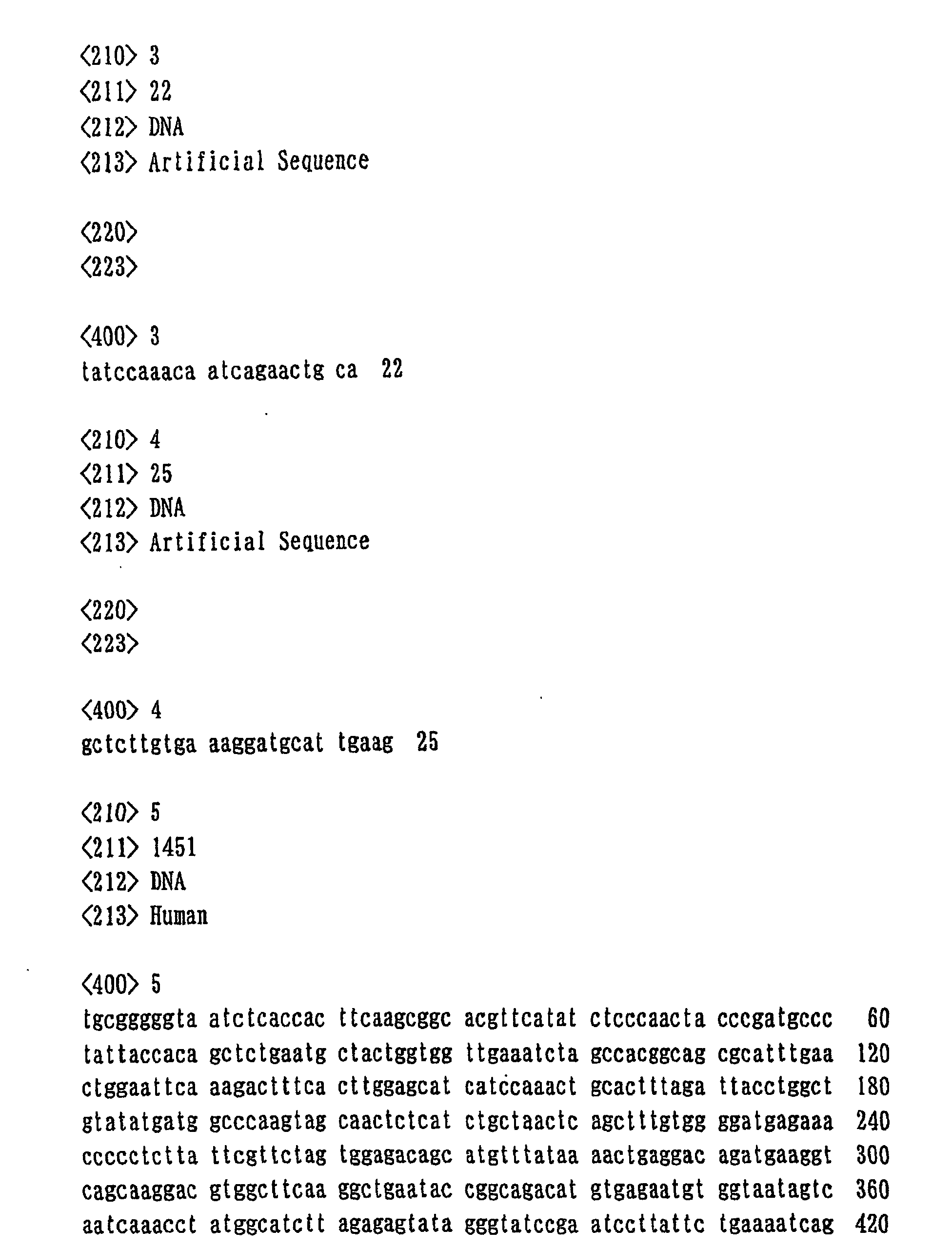

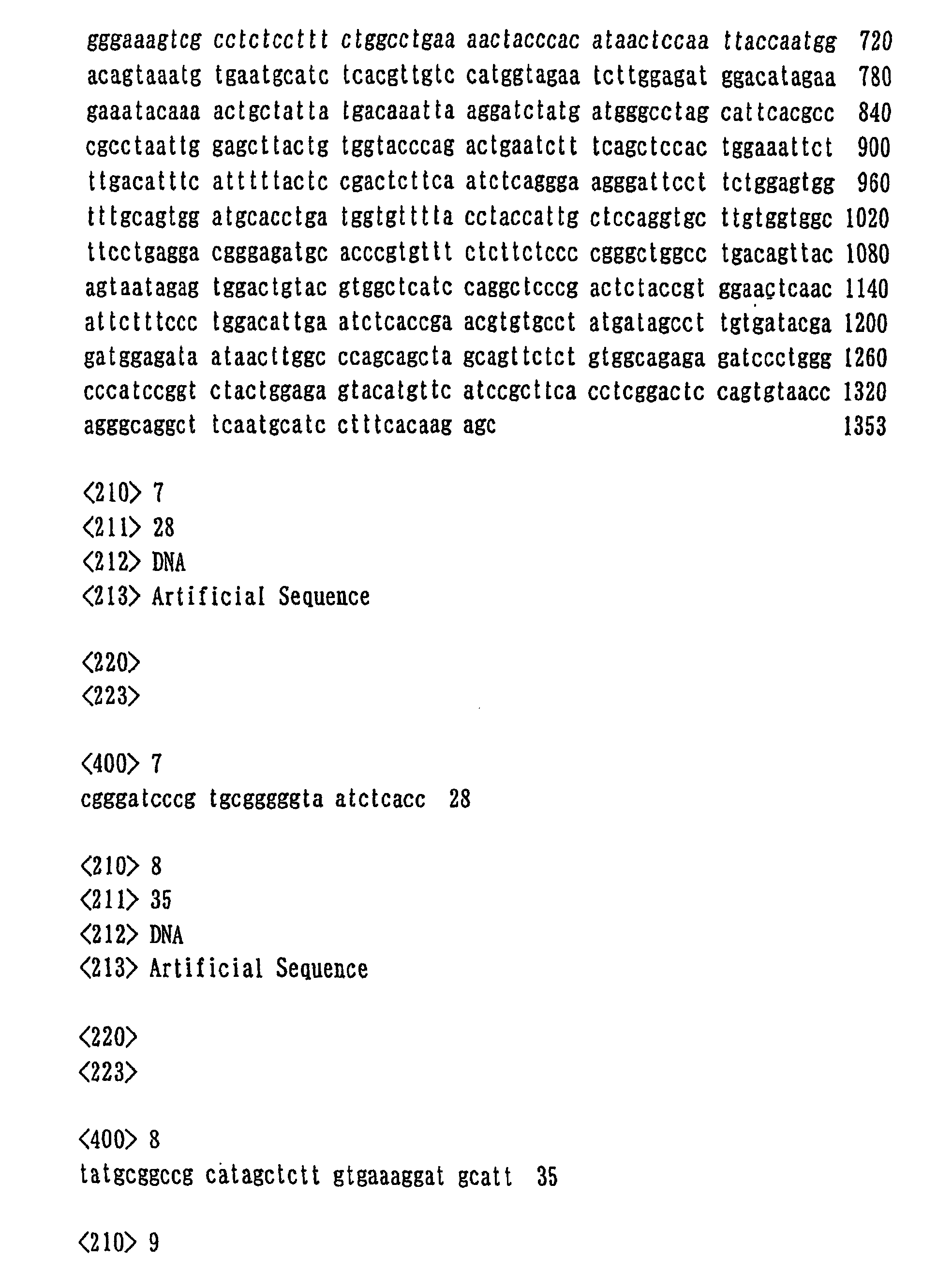
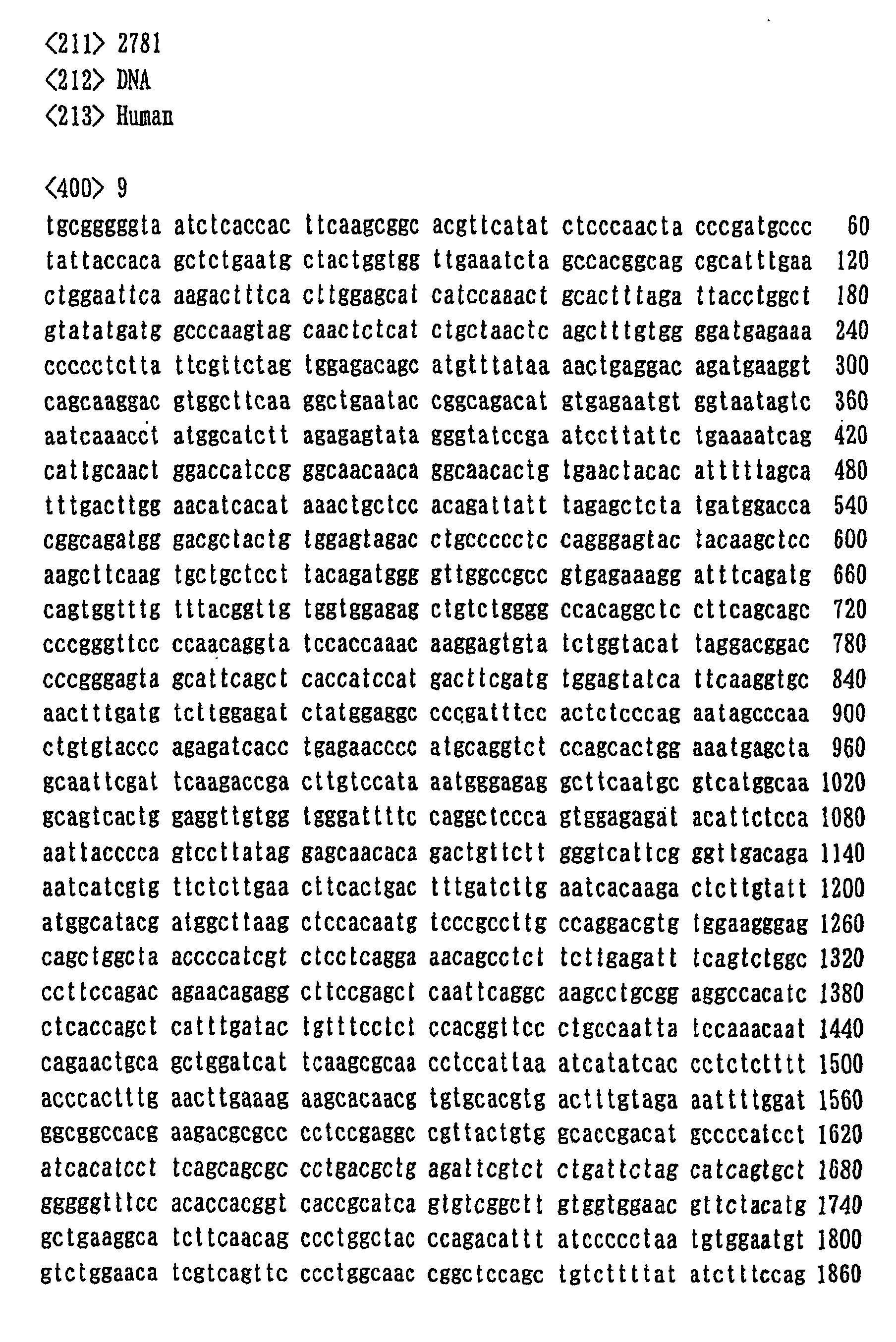

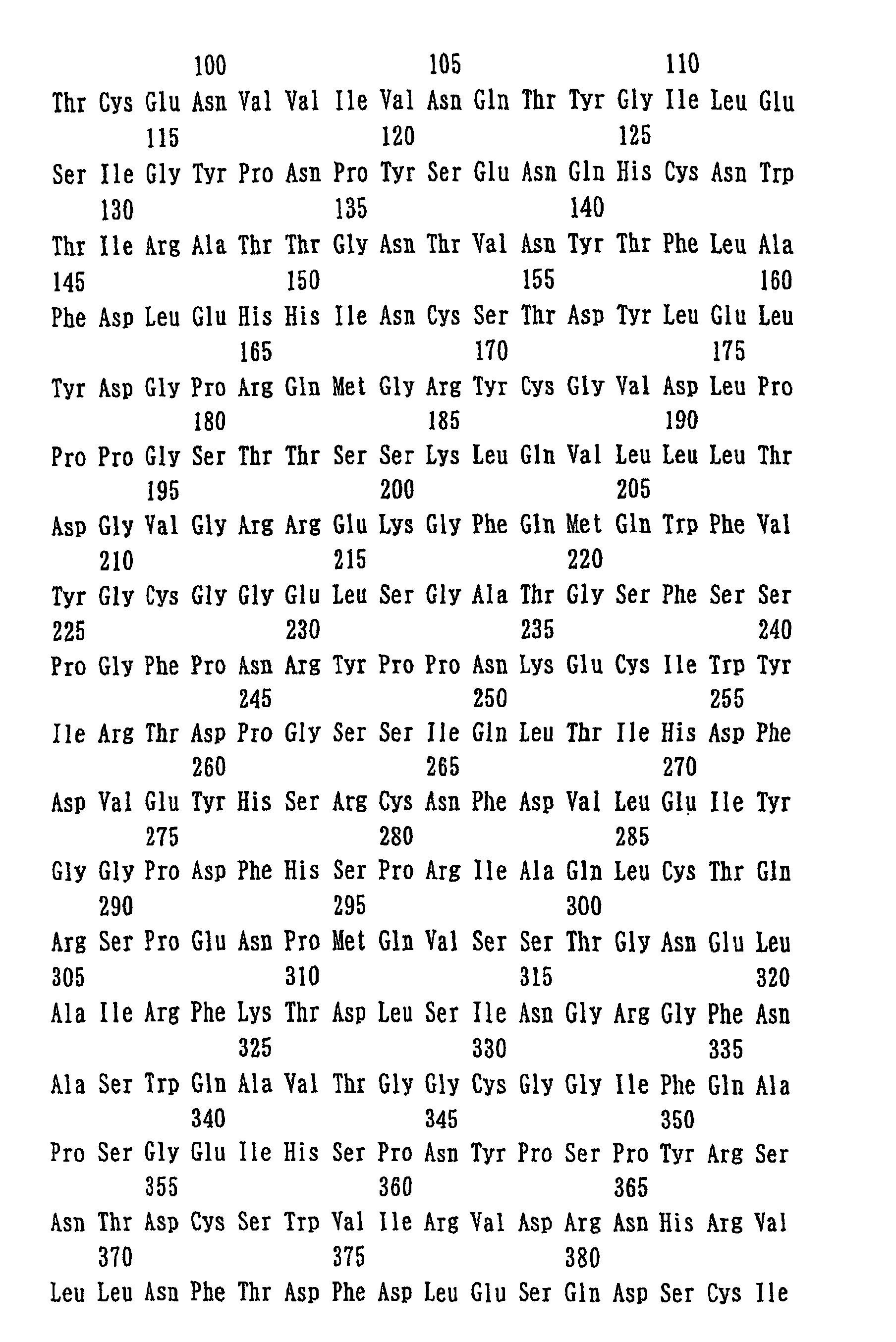


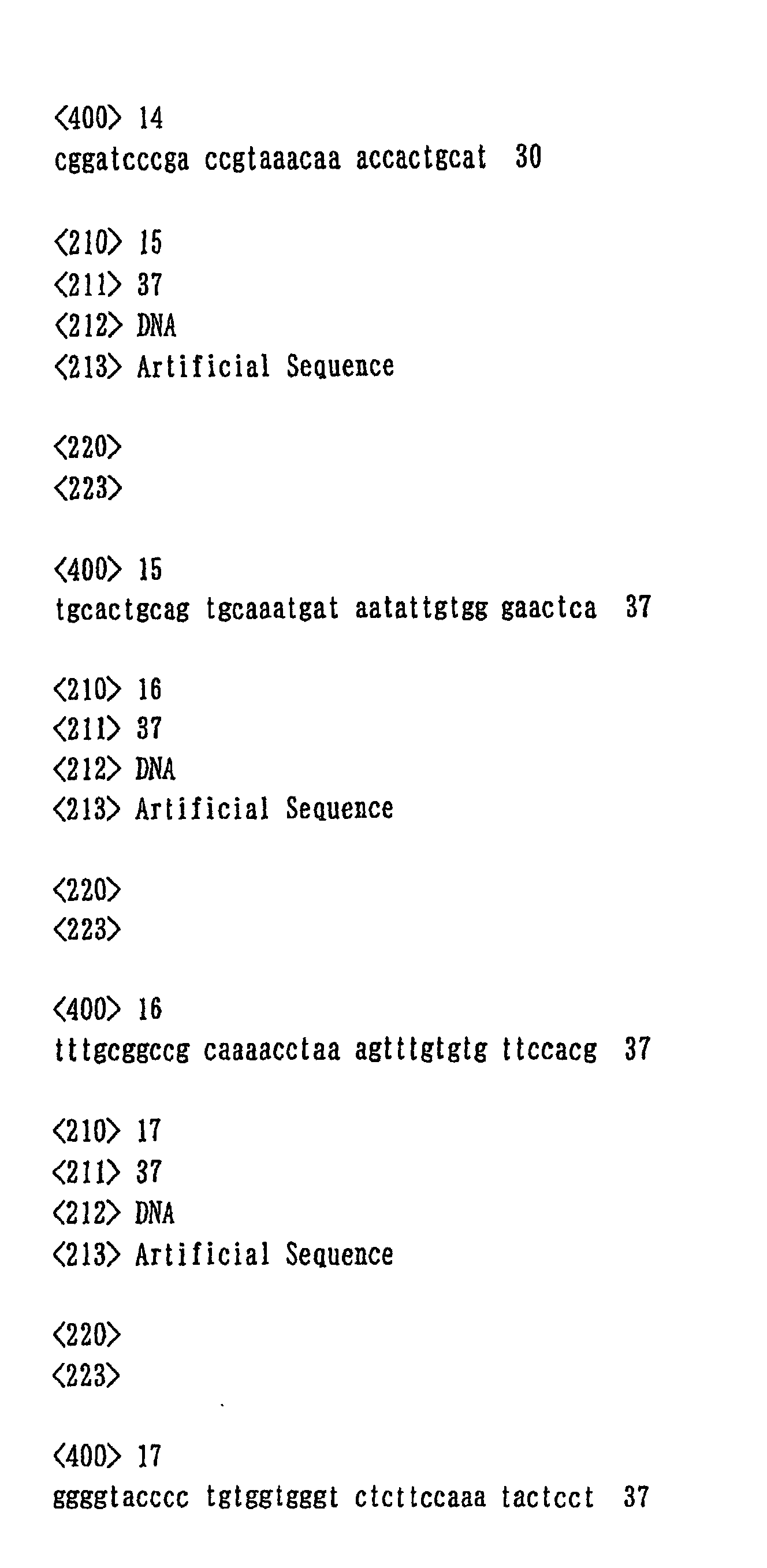

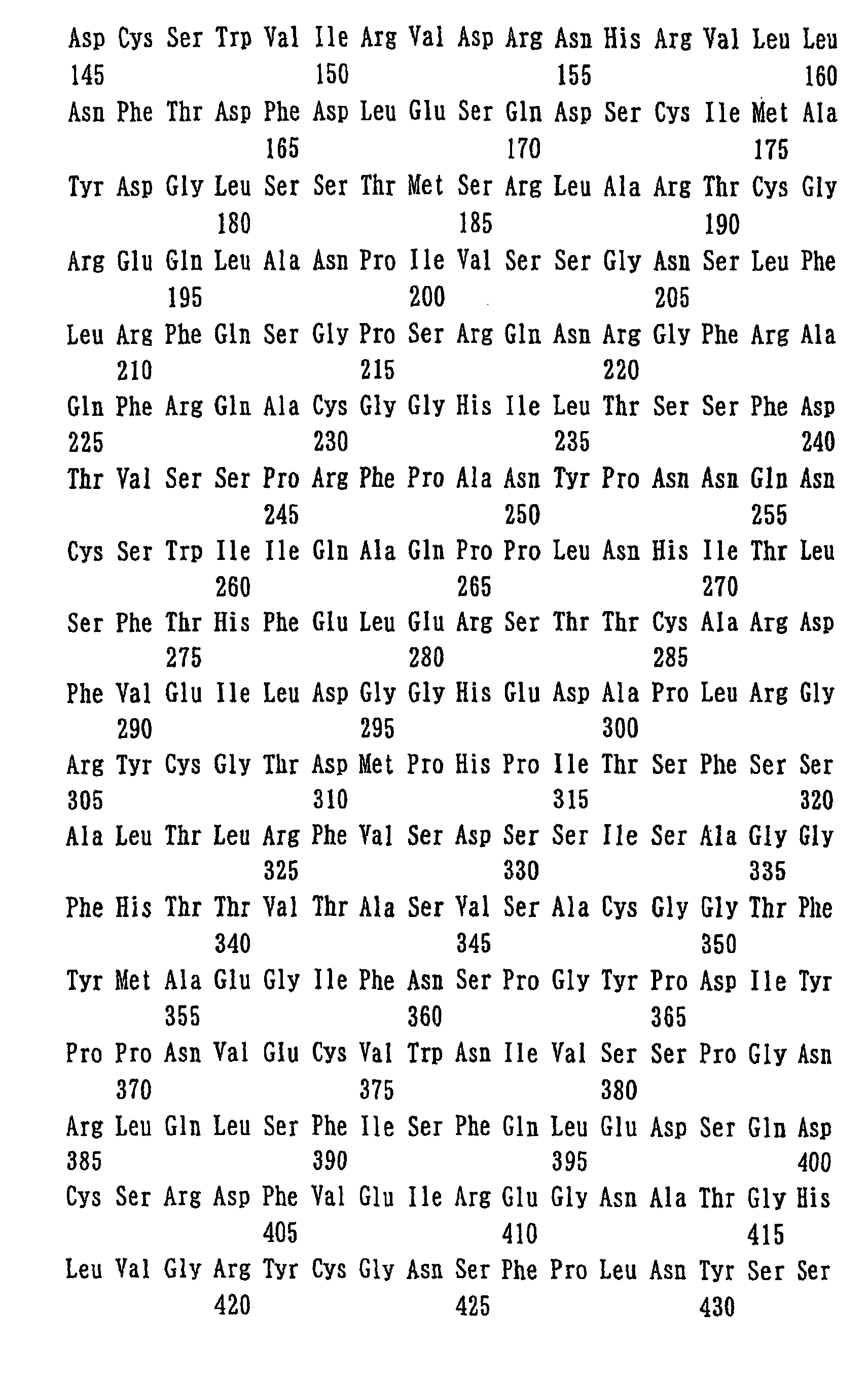


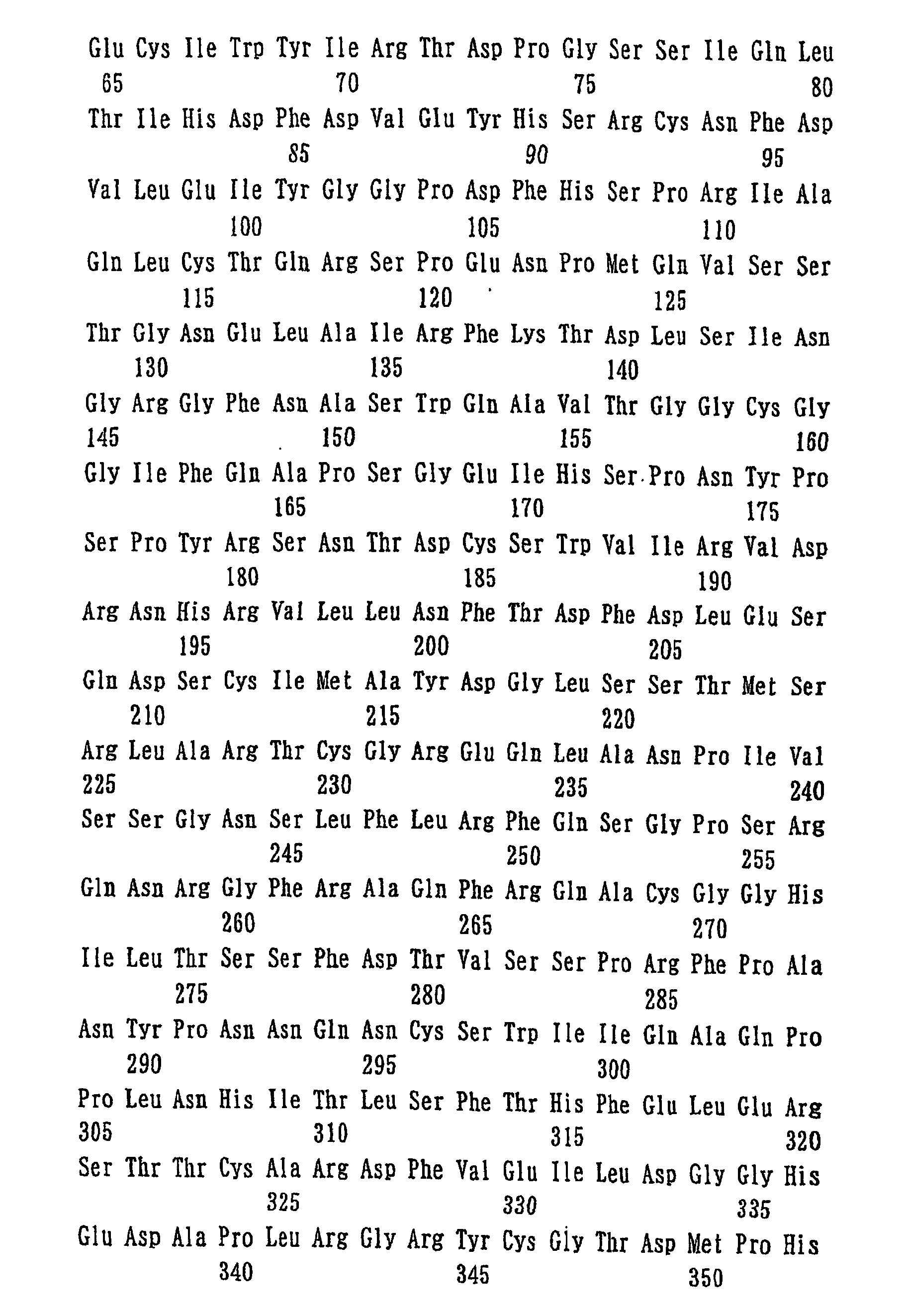


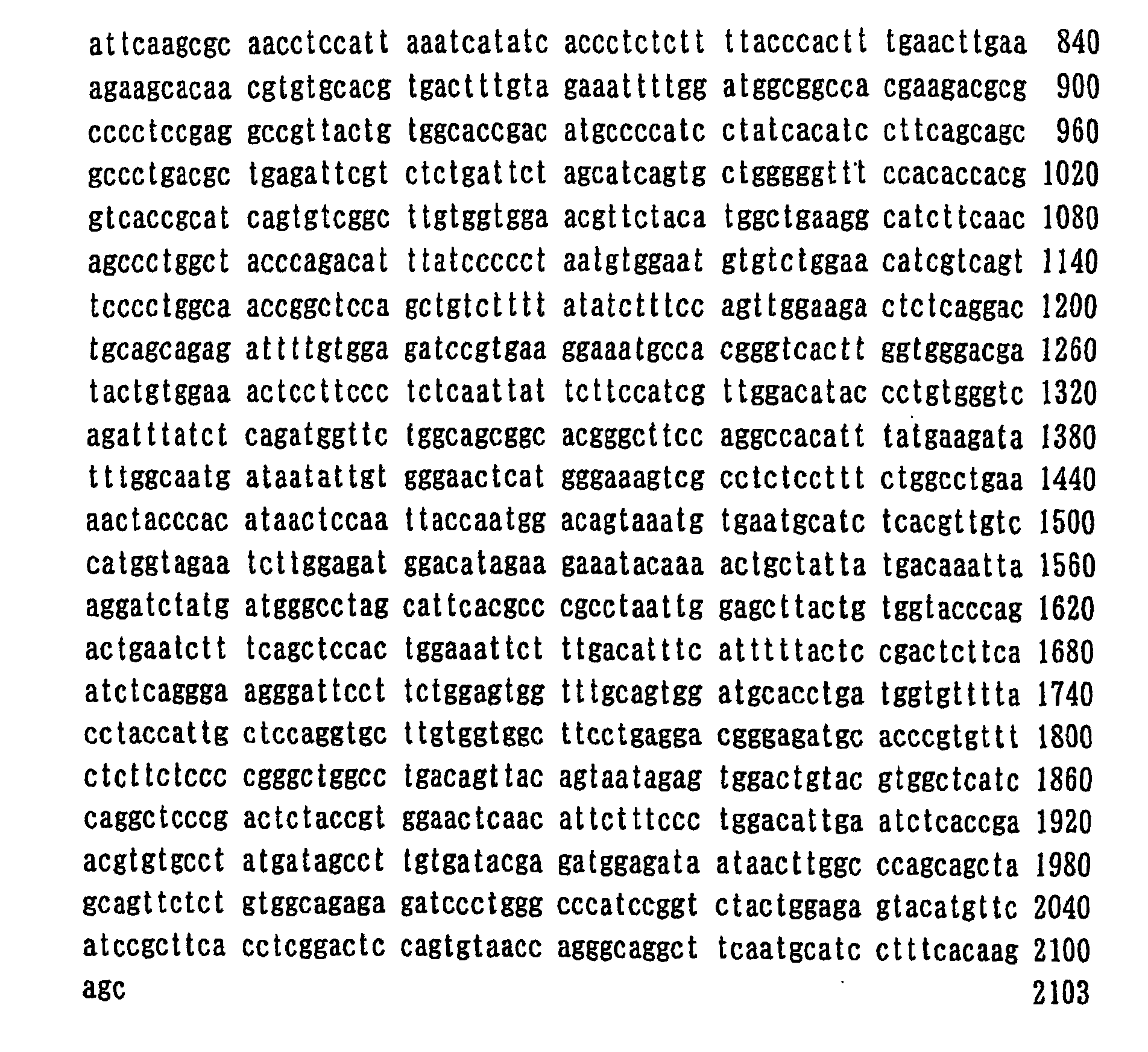
Claims (27)
- A polypeptide having the ability to bind to apolipoprotein A-I, which is a partial fragment of cubilin, an amide or ester of said polypeptide, or a salt of said polypeptide.
- The polypeptide, amide or ester thereof, or salt thereof of claim 1, wherein the polypeptide is characterized by having an amino acid sequence identical or substantially identical with the amino acid sequence as shown in SEQ ID NO: 10.
- The polypeptide, amide or ester thereof, or salt thereof of claim 1, wherein the polypeptide has the amino acid sequence as shown in SEQ ID NO: 10.
- The polypeptide, amide or ester thereof, or salt thereof of claim 1, wherein the polypeptide is characterized by having an amino acid sequence identical or substantially identical with the amino acid sequence as shown in SEQ ID NO: 19.
- The polypeptide, amide or ester thereof, or salt thereof of claim 1, wherein the polypeptide has the amino acid sequence as shown in SEQ ID NO: 19.
- A DNA comprising a DNA encoding the polypeptide of claim 1.
- The DNA of claim 6, wherein the DNA comprises the base sequence as shown in SEQ ID NO: 9.
- The DNA of claim 6, wherein the DNA comprises the base sequence as shown in SEQ ID NO: 22.
- A recombinant vector comprising the DNA of claim 6.
- A transformant transformed with the recombinant vector of claim 9.
- A method of producing the polypeptide, amide or ester thereof, or salt thereof of claim 1, which is characterized by culturing the transformant of claim 10 and allowing the transformant to produce the polypeptide.
- An antibody to the polypeptide, amide or ester thereof, or salt thereof of claim 1.
- A method of screening for compounds or salts thereof that promote or inhibit the activity of the polypeptide or salt thereof of claim 1, wherein the method is characterized by using the polypeptide, amide or ester thereof, or salt thereof of claim 1.
- A screening kit for compounds or salts thereof that promote or inhibit the activity of the polypeptide, amide or ester thereof, or salt thereof of claim 1, wherein the kit comprises the polypeptide or salt thereof of claim 1.
- A compound or salt thereof that promotes or inhibits the activity of the polypeptide, amide or ester thereof, or salt thereof of claim 1, wherein said compound or salt thereof is obtainable by using the screening method of claim 13 or the screening kit of claim 14.
- A medicine comprising a compound or salt thereof that promotes or inhibits the activity of the polypeptide, amide or ester thereof, or salt thereof of claim 1, wherein said compound or salt thereof is obtainable by using the screening method of claim 13 or the screening kit of claim 14.
- A prophylactic and/or therapeutic agent for renal disorders, nephritis, nephropathy, proteinuria, nervous disorders or vitamin B12 deficiency, comprising a compound or salt thereof that promotes or inhibits the activity of the polypeptide, amide or ester thereof, or salt thereof of claim 1, wherein said compound or salt thereof is obtainable by using the screening method of claim 13 or the screening kit of claim 14.
- A prophylactic and/or therapeutic agent for hyperlipemia, hypertriglyceridemia, hypo-high density lipoproteinemia, hypoapolipoproteinemia A-I, after meal hyperlipemia, diabetes, obesity, arteriosclerosis, myocardial infarction or angina, comprising a compound or salt thereof that promotes or inhibits the activity of the polypeptide, amide or ester thereof, or salt thereof of claim 1, wherein said compound or salt thereof is obtainable by using the screening method of claim 13 or the screening kit of claim 14.
- A medicine comprising the polypeptide, amide or ester thereof, or salt thereof of claim 1.
- A prophylactic and/or therapeutic agent for diabetes, obesity, arteriosclerosis, hyperlipemia, hypertriglyceridemia, hypo-high density lipoproteinemia, hypoapolipoproteinemia A-I or nervous disorders, comprising the polypeptide, amide or ester thereof, or salt thereof of claim 1.
- A diagnostic agent that is characterized by the use of the DNA of claim 6.
- A diagnostic agent comprising the antibody of claim 12.
- A method for preventing and/or treating renal disorders, nephritis, nephropathy, proteinuria, nervous disorders or vitamin B12 deficiency in a mammal, comprising a compound or salt thereof that promotes or inhibits the activity of the polypeptide, amide or ester thereof, or salt thereof of claim 1, wherein said compound or salt thereof is obtainable by using the screening method of claim 13 or the screening kit of claim 14.
- A method for preventing and/or treating hyperlipemia, hypertriglyceridemia, hypo-high density lipoproteinemia, hypoapolipoproteinemia A-I, after meal hyperlipemia, diabetes, obesity, arteriosclerosis, myocardial infarction or angina, characterized by administering to a mammal an effective amount of a compound or salt thereof that promotes or inhibits the activity of the polypeptide, amide or ester thereof, or salt thereof of claim 1, wherein said compound or salt thereof is obtainable by using the screening method of claim 13 or the screening kit of claim 14.
- Use of a compound or salt thereof that promotes or inhibits the activity of the polypeptide, amide or ester thereof, or salt thereof of claim 1, for manufacturing a prophylactic and/or therapeutic agent for hyperlipemia, hypertriglyceridemia, hypo-high density lipoproteinemia, hypoapolipoproteinemia A-I, after meal hyperlipemia, diabetes, obesity, arteriosclerosis, myocardial infarction or angina, wherein said compound or salt thereof is obtainable by using the screening method of claim 13 or the screening kit of claim 14.
- A method for preventing and/or treating diabetes, obesity, arteriosclerosis, hyperlipemia, hypertriglyceridemia, hypo-high density lipoproteinemia, hypoapolipoproteinemia A-I or nervous disorders, characterized by administering to a mammal an effective amount of the polypeptide, amide or ester thereof, or salt thereof of claim 1.
- Use of the polypeptide, amide or ester thereof, or salt thereof of claim 1 for manufacturing a prophylactic and/or therapeutic agent for diabetes, obesity, arteriosclerosis, hyperlipemia, hypertriglyceridemia, hypo-high density lipoproteinemia, hypoapolipoproteinemia A-I or nervous disorders.
Applications Claiming Priority (5)
| Application Number | Priority Date | Filing Date | Title |
|---|---|---|---|
| JP2000188306 | 2000-06-22 | ||
| JP2000188306 | 2000-06-22 | ||
| JP2001122125 | 2001-04-20 | ||
| JP2001122125 | 2001-04-20 | ||
| PCT/JP2001/005258 WO2001098341A1 (en) | 2000-06-22 | 2001-06-20 | Novel polypeptide and its dna |
Publications (2)
| Publication Number | Publication Date |
|---|---|
| EP1293510A1 true EP1293510A1 (en) | 2003-03-19 |
| EP1293510A4 EP1293510A4 (en) | 2005-02-09 |
Family
ID=26594490
Family Applications (1)
| Application Number | Title | Priority Date | Filing Date |
|---|---|---|---|
| EP01941118A Withdrawn EP1293510A4 (en) | 2000-06-22 | 2001-06-20 | NEW POLYPEPTIDE AND ITS DNA |
Country Status (4)
| Country | Link |
|---|---|
| US (2) | US6992171B2 (en) |
| EP (1) | EP1293510A4 (en) |
| AU (1) | AU2001274563A1 (en) |
| WO (1) | WO2001098341A1 (en) |
Cited By (1)
| Publication number | Priority date | Publication date | Assignee | Title |
|---|---|---|---|---|
| EP2150627A4 (en) * | 2007-05-09 | 2011-02-23 | Brigham & Womens Hospital | POLYMORPHISM IN THE APO (A) GENE PREDICTING SENSITIVITY TO ACETYLSALICYLIC ACID TREATMENT |
Families Citing this family (2)
| Publication number | Priority date | Publication date | Assignee | Title |
|---|---|---|---|---|
| JP2013532031A (en) * | 2010-06-22 | 2013-08-15 | ジェイジェイケイ メディカル リミテッド | Novel media, apparatus and method |
| CN108866019A (en) * | 2018-07-18 | 2018-11-23 | 青岛农业大学 | A kind of preparation method and applications recombinating streptococcus pneumonia dihyrofolate reductase |
Family Cites Families (3)
| Publication number | Priority date | Publication date | Assignee | Title |
|---|---|---|---|---|
| WO1999037757A1 (en) * | 1998-01-22 | 1999-07-29 | Administrators Of The Tulane Educational Fund | Cubilin protein, dna sequences encoding cubilin and uses thereof |
| US6806254B2 (en) * | 2000-02-03 | 2004-10-19 | Nuvelo, Inc. | Methods and materials relating to alpha-2-macroglobulin-like polypeptides and polynucleotides |
| US6436703B1 (en) * | 2000-03-31 | 2002-08-20 | Hyseq, Inc. | Nucleic acids and polypeptides |
-
2001
- 2001-06-20 US US10/297,895 patent/US6992171B2/en not_active Expired - Fee Related
- 2001-06-20 WO PCT/JP2001/005258 patent/WO2001098341A1/en not_active Ceased
- 2001-06-20 EP EP01941118A patent/EP1293510A4/en not_active Withdrawn
- 2001-06-20 AU AU2001274563A patent/AU2001274563A1/en not_active Abandoned
-
2005
- 2005-07-26 US US11/189,301 patent/US20050261192A1/en not_active Abandoned
Non-Patent Citations (3)
| Title |
|---|
| DATABASE EMBL [Online] 15 May 1998 (1998-05-15), "Homo sapiens intrinsic factor-B12 receptor precursor, mRNA, complete cds." XP002308942 retrieved from EBI accession no. EM_PRO:AF034611 Database accession no. AF034611 * |
| DATABASE UniProt [Online] 1 August 1998 (1998-08-01), "Intrinsic factor-B12 receptor precursor." XP002308943 retrieved from EBI accession no. UNIPROT:O60494 Database accession no. O60494 * |
| See also references of WO0198341A1 * |
Cited By (4)
| Publication number | Priority date | Publication date | Assignee | Title |
|---|---|---|---|---|
| EP2150627A4 (en) * | 2007-05-09 | 2011-02-23 | Brigham & Womens Hospital | POLYMORPHISM IN THE APO (A) GENE PREDICTING SENSITIVITY TO ACETYLSALICYLIC ACID TREATMENT |
| CN101743325B (en) * | 2007-05-09 | 2014-07-09 | 伯莱翰女子医院公司 | Polymorphism in the Aapo (a) gene predict responsiveness to acetylsalicylic acid treatment |
| US10550433B2 (en) | 2007-05-09 | 2020-02-04 | The Brigham And Women's Hospital, Inc. | Polymorphism in the Apo(a) gene predict responsiveness to acetylsalicylic acid treatment |
| US11697850B2 (en) | 2007-05-09 | 2023-07-11 | The Brigham And Women's Hospital, Inc. | Polymorphism in the Apo(a) gene predict responsiveness to acetylsalicylic acid treatment |
Also Published As
| Publication number | Publication date |
|---|---|
| EP1293510A4 (en) | 2005-02-09 |
| WO2001098341A1 (en) | 2001-12-27 |
| US6992171B2 (en) | 2006-01-31 |
| US20050261192A1 (en) | 2005-11-24 |
| US20030176339A1 (en) | 2003-09-18 |
| AU2001274563A1 (en) | 2002-01-02 |
Similar Documents
| Publication | Publication Date | Title |
|---|---|---|
| US20080131976A1 (en) | Novel G protein coupled receptor protein, DNA its ligand | |
| EP1273658A1 (en) | Novel protein, dna thereof and process for producing the same | |
| EP0799892A2 (en) | Calpain, its production and use | |
| EP1207198A1 (en) | Novel g protein-coupled receptor protein and dna thereof | |
| CA2371821A1 (en) | Novel g protein-coupled receptor protein and dna thereof | |
| US6906177B1 (en) | GABA transporter protein and DNA thereof | |
| US6992171B2 (en) | Polypeptide and its DNA | |
| EP1207201A1 (en) | Novel g protein-coupled receptor protein and dna thereof | |
| US6613887B1 (en) | Human ependymin-like protein | |
| EP1473365A1 (en) | Angiogenesis inhibitors | |
| EP1559721B1 (en) | Fprl1 ligands and use thereof | |
| US20050074754A1 (en) | Novel protein and use thereof | |
| EP1364653A1 (en) | Casoase 3 inhibitors | |
| US20040101956A1 (en) | Novel g protein-coupled receptor protein | |
| JPH10324698A (en) | Novel protein and its DNA | |
| JP3472854B2 (en) | New proteins and their uses | |
| EP1207169A1 (en) | Novel g protein-coupled receptor protein and dna thereof | |
| EP1164142A1 (en) | Novel proteins and uses thereof | |
| EP1227105A1 (en) | Ghsr ligand polypeptides and dnas thereof | |
| EP1101821A1 (en) | Novel protein and its dna | |
| JP2003000261A (en) | New polypeptide and its dna | |
| JP2002335964A (en) | New protein and application thereof | |
| JP2002360284A (en) | New protein and use thereof | |
| JP2003000266A (en) | New protein and its dna | |
| JP2003116584A (en) | Prophylactic, therapeutic, and diagnostic agent for cancer |
Legal Events
| Date | Code | Title | Description |
|---|---|---|---|
| PUAI | Public reference made under article 153(3) epc to a published international application that has entered the european phase |
Free format text: ORIGINAL CODE: 0009012 |
|
| 17P | Request for examination filed |
Effective date: 20021203 |
|
| AK | Designated contracting states |
Kind code of ref document: A1 Designated state(s): AT BE CH CY DE DK ES FI FR GB GR IE IT LI LU MC NL PT SE TR Designated state(s): AT BE CH CY DE DK ES FI FR GB GR IE IT LI LU MC NL PT SE TR |
|
| AX | Request for extension of the european patent |
Extension state: AL LT LV MK RO SI |
|
| RAP1 | Party data changed (applicant data changed or rights of an application transferred) |
Owner name: TAKEDA PHARMACEUTICAL COMPANY LIMITED |
|
| RIC1 | Information provided on ipc code assigned before grant |
Ipc: 7C 12P 21/02 B Ipc: 7A 61P 25/00 B Ipc: 7A 61P 9/10 B Ipc: 7A 61P 3/06 B Ipc: 7A 61P 3/04 B Ipc: 7A 61P 3/10 B Ipc: 7A 61K 45/00 B Ipc: 7C 12N 5/10 B Ipc: 7C 07K 16/18 B Ipc: 7C 12N 15/12 B Ipc: 7A 61K 38/17 B Ipc: 7C 07K 14/47 A |
|
| A4 | Supplementary search report drawn up and despatched |
Effective date: 20041227 |
|
| 17Q | First examination report despatched |
Effective date: 20050204 |
|
| 17Q | First examination report despatched |
Effective date: 20050204 |
|
| GRAP | Despatch of communication of intention to grant a patent |
Free format text: ORIGINAL CODE: EPIDOSNIGR1 |
|
| STAA | Information on the status of an ep patent application or granted ep patent |
Free format text: STATUS: THE APPLICATION IS DEEMED TO BE WITHDRAWN |
|
| 18D | Application deemed to be withdrawn |
Effective date: 20080708 |