EP1291850A1 - Decoder - Google Patents
Decoder Download PDFInfo
- Publication number
- EP1291850A1 EP1291850A1 EP01919961A EP01919961A EP1291850A1 EP 1291850 A1 EP1291850 A1 EP 1291850A1 EP 01919961 A EP01919961 A EP 01919961A EP 01919961 A EP01919961 A EP 01919961A EP 1291850 A1 EP1291850 A1 EP 1291850A1
- Authority
- EP
- European Patent Office
- Prior art keywords
- decoding
- software
- music data
- information
- audio file
- Prior art date
- Legal status (The legal status is an assumption and is not a legal conclusion. Google has not performed a legal analysis and makes no representation as to the accuracy of the status listed.)
- Withdrawn
Links
Images



Classifications
-
- H—ELECTRICITY
- H03—ELECTRONIC CIRCUITRY
- H03M—CODING; DECODING; CODE CONVERSION IN GENERAL
- H03M13/00—Coding, decoding or code conversion, for error detection or error correction; Coding theory basic assumptions; Coding bounds; Error probability evaluation methods; Channel models; Simulation or testing of codes
- H03M13/65—Purpose and implementation aspects
- H03M13/6508—Flexibility, adaptability, parametrability and configurability of the implementation
- H03M13/6513—Support of multiple code types, e.g. unified decoder for LDPC and turbo codes
-
- H—ELECTRICITY
- H03—ELECTRONIC CIRCUITRY
- H03M—CODING; DECODING; CODE CONVERSION IN GENERAL
- H03M7/00—Conversion of a code where information is represented by a given sequence or number of digits to a code where the same, similar or subset of information is represented by a different sequence or number of digits
- H03M7/30—Compression; Expansion; Suppression of unnecessary data, e.g. redundancy reduction
-
- G—PHYSICS
- G10—MUSICAL INSTRUMENTS; ACOUSTICS
- G10L—SPEECH ANALYSIS TECHNIQUES OR SPEECH SYNTHESIS; SPEECH RECOGNITION; SPEECH OR VOICE PROCESSING TECHNIQUES; SPEECH OR AUDIO CODING OR DECODING
- G10L19/00—Speech or audio signals analysis-synthesis techniques for redundancy reduction, e.g. in vocoders; Coding or decoding of speech or audio signals, using source filter models or psychoacoustic analysis
-
- G—PHYSICS
- G11—INFORMATION STORAGE
- G11B—INFORMATION STORAGE BASED ON RELATIVE MOVEMENT BETWEEN RECORD CARRIER AND TRANSDUCER
- G11B20/00—Signal processing not specific to the method of recording or reproducing; Circuits therefor
- G11B20/00007—Time or data compression or expansion
-
- H—ELECTRICITY
- H03—ELECTRONIC CIRCUITRY
- H03M—CODING; DECODING; CODE CONVERSION IN GENERAL
- H03M13/00—Coding, decoding or code conversion, for error detection or error correction; Coding theory basic assumptions; Coding bounds; Error probability evaluation methods; Channel models; Simulation or testing of codes
- H03M13/65—Purpose and implementation aspects
- H03M13/6502—Reduction of hardware complexity or efficient processing
- H03M13/6505—Memory efficient implementations
-
- H—ELECTRICITY
- H03—ELECTRONIC CIRCUITRY
- H03M—CODING; DECODING; CODE CONVERSION IN GENERAL
- H03M13/00—Coding, decoding or code conversion, for error detection or error correction; Coding theory basic assumptions; Coding bounds; Error probability evaluation methods; Channel models; Simulation or testing of codes
- H03M13/65—Purpose and implementation aspects
- H03M13/6569—Implementation on processors, e.g. DSPs, or software implementations
-
- G—PHYSICS
- G11—INFORMATION STORAGE
- G11B—INFORMATION STORAGE BASED ON RELATIVE MOVEMENT BETWEEN RECORD CARRIER AND TRANSDUCER
- G11B2220/00—Record carriers by type
- G11B2220/17—Card-like record carriers
-
- G—PHYSICS
- G11—INFORMATION STORAGE
- G11B—INFORMATION STORAGE BASED ON RELATIVE MOVEMENT BETWEEN RECORD CARRIER AND TRANSDUCER
- G11B2220/00—Record carriers by type
- G11B2220/20—Disc-shaped record carriers
- G11B2220/21—Disc-shaped record carriers characterised in that the disc is of read-only, rewritable, or recordable type
- G11B2220/215—Recordable discs
- G11B2220/216—Rewritable discs
Definitions
- the present invention relates to a decoding apparatus applied to an audio player. More specifically, the present invention relates to a decoding apparatus for decoding an encoded signal encoded according to one of a plurality of formats.
- a decoding apparatus for decoding an encoded signal encoded according to any one of a plurality of encoding format, comprising: an attachment means for attaching an external memory storing a plurality of decoding programs respectively corresponding to the plurality of encoding formats; an internal memory for storing at least one of the plurality of decoding programs; a determination means for determining whether or not a specific decoding program corresponding to the encoding format of the encoded signal exists in the internal memory; a transfer means for transferring the specific decoding program from the external memory to the internal memory according to a determination result of the determination means; and a decoding means for decoding the encoded signal according to the decoding program stored in the internal memory.
- the plurality of decoding programs respectively corresponding to the plurality of encoding formats are stored in the external memory.
- the attachment means attaches such the external memory.
- the determination means determines whether or not the specific decoding program corresponding to the encoding format of the encoded signal to be decoded exists in the internal memory, and the transfer means transfers the specific decoding program from the external memory to the internal memory according to the determination result of the determination means. That is, when the specific decoding program exists in the internal memory, a transfer process by the transfer means is never performed.
- the encoding signal is decoded by the decoding means according to the decode program stored in the internal memory. Accordingly, when a plurality of encoded signals according to the same encoding format are sequentially decoded, the specific decoding program is never transferred repeatedly, and therefore, it is possible to shorten a time to start the decoding process.
- the encoded signal is, for example, a compressed music signal.
- a decoding apparatus of this embodiment is applied to a portable audio player 10 decoding (expanding) compressed music data by a predetermined decode program.
- the portable audio player 10 is connected to a communication terminal 400 such as a personal computer.
- the communication terminal 400 is connected to the Internet 100, and an operator can gain access to a plurality of WEB sites 300a, 300b, ⁇ 300n via the Internet 100.
- the WEB site 300a is a site to perform a delivery of the music data.
- the music data is called "music" and " tune".
- the WEB site 300a requires delivery of the accepted tune to a database server 200 via the Internet 100.
- the database server 200 transmits a data file (audio file) including music data of the required music (tune) to the communication server 400 of an ordering source via the Internet 100.
- the transmitted audio file is stored in a hard disk of the communication terminal 400.
- the audio file is formed every one tune of the music data, and when the operator places an order for a music album including a plurality of tunes, a plurality of audio files are downloaded.
- the audio files downloaded to the communication terminal 400 is input to the portable audio player 10 through an input terminal 12.
- the input audio files are recorded onto a memory card 18 via an interface 14.
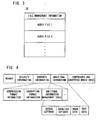
- the audio files are recorded onto the memory card 18 as shown in Figure 3, and each of audio files are managed by file management information.
- the memory card 18 is a detachable recording medium and is electrically connected to the interface 14 by being attached to a slot 16.
- the audio file recorded onto the memory card 18 has a data configuration as shown in Figure 4.
- the memory card 18 is stored with security information, contents information and additional information in this order after a header, and stored with one tune of music data subjected to a compression process and an encryption process by a predetermined format successive to the additional information.
- Encryption key information to prevent unauthorized copying of the audio file is included as the security information.
- this encryption key information it is possible to encrypt a code.
- the contents information includes compression format information indicative of what format the music data is compressed by, encryption format information indicative of what format the music data is encrypted by and an additional information management table indicative of what data exists as the additional information.
- information relating to the audio file such as an artist name, a tune name, an album name, a composer name and a producer name is also included in the contents information.
- the additional information includes text data such as a message of the artist and an episode in creating the album besides decode software (decode program) to expand the music data, equalizer software to adjust a tone of the music and image data of the artist.
- decode software decode program
- equalizer software to adjust a tone of the music and image data of the artist.
- MP3 MPEG-1 Audio Laye3
- TwinVQ Transform domain Weighed interleave vector quatization
- AAC MPEG2/Advanced Audio Coding
- AC-3 Dolby Digital
- the useable decode software is different such that where the DSP is a processor to perform a 16-bit operation, only the decode software of a type A is activated, and where the DSP is a processor to perform a 24-bit operation, only the decode software of a type B is activated.
- the decode software included in the additional information complies with the ePAC format and corresponding to the 16-bit operation DSP
- "ePAC decode software-type A” is written to the additional information management table as decode software information.
- the "ePAC decode software-type A” and "ePAC decode software-type B” are written to the additional information management table as the decode software information.
- the decode software information is a concept including compression format information and type information.
- the additional information management table is stored with information shown in Figure 5.
- the additional information 1 is the "ePAC decode software-type B”
- the additional information 2 is the “ePAC decode software-type A”
- the additional information 3 is "a comment (TEXT) of the artist”.
- the additional information management table is housed with information shown in Figure 6, for example.
- the additional information 1 is the "ePAC decode software-type A”
- the additional information 2 is “virtual sound software-type A”
- the additional information 3 is an "artist image (JPEG)". It is noted that the virtual sound software is effective at a time of reproducing a tune recorded at a concert with a realistic sensation, for example.
- a first is a method for storing in the audio file the decode software, the compression format information and the decode software information on the side of the database server 200
- a second is a method for storing corresponding decode software, the compression format information and the decode software information in the audio file at a time of purchasing after the communication terminal 400 acquires in advance a plurality of decode software from the WEB site 300a or the database server 200.
- the audio file reproduced by the portable audio player 10 is downloaded from the database server 200 and then, recorded onto the memory card 18 or can alternatively be recorded onto the memory card 18 by reading a CD 500 ( Figure 1).
- an audio file with a configuration shown in Figure 4 is formed by the communication terminal 400.
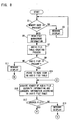
- the CPU 20 included in the portable audio player 10 processes flowcharts shown in Figure 8 to Figure 10. It is noted that the process of such flowcharts is started in response to application of power.
- step S1 it is determined whether or not the memory card 18 is attached to the slot 16 in a step S1. If the memory card 18 is not attached, a message indicating that the memory card 18 is not attached is displayed on an LCD 36 in a step S3, and the process returns to the step S1.
- the process proceeds from the step S1 to a step S5 so as to transfer file management information (see Figure 3) included in the memory card 18 to a memory (FEPROM) 32.
- the file management information is information to manage a data file recorded onto the memory card 18, and whereby, it is possible to understand what kind of data is stored in each of data files.
- a file name of the audio file recorded onto the memory card 18 is detected on the basis of the file management information so as to create an audio file table 32a shown in Figure 7.
- the data file name with an expansion of "spt" is detected from the file management information and set in the audio file table 32a regarding this as an audio file name.
- the audio file table 32a has a plurality of storage areas each of which is called an item, and each item is assigned with the identification number.
- the audio file name detected from the file management information is set from an item in ascending order of identification number.
- step S9 so as to determine whether or not at least one audio file name exists in the audio file table 32a. If "NO" herein, it is determined no audio file exists in the memory card 18, and a message of so is displayed on the LCD 36 for a predetermined time period in a step S11. After a lapse of the predetermined time period, an ending process and a power-off process are executed in a step S55 and in a step S57, respectively, and then, the process is ended.
- a pointer is set to a head item on the audio file table 32a in a step S13.
- the memory card 18 is accessed so as to acquire a header, security information and contents information from the audio file having a file name of the currently pointed item.
- the recording position of the audio file as an acquiring source is specified on the basis of the currently pointed file name and the file management information within the memory card 18.
- a step S17 it is determined whether or not the audio file is a proper file (that is, whether or not the audio file is not an unauthorized copied file) on the basis of the security information acquired in the step 15. If the audio file is not the proper file, a message of so is displayed on the LCD 36 for a predetermined time period in a step S19. Succeedingly, it is determined whether or not the pointer on the audio file table 32a points to a final item in a step S51, and if "NO", it is determined an audio file which has not reproduced is present and then, the process is returned to the step S15 after a moving process of the pointer in a step S53.
- the pointer points to a next item, and the above-described process is performed on the next audio file in the step S15. If "YES" is determined in the step S51, it is regarded an audio file which has not reproduced is not present, the ending process and the power-off process are executed in the steps S55 and S57, respectively, and then, the process is ended.
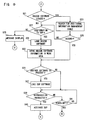
- step S17 it is determined whether or not the decode software has already loaded into a RAM 22a of a DSP 22 in a step S21. Immediately after an application of power, the decode software is not loaded into the RAM 22a. At this time, the process proceeds from the step S21 to a step S27 so as to determine whether or not the decode software included in the additional information is a type conforming to the DSP 22 by referring to the decode software information on the additional information management table.
- the decode software is not conformed to the DSP 22, a message of so is displayed on the LCD 36 for a predetermined time period and then, the process proceeds to the step S51.
- the decode software is conformed to the DSP 22, "YES" is determined in the step S27, and the decode software is loaded from the memory card 18 to the RAM 22a of the DSP 22 in a step S31, and then, the decode software information of the decode software is stored in a work area 20a of the CPU 20 in a step S33.
- the decode software information stored in the work area 20a is especially defined as "soft ware identifying information".
- the software identifying information is utilized for identifying the decode software loaded into the RAM 22a.
- the process proceeds from the step S21 to a step S23 so as to search for the additional information management table rendering the software identifying information stored in the work area 20a as a key. Furthermore, it is determined whether or not the decode software information according with the software identifying information is present in the additional information management table in a step S25. If "YES" is determined herein, it is regarded the decode software corresponding to the audio file to be reproduced is present in the RAM 22a and there is no need to load the decode software again, and then, the process directly proceeds to a step S35. Thus, it is possible to shorten a time required to start a decoding process.
- step S25 if "NO” is determined in the step S25, it is regarded that it is impossible to decode the audio file with the loaded decode software, and the process shifts to the step S27.
- step S27 In a case "YES” is determined in the step S27 and the decode software is loaded anew in the step S31, the decode software loaded in the RAM 22a is overwritten by the decode software loaded anew.
- step S35 It is determined whether or not the DSP software except for the decode software such as the virtual sound software is included in the audio file with referring to the additional information management table in the step S35. If “NO” is determined herein, the process directly proceeds to a step S39 while if "YES” is determined, a loading process of the DSP software is executed in a step S37, and then, the process proceeds to the step S39. Thus, the preparation for reproducing the music data is completed, and a process according to a control of an operation panel 34 is performed after the step S39.
- step S39 When the operator performs a reproducing operation, "YES" is determined in the step S39, and the DSP 22 is activated in a step S43.
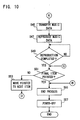
- the music data is read from the audio file having a file name pointed by the pointer on the audio file table 32a in a step S45, and the read music data is transferred to the DSP 22.
- reproduction of the music data is instructed to the DSP 22 in a following step S47.
- the DSP 22 receiving the reproducing instruction decrypts the music data on the basis of the encryption key information included in the security information and expands the decrypted compressed music data with the decode software stored in the RAM 22a.
- the DSP software such as the virtual sound software exists in the RAM 22a
- a process utilizing the DSP software and etc. is performed on the expanded music data.
- the music data thus processed is converted to a sound signal (analog signal) by a D/A converter 24, and the converted sound signal is output to a headphone 30 through an amplifier 26 and an output terminal 28.
- step S49 It is determined whether or not one tune of reproduction is completed in a step S49. If “YES” is determined herein, the process proceeds to the step S51 so as to determine whether or not the pointer on the audio file table 32a points to the final item, that is, the reproduced music data is music data of the last audio file. When the pointer points to an item except the final item, the pointer is moved to a next item in a step S53, and then, the process returns to the step S15. On the other hand, when the pointer points to the final item, the ending process and the power-off process are respectively executed in the steps S55 and S57 and then, the process is ended. It is noted that when the operator performs the power-off operation, "YES" is determined in a step S41, and after the processes in the steps S55 and S57, the process is ended.
- the memory card 18 attached to the slot 16 is stored with a plurality of decoding programs respectively corresponding to a plurality of compression formats.
- the CPU 20 determines whether or not the decoding program corresponding to the compression format of the music data to be reproduced exists in the RAM 22a and transfers the decoding program from the memory card 18 to the RAM 22a in response to the determination result. That is, when the decoding program corresponding to the compression format of the music data to be reproduced exists in the RAM 22a, the same decoding program is never transferred.
- the music data is decoded by the DSP 22 according to the decoding program stored in the RAM 22a.
- the decoding program is not repeatedly transferred, and therefore, it is possible to shorten a time to start the decoding process of the music data.
- accord/discord between the respective audio files is determined as to the only decode software in this embodiment, the accord/discord between the respective audio files may be determined as to another DSP software alternative to or in addition to this.
- the loaded decode software is stored in the RAM in this embodiment, and therefore, the decoded software is deleted at a time of power-off; however, if the loaded decode software and the software identifying information are stored in a nonvolatile memory such as a flash memory and etc., the loaded decode software can make effective after the power-off.
- the RAM of the DSP is stored with the only one decode software, however; it is preferable that a plurality of decode software are stored in the RAM, and only when music data corresponding to no decode software is reproduced, another decode software is loaded into the RAM.
Landscapes
- Engineering & Computer Science (AREA)
- Physics & Mathematics (AREA)
- Theoretical Computer Science (AREA)
- Signal Processing (AREA)
- Probability & Statistics with Applications (AREA)
- Computational Linguistics (AREA)
- Health & Medical Sciences (AREA)
- Audiology, Speech & Language Pathology (AREA)
- Human Computer Interaction (AREA)
- Acoustics & Sound (AREA)
- Multimedia (AREA)
- Signal Processing For Digital Recording And Reproducing (AREA)
Abstract
Description
Claims (4)
- A decoding apparatus for decoding an encoded signal encoded according to any one of a plurality of encoding formats, comprising:an attachment means for attaching an external memory storing a plurality of decoding programs respectively corresponding to said plurality of encoding formats;an internal memory for storing at least one of said plurality of decoding programs; a determination means for determining whether or not a specific decoding program corresponding to the encoding format of said encoded signal exists in said internal memory;a transfer means for transferring said specific decoding program from said external memory to said internal memory according to a determination result of said determination means; anda decoding means for decoding said encoded signal according to the decoding program stored in said internal memory.
- A decoding apparatus according to claim 1, wherein
said external memory stores a plurality of encoded signals complying with the same encoding format. - A decoding apparatus according to claim 2, wherein
a decoding program and an encoded signal corresponding with each other are stored in the same data file. - A decoding apparatus according to any one of claims 1 to 3, wherein
said encoded signal is a compressed music signal.
Applications Claiming Priority (3)
| Application Number | Priority Date | Filing Date | Title |
|---|---|---|---|
| JP2000119801 | 2000-04-20 | ||
| JP2000119801 | 2000-04-20 | ||
| PCT/JP2001/003250 WO2001082292A1 (en) | 2000-04-20 | 2001-04-16 | Decoder |
Publications (2)
| Publication Number | Publication Date |
|---|---|
| EP1291850A1 true EP1291850A1 (en) | 2003-03-12 |
| EP1291850A4 EP1291850A4 (en) | 2005-07-20 |
Family
ID=18630720
Family Applications (1)
| Application Number | Title | Priority Date | Filing Date |
|---|---|---|---|
| EP01919961A Withdrawn EP1291850A4 (en) | 2000-04-20 | 2001-04-16 | Decoder |
Country Status (6)
| Country | Link |
|---|---|
| US (1) | US20030055657A1 (en) |
| EP (1) | EP1291850A4 (en) |
| KR (1) | KR100671920B1 (en) |
| CN (1) | CN1193346C (en) |
| AU (1) | AU2001246924A1 (en) |
| WO (1) | WO2001082292A1 (en) |
Cited By (4)
| Publication number | Priority date | Publication date | Assignee | Title |
|---|---|---|---|---|
| WO2004057611A1 (en) * | 2002-12-23 | 2004-07-08 | Koninklijke Philips Electronics N.V. | Extensible disc player |
| EP1562193A1 (en) * | 2004-02-06 | 2005-08-10 | Sony International (Europe) GmbH | System for storing and rendering multimedia data |
| EP1605460A1 (en) * | 2004-06-05 | 2005-12-14 | Samsung Electronics Co., Ltd. | Method and apparatus for reproducing multimedia contents, apparatus and method for creating multimedia contents, and medium for storing multimedia contents |
| EP1912129A3 (en) * | 2006-10-11 | 2010-09-22 | WIN4NET Co., Ltd. | Method of generating and playing playback file and apparatus using the same |
Families Citing this family (49)
| Publication number | Priority date | Publication date | Assignee | Title |
|---|---|---|---|---|
| JP2001067807A (en) * | 1999-08-25 | 2001-03-16 | Sanyo Electric Co Ltd | Audio playback device |
| US7900041B2 (en) * | 2003-07-22 | 2011-03-01 | Irdeto Canada Corporation | Software conditional access system |
| US7913288B2 (en) * | 2004-01-06 | 2011-03-22 | Digital Interactive Systems Corp. | Home entertainment system |
| JP4225201B2 (en) * | 2004-01-08 | 2009-02-18 | ヤマハ株式会社 | Music content utilization apparatus and program |
| JP2006109290A (en) * | 2004-10-08 | 2006-04-20 | Matsushita Electric Ind Co Ltd | Decryption device |
| US8285595B2 (en) * | 2006-03-29 | 2012-10-09 | Napo Enterprises, Llc | System and method for refining media recommendations |
| US7765192B2 (en) * | 2006-03-29 | 2010-07-27 | Abo Enterprises, Llc | System and method for archiving a media collection |
| US7444388B1 (en) * | 2006-04-13 | 2008-10-28 | Concert Technology Corporation | System and method for obtaining media content for a portable media player |
| US8903843B2 (en) * | 2006-06-21 | 2014-12-02 | Napo Enterprises, Llc | Historical media recommendation service |
| US7970922B2 (en) * | 2006-07-11 | 2011-06-28 | Napo Enterprises, Llc | P2P real time media recommendations |
| US8805831B2 (en) * | 2006-07-11 | 2014-08-12 | Napo Enterprises, Llc | Scoring and replaying media items |
| US7680959B2 (en) * | 2006-07-11 | 2010-03-16 | Napo Enterprises, Llc | P2P network for providing real time media recommendations |
| US9003056B2 (en) | 2006-07-11 | 2015-04-07 | Napo Enterprises, Llc | Maintaining a minimum level of real time media recommendations in the absence of online friends |
| US8327266B2 (en) * | 2006-07-11 | 2012-12-04 | Napo Enterprises, Llc | Graphical user interface system for allowing management of a media item playlist based on a preference scoring system |
| US8059646B2 (en) * | 2006-07-11 | 2011-11-15 | Napo Enterprises, Llc | System and method for identifying music content in a P2P real time recommendation network |
| US8090606B2 (en) * | 2006-08-08 | 2012-01-03 | Napo Enterprises, Llc | Embedded media recommendations |
| US8620699B2 (en) | 2006-08-08 | 2013-12-31 | Napo Enterprises, Llc | Heavy influencer media recommendations |
| US8874655B2 (en) * | 2006-12-13 | 2014-10-28 | Napo Enterprises, Llc | Matching participants in a P2P recommendation network loosely coupled to a subscription service |
| US8307092B2 (en) * | 2007-02-21 | 2012-11-06 | Napo Enterprises, Llc | Method and system for collecting information about a user's media collections from multiple login points |
| US9224427B2 (en) * | 2007-04-02 | 2015-12-29 | Napo Enterprises LLC | Rating media item recommendations using recommendation paths and/or media item usage |
| US7941764B2 (en) | 2007-04-04 | 2011-05-10 | Abo Enterprises, Llc | System and method for assigning user preference settings for a category, and in particular a media category |
| US8112720B2 (en) * | 2007-04-05 | 2012-02-07 | Napo Enterprises, Llc | System and method for automatically and graphically associating programmatically-generated media item recommendations related to a user's socially recommended media items |
| US9037632B2 (en) * | 2007-06-01 | 2015-05-19 | Napo Enterprises, Llc | System and method of generating a media item recommendation message with recommender presence information |
| US20090049045A1 (en) * | 2007-06-01 | 2009-02-19 | Concert Technology Corporation | Method and system for sorting media items in a playlist on a media device |
| US8285776B2 (en) * | 2007-06-01 | 2012-10-09 | Napo Enterprises, Llc | System and method for processing a received media item recommendation message comprising recommender presence information |
| US8839141B2 (en) * | 2007-06-01 | 2014-09-16 | Napo Enterprises, Llc | Method and system for visually indicating a replay status of media items on a media device |
| US9164993B2 (en) * | 2007-06-01 | 2015-10-20 | Napo Enterprises, Llc | System and method for propagating a media item recommendation message comprising recommender presence information |
| US20080307316A1 (en) * | 2007-06-07 | 2008-12-11 | Concert Technology Corporation | System and method for assigning user preference settings to fields in a category, particularly a media category |
| US20090049030A1 (en) * | 2007-08-13 | 2009-02-19 | Concert Technology Corporation | System and method for reducing the multiple listing of a media item in a playlist |
| US20090048992A1 (en) * | 2007-08-13 | 2009-02-19 | Concert Technology Corporation | System and method for reducing the repetitive reception of a media item recommendation |
| US7865522B2 (en) * | 2007-11-07 | 2011-01-04 | Napo Enterprises, Llc | System and method for hyping media recommendations in a media recommendation system |
| US9060034B2 (en) * | 2007-11-09 | 2015-06-16 | Napo Enterprises, Llc | System and method of filtering recommenders in a media item recommendation system |
| US8224856B2 (en) * | 2007-11-26 | 2012-07-17 | Abo Enterprises, Llc | Intelligent default weighting process for criteria utilized to score media content items |
| US20090138457A1 (en) * | 2007-11-26 | 2009-05-28 | Concert Technology Corporation | Grouping and weighting media categories with time periods |
| US9224150B2 (en) * | 2007-12-18 | 2015-12-29 | Napo Enterprises, Llc | Identifying highly valued recommendations of users in a media recommendation network |
| US9734507B2 (en) * | 2007-12-20 | 2017-08-15 | Napo Enterprise, Llc | Method and system for simulating recommendations in a social network for an offline user |
| US8396951B2 (en) | 2007-12-20 | 2013-03-12 | Napo Enterprises, Llc | Method and system for populating a content repository for an internet radio service based on a recommendation network |
| US8060525B2 (en) * | 2007-12-21 | 2011-11-15 | Napo Enterprises, Llc | Method and system for generating media recommendations in a distributed environment based on tagging play history information with location information |
| US8117193B2 (en) | 2007-12-21 | 2012-02-14 | Lemi Technology, Llc | Tunersphere |
| US8316015B2 (en) | 2007-12-21 | 2012-11-20 | Lemi Technology, Llc | Tunersphere |
| US8725740B2 (en) * | 2008-03-24 | 2014-05-13 | Napo Enterprises, Llc | Active playlist having dynamic media item groups |
| US20090259621A1 (en) * | 2008-04-11 | 2009-10-15 | Concert Technology Corporation | Providing expected desirability information prior to sending a recommendation |
| US8484311B2 (en) | 2008-04-17 | 2013-07-09 | Eloy Technology, Llc | Pruning an aggregate media collection |
| US20100070537A1 (en) * | 2008-09-17 | 2010-03-18 | Eloy Technology, Llc | System and method for managing a personalized universal catalog of media items |
| US8484227B2 (en) | 2008-10-15 | 2013-07-09 | Eloy Technology, Llc | Caching and synching process for a media sharing system |
| US8880599B2 (en) * | 2008-10-15 | 2014-11-04 | Eloy Technology, Llc | Collection digest for a media sharing system |
| US8200602B2 (en) | 2009-02-02 | 2012-06-12 | Napo Enterprises, Llc | System and method for creating thematic listening experiences in a networked peer media recommendation environment |
| US20130311859A1 (en) * | 2012-05-18 | 2013-11-21 | Barnesandnoble.Com Llc | System and method for enabling execution of video files by readers of electronic publications |
| US12124700B2 (en) * | 2022-09-23 | 2024-10-22 | Qualcomm Incorporated | Loading multi-segmented software image files into memory using a nested file structure |
Family Cites Families (13)
| Publication number | Priority date | Publication date | Assignee | Title |
|---|---|---|---|---|
| EP0245531A1 (en) * | 1986-05-14 | 1987-11-19 | Deutsche ITT Industries GmbH | Application of a semiconductor read only memory |
| JPS63228200A (en) * | 1987-03-17 | 1988-09-22 | 株式会社日立製作所 | IC sound source device |
| JPH04271396A (en) * | 1991-02-27 | 1992-09-28 | Hitachi Ltd | Digital audio signal transfer method and player used therein |
| JPH04126472A (en) * | 1990-09-17 | 1992-04-27 | Sony Corp | Digital signal storage device |
| JPH06189302A (en) * | 1992-12-15 | 1994-07-08 | Casio Comput Co Ltd | Video telephone set |
| US6216152B1 (en) * | 1997-10-27 | 2001-04-10 | Sun Microsystems, Inc. | Method and apparatus for providing plug in media decoders |
| US6292847B1 (en) * | 1997-12-03 | 2001-09-18 | Kabushiki Kaisha Kobe Seiko Sho. | Digital information reproducing apparatus and digital information distributing system |
| JPH11167400A (en) * | 1997-12-03 | 1999-06-22 | Kobe Steel Ltd | Small music signal playback device |
| JP3394899B2 (en) * | 1998-01-23 | 2003-04-07 | 株式会社東芝 | Audio data recording medium, data processing apparatus and method |
| JP2000013237A (en) * | 1998-06-23 | 2000-01-14 | Victor Co Of Japan Ltd | Portable data reproducing device and semiconductor memory |
| MXPA01010913A (en) * | 1999-04-30 | 2002-05-06 | Thomson Licensing Sa | Method and apparatus for processing digitally encoded audio data. |
| JP2001067807A (en) * | 1999-08-25 | 2001-03-16 | Sanyo Electric Co Ltd | Audio playback device |
| US6721710B1 (en) * | 1999-12-13 | 2004-04-13 | Texas Instruments Incorporated | Method and apparatus for audible fast-forward or reverse of compressed audio content |
-
2001
- 2001-04-16 KR KR1020027014066A patent/KR100671920B1/en not_active Expired - Fee Related
- 2001-04-16 CN CNB018112382A patent/CN1193346C/en not_active Expired - Fee Related
- 2001-04-16 US US10/257,364 patent/US20030055657A1/en not_active Abandoned
- 2001-04-16 AU AU2001246924A patent/AU2001246924A1/en not_active Abandoned
- 2001-04-16 EP EP01919961A patent/EP1291850A4/en not_active Withdrawn
- 2001-04-16 WO PCT/JP2001/003250 patent/WO2001082292A1/en not_active Ceased
Cited By (6)
| Publication number | Priority date | Publication date | Assignee | Title |
|---|---|---|---|---|
| WO2004057611A1 (en) * | 2002-12-23 | 2004-07-08 | Koninklijke Philips Electronics N.V. | Extensible disc player |
| EP1562193A1 (en) * | 2004-02-06 | 2005-08-10 | Sony International (Europe) GmbH | System for storing and rendering multimedia data |
| US7565452B2 (en) | 2004-02-06 | 2009-07-21 | Sony Deutschland Gmbh | System for storing and rendering multimedia data |
| EP1605460A1 (en) * | 2004-06-05 | 2005-12-14 | Samsung Electronics Co., Ltd. | Method and apparatus for reproducing multimedia contents, apparatus and method for creating multimedia contents, and medium for storing multimedia contents |
| US8050542B2 (en) | 2004-06-05 | 2011-11-01 | Samsung Electronics Co., Ltd. | Method and apparatus for reproducing multimedia contents, apparatus and method for creating multimedia contents, and medium for storing multimedia contents |
| EP1912129A3 (en) * | 2006-10-11 | 2010-09-22 | WIN4NET Co., Ltd. | Method of generating and playing playback file and apparatus using the same |
Also Published As
| Publication number | Publication date |
|---|---|
| US20030055657A1 (en) | 2003-03-20 |
| CN1436346A (en) | 2003-08-13 |
| KR20020089509A (en) | 2002-11-29 |
| AU2001246924A1 (en) | 2001-11-07 |
| KR100671920B1 (en) | 2007-01-23 |
| WO2001082292A1 (en) | 2001-11-01 |
| CN1193346C (en) | 2005-03-16 |
| EP1291850A4 (en) | 2005-07-20 |
Similar Documents
| Publication | Publication Date | Title |
|---|---|---|
| US20030055657A1 (en) | Decoder | |
| US7143445B1 (en) | Information processing apparatus, information processing method, and program storage medium | |
| JP4219680B2 (en) | System, method and device for playing recorded audio, video or other content from non-volatile memory cards, compact discs or other media | |
| US8122163B2 (en) | Communication system and its method and communication apparatus and its method | |
| US7787751B2 (en) | Information processing apparatus and method, and program storage medium | |
| US6810200B1 (en) | Digital data processing device that restricts usage of data present on a recording medium | |
| AU1422299A (en) | Recording and reproducing apparatus and terminal apparatus | |
| US7681223B2 (en) | Audio/video reproducing system, audio/video device therein, and audio/video reproducing method therewith | |
| JP2002014683A (en) | RECORDING MEDIUM, RECORDED DATA CREATION DEVICE, AND DATA RESTORE DEVICE | |
| JP2000057747A (en) | Audio dubbing system and recording medium | |
| CA2382004C (en) | Sound reproducing apparatus | |
| US7509179B2 (en) | Distribution system | |
| WO2002056312A1 (en) | Data copying managing method and device, and copy managing system | |
| JP4655470B2 (en) | Content data processing apparatus, content data processing method, content data management system, and content data management method | |
| JP2001210007A (en) | Recording device and recording / reproducing device | |
| JP2002304461A (en) | Information processing apparatus and method, recording medium, and program | |
| JP2003099329A (en) | Information processing apparatus and information processing method | |
| JP2007102431A (en) | Data movement method, data movement source apparatus, data movement destination apparatus, data movement program, and movement data recording program | |
| JP2004062353A (en) | Content replay device, program and method | |
| KR100503066B1 (en) | Apparatus for storing and reproducing music file and method thereof | |
| JP2005233980A (en) | Music player | |
| JP4399090B2 (en) | Music playback system | |
| JP4151544B2 (en) | Recording apparatus, recording method, and program | |
| EP1686578A2 (en) | Data processing circuit, reproduction apparatus, data processing method, reproduction method, storage medium in which data processing program is stored, and storage medium in which reproduction program is stored | |
| JP2002049374A (en) | Music playback device, information acquisition method, information management server, control method therefor, and music playback system |
Legal Events
| Date | Code | Title | Description |
|---|---|---|---|
| PUAI | Public reference made under article 153(3) epc to a published international application that has entered the european phase |
Free format text: ORIGINAL CODE: 0009012 |
|
| 17P | Request for examination filed |
Effective date: 20021017 |
|
| AK | Designated contracting states |
Kind code of ref document: A1 Designated state(s): AT BE CH CY DE DK ES FI FR GB GR IE IT LI LU MC NL PT SE TR Designated state(s): AT BE CH CY DE DK ES FI FR GB GR IE IT LI LU MC NL PT SE TR |
|
| AX | Request for extension of the european patent |
Extension state: AL LT LV MK RO SI |
|
| RBV | Designated contracting states (corrected) |
Designated state(s): AT BE CH CY DE ES FR GB LI |
|
| A4 | Supplementary search report drawn up and despatched |
Effective date: 20050603 |
|
| RIC1 | Information provided on ipc code assigned before grant |
Ipc: 7G 11B 20/10 B Ipc: 7G 10L 19/14 B Ipc: 7G 10L 101/16 B Ipc: 7H 03M 7/30 B Ipc: 7G 10L 19/00 A |
|
| STAA | Information on the status of an ep patent application or granted ep patent |
Free format text: STATUS: THE APPLICATION HAS BEEN WITHDRAWN |
|
| 18W | Application withdrawn |
Effective date: 20050728 |