EP1291809A1 - Procédé de comparaison d'empreintes digitales - Google Patents
Procédé de comparaison d'empreintes digitales Download PDFInfo
- Publication number
- EP1291809A1 EP1291809A1 EP02354130A EP02354130A EP1291809A1 EP 1291809 A1 EP1291809 A1 EP 1291809A1 EP 02354130 A EP02354130 A EP 02354130A EP 02354130 A EP02354130 A EP 02354130A EP 1291809 A1 EP1291809 A1 EP 1291809A1
- Authority
- EP
- European Patent Office
- Prior art keywords
- minutiae
- segment
- current
- image
- threshold
- Prior art date
- Legal status (The legal status is an assumption and is not a legal conclusion. Google has not performed a legal analysis and makes no representation as to the accuracy of the status listed.)
- Withdrawn
Links
Images


Classifications
-
- G—PHYSICS
- G06—COMPUTING OR CALCULATING; COUNTING
- G06V—IMAGE OR VIDEO RECOGNITION OR UNDERSTANDING
- G06V40/00—Recognition of biometric, human-related or animal-related patterns in image or video data
- G06V40/10—Human or animal bodies, e.g. vehicle occupants or pedestrians; Body parts, e.g. hands
- G06V40/12—Fingerprints or palmprints
- G06V40/1365—Matching; Classification
- G06V40/1371—Matching features related to minutiae or pores
Definitions
- the present invention relates to fingerprint recognition which is a perfectly biometric technique proven for the identification of individuals.
- the invention relates to more particularly an automatic process and system identity authentication by fingerprint recognition from a comparison of a current footprint by report to one or more stored reference fingerprints previously.
- fingerprint recognition essentially served as evidence and identification in criminal cases.
- fingerprints are also used as a means of identification and authentication of an individual in access control or secure authentication systems.
- Fingerprint recognition is performed by examining the arrangement of the papillary lines which forms characteristic points called minutiae. At least 8 are needed (usually between 8 and 17) of these minutiae of the arrangement papillary without mismatch between two imprints so that they are consider identical.
- minutiae There are 13 different types of minutiae. The 6 the most frequent details are the termination, the furrow independent, the branch, the spur, the lake and the crossing. On the statistically, the minutiae of branch and termination type are the majority in a fingerprint. It is why in automatic recognition processes of fingerprints we basically look at the concordance of branch and termination type minutiae.
- FIG. 1 very schematically represents a automatic fingerprint recognition system type to which the present invention applies.
- a system is essentially consisting of a sensor 1 (consisting for example of an optical device of the digitizer type) connected to a treatment 2 (PU) responsible for interpreting the results of measures.
- Unit 2 provides, on a link 3, an authentication signal or non-authentication of a finger D placed on the sensor 1.
- the processing unit 2 generally has the role of format the graphic image produced by sensor 1 and analyze this image to compare it to one or more images contained in a reference database.
- FIG. 2 illustrates, in the form of blocks, an example conventional fingerprint recognition method of the type to which the present invention applies.
- Sensor 1 provides a graphic image 10 in which the grooves s (mounts and valleys) of the papillary arrangement are represented in levels of gray.
- the processing unit 2 then performs a preprocessing digital image (most often filtering and binarization followed by thinning or skeletonization of grooves) to obtain a view (block 11) usable for extracting minutiae.
- a stage next (block 12) we determine the position of the minutiae within the image.
- these minutiae are symbolized by triangles b when it comes to branches and by crosses t when it comes to endings.
- Recognition properly said is done on the basis of a map 13 of the minutiae that we compare (block 14, MATCH) to one or more reference maps 15 contained in a database (DB).
- the result R of the comparison is supplied to the application having requested fingerprint authentication.
- the present invention relates more particularly the comparison (block 14, MATCH) of a map of minutiae current versus a minutiae mapping of reference. Obtaining this mapping and extracting minutiae is performed by any known method. Among these known methods, there may be mentioned by way of example, the method described in the article "Minutia Matching Algorithm in Fingerprint Verification "by X. Luo, J. Tian and Y. Wu, published in 2000 in Proceedings of the International Conference on Pattern Recognition.
- a first known method to compare a mapping current of minutiae to a reference mapping consists of selecting a point from the current map, then transform the mapping into polar coordinates of so that the selected point becomes the center of the image. We then select a point from the reference set and we also transforms this set into polar coordinates. We then compare all the modules and angles of the different points (details in both spaces) to determine possible matches.
- a first drawback of this method is that we must select all the minutiae of the reference set taking them successively for origin in order to compare the cartography compared to that of the current set. it requires a large number of comparisons.
- a second drawback is that the selected point as origin in the current image may not be a minutia but an image artifact. So we have to do the big number of comparisons cited above by successively taking all points of the current set as the origin of polar coordinates to be sure there is no match between the two fingerprints.
- the first method above allows to interrupt the algorithmic processing as soon as a number matches enough minutiae is found. However, this must be pursued with all the minutiae to be sure that there is no agreement. The time required is then relatively long (from the order of the second).
- a second known method consists in applying a so-called generalized Hough transform to examine the energy necessary to switch from one minutia map to another.
- Such a method is described, for example, in the article "A real-time matching system for large fingerprint databases "de A.K. Jain, S. Shaoyun, K. Karu and N.K. Ratha, published in the review IEEE Transactions on pattern analysis and machine intelligence, in August 1996 (Vol. 18, No. 8).
- the implementation of such method requires a lot of calculations and takes even more time (several seconds) than the previous one.
- the present invention aims to propose a new process fingerprint recognition by comparison of minutiae maps that allow faster identification that with conventional methods the concordance or not of two fingerprints.
- the invention also aims to minimize resources used for the execution of the algorithm.
- the invention also aims to minimize the size of the program necessary for the implementation of the algorithm.
- the invention also aims to limit the number of accesses memory required when running the algorithm.
- the invention further aims to provide a method and a automatic fingerprint recognition system implementing the same type of algorithm whatsoever for registration of a reference fingerprint or for identification of a current footprint relative to this footprint reference.
- the search for the common path is carried out, segment by segment, by increasing coordinates of the minutiae defining the segments.
- the regression threshold is a function of the numbers of minutiae in the current and reference sets.
- a second threshold of minutiae examined beyond which it is considered there is no identity between the current and reference images we set a second threshold of minutiae examined beyond which it is considered there is no identity between the current and reference images.
- the orientation and length identity between two segments takes into account predetermined tolerances in the Cartesian coordinates.
- the tolerance is, in orientation, more or less approximately 10 degrees, preferably plus or minus about 5 degrees.
- the tolerance is, in translation, at most plus or minus about a third of the image size in the direction corresponding to the length of the finger, and at most plus or minus about a quarter of the image size in the direction corresponding to the width of the finger.
- compliance with tolerances is ensured by conformation a fingerprint sensor.
- the first threshold is a function of the numbers of minutiae in the current and reference sets.
- the invention also provides a recognition system of fingerprints of the type comprising a sensor and a processing unit, the sensor being shaped so as to set a positioning tolerance of one finger at a time rotation and translation relative to the plane of the sensor.
- the conformation of the sensor is obtained by lateral stops and longitudinal in the positioning of the finger.
- FIGS. 3A and 3B show two arrangements papillaries on which the minutiae have been indicated extracted by a conventional automatic process.
- the FIG. 3A represents a current image CI that one wishes compare to a reference image RI represented by the figure 3B.
- the minutiae have been symbolized by triangles when it comes to branches and crosses when these are terminations.
- FIG. 4 represents, in the form of blocks, the essential steps of an implementation method of the comparison of minutiae maps according to the present invention.
- a feature of the invention is to start (block 20, SORT) by ordering the minutiae extracted from an image representing a papillary arrangement. For each detail of the current image CI, we store in an array or equivalent to minus the Cartesian coordinates (X, Y) in the image and the type of minutiae (branch or termination) concerned. These characteristic data relate to minimum data necessary for the implementation of the invention. Preferably and as we will see later, the comparison will be refined taking into account an angular characteristic of the minutiae.
- the angle of the groove including the minutiae relation to one of the axes (generally the horizontal axis X) and / or another angularity of thoroughness.
- the angle of the segment of the furrow furthest from the other two In the case of a branch type minutiae, the angle of the segment of the furrow furthest from the other two.
- the classification of the CI set consists in ordering the minutiae by increasing abscissa and ordinate from an origin arbitrary, but fixed and predetermined. We then obtain a sorted set CIS. For example, the origin of Cartesian coordinates is the lower left corner of the image.
- the first minutia mc1 of the current image is a termination as well as the second and third minutiae mc2 and mc3.
- the fourth minutia mc4 is a branch as well as the fifth minutia mc5, and so continued until the last minutia mcn which is a termination.
- the reference set is classified in the same way (with the same origin and in the same direction) as the whole current to which it should be compared.
- the classification is carried out just before comparison with the current set.
- the reference images undergo the sorting processing when they are stored, so that only a table of reference minutiae, including their Cartesian coordinates, angles (within the meaning of the invention) and types, is stored.
- the first minutia mr1 is a branch.
- the second and third minutiae mr2 and mr3 are endings, the fourth and fifth minutiae mr4 and mr5 are branches, and so on until the last minutia mrm which is a termination.
- Another characteristic of the invention is that the comparison of the current set of CIS ordered minutiae by compared to a reference set is done by comparing paths between these minutiae in the current and reference.
- the preparatory sorting carried out according to the invention is used to compare the minutiae, pair by pair, (thus defining segments) and the succession of these segments from one set of minutiae to another.
- oriented paths are sought, that is to say in the direction of the image which corresponds to increasing abscissa and ordinate.
- Each oriented path is in made up of a series of vectors or segments connecting the minutiae two by two.
- Each path is characterized by the set of angles (acute) formed by two adjacent segments and by the lengths of the segments.
- the implementation of the comparison process requires that the images to be compared are substantially in the same repository.
- the sensor of a fingerprinting system for work of the recognition method according to the invention comprises finger positioning means (for example, a guide provided with a stop) to ensure that the the user is placed substantially in the same position of a taken to another. Tolerance accepted in positioning depends, as we will see later, on the tolerance allowed for the difference in agreement between two minutiae defining a segment in the current set and in the reference set.
- the tolerance image orientation is around ⁇ 10 degrees and is preferably about ⁇ 5 degrees.
- Translation tolerance is at most plus or minus about 1/3 the size of the image in the length of the finger and more or less approximately 1/4 of the image across the width of your finger. For example, for a 256 * 360 pixel image where the 256 pixels correspond to the finger width, the translation tolerance is approximately ⁇ 120 pixels in length and approximately ⁇ 65 pixels in width.
- Figure 5 shows, in more detail, a mode of implementation of the recognition method according to the invention.
- the flowchart in Figure 5 takes as an example the processing of a current image CI which is ordered (block 20, SORT) on the abscissa and in increasing ordinates from a origin as shown in Figures 3A and 3B.
- CI current image
- SORT SORT
- the invention requires memorizing at least the characteristics (at least coordinates and type) of the minutiae of the sets current and reference, and characteristics (number and number of minutiae in the current and reference) of a current path.
- a first step 32 (Csegment, Rsegment), we look in the two sets for a first segment of two minutiae corresponding at least to the constraints of type and distance.
- Search for segments of block 32 takes place from the Cartesian origin of the minutiae.
- the angle of the minutiae is also taken into account (respective angles between the relevant minutiae and the horizontal axis) or another orientation characteristic (for example example, the main orientation of the grooves in blocks of the image).
- THL threshold preferably, relative relative to the total number of minutiae in the image or by compared to a weighted sum of the numbers of minutiae of the images current and reference
- THL threshold defines an output negative (lack of concordance of fingerprints) of the comparison of the invention.
- test 47 If test 47 is positive, we return to research new pairs of minutiae in the same path (block 37), but starting from the previous segment. Go back, or regression, provided by the invention in the current path allows not to eliminate a path by the mere fact that a segment selected points the current path in the wrong direction (dead end).
- a THR threshold for the number of regressions for the whole recognition algorithm. The test (no shown) is then performed at the positive output of block 47 and allows, if the THR threshold is exceeded, to exit the comparison (block 46, ENDLOOP).
- the THR threshold is used to stop the search of a common oriented path and therefore defines a negative output (lack of concordance of fingerprints) within the meaning of the invention.
- test 47 If test 47 is negative, we return to block 31 of start of loop to start a new path from a next pair of reference minutiae.
- test 38 If test 38 gives a positive result, we compare the number of minutiae matched CMIN to the number of minutiae SMIN stored in the maximum path (block 41, CMIN> SMIN?). If the current number CMIN is greater than the number SMIN, we increment the number of paired current minutiae (block 42, CMIN + 1). We memorizes the path and we update the memorized structure of current and maximum paths (block 43, SPATH, STRUCT). We compare then the number of CMIN minutiae stored from the current path by compared to a THM threshold (block 44, CMIN> THM?). THM threshold preferably corresponds to the number (for example between 8 and 17) of minutiae from which we consider fingerprints as identical.
- the THM threshold corresponds to the number of matched minutiae found, related to a weighted sum total minutiae of the current and reference images.
- the THM threshold defines a positive output from the comparison process of the invention. If the CMIN number is less than or equal to the threshold THM, we come back to the search for a new pair of minutiae (block 37). If the CMIN number is greater than the THM threshold, we extract the total number of matched minutiae (block 45, CMIN) and we end the loop (block 46, END LOOP). The number of minutiae total matched then defines the length of identical paths found. We then resume a classic operating process authentication results.
- the deviation thresholds define, with the angular threshold, elasticity coefficients allowing to authorize a tolerance on modifications of orientation impressions and in translation.
- the deviation thresholds take into account the size of the segment considered (for example of the segment size of the reference set) and are therefore related.
- the setting work of steps a) to j) above leads, to determine the first common segment constituted by the minutiae mc2, mc3 in the current image and by the minutiae mr2 and mr3 in the image of reference, to the following succession of steps: a (mr1), b (mr2), c (mc1, mr1), d (mc1, mr1), c (mc2, mr1), d (mc2, mr1), c (mc3, mr1), d (mc3, mr1), c (mc4, mr1), d (mc4, mr1), e (mc4, mr1), c (mc5, mr1), d (mc5, mr1), e (mc5, mr1), ..., c (mcn, mr1), d (mcn, mr1), d (mcn, mr1)
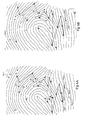
- Figures 6A and 6B reproduce, with the plot of the common path of segments between the two footprints, the footprints of Figures 3A and 3B.
- the settings necessary for the implementation of the method of the invention are essentially to define thresholds for taking into account neighboring minutiae, that is to say elasticity coefficients allowing to authorize a tolerance on modifications of impressions (pressure difference or slight shifts in position on point).
- the creation of a reference file is carried out preferably by successively comparing several sockets of the same footprint in order to take mean values for the classified coordinates of the various minutiae.
- the number of fingerprints examined to create the reference image is between 2 and 10 and is preferably 3.
- the setting of the minimum minutiae threshold matched is not a predetermined number but corresponds to a percentage of the number of minutiae of the reference image.
- An advantage of the present invention is that the process is particularly quick to determine identity between two fingerprints. This speed is notably provided by the fact that we can get out of the algorithm that this either positively or negatively.
- Another advantage of the invention is that its implementation work is less demanding in terms of program resources and memory resources than conventional methods.
- Another advantage of the invention is that the process can be easily configured according to the security level selected.
Landscapes
- Engineering & Computer Science (AREA)
- Human Computer Interaction (AREA)
- Physics & Mathematics (AREA)
- General Physics & Mathematics (AREA)
- Multimedia (AREA)
- Theoretical Computer Science (AREA)
- Collating Specific Patterns (AREA)
- Measurement Of The Respiration, Hearing Ability, Form, And Blood Characteristics Of Living Organisms (AREA)
Abstract
Description
Claims (15)
- Procédé de comparaison d'un ensemble (CI) de minuties d'une image courante par rapport à un ensemble de minuties d'une image de référence (RI), caractérisé en ce qu'il comprend les étapes suivantes :ordonner les minuties par leurs coordonnées cartésiennes dans le plan de l'image à partir d'un point d'origine prédéterminé ;rechercher, dans l'ensemble de référence et dans l'ensemble courant, un chemin commun de minuties semblables ; etconsidérer qu'il y a identité entre les deux images si le chemin commun comporte un nombre de segments supérieur à un premier seuil (THM).
- Procédé selon la revendication 1, caractérisé en ce que la recherche du chemin commun s'effectue, segment par segment, par coordonnées croissantes des minuties définissant les segments.
- Procédé selon la revendication 2, caractérisé en ce que, lorsque la recherche d'un nouveau segment d'un chemin commun est infructueuse, on reprend la recherche depuis le segment précédent, en ne tenant pas compte de la minutie ayant conduit à une recherche infructueuse.
- Procédé selon la revendication 3, caractérisé en ce qu'il consiste à comparer le nombre de fois où la recherche est reprise depuis un segment précédent par rapport à un seuil de régressions (THR) au-delà duquel on considère qu'il n'y a pas identité entre les images courante et de référence.
- Procédé selon la revendication 4, caractérisé en ce que le seuil de régressions (THR) est fonction des nombres de minuties dans les ensembles courant et de référence.
- Procédé selon l'une quelconque des revendications 1 à 5, caractérisé en ce qu'il comprend en outre les étapes suivantes :sélectionner, dans l'ensemble courant (CI) et dans l'ensemble de référence (CR), une première paire de minuties en partant de l'origine cartésienne des référentiels respectifs des deux images ;comparer si les segments calculés sont identiques à la fois en orientation, en longueur et en type de minuties concernées ; etdans l'affirmative, prendre cette première paire de minuties comme le démarrage d'un chemin et dans la négative passer à des paires de minuties suivantes.
- Procédé selon la revendication 6, caractérisé en ce que, pour déterminer un premier segment, on fixe un deuxième seuil (THL) de minuties examinées au-delà duquel on considère qu'il n'y a pas identité entre les images courante et de référence.
- Procédé selon la revendication 6 ou 7, caractérisé en ce que l'identité d'orientation et de longueur entre deux segments tient compte de tolérances prédéterminées dans les coordonnées cartésiennes.
- Procédé selon la revendication 8, caractérisé en ce que la tolérance est, en orientation, de plus ou moins environ 10 degrés, de préférence, de plus ou moins environ 5 degrés.
- Procédé selon la revendication 8 ou 9, caractérisé en ce que la tolérance est, en translation, au maximum de plus ou moins environ un tiers de la taille de l'image dans la direction correspondant à la longueur du doigt, et au maximum de plus ou moins environ un quart de la taille de l'image dans la direction correspondant à la largeur du doigt.
- Procédé selon l'une quelconque des revendications 8 à 10, caractérisé en ce que le respect des tolérances est assuré par la conformation d'un capteur (1) de prises d'empreintes digitales.
- Procédé selon l'une quelconque des revendications 1 à 11, caractérisé en ce que le premier seuil (THM) est fonction des nombres de minuties dans les ensembles courant et de référence.
- Système de reconnaissance d'empreintes digitales du type comprenant un capteur (1) et une unité de traitement (2), caractérisé en ce que le capteur est conformé de façon à fixer une tolérance de positionnement d'un doigt à la fois en rotation et en translation par rapport au plan du capteur.
- Système selon la revendication 13, caractérisé en ce que la conformation du capteur est obtenue par des butées latérales et longitudinales dans le positionnement du doigt.
- Système selon la revendication 13 ou 14, caractérisé en ce que l'unité de traitement (2) comprend des moyens pour la mise en oeuvre du procédé selon l'une quelconque des revendications 1 à 12.
Applications Claiming Priority (2)
| Application Number | Priority Date | Filing Date | Title |
|---|---|---|---|
| FR0111434 | 2001-09-04 | ||
| FR0111434A FR2829264A1 (fr) | 2001-09-04 | 2001-09-04 | Procede de comparaison d'empreintes digitales |
Publications (1)
| Publication Number | Publication Date |
|---|---|
| EP1291809A1 true EP1291809A1 (fr) | 2003-03-12 |
Family
ID=8866952
Family Applications (1)
| Application Number | Title | Priority Date | Filing Date |
|---|---|---|---|
| EP02354130A Withdrawn EP1291809A1 (fr) | 2001-09-04 | 2002-09-03 | Procédé de comparaison d'empreintes digitales |
Country Status (4)
| Country | Link |
|---|---|
| US (1) | US7315634B2 (fr) |
| EP (1) | EP1291809A1 (fr) |
| JP (1) | JP2003178307A (fr) |
| FR (1) | FR2829264A1 (fr) |
Families Citing this family (24)
| Publication number | Priority date | Publication date | Assignee | Title |
|---|---|---|---|---|
| SE526678C2 (sv) * | 2003-02-24 | 2005-10-25 | Precise Biometrics Ab | Förfaranden, datorprogramprodukter och anordningar för identitetskontroll |
| JP4340618B2 (ja) * | 2004-10-08 | 2009-10-07 | 富士通株式会社 | 生体情報認証装置及び方法,並びに生体情報認証プログラム及び生体情報認証プログラムを記録したコンピュータ読取可能な記録媒体 |
| DE102005015180A1 (de) * | 2005-03-31 | 2006-10-05 | Giesecke & Devrient Gmbh | Verifizieren von Fingerabdrücken |
| US20080273770A1 (en) * | 2007-05-03 | 2008-11-06 | Upek, Inc. | Fast Fingerprint Identification And Verification By Minutiae Pair Indexing |
| US8125458B2 (en) * | 2007-09-28 | 2012-02-28 | Microsoft Corporation | Detecting finger orientation on a touch-sensitive device |
| US8520903B2 (en) | 2010-02-01 | 2013-08-27 | Daon Holdings Limited | Method and system of accounting for positional variability of biometric features |
| US8041956B1 (en) | 2010-08-16 | 2011-10-18 | Daon Holdings Limited | Method and system for biometric authentication |
| WO2015175107A1 (fr) * | 2014-05-15 | 2015-11-19 | Bio-Key International, Inc. | Listes courtes adaptatives et accélération de recherche de base de données biométriques |
| CN105205439B (zh) * | 2015-02-13 | 2017-05-03 | 比亚迪股份有限公司 | 指纹重叠区域面积的计算方法及电子装置 |
| CN106326706B (zh) * | 2015-07-10 | 2019-05-21 | 深圳富泰宏精密工业有限公司 | 电子设备、电子设备访问控制系统及方法 |
| CN106778457A (zh) * | 2015-12-11 | 2017-05-31 | 深圳市汇顶科技股份有限公司 | 可提高指纹识别率的指纹识别方法及系统 |
| SE1650126A1 (en) * | 2016-02-02 | 2017-08-03 | Fingerprint Cards Ab | Method and fingerprint sensing system for analyzing biometric measurements of a user |
| KR101845192B1 (ko) * | 2017-02-22 | 2018-04-05 | 인하대학교 산학협력단 | 내적 연산 적용을 위한 지문 정보 변경 방법 및 시스템 |
| US11010285B2 (en) | 2019-01-24 | 2021-05-18 | International Business Machines Corporation | Fault detection and localization to generate failing test cases using combinatorial test design techniques |
| US11099975B2 (en) | 2019-01-24 | 2021-08-24 | International Business Machines Corporation | Test space analysis across multiple combinatoric models |
| US11263116B2 (en) | 2019-01-24 | 2022-03-01 | International Business Machines Corporation | Champion test case generation |
| US11106567B2 (en) | 2019-01-24 | 2021-08-31 | International Business Machines Corporation | Combinatoric set completion through unique test case generation |
| US11010282B2 (en) | 2019-01-24 | 2021-05-18 | International Business Machines Corporation | Fault detection and localization using combinatorial test design techniques while adhering to architectural restrictions |
| US11232020B2 (en) | 2019-06-13 | 2022-01-25 | International Business Machines Corporation | Fault detection using breakpoint value-based fingerprints of failing regression test cases |
| US10970197B2 (en) * | 2019-06-13 | 2021-04-06 | International Business Machines Corporation | Breakpoint value-based version control |
| US11422924B2 (en) | 2019-06-13 | 2022-08-23 | International Business Machines Corporation | Customizable test set selection using code flow trees |
| US10990510B2 (en) * | 2019-06-13 | 2021-04-27 | International Business Machines Corporation | Associating attribute seeds of regression test cases with breakpoint value-based fingerprints |
| US10970195B2 (en) * | 2019-06-13 | 2021-04-06 | International Business Machines Corporation | Reduction of test infrastructure |
| US10963366B2 (en) | 2019-06-13 | 2021-03-30 | International Business Machines Corporation | Regression test fingerprints based on breakpoint values |
Family Cites Families (2)
| Publication number | Priority date | Publication date | Assignee | Title |
|---|---|---|---|---|
| US5631972A (en) * | 1995-05-04 | 1997-05-20 | Ferris; Stephen | Hyperladder fingerprint matcher |
| US6134340A (en) * | 1997-12-22 | 2000-10-17 | Trw Inc. | Fingerprint feature correlator |
-
2001
- 2001-09-04 FR FR0111434A patent/FR2829264A1/fr active Pending
-
2002
- 2002-09-03 JP JP2002257488A patent/JP2003178307A/ja not_active Withdrawn
- 2002-09-03 EP EP02354130A patent/EP1291809A1/fr not_active Withdrawn
- 2002-09-04 US US10/234,754 patent/US7315634B2/en not_active Expired - Lifetime
Non-Patent Citations (2)
| Title |
|---|
| "EXCLUSIVE USE EQUIPMENT", NEC RESEARCH AND DEVELOPMENT, NIPPON ELECTRIC LTD. TOKYO, JP, no. 96, 1 March 1990 (1990-03-01), pages 143 - 159, XP000136301, ISSN: 0547-051X * |
| JAIN A K ET AL: "AN IDENTITY-AUTHENTICATION SYSTEM USING FINGERPRINTS", PROCEEDINGS OF THE IEEE, IEEE. NEW YORK, US, vol. 85, no. 9, 1 September 1997 (1997-09-01), pages 1365 - 1388, XP000738563, ISSN: 0018-9219 * |
Also Published As
| Publication number | Publication date |
|---|---|
| US7315634B2 (en) | 2008-01-01 |
| FR2829264A1 (fr) | 2003-03-07 |
| US20030044052A1 (en) | 2003-03-06 |
| JP2003178307A (ja) | 2003-06-27 |
Similar Documents
| Publication | Publication Date | Title |
|---|---|---|
| FR2829264A1 (fr) | Procede de comparaison d'empreintes digitales | |
| EP2318980B1 (fr) | Procédé de détermination d'une pseudo-identité à partir de caracteristiques de minuties et dispositif associé | |
| US6480617B2 (en) | Method and device for identifying fingerprints | |
| EP3640843A1 (fr) | Procédé d'extraction de caractéristiques d'une empreinte digitale représentée par une image d'entrée | |
| FR2900482A1 (fr) | Procede d'identification d'une personne par analyse des cara cteristiques de ses cils | |
| FR2924247A1 (fr) | Procede d'identification d'une personne par son iris. | |
| EP3620970B1 (fr) | Procédé d'extraction de caractéristiques d'une empreinte digitale représentée par une image d'entrée | |
| EP3582141B1 (fr) | Procédé d'apprentissage de paramètres d'un réseau de neurones à convolution | |
| WO2009041963A1 (fr) | Reconnaissance de l'iris à l'aide d'informations de cohérence | |
| Darwaish et al. | Biometric identification on android smartphones | |
| EP4099200A1 (fr) | Procede et dispositif d'identification et/ou d'authentification biometrique | |
| Tukur | Fingerprint recognition and matching using Matlab | |
| WO2008141872A1 (fr) | Procede et dispositif d'authentification automatisee d'un ensemble de points | |
| FR2979727A1 (fr) | Identification par reconnaissance d'iris | |
| FR2911204A1 (fr) | Procede de traitement d'une image d'une empreinte. | |
| EP2517151B1 (fr) | Codage biometrique | |
| EP3933626A1 (fr) | Evaluation du biais d'une fonction d'identification biométrique | |
| WO2007000504A1 (fr) | Procede de reconnaissance biometrique d'une main, systeme et dispositif associes | |
| EP2652674A1 (fr) | Procede de comparaison d'images d'iris par selection intelligente de zones texturees | |
| CA2411752C (fr) | Procede pour identifier une personne parmi une population par detection de ses empreintes digitales | |
| EP4280542B1 (fr) | Procede et dispositif d'identification biometrique | |
| EP1365350A1 (fr) | Extraction de minuties d'une image d'empreinte digitale | |
| FR3109457A1 (fr) | Procédé de détection d’attaque par présentation pour des empreintes digitales | |
| EP3185178B1 (fr) | Procede et dispositif d`identification biometrique | |
| CN117238002A (zh) | 身份认证方法、装置、计算机设备、存储介质 |
Legal Events
| Date | Code | Title | Description |
|---|---|---|---|
| PUAI | Public reference made under article 153(3) epc to a published international application that has entered the european phase |
Free format text: ORIGINAL CODE: 0009012 |
|
| AK | Designated contracting states |
Kind code of ref document: A1 Designated state(s): AT BE BG CH CY CZ DE DK EE ES FI FR GB GR IE IT LI LU MC NL PT SE SK TR Designated state(s): AT BE BG CH CY CZ DE DK EE ES FI FR GB GR IE IT LI LU MC NL PT SE SK TR |
|
| AX | Request for extension of the european patent |
Extension state: AL LT LV MK RO SI |
|
| 17P | Request for examination filed |
Effective date: 20030905 |
|
| AKX | Designation fees paid |
Designated state(s): DE FR GB IT |
|
| 17Q | First examination report despatched |
Effective date: 20080109 |
|
| R17C | First examination report despatched (corrected) |
Effective date: 20080814 |
|
| STAA | Information on the status of an ep patent application or granted ep patent |
Free format text: STATUS: THE APPLICATION IS DEEMED TO BE WITHDRAWN |
|
| 18D | Application deemed to be withdrawn |
Effective date: 20081230 |