EP1291640A1 - In vitro test method to assess the UVA protection performance of sun care products - Google Patents
In vitro test method to assess the UVA protection performance of sun care products Download PDFInfo
- Publication number
- EP1291640A1 EP1291640A1 EP01121211A EP01121211A EP1291640A1 EP 1291640 A1 EP1291640 A1 EP 1291640A1 EP 01121211 A EP01121211 A EP 01121211A EP 01121211 A EP01121211 A EP 01121211A EP 1291640 A1 EP1291640 A1 EP 1291640A1
- Authority
- EP
- European Patent Office
- Prior art keywords
- uva
- vivo
- vitro
- spectrum
- bmdbm
- Prior art date
- Legal status (The legal status is an assumption and is not a legal conclusion. Google has not performed a legal analysis and makes no representation as to the accuracy of the status listed.)
- Withdrawn
Links
- 238000000338 in vitro Methods 0.000 title claims abstract description 31
- 238000010998 test method Methods 0.000 title claims abstract description 4
- 238000001727 in vivo Methods 0.000 claims abstract description 35
- 238000001228 spectrum Methods 0.000 claims abstract description 19
- 238000002835 absorbance Methods 0.000 claims abstract description 9
- 238000012623 in vivo measurement Methods 0.000 claims abstract description 4
- 238000000034 method Methods 0.000 description 33
- LSHGMOIQPURPAK-UHFFFAOYSA-N 2-benzylidene-1,4,7,7-tetramethylbicyclo[2.2.1]heptan-3-one Chemical compound CC1(C)C(C2=O)(C)CCC1(C)C2=CC1=CC=CC=C1 LSHGMOIQPURPAK-UHFFFAOYSA-N 0.000 description 30
- 229910010413 TiO 2 Inorganic materials 0.000 description 20
- 230000000475 sunscreen effect Effects 0.000 description 20
- 239000000516 sunscreening agent Substances 0.000 description 20
- 238000005259 measurement Methods 0.000 description 13
- UVCJGUGAGLDPAA-UHFFFAOYSA-N ensulizole Chemical compound N1C2=CC(S(=O)(=O)O)=CC=C2N=C1C1=CC=CC=C1 UVCJGUGAGLDPAA-UHFFFAOYSA-N 0.000 description 12
- 229920009537 polybutylene succinate adipate Polymers 0.000 description 11
- 230000005540 biological transmission Effects 0.000 description 10
- 239000000758 substrate Substances 0.000 description 10
- 239000004904 UV filter Substances 0.000 description 8
- XVAMCHGMPYWHNL-UHFFFAOYSA-N bemotrizinol Chemical compound OC1=CC(OCC(CC)CCCC)=CC=C1C1=NC(C=2C=CC(OC)=CC=2)=NC(C=2C(=CC(OCC(CC)CCCC)=CC=2)O)=N1 XVAMCHGMPYWHNL-UHFFFAOYSA-N 0.000 description 8
- 238000000862 absorption spectrum Methods 0.000 description 7
- 238000001720 action spectrum Methods 0.000 description 7
- GWEVSGVZZGPLCZ-UHFFFAOYSA-N Titan oxide Chemical compound O=[Ti]=O GWEVSGVZZGPLCZ-UHFFFAOYSA-N 0.000 description 6
- 210000003491 skin Anatomy 0.000 description 6
- 229920003229 poly(methyl methacrylate) Polymers 0.000 description 5
- 239000004926 polymethyl methacrylate Substances 0.000 description 5
- ZCJJIQHVZCFSGZ-UHFFFAOYSA-N 2,8-bis(diphenylphosphoryl)dibenzothiophene Chemical compound C=1C=CC=CC=1P(C=1C=C2C3=CC(=CC=C3SC2=CC=1)P(=O)(C=1C=CC=CC=1)C=1C=CC=CC=1)(=O)C1=CC=CC=C1 ZCJJIQHVZCFSGZ-UHFFFAOYSA-N 0.000 description 4
- 206010015150 Erythema Diseases 0.000 description 4
- PEDCQBHIVMGVHV-UHFFFAOYSA-N Glycerine Chemical compound OCC(O)CO PEDCQBHIVMGVHV-UHFFFAOYSA-N 0.000 description 4
- 239000000049 pigment Substances 0.000 description 4
- 238000012360 testing method Methods 0.000 description 4
- 239000000839 emulsion Substances 0.000 description 3
- 231100000321 erythema Toxicity 0.000 description 3
- 230000002085 persistent effect Effects 0.000 description 3
- 230000037072 sun protection Effects 0.000 description 3
- 229920005372 Plexiglas® Polymers 0.000 description 2
- 230000037338 UVA radiation Effects 0.000 description 2
- XLOMVQKBTHCTTD-UHFFFAOYSA-N Zinc monoxide Chemical compound [Zn]=O XLOMVQKBTHCTTD-UHFFFAOYSA-N 0.000 description 2
- 230000001476 alcoholic effect Effects 0.000 description 2
- 238000001514 detection method Methods 0.000 description 2
- 230000000694 effects Effects 0.000 description 2
- 235000011187 glycerol Nutrition 0.000 description 2
- 230000010354 integration Effects 0.000 description 2
- 238000010606 normalization Methods 0.000 description 2
- 230000037380 skin damage Effects 0.000 description 2
- 230000007480 spreading Effects 0.000 description 2
- 238000000411 transmission spectrum Methods 0.000 description 2
- XLYOFNOQVPJJNP-UHFFFAOYSA-N water Substances O XLYOFNOQVPJJNP-UHFFFAOYSA-N 0.000 description 2
- TYYHDKOVFSVWON-UHFFFAOYSA-N 2-butyl-2-methoxy-1,3-diphenylpropane-1,3-dione Chemical group C=1C=CC=CC=1C(=O)C(OC)(CCCC)C(=O)C1=CC=CC=C1 TYYHDKOVFSVWON-UHFFFAOYSA-N 0.000 description 1
- JGUMTYWKIBJSTN-UHFFFAOYSA-N 2-ethylhexyl 4-[[4,6-bis[4-(2-ethylhexoxycarbonyl)anilino]-1,3,5-triazin-2-yl]amino]benzoate Chemical group C1=CC(C(=O)OCC(CC)CCCC)=CC=C1NC1=NC(NC=2C=CC(=CC=2)C(=O)OCC(CC)CCCC)=NC(NC=2C=CC(=CC=2)C(=O)OCC(CC)CCCC)=N1 JGUMTYWKIBJSTN-UHFFFAOYSA-N 0.000 description 1
- OSCJHTSDLYVCQC-UHFFFAOYSA-N 2-ethylhexyl 4-[[4-[4-(tert-butylcarbamoyl)anilino]-6-[4-(2-ethylhexoxycarbonyl)anilino]-1,3,5-triazin-2-yl]amino]benzoate Chemical group C1=CC(C(=O)OCC(CC)CCCC)=CC=C1NC1=NC(NC=2C=CC(=CC=2)C(=O)NC(C)(C)C)=NC(NC=2C=CC(=CC=2)C(=O)OCC(CC)CCCC)=N1 OSCJHTSDLYVCQC-UHFFFAOYSA-N 0.000 description 1
- WSSJONWNBBTCMG-UHFFFAOYSA-N 2-hydroxybenzoic acid (3,3,5-trimethylcyclohexyl) ester Chemical compound C1C(C)(C)CC(C)CC1OC(=O)C1=CC=CC=C1O WSSJONWNBBTCMG-UHFFFAOYSA-N 0.000 description 1
- LSNNMFCWUKXFEE-UHFFFAOYSA-M Bisulfite Chemical compound OS([O-])=O LSNNMFCWUKXFEE-UHFFFAOYSA-M 0.000 description 1
- 241001340526 Chrysoclista linneella Species 0.000 description 1
- YZCKVEUIGOORGS-OUBTZVSYSA-N Deuterium Chemical compound [2H] YZCKVEUIGOORGS-OUBTZVSYSA-N 0.000 description 1
- FMRHJJZUHUTGKE-UHFFFAOYSA-N Ethylhexyl salicylate Chemical compound CCCCC(CC)COC(=O)C1=CC=CC=C1O FMRHJJZUHUTGKE-UHFFFAOYSA-N 0.000 description 1
- 241001465754 Metazoa Species 0.000 description 1
- YBGZDTIWKVFICR-JLHYYAGUSA-N Octyl 4-methoxycinnamic acid Chemical compound CCCCC(CC)COC(=O)\C=C\C1=CC=C(OC)C=C1 YBGZDTIWKVFICR-JLHYYAGUSA-N 0.000 description 1
- 241000282320 Panthera leo Species 0.000 description 1
- 206010042496 Sunburn Diseases 0.000 description 1
- 238000010521 absorption reaction Methods 0.000 description 1
- 230000032683 aging Effects 0.000 description 1
- 230000004075 alteration Effects 0.000 description 1
- 238000004458 analytical method Methods 0.000 description 1
- 238000013459 approach Methods 0.000 description 1
- 238000000149 argon plasma sintering Methods 0.000 description 1
- 238000003556 assay Methods 0.000 description 1
- 229960005193 avobenzone Drugs 0.000 description 1
- 239000011324 bead Substances 0.000 description 1
- 230000001413 cellular effect Effects 0.000 description 1
- 238000006243 chemical reaction Methods 0.000 description 1
- 150000001875 compounds Chemical class 0.000 description 1
- 239000002537 cosmetic Substances 0.000 description 1
- 230000001186 cumulative effect Effects 0.000 description 1
- 229910052805 deuterium Inorganic materials 0.000 description 1
- HUVYTMDMDZRHBN-UHFFFAOYSA-N drometrizole trisiloxane Chemical group C[Si](C)(C)O[Si](C)(O[Si](C)(C)C)CC(C)CC1=CC(C)=CC(N2N=C3C=CC=CC3=N2)=C1O HUVYTMDMDZRHBN-UHFFFAOYSA-N 0.000 description 1
- 230000009977 dual effect Effects 0.000 description 1
- 229960000655 ensulizole Drugs 0.000 description 1
- 229940068171 ethyl hexyl salicylate Drugs 0.000 description 1
- 238000011156 evaluation Methods 0.000 description 1
- 238000002474 experimental method Methods 0.000 description 1
- 230000004907 flux Effects 0.000 description 1
- 239000011521 glass Substances 0.000 description 1
- 229910052736 halogen Inorganic materials 0.000 description 1
- 230000009931 harmful effect Effects 0.000 description 1
- 229960004881 homosalate Drugs 0.000 description 1
- 238000000099 in vitro assay Methods 0.000 description 1
- 238000010874 in vitro model Methods 0.000 description 1
- 230000003993 interaction Effects 0.000 description 1
- 238000011835 investigation Methods 0.000 description 1
- 238000012804 iterative process Methods 0.000 description 1
- 230000007774 longterm Effects 0.000 description 1
- 239000000463 material Substances 0.000 description 1
- 230000001404 mediated effect Effects 0.000 description 1
- 239000007764 o/w emulsion Substances 0.000 description 1
- 229960001679 octinoxate Drugs 0.000 description 1
- FMJSMJQBSVNSBF-UHFFFAOYSA-N octocrylene Chemical group C=1C=CC=CC=1C(=C(C#N)C(=O)OCC(CC)CCCC)C1=CC=CC=C1 FMJSMJQBSVNSBF-UHFFFAOYSA-N 0.000 description 1
- 229960000601 octocrylene Drugs 0.000 description 1
- DXGLGDHPHMLXJC-UHFFFAOYSA-N oxybenzone Chemical compound OC1=CC(OC)=CC=C1C(=O)C1=CC=CC=C1 DXGLGDHPHMLXJC-UHFFFAOYSA-N 0.000 description 1
- 229960001173 oxybenzone Drugs 0.000 description 1
- 125000001997 phenyl group Chemical group [H]C1=C([H])C([H])=C(*)C([H])=C1[H] 0.000 description 1
- 230000019612 pigmentation Effects 0.000 description 1
- 229940068196 placebo Drugs 0.000 description 1
- 239000000902 placebo Substances 0.000 description 1
- 230000002028 premature Effects 0.000 description 1
- 230000008569 process Effects 0.000 description 1
- 239000003642 reactive oxygen metabolite Substances 0.000 description 1
- 238000011160 research Methods 0.000 description 1
- 230000004044 response Effects 0.000 description 1
- 239000004576 sand Substances 0.000 description 1
- 238000009738 saturating Methods 0.000 description 1
- 210000000434 stratum corneum Anatomy 0.000 description 1
- 230000035882 stress Effects 0.000 description 1
- 239000004408 titanium dioxide Substances 0.000 description 1
- 230000009466 transformation Effects 0.000 description 1
- 238000002211 ultraviolet spectrum Methods 0.000 description 1
- 239000007762 w/o emulsion Substances 0.000 description 1
- 239000011787 zinc oxide Substances 0.000 description 1
Images


Classifications
-
- G—PHYSICS
- G01—MEASURING; TESTING
- G01N—INVESTIGATING OR ANALYSING MATERIALS BY DETERMINING THEIR CHEMICAL OR PHYSICAL PROPERTIES
- G01N21/00—Investigating or analysing materials by the use of optical means, i.e. using sub-millimetre waves, infrared, visible or ultraviolet light
- G01N21/17—Systems in which incident light is modified in accordance with the properties of the material investigated
- G01N21/25—Colour; Spectral properties, i.e. comparison of effect of material on the light at two or more different wavelengths or wavelength bands
- G01N21/31—Investigating relative effect of material at wavelengths characteristic of specific elements or molecules, e.g. atomic absorption spectrometry
- G01N21/33—Investigating relative effect of material at wavelengths characteristic of specific elements or molecules, e.g. atomic absorption spectrometry using ultraviolet light
-
- G—PHYSICS
- G01—MEASURING; TESTING
- G01J—MEASUREMENT OF INTENSITY, VELOCITY, SPECTRAL CONTENT, POLARISATION, PHASE OR PULSE CHARACTERISTICS OF INFRARED, VISIBLE OR ULTRAVIOLET LIGHT; COLORIMETRY; RADIATION PYROMETRY
- G01J1/00—Photometry, e.g. photographic exposure meter
- G01J1/42—Photometry, e.g. photographic exposure meter using electric radiation detectors
- G01J1/429—Photometry, e.g. photographic exposure meter using electric radiation detectors applied to measurement of ultraviolet light
Definitions
- UVA protection delivered by sunscreens is an issue of major importance due to increasing knowledge about UVA-induced skin damage.
- Europe there is no officially accepted method available to determine the level of UVA protection. Therefore the objective of the present study was to develop a new method combining the merits of an in vitro model, which is simple and reproducible, with the good predictive value of in vivo results.
- Transmission measurements are carried out through a thin layer of sample on roughened PMMA-plates (Plexiglas®).
- the amount of sunscreen is adjusted to the roughness of the plates to ensure an optimal distribution of the sample and measurement in the optimal range of the spectrophotometer. Normalisation of the absorption spectrum to the label (in vivo) SPF makes it possible to predict the level of in vivo UVA protection.
- this new method shows a very good correlation with in vivo results for the UVA protection performance (PPD) of 45 different commercial sunscreens.
- UVA irradiation 320-400nm
- UVA irradiation 320-400nm
- UVA UVA irradiation
- Alterations occur on the biochemical, cellular and functional level.
- the effects of UVA are mainly mediated by free radicals, e.g. reactive oxygen species.
- the visible signs are often the result of long-term, cumulative effects. It is thought that UVA induced premature skin ageing is a process of many years.
- Sunscreens should protect the skin against the effects of both short-wavelength UVB and long-wavelength UVA radiation.
- the sun protection factor (SPF) which is measured in Europe according to the COLIPA standard protocol (1994) [COLIPA, European Cosmetic, Toiletry and Perfumery Association, Colipa SPF Test Method, 94/289 (1994)], indicates the efficacy of sunburn or mainly UVB protection but does not adequately cover the UVA part of the spectrum.
- the newly developed in vitro method exhibits a very good inter-laboratory reproducibility of the relative parameters, e.g. the critical wavelength or the UVA/UVB ratio.
- the relative parameters e.g. the critical wavelength or the UVA/UVB ratio.
- the present invention therefore, relates to a new approach and describes a new method for the determination of the UVA protection performance of sunscreens.
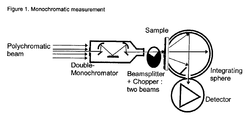
- FIG. 1 A schematic representation of the measuring device is presented in Fig. 1.
- This dual beam spectrometer is equipped with two light sources, a deuterium lamp for the UVB region and a tungsten-halogen lamp for UVA light. After the light passes through a doublemonochromator, a beamsplitter and a chopper direct the monochromatic beam either through the sample or through the reference. Monochromatic irradiation avoids possible thermal artefacts.
- the spectrometer is equipped with a light collecting integration sphere, as required for measuring light-scattering films accurately.
- Routine application started with saturating the (latex-) gloved finger for about one minute with the product. Before applying the sample, the weight of the plate was recorded.There are two basic requirements for the optimal amount of product applied. On the one hand, distribution on the plate should be as homogeneous as possible. On the other hand, theabsorbance of samples with a high content of UV filters should not exceed the optimum dynamic range of the spectrometer used (E ⁇ 2). Application of 0.75 mg/cm 2 seems to be suitable for the majority all products. The sample was spotted evenly across the plate surface with an appropriate device such as a microsyringe or a self-displacing pipette.
- the applied spots were then distributed using a presaturated finger-cot.
- Spreading of the sample is a critical parameter and therefore was always carried out according to a strictly defined procedure: For about 30 seconds the emulsion was spread with only slight pressure to prevent unintended losses at the edges of the plate. After almost all of the volatile components had disappeared, spreading was continued with a considerably higher pressure for another 30 seconds (about 200g).
- a roughened PMMA plate with a homogeneous layer of glycerine was used as a reference substrate.
- the glycerine on the reference substrate serves as a "blank" emulsion, which contains no light-absorbing or -scattering compounds and reduces artificial scattering by the roughened, dry surface much the same as a placebo . Transmission measurements were performed at not less than four different positions on each plate.
- equation 3 Using equation 3 and the thickness-normalised absorption data it is possible to calculate various absolute protection factors based on different flux situations and/or different action spectra (e.g. a PPD-PF or another UVAPF).
- the proposed method combines the well-established method for determining UVB protection (in vivo SPF) and the advantages of determining relative parameters by in vitro measurements. Therefore this new method requires only a single in vivo measurement (the label SPF), which is the most important parameter for each sunscreen.
- the in vitro transmission spectrum was first converted to an absorbance spectrum . If the calculated in vitro SPF differed from the label in vivo SPF the absorption spectrum was transformed by an iterative procedure until the in vitro SPF calculated from the new spectrum equalled the label in vivo SPF. This procedure is illustrated in Fig 2.
- the in vivo UVA protection values of all 45 samples were measured by an external institute under the same conditions (multiport irradiation device) in a short period of two months.
- the PPD endpoint was used as the statistical endpoint in the UVA range.
- the in vivo SPF for standardization of the in vitro PPD value it is possible to combine the advantages of the in vivo method and those of the in vitro method. It is not necessary, for example, to apply the same amount of product as that used normally for the in vivo SPF measurement. It is only important to ensure that the product is uniformly distributed on the substrate using a well defined application technique and that the amount of product applied is chosen so that the transmission measurements are in the optimal detection range of the photometer, especially for samples with a high UV filter concentration.
- standardization with the label in vivo SPF ensures that possible interactions of the sample with the skin due to the higher in vivo application amount of 2 mg/cm 2 will be taken into account in the in vitro measurement.
- the in vitro measurements described combine the advantages of in vitro assays that provide relative parameters with the advantages of the long-established in vivo SPF determination.
- the in vivo SPF is used as the internal standard for the fitting procedure described.
- the transmission spectra of 45 different sunscreen samples can be related to the in vivo measurements by applying a mathematical iteration procedure.
- the protection performance of the sunscreen product can be predicted and expressed as an in vitro PPD protection factor.
Landscapes
- Physics & Mathematics (AREA)
- Spectroscopy & Molecular Physics (AREA)
- General Physics & Mathematics (AREA)
- Health & Medical Sciences (AREA)
- Life Sciences & Earth Sciences (AREA)
- Chemical & Material Sciences (AREA)
- Analytical Chemistry (AREA)
- Biochemistry (AREA)
- General Health & Medical Sciences (AREA)
- Immunology (AREA)
- Pathology (AREA)
- Cosmetics (AREA)
Abstract


Description
- A method is described that is suitable for predicting the UVA protection delivered by sunscreens, which should be considered in any future official discussion on UVA methodology.
- The UVA protection delivered by sunscreens is an issue of major importance due to increasing knowledge about UVA-induced skin damage. In Europe there is no officially accepted method available to determine the level of UVA protection. Therefore the objective of the present study was to develop a new method combining the merits of an in vitro model, which is simple and reproducible, with the good predictive value of in vivo results. Transmission measurements are carried out through a thin layer of sample on roughened PMMA-plates (Plexiglas®). The amount of sunscreen is adjusted to the roughness of the plates to ensure an optimal distribution of the sample and measurement in the optimal range of the spectrophotometer. Normalisation of the absorption spectrum to the label (in vivo) SPF makes it possible to predict the level of in vivo UVA protection. Furthermore, this new method shows a very good correlation with in vivo results for the UVA protection performance (PPD) of 45 different commercial sunscreens.
- Overexposure to sunlight, particularly to UV rays, has harmful effects on human skin. A number of recent studies have shown that in addition to the most damaging UVB irradiation (290-320nm), UVA irradiation (320-400nm) also causes skin damage. Alterations occur on the biochemical, cellular and functional level. The effects of UVA are mainly mediated by free radicals, e.g. reactive oxygen species. The visible signs are often the result of long-term, cumulative effects. It is thought that UVA induced premature skin ageing is a process of many years.
- Sunscreens should protect the skin against the effects of both short-wavelength UVB and long-wavelength UVA radiation. The sun protection factor (SPF), which is measured in Europe according to the COLIPA standard protocol (1994) [COLIPA, European Cosmetic, Toiletry and Perfumery Association, Colipa SPF Test Method, 94/289 (1994)], indicates the efficacy of sunburn or mainly UVB protection but does not adequately cover the UVA part of the spectrum.
- Up to now, no generally accepted method (in vivo or in vitro) has been available. Various in vivo methods to determine the UVA protection level are known such as persistent pigment darkening (PPD) or immediate pigment darkening (IPD). The in vivo methods rely on the pigmentation or erythema produced after exposure to high doses of UVA radiation (10-20 J/cm2) combined with a long exposure time [C. Cole; Sunscreen protection in the ultraviolet A region: how to measure the effectiveness; Photodermatol Photoimmunol Photomed, 17, 2-10, 2001].
- In contrast, the newly developed in vitro method exhibits a very good inter-laboratory reproducibility of the relative parameters, e.g. the critical wavelength or the UVA/UVB ratio. Until now, all absolute in vitro parameters have shown a strong dependence on the layer thickness of applied products and therefore a limited reproducibility.
- In order to bypass these problems, an improved in vitro method with its well known advantages, e.g. easy to handle (no animals, no volunteers), high reproducibility and short measuring times, needs to be designed incorporating the advantages of in vivo experiments.
- The present invention, therefore, relates to a new approach and describes a new method for the determination of the UVA protection performance of sunscreens.
- A schematic representation of the measuring device is presented in Fig. 1. This dual beam spectrometer is equipped with two light sources, a deuterium lamp for the UVB region and a tungsten-halogen lamp for UVA light. After the light passes through a doublemonochromator, a beamsplitter and a chopper direct the monochromatic beam either through the sample or through the reference. Monochromatic irradiation avoids possible thermal artefacts.
- The spectrometer is equipped with a light collecting integration sphere, as required for measuring light-scattering films accurately.
- For our investigations we tested 45 samples representing the whole range of commercially available sunscreens in the European and American market. These samples contain all of the established UV filters and UV filter combinations used in sunscreen products. They reflect the whole spectrum of photostable and less photostable UV filter combinations. The selected products cover the range of SPF=2 to SPF=50 and different types of emulsions (water in oil/oil in water/ hydrodispersion / oil / alcoholic solution). Detailed information is listed in tab. 1.
Type SPF UV filter combination OW 2 BMDBM/ MBC OW 5 BMDBM/ TDSA/ EHT/ OC/ OW 5 BMDBM/ TDSA/ EHT/ OC OW 6 BMDBM/ MBC/ OW 6 BMDBM/ MBC/ EHMC O 8 BMDBM/ OC OW 10 OC/ BEMT/ DPDT/ OW 10 BMDBM/ MBC/ EHT/ ALC 10 BMDBM/ MBC/ DT/ OC OW 10 BMDBM/ MBC/ PBSA/ OC OW 10 TiO 2/ BEMT/ EHMC HD 10 BMDBM/ MBC/ EHT/ PBSA/ TiO 2/ BEMT/ DBT OW 12 BMDBM/ MBC/ EHT/ TiO 2 OW 12 BMDBM/ EHMC/ WO 15 BMDBM/ MBC/ EHT/ TiO 2 WO 15 BMDBM/ MBC/ OC/ ES ALC 15 BMDBM/ MBC/ PBSA/ OC/ EHMC OW 15 TiO 2/ BEMT/ EHMC WO 15 BMDBM/ MBC/ OC/ ES/ O 16 BMDBM/ MBC/ EHT/ OC/ ES/ OW 20 BMDBM/ MBC/ EHT/ PBSA/ DBT OW 20 BMDBM/ TDSA/ EHT/ TiO 2/ DT/ OC/ HD 24 BMDBM/ OC/ EHMC HD 24 BMDBM/ MBC/ EHT/ TiO 2/ OW 25 TiO 2/ OC/ BEMT/ DPDT/ EHMC OW 25 MBC/ EHT/ PBSA/ BEMT/ DPDT/ EHMC OW 26 BMDBM/ MBC/ EHT/ TiO2/ PBSA/ WO 26 BMDBM/ OC/ EHMC/ OW 30 BMDBM/ TDSA/ TiO2/ OC/ WO 30 BMDBM/ MBC/ TiO 2/ OC/ ES OW 30 BMDBM/ MBC/ EHT/ PBSA/ TiO 2 WO 30 BMDBM/ MBC/ TiO 2/ OC/ ES WO 30 PBSA/ OC/ EHMC/ ZnO HD 30 BMDBM/ MBC/ EHT/ TiO 2/ HD 30 BMDBM/ MBC/ EHT/ PBSA HD 30 BMDBM/ MBC/ EHT/ PBSA/ TiO 2/ DBT OW 30 EHMC/ ES/ BENZ-3/ HMS WO 30 TiO 2/ OC/ EHMC/ ES/ BENZ-3 WO 30 PBSA/ OC/ EHMC/ ZnO OW 30 BMDBM/ MBC/ TiO 2/ EHMC WO 35 BMDBM/ MBC/ EHT/ TiO 2/ WO 35 BMDBM/ TDSA/ MBC/ TiO 2/ OC WO 40 BMDBM/ MBC/ EHT/ TiO 2/ DPDT/ BEMT/ DBT OW 45 BMDBM/ TDSA/ EHT/ TiO 2/ DT/ OC WO 50 BMDBM/ MBC/ EHT/ PBSA/ TiO 2/Abbreviations: BMDBM = Butylmethoxydibenzoylmethane; EHC = Ethylhexylmethoxycinnamate; EHT = Ethylhexyltriazone; MBC= Methylbenzylidene Camphor; OC = Octocrylene; PBSA = Phenylbenzimidazole Sulfonic Acid; TDSA = Terephthalydene Dicamphor Sulfonic Acid; TiO2 = Titanium dioxide; ZnO = Zinc oxide; DT = Drometrizole Trisiloxane; DBT = Diethylhexyl Butamido Triazone; DPDT = Disodim Phenyl Dibenzimidazole Tetrasulfonate; BEMT = Bis-Ethylhexyloxyphenol Methoxyphenyl Triazine; ES = Ethylhexyl Salicylate; HMS = Homosalate; BENZ-3 = Benzophenone-3; WO = water in oil emulsion; OW = oil in water emulsion; O = oil; HD = hydrodispersion; ALC = alcoholic solution - Roughened Plexiglas® (PMMA, Röhm GmbH, Darmstadt, Typ XT, transparent, 24770 UVD) plates were produced commercially by the following procedure: The 2.5 mm thick PMMA plates were roughened with a sand blast unit filled with glass beads of defined size (diameter of 90-150 µm, pressure of 6 bar and a distance of 30 cm). Afterwards the PMMA plates were cut into slides of 5cm * 5 cm.
- Routine application started with saturating the (latex-) gloved finger for about one minute with the product. Before applying the sample, the weight of the plate was recorded.There are two basic requirements for the optimal amount of product applied. On the one hand, distribution on the plate should be as homogeneous as possible. On the other hand, theabsorbance of samples with a high content of UV filters should not exceed the optimum dynamic range of the spectrometer used (E<2). Application of 0.75 mg/cm2 seems to be suitable for the majority all products.The sample was spotted evenly across the plate surface with an appropriate device such as a microsyringe or a self-displacing pipette.
- The applied spots were then distributed using a presaturated finger-cot. Spreading of the sample is a critical parameter and therefore was always carried out according to a strictly defined procedure: For about 30 seconds the emulsion was spread with only slight pressure to prevent unintended losses at the edges of the plate. After almost all of the volatile components had disappeared, spreading was continued with a considerably higher pressure for another 30 seconds (about 200g).
- Following application the plates were equilibrated in the dark for 15 minutes.
- A roughened PMMA plate with a homogeneous layer of glycerine was used as a reference substrate.
- As described by different authors [A. D. Pearse, C. Edwards, Human stratum corneum as a substrate for in vitro sunscreen testing, Int. J. Cosm. Sci., 15, 234-244 (1993), B.L. Diffey, J. Robson, A new substrate to measure sunscreen protection factors throughout the ultraviolet spectrum, J. Cosmet. Chem., 40, 127-133 (1989), R.M. Sayre, P.P. Agin, G.J. Levee and E. Marlowe, A comparison of in vivo and in vitro testing of sunscreening formulas, Photochem. Photobiol., 29, 112-119, (1979)], the principle of the analysis is a transmission measurement. The glycerine on the reference substrate serves as a "blank" emulsion, which contains no light-absorbing or -scattering compounds and reduces artificial scattering by the roughened, dry surface much the same as a placebo . Transmission measurements were performed at not less than four different positions on each plate.
- Prior to manipulation, transmission data were converted to absorbance values as shown below, taking also into account the electrical noise (/backgr)(Equation 1).Where:

- A = absorbance
- Iref= intensity of the transmission signal through the substrate without sunscreen
- Isample = intensity of the transmission signal through the substrate with sunscreen
- MPF = monochromatic protection factor (1/T)
- T = transmission
-
- The in vitro sun protection factor (SPF) was calculated using Equation 2:Where

- E(λ) = irradiance at wavelength λ of the light spectrum used
- S(λ) = effectiveness of a biological endpoint at wavelength λ; for the SPF it is the erythema action spectrum [CIE action spectra for UV-erythem; A reference action spectrum for Ultraviolet inducrd erythema in human skin,
- MPF = monochromatic protection factor (1/T)
- A(λ) = absorbance
-
- If the in vitro SPF calculated from the transmission data is unequal to the label SPF measured in vivo, an alignment of the absorbance spectra by an iterative process is performed until the measured in vitro SPF is equal to the measured in vivo SPF. The iteration is applied to the constant C in equation 3. During this mathematical alignment only the height of the absorbance spectrum is altered, i.e. the thickness of the applied layer is corrected to correspond to that of the in vivo SPF. The shape of the spectrum reflecting the particular UV filter combination of the product under test remains unchanged.Where

- E(λ) = irradiance at wavelength λ of the light spectrum used
- S(λ) = effectiveness of a biological endpoint at wavelength λ
- A(λ) = absorbance
- C = constant factor for the adjustment of the spectrum
-
- Using equation 3 and the thickness-normalised absorption data it is possible to calculate various absolute protection factors based on different flux situations and/or different action spectra ( e.g. a PPD-PF or another UVAPF).
- For the calculation of PPD-PF according to equation 3 it is necessary to:
- choose the integration area from 320nm to 400 nm,
- use a spectrum (Eλ) of a common irradiation device (e.g. multiport solar simulator) and
- use the action spectrum of persistent pigment darkening (S(λ)) (equation 4)

-
- Where
- E(λ) = irradiance of the UVA light spectrum of an multiport irradiation device at wavelength λ
- S(λ) = PPD action spectrum from 320nm to 400 nm
[A. Chardon, D. Moyal, C. Hourseau; Persistent Pigment Darkening Response as a Method for Evaluation of UVA Protection Assays; Lowe, Shaath. Pathak, Sunscreens, Marcel Dekker, 559-582, (1997)] - A(λ) = absorbance
- C = constant factor for adjustment of the spectrum as in equation 3
-
- An improved, fast and reproducible in vitro transmission method to predict the level of UVA protection of a sunscreen was developed.
- The proposed method combines the well-established method for determining UVB protection (in vivo SPF) and the advantages of determining relative parameters by in vitro measurements. Therefore this new method requires only a single in vivo measurement (the label SPF), which is the most important parameter for each sunscreen.
- To achieve appropriate distribution on the roughened PMMA substrate and measurement in the best detection range of the photometer, an amount of 0,75 mg/cm2 was applied. Therefore, the amount of products applied to the substrate in the in vitro method is smaller then that applied to the skin in the COLIPA method for SPF testing and the measured in vitro-SPF is different from the labeled in vivo SPF. To normalize the SPF measured in vitro to that measured in vivo, the in vitro transmission spectrum was first converted to an absorbance spectrum . If the calculated in vitro SPF differed from the label in vivo SPF the absorption spectrum was transformed by an iterative procedure until the in vitro SPF calculated from the new spectrum equalled the label in vivo SPF. This procedure is illustrated in Fig 2.
- With this new absorption spectrum it was possible to calculate the UVA protection performance of the investigated sample. Used for the calculation was only the range from 320nm to 400nm (PPD) and therefore the light spectrum of the multiport irradiation device and PPD action spectrum.
- To validate the calculated UVA protection values, the in vivo UVA protection values of all 45 samples were measured by an external institute under the same conditions (multiport irradiation device) in a short period of two months. The PPD endpoint was used as the statistical endpoint in the UVA range.
- Fig.3 shows the correlation between the calculated, predicted UVA protection performance and the values measured in vivo. There is a very good correlation over the whole range with a correlation factor of R=0.92 .
- By using the in vivo SPF for standardization of the in vitro PPD value it is possible to combine the advantages of the in vivo method and those of the in vitro method. It is not necessary, for example, to apply the same amount of product as that used normally for the in vivo SPF measurement. It is only important to ensure that the product is uniformly distributed on the substrate using a well defined application technique and that the amount of product applied is chosen so that the transmission measurements are in the optimal detection range of the photometer, especially for samples with a high UV filter concentration.
- Furthermore, standardization with the label in vivo SPF ensures that possible interactions of the sample with the skin due to the higher in vivo application amount of 2 mg/cm2 will be taken into account in the in vitro measurement.
- Moreover, no pre-irradiation of the samples is necessary. The high dose of UV light in the UVB and UVA range during the SPF measurement stresses especially samples with high SPF values. Photoinstability would influence the SPF data. Therefore, a possible photoinstability of UV filter systems is already included in the calculated in vitro PPD-factor through the in vivo SPF measurement.
- In conclusion, it is possible with the new in vitro method to predict the in vivo UVA protection performance. The very good correlation of the in vitro PPD-PF endpoint values with the in vivo PPD values confirms the validity of this new method (Fig.3).
- The in vitro measurements described combine the advantages of in vitro assays that provide relative parameters with the advantages of the long-established in vivo SPF determination. The in vivo SPF is used as the internal standard for the fitting procedure described.
- The validity of a mathematical transformation of absorption spectra with a constant factor without changing the shape of the curve is well documented [H. Gers-Barlag, E. Klette, R. Bimczok, C. Springob, P. Finkel, T. Rudolph, H. Gonzenbach, P. Schneider, D. Kockott, U. Heinrich, H. Tronnier, R. Bernklau, W. Johncock, R. Langner, H. Driller, H. Westenfelder; In vitro testing to assess the UVA protection performance of sun care products; Int J Cosm Sci, 23, 3-14, (2001)12].
- Based on these results, it was possible to develop a novel in vitro method for the determination of the UVA protection performance of a sunscreen with a known in vivo SPF.
- The transmission spectra of 45 different sunscreen samples can be related to the in vivo measurements by applying a mathematical iteration procedure. The protection performance of the sunscreen product can be predicted and expressed as an in vitro PPD protection factor.
- The validity of the predicted UVA protection performance is shown by an excellent correlation with the PPD values of the same samples measured in vivo.
- Standardization with the SPF measure in vivo makes pre-irradiation of the samples unnecessary.
- Finally this new method has the potential to harmonise the UVA-discussion.
Claims (1)
- In-vitro test method to measure the UVA protection performance (UVAPF) of sun care products by measuring the in-vitro absorbance data, normalising the spectrum to the in-vivo SPF and calculating the UVA protection performance by the following formula:Where
 E(λ) = irradiance at wavelength λ of the light spectrum usedC = constant factor for the adjustment of the spectrum to the in-vivo measurementS(λ) = effectiveness of a biological UVA endpoint at wavelength λ;A(λ) = absorbance
Priority Applications (1)
| Application Number | Priority Date | Filing Date | Title |
|---|---|---|---|
| EP01121211A EP1291640A1 (en) | 2001-09-05 | 2001-09-05 | In vitro test method to assess the UVA protection performance of sun care products |
Applications Claiming Priority (1)
| Application Number | Priority Date | Filing Date | Title |
|---|---|---|---|
| EP01121211A EP1291640A1 (en) | 2001-09-05 | 2001-09-05 | In vitro test method to assess the UVA protection performance of sun care products |
Publications (1)
| Publication Number | Publication Date |
|---|---|
| EP1291640A1 true EP1291640A1 (en) | 2003-03-12 |
Family
ID=8178548
Family Applications (1)
| Application Number | Title | Priority Date | Filing Date |
|---|---|---|---|
| EP01121211A Withdrawn EP1291640A1 (en) | 2001-09-05 | 2001-09-05 | In vitro test method to assess the UVA protection performance of sun care products |
Country Status (1)
| Country | Link |
|---|---|
| EP (1) | EP1291640A1 (en) |
Cited By (6)
| Publication number | Priority date | Publication date | Assignee | Title |
|---|---|---|---|---|
| WO2008044596A1 (en) * | 2006-10-06 | 2008-04-17 | Shiseido Company, Ltd. | Ultraviolet radiation protective effect evaluation method and device |
| JP2008111834A (en) * | 2006-10-06 | 2008-05-15 | Shiseido Co Ltd | Method and device for evaluating ultraviolet radiation protective effect |
| EP2542680A4 (en) * | 2010-03-01 | 2013-08-21 | Mitomics Inc | Uv associated mtdna fusion transcripts and methods and uses thereof |
| EP2684029A4 (en) * | 2011-03-11 | 2014-08-13 | Suncare Res Lab Llc | In vitro measurement of sunscreen protection |
| CN114184542A (en) * | 2022-02-15 | 2022-03-15 | 远东正大检验集团有限公司 | Ultraviolet light variation equipment, application thereof and testing method adopting equipment |
| WO2022194912A1 (en) | 2021-03-17 | 2022-09-22 | Givaudan Sa | Cosmetic composition |
Citations (2)
| Publication number | Priority date | Publication date | Assignee | Title |
|---|---|---|---|---|
| FR2710151A1 (en) * | 1993-09-14 | 1995-03-24 | Bioderma Laboratoire | Apparatus and method for in vitro determination of the protection factor and water resistance of a cosmetic product of the sunscreen type |
| US5500533A (en) * | 1993-09-27 | 1996-03-19 | Shiseido Company, Ltd. | Method and apparatus for measuring ultraviolet protection effectiveness |
-
2001
- 2001-09-05 EP EP01121211A patent/EP1291640A1/en not_active Withdrawn
Patent Citations (2)
| Publication number | Priority date | Publication date | Assignee | Title |
|---|---|---|---|---|
| FR2710151A1 (en) * | 1993-09-14 | 1995-03-24 | Bioderma Laboratoire | Apparatus and method for in vitro determination of the protection factor and water resistance of a cosmetic product of the sunscreen type |
| US5500533A (en) * | 1993-09-27 | 1996-03-19 | Shiseido Company, Ltd. | Method and apparatus for measuring ultraviolet protection effectiveness |
Non-Patent Citations (2)
| Title |
|---|
| DIFFEY B L ET AL: "A NEW SUBSTRATE TO MEASURE SUNSCREEN PROTECTION FACTORS THROUGHOUT THE ULTRAVIOLET SPECTRUM", JOURNAL OF THE SOCIETY COSMETIC CHEMISTS, NEW-YORK, NY, US, vol. 40, no. 3, 1 May 1989 (1989-05-01), pages 127 - 133, XP000571875 * |
| SAYRE R M: "CORRELATION OF IN-VIVO TESTS, IN-VITRO SPF PREDICTIONS A SURVEY OF PUBLISHED STUDIES", COSMETICS & TOILETRIES, WHEATON, IL, US, vol. 108, 1 February 1993 (1993-02-01), pages 111 - 114, XP000573062, ISSN: 0361-4387 * |
Cited By (10)
| Publication number | Priority date | Publication date | Assignee | Title |
|---|---|---|---|---|
| WO2008044596A1 (en) * | 2006-10-06 | 2008-04-17 | Shiseido Company, Ltd. | Ultraviolet radiation protective effect evaluation method and device |
| JP2008111834A (en) * | 2006-10-06 | 2008-05-15 | Shiseido Co Ltd | Method and device for evaluating ultraviolet radiation protective effect |
| CN101523193B (en) * | 2006-10-06 | 2011-06-15 | 株式会社资生堂 | Evaluation method and evaluation device for ultraviolet protection effect |
| US8159656B2 (en) | 2006-10-06 | 2012-04-17 | Shiseido Company, Ltd. | Method and apparatus for evaluating ultraviolet radiation protection effect |
| EP2542680A4 (en) * | 2010-03-01 | 2013-08-21 | Mitomics Inc | Uv associated mtdna fusion transcripts and methods and uses thereof |
| EP3305902A1 (en) * | 2010-03-01 | 2018-04-11 | MDNA Life Sciences Inc. | Uv associated mtdna fusion transcripts and methods and uses thereof |
| EP2684029A4 (en) * | 2011-03-11 | 2014-08-13 | Suncare Res Lab Llc | In vitro measurement of sunscreen protection |
| US9063054B2 (en) | 2011-03-11 | 2015-06-23 | Suncare Research Laboratories, Llc | Vitro measurement of sunscreen protection |
| WO2022194912A1 (en) | 2021-03-17 | 2022-09-22 | Givaudan Sa | Cosmetic composition |
| CN114184542A (en) * | 2022-02-15 | 2022-03-15 | 远东正大检验集团有限公司 | Ultraviolet light variation equipment, application thereof and testing method adopting equipment |
Similar Documents
| Publication | Publication Date | Title |
|---|---|---|
| Moyal et al. | Determination of UVA protection factors using the persistent pigment darkening (PPD) as the end point: (Part 1) Calibration of the method | |
| Grimes | Impact of iron-oxide containing formulations against visible light-induced skin pigmentation in skin of color individuals | |
| Gonzalez et al. | Photostability of commercial sunscreens upon sun exposure and irradiation by ultraviolet lamps | |
| JP4286309B2 (en) | Method for determining an integrated solar protection factor wrapping UVA and UVB radiation | |
| Wang et al. | Comparison of ultraviolet A light protection standards in the United States and European Union through in vitro measurements of commercially available sunscreens | |
| Seité et al. | Accumulated p53 protein and UVA protection level of sunscreens | |
| Fourtanier et al. | UVA filters in sun-protection products: regulatory and biological aspects | |
| Maier et al. | Change of ultraviolet absorbance of sunscreens by exposure to solar-simulated radiation | |
| US20180321139A1 (en) | Optically ascertaining the sun protection factor of sunscreens or other radiation protection agents | |
| Wang et al. | Ex vivo evaluation of radical sun protection factor in popular sunscreens with antioxidants | |
| AU675347B2 (en) | Method and apparatus for measuring ultraviolet protection effectiveness | |
| Miura et al. | Influence of application amount on sunscreen photodegradation in in vitro sun protection factor evaluation: proposal of a skin‐mimicking substrate | |
| Herzog et al. | In vivo and in vitro assessment of UVA protection by sunscreen formulations containing either butyl methoxy dibenzoyl methane, methylene bis‐benzotriazolyl tetramethylbutylphenol, or microfine ZnO | |
| Baron et al. | High ultraviolet A protection affords greater immune protection confirming that ultraviolet A contributes to photoimmunosuppression in humans | |
| Lim et al. | Change of biophysical properties of the skin caused by ultraviolet radiation‐induced photodamage in Koreans | |
| Masuda et al. | An innovative method to measure skin pigmentation | |
| Herzog et al. | On the validity of Beer–Lambert law and its significance for sunscreens | |
| Bielfeldt et al. | Multicenter methodology comparison of the FDA and ISO standard for measurement of in vitro UVA protection of sunscreen products | |
| Throm et al. | In vivo sun protection factor and UVA protection factor determination using (hybrid) diffuse reflectance spectroscopy and a multi‐lambda‐LED light source | |
| Moyal | UVA protection labeling and in vitro testing methods | |
| Sayre et al. | Sunscreen standards tested with differently filtered solar simulators | |
| DGK (German Society for Scientific and Applied Cosmetics) Task Force ‘Sun Protection’. et al. | In vitro testing to assess the UVA protection performance of sun care products | |
| Bouillon | Recent advances in sun protection | |
| NZ539725A (en) | Method and apparatus for determining effectiveness of sunscreens and other skin preparations in shielding human skin from UVA radiation | |
| Akrman et al. | Quartz plates for determining sun protection in vitro and testing photostability of commercial sunscreens |
Legal Events
| Date | Code | Title | Description |
|---|---|---|---|
| PUAI | Public reference made under article 153(3) epc to a published international application that has entered the european phase |
Free format text: ORIGINAL CODE: 0009012 |
|
| AK | Designated contracting states |
Kind code of ref document: A1 Designated state(s): AT BE CH CY DE DK ES FI FR GB GR IE IT LI LU MC NL PT SE TR Designated state(s): AT BE CH CY DE DK ES FI FR GB GR IE IT LI LU MC NL PT SE TR |
|
| AX | Request for extension of the european patent |
Extension state: AL LT LV MK RO SI |
|
| AKX | Designation fees paid | ||
| REG | Reference to a national code |
Ref country code: DE Ref legal event code: 8566 |
|
| STAA | Information on the status of an ep patent application or granted ep patent |
Free format text: STATUS: THE APPLICATION IS DEEMED TO BE WITHDRAWN |
|
| 18D | Application deemed to be withdrawn |
Effective date: 20030913 |