EP1291439A2 - Method for identifying metalloenzyme inhibitors - Google Patents
Method for identifying metalloenzyme inhibitors Download PDFInfo
- Publication number
- EP1291439A2 EP1291439A2 EP02255715A EP02255715A EP1291439A2 EP 1291439 A2 EP1291439 A2 EP 1291439A2 EP 02255715 A EP02255715 A EP 02255715A EP 02255715 A EP02255715 A EP 02255715A EP 1291439 A2 EP1291439 A2 EP 1291439A2
- Authority
- EP
- European Patent Office
- Prior art keywords
- enzyme
- metal cation
- mmp
- functional metal
- inhibitor
- Prior art date
- Legal status (The legal status is an assumption and is not a legal conclusion. Google has not performed a legal analysis and makes no representation as to the accuracy of the status listed.)
- Withdrawn
Links
Images
Classifications
-
- C—CHEMISTRY; METALLURGY
- C12—BIOCHEMISTRY; BEER; SPIRITS; WINE; VINEGAR; MICROBIOLOGY; ENZYMOLOGY; MUTATION OR GENETIC ENGINEERING
- C12Q—MEASURING OR TESTING PROCESSES INVOLVING ENZYMES, NUCLEIC ACIDS OR MICROORGANISMS; COMPOSITIONS OR TEST PAPERS THEREFOR; PROCESSES OF PREPARING SUCH COMPOSITIONS; CONDITION-RESPONSIVE CONTROL IN MICROBIOLOGICAL OR ENZYMOLOGICAL PROCESSES
- C12Q1/00—Measuring or testing processes involving enzymes, nucleic acids or microorganisms; Compositions therefor; Processes of preparing such compositions
- C12Q1/34—Measuring or testing processes involving enzymes, nucleic acids or microorganisms; Compositions therefor; Processes of preparing such compositions involving hydrolase
- C12Q1/37—Measuring or testing processes involving enzymes, nucleic acids or microorganisms; Compositions therefor; Processes of preparing such compositions involving hydrolase involving peptidase or proteinase
-
- C—CHEMISTRY; METALLURGY
- C12—BIOCHEMISTRY; BEER; SPIRITS; WINE; VINEGAR; MICROBIOLOGY; ENZYMOLOGY; MUTATION OR GENETIC ENGINEERING
- C12Q—MEASURING OR TESTING PROCESSES INVOLVING ENZYMES, NUCLEIC ACIDS OR MICROORGANISMS; COMPOSITIONS OR TEST PAPERS THEREFOR; PROCESSES OF PREPARING SUCH COMPOSITIONS; CONDITION-RESPONSIVE CONTROL IN MICROBIOLOGICAL OR ENZYMOLOGICAL PROCESSES
- C12Q1/00—Measuring or testing processes involving enzymes, nucleic acids or microorganisms; Compositions therefor; Processes of preparing such compositions
- C12Q1/34—Measuring or testing processes involving enzymes, nucleic acids or microorganisms; Compositions therefor; Processes of preparing such compositions involving hydrolase
-
- C—CHEMISTRY; METALLURGY
- C12—BIOCHEMISTRY; BEER; SPIRITS; WINE; VINEGAR; MICROBIOLOGY; ENZYMOLOGY; MUTATION OR GENETIC ENGINEERING
- C12Q—MEASURING OR TESTING PROCESSES INVOLVING ENZYMES, NUCLEIC ACIDS OR MICROORGANISMS; COMPOSITIONS OR TEST PAPERS THEREFOR; PROCESSES OF PREPARING SUCH COMPOSITIONS; CONDITION-RESPONSIVE CONTROL IN MICROBIOLOGICAL OR ENZYMOLOGICAL PROCESSES
- C12Q1/00—Measuring or testing processes involving enzymes, nucleic acids or microorganisms; Compositions therefor; Processes of preparing such compositions
- C12Q1/34—Measuring or testing processes involving enzymes, nucleic acids or microorganisms; Compositions therefor; Processes of preparing such compositions involving hydrolase
- C12Q1/42—Measuring or testing processes involving enzymes, nucleic acids or microorganisms; Compositions therefor; Processes of preparing such compositions involving hydrolase involving phosphatase
-
- C—CHEMISTRY; METALLURGY
- C12—BIOCHEMISTRY; BEER; SPIRITS; WINE; VINEGAR; MICROBIOLOGY; ENZYMOLOGY; MUTATION OR GENETIC ENGINEERING
- C12Q—MEASURING OR TESTING PROCESSES INVOLVING ENZYMES, NUCLEIC ACIDS OR MICROORGANISMS; COMPOSITIONS OR TEST PAPERS THEREFOR; PROCESSES OF PREPARING SUCH COMPOSITIONS; CONDITION-RESPONSIVE CONTROL IN MICROBIOLOGICAL OR ENZYMOLOGICAL PROCESSES
- C12Q1/00—Measuring or testing processes involving enzymes, nucleic acids or microorganisms; Compositions therefor; Processes of preparing such compositions
- C12Q1/527—Measuring or testing processes involving enzymes, nucleic acids or microorganisms; Compositions therefor; Processes of preparing such compositions involving lyase
-
- G—PHYSICS
- G01—MEASURING; TESTING
- G01N—INVESTIGATING OR ANALYSING MATERIALS BY DETERMINING THEIR CHEMICAL OR PHYSICAL PROPERTIES
- G01N2333/00—Assays involving biological materials from specific organisms or of a specific nature
- G01N2333/81—Protease inhibitors
- G01N2333/8107—Endopeptidase (E.C. 3.4.21-99) inhibitors
- G01N2333/8146—Metalloprotease (E.C. 3.4.24) inhibitors, e.g. tissue inhibitor of metallo proteinase, TIMP
-
- G—PHYSICS
- G01—MEASURING; TESTING
- G01N—INVESTIGATING OR ANALYSING MATERIALS BY DETERMINING THEIR CHEMICAL OR PHYSICAL PROPERTIES
- G01N2333/00—Assays involving biological materials from specific organisms or of a specific nature
- G01N2333/90—Enzymes; Proenzymes
- G01N2333/914—Hydrolases (3)
- G01N2333/948—Hydrolases (3) acting on peptide bonds (3.4)
- G01N2333/95—Proteinases, i.e. endopeptidases (3.4.21-3.4.99)
- G01N2333/964—Proteinases, i.e. endopeptidases (3.4.21-3.4.99) derived from animal tissue
- G01N2333/96425—Proteinases, i.e. endopeptidases (3.4.21-3.4.99) derived from animal tissue from mammals
- G01N2333/96427—Proteinases, i.e. endopeptidases (3.4.21-3.4.99) derived from animal tissue from mammals in general
- G01N2333/9643—Proteinases, i.e. endopeptidases (3.4.21-3.4.99) derived from animal tissue from mammals in general with EC number
- G01N2333/96486—Metalloendopeptidases (3.4.24)
-
- G—PHYSICS
- G01—MEASURING; TESTING
- G01N—INVESTIGATING OR ANALYSING MATERIALS BY DETERMINING THEIR CHEMICAL OR PHYSICAL PROPERTIES
- G01N2500/00—Screening for compounds of potential therapeutic value
- G01N2500/02—Screening involving studying the effect of compounds C on the interaction between interacting molecules A and B (e.g. A = enzyme and B = substrate for A, or A = receptor and B = ligand for the receptor)
Definitions
- the present invention relates to a method for identifying inhibitors of a metalloenzyme.
- Such inhibitors are useful for treating mammals that suffer from diseases responsive to inhibition of the metalloenzyme such as arthritis, multiple sclerosis, heart failure, stroke, or cancer, to name a few.
- a metalloenzyme is any naturally occurring mammalian enzyme, or any truncated form thereof, that employs a metal cation directly in a functional capacity, including in a catalytic capacity, as opposed to in a purely structural capacity.
- Metalloenzymes include matrix metalloproteinases, a disintegrin and metalloproteinase-thrombospondin ("ADAM-TS”)-type metalloproteinase such as tumor necrosis factor converting enzyme (“TACE”), alcohol dehydrogenases, carboxypeptidases, alkaline phosphatases, carbonic anhydrases, beta-lactamases, aminopeptidases, Leukotriene-A4 (“LTA4") hydrolases, phospholipases C, Escherichia coli (" E.
- prokaryotic metallodeacetylases such as UDP-3- O -acyl- N -acetylglucosamine deacetylase ("LpxC”), prokaryotic peptide deformylase and other iron-dependent enzymes, and isopenicillin N-synthase.
- metal cations employed by such metalloenzymes include Ca 2+ , Zn 2+ , Co 2+ , Mn 2+ , Mn 3+ , Mg 2+ , Cd 2+ , Ni 2+ , Hg 2+ , Fe 2+ , and Fe 3+ .
- MMPs matrix metalloproteinases
- MMP-1 collagenase-1
- MMP-2 collagenase A
- MMP-3 stromelysin-1
- MMP-7 matrilysin
- MMP-8 collagenase-2
- MMP-9 neutrophil collagenase
- MMP-12 collagenase-3
- MMP-13 membrane-type-1 MMP
- MMP-14 membrane-type-1 MMP
- MMPs One major biological function of the MMPs is to catalyze the breakdown of connective tissue or extracellular matrix by virtue of their abilities to hydrolyze various components of the tissue or matrix.
- components that may be hydrolyzed by an MMP include collagens (e.g., type I, II, III, or IV), gelatins, proteoglycans, and fibronectins.
- collagens e.g., type I, II, III, or IV
- gelatins e.g., type I, II, III, or IV
- proteoglycans e.g., type I, II, III, or IV
- fibronectins fibronectins
- the collagenase subfamily of MMPs namely MMP-1, MMP-8, and MMP-13, preferentially cleave collagens, and are thus usually associated with diseases linked to breakdown of collagen-based tissue, for example, arthritis.
- Another major biological function of the MMPs is proteolytic activation of the zymogen (pro
- MMP matrix metalloproteinase
- TIMP matrix metalloproteinase
- diseases characterized by over-expression and/or over-activation of an MMP include rheumatoid arthritis; osteoarthritis; osteoporosis; periodontitis; multiple sclerosis; gingivitis; corneal, epidermal, and gastric ulceration; atherosclerosis; neointimal proliferation, which leads to restenosis and ischemic heart failure; stroke; renal disease; macular degeneration; and tumor metastasis.
- MMP-mediated diseases may involve overactivity of only one MMP enzyme. This is supported by the recent discovery that MMP-13 alone is over-expressed in breast carcinoma, while MMP-1 alone is over-expressed in papillary carcinoma.
- MMP inhibitors identified to date for treatment of the above-listed diseases are their poor selectivity. These MMP inhibitors typically mimic the natural substrates in that they coordinate the functional zinc cation and occupy from 1 to 3 specificity binding pockets along the enzyme active site cleft. As there is much structural similarity among these binding pockets of the various MMPs, this binding mode leads to the poor inhibitor-MMP selectivity.
- MMP inhibitors identified to date that coordinate the functional zinc cation of the MMP are competitive with substrate binding.
- concentration of an enzyme's substrate rises, the potency of a competitive inhibitor for the active site of the enzyme diminishes.
- a selective MMP inhibitor would avoid potential side effects associated with inhibition of MMPs that are not involved in the pathogenesis of the disease being treated. Further, use of a selective MMP inhibitor would require administration of a lower amount of the inhibitor for treatment of disease than would otherwise be required if the inhibitor was nonselective and, after administration, partitioned in vivo among multiple MMPs. Still further, the administration of a lower amount of compound would improve the margin of safety between the dose of the inhibitor required for therapeutic activity and the dose of the inhibitor at which toxicity is observed.
- a noncompetitive or uncompetitive MMP inhibitor would potentially also bind to MMP-TIMP complexes. These inhibitors may not suffer diminishing binding potency in the presence of a rising concentration of substrate. Accordingly, a noncompetitive or uncompetitive MMP inhibitor that binds to an MMP-TIMP complex should maintain its therapeutic efficacy in the presence of the rising substrate concentration.
- a further advantage of a noncompetitive or uncompetitive MMP inhibitor is that when the inhibitor is bound to an MMP-TIMP complex and the TIMP disassociates from the complex to provide free TIMP and inhibitor-bound MMP, the MMP remains inhibited.
- inhibitors of an MMP have been identified by assaying potential inhibitory compounds against the full-length MMP enzyme, or a catalytic domain thereof. These assays are usually performed in the presence of a synthetic substrate of the MMP.
- the synthetic substrate is cleaved by the MMP in the assay to produce cleavage products, wherein a common property (e.g., ultraviolet absorbance or fluorescence) of the synthetic substrate and/or of one of the cleavage products is measured to determine the extent of cleavage.
- a common property e.g., ultraviolet absorbance or fluorescence
- a method of identifying MMP inhibitors that do not coordinate the functional zinc cation which are noncompetitive or uncompetitive inhibitors would thus be valuable. Further, a method of identifying a selective inhibitor of MMP-13 would be particularly valuable, as there appears to be only one reported selective inhibitor of MMP-13, namely WAY-170523.
- the present invention provides a method of identifying inhibitors of metalloenzymes, including inhibitors of MMPs that are competitive, noncompetitive, or uncompetitive inhibitors. For example, selective noncompetitive inhibitors of MMP-13 have been identified using the method of the present invention.
- the method of the present invention works for any enzyme that employs a metal cation in a functional capacity, including in a catalytic mechanism, and is thus applicable to identifying selective inhibitors of any metalloenzyme that acts on a substrate that binds to a metal ion of the enzyme.
- Method Embodiment 1 provides a method for identifying competitive, noncompetitive, or uncompetitive inhibitors of a metalloenzyme.
- Method Embodiment 1 is a method for identifying a compound as a competitive, noncompetitive, or uncompetitive inhibitor of an enzyme having a functional metal cation, the method comprising the steps of:
- Another embodiment of the present invention is the method according to Method Embodiment 1, wherein the compound is a competitive inhibitor of the enzyme having a functional metal cation.
- Another embodiment of the present invention is the method according to Method Embodiment 1, wherein the compound is a noncompetitive inhibitor of the enzyme having a functional metal cation.
- Another embodiment of the present invention is the method according to Method Embodiment 1, wherein the compound is an uncompetitive inhibitor of the enzyme having a functional metal cation.
- Another embodiment of the present invention is the method according to Method Embodiment 1, wherein the functional metal cation is selected from: Ca 2+ , Zn 2+ , Co 2+ , Mn 2+ , Mn 3+ , Mg 2+ , Cd 2+ , Cu 2+ , Ni 2+ , Hg 2+ , Fe 2+ , and Fe 3+ .
- Another embodiment of the present invention is the method according to Method Embodiment 1, wherein the enzyme having a functional metal cation is selected from: a matrix metalloproteinase, an ADAM-TS type metalloproteinase, including TACE, an alcohol dehydrogenase, a carboxypeptidase, an alkaline phosphatase, a carbonic anhydrase, a beta-lactamase, an aminopeptidase, LTA4 hydrolase, a phospholipase C, a prokaryotic metallodeacetylase, a prokaryotic peptide deformylase, and isopenicillin N-synthase.
- the enzyme having a functional metal cation is selected from: a matrix metalloproteinase, an ADAM-TS type metalloproteinase, including TACE, an alcohol dehydrogenase, a carboxypeptidase, an alkaline phosphatase, a carbonic anhydr
- Another embodiment of the present invention is the method according to Method Embodiment 1, wherein the enzyme having a functional metal cation is Escherichia coli (" E. coli ”) metallodeacetylase.
- Another embodiment of the present invention is the method according to Method Embodiment 1, wherein the enzyme having a functional metal cation is LpxC metallodeacetylase.
- Another embodiment of the present invention is the method according to Method Embodiment 1, wherein the enzyme having a functional metal cation is a matrix metalloproteinase, or a catalytic domain thereof.
- Another embodiment of the present invention is the method according to Method Embodiment 1, wherein the enzyme having a functional metal cation is MMP-1, or a catalytic domain thereof.
- Another embodiment of the present invention is the method according to Method Embodiment 1, wherein the enzyme having a functional metal cation is MMP-1 catalytic domain.
- Another embodiment of the present invention is the method according to Method Embodiment 1, wherein the enzyme having a functional metal cation is MMP-1 catalytic domain, the ligand to the functional metal cation is acetohydroxamic acid, and the inhibitor is a noncompetitive inhibitor.
- Another embodiment of the present invention is the method according to Method Embodiment 1, wherein the enzyme having a functional metal cation is MMP-2, or a catalytic domain thereof.
- Another embodiment of the present invention is the method according to Method Embodiment 1, wherein the enzyme having a functional metal cation is MMP-2 catalytic domain.
- Another embodiment of the present invention is the method according to Method Embodiment 1, wherein the enzyme having a functional metal cation is MMP-2 catalytic domain, the ligand to the functional metal cation is acetohydroxamic acid, and the inhibitor is a noncompetitive inhibitor.
- Another embodiment of the present invention is the method according to Method Embodiment 1, wherein the enzyme having a functional metal cation is MMP-3, or a catalytic domain thereof.
- Another embodiment of the present invention is the method according to Method Embodiment 1, wherein the enzyme having a functional metal cation is MMP-3 catalytic domain.
- Another embodiment of the present invention is the method according to Method Embodiment 1, wherein the enzyme having a functional metal cation is MMP-3 catalytic domain, the ligand to the functional metal cation is acetohydroxamic acid, and the inhibitor is a noncompetitive inhibitor.
- Another embodiment of the present invention is the method according to Method Embodiment 1, wherein the enzyme having a functional metal cation is MMP-7, or a catalytic domain thereof.
- Another embodiment of the present invention is the method according to Method Embodiment 1, wherein the enzyme having a functional metal cation is MMP-7 catalytic domain.
- Another embodiment of the present invention is the method according to Method Embodiment 1, wherein the enzyme having a functional metal cation is MMP-7 catalytic domain, the ligand to the functional metal cation is acetohydroxamic acid, and the inhibitor is a noncompetitive inhibitor.
- Another embodiment of the present invention is the method according to Method Embodiment 1, wherein the enzyme having a functional metal cation is MMP-8, or a catalytic domain thereof.
- Another embodiment of the present invention is the method according to Method Embodiment 1, wherein the enzyme having a functional metal cation is MMP-8 catalytic domain.
- Another embodiment of the present invention is the method according to Method Embodiment 1, wherein the enzyme having a functional metal cation is MMP-8 catalytic domain, the ligand to the functional metal cation is acetohydroxamic acid, and the inhibitor is a noncompetitive inhibitor.
- Another embodiment of the present invention is the method according to Method Embodiment 1, wherein the enzyme having a functional metal cation is MMP-9, or a catalytic domain thereof.
- Another embodiment of the present invention is the method according to Method Embodiment 1, wherein the enzyme having a functional metal cation is MMP-9 catalytic domain.
- Another embodiment of the present invention is the method according to Method Embodiment 1, wherein the enzyme having a functional metal cation is MMP-9 catalytic domain, the ligand to the functional metal cation is acetohydroxamic acid, and the inhibitor is a noncompetitive inhibitor.
- Another embodiment of the present invention is the method according to Method Embodiment 1, wherein the enzyme having a functional metal cation is MMP-12, or a catalytic domain thereof.
- Another embodiment of the present invention is the method according to Method Embodiment 1, wherein the enzyme having a functional metal cation is MMP-12 catalytic domain.
- Another embodiment of the present invention is the method according to Method Embodiment 1, wherein the enzyme having a functional metal cation is MMP-12 catalytic domain and the ligand to the functional metal cation is 1,10-phenanthroline, or a pharmaceutically acceptable salt thereof.
- Another embodiment of the present invention is the method according to Method Embodiment 1, wherein the enzyme having a functional metal cation is MMP-13, or a catalytic domain thereof.
- Another embodiment of the present invention is the method according to Method Embodiment 1, wherein the enzyme having a functional metal cation is MMP-13 catalytic domain.
- Another embodiment of the present invention is the method according to Method Embodiment 1, wherein the enzyme having a functional metal cation is MMP-13 catalytic domain, the ligand to the functional metal cation is acetohydroxamic acid, and the inhibitor is a noncompetitive inhibitor.
- Another embodiment of the present invention is the method according to Method Embodiment 1, wherein the enzyme having a functional metal cation is MMP-14, or a catalytic domain thereof.
- Another embodiment of the present invention is the method according to Method Embodiment 1, wherein the enzyme having a functional metal cation is MMP-14 catalytic domain.
- Another embodiment of the present invention is the method according to Method Embodiment 1, wherein the enzyme having a functional metal cation is MMP-14 catalytic domain, the ligand to the functional metal cation is acetohydroxamic acid, and the inhibitor is a noncompetitive inhibitor.
- Another embodiment of the present invention is the method according to Method Embodiment 1, wherein the enzyme having a functional metal cation is a disintegrin and metalloproteinase-thrombospondin-type metalloproteinase.
- Another embodiment of the present invention is the method according to Method Embodiment 1, wherein the enzyme having a functional metal cation is tumor necrosis factor converting enzyme.
- Another embodiment of the present invention is the method according to Method Embodiment 1, wherein the enzyme having a functional metal cation is an alcohol dehydrogenase.
- Another embodiment of the present invention is the method according to Method Embodiment 1, wherein the enzyme having a functional metal cation is a carboxypeptidase.
- Another embodiment of the present invention is the method according to Method Embodiment 1, wherein the enzyme having a functional metal cation is an alkaline phosphatase.
- Another embodiment of the present invention is the method according to Method Embodiment 1, wherein the enzyme having a functional metal cation is a carbonic anhydrase.
- Another embodiment of the present invention is the method according to Method Embodiment 1, wherein the enzyme having a functional metal cation is a beta-lactamase.
- Another embodiment of the present invention is the method according to Method Embodiment 1, wherein the enzyme having a functional metal cation is an aminopeptidase.
- Another embodiment of the present invention is the method according to Method Embodiment 1, wherein the enzyme having a functional metal cation is a Leukotriene-A4 hydrolase.
- Another embodiment of the present invention is the method according to Method Embodiment 1, wherein the enzyme having a functional metal cation is a phospholipase C.
- Another embodiment of the present invention is the method according to Method Embodiment 1, wherein the enzyme having a functional metal cation is a prokaryotic peptide deformylase.
- Another embodiment of the present invention is the method according to Method Embodiment 1, wherein the enzyme having a functional metal cation is isopenicillin N-synthase.
- Another embodiment of the present invention is the method according to Method Embodiment 1, wherein the ligand to the functional metal cation is acetohydroxamic acid.
- Another embodiment of the present invention is the method according to Method Embodiment 1, wherein the ligand to the functional metal cation is 1,10-phenanthroline, or a pharmaceutically acceptable salt thereof.
- Another embodiment of the present invention is the method according to Method Embodiment 1, further comprising utilizing steady-state kinetics to determine whether the inhibitor is a noncompetitive inhibitor or uncompetitive inhibitor.
- the present invention is a method for identifying a compound as a competitive, noncompetitive, or uncompetitive inhibitor of an enzyme having a functional metal cation, the method comprising the steps of:
- the term "metalloenzyme” means any full-length mammalian enzyme, or a truncated form or a catalytic domain thereof, that employs a metal cation in a functional capacity, as opposed to a structural capacity. That is, a functional metal cation coordinates directly via a noncovalent bond, or indirectly via, for example, a bridging water molecule or a conjugate acid or conjugate base form thereof, to a functional group of the substrate being acted upon by the enzyme.
- the substrate may be, for example, an amino acid, an alcohol, a peptide, molecular oxygen (e.g., in the case of certain iron-containing enzymes such as hemoglobin), a nucleotide, a polynucleotide, carbon dioxide (e.g., carbonic anhydrase), a coenzyme, and the like.
- the functional metal cation of the metalloenzyme may, or may not, be an active-site metal cation.
- metalenzyme is synonymous with the phrase “enzyme having a functional metal cation”.
- catalytic domain means the domain containing the functional metal cation of a metalloenzyme, wherein the metalloenzyme contains two or more domains.
- a catalytic domain includes truncated forms thereof.
- the collagenases, of which MMP-13 is a member have been reported to contain a signal peptide domain, a propeptide domain, a catalytic domain, and a hemopexin-like domain (Ye Qi-Zhuang, Hupe D., Johnson L., Current Medicinal Chemistry, 1996;3:407-418).
- competitive inhibitor means an inhibitor of an enzyme having a functional metal cation wherein the inhibitor competes with a ligand to the functional metal cation for binding to said cation. Binding of a competitive inhibitor or the ligand to the functional metal cation of a metalloenzyme are mutually exclusive events. It should be appreciated that the potency of a competitive inhibitor decreases as the concentration of substrate increases.
- noncompetitive inhibitor means an inhibitor of an enzyme having a functional metal cation, wherein the inhibitor may bind to the enzyme, to a metalloenzyme-substrate complex, or to a metalloenzyme-product complex.
- a noncompetitive inhibitor does not compete with a ligand to the functional metal cation for binding to said cation, and thus does not prevent binding of a substrate or a product to a metalloenzyme.
- a noncompetitive inhibitor acts by decreasing the turnover number of an enzyme (i.e., the number of substrate molecules converted to product by the enzyme, per unit time, when the enzyme is fully saturated with substrate).
- a noncompetitive inhibitor acts by binding to a metalloenzyme, a metalloenzyme-substrate complex, or a metalloenzyme-product complex without binding to a functional metal cation of the metalloenzyme.
- the binding affinities of the noncompetitive inhibitor for the metalloenzyme and the metalloenzyme-substrate complex, or the metalloenzyme and the metalloenzyme-product complex may be the same or different.
- a noncompetitive inhibitor that has different binding affinities for the metalloenzyme and the metalloenzyme-substrate complex, or the metalloenzyme and the metalloenzyme-product complex, is known as a "mixed" inhibitor.
- uncompetitive inhibitor means an inhibitor of an enzyme having a functional metal cation, wherein the inhibitor binds to the enzyme-substrate complex only. An uncompetitive inhibitor does not compete with the ligand to the functional metal cation for binding to the functional metal cation of the metalloenzyme-substrate complex.
- compound includes the free acid or free base of a compound, or a pharmaceutically acceptable salt thereof, and further includes solvates, including hydrates, any stereoisomer thereof, including (R) and (S), any diastereomer, enantiomer, and epimer, and mixtures thereof, any geometric isomer thereof, including cis, trans, syn, anti,
- E
- Z any geometric isomer thereof, including cis, trans, syn, anti,
- E
- Z any tautomeric form thereof, including an enolic form of a carbonyl that is proximal to an alpha hydrogen atom.
- ligand to the functional metal cation means any compound that binds to the functional metal cation of an enzyme having a functional metal cation.
- the binding may be of a direct or indirect character. Indirect binding of a ligand via a noncovalent bond to the functional metal cation includes coordination via a bridging water molecule or conjugate acid/base thereof.
- a ligand of any potency, concentration, or size will work in the method of the instant invention provided that the ligand is at a concentration such that, in the assay mixture, some unbound metalloenzyme is present and some bound metalloenzyme is present such that catalytic activity of the enzyme is detectable by the assay method employed, and the graded inhibition of the enzyme activity, in the presence or absence of the ligand, is differentiable.
- any size ligand will work in the invention method, a large ligand will block more binding sites of the metalloenzyme than a smaller ligand will block, and may thus prevent potential inhibitors that bind close to, but not at, the functional metal cation from being identified by the invention method.
- a preferred ligand to the functional metal cation is a low molecular weight (i.e., a molecular weight of from 30 to 750 atomic units) molecule.
- a more preferred ligand has a molecular weight of from 40 to 500 atomic units.
- a still more preferred ligand has a molecular weight of from 50 to 250 atomic units.
- Illustrative examples of the ligand to a functional metal cation include acetohydroxamic acid, acetic acid, propanoic acid, N-hydroxy-propanamide, acetoacetic acid, malonic acid, ethanethiol, 1,3-propanedithiol, N-hydroxy-benzamide, imidazole, 2-mercaptoethanol, cyanide, thiocyanate, 2,4,6-trihydroxypyrimidine, 1,10-phenanthroline, and the like.
- Low molecular weight, known inhibitors of a particular metalloenzyme such as, for example, a dipeptide inhibitor may be used as the ligand to the functional metal cation.
- a concentration of the ligand of from about 0.5 to about 3 K d , wherein " K d " is the disassociation constant for the ligand-enzyme complex.
- K d is equal to the K i of the ligand with the enzyme.
- a concentration of the ligand that is about 1 K d means that about 50% of the target enzyme is bound to the ligand and about 50% of the target enzyme is free (i.e., unbound).
- preferred is a concentration of the ligand that provides from about 20% bound target enzyme to about 90% bound target enzyme. More preferred is a concentration of the ligand that provides from about 35% bound target enzyme to about 90% bound target enzyme. Still more preferred is a concentration of the ligand that provides from about 40% bound target enzyme to about 90% bound target enzyme.
- about when used herein to modify a number, means a numerical range that includes all values that may be rounded to the number being modified by the term.
- about 1 K d means K d in a range of from 0.5 to ⁇ 1.5, which includes 0.5, 0.50001, and 1.4999999999.
- Each of 0.5, 0.50001, or 1.4999999999 may be rounded to the number being modified by about, which number is 1.
- about 2 K d means K d in a range of from 1.5 to ⁇ 2.5, and includes 1.5, 1.50001, and 2.4999999999.
- the phrase “about 1 K d to about 2 K d” includes K d values in the range of from 0.5 to 2.49. Further examples include “about 50%,” which means a range of from 45% to ⁇ 55%, and about pH 7.4, which means a range of from pH 7.35 to ⁇ pH 7.45.
- IC 50 means the concentration of inhibitor required to inhibit the activity of an enzyme having a functional metal cation by 50% compared to the activity of the uninhibited metalloenzyme or to the activity of the metalloenzyme inhibited by a ligand to the functional metal cation.
- acetohydroxamic acid means CH 3 C(O)N(H)OH, which is synonymous with CH 3 CONHOH, AcNHOH, and AcN(H)OH.
- mammal includes a human, cow, horse, pig, dog, cat, sheep, rat, mouse, rabbit, and guinea pig.
- the method of the present invention is useful for identifying a compound, or a pharmaceutically acceptable salt thereof, as a competitive, noncompetitive, or uncompetitive inhibitor of a metalloenzyme.
- Pharmaceutically acceptable salts include, but not limited to, acid addition and/or base salts. The acid addition salts are formed from basic compounds, whereas the base addition salts are formed from acidic compounds. All of these forms are within the scope of the compounds that may be identified as a competitive, noncompetitive, or uncompetitive inhibitor of a metalloenzyme by the method of the present invention.
- Pharmaceutically acceptable acid addition salts of the basic compounds identified according to the method of the present invention include nontoxic salts derived from inorganic acids such as hydrochloric, nitric, phosphoric, sulfuric, hydrobromic, hydroiodic, hydrofluoric, phosphorous, and the like, as well as nontoxic salts derived from organic acids, such as aliphatic mono- and dicarboxylic acids, phenyl-substituted alkanoic acids, hydroxy alkanoic acids, alkanedioic acids, aromatic acids, aliphatic and aromatic sulfonic acids, etc.
- inorganic acids such as hydrochloric, nitric, phosphoric, sulfuric, hydrobromic, hydroiodic, hydrofluoric, phosphorous, and the like
- organic acids such as aliphatic mono- and dicarboxylic acids, phenyl-substituted alkanoic acids, hydroxy alkanoic acids, alkanedioic acids, aromatic acids
- Such salts thus include sulfate, pyrosulfate, bisulfate, sulfite, bisulfite, nitrate, phosphate, monohydrogenphosphate, dihydrogenphosphate, metaphosphate, pyrophosphate, chloride, bromide, iodide, acetate, trifluoroacetate, propionate, caprylate, isobutyrate, oxalate, malonate, succinate, suberate, sebacate, fumarate, maleate, mandelate, benzoate, chlorobenzoate, methylbenzoate, dinitrobenzoate, phthalate, benzenesulfonate, toluenesulfonate, phenylacetate, citrate, lactate, malate, tartrate, methanesulfonate, and the like.
- salts of amino acids such as arginate, and the like, glucosamine, gluconate, and galacturonate (see, for example, Berge S.M. et al., "Pharmaceutical salts," J . of Pharma . Sci., 1977;66:1). All of these forms are within the scope of the . compounds that may be identified by the method of the present invention.
- the invention method works for any form of the compound, including unsolvated forms as well as solvated forms, including hydrated forms; any (R) or (S), diastereomeric, enantiomeric, and epimeric form of the compound, if any, as well as mixtures thereof; all cis, trans, syn, anti, and
- E and
- Z isomers, if any, as well as mixtures thereof; all tautomeric forms, if any, including those tautomeric forms that interchange, for example, via enolization/de-enolization, and the like.
- the invention method employs a ligand to the functional metal cation of a metalloenzyme.
- the ligand may be readily identified by screening compounds, preferably low molecular weight compounds, against the particular metalloenzyme employed in the presence of a suitable enzyme substrate. This screening may be readily accomplished using a conventional art-recognized assay method for the particular enzyme being employed. Acetohydroxamic acid may be used as the ligand.
- the method of the present invention may be used to identify a competitive, noncompetitive, or uncompetitive inhibitor of any metalloenzyme.
- identification is to compare the inhibition of the metalloenzyme by a compound in the absence of the ligand to the functional metal cation, to the inhibition of the metalloenzyme by the compound in the presence of the ligand to the functional metal cation. This comparison can be, for example, by calculating a ratio of inhibition.
- One method of comparing is to determine, by conventional means, the inhibition as IC 50 values, respectively, and to calculate an IC 50 value ratio as the IC 50 value of the compound with the metalloenzyme in the presence of the ligand divided by the IC 50 value of the compound in the presence of the ligand. If the IC 50 value ratio is ⁇ 1, the inhibitor is noncompetitive or uncompetitive, and the inhibitor is synergistic with the ligand to the functional metal. If the ratio is equal to I, the inhibitor is noncompetitive. On the other hand, if the ratio is >1, the inhibitor is competitive.
- determining the inhibition ratio such as, for example, by dividing the inhibition of a compound, at a known concentration, in the presence of the ligand by the inhibition of the compound, at the same concentration, in the absence of the ligand.
- Another example of determining the inhibition ratio is dividing the percent inhibition of a compound at a known concentration in the presence of the ligand by the percent inhibition of the compound at the same concentration in the absence of the ligand. Enzyme kinetics experiments may be further employed, when necessary, as part of the invention method to differentiate between competitive, noncompetitive, and uncompetitive inhibitors.
- an assay for a metalloenzyme is carried out with and without a test compound, and the rates of hydrolysis, as indicated by the steady-state initial reaction velocities of cleavage of substrate by the metalloenzyme, are measured to determine inhibitory activity of the test compound.
- Initial reaction velocities of cleavage of substrate by the metalloenzyme may be determined by measuring the rate of substrate cleavage or the rate of reaction product formation. Measurements may be made utilizing spectrophotometric means, fluorimetric means, or by SDS-polyacrylamide gel electrophoresis ("SDS-PAGE").
- fluorimetric means when fluorimetric means are utilized, changes in absorbance without a test compound and with test compound at different concentrations of compound such as, for example, 100, 10, and 1 ⁇ M, or 100, 10, and I nM may be measured.
- changes in fluorescence may be measured by comparing fluorescence without a test compound to fluorescence with a test compound, wherein the comparisons are performed at different concentrations of test compound, such as those described immediately above.
- the compound concentration is then plotted on the X-axis against the percentage of control activity observed for experiments with compound versus experiments without compound (i.e., (velocity with a ligand to the functional metal cation) divided by (velocity without a ligand to the functional metal cation) x 100) on the Y-axis to define IC 50 values. These experiments are run both in the presence and the absence of the ligand to the functional metal cation.
- %control activity 100/[1+(([I]/IC 50 ) slope )], where [I] is the compound concentration, IC 50 is the concentration of compound where the reaction rate is 50% inhibited relative to the control reaction, and slope is the slope of the IC 50 curve at the curve's inflection point, using nonlinear least-squares curve fitting equation regression.
- the inhibition ratio may be determined by comparing the amount of substrate cleavage or reaction product formation at a single time point (e.g., 30 minutes after addition of compound), measured by spectrophotometric means, fluorimetric means, or SDS-PAGE, to the initial amount of substrate or reaction product for a compound in the presence of a ligand to the functional metal cation, and then in the absence of a ligand to the functional metal cation.
- the assay method, and substrate employed therein, for a particular metalloenzyme is a method and substrate known in the art to be useful for screening for inhibitors of the metalloenzyme.
- a ligand to the functional metal cation of the metalloenzyme is first identified by screening compounds for inhibition of the metalloenzyme using conventional means.
- the K i of the ligand with the metalloenzyme is determined by conventional means, and the concentration of ligand employed in the invention method is about equal to the K i value, or within the range of K d as described above.
- the invention method may be readily adapted for use in high throughput screening mode by a person of ordinary skill in the art by following conventional means of adaptation.
- the method of the present invention for identifying a competitive, noncompetitive, or uncompetitive inhibitor of an MMP may be carried out as follows below in the examples.
- Some of the particular methods described below use the catalytic domain of the MMP-13 enzyme, namely matrix metalloproteinase-13 catalytic domain ("MMP-13CD"), rather than the corresponding full-length enzyme, MMP-13.
- MMP-13CD matrix metalloproteinase-13 catalytic domain
- MMP-3CD Thiopeptolide substrate-based assay for identifying competitive, noncompetitive, or uncompetitive inhibitors of stromelysin-1 catalytic domain
- a standard assay for measuring the amount by which a test compound inhibits the hydrolysis of a thiopeptolide (“TPL”) substrate caused by a representative matrix metalloproteinase enzyme, namely MMP-3 catalytic domain (“MMP-3CD”), is described in detail by Ye, Q-Z. et. al., in Biochemistry, 1992;31(45):11231-11235, which is incorporated by reference herein.
- An amount of the ligand to the functional metal cation such as, for example, 1 K d equivalent of acetohydroxamic acid, may be added to the assay, which is described below, to provide a method of the present invention.
- Thiopeptolide substrates show virtually no decomposition or hydrolysis in the absence of a matrix metalloproteinase enzyme at pH ⁇ 7.6.
- a typical thiopeptolide substrate commonly utilized for assays that determine inhibition of an MMP is Ac-Pro-Leu-Gly-thioester; -Leu-Leu-Gly-Oet.
- a 100 ⁇ L assay mixture will contain 50 mM of 2-morpholinoethane-sulfonic acid monohydrate buffer (MES, pH 6.0), 10 mM CaCl 2 , 100 ⁇ M thiopeptolide substrate, acetohydroxamic acid, and 1 mM 5,5'-dithio-bis(2-nitrobenzoic acid) ("DTNB").
- the thiopeptolide substrate concentration is varied from 10 ⁇ M to 800 ⁇ M to obtain K m and K cat values.
- the change in absorbance at 405 nm is monitored on a THERMO MAX microplate reader (Molecular Devices, Menlo Park, CA) at room temperature (22°C typically).
- assays are carried out with and without an MMP inhibitor test compound, and the rates of hydrolysis, as indicated by the steady-state initial velocities, are compared to determine inhibitory activity of the test compound.
- Initial reaction velocities of thiopeptolide cleavage are determined by measuring the changes in absorbance without an MMP inhibitor test compound and with an MMP inhibitor test compound at different concentrations such as, for example, 100, 10, and 1 ⁇ M, or 100, 10, and 1 nM.
- the inhibitor concentration is then plotted on the X-axis against the percentage of control activity observed for inhibited experiments versus uninhibited experiments (i.e., (velocity with inhibitor) divided by (velocity without inhibitor) ⁇ 100) on the Y-axis to define IC 50 values. These experiments are run both in the presence and the absence of acetohydroxamic acid.
- %control activity 100/[1+(([I]/IC 50 ) slope )], where [I] is the MMP inhibitor test compound concentration, IC 50 is the concentration of MMP inhibitor test compound where the reaction rate is 50% inhibited relative to the control reaction, and slope is the slope of the IC 50 curve at the curve's inflection point, using nonlinear least-squares curve fitting equation regression.
- Fluorigenic peptide-1 substrate based assay for identifying competitive, noncompetitive, or uncompetitive inhibitors of MMP-13CD :
- Reactions 100 ⁇ L contained 0.05 M Hepes buffer (pH 7), 0.01 M calcium chloride, 0.005% polyoxyethylene (23) lauryl ether ("Brij 35"), 0 or 15 mM acetohydroxamic acid, 10 ⁇ M FP1, and 0.1 mM to 0.5 nM inhibitor in DMSO (2% final).
- the initial velocity of FP1 hydrolysis was determined by monitoring the increase in fluorescence at 405 nm (upon excitation at 320 nm) continuously for up to 30 minutes on a microplate reader at room temperature.
- an endpoint read can also be used to determine reaction velocity provided the initial fluorescence of the solution, as recorded before addition of enzyme, is subtracted from the final fluorescence of the reaction mixture.
- the inhibitor was assayed at different concentration values, such as, for example, 100, 10, and 1 ⁇ M, or 100, 10, and 1 nM.
- inhibitor concentration was plotted on the X-axis against the percentage of control activity observed for inhibited experiments versus uninhibited experiments (i.e., (velocity with inhibitor) divided by (velocity without inhibitor) ⁇ 100) on the Y-axis to determine IC 50 values. This determination was done for experiments done in the presence, and experiments done in the absence, of acetohydroxamic acid.
- %control activity 100/[1+(([I]/IC 50 ) slope )], where [I] is the inhibitor concentration, IC 50 is the concentration of inhibitor where the reaction rate is 50% inhibited relative to the control, and slope is the slope of the IC 50 curve at the curve's inflection point, using nonlinear least-squares curve-fitting equation regression.
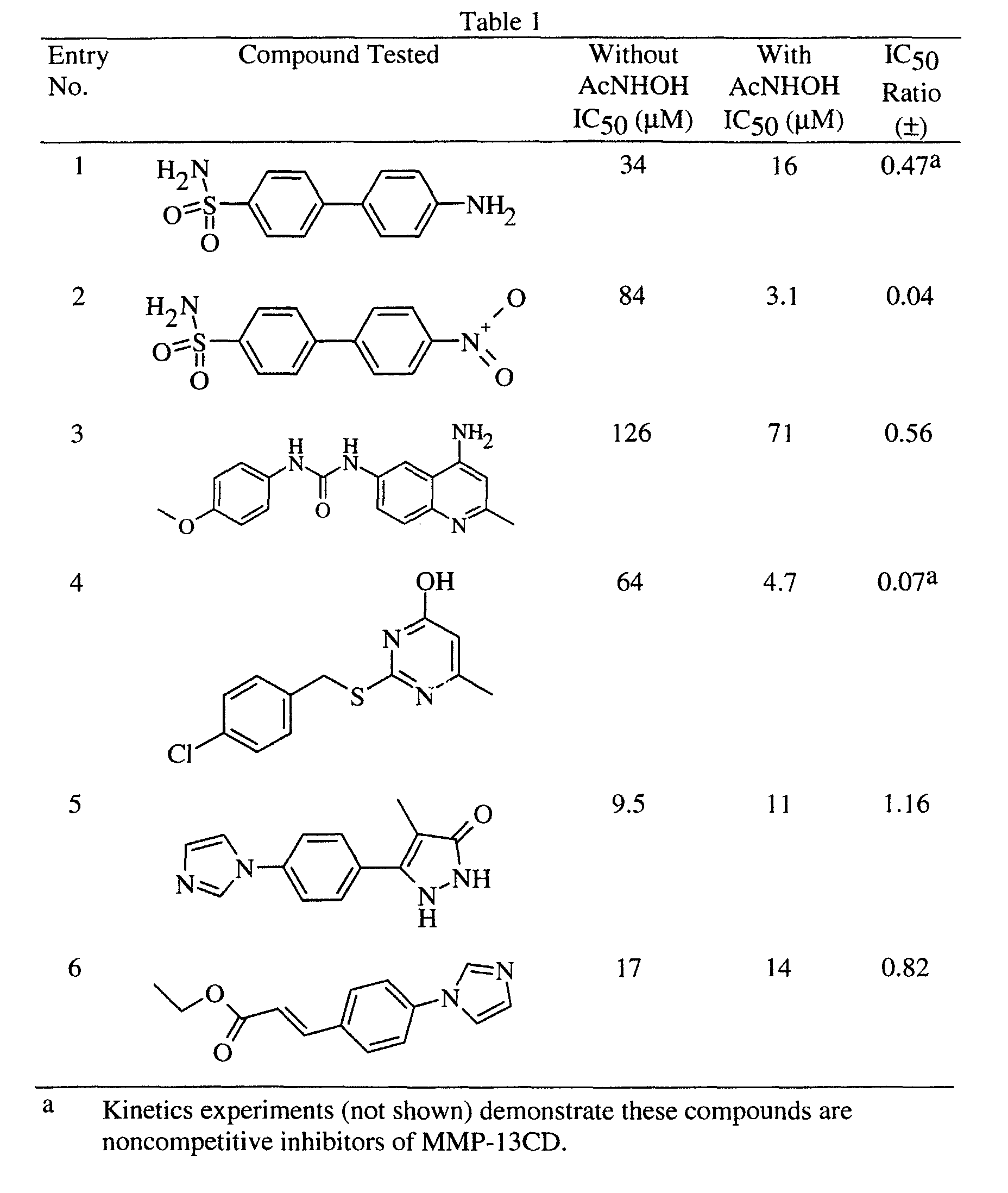
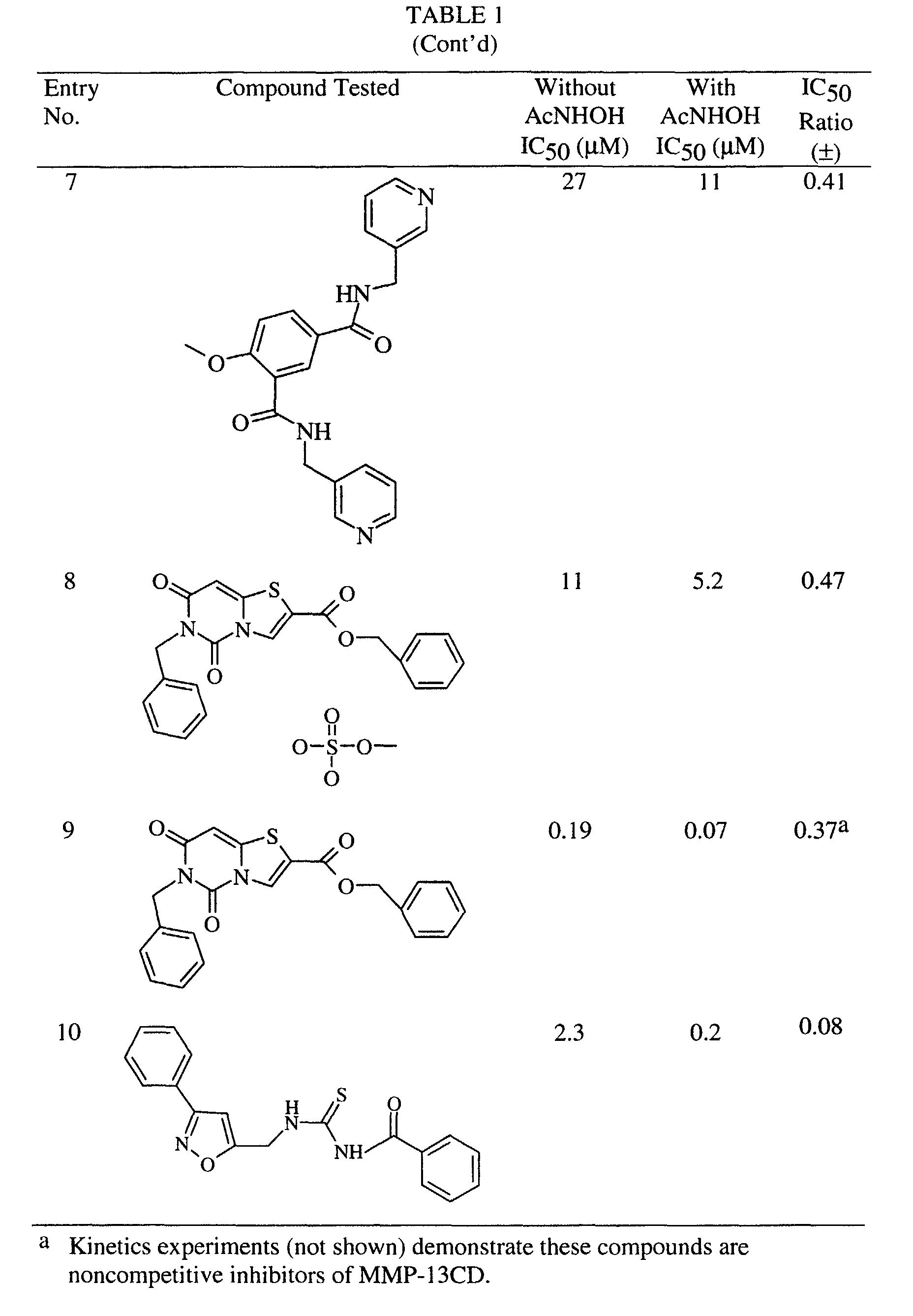
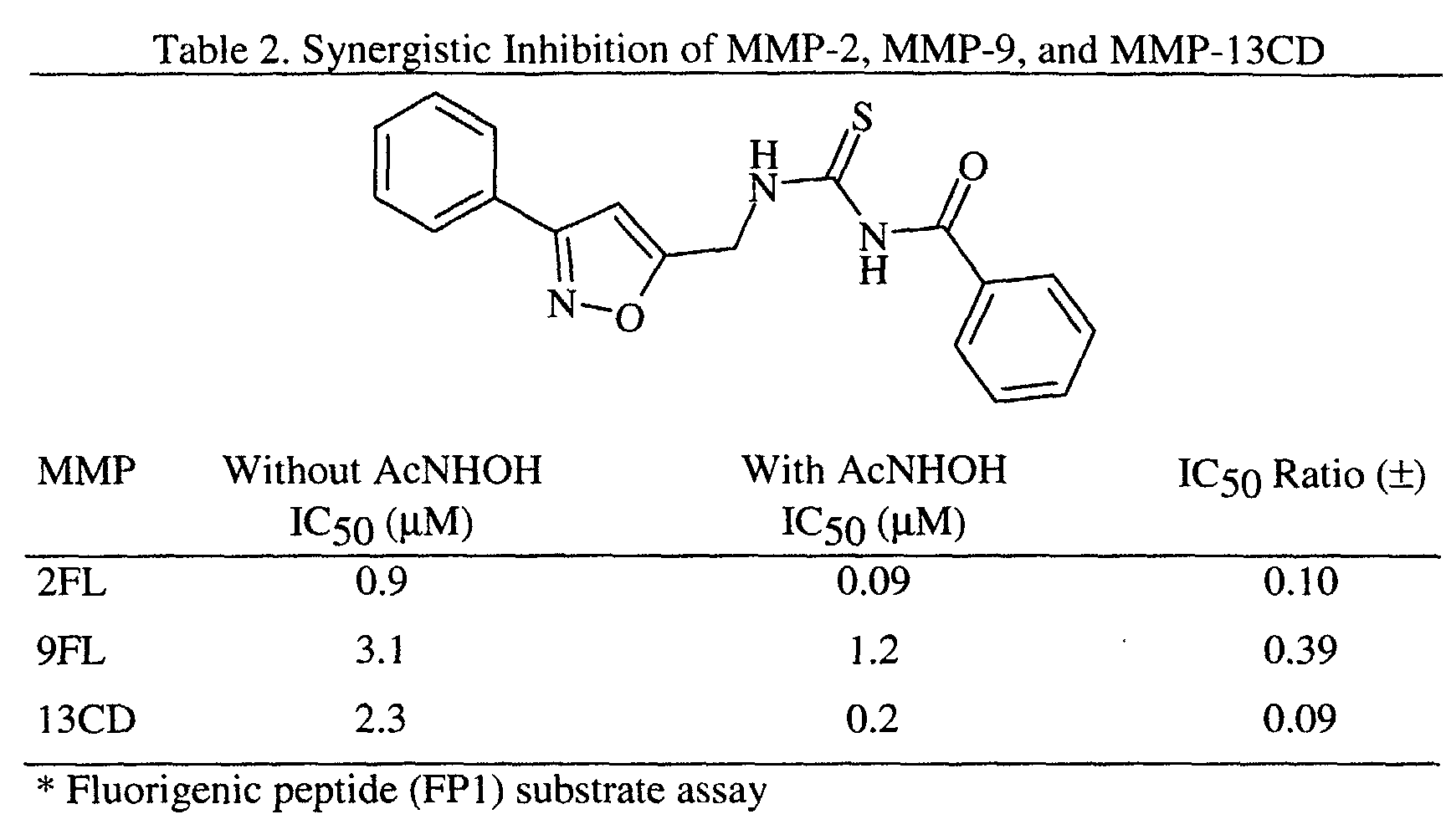
- Example 2 Results of Example 2 are shown below in Table 1 in the column labeled "IC 50 Ratio ( ⁇ )".
- IC 50 Ratio ( ⁇ ) results of Example 2 are shown below in Table 1 in the column labeled "IC 50 Ratio ( ⁇ )".
- noncompetitive or uncompetitive inhibitors that have an IC 50 Ratio ( ⁇ ) ratio of ⁇ 1 are synergistic with AcNHOH, while competitive inhibitors have an IC 50 Ratio ( ⁇ ) of >1, unless otherwise indicated.
- MMP-13CD matrix metalloproteinase-13 catalytic domain
- Example 2 In a manner similar to Example 2, an assay is run wherein 1,10-phenanthroline is substituted for acetohydroxamic acid to identify a competitive, noncompetitive, or uncompetitive inhibitors of MMP-13CD.
- MMP-12CD Human MMP-12 catalytic domain
- Plate preparation For screening, 4 ⁇ L of the compounds were added to 384-well black microplates at 250 ⁇ M in 25% DMSO. For IC 50 determination, a range of 8 dilutions were prepared in 25% DMSO, and 4 ⁇ L of each concentration were added to the plates in duplicates.
- Assay The reaction was started by sequential addition of 41 ⁇ L of the FP-1 (10 ⁇ M final concentration) in assay buffer (50 mM Tris-HCl, 10 mM CaCl 2 ) containing 5 mM AcNHOH and 5 ⁇ L of enzyme diluted in assay buffer containing 0.005% Brij-35. The microplates were incubated for 20 minutes at room temperature. The fluorescence changes were recorded in a Fluostar (BMG) instrument using excitation filter at 320 nm and emission filter at 405 nm. Results in wells containing compounds were calculated as a percentage of the fluorescence signal in control wells that received aqueous DMSO, but no compound (maximum signal), or no enzyme (minimum signal).
- the signal to background ratio was between 5 to 8 with Z' value (a quality control factor, see JI-HU ZHANG et. al., Journal of Biomolecular Screening, 1999;4(2):67-73) in screening higher than 0.4% on each plate.
- IC 50 data were processed in a manner similar to that described for Example 2 to identify competitive, noncompetitive, or uncompetitive inhibitors of MMP-12CD.
- TACE tumor necrosis factor converting enzyme
- Example 2 In a manner similar to Example 2, an assay is run using about I K d of acetohydroxamic acid (determined with TACE), wherein TACE is substituted for MMP-13CD and Fluorigenic peptide-2 ("FP-2"). Mca-Pro-Leu-Ala-Gln-Ala-Val-Dap(Dnp)-Arg-Ser-Ser-Ser-Arg-NH 2 ) is substituted for FP-1 to identify a competitive, noncompetitive, or uncompetitive inhibitor of TACE.
- Example 2 In a manner similar to Example 2, an assay is run using about 1 K d of acetohydroxamic acid (determined with MMP-2), wherein MMP-2 is substituted for MMP-13CD, to identify a competitive, noncompetitive, or uncompetitive inhibitor of MMP-2.
- Example 2 In a manner similar to Example 2, an assay is run using about 1 K d of acetohydroxamic acid (determined with MMP-9), wherein MMP-9 is substituted for MMP-13CD, to identify a competitive, noncompetitive, or uncompetitive inhibitor of MMP-9.
- the method of Examples 1 to 4 may be readily adapted to identify competitive, noncompetitive, or uncompetitive inhibitors of any MMP, or a catalytic domain thereof, by substituting for MMP-13CD and the substrate of Example 1 or 2, the particular MMP, or a catalytic domain thereof, being screened against and an art-recognized substrate of the particular MMP, respectively.
- the method has been adapted to identify competitive, noncompetitive, or uncompetitive inhibitors of any MMP-12CD.
- the invention method works using any mammalian MMP.
- FP-2 fluorigenic peptide-2
- FP-3 fluorigenic peptide-3
- FP-2 may be particularly used in the invention method for identifying competitive, noncompetitive, or uncompetitive inhibitors of TACE (D.E. Van Dyk et. al., Bioorganic and Medicinal Chemistry Letters, 1997;7:1219).
- FP-2 has the sequence Mca-Pro-Leu-Ala-Gln-Ala-Val-Dap(Dnp)-Arg-Ser-Ser-Ser-Arg-NH 2 , and is available from Bachem Americas (catalog number M-2255).
- the present invention provides a method of identifying competitive, noncompetitive, or uncompetitive inhibitors of metalloenzymes, including inhibitors of MMPs.
- the method of the present invention works for any enzyme that employs a functional metal cation. All that is required to practice the invention method with a metalloenzyme not described in one of the above examples is to employ an art-recognized assay method for identifying inhibitors of the metalloenzyme, and add, at about the time the substrate of the metalloenzyme is added, a suitable amount of a ligand to a functional metal cation of the metalloenzyme.
- a suitable amount of the ligand to the functional metal cation is readily determinable by one of ordinary skill in the biochemical arts simply by determining, if necessary, the K i for the ligand with the metalloenzyme being employed, and employing an amount of ligand as described above.
- the present invention improves upon methodology already developed for known assays for identifying inhibitors of metalloenzymes.
- the invention method provides rapid and easy identification of competitive, noncompetitive, or uncompetitive inhibitors of a metalloenzyme, which identification is useful for identifying pharmaceutical or animal health products. Rapid and easy identification of competitive, noncompetitive, or uncompetitive inhibitors of a metalloenzyme has not, until now, been possible.
- the invention method avoids laborious and time-consuming enzyme-kinetics experiments for determining whether an inhibitor of a metalloenzyme is competitive, noncompetitive, or uncompetitive.
- the invention method also avoids using labeled protein or instrumentation not normally found in an enzyme-screening laboratory.
- the present invention may further be adapted for high throughput screening of compound libraries, which is a valuable drug discovery approach that is widely used in the pharmaceutical and animal health industries.
Landscapes
- Chemical & Material Sciences (AREA)
- Organic Chemistry (AREA)
- Life Sciences & Earth Sciences (AREA)
- Zoology (AREA)
- Wood Science & Technology (AREA)
- Proteomics, Peptides & Aminoacids (AREA)
- Health & Medical Sciences (AREA)
- Engineering & Computer Science (AREA)
- Microbiology (AREA)
- Biochemistry (AREA)
- Physics & Mathematics (AREA)
- Molecular Biology (AREA)
- Biotechnology (AREA)
- Biophysics (AREA)
- Analytical Chemistry (AREA)
- Immunology (AREA)
- Bioinformatics & Cheminformatics (AREA)
- General Engineering & Computer Science (AREA)
- General Health & Medical Sciences (AREA)
- Genetics & Genomics (AREA)
- Measuring Or Testing Involving Enzymes Or Micro-Organisms (AREA)
- Pharmaceuticals Containing Other Organic And Inorganic Compounds (AREA)
Abstract
Description
| Protocol menu: | |
| excitation: 320 nm | emission: 405 nm |
| run time: 15 min | interval: 29 sec |
| RFU min: -10 | RFU max: 200 |
| V max points: 32/32 |
Claims (13)
- A method for identifying a compound as a competitive, noncompetitive, or uncompetitive inhibitor of an enzyme having a functional metal cation, the method comprising the steps of:(a) producing a first control mixture comprising the enzyme, a substrate of the enzyme, and a ligand to the functional metal cation, wherein the first control mixture does not contain the compound;(b) producing a second control mixture comprising the enzyme and a substrate of the enzyme, wherein the second control mixture does not contain the compound or the ligand to the functional metal cation;(c) producing a first compound mixture comprising the compound, the enzyme, a substrate of the enzyme, and the ligand to the functional metal cation;(d) producing a second compound mixture comprising the compound, the enzyme, and a substrate of the enzyme, wherein the second compound mixture does not contain the ligand to the functional metal cation;(e) determining inhibition of the enzyme in step (c) by comparing the activity of the enzyme in step (c) to the control activity of the enzyme in step (a);(f) determining inhibition of the enzyme in step (d) by comparing the activity of the enzyme in step (d) to the control activity of the enzyme in step (b); and(g) comparing the inhibition determined in step (e) with the inhibition determined in step (f).
- The method according to Claim 1, wherein the compound is a competitive inhibitor of the enzyme having a functional metal cation.
- The method according to Claim 1, wherein the compound is a noncompetitive inhibitor of the enzyme having a functional metal cation.
- The method according to Claim 1, wherein the compound is an uncompetitive inhibitor of the enzyme having a functional metal cation.
- The method according to Claim 1, wherein the enzyme having a functional metal cation is a matrix metalloproteinase, or a catalytic domain thereof.
- The method according to Claim 1, wherein the enzyme having a functional metal cation is MMP-12, or a catalytic domain thereof.
- The method according to Claim 1, wherein the enzyme having a functional metal cation is MMP-12 catalytic domain.
- The method according to Claim 1, wherein the enzyme having a functional metal cation is MMP-12 catalytic domain, and the ligand to the functional metal cation is 1,10-phenanthroline, or a pharmaceutically acceptable salt thereof.
- The method according to Claim 1, wherein the enzyme having a functional metal cation is MMP-13, or a catalytic domain thereof.
- The method according to Claim 1, wherein the enzyme having a functional metal cation is MMP-13 catalytic domain.
- The method according to Claim 1, wherein the enzyme having a functional metal cation is MMP-13 catalytic domain, the ligand to the functional metal cation is acetohydroxamic acid, and the inhibitor is a noncompetitive inhibitor.
- The method according to Claim 1, wherein the ligand to the functional metal cation is acetohydroxamic acid.
- The method according to Claim 1, further comprising utilizing steady-state kinetics to determine whether the compound is a noncompetitive inhibitor or uncompetitive inhibitor.
Applications Claiming Priority (2)
| Application Number | Priority Date | Filing Date | Title |
|---|---|---|---|
| US31559401P | 2001-08-29 | 2001-08-29 | |
| US315594 | 2001-08-29 |
Publications (2)
| Publication Number | Publication Date |
|---|---|
| EP1291439A2 true EP1291439A2 (en) | 2003-03-12 |
| EP1291439A3 EP1291439A3 (en) | 2003-11-19 |
Family
ID=23225152
Family Applications (1)
| Application Number | Title | Priority Date | Filing Date |
|---|---|---|---|
| EP02255715A Withdrawn EP1291439A3 (en) | 2001-08-29 | 2002-08-15 | Method for identifying metalloenzyme inhibitors |
Country Status (4)
| Country | Link |
|---|---|
| US (1) | US20030129672A1 (en) |
| EP (1) | EP1291439A3 (en) |
| JP (1) | JP2003079394A (en) |
| CA (1) | CA2399559A1 (en) |
Families Citing this family (10)
| Publication number | Priority date | Publication date | Assignee | Title |
|---|---|---|---|---|
| US20030114410A1 (en) | 2000-08-08 | 2003-06-19 | Technion Research And Development Foundation Ltd. | Pharmaceutical compositions and methods useful for modulating angiogenesis and inhibiting metastasis and tumor fibrosis |
| WO2008030252A2 (en) * | 2005-10-20 | 2008-03-13 | Viamet Pharmaceuticals, Inc. | Compositions and methods of screening apoproteins |
| CA2693310C (en) * | 2007-08-02 | 2018-11-27 | Arresto Biosciences, Inc. | Lox and loxl2 inhibitors, antibodies and uses thereof |
| US9107935B2 (en) * | 2009-01-06 | 2015-08-18 | Gilead Biologics, Inc. | Chemotherapeutic methods and compositions |
| WO2011022670A1 (en) * | 2009-08-21 | 2011-02-24 | Arresto Biosciences, Inc | In vivo screening assays |
| RU2012110580A (en) * | 2009-08-21 | 2013-09-27 | Джилид Байолоджикс, Инк. | WAYS OF SCREENING IN VIVO |
| CA2771702A1 (en) * | 2009-08-21 | 2011-02-24 | Gilead Biologics, Inc. | Catalytic domains from lysyl oxidase and loxl2 |
| FR2949463B1 (en) * | 2009-08-26 | 2011-09-16 | Commissariat Energie Atomique | MMP INHIBITORS |
| BR112012019693A2 (en) * | 2010-02-04 | 2017-06-20 | Gilead Biologics Inc | antibodies that bind to lysyl oxidase-like 2 (loxl2) and methods of use for them. |
| US9150527B2 (en) | 2011-08-30 | 2015-10-06 | Innocrin Pharmaceuticals, Inc. | Metalloenzyme inhibitor compounds |
Family Cites Families (5)
| Publication number | Priority date | Publication date | Assignee | Title |
|---|---|---|---|---|
| US5892112A (en) * | 1990-11-21 | 1999-04-06 | Glycomed Incorporated | Process for preparing synthetic matrix metalloprotease inhibitors |
| US5698401A (en) * | 1995-11-14 | 1997-12-16 | Abbott Laboratories | Use of nuclear magnetic resonance to identify ligands to target biomolecules |
| US5989827A (en) * | 1995-11-14 | 1999-11-23 | Abbott Laboratories | Use of nuclear magnetic resonance to design ligands to target biomolecules |
| KR20000068415A (en) * | 1996-09-04 | 2000-11-25 | 로즈 암스트롱, 크리스틴 에이. 트러트웨인 | Compounds for and a Method of Inhibiting Matrix Metalloproteinase |
| US5962481A (en) * | 1996-10-16 | 1999-10-05 | American Cyanamid Company | Preparation and use of ortho-sulfonamido heteroaryl hydroxamic acids as matrix metalloproteinase and tace inhibitors |
-
2002
- 2002-07-26 US US10/206,479 patent/US20030129672A1/en not_active Abandoned
- 2002-08-15 EP EP02255715A patent/EP1291439A3/en not_active Withdrawn
- 2002-08-23 CA CA002399559A patent/CA2399559A1/en not_active Abandoned
- 2002-08-29 JP JP2002251608A patent/JP2003079394A/en active Pending
Also Published As
| Publication number | Publication date |
|---|---|
| EP1291439A3 (en) | 2003-11-19 |
| JP2003079394A (en) | 2003-03-18 |
| US20030129672A1 (en) | 2003-07-10 |
| CA2399559A1 (en) | 2003-02-28 |
Similar Documents
| Publication | Publication Date | Title |
|---|---|---|
| Snoek-van Beurden et al. | Zymographic techniques for the analysis of matrix metalloproteinases and their inhibitors | |
| Tyagi et al. | Direct extraction and estimation of collagenase (s) activity by zymography in microquantities of rat myocardium and uterus | |
| Sang et al. | Proteolytic and non-proteolytic activation of human neutrophil progelatinase B | |
| Baragi et al. | A versatile assay for gelatinases using succinylated gelatin | |
| Frank et al. | Mast cell tissue inhibitor of metalloproteinase-1 is cleaved and inactivated extracellularly by α-chymase | |
| Shi et al. | Identification and characterization of a novel matrix-degrading protease from hormone-dependent human breast cancer cells | |
| Mast et al. | Kinetics and physiologic relevance of the inactivation of alpha 1-proteinase inhibitor, alpha 1-antichymotrypsin, and antithrombin III by matrix metalloproteinases-1 (tissue collagenase),-2 (72-kDa gelatinase/type IV collagenase), and-3 (stromelysin) | |
| Tortorella et al. | ADAMTS-4 (aggrecanase-1): N-terminal activation mechanisms | |
| Knäuper et al. | Activation of progelatinase B (proMMP‐9) by active collagenase‐3 (MMP‐13) | |
| US20030129672A1 (en) | Method for identifying metalloenzyme inhibitors | |
| Vandooren et al. | Gelatin degradation assay reveals MMP-9 inhibitors and function of O-glycosylated domain | |
| Venäläinen et al. | Substrate-dependent, non-hyperbolic kinetics of pig brain prolyl oligopeptidase and its tight binding inhibition by JTP-4819 | |
| Ratnikov et al. | Gelatin zymography and substrate cleavage assays of matrix metalloproteinase-2 in breast carcinoma cells overexpressing membrane type-1 matrix metalloproteinase | |
| Jones | Matrix metalloproteinases in biologic samples | |
| Schenker et al. | A double‐headed cathepsin B inhibitor devoid of warhead | |
| Freije et al. | Activity-based enrichment of matrix metalloproteinases using reversible inhibitors as affinity ligands | |
| Kishi et al. | Activation and enzymatic characterization of recombinant human kallikrein 8. | |
| Schatteman et al. | Activation of plasma procarboxypeptidase U in different mammalian species points to a conserved pathway of inhibition of fibrinolysis | |
| Makowski et al. | Autoactivation profiles of calcium-dependent matrix metalloproteinase-2 and-9 in inflammatory synovial fluid: effect of pyrophosphate and bisphosphonates | |
| Park et al. | Effects of detergents on catalytic activity of human endometase/matrilysin 2, a putative cancer biomarker | |
| WO2004014867A2 (en) | Matrix metalloproteinase inhibitors and methods for identification of lead compounds | |
| Troeberg et al. | Measurement of matrix metalloproteinase activities in the medium of cultured synoviocytes using zymography | |
| Fridrich et al. | Handling metalloproteinases | |
| Lanevschi et al. | Evaluation of chromogenic substrate assays for fibrinolytic analytes in dogs | |
| Moss et al. | Fluorescent substrates for ADAM15 useful for assaying and high throughput screening |
Legal Events
| Date | Code | Title | Description |
|---|---|---|---|
| PUAI | Public reference made under article 153(3) epc to a published international application that has entered the european phase |
Free format text: ORIGINAL CODE: 0009012 |
|
| 17P | Request for examination filed |
Effective date: 20020827 |
|
| AK | Designated contracting states |
Kind code of ref document: A2 Designated state(s): AT BE BG CH CY CZ DE DK EE ES FI FR GB GR IE IT LI LU MC NL PT SE SK TR Designated state(s): AT BE BG CH CY CZ DE DK EE ES FI FR GB GR IE IT LI LU MC NL PT SE SK TR |
|
| AX | Request for extension of the european patent |
Extension state: AL LT LV MK RO SI |
|
| PUAL | Search report despatched |
Free format text: ORIGINAL CODE: 0009013 |
|
| AK | Designated contracting states |
Kind code of ref document: A3 Designated state(s): AT BE BG CH CY CZ DE DK EE ES FI FR GB GR IE IT LI LU MC NL PT SE SK TR |
|
| AX | Request for extension of the european patent |
Extension state: AL LT LV MK RO SI |
|
| RIC1 | Information provided on ipc code assigned before grant |
Ipc: 7C 12Q 1/00 B Ipc: 7C 12Q 1/37 A |
|
| AKX | Designation fees paid |
Designated state(s): AT BE BG CH CY CZ DE DK EE ES FI FR GB GR IE IT LI LU MC NL PT SE SK TR |
|
| RAP1 | Party data changed (applicant data changed or rights of an application transferred) |
Owner name: WARNER-LAMBERT COMPANY LLC |
|
| RAP1 | Party data changed (applicant data changed or rights of an application transferred) |
Owner name: WARNER-LAMBERT COMPANY LLC |
|
| STAA | Information on the status of an ep patent application or granted ep patent |
Free format text: STATUS: THE APPLICATION IS DEEMED TO BE WITHDRAWN |
|
| 18D | Application deemed to be withdrawn |
Effective date: 20070301 |