-
The invention relates to a preservative which inhibits
the growth of fungi, algae and bacteria on or in
coatings which are applied to alkaline or strongly
alkaline substrates and/or which are alkaline or
strongly alkaline themselves. In particular, the
invention relates to preserved final coatings of
external heat insulations and to preserved silicate-based
coatings.
-
A series of biocidal (bactericidal, funcigidal and
algicidal) active ingredients which, in general, afford
good protection when employed on neutral or weakly
alkaline substrates may be added to exterior and
interior coating materials. Known biocides for this
further publication are, for example, fungicides such
as 2-methoxycarbonylaminobenzimidazole (carbendazim),
2-mercaptopyridine N-oxide (in particular the zinc
salt: zinc pyrithion), n-octylisothiazolone (for
example Kathon 893) and iodopropinyl butylcarbamate
(IPBC), or algicides such as 1,1-dimethyl-3-(3,4-dichlorophenyl)urea
(diuron), methylthio-4-t-butylamino-6-cyclopropylamino-s-triazine
(Irgarol 1051,
Mctt), and N2-tert-butyl-N4-ethyl-6-methylthio-1,3,5-triazine-2,4-diamine
(terbutryn). These known biocides
are described, inter alia, in the Laid-Open
Specifications DE-A-42 42 389 and DE-A-197 05 085.
-
US-A-5 688 561 describes a coating process in which two
different coating compositions composed of quaternary
ammonium silicate, inorganic filler and water are
applied to a substrate, the two coating compositions
differing with regard to the amount of the components.
The coating method is finished by curing at ambient
temperature or at higher temperatures. The coatings
obtained are said to be stable up to 1000°C.
-
DE-A-41 22 962 discloses a preparation for preventing
the biogenic H2SO4 corrosion of building materials,
which preparation is characterized by a content of a
C12-C14-fatty-alkyldimethylbenzylammonium- and/or benzyl-dodecylbis(hydroxyethyl)ammonium-S-[2-(aminocarbonyl)-phenyl]thiosulphuric
acid salt. In this application,
the active ingredients afford their optimum effect in
the slightly acidic range.
-
EP-A-0 328 335 describes a growth-inhibitory
composition which can be used for coating equipment
which is immersed in sea water, for example fishing
nets and hulls, but also for protecting and preserving
construction timber and shingles. The composition
comprises partially crosslinked polymers and copolymers
of vinyl compounds and 10 to 30% by weight of selected
quaternary ammonium compounds.
-
DE-A-37 11 680 discloses that aqueous biocidal cationic
synthetic polymer dispersions comprising specific
quaternary ammonium compounds can be used as biocidal
additives, preferably for the protection of timber or
on exterior renders. The examples section of DE-A-37 11
680 describes that an emulsion paint or an exterior
render can be coated with a dilute aqueous biocidal
cationic synthetic polymer dispersion. A reliable
fungicidal additive of dispersion-coated render or
paint against Alternaria species, in particular upon
prolonged immersion in water, cannot be found in DE-A-37
11 680. While the Laid-Open Specification generally
mentions the use of the dispersions for the preparation
of timber preservatives, emulsion paints, synthetic
polymer renders and synthetic resin renders, the
stability of the dispersions must be ensured in a
complicated procedure at pH values of approximately 3.3
and by using protective colloids. In addition, the
reader is warned against the use of the quaternary
ammonium compounds in anionic dispersions, since the
dispersion may coagulate when doing so. The use of
quaternary ammonium compounds in preservatives for
coating compositions which themselves are strongly
alkaline (cement-bound renders or silicate renders) or
on strongly alkaline substrates is not disclosed in DE-A-37
11 680.
-
When assembling a composite cell insulation system, an
external wall (for example made of concrete) is, if
appropriate, first equipped with a layer of lime
render, to which the thermal insulating material (for
example polystyrene, rock wool or glass wool) is
attached. Onto this, an alkaline cement-bound
reinforcing coat (pH > 13, main constituents cement and
filler) is applied, into which, if appropriate, a glass
fibre fabric is inserted as mechanical protection
(first render). The manufacturer recommends a base coat
(pH approximately 7) as the next layer. The base coat
serves, inter alia, to improve adhesion, to buffer the
alkalinity and to improve the covering ability. As the
final coat, a neutral, synthetic-resin-bound render
(binder for example straight acrylate or a mixture of
styrene and acrylate in a weight ratio of 1 : 1) is
applied. This neutral synthetic resin render which is
conventionally used is susceptible to microbial growth
and the consequences which this entails, such as
discoloration and fouling, which is why for example the
abovementioned fungicides carbendazim, zinc pyrithion,
N-octylisothiazolone and isopropyl butylcarbamate and
the algicides diuron, terbutryn and Irgarol 1051 or
mixtures of these are added to it. The sandwich
construction of thermal insulating systems is known and
described, inter alia, in the publications of the
Fachverband Wärmedämmverbundsysteme (WDVS e.V.)
[Composite thermal insulating systems specialist
association].
-
On the one hand, the last-mentioned biocides limit the
choice of further additives in the synthetic resin
render. Thus, for example, zinc pyrithion is broken
down and leached at higher pH values with the formation
of water-soluble components. The stability of these
biocides decreases markedly, in particular upon
prolonged contact with alkaline media. Frequently,
however, not only an insufficient biocidal activity is
observed, but undesired discolorations are also found.
If, for example, these synthetic resin renders with
conventional biocidal additives are employed directly
on strongly alkaline substrates (such as, for example,
on concrete or renders), the biocides fail since even
the contact with strongly alkaline conditions leads to
instability and hydrolysis of the biocides and thus to
a susceptibility to microbial growth. The synthetic
resin renders treated with these conventional biocides
therefore require the abovementioned base coat. To
inhibit microbial growth on a synthetic resin render
applied to an alkaline substrate, also in the long
term, it is also necessary to employ relatively large
amounts of the abovementioned biocides.
-
It was therefore the object of the present invention to
provide a preservative with a good bactericidal,
fungicidal and algicidal action for use in neutral,
weakly alkaline and strongly alkaline coating
compositions, it being intended that the composition be
particularly suitable for use on alkaline substrates.
-
The preservative is intended to have the following
properties:
- activity against bacteria, algae and fungi, in
particular against Alternaria species;
- activity in the neutral, weakly alkaline and
strongly alkaline pH range, i.e. in coatings which
are applied to alkaline substrates or which
themselves are strongly alkaline silicate renders;
the preserving action must not be adversely
affected, not even in the long term;
- it must be readily incorporated into the coating
material;
- it must be compatible with the constituents of the
composition, in particular with anionic components
of the synthetic resin render (for example
acrylates and polyacrylates);
- it must not adversely affect the rheological
properties and the processibility or time of use
of a render, or only to a minor extent;
- it should exhibit good water resistance
(resistance to leaking), UV stability and
weathering stability;
- it should not lead to colour changes, neither in
the coating composition nor in the final use;
- it should be low-odour;
- it should not emit toxicologically relevant
substances, i.e. it should preferably be free from
AOX compounds, formaldehyde-releasing compounds,
isothiazolones and organic solvents;
- it should contain materials which have been
studied thoroughly, and assessed, with regard to
the toxicity to humans and the environment, i.e.
it should not be necessary to label the
preservative and the coating composition with the
hazardous substances label "T" (toxic materials),
a classification of WGK ≤ 2 [WGK = hazard-to-water
classification] being preferred;
- it should be non-foaming or low-foaming, and
- it should have a shelf life of at least 3 months,
preferably at least 12 months, in the coating
composition.
-
-
After application and drying, the coatings treated with
the preservative must show no fungal or algae growth
over a long period, for example over at least 5 years.
An activity against bacteria and fungi is desired for
the self-preservation of the coating composition. In
addition, the preservative should be suitable for use
in both internal and external dispersion renders and
mineral renders and economical to use.
-
Finally, it should be possible for the coating
composition to have a pH of at least 9, which is the
case in silicate renders where cement is used.
-
This object is achieved in accordance with the
invention by a preservative comprising one or more
quaternary ammonium compounds. Thus, the invention is
based inter alia on the finding that such a
preservative in a coating composition shows a
particularly good microbicidal, in particular
fungicidal, action when the composition is applied to
an alkaline, in particular a strongly alkaline,
substrate and/or is alkaline, in particular strongly
alkaline, itself.
-
Accordingly, the invention relates to a preservative
and to a preserved coating composition.
1. Preservative
-
The preservative according to the invention comprises
one or more quaternary ammonium compounds. A quaternary
ammonium compound according to the invention can be,
for example, a betaine or a zwitterionic compound. On
the other hand, preferred quaternary ammonium compounds
are those which are in partially or fully dissociated
form (anion(s) and cation(s)) in aqueous solution
(quaternary ammonium salts).
-
Preferred quaternary ammonium salts are those of
formulae [R1R2R3R4N]+[X]- and [N-R5-pyridinium]+[X]-,
where R1 to R5 can be identical or different and are
selected from among C1- to C30-alkyl, -alkenyl and -aryl
groups and their mixtures, which can have one or more
atoms selected from among O, S, N and P, it also being
possible for one or more of R1 to R4 to be H, with the
proviso that at least one of the groups R1 to R4 is
other than H, X is an anion (of an inorganic or organic
acid). In this context, both anion and cation of the
quaternary ammonium salt can be polyvalent ions
resulting in a stochiometry of [A(n+)]m[K(m+)]n.
-
Quaternary ammonium cations which are preferably
employed in accordance with the invention are
[R1N(CH3)3]+[X]-, [R1NH3]+[X]-, [R1(aryl-CH2)NH2]+[X]-,
[R1(aryl-CH2)N(CH3)2]+[X]-, [R1R2N(CH3)2]+[X]- and [N-R5-pyridinium]+[X]-,
where R1, R2 and R5 are selected
independently of one another from among C1- to C30-alkyl,
C6- to C12-aryl and -(CH2-CHR6O)n-R7, in which n is
a number of 1 to 20 and R6 and R7, which can be
identical or different, are H and/or C1- to C4-alkyl,
and aryl denotes an aryl group which is optionally
substituted.
-
Examples of cations of the quaternary ammonium salts
employed in accordance with the invention are those of
the formula [R1N(CH3)3]+, where R1 is C6- to C20-alkyl,
-hydroxyalkyl or -polyoxyalkyl group or an optionally
substituted aromatic radical having 6 to 12 carbon
atoms. Further preferred cations of the quaternary
ammonium salts according to the invention are C8- to
C18-alkylbenzylammonium, benzalkonium, didecyl- and
dioctyldimethylammonium, didecylmethylpoly)oxyethyl)-ammonium,
cetylpyridinium, cetyltrimethylammonium and
benzyl-fatty-alkyl-bis(hydroxyethyl)ammonium and
mixtures of these, the preservative especially
preferably comprising mixtures of two, three and four
of these preferred cations, such as mixtures of
benzalkonium and dialkyldimethylammonium. In this
context, the cation may also be present as a polymer,
as is the case in, for example, polyhexamethylene
biguanide (Vantocil IB).
-
Examples of anions and classes of anions of the
quaternary ammonium salts employed in accordance with
the invention are hydroxide, sulphate, hydrogen
sulphate, metho sulphate, etho sulphate, lauryl
sulphate, lauryl ether sulphate, cellulose sulphate,
sulfamate, halides (fluoride, chloride, bromide,
iodide), nitrite, nitrate, orthosilicates (for example
sodium, potassium, magnesium and aluminium orthosilicate),
disilicate, metasilicate, sheet-silicates
such as hectorite, bentonite, montmorillonite,
smectite, carbonate, hydrogen carbonate, phosphate,
alkylphosphate, metaphosphate, polyphosphate,
phosphonate, thiocyanate, zincate, aluminate,
alumosilicates (such as, for example, zeolite),
thiosulphuric esters (for example Bunte salts of DE-A-41
22 962 and DE-A-3 307 733), carboxylic acid salts
such as benzoate, lactate, acetate, propionate,
citrate, succinate, glutarate, adipate, toluenesulphonate
(tosylate), salicylate, mercapto compounds
such as 2-mercaptobenzothiazole, 2-mercaptopyridine N-oxide,
dithiocarbamate, fatty acid anions such as
stearate, laurate, 2-ethylhexanoate, saccharinate,
sulphonates such as alkylbenzenesulphonate, alkylsulphonate,
and phenolates such as phenylphenolate. In
addition, known anionic surfactants may also be used as
anions, and these can form neutral salts with the
cations of the quaternary ammonium salts (quat-anion
surfactant complexes). Especially preferred anions are
orthosilicate and thiocyanate.
-
Examples of preferred quaternary ammonium salts are
didecylmethylpoly(oxyethyl)ammonium propionate,
didecyldimethylammonium chloride, benzalkonium
chloride, cetylpyridinium chloride, cetyltrimethylammonium
chloride, dioctyldimethylammonium chloride and
alkylamine silicate.
-
The preservative according to the invention may, on the
one hand, consist of just one or more quaternary
ammonium compounds. On the other hand, it is preferred
to incorporate (inorganic) compounds into a
preservative, preferably one or more alkalizing agents
such as the hydroxides, carbonates, hydrogen carbonates
or silicates of alkali metals, the oxides, carbonates,
hydrogen carbonates, hydroxides or silicates of
alkaline earth metals, or Al(OH)3, in particular NaOH,
KOH, Ca(OH)2, Mg(OH)2, Al(OH)3, basic carbonates such as
Na2CO3, K2CO3, NaHCO3, CaO, orthosilicates such as sodium
orthosilicate, potassium orthosilicate, metasilicates
such as sodium metasilicate, potassium metasilicate,
the silicate-containing waterglasses (for example
sodium waterglass, potassium waterglass, with potassium
waterglass being preferred) and silica gel. If the
preservative according to the invention contains one or
more of these alkalizing agents, it preferably also
contains a solvent. Suitable solvents are water,
alcohols, glycols or glycol ethers, for example 1,2-propylene
glycol, butyl diglycol, butyl glycol, 1-methoxypropan-2-ol,
triethylene glycol, diethylene
glycol and dipropylene glycol.
-
It has been found that preserved coating compositions
which contain in accordance with the invention a
quaternary ammonium compound have undergone
particularly good algicidal and fungicidal treatment
when they have a pH of at least 9. Accordingly, it is
preferred to introduce an alkalizing agent into the
composition, together with the preservative according
to the invention.
-
Thus, a preferred preservative according to the
invention has a pH of at least 9, preferably at least
10, in particular at least 11, for example 12 to 13,
and contains one or more quaternary ammonium compounds
and one or more alkalizing agents, preferably alkali
metal hydroxide, in particular sodium hydroxide. As an
alternative, such a strongly alkali preservative
according to the invention contains metasilicate,
preferably alkali metasilicate such as potassium
waterglass. In this embodiment, it is not necessary
that the desired alkalinity of the composition treated
with preservative is introduced exclusively via the
preservative, but it is possible. The pH of a preferred
strongly alkaline coating material, however, should
preferably not drop owing to the addition of
preservative, which is why a preferred preservative has
at least the alkalinity of the coating material to
which it is added.
-
If a preservative according to the invention contains a
solvent, the preferred solvent being water, then the
preservative contains at least 10% by weight of
solvent. However, the solvent content chosen is as low
as possible in this case and amounts to, preferably,
less than 90%, more preferably less than 80% by weight,
in particular less than 70% by weight, for example 20
to 60% by weight or 30 to 50% by weight, based on the
total mass of the preservative.
-
In addition, the preservative according to the
invention can contain one or more other biocides
selected from among formaldehyde and formaldehyde-releasing
compounds, isothiazolinones such as N-octylisothiazolone,
4,5-dichloroisothiazolone, n-butylbenzisothiazolone,
benzimidazole derivatives such as
carbendazim, thiabendazole and their salts, triazole
and imidazole derivatives such as tebuconazole and
propiconazole, iodine compounds such as iodopropinyl
butylcarbamate, diidomethyltolyl sulphone, pyridine
derivatives such as zinc pyrithione and 2,3,5,6-tetrachloro-4-methylsulphonylpyridine,
triazine derivatives
such as terbutryn, prometryn and Irgarol 1051, urea
derivatives such as diuron, isoproturon, dithiocarbamates
such as ziram, thiram, hydroxylamine
derivatives such as the potassium and aluminium salts
of N-cyclohexyl-N-nitrosohydroxylamine, and 2-(thiocyanatomethylthio)benzothiazole
(TCMTB), benzothiophene-2-cyclohexylcarboxamide
S,S-dioxide and tetrachloroisophthalonitrile.
Combinations of the
abovementioned biocides are preferred in order to close
gaps with regard to their action. In some cases,
synergistically increased algicidal and fungicidal
action of the preservative according to the invention
is observed.
-
A large number of the quaternary ammonium compounds
employed in accordance with the invention are
commercially available. Others can be prepared readily,
for example by known salt interchange methods and
isolation methods. Thus, for example, quaternary
ammonium silicates can be obtained by reacting
quaternary ammonium hydroxides with silica gel, an
isolation of the materials in many cases not being
necessary; the reaction mixtures as such have a
sufficient biocidal activity and can be used for the
purposes according to the invention. For example,
solutions of quaternary ammonium salts can be prepared
by mixing commercially available solutions of
quaternary ammonium salts (for example benzalkonium
chloride, 50% by weight in water; if appropriate as a
mixture with didecyldimethylammonium chloride, 40% by
weight in water) with alkali metal waterglass solutions
(for example potassium waterglass, < 40% by weight in
water, for example approximately 30% by weight in
water). Especially suitable are such clear solutions of
equimolar mixtures of the reactants.
-
While a preservative according to the invention is
preferably present as a clear fluid, it is also
possible to formulate it as a dispersion, emulsion,
paste, as granules or as a powder, in which case it
contains, for example, suitable solid inert carriers
such as talc, argillaceous earth or diatomaceous earth.
In addition, a preservative according to the invention
may contain additives such as markers and indicators,
which permit determination of the concentration of
active ingredients in the product to which algicides
and fungicides have been added.
2. Compositions according to the invention
-
The preservative according to the invention is employed
for the preparation of a coating composition which
preferably comprises a synthetic resin or polymer
dispersion which preferably comprises potassium
waterglass. Examples of suitable dispersions are
described, for example, in DE-A-37 11 680 and EP-A-0
328 335 and in Karsten, Lackrohstoff-Tabellen, Kurt
Vinzenz Verlag 2000, in particular on pages 364
(poly(meth)acrylate homo- or copolymer dispersions) and
451 (silicone-based dispersions).
-
Preferred paints or renders comprising polymer or
synthetic resin dispersions are:
- those on an acrylate or straight acrylate base
with a polymer fraction of not more than 50% by
weight, preferably not more than 30% by weight and
especially preferably not more than 15% by weight,
- those on an acrylic/styrene copolymer base with a
polymer fraction of not more than 50% by weight,
preferably not more than 30% by weight and
especially preferably not more than 15% by weight,
- those on a silicone resin base with a polymer
fraction of not more than 50% by weight,
preferably not more than 30% by weight and
especially preferably not more than 15% by weight,
- those on a silicate (for example cement) base
based on potassium waterglass, optionally with
small amounts (preferably not more than 10% by
weight, especially preferably 5% by weight) of
straight acrylate dispersion or acrylic/styrene
copolymer dispersion.
-
-
While the preservative according to the invention is
preferably employed in the preparation of a coating
composition containing synthetic resin dispersion or
polymer dispersion, the presence of such a dispersion
is not imperative, which is why, in an alternative
embodiment, the coating composition containing the
preservative according to the invention is free from
synthetic dispersion or polymer dispersion.
-
In a preferred embodiment, the composition to which a
microbicidal (in particular fungicidal) preservative
has been added (preserved coating composition) has a pH
of not less than 9, more preferably 10.0 to 13.5, in
particular 10.5 to 13, for example 11 to 12.5 and 11.2
to 11.8.
-
A composition according to the invention is preferably
formulated in such a way that it comprises from 0.1 to
10% by weight, more preferably 0.3 to 3% by weight, and
in particular 1 to 2% by weight of preservative. The
concentration, of the preservative according to the
invention, which is chosen in each individual case
will, of course, depend on the amount of quaternary
ammonium compound present in the preservative. The
amount of quaternary ammonium compound (indicated as
quaternary ammonium chloride if the quaternary ammonium
compound is a quaternary ammonium salt) in a
composition with added fungicide and algicide is
preferably in the range of from 0.05 to 3% by weight,
more preferably 0.1 to 1% by weight, in particular 0.15
to 1% by weight, such as 0.2 to 0.8% by weight, based
on the total mass of the composition.
-
The coating composition into which the preservative
according to the invention is incorporated in order to
provide a coating composition with added microbiocide
is, preferably, a synthetic resin dispersion (with a
comparably large content of dispersed synthetic resin)
or a mixture comprising a synthetic resin dispersion
(with the comparatively low content of dispersed
synthetic resin), the term "synthetic resin dispersion"
and "synthetic resin dispersion-containing mixture"
merging into each other.
-
In a preferred embodiment of the invention, a
composition which has preservative added to it in
accordance with the invention is in the form of an
interior or exterior paint or varnish. In this case,
such a composition comprises, in addition to the
synthetic resin dispersion (as organic binder) and the
preservative according to the invention, one or more
other organic binders, pigments, fillers and additives,
the term "additives" including thickeners, wetting and
dispersing agents, antifoams, adhesion promoters,
surface modifiers such as slip additives or dulling
agents, levelling agents and film-forming media,
dryers, antiskinning agents, light stabilizers,
corrosion inhibitors, flame retardants and in-can
preservatives. Examples of compositions to which
preservative has been added in accordance with the
invention and which are in the form of a varnish are
(classified in accordance with the type of binder used)
straight acrylic dispersion varnish, styrene/acrylic
dispersion varnish, alkyd resin dispersion varnish and
polyurethane dispersion varnish. Corresponding examples
of compositions with preservative added in accordance
with the invention and which are in the form of a paint
are (classified in accordance with the type of binder
used) straight acrylic emulsion paints, styrene/acrylic
emulsion paints, silicone resin emulsion paints,
silicone-resin-modified straight acrylic emulsion
paints, silicate paints and synthetic resin-modified
silicate paints.
-
In a further embodiment, a preservative according to
the invention is incorporated into a material in which
an alkaline pH has already been established, for
example a finished render, in particular silicate
render. A composition with preservative added in
accordance with the invention may, however, also be in
the form of a compound which is used when preparing a
render (render base).
-
The term "render" as used in the present context
encompasses not only moist renders, i.e. coating
materials in the fluid processing condition such as
synthetic resin renders, but also dry renders, i.e.
pulverulent dry preparations which are mixed with water
and so converted into a processable fluid condition,
such as lime cast, white coat or cement facing.
Examples of components of compositons with preservative
added in accordance with the invention which are in the
form of a render are lime, cement, gypsum, anhydrite,
organic polymers or copolymers as binders, aggregates
such as sands, and additives which modify the
properties of the renders, such as air entrainers,
liquifiers, accelerators, retarders, integral
waterproofing agents, antifreeze agents and plastifying
synthetic polymer additions (see also Brasholz,
Handbuch der Anstrich-Beschichtungstechnik [Paint and
coating technology handbook], Bauverlag GmbH, 2nd
Edition 1989; Römpp Lexikon Lacke und Druckfarben
[Dictionary of varnishes and printing inks], Georg
Thieme Verlag 1998, keyword "Putze" [renders]).
Examples of compositions with preservative added in
accordance with the invention and which are in the form
of a render are (classified in accordance with the type
of binder used) inorganically-bound renders such as
silicate render, lime cast, white coat, cement facing
and synthetic resin-treated types of these classes, and
organically bound renders or synthetic resin renders
such as straight-acrylate dispersion render,
styrene/acrylate dispersion render, acrylate copolymer
dispersion render, silicone resin dispersion render,
silicone-resin-modified straight-acrylate dispersion
render, polyvinyl acetate dispersion render, polyvinyl
acetate copolymer dispersion render and polyvinyl
propionate/acrylate copolymer dispersion render.
-
In particular, the invention relates to a silicate
render preserved in accordance with the invention with
quaternary ammonium compound, which silicone render
comprises at least 2% by weight, preferably 5 to 10% by
weight, of synthetic resin dispersion and has a pH of
from 10 to 12.5, preferably from 11.2 to 12, in
particular from 11.2 to 11.8.
-
A process for the preparation of a composition with an
added fungicide and algicide is characterized in that
it encompasses mixing of a preservative which comprises
one or more quaternary ammonium compounds and which
additionally may also comprise the abovementioned other
constituents of a preservative according to the
invention with a synthetic resin dispersion with a pH
of at least 9 and/or a synthetic-resin-dispersion-containing
mixture (preferably a render base) with a pH
of at least 9.
-
A corresponding process is characterized in that it
encompasses mixing a preservative in which an alkaline
pH has been established, which comprises one or more
quaternary ammonium compounds and which additionally
may also comprise the abovementioned other constituents
of a preservative according to the invention and which
has a pH of at least 9, preferably at least 10, more
preferably at least 11, for example 12 to 13, with a
synthetic resin dispersion and/or a synthetic-resin-dispersion-containing
mixture, preferably a strongly
alkaline silicate render.
-
The preservative according to the invention can be
incorporated without difficulty into conventional
materials used for coatings in order to give
compositions according to the invention. It has proved
advantageous to incorporate the preservative into the
material to which it is to be added with stirring and
heating, for example at 50°C. This procedure improves
the stability of the resulting composition. The
preservative is added to the material with stirring and
as slowly and uniformly as possible, and the
preservative is distributed in the material uniformly
and finely to ensure optimal efficacy.
-
Incorporation into the material of the preservative
according to the invention as the last component is not
imperative; after addition of the preservative
according to the invention, further components may be
added; in this case, the composition according to the
invention is an intermediate in the preparation of a
coating composition.
-
When incorporating a preservative according to the
invention into a render, a moderately increased
viscosity may result. The original viscosity can be
restored by adding small amounts of water, for example,
2 parts by weight of water per 100 parts by weight of
composition with a fungicide and algicide added in
accordance with the invention.
-
The compositions with algicides and fungicide added in
accordance with the invention are applied with the aid
of customary coating methods. The coat thickness can
vary and, in the case of the render, depend on the
particle size of the aggregates such as sand; based on
a moist render, it can be, for example, 0.4 kg/m2.
Nothing unusual needs to be taken into account when
applying renders with additions according to the
invention.
-
For the description of the invention, a substrate with
a pH of from 7 to 9 is considered weakly alkaline, a pH
of from 9 to 11 strongly alkaline and a pH of greater
than 11 very strongly alkaline.
-
The preservatives and compositions according to the
invention meet the abovementioned requirements. Thus,
the preservatives are inexpensive and in some cases
commercially available or can simply be prepared from
commercially available substrates following simple
procedures and can be introduced onto the market
without difficulties owing to the use of materials
which have already been analysed and assessed with
regard to their toxicity to humans and ecotoxicity.
-
Surprisingly, the resistance to leaching of the
quaternary ammonium compounds, which are otherwise
readily to moderately soluble in water, in coatings
which are in contact with (strongly or very strongly)
alkaline substrates or which are (strongly) alkaline
themselves, is good to very good. Starting from the
unsatisfactory results of the resistance to leaching of
quaternary ammonium salts, it could not have been
expected that the resistance to leaching of the
quaternary ammonium compounds increases in alkaline to
strongly alkaline compositions and/or in contact with
an alkaline, preferably strongly alkaline and in
particular very strongly alkaline substrate. In
particular, it was surprising that the preserving
action in compositions such as renders with high pH
values and/or upon contact with a strongly or very
strongly alkaline substrate is good to very good.
-
In addition, a good to sufficient compatibility (long-term
stability) of the quaternary ammonium compounds
with the other components of the composition and/or in
contact with the alkaline substrate has been found,
which is surprising.
-
The examples which follow illustrate the advantages of
the invention.
Examples
-
| Abbreviations used: |
| Benzalkonium chloride solution |
C12-C14-alkylbenzyldimethylammonium chloride, 50% by weight in water |
| Bardac LF |
Dioctyldimethylammonium chloride, 50% by weight in water |
| Bardac 2240 |
Didecyldimethylammonium chloride, 40% by weight in water |
| Bardac 22 |
Didecyldimethylammonium chloride, 50% by weight in water/isopropanol |
| Potassium waterglass 28/30 |
Aqueous potassium silicate solution, < 40% by weight (usually approximately 30% by weight) potassium silicate, MV > 3.2 |
| Water |
Fully demineralized water |
| Kathon 893 |
N-octylisothiazolone, 46.1% by weight in 1,2-propylene glycol |
| Sodium waterglass |
Aqueous sodium silicate solution, < 40% by weight (usually approximately 30% by weight) sodium silicate, MV > 3.2 |
-
In the examples which follow, parts are parts by weight
and percentages percentages by weight unless otherwise
specified.
Test methods:
Test method 1
Determination of the resistance to fungal attack
Field of application
-
Laboratory method for determining the resistance of
masonry coatings to fungal attack. In this method,
masonry coatings on standardized paper are used as the
test substrate and Aspergillus niger (AN, ATCC 6275),
Penicillium funiculosum (PF, ATCC 36839) and Alternaria
alternata (AL) are used as test fungi.
-
The experiments are carried out in Petri dishes on
dextrose media.
Sample preparation
-
1000 g of the material to which fungicide is to be
added are treated with different concentrations of the
fungicide to be tested (in separate batches) and
homogenized using a suitable stirrer.
Preparation of the test objects
-
Paper (Schleicher & Schüll No. 2589 B/X 24078)
materials 90 x 270 mm in size are coated with the test
material. The paint or render samples are coated at a
moist-coat thickness of 250 µm, using a doctor blade.
The doctor blade must be provided with an aperture of
at least 6.5 cm width. In the case of renders, the coat
thickness depends on the particle size, as is the case
under practice conditions. The coated support
materials, termed test specimens hereinbelow, are
subsequently dried horizontally for 5 days.
Pretreatment of the test specimens
-
The pretreatment of the test specimens is intended to
simulate the removal of microbiocides owing to
atmospheric exposure, which is possible under realistic
conditions. To this end, the test specimens are leached
for 72 hours (in the case of renders: 336 hours) in
running tap water at a temperature of 15 ± 5°C at a
flow rate of 1 1/min and subsequently dried for 2 days.
The cross section of the container for the leaching
treatment should amount to 1000 ± 500 cm2 in the
direction of flow. Then, samples with a diameter of 5
cm are punched from the pretreated test specimens and
sterilized in a Co60 source at at least 10 kGy.
Experimental procedure
Inoculation and incubation
-
The Sabouraud dextrose agar which has solidified in the
Petri dish is inoculated with 0.2 ml of spore
suspension (107 spores/ml) and plated out using a
sterile Drigalski spatula or a bent sterile glass rod.
-
Using tweezers, the pretreated samples are then placed
uniformly on the inoculated surface of the medium. Care
must be taken that the sample comes into full contact
with the surface of the medium. This is followed by
three weeks' incubation at 30 ± 2°C.
Scoring
-
After one, two and three weeks, the test specimens are
examined for fungal growth. Evaluation was done
visually or using a magnifying glass, if so required
for discounting contaminations. If contamination in an
extent which considerably interferes with the
evaluation is observed, the experiment cannot be
assessed and must be repeated. The samples are assessed
using the following key:
- 00 =
- all of the plate free from fungal growth*
- 0 =
- inhibition zone (zone around the sample which
is free from growth)*
- (0) =
- fungal growth up to the sample*
- 1 =
- only the edge of the sample is covered in
fungal growth*
- 2 =
- the edge of the sample is covered in fungal
growth (less than 25%)
- 3 =
- individual colonies growing on the sample
surface (25 to 75%)
- 4 =
- extensive growth on the sample surface (75% and
more, but not all of the area)
- 5 =
- the sample surface is completely covered in
fungal growth (100%)
Test method 2
Determination of the resistance against attack by algae
Field of application
-
Laboratory method for determining the resistance of
masonry coatings to attack by algae. In this method,
masonry coatings on standardized paper are used as the
test substrate and Scenedesmus cavuolatus (CS,
Chlorella fusca) as test alga.
-
The experiments are carried out in Petri dishes on
alga.
Sample preparation
-
1000 g of the material to which microbicide is to be
added are treated with different concentrations of the
microbiocide to be tested (in separate batches) and
homogenized using a suitable stirrer.
Preparation of the test objects
-
Paper (Schleicher & Schüll No. 2589 B/X 24078)
materials 90 x 270 mm in size are coated with the test
material. The paint or render samples are coated at a
moist-coat thickness of 250 µm, using a doctor blade.
The doctor blade must be provided with an aperture of
at least 6.5 cm width. In the case of renders, the coat
thickness depends on the particle size, as is the case
under practice conditions. The coated support
materials, termed test specimens hereinbelow, are
subsequently dried horizontally for 5 days.
Pretreatment of the test specimens
-
The pretreatment of the test specimens is intended to
simulate the removal of microbicides owing to
atmospheric exposure, which is possible under realistic
conditions. To this end, the test specimens are leached
for 72 hours (in the case of renders: 336 hours) in
running tap water at a temperature of 15 ± 5°C at a
flow rate of 1 1/min and subsequently dried for 2 days.
The cross section of the container for the leaching
treatment should amount to 1000 ± 500 cm2 in the
direction of flow. Then, samples with a diameter of 5
cm are punched from the pretreated test specimens and
sterilized in a Co60 source at at least 10 kGy.
Experimental procedure
Inoculation and incubation
-
The samples are placed on the algal media following
aseptic procedures and are inoculated in the middle
with 0.5 ml of each algal suspension.
-
The mixture of the algal suspension is distributed on
the surface using a Drigalski spatula or a bent sterile
glass rod.
-
During the growth phase of 22 ± 2°C, the coated samples
in the Petri dishes are exposed to light at an
intensity of approx. 1000 Lux (conventional fluorescent
tubes, type D 67 daylight). A cycle of 12 hours
exposure to light and 12 hours storage in the dark is
used.
Scoring
-
The algal growth on the samples is studied and scored
after 2 weeks. Scoring is done visually and based on
the following key:
Group 1 (IZ)
-
No algal growth on the test specimens.
-
Formation of an inhibitory zone (IZ = diameter of the
inhibitory zone in mm) or algal growth on the medium up
to the edge of the test specimens.
-
Paints of these groups can be termed "with effective
addition against algal growth".
Group 2 (AG)
-
Visible algal growth on the test specimen.
- - = no growth
- + = some growth
- ++ = moderate growth
- +++ = pronounced growth
-
Results of the use tests
-
The following materials (paints or renders) were
employed.
| Material W | Stolit K 2, synthetic-resin-bound render, pH 9.3, styrene/acrylate dispersion already preserved with a mixture of 5-chloro-2-methyl-2H-isothiazol-3-one and 2-methyl-2H-isothiazol-3-one (weight ratio 3:1) |
| Paint X | straight-acrylic masonry paint, pH 8.8 |
| Render Y | Stosil APK2, pH 11.3, synthetic-resin-bound render, styrene/acrylate dispersion as organic binder, contains potassium waterglass |
| Render Y2 | Stosil APK 2 (see above), render samples with preservative addition were stored for 4 months at 25°C |
| Paint Z | Sto levelling paint, pH 11.5, polymer dispersion as organic binder, contains potassium waterglass |
| Sto-Levell | Cement-bound reinforcing flat coat for insulating board, pH approx. 13 |
-
The pH values of dry substrate are determined by
moistening the substrate and determining the pH of the
moistened substrate with conventional means such as pH
indicator strips. All other pH measurements are carried
out using commercially available pH-meters:
- The pH of a mixture comprising water (for example
a preservative comprising water or wet render) is
measured directly using a pH-meter.
- If the preservative is present as an anhydrous
solution, an aqueous mixture of 1 part by weight
of preservative and 1 part by weight of water is
prepared. The pH of this aqueous mixture is
considered the pH of the preservative.
- The pH value of a solvent-free mixture (such as a
solvent-free preservative or a composition in the
form of a dry render) is indicated as the pH value
of an aqueous dispersion (1% by weight of solvent-free
mixture in water).
-
Artificial weathering was carried out using a QUV
weathering apparatus from "The Q-Panel Company",
Cleveland, Ohio, U.S.A. over the period indicated using
cycles of 4 hours UV/+50°C and 4 hours
condensation/+50°C.
Example 1
1. Preparation of quaternary ammonium silicate
-
- 1A Preparation of a benzalkonium silicate
solution
20 g of potassium waterglass 28/30 is added
dropwise with stirring to 40 g of
benzalkonium chloride solution; a slightly
viscous clear solution results.
- 1B Reaction of benzalkonium chloride with
potassium waterglass
4.96% by weight of benzalkonium chloride
solution, 5.75% by weight of potassium
waterglass 28/30 and 89.29% by weight of
water were stirred together; a colourless
precipitate resulted. The water was separated
off by decanting, the residue was digested
with water, the water was again removed, and
the residue was dried in the desiccator. This
gave a colourless odourless powder. (Note:
0.5 g of this powder in 50 g of water do not
give a clear solution, not even when the
mixture is stirred for several hours).
- 1C Preparation of benzalkonium chloride, Bardac
2240 and potassium waterglass
40 g of benzalkonium chloride solution, 30 g of
Bardac 2240 and 30 g of potassium waterglass
28/30 were mixed thoroughly; this gave a
clear solution.
-
2. Preparation of quaternary ammonium
thiocyanate
-
- 2A Preparation of a benzalkonium thiocyanate
solution
40.5 g (0.5 mol) of sodium thiocyanate were
dissolved in 59.5 g of water and the solution
was added to a mixture of 360 g of
benzalkonium chloride solution (0.5 mol
benzalkonium chloride) in 127.5 g of butyl
diglycol. Following vigorous shaking, two
phases form which are left to stand overnight
and then separated in a separating funnel.Organic top phase (benzalkonium thiocyanate
in butyl diglycol): 371 g of clear, virtually
colourless solution, density (20°C) 0.9810
g/ml, refractive index 1.4681, pH value 1% by
weight in water 6.3, benzalkonium thiocyanate
content 51.7% by weight;aqueous bottom phase (sodium chloride and
water): 209 g.
- 2B Preparation of benzalkonium thiocyanate as
crude material:
162g (2 mol) sodium thiocyanate were
dissolved in 240 ml of water, and the
solution was added to 1440 g (2 mol) of
benzalkonium chloride solution, with
stirring. After the mixture had been stirred
for 10 minutes, 100 ml of ethyl acetate were
added. The phases were separated in a
separating funnel and the organic phase was
washed once with 100 ml of water and
subsequently concentrated in a rotary
evaporator. This gives 788.3 g of yellow oil
as crude product.
- 2C Preparation of a 30% (by weight) solution of
benzalkonium thiocyanate in 1,2-propylene
glycol
30 g of benzalkonium thiocyanate (2B) and
70 g of 1,2-propylene glycol were stirred at
room temperature until homogeneous, which
gave a clear, pale yellowish-green solution.
- 2D Combination of benzalkonium thiocyanate
solution with Kathon 893
86.8 g of the solution of Example 2A and
13.2 g of Kathon 893 were combined with
stirring, which gave a pale yellowish-brown
solution.Characteristics: butyl diglycol odour,
density (20°C) 0.9887 g/ml, refractive index
1.4692, pH value 1% by weight in water 5.4.
- 2E Combination of a benzalkonium thiocyanate
solution with Kathon 893 and terbutryn
83.8 g of the product of Example 2A, 30.2 g
of Kathon 893 and 3 g of terbutryn were
combined with stirring, which gave a clear,
pale yellowish solution.Characteristics: butyl diglycol odour,
density (20°C) 0.9921 g/ml, refractive index
1.4720, pH value 1% by weight in water 5.6.
- 2F Preparation of Bardac 22 thiocyanate
40.5 g (0.5 mol) of sodium thiocyanate were
dissolved in 150 ml of water. This solution
was added to 361 g (0.5 mol) of Bardac 22,
with stirring.
- 2G Work-up of the product of 2F to give a crude
product
The reaction mixture of Example 2F was
stirred for 15 minutes and then extracted
with 400 ml of dichloromethane. The organic
phase was dried over sodium sulphate and
concentrated. This gave 199.4 g of a yellow
oil as crude product.
- 2H preparation of a 30% (% by weight) solution
of Bardac 22 thiocyanate and 1,2-propylene
glycol
30 g of Bardoc 22-thiocyanate (solid from
Example 2G) and 70 g of 1,2 propylene glycol
were stirred at room temperature until
homogeneous, which gave a clear yellow
solution.
-
3. Preparation of a benzalkonium chloride/potassium
waterglass combination
-
Benzalkonium chloride and potassium waterglass
28/30 were mixed in a weight ratio of 70:30 (A),
60:40 (B) and 80:20 (C ) and the mixtures were
stirred for 15 minutes. Each gave clear, pale
yellowish solutions. Mixing with benzalkonium
chloride solution with potassium waterglass in a
weight ratio of 1:1 (D) gives a clear colourless
solution.
4. Preparation of a benzalkonium chloride/sodium
waterglass combination
-
90 g of benzalkonium chloride solution and 10 g of
sodium waterglass solution 37/40 were mixed, and a
clear, colourless solution was obtained.
5. Preparation of a combination of two quaternary
ammonium compounds with potassium waterglass
-
Benzalkonium chloride solution, Bardac 2240 and
potassium waterglass were stirred in a weight
ratio of 25:25:50 (A) and 30:30:40 (B) . After 24
hours at room temperature, the mixtures are
homogeneous and slightly opaque.
6. Preparation of combinations of quaternary ammonium
compounds
-
The following parts by weight were mixed:
| | A | B | C |
| Benzalkonium chloride solution | 20 | 20 | 13.4 |
| Bardac 2240 | | 25 | 16.7 |
| Bardac LF | 20 | | 13.4 |
| Water | 60 | 55 | 56.5 |
Clear, colourless solutions are obtained.
7. Efficacy of the preservatives according to the
invention in the fungi + algae test
-
In Examples 7.1 to 7.8, the percentages indicate
percent by weight of preservative in the material
with added fungicide and algicide.
-
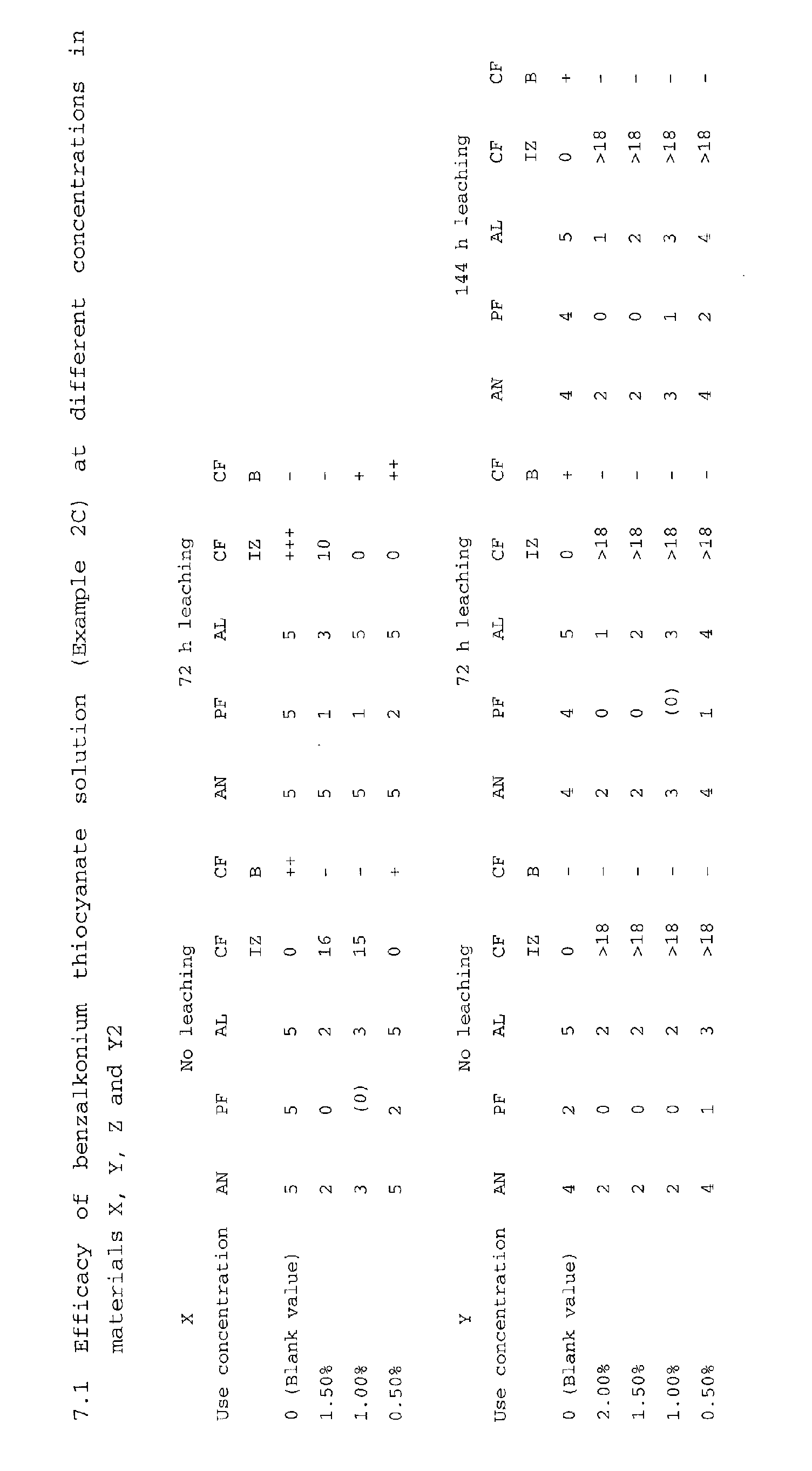
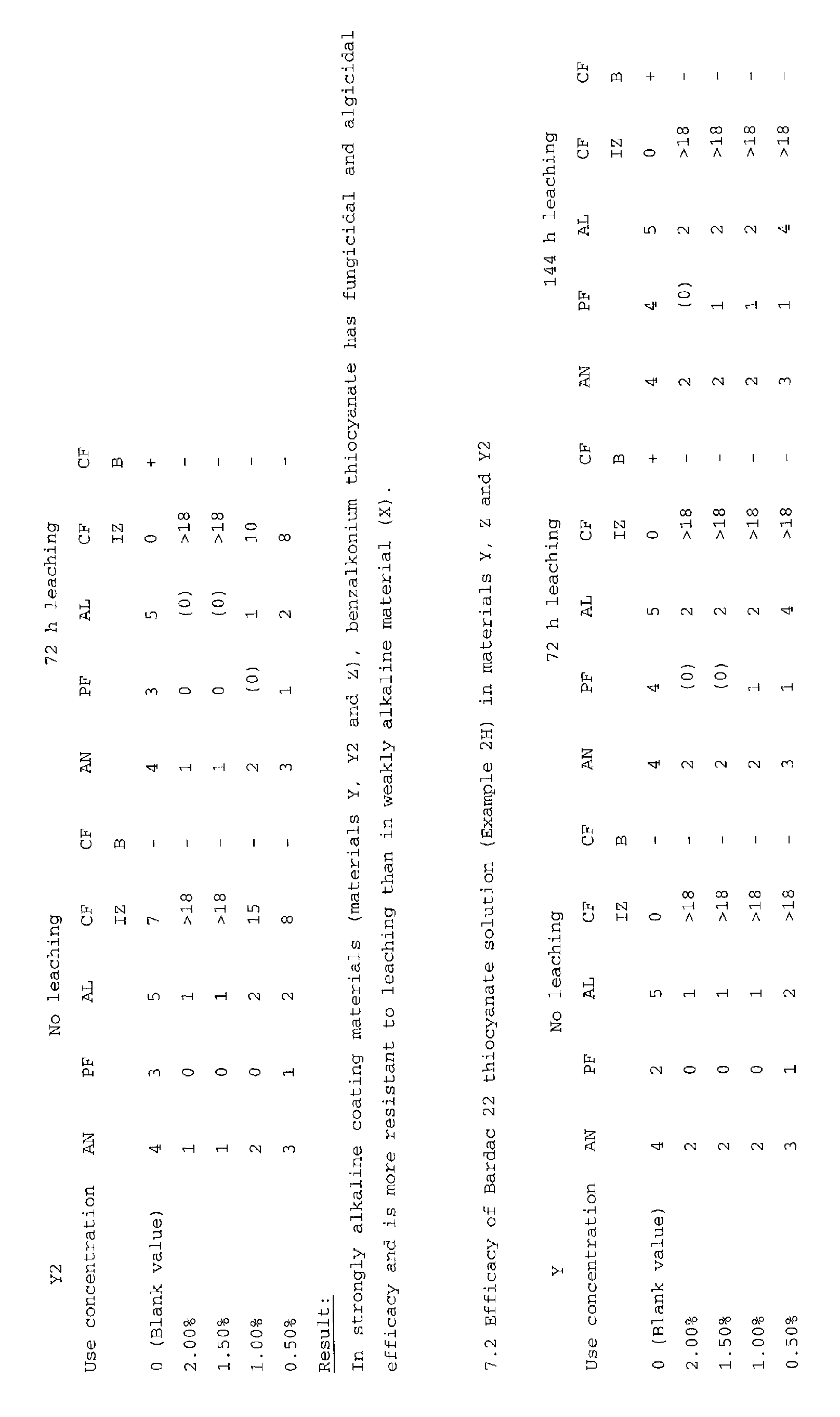
7.3 Efficacy of benzalkonium silicate solution
(Example 1A), benzalkonium thiocyanate solution
(Example 2A), benzalkonium thiocyanate solution
with Kathon 893 (Example 2D) and benzalkonium
thiocyanate solution with Kathon 893 and terbutryn
(Example 2E) in material W (on Eternit slabs).
-
The render is applied to a nominal thickness
(particle size of the largest particle, here 2 mm)
using a metal stopping knife.
| W | 14 days leaching |
| Use concentration | AN | PF | AL | CF
IZ | CF
B |
| 0(blank value) | | 1 | 2 | 2 | 4 | - |
| 0.8% | 2D | 1 | 0 | 1 | 0 | - |
| 0.8% | 2E | 1 | 0 | 1 | 10 | - |
| 0.8% | 2A | 1 | 0 | 1 | 0 | - |
| 1.2% | 2A | 1 | 1 | 1 | 0 | - |
| 0.8% | 1A | 1 | 1 | 1 | 0 | - |
Result:
-
The preservatives according to the invention have good
algicidal and fungicidal efficacy.
-
7.4 Efficacy of benzalkonium thiocyanate solution
(Example 2A), benzalkonium thiocyanate solution
with Kathon 893 (Example 2D) and benzalkonium
thiocyanate solution with Kathon 893 and terbutryn
(Example 2E)
-
Sto-Levell was applied to Eternit slabs using a
stopping knife. The final coating was material W
with algicide and fungicide added according to the
invention.
| W | 14 days leaching |
| Use concentration | AN | PF | AL | CF
IZ | CF
B |
| 0(blank value) | | 2 | 2 | 2 | 4 | - |
| 0.8% | 2D | 1 | 0 | 1 | 10 | - |
| 0.8% | 2E | 1 | 0 | 1 | 16 | - |
| 0.8% | 2A | 1 | 1 | (0) | 0 | - |
| 1.2% | 2A | (0) | (0) | (0) | >18 | - |
Result:
-
The preservatives according to the invention have good
algicidal and fungicidal efficacy.
-
7.5 Efficacy of benzalkonium silicate solution
(Example 1A), benzalkonium thiocyanate solution
(Example 2A), benzalkonium thiocyanate solution
with Kathon 893 (Example 2D) and benzalkonium
thiocyanate solution with Kathon 893 and terbutryn
(Example 2E) in material W on Eternit slabs.
| W | 1000 h QUV weathering |
| Use concentration | AN | PF | AL | CF
IZ | CF
B |
| 0(blank value) | | 2 | 1 | 3 | >18 | + |
| 0.8% | 2D | 1 | 0 | (0) | >18 | - |
| 0.8% | 2E | 1 | 0 | 1 | >18 | - |
| 0.8% | 2A | 1 | 0 | (0) | >18 | - |
| 1.2% | 2A | 1 | 1 | (0) | >18 | - |
| 0.8% | 1A | 1 | 1 | 2 | 0 | - |
Result:
-
The preservatives according to the invention have good
algicidal and fungicidal efficacy.
-
7.6 Efficacy of benzalkonium thiocyanate solution
(Example 2A), benzalkonium thiocyanate solution
with Kathon 893 (Example 2D) and benzalkonium
thiocyanate solution with Kathon 893 and terbutryn
(Example 2E) in making W.
-
Sto-Levell was applied to Eternit slabs using a
stopping knife. The final coating was material W
with fungicide and algicide added according to the
invention.
| W | 1000 h QUV-weathering |
| Use concentration | AN | PF | AL | CF
IZ | CF
B |
| 0(blank value) | | 1 | 1 | 1 | 10 | - |
| 0.8% | 2D | (0) | 0 | (0) | >18 | - |
| 0.8% | 2E | (0) | 0 | (0) | >18 | - |
| 0.8% | 2A | (0) | 0 | (0) | >18 | - |
| 1.2% | 2A | (0) | (0) | (0) | >18 | - |
Result:
-
The preservatives according to the invention have good
algicidal and fungicidal efficacy.
-
7.7 Efficacy of benzalkonium silicate solution
(Example 1A), benzalkonium thiocyanate solution
(Example 2A), benzalkonium thiocyanate solution
with Kathon 893 (Example 2D) and benzalkonium
thiocyanate solution with Kathon 893 and terbutryn
(Example 2A) in material W on Eternit slabs.
-
Leaching was carried out as usual, but over an
extended period. To this end, fungi growing under
realistic conditions were isolated from submitted
test specimens (field isolates) and grown. The
field isolates obtained were employed instead of
the standard test isolates.
| W | 14 days leaching
field isolates |
| Use concentration |
| 0(blank value) | | 1 |
| 0.8% | 2D | 0 |
| 0.8% | 2E | 0 |
| 0.8% | 2A | (0) |
| 1.2% | 2A | (0) |
| 0.8% | 1A | 2 |
Result:
-
The preservatives according to the invention have a
good fungicidal efficacy.
-
7.8 Efficacy of benzalkonium silicate solution
(Example 1A), benzalkonium thiocyanate solution
(Example 2A), benzalkonium thiocyanate solution
with Kathon 893 (Example 2D) and benzalkonium
thiocyanate solution with Kathon 893 and terbutryn
(Example 2E) in material W on Eternit slabs.
| W | 1000 h QUV weathering
field isolates |
| Use concentration |
| 0(blank value) | | (0) |
| 0.8% | 2D | 0 |
| 0.8% | 2E | 0 |
| 0.8% | 2A | 0 |
| 1.2% | 2A | 0 |
| 0.8% | 1A | 0 |
Result:
-
The preservatives according to the invention have a
good fungicidal efficacy.