EP1289997B1 - Macrolides - Google Patents
Macrolides Download PDFInfo
- Publication number
- EP1289997B1 EP1289997B1 EP01956441A EP01956441A EP1289997B1 EP 1289997 B1 EP1289997 B1 EP 1289997B1 EP 01956441 A EP01956441 A EP 01956441A EP 01956441 A EP01956441 A EP 01956441A EP 1289997 B1 EP1289997 B1 EP 1289997B1
- Authority
- EP
- European Patent Office
- Prior art keywords
- compound
- ethyl
- ascomycin
- hydroxy
- pharmaceutically acceptable
- Prior art date
- Legal status (The legal status is an assumption and is not a legal conclusion. Google has not performed a legal analysis and makes no representation as to the accuracy of the status listed.)
- Expired - Lifetime
Links
Classifications
-
- C—CHEMISTRY; METALLURGY
- C07—ORGANIC CHEMISTRY
- C07D—HETEROCYCLIC COMPOUNDS
- C07D498/00—Heterocyclic compounds containing in the condensed system at least one hetero ring having nitrogen and oxygen atoms as the only ring hetero atoms
- C07D498/12—Heterocyclic compounds containing in the condensed system at least one hetero ring having nitrogen and oxygen atoms as the only ring hetero atoms in which the condensed system contains three hetero rings
- C07D498/18—Bridged systems
-
- A—HUMAN NECESSITIES
- A61—MEDICAL OR VETERINARY SCIENCE; HYGIENE
- A61P—SPECIFIC THERAPEUTIC ACTIVITY OF CHEMICAL COMPOUNDS OR MEDICINAL PREPARATIONS
- A61P1/00—Drugs for disorders of the alimentary tract or the digestive system
-
- A—HUMAN NECESSITIES
- A61—MEDICAL OR VETERINARY SCIENCE; HYGIENE
- A61P—SPECIFIC THERAPEUTIC ACTIVITY OF CHEMICAL COMPOUNDS OR MEDICINAL PREPARATIONS
- A61P1/00—Drugs for disorders of the alimentary tract or the digestive system
- A61P1/04—Drugs for disorders of the alimentary tract or the digestive system for ulcers, gastritis or reflux esophagitis, e.g. antacids, inhibitors of acid secretion, mucosal protectants
-
- A—HUMAN NECESSITIES
- A61—MEDICAL OR VETERINARY SCIENCE; HYGIENE
- A61P—SPECIFIC THERAPEUTIC ACTIVITY OF CHEMICAL COMPOUNDS OR MEDICINAL PREPARATIONS
- A61P11/00—Drugs for disorders of the respiratory system
- A61P11/06—Antiasthmatics
-
- A—HUMAN NECESSITIES
- A61—MEDICAL OR VETERINARY SCIENCE; HYGIENE
- A61P—SPECIFIC THERAPEUTIC ACTIVITY OF CHEMICAL COMPOUNDS OR MEDICINAL PREPARATIONS
- A61P17/00—Drugs for dermatological disorders
- A61P17/06—Antipsoriatics
-
- A—HUMAN NECESSITIES
- A61—MEDICAL OR VETERINARY SCIENCE; HYGIENE
- A61P—SPECIFIC THERAPEUTIC ACTIVITY OF CHEMICAL COMPOUNDS OR MEDICINAL PREPARATIONS
- A61P17/00—Drugs for dermatological disorders
- A61P17/14—Drugs for dermatological disorders for baldness or alopecia
-
- A—HUMAN NECESSITIES
- A61—MEDICAL OR VETERINARY SCIENCE; HYGIENE
- A61P—SPECIFIC THERAPEUTIC ACTIVITY OF CHEMICAL COMPOUNDS OR MEDICINAL PREPARATIONS
- A61P21/00—Drugs for disorders of the muscular or neuromuscular system
- A61P21/04—Drugs for disorders of the muscular or neuromuscular system for myasthenia gravis
-
- A—HUMAN NECESSITIES
- A61—MEDICAL OR VETERINARY SCIENCE; HYGIENE
- A61P—SPECIFIC THERAPEUTIC ACTIVITY OF CHEMICAL COMPOUNDS OR MEDICINAL PREPARATIONS
- A61P25/00—Drugs for disorders of the nervous system
-
- A—HUMAN NECESSITIES
- A61—MEDICAL OR VETERINARY SCIENCE; HYGIENE
- A61P—SPECIFIC THERAPEUTIC ACTIVITY OF CHEMICAL COMPOUNDS OR MEDICINAL PREPARATIONS
- A61P25/00—Drugs for disorders of the nervous system
- A61P25/28—Drugs for disorders of the nervous system for treating neurodegenerative disorders of the central nervous system, e.g. nootropic agents, cognition enhancers, drugs for treating Alzheimer's disease or other forms of dementia
-
- A—HUMAN NECESSITIES
- A61—MEDICAL OR VETERINARY SCIENCE; HYGIENE
- A61P—SPECIFIC THERAPEUTIC ACTIVITY OF CHEMICAL COMPOUNDS OR MEDICINAL PREPARATIONS
- A61P27/00—Drugs for disorders of the senses
- A61P27/02—Ophthalmic agents
-
- A—HUMAN NECESSITIES
- A61—MEDICAL OR VETERINARY SCIENCE; HYGIENE
- A61P—SPECIFIC THERAPEUTIC ACTIVITY OF CHEMICAL COMPOUNDS OR MEDICINAL PREPARATIONS
- A61P27/00—Drugs for disorders of the senses
- A61P27/16—Otologicals
-
- A—HUMAN NECESSITIES
- A61—MEDICAL OR VETERINARY SCIENCE; HYGIENE
- A61P—SPECIFIC THERAPEUTIC ACTIVITY OF CHEMICAL COMPOUNDS OR MEDICINAL PREPARATIONS
- A61P29/00—Non-central analgesic, antipyretic or antiinflammatory agents, e.g. antirheumatic agents; Non-steroidal antiinflammatory drugs [NSAID]
-
- A—HUMAN NECESSITIES
- A61—MEDICAL OR VETERINARY SCIENCE; HYGIENE
- A61P—SPECIFIC THERAPEUTIC ACTIVITY OF CHEMICAL COMPOUNDS OR MEDICINAL PREPARATIONS
- A61P3/00—Drugs for disorders of the metabolism
- A61P3/08—Drugs for disorders of the metabolism for glucose homeostasis
- A61P3/10—Drugs for disorders of the metabolism for glucose homeostasis for hyperglycaemia, e.g. antidiabetics
-
- A—HUMAN NECESSITIES
- A61—MEDICAL OR VETERINARY SCIENCE; HYGIENE
- A61P—SPECIFIC THERAPEUTIC ACTIVITY OF CHEMICAL COMPOUNDS OR MEDICINAL PREPARATIONS
- A61P37/00—Drugs for immunological or allergic disorders
- A61P37/02—Immunomodulators
-
- A—HUMAN NECESSITIES
- A61—MEDICAL OR VETERINARY SCIENCE; HYGIENE
- A61P—SPECIFIC THERAPEUTIC ACTIVITY OF CHEMICAL COMPOUNDS OR MEDICINAL PREPARATIONS
- A61P37/00—Drugs for immunological or allergic disorders
- A61P37/02—Immunomodulators
- A61P37/06—Immunosuppressants, e.g. drugs for graft rejection
-
- A—HUMAN NECESSITIES
- A61—MEDICAL OR VETERINARY SCIENCE; HYGIENE
- A61P—SPECIFIC THERAPEUTIC ACTIVITY OF CHEMICAL COMPOUNDS OR MEDICINAL PREPARATIONS
- A61P37/00—Drugs for immunological or allergic disorders
- A61P37/08—Antiallergic agents
-
- A—HUMAN NECESSITIES
- A61—MEDICAL OR VETERINARY SCIENCE; HYGIENE
- A61P—SPECIFIC THERAPEUTIC ACTIVITY OF CHEMICAL COMPOUNDS OR MEDICINAL PREPARATIONS
- A61P5/00—Drugs for disorders of the endocrine system
- A61P5/14—Drugs for disorders of the endocrine system of the thyroid hormones, e.g. T3, T4
Definitions
- the invention relates to macrolides, particularly to macrolactam macrolides. It concerns the compounds of formula I wherein either
- R 1 in formula I When R 1 in formula I is in the ⁇ -configuration it is above, and when it is in the ⁇ -configuration it is below, the plane of the paper.
- R 1 preferably is chloro in the ⁇ -configuration.
- R 3 or R 4 , particularly R 3 preferably is ethyl.
- 21-Ethyl-ascomycin and 27-ethyl-ascomycin are higher homologues of ascomycin.
- 19-Ethyl-ASM, 21-ethyl-ASM and 27-ethyl-ASM are higher homologues of pimecrolimus (ASM) (33-epichloro-33-desoxy-ascomycin).
- the compounds of the invention can be prepared by a process comprising
- any ascomycin-producing microorganism strain may be used which produces higher homologues of ascomycin, e.g. as impurities, preferably a Streptomyces hygroscopicus strain.
- Such strains are known and available from public depositories.
- strains are used which produce significant amounts of higher homologues of ascomycin, or cultivation conditions are chosen which allow preparation of enhanced amounts of higher homologues of ascomycin.
- Such strains are known and readily accessible, such as Streptomyces hygroscopicus subsp. ascomyceticus (e.g.
- appropriate mutant strains may be created exhibiting enhanced higher homologues production, or selected, in conventional manner, or culture may be effected under modified conditions, such as with increased concentration of the C4 precursor sodium butyrate in the culture medium.
- Variant b) is a substitution reaction under simultaneous or concomittant epimerization. It is effected e.g. as described in EP 427680. It preferably is effected in an inert solvent such as tetrahydrofurane or toluene. Preferably the reaction is effected with tetrachloromethane or N-chloro-succinimide in the presence of triphenylphosphine, conveniently in an alkaline medium such as collidine.
- the resultant compounds of the invention may be isolated from the cultivation or reaction mixture and purified in accordance with known methods.
- a chiral stationary phase such as Kromasil® during chromatographic purification may greatly facilitate isolation of, in particular, the compounds of the invention wherein R 1 is chloro.
- the starting materials and intermediate compounds are either known or can be prepared according to known methods or analogously to known methods or analogously as described in the Examples.
- Example 1 21-Ethyl-ascomycin and 27-ethyl-ascomycin
- the compounds of the invention have initially been detected as impurities during scaling-up in the preparation of, respectively, ascomycin and ASM. Follwing on their identification and characterization it was found that, unexpectedly, they possess significant, surprisingly strong pharmacological activity. They are therefore indicated for use as pharmaceuticals. In particular, they possess immunosuppressant and antihyperproliferative, and antiinflammatory activity.
- the antiinflammatory activity may e.g. be determined in the following test method:
- the compounds of the invention inhibit inflammatory swelling by about 10 % to about 50 % upon a single topical application as a 0.1 mM solution, and by about 40 % to about 60 % as a 1 mM solution.
- the immunosuppressant and antihyperproliferative activity may e.g. be determined in the following test method:
- the compounds of the invention inhibit stimulation (IC 50 ) at a dosage of from about 0.1 nM to about 10 nM, particularly from about 0.1 nM to about 1 nM as regards the ascomycin homologs, and from about 1 nM to about 10 nM as regards the ASM homologs.
- the CD4 + antigen-specific human helper T-cell clone is established by limiting dilution culture (Van Reijsen T.C. et al., J. Allergy Clin. Immunol . 90 [1992] 184-193).
- the TCC recognizes a peptide derived from the major allergen Der p1 of the house dust mite Dermatophagoides pteronyssinus (Dpt) in association with the MHC class II restriction molecule HLA-DPw4 (Baselmanns P.J. et al., Human Immunol . 61 [2000] 789-798).
- the TCC is expanded in vitro by activation with immobilized anti-CD3 monoclonal antibody (Leu-4, Becton Dickinson, San Jose, CA, USA) and culture in complete medium supplemented with rIL-2 and rhIL-4 (50 U/ml each) (Van Reijsen et al., supra ).
- M-DC Human monocyte-derived dendritic cells
- RPMI 1640 culture medium at a cell density of 7 x 10 5 cells/ml.
- the culture medium is supplemented with 15 % FCS and rh-GM-CSF (300 U/ml) and rh-IL-4 (100 U/ml).
- 90-95 % of the cells express the phenotype of M-DC as verified by flow cytometry and they are used for antigen-specific stimulation of the TCC, which is used at least 14 days after the last challenge by antigen or anti-CD3 mAb to ensure a resting state of the cells.
- the M-DC are incubated overnight (at least 12 h) in culture medium containing 50 ⁇ g/ml of the extract of Dpt (ARTU Biologicals NV, Lelystad, The Netherlands).
- the content of the major allergen Der p1 used is about 18.5 ⁇ g/mg of Dpt extract.
- the M-DC are washed twice and 50 ⁇ l aliquots of the final number of M-DC are added to 5 x 10 4 T-cells per well in 100 ⁇ l medium, giving a M-DC / T-cell ratio of 1/50. Immediately thereafter, 50 ⁇ l aliquots of a four-fold final concentration of test compound are added. Each sample is tested in quadruplicate.
- test compound is dissolved in ethanol to provide a stock solution of 1 mM and diluted 1/1000 in the complete culture medium that is also used to prepare the final test compound dilution.
- T-cell proliferation is determined by pulsing with 1 ⁇ Ci / 20 ⁇ l / well of (methyl-) 3 H-thymidine (Amersham, U.K.) during the final 16 hours of a 4-day culture period.
- the compounds of the invention in free form and where such forms exist in pharmaceutically acceptable salt form are therefore indicated as antiinflammatory agents and immunosuppressant and antiproliferative agents for use in the prevention and treatment of inflammatory conditions and of conditions requiring immunosuppression, such as:
- the compounds may be administered systemically or topically.
- the appropriate dosage will, of course, vary depending upon, for example, the host, the mode of administration and the nature and severity of the condition being treated. However, in general, satisfactory results are indicated to be obtained systemically at daily dosages of from about 0.15 mg/kg to about 1.5 mg/kg animal body weight.
- An indicated daily dosage in the larger mammals is in the range from about 0.01 mg to about 100 mg, conveniently administered, for example, in divided doses up to four times a day or in retard form.
- satisfactory results are obtained with local administration of a concentration of from about 1 % to about 3 % by weight of active substance several times daily, e.g. 2 to 5 times daily.
- Examples of indicated galenical forms are lotions, gels, creams, sprays and solutions.
- the compounds of the invention may be administered by any conventional route, in particular enterally, e.g. orally, e.g. in the form of tablets or capsules, or topically, e.g. in the form of lotions, gels, creams, sprays, ophthalmic or nasal solutions or aerosols for local treatment of skin and mucosal membranes, e.g. eye, respiratory tract, vagina, oral and nasal cavity.
- enterally e.g. orally, e.g. in the form of tablets or capsules
- topically e.g. in the form of lotions, gels, creams, sprays, ophthalmic or nasal solutions or aerosols for local treatment of skin and mucosal membranes, e.g. eye, respiratory tract, vagina, oral and nasal cavity.
- compositions for e.g. topical application comprising a compound of the invention in free form or where such forms exist in pharmaceutically acceptable salt form in association with at least one pharmaceutical acceptable carrier or diluent may be manufactured in conventional manner by mixing with a pharmaceutically acceptable carrier or diluent.
- Unit dosage forms contain, for example, from about 0.0025 mg to about 50 mg of active substance.
- Topical administration is e.g. to the skin.
- a further form of topical administration is to the eye, e.g. for the prevention or treatment of immune-mediated conditions of the eye, such as: auto-immune diseases, e.g. uveitis, keratoplasty and chronic keratitis; allergic conditions, e.g. vernal conjunctivitis; inflammatory conditions and corneal transplants; and glaucoma; by the topical administration to the eye surface of a compound of the invention in free form or where such forms exist in pharmaceutically acceptable salt form, in a pharmaceutically acceptable ophthalmic vehicle.
- the ophthalmic vehicle is such that the compound is maintained in contact with the ocular surface for a sufficient time period to allow the compound to penetrate the corneal and internal regions of the eye, e.g. the anterior chamber, posterior chamber, vitreous body, aqueous humor, vitreous humor, cornea, iris/cifiary, lens, choroid/retina and sclera.
- the pharmaceutically acceptable ophthalmic vehicle may be e.g. an ointment, vegetable oil, or an encapsulating material.
- antiinflammatory and immunosuppressant and antiproliferative activity is the main activity of the compounds of the invention they also possess some degree of activity in increasing sensitivity to, or in increasing the efficacy of, chemotherapeutic drug therapy. This activity may e.g. be determined according to the test methods described in EP 360760.
- the compounds of the invention are therefore indicated for use in reversing chemotherapeutic drug resistance of varying types, e.g. acquired or innate, or in increasing sensitivity to administered drug therapy, e.g. as a means of reducing regular chemotherapeutic dosage levels, for example in the case of anti-neoplastic or cytostatic drug therapy, as a means of decreasing overall drug toxicity and, more especially, as a means of reversing or reducing resistance, including both inherent and acquired resistance, to chemotherapy.
- the invention thus also concerns the use of a compound of the invention in free form or where such forms exist in pharmaceutically acceptable salt form as a pharmaceutical; a such compound of the invention for use as a pharmaceutical; the use of a such compound of the invention for the preparation of a medicament for the prevention or treatment of an inflammatory condition or of a condition requiring immunosuppression; a process for the preparation of a pharmaceutical composition which comprises mixing a such compound of the invention together with at least one pharmaceutically acceptable carrier or diluent; and a method of prevention or treatment of inflammatory conditions and of conditions requiring immunosuppression, comprising administering a therapeutically effective amount of a such compound of the invention to a subject in need of such treatment.
- the compounds of the invention may be administered as sole active agent or, conveniently, in combination or association with one or more further pharmaceutically active and compatible agents, e.g. macrolactam macrolides, preferably ascomycin derivatives such as ascomycin itself or ASM.
- further pharmaceutically active and compatible agents e.g. macrolactam macrolides, preferably ascomycin derivatives such as ascomycin itself or ASM.
- compositions comprising a compound of the invention in free form or, where such forms exist, in pharmaceutically acceptable salt form, together with at least one pharmaceutically acceptable carrier or diluent, optionally in combination or association with one or more further pharmaceutically active and compatible agents, e.g. macrolactam macrolides, preferably ascomycin derivatives such as ascomycin itself or ASM.
- pharmaceutically active and compatible agents e.g. macrolactam macrolides, preferably ascomycin derivatives such as ascomycin itself or ASM.
- the compound of the invention may be present in such combination or association in widely varying amounts, e.g.
- Suitable ascomycin derivatives are e.g. as described in EP 184162, EP 315978, EP 323042, EP 423714, EP 427680, EP 465426, EP 474126, WO 91/13889, WO 91/19495, EP 484936, EP 523088, EP 532089, EP 569337, EP 626385, WO 93/5059 and WO 97/8182; in particular:
Landscapes
- Health & Medical Sciences (AREA)
- Organic Chemistry (AREA)
- Chemical & Material Sciences (AREA)
- Engineering & Computer Science (AREA)
- Bioinformatics & Cheminformatics (AREA)
- Pharmacology & Pharmacy (AREA)
- Medicinal Chemistry (AREA)
- Nuclear Medicine, Radiotherapy & Molecular Imaging (AREA)
- Chemical Kinetics & Catalysis (AREA)
- General Chemical & Material Sciences (AREA)
- Life Sciences & Earth Sciences (AREA)
- Animal Behavior & Ethology (AREA)
- General Health & Medical Sciences (AREA)
- Public Health (AREA)
- Veterinary Medicine (AREA)
- Immunology (AREA)
- Neurology (AREA)
- Diabetes (AREA)
- Biomedical Technology (AREA)
- Pulmonology (AREA)
- Neurosurgery (AREA)
- Endocrinology (AREA)
- Dermatology (AREA)
- Ophthalmology & Optometry (AREA)
- Orthopedic Medicine & Surgery (AREA)
- Obesity (AREA)
- Emergency Medicine (AREA)
- Hospice & Palliative Care (AREA)
- Rheumatology (AREA)
- Pain & Pain Management (AREA)
- Psychiatry (AREA)
- Transplantation (AREA)
- Hematology (AREA)
- Physical Education & Sports Medicine (AREA)
- Pharmaceuticals Containing Other Organic And Inorganic Compounds (AREA)
- Saccharide Compounds (AREA)
- Steroid Compounds (AREA)
- Preparation Of Compounds By Using Micro-Organisms (AREA)
- Nitrogen And Oxygen Or Sulfur-Condensed Heterocyclic Ring Systems (AREA)
- Pyrane Compounds (AREA)
Abstract
Description
- The invention relates to macrolides, particularly to macrolactam macrolides. It concerns the compounds of formula Iwherein

either - R1 is hydroxy in the β-configuration; and
- R2 is methyl and
- one of R3 and R4 is ethyl and the other is methyl; or
- R1 is chloro in the α-configuration; and
- one of R2, R3 and R4 is ethyl and the others are methyl;
-
- When R1 in formula I is in the α-configuration it is above, and when it is in the β-configuration it is below, the plane of the paper. R1 preferably is chloro in the α-configuration. R3 or R4, particularly R3, preferably is ethyl.
- The compounds of the invention are hereinafter briefly named as follows:
- when R1 is hydroxy and
- R3 is ethyl: 21-ethyl-ascomycin; or
- R4 is ethyl: 27-ethyl-ascomycin;
- when R1 is chloro and
- R2 is ethyl: 19-ethyl-ASM; or
- R3 is ethyl: 21-ethyl-ASM; or
- R4 is ethyl: 27-ethyl-ASM;
- (1R,9S,12S,13R,14S,17R,18E,21S,23S,24R,25S,27R)-12-[(1E-2-[(1R,3R,4R)-4-hydroxy-3-methoxycyclohexyl]-1-methylvinyl]-17,21-diethyl-1,14-dihydroxy-23,25-dimethoxy-13,19,27-trimethyl-11,28-dioxa-4-azatricyclo-[22.3.1.04,9]octacos-18-ene-2,3,10,16-tetrone;
- (1R,9S,12S,13R,14S,17R,18E,21S,23S,24R,25S,27R)-12-[(1E-2-[(1R,3R,4R)-4-hydroxy-3-methoxycyclohexyl]-1-methylvinyl]-17,27-diethyl-1,14-dihydroxy-23,25-dimethoxy-13,19,21-trimethyl-11,28-dioxa-4-azatricyclo-[22.3.1.04,9]octacos-18-ene-2,3,10,16-tetrone;
- (1R,9S,12S,13R,14S,17R,18E,21S,23S,24R,25S,27R)-12-[(1E-2-[(1R,3R,4S)-4-chloro-3-methoxycyclohexyl]-1-methylvinyl]-17,19-diethyl-1,14-dihydroxy-23,25-dimethoxy-13,21,27-trimethyl-11,28-dioxa-4-azatricyclo-[22.3.1.04,9]octacos-18-ene-2,3,10,16-tetrone;
- (1R,9S,12S,13R,14S,17R,18E,21S,23S,24R,25S,27R)-12-[(1E-2-[(1R,3R,4S)-4-chloro-3-methoxycyclohexyl]-1-methylvinyl]-17,21-diethyl-1,14-dihydroxy-23,25-dimethoxy-13,19,27-trimethyl-11,28-dioxa-4-azatricyclo-[22.3.1.04,9]octacos-18-ene-2,3,10,16-tetrone; and
- (1R,9S,12S,13R,14S,17R,18E,21S,23S,24R,25S,27R)-12-[(1E-2-[(1R,3R,4S)-4-chloro-3-methoxycyclohexyl]-1-methylvinyl]-17,27-diethyl-1,14-dihydroxy-23,25-dimethoxy-13,19,21-trimethyl-11,28-dioxa-4-azatricyclo-[22.3.1.04,9]octacos-18-ene-2,3,10,16-tetrone.
- 21-Ethyl-ascomycin and 27-ethyl-ascomycin are higher homologues of ascomycin. 19-Ethyl-ASM, 21-ethyl-ASM and 27-ethyl-ASM are higher homologues of pimecrolimus (ASM) (33-epichloro-33-desoxy-ascomycin).
- The compounds of the invention can be prepared by a process comprising
- a) for the preparation of the compounds of formula I as defined above wherein R1 is hydroxy
in the β-configuration,
cultivating an appropriate microorganism and isolating from the resultant culture medium the corresponding compounds of formula I wherein R1 is hydroxy in the β-configuration; or - b) for the preparation of the compounds of formula I as defined above wherein R1 is chloro
in the α-configuration,
replacing under epimerization hydroxy with chloro in a corresponding compound of formula I wherein R1 is hydroxy in the β-configuration,
and recovering the resultant compounds in free form or, where such forms exist, in salt form. -
- The process of the invention is effected in conventional manner.
- In variant a) any ascomycin-producing microorganism strain may be used which produces higher homologues of ascomycin, e.g. as impurities, preferably a Streptomyces hygroscopicus strain. Such strains are known and available from public depositories. Preferably, strains are used which produce significant amounts of higher homologues of ascomycin, or cultivation conditions are chosen which allow preparation of enhanced amounts of higher homologues of ascomycin. Such strains are known and readily accessible, such as Streptomyces hygroscopicus subsp. ascomyceticus (e.g. ATCC 14891, ATCC 53855, ATCC 55087, ATCC 55276, ATCC 55558, DSM 5085), Streptomyces tsukubaensis No. 9993 (FERM BP-927), Streptomyces hygroscopicus subsp. yakushimaensis No. 7238 (FERM BP-928, NRRL 18488); or natural or artificial mutants thereof, and cultivation conditions for enhanced higher homologues production are known or can readily be determined in conventional manner therefrom. Conveniently, appropriate mutant strains may be created exhibiting enhanced higher homologues production, or selected, in conventional manner, or culture may be effected under modified conditions, such as with increased concentration of the C4 precursor sodium butyrate in the culture medium.
- Variant b) is a substitution reaction under simultaneous or concomittant epimerization. It is effected e.g. as described in EP 427680. It preferably is effected in an inert solvent such as tetrahydrofurane or toluene. Preferably the reaction is effected with tetrachloromethane or N-chloro-succinimide in the presence of triphenylphosphine, conveniently in an alkaline medium such as collidine.
- The resultant compounds of the invention may be isolated from the cultivation or reaction mixture and purified in accordance with known methods. However, it has been found that, surprisingly, use of a chiral stationary phase such as Kromasil® during chromatographic purification may greatly facilitate isolation of, in particular, the compounds of the invention wherein R1 is chloro.
- The starting materials and intermediate compounds are either known or can be prepared according to known methods or analogously to known methods or analogously as described in the Examples.
- The following Examples illustrate the invention. They are not limitative. All temperatures are in degrees Celsius. The compounds are in free form unless specified otherwise. The following abbreviations are used:
HPLC high pressure liquid chromatography I.D. internal diameter THF tetrahydrofurane tlc thin layer chromatography % percent w/w -
- a) Crude ascomycin is prepared on a semi-industrial (kg) scale by fermentation of a Streptomyces strain (ATCC 14891), as described in Example 4 of EP 184162, and partially purified by countercurrent extraction (Res.Discl. 402 [October 1997] 725-726). A crude product is obtained, containing about 35 % ascomycin, 15 % 21-ethyl-ascomycin and 10 % 27-ethyl-ascomycin. This material is further purified in a silica gel filtration step using isopropyl acetate / n-heptane 7/3 (v/v) as an eluant to remove ascomycin. The resultant further crude product obtained contains about 25 % 21-ethyl-ascomycin and 15 % 27-ethyl-ascomycin.
- b) 1 g crude 21-ethyl-ascomycin from a) above is dissolved in 3.5 ml of isopropyl acetate /heptane
7/3 (v/v), and the feed solution is injected on a preparative column (36 cm x 5 cm I.D.)
containing 300 g silicagel [Kromasil® 100-5 SIL (Eka Nobel)] as stationary phase. The
mixture is eluted with isopropyl acetate / heptane 7/3 (v/v) as mobile phase with a flow rate of
100 ml/min at room temperature. UV-detection occurs at 245 nm. The ascomycin derivatives
elute after 34.5 min and are fractionated in intervals of 1.1 min. 21-Ethyl-ascomycin is
collected in fractions 13-28. The pooled fractions are collected and evaporated to dryness at
40° under vacuum. Thirteen preparative runs yield more than 1 g of title compound
21-ethyl-ascomycin:
FAB-MS: fragments in decreasing order: 812 [M+Li]-, 602, 794, 425;
2D-1H-NMR: 21-ethyl = 1.21 ppm, 1.50 ppm (methylene) and 0.87 ppm (methyl). - c) 1 g crude 27-ethyl-ascomycin from a) above is treated as described under b) above, except
that co-eluting fractions 1-7 are collected. The pooled fractions are collected and evaporated
to dryness at 40° under vacuum. 379 mg of the resultant residue are dissolved in 30 ml of
n-hexane/ethanol/methanol 90/5/5 (v/v), and the feed solution is injected on a preparative
column (40 cm x 10 cm I.D.) containing 2.0 kg amylose tris(3,5-dimethylphenylcarbamate)
(coated on silicagel) (Chiralpak-AD®). Elution is effected with n-hexane/ethanol/methanol
90/5/5 (v/v/v) as mobile phase with a flow rate of 150 ml/min at room temperature. UV-detection
occurs at 210 nm. 27-Ethyl-ascomycin elutes between 60 and 80 min. The
27-ethyl-ascomycin containing fractions are collected and evaporated to dryness at 40° under
vacuum, yielding 120 mg of title compound 27-ethyl-ascomycin:
FAB-MS: fragments in decreasing order: 828.6 [M+Na]+, 508.3, 423.0, 563.6;
2D-1H-NMR: 27-ethyl = 1.59 ppm, 1.19 ppm (methylene) and 0.92 ppm (methyl). -
-
- a) ASM is prepared on a semi-industrial (kg) scale using the procedure described in EP 427680, Example 66a, starting from crude ascomycin, and submitted to chromatographic purification over silicagel at 40-45° using heptane / tert-butyl methyl ether (water-saturated) /isopropanol 200/50/8 (v/v) as an eluant. A side fraction from the chromatographic run is obtained having a content of 56 % of crude 19-ethyl-ASM.
- b) Preparative tlc is effected on 17 mg crude product from a) above, dissolved in 1 ml of
methylene chloride and charged on a tlc plate (Merck 5715, 20 x 20 cm I.D.). The
chromatogram is developed using a mixture of pentane/isopropanol 9/1 (v/v) as mobile phase
within 18 cm distance. The zone containing 19-ethyl-ASM (Rf = 0.35) is removed from the tlc
plate and washed with 2 ml of pentane. The product is extracted with 5 ml of acetonitrile and
dried at 60° under vacuum, yielding 4.4 mg title compound with a purity of ≥ 90 %:
FAB-MS: fragments in decreasing order: 830 [M+Li]+, 602, 313, 578, 788;
2D-1H-NMR: 19-ethyl = 2.17 ppm, 1.82 ppm (methylene) and 0.98 ppm (methyl)]. -
- The title compound is obtained analogously as described in Example 4 hereunder, starting from 19-ethyl-ascomycin, i.e. (1R,9S,12S,13R,14S,17R,18E,21S,23S,24R,25S,27R)-12-[(1E-2-[(1R,3R,4R)-4-hydroxy-3-methoxycyclohexyl]-1-methylvinyl]-17,19-diethyl-1,14-dihydroxy-23,25-dimetboxy-13,21,27-trimethyl-11,28-dioxa-4-azatricyclo-[22.3.1.04,9]octacos-18-ene-2,3,10,16-tetrone (B. Junker et al., Biotechnol. Bioeng. 59 [1998] 595-604):
FAB-MS: fragments in decreasing order: 830 [M+Li]+, 602, 313, 578, 788;
2D-1H-NMR: 19-ethyl = 2.17 ppm, 1.82 ppm (methylene) and 0.98 ppm (methyl)]. -
- a) 0.733 g 21-ethyl-ascomycin [see Example 1b) above] is dissolved twice in 2.5 ml of toluene and evaporated at 50° under vacuum In a separate 25 ml flask 0.298 g triphenylphosphine is dissolved in 4.7 ml of tetrahydrofurane, 0.152 g N-chloro-succinimide is added and the suspension is stirred for 30 min at room temperature. To that suspension 0.202 ml of s-collidin is added, followed by the solution of the above dried 21-ethyl-ascomycin in 3.9 ml of tetrahydrofurane. The solution is finally heated up to 50° for 1.5 h and then cooled down to room temperature. 16.6 ml of cyclohexane are added and the organic phase is extracted with 0.18 g citric acid in a mixture of 3.5 ml of water and 3.5 ml of methanol. The organic phase is again extracted twice with 7 ml of methanol/water 1/1 (v/v) and the combined water phase is re-extracted with 10 ml of cyclohexane. The solvent is evaporated at 50° yielding 0.79 g crude 21-ethyl-ASM.
- b) 0.1 g crude product from a) above is dissolved in 1.0 ml of ethanol, and the feed solution is
injected on a preparative column (25 cm x 2 cm I.D.) containing 55 g reversed-phase silicagel
[Kromasil® RP-18 (5µm)] as stationary phase. The product is eluted with 70 % solvent B
[solvent A = water/phosphoric acid 1000/1 (v/v); solvent B = acetonitrile / tert-butyl methyl
ether 825/175 (v/v)] as mobile phase with a flow rate of 15 ml/min at 60°. UV-detection
occurs at 210 nm. 21-Ethyl-ASM elutes at between 11.5 min and 12.0 min. The organic
solvents of the product fraction are evaporated at 50° under vacuum and the remaining water
phase is extracted twice with 15 ml of methylene chloride each. Methylene chloride is finally
evaporated at 50° under vacuum, yielding 30 mg title compound:
FAB-MS: fragments in decreasing order: 830 [M+Li]+, 397, 149;
2D-1H-NMR: 21-ethyl = 1.30 ppm, 1.20 ppm (methylene) and 0.90 ppm (methyl). -
-
- a) 135 mg 27-ethyl-ascomycin [see Example 1c) above] is dissolved in 1.4 ml of toluene and the solvent is distilled off at 60° / 80-20 mbar. The residue is dissolved in 0.36 ml of THF (< 0.01 % H2O). In a separate flask 41.4 mg triphenylphosphine and 21.1 mg N-chloro-succinimide in 0.4 ml of THF are stirred at 20° for 0.5 hours, then 27.4 mg s-collidine is added, followed by the addition of the solution of 27-ethyl-ascomycin, which is rinsed with 30 µl THF. The suspension is heated to 50-53° for 2 hours and an HPLC-analysis is made. When the reaction is completed, the mixture is cooled to 30° and 1.25 ml cyclohexane is added, followed by 26.1 mg anhydrous citric acid dissolved in 0.53 ml water/methanol 1/1 (v/v). The upper layer is separated and washed with 2 x 0.3 ml water/methanol 1/1 (v/v). The aqueous layers are extracted with 2 x 0.3 ml cyclohexane. The combined organic phases are evaporated at 50° / 80-20 mbar to yield 109 mg crude 27-ethyl-ASM (brown resin).
- b) 0.052 g crude product from a) above are dissolved in 1.0 ml acetonitrile, and the feed
solution is injected on a preparative column (25 cm x 2 cm I.D.) containing 55 g reversed-phase
silicagel [Kromasil® RP-18 (5µm)] as stationary phase. The product is eluted with
acetonitrile/water/tert-butyl methyl ether 700/300/50 (v/v/v) as mobile phase with a flow rate of
15 ml/min at 60°. UV-detection occurs at 210 nm. 27-Ethyl-ASM elutes at between 15.0 min
and 25.0 min. The organic solvents of the product fraction are evaporated, yielding 12.4 mg
title compound:
FAB-MS: fragments in decreasing order: 846.7 [M+Na]+, 810.5, 433;
2D-1H-NMR: 27-ethyl = 1.20 ppm, 1.20 ppm (methylene) and 0.90 ppm (methyl). -
- The compounds of the invention have initially been detected as impurities during scaling-up in the preparation of, respectively, ascomycin and ASM. Follwing on their identification and characterization it was found that, unexpectedly, they possess significant, surprisingly strong pharmacological activity. They are therefore indicated for use as pharmaceuticals. In particular, they possess immunosuppressant and antihyperproliferative, and antiinflammatory activity.
- The antiinflammatory activity may e.g. be determined in the following test method:
- [F.M. Dietrich and R. Hess, Int. Arch. Allergy 38 (1970) 246-259]:
- The compounds of the invention inhibit inflammatory swelling by about 10 % to about 50 % upon a single topical application as a 0.1 mM solution, and by about 40 % to about 60 % as a 1 mM solution.
- The immunosuppressant and antihyperproliferative activity may e.g. be determined in the following test method:
- [Br. J. Dermatol. 141 (1999) 264-273]:
- The compounds of the invention inhibit stimulation (IC50) at a dosage of from about 0.1 nM to about 10 nM, particularly from about 0.1 nM to about 1 nM as regards the ascomycin homologs, and from about 1 nM to about 10 nM as regards the ASM homologs.
- This activity is further evidenced in additional testing with the above helper T-cell clone and monocyte-derived dendritic cells:
- The CD4+ antigen-specific human helper T-cell clone (TCC) is established by limiting dilution culture (Van Reijsen T.C. et al., J. Allergy Clin. Immunol. 90 [1992] 184-193). The TCC recognizes a peptide derived from the major allergen Der p1 of the house dust mite Dermatophagoides pteronyssinus (Dpt) in association with the MHC class II restriction molecule HLA-DPw4 (Baselmanns P.J. et al., Human Immunol. 61 [2000] 789-798). To obtain sufficient cell numbers for assay purposes, the TCC is expanded in vitro by activation with immobilized anti-CD3 monoclonal antibody (Leu-4, Becton Dickinson, San Jose, CA, USA) and culture in complete medium supplemented with rIL-2 and rhIL-4 (50 U/ml each) (Van Reijsen et al., supra).
- Human monocyte-derived dendritic cells (M-DC) are generated from purified monocytes by culturing in RPMI 1640 culture medium at a cell density of 7 x 10⁵ cells/ml. The culture medium is supplemented with 15 % FCS and rh-GM-CSF (300 U/ml) and rh-IL-4 (100 U/ml). At day 7 of culture, 90-95 % of the cells express the phenotype of M-DC as verified by flow cytometry and they are used for antigen-specific stimulation of the TCC, which is used at least 14 days after the last challenge by antigen or anti-CD3 mAb to ensure a resting state of the cells. For antigen-specific stimulation, the M-DC are incubated overnight (at least 12 h) in culture medium containing 50 µg/ml of the extract of Dpt (ARTU Biologicals NV, Lelystad, The Netherlands). The content of the major allergen Der p1 used is about 18.5 µg/mg of Dpt extract. The M-DC are washed twice and 50 µl aliquots of the final number of M-DC are added to 5 x 10⁴ T-cells per well in 100 µl medium, giving a M-DC / T-cell ratio of 1/50. Immediately thereafter, 50 µl aliquots of a four-fold final concentration of test compound are added. Each sample is tested in quadruplicate. The test compound is dissolved in ethanol to provide a stock solution of 1 mM and diluted 1/1000 in the complete culture medium that is also used to prepare the final test compound dilution. T-cell proliferation is determined by pulsing with 1 µCi / 20 µl / well of (methyl-)3H-thymidine (Amersham, U.K.) during the final 16 hours of a 4-day culture period.
- The following IC50 values have been obtained:
Compound IC50 (nM) 21-ethyl-ascomycin 0.33 27-ethyl-ascomycin 0.88 19-ethyl-ASM 6.8 21-ethyl-ASM 1.6 27-ethyl-ASM 4.6 - The compounds of the invention in free form and where such forms exist in pharmaceutically acceptable salt form are therefore indicated as antiinflammatory agents and immunosuppressant and antiproliferative agents for use in the prevention and treatment of inflammatory conditions and of conditions requiring immunosuppression, such as:
- a) the treatment of inflammatory and hyperproliferative skin diseases, such as psoriasis, atopic dermatitis, contact dermatitis and further eczematous dermatoses, seborrhoeic dermatitis, Lichen planus, Pemphigus, bullous Pemphigoid, Epidermolysis bullosa, vasculitides, erythemas, cutaneous eosinophilias, Lupus erythematosus and acne;
- b) the prevention and treatment of allergic diseases such as extrinsic asthma, rhinitis, conjunctivitis, atopic eczema, urticaria/angioedema, food/drug allergy and anaphylaxis;
- c) the prevention and treatment of:
- resistance in situations of organ or tissue transplantation, e.g. of heart, kidney, liver, bone marrow and skin,
- graft-versus-host disease, such as following bone marrow grafts,
- autoimmune diseases such as rheumatoid arthritis, systemic Lupus erythematosus, Hashimoto's thyroidis, multiple sclerosis, Myasthenia gravis, diabetes type I and uveitis,
- skin manifestations of immunologically-mediated disorders;
- intestinal diseases; and
- d) alopecia areata.
-
- The compounds may be administered systemically or topically. For the above indications the appropriate dosage will, of course, vary depending upon, for example, the host, the mode of administration and the nature and severity of the condition being treated. However, in general, satisfactory results are indicated to be obtained systemically at daily dosages of from about 0.15 mg/kg to about 1.5 mg/kg animal body weight. An indicated daily dosage in the larger mammals is in the range from about 0.01 mg to about 100 mg, conveniently administered, for example, in divided doses up to four times a day or in retard form. For topical use satisfactory results are obtained with local administration of a concentration of from about 1 % to about 3 % by weight of active substance several times daily, e.g. 2 to 5 times daily. Examples of indicated galenical forms are lotions, gels, creams, sprays and solutions.
- The compounds of the invention may be administered by any conventional route, in particular enterally, e.g. orally, e.g. in the form of tablets or capsules, or topically, e.g. in the form of lotions, gels, creams, sprays, ophthalmic or nasal solutions or aerosols for local treatment of skin and mucosal membranes, e.g. eye, respiratory tract, vagina, oral and nasal cavity.
- Pharmaceutical compositions for e.g. topical application comprising a compound of the invention in free form or where such forms exist in pharmaceutically acceptable salt form in association with at least one pharmaceutical acceptable carrier or diluent may be manufactured in conventional manner by mixing with a pharmaceutically acceptable carrier or diluent. Unit dosage forms contain, for example, from about 0.0025 mg to about 50 mg of active substance.
- Topical administration is e.g. to the skin. A further form of topical administration is to the eye, e.g. for the prevention or treatment of immune-mediated conditions of the eye, such as: auto-immune diseases, e.g. uveitis, keratoplasty and chronic keratitis; allergic conditions, e.g. vernal conjunctivitis; inflammatory conditions and corneal transplants; and glaucoma; by the topical administration to the eye surface of a compound of the invention in free form or where such forms exist in pharmaceutically acceptable salt form, in a pharmaceutically acceptable ophthalmic vehicle.
- The ophthalmic vehicle is such that the compound is maintained in contact with the ocular surface for a sufficient time period to allow the compound to penetrate the corneal and internal regions of the eye, e.g. the anterior chamber, posterior chamber, vitreous body, aqueous humor, vitreous humor, cornea, iris/cifiary, lens, choroid/retina and sclera. The pharmaceutically acceptable ophthalmic vehicle may be e.g. an ointment, vegetable oil, or an encapsulating material.
- Whilst the antiinflammatory and immunosuppressant and antiproliferative activity is the main activity of the compounds of the invention they also possess some degree of activity in increasing sensitivity to, or in increasing the efficacy of, chemotherapeutic drug therapy. This activity may e.g. be determined according to the test methods described in EP 360760.
- The compounds of the invention are therefore indicated for use in reversing chemotherapeutic drug resistance of varying types, e.g. acquired or innate, or in increasing sensitivity to administered drug therapy, e.g. as a means of reducing regular chemotherapeutic dosage levels, for example in the case of anti-neoplastic or cytostatic drug therapy, as a means of decreasing overall drug toxicity and, more especially, as a means of reversing or reducing resistance, including both inherent and acquired resistance, to chemotherapy.
- The invention thus also concerns the use of a compound of the invention in free form or where such forms exist in pharmaceutically acceptable salt form as a pharmaceutical; a such compound of the invention for use as a pharmaceutical; the use of a such compound of the invention for the preparation of a medicament for the prevention or treatment of an inflammatory condition or of a condition requiring immunosuppression; a process for the preparation of a pharmaceutical composition which comprises mixing a such compound of the invention together with at least one pharmaceutically acceptable carrier or diluent; and a method of prevention or treatment of inflammatory conditions and of conditions requiring immunosuppression, comprising administering a therapeutically effective amount of a such compound of the invention to a subject in need of such treatment.
- The compounds of the invention may be administered as sole active agent or, conveniently, in combination or association with one or more further pharmaceutically active and compatible agents, e.g. macrolactam macrolides, preferably ascomycin derivatives such as ascomycin itself or ASM.
- The invention thus also concerns pharmaceutical compositions comprising a compound of the invention in free form or, where such forms exist, in pharmaceutically acceptable salt form, together with at least one pharmaceutically acceptable carrier or diluent, optionally in combination or association with one or more further pharmaceutically active and compatible agents, e.g. macrolactam macrolides, preferably ascomycin derivatives such as ascomycin itself or ASM. The compound of the invention may be present in such combination or association in widely varying amounts, e.g. from about 99 % to about 1 % or from about 90 % to about 10 % generally or, when it is in combination or association with a macrolactam macrolide, preferably with an ascomycin derivative, especially ascomycin itself or ASM, particularly ASM, in view of the similar pharmacological profiles, from about 99.99 % to about 0.01 %, e.g. about 99.9 % to about 0.1 %, or from about 95 % to about 5 %, by weight of respective active agents.
- Suitable ascomycin derivatives are e.g. as described in EP 184162, EP 315978, EP 323042, EP 423714, EP 427680, EP 465426, EP 474126, WO 91/13889, WO 91/19495, EP 484936, EP 523088, EP 532089, EP 569337, EP 626385, WO 93/5059 and WO 97/8182; in particular:
- ascomycin itself;
- tacrolimus (FK506; PrografR);
- imidazolylmethoxyascomycin (WO 97/8182 in Example 1 and as compound of formula I);
- 32-O-(1-hydroxyethylindol-5-yl)ascomycin (L-732531) (Transplantation 65 [1998] 10-18, 18-26, on page 11, Figure 1; and
- (32-desoxy,32-epi-N1-tetrazolyl)ascomycin (ABT-281) (J.Invest.Dermatol. 12 [1999] 729-738, on page 730, Figure 1);
- {1R,5Z,9S,12S-[1E-(1R,3R,4R)],13R,14S,17R,18E,21S,23S,24R,25S,27R}-17-ethyl-1,14-dihydroxy-12-[2-(4-hydroxy-3-methoxycyclohexyl)-1-methylvinyl]-23,25-dimethoxy-13,19,21,27-tetramethyl-11,28-dioxa-4-azatricyclo[22.3.1.04,9]octacos-5,18-diene-2,3,10,16-tetrone (Example 8 in EP 626385);
- {1E-(1R,3R,4R)]1R,4S,5R,6S,9R,10E,13S,15S,16R,17S,19S,20S}-9-ethyl-6,16,20-trihydroxy-4-[2-(4-hydroxy-3-methoxycyclohexyl)-1-methylvinyl]-15,17-dimethoxy-5,11,13,19-tetramethyl-3-oxa-22-azatricyclo[18.6.1.01,22]heptacos-10-ene-2,8,21,27-tetrone
(Examples 6d and 71 in EP 569337); and
especially:
- pimecrolimus (ASM) (Example 66a in EP 427680; 33-epichloro,33-desoxyascomycin).
hereinafter briefly named "the compounds of the invention".
Claims (9)
- A compound of formula Iwherein
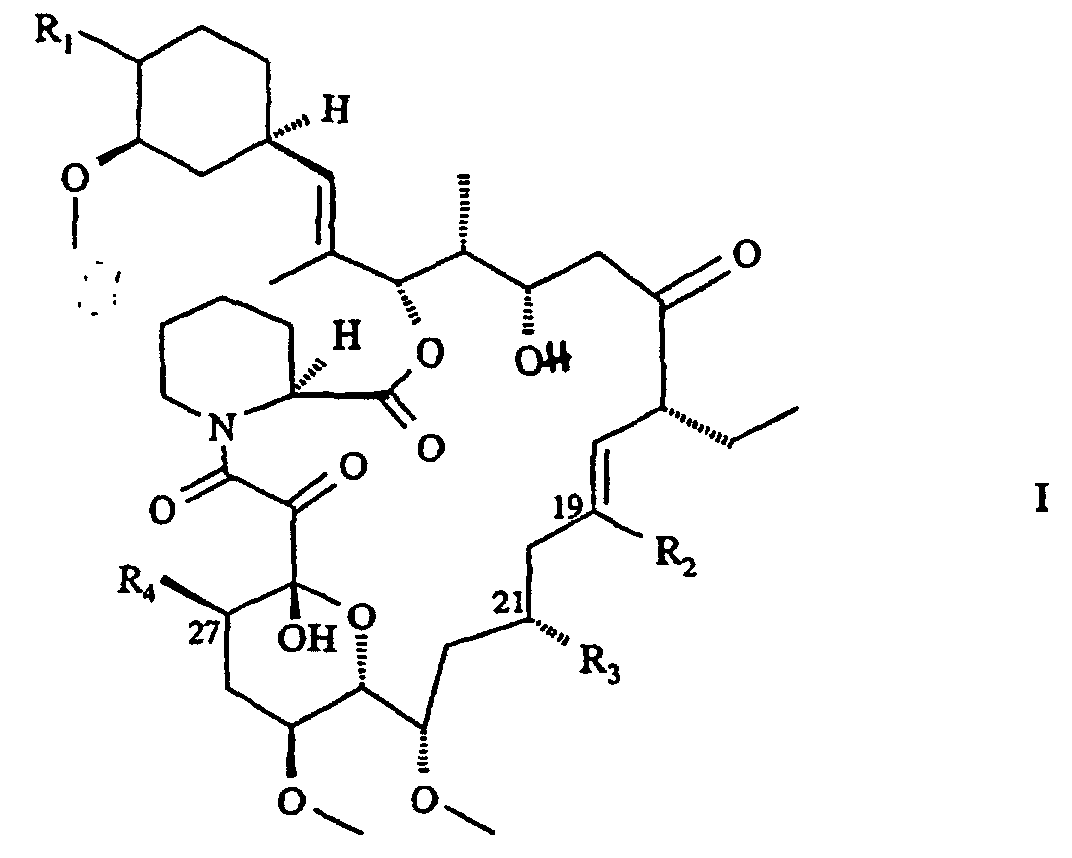
eitherorR1 is hydroxy in the β-configuration; andR2 is methyl andone of R3 and R4 is ethyl and the other is methyl;in free form or, where such forms exist, in salt form,R 1 is chloro in the α-configuration; andone of R2, R3 and R4 is ethyl and the others are methyl; - A process for the preparation of a compound according to claim 1, which comprisesand recovering the resultant compound in free form or, where such forms exist, in salt form.a) for the preparation of the compounds of formula I as defined in claim 1 wherein R1 is hydroxy in the β-configuration,
cultivating an appropriate microorganism and isolating from the resultant culture medium the corresponding compounds of formula I wherein R1 is hydroxy in the β-configuration; orb) for the preparation of the compounds of formula I as defined in claim 1 wherein R1 is chloro in the α-configuration,
replacing under epimerization hydroxy with chloro in a corresponding compound of formula I wherein R1 is hydroxy in the β-configuration, - A pharmaceutical composition comprising a compound as defined in claim 1 in free form or, where such forms exist, in pharmaceutically acceptable salt form, together with at least one pharmaceutically acceptable carrier or diluent.
- A composition according to claim 3 wherein the compound is in combination or association with a further pharmaceutically active and compatible agent.
- A composition according to claim 4 wherein the compound is in combination or association with ASM.
- A process for the preparation of a pharmaceutical composition according to claim 3 comprising mixing the compound with at least one pharmaceutically acceptable carrier or diluent.
- A compound as defined in claim 1 in free form or, where such forms exist, in pharmaceutically acceptable salt form, for use as a pharmaceutical.
- A compound as defined in claim 1 in free form or, where such forms exist, in pharmaceutically acceptable salt form, for use in the prevention or treatment of inflammatory conditions or of conditions requiring immunosuppression.
- The use of a compound as defined in claim 1 in free form or, where such forms exist, in pharmaceutically acceptable salt form in the preparation of a medicament for the prevention or treatment of inflammatory conditions or of conditions requiring immunosuppression.
Applications Claiming Priority (3)
| Application Number | Priority Date | Filing Date | Title |
|---|---|---|---|
| GB0012383 | 2000-05-22 | ||
| GBGB0012383.6A GB0012383D0 (en) | 2000-05-22 | 2000-05-22 | Organic compounds |
| PCT/EP2001/005836 WO2001090110A1 (en) | 2000-05-22 | 2001-05-21 | Macrolides |
Publications (2)
| Publication Number | Publication Date |
|---|---|
| EP1289997A1 EP1289997A1 (en) | 2003-03-12 |
| EP1289997B1 true EP1289997B1 (en) | 2004-01-07 |
Family
ID=9892108
Family Applications (1)
| Application Number | Title | Priority Date | Filing Date |
|---|---|---|---|
| EP01956441A Expired - Lifetime EP1289997B1 (en) | 2000-05-22 | 2001-05-21 | Macrolides |
Country Status (14)
| Country | Link |
|---|---|
| US (1) | US6706727B1 (en) |
| EP (1) | EP1289997B1 (en) |
| JP (2) | JP4043239B2 (en) |
| CN (1) | CN1229381C (en) |
| AT (1) | ATE257481T1 (en) |
| AU (1) | AU2001278428A1 (en) |
| CA (1) | CA2405593C (en) |
| DE (1) | DE60101739T2 (en) |
| DK (1) | DK1289997T3 (en) |
| ES (1) | ES2214436T3 (en) |
| GB (1) | GB0012383D0 (en) |
| PT (1) | PT1289997E (en) |
| TR (1) | TR200400723T4 (en) |
| WO (1) | WO2001090110A1 (en) |
Families Citing this family (12)
| Publication number | Priority date | Publication date | Assignee | Title |
|---|---|---|---|---|
| GB9618952D0 (en) * | 1996-09-11 | 1996-10-23 | Sandoz Ltd | Process |
| JP2005512946A (en) * | 2001-05-09 | 2005-05-12 | ノバルティス アクチエンゲゼルシャフト | Selective immunomodulation method |
| GB0200429D0 (en) * | 2002-01-09 | 2002-02-27 | Novartis Ag | Organic compounds |
| WO2004010900A1 (en) * | 2002-07-25 | 2004-02-05 | Avantec Vascular Corporation | Devices delivering therapeutic agents and methods regarding the same |
| EP1740168A2 (en) * | 2004-04-21 | 2007-01-10 | Advanced Ocular Systems Limited | Antiprostaglandins for the treatment of ocular pathologies |
| WO2006115509A2 (en) | 2004-06-24 | 2006-11-02 | Novartis Vaccines And Diagnostics Inc. | Small molecule immunopotentiators and assays for their detection |
| GT200500282A (en) * | 2004-10-12 | 2006-05-04 | HETEROATOMOS CONTAINING TRICYCLE COMPOUNDS. | |
| CA2584358A1 (en) * | 2004-12-01 | 2006-06-08 | Teva Gyogyszergyar Zartkoeruen Mukoedo Reszvenytarsasag | Non-hygroscopic and powdery amorphous pimecrolimus |
| CN104250255B (en) * | 2013-06-28 | 2016-05-25 | 北京大学 | A kind of flexible lactams macrocycle molecule and preparation method thereof |
| WO2018202733A1 (en) * | 2017-05-01 | 2018-11-08 | Meda Pharma Gmbh & Co. Kg | Process to convert crude ascomycin into purified pimecrolimus |
| EP3741367A1 (en) | 2019-05-21 | 2020-11-25 | Premark Pharma GmbH | Treatment of ocular disease |
| EP4687895A1 (en) | 2023-04-06 | 2026-02-11 | Premark Pharma GmbH | Use of pimecrolimus for the treatment of dry eye in patients characterized by a corneal staining score of 4 or 5 on the oxford grading scale |
Family Cites Families (4)
| Publication number | Priority date | Publication date | Assignee | Title |
|---|---|---|---|---|
| GB8430455D0 (en) * | 1984-12-03 | 1985-01-09 | Fujisawa Pharmaceutical Co | Fr-900506 substance |
| DK0427680T3 (en) * | 1989-11-09 | 1995-12-18 | Sandoz Ltd | Heteroatom-containing cyclic compounds |
| KR100523754B1 (en) * | 1995-09-19 | 2007-06-04 | 아스텔라스세이야쿠 가부시키가이샤 | Aerosol Composition |
| ATE238792T1 (en) * | 1998-02-23 | 2003-05-15 | Fujisawa Pharmaceutical Co | USE OF MACROLIDS TO TREAT GLAUCOMA |
-
2000
- 2000-05-22 GB GBGB0012383.6A patent/GB0012383D0/en not_active Ceased
-
2001
- 2001-05-21 PT PT01956441T patent/PT1289997E/en unknown
- 2001-05-21 AU AU2001278428A patent/AU2001278428A1/en not_active Abandoned
- 2001-05-21 US US10/276,622 patent/US6706727B1/en not_active Expired - Fee Related
- 2001-05-21 ES ES01956441T patent/ES2214436T3/en not_active Expired - Lifetime
- 2001-05-21 CA CA002405593A patent/CA2405593C/en not_active Expired - Fee Related
- 2001-05-21 CN CNB018098320A patent/CN1229381C/en not_active Expired - Fee Related
- 2001-05-21 DK DK01956441T patent/DK1289997T3/en active
- 2001-05-21 EP EP01956441A patent/EP1289997B1/en not_active Expired - Lifetime
- 2001-05-21 AT AT01956441T patent/ATE257481T1/en active
- 2001-05-21 DE DE60101739T patent/DE60101739T2/en not_active Expired - Lifetime
- 2001-05-21 JP JP2001586297A patent/JP4043239B2/en not_active Expired - Fee Related
- 2001-05-21 WO PCT/EP2001/005836 patent/WO2001090110A1/en not_active Ceased
- 2001-05-21 TR TR2004/00723T patent/TR200400723T4/en unknown
-
2007
- 2007-05-09 JP JP2007124376A patent/JP2007254483A/en active Pending
Also Published As
| Publication number | Publication date |
|---|---|
| ATE257481T1 (en) | 2004-01-15 |
| HK1054945A1 (en) | 2003-12-19 |
| CA2405593C (en) | 2009-12-22 |
| DE60101739T2 (en) | 2004-12-09 |
| US6706727B1 (en) | 2004-03-16 |
| TR200400723T4 (en) | 2004-06-21 |
| CN1430620A (en) | 2003-07-16 |
| PT1289997E (en) | 2004-05-31 |
| EP1289997A1 (en) | 2003-03-12 |
| ES2214436T3 (en) | 2004-09-16 |
| DE60101739D1 (en) | 2004-02-12 |
| AU2001278428A1 (en) | 2001-12-03 |
| JP2007254483A (en) | 2007-10-04 |
| CN1229381C (en) | 2005-11-30 |
| DK1289997T3 (en) | 2004-05-10 |
| WO2001090110A1 (en) | 2001-11-29 |
| JP4043239B2 (en) | 2008-02-06 |
| GB0012383D0 (en) | 2000-07-12 |
| JP2003534345A (en) | 2003-11-18 |
| CA2405593A1 (en) | 2001-11-29 |
Similar Documents
| Publication | Publication Date | Title |
|---|---|---|
| JP2007254483A (en) | Macrolide | |
| EP1015459B9 (en) | Tetrazole-containing rapamycin analogs with shortened half-lives | |
| CA2029694C (en) | Heteroatoms-containing tricyclic compounds | |
| EP0642516B1 (en) | Macrocyclic immunomodulators | |
| EP0589703B1 (en) | Proline derivative of rapamycin, production and application thereof | |
| EP0626385B1 (en) | Tetrahydropyran derivatives | |
| EP1781671A1 (en) | Rapamycin polymorph ii and uses thereof | |
| US5561137A (en) | Thio-heterocyclic macrolactam immunomodulators | |
| US6121257A (en) | Sulfamate containing macrocyclic immunomodulators | |
| JP2562001B2 (en) | 2-Amino sugar derivatives of macrolide antibiotics | |
| JP2563080B2 (en) | Sugar derivative of macrolide | |
| KR100317009B1 (en) | Tetrahydropyran derivative | |
| HK1054945B (en) | Macrolides | |
| HK1011684B (en) | Tetrahydropyran derivatives | |
| HK1030771B (en) | Tetrazole-containing rapamycin analogs with shortened half-lives | |
| MXPA00002976A (en) | Tetrazole-containing rapamycin analogs with shortened half-lives |
Legal Events
| Date | Code | Title | Description |
|---|---|---|---|
| PUAI | Public reference made under article 153(3) epc to a published international application that has entered the european phase |
Free format text: ORIGINAL CODE: 0009012 |
|
| 17P | Request for examination filed |
Effective date: 20021223 |
|
| AK | Designated contracting states |
Kind code of ref document: A1 Designated state(s): AT BE CH CY DE DK ES FI FR GB GR IE IT LI LU MC NL PT SE TR |
|
| AX | Request for extension of the european patent |
Extension state: AL LT LV MK RO SI |
|
| GRAH | Despatch of communication of intention to grant a patent |
Free format text: ORIGINAL CODE: EPIDOS IGRA |
|
| GRAS | Grant fee paid |
Free format text: ORIGINAL CODE: EPIDOSNIGR3 |
|
| GRAA | (expected) grant |
Free format text: ORIGINAL CODE: 0009210 |
|
| RAP1 | Party data changed (applicant data changed or rights of an application transferred) |
Owner name: NOVARTIS AG Owner name: NOVARTIS PHARMA GMBH |
|
| AK | Designated contracting states |
Kind code of ref document: B1 Designated state(s): AT BE CH CY DE DK ES FI FR GB GR IE IT LI LU MC NL PT SE TR |
|
| REG | Reference to a national code |
Ref country code: GB Ref legal event code: FG4D |
|
| REG | Reference to a national code |
Ref country code: CH Ref legal event code: EP |
|
| REG | Reference to a national code |
Ref country code: IE Ref legal event code: FG4D |
|
| REF | Corresponds to: |
Ref document number: 60101739 Country of ref document: DE Date of ref document: 20040212 Kind code of ref document: P |
|
| REG | Reference to a national code |
Ref country code: SE Ref legal event code: TRGR |
|
| REG | Reference to a national code |
Ref country code: DK Ref legal event code: T3 |
|
| REG | Reference to a national code |
Ref country code: GR Ref legal event code: EP Ref document number: 20040401067 Country of ref document: GR |
|
| PG25 | Lapsed in a contracting state [announced via postgrant information from national office to epo] |
Ref country code: MC Free format text: LAPSE BECAUSE OF NON-PAYMENT OF DUE FEES Effective date: 20040531 |
|
| REG | Reference to a national code |
Ref country code: PT Ref legal event code: SC4A Free format text: AVAILABILITY OF NATIONAL TRANSLATION Effective date: 20040325 |
|
| LTIE | Lt: invalidation of european patent or patent extension |
Effective date: 20040107 |
|
| REG | Reference to a national code |
Ref country code: ES Ref legal event code: FG2A Ref document number: 2214436 Country of ref document: ES Kind code of ref document: T3 |
|
| ET | Fr: translation filed | ||
| PLBE | No opposition filed within time limit |
Free format text: ORIGINAL CODE: 0009261 |
|
| STAA | Information on the status of an ep patent application or granted ep patent |
Free format text: STATUS: NO OPPOSITION FILED WITHIN TIME LIMIT |
|
| 26N | No opposition filed |
Effective date: 20041008 |
|
| PG25 | Lapsed in a contracting state [announced via postgrant information from national office to epo] |
Ref country code: CY Free format text: LAPSE BECAUSE OF NON-PAYMENT OF DUE FEES Effective date: 20080521 |
|
| PGFP | Annual fee paid to national office [announced via postgrant information from national office to epo] |
Ref country code: ES Payment date: 20120607 Year of fee payment: 12 |
|
| PGFP | Annual fee paid to national office [announced via postgrant information from national office to epo] |
Ref country code: AT Payment date: 20120426 Year of fee payment: 12 |
|
| PGFP | Annual fee paid to national office [announced via postgrant information from national office to epo] |
Ref country code: DK Payment date: 20130513 Year of fee payment: 13 Ref country code: GB Payment date: 20130515 Year of fee payment: 13 Ref country code: IE Payment date: 20130510 Year of fee payment: 13 Ref country code: CH Payment date: 20130514 Year of fee payment: 13 Ref country code: SE Payment date: 20130513 Year of fee payment: 13 Ref country code: DE Payment date: 20130515 Year of fee payment: 13 Ref country code: LU Payment date: 20130529 Year of fee payment: 13 |
|
| PGFP | Annual fee paid to national office [announced via postgrant information from national office to epo] |
Ref country code: BE Payment date: 20130531 Year of fee payment: 13 Ref country code: GR Payment date: 20130412 Year of fee payment: 13 Ref country code: IT Payment date: 20130518 Year of fee payment: 13 Ref country code: FI Payment date: 20130513 Year of fee payment: 13 Ref country code: FR Payment date: 20130531 Year of fee payment: 13 Ref country code: NL Payment date: 20130510 Year of fee payment: 13 |
|
| REG | Reference to a national code |
Ref country code: DE Ref legal event code: R082 Ref document number: 60101739 Country of ref document: DE |
|
| REG | Reference to a national code |
Ref country code: DE Ref legal event code: R119 Ref document number: 60101739 Country of ref document: DE |
|
| REG | Reference to a national code |
Ref country code: NL Ref legal event code: V1 Effective date: 20141201 |
|
| PG25 | Lapsed in a contracting state [announced via postgrant information from national office to epo] |
Ref country code: LU Free format text: LAPSE BECAUSE OF NON-PAYMENT OF DUE FEES Effective date: 20140521 |
|
| REG | Reference to a national code |
Ref country code: CH Ref legal event code: PL |
|
| REG | Reference to a national code |
Ref country code: DK Ref legal event code: EBP Effective date: 20140531 |
|
| REG | Reference to a national code |
Ref country code: AT Ref legal event code: MM01 Ref document number: 257481 Country of ref document: AT Kind code of ref document: T Effective date: 20140521 |
|
| GBPC | Gb: european patent ceased through non-payment of renewal fee |
Effective date: 20140521 |
|
| PG25 | Lapsed in a contracting state [announced via postgrant information from national office to epo] |
Ref country code: LI Free format text: LAPSE BECAUSE OF NON-PAYMENT OF DUE FEES Effective date: 20140531 Ref country code: SE Free format text: LAPSE BECAUSE OF NON-PAYMENT OF DUE FEES Effective date: 20140522 Ref country code: FI Free format text: LAPSE BECAUSE OF NON-PAYMENT OF DUE FEES Effective date: 20140521 Ref country code: GR Free format text: LAPSE BECAUSE OF NON-PAYMENT OF DUE FEES Effective date: 20141203 Ref country code: CH Free format text: LAPSE BECAUSE OF NON-PAYMENT OF DUE FEES Effective date: 20140531 |
|
| PGFP | Annual fee paid to national office [announced via postgrant information from national office to epo] |
Ref country code: TR Payment date: 20141103 Year of fee payment: 14 |
|
| REG | Reference to a national code |
Ref country code: GR Ref legal event code: ML Ref document number: 20040401067 Country of ref document: GR Effective date: 20141203 |
|
| REG | Reference to a national code |
Ref country code: SE Ref legal event code: EUG |
|
| REG | Reference to a national code |
Ref country code: IE Ref legal event code: MM4A |
|
| REG | Reference to a national code |
Ref country code: DE Ref legal event code: R119 Ref document number: 60101739 Country of ref document: DE Effective date: 20141202 |
|
| PG25 | Lapsed in a contracting state [announced via postgrant information from national office to epo] |
Ref country code: AT Free format text: LAPSE BECAUSE OF NON-PAYMENT OF DUE FEES Effective date: 20140521 Ref country code: NL Free format text: LAPSE BECAUSE OF NON-PAYMENT OF DUE FEES Effective date: 20141201 |
|
| PGFP | Annual fee paid to national office [announced via postgrant information from national office to epo] |
Ref country code: PT Payment date: 20141103 Year of fee payment: 14 |
|
| REG | Reference to a national code |
Ref country code: FR Ref legal event code: ST Effective date: 20150130 |
|
| PG25 | Lapsed in a contracting state [announced via postgrant information from national office to epo] |
Ref country code: DK Free format text: LAPSE BECAUSE OF NON-PAYMENT OF DUE FEES Effective date: 20140531 Ref country code: IT Free format text: LAPSE BECAUSE OF NON-PAYMENT OF DUE FEES Effective date: 20140521 Ref country code: IE Free format text: LAPSE BECAUSE OF NON-PAYMENT OF DUE FEES Effective date: 20140521 Ref country code: DE Free format text: LAPSE BECAUSE OF NON-PAYMENT OF DUE FEES Effective date: 20141202 |
|
| PG25 | Lapsed in a contracting state [announced via postgrant information from national office to epo] |
Ref country code: GB Free format text: LAPSE BECAUSE OF NON-PAYMENT OF DUE FEES Effective date: 20140521 Ref country code: FR Free format text: LAPSE BECAUSE OF NON-PAYMENT OF DUE FEES Effective date: 20140602 |
|
| PGFP | Annual fee paid to national office [announced via postgrant information from national office to epo] |
Ref country code: CY Payment date: 20141112 Year of fee payment: 14 |
|
| REG | Reference to a national code |
Ref country code: ES Ref legal event code: FD2A Effective date: 20150629 |
|
| PG25 | Lapsed in a contracting state [announced via postgrant information from national office to epo] |
Ref country code: ES Free format text: LAPSE BECAUSE OF NON-PAYMENT OF DUE FEES Effective date: 20140522 |
|
| REG | Reference to a national code |
Ref country code: PT Ref legal event code: MM4A Free format text: LAPSE DUE TO NON-PAYMENT OF FEES Effective date: 20151123 |
|
| PG25 | Lapsed in a contracting state [announced via postgrant information from national office to epo] |
Ref country code: CY Free format text: LAPSE BECAUSE OF NON-PAYMENT OF DUE FEES Effective date: 20150521 Ref country code: PT Free format text: LAPSE BECAUSE OF NON-PAYMENT OF DUE FEES Effective date: 20151123 |
|
| PG25 | Lapsed in a contracting state [announced via postgrant information from national office to epo] |
Ref country code: BE Free format text: LAPSE BECAUSE OF NON-PAYMENT OF DUE FEES Effective date: 20140531 |
|
| PG25 | Lapsed in a contracting state [announced via postgrant information from national office to epo] |
Ref country code: TR Free format text: LAPSE BECAUSE OF NON-PAYMENT OF DUE FEES Effective date: 20150521 |