EP1289977B1 - Triterpenoid derivatives and their use as antiproliferative agents - Google Patents
Triterpenoid derivatives and their use as antiproliferative agents Download PDFInfo
- Publication number
- EP1289977B1 EP1289977B1 EP01931948A EP01931948A EP1289977B1 EP 1289977 B1 EP1289977 B1 EP 1289977B1 EP 01931948 A EP01931948 A EP 01931948A EP 01931948 A EP01931948 A EP 01931948A EP 1289977 B1 EP1289977 B1 EP 1289977B1
- Authority
- EP
- European Patent Office
- Prior art keywords
- compound
- iii
- formula
- choc
- hal
- Prior art date
- Legal status (The legal status is an assumption and is not a legal conclusion. Google has not performed a legal analysis and makes no representation as to the accuracy of the status listed.)
- Expired - Lifetime
Links
- 0 C[C@@](*)(*IC)[C@](CC1)[C@](*)(C*)[C@@](CC2)[C@]1(*)[C@@]1(*)[C@]2C(C(*C2)[C@@](C)(*)CC3)[C@]23CC1 Chemical compound C[C@@](*)(*IC)[C@](CC1)[C@](*)(C*)[C@@](CC2)[C@]1(*)[C@@]1(*)[C@]2C(C(*C2)[C@@](C)(*)CC3)[C@]23CC1 0.000 description 1
Classifications
-
- C—CHEMISTRY; METALLURGY
- C07—ORGANIC CHEMISTRY
- C07D—HETEROCYCLIC COMPOUNDS
- C07D307/00—Heterocyclic compounds containing five-membered rings having one oxygen atom as the only ring hetero atom
-
- A—HUMAN NECESSITIES
- A61—MEDICAL OR VETERINARY SCIENCE; HYGIENE
- A61K—PREPARATIONS FOR MEDICAL, DENTAL OR TOILETRY PURPOSES
- A61K31/00—Medicinal preparations containing organic active ingredients
- A61K31/33—Heterocyclic compounds
- A61K31/335—Heterocyclic compounds having oxygen as the only ring hetero atom, e.g. fungichromin
- A61K31/34—Heterocyclic compounds having oxygen as the only ring hetero atom, e.g. fungichromin having five-membered rings with one oxygen as the only ring hetero atom, e.g. isosorbide
- A61K31/343—Heterocyclic compounds having oxygen as the only ring hetero atom, e.g. fungichromin having five-membered rings with one oxygen as the only ring hetero atom, e.g. isosorbide condensed with a carbocyclic ring, e.g. coumaran, bufuralol, befunolol, clobenfurol, amiodarone
-
- A—HUMAN NECESSITIES
- A61—MEDICAL OR VETERINARY SCIENCE; HYGIENE
- A61P—SPECIFIC THERAPEUTIC ACTIVITY OF CHEMICAL COMPOUNDS OR MEDICINAL PREPARATIONS
- A61P35/00—Antineoplastic agents
Definitions
- the present invention relates to the therapeutic use and the biological activity of triterpenoid derivatives.
- the invention further relates to novel triterpenoid derivatives.
- CDKs cyclin dependent kinases
- tumour cells do not arrest in G1, and since they become independent of growth factors, they pass the G1 restriction point and enter the S phase very rapidly.
- the present invention relates to compounds which are anti-proliferative, but which are believed to operate via a mechanism other than CDK inhibition.
- the G 1 /S transition of the mammalian cell cycle is tightly regulated by the retinoblastoma protein (pRb).
- pRb retinoblastoma protein
- Retinoblastoma gene mutations or deletions predispose individuals to familiar retinoblastoma and other types of cancers.
- the pRb protein is a docking protein, which in hypophosphorylated form has the capacity to bind and thus to inactivate S-phase transcription factors such as DP-1 and E2F.
- hyperphosphorylated pRb releases the transcription factors and S phase is initiated.
- S phase the pRb protein phosphorylation is maintained by the activity of CDK2/cyclin E complexes.
- hyperphosphorylation of the pRb protein plays a key role in the molecular pathology of cancer cells with altered CDK activity.
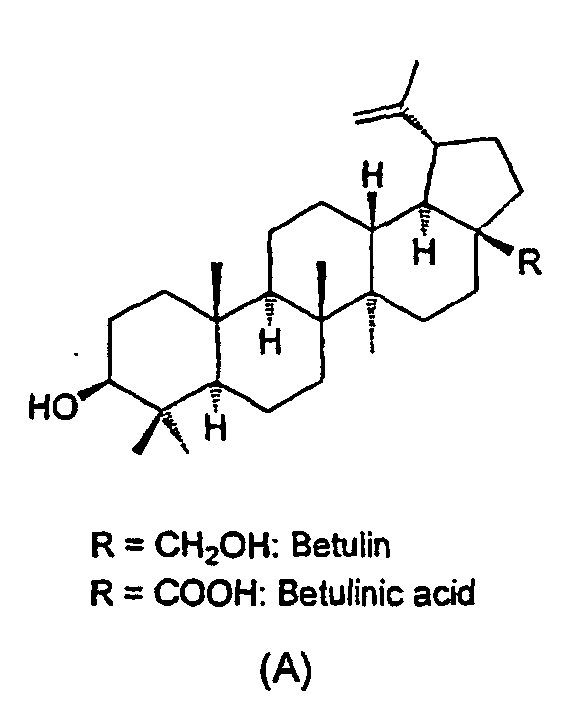
- the present invention relates to the use of triterpenoid compounds derived from the natural products betulin and betulinic acid (BA) as shown in formula (A).
- the compounds of the present invention are referred to hereinafter as betulinines.
- the compounds disclosed herein are believed to be of specific benefit in the treatment of proliferative diseases such as cancers and leukaemias.
- a first aspect of the present invention relates to a compound of formula I, or a pharmaceutically acceptable salt thereof, for use in therapy wherein:
- the invention relates to a compound of formula I, or a pharmaceutically acceptable salt thereof, for treating a patient suffering from leukaemia, cancer or other proliferative disorder.
- a second aspect of the present invention relates to novel betulinines of structural formula Ia, or pharmaceutically acceptable salts thereof, wherein:
- lower alkyl means a linear or branched chain alkyl group containing from 1 to 6 carbon atoms, including methyl, ethyl, propyl, isopropyl, butyl, isobutyl, tertiary butyl.
- R 13 is a diol, triol or polyol.
- R 13 is glycerol, 2,2-dimethyl-1,3-dioxolan-4-yl or pentaerythrityl.
- said compound is of the formula
- the proliferative disorder is cancer or leukaemia.
- the cancer or leukaemia is p53, hormone and multidrug resistance independent.
- the cancer or leukaemia is independent of Rb status.
- the present invention relates to a method of treating patients suffering from cancer by administering therapeutically effective amounts of a compound of formula I or pharmaceutically acceptable salts or esters thereof.
- the compounds of the present invention appear to operate via an alternative mechanism.
- the betulinines of the present invention may inhibit cell proliferation and induce cancer cell death in a manner which involves mainly post-translational modifications, namely the phosphorylation, of a key regulatory protein involved in cellular proliferation. More specifically, it is believed that the betulinines of the invention effect a change in the phosphorylation state of the Rb protein.
- Such a mechanism may be advantageous as it is thought that the compounds of the present invention may be capable of inhibiting cell proliferation in proliferating tumour tissue, but not in healthy tissue.
- the present invention relates to a method of treating a cancerous or leukaemic proliferative disease through effecting a change in the pRb protein phosphorylation state by the administration of a therapeutically effective amount of a compound of formula I, or pharmaceutically acceptable salts or esters thereof.
- the compounds of the present invention are also capable of inducing apoptosis (programmed cell death) in proliferative cells.
- the present invention relates to a method of inducing cell death in proliferative cells comprising administering a therapeutically effective amount of a compound of formula I or pharmaceutically acceptable salts or esters thereof.
- a further aspect of the present invention relates to use of betulinines of formula I as research chemicals and as compounds for clinical and/or laboratory diagnostics.
- the invention relates to the use of betulinines as research chemicals for studying the phosphorylation/de-phosphorylation processes of cellular substrates, cellular proliferation, purification of target molecules, and/or cell cycle studies.
- the present invention therefore further relates to the use of a compound of formula I in the manufacture of a medicament for use in the treatment of a proliferative disease.
- the phrase "manufacture of a medicament” includes the use of a compound of formula I directly as the medicament in addition to its use in a screening programme for further anti-proliferative agents or in any stage of the manufacture of such a medicament.
- Such a screening programme may for example include an assay for determining the phosphorylation state of cellular substrates and determining whether a candidate substance is capable of mimicking the activity of a betulinine of formula I.
- the invention relates to the use of a compound of formula I or a pharmaceutically acceptable salt, crystal form, complex, hydrate, or hydrolysable ester thereof, in an assay for determining the phosphorylation state of cellular substrates, and optionally in the identification of candidate compounds that act in a similar manner.
- the cellular substrate, the phosphorylation state of which is being assayed is Rb protein.
- Such assays may be carried out by incubating a betulinin either alone or together with a candidate substance with a relevant cell line and assessing the phosphorylation profile the Rb protein over a period of time. If a candidate substance is present it's effect on the activity of the control betulinin will be evident by running the corresponding controls (betulinin alone and candidate alone). Further information on such assays including appropriate cell lines,reagents and Rb antibodies is given below.
- Rb protein contains multiple phosphorylation sites for CDKs, its phosphorylated form has molecular weight about 110 kDa, while the molecular weight of hypophosphorylated protein is only 105 kDa. This small difference in molecular weight is enough to separate both forms by conventional SDS-PAGE electrophoresis.
- CEM cells may are cultured in Dulbeco's modified essential medium with 4.5 g dextrose/l, 10% of foetal calf serum, 2 mM glutamine, 100 U/ml penicillin and 100 ⁇ g/ml streptomycin with/without below indicated concentrations of betulinin.
- cells are harvested, washed in ice cold Hank's balanced salt solution and solubilized on ice using the SDS-PAGE sample buffer containing protease and phosphatase inhibitors (10 ⁇ g/ml of leupeptin, 10 ⁇ g/ml of aprotinin, 10 ⁇ g/ml of soybean trypsin inhibitor, 100 ⁇ mol of benzamide, 1 mM of sodium vanadate, 1 mM of NaF, 1 mM of phenylphosphate) and boiled immediately.
- protease and phosphatase inhibitors 10 ⁇ g/ml of leupeptin, 10 ⁇ g/ml of aprotinin, 10 ⁇ g/ml of soybean trypsin inhibitor, 100 ⁇ mol of benzamide, 1 mM of sodium vanadate, 1 mM of NaF, 1 mM of phenylphosphate
- Total cellular proteins (100 ⁇ g/well) are separated on SDS-PAGE electrophoresis, blotted on polyvinyldifluoride membranes and total Rb protein, including proteolytic fragment(s) detected using a pRb monoclonal antibody (Oncogene, Germany, Rb(Ab-5), Cat# OP66 Rev 02-Sept-96 EB, Clone LM95.1) and visualized by chemiluminiscence (ECL-Western Blotting System, Amersham).
- the compounds of the present invention can be present as salts or esters, in particular pharmaceutically acceptable salts or esters.
- compositions of the product of the invention include suitable acid addition or base salts thereof.
- suitable pharmaceutical salts may be found in Berge et al, J Pharm Sci, 66, 1-19 (1977). Salts are formed, for example with strong inorganic acids such as mineral acids, e.g.
- sulphuric acid, phosphoric acid or hydrohalic acids with strong organic carboxylic acids, such as alkanecarboxylic acids of 1 to 4 carbon atoms which are unsubstituted or substituted (e.g., by halogen), such as acetic acid; with saturated or unsaturated dicarboxylic acids, for example oxalic, malonic, succinic, maleic, fumaric, phthalic or tetraphthalic; with hydroxycarboxylic acids, for example ascorbic, glycolic, lactic, malic, tartaric or citric acid; with aminoacids, for example aspartic or glutamic acid; with benzoic acid; or with organic sulfonic acids, such as (C 1 -C 4 )-alkyl- or aryl-sulfonic acids which are unsubstituted or substituted (for example, by a halogen) such as methane- or p-toluene sulfonic acid.
- Esters are formed either using organic acids or alcohols/hydroxides, depending on the functional group being esterified.
- Organic acids include carboxylic acids, such as alkanecarboxylic acids of I to 12 carbon atoms which are unsubstituted or substituted (e.g., by halogen), such as acetic acid; with saturated or unsaturated dicarboxylic acid, for example oxalic, malonic, succinic, maleic, fumaric, phthalic or tetraphthalic; with hydroxycarboxylic acids, for example ascorbic, glycolic, lactic, malic, tartaric or citric acid; with aminoacids, for example aspartic or glutamic acid; with benzoic acid; or with organic sulfonic acids, such as (C 1 -C 4 )-alkyl- or aryl-sulfonic acids which are unsubstituted or substituted (for example, by a halogen) such as methane- or p-to
- Suitable hydroxides include inorganic hydroxides, such as sodium hydroxide, potassium hydroxide, calcium hydroxide, aluminium hydroxide.
- Alcohols include alkanealcohols of 1-12 carbon atoms which may be unsubstituted or substituted, e.g. by a halogen).
- the invention includes, where appropriate all enantiomers and tautomers of compounds of formula I or Ia.
- the man skilled in the art will recognise compounds that possess optical properties (one or more chiral carbon atoms) or tautomeric characteristics.
- the corresponding enantiomers and/or tautomers may be isolated/prepared by methods known in the art.
- the invention furthermore relates to the compounds of, or of use, in the present invention in their various crystalline forms, polymorphic forms and (an)hydrous forms. It is well established within the pharmaceutical industry that chemical compounds may be isolated in any of such forms by slightly varying the method of purification and or isolation from the solvents used in the synthetic preparation of such compounds.
- the invention further includes the compounds of, or of use, in the present invention in prodrug form.
- prodrugs are generally compounds of formula I or Ia wherein one or more appropriate groups have been modified such that the modification is reversed upon administration to a human or mammalian subject.
- Such reversion is usually performed by an enzyme naturally present in such subject, though it is possible for a second agent to be administered together with such a prodrug in order to perform the reversion in vivo.
- modifications include esters (for example, any of those described above), wherein the reversion may be carried out be an esterase etc.
- Other such systems will be well known to those skilled in the art.
- the present invention also encompasses pharmaceutical compositions comprising the compounds of the invention.
- pharmaceutical compositions comprising the compounds of the invention.
- the compounds of the present invention including their pharmaceutically acceptable salts, esters and pharmaceutically acceptable solvates
- they will generally be administered in admixture with a pharmaceutical carrier, excipient or diluent selected with regard to the intended route of administration and standard pharmaceutical practice.
- the present invention also relates to pharmaceutical compositions comprising betulinines or pharmaceutically acceptable salts or esters thereof, together with at least one pharmaceutically acceptable excipient, diluent or carrier.
- the compounds of the invention may be admixed with any suitable binder(s), lubricant(s), suspending agent(s), coating agent(s), and/or solubilising agent(s).
- suitable excipients for the various different forms of pharmaceutical compositions described herein may be found in the "Handbook of Pharmaceutical Excipients, 2 nd Edition, (1994), Edited by A Wade and PJ Weller.
- compositions of the present invention may be adapted for oral, rectal, vaginal, parenteral, intramuscular, intraperitoneal, intraarterial, intrathecal, intrabronchial, subcutaneous, intradermal, intravenous, nasal, buccal or sublingual routes of administration.
- compositions For oral administration, particular use is made of compressed tablets, pills, tablets, gellules, drops, and capsules. Preferably, these compositions contain from 1 to 250 mg and more preferably from 10-100 mg, of active ingredient per dose.
- compositions of the present invention may also be in form of suppositories, pessaries, suspensions, emulsions, lotions, ointments, creams, gels, sprays, solutions or dusting powders.
- the active ingredient can be incorporated into a cream consisting of an aqueous emulsion of polyethylene glycols or liquid paraffin.
- the active ingredient can also be incorporated, at a concentration of between 1 and 10% by weight, into an ointment consisting of a white wax or white soft paraffin base together with such stabilisers and preservatives as may be required.
- Injectable forms may contain between 10 - 1000 mg, preferably between 10 - 250 mg, of active ingredient per dose.
- compositions may be formulated in unit dosage form, i.e., in the form of discrete portions containing a unit dose, or a multiple or sub-unit of a unit dose.
- a person of ordinary skill in the art can easily determine an appropriate dose of one of the instant compositions to administer to a subject without undue experimentation.
- a physician will determine the actual dosage which will be most suitable for an individual patient and it will vary with the age, weight and response of the particular patient.
- the dosages disclosed herein are exemplary of the average case. There can of course be individual instances where higher or lower dosage ranges are merited, and such are within the scope of this invention.
- one or more doses of 10 to 150 mg/day will be administered to the patient for the treatment of malignancy.
- the invention further relates to methods of chemical synthesis of the above described compounds.
- the compound of formula Ib is oxidised to a compound of formula Ic by treating with chromium trioxide.
- Electron impact mass spectra were measured on an INCOS 50 instrument. Ionising electron energy 75 eV, ion source temperature 150°C. EIMS was used to determine molecular weights, M + corresponding to the molecular ion.
- Ether is diethylether. THF and dioxane were dried over sodium. Acetic acid was purified before use by chromium trioxide treatment and distillation. Reactions were run at room temperature unless otherwise stated. The reaction progress was monitored by thin layer chromatography (TLC) on silicagel 60 G (Merck, detection by spraying with 10 % sulphuric acid and heating). The work-up procedure involves dilution with specified solvent (otherwise the organic reaction solvent), extraction with water and then brine or sodium hydrogencarbonate, drying over anhydrous magnesium sulphate, and evaporation under vacuum to give a residue.
- TLC thin layer chromatography
- the 13 C NMR spectrum of the title compound is as follows: 209.2, 179.7, 170.1, 85.9, 71.8, 57.4, 50.9, 48.7, 46.7, 46.2, 46.1, 40.7, 40. 1, 38.2, 35.9, 33.6, 33.4, 32.3, 31.9, 28.7, 27.8, 26.3, 25.5, 24.7, 23.9, 21.2, 21.0, 20.8, 18.9, 17.0, 15.7, 13.6.
- the 13 C NMR spectrum of the title compound is as follows: 213.4, 210.6, 87.9, 87.8, 71.2, 71.2, 60.9, 59.9, 57.1, 52.2, 50.6, 50.4, 48.7, 47.9, 46.8, 46.7, 46.7, 46.5, 41.4, 41.4, 40.9, 40.8, 40.8, 40.4, 37.9, 37.1, 36.7, 36.7, 36.3, 36.3, 34.4, 34.1, 33.5, 32.7, 32.7, 32.4, 29.3, 28.8, 28.8, 26.4, 26.4, 26.4, 26.4, 26.2, 26.2, 26.2, 24.9, 24.5, 24.5, 22.1, 21.4, 21.3, 19.9, 19.5, 19.0, 18.7, 16.7, 15.8, 15.0, 13.4, 13.4.
- the 13 C NMR spectrum of the title compound is as follows: 208.7, 155.4, 154.4, 109.9, 109.8, 87.9, 75.3, 73.2, 73.1, 71.2, 67.8, 66.5, 66.4, 57.3, 50.8, 48.6, 46.8, 46.0, 41.4, 40.9, 40.8, 38.2, 36.3, 36.7, 34.1, 33.5, 32.7, 28.8, 26.8, 26.7, 26.4, 26.2, 26.2, 25.4, 25.3, 24.6, 24.5, 21.3, 21.0, 18.9, 17.0, 15.8, 13.4.
- the 13 C NMR spectrum of the title compound is as follows: 209.3, 154.8, 87.9, 75.5, 71.2, 69.9, 69.8, 68.9, 68.7, 63.0, 57.3, 50.8, 48.7, 46.7, 46.0, 41.4, 40.9, 40.8, 38.3, 36.7, 36.3, 34.1, 33.5, 32.7, 28.8, 26.4, 26.2, 26.2, 24.5, 24.5,21.3, 21.0, 18.9, 17.0, 15.8, 13.4.
- tetrazolium salt MTT is now widely used to quantitate cell proliferation and cytotoxicity [Hajduch M, Mihal V, Minarik J, Fáber E, afárová M, Weigl E, Antálek P.: Cytotechnology, 1996,19,243-245].
- this assay is used in drug screening programs and in chemosensitivity testing. Because tetrazolium salts are cleaved only by metabolically active cells, these assays exclusively detect viable cells.
- Human T-lymphoblastic leukaemia cell line CEM was used for routine screening of these compounds. To prove a common mechanism of action, selected compounds which showed activity in a screening assay were tested in a panel of cell lines (Table 2). These lines were from different species and of different histogenetic origin and they possess various alterations in cell cycle regulatory proteins and hormone dependence status (Table 2). The cells were maintained in Nunc/Coming 80 cm 2 plastic tissue culture flasks and cultured in cell culture medium (DMEM with 5 g/l glucose, 2mM glutamine, 100 U/ml penicillin, 100 ⁇ g/ml streptomycin, 10% foetal calf serum and sodium bicarbonate). Individual compounds were dissolved in 10% dimethylsulfoxide/saline, pH 8.0.
- DMEM cell culture medium
- the cell suspensions that were prepared and diluted according to the particular cell type and the expected target cell density (2.500-30.000 cells per well based on cell growth characteristics) were added by pipette (80 ⁇ l) into 96/well microtiter plates. Inoculates were allowed a pre-incubation period of 24 hours at 37°C and 5% CO 2 for stabilisation. Four-fold dilutions of the intended test concentration were added at time zero in 20 ⁇ l aliquots to the microtiter plate wells. Usually, test compounds were evaluated at six 4-fold dilutions. In routine testing, the highest well concentration was 250 ⁇ M, but it may differ, depending on the agent. All drug concentrations were examined in duplicate.
- Incubations of cells with the test compounds lasted for 72 hours at 37°C, in 5% CO 2 atmosphere and 100% humidity.
- the cells were assayed by using the MTT assay.
- Ten microliters of the MTT stock solution were pipetted into each well and incubated further for 1-4 hours.
- the optical density (OD) was measured at 540nm with the Labsystem iEMS Reader MF (UK).
- TCS tumour cell survival
- betulinic acid which is reported to be an agent selective for neuroectodermal derived tumours, there is no significant difference in the sensitivity of betulinines to tumours of different histogenetic origin.
- the compounds are effective in submicromolar or low micromolar concentrations.
- the non-malignant cells e. g. NIH3T3 fibroblasts and normal human lymphocytes, tolerated substantially higher doses of betulinines than the tumour cells suggesting a favourable therapeutic index.
- betulinines were found to be identical in cell lines bearing various mutations or deletions in cell cycle associated proteins (Table 2). This indicates that these substances should be equally effective in tumours with various alterations of tumour suppressor genes, namely p53, Rb, etc.
- betulinines were shown to be equally effective in drug resistant cell lines as on their maternal counterparts, thereby suggesting that classical mechanisms of multidrug resistance apparently do not apply to these compounds. This particular characteristic should be of significant therapeutic benefit to chemotherapy resistant cancer patients.
- cytotoxic activity of betulinines is independent of the hormonal status of cancer cells, so the compounds should be equally effective in treatment of hormone dependent and independent cancers.
Landscapes
- Chemical & Material Sciences (AREA)
- Health & Medical Sciences (AREA)
- Organic Chemistry (AREA)
- Medicinal Chemistry (AREA)
- Pharmacology & Pharmacy (AREA)
- Life Sciences & Earth Sciences (AREA)
- Animal Behavior & Ethology (AREA)
- General Health & Medical Sciences (AREA)
- Public Health (AREA)
- Veterinary Medicine (AREA)
- Epidemiology (AREA)
- Chemical Kinetics & Catalysis (AREA)
- General Chemical & Material Sciences (AREA)
- Nuclear Medicine, Radiotherapy & Molecular Imaging (AREA)
- Pharmaceuticals Containing Other Organic And Inorganic Compounds (AREA)
- Steroid Compounds (AREA)
- Organic Low-Molecular-Weight Compounds And Preparation Thereof (AREA)
Abstract
Description
- The present invention relates to the therapeutic use and the biological activity of triterpenoid derivatives. The invention further relates to novel triterpenoid derivatives.
- To date, the prior art has primarily focussed on compounds that are capable of regulating the cell cycle by virtue of inhibiting cyclin dependent kinases (CDKs). Examples of such compounds include butyrolactone I, flavopiridol, bohemin, olomoucine, roscovitine, purvanalol and indarubicine.
- There is considerable support in the literature for the hypothesis that CDKs and their regulatory proteins play a significant role in the development of human tumours. Thus, in many tumours a temporal abnormal expression or activity of CDKs has been observed, together with a major deregulation of protein inhibitors (mutations, deletions). This results in the activation of CDKs and consequently in defective regulation of the Gl/S transition. Unlike normal cells, tumour cells do not arrest in G1, and since they become independent of growth factors, they pass the G1 restriction point and enter the S phase very rapidly.
- In contrast to the prior art, the present invention relates to compounds which are anti-proliferative, but which are believed to operate via a mechanism other than CDK inhibition.
- The G1/S transition of the mammalian cell cycle is tightly regulated by the retinoblastoma protein (pRb). Retinoblastoma gene mutations or deletions predispose individuals to familiar retinoblastoma and other types of cancers. The pRb protein is a docking protein, which in hypophosphorylated form has the capacity to bind and thus to inactivate S-phase transcription factors such as DP-1 and E2F. However, following phosphorylation by G1/S cyclin-dependent kinases (CDKs) (CDK4/cyclin D1-D3, CDK6/cyclin D1-D3, CDK2/cyclin A), hyperphosphorylated pRb releases the transcription factors and S phase is initiated. Within the S phase, the pRb protein phosphorylation is maintained by the activity of CDK2/cyclin E complexes. Thus, hyperphosphorylation of the pRb protein plays a key role in the molecular pathology of cancer cells with altered CDK activity.
- The present invention relates to the use of triterpenoid compounds derived from the natural products betulin and betulinic acid (BA) as shown in formula (A). The compounds of the present invention are referred to hereinafter as betulinines.
- With regard to their biological and therapeutic activity, the compounds disclosed herein are believed to be of specific benefit in the treatment of proliferative diseases such as cancers and leukaemias.
- Several of the compounds suitable for use in the present invention are already known in the art, for example those disclosed in Collect. Czech. Chem. Commun. 52, 1052 (1987), Sejbal J. et al.; Hunech, S. Chem. Ber. 98, 1837 (1965); Klinot, J. et al. Collect. Czech. Chem. Commun. 44, 211 (1979); and Huneck, S. Tetrahectron Lett. 6, 375 (1963). However, these disclosures do not include any indication as to possible biological activity of such compounds. WO 98/32443 relates to pharmaceutical formulations of esters of pentacyclic triterpenes such as allobetuline esters of antitumour. antiviral, and antiparasitic activity.
- A first aspect of the present invention relates to a compound of formula I, or a pharmaceutically acceptable salt thereof, for use in therapywherein:

- X1 is C=O;
- X6 is C=O, CH2;
- X7 is O;
- X8 is C=O, C=NOR1b, CHCN, CHOR1b, CHOCOR1b, CHOC(O)OR1b,
- CHOC(O)OR13, CHOSO2CH3, CHOSO2C6H4CH3, CH-Hal, C-(Hal)2, CHN3,
- CH2, C=C(R1b)2, C=CR1bOR1b;
- R2-5 and R11, R12 are Me,
- and wherein R1 is H or lower alkyl, and Hal is Br, Cl, I, F;
- R1a-1b are the same or different groups of R1
- R13 is an OH-substituted alkyl group, an ether group or a cyclic ether.
-
- In a preferred aspect, the invention relates to a compound of formula I, or a pharmaceutically acceptable salt thereof, for treating a patient suffering from leukaemia, cancer or other proliferative disorder.
- A second aspect of the present invention relates to novel betulinines of structural formula Ia, or pharmaceutically acceptable salts thereof,wherein:
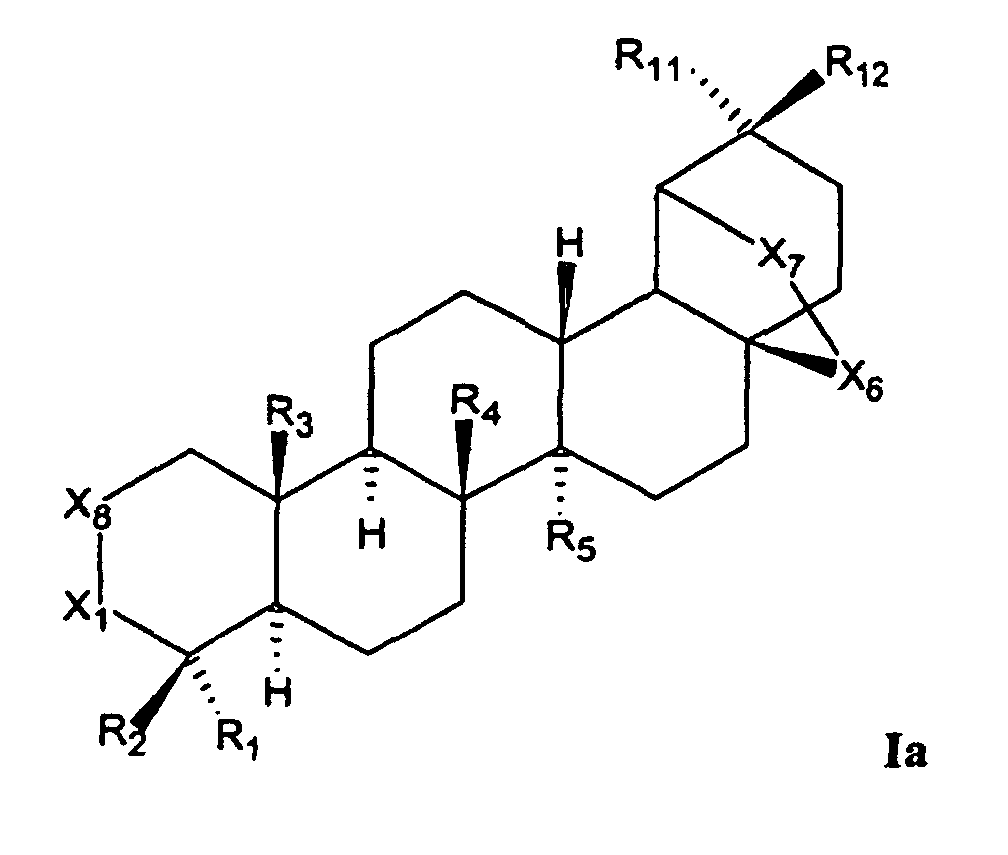
- X1 is C=O;
- X6 is C=O, CH2;
- X7 is O;
- X8 is C=O, C=NOR1b, CHCN, CHOR1b, CHOCOR1b, CHOC(O)OR1b,
- CHOC(O)OR13, CHOSO2CH3, CHOSO2C6H4CH3, CH-Hal, C-(Hal)2, CHN3,
- C=C(R1b)2, C=CR1bOR1b;
- R2-5 and R11, R12 are Me,
- and wherein R1 is H or lower alkyl, and Hal is Br, Cl, I, F;
- R1a-1b are the same or different groups of R1;
- R13 is an OH-substituted alkyl group, an ether group or a cyclic ether;
- with the proviso that when X6 is CH2, X7 is O, R1-5, R11 and R12 are Me;
X8 is other than C=O, C=NOH, C=CHOH, CHBr, CHOH, CHOAc, CHCl, CHOMe or CHOEt. -
- As used herein, the term lower alkyl means a linear or branched chain alkyl group containing from 1 to 6 carbon atoms, including methyl, ethyl, propyl, isopropyl, butyl, isobutyl, tertiary butyl.
- Within the options provided for the groups X1, X6-8, R1-5 and R11-12 of formula I, the following options are preferred:
CHN3 or CHCOOR13. - Preferably, R13 is a diol, triol or polyol.
- Even more preferably, R13 is glycerol, 2,2-dimethyl-1,3-dioxolan-4-yl or pentaerythrityl.
- In an even more preferred embodiment,
X8 is selected from C=O, CHBr, CHOH, CHOAc, C=CH2, C=CHOH, C-Br2, CHN3, CHOC(O)OCH2CHOHCH2OH or CHOC(O)OCH2-2,2-dimethyl-1,3-dioxolan-4-yl. - In a particularly preferred embodiment of the first aspect of the invention, the compounds of use are selected from those shown in Table 1 below:
No. X1 X6 X7 X8 R1-5, R11,12 III.2 C=O C=O O CHOAc Me III.3 C=O CH2 O CHBr Me III.4 C=O CH2 O CHOH Me III.5 C=O CH2 O CHOAc Me III.10 C=O CH2 O CHN3 Me III.13 C=O CH2 O CBr2 Me III.14 C=O CH2 O CF2 Me III.16 C=O CH2 O CHF Me III.21 C=O CH2 O A Me III.22 C=O CH2 O B Me III.29 C=O C=O O CHBr Me III.30 C=O C=O O CBr2 Me III.31 C=O CH2 O C=CH2 Me III.32 C=O CH2 O C=CHOH Me - A is CHOC(O)OCH2CHOHCH2OH and
- B is CHOC(O)OCH2-2,2-dimethyl-1,3-dioxolan-4-yl.
-
- In a particularly preferred embodiment of the invention, said compound is of the formula

- In respect of the second aspect of the invention, the preferred embodiments regarding the compounds are identical to those given above for the first aspect with application of the proviso of formula Ia.
- The most preferred compounds of the second aspect are those in Table 1a below:
No. X1 X6 X7 X8 R1-5, R11,12 III.2 C=O C=O O CHOAc Me III.10 C=O CH2 O CHN3 Me III.13 C=O CH2 O CBr2 Me III.14 C=O CH2 O CF2 Me III.16 C=O CH2 O CHF Me III.21 C=O CH2 O A Me III.22 C=O CH2 O B Me III.29 C=O C=O O CHBr Me III.30 C=O C=O O CBr2 Me III.31 C=O CH2 O C=CH2 Me - A is CHOC(O)OCH2CHOHCH2OH and
- B is CHOC(O)OCH2-2,2-dimethyl-1,3-dioxolan-4-yl.
-
- In respect of the invention as a whole, it is preferable that the proliferative disorder is cancer or leukaemia. In one embodiment, the cancer or leukaemia is p53, hormone and multidrug resistance independent. In another embodiment, the cancer or leukaemia is independent of Rb status.
- More specifically, the present invention relates to a method of treating patients suffering from cancer by administering therapeutically effective amounts of a compound of formula I or pharmaceutically acceptable salts or esters thereof.
- Without wishing to be bound by theory, preliminary studies suggest that rather than influencing the activity of cyclin dependent kinases; the compounds of the present invention appear to operate via an alternative mechanism. In particular, it is believed that the betulinines of the present invention may inhibit cell proliferation and induce cancer cell death in a manner which involves mainly post-translational modifications, namely the phosphorylation, of a key regulatory protein involved in cellular proliferation. More specifically, it is believed that the betulinines of the invention effect a change in the phosphorylation state of the Rb protein. Such a mechanism may be advantageous as it is thought that the compounds of the present invention may be capable of inhibiting cell proliferation in proliferating tumour tissue, but not in healthy tissue.
- Thus, in a further embodiment the present invention relates to a method of treating a cancerous or leukaemic proliferative disease through effecting a change in the pRb protein phosphorylation state by the administration of a therapeutically effective amount of a compound of formula I, or pharmaceutically acceptable salts or esters thereof.
- The compounds of the present invention are also capable of inducing apoptosis (programmed cell death) in proliferative cells. Thus, in an additional embodiment, the present invention relates to a method of inducing cell death in proliferative cells comprising administering a therapeutically effective amount of a compound of formula I or pharmaceutically acceptable salts or esters thereof.
- A further aspect of the present invention relates to use of betulinines of formula I as research chemicals and as compounds for clinical and/or laboratory diagnostics.
- More particularly, the invention relates to the use of betulinines as research chemicals for studying the phosphorylation/de-phosphorylation processes of cellular substrates, cellular proliferation, purification of target molecules, and/or cell cycle studies.
- The present invention therefore further relates to the use of a compound of formula I in the manufacture of a medicament for use in the treatment of a proliferative disease.
- As used herein the phrase "manufacture of a medicament" includes the use of a compound of formula I directly as the medicament in addition to its use in a screening programme for further anti-proliferative agents or in any stage of the manufacture of such a medicament.
- Such a screening programme may for example include an assay for determining the phosphorylation state of cellular substrates and determining whether a candidate substance is capable of mimicking the activity of a betulinine of formula I.
- Thus, in a further embodiment, the invention relates to the use of a compound of formula I or a pharmaceutically acceptable salt, crystal form, complex, hydrate, or hydrolysable ester thereof, in an assay for determining the phosphorylation state of cellular substrates, and optionally in the identification of candidate compounds that act in a similar manner.
- Preferably, the cellular substrate, the phosphorylation state of which is being assayed is Rb protein.
- Such assays may be carried out by incubating a betulinin either alone or together with a candidate substance with a relevant cell line and assessing the phosphorylation profile the Rb protein over a period of time. If a candidate substance is present it's effect on the activity of the control betulinin will be evident by running the corresponding controls (betulinin alone and candidate alone). Further information on such assays including appropriate cell lines,reagents and Rb antibodies is given below.
- Since Rb protein contains multiple phosphorylation sites for CDKs, its phosphorylated form has molecular weight about 110 kDa, while the molecular weight of hypophosphorylated protein is only 105 kDa. This small difference in molecular weight is enough to separate both forms by conventional SDS-PAGE electrophoresis.
- CEM cells may are cultured in Dulbeco's modified essential medium with 4.5 g dextrose/l, 10% of foetal calf serum, 2 mM glutamine, 100 U/ml penicillin and 100 µg/ml streptomycin with/without below indicated concentrations of betulinin. At selected time points, cells are harvested, washed in ice cold Hank's balanced salt solution and solubilized on ice using the SDS-PAGE sample buffer containing protease and phosphatase inhibitors (10 µg/ml of leupeptin, 10 µg/ml of aprotinin, 10 µg/ml of soybean trypsin inhibitor, 100 µmol of benzamide, 1 mM of sodium vanadate, 1 mM of NaF, 1 mM of phenylphosphate) and boiled immediately.
- Total cellular proteins (100 µg/well) are separated on SDS-PAGE electrophoresis, blotted on polyvinyldifluoride membranes and total Rb protein, including proteolytic fragment(s) detected using a pRb monoclonal antibody (Oncogene, Germany, Rb(Ab-5), Cat# OP66 Rev 02-Sept-96 EB, Clone LM95.1) and visualized by chemiluminiscence (ECL-Western Blotting System, Amersham). Details of the Western blot technique are described in Ausubel, F.M., Brent, R., Kingston, R.E., Moore, D.D., Seidman, J.G., Smith, J.A., Struhl, K (Eds): Short Protocols in Molecular Biology, 2nd edition, John Wiley & Sons, New York, Chichester, Brisbane, Toronto, Singapore, 1992, page 10-33 - 10-35.
- The compounds of the present invention can be present as salts or esters, in particular pharmaceutically acceptable salts or esters.
- Pharmaceutically acceptable salts of the product of the invention include suitable acid addition or base salts thereof. A review of suitable pharmaceutical salts may be found in Berge et al, J Pharm Sci, 66, 1-19 (1977). Salts are formed, for example with strong inorganic acids such as mineral acids, e.g. sulphuric acid, phosphoric acid or hydrohalic acids; with strong organic carboxylic acids, such as alkanecarboxylic acids of 1 to 4 carbon atoms which are unsubstituted or substituted (e.g., by halogen), such as acetic acid; with saturated or unsaturated dicarboxylic acids, for example oxalic, malonic, succinic, maleic, fumaric, phthalic or tetraphthalic; with hydroxycarboxylic acids, for example ascorbic, glycolic, lactic, malic, tartaric or citric acid; with aminoacids, for example aspartic or glutamic acid; with benzoic acid; or with organic sulfonic acids, such as (C1-C4)-alkyl- or aryl-sulfonic acids which are unsubstituted or substituted (for example, by a halogen) such as methane- or p-toluene sulfonic acid.
- Esters are formed either using organic acids or alcohols/hydroxides, depending on the functional group being esterified. Organic acids include carboxylic acids, such as alkanecarboxylic acids of I to 12 carbon atoms which are unsubstituted or substituted (e.g., by halogen), such as acetic acid; with saturated or unsaturated dicarboxylic acid, for example oxalic, malonic, succinic, maleic, fumaric, phthalic or tetraphthalic; with hydroxycarboxylic acids, for example ascorbic, glycolic, lactic, malic, tartaric or citric acid; with aminoacids, for example aspartic or glutamic acid; with benzoic acid; or with organic sulfonic acids, such as (C1-C4)-alkyl- or aryl-sulfonic acids which are unsubstituted or substituted (for example, by a halogen) such as methane- or p-toluene sulfonic acid. Suitable hydroxides include inorganic hydroxides, such as sodium hydroxide, potassium hydroxide, calcium hydroxide, aluminium hydroxide. Alcohols include alkanealcohols of 1-12 carbon atoms which may be unsubstituted or substituted, e.g. by a halogen).
- In all aspects of the present invention previously discussed, the invention includes, where appropriate all enantiomers and tautomers of compounds of formula I or Ia. The man skilled in the art will recognise compounds that possess optical properties (one or more chiral carbon atoms) or tautomeric characteristics. The corresponding enantiomers and/or tautomers may be isolated/prepared by methods known in the art.
- The invention furthermore relates to the compounds of, or of use, in the present invention in their various crystalline forms, polymorphic forms and (an)hydrous forms. It is well established within the pharmaceutical industry that chemical compounds may be isolated in any of such forms by slightly varying the method of purification and or isolation from the solvents used in the synthetic preparation of such compounds.
- The invention further includes the compounds of, or of use, in the present invention in prodrug form. Such prodrugs are generally compounds of formula I or Ia wherein one or more appropriate groups have been modified such that the modification is reversed upon administration to a human or mammalian subject. Such reversion is usually performed by an enzyme naturally present in such subject, though it is possible for a second agent to be administered together with such a prodrug in order to perform the reversion in vivo. Examples of such modifications include esters (for example, any of those described above), wherein the reversion may be carried out be an esterase etc. Other such systems will be well known to those skilled in the art.
- The present invention also encompasses pharmaceutical compositions comprising the compounds of the invention. In this regard, and in particular for human therapy, even though the compounds of the present invention (including their pharmaceutically acceptable salts, esters and pharmaceutically acceptable solvates) can be administered alone, they will generally be administered in admixture with a pharmaceutical carrier, excipient or diluent selected with regard to the intended route of administration and standard pharmaceutical practice.
- Thus, the present invention also relates to pharmaceutical compositions comprising betulinines or pharmaceutically acceptable salts or esters thereof, together with at least one pharmaceutically acceptable excipient, diluent or carrier.
- By way of example, in the pharmaceutical compositions of the present invention, the compounds of the invention may be admixed with any suitable binder(s), lubricant(s), suspending agent(s), coating agent(s), and/or solubilising agent(s). Examples of such suitable excipients for the various different forms of pharmaceutical compositions described herein may be found in the "Handbook of Pharmaceutical Excipients, 2nd Edition, (1994), Edited by A Wade and PJ Weller.
- The pharmaceutical compositions of the present invention may be adapted for oral, rectal, vaginal, parenteral, intramuscular, intraperitoneal, intraarterial, intrathecal, intrabronchial, subcutaneous, intradermal, intravenous, nasal, buccal or sublingual routes of administration.
- For oral administration, particular use is made of compressed tablets, pills, tablets, gellules, drops, and capsules. Preferably, these compositions contain from 1 to 250 mg and more preferably from 10-100 mg, of active ingredient per dose.
- Other forms of administration comprise solutions or emulsions which may be injected intravenously, intraarterially, intrathecally, subcutaneously, intradermally, intraperitoneally or intramuscularly, and which are prepared from sterile or sterilisable solutions. The pharmaceutical compositions of the present invention may also be in form of suppositories, pessaries, suspensions, emulsions, lotions, ointments, creams, gels, sprays, solutions or dusting powders.
- An alternative means of transdermal administration is by use of a skin patch. For example, the active ingredient can be incorporated into a cream consisting of an aqueous emulsion of polyethylene glycols or liquid paraffin. The active ingredient can also be incorporated, at a concentration of between 1 and 10% by weight, into an ointment consisting of a white wax or white soft paraffin base together with such stabilisers and preservatives as may be required.
- Injectable forms may contain between 10 - 1000 mg, preferably between 10 - 250 mg, of active ingredient per dose.
- Compositions may be formulated in unit dosage form, i.e., in the form of discrete portions containing a unit dose, or a multiple or sub-unit of a unit dose.
- A person of ordinary skill in the art can easily determine an appropriate dose of one of the instant compositions to administer to a subject without undue experimentation. Typically, a physician will determine the actual dosage which will be most suitable for an individual patient and it will vary with the age, weight and response of the particular patient. The dosages disclosed herein are exemplary of the average case. There can of course be individual instances where higher or lower dosage ranges are merited, and such are within the scope of this invention.
- In an exemplary embodiment, one or more doses of 10 to 150 mg/day will be administered to the patient for the treatment of malignancy.
- The invention further relates to methods of chemical synthesis of the above described compounds.
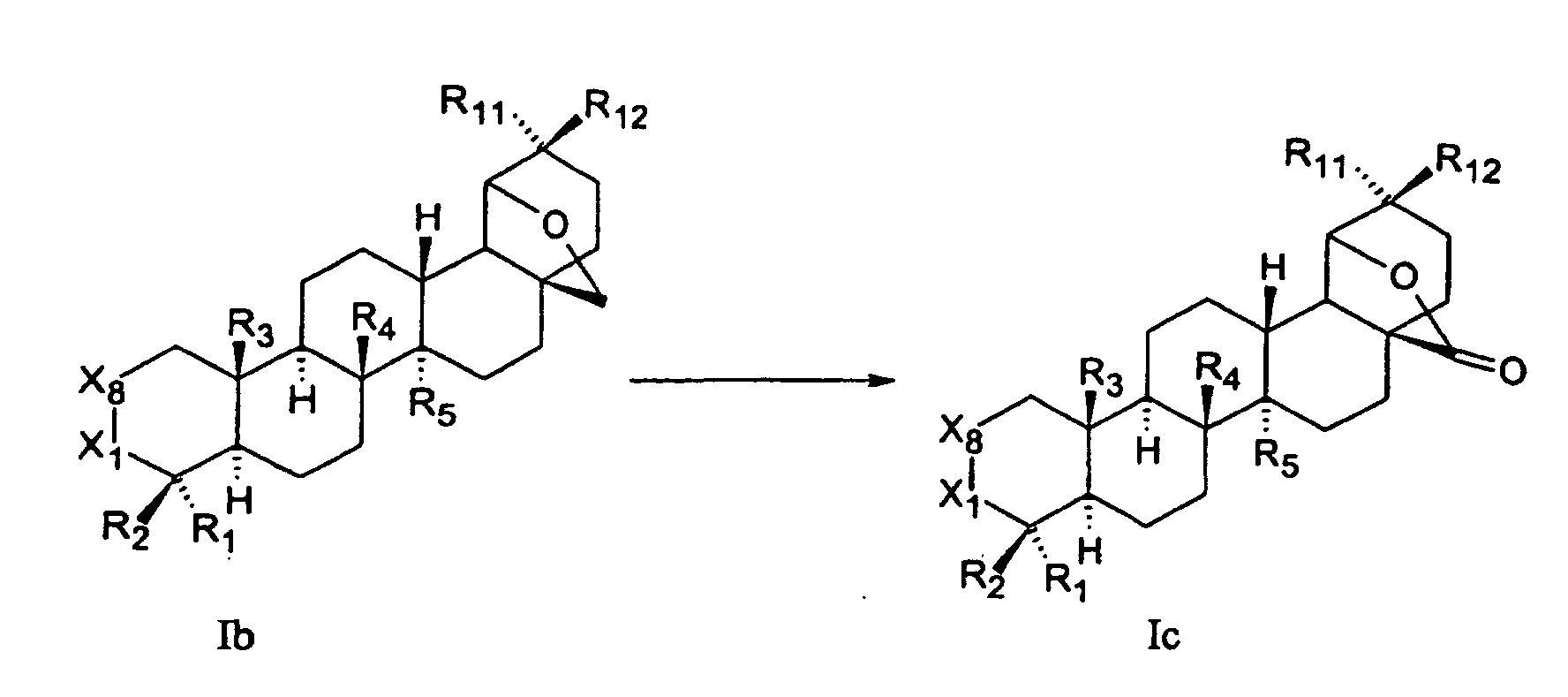
- In one embodiment, the invention relates to a process for preparing a compound of formula I, as defined above, wherein X6 is C=O,comprising oxidising a compound of formula Ib to a compound of formula Ic.
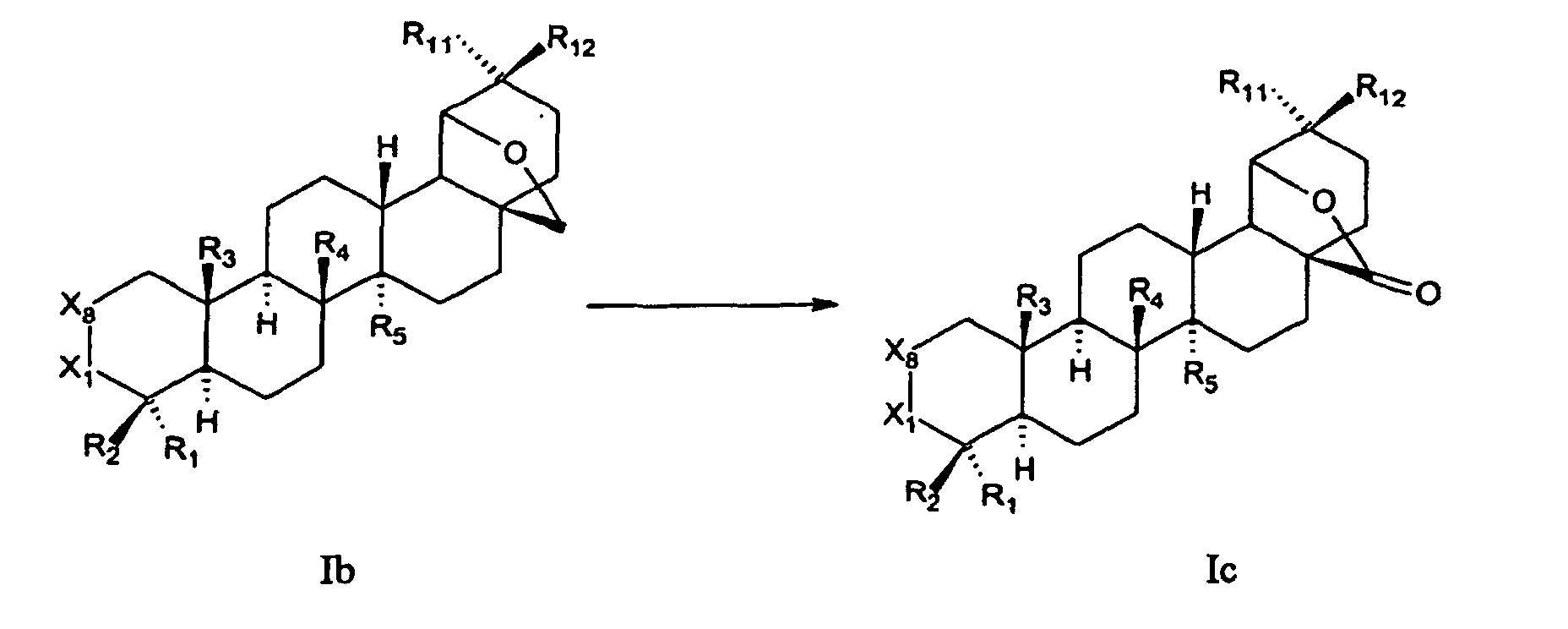
- In a preferred embodiment the compound of formula Ib is oxidised to a compound of formula Ic by treating with chromium trioxide.
- The preparation of the compounds of the present invention will be discussed in greater detail below, with specific reference to the preferred embodiments. The man skilled in the relevant art would be able to prepare other compounds of the invention by selection of the appropriate reagents.
- The following scheme illustrates the synthesis of compounds of formula I where R1-R5, R11, R12 are methyls, X7 is oxygen, X6 is C=O, X1 is C=O and X8 is CHOAc.Conditions: a, oxidation (e.g. with chromium trioxide)

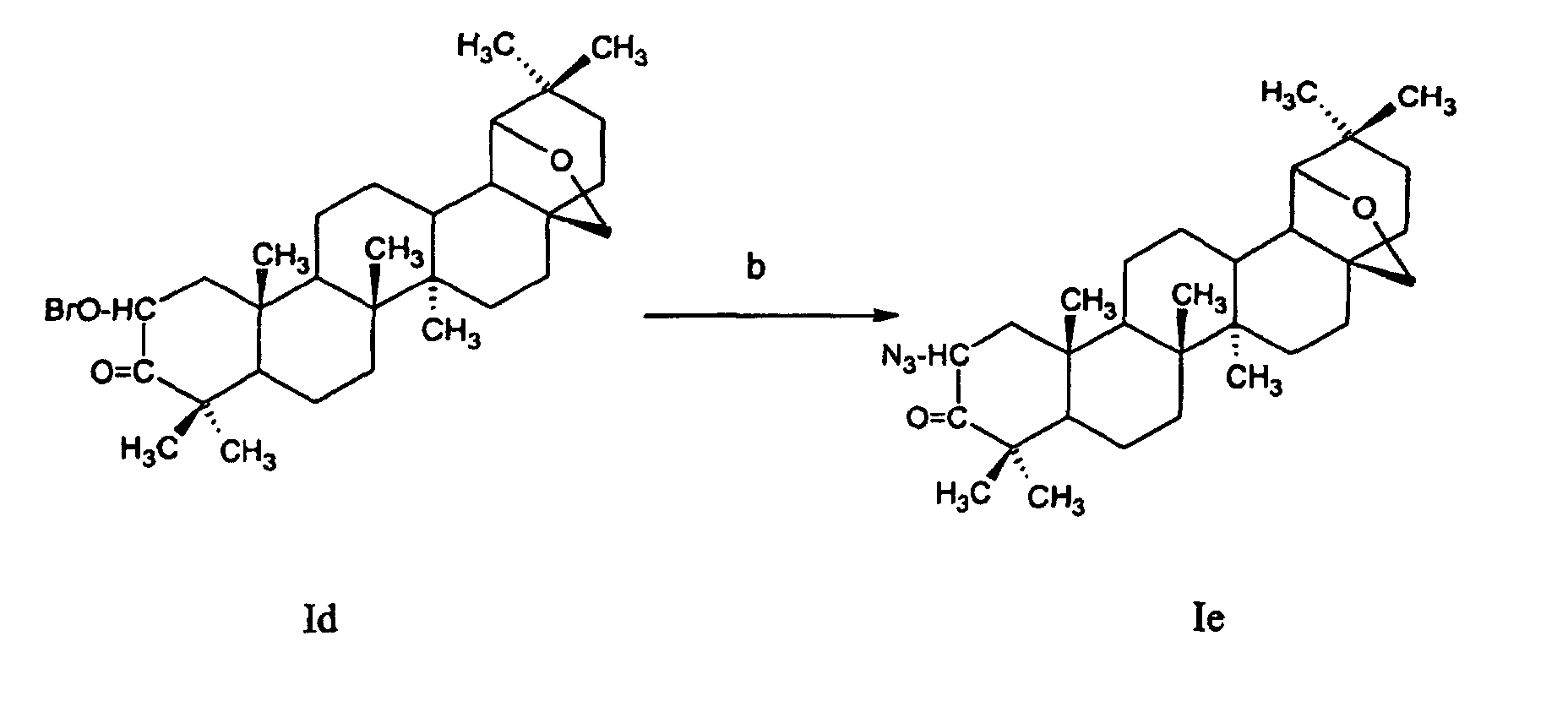
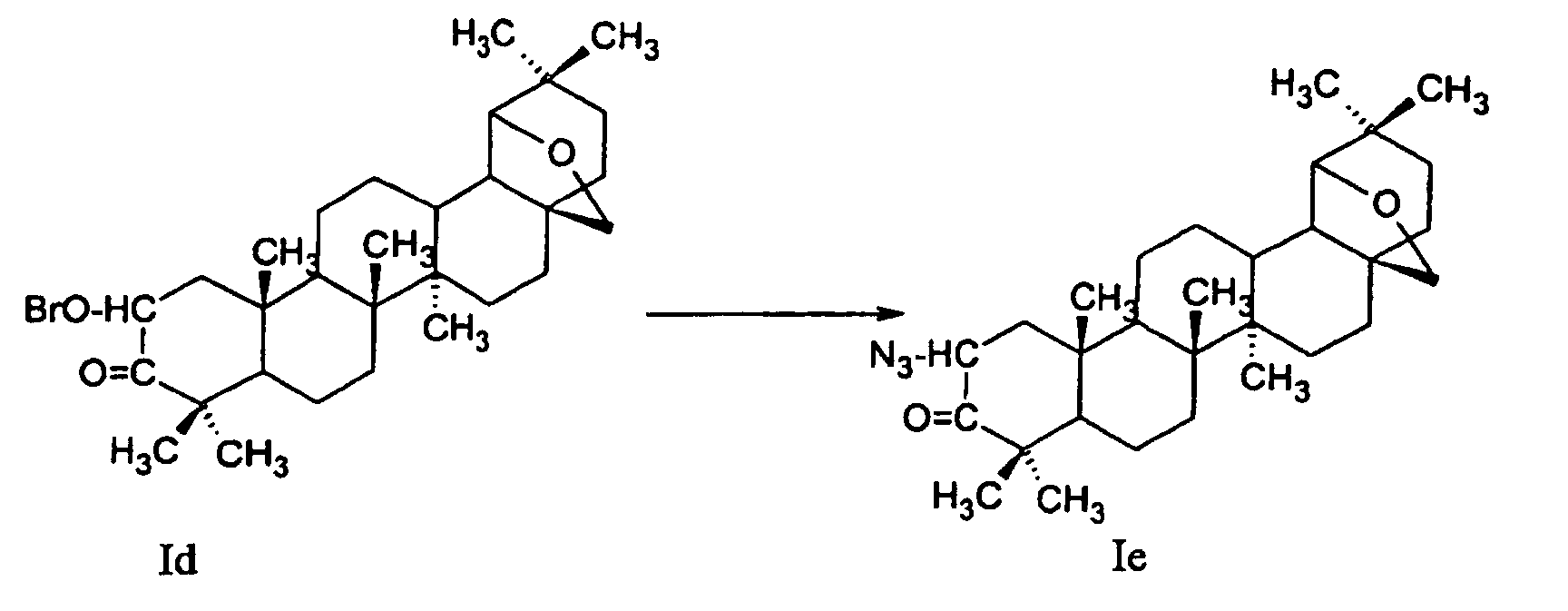
- The scheme below illustrates the synthesis of compound III.10 of formula I where R1-R5, R11, R12 are methyls, X7 is oxygen, X6 is CH2.Conditions: b, nucleophilic substitution with sodium azide (e.g. in N-methylpyrrolid-2-one).
- The scheme below illustrates the synthesis of compounds III.21 and III.22 of formula I where R1-5, R11,12 are methyls, X7 is oxygen, X6 is CH2.Conditions: c, esterification with chloroformate of solketal in presence of base (e.g. pyridine); d, deprotection of acetonide (e.g. with hydrochloric acid).

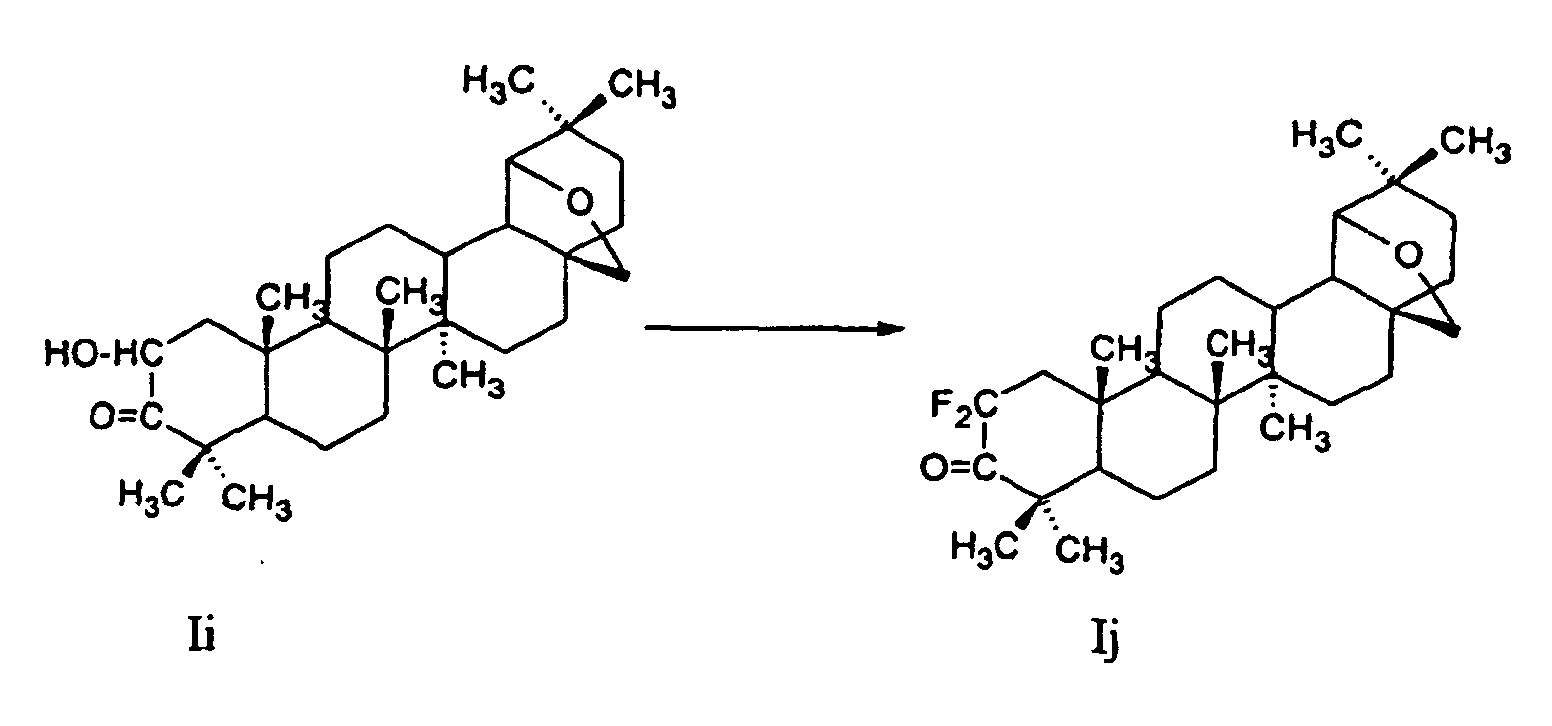
- The scheme below illustrates the synthesis of compound III.14 of formula I where R1-R5, R11, R12 are methyls, X7 is oxygen, X6 is CH2.Conditions: e, reaction with diethylaminosulphur trifluoride.

- This invention is further illustrated by the following examples, which should not be construed as further limiting.
- The chemical shift values (δ-scale, ppm) and coupling constants (J, Hz) in the 1H and 13C NMR spectra were obtained using a Varian UNITY-INOVA 400 FT spectrometer (1H at 400 MHz and 13C at 100.6 MHz) in deuterochloroform with tetramethylsilane (for 1H NMR data δ = 0 ppm) as an internal standard. For the 13C NMR data δ(CDCl3) = 77.00 ppm. The value for a multiple!, either defined (doublet (d), triplet (t), quartet (q), septet (sept.)) or not (m), at the approximate mid point is given unless a range is quoted (s = singlet, b = broad).
- Electron impact mass spectra (EIMS) were measured on an INCOS 50 instrument. Ionising electron energy 75 eV, ion source temperature 150°C. EIMS was used to determine molecular weights, M+ corresponding to the molecular ion.
- Ether is diethylether. THF and dioxane were dried over sodium. Acetic acid was purified before use by chromium trioxide treatment and distillation. Reactions were run at room temperature unless otherwise stated. The reaction progress was monitored by thin layer chromatography (TLC) on silicagel 60 G (Merck, detection by spraying with 10 % sulphuric acid and heating). The work-up procedure involves dilution with specified solvent (otherwise the organic reaction solvent), extraction with water and then brine or sodium hydrogencarbonate, drying over anhydrous magnesium sulphate, and evaporation under vacuum to give a residue.
- Chromium trioxide (2 g; 20 mmol) was added to a solution of 3-oxo-19β,28β-epoxy-18α-oleanan-2-yl acetate [Sejbal J., Klinot J., Vystrcil A.: Collect. Czech. Chem. Commun. 52, 1052 (1987)] (1 g; 2 mmol) in acetic acid (15 ml). The mixture was stirred for 3 hours at a higher temperature. The resulting precipitate was filtered off and washed with acetic acid and methanol. The yield of white crystalline solid was 0.3 g (30%), m.p.315 - 317°C, [α]D +47° (c 0.29; CHCl3).
- The 13C NMR spectrum of the title compound is as follows: 209.2, 179.7, 170.1, 85.9, 71.8, 57.4, 50.9, 48.7, 46.7, 46.2, 46.1, 40.7, 40. 1, 38.2, 35.9, 33.6, 33.4, 32.3, 31.9, 28.7, 27.8, 26.3, 25.5, 24.7, 23.9, 21.2, 21.0, 20.8, 18.9, 17.0, 15.7, 13.6.
- Sodium azide (0.75 g; 11.6 mmol) was added to a solutiom of 2-brom-3-oxo-19β,28β-epoxy-18α-oleanan [Klinot J., Vystrcil A.: Collect. Czech. Chem. Commun. 31, 1079 (1966)] (1 g; 1.9 mmol) in N-methylpyrrolidone (20 ml) and acetic acid (1 ml). The mixture was stirred for 19 hours at room temperature. The product was worked up by general manner and crystallized from ethyl acetate. The yield of pale yellow crystalline solid was 0.5 g (54%), m.p. 94 -97°C, [α]D +91° (c 0.50; CHCl3).
- The 13C NMR spectrum of the title compound is as follows: 213.4, 210.6, 87.9, 87.8, 71.2, 71.2, 60.9, 59.9, 57.1, 52.2, 50.6, 50.4, 48.7, 47.9, 46.8, 46.7, 46.7, 46.5, 41.4, 41.4, 40.9, 40.8, 40.8, 40.4, 37.9, 37.1, 36.7, 36.7, 36.3, 36.3, 34.4, 34.1, 33.5, 32.7, 32.7, 32.4, 29.3, 28.8, 28.8, 26.4, 26.4, 26.4, 26.2, 26.2, 26.2, 24.9, 24.5, 24.5, 22.1, 21.4, 21.3, 19.9, 19.5, 19.0, 18.7, 16.7, 15.8, 15.0, 13.4, 13.4.
- A solution of 19β,28β-epoxy-2α-hydroxy-18α-oleanan-3-one (0.2 g; 0.4 mmol) in a mixture of dichloromethane (3.2 ml), pyridine (0.16 ml) and chloroformate of solketal (0.32 ml; 1.6 mmol) was vigorously stirred for 3 hours at room temperature. After the reaction was complete, the mixture was slowly poured into 50 ml of 5 % hydrochloric acid with ice, twice extracted with chloroform. The combined organic layers were worked up in the usual manner and chromatographed on silica gel (20 % ethyl acetate in hexane). The yield of snow-white lyophilized (from 2-methyl-2-propanol) powder was 0.19 g (70%), m.p. 192 -194°C, [α]D +47° (c 0.54; CHCl3).
- The 13C NMR spectrum of the title compound is as follows: 208.7, 155.4, 154.4, 109.9, 109.8, 87.9, 75.3, 73.2, 73.1, 71.2, 67.8, 66.5, 66.4, 57.3, 50.8, 48.6, 46.8, 46.0, 41.4, 40.9, 40.8, 38.2, 36.3, 36.7, 34.1, 33.5, 32.7, 28.8, 26.8, 26.7, 26.4, 26.2, 26.2, 25.4, 25.3, 24.6, 24.5, 21.3, 21.0, 18.9, 17.0, 15.8, 13.4.
- Dilute aqueous HCl (10 %; 1.5 ml) was added to a solution of 19β,28β-epoxy-18α-oleanan-3-oxo-2α-yl [(2,2-dimethyl-1,3-dioxolan-4-yl)methyl] carbonate (0.1 g; 0.2 mmol) in THF (3 ml) and the resulting clear reaction mixture was stirred for ten hours at 30°C. After the reaction was complete, the mixture was diluted with cold water (50 ml) and twice extracted with ethyl acetate. The combined organic layers were worked up in the usual manner and chromatographed on silica gel (75 % ethyl acetate in hexane). The yield of white lyophilized (from 2-methyl-2-propanol) solid was 0.069 g (74%), m.p. 174 -176°C, [α]D +43° (c 0.53; CHCl3).
- The 13C NMR spectrum of the title compound is as follows: 209.3, 154.8, 87.9, 75.5, 71.2, 69.9, 69.8, 68.9, 68.7, 63.0, 57.3, 50.8, 48.7, 46.7, 46.0, 41.4, 40.9, 40.8, 38.3, 36.7, 36.3, 34.1, 33.5, 32.7, 28.8, 26.4, 26.2, 26.2, 24.5, 24.5,21.3, 21.0, 18.9, 17.0, 15.8, 13.4.
- Diethylaminosulphur trifluoride (DAST, 0.2 ml; 1.3 mmol) was added dropwise to a solution of 19β,28β-epoxy-2α-hydroxy-18α-oleanan-3-one (0.2 g; 0.4 mmol) in dry chloroform (2 ml) and the reaction mixture was stirred overnight at room temperature. After the reaction was complete, the mixture was slowly poured into cold water (50 ml) and twice extracted with chloroform. The combined organic fractions were worked up in the usual manner and chromatographed on silica gel (10 % ethyl acetate in hexane). The residue was crystallized from isopropyl alcohol to give 0.07 g (36%) of the title compound as pearl petals, m.p. 243 -245°C, [α]D +123° (c 0.52; CHCl3).
- The 13C NMR spectrum of the title compound is as follows: 204.6 dd (J1 = 25.2, J2 = 22.5), 115.8 dd (J1 = 257.9, J2 = 244.6), 87.9 s, 71.2 s, 51.8 dd (J1 = 22.5, J2 = 20.2), 50.9 s, 50.1 s, 46.7 s, 45.9 s, 41.4 s, 40.8 s, 40.5 s, 37.1 dds (J1 = 5.3, J2 = 2.3), 36.7 s, 36.3 s, 34.3 s, 32.7 s, 32.3 s, 28.8 s, 28.1 d(J1 = 3.8), 26.4 s, 26.3 s, 26.1 s, 24.5 s, 21.9 s, 21.0 d (J1 =1.1), 19.6 s, 18.5 s, 15.1 s, 13.4 s.
- One of the parameters used as the basis for colorimetric assays is the metabolic activity of viable cells. For example, a microtiter assay which uses the tetrazolium salt MTT is now widely used to quantitate cell proliferation and cytotoxicity [Hajduch M, Mihal V, Minarik J, Fáber E,afárová M, Weigl E, Antálek P.: Cytotechnology, 1996,19,243-245]. For instance, this assay is used in drug screening programs and in chemosensitivity testing. Because tetrazolium salts are cleaved only by metabolically active cells, these assays exclusively detect viable cells. In the case of the MTT assay, yellow soluble tetrazolium salt is reduced to a coloured water-insoluble formazan salt. After it is solubilized, the formazan formed can easily and rapidly be quantified in a conventional ELISA plate reader at 570 nm (maximum absorbancy). The quantity of reduced formazan corresponds to the number of vital cells in the culture.

- Human T-lymphoblastic leukaemia cell line CEM was used for routine screening of these compounds. To prove a common mechanism of action, selected compounds which showed activity in a screening assay were tested in a panel of cell lines (Table 2). These lines were from different species and of different histogenetic origin and they possess various alterations in cell cycle regulatory proteins and hormone dependence status (Table 2). The cells were maintained in Nunc/Coming 80 cm2 plastic tissue culture flasks and cultured in cell culture medium (DMEM with 5 g/l glucose, 2mM glutamine, 100 U/ml penicillin, 100 µg/ml streptomycin, 10% foetal calf serum and sodium bicarbonate). Individual compounds were dissolved in 10% dimethylsulfoxide/saline, pH 8.0.
- The cell suspensions that were prepared and diluted according to the particular cell type and the expected target cell density (2.500-30.000 cells per well based on cell growth characteristics) were added by pipette (80 µl) into 96/well microtiter plates.
Inoculates were allowed a pre-incubation period of 24 hours at 37°C and 5% CO2 for stabilisation. Four-fold dilutions of the intended test concentration were added at time zero in 20 µl aliquots to the microtiter plate wells. Usually, test compounds were evaluated at six 4-fold dilutions. In routine testing, the highest well concentration was 250 µM, but it may differ, depending on the agent. All drug concentrations were examined in duplicate. Incubations of cells with the test compounds lasted for 72 hours at 37°C, in 5% CO2 atmosphere and 100% humidity. At the end of the incubation period, the cells were assayed by using the MTT assay. Ten microliters of the MTT stock solution were pipetted into each well and incubated further for 1-4 hours. After this incubation period, formazan was solubilized by the addition of 100µl/well of 10% SDS in water (pH=5.5) followed by further incubation at 37°C overnight. The optical density (OD) was measured at 540nm with the Labsystem iEMS Reader MF (UK). The tumour cell survival (TCS) was calculated using the following equitation: TCS= (ODdrug exposed well /mean ODcontrol wells) x 100%. The TCS50 value, the drug concentration lethal to 50% of the tumour cells, was calculated from the obtained dose response curves. - To evaluate the anti-cancer activity of betulinines, their cytotoxic activity against CEM cell line was examined using the screening assay. Potent compounds were further tested against a panel of cell lines of different histogenetic and species origin (Table 2).
Cytotoxic activity of selected betulinines against a panel of different (non)malignant cell lines. Cell Line Description Compound (TCS50[mM]) Betulinic Acid III.3 III.10 III.14 B16 mouse melanoma 36 2.1 B16F mouse melanoma, metastatic 4.6 4.7 SW620 human colon cancer, metastasis 250 1.2 U87MG human glioblastoma 250 5.1 HepG2 human hepatocellular carcinoma 3.6 1.7 A549 human lung adenocarcinoma 236 1.0 MCF-7 human breast cancer, estrogen dependent, p53+/+, Rb +/+ 194 2.3 U20S human osteosarcoma, p53+/-, Rb +/- 250 1.5 Saos2 human rhabdomyosarcoma, p53-/-, Rb-/- 250 1.8 BT549 human breast cancer, p53mut/mut 250 2.0 MDA-MB-238 human breast cancer, estrogen independent, p53mut/mut 195 1.4 LNCaP human prostate cancer, androgen dependent 244 1.1 DU145 human prostate cancer, androgen independent, Rb-/- 241 0.8 HT-29 human colon cancer 250 1.6 OVCAR-3 human ovarian cancer 164 1.0 Caco-2 human colon cancer 20 3.0 MEL-3 human melanoma 2.7 1.3 Lymphocytes human normal lymphocytes 250 13 NIH3T3 mouse immortalised fibroblasts 250 7.2 K562 human promyelocytic leukemia 250 0.2 K562-CdA human promyelocytic leukemia, cladrubin resistant 250 0.3 K562-GEM human promyelocytic leukemia, gemcitabin resistant 101 1 0.9 K562-ARA-C human promyelocytic leukemia, cytarabin resistant 250 0.6 K562-FLUD human promyelocytic leukemia, fludarabin resistant 250 0.4 CEM human T-lymphoblastic leukemia 250 1.0 13 170 CEM-DNR 1/C2 human T-lymphoblastic leukemia, daunorubicin resistant 250 0.6 CEM-DNR bulk human T-lymphoblastic leukemia, daunorubicin resistant 250 1.1 CEM-VCR 1/F3 human T-lymphoblastic leukemia, vincristin resistant 19 3.3 CEM-VCR 3/D5 human T-lymphoblastic leukemia, vincristin resistant 24 2.9 CEM-VCR bulk human T-lymphoblastic leukemia, vincristin resistant 69 2.5 - In contrast to betulinic acid, which is reported to be an agent selective for neuroectodermal derived tumours, there is no significant difference in the sensitivity of betulinines to tumours of different histogenetic origin.
- The compounds are effective in submicromolar or low micromolar concentrations. However, the non-malignant cells, e. g. NIH3T3 fibroblasts and normal human lymphocytes, tolerated substantially higher doses of betulinines than the tumour cells suggesting a favourable therapeutic index.
- Notably, the effectiveness of betulinines was found to be identical in cell lines bearing various mutations or deletions in cell cycle associated proteins (Table 2). This indicates that these substances should be equally effective in tumours with various alterations of tumour suppressor genes, namely p53, Rb, etc.
- Furthermore, betulinines were shown to be equally effective in drug resistant cell lines as on their maternal counterparts, thereby suggesting that classical mechanisms of multidrug resistance apparently do not apply to these compounds. This particular characteristic should be of significant therapeutic benefit to chemotherapy resistant cancer patients.
- Finally, the cytotoxic activity of betulinines is independent of the hormonal status of cancer cells, so the compounds should be equally effective in treatment of hormone dependent and independent cancers.
- Those skilled in the art will recognise, or be able to ascertain using no more than routine experimentation, many equivalents to the specific embodiments of the invention described herein. Such equivalents are intended to be encompassed by the claims.
Claims (20)
- A compound of formula I, or a pharmaceutically acceptable salt thereof, for use in therapywherein:
 X1 is C=O;X6 is C=O, CH2;X7 is O;X8 is C=O, C=NOR1b, CHCN, CHOR1b, CHOCOR1b, CHOC(O)OR1b, CHOC(O)OR13, CHOSO2CH3, CHOSO2C6H4CH3, CH-Hal, C-(Hal)2,CHN3, CH2, C=C(R1b)2, C=CR1bOR1b;R2-5 and R11, R12 are Me,and wherein R1 is H or C1-C6 alkyl, and Hal is Br, Cl, I, F;R1a-1b are the same or different groups of R1R13 is an OH-substituted alkyl group, an ether group or acyclic ether.
 - A compound according to claim 1 wherein:X8 is C=O, CH-Hal, CHOR1a, CHOCOR1a, C=C(R1b)2, C=CR1bOR1b, C-Hal2, CHN3 or CHCOOR13.
- A compound according to claim 1 or claim 2 wherein R13 is a diol, triol or polyol.
- A compound according to claim 1 or claim 2 wherein R13 is glyceryl, 2,2-dimethyl-1,3-dioxolan-4-yl or pentaerythrityl.
- A compound according to any preceding claim wherein:X8 is selected from C=O, CHBr, CHOH, CHOAc, C=CH2, C=CHOH, C-Br2, CHN3, CHOC(O)OCH2CHOHCH2OH or CHOC(O)OCH2-2,2-dimethyl-1,3-dioxolan-4-yl.
- A compound according to any preceding claim wherein the compound of formula I is selected from the following table:
No. X1 X6 X7 X8 R1-5, R11,12 III.2 C=O C=O O CHOAc Me III.3 C=O CH2 O CHBr Me III.4 C=O CH2 O CHOH Me III.5 C=O CH2 O CHOAc Me III.10 C=O CH2 O CHN3 Me III.13 C=O CH2 O CBr2 Me III.14 C=O CH2 O CF2 Me III.16 C=O CH2 O CHF Me III.21 C=O CH2 O A Me III.22 C=O CH2 O B Me III.29 C=O C=O O CHBr Me III.30 C=O C=O O CBr2 Me III.31 C=O CH2 O C=CH2 Me III.32 C=O CH2 O C=CHOH Me A is CHOC(O)OCH2CHOHCH2OH andB is CHOC(O)OCH2-2,2-dimethyl-1,3-dioxolan-4-yl. - A compound according to any preceding claim wherein said compound is

- A compound according to any preceding claim for treating a proliferative disorder.
- Use of a compound of formula I, or a pharmaceutically acceptable salt thereof, for manufacture of medicament for use in the treatment of a proliferative disorder.
- A compound of formula Ia, or a pharmaceutically acceptable salt thereof,wherein:
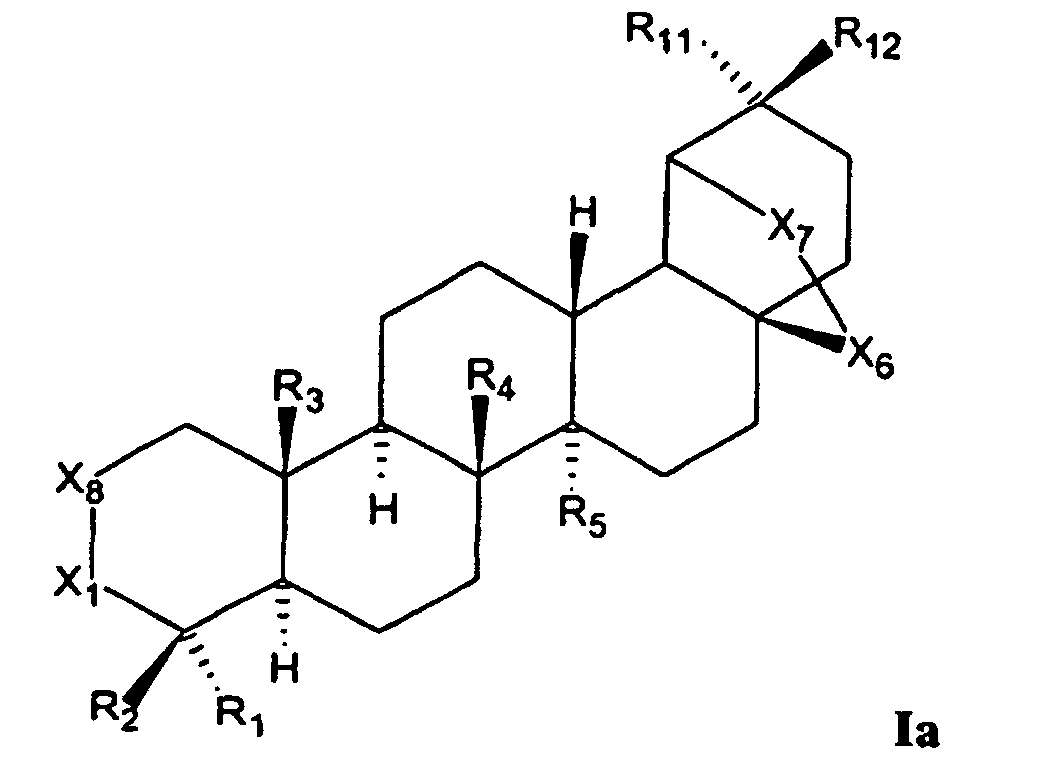 with the proviso that when X6 is CH2, X7 is O, R1-5, R11 and R12 are Me;X1 is C=O;X6 is C=O, CH2;X7 is O;X8 is C=O, C=NOR1b, CHCN, CHOR1b, CHOCOR1b, CHOC(O)OR1b, CHOC(O)OR13, CHOSO2CH3, CHOSO2C6H4CH3, CH-Hal, C-(Hal)2, CHN3, C=C(R1b)2, C=CR1bOR1b;R2-5 and R11, R12 are Me,and wherein R' is H or C1-C6 alkyl, and Hal is Br, Cl, I, F;R1a-1b are the same or different groups of R1;R13 is an OH-substituted alkyl group, an ether group or a cyclic ether.
X8 is other than C=O, C=NOH, C=CHOH, CHBr, CHOH, CHOAc, CHCl, CHOMe or CHOEt. - A compound according to claim 10 wherein:X8 is C=O, CH-Hal, CHOR1a, CHOCOR1a, C=C(R1b)2, C=CR1bOR1b, C-Hal2, CHN3 or CHCOOR13.
- A compound according to claim 10 or 11 wherein R13 is a diol, triol or polyol.
- A compound according to claim 10 or claim 11 wherein R13 is glyceryl, 2,2-dimethyl-1,3-dioxolan-4-yl or pentaerythrityl.
- A compound according to any one of claims 10 to 13 wherein:X8 is selected from C=O, CH-Br, CHOH, CHOAc, C=CH2, C=CHOH, C-Br2, CHN3, CHOC(O)OCH2CHOHCH20H or CHOC(O)OCH2-2,2-dimethyl-1,3-dioxolan-4-yl.
- A compound according to any one of claims 10 to 14 selected from the following table:
No. X1 X6 X7 X8 R1-5, R11,12 III.2 C=O C=O O CHOAc Me III.10 C=O CH2 O CHN3 Me III.13 C=O CH2 O CBr2 Me III.14 C=O CH2 O CF2 Me III.16 C=O CH2 O CHF Me III.21 C=O CH2 O A Me III.22 C=O CH2 O B Me III.29 C=O C=O O CHBr Me III.30 C=O C=O O CBr2 Me III.31 C=O CH2 O C=CH2 Me A is CHOC(O)OCH2CHOHCH2OH andB is CHOC(O)OCH2-2,2-dimethyl-1,3-dioxolan-4-yl. - A process for preparing a compound of formula I, as defined in claim 1, wherein X6 is C=O, comprising oxidising a compound of formula Ib to a compound of formula Ic
- A process according to claim 16 wherein the compound of formula Ib is oxidised to a compound of formula Ic by treating with chromium trioxide.
- A process for preparing a compound of formula I, as defined in claim 1, wherein R1-R5, R11, R12 are methyl, X7 is O, X6 is CH2, comprising reacting a compound of formula Id with sodium azide to form a compound of formula Ie
- A process for preparing a compound of formula I, as defined in claim 1,
wherein R1-R5, R11, R12 are methyl, X7 is O, X6 is CH2, comprising(i) reacting a compound of formula If with chloroformate of solketal to form a compound of formula Ig;(ii) deprotecting said compound of formula Ig to form a compound of formula Ih
- A process for preparing a compound of formula I, as defined in claim 1, wherein R1-R5, R11, R12 are methyl, X7 is O, X6 is CH2, comprising reacting a compound of formula Ii with diethylaminosulphur trifluoride to form a compound of formula Ij
Applications Claiming Priority (5)
| Application Number | Priority Date | Filing Date | Title |
|---|---|---|---|
| GB0012532A GB0012532D0 (en) | 2000-05-23 | 2000-05-23 | Triterpenoid derivatives |
| GB0012532 | 2000-05-23 | ||
| GB0012825 | 2000-05-25 | ||
| GB0012825A GB2362650A (en) | 2000-05-25 | 2000-05-25 | Triterpenoid derivatives |
| PCT/GB2001/002341 WO2001090096A2 (en) | 2000-05-23 | 2001-05-23 | Triterpenoid derivatives and their use as antiproliferative agents |
Publications (2)
| Publication Number | Publication Date |
|---|---|
| EP1289977A2 EP1289977A2 (en) | 2003-03-12 |
| EP1289977B1 true EP1289977B1 (en) | 2005-03-23 |
Family
ID=26244333
Family Applications (1)
| Application Number | Title | Priority Date | Filing Date |
|---|---|---|---|
| EP01931948A Expired - Lifetime EP1289977B1 (en) | 2000-05-23 | 2001-05-23 | Triterpenoid derivatives and their use as antiproliferative agents |
Country Status (5)
| Country | Link |
|---|---|
| EP (1) | EP1289977B1 (en) |
| AT (1) | ATE291573T1 (en) |
| AU (1) | AU2001258631A1 (en) |
| DE (1) | DE60109605T2 (en) |
| WO (1) | WO2001090096A2 (en) |
Families Citing this family (3)
| Publication number | Priority date | Publication date | Assignee | Title |
|---|---|---|---|---|
| CZ301318B6 (en) | 2008-11-13 | 2010-01-13 | Univerzita Palackého v Olomouci | 2-Deoxyglycosides of triterpenoids, process of their preparation and their use as medicament |
| CN105534995B (en) * | 2016-02-24 | 2018-05-18 | 上海交通大学医学院附属仁济医院 | Tyrosine kinase inhibitor is preparing the application in treating chronic myelocytic leukemia drug to compound Hu-17 alone or in combination |
| CN109180775B (en) * | 2018-09-05 | 2021-03-23 | 常州大学怀德学院 | C-28 imine substituted betulin isomer derivative and preparation method and application thereof |
Family Cites Families (1)
| Publication number | Priority date | Publication date | Assignee | Title |
|---|---|---|---|---|
| EP0902685A1 (en) * | 1997-01-24 | 1999-03-24 | Marigen S.A. | Ultramicro-emulsions of spontaneously dispersible concentrates containing antitumorally, antivirally and antiparasitically active esters of pentacyclic triterpenes |
-
2001
- 2001-05-23 DE DE60109605T patent/DE60109605T2/en not_active Expired - Lifetime
- 2001-05-23 AU AU2001258631A patent/AU2001258631A1/en not_active Abandoned
- 2001-05-23 EP EP01931948A patent/EP1289977B1/en not_active Expired - Lifetime
- 2001-05-23 AT AT01931948T patent/ATE291573T1/en not_active IP Right Cessation
- 2001-05-23 WO PCT/GB2001/002341 patent/WO2001090096A2/en not_active Ceased
Non-Patent Citations (1)
| Title |
|---|
| PLATANOV V.G. ET AL, KHIM.-FARM. ZH., vol. 29, no. 2, 1995, pages 42 - 46, XP001021510 * |
Also Published As
| Publication number | Publication date |
|---|---|
| ATE291573T1 (en) | 2005-04-15 |
| EP1289977A2 (en) | 2003-03-12 |
| DE60109605T2 (en) | 2006-02-02 |
| AU2001258631A1 (en) | 2001-12-03 |
| WO2001090096A2 (en) | 2001-11-29 |
| WO2001090096A3 (en) | 2002-03-07 |
| DE60109605D1 (en) | 2005-04-28 |
Similar Documents
| Publication | Publication Date | Title |
|---|---|---|
| EP3359160B1 (en) | Farnesoid x receptor modulators | |
| JP2008518964A (en) | Novel compounds for the treatment of cancer and diseases associated with angiogenic function | |
| CN117143093B (en) | Protein degradation agent and preparation method and application thereof | |
| Li et al. | Synthesis and anti-tumor activity of nitrogen-containing derivatives of the natural product diphyllin | |
| Huang et al. | Discovery of dehydroabietic acid sulfonamide based derivatives as selective matrix metalloproteinases inactivators that inhibit cell migration and proliferation | |
| Sun et al. | Design, synthesis and biological evaluation of benzoylacrylic acid shikonin ester derivatives as irreversible dual inhibitors of tubulin and EGFR | |
| Arsenyan et al. | Selenopheno [2, 3-f] coumarins: novel scaffolds with antimetastatic activity against melanoma and breast cancer | |
| Tseng et al. | Discovery of 2-[2-(5-nitrofuran-2-yl) vinyl] quinoline derivatives as a novel type of antimetastatic agents | |
| CA3169315A1 (en) | Glucose triptolide conjugates and uses thereof | |
| An et al. | Synthesis, in vitro and in vivo evaluation of new hybrids of millepachine and phenstatin as potent tubulin polymerization inhibitors | |
| Li et al. | S3I-201 derivative incorporating naphthoquinone unit as effective STAT3 inhibitors: Design, synthesis and anti-gastric cancer evaluation | |
| Wang et al. | Design, synthesis, and biological evaluation of a series of benzofuran [3, 2-d] pyrimidine-4 (3H)-one derivatives containing thiosemicarbazone analogs as novel PARP-1 inhibitors | |
| US7749988B2 (en) | Triterpenoid derivatives | |
| MX2007014843A (en) | Selective apoptotic induction in cancer cells including activation of procaspase-3. | |
| CN107382796B (en) | CA-4 antineoplastic medicine, synthetic method and application thereof | |
| Xu et al. | Structure–activity relationship of Garcinia xanthones analogues: Potent Hsp90 inhibitors with cytotoxicity and antiangiogenesis activity | |
| WO2010028487A1 (en) | Bidesmosidic betulin and betulinic acid derivatives and uses thereof as antitumor agents | |
| EP1292562A1 (en) | Triterpenoid derivatives | |
| Luo et al. | Discovery of 3-(2-aminobenzo [d] thiazol-5-yl) benzamide derivatives as potent anticancer agents via ROR1 inhibition | |
| Öztürk et al. | Structural characterization, cytotoxic and enzyme inhibitory profile of a novel triazole-linked ferrocene hybrid of 18β-glycyrrhetinic acid | |
| US7858606B2 (en) | Triterpenoid derivatives | |
| EP1289977A2 (en) | Triterpenoid derivatives and their use as antiproliferative agents | |
| Zhao et al. | Synthesis and antitumor activity of new flavonoid hybrid peptidomimetics | |
| EP3536315B1 (en) | Inhibitor of atp-dependent reverse transporters of cells and method for producing same | |
| GB2362650A (en) | Triterpenoid derivatives |
Legal Events
| Date | Code | Title | Description |
|---|---|---|---|
| PUAI | Public reference made under article 153(3) epc to a published international application that has entered the european phase |
Free format text: ORIGINAL CODE: 0009012 |
|
| 17P | Request for examination filed |
Effective date: 20021217 |
|
| AK | Designated contracting states |
Designated state(s): AT BE CH CY DE DK ES FI FR GB GR IE IT LI LU MC NL PT SE TR Kind code of ref document: A2 Designated state(s): AT BE CH CY DE DK ES FI FR GB GR IE IT LI LU MC NL PT SE TR |
|
| AX | Request for extension of the european patent |
Extension state: AL LT LV MK RO SI |
|
| 17Q | First examination report despatched |
Effective date: 20031015 |
|
| GRAP | Despatch of communication of intention to grant a patent |
Free format text: ORIGINAL CODE: EPIDOSNIGR1 |
|
| GRAS | Grant fee paid |
Free format text: ORIGINAL CODE: EPIDOSNIGR3 |
|
| GRAA | (expected) grant |
Free format text: ORIGINAL CODE: 0009210 |
|
| AK | Designated contracting states |
Kind code of ref document: B1 Designated state(s): AT BE CH CY DE DK ES FI FR GB GR IE IT LI LU MC NL PT SE TR |
|
| PG25 | Lapsed in a contracting state [announced via postgrant information from national office to epo] |
Ref country code: IT Free format text: LAPSE BECAUSE OF FAILURE TO SUBMIT A TRANSLATION OF THE DESCRIPTION OR TO PAY THE FEE WITHIN THE PRESCRIBED TIME-LIMIT;WARNING: LAPSES OF ITALIAN PATENTS WITH EFFECTIVE DATE BEFORE 2007 MAY HAVE OCCURRED AT ANY TIME BEFORE 2007. THE CORRECT EFFECTIVE DATE MAY BE DIFFERENT FROM THE ONE RECORDED. Effective date: 20050323 Ref country code: TR Free format text: LAPSE BECAUSE OF FAILURE TO SUBMIT A TRANSLATION OF THE DESCRIPTION OR TO PAY THE FEE WITHIN THE PRESCRIBED TIME-LIMIT Effective date: 20050323 Ref country code: BE Free format text: LAPSE BECAUSE OF FAILURE TO SUBMIT A TRANSLATION OF THE DESCRIPTION OR TO PAY THE FEE WITHIN THE PRESCRIBED TIME-LIMIT Effective date: 20050323 Ref country code: LI Free format text: LAPSE BECAUSE OF FAILURE TO SUBMIT A TRANSLATION OF THE DESCRIPTION OR TO PAY THE FEE WITHIN THE PRESCRIBED TIME-LIMIT Effective date: 20050323 Ref country code: FI Free format text: LAPSE BECAUSE OF FAILURE TO SUBMIT A TRANSLATION OF THE DESCRIPTION OR TO PAY THE FEE WITHIN THE PRESCRIBED TIME-LIMIT Effective date: 20050323 Ref country code: NL Free format text: LAPSE BECAUSE OF FAILURE TO SUBMIT A TRANSLATION OF THE DESCRIPTION OR TO PAY THE FEE WITHIN THE PRESCRIBED TIME-LIMIT Effective date: 20050323 Ref country code: CH Free format text: LAPSE BECAUSE OF FAILURE TO SUBMIT A TRANSLATION OF THE DESCRIPTION OR TO PAY THE FEE WITHIN THE PRESCRIBED TIME-LIMIT Effective date: 20050323 Ref country code: AT Free format text: LAPSE BECAUSE OF FAILURE TO SUBMIT A TRANSLATION OF THE DESCRIPTION OR TO PAY THE FEE WITHIN THE PRESCRIBED TIME-LIMIT Effective date: 20050323 |
|
| REG | Reference to a national code |
Ref country code: GB Ref legal event code: FG4D |
|
| REG | Reference to a national code |
Ref country code: CH Ref legal event code: EP |
|
| REG | Reference to a national code |
Ref country code: IE Ref legal event code: FG4D |
|
| REF | Corresponds to: |
Ref document number: 60109605 Country of ref document: DE Date of ref document: 20050428 Kind code of ref document: P |
|
| PG25 | Lapsed in a contracting state [announced via postgrant information from national office to epo] |
Ref country code: LU Free format text: LAPSE BECAUSE OF NON-PAYMENT OF DUE FEES Effective date: 20050523 Ref country code: CY Free format text: LAPSE BECAUSE OF FAILURE TO SUBMIT A TRANSLATION OF THE DESCRIPTION OR TO PAY THE FEE WITHIN THE PRESCRIBED TIME-LIMIT Effective date: 20050523 Ref country code: IE Free format text: LAPSE BECAUSE OF NON-PAYMENT OF DUE FEES Effective date: 20050523 |
|
| PG25 | Lapsed in a contracting state [announced via postgrant information from national office to epo] |
Ref country code: MC Free format text: LAPSE BECAUSE OF NON-PAYMENT OF DUE FEES Effective date: 20050531 |
|
| PG25 | Lapsed in a contracting state [announced via postgrant information from national office to epo] |
Ref country code: DK Free format text: LAPSE BECAUSE OF FAILURE TO SUBMIT A TRANSLATION OF THE DESCRIPTION OR TO PAY THE FEE WITHIN THE PRESCRIBED TIME-LIMIT Effective date: 20050623 Ref country code: GR Free format text: LAPSE BECAUSE OF FAILURE TO SUBMIT A TRANSLATION OF THE DESCRIPTION OR TO PAY THE FEE WITHIN THE PRESCRIBED TIME-LIMIT Effective date: 20050623 |
|
| PG25 | Lapsed in a contracting state [announced via postgrant information from national office to epo] |
Ref country code: ES Free format text: LAPSE BECAUSE OF FAILURE TO SUBMIT A TRANSLATION OF THE DESCRIPTION OR TO PAY THE FEE WITHIN THE PRESCRIBED TIME-LIMIT Effective date: 20050704 |
|
| NLV1 | Nl: lapsed or annulled due to failure to fulfill the requirements of art. 29p and 29m of the patents act | ||
| PG25 | Lapsed in a contracting state [announced via postgrant information from national office to epo] |
Ref country code: PT Free format text: LAPSE BECAUSE OF FAILURE TO SUBMIT A TRANSLATION OF THE DESCRIPTION OR TO PAY THE FEE WITHIN THE PRESCRIBED TIME-LIMIT Effective date: 20050907 |
|
| REG | Reference to a national code |
Ref country code: CH Ref legal event code: PL |
|
| PLBE | No opposition filed within time limit |
Free format text: ORIGINAL CODE: 0009261 |
|
| STAA | Information on the status of an ep patent application or granted ep patent |
Free format text: STATUS: NO OPPOSITION FILED WITHIN TIME LIMIT |
|
| ET | Fr: translation filed | ||
| REG | Reference to a national code |
Ref country code: IE Ref legal event code: MM4A |
|
| 26N | No opposition filed |
Effective date: 20051227 |
|
| PG25 | Lapsed in a contracting state [announced via postgrant information from national office to epo] |
Ref country code: SE Free format text: LAPSE BECAUSE OF FAILURE TO SUBMIT A TRANSLATION OF THE DESCRIPTION OR TO PAY THE FEE WITHIN THE PRESCRIBED TIME-LIMIT Effective date: 20050623 |
|
| PGFP | Annual fee paid to national office [announced via postgrant information from national office to epo] |
Ref country code: FR Payment date: 20100324 Year of fee payment: 10 |
|
| PGFP | Annual fee paid to national office [announced via postgrant information from national office to epo] |
Ref country code: GB Payment date: 20100318 Year of fee payment: 10 |
|
| PGFP | Annual fee paid to national office [announced via postgrant information from national office to epo] |
Ref country code: DE Payment date: 20100531 Year of fee payment: 10 |
|
| GBPC | Gb: european patent ceased through non-payment of renewal fee |
Effective date: 20110523 |
|
| REG | Reference to a national code |
Ref country code: FR Ref legal event code: ST Effective date: 20120131 |
|
| REG | Reference to a national code |
Ref country code: DE Ref legal event code: R119 Ref document number: 60109605 Country of ref document: DE Effective date: 20111201 |
|
| PG25 | Lapsed in a contracting state [announced via postgrant information from national office to epo] |
Ref country code: FR Free format text: LAPSE BECAUSE OF NON-PAYMENT OF DUE FEES Effective date: 20110531 |
|
| PG25 | Lapsed in a contracting state [announced via postgrant information from national office to epo] |
Ref country code: GB Free format text: LAPSE BECAUSE OF NON-PAYMENT OF DUE FEES Effective date: 20110523 |
|
| PG25 | Lapsed in a contracting state [announced via postgrant information from national office to epo] |
Ref country code: DE Free format text: LAPSE BECAUSE OF NON-PAYMENT OF DUE FEES Effective date: 20111201 |