EP1289655B1 - A method for preparing chiral compounds from racemic epoxides using chiral salen catalysts - Google Patents
A method for preparing chiral compounds from racemic epoxides using chiral salen catalysts Download PDFInfo
- Publication number
- EP1289655B1 EP1289655B1 EP01932385A EP01932385A EP1289655B1 EP 1289655 B1 EP1289655 B1 EP 1289655B1 EP 01932385 A EP01932385 A EP 01932385A EP 01932385 A EP01932385 A EP 01932385A EP 1289655 B1 EP1289655 B1 EP 1289655B1
- Authority
- EP
- European Patent Office
- Prior art keywords
- chiral
- catalyst
- epoxides
- chiral salen
- reaction
- Prior art date
- Legal status (The legal status is an assumption and is not a legal conclusion. Google has not performed a legal analysis and makes no representation as to the accuracy of the status listed.)
- Expired - Lifetime
Links
- 239000003054 catalyst Substances 0.000 title claims abstract description 114
- VEUMANXWQDHAJV-UHFFFAOYSA-N 2-[2-[(2-hydroxyphenyl)methylideneamino]ethyliminomethyl]phenol Chemical compound OC1=CC=CC=C1C=NCCN=CC1=CC=CC=C1O VEUMANXWQDHAJV-UHFFFAOYSA-N 0.000 title claims abstract description 61
- 238000000034 method Methods 0.000 title claims abstract description 11
- 150000001875 compounds Chemical class 0.000 title claims abstract description 10
- 150000002118 epoxides Chemical class 0.000 title claims abstract 6
- 238000006460 hydrolysis reaction Methods 0.000 claims abstract description 16
- 230000007062 hydrolysis Effects 0.000 claims abstract description 14
- 230000000707 stereoselective effect Effects 0.000 claims abstract description 14
- 150000000180 1,2-diols Chemical class 0.000 claims abstract description 13
- 125000004435 hydrogen atom Chemical group [H]* 0.000 claims description 15
- 125000001997 phenyl group Chemical group [H]C1=C([H])C([H])=C(*)C([H])=C1[H] 0.000 claims description 3
- 125000004178 (C1-C4) alkyl group Chemical group 0.000 claims description 2
- 125000006527 (C1-C5) alkyl group Chemical group 0.000 claims description 2
- 125000004430 oxygen atom Chemical group O* 0.000 claims description 2
- 150000001450 anions Chemical class 0.000 claims 2
- 125000000999 tert-butyl group Chemical group [H]C([H])([H])C(*)(C([H])([H])[H])C([H])([H])[H] 0.000 claims 1
- 238000006243 chemical reaction Methods 0.000 abstract description 29
- 230000003287 optical effect Effects 0.000 abstract description 28
- 238000004519 manufacturing process Methods 0.000 abstract description 12
- 239000002184 metal Substances 0.000 abstract description 6
- 229910052751 metal Inorganic materials 0.000 abstract description 6
- 230000003197 catalytic effect Effects 0.000 abstract description 5
- 229910017052 cobalt Inorganic materials 0.000 abstract description 4
- 230000000269 nucleophilic effect Effects 0.000 abstract description 4
- 239000010941 cobalt Substances 0.000 abstract description 3
- GUTLYIVDDKVIGB-UHFFFAOYSA-N cobalt atom Chemical compound [Co] GUTLYIVDDKVIGB-UHFFFAOYSA-N 0.000 abstract description 3
- 230000003213 activating effect Effects 0.000 abstract description 2
- 125000002091 cationic group Chemical group 0.000 abstract description 2
- 239000003446 ligand Substances 0.000 abstract description 2
- YMWUJEATGCHHMB-UHFFFAOYSA-N Dichloromethane Chemical compound ClCCl YMWUJEATGCHHMB-UHFFFAOYSA-N 0.000 description 42
- 150000002924 oxiranes Chemical class 0.000 description 31
- QTBSBXVTEAMEQO-UHFFFAOYSA-N Acetic acid Chemical group CC(O)=O QTBSBXVTEAMEQO-UHFFFAOYSA-N 0.000 description 22
- 238000002360 preparation method Methods 0.000 description 22
- LFQSCWFLJHTTHZ-UHFFFAOYSA-N Ethanol Chemical compound CCO LFQSCWFLJHTTHZ-UHFFFAOYSA-N 0.000 description 20
- 230000000052 comparative effect Effects 0.000 description 18
- 239000011541 reaction mixture Substances 0.000 description 15
- 238000001994 activation Methods 0.000 description 13
- WEVYAHXRMPXWCK-UHFFFAOYSA-N Acetonitrile Chemical compound CC#N WEVYAHXRMPXWCK-UHFFFAOYSA-N 0.000 description 12
- -1 salen compound Chemical class 0.000 description 11
- 230000006340 racemization Effects 0.000 description 10
- 238000003756 stirring Methods 0.000 description 10
- XLYOFNOQVPJJNP-UHFFFAOYSA-N water Substances O XLYOFNOQVPJJNP-UHFFFAOYSA-N 0.000 description 10
- FYNXDGNCEBQLGC-KYJUHHDHSA-N 2,4-ditert-butyl-6-[[(1S,2S)-2-[(3,5-ditert-butyl-2-hydroxyphenyl)methylideneamino]cyclohexyl]iminomethyl]phenol Chemical compound CC(C)(C)C1=CC(C(C)(C)C)=CC(C=N[C@@H]2[C@H](CCCC2)N=CC=2C(=C(C=C(C=2)C(C)(C)C)C(C)(C)C)O)=C1O FYNXDGNCEBQLGC-KYJUHHDHSA-N 0.000 description 8
- 230000035484 reaction time Effects 0.000 description 8
- 229910052757 nitrogen Inorganic materials 0.000 description 7
- QAHREYKOYSIQPH-UHFFFAOYSA-L cobalt(II) acetate Chemical compound [Co+2].CC([O-])=O.CC([O-])=O QAHREYKOYSIQPH-UHFFFAOYSA-L 0.000 description 6
- VLKZOEOYAKHREP-UHFFFAOYSA-N n-Hexane Chemical compound CCCCCC VLKZOEOYAKHREP-UHFFFAOYSA-N 0.000 description 6
- BRLQWZUYTZBJKN-VKHMYHEASA-N (-)-Epichlorohydrin Chemical compound ClC[C@H]1CO1 BRLQWZUYTZBJKN-VKHMYHEASA-N 0.000 description 5
- 238000004508 fractional distillation Methods 0.000 description 5
- 239000007787 solid Substances 0.000 description 5
- FYNXDGNCEBQLGC-LOYHVIPDSA-N 2,4-ditert-butyl-6-[[(1R,2R)-2-[(3,5-ditert-butyl-2-hydroxyphenyl)methylideneamino]cyclohexyl]iminomethyl]phenol Chemical compound CC(C)(C)C1=CC(C(C)(C)C)=CC(C=N[C@H]2[C@@H](CCCC2)N=CC=2C(=C(C=C(C=2)C(C)(C)C)C(C)(C)C)O)=C1O FYNXDGNCEBQLGC-LOYHVIPDSA-N 0.000 description 4
- HEDRZPFGACZZDS-MICDWDOJSA-N Trichloro(2H)methane Chemical compound [2H]C(Cl)(Cl)Cl HEDRZPFGACZZDS-MICDWDOJSA-N 0.000 description 4
- 230000000694 effects Effects 0.000 description 4
- RBACIKXCRWGCBB-UHFFFAOYSA-N 1,2-Epoxybutane Chemical compound CCC1CO1 RBACIKXCRWGCBB-UHFFFAOYSA-N 0.000 description 3
- BRLQWZUYTZBJKN-UHFFFAOYSA-N Epichlorohydrin Chemical compound ClCC1CO1 BRLQWZUYTZBJKN-UHFFFAOYSA-N 0.000 description 3
- CPELXLSAUQHCOX-UHFFFAOYSA-N Hydrogen bromide Chemical group Br CPELXLSAUQHCOX-UHFFFAOYSA-N 0.000 description 3
- YXFVVABEGXRONW-UHFFFAOYSA-N Toluene Chemical compound CC1=CC=CC=C1 YXFVVABEGXRONW-UHFFFAOYSA-N 0.000 description 3
- BOXSCYUXSBYGRD-UHFFFAOYSA-N cyclopenta-1,3-diene;iron(3+) Chemical class [Fe+3].C=1C=C[CH-]C=1.C=1C=C[CH-]C=1 BOXSCYUXSBYGRD-UHFFFAOYSA-N 0.000 description 3
- GKIPXFAANLTWBM-UHFFFAOYSA-N epibromohydrin Chemical compound BrCC1CO1 GKIPXFAANLTWBM-UHFFFAOYSA-N 0.000 description 3
- BRLQWZUYTZBJKN-GSVOUGTGSA-N (+)-Epichlorohydrin Chemical compound ClC[C@@H]1CO1 BRLQWZUYTZBJKN-GSVOUGTGSA-N 0.000 description 2
- CNJSFWUZPVLCGC-ZEQRLZLVSA-N 2,4-ditert-butyl-6-[[(1S,2S)-2-[(2-hydroxyphenyl)methylideneamino]cyclohexyl]iminomethyl]phenol Chemical compound CC(C)(C)c1cc(C=N[C@H]2CCCC[C@@H]2N=Cc2ccccc2O)c(O)c(c1)C(C)(C)C CNJSFWUZPVLCGC-ZEQRLZLVSA-N 0.000 description 2
- 238000004679 31P NMR spectroscopy Methods 0.000 description 2
- NBIIXXVUZAFLBC-UHFFFAOYSA-N Phosphoric acid Chemical compound OP(O)(O)=O NBIIXXVUZAFLBC-UHFFFAOYSA-N 0.000 description 2
- 230000004913 activation Effects 0.000 description 2
- 238000004821 distillation Methods 0.000 description 2
- 239000003814 drug Substances 0.000 description 2
- 239000003960 organic solvent Substances 0.000 description 2
- GKIPXFAANLTWBM-VKHMYHEASA-N (2r)-2-(bromomethyl)oxirane Chemical compound BrC[C@H]1CO1 GKIPXFAANLTWBM-VKHMYHEASA-N 0.000 description 1
- WHNBDXQTMPYBAT-ZCFIWIBFSA-N (2r)-2-butyloxirane Chemical compound CCCC[C@@H]1CO1 WHNBDXQTMPYBAT-ZCFIWIBFSA-N 0.000 description 1
- RBACIKXCRWGCBB-SCSAIBSYSA-N (2r)-2-ethyloxirane Chemical compound CC[C@@H]1CO1 RBACIKXCRWGCBB-SCSAIBSYSA-N 0.000 description 1
- GKIPXFAANLTWBM-GSVOUGTGSA-N (2s)-2-(bromomethyl)oxirane Chemical compound BrC[C@@H]1CO1 GKIPXFAANLTWBM-GSVOUGTGSA-N 0.000 description 1
- WHNBDXQTMPYBAT-LURJTMIESA-N (2s)-2-butyloxirane Chemical compound CCCC[C@H]1CO1 WHNBDXQTMPYBAT-LURJTMIESA-N 0.000 description 1
- 125000000008 (C1-C10) alkyl group Chemical class 0.000 description 1
- 125000006552 (C3-C8) cycloalkyl group Chemical class 0.000 description 1
- BMRWNKZVCUKKSR-SCSAIBSYSA-N (R)-butane-1,2-diol Chemical compound CC[C@@H](O)CO BMRWNKZVCUKKSR-SCSAIBSYSA-N 0.000 description 1
- AWMVMTVKBNGEAK-QMMMGPOBSA-N (R)-styrene oxide Chemical compound C1O[C@@H]1C1=CC=CC=C1 AWMVMTVKBNGEAK-QMMMGPOBSA-N 0.000 description 1
- BMRWNKZVCUKKSR-BYPYZUCNSA-N (S)-butane-1,2-diol Chemical compound CC[C@H](O)CO BMRWNKZVCUKKSR-BYPYZUCNSA-N 0.000 description 1
- AWMVMTVKBNGEAK-MRVPVSSYSA-N (S)-styrene oxide Chemical compound C1O[C@H]1C1=CC=CC=C1 AWMVMTVKBNGEAK-MRVPVSSYSA-N 0.000 description 1
- CNJSFWUZPVLCGC-DNQXCXABSA-N 2,4-ditert-butyl-6-[[(1R,2R)-2-[(2-hydroxyphenyl)methylideneamino]cyclohexyl]iminomethyl]phenol Chemical compound CC(C)(C)c1cc(C=N[C@@H]2CCCC[C@H]2N=Cc2ccccc2O)c(O)c(c1)C(C)(C)C CNJSFWUZPVLCGC-DNQXCXABSA-N 0.000 description 1
- WHNBDXQTMPYBAT-UHFFFAOYSA-N 2-butyloxirane Chemical compound CCCCC1CO1 WHNBDXQTMPYBAT-UHFFFAOYSA-N 0.000 description 1
- SSZWWUDQMAHNAQ-UHFFFAOYSA-N 3-chloropropane-1,2-diol Chemical compound OCC(O)CCl SSZWWUDQMAHNAQ-UHFFFAOYSA-N 0.000 description 1
- QTBSBXVTEAMEQO-UHFFFAOYSA-M Acetate Chemical group CC([O-])=O QTBSBXVTEAMEQO-UHFFFAOYSA-M 0.000 description 1
- WKBOTKDWSSQWDR-UHFFFAOYSA-N Bromine atom Chemical compound [Br] WKBOTKDWSSQWDR-UHFFFAOYSA-N 0.000 description 1
- KZBUYRJDOAKODT-UHFFFAOYSA-N Chlorine Chemical compound ClCl KZBUYRJDOAKODT-UHFFFAOYSA-N 0.000 description 1
- 229910021581 Cobalt(III) chloride Inorganic materials 0.000 description 1
- FBPFZTCFMRRESA-KVTDHHQDSA-N D-Mannitol Chemical class OC[C@@H](O)[C@@H](O)[C@H](O)[C@H](O)CO FBPFZTCFMRRESA-KVTDHHQDSA-N 0.000 description 1
- 230000005526 G1 to G0 transition Effects 0.000 description 1
- AWMVMTVKBNGEAK-UHFFFAOYSA-N Styrene oxide Chemical compound C1OC1C1=CC=CC=C1 AWMVMTVKBNGEAK-UHFFFAOYSA-N 0.000 description 1
- 229910021536 Zeolite Inorganic materials 0.000 description 1
- 150000001336 alkenes Chemical class 0.000 description 1
- GDTBXPJZTBHREO-UHFFFAOYSA-N bromine Substances BrBr GDTBXPJZTBHREO-UHFFFAOYSA-N 0.000 description 1
- 229910052794 bromium Inorganic materials 0.000 description 1
- 125000001246 bromo group Chemical group Br* 0.000 description 1
- 150000001735 carboxylic acids Chemical class 0.000 description 1
- JAWGVVJVYSANRY-UHFFFAOYSA-N cobalt(3+) Chemical compound [Co+3] JAWGVVJVYSANRY-UHFFFAOYSA-N 0.000 description 1
- 230000003247 decreasing effect Effects 0.000 description 1
- 230000002950 deficient Effects 0.000 description 1
- 230000003292 diminished effect Effects 0.000 description 1
- HNPSIPDUKPIQMN-UHFFFAOYSA-N dioxosilane;oxo(oxoalumanyloxy)alumane Chemical compound O=[Si]=O.O=[Al]O[Al]=O HNPSIPDUKPIQMN-UHFFFAOYSA-N 0.000 description 1
- 238000006735 epoxidation reaction Methods 0.000 description 1
- 238000001914 filtration Methods 0.000 description 1
- 125000000524 functional group Chemical group 0.000 description 1
- 125000005843 halogen group Chemical group 0.000 description 1
- 230000003100 immobilizing effect Effects 0.000 description 1
- PNDPGZBMCMUPRI-UHFFFAOYSA-N iodine Chemical compound II PNDPGZBMCMUPRI-UHFFFAOYSA-N 0.000 description 1
- 244000005700 microbiome Species 0.000 description 1
- 238000007040 multi-step synthesis reaction Methods 0.000 description 1
- 239000012429 reaction media Substances 0.000 description 1
- 238000007142 ring opening reaction Methods 0.000 description 1
- 239000002904 solvent Substances 0.000 description 1
- 229910052717 sulfur Inorganic materials 0.000 description 1
- COGRQAIUMQAJID-UHFFFAOYSA-K tribromocobalt Chemical compound Br[Co](Br)Br COGRQAIUMQAJID-UHFFFAOYSA-K 0.000 description 1
- IEKWPPTXWFKANS-UHFFFAOYSA-K trichlorocobalt Chemical compound Cl[Co](Cl)Cl IEKWPPTXWFKANS-UHFFFAOYSA-K 0.000 description 1
- AMNRUTHPUMKEKG-UHFFFAOYSA-K triiodocobalt Chemical compound I[Co](I)I AMNRUTHPUMKEKG-UHFFFAOYSA-K 0.000 description 1
- 239000010457 zeolite Substances 0.000 description 1
Images


Classifications
-
- B—PERFORMING OPERATIONS; TRANSPORTING
- B01—PHYSICAL OR CHEMICAL PROCESSES OR APPARATUS IN GENERAL
- B01J—CHEMICAL OR PHYSICAL PROCESSES, e.g. CATALYSIS OR COLLOID CHEMISTRY; THEIR RELEVANT APPARATUS
- B01J31/00—Catalysts comprising hydrides, coordination complexes or organic compounds
- B01J31/16—Catalysts comprising hydrides, coordination complexes or organic compounds containing coordination complexes
- B01J31/22—Organic complexes
- B01J31/2204—Organic complexes the ligands containing oxygen or sulfur as complexing atoms
- B01J31/2208—Oxygen, e.g. acetylacetonates
- B01J31/2226—Anionic ligands, i.e. the overall ligand carries at least one formal negative charge
- B01J31/2243—At least one oxygen and one nitrogen atom present as complexing atoms in an at least bidentate or bridging ligand
-
- C—CHEMISTRY; METALLURGY
- C07—ORGANIC CHEMISTRY
- C07D—HETEROCYCLIC COMPOUNDS
- C07D301/00—Preparation of oxiranes
-
- C—CHEMISTRY; METALLURGY
- C07—ORGANIC CHEMISTRY
- C07F—ACYCLIC, CARBOCYCLIC OR HETEROCYCLIC COMPOUNDS CONTAINING ELEMENTS OTHER THAN CARBON, HYDROGEN, HALOGEN, OXYGEN, NITROGEN, SULFUR, SELENIUM OR TELLURIUM
- C07F15/00—Compounds containing elements of Groups 8, 9, 10 or 18 of the Periodic Table
- C07F15/06—Cobalt compounds
- C07F15/065—Cobalt compounds without a metal-carbon linkage
-
- B—PERFORMING OPERATIONS; TRANSPORTING
- B01—PHYSICAL OR CHEMICAL PROCESSES OR APPARATUS IN GENERAL
- B01J—CHEMICAL OR PHYSICAL PROCESSES, e.g. CATALYSIS OR COLLOID CHEMISTRY; THEIR RELEVANT APPARATUS
- B01J2231/00—Catalytic reactions performed with catalysts classified in B01J31/00
- B01J2231/40—Substitution reactions at carbon centres, e.g. C-C or C-X, i.e. carbon-hetero atom, cross-coupling, C-H activation or ring-opening reactions
- B01J2231/48—Ring-opening reactions
- B01J2231/482—Ring-opening reactions asymmetric reactions, e.g. kinetic resolution of racemates
- B01J2231/485—Ring-opening reactions asymmetric reactions, e.g. kinetic resolution of racemates kinetic resolution of epoxide racemates
- B01J2231/487—Ring-opening reactions asymmetric reactions, e.g. kinetic resolution of racemates kinetic resolution of epoxide racemates by hydrolysis
-
- B—PERFORMING OPERATIONS; TRANSPORTING
- B01—PHYSICAL OR CHEMICAL PROCESSES OR APPARATUS IN GENERAL
- B01J—CHEMICAL OR PHYSICAL PROCESSES, e.g. CATALYSIS OR COLLOID CHEMISTRY; THEIR RELEVANT APPARATUS
- B01J2531/00—Additional information regarding catalytic systems classified in B01J31/00
- B01J2531/02—Compositional aspects of complexes used, e.g. polynuclearity
- B01J2531/0238—Complexes comprising multidentate ligands, i.e. more than 2 ionic or coordinative bonds from the central metal to the ligand, the latter having at least two donor atoms, e.g. N, O, S, P
- B01J2531/0241—Rigid ligands, e.g. extended sp2-carbon frameworks or geminal di- or trisubstitution
- B01J2531/0252—Salen ligands or analogues, e.g. derived from ethylenediamine and salicylaldehyde
-
- B—PERFORMING OPERATIONS; TRANSPORTING
- B01—PHYSICAL OR CHEMICAL PROCESSES OR APPARATUS IN GENERAL
- B01J—CHEMICAL OR PHYSICAL PROCESSES, e.g. CATALYSIS OR COLLOID CHEMISTRY; THEIR RELEVANT APPARATUS
- B01J2531/00—Additional information regarding catalytic systems classified in B01J31/00
- B01J2531/80—Complexes comprising metals of Group VIII as the central metal
- B01J2531/84—Metals of the iron group
- B01J2531/845—Cobalt
-
- C—CHEMISTRY; METALLURGY
- C07—ORGANIC CHEMISTRY
- C07B—GENERAL METHODS OF ORGANIC CHEMISTRY; APPARATUS THEREFOR
- C07B2200/00—Indexing scheme relating to specific properties of organic compounds
- C07B2200/07—Optical isomers
Definitions
- the present invention relates to a process for preparing chiral compounds from racemic epoxides by using chiral salen catalysts. More particularly, the present invention is to provide the use of chiral salen catalysts for producing chiral compounds such as chiral epoxides and chiral 1,2-diols economically in high yield and high optical purity by performing stereoselective hydrolysis of racemic epoxides, wherein the chiral salen catalyst comprises a cationic cobalt as a center metal of chiral salen ligand and counterions having weak nucleophilic property to resolve disadvantages associated with conventional chiral salen catalysts, and can be used continuously without any activating process of used catalysts because it does not loose a catalytic activity during the reaction process.
- Chiral expoxides or chiral 1,2-diols have been widely used to prepare pharmaceuticals and agriculture products having optical properties (USP 5,071,868; Tetrahedron Lett., Vol. 28, No. 16, 1783, 1987; J. Org . Chem., Vol. 64, 8741,1999). Even if these chiral epoxides or chiral 1,2-diols having high optical purity are very useful industrially, use of these compounds has been restricted because the preparation of such compounds is too difficult to produce in a large scale with low manufacturing price.
- a preparation method of chiral epichlohydrins as one of chiral expoxides is disclosed using microorganism in EP 431,970 and JP 90-257895 and 94-211822. However, it is not recommended because the productivity is low and it requires two-step process.
- Another preparation method of chiral epichlohydrins from chiral sulfonyloxyhaloalcohol derivatives obtained from mannitol derivatives is disclosed in USP 4, 408, 063; and J. Org. chem., Vol 43, 4876, 1978.
- Another preparation method of chiral epichlohydrins from 3-chloro-1,2-propanediol is also disclosed in Syn. Lett No. 12, 1927, 1999. However, these processes are required multi-step syntheses, so that they are also deficient to use for the industrial purpose.
- Methods for preparing chiral expoxides generally use a chiral catalyst having stereoselectivity which hydrolyzes stereoselectively only one isomer from racemic epoxides mixed 50 and 50 of each isomer and leaves the un-hydrolyzed isomer in the reaction medium.
- the chiral catalyst used for said stereoselective hydrolysis is usually expensive. Therefore, if it cannot be re-used, it becomes difficult to use for the industrial purpose.
- the present invention has been completed by developing a novel method of stereoselective hydrolysis using a chiral salen catalyst comprising a cobalt as a center metal and its counterions of PF 6 - or BF 4 - to prevent from loosing activities of chiral catalysts and racemization of chiral products because conventional chiral salen catalysts having acetate groups loose their activities or functional groups such as acetate groups thereof.
- chiral catalysts having nucleophilic groups such as acetate and halogen group as counterions deteriorate optical purity of products and counterions bonded weakly to the center metal in chiral catalysts can be dissociated during the reaction process, resulting in diminished catalytic activity.
- an object of the present invention is to provide an economical process for preparing chiral epoxides and chiral 1,2-diols from racemic epoxides in high yield and high optical purity by using a chiral salen catalyst which keeps excellent catalytic activity after use, thus simplifying the manufacturing process since it does not require an activation process of the used catalyst and does not contribute to racemization of so produced products.
- the present invention is characterized by using chiral salen catalysts expressed by the following formula (1) in the preparation of chiral epoxides or chiral 1,2-diols from racemic epoxides, wherein X 1 , X 2 , X 3 , X 4 , X 5 , X 6 , X 7 , and X 8 represent individually a hydrogen atom or C 4 -C 10 alkyl; Y 1 and Y 2 represent individually a hydrogen atom or C 1 -C 5 alkyl; Z represents PF 6 , or BF 4 ; R 1 and R 2 represent individually a hydrogen atom, C 4 -C 10 alkyl, or unsubstituted or C 1 -C 4 alkyl substituted phenyl, wherein one of R 1 and R 2 is a hydrogen atom, or one of R 1 and R 2 together form a group of formula -(CH 2 ) n -, wherein n is an integer of 3 to 6, or
- the present invention performs in the presence of said chiral salen catalyst of formula (1).
- the present invention relates to the process for preparing optically pure epoxides or 1,2-diols from racemic epoxides by stereoselective hydrolysis in the presence of the chiral salen catalyst which can be reused continuously without an activation process after used and does not affect racemization of the produced products.
- the chiral salen catalyst of formula (1) can be easily prepared by a known method disclosed in Tetrahedron Asymmetry , Vol. 2, No. 7, 481, 1991; and J. Org. Chem., Vol. 59 , 1939, 1994. As shown in Scheme 1, it is prepared by treatment of the salen compound of formula (2) with cobalt(II) acetate and ferrocenium derivative in an organic solvent, wherein X 1 , X 2 , X 3 , X 4 , X 5 , X 6 , X 7 , X 8 , Y 1 , Y 2 , Z, R 1 , and R 2 are same as previously defined.
- the chiral salen catalyst of formula (1) can be used by immobilizing on the stationary phase such as zeolite.
- Racemic epoxide compound of formula (3), 0.4-0.8 equivalents of water and over 0.001 mol% of a chiral salen catalyst, preferably 0.1-5 mol%, are reacted at a temperature of -10 to 30°C, preferably 5 to 25°C.
- a chiral epoxide which is (R)-4 or (S)-4
- the chiral salen catalyst is recovered and a chiral 1,2-diol, which is (R)-5 or (S)-5, is obtained from the residue by using organic solvent.
- the recovered catalyst is re-used for hydrolysis of fresh racemic epoxide to produce chiral epoxide or chiral 1,2-diol without any activation process.
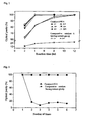
- Figs. 1 and 2 are graphs comparing a reaction rate and optical purity of conventional chiral salen catalyst having acetate group (comparative catalyst 1) with those of chiral salen catalyst (I-SS-1) defined in the present invention over reaction time.
- the use of the chiral salen catalyst, as defined in the present invention shows faster reaction rate and higher optical purity (over 99%ee) than that of the conventional chiral salen catalyst having acetate group. It is further proved that the chiral salen catalyst, as used in the present invention, can be used continuously without any activation process, while the conventional chiral salen catalyst having acetate group has to be activated with acetic acid after each use because it looses its catalytic activity and the reaction using recovered catalyst takes much longer to obtain over 99%ee of optical purity of the product than that using fresh catalyst.
- Fig. 3 represents a graph comparing degrees of racemization of products produced by using conventional chiral salen catalyst having acetate group (OAc; (comparative catalyst 2) and conventional chiral salen catalyst having bromide group (Br; (comparative catalyst 3) with that using the chiral salen catalyst (I-RR-1) in accordance with the present invention over reaction time.
- Example 11 (comparative) : Preparation of (R,R)- N,N' -bis(3,5-di- t -butylsalicylidene)-1,2-cyclohexanediamino cobalt(III) iodide
- Each 100 g of racemic epichlorohydrin was added to 0.25 mol% of the catalyst prepared in Examples 1 to 8 and cooled to 5°C. Each 13.6 g of water was added slowly to each reaction mixture and then stirred at 20°C for 4 hrs. Each reaction mixture was performed for fractional distillation under vacuum to obtain (R)[or (S)]-epichlorohydrin. Dichloromethane and water were added to the residue and the used catalyst was obtained from dichloromethane layer which was further evaporated under vacuum. The recovered catalyst without any activation process was reused for another hydrolysis reaction of racemic epichlorohydrin continuously to obtain (R)[or (S)]-epichlorohydrin with over 99 %ee of optical purity.
- (R)-epichlorohydrin was prepared in the same manner as Experimental Example 1 by using the conventional chiral salen catalyst having acetate group (comparative catalyst 1).
- (R)-epichlorohydrin with 17 %ee of optical purity was prepared.
- the used catalyst was activated by a known method ( Science, Vol. 277 , 936, 1997 ). The used catalyst was added in toluene and 2 equivalent of acetic acid and stirred for 1 hr under atmosphere condition and the solvent was then evaporated under vacuum to obtain recovered catalyst.
- Fig. 5 representing UV data of the catalyst before and after reaction using the chiral salen catalyst (comparative catalyst 1) having acetate group, it indicated that acetate group of the comparative catalyst 1 was dissociated after the reaction.
- Example 2 g of the catalyst prepared in Example 1 (I-SS-1) or Example 2 (I-RR-1) was added to 148 g of racemic epibromohydrin and cooled to 5°C. 13.6 g of water was slowly added to the reaction mixture of which was stirred at 20°C for 4 hrs. The reaction mixture was performed for fractional distillation under vacuum to obtain (R) (or (S))-epibromohydrin. Dichloromethane and water were added to the residue and extracted out the used catalyst to the dichloromethane layer which was evaporated under vacuum to recover the used catalyst. The recovered catalyst was used for next reaction without any activation process to produce (R) (or (S))-epibromohydrin with over 99 %ee of optical purity.
- the reaction was performed in the same manner as Experimental Example 3 except that 78 g of racemic 1,2-epoxybutane was used instead of racemic epibromohydrin to obtain the target product with over 99 %ee of optical purity.
- the reaction was performed in the same manner as Experimental Example 3 except that 108 g of racemic 1,2-epoxyhexane was used instead of racemic epibromohydrin to obtain the target product with over 99 %ee of optical purity.
- Example 1 5 g of the catalyst prepared in Example 1 (1-SS-1) or Example 2 (I-RR-1) was added to 130 g of racemic styrene oxide and cooled to 5°C. 13.6 g of water was slowly added to the reaction mixture, which was stirred at 20°C for 15 hrs. The reaction mixture was performed for fractional distillation under vacuum to obtain first (R) (or (S))-styrene oxide. Dichloromethane and water were added to the residue and extracted out the used catalyst to the dichloromethane layer which was evaporated under vacuum to recover the used catalyst. The recovered catalyst was reused for next reaction without any activation process to produce (R) (or (S))-styrene oxide with over 99 %ee of optical purity.
- Example 2 2 g of the catalyst prepared in Example 1 (I-SS-1) or Example 2 (I-RR-1) was added to 78 g of racemic 1,2-epoxybutane and cooled to 5°C. 7.8 g of water was slowly added to the reaction mixture, which was stirred at 20°C for 3 hrs. The reaction mixture was performed for fractional distillation under vacuum to obtain first (R) (or (S))-1,2-butandiol. Dichloromethane and water were added to the residue and extracted out the used catalyst to the dichloromethane layer which was evaporated under vacuum to recover the used catalyst. The recovered catalyst was reused for next reaction without any activation process to produce (R) (or (S))-1,2-butandiol with over 99 %ee of optical purity.
- the chiral salen catalyst used in the present invention can be reused without any activation process, which is a disadvantage associated with conventional chiral salen catalyst, and used in mass production of chiral epoxides or chiral 1,2-dials from racemic epoxides in high yield and high optical purity by stereoselective hydrolysis.
Landscapes
- Chemical & Material Sciences (AREA)
- Organic Chemistry (AREA)
- Inorganic Chemistry (AREA)
- Engineering & Computer Science (AREA)
- Materials Engineering (AREA)
- Chemical Kinetics & Catalysis (AREA)
- Organic Low-Molecular-Weight Compounds And Preparation Thereof (AREA)
- Low-Molecular Organic Synthesis Reactions Using Catalysts (AREA)
- Catalysts (AREA)
- Epoxy Compounds (AREA)
Abstract
Description
- The present invention relates to a process for preparing chiral compounds from racemic epoxides by using chiral salen catalysts. More particularly, the present invention is to provide the use of chiral salen catalysts for producing chiral compounds such as chiral epoxides and chiral 1,2-diols economically in high yield and high optical purity by performing stereoselective hydrolysis of racemic epoxides, wherein the chiral salen catalyst comprises a cationic cobalt as a center metal of chiral salen ligand and counterions having weak nucleophilic property to resolve disadvantages associated with conventional chiral salen catalysts, and can be used continuously without any activating process of used catalysts because it does not loose a catalytic activity during the reaction process.
- Chiral expoxides or chiral 1,2-diols have been widely used to prepare pharmaceuticals and agriculture products having optical properties (USP 5,071,868; Tetrahedron Lett., Vol. 28, No. 16, 1783, 1987; J. Org. Chem., Vol. 64, 8741,1999). Even if these chiral epoxides or chiral 1,2-diols having high optical purity are very useful industrially, use of these compounds has been restricted because the preparation of such compounds is too difficult to produce in a large scale with low manufacturing price.
- A preparation method of chiral epichlohydrins as one of chiral expoxides is disclosed using microorganism in EP 431,970 and JP 90-257895 and 94-211822. However, it is not recommended because the productivity is low and it requires two-step process. Another preparation method of chiral epichlohydrins from chiral sulfonyloxyhaloalcohol derivatives obtained from mannitol derivatives is disclosed in
USP 4, 408, 063; and J. Org. chem., Vol 43, 4876, 1978. Another preparation method of chiral epichlohydrins from 3-chloro-1,2-propanediol is also disclosed in Syn. Lett No. 12, 1927, 1999. However, these processes are required multi-step syntheses, so that they are also deficient to use for the industrial purpose. - Methods for preparing chiral expoxides generally use a chiral catalyst having stereoselectivity which hydrolyzes stereoselectively only one isomer from racemic epoxides mixed 50 and 50 of each isomer and leaves the un-hydrolyzed isomer in the reaction medium. However, the chiral catalyst used for said stereoselective hydrolysis is usually expensive. Therefore, if it cannot be re-used, it becomes difficult to use for the industrial purpose.
- Stereoselective hydrolyses of chiral epoxides using chiral salen catalyst as a chiral catalyst are recently disclosed in Science, Vol. 277, 936,1997; USP 5,665,890 and 5,929,232; and WO00/09463 and WO91/14694. It has been reported that the use of chiral salen catalyst provides higher yield with higher optical purity compared to uses of other chiral catalysts. However, it is reported that after hydrolysis of a racemic epoxide using conventional chiral salen catalyst, the product chiral epoxide is racemized as time goes in pages 86-87 of WO00/09463. When this hydrolysis is performed for mass production, the racemization of the product becomes deepened since it takes longer to perform the distillation to obtain the desired product, thus resulting in decrease of optical purity of the chiral epoxide. Therefore, the use of chiral salen catalyst in the production of chiral epoxides is limited for the above-mentioned reasons.
- The documents US-A-5 637 739 and Tetrahedron Lett. Vol. 38, No. 5, 773 - 776, 1997 (Jacobsen et al.) both disclose catalysts as defined in the present claims, but use these in epoxidations of prochiral olefins and stereoselective nucleophilic ring openings of meso-epoxides with carboxylic acids, respectively.
- Further, when conventional chiral salen catalysts are reused, it requires an activation process after each use because activities thereof are rapidly decreased. Even if the catalyst is activated after used, the optical activity of the product prepared by using reused catalyst is remarkably lower than that of the product prepared by using fresh catalyst. Thus, there is limited to reuse. Such problems increase the manufacturing price of producing chiral epoxides.
- Consequently, demand to produce chiral compounds such as chiral epoxides or chiral 1,2-diols efficiently and economically has been highly increased with the importance of such compounds to prepare pharmaceuticals and agriculture products.
- The present invention has been completed by developing a novel method of stereoselective hydrolysis using a chiral salen catalyst comprising a cobalt as a center metal and its counterions of PF6- or BF4- to prevent from loosing activities of chiral catalysts and racemization of chiral products because conventional chiral salen catalysts having acetate groups loose their activities or functional groups such as acetate groups thereof.
- In other words, it is important to select appropriate counterions bonded to the center metal in chiral salen catalysts used in stereoselective hydrolyses of racemic epoxides. For example, chiral catalysts having nucleophilic groups such as acetate and halogen group as counterions deteriorate optical purity of products and counterions bonded weakly to the center metal in chiral catalysts can be dissociated during the reaction process, resulting in diminished catalytic activity.
- The chiral salen catalyst used in the present invention not only keeps its activity but also provides excellent production of chiral epoxides without racemization by comprising a cobalt center metal and counterions of PF6- or BF4-. Therefore, an object of the present invention is to provide an economical process for preparing chiral epoxides and chiral 1,2-diols from racemic epoxides in high yield and high optical purity by using a chiral salen catalyst which keeps excellent catalytic activity after use, thus simplifying the manufacturing process since it does not require an activation process of the used catalyst and does not contribute to racemization of so produced products.
-
- Fig. 1 represents a graph comparing an optical purity of products produced by using conventional chiral salen catalyst having acetate group with that using the chiral salen catalyst defined in the present invention over reaction time.
- Fig. 2 represents a graph comparing an optical purity of products produced by using conventional chiral salen catalyst having acetate group with that using the chiral salen catalyst defined in the present invention over number of times it is used.
- Fig. 3 represents a graph comparing degrees of racemization of products produced by using conventional chiral salen catalyst having acetate group and conventional chiral salen catalyst having bromide group with that using the chiral salen catalyst defined in the present invention over reaction time.
- Fig. 4 represents UV data of the catalyst before and after reaction using the chiral salen catalyst defined in the present invention.
- Fig. 5 represents UV data of the catalyst before and after reaction using the chiral salen catalyst having acetate group.
-
- The present invention is characterized by using chiral salen catalysts expressed by the following formula (1) in the preparation of chiral epoxides or chiral 1,2-diols from racemic epoxides,wherein X1, X2, X3, X4, X5, X6, X7, and X8 represent individually a hydrogen atom or C4-C10 alkyl; Y1 and Y2 represent individually a hydrogen atom or C1-C5 alkyl; Z represents PF6, or BF4; R1 and R2 represent individually a hydrogen atom, C4-C10 alkyl, or unsubstituted or C1-C4alkyl substituted phenyl, wherein one of R1 and R2 is a hydrogen atom, or one of R1 and R2 together form a group of formula -(CH2)n-, wherein n is an integer of 3 to 6, or -(CH2)m-Q-(CH2)m-, wherein, m is an integer of 1 to 2 and Q is a oxygen atom or NH.
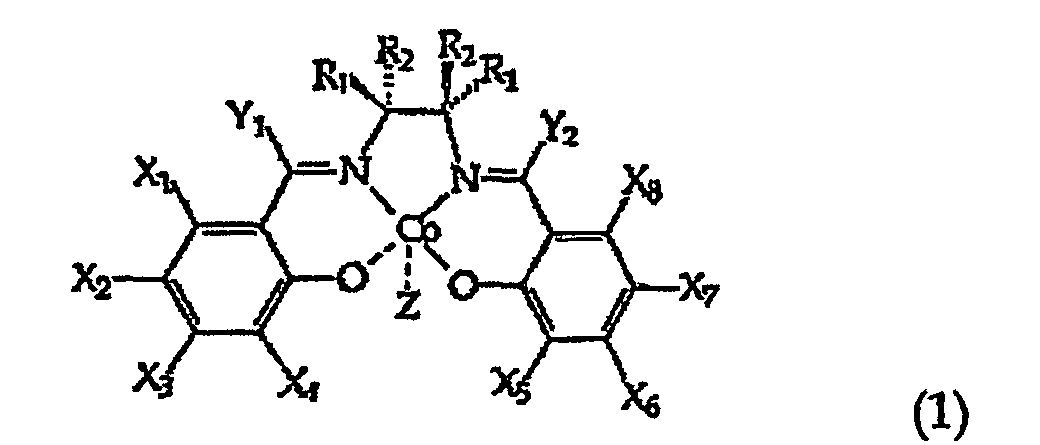
- In the stereoselective hydrolysis of racemic epoxides to chiral epoxides or chiral 1,2-diols, the present invention performs in the presence of said chiral salen catalyst of formula (1).
- The present invention is described in detail as set forth hereunder.
- The present invention relates to the process for preparing optically pure epoxides or 1,2-diols from racemic epoxides by stereoselective hydrolysis in the presence of the chiral salen catalyst which can be reused continuously without an activation process after used and does not affect racemization of the produced products.
- The chiral salen catalyst of formula (1) can be easily prepared by a known method disclosed in Tetrahedron Asymmetry, Vol. 2, No. 7, 481, 1991; and J. Org. Chem., Vol. 59, 1939, 1994. As shown in
Scheme 1, it is prepared by treatment of the salen compound of formula (2) with cobalt(II) acetate and ferrocenium derivative in an organic solvent,wherein X1, X2, X3, X4, X5, X6, X7, X8, Y1, Y2, Z, R1, and R2 are same as previously defined.
- The chiral salen catalyst of formula (1) can be used by immobilizing on the stationary phase such as zeolite.
- The mechanism of preparing chiral epoxides or chiral 1,2-diols from racemic epoxides in the presence of the chiral salen catalyst of formula (1) by stereoselective hydrolysis is shown in
Scheme 2,wherein R represents unsubstituted or halogen-substituted C1-C10 alkyl, unsubstituted or halogen-substituted C3-C8 cycloalkyl, or unsubstituted or halogen-substituted phenyl; I-RR represents a chiral salen catalyst of formula (1), where R1 is a hydrogen atom; I-SS represents a chiral salen catalyst of formula (1), where R2 is a hydrogen atom.
- The stereoselective hydrolysis of
Scheme 2 is described in more detail hereinafter. - Racemic epoxide compound of formula (3), 0.4-0.8 equivalents of water and over 0.001 mol% of a chiral salen catalyst, preferably 0.1-5 mol%, are reacted at a temperature of -10 to 30°C, preferably 5 to 25°C. After the reaction is completed, a chiral epoxide, which is (R)-4 or (S)-4, is obtained by fractional distillation. The chiral salen catalyst is recovered and a chiral 1,2-diol, which is (R)-5 or (S)-5, is obtained from the residue by using organic solvent. The recovered catalyst is re-used for hydrolysis of fresh racemic epoxide to produce chiral epoxide or chiral 1,2-diol without any activation process.
- When the chiral salen catalyst of formula (1), where R1 is a hydrogen atom, (hereafter referring to as "I-RR") is used for the stereoselective hydrolysis, (R)-epoxide or (S)-1,2-diol is produced, while when the chiral salen catalyst of formula (1), where R2 is a hydrogen atom, (hereafter referring to as "I-SS") is used, (S)-epoxide or (R)-1,2-diol is produced.
- Figs. 1 and 2 are graphs comparing a reaction rate and optical purity of conventional chiral salen catalyst having acetate group (comparative catalyst 1) with those of chiral salen catalyst (I-SS-1) defined in the present invention over reaction time.
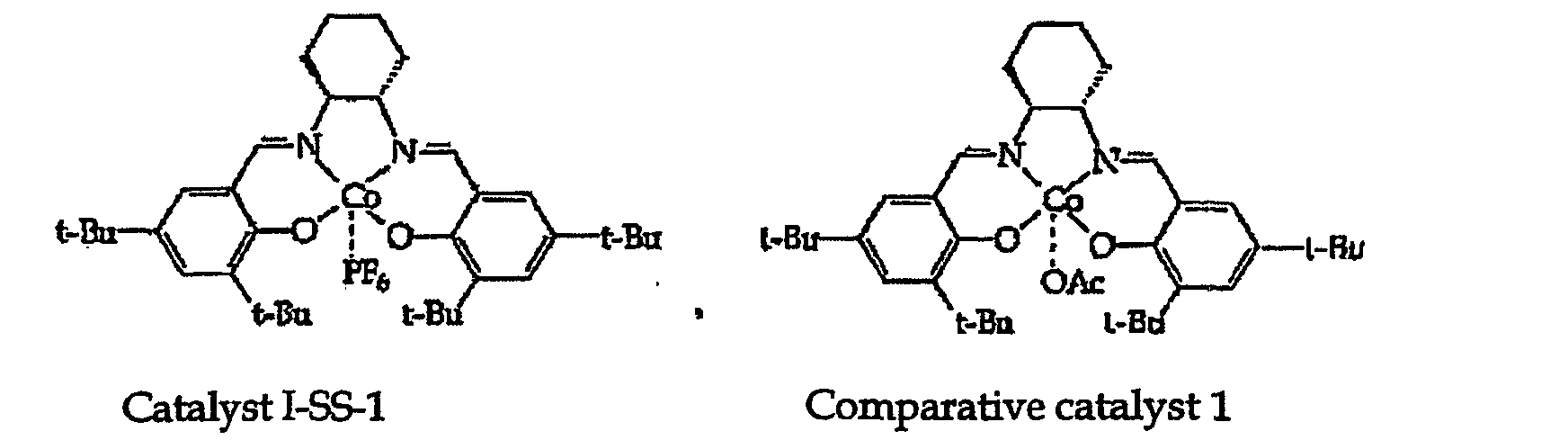
- The use of the chiral salen catalyst, as defined in the present invention, shows faster reaction rate and higher optical purity (over 99%ee) than that of the conventional chiral salen catalyst having acetate group. It is further proved that the chiral salen catalyst, as used in the present invention, can be used continuously without any activation process, while the conventional chiral salen catalyst having acetate group has to be activated with acetic acid after each use because it looses its catalytic activity and the reaction using recovered catalyst takes much longer to obtain over 99%ee of optical purity of the product than that using fresh catalyst.
- Fig. 3 represents a graph comparing degrees of racemization of products produced by using conventional chiral salen catalyst having acetate group (OAc; (comparative catalyst 2) and conventional chiral salen catalyst having bromide group (Br; (comparative catalyst 3) with that using the chiral salen catalyst (I-RR-1) in accordance with the present invention over reaction time.

- In Fig. 3, when the chiral salen catalyst is used in accordance with the present invention, there is no or little of racemization over reaction of time, while when conventional chiral salen catalyst having acetate group (OAc; (comparative catalyst 2) or conventional chiral salen catalyst having bromide group (Br; (comparative catalyst 3) is used, the degree of racemization becomes higher over reaction time, resulting in lowering optical purity of the corresponding product because the conventional chiral salen catalysts contain counterions having a nuclophilic group. In the mass production of chiral epoxides, it will take longer reaction time to distill the desired product. Therefore, it is expected that use of the chiral salen catalyst, in accordance with the present invention, contributes to produce optically pure chiral epoxide, while the comparative use of
catalyst - Hereunder is given the more detailed description of the present invention using examples. However, it should not be construed as limiting the scope of the present invention.
-

- 1 Equivalent of (S,S)-N,N'-bis(3,5-di-t-butylsalicylidene)-1,2-cyclohexanediamine and 1.2 equivalent of cobalt(II)acetate·4H2O were added to ethanol and refluxed for 5 hrs while stirring. The reaction mixture was filtered and washed with small amount of ethanol. The obtained solid, 1 equivalent of ferrocenium hexafluorophosphate and acetonitrile were mixed and refluxed for 1 hr while stirring, and acetonitrile was then evaporated under vacuum. Hexane was added to the residue and stirred for 30 min and filtered to obtain the target product. IR 1060, 1110, 1170, 1195, 1210, 1295, 1410, 1480, 1500, 1510, 1605, 1645 cm-1; 31P NMR(CDCl3) δ(H3PO4, ppm) -144.49[m, J(31P, 19F)=1.77KHz]
-
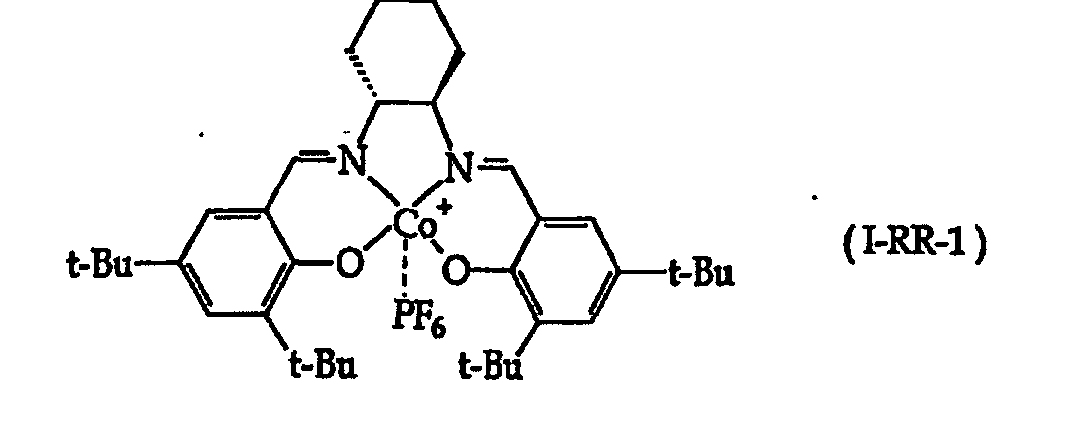
- The reaction was performed in the same manner as Example 1 except that (R,R)-N,N'-bis(3,5-di-t-butylsalicylidene)-1,2-cyclohexanediamine was used instead of (S,S)-N,N'-bis(3,5-di-t-butylsalicylidene)-1,2-cyclohexanediamine to obtain the target product.
IR 1060, 1110, 1170, 1195, 1210, 1295, 1410, 1480, 1500, 1510, 1605, 1645 cm-1; 31P NMR(CDCl3) δ(H3PO4, ppm) -144.49[m, J(31P, 19F)=1.77KHz] -

- 1 Equivalent of (S,S)-N,N'-bis(3,5-di-t-butylsalicylidene)-1,2-cyclohexanediamine and 1.2 equivalents of cobalt(II)acetate·4H2O were added to ethanol and refluxed for 5 hrs while stirring. The reaction mixture was filtered and washed with small amount of ethanol at room temperature. The obtained solid, ferrocenium tetrafluoroborate and acetonitrile were mixed and refluxed for 1 while stirring. Acetonitrile was then evaporated under vacuum. Hexane was added to the residue and stirred for 30 min, followed by filtration to obtain the target product.
-

- The reaction was performed in the same manner as Example 3 except that (R,R)-N,N'-bis(3,5-di-t-butylsalicylidene)-1,2-cyclohexanediamine was used instead of (S,S)-N,N'-bis(3,5-di-t-butylsalicylidene)-1,2-cyclohexanediamine to obtain the target product.
-
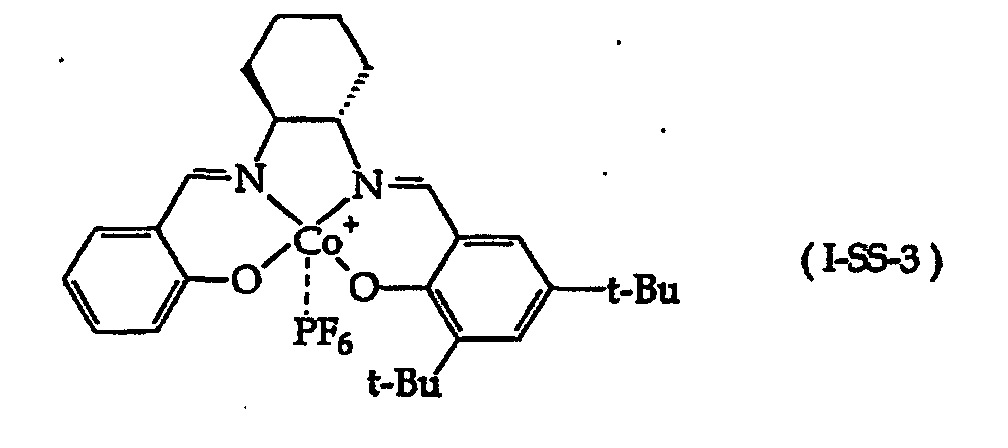
- The reaction was performed in the same manner as Example 1 except that (S)-N-(3,5-di-t-butylsalicylidene)-(S)-N'-(salicylidene)-1,2-cyclohexanediamine was used instead of (S,S)-N,N'-bis(3,5-di-t-butylsalicylidene)-1,2-cyclohexanediamine to obtain the target product.
IR 840, 890, 990, 1020, 1110, 1185, 1220, 1255, 1270, 1285, 1370, 1400, 1450, 1480, 1560, 1610, 1640 cm-1 -

- The reaction was performed in the same manner as Example 1 except that (R)-N-(3,5-di-t-butylsalicylidene)-(R)-N'-(salicyhdene)-1,2-cyclohexanediamine was used instead of (S,S)-N,N'-bis(3,5-di-t-butylsalicylidene)-1,2-cyclohexanediamine to obtain the target product.
-

- The reaction was performed in the same manner as Example 3 except that (S)-N-(3,5-di-t-butylsalicylidene)-(S)-N'-(salicylidene)-1,2-cyclohexanediamine was used instead of (S,S)-N,N'-bis(3,5-di-t-butylsalicylidene)-1,2-cyclohexanediamine to obtain the target product.
-

- The reaction was performed in the same manner as Example 3 except that (R)-N-(3,5-di-t-butylsalicylidene)-(R)-N'-(salicylidene)-1,2-cyclohexanediamine was used instead of (S,S)-N,N'-bis(3,5-di-t-butylsalicylidene)-1,2-cyclohexanediamine to obtain the target product.
-

- 1 equivalent of (R,R)-N,N'-bis(3,5-di-t-butylsalicylidene)-1,2-cydohexanediamine and 1.2 equivalents of cobalt(II)acetate·4H2O were added to ethanol and refluxed for 5 hrs while stirring. The reaction mixture was filtered and washed with small amount of ethanol at room temperature. The obtained solid, 0.5 equivalents of bromine, and dichloromethane were added and refluxed for 1 hr while stirring and dichloromethane was evaporated under vacuum to obtain the target product.
-
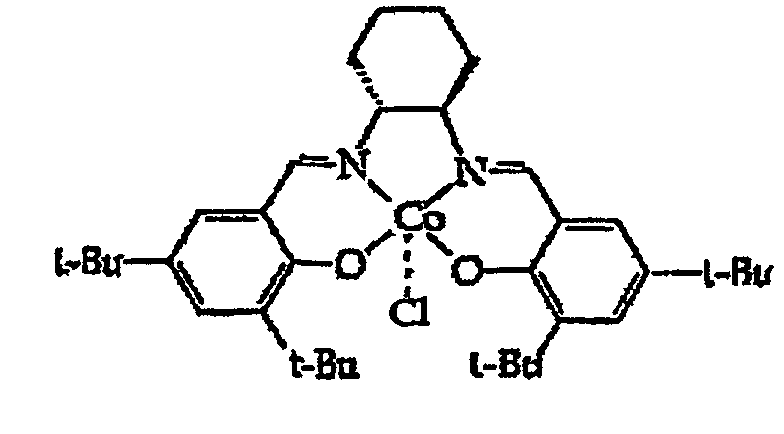
- 1 equivalent of (R,R)-N,N'-bis(3,5-di-t-butylsalicylidene)-1,2-cyclohexanediamine and 1.2 equivalents of cobalt(II)acetate·4H2O were added to ethanol and refluxed for 5 hrs while stirring. The reaction mixture was filtered and washed with small amount of ethanol at room temperature. The obtained solid, 0.5 equivalents of chlorine gas, and dichloromethane were added and refluxed for 1 hr while stirring and dichloromethane was evaporated under vacuum to obtain the target product.
-

- 1 equivalent of (R,R)-N,N'-bis(3,5-di-t-butylsalicylidene)-1,2-cyclohexanediamine and 1.2 equivalents of cobalt(II)acetate·4H2O were added to ethanol and refluxed for 5 hrs while stirring. The reaction mixture was filtered and washed with small amount of ethanol at room temperature. The obtained solid, 0.5 equivalents of iodine, and dichloromethane were added and refluxed for 1 hr while stirring and dichloromethane was evaporated under vacuum to obtain the target product.
- Each 100 g of racemic epichlorohydrin was added to 0.25 mol% of the catalyst prepared in Examples 1 to 8 and cooled to 5°C. Each 13.6 g of water was added slowly to each reaction mixture and then stirred at 20°C for 4 hrs. Each reaction mixture was performed for fractional distillation under vacuum to obtain (R)[or (S)]-epichlorohydrin. Dichloromethane and water were added to the residue and the used catalyst was obtained from dichloromethane layer which was further evaporated under vacuum. The recovered catalyst without any activation process was reused for another hydrolysis reaction of racemic epichlorohydrin continuously to obtain (R)[or (S)]-epichlorohydrin with over 99 %ee of optical purity.
- As shown in Fig. 4 representing UV data of I-SS-1 prepared in Example 1 before and after the hydrolysis reaction, the data before the reaction was not changed from that after.
- (R)-epichlorohydrin was prepared in the same manner as Experimental Example 1 by using the conventional chiral salen catalyst having acetate group (comparative catalyst 1). When the used catalyst was used for next reaction without any activation process, (R)-epichlorohydrin with 17 %ee of optical purity was prepared. After the second reaction, the used catalyst was activated by a known method (Science, Vol. 277, 936, 1997). The used catalyst was added in toluene and 2 equivalent of acetic acid and stirred for 1 hr under atmosphere condition and the solvent was then evaporated under vacuum to obtain recovered catalyst. When the third reaction was performed by using the recovered catalyst, the reaction took 7 to 8 hrs under the same reaction condition to obtain (R)-epichlorohydrin with lower than 99 %ee of optical purity, while it took only 4 hr when the fresh catalyst was used. The result was summarized in Table 1.
Catalyst Nos. of time Optical purity (%ee) Ave. yield Reaction time Comparative catalyst 1 havingacetate group 1st >99.8 80% 4 hr 2nd (w/o activation) 17 - 8 hr 3rd (w/activation) <99 80% 8 hr I-SS-1
(or I-RR-1)1st >99.8 80.4 % 4 hr 4th >99.8 6hr 8th >99.8 8 hr 10th >99.4 12 hr I-SS-2
(or I-RR-2)1st >99.8 80 % 4 hr 5th >99.8 6 hr 6th >99.7 10 hr 7th >99.4 12 hr I-SS-3
(or I-RR-3)1st >99.8 80 % 4 hr 4th >99.8 6 hr 8th >99.6 8 hr 10th >99.3 12 hr I-SS-4
(or I-RR-4)1st >99.8 78 % 4 hr 4th >99.8 6 hr 5th >99.5 8 hr 6th >99.1 12 hr - In Fig. 5 representing UV data of the catalyst before and after reaction using the chiral salen catalyst (comparative catalyst 1) having acetate group, it indicated that acetate group of the
comparative catalyst 1 was dissociated after the reaction. - Each 0.4 mol% of the catalyst I-SS-1 prepared in Example 2,
comparative catalyst 2 having acetate group, andcomparative catalyst 3 having bromo group was added to 100 g of racemic epichlorohydrin separately and cooled to 5°C. 10.7 g of water was slowly added to each reaction mixture of which was stirred at 20°C. The optical purity of each reaction mixture was measured over reaction time as shown in Fig. 3. - 2 g of the catalyst prepared in Example 1 (I-SS-1) or Example 2 (I-RR-1) was added to 148 g of racemic epibromohydrin and cooled to 5°C. 13.6 g of water was slowly added to the reaction mixture of which was stirred at 20°C for 4 hrs. The reaction mixture was performed for fractional distillation under vacuum to obtain (R) (or (S))-epibromohydrin. Dichloromethane and water were added to the residue and extracted out the used catalyst to the dichloromethane layer which was evaporated under vacuum to recover the used catalyst. The recovered catalyst was used for next reaction without any activation process to produce (R) (or (S))-epibromohydrin with over 99 %ee of optical purity.
- The reaction was performed in the same manner as Experimental Example 3 except that 78 g of racemic 1,2-epoxybutane was used instead of racemic epibromohydrin to obtain the target product with over 99 %ee of optical purity.
- The reaction was performed in the same manner as Experimental Example 3 except that 108 g of racemic 1,2-epoxyhexane was used instead of racemic epibromohydrin to obtain the target product with over 99 %ee of optical purity.
- 5 g of the catalyst prepared in Example 1 (1-SS-1) or Example 2 (I-RR-1) was added to 130 g of racemic styrene oxide and cooled to 5°C. 13.6 g of water was slowly added to the reaction mixture, which was stirred at 20°C for 15 hrs. The reaction mixture was performed for fractional distillation under vacuum to obtain first (R) (or (S))-styrene oxide. Dichloromethane and water were added to the residue and extracted out the used catalyst to the dichloromethane layer which was evaporated under vacuum to recover the used catalyst. The recovered catalyst was reused for next reaction without any activation process to produce (R) (or (S))-styrene oxide with over 99 %ee of optical purity.
- 2 g of the catalyst prepared in Example 1 (I-SS-1) or Example 2 (I-RR-1) was added to 78 g of racemic 1,2-epoxybutane and cooled to 5°C. 7.8 g of water was slowly added to the reaction mixture, which was stirred at 20°C for 3 hrs. The reaction mixture was performed for fractional distillation under vacuum to obtain first (R) (or (S))-1,2-butandiol. Dichloromethane and water were added to the residue and extracted out the used catalyst to the dichloromethane layer which was evaporated under vacuum to recover the used catalyst. The recovered catalyst was reused for next reaction without any activation process to produce (R) (or (S))-1,2-butandiol with over 99 %ee of optical purity.
- As described above, the chiral salen catalyst used in the present invention can be reused without any activation process, which is a disadvantage associated with conventional chiral salen catalyst, and used in mass production of chiral epoxides or chiral 1,2-dials from racemic epoxides in high yield and high optical purity by stereoselective hydrolysis.
Claims (2)
- A method of preparing chiral epoxides or chiral 1,2-diols from racemic epoxides by stereoselective hydrolysis, using a chiral salen catalyst of formula (1):wherein X1, X2, X3, X4, X5, X6, X7, and X8 represent individually a hydrogen atom or C4-C10 alkyl; Y1 and Y2 represent individually a hydrogen atom or C1-C5 alkyl; Z represents a counter anion; R1 and R2 represent individually a hydrogen atom, C4-C10 alkyl, or unsubstituted or C1-C4 alkyl substituted phenyl, wherein one of R1 and R2 is a hydrogen atom, or one of R1 and R2 together form a group of formula -(CH2)n-, wherein n is an integer of 3 to 6, or -(CH2)m-Q-(CH2)m-wherein m is an integer of 1 or 2 and Q is a oxygen atom or NH ;

characterised in that said counter anion Z represents PF6 - or BF4 -. - The method of preparing chiral compounds according to claim 1, wherein said X1, X2, X3, X4, X5, X6, X7, and X8 represent individually a hydrogen atom or a t-butyl group; said Y1 and Y2 represent individually a hydrogen atom; said Z represents PF6 -, or BF4 -; and one of said R1 and R2 is a hydrogen atom and the other R1 and R2 together form a group of formula -(CH2)4-.
Applications Claiming Priority (3)
| Application Number | Priority Date | Filing Date | Title |
|---|---|---|---|
| KR20000028099 | 2000-05-24 | ||
| KR2000028099 | 2000-05-24 | ||
| PCT/KR2001/000854 WO2001089690A1 (en) | 2000-05-24 | 2001-05-23 | Novel chiral salen catalysts, and a process for preparing chiral compounds from racemic epoxides for using them |
Publications (3)
| Publication Number | Publication Date |
|---|---|
| EP1289655A1 EP1289655A1 (en) | 2003-03-12 |
| EP1289655A4 EP1289655A4 (en) | 2004-03-31 |
| EP1289655B1 true EP1289655B1 (en) | 2005-12-28 |
Family
ID=19670066
Family Applications (1)
| Application Number | Title | Priority Date | Filing Date |
|---|---|---|---|
| EP01932385A Expired - Lifetime EP1289655B1 (en) | 2000-05-24 | 2001-05-23 | A method for preparing chiral compounds from racemic epoxides using chiral salen catalysts |
Country Status (9)
| Country | Link |
|---|---|
| US (1) | US6720434B2 (en) |
| EP (1) | EP1289655B1 (en) |
| JP (1) | JP3962587B2 (en) |
| CN (1) | CN1174804C (en) |
| AT (1) | ATE314144T1 (en) |
| AU (1) | AU5891201A (en) |
| DE (1) | DE60116295D1 (en) |
| IN (1) | IN2002DE01011A (en) |
| WO (1) | WO2001089690A1 (en) |
Cited By (1)
| Publication number | Priority date | Publication date | Assignee | Title |
|---|---|---|---|---|
| EP1901845A4 (en) * | 2005-06-21 | 2014-11-19 | Cornell Res Foundation Inc | ISOTACTIC SPECIFIC CATALYST FOR THE INDIRECT PRODUCTION OF A HIGHLY ISOTACTIC POLYPROPYLENE OXIDE OR A HIGHLY ISOTACTIC POLYBUTYLENE OXIDE |
Families Citing this family (17)
| Publication number | Priority date | Publication date | Assignee | Title |
|---|---|---|---|---|
| CN1233648C (en) * | 2001-06-27 | 2005-12-28 | 尔艾斯特公司 | SALEN catalyst, preparation of catalyst and method for preparing chiral compound by using catalyst |
| US6639087B2 (en) * | 2001-08-22 | 2003-10-28 | Rhodia Pharma Solutions Inc. | Kinetic resolution method |
| WO2003018520A1 (en) | 2001-08-22 | 2003-03-06 | Rhodia Pharma Solutions Inc. | Improved hydrolytic kinetic resolution of epoxides |
| DE10164348A1 (en) | 2001-12-28 | 2003-07-17 | Basf Ag | Process for the preparation of 1-methoypropanol-2 |
| DE10208252A1 (en) * | 2002-02-26 | 2003-09-04 | Celanese Ventures Gmbh | Non-metallocenes fixed in a convex manner, process for their preparation and their use in the polymerization of olefins |
| JPWO2004076391A1 (en) * | 2003-02-28 | 2006-06-01 | 独立行政法人科学技術振興機構 | Method for producing optically active compound |
| US20070092541A1 (en) * | 2004-03-01 | 2007-04-26 | Walling David W | Direct contact quench crystallization process and cosmetic products produced thereby |
| US7304172B2 (en) * | 2004-10-08 | 2007-12-04 | Cornell Research Foundation, Inc. | Polycarbonates made using highly selective catalysts |
| KR100894680B1 (en) * | 2007-06-13 | 2009-04-24 | 주식회사 카이로켐 | Novel chiral salen catalyst and preparation method of chiral compound from racemic epoxy compound using same |
| US20090286968A1 (en) | 2008-04-25 | 2009-11-19 | Auburn University | 2-Quinoxalinol Salen Compounds and Uses Thereof |
| CN101967165B (en) * | 2010-09-21 | 2012-09-05 | 中国科学院上海有机化学研究所 | Bridge chain bis-Schiff base-cobalt complex and synthesis method thereof as well as application thereof |
| TR201202779A2 (en) | 2012-03-12 | 2013-10-21 | Petkim Petrokimya Holding Anonim Sirketi | Polyethylene carbonate production method |
| EP2664641B1 (en) | 2012-05-18 | 2018-04-25 | Petkim Petrokimya Holding Anonim Sirekti | Method for producing polyethylene carbonate with metal salts |
| CN111097529B (en) * | 2018-10-25 | 2023-05-02 | 中国石油化工股份有限公司 | High-performance nano cage limit catalyst, preparation method and application |
| ES3002689T3 (en) * | 2018-07-31 | 2025-03-07 | China Petroleum & Chem Corp | Nanocaged catalyst, preparation method, and application |
| CN113943206A (en) * | 2021-10-25 | 2022-01-18 | 华今(山东)新材料科技有限公司 | Preparation method of high-quality (R) -3-chloro-1, 2-propanediol |
| CN117658953B (en) * | 2023-12-04 | 2026-01-30 | 上海中化科技有限公司 | Preparation methods of chiral epoxy compounds, chiral β-lactones and polyhydroxy fatty acid esters |
Family Cites Families (4)
| Publication number | Priority date | Publication date | Assignee | Title |
|---|---|---|---|---|
| US5637739A (en) * | 1990-03-21 | 1997-06-10 | Research Corporation Technologies, Inc. | Chiral catalysts and catalytic epoxidation catalyzed thereby |
| CA2077541C (en) * | 1990-03-21 | 1998-08-18 | Eric N. Jacobsen | Chiral catalysts and epoxidation reactions catalyzed thereby |
| US6262278B1 (en) * | 1995-03-14 | 2001-07-17 | President And Fellows Of Harvard College | Stereoselective ring opening reactions |
| US5665890A (en) * | 1995-03-14 | 1997-09-09 | President And Fellows Of Harvard College | Stereoselective ring opening reactions |
-
2001
- 2001-05-23 EP EP01932385A patent/EP1289655B1/en not_active Expired - Lifetime
- 2001-05-23 US US10/181,193 patent/US6720434B2/en not_active Expired - Lifetime
- 2001-05-23 WO PCT/KR2001/000854 patent/WO2001089690A1/en not_active Ceased
- 2001-05-23 AT AT01932385T patent/ATE314144T1/en not_active IP Right Cessation
- 2001-05-23 DE DE60116295T patent/DE60116295D1/en not_active Expired - Lifetime
- 2001-05-23 AU AU58912/01A patent/AU5891201A/en not_active Abandoned
- 2001-05-23 JP JP2001585922A patent/JP3962587B2/en not_active Expired - Fee Related
- 2001-05-23 CN CNB018094376A patent/CN1174804C/en not_active Expired - Fee Related
-
2002
- 2002-10-09 IN IN1011DE2002 patent/IN2002DE01011A/en unknown
Cited By (1)
| Publication number | Priority date | Publication date | Assignee | Title |
|---|---|---|---|---|
| EP1901845A4 (en) * | 2005-06-21 | 2014-11-19 | Cornell Res Foundation Inc | ISOTACTIC SPECIFIC CATALYST FOR THE INDIRECT PRODUCTION OF A HIGHLY ISOTACTIC POLYPROPYLENE OXIDE OR A HIGHLY ISOTACTIC POLYBUTYLENE OXIDE |
Also Published As
| Publication number | Publication date |
|---|---|
| ATE314144T1 (en) | 2006-01-15 |
| JP2003534117A (en) | 2003-11-18 |
| DE60116295D1 (en) | 2006-02-02 |
| IN2002DE01011A (en) | 2005-01-28 |
| EP1289655A1 (en) | 2003-03-12 |
| WO2001089690A1 (en) | 2001-11-29 |
| CN1174804C (en) | 2004-11-10 |
| AU5891201A (en) | 2001-12-03 |
| US6720434B2 (en) | 2004-04-13 |
| US20030032821A1 (en) | 2003-02-13 |
| CN1436098A (en) | 2003-08-13 |
| JP3962587B2 (en) | 2007-08-22 |
| EP1289655A4 (en) | 2004-03-31 |
Similar Documents
| Publication | Publication Date | Title |
|---|---|---|
| US6903043B2 (en) | Chiral polymeric salen catalyst, and a process for preparing chiral compounds from racemic epoxides by using them | |
| US6720434B2 (en) | Process for preparing chiral compounds from recemic epoxides by using chiral salen catalysts | |
| EP1292602B1 (en) | New chiral salen catalyst and methods for the preparation of chiral compounds from racemic epoxides by using new catalyst | |
| Bandini et al. | The First Catalytic Enantioselective Nozaki–Hiyama Reaction | |
| US5665890A (en) | Stereoselective ring opening reactions | |
| US6130340A (en) | Asymmetric cycloaddition reactions | |
| US8558017B2 (en) | Ruthenium (II) catalysts for use in stereoselective cyclopropanations | |
| US6639087B2 (en) | Kinetic resolution method | |
| Zhao et al. | Asymmetric synthesis of dihydrocoumarins via catalytic sequential 1, 6-addition/transesterification of α-isocyanoacetates with para-quinone methides | |
| WO2009014362A2 (en) | Novel bimetallic salen catalyst and method for the synthesis of chiral compounds using the same | |
| EP1276745B1 (en) | Ruthenium-diphosphine complexes and their use as catalysts | |
| Fraile et al. | Enantioselective C–H carbene insertions with homogeneous and immobilized copper complexes | |
| CN114082446B (en) | Chiral zirconium catalyst for preparing chiral α-hydroxy-β-keto acid ester compound and preparation method thereof | |
| US6025503A (en) | Process for producing optically active titanium alkoxide complexes | |
| KR100319045B1 (en) | Novel chiral salen catalyst, and a process for preparing chiral compounds from racemic epoxides for using them | |
| CN1267238A (en) | Homogeneous oxidation catalyst using metal complexes | |
| EP0275354B1 (en) | Process for preparing optically active arylacetic acid derivatives | |
| JP4357332B2 (en) | Process for producing optically active nitroalcohols | |
| WO2004024684A2 (en) | Enantioselective amination and etherification | |
| La Crois | Manganese complexes as catalysts in epoxidation reactions: A ligand approach | |
| JP4284027B2 (en) | Process for producing optically active isoxazolidines | |
| US20040176243A1 (en) | Chiral cheating agent and chiral catlyst | |
| CN111606913B (en) | A method for synthesizing tetraaryl nickel porphyrin catalyzed by anhydrous aluminum chloride | |
| JP2004323445A (en) | Method for producing optically active sulfoxide compound | |
| CN121044948A (en) | A method for synthesizing substituted allyl alcohol compounds |
Legal Events
| Date | Code | Title | Description |
|---|---|---|---|
| PUAI | Public reference made under article 153(3) epc to a published international application that has entered the european phase |
Free format text: ORIGINAL CODE: 0009012 |
|
| 17P | Request for examination filed |
Effective date: 20021029 |
|
| AK | Designated contracting states |
Kind code of ref document: A1 Designated state(s): AT BE CH CY DE DK ES FI FR GB GR IE IT LI LU MC NL PT SE TR |
|
| AX | Request for extension of the european patent |
Extension state: AL LT LV MK RO SI |
|
| RIN1 | Information on inventor provided before grant (corrected) |
Inventor name: KIM, SEONG, JIN Inventor name: LEE, HO, SEONG Inventor name: YUN, JIN, WON Inventor name: KIM, GEON-JOONG Inventor name: PARK, DAE-WOON |
|
| RIC1 | Information provided on ipc code assigned before grant |
Ipc: 7C 07F 15/06 B Ipc: 7C 07D 301/32 B Ipc: 7B 01J 31/18 A Ipc: 7C 07B 53/00 B Ipc: 7C 07C 251/24 B |
|
| A4 | Supplementary search report drawn up and despatched |
Effective date: 20040213 |
|
| 17Q | First examination report despatched |
Effective date: 20041116 |
|
| RTI1 | Title (correction) |
Free format text: A PROCESS FOR PREPARING CHIRAL COMPOUNDS FROM RACEMIC EPOXIDES USING CHIRAL SALEN CATALYSTS |
|
| GRAP | Despatch of communication of intention to grant a patent |
Free format text: ORIGINAL CODE: EPIDOSNIGR1 |
|
| RTI1 | Title (correction) |
Free format text: A METHOD FOR PREPARING CHIRAL COMPOUNDS FROM RACEMIC EPOXIDES USING CHIRAL SALEN CATALYSTS |
|
| GRAS | Grant fee paid |
Free format text: ORIGINAL CODE: EPIDOSNIGR3 |
|
| GRAA | (expected) grant |
Free format text: ORIGINAL CODE: 0009210 |
|
| AK | Designated contracting states |
Kind code of ref document: B1 Designated state(s): AT BE CH CY DE DK ES FI FR GB GR IE IT LI LU MC NL PT SE TR |
|
| PG25 | Lapsed in a contracting state [announced via postgrant information from national office to epo] |
Ref country code: IT Free format text: LAPSE BECAUSE OF FAILURE TO SUBMIT A TRANSLATION OF THE DESCRIPTION OR TO PAY THE FEE WITHIN THE PRESCRIBED TIME-LIMIT;WARNING: LAPSES OF ITALIAN PATENTS WITH EFFECTIVE DATE BEFORE 2007 MAY HAVE OCCURRED AT ANY TIME BEFORE 2007. THE CORRECT EFFECTIVE DATE MAY BE DIFFERENT FROM THE ONE RECORDED. Effective date: 20051228 Ref country code: NL Free format text: LAPSE BECAUSE OF FAILURE TO SUBMIT A TRANSLATION OF THE DESCRIPTION OR TO PAY THE FEE WITHIN THE PRESCRIBED TIME-LIMIT Effective date: 20051228 Ref country code: FI Free format text: LAPSE BECAUSE OF FAILURE TO SUBMIT A TRANSLATION OF THE DESCRIPTION OR TO PAY THE FEE WITHIN THE PRESCRIBED TIME-LIMIT Effective date: 20051228 Ref country code: CH Free format text: LAPSE BECAUSE OF FAILURE TO SUBMIT A TRANSLATION OF THE DESCRIPTION OR TO PAY THE FEE WITHIN THE PRESCRIBED TIME-LIMIT Effective date: 20051228 Ref country code: BE Free format text: LAPSE BECAUSE OF FAILURE TO SUBMIT A TRANSLATION OF THE DESCRIPTION OR TO PAY THE FEE WITHIN THE PRESCRIBED TIME-LIMIT Effective date: 20051228 Ref country code: AT Free format text: LAPSE BECAUSE OF FAILURE TO SUBMIT A TRANSLATION OF THE DESCRIPTION OR TO PAY THE FEE WITHIN THE PRESCRIBED TIME-LIMIT Effective date: 20051228 Ref country code: LI Free format text: LAPSE BECAUSE OF FAILURE TO SUBMIT A TRANSLATION OF THE DESCRIPTION OR TO PAY THE FEE WITHIN THE PRESCRIBED TIME-LIMIT Effective date: 20051228 |
|
| REG | Reference to a national code |
Ref country code: GB Ref legal event code: FG4D |
|
| REG | Reference to a national code |
Ref country code: CH Ref legal event code: EP |
|
| REG | Reference to a national code |
Ref country code: IE Ref legal event code: FG4D |
|
| REF | Corresponds to: |
Ref document number: 60116295 Country of ref document: DE Date of ref document: 20060202 Kind code of ref document: P |
|
| PG25 | Lapsed in a contracting state [announced via postgrant information from national office to epo] |
Ref country code: SE Free format text: LAPSE BECAUSE OF FAILURE TO SUBMIT A TRANSLATION OF THE DESCRIPTION OR TO PAY THE FEE WITHIN THE PRESCRIBED TIME-LIMIT Effective date: 20060328 Ref country code: GR Free format text: LAPSE BECAUSE OF FAILURE TO SUBMIT A TRANSLATION OF THE DESCRIPTION OR TO PAY THE FEE WITHIN THE PRESCRIBED TIME-LIMIT Effective date: 20060328 Ref country code: DK Free format text: LAPSE BECAUSE OF FAILURE TO SUBMIT A TRANSLATION OF THE DESCRIPTION OR TO PAY THE FEE WITHIN THE PRESCRIBED TIME-LIMIT Effective date: 20060328 |
|
| PG25 | Lapsed in a contracting state [announced via postgrant information from national office to epo] |
Ref country code: DE Free format text: LAPSE BECAUSE OF FAILURE TO SUBMIT A TRANSLATION OF THE DESCRIPTION OR TO PAY THE FEE WITHIN THE PRESCRIBED TIME-LIMIT Effective date: 20060329 |
|
| PG25 | Lapsed in a contracting state [announced via postgrant information from national office to epo] |
Ref country code: ES Free format text: LAPSE BECAUSE OF FAILURE TO SUBMIT A TRANSLATION OF THE DESCRIPTION OR TO PAY THE FEE WITHIN THE PRESCRIBED TIME-LIMIT Effective date: 20060408 |
|
| PG25 | Lapsed in a contracting state [announced via postgrant information from national office to epo] |
Ref country code: PT Free format text: LAPSE BECAUSE OF FAILURE TO SUBMIT A TRANSLATION OF THE DESCRIPTION OR TO PAY THE FEE WITHIN THE PRESCRIBED TIME-LIMIT Effective date: 20060529 |
|
| PG25 | Lapsed in a contracting state [announced via postgrant information from national office to epo] |
Ref country code: MC Free format text: LAPSE BECAUSE OF NON-PAYMENT OF DUE FEES Effective date: 20060531 |
|
| NLV1 | Nl: lapsed or annulled due to failure to fulfill the requirements of art. 29p and 29m of the patents act | ||
| REG | Reference to a national code |
Ref country code: CH Ref legal event code: PL |
|
| PLBE | No opposition filed within time limit |
Free format text: ORIGINAL CODE: 0009261 |
|
| STAA | Information on the status of an ep patent application or granted ep patent |
Free format text: STATUS: NO OPPOSITION FILED WITHIN TIME LIMIT |
|
| 26N | No opposition filed |
Effective date: 20060929 |
|
| EN | Fr: translation not filed | ||
| PG25 | Lapsed in a contracting state [announced via postgrant information from national office to epo] |
Ref country code: FR Free format text: LAPSE BECAUSE OF FAILURE TO SUBMIT A TRANSLATION OF THE DESCRIPTION OR TO PAY THE FEE WITHIN THE PRESCRIBED TIME-LIMIT Effective date: 20070216 |
|
| PG25 | Lapsed in a contracting state [announced via postgrant information from national office to epo] |
Ref country code: TR Free format text: LAPSE BECAUSE OF FAILURE TO SUBMIT A TRANSLATION OF THE DESCRIPTION OR TO PAY THE FEE WITHIN THE PRESCRIBED TIME-LIMIT Effective date: 20051228 Ref country code: LU Free format text: LAPSE BECAUSE OF NON-PAYMENT OF DUE FEES Effective date: 20060523 |
|
| PG25 | Lapsed in a contracting state [announced via postgrant information from national office to epo] |
Ref country code: FR Free format text: LAPSE BECAUSE OF FAILURE TO SUBMIT A TRANSLATION OF THE DESCRIPTION OR TO PAY THE FEE WITHIN THE PRESCRIBED TIME-LIMIT Effective date: 20051228 Ref country code: CY Free format text: LAPSE BECAUSE OF FAILURE TO SUBMIT A TRANSLATION OF THE DESCRIPTION OR TO PAY THE FEE WITHIN THE PRESCRIBED TIME-LIMIT Effective date: 20051228 |
|
| PGFP | Annual fee paid to national office [announced via postgrant information from national office to epo] |
Ref country code: IE Payment date: 20170519 Year of fee payment: 17 Ref country code: GB Payment date: 20170519 Year of fee payment: 17 |
|
| GBPC | Gb: european patent ceased through non-payment of renewal fee |
Effective date: 20180523 |
|
| REG | Reference to a national code |
Ref country code: IE Ref legal event code: MM4A |
|
| PG25 | Lapsed in a contracting state [announced via postgrant information from national office to epo] |
Ref country code: IE Free format text: LAPSE BECAUSE OF NON-PAYMENT OF DUE FEES Effective date: 20180523 Ref country code: GB Free format text: LAPSE BECAUSE OF NON-PAYMENT OF DUE FEES Effective date: 20180523 |