EP1289271A2 - Predominant color identification in digital images - Google Patents
Predominant color identification in digital images Download PDFInfo
- Publication number
- EP1289271A2 EP1289271A2 EP02254991A EP02254991A EP1289271A2 EP 1289271 A2 EP1289271 A2 EP 1289271A2 EP 02254991 A EP02254991 A EP 02254991A EP 02254991 A EP02254991 A EP 02254991A EP 1289271 A2 EP1289271 A2 EP 1289271A2
- Authority
- EP
- European Patent Office
- Prior art keywords
- color
- list
- pixels
- predominant
- block
- Prior art date
- Legal status (The legal status is an assumption and is not a legal conclusion. Google has not performed a legal analysis and makes no representation as to the accuracy of the status listed.)
- Ceased
Links
Images


Classifications
-
- H—ELECTRICITY
- H04—ELECTRIC COMMUNICATION TECHNIQUE
- H04N—PICTORIAL COMMUNICATION, e.g. TELEVISION
- H04N1/00—Scanning, transmission or reproduction of documents or the like, e.g. facsimile transmission; Details thereof
- H04N1/46—Colour picture communication systems
- H04N1/64—Systems for the transmission or the storage of the colour picture signal; Details therefor, e.g. coding or decoding means therefor
- H04N1/644—Systems for the transmission or the storage of the colour picture signal; Details therefor, e.g. coding or decoding means therefor using a reduced set of representative colours, e.g. each representing a particular range in a colour space
-
- H—ELECTRICITY
- H04—ELECTRIC COMMUNICATION TECHNIQUE
- H04N—PICTORIAL COMMUNICATION, e.g. TELEVISION
- H04N1/00—Scanning, transmission or reproduction of documents or the like, e.g. facsimile transmission; Details thereof
- H04N1/46—Colour picture communication systems
- H04N1/64—Systems for the transmission or the storage of the colour picture signal; Details therefor, e.g. coding or decoding means therefor
- H04N1/642—Adapting to different types of images, e.g. characters, graphs, black and white image portions
Definitions
- the present invention relates to apparatus for identifying a predominant colour in a digital image for use, for example, in the compression of compound documents.
- a hardcopy device such as a digital copier typically includes a scan engine for converting pages of documents into digital images, memory for storing the digital images, and a print engine for printing out the stored images.
- the memory is usually large enough to store at least one full digital image. By storing a full digital image in memory, the digital copier can print out multiple copies of the stored image.
- Digital image compression is performed to reduce the memory and bandwidth requirements of the digital copier. Reducing the memory and bandwidth requirements, in turn, reduces the cost of the digital copier.
- a single compression algorithm is usually not suitable for compressing compound documents.
- Compound documents may contain text, drawings and photo regions (sometimes overlaid), complex backgrounds (e.g., text boxes), watermarks and gradients.
- Compression algorithms such as JPEG are suitable for compressing photo regions of the compound color documents, but they are not suitable for compressing black and white text regions of the compound color documents.
- These lossy compression algorithms are based on linear transforms (e.g., discrete cosine transform, discrete wavelet transform) and do not compress edges efficiently. They require too many bits, and may produce very objectionable artifacts around text.
- Compression algorithms such as CCITT, G4 and JBIG are suitable for compressing black and white text regions of the compound color documents. However, they are not suitable for compressing photo regions of the compound color documents.
- a typical solution is to pre-process the documents, separating the regions according to the type of information they contain. For instance, regions containing edges (e.g., regions containing text, line-art-graphics) and regions containing natural features (e.g., regions containing photos, color backgrounds and gradients) are separated and compressed according to different algorithms.
- regions containing edges e.g., regions containing text, line-art-graphics
- regions containing natural features e.g., regions containing photos, color backgrounds and gradients
- the present invention seeks to provide improved color identification.
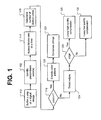
- FIG. 1 illustrates a method for processing a digital image.
- the digital image is made up of a plurality of pixels, each pixel represented by an n-bit word.
- n-bit word representing RGB color space
- eight bits represent a red component
- eight bits represent a green component
- eight bits represent a blue component.
- the digital image is processed one strip at a time.
- Each strip contains a row of contiguous blocks.
- Each block contains a relatively small number of pixels relative to the number of pixels in the digital image.
- a typical block size may be 16x16 pixels or 32x32 pixels. The smaller blocks require less memory and result in better resolution. In practice, block size will be dictated by memory constraints on the hardcopy device.
- the strip is buffered (112) and blocks are accessed one at a time (114). For each block, the number of distinct colors is determined (116), and compared to a threshold number (118). A block having less than the threshold number of colors is likely to contain text or other computer-generated features. A block having as many as, or more than, the threshold number of colors is likely to contain a color gradient.
- a block has less than the threshold number of colors, its color pattern is encoded (120).
- the threshold number is three and a block contains portions of black text and white background.
- the block has two distinct colors; therefore, its color pattern is encoded.
- the block may be encoded by assigning a value of '0' to white pixels and a value of '1' to black pixels.
- a one-bit word may be used to encode each pixel of the block.
- Resulting from the encoding is a string of 0's and a string of 1's. Because a large portion of the processing burden is spent finding discrete colors, this simple approach greatly reduces the computational burden.
- the strings of zeros and ones are compressed (122).
- Run length encoding or any suitable algorithm may be used to reduce the length of the strings of 0's and 1's.
- a threshold number other than three may be used.
- the choice of a threshold will depend in part upon the resolution of the image. If the resolution is high, a color will change slowly, and each block might contain only two or three colors.
- the threshold number is four and a block contains three distinct colors. The three colors are assigned values of one, two and three, whereby a two-bit word is used to encode each color.
- each 24-bit or 32-bit word can be reduced to a single bit.
- the number of comparisons is lower and the complexity of the classification is lower.
- edge detection is performed to classify the block (124). If an edge is detected, the block is placed in a class that will be encoded by a lossy high quality compression algorithm (128). If an edge is not detected, the block is likely to contain photographic or natural features and, therefore, is placed in a class that will be encoded by a lossy low quality compression algorithm (130).
- the edge detection need not identify the location or orientation of an edge in a block; it merely needs to indicate the presence of an edge in a block.
- a preferred edge detection technique involves applying an entropy function to a block in order to detect the presence of an edge in the block.
- the preferred edqe detection technique is disclosed in U.S. Serial No. 09/912,278 filed July 24, 2001 (Attorney docket no. PDNO 10006298-1), which is incorporated herein by reference.
- the lossy compression (128, 130) typically encodes each of the color components of the block into three separate streams.
- a predominant color in the buffered strip may be identified (132) before the blocks are processed.
- the predominant color of the buffered strip may be identified by performing a statistical analysis on a random sampling of pixels in the buffered strip.
- the predominant color may be added to header information and used by a decoder as the default color for decoding all of the blocks in the strip.
- a predominant color of one of the strips could be considered the predominant color of the entire image. Knowledge of the predominant color can lead to more efficient compression of the digital image.
- Header information may be added to each block. For example, a first entry of a block header could indicate the threshold number of colors; a second entry could indicate whether the threshold was exceeded, and a third entry could indicate whether the block contains an edge.
- Additional block header information could indicate the compression algorithm used to compress the block, and the spatial location of the block in the image. However, this entry for spatial location could be eliminated if the blocks are coded sequentially.
- the header entry for compression type could be eliminated if the type of compression is agreed upon by convention.
- Header information may be added to each strip of blocks. Such header information may identify predominant colors.
- the compressed blocks can be decoded with little to no overhead.
- the blocks are reconstructed with the same algorithms with which they were compressed.
- the header information in each block allows the compression algorithm to be identified and the reconstructed blocks to be rearranged in their original spatial location in the document. For example, if the second header entry (whether the threshold number of colors is exceeded) is true and the third header entry (whether the block contains an edge) is also true, an agreed-upon lossy compression algorithm could be used to reconstruct a block. If the second entry is true and the third entry is false, a different agreed-upon lossy compression algorithm could be used to reconstruct a block.
- the block is decoded, and word length is derived from the first entry (for example, a threshold of three indicates that each color is encoded by a 1-bit word).
- the first example is shown in Figure 2.
- the value of each n-bit word of the block is looked up in a color occurrence list (210).
- the list includes one or more entries [(R,G,B), q], where (R,G,B) is a color vector and q is the number of times that color vector is selected. If a color vector is not on the color occurrence list (212), that color vector is added to the list (214). If the color vector is already on the list (212), the count (q) of the color vector is incremented (216). After all words of the block have been identified (218), the list is processed (220). If the number of distinct colors is less than the threshold number, the number of colors on the list is encoded, and the distinct colors on the list are encoded. If not (for example, the block contains a color gradient), the list is discarded.
- the second example is similar to the first example, except that the n-bit words are rounded off.
- An n-bit word may be rounded off, for example, by ignoring its least significant bits. This second example is useful for images having a lot of noise. It also reduces the size of the color occurrence list.
- the number of distinct colors is determined by dividing the color space into different "color bins," identifying colors in the block and assigning each identified color to a color bin.
- a color occurrence list is maintained to indicate the number of occurrences or hits for each bin.
- the number of distinct colors corresponds to the number of color bins that have been "filled" (a color bin may be considered filled if at least one of the identified colors falls within the range of that color bin).
- a color space is divided into eight color bins, a first bin might cover pixel values from 0-31, a second bin might cover pixel values from 32-63, and so on.
- the color occurrence list is processed. Comparing the identified colors to color bins reduces the number of comparisons that are needed to determine the number of distinct colors, as well as reducing the size of the color occurrence list.
- Figure 3 shows a method of identifying one or more predominant colors in each strip of the digital image.
- a strip of the image is buffered (310), and a detection algorithm is applied to a random sampling of pixels in the strip (312).
- the detection algorithm indicates one or more predominant colors in the strip.
- the detection algorithm is based on three parameters: a true color ratio (r c ), an acceptable ratio (r a ) and a desirable ratio (r d ).
- the true color ratio (r c ) is the number of pixels having a specific color divided by the total number of pixels in the strip.
- the probability of detecting a predominant color is low if r c ⁇ r a , and the probability of detecting a predominant color is high if r c >r d .
- the difference between the acceptable ratio (r a ) and the desirable ratio (r d ) allows for a smooth transition in the detection probability.
- the detection algorithm minimizes the probability of identifying a color having r c ⁇ r a as a predominant color (a "false-positive” outcome"), and it minimizes the probability of not identifying a color having r c >r d as a predominant color (a "false-negative” outcome").
- the following exemplary detection algorithm may be used to create a color occurrence list.
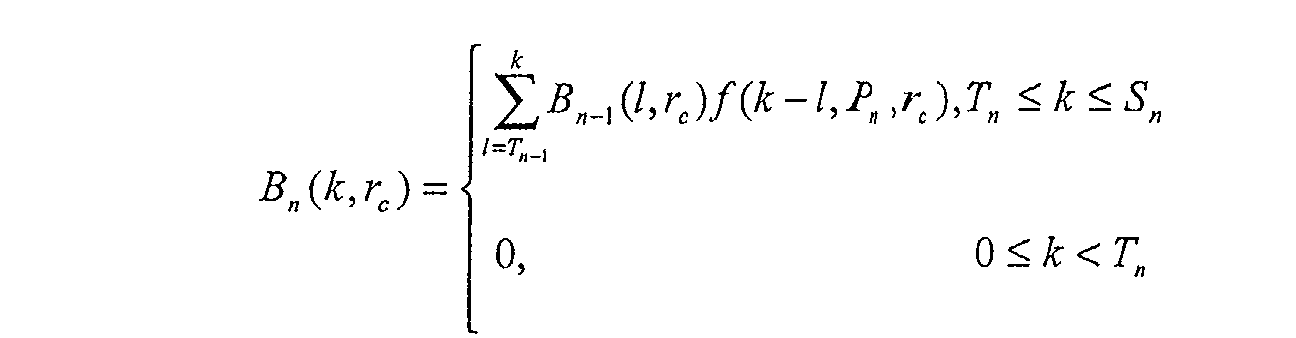
- An optimal set of parameters P n , T n and U n may be computed as follows. Probability functions f(l,k,p) and v(l,k,p) are defined as The probability that a color with r c ⁇ r d is discarded at the n th step (step 3(b)) is determined not only by the number of occurrences, but also considering if it was not discarded in a previous step.
- the probability that a color vector is not discarded is After using this equation to compute P n and T n , the probabilities can be updated using the following:
- the probabilities of false-positive and false-negative decisions at step n are F n FN ⁇ B n d (r d ) and
- the probabilities of false-positive and false-negative decisions are bounded by F FP ⁇ 1 - B N d ( r a ) and F FN ⁇ B N d ( r d ).
- the parameters may be determined by starting with initial values and adjusting the values until the desired probabilities occur.
- the color occurrence list may be implemented efficiently as a sorted list, so that pixels are compared first to the most common colors; or as a hash table in order to minimize the number of color comparisons.
- the hardcopy device 410 includes a processor 412, read-only memory 414 and random access memory 416.
- the read-only memory 414 stores a program that, when executed, causes the processor 412 to process the digital image according to the method of Figure 1.
- the random access memory 416 is used for buffering the strips and storing intermediate results of the processing (such as results from each compression block).
- the hardcopy device also includes an engine 418. In a digital copier, for example, the engine 418 would include a print engine and a scan engine.
- the method is not limited to any particular hardcopy device.
- Exemplary hardcopy devices include digital copiers, printers, scanners, and all-in-one machines.
- the method is not limited to hardcopy devices; it may be implemented in any device that stores a digital image.
Landscapes
- Engineering & Computer Science (AREA)
- Multimedia (AREA)
- Signal Processing (AREA)
- Compression Of Band Width Or Redundancy In Fax (AREA)
- Compression Or Coding Systems Of Tv Signals (AREA)
- Compression, Expansion, Code Conversion, And Decoders (AREA)
- Inspection Of Paper Currency And Valuable Securities (AREA)
- Lubrication Of Internal Combustion Engines (AREA)
- Holo Graphy (AREA)
- Image Processing (AREA)
Abstract
Description




Claims (10)
- Apparatus for identifying at least one predominant color in a digital image, the apparatus including a processor (412) operable to apply a detection rule to randomly-selected pixels in the image (312).
- Apparatus as in claim 1, wherein the processor (412) is operable to determine at least one predominant color for each strip of the image.
- Apparatus as in claim 1 or 2, wherein the detection rule minimizes the probability of at least one of a false-positive outcome and a false-negative outcome.
- Apparatus as in claim 1 or 2, wherein the probability of a false-positive outcome is the probability of identifying a color having rc < ra as a predominant color, where rc is the number of pixels in a sample region having a specific color divided by the total number of pixels in the sample region, and ra is an acceptable ratio.
- Apparatus as in claim 3, wherein the probability of a false-negative outcome is the probability of identifying a color having rc > rd as a predominant color, where rc is the number of pixels in a sample region having a specific color divided by the total number of pixels in the sample region, and rd is a desirable ratio.
- Apparatus as in any preceding claim, wherein the detection rule is used to create a color occurrence list.
- Apparatus as in claim 6, wherein the color list is created by testing a first sample of pixels in the image (512), for each pixel in the sampling:if a color vector of the pixel is in the list, incrementing a corresponding counter; andif the color vector is not in the list, adding the color vector to the list and initializing a corresponding counter.
- Apparatus as in claim 7, including testing at least one additional sampling of pixels in the image (514), for each pixel of each sampling:incrementing the corresponding counter if a color vector of the pixel is in the list.
- Apparatus as in claim 8, wherein at the end of each additional sampling, all entries with counter q < Tn are removed from the list (516).
- Apparatus as in claim 8, wherein no additional samplings are tested and the list is finalized if the list is empty or all entries have a counter q > Un (518), whereby all color vectors in the list are identified as the predominant colors.
Applications Claiming Priority (2)
| Application Number | Priority Date | Filing Date | Title |
|---|---|---|---|
| US09/924,926 US7191103B2 (en) | 2001-08-08 | 2001-08-08 | Predominant color identification in digital images |
| US924926 | 2001-08-08 |
Publications (2)
| Publication Number | Publication Date |
|---|---|
| EP1289271A2 true EP1289271A2 (en) | 2003-03-05 |
| EP1289271A3 EP1289271A3 (en) | 2003-12-10 |
Family
ID=25450930
Family Applications (1)
| Application Number | Title | Priority Date | Filing Date |
|---|---|---|---|
| EP02254991A Ceased EP1289271A3 (en) | 2001-08-08 | 2002-07-16 | Predominant color identification in digital images |
Country Status (3)
| Country | Link |
|---|---|
| US (1) | US7191103B2 (en) |
| EP (1) | EP1289271A3 (en) |
| JP (2) | JP2003125208A (en) |
Cited By (1)
| Publication number | Priority date | Publication date | Assignee | Title |
|---|---|---|---|---|
| US8908986B1 (en) | 2014-07-23 | 2014-12-09 | Teespring, Inc. | Systems and methods for selecting ink colors |
Families Citing this family (10)
| Publication number | Priority date | Publication date | Assignee | Title |
|---|---|---|---|---|
| WO2004055729A1 (en) * | 2002-12-13 | 2004-07-01 | Koninklijke Philips Electronics N.V. | Adaptive segmentatio of television images |
| US20050196049A1 (en) * | 2004-02-02 | 2005-09-08 | Clark Adam L. | System and method for encoding live audio/video information |
| US7010033B2 (en) * | 2004-02-02 | 2006-03-07 | Adams Platform Pty Ltd. | System and method for compressing and encoding video |
| US7609882B2 (en) * | 2005-05-25 | 2009-10-27 | Himax Technologies Limited | Image compression and decompression method capable of encoding and decoding pixel data based on a color conversion method |
| US7729546B2 (en) * | 2005-12-23 | 2010-06-01 | Lexmark International, Inc. | Document segmentation for mixed raster content representation |
| ES2743240T3 (en) * | 2008-02-21 | 2020-02-18 | Orange | Encoding and decoding of an image or sequence of images divided into blocks of pixels |
| KR101508599B1 (en) * | 2008-03-18 | 2015-04-03 | 삼성전자주식회사 | Method for compressing binary image based 2x2 block |
| KR102120865B1 (en) * | 2014-01-14 | 2020-06-17 | 삼성전자주식회사 | Display Device, Driver of Display Device, Electronic Device including thereof and Display System |
| CN106021455A (en) * | 2016-05-17 | 2016-10-12 | 乐视控股(北京)有限公司 | Image characteristic relationship matching method, apparatus and system |
| JP6148785B1 (en) * | 2016-12-26 | 2017-06-14 | 株式会社Cygames | Information processing system, information processing apparatus, and program |
Family Cites Families (44)
| Publication number | Priority date | Publication date | Assignee | Title |
|---|---|---|---|---|
| US5079630A (en) * | 1987-10-05 | 1992-01-07 | Intel Corporation | Adaptive video compression system |
| US5396564A (en) * | 1991-12-20 | 1995-03-07 | International Business Machines Corporation | Method of and apparatus for recognizing predominate and non-predominate color code characters for optical character recognition |
| US5835625A (en) * | 1993-01-29 | 1998-11-10 | International Business Machines Corporation | Method and apparatus for optical character recognition utilizing proportional nonpredominant color analysis |
| JPH06311376A (en) * | 1993-04-20 | 1994-11-04 | Fuji Xerox Co Ltd | Color detector |
| US5585944A (en) * | 1994-05-10 | 1996-12-17 | Kaleida Labs, Inc. | Method for compressing and decompressing images by subdividing pixel color distributions |
| JPH08297692A (en) * | 1994-09-16 | 1996-11-12 | Mitsubishi Electric Corp | Optical proximity correction device and method, and pattern forming method |
| US5802361A (en) * | 1994-09-30 | 1998-09-01 | Apple Computer, Inc. | Method and system for searching graphic images and videos |
| DE69417900T2 (en) * | 1994-11-17 | 1999-11-11 | Chemunex, Maisons-Alfort | Device and method for fast and highly sensitive detection and counting of microorganisms using fluorescence |
| JPH0951446A (en) * | 1995-08-07 | 1997-02-18 | Canon Inc | Image output method |
| JPH0998298A (en) * | 1995-09-29 | 1997-04-08 | Sony Corp | Color gamut compression method and color gamut compression device |
| JP3269359B2 (en) * | 1995-11-13 | 2002-03-25 | セイコーエプソン株式会社 | Data encoding device and method, and data decoding device and method |
| JP3745069B2 (en) | 1996-02-15 | 2006-02-15 | キヤノン株式会社 | Image processing apparatus and method |
| US6389162B2 (en) | 1996-02-15 | 2002-05-14 | Canon Kabushiki Kaisha | Image processing apparatus and method and medium |
| JP3778229B2 (en) * | 1996-05-13 | 2006-05-24 | 富士ゼロックス株式会社 | Image processing apparatus, image processing method, and image processing system |
| US6094453A (en) * | 1996-10-11 | 2000-07-25 | Digital Accelerator Corporation | Digital data compression with quad-tree coding of header file |
| US6049627A (en) * | 1997-05-28 | 2000-04-11 | Thomason Information Services, Inc. | Covert digital identifying indicia for digital image |
| US6618117B2 (en) * | 1997-07-12 | 2003-09-09 | Silverbrook Research Pty Ltd | Image sensing apparatus including a microcontroller |
| US6011595A (en) * | 1997-09-19 | 2000-01-04 | Eastman Kodak Company | Method for segmenting a digital image into a foreground region and a key color region |
| US6246790B1 (en) * | 1997-12-29 | 2001-06-12 | Cornell Research Foundation, Inc. | Image indexing using color correlograms |
| JPH11331626A (en) * | 1998-03-09 | 1999-11-30 | Minolta Co Ltd | Image processor |
| GB9806767D0 (en) * | 1998-03-31 | 1998-05-27 | Philips Electronics Nv | Pixel colour valve encoding and decoding |
| US6373890B1 (en) * | 1998-05-05 | 2002-04-16 | Novalogic, Inc. | Video compression and playback process |
| JP2000032287A (en) * | 1998-07-15 | 2000-01-28 | Fuji Xerox Co Ltd | Image processor and image processing method |
| US6266442B1 (en) * | 1998-10-23 | 2001-07-24 | Facet Technology Corp. | Method and apparatus for identifying objects depicted in a videostream |
| WO2000030342A1 (en) * | 1998-11-16 | 2000-05-25 | Conexant Systems, Inc. | Black replacement for color digital image printing |
| US6304340B1 (en) * | 1998-11-18 | 2001-10-16 | Xerox Corporation | Composite halftone screens with stochastically distributed clusters or lines |
| US6584154B1 (en) * | 1998-11-26 | 2003-06-24 | Oki Electric Industry Co., Ltd. | Moving-picture coding and decoding method and apparatus with reduced computational cost |
| US6690834B1 (en) * | 1999-01-22 | 2004-02-10 | Sigma Designs, Inc. | Compression of pixel data |
| US6774917B1 (en) * | 1999-03-11 | 2004-08-10 | Fuji Xerox Co., Ltd. | Methods and apparatuses for interactive similarity searching, retrieval, and browsing of video |
| JP4121676B2 (en) * | 1999-03-12 | 2008-07-23 | セイコーエプソン株式会社 | Image processing apparatus that performs compression and expansion, and electronic printing apparatus using the same |
| WO2001001349A1 (en) * | 1999-06-28 | 2001-01-04 | Iterated Systems, Inc. | Jpeg image artifacts reduction |
| US6480627B1 (en) * | 1999-06-29 | 2002-11-12 | Koninklijke Philips Electronics N.V. | Image classification using evolved parameters |
| US6587583B1 (en) * | 1999-09-17 | 2003-07-01 | Kurzweil Educational Systems, Inc. | Compression/decompression algorithm for image documents having text, graphical and color content |
| KR20010055492A (en) * | 1999-12-10 | 2001-07-04 | 오길록 | Image retrival system and method using image histogram |
| KR20010059114A (en) * | 1999-12-30 | 2001-07-06 | 박종섭 | Method for compressing image data outputted from image sensor |
| US6829063B1 (en) * | 2000-06-14 | 2004-12-07 | Hewlett-Packard Development Company, L.P. | Method for designing sets of color matrices that tile together |
| US6701012B1 (en) * | 2000-07-24 | 2004-03-02 | Sharp Laboratories Of America, Inc. | Out-of-layer pixel generation for a decomposed-image layer |
| US6789052B1 (en) * | 2000-10-24 | 2004-09-07 | Advanced Micro Devices, Inc. | Method of using control models for data compression |
| US7453468B2 (en) * | 2000-11-29 | 2008-11-18 | Xerox Corporation | Intelligent color to texture converter |
| US6505002B2 (en) * | 2000-12-22 | 2003-01-07 | Eastman Kodak Company | Camera that displays predominant color multi-color scene and/or multi-color captured image of scene |
| US6701020B2 (en) * | 2001-03-15 | 2004-03-02 | Hewlett-Packard Development Company, L.P. | JADE-JPEG based adaptive document compression engine |
| US7155066B2 (en) * | 2001-05-31 | 2006-12-26 | Agilent Technologies, Inc. | System and method for demosaicing raw data images with compression considerations |
| US6832006B2 (en) * | 2001-07-23 | 2004-12-14 | Eastman Kodak Company | System and method for controlling image compression based on image emphasis |
| US6744919B2 (en) * | 2001-07-24 | 2004-06-01 | Hewlett Packard Development Company, L.P. | Classification of blocks for compression based on number of distinct colors |
-
2001
- 2001-08-08 US US09/924,926 patent/US7191103B2/en not_active Expired - Lifetime
-
2002
- 2002-07-16 EP EP02254991A patent/EP1289271A3/en not_active Ceased
- 2002-08-02 JP JP2002225449A patent/JP2003125208A/en not_active Withdrawn
-
2007
- 2007-09-10 JP JP2007233858A patent/JP2008048431A/en not_active Withdrawn
Cited By (1)
| Publication number | Priority date | Publication date | Assignee | Title |
|---|---|---|---|---|
| US8908986B1 (en) | 2014-07-23 | 2014-12-09 | Teespring, Inc. | Systems and methods for selecting ink colors |
Also Published As
| Publication number | Publication date |
|---|---|
| JP2003125208A (en) | 2003-04-25 |
| US20030031361A1 (en) | 2003-02-13 |
| JP2008048431A (en) | 2008-02-28 |
| EP1289271A3 (en) | 2003-12-10 |
| US7191103B2 (en) | 2007-03-13 |
Similar Documents
| Publication | Publication Date | Title |
|---|---|---|
| US6744919B2 (en) | Classification of blocks for compression based on number of distinct colors | |
| US5819289A (en) | Data embedding employing degenerate clusters of data having differences less than noise value | |
| US5659726A (en) | Data embedding | |
| JP2008048431A (en) | Apparatus for identifying predominant color in digital image | |
| US7376265B2 (en) | Segmentation-based hybrid compression scheme for scanned documents | |
| EP0685963B1 (en) | Image processing apparatus and method | |
| US6389162B2 (en) | Image processing apparatus and method and medium | |
| US5625712A (en) | Iterative compression of digital images | |
| EP0434429A2 (en) | Image processing apparatus | |
| WO1996026494A1 (en) | Data embedding | |
| US20060044576A1 (en) | Apparatus for image processing | |
| KR101289630B1 (en) | JPEG detectors and JPEG image history estimators | |
| JP4257202B2 (en) | Device for detecting edges in image blocks | |
| US7315652B2 (en) | Image processing apparatus | |
| US7062100B2 (en) | System for selecting a compression method for image data | |
| US7190837B2 (en) | Compression of mixed raster content (MRC) image data | |
| JPH1070654A (en) | Image processor | |
| US6879417B1 (en) | Color image processing apparatus that performs color conversion processing | |
| US7415158B1 (en) | Method for determining whether to use a lossy or lossless codec to compress a digital image using a table of non-allowed pixel values | |
| JP3931468B2 (en) | Image area separating apparatus and method | |
| JP2001103315A (en) | Image coding method and image coder | |
| JPH08307666A (en) | Data processing device for multi-gradation images of mixed documents and photographs | |
| JP2004158980A (en) | Color image processing apparatus | |
| JPH0818795A (en) | Image data processor | |
| KR20030054101A (en) | Method for embedding watermark which is not affected by image compression and judging the alteration or forgery of the image using thereof |
Legal Events
| Date | Code | Title | Description |
|---|---|---|---|
| PUAI | Public reference made under article 153(3) epc to a published international application that has entered the european phase |
Free format text: ORIGINAL CODE: 0009012 |
|
| AK | Designated contracting states |
Kind code of ref document: A2 Designated state(s): AT BE BG CH CY CZ DE DK EE ES FI FR GB GR IE IT LI LU MC NL PT SE SK TR Designated state(s): AT BE BG CH CY CZ DE DK EE ES FI FR GB GR IE IT LI LU MC NL PT SE SK TR |
|
| AX | Request for extension of the european patent |
Extension state: AL LT LV MK RO SI |
|
| PUAL | Search report despatched |
Free format text: ORIGINAL CODE: 0009013 |
|
| AK | Designated contracting states |
Kind code of ref document: A3 Designated state(s): AT BE BG CH CY CZ DE DK EE ES FI FR GB GR IE IT LI LU MC NL PT SE SK TR |
|
| AX | Request for extension of the european patent |
Extension state: AL LT LV MK RO SI |
|
| 17P | Request for examination filed |
Effective date: 20040607 |
|
| 17Q | First examination report despatched |
Effective date: 20040712 |
|
| AKX | Designation fees paid |
Designated state(s): DE FR GB |
|
| STAA | Information on the status of an ep patent application or granted ep patent |
Free format text: STATUS: THE APPLICATION HAS BEEN REFUSED |
|
| 18R | Application refused |
Effective date: 20080415 |