EP1289229A2 - Dynamic protocol exchange system and method - Google Patents
Dynamic protocol exchange system and method Download PDFInfo
- Publication number
- EP1289229A2 EP1289229A2 EP02251846A EP02251846A EP1289229A2 EP 1289229 A2 EP1289229 A2 EP 1289229A2 EP 02251846 A EP02251846 A EP 02251846A EP 02251846 A EP02251846 A EP 02251846A EP 1289229 A2 EP1289229 A2 EP 1289229A2
- Authority
- EP
- European Patent Office
- Prior art keywords
- transition
- state
- protocol
- section
- processing
- Prior art date
- Legal status (The legal status is an assumption and is not a legal conclusion. Google has not performed a legal analysis and makes no representation as to the accuracy of the status listed.)
- Withdrawn
Links
Images







Classifications
-
- H—ELECTRICITY
- H04—ELECTRIC COMMUNICATION TECHNIQUE
- H04L—TRANSMISSION OF DIGITAL INFORMATION, e.g. TELEGRAPHIC COMMUNICATION
- H04L9/00—Cryptographic mechanisms or cryptographic arrangements for secret or secure communications; Network security protocols
- H04L9/40—Network security protocols
-
- H—ELECTRICITY
- H04—ELECTRIC COMMUNICATION TECHNIQUE
- H04L—TRANSMISSION OF DIGITAL INFORMATION, e.g. TELEGRAPHIC COMMUNICATION
- H04L69/00—Network arrangements, protocols or services independent of the application payload and not provided for in the other groups of this subclass
- H04L69/12—Protocol engines
Definitions
- the present invention relates, generally to a system and method for dynamically installing and exchanging protocols to be used by a computer system according to a state of the computer system.
- protocols used in computer systems are defined strictly, and computer systems are required to produce communication routines according to the foregoing strictly defined protocols.
- To link computer systems via a network to perform processing it is necessary to understand the protocols in detail and know how to use the same thoroughly. In other words, it is necessary to clarify what processing the respective objects perform and what parameters are needed for transmission required for performing the foregoing processing.
- the conventional protocols are described in detail about the overall external interface so as to cover every state of the computer systems, and are prepared beforehand in computer systems so that they are fixedly determined when the computer systems are activated; in other words, they are static protocols.
- the first problem of the conventional static protocols is that protocols are fixed when a computer system is started. Since protocols described in detail about the overall external interface so as to cover every state of the computer system are installed upon the start of the computer system, the protocols are fixed and cannot be changed dynamically according to a state of the system. In the case where static protocols are used, the relationship between objects of computer systems is fixed also, thereby making it difficult to build computer systems that have free mutual relationship therebetween and that are able to implement object linkage that allows flexible distribution processing to be performed.
- the second problem of the conventional static protocols is that a change in the specification or version of the protocols incurs a heavy load of rewriting of protocols.
- the development of the network technology and the distribution computer technology occasionally requires changes in specifications and versions of protocols used in computer systems. In the case where modules for processing protocols are provided as hardware, every time the specifications and versions of protocols are changed, corresponding hardware portions have to be changed.
- protocols optimal for current states of the systems are installed.
- the states of the computer systems vary every moment, if the re-installation or rewriting of the program modules of protocols is to be conducted according to the states of the computer systems, the re-installation or rewriting frequently occurs, thereby causing the processing efficiencies of the computer systems to deteriorate.
- a dynamic protocol exchange system of the present invention includes: a transition rule list section that includes transition rules each of which specifies correspondence among an input pattern to be received, a processing to be executed, and an output pattern to be outputted as a result of the processing; and an installation section that installs one or a plurality of transition rules as a protocol of the system, the transition rules being selected from the transition rule list section according to a system state, wherein the installation section dynamically exchanges installed contents of the protocol according to the system state.
- a dynamic protocol exchange system of the present invention includes: a protocol definition section including a transition rule list section and a state table section, the transition rule list section including transition rules each of which specifies correspondence among an input pattern to be received, a processing to be executed, and an output pattern to be outputted as a result of the processing, the state table specifying correspondences between the system states and one or plural transition rules to be used in the system states; a state detection section that detects a system state; and an installation section that installs one or plural transition rules as a protocol of the system, the transition rules being selected from the transition rule list according to a system state, wherein the installation section is notified of a system state by the state detection section, retrieves transition rules corresponding to the system state from the state table, and installs therein the one or plural transition rules as retrieval results from the transition rule list as a protocol of the system.
- the dynamic protocol exchange system of the present invention is allowed to install only transition rules that describe an input pattern to be received currently and processing to be executed when the foregoing input pattern is received, whereby the scale of the protocol to be installed currently can be reduced. Furthermore, according to the system state that dynamically varies with the execution of processing of the transition rules, the transition rules to be installed can be exchanged dynamically, thereby making the protocol non-static and making it possible to exchange the protocol dynamically. Only transition rules to be installed may be determined for each system state, and there is no need to prepare a protocol that covers all the system states in a unified way. Furthermore, since only exchange of transition rules to be installed currently is required, a load of rewriting decreases.
- transition rules so as not include information concerning system stages, it is possible to describe input patterns and processing freely and flexibly without dependence on system states, and the versatility of transition rules can be enhanced.
- the installation section preferably selects and installs not transition rules covering all the states that the system can possibly take, but only one or a plurality of transition rules corresponding to a current system state.
- the dynamic protocol exchange system of the present invention preferably further includes a data input/output section for inputting/outputting data, and a processing execution section that executes processing of a transition rule that has an input pattern matching an input pattern of data inputted to the system via the data input/output section.
- the dynamic protocol exchange system of the present invention can execute processing matching an input pattern, detect a system state resulting from the execution of the processing, and dynamically select a transition rule to which correspondence to the detected system state is specified by the state table, so that the transition rules are installed.
- a recording medium may be provided in which a processing program for implementing the foregoing dynamic protocol exchange system is recorded, so that a processing program for constituting an object linkage device is read from the recording medium by a personal computer or the like.
- FIG. 1 is a view schematically illustrating the relationship among system states, transition rules corresponding to the system states, and state transitions according to a first embodiment of the present invention.
- FIG. 2 is a view illustrating an example of a protocol definition shown in FIG. 1 described in the XML format.
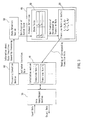
- FIG. 3 is a block diagram schematically illustrating an example of a configuration of a dynamic protocol exchange system of the present invention.
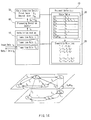
- FIG. 4 is a view schematically illustrating the relationship between protocol definitions and state transitions according to the second embodiment of the present invention.
- FIG. 5 is a view schematically illustrating protocol installation processing at an initial stage.
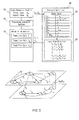
- FIG. 6 is a view illustrating system state transition in the case where data with an input pattern I 10 are inputted.
- FIG. 7 is a view schematically illustrating protocol exchange processing that is caused in response to transition of a system state at a second layer from S 21 to S 22 .
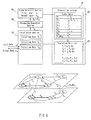
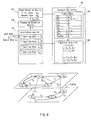
- FIG. 8 is a view illustrating system state transition in the case where data with an input pattern I 1 are inputted.
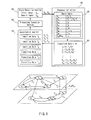
- FIG. 9 is a view schematically illustrating protocol exchange processing that is caused in response to transition of a system state at a first layer from S 11 to S 12 .
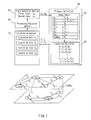
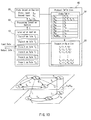
- FIG. 10 is a view illustrating system state transition in the case where data with an input pattern I 7 are inputted.
- FIG. 11 is a view schematically illustrating protocol exchange processing that is caused in response to transition of a system state at the first layer from S 12 to S 14 .
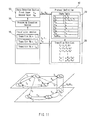
- FIG. 12 is a view illustrating system state transition in the case where data with an input pattern I 12 are inputted.
- FIG. 13 is a view schematically illustrating protocol exchange processing that is caused in response to transition of a system state at the second layer from S 22 to S 23 .
- FIG. 14 is a view illustrating system state transition in the case where data with an input pattern I 9 are inputted.
- FIG. 15 is a view schematically illustrating protocol exchange processing that is caused in response to transition of a system state at the first layer from S 14 to S 12 .
- FIG. 16 is a view illustrating system state transition in the case where data with an input pattern I 2 are inputted.
- FIG. 17 is a view schematically illustrating protocol exchange processing that is caused in response to transition of a system state at the second layer from S 23 to S 21 .
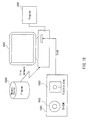
- FIG. 18 is a view illustrating an example of a recording medium in which a processing program is recorded that implements a dynamic protocol exchange system according to a third embodiment of the present invention.
- a dynamic protocol exchange system of the present invention dynamically reads a transition rule according to a system state, and operates according to the currently installation rules.
- the transition rule specifies a correspondence between an acceptable input pattern, processing to be executed, and an output pattern to be outputted as a result of the processing.
- FIG. 1 schematically illustrates the relationship between system states, sets of transition rules that correspond to the system states and state transitions, respectively.
- S 1 , S 2 , and S 3 represent system states. Arrows extended between the system states S 1 , S 2 , and S 3 represent state transitions, and the transitions are described with sets of transition rules, respectively.
- Each transition rule T n is described in a form of ⁇ I n , P n , O n >, and I n , P n, and O n represent an input pattern, processing to be performed by a system, and an output pattern as a result of the processing, respectively.
- One or a plurality of specific transition rules are assigned to the states S 1 , S 2 , and S 3 of a system.
- a table showing the relationships between the operation states of the system and the set of transition rules assigned thereto is defined as a state table.
- An example of the state table shown in FIG. 1 illustrates that transition rules T 1 and T 6 are assigned in the case where the system is in a state S 1 , transition rules T 2 , T 3 , and T 4 are assigned in the case where the system is in a state S 2 , and a transition rule T 5 is assigned in the case where the system is in a state S 3 .
- a transition rule is a list including all of defined transition rules. According to an example of the transition rule list shown in FIG. 1, the transition rules T 1 to T 6 are listed therein. Each system dynamically reads one of the predetermined transition rules in the transition rule list so as to correspond to a current system state according to the state table.
- protocol definition a combination of the state table and the transition rule list is called protocol definition.
- protocol definitions are prepared for each system, there is no need to fixedly install massive and detailed protocols such as conventional static protocols; only transition rules necessary for a current system state have to be read in so as to be replaced with transition rules for a previous state before a state transition.
- FIG. 2 is a view illustrating an example of description in the XML format of the protocol definition shown in FIG. 1. Individual protocol definitions of systems may be prepared as shown in FIG. 2.
- the transition rules T 1 and T 6 are assigned according to the state table. Then, the two transition rules T 1 and T 6 are read in. In other words, when the system is in the state S 1 , the protocol composed of two transition rules T 1 and T 6 is installed therein.
- the system which reads the two transition rules T 1 and T 6 therein results in having input patterns I 1 and I 6 , hence respond to only an input of data having either the input pattern I 1 or I 6 and executes either processing P 1 or P 6 .
- processing P 1 is executed, and output data having an output pattern O 1 are outputted.
- the system makes state transition from the state S 1 to the state S 2 .
- transition rules assigned to the system state S 2 are checked by referring to the state table again, and it is found that transition rules T 2 , T 3 , and T 4 are assigned thereto. Therefore, the transition rules T 2 , T 3 , and T 4 are read in from the transition rule list, and the transition rules T 1 and T 6 assigned for the system state S 1 are exchanged for the foregoing transition rules T 2 , T 3 , and T 4 .
- the protocol installed in the system is switched dynamically from the protocol composed of the two transition rules T 1 and T 6 assigned for the system state Si to the protocol composed of the three transitions rules T 2 , T 3 , and T 4 assigned for the system state S 2 .
- one or a plurality of transition rules are read in dynamically according to each state of the system, and an installed protocol is exchanged dynamically for a protocol composed of the foregoing read transition rules.
- an installed protocol is exchanged dynamically for a protocol composed of the foregoing read transition rules.
- the exchange may be carried out so that only the transition rules other than the overlapped rule are exchanged.
- the exchange may be carried out so that all the transition rules corresponding to a system state after state transition including the overlapped rule are read in without checking overlapping of the transition rules.
- the latter processing is preferable. This is because in the latter case, the protocol exchange processing is simpler, and it may be carried out independently from a previous state of installation of a protocol before a state transition. The embodiment shown below will be described assuming that the latter processing is used therein.
- transition rules are described so as not to include information regarding operation states of a system
- the relationship between an input pattern I n , processing P n and an output pattern O n can be described freely and flexibly without dependence on the operation state of the system, and the applicability of the transition rules can be enhanced.
- FIG. 3 is a block diagram schematically illustrating an example of a configuration of a dynamic protocol exchange system of the present invention.
- a transition rule list section 20 denotes an installation section that selects one or a plurality of transition rules from a transition rule list section 20 according to a system state and reads the same therein, so that a protocol composed of the one or plural transition rules is installed therein.
- the transition rule list section provides data of a transition rule in response to a request from the installation section 10.
- FIG. 3 has a configuration further including a state table section 30, a protocol definition section 40, a state detection section 50, a processing execution section 60, and a data input/output section 70.
- the processing execution section 60 executes processing of a transition rule having an input pattern that matches an input pattern of data inputted to the system via the data input/output section 70, among the transition rules installed in the installation section 10, and notifies the state detection section 50 of information concerning a state transition in the system caused by the processing.
- the state detection section 50 is a section for detecting a system state.
- the state detection section 50 checks information regarding a state transition supplied from the processing execution section 60 and parameters representing the other details of the system state, so as to detect the system state.
- the system state information thus detected is notified to the state table section 30 of the protocol definition section 40.
- the protocol definition section 40 is configured to include the transition rule list section 20 and the state table section 30.
- the state table section 30 holds a state table that specifies correspondences between operation states of the system and one or a plurality of transition rules to be used in the operation states. Using a system state notified by the state detection section 50 as a retrieving key, it retrieves one or a plurality of corresponding transition rules and notifies the installation section 10 of the same. It should be noted that the installation section 10 reads the notified transition rules from the transition rule list section 20 into itself.
- the data input/output section 70 inputs/outputs data from/to the other systems on the network.
- the installation section 10 accepts inputted data according to the installed protocol in the case where the protocol includes a transition rule that specifies the acceptance of an input pattern of the input data, and causes the transition rule to be executed by the processing execution section 60. Furthermore, a result of the processing is outputted as output data having an output pattern according to the transition rule via the data input/output section 70.
- the protocol is exchanged dynamically through a processing loop for successive processing in the installation section 10 ⁇ the processing execution section 60 ⁇ the state detection section 50 ⁇ the state table section 30 ⁇ the transition rule list section 20 ⁇ the installation section 10.
- a protocol composed of only necessary transition rules is installed in the installation section 10 according to the system state that varies every moment as the execution of processing proceeds.
- the contents of the protocol definition can be freely rewritten. By either rewriting the protocol definition or exchanging the protocol definition by reading a new protocol definition therein, it is possible to flexibly change the system state transition relationship and the processing contents to be executed.
- dynamic protocol exchange system of the present invention includes two implementations described below of the processing process executed by the processing execution section 60.
- the first implementation is such that the processing process itself, which is to be executed by the processing execution section 60, is described in the transition rule, and when a transition rule is read in dynamically according to a system state, a corresponding portion of the processing process is included in the transition rule to be read in.
- the processing P n described in the transition rule T n is the processing process itself.
- the second implementation is such that the processing process itself, which is to be executed by the processing execution section 60, is installed in the processing execution section 60 beforehand, and information representing the processing process, such as a name of the processing process, is described in the transition rule.
- the processing P n described in the transition rule T n is a name of the processing.
- the corresponding processing process is activated.
- an amount of data of each transition rule to be read in dynamically according to a state of the system decreases, thereby reducing a load of data transmission processing.
- transition rules corresponding to a system state notified from the state detection section are retrieved from the state table section so that the installation section reads one or a plurality of corresponding transition rules from the transition rule list, so that a protocol composed of these transition rules is installed.
- the contents of the installed protocol can be exchanged dynamically.
- a system has a hierarchical and multiplex set of states, though the basic configuration thereof is identical to that described above of the first embodiment in which transition rules are read in dynamically according to a system state and a system is operated according to a currently installed protocol composed of the foregoing transition rules.
- a system has a system state as to each of layers of the hierarchy.
- the system state can be expressed using not less than two parameters.
- the system state can be expressed as S mn using two parameters m and n.
- states S 11 , S 12 , S 13 , and S 14 compose a first layer
- states S 21 , S 22 , and S 23 compose a second layer.
- the system may have the system state S 11 at the first layer, and the system state S 21 at the second layer.
- FIG. 4 schematically illustrates the relationship between a protocol definition and state transitions according to the second embodiment.
- the transition rule list held by the protocol definition shown in FIG. 4 includes all the specified transition rules, like the transition rule list according to the first embodiment, and in this example, the transition rule list stores thirteen transition rules T 1 to T 13 .
- the state table held by the protocol definition shown in FIG. 4 describes in a table format correspondences between system states and transition rules assigned to the system states, respectively, like the state table according to the first embodiment, though the system states configure a hierarchical multiplexed structure. In this example, they are classified into two layers, that is, a first layer (system states S 11 , S 12 , S 13 , and S 14 ) and a second layer (system states S 21 , S 22 , and S 23 ), and correspondences of transition rules thereto are specified so as to be assigned to the system states in the layers, respectively.
- a first layer system states S 11 , S 12 , S 13 , and S 14
- second layer system states S 21 , S 22 , and S 23
- a diagram that schematically illustrates a state transition relationship according to the state table held by the protocol definition shown in FIG. 4 is a state transition diagram shown in a left half part of FIG. 4.
- the system state transition relationship is multiplexed so as to have two layers, that is, the first and second layers. In each layer, the relationship of state transition between system states is determined.
- the transition rule T 9 is additionally added to the first layer exclusively when the combination of the system stages of the first layer and the second layer is a combination of S 14 and S 23 .
- the transition rule T 9 is read in, in addition to the transition rule T 8 corresponding to the system state S 14 of the first layer and the transition rule T 13 corresponding to the system state S 23 of the second layer. Therefore, consequently, the transition rules T 8 , T 13 , and T 9 compose the protocol.
- the following description will depict a flow of a protocol exchange system in the case where the system states are made hierarchical and multiplex, referring to the protocol definition shown in FIG. 4. Shown is an example in which the first layer and the second layer start with the system states S 11 and S 21 , respectively, then, input data with input patterns I 10 , I 1 , I 7 , I 12 , I 9 , and I 2 are successively supplied as input data, thereby causing state transition, in which the protocol is dynamically exchanged according to the system state.
- the foregoing example is a case where when input data with an input pattern I 9 are supplied, state transition is caused in the first layer according to the combination of the system states of the first and second layers, and when input data with an input pattern I 2 are supplied, stat transition dependent on the combination of system state in the first layer is caused in the second layer.
- FIGS. 5 to 17 schematically and simply illustrate the installation section 10 to the processing execution section 60, along with system state transition diagrams.
- the protocol definition is identical to that shown in FIG. 4, and the same state table and transition rule list as those in shown in FIG. 4 are held in the state table section 30 and the transition rule list 20, respectively.
- a dynamic protocol exchange system of the present invention can be described as a program that describes processing operations for implementing the aforementioned configuration, and the dynamic protocol exchange system of the present invention can be built up by causing a computer to read the program therein.
- a program including processing operations for implementing the dynamic protocol exchange system of the present invention can be provided in a state of being stored in not only a portable recording medium 1001 such as a CD-ROM 1002 or a flexible disk 1003 but also a recording medium 1000 in a recording device on the network, or a recording medium 1005 such as a hard disk or a RAM of a computer, or can be downloaded from the network.
- the program Upon the execution of the program, the program is loaded in a computer 1004, and is executed on a main memory.
- an optimal protocol with respect to a current system state is installed by dynamically exchanging the protocol according to dynamic variation of the system state, while the processing efficiency of the system can be maintained.
Landscapes
- Engineering & Computer Science (AREA)
- Computer Security & Cryptography (AREA)
- Computer Networks & Wireless Communication (AREA)
- Signal Processing (AREA)
- Communication Control (AREA)
- Computer And Data Communications (AREA)
- Stored Programmes (AREA)
Abstract
Description
Claims (12)
- A dynamic protocol exchange system, comprising:a transition rule list section that includes transition rules each of which specifies correspondence among an input pattern to be received, a processing to be executed, and an output pattern to be outputted as a result of the processing; andan installation section that installs one or a plurality of transition rules selected from the transition rule list section according to a system state,wherein the installation section dynamically exchanges contents of the installed protocol according to the system state.
- A dynamic protocol exchange system, comprising:a protocol definition section including a transition rule list section and a state table section, the transition rule list section including transition rules each of which specifies correspondence among an input pattern to be received, a processing to be executed, and an output pattern to be outputted as a result of the processing, the state table specifying correspondences between system states and one or a plurality of transition rules to be used in the system states;a state detection section that detects a system state; andan installation section that installs one or a plurality of transition rules selected from the transition rule list section according to the system state,wherein the installation section is notified of a system state by the state detection section, retrieves one or a plurality transition rules corresponding to the system state from the state table section, and installs therein the transition rules as retrieval results from the transition rule list section as a protocol of the system.
- The dynamic protocol exchange system according to claim1 or 2, wherein the transition rules are defined so as not to include information regarding the system state.
- The dynamic protocol exchange system according to claim 1 or 2, further comprising:a data input/output section for inputting and outputting data; anda processing execution section for executing a transition rule having an input pattern that matches an input pattern of the inputted data among the transition rules installed in the execution section.
- The dynamic protocol exchange system according to claim 1 or 2, wherein system state transition relationship defined according to the state table of the state table section and the transition rules of the transition rule list section has layers so as to be multiplexed.
- A dynamic protocol exchange method, comprising:collecting transition rules each of which specifies correspondence among an input pattern to be received, a processing to be executed, and an output pattern to be outputted as a result of the processing, so as to prepare a transition rule list;installing one or a plurality of transition rules as a protocol of the system, the transition rules being selected from the transition rule list according to a system state; anddynamically exchange contents of the installed protocol according to the system state.
- A dynamic protocol exchange method, comprising:preparing a protocol definition provided with a transition rule list that includes transition rules each of which specifies correspondence among an input pattern to be received, a processing to be executed, and an output pattern to be outputted as a result of the processing, and a state table specifying correspondences between system states and one or a plurality of transition rules to be used in the system states;detecting a system state;retrieving one or a plurality of transition rules corresponding to the detected system state from the state table, and installing the transition rules as retrieval results from the transition rule list as a protocol of the system; anddynamically exchanging contents of the installed protocol according to the system state.
- The dynamic protocol exchange method according to claim 6 or 7, wherein the transition rules are defined so as not to include information regarding the system state.
- The dynamic protocol exchange method according to claim 6 or 7, further comprising:inputting data; andexecuting a transition rule having an input pattern that matches an input pattern of the inputted data, among the transition rules installed in the execution section.
- The dynamic protocol exchange method according to claim 6 or 7, wherein system state transition relationship defined according to the state table and the transition rules has layers so as to be multiplexed.
- A program for processing operations of a system that operates while dynamically exchanging a protocol, the program comprising the operations of:collecting transition rules each of which specifies correspondence among an input pattern to be received, a processing to be executed, and an output pattern to be outputted as a result of the processing, so as to prepare a transition rule list;installing one or a plurality of transition rules as a protocol of the system, the transition rules being selected from the transition rule list according to a system state; anddynamically exchanging contents of the installed protocol according to the system state that dynamically varies.
- A program for processing operations of a system that operates while dynamically exchanging a protocol, the program comprising the operations of:preparing a protocol definition provided with a transition rule list that includes transition rules each of which specifies correspondence among an input pattern to be received, a processing to be executed, and an output pattern to be outputted as a result of the processing, and a state table specifying correspondences between system states and one or a plurality of transition rules to be used in the system states;detecting a system state; andretrieving one or a plurality of transition rules corresponding to the detected system state from the state table, and installing the transition rules as retrieval results from the transition rule list as a protocol of the system.
Applications Claiming Priority (2)
| Application Number | Priority Date | Filing Date | Title |
|---|---|---|---|
| JP2001267720A JP2003076620A (en) | 2001-09-04 | 2001-09-04 | Dynamic protocol switching system and method |
| JP2001267720 | 2001-09-04 |
Publications (2)
| Publication Number | Publication Date |
|---|---|
| EP1289229A2 true EP1289229A2 (en) | 2003-03-05 |
| EP1289229A3 EP1289229A3 (en) | 2005-07-13 |
Family
ID=19093818
Family Applications (1)
| Application Number | Title | Priority Date | Filing Date |
|---|---|---|---|
| EP02251846A Withdrawn EP1289229A3 (en) | 2001-09-04 | 2002-03-14 | Dynamic protocol exchange system and method |
Country Status (3)
| Country | Link |
|---|---|
| US (1) | US20030046456A1 (en) |
| EP (1) | EP1289229A3 (en) |
| JP (1) | JP2003076620A (en) |
Families Citing this family (5)
| Publication number | Priority date | Publication date | Assignee | Title |
|---|---|---|---|---|
| US8031761B2 (en) | 2003-12-07 | 2011-10-04 | Adaptive Spectrum And Signal Alignment, Inc. | Adaptive margin and band control |
| US7460588B2 (en) * | 2005-03-03 | 2008-12-02 | Adaptive Spectrum And Signal Alignment, Inc. | Digital subscriber line (DSL) state and line profile control |
| WO2007044326A2 (en) | 2005-10-04 | 2007-04-19 | Adaptive Spectrum And Signal Alignment, Inc. | Dsl system |
| JP2008118485A (en) * | 2006-11-07 | 2008-05-22 | Meidensha Corp | Secs message data preparing device |
| US8196187B2 (en) * | 2008-02-29 | 2012-06-05 | Microsoft Corporation | Resource state transition based access control system |
Family Cites Families (7)
| Publication number | Priority date | Publication date | Assignee | Title |
|---|---|---|---|---|
| JPH0340155A (en) * | 1989-07-07 | 1991-02-20 | Matsushita Electric Ind Co Ltd | Protocol data unit editing and analysis device |
| EP0474932A1 (en) * | 1990-09-13 | 1992-03-18 | Hewlett-Packard Company | Network fault analyzer |
| US5414812A (en) * | 1992-03-27 | 1995-05-09 | International Business Machines Corporation | System for using object-oriented hierarchical representation to implement a configuration database for a layered computer network communications subsystem |
| US6034963A (en) * | 1996-10-31 | 2000-03-07 | Iready Corporation | Multiple network protocol encoder/decoder and data processor |
| US6111893A (en) * | 1997-07-31 | 2000-08-29 | Cisco Technology, Inc. | Universal protocol conversion |
| WO2001009831A2 (en) * | 1999-08-02 | 2001-02-08 | Reticular Systems, Inc. | Integrated system and method of creating intelligent agents |
| US20020161907A1 (en) * | 2001-04-25 | 2002-10-31 | Avery Moon | Adaptive multi-protocol communications system |
-
2001
- 2001-09-04 JP JP2001267720A patent/JP2003076620A/en active Pending
-
2002
- 2002-03-12 US US10/094,800 patent/US20030046456A1/en not_active Abandoned
- 2002-03-14 EP EP02251846A patent/EP1289229A3/en not_active Withdrawn
Also Published As
| Publication number | Publication date |
|---|---|
| US20030046456A1 (en) | 2003-03-06 |
| EP1289229A3 (en) | 2005-07-13 |
| JP2003076620A (en) | 2003-03-14 |
Similar Documents
| Publication | Publication Date | Title |
|---|---|---|
| EP0928441B1 (en) | Systems and methods for providing dynamic data referencing in a generic data exchange environment | |
| US8104043B2 (en) | System and method for dynamic cooperative distributed execution of computer tasks without a centralized controller | |
| US7243346B1 (en) | Customized library management system | |
| RU2336558C1 (en) | Device for image processing and control method for it | |
| US5848273A (en) | Method for generating OLE automation and IDL interfaces from metadata information | |
| EP1437657A2 (en) | System and method for management of software applications | |
| CA2504333A1 (en) | Programming and development infrastructure for an autonomic element | |
| US10185600B2 (en) | Multiple interface support | |
| US6658644B1 (en) | Services-based architecture for a telecommunications enterprise | |
| CN102214111A (en) | Device driver program setting method and device, and installing method and device | |
| JP4491989B2 (en) | Control system | |
| WO2007088100A1 (en) | Computer-implemented method, system, and program product for optimizing a distributed application | |
| RU2400817C2 (en) | Method for chaining of technical data and system for service and control of industrial plant | |
| EP1289229A2 (en) | Dynamic protocol exchange system and method | |
| CN102707907B (en) | Device and printer having frame | |
| US6289394B1 (en) | Agent management system capable of readily monitoring and controlling agent | |
| US7325237B2 (en) | System having customization modules to provide customizations | |
| JP3679429B2 (en) | File resource management system and method | |
| JP2907174B2 (en) | User interface system for supervisory control system | |
| JP4348880B2 (en) | File management program, computer-readable recording medium storing file management program, and file management method | |
| JP3434311B2 (en) | Electronic exchange | |
| US20030046301A1 (en) | Method and system for the integrated installation of software | |
| JP4536442B2 (en) | Electronic document system | |
| JP3761351B2 (en) | Distributed system remote maintenance management apparatus, method thereof, and storage medium storing program thereof | |
| JP2003005964A (en) | System and device and method for preparing control program, recording medium and its program |
Legal Events
| Date | Code | Title | Description |
|---|---|---|---|
| PUAI | Public reference made under article 153(3) epc to a published international application that has entered the european phase |
Free format text: ORIGINAL CODE: 0009012 |
|
| AK | Designated contracting states |
Kind code of ref document: A2 Designated state(s): AT BE CH CY DE DK ES FI FR GB GR IE IT LI LU MC NL PT SE TR Designated state(s): AT BE CH CY DE DK ES FI FR GB GR IE IT LI LU MC NL PT SE TR |
|
| AX | Request for extension of the european patent |
Extension state: AL LT LV MK RO SI |
|
| PUAL | Search report despatched |
Free format text: ORIGINAL CODE: 0009013 |
|
| AK | Designated contracting states |
Kind code of ref document: A3 Designated state(s): AT BE CH CY DE DK ES FI FR GB GR IE IT LI LU MC NL PT SE TR |
|
| AX | Request for extension of the european patent |
Extension state: AL LT LV MK RO SI |
|
| STAA | Information on the status of an ep patent application or granted ep patent |
Free format text: STATUS: THE APPLICATION IS DEEMED TO BE WITHDRAWN |
|
| AKX | Designation fees paid | ||
| 18D | Application deemed to be withdrawn |
Effective date: 20051001 |
|
| REG | Reference to a national code |
Ref country code: DE Ref legal event code: 8566 |