EP1288970B1 - Self-extinguishing cable and flame-retardant composition used therein - Google Patents
Self-extinguishing cable and flame-retardant composition used therein Download PDFInfo
- Publication number
- EP1288970B1 EP1288970B1 EP01121137A EP01121137A EP1288970B1 EP 1288970 B1 EP1288970 B1 EP 1288970B1 EP 01121137 A EP01121137 A EP 01121137A EP 01121137 A EP01121137 A EP 01121137A EP 1288970 B1 EP1288970 B1 EP 1288970B1
- Authority
- EP
- European Patent Office
- Prior art keywords
- group
- optionally substituted
- flame
- groups
- alkyl
- Prior art date
- Legal status (The legal status is an assumption and is not a legal conclusion. Google has not performed a legal analysis and makes no representation as to the accuracy of the status listed.)
- Expired - Lifetime
Links
- 239000003063 flame retardant Substances 0.000 title claims abstract description 87
- RNFJDJUURJAICM-UHFFFAOYSA-N 2,2,4,4,6,6-hexaphenoxy-1,3,5-triaza-2$l^{5},4$l^{5},6$l^{5}-triphosphacyclohexa-1,3,5-triene Chemical compound N=1P(OC=2C=CC=CC=2)(OC=2C=CC=CC=2)=NP(OC=2C=CC=CC=2)(OC=2C=CC=CC=2)=NP=1(OC=1C=CC=CC=1)OC1=CC=CC=C1 RNFJDJUURJAICM-UHFFFAOYSA-N 0.000 title claims abstract description 86
- 239000000203 mixture Substances 0.000 title claims abstract description 86
- 239000000945 filler Substances 0.000 claims abstract description 37
- 238000000576 coating method Methods 0.000 claims abstract description 26
- 239000002861 polymer material Substances 0.000 claims abstract description 26
- 239000011248 coating agent Substances 0.000 claims abstract description 24
- BLRPTPMANUNPDV-UHFFFAOYSA-N Silane Chemical group [SiH4] BLRPTPMANUNPDV-UHFFFAOYSA-N 0.000 claims abstract description 18
- 229910000077 silane Inorganic materials 0.000 claims abstract description 18
- 229920001577 copolymer Polymers 0.000 claims description 38
- -1 polyethylene Polymers 0.000 claims description 31
- VGGSQFUCUMXWEO-UHFFFAOYSA-N Ethene Chemical compound C=C VGGSQFUCUMXWEO-UHFFFAOYSA-N 0.000 claims description 30
- 239000005977 Ethylene Substances 0.000 claims description 29
- 125000004432 carbon atom Chemical group C* 0.000 claims description 25
- 229910001862 magnesium hydroxide Inorganic materials 0.000 claims description 23
- VTHJTEIRLNZDEV-UHFFFAOYSA-L magnesium dihydroxide Chemical compound [OH-].[OH-].[Mg+2] VTHJTEIRLNZDEV-UHFFFAOYSA-L 0.000 claims description 21
- 239000000347 magnesium hydroxide Substances 0.000 claims description 21
- 239000004711 α-olefin Substances 0.000 claims description 21
- 125000005915 C6-C14 aryl group Chemical group 0.000 claims description 19
- 150000003839 salts Chemical class 0.000 claims description 16
- 239000004020 conductor Substances 0.000 claims description 15
- 150000002148 esters Chemical class 0.000 claims description 12
- 239000004698 Polyethylene Substances 0.000 claims description 10
- 125000000217 alkyl group Chemical group 0.000 claims description 10
- 150000001993 dienes Chemical class 0.000 claims description 10
- 229920000573 polyethylene Polymers 0.000 claims description 10
- 239000004743 Polypropylene Substances 0.000 claims description 9
- 229920001155 polypropylene Polymers 0.000 claims description 9
- 125000000229 (C1-C4)alkoxy group Chemical group 0.000 claims description 8
- 150000001336 alkenes Chemical class 0.000 claims description 8
- 125000003545 alkoxy group Chemical group 0.000 claims description 8
- 229910052751 metal Inorganic materials 0.000 claims description 8
- 239000002184 metal Chemical class 0.000 claims description 8
- 229920000728 polyester Polymers 0.000 claims description 8
- 229920000570 polyether Polymers 0.000 claims description 8
- 239000012796 inorganic flame retardant Substances 0.000 claims description 7
- JRZJOMJEPLMPRA-UHFFFAOYSA-N olefin Natural products CCCCCCCC=C JRZJOMJEPLMPRA-UHFFFAOYSA-N 0.000 claims description 7
- FYYHWMGAXLPEAU-UHFFFAOYSA-N Magnesium Chemical compound [Mg] FYYHWMGAXLPEAU-UHFFFAOYSA-N 0.000 claims description 6
- 239000004411 aluminium Substances 0.000 claims description 6
- XAGFODPZIPBFFR-UHFFFAOYSA-N aluminium Chemical compound [Al] XAGFODPZIPBFFR-UHFFFAOYSA-N 0.000 claims description 6
- 229920001519 homopolymer Polymers 0.000 claims description 6
- 150000002430 hydrocarbons Chemical group 0.000 claims description 6
- 239000011777 magnesium Substances 0.000 claims description 6
- 125000003837 (C1-C20) alkyl group Chemical group 0.000 claims description 5
- 125000003358 C2-C20 alkenyl group Chemical group 0.000 claims description 5
- OYPRJOBELJOOCE-UHFFFAOYSA-N Calcium Chemical group [Ca] OYPRJOBELJOOCE-UHFFFAOYSA-N 0.000 claims description 5
- 125000003342 alkenyl group Chemical group 0.000 claims description 5
- 239000011575 calcium Substances 0.000 claims description 5
- 238000006555 catalytic reaction Methods 0.000 claims description 5
- 125000002887 hydroxy group Chemical group [H]O* 0.000 claims description 5
- 229920001169 thermoplastic Polymers 0.000 claims description 5
- 239000004416 thermosoftening plastic Substances 0.000 claims description 5
- 125000000923 (C1-C30) alkyl group Chemical group 0.000 claims description 4
- NIXOWILDQLNWCW-UHFFFAOYSA-N Acrylic acid Chemical class OC(=O)C=C NIXOWILDQLNWCW-UHFFFAOYSA-N 0.000 claims description 4
- 125000000739 C2-C30 alkenyl group Chemical group 0.000 claims description 4
- 229920000089 Cyclic olefin copolymer Polymers 0.000 claims description 4
- UFHFLCQGNIYNRP-UHFFFAOYSA-N Hydrogen Chemical compound [H][H] UFHFLCQGNIYNRP-UHFFFAOYSA-N 0.000 claims description 4
- 125000003118 aryl group Chemical group 0.000 claims description 4
- 239000001257 hydrogen Substances 0.000 claims description 4
- 229910052739 hydrogen Inorganic materials 0.000 claims description 4
- ZLNQQNXFFQJAID-UHFFFAOYSA-L magnesium carbonate Chemical compound [Mg+2].[O-]C([O-])=O ZLNQQNXFFQJAID-UHFFFAOYSA-L 0.000 claims description 4
- 239000004721 Polyphenylene oxide Substances 0.000 claims description 3
- 125000005024 alkenyl aryl group Chemical group 0.000 claims description 3
- 125000005250 alkyl acrylate group Chemical group 0.000 claims description 3
- 125000002877 alkyl aryl group Chemical group 0.000 claims description 3
- PNEYBMLMFCGWSK-UHFFFAOYSA-N aluminium oxide Inorganic materials [O-2].[O-2].[O-2].[Al+3].[Al+3] PNEYBMLMFCGWSK-UHFFFAOYSA-N 0.000 claims description 3
- 125000005018 aryl alkenyl group Chemical group 0.000 claims description 3
- 125000003710 aryl alkyl group Chemical group 0.000 claims description 3
- 229910052791 calcium Inorganic materials 0.000 claims description 3
- 229920005606 polypropylene copolymer Polymers 0.000 claims description 3
- 150000004684 trihydrates Chemical class 0.000 claims description 3
- 125000004400 (C1-C12) alkyl group Chemical group 0.000 claims description 2
- 125000006710 (C2-C12) alkenyl group Chemical group 0.000 claims description 2
- 229910021502 aluminium hydroxide Inorganic materials 0.000 claims description 2
- 229910001861 calcium hydroxide Inorganic materials 0.000 claims description 2
- 239000001095 magnesium carbonate Substances 0.000 claims description 2
- 229910000021 magnesium carbonate Inorganic materials 0.000 claims description 2
- 229910000000 metal hydroxide Inorganic materials 0.000 claims description 2
- 150000004692 metal hydroxides Chemical class 0.000 claims description 2
- 229910044991 metal oxide Inorganic materials 0.000 claims description 2
- 150000004706 metal oxides Chemical class 0.000 claims description 2
- 125000000913 palmityl group Chemical group [H]C([*])([H])C([H])([H])C([H])([H])C([H])([H])C([H])([H])C([H])([H])C([H])([H])C([H])([H])C([H])([H])C([H])([H])C([H])([H])C([H])([H])C([H])([H])C([H])([H])C([H])([H])C([H])([H])[H] 0.000 claims description 2
- 125000004079 stearyl group Chemical group [H]C([*])([H])C([H])([H])C([H])([H])C([H])([H])C([H])([H])C([H])([H])C([H])([H])C([H])([H])C([H])([H])C([H])([H])C([H])([H])C([H])([H])C([H])([H])C([H])([H])C([H])([H])C([H])([H])C([H])([H])C([H])([H])[H] 0.000 claims description 2
- UGZADUVQMDAIAO-UHFFFAOYSA-L zinc hydroxide Chemical compound [OH-].[OH-].[Zn+2] UGZADUVQMDAIAO-UHFFFAOYSA-L 0.000 claims description 2
- 229910021511 zinc hydroxide Inorganic materials 0.000 claims description 2
- 229940007718 zinc hydroxide Drugs 0.000 claims description 2
- 125000000041 C6-C10 aryl group Chemical group 0.000 claims 4
- XLYOFNOQVPJJNP-UHFFFAOYSA-N water Substances O XLYOFNOQVPJJNP-UHFFFAOYSA-N 0.000 abstract description 9
- 230000002411 adverse Effects 0.000 abstract description 2
- 125000001183 hydrocarbyl group Chemical group 0.000 abstract 1
- 239000010410 layer Substances 0.000 description 20
- 229920000642 polymer Polymers 0.000 description 16
- 239000007822 coupling agent Substances 0.000 description 14
- 150000004756 silanes Chemical class 0.000 description 14
- 239000000654 additive Substances 0.000 description 11
- WOXXJEVNDJOOLV-UHFFFAOYSA-N ethenyl-tris(2-methoxyethoxy)silane Chemical compound COCCO[Si](OCCOC)(OCCOC)C=C WOXXJEVNDJOOLV-UHFFFAOYSA-N 0.000 description 11
- 238000001125 extrusion Methods 0.000 description 10
- 230000002209 hydrophobic effect Effects 0.000 description 9
- 229920001971 elastomer Polymers 0.000 description 7
- QQONPFPTGQHPMA-UHFFFAOYSA-N propylene Natural products CC=C QQONPFPTGQHPMA-UHFFFAOYSA-N 0.000 description 7
- 125000004805 propylene group Chemical group [H]C([H])([H])C([H])([*:1])C([H])([H])[*:2] 0.000 description 7
- VXNZUUAINFGPBY-UHFFFAOYSA-N 1-Butene Chemical compound CCC=C VXNZUUAINFGPBY-UHFFFAOYSA-N 0.000 description 6
- LIKMAJRDDDTEIG-UHFFFAOYSA-N 1-hexene Chemical compound CCCCC=C LIKMAJRDDDTEIG-UHFFFAOYSA-N 0.000 description 6
- FAPWRFPIFSIZLT-UHFFFAOYSA-M Sodium chloride Chemical compound [Na+].[Cl-] FAPWRFPIFSIZLT-UHFFFAOYSA-M 0.000 description 6
- 238000009826 distribution Methods 0.000 description 6
- QIQXTHQIDYTFRH-UHFFFAOYSA-N octadecanoic acid Chemical compound CCCCCCCCCCCCCCCCCC(O)=O QIQXTHQIDYTFRH-UHFFFAOYSA-N 0.000 description 6
- 229920000098 polyolefin Polymers 0.000 description 6
- KWKAKUADMBZCLK-UHFFFAOYSA-N 1-octene Chemical compound CCCCCCC=C KWKAKUADMBZCLK-UHFFFAOYSA-N 0.000 description 5
- 230000032683 aging Effects 0.000 description 5
- ODINCKMPIJJUCX-UHFFFAOYSA-N calcium oxide Inorganic materials [Ca]=O ODINCKMPIJJUCX-UHFFFAOYSA-N 0.000 description 5
- 239000003795 chemical substances by application Substances 0.000 description 5
- 239000000463 material Substances 0.000 description 5
- OQCDKBAXFALNLD-UHFFFAOYSA-N octadecanoic acid Natural products CCCCCCCC(C)CCCCCCCCC(O)=O OQCDKBAXFALNLD-UHFFFAOYSA-N 0.000 description 5
- 239000005060 rubber Substances 0.000 description 5
- XDOFQFKRPWOURC-UHFFFAOYSA-N 16-methylheptadecanoic acid Chemical compound CC(C)CCCCCCCCCCCCCCC(O)=O XDOFQFKRPWOURC-UHFFFAOYSA-N 0.000 description 4
- 235000021355 Stearic acid Nutrition 0.000 description 4
- 230000000996 additive effect Effects 0.000 description 4
- 229910052782 aluminium Inorganic materials 0.000 description 4
- ADCOVFLJGNWWNZ-UHFFFAOYSA-N antimony trioxide Chemical compound O=[Sb]O[Sb]=O ADCOVFLJGNWWNZ-UHFFFAOYSA-N 0.000 description 4
- 239000000292 calcium oxide Substances 0.000 description 4
- 150000002118 epoxides Chemical class 0.000 description 4
- CGPRUXZTHGTMKW-UHFFFAOYSA-N ethene;ethyl prop-2-enoate Chemical compound C=C.CCOC(=O)C=C CGPRUXZTHGTMKW-UHFFFAOYSA-N 0.000 description 4
- 229910052749 magnesium Inorganic materials 0.000 description 4
- 229940091250 magnesium supplement Drugs 0.000 description 4
- FPYJFEHAWHCUMM-UHFFFAOYSA-N maleic anhydride Chemical compound O=C1OC(=O)C=C1 FPYJFEHAWHCUMM-UHFFFAOYSA-N 0.000 description 4
- 238000000034 method Methods 0.000 description 4
- 239000000243 solution Substances 0.000 description 4
- 239000008117 stearic acid Substances 0.000 description 4
- XMNIXWIUMCBBBL-UHFFFAOYSA-N 2-(2-phenylpropan-2-ylperoxy)propan-2-ylbenzene Chemical compound C=1C=CC=CC=1C(C)(C)OOC(C)(C)C1=CC=CC=C1 XMNIXWIUMCBBBL-UHFFFAOYSA-N 0.000 description 3
- 229920002943 EPDM rubber Polymers 0.000 description 3
- RTAQQCXQSZGOHL-UHFFFAOYSA-N Titanium Chemical compound [Ti] RTAQQCXQSZGOHL-UHFFFAOYSA-N 0.000 description 3
- 150000008064 anhydrides Chemical class 0.000 description 3
- 229940087373 calcium oxide Drugs 0.000 description 3
- 150000001991 dicarboxylic acids Chemical class 0.000 description 3
- 235000014113 dietary fatty acids Nutrition 0.000 description 3
- HQQADJVZYDDRJT-UHFFFAOYSA-N ethene;prop-1-ene Chemical group C=C.CC=C HQQADJVZYDDRJT-UHFFFAOYSA-N 0.000 description 3
- 239000000194 fatty acid Substances 0.000 description 3
- 229930195729 fatty acid Natural products 0.000 description 3
- 150000004665 fatty acids Chemical class 0.000 description 3
- 150000004679 hydroxides Chemical class 0.000 description 3
- 239000003999 initiator Substances 0.000 description 3
- 238000002156 mixing Methods 0.000 description 3
- 150000002763 monocarboxylic acids Chemical class 0.000 description 3
- TVMXDCGIABBOFY-UHFFFAOYSA-N n-Octanol Natural products CCCCCCCC TVMXDCGIABBOFY-UHFFFAOYSA-N 0.000 description 3
- 239000002245 particle Substances 0.000 description 3
- 239000000779 smoke Substances 0.000 description 3
- 239000011780 sodium chloride Substances 0.000 description 3
- VZCYOOQTPOCHFL-UHFFFAOYSA-N trans-butenedioic acid Natural products OC(=O)C=CC(O)=O VZCYOOQTPOCHFL-UHFFFAOYSA-N 0.000 description 3
- 229940117958 vinyl acetate Drugs 0.000 description 3
- WRIDQFICGBMAFQ-UHFFFAOYSA-N (E)-8-Octadecenoic acid Natural products CCCCCCCCCC=CCCCCCCC(O)=O WRIDQFICGBMAFQ-UHFFFAOYSA-N 0.000 description 2
- CRSBERNSMYQZNG-UHFFFAOYSA-N 1-dodecene Chemical compound CCCCCCCCCCC=C CRSBERNSMYQZNG-UHFFFAOYSA-N 0.000 description 2
- JAHNSTQSQJOJLO-UHFFFAOYSA-N 2-(3-fluorophenyl)-1h-imidazole Chemical compound FC1=CC=CC(C=2NC=CN=2)=C1 JAHNSTQSQJOJLO-UHFFFAOYSA-N 0.000 description 2
- LQJBNNIYVWPHFW-UHFFFAOYSA-N 20:1omega9c fatty acid Natural products CCCCCCCCCCC=CCCCCCCCC(O)=O LQJBNNIYVWPHFW-UHFFFAOYSA-N 0.000 description 2
- WPMYUUITDBHVQZ-UHFFFAOYSA-M 3-(3,5-ditert-butyl-4-hydroxyphenyl)propanoate Chemical compound CC(C)(C)C1=CC(CCC([O-])=O)=CC(C(C)(C)C)=C1O WPMYUUITDBHVQZ-UHFFFAOYSA-M 0.000 description 2
- WSSSPWUEQFSQQG-UHFFFAOYSA-N 4-methyl-1-pentene Chemical compound CC(C)CC=C WSSSPWUEQFSQQG-UHFFFAOYSA-N 0.000 description 2
- QSBYPNXLFMSGKH-UHFFFAOYSA-N 9-Heptadecensaeure Natural products CCCCCCCC=CCCCCCCCC(O)=O QSBYPNXLFMSGKH-UHFFFAOYSA-N 0.000 description 2
- KAKZBPTYRLMSJV-UHFFFAOYSA-N Butadiene Chemical compound C=CC=C KAKZBPTYRLMSJV-UHFFFAOYSA-N 0.000 description 2
- VZCYOOQTPOCHFL-OWOJBTEDSA-N Fumaric acid Chemical compound OC(=O)\C=C\C(O)=O VZCYOOQTPOCHFL-OWOJBTEDSA-N 0.000 description 2
- BAPJBEWLBFYGME-UHFFFAOYSA-N Methyl acrylate Chemical compound COC(=O)C=C BAPJBEWLBFYGME-UHFFFAOYSA-N 0.000 description 2
- ZQPPMHVWECSIRJ-UHFFFAOYSA-N Oleic acid Natural products CCCCCCCCC=CCCCCCCCC(O)=O ZQPPMHVWECSIRJ-UHFFFAOYSA-N 0.000 description 2
- OFOBLEOULBTSOW-UHFFFAOYSA-N Propanedioic acid Natural products OC(=O)CC(O)=O OFOBLEOULBTSOW-UHFFFAOYSA-N 0.000 description 2
- XTXRWKRVRITETP-UHFFFAOYSA-N Vinyl acetate Chemical compound CC(=O)OC=C XTXRWKRVRITETP-UHFFFAOYSA-N 0.000 description 2
- 239000003963 antioxidant agent Substances 0.000 description 2
- 229910052599 brucite Inorganic materials 0.000 description 2
- CQEYYJKEWSMYFG-UHFFFAOYSA-N butyl acrylate Chemical compound CCCCOC(=O)C=C CQEYYJKEWSMYFG-UHFFFAOYSA-N 0.000 description 2
- BRPQOXSCLDDYGP-UHFFFAOYSA-N calcium oxide Chemical compound [O-2].[Ca+2] BRPQOXSCLDDYGP-UHFFFAOYSA-N 0.000 description 2
- CJZGTCYPCWQAJB-UHFFFAOYSA-L calcium stearate Chemical class [Ca+2].CCCCCCCCCCCCCCCCCC([O-])=O.CCCCCCCCCCCCCCCCCC([O-])=O CJZGTCYPCWQAJB-UHFFFAOYSA-L 0.000 description 2
- 239000003054 catalyst Substances 0.000 description 2
- 230000000052 comparative effect Effects 0.000 description 2
- 150000001875 compounds Chemical class 0.000 description 2
- 238000000354 decomposition reaction Methods 0.000 description 2
- 239000012024 dehydrating agents Substances 0.000 description 2
- POULHZVOKOAJMA-UHFFFAOYSA-N dodecanoic acid Chemical compound CCCCCCCCCCCC(O)=O POULHZVOKOAJMA-UHFFFAOYSA-N 0.000 description 2
- 239000000806 elastomer Substances 0.000 description 2
- FWDBOZPQNFPOLF-UHFFFAOYSA-N ethenyl(triethoxy)silane Chemical compound CCO[Si](OCC)(OCC)C=C FWDBOZPQNFPOLF-UHFFFAOYSA-N 0.000 description 2
- NKSJNEHGWDZZQF-UHFFFAOYSA-N ethenyl(trimethoxy)silane Chemical compound CO[Si](OC)(OC)C=C NKSJNEHGWDZZQF-UHFFFAOYSA-N 0.000 description 2
- 229920001038 ethylene copolymer Polymers 0.000 description 2
- 238000000227 grinding Methods 0.000 description 2
- IPCSVZSSVZVIGE-UHFFFAOYSA-N hexadecanoic acid Chemical compound CCCCCCCCCCCCCCCC(O)=O IPCSVZSSVZVIGE-UHFFFAOYSA-N 0.000 description 2
- 229920001903 high density polyethylene Polymers 0.000 description 2
- 239000004700 high-density polyethylene Substances 0.000 description 2
- 238000009413 insulation Methods 0.000 description 2
- 230000003993 interaction Effects 0.000 description 2
- QXJSBBXBKPUZAA-UHFFFAOYSA-N isooleic acid Natural products CCCCCCCC=CCCCCCCCCC(O)=O QXJSBBXBKPUZAA-UHFFFAOYSA-N 0.000 description 2
- 229920001684 low density polyethylene Polymers 0.000 description 2
- 239000004702 low-density polyethylene Substances 0.000 description 2
- VZCYOOQTPOCHFL-UPHRSURJSA-N maleic acid Chemical compound OC(=O)\C=C/C(O)=O VZCYOOQTPOCHFL-UPHRSURJSA-N 0.000 description 2
- 239000011976 maleic acid Substances 0.000 description 2
- 239000011159 matrix material Substances 0.000 description 2
- 229920001179 medium density polyethylene Polymers 0.000 description 2
- 239000004701 medium-density polyethylene Substances 0.000 description 2
- LVHBHZANLOWSRM-UHFFFAOYSA-N methylenebutanedioic acid Natural products OC(=O)CC(=C)C(O)=O LVHBHZANLOWSRM-UHFFFAOYSA-N 0.000 description 2
- ZQPPMHVWECSIRJ-KTKRTIGZSA-N oleic acid Chemical compound CCCCCCCC\C=C/CCCCCCCC(O)=O ZQPPMHVWECSIRJ-KTKRTIGZSA-N 0.000 description 2
- 150000001282 organosilanes Chemical class 0.000 description 2
- YWAKXRMUMFPDSH-UHFFFAOYSA-N pentene Chemical compound CCCC=C YWAKXRMUMFPDSH-UHFFFAOYSA-N 0.000 description 2
- 229920001384 propylene homopolymer Polymers 0.000 description 2
- 229920006395 saturated elastomer Polymers 0.000 description 2
- 235000003441 saturated fatty acids Nutrition 0.000 description 2
- 150000004671 saturated fatty acids Chemical class 0.000 description 2
- 239000000126 substance Substances 0.000 description 2
- VXUYXOFXAQZZMF-UHFFFAOYSA-N titanium(IV) isopropoxide Chemical compound CC(C)O[Ti](OC(C)C)(OC(C)C)OC(C)C VXUYXOFXAQZZMF-UHFFFAOYSA-N 0.000 description 2
- 235000021122 unsaturated fatty acids Nutrition 0.000 description 2
- 150000004670 unsaturated fatty acids Chemical class 0.000 description 2
- 239000010457 zeolite Substances 0.000 description 2
- XOOUIPVCVHRTMJ-UHFFFAOYSA-L zinc stearate Chemical compound [Zn+2].CCCCCCCCCCCCCCCCCC([O-])=O.CCCCCCCCCCCCCCCCCC([O-])=O XOOUIPVCVHRTMJ-UHFFFAOYSA-L 0.000 description 2
- DXZMANYCMVCPIM-UHFFFAOYSA-L zinc;diethylphosphinate Chemical compound [Zn+2].CCP([O-])(=O)CC.CCP([O-])(=O)CC DXZMANYCMVCPIM-UHFFFAOYSA-L 0.000 description 2
- OJOWICOBYCXEKR-APPZFPTMSA-N (1S,4R)-5-ethylidenebicyclo[2.2.1]hept-2-ene Chemical compound CC=C1C[C@@H]2C[C@@H]1C=C2 OJOWICOBYCXEKR-APPZFPTMSA-N 0.000 description 1
- WYTZZXDRDKSJID-UHFFFAOYSA-N (3-aminopropyl)triethoxysilane Chemical compound CCO[Si](OCC)(OCC)CCCN WYTZZXDRDKSJID-UHFFFAOYSA-N 0.000 description 1
- PRBHEGAFLDMLAL-GQCTYLIASA-N (4e)-hexa-1,4-diene Chemical compound C\C=C\CC=C PRBHEGAFLDMLAL-GQCTYLIASA-N 0.000 description 1
- RJUCIROUEDJQIB-GQCTYLIASA-N (6e)-octa-1,6-diene Chemical compound C\C=C\CCCC=C RJUCIROUEDJQIB-GQCTYLIASA-N 0.000 description 1
- KJOIQMXGNUKOLD-UHFFFAOYSA-N 1-[diacetyl(ethenyl)silyl]ethanone Chemical compound CC(=O)[Si](C=C)(C(C)=O)C(C)=O KJOIQMXGNUKOLD-UHFFFAOYSA-N 0.000 description 1
- ZNRLMGFXSPUZNR-UHFFFAOYSA-N 2,2,4-trimethyl-1h-quinoline Chemical compound C1=CC=C2C(C)=CC(C)(C)NC2=C1 ZNRLMGFXSPUZNR-UHFFFAOYSA-N 0.000 description 1
- STMDPCBYJCIZOD-UHFFFAOYSA-N 2-(2,4-dinitroanilino)-4-methylpentanoic acid Chemical compound CC(C)CC(C(O)=O)NC1=CC=C([N+]([O-])=O)C=C1[N+]([O-])=O STMDPCBYJCIZOD-UHFFFAOYSA-N 0.000 description 1
- SMZOUWXMTYCWNB-UHFFFAOYSA-N 2-(2-methoxy-5-methylphenyl)ethanamine Chemical compound COC1=CC=C(C)C=C1CCN SMZOUWXMTYCWNB-UHFFFAOYSA-N 0.000 description 1
- JJRUAPNVLBABCN-UHFFFAOYSA-N 2-(ethenoxymethyl)oxirane Chemical compound C=COCC1CO1 JJRUAPNVLBABCN-UHFFFAOYSA-N 0.000 description 1
- VFBJXXJYHWLXRM-UHFFFAOYSA-N 2-[2-[3-(3,5-ditert-butyl-4-hydroxyphenyl)propanoyloxy]ethylsulfanyl]ethyl 3-(3,5-ditert-butyl-4-hydroxyphenyl)propanoate Chemical compound CC(C)(C)C1=C(O)C(C(C)(C)C)=CC(CCC(=O)OCCSCCOC(=O)CCC=2C=C(C(O)=C(C=2)C(C)(C)C)C(C)(C)C)=C1 VFBJXXJYHWLXRM-UHFFFAOYSA-N 0.000 description 1
- XOUQAVYLRNOXDO-UHFFFAOYSA-N 2-tert-butyl-5-methylphenol Chemical compound CC1=CC=C(C(C)(C)C)C(O)=C1 XOUQAVYLRNOXDO-UHFFFAOYSA-N 0.000 description 1
- HCILJBJJZALOAL-UHFFFAOYSA-N 3-(3,5-ditert-butyl-4-hydroxyphenyl)-n'-[3-(3,5-ditert-butyl-4-hydroxyphenyl)propanoyl]propanehydrazide Chemical compound CC(C)(C)C1=C(O)C(C(C)(C)C)=CC(CCC(=O)NNC(=O)CCC=2C=C(C(O)=C(C=2)C(C)(C)C)C(C)(C)C)=C1 HCILJBJJZALOAL-UHFFFAOYSA-N 0.000 description 1
- XDLMVUHYZWKMMD-UHFFFAOYSA-N 3-trimethoxysilylpropyl 2-methylprop-2-enoate Chemical compound CO[Si](OC)(OC)CCCOC(=O)C(C)=C XDLMVUHYZWKMMD-UHFFFAOYSA-N 0.000 description 1
- INYHZQLKOKTDAI-UHFFFAOYSA-N 5-ethenylbicyclo[2.2.1]hept-2-ene Chemical compound C1C2C(C=C)CC1C=C2 INYHZQLKOKTDAI-UHFFFAOYSA-N 0.000 description 1
- WTQBISBWKRKLIJ-UHFFFAOYSA-N 5-methylidenebicyclo[2.2.1]hept-2-ene Chemical compound C1C2C(=C)CC1C=C2 WTQBISBWKRKLIJ-UHFFFAOYSA-N 0.000 description 1
- 239000005995 Aluminium silicate Substances 0.000 description 1
- 239000004342 Benzoyl peroxide Substances 0.000 description 1
- OMPJBNCRMGITSC-UHFFFAOYSA-N Benzoylperoxide Chemical compound C=1C=CC=CC=1C(=O)OOC(=O)C1=CC=CC=C1 OMPJBNCRMGITSC-UHFFFAOYSA-N 0.000 description 1
- RYGMFSIKBFXOCR-UHFFFAOYSA-N Copper Chemical compound [Cu] RYGMFSIKBFXOCR-UHFFFAOYSA-N 0.000 description 1
- 229920003317 Fusabond® Polymers 0.000 description 1
- 244000043261 Hevea brasiliensis Species 0.000 description 1
- 239000005639 Lauric acid Substances 0.000 description 1
- 229920010126 Linear Low Density Polyethylene (LLDPE) Polymers 0.000 description 1
- CERQOIWHTDAKMF-UHFFFAOYSA-N Methacrylic acid Chemical compound CC(=C)C(O)=O CERQOIWHTDAKMF-UHFFFAOYSA-N 0.000 description 1
- 239000005642 Oleic acid Substances 0.000 description 1
- 235000021314 Palmitic acid Nutrition 0.000 description 1
- 229910021536 Zeolite Inorganic materials 0.000 description 1
- HCHKCACWOHOZIP-UHFFFAOYSA-N Zinc Chemical compound [Zn] HCHKCACWOHOZIP-UHFFFAOYSA-N 0.000 description 1
- 238000010521 absorption reaction Methods 0.000 description 1
- 239000002253 acid Substances 0.000 description 1
- 239000002671 adjuvant Substances 0.000 description 1
- 150000001343 alkyl silanes Chemical class 0.000 description 1
- 235000012211 aluminium silicate Nutrition 0.000 description 1
- 230000003078 antioxidant effect Effects 0.000 description 1
- 229920005601 base polymer Polymers 0.000 description 1
- 235000019400 benzoyl peroxide Nutrition 0.000 description 1
- 230000005540 biological transmission Effects 0.000 description 1
- 229920005549 butyl rubber Polymers 0.000 description 1
- 239000008116 calcium stearate Substances 0.000 description 1
- 235000013539 calcium stearate Nutrition 0.000 description 1
- 230000015556 catabolic process Effects 0.000 description 1
- HNEGQIOMVPPMNR-IHWYPQMZSA-N citraconic acid Chemical compound OC(=O)C(/C)=C\C(O)=O HNEGQIOMVPPMNR-IHWYPQMZSA-N 0.000 description 1
- 229940018557 citraconic acid Drugs 0.000 description 1
- 239000008199 coating composition Substances 0.000 description 1
- 239000011247 coating layer Substances 0.000 description 1
- 238000004040 coloring Methods 0.000 description 1
- 238000002485 combustion reaction Methods 0.000 description 1
- 238000007334 copolymerization reaction Methods 0.000 description 1
- 229910052802 copper Inorganic materials 0.000 description 1
- 239000010949 copper Substances 0.000 description 1
- UVJHQYIOXKWHFD-UHFFFAOYSA-N cyclohexa-1,4-diene Chemical compound C1C=CCC=C1 UVJHQYIOXKWHFD-UHFFFAOYSA-N 0.000 description 1
- 238000006731 degradation reaction Methods 0.000 description 1
- 230000008021 deposition Effects 0.000 description 1
- LSXWFXONGKSEMY-UHFFFAOYSA-N di-tert-butyl peroxide Chemical compound CC(C)(C)OOC(C)(C)C LSXWFXONGKSEMY-UHFFFAOYSA-N 0.000 description 1
- 229920003244 diene elastomer Polymers 0.000 description 1
- VKJWRHASAVFGPS-UHFFFAOYSA-N diethoxy-methyl-prop-2-enylsilane Chemical compound CCO[Si](C)(CC=C)OCC VKJWRHASAVFGPS-UHFFFAOYSA-N 0.000 description 1
- WQTNGCZMPUCIEX-UHFFFAOYSA-N dimethoxy-methyl-prop-2-enylsilane Chemical compound CO[Si](C)(OC)CC=C WQTNGCZMPUCIEX-UHFFFAOYSA-N 0.000 description 1
- YYLGKUPAFFKGRQ-UHFFFAOYSA-N dimethyldiethoxysilane Chemical compound CCO[Si](C)(C)OCC YYLGKUPAFFKGRQ-UHFFFAOYSA-N 0.000 description 1
- HNPSIPDUKPIQMN-UHFFFAOYSA-N dioxosilane;oxo(oxoalumanyloxy)alumane Chemical compound O=[Si]=O.O=[Al]O[Al]=O HNPSIPDUKPIQMN-UHFFFAOYSA-N 0.000 description 1
- 229940069096 dodecene Drugs 0.000 description 1
- 229920001198 elastomeric copolymer Polymers 0.000 description 1
- ZLNAFSPCNATQPQ-UHFFFAOYSA-N ethenyl-dimethoxy-methylsilane Chemical compound CO[Si](C)(OC)C=C ZLNAFSPCNATQPQ-UHFFFAOYSA-N 0.000 description 1
- 239000001530 fumaric acid Substances 0.000 description 1
- 239000003517 fume Substances 0.000 description 1
- 239000007789 gas Substances 0.000 description 1
- 239000011521 glass Substances 0.000 description 1
- 239000003365 glass fiber Substances 0.000 description 1
- VOZRXNHHFUQHIL-UHFFFAOYSA-N glycidyl methacrylate Chemical compound CC(=C)C(=O)OCC1CO1 VOZRXNHHFUQHIL-UHFFFAOYSA-N 0.000 description 1
- 239000008187 granular material Substances 0.000 description 1
- 150000004820 halides Chemical class 0.000 description 1
- RSKGMYDENCAJEN-UHFFFAOYSA-N hexadecyl(trimethoxy)silane Chemical compound CCCCCCCCCCCCCCCC[Si](OC)(OC)OC RSKGMYDENCAJEN-UHFFFAOYSA-N 0.000 description 1
- 238000002347 injection Methods 0.000 description 1
- 239000007924 injection Substances 0.000 description 1
- 229910052500 inorganic mineral Inorganic materials 0.000 description 1
- NLYAJNPCOHFWQQ-UHFFFAOYSA-N kaolin Chemical compound O.O.O=[Al]O[Si](=O)O[Si](=O)O[Al]=O NLYAJNPCOHFWQQ-UHFFFAOYSA-N 0.000 description 1
- 229920000092 linear low density polyethylene Polymers 0.000 description 1
- 239000004707 linear low-density polyethylene Substances 0.000 description 1
- 229920005679 linear ultra low density polyethylene Polymers 0.000 description 1
- 239000007788 liquid Substances 0.000 description 1
- 238000004519 manufacturing process Methods 0.000 description 1
- 239000006078 metal deactivator Substances 0.000 description 1
- 239000012968 metallocene catalyst Substances 0.000 description 1
- 150000002739 metals Chemical class 0.000 description 1
- 239000011707 mineral Substances 0.000 description 1
- 238000012986 modification Methods 0.000 description 1
- 230000004048 modification Effects 0.000 description 1
- 125000002950 monocyclic group Chemical group 0.000 description 1
- 239000000178 monomer Substances 0.000 description 1
- WQEPLUUGTLDZJY-UHFFFAOYSA-N n-Pentadecanoic acid Natural products CCCCCCCCCCCCCCC(O)=O WQEPLUUGTLDZJY-UHFFFAOYSA-N 0.000 description 1
- 229920003052 natural elastomer Polymers 0.000 description 1
- 229920001194 natural rubber Polymers 0.000 description 1
- 230000007935 neutral effect Effects 0.000 description 1
- SLYCYWCVSGPDFR-UHFFFAOYSA-N octadecyltrimethoxysilane Chemical compound CCCCCCCCCCCCCCCCCC[Si](OC)(OC)OC SLYCYWCVSGPDFR-UHFFFAOYSA-N 0.000 description 1
- MSRJTTSHWYDFIU-UHFFFAOYSA-N octyltriethoxysilane Chemical compound CCCCCCCC[Si](OCC)(OCC)OCC MSRJTTSHWYDFIU-UHFFFAOYSA-N 0.000 description 1
- 229960003493 octyltriethoxysilane Drugs 0.000 description 1
- 229940049964 oleate Drugs 0.000 description 1
- 235000021313 oleic acid Nutrition 0.000 description 1
- 150000002889 oleic acids Chemical class 0.000 description 1
- 239000013307 optical fiber Substances 0.000 description 1
- 150000001451 organic peroxides Chemical class 0.000 description 1
- RPQRDASANLAFCM-UHFFFAOYSA-N oxiran-2-ylmethyl prop-2-enoate Chemical compound C=CC(=O)OCC1CO1 RPQRDASANLAFCM-UHFFFAOYSA-N 0.000 description 1
- NFHFRUOZVGFOOS-UHFFFAOYSA-N palladium;triphenylphosphane Chemical compound [Pd].C1=CC=CC=C1P(C=1C=CC=CC=1)C1=CC=CC=C1.C1=CC=CC=C1P(C=1C=CC=CC=1)C1=CC=CC=C1.C1=CC=CC=C1P(C=1C=CC=CC=1)C1=CC=CC=C1.C1=CC=CC=C1P(C=1C=CC=CC=1)C1=CC=CC=C1 NFHFRUOZVGFOOS-UHFFFAOYSA-N 0.000 description 1
- 239000012188 paraffin wax Substances 0.000 description 1
- 239000000049 pigment Substances 0.000 description 1
- 229920003023 plastic Polymers 0.000 description 1
- 239000004033 plastic Substances 0.000 description 1
- 229920002959 polymer blend Polymers 0.000 description 1
- 238000010094 polymer processing Methods 0.000 description 1
- 229920002689 polyvinyl acetate Polymers 0.000 description 1
- 239000011118 polyvinyl acetate Substances 0.000 description 1
- 239000004800 polyvinyl chloride Substances 0.000 description 1
- 239000011148 porous material Substances 0.000 description 1
- 238000002360 preparation method Methods 0.000 description 1
- 229920005653 propylene-ethylene copolymer Polymers 0.000 description 1
- 230000001681 protective effect Effects 0.000 description 1
- 238000003908 quality control method Methods 0.000 description 1
- 238000007348 radical reaction Methods 0.000 description 1
- 229920002379 silicone rubber Polymers 0.000 description 1
- 239000007787 solid Substances 0.000 description 1
- 239000012756 surface treatment agent Substances 0.000 description 1
- 239000000454 talc Substances 0.000 description 1
- 229910052623 talc Inorganic materials 0.000 description 1
- GJBRNHKUVLOCEB-UHFFFAOYSA-N tert-butyl benzenecarboperoxoate Chemical compound CC(C)(C)OOC(=O)C1=CC=CC=C1 GJBRNHKUVLOCEB-UHFFFAOYSA-N 0.000 description 1
- 238000009757 thermoplastic moulding Methods 0.000 description 1
- 239000010936 titanium Substances 0.000 description 1
- 229910052719 titanium Inorganic materials 0.000 description 1
- 231100000331 toxic Toxicity 0.000 description 1
- 230000002588 toxic effect Effects 0.000 description 1
- 239000002341 toxic gas Substances 0.000 description 1
- ALVYUZIFSCKIFP-UHFFFAOYSA-N triethoxy(2-methylpropyl)silane Chemical compound CCO[Si](CC(C)C)(OCC)OCC ALVYUZIFSCKIFP-UHFFFAOYSA-N 0.000 description 1
- OYGYKEULCAINCL-UHFFFAOYSA-N triethoxy(hexadecyl)silane Chemical compound CCCCCCCCCCCCCCCC[Si](OCC)(OCC)OCC OYGYKEULCAINCL-UHFFFAOYSA-N 0.000 description 1
- CPUDPFPXCZDNGI-UHFFFAOYSA-N triethoxy(methyl)silane Chemical compound CCO[Si](C)(OCC)OCC CPUDPFPXCZDNGI-UHFFFAOYSA-N 0.000 description 1
- FZMJEGJVKFTGMU-UHFFFAOYSA-N triethoxy(octadecyl)silane Chemical compound CCCCCCCCCCCCCCCCCC[Si](OCC)(OCC)OCC FZMJEGJVKFTGMU-UHFFFAOYSA-N 0.000 description 1
- UMFJXASDGBJDEB-UHFFFAOYSA-N triethoxy(prop-2-enyl)silane Chemical compound CCO[Si](CC=C)(OCC)OCC UMFJXASDGBJDEB-UHFFFAOYSA-N 0.000 description 1
- XYJRNCYWTVGEEG-UHFFFAOYSA-N trimethoxy(2-methylpropyl)silane Chemical compound CO[Si](OC)(OC)CC(C)C XYJRNCYWTVGEEG-UHFFFAOYSA-N 0.000 description 1
- LFRDHGNFBLIJIY-UHFFFAOYSA-N trimethoxy(prop-2-enyl)silane Chemical compound CO[Si](OC)(OC)CC=C LFRDHGNFBLIJIY-UHFFFAOYSA-N 0.000 description 1
- OLTVTFUBQOLTND-UHFFFAOYSA-N tris(2-methoxyethoxy)-methylsilane Chemical compound COCCO[Si](C)(OCCOC)OCCOC OLTVTFUBQOLTND-UHFFFAOYSA-N 0.000 description 1
- 229920001862 ultra low molecular weight polyethylene Polymers 0.000 description 1
- 239000001993 wax Substances 0.000 description 1
- 239000011701 zinc Substances 0.000 description 1
- 229910052725 zinc Inorganic materials 0.000 description 1
- 229940057977 zinc stearate Drugs 0.000 description 1
- 229910052726 zirconium Inorganic materials 0.000 description 1
Images

Classifications
-
- H—ELECTRICITY
- H01—ELECTRIC ELEMENTS
- H01B—CABLES; CONDUCTORS; INSULATORS; SELECTION OF MATERIALS FOR THEIR CONDUCTIVE, INSULATING OR DIELECTRIC PROPERTIES
- H01B7/00—Insulated conductors or cables characterised by their form
- H01B7/17—Protection against damage caused by external factors, e.g. sheaths or armouring
- H01B7/28—Protection against damage caused by moisture, corrosion, chemical attack or weather
- H01B7/2813—Protection against damage caused by electrical, chemical or water tree deterioration
-
- C—CHEMISTRY; METALLURGY
- C08—ORGANIC MACROMOLECULAR COMPOUNDS; THEIR PREPARATION OR CHEMICAL WORKING-UP; COMPOSITIONS BASED THEREON
- C08K—Use of inorganic or non-macromolecular organic substances as compounding ingredients
- C08K3/00—Use of inorganic substances as compounding ingredients
- C08K3/01—Use of inorganic substances as compounding ingredients characterized by their specific function
- C08K3/016—Flame-proofing or flame-retarding additives
Definitions
- the present invention concerns a self-extinguishing cable and the flame-retardant composition used therein.
- the invention relates to a self-extinguishing cable having improved insulating properties and to the flame-retardant composition used therein.
- Self-extinguishing cables are generally produced by extruding over the core of the cable a flame-retardant coating consisting of a polymer composition which has been given flame retardant properties by the addition of a suitable additive.
- a flame-retardant coating consisting of a polymer composition which has been given flame retardant properties by the addition of a suitable additive.
- Polyolefin-based compositions comprising, for example, polyethylene or ethylene/vinyl acetate copolymers, containing an organic halide combined with antimony trioxide as flame-retardant additive can, for example, be used for this purpose.
- halogenated flame-retardant additives have many drawbacks since they partially decompose during processing of the polymer, giving rise to halogenated gases which are toxic to workers and corrode the metal parts of the polymer-processing equipment. In addition, when they are placed directly in a flame, their combustion gives rise to very large amounts of fumes containing toxic gases. Similar drawback
- halogen-free compositions in the production of self-extinguishing cables, in which a polymer base, generally of polyolefin type, is mixed with inorganic flame-retardant fillers, generally hydroxides, hydrated oxides or hydrated salts of metals, in particular of aluminium or magnesium, such as magnesium hydroxide or alumina trihydrate, or mixtures thereof (see, for example, patents US 4,145,404 , US 4,673,620 , EP-B-328,051 and EP-B-530,940 ).
- Inorganic flame-retardant fillers generally hydroxides as above noted, can be used as they are or coated with various hydrophobic products since they are usually strongly hygroscopic and this tendency to absorb water, even at the operating conditions of the cable, can cause the loss of the electric insulating characteristics of the coating material; therefore, to reduce hygroscopicity, hydrophobic agents are advantageously used to coat the flame-retardant filler.
- hydrophobic agents saturated or unsaturated fatty acids or the salts thereof, in particular oleic, stearic or isostearic acid and the corresponding oleates or stearates, etc. with e.g. zinc, magnesium or aluminium, etc.; or organic silanes such as short chain alkyl- and alkylalkoxy-silanes, or titanium, aluminium and zirconium organic compounds, are known.
- WO 96/27885 describes a flame-retardant composition for coating electrical cables, comprising polypropylene as polymer matrix supplemented with 1-20% by weight of a polyethylene wax and 100-200% by weight of magnesium hydroxide coated with a hydrophobic product, for example an alkylsilane.
- This coating is said to increase the compatibility between the filler and the polymer matrix and at the same time to impart hydrophobic properties to the flame-retardant coating, thus avoiding the absorption of moisture which would reduce the efficiency of the insulating properties of the material.
- EP-A-0249010 describes thermoplastic mouldings compounds having high impact strength and high elongation at break, with good fire performance, which are based on polymer blends consisting of a mixture of 1 to 40% by weight of propylene homo- and/or co-polymer, from 0.5 to 5% by weight of ethylene-propylene-diene terpolymer rubber and from 40 to 70% by weight of silane coated magnesium hydroxide and, optionally, polyethylene, polyacrylic ester and polyvinyl acetate homo- and co-polymer.
- JP-5-17692 and JP-7-161230 disclose a flame retardant composition endowed with either improved acid resistance or suppressed hygroscopicity, respectively, comprising magnesium hydroxide processed with a surface-treatment agent containing at least one compound selected from fatty acids and the metal salts thereof, silane and titanate coupling agents, the composition being added to a plastic or rubber and being used as a coating material on halogen-free self-extinguishing electric wires and cables.
- EP-A-0568488 discloses particulate magnesium hydroxide suitable for use as a flame-retardant additive for a polymer, especially for wires and cables, having peculiar BET surface area and average particle size.
- the particulate magnesium hydroxide may be coated with an agent selected from a fatty acid, a carboxylated unsaturated polymer, an organosilane, e.g. 3-aminopropyltriethoxysilane or vinyl-tris(2-methoxyethoxy)silane, an organotitanate or a salt thereof.
- the articles formed by mixing particulate magnesium hydroxide with a polymer are said to exhibit optimal properties including flame-retardant effectiveness, tensile strength and percent elongation as well as the dispersability of the particulate magnesium hydroxide in the polymer material.
- WO 99/05688 discloses a low smoke, self-extinguishing cable and a halogen-free flame retardant coating used therein wherein natural magnesium hydroxide is used as flame-retardant filler.
- the coating comprises (a) a crystalline propylene homopolymer or copolymer; (b) a copolymer of ethylene with at least one ⁇ -olefin, and optionally with a diene, having a Composition Distribution Index (CDI) greater than 45%; (c) natural magnesium hydroxide.
- CDI Composition Distribution Index
- a coupling agent such as saturated silane compounds or silane compounds containing at least one ethylenic unsaturation, epoxides containing an ethylenic unsaturation, monocarboxylic acids or dicarboxylic acids having at least one ethylenic unsaturation, or derivatives thereof, f.i. anhydrides or esters, may be added to the coating composition.
- the cable thus obtained exhibits enhanced flexibility, thermocompression resistance and flame-retardant properties.
- WO 00/39810 discloses a process for producing self-extinguishing low smoke cables wherein the flame-retardant coating layer is obtained by extruding a flame-retardant composition
- a flame-retardant composition comprising a polymer base, such as polyethylene, polypropylene, copolymers of ethylene or propylene with ⁇ -olefins, copolymers of ethylene with at least one ester chosen from alkyl acrylates, alkyl methacrylates and vinyl carboxylates, natural rubber, butyl rubber or mixtures thereof, an inorganic flame-retardant filler such as hydroxides, hydrated oxides, salts or hydrated salts of calcium, aluminium or magnesium and a dehydrating agent, such as calcium oxide and zeolites.
- a polymer base such as polyethylene, polypropylene, copolymers of ethylene or propylene with ⁇ -olefins, copolymers of ethylene with at least one este
- the resulting flame-retardant layer is smooth and uniform and substantially free of pores and succeeds in ameliorating the mechanical properties of the coating.
- a coupling agent capable of increasing the interaction between the active groups of the flame-retardant filler and the polymer chains, may be added in order to enhance the compatibility between the filler and the polymer base.
- This coupling agent can be, for example, a saturated silane compound or a silane compound containing at least one ethylenic insaturation, for instance vinyltris(2-methoxyethoxy)silane.
- WO 00/19452 discloses a low smoke, self-extinguishing electrical cable coated with a flame-retardant composition, comprising (a) an ethylene homopolymer or copolymer with an ⁇ -olefin or with an ethylenically unsaturated ester, having a density of from 0.905 to 0.970 g/cm 3 ; (b) a copolymer of ethylene with at least one ⁇ -olefin, and optionally with a diene, having a density of from 0.860 to 0.904 g/cm 3 and a Composition Distribution Index (CDI) greater than 45%; and (c) natural magnesium hydroxide in an amount such as to impart flame-retardant properties; wherein at least one of the polymeric components (a) and (b) contains hydrolyzable organic silane groups grafted onto the polymer chain in order to effectively compatibilize said components with the magnesium hydroxide.
- the resulting cable shows good tensile properties with
- Self-extinguishing cables as those described above are usually tested and used in alternating current.
- Quality control tests in alternating current include measuring the variation of the insulating constant (Ki) after having subjected the cable to an ageing treatment in water at the working temperature.
- the Applicant has faced the technical problem of how to produce cables with a flame-retardant, halogen-free coating showing enhanced insulating properties in water or in the presence of a moist environment, not only in alternating current but also in direct current, without adversely affecting self-extinguishing properties.
- the Applicant has now found that it is possible to solve the above problem by adding a peculiar organosilane to a flame-retardant composition comprising a polymer base and an inorganic flame-retardant filler as described hereinunder.
- the present invention thus relates to a self-extinguishing cable comprising at least one conductor and at least one flame-retardant coating, wherein the at least one flame-retardant coating comprises:
- the polymer material in the flame-retardant coating of the self-extinguishing cable of the invention is selected from: polyethylene; copolymers of ethylene with at least one ⁇ -olefin containing from 3 to 12 carbon atoms, and optionally with at least one diene containing from 4 to 20 carbon atoms; polypropylene; thermoplastic copolymers of propylene with ethylene and/or at least one ⁇ -olefin containing from 4 to 12 carbon atoms; copolymers of ethylene with at least one ester selected from alkyl acrylates, alkyl methacrylates and vinyl carboxylates, wherein the alkyl and the carboxylic groups comprised therein are linear or branched, and wherein the linear or branched alkyl group may contain from 1 to 8, preferably from 1 to 4, carbon atoms, while the linear or branched carboxylic group may contain from 2 to 8, preferably from 2 to 5, carbon atoms; and mixtures thereof.
- the ⁇ -olefin can be selected, for example, from propylene, 1-butene, 1-pentene, 4-methyl-1-pentene, 1-hexene, 1-octene, 1-dodecene and the like. Among them, propylene, 1-butene, 1-hexene and 1-octene are particularly preferred.
- the polymer material is selected from copolymers of ethylene with at least -one ⁇ -olefin containing from 3 to 12 carbon atoms, and optionally with at least one diene containing from 4 to 20 carbon atoms, obtained by single-site catalysis.
- the inorganic hydrated flame-retardant filler is selected from: metal hydroxides, hydrated metal oxides, metal salts having at least one hydroxyl group, and hydrated metal salts; particularly, the flame-retardant filler is a calcium, aluminium, magnesium or zinc hydroxide, hydrated oxide, salt having at least one hydroxyl group or hydrated salt.
- the C 10 -C 40 hydrocarbon group contained in the silane is preferably a C 10 -C 40 , more preferably C 12 -C 24 , alkyl, alkenyl, aryl, alkylaryl, arylalkyl, arylalkenyl, alkenylaryl group, whereas the hydrolysable group is preferably a C 1 -C 16 alkoxy group, optionally substituted by at least one C 1 -C 16 alkoxy group.
- the silane may have the following formula: Y 4-(x+z) SiR x R' z (I) wherein:
- x is 1; z is zero; Y, equal or different from each other, are selected from C 1 -C 4 alkoxy group, optionally substituted by at least one C 1 -C 4 alkoxy group, f.i. methoxy, ethoxy or methoxyethoxy group; R is a C 14 -C 20 alkyl, f.i. hexadecyl or octadecyl group.
- the present invention concerns a flame-retardant composition
- a flame-retardant composition comprising:
- Copolymers which are particularly preferred are those which can be obtained by copolymerization of ethylene with at least one ⁇ -olefin containing from 3 to 12 carbon atoms, and optionally with at least one diene, in the presence of a single-site catalyst, in particular a metallocene catalyst or a constrained geometry catalyst.
- copolymers are characterized by a density of between 0.860 and 0.904 g/cm 3 , preferably from 0.865 to 0.902 g/cm 3 , and by a Composition Distribution Index (CDI) greater than 45%, said index being defined as the percentage by weight of the copolymer molecules having an ⁇ -olefin content of up to 50% of the total average molar content of ⁇ -olefin.
- CDI Composition Distribution Index
- These copolymers preferably have the following monomer composition: 75-97 mol%, preferably 90-95 mol%, of ethylene; 3-25 mol%, preferably 5-10 mol%, of ⁇ -olefin; 0-5 mol%, preferably 0-2 mol%, of a diene.
- the ⁇ -olefin is preferably selected from propylene, 1-butene, 1-hexene and 1-octane. Products of this type are available under the tradenames Engage® from Du Pont-Dow Elastomers and Exact® from Exxon Chemical.
- the ethylene copolymers obtained by single-site catalysis are preferably used as a mixture with a crystalline propylene homopolymer or copolymer, as described, for example, in the above mentioned WO 99/05688 , or with an ethylene homopolymer or copolymer which has a density of between 0.905 and 0.970 g/cm 3 , preferably between 0.910 and 0.940 g/cm 3 , as described, for example, in WO 00/19452 or, alternatively, in US patent 5,707,732 .
- the polymer material preferably comprises from 5 to 60% by weight, more preferably from 10 to 45% by weight, of a propylene or ethylene homopolymer or copolymer as defined above, and from 40 to 95% by weight, more preferably from 55 to 90% by weight, of an ethylene copolymer obtained by single-site catalysis as defined above, the percentages being relative to the total weight of the polymeric components.
- inorganic hydrated flame-retardant fillers which may be used in the self-extinguishing cables and flame-retardant compositions of the invention are: magnesium hydroxide, alumina trihydrate, hydrated magnesium carbonate, hydrated calcium, magnesium carbonate, 4ZnO.B 2 O 3 .H 2 O, 2ZnO.3B 2 O 3 .3.5H 2 O, or mixtures thereof.
- Magnesium hydroxide is particularly preferred, since it is characterized by a decomposition temperature of about 340°C and thus allows high extrusion temperatures to be used. It is more particularly preferred to use magnesium hydroxide of natural origin, obtained by grinding minerals based on magnesium hydroxide, such as brucite, as described in WO 99/05688 .
- the flame-retardant filler is generally used in the form of particles which are untreated or surface-treated with saturated or unsaturated fatty acids containing from 8 to 24 carbon atoms, or metal salts thereof, such as, for example: oleic acid, palmitic acid, stearic acid, isostearic acid, lauric acid; magnesium or zinc stearate or oleate.
- the flame-retardant filler can likewise be surface-treated with suitable coupling agents, for example short chain organic silanes or titanates such as vinyltriethoxysilane, vinyltriacetylsilane, tetraisopropyl titanate and tetra-n-butyl titanate.
- the amount of flame-retardant filler to be added is predetermined so as to obtain a cable which is capable of passing flame/fire-propagation tests, particularly those according to standard IEC 332-1 or IEC 332-3 A,B,C. In general, this amount is between 10 and 90% by weight, preferably between 30 and 80% by weight, relative to the total weight of the flame-retardant composition.
- silanes above defined as component c) of the flame-retardant coating of the cable of the invention are preferably in an amount from 0.1% to 10%, preferably 0.5% to 5% by weight with respect to the total weight of the inorganic flame-retardant filler.
- silanes which are suitable for the cable and composition of the invention are: hexadecyltrimethoxysilane, hexadecyltriethoxysilane, octadecyltrimethoxysilane and octadecyltriethoxysilane.
- a coupling agent capable of increasing the interaction between the active hydroxyl groups of the flame-retardant filler and the polymer chains may be added to the mixture in order to enhance the compatibility between the flame-retardant filler and the polymer material.
- This coupling agent can be selected from those known in the art, for example: short chain saturated silane compounds or silane compounds containing at least one ethylenic unsaturation; epoxides containing an ethylenic unsaturation; monocarboxylic acids or, preferably, dicarboxylic acids having at least one ethylenic unsaturation, or derivatives thereof, in particular anhydrides or esters.
- Examples of short chain silane compounds which are suitable for this purpose are: ⁇ -methacryloxypropyltrimethoxysilane, allyltrimethoxysilane, allyltriethoxysilane, allylmethyldimethoxysilane, allylmethyldiethoxysilane, methyltriethoxysilane, methyltris (2-methoxyethoxy)silane, dimethyldiethoxysilane, vinyltris (2-methoxyethoxy)silane, vinyltrimethoxysilane, vinyl methyldimethoxysilane, vinyltriethoxysilane, octyl triethoxysilane, isobutyltriethoxysilane and isobutyl trimethoxysilane or mixtures thereof.
- epoxides containing an ethylenic unsaturation are: glycidyl acrylate, glycidyl methacrylate, monoglycidyl ester of itaconic acid, glycidyl ester of maleic acid, vinyl glycidyl ether and allyl glycidyl ether or mixtures thereof.
- Monocarboxylic or dicarboxylic acids, having at least one ethylenic unsaturation, or derivatives thereof, which can be used as coupling agents are, for example: maleic acid, maleic anhydride, fumaric acid, citraconic acid, itaconic acid, acrylic acid and methacrylic acid, and anhydrides or esters derived from these, or mixtures thereof.
- Maleic anhydride is particularly preferred.
- the coupling agents can be used as they are or pre-grafted onto a polyolefin, for example polyethylene or copolymers of ethylene with an ⁇ -olefin, by means of a radical reaction (see for example EP-A-530,940 ).
- the amount of pre-grafted coupling agent is generally between 0.05 and 5 parts by weight, preferably between 0.1 and 2 parts by weight, relative to 100 parts by weight of polyolefin.
- Polyolefins pre-grafted with maleic anhydride are available as commercial products known, for example, under the brand names Fusabond ® (Du Pont), Orevac ® (Elf Atochem), Exxelor ® (Exxon Chemical), Yparex ® (DSM), etc.
- the coupling agents of carboxylic or epoxide type mentioned above for example maleic anhydride
- the short chain silanes with ethylenic unsaturation for example vinyltrimethoxysilane
- a radical initiator so as to graft the compatibilizing agent directly onto the polymer material.
- An organic peroxide such as tert-butyl perbenzoate, dicumyl peroxide, benzoyl peroxide and di-tert-butyl peroxide can, for example, be used as initiator.
- This method is described, for example, in patent US-4,317,765 , in Japanese patent application JP-62-58774 or alternatively in the above mentioned WO 99/05688 and WO 00/19452 .
- the amount of coupling agent to be added to the mixture can vary mainly depending on the type of coupling agent used and on the amount of flame-retardant filler added, and is generally between 0.01 and 5%, preferably between 0.05 and 2%, by weight relative to the total weight of the polymer material mixture.
- antioxidants which are suitable for this purpose are, for example:
- fillers which may be used in the present invention include, for example, glass particles, glass fibres, calcined kaolin and talc or mixtures thereof. Processing co-adjuvants usually added to the polymer material are, for example, calcium stearate, zinc stearate, stearic acid, paraffin wax and silicone rubbers or mixtures thereof.
- Another component that may be added to the flame-retardant composition and cables according to the present invention is at least one dehydrating agent, such as calcium oxide or a zeolite, generally in an amount of from 0.5 to 15% by weight with respect to the weight of the flame retardant filler, as described in the above-mentioned patent application WO 00/39810 .
- the flame-retardant compositions according to the present invention are preferably used in non-crosslinked form, in order to obtain a coating with thermoplastic properties which is thus recyclable.
- the flame-retardant compositions according to the present invention can be prepared by mixing the components a), b) and c) as above defined together with the other additives which may be present according to techniques known in the art, for example using an internal mixer of the type containing tangential rotors (Banbury) or interpenetrating rotors, or in continuous mixers of the Ko-Kneader (Buss) type or of the co-rotating or counterrotating twin-screw type.
- the flame-retardant compositions of the invention can be prepared by treating component b) with component c) as above defined and then mixing the resulting mixture with component a) as above defined.
- the component c) as above defined during the phase of preparation of the flame-retardant composition it can be added during the deposition by extrusion of the flame-retardant coating to produce the cable, for example via the extruder hopper or by injection into the extruder cylinder.
- the component c) as above defined may be added to the flame-retardant composition as such (usually in the form of a liquid), or supported on a solid inert carrier, or also predispersed in a polymer material, such as one of those described above as component a).
- the flame-retardant compositions thus obtained can be used to coat the conductor directly, or to make an outer sheath on the conductor which has been precoated with an insulating layer.
- the extrusion can take place in two separate phases, the inner layer being extruded on the conductor in a first passage and the outer layer being extruded on the inner layer in a second passage.
- the coating process can take place in a single passage, for example by means of the "tandem" technique, in which two .separate extruders arranged in series are used, or alternatively by co-extrusion with a single extrusion head.
- the temperature at which the flame-retardant composition is extruded can vary within a wide range and is predetermined as a function of the extrusion rate to be obtained.
- the extrusion rate in fact depends on the viscosity of the composition in the molten state and thus on its temperature. In turn, the viscosity depends mainly on the type of polymer material and on the type and amount of flame-retardant filler used.
- the minimum extrusion temperature for the composition is generally not less than the plasticization temperature of the polymer material, while the maximum extrusion temperature is predetermined so as to avoid degradation or decomposition of the polymer material and/or of the flame-retardant filler.
- the temperature at which the flame-retardant composition is extruded is generally between 160°C and 320°C, preferably between 200°C and 280°C.
- Low voltage generally means a voltage lower than 5 kV, preferably lower than 2 kV, more preferably lower than 1 kV.
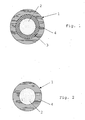
- a self-extinguishing cable (1) of the unipolar type, in particular for low voltage electric energy distribution comprises: a conductor (2), an inner layer having electric insulating function (3) and an outer layer (4) having the function of a protective sheath with flame retardant properties consisting of the composition according to the present invention.
- the inner layer (3) can be made of a polymer material, either cross-linked or non cross-linked, preferably halogen-free, having electric insulation properties.
- the polymer material can be selected, for instance, from: polyolefins, (omopolymers or copolymers of different olefins), copolymers ethylene/unsaturated esters, polyesters, polyethers, copolymers polyethers/polyesters, and mixtures thereof.
- polymers examples include polyethylene (PE), particularly linear low density PE (LLDPE); polypropylene (PP); thermoplastic copolymers propylene/ethylene; elastomeric copolymers ethylene-propylene (EPR) or ethylene-propylene-diene (EPDM); copolymers ethylene/vinylacetate (EVA); copolymers ethylene/methylacrylate (EMA); copolymers ethylene/ ethylacrylate (EEA); copolymers ethylene/butylacrylate (EBA); copolymers ethylene/alpha-olefin.
- PE polyethylene
- LLDPE linear low density PE
- PP polypropylene
- EPR ethylene-propylene
- EPDM ethylene-propylene-diene
- EVA ethylene/vinylacetate
- EMA ethylene/methylacrylate
- EAA copolymers ethylene/ ethylacrylate
- EBA copolymers ethylene/butylacrylate
- the inner layer (3)
- a self-extinguishing cable (1) of the unipolar type, particularly for the distribution of low voltage electric energy can be made of a conductor (2) directly coated with the flame-retardant composition above described so as to form an outer layer (4) having flame retardant properties, without interposing other insulating layers.
- the outer layer (4) works also as electric insulation layer.
- a thin polymer layer (not shown in the figures) having an antiabrasive function may also be externally applied.
- a pigment may be added to the material forming the outer layer (4) or the antiabrasive layer in order to provide the cable with a specific colouring for identification purposes.
- the cable can be identified by a thin coloured strip which may be applied externally.
- a self-extinguishing cable (1) of the tripolar type, in particular for the distribution of low voltage electric energy comprises three conductors (2), each one coated with an insulating layer (3), two of which being the phase conductors, one being the neutral conductor.
- the insulating layers (3) may consist of an insulating polymer material selected from the ones above indicated. Alternatively, the insulating layers (3) may consist of a common flame retardant composition, or even of a flame retardant composition according to the present invention.
- the so insulated three conductors (2) are stranded together and the interstices among one conductor and the other are filled with a material (5), preferably having flame retardant properties as well, so as to form a continuous structure having a substantially cylindrical form.
- An external sheath (6) comprising the flame retardant composition according to the invention is then applied on such a structure.
- FIGS 1-3 show only some possible embodiments of a cable according to the invention. It is evident that suitable modifications known in the art can be made in those embodiments, but without departing from the scope of the invention.
- the flame retardant composition of the invention can also be advantageously used for coating telecommunications or data transmission cables, , including optical fibre cables, or even mixed energy/telecommunications cables.
- the following flame-retardant composition was used as a reference (hereinafter: the reference mixture):
- the amounts of the various components are expressed as phr (parts by weight per 100 parts by weight of polymer material).
- the above flame-retardant compositions were prepared by using a Banbury mixer and then deposited by means of a Bandera 45 extruder onto a copper conductor having a 1.5 mm 2 section, to obtain a cable having a flame-retardant coating of 0.7 mm thickness.
- silanes suitable for the cable of the invention allow to obtain the best results in direct current; further, it can be noted that such silanes are better than short chain silanes currently used, the amounts thereof being equal.
Landscapes
- Chemical & Material Sciences (AREA)
- Health & Medical Sciences (AREA)
- Chemical Kinetics & Catalysis (AREA)
- Medicinal Chemistry (AREA)
- Polymers & Plastics (AREA)
- Organic Chemistry (AREA)
- Compositions Of Macromolecular Compounds (AREA)
- Insulated Conductors (AREA)
- Organic Insulating Materials (AREA)
Abstract
Description
- The present invention concerns a self-extinguishing cable and the flame-retardant composition used therein. In particular, the invention relates to a self-extinguishing cable having improved insulating properties and to the flame-retardant composition used therein.
- Self-extinguishing cables are generally produced by extruding over the core of the cable a flame-retardant coating consisting of a polymer composition which has been given flame retardant properties by the addition of a suitable additive. Polyolefin-based compositions comprising, for example, polyethylene or ethylene/vinyl acetate copolymers, containing an organic halide combined with antimony trioxide as flame-retardant additive can, for example, be used for this purpose. However, halogenated flame-retardant additives have many drawbacks since they partially decompose during processing of the polymer, giving rise to halogenated gases which are toxic to workers and corrode the metal parts of the polymer-processing equipment. In addition, when they are placed directly in a flame, their combustion gives rise to very large amounts of fumes containing toxic gases. Similar drawbacks are encountered when polyvinyl chloride (PVC) with added antimony trioxide is used as base polymer.
- Thus, in recent years, use has been made of halogen-free compositions in the production of self-extinguishing cables, in which a polymer base, generally of polyolefin type, is mixed with inorganic flame-retardant fillers, generally hydroxides, hydrated oxides or hydrated salts of metals, in particular of aluminium or magnesium, such as magnesium hydroxide or alumina trihydrate, or mixtures thereof (see, for example, patents
US 4,145,404 ,US 4,673,620 ,EP-B-328,051 EP-B-530,940 - Inorganic flame-retardant fillers, generally hydroxides as above noted, can be used as they are or coated with various hydrophobic products since they are usually strongly hygroscopic and this tendency to absorb water, even at the operating conditions of the cable, can cause the loss of the electric insulating characteristics of the coating material; therefore, to reduce hygroscopicity, hydrophobic agents are advantageously used to coat the flame-retardant filler.
- Among hydrophobic agents, saturated or unsaturated fatty acids or the salts thereof, in particular oleic, stearic or isostearic acid and the corresponding oleates or stearates, etc. with e.g. zinc, magnesium or aluminium, etc.; or organic silanes such as short chain alkyl- and alkylalkoxy-silanes, or titanium, aluminium and zirconium organic compounds, are known.
- For example,
WO 96/27885 -
EP-A-0249010 describes thermoplastic mouldings compounds having high impact strength and high elongation at break, with good fire performance, which are based on polymer blends consisting of a mixture of 1 to 40% by weight of propylene homo- and/or co-polymer, from 0.5 to 5% by weight of ethylene-propylene-diene terpolymer rubber and from 40 to 70% by weight of silane coated magnesium hydroxide and, optionally, polyethylene, polyacrylic ester and polyvinyl acetate homo- and co-polymer. -
JP-5-17692 JP-7-161230 -
EP-A-0568488 discloses particulate magnesium hydroxide suitable for use as a flame-retardant additive for a polymer, especially for wires and cables, having peculiar BET surface area and average particle size. Optionally, the particulate magnesium hydroxide may be coated with an agent selected from a fatty acid, a carboxylated unsaturated polymer, an organosilane, e.g. 3-aminopropyltriethoxysilane or vinyl-tris(2-methoxyethoxy)silane, an organotitanate or a salt thereof. The articles formed by mixing particulate magnesium hydroxide with a polymer are said to exhibit optimal properties including flame-retardant effectiveness, tensile strength and percent elongation as well as the dispersability of the particulate magnesium hydroxide in the polymer material. -
WO 99/05688 -
WO 00/39810 -
WO 00/19452 - Self-extinguishing cables as those described above are usually tested and used in alternating current. Quality control tests in alternating current include measuring the variation of the insulating constant (Ki) after having subjected the cable to an ageing treatment in water at the working temperature.
- Unexpectedly, the Applicant has found that common flame retardant coatings which show positive results in ageing tests in water performed in alternating current do not give equally good performances when subjected to analogous ageing tests in water carried out in direct current.
- The Applicant has realised that the use of conventional hydrophobic agents, such as fatty acids or short chain silanes, in halogen-free flame retardant compositions gives unsatisfactory results when it is requested to produce self-extinguishing cables able to pass ageing tests in water, particularly in salt containing water, performed in direct current. Such tests are of outstanding importance for some applications where the cables are operated in direct current, such as in the railway field.
- Therefore, the Applicant has faced the technical problem of how to produce cables with a flame-retardant, halogen-free coating showing enhanced insulating properties in water or in the presence of a moist environment, not only in alternating current but also in direct current, without adversely affecting self-extinguishing properties.
- The Applicant has now found that it is possible to solve the above problem by adding a peculiar organosilane to a flame-retardant composition comprising a polymer base and an inorganic flame-retardant filler as described hereinunder.
- In a first aspect, the present invention thus relates to a self-extinguishing cable comprising at least one conductor and at least one flame-retardant coating, wherein the at least one flame-retardant coating comprises:
- a) at least one polymer material selected from: olefin homopolymers, olefin copolymers, copolymers of at least one olefin with at least one ethylenically unsaturated ester, polyesters, polyethers, polyether/polyester copolymers, and mixtures thereof;
- b) at least one inorganic hydrated flame-retardant filler;
- c) at least one silane substituted with at least one C10-C40 hydrocarbon group and with at least one hydrolysable group.
- Preferably, the polymer material in the flame-retardant coating of the self-extinguishing cable of the invention is selected from: polyethylene; copolymers of ethylene with at least one α-olefin containing from 3 to 12 carbon atoms, and optionally with at least one diene containing from 4 to 20 carbon atoms; polypropylene; thermoplastic copolymers of propylene with ethylene and/or at least one α-olefin containing from 4 to 12 carbon atoms; copolymers of ethylene with at least one ester selected from alkyl acrylates, alkyl methacrylates and vinyl carboxylates, wherein the alkyl and the carboxylic groups comprised therein are linear or branched, and wherein the linear or branched alkyl group may contain from 1 to 8, preferably from 1 to 4, carbon atoms, while the linear or branched carboxylic group may contain from 2 to 8, preferably from 2 to 5, carbon atoms; and mixtures thereof.
- With "α-olefin" it is generally meant an olefin of formula CH2=CH-R, wherein R is a linear or branched alkyl having from 1 to 10 carbon atoms. The α-olefin can be selected, for example, from propylene, 1-butene, 1-pentene, 4-methyl-1-pentene, 1-hexene, 1-octene, 1-dodecene and the like. Among them, propylene, 1-butene, 1-hexene and 1-octene are particularly preferred.
- With "diene" it is generally meant:
- a linear, conjugated or non-conjugated diolefin having from 4 to 20 carbon atoms, for example 1,3-butadiene, 1,4-hexadiene or 1,6-octadiene;
- a monocyclic or polycyclic diene having from 4 to 20 carbon atoms, for example 1,4-cyclohexadiene, 5-ethylidene-2-norbornene, 5-methylene-2-norbornene, 5-vinyl-2-norbornene.
- More preferably, the polymer material is selected from copolymers of ethylene with at least -one α-olefin containing from 3 to 12 carbon atoms, and optionally with at least one diene containing from 4 to 20 carbon atoms, obtained by single-site catalysis.
- Preferably, the inorganic hydrated flame-retardant filler is selected from: metal hydroxides, hydrated metal oxides, metal salts having at least one hydroxyl group, and hydrated metal salts; particularly, the flame-retardant filler is a calcium, aluminium, magnesium or zinc hydroxide, hydrated oxide, salt having at least one hydroxyl group or hydrated salt.
- In the flame-retardant coating of the self-extinguishing cable of the invention, the C10-C40 hydrocarbon group contained in the silane is preferably a C10-C40, more preferably C12-C24, alkyl, alkenyl, aryl, alkylaryl, arylalkyl, arylalkenyl, alkenylaryl group, whereas the hydrolysable group is preferably a C1-C16 alkoxy group, optionally substituted by at least one C1-C16 alkoxy group.
- According to a preferred embodiment, the silane may have the following formula:
Y4-(x+z)SiRxR'z (I)
wherein: - x is 1, 2 or 3; z is zero, 1 or 2; with the proviso that x+z is not higher than 3;
- Y, equal or different from each other, are C1-C8, preferably C1-C4, alkoxy groups, optionally substituted by at least one C1-C8, preferably C1-C4, alkoxy group;
- R, equal or different from each other, are selected from:
- C10-C40, preferably C12-C24, more preferably C14-C20 alkyl groups, optionally substituted by at least one C6-C14 aryl group;
- C10-C40, preferably C12-C24, more preferably C14-C20 alkenyl groups, optionally substituted by at least one C6-C14 aryl group;
- C6-C14, preferably C6-C10, aryl groups, optionally substituted by at least one C1-C30 alkyl group and/or by at least one C2-C30 alkenyl group;
- with the proviso that each of R has from 10 to 40 carbon atoms;
- R', equal or different from each other, are selected from:
- hydrogen;
- C1-C20, preferably C1-C16, more preferably C1-C12 alkyl groups, optionally substituted by at least one C6-C14 aryl group;
- C2-C20, preferably C2-C16, more preferably C2-C12 alkenyl groups, optionally substituted by at least one C6-C14 aryl group;
- C6-C14 aryl groups, optionally substituted by at least one C1-C20 alkyl group and/or by at least one C2-C20 alkenyl group.
- According to a particularly preferred embodiment, in formula (I) x is 1; z is zero; Y, equal or different from each other, are selected from C1-C4 alkoxy group, optionally substituted by at least one C1-C4 alkoxy group, f.i. methoxy, ethoxy or methoxyethoxy group; R is a C14-C20 alkyl, f.i. hexadecyl or octadecyl group.
- In a second aspect, the present invention concerns a flame-retardant composition comprising:
- a) at least one polymer material selected from: olefin homopolymers, olefin copolymers, copolymers of at least one olefin with at least one ethylenically unsaturated ester, polyesters, polyethers, polyether/polyester copolymers, and mixtures thereof;
- b) at least one inorganic hydrated flame-retardant filler;
- c) at least one silane substituted with at least one C10-C40 hydrocarbon group and with at least one hydrolysable group.
- Examples of polymer materials that may be used in the self-extinguishing cables and flame-retardant compositions of the invention are: high-density polyethylene (HDPE) (d=0.940-0.970 g/cm3), medium-density polyethylene (MDPE) (d=0.926-0.940 g/cm3), low-density polyethylene (LDPE) (d=0.910-0.926 g/cm3); linear low-density polyethylene (LLDPE) and ultra-low-density polyethylene (ULDPE) (d=0.860-0.910 g/cm3); polypropylene (PP); thermoplastic copolymers of propylene with ethylene; ethylene/vinyl acetate (EVA) copolymers; ethylene/ethyl acrylate (EEA) copolymers, ethylene/butyl acrylate (EBA) copolymers; ethylene/α-olefin rubbers, in particular ethylene/propylene rubbers (EPR), ethylene/propylene/diene rubbers (EPDM); and mixtures thereof.
- Copolymers which are particularly preferred are those which can be obtained by copolymerization of ethylene with at least one α-olefin containing from 3 to 12 carbon atoms, and optionally with at least one diene, in the presence of a single-site catalyst, in particular a metallocene catalyst or a constrained geometry catalyst. These copolymers are characterized by a density of between 0.860 and 0.904 g/cm3, preferably from 0.865 to 0.902 g/cm3, and by a Composition Distribution Index (CDI) greater than 45%, said index being defined as the percentage by weight of the copolymer molecules having an α-olefin content of up to 50% of the total average molar content of α-olefin. These copolymers preferably have the following monomer composition: 75-97 mol%, preferably 90-95 mol%, of ethylene; 3-25 mol%, preferably 5-10 mol%, of α-olefin; 0-5 mol%, preferably 0-2 mol%, of a diene. The α-olefin is preferably selected from propylene, 1-butene, 1-hexene and 1-octane. Products of this type are available under the tradenames Engage® from Du Pont-Dow Elastomers and Exact® from Exxon Chemical.
- The ethylene copolymers obtained by single-site catalysis are preferably used as a mixture with a crystalline propylene homopolymer or copolymer, as described, for example, in the above mentioned
WO 99/05688 WO 00/19452 US patent 5,707,732 . In particular, the polymer material preferably comprises from 5 to 60% by weight, more preferably from 10 to 45% by weight, of a propylene or ethylene homopolymer or copolymer as defined above, and from 40 to 95% by weight, more preferably from 55 to 90% by weight, of an ethylene copolymer obtained by single-site catalysis as defined above, the percentages being relative to the total weight of the polymeric components. - Examples of inorganic hydrated flame-retardant fillers which may be used in the self-extinguishing cables and flame-retardant compositions of the invention are: magnesium hydroxide, alumina trihydrate, hydrated magnesium carbonate, hydrated calcium, magnesium carbonate, 4ZnO.B2O3.H2O, 2ZnO.3B2O3.3.5H2O, or mixtures thereof. Magnesium hydroxide is particularly preferred, since it is characterized by a decomposition temperature of about 340°C and thus allows high extrusion temperatures to be used. It is more particularly preferred to use magnesium hydroxide of natural origin, obtained by grinding minerals based on magnesium hydroxide, such as brucite, as described in
WO 99/05688 - The flame-retardant filler is generally used in the form of particles which are untreated or surface-treated with saturated or unsaturated fatty acids containing from 8 to 24 carbon atoms, or metal salts thereof, such as, for example: oleic acid, palmitic acid, stearic acid, isostearic acid, lauric acid; magnesium or zinc stearate or oleate. In order to increase the compatibility with the polymer material, the flame-retardant filler can likewise be surface-treated with suitable coupling agents, for example short chain organic silanes or titanates such as vinyltriethoxysilane, vinyltriacetylsilane, tetraisopropyl titanate and tetra-n-butyl titanate.
- The amount of flame-retardant filler to be added is predetermined so as to obtain a cable which is capable of passing flame/fire-propagation tests, particularly those according to standard IEC 332-1 or IEC 332-3 A,B,C. In general, this amount is between 10 and 90% by weight, preferably between 30 and 80% by weight, relative to the total weight of the flame-retardant composition.
- The silanes above defined as component c) of the flame-retardant coating of the cable of the invention are preferably in an amount from 0.1% to 10%, preferably 0.5% to 5% by weight with respect to the total weight of the inorganic flame-retardant filler. Examples of silanes which are suitable for the cable and composition of the invention are: hexadecyltrimethoxysilane, hexadecyltriethoxysilane, octadecyltrimethoxysilane and octadecyltriethoxysilane.
- A coupling agent capable of increasing the interaction between the active hydroxyl groups of the flame-retardant filler and the polymer chains may be added to the mixture in order to enhance the compatibility between the flame-retardant filler and the polymer material. This coupling agent can be selected from those known in the art, for example: short chain saturated silane compounds or silane compounds containing at least one ethylenic unsaturation; epoxides containing an ethylenic unsaturation; monocarboxylic acids or, preferably, dicarboxylic acids having at least one ethylenic unsaturation, or derivatives thereof, in particular anhydrides or esters.
- Examples of short chain silane compounds which are suitable for this purpose are: γ-methacryloxypropyltrimethoxysilane, allyltrimethoxysilane, allyltriethoxysilane, allylmethyldimethoxysilane, allylmethyldiethoxysilane, methyltriethoxysilane, methyltris (2-methoxyethoxy)silane, dimethyldiethoxysilane, vinyltris (2-methoxyethoxy)silane, vinyltrimethoxysilane, vinyl methyldimethoxysilane, vinyltriethoxysilane, octyl triethoxysilane, isobutyltriethoxysilane and isobutyl trimethoxysilane or mixtures thereof.
- Examples of epoxides containing an ethylenic unsaturation are: glycidyl acrylate, glycidyl methacrylate, monoglycidyl ester of itaconic acid, glycidyl ester of maleic acid, vinyl glycidyl ether and allyl glycidyl ether or mixtures thereof.
- Monocarboxylic or dicarboxylic acids, having at least one ethylenic unsaturation, or derivatives thereof, which can be used as coupling agents are, for example: maleic acid, maleic anhydride, fumaric acid, citraconic acid, itaconic acid, acrylic acid and methacrylic acid, and anhydrides or esters derived from these, or mixtures thereof. Maleic anhydride is particularly preferred.
- The coupling agents can be used as they are or pre-grafted onto a polyolefin, for example polyethylene or copolymers of ethylene with an α-olefin, by means of a radical reaction (see for example
EP-A-530,940 - Alternatively, the coupling agents of carboxylic or epoxide type mentioned above (for example maleic anhydride) or the short chain silanes with ethylenic unsaturation (for example vinyltrimethoxysilane) can be added to the mixture in combination with a radical initiator so as to graft the compatibilizing agent directly onto the polymer material. An organic peroxide such as tert-butyl perbenzoate, dicumyl peroxide, benzoyl peroxide and di-tert-butyl peroxide can, for example, be used as initiator. This method is described, for example, in patent
US-4,317,765 , in Japanese patent applicationJP-62-58774 WO 99/05688 WO 00/19452 - The amount of coupling agent to be added to the mixture can vary mainly depending on the type of coupling agent used and on the amount of flame-retardant filler added, and is generally between 0.01 and 5%, preferably between 0.05 and 2%, by weight relative to the total weight of the polymer material mixture.
- Conventional antioxidants which are suitable for this purpose are, for example:
- polymerized trimethyldihydroquinoline, 4,4'-thiobis (3-methyl-6-tert-butyl)phenol; pentaerythryl tetra-[3-(3,5-di-tert-butyl-4-hydroxyphenyl)propionate] and 2,2'-thiodiethylene bis[3-(3,5-di-tert-butyl-4-hydroxyphenyl)propionate] or mixtures thereof.
- Other fillers which may be used in the present invention include, for example, glass particles, glass fibres, calcined kaolin and talc or mixtures thereof. Processing co-adjuvants usually added to the polymer material are, for example, calcium stearate, zinc stearate, stearic acid, paraffin wax and silicone rubbers or mixtures thereof. Another component that may be added to the flame-retardant composition and cables according to the present invention is at least one dehydrating agent, such as calcium oxide or a zeolite, generally in an amount of from 0.5 to 15% by weight with respect to the weight of the flame retardant filler, as described in the above-mentioned patent application
WO 00/39810 - The flame-retardant compositions according to the present invention are preferably used in non-crosslinked form, in order to obtain a coating with thermoplastic properties which is thus recyclable.
- The flame-retardant compositions according to the present invention can be prepared by mixing the components a), b) and c) as above defined together with the other additives which may be present according to techniques known in the art, for example using an internal mixer of the type containing tangential rotors (Banbury) or interpenetrating rotors, or in continuous mixers of the Ko-Kneader (Buss) type or of the co-rotating or counterrotating twin-screw type.
- As an alternative, the flame-retardant compositions of the invention can be prepared by treating component b) with component c) as above defined and then mixing the resulting mixture with component a) as above defined.
- As a further alternative, rather than adding the component c) as above defined during the phase of preparation of the flame-retardant composition, it can be added during the deposition by extrusion of the flame-retardant coating to produce the cable, for example via the extruder hopper or by injection into the extruder cylinder.
- The component c) as above defined may be added to the flame-retardant composition as such (usually in the form of a liquid), or supported on a solid inert carrier, or also predispersed in a polymer material, such as one of those described above as component a).
- During the extrusion phase, the flame-retardant compositions thus obtained can be used to coat the conductor directly, or to make an outer sheath on the conductor which has been precoated with an insulating layer. When two layers are present, the extrusion can take place in two separate phases, the inner layer being extruded on the conductor in a first passage and the outer layer being extruded on the inner layer in a second passage. Advantageously, the coating process can take place in a single passage, for example by means of the "tandem" technique, in which two .separate extruders arranged in series are used, or alternatively by co-extrusion with a single extrusion head.
- The temperature at which the flame-retardant composition is extruded can vary within a wide range and is predetermined as a function of the extrusion rate to be obtained. The extrusion rate in fact depends on the viscosity of the composition in the molten state and thus on its temperature. In turn, the viscosity depends mainly on the type of polymer material and on the type and amount of flame-retardant filler used. The minimum extrusion temperature for the composition is generally not less than the plasticization temperature of the polymer material, while the maximum extrusion temperature is predetermined so as to avoid degradation or decomposition of the polymer material and/or of the flame-retardant filler. Thus, on the basis of the abovementioned criteria, in the case of flame-retardant compositions based on a mixture of polypropylene and ethylene/α-olefin copolymers as described above, in which magnesium hydroxide is used as flame-retardant filler, the temperature at which the flame-retardant composition is extruded is generally between 160°C and 320°C, preferably between 200°C and 280°C.
- Some examples of embodiments will now be reported for the purpose of illustrating the present invention more clearly, with particular reference to the accompanying drawings, in which:
-
Figure 1 is a cross-section of a low voltage cable of the unipolar type according to the invention; - -
Figure 2 is a cross-section of another low voltage cable of the unipolar type according to the invention; - -
Figure 3 is a cross-section of a low voltage cable of the tripolar type according to the invention. - "Low voltage" generally means a voltage lower than 5 kV, preferably lower than 2 kV, more preferably lower than 1 kV.
- With reference to
Figure 1 , a self-extinguishing cable (1) of the unipolar type, in particular for low voltage electric energy distribution, comprises: a conductor (2), an inner layer having electric insulating function (3) and an outer layer (4) having the function of a protective sheath with flame retardant properties consisting of the composition according to the present invention. - The inner layer (3) can be made of a polymer material, either cross-linked or non cross-linked, preferably halogen-free, having electric insulation properties. The polymer material can be selected, for instance, from: polyolefins, (omopolymers or copolymers of different olefins), copolymers ethylene/unsaturated esters, polyesters, polyethers, copolymers polyethers/polyesters, and mixtures thereof. Examples of such polymers are: polyethylene (PE), particularly linear low density PE (LLDPE); polypropylene (PP); thermoplastic copolymers propylene/ethylene; elastomeric copolymers ethylene-propylene (EPR) or ethylene-propylene-diene (EPDM); copolymers ethylene/vinylacetate (EVA); copolymers ethylene/methylacrylate (EMA); copolymers ethylene/ ethylacrylate (EEA); copolymers ethylene/butylacrylate (EBA); copolymers ethylene/alpha-olefin. The inner layer (3) may also be a flame-retardant coating obtained e.g. from a flame-retardant composition according to the present invention.
- Alternatively, referring to
Figure 2 , a self-extinguishing cable (1) of the unipolar type, particularly for the distribution of low voltage electric energy, can be made of a conductor (2) directly coated with the flame-retardant composition above described so as to form an outer layer (4) having flame retardant properties, without interposing other insulating layers. In this way, the outer layer (4) works also as electric insulation layer. - A thin polymer layer (not shown in the figures) having an antiabrasive function may also be externally applied.
- A pigment may be added to the material forming the outer layer (4) or the antiabrasive layer in order to provide the cable with a specific colouring for identification purposes. Alternatively, the cable can be identified by a thin coloured strip which may be applied externally.
- With reference to
Figure 3 , a self-extinguishing cable (1) of the tripolar type, in particular for the distribution of low voltage electric energy, comprises three conductors (2), each one coated with an insulating layer (3), two of which being the phase conductors, one being the neutral conductor. The insulating layers (3) may consist of an insulating polymer material selected from the ones above indicated. Alternatively, the insulating layers (3) may consist of a common flame retardant composition, or even of a flame retardant composition according to the present invention. The so insulated three conductors (2) are stranded together and the interstices among one conductor and the other are filled with a material (5), preferably having flame retardant properties as well, so as to form a continuous structure having a substantially cylindrical form. An external sheath (6) comprising the flame retardant composition according to the invention is then applied on such a structure. -
Figures 1-3 show only some possible embodiments of a cable according to the invention. It is evident that suitable modifications known in the art can be made in those embodiments, but without departing from the scope of the invention. In particular, the flame retardant composition of the invention can also be advantageously used for coating telecommunications or data transmission cables, , including optical fibre cables, or even mixed energy/telecommunications cables. - The following examples are given to illustrate the invention without limiting it.
- Some accelerated ageing tests in water containing dissolved NaCl were carried out on cable specimens as described hereinbelow.
- The following flame-retardant composition was used as a reference (hereinafter: the reference mixture):
- 85 phr Engage® 8003 - ethylene-octene copolymer obtained by single-site catalysis (Du Pont-Dow Elastomers);
- 210 phr Hydrofy® G 1.5 - natural magnesium hydroxide, obtained by grinding brucite, not surface-treated (NUOVA SIMA);
- 0.40 phr Luperox® DC40 - peroxidic initiator: dicumyl peroxide (Atofina);
- 2.10 phr Silquest® A-172 - coupling agent: vinyltris(2-methoxyethoxy)silane (VTMOEO) (Witco);
- 15 phr Moplen® EP1X35F - random crystalline propyleneethylene copolymer: d = 0.900 g/cm3; MFI = 9.0 g/10'; T2m = 154°C; ΔH2m = 90.6 J/g (Basell);
- 0.8 phr Irganox® 1010 - antioxidant: pentaerythryl tetrakis[3-(3,5-di-tert-butyl-4-hydroxyphenyl)propionate] (Ciba-Geigy) ;
- 0.3 phr Irganox® MD1024 - metal deactivator: 1,2-bis(3,5-di-tert-butyl-4-hydroxyhydrocinnamoyl)hydrazine (Ciba-Geigy) ;
- 6.10 phr Kezadol® GR - calcium oxide predispersed in semicrystalline EPR rubber (80% by weight of CaO), in the form of granules with average diameter 6-7 µm (Kettlitz).
- The amounts of the various components are expressed as phr (parts by weight per 100 parts by weight of polymer material).
- The above reference mixture was supplemented with hydrophobic additives as reported in Table 1 (the amounts of additives are expressed as % by weight with respect to the weight of flame retardant filler).
- The above flame-retardant compositions were prepared by using a Banbury mixer and then deposited by means of a Bandera 45 extruder onto a copper conductor having a 1.5 mm2 section, to obtain a cable having a flame-retardant coating of 0.7 mm thickness.
- Two separate tests in direct current were carried out on the so obtained cables according to the conditions illustrated herebelow:
- (1) cables immersed in a 10 g/l NaCl solution at 60°C; negative pole connected to conductors, positive pole inside the solution; 3 kV direct current, applied for 5 minutes with 2 h intervals.
- (2) cables immersed in a 10 g/l NaCl solution at 60°C; negative pole connected to conductors, positive pole inside the solution; 1 kV direct current, applied for 30 minutes with 12 h intervals.
- The time (in hours) after which the cables shortcircuited is reported in Table 1 [t1 for test (1) and t2 for test (2)].
TABLE 1 SAMPLE t1 (h) t2 (h) REF. MIX.* 72 20 1* 120 26 2 216 50 3* 120 28 * = comparative
REF. MIX. = reference mixture;
1 = REF. MIX. + 2% by weight of stearic acid;
2 = REF. MIX. + 2% by weight of Dynasylan® 9116 (esadecyltrimethoxy silane) ;
3 = REF. MIX. + 2% by weight of KR TTS (isopropyltriisostearyl titanate). - The results reported in Table 1 show that the time needed to short-circuit the cable specimens changes by varying the test conditions, the performance of
cable 2 being remarkably better than that ofcables - The test in direct current applying a voltage of 1 kV for 30 minutes every 12 hours, which is closer to the operation conditions of a cable, was repeated using for the flame-retardant coating the same reference mixture of Example 1, by changing either the amount of added VTMOEO or by adding different hydrophobic additives as reported in Table 2 (the amounts of VTMOEO and of hydophobic additives being expressed as % by weight with respect to the filler weight).
TABLE 2 SPECIMEN VTMOEO
(% weight)HYDROPHOBIC ADDITIVE
(% weight)t
(h)REF. MIX. * 1.0 - 72 1* 2.0 - 96 2* 3.0 - 120 3* 1.0 2.0 STEARIC ACID 120 4 1.0 2.0 DYNASYLAN® 9116 216 * = comparative;
REF. MIX. = Reference mixture;
1 = REF. MIX. + 2% VTMOEO;
2 = REF. MIX. + 3% VTMOEO;
3 = REF. MIX. + 2% stearic acid;
4 = REF. MIX. + 2% Dynasylan® 9116;
t = 1 kV for 30 min every 12 hours. - From the above results, it is apparent that the silanes suitable for the cable of the invention, among the tested additives, allow to obtain the best results in direct current; further, it can be noted that such silanes are better than short chain silanes currently used, the amounts thereof being equal.
Claims (18)
- Self-extinguishing cable comprising at least one conductor and at least one flame-retardant coating, wherein the at least one flame-retardant coating comprises:a) at least one polymer material selected from: olefin homopolymers, olefin copolymers, copolymers of at least one olefin with at least one ethylenically unsaturated ester, polyesters, polyethers, polyether/polyester copolymers, and mixtures thereof;b) at least one inorganic hydrated flame-retardant filler;c) at least one silane substituted with at least one C10-C40 hydrocarbon group and with at least one hydrolysable group.
- A cable according to claim 1, wherein the polymer material is selected from:polyethylene; copolymers of ethylene with at least one α-olefin containing from 3 to 12 carbon atoms, and optionally with at least one diene containing from 4 to 20 carbon atoms; polypropylene; thermoplastic copolymers of propylene with ethylene and/or at least one α-olefin containing from 4 to 12 carbon atoms; copolymers of ethylene with at least one ester selected from alkyl acrylates, alkyl methacrylates and vinyl carboxylates, wherein the alkyl and the carboxylic groups comprised therein are linear or branched, and wherein the linear or branched alkyl group may contain from 1 to 8, preferably from 1 to 4, carbon atoms, while the linear or-branched carboxylic group may contain from 2 to 8, preferably from 2 to 5, carbon atoms; and mixtures thereof.
- A cable according to claim 2, wherein the linear or branched alkyl group may contain from 1 to 4 carbon atoms, while the linear or branched carboxylic group may contain from 2 to 5 carbon atoms.
- A cable according to any of the previous claims, wherein the polymer material is selected from copolymers of ethylene with at least one α-olefin containing from 3 to 12 carbon atoms, and optionally with at least one diene containing from 4 to 20 carbon atoms, obtained by single-site catalysis.
- A cable according to any of the previous claims, wherein the inorganic hydrated flame-retardant filler is selected from: metal hydroxides, hydrated metal oxides, metal salts having at least one hydroxyl group, and hydrated metal salts.
- A cable according to any of the previous claims, wherein the inorganic hydrated flame-retardant filler is a calcium, aluminium, magnesium or zinc hydroxide, hydrated oxide, salt having at least one hydroxyl group or hydrated salt.
- A cable according to any of the previous claims, wherein the flame-retardant filler is selected from:magnesium hydroxide, alumina trihydrate, hydrated magnesium carbonate, hydrated calcium, magnesium carbonate, 4ZnO.B2O3.H2O, 2ZnO.3B2O3.3.5H2O, or mixtures thereof.
- A cable according to any of the previous claims, wherein the flame-retardant filler is magnesium hydroxide.
- A cable according to any of the previous claims, wherein the C10-C40 hydrocarbon group contained in the silane is a C10-C40 alkyl, alkenyl, aryl, alkylaryl, arylalkyl, arylalkenyl, alkenylaryl group, whereas the hydrolysable group is a C1-C16 alkoxy group, optionally substituted by at least one C1-C16 alkoxy group.
- A cable according to any of the previous claims, wherein the C10-C40 hydrocarbon group contained in the silane is a C12-C24 alkyl, alkenyl, aryl, alkylaryl, arylalkyl, arylalkenyl, alkenylaryl group.
- A cable according to any of the previous claims, wherein the silane has the following formula:
Y4-(x+z)SiRxR' z (I)
wherein:x is 1, 2 or 3; z is zero, 1 or 2; with the proviso that x+z is not higher than 3;Y, equal or different from each other, are C1-C8 alkoxy groups, optionally substituted by at least one C1-C8 alkoxy group;R, equal or different from each other, are selected from:C10-C40 alkyl groups, optionally substituted by at least one C6-C14 aryl group;C10-C40 alkenyl groups, optionally substituted by at least one C6-C14 aryl group;C6-C14 aryl groups, optionally substituted by at least one C1-C30 alkyl group and/or by at least one C2-C30 alkenyl group;with the proviso that each of R has from 10 to 40 carbon atoms;R', equal or different from each other, are selected from:hydrogen;C1-C20 alkyl groups, optionally substituted by at least one C6-C14 aryl group;C2-C20 alkenyl groups, optionally substituted by at least one C6-C14 aryl group;C6-C14 aryl groups, optionally substituted by at least one C1-C20 alkyl group and/or by at least one C2-C20 alkenyl group. - A cable according to any of the previous claims, wherein the silane has the following formula:
Y4-(x+z)SiRxR'z (I)
wherein:x is 1, 2 or 3; z is zero, 1 or 2; with the proviso that x+z is not higher than 3;Y, equal or different from each other, are C1-C4 alkoxy groups, optionally substituted by at least one C1-C4 alkoxy group;R, equal or different from each other, are selected from:C12-C24 alkyl groups, optionally substituted by at least one C6-C14 aryl group;C12-C24 alkenyl groups, optionally substituted by at least one C6-C14 aryl group;C6-C10 aryl groups, optionally substituted by at least one C1-C30 alkyl group and/or by at least one C2-C30 alkenyl group;with the proviso that each of R has from 10 to 40 carbon atoms;R', equal or different from each other, are selected from:hydrogen;C1-C16 alkyl groups, optionally substituted by at least one C6-C14 aryl group;C2-C16 alkenyl groups, optionally substituted by at least one C6-C14 aryl group;C6-C10 aryl groups, optionally substituted by at least one C1-C20 alkyl group and/or by at least one C2-C20 alkenyl group. - A cable according to any of the previous claims, wherein the silane has the following formula:
Y4-(x-z)SiRxR'z (I)
wherein:x is 1, 2 or 3; z is zero, 1 or 2; with the proviso that x+z is not higher than 3;Y, equal or different from each other, are C1-C4 alkoxy groups, optionally substituted by at least one C1-C4 alkoxy group;R, equal or different from each other, are selected from:C14-C20 alkyl groups, optionally substituted by at least one C6-C14 aryl group;C14-C20 alkenyl groups, optionally substituted by at least one C6-C14 aryl group;C6-C10 aryl groups, optionally substituted by at least one C1-C30 alkyl group and/or by at least one C2-C30 alkenyl group;with the proviso that each of R has from 10 to 40 carbon atoms;R', equal or different from each other, are selected from:hydrogen;C1-C12 alkyl groups, optionally substituted by at least one C6-C14 aryl group;C2-C12 alkenyl groups, optionally substituted by at least one C6-C14 aryl group;C6-C10 aryl groups, optionally substituted by at least one C1-C20 alkyl group and/or by at least one C2-C20 alkenyl group. - A cable according to any of the claims 11-13, wherein, in formula (I), x is 1; z is zero; Y, equal or different from each other, are selected from C1-C4 alkoxy group, optionally substituted by at least one C1-C4 alkoxy group; R is a C14-C20 alkyl.
- A cable according to any of the claims 11-14, wherein, in formula (I), x is 1; z is zero; Y, equal or different from each other, are selected from methoxy, ethoxy or methoxyethoxy group, optionally substituted by at least one methoxy, ethoxy or methoxyethoxy group and R is a hexadecyl or octadecyl group.
- A cable according to any of the previous claims, wherein the silane is in an amount from 0.1% to 10% with respect to the total weight of the inorganic flame-retardant filler.
- A cable according to any of the previous claims, wherein the silane is in an amount from 0.5% to 5% by weight with respect to the total weight of the inorganic flame-retardant filler.
- Flame-retardant composition comprising: a) at least one polymer material; b) at least one inorganic hydrated flame-retardant filler; and c) at least one silane; a), b) and c) being defined according to any of the previous claims.
Priority Applications (5)
| Application Number | Priority Date | Filing Date | Title |
|---|---|---|---|
| DE60143388T DE60143388D1 (en) | 2001-09-04 | 2001-09-04 | Self-extinguishing electrical cable and flame-retardant composition |
| EP01121137A EP1288970B1 (en) | 2001-09-04 | 2001-09-04 | Self-extinguishing cable and flame-retardant composition used therein |
| ES01121137T ES2354386T3 (en) | 2001-09-04 | 2001-09-04 | SELF-EXTINGUISHABLE CABLE AND IGNIFUOUS COMPOSITION USED IN THE SAME. |
| AT01121137T ATE487222T1 (en) | 2001-09-04 | 2001-09-04 | SELF-EXTINGUISHING ELECTRICAL CABLE AND FLAME RETARDANT COMPOSITION |
| US10/233,756 US20030059613A1 (en) | 2001-09-04 | 2002-09-04 | Self-extinguishing cable and flame-retardant composition used therein |
Applications Claiming Priority (1)
| Application Number | Priority Date | Filing Date | Title |
|---|---|---|---|
| EP01121137A EP1288970B1 (en) | 2001-09-04 | 2001-09-04 | Self-extinguishing cable and flame-retardant composition used therein |
Publications (2)
| Publication Number | Publication Date |
|---|---|
| EP1288970A1 EP1288970A1 (en) | 2003-03-05 |
| EP1288970B1 true EP1288970B1 (en) | 2010-11-03 |
Family
ID=8178530
Family Applications (1)
| Application Number | Title | Priority Date | Filing Date |
|---|---|---|---|
| EP01121137A Expired - Lifetime EP1288970B1 (en) | 2001-09-04 | 2001-09-04 | Self-extinguishing cable and flame-retardant composition used therein |
Country Status (4)
| Country | Link |
|---|---|
| EP (1) | EP1288970B1 (en) |
| AT (1) | ATE487222T1 (en) |
| DE (1) | DE60143388D1 (en) |
| ES (1) | ES2354386T3 (en) |
Families Citing this family (3)
| Publication number | Priority date | Publication date | Assignee | Title |
|---|---|---|---|---|
| DE19859949A1 (en) | 1998-12-28 | 2000-06-29 | Focke & Co | Cigarette pack and method and apparatus for making the same |
| MX348660B (en) | 2011-11-04 | 2017-05-29 | Servicios Condumex Sa | Composition for low smoke, flame retardant, halogen-free, thermoplastic insulation showing good electrical properties in water. |
| CN118782313B (en) * | 2024-07-26 | 2025-02-25 | 安徽远征传导科技股份有限公司 | A wear-resistant liquid-cooled cable with ultra-large current load for new energy |
Family Cites Families (2)
| Publication number | Priority date | Publication date | Assignee | Title |
|---|---|---|---|---|
| GB9113584D0 (en) * | 1991-06-24 | 1991-08-14 | Bp Chem Int Ltd | Stabilised polymer composition and use |
| US5412012A (en) * | 1994-01-24 | 1995-05-02 | Quantum Chemical Corporation | Flame retardant insulation compositions having improved strippability |
-
2001
- 2001-09-04 ES ES01121137T patent/ES2354386T3/en not_active Expired - Lifetime
- 2001-09-04 DE DE60143388T patent/DE60143388D1/en not_active Expired - Lifetime
- 2001-09-04 AT AT01121137T patent/ATE487222T1/en not_active IP Right Cessation
- 2001-09-04 EP EP01121137A patent/EP1288970B1/en not_active Expired - Lifetime
Also Published As
| Publication number | Publication date |
|---|---|
| ATE487222T1 (en) | 2010-11-15 |
| EP1288970A1 (en) | 2003-03-05 |
| DE60143388D1 (en) | 2010-12-16 |
| ES2354386T3 (en) | 2011-03-14 |
Similar Documents
| Publication | Publication Date | Title |
|---|---|---|
| EP2310449B1 (en) | Flame-retardant electrical cable | |
| US20030059613A1 (en) | Self-extinguishing cable and flame-retardant composition used therein | |
| KR100536616B1 (en) | Cables with a halogen-free, recyclable coating containing polypropylene and ethylene copolymers with high structural uniformity | |
| EP0998747B1 (en) | Low-smoke self-extinguishing cable and flame-retardant composition used therein | |
| US8097809B2 (en) | Low-smoke self-extinguishing cable and flame-retardant composition comprising natural magnesium hydroxide | |
| US6924031B2 (en) | Low-smoke self-extinguishing electrical cable and flame-retardant composition used therein | |
| US6372344B1 (en) | Cables with a halogen-free recyclable coating comprising polypropylene and an ethylene copolymer having high elastic recovery | |
| US6410651B1 (en) | Cables with a halogen-free recyclable coating comprising polypropylene and an ethylene copolymer having high structural uniformity | |
| RU2237078C2 (en) | Method of manufacturing self-extinguishing cables emitting low levels of smoke and flameproof compositions utilized therein | |
| EP1116244B1 (en) | Low-smoke self-extinguishing electrical cable and flame-retardant composition used therein | |
| AU777541B2 (en) | Self-extinguishing cable with low-level production of fumes, and flame-retardant composition used therein | |
| CA3007771A1 (en) | Stabilized moisture-curable polymeric compositions | |
| EP1149390B1 (en) | Process for producing self-extinguishing cables with low-level production of fumes and flame-retardant compositions used therein | |
| US6849217B1 (en) | Process for producing self-extinguishing cables with low-level production of fumes, and flame-retardant compositions used therein | |
| EP1288970A1 (en) | Self-extinguishing cable and flame-retardant composition used therein | |
| HK1073321B (en) | Process for producing self-extinguishing cables with low-level production of fumes, and flame-retardant compositions used therein |
Legal Events
| Date | Code | Title | Description |
|---|---|---|---|
| PUAI | Public reference made under article 153(3) epc to a published international application that has entered the european phase |
Free format text: ORIGINAL CODE: 0009012 |
|
| AK | Designated contracting states |
Kind code of ref document: A1 Designated state(s): AT BE CH CY DE DK ES FI FR GB GR IE IT LI LU MC NL PT SE TR |
|
| AX | Request for extension of the european patent |
Extension state: AL LT LV MK RO SI |
|
| RAP1 | Party data changed (applicant data changed or rights of an application transferred) |
Owner name: PIRELLI S.P.A. |
|
| 17P | Request for examination filed |
Effective date: 20030804 |
|
| AKX | Designation fees paid |
Designated state(s): AT BE CH CY DE DK ES FI FR GB GR IE IT LI LU MC NL PT SE TR |
|
| RAP1 | Party data changed (applicant data changed or rights of an application transferred) |
Owner name: PIRELLI & C. S.P.A. |
|
| RAP1 | Party data changed (applicant data changed or rights of an application transferred) |
Owner name: PRYSMIAN CAVI E SISTEMI ENERGIA S.R.L. |
|
| 111Z | Information provided on other rights and legal means of execution |
Free format text: ATBECHCYDEDKESFIFRGBGRIEITLUMCNLPTSETR Effective date: 20060512 |
|
| RAP1 | Party data changed (applicant data changed or rights of an application transferred) |
Owner name: PRYSMIAN S.P.A. |
|
| GRAP | Despatch of communication of intention to grant a patent |
Free format text: ORIGINAL CODE: EPIDOSNIGR1 |
|
| GRAJ | Information related to disapproval of communication of intention to grant by the applicant or resumption of examination proceedings by the epo deleted |
Free format text: ORIGINAL CODE: EPIDOSDIGR1 |
|
| GRAP | Despatch of communication of intention to grant a patent |
Free format text: ORIGINAL CODE: EPIDOSNIGR1 |
|
| GRAS | Grant fee paid |
Free format text: ORIGINAL CODE: EPIDOSNIGR3 |
|
| GRAA | (expected) grant |
Free format text: ORIGINAL CODE: 0009210 |
|
| AK | Designated contracting states |
Kind code of ref document: B1 Designated state(s): AT BE CH CY DE DK ES FI FR GB GR IE IT LI LU MC NL PT SE TR |
|
| REG | Reference to a national code |
Ref country code: GB Ref legal event code: FG4D |
|
| REG | Reference to a national code |
Ref country code: CH Ref legal event code: EP |
|
| REG | Reference to a national code |
Ref country code: IE Ref legal event code: FG4D |
|
| REF | Corresponds to: |
Ref document number: 60143388 Country of ref document: DE Date of ref document: 20101216 Kind code of ref document: P |
|
| REG | Reference to a national code |
Ref country code: NL Ref legal event code: VDEP Effective date: 20101103 |
|
| REG | Reference to a national code |
Ref country code: ES Ref legal event code: FG2A Effective date: 20110302 |
|
| PG25 | Lapsed in a contracting state [announced via postgrant information from national office to epo] |
Ref country code: SE Free format text: LAPSE BECAUSE OF FAILURE TO SUBMIT A TRANSLATION OF THE DESCRIPTION OR TO PAY THE FEE WITHIN THE PRESCRIBED TIME-LIMIT Effective date: 20101103 Ref country code: FI Free format text: LAPSE BECAUSE OF FAILURE TO SUBMIT A TRANSLATION OF THE DESCRIPTION OR TO PAY THE FEE WITHIN THE PRESCRIBED TIME-LIMIT Effective date: 20101103 Ref country code: PT Free format text: LAPSE BECAUSE OF FAILURE TO SUBMIT A TRANSLATION OF THE DESCRIPTION OR TO PAY THE FEE WITHIN THE PRESCRIBED TIME-LIMIT Effective date: 20110303 Ref country code: NL Free format text: LAPSE BECAUSE OF FAILURE TO SUBMIT A TRANSLATION OF THE DESCRIPTION OR TO PAY THE FEE WITHIN THE PRESCRIBED TIME-LIMIT Effective date: 20101103 Ref country code: AT Free format text: LAPSE BECAUSE OF FAILURE TO SUBMIT A TRANSLATION OF THE DESCRIPTION OR TO PAY THE FEE WITHIN THE PRESCRIBED TIME-LIMIT Effective date: 20101103 |
|
| PG25 | Lapsed in a contracting state [announced via postgrant information from national office to epo] |
Ref country code: GR Free format text: LAPSE BECAUSE OF FAILURE TO SUBMIT A TRANSLATION OF THE DESCRIPTION OR TO PAY THE FEE WITHIN THE PRESCRIBED TIME-LIMIT Effective date: 20110204 |
|
| PG25 | Lapsed in a contracting state [announced via postgrant information from national office to epo] |
Ref country code: BE Free format text: LAPSE BECAUSE OF FAILURE TO SUBMIT A TRANSLATION OF THE DESCRIPTION OR TO PAY THE FEE WITHIN THE PRESCRIBED TIME-LIMIT Effective date: 20101103 |
|
| PG25 | Lapsed in a contracting state [announced via postgrant information from national office to epo] |
Ref country code: DK Free format text: LAPSE BECAUSE OF FAILURE TO SUBMIT A TRANSLATION OF THE DESCRIPTION OR TO PAY THE FEE WITHIN THE PRESCRIBED TIME-LIMIT Effective date: 20101103 |
|
| PLBE | No opposition filed within time limit |
Free format text: ORIGINAL CODE: 0009261 |
|
| STAA | Information on the status of an ep patent application or granted ep patent |
Free format text: STATUS: NO OPPOSITION FILED WITHIN TIME LIMIT |
|
| 26N | No opposition filed |
Effective date: 20110804 |
|
| REG | Reference to a national code |
Ref country code: DE Ref legal event code: R097 Ref document number: 60143388 Country of ref document: DE Effective date: 20110804 |
|
| PG25 | Lapsed in a contracting state [announced via postgrant information from national office to epo] |
Ref country code: MC Free format text: LAPSE BECAUSE OF NON-PAYMENT OF DUE FEES Effective date: 20110930 |
|
| REG | Reference to a national code |
Ref country code: CH Ref legal event code: PL |
|
| REG | Reference to a national code |
Ref country code: IE Ref legal event code: MM4A |
|
| REG | Reference to a national code |
Ref country code: FR Ref legal event code: ST Effective date: 20120531 |
|
| REG | Reference to a national code |
Ref country code: DE Ref legal event code: R119 Ref document number: 60143388 Country of ref document: DE Effective date: 20120403 |
|
| PG25 | Lapsed in a contracting state [announced via postgrant information from national office to epo] |
Ref country code: CH Free format text: LAPSE BECAUSE OF NON-PAYMENT OF DUE FEES Effective date: 20110930 Ref country code: IE Free format text: LAPSE BECAUSE OF NON-PAYMENT OF DUE FEES Effective date: 20110904 Ref country code: LI Free format text: LAPSE BECAUSE OF NON-PAYMENT OF DUE FEES Effective date: 20110930 Ref country code: DE Free format text: LAPSE BECAUSE OF NON-PAYMENT OF DUE FEES Effective date: 20120403 |
|
| PG25 | Lapsed in a contracting state [announced via postgrant information from national office to epo] |
Ref country code: FR Free format text: LAPSE BECAUSE OF NON-PAYMENT OF DUE FEES Effective date: 20110930 |
|
| PG25 | Lapsed in a contracting state [announced via postgrant information from national office to epo] |
Ref country code: LU Free format text: LAPSE BECAUSE OF NON-PAYMENT OF DUE FEES Effective date: 20110904 Ref country code: CY Free format text: LAPSE BECAUSE OF EXPIRATION OF PROTECTION Effective date: 20101103 |
|
| PG25 | Lapsed in a contracting state [announced via postgrant information from national office to epo] |
Ref country code: TR Free format text: LAPSE BECAUSE OF FAILURE TO SUBMIT A TRANSLATION OF THE DESCRIPTION OR TO PAY THE FEE WITHIN THE PRESCRIBED TIME-LIMIT Effective date: 20101103 |
|
| PGFP | Annual fee paid to national office [announced via postgrant information from national office to epo] |
Ref country code: GB Payment date: 20140929 Year of fee payment: 14 Ref country code: ES Payment date: 20140926 Year of fee payment: 14 |
|
| PGFP | Annual fee paid to national office [announced via postgrant information from national office to epo] |
Ref country code: IT Payment date: 20140923 Year of fee payment: 14 |
|
| PG25 | Lapsed in a contracting state [announced via postgrant information from national office to epo] |
Ref country code: IT Free format text: LAPSE BECAUSE OF NON-PAYMENT OF DUE FEES Effective date: 20150904 |
|
| GBPC | Gb: european patent ceased through non-payment of renewal fee |
Effective date: 20150904 |
|
| PG25 | Lapsed in a contracting state [announced via postgrant information from national office to epo] |
Ref country code: GB Free format text: LAPSE BECAUSE OF NON-PAYMENT OF DUE FEES Effective date: 20150904 |
|
| PG25 | Lapsed in a contracting state [announced via postgrant information from national office to epo] |
Ref country code: ES Free format text: LAPSE BECAUSE OF NON-PAYMENT OF DUE FEES Effective date: 20150905 |
|
| REG | Reference to a national code |
Ref country code: ES Ref legal event code: FD2A Effective date: 20180710 |