EP1288217A2 - Preparation of dialkylpyridylboranes - Google Patents
Preparation of dialkylpyridylboranes Download PDFInfo
- Publication number
- EP1288217A2 EP1288217A2 EP02255717A EP02255717A EP1288217A2 EP 1288217 A2 EP1288217 A2 EP 1288217A2 EP 02255717 A EP02255717 A EP 02255717A EP 02255717 A EP02255717 A EP 02255717A EP 1288217 A2 EP1288217 A2 EP 1288217A2
- Authority
- EP
- European Patent Office
- Prior art keywords
- alkyl
- reagent
- aryl
- borane
- magnesium halide
- Prior art date
- Legal status (The legal status is an assumption and is not a legal conclusion. Google has not performed a legal analysis and makes no representation as to the accuracy of the status listed.)
- Granted
Links
Classifications
-
- C—CHEMISTRY; METALLURGY
- C07—ORGANIC CHEMISTRY
- C07D—HETEROCYCLIC COMPOUNDS
- C07D213/00—Heterocyclic compounds containing six-membered rings, not condensed with other rings, with one nitrogen atom as the only ring hetero atom and three or more double bonds between ring members or between ring members and non-ring members
- C07D213/02—Heterocyclic compounds containing six-membered rings, not condensed with other rings, with one nitrogen atom as the only ring hetero atom and three or more double bonds between ring members or between ring members and non-ring members having three double bonds between ring members or between ring members and non-ring members
- C07D213/04—Heterocyclic compounds containing six-membered rings, not condensed with other rings, with one nitrogen atom as the only ring hetero atom and three or more double bonds between ring members or between ring members and non-ring members having three double bonds between ring members or between ring members and non-ring members having no bond between the ring nitrogen atom and a non-ring member or having only hydrogen or carbon atoms directly attached to the ring nitrogen atom
- C07D213/24—Heterocyclic compounds containing six-membered rings, not condensed with other rings, with one nitrogen atom as the only ring hetero atom and three or more double bonds between ring members or between ring members and non-ring members having three double bonds between ring members or between ring members and non-ring members having no bond between the ring nitrogen atom and a non-ring member or having only hydrogen or carbon atoms directly attached to the ring nitrogen atom with substituted hydrocarbon radicals attached to ring carbon atoms
-
- C—CHEMISTRY; METALLURGY
- C07—ORGANIC CHEMISTRY
- C07F—ACYCLIC, CARBOCYCLIC OR HETEROCYCLIC COMPOUNDS CONTAINING ELEMENTS OTHER THAN CARBON, HYDROGEN, HALOGEN, OXYGEN, NITROGEN, SULFUR, SELENIUM OR TELLURIUM
- C07F5/00—Compounds containing elements of Groups 3 or 13 of the Periodic Table
- C07F5/02—Boron compounds
- C07F5/027—Organoboranes and organoborohydrides
-
- A—HUMAN NECESSITIES
- A61—MEDICAL OR VETERINARY SCIENCE; HYGIENE
- A61P—SPECIFIC THERAPEUTIC ACTIVITY OF CHEMICAL COMPOUNDS OR MEDICINAL PREPARATIONS
- A61P19/00—Drugs for skeletal disorders
-
- A—HUMAN NECESSITIES
- A61—MEDICAL OR VETERINARY SCIENCE; HYGIENE
- A61P—SPECIFIC THERAPEUTIC ACTIVITY OF CHEMICAL COMPOUNDS OR MEDICINAL PREPARATIONS
- A61P37/00—Drugs for immunological or allergic disorders
Definitions
- Dialkylpyridylboranes are very useful reagents in cross-coupling reactions to prepare substituted pyridine derivatives.
- Substituted pyridine derivatives may be used in the synthesis of the compounds of formula (I) referred to in WO 99/57101, published November 11, 1999, which are inhibitors of p38 MAP kinase inhibitors.
- Compounds that inhibit p38 MAP kinase are reported to be effective in inhibiting bone resorption, inflammation, and other immune and inflammation based pathologies.
- the present invention relates to an improved process for the preparation of dialkylpyridylboranes.
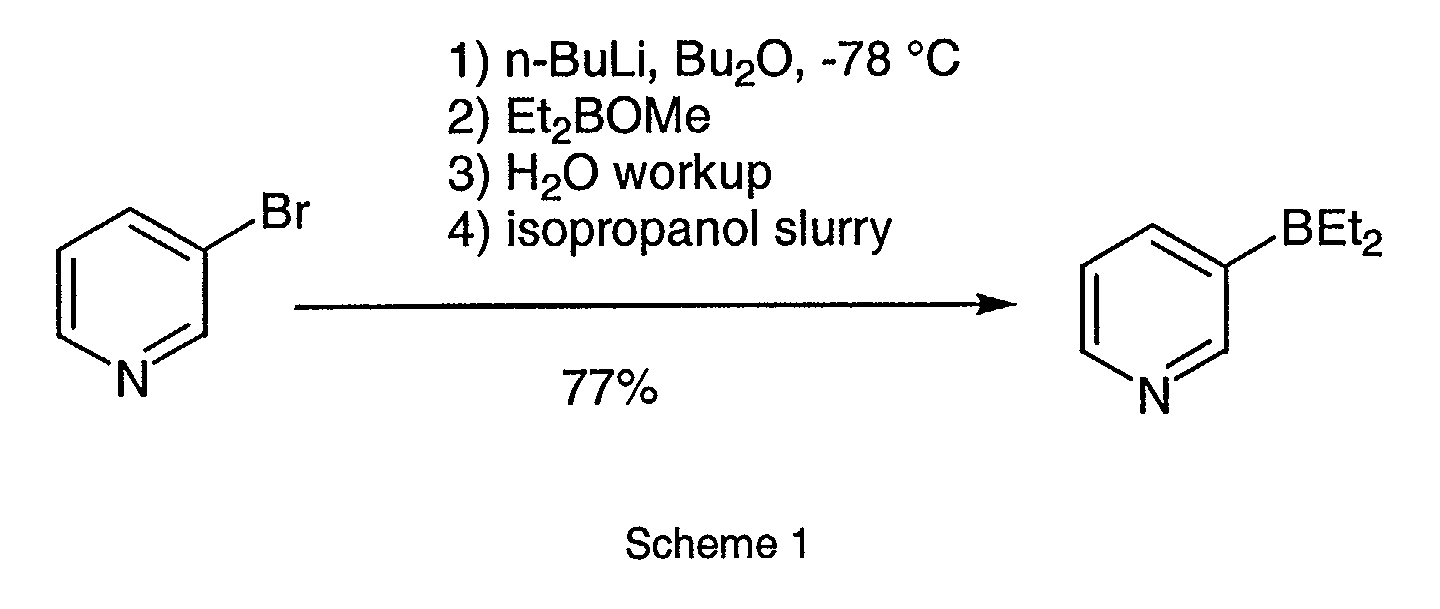
- the current process for the synthesis of these materials involves the lithium-bromine exchange on the bromopyridine followed by trapping of the lithiopyridine with diethylmethoxyborane or triethylborane.
- This type of process is referred to in the following references (a) Ishikura, M.; Mano, T.; Oda, I.; Terashima, M. Heterocycles 1984, 22, 2471-2474; (b) Ishikura, M.; Ohta, T.; Terashima, M. Chem. Pharm. Bull. 1983, 31 , 4573-4577; (c) Morris, G.A.; Nguyen, S.T. Tetrahedron Lett.
- the present invention relates to a method for the preparation of dialkylpyridylboranes comprising reacting a pyridine Grignard reagent and an alkoxydialkylborane or a trialkylborane.
- the reaction may be performed at a temperature from about 0°C to about 40°C.
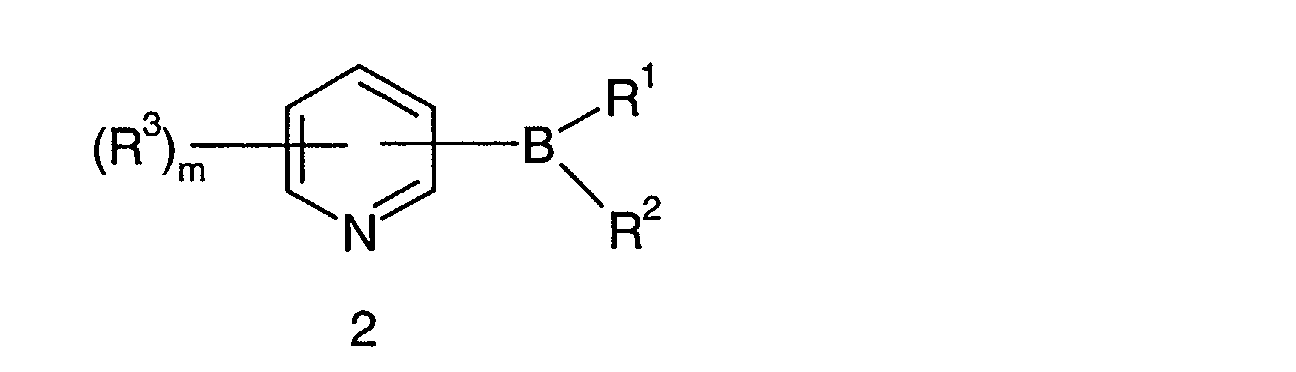
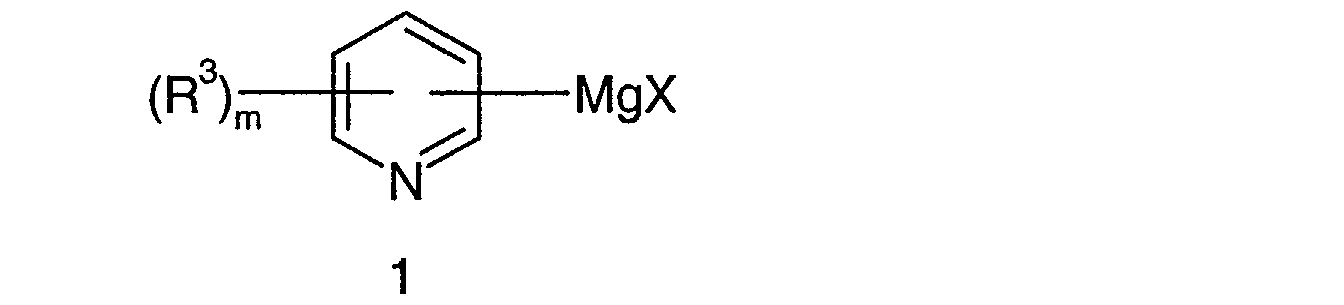
- the invention relates to a method for the preparation of a compound of formula 2: wherein R 1 and R 2 are each independently C 1 -C 10 alkyl; R 3 is H, C 1 -C 10 alkyl, C 2 -C 10 alkenyl, C 2 -C 10 alkynyl, -C(O)(C 1 -C 10 alkyl), -(CH 2 ) t (C 6 -C 10 aryl), -(CH 2 ) t (4-10 membered heterocyclic), -C(O)(CH 2 ) t (C 6 -C 10 aryl), or -C(O)(CH 2 ) t (5-10 membered heterocyclic), wherein t is an integer from 0 to 5; said alkyl group optionally includes 1 or 2 hetero moieties selected from O, S and -N(R 6 )- with the proviso that two O atoms, two S atoms, or an O and S atom are not attached directly
- R 1 and R 2 are each independently C 1 -C 5 alkyl. In another preferred embodiment R 1 and R 2 are each independently C 1 -C 3 alkyl. In a more preferred embodiment R 1 and R 2 are each independently methyl or ethyl.
- R 3 is H, C 1 -C 10 alkyl, C 2 -C 10 alkenyl, C 2 -C 10 alkynyl, -C(O)(C 1 -C 10 alkyl), -(CH 2 ) t (C 6 -C 10 aryl), wherein t is an integer from 0 to 5; said alkyl group optionally includes 1 or 2 hetero moieties selected from O, S and -N(R 6 )-with the proviso that two O atoms, two S atoms, or an O and S atom are not attached directly to each other; said R 3 aryl group is optionally fused to a C 6 -C 10 aryl group, a C 5 -C 8 saturated cyclic group, or a 5-10 membered heterocyclic group; the -(CH 2 ) t - moieties of the foregoing R 1 groups optionally include a carbon-carbon double or triple bond where t is an integer from
- X is Cl, Br, or I. In a more preferred embodiment X is Br.
- halo as used herein, unless otherwise indicated, includes fluoro, chloro, bromo or iodo. Preferred halo groups are chloro, bromo, and iodo.
- alkyl as used herein, unless otherwise indicated, includes saturated monovalent hydrocarbon radicals having straight, cyclic or branched moieties. It is understood that for cyclic moieties at least three carbon atoms are required in said alkyl group.
- alkenyl as used herein, unless otherwise indicated, includes monovalent hydrocarbon radicals having at least one carbon-carbon double bond and also having straight, cyclic or branched moieties as provided above in the definition of "alkyl".
- alkynyl as used herein, unless otherwise indicated, includes monovalent hydrocarbon radicals having at least one carbon-carbon triple bond and also having straight, cyclic or branched moieties as provided above in the definition of "alkyl".
- alkoxy as used herein, unless otherwise indicated, includes O-alkyl groups wherein “alkyl” is as defined above.
- aryl as used herein, unless otherwise indicated, includes an organic radical derived from an aromatic hydrocarbon by removal of one hydrogen, such as phenyl or naphthyl.
- 4-10 membered heterocyclic includes aromatic and non-aromatic heterocyclic groups containing one or more heteroatoms each selected from O, S and N, wherein each heterocyclic group has from 4-10 atoms in its ring system.
- Non-aromatic heterocyclic groups include groups having only 4 atoms in their ring system, but aromatic heterocyclic groups must have at least 5 atoms in their ring system.
- An example of a 4 membered heterocyclic group is azetidinyl (derived from azetidine).
- An example of a 5 membered heterocyclic group is thiazolyl and an example of a 10 membered heterocyclic group is quinolinyl.
- non-aromatic heterocyclic groups are pyrrolidinyl, tetrahydrofuranyl, tetrahydrothienyl, tetrahydropyranyl, tetrahydrothiopyranyl, piperidino, morpholino, thiomorpholino, thioxanyl, piperazinyl, azetidinyl, oxetanyl, thietanyl, homopiperidinyl, oxepanyl, thiepanyl, oxazepinyl, diazepinyl, thiazepinyl, 1,2,3,6-tetrahydropyridinyl, 2-pyrrolinyl, 3-pyrrolinyl, indolinyl, 2H-pyranyl, 4H-pyranyl, dioxanyl, 1,3-dioxolanyl, pyrazolinyl, dithianyl, dithiolanyl, dihydropyr
- aromatic heterocyclic groups are pyridinyl, imidazolyl, pyrimidinyl, pyrazolyl, triazolyl, pyrazinyl, tetrazolyl, furyl, thienyl, isoxazolyl, thiazolyl, oxazolyl, isothiazolyl, pyrrolyl, quinolinyl, isoquinolinyl, indolyl, benzimidazolyl, benzofuranyl, cinnolinyl, indazolyl, indolizinyl, phthalazinyl, pyridazinyl, triazinyl, isoindolyl, pteridinyl, purinyl, oxadiazolyl, thiadiazolyl, furazanyl, benzofurazanyl, benzothiophenyl, benzothiazolyl, benzoxazolyl, quinazolinyl, quinox
- a group derived from pyrrole may be C-attached or N-attached where such is possible.
- a group derived from pyrrole may be pyrrol-1-yl (N-attached) or pyrrol-3-yl (C-attached).
- the present invention relates to a method for preparing a dialkylpyridylborane comprising reacting a pyridine Grignard reagent with an alkoxydialkylborane reagent or a trialkylborane reagent.
- the pyridine Grignard reagent is prepared by reacting an alkylmagnesium halide or arylmagnesium halide with a halopyridine reagent.
- the pyridine Grignard reagent is prepared in situ.
- the pyridine Grignard reagent is prepared by reacting a halopyridine, Mg(0), and alkyl halide or aryl halide.
- the pyridine Grignard reagent is pyridylmagnesium chloride or pyridylmagnesium bromide.
- the alkylmagnesium halide is C 1 -C 10 alkylmagnesium halide. In one preferred embodiment the alkylmagnesium halide is C 1 -C 5 alkylmagnesium halide. In one more preferred embodiment the alkylmagnesium halide is selected from the group consisting of methylmagnesium chloride, ethylmagnesium chloride, isopropylmagnesium chloride, methylmagnesium bromide, ethylmagnesium bromide, and isopropylmagnesium bromide.
- the halopyridine reagent is chloropyridine, bromopyridine, or iodopyridine. In one more preferred embodiment the halopyridine is 3-bromopyridine.
- the alkoxydialkylborane is C 1 -C 10 alkoxydi(C 1 -C 10 alkyl)borane. More preferably, the alkoxydialkylborane is C 1 -C 10 alkoxydi(C 1 -C 5 alkyl)borane. Most preferably, the alkoxydialkylborane is C 1 -C 10 alkoxydi(C 1 -C 2 alkyl)borane. In one preferred embodiment of the present invention the C 1 -C 10 alkoxydialkylborane is C 1 -C 10 alkoxydimethylborane or C 1 -C 10 alkoxydiethylborane.
- the alkoxydialkylborane is C 1 -C 5 alkoxydi(C 1 -C 10 alkyl)borane. In a more preferred embodiment the alkoxydialkylborane is C 1 -C 3 alkoxydi(C 1 -C 5 alkyl)borane. In one embodiment of the present invention the alkoxydialkylborane is methoxydi(C 1 -C 5 alkyl)borane or ethoxydi(C 1 -C 5 alkyl)borane.
- the alkoxydialkylborane is methoxydiethylborane.
- the reaction between said alkoxydialkylborane reagent or said trialkylborane reagent and said Grignard pyridine reagent is performed at temperature from about 0°C to about 40°C. In one preferred embodiment the reaction is performed at temperature from about 10°C to about 25°C.
- the present invention relates to a method to prepare dialkylpyridylboranes by the reaction a pyridine Grignard reagent and an alkoxydialkylborane or a trialkylborane at a temperature of about 0°C to about 40°C.
- the dialkylpyridylborane is prepared by the reacting an alkylmagnesium halide or an arylmagnesium halide with a halopyridine followed by the addition of a trialkylborane or alkoxydialkylborane.
- Functional pyridines are prepared using a halide-lithium exchange reaction, which has to be performed at low temperatures from -100°C to -40°C depending on the solvent employed. The low temperature prevents side reactions such as deprotonation, elimination of lithium bromide or other reactions from occurring during the halide-metal exchange. If functional pyridines are desired in industrial environment it is often costly and inconvenient to run reactions at low temperatures. It is known in the art that the corresponding Grignard reagents are kinetically stable up to much higher temperatures (>25°C). However, magnesiopyridines are notoriously difficult to generate directly from the corresponding pyridine halide and magnesium (0) ((a) Harris, S.A. Iowa State Call. J. Sci .
- Pyridyl Grignard reagents have also been generated by ligand exchange reactions of aryl pyridyl sulfoxides with Grignard reagents (Shibutani, T.; Fujihara, H.; Furukawa, N. Heteroat. Chem. 1991, 2 , 521-531).
- the heteroaryl Grignard may also be directly generated from the pyridyl halide, magnesium(0), and a reactive alkylhalide such as ethylbromide (Entrainment Method).
- This process can be run within a wide temperature range as high as 40°C and generates the halomagnesiopyridine under mild reaction conditions.
- the halomagnesiopyridine can be converted to the corresponding dialkylpyridylborane by reaction with a dialkylalkoxyborane or a trialkylborane at a temperature of about 0°C to about 40°C. This reaction produces the desired dialkylpyridylborane in comparable yield and quality to that made by the reaction of the corresponding lithiated pyridine at low temperature.
- the method of the present invention may be employed in the synthesis of compounds which require a pyridine substitutent.
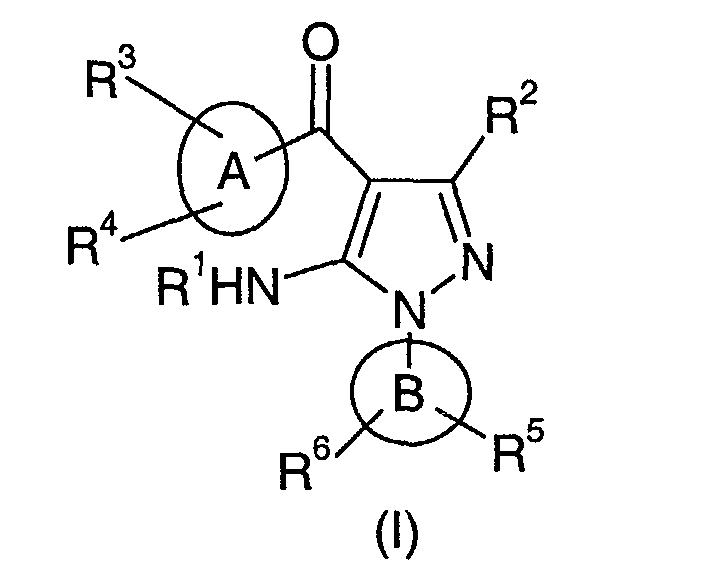
- the pyrazole p38 MAP kinase inhibitors of WO 99/57101 formula (I) shown below: wherein A, B, R 1 , R 2 , R 3 , R 4 , R 5 , and R 6 are as defined in WO 99/57101, which is hereby incorporated by reference in its entirety, may include the presence of a pyridine substituent.
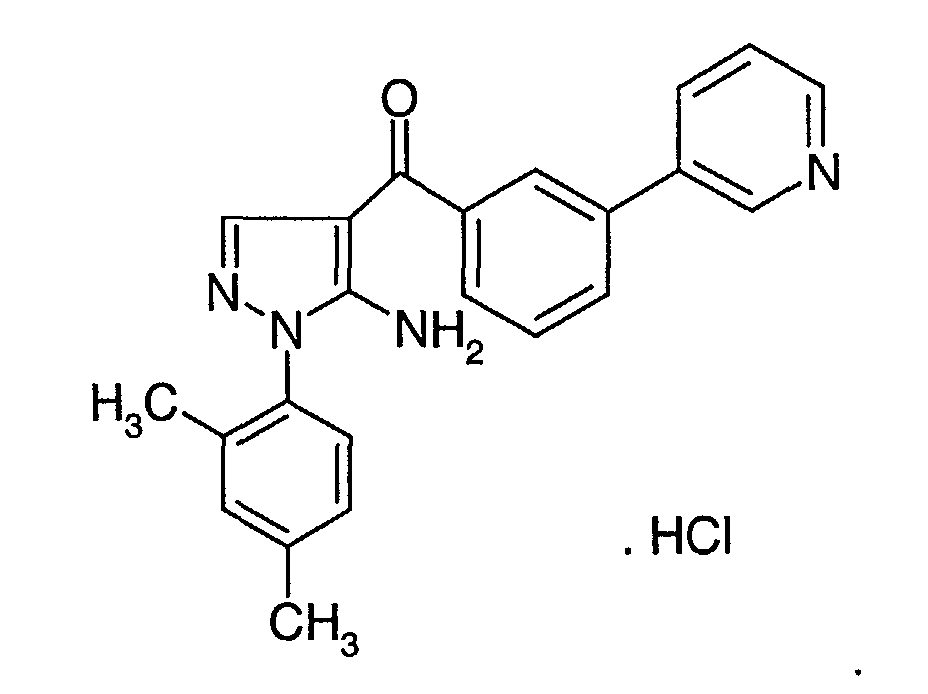
- the method of the present invention can be employed to introduce the pyridine in Example 23 (5-Amino-1-(2,4-dimethylphenyl)-4-]3-(pyridin-3-yl)benzoyl]pyrazole HCl salt), shown below, of WO 99/57101, rather than the exemplified method of introducing the pyridine substituent using the traditional reagent n-butyl lithium,
- the compounds of formula (I) and their pharmaceutically acceptable salts and solvates can be administered orally, transdermally (e.g., through the use of a patch), parenterally or topically. Oral administration is preferred.
- compounds of the formula (I) and their pharmaceutically acceptable salts and solvates are most desirably administered in dosages ranging from about 1.0 mg up to about 500 mg per day, preferably from about 1 to about 100 mg per day in single or divided (i.e., multiple) doses.
- the therapeutic compounds will ordinarily be administered in daily dosages ranging from about 0.01 to about 10 mg per kg body weight per day, in single or divided doses.
- Variations may occur depending on the weight and condition of the person being treated and the particular route of administration chosen. In some instances, dosage levels below the lower limit of the aforesaid range may be more than adequate, while in other cases still larger doses may be employed without causing any harmful side effect, provided that such larger doses are first divided into several small doses for administration throughout the day.
- the therapeutic compounds may be administered alone or in combination with pharmaceutically acceptable carriers or diluents by any of the routes previously indicated, and such administration may be carried out in single or multiple doses. More particularly, the therapeutic compounds can be administered in a wide variety of different dosage forms, i.e., they may be combined with various pharmaceutically acceptable inert carriers in the form of tablets, capsules, lozenges, troches, hard candies, powders, sprays, creams, salves, suppositories, jellies, gels, pastes, lotions, ointments, elixirs, syrups, and the like. Such carriers include solid diluents or fillers, sterile aqueous media and various non-toxic organic solvents, etc. Moreover, oral pharmaceutical compositions can be suitably sweetened and/or flavored.
- tablets containing various excipients such as microcrystalline cellulose, sodium citrate, calcium carbonate, dicalcium phosphate and glycine may be employed along with various disintegrants such as starch (and preferably corn, potato or tapioca starch), alginic acid and certain complex silicates, together with granulation binders like polyvinylpyrrolidone, sucrose, gelatin and acacia.
- disintegrants such as starch (and preferably corn, potato or tapioca starch), alginic acid and certain complex silicates, together with granulation binders like polyvinylpyrrolidone, sucrose, gelatin and acacia.
- lubricating agents such as magnesium stearate, sodium lauryl sulfate and talc are often very useful for tabletting purposes.
- compositions of a similar type may also be employed as fillers in gelatin capsules; preferred materials in this connection also include lactose or milk sugar as well as high molecular weight polyethylene glycols.
- preferred materials in this connection also include lactose or milk sugar as well as high molecular weight polyethylene glycols.
- the active ingredient may be combined with various sweetening or flavoring agents, coloring matter or dyes, and, if so desired, emulsifying and/or suspending agents as well, together with such diluents as water, ethanol, propylene glycol, glycerin and various like combinations thereof.
- solutions of a therapeutic compound in either sesame or peanut oil or in aqueous propylene glycol may be employed.
- the aqueous solutions should be suitably buffered if necessary and the liquid diluent first rendered isotonic.
- These aqueous solutions are suitable for intravenous injection purposes.
- the oily solutions are suitable for intra-articular, intra-muscular and subcutaneous injection purposes. The preparation of all these solutions under sterile conditions is readily accomplished by standard pharmaceutical techniques well-known to those skilled in the art.
- administer the therapeutic compounds topically and this may preferably be done by way of creams, jellies, gels, pastes, ointments and the like, in accordance with standard pharmaceutical practice.
- the therapeutic compounds may also be administered to a mammal other than a human.
- the dosage to be administered to a mammal will depend on the animal species and the disease or disorder being treated.
- the therapeutic compounds may be administered to animals in the form of a capsule, bolus, tablet or liquid drench.
- the therapeutic compounds may also be administered to animals by injection or as an implant.
- Such formulations are prepared in a conventional manner in accordance with standard veterinary practice.
- the therapeutic compounds may be administered with the animal feedstuff and for this purpose a concentrated feed additive or premix may be prepared for mixing with the normal animal feed.
- the compounds of formula (I) exhibit activity as p38 MAP kinase inhibitors and are useful in the treatment of diseases mediated by cykokines, such as inhibition of bone resorption, inflammation, and other immune and inflammation-based pathologies.
- the activity of the compounds of formula (I) as p38 MAP kinase inhibitors can be determined using the assays described in WO 99/57101.
- the reaction was quenched by 2N HCI (200 mL) at 0°C.
- the pH of the aqueous layer was adjusted to 7 using sodium carbonate, and the mixture was extracted with ethyl acetate (3x150 mL), washed with brine (150 mL), dried over sodium sulfate, and concentrated in vacuo.
- the crude material was slurried in isopropanol and filtered, providing the product as a white solid (41.5 g, 0.282 mol) in 78% yield.
- the NMR spectrum and melting point recorded for the prepared material was identical to that the NMR spectrum and melting point for diethyl-3-pyridylborane purchased from Aldrich Chemical Company, Millwaukee, Wisconsin.
- Diethyl-4-pyridylborane was prepared according to the method described in Example 1 except that 4-bromopyridine was used in place of 3-bromopyridine. The reaction resulted in a recovered yield of 88%.
Landscapes
- Chemical & Material Sciences (AREA)
- Organic Chemistry (AREA)
- Health & Medical Sciences (AREA)
- Veterinary Medicine (AREA)
- Animal Behavior & Ethology (AREA)
- Engineering & Computer Science (AREA)
- Chemical Kinetics & Catalysis (AREA)
- General Chemical & Material Sciences (AREA)
- Medicinal Chemistry (AREA)
- Nuclear Medicine, Radiotherapy & Molecular Imaging (AREA)
- Pharmacology & Pharmacy (AREA)
- Life Sciences & Earth Sciences (AREA)
- Bioinformatics & Cheminformatics (AREA)
- General Health & Medical Sciences (AREA)
- Public Health (AREA)
- Physical Education & Sports Medicine (AREA)
- Immunology (AREA)
- Pyridine Compounds (AREA)
- Plural Heterocyclic Compounds (AREA)
- Organic Low-Molecular-Weight Compounds And Preparation Thereof (AREA)
Abstract
Description


Claims (15)
- A method for preparing a dialkylpyridylborane comprising reacting a pyridine Grignard reagent with a borane reagent selected from an alkoxydialkylborane reagent and a trialkylborane reagent.
- The method of claim 1, wherein the pyridine Grignard reagent is prepared by reacting an alkyl magnesium halide or aryl magnesium halide with a halopyridine reagent.
- The method of claim 1 or 2, wherein the borane reagent is a C1-C10alkoxydi(C1-C10alkyl)borane.
- The method of any of claims 1, 2 and 3, wherein the borane reagent is a C1-C5alkoxydi(C1-C10alkyl)borane.
- The method of any of claims 1 to 4, wherein the borane reagent is methoxydiethylborane.
- The method of any of claims 1 to 5, wherein the reaction between said borane reagent and said pyridine Grignard reagent is performed at temperature from about 0°C to about 40°C.
- The method of any of claims 1 to 6, wherein the reaction is performed at temperature from about 0°C.
- The method of any of claims 1 to 7, wherein said pyridine Grignard reagent is prepared by reacting a halopyridine, Mg(0), and an alkyl halide or aryl halide.
- The method of any of claims 1 to 8, wherein the pyridine Grignard reagent is pyridylmagnesium chloride.
- A method for preparing a dialkylpyridylborane comprising reacting an alkyl magnesium halide or aryl magnesium halide with a halopyridine followed by the addition of an alkoxydialkylborane or trialkylborane.
- The method of claim 10, wherein the alkyl magnesium halide is a C1-C10alkyl magnesium halide.
- The method of claim 10, wherein the aryl magnesium halide is a C6-C10aryl magnesium halide.
- The method of any of claims 10 to 12, wherein the halopyridine is chloropyridine, bromopyridine, or iodopyridine.
- The method of any of claims 10 to 13, wherein the alkoxydialkylborane or trialkylborane is a C1-C10alkoxydi(C1-C10alkyl)borane.
- A method for preparing a compound of formula 2:wherein R1 and R2 are each independently C1-C10 alkyl and R3 is H, C1-C10 alkyl, C2-C10 alkenyl, C2-C10 alkynyl, -C(O)(C1-C10 alkyl), -(CH2)t(C6-C10 aryl), -(CH2)t(4-10 membered heterocyclic), -C(O)(CH2)t(C6-C10 aryl), or -C(O)(CH2)t(5-10 membered heterocyclic), wherein t is an integer from 0 to 5; said alkyl group optionally includes 1 or 2 hetero moieties selected from O, S and -N(R6)- with the proviso that two O atoms, two S atoms, or an O and S atom are not attached directly to each other; said R3 aryl and heterocyclic groups are optionally fused to a C6-C10 aryl group, a C5-C8 saturated cyclic group, or a 5-10 membered heterocyclic group; 1 or 2 carbon atoms in the foregoing heterocyclic moieties are optionally substituted by an oxo (=O) moiety; the -(CH2)t- moieties of the foregoing R3 groups optionally include a carbon-carbon double or triple bond where t is an integer from 2 to 5; and the foregoing R3 groups, except H, are optionally substituted by 1 to 3 R4 groups; R4 is C1-C10 alkyl or C1-C10 alkoxy; R6 is H or C1-C10 alkyl and wherein m is 0 to 4; comprising reacting a compound of formula 1,
 wherein R3 and m are as defined for formula 2 above and X is a halo with a compound of the formula R5BR1R2, wherein R1, R2 are as defined above for formula 2 and wherein R5 is C1-C10 alkyl or C1-C10 alkoxy.

Applications Claiming Priority (2)
| Application Number | Priority Date | Filing Date | Title |
|---|---|---|---|
| US31518301P | 2001-08-27 | 2001-08-27 | |
| US315183P | 2001-08-27 |
Publications (3)
| Publication Number | Publication Date |
|---|---|
| EP1288217A2 true EP1288217A2 (en) | 2003-03-05 |
| EP1288217A3 EP1288217A3 (en) | 2003-09-17 |
| EP1288217B1 EP1288217B1 (en) | 2006-03-29 |
Family
ID=23223262
Family Applications (1)
| Application Number | Title | Priority Date | Filing Date |
|---|---|---|---|
| EP02255717A Expired - Lifetime EP1288217B1 (en) | 2001-08-27 | 2002-08-15 | Preparation of dialkylpyridylboranes |
Country Status (18)
| Country | Link |
|---|---|
| US (1) | US6570017B2 (en) |
| EP (1) | EP1288217B1 (en) |
| JP (1) | JP2003096084A (en) |
| KR (1) | KR20030019112A (en) |
| CN (1) | CN1401649A (en) |
| AT (1) | ATE321766T1 (en) |
| BR (1) | BR0203371A (en) |
| CA (1) | CA2399834C (en) |
| CZ (1) | CZ20022642A3 (en) |
| DE (1) | DE60210224T2 (en) |
| ES (1) | ES2256416T3 (en) |
| HU (1) | HUP0202868A3 (en) |
| IL (1) | IL151379A0 (en) |
| MX (1) | MXPA02008364A (en) |
| PL (1) | PL355706A1 (en) |
| RU (1) | RU2002122947A (en) |
| YU (1) | YU59502A (en) |
| ZA (1) | ZA200206778B (en) |
Families Citing this family (4)
| Publication number | Priority date | Publication date | Assignee | Title |
|---|---|---|---|---|
| EP2576570A1 (en) * | 2010-05-26 | 2013-04-10 | Boehringer Ingelheim International GmbH | 2-oxo-1,2-dihydropyridin-4-ylboronic acid derivatives |
| CN103483366B (en) * | 2013-09-05 | 2017-02-08 | 润泽制药(苏州)有限公司 | Preparation method of methoxy diethyl borane |
| BR112018009931A8 (en) * | 2015-11-17 | 2019-02-26 | Dow Agrosciences Llc | 4 - ((6- (2- (2,4-difluorphenyl) -1,1-difluoro-2-hydroxy-3- (1h-1,2,4-triazol-1-yl) propyl) pyridin-3-one il) oxy) benzonitrile and preparation processes |
| CN117402184B (en) * | 2023-12-15 | 2024-04-26 | 山东国邦药业有限公司 | Preparation method of diethyl methoxyborane |
Family Cites Families (5)
| Publication number | Priority date | Publication date | Assignee | Title |
|---|---|---|---|---|
| DE2961831D1 (en) * | 1978-11-07 | 1982-02-25 | Ici Plc | Alkylborane complexes with aromatic amines, solutions thereof for use as hydroborating and reducing agents, and processes for their manufacture |
| GB8304613D0 (en) * | 1983-02-18 | 1983-03-23 | Ici Plc | Chemical process |
| DE4320432A1 (en) * | 1993-06-21 | 1994-12-22 | Bayer Ag | Substituted mono- and bipyridylmethyl derivatives |
| US5486534A (en) * | 1994-07-21 | 1996-01-23 | G. D. Searle & Co. | 3,4-substituted pyrazoles for the treatment of inflammation |
| PL344004A1 (en) * | 1998-05-05 | 2001-09-10 | Hoffmann La Roche | Pyrazole derivatives as p-38 map kinase inhibitors |
-
2002
- 2002-07-31 CZ CZ20022642A patent/CZ20022642A3/en unknown
- 2002-08-09 YU YU59502A patent/YU59502A/en unknown
- 2002-08-15 EP EP02255717A patent/EP1288217B1/en not_active Expired - Lifetime
- 2002-08-15 ES ES02255717T patent/ES2256416T3/en not_active Expired - Lifetime
- 2002-08-15 DE DE60210224T patent/DE60210224T2/en not_active Expired - Fee Related
- 2002-08-15 AT AT02255717T patent/ATE321766T1/en not_active IP Right Cessation
- 2002-08-21 IL IL15137902A patent/IL151379A0/en unknown
- 2002-08-23 ZA ZA200206778A patent/ZA200206778B/en unknown
- 2002-08-23 JP JP2002243438A patent/JP2003096084A/en active Pending
- 2002-08-23 CA CA002399834A patent/CA2399834C/en not_active Expired - Fee Related
- 2002-08-23 US US10/226,429 patent/US6570017B2/en not_active Expired - Fee Related
- 2002-08-23 BR BR0203371-2A patent/BR0203371A/en not_active IP Right Cessation
- 2002-08-23 CN CN02142212A patent/CN1401649A/en active Pending
- 2002-08-26 HU HU0202868A patent/HUP0202868A3/en unknown
- 2002-08-26 MX MXPA02008364A patent/MXPA02008364A/en active IP Right Grant
- 2002-08-26 PL PL02355706A patent/PL355706A1/en unknown
- 2002-08-26 RU RU2002122947/04A patent/RU2002122947A/en unknown
- 2002-08-26 KR KR1020020050579A patent/KR20030019112A/en not_active Ceased
Also Published As
| Publication number | Publication date |
|---|---|
| US6570017B2 (en) | 2003-05-27 |
| YU59502A (en) | 2004-12-31 |
| US20030083312A1 (en) | 2003-05-01 |
| HUP0202868A3 (en) | 2004-04-28 |
| PL355706A1 (en) | 2003-03-10 |
| ES2256416T3 (en) | 2006-07-16 |
| HUP0202868A2 (en) | 2003-06-28 |
| BR0203371A (en) | 2003-05-27 |
| ZA200206778B (en) | 2004-02-23 |
| KR20030019112A (en) | 2003-03-06 |
| DE60210224D1 (en) | 2006-05-18 |
| CA2399834A1 (en) | 2003-02-27 |
| RU2002122947A (en) | 2004-03-10 |
| CA2399834C (en) | 2006-08-22 |
| EP1288217B1 (en) | 2006-03-29 |
| HU0202868D0 (en) | 2002-10-28 |
| CN1401649A (en) | 2003-03-12 |
| MXPA02008364A (en) | 2003-03-04 |
| DE60210224T2 (en) | 2007-01-11 |
| CZ20022642A3 (en) | 2003-09-17 |
| JP2003096084A (en) | 2003-04-03 |
| ATE321766T1 (en) | 2006-04-15 |
| IL151379A0 (en) | 2003-04-10 |
| EP1288217A3 (en) | 2003-09-17 |
Similar Documents
| Publication | Publication Date | Title |
|---|---|---|
| RS59502B1 (en) | Method for the control of power ramp-rates minimizing energy storage requirements in intermittent power generation plants | |
| Fang et al. | Synthesis, Structure, and Reactivity of Hydridoiridium Complexes Bearing a Pincer‐Type PSiP Ligand | |
| CN110386944B (en) | Di(hetero)aryl macrocycles for inhibiting protein kinase activity | |
| Ainscough et al. | Hexafluorosilicate coordination to the antitumour copper (II) salicylaldehyde benzoylhydrazone (H2L) system: single-crystal X-ray structure of [{Cu (HL) H2O} 2SiF6]· 2H2O | |
| CA2005206A1 (en) | Substituted 2-pyridones and pyrid-2-thiones, processes for their preparation and their use in medicaments | |
| WO2008070583A2 (en) | Thrombopoietin mimetics | |
| JPH0840892A (en) | Platinum complex having activity against cancer cells | |
| KR20000070803A (en) | 2-amino-6-(2-substituted-4-phenoxy)-substituted-pyridines | |
| EP1070713B1 (en) | Quinolonecarboxylic acid derivatives or salts thereof | |
| JP2011241217A (en) | Process for cross coupling indoles | |
| EP1288217B1 (en) | Preparation of dialkylpyridylboranes | |
| WO2003000681A1 (en) | Antibacterial having quinolinecarboxamide skeleton | |
| JPS61109767A (en) | Oxindole antiinflammatory | |
| WO2001017968A1 (en) | Integrase inhibitors containing aromatic heterocycle derivatives | |
| WO2014167446A1 (en) | Derivatives of 1-(substituted sulfonyl)-2-aminoimidazoline as antitumor and antiproliferative agents | |
| US4994591A (en) | Platinum complexes derived from b-silyamines | |
| Kobayashi et al. | Installation of the imidazole ring on chiral substrates via allylic substitution | |
| Arvanitis et al. | CRF Ligands via suzuki and negishi couplings of 3-pyridyl boronic acids or halides with 2-benzyloxy-4-chloro-3-nitropyridine | |
| HK1050534A (en) | Preparation of dialkylpyridylboranes | |
| Sladek et al. | 3-Fluoropyridyl nickel complexes as useful tools for the selective synthesis of new 2, 4, 5, 6-tetrafluoropyridines: a route complementing the established methods to access fluorinated pyridines | |
| JPH0373548B2 (en) | ||
| KR102903096B1 (en) | Manufacturing method of alkynyl amino acid ester derivative using photocatalytic reaction and use thereof | |
| JPH0516429B2 (en) | ||
| JP6940524B2 (en) | Methods for the production of 6-alkynyl-pyridine derivatives | |
| Oh et al. | Rh-catalyzed intramolecular debenzylative cyclization of amines. Butyrolactams from benzylamines having a chloroacetylene moiety |
Legal Events
| Date | Code | Title | Description |
|---|---|---|---|
| PUAI | Public reference made under article 153(3) epc to a published international application that has entered the european phase |
Free format text: ORIGINAL CODE: 0009012 |
|
| 17P | Request for examination filed |
Effective date: 20020827 |
|
| AK | Designated contracting states |
Kind code of ref document: A2 Designated state(s): AT BE BG CH CY CZ DE DK EE ES FI FR GB GR IE IT LI LU MC NL PT SE SK TR |
|
| AX | Request for extension of the european patent |
Extension state: AL LT LV MK RO SI |
|
| PUAL | Search report despatched |
Free format text: ORIGINAL CODE: 0009013 |
|
| AK | Designated contracting states |
Kind code of ref document: A3 Designated state(s): AT BE BG CH CY CZ DE DK EE ES FI FR GB GR IE IT LI LU MC NL PT SE SK TR |
|
| AX | Request for extension of the european patent |
Extension state: AL LT LV MK RO SI |
|
| AKX | Designation fees paid |
Designated state(s): AT BE BG CH CY CZ DE DK EE ES FI FR GB GR IE IT LI LU MC NL PT SE SK TR |
|
| AXX | Extension fees paid |
Extension state: SI Payment date: 20020827 Extension state: LT Payment date: 20020827 Extension state: AL Payment date: 20020827 Extension state: LV Payment date: 20020827 Extension state: RO Payment date: 20020827 Extension state: MK Payment date: 20020827 |
|
| GRAP | Despatch of communication of intention to grant a patent |
Free format text: ORIGINAL CODE: EPIDOSNIGR1 |
|
| GRAS | Grant fee paid |
Free format text: ORIGINAL CODE: EPIDOSNIGR3 |
|
| GRAA | (expected) grant |
Free format text: ORIGINAL CODE: 0009210 |
|
| AK | Designated contracting states |
Kind code of ref document: B1 Designated state(s): AT BE BG CH CY CZ DE DK EE ES FI FR GB GR IE IT LI LU MC NL PT SE SK TR |
|
| AX | Request for extension of the european patent |
Extension state: AL LT LV MK RO SI |
|
| PG25 | Lapsed in a contracting state [announced via postgrant information from national office to epo] |
Ref country code: NL Free format text: LAPSE BECAUSE OF FAILURE TO SUBMIT A TRANSLATION OF THE DESCRIPTION OR TO PAY THE FEE WITHIN THE PRESCRIBED TIME-LIMIT Effective date: 20060329 Ref country code: BE Free format text: LAPSE BECAUSE OF FAILURE TO SUBMIT A TRANSLATION OF THE DESCRIPTION OR TO PAY THE FEE WITHIN THE PRESCRIBED TIME-LIMIT Effective date: 20060329 Ref country code: LI Free format text: LAPSE BECAUSE OF FAILURE TO SUBMIT A TRANSLATION OF THE DESCRIPTION OR TO PAY THE FEE WITHIN THE PRESCRIBED TIME-LIMIT Effective date: 20060329 Ref country code: AT Free format text: LAPSE BECAUSE OF FAILURE TO SUBMIT A TRANSLATION OF THE DESCRIPTION OR TO PAY THE FEE WITHIN THE PRESCRIBED TIME-LIMIT Effective date: 20060329 Ref country code: CH Free format text: LAPSE BECAUSE OF FAILURE TO SUBMIT A TRANSLATION OF THE DESCRIPTION OR TO PAY THE FEE WITHIN THE PRESCRIBED TIME-LIMIT Effective date: 20060329 Ref country code: SK Free format text: LAPSE BECAUSE OF FAILURE TO SUBMIT A TRANSLATION OF THE DESCRIPTION OR TO PAY THE FEE WITHIN THE PRESCRIBED TIME-LIMIT Effective date: 20060329 |
|
| REG | Reference to a national code |
Ref country code: GB Ref legal event code: FG4D |
|
| REG | Reference to a national code |
Ref country code: CH Ref legal event code: EP |
|
| PGFP | Annual fee paid to national office [announced via postgrant information from national office to epo] |
Ref country code: IE Payment date: 20060418 Year of fee payment: 5 |
|
| PGFP | Annual fee paid to national office [announced via postgrant information from national office to epo] |
Ref country code: DE Payment date: 20060427 Year of fee payment: 5 |
|
| REG | Reference to a national code |
Ref country code: IE Ref legal event code: FG4D |
|
| REF | Corresponds to: |
Ref document number: 60210224 Country of ref document: DE Date of ref document: 20060518 Kind code of ref document: P |
|
| PG25 | Lapsed in a contracting state [announced via postgrant information from national office to epo] |
Ref country code: SE Free format text: LAPSE BECAUSE OF FAILURE TO SUBMIT A TRANSLATION OF THE DESCRIPTION OR TO PAY THE FEE WITHIN THE PRESCRIBED TIME-LIMIT Effective date: 20060629 Ref country code: BG Free format text: LAPSE BECAUSE OF FAILURE TO SUBMIT A TRANSLATION OF THE DESCRIPTION OR TO PAY THE FEE WITHIN THE PRESCRIBED TIME-LIMIT Effective date: 20060629 Ref country code: DK Free format text: LAPSE BECAUSE OF FAILURE TO SUBMIT A TRANSLATION OF THE DESCRIPTION OR TO PAY THE FEE WITHIN THE PRESCRIBED TIME-LIMIT Effective date: 20060629 |
|
| REG | Reference to a national code |
Ref country code: ES Ref legal event code: FG2A Ref document number: 2256416 Country of ref document: ES Kind code of ref document: T3 |
|
| PGFP | Annual fee paid to national office [announced via postgrant information from national office to epo] |
Ref country code: GB Payment date: 20060725 Year of fee payment: 5 |
|
| PGFP | Annual fee paid to national office [announced via postgrant information from national office to epo] |
Ref country code: ES Payment date: 20060802 Year of fee payment: 5 |
|
| PGFP | Annual fee paid to national office [announced via postgrant information from national office to epo] |
Ref country code: FR Payment date: 20060823 Year of fee payment: 5 |
|
| PG25 | Lapsed in a contracting state [announced via postgrant information from national office to epo] |
Ref country code: PT Free format text: LAPSE BECAUSE OF FAILURE TO SUBMIT A TRANSLATION OF THE DESCRIPTION OR TO PAY THE FEE WITHIN THE PRESCRIBED TIME-LIMIT Effective date: 20060829 |
|
| PG25 | Lapsed in a contracting state [announced via postgrant information from national office to epo] |
Ref country code: MC Free format text: LAPSE BECAUSE OF NON-PAYMENT OF DUE FEES Effective date: 20060831 |
|
| PGFP | Annual fee paid to national office [announced via postgrant information from national office to epo] |
Ref country code: IT Payment date: 20060831 Year of fee payment: 5 |
|
| LTIE | Lt: invalidation of european patent or patent extension |
Effective date: 20060329 |
|
| REG | Reference to a national code |
Ref country code: CH Ref legal event code: PL |
|
| NLV1 | Nl: lapsed or annulled due to failure to fulfill the requirements of art. 29p and 29m of the patents act | ||
| ET | Fr: translation filed | ||
| PLBE | No opposition filed within time limit |
Free format text: ORIGINAL CODE: 0009261 |
|
| STAA | Information on the status of an ep patent application or granted ep patent |
Free format text: STATUS: NO OPPOSITION FILED WITHIN TIME LIMIT |
|
| 26N | No opposition filed |
Effective date: 20070102 |
|
| GBPC | Gb: european patent ceased through non-payment of renewal fee |
Effective date: 20070815 |
|
| PG25 | Lapsed in a contracting state [announced via postgrant information from national office to epo] |
Ref country code: CZ Free format text: LAPSE BECAUSE OF FAILURE TO SUBMIT A TRANSLATION OF THE DESCRIPTION OR TO PAY THE FEE WITHIN THE PRESCRIBED TIME-LIMIT Effective date: 20060329 Ref country code: GR Free format text: LAPSE BECAUSE OF FAILURE TO SUBMIT A TRANSLATION OF THE DESCRIPTION OR TO PAY THE FEE WITHIN THE PRESCRIBED TIME-LIMIT Effective date: 20060630 |
|
| PG25 | Lapsed in a contracting state [announced via postgrant information from national office to epo] |
Ref country code: EE Free format text: LAPSE BECAUSE OF FAILURE TO SUBMIT A TRANSLATION OF THE DESCRIPTION OR TO PAY THE FEE WITHIN THE PRESCRIBED TIME-LIMIT Effective date: 20060329 Ref country code: FI Free format text: LAPSE BECAUSE OF FAILURE TO SUBMIT A TRANSLATION OF THE DESCRIPTION OR TO PAY THE FEE WITHIN THE PRESCRIBED TIME-LIMIT Effective date: 20060329 |
|
| REG | Reference to a national code |
Ref country code: FR Ref legal event code: ST Effective date: 20080430 |
|
| PG25 | Lapsed in a contracting state [announced via postgrant information from national office to epo] |
Ref country code: TR Free format text: LAPSE BECAUSE OF FAILURE TO SUBMIT A TRANSLATION OF THE DESCRIPTION OR TO PAY THE FEE WITHIN THE PRESCRIBED TIME-LIMIT Effective date: 20060329 Ref country code: LU Free format text: LAPSE BECAUSE OF NON-PAYMENT OF DUE FEES Effective date: 20060815 Ref country code: DE Free format text: LAPSE BECAUSE OF NON-PAYMENT OF DUE FEES Effective date: 20080301 |
|
| PG25 | Lapsed in a contracting state [announced via postgrant information from national office to epo] |
Ref country code: IE Free format text: LAPSE BECAUSE OF NON-PAYMENT OF DUE FEES Effective date: 20070815 Ref country code: FR Free format text: LAPSE BECAUSE OF NON-PAYMENT OF DUE FEES Effective date: 20070831 |
|
| REG | Reference to a national code |
Ref country code: ES Ref legal event code: FD2A Effective date: 20070816 |
|
| PG25 | Lapsed in a contracting state [announced via postgrant information from national office to epo] |
Ref country code: CY Free format text: LAPSE BECAUSE OF FAILURE TO SUBMIT A TRANSLATION OF THE DESCRIPTION OR TO PAY THE FEE WITHIN THE PRESCRIBED TIME-LIMIT Effective date: 20060329 Ref country code: GB Free format text: LAPSE BECAUSE OF NON-PAYMENT OF DUE FEES Effective date: 20070815 |
|
| PG25 | Lapsed in a contracting state [announced via postgrant information from national office to epo] |
Ref country code: ES Free format text: LAPSE BECAUSE OF NON-PAYMENT OF DUE FEES Effective date: 20070816 |
|
| PG25 | Lapsed in a contracting state [announced via postgrant information from national office to epo] |
Ref country code: IT Free format text: LAPSE BECAUSE OF NON-PAYMENT OF DUE FEES Effective date: 20070815 |