Background of the Invention
(1) Field of the Invention
The present invention relates to a method for producing optically active
lactone compounds. More specifically, the invention relates to a method for
producing optically active lactone compounds by Baeyer-Villiger oxidation of cyclic
ketone compounds using salen cobalt complexes possessing a cis-β structure as a
catalyst. Such optically active lactone compounds can be used for the synthesis of
medicines and agrochemicals. Further, both S isomers and R isomers can be
synthesized by choosing the catalyst.
(2) Related Art Statement
Asymmetric Baeyer-Villiger oxidation is an important reaction in the
organic synthetic chemistry. Still, these is no general method for achieving sufficient
enantioselectivity in the oxidation. Baeyer-Villiger oxidation starts with nucleophilic
attach of an oxidant to a carboxyl group, followed by the migration of the carbonyl-substitutent
(R3 or R4) to the vicinal oxygen atom to give a lactone (or esters). Lewis
acid accelerates both the nuclceophic addition and the migration through its
coordination to the carbonyl group and the leaving group (X'), respectively.
The reaction formula is shown below.
Bolm and co-workers reported enantiomer-differentiating Bayer-Villiger
oxidation of racemic 2-substituted cycloalkanones using a combination of molecular
oxygen and aldehyde (Mukaiyama condition) in the presence of bis(oxazolinylphenolato)copper
(II) complex as a catalyst (Bolm C., Schlingloff G. and Weichhardt
K., Angew. Chem. Int. Ed. Engl. 1994, 33, 1848-1849). Enantioselective Baeyer-Villiger
oxidation using chiral platinum complexes as catalysts were also reported
(Gusso A., Baccin C., Pinna F., and Strukul G., Organometallics, 1994, 13, 3442-3451).
Thereafter, asymmetric Baeyer-Villiger oxidations using various optically active metal
complexes as catalysts have been investigated, and high enatioselectivity has been
realized for the reactions of some specific substrates.
However, the maximum enantioselectivity in the reported asymmetric
Baeyer-Villiger oxidation of prochiral ketones, particularly, prochiral 3-substituted
cyclobutanone compounds by using optically active metal complexes as catalyst was
47 %ee (until August, 2001) (Lopp M., Paju A., Kanger T., and Pehk T., Tetrahedron
Lett., 1996, 37, 7583-7586, Bolm C., Schlingloff G., and Bienewald F., J. Mol. Cat. A;
Chem., 1997, 117, 347-350, Bolm C., and Beckmann O., Chirality, 2000, 12, 523-525,
Shinohara T., Fujioka S., and Kotsuki, H., Heterocycles, 2001, 55, 237-241).
Summary of the Invention
Therefore, it is an object of the present invention to provide a method for
producing lactone compounds at an optically high purity by asymmetric Baeyer-Villiger
oxidation of prochiral ketones.
Having made strenuous investigations to solve the above-mentioned
problems, the inventors discovered that lactone compounds of optically high purities
could be produced by the Baeyer-Villiger oxidation of cyclic ketone compounds with
specific oxidants in the presence of cobalt(salen) complexes of cis-β structure as
catalyst. The present invention was accomplished based on this discovery.
Any combinations of (21) to (26) are also preferred embodiments of the
catalyst of the present invention, so long as no discrepancy occurs.
These and other objects, features and advantages of the invention will be
apparent from reading of the following detailed description of the invention when taken
with the understanding that some variations, changes or variations could be easily made
by the skilled person in the art to which the invention pertains.
Detailed Description of the Invention
In the following, the present invention will be explained in more detail.
The Baeyer-Villiger oxidation utilized in the producing method according to the
present invention, which is also called the Baeyer-Villiger reaction or the Baeyer-Villigar
rearrangement, is a reaction in which an ester is produced by oxidation of a
ketone with peroxide. The lactone is obtained by subjecting the cyclic ketone
compound to this reaction. Further, the optically active lactone compound is obtained
by subjecting the prochiral cyclic ketone compound to the above reaction.
The Baeyer-Villiger oxidation consists of two steps: (i) nucleophilic attack
of an oxidant to a carbonyl compound to give Criegee adduct and (ii) rearrangement of
the adduct to give an ester (or lactone). Therefore, the stereochemistry of the Baeyer-Villiger
oxidation is influenced by two factors: (i) the face-selectivity in the addition of
the oxidant and (ii) the enantiotopos-selectivity in the rearrangement. According to
the present invention, the Baeyer-Villiger oxidation of the prochiral cyclic ketone
compounds with use of the specific metal catalysts and specific oxidants as mentioned
later improves the face-selectivity and the enantiotopos-selectivity, so that the optically
active lactone compounds are obtained.
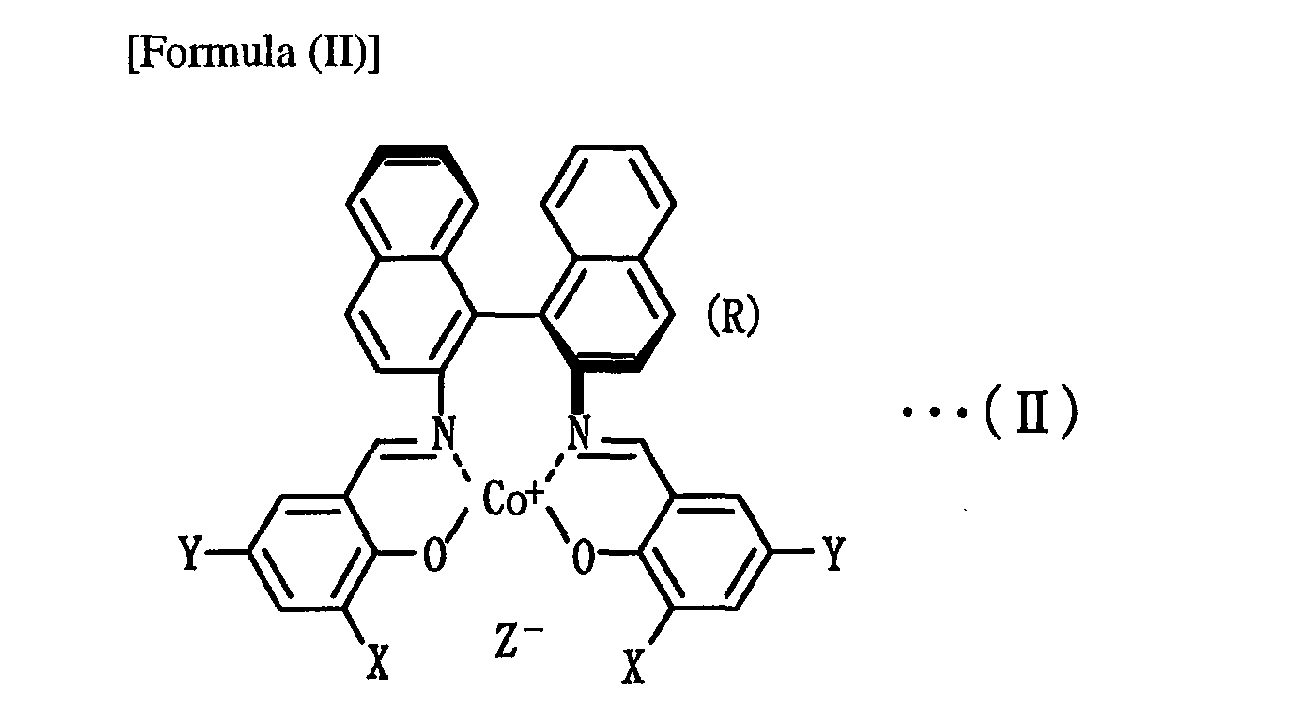
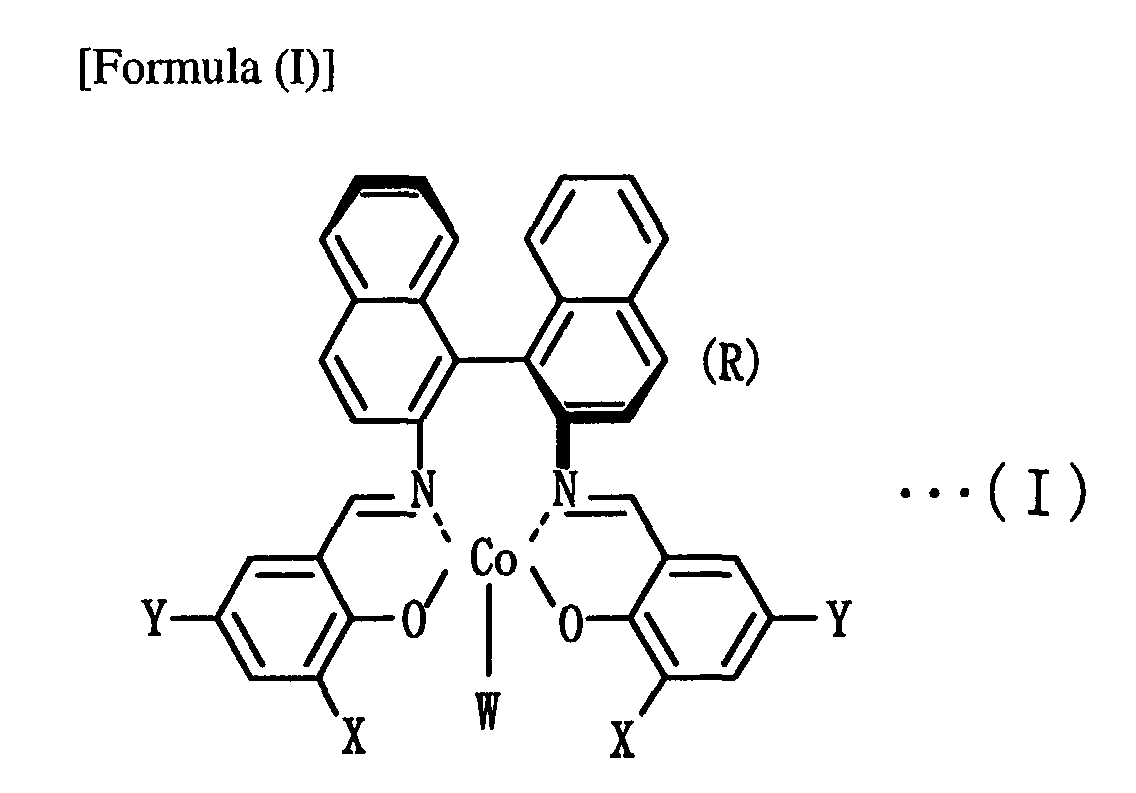
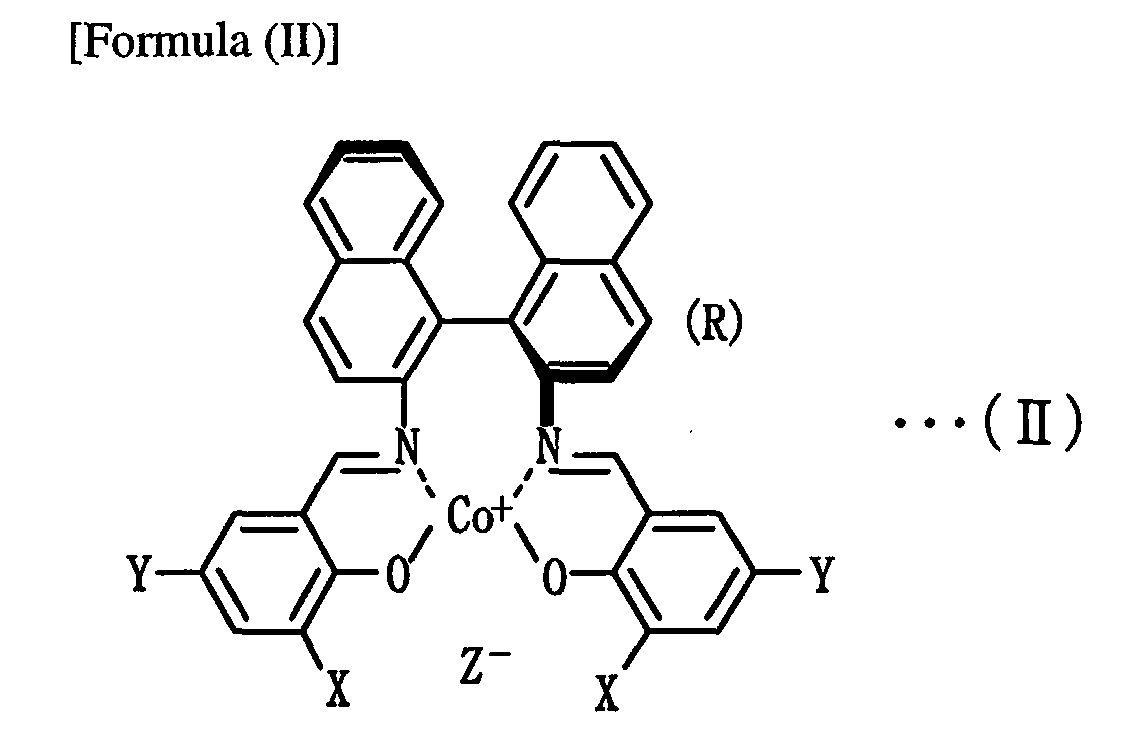
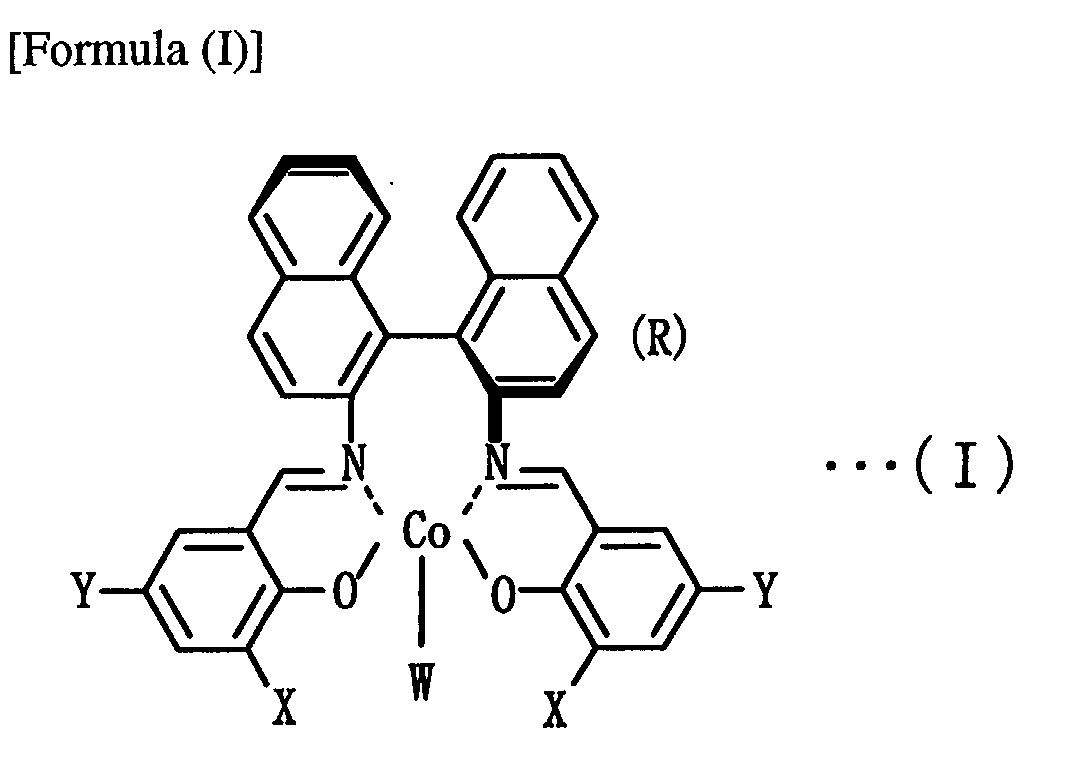
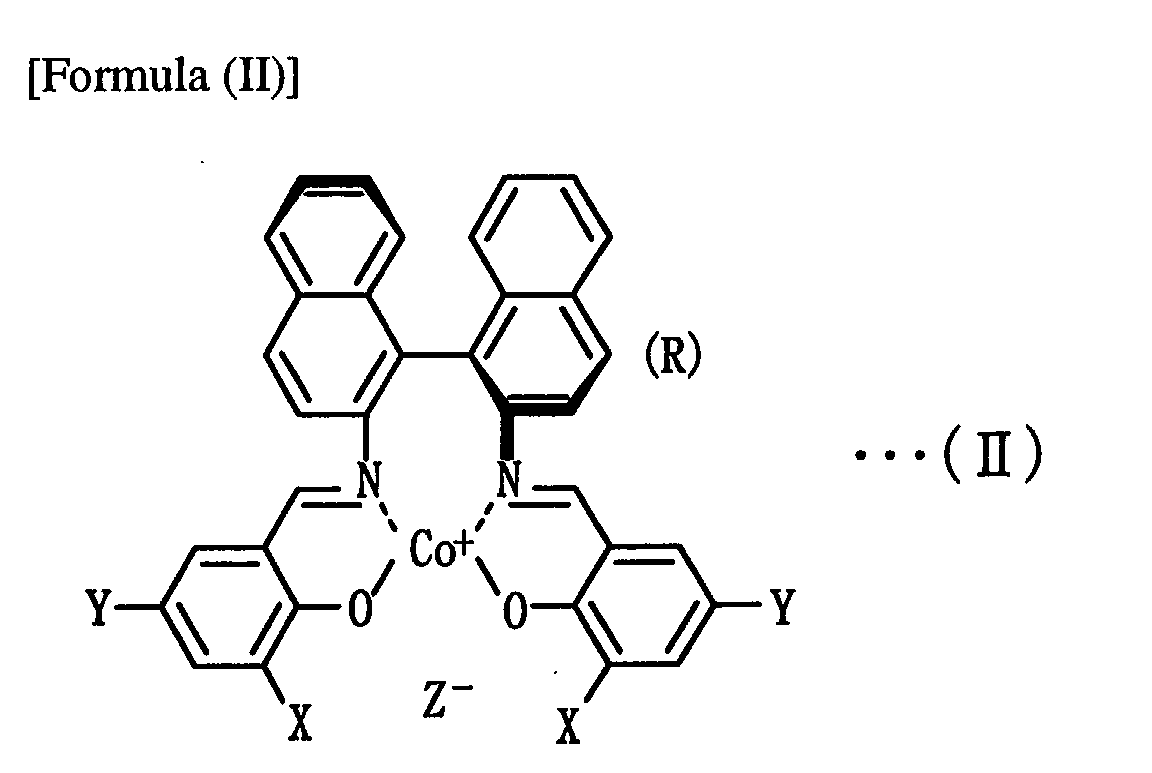
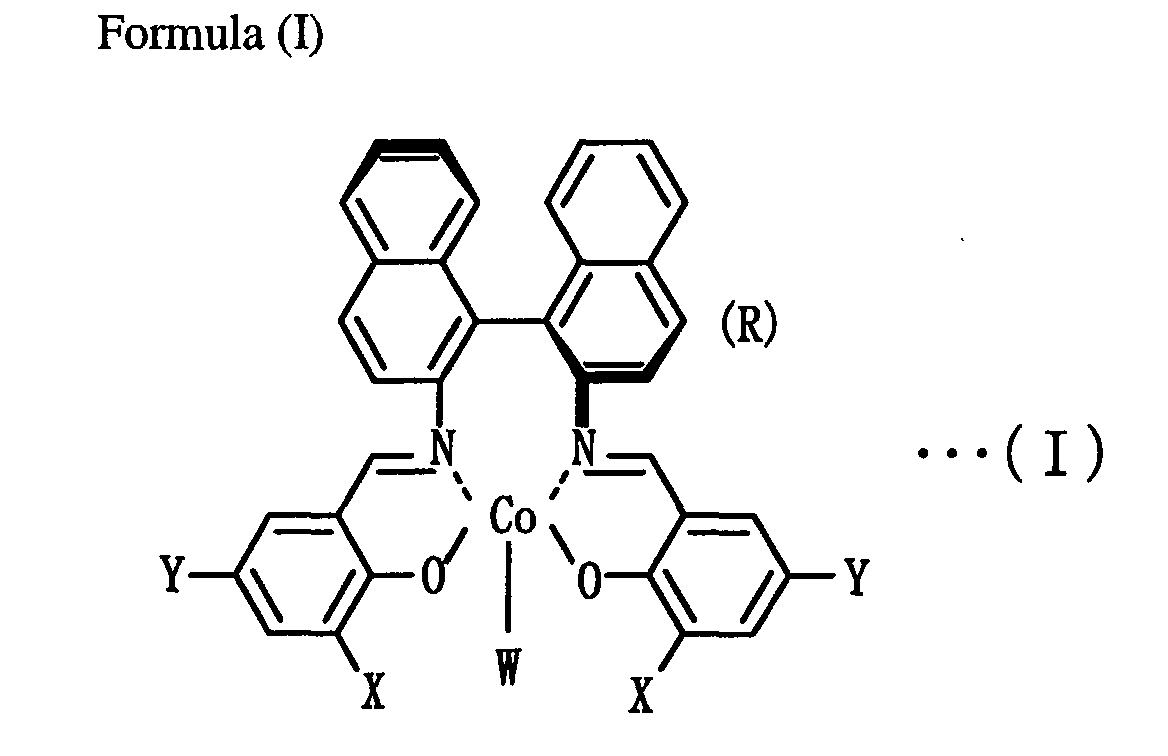
The cobalt(salen) complex possessing the cis-β structure to be used as the
catalyst in the present invention is expressed by either one of the following formulae (I)
and (II).
In the formula (I), X and Y independently denote H, t-butyl group or an
electron-withdrawing group. As the electron-withdrawing group, halogen elements
such as F, Cl, Br and I as well as a nitro group may be recited. As X and Y in the
formula (I), t-butyl group, F, Cl, Br, I and nitro group are preferred. It is particularly
preferable that X is t-butyl group and Y is nitro group. W is a halogen element, and
Br and I are recited as the halogen element. I is preferred, because I weakly bonds to
cobalt and easily dissociates therefrom in the reaction system.
In the formula (II), X and Y independently denote H, t-butyl group or an
electron-withdrawing group. As the electron-withdrawing group, the same as referred
to in the explanation of X and Y in the formula (I) are recited. As X and Y in the
formula (II), F, Cl, Br and I are preferred. It is particularly preferable that both X and
Y are F. Z- is a monovalent non-coordinating anion. For example, SbF6 - and PF6 -
may be reicted, and SbF6 - is preferred. Since Z- is the monovalent non-coordinating
anion, the complex represented by the formula (II) is cationic.
The cobalt(salen) complex represented by the formula (II) is obtained by
reacting the cobalt(salen) complex of the formula (I) with silver hexafluoroantimonate
or the like, for example. Therefore, the cobalt(salen) complex of the formula (I) is
more easily synthesized as compared with that of the formula (II). The cobalt(salen)
complex of the formula (I) is more easily handled than that of the formula (II).
Therefore, the cobalt(salen) complex of the formula (I) is more preferable from the
standpoint of the production cost and the handling easiness of the complex.
The loading amount of the catalyst according to the present invention is
preferably in a range of 1 to 10 mol%, more preferably 4 to 6 mol% relative to 1 mol of
the cyclic ketone as the substrate.
The cationic cobalt(salen) complex of the formula (II) has two vacant
coordinating sites adjacent to each other above the central metal, and these coordinating
sites are available for coordination of the substrate and the oxidant. On the other hand,
in the cobalt(salen) complex of the formula (I), W coordinating to the central metal is
easily dissociated in the reaction system, so that the cobalt ion can possess two vacant
coordinating sites adjacent to each other, and these coordinating sites are available for
the coordination of the substrate and the oxidant.
Therefore, when the cobalt(salen) complex of either the formula (I) or (II)
is used for the asymmetric Baeyer-Villiger oxidation, the oxygen atom of the carbonyl
group of the substrate and the oxygen atom of the oxidant simultaneously on stepwise
coordinate to the central metal and the Baeyer-Villiger oxidation occurs in the
coordination sphere of the cobalt ion. Accordingly, the face-selectivity in nucleophilic
attack of the oxygen atom of the oxidant to the carbon atom of the carbonyl group of
the substrate and enantiotopos-selectivity in the rearrangement of the Criegee adduct
resulting from the nucleophilic attack are achieved. Therefore, the cobalt(salen)
complex used in the producing method of the present invention is required to have two
vacant coordinating sites adjacent to each other above the metal on which the desired
Baeyer-Villiger oxidation proceeds.
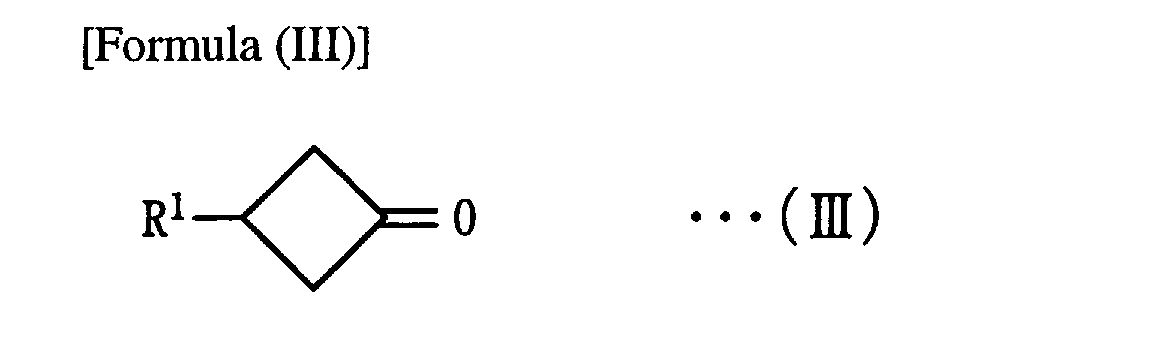
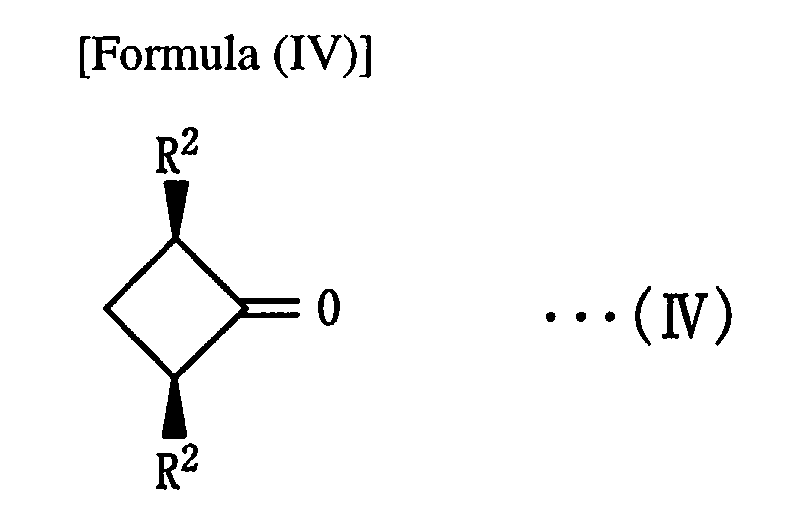
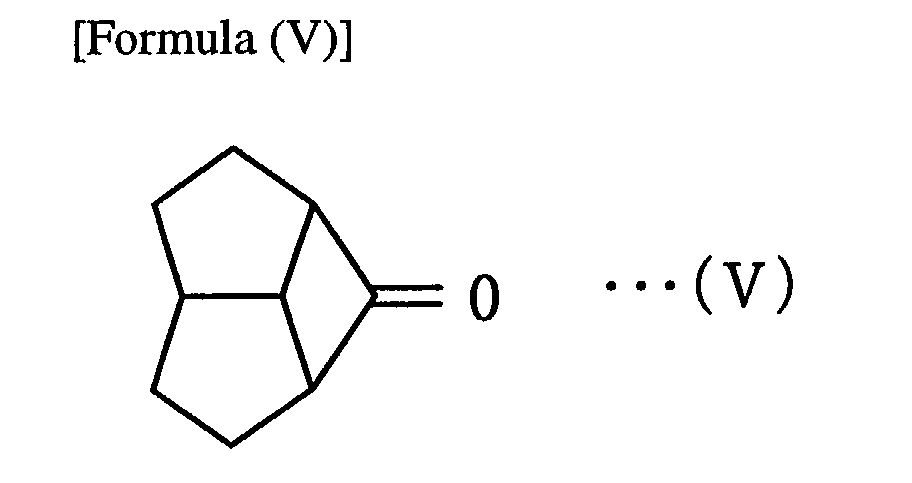
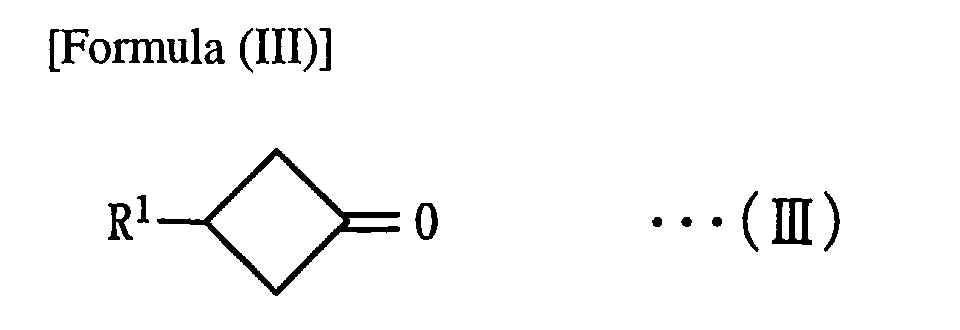
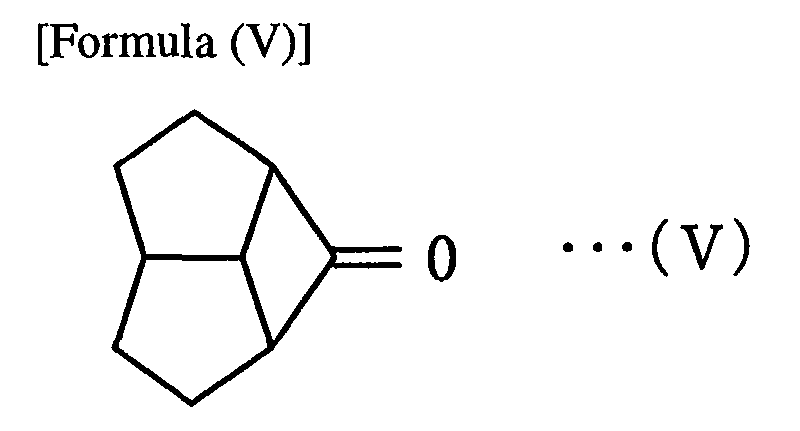
The cyclic ketone compound to be used in the present invention is a
prochiral cyclic ketone compound, which forms a chiral carbon in the Baeyer-Villiger
oxidation. For example, the compounds represented by the following formulae (III),
(IV) and (V) are recited. In this application, the prochiral cyclic ketone compounds
mean the cyclic ketones that form a chiral carbon through the reaction.
in which R
1 is a substituted or non-substituted C1-C20 alkyl group or a substituted or
non-substituted C6-C15 aryl group.
in which R
2 is a substituted or non-substituted C1-C20 alkyl group or a substituted or
non-substituted C6-C15 aryl group.
As the alkyl group in R1 of the formula (III), methyl, ethyl, propyl,
isopropyl, butyl, isobutyl, t-butyl, pentyl, isopentyl, neopentyl, hexyl, heptyl, octyl, 2-ethylhexyl,
nonyl, decyl, undecyl, dodecyl, tridecyl, isotridecyl, myristyl, palmityl,
stearyl, eicocyl, docosyl, etc. may be recited.
As the aryl group in R1 of the formula (III), phenyl, tolyl, xylyl, cumyl,
mesityl, ethylphenyl, propylphenyl, butylphenyl, pentylphenyl, hexylphenyl,
heptylphenyl, octylphenyl, nonylphenyl, α-naphthyl, β-naphthyl, etc. may be recited.
The above alkyl group and aryl group may be substituted by a halogen, a
C1-C4 alkoxy group or the like.
As the alkyl group and the aryl group in R2 of the formula (IV), those
recited as the alkyl group and the aryl group in R1 of the above formula (III) may be
also recited. These alkyl groups and aryl groups may be substituted by a halogen, a
C1-C4 alkoxy group or the like.
The oxidant to be used in the present invention is hydrogen peroxide or an
urea-hydrogen peroxide adduct (UHP). Each of these oxidants coordinates to the
central metal of the cobalt(salen) complex, attacks the carbonyl group as the substrate
and produces the chelated Criegee adduct. Another possibility is that the oxidant
attacks the carbonyl compound and coordinates to the central metal to give the chelated
Criegee adduct. On the other hand, if t-butyl hydroxyperoxide (TBHP) or methachloroperbenzoic
acid (m-CPBA) is used as the oxidant, the oxidant attacks the
carbonyl compounds to produce a non-chelated Criegee adduct an intermediate. In
this case, since the oxygen atom of the carbonyl group as the substrate and the oxygen
atom of the oxidant do not simultaneously coordinate to the central metal, the
enantoiselectivity is extremely deteriorated. The use amount of the above oxidant is
preferably 1 to 2 equivalents, more preferably 1.2 to 1.3 equivalent relative to the cyclic
ketone as the substrate.
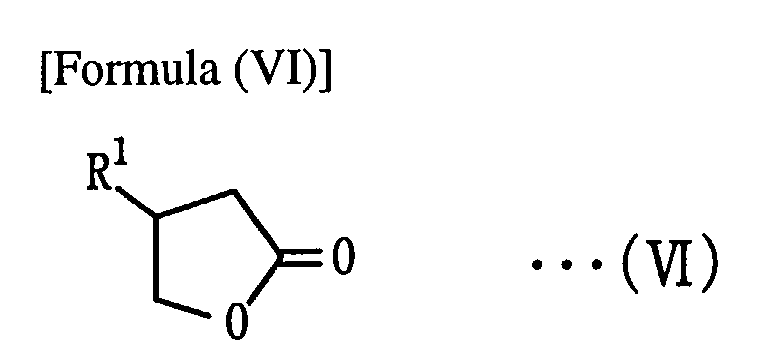
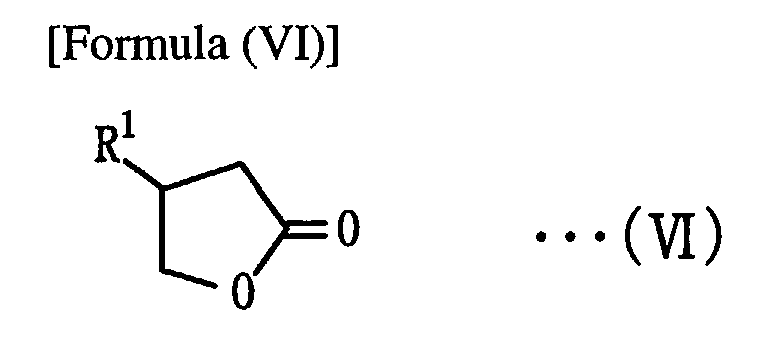
The optically active lactone compound as the product of the present
invention is produced by subjecting the above-mentioned prochiral cyclic ketone
compound to the asymmetric Baeyer-Villiger oxidation. Since the enantiotopos-selective
rearrangement of the chelated Criegee adduct is high in the producing method
of the present invention as mentioned above, the optically active lactone compound is
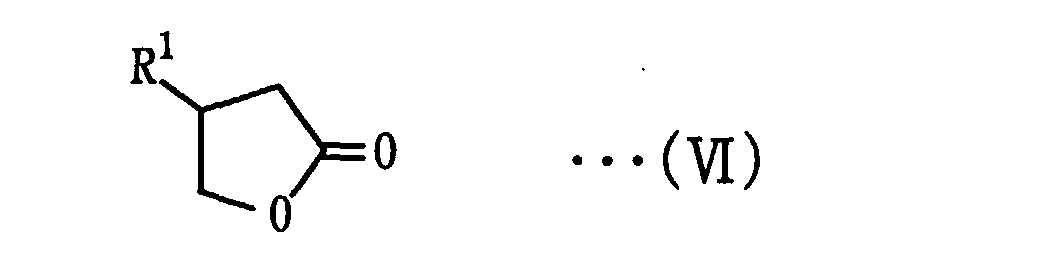
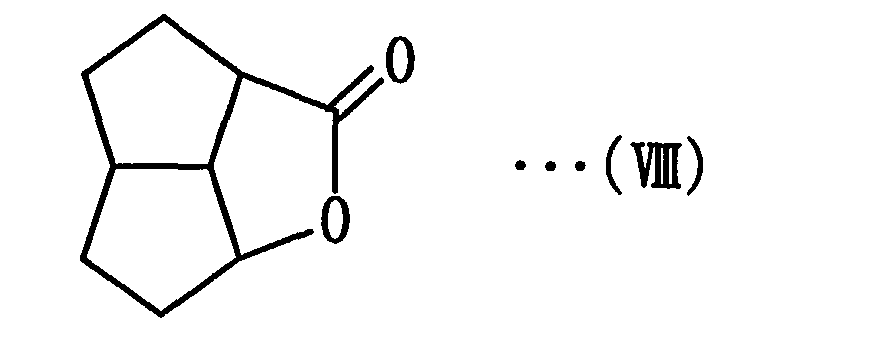
obtained. The optically active lactone compounds produced form the cyclic ketones
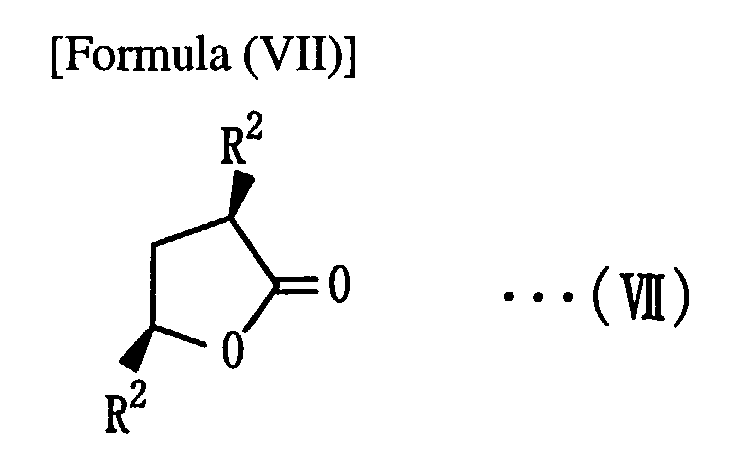
by the present invention have formulae (VI), (VII), (VIII), etc. and are recited.
in which R
1 has the same meaning as mentioned above.
in which R
2 has the same meaning as mentioned above.
The optical purity to be used as an index for the purity of the optical isomer
of the present invention is expressed by the following formula.
[Mathematical formula] Optical purity (%ee) = [α]D×100[α]Dmax =(R-S)×100R+S or (S-R)×100R+S = Enantiometric excess percentage (%ee)
in which [α]D is a specific optical rotation degree of a sample, [α]Dmax is a specific
optical rotation degree of an optically pure substance, R is a ratio of an R isomer in the
sample, and S is a ratio of an S isomer in the sample. Therefore, the optical purity is
equal to the excess ratio of the enantiomers. If the ratio of the R isomer is equal to
that of the S isomer, that is, if the sample is a racemic product, the optical purity is 0%
ee. The optical purity (excess ratio of the enantiomers) of the product can be
measured by a high performance liquid chromatography (HPLC) using an optically
active column.
The producing method of the present invention is usually effected in a
solvent. As the solvent, halogenated alkanes such as dichloromethane, ether
compounds such as tetrahydrofuran (THF) and diethyl ether, nitrile compounds such as
acetonitrile, esterified compounds such as ethyl acetate, C1-C3 alcohol compounds
such as methanol, ethanol and isopropanol, aliphatic hydrocarbons such as hexane,
aromatic hydrocarbons such as benzene and toluene, etc. may be recited. Among
them, polar solvents such as the halogenated alkane, the ether compound, the nitrile
compound, the ester compound and the alcohol compound are preferred from the
standpoint of enhancing the reaction speed and the excess percentage of the
enantiomers. Acetonitrile, ethyl acetate, tetrahydrofuran, diethyl ether and the C1-C3
alcohol compounds are particularly preferred. The use amount of the solvent is
preferably 1-10 ml, more preferably 4-5 ml relative to 1 mmol of the cyclic ketone as
the substrate.
The producing method of the present invention can be effected at room
temperature. The reaction is preferably effected at not more than room temperature,
for example, 0°C to -20°C, because the optical purity of the product increases due to
the enhanced excess percentage of the enantiomers, although the yield of the product
decreases in the reaction at such a temperature.
According to the present invention, the optically active lactone compound
can be produced by stirring a mixed solution of the cyclic ketone compound, the
oxidant, the solvent and the catalyst. Stirring is not limited to a particular way so long
as the uniformity of the mixed solution can be ensured. A known stirring method can
be used. The reaction time is not particularly limited, and appropriately selected
depending upon the reaction temperature. It is preferable that the higher the reaction
temperature, the shorter is the reaction time, whereas the lower the reaction temperature,
the longer is the reaction time.
(Examples)
In the following, the present invention will be explained in more detail with
reference to examples, but the scope of the invention is not limited to these examples.
Complex synthesis example 1
Cobalt (II) acetate (tetrahydrate) (manufactured by Kishida Chemical Co.,
Ltd.) (124.5 mg, 0.5 mmol) was heated at 80°C, and dry in vacuum for one hour.
Then, the resultant was returned to room temperature, and dissolved in dehydrated
ethanol (5 ml) added in nitrogen flow.
Into ethanol (10 ml) was dissolved (1S, 2S)-1, 2-diphenylethylene diamine
(Kankyou Kagaku Center Co., Ltd.) (106.2 mg, 0.5 mmol). Into the solution was
added 3, 5-dibromosalicyl aldehyde (Tokyo Kasei Industries, Ltd.) (279.9 mg,
1.0 mmol). The solution was refluxed under heating and stirring for 6 hours. Then,
the reaction mixture was returned to room temperature after the completion of the
reaction, and the precipitate formed was filtered and dried under heating for one hour.
The dried precipitate was added to the above ethanol solution of the cobalt acetate, and
the mixture was refluxed under heating for 6 hours. Thereafter, the reaction mixture
was returned to room temperature, and the precipitate was filtered in a nitrogen
atmosphere, and dried by heating for one hour.
The dried precipitate was dissolved in dichloromethane in nitrogen
atmosphere. Iodine (63.5 mg, 0.25 mmol) was added into the solution, which was stirred
for one hour. Then, silver hexafluoroantimonate [Aldrich Chem. Co.](171.8 mg,
0.5 mmol) was added to the resultant, and the mixture was further stirred for one hour.
Thereafter, the reaction solution was filtered with Celite, and the filtrate was concentrated
with a rotary evaporator, thereby removing dichloromethane. The residue
was chromatographed in a silica gel column using dichloromethane/ methanol (= 20/1)
as a developing solvent, thereby obtaining Co (III) (salen) complex having the
following formula (IX), that is, [(S, S)-N, N'-bis(3, 5-dibromosalicylidene)-1, 2-diphenylethylene
diaminate cobalt (III)]hexafluoroantimonate (403.0 mg, yield 84%).
Results in IR (KBr) measurement of the complex obtained by the above
method were 3065, 3056, 2959, 1632, 1583, 1502, 1439, 1375, 1310, 1217, 1167, 1078,
1005, 964, 864, 789, 748, 714, 664, 550, 521 cm-1. An actual measurement result of
HRFAB-MS m/z was 788.7429, while the theoretical value of C28H18O2N2 79Br4Co(M+-SbF6 -)
was 788.7434.
Complex Synthesis example 2
Cobalt (II) acetate (tetrahydrate) (manufactured by Kishida Chemical Co.,
Ltd.) (124.5 mg, 0.5 mmol) was heated at 80°C, and dry in vacuum for one hour.
After that, the resultant was returned to room temperature, and dissolved in dehydrated
ethanol (5 ml) added in nitrogen flow.
Into ethanol (10 ml) was dissolved (1S, 2S)-1, 2-cyclohexane diamine
(Kankyou Kagaku Center Co., Ltd.) (57.0 mg, 0.5 mmol). Into the solution was
added 3, 5-dibromosalicyl aldehyde (Tokyo Kasei Industries, Ltd.) (279.9 mg,
1.0 mmol). The solution was refluxed under heating and stirring for 6 hours.
The reaction mixture was returned to room temperature after the completion of the
reaction, and the precipitate formed was filtered and dried under heating for one hour.
The dried precipitate was added to the above ethanol solution of the cobalt acetate, and
the mixture was refluxed under heating for 6 hours. Then, the reaction mixture was
returned to room temperature, and the precipitate was filtered in a nitrogen atmosphere,
and dried by heating for one hour.
The dried precipitate was dissolved in dichloromethane in nitrogen
atmosphere. Iodine (63.5 mg, 0.25 mmol) was added into the solution, which was
stirred for one hour. then, silver hexafluoroantimonate [Aldrich Chem. Co.](171.8 mg,
0.5 mmol) was added to the resultant, and the mixture was further stirred for one hour.
After that, the reaction solution was filtered with Celite, and the filtrate was
concentrated with a rotary evaporator, thereby removing dichloromethane.
The residue was chromatographed in a silica gel column using dichloromethane/methanol
(= 20/1) as a developing solvent, thereby obtaining Co (III) (salen) complex
having the following formula (X), that is, [(S, S)-N, N'-bis(3, 5-dibromosalicylidene)-1,
2-cyclohexane diaminate cobalt (III)]hexafluoroantimonate (311.3 mg, yield 89%).
Results in IR (KBr) measurement of the complex obtained by the above
method were 3065, 2937, 2862, 1637, 1581, 1516, 1441, 1377, 1344, 1315, 1290, 1165,
1034, 957, 868, 746, 715, 660, 586, 552, 511, 457 cm-1. An actual measurement result
of HRFAB-MS m/z was 690.7283, while the theoretical value of
C20H16O2N2 79Br4Co(M+-SbF6 -) was 690.7277.
Complex synthesis example 3
Cobalt (II) acetate (tetrahydrate) (manufactured by Kishida Chemical Co.,
Ltd.) (124.5 mg, 0.5 mmol) was heated at 80°C, and dry in vacuum for one hour.
Thereafter, the resultant was returned to room temperature, and dissolved in dehydrated
ethanol (5 ml) added in nitrogen flow.
Into ethanol (10 ml) was suspended (R)-(+)-1, 1'-binaphthyl-2, 2'-diamine
(Aldrich Chem. Co.) (142.2 mg, 0.5 mmol). Into the suspension was added 3, 5-difluorosalicyl
aldehyde (158.1 mg, 1.0 mmol) synthesized by reacting 3, 5-difluorophenol
with hexamethylene tetramine in trifluoroacetic acid (90°C).
The solution was refluxed under heating and stirring for 6 hours. The reaction
mixture was returned to room temperature after the completion of the reaction, and the
precipitate formed was filtered and dried under heating for one hour. The dried
precipitate was added to the above ethanol solution of the cobalt acetate, and the
mixture was refluxed under heating for 6 hours. Then, the reaction mixture was
returned to room temperature, and ethanol was removed with the rotary evaporator and
the residue was dried by heating for one hour.
The dried residue was dissolved in dichloromethane in nitrogen atmosphere.
Iodine (63.5 mg, 0.25 mmol) was added into the solution, which was stirred for one
hour. Then, dichloromethane was removed by using the rotary evaporator, and the
residue was dried by heating for one hour, thereby obtaining Co (III) (salen) complex
having the following formula (XI), that is, [(R)-N, N'-bis(3, 5-difluorosalicylidene)-1,
1'-binaphthyl-2,2'-diaminate cobalt (III)]iodide. This was utilized for an intended
reaction without being isolated. A part of the product was taken for identification,
which gave the following measurement results.
Results in IR (KBr) measurement of the complex obtained by the above
method were 3057, 1606, 1553, 1448, 1350, 1304, 1263, 1231, 1178, 1124, 1051, 991,
949, 825, 750, 694, 644 cm-1. An actual measurement result of ESI-MS m/z was
620.9, while the theoretical value of C34H18O2N2F4Co(M+-I-) was 621.06.
Next, the Co(III) (salen) complex (374 mg, 0.5 mmol) having the above
chemical formula (XI) was dissolved in dichloromethane, and silver hexafluoroantimonate
[Aldrich Chem. Co.] (172.8 mg, 0.5 mmol) was added to the resultant, and
the mixture was stirred for one hour. Then, the reaction solution was filtered with
Celite, and the filtrate was concentrated with the rotary evaporator, thereby removing
dichloromethane. The residue was chromatographed in a silica gel column using
dichloromethane/methanol (= 20/1) as a developing solvent, thereby obtaining Co (III)
(salen) complex having the following formula (XII), that is, [(R)-N, N'-bis(3, 5-difluorosalicylidene)-1,
1'-binaphthyl-2,2'-diaminate cobalt (III)]hexafluoroantimonate
(300.0 mg, yield 70%).
Results in IR (KBr) measurement of the complex obtained by the above
method were 3385, 3236, 3057, 2930, 1713, 1610, 1553, 1506, 1450, 1352, 1308, 1267,
1232, 1180, 1126, 1066, 989, 951, 831, 750, 694, 660, 582, 536, 488 cm-1. An actual
measurement result of HRFAB-MS m/z was 621.0641, while the theoretical value of
C34H18O2N2F4Co(M+-SbF6 -) was 621.0636.
Complex synthesis example 4
Cobalt (II) acetate (tetrahydrate) (manufactured by Kishida Chemical Co.,
Ltd.) (124.5 mg, 0.5 mmol) was heated at 80°C, and dry in vacuum for one hour.
Then, the resultant was returned to room temperature, and dissolved in dehydrated
ethanol (5 ml) added in nitrogen flow.
Into ethanol (10 ml) was suspended (R)-(+)-1, 1'-binaphthyl-2, 2'-diamine
(Aldrich Chem. Co.) (142.2 mg, 0.5 mmol). Into the suspension was added 3, 5-difluorosalicyl
aldehyde (158.1 mg, 1.0 mmol) synthesized by reacting 3, 5-difluorophenol
with hexamethylene tetramine in trifluoroacetic acid (90°C).
The solution was refluxed under heating and stirring for 6 hours. The reaction
mixture was returned to room temperature after the completion of the reaction, and the
precipitate formed was filtered and dried under heating for one hour. The dried
precipitate was added to the above ethanol solution of the cobalt acetate, and the
mixture was refluxed under heating for 6 hours. Thereafter, the reaction mixture was
returned to room temperature, and ethanol was removed with the rotary evaporator and
the residue was dried by heating for one hour.
The dried residue was dissolved in dichloromethane in nitrogen atmosphere.
Bromine (40.0 mg, 0.25 mmol) was added into the solution, which was stirred for
one hour. Then, dichloromethane was removed by using the rotary evaporator, and
the residue was dried by heating for one hour, thereby obtaining Co (III) (salen)
complex having the following formula (XIII), that is, [(R)-N, N'-bis(3, 5-difluorosalicylidene)-1,
1'-binaphthyl-2,2'-diaminate cobalt (III)]bromide. This was
utilized for an intended reaction without being isolated. A part of the product was
taken for identification, which gave the following measurement results.
Results in IR (KBr) measurement of the complex obtained by the above
method were 2964, 1612, 1585, 1560, 1468, 1389, 1327, 1271, 1227, 1180, 1126, 1070,
991, 925, 806, 748, 679 cm-1. An actual measurement result of ESI-MS m/z was 620.9,
while the theoretical value of C34H18O2N2F4Co(M+-Br-) was 621.06.
Complex synthesis example 5
Cobalt (II) acetate (tetrahydrate) (manufactured by Kishida Chemical Co.,
Ltd.) (124.5 mg, 0.5 mmol) was heated at 80°C, and dry in vacuum for one hour.
Then, the resultant was returned to room temperature, and dissolved in dehydrated
ethanol (5 ml) added in nitrogen flow.
Into ethanol (10 ml) was suspended (R)-(+)-1, 1'-binaphthyl-2, 2'-diamine
(Aldrich Chem. Co.) (142.2 mg, 0.5 mmol). Into the suspension was added 3, 5-dichlorosalicyl
aldehyde (Tokyo Kasei Industries, Ltd.) (191.0 mg, 1.0 mmol).
The solution was refluxed under heating and stirring for 6 hours. The reaction
mixture was returned to room temperature after the completion of the reaction, and the
precipitate formed was filtered and dried under heating for one hour. The dried
precipitate was added to the above ethanol solution of the cobalt acetate, and the
mixture was refluxed under heating for 6 hours. Then, the reaction mixture was
returned to room temperature, and ethanol was removed with the rotary evaporator and
the residue was dried by heating for one hour.
The dried residue was dissolved in dichloromethane in nitrogen atmosphere.
Iodine (63.5 mg, 0.25 mmol) was added into the solution, which was stirred for one
hour. Then, dichloromethane was removed by using the rotary evaporator, and the
residue was dried by heating for one hour, thereby obtaining Co (III) (salen) complex
having the following formula (XIV), that is, [(R)-N, N'-bis(3, 5-difluorosalicylidene)-1,
1'-binaphthyl-2,2'-diaminate cobalt (III)]iodide. This was utilized for an intended
reaction without being isolated. A part of the product was taken for identification,
which gave the following measurement results.
Results in IR (KBr) measurement of the complex obtained by the above
method were 3059, 2930, 2374, 1603, 1508, 1433, 1379, 1306, 1200, 1163, 970, 864,
822, 748, 691 cm-1. An actual measurement result of ESI-MS m/z was 684.8, while
the theoretical value of C34H18O2N2Cl4Co(M+-I-) was 684.9.
Complex synthesis example 6
Cobalt (II) acetate (tetrahydrate) (manufactured by Kishida Chemical Co.,
Ltd.) (124.5 mg, 0.5 mmol) was heated at 80°C, and dry in vacuum for one hour.
Then, the resultant was returned to room temperature, and dissolved in dehydrated
ethanol (5 ml) added in nitrogen flow.
Into ethanol (10 ml) was suspended (R)-(+)-1, 1'-binaphthyl-2, 2'-diamine
(Aldrich Chem. Co.) (142.2 mg, 0.5 mmol). Into the suspension was added 3, 5-dibromosalicyl
aldehyde (Tokyo Kasei Industries, Ltd.)(279.9 mg, 1.0 mmol).
The solution was refluxed under heating and stirring for 6 hours. The reaction
mixture was returned to room temperature after the completion of the reaction, and the
precipitate formed was filtered and dried under heating for one hour. The dried
precipitate was added to the above ethanol solution of the cobalt acetate, and the
mixture was refluxed under heating for 6 hours. Thereafter, the reaction mixture was
returned to room temperature, and the precipitate was filtered in nitrogen atmosphere
and was dried by heating for one hour.
The dried precipitate was dissolved in dichloromethane in nitrogen
atmosphere. Iodine (63.5 mg, 0.25 mmol) was added into the solution, which was
stirred for one hour. Then, dichloromethane was removed by using the rotary
evaporator, and the residue was dried by heating for one hour, thereby obtaining Co
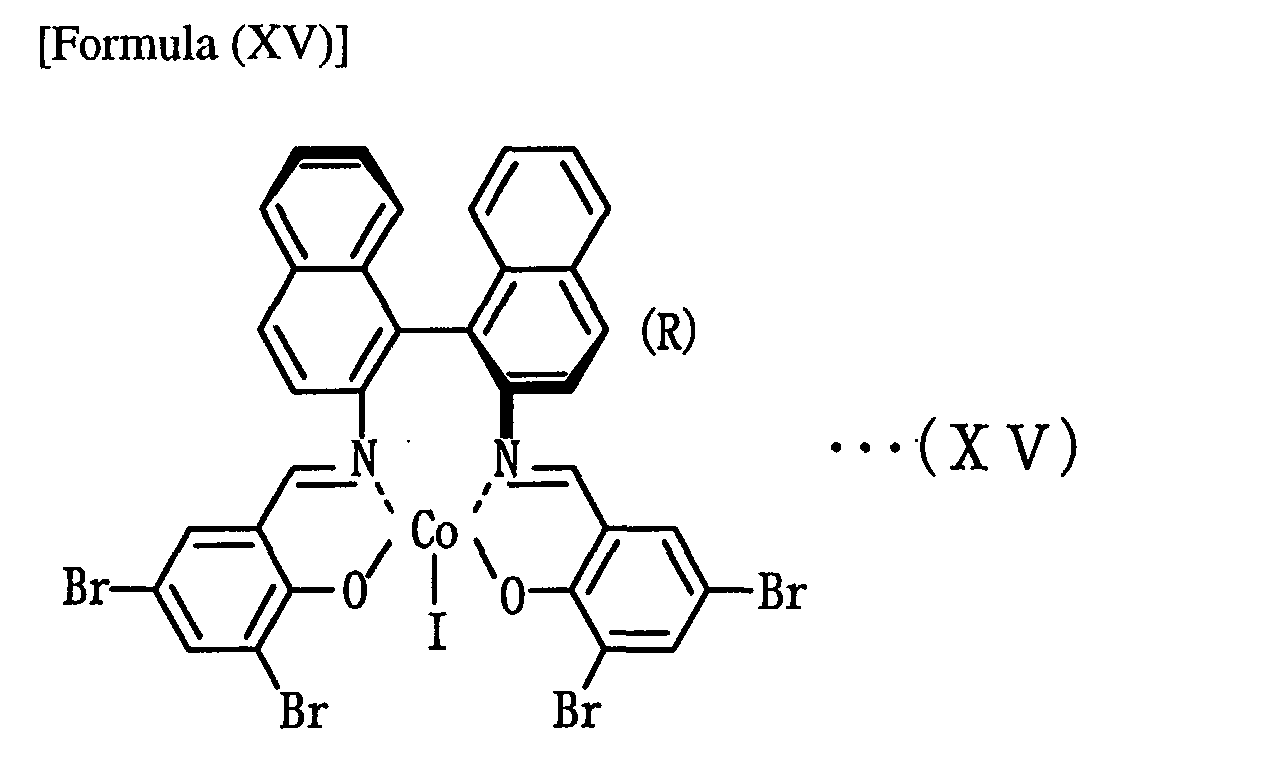
(III) (salen) complex having the following formula (XV), that is, [(R)-N, N'-bis(3, 5-dibromosalicylidene)-1,
1'-binaphthyl-2,2'-diaminate cobalt (III)]iodine. This was
utilized for an intended reaction without being isolated. A part of the product was
taken for identification, which gave the following measurement results.
Results in IR (KBr) measurement of the complex obtained by the above
method were 3057, 3009, 2922, 1601, 1501, 1427, 1377, 1304, 1265, 1200, 1150, 1070,
1043, 955, 866, 818, 750, 714, 687, 658 cm-1. An actual measurement result of ESI-MS
m/z was 860.5, while the theoretical value of C34H18O2N2 79Br4Co(M+-I-) was 860.7.
Next, the Co(III) (salen) complex (496 mg, 0.5 mmol) having the above
chemical formula (XV) was dissolved in dichloromethane, and silver hexafluoroantimonate
[Aldrich Chem. Co.](172.8 mg, 0.5 mmol) was added to the resultant, and
the mixture was stirred for one hour. Then, the reaction solution was filtered with Celite,
and the filtrate was concentrated with the rotary evaporator, thereby removing
dichloromethane. The residue was chromatographed in a silica gel column using
dichloromethane/methanol (= 20/1) as a developing solvent, thereby obtaining Co (III)
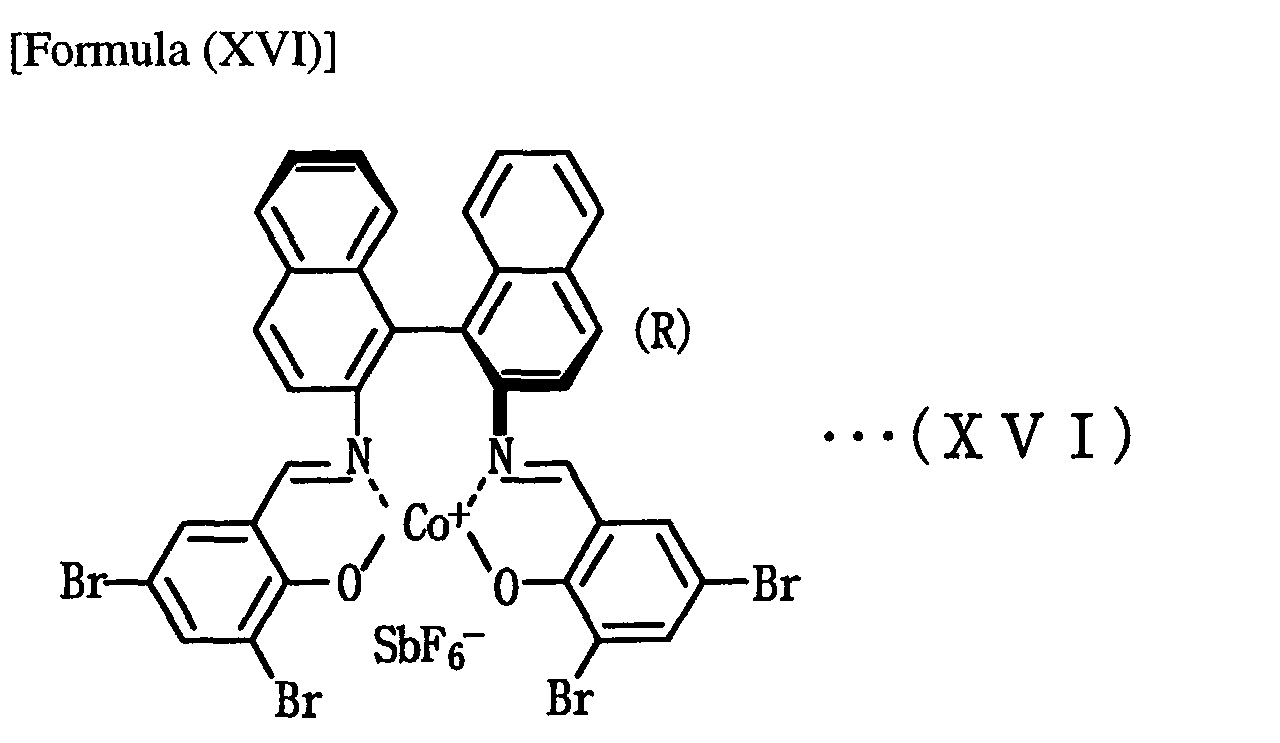
(salen) complex having the following formula (XVI), that is, [(R)-N, N'-bis(3, 5-dibromosalicylidene)-1,
1'-binaphthyl-2,2'-diaminate cobalt (III)]hexafluoroantimonate
(495.4 mg, yield 96%).
Results in IR (KBr) measurement of the complex obtained by the above
method were 3381, 3290, 3230, 3059, 3014, 2924, 2854, 1601, 1504, 1431, 1367, 1306,
1265, 1203, 1161, 1092, 951, 864, 820, 777, 750, 723, 662, 540, 496, 438 cm-1.
An actual measurement result of HRFAB-MS m/z was 860.7443, while the theoretical
value of C34H18O2N2 79Br4Co(M+-SbF6 -) was 860.7434.
Complex synthesis example 7
Cobalt (II) acetate (tetrahydrate) (manufactured by Kishida Chemical Co.,
Ltd.) (124.5 mg, 0.5 mmol) was heated at 80°C, and dry in vacuum for one hour.
Then, the resultant was returned to room temperature, and dissolved in dehydrated
ethanol (5 ml) added in nitrogen flow.
Into ethanol (10 ml) was suspended (R)-(+)-1, 1'-binaphthyl-2, 2'-diamine
(Aldrich Chem. Co.) (142.2 mg, 0.5 mmol). Into the suspension was added 3, 5-diiodosalicyl
aldehyde (Tokyo Kasei Industries, Ltd.) (373.9 mg, 1.0 mmol).
The solution was refluxed under heating and stirring for 6 hours. The reaction
mixture was returned to room temperature after the completion of the reaction, and the
precipitate formed was filtered and dried under heating for one hour. The dried
precipitate was added to the above ethanol solution of the cobalt acetate, and the
mixture was refluxed under heating for 6 hours. Thereafter, the reaction mixture was
returned to room temperature, ethanol was removed by using the rotary evaporator, and
the residue was dried by heating for one hour.
The dried residue was dissolved in dichloromethane in nitrogen atmosphere.
Iodine (63.5 mg, 0.25 mmol) was added into the solution, which was stirred for one
hour. Then, dichloromethane was removed by using the rotary evaporator, and the
residue was dried by heating for one hour, thereby obtaining Co (III) (salen) complex
having the following formula (XVII), that is, [(R)-N, N'-bis(3, 5-diiodosalicylidene)-1,
1'-binaphthyl-2,2'-diaminate cobalt (III)]iodine. This was utilized for an intended
reaction without being isolated. A part of the product was taken for identification,
which gave the following measurement results.
Results in IR (KBr) measurement of the complex obtained by the above
method were 3051, 2923, 2301, 1595, 1487, 1421, 1371, 1302, 1204, 1146, 1113, 1072,
955, 864, 814, 748, 679 cm-1. An actual measurement result of ESI-MS m/z was
1052.5, while the theoretical value of C34H18O2N2I4Co(M+-I-) was 1052.7.
Complex synthesis example 8
Into ethanol (7 ml) was suspended (R)-1, 1'-binaphthyl-2, 2'-diamine
(Aldrich Chem. Co.) (200 mg, 0.7 mmol). Into the suspension was added 3-tert.-butyl-5-nitrosalicyl
aldehyde (314 mg, 1.4 mmol) synthesized by treating 3-tert.-butylsalicyl
aldehyde (Aldrich Chem., Co.) with a mixture of conc. nitric acid and conc.
sulfuric acid. The solution was heated at 90°C under stirring for 12 hours. Then, the
reaction mixture was returned to room temperature, and the precipitate was filtered and
was dried under vacuum.
Cobalt (II) acetate (tetrahydrate) (manufactured by Kishida Chemical Co.,
Ltd.) was heated at 70-80°C in vacuum until its color changed from pink to purple, and
the resulting cobalt (II) acetate (50 mg, 0.2 mmol) was added and dissolved into
deaerated N, N'-dimethylformamide (DMF) (4 ml). Into this solution was added the
above precipitate (139 mg, 0.2 mmol), which was heated at 110°C for 24 hours and then
concentrated in vacuum. Thereafter, the resultant was dissolved into dichloromethane
(4 ml). Into this solution was added iodine (25.4 mg, 0.1 mmol), which was stirred for
one hour. Then, the mixed liquid was concentrated, and the residue was
chromatographed in a silica gel column using hexane/dichloromethane (= 1/0 to 1/1) as
a developing solvent, thereby obtaining Co (III) (salen) complex having the following
formula (XVIII), that is, [(R)-N, N'-bis(3-tert.-butyl-5-nitrosalicylidene)-1, 1'-binaphthyl-2,2'-diaminate
cobalt (III)]iodine (113 mg, yield 64%).
Results in IR (KBr) measurement of the complex obtained by the above
method were 3059, 2957, 2916, 2870, 1593, 1554, 1500, 1470, 1419, 1387, 1315, 1200,
1173, 1115, 1076, 1028, 984, 922, 866, 829, 798, 739, 681, 561, 509, 484 cm-1.
An actual measurement result of HRFAB-MS m/z was 751.1971, while the theoretical
value of C42H36O6N4Co(M+-I-) was 751.1967.
Complex synthesis example 9
Cobalt (II) acetate (tetrahydrate) (manufactured by Kishida Chemical Co.,
Ltd.) (124.5 mg, 0.5 mmol) was heated at 80°C, and dry in vacuum for one hour.
Then, the resultant was returned to room temperature, and dissolved in dehydrated
ethanol (5 ml) added in nitrogen flow.
Into ethanol (10 ml) was suspended (R)-(+)-1, 1'-binaphthyl-2, 2'-diamine
(Aldrich Chem. Co.) (142.2 mg, 0.5 mmol). Into the suspension was added salicyl
aldehyde (Nakarai Tesc Co., Ltd.) (122.1 mg, 1.0 mmol). The solution was refluxed
under heating and stirring for 6 hours. The reaction mixture was returned to room
temperature after the completion of the reaction, and the precipitate formed was filtered
and dried under heating for one hour. The dried precipitate was added to the above
ethanol solution of the cobalt acetate, and the mixture was refluxed under heating for
6 hours. Thereafter, the reaction mixture was returned to room temperature, and the
precipitate was filtered in nitrogen atmosphere and dried by heating for one hour.
The dried precipitate was dissolved in dichloromethane in nitrogen
atmosphere. Iodine (63.5 mg, 0.25 mmol) was added into the solution, which was
stirred for one hour. Then, silver hexafluoroantimonate (Aldrich Chem. Co., Ltd.)
(172.8 mg, 0.5 mmol) was added to the solution, which was further stirred for one hour.
After that, the reaction solution was filtered with Celite, and the filtrate was
concentrated with the rotary evaporator, thereby removing dichloromethane.
The residue was subjected to separation with a silica gel column using
dichloromethane/methanol (= 20/1) as a developing solvent, thereby obtaining Co (III)
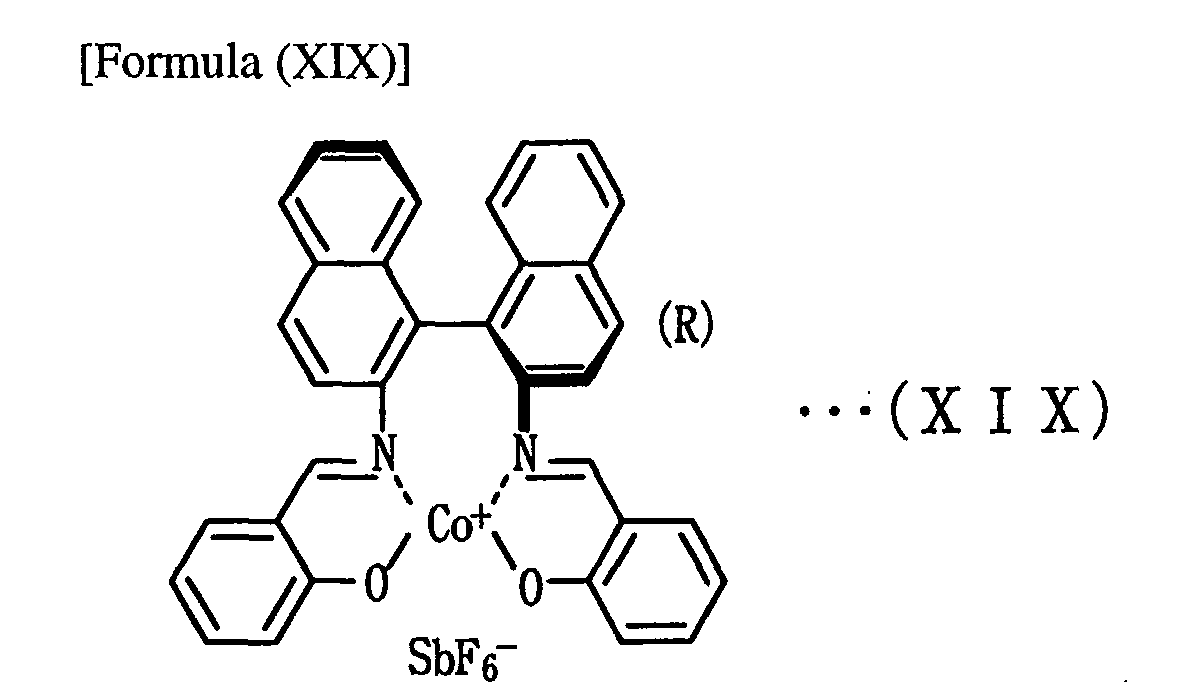
(salen) complex having the following formula (XIX), that is, [(R)-N, N'-bis(salicylidene)-1,
1'-binaphthyl-2,2'-diaminate cobalt (III)]hexafluoroantimonate
(325.9 mg, yield 83%).
Results in IR (KBr) measurement of the complex obtained by the above
method were 3298, 3236, 3055, 3014, 2926, 1607, 1527, 1441, 1375, 1313, 1190, 1149,
1074, 957, 910, 816, 752, 660, 492, 440 cm-1. An actual measurement result of
HRFAB-MS m/z was 549.1012, while the theoretical value of C34H22O2N2Co(M+-SBF6 -)
was 549.1013.
Complex synthesis example 10
Cobalt (II) acetate (tetrahydrate) (manufactured by Kishida Chemical Co.,
Ltd.) (124.5 mg, 0.5 mmol) was heated at 80°C, and dry in vacuum for one hour.
Thereafter, the resultant was returned to room temperature, and dissolved in dehydrated
ethanol (5 ml) added in nitrogen flow.
Into ethanol (10 ml) was suspended (R)-(+)-1, 1'-binaphthyl-2, 2'-diamine
(Aldrich Chem. Co.) (142.2 mg, 0.5 mmol). Into the suspension was added 2-hydroxy-5-methoxybenzaldehyde
(Aldrich Chem. Co.) (152.2 mg, 1.0 mmol). The solution was
refluxed under heating and stirring for 6 hours. The reaction mixture was returned to
room temperature after the completion of the reaction, ethanol was removed by using
the rotary evaporator, and the residue was dried under heating for one hour. The dried
residue was added to the above ethanol solution of the cobalt acetate, and the mixture
was refluxed under heating for 6 hours. Thereafter, the reaction mixture was returned
to room temperature, and the precipitate was filtered in nitrogen atmosphere and dried
by heating for one hour.
The dried precipitate was dissolved in dichloromethane in nitrogen
atmosphere. Iodine (63.5 mg, 0.25 mmol) was added into the solution, which was
stirred for one hour. Then, silver hexafluoroantimonate (Aldrich Chem. Co.)
(172.8 mg, 0.5 mmol) was added to the solution, which was further stirred for one hour.
After that, the reaction solution was filtered with Celite, and the filtrate was
concentrated with the rotary evaporator, thereby removing dichloromethane.
The residue was chromatographed in a silica gelcolumn using dichloromethane/methanol
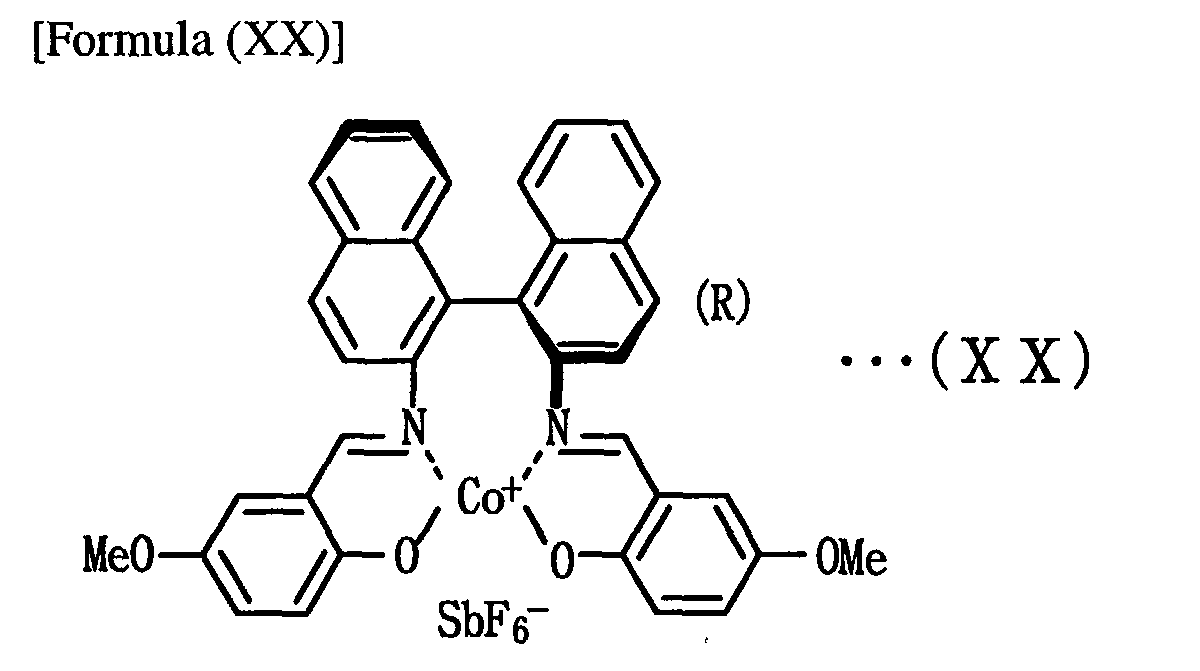
(= 20/1) as a developing solvent, thereby obtaining Co (III) (salen) complex
having the following formula (XX), that is, [(R)-N, N'-bis(5-dimethoxysalicylidene)-1,
1'-binaphthyl-2,2'-diaminate cobalt (III)]hexafluoroantimonate (367.7 mg, yield 87%).
Results in IR (KBr) measurement of the complex obtained by the above
method were 3385, 3302, 3238, 3055, 3001, 2937, 2837, 1593, 1533, 1510, 1462, 1431,
1356, 1302, 1267, 1219, 1155, 1076, 1036, 947, 818, 750, 660, 575, 527, 494, 440 cm-1.
An actual measurement result of HRFAB-MS m/z was 606.1225, while the theoretical
value of C36H26O4N2Co(M+-SbF6 -) was 609.1225.
Example 1
Into 0.5 ml of dichloromethane (CH2Cl2) was dissolved 3-phenylcyclobutanone
(14.6 mg, 0.1 mmol) at room temperature. Into this dichloromethane
solution was added the Co(III) (salen) complex (5.5 mg, 5.0 µmol) having the above
formula (XVI). Into this solution was added 30% hydrogen peroxide aqueous
solution (15 µl, content of hydrogen peroxide 0.13 mmol), which was stirred at room
temperature for 24 hours. After the completion of the reaction, the dichloromethane
was removed by the rotary evaporator, and the residue was chromatographed in a silica
gel column using hexane/ethyl acetate (=45/7) as a developing solvent, thereby
obtaining β-phenyl-γ-butylolactone (4.9 mg, yield 30%). Analysis of the enatiomer
excess percentage of this lactone by high liquid chromatography with a Daicel
Chiralpak AD-H column using an eluting liquid of hexane/isopropanol (=49/1)
revealed that the product was composed mainly of the S isomer, and its enantiomeric
excess percentage was 20% ee. Results are shown in Table 1.
Example 2
Example 2 was effected in the same manner as in Example 1 except that
urea-hydrogen peroxide adduct (UHP) (12 mg, content of hydrogen peroxide
0.13 mmol) was used instead of 30% hydrogen peroxide aqueous solution (15 µl,
content of hydrogen peroxide 0.13 mmol). Results are shown in Table 1.
Example 3
Example 3 was effected in the same manner as in Example 2 except that
the Co(III) (salen) complex (4.3 mg, 5.0 µmol) having the formula (XII) was used
instead of the Co(III) (salen) complex (5.5 mg, 5.0 µmol) having the formula (XVI).
Results are shown in Table 1.
Example 4
Example 4 was effected in the same manner as in Example 2 except that
the Co(III) (salen) complex (3.9 mg, 5.0 µmol) having the formula (XIX) was used
instead of the Co(III) (salen) complex (5.5 mg, 5.0 µmol) having the formula (XVI).
Results are shown in Table 1.
Reference Example 1
Reference Example 1 was effected in the same manner as in Example 1
except that the Co(III) (salen) complex (5.1 mg, 5.0 µmol) having the formula (IX) was
used instead of the Co(III) (salen) complex (5.5 mg, 5.0 µmol) having the formula
(XVI). Results are shown in Table 1.
Reference Example 2
Reference Example 1 was effected in the same manner as in Example 1
except that a toluene solution (3.34 N) of t-butylhydroperoxide (TBHP) (30 µl, TBHP
content 0.1 mmol) was used instead of used instead of 30% hydrogen peroxide aqueous
solution (15 µl, content of hydrogen peroxide 0.13 mmol). Results are shown in
Table 1.
Reference Example 3
Into 0.5 ml of dichloromethane (CH2Cl2) was dissolved 3-phenyl
cyclobutane (14.6 mg, 0.1 mmol). Into this dichloromethane solution was added the
Co(III) (salen) complex (5.1 mg, 5.0 µmol) having the above formula (IX), which was
cooled to -78°C. Into the resulting solution were added methachloro perbenzoic acid
(m-CPBA) (26 mg, 0.1 mmol) and N-methyl morpholine-N-oxide (12 mg, 0.1 mmol),
which was stirred at -78°C for 24 hours. Then, β-phenyl-γ-butylolactone was
separated and analyzed in the same manner as in Example 1. Results are shown in
Table 1.
Reference Example 4
Reference Example 4 was effected in the same manner as in Reference
Example 1 except that the Co(III) (salen) complex (4.7 mg, 5.0 µmol) having the
formula (X) was used instead of the Co(III) (salen) complex (5.1 mg, 5.0 µmol) having
the formula (IX). Results are shown in Table 1.
Reference Example 5
Reference Example 5 was effected in the same manner as in Reference
Example 2 except that the Co(III) (salen) complex (4.7 mg, 5.0 µmol) having the
formula (X) was used instead of the Co(III) (salen) complex (5.1 mg, 5.0 µmol) having
the formula (IX). Results are shown in Table 1.
Reference Example 6
Reference Example 6 was effected in the same manner as Reference
Example 3 except that the Co(III) (salen) complex (4.7 mg, 5.0 µmol) having the
formula (X) was used instead of the Co(III) (salen) complex (5.1 mg, 5.0 µmol) having
the formula (IX). Results are shown in Table 1.
Reference Example 7
Reference Example 7 was effected in the same manner as in Reference
Example 2 except that the Co(III) (salen) complex (5.5 mg, 5.0 µmol) having the
formula (XVI) was used instead of the Co(III) (salen) complex (5.1 mg, 5.0 µmol)
having the formula (IX). Results are shown in Table 1.
Reference Example 8
Reference Example 8 was effected in the same manner as in Reference
Example 3 except that the Co(III) (salen) complex (5.5 mg, 5.0 µmol) having the
formula (XVI) was used instead of the Co(III) (salen) complex (5.1 mg, 5.0 µmol)
having the formula (IX). Results are shown in Table 1.
Reference Example 9
Reference Example 9 was effected in the same manner as in Reference
Example 2 except that the Co(III) (salen) complex (4.3 mg, 5.0 µmol) having the
formula (XX) was used instead of the Co(III) (salen) complex (5.1 mg, 5.0 µmol)
having the formula (IX). Results are shown in Table 1.
| | catalyst | oxidant | yielded (mg) | yield (%) | enantiomeric excess percentage (%ee) | configuration |
| Example 1 | formula (XVI) | H2O2 | 4.9 | 30 | 20 | S |
| Example 2 | formula (XVI) | UHP | 5.0 | 31 | 53 | S |
| Example 3 | formula (XII) | UHP | 4.9 | 30 | 57 | S |
| Example 4 | formula (XIX) | UHP | 1.6 | 10 | 55 | S |
| Reference Example 1 | formula (IX) | H2O2 | 4.7 | 29 | 0 | rasemi |
| Reference Example 2 | formula (IX) | TBHP | 11.7 | 72 | 0 | rasemi |
| Reference Example 3 | formula (IX) | m-CPBA | 13.2 | 75 | 0 | rasemi |
| Reference Example 4 | formula (X) | H2O2 | 3.2 | 20 | 0 | rasemi |
| Reference Example 5 | formula (X) | TBHP | 10 | 62 | 0 | rasemi |
| Reference Example 6 | formula (X) | m-CPBA | 13 | 80 | 0 | rasemi |
| Reference Example 7 | formula (XVI) | TBHP | 4.4 | 27 | 0 | rasemi |
| Reference Example 8 | formula (XVI) | m-CPBA | 12.6 | 78 | 0 | rasemi |
| Reference Example 9 | formula (XX) | UHP | 0 | 0 | - | - |
For example, the specific optical rotation of the S isomer of β-phenyl-γ-butylolactone
is [α]20 D = +50.5°(c 5, MeOH) at 20°C, whereas the specific optical
rotation of β-phenyl-γ-butylolactone is [α]24 D = +37.0° (c 0.53, MeOH) at 24°C.
The reaction formula corresponding to Examples 1 to 4 and Reference
Examples 1 to 9 in Table 1 is shown below.
It is seen from Table 1 that the cationic cobalt(salen) complexes having the
formulae (XVI),(XII) and (XIX) are more excellent as the catalysts in terms of the
enantiomeric excess percentage. Further, it is seen that H2O2 and UHP are more
excellent in terms of the enatiomer excess percentage.
Example 5
Example 5 was effected in the same manner as in Example 3 except that
tetrahydrofuran (THF) (0.5 ml) was used instead of dichloromethane (CH2Cl2) (0.5 ml).
Results are shown in Table 2.
Example 6
Example 6 was effected in the same manner as in Example 3 except that
acetonitrile (CH3CN) (0.5 ml) was used instead of dichloromethane (CH2Cl2) (0.5 ml).
Results are shown in Table 2.
Example 7
Example 7 was effected in the same manner as in Example 3 except that
ethanol (EtOH) (0.5 ml) was used instead of dichloromethane (CH2Cl2) (0.5 ml).
Results are shown in Table 2.
Example 8
Example 8 was effected in the same manner as in Example 7 except that
30% hydrogen peroxide (H2O2) aqueous solution (15 µl, hydrogen peroxide content
0.13 mmol) was used instead of urea-hydrogen peroxide adduct (UHP) (12 mg,
hydrogen peroxide content 0.13 mmol). Results are shown in Table 2.
Example 9
Into 0.5 ml of ethanol (EtOH) was dissolved 3-phenyl cyclobutane
(14.6 mg, 0.1 mmol). Into this ethanol solution was added the Co(III) (salen) complex
(4.3 mg, 5.0 µmol) having the above formula (XII), which was cooled to 0°C. Into
the resulting solution was added urea-hydrogen peroxide adduct (12 mg, hydrogen
peroxide content 0.13 mmol), which was stirred at 0°C for 24 hours. Then, β-phenyl-γ-butylolactone
was separated and analyzed in the same manner as in Example 1.
Results are shown in Table 2.
Example 10
Example 10 was effected in the same manner as in Example 9 except that
30% hydrogen peroxide (H2O2) aqueous solution (15 µl, hydrogen peroxide content
0.13 mmol) was used instead of urea-hydrogen peroxide adduct (UHP) (12 mg,
hydrogen peroxide content 0.13 mmol). Results are shown in Table 2.
Example 11
Into 0.5 ml of ethanol (EtOH) was dissolved 3-phenyl cyclobutane
(14.6 mg, 0.1 mmol). Into this ethanol solution was added the Co(III) (salen) complex
(4.3 mg, 5.0 µmol) having the above formula (XII), which was cooled to -20°C. Into
the resulting solution was added hydrogen peroxide (15 µl, hydrogen peroxide content
0.13 mmol), which was stirred at -20°C for 24 hours. Then, β-phenyl-γ-butylolactone
was separated and analyzed in the same manner as in Example 1. Results are shown
in Table 2.
Example 12
Into 0.5 ml of ethanol (EtOH) was dissolved 3-phenyl cyclobutane
(14.6 mg, 0.1 mmol). Into this ethanol solution was added the Co(III) (salen) complex
(4.3 mg, 5.0 µmol) having the above formula (XII), which was cooled to -78°C. Into
the resulting solution was added urea-hydrogen peroxide adduct (12 mg, hydrogen
peroxide content 0.13 mmol), which was stirred at -78°C for 24 hours. Then, β-phenyl-γ-butylolactone
was separated and analyzed in the same manner as in Example 1.
Results are shown in Table 2.
Example 13
Example 13 was effected in the same manner as in Example 3 except that
methanol (MeOH) (0.5 ml) was used instead of dichloromethane (CH2Cl2) (0.5 ml).
Results are shown in Table 2.
Example 14
Example 14 was effected in the same manner as in Example 3 except that
isopropanol (i-PrOH) (0.5 ml) was used instead of dichloromethane (CH2Cl2) (0.5 ml).
Results are shown in Table 2.
Example 15
Example 13 was effected in the same manner as in Example 3 except that
ethyl acetate (AcOEt) (0.5 ml) was used instead of dichloromethane (CH2Cl2) (0.5 ml).
Results are shown in Table 2.
Example 16
Example 16 was effected in the same manner as in Example 3 except that
diethyl ether (Et2O) (0.5 ml) was used instead of dichloromethane (CH2Cl2) (0.5 ml).
Results are shown in Table 2.
Example 17
Example 17 was effected in the same manner as in Example 3 except that
hexane (MeOH) (0.5 ml) was used instead of dichloromethane (CH2Cl2) (0.5 ml).
Results are shown in Table 2.
Example 18
Example 18 was effected in the same manner as in Example 3 except that
methanol benzene (0.5 ml) was used instead of dichloromethane (CH2Cl2) (0.5 ml).
Results are shown in Table 2.
Example 19
Example 19 was effected in the same manner as in Example 3 except that
toluene (0.5 ml) was used instead of dichloromethane (CH
2Cl
2) (0.5 ml). Results are
shown in Table 2.
| | oxidant | solvent | reaction temperature (°C) | yielded (mg) | yield (%) | enantiomeric excess percentage (%ee) | configuration |
| Example 3 | UHP | CH2Cl2 | Room temp. | 4.9 | 30 | 57 | S |
| Example 5 | UHP | THF | Room temp. | 11 | 69 | 70 | S |
| Example 6 | UHP | CH3CN | Room temp. | 15.1 | 93 | 67 | S |
| Example 7 | UHP | EtOH | Room temp. | 14.1 | 87 | 71 | S |
| Example 8 | H2O2 | EtOH | Room temp. | 14.9 | 92 | 69 | S |
| Example 9 | UHP | EtOH | 0°C | 14.6 | 90 | 75 | S |
| Example 10 | H2O2 | EtOH | 0°C | 13.8 | 85 | 75 | S |
| Example 11 | H2O2 | EtOH | -20°C | 11.7 | 72 | 77 | S |
| Example 12 | UHP | EtOH | -78°C | 13.9 | 86 | 69 | S |
| Example 13 | UHP | MeOH | Room temp. | 13.6 | 84 | 70 | S |
| Example 14 | UHP | i-PrOH | Room temp. | 14.9 | 92 | 71 | S |
| Example 15 | UHP | AcOEt | Room temp. | 14.1 | 87 | 60 | S |
| Example 16 | UHP | Et2O | Room temp. | 13.4 | 83 | 69 | S |
| Example 17 | UHP | hexane | Room temp. | 12.6 | 78 | 50 | S |
| Example 18 | UHP | benzene | Room temp. | 3.6 | 22 | 55 | S |
| Example 19 | UHP | toluene | Room temp. | 4.1 | 25 | 55 | S |
| In Examples of Table 2, the complex of the formula (XII) was used as the catalyst. |
The reaction formula corresponding to Examples 5 to 19 in Table 2 is
shown below.
It is seen from Table 2 that tetrahydrofuran (THF), acetonitrile, ethanol,
methanol, isopropanol, ethyl acetate and diethyl ether are more excellent as the solvent
in terms of the enantiomeric excess percentage. Further, it is seen that the reaction
temperature range of -20 to 0°C is more excellent in terms of the enantiomeric excess
percentage.
Example 20: Asymmetric Baeyer-Villiger oxidation of 3-(p-chlorophenyl)-cyclobutanone
Into 0.5 ml of ethanol was dissolved 3-(p-chlorophenyl)cyclobutanone
(18.0 mg, 0.1 mmol). Into this ethanol solution was added the Co(III) (salen) complex
(4.3 mg, 5.0 µmol) having the above formula (XII). Into this solution was added 30%
hydrogen peroxide aqueous solution (15 µl, content of hydrogen peroxide 0.13 mmol),
which was stirred at 0°C for 24 hours. After the completion of the reaction, the
ethanol was removed by the rotary evaporator, and the residue was chromatographed in
a silica gel column using hexane/ethyl acetate (= 45/7) as a developing solvent, thereby
obtaining β-(p-chlorophenyl)-γ-butylolactone (14.9 mg, yield 76%). Analysis of the
enatiomer excess percentage of this lactone by high liquid chromatography with a
Daicel Chiralpak AD-H column using an eluting liquid of hexane/isopropanol (=49/1)
revealed that the product was composed mainly of the S isomer, and its enantiomeric
excess percentage was 75% ee.
The absolute conformation was determined through the chiproptical
comparison. For example, the specific optical rotation of the S isomer of β-(p-chlorophenyl)-γ-butylolactone
is [α]
D = +46.5°(c 0.5, CHCl
3) at 20°C, whereas the
specific optical rotation of the β-(p-chlorophenyl)-γ-butylolactone is [α]
D = +39.8°(c
0.47, CHCl
3) at 24°C. Thus, the absolute conformation was the S isomer.
The reaction formula was shown below.
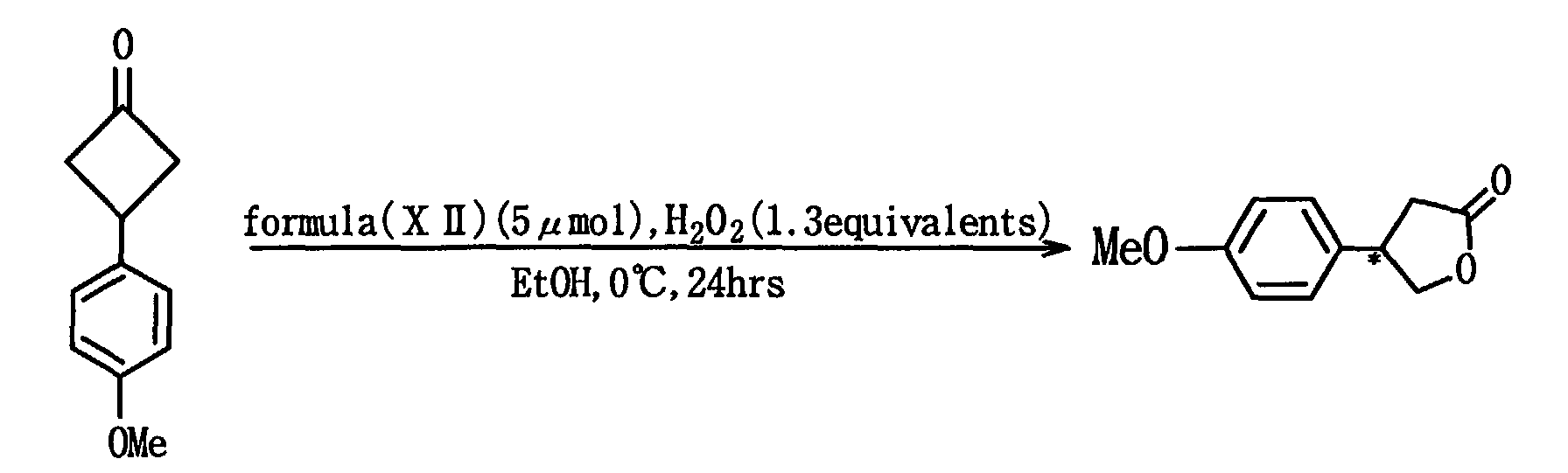
Into 0.5 ml of ethanol was dissolved 3-(p-methoxyphenyl)cyclobutanone
(17.6 mg, 0.1 mmol). Into this ethanol solution was added the Co(III) (salen) complex
(4.3 mg, 5.0 µmol) having the above formula (XII). Into this solution was added 30%
hydrogen peroxide aqueous solution (15 µl, content of hydrogen peroxide 0.13 mmol),
which was stirred at 0°C for 24 hours. After the completion of the reaction, the
ethanol was removed by the rotary evaporator, and the residue was chromatographed in
a silica gel column using hexane/ethyl acetate (= 45/7) as a developing solvent, thereby
obtaining β-(p-methoxyphenyl)-γ-butylolactone (14.5 mg, yield 75%). Analysis of
the enatiomer excess percentage of this lactone by high liquid chromatography with a
Daicel Chiralpak AD-H column using an eluting liquid of hexane/isopropanol (=49/1)
revealed that the product was composed mainly of the S isomer, and its enantiomeric
excess percentage was 78% ee. The reaction formula is shown below.
(β-(p-methoxyphenyl)-γ-butylolactone):
1H NMR(400MHz):δ7.15(d, J=8.5Hz, 2H),
6.90(d, J=8.5Hz, 2H), 4.63(dd, J=7.8, 9.0Hz, 1H), 4.22(dd, J=8.2, 9.0Hz, 1H), 3.81(s,
3H), 3.78-3.69(m, 1H), 2.89(dd, J=8.7, 17.6Hz, 1H), 2.63(dd, J=9.3, 17.6Hz, 1H).
IR(KBr method): 3527, 3454, 3014, 2962, 2904, 1774, 1483, 1356, 1300, 1167, 1092,
1011, 905, 833, 681, 590, 542, 501, 455 cm
-1.
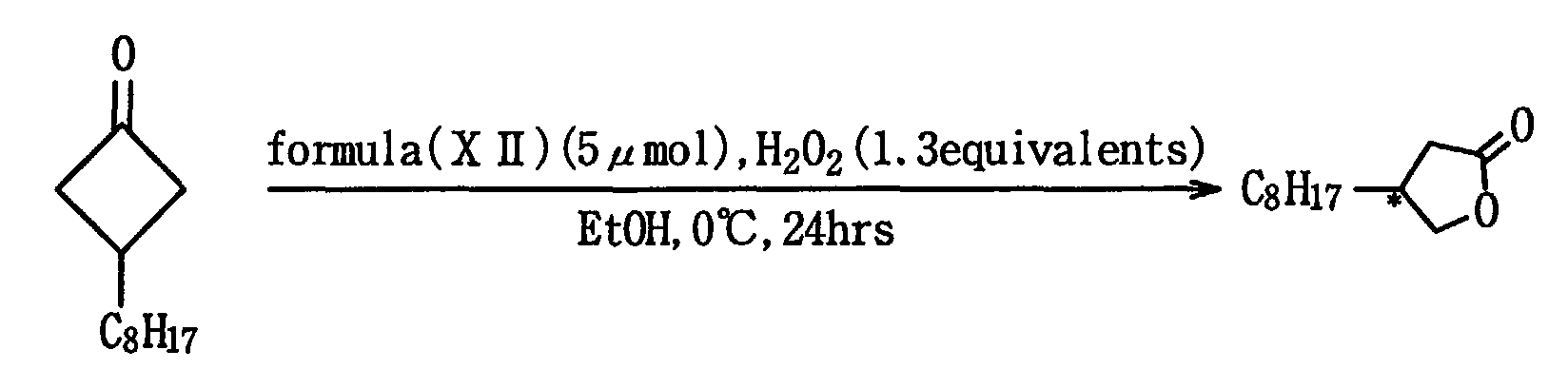
Into 0.5 ml of ethanol (EtOH) was dissolved 3-octylcyclobutanone
(18.2 mg, 0.1 mmol). Into this ethanol solution was added the Co(III) (salen) complex
(4.3 mg, 5.0 µmol) having the above formula (XII). Into this solution was added 30%
hydrogen peroxide aqueous solution (15 µl, content of hydrogen peroxide 0.13 mmol),
which was stirred at 0°C for 24 hours. After the completion of the reaction, the
ethanol was removed by the rotary evaporator, and the residue was chromatographed in
a silica gel column using hexane/ethyl acetate (= 45/7) as a developing solvent, thereby
obtaining β-octyl-γ-butylolactone (14.9 mg, yield 75%). Analysis of the enatiomer
excess percentage of this lactone by the proton nuclear magnetic resonance spectrum
(1H NMR) with a shift reagent revealed that its enantiomeric excess percentage was
73% ee. The reaction formula is shown below.
(β-octyl-γ-butylolactone)
1HNMR(4000MHz): δ4.41(dd, J=8.8 and 7.3Hz, 1H),
3.92(dd, J=8.8 and 7.1Hz, 1H), 2.61(dd, J=16.6 and 8.3Hz, 1H), 2.54(ddd, J=8.3, 7.6
and 7.3Hz, 1H), 2.17(dd, J=16.6 and 7.6Hz, 1H), 2.20-2.15 (m, 2H), 1.32-1.26(m, 10H),
0.88(t, J=7.8Hz, 3H). IR(liquid film method): 2924, 2854, 1780, 1462, 1421, 1377,
1259, 1169, 1020, 798 cm
-1.
It is seen from Examples 21, 22 and 23 that the cationic cobalt(salen)
complexes according to the present invention are effective for the Baeyer-Villiger
oxidation of various chiral cyclic ketone compounds.
Example 23
Example 23 was effected in the same manner as in Example 7 except that
the Co (III) (salen) complex having the formula (XIII) (3.5 mg, 5.0 µmol) was used
instead of the Co (III) (salen) complex having the formula (XII) (4.3 mg, 5.0 µmol).
Results are shown in Table 3.
Example 24
Example 24 was effected in the same manner as in Example 7 except that
the Co (III) (salen) complex having the formula (XI) (3.7 mg, 5.0 µmol) was used
instead of the Co (III) (salen) complex having the formula (XII) (4.3 mg, 5.0 µmol).
Results are shown in Table 3.
Example 25
Example 25 was effected in the same manner as in Example 24 except that
tetrahydrofuran (THF) (0.5 ml) was used instead of ethanol (EtOH) (0.5 ml). Results
are shown in Table 3.
Example 26
Example 26 was effected in the same manner as in Example 24 except that
acetonitrile (CH3CN) (0.5 ml) was used instead of ethanol (EtOH) (0.5 ml). Results
are shown in Table 3.
Example 27
Example 27 was effected in the same manner as in Example 24 except that
ethyl acetate (AcOEt) (0.5 ml) was used instead of ethanol (EtOH) (0.5 ml). Results
are shown in Table 3.
Example 28
Example 28 was effected in the same manner as in Example 24 except that
diethyl ether (Et2O) (0.5 ml) was used instead of ethanol (EtOH) (0.5 ml). Results are
shown in Table 3.
Example 29
Example 29 was effected in the same manner as in Example 24 except that
hexane (0.5 ml) was used instead of ethanol (EtOH) (0.5 ml). Results are shown in
Table 3.
Example 30
Example 30 was effected in the same manner as in Example 24 except that
benzene (0.5 ml) was used instead of ethanol (EtOH) (0.5 ml). Results are shown in
Table 3.
Example 31
Example 31 was effected in the same manner as in Example 24 except that
toluene (0.5 ml) was used instead of ethanol (EtOH) (0.5 ml). Results are shown in
Table 3.
Example 32
Example 32 was effected in the same manner as in Example 24 except that
dichloromethane (CH
2Cl
2) (0.5 ml) was used instead of ethanol (EtOH) (0.5 ml).
Results are shown in Table 3.
| | catalyst | solvent | yield (%) | enantiomeric excess percentage (%ee) | configuration |
| Example 7 | formula (XII) | EtOH | 87 | 71 | S |
| Example 23 | formula (XIII) | EtOH | 70 | 26 | S |
| Example 24 | formula (XI) | EtOH | 97 | 72 | S |
| Example 25 | formula (XI) | THF | 52 | 71 | S |
| Example 26 | formula (XI) | CH3CN | 62 | 65 | S |
| Example 27 | formula (XI) | AcOEt | 75 | 71 | S |
| Example 28 | formula (XI) | Et2O | 71 | 69 | S |
| Example 29 | formula (XI) | hexane | 45 | 54 | S |
| Example 30 | formula (XI) | benzene | 21 | 66 | S |
| Example 31 | formula (XI) | toluene | 25 | 64 | S |
| Example 32 | formula (XI) | CH2Cl2 | 43 | 69 | S |
The reaction formula corresponding to Examples 23 to 32 in Table 3 is
shown below.
It is seen from Table 3 that the complexes corresponding to the precursors
of the cationic cobalt(salen) complexes are effective for the asymmetric Baeyer-Villiger
oxidation of the cyclic ketone compounds.
Example 33
Example 33 was effected in the same manner as in Example 10 except that
the Co (III) (salen) complex (3.7 mg, 5.0 µmol) having the above formula (XI) (3.7 mg,
5.0 µmol) was used instead of the Co (III) (salen) complex (4.3 mg, 5.0 µmol) having
the above formula (XII) (4.3 mg, 5.0 µmol). As a result, β-phenyl-γ-butylolactone
was obtained at a yield of 96%, and the lactone was composed mainly of the S isomer
with the enatiomer excess percentage of 79% ee.
Example 34
Example 34 was effected in the same manner as in Example 20 except that
the Co (III) (salen) complex (3.7 mg, 5.0 µmol) having the above formula (XI) (3.7 mg,
5.0 µmol) was used instead of the Co (III) (salen) complex (4.3 mg, 5.0 µmol) having
the above formula (XII) (4.3 mg, 5.0 µmol). As a result, β-phenyl-γ-butylolactone
was obtained at a yield of 82%, and the lactone was composed mainly of the S isomer
with the enatiomer excess percentage of 75% ee.
Example 35
Example 33 was effected in the same manner as in Example 21 except that
the Co (III) (salen) complex (3.7 mg, 5.0 µmol) having the above formula (XI) (3.7 mg,
5.0 µmol) was used instead of the Co (III) (salen) complex (4.3 mg, 5.0 µmol) having
the above formula (XII) (4.3 mg, 5.0 µmol). As a result, β-phenyl-γ-butylolactone
was obtained at a yield of 99%, and the lactone was composed mainly of the S isomer
with the enatiomer excess percentage of 75% ee.
Example 36
Example 36 was effected in the same manner as in Example 22 except that
the Co (III) (salen) complex (3.7 mg, 5.0 µmol) having the above formula (XI) (3.7 mg,
5.0 µmol) was used instead of the Co (III) (salen) complex (4.3 mg, 5.0 µmol) having
the above formula (XII) (4.3 mg, 5.0 µmol). As a result, β-phenyl-γ-butylolactone
was obtained at a yield of 89%, and the lactone was composed mainly of the S isomer
with the enatiomer excess percentage of 69% ee.
It is seen from Examples 33 to 36 that the complexes corresponding to the
precursors of the cationic cobalt(salen) complexes are effective for the asymmetric
Baeyer-Villiger oxidation of the cyclic ketone compounds.
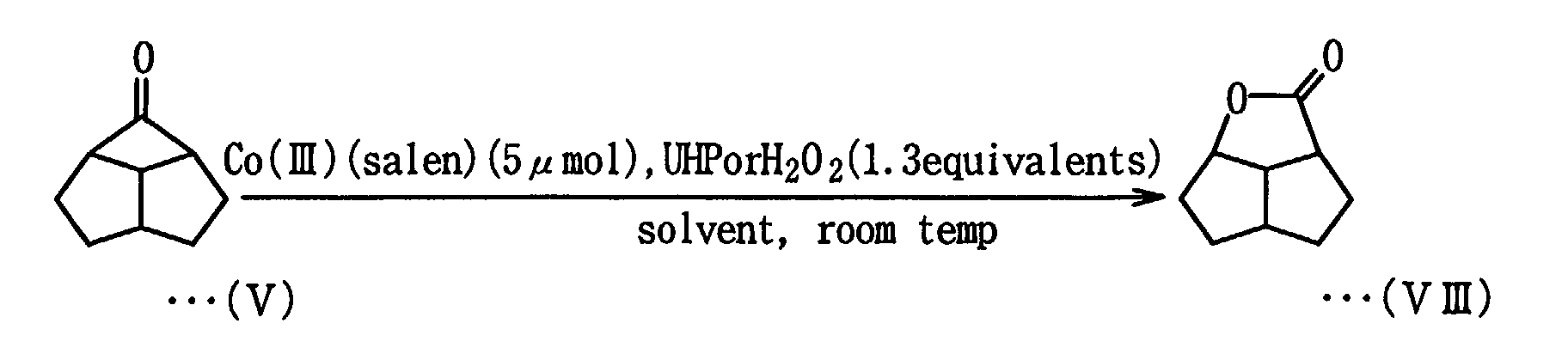
Example 37
Into 0.5 ml of ethanol was dissolved tricyclo[4, 2, 1, 03,9]nonane-2-one
(13.6 mg, 0.1 mmol). Into this ethanol solution was added the Co (III) (salen)
complex (3.7 mg, 5 µmol) having the above formula (XI). Into this solution was
added 30% hydrogen peroxide aqueous solution (15 µl, hydrogen peroxide content
0.13 mmol), which was stirred at room temperature for 24 hours. After the
completion of the reaction, the mixed liquid was concentrated, and the residue was
chromatographed in a silica gel column with hexane/ethyl acetate (=8/2) as a
developing solvent, thereby obtaining 2-oxatricyclo[5.2.1.04,10]decane-3-one (4.7 mg,
yield 31%) having the above formula (VIII). The enantiomer excess percentage of the
product was determined as follows.
Benzyl amine (110 ml, 1.0 mmol) was dissolved into dichloromethane
(1.5 ml), and trimethyl aluminum (0.98 M hexane solution 1.0 ml, 1.0 mmol) was
added into this solution at room temperature, followed by stirring for one hour.
The resulting aluminum-amide solution (1.0 ml) was added into the above 2-oxatricyclo[5.
2. 1. 04,10]decane-3-one (4.7 ml) at room temperature. After the
mixture was stirred for 24 hours, the mixed liquid was quenched with 1M HCl aqueous
solution and subjected to extraction with dichloromethane. The extract was dried over
anhyrous MgSO4, and concentrated. The residue was chromatographed on silica gel
column using hexane/ethyl acetate (=8/2), thereby obtaining corresponding γ-hydroxybenzyl
amide. Analysis of the enantiomeric excess percentage with Daicel
Chiralcell OB-H and by a high speed liquid chromatography with hexane/isopropanol
(=9/1) revealed that the product was composed mainly of 1R, 4S, 7S and 10 R isomers
with the enantiomeric excess percentage of 36% ee. Results are shown in Table 4.
Example 38
Example 38 was effected in the same manner as in Example 37 except that
the urea-hydrogen peroxide adduct (UHP) (12 mg, hydrogen peroxide content
0.13 mmol) was used instead of the 30% hydrogen peroxide aqueous solution (15 µl,
hydrogen peroxide content 0.13 mmol). Results are shown in Table 4.
Example 39
Example 39 was effected in the same manner as in Example 38 except that
acetonitrile (CH3CN) (0.5 ml) was used instead of ethanol (EtOH) (0.5 ml). Results
are shown in Table 4.
Example 40
Example 40 was effected in the same manner as in Example 38 except that
diethyl ether (EtO2) (0.5 ml) was used instead of ethanol (EtOH) (0.5 ml). Results are
shown in Table 4.
Example 41
Example 41 was effected in the same manner as in Example 38 except that
ethyl acetate (AcOEt) (0.5 ml) was used instead of ethanol (EtOH) (0.5 ml). Results
are shown in Table 4.
Example 42
Example 42 was effected in the same manner as in Example 41 except that
the stirring time (reaction time) was changed to 48 hours. Results are shown in
Table 4.
Example 43
Example 43 was effected in the same manner as in Example 42 except that
the Co (III) (salen) complex (4.1 mg, 5.0 µmol) having the above formula (XIV) was
used instead of the Co (III) (salen) complex (3.7 mg, 5.0 µmol) having the above
formula (XI).
Example 44
Example 44 was effected in the same manner as in Example 42 except that
the Co (III) (salen) complex (5.0 mg, 5.0 µmol) having the above formula (XV) was
used instead of the Co (III) (salen) complex (3.7 mg, 5.0 µmol) having the above
formula (XI).
Example 45
Example 45 was effected in the same manner as in Example 42 except that
the Co (III) (salen) complex (5.1 mg, 5.0 µmol) having the above formula (XVII) was
used instead of the Co (III) (salen) complex (3.7 mg, 5.0 µmol) having the above
formula (XI).
Example 46
Example 46 was effected in the same manner as in Example 42 except that
the Co (III) (salen) complex (4.4 mg, 5.0 µmol) having the above formula (XVIII) was
used instead of the Co (III) (salen) complex (3.7 mg, 5.0 µmol) having the above
formula (XI).
| | catalyst | oxidant | solvent | time (h) | yield (%) | enantiomeric excess percentage (%ee) | configuration |
| Example 37 | formula (XI) | H2O2 | EtOH | 24 | 31 | 36 | 1R, 4S, 7S, 10R |
| Example 38 | formula (XI) | UHP | EtOH | 24 | 38 | 43 | 1R, 4S, 7S, 10R |
| Example 39 | formula (XI) | UHP | CH3CN | 24 | 15 | 55 | 1R, 4S, 7S, 10R |
| Example 40 | formula (XI) | UHP | Et2O | 24 | 15 | 56 | 1R, 4S, 7S, 10R |
| Example 41 | formula (XI) | UHP | AcOEt | 24 | 21 | 59 | 1R, 4S, 7S, 10R |
| Example 42 | formula (XI) | UHP | AcOEt | 48 | 42 | 60 | 1R, 4S, 7S, 10R |
| Example 43 | formula (XIV) | UHP | AcOEt | 48 | 36 | 76 | 1R, 4S, 7S, 10R |
| Example 44 | formula (XV) | UHP | AcOEt | 48 | 26 | 86 | 1R, 4S, 7S, 10R |
| Example 45 | formula (XVII) | UHP | AcOEt | 48 | 49 | 64 | 1R, 4S, 7S, 10R |
| Example 46 | formula (XVIII) | UHP | AcOEt | 48 | 92 | 98 | 1R, 4S, 7S, 10R |
The reaction formula corresponding to Examples 37-46 in Table 4 is shown
below.
It is seen from Table 4 that the complexes according to the present
invention are effective for the Baeyer-Villiger oxidation of the cyclic ketones having
the above formula (V).
As mentioned above, the optically active lactone compounds can be
produced by the producing method of the invention, and the lactone compounds having
high optical purities of not less than 47% ee can be produced by appropriately selecting
the reacting condition. Further, according to the present invention, inexpensive
alcohols and ethers can be used as the solvent, while inexpensive hydrogen peroxide
can be used as the oxidant. Therefore, the invention method has the economical
advantage that the costs of the raw materials can be reduced. Thus, the optically
active lactone compounds to be used for the synthesis of medicines and argochemicals
can be produced at high optical purities.














 in which X and Y independently denote H, a t-butyl group or an electron-withdrawing substituting group and Z- is a monovalent anion.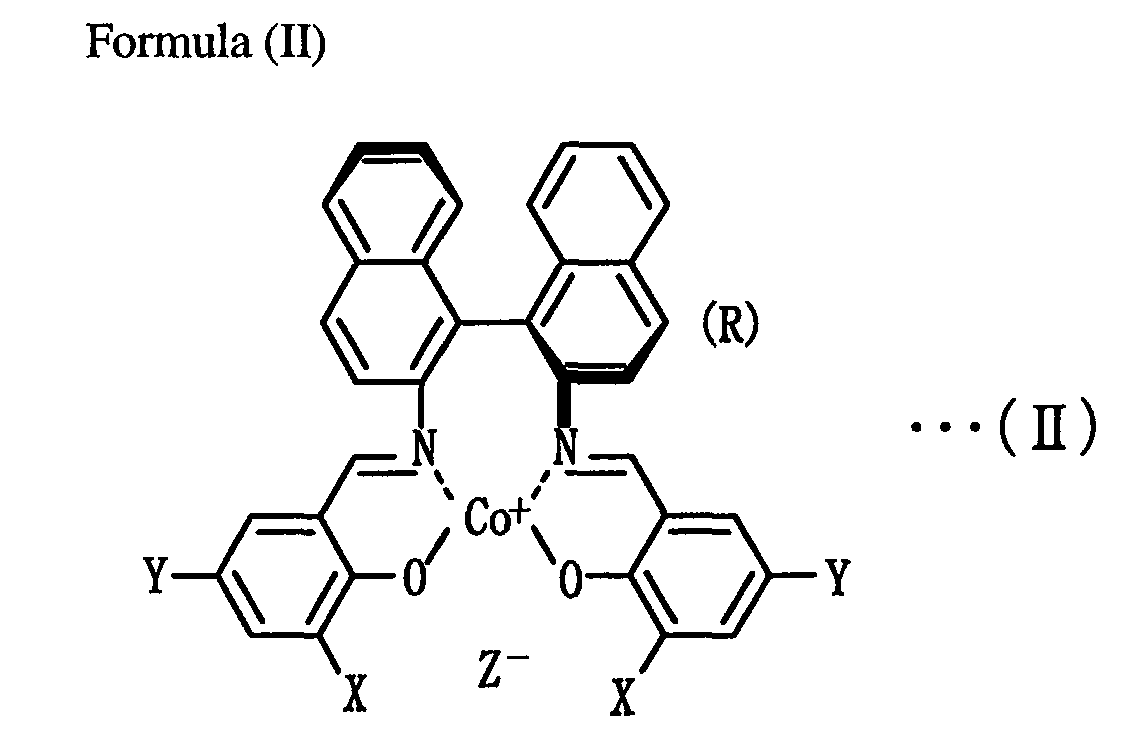
 in which R2 is a substituted or non-substituted C1-C20 alkyl group or a substituted or non-substituted C6-C15 aryl group.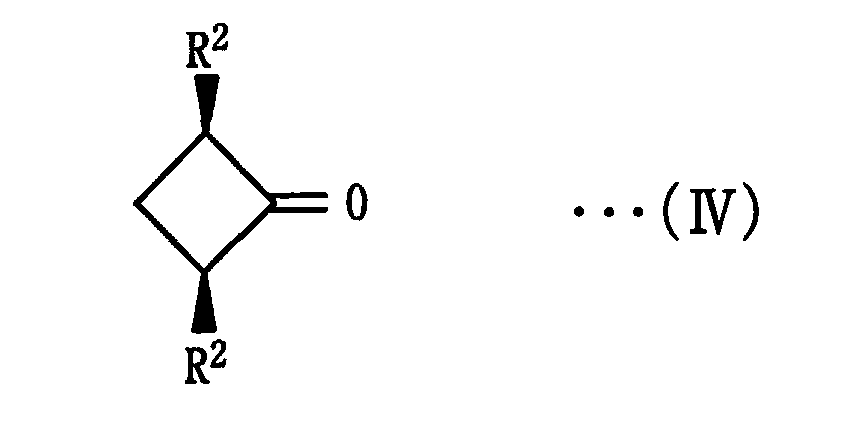

 in which R2 is a substituted or non-substituted C1-C20 alkyl group or a substituted or non-substituted C6-C15 aryl group. Formula (VIII)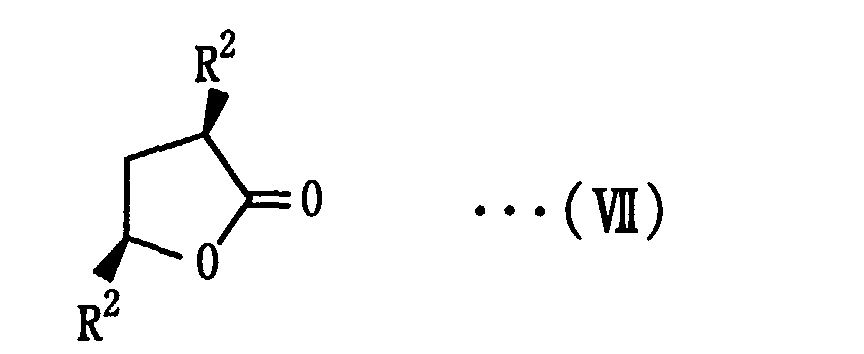
 in which X and Y independently denote H, a t-butyl group or an electron-withdrawing substituting group and Z- is a monovalent anion.