EP1288195A1 - Cationic nitrile compounds and compositions containing them - Google Patents
Cationic nitrile compounds and compositions containing them Download PDFInfo
- Publication number
- EP1288195A1 EP1288195A1 EP01307504A EP01307504A EP1288195A1 EP 1288195 A1 EP1288195 A1 EP 1288195A1 EP 01307504 A EP01307504 A EP 01307504A EP 01307504 A EP01307504 A EP 01307504A EP 1288195 A1 EP1288195 A1 EP 1288195A1
- Authority
- EP
- European Patent Office
- Prior art keywords
- cationic
- ketonitrile
- alkyl
- hydrogen
- hydrogen peroxide
- Prior art date
- Legal status (The legal status is an assumption and is not a legal conclusion. Google has not performed a legal analysis and makes no representation as to the accuracy of the status listed.)
- Withdrawn
Links
- 239000000203 mixture Substances 0.000 title claims abstract description 49
- -1 Cationic nitrile compounds Chemical class 0.000 title description 15
- MHAJPDPJQMAIIY-UHFFFAOYSA-N Hydrogen peroxide Chemical compound OO MHAJPDPJQMAIIY-UHFFFAOYSA-N 0.000 claims abstract description 69
- 125000002091 cationic group Chemical group 0.000 claims abstract description 25
- 238000004140 cleaning Methods 0.000 claims abstract description 14
- 125000002947 alkylene group Chemical group 0.000 claims abstract description 12
- 229910052757 nitrogen Inorganic materials 0.000 claims abstract description 8
- 125000004433 nitrogen atom Chemical group N* 0.000 claims abstract description 8
- 150000002576 ketones Chemical class 0.000 claims abstract description 4
- 125000002560 nitrile group Chemical group 0.000 claims abstract description 4
- 125000000217 alkyl group Chemical group 0.000 claims description 20
- 239000001257 hydrogen Substances 0.000 claims description 13
- 229910052739 hydrogen Inorganic materials 0.000 claims description 13
- 229910052799 carbon Inorganic materials 0.000 claims description 11
- 150000001721 carbon Chemical group 0.000 claims description 10
- 125000001424 substituent group Chemical group 0.000 claims description 10
- UFHFLCQGNIYNRP-UHFFFAOYSA-N Hydrogen Chemical compound [H][H] UFHFLCQGNIYNRP-UHFFFAOYSA-N 0.000 claims description 9
- OKTJSMMVPCPJKN-UHFFFAOYSA-N Carbon Chemical group [C] OKTJSMMVPCPJKN-UHFFFAOYSA-N 0.000 claims description 6
- 125000003545 alkoxy group Chemical group 0.000 claims description 6
- 125000002496 methyl group Chemical group [H]C([H])([H])* 0.000 claims description 5
- 125000001495 ethyl group Chemical group [H]C([H])([H])C([H])([H])* 0.000 claims description 4
- 150000002431 hydrogen Chemical class 0.000 claims description 4
- 125000001997 phenyl group Chemical group [H]C1=C([H])C([H])=C(*)C([H])=C1[H] 0.000 claims description 4
- 230000009977 dual effect Effects 0.000 claims description 3
- 125000003118 aryl group Chemical group 0.000 claims description 2
- 125000004122 cyclic group Chemical group 0.000 claims description 2
- 150000001875 compounds Chemical class 0.000 abstract description 14
- 230000000844 anti-bacterial effect Effects 0.000 abstract description 10
- 239000004615 ingredient Substances 0.000 description 7
- 239000000047 product Substances 0.000 description 7
- WEVYAHXRMPXWCK-UHFFFAOYSA-N Acetonitrile Chemical compound CC#N WEVYAHXRMPXWCK-UHFFFAOYSA-N 0.000 description 6
- 239000002243 precursor Substances 0.000 description 6
- 239000004094 surface-active agent Substances 0.000 description 6
- 230000000845 anti-microbial effect Effects 0.000 description 5
- 238000009472 formulation Methods 0.000 description 5
- 239000003752 hydrotrope Substances 0.000 description 5
- 239000002904 solvent Substances 0.000 description 5
- 241000894006 Bacteria Species 0.000 description 4
- 239000007844 bleaching agent Substances 0.000 description 4
- XLYOFNOQVPJJNP-UHFFFAOYSA-N water Substances O XLYOFNOQVPJJNP-UHFFFAOYSA-N 0.000 description 4
- LYCAIKOWRPUZTN-UHFFFAOYSA-N Ethylene glycol Chemical compound OCCO LYCAIKOWRPUZTN-UHFFFAOYSA-N 0.000 description 3
- DNIAPMSPPWPWGF-UHFFFAOYSA-N Propylene glycol Chemical compound CC(O)CO DNIAPMSPPWPWGF-UHFFFAOYSA-N 0.000 description 3
- JUJWROOIHBZHMG-UHFFFAOYSA-N Pyridine Chemical compound C1=CC=NC=C1 JUJWROOIHBZHMG-UHFFFAOYSA-N 0.000 description 3
- 150000001298 alcohols Chemical class 0.000 description 3
- 229910052783 alkali metal Inorganic materials 0.000 description 3
- 239000003795 chemical substances by application Substances 0.000 description 3
- 150000002825 nitriles Chemical class 0.000 description 3
- 150000002978 peroxides Chemical class 0.000 description 3
- 125000001273 sulfonato group Chemical group [O-]S(*)(=O)=O 0.000 description 3
- DURPTKYDGMDSBL-UHFFFAOYSA-N 1-butoxybutane Chemical compound CCCCOCCCC DURPTKYDGMDSBL-UHFFFAOYSA-N 0.000 description 2
- 241000588724 Escherichia coli Species 0.000 description 2
- IAYPIBMASNFSPL-UHFFFAOYSA-N Ethylene oxide Chemical compound C1CO1 IAYPIBMASNFSPL-UHFFFAOYSA-N 0.000 description 2
- 102000004316 Oxidoreductases Human genes 0.000 description 2
- 108090000854 Oxidoreductases Proteins 0.000 description 2
- KFSLWBXXFJQRDL-UHFFFAOYSA-N Peracetic acid Chemical compound CC(=O)OO KFSLWBXXFJQRDL-UHFFFAOYSA-N 0.000 description 2
- XSQUKJJJFZCRTK-UHFFFAOYSA-N Urea Chemical compound NC(N)=O XSQUKJJJFZCRTK-UHFFFAOYSA-N 0.000 description 2
- 239000012190 activator Substances 0.000 description 2
- 150000001340 alkali metals Chemical class 0.000 description 2
- MTHSVFCYNBDYFN-UHFFFAOYSA-N anhydrous diethylene glycol Natural products OCCOCCO MTHSVFCYNBDYFN-UHFFFAOYSA-N 0.000 description 2
- 239000003945 anionic surfactant Substances 0.000 description 2
- 239000004599 antimicrobial Substances 0.000 description 2
- QVGXLLKOCUKJST-UHFFFAOYSA-N atomic oxygen Chemical compound [O] QVGXLLKOCUKJST-UHFFFAOYSA-N 0.000 description 2
- 230000003115 biocidal effect Effects 0.000 description 2
- 238000004061 bleaching Methods 0.000 description 2
- 239000004202 carbamide Substances 0.000 description 2
- 239000006285 cell suspension Substances 0.000 description 2
- RWGFKTVRMDUZSP-UHFFFAOYSA-N cumene Chemical compound CC(C)C1=CC=CC=C1 RWGFKTVRMDUZSP-UHFFFAOYSA-N 0.000 description 2
- VTIIJXUACCWYHX-UHFFFAOYSA-L disodium;carboxylatooxy carbonate Chemical compound [Na+].[Na+].[O-]C(=O)OOC([O-])=O VTIIJXUACCWYHX-UHFFFAOYSA-L 0.000 description 2
- 238000004090 dissolution Methods 0.000 description 2
- 230000008030 elimination Effects 0.000 description 2
- 238000003379 elimination reaction Methods 0.000 description 2
- 239000007788 liquid Substances 0.000 description 2
- 239000000463 material Substances 0.000 description 2
- 239000001301 oxygen Substances 0.000 description 2
- 229910052760 oxygen Inorganic materials 0.000 description 2
- 238000004806 packaging method and process Methods 0.000 description 2
- 230000003389 potentiating effect Effects 0.000 description 2
- UMJSCPRVCHMLSP-UHFFFAOYSA-N pyridine Natural products COC1=CC=CN=C1 UMJSCPRVCHMLSP-UHFFFAOYSA-N 0.000 description 2
- 229940045872 sodium percarbonate Drugs 0.000 description 2
- 125000005270 trialkylamine group Chemical group 0.000 description 2
- GETQZCLCWQTVFV-UHFFFAOYSA-N trimethylamine Chemical compound CN(C)C GETQZCLCWQTVFV-UHFFFAOYSA-N 0.000 description 2
- AQLJVWUFPCUVLO-UHFFFAOYSA-N urea hydrogen peroxide Chemical compound OO.NC(N)=O AQLJVWUFPCUVLO-UHFFFAOYSA-N 0.000 description 2
- 125000004178 (C1-C4) alkyl group Chemical group 0.000 description 1
- JOLQKTGDSGKSKJ-UHFFFAOYSA-N 1-ethoxypropan-2-ol Chemical compound CCOCC(C)O JOLQKTGDSGKSKJ-UHFFFAOYSA-N 0.000 description 1
- ARXJGSRGQADJSQ-UHFFFAOYSA-N 1-methoxypropan-2-ol Chemical compound COCC(C)O ARXJGSRGQADJSQ-UHFFFAOYSA-N 0.000 description 1
- HUUPVABNAQUEJW-UHFFFAOYSA-N 1-methylpiperidin-4-one Chemical compound CN1CCC(=O)CC1 HUUPVABNAQUEJW-UHFFFAOYSA-N 0.000 description 1
- 238000005160 1H NMR spectroscopy Methods 0.000 description 1
- XNWFRZJHXBZDAG-UHFFFAOYSA-N 2-METHOXYETHANOL Chemical compound COCCO XNWFRZJHXBZDAG-UHFFFAOYSA-N 0.000 description 1
- FMVOPJLFZGSYOS-UHFFFAOYSA-N 2-[2-(2-ethoxypropoxy)propoxy]propan-1-ol Chemical compound CCOC(C)COC(C)COC(C)CO FMVOPJLFZGSYOS-UHFFFAOYSA-N 0.000 description 1
- WAEVWDZKMBQDEJ-UHFFFAOYSA-N 2-[2-(2-methoxypropoxy)propoxy]propan-1-ol Chemical compound COC(C)COC(C)COC(C)CO WAEVWDZKMBQDEJ-UHFFFAOYSA-N 0.000 description 1
- REXUYBKPWIPONM-UHFFFAOYSA-N 2-bromoacetonitrile Chemical compound BrCC#N REXUYBKPWIPONM-UHFFFAOYSA-N 0.000 description 1
- POAOYUHQDCAZBD-UHFFFAOYSA-N 2-butoxyethanol Chemical compound CCCCOCCO POAOYUHQDCAZBD-UHFFFAOYSA-N 0.000 description 1
- ZNQVEEAIQZEUHB-UHFFFAOYSA-N 2-ethoxyethanol Chemical compound CCOCCO ZNQVEEAIQZEUHB-UHFFFAOYSA-N 0.000 description 1
- UPGSWASWQBLSKZ-UHFFFAOYSA-N 2-hexoxyethanol Chemical compound CCCCCCOCCO UPGSWASWQBLSKZ-UHFFFAOYSA-N 0.000 description 1
- JBVOQKNLGSOPNZ-UHFFFAOYSA-N 2-propan-2-ylbenzenesulfonic acid Chemical class CC(C)C1=CC=CC=C1S(O)(=O)=O JBVOQKNLGSOPNZ-UHFFFAOYSA-N 0.000 description 1
- NTKBNCABAMQDIG-UHFFFAOYSA-N 3-butoxypropan-1-ol Chemical compound CCCCOCCCO NTKBNCABAMQDIG-UHFFFAOYSA-N 0.000 description 1
- XSVSPKKXQGNHMD-UHFFFAOYSA-N 5-bromo-3-methyl-1,2-thiazole Chemical compound CC=1C=C(Br)SN=1 XSVSPKKXQGNHMD-UHFFFAOYSA-N 0.000 description 1
- CPELXLSAUQHCOX-UHFFFAOYSA-M Bromide Chemical compound [Br-] CPELXLSAUQHCOX-UHFFFAOYSA-M 0.000 description 1
- 239000004215 Carbon black (E152) Substances 0.000 description 1
- VEXZGXHMUGYJMC-UHFFFAOYSA-M Chloride anion Chemical compound [Cl-] VEXZGXHMUGYJMC-UHFFFAOYSA-M 0.000 description 1
- 206010015946 Eye irritation Diseases 0.000 description 1
- 229910002651 NO3 Inorganic materials 0.000 description 1
- NHNBFGGVMKEFGY-UHFFFAOYSA-N Nitrate Chemical compound [O-][N+]([O-])=O NHNBFGGVMKEFGY-UHFFFAOYSA-N 0.000 description 1
- CTQNGGLPUBDAKN-UHFFFAOYSA-N O-Xylene Chemical compound CC1=CC=CC=C1C CTQNGGLPUBDAKN-UHFFFAOYSA-N 0.000 description 1
- 108700020962 Peroxidase Proteins 0.000 description 1
- 102000003992 Peroxidases Human genes 0.000 description 1
- GOOHAUXETOMSMM-UHFFFAOYSA-N Propylene oxide Chemical compound CC1CO1 GOOHAUXETOMSMM-UHFFFAOYSA-N 0.000 description 1
- 206010040880 Skin irritation Diseases 0.000 description 1
- QAOWNCQODCNURD-UHFFFAOYSA-L Sulfate Chemical compound [O-]S([O-])(=O)=O QAOWNCQODCNURD-UHFFFAOYSA-L 0.000 description 1
- UBRGWGQLWZNODA-UHFFFAOYSA-N acetonitrile;1-methylpiperidin-1-ium-4-one;bromide Chemical compound [Br-].CC#N.C[NH+]1CCC(=O)CC1 UBRGWGQLWZNODA-UHFFFAOYSA-N 0.000 description 1
- 239000000654 additive Substances 0.000 description 1
- 239000003619 algicide Substances 0.000 description 1
- 150000001335 aliphatic alkanes Chemical class 0.000 description 1
- 229910052784 alkaline earth metal Inorganic materials 0.000 description 1
- 150000001342 alkaline earth metals Chemical class 0.000 description 1
- 150000008055 alkyl aryl sulfonates Chemical class 0.000 description 1
- 125000005599 alkyl carboxylate group Chemical group 0.000 description 1
- 150000008051 alkyl sulfates Chemical class 0.000 description 1
- 229940045714 alkyl sulfonate alkylating agent Drugs 0.000 description 1
- 150000008052 alkyl sulfonates Chemical class 0.000 description 1
- 125000005263 alkylenediamine group Chemical class 0.000 description 1
- 150000001449 anionic compounds Chemical class 0.000 description 1
- 150000001450 anions Chemical class 0.000 description 1
- 230000003385 bacteriostatic effect Effects 0.000 description 1
- 238000003287 bathing Methods 0.000 description 1
- 230000015572 biosynthetic process Effects 0.000 description 1
- 238000005282 brightening Methods 0.000 description 1
- 239000003086 colorant Substances 0.000 description 1
- 239000007859 condensation product Substances 0.000 description 1
- 238000011109 contamination Methods 0.000 description 1
- 239000012933 diacyl peroxide Substances 0.000 description 1
- YRIUSKIDOIARQF-UHFFFAOYSA-N dodecyl benzenesulfonate Chemical compound CCCCCCCCCCCCOS(=O)(=O)C1=CC=CC=C1 YRIUSKIDOIARQF-UHFFFAOYSA-N 0.000 description 1
- 230000000694 effects Effects 0.000 description 1
- 238000004945 emulsification Methods 0.000 description 1
- 230000002255 enzymatic effect Effects 0.000 description 1
- RTZKZFJDLAIYFH-UHFFFAOYSA-N ether Substances CCOCC RTZKZFJDLAIYFH-UHFFFAOYSA-N 0.000 description 1
- 231100000013 eye irritation Toxicity 0.000 description 1
- 230000002349 favourable effect Effects 0.000 description 1
- 238000001914 filtration Methods 0.000 description 1
- 238000009408 flooring Methods 0.000 description 1
- 239000006260 foam Substances 0.000 description 1
- 238000005187 foaming Methods 0.000 description 1
- 150000002334 glycols Chemical class 0.000 description 1
- 150000004820 halides Chemical class 0.000 description 1
- 229930195733 hydrocarbon Natural products 0.000 description 1
- 238000011065 in-situ storage Methods 0.000 description 1
- 229910001412 inorganic anion Inorganic materials 0.000 description 1
- 150000004966 inorganic peroxy acids Chemical class 0.000 description 1
- JZMJDSHXVKJFKW-UHFFFAOYSA-M methyl sulfate(1-) Chemical compound COS([O-])(=O)=O JZMJDSHXVKJFKW-UHFFFAOYSA-M 0.000 description 1
- 230000000813 microbial effect Effects 0.000 description 1
- 244000005700 microbiome Species 0.000 description 1
- 238000002156 mixing Methods 0.000 description 1
- 239000002736 nonionic surfactant Substances 0.000 description 1
- 239000003605 opacifier Substances 0.000 description 1
- 150000002891 organic anions Chemical class 0.000 description 1
- 150000004967 organic peroxy acids Chemical class 0.000 description 1
- 239000007800 oxidant agent Substances 0.000 description 1
- 230000001590 oxidative effect Effects 0.000 description 1
- 239000012188 paraffin wax Substances 0.000 description 1
- 239000002304 perfume Substances 0.000 description 1
- NIXKBAZVOQAHGC-UHFFFAOYSA-N phenylmethanesulfonic acid Chemical class OS(=O)(=O)CC1=CC=CC=C1 NIXKBAZVOQAHGC-UHFFFAOYSA-N 0.000 description 1
- 238000002360 preparation method Methods 0.000 description 1
- 150000003222 pyridines Chemical class 0.000 description 1
- 238000010992 reflux Methods 0.000 description 1
- 150000003839 salts Chemical class 0.000 description 1
- 231100000475 skin irritation Toxicity 0.000 description 1
- 229960001922 sodium perborate Drugs 0.000 description 1
- 239000012418 sodium perborate tetrahydrate Substances 0.000 description 1
- QUCDWLYKDRVKMI-UHFFFAOYSA-M sodium;3,4-dimethylbenzenesulfonate Chemical compound [Na+].CC1=CC=C(S([O-])(=O)=O)C=C1C QUCDWLYKDRVKMI-UHFFFAOYSA-M 0.000 description 1
- IBDSNZLUHYKHQP-UHFFFAOYSA-N sodium;3-oxidodioxaborirane;tetrahydrate Chemical compound O.O.O.O.[Na+].[O-]B1OO1 IBDSNZLUHYKHQP-UHFFFAOYSA-N 0.000 description 1
- YKLJGMBLPUQQOI-UHFFFAOYSA-M sodium;oxidooxy(oxo)borane Chemical compound [Na+].[O-]OB=O YKLJGMBLPUQQOI-UHFFFAOYSA-M 0.000 description 1
- 239000007787 solid Substances 0.000 description 1
- 239000012265 solid product Substances 0.000 description 1
- 239000007921 spray Substances 0.000 description 1
- 239000003381 stabilizer Substances 0.000 description 1
- 239000000126 substance Substances 0.000 description 1
- 238000006467 substitution reaction Methods 0.000 description 1
- 239000000758 substrate Substances 0.000 description 1
- 229910021653 sulphate ion Inorganic materials 0.000 description 1
- 230000000475 sunscreen effect Effects 0.000 description 1
- 239000000516 sunscreening agent Substances 0.000 description 1
- 239000000725 suspension Substances 0.000 description 1
- 230000009182 swimming Effects 0.000 description 1
- 238000003786 synthesis reaction Methods 0.000 description 1
- JOXIMZWYDAKGHI-UHFFFAOYSA-M toluene-4-sulfonate Chemical compound CC1=CC=C(S([O-])(=O)=O)C=C1 JOXIMZWYDAKGHI-UHFFFAOYSA-M 0.000 description 1
- JOXIMZWYDAKGHI-UHFFFAOYSA-N toluene-4-sulfonic acid Chemical compound CC1=CC=C(S(O)(=O)=O)C=C1 JOXIMZWYDAKGHI-UHFFFAOYSA-N 0.000 description 1
- 239000008096 xylene Substances 0.000 description 1
Classifications
-
- C—CHEMISTRY; METALLURGY
- C11—ANIMAL OR VEGETABLE OILS, FATS, FATTY SUBSTANCES OR WAXES; FATTY ACIDS THEREFROM; DETERGENTS; CANDLES
- C11D—DETERGENT COMPOSITIONS; USE OF SINGLE SUBSTANCES AS DETERGENTS; SOAP OR SOAP-MAKING; RESIN SOAPS; RECOVERY OF GLYCEROL
- C11D3/00—Other compounding ingredients of detergent compositions covered in group C11D1/00
- C11D3/48—Medical, disinfecting agents, disinfecting, antibacterial, germicidal or antimicrobial compositions
-
- C—CHEMISTRY; METALLURGY
- C07—ORGANIC CHEMISTRY
- C07C—ACYCLIC OR CARBOCYCLIC COMPOUNDS
- C07C255/00—Carboxylic acid nitriles
- C07C255/01—Carboxylic acid nitriles having cyano groups bound to acyclic carbon atoms
- C07C255/24—Carboxylic acid nitriles having cyano groups bound to acyclic carbon atoms containing cyano groups and singly-bound nitrogen atoms, not being further bound to other hetero atoms, bound to the same saturated acyclic carbon skeleton
-
- C—CHEMISTRY; METALLURGY
- C07—ORGANIC CHEMISTRY
- C07D—HETEROCYCLIC COMPOUNDS
- C07D211/00—Heterocyclic compounds containing hydrogenated pyridine rings, not condensed with other rings
- C07D211/04—Heterocyclic compounds containing hydrogenated pyridine rings, not condensed with other rings with only hydrogen or carbon atoms directly attached to the ring nitrogen atom
- C07D211/06—Heterocyclic compounds containing hydrogenated pyridine rings, not condensed with other rings with only hydrogen or carbon atoms directly attached to the ring nitrogen atom having no double bonds between ring members or between ring members and non-ring members
- C07D211/36—Heterocyclic compounds containing hydrogenated pyridine rings, not condensed with other rings with only hydrogen or carbon atoms directly attached to the ring nitrogen atom having no double bonds between ring members or between ring members and non-ring members with hetero atoms or with carbon atoms having three bonds to hetero atoms with at the most one bond to halogen, e.g. ester or nitrile radicals, directly attached to ring carbon atoms
- C07D211/40—Oxygen atoms
- C07D211/44—Oxygen atoms attached in position 4
- C07D211/46—Oxygen atoms attached in position 4 having a hydrogen atom as the second substituent in position 4
-
- C—CHEMISTRY; METALLURGY
- C11—ANIMAL OR VEGETABLE OILS, FATS, FATTY SUBSTANCES OR WAXES; FATTY ACIDS THEREFROM; DETERGENTS; CANDLES
- C11D—DETERGENT COMPOSITIONS; USE OF SINGLE SUBSTANCES AS DETERGENTS; SOAP OR SOAP-MAKING; RESIN SOAPS; RECOVERY OF GLYCEROL
- C11D3/00—Other compounding ingredients of detergent compositions covered in group C11D1/00
- C11D3/39—Organic or inorganic per-compounds
- C11D3/3902—Organic or inorganic per-compounds combined with specific additives
- C11D3/3905—Bleach activators or bleach catalysts
- C11D3/3907—Organic compounds
- C11D3/3917—Nitrogen-containing compounds
- C11D3/3925—Nitriles; Isocyanates or quarternary ammonium nitriles
-
- C—CHEMISTRY; METALLURGY
- C11—ANIMAL OR VEGETABLE OILS, FATS, FATTY SUBSTANCES OR WAXES; FATTY ACIDS THEREFROM; DETERGENTS; CANDLES
- C11D—DETERGENT COMPOSITIONS; USE OF SINGLE SUBSTANCES AS DETERGENTS; SOAP OR SOAP-MAKING; RESIN SOAPS; RECOVERY OF GLYCEROL
- C11D2111/00—Cleaning compositions characterised by the objects to be cleaned; Cleaning compositions characterised by non-standard cleaning or washing processes
- C11D2111/10—Objects to be cleaned
- C11D2111/14—Hard surfaces
Definitions
- the present invention generally relates to cationic nitrile compounds which incorporate a ketone grouping (referred to herein as "cationic ketonitriles”) and in particular their use in compositions which are designed for the hygienic cleaning of hard surfaces.
- cationic ketonitriles a ketone grouping
- Cleaning compositions designed for application to hard surfaces in the household, or in institutional or hospital environments generally comprise one or more surfactants, and, optionally, one or more antimicrobial actives and/or solvents.
- biocidal activity of surfactants is, with a few notable exceptions, low and it is therefore commonplace to add a separate antimicrobial active to compositions.
- Hydrogen peroxide is known as an environmentally friendly antimicrobial oxidant, but typically requires long contact times and/or high concentrations in order to be effective.
- the present invention provides new cationic nitrile compounds which have particular utility in hygienic cleaning compositions.
- the new cationic nitrile compounds have been found to potentiate the antibacterial activity of peroxygen sources such as hydrogen peroxide. This allows a substantial reduction in the concentration of peroxygen source required to achieve good disinfectancy against the typical bacteria as found on hard surfaces in the household, so that effective hygiene performance can be obtained at much lower levels of hydrogen peroxide than would typically be used in a hygiene product such as an antimicrobial household cleaner.
- Cationic nitriles of various types have been described as bleach activators for oxygen-containing bleaching agents.
- Examples are WO96/40661, WO98/23533 and WO98/23534 which all relate to a class of N-alkyl morpholinium acetonitrile compounds which are used in particular to enhance the bleaching activity of peroxygen compounds for laundry bleaching, brightening and stain removal.
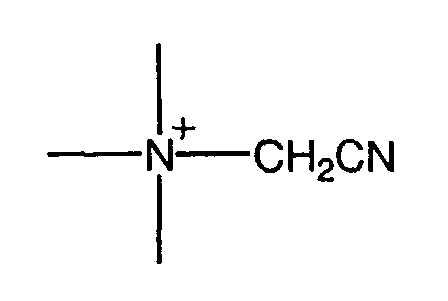
- EP 0 303 520 describes three particular classes of compound having groups in the molecule. These are prepared by reacting a halogenated nitrile with either trialkylamine, pyridine or substituted pyridine, alkylene diamine or polyalkylenepolyamine respectively. The compounds are used as bleach activators for oxygen-containing bleaching agents such as sodium percarbonate and sodium perborate.
- EP 0 458 396 and EP 0 464 880 respectively describe how the hygroscopic properties of cationic nitriles of the types disclosed in EP 0 303 520 (in particular those derived from trialkylamines such as trimethylamine) can be improved by either substitution at the ⁇ -carbon atom of the cationic nitrile group or by providing certain selected counter-anions.
- the present invention provides new cationic nitrile compounds which have particular utility in hygienic cleaning compositions.
- the new cationic nitrile compounds have been found to potentiate the antibacterial activity of peroxygen sources such as hydrogen peroxide. This allows a substantial reduction in the concentration of peroxygen source (such as H 2 O 2 ) required to achieve good disinfectancy against the typical (Gram + ve & Gram-ve) bacteria as found on hard surfaces in the household.
- the present invention provides a cationic ketonitrile containing at least one nitrile group bonded to a quaternary nitrogen atom via an alkylene or substituted alkylene linkage, and at least one ketone grouping bonded to the quaternary nitrogen atom via an alkylene, or substituted alkylene, linkage.
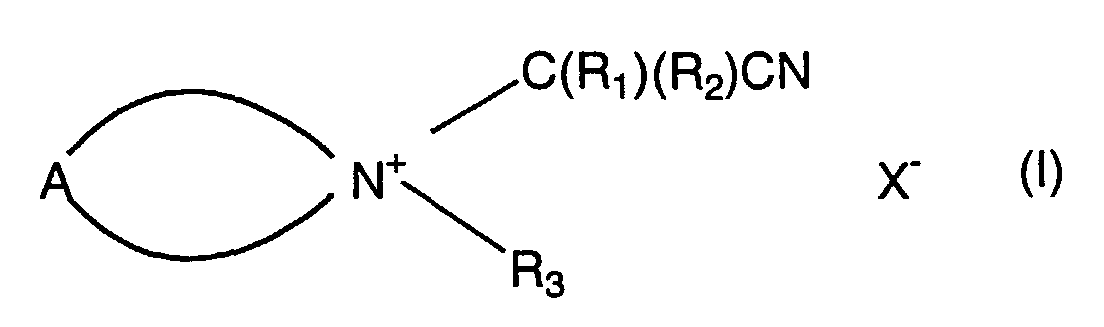
- Compounds of the invention may suitably be represented by the general formula (I): in which A is a carbon chain incorporating at least one carbonylated carbon atom and which, together with the quaternary nitrogen atom, forms a saturated ring system; R 1 and R 2 are each independently selected from hydrogen or a substituent group containing at least one carbon atom; R 3 is selected from C 1-10 straight or branched chain alkyl (or alkoxylated alkyl where the alkoxy is C 2-4 ), C 7-12 phenyl-substituted alkyl and C 6-10 alkyl substituted phenyl; or alternatively R 3 is a substituent group containing at least one carbon atom which is linked to carbon chain A forming a ring; and X is a suitable counterion.
- A is a carbon chain incorporating at least one carbonylated carbon atom and which, together with the quaternary nitrogen atom, forms a saturated ring system
- R 1 and R 2 are each independently selected from hydrogen or
- Suitable counterions X include any organic or inorganic anion. Examples are methylsulphate, sulphate, halide (such as chloride, bromide), nitrate, and those counterions described in EP 0 464 880 such as alkane and paraffin sulphonates, p-toluene sulphonate (tosylate), dodecyl benzene sulphonate, primary alcohol sulphates and ether sulphates, alkyl carboxylates and other surfactant anions.
- methylsulphate, sulphate, halide (such as chloride, bromide), nitrate and those counterions described in EP 0 464 880 such as alkane and paraffin sulphonates, p-toluene sulphonate (tosylate), dodecyl benzene sulphonate, primary alcohol sulphates and ether sulphates, alkyl carboxylates and other surfactant
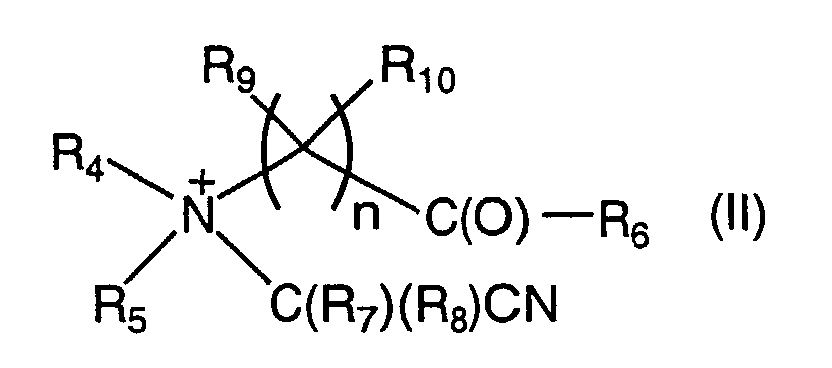
- compounds of the invention may suitably be represented by the general formula (II): in which R 7 and R 8 are each independently selected from hydrogen or a substituent group containing at least one carbon atom; R 9 and R 10 are each independently selected from hydrogen or a substituent group containing at least one carbon atom, which substituent groups R 9 and R 10 may optionally be linked to form a ring; R 4 and R 5 are each independently selected from C 1-10 straight or branched chain alkyl (or alkoxylated alkyl where the alkoxy is C 2-4 ), C 7-12 phenyl-substituted alkyl and C 6-10 alkyl substituted phenyl; R 6 is selected from aryl and C 1-4 straight or branched chain alkyl (or alkoxylated alkyl where the alkoxy is C 2-4 ); n is an integer from 1 to 4 and X is a suitable counterion such as is described above.
- R 7 and R 8 are each independently selected from hydrogen or a substituent group containing
- novel compounds of the present invention are particularly useful as potentiators of the antibacterial activity of peroxygen sources such as hydrogen peroxide.
- the present invention also provides a composition suitable for the hygienic cleaning of surfaces comprising a compound of the invention as described above (hereinafter referred to as a "cationic ketonitrile"), together with a peroxygen source.
- a compound of the invention as described above hereinafter referred to as a "cationic ketonitrile”
- compositions of the invention comprise one or more cationic ketonitriles as are described above.
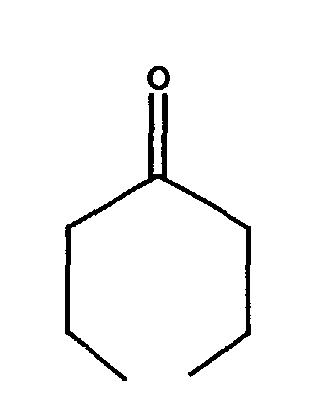
- Preferred compounds of general formula (I) for inclusion in compositions according to the invention include those in which carbon chain A has one of the formulae below: R 1 and R 2 are both hydrogen and R 3 is methyl or ethyl.
- R 1 and R 2 are both hydrogen and R 3 is methyl. These may be designated as N-acetonitrile-N-methyl-4-oxo-piperidinium salts.
- Preferred compounds of general formula (II) for inclusion in compositions according to the invention include those in which R 7 , R 8 , R 9 and R 10 are all hydrogen, R 4 and R 5 are both ethyl and R 6 is methyl.
- the total amount of cationic ketonitrile suitably ranges from 0.01% to 10%, more preferably from 0.1% to 5%, most preferably from 0.15% to 4.0% by weight based on total weight of the composition.
- the peroxygen source may be any peroxide or peroxide generating system known in the art such as dihydrocarbon peroxides, diacyl peroxides, hydrocarbon hydroperoxides, organic and inorganic peracids and persalts and in particular hydrogen peroxide.
- Preferred peroxygen sources are hydrogen peroxide, peracetic acid, PAP and alkali metal or alkaline earth metal monoperoxosulphate salts.
- Hydrogen peroxide is most preferred and may be incorporated per se into the composition, or may be generated in situ by use of a hydrogen peroxide precursor.
- suitable hydrogen peroxide precursors are compounds which produce hydrogen peroxide on dissolution in water, (such as sodium perborate monohydrate, sodium perborate tetrahydrate, sodium percarbonate and the urea-hydrogen peroxide addition compound percarbamide), and enzymatic hydrogen peroxide generating systems (such as peroxidases, oxidases and other oxido-reductase enzyme systems, in conjunction with their appropriate substrates).
- the cationic ketonitrile potentiates the antibacterial activity of the peroxygen source. This allows effective hygiene performance to be obtained at much lower levels of active than would typically be used in a hygiene product such as an antimicrobial household cleaner.
- the amount of hydrogen peroxide in compositions of the invention suitably ranges from 0.0001% to 5%, more preferably from 0.001 to 1.5%, most preferably from 0.003% to 0.6%, by weight based on total weight of the composition.
- the molar ratio of cationic ketonitrile (in total, if a mixture of cationic ketonitriles is used) to peroxygen source (such as hydrogen peroxide or precursor thereof generating the equivalent amount of hydrogen peroxide) typically ranges from 10:1 to 1:1000, preferably from 5:1 to 1:100, most preferably about 1:1.
- Aqueous ready-to-use compositions of the invention will generally have a pH between 6 and 12, more preferably between 7 and 11.5.
- compositions according to the invention are designed in particular for the hygienic cleaning of hard surfaces.
- hard surfaces are meant those surfaces which are typically found in the household, or in institutional or hospital environments, and which are prone to microbial contamination. Examples include bathroom fixtures, bathroom appliances (toilets, bidets, shower stalls, bathtubs and bathing appliances), wall and flooring surfaces and those surfaces associated with kitchen environments and other environments associated with food preparation.
- compositions of the invention designed for the hygienic cleaning of surfaces may take any form suitable for hygiene products.
- Liquid compositions according to the invention are typically aqueous compositions in which the principal ingredient is water, which is normally present at a level of at least 75%, preferably at least 90%, more preferably at least 95%, by weight based on total weight of the composition.
- the use of distilled or demineralised water is preferred, but not essential to the invention.
- liquid compositions according to the invention it is preferred to store the cationic ketonitrile separately from the peroxygen source.
- a dual-compartment container in which the cationic ketonitrile and peroxygen source are stored in separate compartments.
- a dual-compartment container will include a delivery means which allows the cationic ketonitrile and peroxygen source to be delivered to the surface to be treated so that they combine as they are exiting the delivery means and/or in mid-air as they are directed to the surface and/or on the surface itself.
- a particularly preferred delivery means is a trigger spray head.
- this will preferably have two siphon tubes, respectively leading into each compartment and either a single nozzle with a mixing chamber or two separate nozzles substantially adjacent to each other.
- a dispensing nozzle or nozzles configured to promote foaming may be used.
- compositions of the invention may contain a peroxygen source precursor such as a hydrogen peroxide precursor which produces hydrogen peroxide on dissolution in water, in which case a solid product form can be used, such as a tablet.
- a peroxygen source precursor such as a hydrogen peroxide precursor which produces hydrogen peroxide on dissolution in water
- a solid product form can be used, such as a tablet.
- compositions of the invention designed for the hygienic cleaning of surfaces may further contain any conventional surfactant for emulsification and cleaning purposes.
- concentration of this surfactant material is generally in the range from 0 to 50% by weight based on total weight of the composition, but a maximum concentration of 20% by weight based on total weight of the composition is usually preferred.
- Suitable surfactants may be anionic surfactants, such as alkyl aryl sulfonates, alkyl sulfates and alkyl sulfonates, nonionic surfactants, such as ethylene oxide and/or propylene oxide condensation products with alcohols or alkylphenol, or mixtures thereof.
- composition according to the invention can contain other optional ingredients which aid in their cleaning performance and maintain the physical and chemical stability of the product.
- Hydrotropes are useful optional components. These enable the cloud point of the composition to be raised without requiring the addition of anionic surfactants.
- Suitable hydrotropes include alkali metal toluene sulphonates, urea, alkali metal xylene and cumene sulphonates, short chain (preferably C 1-5 ) alcohols, and glycols. Preferred amongst these hydrotropes are the sulphonates, particularly the cumene and toluene sulphonates.
- Typical levels of hydrotrope range from 0 to 5% by weight based on total weight of the composition, for the sulphonates. Correspondingly higher levels of urea and alcohols are required. Hydrotropes are not required for dilute products.
- Solvents may be present in the compositions of the invention.
- Suitable solvents correspond to the general formula R 1 -O-(EO) m -(PO) n -R 2 , wherein R 1 and R 2 are independently C 2-6 alkyl or hydrogen, but not both hydrogen, m and n are independently 0-5, EO represents an ethyleneoxy group and PO represents a propyleneoxy group.
- Suitable materials of this type include the C 1-4 alkyl ethers of alkylene glycols such as ethylene glycol, propylene glycol and oligomers thereof having 2 or 3 repeating units.
- alkylene glycols such as ethylene glycol, propylene glycol and oligomers thereof having 2 or 3 repeating units.
- Examples include monoethers such as ethylene glycol mono-n-butyl ether, ethylene glycol monomethyl ether, ethylene glycol monoethyl ether, ethylene glycol mono-n-hexyl ether, propylene glycol monomethyl ether, propylene glycol monoethyl ether, propylene glycol mono-n-butyl ether, isopropylene glycol monoethyl or monopropyl or monobutyl ether, diethylene glycol monoethyl or monopropyl or monobutyl ether, di- or tripropylene glycol monomethyl ether, di- or tripropylene glycol monoeth
- Typical levels of solvent range from 0 to 2% by weight based on total weight of the composition.
- compositions according to the invention can also contain, in addition to the ingredients already mentioned, other optional ingredients such as pH regulants, sunscreens, foam-control agents, colorants, viscosity modifying agents, freeze-thaw stabilisers, additional hygiene agents, perfumes and opacifiers.
- other optional ingredients such as pH regulants, sunscreens, foam-control agents, colorants, viscosity modifying agents, freeze-thaw stabilisers, additional hygiene agents, perfumes and opacifiers.
- aureus Mean log reduction in cell numbers (from log-7 cell suspension) Formulation pH No BSA 0.3% BSA 0.5% hydrogen peroxide 11.0 0 0 3.5% N-acetonitrile-N-methyl-4-oxo-piperidinium bromide 11.0 0 0 0.5% hydrogen peroxide + 3.5% N-acetonitrile-N-methyl-4-oxo-piperidinium bromide 11.0 5.0 5.0
- the data shows that the bactericidal performance of the cationic ketonitrile/hydrogen peroxide combination is significantly greater than that observed from the same levels of either the cationic ketonitrile or hydrogen peroxide alone.
- N-Methyl-4-oxopiperidine (5.65g, 0.05m) was dissolved in acetonitrile (30ml) and bromoacetonitrile (5.95g, 0.05m) was added. The mixture was heated under reflux for 6h.
Landscapes
- Chemical & Material Sciences (AREA)
- Organic Chemistry (AREA)
- Life Sciences & Earth Sciences (AREA)
- Engineering & Computer Science (AREA)
- Chemical Kinetics & Catalysis (AREA)
- Oil, Petroleum & Natural Gas (AREA)
- Wood Science & Technology (AREA)
- Inorganic Chemistry (AREA)
- Detergent Compositions (AREA)
- Agricultural Chemicals And Associated Chemicals (AREA)
Abstract
The invention provides a cationic ketonitrile containing at
least one nitrile group bonded to a quaternary nitrogen atom
via an alkylene or substituted alkylene linkage, and at
least one ketone grouping bonded to the quaternary nitrogen
atom via an alkylene, or substituted alkylene, linkage.
The compounds of the invention are particularly useful as
potentiators of the antibacterial activity of peroxygen
sources such as hydrogen peroxide, in compositions for the
hygienic cleaning of surfaces.
Description
- The present invention generally relates to cationic nitrile compounds which incorporate a ketone grouping (referred to herein as "cationic ketonitriles") and in particular their use in compositions which are designed for the hygienic cleaning of hard surfaces.
- Cleaning compositions designed for application to hard surfaces in the household, or in institutional or hospital environments, generally comprise one or more surfactants, and, optionally, one or more antimicrobial actives and/or solvents.
- Hard surfaces found in the household, or in institutional or hospital environments, such as kitchen work surfaces and bathrooms, are often contaminated with bacteria and other microorganisms, which present a risk to human health, especially when they are present near food.
- The biocidal activity of surfactants is, with a few notable exceptions, low and it is therefore commonplace to add a separate antimicrobial active to compositions.
- Hydrogen peroxide is known as an environmentally friendly antimicrobial oxidant, but typically requires long contact times and/or high concentrations in order to be effective.
- The present invention provides new cationic nitrile compounds which have particular utility in hygienic cleaning compositions. The new cationic nitrile compounds have been found to potentiate the antibacterial activity of peroxygen sources such as hydrogen peroxide. This allows a substantial reduction in the concentration of peroxygen source required to achieve good disinfectancy against the typical bacteria as found on hard surfaces in the household, so that effective hygiene performance can be obtained at much lower levels of hydrogen peroxide than would typically be used in a hygiene product such as an antimicrobial household cleaner.
- Cationic nitriles of various types have been described as bleach activators for oxygen-containing bleaching agents. Examples are WO96/40661, WO98/23533 and WO98/23534 which all relate to a class of N-alkyl morpholinium acetonitrile compounds which are used in particular to enhance the bleaching activity of peroxygen compounds for laundry bleaching, brightening and stain removal.
- EP 0 303 520 describes three particular classes of compound havinggroups in the molecule. These are prepared by reacting a halogenated nitrile with either trialkylamine, pyridine or substituted pyridine, alkylene diamine or polyalkylenepolyamine respectively. The compounds are used as bleach activators for oxygen-containing bleaching agents such as sodium percarbonate and sodium perborate.
- EP 0 458 396 and EP 0 464 880 respectively describe how the hygroscopic properties of cationic nitriles of the types disclosed in EP 0 303 520 (in particular those derived from trialkylamines such as trimethylamine) can be improved by either substitution at the α-carbon atom of the cationic nitrile group or by providing certain selected counter-anions.
- US 4,874,785 describes a series of bacteriostatic "quats" which contain two long chain alkyl groups, one short chain alkyl group and a functional alkyl group which may be substituted with nitrile ("nitrile quats"). These are said to have a favourable foam profile which allows them to be used without co-additives in formulations used as toilet bowl cleaners and swimming pool algicide.
- The present invention provides new cationic nitrile compounds which have particular utility in hygienic cleaning compositions. The new cationic nitrile compounds have been found to potentiate the antibacterial activity of peroxygen sources such as hydrogen peroxide. This allows a substantial reduction in the concentration of peroxygen source (such as H2O2) required to achieve good disinfectancy against the typical (Gram + ve & Gram-ve) bacteria as found on hard surfaces in the household.
- The present invention provides a cationic ketonitrile containing at least one nitrile group bonded to a quaternary nitrogen atom via an alkylene or substituted alkylene linkage, and at least one ketone grouping bonded to the quaternary nitrogen atom via an alkylene, or substituted alkylene, linkage.
- Compounds of the invention may suitably be represented by the general formula (I):in which A is a carbon chain incorporating at least one carbonylated carbon atom and which, together with the quaternary nitrogen atom, forms a saturated ring system; R1 and R2 are each independently selected from hydrogen or a substituent group containing at least one carbon atom; R3 is selected from C1-10 straight or branched chain alkyl (or alkoxylated alkyl where the alkoxy is C2-4), C7-12 phenyl-substituted alkyl and C6-10 alkyl substituted phenyl; or alternatively R3 is a substituent group containing at least one carbon atom which is linked to carbon chain A forming a ring; and X is a suitable counterion.

- Suitable counterions X include any organic or inorganic anion. Examples are methylsulphate, sulphate, halide (such as chloride, bromide), nitrate, and those counterions described in EP 0 464 880 such as alkane and paraffin sulphonates, p-toluene sulphonate (tosylate), dodecyl benzene sulphonate, primary alcohol sulphates and ether sulphates, alkyl carboxylates and other surfactant anions.
- Alternatively, compounds of the invention may suitably be represented by the general formula (II):in which R7 and R8 are each independently selected from hydrogen or a substituent group containing at least one carbon atom; R9 and R10 are each independently selected from hydrogen or a substituent group containing at least one carbon atom, which substituent groups R9 and R10 may optionally be linked to form a ring; R4 and R5 are each independently selected from C1-10 straight or branched chain alkyl (or alkoxylated alkyl where the alkoxy is C2-4), C7-12 phenyl-substituted alkyl and C6-10 alkyl substituted phenyl; R6 is selected from aryl and C1-4 straight or branched chain alkyl (or alkoxylated alkyl where the alkoxy is C2-4); n is an integer from 1 to 4 and X is a suitable counterion such as is described above.
- The novel compounds of the present invention are particularly useful as potentiators of the antibacterial activity of peroxygen sources such as hydrogen peroxide.
- Accordingly the present invention also provides a composition suitable for the hygienic cleaning of surfaces comprising a compound of the invention as described above (hereinafter referred to as a "cationic ketonitrile"), together with a peroxygen source.
- Compositions of the invention comprise one or more cationic ketonitriles as are described above.
- Preferred compounds of general formula (I) for inclusion in compositions according to the invention include those in which carbon chain A has one of the formulae below:R1 and R2 are both hydrogen and R3 is methyl or ethyl.

- Especially preferred are compounds of general formula (I) in which A has the formula:R1 and R2 are both hydrogen and R3 is methyl. These may be designated as N-acetonitrile-N-methyl-4-oxo-piperidinium salts.
- Preferred compounds of general formula (II) for inclusion in compositions according to the invention include those in which R7, R8, R9 and R10 are all hydrogen, R4 and R5 are both ethyl and R6 is methyl.
- In compositions of the invention, the total amount of cationic ketonitrile suitably ranges from 0.01% to 10%, more preferably from 0.1% to 5%, most preferably from 0.15% to 4.0% by weight based on total weight of the composition.
- The peroxygen source may be any peroxide or peroxide generating system known in the art such as dihydrocarbon peroxides, diacyl peroxides, hydrocarbon hydroperoxides, organic and inorganic peracids and persalts and in particular hydrogen peroxide.
- Preferred peroxygen sources are hydrogen peroxide, peracetic acid, PAP and alkali metal or alkaline earth metal monoperoxosulphate salts.
- Hydrogen peroxide is most preferred and may be incorporated per se into the composition, or may be generated in situ by use of a hydrogen peroxide precursor. Examples of suitable hydrogen peroxide precursors are compounds which produce hydrogen peroxide on dissolution in water, (such as sodium perborate monohydrate, sodium perborate tetrahydrate, sodium percarbonate and the urea-hydrogen peroxide addition compound percarbamide), and enzymatic hydrogen peroxide generating systems (such as peroxidases, oxidases and other oxido-reductase enzyme systems, in conjunction with their appropriate substrates).
- Advantageously the cationic ketonitrile potentiates the antibacterial activity of the peroxygen source. This allows effective hygiene performance to be obtained at much lower levels of active than would typically be used in a hygiene product such as an antimicrobial household cleaner.
- The benefits of being able to formulate at reduced levels of active are particularly significant in the context of household cleaning. Such advantages include the reduction or elimination of potential skin or eye irritation associated with consumer usage of the formulation, and the reduction or elimination of formulation residues which could, for example, contaminate food.
- The amount of hydrogen peroxide in compositions of the invention (or precursor thereof generating the equivalent amount of hydrogen peroxide), suitably ranges from 0.0001% to 5%, more preferably from 0.001 to 1.5%, most preferably from 0.003% to 0.6%, by weight based on total weight of the composition.
- The molar ratio of cationic ketonitrile (in total, if a mixture of cationic ketonitriles is used) to peroxygen source (such as hydrogen peroxide or precursor thereof generating the equivalent amount of hydrogen peroxide) typically ranges from 10:1 to 1:1000, preferably from 5:1 to 1:100, most preferably about 1:1.
- Aqueous ready-to-use compositions of the invention will generally have a pH between 6 and 12, more preferably between 7 and 11.5.
- Compositions according to the invention are designed in particular for the hygienic cleaning of hard surfaces. By "hard surfaces" is meant those surfaces which are typically found in the household, or in institutional or hospital environments, and which are prone to microbial contamination. Examples include bathroom fixtures, bathroom appliances (toilets, bidets, shower stalls, bathtubs and bathing appliances), wall and flooring surfaces and those surfaces associated with kitchen environments and other environments associated with food preparation.
- Compositions of the invention designed for the hygienic cleaning of surfaces may take any form suitable for hygiene products.
- Liquid compositions according to the invention are typically aqueous compositions in which the principal ingredient is water, which is normally present at a level of at least 75%, preferably at least 90%, more preferably at least 95%, by weight based on total weight of the composition. The use of distilled or demineralised water is preferred, but not essential to the invention.
- In liquid compositions according to the invention, it is preferred to store the cationic ketonitrile separately from the peroxygen source.
- This could be achieved by providing them in respective separate containers. The consumer could then apply each to the surface to be treated, either sequentially or simultaneously. However, it is more convenient to package the composition in a dual-compartment container in which the cationic ketonitrile and peroxygen source are stored in separate compartments. Such a dual-compartment container will include a delivery means which allows the cationic ketonitrile and peroxygen source to be delivered to the surface to be treated so that they combine as they are exiting the delivery means and/or in mid-air as they are directed to the surface and/or on the surface itself.
- A particularly preferred delivery means, especially for non-thickened systems, is a trigger spray head. In the case of a dual compartment system, this will preferably have two siphon tubes, respectively leading into each compartment and either a single nozzle with a mixing chamber or two separate nozzles substantially adjacent to each other. If desired, a dispensing nozzle or nozzles configured to promote foaming may be used.
- For thickened systems a pouring dual compartment packaging form is generally preferred.
- Alternatively, compositions of the invention may contain a peroxygen source precursor such as a hydrogen peroxide precursor which produces hydrogen peroxide on dissolution in water, in which case a solid product form can be used, such as a tablet.
- Compositions of the invention designed for the hygienic cleaning of surfaces may further contain any conventional surfactant for emulsification and cleaning purposes. The concentration of this surfactant material is generally in the range from 0 to 50% by weight based on total weight of the composition, but a maximum concentration of 20% by weight based on total weight of the composition is usually preferred. Suitable surfactants may be anionic surfactants, such as alkyl aryl sulfonates, alkyl sulfates and alkyl sulfonates, nonionic surfactants, such as ethylene oxide and/or propylene oxide condensation products with alcohols or alkylphenol, or mixtures thereof.
- The composition according to the invention can contain other optional ingredients which aid in their cleaning performance and maintain the physical and chemical stability of the product.
- Hydrotropes are useful optional components. These enable the cloud point of the composition to be raised without requiring the addition of anionic surfactants.
- Suitable hydrotropes include alkali metal toluene sulphonates, urea, alkali metal xylene and cumene sulphonates, short chain (preferably C1-5) alcohols, and glycols. Preferred amongst these hydrotropes are the sulphonates, particularly the cumene and toluene sulphonates.
- Typical levels of hydrotrope range from 0 to 5% by weight based on total weight of the composition, for the sulphonates. Correspondingly higher levels of urea and alcohols are required. Hydrotropes are not required for dilute products.
- Solvents may be present in the compositions of the invention.
- Suitable solvents correspond to the general formula R1-O-(EO)m-(PO)n-R2, wherein R1 and R2 are independently C2-6 alkyl or hydrogen, but not both hydrogen, m and n are independently 0-5, EO represents an ethyleneoxy group and PO represents a propyleneoxy group.
- Suitable materials of this type include the C1-4 alkyl ethers of alkylene glycols such as ethylene glycol, propylene glycol and oligomers thereof having 2 or 3 repeating units. Examples include monoethers such as ethylene glycol mono-n-butyl ether, ethylene glycol monomethyl ether, ethylene glycol monoethyl ether, ethylene glycol mono-n-hexyl ether, propylene glycol monomethyl ether, propylene glycol monoethyl ether, propylene glycol mono-n-butyl ether, isopropylene glycol monoethyl or monopropyl or monobutyl ether, diethylene glycol monoethyl or monopropyl or monobutyl ether, di- or tripropylene glycol monomethyl ether, di- or tripropylene glycol monoethyl ether, and mixtures thereof.
- Typical levels of solvent range from 0 to 2% by weight based on total weight of the composition.
- Compositions according to the invention can also contain, in addition to the ingredients already mentioned, other optional ingredients such as pH regulants, sunscreens, foam-control agents, colorants, viscosity modifying agents, freeze-thaw stabilisers, additional hygiene agents, perfumes and opacifiers.
- The invention will now be illustrated by the following nonlimiting Examples, in which all percentages are by weight based on total weight, unless otherwise indicated.
- The bactericidal activities of various combinations of hydrogen peroxide and a representative cationic ketonitrile, compared with controls using either ingredient individually, were tested using the European Suspension Test protocol (European standard EN1276). Biocidal test data against two representative bacteria, E. coli ATCC 11229 (Gram -negative) and S. aureus ATCC 6538 (Gram-positive) are shown below in Table 1.
Bactericidal activity from combinations of N-acetonitrile-N-methyl-4-oxo-piperidinium bromide and hydrogen peroxide (5 minutes contact time) in unbuffered systems against E. coli: Mean log reduction in cell numbers (from log-7 cell suspension) Formulation pH No BSA 0.3% BSA 0.1% hydrogen peroxide 11.0 0 0 0.7% N-acetonitrile-N-methyl-4-oxo-piperidinium bromide 11.0 0 0 0.1% hydrogen peroxide + 0.7% N-acetonitrile-N-methyl-4-oxo-piperidinium bromide 11.0 4.8 2.0 0.1% hydrogen peroxide 9.2 0 0 0.7% N-acetonitrile-N-methyl-4-oxo-piperidinium bromide 9.2 0 0 0.1% hydrogen peroxide + 0.7% N-acetonitrile-N-methyl-4-oxo-piperidinium bromide 9.2 4.7 3.5 0.1% hydrogen peroxide 7.0 0 0 0.7% N-acetonitrile-N-methyl-4-oxo-piperidinium bromide 7.0 0 0 0.1% hydrogen peroxide + 0.7% N-acetonitrile-N-methyl-4-oxo-piperidinium bromide 7.0 2.9 1.0 Bactericidal activity from combinations of N-acetonitrile-N-methyl-4-oxo-piperidinium bromide and hydrogen peroxide (5 minutes contact time) in unbuffered systems against S. aureus: Mean log reduction in cell numbers (from log-7 cell suspension) Formulation pH No BSA 0.3% BSA 0.5% hydrogen peroxide 11.0 0 0 3.5% N-acetonitrile-N-methyl-4-oxo-piperidinium bromide 11.0 0 0 0.5% hydrogen peroxide + 3.5% N-acetonitrile-N-methyl-4-oxo-piperidinium bromide 11.0 5.0 5.0 - The data shows that the bactericidal performance of the cationic ketonitrile/hydrogen peroxide combination is significantly greater than that observed from the same levels of either the cationic ketonitrile or hydrogen peroxide alone.
- N-Methyl-4-oxopiperidine (5.65g, 0.05m) was dissolved in acetonitrile (30ml) and bromoacetonitrile (5.95g, 0.05m) was added. The mixture was heated under reflux for 6h. The solvent was cooled and a white solid crystallised out of solution, was separated by filtration, washed with acetonitrile and dried in vacuo 8.4g,72% yield; 1H NMR : (δ, D2O) 4.24, m, 4H, O=C(CH2CH2)2 -N+; 3.75, m, 4H, O=C(CH2 CH2)2N+; 3.4, s, 3H, MeN+.
Claims (10)
- A cationic ketonitrile containing at least one nitrile group bonded to a quaternary nitrogen atom via an alkylene or substituted alkylene linkage, and at least one ketone grouping bonded to the quaternary nitrogen atom via an alkylene, or substituted alkylene, linkage.
- A cationic ketonitrile according to claim 1, having the general formula (I):in which A is a carbon chain incorporating at least one carbonylated carbon atom and which, together with the quaternary nitrogen atom, forms a saturated ring system; R1 and R2 are each independently selected from hydrogen or a substituent group containing at least one carbon atom; R3 is selected from C1-10 straight or branched chain alkyl (or alkoxylated alkyl where the alkoxy is C2-4), C7-12 phenyl-substituted alkyl and C6-10 alkyl substituted phenyl; or alternatively R3 is a substituent group containing at least one carbon atom which is linked to carbon chain A forming a ring; and X is a suitable counterion.
- A cationic ketonitrile according to claim 1, having the general formula (II):in which R7 and R8 are each independently selected from hydrogen or a substituent group containing at least one carbon atom; R9 and R10 are each independently selected from hydrogen or a substituent group containing at least one carbon atom, which substituent groups R9 and R10 may optionally be linked to form a ring; R4 and R5 are each independently selected from C1-10 straight or branched chain alkyl or alkoxylated alkyl where the alkoxy is C2-4, C7-12 phenyl-substituted alkyl and C6-10 alkyl substituted phenyl; R6 is selected from aryl and C1-4 straight or branched chain alkyl or alkoxylated alkyl where the alkoxy is C2-4; n is an integer from 1 to 4 and X is a suitable counterion.

- A cationic ketonitrile of general formula (I) as defined in claim 2, in which carbon chain A has one of the formulae below:R1 and R2 are both hydrogen and R3 is methyl or ethyl.

- A cationic ketonitrile of general formula (II) as defined in claim 3, in which R7, R8, R9 and R10 are all hydrogen, R4 and R5 are both ethyl and R6 is methyl.
- A composition suitable for the hygienic cleaning of surfaces which comprises a cationic ketonitrile as defined in any one of claims 1 to 5, together with a peroxygen source.
- A composition according to claim 6, in which the peroxygen source is hydrogen peroxide.
- A composition according to claim 7, in which the molar ratio of cationic ketonitrile to hydrogen peroxide ranges from 10:1 to 1:1000, preferably from 5:1 to 1:100, most preferably about 1:1.
- A composition according to any one of claims 6 to 8, which has a pH between 6 and 12, preferably from 7.0 to 11.5.
- A hygienic cleaning composition according to any one of claims 6 to 9, in which the cationic ketonitrile and peroxygen source are respectively packaged in separate compartments of a dual compartment dispenser and mixed on dispensation.
Priority Applications (1)
| Application Number | Priority Date | Filing Date | Title |
|---|---|---|---|
| EP01307504A EP1288195A1 (en) | 2001-09-04 | 2001-09-04 | Cationic nitrile compounds and compositions containing them |
Applications Claiming Priority (1)
| Application Number | Priority Date | Filing Date | Title |
|---|---|---|---|
| EP01307504A EP1288195A1 (en) | 2001-09-04 | 2001-09-04 | Cationic nitrile compounds and compositions containing them |
Publications (1)
| Publication Number | Publication Date |
|---|---|
| EP1288195A1 true EP1288195A1 (en) | 2003-03-05 |
Family
ID=8182237
Family Applications (1)
| Application Number | Title | Priority Date | Filing Date |
|---|---|---|---|
| EP01307504A Withdrawn EP1288195A1 (en) | 2001-09-04 | 2001-09-04 | Cationic nitrile compounds and compositions containing them |
Country Status (1)
| Country | Link |
|---|---|
| EP (1) | EP1288195A1 (en) |
Cited By (1)
| Publication number | Priority date | Publication date | Assignee | Title |
|---|---|---|---|---|
| PL424113A1 (en) * | 2017-12-29 | 2019-07-01 | Przedsiębiorstwo Produkcyjno-Consultingowe Adob Spółka Z Ograniczoną Odpowiedzialnością Spółka Komandytowa | Halides of quaternary derivatives of 4-hydroxy-1-methylpiperidine as washing agents and disinfectants |
Citations (3)
| Publication number | Priority date | Publication date | Assignee | Title |
|---|---|---|---|---|
| JPH02132196A (en) * | 1988-11-11 | 1990-05-21 | Kao Corp | Bleaching agent and bleaching cleansing agent composition |
| EP0790244A1 (en) * | 1996-02-15 | 1997-08-20 | Hoechst Aktiengesellschaft | Ammonium nitriles and use thereof as bleach activators |
| US5958289A (en) * | 1995-06-07 | 1999-09-28 | The Clorox Company | N-alkyl ammonium acetonitrile bleach activators |
-
2001
- 2001-09-04 EP EP01307504A patent/EP1288195A1/en not_active Withdrawn
Patent Citations (3)
| Publication number | Priority date | Publication date | Assignee | Title |
|---|---|---|---|---|
| JPH02132196A (en) * | 1988-11-11 | 1990-05-21 | Kao Corp | Bleaching agent and bleaching cleansing agent composition |
| US5958289A (en) * | 1995-06-07 | 1999-09-28 | The Clorox Company | N-alkyl ammonium acetonitrile bleach activators |
| EP0790244A1 (en) * | 1996-02-15 | 1997-08-20 | Hoechst Aktiengesellschaft | Ammonium nitriles and use thereof as bleach activators |
Non-Patent Citations (1)
| Title |
|---|
| PATENT ABSTRACTS OF JAPAN vol. 014, no. 363 (C - 0746) 7 August 1990 (1990-08-07) * |
Cited By (1)
| Publication number | Priority date | Publication date | Assignee | Title |
|---|---|---|---|---|
| PL424113A1 (en) * | 2017-12-29 | 2019-07-01 | Przedsiębiorstwo Produkcyjno-Consultingowe Adob Spółka Z Ograniczoną Odpowiedzialnością Spółka Komandytowa | Halides of quaternary derivatives of 4-hydroxy-1-methylpiperidine as washing agents and disinfectants |
Similar Documents
| Publication | Publication Date | Title |
|---|---|---|
| US5891392A (en) | Ready to use aqueous hard surface cleaning and disinfecting compositions containing hydrogen peroxide | |
| AU752959B2 (en) | Multiple component hard surface cleaning compositions | |
| US6180583B1 (en) | Cleaning compositions containing short-chain surfactants | |
| US9029311B2 (en) | Targeted performance of hypohalite methods thereof | |
| US5962391A (en) | Near tricritical point compositions containing bleach and or biostatic agent | |
| HUP0200700A2 (en) | Multiple component bleaching composition cleaning compositions containing thereof and container for storage | |
| US5643861A (en) | Near tricritical point compositions containing a bleach and/or a disinfecting agent | |
| US6472360B1 (en) | Multiple component hard surface cleaning compositions | |
| US6042744A (en) | Bleaching compositions comprising hypochlorite and delivery systems therefor | |
| EP1348016A1 (en) | Antimicrobial cleaning compositions | |
| JP5463026B2 (en) | Antibacterial composition | |
| WO2001065939A1 (en) | Bactericidal compositions comprising a quaternary ammonium salt | |
| EP1343867A2 (en) | Antimicrobial wipe | |
| EP1288283A1 (en) | Antimicrobial compositions | |
| JP6244232B2 (en) | Oxidizing composition | |
| JP6279358B2 (en) | Oxidizing composition | |
| EP0795002A1 (en) | Lacto/peroxide bleaching solution, a bleaching system for forming the same and method of preparing and using the same | |
| EP0874887B1 (en) | Improvements relating to antimicrobial cleaning compositions | |
| EP0992573A1 (en) | Cleaning with short-chain surfactants | |
| US6083994A (en) | Aqueous bactericidal compositions based on synergistic combination of linear alkylbenzenesulfonates and n-propanol | |
| US20080308767A1 (en) | Increasing the stability of liquid hypochlorite-containing washing and cleaning compositions | |
| EP1253190A1 (en) | Hard surface cleaning compositions | |
| US20080308766A1 (en) | Stability improvement of liquid hypochlorite-containing washing and cleaning compositions | |
| EP1130082A1 (en) | Cleaning compositions | |
| WO1998001527A1 (en) | Near tricritical point compositions containing bleach and/or biostatic agent |
Legal Events
| Date | Code | Title | Description |
|---|---|---|---|
| PUAI | Public reference made under article 153(3) epc to a published international application that has entered the european phase |
Free format text: ORIGINAL CODE: 0009012 |
|
| AK | Designated contracting states |
Kind code of ref document: A1 Designated state(s): AT BE CH CY DE DK ES FI FR GB GR IE IT LI LU MC NL PT SE TR Designated state(s): AT BE CH CY DE DK ES FI FR GB GR IE IT LI LU MC NL PT SE TR |
|
| AX | Request for extension of the european patent |
Extension state: AL LT LV MK RO SI |
|
| STAA | Information on the status of an ep patent application or granted ep patent |
Free format text: STATUS: THE APPLICATION HAS BEEN WITHDRAWN |
|
| 18W | Application withdrawn |
Effective date: 20030310 |