EP1288189A2 - Alkylation of an aromatic amine,in particular diphenylamine, with polyisobutylene oligomers - Google Patents
Alkylation of an aromatic amine,in particular diphenylamine, with polyisobutylene oligomers Download PDFInfo
- Publication number
- EP1288189A2 EP1288189A2 EP02255893A EP02255893A EP1288189A2 EP 1288189 A2 EP1288189 A2 EP 1288189A2 EP 02255893 A EP02255893 A EP 02255893A EP 02255893 A EP02255893 A EP 02255893A EP 1288189 A2 EP1288189 A2 EP 1288189A2
- Authority
- EP
- European Patent Office
- Prior art keywords
- polyisobutylene
- diphenylamine
- range
- aromatic amine
- reaction
- Prior art date
- Legal status (The legal status is an assumption and is not a legal conclusion. Google has not performed a legal analysis and makes no representation as to the accuracy of the status listed.)
- Granted
Links
Classifications
-
- C—CHEMISTRY; METALLURGY
- C07—ORGANIC CHEMISTRY
- C07C—ACYCLIC OR CARBOCYCLIC COMPOUNDS
- C07C209/00—Preparation of compounds containing amino groups bound to a carbon skeleton
- C07C209/68—Preparation of compounds containing amino groups bound to a carbon skeleton from amines, by reactions not involving amino groups, e.g. reduction of unsaturated amines, aromatisation, or substitution of the carbon skeleton
Definitions
- This invention relates to a process for preparation of alkylated diphenylamine that is liquid at room temperature. More specifically, this invention relates to a process for alkylation of diphenylamine (DPA) with polyisobutylene (PIB) oligomers having a molecular weight in the range of 120 to 600 and having a methylvinylidene content of at least 25%. Preferably, the reaction is carried out in the presence of a clay catalyst, but other types of catalysts can be used.
- DPA diphenylamine
- PIB polyisobutylene
- the alkylated diphenylamine prepared by the disclosed process exhibits excellent antioxidant characteristics in lubricating oil formulations.
- Alkylated diarylamines such as alkylated diphenylamine
- alkylated diphenylamine are well known in the art to be effective stabilizers or antioxidants in a wide variety of organic materials, including, among other organic materials, mineral oil derived lubricants and synthetic lubricants.
- organic materials including, among other organic materials, mineral oil derived lubricants and synthetic lubricants.
- light colored, liquid (at about 20°C) products are desirable for a number of practical reasons.
- Lai discloses yet another method of alkylating diphenylamine to obtain a light colored, liquid product, which comprises a two step method wherein, in the second step, a second olefin is added to the reaction mixture containing diphenylamine and diisobutylene (and/or an alpha-olefin of the disclosed formula) to scavenge or reduce the amount of unreacted diphenylamine in the product
- a second olefin is added to the reaction mixture containing diphenylamine and diisobutylene (and/or an alpha-olefin of the disclosed formula) to scavenge or reduce the amount of unreacted diphenylamine in the product
- specific mole ratio ranges, reaction temperatures and reaction times are disclosed as important to obtain the desired alkylated diphenylamine that is liquid at room temperature.
- the present invention relates to the preparation of alkylated diphenylamine and other alkylated aromatic amine antioxidant compositions using highly reactive polyisobutylenes as the alkylating reagent.
- Such 2-methylvinylidene polyisobutylenes are typically prepared using boron trifluoride catalysis.
- polyisobutylene refers to the HR PIB distillate byproduct and is further defined as comprising a mixture of highly reactive polyisobutylene oligomers, said mixture containing mostly C 8 H 16 to C 28 H 56 oligomers (average C 14 H 28 ), exhibiting a molecular weight in the range of about 120 to about 600 (an average of about 200), containing a 2-methylvinylidene amount of at least about 25% and containing diisobutylene (C 8 ) in a fractional amount ranging from 0% to about 50%.
- the alkylation reaction can be carried out at elevated temperatures under low pressure; (2) flexibility in utilizing a new, previously wasted feedstock, which can be comprised of specific carbon number fractions, a mixture of selected fractions or, most desirably, use of the total, unfractionated HR PIB distillate byproduct, with or without removal of inert solvent (2% to 10%); (3) the alkylation reaction can be carried out at relatively lower temperatures, which because of the greater reactivity afforded by the presence of 2-methylvinylidene results in a liquid alkylated product and no solid product as is usual in low temperature reactions with conventional diisobutylene, and; (4) milder, low temperature reaction conditions can be employed to control fragmentation.
- the present invention provides a novel, one-step, process for the preparation of alkylated diphenylamine, which comprises reacting diphenylamine with polyisobutylene in the presence of a suitable alkylation catalyst at a suitable alkylation reaction temperature less than about 200°C, wherein said polyisobutylene contains at least about 25% of a methylvinylidene isomer and wherein the number average molecular weight of said polyisobutylene is in the range of about 120 to about 600 and wherein the mole ratio of said polyisobutylene to said diphenylamine is in the range of 1.0:1.0 to 4.0:1.0 and forming an alkylated diphenylamine product wherein said alkylated diphenylamine product is liquid at room temperature and atmospheric pressure.
- aromatic amines are subject to alkylation by the disclosed process.
- Such other aromatic amines include, for example: N-phenyl-1-naphthylamine, N-phenyl-2-naphthylamine, p,p'-phenylenediamine, phenothiazine, phenoxazine, p-amino-diphenylamine, p-methylamino-diphenylamine and p-isopropylamino-diphenylamine.
- the present invention provides a liquid alkylated diphenylamine, which is an effective antioxidant, by a process comprising alkylating diphenylamine with a polyisobutylene oligomer under suitable alkylation reaction conditions in the presence of a suitable alkylation catalyst.
- the polyisobutylene will have a number average molecular weight of about 120 to about 600, preferably in the range of about 150 to about 400, and more preferably in the range of about 160 to about 280 and a methylvinylidene content of at least about 25%, preferably in the range of about 25% to about 95%, more preferably in the range of about 40% to about 95%, and even more preferably in the range of about 60% to about 90%.
- Diisobutylene (C 8 ) may be present in the polyisobutylene in a fractional amount ranging from 0% to about 50% and preferably from about 10% to about 50%.
- clay as catalyst in the alkylation of diphenylamine is disclosed in U.S. Pat. No. 3,452,056, which describes the alkylation of diphenylamine with alpha-methylstyrene and related olefins with clay as the catalyst.
- U.S. Patent No. 2,943,112 and other prior art clay is described as having several advantages including, for example: (1) as having the advantage of giving lighter colored product, (2) ease of removal by filtration after the reaction and (3) a lower degree of yellow color in the alkylated product .
- clay and other Lewis Acids, such as AlCl 3 or BF 3 are generally taught as being interchangeable.(See, U.S. Pat. Nos.
- U.S. Pat. No. 5,672,752; 5,750,787 and 6,204,412 identify certain commercially available clay catalysts, including; FiltrolTM and RetrolTM available from Engelhard; FulcatTM 14, FulmontTM 700C, FulmontTM 237, and FulcatTM 22B available from Laporte Industries; and KatalysatorTM K10 available from Sud-Chemi.
- These clays may include acid activated or acid leached clays.
- the clay catalysts may contain some water as received. Removal of the water prior to use results in a lighter colored reaction product.
- Clay with low water content or remove the water by heating the clay with a nitrogen sweep or with vacuum stripping is desirable to use clay with low water content or remove the water by heating the clay with a nitrogen sweep or with vacuum stripping.
- Acid activated clays are preferred; however, Lewis Acids such as AlCl 3 or BF 3 , and BF 3 complexes of diethyl ether, phenol, including mixtures thereof with clay could be used as well.
- the preferred catalyst was determined to be Engelhard F-24 acid-activated clay (formerly Filtrol's Retrol clays).
- reaction temperature for the alkylation reaction will be in range of about 125°C to about 195°C, preferably in the range of about 135°C to about 175°C, and more preferably in the range of about 155°C to about 165°C.
- a lower temperature such as 75-100°C may be used.
- the reaction can be carried out at a single temperature or, sequentially, at different temperatures.
- the reaction pressure can range up to about 250 psi or higher, preferably below about 250 psi, and more preferably in the range of about 25 to 100 psi.
- Inert gas such as nitrogen
- nitrogen can be used to minimize oxidation of products during reaction, but mostly to allow operation at higher temperatures with the lower boiling oligomers.
- a nitrogen or other inert gas atmosphere in contrast to air, suppresses the formation of products that deactivate the clay catalyst.
- Other benefits of nitrogen pressure include higher rates of reaction, shorter reaction times, and enhanced formation of dialkylated DPA. The latter was achieved by preventing the loss of volatiles to the atmosphere.
- the molar ratio of polyisobutylene to diphenylamine is normally in the range of about 1.0:1.0 to 4.0:1.0, preferably in the range of about 1.25:1.0 to 3.0:1.0, and more preferably in the range of about 1.5:1.0 to 2.8:1.0.
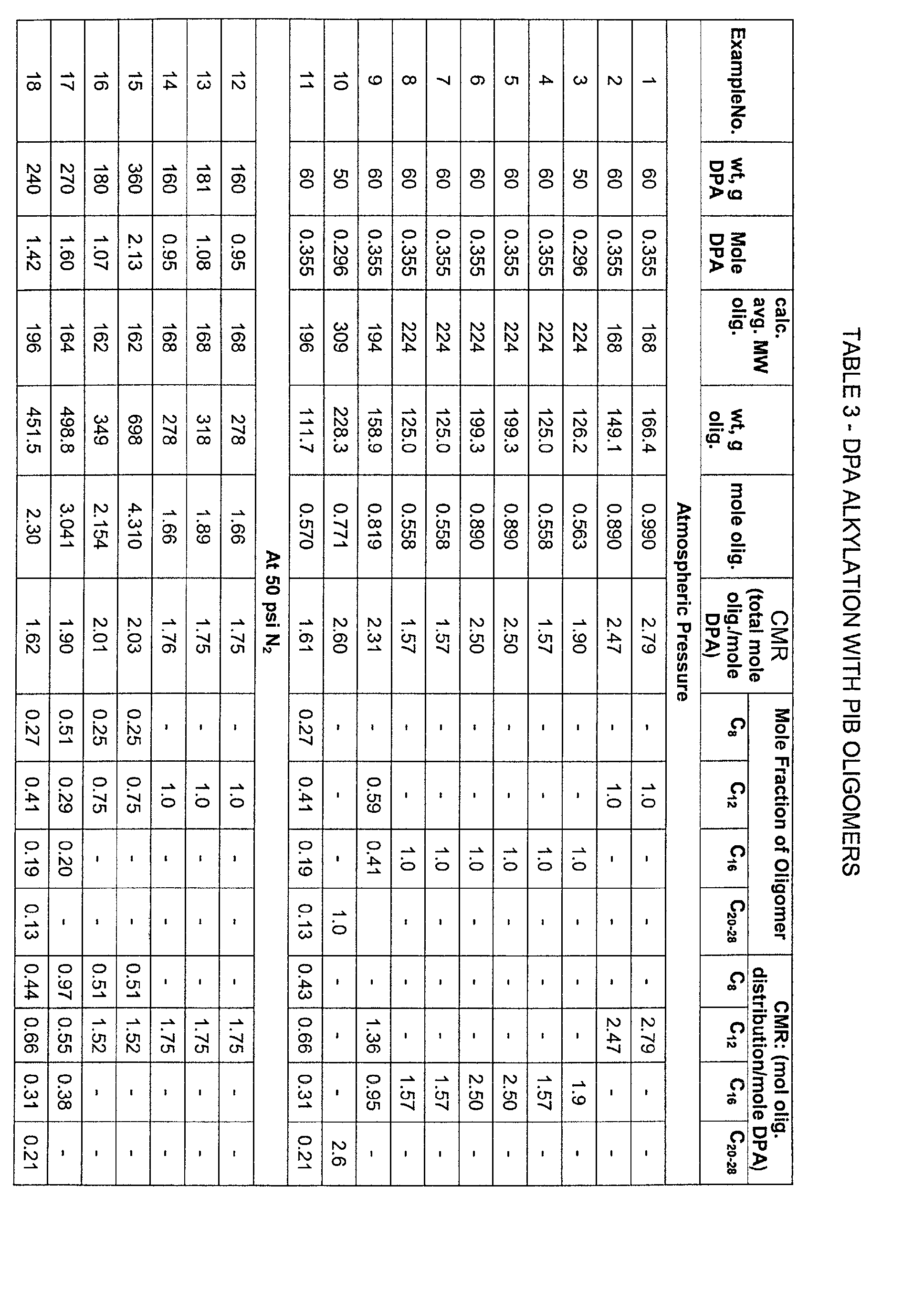
- Tables 1 - 3 in the Examples set forth the mole ratios of polyisobutylene to diphenylamine chosen for Examples 1-18. Other mole ratios may be chosen. The mole ratio chosen for the reaction will affect the degree of DPA conversion to alkylate.
- the mole ratio of diisobutylene:diphenylamine is less that about 0.6:1, preferably less than about 0.55:1 and more preferably less than about 0.45:1.
- reaction can be carried out in a neutral solvent such as mineral oil or an inert hydrocarbon solvent, but generally no solvent is necessary.
- a neutral solvent such as mineral oil or an inert hydrocarbon solvent, but generally no solvent is necessary.
- Reaction time is a very flexible reaction parameter and is dependent on the reaction temperature, mole ratio of reactants and catalysts and pressure. Generally, the reaction will be carried out over a period of about 2 to 30 or more hours, preferably over a period of about 5 to 24 hours, and more preferably over a period of about 6 to 16 hours.
- the desired alkylated diphenylamine products can be isolated using conventional techniques, such as stripping under vacuum or separation by elution with hexane using column chromatography.
- the amount of monoalkylated DPA to dialkylated DPA in the product mixture can typically range from 34 to 68 mole % for the monoalkylate to 32 to 66 mole % for the dialkylate; however, under certain conditions the product mixture can be either predominantly monoalkylate or predominantly dialkylate.
- the molar % ratio of monoalkylate to dialkylate was 44 to 56; in Example No.
- Example No. 1 shown in Table 1 the product contained exclusively mono isomer and a small amount of unreacted DPA.
- the alkylated products were liquid at room temperature (about 20°C) and ambient pressure.
- Tables 1 and 2 Representative experiments with HR PIB oligomers are summarized in Tables 1 and 2. These examples are exploratory in nature, designed to determine the scope of the alkylation reaction and do not necessarily represent optimum conditions for producing any particular product or composition.
- the runs in Tables 1 and 2 are arranged in chronological order, with the C 12 oligomers being listed first, followed by C 16 , etc. Within each oligomer fraction, the runs are also arranged according to reaction temperature, with the lower temperature being listed first.
- Table 1 describes the specific alkylation reaction conditions of Examples 1 - 11.
- Diphenylamine and F-24 (Engelhard) catalyst were added to a 300-mL, three-necked, round-bottom flask fitted with a mechanical stirrer, heating mantle, thermometer, condenser, nitrogen purge and an addition funnel. While stirring, the flask contents were heated to the temperatures shown in Table 1.
- PIB oligomer was incrementally added to the mixture over the times shown in Table 1 to control and maintain the desired reaction temperature. Following oligomer addition the reaction was continued at the temperatures and for the times shown in Table 1.
- the reaction product was cooled, then filtered over Celite under vacuum to separate the spent catalyst.
- the filtrate was analyzed, using GLC and 1 H NMR, for DPA, monoalkylated DPA, dialkylated DPA and the distribution of individual isomers.
- the filtrate was stripped under vacuum to remove unreacted oligomers along with some DPA.
- Example No. 6 in Table 1 Reference is made to Example No. 6 in Table 1 as a specific representation of the above procedure.
- DPA 60 g
- F-24 catalyst 12 g, Engelhard
- TBN 136.5 mg KOH/g; 3.57% N; TBN/N, 38.2.
- Analysis by GLC DPA, 5.3%; C4-DPA, 19.2%; C8-DPA, 16.1%; C12-DPA, 10.7%; C16-DPA, 36.6%; C20-DPA, 12.1%.
- 1 H NMR 5.55 ppm (>NH, monoalkylated DPA, 68%), 5.48 ppm (>NH, dialkylated DPA, 32%), and 5.70 ppm (>NH, free DPA, ⁇ ⁇ 1%).
- Example 11 a commercial PIB distillate (95% purity, C8, 17.4%; C12, 39.8%; C16, 24.4%; C20, 12.9%; C24, 4.1%; and C28, 1.4%) was used without removal of about 5% process solvent.
- Diphenylamine (60 g) and F-24 catalyst (12 g, Engelhard) were added into a 300-mL, three-necked, round-bottomed flask fitted with a mechanical stirrer, heating mantle, thermometer, condenser, nitrogen purge, and addition funnel.
- Examples 12 ⁇ 18 as shown in Table 2 were carried out under nitrogen pressure in a 2-L, 316-stainless steel, mechanically stirred autoclave (Autoclave Engineers, Inc., Erie, PA).
- the autoclave was equipped with a heating mantle, cooling coil and a thermocouple.
- DPA and sulfuric acid-activated catalyst F-24, Engelhardt
- the reaction was continued for 24 h or less.
- the course of the reaction was monitored by GLC.
- the autoclave was cooled and its content filtered over Celite under vacuum to separate product from the catalyst. The filtrate was stripped by heating under high vacuum (1-2 mm Hg) to remove most of the unreacted oligomers and some DPA.
- Example 18 is representative of the specific nitrogen pressure procedures.
- the autoclave was charged with DPA (240 g) and F-24 catalyst (48 g), nitrogen purged, pressured with nitrogen to 50 psi and heated to 165°C.
- PIB distillate 451.5 g, 95.5% purity, C8, 18.3%; C12, 41.0%; C16, 25.0%; C20, 10.5%; C24, 4.1%; and C28, 1.0%)
- CMR (mole tetramer/mole DPA) 1.62] was incrementally added to the autoclave over 105 minutes to control and maintain the reaction temperature at 165°C. The reaction was thereafter continued at 165°C for 16 hours and then allowed to cool.
Landscapes
- Chemical & Material Sciences (AREA)
- Organic Chemistry (AREA)
- Chemical Kinetics & Catalysis (AREA)
- Organic Low-Molecular-Weight Compounds And Preparation Thereof (AREA)
- Low-Molecular Organic Synthesis Reactions Using Catalysts (AREA)
- Anti-Oxidant Or Stabilizer Compositions (AREA)
- Lubricants (AREA)
Abstract
Description
| Alkylation of DPA with HR PIB Oligomers at Atmospheric Pressure | ||||||
| Example No. | PIB Fraction (%MV) | Temp. °C | PIB Addn. Time min | Rxn.Time hr | CMR PIB/DPA | DPA %conv. |
| 1 | C12(40) | 135 | 70 | 20 | 2.79 | 75 |
| 2 | C12(40) | 150 (170) | 22 | 13 (2) | 2.47 | 90 |
| 3 | C16(63) | 135 | 35 | 20 | 1.90 | 67 |
| 4 | C16(63) | 150 | 30 | 22 | 1.57 | 75 |
| 5 | C16(63) | 150 | 50 | 24 | 2.50 | 93 |
| 6 | C16(63) | 170 | 46 | 8 | 2.50 | 96 |
| 7 | C16(63) | 175 | 55 | 6 | 1.57 | 88 |
| 8 | C16(63) | 185 | 30 | 6 | 1.57 | 88 |
| 9 | C12/C16(53) | 175 | 96 | 6 | 2.31 | 91 |
| 10 | C20-28(82) | 175 | 100 | 6 | 2.60 | 93 |
| 11 | C8-28(75) | 145(170) | 135 | 1.5 (4) | 1.61 | 82 |
| Alkylation of DPA with HR PIB Oligomers under 50 psi N2 | ||||||
| Example No. | PIB Fraction (%MV) | Temp. °C | PIB Addn Time/min | Rxn time hr | CMR PIB/DPA | DPA % conv |
| 12 | C12(40) | 150 | 70 | 6 | 1.75 | 83 |
| 13 | C12(40) | 170 | 73 | 24 | 1.75 | 97 |
| 14 | C12(40) | 185(200) | 60 | 4.5(0.5) | 1.76 | 99 |
| 15 | C8/C12(50) | 165 | 160 | 16 | 2.03 | 93 |
| 16 | C8/C12(50) | 175 | 100 | 6 | 2.01 | 89 |
| 17 | C8/C12/C16(63) | 165 | 120 | 16 | 1.90 | 94 |
| 18 | C8-28(75) | 165 | 105 | 16 | 1.62 | 95 |
| Oxidation AO1 Bench Test Results | |||||||
| Sample ID | Base oil | TBN mgKOH/g | %N | TBN/N | RDPA wt% | mono/di ratio2 | hr to 1L. O2 uptake3 |
| Reference | Grp 2 | - | - | - | none | none | 6.4 |
| Irganox L574 | Grp 2 | 181.6 | 4.63 | 39.2 | 0.10 | 52/48 | 13.8 |
| Naugalube 6405 | Grp 2 | 175.9 | 4.58 | 38.4 | 0.10 | 55/45 | 13.9 |
| DPA | Grp 2 | 331.0 | 8.28 | 40.0 | 0.10 | none | 9.8 |
| Example 13 | Grp 2 | 172.7 | 4.67 | 37.0 | 0.10 | 44/56 | 15.4 |
| Example 5 | Grp 2 | 136.5 | 3.57 | 38.2 | 0.10 | 68/32 | 12.8 |
| Example 10 | Grp 2 | 90.6 | 2.44 | 37.2 | 0.10 | 57/43 | 10.3 |
| Example 18 | Grp 2 | 156.3 | 3.95 | 39.6 | 0.10 | 34/66 | 15.6 |
| Example 19 | Grp 2 | 157.2 | 3.97 | 39.6 | 0.10 | 58/42 | 13.2 |
| Reference | Grp 1 | - | - | - | none | none | 3.8 |
| Irganox L57 | Grp 1 | 181.6 | 4.63 | 39.2 | 0.10 | 52/48 | 5.4 |
| Naugalube 640 | Grp 1 | 175.9 | 4.58 | 38.4 | 0.10 | 55/45 | 5.1 |
| Example 13 | Grp 1 | 172.7 | 4.67 | 37.0 | 0.10 | 44/56 | 5.3 |
| Example 5 | Grp 1 | 136.5 | 3.57 | 38.2 | 0.10 | 68/32 | 4.7 |
| Example 18 | Grp 1 | 156.3 | 3.95 | 39.6 | 0.10 | 34/66 | 4.7 |
| Example 19 | Grp 1 | 157.2 | 3.97 | 39.6 | 0.10 | 58/42 | 4.9 |
| Test conditions: Temp.171°C; Pressure, 1.0 atm O2; Stirrer, 1000 rev/min: 1Catalyst: Fe/Cu, 50/5 ppm; Results: ± 0.5 h. 2by 15N or 1H NMR. 3Screening formulation: [13 mM P/kg] ZnDTP, 6.0 % Succinimide, [25] overbased Sulfonate, and [25] Calcium phenate in Group 1 or 2 base oil. 4Irganox® L57 is available commerically from Ciba-Geigy. 5Naugalube® 640 is available commercially from Crompton. |
Claims (26)
- A process for alkylating an aromatic amine, comprising:wherein said alkylated aromatic amine product is liquid at room temperature and atmospheric pressure.in one step reacting an aromatic amine with a polyisobutylene in the presence of a suitable alkylation catalyst at a suitable alkylation reaction temperature less than about 200°C, wherein said polyisobutylene contains at least about 25% of a methylvinylidene isomer and wherein the number average molecular weight of said polyisobutylene is in the range of about 120 to about 600 and wherein the mole ratio of said polyisobutylene to said aromatic amine is in the range of 1.0:1.0 to 4.0:1.0; andforming an alkylated aromatic amine product
- The process of claim 1 wherein the methylvinylidene content of the polyisobutylene is in the range of about 25% to about 95%.
- The process of claim 1 wherein the methylvinylidene content of the polyisobutylene is in the range of about 40% to about 95%.
- The process of claim 1 wherein the methylvinylidene content of the polyisobutylene is in the range of about 60% to about 90%.
- The process of claim 1 wherein said clay catalyst is an acid activated clay catalyst.
- The process of claim 1 wherein said reaction temperature is from about 125°C to about 195°C.
- The process of claim 6 wherein said reaction temperature is from about 135°C to about 175°C.
- The process of claim 6 wherein said reaction temperature is from about 155°C to about 165°C.
- The process of claim 1 wherein the average molecular weight of said polyisobutylene is in the range of about 150 to about 400.
- The process of claim 1 wherein the average molecular weight of said polyisobutylene is in the range of about 160 to about 280.
- The process of claim 1 wherein a reaction time is in the range of about five to 24 hours.
- The process of claim 13 wherein said reaction time is in the range of about six to 16 hours.
- The process of claim 1, wherein the aromatic amine is diphenylamine.
- The process of claim 13 wherein said mole ratio of said polyisobutylene:diphenylamine is from about 1.25:1 to about 3.0:1.
- The process of claim 13 wherein said mole ratio of said polyisobutylene:diphenylamine is from about 1.5:1 to about 2.8:1.
- The process of claim 13 wherein said polyisobutylene has a diisobutylene content in the range of about 10 percent to about 50 percent and wherein the mole ratio of diisobutylene:diphenylamine is less than about 0.6:1.
- The process of claim 16 wherein said clay catalyst is an acid activated clay catalyst.
- The process of claim 17 wherein said reaction temperature is from about 135°C to about 175°C.
- The process of claim 17 wherein said reaction temperature is from about 155°C to about 165°C.
- The process of claim 16 wherein the mole ratio of said diisobutylene:diphenylamine is less than about 0.55:1.
- The process of claim 16 wherein the mole ratio of said diisobutylene:diphenylamine is less than about 0.45:1.
- The process of claim 16 wherein said reaction time is in the range of about five to 24 hours.
- The process of claim 22 wherein said reaction time is in the range of about 6 to 16 hours.
- The process of claims 13 or 16 wherein said process forms a product mixture having 15 or more mole percent dialkylated diphenylamine and 34 or more mole percent monoalkylated diphenylamine.
- The process of claim 1 wherein said aromatic amine is selected from the group consisting of N-phenyl-1-naphthylamine, N-phenyl-2-naphthylamine, p,p'-phenylenediamine, phenothiazine, phenoxazine, p-aminodiphenylamine, p-methylaminodiphenylamine and p-isopropylaminodiphenylamine.
- An alkylated diphenylamine produced according to the process of any preceding claim.
Applications Claiming Priority (2)
| Application Number | Priority Date | Filing Date | Title |
|---|---|---|---|
| US944906 | 2001-08-31 | ||
| US09/944,906 US6355839B1 (en) | 2001-08-31 | 2001-08-31 | Alkylation of diphenylamine with polyisobutylene oligomers |
Publications (3)
| Publication Number | Publication Date |
|---|---|
| EP1288189A2 true EP1288189A2 (en) | 2003-03-05 |
| EP1288189A3 EP1288189A3 (en) | 2003-09-03 |
| EP1288189B1 EP1288189B1 (en) | 2006-11-02 |
Family
ID=25482258
Family Applications (1)
| Application Number | Title | Priority Date | Filing Date |
|---|---|---|---|
| EP02255893A Expired - Lifetime EP1288189B1 (en) | 2001-08-31 | 2002-08-23 | Alkylation of diphenylamine with polyisobutylene oligomers |
Country Status (6)
| Country | Link |
|---|---|
| US (1) | US6355839B1 (en) |
| EP (1) | EP1288189B1 (en) |
| JP (1) | JP4288050B2 (en) |
| CA (1) | CA2399479C (en) |
| DE (1) | DE60215733T2 (en) |
| SG (1) | SG114564A1 (en) |
Cited By (1)
| Publication number | Priority date | Publication date | Assignee | Title |
|---|---|---|---|---|
| CN102276480A (en) * | 2010-06-08 | 2011-12-14 | 中国石油化工集团公司 | Preparation method of high-purity solid alkylated diphenylamine |
Families Citing this family (26)
| Publication number | Priority date | Publication date | Assignee | Title |
|---|---|---|---|---|
| US6867171B2 (en) * | 2002-11-27 | 2005-03-15 | Chevron Oronitz Company Llc | Low molecular weight branched alkenyl succinic acid derivatives prepared from low molecular weight polyisobutene and unsaturated acidic reagents |
| US6884855B2 (en) * | 2003-01-30 | 2005-04-26 | Chevron Oronite Company Llc | Sulfurized polyisobutylene based wear and oxidation inhibitors |
| CN100430368C (en) * | 2003-04-04 | 2008-11-05 | 科聚亚公司 | Process for the production of alkylated diphenylamines |
| US7189875B2 (en) * | 2003-04-04 | 2007-03-13 | Crompton Corporation | Diphenylamine alkylated with olefin mixtures containing fractions with varying degrees of activity |
| US6930183B2 (en) * | 2003-04-17 | 2005-08-16 | Crompton Corporation | Alkylated iminodibenzyls as antioxidants |
| KR101147064B1 (en) * | 2003-07-24 | 2012-05-22 | 더 퀸스 메디컬 센터 | Preparation and use of alkylating agents |
| US20060276677A1 (en) * | 2005-06-02 | 2006-12-07 | Elnagar Hassan Y | Process for synthesizing alkylated arylamines |
| US7390928B2 (en) * | 2005-12-14 | 2008-06-24 | Chemtura Corporation | Alkylation of N′-phenyl-N-alkylphenylenediamines in ionic liquid, N′-phenyl-N-alkyl (alkylphenylene) diamines produced thereby, and lubricant compositions containing same |
| CN101200511B (en) * | 2006-12-12 | 2010-07-14 | 徐夫真 | Method for producing amine polyisobutene |
| US8828916B2 (en) | 2006-12-28 | 2014-09-09 | Chevron Oronite Company Llc | Method to prepare nonylated diphenylamine using recycle sequential temperatures |
| US20080312472A1 (en) * | 2007-06-14 | 2008-12-18 | Stephen Arrowsmith | Additives |
| US7847030B2 (en) * | 2008-02-29 | 2010-12-07 | Exxonmobil Research And Engineering Company | Diphenylamine functionalization of poly-α-olefins |
| US9617201B2 (en) | 2013-10-14 | 2017-04-11 | Chemtura Corporation | Fixed bed process for clay catalyzed alkylation of aromatic amines |
| US9890346B2 (en) | 2014-07-21 | 2018-02-13 | Lanxess Solutions Us Inc. | Selective alkylation method for producing p, p′-di-alkylated diphenylamine antioxidants |
| EP3322690B1 (en) | 2015-07-15 | 2021-08-11 | LANXESS Corporation | Diaryl amine antioxidants prepared from branched olefins |
| WO2018125569A1 (en) | 2016-12-27 | 2018-07-05 | The Lubrizol Corporation | Lubricating composition including n-alkylated dianiline |
| WO2018125567A1 (en) | 2016-12-27 | 2018-07-05 | The Lubrizol Corporation | Lubricating composition with alkylated naphthylamine |
| JP2022526904A (en) | 2019-03-22 | 2022-05-27 | シェブロン・オロナイト・カンパニー・エルエルシー | Antioxidants with high monoalkylated diphenylamine content |
| CA3173369A1 (en) | 2020-03-11 | 2021-09-16 | Chevron Oronite Company Llc | Lubricating oil compositions with improved oxidative performance comprising alkylated diphenylamine antioxidant and sulfonate detergents |
| KR20220149544A (en) | 2020-03-11 | 2022-11-08 | 셰브런 오로나이트 컴퍼니 엘엘씨 | Lubricating Oil Composition With Improved Oxidation Performance Comprising Alkylated Diphenylamine Antioxidant and Carboxylate Detergent |
| CN116601263B (en) | 2020-11-17 | 2025-07-01 | 松原实业有限公司 | Compositions comprising alkylated diphenylamines with enhanced properties |
| CN116685663B (en) | 2020-12-23 | 2025-07-25 | 路博润公司 | Benzazepine compounds as antioxidants for lubricating compositions |
| TW202311225A (en) | 2021-06-25 | 2023-03-16 | 韓商松原產業股份有限公司 | O-alkylated sterically hindered antioxidants |
| EP4655365A1 (en) | 2023-01-24 | 2025-12-03 | The Lubrizol Corporation | Lubricating composition with phenolic antioxidant and low active sulfur |
| EP4689027A1 (en) | 2023-03-31 | 2026-02-11 | LANXESS Corporation | Efficient, low-energy, low waste alkylation and arylation method for producing safe, enviromentally-friendly disubstituted diphenylamine antioxidants |
| WO2025024623A1 (en) | 2023-07-27 | 2025-01-30 | The Lubrizol Corporation | Lubricating composition with phenolic antioxidant, calcium salicylate detergent, and low active sulfur |
Family Cites Families (9)
| Publication number | Priority date | Publication date | Assignee | Title |
|---|---|---|---|---|
| US2943112A (en) | 1957-11-06 | 1960-06-28 | Pennsalt Chemicals Corp | Alkylation of diphenylamine |
| US3452056A (en) | 1966-04-07 | 1969-06-24 | Uniroyal Inc | Substituted diphenylamines |
| DE2702604C2 (en) | 1977-01-22 | 1984-08-30 | Basf Ag, 6700 Ludwigshafen | Polyisobutenes |
| GB8329082D0 (en) | 1983-11-01 | 1983-12-07 | Bp Chem Int Ltd | Low molecular weight polymers of 1-olefins |
| GB8332797D0 (en) | 1983-12-08 | 1984-01-18 | Ciba Geigy Ag | Antioxidant production |
| US5300701A (en) * | 1992-12-28 | 1994-04-05 | Chevron Research And Technology Company | Process for the preparation of polyisobutyl hydroxyaromatics |
| US5672752A (en) | 1995-09-13 | 1997-09-30 | The Bfgoodrich Company | Liquid alkylated diphenylamine antioxidant |
| US5750787A (en) | 1995-09-13 | 1998-05-12 | B. F. Goodrich Company | Liquid alkylated diphenylamine antioxidant |
| US6204412B1 (en) | 1999-04-16 | 2001-03-20 | The B. F. Goodrich Company | Method of manufacturing alkylated diphenylamine compositions and products thereof |
-
2001
- 2001-08-31 US US09/944,906 patent/US6355839B1/en not_active Expired - Lifetime
-
2002
- 2002-08-22 CA CA2399479A patent/CA2399479C/en not_active Expired - Fee Related
- 2002-08-23 EP EP02255893A patent/EP1288189B1/en not_active Expired - Lifetime
- 2002-08-23 DE DE60215733T patent/DE60215733T2/en not_active Expired - Lifetime
- 2002-08-30 SG SG200205238A patent/SG114564A1/en unknown
- 2002-08-30 JP JP2002252820A patent/JP4288050B2/en not_active Expired - Lifetime
Cited By (1)
| Publication number | Priority date | Publication date | Assignee | Title |
|---|---|---|---|---|
| CN102276480A (en) * | 2010-06-08 | 2011-12-14 | 中国石油化工集团公司 | Preparation method of high-purity solid alkylated diphenylamine |
Also Published As
| Publication number | Publication date |
|---|---|
| CA2399479A1 (en) | 2003-02-28 |
| JP2003081922A (en) | 2003-03-19 |
| EP1288189A3 (en) | 2003-09-03 |
| DE60215733D1 (en) | 2006-12-14 |
| EP1288189B1 (en) | 2006-11-02 |
| CA2399479C (en) | 2010-10-19 |
| JP4288050B2 (en) | 2009-07-01 |
| SG114564A1 (en) | 2005-09-28 |
| US6355839B1 (en) | 2002-03-12 |
| DE60215733T2 (en) | 2007-02-08 |
Similar Documents
| Publication | Publication Date | Title |
|---|---|---|
| US6355839B1 (en) | Alkylation of diphenylamine with polyisobutylene oligomers | |
| EP2079677B1 (en) | Macromolecular amine-phenolic antioxidant compositions, process technology thereof, and uses thereof | |
| JP2689283B2 (en) | Aromatic Alkylation with Alpha-Olefin Dimers | |
| EP3172296B1 (en) | Selective alkylation method for producing p,p'-di-alkylated diphenylamine antioxidants | |
| EP1411044B1 (en) | Oxidation stabilized lubricating oils and polyol solutions | |
| US5672752A (en) | Liquid alkylated diphenylamine antioxidant | |
| EP3322690A1 (en) | Diaryl amine antioxidants prepared from branched olefins | |
| JP2002542220A (en) | Process for producing alkylated diphenylamine composition and product thereof | |
| CA2616569C (en) | Method to prepare nonylated diphenylamine using recycle and sequential temperatures | |
| EP4326842B1 (en) | Liquid mono-alkylated n-phenyl-alpha-napthylamine compositions and methods of manufacturing the same | |
| US4219503A (en) | Process for producing 2,6-dialkylanilines | |
| CZ20021049A3 (en) | Process for preparing compositions based on alkylated phenylnaphthtyl amine and products containing thereof | |
| KR20080011685A (en) | Improved Methods for the Synthesis of Alkylated Arylamines | |
| JPS6118748A (en) | Preparation of n-alkyldiphenylamine or its nucleus-substituted compound | |
| HK1065529B (en) | Oxidation stabilized lubricating oils and polyol solutions | |
| CA2526180A1 (en) | Liquid alkylated diphenylamine antioxidant |
Legal Events
| Date | Code | Title | Description |
|---|---|---|---|
| PUAI | Public reference made under article 153(3) epc to a published international application that has entered the european phase |
Free format text: ORIGINAL CODE: 0009012 |
|
| AK | Designated contracting states |
Kind code of ref document: A2 Designated state(s): AT BE BG CH CY CZ DE DK EE ES FI FR GB GR IE IT LI LU MC NL PT SE SK TR Designated state(s): AT BE BG CH CY CZ DE DK EE ES FI FR GB GR IE IT LI LU MC NL PT SE SK TR |
|
| AX | Request for extension of the european patent |
Extension state: AL LT LV MK RO SI |
|
| PUAL | Search report despatched |
Free format text: ORIGINAL CODE: 0009013 |
|
| AK | Designated contracting states |
Kind code of ref document: A3 Designated state(s): AT BE BG CH CY CZ DE DK EE ES FI FR GB GR IE IT LI LU MC NL PT SE SK TR |
|
| AX | Request for extension of the european patent |
Extension state: AL LT LV MK RO SI |
|
| RIC1 | Information provided on ipc code assigned before grant |
Ipc: 7C 07C 209/68 A Ipc: 7C 07C 211/55 B |
|
| 17P | Request for examination filed |
Effective date: 20031107 |
|
| AKX | Designation fees paid |
Designated state(s): DE FR GB NL |
|
| 17Q | First examination report despatched |
Effective date: 20050502 |
|
| GRAP | Despatch of communication of intention to grant a patent |
Free format text: ORIGINAL CODE: EPIDOSNIGR1 |
|
| RTI1 | Title (correction) |
Free format text: ALKYLATION OF DIPHENYLAMINE WITH POLYISOBUTYLENE OLIGOMERS |
|
| GRAS | Grant fee paid |
Free format text: ORIGINAL CODE: EPIDOSNIGR3 |
|
| GRAA | (expected) grant |
Free format text: ORIGINAL CODE: 0009210 |
|
| AK | Designated contracting states |
Kind code of ref document: B1 Designated state(s): DE FR GB NL |
|
| REG | Reference to a national code |
Ref country code: GB Ref legal event code: FG4D |
|
| REF | Corresponds to: |
Ref document number: 60215733 Country of ref document: DE Date of ref document: 20061214 Kind code of ref document: P |
|
| ET | Fr: translation filed | ||
| PLBE | No opposition filed within time limit |
Free format text: ORIGINAL CODE: 0009261 |
|
| STAA | Information on the status of an ep patent application or granted ep patent |
Free format text: STATUS: NO OPPOSITION FILED WITHIN TIME LIMIT |
|
| 26N | No opposition filed |
Effective date: 20070803 |
|
| REG | Reference to a national code |
Ref country code: DE Ref legal event code: R082 Ref document number: 60215733 Country of ref document: DE Representative=s name: HASELTINE LAKE LLP, DE |
|
| REG | Reference to a national code |
Ref country code: FR Ref legal event code: PLFP Year of fee payment: 15 |
|
| REG | Reference to a national code |
Ref country code: FR Ref legal event code: PLFP Year of fee payment: 16 |
|
| REG | Reference to a national code |
Ref country code: FR Ref legal event code: PLFP Year of fee payment: 17 |
|
| PGFP | Annual fee paid to national office [announced via postgrant information from national office to epo] |
Ref country code: NL Payment date: 20190814 Year of fee payment: 18 |
|
| REG | Reference to a national code |
Ref country code: DE Ref legal event code: R082 Ref document number: 60215733 Country of ref document: DE Representative=s name: HL KEMPNER PATENTANWALT, RECHTSANWALT, SOLICIT, DE |
|
| REG | Reference to a national code |
Ref country code: NL Ref legal event code: MM Effective date: 20200901 |
|
| PG25 | Lapsed in a contracting state [announced via postgrant information from national office to epo] |
Ref country code: NL Free format text: LAPSE BECAUSE OF NON-PAYMENT OF DUE FEES Effective date: 20200901 |
|
| PGFP | Annual fee paid to national office [announced via postgrant information from national office to epo] |
Ref country code: FR Payment date: 20210714 Year of fee payment: 20 |
|
| PGFP | Annual fee paid to national office [announced via postgrant information from national office to epo] |
Ref country code: DE Payment date: 20210713 Year of fee payment: 20 Ref country code: GB Payment date: 20210714 Year of fee payment: 20 |
|
| REG | Reference to a national code |
Ref country code: DE Ref legal event code: R071 Ref document number: 60215733 Country of ref document: DE |
|
| REG | Reference to a national code |
Ref country code: GB Ref legal event code: PE20 Expiry date: 20220822 |
|
| PG25 | Lapsed in a contracting state [announced via postgrant information from national office to epo] |
Ref country code: GB Free format text: LAPSE BECAUSE OF EXPIRATION OF PROTECTION Effective date: 20220822 |
|
| P01 | Opt-out of the competence of the unified patent court (upc) registered |
Effective date: 20230522 |