EP1288184A1 - Bis(diphenylvinyl)arene compound - Google Patents
Bis(diphenylvinyl)arene compound Download PDFInfo
- Publication number
- EP1288184A1 EP1288184A1 EP02255997A EP02255997A EP1288184A1 EP 1288184 A1 EP1288184 A1 EP 1288184A1 EP 02255997 A EP02255997 A EP 02255997A EP 02255997 A EP02255997 A EP 02255997A EP 1288184 A1 EP1288184 A1 EP 1288184A1
- Authority
- EP
- European Patent Office
- Prior art keywords
- group
- bis
- diphenylvinyl
- arene compound
- carbonyl
- Prior art date
- Legal status (The legal status is an assumption and is not a legal conclusion. Google has not performed a legal analysis and makes no representation as to the accuracy of the status listed.)
- Granted
Links
- 0 C*C1=C(*)C(*)=C(*)C(C)[C@@]1C(c1c(*)c(*)c(*)c(*)c1N=O)=C(*)C*C(*)=C(c1c(*)c(*)c(*)c(*)c1*)c(c(*)c(*)c(*#C)c1*)c1P Chemical compound C*C1=C(*)C(*)=C(*)C(C)[C@@]1C(c1c(*)c(*)c(*)c(*)c1N=O)=C(*)C*C(*)=C(c1c(*)c(*)c(*)c(*)c1*)c(c(*)c(*)c(*#C)c1*)c1P 0.000 description 2
Classifications
-
- C—CHEMISTRY; METALLURGY
- C07—ORGANIC CHEMISTRY
- C07C—ACYCLIC OR CARBOCYCLIC COMPOUNDS
- C07C25/00—Compounds containing at least one halogen atom bound to a six-membered aromatic ring
- C07C25/24—Halogenated aromatic hydrocarbons with unsaturated side chains
-
- C—CHEMISTRY; METALLURGY
- C07—ORGANIC CHEMISTRY
- C07C—ACYCLIC OR CARBOCYCLIC COMPOUNDS
- C07C309/00—Sulfonic acids; Halides, esters, or anhydrides thereof
- C07C309/63—Esters of sulfonic acids
- C07C309/64—Esters of sulfonic acids having sulfur atoms of esterified sulfo groups bound to acyclic carbon atoms
- C07C309/65—Esters of sulfonic acids having sulfur atoms of esterified sulfo groups bound to acyclic carbon atoms of a saturated carbon skeleton
-
- C—CHEMISTRY; METALLURGY
- C07—ORGANIC CHEMISTRY
- C07C—ACYCLIC OR CARBOCYCLIC COMPOUNDS
- C07C309/00—Sulfonic acids; Halides, esters, or anhydrides thereof
- C07C309/63—Esters of sulfonic acids
- C07C309/72—Esters of sulfonic acids having sulfur atoms of esterified sulfo groups bound to carbon atoms of six-membered aromatic rings of a carbon skeleton
- C07C309/73—Esters of sulfonic acids having sulfur atoms of esterified sulfo groups bound to carbon atoms of six-membered aromatic rings of a carbon skeleton to carbon atoms of non-condensed six-membered aromatic rings
-
- C—CHEMISTRY; METALLURGY
- C07—ORGANIC CHEMISTRY
- C07C—ACYCLIC OR CARBOCYCLIC COMPOUNDS
- C07C43/00—Ethers; Compounds having groups, groups or groups
- C07C43/02—Ethers
- C07C43/20—Ethers having an ether-oxygen atom bound to a carbon atom of a six-membered aromatic ring
- C07C43/225—Ethers having an ether-oxygen atom bound to a carbon atom of a six-membered aromatic ring containing halogen
-
- C—CHEMISTRY; METALLURGY
- C07—ORGANIC CHEMISTRY
- C07F—ACYCLIC, CARBOCYCLIC OR HETEROCYCLIC COMPOUNDS CONTAINING ELEMENTS OTHER THAN CARBON, HYDROGEN, HALOGEN, OXYGEN, NITROGEN, SULFUR, SELENIUM OR TELLURIUM
- C07F7/00—Compounds containing elements of Groups 4 or 14 of the Periodic Table
- C07F7/02—Silicon compounds
- C07F7/08—Compounds having one or more C—Si linkages
- C07F7/0803—Compounds with Si-C or Si-Si linkages
- C07F7/081—Compounds with Si-C or Si-Si linkages comprising at least one atom selected from the elements N, O, halogen, S, Se or Te
-
- C—CHEMISTRY; METALLURGY
- C07—ORGANIC CHEMISTRY
- C07C—ACYCLIC OR CARBOCYCLIC COMPOUNDS
- C07C2603/00—Systems containing at least three condensed rings
- C07C2603/02—Ortho- or ortho- and peri-condensed systems
- C07C2603/04—Ortho- or ortho- and peri-condensed systems containing three rings
- C07C2603/22—Ortho- or ortho- and peri-condensed systems containing three rings containing only six-membered rings
- C07C2603/24—Anthracenes; Hydrogenated anthracenes
Definitions
- the present invention relates to a bis(diphenylvinyl)arene compound.
- JP-A-2000-143778 discloses bis(diphenylvinyl)benzene having two bromine atoms on phenyl group, and a polymer obtained by polymerizing this compound can be used as a light-emitting material.
- the above bis(diphenylvinyl)arene compound having a reactive functional group is not sufficiently soluble in an organic solvent, therefore the reactivity such as polymerization is also still insufficient.
- An object of the present invention is to provide a new bis (diphenylvinyl)arene compound having a reactive functional group on the phenyl group, which has sufficient solubility in an organic solvent and excellent reactivity.
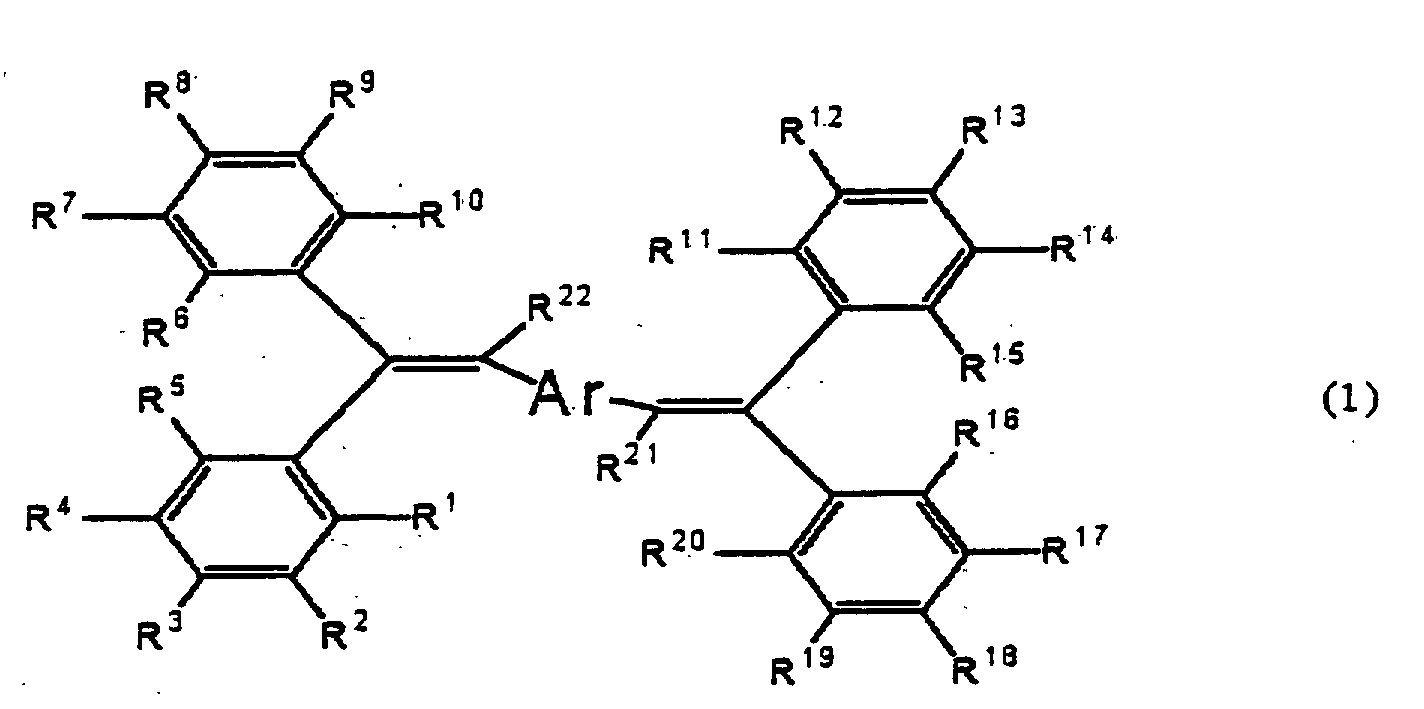
- the present invention relates to a bis (diphenylvinyl) arene compound shown by formula (1), wherein, Ar is an arylene group and has one or more substituents selected from alkylsilyl group, alkoxy phenyl group, arylsulfonyloxy group, alkylsulfonyloxy group, alkyl group, alkenyl group, aralkyl group, arylthio group, aryl alkenyl group, cyclic alkenyl group, alkoxy group, aryloxy group, alkyloxy carbonyl group, aralkyloxy carbonyl group, aryloxy carbonyl group, and aryl group; R 1 -R 22 each independently represent a hydrogen atom, a halogen atom, cyano group, nitro group, arylsulfonyloxy group, alkylsulfonyloxy group, alkyl group, alkenyl group, aralkyl group, aryl
- the arylene group is an atomic group in which two hydrogen atoms are removed from an aromatic hydrocarbon.
- the aromatic hydrocarbon here also includes those having a condensed ring, and those in which two of independent benzene rings or condensed rings are bonded through a direct bond or vinylene group.
- the arylene group usually has about 6 to 20 carbon atoms. Here, the number of carbon atoms of an arylene group does not contain the carbon atoms of the substituent.
- the arylene group specifically exemplified are phenylene group, naphthalenediyl group, and anthracene diyl group, etc. In view of availability of the raw material and reactivity, phenylene group is preferable.
- substituents include: triethylsilyl group, tripropylsilyl group, tributylsilyl group, dimethyloctylsilyl group, etc., as alkylsilyl group; methoxyphenyl group, ethoxyphenyl group, propoxyphenyl group, 3,7-dimethyloctyloxy phenyl group etc., as alkoxyphenyl group; p-toluene sulfonyloxy group, phenyl sulfonyloxy group etc., as arylsulfonyloxy group; propylsulfonyloxy group, trifluoromethyl sulfonyloxy group etc., as alkyl sulfonyloxy group; methyl group, ethyl group, n-propyl group, isopropyl group, n-butyl group, isobutyl group, t-butyl group, n
- substituents may be substituted by, for example: halogen atoms such as fluorine atom, chlorine atom, bromine atom, iodine atom; alkoxy groups such as methoxy group, ethoxy group, n-propoxy group, t-butoxy group, etc.; aryloxy groups such as phenoxy group, etc.; lower alkyl groups such as methyl group, ethyl group, n-propyl group, isopropyl group, n-butyl group, isobutyl group, t-butyl group, n-amyl group, neo pentyl group, n-hexyl group, etc.; lower alkylthio groups such as n-propylthio group, t-butylthio group, etc.; arylthio groups such as phenylthio group, etc.; nitro group; hydroxyl group, etc.
- halogen atoms such as fluorine
- substituents may form a ring and may have a saturated or unsaturated condensed-ring structure.
- alkyl group, alkylsilyl group, and alkoxy phenyl group are preferable in view of solubility.
- the number of these substituents is one or more, and usually 1 to 4.
- R 1 -R 22 may be the same or different from each other, and represent a hydrogen atom, a halogen atom, cyano group, nitro group, arylsulfonyloxy group, alkylsulfonyloxy group, alkyl group, alkenyl group, aralkyl group, arylthio group, arylalkenyl group, cyclic alkenyl group, alkoxy group, aryloxy group, alkyloxy carbonyl group, aralkyloxy carbonyl group, aryloxy carbonyl group, or aryl group.
- at least one of R 1 -R 20 is a halogen atom, an aryl sulfonyloxy group, or an alkylsulfonyloxy group.
- a halogen atom, aryl sulfonyloxy group, or alkyl sulfonyloxy group may be available as a reactive group, such as for polymerization. What is necessary is just to have one group of these, but in order to be used as a monomer for polymerization, preferable is to have two or more groups of these.
- R 3 in formula (1) is a halogen atom, arylsulfonyloxy group, or alkyl sulfonyloxy group.
- R 3 and R 13 are halogen atoms, arylsulfonyloxy groups, or alkylsulfonyloxy groups.
- R 1 -R 22 of formula (1) fluorine atom, chlorine atom, bromine atom, and iodine atom, etc. are exemplified as the halogen atom, and chlorine atom and bromine atom are preferable.
- arylsulfonyloxy groups exemplified are p-toluene sulfonyloxy group, phenyl sulfonyloxy group, etc.; and as the alkylsulfonyloxy groups, exemplified are propylsulfonyloxy group, trifluoromethyl sulfonyloxy group, etc. Among them, p-toluene sulfonyloxy group and trifluoro methyl sulfonyloxy group are preferable in view of ready availability and reactivity.
- alkyl groups exemplified are methyl group, ethyl group, n-propyl group, isopropyl group, n-butyl group, isobutyl group, t-butyl group, n-amyl group, neopentyl group, n-hexyl group, cyclohexyl group, n-octyl group, n-nonyl group, 2,3,4-trimethyl-3-pentyl group, 2,4-dimethyl-3-pentyl group etc.; and as the aralkyl groups, exemplified are benzyl group, 2-phenylethyl group, 2-naphtylethyl group, diphenyl methyl group, etc.
- aryl groups exemplified are phenyl group, naphtyl group, biphenyl group, furyl group, etc.; and as the arylthio groups, exemplified are thiophenyl group etc.
- alkenyl groups exemplified are 2-methyl-1-propenyl group, 2-butenyl group, etc.
- aryl alkenyl groups exemplified are trans- ⁇ - styryl group, 3-phenyl-1-propenyl group, etc.
- cyclic alkenyl groups exemplified are 1-cyclohexenyl group etc.
- alkoxy groups exemplified are methoxy group, ethoxy group, n-propoxy group, t-butoxy group, etc.; and as the aryloxy group, exemplified are phenoxy group, naphtyloxy group, diphenyloxy group, etc.
- alkyloxy carbonyl groups exemplified are methoxy carbonyl group, ethoxy carbonyl group, t -butyloxy carbonyl group, etc.; as the aralkyloxy carbonyl groups, exemplified are benzyloxy carbonyl group, etc.; and as the aryloxy carbonyl groups, exemplified are phenyloxy carbonyl group etc.
- groups other than hydrogen atom, halogen atom, cyano group, and nitro group may be substituted with: a halogen atom such as fluorine atom, chlorine atom, bromine atom, and iodine atom; alkoxy group sucu as methoxy group, ethoxy group, n-propoxy group, t-butoxy group, etc.; aryloxy group such as phenoxy group, etc.; lower alkyl group such as methyl group, ethyl group, n-propyl group, isopropyl group, n-butyl group, isobutyl group, t-butyl group, n-amyl group, neo pentyl group, n-hexyl group, etc.; lower alkylthio group such as n-propylthio groups, such as , and t-butylthio group, etc.; arylthio group such as
- compound (E) which is an example of the compound of general formula (1), can be produced, for example as shown by the following figure: by reacting a dihalomethyl aryl compound (A) with phosphorous ester (B) to produce a bis (dialkylphosphonomethyl)aryl compound (C) (step 1): and by reacting the bis (dialkylphosphonomethyl)aryl compound (C) produced in step 1 with a benzophenone compound (D) (step 2).
- Ar of dihalomethylaryl compound (A) is the same as exemplified about the compounds of the above formula (1).
- Y is a halogen atom.
- halogen atoms for example, chlorine atom, bromine atom, and iodine atom are exemplified, and bromine atom is preferable.
- step 1 as the phosphorous ester (B), trimethyl phosphite, triethyl phosphite, tri-n-propyl phosphite, etc. are exemplified, and triethyl phosphite is preferable.
- Step 1 is usually carried out with using phosphorous ester (B) as a solvent.
- a solvent may be mixed further.
- the solvent to be mixed for example: ether solvents such as diethyl ether, tetrahydrofuran, tertiary butylmethylether, and dioxane; hydrocarbon solvents such as hexane, cyclohexane, toluene, xylene, etc. can be used as an inert solvent under the reaction.
- the amount of the solvent used is not especially limited, but it is usually about 10 to 500 times to dihalomethylaryl compound (A) in a weight ratio.
- the reaction temperature is usually a reflux temperature.
- the reaction temperature is usually about from 50 °C to 250 °C, and suitably from 110 °C to 180 °C.
- reaction time is not limited especially, it is usually for about from 30 minutes to 100 hours. Usually, the time when substantially all of the raw material dihalomethylaryl compound (A) is consumed, is considered as the end of reaction,
- bis (dialkylphosphonomethyl) aryl compound (C) can be obtained by distilling off the remaining phosphorous ester and solvent under reduced pressure.
- a conventional method for example, after mixing with a weakly basic water, such as sodium-hydrogencarbonate water etc., extraction with an organic solvent such as toluene, ethyl acetate, diethyl ether, dichloro methane, is carried out, and the desired bis (dialkylphosphonomethyl) aryl compound can be obtained by concentrating the resultant organic layer.
- purification by column chromatography or distillation may be carried out according to needs.
- step 2 bis (dialkylphosphonomethyl) aryl compound (C) obtained by the above step 1 is reacted with benzophenone compound (D) under existence of a base, and compound (E) which is an example of bis (diphenyl vinyl) arene compound (1) of the present invention can be obtained.
- the amounts of benzophenone compound (D) is usually about 0.5 to 10 mols, and preferably 1.5 to 4 mols based on 1 mol of bis (dialkylphosphonomethyl) aryl compound (C).
- inorganic bases such as sodium hydroxide, potassium hydroxide, etc.
- alcoholate bases such as sodium methylate, potassium methylate, lithium methylate, sodium ethylate, potassium ethylate, lithium ethylate, sodium tertiary butyrate, potassium tertiary butyrate, lithium tertiary butyrate, etc.
- amide bases such as lithium amide, sodium amide potassium amide, etc.
- the amount of the base is not limited especially, it is usually about 1.5 to 10 mols, and suitably 2.5 to 4 mols based on 1 mol of the raw material of bis (dialkylphosphonomethyl) aryl compounds.
- the reaction of step 2 is usually carried out in a solvent.
- a solvent an inert solvent is used, and exemplified are: halogenated solvents such as chloroform, dichloromethane, 1,2-dichloroethane, etc.; ether solvents such as ethyl ether, diethoxy methane, tetrahydrofuran, dimethoxy ethane, dioxane, etc.; and hydrocarbon solvents such as hexane, toluene, etc. Ether solvents are used preferably
- the amount of the solvent used is not limited especially, but it is usually about 0.1 to 500 times to benzophenone compound (D) in a weight ratio.
- the reaction temperature is not limited especially, but it is usually about 0 to 100 °C.
- the reaction time is about 30 minutes to 24 hours. Disappearance of the raw material bis(dialkylphosphonomethyl)aryl compound is considered as the reaction end.
- the bis(diphenylvinyl)arene compound having a reactive functional group on phenyl group of the present invention has sufficient solubility in an organic solvent and excellent reactivity, and can be preferably used as a raw material for a polymer of a light-emitting material.
Landscapes
- Chemical & Material Sciences (AREA)
- Organic Chemistry (AREA)
- Organic Low-Molecular-Weight Compounds And Preparation Thereof (AREA)
Abstract

Description
- The present invention relates to a bis(diphenylvinyl)arene compound.
- As a bis(diphenylvinyl)arene compound having a reactive functional group such as a halogen atom, for example, JP-A-2000-143778 discloses bis(diphenylvinyl)benzene having two bromine atoms on phenyl group, and a polymer obtained by polymerizing this compound can be used as a light-emitting material.
- However, the above bis(diphenylvinyl)arene compound having a reactive functional group is not sufficiently soluble in an organic solvent, therefore the reactivity such as polymerization is also still insufficient.
- An object of the present invention is to provide a new bis (diphenylvinyl)arene compound having a reactive functional group on the phenyl group, which has sufficient solubility in an organic solvent and excellent reactivity.
- The present invention relates to a bis (diphenylvinyl) arene compound shown by formula (1),wherein, Ar is an arylene group and has one or more substituents selected from alkylsilyl group, alkoxy phenyl group, arylsulfonyloxy group, alkylsulfonyloxy group, alkyl group, alkenyl group, aralkyl group, arylthio group, aryl alkenyl group, cyclic alkenyl group, alkoxy group, aryloxy group, alkyloxy carbonyl group, aralkyloxy carbonyl group, aryloxy carbonyl group, and aryl group; R1-R22 each independently represent a hydrogen atom, a halogen atom, cyano group, nitro group, arylsulfonyloxy group, alkylsulfonyloxy group, alkyl group, alkenyl group, aralkyl group, arylthio group, arylalkenyt group, cyclic alkenyl group, alkoxy group, aryloxy group, alkyloxy carbonyl group, aralkyloxy carbonyl group, aryloxy carbonyl group, or aryl group; and at least one of R1-R20 is a halogen atom, arylsulfonyloxy group or alkyl sulfonyloxy group.

- The arylene group is an atomic group in which two hydrogen atoms are removed from an aromatic hydrocarbon. The aromatic hydrocarbon here also includes those having a condensed ring, and those in which two of independent benzene rings or condensed rings are bonded through a direct bond or vinylene group. The arylene group usually has about 6 to 20 carbon atoms. Here, the number of carbon atoms of an arylene group does not contain the carbon atoms of the substituent. As the arylene group, specifically exemplified are phenylene group, naphthalenediyl group, and anthracene diyl group, etc. In view of availability of the raw material and reactivity, phenylene group is preferable.
- Next, the substituent contained in the arylene group is explained.
- Examples of the substituents include: triethylsilyl group, tripropylsilyl group, tributylsilyl group, dimethyloctylsilyl group, etc., as alkylsilyl group; methoxyphenyl group, ethoxyphenyl group, propoxyphenyl group, 3,7-dimethyloctyloxy phenyl group etc., as alkoxyphenyl group; p-toluene sulfonyloxy group, phenyl sulfonyloxy group etc., as arylsulfonyloxy group; propylsulfonyloxy group, trifluoromethyl sulfonyloxy group etc., as alkyl sulfonyloxy group; methyl group, ethyl group, n-propyl group, isopropyl group, n-butyl group, isobutyl group, t-butyl group, n-amyl group, neopentyl group, n-hexyl group, cyclohexyl group, n-octyl group, n-nonyl group, 2,3,4-trimethyl-3-pentyl group, 2,4-dimethyl-3-pentyl group etc., as alkyl group; benzyl group, 2-phenylethyl group, 2-naphtylethyl group, diphenylmethyl group, etc.,. as aralkyl group; phenyl group, naphtyl group, biphenyl group, furyl group, etc., as aryl group;. thiophenyl group etc., as arylthio group; 2-methyl-1-propenyl group, 2-butenyl group etc., as alkenyl group; trans-β-styryl group, 3-phenyl-1-propenyl group etc., as aryl alkenyl group; 1-cyclohexenyl group etc., as cyclic alkenyl group: methoxy group, ethoxy group, n-propoxy group, t-butoxy group etc., as alkoxy group; phenoxy group, naphtyloxy group, diphenyloxy group etc., as aryloxy group; methoxy carbonyl group, ethoxy carbonyl group, t-butyloxy carbonyl group, as alkyloxy carbonyl group; and benzyloxy carbonyl group etc., as aralkyloxy carbonyl group; and phenyloxy carbonyl group etc., as aryloxy carbonyl group, respectively. Moreover, the above substituents may be substituted by, for example: halogen atoms such as fluorine atom, chlorine atom, bromine atom, iodine atom; alkoxy groups such as methoxy group, ethoxy group, n-propoxy group, t-butoxy group, etc.; aryloxy groups such as phenoxy group, etc.; lower alkyl groups such as methyl group, ethyl group, n-propyl group, isopropyl group, n-butyl group, isobutyl group, t-butyl group, n-amyl group, neo pentyl group, n-hexyl group, etc.; lower alkylthio groups such as n-propylthio group, t-butylthio group, etc.; arylthio groups such as phenylthio group, etc.; nitro group; hydroxyl group, etc.
- Further, these substituents may form a ring and may have a saturated or unsaturated condensed-ring structure.
- Among them, alkyl group, alkylsilyl group, and alkoxy phenyl group are preferable in view of solubility. The number of these substituents is one or more, and usually 1 to 4.
- Next, R1-R22 of formula (1) are explained.
- In formula (1), R1-R22 may be the same or different from each other, and represent a hydrogen atom, a halogen atom, cyano group, nitro group, arylsulfonyloxy group, alkylsulfonyloxy group, alkyl group, alkenyl group, aralkyl group, arylthio group, arylalkenyl group, cyclic alkenyl group, alkoxy group, aryloxy group, alkyloxy carbonyl group, aralkyloxy carbonyl group, aryloxy carbonyl group, or aryl group. Here, at least one of R1-R20 is a halogen atom, an aryl sulfonyloxy group, or an alkylsulfonyloxy group.
- A halogen atom, aryl sulfonyloxy group, or alkyl sulfonyloxy group may be available as a reactive group, such as for polymerization. What is necessary is just to have one group of these, but in order to be used as a monomer for polymerization, preferable is to have two or more groups of these.
- When the number of halogen atom, arylsulfonyloxy group, or alkylsulfonyloxy groups is one, it is preferable that R3 in formula (1) is a halogen atom, arylsulfonyloxy group, or alkyl sulfonyloxy group.
- Moreover, when the number is two, it is preferable that R3 and R13 are halogen atoms, arylsulfonyloxy groups, or alkylsulfonyloxy groups.
- In R1-R22 of formula (1), fluorine atom, chlorine atom, bromine atom, and iodine atom, etc. are exemplified as the halogen atom, and chlorine atom and bromine atom are preferable.
- As the arylsulfonyloxy groups, exemplified are p-toluene sulfonyloxy group, phenyl sulfonyloxy group, etc.; and as the alkylsulfonyloxy groups, exemplified are propylsulfonyloxy group, trifluoromethyl sulfonyloxy group, etc. Among them, p-toluene sulfonyloxy group and trifluoro methyl sulfonyloxy group are preferable in view of ready availability and reactivity.
- As the alkyl groups, exemplified are methyl group, ethyl group, n-propyl group, isopropyl group, n-butyl group, isobutyl group, t-butyl group, n-amyl group, neopentyl group, n-hexyl group, cyclohexyl group, n-octyl group, n-nonyl group, 2,3,4-trimethyl-3-pentyl group, 2,4-dimethyl-3-pentyl group etc.; and as the aralkyl groups, exemplified are benzyl group, 2-phenylethyl group, 2-naphtylethyl group, diphenyl methyl group, etc.
- As the aryl groups, exemplified are phenyl group, naphtyl group, biphenyl group, furyl group, etc.; and as the arylthio groups, exemplified are thiophenyl group etc.
- As the alkenyl groups, exemplified are 2-methyl-1-propenyl group, 2-butenyl group, etc.; as the aryl alkenyl groups, exemplified are trans-β- styryl group, 3-phenyl-1-propenyl group, etc.; and as the cyclic alkenyl groups, exemplified are 1-cyclohexenyl group etc.
- As the alkoxy groups, exemplified are methoxy group, ethoxy group, n-propoxy group, t-butoxy group, etc.; and as the aryloxy group, exemplified are phenoxy group, naphtyloxy group, diphenyloxy group, etc.
- As the alkyloxy carbonyl groups, exemplified are methoxy carbonyl group, ethoxy carbonyl group, t -butyloxy carbonyl group, etc.; as the aralkyloxy carbonyl groups, exemplified are benzyloxy carbonyl group, etc.; and as the aryloxy carbonyl groups, exemplified are phenyloxy carbonyl group etc.
- Among the above R1-R22, groups other than hydrogen atom, halogen atom, cyano group, and nitro group, may be substituted with: a halogen atom such as fluorine atom, chlorine atom, bromine atom, and iodine atom; alkoxy group sucu as methoxy group, ethoxy group, n-propoxy group, t-butoxy group, etc.; aryloxy group such as phenoxy group, etc.; lower alkyl group such as methyl group, ethyl group, n-propyl group, isopropyl group, n-butyl group, isobutyl group, t-butyl group, n-amyl group, neo pentyl group, n-hexyl group, etc.; lower alkylthio group such as n-propylthio groups, such as , and t-butylthio group, etc.; arylthio group such as phenylthio group, etc.; nitro group; hydroxyl group, etc.
- Following compounds are illustrated as a concrete example of bis(diphenylvinyl)arene compound (1) of the present invention.
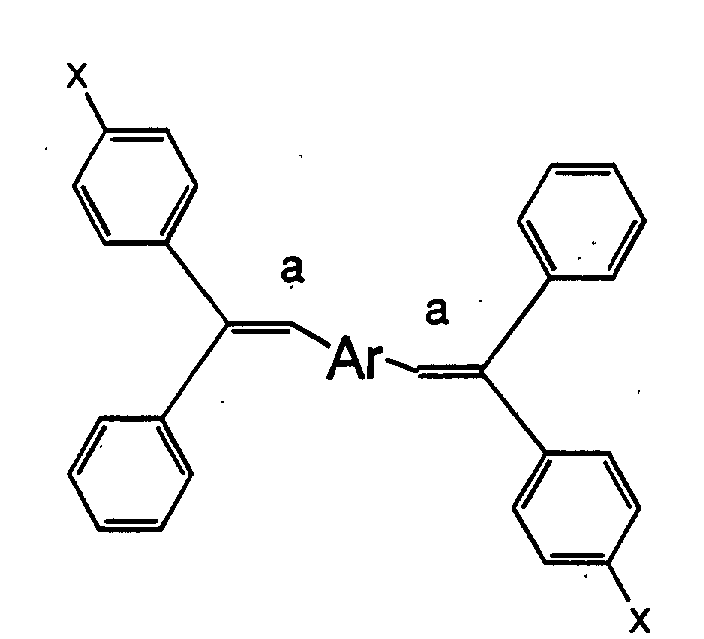
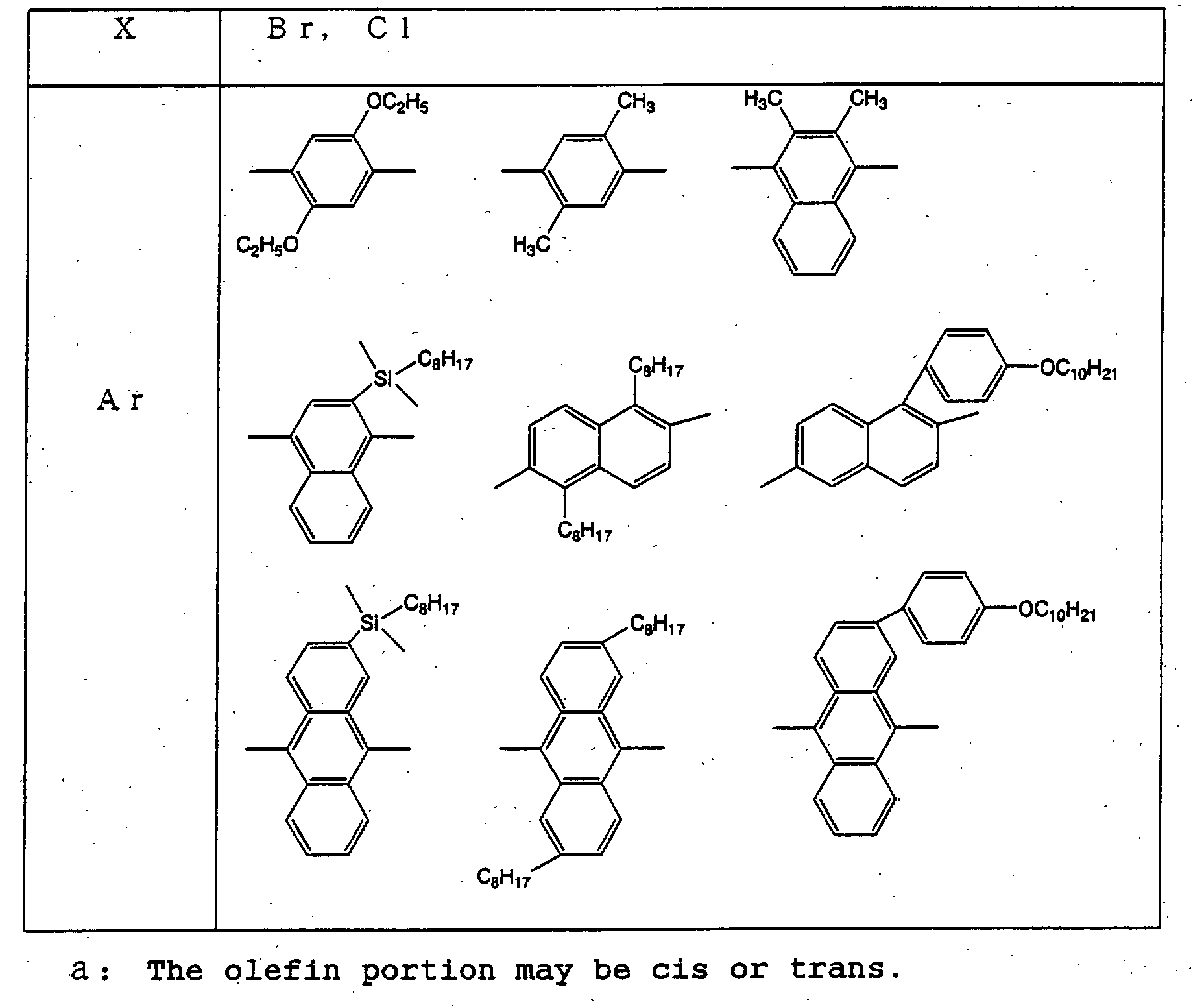
- Although the method for preparing the compound of general formula (1) of the present invention is not especially limited, compound (E) which is an example of the compound of general formula (1), can be produced, for example as shown by the following figure: by reacting a dihalomethyl aryl compound (A) with phosphorous ester (B) to produce a bis (dialkylphosphonomethyl)aryl compound (C) (step 1):
and by reacting the bis (dialkylphosphonomethyl)aryl compound (C) produced in step 1 with a benzophenone compound (D) (step 2).

- In step 1, Ar of dihalomethylaryl compound (A) is the same as exemplified about the compounds of the above formula (1). Y is a halogen atom. As halogen atoms, for example, chlorine atom, bromine atom, and iodine atom are exemplified, and bromine atom is preferable.
- In step 1, as the phosphorous ester (B), trimethyl phosphite, triethyl phosphite, tri-n-propyl phosphite, etc. are exemplified, and triethyl phosphite is preferable. Step 1 is usually carried out with using phosphorous ester (B) as a solvent.
- In step 1, a solvent may be mixed further. As the solvent to be mixed, for example: ether solvents such as diethyl ether, tetrahydrofuran, tertiary butylmethylether, and dioxane; hydrocarbon solvents such as hexane, cyclohexane, toluene, xylene, etc. can be used as an inert solvent under the reaction. The amount of the solvent used is not especially limited, but it is usually about 10 to 500 times to dihalomethylaryl compound (A) in a weight ratio.
- When using a phosphorous ester as a solvent, the reaction temperature is usually a reflux temperature. When using other solvent with mixing, it can be made to react, if necessary at a pressurized condition, at the same temperature with the reflux temperature of the case using phosphorous ester as a solvent.. Specifically, the reaction temperature is usually about from 50 °C to 250 °C, and suitably from 110 °C to 180 °C.
- Although the reaction time is not limited especially, it is usually for about from 30 minutes to 100 hours. Usually, the time when substantially all of the raw material dihalomethylaryl compound (A) is consumed, is considered as the end of reaction,
- After reaction, bis (dialkylphosphonomethyl) aryl compound (C) can be obtained by distilling off the remaining phosphorous ester and solvent under reduced pressure. If necessary, from the resultant reaction concentrate, by a conventional method, for example, after mixing with a weakly basic water, such as sodium-hydrogencarbonate water etc., extraction with an organic solvent such as toluene, ethyl acetate, diethyl ether, dichloro methane, is carried out, and the desired bis (dialkylphosphonomethyl) aryl compound can be obtained by concentrating the resultant organic layer. Moreover, purification by column chromatography or distillation may be carried out according to needs.
- In step 2, bis (dialkylphosphonomethyl) aryl compound (C) obtained by the above step 1 is reacted with benzophenone compound (D) under existence of a base, and compound (E) which is an example of bis (diphenyl vinyl) arene compound (1) of the present invention can be obtained.
- By changing the benzophenone compound, various compounds of the present invention (I) can be produced.
- The amounts of benzophenone compound (D) is usually about 0.5 to 10 mols, and preferably 1.5 to 4 mols based on 1 mol of bis (dialkylphosphonomethyl) aryl compound (C).
- As the base used in step 2, exemplified are: inorganic bases such as sodium hydroxide, potassium hydroxide, etc.; alcoholate bases such as sodium methylate, potassium methylate, lithium methylate, sodium ethylate, potassium ethylate, lithium ethylate, sodium tertiary butyrate, potassium tertiary butyrate, lithium tertiary butyrate, etc.; and amide bases such as lithium amide, sodium amide potassium amide, etc. The amount of the base is not limited especially, it is usually about 1.5 to 10 mols, and suitably 2.5 to 4 mols based on 1 mol of the raw material of bis (dialkylphosphonomethyl) aryl compounds.
- The reaction of step 2 is usually carried out in a solvent. As the solvent, an inert solvent is used, and exemplified are: halogenated solvents such as chloroform, dichloromethane, 1,2-dichloroethane, etc.; ether solvents such as ethyl ether, diethoxy methane, tetrahydrofuran, dimethoxy ethane, dioxane, etc.; and hydrocarbon solvents such as hexane, toluene, etc. Ether solvents are used preferably
- The amount of the solvent used is not limited especially, but it is usually about 0.1 to 500 times to benzophenone compound (D) in a weight ratio.
- The reaction temperature is not limited especially, but it is usually about 0 to 100 °C. The reaction time is about 30 minutes to 24 hours. Disappearance of the raw material bis(dialkylphosphonomethyl)aryl compound is considered as the reaction end.
- If necessary, from the resultant reaction mixture, by a conventional method, for example, after mixing with dilute sulfuric acid, extraction with an organic solvent such as toluene, ethyl acetate, diethyl ether, dichloro methane, is carried out, and the desired bis (diarylvinyl) aryl compound can be obtained by concentrating the resultant organic layer. Moreover, purification by column chromatography or distillation may be carried out according to needs.
- Hereafter, although the examples explain the present invention in detail, the present invention should not be construed to be limited thereto.
- Under an inert atmosphere, 4-bromobenzophenone (0.783g, 3mmol), and 1,4-bis-(diethylphosphonomethyl)-2-(2-ethylhexyloxy)-5-methoxy benzene (0.660g, 1.23mmol) were dissolved in tetrahydrofuran (10g). At room temperature, tetrahydrofuran (3.28g) solution of tert-butoxy potassium (0.414g, 3.69mmol) was added dropwise for 5 minutes, and successively stirred for 3.5 hours. The reaction mixture was charged into water (100ml) and neutralized with 5% sulfuric acid. After neutralization, ethyl acetate (250ml) was added and the organic layer was partitioned. The organic layer was washed with water and dried over anhydrous sodium sulfate. The solvent was distilled off under reduced pressure, and the resultant raw product was purified by silica gel chromatography to give the desired product. (Yield: 0.86g. 93%)
MS Spectrum: M+ 751.2, M+-C8H16 639.1
1H-NMR(200MHz/CDCl3)
ä 0.78-1.05ppm (m, 6H), 1.15-1.70ppm (m, 9H) 3.02-3.38 ppm (m, 5H), 6.13-6.30 ppm (m, 2H), 6.98-7.55 ppm (m, 20H) - Under an inert atmosphere, 4-bromobenzophenone (3.917g, 15mmol), and 9,10-bis-(diethylphosphonomethyl) anthracene (2.942g, 6.15mmol) were dissolved in tetrahydrofuran (40g). At room temperature, tetrahydrofuran (16.38g) solution of tert-butoxy potassium (2.070g, 18.45mmol) was added dropwise for 5 minutes, and successively stirred for 3.5 hours.. The reaction mixture was charged into water (100ml) and neutralized with 5% sulfuric acid. After neutralization, the crystal was filtrated and the dissolved in tetrahydrofuran (300ml). Then, the solvent was partly distilled off under reduced pressure, and cooled to deposit crystal. The crystal was filtrated and dried to give the desired product. (Yield: 1.10, 26%)
MS Spectrum: M+ 693.1 - Under an inert atmosphere, 4-bromobenzophenone (2.611g, 10mmol), and 1,4-bis(diethylphosphonomethyl)-2-(3,7-dimethyloctyl)-5-methyl benzene (2.184g, 4.10 mmol) were dissolved in tetrahydrofuran (30g). At room temperature, tetrahydrofuran (10.92g) solution of tert-butoxy potassium (1.380g, 12.30mmol) was added dropwise for 5 minutes, and successively stirred for 3.5 hours. The reaction mixture was charged into water (200ml) and neutralized with 5% sulfuric acid. After neutralization, ethyl acetate (250ml) was added and the organic layer was partitioned. The organic layer was washed with water and dried over anhydrous sodium sulfate. The solvent was distilled off under reduced pressure, and the resultant raw product was purified by silica gel chromatography to give the desired product. (Yield: 1.34g, 44%)
MS Spectrum: M+ 747.2 and M+-C9H18 621.1
1H-NMR(200MHz/CDCl3)
ä 0.55-0.93 ppm (m, 9H), 0.93-1.60 ppm (m, 8H), 1.85-2.15 ppm(m,.2H), 2.15-2.53 ppm (m, 5H), 6.41-6.65 (m, 2H), 6.80-7.58 ppm (m, 20H) - Under an inert atmosphere, 4-bromobenzophenone (1.306g, 5mmol), and 1,4-bis(diethylphosphonomethyl)-2-[4-(3,7-dimethyloctyloxy)phenyl]benzene (2.184g, 2.05mmol) were dissolved in tetrahydrofuran (15g). At room temperature, tetrahydrofuran (5.46g) solution of tert-butoxy potassium (0.690g, 6.15mmol) was added dropwise for 5 minutes, and successively stirred for 3.5 hours. The reaction mixture was charged into water (100ml) and neutralized with 5% sulfuric acid. After neutralization, ethyl acetate (150ml) was added and the organic layer was partitioned. The organic layer was washed with water and dried over anhydrous sodium sulfate. The solvent was distilled off under reduced pressure, and the resultant raw product was purified by silica gel chromatography to give the desired product. (Yield: 1.22g, 72%)
MS spectrum: M+ 825.2, M+-ph 747.2, M+-ph-Br 669.2
1H-NMR(200MHz/CDCl3)
ä 0.80-1.05 ppm (m, 9H), 1.05-1.90 ppm (m, 10H), 3.85-4.05 ppm (m, 2H), 6.62-7.58 ppm (m, 27H) - Under an inert atmosphere, 4-bromobenzophenone (1.306g, 5mmol), and 1,4-bis(diethylphosphonomethyl)-2-dimethyloctylsilyl benzene (1.125g, 2.05 mmol) were dissolved in tetrahydrofuran (15g). At room temperature, tetrahydrofuran (5.46g) solution of tert-butoxy potassium (0.690g, 6.15mmol) was added dropwise for 5 minutes, and successively stirred for 3.5 hours. The reaction mixture was charged into water (100ml) and neutralized with 5% sulfuric acid. After neutralization, ethyl acetate (200ml) was added and the organic layer was partitioned. The organic layer was washed with water and dried over anhydrous sodium sulfate. The solvent was distilled off under reduced pressure, and the resultant raw product was purified by silica gel chromatography to give the desired product.
(Yield: 1.29g, 83%)
MS spectrum: M+ 763.2
1H-NMR(200MHz/CDCl3)
ä 0.05-0.35 ppm (m, 6H), 0.60-0.82 (m, 2H), 0.82-1.05 (m, 3H), 1.17-1.45 (m, 12H), 6.55-6.78 (m, 2H), 6.78-7.55 (m, 21H) - Under an inert atmosphere, 4-chlorobenzophenone (0.650g, 3mmol), and 1,4-bis(diethylphosphonomethyl)-2-(2-ethylhexylxoy)-5-methoxy benzene (0.660g, 1.23 mmol) are dissolved in tetrahydrofuran (10g). At room temperature, tetrahydrofuran (3.28g) solution of tert-butoxy potassium (0.414g, 3.69mmol) is added dropwise for 5 minutes, and successively stirred for 3.5 hours. The reaction mixture is charged into water (200ml) and neutralized with 5% sulfuric acid. After neutralization, a hydrophobic solvent is added and the organic layer is partitioned. The organic layer is washed with water and dried over anhydrous sodium sulfate. The solvent is distilled off under reduced pressure, and the resultant raw product is purified by silica gel chromatography or recrystallization to give a desired product.
- Under an inert atmosphere, 3-bromobenzophenone (3.917g, 15mmol), and 9,10-bis(diethylphosphonomethyl)anthracene (2.942g, 6.17 mmol) are dissolved in tetrahydrofuran (40g). At room temperature, tetrahydrofuran (16.38g) solution of tert-butoxy potassium (2.070g, 18.45mmol) is added dropwise for 5 minutes, and successively stirred for 3.5 hours. The reaction mixture is charged into water (200ml) and neutralized with 5% sulfuric acid. After neutralization, a hydrophobic solvent is added and the organic layer is partitioned. The organic layer is washed with water and dried over anhydrous sodium sulfate. The solvent is distilled off under reduced pressure, and the resultant raw product is purified by silica gel chromatography or recrystallization to give a desired product.
- Under an inert atmosphere, 4-bromobenzophenone (2.611g, 10mmol), and 1,4-bis(diethylphosphonomethyl) -2,5-diethoxybenzene (1.912g, 4.10mmol) are dissolved in tetrahydrofuran (30g). At room temperature, tetrahydrofuran (10.92g) solution of tert-butoxy potassium (1.380g, 12.30mmol) is added dropwise for 5 minutes, and successively stirred for 3.5 hours. The reaction mixture is charged into water (200ml) and neutralized with 5% sulfuric acid. After neutralization, a hydrophobic solvent is added and the organic layer is partitioned. The organic layer is washed with water and dried over anhydrous sodium sulfate. The solvent is distilled off under reduced pressure, and the resultant raw product is purified by silica gel chromatography or recrystallization to give a desired product.
- The above compound is obtained with the same manner as Referential Example 3, except that 1,4-bis(diethyl phosphonomethyl)-2,5-diethylbenzene(1.666g, 4.10mmol) is used in place of 1,4-bis(diethylphosphonomethyl)-2,5-diethoxybenzene(1.912g, 4.10mmol).
- The above compound is obtained with the same manner as Referential Example 3, except that 1,4-bis(diethyl phosphonomethyl)-2,3-dimethylnaphthalene (1.871g, 4.10mmol) is used in place of 1,4-bis(diethylphosphonomethyl)-2,5-diethoxybenzene(1.912g, 4.10mmol).
- The bis(diphenylvinyl)arene compound having a reactive functional group on phenyl group of the present invention has sufficient solubility in an organic solvent and excellent reactivity, and can be preferably used as a raw material for a polymer of a light-emitting material.
Claims (5)
- A bis(diphenylvinyl)arene compound of formula (1)wherein Ar is an arylene group and has one or more substituents selected from alkylsilyl group, alkoxy phenyl group, arylsulfonyloxy group, alkylsulfonyloxy group, alkyl group, alkenyl group, aralkyl group, arylthio group, aryl alkenyl group, cyclic alkenyl group, alkoxy group, aryloxy group, alkyloxy carbonyl group, aralkyloxy carbonyl group, aryloxy carbonyl group, and aryl group; R1-R22 each independently represent a hydrogen atom, a halogen atom, cyano group, nitro group, arylsulfonyloxy group, alkylsulfonyloxy group, alkyl group, alkenyl group, aralkyl group, arylthio group, arylalkenyl group, cyclic alkenyl group, alkoxy group, aryloxy group, alkyloxy carbonyl group, aralkyloxy carbonyl group, aryloxy carbonyl group, or aryl group; and at least one of R1-R20 is a halogen atom, arylsulfonyloxy group or alkyl sulfonyloxy group.
- A bis(diphenylvinyl)arene compound according to claim 1, wherein Ar has one or more substituents selected from alkyl group, alkylsilyl group and alkoxyphenyl group.
- A bis(diphenylvinyl)arene compound according to claim 1 or 2, wherein R3 is a halogen atom, arylsulfonyloxy group or alkylsulfonyloxy group.
- A bis(diphenylvinyl)arene compound according to any one of claims 1 to 3, wherein R3 and R13 are halogen atoms, arylsulfonyloxy groups or alkylsulfonyloxy groups.
- A bis(diphenylvinyl)arene compound according to any one of claims 1 to 4, wherein R3 is a halogen atom.
Applications Claiming Priority (2)
| Application Number | Priority Date | Filing Date | Title |
|---|---|---|---|
| JP2001263146 | 2001-08-31 | ||
| JP2001263146 | 2001-08-31 |
Publications (2)
| Publication Number | Publication Date |
|---|---|
| EP1288184A1 true EP1288184A1 (en) | 2003-03-05 |
| EP1288184B1 EP1288184B1 (en) | 2008-10-29 |
Family
ID=19089939
Family Applications (1)
| Application Number | Title | Priority Date | Filing Date |
|---|---|---|---|
| EP02255997A Expired - Lifetime EP1288184B1 (en) | 2001-08-31 | 2002-08-29 | Bis(diphenylvinyl)arene compound |
Country Status (5)
| Country | Link |
|---|---|
| US (1) | US6875895B2 (en) |
| EP (1) | EP1288184B1 (en) |
| KR (1) | KR100976966B1 (en) |
| DE (1) | DE60229599D1 (en) |
| TW (1) | TWI324590B (en) |
Families Citing this family (2)
| Publication number | Priority date | Publication date | Assignee | Title |
|---|---|---|---|---|
| US7625988B2 (en) * | 2003-06-20 | 2009-12-01 | William Marsh Rice University | Flame retardant polymers having pendant groups related to bisphenol-C and monomers for synthesis thereof |
| KR20090018489A (en) * | 2007-08-17 | 2009-02-20 | 주식회사 동진쎄미켐 | Novel silicon compound and organic light emitting device using same |
Citations (5)
| Publication number | Priority date | Publication date | Assignee | Title |
|---|---|---|---|---|
| US4076645A (en) * | 1977-01-10 | 1978-02-28 | American Cyanamid Company | Chemical lighting process and composition |
| EP0502202A1 (en) * | 1990-09-20 | 1992-09-09 | Idemitsu Kosan Company Limited | Organic electroluminescent element |
| US5486441A (en) * | 1993-04-28 | 1996-01-23 | Takasago International Corporation | Electrophotographic photoreceptor containing 1,4-bis(4,4-diphenyl-1,3-butadienyl)benzene derivative |
| US5503910A (en) * | 1994-03-29 | 1996-04-02 | Idemitsu Kosan Co., Ltd. | Organic electroluminescence device |
| JP2000143778A (en) * | 1998-11-12 | 2000-05-26 | Samsung Sdi Co Ltd | Light-emitting compound and display element employing the same as color-forming material |
Family Cites Families (3)
| Publication number | Priority date | Publication date | Assignee | Title |
|---|---|---|---|---|
| JP3199328B2 (en) | 1992-02-18 | 2001-08-20 | 出光興産株式会社 | Polycarbonate polymer, method for producing the same, and electrophotographic photoreceptor using the same |
| KR20000070617A (en) | 1997-01-31 | 2000-11-25 | 슈틀러 | New manganese dioxide electrodes, process for producing the same and their use |
| TW541853B (en) * | 2000-11-10 | 2003-07-11 | Sumitomo Chemical Co | Polymeric fluorescent substance and polymer light-emitting device using the same |
-
2002
- 2002-08-16 TW TW091118483A patent/TWI324590B/en not_active IP Right Cessation
- 2002-08-20 US US10/223,211 patent/US6875895B2/en not_active Expired - Fee Related
- 2002-08-28 KR KR1020020051121A patent/KR100976966B1/en not_active Expired - Fee Related
- 2002-08-29 DE DE60229599T patent/DE60229599D1/en not_active Expired - Lifetime
- 2002-08-29 EP EP02255997A patent/EP1288184B1/en not_active Expired - Lifetime
Patent Citations (7)
| Publication number | Priority date | Publication date | Assignee | Title |
|---|---|---|---|---|
| US4076645A (en) * | 1977-01-10 | 1978-02-28 | American Cyanamid Company | Chemical lighting process and composition |
| US4076645B1 (en) * | 1977-01-10 | 1992-03-10 | American Cyanamid Co | |
| EP0502202A1 (en) * | 1990-09-20 | 1992-09-09 | Idemitsu Kosan Company Limited | Organic electroluminescent element |
| US5486441A (en) * | 1993-04-28 | 1996-01-23 | Takasago International Corporation | Electrophotographic photoreceptor containing 1,4-bis(4,4-diphenyl-1,3-butadienyl)benzene derivative |
| US5503910A (en) * | 1994-03-29 | 1996-04-02 | Idemitsu Kosan Co., Ltd. | Organic electroluminescence device |
| JP2000143778A (en) * | 1998-11-12 | 2000-05-26 | Samsung Sdi Co Ltd | Light-emitting compound and display element employing the same as color-forming material |
| US6337150B1 (en) * | 1998-11-12 | 2002-01-08 | Samsung Display Devices Co., Ltd. | Light-emitting compound and display device adopting light-emitting compound as color-developing substance |
Also Published As
| Publication number | Publication date |
|---|---|
| KR20030019174A (en) | 2003-03-06 |
| KR100976966B1 (en) | 2010-08-23 |
| DE60229599D1 (en) | 2008-12-11 |
| EP1288184B1 (en) | 2008-10-29 |
| US20030100786A1 (en) | 2003-05-29 |
| US6875895B2 (en) | 2005-04-05 |
| TWI324590B (en) | 2010-05-11 |
Similar Documents
| Publication | Publication Date | Title |
|---|---|---|
| CN101967147B (en) | S-triazacoronene compound and synthesis method and application thereof | |
| CN101445511B (en) | Perfluor cyclobutyl arylene oligopolymer, preparation method thereof by using iterative coupled reaction and usage | |
| EP0295880A1 (en) | Substituted cyclic ketones, substituted cyclic enones, and process for producing the same | |
| JPWO2017175610A1 (en) | Monoglycidyl isocyanurate compound and method for producing the same | |
| US20030100786A1 (en) | Bis (diphenylvinyl) arene compound | |
| KR100541590B1 (en) | Sulfurpentafluoride compounds and preparation and use thereof | |
| EP3766868A1 (en) | Method for producing aniline derivative | |
| US20150105567A1 (en) | Optically active axially chiral alpha-allenic alcohol, synthesis method and use thereof | |
| US20230399293A1 (en) | Method for producing fluorine-containing compound and fluorine-containing compound | |
| JP2004099445A (en) | Tricyclopentadiene diepoxide | |
| CN109232515B (en) | Crown ether compound and its preparing method | |
| JPH0830028B2 (en) | Fluorine-containing alicyclic compound and method for producing the same | |
| JP2009149595A (en) | Method for producing cyanoethyl ethers | |
| JP2003146929A (en) | Bis (diphenylvinyl) arene compound | |
| JPH1025258A (en) | Alkylation of cyclopentadiene-based compound | |
| TW201934527A (en) | Method for producing halogen compound, method for producing potassium salt, and potassium salt | |
| CN101235026B (en) | 4'-dialkoxymethylbicyclohexane-4-ylmethanol and its production method | |
| US7078465B2 (en) | Process to bromomethylate aromatic compounds | |
| US10800737B2 (en) | Method for preparing treprostinil and intermediate therefor | |
| JP2002205967A (en) | Novel crosslinkable compound having acenaphthylene ring and synthetic intermediate thereof | |
| CN1070647A (en) | Preparation has the method for optically active false bufotoxin amidoalcohol | |
| JPH03236393A (en) | Silicone-modified phenol compound, production thereof and epoxy derivative | |
| JP2759363B2 (en) | Diacetylene compound and method for producing the same | |
| CN115594582A (en) | Synthesis of 13 Method and application of C-marked 4-trifluoromethyl aryl formate | |
| KR20050064809A (en) | Novel method for preparing gallamine triethiodide |
Legal Events
| Date | Code | Title | Description |
|---|---|---|---|
| PUAI | Public reference made under article 153(3) epc to a published international application that has entered the european phase |
Free format text: ORIGINAL CODE: 0009012 |
|
| AK | Designated contracting states |
Kind code of ref document: A1 Designated state(s): AT BE BG CH CY CZ DE DK EE ES FI FR GB GR IE IT LI LU MC NL PT SE SK TR |
|
| AX | Request for extension of the european patent |
Extension state: AL LT LV MK RO SI |
|
| 17P | Request for examination filed |
Effective date: 20030901 |
|
| AKX | Designation fees paid |
Designated state(s): DE FR GB NL |
|
| RAP1 | Party data changed (applicant data changed or rights of an application transferred) |
Owner name: SUMITOMO CHEMICAL COMPANY, LIMITED |
|
| 17Q | First examination report despatched |
Effective date: 20060220 |
|
| GRAP | Despatch of communication of intention to grant a patent |
Free format text: ORIGINAL CODE: EPIDOSNIGR1 |
|
| GRAS | Grant fee paid |
Free format text: ORIGINAL CODE: EPIDOSNIGR3 |
|
| GRAA | (expected) grant |
Free format text: ORIGINAL CODE: 0009210 |
|
| AK | Designated contracting states |
Kind code of ref document: B1 Designated state(s): DE FR GB NL |
|
| REG | Reference to a national code |
Ref country code: GB Ref legal event code: FG4D |
|
| REF | Corresponds to: |
Ref document number: 60229599 Country of ref document: DE Date of ref document: 20081211 Kind code of ref document: P |
|
| PLBE | No opposition filed within time limit |
Free format text: ORIGINAL CODE: 0009261 |
|
| STAA | Information on the status of an ep patent application or granted ep patent |
Free format text: STATUS: NO OPPOSITION FILED WITHIN TIME LIMIT |
|
| 26N | No opposition filed |
Effective date: 20090730 |
|
| PGFP | Annual fee paid to national office [announced via postgrant information from national office to epo] |
Ref country code: NL Payment date: 20100810 Year of fee payment: 9 |
|
| PGFP | Annual fee paid to national office [announced via postgrant information from national office to epo] |
Ref country code: FR Payment date: 20100824 Year of fee payment: 9 |
|
| REG | Reference to a national code |
Ref country code: NL Ref legal event code: V1 Effective date: 20120301 |
|
| REG | Reference to a national code |
Ref country code: FR Ref legal event code: ST Effective date: 20120430 |
|
| PG25 | Lapsed in a contracting state [announced via postgrant information from national office to epo] |
Ref country code: NL Free format text: LAPSE BECAUSE OF NON-PAYMENT OF DUE FEES Effective date: 20120301 |
|
| PG25 | Lapsed in a contracting state [announced via postgrant information from national office to epo] |
Ref country code: FR Free format text: LAPSE BECAUSE OF NON-PAYMENT OF DUE FEES Effective date: 20110831 |
|
| PGFP | Annual fee paid to national office [announced via postgrant information from national office to epo] |
Ref country code: DE Payment date: 20130821 Year of fee payment: 12 |
|
| PGFP | Annual fee paid to national office [announced via postgrant information from national office to epo] |
Ref country code: GB Payment date: 20130828 Year of fee payment: 12 |
|
| REG | Reference to a national code |
Ref country code: DE Ref legal event code: R119 Ref document number: 60229599 Country of ref document: DE |
|
| GBPC | Gb: european patent ceased through non-payment of renewal fee |
Effective date: 20140829 |
|
| REG | Reference to a national code |
Ref country code: DE Ref legal event code: R119 Ref document number: 60229599 Country of ref document: DE Effective date: 20150303 |
|
| PG25 | Lapsed in a contracting state [announced via postgrant information from national office to epo] |
Ref country code: GB Free format text: LAPSE BECAUSE OF NON-PAYMENT OF DUE FEES Effective date: 20140829 Ref country code: DE Free format text: LAPSE BECAUSE OF NON-PAYMENT OF DUE FEES Effective date: 20150303 |