EP1286500A1 - Method and system for operating a home network - Google Patents
Method and system for operating a home network Download PDFInfo
- Publication number
- EP1286500A1 EP1286500A1 EP01120177A EP01120177A EP1286500A1 EP 1286500 A1 EP1286500 A1 EP 1286500A1 EP 01120177 A EP01120177 A EP 01120177A EP 01120177 A EP01120177 A EP 01120177A EP 1286500 A1 EP1286500 A1 EP 1286500A1
- Authority
- EP
- European Patent Office
- Prior art keywords
- data
- home network
- functional component
- sfc
- file
- Prior art date
- Legal status (The legal status is an assumption and is not a legal conclusion. Google has not performed a legal analysis and makes no representation as to the accuracy of the status listed.)
- Granted
Links
Images
Classifications
-
- G—PHYSICS
- G06—COMPUTING OR CALCULATING; COUNTING
- G06F—ELECTRIC DIGITAL DATA PROCESSING
- G06F16/00—Information retrieval; Database structures therefor; File system structures therefor
- G06F16/40—Information retrieval; Database structures therefor; File system structures therefor of multimedia data, e.g. slideshows comprising image and additional audio data
- G06F16/48—Retrieval characterised by using metadata, e.g. metadata not derived from the content or metadata generated manually
- G06F16/483—Retrieval characterised by using metadata, e.g. metadata not derived from the content or metadata generated manually using metadata automatically derived from the content
-
- H—ELECTRICITY
- H04—ELECTRIC COMMUNICATION TECHNIQUE
- H04L—TRANSMISSION OF DIGITAL INFORMATION, e.g. TELEGRAPHIC COMMUNICATION
- H04L12/00—Data switching networks
- H04L12/28—Data switching networks characterised by path configuration, e.g. LAN [Local Area Networks] or WAN [Wide Area Networks]
- H04L12/40—Bus networks
- H04L12/40052—High-speed IEEE 1394 serial bus
- H04L12/40117—Interconnection of audio or video/imaging devices
-
- G—PHYSICS
- G06—COMPUTING OR CALCULATING; COUNTING
- G06F—ELECTRIC DIGITAL DATA PROCESSING
- G06F16/00—Information retrieval; Database structures therefor; File system structures therefor
- G06F16/40—Information retrieval; Database structures therefor; File system structures therefor of multimedia data, e.g. slideshows comprising image and additional audio data
-
- H—ELECTRICITY
- H04—ELECTRIC COMMUNICATION TECHNIQUE
- H04L—TRANSMISSION OF DIGITAL INFORMATION, e.g. TELEGRAPHIC COMMUNICATION
- H04L12/00—Data switching networks
- H04L12/28—Data switching networks characterised by path configuration, e.g. LAN [Local Area Networks] or WAN [Wide Area Networks]
- H04L12/2803—Home automation networks
- H04L12/2805—Home Audio Video Interoperability [HAVI] networks
-
- H—ELECTRICITY
- H04—ELECTRIC COMMUNICATION TECHNIQUE
- H04L—TRANSMISSION OF DIGITAL INFORMATION, e.g. TELEGRAPHIC COMMUNICATION
- H04L12/00—Data switching networks
- H04L12/28—Data switching networks characterised by path configuration, e.g. LAN [Local Area Networks] or WAN [Wide Area Networks]
- H04L12/2803—Home automation networks
- H04L12/2807—Exchanging configuration information on appliance services in a home automation network
- H04L12/281—Exchanging configuration information on appliance services in a home automation network indicating a format for calling an appliance service function in a home automation network
-
- H—ELECTRICITY
- H04—ELECTRIC COMMUNICATION TECHNIQUE
- H04L—TRANSMISSION OF DIGITAL INFORMATION, e.g. TELEGRAPHIC COMMUNICATION
- H04L12/00—Data switching networks
- H04L12/28—Data switching networks characterised by path configuration, e.g. LAN [Local Area Networks] or WAN [Wide Area Networks]
- H04L12/2803—Home automation networks
- H04L12/2807—Exchanging configuration information on appliance services in a home automation network
- H04L12/2814—Exchanging control software or macros for controlling appliance services in a home automation network
-
- H—ELECTRICITY
- H04—ELECTRIC COMMUNICATION TECHNIQUE
- H04L—TRANSMISSION OF DIGITAL INFORMATION, e.g. TELEGRAPHIC COMMUNICATION
- H04L12/00—Data switching networks
- H04L12/28—Data switching networks characterised by path configuration, e.g. LAN [Local Area Networks] or WAN [Wide Area Networks]
- H04L12/2803—Home automation networks
- H04L2012/2847—Home automation networks characterised by the type of home appliance used
- H04L2012/2849—Audio/video appliances
Definitions
- the invention relates to a method and a system for operating a home network, and a computer program product. More specifically, the invention relates to a method for operating a home network realizing permanent data storage and/or retrieval capabilities for home network middleware.
- home network architectures In recent years, a lot of research work has been done to provide home network architectures and methods for interconnecting and controlling home network devices. Primary goals to be achieved by home network architectures are that any home network device can identify, control and "present” any other home network device, and that any home network device can communicate with any other home network device.
- the invention provides a method for operating a HAVi system based home network according to claim 1. Further, the invention provides a system for operating a home network according to claim 12. Finally, a computer program product according to claim 13 is provided.
- a HAVi system based home network having a plurality of home network devices, wherein for each home network device having data storing and/or retrieving capabilities a respective data storing functional component is defined, and wherein for each and/or with each of said data storing functional components of said respective home network devices a particular functionality component module is defined and associated, respectively.
- each home network device is to be understood as a physical entity attached to the home network, for example a video player, a recoder, a camera, a CD player, and the like.
- a functional component is to be understood as an abstraction within the HAVi architecture that represents a group of related functions associated with a device.
- a receiver may consist of the following functional components: Tuner, decoder, and audio amplifier.
- a functional component module is to be understood as a HAVi software element providing an interface for controlling a specific functional component of a device.
- the HAVi architecture as a lean home network middleware is taken as a basis for data management of applications of the home network.
- the data management mechanisms can be integrated into the HAVi environment by defining a new functional component module associated to a functional component of a home network device providing data storing, retrieving and managing capabilities (for example hard disks, streamers, memory sticks and the like), which in the following is only referred to as data storing functional component module.
- the data storing functional component module provides a transparent, centralized interface allowing software elements, in particular applications of the HAVi home network system to store respective application-related data or even the application itself.
- Any home network device offering data storage facilities for example a harddisk or a tuner
- the data storing functional component modules are used to process information and/or data elements, in particular to store and/or retrieve the information and/or data elements to/from said data storing functional components.
- software elements in particular software components of the HAVi system, are employed in the process of managing/storing/retrieving the information or data elements.
- the applications handling the data elements via the data storing functional component module are preferably software applications (for example a JAVA application).
- a data storing functional component module being assigned to a data storing functional component preferably allows to manage every kind of data, even application byte code.
- An application module is a particular type of a HAVi software element which for example highly benefits from the data storing functional component module system. Examples of the practical usage of a data storing functional component modules are the centralized handling of game high-score lists associated with a game application, documents associated with a document processing application, general preferences, and the like via a single or several data storing functional component modules.
- the functionality of the data storing functional component module may for example be used to determine raw and/or currently available storing space on the respective data storing functional components. Further, the functionality of the data storing functional component modules may be used to create/store the data elements in said data storing functional components and/or to insert data at a desired position in an already stored data element, and/or to delete at least a part of a stored data element.
- the functionality of the data storing functional component modules may further comprise the capability to search within data stored in the data storing functional components to find data elements which comprise data matching with a searching criteria.
- the functionality of the data storing functional component modules comprises the concept to include/read/change/delete data element specific meta-information, which in particular is representative for the type of the content of a respective data element, into/from/in at least one data element.
- the concept of including meta-data attributes into the data element like data files allows an application to store additional, commonly used application-specific information in form of the meta-data attributes, and therefore gives the application full flexibility in how the organisation of its data repository is designed.
- Each application may organize respective data elements in a different way. For example, a word processor application could define meta-data attributes "title" and "author” for each document stored.
- meta-information of each data element When searching within data stored in a data storing functional component, it may be useful to only examine the meta-information of each data element, wherein the meta-information of the data elements serves as respective possible matching information. This means that in this example at least a part of the meta-information is representative for the content of the respective data element, which enables a very performant data search.
- the access to the data elements via the data storing functional component module preferably is conceived in two possible modes: Read-only mode or read-write mode.
- the read-only mode is concurrent and the read-write mode is exclusive. This means that any number of software elements, in particular applications, can access a data element in read-only mode, but only one application can access a data element in the read-write mode.
- functionality of the data storing functional component module is used to check if accessing rights for accessing/manipulating data elements respectively assigned to software elements are fulfilled if a software element wants to access a data element.
- each data element stored in a data storing functional component preferably is assigned to a specific software element.
- the invention further provides a system for operating a home network which is capable of performing and/or realizing the method according the present invention for operating a home network as described above.
- the invention provides a computer program product comprising computer product means for performing and/or realizing the method according to the present invention for operating a home network as described above, when it is executed on a computer, a digital signal processing means, and/or the like.
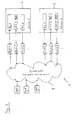
- a part of a HAVi based home network 1 comprises a first home network device 2 and a second home network device 3, which are connected with each other by a communication network 4.
- the communication network 4 is for example based upon an IEEE 1394 communication bus.
- the first home network device 2 comprises a first functional component FC1, a second functional component FC2, and a first data storing functional component sFC1.
- the first functional component FC1 may for example be a tuner unit
- the second functional component FC2 may for example be an amplifying unit.
- the first data storing functional component sFC1 may for example be a hard disk for storing digital audio data received by the tuner unit.
- the data to be stored on the first functional component sFC1 is stored in form of data elements; here, the first data storing functional component sFC1 comprises a first data element DE1, for example a data file.
- the second home network device 3 comprises a third functional component FC3, a second data storing functional component sFC2 and a third data storing functional component sFC3, each of them comprising a data element (DE2 and DE3), respectively.
- the second home network device 3 may for example be a computer comprising a computational unit as third functional component FC3, and further two hard disks as first and a second data storing functional components sFC2, sFC3.
- the sum of sFC1 to sFC3 will be simply referred to as sFC i .
- a first to third software element SWE1 to SWE3 can use the data storing functional component modules sFCM1 to sFCM3 as respective interfaces for accessing corresponding data storing functional components sFC1 to sFC3. In this manner, storing, retrieving or managing data handled by the software elements SWE1 to SWE3 is performed.
- the sum of sFCM1 to sFCM3 will be simply referred to as sFCM i .
- the sum of SWE1 to SWE3 will be simply referred to as SWE i
- the sum of DE1 to DE3 will be simply referred to as DE i .
- the inventive concept of using the functional component module system of a HAVi environment allows a lean, centralized and transparent handling of home network data.
- API Application Program Interface
- MetaData element contains additional application-specific information relating to a file.
- MetaData contains a sequence of MetaDataAttributes. It is left completely open for the application how it uses the MetaData, or if it uses MetaData at all.
- MetaDataAttributes could be the file s name, date, version etc.
- Storage::GetCapacity returns the raw capacity of the storage entity associated with the Storage FCM.
- Storage::GetAvailableSpace returns the currently remaining capacity of storage provided by the Storage FCM.
- :AppendData appends the octet sequence data to the end of the current file data contents of the file identified by fileId.
- Storage::Close closes the file associated with fileId. After closing the file any further accesses by this application to the file contents will result in an ENOT_OPEN error. If an application is closed, all files it had previously opened are closed automatically.
- Storage::Create creates a new file that will be assigned to the application that is identified by applicationIdString.
- the Storage FCM returns fileId, to be used for subsequent accesses to the file. After being created, the file is in the closed state.
- DeleteData deletes maximum dataToDelete octets of file contents data of the file identified by fileId beginning at position offset including the octet at position offset. The first valid file position is zero. The file must have been opened with FileAccessType equal to READ_WRITE.
- GetFileSize returns the size of the file data contents in octets.
- Storage::GetMetaData returns the met a Data block of the file associated with fileId.
- Storage opens the file identified by fileId for read-only or read-write access. After opening the file with fileAccess equal to READ_ONLY or READ_WRITE its data can be read concurrently. To exclusivly manipulate the file contents data, fileAccess equal to READ_WRITE must be specified.
- ReadData reads maximum dataToRead octets of file contents data starting from the position offset whereby position offset is the first octet that is read. The first valid file position is zero.
- Storage::SetMetaData replaces the previous metaData block of the file identified by fileId with the given metaData.
Landscapes
- Engineering & Computer Science (AREA)
- Automation & Control Theory (AREA)
- Multimedia (AREA)
- Computer Networks & Wireless Communication (AREA)
- Signal Processing (AREA)
- Theoretical Computer Science (AREA)
- Databases & Information Systems (AREA)
- Physics & Mathematics (AREA)
- General Engineering & Computer Science (AREA)
- General Physics & Mathematics (AREA)
- Data Mining & Analysis (AREA)
- Library & Information Science (AREA)
- Computer And Data Communications (AREA)
- Information Retrieval, Db Structures And Fs Structures Therefor (AREA)
Abstract
Description
- Fig. 1
- is a schematic drawing showing a preferred embodiment of a part of a HAVi network architecture comprising functionality for handling data storing home network capabilities.
| Service | Comm Type | Locality | Access | Resv Prot |
| Storage::GetCapacity | M | global | all | |
| Storage::GetAvailableSpace | M | global | all | |
| Storage::AppendData | M | global | all | |
| Storage::Close | M | global | all | |
| Storage::Create | M | global | all | |
| Storage::Delete | M | global | all | |
| Storage::DeleteData | M | global | all | |
| Storage::Find | M | global | all | |
| Storage::GetFileSize | M | global | all | |
| Storage:: GetMetaData | M | global | all | |
| Storage::InsertData | M | global | all | |
| Storage::Open | M | global | all | |
| Storage::Read Data | M | global | all | |
| Storage::SetMetaData | M | global | all |
<Company DNS name>/<application name>
Example: my_company.com/my_application_name

MetaDataAttributes could be the file s name, date, version etc.
- capacity - total raw capacity of the Storage FCM, in octets.
- availableSpace - current capacity still available in the Storage FCM, in octets.
in FileId fileId,
in sequence<octet> data)
- fileld - Identifies the file.
- data - data to append.
- ENOT_EXIST - File associated with fileId does not exist.
- EACCESS_TYPE - The file had not been opened with FileAccessType of READ_WRITE.
- ENOT_OPEN - The file has not been opened by the calling application.
- END_CAPACITY - Not enough storage resources are available to perform this operation.
- fileld - identifies the file.
- SNOT_EXIST - File associated with fileId does not exist.
- ENOT_OPEN - The file has not been opened by the calling application.
in ApplicationIdString applicationIdString,
out FileId fileId)
- applicationIdString - identifies the application that is associated with the file.
- fileld - identifies the newly created file.
- END_CAPACITY - Not enough storage resources are available to perform this operation.
- fileId - identifies the file.
- ENOT_EXIST - File associated with fileId does not exist.
- EACCESS_VIOLATION - There is an access violation. Another application currently has the file open (READ_ONLY or READ_WRITE).
in FileId fileId,
in uint64 offset,
in uint64 dataToDelete)
- fileld - identifies the file.
- offset - offset at which to start to delete data.
- dataToDelete - the number of octets to delete.
- ENOT_EXIST - File associated with fileId does not exist.
- EACCESS_TYPE - The file was not opened with FileAccessType of READ_WRITE.
- ENOT_OPEN - The file has not been opened by the calling application.
- EEND_OF_FILE - The offset position offset is past the end of the file (greater than the size of the file minus one).
in ApplicationIdString applicationIdString,
in MetaData metaData,
out sequence<FileId> fileIdList)
- applicationIdString - identifies the application that is associated with the files.
- metaData - defines the meta-data that must be set and its values that must match for the files of the result set.
- fileIdList - a list of FileId that match the search criteria.
in FileId fileId,
out uint64 size)
- fileId - identifies the file.
- size - the size in octets of the file.
- ENOT_EXIST - File associated with fileId does not exist.
in FileId fileId,
out MetaData metaData)
- fileId - identifies the file.
- metaData - themeta-data of the file.
- ENOT_EXIST - File associated with fileId does not exist.
in FileId fileId,
in uint64 offset,
in sequence<octet> data)
- fileId - Identifies the file.
- offset - offset at which to insert the data.
- data - data to insert.
- ENOT_EXIST - File associated with fileId does not exist.
- EACCESS_TYPE - The FileAccessType specified to open the file has not been READ_WRITE.
- ENOT_OPEN - The file has not been opened by this application.
- END_CAPACITY - Not enough storage resources are available to perform this operation.
- EEND_OF_FILE - The offset position offset is past the end of the file (greater than the size of the file minus one).
in FileId fileId,
in FileAccessType fileAccess)
- fileId - identifies the file.
- fileAccess -defines the FileAccessType.
- ENOT_EXIST - File associated with fileId does not exist.
- EACCESS_VIOLATION - There is an access violation if fileAccess is specified as READ_WRITE and the file identified by fileId has been opend by another application in READ_WRITE mode.
in FileId fileId,
in uint64 offset,
in uint64 dataToRead,
out sequence<octet> data)
- fileld - identifies the file.
- offset- offset at which to start reading.
- dataToRead - maximum number of octets to read
- data - destination that will contain the data read.
- ENOT_EXIST - File associated with fileId does not exist.
- EEND_OF_FILE - The offset position offset is past the end ofthe file.
- ENOT_OPEN - The file has not been opened by the calling application.
in FileId fileId,
in MetaData metaData)
- fileId - identifies the file.
- metaData -the files metaData block.
- ENOT_EXIST - File associated with fileId does not exist.
- END_CAPACITY - Not enough storage resources are available to perform this operation.
Claims (13)
- Method for operating a HAVi system based home network (1) having a plurality of home network devices (2, 3),wherein for each home network device (2, 3) having data storing and/or retrieving capabilities a respective data storing functional component (sFCi) is defined, andwherein for each and/or with each of said data storing functional components (sFCi) of said respective home network devices (2, 3) a particular functional component module (sFCMi) is defined and associated, respectively.
- Method according to claim 1,
characterized in that
said functional component modules (sFCMi) being associated with said data storing functional components (sFCi) are used to process information or data elements (DEi), in particular to store and/or retrieve said information or data elements (DEi) to/from said data storing functional components (sFCi). - Method according to claim 2,
characterized in that
software elements (SWEi), in particular components of said HAVi system are employed in the process of managing/storing/retrieving said information or data elements (DEi). - Method according to claim 2 or 3,
characterized by
using said functionality of said functional component modules (sFCMi) to determine raw and/or currently available storing space on said respective data storing functional components (sFCi). - Method according to anyone of the claims 2 to 4,
characterized by
using said functionality of the functional component modules (sFCMi) to create/store said data elements (DEi) in said data storing functional components (sFCi), and/or to insert data at a desired position in already stored data elements (DEi), and/or to delete at least a part of a stored data elements (DEi). - Method according to anyone of the claims 2 to 5,
characterized by
using said functionality of said functional component modules (sFCMi) to search whithin data stored in said data storing functional components (sFCi) to find data elements (DEi) which comprise data matching with a searching criteria. - Method according to anyone of the claims 2 to 6,
characterized by
using said functionality of the functional component module (sFCMi) to include/read/change/delete data element specific meta information, in particular representative for the type of the content of a respective data element (DEi), into/in/from at least one data element (DEi). - Method according to claim 7,
characterized by
examining only said meta information of each data element (DEi) when searching whithin data stored in said data storing functional component (sFCi), wherein the meta information of said data elements (DEi) serves as respective possible matching information. - Method according to anyone of the claims 3 to 8,
characterized by
using said functionality of said functional component modules (sFCMi) to check if accessing rights for accessing/manipulating data elements (DEi) respectively assigned to software elements (SWEi) are fulfilled if a software element wants to access a data element (DEi). - Method according to anyone of the claims 2 to 9,
characterized in that
each data element (DEi) stored in the data storing functional component (sFCi) is assigned to a software element (SWEi). - Method according to anyone of the claims 3 to 10,
characterized in that
software applications are used as software elements (SWEi), and/or data files are used as data elements (DEi). - System (1) for operating a home network which is capable of performing and/or realizing the method for operating a home network according to anyone of the preceding claims 1 to 11 and/or the steps thereof.
- Computer program product, comprising computer product means to perform and/or realize the method for operating a home network to anyone of the preceding claims 1 to 11 and/or the steps thereof, when it is executed on a computer, a digital signal processing means, and/or the like.
Priority Applications (2)
| Application Number | Priority Date | Filing Date | Title |
|---|---|---|---|
| DE60124092T DE60124092T8 (en) | 2001-08-22 | 2001-08-22 | Method and system for operating a home network |
| EP01120177A EP1286500B1 (en) | 2001-08-22 | 2001-08-22 | Method and system for operating a home network |
Applications Claiming Priority (1)
| Application Number | Priority Date | Filing Date | Title |
|---|---|---|---|
| EP01120177A EP1286500B1 (en) | 2001-08-22 | 2001-08-22 | Method and system for operating a home network |
Publications (2)
| Publication Number | Publication Date |
|---|---|
| EP1286500A1 true EP1286500A1 (en) | 2003-02-26 |
| EP1286500B1 EP1286500B1 (en) | 2006-10-25 |
Family
ID=8178394
Family Applications (1)
| Application Number | Title | Priority Date | Filing Date |
|---|---|---|---|
| EP01120177A Expired - Lifetime EP1286500B1 (en) | 2001-08-22 | 2001-08-22 | Method and system for operating a home network |
Country Status (2)
| Country | Link |
|---|---|
| EP (1) | EP1286500B1 (en) |
| DE (1) | DE60124092T8 (en) |
Citations (2)
| Publication number | Priority date | Publication date | Assignee | Title |
|---|---|---|---|---|
| EP0964559A1 (en) * | 1998-06-08 | 1999-12-15 | THOMSON multimedia | Method for transmitting asynchronous data in a home network |
| EP0964558A1 (en) * | 1998-06-08 | 1999-12-15 | THOMSON multimedia | Method for accessing internet applications from home network devices |
-
2001
- 2001-08-22 EP EP01120177A patent/EP1286500B1/en not_active Expired - Lifetime
- 2001-08-22 DE DE60124092T patent/DE60124092T8/en active Active
Patent Citations (2)
| Publication number | Priority date | Publication date | Assignee | Title |
|---|---|---|---|---|
| EP0964559A1 (en) * | 1998-06-08 | 1999-12-15 | THOMSON multimedia | Method for transmitting asynchronous data in a home network |
| EP0964558A1 (en) * | 1998-06-08 | 1999-12-15 | THOMSON multimedia | Method for accessing internet applications from home network devices |
Also Published As
| Publication number | Publication date |
|---|---|
| DE60124092T8 (en) | 2007-09-13 |
| DE60124092T2 (en) | 2007-05-31 |
| EP1286500B1 (en) | 2006-10-25 |
| DE60124092D1 (en) | 2006-12-07 |
Similar Documents
| Publication | Publication Date | Title |
|---|---|---|
| US7072983B1 (en) | Scheme for systemically registering meta-data with respect to various types of data | |
| US7155444B2 (en) | Promotion and demotion techniques to facilitate file property management between object systems | |
| US7673020B2 (en) | System and method for facilitating communication between a computing device and multiple categories of media devices | |
| US7162486B2 (en) | System and method for representing named data streams within an on-disk structure of a file system | |
| EP1325409B1 (en) | A shared file system having a token-ring style protocol for managing meta-data | |
| US6823398B1 (en) | File system management embedded in a storage device | |
| US7010657B2 (en) | Avoiding deadlock between storage assignments by devices in a network | |
| US6449607B1 (en) | Disk storage with modifiable data management function | |
| AU2002344297B2 (en) | Management and synchronization application for network file system | |
| JP4279452B2 (en) | System and method for performing a predefined action when porting the namespace of one storage medium to the namespace of another storage medium | |
| TW200408980A (en) | System and method for managing file names for file system filter drivers | |
| MX2008000520A (en) | Intelligent container index and search. | |
| JP2002540530A (en) | Automatic file pruning | |
| WO1999066401A1 (en) | Backup and restore for heterogeneous file server environment | |
| KR20060073921A (en) | Db metadata extraction | |
| EP1607868A1 (en) | Data processing device, data processing program, and recording medium | |
| WO2008058043A1 (en) | Data serialization and transfer | |
| EP1286500B1 (en) | Method and system for operating a home network | |
| Holdsworth et al. | A blueprint for representation information in the OAIS model | |
| JP4412983B2 (en) | Archive device and archive processing program | |
| WO2007011164A1 (en) | Virtual storage system and method for managementing virtual storage based on ad-hoc network | |
| WO2006133737A1 (en) | Method for setting up a network of mobile or stationary devices | |
| CN101256585B (en) | File processing method and device | |
| KR20050097437A (en) | Method for managing multimedia data | |
| JP2686063B2 (en) | Image information storage search method |
Legal Events
| Date | Code | Title | Description |
|---|---|---|---|
| PUAI | Public reference made under article 153(3) epc to a published international application that has entered the european phase |
Free format text: ORIGINAL CODE: 0009012 |
|
| AK | Designated contracting states |
Designated state(s): AT BE CH CY DE DK ES FI FR GB GR IE IT LI LU MC NL PT SE TR Kind code of ref document: A1 Designated state(s): AT BE CH CY DE DK ES FI FR GB GR IE IT LI LU MC NL PT SE TR |
|
| AX | Request for extension of the european patent |
Extension state: AL LT LV MK RO SI |
|
| 17P | Request for examination filed |
Effective date: 20030807 |
|
| AKX | Designation fees paid |
Designated state(s): DE |
|
| 17Q | First examination report despatched |
Effective date: 20050119 |
|
| RAP1 | Party data changed (applicant data changed or rights of an application transferred) |
Owner name: SONY DEUTSCHLAND GMBH |
|
| GRAP | Despatch of communication of intention to grant a patent |
Free format text: ORIGINAL CODE: EPIDOSNIGR1 |
|
| GRAS | Grant fee paid |
Free format text: ORIGINAL CODE: EPIDOSNIGR3 |
|
| GRAA | (expected) grant |
Free format text: ORIGINAL CODE: 0009210 |
|
| RIN1 | Information on inventor provided before grant (corrected) |
Inventor name: TIEDEMANN, STEPHEN,ADVANCED TECH.CENTER STUTTGART Inventor name: SZUCS, PAUL,ADVANCED TECH. CENTER STUTTGART Inventor name: MAYER, MATTHIAS,ADVANCED TECH. CENTER STUTTGART Inventor name: TERRANOVA, SABINE,ADVANCED TECH. CENTER STUTTGART |
|
| AK | Designated contracting states |
Kind code of ref document: B1 Designated state(s): DE |
|
| REF | Corresponds to: |
Ref document number: 60124092 Country of ref document: DE Date of ref document: 20061207 Kind code of ref document: P |
|
| RAP2 | Party data changed (patent owner data changed or rights of a patent transferred) |
Owner name: SONY DEUTSCHLAND GMBH |
|
| PLBE | No opposition filed within time limit |
Free format text: ORIGINAL CODE: 0009261 |
|
| STAA | Information on the status of an ep patent application or granted ep patent |
Free format text: STATUS: NO OPPOSITION FILED WITHIN TIME LIMIT |
|
| 26N | No opposition filed |
Effective date: 20070726 |
|
| PGFP | Annual fee paid to national office [announced via postgrant information from national office to epo] |
Ref country code: DE Payment date: 20090821 Year of fee payment: 9 |
|
| REG | Reference to a national code |
Ref country code: DE Ref legal event code: R119 Ref document number: 60124092 Country of ref document: DE Effective date: 20110301 |
|
| PG25 | Lapsed in a contracting state [announced via postgrant information from national office to epo] |
Ref country code: DE Free format text: LAPSE BECAUSE OF NON-PAYMENT OF DUE FEES Effective date: 20110301 |