EP1286494A1 - Verfahren zur Erzeugung eines asymmetrischen kryptografischen Gruppenschlüsselpaares - Google Patents
Verfahren zur Erzeugung eines asymmetrischen kryptografischen Gruppenschlüsselpaares Download PDFInfo
- Publication number
- EP1286494A1 EP1286494A1 EP02017506A EP02017506A EP1286494A1 EP 1286494 A1 EP1286494 A1 EP 1286494A1 EP 02017506 A EP02017506 A EP 02017506A EP 02017506 A EP02017506 A EP 02017506A EP 1286494 A1 EP1286494 A1 EP 1286494A1
- Authority
- EP
- European Patent Office
- Prior art keywords
- group
- key
- public
- group key
- members
- Prior art date
- Legal status (The legal status is an assumption and is not a legal conclusion. Google has not performed a legal analysis and makes no representation as to the accuracy of the status listed.)
- Granted
Links
- 238000000034 method Methods 0.000 title claims description 73
- 238000004891 communication Methods 0.000 claims description 12
- 230000005540 biological transmission Effects 0.000 description 5
- 238000004519 manufacturing process Methods 0.000 description 2
- 238000000151 deposition Methods 0.000 description 1
- 238000004321 preservation Methods 0.000 description 1
- 230000008929 regeneration Effects 0.000 description 1
- 238000011069 regeneration method Methods 0.000 description 1
- 238000012552 review Methods 0.000 description 1
- 238000012360 testing method Methods 0.000 description 1
- 238000012795 verification Methods 0.000 description 1
Images

Classifications
-
- H—ELECTRICITY
- H04—ELECTRIC COMMUNICATION TECHNIQUE
- H04L—TRANSMISSION OF DIGITAL INFORMATION, e.g. TELEGRAPHIC COMMUNICATION
- H04L9/00—Cryptographic mechanisms or cryptographic arrangements for secret or secure communications; Network security protocols
- H04L9/08—Key distribution or management, e.g. generation, sharing or updating, of cryptographic keys or passwords
- H04L9/0816—Key establishment, i.e. cryptographic processes or cryptographic protocols whereby a shared secret becomes available to two or more parties, for subsequent use
- H04L9/0838—Key agreement, i.e. key establishment technique in which a shared key is derived by parties as a function of information contributed by, or associated with, each of these
- H04L9/0841—Key agreement, i.e. key establishment technique in which a shared key is derived by parties as a function of information contributed by, or associated with, each of these involving Diffie-Hellman or related key agreement protocols
Definitions
- the invention relates to a method for producing a asymmetric cryptographic group key according to the specified in the preamble of claim 1 Art and an arrangement for carrying out the method according to claim 14.
- the encryption process is usually the public known, the key, however, represents the secret information of the involved communication partners represents.
- Cryptography should also ensure that manipulation, if necessary during the transmission the message on a public channel at the Message were made by the recipient of the Message can be detected. This further basic goal Cryptography is also called integrity.
- Another basic goal of cryptography is authentication the communication partner, that is, the certainty that one communication partner is also the one is, for which he pretends.
- Symmetric encryption methods are emerging thereby characterized by the fact that the persons involved share a shared secret. This shared secret represents the cryptographic key.
- symmetric encryption is cryptographic Key only from a single, so called symmetric key.
- the cryptographic key the so-called asymmetrical key
- the key pair consists of one private and a public key.
- the public key must be accessible to everyone be.
- the asymmetric encryption method is also referred to as public key cryptography.
- Alice wants an encrypted one Send message to Bob, so use it for encryption the message the public key from Bob.
- Bob wants an encrypted one Send message to Bob, so use it for encryption the message the public key from Bob.
- Bob only Bob in able to read the message sent by Alice, because the message can be alone with the private one Keys decrypted by Bob and thus in a readable Be brought form.
- the result of this process then forms the digital Signature, which to the original message to be sent is added. Now get Bob from Alice one a digital signature provided message, so applies He then clicks Alice's public key. There Then two things happen: First, the digital one Signature decrypts and Bob receives the one from Alice generated checksum in plain text. The other is off the received message again formed a hash-comprimat. Voices that by Bob - with the public Keys from Alice - newly formed and the Compress in the digital signature, so Bob can be sure that the content of the Alice sent message was not changed.
- Bob can be sure that the received Message actually came from Alice, as the used public keys from a certification authority certified, that is, the public Key is tied to the identity of Alice.
- From DE 198 47 941 A1 is a tree-based key agreement method known.
- the tree-based Method serves to create and establish a common cryptographic key for a group with several participants to ensure secrecy from messages over insecure communication channels transmitted exclusively to the group members become.
- This formula can also be transferred to other mathematical groups.
- the new secret is known to all participants who hang as leaves under the node (j + 1, i).
- the group participants can now under help of the present cryptographic key - more symmetrical Group key - by means of a symmetrical Encryption methods communicate with each other.
- Alice is now capable of the group member Bob send an encrypted message.
- Alice encrypts the message with the known one symmetric group key.
- Bob is in turn able to match the received text with the same, also known to decrypt keys.
- the disadvantage here is that it is not possible with the existing symmetric group key a secure To communicate with a group stranger. So for example, it is not possible for Alice a secure To communicate with a group stranger, there the group stranger, not in the possession of the common symmetric group key, and thus except Is capable of encrypted by Alice transmitted Decrypt message.
- the invention is based on the object, a Method for generating an asymmetric group key educate in such a way that while avoiding the disadvantages mentioned a secure communication between a group consisting of several group members, which already has a symmetric group key Share, and allows group strangers. Furthermore, the invention is based on the object, the Allow group members to sign signed messages to send to a group stranger, leaving the message demonstrably from the group, the group member even that has signed the message, however remains anonymous.
- the invention is based on the finding that at Presence of an asymmetrical group key, So a private group key, exclusively known to the group members, and a public one Group key, publicly available is, secure communication between group members and group strangers, as well as an authentication the group to the group stranger while maintaining the anonymity of the individual group members is possible. It also enables integrity the submitted message.
- asymmetric cryptographic key with one public group key and a private group key for a group of at least two participants - group participants - who have a common, only known to the group members, symmetrical Divide group key, this symmetric group key used.
- the private group key is based doing so on the symmetric group key and especially on other group members known parameters.
- the public group key by means of a procedure that on the principle of the discrete logarithm based on the method of Diffie and Hellmann, the ElGamal encryption method, the elliptical Curve method, the XTR Public Key System, as well comparable methods - generated.
- asymmetric cryptographic keys consisting from a private group key and a public group key, which, as stated on the previously known to the individual group participants symmetric group key based.
- the public group key is certified, d. H. the value of the public group key becomes the identity of all group members bound.
- certification of the group key is the authentication of the group opposite a group stranger ensured.
- the public group key is preferred announced to the group strangers. This can be special by depositing the public key at a central instance, such as a certification authority, respectively.
- the public key of the group stranger is on whose identity is bound, so certified, to, like already mentioned, the authentication of the group stranger to enable in this way.
- the group member Alice im Communicate the group's mission with a group stranger, so Alice encrypts the message with the public Key of the group stranger. Subsequently Alice signs the message with the private group key.
- the group stranger is after receiving the message with Help his private key in a position to get the message to decode. Furthermore, he can, as already described in detail, by checking the digital Signature the integrity of the message or, where appropriate notice changes made.
- the group stranger can be sure that the Message comes from a group member as the to Verification of digital signature used public Group key certified, ie to the identity of all group members was tied.
- the identity the transmitter, in this case Alice remains the stranger to the group but hidden, since Alice for the signature the message uses the private group key Has.
- the anonymity of the sender, here Alice guaranteed to the group stranger.
- the Group members share known symmetric group keys iteratively using a tree-based Key agreement procedure for groups, in particular using the Diffie and Hellmann methods, generated.
- the tree-based key agreement procedure has the advantage that with it the symmetric group key be generated independently and flexibly can. So it is with the help of the tree-based key agreement protocol readily possible on one Change in the number of group members, eg. B. by the inclusion of another group member to respond and in a simple way a new symmetrical Generate group keys.
- the following required regeneration of the asymmetric Group key based on the symmetric group key takes place in the manner already described and Wise.
- the ElGamal signature method is advantageously used come.
- the message to sign m g ⁇ k (j + 1, i) mod p is the public key to the secret Key k (j + 1, i), which belongs to all group members, those in the below the node (j + 1, i) in the binary tree appended are known.
- the certification of the public group key is preferably within the group of each group member even made. This can be, for example by digitally signing the public group key done by the individual group members. This is particularly efficient with the tree-based Key agreement procedure possible because here the group key is formed iteratively, and the education and certification of a public Key can be done in each iteration stage, where the public key of the next stage always with the public key of the underlying Level is certified.
- the symmetric common to group members Group key from a central facility generated.
- Group key based on from the central Device distributed to the individual group members symmetric group key is preferred the certification of the public group key performed by this central facility.
- the central instance ie the instance that the already certified public Providing keys to anyone publicly available and the central facility, which ia. a Certification central, preferably identical.
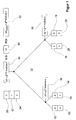
- Fig. 1 is schematically a group 10 with four group members 12, 14, 16 and 18 as well as a group stranger 20 shown.
- group members 12, 14, 16 and 18 in addition to the above-mentioned reference numerals 12, 14, 16 and 18 also indicated by the capital letters A, B, C and D. Accordingly, the group foreign 20 indicated by the capital letter F
- Each of the group members 12, 14, 16 and 18 is included in possession of a private secret, which in the further History also referred to as a private key becomes.
- the group member 12 is in the private ownership Key 22, according to the group members own 14, 16 and 18 the private keys 24, 26 and 28.
- To the assignment of private keys 22, 24, 26 and 28 to the respective group member 12, 14, 16 and 18 are the private keys 22, 24 26 and 28 in Fig. 1 with corresponding lower case letters, namely a, b, c and d, respectively.
- group members share 12, 14, 16 and 18 is a common symmetric group key 30.
- the group stranger 20 is also in possession of a private Key 32 and a publicly accessible and certified public key 34.
- the group members 12, 14, 16 and 18 together known symmetric group key 30 has been within the group 10 by means of a tree-based encryption method, especially using of the Diffie-Hellmann method.
- group members 16 and 18 lead with theirs private keys 26 and 28 undergo a DH procedure and get their common key 38.
- group members 12 and 14 perform one side and group members 16 and 18 the other side has another DH procedure in common into which the common key 36 of the Group members 12 and 14, respectively, the common Key 38 is included by group members 16 and 18 become.
- the common key 36 of the Group members 12 and 14, respectively the common Key 38 is included by group members 16 and 18 become.
- this symmetric Group key 30 is the new asymmetric group key with a private group key 40 and a public group key 42 generated.
- the private group key 40 becomes symmetrical Group key 30 and more, not here presented to all group members 12, 14, 16 and Calculated 18 known parameters.
- the certification of the public group key 42 is advantageously done by digitally signing the public Group key 42 through the individual Group participants 12, 14, 16 and 18.
- FIG. 2 schematically shows a telecommunications network 44 presented to the group 10 and the group foreign 20 are connected.
- both the public Key 34 of the group stranger 20, as well as the public Group 10 group key 42 public be accessible. This happens here through the public Deposit of public keys 34 and 42 at the certification body 46.
- the group member 12 encrypts his message with the public key 34 of the Non-Group Members 20.
- the group member signs 12 the encrypted message with the private one Group key 40.
- the digital is based Signature on the already mentioned RSA method.
- a checksum - hash value - formed from the message to be sent.
- This Hash value is then used with the private group key 40 encrypted.
- the result, so the encrypted Hash value forms the digital signature.
- the group stranger 20 goes as follows in front:
- the group stranger 20 uses the public Group key 42 to the digital signature. Thereby the encrypted hash value is decrypted and the group stranger 20 receives the hash value in plain text. In addition, from the received message again a hash value formed. Is this true with the public Group key 42 generated hash value and decrypted received hash value, so can the Non-Group 20 Be sure the message is during transmission via the telecommunications network 46 was not manipulated. The review of the message based on manipulation in the described embodiment So on a hash value comparison. would when sending the message even a single one Bit of the message had been changed, the two would Hash values no longer match.
- the group stranger 20 can also be sure that the received message sent by a group member was because he to check the digital signature the certified public group key 42 applied Has.
- the digital signature in addition to the one described here RSA method also uses other signature methods, in particular the ElGamal signature method, can be used.
- the process is when the non-group 20 sends a message to group 10.
- the group foreign 20 encrypts the to be transmitted Message with the public group key 42 and then sign the encrypted Message with his private key 32.
- the group members 12, 14, 16 and 18 are now in the Location using the public key 34 of the group stranger 20 the message on manipulation and authenticity to consider. Get the plain text of the message the group members 12, 14, 16 and 18 through decrypt the message with their shared private Group key 40.
- the invention is characterized in that by the simple generation of an asymmetric group key, So a private group key 40 and one public group key 42, from a the Group members have known symmetric group keys 30 in a simple way a safe Communication over a public channel 44 between a group 10 with several members 12, 14, 16 and 18 and non-group 20 allows being the anonymity of each group member 12, 14, 16 and 18 with respect to the group stranger 20 becomes.
Landscapes
- Engineering & Computer Science (AREA)
- Computer Security & Cryptography (AREA)
- Computer Networks & Wireless Communication (AREA)
- Signal Processing (AREA)
- Computer And Data Communications (AREA)
- Mobile Radio Communication Systems (AREA)
- Selective Calling Equipment (AREA)
- Transition And Organic Metals Composition Catalysts For Addition Polymerization (AREA)
- Storage Device Security (AREA)
Abstract
Description
- Fig. 1
- eine schematische Darstellung einer Baumstruktur einer Gruppe mit vier Gruppenmitglieder A, B, C und D, sowie eine schematische Darstellung eines Gruppenfremden F, und
- Fig. 2
- eine schematische Darstellung der Gruppe und des Gruppenfremden aus Fig. 1, die zum Zweck des Informationsaustausches an das Telekommunikationsnetz angeschlossen sind.
- 10
- Gruppe mit mehreren Mitgliedern
- 12
- Gruppenmitglied A
- 14
- Gruppenmitglied B
- 16
- Gruppenmitglied C
- 18
- Gruppenmitglied D
- 20
- Gruppenfremder F
- 22
- privater Schlüssel a des Gruppenmitglied A
- 24
- privater Schlüssel b des Gruppenmitglied B
- 26
- privater Schlüssel c des Gruppenmitglied C
- 28
- privater Schlüssel d des Gruppenmitglied D
- 30
- symmetrischer Gruppenschlüssel k3
- 32
- privater Schlüssel f des Gruppenfremden F
- 34
- zertifizierter, öffentlicher Schlüssel k des Gruppenfremden F
- 36
- gemeinsamer Schlüssel k1 der Gruppenmitglieder A und B
- 38
- gemeinsamer Schlüssel k2 der Gruppenmitglieder C und D
- 40
- privater Gruppenschlüssel k4
- 42
- zertifizierter, öffentlicher Gruppenschlüssel k4öffentlich
- 44
- Telekommunikationsnetz
- 46
- Zertifizierungsstelle
Claims (14)
- Verfahren zur Erzeugung eines asymmetrischen kryptografischen Gruppenschlüssels mit einem öffentlichen Gruppenschlüssel (42) und einem privaten Gruppenschlüssel (40), dadurch gekennzeichnet, dass eine Gruppe (10) von mindestens zwei Teilnehmern - Gruppenmitglieder (12, 14, 16, und 18) - einen gemeinsamen, nur den Gruppenmitgliedern (12, 14 16 und 18) bekannten, symmetrischen Gruppenschlüssel (30) teilen und der private Gruppenschlüssel (40) auf dem symmetrischen Gruppenschlüssel (30) basiert, insbesondere auch auf weiteren den Gruppenmitgliedern (12, 14, 16 und 18) bekannten Parametern.
- Verfahren nach Anspruch 1, dadurch gekennzeichnet, dass aus dem privaten Gruppenschlüssel (40) der öffentliche Gruppenschlüssel (42) mittels eines Verfahrens, das auf dem Prinzip des diskreten Logarithmus basiert erzeugt wird, wie nach dem Verfahren von Diffie und Hellmann, dem ElGamal-Verschlüsselungsverfahren, dem elliptischen Kurvenverfahren, dem XTR Public Key System, sowie vergleichbare Verfahren.
- Verfahren nach Anspruch 1 oder 2, dadurch gekennzeichnet, dass der öffentliche Gruppenschlüssel (42) zertifiziert wird, d. h., dass der Wert des öffentlichen Gruppenschlüssel (42) an die Identität aller Gruppenmitglieder (12, 14, 16 und 18) gebunden wird.
- Verfahren nach einem der Ansprüche 1 bis 3, dadurch gekennzeichnet, dass für eine sichere Kommunikation mit einem Gruppenfremden (20) der öffentliche Gruppenschlüssel (42) dem Gruppenfremden (20) bekannt gegeben wird, insbesondere durch eine öffentliche Hinterlegung des öffentlichen Gruppenschlüssels (42) bei einer zentralen Instanz (46).
- Verfahren nach einem der vorangehenden Ansprüche, dadurch gekennzeichnet, dass der symmetrische Gruppenschlüssel (30) der Gruppenmitgliedern (12, 14, 16, und 18) iterativ mittels eines baumbasierten Schlüsselvereinbarungsverfahren für Gruppen, insbesondere unter Anwendung des Diffie und Hellmann Verfahren, erzeugt wird .
- Verfahren nach einem der vorangehenden Ansprüche und insbesondere nach Anspruch 3, dadurch gekennzeichnet, dass die Zertifizierung des öffentlichen Gruppenschlüssels (42) innerhalb der Gruppe (10) von jedem Gruppenmitglied (12, 14, 16 und 18), insbesondere durch digitales Signieren des öffentlichen Gruppenschlüssels (42), selbst vorgenommen wird.
- Verfahren nach einem der Ansprüche 1 bis 4, dadurch gekennzeichnet, dass der symmetrische Gruppenschlüssel (30) der Gruppenmitgliedern (12, 14, 16 und 18) von einer zentralen Einrichtung generiert wird.
- Verfahren nach Anspruch 7, dadurch gekennzeichnet, dass der symmetrische Gruppenschlüssel (30) von der zentralen Einrichtung an die einzelnen Gruppenmitglieder (12, 14, 16 und 18) verteilt wird.
- Verfahren nach Anspruch 7 und 8 und insbesondere nach Anspruch 3, dadurch gekennzeichnet, dass die Zertifizierung des öffentlichen Gruppenschlüssel (42) von dieser zentralen Einrichtung durchgeführt wird.
- Verfahren nach Anspruch 7 bis 9 und insbesondere nach Anspruch 4, dadurch gekennzeichnet, dass die zentrale Instanz (46) und die zentrale Einrichtung identisch sind.
- Verfahren nach einem der vorangehenden Ansprüche, dadurch gekennzeichnet, dass der Gruppenfremde (20) ebenfalls im Besitz eines geheimen privaten Schlüssels (32) und eines öffentlichen Schlüssel (34) ist.
- Verfahren nach Anspruch 11, dadurch gekennzeichnet, dass der öffentliche Schlüssel (34) des Gruppenfremden (20) zertifiziert wurde.
- Verfahren nach Anspruch 11 und 12, dadurch gekennzeichnet, dass der öffentliche Schlüssel (34) des Gruppenfremden (20) öffentlich zugänglich ist.
- Anordnung zur Durchführung des Verfahrens nach einem der vorangehenden Ansprüche.
Applications Claiming Priority (2)
| Application Number | Priority Date | Filing Date | Title |
|---|---|---|---|
| DE10141396 | 2001-08-23 | ||
| DE10141396A DE10141396A1 (de) | 2001-08-23 | 2001-08-23 | Verfahren zur Erzeugung eines asymmetrischen kryptografischen Gruppenschlüssels |
Publications (2)
| Publication Number | Publication Date |
|---|---|
| EP1286494A1 true EP1286494A1 (de) | 2003-02-26 |
| EP1286494B1 EP1286494B1 (de) | 2006-03-01 |
Family
ID=7696404
Family Applications (1)
| Application Number | Title | Priority Date | Filing Date |
|---|---|---|---|
| EP02017506A Expired - Lifetime EP1286494B1 (de) | 2001-08-23 | 2002-08-06 | Verfahren zur Erzeugung eines asymmetrischen kryptografischen Gruppenschlüsselpaares |
Country Status (3)
| Country | Link |
|---|---|
| EP (1) | EP1286494B1 (de) |
| AT (1) | ATE319241T1 (de) |
| DE (2) | DE10141396A1 (de) |
Cited By (2)
| Publication number | Priority date | Publication date | Assignee | Title |
|---|---|---|---|---|
| US8793495B2 (en) | 2010-08-23 | 2014-07-29 | Giesecke & Devrient Gmbh | Method for authenticating a portable data carrier |
| CN111918285A (zh) * | 2020-06-17 | 2020-11-10 | 南京如般量子科技有限公司 | 基于id密码学的抗量子计算群组通信方法及系统 |
Families Citing this family (1)
| Publication number | Priority date | Publication date | Assignee | Title |
|---|---|---|---|---|
| DE102012017835A1 (de) * | 2012-09-10 | 2014-03-13 | Giesecke & Devrient Gmbh | Verfahren zur Authentisierung eines portablen Datenträgers |
Citations (2)
| Publication number | Priority date | Publication date | Assignee | Title |
|---|---|---|---|---|
| WO2001006697A2 (en) * | 1999-07-19 | 2001-01-25 | Certicom Corp. | Split-key key-agreement protocol |
| DE19938198A1 (de) * | 1999-08-12 | 2001-03-01 | Deutsche Telekom Ag | Verfahren zum Etablieren eines gemeinsamen Schlüssels für eine Gruppe von mindestens drei Teilnehmern |
Family Cites Families (7)
| Publication number | Priority date | Publication date | Assignee | Title |
|---|---|---|---|---|
| US4531020A (en) * | 1982-07-23 | 1985-07-23 | Oak Industries Inc. | Multi-layer encryption system for the broadcast of encrypted information |
| DE19622630C1 (de) * | 1996-06-05 | 1997-11-20 | Siemens Ag | Verfahren zum gruppenbasierten kryptographischen Schlüsselmanagement zwischen einer ersten Computereinheit und Gruppencomputereinheiten |
| DE19710413A1 (de) * | 1997-03-13 | 1998-09-17 | Toralf Lehsten | Verfahren zur Verteilung von Berechtigungen zum symmetrischen Ver- und Entschlüsseln von Daten in einem Computernetz und/oder Personalcomputer unter Anwendung der Public Key Kryptographie |
| DE19718583C5 (de) * | 1997-05-05 | 2007-04-26 | T-Mobile Deutschland Gmbh | Ende-zu-Ende Verschlüsselung |
| US6038322A (en) * | 1998-10-20 | 2000-03-14 | Cisco Technology, Inc. | Group key distribution |
| DE19925910B4 (de) * | 1999-06-07 | 2005-04-28 | Siemens Ag | Verfahren zum Be- oder Verarbeiten von Daten |
| US6912656B1 (en) * | 1999-11-30 | 2005-06-28 | Sun Microsystems, Inc. | Method and apparatus for sending encrypted electronic mail through a distribution list exploder |
-
2001
- 2001-08-23 DE DE10141396A patent/DE10141396A1/de not_active Withdrawn
-
2002
- 2002-08-06 DE DE50205909T patent/DE50205909D1/de not_active Expired - Lifetime
- 2002-08-06 AT AT02017506T patent/ATE319241T1/de active
- 2002-08-06 EP EP02017506A patent/EP1286494B1/de not_active Expired - Lifetime
Patent Citations (2)
| Publication number | Priority date | Publication date | Assignee | Title |
|---|---|---|---|---|
| WO2001006697A2 (en) * | 1999-07-19 | 2001-01-25 | Certicom Corp. | Split-key key-agreement protocol |
| DE19938198A1 (de) * | 1999-08-12 | 2001-03-01 | Deutsche Telekom Ag | Verfahren zum Etablieren eines gemeinsamen Schlüssels für eine Gruppe von mindestens drei Teilnehmern |
Non-Patent Citations (2)
| Title |
|---|
| ATENIESE G ET AL: "NEW MULTIPARTY AUTHENTICATION SERVICES AND KEY AGREEMENT PROTOCOLS", 4 April 2000, IEEE JOURNAL ON SELECTED AREAS IN COMMUNICATIONS, IEEE INC. NEW YORK, US, VOL. 18, NR. 4, PAGE(S) 628-639, ISSN: 0733-8716, XP000927584 * |
| BOYD C ET AL: "DESIGN AND ANALYSIS OF KEY EXCHANGE PROTOCOLS VIA SECURE CHANNEL IDENTIFICATION", 28 November 1994, ADVANCES IN CRYPTOLOGY - ASIACRYPT '94. 4TH. INTERNATIONAL CONFERENCE ON THE THEORY AND APPLICATIONS OF CRYPTOLOGY, WOLLONGONG, AUSTRALIA, NOV. 28 - DEC. 1, 1994. PROCEEDINGS, PROCEEDINGS OF THE CONFERENCE ON THE THEORY AND APPLICATIONS OF CRYPTOLOGY, UK, ISBN: 3-540-59339-X, XP000527595 * |
Cited By (3)
| Publication number | Priority date | Publication date | Assignee | Title |
|---|---|---|---|---|
| US8793495B2 (en) | 2010-08-23 | 2014-07-29 | Giesecke & Devrient Gmbh | Method for authenticating a portable data carrier |
| CN111918285A (zh) * | 2020-06-17 | 2020-11-10 | 南京如般量子科技有限公司 | 基于id密码学的抗量子计算群组通信方法及系统 |
| CN111918285B (zh) * | 2020-06-17 | 2022-09-23 | 南京如般量子科技有限公司 | 基于id密码学的抗量子计算群组通信方法及系统 |
Also Published As
| Publication number | Publication date |
|---|---|
| EP1286494B1 (de) | 2006-03-01 |
| DE10141396A1 (de) | 2003-03-13 |
| DE50205909D1 (de) | 2006-04-27 |
| ATE319241T1 (de) | 2006-03-15 |
Similar Documents
| Publication | Publication Date | Title |
|---|---|---|
| DE69633590T2 (de) | Verfahren zur Unterschrift und zur Sitzungsschlüsselerzeugung | |
| DE60313704T2 (de) | Verfahren und Vorrichtung zur Erzeugung eines Geheimschlüssels | |
| DE69520714T2 (de) | Verfahren und Vorrichtung zum sicheren elektronischen Abstimmen | |
| DE69311581T2 (de) | Verfahren und system zur authentifizierten sicheren schlüsselverteilung in einem kommunikationssystem | |
| DE60006147T2 (de) | Schlüsselzustimmungsprotokoll mit getrennten Schlüsseln | |
| DE102012206341B4 (de) | Gemeinsame Verschlüsselung von Daten | |
| EP3443705B1 (de) | Verfahren und anordnung zum aufbauen einer sicheren kommunikation zwischen einer ersten netzwerkeinrichtung (initiator) und einer zweiten netzwerkeinrichtung (responder) | |
| DE69838258T2 (de) | Public-Key-Datenübertragungssysteme | |
| EP0903027A1 (de) | Verfahren zum gruppenbasierten kryptographischen schlüsselmanagement zwischen einer ersten computereinheit und gruppencomputereinheiten | |
| DE10248004A1 (de) | Verfahren und Vorrichtung zum Verschlüsseln von Daten | |
| DE102020003739A1 (de) | Verfahren zur Verteilung und Aushandlung von Schlüsselmaterial | |
| EP4099611A1 (de) | Erzeugung quantensicherer schlüssel in einem netzwerk | |
| EP4050839A1 (de) | Verfahren zur vereinbarung eines gemeinsamen kryptographischen schlüssels und verfahren zur verschlüsselten kommunikation sowie computerprogrammprodukt und gerät | |
| EP3697019A1 (de) | Verfahren zur bereitstellung eines herkunftsortnachweises für ein digitales schlüsselpaar | |
| EP1286494B1 (de) | Verfahren zur Erzeugung eines asymmetrischen kryptografischen Gruppenschlüsselpaares | |
| DE102019216203A1 (de) | Auf Blockverschlüsselung basierender Proof-of-Work | |
| EP1208669B1 (de) | Verfahren zum etablieren eines gemeinsamen schlüssels für eine gruppe von mindestens drei teilnehmern | |
| EP1119941A1 (de) | Verfahren zum etablieren eines gemeinsamen schlüssels zwischen einer zentrale und einer gruppe von teilnehmern | |
| DE602004004135T2 (de) | Verfahren zur verschlüsselung/entschlüng einer nachricht sowie dazugehörige vorrichtung | |
| WO2007099026A1 (de) | Verfahren und vorrichtung zum authentifizieren eines öffentlichen schlüssels | |
| DE102006036165B3 (de) | Verfahren zur Etablierung eines geheimen Schlüssels zwischen zwei Knoten in einem Kommunikationsnetzwerk | |
| EP2449494A1 (de) | Vorrichtungen und verfahren zum erstellen und validieren eines digitalen zertifikats | |
| DE10114157A1 (de) | Verfahren zur rechnergestützten Erzeugung von öffentlichen Schlüsseln zur Verschlüsselung von Nachrichten und Vorrichtung zur Durchführung des Verfahrens | |
| DE102016106602A1 (de) | Verfahren und Anordnung zum Aufbauen einer sicheren Kommunkation zwischen einer ersten Netzwerkeinrichtung (Initator) und einer zweiten Netzwerkeinrichtung (Responder) | |
| WO2020144123A1 (de) | Verfahren und system zur informationsübermittlung |
Legal Events
| Date | Code | Title | Description |
|---|---|---|---|
| PUAI | Public reference made under article 153(3) epc to a published international application that has entered the european phase |
Free format text: ORIGINAL CODE: 0009012 |
|
| AK | Designated contracting states |
Kind code of ref document: A1 Designated state(s): AT BE BG CH CY CZ DE DK EE ES FI FR GB GR IE IT LI LU MC NL PT SE SK TR Designated state(s): AT BE BG CH CY CZ DE DK EE ES FI FR GB GR IE IT LI LU MC NL PT SE SK TR |
|
| AX | Request for extension of the european patent |
Extension state: AL LT LV MK RO SI |
|
| 17P | Request for examination filed |
Effective date: 20030826 |
|
| AKX | Designation fees paid |
Designated state(s): AT BE BG CH CY CZ DE DK EE ES FI FR GB GR IE IT LI LU MC NL PT SE SK TR |
|
| 17Q | First examination report despatched |
Effective date: 20031002 |
|
| GRAP | Despatch of communication of intention to grant a patent |
Free format text: ORIGINAL CODE: EPIDOSNIGR1 |
|
| GRAS | Grant fee paid |
Free format text: ORIGINAL CODE: EPIDOSNIGR3 |
|
| GRAA | (expected) grant |
Free format text: ORIGINAL CODE: 0009210 |
|
| AK | Designated contracting states |
Kind code of ref document: B1 Designated state(s): AT BE BG CH CY CZ DE DK EE ES FI FR GB GR IE IT LI LU MC NL PT SE SK TR |
|
| PG25 | Lapsed in a contracting state [announced via postgrant information from national office to epo] |
Ref country code: SK Free format text: LAPSE BECAUSE OF FAILURE TO SUBMIT A TRANSLATION OF THE DESCRIPTION OR TO PAY THE FEE WITHIN THE PRESCRIBED TIME-LIMIT Effective date: 20060301 Ref country code: NL Free format text: LAPSE BECAUSE OF FAILURE TO SUBMIT A TRANSLATION OF THE DESCRIPTION OR TO PAY THE FEE WITHIN THE PRESCRIBED TIME-LIMIT Effective date: 20060301 Ref country code: IE Free format text: LAPSE BECAUSE OF FAILURE TO SUBMIT A TRANSLATION OF THE DESCRIPTION OR TO PAY THE FEE WITHIN THE PRESCRIBED TIME-LIMIT Effective date: 20060301 Ref country code: IT Free format text: LAPSE BECAUSE OF FAILURE TO SUBMIT A TRANSLATION OF THE DESCRIPTION OR TO PAY THE FEE WITHIN THE PRESCRIBED TIME-LIMIT;WARNING: LAPSES OF ITALIAN PATENTS WITH EFFECTIVE DATE BEFORE 2007 MAY HAVE OCCURRED AT ANY TIME BEFORE 2007. THE CORRECT EFFECTIVE DATE MAY BE DIFFERENT FROM THE ONE RECORDED. Effective date: 20060301 Ref country code: FI Free format text: LAPSE BECAUSE OF FAILURE TO SUBMIT A TRANSLATION OF THE DESCRIPTION OR TO PAY THE FEE WITHIN THE PRESCRIBED TIME-LIMIT Effective date: 20060301 |
|
| REG | Reference to a national code |
Ref country code: GB Ref legal event code: FG4D Free format text: NOT ENGLISH |
|
| REG | Reference to a national code |
Ref country code: CH Ref legal event code: EP |
|
| REG | Reference to a national code |
Ref country code: IE Ref legal event code: FG4D Free format text: LANGUAGE OF EP DOCUMENT: GERMAN |
|
| REF | Corresponds to: |
Ref document number: 50205909 Country of ref document: DE Date of ref document: 20060427 Kind code of ref document: P |
|
| GBT | Gb: translation of ep patent filed (gb section 77(6)(a)/1977) |
Effective date: 20060505 |
|
| PG25 | Lapsed in a contracting state [announced via postgrant information from national office to epo] |
Ref country code: BG Free format text: LAPSE BECAUSE OF FAILURE TO SUBMIT A TRANSLATION OF THE DESCRIPTION OR TO PAY THE FEE WITHIN THE PRESCRIBED TIME-LIMIT Effective date: 20060601 Ref country code: SE Free format text: LAPSE BECAUSE OF FAILURE TO SUBMIT A TRANSLATION OF THE DESCRIPTION OR TO PAY THE FEE WITHIN THE PRESCRIBED TIME-LIMIT Effective date: 20060601 Ref country code: DK Free format text: LAPSE BECAUSE OF FAILURE TO SUBMIT A TRANSLATION OF THE DESCRIPTION OR TO PAY THE FEE WITHIN THE PRESCRIBED TIME-LIMIT Effective date: 20060601 |
|
| PG25 | Lapsed in a contracting state [announced via postgrant information from national office to epo] |
Ref country code: ES Free format text: LAPSE BECAUSE OF FAILURE TO SUBMIT A TRANSLATION OF THE DESCRIPTION OR TO PAY THE FEE WITHIN THE PRESCRIBED TIME-LIMIT Effective date: 20060612 |
|
| PG25 | Lapsed in a contracting state [announced via postgrant information from national office to epo] |
Ref country code: PT Free format text: LAPSE BECAUSE OF FAILURE TO SUBMIT A TRANSLATION OF THE DESCRIPTION OR TO PAY THE FEE WITHIN THE PRESCRIBED TIME-LIMIT Effective date: 20060801 |
|
| PG25 | Lapsed in a contracting state [announced via postgrant information from national office to epo] |
Ref country code: LI Free format text: LAPSE BECAUSE OF NON-PAYMENT OF DUE FEES Effective date: 20060831 Ref country code: CH Free format text: LAPSE BECAUSE OF NON-PAYMENT OF DUE FEES Effective date: 20060831 Ref country code: MC Free format text: LAPSE BECAUSE OF NON-PAYMENT OF DUE FEES Effective date: 20060831 Ref country code: BE Free format text: LAPSE BECAUSE OF NON-PAYMENT OF DUE FEES Effective date: 20060831 |
|
| NLV1 | Nl: lapsed or annulled due to failure to fulfill the requirements of art. 29p and 29m of the patents act | ||
| ET | Fr: translation filed | ||
| REG | Reference to a national code |
Ref country code: IE Ref legal event code: FD4D |
|
| PLBE | No opposition filed within time limit |
Free format text: ORIGINAL CODE: 0009261 |
|
| STAA | Information on the status of an ep patent application or granted ep patent |
Free format text: STATUS: NO OPPOSITION FILED WITHIN TIME LIMIT |
|
| 26N | No opposition filed |
Effective date: 20061204 |
|
| REG | Reference to a national code |
Ref country code: CH Ref legal event code: PL |
|
| BERE | Be: lapsed |
Owner name: DEUTSCHE TELEKOM A.G. Effective date: 20060831 |
|
| PG25 | Lapsed in a contracting state [announced via postgrant information from national office to epo] |
Ref country code: CZ Free format text: LAPSE BECAUSE OF FAILURE TO SUBMIT A TRANSLATION OF THE DESCRIPTION OR TO PAY THE FEE WITHIN THE PRESCRIBED TIME-LIMIT Effective date: 20060301 Ref country code: GR Free format text: LAPSE BECAUSE OF FAILURE TO SUBMIT A TRANSLATION OF THE DESCRIPTION OR TO PAY THE FEE WITHIN THE PRESCRIBED TIME-LIMIT Effective date: 20060602 |
|
| PG25 | Lapsed in a contracting state [announced via postgrant information from national office to epo] |
Ref country code: EE Free format text: LAPSE BECAUSE OF FAILURE TO SUBMIT A TRANSLATION OF THE DESCRIPTION OR TO PAY THE FEE WITHIN THE PRESCRIBED TIME-LIMIT Effective date: 20060301 |
|
| PG25 | Lapsed in a contracting state [announced via postgrant information from national office to epo] |
Ref country code: LU Free format text: LAPSE BECAUSE OF NON-PAYMENT OF DUE FEES Effective date: 20060806 Ref country code: TR Free format text: LAPSE BECAUSE OF FAILURE TO SUBMIT A TRANSLATION OF THE DESCRIPTION OR TO PAY THE FEE WITHIN THE PRESCRIBED TIME-LIMIT Effective date: 20060301 |
|
| PG25 | Lapsed in a contracting state [announced via postgrant information from national office to epo] |
Ref country code: CY Free format text: LAPSE BECAUSE OF FAILURE TO SUBMIT A TRANSLATION OF THE DESCRIPTION OR TO PAY THE FEE WITHIN THE PRESCRIBED TIME-LIMIT Effective date: 20060301 |
|
| REG | Reference to a national code |
Ref country code: FR Ref legal event code: PLFP Year of fee payment: 15 |
|
| REG | Reference to a national code |
Ref country code: FR Ref legal event code: PLFP Year of fee payment: 16 |
|
| REG | Reference to a national code |
Ref country code: FR Ref legal event code: PLFP Year of fee payment: 17 |
|
| PGFP | Annual fee paid to national office [announced via postgrant information from national office to epo] |
Ref country code: AT Payment date: 20210818 Year of fee payment: 20 Ref country code: FR Payment date: 20210823 Year of fee payment: 20 |
|
| PGFP | Annual fee paid to national office [announced via postgrant information from national office to epo] |
Ref country code: DE Payment date: 20210819 Year of fee payment: 20 Ref country code: GB Payment date: 20210824 Year of fee payment: 20 |
|
| REG | Reference to a national code |
Ref country code: DE Ref legal event code: R071 Ref document number: 50205909 Country of ref document: DE |
|
| REG | Reference to a national code |
Ref country code: GB Ref legal event code: PE20 Expiry date: 20220805 |
|
| REG | Reference to a national code |
Ref country code: AT Ref legal event code: MK07 Ref document number: 319241 Country of ref document: AT Kind code of ref document: T Effective date: 20220806 |
|
| PG25 | Lapsed in a contracting state [announced via postgrant information from national office to epo] |
Ref country code: GB Free format text: LAPSE BECAUSE OF EXPIRATION OF PROTECTION Effective date: 20220805 |