EP1286278A2 - Video structuring by probabilistic merging of video segments - Google Patents
Video structuring by probabilistic merging of video segments Download PDFInfo
- Publication number
- EP1286278A2 EP1286278A2 EP02078086A EP02078086A EP1286278A2 EP 1286278 A2 EP1286278 A2 EP 1286278A2 EP 02078086 A EP02078086 A EP 02078086A EP 02078086 A EP02078086 A EP 02078086A EP 1286278 A2 EP1286278 A2 EP 1286278A2
- Authority
- EP
- European Patent Office
- Prior art keywords
- video
- merging
- segments
- segment
- dissimilarity
- Prior art date
- Legal status (The legal status is an assumption and is not a legal conclusion. Google has not performed a legal analysis and makes no representation as to the accuracy of the status listed.)
- Granted
Links
Images


Classifications
-
- G—PHYSICS
- G06—COMPUTING OR CALCULATING; COUNTING
- G06V—IMAGE OR VIDEO RECOGNITION OR UNDERSTANDING
- G06V20/00—Scenes; Scene-specific elements
- G06V20/40—Scenes; Scene-specific elements in video content
-
- G—PHYSICS
- G06—COMPUTING OR CALCULATING; COUNTING
- G06F—ELECTRIC DIGITAL DATA PROCESSING
- G06F16/00—Information retrieval; Database structures therefor; File system structures therefor
- G06F16/70—Information retrieval; Database structures therefor; File system structures therefor of video data
- G06F16/74—Browsing; Visualisation therefor
- G06F16/745—Browsing; Visualisation therefor the internal structure of a single video sequence
-
- G—PHYSICS
- G06—COMPUTING OR CALCULATING; COUNTING
- G06F—ELECTRIC DIGITAL DATA PROCESSING
- G06F16/00—Information retrieval; Database structures therefor; File system structures therefor
- G06F16/70—Information retrieval; Database structures therefor; File system structures therefor of video data
- G06F16/78—Retrieval characterised by using metadata, e.g. metadata not derived from the content or metadata generated manually
- G06F16/783—Retrieval characterised by using metadata, e.g. metadata not derived from the content or metadata generated manually using metadata automatically derived from the content
- G06F16/7847—Retrieval characterised by using metadata, e.g. metadata not derived from the content or metadata generated manually using metadata automatically derived from the content using low-level visual features of the video content
- G06F16/785—Retrieval characterised by using metadata, e.g. metadata not derived from the content or metadata generated manually using metadata automatically derived from the content using low-level visual features of the video content using colour or luminescence
Definitions
- the invention relates generally to the processing and browsing of video material, and in particular to accessing, organizing and manipulating information from home videos.
- a complete moving image document is referred to as a video clip.
- the fundamental unit of the production of video is the shot, which captures continuous action.
- the identification of video shots is achieved by scene change detection schemes which give the start and end of each shot.
- a scene is usually composed of a small number of interrelated shots that are unified by location or dramatic incident.
- Feature films are typically composed of a number of scenes, which define a storyline for understanding the content of the moving image document.
- the task at hand could be defined as the determination of the number of clusters present in a given video clip, and the design of an optimality criterion for assigning cluster labels to each frame/shot in the video sequence. This has indeed been the direction taken by most research in video analysis, even when dealing with storylined content.
- K-means For the second stage, using shots as the fundamental unit of video structure, K-means, distribution-based clustering, and time-constrained merging techniques have all been disclosed in the prior art. Some of these methods usually require setting of a number of parameters, which are either application-dependent or empirically determined by user feedback.
- hierarchical representations seem to be not only natural to represent unstructured content, but are probably the best way of providing useful non-linear interaction models for browsing and manipulation. Fortunately, as a byproduct, clustering allows for the generation of hierarchical representations for video content.
- Different models for hierarchical organization have also been proposed in the prior art, including scene transition graphs (e.g., see the aforementioned U.S. Patent No. 5,821,945), and tables of contents based on trees, although the efficiency/usability of each specific model remains in general as an open issue.
- a method for structuring video by probabilistic merging of video segments includes the steps of a) obtaining a plurality of frames of unstructured video; b) generating video segments from the unstructured video by detecting shot boundaries based on color dissimilarity between consecutive frames; c) extracting a feature set by processing pairs of segments for visual dissimilarity and their temporal relationship, thereby generating an inter-segment visual dissimilarity feature and an inter-segment temporal relationship feature; and d) merging video segments with a merging criterion that applies a probabilistic analysis to the feature set, thereby generating a merging sequence representing the video structure.
- the probabilistic analysis follows a Bayesian formulation and the merging sequence is represented in a hierarchical tree structure that includes a frame extracted from each segment.
- this invention employs methods for consumer video structuring based on probabilistic models. More specifically, the invention proposes a novel methodology to discover cluster structure in home videos, using video shots as the unit of organization.
- the methodology is based on two concepts: (i) the development of statistical models (e.g., learned joint mixture Gaussian models) to represent the distribution of inter-segment visual similarity and an inter-segment temporal relationship, including temporal adjacency and duration of home video segments, and (ii) the reformulation of hierarchical clustering (merging) as a sequential binary classification process.
- statistical models e.g., learned joint mixture Gaussian models
- the models are used in (ii) in a probabilistic clustering algorithm, for which a Bayesian formulation is useful since these models can incorporate prior knowledge of the statistical structure of home video, and which offers the advantages of a principled methodology. Such prior knowledge can be extracted from the detailed analysis of the cluster structure of a real home video database.
- the video structuring algorithm can be efficiently implemented according to the invention and does not need any ad-hoc parameter determination.
- finding video clusters allows for the generation of hierarchical representations for video content, which provide nonlinear access for browsing and manipulation.
- a principal advantage of the invention is that, based on the performance of the methodology with respect to cluster detection and individual shot-cluster labeling, it is able to deal with unstructured video and video with unrestricted content, as would be found in consumer home video. Thus, it is the first step for building tools for a system for the interactive organization and retrieval of home video information.
- Another advantage is that the method automatically governs the merging process, without empirical parameter determination, and integrates visual and temporal segment dissimilarity features in a single model.
- the representation of the merging sequence by a tree provides the basis for a user-interface that allows for hierarchical, non-linear access to the video content.
- the program may be stored in conventional computer readable storage medium, which may comprise, for example; magnetic storage media such as a magnetic disk (such as a floppy disk or a hard drive) or magnetic tape; optical storage media such as an optical disc, optical tape, or machine readable bar code; solid state electronic storage devices such as random access memory (RAM), or read only memory (ROM); or any other physical device or medium employed to store a computer program.
- magnetic storage media such as a magnetic disk (such as a floppy disk or a hard drive) or magnetic tape
- optical storage media such as an optical disc, optical tape, or machine readable bar code
- solid state electronic storage devices such as random access memory (RAM), or read only memory (ROM); or any other physical device or medium employed to store a computer program.
- Accessing, organizing and manipulating personal memories stored in home videos constitutes a technical challenge, due to its unrestricted content, and the lack of clear storyline structure.
- a methodology is provided for structuring of consumer video, based on the development of parametric statistical models of similarity and adjacency between shots, the unit of visual information in consumer video clips.
- a Bayesian formulation for merging of shots appears as a reasonable choice as these models can encode prior knowledge of the statistical structure of home video. Therefore, the methodology is based on shot boundary detection and Bayesian segment merging.
- Gaussian Mixture joint models of inter-segment visual similarity, temporal adjacency and segment duration -learned from home video training samples using the Expectation-Maximization (EM) algorithm- are used to represent the class-conditional densities of the observed features.
- Such models are then used in a merging algorithm consisting of a binary Bayes classifier, where the merging order is determined by a variation of Highest Confidence First (HCF), and the Maximum a Posteriori (MAP) criterion defines the merging criterion.
- HCF Highest Confidence First
- MAP Maximum a Posteriori
- the merging algorithm can be efficiently implemented by the use of a hierarchical queue, and does not need any empirical parameter determination.
- the representation of the merging sequence by a tree provides the basis for a user-interface that allows for hierarchical, non-linear access to the video content.
- the video structuring method is shown to operate on a sequence of video frames stage 8 obtained from an unstructured video source, typically displaying an unrestricted content, such as found in consumer home videos.
- the salient features of the video structuring method according to the invention can be concisely summarized in the following four stages (which will be subsequently described in later sections in more detail):
- a feature vector representation for video segments i.e., suppose that a video clip has been divided into shots or segments (where a segment is composed of one or more shots), and that features that represent them have been extracted.
- Any clustering procedure should specify mechanisms both to assign cluster labels to each segment in the home video clip and to determine the number of clusters (where a cluster may encompass one or more segments).
- the clustering process needs to include time as a constraint, as video events are of limited duration (e.g., see the Rui and Huang article).
- the definition of a generic generative model for intra-segment features in home videos is particularly difficult, given their unconstrained content. Instead, according to the present invention, home video is analyzed using statistical inter-segment models.
- the invention proposes to build up models that describe the properties of visual and temporal features defined on pairs of segments .
- Inter-segment features naturally emerge in a merging framework, and integrate visual dissimilarity, duration, and temporal adjacency.
- a merging algorithm can be thought of as a classifier, which sequentially takes a pair of video segments and decides whether they should be merged or not.
- Let s i and s j denote the i - th and j - th video segments in a video clip, and let ⁇ be a binary random variable (r.v.) that indicates whether such pair of segments correspond to the same cluster and should be merged or not.
- the formulation of the merging process as a sequential two-class (merge/not merge) pattern classification problem allows for the application of concepts from Bayesian decision theory (for a discussion of Bayesian decision theory, see, e.g., R.O. Duda, P.E. Hart and D.G. Stork, Pattern Classification, 2 nd ed., John Wiley and Sons, 2000).
- Bayesian decision theory for a discussion of Bayesian decision theory, see, e.g., R.O. Duda, P.E. Hart and D.G. Stork, Pattern Classification, 2 nd ed., John Wiley and Sons, 2000.
- MAP Maximum a Posteriori
- the class that must be selected is the one that maximizes the a posteriori probability mass function of ⁇ given x , i.e., By Bayes rule, Pr( ⁇
- x ) p ( x
- H 1 denotes the hypothesis that the pair of segments should be merged
- H 0 denotes the opposite.
- the classification of pairs of shots is performed sequentially, until a certain stop criteria is satisfied. Therefore, the tasks are the determination of a useful feature space, the selection of models for the distributions, and the specification of the merging algorithm. Each of these steps are described in the following sections of the description.
- shot boundary detection is computed in stage 10 by a series of methods to detect the cuts usually found in home video (see, e.g., U. Gargi, R. Kasturi and S. H. Strayer, "Performance Characterization of Video-Shot-Change Detection Methods", IEEE CSVT , Vol. 10, No. 1, February 2000, pp. 1-13). Over-segmentation due to detection errors (e.g. due to illumination or noise artifacts) can be handled by the clustering algorithm. Additionally, videos of very poor quality are removed.
- shot detection is determined by adaptive thresholding of a histogram difference signal.
- Other color models (LAB or LUV) could be used, and might provide better shot detection performance, but at increased computational cost.
- the L1 metric is used to represent the color dissimilarity d C (t,t+1) between two consecutive frames: where h k / t denotes the value of the k-th bin for the concatenated RGB histogram of frame t .
- the 1-D signal d C is then binarized by a threshold that is computed on a sliding window centered at time t of length fr / 2 , where fr denotes the frame rate.
- ⁇ d ( t ) denotes the mean of dissimilarities computed on the sliding window
- ⁇ d (t) denotes the mean absolute deviation of the dissimilarity within the window, which is known to be a more robust estimator of the variability of a data set around its mean
- a feature set for visual dissimilarity, temporal separation and accumulated segment duration is generated in the video shot feature extraction stage 12.
- Both visual dissimilarity and temporal information, particularly temporal separation have been used for clustering in the past.
- visual dissimilarity and in terms of discerning power of a visual feature, it is clear that a single frame is often insufficient to represent the content of a segment.
- the mean histogram represents both the presence of the dominant colors and their persistence within the segment.
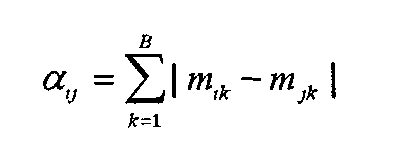
- the L1 norm of the mean segment histogram difference is used to visually compare a pair of segments i and j , where ⁇ ij denotes visual dissimilarity between segments i and j , B is the number of histogram bins, m ik is the value of the k - th bin of the mean color histogram of segment s i , and m jk is the value of the k-th bin of the mean color histogram of segment s j .
- ⁇ ij min( e i - b j , e j - b i )(1 - ⁇ ij )
- ⁇ ij denotes a Kronecker's delta
- b i ,e i denote first and last frames of segment s i
- b j ,e j denote first and last frames of segment s j .
- Fig. 3 shows the empirical distribution of home video shot duration for approximately 660 shots from a database with ground-truth, and its fitting by a Gaussian mixture model (see next subsection). (In Figure 3, the empirical distribution, and an estimated Gaussian mixture model consisting of six components, are superimposed. Duration was normalized to the longest duration found in the database (580 sec.).) Even though videos correspond to different scenarios and were filmed by multiple people, a clear temporal pattern is present (see also the Vasconcelos and Lippmann article).
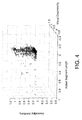
- Fig. 4 shows a scattering plot of 4000 labeled inter-segment feature vectors extracted from home video. (Half of the samples correspond to hypothesis H 1 (segment pair belongs together, labeled with light gray), and the other half to H 0 (segment pair does not belong together, labeled with dark gray). The features have been normalized. )
- EM is a known technique for finding ML estimates for a broad range of problems where the observed data is in some sense incomplete.
- the incomplete data are the unobserved mixture components, whose prior probabilities are the parameters ⁇ Pr( c ) ⁇ .
- EM is based on increasing the conditional expectation of the log-likelihood of the complete data given the observed data by using an iterative hill-climbing procedure.
- model selection i.e., the number of components of each mixture can be automatically estimated using the Minimum Description Length (MDL) principle (see J. Rissanen, "Modeling by Shortest Data Description", Automatica , 14:465-471, 1978).
- ⁇ ( p ) ) E ⁇ log p ( Y
- X h(Y) denotes a known many-to-one function (for example, a subset operator)
- x represents a sequence or vector of data
- p is an superscript that denotes the iteration number.
- E-step Find the expected likelihood of the complete data as a function of ⁇ , Q ( ⁇
- M-step Re-estimate parameters, according to
- EM is an iterative algorithm that converges to a local maximum of the likelihood of the sample set.
- Y ( X,I ), where I indicates the Gaussian component that has been used in generating each sample of the observed data.
- I indicates the Gaussian component that has been used in generating each sample of the observed data.
- y ( x,i), i ⁇ ⁇ 1,..., K ⁇ ⁇ .
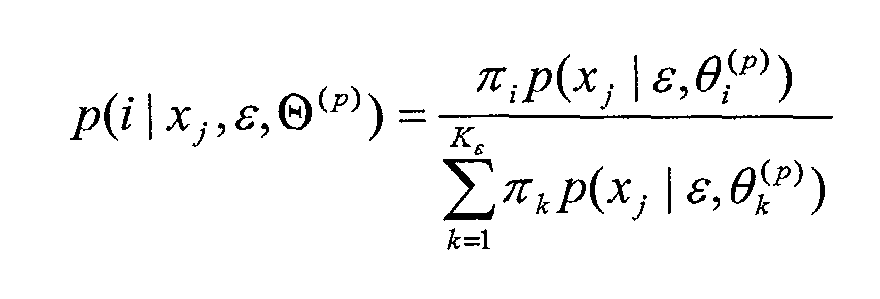
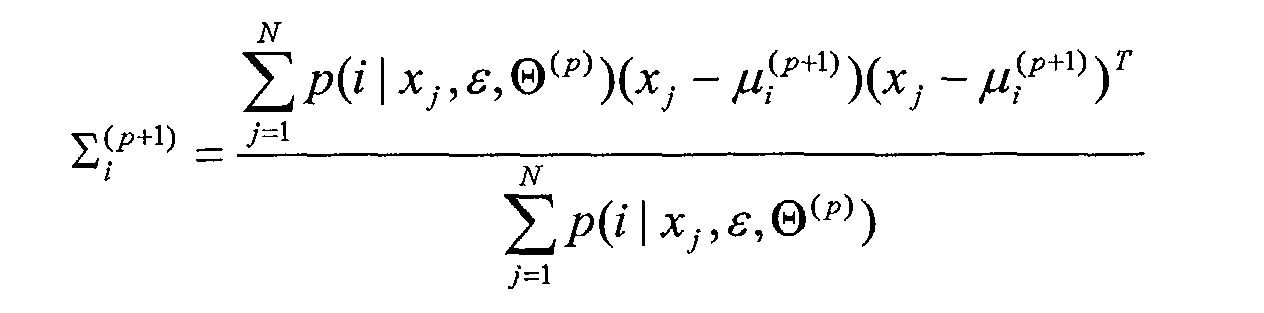
- EM takes a further simplified form: E-step: For all N training samples, and for all mixture components, compute the probability that Gaussian i fits the sample x j given the current estimation ⁇ ( p ) , M-step: Re-estimate parameters, The mean vectors and covariance matrices for each of the mixture components must be initialized in the first place.
- the means are initialized using the traditional K-means algorithm, while the covariance matrices are initialized with the identity matrix.
- data-driven initialization usually performs better than pure random initialization.
- a small amount of noise is added to each mean, to diminish the procedure to be trapped in local maxima.
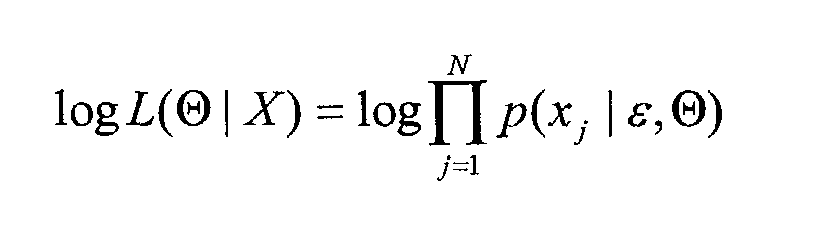
- the convergence criterion is defined by the rate of increase on the log-likelihood of the observed data in successive iterations, i.e., the EM iteration is terminated when log L ( ⁇ ( p +1)
- MDL Minimum Description Length
- the merging algorithm is implemented in the video segment merging stage 14. Any merging algorithm requires three elements: a feature model, a merging order, and a merging criterion (L. Garrido, P. Salembier, D. Garcia, "Extensive Operators in Partition Lattices for Image Sequence Analysis", Sign. Proc., 66(2): 157-180, 1998).
- the merging order determines which clusters should be probed for possible merging at each step of the process.
- the merging criterion decides whether the merging should occur or not.
- the feature model of each cluster should be updated if a merging occurs.
- the present video segment clustering method uses this general formulation, based on the statistical inter-segment models developed in the previous section. In the present algorithm, the class-conditionals are used to define both the merging order and the merging criterion.
- Merging algorithms can be efficiently implemented by the use of adjacency graphs and hierarchical queues, which allow for prioritized processing. Elements to be processed are assigned a priority, and introduced into the queue according to it. Then, the element that is extracted at each step is the one that has the highest priority.
- Hierarchical queues are now traditional tools in mathematical morphology. Their use in Bayesian image analysis first appeared in C. Chou and C. Brown, "The Theory and Practice of Bayesian Image Labeling", IJCV, 4, pp. 185-210, 1990, with the Highest Confidence First (HCF) optimization method. The concept is intuitively appealing: at each step, decisions should be made based on the piece of information that has the highest certainty. Recently, similar formulations have appeared in morphological processing.
- the segment merging method comprises two stages: a queue initialization stage 20 and a queue updating/depletion stage 30.
- the merging algorithm comprises a binary Bayes classifier, where the merging order is determined by a variation of Highest Confidence First (HCF), and the Maximum a Posteriori (MAP) criterion defines the merging criterion.
- HCF Highest Confidence First
- MAP Maximum a Posteriori
- intershot features x ij are computed for all pairs of adjacent shots in the video.
- the merging sequence i.e., a list with the successive merging of pairs of video segments, is stored and used to generate a hierarchy. Furthermore, for visualization and manipulation, after emptying the hierarchical queue in the merging algorithm, further merging of video segments is allowed to build a complete merging sequence that converges into a single segment (the whole video clip).
- the merging sequence is then represented by a partition tree 18 ( Figure 1), which is known to be an efficient structure for hierarchical representation of visual content, and provides the starting point for user interaction.
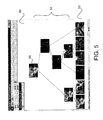
- FIG. 5 An example of a tree representation stage 50 appears in Fig. 5.
- a prototype of an interface to display the tree representation of the analyzed home video may be based on key frames, that is, a frame extracted from each segment.
- a set of functionalities that allow for manipulation (correction, augmentation, reorganization) of the automatically generated video clusters, along with cluster playback, and other VCR capabilities may be applied to the representation.
- the user may parse the video using this tree representation, retrieve preview clips and do video editing.
- Queue-based methods with real-valued priorities can be very efficiently implemented using binary search trees, where the operations of insertion, deletion and minimum/maximum location are straightforward.
- the implementation is related to the description in L. Garrido, P. Salembier and L. Garcia, "Extensive Operators in Partition Lattices for Image Sequence Analysis", Signal Processing, (66), 2, 1998, pp. 157-180.
- the merging sequence i.e. a list with the successive merging of pairs of video segments, is stored and used to generate a hierarchy.
- the first level 52 in the hierarchy is defined by key frames from the individual segments provided by the video segmentation stage 10.
- the second level stage 54 in the hierarchy is defined by key frames from the clusters generated by the algorithm used in the segment merging stage 14.
- BPT Binary Partition Tree
- each node (with exception of the leaves, which correspond to the initial shots) has two children.
- P. Salembier, L. Garrido "Binary Partition Tree as an Efficient Representation for Filtering, Segmentation, and Information Retrieval", IEEE Intl. Conference on Image Processing, ICIP '98, Chicago, Illinois, October 4-7, 1998.
- the BPT also provides the starting point to build a tool for user interaction.
- the tree representation provides an easy-to-use interface for visualization and manipulation (verification, correction, augmentation, reorganization) of the automatically generated video clusters.
- manual feedback mechanisms may improve the generation of video clusters, and additionally give users the possibility of actually doing something with their videos.
- an implementing program would read a merging sequence, and build the binary tree, representing each node of the sequence by a frame extracted from each segment.
- a random frame represents each leaf (shot) of the tree.
- Each parent node is represented by the child random-frame with smaller shot number.
- the term "random” may be preferred instead of "keyframe” because no effort was done in selecting it).
- the representation shown in Figure 5 is useful to visualize the merging process, identify erroneous clusters, or for general display when the number of shots is small, but it can become very deep to display when the original number of shots is large.
- a second version of the interface could display only the three levels of the hierarchy, i.e., the leaves of the tree, the clusters that were obtained as the result of the probabilistic merging algorithm, and the complete-video node.
- This mode of operation should allow for interactive reorganization of the merging sequence, so that the user can freely exchange video segments among clusters, combine clusters from multiple video clips, etc. Integration of either interface with other desired features, like playback of preview sequences when clicking on the tree nodes, and VCR capabilities, should be clear to those skilled in this art.
Landscapes
- Engineering & Computer Science (AREA)
- Multimedia (AREA)
- Theoretical Computer Science (AREA)
- Physics & Mathematics (AREA)
- General Physics & Mathematics (AREA)
- Library & Information Science (AREA)
- Data Mining & Analysis (AREA)
- Databases & Information Systems (AREA)
- General Engineering & Computer Science (AREA)
- Human Computer Interaction (AREA)
- Television Signal Processing For Recording (AREA)
- Image Analysis (AREA)
Abstract
Description
- Visual similarity is described by the mean segment histogram that represents segment appearance. The mean histogram represents both the presence of the dominant colors and their persistence within the segment.
- Temporal separation between segments is a strong indication of their belonging to the same cluster.
- Combined temporal duration of two individual segments is also a strong indicator about their belonging to the same cluster (e.g., two long shots are not likely to belong to the same video cluster).


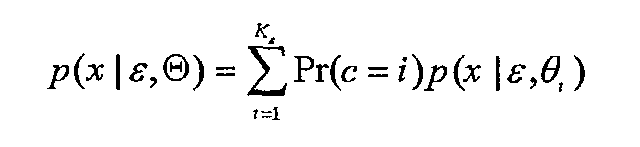
The well-known expectation-maximization (EM) algorithm constitutes the standard procedure for Maximum Likelihood estimation (ML) of the set of parameters Θ (see A. P. Dempster, N. M. Laird and D. B. Rubin, "Maximum Liklihood from Incomplete Data via the EM Algorithm", Journal of the Royal Statistical Society, Series B, 39:1-38, 1977). EM is a known technique for finding ML estimates for a broad range of problems where the observed data is in some sense incomplete. In the case of a Gaussian Mixture, the incomplete data are the unobserved mixture components, whose prior probabilities are the parameters {Pr(c)}. EM is based on increasing the conditional expectation of the log-likelihood of the complete data given the observed data by using an iterative hill-climbing procedure. Additionally, model selection, i.e., the number of components of each mixture can be automatically estimated using the Minimum Description Length (MDL) principle (see J. Rissanen, "Modeling by Shortest Data Description", Automatica, 14:465-471, 1978).
E-step: Find the expected likelihood of the complete data as a function of , Q(|(p)).
M-step: Re-estimate parameters, according to

E-step: For all N training samples, and for all mixture components, compute the probability that Gaussian i fits the sample xj given the current estimation Θ(p),



- The simplest assumption is Pr(ε = 0) = Pr(ε = 1) = 1/2, which turns the MAP criterion into the ML criterion.
- The priors themselves can be ML-estimated from training data (see Duda et
al., Pattern Classification, op. cit.). It is straightforward to show that, assuming
that the N are independent, the ML estimator of the priors is
where
 (e,k) is equal to one if the k-th training sample belongs to the class represented by ε = e, e ∈ {0,1}, and zero otherwise. In other words, the priors are simply weights determined by the available evidence (the training data).
- The dynamics involved in the merging algorithm (presented in the following section) also influences the prior knowledge in a sequential manner (it is expected that more segments will be merged at the beginning of the process, and less at the end). In other words, the prior can be dynamically updated based on this rationale.




Claims (10)
- A method for structuring video by probabilistic merging of video segments, said method comprising the steps of:a) obtaining a plurality of frames of unstructured video;b) generating video segments from the unstructured video by detecting shot boundaries based on color dissimilarity between consecutive frames;c) extracting a feature set by processing pairs of segments for visual dissimilarity and their temporal relationship, thereby generating an inter-segment visual dissimilarity feature and an inter-segment temporal relationship feature; andd) merging video segments with a merging criterion that applies a probabilistic analysis to the feature set, thereby generating a merging sequence representing the video structure.
- The method as claimed in claim 1 wherein step b) comprises the steps of:generating color histograms from the consecutive frames;generating a difference signal from the color histograms that represents the color dissimilarity between consecutive frames; andthresholding the difference signal based on a mean dissimilarity determined over a plurality of frames, thereby producing a signal that indicates an existence of a shot boundary.
- The method as claimed in claim 2 wherein the difference signal is based on a mean dissimilarity determined over a plurality of frames centered on one of the consecutive frames and corresponding in number of frames to a fraction of the frame rate of video capture.
- The method as claimed in claim 2 further including the step of morphologically transforming the thresholded difference signal with a pair of structuring elements that eliminate the presence of multiple adjacent shot boundaries.
- The method as claimed in claim 1 wherein the processing of pairs of segments for visual dissimilarity in step c) comprises the steps of computing a mean color histogram for each segment and computing a visual dissimilarity feature metric from the difference between mean color histograms for pairs of segments.
- The method as claimed in claim 1 wherein the processing of pairs of segments for their temporal relationship in step c) comprises the processing of pairs of segments for a temporal separation between pairs of segments and for an accumulated temporal duration between pairs of segments.
- The method as claimed in claim 1 wherein step d) comprises the steps of:generating parametric mixture models to represent class-conditional densities of the inter-segment features comprising the feature set; andapplying the merging criterion to the parametric mixture models.
- The method as claimed in claim 7 wherein step d) is performed in a hierarchical queue and comprises the steps of:initializing the queue by introducing each feature into the queue with a priority equal to the probability of merging each corresponding pair of segments;depleting the queue by merging the segments if the merging criterion is met; andupdating the model of the merged segment and then updating the queue based upon the updated model.
- The method as claimed in claim 1 wherein representing the merging sequence is represented in a hierarchical tree structure.
- A computer storage medium having instructions stored therein for causing a computer to perform the method of claim 1.
Applications Claiming Priority (2)
| Application Number | Priority Date | Filing Date | Title |
|---|---|---|---|
| US927041 | 2001-08-09 | ||
| US09/927,041 US7296231B2 (en) | 2001-08-09 | 2001-08-09 | Video structuring by probabilistic merging of video segments |
Publications (3)
| Publication Number | Publication Date |
|---|---|
| EP1286278A2 true EP1286278A2 (en) | 2003-02-26 |
| EP1286278A3 EP1286278A3 (en) | 2003-03-05 |
| EP1286278B1 EP1286278B1 (en) | 2006-12-06 |
Family
ID=25454072
Family Applications (1)
| Application Number | Title | Priority Date | Filing Date |
|---|---|---|---|
| EP02078086A Expired - Lifetime EP1286278B1 (en) | 2001-08-09 | 2002-07-29 | Video structuring by probabilistic merging of video segments |
Country Status (4)
| Country | Link |
|---|---|
| US (2) | US7296231B2 (en) |
| EP (1) | EP1286278B1 (en) |
| JP (1) | JP4197905B2 (en) |
| DE (1) | DE60216547T2 (en) |
Cited By (5)
| Publication number | Priority date | Publication date | Assignee | Title |
|---|---|---|---|---|
| US7653241B2 (en) | 2004-07-15 | 2010-01-26 | Nippon Telegraph And Telephone Corporation | Signal detection method, signal detection system, signal detection processing program, and recording medium recorded with program thereof |
| WO2010055242A1 (en) * | 2008-11-13 | 2010-05-20 | France Telecom | Method for cutting multimedia content, and corresponding device and computer program |
| EP2149118A4 (en) * | 2007-04-20 | 2012-03-07 | Google Inc | Media advertising |
| EP1845477A3 (en) * | 2006-03-30 | 2013-06-26 | Kabushiki Kaisha Toshiba | Moving image division apparatus, caption extraction apparatus, method and program |
| US9400842B2 (en) | 2009-12-28 | 2016-07-26 | Thomson Licensing | Method for selection of a document shot using graphic paths and receiver implementing the method |
Families Citing this family (84)
| Publication number | Priority date | Publication date | Assignee | Title |
|---|---|---|---|---|
| US7075683B1 (en) * | 1999-02-15 | 2006-07-11 | Canon Kabushiki Kaisha | Dynamic image digest automatic editing system and dynamic image digest automatic editing method |
| KR100694238B1 (en) * | 2000-09-28 | 2007-03-14 | 가부시키가이샤 리코 | Structure editing method, image structure editing method, object content structure management method, object content structure display method, content management method and recording medium |
| US7143352B2 (en) * | 2002-11-01 | 2006-11-28 | Mitsubishi Electric Research Laboratories, Inc | Blind summarization of video content |
| US7082572B2 (en) * | 2002-12-30 | 2006-07-25 | The Board Of Trustees Of The Leland Stanford Junior University | Methods and apparatus for interactive map-based analysis of digital video content |
| US7127127B2 (en) * | 2003-03-04 | 2006-10-24 | Microsoft Corporation | System and method for adaptive video fast forward using scene generative models |
| KR100609154B1 (en) * | 2003-05-23 | 2006-08-02 | 엘지전자 주식회사 | Method and device for playing video content |
| US7292737B2 (en) * | 2003-08-15 | 2007-11-06 | Microsoft Corporation | Unified bayesian framework for shape registration |
| KR100590537B1 (en) * | 2004-02-18 | 2006-06-15 | 삼성전자주식회사 | Summary Method and Device of Multiple Images |
| JP4511850B2 (en) * | 2004-03-03 | 2010-07-28 | 学校法人早稲田大学 | Person attribute identification method and system |
| JP4660736B2 (en) * | 2004-09-24 | 2011-03-30 | 独立行政法人産業技術総合研究所 | Moving picture time division processing method and apparatus |
| US7640218B2 (en) * | 2005-01-18 | 2009-12-29 | Fuji Xerox Co., Ltd. | Efficient methods for temporal event clustering of digital photographs |
| US7735111B2 (en) * | 2005-04-29 | 2010-06-08 | The Directv Group, Inc. | Merging of multiple encoded audio-video streams into one program with source clock frequency locked and encoder clock synchronized |
| US7561206B2 (en) * | 2005-06-29 | 2009-07-14 | Microsoft Corporation | Detecting progressive video |
| US7551234B2 (en) * | 2005-07-28 | 2009-06-23 | Seiko Epson Corporation | Method and apparatus for estimating shot boundaries in a digital video sequence |
| KR100703801B1 (en) * | 2005-10-21 | 2007-04-06 | 삼성전자주식회사 | Method for calculating a task, method for providing summary information for calculating a task, and apparatus therefor |
| US7773813B2 (en) * | 2005-10-31 | 2010-08-10 | Microsoft Corporation | Capture-intention detection for video content analysis |
| US9554093B2 (en) | 2006-02-27 | 2017-01-24 | Microsoft Technology Licensing, Llc | Automatically inserting advertisements into source video content playback streams |
| US8009193B2 (en) * | 2006-06-05 | 2011-08-30 | Fuji Xerox Co., Ltd. | Unusual event detection via collaborative video mining |
| US8064662B2 (en) * | 2006-07-17 | 2011-11-22 | Siemens Medical Solutions Usa, Inc. | Sparse collaborative computer aided diagnosis |
| ITTO20060534A1 (en) * | 2006-07-20 | 2008-01-21 | Si Sv El S P A | AUTOMATIC MANAGEMENT OF DIGITAL ARCHIVES IN PARTICULAR OF AUDIO AND / OR VIDEO FILES |
| US20080127270A1 (en) * | 2006-08-02 | 2008-05-29 | Fuji Xerox Co., Ltd. | Browsing video collections using hypervideo summaries derived from hierarchical clustering |
| CN101689394B (en) * | 2007-02-01 | 2014-03-26 | 耶路撒冷希伯来大学伊森姆研究发展有限公司 | Method and system for video indexing and video synopsis |
| US20080231741A1 (en) * | 2007-03-21 | 2008-09-25 | Mcintyre Dale F | Camera with multiple displays |
| US20080231740A1 (en) * | 2007-03-21 | 2008-09-25 | Mcintyre Dale F | Camera with multiple displays |
| US8154600B2 (en) * | 2007-04-20 | 2012-04-10 | Utc Fire & Security Americas Corporation, Inc. | Method and system for distributed multiple target tracking |
| JP2010531561A (en) * | 2007-06-15 | 2010-09-24 | コーニンクレッカ フィリップス エレクトロニクス エヌ ヴィ | Method and apparatus for automatically generating a summary of multimedia files |
| US20080319844A1 (en) * | 2007-06-22 | 2008-12-25 | Microsoft Corporation | Image Advertising System |
| US9304994B2 (en) * | 2007-08-30 | 2016-04-05 | At&T Intellectual Property Ii, L.P. | Media management based on derived quantitative data of quality |
| JP5060224B2 (en) * | 2007-09-12 | 2012-10-31 | 株式会社東芝 | Signal processing apparatus and method |
| US8654255B2 (en) * | 2007-09-20 | 2014-02-18 | Microsoft Corporation | Advertisement insertion points detection for online video advertising |
| EP2206114A4 (en) | 2007-09-28 | 2012-07-11 | Gracenote Inc | Synthesizing a presentation of a multimedia event |
| AU2007231756B2 (en) * | 2007-10-30 | 2011-04-07 | Canon Kabushiki Kaisha | A method of segmenting videos into a hierachy of segments |
| US20090171787A1 (en) * | 2007-12-31 | 2009-07-02 | Microsoft Corporation | Impressionative Multimedia Advertising |
| US8804005B2 (en) | 2008-04-29 | 2014-08-12 | Microsoft Corporation | Video concept detection using multi-layer multi-instance learning |
| JP5231928B2 (en) * | 2008-10-07 | 2013-07-10 | 株式会社ソニー・コンピュータエンタテインメント | Information processing apparatus and information processing method |
| US8207989B2 (en) * | 2008-12-12 | 2012-06-26 | Microsoft Corporation | Multi-video synthesis |
| JP5159654B2 (en) * | 2009-01-23 | 2013-03-06 | 株式会社東芝 | Video processing apparatus and video processing method |
| US9190110B2 (en) | 2009-05-12 | 2015-11-17 | JBF Interlude 2009 LTD | System and method for assembling a recorded composition |
| US11232458B2 (en) * | 2010-02-17 | 2022-01-25 | JBF Interlude 2009 LTD | System and method for data mining within interactive multimedia |
| US9171578B2 (en) | 2010-08-06 | 2015-10-27 | Futurewei Technologies, Inc. | Video skimming methods and systems |
| US8923607B1 (en) | 2010-12-08 | 2014-12-30 | Google Inc. | Learning sports highlights using event detection |
| US8621355B2 (en) * | 2011-02-02 | 2013-12-31 | Apple Inc. | Automatic synchronization of media clips |
| WO2012175783A1 (en) * | 2011-06-21 | 2012-12-27 | Nokia Corporation | Video remixing system |
| US8706675B1 (en) * | 2011-08-29 | 2014-04-22 | Google Inc. | Video content claiming classifier |
| US9020294B2 (en) * | 2012-01-18 | 2015-04-28 | Dolby Laboratories Licensing Corporation | Spatiotemporal metrics for rate distortion optimization |
| KR20130111061A (en) * | 2012-03-30 | 2013-10-10 | 한국전자통신연구원 | Image encoding method using binary partition tree |
| US9015201B2 (en) * | 2012-04-24 | 2015-04-21 | Honeywell International Inc. | Discriminative classification using index-based ranking of large multimedia archives |
| CN103578094B (en) * | 2012-07-20 | 2016-07-13 | 清华大学 | Shot segmentation method |
| US8818037B2 (en) * | 2012-10-01 | 2014-08-26 | Microsoft Corporation | Video scene detection |
| CN103235806B (en) * | 2013-04-19 | 2016-04-20 | 北京理工大学 | The intersegmental relation recognition method of internet video sheet based on time-space relationship |
| US10552887B1 (en) | 2013-09-14 | 2020-02-04 | DemoChimp, Inc. | Web-based automated product demonstration |
| US9501719B1 (en) * | 2013-10-28 | 2016-11-22 | Eyecue Vision Technologies Ltd. | System and method for verification of three-dimensional (3D) object |
| US9792957B2 (en) | 2014-10-08 | 2017-10-17 | JBF Interlude 2009 LTD | Systems and methods for dynamic video bookmarking |
| US9436876B1 (en) * | 2014-12-19 | 2016-09-06 | Amazon Technologies, Inc. | Video segmentation techniques |
| JP6421669B2 (en) * | 2015-03-26 | 2018-11-14 | 富士通株式会社 | Evaluation method, evaluation program, and evaluation apparatus |
| US10331787B2 (en) * | 2015-04-06 | 2019-06-25 | Omniscience Corporation | Distributed storytelling framework for intelligence analysis |
| US10582265B2 (en) | 2015-04-30 | 2020-03-03 | JBF Interlude 2009 LTD | Systems and methods for nonlinear video playback using linear real-time video players |
| US10460765B2 (en) | 2015-08-26 | 2019-10-29 | JBF Interlude 2009 LTD | Systems and methods for adaptive and responsive video |
| US11497988B2 (en) | 2015-08-31 | 2022-11-15 | Omniscience Corporation | Event categorization and key prospect identification from storylines |
| US9971904B2 (en) * | 2015-09-30 | 2018-05-15 | Robert Bosch Gmbh | Method and system for range search on encrypted data |
| US11128853B2 (en) | 2015-12-22 | 2021-09-21 | JBF Interlude 2009 LTD | Seamless transitions in large-scale video |
| US11856271B2 (en) | 2016-04-12 | 2023-12-26 | JBF Interlude 2009 LTD | Symbiotic interactive video |
| US10282632B1 (en) * | 2016-09-21 | 2019-05-07 | Gopro, Inc. | Systems and methods for determining a sample frame order for analyzing a video |
| US10268898B1 (en) * | 2016-09-21 | 2019-04-23 | Gopro, Inc. | Systems and methods for determining a sample frame order for analyzing a video via segments |
| US11205103B2 (en) | 2016-12-09 | 2021-12-21 | The Research Foundation for the State University | Semisupervised autoencoder for sentiment analysis |
| US11050809B2 (en) | 2016-12-30 | 2021-06-29 | JBF Interlude 2009 LTD | Systems and methods for dynamic weighting of branched video paths |
| CN109982066B (en) * | 2017-12-27 | 2021-02-02 | 浙江宇视科技有限公司 | Diagnostic particle calculation method, device and readable storage medium |
| US10257578B1 (en) | 2018-01-05 | 2019-04-09 | JBF Interlude 2009 LTD | Dynamic library display for interactive videos |
| CN112836687B (en) * | 2018-05-10 | 2024-05-10 | 北京影谱科技股份有限公司 | Video behavior segmentation method, device, computer equipment and medium |
| US11601721B2 (en) | 2018-06-04 | 2023-03-07 | JBF Interlude 2009 LTD | Interactive video dynamic adaptation and user profiling |
| CN109086774B (en) * | 2018-08-02 | 2021-09-03 | 武汉大学 | Color image binarization method and system based on naive Bayes |
| US11490047B2 (en) | 2019-10-02 | 2022-11-01 | JBF Interlude 2009 LTD | Systems and methods for dynamically adjusting video aspect ratios |
| US11093755B2 (en) | 2019-11-19 | 2021-08-17 | International Business Machines Corporation | Video segmentation based on weighted knowledge graph |
| US12096081B2 (en) | 2020-02-18 | 2024-09-17 | JBF Interlude 2009 LTD | Dynamic adaptation of interactive video players using behavioral analytics |
| US11245961B2 (en) | 2020-02-18 | 2022-02-08 | JBF Interlude 2009 LTD | System and methods for detecting anomalous activities for interactive videos |
| WO2021257925A1 (en) * | 2020-06-18 | 2021-12-23 | Board Of Regents Of The University Of Nebraska | Materials and methods for long-term tracking of group-housed livestock |
| US12047637B2 (en) | 2020-07-07 | 2024-07-23 | JBF Interlude 2009 LTD | Systems and methods for seamless audio and video endpoint transitions |
| CN112149575B (en) * | 2020-09-24 | 2024-05-24 | 新华智云科技有限公司 | Method for automatically screening fragments with automobile parts from video |
| CN114501165A (en) * | 2020-10-23 | 2022-05-13 | 国家广播电视总局广播电视科学研究院 | Video structured representation method and device and electronic equipment |
| US11882337B2 (en) | 2021-05-28 | 2024-01-23 | JBF Interlude 2009 LTD | Automated platform for generating interactive videos |
| US12155897B2 (en) | 2021-08-31 | 2024-11-26 | JBF Interlude 2009 LTD | Shader-based dynamic video manipulation |
| US12549818B2 (en) | 2021-08-31 | 2026-02-10 | JBF Interlude 2009 LTD | Shader-based dynamic video manipulation |
| US11934477B2 (en) | 2021-09-24 | 2024-03-19 | JBF Interlude 2009 LTD | Video player integration within websites |
| CN118918538B (en) * | 2024-10-12 | 2025-01-21 | 宁波高新区敏智科技有限公司 | A monitoring and analysis system and method based on artificial intelligence |
Family Cites Families (25)
| Publication number | Priority date | Publication date | Assignee | Title |
|---|---|---|---|---|
| US5664227A (en) | 1994-10-14 | 1997-09-02 | Carnegie Mellon University | System and method for skimming digital audio/video data |
| US5805733A (en) | 1994-12-12 | 1998-09-08 | Apple Computer, Inc. | Method and system for detecting scenes and summarizing video sequences |
| US5821945A (en) | 1995-02-03 | 1998-10-13 | The Trustees Of Princeton University | Method and apparatus for video browsing based on content and structure |
| US5969755A (en) * | 1996-02-05 | 1999-10-19 | Texas Instruments Incorporated | Motion based event detection system and method |
| US5675382A (en) * | 1996-04-08 | 1997-10-07 | Connectix Corporation | Spatial compression and decompression for video |
| US5828809A (en) | 1996-10-01 | 1998-10-27 | Matsushita Electric Industrial Co., Ltd. | Method and apparatus for extracting indexing information from digital video data |
| JP2001503895A (en) | 1996-11-15 | 2001-03-21 | サーノフ コーポレイション | Method and apparatus for effectively displaying, storing, and accessing video information |
| US6263507B1 (en) * | 1996-12-05 | 2001-07-17 | Interval Research Corporation | Browser for use in navigating a body of information, with particular application to browsing information represented by audiovisual data |
| US5963653A (en) * | 1997-06-19 | 1999-10-05 | Raytheon Company | Hierarchical information fusion object recognition system and method |
| US5956026A (en) | 1997-12-19 | 1999-09-21 | Sharp Laboratories Of America, Inc. | Method for hierarchical summarization and browsing of digital video |
| US6249285B1 (en) * | 1998-04-06 | 2001-06-19 | Synapix, Inc. | Computer assisted mark-up and parameterization for scene analysis |
| US6278466B1 (en) * | 1998-06-11 | 2001-08-21 | Presenter.Com, Inc. | Creating animation from a video |
| US6721454B1 (en) * | 1998-10-09 | 2004-04-13 | Sharp Laboratories Of America, Inc. | Method for automatic extraction of semantically significant events from video |
| US6263103B1 (en) * | 1998-11-30 | 2001-07-17 | Mitsubishi Electric Research Laboratories, Inc. | Estimating scenes using statistical properties of images and scenes |
| WO2000045603A1 (en) | 1999-01-29 | 2000-08-03 | Sony Corporation | Signal processing method and video/voice processing device |
| US6373979B1 (en) * | 1999-01-29 | 2002-04-16 | Lg Electronics, Inc. | System and method for determining a level of similarity among more than one image and a segmented data structure for enabling such determination |
| US6462754B1 (en) * | 1999-02-22 | 2002-10-08 | Siemens Corporate Research, Inc. | Method and apparatus for authoring and linking video documents |
| US6535639B1 (en) * | 1999-03-12 | 2003-03-18 | Fuji Xerox Co., Ltd. | Automatic video summarization using a measure of shot importance and a frame-packing method |
| EP1129573A2 (en) * | 1999-07-06 | 2001-09-05 | Koninklijke Philips Electronics N.V. | Automatic extraction method of the structure of a video sequence |
| US6489989B1 (en) * | 1999-09-15 | 2002-12-03 | Electric Planet, Inc. | System, method and article of manufacture for executing a video setup protocol |
| US6642940B1 (en) * | 2000-03-03 | 2003-11-04 | Massachusetts Institute Of Technology | Management of properties for hyperlinked video |
| US6747707B2 (en) * | 2000-03-31 | 2004-06-08 | Matsushita Electric Industrial Co., Ltd. | Data editing system for finally editing a recording medium using received compressed data |
| US6616529B1 (en) * | 2000-06-19 | 2003-09-09 | Intel Corporation | Simulation and synthesis of sports matches |
| AU2001283004A1 (en) * | 2000-07-24 | 2002-02-05 | Vivcom, Inc. | System and method for indexing, searching, identifying, and editing portions of electronic multimedia files |
| US20020157116A1 (en) * | 2000-07-28 | 2002-10-24 | Koninklijke Philips Electronics N.V. | Context and content based information processing for multimedia segmentation and indexing |
-
2001
- 2001-08-09 US US09/927,041 patent/US7296231B2/en not_active Expired - Lifetime
-
2002
- 2002-07-29 DE DE60216547T patent/DE60216547T2/en not_active Expired - Lifetime
- 2002-07-29 EP EP02078086A patent/EP1286278B1/en not_active Expired - Lifetime
- 2002-08-07 JP JP2002230037A patent/JP4197905B2/en not_active Expired - Fee Related
-
2007
- 2007-09-19 US US11/857,597 patent/US20080059885A1/en not_active Abandoned
Cited By (7)
| Publication number | Priority date | Publication date | Assignee | Title |
|---|---|---|---|---|
| US7653241B2 (en) | 2004-07-15 | 2010-01-26 | Nippon Telegraph And Telephone Corporation | Signal detection method, signal detection system, signal detection processing program, and recording medium recorded with program thereof |
| EP1713059A4 (en) * | 2004-07-15 | 2012-07-04 | Nippon Telegraph & Telephone | SIGNAL DETECTION METHOD, SIGNAL DETECTION SYSTEM, SIGNAL DETECTION PROGRAM, AND RECORDING MEDIUM ON WHICH THE PROGRAM IS RECORDED |
| EP1845477A3 (en) * | 2006-03-30 | 2013-06-26 | Kabushiki Kaisha Toshiba | Moving image division apparatus, caption extraction apparatus, method and program |
| EP2149118A4 (en) * | 2007-04-20 | 2012-03-07 | Google Inc | Media advertising |
| US8874468B2 (en) | 2007-04-20 | 2014-10-28 | Google Inc. | Media advertising |
| WO2010055242A1 (en) * | 2008-11-13 | 2010-05-20 | France Telecom | Method for cutting multimedia content, and corresponding device and computer program |
| US9400842B2 (en) | 2009-12-28 | 2016-07-26 | Thomson Licensing | Method for selection of a document shot using graphic paths and receiver implementing the method |
Also Published As
| Publication number | Publication date |
|---|---|
| JP4197905B2 (en) | 2008-12-17 |
| EP1286278A3 (en) | 2003-03-05 |
| US20030058268A1 (en) | 2003-03-27 |
| US20080059885A1 (en) | 2008-03-06 |
| US7296231B2 (en) | 2007-11-13 |
| DE60216547T2 (en) | 2007-09-27 |
| DE60216547D1 (en) | 2007-01-18 |
| EP1286278B1 (en) | 2006-12-06 |
| JP2003069924A (en) | 2003-03-07 |
Similar Documents
| Publication | Publication Date | Title |
|---|---|---|
| EP1286278B1 (en) | Video structuring by probabilistic merging of video segments | |
| Sultana et al. | Unsupervised deep context prediction for background estimation and foreground segmentation. | |
| Dimitrova et al. | Video classification based on HMM using text and faces | |
| US8170280B2 (en) | Integrated systems and methods for video-based object modeling, recognition, and tracking | |
| Hoiem et al. | Object-based image retrieval using the statistical structure of images | |
| JP5174445B2 (en) | Computer-implemented video scene boundary detection method | |
| Haq et al. | Video summarization techniques: a review | |
| US5821945A (en) | Method and apparatus for video browsing based on content and structure | |
| Asghar et al. | Video indexing: a survey | |
| Eickeler et al. | Content based indexing of images and video using face detection and recognition methods | |
| Avrithis et al. | Broadcast news parsing using visual cues: A robust face detection approach | |
| JP2004046827A (en) | Adaptive mixed learning in dynamic systems | |
| Petrogianni et al. | Film shot type classification based on camera movement styles | |
| Naphade | On supervision and statistical learning for semantic multimedia analysis | |
| Wachman et al. | Tools for browsing a TV situation comedy based on content specific attributes | |
| Rui et al. | A unified framework for video browsing and retrieval | |
| Saravanan et al. | Data mining framework for video data | |
| Naphade | A probablistic framework for mapping audio-visual features to high-level semantics in terms of concepts and context | |
| Gatica-Perez et al. | Consumer Video Structuring by Probabilistic Merging of Video Segments. | |
| Li et al. | Image/video segmentation: Current status, trends, and challenges | |
| Hari et al. | Human face based approach for video summarization | |
| Zumer et al. | Color-independent classification of animation video | |
| Dimitrova et al. | Video classification using object tracking | |
| Lippman et al. | Human interfaces to video | |
| Yang et al. | Improved Quality Keyframe Selection Method for HD Video. |
Legal Events
| Date | Code | Title | Description |
|---|---|---|---|
| PUAI | Public reference made under article 153(3) epc to a published international application that has entered the european phase |
Free format text: ORIGINAL CODE: 0009012 |
|
| PUAL | Search report despatched |
Free format text: ORIGINAL CODE: 0009013 |
|
| AK | Designated contracting states |
Kind code of ref document: A2 Designated state(s): AT BE BG CH CY CZ DE DK EE ES FI FR GB GR IE IT LI LU MC NL PT SE SK TR |
|
| AX | Request for extension of the european patent |
Extension state: AL LT LV MK RO SI |
|
| AK | Designated contracting states |
Designated state(s): AT BE BG CH CY CZ DE DK EE ES FI FR GB GR IE IT LI LU MC NL PT SE SK TR Kind code of ref document: A3 Designated state(s): AT BE BG CH CY CZ DE DK EE ES FI FR GB GR IE IT LI LU MC NL PT SE SK TR |
|
| AX | Request for extension of the european patent |
Extension state: AL LT LV MK RO SI |
|
| 17P | Request for examination filed |
Effective date: 20030807 |
|
| AKX | Designation fees paid |
Designated state(s): DE FR GB |
|
| 17Q | First examination report despatched |
Effective date: 20031107 |
|
| GRAP | Despatch of communication of intention to grant a patent |
Free format text: ORIGINAL CODE: EPIDOSNIGR1 |
|
| GRAS | Grant fee paid |
Free format text: ORIGINAL CODE: EPIDOSNIGR3 |
|
| GRAA | (expected) grant |
Free format text: ORIGINAL CODE: 0009210 |
|
| RBV | Designated contracting states (corrected) |
Designated state(s): DE GB |
|
| AK | Designated contracting states |
Kind code of ref document: B1 Designated state(s): DE GB |
|
| REG | Reference to a national code |
Ref country code: GB Ref legal event code: FG4D |
|
| REF | Corresponds to: |
Ref document number: 60216547 Country of ref document: DE Date of ref document: 20070118 Kind code of ref document: P |
|
| PLBE | No opposition filed within time limit |
Free format text: ORIGINAL CODE: 0009261 |
|
| STAA | Information on the status of an ep patent application or granted ep patent |
Free format text: STATUS: NO OPPOSITION FILED WITHIN TIME LIMIT |
|
| 26N | No opposition filed |
Effective date: 20070907 |
|
| REG | Reference to a national code |
Ref country code: DE Ref legal event code: R082 Ref document number: 60216547 Country of ref document: DE Representative=s name: MUELLER-BORE & PARTNER PATENTANWAELTE, EUROPEA, DE |
|
| REG | Reference to a national code |
Ref country code: DE Ref legal event code: R082 Ref document number: 60216547 Country of ref document: DE Representative=s name: MUELLER-BORE & PARTNER PATENTANWAELTE, EUROPEA, DE Effective date: 20130430 Ref country code: DE Ref legal event code: R081 Ref document number: 60216547 Country of ref document: DE Owner name: INTELLECTUAL VENTURES FUND 83 LLC (N.D.GES.D.S, US Free format text: FORMER OWNER: EASTMAN KODAK CO., ROCHESTER, US Effective date: 20130430 Ref country code: DE Ref legal event code: R081 Ref document number: 60216547 Country of ref document: DE Owner name: INTELLECTUAL VENTURES FUND 83 LLC (N.D.GES.D.S, US Free format text: FORMER OWNER: EASTMAN KODAK CO., ROCHESTER, N.Y., US Effective date: 20130430 Ref country code: DE Ref legal event code: R082 Ref document number: 60216547 Country of ref document: DE Representative=s name: MUELLER-BORE & PARTNER PATENTANWAELTE PARTG MB, DE Effective date: 20130430 |
|
| REG | Reference to a national code |
Ref country code: GB Ref legal event code: 732E Free format text: REGISTERED BETWEEN 20130711 AND 20130717 |
|
| PGFP | Annual fee paid to national office [announced via postgrant information from national office to epo] |
Ref country code: DE Payment date: 20130731 Year of fee payment: 12 |
|
| REG | Reference to a national code |
Ref country code: DE Ref legal event code: R119 Ref document number: 60216547 Country of ref document: DE |
|
| PG25 | Lapsed in a contracting state [announced via postgrant information from national office to epo] |
Ref country code: DE Free format text: LAPSE BECAUSE OF NON-PAYMENT OF DUE FEES Effective date: 20150203 |
|
| REG | Reference to a national code |
Ref country code: DE Ref legal event code: R119 Ref document number: 60216547 Country of ref document: DE Effective date: 20150203 |
|
| PGFP | Annual fee paid to national office [announced via postgrant information from national office to epo] |
Ref country code: GB Payment date: 20170727 Year of fee payment: 16 |
|
| GBPC | Gb: european patent ceased through non-payment of renewal fee |
Effective date: 20180729 |
|
| PG25 | Lapsed in a contracting state [announced via postgrant information from national office to epo] |
Ref country code: GB Free format text: LAPSE BECAUSE OF NON-PAYMENT OF DUE FEES Effective date: 20180729 |