EP1284581A2 - Preventing excessive use of security keys in a wireless communications security system - Google Patents
Preventing excessive use of security keys in a wireless communications security system Download PDFInfo
- Publication number
- EP1284581A2 EP1284581A2 EP02016503A EP02016503A EP1284581A2 EP 1284581 A2 EP1284581 A2 EP 1284581A2 EP 02016503 A EP02016503 A EP 02016503A EP 02016503 A EP02016503 A EP 02016503A EP 1284581 A2 EP1284581 A2 EP 1284581A2
- Authority
- EP
- European Patent Office
- Prior art keywords
- value
- channel
- station
- hfn
- established
- Prior art date
- Legal status (The legal status is an assumption and is not a legal conclusion. Google has not performed a legal analysis and makes no representation as to the accuracy of the status listed.)
- Granted
Links
- 238000000034 method Methods 0.000 claims description 24
- 239000000872 buffer Substances 0.000 description 19
- 230000011664 signaling Effects 0.000 description 16
- 230000005540 biological transmission Effects 0.000 description 9
- 230000001360 synchronised effect Effects 0.000 description 9
- 238000010586 diagram Methods 0.000 description 4
- 230000008569 process Effects 0.000 description 4
- 230000008859 change Effects 0.000 description 3
- 230000001934 delay Effects 0.000 description 3
- 230000006870 function Effects 0.000 description 3
- 230000000694 effects Effects 0.000 description 2
- 239000000284 extract Substances 0.000 description 2
- 230000004044 response Effects 0.000 description 2
- 230000004075 alteration Effects 0.000 description 1
- 230000008901 benefit Effects 0.000 description 1
- 230000001413 cellular effect Effects 0.000 description 1
- 238000005336 cracking Methods 0.000 description 1
- 238000001514 detection method Methods 0.000 description 1
- 230000004048 modification Effects 0.000 description 1
- 238000012986 modification Methods 0.000 description 1
- 230000000737 periodic effect Effects 0.000 description 1
Images

Classifications
-
- H—ELECTRICITY
- H04—ELECTRIC COMMUNICATION TECHNIQUE
- H04W—WIRELESS COMMUNICATION NETWORKS
- H04W12/00—Security arrangements; Authentication; Protecting privacy or anonymity
- H04W12/02—Protecting privacy or anonymity, e.g. protecting personally identifiable information [PII]
-
- H—ELECTRICITY
- H04—ELECTRIC COMMUNICATION TECHNIQUE
- H04L—TRANSMISSION OF DIGITAL INFORMATION, e.g. TELEGRAPHIC COMMUNICATION
- H04L63/00—Network architectures or network communication protocols for network security
- H04L63/20—Network architectures or network communication protocols for network security for managing network security; network security policies in general
- H04L63/205—Network architectures or network communication protocols for network security for managing network security; network security policies in general involving negotiation or determination of the one or more network security mechanisms to be used, e.g. by negotiation between the client and the server or between peers or by selection according to the capabilities of the entities involved
-
- H—ELECTRICITY
- H04—ELECTRIC COMMUNICATION TECHNIQUE
- H04W—WIRELESS COMMUNICATION NETWORKS
- H04W12/00—Security arrangements; Authentication; Protecting privacy or anonymity
- H04W12/04—Key management, e.g. using generic bootstrapping architecture [GBA]
-
- H—ELECTRICITY
- H04—ELECTRIC COMMUNICATION TECHNIQUE
- H04W—WIRELESS COMMUNICATION NETWORKS
- H04W12/00—Security arrangements; Authentication; Protecting privacy or anonymity
- H04W12/60—Context-dependent security
- H04W12/61—Time-dependent
Definitions
- the present invention relates to security count values in a wireless communications system.
- the present invention discloses a method for ensuring that security counts generated by a hyper-frame number are re-used as little as possible over the lifetime of a security key.
- Fig.1 is a simplified block diagram of a prior art wireless communications system.
- the wireless communications system includes a first station 10 in wireless communications with a second station 20.
- the first station 10 could be a mobile unit, such as a cellular telephone, and the second station 20 could be a base station.
- the first station 10 communicates with the second station 20 over a plurality of channels 12.
- the second station 20 thus has corresponding channels 22, one for each of the channels 12.
- Each channel 12 has a receiving buffer 12r for holding protocol data units (PDUs) 11r received from the corresponding channel 22 of the second station 20.
- Each channel 12 also has a transmitting buffer 12t for holding PDUs 11t that are awaiting transmission to the corresponding channel 22 of the second station 20.
- PDUs protocol data units
- a PDU 11t is transmitted by the first station 10 along a channel 12 and received by the second station 20 to generate a corresponding PDU 21r in the receiving buffer 22r of the corresponding channel 22.
- a PDU 21t is transmitted by the second station 20 along a channel 22 and received by the first station 10 to generate a corresponding PDU 11r in the receiving buffer 12r of the corresponding channel 12.
- each PDU 11r, 11t, 21r and 21t along corresponding channels 12 and 22 are identical. That is, a transmitted PDU 11t generates an identical corresponding received PDU 21r, and vice versa. Furthermore, both the first station 10 and the second station 20 use identical PDU 11t, 21t data structures. Although the data structure of each PDU 11r, 11t, 21r and 21t along corresponding channels 12 and 22 is identical, different channels 12 and 22 may use different PDU data structures according to the type of connection agreed upon along the corresponding channels 12 and 22. In general, though, every PDU 11r, 11t, 21r and 21t will have a sequence number 5r, 5t, 6r, 6t.
- the sequence number 5r, 5t, 6r, 6t is an m-bit number that is incremented for each PDU 11r, 11t, 21r, 21t.
- the magnitude of the sequence number 5r, 5t, 6r, 6t thus indicates the sequential ordering of the PDU 11r, 11t, 21r, 21t in its buffer 12r, 12t, 22r, 22t.
- the sequence number 5t, 6t is often explicitly carried by the PDU 11t, 21t, but may also be implicitly assigned by the station 10, 20. For example, in an acknowledged mode setup for corresponding channels 12 and 22, each transmitted PDU 11t, successful reception of which generates an identical corresponding PDU 21r, is explicitly confirmed by the second station 20.
- a 12-bit sequence number 5t is explicitly carried by each PDU 11t.
- the second station 20 scans the sequence numbers 6r embedded within the received PDUs 21r to determine the sequential ordering of the PDUs 21r, and to determine if any PDUs 21r are missing.
- the second station 20 can then send a message to the first station 10 that indicates which PDUs 21r were received by using the sequence numbers 6r of each received PDU 21r, or may request that a PDU 11t be re-transmitted by specifying the sequence number 5t of the PDU 11t to be re-transmitted. Alternatively, in a so-called transparent transmission mode, data is never confirmed as successfully received.
- the sequence numbers 5t, 6t are not explicitly carried in the PDUs 11t, 21t.
- the first station 10 simply internally assigns a 7-bit sequence number 5t to each PDU 11t.
- the second station 20 similarly assigns a 7-bit sequence number 6r to each PDU 21r.
- the sequence numbers 5t maintained by the first station 10 for the PDUs 11t are identical to the corresponding sequence numbers 6r for the PDUs 21r that are maintained by the second station 20.
- Hyper-frame numbers are also maintained by the first station 10 and the second station 20.
- Hyper-frame numbers may be thought of as high-order bits of the sequence numbers 5t, 6t that are never physically transmitted with the PDUs 11t, 21t, except in rare cases of special signaling PDUs 11t, 21t that are used for synchronization. And in these cases, the HFNs are not carried as part of the sequence number 11t, 21t, but instead are carried in fields of the data payload of the signaling PDU 11t, 21t, and thus are more properly signaling data. As each transmitted PDU 11t, 21t generates a corresponding received PDU 21r, 11r, hyper-frame numbers are also maintained for received PDUs 11r, 21r.
- Each channel 12 of the first station 10 thus has a receiving hyper-frame number (HFN R ) 13r and a transmitting hyper-frame number (HFN T ) 13t.
- the corresponding channel 22 on the second station 20 has a HFN R 23r and a HFN T 23t.
- the first station 10 detects roll-over of the sequence numbers 5r of PDUs 11r in the receiving buffer 12r, the first station 10 increments the HFN R 13r.
- sequence numbers 5t of transmitted PDUs 11t the first station 10 increments the HFN T 13t.
- a similar process occurs on the second station 20 for the HFN R 23r and HFN T 23t.
- the HFN R 13r of the first station 10 should thus be synchronized with (i.e., identical to) the HFN T 23t of the second station 20. Similarly, the HFN T 13t of the first station 10 should be synchronized with (i.e., identical to) the HFN R 23r of the second station 20.
- the PDUs 11t and 21t are not transmitted "out in the open".
- a security engine 14 on the first station, and a corresponding security engine 24 on the second station 20, are together used to ensure secure and private exchanges of data exclusively between the first station 10 and the second station 20.
- the security engine 14, 24 has two primary functions. The first is the obfuscation (i.e., ciphering, or encryption) of data held within a PDU 11t, 21t so that the PDU 11t, 21t presents a meaningless collection of random numbers to an eavesdropper. The second is to verify the integrity of data contained within the PDUs 11r, 21r. This is used to prevent another, improper, station from masquerading as either the first station 10 or the second station 20.
- the first station 10 can be certain that a PDU 11r was, in fact, transmitted by the second station 20, and vice versa.
- the security engine 14 uses, amongst other inputs, an n-bit security count 14c and a key 14k to perform the ciphering functions to the PDU 11t.
- the security engine 24 must use an identical security count 24c and key 24k.
- data integrity checking on the first station 10 uses an n-bit security count that must be synchronized with a corresponding security count on the second station 20.
- the ciphering security count 14c, 24c is considered in the following.
- the keys 14k and 24k remain constant across all PDUs 11t and 21t (and thus corresponding PDUs 21r and 11r), until explicitly changed by both the first station 10 and the second station 20.
- the security counts 14c and 24c continuously change with each PDU 11t and 21t. This constant changing of the security count 14c, 24c makes decrypting (and spoofing) of PDUs 11t, 21t more difficult, as it reduces statistical consistency of inputs into the security engine 14, 24.
- the security count 14c for a PDU 11t is generated by using the sequence number 5t of the PDU 11t as the low order bits of the security count 14c, and the HFN T 13t associated with the sequence number 5t as the high order bits of the security count 14c.
- the security count 14c for a PDU 11r is generated from the sequence number 5r of the PDU 11r and the HFN R 13r of the PDU 11r.
- An identical process occurs on the second station 20, in which the security count 24c is generated using the sequence number 6r, 6t and the appropriate HFN R 23r or HFN T 23t.
- the security count 14c, 24c has a fixed bit size, say 32 bits.
- the hyper-frame numbers HFN R 13r, HFN R 23r, HFN T 13t and HFN T 23t must vary in bit size in a corresponding manner to yield the fixed bit size of the security count 14c, 24c.
- the sequence numbers 5r, 6r, 5t, 6t are all 7 bits in size.
- the hyper-frame numbers HFN R 13r, HFN R 23r, HFN T 13t and HFN T 23t are thus 25 bits in size; combining the two together yields a 32 bit security count 14c, 24c.
- sequence numbers 5r, 6r, 5t, 6t are all 12 bits in size.
- the hyper-frame numbers HFN R 13r, HFN R 23r, HFN T 13t and HFN T 23t are thus 20 bits in size so that combining the two together continues to yield a 32 bit security count 14c, 24c.
- the first station 10 Initially, there are no established channels 12 and 22 between the first station 10 and the second station 20.
- the first station 10 thus establishes a channel 12 with the second station 20. To do this, the first station 10 must determine an initial value for the HFN T 13t and HFN R 13r.
- the first station 10 references a non-volatile memory 16, such as a flash memory device or a SIM card, for a start value 16s, and uses the start value 16s to generate the initial value for the HFN T 13t and the HFN R 13r.
- the start value 16s holds the x most significant bits (MSB x ) of a hyper-frame number from a previous session along a channel 12.
- x should be at least as large as the bit size of the smallest-sized hyper-frame number (i.e., for the above example, x should be at least 20 bits in size).
- the MSB X of the HFN T 13t and the HFN R 13r are set to the start value 16s, and the remaining low order bits are set to zero.
- the first station 10 then transmits the start value 16s to the second station 20 (by way of a special signaling PDU 11t) for use as the HFN R 23r and the HFN T 23t. In this manner, the HFN T 13t is synchronized with the HFN R 23r, and the HFN T 23t is synchronized with the HFN R 13r.
- the first station 10 may establish a plurality of channels 12 with the second station 20. Each of these channels 12 uses its own sequence numbers 5r and 5t, and hyper-frame numbers 13r and 13t.
- the first station 10 considers the HFN T 13t and HFN R 13r of all currently established channels 12, selecting the HFN T 13t or HFN R 13r with the highest value.
- the first station 10 then extracts the MSB x of this highest-valued hyper-frame number 13r, 13t, increments the MSB x by one, and uses it as the MSB x for the new HFN T 13t and HFN R 13r for a newly established channel 12.
- Synchronization is then performed between the first station 10 and the second station 20 to provide the MSB x to the second station 20 for the HFN R 23r and HFN T 23t. In this manner, a constantly incrementing spacing is ensured between the security counts 14c of all established channels 12.
- the keys 14k and 24k should be changed after a predetermined interval. This interval is determined by the security count 14c, 24c.
- the security count 14c, 24c exceeds a predetermined value, the first station 10 and second station 20 initiate a security command to change the keys 14k and 24k.
- a hyper-frame number must be remembered between sessions (that is, remembered between when the first station 10 is turned off and then turned back on again), which is the purpose of the start value 16s.
- the MSB x of the HFN T 13t or HFN R 13r for this channel 12 are extracted (depending on which is the larger, HFN T 13t or HFN R 13r), incremented by one, and then saved in the start value 16s.
- the first station 10 uses the start value 16s, and the security count 14c is thus ensured to continuously rise.
- the first station 10 establishes a signaling channel 12 with the second station 20.
- This signaling channel 12 is used to carry special signaling PDUs 11t for the communications protocol, and is established quite early on after the first station 10 is turned on.
- Signaling channels 12 tend to have a long duration, but generally do not carry much data.
- both the HFN T 13t and the HFN R 13r of the signaling channel 12 will have relatively small values, as the hyper-frame numbers 13t, 13r are created early on and are infrequently incremented due to low PDU 11t, 11r traffic loads.
- data channels 12 may be established sporadically and have high PDU 11t, 11r throughput.
- the HFN T 13t, or HFN R 13r, of such a data channel 12 may thus become quite large in comparison to that of the signaling channel 12.
- the signaling channel 12 will continue to exist, and so the hyper-frame numbers 13t, 13r associated with the data channel 12 are lost.
- a data channel 12 may have much larger hyper-frame numbers 13t, 13r than the signaling channel 12, it is the signaling channel 12 that is finally the last channel 12 to be released, and so it is the HFN T 13t, or HFN R 13r, of the signaling channel 12 that is used to generate the start value 16s.
- the preferred embodiment of the present invention discloses a method for storing and managing a start value in a wireless communications device.
- the start value is x bits in size arid is used to provide an initial value to an n-bit security count value.
- the wireless communications device is capable of establishing a plurality of channels and capable of releasing established channels. For every channel established by the wireless communications device, a corresponding terminal value is obtained. A terminal value for a channel is the highest value reached by the x most significant bits (MSB x ) of an n-bit security count value associated with the channel. A final value is obtained that is the greatest value of all the terminal values.
- MSB x most significant bits
- a start value is stored in the memory of the wireless device that is at least as large as the final value.
- the present invention method reduces re-use of security count values, and encourages a more rapid changing of security keys. A minimum re-use of security count values is obtained, while maintaining a maximum security key usage. Overall transmission security is enhanced by avoiding unnecessary delays to the changing of the security key.
- a station may be a mobile telephone, a handheld transceiver, a base station, a personal data assistant (PDA), a computer, or any other device that requires a wireless exchange of data. It should be understood that many means may be used for the physical layer to effect wireless transmissions, and that any such means may be used for the system hereinafter disclosed.
- PDA personal data assistant
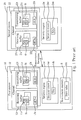
- Fig.2 is a simplified block diagram of a wireless communications system 30 according to the present invention.
- the wireless communications system 30 is much as that of the prior art, as it is the primary objective of the present invention to change the method used for managing a start value 46s.
- the wireless communications system 30 includes a first station 40 in wireless communications with a second station 50 over a plurality of established channels 42.
- the first station 40 may be a mobile unit that establishes a channel 42 to effect communications with the second station 50 that is a base station.
- the second station 50 establishes a corresponding channel 52 for the channel 42 of the first station 40.
- the first station 40 may also release an established channel 42, in which case the second station 50 releases the corresponding channel 52.
- Each channel 42 has a receiving buffer 42r and a transmitting buffer 42t.
- each channel 52 has a receiving buffer 52r and a transmitting buffer 52t.
- the receiving buffer 42r is used to hold protocol data units (PDUs) 41r received from the second station 50.
- the transmitting buffer 42t is used to hold PDUs 41t awaiting transmission to the second station 50.
- a PDU 41t is transmitted along its channel 42 to the second station 50, where it is received and placed into the receiving buffer 52r of the corresponding channel 52.
- a PDU 51t is transmitted along its channel 52 to the first station 40, where it is received and placed into the receiving buffer 42r of the corresponding channel 42.
- Each PDU 41r, 41t, 51r, 51t has an m-bit sequence number (SN) 35r, 35t, 36r, 36t that indicates the sequential position of the PDU 41r, 41t, 51r, 51t within its respective buffer 42r, 42t, 52r, 52t. Sequentially later PDUs 41r, 41t, 51r, 51t have sequentially higher sequence numbers 35r, 35t, 36r, 36t. As the sequence number 35r, 35t, 36r, 36t has a fixed bit size, the sequence number 35r, 35t, 36r, 36t will rollover to zero when its value exceeds 2 m -1.
- the receiving buffers 42r, 52r each have a respective receiving hyper-frame number (HFN R ) 43r, 53r that is incremented by one upon detection of such a roll-over event of the sequence number 35r, 36r of received PDUs 41r, 51r.
- the HFN R 43r, 53r associated with each received PDU 41r, 51r thus serves as high-order bits (most significant bits) for the sequence number 35r, 36r of the received PDU 41r, 51r.
- each transmitting buffer 42t, 52t has a respective transmitting hyper-frame number (HFN T ) 43t, 53t that serves as the high-order, most significant bits of the sequence number 35t, 36t of each transmitted PDU 41t, 51t.
- the hyper-frame numbers 43r, 43t, 53r, 53t are internally maintained by the first station 40 and second station 50, and are explicitly transmitted only during synchronization events. This is in contrast to the sequence numbers 35t, 36t, which are typically carried by their respective PDUs 41t, 51t.
- the first station 40 has a security engine 44 that is used to perform enciphering/deciphering and data integrity checks of the PDUs 41r, 41t.
- Two of a multiple of inputs into the security engine particularly include an n-bit security count 44c, and a ciphering key 44k.
- a corresponding security engine 54 is provided on the second station 50, which also uses an n-bit security count 54c and a ciphering key 54k.
- a PDU 41t is enciphered by the security engine 44 using a distinct security count 44c, and ciphering key 44k.
- the security engine 54 To properly decipher the corresponding received PDU 52r, the security engine 54 must use a security count 54c that is identical to the security count 44c, and a ciphering key 54k that is identical to the ciphering key 44k. Integrity checking of PDUs 41r, 41t, 51r, 51t also utilizes synchronized security counts, but as these integrity security counts are almost invariably smaller than the ciphering security counts 44c, 54c, for purposes of the following discussion it is the ciphering security counts 44c, 54c that are considered.
- the ciphering key 44k, 54k is changed relatively infrequently, and involves a somewhat complicated signaling process between the first station 40 and second station 50 to ensure that the respective ciphering keys 44k, 54k remain synchronized (i.e., are identical).
- the security count 44c, 54c continuously changes for each PDU 41r, 41t, 51r, 51t along the channel 42, 52.
- the security count 44c is generated for each PDU 41r, 41t by using the sequence number 35r, 35t of the PDU 41r, 41t as the low-order (least significant) bits of the security count 44c, and the HFN R 43r, HFN T 43t, respectively associated with the PDU 41r, 41t, as the high-order bits of the security count 44c.
- a corresponding process is used by the security engine 54 of the second station 50.
- the security count 44c continuously increases with each PDU 41t. The same is thus also true for streams of PDUs 51t transmitted by the second station 50.
- the range of security count values 44c used by the various channels 42 may vary widely. All channels 42, however, use the same ciphering key 44k.
- the first station 40 has no established channels 42 with the second station 50.
- the first station 40 first extracts a start value 46s from a non-volatile memory 46 of the first station 40, and uses this start value 46s to generate the HFN T 43t and the HFN R 43r for the channel 42 that is to be established.
- the non-volatile memory 46 is used to permanently store data for the first station 40, and may be an electrically erasable read-only memory (EEROM), a SIM card, or the like, so that the start value 46s is not lost when the first station 40 is turned off.
- the bit size of the start value 46s should be equal to the bit size of the hyper-frame numbers 43t and 43r.
- the HFN T 43t and the HFN R 43r are simply set equal to the start value 46s. If, however, the start value 46s is x bits in size for m-bit hyper-frame number 43t, 43r, and x is less than m, then the start value 46s is used as the x most significant bits (MSB x ) of the hyper-frame numbers 43t, 43r, and the remaining low-order bits of HFN T 43t and HFN R 43r are simply cleared.
- MSB x most significant bits
- the first station 40 After generating the hyper-frame numbers 43t and 43r by way of the start value 46s, the first station 40 transmits the start value 46s to the second station 50 so that the second station 50 may set the HFN R 53r and the HFN T 53t of the corresponding channel 52 equal to the initial value of the hyper-frame numbers 43t and 43r. In this manner, the HFN T 43t is synchronized with the corresponding HFN R 53r, and the HFN R 43r is synchronized with the corresponding HFN T 53t.
- the start value 46s is an x-bit sized number
- the HFN T 43t is used as the most significant bits of the security count 44c for transmitted PDUs 41t
- the start value effectively holds the MSB x of the n-bit security count 44c, where n is equal to the sum of the bit size of the HFN T 43t and the bit size of the sequence number 35t. This is also true for the security count 44c for received PDUs 41r, as regards HFN R 43r.
- Many other channels 42 may be established by the first station 40 (or in response to a channel 52 being established by the second station 50) after an initial channel 42 has been established.
- the first station 40 first selects the numerically greatest hyper-frame number 43t or 43r from all of the established channels 42.
- the MSB x of this numerically greatest hyper-frame number 43r, 43t are extracted to generate an x-bit final value 45. If this x-bit final value 45 is less than 2 x -1, then the final value 45 is incremented by one.
- the final value 45 is checked against the start value 46s. If the final value 45 is less than the start value 46s, then the final value 45 is set equal to the start value 46s.
- the final value 45 is then used as the MSB x for the HFN T 43t and the HFN R 43r of the new channel 42 being established. Synchronization is then performed between the first station 40 and the second station 50 to establish initial values for HFN R 43r and HFN R 53r.
- the first station 40 may release an established channel 42.
- an established channel 42 When an established channel 42 is released, memory used by the channel 42 is freed. The corresponding receiving buffer 42r and transmitting buffer 42t are thus removed, and the HFN R 43r and HFN T 43t are lost.
- the first station 40 first selects the numerically greatest HFN T 43t or HFN R 43r concurrently reached by all established channels 42, including the terminal value of the HFN T 43t and the HFN R 43r of the channel 42 that is to be released.
- a terminal value of a hyper-frame number 43r, 43t is the last value reached just before the corresponding channel 42 is released.
- the MSB x of this numerically greatest hyper-frame number 43t, 43r are extracted to generate an x-bit final value 45. If this x-bit final value 45 is less than 2 x -1, then the final value 45 is incremented by one. If the final value 45 is then greater than the start value 46s, the final value 45 is stored in the non-volatile memory 46 as the start value 46s.
- the first station 40 may set the final value 45 equal to the MSB x of the terminal value of the larger of the HFN T 43t or the HFN R 43r of the channel 42 that is being released. If this final value 45 is less than 2 x -1, then the final value 45 is incremented by one. If the final value 45 is then greater than the start value 46s, the final value 45 is stored in the non-volatile memory 46 as the start value 46s.
- the end result is that, upon the release of a last channel 42 (after which there will be no established channels 42), the start value 46s will hold a value that is one greater than the highest terminal value reached by the MSB x of the hyper-frame numbers 43t, 43r of all channels 42 that were established, which is the primary objective of the present invention. To prevent rollover of the start value 46s, the start value 46s is not permitted to exceed 2 x -1.
- the first station 40 By ensuring the start value 46s is consistent with the MSB x of the largest security count 44c reached by any of the channels 42 of the first station 40, the first station 40 ensures that excessive re-use of security count values 44c is prevented, and that the security count 44c steadily advances across sessions, without falling back to previous values. As changing of the ciphering key 44k depends upon the magnitude of the security count 44c, the first station 40 ensures that the ciphering key 44k is not used for an excessive length of time. This helps to further ensure the security of the communications system 30, as periodic changing of the ciphering keys 44k, 54k makes cracking of the security engines 44, 54 more difficult.
- the first station 40 is a mobile phone and the second station 50 is a base station.
- the bit size of the start value 46s equals the bit size of the hyper-frame numbers 43r and 43t.
- the first station 40 is turned on and establishes an initial channel 42 with the second station 50, beginning a session.
- a session indicates the period of time spanned from the establishing of a first channel 42, to the releasing of a final channel 42.
- the first channel 42 is, in fact, the very first channel 42 established by the first station 40 with the second station 50, there being no other established channels 42, and is usually in response to the first station 40 being turned on.
- the final channel 42 is the very last channel release by the first station 40, so that thereafter there are no established channels 42 with the second station 50, which usually occurs just prior to the first station 40 being turned off. Assuming that the start value 46s holds an initial value of 147, the first station 40 will, after being turned on, use the start value 46s as the HFN T 43t and the HFN R 43r of the newly established first channel 42. HFN T 43t for the first channel 42 will thus have a value of 147, as will the HFN R 43r. Generally speaking, the first channel 42 will usually be a signaling channel 42, which tends to have a relatively low transmission rate of PDUs 41t. Some time later, the first station 40 establishes a data channel 42 with the second station 50.
- HFN T 43t will be the larger of the hyper-frame numbers 43t, 43r for the first channel 42, and may have incremented only once, to a value of 148.
- the first station 40 first finds the greatest value of all the hyper-frame numbers 43t, 43r across all established channels 42. There being only one currently established channel 42, the first channel 42, the result of this search yields the value of 148 from the HFN T 43t of the first channel 42.
- This value is incremented by one and then compared to the start value 46s, and the larger of the two is selected and used as the HFN T 43t and HFN R 43r for the data channel 42.
- the data channel 42 thus obtains an HFN T 43t having an initial value of 149, and an HFN R 43r that also has the initial value of 149.
- the data channel 42 is finally released. Due to the high traffic volumes along the data channel 42, the HFN R 43r for the data channel 42 increased from the initial value of 149 to a terminal value of 231, and is greater than the terminal value of the HFN T 43t for the data channel 42 (i.e., the data channel 42 received a great deal more PDUs 41r than it transmitted).
- the first station 40 compares the HFN R 43r of the data channel 42 with the start value 46s. Finding that the HFN R 43r of the data channel 42 is greater than the start value 46s, the HFN R 43r is incremented by one and then stored as the start value 46s. The start value 46s thus holds a value of 232. Any subsequently-established channel 42 would thus have an HFN T 43t and an HFN R 43r of at least 232.
- the present invention provides for updating a start value stored in non-volatile memory each time an established channel is released. In this manner, the x most significant bits of the largest value reached by the security count for every established channel is preserved in the non-volatile memory. Excessive re-use of security count values is thus prevented, and ciphering keys are not used for an excessive period of time.
Landscapes
- Engineering & Computer Science (AREA)
- Computer Security & Cryptography (AREA)
- Computer Networks & Wireless Communication (AREA)
- Signal Processing (AREA)
- Computer Hardware Design (AREA)
- Computing Systems (AREA)
- General Engineering & Computer Science (AREA)
- Mobile Radio Communication Systems (AREA)
- Transceivers (AREA)
Abstract
Description
Claims (11)
- A method for determining a start value to be stored in a memory of a wireless communications device, the start value being x bits in size and used to provide an initial value to an n-bit security count value, the wireless communications device capable of establishing a plurality of channels and capable of releasing established channels, the method comprising:for at least two channels established by the wireless communications device, obtaining a corresponding terminal value, the terminal value of the corresponding channel being the highest value reached by the x most significant bits (MSBx) of an n-bit security count value associated with the channel;obtaining a final value that is the greatest value of all the terminal values; andstoring a start value in the memory of the wireless device that is at least as large as the final value.
- The method of claim 1 wherein if the final value is not greater than a start value previously stored in the memory, then the final value is set to be at least as great as the start value previously stored in the memory.
- The method of claim 2 wherein the start value stored in the memory is greater than both the final value and the previously stored start value.
- The method of claim 3 wherein if the final value exceeds a predetermined value, then the final value is set equal to the predetermined value.
- The method of claim 4 wherein the predetermined value is determined by 2x so as to prevent roll-over of the start value stored in the memory.
- A method for managing a start value in a wireless communications device, the start value being x bits in size and used to provide an initial value to an n-bit security count value, the wireless communications device capable of establishing a plurality of channels, each channel having an associated n-bit security count value, and capable of releasing established channels, the method comprising:for an initial established channel, setting the x most significant bits (MSBx) of the n-bit security count value associated with the initial established channel to a first value, the first value being at least as great as the start value stored in a memory of the wireless communications device;for a subsequently established channel, setting the MSBx of the n-bit security count value associated with the subsequently established channel to a second value, the second value being at least as great as the greatest value reached of all the MSBx of all the n-bit security count values associated with all established channels;upon release of any of the established channels when at least another channel is established, generating a third value that is at least as great as the greatest value reached of all the MSBx of all the n-bit security count values associated with all the established channels and the n-bit security count value associated with the released channel; andstoring the third value in the memory as the start value.
- The method of claim 6 wherein the third value stored in the memory is greater than the first value.
- The method of claim 6 wherein if the third value exceeds a predetermined value, then the third value is set equal to the predetermined value.
- The method of claim 8 wherein the predetermined value is determined by 2x so as to prevent roll-over of the start value.
- The method of claim 6 wherein the second value is further set to be at least as great as the start value stored in the memory.
- The method of claim 6 wherein the third value is further set to be at least as great as the start value stored in the memory.
Applications Claiming Priority (2)
| Application Number | Priority Date | Filing Date | Title |
|---|---|---|---|
| US09/682,311 US6728529B2 (en) | 2001-08-16 | 2001-08-16 | Preventing excessive use of security keys in a wireless communications security system |
| US682311 | 2001-08-16 |
Publications (3)
| Publication Number | Publication Date |
|---|---|
| EP1284581A2 true EP1284581A2 (en) | 2003-02-19 |
| EP1284581A3 EP1284581A3 (en) | 2005-04-20 |
| EP1284581B1 EP1284581B1 (en) | 2009-07-15 |
Family
ID=24739133
Family Applications (1)
| Application Number | Title | Priority Date | Filing Date |
|---|---|---|---|
| EP02016503A Expired - Lifetime EP1284581B1 (en) | 2001-08-16 | 2002-07-23 | Preventing excessive use of security keys in a wireless communications security system |
Country Status (6)
| Country | Link |
|---|---|
| US (1) | US6728529B2 (en) |
| EP (1) | EP1284581B1 (en) |
| KR (1) | KR100543802B1 (en) |
| CN (1) | CN1246981C (en) |
| DE (1) | DE60232936D1 (en) |
| TW (1) | TW589847B (en) |
Families Citing this family (9)
| Publication number | Priority date | Publication date | Assignee | Title |
|---|---|---|---|---|
| GB0004178D0 (en) * | 2000-02-22 | 2000-04-12 | Nokia Networks Oy | Integrity check in a communication system |
| US6925183B2 (en) * | 2001-08-16 | 2005-08-02 | Asustek Computer Inc. | Preventing shortened lifetimes of security keys in a wireless communications security system |
| US6968200B2 (en) * | 2002-08-26 | 2005-11-22 | Asustek Computer Inc. | Method of initializing hyper-frame numbers during an establishment of a new radio bearer in a wireless communication system |
| US6925298B2 (en) * | 2002-08-26 | 2005-08-02 | Asustek Computer Inc. | Initialization for hyper frame number of signaling radio bearers |
| US7734051B2 (en) * | 2004-11-30 | 2010-06-08 | Novell, Inc. | Key distribution |
| EP1806943A2 (en) * | 2006-01-04 | 2007-07-11 | Innovative Sonic Limited | Method and apparatus of modifying integrity protection configuration in a mobile user equipment of a wireless communications system |
| US8724548B2 (en) * | 2010-04-22 | 2014-05-13 | Qualcomm Incorporated | Counter check procedure for packet data transmission |
| US20140219451A1 (en) * | 2013-02-07 | 2014-08-07 | Mediatek Inc. | Adaptive security apparatus and method for updating security parameter |
| US9820216B1 (en) | 2014-05-12 | 2017-11-14 | Sprint Communications Company L.P. | Wireless traffic channel release prevention before update process completion |
Family Cites Families (6)
| Publication number | Priority date | Publication date | Assignee | Title |
|---|---|---|---|---|
| FI108827B (en) * | 1998-01-08 | 2002-03-28 | Nokia Corp | A method for implementing connection security in a wireless network |
| FI111433B (en) * | 1998-01-29 | 2003-07-15 | Nokia Corp | Procedure for the confidentiality of data communications and cellular radio systems |
| KR19990081310A (en) * | 1998-04-28 | 1999-11-15 | 유기범 | Authentication value generation method using mobile terminal in personal communication exchange |
| FI106494B (en) * | 1998-11-05 | 2001-02-15 | Nokia Networks Oy | Ramsynkroniseringsmekanism |
| US6473613B2 (en) * | 1998-12-18 | 2002-10-29 | Conexant Systems, Inc. | Method and system for generating a secure wireless link between a handset and base station |
| FI110974B (en) * | 2000-03-01 | 2003-04-30 | Nokia Corp | Initialization of a counter, especially for radio frames |
-
2001
- 2001-08-16 US US09/682,311 patent/US6728529B2/en not_active Expired - Lifetime
-
2002
- 2002-07-22 KR KR1020020042983A patent/KR100543802B1/en not_active Expired - Lifetime
- 2002-07-23 EP EP02016503A patent/EP1284581B1/en not_active Expired - Lifetime
- 2002-07-23 DE DE60232936T patent/DE60232936D1/en not_active Expired - Lifetime
- 2002-08-01 TW TW091117531A patent/TW589847B/en not_active IP Right Cessation
- 2002-08-08 CN CNB021277672A patent/CN1246981C/en not_active Expired - Lifetime
Also Published As
| Publication number | Publication date |
|---|---|
| EP1284581B1 (en) | 2009-07-15 |
| TW589847B (en) | 2004-06-01 |
| KR100543802B1 (en) | 2006-01-23 |
| KR20030015841A (en) | 2003-02-25 |
| DE60232936D1 (en) | 2009-08-27 |
| EP1284581A3 (en) | 2005-04-20 |
| CN1442964A (en) | 2003-09-17 |
| CN1246981C (en) | 2006-03-22 |
| US6728529B2 (en) | 2004-04-27 |
| US20030036377A1 (en) | 2003-02-20 |
Similar Documents
| Publication | Publication Date | Title |
|---|---|---|
| USRE49393E1 (en) | Preventing shortened lifetimes of security keys in a wireless communications security system | |
| US6925298B2 (en) | Initialization for hyper frame number of signaling radio bearers | |
| US9420468B2 (en) | Method and apparatus to implement security in a long term evolution wireless device | |
| US7233671B2 (en) | Method for storing a security start value in a wireless communications system | |
| JP4066371B2 (en) | Security reconfiguration in UMTS | |
| US6829358B2 (en) | Processing channel resets while performing a ciphering configuration change in a wireless communications protocol | |
| EP2071885A2 (en) | Method of handling security key change and related communication device | |
| KR20030062412A (en) | A system for ensuring encrypted communication after handover | |
| KR20030019318A (en) | Counter initialization, particularly for radio frames | |
| EP1284581B1 (en) | Preventing excessive use of security keys in a wireless communications security system | |
| US7813505B2 (en) | Sequence number synchronization for ciphering | |
| US7054306B2 (en) | Method for handling ciphering status in a wireless network | |
| US6968200B2 (en) | Method of initializing hyper-frame numbers during an establishment of a new radio bearer in a wireless communication system | |
| US20050169480A1 (en) | Fast ciphering key search for WLAN receivers | |
| JP2004080071A (en) | Method for preventing excessive use of security key in wireless communication security system | |
| CN114531721A (en) | Method for establishing tunnel and processing message and AC | |
| HK1066373A1 (en) | Local authentication in a communication system | |
| HK1066373B (en) | Local authentication in a communication system |
Legal Events
| Date | Code | Title | Description |
|---|---|---|---|
| PUAI | Public reference made under article 153(3) epc to a published international application that has entered the european phase |
Free format text: ORIGINAL CODE: 0009012 |
|
| AK | Designated contracting states |
Designated state(s): AT BE BG CH CY CZ DE DK EE ES FI FR GB GR IE IT LI LU MC NL PT SE SK TR |
|
| AX | Request for extension of the european patent |
Extension state: AL LT LV MK RO SI |
|
| PUAL | Search report despatched |
Free format text: ORIGINAL CODE: 0009013 |
|
| AK | Designated contracting states |
Kind code of ref document: A3 Designated state(s): AT BE BG CH CY CZ DE DK EE ES FI FR GB GR IE IT LI LU MC NL PT SE SK TR |
|
| AX | Request for extension of the european patent |
Extension state: AL LT LV MK RO SI |
|
| 17P | Request for examination filed |
Effective date: 20050713 |
|
| AKX | Designation fees paid |
Designated state(s): DE FI FR GB SE |
|
| GRAP | Despatch of communication of intention to grant a patent |
Free format text: ORIGINAL CODE: EPIDOSNIGR1 |
|
| RIC1 | Information provided on ipc code assigned before grant |
Ipc: H04W 8/00 20090101AFI20090303BHEP |
|
| GRAS | Grant fee paid |
Free format text: ORIGINAL CODE: EPIDOSNIGR3 |
|
| GRAA | (expected) grant |
Free format text: ORIGINAL CODE: 0009210 |
|
| AK | Designated contracting states |
Kind code of ref document: B1 Designated state(s): DE FI FR GB SE |
|
| REG | Reference to a national code |
Ref country code: GB Ref legal event code: FG4D |
|
| REF | Corresponds to: |
Ref document number: 60232936 Country of ref document: DE Date of ref document: 20090827 Kind code of ref document: P |
|
| REG | Reference to a national code |
Ref country code: SE Ref legal event code: TRGR |
|
| PLBE | No opposition filed within time limit |
Free format text: ORIGINAL CODE: 0009261 |
|
| STAA | Information on the status of an ep patent application or granted ep patent |
Free format text: STATUS: NO OPPOSITION FILED WITHIN TIME LIMIT |
|
| 26N | No opposition filed |
Effective date: 20100416 |
|
| REG | Reference to a national code |
Ref country code: FR Ref legal event code: PLFP Year of fee payment: 15 |
|
| REG | Reference to a national code |
Ref country code: FR Ref legal event code: PLFP Year of fee payment: 16 |
|
| REG | Reference to a national code |
Ref country code: FR Ref legal event code: PLFP Year of fee payment: 17 |
|
| PGFP | Annual fee paid to national office [announced via postgrant information from national office to epo] |
Ref country code: FR Payment date: 20210422 Year of fee payment: 20 Ref country code: FI Payment date: 20210427 Year of fee payment: 20 |
|
| PGFP | Annual fee paid to national office [announced via postgrant information from national office to epo] |
Ref country code: SE Payment date: 20210421 Year of fee payment: 20 Ref country code: GB Payment date: 20210503 Year of fee payment: 20 |
|
| PGFP | Annual fee paid to national office [announced via postgrant information from national office to epo] |
Ref country code: DE Payment date: 20210420 Year of fee payment: 20 |
|
| REG | Reference to a national code |
Ref country code: DE Ref legal event code: R071 Ref document number: 60232936 Country of ref document: DE |
|
| REG | Reference to a national code |
Ref country code: FI Ref legal event code: MAE |
|
| REG | Reference to a national code |
Ref country code: GB Ref legal event code: PE20 Expiry date: 20220722 |
|
| REG | Reference to a national code |
Ref country code: SE Ref legal event code: EUG |
|
| PG25 | Lapsed in a contracting state [announced via postgrant information from national office to epo] |
Ref country code: GB Free format text: LAPSE BECAUSE OF EXPIRATION OF PROTECTION Effective date: 20220722 |